

Submitted:
24 September 2026
Posted:
28 September 2026
You are already at the latest version
Abstract
Hemoglobin subunit beta (HBB) is essential for balanced hemoglobin assembly, and mutations in its short coding sequence cause severe hemoglobinopathies such as β-thalassemia. Pathogenic variants are not randomly distributed but cluster into mutation regions, forming hotspots that influence structural stability and disease progression. To characterize mutation regions, this study shifts focus from isolated point mutations to contiguous hotspot neighborhoods, defining 26 regions from 109 pathogenic mutation sites in the HBB human protein. Quantitative analyses of amino acid frequencies, polarity distributions, hydropathy n-grams, and intrinsic disorder profiles reveal that hotspots are compositionally robust yet unique: they preserve local stability through overlapping subsequences, while also exhibiting recurrence of signatures in distant non-overlapping fragments. Importantly, sequence homology analysis confirmed no relationship among hotspots, underscoring their uniqueness as ordered arrangements rather than simple sequence similarities. These findings highlight the power of quantitative hotspot analysis in uncovering hidden organizational principles of the HBB human sequence, with implications for predictive diagnostics and future comparative studies across globin families and clinical mutational spectra.
Keywords:
hemoglobin subunit beta (HBB)
; β-thalassemia (B-THAL)
; mutation region
; hotspot region
; n-gram frequency distributions
; hydropathy profiles
; intrinsic protein disorder
1. Introduction
The hemoglobin molecule is a highly specialized heterotetrameric metalloprotein made up of two alpha ()-like and two beta ()-like globins (), that function to transport oxygen in the blood cells of vertebrates [1]. In humans, healthy hemoglobin A (HbA) is strictly dependent on the stoichiometric balancing and structural symmetry of these subunits [2,3,4]. The production of -globin is controlled by the hemoglobin subunit beta (HBB) gene, which lies in a 60-kb cluster on chromosome 11p15.5 [5,6,7]. Malfunction in the transcription, translation, or folding process of this gene produces serious disorders in blood physiology [8,9]. One such disorder that occurs is -thalassemia, which is an autosomal recessive hemoglobinopathy associated with either the absence () or severe reduction () in the synthesis of functional adult -globin protein [5,9]. This structural weakness leads to a profound chain imbalance where the toxic, unpaired -chains cause early destruction of red blood cells, ineffective erythropoiesis, and chronic hemolytic anemia [9,10]. The disease burden associated with these hemoglobin disorders is extraordinarily high in the world, especially the birth of thousands of infants who require blood transfusions every year [11,12,13]. It is estimated that about 1.5% of the total population are carriers for the -thalassemia mutation, leading to more than 40,000 to 52,000 babies with symptoms being born each year [14,15]. The number of people who are transfusion-dependent as well as those who are not, but are still suffering from the disease have grown to around 1 to 1.3 million cases in the world today with many of these children dying at a very young age due to low-and-middle-income countries [15,16]. The problem is highly prevalent in India, regarded as the capital of thalassemia globally, contributing about 25% to the problem [17,18,19]. The data collected in recent times reveals that more than 42 to 50 million Indians are latent carriers of this mutated gene with a prevalence of carriership ranging from 3% to 4% in the country [17]. Such a large pool of genetically modified people leads to an estimated 10,000 to 15,000 newborns affected with Thalassemia Major every year in the country, adding about 27 to 40 transfusion-dependent newborns every day in the country [17].
Molecular structure of human -globin protein comprises 146 amino acids [20]. A number of disease-causing single-nucleotide variants (SNVs), frameshift mutations, insertions, and deletions have been observed in the short coding sequence of -globin protein, with hundreds of causative alleles reported worldwide [5,9]. Pathogenic variants causing structural diseases are not distributed randomly but rather show a tendency to cluster in certain structural regions of the protein [6,21,22]. Traditionally, the diagnosis and modeling of such mutants have been highly empirical, biochemical in nature, or concerned with sequence coverages based on mass spectrometry or classic allosteric kinetics models such as Hill and Adair models [23,24]. Although these models do a good job in explaining the macroscopic physiological binding process, they generally lack the ability to understand why particular sites tend to mutate. So far, molecular mapping has shown that there are conserved classical mutation hotspots found along the exonic regions of the protein coding gene, which include Codon 6, Codon 15, Codon 17, Codon 26 (HbE), Codon 30, Codon 39, and the Codon 41/42 deletion region, where certain nucleotide topologies within these regions affect the stability of mRNA, cause cryptic splice site activation, or early translation termination [5,25,26,27]. Importantly, these recurrent hotspots are not merely isolated mutational points but represent compositional neighborhoods whose robustness and recurrence across distant regions highlight their functional significance.
To fill this void, this study presents a mathematical genomics approach to investigate human HBB protein sequence (P68871) regionwise where the regions/ segments comprise pathogenic and likely pathogenic mutations. 109 such mutation sites were found from UniProt database for (P68871). What makes this approach unique was its shift from single-nucleotide or residue mutations to continuous stretch of amino acid locations showing mutations. Such stretches were flanked by one or more non-mutant residues on either or both ends and identified as mutation regions. In addition, we define a hotspot region by considering ten flanking residues on both sides of a mutation region in order to identify the neighborhood effect, since the arrangement of surrounding residues often preserves compositional similarity despite positional shifts, reflecting the continuum of local stability and uniqueness observed in hotspot behavior. Likewise, 26 hotspot regions were obtained from P68871. Defining this configuration of neighborhoods was important, because the arrangement and characteristics of the residues that surround it define the necessary local shielding or buffering needed in order to either withstand a mutation or cause an allosteric breakdown [28]. This way, the attention moved away from single static point mutations toward localized subsequences. Instead of depending only on clinical documentation, we can obtain the localized physical properties that affect the structural instability of the human hemoglobin beta chain.
Analysing spatial arrangement of these one-dimensional sub-sequences was important, because the order of different residues forms a kind of ‘sequence grammar’ that determines structural flexibility, local environment, and the ability to fold before higher order structure formation [29]. This study used a couple of quantitative methods to determine the effect of localized topology on the spatial distribution and clustering of pathogenic mutations along the human HBB protein sequence. Distribution of the polar and non-polar residues were studied to identify the clusters of hydrophobic nature and analyze the local changes in the amphipathic property due to mutation. Such quantitative profiling was essential, as hotspots frequently exhibit both local robustness and distant recurrence of compositional signatures, underscoring their dual role as anchors of stability and motifs of adaptability. It was important to analyze these linear structures, because the way polar and non-polar residues were arranged, formed a basic design that guarantees the stability of proteins and avoids any pathogenic misfolding cascade [29]. Further, since structural flexibility frequently provides the basis for mutation-proneness, the inherent degree of protein disorder in each hotspot was considered. The determination of this conformational instability was vital, since the localized flexibility and intrinsic disorder will establish the limits within which a mutant can be tolerated structurally without leading to thermodynamic breakdown of the structure [29]. Lastly, the similarity between sub-sequences generated from the entire sequence and the hotspot regions was evaluated to identify homologies and spatial cross-correlation. This approach provides a comprehensive categorization of -thalassemia hotspots, which may help recognize distinct patterns in the sequence topology and structural characteristics of highly mutable sites. Identification of polypeptide segments which were more prone to mutations was essential for understanding why certain genetic sequences are more susceptible to collapse from pathogenic mutations than others, providing predictive value for molecular diagnostics and custom therapeutic engineering. By embedding quantitative perspectives into hotspot analysis, this study bridges classical mutation mapping with modern sequence-level genomics, highlighting how compositional ordered-arrangements and intrinsic disorder signatures together shape the mutational landscape of the HBB human sequence.
2. Data Acquisition
For this present study, the hemoglobin subunit beta protein sequence (P68871) was taken from UniProtKB database.
3. Methods
3.1. Identification of Mutation Variants in HBB Protein
For the HBB sequence, all pathogenic and likely pathogenic mutations or amino acid substitutions associated with the disease -thalassemia (B-THAL) were identified using the UniProt Variant Viewer [30,31]. The clinical significance of these variants was further validated through ClinVar and Ensembl [32,33]. The identified variants included missense mutations, frameshift mutations, initiator codon variants, and stop-gained mutations. In addition, specific mutation notations are interpreted as follows:
- “B>*” denotes a nonsense mutation where the amino acid residue `B’ is replaced by a stop codon, resulting in a truncated protein.
- “B>C*” indicates a substitution where residue `B’ is replaced by `C’, followed immediately by a stop codon (*), producing a truncated protein.
- “B>missing” represents a deletion mutation in which the amino acid residue `B’ is absent from the variant sequence.
- “QA>P” signifies a complex deletion-insertion (delins) mutation, where the consecutive residues Glutamine (Q) and Alanine (A) are deleted and replaced by a single Proline (P).
3.1.1. Mutation Region and Hotspot Region in HBB Protein
Based on the identified mutations responsible for B-THAL, mutation region and associated hotspot regions were identified. Here mutation region and hotspot region are defined as follows [34]:
Definition 1
(Mutation Region). Let the amino acid sequence of the HBB protein be
where denotes the residue at position i.
A subsequence
is called a mutation region if both the following conditions are true:
- 1.
- Every residue inside the subsequence is mutated:
- 2.
- The residues immediately before and after the subsequence are not mutated:
Thus, a mutation region is a maximal contiguous block of mutated residues in , flanked on both sides (unless one end of the block is a terminal of sequence) by non-mutated residues.
Example 1
(Mutation Region). Consider a fragment of the HBB protein sequence:
Suppose the mutation status of each residue is given by:
where N = non-mutated and M = mutated.
Then the mutation regions are:
Here:
- is a contiguous block of three mutated residues, flanked by and which are non-mutated.
- is a single mutated residue, flanked by and which are non-mutated.
Definition 2
(Hotspot Region). Let be the amino acid sequence of the HBB protein, and let
be a mutation region.
The hotspot region associated with R is defined as the concatenation of:
- the 10 residues immediately preceding R, i.e.
- the mutation region ,
- the 10 residues immediately following R, i.e.
Thus, the hotspot region is a subsequence of that contains the mutation region together with its flanking 10 residues on each side or till end of sequence, whichever is less.
Example 2
(Hotspot Region). Consider a fragment of the HBB protein sequence:
Suppose the mutation region is
where are mutated residues, and are non-mutated.
The hotspot region is defined as:
Thus:
- The subsequence are the 10 residues preceding the mutation region.
- The subsequence is the mutation region itself.
- The subsequence are the 10 residues following the mutation region.
For the HBB protein sequence, all possible mutation regions and corresponding hotspot regions were determined as illustrated here.
3.2. Determining Subsequences of Hemoglobin Subunit Beta (HBB) of Varied Lengths
Using an overlapping sliding window approach with step size 1, all possible subsequences of a specified length l were generated from the HBB protein sequence. For any given length l, the total number of subsequences obtained is .
Example 3.
Consider l=12, then the set of subsequences of length l would be .
For each l, associated with the lengths of hotspot regions, set of HBB subsequences of length l was derived.
3.3. Amino Acid Frequency Distribution Across HBB Hotspots and Subsequences
The amino acid frequency, defined as the number of occurrences of each amino acid, was calculated for all HBB hotspot regions and subsequences [35]. To account for differences in sequence length, the relative frequency of each amino acid was obtained by dividing its absolute count by the length of the corresponding sequence. Consequently, each HBB hotspot or subsequence is represented as a 20-dimensional frequency vector, corresponding to the relative frequencies of the 20 standard amino acids [36,37].
Example 4.
Consider the HBB subsequence fragment:
Val–His–Leu–Thr–Pro–Glu–Glu–Lys
Then the absolute counts would be Val: 1, His: 1, Leu: 1, Thr: 1, Pro: 1, Glu: 2, Lys: 1. Total length = 8 residues.
Consequently, the relative frequencies Val: 1/8 = 12.5% His: 1/8 = 12.5% Leu: 1/8 = 12.5% Thr: 1/8 = 12.5% Pro: 1/8 = 12.5% Glu: 2/8 = 25.0% Lys: 1/8 = 12.5%
Thus, this subsequence is represented as a sparse 20-dimensional vector, with entries corresponding to the observed amino acids and their relative frequencies.
3.4. Polar and Non-Polar Residue Frequency Distribution Across HBB Hotspots and Subsequences
Let denote the alphabet of amino acid residues. The 20 amino acids were partitioned into two disjoint sets according to hydropathy:
Thus, and .
Following this classification, the relative frequencies of polar and non-polar residues were computed for each hotspot region and subsequence, thereby quantifying the compositional balance of hydropathy-based residues [37,38].
Example 5
(Polar and non-polar residue distribution).
Consider the HBB subsequence fragment:
Val–His–Leu–Thr–Pro–Glu–Glu–Lys
- Classification by hydropathy - Val (non-polar), His (polar), Leu (non-polar), Thr (polar), Pro (non-polar), Glu (polar), Glu (polar), Lys (polar).
- Frequency calculation - Non-polar residues: Val, Leu, Pro → 3 out of 8 residues (37.5%). - Polar residues: His, Thr, Glu, Glu, Lys → 5 out of 8 residues (62.5%).
Thus, this subsequence shows a predominance of polar residues, reflecting its potential role in solvent exposure and functional interactions.
3.5. Hydropathy-Based n-Gram Frequency Distribution Across HBB Hotspots and Subsequences
For all HBB hotspots and subsequences, each residue was encoded as
An n-gram is defined as any contiguous subsequence of length n in the binary encoding. Each n-gram is therefore a word in representing the local hydropathy pattern.
The complete set of 2-grams and 3-grams are , and , respectively. In general, the set of all possible n-grams is , containing distinct words.
Relative Frequency of n-Grams:
For each hotspot and subsequence, all overlapping n-grams () were enumerated by sliding a window of length n with step size 1 across the binary hydropathy encoding, and their counts and relative frequencies were computed to characterize local hydropathy patterns. For each , the count is
and the relative frequency is
Thus represents the proportion of occurrences of w among all observed overlapping n-grams.
Example 6
(2-grams). Consider a dummy protein sequence of length 12 with binary hydropathy representation
The complete set of 2-grams is
Sliding a window of length 2 across b yields the overlapping 2-grams:
The counts are
and the relative frequencies are
Example 7
(3-grams). The complete set of 3-grams is
Sliding a window of length 3 across b yields the overlapping 3-grams:
The counts are
with all other 3-grams having count zero. The relative frequencies are
3.6. Intrinsic Protein Disorder of HBB Hotspots and Subsequences
Intrinsic disorder profiles (IPD) for HBB hotspots and subsequences were generated using Metapredict v3.0, a deep-learning consensus predictor of intrinsic disorder, accessed via the official webserver for single-sequence validation and through the authors’ Google Colab Python notebook for batch analysis [39,40]. All HBB hotspots and subsequences in FASTA format were processed to yield per-residue disorder scores ranging from 0 to 1, exported as tab-delimited files, and subsequently imported into MATLAB for visualization. Residues with scores were classified as disordered, while those were considered ordered. Domain-level averages with standard deviations were computed across conserved regions (NBD1, NBD2, R-domain, cytoplasmic loops, and C-terminal tail) to provide a comprehensive disorder architecture profile of HBB hotspots and subsequences.
Example 8
(IPD). Consider the HBB hotspot fragment:
Val–His–Leu–Thr–Pro–Glu–Glu–Lys
- Per-residue disorder scores (sample output from Metapredict v3.0): Val: 0.42, His: 0.61, Leu: 0.30, Thr: 0.55, Pro: 0.47, Glu: 0.78, Glu: 0.80, Lys: 0.62.
- Classification: Ordered residues (): Val, Leu, Pro. Disordered residues (): His, Thr, Glu, Glu, Lys.
3.7. Determining Proximal Sets of HBB Subsequences for All Hotspots
For each HBB hotspot and subsequence, four quantitative features were computed: (i) amino acid frequency distribution, (ii) polar and non-polar frequency distribution, (iii) hydropathy-based n-gram frequency distribution, and (iv) intrinsic protein disorder profile analysis. For a hotspot of length l, the Euclidean distance was calculated between its feature vector (e.g., a 20-dimensional frequency vector for amino acid distribution, a 2-dimensional vector for polar/non-polar composition, etc.) and the corresponding feature vectors of subsequences of length l. These distances were used to identify subsequences proximal to each hotspot. In this study, we applied suitable distance threshold for each features to identify the most proximal subsequences among all subsequences of the respective length.
Example 9
(Proximal set). Suppose a hotspot of length has the following simplified feature vectors:
- Hotspot feature vector (polar/non-polar composition):
(polar = 25%, non-polar = 75%).
- Subsequence A feature vector:
- Subsequence B feature vector:
The Euclidean distances are:
Thus, subsequence B is more proximal to the hotspot than subsequence A, since its feature vector lies closer in Euclidean space.
Following this, we outline the methodological framework that underpins the present study (Figure 1).
4. Results and Analyses
4.1. Mutations Identification in HBB Protein
Pathogenic and likely pathogenic variants within the HBB sequence, comprising amino acid substitutions associated with B-thalassemia, were systematically curated using the UniProt Variant Viewer (Table 1). In total, 109 mutated residue positions were identified, together with 38 non-mutated residues across the HBB sequence.
4.1.1. Mutation Regions and Associated Hotspot Regions in HBB Protein
Based on the identified pathogenic and likely pathogenic variants within the HBB protein sequence, a total of 26 distinct mutation regions were delineated (Table 2). These regions exhibited variable lengths, ranging from single-residue mutations to extended clusters spanning up to 13 consecutive residues. Consequently, 26 hotspot regions were defined, each corresponding to one of these contiguous mutation segments (Table 2).
The hotspots were presented in FASTA format, annotated with start and stop residue positions relative to the HBB human reference sequence (P68871), tagged in the sequence header (Figure 2). Henceforth, these hotspots are denoted as Hotspot, where . Furthermore, it was observed that each amino acid residue of the HBB sequence (P68871) was found to be included in at least one of the identified hotspots and consequently, no residue was excluded from hotspot representation. It was noteworthy that these hotspots exhibited no significant sequence similarity, as determined through analysis with a multiple sequence alignment tool (Clustal Omega).
4.1.2. Subsequences of Hemoglobin Subunit Beta (HBB) of Varied Lengths
26 hotspots of varying lengths (namely, 12, 14, 18, 21, 22, 23, 24, 25, 26, 27, 28, and 31 residues) were identified. For each specified length, set of subsequences was systematically generated from the human HBB protein sequence. The number of subsequences corresponding to each length is summarized in Table 3. It was noted that subsequence was designated as “Subseq_n_Pos_-”, where n denotes the nth subsequence and and denote start and stop residue position of the subsequence.
4.2. Structure-Function Analysis of HBB Human Protein
Hemoglobin is one of the most studied proteins with well-established structure-function relationships. In fact, this heterotetrameric protein is made of two -globin and two -globin polypeptide chains (22), each containing a heme group embedded in their folds (Figure 3). Hemoglobin is responsible for transporting oxygen from the lungs to the body tissues and returning carbon dioxide back to the lungs, and its highly specialized structure allows it to change shape, altering its affinity for oxygen based on the body’s immediate physiological needs. Hemoglobin shifts between two distinct structural states (T-state and R-state) to efficiently capture and release oxygen. The T-state is a tense conformation (tense/taut, deoxygenated form) that has a low affinity for oxygen. It features tight ionic bonds (salt bridges) between subunits, keeping the iron atom slightly out of the heme plane. The R-state is a relaxed conformation that has a high affinity for oxygen. Binding of the first molecule pulls the iron into the heme plane, breaking salt bridges and rotating the subunits.
Analysis of multiple currently available structures of human hemoglobin revealed that this protein has a very complex and dynamic structural organization that extends beyond classical T and R forms, where in addition to the classical R state one can find an ensemble of fully-liganded states exhibiting distinct quaternary conformations, such as R2, RR2, R3, and RR3, which seem to exist in a dynamic equilibrium [2]. Assigning these states relies on several key factors, such the rigid-body screw rotation of one dimer to another, interdimer salt-bridge and hydrogen-bond interactions, heme–heme distance, and the sizes of the distal heme pocket, central water cavity, and the and clefts [2]. Detailed consideration of the corresponding structural changes accompanying transitions between the hemoglobin different states is outside the scope of this study. However, we provide here a brief description of major structural elements of HBB and their coordination of heme and interactions with the 1 and 2 chains in different states of human hemoglobin.
The best and highest-resolution classical T- and R-state structures of human adult hemoglobin are represented by the 1.25 Å resolution crystal structures deposited in the Protein Data Bank as 2DN2 unliganded human deoxyhemoglobin and 2DN1 (oxyhemoglobin), respectively [41]. Structure in PDB ID: 1JY7 entry represents an RR2 intermediate quaternary state that lies on the transition path between the classical R-state and the R2-state of human methemoglobin, rather than a pure T-state or standard R-state, whereas the illustration of the R2 state is given by the crystal structure 1QXD at resolution of 2.25 Å [42,43]. A triply ligated crystal structure of relaxed state human hemoglobin exemplifies the structure of the RR3-state (PDB ID 3D17; resolution is 2.25 Å) [44]. The illustration of the R3-state structure of human hemoglobin is given by the crystal structure 1YZI at resolution of 2.07 Å [45]. Results of the analysis of structural features of human HBB in the aforementioned states and residues of this protein involved in coordination of heme and contacts with other subunits in the hemoglobin tetramer are listed in Table 4.
We analyzed six hemoglobin conformational states: T-state (PDB ID: 2DN2), R-state (2DN1), RR2-intermediate (1JY7), R2-state (1QXD), RR3-intermediate (3D17), and R3-state (1YZI) (Table 4). These structural states were compared against 26 hotspots as stated in Table 2.
Residues essential for heme coordination consistently overlap with mutation regions. In Helix 5, residues 64–71 coincide with Hotspot_10 (mutation regions: 64–65) and Hotspot_11 (67–74) (Table 4). In Helix 7–8, residues 86–93 overlap with Hotspot_13 (84–87) and Hotspot_14 (89–99). Helix 8–9 residues 103–107 align with Hotspot_15 (101) and Hotspot_16 (107), while Helix 9–10 residues 113–117 overlap with Hotspot_18 (113–117). In addition, Helix 3 residues 42–46 coincide with Hotspot_4 (27–32), Hotspot_6 (40–44), and Hotspot_7 (46–49). These overlaps demonstrate that mutations observed in HBB occur precisely at residues stabilizing the heme pocket and oxygen-binding environment.
Residues mediating 1 chain interactions also overlap with mutation-confirmed hotspots. Helix 10–11 residues 124–132 coincide with Hotspots 21–23, while Helix 11 residues 138–142 overlap with Hotspot_24. The C-terminal residues 146–147, which stabilize the T-state quaternary structure, overlap with Hotspot_26. On the 2 chain side, Helix 3 residues 37–41 overlap with Hotspots 4–5, while loop residues 97–103 and 106 overlap with Hotspots 14–16. Additional 2 contacts in Helix 9 (109–120) align with Hotspots 17–20. Thus, mutation-confirmed hotspots coincide with residues that mediate inter-subunit communication and cooperative regulation.
State-specific mapping highlights the functional consequences of these overlaps. The T-state showed strong correspondence with Hotspots 4–7, 10–11, 14–16, 20–23, and 26, reflecting its dependence on rigid inter-chain stabilization. Mutations in these regions destabilized the deoxy conformation. The R-state shifts overlaped toward Hotspots 14–20, consistent with relaxed 2 chain interactions and expanded heme coordination; mutations here impair oxygen affinity. The RR2 and RR3 intermediates combine T-like and R-like overlaps, introducing unique contacts at Hotspot_3 (residue 32) and Hotspot_26 (residue 146), marking transitional stabilization. Mutations in these regions may trap hemoglobin in unstable conformations. Finally, the R2 and R3 states expand overlaps into Hotspots 12–14 (residues 88–93), reflecting deeper relaxation and enhanced oxygen affinity; mutations here reduce cooperative binding efficiency.
4.3. Amino Acid Frequency Distribution Across HBB Hotspots and Subsequences with Their Proximity
In this section, the amino acid frequency distribution across HBB hotspots and HBB subsequences was presented and analyzed. Based on these frequency compositions, the proximity relationships between each hotspot and its respective length-defined subsequences were subsequently derived.
4.3.1. Amino acid frequency distribution across HBB hotspots
Comprehensive analysis of amino acid frequency distributions across 26 HBB hotspots revealed distinct compositional signatures (Table 5). From Table 5, it was observed that Isoleucine is completely absent while Glycine was present in all hotspots. Three amino acids, namely Alanine, Leucine, and Valine were present in all hotspots, with the exception of Hotspot_15, Hotspot_22, and Hotspot_13 respectively. (Table 5).
The smallest hotspot, Hotspot_26 of length 12, was characterized by 33.3% Alanine and 8.33% each of Asparagine, Glycine, Leucine, Lysine, Tyrosine, and Valine. Hotspot_25 of length 14 contained 28.57% Alanine and 7.14% each of Asparagine, Glycine, Leucine, Lysine, and Tyrosine, while Valine accounted for 21.43%. Hotspot_24 of length 18 contained 27.78% Alanine and 5.56% each of Asparagine, Glutamine, Glycine, and Leucine were present. It is noteworthy that Hotspot_26 and Hotspot_25 were both subsequences of Hotspot_24.
Furthermore, the Hotspot_10 of length 22 possessed 13.64% Alanine and an equal proportion of Valine. In addition, 4.55% each of Asparagine, Glutamine, Histidine, Leucine, Methionine, Phenylalanine, Proline, and Serine were present. Furthermore, 13.64% Glycine and Tyrosine were composed in Hotspot_10. Hotspot_12 of length 27 contained 11.11% Alanine, Glycine, and Lysine each, with 22.22% Leucine. In addition, 3.70% Asparagine, Glutamic acid, Histidine, and Valine were present, while 7.41% Aspartic acid, Phenylalanine, Serine, and Proline were observed. Hotspot_14 exhibited 22.58% Leucine and 9.68% each of Asparagine and Aspartic acid. In addition, 3.23% each of Alanine, Arginine, Cysteine, Proline, Serine, and Valine were present, while 6.45% each of Glutamic acid, Glycine, Histidine, Lysine, Phenylalanine, and Threonine were found in Hotspot_14.
Among 26 hotspots, Hotspot_20 and Hotspot_21 (both of length 21) were identified as the most proximal pair (Figure 4). Three other pairs—(Hotspot_17, Hotspot_18), (Hotspot_9, Hotspot_10), and (Hotspot_24, Hotspot_25)—also exhibited proximity, although to progressively lower degrees. Notably, unlike Hotspot_20 and Hotspot_21, the members of these three pairs differed in length.
Among the five hotspots of length 21, Hotspot_15 and Hotspot_16 formed one cluster, but were distant from the cluster comprising Hotspot_19, Hotspot_20 and Hotspot_21 (Figure 5). Among the four hotspots of length 24, Hotspot_5 and Hotspot_7 clustered together. For the three hotspots of length 25, Hotspot_6 and Hotspot_18 were closer compared to distances of either of them from Hotspot_22 (Figure 5). The distances between the members having lengths 22 (Hotspot_10 and Hotspot_23), 26 (Hotspot_3 and Hotspot_4), and 28 (Hotspot_9 and Hotspot_11) were 28.74, 13.32, and 13.36 respectively. As feature vectors obtained from relative frequency of amino acids of Hotspot_10 and Hotspot_23 differed much, they did not form a cluster as shown in (Figure 4), though the hotspots had same lengths. Hotspot_1, Hotspot_8 and Hotspot_17, each had length 23 and the three pairwise distances between them were approximately 23.5.
In addition, for each set of HBB subsequences of length l (12, 14, 18, 21, 22, 23, 24, 25, 26, 27, 28, and 31), the amino acid frequency composition—expressed as relative percentages—was computed.
4.3.2. Proximal HBB Subsequences with Respect to Each Hotspot Based on Amino Acid Frequency Distribution
For each hotspot of length l, the Euclidean distance between its amino acid relative frequency vector and the corresponding vectors of all HBB subsequences of the same length was calculated. Proximity of HBB subsequences was established by setting a Euclidean distance cutoff of 20, and complete lists for each hotspot were provided in the Supplementary file. As expected, the hotspot itself represented the most trivial proximal subsequence, because it was included among the subsequences of identical length. Every hotspot exhibited the highest similarity with subsequences beginning one or two residues to the right or left of the starting residue of corresponding hotspot. Similarity exhibited an overall decreasing trend with increasing distance from the hotspot in both the left and right directions, although the trend was not monotonic. Several of these hotspots also possessed completely non-overlapping proximal subsequences, indicating that similar amino acid frequency distributions can occur even in the absence of positional overlap.
The shortest hotspots exhibited a limited number of proximal subsequences that largely overlapped with their original positions. Hotspot_26 (136-147), which was 12 residues long, possessed only one proximal subsequence (135-146), differing by a single residue position. Both Hotspot_25 (134-147) and Hotspot_24 (130-147) had five proximal subsequences, all exhibiting substantial positional overlap.
For hotspots of length 21 residues viz. Hotspot_15 (91-111), the closest subsequences were those spanning residues 89-109, 90-110, and 92-112, each sharing 19-20 residues with the hotspot. Subsequences at 78-98 and 104-124 were farthest in proximal list, both with 8 overlapping residues. Subsequence at 105-125 was closer to Hotspot_15 than subsequences at 104-124. No subsequence starting before residue 87 or after residue 107 was in the proximal list of Hotspot_16 (97-117).
Hotspots located within the C-terminal region displayed the same progressive reduction in overlap as the positional distance increased. Among overlapping proximal subsequences of Hotspot_19 (109-129), leftmost and rightmost were 98-118 and 118-138 respectively. Notably, subsequences 1-21 and 2-22 were completely non-overlapping despite being identified as proximal of Hotspot_19 based on amino acid frequency distribution. Hotspot_20 (112-132) had only overlapping subsequences in proximity. Although subsequences 107-127 and 117-137 both had overlap of 16 residues, former is more distant from Hotspot_20. Among proximal subsequences of Hotspot_20, the least overlap was for 122-142. Hotspot_21 (114-134) demonstrated zero Euclidean distance with subsequence 115-135, while those positioned farther away exhibited progressively lower overlap. Leftmost and rightmost proximal subsequences were 108-128 and 122-142 respectively.
Hotspot_10 (54-75) also demonstrated maximum similarity with immediately adjacent subsequences at 52-73, 53-74, 55-76, and 56-77, sharing 19-20 residues. Among overlapping proximal subsequences, minimum overlap was 12 for 44-65. One completely non-overlapping proximal subsequence spanning residues 9-30 was also identified. Each of the 17 subsequences with starting residue positions 109, 110, 111,... 126 was proximal of Hotspot_23 (122-143). All subsequences starting from residues 117, 113, 112, 111, 110, and 109 were at the same distance as well as farthest among proximal subsequences. 115-136 were quite closer to Hotspot_23 than 117-138. No non overlapping proximal subsequence was found.
Subsequence 5-27 was twice as far from Hotspot_1 (1-23) as 2-24 or 3-25. Completely non-overlapping proximal subsequences were identified at 44-66, 107-129, 108-130, and 109-131. Among overlapping proximal subsequences, rightmost was 18-40 although subsequences starting from positions 11, 12,...16 were not included in proximal list of this hotspot.
Subsequences starting from positions 12, 13, 14, 17, and 19 were equally distant as those starting from residues 81, 82, and 83 from Hotspot_17 (99-121), although the first five were completely non-overlapping. All of these eight, among all proximal subsequences, were at the maximum distance from this hotspot. Apart from the first five in the N-terminal region, other non overlapping sequences were 15-37, 18-40, 21-43, and 20-42. The first three were equally distant as those starting from residue 84. The rightmost proximal subsequence was 109-131.
Only one non overlapping subsequence 83-105 was found among 24 proximal subsequences of Hotspot_8 (41-63). 26-48 was the proximal sequence with the lowest overlap of eight residues. Subsequences starting with 27, 28 or 29 were not present in the proximal list while all left subsequences starting from 30 were present. The rightmost proximal subsequence was 52-74 although 49-71 was not included in the proximal list.
The rightmost subsequence among 27 proximal subsequences of Hotspot_13 (74-97) was 88-111 while the leftmost was 59-82. All left (except 60-81 and 61-83) and right subsequences between these two limits were proximal. 59-82 was farthest among proximal sequences.
Subsequence 18-41 was the rightmost among 14 proximal subsequences of Hotspot_2 (5-28). All subsequences starting from 1 to 18 except those starting from 12, 14, 15 were proximal.
Completely non-overlapping subsequences among 26 proximal subsequences of Hotspot_5 (25-48) were identified at 100-123, 101-124, and 102-125. These three were equally distant as those starting from residues 17, 18, 37, 39, and 40 from Hotspot_5, although the latter five shared overlapping residues with the hotspot. Among overlapping proximal subsequences, leftmost and rightmost were 17-40 and 40-63 having 16 and 9 overlapping residues respectively.
All 18 proximal sub sequences of Hotspot_7 (36-59) were overlapping. All subsequences starting from residue positions 25, 26,.. 43 were included in the proximal list. Leftmost subsequence 25-48 and rightmost subsequence 43-66 showed overlaps of 13 and 17 residues with Hotspot_7 respectively.
37 sub sequences were included in the proximal list of Hotspot_18 (103-127). Completely non-overlapping proximal subsequences were 18-42, 19-43, 20-44, 21-45, 22-46, 24-48, and 28-52. 19-43 were much closer than the other six. Among overlapping proximal subsequences of Hotspot_18, leftmost 81-105 and rightmost 111-135 had 3 and 16 overlapping residues respectively. All subsequences between 81-105 and 111-135 were proximal.
All the 17 proximal sequences of Hotspot_22 (116-140) were overlapping with the hotspot. The starting residues of the proximal subsequences range from positions 106 to 123 with minimum overlap of 15 residues for 106-130. 106-130 was farthest among proximal subsequences. 123-147 was the rightmost possible substring of length 25. 117-141 had zero distance with Hotspot_22 as residues at position 116 and 141 were the same. 112-136 was much closer to the hotspot than subsequences starting before 112.
8 out of 31 proximal subsequences of Hotspot_6 (30-54) were completely non-overlapping These eight subsequences start from residues 81, 82, 83, 84, 85, 86, 100, and 104. All of them along with 18-42 were at greater distance compared to the rest of proximal subsequences from the hotspot. Starting residues of overlapping proximal subsequences spanned continuously from 18 to 41. 23-47 was much farther from the hotspot than 22-46.
Hotspot_3 (10-35) had one non overlapping proximal subsequence 105-130. This one along with 21-46 (rightmost overlapping) were farthest among proximal subsequences. All subsequences starting from residues 1 to 21 were included in the proximal list. Hotspot_4 (17-42) had 40 proximal subsequences. All subsequences starting from residues 1 to 33, except 28, 29, 31 were included in the proximal list. Starting residues of 11 non overlapping proximal subsequences ranged from 97 to 108 except 101. 1-26 was much closer to the hotspot than 3-28.
All 34 subsequences starting from residues 53 to 87 were proximal to Hotspot_12 (66-92). The only remaining proximal subsequence viz. 43–69, exhibited a minimum overlap of four residues with Hotspot_12. 43–69 along with 87-113 were farthest among proximal subsequences. Further, 82-108 was substantially closer to Hotspot_12 than 80-106. All 27 subsequences of length 28, each beginning at a successive residue from 40 to 67, were proximal and overlapping to Hotspot_11 (57-84). 40-67, 41-68, and 67-94 were farthest among proximal subsequences. A monotonic increase in distance is observed for proximal subsequences starting from residue 58 onward.
Every subsequence starting at residues 33, 34, 35, …, 66 (33 subsequences in total) was proximal and overlapping to Hotspot_9 (45-72). Completely non-overlapping proximal subsequences were identified at 106-133 and 107-134. The Euclidean distance of 46-73 from the hotspot is zero. The next set of proximal subsequences started from residues 43, 44, 47, 48, 49, and 50, all at the same distance from the hotspot. 66-93, 106-133, and 107-134 were farthest proximal subsequences.
The only non overlapping proximal subsequence of Hotspot_14 (79-109) was 28-58. The leftmost and rightmost proximal overlapping subsequences were 59–89 and 100–130, each exhibiting an overlap of 11 and 10 residues respectively, with the hotspot. 59-89 and 28-58 had maximum distance from the hotspot among proximal subsequences. All subsequences with starting residue ranging from 59 to 100, except 60-90, 98-128, and 99-129 were proximal. 78-108, 80-110, and 81-111 were closest (having distances 4.56 for all 3) followed by subsequences starting from 75, 76, and 77 (having distances 6.45 for all 3).
4.4. Polar and Non-Polar Residue Frequency Distribution Across HBB Hotspots and Subsequences
Among the 26 hotspots analyzed, Hotspot_13, Hotspot_14, and Hotspot_15 contain a greater proportion of polar residues than nonpolar residues while all remaining hotspots contain a greater proportion of nonpolar residues than polar residues (Figure 6). The Hotspot_3 and Hotspot_24 had the most nonpolar-enriched regions, while the most polar-enriched region was noticed in Hotspot_14 (Figure 6).
It was note worthy that in Hotspot_23 mutations exclusively remove polar residues, thereby accentuating the already nonpolar-rich composition of these regions. In Hotspot_3, mutations consist of conservative substitutions among polar or nonpolar residues, combined with deletions that remove two polar and one nonpolar residue (Table 1). Overall, across these hotspots, the mutational events reinforce or preserve nonpolar richness by deleting polar residues or substituting residues conservatively.
Furthermore, in Hotspot_13, mutations predominantly delete nonpolar residues, increasing relative polar enrichment (Table 1). In Hotspot_14, mutations involve extensive deletions and substitutions across both polar and nonpolar residues, with several polarity-conserving substitutions but also loss of nonpolar residues, leading to significant alteration of polar nonpolar distribution (Table 1). In Hotspot_15, a single mutation expands the sequence by replacing proline with a four-residue insertion, introducing mixed polarity (Table 1). Thus, across these three hotspots, mutations do not reinforce nonpolar richness; instead, they introduce structural variability by deleting nonpolar residues (Hotspot_13, Hotspot_14) or inserting mixed residues (Hotspot_15), while some substitutions conserve polarity.
In addition, for each set of HBB subsequences of length l (12, 14, 18, 21, 22, 23, 24, 25, 26, 27, 28, and 31), the polar and non-polar residue composition, expressed as relative percentages, was computed.
4.4.1. Proximal HBB Subsequences Across Hotspots by Polar and Non-Polar Frequency Distribution
For each hotspot of length l, the Euclidean distance was computed between its polarity based frequency vector and the corresponding vectors of all HBB subsequences of the same length. The complete list of proximal subsequences (defined by a distance of 0) is provided in the Supplementary file. Hence, every proximal subsequence exhibited an identical polar and non-polar ratio to that of its respective hotspot. As expected, each hotspot was trivially proximal to itself, since the hotspot sequence is included among the subsequences of identical length; therefore, such trivial proximities were excluded from the following results. It should be noted that, in the following section, the terms “closest” and “farthest” from the hotspot for subsequences refer specifically to the positions of subsequence residues relative to the hotspot, and not euclidean distance based on feature vector. Additionally, if any proximal subsequence had at least one common residue with its reference hotspot, it was termed overlapping, otherwise non overlapping. A proximal subsequence was considered to be located to the left (right) of its reference hotspot, if the starting residue of the subsequence was positioned to the left (right) of the starting residue of the hotspot.
All of 42 proximal subsequences of Hotspot (residues 136–147) were entirely non-overlapping, lying outside the hotspot residue positions. Adjacent non-overlapping proximal subsequences were located at amino acid positions 118–129, 120–131, 123–134, and 124–135. In contrast, distant non-overlapping subsequences were positioned at 6–17, 8–19, 9–20, 12–23, 13–24, 16–27, 17–28, and so on.
Hotspot (residues 134–147) showed seven overlapping proximal subsequences viz. 123–136, 124–137, 127–140, 128–141, 131–144, 132–145, and 133–146. In addition, thirty non overlapping HBB subsequences were proximal of Hotspot, with the most distant and nearest subsequences 11-24 and 114-127 respectively.
Hotspot (residues 130–147) possessed two overlapping proximal subsequences viz. 115–132 and 118–135 . Twenty four proximal subsequences were non overlapping. Among them, four subsequences were distant, starting from residue positions 1, 2, 4, and 8. Starting positions of rest twenty non overlapping proximal subsequences were between 31 and 96.
Hotspot (91-111) displayed a significant overlapping proximal subsequence at amino acid position 93–113. Other three overlapping proximal subsequences were 73–93, 74–94, and 75–95, sharing 3–5 residues with Hotspot. Furthermore, a distant non-overlapping subsequence was positioned at 3–23, separated by more than 65 residues from Hotspot.
Hotspot (97-117) exhibited ten overlpping proximal subsequences and the starting residues of all of them were between 96 and 111. Furthermore, twenty three proximal subsequences such as 9–29, 20–40, 21–41, 22–42, 25–45, and so on were placed distantly, and thus entirely non-overlapping. The closest (farthest) non overlapping subsequences on left and right sides were 69-89 (9-29) and 118-138 (126-146) respectively.
Hotspot (109-129) possessed fourteen overlapping proximal subsequences, with the leftmost and rightmost 96-116 and 126-146 respectively. Among nineteen non-overlapping proximal subsequences, the farthest and nearest ones were 9-29 and 69-89. No proximal subsequence started between positions 30 to 50.
Hotspot (112-132) had eight overlapping proximal subsequences, with starting positions 95, 98, 102, 114, 115, 116, 117 and 127. Furthermore, twenty two subsequences—including 1–21, 6–26, 8–28, 30–50, 32–52, and so on were non-overlapping. The closest non-overlapping subsequences was 70-90.
Hotspot (114-134) had thirty proximal subsequences. Eight proximal subsequences with starting positions between 95 and 127 overlapped with Hotspot by 2–20 residues. Couple of subsequences, including 1–21, 6–26, 8–28, 30–50, 32–52 etc., among the remaining twenty two non-overlapping proximal subsequences, were distant from Hotspot position wise. Nearest non-overlapping proximal subsequence was 70-90.
Hotspot (54-75) owned five overlapping proximal subsequences with residue positions 51-72, 52–73, 55–76, 56-77, and 68-89. Twenty four non-overlapping proximal subsequences were identified with the leftmost and rightmost as 9-30 and 125-146 respectively.
Hotspot (122-143) possessed two overlapping proximal subsequences at 123–144 and 106–127. In addition, the set of non-overlapping proximal subsequences started from residue positions 11, 12, 13, 15, 16 and 17.
Hotspot (1-23) exhibited three overlapping proximal subsequences at 2–24, 3–25, and 5-27. Among ten non-overlapping proximal subsequences, nearest and farthest ones were 31-53 and 93-115 respectively.
Hotspot (41-63) was associated with eighteen overlapping proximal subsequences with overlap of 1 (subsequence 63-85) to 22 (subsequence 42-64) residues. Among fifteen proximal non-overlapping subsequences, three were on left side with starting positions 4, 6, 7. Starting positions of other twelve proximal non-overlapping subsequences on right side ranged from 64 to 113.
Hotspot (99-121) possessed eleven overlapping proximal subsequences, which shared 4 (subsequence 118-140) to 22 (subsequence 98-120) residues with Hotspot. Among twenty two non-overlapping proximal subsequences, twenty were on left side with starting residues between 8 and 68. No proximal subsequence started between 29 and 48. The other two non-overlapping proximal subsequences were 124-146 and 125-147.
Hotspot (5-28) exhibited four overlapping proximal subsequences on left side of the hotspot, and no overlapping proximal subsequences on right side. Eighteen proximal subsequences with starting positions ranging from 30 to 95 did not overlap.
All six proximal subsequences on left side and one subsequence on right side of Hotspot (25-48) were overlapping. Sixteen proximal subsequences on right side, with starting positions between 49 and 123 were non-overlapping. No subsequence with starting positions between 57 and 96 was proximal.
Hotspot (36-59) had ten overlapping proximal subsequences with overlap of 2-23 residues. Starting positions of non overlapping proximal subsequences on left side were 1,2, 3, 4 and 5. Another seven non overlapping proximal subsequences on right side started between 60 and 95.
Hotspot (74-97) was associated with nine proximal subsequences, with starting positions between 72 and 90. No non-overlapping proximal subsequences were detected for the hotspot.
Hotspot (30-54) possessed eleven proximal subsequences with starting positions between 7 and 50. Rest nineteen proximal subsequences were entirely non-overlapping.
All of the seven proximal subsequences on right side of Hotspot (103-127) were overlapping. In contrast, ten proximal subsequences on left side did not overlap as their starting positions ranged between 9 and 55.
Hotspot (116-140) possessed fourteen overlapping proximal subsequences with starting positions between 96 and 123. In contrast, twenty proximal subsequences ended before residue 116, thus were non-overlapping.
Hotspot (10-35) had only four proximal subsequences at 11–36, 12–37, 13–38, and 14–39, so all four were overlapping.
Hotspot (17-42) possessed nine overlapping proximal subsequences with starting positions between 8 and 32. Seventeen proximal subsequences began within residue positions 46 and 120, and were therefore non-overlapping. No proximal subsequence had starting positions between 56 and 100.
Hotspot, spanning amino acids 66–92, showed overlap with thirteen proximal subsequences having starting positions between 42 and 68. Eight non overlapping proximal subsequences on left side started between 1 and 37 while five on right side, started from 94, 95, 96,98 and 121.
Hotspot (45-72), overlapped with eighteen proximal subsequences with starting residues between 19 and 55. Three proximal subsequences on left and thirteen on right were non-overlapping. Non-overlapping proximal subsequences on right started between 99 and 119.
For Hotspot (57-84), fifteen proximal subsequences were overlapping with 2 (for 31-58) to 27 (56-83) common residues. Starting residues of overlapping proximal subsequences ranged from 31 to 65. Eight non-overlapping subsequences with starting positions between 1 and 27 and four non-overlapping subsequences on right (with starting positions 96, 97, 98 and 120) were also proximal.
All the eight identified proximal subsequences of Hotspot (79-109) were overlapping, with the leftmost and rightmost being 72-102 and 80-110, respectively.
4.5. Hydropathy-Based n-Grams Frequency Distribution Across HBB Hotspots and Subsequences
4.5.1. Hydropathy-Based 2-Grams Frequency Distribution
The 2-gram hydropathy profiles across the 26 HBB hotspots revealed that the only Hotspot_25 (14 residues, 00 =: 0.54) was dominated by 2-grams hydrophobic residues, while few hotspots (Hotspot_4, 6, 10, 11, and 21) possessed same amount of alternating 2 grams (01 and 10) (Table 6). All three hotspots of length 23 viz. Hotspot_1, 8, and 17 contained same amount 01. Both hotspots of length 26 viz. Hotspot_3, 4 contained same amount of 10, as did both hotspots of length 28 viz. Hotspot_9, 11. Both hotspots of length 22 viz. Hotspot_10, 23 contained same amount of 11.
Dendrogram showed that Hotspot_2 and Hotspot_7 (both had length 24) contained identical 2-grams hydropathy profiles (Figure 7). No other pair of hotspots had members of equal length. With identical amounts of 01 and 10, distance between Hotspot_13 and Hotspot_15 was the lowest among distances between members of other pairs. Hotspots with smaller lengths viz. Hotspot_24, 25 and 26 were distant from the rest 23 hotspots.
4.5.2. Hydropathy-Based 3-Grams Frequency Distribution
The 3-gram hydropathy frequency distribution across the 26 HBB hotspots revealed distinct patterns. Hotspots with elevated 000 frequencies, such as Hotspot_25 (0.42), Hotspot_24 (0.31), and Hotspot_26 (0.30), were dominated by nonpolar triplets, whereas hotspots enriched in transition 3-grams (010 and 101), including Hotspot_15 (010 =: 0.21, 101 =: 0.26), Hotspot_14 (010 = 0.21, 101 =: 0.28), and Hotspot_9 and Hotspot_11 (both with 010 and 101 ), exhibited frequent polarity shifts indicative of alternating hydropathy patterns (Table 7). Hotspot_24 (111 =: 0.19), Hotspot_25 (111 =: 0.17) and Hotspot_26 (111 =: 0.2), showed enrichment in polar triplets compared to other hotspots. Hotspot_2 revealed nearly uniformly distributed frequencies across 3-grams without a single dominant motif. An additional observation was that 011_freq and 110_freq values (two consecutive polar residues flanking a polarity transition) were nearly identical across most hotspots (Table 7).
Dendrogram derived from the 3-gram hydropathy profiles showed that distance between Hotspot_6 and Hotspot_7 was minimum among all possible pairs (Figure 8). Hotspot_24, Hotspot_25, and Hotspot_26 clubbed together although they were distant from rest of the hotspots.
4.5.3. Hydropathy-Based 4-Gram Frequency Distribution
The 4-gram hydropathy frequency distribution across the 26 HBB hotspots revealed that Hotspot_25 (0.27) and Hotspot_24 (0.20) were dominated by nonpolar quadruplets, reflecting extended hydrophobic clustering, while hotspots enriched in transition 4-grams, particularly 0101 and 1010, including Hotspot_10 (0101 =: 0.21, 1010 =: 0.16), Hotspot_1 (0101 =: 0.20, 1010 =: 0.10), Hotspot_9 (0101 =: 0.20, 1010 =: 0.16), and Hotspot_11 (0101 =: 0.20, 1010 =: 0.16), exhibited frequent polarity alternations, indicative of alternating hydropathy 4-grams (Table 8). An additional observation was that complementary transition motifs such as 0011 and 1100, or 0110 and 1001, often occurred with similar frequencies across several hotspots (Table 8). Overall, the 4-gram analysis highlights hydrophobic-dominant, transition-dominant, polar-enriched, and balanced hotspots, extending the 4-gram diversity as observed in 2-gram and 3-gram analyses across HBB hotspots.
Dendrogram derived from the 4-gram hydropathy profiles (Figure 9) demonstrated that distance between Hotspot_6 and Hotspot_7 was lowest among all possible pairs, similar to 3-gram hydropathy profiles. Like previous two dendrograms, here also Hotspot_24, Hotspot_25, and Hotspot_26 were distant from rest of the hotspots while forming a cluster among themselves.
In addition, for each set of HBB subsequences of length l (12, 14, 18, 21, 22, 23, 24, 25, 26, 27, 28, and 31), the relative frequencies of 2-grams, 3-grams, and 4-grams were computed.
4.5.4. Proximal HBB Subsequences with Respect to Each Hotspot Based on 2-Gram, 3-Gram, and 4-Gram Frequency Distributions
Euclidean distances between n-gram (n = 2, 3, and 4) feature vector of every hotspot of length l and all HBB subsequences of the same length l were computed. Subsequences designated as proximal were defined by setting the Euclidean distance equal to zero. Proximal subsequences to each hotspot were derived independently from the 2-gram, 3-gram, and 4-gram frequency analyses. For each of n-gram frequencies, each hotspot of length l possessed one trivial proximal subsequence, namely the hotspot itself, since it was inherently one of the subsequences of that length. List of all proximal subsequences (excluding trivial ones) for each hotspot were presented in Supplementary file.
It was observed that six hotspots namely Hotspot_9, Hotspot_15, Hotspot_16, Hotspot_24, Hotspot_25, and Hotspot_26 did not possess any proximal subsequence based on 2-gram, 3-gram, or 4-gram frequency distributions. Further, no proximal subsequence was observed from both 3-gram and 4-gram analyses for Hotspot_1, Hotspot_4, Hotspot_8, Hotspot_10, Hotspot_18, Hotspot_20, and Hotspot_23. Only four hotspots - Hotspot_6, Hotspot_7, Hotspot_11, and Hotspot_19 contained proximal subsequences based on all three n-gram analysis.
In the 2-gram analysis, overlapping subsequences were observed at positions 100–120, 103–123, and 105–125, together with non-overlapping subsequences at 9–29 and 67–87 for Hotspot_19. The 3-gram analysis yielded nine proximal subsequences, all of which were overlapping. The 4-gram analysis identified only one non-trivial proximal subsequence at positions 105–125. Importantly, the subsequence spanning residue positions 105–125 was consistently proximal across all three analyses—2-gram, 3-gram, and 4-gram.
In the 2-gram analysis, all four proximal subsequences of Hotspot_20 were non-overlapping.
In the 2-gram analysis, three proximal subsequences of Hotspot_21, starting from 113, 115, and 116 were overlapping while rest five were non-overlapping. The 3-gram analysis yielded only one proximal subsequence, which was non-overlapping, and also present in 2-gram analysis. The 4-gram analysis identified no proximal subsequence.
For Hotspot_23, the 2-gram analysis identified two overlapping and one non-overlapping (22-43) proximal subsequences.
For Hotspot_10, the 2-gram analysis identified five overlapping proximal subsequences starting from positions 53, 55, 56, 67, 68, while five other proximal subsequences were non-overlapping and were located on right side of Hotspot_10.
For Hotspot_1, the 2-gram detected only one proximal subsequence, which was non-overlapping.
Likewise, for Hotspot_8, the 2-gram analysis revealed only one proximal subsequence, which was overlapping.
For Hotspot_17, the 2-gram analysis produced three proximal subsequences. All of them were non-overlapping and were located on left side of Hotspot_17. The 3-gram analysis identified only one overlapping subsequence at 103–125. No proximal subsequence was detected from the 4-gram analysis.
For Hotspot_2, the 2-gram analysis identified one overlapping (3–26) and three non-overlapping (31–54, 36–59, and 93–116) proximal subsequences. The 3-gram analysis yielded only one proximal subsequence (4–27). No proximal subsequence was detected from the 4-gram analysis of Hotspot_2.
For Hotspot_5, the 2-gram and 4-gram analysis produced one proximal subsequence each. Both of them were overlapping. No proximal subsequence was detected from the 3-gram analysis of Hotspot_5.
For Hotspot_7, the 2-gram analysis produced one overlapping (31-54) and three non-overlapping (3–26, 5–28, and 93–116) proximal subsequences. All six proximal subsequences obtained from the 3-gram analysis were overlapping. The 4-gram analysis detected only one proximal subsequence (31–54), which was also common in 2-gram and 3-gram.
In the 2-gram and 3-gram analysis, number of proximal subsequences to Hotspot_13 were two and one respectively, and all of them were overlapping. 4-gram analysis did not display any proximal subsequence.
Out of ten proximal subsequences obtained from 2-gram analysis of Hotspot_6 (spanning residues 30-54), three overlapped with the hotspot with starting positons 35, 36, and 37. Among rest seven non-overlapping proximal sub-sequences, four subsequences (with starting positions 1,2, 3, and 4) and three subsequences (with starting positions 92, 93, and 94) were on left and right of Hotspot_6 respectively. The 3-gram analysis yielded only one proximal subsequence (35–59), which was also found in 2-gram and 4-gram. The 4-gram analysis revealed five proximal subsequences with starting positions 31, 32, 33, 34, and 35, and thus all were overlapping.
Two non-overlapping (9-33 and 53-77) and one overlapping (105-129) proximal sub-sequence was obtained from 2-gram analysis of Hotspot_18 (103-127).
Hotspot_22 (116-140) possessed one (21–45) and two (114–138 and 115–139) proximal subsequences based on 2-grams and 3-grams respectively. First one was non-overlapping while the last two overlapped with Hotspot_22.
Across both the 2-gram and 3-gram analyses, the only subsequence identified as proximal to Hotspot_3 (10-35) spanned residues 13–38.
The only proximal subsequence (101-126) to Hotspot_4 (17-42) was detected from the 2-gram analysis.
While all three proximal subsequences found from 3-gram analyis of Hotspot_12 were overlapping, both proximal subsequences found from 2-gram analyis did not overlap with Hotspot_12.
In the 2-gram analysis of Hotspot_11, four proximal subsequences were detected, and all of them were overlapping with the hotspot. The subsequence 59–86 appeared consistently in all n-gram analyses. In addition to 59-86, the 3-gram analysis revealed another proximal sequence 58-85, which was also present in 2-gram.
In the 2-gram analysis, two proximal subsequences to Hotspot_14 (79-109) were detected at 72–102, 75–105.The 3-gram analysis yielded three proximal subsequences starting from 72, 73, and 74. All five proximal subsequences were overlapping and were very close to Hotspot_14 in the HBB sequence.
It should be noted that among the eleven hotspots that had proximal subsequences based on 3-gram analysis, only Hotspot_21 showed a non-overlapping subsequence. For the remaining 10 hotspots, the starting residues of all proximal subsequences were within eight residues left or right of the starting residue of the corresponding hotspot. Further, six hotspots showed proximal subsequences based on 4-gram analysis. All of them were overlapping and their starting residues were within five residues left or right of the starting residue of their corresponding hotspots.
Furthermore, it was observed that among the 26 hotspots, only three—Hotspot_6, Hotspot_11, and Hotspot_19 exhibited non-trivial proximal HBB subsequences at positions 35, 59–86, and 109–129, respectively, in addition to the trivial ones identified through the 2-gram, 3-gram, and 4-gram analyses. Notably, these non-trivial subsequences overlapped with their corresponding hotspots. In contrast, the remaining hotspots displayed only trivial proximal subsequences across the cumulative n-gram frequencies, thereby certifying their uniqueness. Furthermore, the residue positions of detected mutations within these three hotspots coincided with the overlapping spans shared by the trivial and non-trivial proximal subsequences.
4.6. Intrinsic Protein Disorder Profiles of HBB Hotspots and HBB Subsequences
Intrinsic protein disorder (IPD) profiles were analyzed for all 26 HBB hotspots, leading to the identification of three broad categories: fully disordered, fully ordered, and mixed order–disorder residues. Hotspot_25, Hotspot_26, Hotspot_1, Hotspot_2, Hotspot_7, Hotspot_8, Hotspot_9, and Hotspot_18 were classified as fully disordered, whereas Hotspot_3, Hotspot_6, Hotspot_12, Hotspot_16, Hotspot_17, and Hotspot_23 were fully ordered. Two hotspots exhibited borderline behavior: Hotspot_19 was ordered except for its initial residue, while Hotspot_10 was disordered except for its two residues at the end (Table 9). The remaining hotspots displayed a mixture of ordered and disordered residues, reflecting heterogeneous structural tendencies among the subsequences (Table 9). Notably, the HBB human sequence was predicted to be fully ordered using Metapredict v3.0 and high structural confidence in the AlphaFold2 prediction for the HBB sequence was ensured by the pLDDT score (Figure 10).
Furthermore, hotspots of identical length were clustered using pairwise Euclidean distances derived from their IPD profiles. This analysis revealed that the pairs of hotspots {Hotspot_20, Hotspot_21}, {Hotspot_1, Hotspot_8}, {Hotspot_2, Hotspot_7}, and {Hotspot_6, Hotspot_22} were very close to each other (Figure 11).
4.6.1. Proximal HBB Subsequences with Respect to Each Hotspot Based on IPD Profiles
For each set of HBB subsequences of length l (12, 14, 18, 21, 22, 23, 24, 25, 26, 27, 28, and 31), the intrinsic protein disorder profiles were predicted. HBB subsequences designated as proximal with respect to IPD were defined by setting the Euclidean distance less than or equal to 0.2. Based on this definition, Hotspot_18 did not possess any proximal subsequence. List of all proximal subsequences, excluding trivial ones for each hotspot were presented in Supplementary file.
Hotspot_26 showed proximal subsequences at 127–138, 135–146, 129–140, 132–143, 133–144, and 128–139 with partial overlap. Additional non-overlapping proximal subsequences were detected at 24–35, 82–93, 62–73, 7–18, 8–19, 121–132, and so on.
Hotspot_25 contained proximal subsequences at 133–146, 129–142, 131–144, and 130–143 with partial overlap. Additional non-overlapping subsequences were detected at 81–94, 26–39, 94–107, 119–132, 121–134, 28–41, 21–34, and 97–110.
Hotspot_24 showed only one proximal subsequence at 103–120,which was non-overlapping.
Non-overlapping proximal subsequence of Hotspot_15 was observed at 14–34. 73–93 and 74–94 had overlap of 2-3 residues.
Hotspot_16 possessed the proximal subsequences at 101–121, 103–123, and 114–134 with partial overlap. Non-overlapping subsequences were observed at 123–143 and 30–50.
Hotspot_19 was associated with overlapping proximal subsequences at 111–131 and 124–144. Two non-overlapping subsequences were found at 27–47 and 85–105.
Hotspot_20 possessed overlapping proximal subsequences at 114–134 and 115–135. Non-overlapping proximal subsequences were identified at 26–46, 86–106, 71–91, 76–96, and 80–100.
Hotspot_21 was linked to overlapping proximal subsequences at 114–134, 112–132, 115–135, 96–116, 97–117, and 98–118. Non-overlapping subsequences with Hotspot_21 were observed at 86–106, 26–46, 67–87, and 30–50.
The HBB subsequences at 121–142, 125-146, 123-144, and 102-123 were found to be proximal with Hotspot_23. The HBB subsequences at 99–120, 72-93, 76-97, and 85-106 were also found to be proximal with Hotspot_23, but these were non-overlapping.
The HBB subsequences at 55–76, 57–78, and 53–74 were found to be proximal with Hotspot_10. The HBB subsequences at 4–25, 5–26, and 3–24 were also proximal, but with no overlap with Hotspot_10.
The HBB subsequences at 43–65, 44–66, 45–67, 46–68, and 48–70 were found to be proximal to Hotspot_1 with no overlap.
The subsequences at 102–124, 114–136 were found to be proximal to Hotspot_17. The HBB subsequence at 82–104, 124–146, and 125–147 were non-overlapping proximal with Hotspot_17.
Hotspot_8 possessed overlapping proximal subsequences at 42–64, and 39–61, while additional HBB subsequences at 6–28, 9–31, 68–90, and 49–71 were proximal with Hotspot_8, but did not overlap.
Hotspot_2 had proximity with HBB subsequences at 4–27, 3–26, and 1–24. Additional HBB subsequences at 39–62, 42–65, and 46–69 were non-overlapping proximal with Hotspot_2.
The HBB subsequences at 24–47 were found to be proximal with Hotspot_5. Other HBB subsequences at 68–91, 114–137, and 85–108 were proximal with Hotspot_5, but did not overlap.
The HBB subsequences at 38–61 were found to be proximal with Hotspot_7. Other two HBB subsequences at 8–31 and 7–30 were proximal with Hotspot_7, but did not overlap.
Notably, Hotspot_18 did not possess any proximal subsequence.
The trivial HBB subsequence at 116–140 was found to be proximal with Hotspot_22. Other HBB subsequences at 66–90, 72–96, 55–79, and 86–110 were non-overlapping proximal with Hotspot_22.
The HBB subsequences at 31–55 were found to be proximal with Hotspot_6 with overlap of 24 residues.
The HBB subsequences at 11–36, 12–37, 9–34, and 24–49 were found to be proximal with Hotspot_3. Other HBB subsequences at 67–92, 121–146, 122–147, 74–99, 81–106, and 100–125 were non-overlapping proximal with Hotspot_3.
The HBB subsequences at 20–45, and 21–46 were found to be proximal with Hotspot_4. No non overlapping proximal subsequence was noted.
The HBB subsequences at 67–93 were found to be overlapping proximal with Hotspot_12. Other HBB subsequences at 10–36, 11–37, 14–40, 15–41, 23–49, 120–146, and 121–147 were non-overlapping proximal with Hotspot_12.
Hotspot_11 contained two proximal HBB subsequences at 53–80, and 56–83. Another HBB subsequence at 5–32 was proximal with Hotspot_11, but did not overlap.
The HBB subsequences at 44–71 was proximal with Hotspot_9. No non overlapping proximal subsequence was noted.
The HBB subsequence at 73–103, and 70–100 were proximal to Hotspot_14. HBB subsequences at 21–51 was proximal to Hotspot_14, but did not overlap.
5. Discussion
The integrative analyses of proximal HBB subsequences across mutation hotspots, using amino acid frequency distributions, polarity profiles, hydropathy n-gram frequencies, and intrinsic protein disorder (IPD) features, consistently demonstrates that hotspots are both robust and unique compositional motifs within the -globin sequence. Each feature provides complementary evidence: overlapping subsequences reflect a unique continuum of compositional neighborhoods, while non-overlapping subsequence proximities reveal recurrence of hotspot signatures in distant regions of the protein.
It resulted that hotspots containing HBB mutations coincide precisely with residues critical for hemoglobin’s structural transitions. Hotspots 10–18 overlap with conserved heme coordination residues, representing the most direct disruption to oxygen binding. Hotspots 20–26 overlap with 1 chain contacts and the C-tail, destabilizing cooperative regulation and quaternary stabilization. Hotspots 4–7 and 14–16 overlap with 2 chain contacts, impairing inter-subunit communication. Among these, Hotspot_14 (mutation region 89–99) emerges as the single most critical zone, overlapping with multiple heme coordination residues and 2 chain contacts. Mutations in this region were predicted to exert the strongest impact on hemoglobin function and clinical outcomes, providing a mechanistic explanation for the pathogenicity of HBB mutations observed in hemoglobinopathies.
Amino acid frequency distribution across hotspots of varying lengths, immediately adjacent HBB subsequences consistently exhibited the greatest similarity, often sharing 18–31 residues with the hotspot. This strong spatial–positional continuum indicates that hotspots remain embedded within stable local neighborhoods, where compositional similarity was preserved despite minor shifts in sequence position. Such robustness suggested that mutationally relevant regions of HBB are not isolated fragments, but rather part of broader, compositionally coherent domains. At the same time, the uniqueness of hotspot regions was underscored by the identification of completely non-overlapping proximal HBB subsequences that nevertheless retained comparable amino acid frequency profiles. For example, Hotspot_19 aligned with subsequences at residues 1–21 and 2–22, while Hotspot_17 showed similarity with distant N-terminal fragments such as 20–42 and 15–37. These findings reveal that hotspots carry compositional signatures that recur in non-contiguous regions of the HBB human sequence. Their ability to sustain frequency-based similarity despite positional discontinuity highlighted their role as compositional ordered-arrangements, distinct from mere local continuity.
Furthermore, relatively longer hotspots, such as Hotspot_14, illustrated this dual property of robustness and uniqueness. Proximal subsequences shared up to 31 residues, confirming strong local stability, while distal subsequences retained only 10–11 residues yet were still classified as proximal. This pattern indicates that hotspot regions were compositionally resilient: they preserve their identity across positional shifts, while also echoing their frequency distributions in distant sequence contexts. The recurrence of such spatial arrangement of amino acid residues across the HBB sequence suggested that hotspots may represent conserved compositional frameworks, potentially linked to structural or functional constraints.
The analysis of HBB hotspots based on polar and non-polar residue frequency distributions revealed that hotspot regions exhibit distinctive hydropathy compositional profiles. In several cases, proximal subsequences were trivially overlapping with the hotspot itself or with immediately adjacent segments, thereby reflecting local continuity of polarity percentages. For example, Hotspot and Hotspot showed multiple overlapping subsequences within or near the hotspot boundaries, confirming that their polarity profiles were stably preserved across short positional shifts.
However, the uniqueness of hotspot regions becomes evident in cases where proximal subsequences were entirely non-overlapping yet retained identical polar/non-polar residue compositions. Hotspot was particularly notable: all proximal subsequences identified were completely non-overlapping, located either 10–25 residues upstream or as distant as 30–120 residues away, yet they reproduced the same polarity percentages. Similarly, Hotspot and Hotspot exhibited proximal subsequences separated by more than 60 residues, which nonetheless matched the hotspot polarity profile. These findings implied that the hydropathy based compositional signatures of certain hotspots were not confined to their immediate sequence context, but were effectively “written” into other parts of the HBB sequence.
Longer hotspots, such as Hotspot, Hotspot, and Hotspot, demonstrated extensive overlap with proximal subsequences, sharing 20–31 residues. Yet even in these cases, distant subsequences separated by 60–100 residues were identified as proximal, underscoring the recurrence of polarity motifs across the sequence. This dual property–trivial overlap with local subsequences and recurrence in distant non-overlapping fragments—highlights the uniqueness of hotspot regions as compositional anchors within the HBB human protein.
Individually, the 2-gram, 3-gram, and 4-gram analyses yielded several proximal HBB subsequences across different hotspots, reflecting hotspots’s hydropathy induced n-gram frequency based similarities at varying granularities. Among 26 hotspots, 23 showed only trivial proximal subsequences, confirming their uniqueness up to cumulative n-gram frequency. The exceptions—Hotspot_6, Hotspot_11, and Hotspot_19—contained non-trivial subsequences overlapping their respective hotspots, highlighting additional structural relationships. This distinction emphasizes that while isolated n-gram analyses may suggest multiple proximities, the cumulative framework provided a more stringent measure of hotspot uniqueness.
Although the HBB human sequence was predicted to be globally intrinsically ordered, the analysis of hotspot subsequences revealed heterogeneous disorder tendencies. This apparent duality arises, because intrinsic disorder is often context-dependent: while the overall protein adopts a stable ordered fold, local subsequences may contain residues that favor conformational flexibility, such as glycine, proline, or charged polar amino acids. These locally disordered regions frequently correspond to functional microdomains, including mutation hotspots, binding interfaces, or regulatory motifs, where structural adaptability is advantageous. Notably, analysis of amino acid sequence homology across all 26 hotspots of the HBB human sequence revealed no clustering relationship, confirming the absence of sequence similarity among the hotspots. Thus, the coexistence of globally ordered architecture with locally disordered hotspots reflects a balance between structural stability and functional versatility, underscoring the biological relevance of disorder in facilitating protein–protein interactions, mutation tolerance, and dynamic regulation within the HBB sequence.
Several hotspots also exhibited partially overlapping proximal subsequences, such as Hotspot (HBB subsequences at 129–142, 131–144, 133–146), Hotspot (HBB subsequences at 101–121, 103–123, 114–134), and Hotspot (HBB subsequences 112–132, 115–135, 96–116). These overlaps demonstrate local continuity of disorder profiles, where adjacent subsequences retain similar IPD characteristics. Such findings suggested that hotspots were embedded within broader neighborhoods of compositional disorder, reinforcing their robustness.
More strikingly, a number of hotspots were associated with non-overlapping proximal subsequences that nonetheless reproduced the same IPD profiles. For example, Hotspot showed non-overlapping proximities at 24–35, 82–93, 62–73, and 7–18; Hotspot aligned with 103–120; Hotspot with 14–34; Hotspot with 26–46 and 86–106. These cases indicate that the disorder signatures of certain hotspots were not confined to their immediate HBB subsequence context, but recur in distant regions of the HBB sequence. In other words, the IPD profile of a hotspot appeared to be “written” into other parts of the HBB human protein, reflecting compositional motifs that transcend positional boundaries. Interestingly, Hotspot was unique in that it did not possess any proximal subsequence other than the trivial one. This suggested that some hotspots may represent highly localized disorder signatures, confined strictly to their own span without recurrence elsewhere. Such exceptions highlight the diversity of hotspot behavior: while many exhibit both local robustness and distant recurrence, others remain uniquely self-contained.
Taken together, these findings establish that HBB hotspots are compositionally unique in their IPD profiles. Trivial and overlapping proximities confirm local robustness, while non-overlapping proximities demonstrate that hotspot disorder signatures recur across distant regions of the sequence. This dual property underscores the role of hotspots as both local anchors and global motifs within the HBB protein.
Our present conclusive discussion resonate with prior studies emphasizing the persistence of mutation hotspots and recurrent motifs in the -globin gene despite genetic heterogeneity [47,48,49]. The present integrative framework extends these insights by demonstrating that HBB hotspot signatures are robustly preserved locally and recurrently embedded across distant regions of the HBB human sequence.
Taken together, these integrative findings establish that mutation hotspots within the HBB human sequence were not random fragments but compositionally resilient motifs that balance local robustness with global recurrence. The absence of amino acid sequence homology among hotspots further underscored their uniqueness, revealing that their identity was encoded through quantitative compositional order rather than sequence similarity. This highlighted the power of quantitative analysis—spanning amino acid frequencies, polarity distributions, hydropathy n-grams, and intrinsic disorder profiles—in uncovering hidden organizational principles of hotspot regions. Beyond advancing our understanding of -globin sequence architecture, these insights carry broader implications for mutation tolerance, protein–protein interactions, and regulatory adaptability. Looking ahead, extending such quantitative frameworks to comparative globin family studies, integrating structural modeling with compositional motifs, and linking hotspot signatures to clinical mutational spectra will deepen our grasp of how local disorder and compositional uniqueness shape protein function and disease mechanisms.
Author Contributions
SSH, MS, and DN formulated and designed the study protocol. SSH, MS, and VNU conducted the theoretical experiments and obtained the results. SSH, MS, DN, VNU, and NM performed the quantitative analyses. AG, VNU, and SSH supervised the project. All authors reviewed, checked, and approved the final version of the manuscript.
Conflicts of Interest
The authors declare no conflict of interest.
References
- Castiglione, N.; Rinaldo, S.; Giardina, G.; Stelitano, V.; Cutruzzolà, F. Nitrite and nitrite reductases: from molecular mechanisms to significance in human health and disease. Antioxid. Redox Signal. 2012, 17, 684–716. [Google Scholar] [CrossRef] [PubMed]
- Ahmed, M.H.; Ghatge, M.S.; Safo, M.K. Hemoglobin: structure, function and allostery. Vertebrate and invertebrate respiratory proteins, lipoproteins and other body fluid proteins 2020, 345–382. [Google Scholar] [CrossRef] [PubMed]
- Storz, J.F. Hemoglobin: insights into protein structure, function, and evolution; Oxford University Press, 2018. [Google Scholar]
- Marengo-Rowe, A.J. Structure-function relations of human hemoglobins. Proc. Bayl. Univ. Med. Cent. Proc. 2006, Vol. 19, 239–245. [Google Scholar] [CrossRef] [PubMed]
- Saad, H.K.M.; Taib, W.R.W.; Ab Ghani, A.S.; Ismail, I.; Al-Rawashde, F.A.; Almajali, B.; Alhawamdeh, M.; Abd Rahman, A.A.; Al-Wajeeh, A.S.; Al-Jamal, H.A.N. HBB gene mutations and their pathological impacts on HbE/β-Thalassaemia in Kuala Terengganu, Malaysia. Diagnostics 2023, 13, 1247. [Google Scholar] [CrossRef] [PubMed]
- Tripathi, P. Genetics of thalassemia. In The Erythrocyte-A Unique Cell; IntechOpen, 2022. [Google Scholar]
- Won, W.; Lee, E.H.; Gotina, L.; Chun, H.; Lee, J.H.; Bhalla, M.; Park, U.; Kim, D.; Kim, T.Y.; Choi, J.W.; et al. Hemoglobin as a pseudoperoxidase and drug target for oxidative stress-related diseases. Signal Transduct. Target. Ther. 2025, 10, 270. [Google Scholar] [CrossRef] [PubMed]
- Bhai, P.; Chin-Yee, B.; Pope, V.; Cheong, I.; Matyashin, M.; Levy, M.A.; Foroutan, A.; Stuart, A.; Hsia, C.C.; Lin, H.; et al. Mutational landscape of patients referred for elevated hemoglobin level. Curr. Oncol. 2022, 29, 7209–7217. [Google Scholar] [CrossRef] [PubMed]
- Sadiq, I.Z.; Abubakar, F.S.; Usman, H.S.; Abdullahi, A.D.; Ibrahim, B.; Kastayal, B.S.; Ibrahim, M.; Hassan, H.A. Thalassemia: Pathophysiology, diagnosis, and advances in treatment. Thalass. Rep. 2024, 14, 81–102. [Google Scholar] [CrossRef]
- Almadhaani, K.Y.; Altaie, A.M.; Hamoudi, R. Molecular profiles of red blood cells across geographic, pathological, and age-related perspectives: translational insights. Front. Med. 2026, 13, 1798592. [Google Scholar] [CrossRef] [PubMed]
- Mohd Yasin, N.; Chatzimatthaiou, S.; Perolla, A.; Blanco Alvarez, A.; Brito, M.; El-Kamah, G.; Xhetani, M.; Kountouris, P.; Stephanou, C.; Traeger-Synodinos, J. Mapping Current and Emerging Laboratory Techniques for Haemoglobinopathy Carrier Detection and Prevention: A Narrative Review from the HELIOS Action. Int. J. Mol. Sci. 2026, 27, 3916. [Google Scholar] [CrossRef] [PubMed]
- Weatherall, D.; Akinyanju, O.; Fucharoen, S.; Olivieri, N.; Musgrove, P. Inherited disorders of hemoglobin. In Disease Control Priorities in Developing Countries, 2nd edition; 2006. [Google Scholar]
- Forni, G.L.; Grazzini, G.; Boudreaux, J.; Agostini, V.; Omert, L. Global burden and unmet needs in the treatment of transfusion-dependent β-thalassemia. Front. Hematol. 2023, 2, 1187681. [Google Scholar] [CrossRef]
- Qidwai, T. Beta-Thalassemia. In Exploration of Host Genetic Factors associated with Malaria; Springer, 2021; pp. 43–53. [Google Scholar]
- Taher, A.T.; Weatherall, D.J.; Cappellini, M.D. Thalassaemia. The Lancet 2018, 391, 155–167. [Google Scholar] [CrossRef] [PubMed]
- Tuo, Y.; Li, Y.; Li, Y.; Ma, J.; Yang, X.; Wu, S.; Jin, J.; He, Z. Global, regional, and national burden of thalassemia, 1990–2021: a systematic analysis for the global burden of disease study 2021. EClinicalMedicine 2024, 72. [Google Scholar] [CrossRef] [PubMed]
- Sumedha, D.; Anita, K. Prevalence of beta thalassemia carriers in India: a systematic review and meta-analysis. J. Community Genet. 2023, 14, 527–541. [Google Scholar] [CrossRef] [PubMed]
- Kumar, M.; Kargwal, V.; Goel, R.; Debnath, E.; Malhotra, S.; Balyan, K.; Zaidi, M.; Yadav, R. Challenges faced in screening for thalassemia and other hemoglobinopathies in a North Indian population. Pediatr. Hematol. Oncol. J. 2025, 10, 59–65. [Google Scholar] [CrossRef]
- Mandal, P. Prevalence and Hematological Profile of Beta Thalassemia Trait in an Urban Indian Population: A Cross-Sectional Study from Chandigarh. Interdiscip. J. Afr. Alliance Res. Advocacy Innov. 2025, 1. [Google Scholar] [CrossRef]
- Beier, H.M.; Beier-Hellwig, K. Molecular and cellular aspects of endometrial receptivity. Hum. Reprod. Update 1998, 4, 448–458. [Google Scholar] [CrossRef] [PubMed]
- Alaithan, M.A.; AbdulAzeez, S.; Borgio, J.F. A comprehensive review of the prevalence of beta globin gene variations and the co-inheritance of related gene variants in Saudi Arabians with beta-thalassemia. Saudi Med. J. 2018, 39, 329. [Google Scholar] [CrossRef] [PubMed]
- Lin, Y.L.; Gokcumen, O. Fine-scale characterization of genomic structural variation in the human genome reveals adaptive and biomedically relevant hotspots. Genome Biol. Evol. 2019, 11, 1136–1151. [Google Scholar] [CrossRef] [PubMed]
- Dasauni, P.; Singh, N.; Chhabra, V.; Mahapatra, M.; Saxena, R.; Kundu, S. Optimization and identification of single mutation in hemoglobin variants with 2, 2, 2 trifluoroethanol modified digestion method and nano- LC coupled MALDI MS/MS. Molecules 2022, 27, 6357. [Google Scholar] [CrossRef] [PubMed]
- Lavrinenko, I.A.; Vashanov, G.A.; Hernández Cáceres, J.L.; Nechipurenko, Y.D. Mathematical models describing oxygen binding by hemoglobin. Biophys. Rev. 2023, 15, 1269–1278. [Google Scholar] [CrossRef] [PubMed]
- Piel, F.B.; de Montalembert, M.; Das, R.; Kuo, K.H.; Taher, A.T.; Musallam, K.M.; Treadwell, M.; Fucharoen, S.; Angastiniotis, M.; Higgs, D.; et al. Thalassaemia. Nat. Rev. Dis. Primers 2026, 12, 45. [Google Scholar] [CrossRef] [PubMed]
- Alvarez-Dominguez, J.R.; Amosova, O.; Fresco, J.R. Self-catalytic DNA depurination underlies human β-globin gene mutations at codon 6 that cause anemias and thalassemias. J. Biol. Chem. 2013, 288, 11581–11589. [Google Scholar] [CrossRef] [PubMed]
- Hantaweepant, C.; Suktitipat, B.; Pithukpakorn, M.; Chinthammitr, Y.; Limwongse, C.; Tansiri, N.; Sawatnatee, S.; Takpradit, C.; Rotchanapanya, W.; Pongudom, S.; et al. Whole exome sequencing and rare variant association study to identify genetic modifiers, KLF1 mutations, and a novel double mutation in Thai patients with hemoglobin E/beta-thalassemia. Hematology 2023, 28, 2187155. [Google Scholar] [CrossRef] [PubMed]
- Rousseau, F.; Serrano, L.; Schymkowitz, J.W. How evolutionary pressure against protein aggregation shaped chaperone specificity. J. Mol. Biol. 2006, 355, 1037–1047. [Google Scholar] [CrossRef] [PubMed]
- Holehouse, A.S.; Kragelund, B.B. The molecular basis for cellular function of intrinsically disordered protein regions. Nat. Rev. Mol. Cell Biol. 2024, 25, 187–211. [Google Scholar] [CrossRef] [PubMed]
- Ahmad, S.; Jose da Costa Gonzales, L.; Bowler-Barnett, E.H.; Rice, D.L.; Kim, M.; Wijerathne, S.; Luciani, A.; Kandasaamy, S.; Luo, J.; Watkins, X.; et al. The UniProt website API: facilitating programmatic access to protein knowledge. Nucleic Acids Res. 2025, 53, W547–W553. [Google Scholar] [CrossRef] [PubMed]
- Coudert, E.; Gehant, S.; De Castro, E.; Pozzato, M.; Baratin, D.; Neto, T.; Sigrist, C.J.; Redaschi, N.; Bridge, A. Annotation of biologically relevant ligands in UniProtKB using ChEBI. Bioinformatics 2023, 39, btac793. [Google Scholar] [CrossRef] [PubMed]
- Landrum, M.J.; Lee, J.M.; Benson, M.; Brown, G.; Chao, C.; Chitipiralla, S.; Gu, B.; Hart, J.; Hoffman, D.; Hoover, J.; et al. ClinVar: public archive of interpretations of clinically relevant variants. Nucleic Acids Res. 2016, 44, D862–D868. [Google Scholar] [CrossRef] [PubMed]
- Harrison, P.W.; Amode, M.R.; Austine-Orimoloye, O.; Azov, A.G.; Barba, M.; Barnes, I.; Becker, A.; Bennett, R.; Berry, A.; Bhai, J.; et al. Ensembl 2024. Nucleic Acids Res. 2024, 52, D891–D899. [Google Scholar] [CrossRef] [PubMed]
- Thein, S.L. The molecular basis of β-thalassemia. Cold Spring Harb. Perspect. Med. 2013, 3, a011700. [Google Scholar] [CrossRef] [PubMed]
- Khedr, A. The profile of free amino acids in latent fingerprint of healthy and beta-thalassemic volunteers. J. Chromatogr. B 2010, 878, 1576–1582. [Google Scholar] [CrossRef] [PubMed]
- Nawn, D.; Hassan, S.S.; Hromić-Jahjefendić, A.; Bhattacharya, T.; Basu, P.; Redwan, E.M.; Barh, D.; Andrade, B.S.; Aljabali, A.A.; Serrano-Aroca, Á.; et al. Molecular genomic insights into melanoma associated proteins prame and bap1. J. Biomol. Struct. Dyn. 2025, 43, 9719–9749. [Google Scholar] [CrossRef] [PubMed]
- Nawn, D.; Hassan, S.S.; Sil, M.; Ghosh, A.; Goswami, A.; Uversky, V.N. Proximal relationships of moonlighting proteins in Escherichia coli: A mathematical genomics perspective. Int. J. Biol. Macromol. 2025, 308, 142766. [Google Scholar] [CrossRef] [PubMed]
- Hassan, S.S.; Nawn, D.; Mukherjee, N.; Goswami, A.; Uversky, V.N. A mathematical genomics perspective on the moonlighting role of glyceraldehyde-3-phosphate dehydrogenase (GAPDH). Int. J. Biol. Macromol. 2025, 148045. [Google Scholar] [CrossRef] [PubMed]
- Lotthammer, J.M.; Hernández-García, J.; Griffith, D.; Weijers, D.; Holehouse, A.S.; Emenecker, R.J. Metapredict enables accurate disorder prediction across the Tree of Life. bioRxiv 2024, 2024–11. [Google Scholar] [CrossRef]
- Emenecker, R.J.; Griffith, D.; Holehouse, A.S. Metapredict: a fast, accurate, and easy-to-use predictor of consensus disorder and structure. Biophys. J. 2021, 120, 4312–4319. [Google Scholar] [CrossRef] [PubMed]
- Park, S.Y.; Yokoyama, T.; Shibayama, N.; Shiro, Y.; Tame, J.R. 1.25 Å resolution crystal structures of human haemoglobin in the oxy, deoxy and carbonmonoxy forms. J. Mol. Biol. 2006, 360, 690–701. [Google Scholar] [CrossRef] [PubMed]
- Biswal, B.; Vijayan, M. Structures of human oxy-and deoxyhaemoglobin at different levels of humidity: variability in the T state. Biol. Crystallogr. 2002, 58, 1155–1161. [Google Scholar] [CrossRef] [PubMed]
- Safo, M.K.; Abdulmalik, O.; Danso-Danquah, R.; Burnett, J.C.; Nokuri, S.; Joshi, G.S.; Musayev, F.N.; Asakura, T.; Abraham, D.J. Structural basis for the potent antisickling effect of a novel class of five-membered heterocyclic aldehydic compounds. J. Med. Chem. 2004, 47, 4665–4676. [Google Scholar] [CrossRef] [PubMed]
- Jenkins, J.D.; Musayev, F.N.; Danso-Danquah, R.; Abraham, D.J.; Safo, M.K. Structure of relaxed-state human hemoglobin: insight into ligand uptake, transport and release. Biol. Crystallogr. 2009, 65, 41–48. [Google Scholar] [CrossRef] [PubMed]
- Safo, M.; Abraham, D. The enigma of the liganded hemoglobin end state: a novel quaternary structure of human carbonmonoxy hemoglobin. Biochemistry 2005, 44, 8347–8359. [Google Scholar] [CrossRef] [PubMed]
- Abali, Z.; Aydin, Z.; Khokhar, M.; Ates, Y.C.; Gursoy, A.; Keskin, O. PPInterface: a comprehensive dataset of 3D protein-protein interface structures. J. Mol. Biol. 2024, 436, 168686. [Google Scholar] [CrossRef] [PubMed]
- Jeniffer, S. Integrating higher-order Markov modeling with fuzzy automata for predictive genomics of hemoglobin subunit beta mutations. Eur. Phys. J. Plus 2026, 141, 485. [Google Scholar] [CrossRef]
- Sadoon, T.A.; Othman, H.E. Complete molecular spectrum of β-globin gene mutations via direct sequencing identifies seven novel variants in β-thalassemia major. PLoS ONE 2025, 20, e0336610. [Google Scholar] [CrossRef] [PubMed]
- Carlice-dos Reis, T.; Viana, J.; Moreira, F.C.; Cardoso, G.d.L.; Guerreiro, J.; Santos, S.; Ribeiro-dos Santos, A. Investigation of mutations in the HBB gene using the 1,000 genomes database. PLoS ONE 2017, 12, e0174637. [Google Scholar] [CrossRef] [PubMed]
Figure 1.
Protocol of the present study. Here, denotes ith residue. Sequence length is n. and are ith mutation and hotspot regions, respectively. and are minimum and maximum HR lengths. Minimum possible value of is for window size w. Here a is a positive integer. is the set of subsequences having length a.
Figure 1.
Protocol of the present study. Here, denotes ith residue. Sequence length is n. and are ith mutation and hotspot regions, respectively. and are minimum and maximum HR lengths. Minimum possible value of is for window size w. Here a is a positive integer. is the set of subsequences having length a.
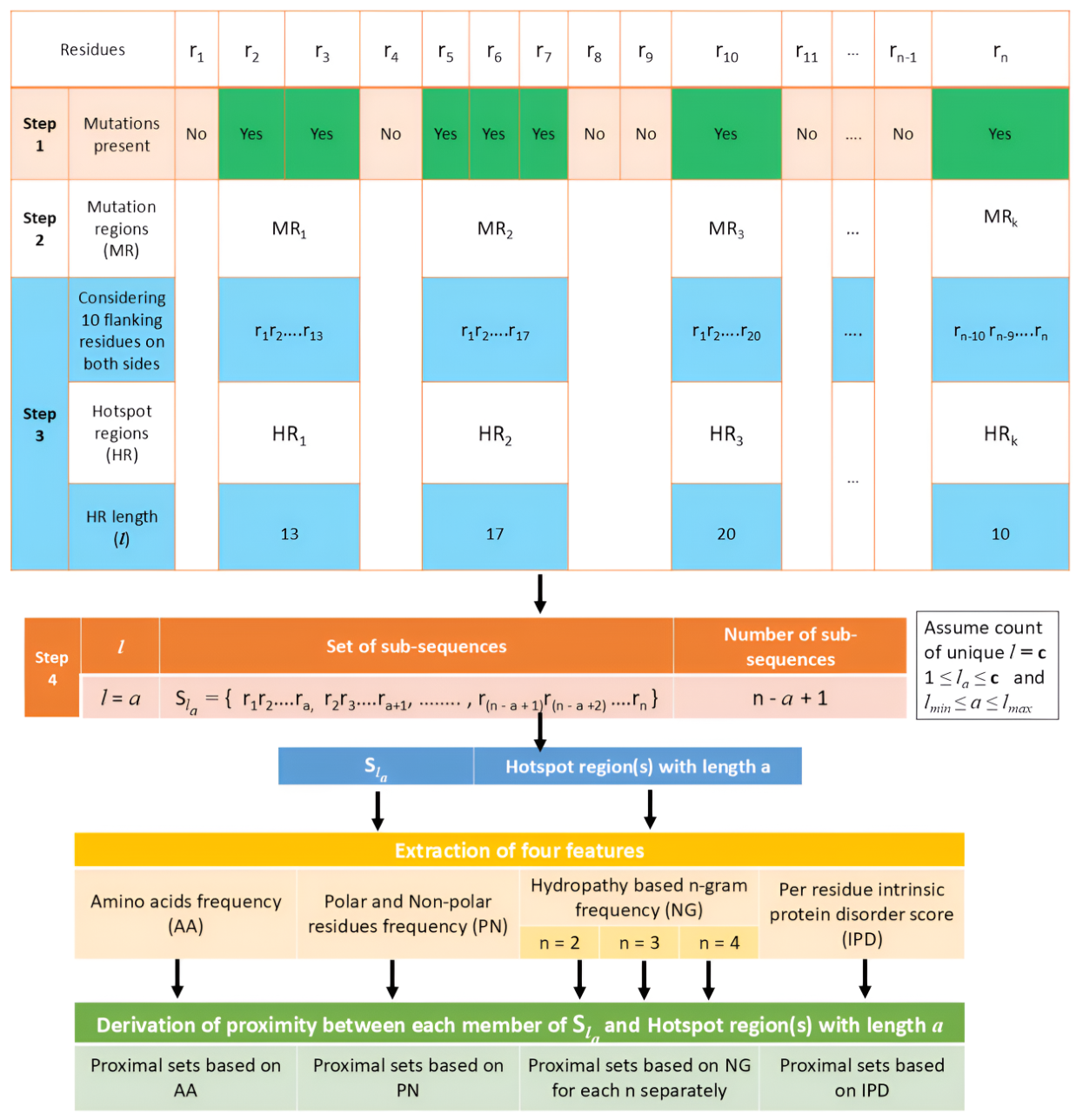
Figure 2.
Identified mutation hotspots within the human HBB protein sequence (P68871).
Figure 2.
Identified mutation hotspots within the human HBB protein sequence (P68871).
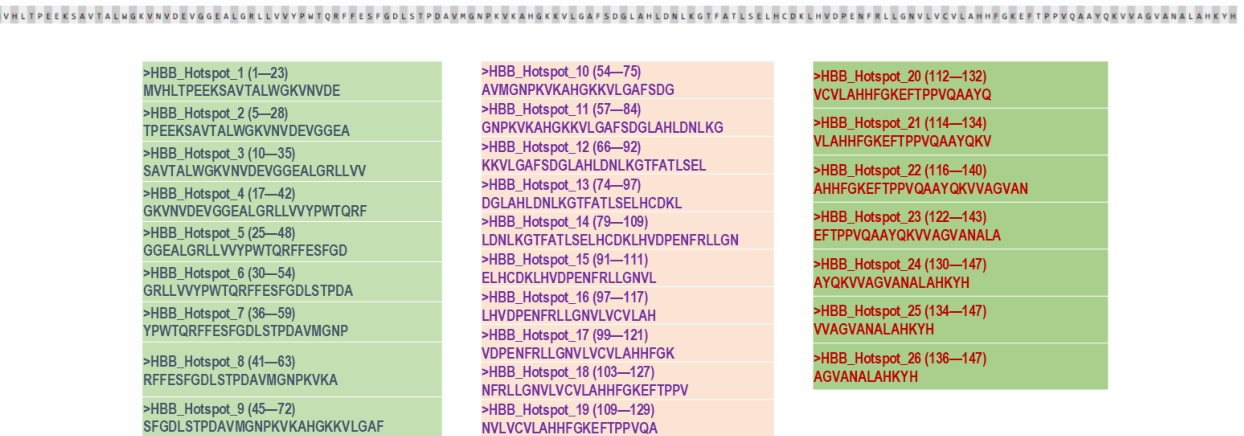
Figure 3.
Quaternary structure of human hemoglobin (HbA). Ribbon representation of the tetrameric hemoglobin molecule composed of two -globin subunits (HBA, chains A and C) and two -globin subunits (HBB, chains B and D). Each subunit is shown in a distinct color (green, brown, orange, and dark gray). The heme prosthetic groups are displayed in stick representation within each globin chain, highlighting the 22 heterotetrameric organization responsible for oxygen binding.
Figure 3.
Quaternary structure of human hemoglobin (HbA). Ribbon representation of the tetrameric hemoglobin molecule composed of two -globin subunits (HBA, chains A and C) and two -globin subunits (HBB, chains B and D). Each subunit is shown in a distinct color (green, brown, orange, and dark gray). The heme prosthetic groups are displayed in stick representation within each globin chain, highlighting the 22 heterotetrameric organization responsible for oxygen binding.
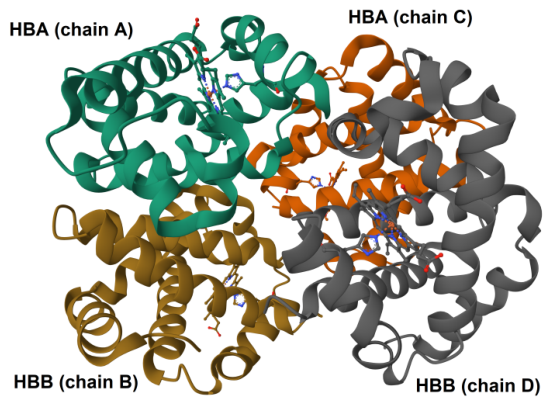
Figure 4.
Dendrogram of HBB hotspots based on pairwise distances of amino acid frequency compositions.
Figure 4.
Dendrogram of HBB hotspots based on pairwise distances of amino acid frequency compositions.
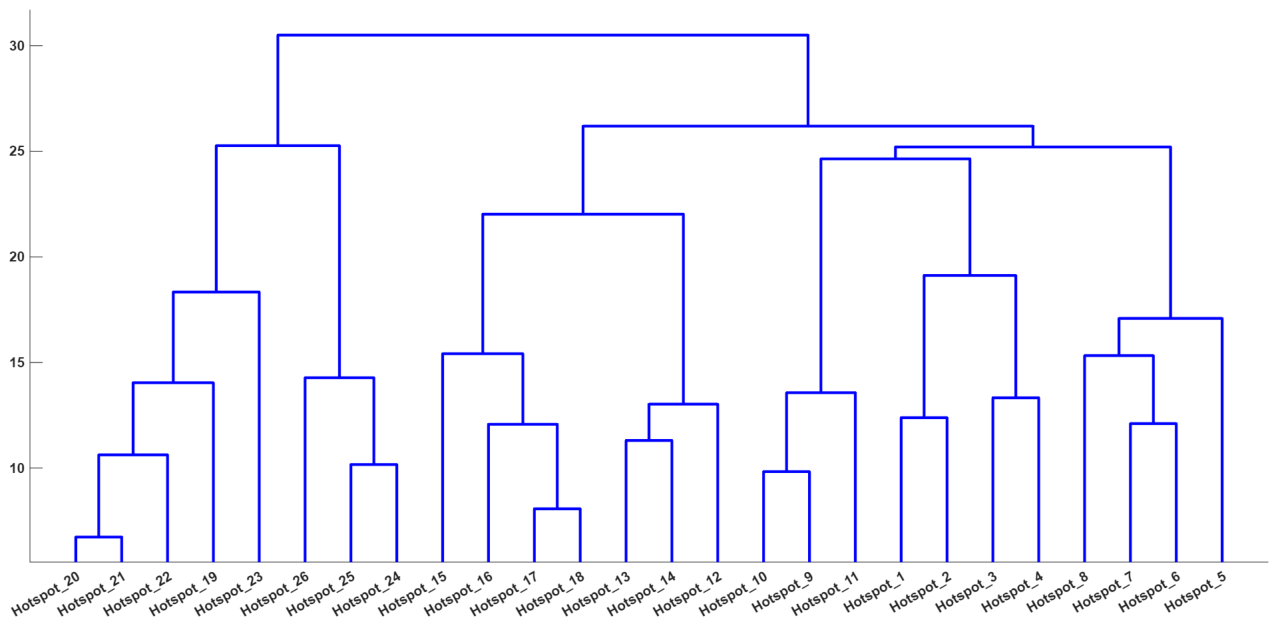
Figure 5.
Dendrogram of HBB hotspots of identical length based on pairwise distances of amino acid frequency compositions.
Figure 5.
Dendrogram of HBB hotspots of identical length based on pairwise distances of amino acid frequency compositions.

Figure 6.
Polar and nonpolar residue compositions across HBB hotspots.
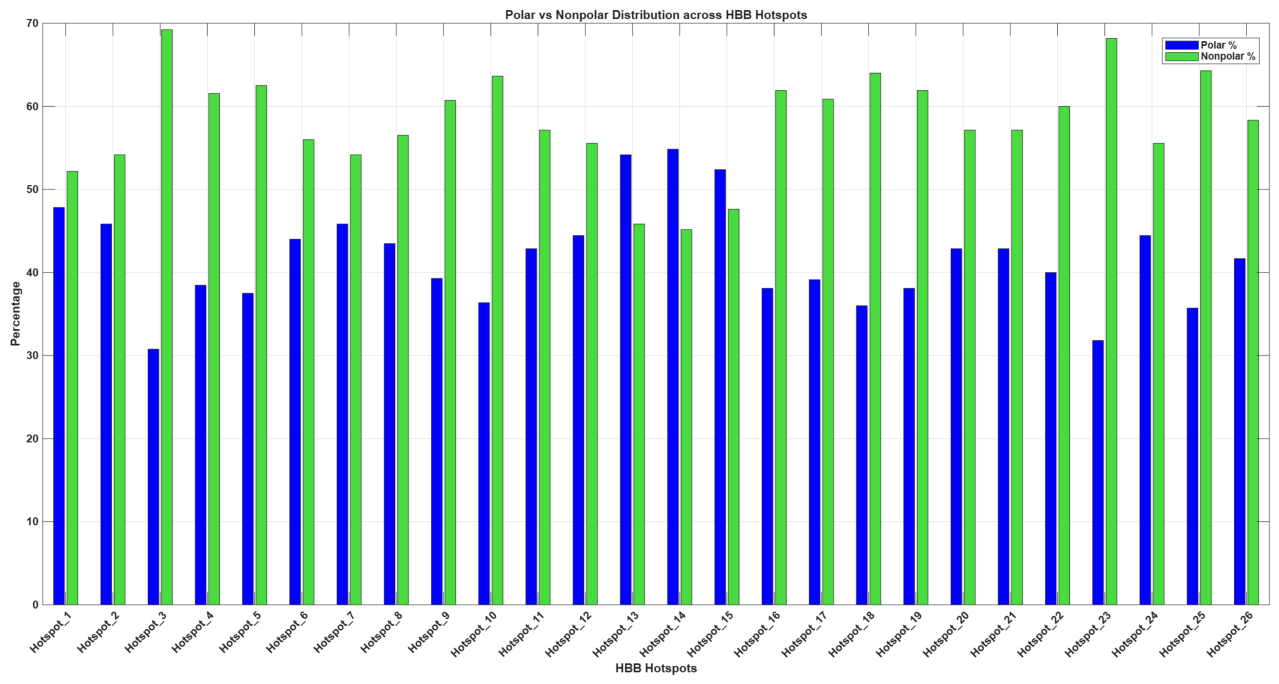
Figure 7.
Dendrogram based on 2-grams frequency distribution
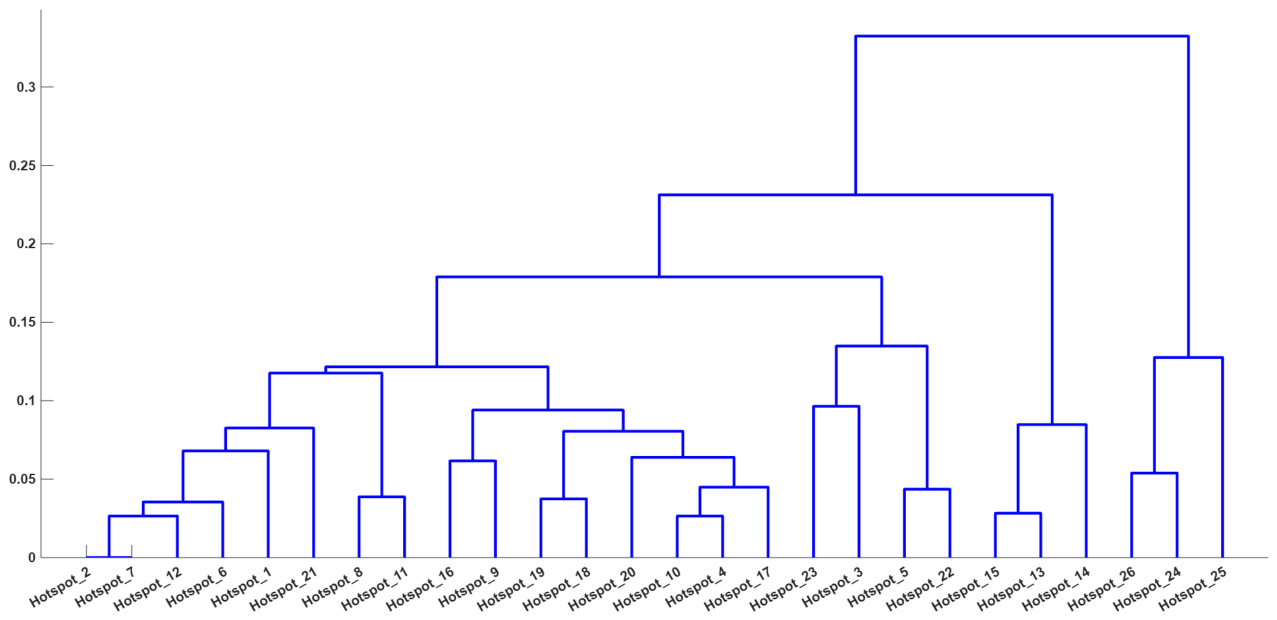
Figure 8.
Dendrogram based on 3-gram frequency distribution
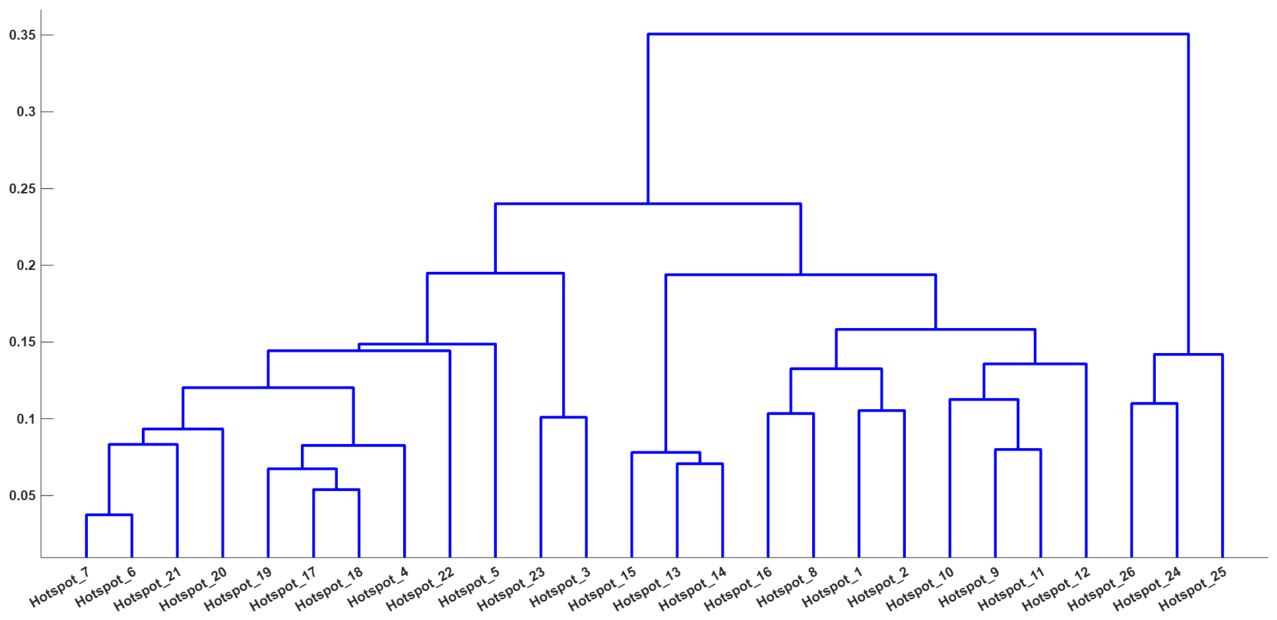
Figure 9.
Dendrogram based on 4-gram frequency distribution
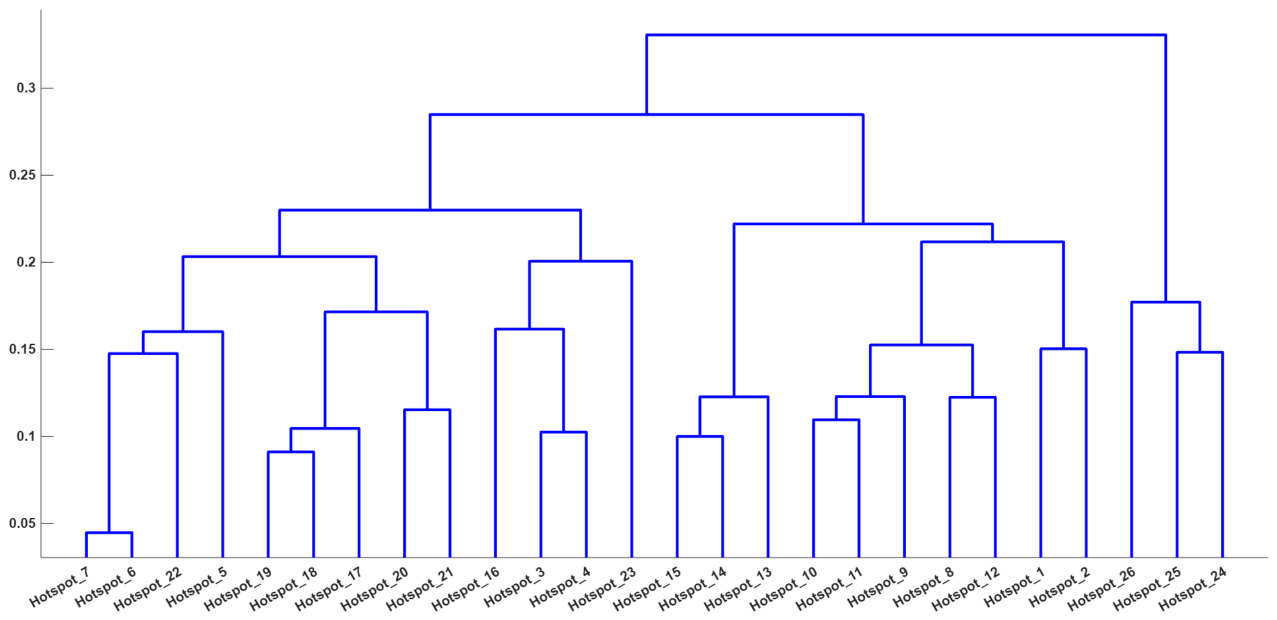
Figure 10.
Intrinsic protein disorder profiles of human HBB sequence
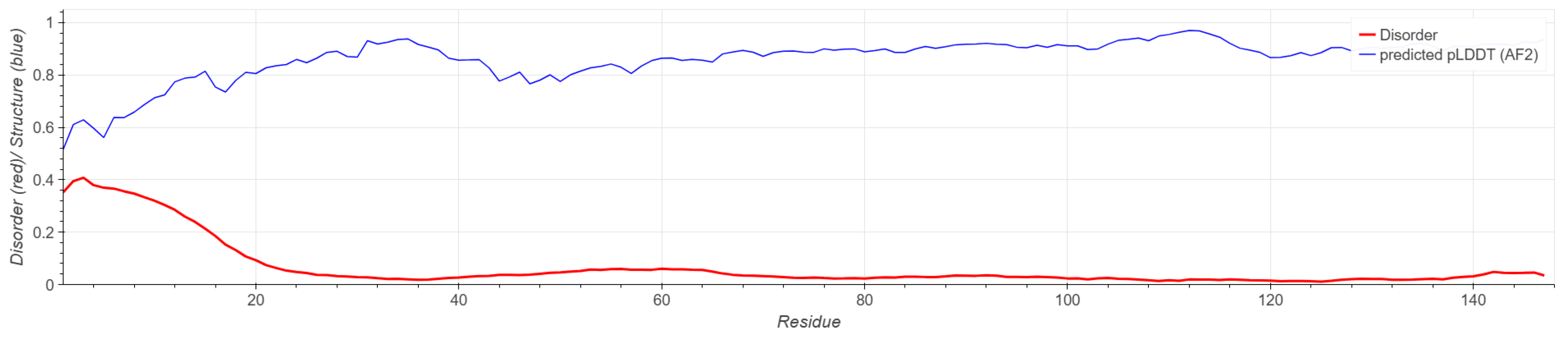
Figure 11.
Proximity among hotspots (more than two) of identical length based on IPD profiles
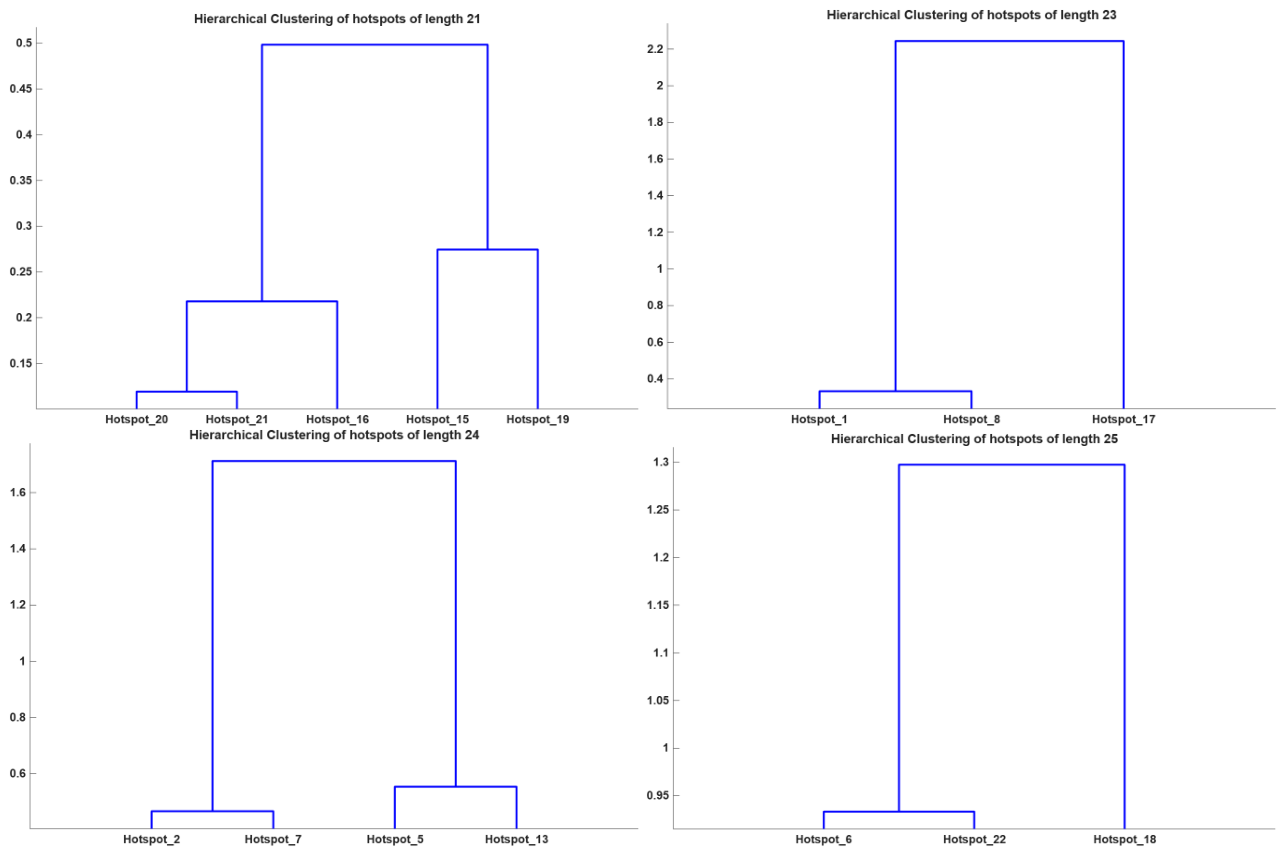

Table 1.
List of pathogenic and likely pathogenic variants within the HBB sequence and non-mutated residue position in HBB protein sequence.
Table 1.
List of pathogenic and likely pathogenic variants within the HBB sequence and non-mutated residue position in HBB protein sequence.
| Mutation site(s) | Position(s) | Mutations | Mutation site(s) | Position(s) | Mutations | Non-mutant residue postion(s) | ||||||||
|---|---|---|---|---|---|---|---|---|---|---|---|---|---|---|
| 1 | 1 | M>I | M>K | M>L | M>R | M>T | M>V | 64 | H>missing | H>Y | 14 | |||
| 2 | V>missing | V>M | 10 | 65 | G>missing | 19 | ||||||||
| 3 | H>missing | H>P | 67 | K>* | K>E | 26 | ||||||||
| 4 | L>missing | 68 | V>missing | 33–34 | ||||||||||
| 5 | T>missing | 69 | L>missing | L>F | 39 | |||||||||
| 6 | P>missing | 70 | G>missing | 45 | ||||||||||
| 7 | E>missing | E>* | E>K | E>M | E>V | 71 | A>missing | 50 | ||||||
| 8 | E>* | E>D* | 72 | F>missing | 54 | |||||||||
| 9 | K>missing | 73 | S>missing | S>* | 63 | |||||||||
| 10 | S>missing | 11 | 74 | D>* | 66 | |||||||||
| 11 | A>missing | 76 | L>missing | 75 | ||||||||||
| 12 | V>missing | 77 | A>missing | 83 | ||||||||||
| 13 | T>missing | 78 | H>missing | 88 | ||||||||||
| 2 | 15 | L>missing | 79 | L>missing | 100 | |||||||||
| 16 | W>missing | W>* | W>* | 80 | D>missing | 102–106 | ||||||||
| 17 | G>missing | 81_82 | NL>* | 108 | ||||||||||
| 18 | K>missing | K>* | K>T | 12 | 82 | L>missing | 112 | |||||||
| 3 | 20 | N>S | 84 | G>missing | 118 | |||||||||
| 21 | V>M | 85 | T>missing | 120–121 | ||||||||||
| 22 | D>missing | 86 | F>missing | 123 | ||||||||||
| 23 | E>missing | E>* | E>K | 13 | 87 | A>missing | 125 | |||||||
| 24 | V>F | 89 | L>missing | L>P | 131 | |||||||||
| 25 | G>missing | 90 | S>missing | S>N | 134–139 | |||||||||
| 4 | 27 | E>missing | E>* | E>* | E>K | 91 | E>* | E>K | 141–143 | |||||
| 28 | A>S | 91_98 | ELHCDKLH>missing | 145 | ||||||||||
| 29 | L>missing | 93 | H>missing | H>Q | ||||||||||
| 30 | G>missing | 95 | D>missing | |||||||||||
| 31 | R>missing | R>G | R>K | R>S | R>T | 97 | L>missing | |||||||
| 32 | L>missing | 14 | 99 | V>missing | V>M | |||||||||
| 5 | 35 | V>F | V>missing | 15 | 101 | P>SENF | ||||||||
| 36 | Y>* | Y>C | 16 | 107 | L>R | L>V | ||||||||
| 37 | P>missing | 109 | N>missing | |||||||||||
| 37_38 | PW>* | 110 | V>M | |||||||||||
| 38 | W>missing | W>* | 17 | 111 | L>P | |||||||||
| 6 | 40 | Q>missing | Q>* | Q>K | 113 | C>* | ||||||||
| 41 | R>missing | 114 | V>missing | |||||||||||
| 42 | F>missing | 115 | L>P | |||||||||||
| 43 | F>missing | F>S | 116 | A>missing | A>D | A>P | ||||||||
| 44 | E>missing | E>* | 18 | 117 | H>missing | |||||||||
| 7 | 46 | F>missing | 19 | 119 | F>missing | |||||||||
| 47 | G>missing | 20 | 122 | E>* | E>K | E>Q | ||||||||
| 48 | D>missing | 21 | 124 | T>missing | ||||||||||
| 49 | L>missing | 126 | P>missing | |||||||||||
| 8 | 51 | T>missing | 127 | V>missing | V>E | V>G | ||||||||
| 52 | P>missing | 128 | Q>* | Q>P | Q>R | |||||||||
| 53 | D>missing | 128_129 | QA>P | |||||||||||
| 9 | 55 | V>missing | 129 | A>missing | ||||||||||
| 56 | M>missing | 22 | 130 | A>V | ||||||||||
| 57_58 | GN>QP* | 132 | Q>missing | Q>* | ||||||||||
| 59_60 | PK>* | 23 | 133 | K>missing | K>* | |||||||||
| 60 | K>missing | K>* | 24 | 140 | N>* | |||||||||
| 61 | V>E | 25 | 144 | H>missing | ||||||||||
| 62 | K>* | 146 | Y>N | |||||||||||
| 26 | 147 | H>P | ||||||||||||
Table 2.
Mutation regions and associated hotspot regions based on identified mutation-variants.
| Mutation site(s) | Mutation regions | Hotspot regions | Hotspot length | Mutation site(s) | Mutation regions | Hotspot regions | Hotspot length | |
|---|---|---|---|---|---|---|---|---|
| 1 | 1–13 | 1–23 | 23 | 14 | 89–99 | 79–109 | 31 | |
| 2 | 15–18 | 5–28 | 24 | 15 | 101 | 91–111 | 21 | |
| 3 | 20–25 | 10–35 | 26 | 16 | 107 | 97–117 | 21 | |
| 4 | 27–32 | 17–42 | 26 | 17 | 109–111 | 99–121 | 23 | |
| 5 | 35–38 | 25–48 | 24 | 18 | 113–117 | 103–127 | 25 | |
| 6 | 40–44 | 30–54 | 25 | 19 | 119 | 109–129 | 21 | |
| 7 | 46–49 | 36–59 | 24 | 20 | 122 | 112–132 | 21 | |
| 8 | 51–53 | 41-63 | 23 | 21 | 124 | 114–134 | 21 | |
| 9 | 55–62 | 45–72 | 28 | 22 | 126–130 | 116–140 | 25 | |
| 10 | 64–65 | 54–75 | 22 | 23 | 132-133 | 122–143 | 22 | |
| 11 | 67–74 | 57–84 | 28 | 24 | 140 | 130–147 | 18 | |
| 12 | 76–82 | 66–92 | 27 | 25 | 144 | 134–147 | 14 | |
| 13 | 84–87 | 74–97 | 24 | 26 | 146–147 | 136–147 | 12 |
Table 3.
Number of HBB subsequences of varied lengths
| Sl. No. | Length of subsequence (l) | Number of subsequences () | Sl. No. | Length of subsequence (l) | Number of subsequences () |
|---|---|---|---|---|---|
| 1 | 12 | 136 | 7 | 24 | 124 |
| 2 | 14 | 134 | 8 | 25 | 123 |
| 3 | 18 | 130 | 9 | 26 | 122 |
| 4 | 21 | 127 | 10 | 27 | 121 |
| 5 | 22 | 126 | 11 | 28 | 120 |
| 6 | 23 | 125 | 12 | 31 | 117 |
Table 4.
Structural features and functional elements of human HHB in several functional states. a Information about residues involved in formation of the intersubunit interfaces was retrieved using the PPInterface algorithm [46].b Represent contact between 1 and 2 chains.
Table 4.
Structural features and functional elements of human HHB in several functional states. a Information about residues involved in formation of the intersubunit interfaces was retrieved using the PPInterface algorithm [46].b Represent contact between 1 and 2 chains.
| Hemoglobin state; PDB ID | Structural elements (residues) | Residues for heme coordination | Residues interacting with 1 chaina | Residues interacting with 2 chaina |
|---|---|---|---|---|
| T-state; 2DN2 | N-tail (1-4) | |||
| Helix 1 (5-17) | ||||
| Loop 1-2 (18-19) | ||||
| Helix 2 (20-36) | 31, 34, 35, 36 | 35, 36, | ||
| Helix 3 (37-47) | 42, 43, 46 | 37, 38, 40, 41 | ||
| Loop 3-4 (48-50) | ||||
| Helix 4 (51-57) | 56 | |||
| Helix 5 (58-76) | 64, 67, 68, 71 | |||
| Helix 6 (77-80) | ||||
| Helix 7 (81-86) | 86 | |||
| Helix 8 (86-96) | 89, 92, 93 | |||
| Loop 8-9 (97-100) | 97, 99 | 98, 100 | ||
| Helix 9 (101-120) | 103, 104, 107 | 109, 112, 113, 116, 117, 120 | 102, 106 | |
| Helix 10 (121-123) | 123 | |||
| Helix 11 (124-144) | 138, 142 | 124, 125, 128, 129, 132 | ||
| C-tail (145-147) | 146, 147 | |||
| R-state; 2DN1 | N-tail (1-4) | |||
| Helix 1 (5-17) | ||||
| Loop 1-2 (18-22) | ||||
| Helix 2 (23-36) | 31, 34, 35 | |||
| Helix 3 (37-47) | 39, 42, 43 | |||
| Loop 3-4 (48-50) | ||||
| Helix 4 (51-58) | 56 | |||
| Helix 5 (58-77) | 64, 67, 68, 71, 72 | |||
| Loop 5-6 (78-80) | ||||
| Helix 6 (81-86) | ||||
| Helix 7 (86-94) | 89, 92, 93 | |||
| Loop 7-8 (97-100) | 97, 99 | |||
| Helix 8 (101-120) | 103, 104, 107 | 105, 109, 112, 113, 116, 120 | ||
| Helix 9 (121-123) | 123 | |||
| Helix 10 (124-143) | 142 | 124, 125, 126, 128, 129, 132 | ||
| Helix 11 (144-147) | ||||
| RR2-intermediate; 1JY7 | N-tail (1-4) | |||
| Helix 1 (5-18) | ||||
| Loop 1-2 (19) | ||||
| Helix 2 (20-36) | 31, 34, 35 | |||
| Helix 3 (37-47) | 39, 42, 43, 45, 46 | 37, 38, 40, 41 | ||
| Loop 3-4 (48-50) | ||||
| Helix 4 (51-57) | 56 | |||
| Helix 5 (58-77) | 64, 67, 68, 71, 72 | |||
| Loop 5-6 (78-80) | ||||
| Helix 6 (81-86) | ||||
| Helix 7 (86-91) | 89 | |||
| Loop 7-8 (92-100) | 92, 93, 97, 99 | 100 | ||
| Helix 8 (101-119) | 103, 104, 107 | 109, 112, 116, 117 | 103 | |
| Loop 8-9 (120-123) | 120, 121, 123 | |||
| Helix 9 (124-144) | 138, 142 | 124, 125, 128, 129, 132 | ||
| C-tail (145-147) | ||||
| R2-state; 1QXD | N-tail (1-4) | |||
| Helix 1 (5-17) | ||||
| Loop 1-2 (18-22) | ||||
| Helix 2 (23-36) | 31, 34, 35, 36 | |||
| Helix 3 (37-47) | 39, 42, 43, 45, 46 | 37, 38, 40, 41 | ||
| Loop 3-4 (48-50) | ||||
| Helix 4 (51-58) | 52, 56 | |||
| Helix 5 (58-77) | 64, 67, 68, 71, 72 | |||
| Loop 5-6 (78-80) | ||||
| Helix 6 (81-86) | ||||
| Helix 7 (86-94) | 89, 92, 93 | |||
| Loop 7-8 (97-99) | 97, 99 | 98 | ||
| Helix 8 (100-120) | 103, 104, 107 | 102, 109, 112, 113, 116, 117 | 100, 103 | |
| Helix 9 (121-123) | 120, 123 | |||
| Helix 10 (124-142) | 142 | 124, 125, 126, 128, 129, 132 | ||
| C-tail (143-147) | ||||
| RR3-intermediate; 3D17 | N-tail (1-4) | (2, 3)b | ||
| Helix 1 (5-16) | ||||
| Helix 2 (17-19) | ||||
| Loop 2-3 (18-22) | ||||
| Helix 3 (22-36) | 32 | 31, 35, 36 | ||
| Helix 4 (37-47) | 39, 42, 43, 46 | 38, 40, 41, 44 | ||
| Loop 4-5 (48-50) | ||||
| Helix 5 (51-58) | 56 | |||
| Helix 6 (58-74) | 64, 67, 68, 71, 72 | |||
| Loop 6-7 (75-80) | ||||
| Helix 7 (81-86) | ||||
| Helix 8 (86-96) | 89, 92, 93 | |||
| Loop 8-9 (97-100) | 97, 99 | 98, 100 | ||
| Helix 9 (101-120) | 103, 104, 107 | 109, 112, 113, 116, 117, 120 | 102, 103 | |
| Helix 10 (121-123) | 123 | |||
| Helix 11 (124-143) | 142 | 124, 125, 126, 128, 129, 132 | 146; (133, 140)b | |
| C-tail (144-147) | (147)b | |||
| R3-state; 1YZI | N-tail (1-4) | |||
| Helix 1 (5-18) | ||||
| Loop 1-2 (19-22) | ||||
| Helix 2 (23-36) | 31, 34, 35, 36 | |||
| Helix 3 (37-47) | 39, 42, 43, 46 | |||
| Loop 3-4 (48-50) | ||||
| Helix 4 (51-57) | 56 | |||
| Helix 5 (58-78) | 64, 67, 68, 71, 72 | |||
| Loop 5-6 (79-80) | ||||
| Helix 6 (81-86) | ||||
| Helix 7 (86-94) | 88, 89, 92, 93 | |||
| Loop 7-8 (97-99) | 97, 99 | |||
| Helix 8 (100-120) | 103, 104, 107 | 105, 109, 112, 113, 116, 117, 120 | ||
| Helix 9 (121-123) | 123 | |||
| Helix 10 (124-143) | 142 | 124, 125, 126, 128, 129, 132 | ||
| C-tail (144-147) |
Table 5.
Amino acid frequency distribution across HBB hotspots. Same length hotspots were highlighted with identical background color.
Table 5.
Amino acid frequency distribution across HBB hotspots. Same length hotspots were highlighted with identical background color.
| HBB_Hotspots | Length | A | R | N | D | C | Q | E | G | H | I | L | K | M | F | P | S | T | W | Y | V |
|---|---|---|---|---|---|---|---|---|---|---|---|---|---|---|---|---|---|---|---|---|---|
| Hotspot_26 | 12 | 33.33 | 0.00 | 8.33 | 0.00 | 0.00 | 0.00 | 0.00 | 8.33 | 16.67 | 0.00 | 8.33 | 8.33 | 0.00 | 0.00 | 0.00 | 0.00 | 0.00 | 0.00 | 8.33 | 8.33 |
| Hotspot_25 | 14 | 28.57 | 0.00 | 7.14 | 0.00 | 0.00 | 0.00 | 0.00 | 7.14 | 14.29 | 0.00 | 7.14 | 7.14 | 0.00 | 0.00 | 0.00 | 0.00 | 0.00 | 0.00 | 7.14 | 21.43 |
| Hotspot_24 | 18 | 27.78 | 0.00 | 5.56 | 0.00 | 0.00 | 5.56 | 0.00 | 5.56 | 11.11 | 0.00 | 5.56 | 11.11 | 0.00 | 0.00 | 0.00 | 0.00 | 0.00 | 0.00 | 11.11 | 16.67 |
| Hotspot_15 | 21 | 0.00 | 4.76 | 9.52 | 9.52 | 4.76 | 0.00 | 9.52 | 4.76 | 9.52 | 0.00 | 23.81 | 4.76 | 0.00 | 4.76 | 4.76 | 0.00 | 0.00 | 0.00 | 0.00 | 9.52 |
| Hotspot_16 | 21 | 4.76 | 4.76 | 9.52 | 4.76 | 4.76 | 0.00 | 4.76 | 4.76 | 9.52 | 0.00 | 23.81 | 0.00 | 0.00 | 4.76 | 4.76 | 0.00 | 0.00 | 0.00 | 0.00 | 19.05 |
| Hotspot_19 | 21 | 9.52 | 0.00 | 4.76 | 0.00 | 4.76 | 4.76 | 4.76 | 4.76 | 9.52 | 0.00 | 9.52 | 4.76 | 0.00 | 9.52 | 9.52 | 0.00 | 4.76 | 0.00 | 0.00 | 19.05 |
| Hotspot_20 | 21 | 14.29 | 0.00 | 0.00 | 0.00 | 4.76 | 9.52 | 4.76 | 4.76 | 9.52 | 0.00 | 4.76 | 4.76 | 0.00 | 9.52 | 9.52 | 0.00 | 4.76 | 0.00 | 4.76 | 14.29 |
| Hotspot_21 | 21 | 14.29 | 0.00 | 0.00 | 0.00 | 0.00 | 9.52 | 4.76 | 4.76 | 9.52 | 0.00 | 4.76 | 9.52 | 0.00 | 9.52 | 9.52 | 0.00 | 4.76 | 0.00 | 4.76 | 14.29 |
| Hotspot_10 | 22 | 13.64 | 0.00 | 4.55 | 4.55 | 0.00 | 0.00 | 0.00 | 18.18 | 4.55 | 0.00 | 4.55 | 18.18 | 4.55 | 4.55 | 4.55 | 4.55 | 0.00 | 0.00 | 0.00 | 13.64 |
| Hotspot_23 | 22 | 27.27 | 0.00 | 4.55 | 0.00 | 0.00 | 9.09 | 4.55 | 4.55 | 0.00 | 0.00 | 4.55 | 4.55 | 0.00 | 4.55 | 9.09 | 0.00 | 4.55 | 0.00 | 4.55 | 18.18 |
| Hotspot_1 | 23 | 8.70 | 0.00 | 4.35 | 4.35 | 0.00 | 0.00 | 13.04 | 4.35 | 4.35 | 0.00 | 8.70 | 8.70 | 4.35 | 0.00 | 4.35 | 4.35 | 8.70 | 4.35 | 0.00 | 17.39 |
| Hotspot_8 | 23 | 8.70 | 4.35 | 4.35 | 8.70 | 0.00 | 0.00 | 4.35 | 8.70 | 0.00 | 0.00 | 4.35 | 8.70 | 4.35 | 13.04 | 8.70 | 8.70 | 4.35 | 0.00 | 0.00 | 8.70 |
| Hotspot_17 | 23 | 4.35 | 4.35 | 8.70 | 4.35 | 4.35 | 0.00 | 4.35 | 8.70 | 8.70 | 0.00 | 17.39 | 4.35 | 0.00 | 8.70 | 4.35 | 0.00 | 0.00 | 0.00 | 0.00 | 17.39 |
| Hotspot_2 | 24 | 12.50 | 0.00 | 4.17 | 4.17 | 0.00 | 0.00 | 16.67 | 12.50 | 0.00 | 0.00 | 4.17 | 8.33 | 0.00 | 0.00 | 4.17 | 4.17 | 8.33 | 4.17 | 0.00 | 16.67 |
| Hotspot_5 | 24 | 4.17 | 8.33 | 0.00 | 4.17 | 0.00 | 4.17 | 8.33 | 16.67 | 0.00 | 0.00 | 12.50 | 0.00 | 0.00 | 12.50 | 4.17 | 4.17 | 4.17 | 4.17 | 4.17 | 8.33 |
| Hotspot_7 | 24 | 4.17 | 4.17 | 4.17 | 8.33 | 0.00 | 4.17 | 4.17 | 8.33 | 0.00 | 0.00 | 4.17 | 0.00 | 4.17 | 12.50 | 12.50 | 8.33 | 8.33 | 4.17 | 4.17 | 4.17 |
| Hotspot_13 | 24 | 8.33 | 0.00 | 4.17 | 12.50 | 4.17 | 0.00 | 4.17 | 8.33 | 8.33 | 0.00 | 25.00 | 8.33 | 0.00 | 4.17 | 0.00 | 4.17 | 8.33 | 0.00 | 0.00 | 0.00 |
| Hotspot_6 | 25 | 4.00 | 8.00 | 0.00 | 8.00 | 0.00 | 4.00 | 4.00 | 8.00 | 0.00 | 0.00 | 12.00 | 0.00 | 0.00 | 12.00 | 8.00 | 8.00 | 8.00 | 4.00 | 4.00 | 8.00 |
| Hotspot_18 | 25 | 4.00 | 4.00 | 8.00 | 0.00 | 4.00 | 0.00 | 4.00 | 8.00 | 8.00 | 0.00 | 16.00 | 4.00 | 0.00 | 12.00 | 8.00 | 0.00 | 4.00 | 0.00 | 0.00 | 16.00 |
| Hotspot_22 | 25 | 20.00 | 0.00 | 4.00 | 0.00 | 0.00 | 8.00 | 4.00 | 8.00 | 8.00 | 0.00 | 0.00 | 8.00 | 0.00 | 8.00 | 8.00 | 0.00 | 4.00 | 0.00 | 4.00 | 16.00 |
| Hotspot_3 | 26 | 11.54 | 3.85 | 3.85 | 3.85 | 0.00 | 0.00 | 7.69 | 15.38 | 0.00 | 0.00 | 15.38 | 3.85 | 0.00 | 0.00 | 0.00 | 3.85 | 3.85 | 3.85 | 0.00 | 23.08 |
| Hotspot_4 | 26 | 3.85 | 7.69 | 3.85 | 3.85 | 0.00 | 3.85 | 7.69 | 15.38 | 0.00 | 0.00 | 11.54 | 3.85 | 0.00 | 3.85 | 3.85 | 0.00 | 3.85 | 3.85 | 3.85 | 19.23 |
| Hotspot_12 | 27 | 11.11 | 0.00 | 3.70 | 7.41 | 0.00 | 0.00 | 3.70 | 11.11 | 3.70 | 0.00 | 22.22 | 11.11 | 0.00 | 7.41 | 0.00 | 7.41 | 7.41 | 0.00 | 0.00 | 3.70 |
| Hotspot_9 | 28 | 10.71 | 0.00 | 3.57 | 7.14 | 0.00 | 0.00 | 0.00 | 14.29 | 3.57 | 0.00 | 7.14 | 14.29 | 3.57 | 7.14 | 7.14 | 7.14 | 3.57 | 0.00 | 0.00 | 10.71 |
| Hotspot_11 | 28 | 10.71 | 0.00 | 7.14 | 7.14 | 0.00 | 0.00 | 0.00 | 17.86 | 7.14 | 0.00 | 14.29 | 17.86 | 0.00 | 3.57 | 3.57 | 3.57 | 0.00 | 0.00 | 0.00 | 7.14 |
| Hotspot_14 | 31 | 3.23 | 3.23 | 9.68 | 9.68 | 3.23 | 0.00 | 6.45 | 6.45 | 6.45 | 0.00 | 22.58 | 6.45 | 0.00 | 6.45 | 3.23 | 3.23 | 6.45 | 0.00 | 0.00 | 3.23 |
Table 6.
Frequency distribution of 2-grams across HBB hotspots
| HBB Hotspots | Length | 00_freq | 01_freq | 10_freq | 11_freq | HBB Hotspots | Length | 00_freq | 01_freq | 10_freq | 11_freq | |
|---|---|---|---|---|---|---|---|---|---|---|---|---|
| Hotspot_26 | 12 | 0.45 | 0.18 | 0.09 | 0.27 | Hotspot_2 | 24 | 0.26 | 0.26 | 0.30 | 0.17 | |
| Hotspot_25 | 14 | 0.54 | 0.15 | 0.08 | 0.23 | Hotspot_5 | 24 | 0.39 | 0.26 | 0.22 | 0.13 | |
| Hotspot_24 | 18 | 0.41 | 0.18 | 0.12 | 0.29 | Hotspot_7 | 24 | 0.26 | 0.26 | 0.30 | 0.17 | |
| Hotspot_15 | 21 | 0.15 | 0.30 | 0.35 | 0.20 | Hotspot_13 | 24 | 0.13 | 0.30 | 0.35 | 0.22 | |
| Hotspot_16 | 21 | 0.30 | 0.35 | 0.30 | 0.05 | Hotspot_6 | 25 | 0.25 | 0.29 | 0.29 | 0.17 | |
| Hotspot_19 | 21 | 0.35 | 0.25 | 0.30 | 0.10 | Hotspot_18 | 25 | 0.38 | 0.25 | 0.29 | 0.08 | |
| Hotspot_20 | 21 | 0.30 | 0.30 | 0.25 | 0.15 | Hotspot_22 | 25 | 0.38 | 0.25 | 0.21 | 0.17 | |
| Hotspot_21 | 21 | 0.30 | 0.25 | 0.25 | 0.20 | Hotspot_3 | 26 | 0.44 | 0.24 | 0.28 | 0.04 | |
| Hotspot_10 | 22 | 0.33 | 0.29 | 0.29 | 0.10 | Hotspot_4 | 26 | 0.32 | 0.28 | 0.28 | 0.12 | |
| Hotspot_23 | 22 | 0.48 | 0.19 | 0.24 | 0.10 | Hotspot_12 | 27 | 0.27 | 0.27 | 0.31 | 0.15 | |
| Hotspot_1 | 23 | 0.23 | 0.32 | 0.27 | 0.18 | Hotspot_9 | 28 | 0.30 | 0.30 | 0.33 | 0.07 | |
| Hotspot_8 | 23 | 0.23 | 0.32 | 0.36 | 0.09 | Hotspot_11 | 28 | 0.22 | 0.33 | 0.33 | 0.11 | |
| Hotspot_17 | 23 | 0.32 | 0.32 | 0.27 | 0.09 | Hotspot_14 | 31 | 0.10 | 0.37 | 0.33 | 0.20 |
Table 7.
Frequency distribution of 3-gram across HBB hotspots
| HBB Hotspots | Length | 000_freq | 001_freq | 010_freq | 011_freq | 100_freq | 101_freq | 110_freq | 111_freq |
|---|---|---|---|---|---|---|---|---|---|
| Hotspot_26 | 12 | 0.30 | 0.20 | 0.10 | 0.10 | 0.10 | 0.00 | 0.00 | 0.20 |
| Hotspot_25 | 14 | 0.42 | 0.17 | 0.08 | 0.08 | 0.08 | 0.00 | 0.00 | 0.17 |
| Hotspot_24 | 18 | 0.31 | 0.13 | 0.06 | 0.13 | 0.13 | 0.00 | 0.06 | 0.19 |
| Hotspot_15 | 21 | 0.05 | 0.05 | 0.21 | 0.11 | 0.11 | 0.26 | 0.11 | 0.11 |
| Hotspot_16 | 21 | 0.16 | 0.16 | 0.26 | 0.05 | 0.16 | 0.16 | 0.05 | 0.00 |
| Hotspot_19 | 21 | 0.16 | 0.21 | 0.16 | 0.11 | 0.21 | 0.05 | 0.11 | 0.00 |
| Hotspot_20 | 21 | 0.11 | 0.21 | 0.16 | 0.16 | 0.21 | 0.05 | 0.11 | 0.00 |
| Hotspot_21 | 21 | 0.11 | 0.21 | 0.11 | 0.16 | 0.16 | 0.05 | 0.16 | 0.05 |
| Hotspot_10 | 22 | 0.25 | 0.10 | 0.20 | 0.10 | 0.05 | 0.20 | 0.10 | 0.00 |
| Hotspot_23 | 22 | 0.30 | 0.15 | 0.15 | 0.05 | 0.20 | 0.05 | 0.05 | 0.05 |
| Hotspot_1 | 23 | 0.10 | 0.14 | 0.24 | 0.10 | 0.10 | 0.19 | 0.05 | 0.10 |
| Hotspot_8 | 23 | 0.10 | 0.14 | 0.24 | 0.10 | 0.14 | 0.19 | 0.10 | 0.00 |
| Hotspot_17 | 23 | 0.14 | 0.19 | 0.19 | 0.10 | 0.19 | 0.10 | 0.10 | 0.00 |
| Hotspot_2 | 24 | 0.14 | 0.14 | 0.18 | 0.09 | 0.14 | 0.14 | 0.09 | 0.09 |
| Hotspot_5 | 24 | 0.14 | 0.27 | 0.14 | 0.09 | 0.23 | 0.00 | 0.09 | 0.05 |
| Hotspot_7 | 24 | 0.09 | 0.18 | 0.14 | 0.14 | 0.18 | 0.09 | 0.14 | 0.05 |
| Hotspot_13 | 24 | 0.05 | 0.09 | 0.18 | 0.14 | 0.09 | 0.23 | 0.14 | 0.09 |
| Hotspot_6 | 25 | 0.09 | 0.17 | 0.17 | 0.13 | 0.17 | 0.09 | 0.13 | 0.04 |
| Hotspot_18 | 25 | 0.17 | 0.17 | 0.17 | 0.09 | 0.22 | 0.09 | 0.09 | 0.00 |
| Hotspot_22 | 25 | 0.22 | 0.17 | 0.09 | 0.13 | 0.17 | 0.04 | 0.13 | 0.04 |
| Hotspot_3 | 26 | 0.25 | 0.17 | 0.21 | 0.04 | 0.21 | 0.08 | 0.04 | 0.00 |
| Hotspot_4 | 26 | 0.17 | 0.17 | 0.21 | 0.08 | 0.17 | 0.08 | 0.08 | 0.04 |
| Hotspot_12 | 27 | 0.16 | 0.12 | 0.16 | 0.12 | 0.12 | 0.16 | 0.16 | 0.00 |
| Hotspot_9 | 28 | 0.19 | 0.08 | 0.23 | 0.08 | 0.12 | 0.23 | 0.08 | 0.00 |
| Hotspot_11 | 28 | 0.15 | 0.08 | 0.23 | 0.12 | 0.08 | 0.23 | 0.12 | 0.00 |
| Hotspot_14 | 31 | 0.03 | 0.07 | 0.21 | 0.14 | 0.07 | 0.28 | 0.14 | 0.07 |
Table 8.
Frequency distribution of 4-gram across HBB hotspots
| HBB Hotspots | Length | 0000_freq | 0001_freq | 0010_freq | 0011_freq | 0100_freq | 0101_freq | 0110_freq | 0111_freq | 1000_freq | 1001_freq | 1010_freq | 1011_freq | 1100_freq | 1101_freq | 1110_freq | 1111_freq |
|---|---|---|---|---|---|---|---|---|---|---|---|---|---|---|---|---|---|
| Hotspot_26 | 12 | 0.11 | 0.22 | 0.11 | 0.11 | 0.11 | 0.00 | 0.00 | 0.11 | 0.11 | 0.00 | 0.00 | 0.00 | 0.00 | 0.00 | 0.00 | 0.11 |
| Hotspot_25 | 14 | 0.27 | 0.18 | 0.09 | 0.09 | 0.09 | 0.00 | 0.00 | 0.09 | 0.09 | 0.00 | 0.00 | 0.00 | 0.00 | 0.00 | 0.00 | 0.09 |
| Hotspot_24 | 18 | 0.20 | 0.13 | 0.07 | 0.07 | 0.07 | 0.00 | 0.00 | 0.13 | 0.13 | 0.00 | 0.00 | 0.00 | 0.07 | 0.00 | 0.07 | 0.07 |
| Hotspot_15 | 21 | 0.00 | 0.06 | 0.06 | 0.00 | 0.11 | 0.11 | 0.06 | 0.06 | 0.06 | 0.00 | 0.17 | 0.11 | 0.00 | 0.11 | 0.06 | 0.06 |
| Hotspot_16 | 21 | 0.00 | 0.17 | 0.11 | 0.00 | 0.17 | 0.11 | 0.06 | 0.00 | 0.17 | 0.00 | 0.11 | 0.06 | 0.00 | 0.06 | 0.00 | 0.00 |
| Hotspot_19 | 21 | 0.00 | 0.17 | 0.11 | 0.11 | 0.11 | 0.00 | 0.11 | 0.00 | 0.17 | 0.06 | 0.06 | 0.00 | 0.06 | 0.06 | 0.00 | 0.00 |
| Hotspot_20 | 21 | 0.00 | 0.11 | 0.06 | 0.17 | 0.17 | 0.00 | 0.11 | 0.00 | 0.11 | 0.11 | 0.06 | 0.00 | 0.06 | 0.06 | 0.00 | 0.00 |
| Hotspot_21 | 21 | 0.00 | 0.11 | 0.06 | 0.17 | 0.11 | 0.00 | 0.11 | 0.06 | 0.06 | 0.11 | 0.06 | 0.00 | 0.06 | 0.06 | 0.06 | 0.00 |
| Hotspot_10 | 22 | 0.16 | 0.11 | 0.05 | 0.05 | 0.00 | 0.21 | 0.11 | 0.00 | 0.05 | 0.00 | 0.16 | 0.05 | 0.05 | 0.00 | 0.00 | 0.00 |
| Hotspot_23 | 22 | 0.16 | 0.11 | 0.11 | 0.05 | 0.16 | 0.00 | 0.00 | 0.05 | 0.16 | 0.05 | 0.05 | 0.00 | 0.05 | 0.00 | 0.05 | 0.00 |
| Hotspot_1 | 23 | 0.05 | 0.05 | 0.15 | 0.00 | 0.05 | 0.20 | 0.00 | 0.05 | 0.05 | 0.05 | 0.10 | 0.10 | 0.05 | 0.00 | 0.05 | 0.05 |
| Hotspot_8 | 23 | 0.05 | 0.05 | 0.10 | 0.05 | 0.05 | 0.15 | 0.10 | 0.00 | 0.05 | 0.10 | 0.15 | 0.05 | 0.05 | 0.05 | 0.00 | 0.00 |
| Hotspot_17 | 23 | 0.00 | 0.15 | 0.10 | 0.05 | 0.15 | 0.05 | 0.10 | 0.00 | 0.15 | 0.05 | 0.05 | 0.05 | 0.05 | 0.05 | 0.00 | 0.00 |
| Hotspot_2 | 24 | 0.05 | 0.10 | 0.14 | 0.00 | 0.05 | 0.10 | 0.05 | 0.05 | 0.10 | 0.05 | 0.05 | 0.10 | 0.10 | 0.00 | 0.05 | 0.05 |
| Hotspot_5 | 24 | 0.05 | 0.10 | 0.14 | 0.10 | 0.14 | 0.00 | 0.05 | 0.05 | 0.10 | 0.14 | 0.00 | 0.00 | 0.10 | 0.00 | 0.05 | 0.00 |
| Hotspot_7 | 24 | 0.05 | 0.05 | 0.10 | 0.10 | 0.05 | 0.05 | 0.10 | 0.05 | 0.05 | 0.14 | 0.05 | 0.05 | 0.10 | 0.05 | 0.05 | 0.00 |
| Hotspot_13 | 24 | 0.00 | 0.05 | 0.10 | 0.00 | 0.05 | 0.14 | 0.10 | 0.05 | 0.05 | 0.05 | 0.10 | 0.14 | 0.00 | 0.10 | 0.05 | 0.05 |
| Hotspot_6 | 25 | 0.05 | 0.05 | 0.09 | 0.09 | 0.09 | 0.05 | 0.09 | 0.05 | 0.05 | 0.14 | 0.05 | 0.05 | 0.09 | 0.05 | 0.05 | 0.00 |
| Hotspot_18 | 25 | 0.00 | 0.14 | 0.09 | 0.09 | 0.18 | 0.00 | 0.09 | 0.00 | 0.18 | 0.05 | 0.09 | 0.00 | 0.05 | 0.05 | 0.00 | 0.00 |
| Hotspot_22 | 25 | 0.14 | 0.09 | 0.05 | 0.09 | 0.09 | 0.00 | 0.09 | 0.05 | 0.09 | 0.09 | 0.05 | 0.00 | 0.09 | 0.05 | 0.05 | 0.00 |
| Hotspot_3 | 26 | 0.09 | 0.13 | 0.17 | 0.00 | 0.13 | 0.09 | 0.04 | 0.00 | 0.17 | 0.04 | 0.04 | 0.04 | 0.04 | 0.00 | 0.00 | 0.00 |
| Hotspot_4 | 26 | 0.04 | 0.13 | 0.13 | 0.04 | 0.13 | 0.09 | 0.04 | 0.04 | 0.13 | 0.04 | 0.04 | 0.04 | 0.04 | 0.00 | 0.04 | 0.00 |
| Hotspot_12 | 27 | 0.08 | 0.08 | 0.08 | 0.04 | 0.04 | 0.13 | 0.13 | 0.00 | 0.08 | 0.04 | 0.08 | 0.08 | 0.08 | 0.04 | 0.00 | 0.00 |
| Hotspot_9 | 28 | 0.12 | 0.04 | 0.08 | 0.00 | 0.04 | 0.20 | 0.08 | 0.00 | 0.08 | 0.04 | 0.16 | 0.08 | 0.04 | 0.04 | 0.00 | 0.00 |
| Hotspot_11 | 28 | 0.08 | 0.08 | 0.04 | 0.04 | 0.00 | 0.20 | 0.12 | 0.00 | 0.08 | 0.00 | 0.16 | 0.08 | 0.08 | 0.04 | 0.00 | 0.00 |
| Hotspot_14 | 31 | 0.00 | 0.04 | 0.04 | 0.00 | 0.07 | 0.14 | 0.11 | 0.04 | 0.04 | 0.04 | 0.18 | 0.11 | 0.00 | 0.14 | 0.04 | 0.04 |
Table 9.
Intrinsic protein disorder profiles of HBB hotspots
| HBB Hotspots | Length | 1 | 2 | 3 | 4 | 5 | 6 | 7 | 8 | 9 | 10 | 11 | 12 | 13 | 14 | 15 | 16 | 17 | 18 | 19 | 20 | 21 | 22 | 23 | 24 | 25 | 26 | 27 | 28 | 29 | 30 | 31 |
|---|---|---|---|---|---|---|---|---|---|---|---|---|---|---|---|---|---|---|---|---|---|---|---|---|---|---|---|---|---|---|---|---|
| Hotspot_26 | 12 | 0.69 | 0.65 | 0.68 | 0.69 | 0.71 | 0.72 | 0.71 | 0.73 | 0.74 | 0.74 | 0.77 | 0.80 | |||||||||||||||||||
| Hotspot_25 | 14 | 0.60 | 0.57 | 0.56 | 0.57 | 0.58 | 0.61 | 0.62 | 0.62 | 0.60 | 0.62 | 0.62 | 0.61 | 0.63 | 0.65 | |||||||||||||||||
| Hotspot_24 | 18 | 0.45 | 0.43 | 0.44 | 0.49 | 0.49 | 0.50 | 0.52 | 0.53 | 0.53 | 0.54 | 0.54 | 0.54 | 0.52 | 0.54 | 0.56 | 0.56 | 0.58 | 0.62 | |||||||||||||
| Hotspot_15 | 21 | 0.54 | 0.52 | 0.51 | 0.46 | 0.44 | 0.43 | 0.40 | 0.39 | 0.36 | 0.34 | 0.33 | 0.31 | 0.32 | 0.30 | 0.28 | 0.27 | 0.26 | 0.25 | 0.23 | 0.22 | 0.20 | ||||||||||
| Hotspot_16 | 21 | 0.39 | 0.43 | 0.43 | 0.45 | 0.48 | 0.48 | 0.48 | 0.47 | 0.47 | 0.45 | 0.45 | 0.44 | 0.43 | 0.40 | 0.42 | 0.42 | 0.42 | 0.40 | 0.40 | 0.41 | 0.43 | ||||||||||
| Hotspot_19 | 21 | 0.52 | 0.44 | 0.42 | 0.39 | 0.36 | 0.35 | 0.35 | 0.36 | 0.35 | 0.35 | 0.35 | 0.36 | 0.36 | 0.34 | 0.34 | 0.34 | 0.33 | 0.32 | 0.30 | 0.29 | 0.27 | ||||||||||
| Hotspot_20 | 21 | 0.54 | 0.55 | 0.53 | 0.51 | 0.51 | 0.49 | 0.47 | 0.47 | 0.48 | 0.47 | 0.46 | 0.45 | 0.45 | 0.44 | 0.44 | 0.42 | 0.43 | 0.42 | 0.40 | 0.38 | 0.36 | ||||||||||
| Hotspot_21 | 21 | 0.49 | 0.51 | 0.50 | 0.49 | 0.47 | 0.46 | 0.46 | 0.46 | 0.44 | 0.43 | 0.44 | 0.43 | 0.44 | 0.42 | 0.44 | 0.43 | 0.42 | 0.39 | 0.39 | 0.38 | 0.34 | ||||||||||
| Hotspot_10 | 22 | 0.66 | 0.71 | 0.71 | 0.70 | 0.71 | 0.71 | 0.70 | 0.70 | 0.71 | 0.70 | 0.70 | 0.68 | 0.67 | 0.67 | 0.65 | 0.64 | 0.62 | 0.58 | 0.53 | 0.51 | 0.46 | 0.40 | |||||||||
| Hotspot_23 | 22 | 0.41 | 0.42 | 0.42 | 0.43 | 0.42 | 0.41 | 0.41 | 0.40 | 0.39 | 0.37 | 0.36 | 0.35 | 0.33 | 0.32 | 0.31 | 0.31 | 0.30 | 0.29 | 0.29 | 0.29 | 0.29 | 0.30 | |||||||||
| Hotspot_1 | 23 | 0.77 | 0.83 | 0.86 | 0.84 | 0.82 | 0.81 | 0.83 | 0.83 | 0.83 | 0.84 | 0.85 | 0.84 | 0.85 | 0.84 | 0.83 | 0.84 | 0.82 | 0.82 | 0.80 | 0.80 | 0.79 | 0.80 | 0.80 | ||||||||
| Hotspot_8 | 23 | 0.75 | 0.78 | 0.77 | 0.77 | 0.76 | 0.77 | 0.78 | 0.77 | 0.77 | 0.77 | 0.78 | 0.78 | 0.78 | 0.77 | 0.76 | 0.75 | 0.73 | 0.73 | 0.72 | 0.71 | 0.71 | 0.74 | 0.75 | ||||||||
| Hotspot_17 | 23 | 0.36 | 0.38 | 0.38 | 0.38 | 0.39 | 0.37 | 0.37 | 0.35 | 0.35 | 0.34 | 0.33 | 0.31 | 0.32 | 0.32 | 0.32 | 0.30 | 0.29 | 0.28 | 0.28 | 0.27 | 0.25 | 0.25 | 0.25 | ||||||||
| Hotspot_2 | 24 | 0.71 | 0.73 | 0.75 | 0.76 | 0.77 | 0.78 | 0.79 | 0.78 | 0.79 | 0.79 | 0.78 | 0.78 | 0.77 | 0.77 | 0.75 | 0.76 | 0.75 | 0.74 | 0.72 | 0.70 | 0.69 | 0.69 | 0.68 | 0.69 | |||||||
| Hotspot_5 | 24 | 0.48 | 0.51 | 0.50 | 0.52 | 0.52 | 0.50 | 0.49 | 0.47 | 0.45 | 0.42 | 0.41 | 0.40 | 0.40 | 0.39 | 0.39 | 0.39 | 0.38 | 0.36 | 0.36 | 0.36 | 0.35 | 0.32 | 0.32 | 0.30 | |||||||
| Hotspot_7 | 24 | 0.59 | 0.62 | 0.65 | 0.63 | 0.64 | 0.66 | 0.65 | 0.66 | 0.66 | 0.67 | 0.67 | 0.68 | 0.68 | 0.68 | 0.69 | 0.69 | 0.70 | 0.69 | 0.68 | 0.66 | 0.64 | 0.63 | 0.63 | 0.63 | |||||||
| Hotspot_13 | 24 | 0.40 | 0.41 | 0.42 | 0.40 | 0.40 | 0.38 | 0.38 | 0.37 | 0.35 | 0.33 | 0.31 | 0.29 | 0.28 | 0.27 | 0.25 | 0.25 | 0.25 | 0.24 | 0.24 | 0.23 | 0.22 | 0.22 | 0.21 | 0.21 | |||||||
| Hotspot_6 | 25 | 0.32 | 0.27 | 0.26 | 0.24 | 0.24 | 0.25 | 0.27 | 0.28 | 0.30 | 0.32 | 0.32 | 0.34 | 0.34 | 0.36 | 0.38 | 0.38 | 0.39 | 0.41 | 0.39 | 0.39 | 0.39 | 0.36 | 0.33 | 0.27 | 0.22 | ||||||
| Hotspot_18 | 25 | 0.55 | 0.51 | 0.52 | 0.52 | 0.52 | 0.52 | 0.54 | 0.52 | 0.54 | 0.55 | 0.55 | 0.54 | 0.54 | 0.55 | 0.56 | 0.58 | 0.59 | 0.62 | 0.64 | 0.66 | 0.68 | 0.73 | 0.77 | 0.83 | 0.86 | ||||||
| Hotspot_22 | 25 | 0.55 | 0.57 | 0.57 | 0.57 | 0.56 | 0.56 | 0.54 | 0.53 | 0.52 | 0.50 | 0.50 | 0.48 | 0.48 | 0.47 | 0.46 | 0.44 | 0.44 | 0.43 | 0.40 | 0.39 | 0.39 | 0.37 | 0.34 | 0.33 | 0.31 | ||||||
| Hotspot_3 | 26 | 0.30 | 0.36 | 0.33 | 0.33 | 0.35 | 0.34 | 0.33 | 0.32 | 0.30 | 0.29 | 0.28 | 0.27 | 0.26 | 0.24 | 0.24 | 0.23 | 0.23 | 0.22 | 0.22 | 0.21 | 0.20 | 0.19 | 0.18 | 0.16 | 0.15 | 0.12 | |||||
| Hotspot_4 | 26 | 0.65 | 0.66 | 0.66 | 0.63 | 0.62 | 0.59 | 0.56 | 0.53 | 0.50 | 0.49 | 0.45 | 0.43 | 0.41 | 0.36 | 0.34 | 0.30 | 0.28 | 0.25 | 0.23 | 0.22 | 0.22 | 0.21 | 0.19 | 0.17 | 0.16 | 0.15 | |||||
| Hotspot_12 | 27 | 0.37 | 0.37 | 0.37 | 0.36 | 0.36 | 0.35 | 0.35 | 0.34 | 0.31 | 0.31 | 0.29 | 0.27 | 0.25 | 0.23 | 0.22 | 0.21 | 0.19 | 0.18 | 0.18 | 0.17 | 0.16 | 0.16 | 0.15 | 0.15 | 0.14 | 0.12 | 0.12 | ||||
| Hotspot_9 | 28 | 0.81 | 0.83 | 0.84 | 0.84 | 0.84 | 0.83 | 0.83 | 0.82 | 0.83 | 0.82 | 0.81 | 0.82 | 0.79 | 0.78 | 0.77 | 0.77 | 0.75 | 0.76 | 0.74 | 0.71 | 0.68 | 0.68 | 0.68 | 0.64 | 0.65 | 0.66 | 0.63 | 0.60 | |||
| Hotspot_11 | 28 | 0.63 | 0.62 | 0.62 | 0.61 | 0.62 | 0.62 | 0.62 | 0.60 | 0.58 | 0.58 | 0.58 | 0.56 | 0.56 | 0.55 | 0.52 | 0.50 | 0.49 | 0.46 | 0.45 | 0.42 | 0.41 | 0.40 | 0.38 | 0.36 | 0.34 | 0.31 | 0.29 | 0.25 | |||
| Hotspot_14 | 31 | 0.53 | 0.58 | 0.58 | 0.57 | 0.55 | 0.51 | 0.50 | 0.48 | 0.44 | 0.41 | 0.40 | 0.38 | 0.37 | 0.34 | 0.32 | 0.31 | 0.30 | 0.29 | 0.29 | 0.29 | 0.29 | 0.30 | 0.31 | 0.31 | 0.31 | 0.30 | 0.30 | 0.28 | 0.27 | 0.25 | 0.22 |
Disclaimer/Publisher’s Note: The statements, opinions and data contained in all publications are solely those of the individual author(s) and contributor(s) and not of MDPI and/or the editor(s). MDPI and/or the editor(s) disclaim responsibility for any injury to people or property resulting from any ideas, methods, instructions or products referred to in the content. |
© 2026 by the authors. Licensee MDPI, Basel, Switzerland. This article is an open access article distributed under the terms and conditions of the Creative Commons Attribution (CC BY) license (http://creativecommons.org/licenses/by/4.0/).
Copyright: This open access article is published under a Creative Commons CC BY 4.0 license, which permit the free download, distribution, and reuse, provided that the author and preprint are cited in any reuse.