

Submitted:
24 September 2026
Posted:
24 September 2026
You are already at the latest version
Abstract
Uranium mining in Canada has been central to global nuclear development, from its early role in weapons production during World War II to its current use in nuclear energy and medical applications. This review examines the historical and contemporary effects of uranium mining on Indigenous peoples in Canada. A narrative review was conducted using peer-reviewed databases and Indigenous-led advocacy and knowledge platforms. Grey literature and community testimonies were also included to capture Indigenous perspectives, which are often absent from academic discourse. Overall, uranium mining has produced widespread and enduring consequences for Indigenous communities and their lands. Historical operations exposed workers and families to radiation, contributing to elevated rates of cancer and chronic disease. Contemporary projects continue to generate environmental contamination, food insecurity, and cultural disruption, while economic benefits remain inequitably distributed. Regulatory frameworks such as the Duty to Consult and Impact and Benefit Agreements have evolved but often fail to ensure free, prior, and informed consent. Indigenous activism and governance initiatives have driven policy shifts, yet gaps in health equity, environmental remediation, and recognition of sovereignty persist. These struggles mirror broader global patterns where Indigenous communities face disproportionate burdens of resource extraction to this day.
Keywords:
uranium mining
; Indigenous health
; indigenous peoples
; indigenous sovereignty
; environmental justice
; reconciliation
; nuclear development
; environmental governance
; health inequities
1. Introduction
Uranium mining on Indigenous land in Canada is both a historical and contemporary issue, reflecting a complex interplay between resource extraction, Indigenous land rights, and environmental justice. Therefore, an exploration of these interconnected issues through an emphasis on Indigenous voices and perspectives, whose lands have and continue to be primary sites of uranium extraction and mining, is of critical importance.
Before western colonialism, Indigenous communities lived on ancestral territories, developing spiritual, cultural, and subsistence connections to the land. However, the onset of colonization disrupted these connections. The treaties that were created between Indigenous Peoples and colonial governments served as a means to displace Indigenous peoples, culture, and traditions, or limit their control over land use and rights. Uranium mining is a continuing example of western economic practices deeply rooted in colonialism that exacerbates the challenges for Indigenous communities, encroaching upon traditional hunting, fishing, and sacred areas critical to Indigenous life [1]. Similar to policies in other sectors, many early land rights policies, including those concerned with uranium mining, ignored Indigenous sovereignty. Instead, these policies prioritize resource extraction and financial gain over traditional Indigenous practices and environmental stewardship [2].
Driven by the global race for nuclear armament, uranium mining became popular in Canada during World War II. Canada’s uranium reserves, located in Saskatchewan’s Athabasca Basin, Nunavut, and Northern Ontario, became strategic military assets at the expense of Indigenous communities residing on these lands. Mining activities during this period prioritized economic and strategic interests neglecting the environmental and social repercussions on Indigenous populations and their land [1]. The toxic biological and social legacy of these operations, including increased cancer risks and environmental degradation, continues to affect these communities today [3].
In recent years, we have seen a surge of resilience in the form of Indigenous activism, with movements like Idle No More advocating for environmental justice, Indigenous sovereignty, and the protection of Indigenous lands. Furthermore, Indigenous governance has emphasized the need for meaningful and direct consultation with Indigenous communities before resource development projects commence [3].
This advocacy reflects a strong push from Indigenous communities to influence policies affecting their lands, exemplified by British Columbia’s 2019 Declaration on the Rights of Indigenous Peoples Act (DRIPA). DRIPA aimed to align BC’s laws with the United Nations Declaration on the Rights of Indigenous Peoples (UNDRIP), committing to free, prior, and informed consent (FPIC) from Indigenous groups on projects affecting their territories [4,5]. This step demonstrates how Indigenous activism is fostering new policies that recognize Indigenous rights to manage their land and participate in decision-making, a crucial aspect of reconciling past injustices. However, a recent 2023 decision by the BC Supreme Court clarified that DRIPA does not legally enforce UNDRIP within provincial law. Instead, DRIPA is only considered aspirational as it mandates consultation and cooperation with Indigenous communities but does not impose binding obligations on the province to amend existing laws, like the Mineral Tenure Act, to fully reflect UNDRIP principles [6]. Despite its limitations, DRIPA allows for UNDRIP to serve as an interpretive tool in legal contexts, shaping how courts approach Indigenous rights and land claims, collectively reflecting both the progress and challenges in enacting policies that support Indigenous sovereignty.
Although uranium mining in Canada is often framed as a historical issue associated with Cold War weapons production, contemporary energy and security dynamics have renewed interest in nuclear systems and, by extension, uranium supply chains. In climate and energy policy debates, nuclear power is frequently positioned as a low-carbon electricity source capable of supporting decarbonization goals, prompting renewed attention to nuclear expansion pathways [7,8]. Within this landscape, small modular reactors (SMRs) have emerged as a prominent proposed technology, with a growing literature evaluating their claimed advantages and the practical constraints that may shape deployment [9,10]. SMR proposals are often linked to remote and northern applications, which can intersect with Indigenous territories and governance contexts, raising equity and legitimacy concerns when energy transitions are pursued without structurally meaningful Indigenous authority in decision-making; qualitative case studies in northern Indigenous contexts demonstrate complexities around sustainable energy pathways and community participation [11]. This “nuclear-as-climate-solution” framing has also been critiqued for the way it can obscure or reproduce colonial power relations in environmental governance. Empirical analyses of Canadian environmental assessment (EA) practice and Indigenous knowledge integration point to persistent tensions around how and whether Indigenous voices are meaningfully included in federal assessment regimes, with scholars documenting structural limits to incorporating Indigenous epistemologies in EA processes [12,13]. These limitations are especially consequential for uranium and related nuclear infrastructure because health, environmental, social, and cultural impacts may extend across long time horizons, while many regulatory decision points are concentrated early in industrial project lifecycles.
Central to evaluating whether contemporary uranium and nuclear initiatives represent a departure from historic extractive patterns is an explicit definition of Indigenous sovereignty. In this review, Indigenous sovereignty refers to Indigenous Peoples’ inherent authority and jurisdiction over their lands and governance systems, including decision-making power regarding land stewardship and development pathways. The literature on Indigenous governance and sovereignty in resource contexts consistently highlights the importance of Indigenous jurisdiction and self-determination in land and resource governance frameworks [14]. A key operational expression of this authority in contemporary policy debates is free, prior, and informed consent (FPIC), articulated in the United Nations Declaration on the Rights of Indigenous Peoples (UNDRIP) and widely analyzed in peer-reviewed Canadian scholarship as a standard that goes beyond procedural consultation toward meaningful consent and negotiated authority [14,15].
Collectively, based on this initial background search, the following narrative review seeks to integrate peer-reviewed literature, government reports, and Indigenous perspectives to present a holistic understanding of uranium mining for the purposes of nuclear development and its impact on Indigenous communities in Canada. It examines the historical context of uranium extraction, the effectiveness of current Canadian policies (e.g., CEAA, CNSC), and comparative case studies of Canadian Indigenous communities impacted by uranium mining. Overall, with the gathered information, our aim is to highlight how uranium mining has affected Indigenous communities in Canada across the health, environmental, socioeconomic, and policy spheres, and what lessons this offers for efforts reconciliation and future governance.
2. Methods
This review extracted information from diverse perspectives, including Indigenous voices, to ensure an accurate representation of partners and communities in uranium mining decision making. Given the interdisciplinary scope and heterogeneity of sources, including Indigenous-led reports not typically indexed in scientific and humanities databases, a narrative review design was chosen to integrate diverse evidence and perspectives. Google Scholar, PubMed (MEDLINE), and Scopus were primarily used to identify peer-reviewed literature covering intersections between Indigenous studies and public health to analyze the impacts of uranium mining for nuclear development, specifically across the dimensions of health, environment, socioeconomic, and policy.
We also searched for Indigenous-led research through relevant organizations as well as lived experiences in the form of autobiographies/biographies authored by Indigenous scholars. Indigenous organizations were systematically searched using a tiered approach investigating national and territorial/provincial organizations/bodies (Table 1).
This review was conducted in alignment with the Tri-Council Policy Statement: Ethical Conduct for Research Involving Humans (i.e., TCPS2, Chapter 9) and the OCAP principles (i.e., Ownership, Control, Access, Possession). While this project analyzed only publicly available and published sources, we recognized that these materials reflect the lived experiences and intellectual property of Indigenous Peoples. Accordingly, our approach emphasized respect, reciprocity, and relational accountability, ensuring that Indigenous voices were centred and not subordinated to state, corporate, or purely academic perspectives. In practice, this meant prioritizing sources authored by Indigenous scholars and organizations, contextualizing historical accounts with community testimonies, and critically appraising government/industry documents alongside Indigenous perspectives.
Reports from Canadian regulatory bodies, such as the Canadian Nuclear Safety Commission (CNSC), National Resources Canada (NRCan), Impact Assessment Agency of Canada (IAAC), Health Canada, Crown–Indigenous Relations and Northern Affairs Canada (CIRNAC) and the Canadian Environmental Assessment Agency (CEAA) were also included in this review as they are key in providing insights into current mining policies, regulations, and environmental impact assessments. Lastly, official governmental documents such as the Truth and Reconciliation Commission (TRC) Calls to Action and position statements from Indigenous organizations were integrated to frame the discussion within a broader context of reconciliation and Indigenous sovereignty.
Sources were included if they focused on uranium mining or tailings in Canada and examined either (1) health, (2) environmental, (3) socioeconomic, and/or (4) governance/policy impacts on Indigenous communities. There was no date restriction applied but we excluded any literature unrelated to uranium mining and its impact on Canadian Indigenous populations. (Although selected global studies looking at the impact of resource extraction on Indigenous Peoples in other countries were included for comparative purposes to show the national scale of the issue.) Publications limited to non-Indigenous populations, or those addressing energy policy in general without a clear link to uranium mining, were also excluded. Both peer-review publications (e.g., original research, reviews, case studies) and grey literature (theses, government/NGO reports, and Indigenous-led documents) published in English and French (or with translation in either language) were included. Given the narrative design of our review, no formal risk-of-bias assessment was performed, but we noted methodological strengths and limitations where relevant. Subsequently, opinion pieces, news articles, and blogs, lacking verifiable data or strong methodology were not considered.
The literature search employed for PubMed, Scopus, and Google Scholar consisted of a Boolean combination (AND/OR) of keywords to ensure relevant sources are identified. The following search query was employed in all three databases: (“uranium*”) AND (“Indigenous*” OR “Aboriginal*” OR “First Nation*” OR “Inuit*” OR “Metis*” OR “Métis*”) AND (“Canada” OR “Ca” OR “Alberta” OR “AB” OR “British Columbia” OR “BC” OR “Manitoba” OR “MB” OR “New Brunswick” OR “NB” OR “Newfoundland and Labrador” OR “NL” OR “Nova Scotia” OR “NS” OR “Ontario” OR “ON” OR “Prince Edward Island” OR “PEI” OR “Quebec” OR “QC” OR “Saskatchewan” OR “SK” OR “Nunavut” OR “NU” OR “Northwest Territories” OR “NT” OR “Yukon” OR “YT”). For grey literature outside of these databases, targeted searches were performed using constructed site-restricted Google queries (e.g., site:CNSC-CCSN.GC.CA uranium mines Indigenous for CNSC). Each search and study were compiled using a citation manager. Reference lists of included works were also reviewed to capture additional relevant sources.
3. Results
3.1. Historical Context
Uranium mining in Canada is intricately linked to global nuclear development, resulting in significant impacts on Indigenous Peoples and Lands [16]. During World War II, Canada emerged as a key player in the nuclear arms race, contributing to the Manhattan Project by providing uranium from mines in the Northwest Territories and northern Saskatchewan. These lands were repurposed for mining operations without meaningful consultation or compensation for the Indigenous communities that relied on them for traditional practices such as hunting, fishing, and cultural ceremonies [2]. In current society, uranium mining has left profound environmental and social scars, creating long-term consequences that Indigenous communities continue to grapple with today.
During the 1940s, the discovery of large uranium deposits in Saskatchewan’s Athabasca Basin and northern Ontario placed Canada at the forefront of nuclear development [1]. The global demand for uranium surged during the Cold War, further intensifying mining operations across Canada.
Despite the economic benefits promised to local populations, Indigenous communities were largely excluded from the decision-making processes governing the use of their lands [3]. While many Indigenous communities were employed in mining operations, they often worked in hazardous conditions with little to no protective equipment and were not involved in the governance or planning of these projects. Indigenous workers in mining and extraction also faced significant exploitation and wage inequities, a trend that continues to shape the industry today [17]. However, this wage growth exists alongside structural inequalities and persistent barriers. Structural barriers, like limited career progression and discrimination, prevent long-term economic empowerment for many Indigenous workers despite higher wages and increased representation in resource roles compared to government sectors [17,18]. Historically, mining companies have often began work without consent or proper consultation from the Indigenous communities, violating treaty obligations and disregarding Indigenous sovereignty. This lack of involvement in land governance reflected the broader colonial policies of the time which prioritized resource extraction over Indigenous rights [3]. The historical evolution of uranium development in Canada, alongside its environmental and health consequences, Indigenous responses, and changes in legal and regulatory frameworks, is summarized in Figure 1.
3.2. Health Impacts
To understand the health impacts of uranium mining in Canada, there is a need to consider it within the broader contexts of environmental injustice and colonial exploitation. Historically, uranium mining has occurred on or near Indigenous Land, with few examples of meaningful consultation or informed consent with the communities most impacted by uranium mining. As a result, Indigenous Peoples have disproportionately faced health impacts from occupational exposures to uranium mining, from the subsequent contaminants present in the environment due to mining, and from the barriers to accessing health care services in remote communities. These impacts reflect direct exposures and broader structural inequities affecting Indigenous communities.
As previously mentioned, uranium mining in Canada began primarily for the purposes of supporting wartime nuclear development during the middle 20th century, when there was little regulation or worker protection [2,20]. Consequently, Indigenous workers and their families were generally included in mining economies based on terms and conditions that provided them with little information regarding the potential dangers of radiation exposure to the workers or to the surrounding public. Workers involved in early uranium and radium mining operations were seldom advised about the hazards of contact with radioactive materials nor were adequate safety precautions or protective equipment made available to employees working along transportation routes [21]. These exposures had long-term impacts on both workers and surrounding communities and reflect broader structural determinants of health.
3.2.1. Occupational Radiation Exposure and Worker Health
During both World Wars and the Cold War, uranium mining rapidly expanded in Canada. Early mines that opened were located in the North and/or very remote areas of the country, such as the Northwest Territories (NWT) and Northern Saskatchewan, home to many Indigenous communities. Indigenous Peoples from these communities were hired to work in uranium mines without being adequately informed of the associated dangers [2,21]. These conditions resulted in substantial exposure to uranium and radon gas [22]. The long hours that miners worked and the lack of regulatory oversight over the early years of uranium mining enhanced the problem.
Historical accounts from Dene communities of the Sahtu region describe how workers would transport large amounts of radioactive ore with little protection or understanding of the health effects of this exposure [2,23]. In the Délı̨nę First Nation, the toll of the illnesses and premature death experienced by the families of those that mined was so high that those affected were referred to as the Village of Widows in Peter Blow’s 1999 documentary, which documented the intergenerational impact on the community; this is also well-documented in both historical documents and community records [24].
3.2.2. Community-Level Exposure and Environmental Pathways
While occupational exposure among miners represents one pathway of risk, uranium mining also generates environmental contamination that can affect entire communities. Radioactive materials released during mining and milling operations contaminate surrounding ecosystems, including water sources, soils, and traditional Indigenous food systems. Specifically, uranium mining generates large amounts of mine tailings and waste rocks that contain radioactive materials; left unattended or improperly cleaned after completion of the mining operation, this becomes susceptible to the effects of weathering processes, leaching radioactive materials into the environment through direct contact with the ground (i.e., infiltration), surface water flow (i.e., runoff), and airborne particulate matter generated during mining.
Consumption of the consequently contaminated water is particularly concerning among Indigenous Peoples residing adjacent to uranium mining sites. Assessment of water quality at the national level has shown uranium concentration rates above recommended values for drinking water in certain First Nation communities, indicating continuing public health concerns regarding access to safe drinking water and disparities in community based water and sewage infrastructure [25]. In addition, environmental monitoring studies have indicated high levels of uranium contamination around abandoned uranium exploration sites in Labrador [26].
Traditional Indigenous foods, such as in northern Canada, represent another concerning pathway of contamination. In northern ecosystems, radioactive materials move from contaminated soil and atmosphere through the lichen–caribou–human food chain: Lichens absorb radioactive materials from contaminated soil and atmospheric deposits that are then ingested by caribou; the caribou are subsequently consumed by Indigenous Peoples as an important component of their traditional diet [27].
Radiation exposure also occurs indoors, with radon gas levels in residences in northern Indigenous communities found to be higher than recommended safety limits based upon geological factors, and worsened by inadequate ventilation. In particular, approximately 28% of homes in Nunatsiavut, NL, had radon gas levels above the recommended Canadian safety threshold for radon, indicating a possibility for chronic indoor radiation exposure [28].
Biomonitoring data provide additional support. Elevated uranium levels have been detected in biological samples from exposed populations. Data collected on the extent of environmental contamination at historical mine sites provides context to current concerns regarding continued exposure. A Délı̨nę study of Port Radium (2005) has provided a comprehensive overview of both the environmental contamination spread throughout the area and reports of illnesses experienced by the Délı̨nę First Nation people associated with proximity to mining activities [21]. Other jurisdictions have conducted similar studies of communities surrounding abandoned hard rock mines and indicate similarly increased concentrations of uranium and associated metals in adults, newborns, and children alike; most concerning, researchers note that these contaminated sites will likely remain unremediated for generations [29].
Local studies have been conducted to demonstrate the relationship between environmental exposure and resultant health issues. For instance, studies conducted on drinking water contamination within the Kitigan Zibi Anishinabeg First Nation community of Quebec showed an association between renal tubular dysfunction and uranium levels in drinking water [30]. The findings of this research have greater relevance due to an even broader body of literature indicating the link between uranium consumed from drinking water and sub-clinical kidney damage at the population level, which we explore further below [31]. Elevated levels of uranium and other metals have also been detected in Indigenous communities located proximal to abandoned mines in the western U.S., persisting across multiple generations, and made worse due to lack of remediation [29].
3.2.3. Physical Health Outcomes
Uranium miners who have experienced high exposures to radon have experienced increased risks for radiation-induced diseases, including lung cancer. Cohort studies of uranium miners have repeatedly demonstrated a positive association between the cumulative amount of radon exposure and lung cancer mortality. An analysis of the Eldorado uranium miners’ cohort showed a clear linear association between radon exposure and lung cancer incidence, with increasing amounts of exposure being related to increasing mortality rates [32]. Additionally, in Ontario studies, a dose–response relationship was found between exposure to radon decay products and lung cancer risk in studies. Specifically, miners exposed to the greatest cumulative levels of radon decay products had almost twice the risk of developing lung cancer compared to miners exposed to lower cumulative levels [33]. These studies lend strong evidence to further previous research demonstrating that underground uranium mining was a source of significant occupational hazards, especially in the first few decades of mining when protection was limited (e.g., in the Sahtu and Serpent River areas, Indigenous communities have reported an increase in cancer rates due to historical exposures [23,34]. While the scientific evidence supporting community-wide cancer cluster patterns is limited, the ongoing associations highlight the necessity of continued comprehensive environmental monitoring and public health surveillance of exposed populations.
In addition to lung cancer, exposure to uranium and other radioactive substances has also been shown to be related to the development of chronic respiratory diseases. Radioactive dust and silica particles are known major causes of pneumoconiosis and chronic obstructive pulmonary disease (COPD) in individuals working in underground mining environments, and several studies conducted on Indigenous uranium miners in the U.S. have demonstrated a link with underground mining. A retrospective study of Navajo uranium miners found that there was a significant increase in pneumoconioses and other non-cancerous respiratory condition-related mortality, and underground mining was identified as the significant risk factor [35].
Uranium is also a heavy metal toxin with demonstrated nephrotoxic effects, and unlike respiratory disease, chronic exposure may lead to reduced kidney function independent of radiotoxicity, with renal tubular damage seen in uranium miners [30,31]. Additionally, chronic exposure to uranium has been associated with cardiovascular disease. Indigenous Peoples in the States—who historically have disproportionately increased exposure to uranium—have demonstrated higher rates of hypertension and abnormal cardiac remodelling due to uranium exposure [36]. Although there are no similar prospective data on Canadian Indigenous communities to date, these findings are applicable to Canadian communities who have similar exposure histories and certainly warrant further investigation.
3.2.4. Mental Health and Psychosocial Impacts
Apart from the physical health impact, it is important to consider the significant psychosocial impacts, which are core aspects of health often excluded in purely physical health-focused discussions. Contamination of Indigenous Lands, water, foods, and the loss of traditional activities has led to increased anxiety, grief, and stress. According to both Indigenous and non-Indigenous scholars, uranium contamination of the land and water that support many of the activities crucial to Indigenous Peoples, like hunting, fishing and gathering, causes disruptions of daily life practices, and consequently affect the identities of Indigenous individuals and as a community [34,37]. When Serpent River First Nation community members discussed the associated suffering with uranium mining in the region, in addition to respiratory disease and miscarriages, they also reported loss of food systems [34]. The experience of uranium mining and its continued impact over time has created intergenerational trauma and continues to create chronic stress in these communities as they live with the ongoing environmental contamination and past exploitation. The perceived risk to the environment can cause additional psychological distress. The fear of cancer or consuming contaminated foods, as well as lack of knowledge of environmental safety, leads to chronic stress in communities impacted by uranium mining [23]. In an oral narrative from the Sahtu region of NWT, the shared stories of illness and early mortality experienced by uranium mine workers created a (valid) negative and traumatic narrative about uranium mining among the community.
3.2.5. Healthcare Access and Structural Health Inequities
Inequities in access to health care worsen the negative health impacts. Uranium mining activity has historically been located in remote and northern parts of Canada. These are also characterized by poor health care systems, with many communities having to travel long distances to see a healthcare provider, made worse in receiving specialty care, collectively creating significant barriers to accessing a diagnosis and receiving appropriate treatment. Additionally, in remote and resource-poor areas, it may be difficult to screen chronic conditions, such as lung cancer and renal disease, prior to onset. Many screening and diagnostic tests are rarely available in remote locations, resulting in delayed diagnoses and treatments for those who do develop chronic illness. Mental health services are also underfunded in Indigenous communities despite the well documented psychosocial impacts of environmental pollution in the literature. Shortages of mental health professionals, high rates of staff turnover, long waiting lists for service, and geographic and cultural inappropriateness of service delivery in remote, rural, and Indigenous communities are ongoing identified barriers that demand attention from our governments and healthcare systems [38,39].
Lingering exposure to radioactivity from closed mining sites in Indigenous communities is evident even several decades later [29]. Community-based studies (e.g., Délı̨ne) highlight ongoing concerns regarding long-term environmental contamination and associated illness [21]. Exposure to uranium mining radioactivity adds significant cumulative exposures for surrounding communities long-term. Diseases associated with this also typically have extended latency periods before the pathological symptoms manifest. As a result, along with the aforementioned existing inequities in healthcare access, the delayed impact can create ongoing cycles of health inequities in Indigenous communities.
3.3. Socioeconomic Impacts
While uranium mining and processing has had an impact on the regional economy in terms of job creation and infrastructure, the economic benefits from uranium mining are distributed inequitably and are often concentrated outside the Indigenous communities whose lands host these projects. Historically, resource-based industries operate in extractive frontier economies [20], which are characterized by economies that are highly dependent upon a single commodity and are largely driven by external capital and industrial demand. While such economies have the potential generate wealth at the national and corporate level, the long term benefits to the local community are often tenuous. Graetz points out that a significant proportion of uranium reserves are found on or near Indigenous Land, yet the communities that host uranium mining and processing projects experience great environmental and social costs [40]. This reflects a broader pattern in which local benefits remain limited relative to externalized gains. The extent of the structural disadvantage associated with uranium mining is particularly evident in in northern Canada, where economy building activities are limited.
3.3.1. Distribution of Economic Benefits
A direct way uranium mining contributes to Indigenous economy is providing competitive wage packages to workers. Indigenous workers working in the oil and gas extraction sector in Canada earn ~$140,000 annually, while those who work in mining earn ~$93,600 annually; on the contrary, the national Indigenous income average across all industries is ~$51,000 per year [18]. Northern Saskatchewan mining companies, i.e., Cameco, reports that approximately 50–51% of its uranium mine workforce are Indigenous workers [41]. Indigenous employment in the northern mining sector is increasing since companies like Cameco are increasingly creating partnerships and training Indigenous Peoples [42]. These wage increases and inclusion of Indigenous communities generate substantial short-term economic growth (by short-term, limited in scope and not extending broadly across communities).
The difference in revenue produced by uranium mining and that retained by the local community is also significant, with the amount retained by local communities being much smaller than the total amount produced overall by mining activities. In 2022, Natural Resource Canada reported that uranium mine production in Canada produced ~$1.1 billion [43]. In addition, uranium sales in Saskatchewan totalled ~$2.6 billion in 2024 [44]. However, only a small fraction of this revenue is retained within Indigenous communities [42]. This disparity reflects the broader structure of extractive industries, where revenues accrue primarily to corporate and state actors.
Impact and benefit agreements (IBAs) are a primary method of distributing economic benefits. In this situation, these are typically agreements made directly between mining companies, like Cameco, and Indigenous communities on how economic returns will be shared from resource development projects. Components include local hiring requirements, education, training programs, and cash disbursements. While projects have typically provided payments of ~1% of mine site revenues, there are many examples of projects paying less than .01%, well below the mining industry standard [45]. Examples of more equitable IBAs include the Mary River iron mine project in Nunavut, where community benefits were modelled at 2.1% of discounted life-of-mine revenues [46]. Even though IBAs function to share economic returns to communities involved, their effectiveness has been limited: many agreements are merely compensation agreements and do not represent an opportunity for economic structural change in economy, with IBAs prioritizing compensation over long-term structural transformation, and not addressing broader structural inequalities [47].
Uranium mines also promote hierarchies and limited job growth opportunities for the Indigenous communities, who are typically hired into lower paying jobs like equipment operation or maintenance, but rarely get opportunities to be hired into management and technical roles [48]. A result is income inequality in Indigenous communities impacted. The associated systemic barriers to upward career movement that exist with the jobs provided make it difficult to experience job growth or promotion. Enhancing this damage, in some instances, government funding for Indigenous communities is reduced to support the financial benefits generated by the partnership with mining companies. In specific, money given to Indigenous communities from the federal government to help support development is decreased if the community’s economy grows due to mining partnerships in some cases [49], further limiting the potential economic benefits.
3.3.2. Boom–Bust Economic Cycles and Fly-In/fly-Out Effects
Mining-based cyclical economies imply that job numbers and local economy activity follow commodity price fluctuations and production cycles at mines. As such, in many northern communities, mining has been the main source of employment income for residents, and local economies are sensitive to changes in the global commodity markets. Economists call this phenomenon single-industry dependence because the local economy is largely dependent upon one extraction industry for jobs and revenue [20]. Even though an active mine operation will produce rapid economic growth when there is strong demand for its products, these gains are often followed by significant downturns as production declines or ceases. The structural uncertainty associated with this type of single-industry dependence limits the potential of mining-dependent communities to develop locally based, diversified and sustainable local economies.
The rise and fall of Uranium City in Saskatchewan is a very clear example of the boom–bust cycle associated with uranium mining. Uranium City was established to support the Cold War from the 1950s until the late 1970s through uranium mining; during this time, it was a major mining community. At its height in the early 1980s, Uranium City had about 2,500 people living in it along with essential community services such as schools, health care, and roadways [50]. When the local uranium mines closed in 1982, the economy collapsed dramatically, and in four years, the number of residents in Uranium City dropped from 2500 down to less than 200, as most of the former miners moved away to find work [50]. As former residents moved away to find work, the former residents lost access to the essential services they once had such as schools, hospitals and other municipal services. The water and sewage services in Uranium City were cut off from 1982 to 1985. The local hospital was also moved in 2003. Today, Uranium City has a very low resident count and is a remote location as the decline of uranium mining has shown the effects of resource-based economies on communities. The decline of mining towns, like Uranium City, following mine closures demonstrates the vulnerability of communities dependent on extractive industries. Mine closures frequently result in rapid job loss and long-term economic instability.
In addition to the boom–bust cycle, fly-in-fly-out (FIFO) labour systems are a common practice to allow mine operators to operate in remote locations without having to build permanent communities or settlements. However, this type of labour system fragments the community and decrease the opportunity for sustainable economic growth through local spending; scholarly research indicates the use of FIFO labour systems leading to community fragmentation and a lack of opportunity for sustained economic development at the local level [48]. Additionally, most employees, rather than being recruited from native surrounding communities, like of Indigenous reserves, travel into the area from larger cities, thus a majority of the money generated is accumulating outside of the region in which the extraction takes place, evident with Indigenous mines in northern Saskatchewan [51].
3.3.3. Socialization of Environmental Liabilities
Perhaps the most significant challenges associated with uranium mining are related to clean up, remediation, and restoration after ceasing of mining activities, which is associated with high costs; compounding this is the fact that the financial obligation to fund such efforts are not always shouldered by the companies/organizations responsible for project startup and operations, which usually fall short of being sufficient for complete restoration. When mining companies do not accept complete responsibility for the environmental restoration of their former mine, they are essentially passing on these costs to the taxpayers through the government. For example, the former Gunnar uranium mine in northern Saskatchewan is anticipated with ~$280 million to clean up the abandoned mine, with a large portion of the necessary funding provided by the provincial and federal government [52]. This reflects a broader pattern in which profits are privatized while long-term liabilities are socialized.
Table 2 illustrates how mining creates economic vulnerability on Indigenous lands it occurs on. While mining generates employment and income, these benefits are unevenly distributed and short term. These economies are further shaped by volatility and limited opportunities for long-term workforce integration. Mining also generates long-term environmental and financial liabilities, with the potential for long-term economic burden post-closure highlighted in Table 2. Many Indigenous leaders and policymakers see these dynamics as evidence of why the focus needs to move away from just resource extraction to create sustainable economic development in Indigenous communities. Achieving this requires investment in diversified economies and governance systems that support long-term sustainability.
3.4. Environmental Impacts
Uranium mining across Canada has left a profound and enduring legacy of environmental degradation in Indigenous territories. From the contaminated waters of the Serpent River watershed in Ontario, to polluted soils and wildlife in Saskatchewan’s Athabasca Basin, to the tailings-laden shores of Great Bear Lake in the Northwest Territories, and the threatened caribou habitats of Baker Lake in Nunavut, Indigenous lands have consistently borne the environmental costs of uranium extraction.
The Serpent River First Nation experienced severe health and environmental consequences from uranium mining operations at Elliot Lake between the 1950s and 1990s. During peak operations in 1959, ten mills processed 34,000 tons of ore daily, with 99.8% of the milled material discharged as waste directly into the Serpent River Watershed, resulting in greater water acidity and the emission of dangerous radioactive contaminants [55]. Radium-226 concentrations in the Serpent River reached approximately 1 Bq/L more than 20 kilometers downstream from tailings ponds, surpassing the present Canadian guideline for drinking water of 0.5 Bq/L, while upstream lakes such as McCabe Lake experienced concentrations as high as 3.75 Bq/L [56]. These discharges caused devastating impacts to the ecosystem extending over tens of kilometers for approximately 30 years, contributing to major decreases in fish populations and rendering traditional fishing practices unsafe until 1977, leading to profound ecological effects that stretched tens of kilometers and continued for around three decades [56].
Uranium extraction in the Athabasca Basin of Saskatchewan traces back to the early 1930s, following the initial discovery of ore deposits along Lake Athabasca’s northern shoreline [57]. The region is home to Cree, Dene, and Métis communities whose proximity to mining operations has placed them at the centre of the industry’s environmental consequences [57,58]. The Canadian government established Eldorado Mining and Refining Limited as a Crown corporation, and much of the industry’s rapid postwar growth was driven by contracts supplying U.S. nuclear weapons laboratories [57]. By 1959, the region hosted 23 operational mines and 19 treatment facilities, with Canadian uranium exports valued at $330 million, surpassing all other mineral commodities. Among the sites developed during this boom were the Gunnar and Lorado operations near Crackingstone Point, which began production in the mid-1950s. Gunnar ceased operations in 1964 and was abandoned, with little effort made to contain its waste; tailings were allowed to drain into nearby bays of Lake Athabasca, and the site remains under active cleanup decades later through the Project CLEANS initiative. Across the broader region, roughly three dozen Cree, Dene, and Métis communities have been recognized as affected by uranium development [57]. Research conducted in the late 1980s identified elevated radionuclide concentrations in whitefish from Langley Bay, near the abandoned Gunnar and Lorado sites [59]. Health advisories warning against fishing, swimming, and consuming untreated water from these areas have remained in place [57]. More recent studies have documented higher-than-expected uranium levels in Indigenous adults and children living in the Athabasca Basin, pointing to ongoing exposure to radioactive contamination [48].
Environmental assessments conducted by the Canada-Déline Uranium Table (2005) at Port Radium reveal spatially variable contamination across the mine site and adjacent Great Bear Lake [21]. Metal concentrations in the lake are highest near the shoreline but remain below thresholds harmful to aquatic life. On-site, buried tailings are the most contaminated medium but are largely immobile, while surface runoff exceeds safety guidelines for several metals. Soil and vegetation analyses confirm elevated uranium, chromium, and arsenic in impacted areas, with gamma radiation identified as the primary exposure pathway. Arsenic levels in the McDonough Lake Tailings Containment Area exceed aquatic toxicity benchmarks for some species, though impacts are geographically contained. At the wildlife level, arsenic poses potential risks to fox, duck, and hare through ingestion of contaminated vegetation and soil, while elevated cobalt and uranium in localized drainage areas raise further concern for hare. Caribou showed no adverse impacts—an important finding given their role as a critical food source for Dene communities [21].
Sarkar et al. (2019) examined environmental contamination surrounding the Kitts adit, an abandoned uranium exploration site located approximately 20 km southwest of the Inuit community of Makkovik in the Central Mineral Belt of Northern Labrador [26]. When development ceased in the 1980s, radioactive rock piles and underground tunnels were left inadequately contained within the surrounding boreal forest. Uranium and lead levels were measured across water, soil, sediments, vegetation, fish, and clams. Water samples collected across the site were generally within acceptable ranges for both uranium and lead, though one sample taken directly at the adit recorded a uranium concentration of 249.32 µg/L, more than twelve times Canada’s drinking water guideline of 20 µg/L [60], indicating localized but significant contamination at the source. Lead concentrations in water were largely below detection limits across most sites. Soil and sediment results were more consistently concerning, with uranium levels at some locations reaching as high as 214.46 mg/kg and lead concentrations peaking at 26.75 mg/kg. Plant species growing near the site, including water sedge and sweet gale, also showed elevated uptake of both contaminants compared to unaffected control areas, suggesting that contamination has moved beyond the immediate site into the surrounding ecosystem. These findings carry serious implications for local Inuit populations, who routinely move through the surrounding lands and waterways for subsistence activities such as hunting, fishing, and trapping. As country foods, including caribou, rabbit, berries, and fish, form a central part of their diet and are consumed in considerable amounts, the presence of radioactive contaminants in the surrounding environment creates multiple exposure pathways into the traditional food system, placing both the physical health and cultural practices of the Inuit communities of Makkovik and Postville at significant risk.
3.5. Governance Policy Impacts
A central and recurring theme across the literature is the structural inadequacy of Canada’s regulatory and participatory frameworks in protecting Indigenous communities from the impacts of uranium mining. Scholars examining these frameworks from legal, institutional, and community-based perspectives consistently find that existing policy mechanisms, while formally inclusive, fail in practice to give Indigenous participation meaningful decision-making power.
The first phase of Canadian uranium extraction unfolded without any dedicated nuclear or radiological regulation. Federal regulation of radioactive material transport was introduced in 1946 but, critically, did not extend to workers handling uranium ore [21]. At Port Radium on Great Bear Lake, where the Sahtu Dene community of Délįnę supplied transport labour along what became known as the Northern Transportation Route, the mine operated under sustained secrecy driven by its economic value and military strategic importance. Dene workers were never informed about the radiological hazards of the materials they handled. When Port Radium ceased operations in 1960, no formal decommissioning requirements existed for uranium mines anywhere in Canada [21]. The same regulatory void shaped the rapid abandonment of the Gunnar (1964) and Lorado uranium operations on the north shore of Lake Athabasca, where tailings were discharged directly into the lake system [57].
The Atomic Energy Control Board, established under the 1946 Atomic Energy Control Act, did not have a legislative mandate to regulate uranium mines and mills during this entire period. The board only began to regulate the uranium mining sector in 1975 [61]. Throughout these decades, Indigenous peoples adjacent to these operations were not consulted, did not participate in decision-making, and in many cases were not even informed about what was happening on their territories [21,57]
Following the 1975 shift, regulatory development continued at both federal and provincial levels. Saskatchewan’s provincial government rolled out an integrated framework for environmental assessment (EA) and enforcement of uranium operations during the early 1980s, and beginning in 1991, new mine and mill proposals in the northern part of the province were directed to a joint federal–provincial review body, the Panel on Uranium Mining Developments. The consultations conducted by this panel surfaced two main concerns from northern communities: a desire for stronger economic returns from mining activity, and a demand for more meaningful involvement in environmental oversight. These concerns led to the establishment of the Northern Saskatchewan Environmental Quality Committee (NSEQC) in 1995 [57].
The modern doctrine of Crown consultation with Indigenous peoples on resource decisions emerged only later, beginning with the Supreme Court’s recognition of aboriginal title in Calder (1973) and consolidating through Delgamuukw (1997) and Haida Nation (2004) [62]. Yet scholarly evaluations of how these consultation processes operated in practice have been markedly critical. Even where consultation existed on paper, Aboriginal peoples lacked meaningful authority over outcomes [63,64]. Under the Yukon Umbrella Final Agreement, for instance, co-management boards hold only advisory roles with no power to enforce their recommendations. Traditional Knowledge was selectively included where it could be expressed in scientifically legible terms, in what Nadasdy (1999) called “distillation” and Agrawal (2002) termed “particularisation.” [63,65] In one case Nadasdy (1999) documents, Kluane First Nation hunters argued that killing mature full-curl rams disrupted sheep social structure by removing the animals who taught younger rams, an argument biologists simply ignored because it could not be expressed quantitatively. Stevenson (1996) and Houde (2007) describe a similar pattern: Aboriginal peoples are often invited to participate, but rarely given real decision-making power [64,66].
Udofia et al. (2017) carried out a qualitative study to explore practical challenges affecting Indigenous communities’ participation in environmental assessment (EA) processes related to uranium exploration and mining in northwest Saskatchewan [67]. Based on semi-structured interviews with 29 participants across government, industry, EA practitioners, and Indigenous community representatives, including members of the Clearwater River Dené Nation and the municipality of La Loche, the authors identified ten dominant themes that persistently undermine both the quality and efficiency of Indigenous participation in EA processes.
A central finding of the study was the significant ambiguity surrounding the distinction between the roles and responsibilities of government bodies, the mining industry, and the legal duty to consult. Many participants highlighted that the unclear separation between Indigenous participation in EA processes and the government’s duty to consult undermines both the quality and efficiency of engagement. As governments increasingly delegate consultation obligations to project proponents, Indigenous community members reported that neither meaningful participation nor the Duty to Consult was being adequately fulfilled. While there was broad agreement on the need for clearly defined roles and shared expectations among government, industry, and Indigenous communities, these responsibilities are frequently misunderstood and applied inconsistently across projects. Additionally, communities argued that consultation is triggered far too late, only once a formal EA application is submitted, rather than at the point when the Crown first contemplates resource development—a timing failure that structurally excludes communities from upstream decision-making [67].
The scope of EA processes further limits their utility: rigid response to notification timelines of 21 to 45 days, the exemption of small exploration projects from assessment requirements, and the absence of any strategic-level regional assessment collectively produce what community participants described as a procedural “tick box” exercise rather than a meaningful venue for influence. Notably, EA remains the only institutional space available for communities to raise Treaty rights and land claims concerns, yet its narrow project-specific mandate precludes substantive engagement with these broader issues [67].
These procedural problems are compounded by the selective incorporation of Traditional Knowledge within governance institutions. Haalboom (2016) conducted a case study of the Northern Saskatchewan Environmental Quality Committee (NSEQC), with representatives from 32 northern communities, approximately 85% Indigenous, primarily Cree, Dene, and Métis. Drawing on participant observation, document analysis, and a focus group with 14 Indigenous representatives, the study found that despite its formal mandate, the NSEQC reproduced the same power asymmetries it was designed to address [57]. Indigenous ethical objections, such as concerns about fish tagging grounded in the understanding of fish as sentient beings, were dismissed in favour of scientific protocols. Indigenous observations of environmental change, including reports of sick and disoriented moose near mine sites, were withheld out of fear they would be ignored or misappropriated. Most strikingly, focus group participants described how Traditional Knowledge is selectively incorporated to create the appearance of Indigenous agreement with industry decisions, rather than to genuinely inform them.
At the level of constitutional and international law, Göcke (2014) identifies a structural gap between Canada’s domestic consultation framework and the consent-based standards required under international law [62]. Canada’s Duty to Consult provides procedural protections but does not require Indigenous agreement before development proceeds. This limitation is especially consequential in Saskatchewan, where uranium mines are concentrated entirely within territories covered by historical cession treaties, meaning Aboriginal title protections and their associated consultation requirements do not apply. The Comprehensive Land Claims process embeds a similar paradox: communities gain secure ownership over small portions of their territories but effectively relinquish enforceable rights over the larger areas they traditionally occupied, opening those lands to resource extraction without consent requirements. The United Nations Declaration on the Rights of Indigenous Peoples (UNDRIP), adopted by Canada without qualification in 2016 and legislated through Bill C-15 in 2021, requires Free, Prior, and Informed Consent (FPIC) before approving mineral exploitation on Indigenous lands, and Article 29(2) specifically prohibits the storage of hazardous materials on those lands without FPIC [5]. Given that uranium mining invariably produces radioactive waste stored near mine sites for thousands of years, Göcke (2014) concludes that FPIC is not merely aspirational but legally mandatory for uranium projects under international law, a threshold that existing Canadian mechanisms including CNSC licensing and Impact Benefit Agreements appear unlikely to meet [62].
Taken together, the literature makes a compelling case that meaningful reform requires moving beyond procedural inclusion toward consent-based governance frameworks in which affected communities hold substantive authority over decisions concerning uranium development on their territories.
3.6. Canadian Indigenous Voices
Across Canada, Indigenous communities have documented severe environmental contamination, heightened health risks, and persistent struggles for justice in the wake of uranium mining operations. The four case studies examined in this review span Ontario, Saskatchewan, the Northwest Territories, and Nunavut and encompass both historical uranium-producing regions and proposed contemporary developments. Figure 2 situates these communities geographically in relation to major historical, active, and proposed uranium operations in Canada.
3.6.1. Serpent River First Nation (Ontario)—Elliot Lake Mines
Uranium mining around Elliot Lake during the 1950s and 1960s left a toxic legacy for the Serpent River First Nation [68]. A sulfuric acid extraction plant was constructed on reserve land to process uranium ore leading to contamination of the Serpent River watershed [69]. Even decades after the mines were shut down, community members continued to report that they “are still unable to eat the fish in our rivers, and use the land set aside for us to use” due to the ongoing contamination [69]. The pollution has resulted in severe health effects, with Serpent River First Nation recording some of the highest cancer rates in the province and shortened life spans for residents.
Community testimonies further reveal how local children who swam in polluted waters emerged with rashes and burning eyes, while workers at the acid plant suffered from facial burns and persistent respiratory issues [68]. Lianne Leddy, an Anishinaabe scholar from Serpent River, has documented how elders fought for cleanup efforts, including her grandmother’s plea to “[g]et the acid plant cleaned up really well! … At least the young people should have someplace to call home” [68]. Due to sustained community pressure, the abandoned acid plant was finally remediated in 1988; however, no financial compensation has been provided to the Serpent River First Nation for the long-term damage.
3.6.2. Athabasca Basin (Northern Saskatchewan)
Northern Saskatchewan’s Athabasca Basin has been a major uranium mining zone since the mid-20th century. Dene, Cree, and Métis communities live in proximity to these mining sites and they have endured severe environmental and health consequences as a result [58]. Large-scale uranium mining and milling have significantly polluted the region’s soils and water, impacting traditional livelihoods such as fishing, hunting, and trapping, and increased food insecurity. Studies have documented higher-than-expected uranium levels in Indigenous adults and children living in the Athabasca Basin, indicating continued exposure to radioactive contamination. Frustration over these impacts is evident in local activism. In 2013, at an Idle No More rally in northern Saskatchewan, a Dene elder voiced concern: “I look at my grandchildren and wonder… Where will they get clean water once the industries have pulled out, leaving our people in a toxic wasteland?... How do we stop this from happening for the sake of our grandchildren’s future?” [58]. This reflects the widespread fear that the economic benefits of uranium mining do not outweigh the irreversible environmental and intergenerational health costs. Though some mining companies have established community benefit agreements, the power imbalances still persists [48].
3.6.3. Délı̨ne, Northwest Territories—“Village of Widows”
The Délı̨ne Dene community on Great Bear Lake faced one of the earliest and most devastating impacts of uranium mining. From the 1940s to 1960s, Délı̨ne (formerly Fort Franklin) served as the service center for the Port Radium mine which provided uranium for the Manhattan Project [70].
The health consequences were catastrophic. Many Dene men were employed to haul high-grade uranium ore, unknowingly exposing themselves and their families to lethal radiation. The effects became devastatingly clear decades later—“Fourteen of the 30 Dene who worked at the Port Radium… uranium mine have died of cancer” [70]. This tragic reality led to the community being nicknamed the “Village of Widows.”
A 1990s health study confirmed that Délı̨ne had illness rates 2x higher than other First Nations. Elders recall that neither the mining company nor the Canadian government ever warned them about radiation risks. As resident Shirley Baton-Modest lamented: “I think my people were used as guinea pigs. They were never informed of the dangers” [70].
In addition to its devastating human toll, the Port Radium mine contaminated Great Bear Lake leading to radioactive fish and wildlife [71]. For generations, the Dene relied on the lake for sustenance and its contamination represented both a food security crisis and a profound cultural loss. Community members recall how elders had warned of a “sickness” from the shiny black rock, yet these warnings were tragically ignored [70].
Starting in the 1990s, Délı̨ne leaders established the Dene Uranium Committee demanding government recognition, health studies, and cleanup efforts. [70]. These efforts resulted in a federal action plan to remediate Port Radium by 2005 and a formal apology in 2016 for government negligence [72,73]. The community’s advocacy has since contributed to stronger radiation protection laws and reinforced calls for free, prior, and informed consent (FPIC) in all future mining projects on Indigenous lands.
3.6.4. Baker Lake (Nunavut)
Inuit residents of Baker Lake (Qamani’tuaq) have actively opposed uranium mining to protect their fragile Arctic ecosystem and sacred caribou herds. The proposed Kiggavik uranium mine, first introduced in the 1980s and revisited in the 2000s, faced strong resistance due to its threats to caribou migration and land contamination [74]. Inuit hunters and residents feared that exploration and road traffic would disturb caribou populations, endangering their subsistence lifestyle and food security [1].
While mining companies promised economic benefits, Inuit leaders noted that these benefits were often short-lived or accrued mainly to non-Indigenous workers, while environmental destruction was permanent. Baker Lake Inuit, led by Joan Scottie and the Baker Lake Concerned Citizens Committee, fought the Kiggavik project through public meetings and a community plebiscite [1,75]. Their activism resulted in a 90% local vote against the mine, effectively halting the project—twice over two separate proposals. In 2016, Nunavut’s Impact Review Board refused to approve the Kiggavik mine, aligning with Inuit concerns that the project lacked a clear development timeline [75].
3.6.5. Cross-Case Synthesis and International Comparative Analysis
The Canadian and international case studies reveal several recurring patterns that demonstrate how uranium and other extractive industries disproportionately affect Indigenous communities regardless of geographic location. Across all cases, environmental contamination emerged as the most consistent consequence of resource extraction. In Canada, contamination of waterways, soils, fish, and wildlife was documented among the Serpent River First Nation, Délı̨ne Dene, and communities in the Athabasca Basin [58,69,70]. Similar patterns were observed internationally, where mercury contamination among the Yanomami in Brazil and radioactive pollution in Australian Indigenous territories disrupted ecosystems and traditional food systems [76,77,78]. Despite differences in the specific contaminants involved, the outcome was comparable: degradation of Indigenous lands and reduced access to safe traditional food sources.
Another recurring theme was the disproportionate burden of adverse health outcomes. Canadian communities reported elevated rates of cancer, respiratory disease, kidney dysfunction, hypertension, and other chronic illnesses linked to uranium exposure [48,70]. Internationally, Indigenous populations experienced mercury poisoning, increased malaria transmission associated with mining-related environmental changes, and concerns regarding cancer and kidney disease resulting from radioactive contamination [76,77]. While the specific health outcomes varied according to local environmental conditions and mining practices, all cases demonstrated how Indigenous populations often bear the long-term health costs of resource extraction while receiving limited benefits.
The case studies also highlighted common disruptions to traditional livelihoods and cultural practices. In Canada, contamination of hunting, trapping, fishing, and caribou habitats undermined food security and cultural continuity [1]. Similar effects were evident among the Yanomami, whose agricultural and fishing practices were disrupted by environmental destruction, and among Indigenous Australians whose connections to traditional hunting grounds and culturally significant landscapes were threatened [76,78]. These findings suggest that mining impacts extend beyond environmental and physical health consequences to affect cultural identity, Indigenous knowledge systems, and intergenerational relationships with the land.
Despite these similarities, important differences emerged across geographic and governance contexts. Canadian cases demonstrate a gradual shift toward greater recognition of Indigenous rights through mechanisms such as environmental review processes, community benefit agreements, remediation initiatives, and formal government acknowledgements of harm, as seen in Délı̨ne and Baker Lake [70,75]. However, many communities continue to report inadequate consultation and unequal decision-making power. In contrast, the Yanomami experience reflects challenges associated with illegal mining operations and weak regulatory enforcement [77], while Australian cases reveal tensions between formal legal protections and the practical exclusion of Indigenous Peoples from meaningful participation in mining decisions [76]. These differences suggest that stronger governance structures may improve accountability and remediation efforts, but they do not necessarily eliminate underlying power imbalances.
A further distinction relates to community responses and outcomes. Several Canadian communities achieved measurable successes through sustained advocacy, including remediation of contaminated sites, government recognition of historical harms, and the rejection of proposed mining projects [70,75,79]. International examples demonstrate similar resistance efforts but often face greater challenges due to ongoing illegal extraction activities or weaker enforcement mechanisms [76,77]. Nevertheless, across all cases, Indigenous communities have consistently demonstrated resilience and leadership in environmental stewardship, public health advocacy, and the protection of cultural heritage.
Collectively, these findings suggest that the impacts of uranium and mineral extraction on Indigenous communities are not isolated incidents but part of a broader global pattern of environmental injustice. Although the specific historical, political, and regulatory contexts differ, recurring themes of contamination, health inequities, cultural disruption, limited participation in decision-making, and Indigenous resistance appear across both Canadian and international settings. These shared experiences underscore the need for stronger implementation of Indigenous rights, including free, prior, and informed consent (FPIC), meaningful participation in resource governance, and long-term environmental and health monitoring to address both historical and ongoing harms.

Table 3.
Summary of Canadian Indigenous communities affected by uranium mining: highlighting the environmental, health, social, and cultural impacts of extraction activities, as well as community-led responses and advocacy efforts.
Table 3.
Summary of Canadian Indigenous communities affected by uranium mining: highlighting the environmental, health, social, and cultural impacts of extraction activities, as well as community-led responses and advocacy efforts.
| Indigenous Community | Mining Project / Region | Time Period | Environmental Impacts | Social & Cultural Impacts | Health Impacts | Community Response & Outcomes |
| Serpent River First Nation (Ontario) | Elliot Lake uranium mines and sulfuric acid plant | 1950s–1960s (legacy impacts continue) | Contamination of the Serpent River watershed; polluted fish and traditional lands | Loss of access to traditional fishing and land use; intergenerational concerns about environmental degradation | High cancer rates, shortened life expectancy, rashes, eye irritation, respiratory problems among workers | Community advocacy led to remediation of the acid plant in 1988, though no financial compensation was provided |
| Dene, Cree, and Métis Communities (Athabasca Basin, Saskatchewan) | Uranium mining and milling operations | Mid-20th century–present | Soil and water contamination; radioactive pollution affecting ecosystems | Reduced hunting, trapping, and fishing opportunities; increased food insecurity; concerns for future generations | Elevated uranium exposure; increased rates of cancer, respiratory disease, kidney dysfunction, and hypertension | Ongoing activism, including Idle No More advocacy and demands for stronger environmental protections and Indigenous participation |
| Délı̨ne Dene (Northwest Territories) | Port Radium uranium mine | 1940s–1960s | Contamination of Great Bear Lake; radioactive fish and wildlife | Loss of traditional food sources; cultural disruption; community became known as the “Village of Widows” | High cancer mortality among mine workers; illness rates approximately twice those of other First Nations | Formation of the Dene Uranium Committee; federal remediation plan (2007); government apology (2016); strengthened advocacy for FPIC |
| Baker Lake Inuit (Nunavut) | Proposed Kiggavik uranium mine | Proposed from 1980s; revisited 2000s–2016 | Threats to caribou habitat, migration routes, and Arctic ecosystems | Risks to subsistence hunting, food security, and Inuit cultural practices; concerns over unequal distribution of economic benefits | Potential future health risks from environmental contamination (project ultimately not approved) | Community mobilization, public meetings, and plebiscites; 90% vote against project; project halted and rejected by the Nunavut Impact Review Board in 2016 |
3.7. Indigenous Resistance, Sovereignty, and the Reshaping of Uranium Governance
Beginning with local protest against uranium mining in Canada, Indigenous resistance has developed into a multi-scaled governance movement that focuses on sovereignty, health across generations, and caring for the environment. Across First Nations, Inuit, and Métis lands, uranium mining is typically seen as more than just an extractive industry; it is a smaller part of the broader nuclear cycle which presents long-term ecological, cultural, and health impacts beyond the immediate impact of mining activities. Indigenous communities are responding through litigation, policy development, regulation, direct action, land-based self-governance, and negotiated agreements, shaping debate about uranium development and its governance. In this section, we highlight these effects directly through a search of Indigenous-led national and provincial organizations.
3.7.1. National Indigenous Governance and Anti-Nuclear Framing
The Assembly of First Nations (AFN), at the national level, has been advocating for environmental protection, responsible resource development, and the implementation of Free Prior Informed Consent (FPIC), outlined in the United Nations Declaration on the Rights of Indigenous Peoples (UNDRIP) [3]. The AFN is using its resolutions and environmental policy discussions to draw attention to the environmental and health impacts of mining and to demand greater oversight and scrutiny of federal regulatory systems that affect the lands and communities of Indigenous peoples. Additionally, the Indigenous Environmental Network (IEN) identifies uranium mining as part of an anti-nuclear continuum and links uranium mining to broader nuclear weapon and energy production and associated radioactive waste storage, management [80]. The Indigenous anti-nuclear summit declaration calls for the cessation of uranium mining on Indigenous lands while promoting Indigenous self-determination and protecting the environment within the context of Indigenous decision-making regarding nuclear issues. In addition, the Violence on the Land, Violence on Our Bodies framework, codeveloped by Women’s Earth Alliance and the Native Youth Sexual Health Network views extractive industries—including uranium mining—as manifestations of both colonial and gendered violence that are associated with land dispossession, environmental degradation, contamination, and health disparities among Indigenous Peoples [81].
3.7.2. Legal Precedent and Uranium Moratoria
In Eeyou Istchee (Quebec), the Cree Nation Government has opposed uranium exploration through years of political activism and legal action. In August 2012, the Cree Nation declared a permanent moratorium on uranium exploration on their traditional lands due to environmental, cultural, and intergenerational health concerns [82]. Prior to this, the Cree had been working to inform the public about potential uranium exploration in their area. This created a basis for subsequent regulatory and legal decisions regarding uranium mining in the region. The proposed Strateco Matoush uranium mine was also denied operations in Quebec after Cree opposition. In November 2013, the Quebec Minister of the Environment decided against issuing a certificate of authorization for the Matoush uranium mining project, citing a lack of social acceptability, as defined by the Cree Nation of Mistissini. When the Supreme Court of Canada chose not to hear Strateco’s appeal, the decision of the Quebec Court of Appeal was allowed to stand and the decision of the Quebec government to deny permits was upheld [82], illustrating how political mobilization, legal processes, and the exercise of Indigenous jurisdiction creates opportunities for regulatory decisions to uranium mining.
3.7.3. Inuit Governance
In Nunavut, Inuit governing organizations created uranium-related policy instruments that recognized uranium as a high-risk mineral requiring special scrutiny and control. Nunavut Tunngavik Incorporated (NTI), the legal representative of the Inuit of Nunavut for the purposes of native treaty rights and treaty negotiation, has a uranium policy based on the Nunavut Land Claims Agreement (NLCA), emphasizing Inuit involvement in decision making and strict environmental assessment of uranium mines [83,84]. An NTI background paper references a number of other issues, such as radioactive persistence, long-term waste management, negative environmental, and negative health impacts from uranium mining [85]. Similarly, Makivvik Corporation and the Kativik Regional Government expressed opposition to uranium mining in Nunavik due to potential environmental impacts on the Arctic ecosystem and wildlife and to potential adverse effects on Inuit food systems, with uranium mining specifically seen as being incompatible with Inuit stewardship obligations and the protection of the environment over time [86]. Inuit governance approaches frame uranium as an exceptional mineral requiring region-specific policy and stewardship-based decision-making.
3.7.4. Métis Nuclear Governance
Métis governments are engaging with federal nuclear regulatory processes. The Manitoba Métis Federation (MMF) is filing formal intervention requests to the Canadian Nuclear Safety Commission (CNSC) on uranium mines and mills that have been part of regulatory processes. In these filings, the MMF emphasizes a need to greater recognition of Métis Rights, improved environmental monitoring, and a stronger recognition of Indigenous perspectives in the context of nuclear regulatory oversight processes [87]. This model of Indigenous engagement in regulatory institutions is an example of active engagement of Indigenous Peoples with regulation, furthering the overall progress of Indigenous involvement in environmental monitoring and regulatory decision making. Furthermore, the Federation of Sovereign Indigenous Nations (FSIN) emphasizes the need for First Nations to be recognized as rights holders in the context of critical minerals and resource extraction [88]. While the FSIN’s statement is broad regarding critical minerals and not exclusive to uranium mining (although inclusive to it), the governance issues are particularly important in Saskatchewan, as previously mentioned as accounting for majority of uranium produced in Canada.
Not all Indigenous Peoples and organizations frame uranium mining as negative, however, with the Métis Nation–Saskatchewan (MN-S) in Northern Saskatchewan accepting an IBA offer from the uranium mining company NexGen Energy for the proposed Rook I uranium mine project in the uranium-rich district of the southwestern area of the Athabasca Basin, Saskatchewan [89]. Contrarily, MN-S have recently expressed concerns regarding the lack of environmental protection and regulatory oversight of uranium mines on their land, displaying cautious engagement with such initiatives [90].
3.7.4. Treaty-Based Nuclear Education and Grassroots Mobilization
Ontario’s Grand Council Treaty #3 established the Nuclear 101 Guidebook, an educational resource that builds on a combination of scientific knowledge, traditional teachings, and the principles of Anishinaabe Law (i.e., Manito Aki Inakonigaawin), to define land and water responsibilities and build community knowledge and capacity in nuclear-related decision making processes for the Treaty #3 territory [91]. This was developed in response to a Chiefs’ assembly mandate for the Treaty #3 Chiefs to develop an educational resource to support informed community input regarding large-scale nuclear developments within the treaty area and to support informed participation in resource governance. The Anishinabek Nation Mining Report identifies many of the same concerns in relation to consultation processes and environmental protection, and emphasizes the need for greater Indigenous involvement in decision-making around resource development on Anishinaabe lands reflecting growing institutional capacity for Indigenous-led nuclear governance [92].
The results of community-led activism have been realized in terms of environmental impacts as well. Serpent River First Nation has been involved in more than a decade of advocacy for environmental hearings and community mobilization in regard to uranium tailings and associated pollution in the area. In 1986, Serpent River First Nation community members relocated contaminated uranium tailings to the roadside of the Trans-Canada Highway that prompted public awareness and the federal government to apply pressure eventually contributing to federal commitments for cleanup and environmental remediation funding in the region [34,93].
3.7.5. Implications for Policy Reform
Historically, uranium development in Canada took place in regulatory contexts in which Indigenous Peoples were often excluded from participating in the decision-making processes. Today, Indigenous governance frameworks increasingly emphasize rights recognition, environmental oversight, and participation in resource decision-making, informing ongoing debates on FPIC, environmental monitoring, and the integration of Indigenous governance systems but still requiring increased participation, consultation, and implementation of Indigenous governance into regulatory decision-making.
4. Discussion
As Canada continues to grapple with the legacy of uranium mining on Indigenous lands, it is essential to restructure the relationship between resource development and Indigenous communities. Future policies must emphasize Indigenous sovereignty, environmental stewardship, and sustainable economic development while also not only acknowledging but also actively addressing the harms caused by historical mining activities. Policy recommendations incorporating these considerations have been included to realign future directions with reconciliation efforts and Indigenous governance in Table 4 below.
5. Conclusion
The legacy of uranium mining in Canada has had profound and far-reaching impacts on Indigenous communities, affecting their health, culture, and the environment. This review illustrates the historical and ongoing challenges faced by Indigenous peoples, stemming from systemic exclusion from decision-making, inadequate consultation processes, and a prioritization of economic gains over environmental and cultural preservation. These issues are rooted in colonial policies that disregarded Indigenous land rights and contributed to the widespread environmental degradation.
Despite modern legal frameworks, such as the Duty to Consult and environmental assessment regulations, significant gaps persist in protecting Indigenous communities. Additionally, comparative analyses reveal that Indigenous communities worldwide face similar challenges when it comes to uranium and other forms of mining. The consistent patterns of health risks, cultural disruptions, and inadequate consultation suggest that there is a pressing need for international standards to uphold Indigenous rights and ensure sustainable resource management.
To address these issues, future policy directions must centre on reconciliation and respect for Indigenous sovereignty. This includes strengthening co-governance models, integrating Indigenous knowledge into environmental planning, and implementing restorative justice measures. Policies should prioritize not only local and long-term economic development but also the restoration of ecosystems and the well-being of affected communities. Only by fostering genuine partnerships and embedding Indigenous perspectives into all stages of mining projects can Canada move closer to rectifying historical injustices and ensuring current and future practices are rooted in sustainability, equity, and safety.
Author Contributions
Conceptualization, A.B.; methodology, A.B.; investigation, A.B. and H.V.; writing—original draft preparation, A.B. and H.B.; writing—review and editing, A.B. and H.V; Visualization, A.B. and H.B. All authors have read and agreed to the published version of the manuscript.
Funding
This research received no external funding.
Acknowledgments
The authors thank International Physicians for the Prevention of Nuclear War Canada (IPPNWC) and Daria Lissus for their helpful feedback on the first draft of this manuscript.
Conflicts of Interest
The authors declare no conflicts of interest.
References
- Scottie, J.; Bernauer, W.; Hicks, J. I Will Live for Both of Us: A History of Colonialism, Uranium Mining, and Inuit Resistance; University of Manitoba Press, 2022. [Google Scholar]
- Anker, P. Two Prophecies: A History of Uranium Mining in Canada. JAm It J. Am. Stud. Italy 2023, no. 8, 5–23. [Google Scholar] [CrossRef] [PubMed]
- Assembly of First Nations (AFN). “Addressing Impacts from Mining Activities.” 2023. Available online: https://afn.bynder.com/m/6371ab66fb68864c/original/50-2023-Addressing-Impacts-from-Mining-Activities.pdf (accessed on Aug. 31 2026).
- Province of British Columbia, “Declaration on the Rights of Indigenous Peoples Act.”. Available online: https://www2.gov.bc.ca/gov/content/governments/indigenous-people/new-relationship/united-nations-declaration-on-the-rights-of-indigenous-peoples (accessed on Aug. 31 2026).
- United Nations, “United Nations Declaration on the Rights of Indigenous Peoples.”. 2007. Available online: https://www.un.org/development/desa/indigenouspeoples/wp-content/uploads/sites/19/2018/11/UNDRIP_E_web.pdf (accessed on Aug. 31 2026).
- Hoekstra, J. A. “BCSC Finds UNDRIP Not Implemented into BC Law,” Cassels. Available online: https://cassels.com/insights/bcsc-finds-undrip-not-implemented-into-bc-law/ (accessed on Aug. 31 2026).
- IAEA, Climate Change and Nuclear Power 2020. in Non-serial Publication; IAEA: Vienna, 2020.
- Taylor, R.; Bodel, W.; Banford, A.; Butler, G.; Livens, F. Sustainability of Nuclear Energy—A Critical Review from a UK Perspective. Sustainability 2024, vol. 16(no. 24), 10952. [Google Scholar] [CrossRef]
- Liou, J. “What are Small Modular Reactors (SMRs)?”. Available online: http://www.iaea.org/newscenter/news/what-are-small-modular-reactors-smrs (accessed on Aug. 31 2026).
- Momin, R. Physics-Driven Cost Optimization and Advanced Research & Development (R&D) Strategies for Small Modular Reactors (SMRs) in Leading Nuclear Energy Nations. arXiv:2307.12989. 2023. [Google Scholar] [CrossRef]
- Iakovleva, M. “Connecting Technology with Communities: The Case of Small Modular Reactors,” 2023. Available online: https://hdl.handle.net/10388/15114 (accessed on Aug. 31 2026).
- Arsenault, R.; Bourassa, C.; Diver, S.; McGregor, D.; Witham, A. Including Indigenous Knowledge Systems in Environmental Assessments: Restructuring the Process. Glob. Environ. Polit. 2019, vol. 19(no. 3), 120–132. [Google Scholar] [CrossRef]
- Eckert, L. E.; et al. Indigenous knowledge and federal environmental assessments in Canada: applying past lessons to the 2019 impact assessment act. FACETS 2020, vol. 5(no. 1), 67–90. [Google Scholar] [CrossRef]
- Papillon, M.; Rodon, T. Proponent-Indigenous agreements and the implementation of the right to free, prior, and informed consent in Canada. Environ. Impact Assess. Rev. 2017, vol. 62, 216–224. [Google Scholar] [CrossRef]
- Warnock, J. “Interpreting UNDRIP: Exploring the Relationship Between FPIC, Consultation, Consent, and Indigenous Legal Traditions”. [PubMed]
- Wagner. Canada and the Atom Bomb. Available online: https://hiroshimadaycoalition.ca/data/uploads/canada-and-the-atom-bomb.pdf (accessed on Aug. 31 2026).
- Bainton, N. “Mining and Indigenous Peoples,” in Oxford Research Encyclopedia of Anthropology; Aldenderfer, M., Ed.; Oxford University Press, 2020; p. 0. [Google Scholar] [CrossRef]
- Indigenous Resource Network, “More Indigenous representation in resource sector than in Ottawa,” Indigenous Resource Network. Available online: https://www.indigenousresourcenetwork.ca/more_indigenous_representation_in_resource_sector_than_in_ottawa (accessed on Aug. 31 2026).
- BioRender. Available online: https://app.biorender.com/illustrations/601394330e8cd900a64f46a3 (accessed on Oct. 07 2021).
- Sandlos, J.; et al. Mining and Communities in Northern Canada: History, Politics, and Memory. 2015. [Google Scholar]
- Délįne First Nation, “Canada-Déline Uranium Table,” Aug. 2005. Available online: https://assembly.nu.ca/library/Edocs/2005/001195-e.pdf (accessed on Aug. 31 2026).
- CNSC. “Health Risks of Past Mining Activity,” Aug. 2014. Available online: https://voute.bape.gouv.qc.ca/dl/?id=00000644045 (accessed on Sep. 01 2026).
- Gray-Cosgrove, C. “Bedrock stories: a critical geography of radium and uranium mining in the Sahtu region, Northwest Territories,” Aug. 2015. Available online: https://hdl.handle.net/20.500.14783/12305 (accessed on Sep. 01 2026).
- van Wyck, P. The Highway of the Atom; 2010; p. 271. [Google Scholar] [CrossRef]
- Schwartz, H.; et al. Metals in the drinking water of First Nations across Canada. Can. J. Public Health Rev. Can. Sante Publique 2021, vol. 112, no. Suppl 1, 113–132. [Google Scholar] [CrossRef] [PubMed]
- Sarkar, D. H. C.; Wilton; Fitzgerald, E.; Sharma, A.; Sharma, A.; Sathya, A. J. Environmental impact assessment of uranium exploration and development on indigenous land in Labrador (Canada): a community-driven initiative. Environ. Geochem. Health 2019, vol. 41(no. 2), 939–949. [Google Scholar] [CrossRef] [PubMed]
- Thomas, P. A.; Gates, T. E. Radionuclides in the lichen-caribou-human food chain near uranium mining operations in northern Saskatchewan, Canada. Environ. Health Perspect. 1999, vol. 107(no. 7), 527–537. [Google Scholar] [CrossRef] [PubMed]
- Sarkar; Wilton, D. H.; Fitzgerald, E. Indoor Radon in Microgeological Setting of an Indigenous Community in Canada: A Pilot Study for Hazard Identification. Int. J. Occup. Environ. Med. 2017, vol. 8(no. 2), 69–79. [Google Scholar] [CrossRef] [PubMed]
- Lewis, J.; Hoover, J.; MacKenzie, D. Mining and Environmental Health Disparities in Native American Communities. Curr. Environ. Health Rep. 2017, vol. 4(no. 2), 130–141. [Google Scholar] [CrossRef] [PubMed]
- Zamora, M. L. L.; Zielinski, J. M.; Moodie, G. B.; Falcomer, R. A. F.; Hunt, W. C.; Capello, K. Uranium in drinking water: renal effects of long-term ingestion by an aboriginal community. Arch. Environ. Occup. Health 2009, vol. 64(no. 4), 228–241. [Google Scholar] [CrossRef] [PubMed]
- Kurttio, P.; et al. Renal effects of uranium in drinking water. Environ. Health Perspect. 2002, vol. 110(no. 4), 337–342. [Google Scholar] [CrossRef] [PubMed]
- Lane, R. S. D.; Frost, S. E.; Howe, G. R.; Zablotska, L. B. Mortality (1950-1999) and cancer incidence (1969-1999) in the cohort of Eldorado uranium workers. Radiat. Res. 2010, vol. 174(no. 6), 773–785. [Google Scholar] [CrossRef] [PubMed]
- Navaranjan, G.; Berriault, C.; Do, M.; Villeneuve, P. J.; Demers, P. A. Cancer incidence and mortality from exposure to radon progeny among Ontario uranium miners. Occup. Environ. Med. 2016, vol. 73(no. 12), 838–845. [Google Scholar] [CrossRef] [PubMed]
- Leddy, L. “Webinar: Pathways to Indigenous Health—Cold war uranium mining and its impact on land, water, and Anishinaabe wellness,” 2024. Available online: https://www.nccih.ca/Publications/lists/Publications/2024-Leddy-webinar-transcript-PDF-EN.pdf (accessed on Sep. 01 2026).
- Roscoe, R. J.; Deddens, J. A.; Salvan, A.; Schnorr, T. M. Mortality among Navajo uranium miners. Am. J. Public Health 1995, vol. 85(no. 4), 535–540. [Google Scholar] [CrossRef] [PubMed]
- Patterson, K. P. Uranium Exposure, Hypertension, and Blood Pressure in the Strong Heart Family Study. Prev. Chronic. Dis. 2025, vol. 22. [Google Scholar] [CrossRef] [PubMed]
- Heber, R. W. Indigenous Knowledge, Resources Use, and the Dene of Northern Saskatchewan. Can. J. Dev. Stud. Rev. Can. Détudes Dév. 2005, vol. 26(no. 2), 247–256. [Google Scholar] [CrossRef]
- Boksa, P.; Joober, R.; Kirmayer, L. J. Mental wellness in Canada’s Aboriginal communities: striving toward reconciliation. J. Psychiatry Neurosci. JPN 2015, vol. 40(no. 6), 363–365. [Google Scholar] [CrossRef] [PubMed]
- Horrill, T.; McMillan, D. E.; Schultz, A. S. H.; Thompson, G. Understanding access to healthcare among Indigenous peoples: A comparative analysis of biomedical and postcolonial perspectives. Nurs. Inq. 2018, vol. 25(no. 3), e12237. [Google Scholar] [CrossRef] [PubMed]
- Graetz, G. Uranium mining and First Peoples: the nuclear renaissance confronts historical legacies. J. Clean. Prod. 2014, vol. 84, 339–347. [Google Scholar] [CrossRef]
- Cameco. “Cameco Releases 2023 Sustainability Report,” Jun. 2024. Available online: https://www.cameco.com/media/news/cameco-releases-2023-sustainability-report (accessed on Sep. 04 2026).
- Coates, K.; Holroyd, C.; Baumann, B. “Indigenous Peoples and the uranium mining sector in northern Saskatchewan,” in Local Communities and the Mining Industry; Routledge, 2023. [Google Scholar]
- Can, N.R. “Energy Fact Book 2023-2024,” 2023. Available online: https://energy-information.canada.ca/sites/default/files/2023-10/energy-factbook-2023-2024.pdf (accessed on Sep. 04 2026).
- Government of Saskatchewan. Saskatchewan Uranium Production and Sales Reach all Time Highs. Available online: https://www.saskatchewan.ca/government/news-and-media/2025/april/23/saskatchewan-uranium-production-and-sales-reach-all-time-highs (accessed on Sep. 04 2026).
- Dolan, B. “Why does one of Canada’s largest miners pay so little to Indigenous Communities?,” IBA Info. Available online: https://ibainfo.org/commentary/why-does-canadas-largest-miner-pay-so-little-to-indigenous-communities/ (accessed on Sep. 04 2026).
- Adebayo, E.; Werker, E. How much are benefit-sharing agreements worth to communities affected by mining? Resour. Policy 2021, vol. 71, 101970. [Google Scholar] [CrossRef]
- Meerveld, D. “Assessing Value: A Comprehensive Study of Impact Benefit Agreements on Indigenous Communities of Canada,” Grad. Thesis, Mar 2016. Available online: https://ruor.uottawa.ca/server/api/core/bitstreams/804ccac6-b5b6-409b-b895-6b3b813b4c5b/content.
- Jensen, T.; Sandström, J. Fly-in/fly-out and the fragmentation of communities: A case study of a uranium mine on indigenous land. J. Rural Stud. 2020, vol. 78, 78–86. [Google Scholar] [CrossRef]
- Mahmoud, F. “Uranium Mining: Unveiling the Impacts on Indigenous Communities,” Spheres of Influence. Available online: http://spheresofinfluence.ca/uranium-mining-unveiling-the-impacts-on-indigenous-communities/ (accessed on Sep. 04 2026).
- McBain, L. “Uranium City,” Encyclopedia of Sasketchewan. Available online: https://esask.uregina.ca/entry/uranium_city.html (accessed on Sep. 04 2026).
- Storey, K. Fly-in/Fly-out: Implications for Community Sustainability. Sustainability 2010, vol. 2(no. 5), 1161–1181. [Google Scholar] [CrossRef]
- Saskatchewan files suit over mine remediation costs. World Nuclear News. Available online: https://world-nuclear-news.org/articles/saskatchewan-files-suit-over-mine-remediation-cost (accessed on Sep. 04 2026).
- Government of Saskatchewan. Province Issues Statement Of Claim Against The Federal Government To Honour Commitment To Clean Up Uranium Mine In Northern Saskatchewan. Available online: https://www.saskatchewan.ca/government/news-and-media/2018/november/28/gunnar-mine-cleanup (accessed on Sep. 12 2026).
- Government of Canada. Census Profile, 2021 Uranium City. Available online: https://www12.statcan.gc.ca/census-recensement/2021/dp-pd/prof/details/page.cfm?Lang=E&SearchText=Uranium%20City&DGUIDlist=2021A0006470239&GENDERlist=1&STATISTIClist=1&HEADERlist=0 (accessed on Sep. 04 2026).
- Mellor, R. “9. A Comparative Case Study of Uranium Mine and Mill Tailings Regulation in Canada and the United States,” in Mining North America. University of California Press, 2019. pp. 256–279. Available online: https://www.degruyterbrill.com/document/doi/10.1525/9780520966536-012/html?lang=en (accessed on Sep. 08 2026).
- Canadian Nuclear Safety Commission. “History of uranium mining in the Elliot Lake region of Ontario and associated effects on water quality and fish intended for human consumption,” Jan. 2015. Available online: https://voute.bape.gouv.qc.ca/dl/?id=00000644060 (accessed on Sep. 08 2026).
- Haalboom, B. Pursuing openings and navigating closures for aboriginal knowledges in environmental governance of uranium mining, Saskatchewan, Canada. Extr. Ind. Soc. 2016, vol. 3(no. 4), 1010–1017. [Google Scholar] [CrossRef]
- Mihalicz, Debbie. Indigenous protests against uranium mining, nuclear waste dumping and industrial abuse in Saskatchewan, Canada—Nuclear Heritage. Available online: https://www.nuclear-heritage.net/index.php/Indigenous_protests_against_uranium_mining,_nuclear_waste_dumping_and_industrial_abuse_in_Saskatchewan,_Canada (accessed on Sep. 08 2026).
- Waite, D. T.; Joshi, S. R.; Sommerstad, H. The effect of uranium mine tailings on radionuclide concentrations in Langley Bay, Saskatchewan, Canada. Arch. Environ. Contam. Toxicol. 1988, vol. 17(no. 3), 373–380. [Google Scholar] [CrossRef] [PubMed]
- Health Canada. “Guidelines for Canadian Drinking Water Quality Summary Table,” Sep. 2020. Available online: https://www.canada.ca/content/dam/hc-sc/migration/hc-sc/ewh-semt/alt_formats/pdf/pubs/water-eau/sum_guide-res_recom/summary-table-EN-2020-02-11.pdf (accessed on Sep. 08 2026).
- Canadian Nuclear Safety Commission. “Health Risks of Past Mining Activity (Uranium),” Aug. 2014. Available online: https://voute.bape.gouv.qc.ca/dl/?id=00000644045 (accessed on Sep. 08 2026).
- Göcke, K. “Indigenous Peoples in the Nuclear Age: Uranium Mining on Indigenous’ Lands,” in Nuclear Non-Proliferation in International Law—Volume I; Black-Branch, J. L., Fleck, D., Eds.; T.M.C. Asser Press: The Hague, 2014; pp. 199–223. [Google Scholar] [CrossRef]
- P. Nadasdy, The Politics of Tek: Power and the ‘Integration’ of Knowledge. Arct. Anthropol. 1999, vol. 36(no. 1/2), 1–18.
- Stevenson, M. G. Indigenous Knowledge in Environmental Assessment. ARCTIC 1996, vol. 49(no. 3), 278–291. [Google Scholar] [CrossRef]
- Agrawal. Indigenous knowledge and the politics of classification. Int. Soc. Sci. J. 2002, vol. 54(no. 173), 287–297. [Google Scholar] [CrossRef]
- Houde, N. The Six Faces of Traditional Ecological Knowledge: Challenges and Opportunities for Canadian Co-Management Arrangements. Ecol. Soc. 2007, vol. 12(no. 2). Available online: https://www.jstor.org/stable/26267900 (accessed on Sep. 08 2026). [CrossRef]
- Udofia; Noble, B.; Poelzer, G. Meaningful and efficient? Enduring challenges to Aboriginal participation in environmental assessment. Environ. Impact Assess. Rev. 2017, vol. 65, 164–174. [Google Scholar] [CrossRef]
- L. C. Leddy, Serpent River resurgence: Confronting uranium mining at Elliot Lake; University of Toronto Press, 2022.
- Knibbs, Leslie. “Serpent River First Nation still feeling effects of acid plant, a simmering mistrust,” Anishinabek News. Available online: https://anishinabeknews.ca/2021/11/serpent-river-first-nation-still-feeling-effects-of-acid-plant-a-simmering-mistrust/ (accessed on Sep. 08 2026).
- Nikiforuk, Andrew. “Echoes of the Atomic Age: Cancer Kills 14 Aboriginal Uranium Workers,” Calgary Herald, Mar. 14, 1998. Available online: https://www.ccnr.org/deline_deaths.html (accessed on Sep. 08 2026).
- Sahtú Renewable Resources Board. Minerals and mining, Port Radium. Available online: https://www.srrb.nt.ca/102-sahtu-atlas/resources-and-development/201-uranium-and-the-sahtuot-ine (accessed on Sep. 08 2026).
- Contaminants and Remediation Directorate and The Canada-Déline Uranium Team, “PORT Radium Mine Remediation Plan.”. Available online: https://lwb-registry-867.s3.ca-central-1.amazonaws.com/Documents/S06D-004/S06D-004%20-%20Port%20Radium%20Mine%20Remediation%20Plan%201%20-%20Sep-01_05.pdf (accessed on Sep. 12 2026).
- Government of Canada. Statement of Apology for the Relocation of the Sayisi Dene. Available online: https://www.rcaanc-cirnac.gc.ca/eng/1471286774906/1542900850824 (accessed on Sep. 12 2026).
- Lochead, D. “Uranium exploration plan in Thelon Basin draws some concerns,” Nunatsiaq News. Available online: https://nunatsiaq.com/stories/article/uranium-exploration-plan-in-thelon-basin-draws-some-concerns/ (accessed on Sep. 08 2026).
- P. Kulchyski, “The Indigenous fight to stop uranium mining in Canada’s North,” Canadian Dimension. Available online: https://canadiandimension.com/articles/view/the-indigenous-fight-to-stop-uranium-mining-in-canadas-north (accessed on Sep. 08 2026).
- Leyton-Flor, S. A.; Sangha, K. The socio-ecological impacts of mining on the well-being of Indigenous Australians: A systematic review. Extr. Ind. Soc. 2024, vol. 17, 101429. [Google Scholar] [CrossRef]
- Martins-Filho, P. R.; et al. The devastating impact of illegal mining on indigenous health: a focus on malaria in the Brazilian Amazon. EXCLI J. 2023, vol. 22, 400–402. [Google Scholar] [CrossRef] [PubMed]
- Mataveli, G.; Chaves, M.; Guerrero, J.; Escobar-Silva, E. V.; Conceição, K.; de Oliveira, G. Mining Is a Growing Threat within Indigenous Lands of the Brazilian Amazon. Remote Sens. 2022, vol. 14(no. 16), 4092. [Google Scholar] [CrossRef]
- Schoenherr, D. “Book documents uranium pollution of First Nation community,” Great Lakes Echo. Available online: https://greatlakesecho.org/2023/10/03/serpent-river-resurgence-documents-uranium-pollution-of-first-nation-community/ (accessed on Sep. 08 2026).
- Indigenous Environmental Network, “Indigenous Anti-Nuclear Summit Declaration.”. Available online: https://www.ienearth.org/indigenous-anti-nuclear-summit-declaration/ (accessed on Sep. 12 2026).
- Women’s Earth Alliance and Native Youth Sexual Health Network, “Violence on The Land, Violence, on Our Bodies—Building an Indigenous Response to Environmental Violence,” 2016. Available online: http://landbodydefense.org/uploads/files/VLVBReportToolkit2016.pdf (accessed on Sep. 12 2026).
- The Grand Council of the Crees (Eeyou Istchee), “The Cree Nation applauds the Supreme Court of Canada’s refusal to consider Strateco’s appeal.”. Available online: https://www.cngov.ca/the-cree-nation-applauds-the-supreme-court-of-canadas-refusal-to-consider-stratecos-appeal/ (accessed on Sep. 12 2026).
- Nunavut Tunngavik Incorporated. “Policy Concerning Uranium Mining in Nunavut,” Sep. 2007. Available online: https://www.tunngavik.com/documents/publications/2007-09-11-Uranium-Policy.pdf (accessed on Sep. 12 2026).
- Nunavut Tunngavik Incorporated, “NTI Board of Directors Approves Uranium Policy.”. Available online: https://www.tunngavik.com/news/nti-board-of-directors-approves-uranium-policy/ (accessed on Sep. 12 2026).
- Nunavut Tunngavik Incorporated. “Background Paper On the NTI Uranium Policy,” Nov. 2006. Available online: https://www.tunngavik.com/documents/publications/2006-11-00-Background-Paper-on-the-Uranium-Policy.pdf.
- Makivvik, “Makivvik and the KRG Oppose Uranium Development in Nunavik.”. Available online: https://www.makivvik.ca/makivik-krg-oppose-uranium-development-nunavik/ (accessed on Sep. 12 2026).
- Manitoba Métis Federation. “2023 Regulatory Oversight Report for Uranium Mines and Mills,” Nov. 2024. Available online: https://www.mmf.mb.ca/wcm-docs/docs/ei_federal/mmf_2023_cnsc_ror_for_uranium_mines_and_mills_2024.12.10.pdf (accessed on Sep. 12 2026).
- The Federation of Sovereign Indigenous Nations, “FIRST NATIONS LAY CLAIM TO ALL CRITICAL MINERALS AND RARE EARTH ELEMENTS IN SASKATCHEWAN,” FSIN.ca. Available online: https://www.fsin.ca/post/first-nations-lay-claim-to-all-critical-minerals-and-rare-earth-elements-in-saskatchewan (accessed on Sep. 12 2026).
- Métis Nation–Saskatchewan, “A historic agreement signed between MN–S, Northern Region II, and NexGen.”. Available online: https://mns.ca/news/media-releases/article/216 (accessed on Sep. 12 2026).
- Métis Nation–Saskatchewan, “Métis Nation–Saskatchewan Calls on Governments to Reject Approvals for Fission Uranium Corp.’s PLS Uranium Project,” Aug. 2024. Available online: https://mns.ca/uploads/wp-content/uploads/2024/08/MNS-Fission-release-Aug.-14.pdf (accessed on Sep. 12 2026).
- Grand Council Treaty #3, “Grand Council Treaty #3 Nuclear 101 Guidebook,” Jan. 2022. Available online: https://gct3.ca/wp-content/uploads/2024/08/GCT3-Nuclear-101-Guidebook-2022-FNL-1.pdf (accessed on Sep. 12 2026).
- Anishinabek, “Anishinabek Minerals and Mining,” 2011. Available online: https://www.anishinabek.ca/wp-content/uploads/2016/07/MiningReport.pdf (accessed on Sep. 12 2026).
- Serpent River First Nation, “Serpent River First Nation Mining Report.”. Available online: https://www.anishinabek.ca/wp-content/uploads/2016/07/SRFN-Mining-Report.pdf (accessed on Sep. 12 2026).
- Commission of Canada. “Truth and Reconciliation Commission of Canada: Calls to Action,” 2015. Available online: https://www2.gov.bc.ca/assets/gov/british-columbians-our-governments/indigenous-people/aboriginal-peoples-documents/calls_to_action_english2.pdf (accessed on Sep. 12 2026).
- Government of Canada. Indigenous Knowledge under the Impact Assessment Act. Available online: https://www.canada.ca/en/impact-assessment-agency/services/policy-guidance/practitioners-guide-impact-assessment-act/indigenous-knowledge-under-the-impact-assessment-act.html (accessed on Sep. 12 2026).
- Government of Canada. National Inventory of Orphaned and Abandoned Mines. Available online: https://osdp-psdo.canada.ca/dp/en/search/metadata/NRCAN-FGP-1-330ec960-cc52-47d9-840b-d93470347ab4 (accessed on Sep. 12 2026).
- Government of Canada. Northern Contaminated Sites Program. Available online: https://www.rcaanc-cirnac.gc.ca/eng/1100100035301/1537371472183 (accessed on Sep. 12 2026).
Figure 1.
Historical evolution of uranium mining and nuclear development in Canada and its intersections with Indigenous health, environmental impacts, resistance, and governance. The timeline highlights major developments from the establishment of uranium extraction at Port Radium through Cold War expansion, mine closures and legacy contamination, Indigenous resistance to proposed developments, and contemporary shifts toward Indigenous rights and consent-based governance. Created with Biorender.com [19].
Figure 1.
Historical evolution of uranium mining and nuclear development in Canada and its intersections with Indigenous health, environmental impacts, resistance, and governance. The timeline highlights major developments from the establishment of uranium extraction at Port Radium through Cold War expansion, mine closures and legacy contamination, Indigenous resistance to proposed developments, and contemporary shifts toward Indigenous rights and consent-based governance. Created with Biorender.com [19].
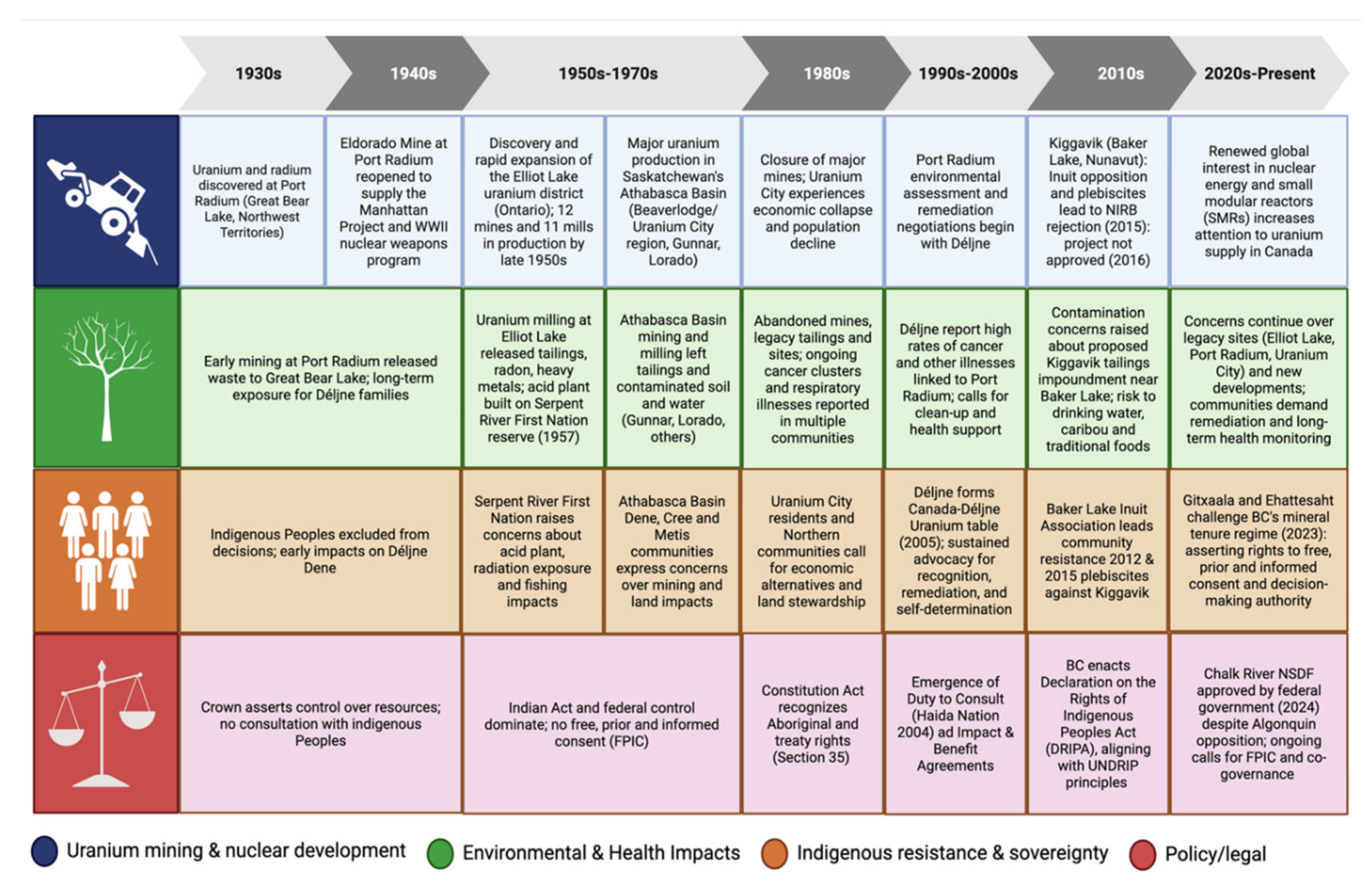
Figure 2.
Geographic distribution of uranium development and Indigenous case-study communities examined in this review. The map identifies major historical uranium mining districts, selected active and proposed uranium operations, and the four Canadian Indigenous case-study regions discussed in the review: Serpent River First Nation in Ontario, Dene, Cree, and Métis communities of the Athabasca Basin in Saskatchewan, Délı̨nę Dene in the Northwest Territories, and Baker Lake Inuit (Qamani’tuaq) in Nunavut. Provincial and territorial boundaries shown do not represent Indigenous traditional territorial boundaries. Figure created with Biorender [19].
Figure 2.
Geographic distribution of uranium development and Indigenous case-study communities examined in this review. The map identifies major historical uranium mining districts, selected active and proposed uranium operations, and the four Canadian Indigenous case-study regions discussed in the review: Serpent River First Nation in Ontario, Dene, Cree, and Métis communities of the Athabasca Basin in Saskatchewan, Délı̨nę Dene in the Northwest Territories, and Baker Lake Inuit (Qamani’tuaq) in Nunavut. Provincial and territorial boundaries shown do not represent Indigenous traditional territorial boundaries. Figure created with Biorender [19].
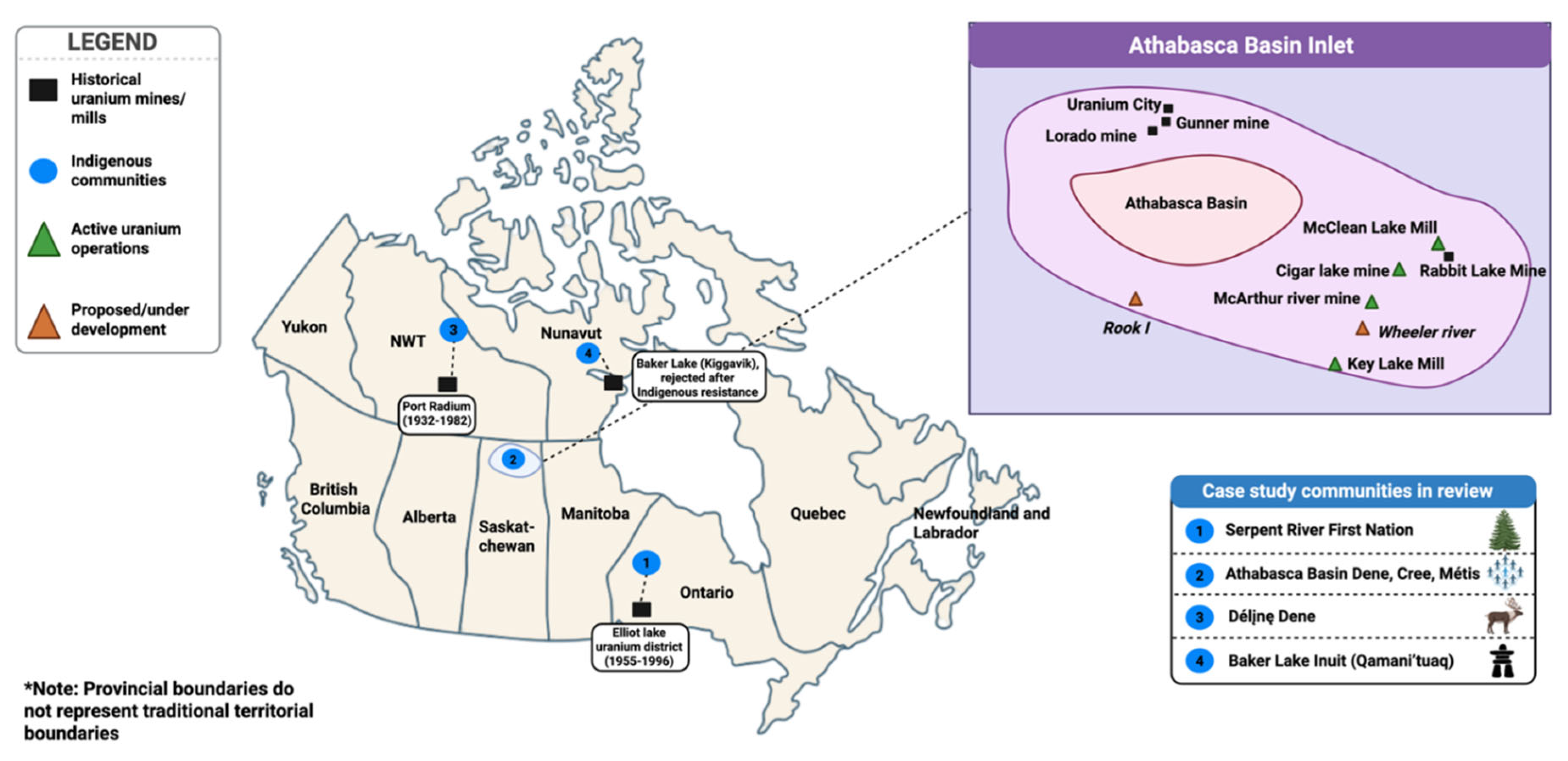
Table 1.
Indigenous-led organizations were systematically searched at the national (1) and provincial/territorial levels (2) to capture policy perspectives, governance frameworks, and community-specific experiences relevant to uranium mining in Canada.
Table 1.
Indigenous-led organizations were systematically searched at the national (1) and provincial/territorial levels (2) to capture policy perspectives, governance frameworks, and community-specific experiences relevant to uranium mining in Canada.
| Tier | Jurisdiction / Scope | Organizations / Bodies |
| 1—National | Canada-wide | Assembly of First Nations (AFN); Inuit Tapiriit Kanatami (ITK); Métis National Council (MNC); Native Women’s Association of Canada (NWAC); National Association of Friendship Centres (NAFC); First Nations Major Projects Coalition (FNMPC); Indigenous Environmental Network (IEN); Idle No More |
| 2—Provincial / Territorial | British Columbia | Union of BC Indian Chiefs (UBCIC); First Nations Summit; BC Assembly of First Nations (BCAFN) |
| Alberta | Confederacy of Treaty Six First Nations; Treaty 7 First Nations Chiefs’ Association; Treaty 8 First Nations of Alberta; Métis Nation of Alberta (Otipemisiwak Métis Government) | |
| Saskatchewan | Federation of Sovereign Indigenous Nations (FSIN); Métis Nation–Saskatchewan | |
| Manitoba | Assembly of Manitoba Chiefs; Manitoba Métis Federation | |
| Ontario | Chiefs of Ontario; Nishnawbe Aski Nation; Anishinabek Nation (Union of Ontario Indians); Grand Council Treaty #3; Association of Iroquois & Allied Indians; Métis Nation of Ontario | |
| Québec / Labrador | Assembly of First Nations Québec–Labrador (AFNQL); Cree Nation Government (Eeyou Istchee); Makivik Corporation (Nunavik Inuit) | |
| New Brunswick | Wolastoqey Nation in New Brunswick; Mi’gmawe’l Tplu’taqnn Inc. | |
| Nova Scotia | Kwilmu’kw Maw-klusuaqn / Mi’kmaq Rights Initiative (KMKNO) | |
| Prince Edward Island | Mi’kmaq Confederacy of PEI | |
| Newfoundland & Labrador | Nunatsiavut Government; Innu Nation; NunatuKavut Community Council | |
| Northwest Territories | Dene Nation; Inuvialuit Regional Corporation | |
| Nunavut | Nunavut Tunngavik Incorporated (NTI) | |
| Yukon | Council of Yukon First Nations |
Table 2.
Economic imbalances of uranium mining in Canada. Short-term economic gains offered to Indigenous communities during mining operations (e.g., wages, community payments, employment, infrastructure) compared with long-term burdens after closure (e.g., corporate profit disparities, environmental remediation costs, job loss, and service decline).
Table 2.
Economic imbalances of uranium mining in Canada. Short-term economic gains offered to Indigenous communities during mining operations (e.g., wages, community payments, employment, infrastructure) compared with long-term burdens after closure (e.g., corporate profit disparities, environmental remediation costs, job loss, and service decline).
| Short-term gains | Magnitude with case example | Long-term impact | Magnitude with case example |
| Indigenous wages (mining) | ≈$93,600 per worker/year; Indigenous average (all industries) ≈$51,120 → ~1.8× higher [18] | Corporate uranium sales / production value (scale) | Canada 2022: ≈$1.1B (value of mine production) [43]. Saskatchewan 2024: ≈$2.6B uranium sales [44]. |
| Community benefit-sharing (IBAs/BSAs) | Mary River (Nunavut) modelled 2.10% of discounted life-of-mine revenue [46] | Environmental cleanup costs | Gunnar uranium mine (SK) remediation ≈$280M [53] |
| Indigenous employment during operations | ≈50–51% of workforce at Cameco’s northern Saskatchewan uranium operations [41] | Job and population loss after closure | Uranium City (SK): ≈2,500 residents pre-closure (1981) → ≈200 by 1986 [54] à 91 by 2021 |
| Local infrastructure during boom | Uranium city (SK) planned to accommodate 5000 upon construction in 1952. Hospital built, further impact on job growth [50] | Post-closure service decline | Uranium City: Water/sewer shut off 1982–85; hospital relocated 2003; widespread service and business loss [50] |
Table 4.
Policy recommendations to advance reconciliation, Indigenous sovereignty, environmental stewardship, and sustainable resource governance in communities affected by uranium mining. Recommendations are organized by policy domain and aligned with the Truth and Reconciliation Commission (TRC) Calls to Action, the United Nations Declaration on the Rights of Indigenous Peoples (UNDRIP), and the principle of Free, Prior, and Informed Consent (FPIC), while identifying current implementation gaps and feasibility considerations.
Table 4.
Policy recommendations to advance reconciliation, Indigenous sovereignty, environmental stewardship, and sustainable resource governance in communities affected by uranium mining. Recommendations are organized by policy domain and aligned with the Truth and Reconciliation Commission (TRC) Calls to Action, the United Nations Declaration on the Rights of Indigenous Peoples (UNDRIP), and the principle of Free, Prior, and Informed Consent (FPIC), while identifying current implementation gaps and feasibility considerations.
| Policy type | Recommendation | Current gaps/challenges | Rationale | Alignment with TRC/UNDRIP/FPIC | Implementation strategy | Feasibility timeline | Key references |
| Consultation and co-governance | Strengthen Indigenous consultation and co-governance models | Consultation often remains procedural rather than consent-based, with Indigenous communities included after key project decisions have already been shaped. | Co-governance shifts Indigenous Peoples from stakeholders to rights-holders and decision-makers in resource governance. | UNDRIP Articles 18, 19, 29, 32; FPIC; TRC Call to Action 92 | Amend federal/provincial mining regulations to require binding FPIC before project approval. Establish Indigenous–Crown–industry co-governance boards with authority over monitoring, compliance, and project modification. | Medium- to long-term | [3,5,94] |
| Indigenous knowledge and impact assessment | Integrate Indigenous knowledge into environmental and health impact assessments | Indigenous knowledge is increasingly recognized but may still be treated as supplementary rather than equal to Western scientific evidence. | Indigenous knowledge strengthens environmental stewardship and reflects place-based relationships among land, water, health, and culture. | UNDRIP Articles 25, 31, 32; TRC Call to Action 92 | Require Indigenous knowledge integration from the earliest stages of impact assessment. Fund Indigenous-led impact assessments and community-controlled data governance protocols. | Short- to medium-term | [1,13,95] |
| Environmental remediation | Address legacy pollution and long-term environmental restoration | Many contaminated and abandoned mining sites continue to pose ecological, cultural, and health risks, while remediation funding and accountability remain uneven. | Remediation is necessary to restore land-based livelihoods, reduce exposure risks, and address intergenerational environmental harms. | UNDRIP Articles 28, 29; FPIC; TRC reconciliation principles | Create a dedicated federal Indigenous-led uranium remediation fund. Require polluter-pays mechanisms, long-term monitoring, and restoration plans designed with affected communities. | Medium-term | [34,96,97] |
| Health equity and environmental surveillance | Advance health equity in communities affected by uranium mining | Environmental exposure monitoring and long-term health surveillance are often fragmented, underfunded, or not community-controlled. | Communities affected by uranium mining require culturally safe care, exposure monitoring, and longitudinal surveillance for cancer, kidney disease, respiratory illness, and mental health impacts. | UNDRIP Articles 21, 24, 29; TRC Calls to Action 18–24 | Establish mobile and community-based health services, Indigenous-led environmental health registries, and long-term surveillance for radiation and contaminant-related outcomes. | Short- to medium-term | [34] |
| Economic self-determination | Support Indigenous economic self-determination beyond extractive dependency | Impact benefit agreements may provide jobs or revenue but can be short-term, confidential, unevenly negotiated, or dependent on continued extraction. | Economic reconciliation requires sustainable, community-defined development that does not force communities to trade environmental health for employment. | TRC Call to Action 92(ii); UNDRIP Articles 20, 23, 32 | Reform IBAs to include transparency, long-term revenue sharing, skills training, Indigenous procurement, renewable energy investment, and non-extractive economic alternatives. | Medium-term | [3,94] |
| Reparative justice and reconciliation | Promote reparative justice for historical uranium harms | Many communities have received limited compensation, incomplete recognition, or delayed remediation despite decades of health and environmental impacts. | Reparative justice acknowledges historical wrongdoing and supports healing through compensation, land restoration, cultural revitalization, and public accountability. | UNDRIP Articles 8, 11, 28; TRC reconciliation framework | Establish community-led reparations frameworks, including financial compensation, formal apologies, memorialization, health supports, and funding for cultural revitalization. | Long-term | [5,68,70,94] 9/28/2026 4:34:00 PM |
Disclaimer/Publisher’s Note: The statements, opinions and data contained in all publications are solely those of the individual author(s) and contributor(s) and not of MDPI and/or the editor(s). MDPI and/or the editor(s) disclaim responsibility for any injury to people or property resulting from any ideas, methods, instructions or products referred to in the content. |
© 2026 by the authors. Licensee MDPI, Basel, Switzerland. This article is an open access article distributed under the terms and conditions of the Creative Commons Attribution (CC BY) license (http://creativecommons.org/licenses/by/4.0/).
Copyright: This open access article is published under a Creative Commons CC BY 4.0 license, which permit the free download, distribution, and reuse, provided that the author and preprint are cited in any reuse.