

Submitted:
23 September 2026
Posted:
24 September 2026
You are already at the latest version
Abstract
High-dimensional biological systems can be represented in fewer dimensions to achieve simpler descriptions of complex cellular and physiological data. However, compact organization is frequently interpreted as evidence of reduced underlying dimensionality. We introduce an approach to separate geometrical compression from loss of local mathematical degrees of freedom within a biological solution space. We built a synthetic system of interacting regulatory, metabolic and signaling states governed by nonlinear constraints and examined its admissible solutions across changes in a control parameter. Multistart root finding identified the possible states, while intersolution distances quantified their geometrical compression. In parallel, Jacobian singular values and condition numbers assessed local rank and sensitivity, with nearest-neighbor geometry, participation ratios and residual-gradient dynamics providing complementary information on solution organization and stability. Our analysis revealed progressive geometrical convergence of distinct solutions accompanied by increasing numerical sensitivity, while the Jacobian preserved full rank throughout the investigated range. This suggests that compression in state space can occur without a corresponding reduction in local mathematical degrees of freedom, providing a criterion for separating apparent low-dimensional organization from genuine local dimensional loss. Potential applications include identifying misleading low-dimensional representations, assessing whether compressed biological data preserve their original structure and detecting regions where model solutions become increasingly sensitive to perturbations.
Keywords:
manifold
; multistability
; bifurcation
; bioinformatics
; embedding
Introduction
Dimensionality reduction represents high-dimensional observations using fewer coordinates, whereas intrinsic dimension describes the effective dimensionality required to capture their organization. Recent studies show that manifold structure, sampling density, noise and local heterogeneity can complicate the relationship between these two concepts (Meila and Zhang 2024; Tempczyk et al. 2025; Chinesta et al. 2025). This distinction has practical consequences because the dimensionality inferred from the data can influence which reduction strategy is appropriate; in biomedical datasets, intrinsic-dimension analysis has therefore been used to guide dimensionality reduction and data integration (Gliozzo et al. 2025). The problem is further complicated by the fact that different manifold-learning methods preserve different combinations of neighborhoods, trajectories, clusters and global relationships (Nadjafikhah and Nasiri 2025), while visually coherent embeddings may still distort the geometry of the original space (Gildenblat and Pahnke 2026). Consequently, dimensionality reduction is better regarded as a compromise among geometric fidelity, interpretability, efficiency and preservation of relevant information than as direct recovery of latent dimensionality (Wani 2025; Yao and Su 2026). This raises the question we address here: can biological states become strongly compressed in their geometrical representation while retaining their local mathematical dimensional structure?
To address this issue, we combined complementary measures of geometrical proximity and local rank structure, examining how each changed across the solution space. We performed a synthetic simulation in which normalized regulatory, metabolic and signaling activities were defined as simultaneous solutions of three coupled nonlinear constraint equations. At each of 101 values of a continuously varied control parameter, multistart numerical root finding was used to identify distinct solutions satisfying all three equations simultaneously. Then, we calculated the Euclidean distance between solutions, providing a direct measure of their geometrical separation. Nevertheless, decreasing distance indicates that admissible states are becoming closer in the original state space, but does not by itself demonstrate loss of dimension. To examine this second property independently, we calculated the analytical Jacobian matrix of the constraint equations at every solution. The Jacobian describes how small changes in regulatory, metabolic and signaling activities modify the three constraints. Still, singular-value decomposition of this matrix provided its smallest singular value: values approaching zero indicate proximity to local rank deficiency, whereas a finite smallest singular value indicates that the Jacobian is full rank. Still, we calculated the Jacobian condition number, which measures how sensitive the local system becomes to small perturbations. Further, local nearest-neighbor distances were used to estimate solution density, while covariance eigenvalues of neighboring biological states were combined into a participation ratio describing how strongly the local point cloud was concentrated along one or several directions. Finally, we integrated residual-gradient dynamics, in which trajectories descend the squared residual of the constraint equations, to examine how simulated states approach the admissible solutions. Together, these calculations tested whether increasing geometrical compression necessarily entails a loss of local mathematical structure or whether distinct solutions can converge within state space while the constraint Jacobian preserves full rank.
Methods
We studied a synthetic biological state-space model to determine whether apparent geometrical compression of admissible configurations necessarily corresponds to a genuine reduction in local mathematical dimensionality. We aimed to identify a discriminable signature separating convergence of distinct solution families from mathematical degeneracy. Specifically, geometrical compression was assessed through decreasing intersolution distance, whereas proximity to local rank deficiency was independently evaluated through the smallest Jacobian singular value. Persistence of finite singular values despite substantial solution convergence was interpreted as apparent compression without demonstrated dimensional collapse.
Constraint system. The simulated biological configuration was represented by the dimensionless state vector
Root sampling. The control parameter was sampled at 101 equally spaced values,
Solution separation. Geometrical compression was quantified directly from the simultaneously recovered roots. At each control value, pairwise Euclidean distances were calculated in the normalized three-dimensional biological state space,
Jacobian analysis. Local properties of the constraint system were quantified through its analytical Jacobian,
Neighborhood geometry. Local organization of the complete sampled solution set was examined using nearest-neighbor analysis. For this calculation, each solution was represented in the combined normalized state-control space
Local dimensional organization was evaluated from the biological coordinates of the same selected neighbors. After centering,
Residual dynamics. An auxiliary dynamical calculation was performed to determine whether numerical trajectories could approach the constraint-defined solutions. We first defined residual energy
Software tools. NumPy was used for numerical arrays, random-number generation, matrix operations, singular-value decomposition and eigenvalue calculations. SciPy was used for nonlinear root finding with the hybrid solver, numerical integration with solve_ivp, nearest-neighbor calculations through cKDTree and the Spearman and Kruskal-Wallis statistical tests. pandas were used to organize solution-level and parameter-level numerical outputs.
Results
We report the behavior of our synthetic nonlinear constraint system across the sampled control-parameter interval. Our analyses were restricted to quantities directly calculated during the simulation, including recovered roots, intersolution distances, Jacobian singular values and condition numbers, nearest-neighbor density, local participation ratio and residual-gradient trajectories. We specifically examined whether geometrical compression occurred while the constraint Jacobian preserved full rank.
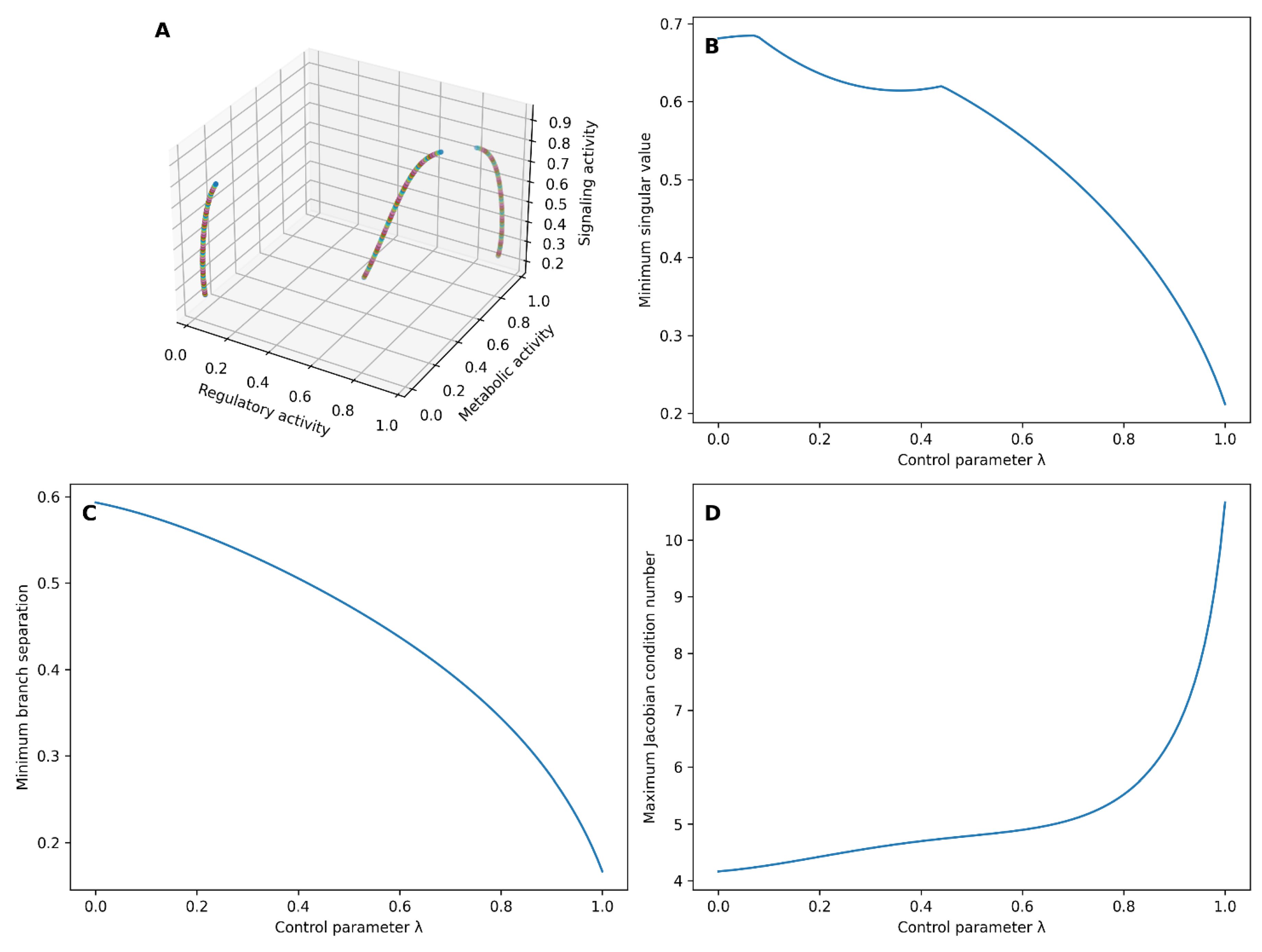
Solution organization. Multistart root finding consistently recovered three distinct admissible solutions across the entire control-parameter interval. The recovered states formed three visually distinguishable solution families in the normalized regulatory, metabolic and signaling coordinate space (Figure 1A). Because roots were independently identified at each control value rather than connected using a formal branch-continuation algorithm, these structures are referred to here as solution families rather than numerically tracked branches. The number of recovered roots was constant throughout the sampled interval, while the minimum Euclidean separation between distinct solutions progressively decreased (Figure 1C). This decrease showed a significant negative association with the control parameter (Spearman correlation, p < 0.001), and minimum-separation distributions differed significantly among the low, middle and high parameter regions (Kruskal-Wallis test, p < 0.001). In contrast, local nearest-neighbor density did not differ significantly among these regions (p = 0.216). Participation-ratio distributions differed significantly among parameter regions (p < 0.001), although the absolute differences were small and were therefore treated as secondary to the direct intersolution-distance measurement.
Overall, the computed solution geometry showed substantial convergence of three persistent sets of roots without a reduction in the number of distinct numerical solutions.
Jacobian behavior. Singular-value decomposition of the analytically evaluated Jacobian showed that geometrical convergence was accompanied by changing local conditioning. The minimum singular value progressively decreased across the control-parameter interval (Figure 1B), showing a significant negative association with the control parameter (Spearman correlation, p < 0.001). Its distributions also differed significantly among the low, middle and high parameter regions (Kruskal-Wallis test, p < 0.001). Consistently, the maximum Jacobian condition number (Figure 1D) showed a significant positive association with the control parameter (Spearman correlation, p < 0.001). Despite these changes, the smallest singular value stayed finite throughout the investigated interval, and no zero singular value or Jacobian rank deficiency was observed. In the separately executed residual-gradient analysis, terminal residuals and distances to the recovered solution set were very small at lower and intermediate control values and increased toward the upper end of the interval, coinciding with poorer Jacobian conditioning.
Overall, the distance and Jacobian measures distinguished increasing geometrical compression and numerical sensitivity from loss of local Jacobian rank.
Summarizing, our main result is that the simulated nonlinear constraint system underwent pronounced geometrical compression while preserving distinct solutions and a full-rank Jacobian throughout the sampled range. The decrease in the smallest singular value and increase in the condition number indicated increasing local sensitivity, but not dimensional collapse. Thus, substantial geometrical compression occurred without local rank loss: distinct solutions converged within state space while preserving their local mathematical rank, indicating that increasing spatial convergence does not necessarily correspond to a genuine reduction in local mathematical degrees of freedom.
representing continuously changing external conditions. The progressive decrease indicates increasing proximity to local rank deficiency, although the singular value is finite throughout the investigated interval and no mathematical singularity is reached. (C) Minimum Euclidean separation between distinct solution branches at each value of , showing progressive convergence of the solution families without an observed branch collision. Distances are expressed in normalized three-dimensional state-space units. (D) Maximum Jacobian condition number across the solutions identified at each control value. Its increase toward the upper end of the parameter interval indicates increasing sensitivity of the local constraint equations to perturbations, while remaining compatible with a nonsingular Jacobian over the complete simulated range.
Conclusions
We asked whether geometrical compression of admissible biological-style states necessarily leads to a loss of local mathematical degrees of freedom or whether distinct solutions can become progressively closer while the constraint equations are locally full rank. We used a synthetic system of coupled nonlinear constraints representing normalized regulatory, metabolic and signaling activities. Using manifold mathematical approaches, our simulations compared independently recovered solutions across a systematic control-parameter sweep. We found three distinct solutions at every sampled control value, while their minimum separation progressively decreased. Geometrical convergence was accompanied by a reduction in the smallest Jacobian singular value and an increase in conditioning, but the smallest singular value was finite and no Jacobian rank deficiency was observed. Our results suggest that substantial geometrical compression can coexist with locally nonsingular constraint equations. In our synthetic system, visual or metric convergence of admissible states was consequently distinguishable from the stronger mathematical condition of local rank loss.
Our approach differs from commonly used dimensionality-reduction procedures such as principal component analysis, UMAP, t-SNE, diffusion maps and other manifold-learning techniques (Lin and Zha 2008; Kobak and Berens 2019; Mi et al. 2019; Aliverti et al. 2020; Diaz-Papkovich, Anderson-Trocmé, and Gravel 2021; Hozumi et al. 2021; Jang 2021; Kang et al. 2021; Roger et al. 2022; Zhou and Sharpee 2022; Gonzalez-Castillo et al. 2023; Ujas, Obregon-Perko, and Stowe 2023; Vagner et al. 2023; Li et al. 2024). Rather than constructing a lower-dimensional embedding from a high-dimensional dataset, we directly calculated the solutions of explicitly defined nonlinear constraints and examined their organization in the original three-dimensional state space. Our analysis also differs from intrinsic-dimension estimators since it does not provide a general estimate of intrinsic dimensionality. Instead, we assessed local mathematical regularity through singular values of the constraint Jacobian. Therefore, intersolution distances and Jacobian singular values provided separate measures of geometrical compression and local rank stability. Nearest-neighbor density and covariance-based participation ratios provided additional numerical descriptions of the sampled solution set, while residual-gradient integration examined convergence toward constraint-defined roots.
Our study has limitations. The analyzed system is synthetic, contains only three normalized state variables and does not reproduce the dimensionality, measurement noise, heterogeneity or incomplete sampling characteristic of experimental biological datasets. The nonlinear coefficients were specified for the simulation rather than estimated from observations. Multistart root finding cannot formally guarantee recovery of every possible root, although extensive starting-point sampling was used at each control value. Solution families were inferred from the organization of independently recovered roots across the parameter sweep; no formal branch-continuation algorithm was performed. The participation ratio describes local point-cloud organization but is not an intrinsic-dimension estimator and Jacobian rank is not mathematically equivalent to every definition of intrinsic dimensionality. Likewise, we did not calculate derived moduli spaces, pseudo-holomorphic curves or Fredholm structures. These distinctions restrict our analysis to geometrical compression and local Jacobian regularity. Further investigation is required to determine whether the same relationships hold in genuinely high-dimensional systems, under stochastic perturbations, or when constraint equations must be inferred from noisy observations.
Our approach suggests experimentally testable hypotheses. First, under a controlled perturbation, independently identifiable biological states may progressively approach one another while remaining distinguishable; the measurable observables would be interstate distance and the number of separately resolved states.
Second, if experimental constraints can be inferred locally, increasing state convergence should be compared with the smallest singular value of their estimated Jacobian. The prediction is not that geometrical compression must produce rank loss, but that substantial compression can occur while the smallest singular value is detectably above zero.
Third, worsening local conditioning should accompany increasing sensitivity to perturbations if the inferred system approaches an ill-conditioned regime; this can be tested by relating the Jacobian condition number to measured response amplitudes.
Fourth, an apparent low-dimensional pattern in conventional embedding should not by itself be classified as loss of mathematical dimensionality. A stronger test would require comparison with independently estimated intrinsic dimension or local constraint rank.
Future simulations should increase the ambient dimensionality, vary the number and form of constraints, introduce controlled noise and missing observations and repeat the analysis across independently generated systems. Direct comparisons with PCA, UMAP, t-SNE, diffusion maps and established intrinsic-dimension estimators would determine whether solution-space compression and embedding-derived low dimensionality provide concordant or divergent descriptions.
Practical applications could include evaluating dimensionality-reduction methods applied to complex biological data. A reduced representation could be compared with the original constraint structure to determine whether observations that appear closer after compression have lost local degrees of freedom or have simply moved closer together.
Our approach could also help assess the reliability of numerical models. Small Jacobian singular values and large condition numbers identify regions where solutions become more sensitive to changes in measurements or model parameters. These regions may indicate where additional measurements are needed to distinguish similar biological states.
Our approach could also help distinguish different sources of uncertainty in mechanistic models, such as difficulty in identifying a solution, the presence of multiple possible solutions or poor numerical conditioning.
Finally, in longitudinal biological studies, changes in the distance between states could be examined together with changes in their local mathematical structure. This could help determine whether states are simply becoming more similar or whether their underlying degrees of freedom are also changing.
In conclusion, we found that substantial geometrical compression can occur without loss of local mathematical rank. Across our synthetic system, distinct admissible solutions moved progressively closer together, yet the constraint Jacobian preserved full rank throughout the entire parameter range. Thus, increasing proximity between states does not necessarily indicate a reduction in their local mathematical degrees of freedom. This means that geometrical compression and local rank loss should be considered distinct properties when interpreting reduced representations of complex systems. Further studies using higher-dimensional models, explicit intrinsic-dimension estimates and experimental biological data will determine how broadly this distinction applies.
Declarations
Authors' contributions. The Author performed: study concept and design, acquisition of data, analysis and interpretation of data, drafting of the manuscript, critical revision of the manuscript for important intellectual content, statistical analysis, obtained funding, administrative, technical and material support, study supervision.
Funding: This research did not receive any specific grant from funding agencies in the public, commercial or not-for-profit sectors.
Ethics approval and consent to participate. Ethics approval statement is not applicable. This research does not contain any studies with human participants or animals performed by the Author.
Consent for publication. The Author transfers all copyright ownership, in the event the work is published. The undersigned author warrants that the article is original, does not infringe on any copyright or other proprietary right of any third part, is not under consideration by another journal and has not been previously published.
Availability of data and materials. All data and materials generated or analyzed during this study are included in the manuscript. The Author had full access to all the data in the study and took responsibility for the integrity of the data and the accuracy of the data analysis.
Disclaimer/Publisher’s Note: The statements, opinions and data contained in all publications are solely those of the individual author(s) and contributor(s) and not of MDPI and/or the editor(s). MDPI and/or the editor(s) disclaim responsibility for any injury to people or property resulting from any ideas, methods, instructions or products referred to in the content.Competing interests. The Author does not have any known or potential conflict of interest including any financial, personal or other relationships with other people or organizations within three years of beginning the submitted work that could inappropriately influence or be perceived to influence their work.
Acknowledgments: none.
Declaration of generative AI and AI-assisted technologies in the writing process. During the preparation of this work, the author used ChatGPT 5.3 to assist with data analysis and manuscript drafting and to improve spelling, grammar and general editing. After using this tool, the author reviewed and edited the content as needed, taking full responsibility for the content of the publication.
References
- Aliverti, E.; Tilson, J. L.; Filer, D. L.; Babcock, B.; Colaneri, A.; Ocasio, J.; Gershon, T. R.; Wilhelmsen, K. C.; Dunson, D. B. Projected t-SNE for Batch Correction. Bioinformatics 2020, 36(11), 3522–27. [Google Scholar] [CrossRef] [PubMed]
- Chinesta, Francisco; Cueto, Elias; Champaney, Victor; Ghnatios, Chady; Ammar, Amine; Hascoet, Nicolas; Gonzalez, David; et al. Intrinsic Dimensionality of a Data Set and Manifold Learning. In A Gentle Introduction to Data, Learning and Model Order Reduction; Springer: Cham, 2025. [Google Scholar]
- Diaz-Papkovich, A.; Anderson-Trocmé, L.; Gravel, S. A Review of UMAP in Population Genetics. J. Hum. Genet. 2021, 66(1), 85–91. [Google Scholar] [CrossRef] [PubMed]
- Gildenblat, Jacob; Pahnke, Jens. Dimensionality Reduction with Strong Global Structure Preservation. Pattern Anal. Appl. 2026, 29, 38. [Google Scholar] [CrossRef]
- Gliozzo, Jessica; Soto-Gomez, Mauricio; Guarino, Valentina; Bonometti, Arturo; Cabri, Alberto; Cavalleri, Emanuele; Reese, Justin; et al. Intrinsic-Dimension Analysis for Guiding Dimensionality Reduction and Data Fusion in Multi-Omics Data Processing. Artif. Intell. Med. 2025, 160, 103049. [Google Scholar] [CrossRef] [PubMed]
- Gonzalez-Castillo, J.; Fernandez, I.; Lam, K. C.; Handwerker, D. A.; Pereira, F.; Bandettini, P. A. Manifold Learning for fMRI Time-Varying FC. Front. Hum. Neurosci. 2023, 17, 1134012. [Google Scholar] [CrossRef] [PubMed]
- Hozumi, Y.; Wang, R.; Yin, C.; Wei, G. W. UMAP-Assisted K-Means Clustering of Large-Scale SARS-CoV-2 Mutation Datasets. Comput. Biol. Med. 2021, 131, 104264. [Google Scholar] [CrossRef] [PubMed]
- Jang, J. H. Principal Component Analysis of Hybrid Functional and Vector Data. Stat. Med. 2021, 40(24), 5152–73. [Google Scholar] [CrossRef] [PubMed]
- Kang, B.; García García, D.; Lijffijt, J.; Santos-Rodríguez, R.; De Bie, T. Conditional t-SNE: More Informative t-SNE Embeddings. Mach. Learn. 2021, 110(10), 2905–40. [Google Scholar] [CrossRef] [PubMed]
- Kobak, D.; Berens, P. The Art of Using t-SNE for Single-Cell Transcriptomics. Nat. Commun. 2019, 10(1), 5416. [Google Scholar] [CrossRef] [PubMed]
- Li, T.; Zou, Y.; Li, X.; Wong, T. K. F.; Rodrigo, A. G. Mugen-UMAP: UMAP Visualization and Clustering of Mutated Genes in Single-Cell DNA Sequencing Data. BMC Bioinform. 2024, 25(1), 308. [Google Scholar] [CrossRef] [PubMed]
- Lin, T.; Zha, H. Riemannian Manifold Learning. IEEE Trans. Pattern Anal. Mach. Intell. 2008, 30(5), 796–809. [Google Scholar] [CrossRef] [PubMed]
- Meila, Marina; Zhang, Hanyu. Manifold Learning: What, How and Why. Annu. Rev. Stat. Its Appl. 2024, 11, 393–417. [Google Scholar] [CrossRef]
- Mi, J. X.; Zhang, Y. N.; Lai, Z.; Li, W.; Zhou, L.; Zhong, F. Principal Component Analysis Based on Nuclear Norm Minimization. Neural Netw. 2019, 118, 1–16. [Google Scholar] [CrossRef] [PubMed]
- Nadjafikhah, Mehdi; Nasiri, Mohammad. A Comparative Study of Manifold Learning Methods for scRNA-seq with a Trajectory-Aware Metric. Sci. Rep. 2025, 15, 28923. [Google Scholar] [CrossRef] [PubMed]
- Roger, E.; Attyé, A.; Renard, F.; Baciu, M. Leveraging Manifold Learning Techniques to Explore White Matter Anomalies: An Application of the TractLearn Pipeline in Epilepsy. NeuroImage Clin. 2022, 36, 103209. [Google Scholar] [CrossRef] [PubMed]
- Tempczyk, Piotr; Garncarek, Lukasz; Filipiak, Dominik; Kurpisz, Adam. A Wiener Process Perspective on Local Intrinsic Dimension Estimation Methods. Proc. AAAI Conf. Artif. Intell. 2025, 39(19), 20859–20866. [Google Scholar] [CrossRef]
- Ujas, T. A.; Obregon-Perko, V.; Stowe, A. M. A Guide on Analyzing Flow Cytometry Data Using Clustering Methods and Nonlinear Dimensionality Reduction (tSNE or UMAP). Methods Mol. Biol. 2023, 2616, 231–49. [Google Scholar] [CrossRef] [PubMed]
- Vagner, M.; Cleather, D. J.; Kubový, P.; Hojka, V.; Stastny, P. Principal Component Analysis Can Be Used to Discriminate Between Elite and Sub-Elite Kicking Performance. Mot. Control 2023, 27(2), 354–72. [Google Scholar] [CrossRef] [PubMed]
- Wani, Aasim Ayaz. Comprehensive Review of Dimensionality Reduction Algorithms: Challenges, Limitations and Innovative Solutions. PeerJ Comput. Sci. 2025, 11, e3025. [Google Scholar] [CrossRef] [PubMed]
- Yao, Zhigang; Su, Jiaji. Manifold Fitting: A Review of Methods and Applications. Harv. Data Sci. Rev. 2026, 8(3). [Google Scholar] [CrossRef]
- Zhou, Y.; Sharpee, T. O. Using Global t-SNE to Preserve Intercluster Data Structure. Neural Comput. 2022, 34(8), 1637–51. [Google Scholar] [CrossRef] [PubMed]
Figure 1.
Geometrical organization and local regularity of the simulated biological solution space. (A) Three-dimensional representation of the simulation-derived admissible solutions in normalized regulatory, metabolic and signaling activity space across the sampled control-parameter interval. Each point corresponds to a numerical solution of the coupled nonlinear constraint equations and the three continuous families represent the three distinct roots recovered at every sampled value of the control parameter. (B) Minimum singular value of the Jacobian matrix as a function of the dimensionless control parameter
Figure 1.
Geometrical organization and local regularity of the simulated biological solution space. (A) Three-dimensional representation of the simulation-derived admissible solutions in normalized regulatory, metabolic and signaling activity space across the sampled control-parameter interval. Each point corresponds to a numerical solution of the coupled nonlinear constraint equations and the three continuous families represent the three distinct roots recovered at every sampled value of the control parameter. (B) Minimum singular value of the Jacobian matrix as a function of the dimensionless control parameter
Disclaimer/Publisher’s Note: The statements, opinions and data contained in all publications are solely those of the individual author(s) and contributor(s) and not of MDPI and/or the editor(s). MDPI and/or the editor(s) disclaim responsibility for any injury to people or property resulting from any ideas, methods, instructions or products referred to in the content. |
© 2026 by the authors. Licensee MDPI, Basel, Switzerland. This article is an open access article distributed under the terms and conditions of the Creative Commons Attribution (CC BY) license (http://creativecommons.org/licenses/by/4.0/).
Copyright: This open access article is published under a Creative Commons CC BY 4.0 license, which permit the free download, distribution, and reuse, provided that the author and preprint are cited in any reuse.