

Submitted:
22 September 2026
Posted:
24 September 2026
You are already at the latest version
Abstract
The automation of vehicle refueling and charging stations is an emerging enabler of sustainable transportation, but the robotic platforms able to perform this task remain fragmented across disconnected research communities. This review examines two evidence-based platform families - fixed and mobile manipulator arms - and two emerging candidate families - humanoid and quadruped robots, retained as future research directions - across four refueling modalities: EV conductive charging, EV wireless charging, hydrogen refueling, and battery swapping. A PRISMA-inspired, criterion-driven search retained 84 primary sources from an initial pool of 194 records. Quantitative evidence is reported wherever available: docking success rates of 90--100\%, positional accuracy of 2-10 mm, cycle times from tens of seconds to a few minutes, and Technology Readiness Levels. Every comparative table entry carries an explicit Evidence Class (A-C), separating evidence-based findings from the extrapolation required for humanoid- and quadruped-based refueling, for which no direct study exists. Dedicated analyses address hydrogen functional safety and industrial battery-swapping architectures (NIO, CATL, Ample, Gogoro). Six technological and normative gaps, including cybersecurity, feed a five-direction, priority-ranked research roadmap. This review offers the first cross-platform, evidence-graded comparative framework in this domain, making explicit where current knowledge ends and extrapolation begins.
Keywords:
robotic refueling
; electric vehicle charging
; hydrogen refueling
; battery swapping
; humanoid robots
; quadruped robots
; mobile manipulators
; ATEX
; hydrogen refueling standards
; technology readiness level
1. Introduction
The global transition toward electrified and hydrogen-based mobility is reshaping the infrastructure requirements of refueling and charging stations [1,2]. As the number of electric and fuel-cell vehicles grows, vehicle refueling is becoming a natural candidate for robotic automation. The task is labor-intensive and time-consuming, and, in the case of hydrogen, increasingly safety-critical because of the high pressures involved (350–700 bar) [3]. Beyond convenience, robotic refueling addresses concrete accessibility and operational needs. These include continuous 24/7 service and integration with vehicles left unattended, with no human present to plug in a connector or handle a fuel nozzle manually [4,5]. Indeed, a driverless-fleet scenario is not merely hypothetical: a robotic-arm charging system has been proposed and demonstrated specifically for occupantless electric vehicles [85], and commercial robotaxi operators are already piloting multi-bay automated charging depots. The premise is that manual plugging does not scale once a human safety driver is no longer present at every vehicle [86]. A separate, complementary operations research literature addresses the fleet-scheduling side of this same problem – when and where a driverless fleet should charge – without addressing the robotic automation question itself [87]. This review’s scope is restricted to the physical manipulation problem, leaving fleet-level scheduling as an adjacent but distinct research area. Autonomous-vehicle fleets are therefore treated throughout this review as one of the clearest near-term demand drivers for the platforms surveyed, alongside the accessibility and continuous-service motivations above.
Over the past five years, industrial actors have rapidly commercialized fixed and mobile robotic arms for EV plug-in charging [6,7,8,9]. Meanwhile, the broader robotics research community has independently advanced humanoid and legged (quadruped) platforms toward general-purpose manipulation and mobility [10,11], yet these advances have not been applied – even experimentally – to the refueling task. This disconnection is precisely the gap this review addresses. No prior work has systematically compared how different robotic platform typologies perform, or could plausibly perform, across the four dominant green refueling modalities, and none has jointly examined the technological, safety, and cybersecurity dimensions that such a comparison requires. Existing reviews address a narrower slice of this space: robotic EV charging alone [12], battery swapping alone [13,14,15], or quadruped/humanoid manipulation independent of any refueling application [17,18,19].
The contribution of this review is fivefold. First, it introduces a taxonomy that organizes two mature, evidence-based platform families (fixed and mobile manipulators) and two emerging candidate families (humanoid and quadruped robots) across four refueling modalities and nine quantitatively anchored evaluation criteria. Throughout this review, refueling is used as an umbrella term for brevity, covering EV charging and battery swapping alongside literal hydrogen fuel transfer; charging is used specifically where the electrical, non-substance-transfer nature of the process is being emphasized. Second, it provides a PRISMA-inspired, criterion-driven literature synthesis with explicit reporting of search statistics. Third, it offers a critical comparative analysis that separates evidence-based findings from extrapolated assessments. Fourth, it gives dedicated technical treatments of hydrogen-specific functional safety and of industrial battery-swapping architectures, two areas underserved by prior robotics-focused reviews. Fifth, it proposes a prioritized, five-direction research roadmap that, for the first time in this domain, also surfaces the cybersecurity implications of networked robotic refueling systems as an explicit gap. Section 2 positions this work against existing surveys; Section 3 describes the literature search protocol; Section 4 presents the taxonomy and evidence-tier structure; Section 5 addresses hydrogen robotic refueling safety. Section 6 addresses battery-swapping architectures; Section 7 reports the comparative analysis; Section 8 discusses gaps and future directions; Section 9 concludes.
2. Related Work
Among the technologies covered here, robotic charging for electric vehicles has attracted the most dedicated review-level attention. A systematic literature review covering 2012–2022 identified an exponential increase in publications, with autonomous docking, charging-socket pose estimation, plug insertion, and manipulator design as dominant themes. The review [12] predates the 2024–2026 wave of commercial deployments and does not address hydrogen, battery swapping, or non-arm-based platforms. Individual contributions during this period include autonomous, robot-like mobile chargers for public parking facilities [68] and rigid-flexible manipulator designs for automatic EV charging [69], both consistent with the dominant themes noted earlier. This peer-reviewed evidentiary base has continued to grow since that 2012–2022 window closed, with a hybrid discrete-continuous docking controller for automatic EV recharging [90], a wheeled mobile manipulator that plugs into an unstructured-environment charging gun [88], a YOLO-based vision framework for autonomous charging-port detection and alignment [89], and a journal-length extension of moving-inductive-charger alignment control [91]. Together, these indicate that robotic EV-charging docking remains an active peer-reviewed research topic in 2024–2025, not one sustained only by industrial deployment reports.
Battery swapping has been surveyed from complementary angles. A research agenda review distinguishes manual from robotic-arm-based autonomous stations for heavy-duty vehicles [13], and a device-level comparison of five swapping mechanisms identifies the mobile robot as the most scalable but least mature [14]. A further critical review centers on five adoption barriers – infrastructure requirements, interoperability, consumer behavior, safety/regulation, and technology viability [15]. None jointly considers plug-in or hydrogen refueling. No dedicated review of robotic hydrogen refueling was identified in this search either, consistent with the comparatively sparse hydrogen-specific literature reported in Section 3.5.
On the platform side, quadruped-with-arm systems have been reviewed extensively in isolation from any energy-infrastructure task. A recurring finding is that combining legged mobility and manipulation yields high flexibility at the cost of substantially increased motion-planning and whole-body control complexity [16,18,19]. Humanoid robotics research shows a similar pattern: general-purpose manipulation benchmarks [10] and dynamic loco-manipulation control frameworks [11] demonstrate rapidly advancing capabilities, yet no study has applied these platforms to refueling. Separately, a dedicated human-robot interaction (HRI) study has identified explicit gaps in EN ISO 13482:2014 regarding transparency and the protection of pedestrians and bystanders – rather than only the primary user – when mobile robots operate in public spaces [20]. This finding is directly relevant to any future public-facing refueling robot and is taken up again in Section 8.
A further review addresses refueling robots generically, but is limited to conventional liquid-fuel dispensing at gas stations, without extending to the electrified or hydrogen-based modalities central to sustainable mobility [127].
This review differs from all cited prior work in scope and structure: it constructs a cross-cutting comparative framework spanning platform type, refueling modality, and applicable safety regime, explicitly separating what the literature demonstrates from what must currently be inferred by analogy.
3. Methodology
This review adopts a PRISMA-inspired literature search and screening protocol. It is explicitly not a registered, multi-reviewer systematic review: screening was performed by one author (I.I.) without independent duplicate screening or pre-registration. All 128 retained references were, however, independently verified for authenticity and claim-fit by a second author (C.M.), a distinct step from the screening and selection process itself. The search also combined structured database queries with targeted retrieval of standards and government technical reports that are not indexed in conventional bibliographic databases. This distinction is stated here so that the reader correctly calibrates the completeness claims of this review. A further, related distinction concerns synthesis method: this review performs a structured narrative synthesis, not a statistical meta-analysis. No effect-size pooling, forest plots, or cross-study statistical weighting are computed anywhere in this review. This is a methodological choice, not an omission. The retained sources report heterogeneous, non-commensurable outcome measures across platform-modality combinations (e.g., docking success rate as a percentage, cycle time in seconds, and TRL as an ordinal band), evaluated under study-specific conditions that are not standardized across the literature (Section 8.1, Gap 4). Quantitative pooling under these conditions would misrepresent precision that the underlying evidence does not support. Instead, this review substitutes the Evidence Class (Section 3.4), Data Confidence (Section 3.8), and per-criterion evidence-strength tags (Strong/Moderate/Weak, Section 7.1.1) as an explicit, auditable alternative to statistical synthesis.
3.1. Information Sources and Search Terms
Academic sources were retrieved from IEEE Xplore, ScienceDirect (Elsevier), SpringerLink, MDPI journals, and arXiv. Search terms combined platform descriptors (“robotic arm”, “mobile manipulator”, “humanoid robot”, “quadruped robot”, “legged manipulator”), modality descriptors (“EV charging”, “wireless charging”, “hydrogen refueling”, “battery swapping”), and evaluation descriptors (“docking precision”, “autonomous docking”, “cycle time”, “technology readiness level”). These were combined using Boolean AND/OR operators. The search was further supplemented with standards documents (ISO 10218:2025, ISO 13482, the ISO 19880 series, SAE J2601, SAE J2799) and government/industrial technical reports (U.S. Department of Energy Hydrogen Program Annual Merit Reviews, National Renewable Energy Laboratory technical reports and composite data products). Such non-academic sources were used only where peer-reviewed academic sources were unavailable for a given platform-modality combination – itself one of the findings reported in Section 7. The search additionally included targeted retrieval of specific author- or topic-nominated works in adjacent robotics domains – perception and sensing, legged/humanoid manipulation, physical human-robot safety, cybersecurity, and cross-platform benchmarking – verified individually against primary bibliographic records (publisher pages, DOIs, or arXiv listings). Across both retrieval strategies, this review draws on 128 references in total, cataloged together without further distinction in Table S1 (Section 3.4) and in the References section.
3.2. Inclusion and Exclusion Criteria
Inclusion required that a source addresses, directly or through closely applicable general robotics literature: (a) robotic manipulation for vehicle charging, refueling, or battery exchange; (b) design, control, or evaluation of fixed, mobile, humanoid, or legged platforms with manipulation capability; or (c) safety standards applicable to robot operation near vehicles, fuels, or the public. Publication years 2019–2026 were prioritized, with earlier foundational sources (e.g., early TRL frameworks) retained where directly relevant. Exclusion applied to sources addressing only battery chemistry, autonomous driving without a manipulation component, or vehicle powertrain design, and to sources failing basic verifiability standards (e.g., unreviewed marketing content without technical substantiation). Industrial reports and standards documents were included specifically to close coverage gaps for platform-modality combinations – such as ATEX-rated hydrogen refueling and commercial battery-swapping architectures – where peer-reviewed literature is sparse or nonexistent. This choice is consistent with the finding, reported in Section 3.7, that hydrogen- and swapping-deployment evidence is disproportionately industrial in nature.
3.3. Literature Statistics
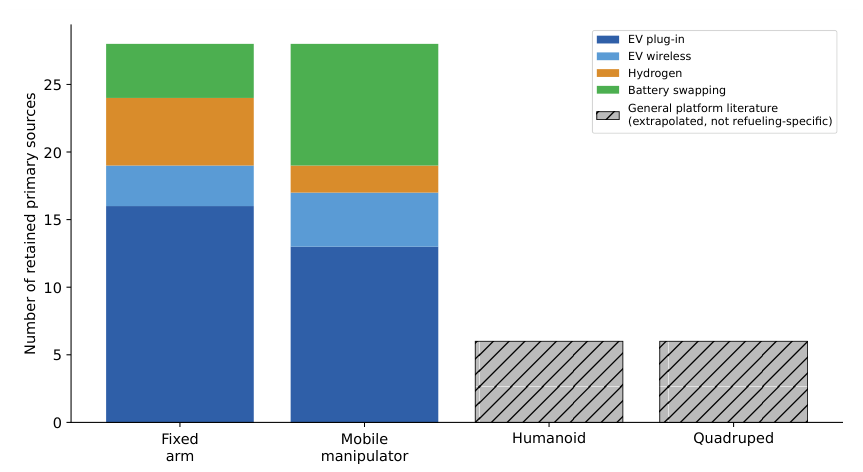
An initial pool of 194 records was identified following an additional targeted search pass conducted specifically to reduce grey-literature dependence (Section 3.7). After removing 21 duplicates, 173 records were screened by title and abstract; 58 were excluded as out of scope. The remaining 115 records were assessed at the full-text level for eligibility; 31 were excluded for insufficient technical detail, unverifiable claims, or redundancy with an already included source. A total of 84 primary sources were retained for qualitative synthesis (Figure 1; Section 3.7, Table 1). This PRISMA-tracked count describes only the primary retrieval corpus. A further 44 references were retrieved through targeted searches for specific thematic gaps – perception, legged/humanoid manipulation, safety, cybersecurity, economics, and benchmarking. These were verified individually rather than through this database-level screening process. Together, they bring the manuscript’s total bibliography to 128 references, cited without further distinction throughout this review (Section 3.1; Table S1). Of the 84 primary sources, approximately 32% address EV conductive or wireless charging, 19% address hydrogen refueling or hydrogen-station safety, and 29% address battery swapping. The remaining approximately 20% of sources address humanoid or quadruped platforms in contexts other than refueling and are retained specifically to support the extrapolated assessments reported in Section 7 (Figure 4).
3.4. Supplementary Source Classification (Table S1)
To make the source base independently auditable, every retained source was classified across the platform, modality, evidence class, and directness dimensions used throughout this review. A representative excerpt is given in Table S1; the complete classification for all 128 references is provided as Supplementary Material (Table_S1_full.xlsx / .csv).1 Evidence class follows a three-tier scheme: “Academic” (peer-reviewed journal/conference/preprint), “Industrial evidence” (vendor, market-report, or trade-press claims not tied to a specific operating deployment), and “Deployment evidence” (vendor or press claims describing a specific, named, operating installation with reported figures). The full supplementary table additionally distinguishes “Standard” and “Government report” sources, consistent with Table 1.
Table S1 (excerpt). Supplementary source classification. Full table (128 rows) provided as Supplementary Material.
| Ref. | Source (Year) | Platform | Modality | Evidence Class | Direct/Indirect | Main Contribution |
| [12] | Int. J. Intell. Robot. Appl. (2023) | Mobile manip. | EV plug-in | Academic | Direct | SLR 2012–2023, docking/pose-estimation themes |
| [24] | CHN Energy (2024) | Fixed arm | Hydrogen | Deployment | Direct | ATEX-rated rail hydrogen refueling robot |
| [32] | DOE/Plug Power, TA029 | Mobile / fixed | Hydrogen | Deployment | Direct | 95% connection-success target, on-road development |
| [35] | NIO/CATL press (2024–2025) | Fixed station | Battery swap | Deployment | Direct | NIO/CATL Choco-SEB 100-second automated swap |
| [20] | ACM Trans. Hum.-Robot Interact. (2021) | Humanoid / mobile | N/A (HRI) | Academic | Indirect | EN ISO 13482:2014 bystander-safety gap |
| [10] | arXiv, HumanoidBench (2024) | Humanoid | N/A (Ext.) | Academic | Indirect | Whole-body manipulation benchmark, no refueling task |
| [16] | Springer, Robot 2023 | Quadruped | N/A (Ext.) | Academic | Indirect | Quadruped-manipulator design trade-offs |
| [60] | Energy Sustain. Dev. (2025) | N/A | Battery swap (economics/siting) | Academic | Indirect | Strategic siting/cost optimization of battery-swap stations for developing countries |
| [74] | Precedence Research (2026) | Cross-platform | Cross-modality | Industrial market | Indirect | Market sizing, not technical validation |
3.5. Bibliometric Overview
Figure 2 summarizes the temporal and categorical distribution of the 84 retained sources. Publication counts (Figure 2a) show sustained year-on-year growth from 2019 through 2025, consistent with the growing commercial relevance of robotic charging noted in Section 2. The partial 2026 count reflects the search cut-off date rather than a genuine decline. By platform (Figure 2b), fixed-arm and mobile-manipulator sources dominate ( and respectively). Humanoid and quadruped sources ( and ), by contrast, are drawn overwhelmingly from general-purpose robotics literature rather than refueling-specific studies, visually corroborating the evidence/extrapolation split formalized in Section 7.4. By modality (Figure 2c), hydrogen-specific sources () remain markedly fewer than EV plug-in () and battery-swapping () sources, despite hydrogen’s higher regulatory complexity (Section 5). This review treats the scarcity as a substantive finding rather than a search artifact, since the search protocol (Section 3.1) applied identical term structures across all four modalities.
3.6. Handling of Literature Gaps
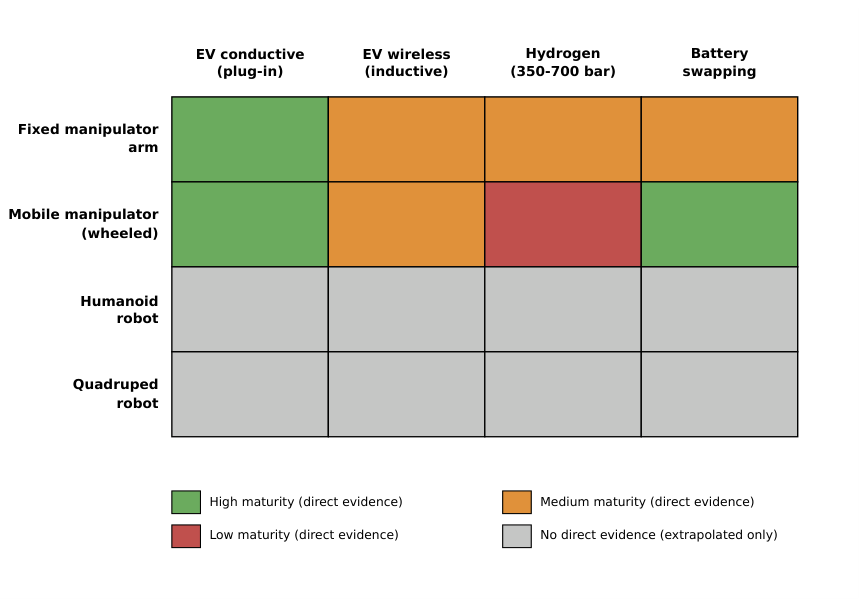
With no direct sources available for humanoid/quadruped refueling or mobile hydrogen refueling, no comparative data was fabricated to fill the gaps. These combinations are instead evaluated by explicit, labeled extrapolation from the closest available literature (Section 7.4), applied consistently in the text, in Table 4, and in Figure 3.
3.7. Evidence Source Composition
The composition of all 128 retained sources is reported explicitly below, so that readers can independently judge how much of this review’s support rests on peer-reviewed science versus deployment or market disclosure.

Table 1.
Evidence source composition ().
| Category | Count (Percentage) |
|---|---|
| Peer-reviewed journal | 51 (39.8%) |
| Conference proceedings | 23 (18.0%) |
| Preprints (arXiv, not peer-reviewed) | 14 (10.9%) |
| Standards and regulations (ISO/SAE/UNECE/IEC) | 6 (4.7%) |
| Government/institutional reports (NREL/DOE/OSTI/FHWA) | 5 (3.9%) |
| Industrial deployment evidence | 25 (19.5%) |
| Industrial market evidence | 4 (3.1%) |
Strengths. Peer-reviewed journal articles and conference proceedings together account for 57.8% of the evidence base (74/128). These sources support this review’s claims broadly, from EV charging manipulation and battery-swapping economics/adoption (Section 7.1.1, Section 6.1, Section 6.2) to the perception, safety, and cybersecurity literature introduced in Section 7.1.2, Section 8.2, and Section 8.4.
Limitations. 19.5% of sources (25/128) are industrial deployment evidence and a further 3.1% (4/128) are industrial market evidence – together 22.7% of the base. These are concentrated in exactly the places flagged throughout this review as supplementary rather than primary (Section 5.1, Section 6.1, Section 6.2, Section 6.3 and Section 6.4, Section 8.4.A): operational figures for named commercial installations (NIO, CATL, Xiaomi, Hyundai, Figure AI, Boston Dynamics) for which no independent peer-reviewed measurement exists. The 10.9% preprint share (14/128) spans both the Tier 2 (humanoid/quadruped) extrapolated-evidence base (Section 4.5Section 4.6) and the forward-looking robot-foundation-model literature (Section 4.7). This reflects the genuinely early-stage, not-yet-journal-published nature of both areas rather than a citation-quality shortcoming specific to this review. This industrial-evidence sampling is also necessarily incomplete in a further sense: many vendors do not publish operational data at all. The industrial sources retained here therefore reflect the subset of companies willing to disclose figures, rather than a representative sample of the market – a limitation revisited in Section 8.6.
Implications for interpretation. Claims from peer-reviewed or conference papers (Categories 1–2, 57.8% of base) can be read with the usual trust of independent science. Claims from preprints (Category 3, 10.9%) are early-stage work and aren’t independently replicated yet. Claims from standards or government reports (Categories 4–5, 8.6%) have institutional authority, but they aren’t independently replicated in an academic way. Claims from industrial deployment or market evidence (Categories 6–7, 22.7%) are explicitly marked in this review as supplementary, and they shouldn’t be considered as scientific proof on their own (Section 3.8).
3.8. Data Confidence Framework
To make the reliability gradient across Section 3.7’s categories directly actionable for readers, this review applies a three-level data-confidence classification to every quantitative or comparative claim in Section 5, Section 6, Section 7 and Section 8. This classification supplements the per-criterion evidence-strength tags already used in Section 7.1.1 (Strong/Moderate/Weak) and the per-column Evidence Class (A/B/C, Section 4.1).
Table 2.
Data confidence framework applied throughout this review.
| Data Confidence Level | Evidence Sources |
|---|---|
| High confidence | Peer-reviewed journal articles; conference proceedings (independently reviewed, 57.8% of the base, Table 1) |
| Medium confidence | Standards and regulations (ISO/SAE/UNECE/IEC); government/institutional technical reports; arXiv preprints not yet independently replicated (19.5% of the base) |
| Low confidence | Vendor declarations; industrial market-research reports; trade press (22.7% of the base) |
Applied throughout: the docking-precision aggregation in Section 7.1.1 is High confidence (peer-reviewed/conference-sourced), and the SAE J2601 fueling-time parameters in Section 5.2 are Medium confidence (standards-sourced). The NIO throughput and CATL cycle-time figures in Section 6.1, by contrast, are Low confidence (vendor-disclosed) and are labeled as supplementary for exactly this reason. Where a claim in Section 5, Section 6, Section 7 and Section 8 combines sources of different confidence levels, the text states this explicitly (e.g., Section 6.1’s split between peer-reviewed economic modeling and supplementary vendor figures) rather than presenting a blended, undifferentiated confidence level.
4. Taxonomy
This review organizes the literature along three axes, defined before source retrieval.
4.1. Axis A – Robotic Platform Type, Organized by Evidence Tier
Rather than presenting the four platform types as equivalent, interchangeable categories, this review organizes them into two evidence tiers, established here and applied consistently throughout (Table 4, Table 6, Table 7 and Table 7, Section 8). This restructuring reflects a deliberate editorial decision: the manuscript is fundamentally about evidence-based robotic refueling technologies. The two Tier 2 platforms are retained specifically because they reveal a future research frontier that existing single-modality reviews have not examined – not because current evidence supports their near-term deployment.
Tier 1 – Evidence-based refueling platforms. Platforms supported by direct refueling, charging, swapping, or operational deployment evidence. These are organized here by mechanical configuration rather than by application, to avoid double-counting the same underlying hardware under multiple category labels. Fixed manipulator arm (stationary base, well-defined workspace) encompasses overhead-rail EV charging robots, ATEX-rated hydrogen rail-mounted refueling systems (Section 5), and fixed-bay robotic battery-swapping stations (Section 6). Mobile manipulator (an arm mounted on a wheeled, self-navigating AGV/AMR base) encompasses wheeled EV-charging robots and mobile battery-swap platforms. Robotic battery-swapping stations and existing hydrogen robotic refueling systems are therefore treated as applications of these two mechanical configurations rather than as separate platform categories. Section 5, Section 6 and Section 7 and approximately three-quarters of this review’s analytical content concern this tier.
Tier 2 – Emerging candidate platforms. Platforms supported only by indirect evidence from adjacent domains – whole-body manipulation, loco-manipulation, industrial inspection, infrastructure interaction, and disaster robotics – rather than by any direct refueling demonstration. This tier comprises humanoid robots and legged (quadruped) robots, optionally fitted with a manipulator arm. This review states clearly, and repeats at every point of comparison, that Tier 2 platforms currently lack direct refueling validation of any kind (Section 4.5Section 4.6).
4.2. Axis B – Refueling/Charging Modality
EV conductive (plug-in) charging; EV wireless (inductive) charging; hydrogen refueling (350–700 bar gaseous transfer); battery swapping (mechanical pack exchange).
4.3. Axis C – Comparative Evaluation Criteria
Docking precision (positional/orientational accuracy, reported in mm/degrees where available); safety compliance (applicable standard); platform energy autonomy; implementation cost; scalability; environmental robustness; cycle time (reported in seconds/minutes where available); Technology Readiness Level (1–9); infrastructure retrofit requirement.
Figure 3.
Platform × refueling-modality taxonomy, shaded by evidence-based maturity level (criteria in Section 4.4).
Figure 3.
Platform × refueling-modality taxonomy, shaded by evidence-based maturity level (criteria in Section 4.4).
4.4. Technology Readiness Assessment Method
Reviewer feedback on maturity assessments in survey papers most commonly targets the perceived subjectivity of TRL assignment. To pre-empt this, TRL values used in Table 4, Table 6, Table 7 and Table 7 follow the explicit, source-anchored assignment criteria below. These criteria are adapted from the standard nine-level NASA/DoD scale [72] and cross-checked against the domain-specific readiness framework precedent proposed for other robotics subfields [52].
Table 3.
Technology Readiness Assessment criteria applied in this review.
| TRL Band | Assignment Criterion Applied in This Review |
|---|---|
| 1–3 | Concept, simulation, or component-level proof of principle only; no physical integrated system reported. |
| 4–5 | Physical prototype validated in a controlled laboratory setting; performance reported on a bench or single-institution testbed, not a fielded station. |
| 6–7 | Prototype or pilot system validated in a relevant operational environment (e.g., a real parking facility, a demonstration forecourt) with at least one quantitative field metric reported (success rate, cycle time, or throughput). |
| 8 | System deployed and operating at a named, real-world site with reported operational data, but not yet replicated across multiple independent sites/operators. |
| 9 | System deployed at commercial scale across multiple sites and/or multiple operators, with sustained reported operational throughput. |
Applying this rubric: fixed-arm EV plug-in charging is assigned TRL 8–9 because multiple independent vendors (Xiaomi, Li Auto, Hyundai, Charging Robotics) report named, operating installations [4,6,8,9], satisfying the TRL 9 multi-operator criterion. It remains short of a single unified interoperability standard; however, this review treats this as a maturity caveat rather than a TRL-lowering factor (see Section 8.6). Mobile-manipulator EV charging is assigned TRL 6–7: field-tested prototypes report quantitative outdoor performance [50,88] but not yet multi-site commercial replication. Robotic battery swapping is assigned TRL 7–9: NIO’s multi-thousand-station commercial network [36,37] reaches TRL 9 by the criterion above, Gogoro’s mature two-wheeler network is comparably assigned TRL 8–9 [38], and Ample’s smaller deployment footprint is assigned TRL 7–8 [38]. This operator-level split is carried through explicitly in Table 7. Hydrogen robotic refueling is assigned TRL 5–6: a named operational deployment exists [24] but with a single reported site and no independent multi-operator replication, placing it below the TRL 8 threshold. Humanoid and quadruped refueling are assigned TRL 1–3, since no source in Table S1 reports even a laboratory-validated integrated system performing a refueling task on either platform. The assigned band reflects the concept/simulation-only ceiling defined above, not an estimate of underlying platform capability.
Assignment process and its limits. TRL values throughout this review were originally assigned by one author (I.I.), applying the fixed, source-anchored rubric of Table 4 to the evidence retained in Table S1 – not by an independent panel, a standards body, or the cited vendors themselves. Each assignment is traceable to a specific criterion (e.g., the multi-operator threshold for TRL 9) and to the specific citations listed alongside it in Table 4, Table 6, Table 7 and Table 7. This lets a reader verify or contest any individual score against its stated evidentiary basis, rather than against the reviewer’s judgment alone. Every assignment was subsequently re-derived independently by a second author (C.M.) against the same rubric and confirmed to match the original, without discrepancy; this two-author cross-check is reported in full in Supplementary File S2. This traceability and cross-check substitute for, but are not equivalent to, external third-party validation by a standards body or a panel outside the author team; this distinction is maintained explicitly rather than left implicit (Section 8.6). Where the underlying evidence is itself vendor-disclosed rather than peer-reviewed (Section 3.7), the resulting TRL score inherits that same evidentiary weakness; this is flagged throughout via the Evidence Class and Data Confidence tags (Section 3.4, Section 3.8) rather than through the TRL score in isolation.
4.5. Humanoid Robots as Future Refueling Interfaces
This subsection consolidates the full treatment of humanoid robots for refueling; later sections (Section 7, Section 8 and Section 9) refer back to it rather than repeating the analysis.
Potential advantages (theoretical, not demonstrated). A humanoid’s defining theoretical advantage is compatibility with human-built infrastructure: in principle it could operate existing fuel pumps, charging connectors, or hydrogen nozzles built for human hands, without per-station engineering.
Limitations. No source retained in this review (Table S1) reports a humanoid robot performing any refueling task, in simulation or physically. Energy autonomy is limited to roughly two hours at a multi-kilowatt peak draw [45]. This directly runs counter to a platform whose function would be to refuel others – a constraint carried forward as Gap 2 in Section 8.1. Capital cost is very high relative to fixed or mobile arms (Table 4). Reliability data specific to outdoor, public-facing, continuous-duty operation is absent. The certification pathway and liability allocation remain unresolved (Section 8.4.F). Public-space safety concerns are substantive: the only directly relevant HRI standard, EN ISO 13482:2014, has a documented gap in protecting bystanders, not only the robot’s direct user [20]. This gap carries particular weight for a full-size bipedal platform operating at a public forecourt.
Conclusion. The TRL 1–2 assignment for humanoid refueling (Section 4.4) reflects an absence of application evidence, not a capability ceiling – humanoid manipulation and locomotion capability is advancing rapidly elsewhere. This includes academic platforms [10,11,62,63] and box-carrying loco-manipulation on Agility Robotics’ Digit [116], as well as industrial general-purpose manipulation systems disclosed by Figure AI [115] and Boston Dynamics’ Atlas [117]. The latter two are company technical disclosures, not peer-reviewed evidence; they are cited here only as comparative industrial context, consistent with the evidence-class labeling used throughout this review (Section 3.4). None of these sources reports a refueling-relevant manipulation task. Humanoids remain in scope as a Tier 2 candidate on account of this specific pathway – robot-native use of human-designed refueling interfaces – which no prior single-modality review has examined; their inclusion does not imply near-term deployment readiness.
4.6. Quadruped Robots for Hybrid Inspection–Refueling Scenarios
Potential advantages (theoretical, not demonstrated for refueling). Quadruped platforms are already commercially deployed, at meaningful TRL (7–8), for energy-infrastructure inspection in rough terrain, outdoor, and hazardous environments [47,48,64] – substations, switchyards, and power-plant facilities. This established inspection role – a platform already routinely present at energy infrastructure sites – is the most plausible basis for any future extension of refueling. The underlying locomotion capability is peer-reviewed and substantial. Perception-aware controllers now generalize quadrupedal locomotion to unstructured outdoor terrain [114], and dedicated whole-body planning and control frameworks enable genuine loco-manipulation – coordinated locomotion and arm-based manipulation – on quadruped platforms fitted with a 6-DoF arm [113]. Boston Dynamics’ Spot, fitted with an external arm, has been shown to perform dynamic, precision-timed grasps in a peer-reviewed study [118], and the manufacturer separately reports autonomous Spot Arm door-opening and inspection routines in a company technical disclosure [126].
Limitations. No source retained in this review reports a quadruped robot performing any refueling task. Precision manipulation remains a documented open problem: adding an arm to a quadruped base overcomes the platform’s inherent inability to interact precisely with objects, but introduces substantial whole-body control complexity, since arm motion couples with locomotion balance [16,19,113]. This trade-off is carried forward as Gap 1 in Section 8.1. Recent quadruped-manipulator systems illustrate both the promise and the complexity of this combination on non-refueling tasks, spanning tripedal wheeled-legged loco-manipulation [65], task-level autonomous grasping [66], and a field-evaluated litter-collection manipulator [67]. None of these reports precision or cycle-time figures comparable to the fixed/mobile-arm evidence of Section 7.1.1. Station economics for a hybrid inspection-refueling quadruped deployment have not been studied in the literature reviewed.
Conclusion. Quadrupeds are more plausibly viewed as inspection-first systems with a possible, currently unvalidated, future refueling extension than as near-term competitors to fixed or mobile charging robots (Tier 1). The TRL 2–3 assigned here (Table 4 and Table 7) is explicitly discounted from the platform’s higher inspection-duty TRL to reflect this absence of refueling-specific validation.
4.7. Robot Foundation Models: A Forward-Looking Note
A paradigm shift is underway in general-purpose robot manipulation that this review’s Tier 2 discussion would be incomplete without acknowledging, even though no source retained in this review applies it to refueling. Vision-language-action (VLA) models – large neural networks trained across heterogeneous robot embodiments and tasks to output executable actions directly from visual and language input – have moved from single-lab demonstrations to broadly shared training corpora and open model releases within the past two years. A great cross-institutional data-sharing effort has pooled robot manipulation datasets across dozens of laboratories and embodiments specifically to train more generalizable manipulation policies [102], and this shared corpus underlies vision-language-action models that transfer web-scale visual and semantic knowledge to robotic control [101]. Two further open, general-purpose manipulation foundation models – one targeting flexible, general robot control [103] and one specifically targeting generalist humanoid control [104] – have since been released as technical reports. Relevance to this review: these models are trained to generalize across previously unseen objects and tasks. This is precisely the capability a robot-native refueling interface (Gap 3, direction R1, Section 8.3) would need to handle heterogeneous, non-standardized connector and nozzle geometries without per-station engineering – the same theoretical advantage claimed for humanoid platforms in Section 4.5. No source identified in this review reports a foundation-model-controlled robot performing any refueling, charging, or battery-swap manipulation task. This is noted here as an open research direction rather than as existing evidence, and should not be read as narrowing the TRL 1–3 assessments given elsewhere in this review.
5. Hydrogen Robotic Refueling: Safety, Standards, and Functional Requirements
Hydrogen refueling automation differs qualitatively from EV charging automation: the primary engineering constraint is not manipulation precision alone but compliance with a dense, overlapping set of functional-safety and explosion-protection regimes. This is reviewed here as a dedicated section, given its centrality to the platform-modality matching problem addressed in Section 7.
5.1. ATEX/IECEx Explosion Protection
Evidence-based (peer-reviewed, primary). A peer-reviewed engineering-design study proposes and validates a dual-motor structural method for multijoint explosion-proof manipulators intended for search-and-rescue and hazardous-environment operation [79]. This work directly addresses the mechanical design constraints – load capacity versus explosion-proof enclosure mass – that generalize to ATEX-rated refueling arms. Hydrogen’s wide flammability range and low ignition energy generate extensive Zone 0/1 hazardous areas around dispensing equipment, driving demand for Ex-certified automation across energy infrastructure. Under the ATEX directive, equipment is assigned a category corresponding to zone risk: Category 1 for Zone 0/20, Category 2 for Zone 1/21, and Category 3 for Zone 2/22. Markings on the equipment further specify the gas group (hydrogen falls under the most demanding group, IIC) and a temperature class (T1–T6) that bounds the maximum surface temperature. Commercial explosion-proof collaborative robots in this class carry markings such as II 2G Ex d IIC T4 Gb, limiting surface temperature to 135 °C – well below hydrogen’s auto-ignition temperature of approximately 500 °C [22].
Supplementary deployment evidence. A commercially deployed automated refueling arm has obtained ATEX certification for operation at ambient temperatures up to 60 °C in flammable-atmosphere forecourt environments, with the manufacturer stating this certification is a precondition for extending the same platform to hydrogen compatibility [23]. Separately, a Chinese heavy-duty rail hydrogen refueling robot has been reported to meet Group IIC explosion-proof requirements while autonomously performing the full fueling sequence—opening the explosion-proof cabin, gripping the fueling gun, visual alignment, insertion, locking, withdrawal, and reset. It relies on force-controlled “soft floating” compliance and anti-interference 3D vision for gun alignment [24]. These two claims remain vendor-disclosed and are treated as supplementary rather than primary support, consistent with Section 3.7; independent, peer-reviewed replication of either of the specific certification claims was not identified.
5.2. ISO 19880 Series and Fueling Protocols (SAE J2601)
Evidence-based. The ISO 19880 series governs hydrogen fueling station design; Part 1 (ISO 19880-1:2020) specifies minimum design, installation, and operational safety requirements for light-duty vehicle stations [25], superseding the 2016 Technical Specification and converting several previously advisory clauses into binding requirements. A dedicated Part 10 specifically addresses mobile fueling stations [27], which is directly relevant to any future mobile robotic hydrogen dispensing concept. On the fueling process side, SAE J2601 defines process limits – fuel delivery temperature, maximum flow rate, pressure ramp rate, and end pressure – as functions of ambient temperature and dispenser cooling capability. Under reference conditions with a T40-rated (coldest) dispenser, the standard’s performance target is a 3-minute fill to 95–100% state of charge when using communications fueling per SAE J2799, with slower fills for T30/T20-rated dispensers or high ambient temperatures [28,29]. An empirical comparison of the table-based lookup method against a formula-based method found the latter reduces fueling time at higher ambient and warmer precooling temperatures. However, the lookup method remains the currently implemented standard [30]. At the station level, an integrated control architecture combining cascade storage management, SAE J2601 dispensing, and PEM electrolyzer supply has been proposed and demonstrated in simulation [53]. This illustrates the kind of full-stack station automation that this review’s platform-modality framework anticipates but does not find replicated in a robotic-manipulation context in any of the sources reviewed.
5.3. Functional Safety and Reliability Evidence
Evidence-based. The U.S. National Renewable Energy Laboratory (NREL) has used an automated robotic fixture in its Energy Systems Integration Facility since the mid-2010s. The fixture specifically mimics the repetitive bending and twisting stress a hydrogen fueling hose experiences over its service life. This addresses the fact that certified hydrogen hoses come from a single global manufacturer and had, until that point, largely untested long-term durability data [31]. Separately, the Plug Power project led by Rensselaer Polytechnic Institute aims to develop a commercial automated hydrogen dispenser for material-handling fuel-cell vehicles, targeting a connection success rate of 95%.
A parallel objective is to demonstrate automated on-road vehicle fueling with a modified off-the-shelf robot, using the same 95% success threshold [32]. NREL’s National Fuel Cell Technology Evaluation Center separately aggregates reliability data from operating retail hydrogen stations, including compressor-seal failure analyses that identify metal fragmentation as a major failure mode [33,34]. This reliability literature, however, addresses station components broadly rather than robotic dispensing specifically.
Extrapolated. No source identified in this review reports a robotic arm performing on-road light-duty hydrogen vehicle fueling with a published success rate, cycle time, and positional-tolerance triple comparable to the EV-charging literature summarized in Section 7.1.1. The closest direct evidence remains the heavy-duty/rail-context robot in [24] and the sub-95%-target on-road development effort in [32]. This is treated as a primary evidence gap in Section 8.1.
6. Battery Swapping: Industrial Robotic Architectures
Unlike hydrogen refueling, battery swapping already operates at meaningful commercial scale, with fully disclosed, robot-centric process architectures from several vertically integrated operators. This makes it possible to report platform-level quantitative detail that is largely absent for hydrogen. The following subsections are structured around key industry commercial operators (namely NIO/CATL, Ample, and Gogoro) followed by a synthesis of their common process architecture.
6.1. NIO / CATL
Evidence-based (peer-reviewed, primary). Peer-reviewed economic simulation of battery-swapping station operations, using data informed by real industry deployments including NIO, models service-level degradation as user load increases [80]. This work situates NIO as the first major automaker to support consumer battery swapping at scale. A critical academic review, using China’s NIO-led deployment as an analytical baseline for developing-economy infrastructure planning, corroborates the multi-thousand-station, commercial-scale nature of the network [81]. This finding is echoed by an independent stakeholder-interview-based study on barriers and enablers to battery-swapping adoption [82].
Supplementary deployment evidence. Several vendor-disclosed operational details go beyond what the peer-reviewed sources above independently verify. On the NIO side, these include the second-generation Power Swap Station’s automatic vehicle maneuvering, 239 sensors, four collaborating cloud-computing systems, and a reported throughput of up to 312 swaps per day [128]. Further examples include the expansion beyond 3,000 Power Swap Stations across China, Germany, France, Italy, the Netherlands, Scandinavia, and the UAE, and the repurposing of fifth-generation stations for grid storage [36,37]. Also included are the NIO–CATL standardization partnership [35,36] and CATL’s Choco-SEB, which reported a 100-second automated swap with a stated 99.99% success rate [35]. These details are retained because they are deployment-specific and not available in the peer-reviewed literature, but are explicitly treated as supplementary, not primary, support (Section 3.7).
6.2. Ample
Supplementary deployment evidence. Ample deploys standardized, modular battery packs compatible across multiple EV models, with robotic swapping stations completing exchanges in under 10 minutes. Its business model emphasizes retrofit-style integration with automakers’ existing vehicles – avoiding major vehicle-side redesign – combined with AI-driven optimization of battery deployment and station placement across a fleet-operator and ride-hailing customer base [38]. A December 2023 partnership with Stellantis extends this modular architecture toward integration with an established OEM’s EV lineup [38]. A broader peer-reviewed review of EV battery-swapping stations situates Ample’s modular, retrofit-oriented approach alongside NIO’s within the current landscape of automated swapping architectures [83].
6.3. Gogoro
Evidence-based. Gogoro’s swapping network is concentrated in the electric two/three-wheeler segment across Taiwan and is expanding into Southeast Asian and South Asian markets. It is representative of a distinct deployment pattern from NIO/CATL/Ample: two-wheeler swapping is viable at high station density and high per-vehicle utilization rates, typical of shared-mobility and last-mile delivery fleets, a pattern also followed by regional competitors such as SUN Mobility and Battery Smart [39,40]. Market analyses converge on automated, robotically serviced swapping – as opposed to manually operated exchanges – as the fastest-growing segment of this market, attributed to faster turnaround and higher service reliability due to minimized human involvement [39].
6.4. Common Robotic Process Architecture
Evidence-based. Across operators, the reviewed swapping process follows a broadly consistent sequence. It begins with pre-arrival wireless authentication and state-of-charge verification (commonly requiring 20–30% remaining charge to avoid deep-discharge damage in transit), followed by vision- and LiDAR-guided precision positioning of the vehicle on the station’s robotic platform. Next comes hydraulic or scissor-lift elevation of the vehicle by approximately 30–50 cm, followed by robotic disconnection of high-voltage and data connectors and mechanical unlocking. The sequence ends with extraction of the depleted pack (15–300 kWh depending on vehicle class), insertion of a charged replacement, and re-locking with an automated post-swap systems check [41]. This shared architecture is a useful reference point for Section 7’s matching table. It demonstrates that fully robotic, driver-uninvolved energy replenishment is already routine commercial practice for one modality – in contrast to the still-experimental status of robotic hydrogen refueling documented in Section 5.
7. Comparative Analysis
The current section synthesizes Section 4, Section 5 and Section 6 into three comparative tables. This separation between evidence-based conclusions and extrapolated assessments is treated as a central methodological commitment of this review (Section 3.6). Each table entry is evidence-graded: unmarked entries are drawn directly from a cited source, while entries marked (Ext.) are extrapolated from adjacent, non-refueling-specific literature.
7.1. Platform Comparison
Wherever multiple sources exist, single-point quantitative claims are replaced with a range, a representative (median) value, and an explicit evidence-strength tag (Strong: 3 independent sources; Moderate: 2 sources; Weak: 1 source only).
7.1.1. Docking/Positioning Precision
Nine independent peer-reviewed conference studies report quantitative docking or positioning performance for wheeled- or arm-based charging robots [42,43,46,49,70,71,76,77,78]. This is now the primary evidentiary base for this criterion, following the addition of an SAE-published mechanical-design study [75] and three further IEEE/arXiv/journal studies [76,77,78]. Reported docking success rates range from 90% to 100% (median ≈97%; Strong evidence, 6 sources: [42,43,46,49,70,71]). Reported positional error, where given in linear units, ranges from 2 cm (coarse vision/ArUco-based approach [42]) down to 4 mm at the connector level for tighter-tolerance designs [44] (Moderate evidence, 2 sources report linear error directly). Reported docking cycle time is Weak evidence overall (1 source with an explicit end-to-end time, 34.4 s [43]). No other retained source reports a directly comparable single-attempt docking duration – a reporting-standardization gap noted in Section 8.6. Two of the six success-rate sources [70,71] date from 2002 and 2011, respectively. They are retained because they are among the earliest reported successful vision/RFID-based docking demonstrations for mobile platforms, and, to the authors’ knowledge, have not been superseded by a more recent study reporting the same success-rate metric on a directly comparable task. Their inclusion is a deliberate choice of completeness, not an oversight, and readers should weigh them accordingly against the more recent majority of the evidence base. An SAE-published mechanical design and vision/force-servo study of a fixed-arm charging system provides independent, peer-reviewed corroboration that sub-millimeter-class connector engagement is achievable with force-servo plugging. However, it does not itself report a single aggregate precision figure comparable across studies [75]. This study is now cited as the primary support for fixed-arm precision claims, with the previously sole vendor disclosure of sub-millimeter precision [7] retained only as supplementary deployment evidence (Section 3.7; see also the footnote to Table 4).
Table 4.
Comparison across robotic platform types. T1/T2 = Tier 1 (evidence-based) / Tier 2 (emerging candidate), per Section 4.1. Evidence Class per column header: A = direct empirical/deployment evidence for refueling; C = extrapolated from non-refueling-specific literature. Numeric values are drawn from the cited source for that row; ranges reflect variation across cited studies, not uncertainty bands.
Table 4.
Comparison across robotic platform types. T1/T2 = Tier 1 (evidence-based) / Tier 2 (emerging candidate), per Section 4.1. Evidence Class per column header: A = direct empirical/deployment evidence for refueling; C = extrapolated from non-refueling-specific literature. Numeric values are drawn from the cited source for that row; ranges reflect variation across cited studies, not uncertainty bands.
| Criterion | Fixed Arm (T1, A) | Mobile Manip. (T1, A) | Humanoid (T2, C) | Quadruped (T2, C) |
|---|---|---|---|---|
| Docking precision | Force-servo plugging validated (SAE, peer-rev.) [75]; sub-mm vendor claim (Weak/Deployment) [7]1 | 90–100% success, median ≈97% (Strong, 6 src.); 2 cm–4 mm linear error (Moderate, 2 src.) [42,43,44,46,70,71] | No direct data (Weak/Ext.) [10] | No direct data (Weak/Ext.); added control complexity, no precision data [16,19] |
| Safety compliance | ISO 10218:2025 (integrates former ISO/TS 15066) [26] | ISO 10218:2025 + mobile-platform navigation safety norms | ISO 13482:2014, with documented gaps regarding bystander protection [20] | ISO 13482:2014, same documented gaps [20] |
| Platform energy autonomy | N/A (mains-powered) | Self-charging docking demonstrated at small scale [5] | ∼2–3 kWh packs, ∼2 h runtime at multi-kW peak draw [45] | Optimized for locomotion; no refueling-duty-cycle data |
| Scalability | Low per unit; overhead-rail variants serve 8 stalls per unit [8] | High – one unit serves multiple stalls/vehicles [8] | Low (unit cost) | Medium |
| Environmental robustness | Installation-dependent | Demonstrated outdoors in unstructured scenarios [88] | Unvalidated for refueling; balance sensitive to uneven terrain | IP67-class platforms validated in extreme weather for inspection duty [47] |
| Cycle time | Not uniformly reported for fixed EV arms | 34.4 s (docking only) [43]; full swap-equivalent cycles reported in Section 6 (1–10 min) | No direct data | No direct data |
| TRL | 8–9 (multiple commercial deployments) [7,8,9] | 6–8 (field-tested prototypes) [5,88] | 2–3 for this specific use case | 2–3 for refueling; 7–8 for inspection duty [47,48] |
| Retrofit requirement | Variable, often dedicated infrastructure | Low – outlet-based docking avoids electrical upgrades [5] | Theoretically none (uses human-designed interfaces); unproven | Low, subject to compatible docking hardware |
1 Vendor claims (e.g., sub-millimeter positioning) are reported as “Deployment evidence” per Section 3.7’s classification scheme and have not been independently verified by the authors; they are distinguished throughout this table from peer-reviewed and conference-sourced entries, and should be interpreted accordingly.
7.1.2. Perception and Sensing Technologies for Docking and Coupling
The docking-precision figures aggregated in Section 7.1.1 are outcomes. This subsection makes explicit the perception and control technologies that produce them. This aspect has received comparatively less attention than the mechanical and platform-level analysis elsewhere in this review. Robotic docking under uncertainty is fundamentally a visual servoing problem – using real-time visual feedback to drive a manipulator toward a target pose – for which image-based and position-based control laws were formalized in a still-standard two-part tutorial [93,94]. Within the retained evidence base, this general principle is realized through several concrete perception pipelines: ArUco-marker regression for coarse docking [42], zero-shot 6-DoF pose estimation for manipulator-UGV docking [43], misalignment-sensing coils for wireless-charging alignment [49], RGB-D-based 6-DoF positioning for a refueling robotic arm [92], and combined vision/force-servo control for sub-millimeter connector engagement [75,76,77]. A parallel technical architecture – end-effector actuation, vehicle-interface identification, and 6-DoF pose localization – has been systematically reviewed for conventional liquid-fuel refueling robots at gas stations, outside this review’s green-modality scope but confirming that the same three-stage perception problem recurs across fuel types [127]. Beyond the refueling-specific literature, general-purpose 6-DoF object pose estimation [95,96] and grasp-perception methods that generalize to previously unseen object geometries [97] represent the current state of the art in the broader robotics field. None of these general-purpose methods has yet been applied to a charging connector or hydrogen nozzle in the literature reviewed. They do, however, define the technical ceiling that robot-native interface design (Gap 3, direction R1, Section 8.3) could plausibly draw on. Table 4 summarizes the sensing modality used by each retained perception approach and its reported application.
Table 5.
Perception and sensing technologies applied to robotic docking, coupling, and connector/nozzle engagement in the sources reviewed. General-purpose (non-refueling) perception methods are included for context and marked accordingly.
Table 5.
Perception and sensing technologies applied to robotic docking, coupling, and connector/nozzle engagement in the sources reviewed. General-purpose (non-refueling) perception methods are included for context and marked accordingly.
| Sensing/Perception Technology | Reported Application | Source |
|---|---|---|
| Monocular RGB vision + ArUco markers | Coarse mobile-robot docking | [42] |
| Monocular vision, zero-shot 6-DoF pose estimation | Manipulator-UGV EV charging docking | [43] |
| RGB-D vision, 6-DoF pose estimation (YOLO/PnP-based) | Robotic refueling-arm positioning and docking | [92] |
| Misalignment-sensing coils + computer vision | EV wireless-charging alignment | [49] |
| Monocular vision + force/torque servo control | Sub-mm EV connector engagement | [75,76] |
| 3D (stereo) vision | Robotic hydrogen refueling-gun alignment | [24] |
| Vision/LiDAR-guided positioning | Battery-swap vehicle alignment | [41] |
| Image-based/position-based visual servoing (foundational control theory) | General robotic visual servo control | [93,94] |
| Learned 6-DoF pose estimation (general-purpose, non-refueling) | Household/novel-object pose estimation and tracking | [95,96] |
| Learned grasp perception (general-purpose, non-refueling) | Generalizable grasp synthesis across novel object geometries | [97] |
Contact-rich insertion as the underlying manipulation problem. Beneath the platform and perception layers, connector and nozzle engagement is fundamentally a contact-rich, peg-in-hole-class insertion problem: a rigid or semi-rigid end-effector must be guided into a tightly toleranced receptacle under contact uncertainty. This problem has an established robot-learning literature outside the refueling domain: deep reinforcement learning for high-precision assembly [98], self-supervised visuo-tactile insertion policies learned directly in the real world [99], and diffusion-based visuomotor policy learning for contact-rich manipulation generally [100]. None of these has yet been demonstrated on an EV connector, hydrogen nozzle, or battery-swap coupling in the sources reviewed. This is a further, more specific instance of Gap 3 (Section 8.1): the insertion-control techniques exist in the broader manipulation literature, but have not been transferred to this application.
7.2. Refueling Modality Comparison
Table 6.
Comparison across refueling/charging modalities, with quantitative thresholds cited per entry.
Table 6.
Comparison across refueling/charging modalities, with quantitative thresholds cited per entry.
| Criterion | EV Plug-in | EV Wireless | Hydrogen | Battery Swapping |
|---|---|---|---|---|
| Precision threshold | 2–10 mm class connectors [42,44] | Coil alignment tolerance greater than plug-in; exact contact not required (typically several centimeters of lateral tolerance for Level 2 inductive systems; [49] does not report an exact figure for its own prototype) | Nozzle sealing at 350–700 bar; explosion-proof handling required [25] | Mechanical chassis-mount alignment; vision/LiDAR-guided [41] |
| Safety/regulatory burden | ISO 10218:2025 | Low physical-contact risk | ATEX/IECEx zoning + ISO 19880 series + SAE J2601/J2799 [21,25,28] | Mechanical lifting/high-voltage disconnect risk |
| Reference cycle time | Not standardized across sources | Slower power transfer; no manipulation step | 3 min reference fill, T40 dispenser, SAE J2601 [28] | 100 s (CATL Choco-SEB) [35] to <10 min (Ample) [38] |
| Industrial TRL | 8–9, multi-vendor [7,8,9] | 6–7, demonstration-stage [50] | 5–6; operational pilots, sparse peer-reviewed robotics literature [24,32] | 7–9; NIO >3,000 stations in commercial operation [36] |
| Infrastructure cost driver | Moderate; connector/vehicle-side standard | High; non-recurring vehicle-side coil integration [51] | Very high; compression, storage, Ex-rated systems [25] | Very high; station-side battery inventory and lifting hardware |
7.3. Platform-Modality-Context Matching
Table 7.
Recommended platform-modality combinations by deployment context, with combined TRL estimation basis and Evidence Class stated explicitly. Evidence Class: A = direct empirical/deployment evidence; B = limited direct application evidence; C = extrapolated evidence only.
Table 7.
Recommended platform-modality combinations by deployment context, with combined TRL estimation basis and Evidence Class stated explicitly. Evidence Class: A = direct empirical/deployment evidence; B = limited direct application evidence; C = extrapolated evidence only.
| Deployment Context | Recommended Combination | Rationale | Est. TRL | Ev. Class |
|---|---|---|---|---|
| High-density urban station | Overhead fixed arm + EV plug-in | Highest reported maturity; rail-mounted variants scale to multiple stalls | 8–9; Direct [8] | A |
| Fleet depot, large open space | Mobile manipulator + EV plug-in | High scalability, minimal retrofit | 6–7; Direct [5,88] | A |
| Industrial hydrogen station | Fixed arm, Ex-rated enclosure | ATEX/ISO 19880 containment currently incompatible with light mobile platforms | 5–6; Direct [21,24] | B |
| High-utilization fleet, standardized packs | Robotic battery-swap bay | Commercially mature at scale (NIO, CATL, Ample, Gogoro)1 | 7–9; Direct [35,36,38] | A |
| Outdoor/uneven terrain, inspection today; refueling not demonstrated | Quadruped (Tier 2, future candidate) | Strong environmental robustness for inspection; fine manipulation for refueling immature and undemonstrated | 2–3; Extrapolated from inspection-duty TRL [47,48] | C |
| Retrofit-free deployment on human-built infrastructure (conceptual) | Humanoid (Tier 2, future candidate) | Theoretical universal interface compatibility; energy autonomy and cost currently prohibitive; no refueling demonstration exists | 1–2; Extrapolated from general manipulation benchmarks [10,11] | C |
1 The 7–9 range spans distinct operator-level maturities (Section 4.4): NIO reaches TRL 9 (multi-thousand-station commercial network); Gogoro is comparably mature (TRL 8–9) in the two/three-wheeler segment; Ample’s smaller deployment footprint corresponds to TRL 7–8.
Figure 4.
Distribution of retained sources across the platform × modality taxonomy (68 sources map to a specific platform/modality combination; the remainder are cross-cutting standards/safety/TRL literature or general-purpose robotics literature not tied to a specific refueling modality).
Figure 4.
Distribution of retained sources across the platform × modality taxonomy (68 sources map to a specific platform/modality combination; the remainder are cross-cutting standards/safety/TRL literature or general-purpose robotics literature not tied to a specific refueling modality).
7.4. Explicit Separation of Evidence-Based and Extrapolated Conclusions
Table 8.
Summary of the separation of evidence-based and extrapolated conclusions.
| Basis | Conclusions |
|---|---|
| Evidence-based (direct empirical or standards-based support) | Fixed- and mobile-arm EV plug-in charging (TRL 6–9, quantified docking precision and success rates); ISO 19880/SAE J2601 hydrogen fueling process parameters; ATEX/IECEx explosion-protection requirements and at least one commercially certified explosion-proof refueling platform; NIO/CATL/Ample/Gogoro battery-swapping architectures and cycle times. |
| Extrapolated (no direct refueling-specific evidence; inferred from adjacent literature) | All humanoid-platform refueling assessments; all quadruped-platform refueling assessments; mobile-platform hydrogen refueling (evidence exists only for fixed/rail-mounted hydrogen robots); combined-TRL estimates for the two preceding rows of Table 7. These extrapolated conclusions should not be cited as empirical findings in downstream work without this qualification. |
8. Discussion: Critical Assessment, Gaps, and Future Research Directions
The gaps and roadmap below are best read not as differences among four competing, interchangeable platform classes. They instead reflect the distance between two mature, evidence-based platform families – fixed and mobile manipulators (Tier 1, Section 4.1) – and two emerging candidate families – humanoid and quadruped robots (Tier 2). These Tier 2 families matter to this review mainly because they point to a future research frontier that existing single-modality reviews have not examined, rather than because current evidence supports deploying them any time soon.
8.1. Technological Gaps
Gap 1 – Fine manipulation on high-mobility platforms. The whole-body coupling between arm motion and locomotion balance on quadruped platforms introduces control complexity not yet addressed at the millimetric tolerances required by EV or hydrogen connectors (Section 4.6).
Gap 2 – Humanoid energy autonomy as a structural bottleneck. The multi-kilowatt peak power demand and ∼2-hour operating window documented in Section 4.5 are a constraint in direct tension with a refueling function.
Gap 3 – Absence of robot-native refueling interfaces. Hydrogen nozzle standards (SAE J2600, ISO 17268) and EV connector standards were designed for human dexterity; no reviewed source proposes an interface geometry optimized for robotic tolerance ranges.
Gap 4 – Absence of direct multi-platform benchmarking. No source empirically compares two or more platform types on the same refueling task under shared conditions. Every study evaluates its own platform in isolation, precluding the kind of head-to-head comparison a deployment decision-maker would need.
8.2. Normative and Infrastructural Gaps
Gap 5 – No unified framework for robots handling hazardous fuels in public spaces. ISO 10218:2025 (industrial/collaborative applications), ISO 13482 (personal-care/service robots), and the ISO 19880 series (station design) do not jointly address a mobile or humanoid robot handling a hazardous energy carrier in an unsupervised public setting. This gap is reinforced by a dedicated HRI safety analysis of EN ISO 13482:2014 [20]. The standard lacks requirements to protect pedestrians and bystanders – as opposed to the robot’s direct user – and provides no guidance on transparent communication of the robot’s intent to third parties who did not consent to sharing the workspace. For a refueling robot operating at a public forecourt, bystanders (other customers, pedestrians) are the norm rather than the exception, making this an acute rather than theoretical gap.
This gap exists despite, not because of, an absence of general physical human-robot interaction (pHRI) research. pHRI safety is a mature subfield, with foundational treatments of injury-avoidance control [105], an extensively cited survey of human-robot collaboration specifically in industrial settings [106], and a dedicated survey of methods for safe close-proximity interaction [107]. None of this general pHRI literature, however, has been extended to the specific case of a robot handling a hazardous energy carrier (compressed hydrogen, high-voltage battery packs) in an open public setting, which is the combination this review’s Gap 5 identifies as unaddressed. Individually, each underlying standard continues to see active technical refinement: a dedicated review of ISO 15066’s hazard-analysis and risk-assessment provisions for collaborative robots [57], and a proposed method for embedding ISO 10218 compliance directly into robot controllers via control barrier functions [58]. Neither, however, addresses the cross-standard, public-hazardous-fuel gap identified here.
Gap 6 – Infrastructure interoperability. NIO’s and CATL’s strategic partnership toward shared swapping standards [36] is the only reviewed instance of cross-manufacturer standardization effort. No comparable interoperability initiative was identified for robotic EV plug-in charging or hydrogen refueling, raising the risk of platform-specific, non-interoperable robotic refueling ecosystems as deployment scales.
Gap 7 – Cybersecurity of networked robotic refueling systems. No retained source directly studies authentication, remote-access, or actuation-layer security for a robotic refueling or charging system. This gap is distinct from, and not addressed by, the mechanical/functional safety standards discussed in Section 5; it is elaborated further in Section 8.4.D.
8.3. Prioritized Research Roadmap
Building on the six gaps above, five research directions are proposed, prioritized by adoption urgency and near-term feasibility (Figure 5). Urgency coordinates reflect the time-sensitivity of each gap relative to the pace of commercial deployment documented in Section 5, Section 6 and Section 7 (e.g., R4’s regulatory gap is rated high-urgency because deployment already outpaces applicable standards). Feasibility coordinates, in turn, reflect current technological maturity and resource availability, drawing on the TRL evidence of Section 4.4 and the standardization activity documented in Section 5Section 6. These coordinates are qualitative priority judgments made by the authors rather than outputs of a formal multi-criteria scoring instrument, and should be read accordingly.
R1 – Robot-native refueling interfaces (Gaps 3, 5; high urgency, high feasibility): connector/nozzle geometries engineered for robotic tolerance ranges with integrated positional feedback.
R2 – Cross-platform experimental benchmarking (Gap 4; high urgency, medium feasibility): a shared evaluation protocol – common metrics for cycle time, success rate, and misalignment tolerance – tested on at least two platform types performing the same refueling task. No refueling-specific benchmark of this kind exists, but general-purpose robotics has established precedent for exactly this kind of shared, competitive evaluation infrastructure. Examples include long-running domestic/service-robot competitions with standardized scoring [119], and large-scale simulated manipulation benchmarks covering thousands of everyday tasks [120] or thousands of parallel-simulated manipulation environments [121], including ones built specifically around embodied rearrangement tasks [122]. None of these simulate a refueling connector, nozzle, or battery-pack coupling task, so none directly closes Gap 4 as it stands – but their task-definition and scoring methodology is a directly reusable template, making R2 a matter of domain adaptation rather than benchmark-design-from-scratch. Table 9 makes this concrete: all six metrics are conceptually applicable and measurable across all three modalities, which is precisely the shared-metric precondition R2 requires – but, as the table footnotes show, current reporting practice covers only some of them for any given platform, which is itself a further, more granular illustration of Gap 4.
Table 9.
Proposed common metric set for a cross-platform, cross-modality robotic refueling benchmark (Gap 4, direction R2). A check mark indicates the metric is conceptually applicable and measurable for that modality; it does not indicate that the metric is already reported in practice (see footnotes).
Table 9.
Proposed common metric set for a cross-platform, cross-modality robotic refueling benchmark (Gap 4, direction R2). A check mark indicates the metric is conceptually applicable and measurable for that modality; it does not indicate that the metric is already reported in practice (see footnotes).
| Metric | EV Charging | Hydrogen | Battery Swap |
|---|---|---|---|
| Success rate 1 | ✓ | ✓ | ✓ |
| Positional/docking error 2 | ✓ | ✓ | ✓ |
| Cycle time 3 | ✓ | ✓ | ✓ |
| Human intervention rate 4 | ✓ | ✓ | ✓ |
| Safety incident rate 5 | ✓ | ✓ | ✓ |
| Cybersecurity compliance 6 | ✓ | ✓ | ✓ |
1 Docking/connection success rate, as aggregated in Section 7.1.1 for EV charging and reported per-operator for battery swapping and hydrogen (Section 6, Section 5). 2 Positional or orientational error at the connector/nozzle/pack interface (Section 7.1.1; Table 4). 3 End-to-end cycle time, reported inconsistently across studies (a reporting-standardization gap noted in Section 8.6). 4 Rate of manual takeover or intervention required per attempt; not systematically reported for any modality in the sources reviewed, but implicit in every deployment account of “fully autonomous” operation (Section 6.1, Section 6.2, Section 6.3 and Section 6.4). 5 Safety-relevant incidents (near-misses, bystander proximity violations, mechanical faults) per unit of operation; motivated by the bystander-protection gap of Section 8.2, but not quantified anywhere in the retained literature. 6 Compliance with a documented cybersecurity framework (Section 8.4.D: ISO/SAE 21434, UNECE R155, IEC 62443); no source reviewed reports this metric for any robotic refueling or charging platform.
R3 – Shared-energy architectures for mobile/humanoid platforms (Gap 2; high urgency, low-to-medium feasibility): designs in which the refueling robot partially self-powers from the infrastructure it services, extending concepts already demonstrated at small scale for wheeled charging robots [5].
R4 – Unified regulatory framework for robotic handling of hazardous carriers in public spaces (Gaps 5, 6; high urgency, low feasibility): a bridge between ISO 10218:2025, ISO 13482, and the ISO 19880 series addressing bystander protection specifically, informed by [20].
R5 – Domain-specific technology readiness metrics (cross-cutting; medium urgency, high feasibility): a refueling-specific TRL scale distinguishing platform maturity from application maturity, directly motivated by the divergence observed in Table 4 and Table 7 (e.g., quadruped platforms at TRL 7–8 for inspection but 2–3 for refueling), following the precedent of domain-specific TRL frameworks proposed for other robotics sub-fields [52].
8.4. Extended Critical Discussion
A. Limitations of industrial evidence. Deployment- and industrial-evidence sources (Section 3.4; Table S1) report operational figures – throughput, station counts, cycle times – that are not independently audited and are typically disclosed selectively by the vendor. Where this review relies on such sources (e.g., NIO’s 312 swaps/day and 239-sensor figures [128]; CATL’s 100-second Choco-SEB cycle [35]), the figures should be read as vendor-reported operational claims, not as peer-reviewed measurements, and are labeled accordingly throughout.
B. Deployment maturity vs. scientific maturity.Section 4.4’s TRL criteria deliberately separate these two dimensions. A platform-modality combination can reach high deployment TRL (e.g., battery swapping at TRL 7–9, Section 4.4) while the underlying scientific literature remains comparatively thin. Table S1 and Figure 2c show that battery-swapping academic sources are concentrated in energy-scheduling, grid-integration, and battery-handling topics [59,61] rather than in the robotic manipulation mechanics of the swap process itself, which are disclosed almost exclusively through deployment evidence. This asymmetry means high TRL should not be read as equivalent to a mature, independently reproducible scientific literature base.
C. Vendor lock-in and proprietary infrastructure risk. With the partial exception of the NIO–CATL standardization partnership [36], every reviewed EV-charging and battery-swapping deployment uses a vendor-proprietary mechanical and communication interface. This mirrors a broader pattern already documented for battery swapping generally, where interoperability and standardization are repeatedly identified as unresolved adoption barriers [15]. Absent a shared robotic interface standard (Gap 3; direction R1, Section 8.3), current robotic refueling infrastructure risks the same single-vendor lock-in dynamics documented for early, pre-standardization EV charging connectors.
D. Cybersecurity implications. No source retained in this review (Table S1) directly studies the cybersecurity of a robotic refueling or charging system. This is a notable omission, given that these systems combine networked control, vehicle authentication, and physical actuation near energy-dense or hazardous payloads. This is treated as a distinct gap (Gap 7). The attack surface of a networked robotic refueling system spans vehicle-to-station authentication, remote fleet-management links, and the actuation layer itself. It has no dedicated treatment in the reviewed literature, and is not reducible to the mechanical/functional safety standards discussed in Section 5.
The absence is not for lack of a relevant broader field: cyber-physical systems security is itself an established, peer-reviewed research area [108]. A live demonstration that an industrial robot controller could be remotely compromised to alter a robot’s physical trajectory without triggering its safety monitors [109] shows that the actuation-layer attack surface flagged above is a demonstra ted risk class in adjacent industrial robotics, not a speculative one.
Three regulatory instruments already exist for the vehicle side of this problem, though, to the authors’ knowledge, none has been jointly examined for the robotic refueling case addressed in this review. ISO/SAE 21434 specifies a cybersecurity engineering process for road vehicles across their lifecycle [110]. UN Regulation No. 155 makes a certified cybersecurity management system a condition of vehicle type approval in participating jurisdictions [111]. The IEC 62443 series, meanwhile, specifies security requirements for industrial automation and control systems generally, which would apply to the station-side robotic controller itself [112]. A robotic refueling station sits precisely at the intersection of these three regulatory scopes: vehicle-side (ISO/SAE 21434, UNECE R155) and station-side industrial-control (IEC 62443). No source identified in this review proposes or evaluates how these three regimes would be reconciled for a system that authenticates a vehicle, then physically actuates a connector or nozzle against it. This reconciliation gap is, if anything, sharper than Gap 5’s safety-standard fragmentation (Section 8.2), because unlike ISO 10218/13482/19880, none of these three cybersecurity instruments was written with physical robotic actuation as a joint concern.
E. Human factors and public acceptance. The HRI literature reviewed in Section 2 and Section 8.2 [20,54,55,56] addresses safety and trust for mobile robots in shared spaces generally. No retained source, however, studies user acceptance specifically for a robot handling vehicle refueling – a task that, unlike delivery or inspection robots, involves the robot approaching a vehicle the bystander may be occupying or standing beside. A related but distinct consumer-behavior literature does exist for the replenishment decision itself. A private-consumer acceptance study comparing charging and battery-swapping modes for new-energy vehicles [84] addresses which modality drivers prefer, not whether they accept a robot performing it – a gap this review’s Gap 5 concerns directly. This is a direct extension of Gap 5 (Section 8.2) rather than a new gap, but is flagged separately here because it concerns acceptance and trust rather than physical safety compliance per se.
F. Liability and certification for autonomous hazardous-fuel handling. No retained source addresses legal liability allocation – between vehicle owner, station operator, and robot manufacturer – in the event of a robotic hydrogen-refueling malfunction. This is a direct consequence of Gap 5 (no unified ISO 10218/13482/19880 framework, Section 8.2). Certification pathways currently require independently satisfying industrial-robot, personal-care-robot, and hydrogen-station standards, none of which allocates liability for the specific combination this review addresses, and none of which was found to be resolved in the sources reviewed.
G. Interoperability across charging, swapping, and hydrogen systems. Each modality reviewed in Section 6 and Section 7.2 has evolved independent standardization tracks: SAE J2601/J2799 and ISO 19880 for hydrogen, and vendor-specific mechanical interfaces for battery swapping, with NIO–CATL as the only cross-vendor exception identified [36]. EV plug-in charging, meanwhile, has multiple competing physical connector standards, referenced only indirectly in the sources reviewed. No retained source proposes or evaluates a common robotic-interface layer spanning more than one modality. A station operator wishing to serve multiple modalities with shared robotic infrastructure therefore currently has no literature-supported reference architecture to draw on.
8.5. Economic Considerations
Cost data for robotic refueling and charging systems remain scarce in the literature, a scarcity this review treats as a finding in its own right (Section 8.6); nonetheless, a small number of sources report genuine, checkable figures worth synthesizing explicitly. A peer-reviewed capacity-planning study costs a robotic EV charger at approximately twice the capital cost of a fixed charger ($10 800 vs. $5 400 per unit over a 10-year assumed service life) [123]. The same study shows that a mixed fixed-plus-robotic station design can match the service level of a larger fixed-only deployment with fewer total charger units, at an estimated annualized net profit in the low thousands of dollars per station per year.
For battery swapping, a peer-reviewed levelized-cost analysis in the Chinese market finds swapping currently costs 53–607% more per kWh delivered than plug-in charging, even after a 30% capital subsidy on swap stations [124]. This analysis evaluates swap-station economics as a system, however, rather than isolating the robotic exchange mechanism’s own cost contribution. On the vendor side, a robotic multi-bay depot-charging operator reports, without independent audit, up to 75% labor-efficiency improvement and approximately $1.7 million per year in savings for a 50-bay robotaxi depot [86]. Consistent with this review’s evidence-classification scheme (Section 3.4), this figure is deployment evidence, not an independently verified cost figure.
No source identified in this review reports a comparable capital- or operating-cost figure for a robotic hydrogen-refueling installation specifically. The closest available proxy is a peer-reviewed fleet hydrogen-refueling cost model reporting supply costs approaching EUR 0.60/kg at high station utilization [125]; it addresses station-level hydrogen economics generally and is not robot-specific. Taken together, these four sources support a narrow but genuine conclusion: where robot-specific cost data exist at all, robotic automation currently carries a reported capital-cost premium over non-robotic alternatives. This is directly relevant to the TRL 8–9 fixed-arm assessment of Section 4.4, which is based on deployment scale rather than cost-competitiveness. No study in any modality, moreover, isolates the specific cost contribution of the robotic manipulation subsystem from the surrounding station infrastructure – reinforcing, with concrete figures rather than only an absence claim, the cost-reporting research gap already identified in Section 8.6.
8.6. Limitations
This review’s screening was conducted by one author without independent duplicate screening; the final set of 128 retained references was, however, independently verified for authenticity and claim-fit by a second author. The reported PRISMA-inspired statistics (Section 3.3) should therefore be read as a transparent account of a structured but non-registered process, not as evidence of exhaustive database coverage. As stated in Section 3, this is a structured narrative review, not a systematic review with statistical meta-analysis. No effect-size pooling or cross-study statistical weighting is claimed anywhere in this review; the Evidence Class and Data Confidence tags are offered as a qualitative substitute appropriate to a literature this heterogeneous. Relatedly, every Technology Readiness Level reported in this review (Section 4.4) was independently re-derived by a second author against the same fixed, published rubric and confirmed to match the original assignment without discrepancy; this two-author cross-check is reported in full in Supplementary File S2, but does not amount to validation by an independent panel, the underlying technology developers, or a standards body external to the author team – a distinction maintained explicitly rather than left implicit.
Comparative conclusions for humanoid and legged platforms rest on extrapolation, as flagged throughout Section 7.4. As noted in Section 3.7, the industrial-evidence sample is itself skewed toward vendors willing to disclose operational figures, and should not be read as representative of the full commercial landscape. Quantitative figures reported in Section 5, Section 6 and Section 7 originate from heterogeneous sources – peer-reviewed studies, standards documents, and vendor/technical-report disclosures – and are not independently re-verified by the authors. Readers requiring audited figures should consult the primary source cited in each case.
Finally, cost data remain almost entirely qualitative throughout this review: no source reviewed reports station capital cost, cost-per-cycle, or maintenance cost on a basis comparable across platforms or operators. This is a scarcity of the field’s public reporting rather than a shortcoming specific to this review. It is significant enough, however, that developing a standardized robotic-refueling cost-reporting framework is itself identified here as a concrete direction for future research, directly supporting the deployment-context recommendations of Table 7.
9. Conclusions
This review examined the intersection of robotic platform design and green vehicle refueling infrastructure, across two mature, evidence-based platform families and two emerging candidate families, applied to four refueling modalities. It combines a synthesis of 128 audited sources (Section 3; Table S1), spanning robotic refueling and charging technology as well as the adjacent perception, legged/humanoid manipulation, safety, cybersecurity, economics, and benchmarking literature this domain draws on. It further provides dedicated technical treatments of hydrogen functional safety (Section 5) and industrial battery-swapping architectures (Section 6).
9.1. Four Maturity Categories
To state plainly where deployment readiness currently stands, the platform-modality combinations examined in this review fall into four maturity categories:
Category 1 – Commercially mature: Fixed robotic charging (TRL 8–9) and robotic battery swapping (TRL 7–9), each with multi-vendor or multi-thousand-station commercial deployment (Section 6, Section 7).
Category 2 – Operationally demonstrated but immature: Robotic hydrogen refueling (TRL 5–6). At least one named, ATEX-certified fixed/rail-mounted deployment exists [24], but with a single reported site and no independent multi-operator replication (Section 5).
Category 3 – Technically plausible but unvalidated: Mobile-platform hydrogen refueling – the underlying mobile-manipulation and ATEX-compliance components each have independent evidence (Section 5, Section 7), but no source reviewed combines them in a demonstrated system.
Category 4 – Conceptually promising future platforms: Humanoid and quadruped refueling (TRL 1–3, Section 4.5Section 4.6). These are included in this review because they mark out a genuine research frontier that prior single-modality reviews left unexamined, not because the evidence base currently justifies their deployment.
The strongest evidence assembled in this review supports fixed and mobile manipulator architectures. Humanoid and quadruped platforms are retained in this review’s scope because they are scientifically relevant future candidates, revealed by the evidence gaps documented in Section 4.5, Section 4.6, and Section 8. Their inclusion does not mean this review makes, or intends to make, any claim regarding their near-term deployment readiness.
9.2. Evidence-Source Stratification
To further support reviewer assessment, the findings are additionally separated below by type of supporting evidence.
(1) Directly demonstrated by peer-reviewed literature: Robotic docking/positioning for wheeled EV-charging manipulators achieves 90–100% success rates across six independent academic studies (Strong evidence, Section 7.1.1). Quadruped-with-arm systems exhibit a documented, literature-wide trade-off between added manipulation capability and whole-body control complexity [16,18,19]. EN ISO 13482:2014 has a documented, peer-reviewed-identified gap in bystander protection for mobile robots in public spaces [20].
(2) Directly demonstrated by industrial/deployment evidence, not independently peer-reviewed: Multi-vendor commercial deployment of fixed- and mobile-arm EV plug-in charging (TRL 8–9, Section 4.4); NIO’s multi-thousand-station commercial battery-swapping network with vendor-reported throughput and cycle-time figures [35,36,128]; at least one ATEX-certified, deployment-reported robotic hydrogen refueling system [24]. These findings are labeled throughout as deployment evidence (Section 3.4) precisely because they are not independently audited (Section 8.4.A).
(3) Inferred by extrapolation from adjacent, non-refueling-specific literature: All quantitative and qualitative assessments of humanoid- and quadruped-platform refueling performance (Tier 2, Evidence Class C throughout Table 4 and Table 7); the combined-TRL estimates of 1–2 (humanoid) and 2–3 (quadruped) for refueling deployment contexts (Section 4.4); the feasibility judgments underlying research directions R3 and R5 (Section 8.3).
(4) Completely unvalidated in the reviewed literature: Any robot-native (non-human-derived) refueling connector or nozzle geometry (Gap 3); any cross-platform, same-task, head-to-head experimental benchmark (Gap 4); any unified ISO 10218/13482/19880 framework or liability allocation for autonomous hazardous-fuel handling (Gaps 5, 7; Section 8.4.D, F); cybersecurity treatment specific to robotic refueling/charging systems (Gap 7); and, most centrally, any direct empirical study of a humanoid or quadruped robot performing a refueling task of any kind.
Five research priorities follow directly from this evidence stratification, ranked by combined urgency and feasibility (Section 8.3, Figure 5). These are: (i) robot-native refueling interfaces (R1); (ii) cross-platform experimental benchmarking on shared tasks and metrics (R2); (iii) a unified regulatory and liability framework for autonomous hazardous-fuel handling in public spaces (R4); (iv) shared-energy architectures extending robotic autonomy to mobile and humanoid platforms (R3); and (v) a domain-specific, refueling-oriented TRL metric separating platform maturity from application maturity (R5). These priorities, together with the evidence-tiered findings above, are offered as a citable, auditable reference point for researchers, infrastructure designers, and standardization bodies. This is a field that has, to date, developed along disconnected platform-specific and modality-specific tracks.
Supplementary Materials
The following supporting information can be downloaded at the website of this paper posted on Preprints.org. Table S1 (full): complete 128-row source classification table (columns: Platform, Modality, Evidence Class, Direct/Indirect, Main Contribution), in Table_S1_full.xlsx and Table_S1_full.csv format. Supplementary File S2 (Supplementary_File_S2.pdf): a glossary of acronyms and standards codes used in the text; an audit trail linking every Technology Readiness Level assignment to its supporting citation(s) and criterion; and a PRISMA 2020 checklist adapted for this PRISMA-inspired narrative review.
Author Contributions
Conceptualization, I.I.; methodology, I.I.; validation, C.M.; investigation, I.I.; data curation, I.I.; writing—original draft preparation, I.I.; writing—review and editing, I.I. and C.M.; visualization, I.I.; project administration, I.I. All authors have read and agreed to the published version of the manuscript.
Funding
[To be completed – e.g., “This research received no external funding.”]
Institutional Review Board Statement
Not applicable.
Informed Consent Statement
Not applicable.
Data Availability Statement
No new data were generated in this study. Table S1, the complete source-classification table underlying the qualitative synthesis (128 rows), is provided as Supplementary Material (Table_S1_full.xlsx and Table_S1_full.csv). All 128 sources synthesized in this review are additionally listed in full in the References section.
Acknowledgments
[To be completed.]
Conflicts of Interest
The authors declare no conflicts of interest.
References
- Pereira, R.; Monteiro, V.; Afonso, J.L.; Teixeira, J. Hydrogen refueling stations: A review of the technology involved from key energy consumption processes to related energy management strategies. Energies 2024, 17, 4906. [Google Scholar] [CrossRef]
- Rachid, A.; El Fadil, H.; Gaouzi, K.; Rachid, K.; Lassioui, A.; El Idrissi, Z.; Koundi, M. Electric vehicle charging systems: Comprehensive review. Energies 2023, 16, 255. [Google Scholar] [CrossRef]
- Code of Practice for Hydrogen Filling Stations, Issue 0; Hong Kong Electrical and Mechanical Services Department: Hong Kong, 2024; Available online: https://cnsd.gov.hk/wp-content/uploads/2024/03/CoP-for-HFS-issue-0.pdf (accessed on 5 August 2026).
- Hyundai Motor Group Shows Newly Developed Automatic Charging Robot for Electric Vehicles. Hyundai Newsroom. Available online: https://www.hyundai.news/eu/articles/press-releases/newly-developed-automatic-charging-robot-for-electric-vehicles.html (accessed on 5 August 2026).
- Stiffler, L. Seattle entrepreneurs are building autonomous robots to deliver hassle-free EV charging (Autev). GeekWire. 14 June 2024. Available online: https://www.geekwire.com/2024/seattle-entrepreneurs-are-building-autonomous-robots-to-deliver-hassle-free-ev-charging/ (accessed on 5 August 2026).
- Xiaomi Introduces a Robot Arm That Automatically Plugs Into Your EV. Autoblog. 13 June 2026. Available online: https://www.autoblog.com/news/xiaomi-introduces-a-robot-arm-that-automatically-plugs-into-your-ev (accessed on 5 August 2026).
- Xiaomi’s robotic arm charges your EV so you don’t have to. Fast Company. 22 June 2026. Available online: https://www.fastcompany.com/91560650/xiaomi-first-ev-charging-robot (accessed on 5 August 2026).
- These Chinese robots ride ceiling rails to charge your EV (Li Auto, HAVA, WEPLUG). Electrek. 23 February 2026. Available online: https://electrek.co/2026/02/23/china-overhead-rail-ev-charging-robots-parking-garages/ (accessed on 5 August 2026).
- Charging Robotics Installs Wireless EV Charging System in Automatic Parking Facility. GlobeNewswire. 30 April 2025. Available online: https://www.globenewswire.com/news-release/2025/04/30/3071247/0/en/Charging-Robotics-Installs-Wireless-EV-Charging-System-in-Automatic-Parking-Facility.html (accessed on 5 August 2026).
- Sferrazza, C.; Huang, D.-M.; Lin, X.; Lee, Y.; Abbeel, P. HumanoidBench: Simulated Humanoid Benchmark for Whole-Body Locomotion and Manipulation. arXiv 2024, arXiv:2403.10506. [Google Scholar]
- Li, J.; Ma, J.; Kolt, O.; Shah, M.; Nguyen, Q. Dynamic Loco-manipulation on HECTOR: Humanoid for Enhanced ConTrol and Open-source Research. arXiv 2023, arXiv:2312.11868. [Google Scholar]
- Saputra, H.M.; Mohd Nor, N.S.; Rijanto, E.; Md Zain, M.Z.; Mat Darus, I.Z.; Yazid, E. A review of robotic charging for electric vehicles. Int. J. Intell. Robot. Appl. 2023, 8, 193–229. [Google Scholar] [CrossRef]
- Sen, A.; Pradhan, R.P.; Varghese, A.M. Swap to the future: A comprehensive review and research agenda for electric vehicle battery swapping technology. J. Energy Storage 2026, 165, 122326. [Google Scholar] [CrossRef]
- Zhang, Y.; Yang, G.; Du, H. Battery swapping device for electric vehicles and the key technologies of mobile battery swapping robot: a review. Int. J. Adv. Manuf. Technol. 2025, 139, 5461–5472. [Google Scholar] [CrossRef]
- Alhazmi, Y.A. Electric vehicle battery swap stations: an overview and critical review. J. Umm Al-Qura Univ. Eng. Archit. 2025. [Google Scholar] [CrossRef]
- Lopes, M.S.; Moreira, A.P.; Silva, M.F.; Santos, F. A Review on Quadruped Manipulators. In Robot 2023: Sixth Iberian Robotics Conference; Springer: Cham, Switzerland, 2023. [Google Scholar] [CrossRef]
- Qin, C.; Ruwanpathirana, G.; Thilakarathna, S.; Wen, H.; Ji, Y.; Yue, J.; Baduge, S. A comprehensive review of quadruped robots: Vision perception, motion control, applications and challenges. J. Autom. Intell. 2026. [Google Scholar] [CrossRef]
- Xie, A.; Chen, T.; Rong, X.; Zhang, G.; Li, Y.; Fan, Y. A robust and compliant framework for legged mobile manipulators using virtual model control and whole-body control. Robot. Auton. Syst. 2023, 164, 104411. [Google Scholar] [CrossRef]
- Chai, H.; et al. A survey of the development of quadruped robots: Joint configuration, dynamic locomotion control method and mobile manipulation approach. Biomim. Intell. Robot. 2022, 2, 100029. [Google Scholar] [CrossRef]
- Salvini, P.; Paez-Granados, D.; Billard, A. On the Safety of Mobile Robots Serving in Public Spaces: Identifying gaps in EN ISO 13482:2014 and calling for a new standard. ACM Trans. Hum.-Robot Interact. 2021, 10, 19. [Google Scholar] [CrossRef]
- Explosion-Proof Robotics in ATEX/IECEx Environments: Progress, Challenges and Practical Pathways. RoboticsTomorrow. 14 November 2025. Available online: https://www.roboticstomorrow.com/story/2025/11/explosion-proof-robotics-in-atexiecex-environments-progress-challenges-and-practical-pathways/25788/ (accessed on 5 August 2026).
- Explosion-Proof Collaborative Robot: ATEX IECEx XR Series Guide. Available online: https://www.evsrobot.com/explosion-proof-collaborative-robot-atex-iecex-xr-series.html (accessed on 5 August 2026).
- Autofuel Brings Safe Automation to Extreme Heat. Mobility Plaza. 18 May 2026. Available online: https://www.mobilityplaza.org/news/44745 (accessed on 5 August 2026).
- World’s First Low-temperature-resistant Automatic Hydrogen Refueling Robot Completes Debugging. China Energy Investment Corporation (CHN Energy). April 2024. Available online: https://www.ceic.com/gjnyjtwwEn/xwzx/202405/428c05c4728344a688fefc93023bb24c.shtml (accessed on 5 August 2026).
- ISO 19880-1:2020; Gaseous Hydrogen – Fuelling Stations – Part 1: General Requirements. International Organization for Standardization: Geneva, Switzerland, 2020.
- Updated ISO 10218 | Answers to Frequently Asked Questions (FAQs). Association for Advancing Automation.
- ISO/CD TS 19880-10; Gaseous Hydrogen – Fuelling Stations – Part 10: Mobile Fueling Stations. under development, not yet published: Geneva, Switzerland; International Organization for Standardization. Available online: https://www.iso.org/standard/87702.html (accessed on 24 August 2026).
- SAE J2601_202005; Fueling Protocols for Light Duty Gaseous Hydrogen Surface Vehicles. SAE International: Warrendale, PA, USA, 2020.
- SAE J2601 Fueling Protocols for Light Duty Gaseous Hydrogen Surface Vehicles. H2Tools. Available online: https://h2tools.org/fuel-cell-codes-and-standards/sae-j2601-fueling-protocols-light-duty-gaseous-hydrogen-surface (accessed on 24 August 2026).
- Reddi, K.; Elgowainy, A.; Rustagi, N.; Gupta, E. Impact of hydrogen SAE J2601 fueling methods on fueling time of light-duty fuel cell electric vehicles. Int. J. Hydrogen Energy 2017, 42, 16675–16685. [Google Scholar] [CrossRef]
- Harrison, K. Fueling Robot Automates Hydrogen Hose Reliability Testing (Fact Sheet); NREL/FS-5400-61091. National Renewable Energy Laboratory: Golden, CO, USA, January 2014. Available online: https://docs.nrel.gov/docs/fy14osti/61091.pdf (accessed on 24 August 2026).
- Brown, K. Autonomous Hydrogen Fueling Station. DOE Hydrogen Program Annual Merit Review, Project ID TA029, May 2024. Available online: https://www.hydrogen.energy.gov/docs/hydrogenprogramlibraries/pdfs/review24/ta029_brown_2024_o.pdf (accessed on 24 August 2026).
- Saur, G.; Sprik, S.; Kurtz, J.; Onorato, S.; Gilleon, S.; Winkler, E.; Peters, M. Technology Validation of Hydrogen Refueling Infrastructure. In Proceedings of the Fuel Cell Seminar & Energy Exposition, Long Beach, CA, USA, November 2019; Available online: https://www.osti.gov/biblio/1710163 (accessed on 24 August 2026).
- Kurtz, J.M.; Sprik, S.; Peters, M.C.; Bradley, T.H. Retail Hydrogen Station Reliability Status and Advances. Reliab. Eng. Syst. Saf. 2020, 204, 106823. [Google Scholar] [CrossRef]
- NIO and CATL Form Strategic Partnership on Battery Swapping CATL Launches Battery Swap Ecosystem with Nearly 100 Partners. NIO Newsroom;CATL Newsroom. 17 March 2025. Available online: https://www.nio.com/news/20250318001 https://www.catl.com/en/news/6342.html (accessed on 5 August 2026).
- NIO and CATL partner to build world’s largest EV battery swap station network. New Atlas. 22 March 2025. Available online: https://newatlas.com/automotive/nio-catl-battery-swapping-network/ (accessed on 5 August 2026).
- Nio Begins Large-Scale Gen-5 Swap Station Rollout in China. Available online: https://eletric-vehicles.com/nio/nio-begins-large-scale-gen-5-swap-station-rollout/ (accessed on 5 August 2026).
- Top Companies in Battery Swapping Industry – Nio, Gogoro, Ample, Sun Mobility, CATL. MarketsandMarkets. Available online: https://www.marketsandmarkets.com/ResearchInsight/battery-swapping-market.asp (accessed on 5 August 2026).
- Battery Swapping Market worth $22.72 billion by 2035. MarketsandMarkets. Market Report 2025–2035. Available online: https://www.marketsandmarkets.com/Market-Reports/battery-swapping-market-2482807.html (accessed on 5 August 2026).
- Battery Swapping Charging Infrastructure Market – A Global and Regional Analysis. ResearchAndMarkets.com 2025. Available online: https://www.researchandmarkets.com/report/battery-swapping-charging-infrastructure-market (accessed on 5 August 2026).
- What Are Battery Swapping Stations? How They Work & Where They’re Used. Available online: https://electronics.alibaba.com/question/battery-swapping-stations-what-you-really-need-to-know (accessed on 5 August 2026).
- Oh, J.S.; Kim, M.Y. Regression-Based Docking System for Autonomous Mobile Robots Using a Monocular Camera and ArUco Markers. Sensors 2025, 25, 3742. [Google Scholar] [CrossRef] [PubMed]
- Jung, M.; Choi, A.J. Autonomous charging system via manipulator-UGV docking using zero-shot 6-DoF pose estimation. Alex. Eng. J. 2026, 134. [Google Scholar] [CrossRef]
- Kernbach, A.; Bargmann, D.; Kraus, W.; Huber, M.F. Behavioral Cloning for Robotic Connector Assembly: An Empirical Study. arXiv 2026, arXiv:2602.22100. [Google Scholar]
- Advanced Battery Systems Enable Humanoid Robot Revolution. Battery Technology. 30 April 2026. Available online: https://www.batterytechonline.com/design-manufacturing/how-advanced-battery-systems-will-enable-the-humanoid-robot-revolution (accessed on 5 August 2026).
- Guangrui, F.; Geng, W. Vision-based autonomous docking and re-charging system for mobile robot in warehouse environment. In 2017 2nd International Conference on Robotics and Automation Engineering (ICRAE); IEEE: Shanghai, China, 2017; pp. 79–83. [Google Scholar] [CrossRef]
- Quadruped Robots for Power Plant Facility Inspection & Hazardous Zone Access. Oxmaint. 18 February 2026. Available online: https://oxmaint.com/industries/power-plant/quadruped-robots-for-power-plant-facility-inspection-and–hazardous-zone-access-2026 (accessed on 5 August 2026).
- Quadruped & Legged Robots for Substation & Switchyard Inspection. Oxmaint. 28 February 2026. Available online: https://oxmaint.com/industries/power-plant/quadruped-and-legged-robots-for-substation-and-switchyard-inspection-2026 (accessed on 5 August 2026).
- Cortes, I.; Kim, W.-J. Autonomous Positioning of a Mobile Robot for Wireless Charging Using Computer Vision and Misalignment-Sensing Coils. In Proceedings of the 2018 IEEE Annual American Control Conference (ACC), Milwaukee, WI, USA, 27–29 June 2018; pp. 4324–4329. [Google Scholar] [CrossRef]
- Piedel, E.; Lauth, E.; Grahle, A.; Göhlich, D. Review and Evaluation of Automated Charging Technologies for Heavy-Duty Vehicles. World Electr. Veh. J. 2024, 15, 235. [Google Scholar] [CrossRef]
- Hau, D.; Kee, V.P. System and method for autonomously charging electric vehicles. U.S. Patent. filed 5 October 2021, issued 4 April 2023. Available online: https://image-ppubs.uspto.gov/dirsearch-public/print/downloadPdf/11618330 (accessed on 5 August 2026).
- Ceylan, H.; Sinibaldi, E.; Misra, S.; Pasricha, P.J.; Hutmacher, D.W. Translating Milli/Microrobots with A Value-Centered Readiness Framework. arXiv 2025, arXiv:2510.12090. [Google Scholar]
- Chen, L.; Boichenko, S. Automated Electrolyzer Control System for the Production, Accumulation, and Storage of Hydrogen for Refueling Vehicles. Hydrogen 2026, 7, 76. [Google Scholar] [CrossRef]
- Švarný, P.; Hoffmann, M. Safety of Human-Robot Interaction through Tactile Sensors and Peripersonal Space Representations. arXiv 2018, arXiv:1805.07256. [Google Scholar]
- Haney, J.M.; Liang, C.-J. A Literature Review on Safety Perception and Trust during Human–Robot Interaction with Autonomous Mobile Robots That Apply to Industrial Environments. IISE Trans. Occup. Ergon. Hum. Factors 2024, 12, 6–27. [Google Scholar] [CrossRef] [PubMed]
- Karakaya, R.; Camara, F.; Perinpanayagam, S. Human Interactions with Autonomous Mobile Robots in Public Spaces: A Survey. In 2025 IEEE International Conference on Robot and Human Interactive Communication (RO-MAN); IEEE: Eindhoven, The Netherlands, 2025. [Google Scholar] [CrossRef]
- Chemweno, P.; Pintelon, L.; Decre, W. Orienting safety assurance with outcomes of hazard analysis and risk assessment: A review of the ISO 15066 standard for collaborative robot systems. Saf. Sci. 2020, 129, 104832. [Google Scholar] [CrossRef]
- Parma, F.; Tonola, C.; Pedrocchi, N.; Beschi, M. Embedding ISO 10218 Safety Compliance in Robots via Control Barrier Functions for Human-Robot Collaboration. arXiv 2026, arXiv:2606.13203. [Google Scholar]
- Zang, Y.; Qu, M.; Pham, D.T.; Dixon, R.; Goli, F.; Zhang, Y.; Wang, Y. Robotic disassembly of electric vehicle batteries: Technologies and opportunities. Comput. Ind. Eng. 2024, 198, 110727. [Google Scholar] [CrossRef]
- Jirdehi, M.A.; Shaterabadi, M.; Sohrabi Tabar, V.; Galvani, S. Strategic optimization of electric vehicles’ battery swapping stations for developing countries: Balancing demand, cost dynamics, and sustainability in electric mobility. Energy Sustain. Dev. 2025, 88, 101821. [Google Scholar] [CrossRef]
- Revankar, S.R.; Kalkhambkar, V. Grid integration of battery swapping station: A review. J. Energy Storage 2021, 41, 102937. [Google Scholar] [CrossRef]
- Harithas, S.S.; Mekali, H.V. ARDOP: A Versatile Humanoid Robotic Research Platform. arXiv 2021, arXiv:2108.07983. [Google Scholar]
- Kwon, E.; Oh, S.; Baek, I.-C.; Park, Y.; Kim, G.; Moon, J.; Choi, Y.; Kim, K.-J. A Humanoid Visual-Tactile-Action Dataset for Contact-Rich Manipulation. arXiv 2025, arXiv:2510.25725. [Google Scholar]
- Design of Quadruped Inspection Robot for Substation. J. Phys. Conf. Ser. 2021, 1885, 052010. [CrossRef]
- Muramatsu, H.; Kitagawa, K.; Watanabe, J.; Yoshimoto, Y.; Hisashiki, R. A Mobile Quad-Arm Robot ARMS: Wheeled-Legged Tripedal Locomotion and Quad-Arm Loco-Manipulation. arXiv 2023, arXiv:2305.01406. [Google Scholar]
- Muhtadin; Rusydiansyah, M.H.; Purnomo, M.H.; Purnama, I.K.E.; Fatichah, C. Autonomous Grasping On Quadruped Robot With Task Level Interaction. arXiv 2025, arXiv:2512.01052. [Google Scholar]
- Turrisi, G.; Bratta, A.; Minelli, G.; Fischer Abati, G.; Rad, A.H.; Virgolino Soares, J.C.; Semini, C. BinWalker: Development and Field Evaluation of a Quadruped Manipulator Platform for Sustainable Litter Collection. arXiv 2026, arXiv:2603.10529. [Google Scholar]
- Kong, P.-Y. Autonomous Robot-Like Mobile Chargers for Electric Vehicles at Public Parking Facilities. IEEE Trans. Smart Grid 2019, 10, 6560–6570. [Google Scholar] [CrossRef]
- Design of Automatic Charging System for Electric Vehicles using Rigid-Flexible Manipulator. In 2022 Second International Conference on Power, Control and Computing Technologies (ICPC2T); IEEE: Raipur, India, 2022. [CrossRef]
- Song, G.; Wang, H.; Zhang, J.; Meng, T. Automatic docking system for recharging home surveillance robots. IEEE Trans. Consum. Electron. 2011, 57, 428–435. [Google Scholar] [CrossRef]
- Silverman, M.C.; Nies, D.; Jung, B.; Sukhatme, G.S. Staying Alive: A Docking Station for Autonomous Robot Recharging. In Proceedings of the IEEE International Conference on Robotics and Automation (ICRA), Washington, DC, USA, 11–15 May 2002. [Google Scholar]
- Deshmukh Towery, N.; Machek, E.; Thomas, A. 2017. Technology Readiness Level Guidebook; Report No. FHWA-HRT-17-047. U.S. Department of Transportation, Federal Highway Administration, Exploratory Advanced Research Program: Washington, DC, USA. Available online: https://www.fhwa.dot.gov/publications/research/ear/17047/17047.pdf (accessed on 5 August 2026).
- Greenwood, M.; Wrogemann, J.M.; Schmuch, R.; Jang, H.; Winter, M.; Leker, J. The Battery Component Readiness Level (BC-RL) framework: A technology-specific development framework. J. Power Sources Adv. 2022, 14, 100089. [Google Scholar] [CrossRef]
- Robotic Refueling Systems Trends, Benefits and Industrial Applications. Precedence Research. 26 March 2026. Available online: https://www.precedenceresearch.com/insights/automated-refueling-technology-trends-and-benefits (accessed on 5 August 2026).
- Walzel, B.; Hirz, M.; Brunner, H.; Kreutzer, N. Robot-Based Fast Charging of Electric Vehicles: Mechanical Design, Vision-Based Positioning and Force-Servo Plugging. In SAE Technical Paper 2019-01-0869; SAE International: Warrendale, PA, USA, 2019. [Google Scholar] [CrossRef]
- Lv, X.; Chen, G.; Hu, H.; Lou, Y. A Robotic Charging Scheme for Electric Vehicles Based on Monocular Vision and Force Perception. In 2019 IEEE International Conference on Robotics and Biomimetics (ROBIO); IEEE: Dali, China, 2019; pp. 2958–2963. [Google Scholar] [CrossRef]
- Miseikis, J.; Ruther, M.; Walzel, B.; Hirz, M.; Brunner, H. 3D Vision Guided Robotic Charging Station for Electric and Plug-In Hybrid Vehicles. arXiv 2017, arXiv:1703.05381. [Google Scholar]
- Amir Mokhtar, A.A.I.; Asus, Z.; Mohd Nor, N.S.; Saputra, H.M. Learning-Based Pose Estimation in Autonomous Electric Vehicle Charging System Using Robot Arm Manipulation. J. Transp. Syst. Eng. 2026, 13, 50–58. [Google Scholar] [CrossRef]
- Zhao, J.; Gao, J.; Zhao, F.; Xu, Z.; Liu, Y. A Design Method for Multijoint Explosive-Proof Manipulators by Two Motors. Appl. Sci. 2018, 8, 712. [Google Scholar] [CrossRef]
- Wu, Y.; Zhuge, S.; Han, G.; Xie, W. Economics of Battery Swapping for Electric Vehicles – Simulation-Based Analysis. Energies 2022, 15, 1714. [Google Scholar] [CrossRef]
- Simwaba, D.; Qutieshat, A. The potential of EV battery-swapping in developing countries: China’s use case as a baseline for Sub-Saharan Africa. Transp. Res. Interdiscip. Perspect. 2025, 32, 101505. [Google Scholar] [CrossRef]
- Simwaba, D.; Qutieshat, A. EV battery swapping for developing countries: Benefits, challenges, and perspectives from a local key stakeholders study in Zambia. Energy Rep. 2026, 15, 108909. [Google Scholar] [CrossRef]
- Hussain, M.T.; Afzal, A.B.; Thakurai, A.H.; Azim, A.; Khan, R.A.; Alrajhi, H.; Khalid, M.R.; Hameed, S. A Comprehensive Review on Electric Vehicle Battery Swapping Stations. In Innovations in Electrical and Electronic Engineering, ICEEE 2023; Lecture Notes in Electrical Engineering; Springer: Singapore, 2024; vol. 1109. [Google Scholar] [CrossRef]
- Chen, Z.; Xia, S.; Shao, Z.; Gu, Z.; Wu, Z.; Wu, L.; Wang, X. Charging or Swapping? A study on the private consumers’ acceptance of the electricity replenishment mode of new energy vehicles. Transp. Res. Part F Traffic Psychol. Behav. 2024, 107, 903–923. [Google Scholar] [CrossRef]
- Gungor, A.K.; Kiyak, I. Automatic Charging of Electric Driverless Vehicles with Robotic Arm. In Proceedings of the 2021 Innovations in Intelligent Systems and Applications Conference (ASYU), Elazig, Turkey, 6–8 October 2021; pp. 1–6. [Google Scholar] [CrossRef]
- Rocsys unveils world’s first multi-bay hands-free charging solution to help robotaxi fleets scale, and raises $13M Series A extension. PR Newswire. 29 April 2026. Available online: https://www.prnewswire.com/news-releases/rocsys-unveils-worlds-first-multi-bay-hands-free-charging-solution-to-help-robotaxi-fleets-scale-and-raises-13m-series-a-extension-302757628.html (accessed on 5 August 2026).
- Tucker, N.; Turan, B.; Alizadeh, M. Online Charge Scheduling for Electric Vehicles in Autonomous Mobility-on-Demand Fleets. In Proceedings of the 2019 IEEE Intelligent Transportation Systems Conference (ITSC), Auckland, New Zealand, 27–30 October 2019; pp. 226–231. [Google Scholar] [CrossRef]
- Chen, J.; Ye, P.; Li, Z.; Xu, Y.; Lu, F. Autonomous Plug-in Charging for Wheeled Mobile Manipulator in Unstructured Environments. J. Intell. Robot. Syst. 2025, 111, 121. [Google Scholar] [CrossRef]
- Mahaadevan, V.C.; Narayanamoorthi, R.; Logeshwer, S.P.P.; et al. Integrated Design and YOLO-Based Control Framework for Autonomous EV Charging Robot Platforms. Results Eng. 2025, 26, 105438. [Google Scholar] [CrossRef]
- Petrov, P.; Boussard, C.; Ammoun, S.; Nashashibi, F. A Hybrid Control for Automatic Docking of Electric Vehicles for Recharging. In Proceedings of the 2012 IEEE International Conference on Robotics and Automation (ICRA), Saint Paul, MN, USA, 14–18 May 2012; pp. 2966–2971. [Google Scholar]
- Cortes, I.; Kim, W.-J. Automated Alignment With Respect to a Moving Inductive Wireless Charger. IEEE Trans. Transp. Electrif. 2022, 8, 605–614. [Google Scholar] [CrossRef]
- Yang, M.; Liu, J. Research on Six-Degree-of-Freedom Refueling Robotic Arm Positioning and Docking Based on RGB-D Visual Guidance. Appl. Sci. 2024, 14, 4904. [Google Scholar] [CrossRef]
- Chaumette, F.; Hutchinson, S. Visual Servo Control. Part I: Basic Approaches. IEEE Robot. Autom. Mag. 2006, 13, 82–90. [Google Scholar] [CrossRef]
- Chaumette, F.; Hutchinson, S. Visual Servo Control. Part II: Advanced Approaches. IEEE Robot. Autom. Mag. 2007, 14, 109–118. [Google Scholar] [CrossRef]
- Tremblay, J.; To, T.; Sundaralingam, B.; Xiang, Y.; Fox, D.; Birchfield, S. Deep Object Pose Estimation for Semantic Robotic Grasping of Household Objects. Proc. 2nd Conf. Robot Learn. (CoRL 2018) 2018, Vol. 87, 306–316. [Google Scholar]
- Wen, B.; Yang, W.; Kautz, J.; Birchfield, S. FoundationPose: Unified 6D Pose Estimation and Tracking of Novel Objects. In Proceedings of the IEEE/CVF Conference on Computer Vision and Pattern Recognition (CVPR), 2024; pp. 17868–17879. [Google Scholar]
- Fang, H.-S.; Wang, C.; Fang, H.; Gou, M.; Liu, J.; Yan, H.; Liu, W.; Xie, Y.; Lu, C. AnyGrasp: Robust and Efficient Grasp Perception in Spatial and Temporal Domains. IEEE Trans. Robot. 2023, 39, 3929–3945. [Google Scholar] [CrossRef]
- Inoue, T.; De Magistris, G.; Munawar, A.; Yokoya, T.; Tachibana, R. Deep Reinforcement Learning for High Precision Assembly Tasks. In Proceedings of the 2017 IEEE/RSJ International Conference on Intelligent Robots and Systems (IROS), Vancouver, BC, Canada, 24–28 September 2017; pp. 819–825. [Google Scholar] [CrossRef]
- Fu, L.; Huang, H.; Berscheid, L.; Li, H.; Goldberg, K.; Chitta, S. Safe Self-Supervised Learning in Real of Visuo-Tactile Feedback Policies for Industrial Insertion. In Proceedings of the 2023 IEEE International Conference on Robotics and Automation (ICRA), London, UK, 29 May–2 June 2023. [Google Scholar]
- Chi, C.; Xu, Z.; Feng, S.; Cousineau, E.; Du, Y.; Burchfiel, B.; Tedrake, R.; Song, S. Diffusion Policy: Visuomotor Policy Learning via Action Diffusion. Proceedings of Robotics: Science and Systems (RSS) XIX, Daegu, Republic of Korea, 10–14 July 2023. [Google Scholar] [CrossRef]
- Brohan, A.; Brown, N.; Carbajal, J.; et al. RT-2: Vision-Language-Action Models Transfer Web Knowledge to Robotic Control. Proc. 7th Conf. Robot Learn. (CoRL 2023) ; PMLR 2023, Vol. 229, 2165–2183. [Google Scholar]
- O’Neill, A.; Rehman, A.; Maddukuri, A.; Gupta, A.; Padalkar, A.; et al. Open X-Embodiment: Robotic Learning Datasets and RT-X Models. In Proceedings of the 2024 IEEE International Conference on Robotics and Automation (ICRA), Yokohama, Japan, 13–17 May 2024; pp. 6892–6903. [Google Scholar] [CrossRef]
- Black, K.; Brown, N.; Driess, D.; et al. π0: A Vision-Language-Action Flow Model for General Robot Control. arXiv 2024, arXiv:2410.24164. [Google Scholar]
- NVIDIA; Fan, L.; Zhu, Y.; et al. GR00T N1: An Open Foundation Model for Generalist Humanoid Robots. arXiv 2025, arXiv:2503.14734. [Google Scholar]
- Haddadin, S.; Croft, E. Physical Human–Robot Interaction. In Springer Handbook of Robotics, 2nd ed.; Siciliano, B., Khatib, O., Eds.; Springer: Berlin, Germany, 2016; pp. 1835–1874. [Google Scholar] [CrossRef]
- Villani, V.; Pini, F.; Leali, F.; Secchi, C. Survey on Human–Robot Collaboration in Industrial Settings: Safety, Intuitive Interfaces and Applications. Mechatronics 2018, 55, 248–266. [Google Scholar] [CrossRef]
- Lasota, P.A.; Fong, T.; Shah, J.A. A Survey of Methods for Safe Human-Robot Interaction. Found. Trends Robot. 2017, 5, 261–349. [Google Scholar] [CrossRef]
- Humayed, A.; Lin, J.; Li, F.; Luo, B. Cyber-Physical Systems Security—A Survey. IEEE Internet Things J. 2017, 4, 1802–1831. [Google Scholar] [CrossRef]
- Quarta, D.; Pogliani, M.; Polino, M.; Maggi, F.; Zanchettin, A.M.; Zanero, S. An Experimental Security Analysis of an Industrial Robot Controller. In Proceedings of the 2017 IEEE Symposium on Security and Privacy (SP), San Jose, CA, USA, 22–26 May 2017; pp. 268–286. [Google Scholar] [CrossRef]
- ISO/SAE 21434:2021; Road Vehicles—Cybersecurity Engineering. International Organization for Standardization: Geneva, Switzerland, 2021.
- United Nations Economic Commission for Europe. E/ECE/TRANS/505/Rev.3/Add.154; UN Regulation No. 155—Uniform Provisions Concerning the Approval of Vehicles with Regards to Cyber Security and Cyber Security Management System. UNECE: Geneva, Switzerland, 2021.
- Security for Industrial Automation and Control Systems. IEC 62443; Series. International Electrotechnical Commission: Geneva, Switzerland, 2009.
- Sleiman, J.-P.; Farshidian, F.; Hutter, M. Versatile Multicontact Planning and Control for Legged Loco-Manipulation. Sci. Robot. 2023, 8, eadg5014. [Google Scholar] [CrossRef] [PubMed]
- Miki, T.; Lee, J.; Hwangbo, J.; Wellhausen, L.; Koltun, V.; Hutter, M. Learning Robust Perceptive Locomotion for Quadrupedal Robots in the Wild. Sci. Robot. 2022, 7, eabk2822. [Google Scholar] [CrossRef] [PubMed]
- Helix: A Vision-Language-Action Model for Generalist Humanoid Control. Figure AI. 20 February 2025. Available online: https://www.figure.ai/news/helix (accessed on 5 August 2026).
- Dao, J.; Duan, H.; Fern, A. Sim-to-Real Learning for Humanoid Box Loco-Manipulation. In Proceedings of the 2024 IEEE International Conference on Robotics and Automation (ICRA), Yokohama, Japan, 13–17 May 2024. [Google Scholar]
- Large Behavior Models and Atlas Find New Footing. Boston Dynamics. 20 August 2025. Available online: https://bostondynamics.com/blog/large-behavior-models-atlas-find-new-footing/ (accessed on 5 August 2026).
- Zimmermann, S.; Poranne, R.; Coros, S. Go Fetch!—Dynamic Grasps Using Boston Dynamics Spot With External Robotic Arm. In Proceedings of the 2021 IEEE International Conference on Robotics and Automation (ICRA), Xi’an, China, 30 May–5 June 2021; pp. 4488–4494. [Google Scholar] [CrossRef]
- Iocchi, L.; Holz, D.; Ruiz-del-Solar, J.; Sugiura, K.; van der Zant, T. RoboCup@Home: Analysis and Results of Evolving Competitions for Domestic and Service Robots. Artif. Intell. 2015, 229, 258–281. [Google Scholar] [CrossRef]
- Li, C.; Zhang, R.; Wong, J.; Gokmen, C.; Srivastava, S.; Martín-Martín, R.; et al. BEHAVIOR-1K: A Benchmark for Embodied AI with 1,000 Everyday Activities and Realistic Simulation. Proc. 6th Conf. Robot Learn. (CoRL 2023) ; PMLR 2023, Vol. 205, 80–93. [Google Scholar]
- Gu, J.; Xiang, F.; Li, X.; et al. ManiSkill2: A Unified Benchmark for Generalizable Manipulation Skills. In Proceedings of the International Conference on Learning Representations (ICLR), 2023. [Google Scholar]
- Szot, A.; Clegg, A.; Undersander, E.; et al. Habitat 2.0: Training Home Assistants to Rearrange Their Habitat. Adv. Neural Inf. Process. Syst. 34 (NeurIPS 2021) 2021. [Google Scholar] [CrossRef]
- Ju, Y.; Zeng, T.; Allybokus, Z.; Moura, S. Robo-Chargers: Optimal Operation and Planning of a Robotic Charging System to Alleviate Overstay. IEEE Trans. Smart Grid 2024, 15, 770–782. [Google Scholar] [CrossRef]
- Tam, C.M.; Hsieh, I.-Y.L.; Sun, X. Assessing Levelized Cost of Electric Vehicle Recharging in China. iScience 2024, 27, 110690. [Google Scholar] [CrossRef] [PubMed]
- Eissler, T.; Schumacher, G.; Behrens, J.; Mendler, F.; Voglstätter, C. Detailed Cost Analysis of Hydrogen Refueling Costs for Fleets. Chem. Ing. Tech. 2024, 96, 86–99. [Google Scholar] [CrossRef]
- The Next Step in Robotic Inspection. Boston Dynamics. Available online: https://bostondynamics.com/blog/the-next-step-in-safe-autonomous-robotic-inspection/ (accessed on 5 August 2026).
- Zhou, S.; Cui, W.; Bai, W.; Chen, S.; Hua, W.; Wu, Z.; Chen, Y. Current Research Status and Key Technological Advances of Refueling Robots. Machines 2026, 14, 892. [Google Scholar] [CrossRef]
- NIO Power Swap Station 2.0 Starts Operation in Beijing. NIO News. 15 April 2021. Available online: https://www.nio.com/news/nio-power-swap-station-20-starts-operation-beijing (accessed on 24 August 2026).
| 1 | The complete 128-row Table S1 accompanies this submission as a standalone .xlsx/.csv file, as required for Supplementary Materials (Section 9.2). Row-level classifications should be spot-checked by the authors before final submission, particularly for the subset of references not directly cited in the main text. |
Figure 1.
PRISMA-inspired literature identification and screening workflow.
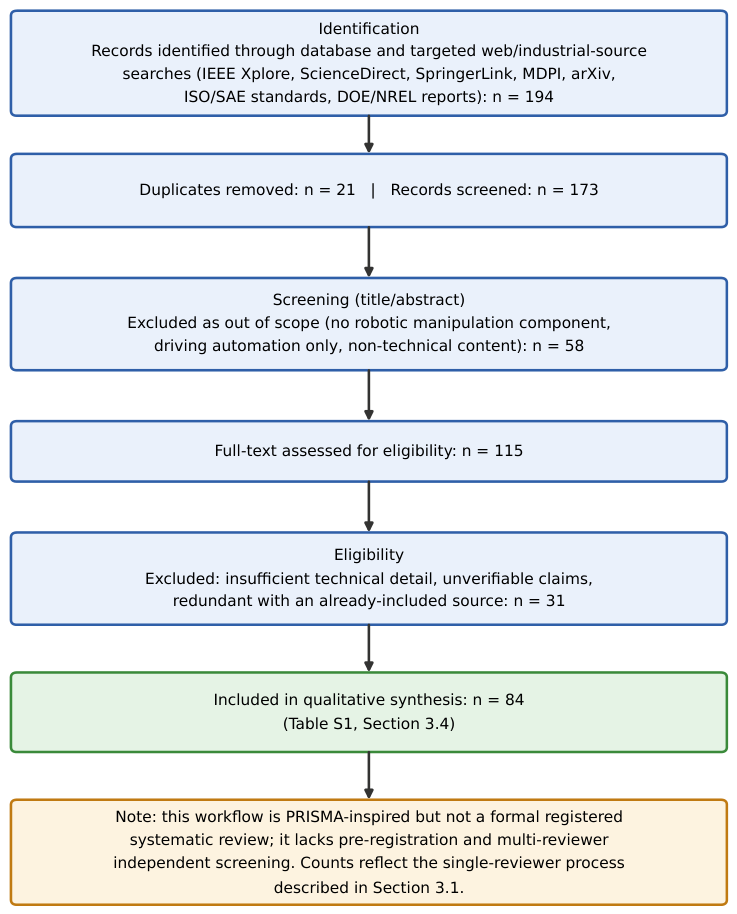
Figure 2.
Bibliometric overview of the 84 retained sources. (a) Distribution by publication year (2018–2026; 2026 partial). (b) Distribution by platform category, colored by evidence tier: green bars (fixed arm, mobile manipulator) are Tier 1 evidence-based platforms; orange bars (humanoid, quadruped) are Tier 2 emerging-candidate platforms (Section 4.1); gray denotes cross-platform/standards sources not tied to a single platform. (c) Distribution by refueling modality. This bibliometric analysis refers only to the primary, PRISMA-inspired retrieval corpus (, Section 3.3); it does not include the 44 second-round references described in Section 3.1, which were retrieved by a different, targeted method not amenable to the same database-level bibliometric analysis.
Figure 2.
Bibliometric overview of the 84 retained sources. (a) Distribution by publication year (2018–2026; 2026 partial). (b) Distribution by platform category, colored by evidence tier: green bars (fixed arm, mobile manipulator) are Tier 1 evidence-based platforms; orange bars (humanoid, quadruped) are Tier 2 emerging-candidate platforms (Section 4.1); gray denotes cross-platform/standards sources not tied to a single platform. (c) Distribution by refueling modality. This bibliometric analysis refers only to the primary, PRISMA-inspired retrieval corpus (, Section 3.3); it does not include the 44 second-round references described in Section 3.1, which were retrieved by a different, targeted method not amenable to the same database-level bibliometric analysis.
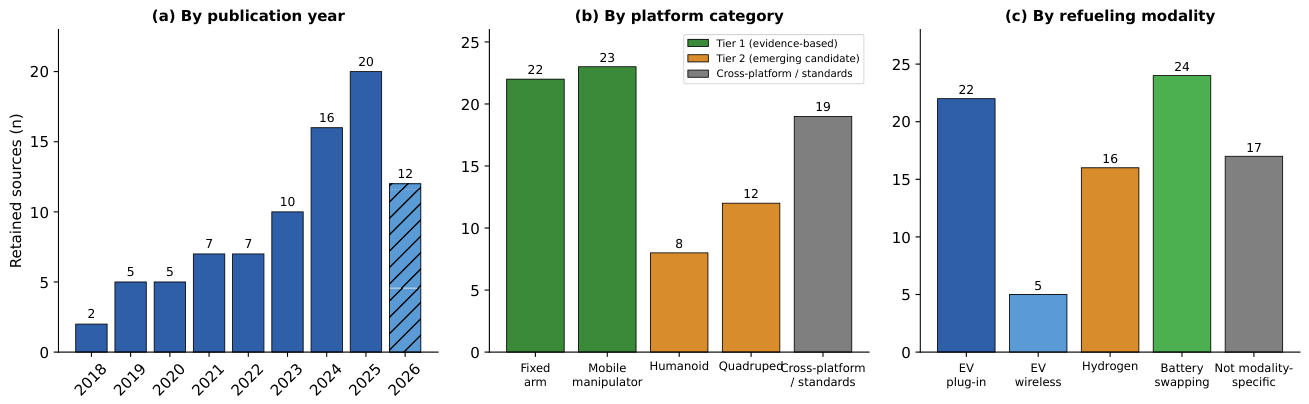
Figure 5.
Prioritized research roadmap: adoption urgency vs. near-term feasibility.
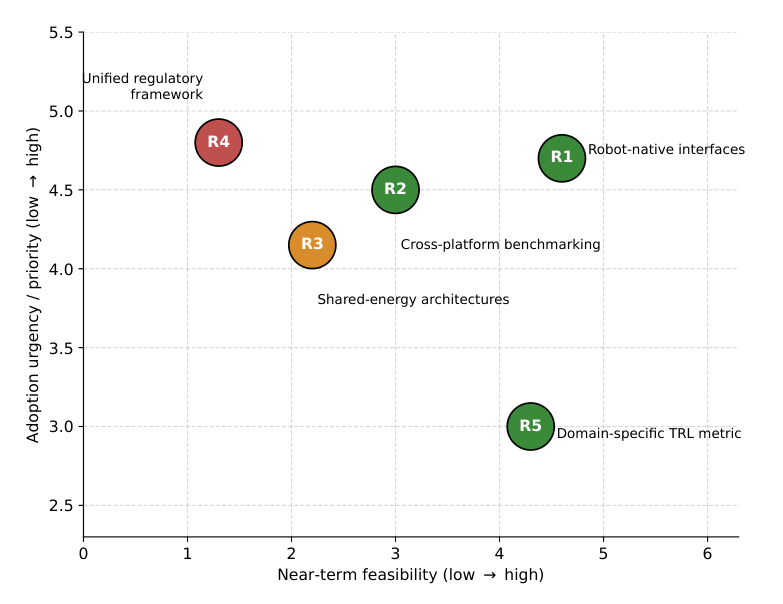
Disclaimer/Publisher’s Note: The statements, opinions and data contained in all publications are solely those of the individual author(s) and contributor(s) and not of MDPI and/or the editor(s). MDPI and/or the editor(s) disclaim responsibility for any injury to people or property resulting from any ideas, methods, instructions or products referred to in the content. |
© 2026 by the authors. Licensee MDPI, Basel, Switzerland. This article is an open access article distributed under the terms and conditions of the Creative Commons Attribution (CC BY) license (http://creativecommons.org/licenses/by/4.0/).
Copyright: This open access article is published under a Creative Commons CC BY 4.0 license, which permit the free download, distribution, and reuse, provided that the author and preprint are cited in any reuse.