

Submitted:
23 September 2026
Posted:
23 September 2026
You are already at the latest version
Abstract
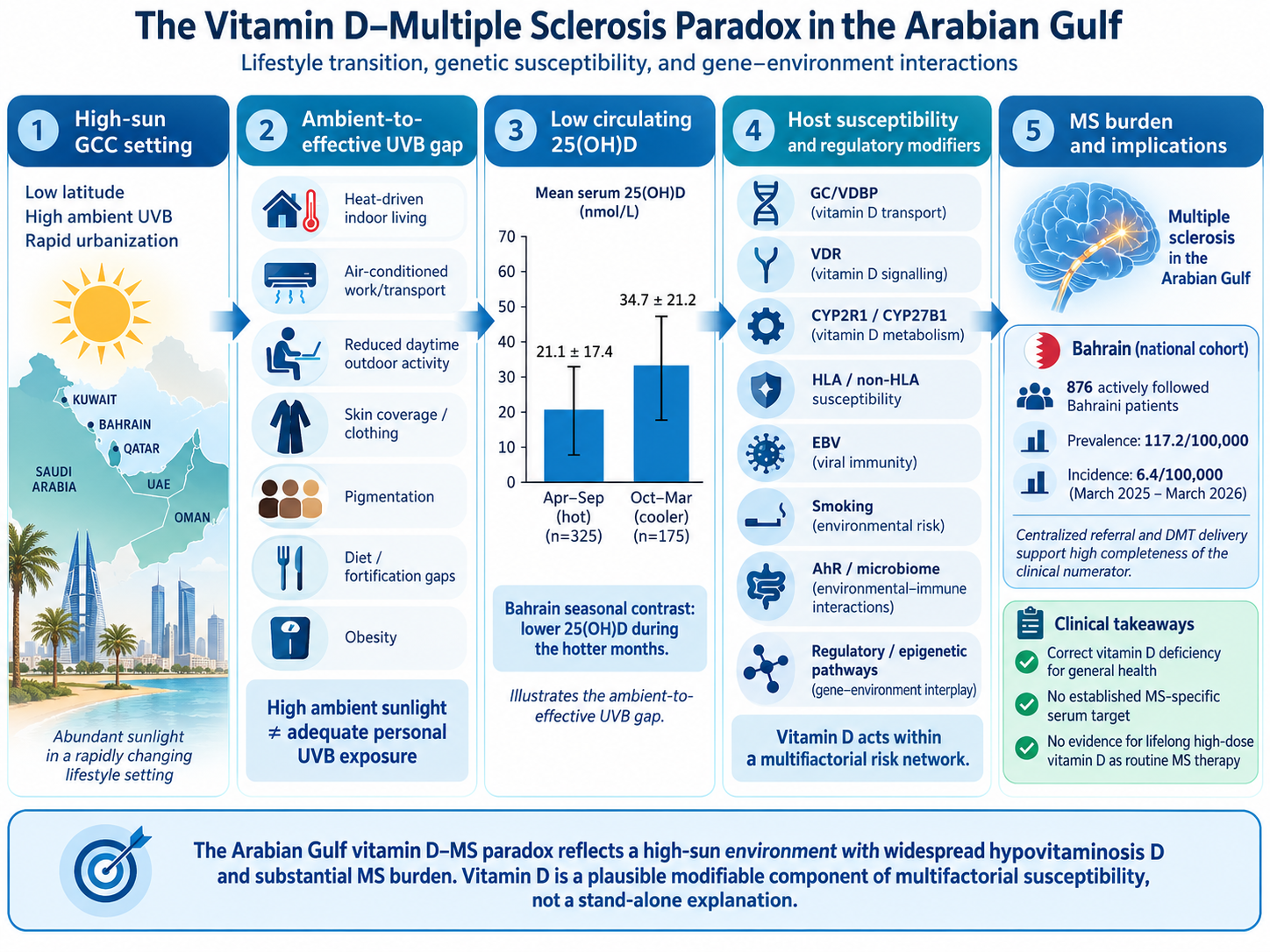
Background: Gulf Cooperation Council (GCC) populations combine intense ultraviolet B (UVB) radiation with widespread hypovitaminosis D and multiple sclerosis (MS) burden. We examine this Arabian Gulf vitamin D–MS paradox as an exposure–biology–inference problem rather than a single causal pathway. Methods: We conducted a structured narrative review and regional synthesis using a structured search of PubMed/MEDLINE, Embase, Scopus, Web of Science, and regional sources (January 1990–August 2026), followed by a targeted September 2026 update incorporating the Bahrain Research Square preprint. Evidence was appraised for ascertainment, assay heterogeneity, temporality, confounding, ancestry transferability, replication, and intervention design. Results: Low 25-hydroxyvitamin D [25(OH)D] recurs across the GCC despite abundant UVB. In Bahrain, mean 25(OH)D was lower during April–September than October–March (21.1±17.4 vs 34.7±21.2 nmol/L); secondary calculation gave a difference of −13.6 nmol/L (95% CI −17.3 to −9.9; Cohen’s d=0.72). A September 2026 preprint identified 876 actively followed Bahraini patients, corresponding to crude registry-based prevalence of 117.2 per 100,000 (95% CI 109.4–125.0), and 48 new diagnoses during March 2025–March 2026, yielding incidence of 6.4 per 100,000 (95% CI 4.7–8.5). Centralized national referral and DMT delivery support high completeness of the contemporary clinical numerator, while denominator projection and lack of age/sex standardization remain limitations. Regional genetic, EBV, obesity, smoking, diagnostic-era, and treatment-related evidence supports a multifactorial model. Conclusions: Vitamin D is a plausible modifiable component of multifactorial MS susceptibility, not a stand-alone explanation for GCC epidemiological change. Deficiency should be corrected for general health, but no MS-specific serum target or lifelong high-dose regimen is established. Contemporary Bahrain data strengthen evidence of substantial national MS burden while showing that higher prevalence need not imply a proportional rise in annual incidence. Ancestry-aware longitudinal GCC studies are needed.
Keywords:
25-hydroxyvitamin D
; multiple sclerosis
; Arabian gulf
; gulf Cooperation council
; ultraviolet B
; lifestyle transition
; gene–environment interaction
Copyright: This open access article is published under a Creative Commons CC BY 4.0 license, which permit the free download, distribution, and reuse, provided that the author and preprint are cited in any reuse.