
Submitted:
22 September 2026
Posted:
22 September 2026
You are already at the latest version
Abstract
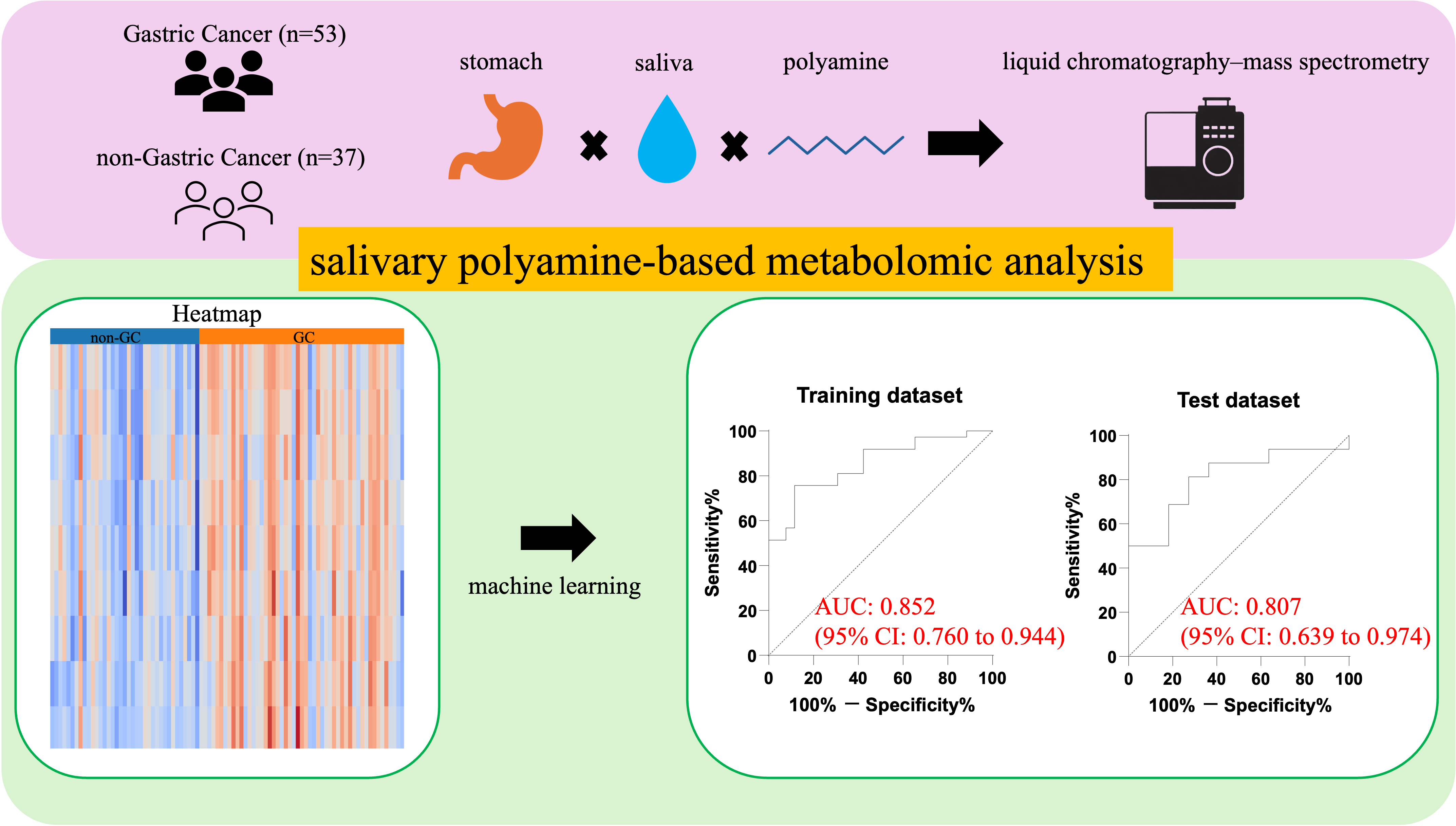
Background/Objectives: Gastric cancer (GC) is one of the most prevalent malignancies worldwide, highlighting the need for minimally invasive and highly accurate screening methods for its early detection. We evaluated the utility of salivary polyamine-based metabolomic analysis for distinguishing individuals with GC from those without GC. Methods: A total of 53 patients with GC and 37 non-GC controls were included. Participants were recruited from individuals who underwent upper gastrointestinal endoscopy at Tokyo Medical University Hospital between March 2020 and May 2025 and provided saliva samples on the same day. Participants with factors known to affect polyamine levels were excluded. Salivary metabolites quantified by liquid chromatography–mass spectrometry were statistically compared between groups. Acetylated-to-non-acetylated polyamine ratios were used as features to construct a logistic regression-based machine learning model, and discriminative performance was evaluated using receiver operating characteristic analysis. Results: The GC group showed significantly higher concentrations of salivary metabolites. Among individual polyamines, N1-acetylspermine demonstrated the highest discriminative ability (AUC = 0.845). When acetylated-to-non-acetylated polyamine ratios were analyzed, significant differences between groups were observed for N1,N8-diacetylspermidine/spermidine and N1-acetylspermine/spermine. A logistic regression model constructed using six such ratios achieved strong predictive performance in the test dataset (AUC = 0.807), with a sensitivity of 81.3% and a specificity of 72.7%. Notably, these ratios outperformed conventional tumor markers such as carcinoembryonic antigen and carbohydrate antigen 19-9, in sensitivity. Conclusions: Our results demonstrate that salivary polyamine analysis, particularly using acetylation ratios, enables accurate and minimally invasive detection of GC and represents a promising adjunctive tool for GC screening.
Keywords:
biomarker
; gastric cancer
; metabolomics
; polyamine
; saliva
Copyright: This open access article is published under a Creative Commons CC BY 4.0 license, which permit the free download, distribution, and reuse, provided that the author and preprint are cited in any reuse.