

Submitted:
22 September 2026
Posted:
22 September 2026
You are already at the latest version
Abstract
This study investigates how external green pressures and internal adaptive capabilities are converted into sustainable performance through green product development (GPD) in resource-constrained culinary micro, small, and medium-sized enterprises (MSMEs). A cross-sectional survey of 383 owner-managers of culinary MSMEs in East Java, Indonesia, was analyzed using partial least squares structural equation modeling (PLS-SEM) with 5,000 bootstrap resamples. The results indicate that customer pressure significantly influences GPD (β = 0.241, p < 0.001), while green dynamic capability has the strongest effect on GPD (β = 0.426, p < 0.001). Environmental regulation shows a positive but nonsignificant effect on GPD (β = 0.101, p = 0.065). Furthermore, GPD positively affects sustainable performance (β = 0.166, p = 0.007). GPD significantly mediates the effects of customer pressure (β = 0.040, p = 0.031) and green dynamic capability (β = 0.071, p = 0.010) on sustainable performance, whereas environmental regulation directly influences sustainable performance (β = 0.361, p < 0.001) without a significant mediated effect. The model explains 42.3% of GPD and 30.1% of sustainable performance variance. This study develops a pressure-capability-conversion framework, demonstrating that green product development serves as a key mechanism for transforming environmental demands and organizational capabilities into sustainable value creation.
Keywords:
environmental regulation
; customer pressure
; green dynamic capability
; green product development
; sustainable performance
1. Introduction
Micro, small, and medium-sized enterprises occupy a central but difficult position in the sustainability transition. Collectively, they create employment, local value, and entrepreneurial inclusion, yet individually they often operate with limited capital, technical expertise, formal environmental systems, and bargaining power. For these firms, sustainability is rarely achieved by adopting a broad environmental orientation alone. External expectations and internal resources must be converted into concrete operational and product decisions that can generate economic, environmental, and social value at the same time (Alayón et al., 2022; Chan et al., 2023; Chong & Kaliappen, 2025). This conversion problem is especially relevant in emerging economies, where small firms are numerous, resource constraints are pronounced, and environmental governance is still developing.
Indonesia provides a consequential setting for examining this problem. More than 64 million MSMEs contribute about 61% of national gross domestic product and absorb almost 97% of employment, making their transition practices important to national sustainability outcomes (Coordinating Ministry for Economic Affairs of the Republic of Indonesia, 2025). The challenge is not simply to persuade MSMEs to support environmental goals. The managerial question is how relatively small organizations can recognize green demands, mobilize limited resources, and implement changes that improve business continuity while reducing environmental and social harm. Research on Indonesian SMEs points to regulatory barriers, capability gaps, and uneven access to supportive institutions, suggesting that sustainability depends on the interaction between external pressure, internal capability, and feasible innovation mechanisms (Gunawan et al., 2022; Setyaningrum et al., 2023).
Culinary MSMEs make this interaction unusually visible. Food businesses combine perishable inputs, packaging intensity, energy and water use, short production cycles, low margins, and direct consumer scrutiny. Decisions about ingredients, sourcing, portioning, preparation, packaging, shelf life, and waste are simultaneously operational and market decisions. Indonesia’s food-loss and waste challenge further increases the relevance of small culinary firms. National estimates indicate very large volumes of food loss and waste and substantial economic losses, which makes product and process redesign a practical sustainability lever rather than a purely symbolic environmental action (Ministry of National Development Planning/Bappenas, 2021; Omar et al., 2024; Omri et al., 2024).
The literature identifies several drivers of green action, but their mechanisms remain fragmented. Institutional research shows that regulation, customer expectations, and other stakeholder demands can stimulate environmental responses and green innovation (Huang et al., 2016; Ning et al., 2021; Qi et al., 2021; Alyahya et al., 2022). Dynamic-capability research argues that firms need routines for sensing change, acquiring knowledge, coordinating people, and reconfiguring resources before external signals can become adaptive action (Teece, 2007; Karman & Savanevičienė, 2021; Correggi et al., 2024). Eco-innovation research, in turn, links green product and process innovation with competitiveness and sustainable performance (Le, 2022; German et al., 2023; Oduro, 2024). These streams are complementary, but they often stop at different points in the explanation.
Three limitations are particularly important. First, studies often aggregate stakeholder pressure into a single index even though coercive regulation and customer-based market pressure can create different organizational responses. Regulation can discipline operations through standards, sanctions, and compliance routines, while customers make visible environmental attributes commercially salient. Treating these pressures as interchangeable can hide theoretically meaningful asymmetry (Huang & Chen, 2022; Mady et al., 2024; Zhang et al., 2024). Second, green dynamic capability is frequently modeled as a direct predictor or moderator, leaving underexplained the organizational object through which adaptive capacity becomes value. Evidence increasingly shows that capability matters when deployed through innovation, knowledge, and coordinated action rather than merely possessed (Yousaf, 2021; Singh et al., 2022; Khan et al., 2024; Borah et al., 2025). Third, research remains concentrated in manufacturing and larger firms, while culinary MSMEs combine service and production features, rapid customer feedback, and severe resource constraints. These features make product-level adaptation a theoretically meaningful conversion mechanism.
This study addresses these gaps by developing and testing a pressure-capability-conversion framework. Environmental regulation (ER) represents coercive green pressure, customer pressure (CP) represents market and normative pressure, green dynamic capability (GDC) represents the firm’s adaptive capacity, and green product development (GPD) represents the product-level mechanism through which pressure and capability can be translated into sustainable performance (SP). Sustainable performance is understood through the triple-bottom-line logic of economic, environmental, and social outcomes (Elkington, 1997). The framework estimates both direct and specific indirect paths, allowing regulation, customer pressure, and capability to follow different routes rather than imposing one uniform mechanism.
The study makes four contributions. First, it disaggregates institutional pressure and shows why coercive and customer-based demands should be analyzed separately. Second, it positions GPD as a conversion mechanism rather than an undifferentiated innovation outcome. Third, it extends dynamic-capability reasoning by asking whether capability contributes to performance directly or only when embedded in product decisions. Fourth, it provides evidence from resource-constrained culinary MSMEs in East Java, a context in which green redesign can simultaneously affect cost, waste, customer value, legitimacy, and local welfare. The practical implication is equally specific: managers and policymakers should not assume that all green pressures automatically produce innovation or that all capabilities automatically produce performance. They should identify the route through which each driver becomes operational value.
Environmental Regulation, Customer Pressure, and Green Product Development
Institutional theory explains why firms respond to external expectations even when immediate financial returns are uncertain. Coercive pressure arises from laws, standards, monitoring, incentives, and sanctions. In environmental settings, regulation can make resource use, waste, technology, and product attributes legitimate or illegitimate, thereby changing the cost of inaction. The Porter perspective adds that well-designed regulation can reveal inefficiencies and motivate innovation rather than merely impose compliance costs. Empirical research generally finds that regulatory intensity is associated with environmental management, green innovation, or sustainable performance, but the strength and direction of the relationship depend on enforcement quality, absorptive capacity, firm resources, and the type of innovation examined (Ali et al., 2021; Mu et al., 2022; Chen et al., 2023; Wang & Sun, 2022; Su, 2025). Systematic evidence also shows that environmental regulation does not generate a uniform innovation response across contexts (Lima et al., 2021).
For culinary MSMEs, regulation can affect product development through rules on ingredients, food safety, packaging, waste, sanitation, and production technologies. Clear requirements may motivate safer materials, more efficient preparation, better waste handling, and compliant packaging. Yet regulatory attention may also be absorbed by documentation and minimum compliance, particularly where firms have limited slack. This creates a plausible distinction between regulation’s direct contribution to disciplined operations and its more uncertain contribution to proactive product redesign. Research on SMEs similarly suggests that incentives, technical support, and institutional infrastructure determine whether environmental rules stimulate deeper innovation (Rajapakse et al., 2022; Peng & Pan, 2023; Xu et al., 2023). Therefore, the study tests a positive regulation-GPD path and a positive regulation-performance path while allowing their relative strength to differ.
H1a.Environmental regulation is positively associated with green product development.
H1b.Environmental regulation is positively associated with sustainable performance.
Customer pressure has a different logic. It is expressed through demand, feedback, scrutiny, brand evaluation, supplier expectations, and willingness to reward or punish environmental attributes. When customers ask about ingredients, packaging, traceability, local sourcing, waste, or recyclability, environmental characteristics become part of the value proposition. Such pressure reduces uncertainty about whether greener offerings will be accepted and can legitimize the costs of experimentation. Studies of stakeholder pressure and green innovation show that customer and market expectations can activate organizational responses, especially when firms have the capability to interpret and respond to those signals (Huang et al., 2016; Singh et al., 2022; Mady et al., 2024; Pietilä et al., 2024).
In culinary markets, customer pressure is particularly close to the product because consumers interact with packaging, ingredients, portions, freshness, and visible waste. This proximity suggests that customer pressure should be strongly linked to GPD. A direct link with sustainable performance is also plausible because favorable customer responses can improve reputation, loyalty, and sales. However, the conversion argument predicts that customer pressure will be more consequential when it changes the offering itself. Green marketing, customer knowledge, and green innovation research similarly indicates that demand signals create value when they are integrated into product or strategic adaptation (Mata et al., 2024).
H2a.Customer pressure is positively associated with green product development.
H2b.Customer pressure is positively associated with sustainable performance.
Green Dynamic Capability as Adaptive Capacity
Dynamic capabilities are higher-order capacities that allow firms to renew ordinary routines when environments change. They involve sensing opportunities and threats, seizing opportunities through investment and coordination, and reconfiguring resources, relationships, and processes (Teece, 2007). The sustainability literature extends this logic to ecological knowledge, green technologies, stakeholder expectations, and resource reallocation. Green dynamic capability therefore reflects more than a positive environmental attitude. It captures the organizational routines through which a firm notices environmental change, assimilates knowledge, coordinates employees, and redirects scarce resources toward greener action (Yousaf, 2021; Bresciani et al., 2023; Correggi et al., 2024).
The distinction between capability and deployment is crucial for MSMEs. A small firm may recognize environmental opportunities and possess useful knowledge without changing products because experimentation is costly, supplier options are limited, or day-to-day survival absorbs managerial attention. Conversely, firms that repeatedly combine sensing, learning, coordination, and resource reallocation can translate environmental signals into concrete changes. Research connects green dynamic capability with green innovation, resilience, knowledge management, and sustainable performance, but also shows that mediating innovation mechanisms are often necessary (Singh et al., 2022; Khan et al., 2023; Khan et al., 2024; Asiedu et al., 2025; Ullah et al., 2025).
GPD is expected to be a primary deployment mechanism because product redesign requires interpreting stakeholder signals, translating them into technical requirements, coordinating suppliers and employees, and learning from customer feedback. GDC may also be related directly to sustainable performance through faster resource reconfiguration, operating learning, and coordinated environmental action. Estimating both paths is necessary because mediation cannot be classified properly if the direct capability-performance path is omitted (Nitzl et al., 2016).
H3a.Green dynamic capability is positively associated with green product development.
H3b.Green dynamic capability is positively associated with sustainable performance.
Green Product Development and Sustainable Performance
GPD integrates environmental criteria into product-level decisions. It can involve safer or lower-impact materials, lower energy and material use in production and distribution, lower waste during use, and reduced post-use environmental burden. Product development is therefore narrower and more observable than a broad green orientation. In culinary MSMEs, GPD can include ingredient substitution, lighter or reusable packaging, more efficient preparation, improved portion design, reduced spoilage, and changes that make disposal or reuse easier. Earlier work established the relevance of green product development to organizational outcomes, while more recent studies show that product and process innovation remain central to sustainable performance and competitive advantage (Jabbour et al., 2015; Luan, 2022; Majali et al., 2022; Zhu et al., 2023).
The expected performance effect is multidimensional. Economically, GPD can lower material and energy costs, reduce waste, differentiate offerings, and support customer loyalty. Environmentally, it can reduce resource intensity, hazardous inputs, emissions, and disposal impacts. Socially, it can support product responsibility, workplace safety, and community legitimacy. Meta-analytic evidence indicates that eco-innovation is positively related to SME sustainable performance overall, although effects vary by context, innovation type, and time horizon (Oduro, 2024). Studies of green manufacturing, green strategy, and eco-design similarly show that innovation can connect environmental practices with broader performance outcomes (Aftab et al., 2023; Le, 2022; Omar et al., 2024; Omri et al., 2024).
H4.Green product development is positively associated with sustainable performance.
GPD as a Conversion Mechanism
The pressure-capability-conversion argument predicts that antecedents affect performance indirectly when product action is required to translate them into outcomes. Regulation can improve sustainable performance directly through compliance, risk reduction, and operating discipline, yet it may also influence performance through product redesign. Customer pressure is less likely to create durable performance unless firms change what they offer. GDC should create value when its sensing, learning, and reconfiguration routines are deployed through product decisions. This reasoning is consistent with research in which green innovation transmits the effects of stakeholder pressure, environmental strategy, entrepreneurial orientation, and capability into performance (Majali et al., 2022; Singh et al., 2022; Aftab et al., 2023; Khan et al., 2023).
The model therefore tests three specific indirect effects rather than one generic mediation claim. The purpose is not to assume mediation in advance but to identify whether each antecedent follows a direct route, an indirect route, both routes, or neither. This distinction matters theoretically because asymmetric pathways imply that managers should respond differently to regulatory pressure, market pressure, and capability gaps. It also matters methodologically because a complete mediation architecture requires the direct paths from each antecedent to performance to be estimated alongside the indirect paths (Nitzl et al., 2016; Hair et al., 2022).
H5a.Green product development mediates the relationship between environmental regulation and sustainable performance.
H5b.Green product development mediates the relationship between customer pressure and sustainable performance.
H5c.Green product development mediates the relationship between green dynamic capability and sustainable performance.
Culinary MSMEs as a Theoretical Boundary Condition
The culinary setting is not only a convenient empirical context. It is a boundary condition that sharpens the conversion logic. Compared with many manufacturing firms, small food businesses operate with faster product cycles, more direct customer contact, highly perishable inputs, and immediate exposure to visible waste. These characteristics shorten the distance between an environmental signal and a product decision. A customer complaint about excessive packaging can be translated into a packaging trial within days, while a rule on food safety or waste can alter preparation routines immediately. At the same time, limited cash, labor, and technical expertise constrain the scale of experimentation. Sustainability action therefore depends on whether managers can convert signals into low-cost, reversible, and operationally feasible changes.
This combination of speed and scarcity makes culinary MSMEs theoretically useful for separating pressure from conversion capacity. Market demand can be intense but remain ineffective if firms lack the routines to test alternatives. Capability can be present but underutilized if product redesign is perceived as too risky. Regulation can change basic operating discipline without necessarily producing differentiated green offerings. Research on environmental uncertainty and eco-innovation suggests that firms respond more effectively when adaptive capabilities help them interpret uncertainty rather than merely react to it (Han et al., 2023). Similarly, studies of institutional pressure and green product success show that pressure becomes more valuable when it is connected to innovation and credible market-facing change (Zhou et al., 2021).
The context also helps explain why sustainable performance should be modeled as a multidimensional outcome. A packaging change can reduce material costs, lower waste, and improve customer perception at the same time, while an ingredient substitution can improve safety but increase cost. The same intervention can therefore generate trade-offs across economic, environmental, and social dimensions. Treating performance as a triple-bottom-line construct captures this managerial reality better than a purely financial outcome, although future research should test the three dimensions separately to identify where benefits and trade-offs occur.
Figure 1.
Pressure-capability-conversion conceptual model.
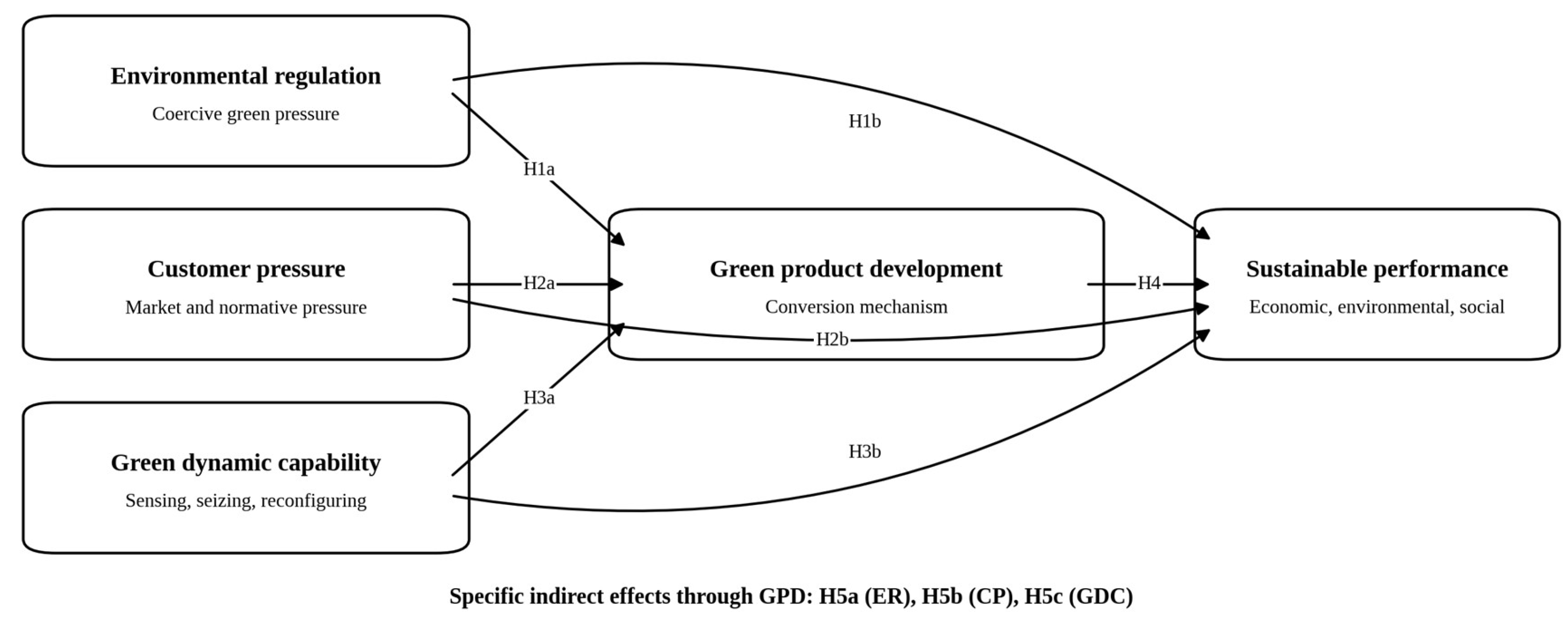

Table 1.
Hypothesis architecture and theoretical mechanism.
| Hypothesis | Path | Core theoretical logic | Expected effect |
| H1a | ER → GPD | Coercive pressure encourages product-level environmental adaptation | Positive |
| H1b | ER → SP | Compliance and operating discipline improve triple-bottom-line outcomes | Positive |
| H2a | CP → GPD | Market feedback makes greener offerings commercially salient | Positive |
| H2b | CP → SP | Customer legitimacy and demand may improve sustainable outcomes | Positive |
| H3a | GDC → GPD | Adaptive routines enable sensing, learning, coordination, and reconfiguration | Positive |
| H3b | GDC → SP | Adaptive resource reconfiguration may directly support sustainability | Positive |
| H4 | GPD → SP | Product-level eco-efficiency and differentiation create triple-bottom-line value | Positive |
| H5a-H5c | ER/CP/GDC → GPD → SP | GPD converts external pressure and internal capability into outcomes | Positive indirect effect |
2. Materials and Methods
2.1. Research Design and Context
The study used a cross-sectional explanatory survey design. The target respondents were owner-managers of culinary MSMEs in East Java, Indonesia. Owner-managers were selected as key informants because product design, sourcing, compliance, resource allocation, and operating decisions in small culinary businesses are commonly concentrated in this role. Purposive non-probability sampling was used to identify respondents with direct knowledge of business operations and environmental practices. The final analytical file contained 383 complete observations and no missing values across the indicators used for the model.
The sample reflects the resource-constrained setting relevant to the study. Most enterprises employed ten or fewer people, most reported monthly revenue below IDR 50 million, and most had operated for between one and seven years. These characteristics are reported descriptively rather than treated as causal explanations of model relationships. The supplied research materials did not contain a verified sampling-frame size, invitation count, collection dates, or response-rate calculation. These details should be recovered from the original fieldwork records before journal submission if the target journal requires them.
2.2. Measures
All constructs were measured reflectively with five-point Likert-type items ranging from 1 (strongly disagree) to 5 (strongly agree). Environmental regulation used four items covering regulatory comprehensiveness, oversight authority, production-technology strictness, and sanctions. Customer pressure used four items addressing environmental awareness, preference for green products, attention to firm environmental behavior, and expectations for environmentally responsible suppliers (Huang et al., 2016; Chen et al., 2023).
Green dynamic capability used seven items representing environmental sensing, knowledge development and assimilation, process or technology development, knowledge integration, employee coordination, and resource allocation. These dimensions are consistent with the sensing-seizing-reconfiguring logic of dynamic capabilities and established green-capability measures (Chen & Chang, 2013; Yousaf, 2021). GPD used four items covering safer material substitution, production and distribution resource efficiency, use-phase efficiency, and post-use environmental impact (Jabbour et al., 2015; Luan, 2022).
Sustainable performance was measured as a broad triple-bottom-line construct covering economic, environmental, and social outcomes, consistent with the conceptual logic of Elkington (1997) and recent SME sustainability research (Oduro, 2024). One item, SP5 (‘assets are more productive than comparable firms’), had an outer loading of 0.393 and was removed after statistical and content review. Fourteen SP indicators remained. The final model therefore contained 33 retained indicators: CP = 4, ER = 4, GDC = 7, GPD = 4, and SP = 14.
2.3. Analytical Strategy and Data-Integrity Procedures
Partial least squares structural equation modeling was appropriate because the study examined two endogenous constructs and a mediation architecture, while the indicator distributions were not assumed to be multivariate normal. Measurement quality was assessed using outer loadings, composite reliability (ρC), average variance extracted (AVE), the heterotrait-monotrait ratio (HTMT), and the Fornell-Larcker criterion. Composite reliability and AVE were recomputed from the final standardized loadings for all constructs to ensure internal consistency of the reported table. This step also restored the omitted GPD reliability information in the supplied summary. HTMT values below 0.85 were interpreted conservatively as evidence of discriminant validity (Fornell & Larcker, 1981; Henseler et al., 2015; Hair et al., 2022).
The structural model was assessed using inner VIF values, standardized path coefficients, 95% percentile bootstrap confidence intervals, R², adjusted R², f², and specific indirect effects. Inference used 5,000 case-resampling bootstrap draws. Mediation was classified after estimating the direct path from every antecedent to sustainable performance. A significant indirect effect accompanied by a nonsignificant direct effect was interpreted as indirect-only mediation, while a significant direct effect with a nonsignificant indirect effect was interpreted as direct-only non-mediation (Nitzl et al., 2016).
The supplied SmartPLS output was audited for internal consistency. Legacy figures in the source manuscript contained structural coefficients and R² values that differed from the theory-complete results table. Those figures were not retained. The revised manuscript uses one reconciled structural specification throughout: R² = 0.423 for GPD and R² = 0.301 for SP, with the direct GDC to SP path included. Construct scores were reconstructed from the supplied standardized indicators and outer weights, and the complete structural model was estimated on the purified PLS scores. This is reported transparently because the original export did not contain a native SmartPLS rerun of the added GDC to SP path (Ringle et al., 2024; Sarstedt et al., 2022). A native rerun of the complete final model in SmartPLS 4 is recommended before submission if the raw project file is available.
Common-method risk was examined using full-collinearity diagnostics. Construct-level VIFs ranged from 1.430 to 1.951, below the conservative 3.3 rule of thumb. These results reduce concern but do not demonstrate the absence of common-method bias. The cross-sectional, single-informant design remains vulnerable to common-source effects, and future research should use temporal separation, multiple informants, or objective outcome measures where feasible (Podsakoff et al., 2003).
2.4. Ethics and Reproducibility
The manuscript does not infer or fabricate ethics information that was absent from the supplied records. Before submission, the authors should insert the approving institution, approval number and date, and the exact informed-consent procedure used during data collection. The analysis reported here is reproducible at the level of the supplied construct scores, retained loadings, structural paths, and bootstrap specification. The de-identified analytical file should be archived or made available subject to participant consent and institutional policy.
Figure 2.
Research and analytical procedure.
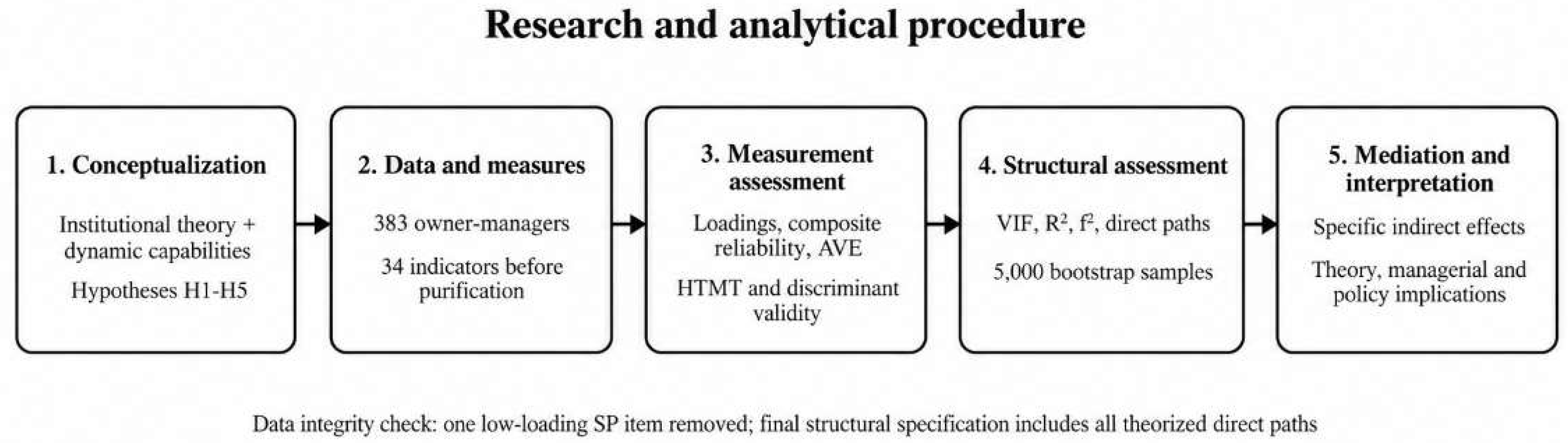
Table 2.
Demographic characteristics of respondents.
| Variable | Category | Frequency | Percentage (%) |
| Educational attainment | Undergraduate degree | 160 | 41.78 |
| Senior high school | 152 | 39.69 | |
| Master’s degree | 32 | 8.36 | |
| Junior high school | 22 | 5.74 | |
| Doctoral degree | 17 | 4.44 | |
| Length of business operation | Less than 1 year | 45 | 11.75 |
| 1-3 years | 131 | 34.20 | |
| 4-7 years | 126 | 32.90 | |
| 8-10 years | 52 | 13.58 | |
| More than 10 years | 29 | 7.57 | |
| Number of employees | 1-5 employees | 221 | 57.70 |
| 6-10 employees | 87 | 22.72 | |
| 11-15 employees | 58 | 15.14 | |
| 16-20 employees | 10 | 2.61 | |
| More than 20 employees | 7 | 1.83 | |
| Monthly revenue | Less than IDR 10 million | 181 | 47.26 |
| IDR 10-50 million | 130 | 33.94 | |
| IDR 50-100 million | 58 | 15.14 | |
| IDR 100-300 million | 9 | 2.35 | |
| More than IDR 300 million | 5 | 1.31 |
Note. N = 383. Percentages are calculated from the frequencies supplied in the field summary and may differ by 0.01 because of rounding.
Table 3.
Measurement model quality after purification.
| Construct | Items retained | Loading range | Composite reliability (ρC) | AVE | √AVE |
| Customer pressure (CP) | 4 | 0.789-0.889 | 0.901 | 0.696 | 0.834 |
| Environmental regulation (ER) | 4 | 0.809-0.913 | 0.930 | 0.768 | 0.876 |
| Green dynamic capability (GDC) | 7 | 0.665-0.807 | 0.897 | 0.554 | 0.744 |
| Green product development (GPD) | 4 | 0.698-0.864 | 0.887 | 0.665 | 0.815 |
| Sustainable performance (SP) | 14 | 0.791-0.906 | 0.975 | 0.736 | 0.858 |
Note. ρC and AVE were recomputed from the final standardized loadings for internal consistency. SP5 (loading = 0.393) was removed. GPD reliability was restored from its four reported standardized loadings rather than left missing.
Table 4.
Discriminant validity: Fornell-Larcker criterion and HTMT summary.
| Construct | CP | ER | GDC | GPD | SP |
| CP | 0.834 | ||||
| ER | 0.520 | 0.876 | |||
| GDC | 0.567 | 0.613 | 0.744 | ||
| GPD | 0.536 | 0.473 | 0.629 | 0.815 | |
| SP | 0.454 | 0.597 | 0.565 | 0.465 | 0.858 |
Note. Diagonal values are the square roots of AVE. Off-diagonal values are construct correlations. HTMT ratios ranged from 0.402 to 0.683; all were below 0.85.
3. Results
3.1. Respondent Profile
The sample comprised 383 owner-managers of culinary MSMEs in East Java. Undergraduate education was the largest category (41.78%), followed by senior high school (39.69%). Regarding business age, 34.20% of firms had operated for one to three years and 32.90% for four to seven years, so 67.10% were between one and seven years old. The small scale of the sample is especially clear from employment and revenue. A total of 57.70% employed one to five people and another 22.72% employed six to ten, meaning 80.42% had no more than ten employees. Monthly revenue was below IDR 10 million for 47.26% and between IDR 10 million and IDR 50 million for 33.94%, so 81.20% reported revenue below IDR 50 million. These distributions support the interpretation of the setting as dominated by relatively small, resource-constrained businesses without implying that firm size itself caused the structural relationships.
3.2. Measurement Model
The final reflective measurement model met the reported reliability and validity criteria. Retained outer loadings ranged from 0.665 to 0.913. Two GDC items were below the preferred 0.70 guideline (0.688 and 0.665), and one GPD item was 0.698, but they were retained because the construct-level reliability and AVE remained satisfactory and the items represented theoretically important aspects of the constructs. Composite reliability ranged from 0.887 to 0.975, while AVE ranged from 0.554 to 0.768. Thus, all constructs exceeded the usual 0.70 composite-reliability and 0.50 AVE benchmarks (Hair et al., 2022).
Discriminant validity was also satisfactory. HTMT ratios ranged from 0.402 to 0.683, well below the conservative 0.85 threshold (Henseler et al., 2015). In the Fornell-Larcker matrix, the square root of each construct’s AVE exceeded its correlations with the other constructs. The strongest latent correlation was between GDC and GPD (r = 0.629), which remained below the square roots of both AVEs. Together, the results indicate that environmental regulation, customer pressure, green dynamic capability, green product development, and sustainable performance were empirically distinguishable.
3.3. Structural Model and Direct Effects
Inner VIF values ranged from 1.585 to 2.211, indicating that structural collinearity was not problematic. The model explained 42.3% of the variance in GPD (adjusted R² = 0.419) and 30.1% of the variance in SP (adjusted R² = 0.293). These values indicate moderate explanatory power for a model of heterogeneous small businesses, while leaving substantial variance for additional organizational and market factors.
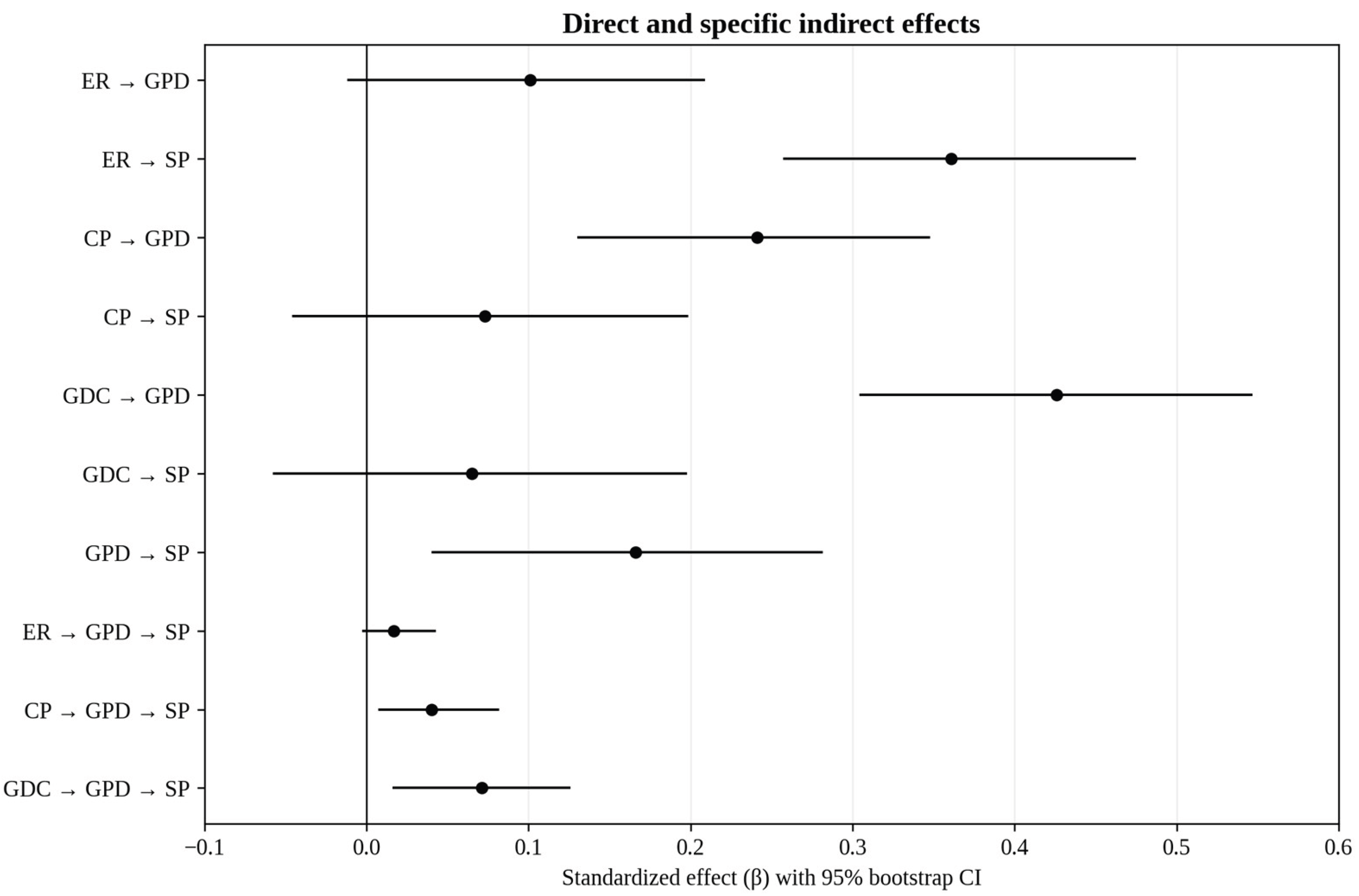
The direct paths revealed clear asymmetry. Environmental regulation had a positive but nonsignificant association with GPD (β = 0.101, SE = 0.055, p = 0.065, 95% CI [-0.011, 0.208], f² = 0.012), so H1a was not supported at the 5% level. By contrast, regulation was strongly associated with sustainable performance (β = 0.361, SE = 0.056, p < 0.001, 95% CI [0.258, 0.474], f² = 0.120), supporting H1b.
Customer pressure was positively associated with GPD (β = 0.241, SE = 0.056, p < 0.001, 95% CI [0.131, 0.347], f² = 0.071), supporting H2a. Its direct relationship with sustainable performance was small and nonsignificant (β = 0.073, p = 0.248, f² = 0.005), so H2b was not supported. GDC was the strongest antecedent of GPD (β = 0.426, SE = 0.062, p < 0.001, 95% CI [0.305, 0.546], f² = 0.193), supporting H3a. However, its direct performance path was nonsignificant (β = 0.065, p = 0.317, f² = 0.003), so H3b was not supported. Finally, GPD was positively associated with sustainable performance (β = 0.166, SE = 0.062, p = 0.007, 95% CI [0.041, 0.281], f² = 0.023), supporting H4.
3.4. Specific Indirect Effects
The mediation results strengthened the asymmetric interpretation. The ER to GPD to SP indirect effect was not significant (β = 0.017, p = 0.132, 95% CI [-0.002, 0.042]). Because the direct ER to SP path was significant, the pattern is classified as direct-only non-mediation, and H5a was not supported. Customer pressure showed a significant indirect effect through GPD (β = 0.040, p = 0.031, 95% CI [0.008, 0.081]) while its direct SP path was nonsignificant. This is indirect-only mediation and supports H5b. GDC also showed indirect-only mediation: GDC to GPD to SP was significant (β = 0.071, p = 0.010, 95% CI [0.017, 0.125]) while the direct GDC to SP path was nonsignificant, supporting H5c. Overall, six of the ten hypotheses were supported.
Table 5.
Direct effects and structural-model assessment.
| Hyp. | Path | β | SE | p | 95% CI low | 95% CI high | f² | VIF | Decision |
| H1a | ER → GPD | 0.101 | 0.055 | 0.065 | -0.011 | 0.208 | 0.012 | 1.721 | Not supported |
| H1b | ER → SP | 0.361 | 0.056 | <0.001 | 0.258 | 0.474 | 0.120 | 1.731 | Supported |
| H2a | CP → GPD | 0.241 | 0.056 | <0.001 | 0.131 | 0.347 | 0.071 | 1.585 | Supported |
| H2b | CP → SP | 0.073 | 0.063 | 0.248 | -0.045 | 0.198 | 0.005 | 1.694 | Not supported |
| H3a | GDC → GPD | 0.426 | 0.062 | <0.001 | 0.305 | 0.546 | 0.193 | 1.853 | Supported |
| H3b | GDC → SP | 0.065 | 0.065 | 0.317 | -0.057 | 0.197 | 0.003 | 2.211 | Not supported |
| H4 | GPD → SP | 0.166 | 0.062 | 0.007 | 0.041 | 0.281 | 0.023 | 1.806 | Supported |
Note. R² = 0.423 (adjusted R² = 0.419) for GPD; R² = 0.301 (adjusted R² = 0.293) for SP. Two-tailed percentile bootstrap inference used 5,000 resamples.
Table 6.
Specific indirect effects through green product development.
| Hyp. | Indirect path | β | SE | p | 95% CI low | 95% CI high | Mediation type | Decision |
| H5a | ER → GPD → SP | 0.017 | 0.011 | 0.132 | -0.002 | 0.042 | Direct-only non-mediation | Not supported |
| H5b | CP → GPD → SP | 0.040 | 0.019 | 0.031 | 0.008 | 0.081 | Indirect-only mediation | Supported |
| H5c | GDC → GPD → SP | 0.071 | 0.027 | 0.010 | 0.017 | 0.125 | Indirect-only mediation | Supported |
Figure 3.
Final structural model and standardized path estimates.
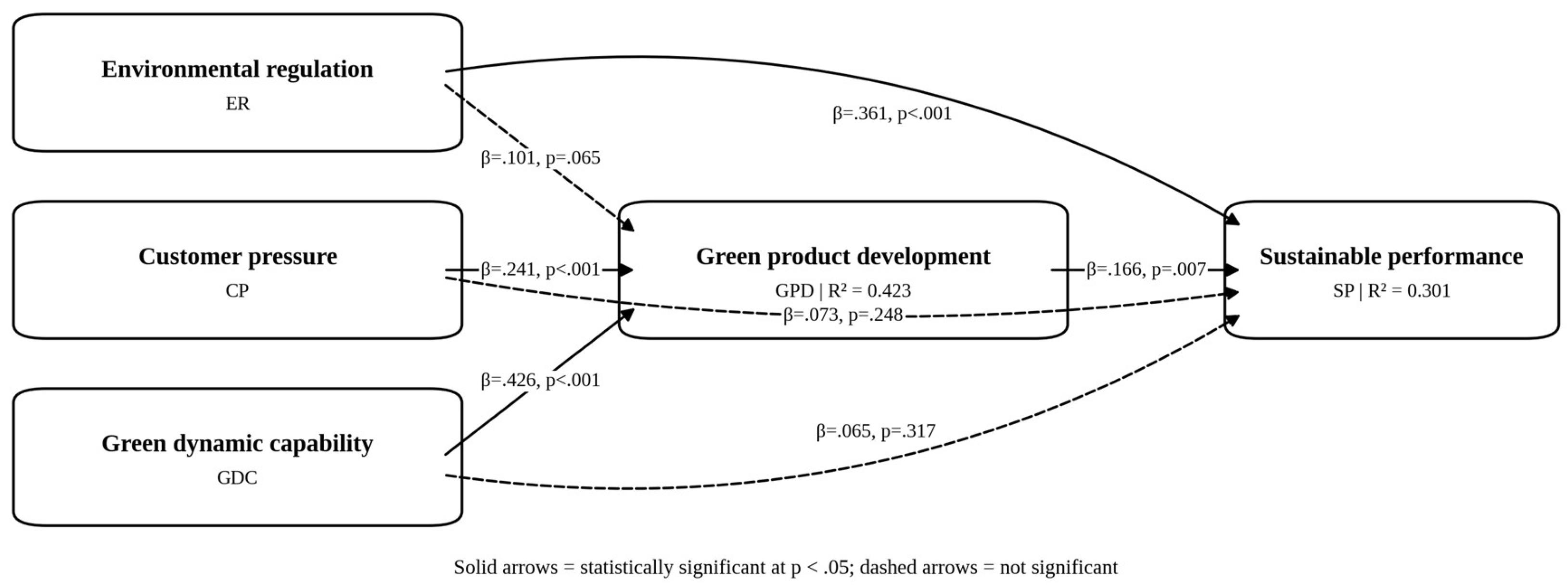
Figure 4.
Direct and specific indirect effects with 95% bootstrap confidence intervals.
4. Discussion
4.1. Customer Pressure Becomes Valuable When It Changes the Offering
The customer-pressure results provide the clearest evidence for the proposed conversion mechanism. Customer pressure was associated with GPD but not directly with sustainable performance, while the specific indirect effect through GPD was significant. Market expectations therefore did not translate automatically into economic, environmental, and social value. They became consequential after firms changed materials, resource use, product characteristics, or post-use impact. This finding refines broad stakeholder-pressure arguments by identifying a product-level response that explains how customer expectations become performance (Huang et al., 2016; Singh et al., 2022).
The result is consistent with studies showing that eco-friendly demand, customer scrutiny, and institutional pressure can trigger green innovation and sustainable advantage (Huang & Chen, 2022; Mady et al., 2024; Zhang et al., 2024). It also helps explain why direct stakeholder-pressure effects are inconsistent across studies. If customer pressure is measured without the conversion behavior that follows it, the mechanism remains hidden. For culinary MSMEs, this is plausible because customers experience many environmental attributes directly. Packaging, ingredients, portioning, visible waste, and sourcing are all part of the offering. Managers who simply acknowledge green preferences without redesigning the offering are unlikely to realize the same benefits as firms that convert demand into product decisions.
The effect size of customer pressure on GPD was small but meaningful (f² = 0.071), while the direct CP to SP effect size was negligible (f² = 0.005). The practical implication is not that customer pressure is weak. Rather, its value is conditional on managerial translation. This interpretation aligns with research on strategic agility, customer knowledge, and sustainable marketing, where market information becomes valuable when firms absorb and act on it (Mata et al., 2024).
4.2. Green Capability Must Be Deployed, Not Merely Possessed
GDC was the strongest antecedent of GPD, but its direct relationship with sustainable performance was nonsignificant. The significant GDC to GPD to SP effect indicates indirect-only mediation. This result advances dynamic-capability logic in a specific way. Sensing environmental change, integrating knowledge, coordinating people, and reallocating resources are not performance outcomes. They are capacities whose value depends on deployment. GPD is one observable deployment object that converts higher-order capability into customer-facing and operational change (Teece, 2007; Yousaf, 2021; Correggi et al., 2024).
This mechanism is particularly relevant for small firms. Culinary MSMEs rarely innovate through formal R&D departments. They innovate incrementally by changing ingredients, suppliers, packaging, production routines, energy use, serving systems, and disposal arrangements. Such changes require the same underlying dynamic-capability logic found in larger organizations, but the manifestation is simpler and more immediate. The finding therefore complements evidence linking GDC to green innovation, knowledge management, organizational resilience, and sustainable performance (Bresciani et al., 2023; Khan et al., 2023; Khan et al., 2024; Borah et al., 2025; Asiedu et al., 2025).
The path from GDC to GPD had the largest f² in the model (0.193), while GDC’s direct f² on SP was only 0.003. The contrast makes the deployment argument empirically visible. Capability-building programs should therefore be judged not only by training completion, awareness, or knowledge accumulation but by whether the firm can repeatedly convert knowledge into redesigned products and routines. Recent work on technological readiness and green dynamic capability reaches a similar conclusion that capability becomes valuable when connected to innovation and implementation rather than treated as a static asset (Ullah et al., 2025).
4.3. Regulation Follows a Compliance-Dominant Route
Environmental regulation followed a different pathway. It had the strongest direct association with sustainable performance but only a positive, nonsignificant association with GPD, and the specific indirect effect through GPD was not significant. The most defensible interpretation is a compliance-dominant route. Regulation appears to be associated with performance through safer operations, waste control, monitoring, resource discipline, and risk avoidance rather than primarily through proactive product redesign.
This result is compatible with the Porter perspective but qualifies the assumption that regulation necessarily stimulates innovation. Environmental rules can improve performance when they reduce inefficient or harmful routines, yet their innovation effect depends on policy design, support mechanisms, absorptive capacity, and managerial interpretation (Qi et al., 2021; Mu et al., 2022; Chen et al., 2023; Su, 2025). Evidence from environmental-regulation research likewise suggests that incentives, digitalization, and dynamic capabilities can shape whether compliance requirements become broader sustainable innovation (Peng & Pan, 2023; F. Wang & Sun, 2022; Xu et al., 2023).
For resource-constrained culinary firms, compliance can be immediate while product experimentation is risky. Managers may adopt mandated sanitation, waste, energy, or packaging practices without redesigning the core offering. The marginal ER to GPD coefficient should therefore not be interpreted as evidence that regulation is irrelevant to innovation. It identifies a policy design problem. If policymakers want regulation to stimulate GPD, enforcement may need to be combined with technical clinics, supplier information, testing support, micro-grants, or green procurement channels (Rajapakse et al., 2022; Gunawan et al., 2022).
4.4. Theoretical Contributions
First, the study contributes to institutional theory by separating coercive regulation from customer-based market and normative pressure. The two pressures did not have interchangeable consequences. Regulation was associated directly with sustainable performance, whereas customer pressure required GPD. Aggregating them into one stakeholder-pressure construct would have concealed this asymmetry and encouraged generic recommendations. The results support a more granular view of institutional pressure in which the source of pressure influences the mechanism of response (Ning et al., 2021; Pietilä et al., 2024; Zhang et al., 2024).
Second, the study contributes to dynamic-capability theory by identifying a capability-to-action-to-outcome sequence. GDC did not have a meaningful direct performance effect once GPD and the other predictors were included, but it had the strongest association with GPD and a significant indirect performance effect. This clarifies why studies can find strong capability-innovation relationships but uneven capability-performance relationships. The missing element can be the organizational artifact or practice through which capability is deployed (Karman & Savanevičienė, 2021; Gerlich et al., 2025).
Third, the study contributes to eco-innovation research by treating GPD as a specific conversion mechanism rather than using a broad green-innovation index. Product development captures decisions about materials, production and distribution efficiency, use, and post-use effects. Its positive link with sustainable performance is consistent with prior GPD evidence and recent meta-analytic results (Jabbour et al., 2015; Luan, 2022; Oduro, 2024). The specificity is useful because product-level changes are directly actionable for small culinary firms.
Fourth, the asymmetric mediation architecture provides a boundary condition for the claim that green pressure pays. Pressure pays through different routes. Regulation can be associated with disciplined operations and direct sustainability gains. Customer pressure creates value when translated into product change. Capability creates value when deployed. This pressure-capability-conversion architecture integrates institutional and dynamic-capability explanations without forcing all antecedents through one causal route. It also fits broader evidence that sustainable performance is shaped by combinations of external networks, innovation, internal resilience, and environmental practices rather than one universal driver (Ardito et al., 2021; Chan et al., 2023; Ahmed et al., 2023).
4.5. Boundary Conditions, Practical Magnitude, and Alternative Explanations
The statistical significance of the model should not be confused with large practical effects. GPD explained part of the pathway from customer pressure and capability to performance, but the GPD to SP effect itself was modest (β = 0.166; f² = 0.023). This suggests that product development is one conversion mechanism among several, not a complete explanation of sustainable performance. Supplier relationships, process innovation, employee capability, digital systems, green finance, market positioning, and operational slack may also determine whether green initiatives create value. Studies of digital and environmental orientation, green supply-chain practices, and environmental management systems similarly show that sustainability performance emerges from complementary organizational systems rather than a single intervention (Ardito et al., 2021; Wang & Ozturk, 2023; Bresciani et al., 2023).
The model also leaves room for alternative sequencing. Customer pressure may stimulate GPD, but firms with successful green products may subsequently attract more environmentally conscious customers. Likewise, sustainable performance can create slack that enables capability development and further product experimentation. The cross-sectional design cannot distinguish these recursive processes. Longitudinal data are therefore needed before the pathways are interpreted as temporal causation. This caution is especially important because the strong ER to SP association may partly reflect better-managed firms that are simultaneously more compliant and more sustainable, rather than a pure regulatory effect.
A further boundary condition concerns the formality of environmental governance. Regulation in East Java may be experienced through a mixture of national standards, local enforcement, certification expectations, and informal advisory practices. A four-item perception scale captures managerial experience of regulation but not the objective intensity or quality of enforcement. Future studies should pair perceptual measures with administrative indicators such as inspection frequency, certification status, waste-management requirements, or policy incentives. The same logic applies to customer pressure. Objective demand measures, sales shares of greener products, online review content, and willingness-to-pay evidence would strengthen inference beyond managerial perceptions.
Finally, the mediation pattern may vary with firm maturity and resource position. A mature firm with stable cash flow may respond to regulation by redesigning products, whereas a micro-enterprise may stop at minimum compliance. Digital capability may also amplify the conversion of customer feedback into experimentation by making preferences easier to capture and test. Research on digitalization and sustainable innovation supports this possibility, suggesting a useful extension in which digital capability, market turbulence, or green financial access conditions the strength of the pressure-to-GPD pathway (Xu et al., 2023; Gerlich et al., 2025). The current results should therefore be understood as an average architecture for the sampled firms, not a universal sequence that applies identically to every MSME.
5. Conclusions
This study shows that green pressure and green capability do not reach sustainable performance through a single route. Customer pressure and green dynamic capability were associated with sustainable performance through green product development, while their direct performance paths were not significant. Environmental regulation followed a different pattern: it had a strong direct association with sustainable performance but no significant GPD-mediated effect. GPD itself remained positively associated with sustainable performance. The results therefore support a pressure-capability-conversion explanation in which market pressure and adaptive capability become valuable when embedded in product-level change, while regulation is more strongly associated with a compliance and operating-discipline route.
The findings should be interpreted within several limitations. The cross-sectional design cannot establish temporal causality, and reverse or reciprocal relationships remain possible. The single-informant, self-reported measures are vulnerable to perceptual and common-method bias despite favorable collinearity diagnostics. Purposive sampling limits population inference. The supplied materials did not include a verified sampling frame, invitation count, fieldwork dates, or complete ethics documentation. The final structural specification also includes a GDC to SP path that was estimated on purified PLS construct scores rather than through a new native SmartPLS run, so the raw project should be rerun before submission if available. Finally, SP was treated as a reflective global construct; future work should compare this specification with a hierarchical economic-environmental-social model.
Future research should use time-lagged or multi-source designs, objective waste and energy data, sales and margin indicators, and repeated measures of product change. Multi-group analysis could compare micro and small firms, younger and mature firms, and different culinary subsectors. Researchers should also test moderators such as green finance, digital capability, market turbulence, enforcement consistency, and policy support. Longitudinal or experimental designs would be especially valuable for establishing whether GPD precedes performance improvements and whether customer acceptance offsets the cost of redesign.
Supplementary Materials
The following supporting information can be downloaded at the website of this paper posted on Preprints.org.
Author Contributions
Conceptualization, A.M.H. and M.E.A.; methodology, A.M.H. and M.E.A.; software, M.E.A.; validation, A.M.H. and M.E.A.; formal analysis, M.E.A.; investigation, A.M.H.; resources, A.M.H.; data curation, A.M.H.; writing—original draft preparation, A.M.H.; writing—review and editing, A.M.H. and M.E.A.; visualization, M.E.A.; supervision, M.E.A.; project administration, A.M.H.; funding acquisition, A.M.H. All authors have read and agreed to the published version of the manuscript.
Funding
This research received no external funding.
Institutional Review Board Statement
Ethical review and approval were waived for this study because the research involved a non-interventional survey of adult business owners and collected only anonymous responses without involving clinical procedures, vulnerable populations, or identifiable personal information.
Informed Consent Statement
Informed consent was obtained from all subjects involved in the study. Participants were informed about the purpose of the research, voluntary participation, confidentiality of responses, and their right to withdraw from participation at any time.
Data Availability Statement
The data supporting the findings of this study are available from the corresponding author upon reasonable request. Due to ethical and privacy considerations regarding individual respondents and business information, the complete dataset is not publicly available. Supplementary materials containing the measurement items and supporting analytical information are available at: https://docs.google.com/spreadsheets/d/1b5KYVvA43t0VCuPwzahVavHHi6WLSn_u/edit?usp=sharing&ouid=114361729937141557685&rtpof=true&sd=true.
Acknowledgments
The authors would like to thank all culinary MSME owner-managers in East Java, Indonesia, who participated in this study. The authors also acknowledge the support and assistance provided by colleagues and institutions during the data collection and manuscript preparation process. During the preparation of this manuscript, the authors used ChatGPT (OpenAI, GPT-5.6) for language refinement and improvement of academic expression. The authors have reviewed and edited all generated content and take full responsibility for the accuracy, originality, and integrity of the published work.
Conflicts of Interest
The authors declare no conflicts of interest. The funders had no role in the design of the study; in the collection, analyses, or interpretation of data; in the writing of the manuscript; or in the decision to publish the results.
References
- Aftab, J.; Abid, N.; Cucari, N.; Savastano, M. Green human resource management and environmental performance: The role of green innovation and environmental strategy in a developing country. Bus. Strategy Environ. 2023, 32(4), 1782–1798. [Google Scholar] [CrossRef]
- Ahmed, R. R.; Akbar, W.; Aijaz, M.; Channar, Z. A.; Ahmed, F.; Parmar, V. The role of green innovation on environmental and organizational performance: Moderation of human resource practices and management commitment. Heliyon 2023, 9(1), e12679. [Google Scholar] [CrossRef] [PubMed]
- Alayón, C. L.; Säfsten, K.; Johansson, G. Barriers and enablers for the adoption of sustainable manufacturing by manufacturing SMEs. Sustainability 2022, 14(4), 2364. [Google Scholar] [CrossRef]
- Ali, H.; Chen, T.; Hao, Y. Sustainable manufacturing practices, competitive capabilities, and sustainable performance: Moderating role of environmental regulations. Sustainability 2021, 13(18), 10051. [Google Scholar] [CrossRef]
- Alyahya, M.; Aliedan, M.; Agag, G.; Abdelmoety, Z. H. Exploring the link between sustainable development practices, institutional pressures, and green innovation. Sustainability 2022, 14(21), 14312. [Google Scholar] [CrossRef]
- Ardito, L.; Raby, S.; Albino, V.; Bertoldi, B. The duality of digital and environmental orientations in the context of SMEs: Implications for innovation performance. J. Bus. Res. 2021, 123, 44–56. [Google Scholar] [CrossRef]
- Asiedu, E.; Alhassan, S.; Majeed, M.; Malcalm, E. Green dynamic capability and sustainability performance: The roles of green innovation and green sustainability of manufacturing firms. Discov. Sustain. 2025, 6(1). [Google Scholar] [CrossRef]
- Borah, P. S.; Dogbe, C. S. K.; Marwa, N. Green dynamic capability and green product innovation for sustainable development: Role of green operations, green transaction, and green technology development capabilities. Corp. Soc. Responsib. Environ. Manag. 2025, 32(1). [Google Scholar] [CrossRef]
- Bresciani, S.; Rehman, S. U.; Alam, G. M.; Ashfaq, K.; Usman, M. Environmental management control systems package, perceived environmental uncertainty and green performance: Green dynamic capabilities and investment in environmental management perspectives. Rev. Int. Bus. Strategy 2023, 33(1), 105–126. [Google Scholar] [CrossRef]
- Chan, A.; Cheng, F.; Cheng, S.-L. Post-crisis sustainable performance of manufacturing SMEs: The roles of positive orientation, financial slack, and external networks. Sustainability 2023, 15(17), 12998. [Google Scholar] [CrossRef]
- Chen, S.; Lakkanawanit, P.; Suttipun, M.; Xue, H. Environmental regulation and corporate performance: The effects of green financial management and top management’s environmental awareness. Cogent Bus. Manag. 2023, 10(1), 2209973. [Google Scholar] [CrossRef]
- Chen, Y.-S.; Chang, C.-H. The determinants of green product development performance: Green dynamic capabilities, green transformational leadership, and green creativity. J. Bus. Ethics 2013, 116(1), 107–119. [Google Scholar] [CrossRef]
- Chong, C. S.; Kaliappen, N. Antecedents and consequences for sustainability in Malaysian small and medium-sized enterprises (SMEs). Soc. Responsib. J. 2025, 21(5), 978–1008. [Google Scholar] [CrossRef]
- Coordinating Ministry for Economic Affairs of the Republic of Indonesia. The government encourages MSMEs to move up a class and increase their contribution to Indonesian exports . Coordinating Ministry for Economic Affairs of the Republic of Indonesia. 2025. Available online: https://www.ekon.go.id/publikasi/detail/6152/pemerintah-dorong-umkm-naik-kelas-tingkatkan-kontribusi-terhadap-ekspor-indonesia.
- Correggi, C.; Di Toma, P.; Ghinoi, S. Rethinking dynamic capabilities in light of sustainability: A bibliometric analysis. Bus. Strategy Environ. 2024, 33(8), 7990–8016. [Google Scholar] [CrossRef]
- Elkington, J. Cannibals with Forks: The Triple Bottom Line of 21st Century Business; Capstone, 1997. [Google Scholar]
- Fornell, C.; Larcker, D. F. Evaluating structural equation models with unobservable variables and measurement error. J. Mark. Res. 1981, 18(1), 39–50. [Google Scholar] [CrossRef]
- Gerlich, C.; Brenk, K.; Antonio, J. L.; Kanbach, D. K.; Kraus, S. Wielding a double-edged sword: Unravelling the development of dynamic capabilities through growth hacking. J. Bus. Res. 2025, 189, 115172. [Google Scholar] [CrossRef]
- German, J. D.; Redi, A. A. N. P.; Ong, A. K. S.; Liwanag, J. L. The impact of green innovation initiatives on competitiveness and financial performance of the land transport industry. Heliyon 2023, 9(8), e19130. [Google Scholar] [CrossRef] [PubMed]
- Gunawan, A. A.; Bloemer van Riel, A. C. R.; Essers, J.C. Institutional barriers and facilitators of sustainability for Indonesian batik SMEs: A policy agenda. Sustainability 2022, 14(14), 8772. [Google Scholar] [CrossRef]
- Hair, J. F.; Hult, G. T. M.; Ringle, C. M.; Sarstedt, M. A Primer on Partial Least Squares Structural Equation Modeling (PLS-SEM); SAGE Publications, 2022. [Google Scholar]
- Han, X.; Yue, B.; He, Z. Thriving in uncertainty: Examining the relationship between perceived environmental uncertainty and corporate eco-innovation through the lens of dynamic capabilities. Front. Environ. Sci. 2023, 11, 1196997. [Google Scholar] [CrossRef]
- Henseler, J.; Ringle, C. M.; Sarstedt, M. A new criterion for assessing discriminant validity in variance-based structural equation modeling. J. Acad. Mark. Sci. 2015, 43, 115–135. [Google Scholar] [CrossRef]
- Huang, X. X.; Hu, Z. P.; Liu, C. S.; Yu, D. J.; Yu, L. F. The relationships between regulatory and customer pressure, green organizational responses, and green innovation performance. J. Clean. Prod. 2016, 112, 3423–3433. [Google Scholar] [CrossRef]
- Huang, Y.-C.; Chen, C. T. Exploring institutional pressures, firm green slack, green product innovation and green new product success: Evidence from Taiwan’s high-tech industries. Technol. Forecast. Soc. Change 2022, 174, 121196. [Google Scholar] [CrossRef]
- Jabbour, C. J. C.; Jugend, D.; de Sousa Jabbour, A. B. L.; Gunasekaran, A.; Latan, H. Green product development and performance of Brazilian firms: Measuring the role of human and technical aspects. J. Clean. Prod. 2015, 87(1), 442–451. [Google Scholar] [CrossRef]
- Karman, A.; Savanevičienė, A. Enhancing dynamic capabilities to improve sustainable competitiveness: Insights from research on organisations of the Baltic region. Balt. J. Manag. 2021, 16(2), 318–341. [Google Scholar] [CrossRef]
- Khan, A. N.; Mehmood, K.; Kwan, H. K. Green knowledge management: A key driver of green technology innovation and sustainable performance in the construction organizations. J. Innov. Knowl. 2024, 9(1), 100455. [Google Scholar] [CrossRef]
- Khan, N. R.; Ameer, F.; Bouncken, R. B.; Covin, J. G. Corporate sustainability entrepreneurship: The role of green entrepreneurial orientation and organizational resilience capacity for green innovation. J. Bus. Res. 2023, 169, 114296. [Google Scholar] [CrossRef]
- Le, T. T. How do corporate social responsibility and green innovation transform corporate green strategy into sustainable firm performance? J. Clean. Prod. 2022, 362, 132228. [Google Scholar] [CrossRef]
- Lima, J. M.; Borsatto, J. M. L. S.; Bazani, C. L. Green innovation and environmental regulations: A systematic review of international academic works. Environ. Sci. Pollut. Res. 2021, 28. [Google Scholar] [CrossRef] [PubMed]
- Luan, N. T. The influence of green product development performance to enhance enterprise effectiveness and innovation. Economies 2022, 10(5), 113. [Google Scholar] [CrossRef]
- Mady, K.; Anwar, I.; Abdelkareem, R. S. Nexus between regulatory pressure, eco-friendly product demand and sustainable competitive advantage of manufacturing SMEs: The mediating role of eco-innovation. In Environment, Development and Sustainability; 2024. [Google Scholar] [CrossRef]
- Majali, T.; Alkaraki, M.; Asad, M.; Aladwan, N.; Aledeinat, M. Green transformational leadership, green entrepreneurial orientation and performance of SMEs: The mediating role of green product innovation. J. Open Innov. Technol. Mark. Complex. 2022, 8(4), 191. [Google Scholar] [CrossRef]
- Mata, M. N.; Martins, J. M.; Inácio, P. L. Collaborative innovation, strategic agility, and absorptive capacity adoption in SMEs: The moderating effects of customer knowledge management capability. J. Knowl. Manag. 2024, 28(4), 1116–1140. [Google Scholar] [CrossRef]
- Ministry of National Development Planning/Bappenas. Bappenas discusses the urgency of low-carbon development during LCDI Week 2021 . Ministry of National Development Planning/Bappenas. 2021. Available online: https://www.bappenas.go.id/id/berita/bahas-urgensi-pembangunan-rendah-karbon-bappenas-helat-lcdi-week-2021-zlS5R.
- Mu, S.; Wang, X.; Mohiuddin, M. Impact of environmental protection regulations on corporate performance from Porter hypothesis perspective: A study based on publicly listed manufacturing firms data. Front. Environ. Sci. 2022, 10, 928697. [Google Scholar] [CrossRef]
- Ning, S.; Jie, X.; Li, X. Institutional pressures and corporate green innovation: Empirical evidence from Chinese manufacturing enterprises. Pol. J. Environ. Stud. 2021, 31, 231–243. [Google Scholar] [CrossRef] [PubMed]
- Nitzl, C.; Roldán, J. L.; Cepeda, G. Mediation analysis in partial least squares path modeling: Helping researchers discuss more sophisticated models. Ind. Manag. Data Syst. 2016, 116(9), 1849–1864. [Google Scholar] [CrossRef]
- Oduro, S. Eco-innovation and SMEs’ sustainable performance: A meta-analysis. Eur. J. Innov. Manag. 2024, 27(9), 248–279. [Google Scholar] [CrossRef]
- Omar, A.; Al-shari, A.; Shah, S. H. A.; Bayram, G. E.; Rahman, E. Z.; Valeri, M. Green manufacturing practices and SMEs’ sustainable performance: A moderated mediation mechanism of green innovation and managerial discretion. Eur. Bus. Rev. 2024, 36(4), 588–609. [Google Scholar] [CrossRef]
- Omri, W.; Courrent, J.-M.; Nemeh, A. To go or not to go green for SMEs: Toward the twinning effect of ecodesign practices and radical innovativeness on SME performance. IEEE Trans. Eng. Manag. 2024, 71, 6370–6381. [Google Scholar] [CrossRef]
- Peng, H.; Pan, Y. The effects of environmental regulations on sustainable entrepreneurship from the perspective of dynamic capabilities: A study based on Chinese new energy enterprises. Front. Energy Res. 2023, 11, 1295448. [Google Scholar] [CrossRef]
- Pietilä, H.; Laari-Salmela, S.; Puhakka, V. Participating by choice or command? When ideals of stakeholder engagement clash with a prevailing strategy discourse. In Business & Society; 2024. [Google Scholar] [CrossRef]
- Podsakoff, P. M.; MacKenzie, S. B.; Lee, J.-Y.; Podsakoff, N. P. Common method biases in behavioral research: A critical review of the literature and recommended remedies. J. Appl. Psychol. 2003, 88(5), 879–903. [Google Scholar] [CrossRef] [PubMed]
- Qi, G.; Jia, Y.; Zou, H. Is institutional pressure the mother of green innovation? Examining the moderating effect of absorptive capacity. J. Clean. Prod. 2021, 278, 123957. [Google Scholar] [CrossRef]
- Rajapakse, R. M. D. A. P.; Azam, S. M. F.; Khatibi, A. The role of environmental incentives in greening small and medium-sized enterprises: A developing economy perspective. Manag. Environ. Qual. 2022, 33(5), 1167–1186. [Google Scholar] [CrossRef]
- Ringle, C. M.; Wende, S.; Becker, J.-M. SmartPLS 4 . SmartPLS. 2024. Available online: https://www.smartpls.com.
- Sarstedt, M.; Hair, J. F.; Pick, M.; Liengaard, B. D.; Radomir, L.; Ringle, C. M. Progress in partial least squares structural equation modeling use in marketing research in the last decade. Psychol. Mark. 2022, 39(5), 1035–1064. [Google Scholar] [CrossRef]
- Setyaningrum, R. P.; Kholid, M. N.; Susilo, P. Sustainable SMEs performance and green competitive advantage: The role of green creativity, business independence and green IT empowerment. Sustainability 2023, 15(15), 12096. [Google Scholar] [CrossRef]
- Singh, S. K.; Del Giudice, M.; Chiappetta Jabbour, C. J.; Latan, H.; Sohal, A. S. Stakeholder pressure, green innovation, and performance in small and medium-sized enterprises: The role of green dynamic capabilities. Bus. Strategy Environ. 2022, 31(1), 500–514. [Google Scholar] [CrossRef]
- Su, L. Environmental regulation and corporate green innovation: Evidence from the implementation of the total energy consumption target in China. J. Bus. Econ. 2025, 95(4), 499–526. [Google Scholar] [CrossRef]
- Teece, D. J. Explicating dynamic capabilities: The nature and microfoundations of (sustainable) enterprise performance. Strateg. Manag. J. 2007, 28(13), 1319–1350. [Google Scholar] [CrossRef]
- Ullah, S.; Kukreti, M.; Sami, A.; Rehan, M. Leveraging technological readiness and green dynamic capability to enhance sustainability performance in manufacturing firms. J. Manuf. Technol. Manag. 2025, 36(3), 714–730. [Google Scholar] [CrossRef]
- Wang, F.; Sun, Z. Do environmental regulation intensity and ESG performance have a substitution effect on enterprise green innovation? Evidence from China. Int. J. Environ. Res. Public Health 2022, 19(14), 8558. [Google Scholar] [CrossRef] [PubMed]
- Wang, Y.; Ozturk, I. Role of green innovation, green internal and external supply chain management practices: A gateway to environmental sustainability. Econ. Res.-Ekon. Istraž. 2023, 36(3). [Google Scholar] [CrossRef]
- Xu, X.; Jiang, R.; Shahzad, U.; Fan, X. Sustainable innovation in small and medium-sized enterprises: Environmental regulations and digitalization as catalysts. J. Environ. Dev. 2023, 32(4), 413–443. [Google Scholar] [CrossRef]
- Yousaf, Z. Go for green: Green innovation through green dynamic capabilities—accessing the mediating role of green practices and green value co-creation. Environ. Sci. Pollut. Res. 2021, 28. [Google Scholar] [CrossRef] [PubMed]
- Zhang, Q.; Zhu, X.; Lee, M. Exploring institutional pressures, green innovation, and sustainable performance: Examining the mediated moderation role of entrepreneurial orientation. Sustainability 2024, 16(5), 2058. [Google Scholar] [CrossRef]
- Zhou, J.; Sawyer, L.; Safi, A. Institutional pressure and green product success: The role of green transformational leadership, green innovation, and green brand image. Front. Psychol. 2021, 12, 704855. [Google Scholar] [CrossRef] [PubMed]
- Zhu, Y.; Zheng, Y.; Sobhani, F. A.; Siddik, A. B.; Zhang, H. Understanding corporate green competitive advantage through green technology adoption and green dynamic capabilities: Does green product innovation matter? Systems 2023, 11(9), 461. [Google Scholar] [CrossRef]
Disclaimer/Publisher’s Note: The statements, opinions and data contained in all publications are solely those of the individual author(s) and contributor(s) and not of MDPI and/or the editor(s). MDPI and/or the editor(s) disclaim responsibility for any injury to people or property resulting from any ideas, methods, instructions or products referred to in the content. |
© 2026 by the authors. Licensee MDPI, Basel, Switzerland. This article is an open access article distributed under the terms and conditions of the Creative Commons Attribution (CC BY) license (http://creativecommons.org/licenses/by/4.0/).
Copyright: This open access article is published under a Creative Commons CC BY 4.0 license, which permit the free download, distribution, and reuse, provided that the author and preprint are cited in any reuse.