

Submitted:
21 September 2026
Posted:
22 September 2026
You are already at the latest version
Abstract
The development of hemoglobin-based oxygen carriers (HBOC) has historically been guided by the need for autologous blood stores and for the reduction of blood transfusion for kidney dialysis patients. It was to be a temporary blood replacement or a "blood substitute". That terminology is physiologically and contextually incomplete: blood (as an organ system) is a complex biological system, whereas oxygen transport and delivery are specific functions that can be investigated, measured, and therapeutically supported. By 1990 the autologous blood programs were determined to be ineffective for supporting oxygen delivery and the FDA approved erythropoietin drastically reduced the need and risk exposure for blood transfusions in the dialysis patient population. By the mid-1990s, the field of HBOC blood replacements/substitutes was already moving toward recognition of the systems-physiological immediate need for oxygen delivery, a requirement for metabolic support. The unmet medical need for controlled, “immediate” oxygen delivery was created as an outgrowth further identified due to many applied physiological discoveries that were associated and related to ischemia and ischemic reperfusion. Thus, the opportunity for "oxygen therapeutics" was born. The subsequent physiological and clinical experience has reinforced the importance understanding the actions of hemoglobin types and states, purity, and stability, while also clearly demonstrating that broad measures such as “hemoglobin concentration or level” and arterial oxygen saturation are imprecise and inadequate indicators of time sensitive metabolic support. Blood flow, microvascular distribution, oxygen affinity and unloading, vascular signaling, diffusion, metabolic demand, and temperature are increasingly recognized as critical determinants for adequate perfusion and reproducible positive clinical outcomes. From the voluminous preclinical and clinical work, we strongly believe that Precision Oxygen Therapeutics must be defined in an appropriate and translational guidance concerned with the real-time measurement, regulation measures, and metabolic support of oxygen delivery according to physiological and systemic biological demand. Within this structure, we define a Biological Hemoglobin Oxygen Carrier (BHOC) as a biologically derived or biologically engineered hemoglobin-mediated oxygen-delivery material or therapeutic whose molecular composition and formulation, oxygen-binding and unloading characteristics, pharmacology, vascular interactions, redox behavior, and manufacturing attributes can be quantitatively characterized and reproducibly controlled within a structured GMP framework. BHOC is not proposed as a replacement for the historically established classification HBOC or the more general term oxygen carrier (OC). With the expanding volume of continuously recorded physiological data, Precision Oxygen Therapeutics may now be considered an additional biological tool within the evolving field of transfusion medicine. The guidance shifts the scientific question from whether a practice "replaces blood" to how an intervention can support oxygen-delivery function at the appropriate physiological location, intensity, and duration while maintaining acceptable vascular and systemic safety and integrity. This Perspective suggests relevant terminology, positions its development in historical context, and outlines a testable research agenda for microvascular and tissue-level oxygen delivery.
Keywords:
biological hemoglobin oxygen carrier
; BHOC
; precision oxygen therapeutics
; hemoglobin-based oxygen carrier
; HBOC
; oxygen therapeutics
; tissue oxygenation
; microcirculation
; nitric oxide
; oxygen delivery
; transfusion medicine
1. Introduction: Blood Is a System; Oxygen Delivery Is a Function
Blood performs multiple biological functions, including oxygen and carbon dioxide transport, hemostasis, immune defense, buffering, volume support, nutrient transport, signaling, maintenance of homeostasis, and more. An isolated oxygen-carrying molecule cannot reproduce that entire biological architecture. This distinction matters because early development of hemoglobin-based products was frequently described using "artificial blood" and "blood substitute," terminology that implicitly invited comparison with blood as a whole rather than with a specific physiological function.
Alayash, writing from the U.S. Food and Drug Administration (FDA), explicitly described "blood substitute" and "artificial blood" as misnomers because the compounds under discussion primarily provided oxygen transport and volume support while lacking many other functions of blood. He argued that hemoglobin-based oxygen carriers (HBOCs) and oxygen therapeutics were more appropriate terms [4]. That conceptual distinction deserves development: blood is a biological system; oxygen delivery is a physiological function.
In this Perspective, we propose Precision Oxygen Therapeutics as a contemporary classification for studying specific oxygen delivery as an independent measure and controlled therapeutic beneficial outcome.
Biological Hemoglobin Oxygen Carrier (BHOC) is a function-first technological designation within that treatment construct. The purpose is not to relabel the historical literature, but to create a precise new vocabulary for the characterization of investigational materials, translational research, and clinical hypothesis that will offer outcomes that a supportive of the metabolic life functions.
2. Historical Evolution: From Blood Substitution to Oxygen Therapeutics
The need for guidance transition did not begin in 2026. An archival industry report published by Stover & Associates in September 1996, A New Generation of Oxygen Therapeutics, described hemoglobin-based and perfluorocarbon oxygen carriers as a broader generation of oxygen therapeutics rather than only as red-cell substitutes [1]. The report is used here as a historical source, not as evidence that the scientific or clinical assumptions it contained were subsequently validated. Its existence is independently reflected in contemporary reviews of the field [3].
The transition is also evident in Biopure's development history. In prepared testimony before the U.S. Joint Economic Committee in 1999, Carl W. Rausch described Biopure's technology as a new class of biopharmaceuticals called "oxygen therapeutics," while noting that such products were often called blood substitutes because they could replace intravascular fluid and deliver oxygen [2]. In 2004, Alayash used oxygen therapeutics to describe modified hemoglobin systems intended to address oxygen deficits in ischemic settings [4].
Clinical experience further broadened the investigative clinical protocols. In a report of HBOC-201 clinical use after its approval for human use in South Africa, Levien observed an increasing tendency among clinicians familiar with the product to use it for a tissue-oxygenation effect rather than solely as a red-cell (hemoglobin) replacement, while emphasizing that this real world clinical observation required controlled prospective evaluation [5]. These sources show a progressive change in the dominant question: from reproducing blood units, to replacing packed red blood cells, to supporting oxygen-delivery function. Development programs also included acute normovolemic hemodilution models, in which whole blood was removed and retained for reinfusion after surgery; in those settings, low plasma hemoglobin concentrations were evaluated in relation to hemodynamic stability and oxygen availability.

Table 1.
Developmental evolution of oxygen-carrier terminology.
| Developmental stage | Dominant question |
|---|---|
| Artificial blood | Can blood be reproduced? |
| Blood substitute | Can donor RBCs be replaced? |
| HBOC (all types, irrespective of source or purity) | Can hemoglobin-mediated oxygen carriage be provided without intact RBCs? |
| Oxygen therapeutics | Can oxygen-delivery function itself be therapeutically supported? |
| Precision Oxygen Therapeutics | Can oxygen delivery be measured, regulated, and supported according to physiological demand at the microvascular and tissue level? (with or without RBCs) |
3. Proposed Terminology and Scope
Consider the following canonical definition: Precision Oxygen Therapeutics is a translational scientific and therapeutic construct concerned with the measurement, regulation, and therapeutic support of oxygen delivery according to physiological demand, conceptually independent of whether donor blood is available or any transfusion or perfusion is otherwise feasible.
Within this framework, a Biological Hemoglobin Oxygen Carrier (BHOC) is defined as a biologically derived or biologically engineered hemoglobin-mediated oxygen-delivery material or therapeutic whose composition, molecular characteristics, oxygen-binding and exchange control, pharmacology, physiology, redox behavior, and manufacturing attributes can be quantitatively characterized and reproducibly controlled.
The relationship among terms may be deliberately asymmetric. Presently, HBOC in historical references, remains an established scientific and bibliographic term for the historical and some contemporary literature on hemoglobin-based oxygen carriers. BHOC is not proposed as a replacement label for all HBOCs, nor should historical products be retroactively relabeled. Rather, BHOC denotes a function-first application in which biological origin or engineering, oxygen-delivery behavior, vascular interaction, and product-specific quality attributes are treated as an integrated characterization problem. Precision Oxygen Therapeutics is broader still: it is a research and therapeutic guidance, and in principle can include oxygen-delivery technologies beyond hemoglobin-based systems.
This scope distinction is important for both scientific clarity and literature retrieval. Historical evidence should continue to be indexed and searched using HBOC, hemoglobin-based blood substitute, oxygen therapeutic, and specific product names. BHOC and Precision Oxygen Therapeutics are proposed as forward-looking terms that organize future work around measurable oxygen-delivery function rather than around the metaphor of replacing blood.
Table 2.
Canonical terminology proposed in this Perspective.
| Term | Canonical definition / scope |
|---|---|
| Precision Oxygen Therapeutics | A translational scientific and therapeutic framework concerned with the measurement, regulation, and therapeutic support of oxygen delivery according to physiological demand, conceptually independent of whether donor blood is available or transfusion is otherwise feasible. |
| Biological Hemoglobin Oxygen Carrier (BHOC) | A biologically derived or biologically engineered hemoglobin-mediated oxygen-delivery material or therapeutic whose composition, molecular characteristics, oxygen-binding and unloading behavior, pharmacology, physiological interactions, redox behavior, and manufacturing attributes can be quantitatively characterized and reproducibly controlled. |
| Precision oxygen delivery | Controlled support of oxygen availability according to physiological demand, with particular attention to microvascular distribution, tissue-level availability, unloading, blood flow, vascular signaling, and systemic response. The term describes a development objective and requires indication-specific validation. |
4. The Intervention Is the Precise Oxygen-Delivery Pathway, Not Oxygen Content and Availability Alone
Global oxygen “delivery” is commonly expressed as the product of cardiac output and arterial oxygen content (DO₂ = cardiac output × CaO₂). This relationship is fundamental, but it does not ensure homogeneous regional oxygen metabolic support. Adequate cardiac output, arterial saturation, blood pressure, or circulating hemoglobin can coexist with impaired microvascular perfusion, heterogeneous capillary flow, altered oxygen unloading, diffusion limitation, endothelial dysfunction, or impaired cellular utilization [6].
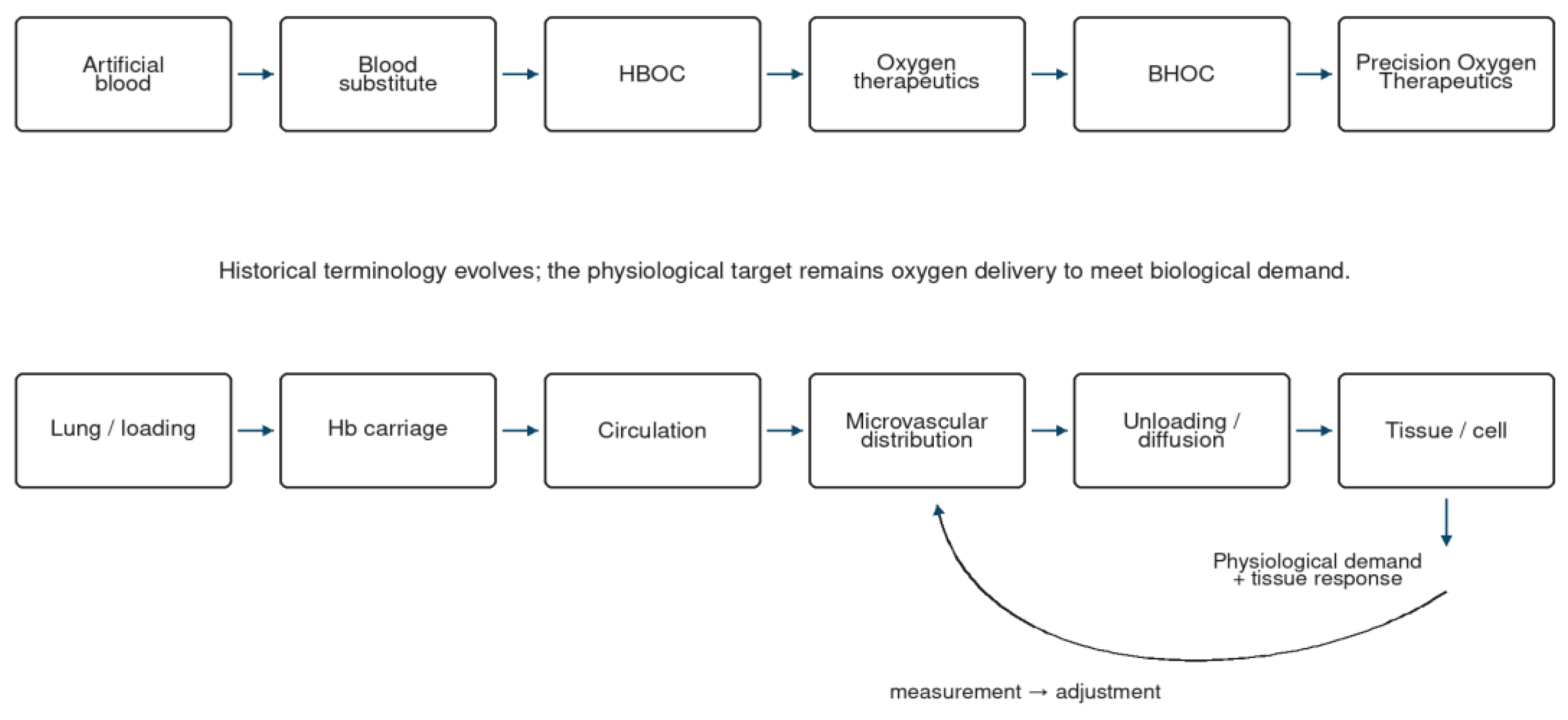
A useful systems representation is: oxygen loading → carriage → circulation → microvascular distribution → unloading → diffusion → tissue support → cellular utilization. Failure at any step can reduce effective oxygenation. The red blood cell illustrates this integration: hemoglobin oxygen affinity and unloading are affected by oxygen tension, carbon dioxide, pH, temperature, and 2,3-DPG, while red-cell deformability, transit, and vascular signaling influence where oxygen is distributed. Contemporary RBC physiology describes interacting allosteric and vaso-regulatory components of oxygen transport [7].
For an oxygen therapeutic, therefore, maximum oxygen content is not necessarily the optimal design objective. The more relevant problem is to determine how much available oxygen is carried, where and when it is released, how rapidly it is released, and what vascular response accompanies that release. This is the distinction between oxygen carriage and precision oxygen delivery and support.
5. Vascular Tone and Nitric-Oxide Biology Are Part of Oxygen-Delivery Pharmacology
One of the central challenges identified in HBOC development has been vasoactivity. Unstabilized cell-free hemoglobin can scavenge nitric oxide more readily than erythrocyte-contained hemoglobin because normal red-cell compartmentalization limits the interaction between hemoglobin and the vascular wall. Experimental work has linked plasma hemoglobin to altered vascular reactivity, vasoconstriction, and increased vascular resistance [8].
These effects are clinically important and should not be minimized. A 2008 meta-analysis of multiple earlier cell-free hemoglobin products reported increased risks of myocardial infarction and death across heterogeneous surgical, stroke, and trauma trials [9]. The investigational products, molecular architectures, indications, dosing strategies, and trial designs were heterogeneous; nevertheless, the analysis identified a safety signal that remains central to the field's regulatory history. This heterogeneity also supports product-specific evaluation rather than assuming uniform biological behavior across all hemoglobin-based oxygen carriers.
At the same time, the physiology of vasoactivity is not exhausted by the equation "hemoglobin + nitric-oxide scavenging = failure." Winslow described a second mechanism in which facilitated oxygen delivery by cell-free hemoglobin may produce precapillary oxygen oversupply and a regulatory vasoconstrictive response [10,11]. The magnitude and clinical relevance of vasoactivity may vary with molecular architecture, oxygen affinity, dose, organ, and physiological context. These mechanisms are not mutually exclusive. Their relevance is that vascular tone should be treated as part of oxygen-delivery pharmacology rather than as an isolated side effect detached from oxygen flux.
Intact RBCs also participate in oxygen-dependent vascular signaling. Work by Pawloski, Hess, and Stamler described export of NO-related bioactivity from red cells [12], while Crawford and colleagues demonstrated nitrite/NO-related mechanisms contributing to hypoxic vasodilation [13]. Reviews of erythrocyte vascular biology emphasize the interaction among oxygen affinity, oxygen unloading, nitric-oxide chemistry, ATP signaling, membrane biology, and blood flow [7,14]. These mechanisms remain an active scientific field and should not be automatically extrapolated from intact RBCs to a cell-free BHOCs. The translational question is therefore investigative material-specific: what is the net relationship among oxygen release, nitric-oxide biology, vascular tone, regional blood flow, and tissue oxygenation?
6. From a Fixed-Dose Oxygen Carrier to a Feedback-Oriented Physiological Intervention
The word precision should guide a development objective, not a marketing adjective. Precision Oxygen Therapeutics should ultimately be evaluated as a feedback-oriented system in which physiological demand and evidence of oxygen-delivery deficit inform intervention, and the measured response informs continuation, adjustment, or discontinuation.
The conceptual sequence is: physiological demand → identification of oxygen-delivery deficit → selection of intervention → oxygen-carrying support → microvascular distribution and unloading → measurement of physiological response → adjustment or discontinuation. The therapeutic objective is not maximal oxygenation availability. It is adequate oxygen delivery without physiologically inappropriate under-delivery or oxidative stress.
A major limitation is that no single routinely available variable constitutes a universal real-time tissue oxygenation endpoint. Candidate research tools include regional near-infrared spectroscopy, transcutaneous oxygen measurements, lactate kinetics, venous oxygen variables, microcirculatory imaging, organ-specific functional endpoints, and emerging measurements of cellular or mitochondrial oxygenation. The relevant control variables are likely to be indication-specific rather than universal [6]. Accordingly, the framework requires parallel development of monitoring strategies and oxygen-delivery and support therapeutics.
7. Conceptual Independence from Donor-Blood Availability
Alternative oxygen carriers have historically been positioned for situations in which donor blood is unavailable, incompatible, refused, or operationally inaccessible. Those remain important scenarios. Precision Oxygen Therapeutics, however, separates two variables that are often conflated: the availability of donor blood and the adequacy of oxygen delivery.
A patient may have donor blood available yet still have regional or microcirculatory oxygen-delivery failure. Conversely, anemia does not automatically imply that an additional oxygen carrier (as indicated by RBC hemoglobin level determination) is required when compensatory physiology is adequate. The research trigger for precision oxygen support should therefore be investigated as a demonstrable oxygen-delivery deficit relative to physiological demand, not merely as the absence of blood hematocrit or hemoglobin level.
This is not a recommendation to bypass transfusion when transfusion is indicated, nor does it establish clinical benefit for a BHOC when donor blood is available. It is a clinical observation of signs and symptoms of anemia-generating distinction. Hemorrhage, anemia, ischemia, low-flow states, impaired microcirculation, and other conditions will require separate evidence, dosing strategies, endpoints, and risk-benefit assessments. Precision Oxygen Therapeutics is intended as a complementary and an early immediate intervention to reduce ischemic insult, while safely preparing transfusion medicine guidance, this is not an alternative doctrine.
8. Implications for Product Development and Regulatory Science
Terminology influences the questions asked during product development. A product framed as a "blood substitute" is naturally evaluated in relation to replacement of red-cell transfusion. A product developed as an oxygen therapeutic raises additional mechanistic questions: Does it improve oxygen delivery? In which population? At what dose and duration? At what tissue or organ level? With what vascular, oxidative, renal, hepatic, and cardiac consequences of limiting ischemic insult?
FDA- and NIH-associated scientific discussions of HBOCs have repeatedly emphasized mechanistic safety, clinical efficacy, cardiovascular effects, and the heterogeneity of individual investigative materials. [15,16] This history supports an investigative-specific rather than class-generic approach. Molecular size distribution, oxygen affinity, redox behavior, extravasation, methemoglobin formation, viscosity, oncotic characteristics, pharmacokinetics, impurities, and manufacturing critical quality attributes can all influence biological behavior.
Within the proposed guidance, development should therefore be treatment-specific, indication-specific, dose-specific, and physiology-specific. Appropriate clinical endpoints remain essential; mechanistic oxygen-delivery metabolic endpoints should complement, not replace, mortality, morbidity, adverse events, organ performance outcomes, and appropriate established transfusion endpoints. The purpose of the guidance suggestion is to improve the biological interpretation of those outcomes and to make cross-product (biosimilar) generalization more disciplined and relevant.
9. Bridge Function, Biological Time, and Endogenous Recovery
An oxygen carrier used in an emergency may have value not only through immediate oxygen transport and delivery but also through the creation of biological time: time to control hemorrhage, treat the underlying disease, restore circulation or perfusion, perform definitive corrective intervention, or allow and support endogenous erythropoietic recovery. Expanded-access experience with HBOC-201 has explicitly used recovery of native hemoglobin and evidence of reticulocytosis among criteria for stopping further dosing [17]. Clinical experience also illustrates the potential role of bridge or intermittent administration strategies and the importance of understanding product-specific pharmacology and adverse effects [20].
A related question, not yet real world evaluated in a clinical trial, relates to heme-iron recycling. Most iron used for erythropoiesis is recovered through macrophage recycling of heme iron from senescent erythrocytes rather than supplied by daily intestinal absorption [18,19]. This raises a testable BHOC-specific hypothesis: can iron derived from metabolism of an administered biological hemoglobin oxygen carrier enter endogenous heme/iron recycling pathways and contribute meaningfully to subsequent erythropoiesis?
No directly measured evidence establishes such a benefit. Studies would need to define BHOC catabolism, heme handling, haptoglobin and hemopexin interactions, macrophage uptake, ferroportin-mediated iron export, transferrin incorporation, marrow utilization, reticulocyte kinetics, and potential toxicity from free heme, oxidative stress, or excess iron. The concept should therefore remain an exploratory research question rather than a therapeutic claim.
10. Research Agenda and Evaluable Hypotheses
A useful guidance outlined program should generate falsifiable questions. Precision Oxygen Therapeutics generates at least five. First, tissue- or organ-level oxygen-delivery response may provide clinically relevant information not captured by hemoglobin concentration or systemic saturation alone. Second, the optimal oxygen carrier may be the product that achieves the most appropriate relationship among oxygen loading, microvascular distribution, unloading, vascular response, and metabolic demand rather than the product with the highest oxygen-carrying capacity. Third, HBOC-associated vasoactivity may vary materially with molecular architecture, oxygen affinity, dose, nitric-oxide interactions, extravasation, and patient physiology and should therefore be characterized quantitatively rather than assumed to be uniform across a class. Fourth, selected oxygen carriers may function as temporary physiological bridges in defined settings even when donor blood is technically available, but only if prospective evidence demonstrates a clinically meaningful oxygen-delivery deficit and a favorable risk-benefit profile. Fifth, metabolism of biological hemoglobin oxygen carriers may interact with endogenous heme and iron recycling, but the magnitude and clinical significance of that interaction remain unknown.
These propositions are hypotheses, not therapeutic conclusions. The next step is not broader terminology; it is disciplined experimental validation using product-specific chemistry, translational physiology, indication-specific models, and prospective clinical endpoints.
11. Limitations of the Proposed Guidance.
Precision Oxygen Therapeutics is proposed here as a translational framework; it is not an established clinical specialty, regulatory category, validated treatment protocol, or clinical consensus. There is no universally accepted bedside measure of tissue oxygen-delivery adequacy. Tissue oxygen requirements differ among organs, disease states, temperatures, and metabolic conditions. Microvascular and cellular measurements remain technically challenging and are not uniformly validated as treatment targets.
The historical HBOC field also contains controversial safety signals, including cardiovascular, vasoactive, oxidative stress, renal compromise, and methemoglobin-related concerns. Mechanisms established for erythrocyte-contained hemoglobin cannot be assumed to apply to cell-free hemoglobin, and findings from one molecular architecture should not be generalized automatically to another. The term BHOC itself does not create evidence of safety or efficacy; it creates a proposed characterization guidance that must be populated by data and proper protocol.
Finally, the historical sources used to trace the development of the term oxygen therapeutics include an archival industry report and prepared congressional testimony. These sources are appropriate for documenting terminology and conceptual history but are not substitutes for peer-reviewed evidence of clinical effect. These limitations define the research and development agenda and the evidentiary boundaries of the present Perspective.
12. Conclusion
The history of hemoglobin-based oxygen carriers (HBOCs) reflects a progressive change in their applications and in the germane scientific question: from whether safe and effective “blood “can be reproduced, including through cell-based approaches such as those explored by Rubius Therapeutics, to whether red-cell oxygen carriage can be supplied by alternative means, and to whether oxygen delivery itself can be precisely controlled and therapeutically supported. We believe there is a critical need for Precision Oxygen Therapeutics as the advanced developmental and applied step in that evolution: a framework centered on measuring, regulating, and supporting oxygen delivery to provide metabolic support according to physiological demand.
Within this context, we present the following definition of a Biological Hemoglobin Oxygen Carrier (BHOC): a quantitatively characterizable hemoglobin-mediated oxygen-delivery material or therapeutic whose oxygen-binding behavior, pharmacology, vascular interactions, redox properties, and manufacturing attributes are evaluated as an integrated system. BHOC does not replace HBOC as the established historical term; it provides a forward-looking functional framework for new product-specific development.
The relevant scientific endpoint is therefore not whether an intervention "replaces blood." It is whether an oxygen-delivery technology can provide appropriate physiological support and a favorable benefit-risk outcome at the appropriate location and duration, with acceptable microvascular and systemic safety. Blood is a biological system. Oxygen delivery is a regulated physiological function. Precision Oxygen Therapeutics proposes that this function should be investigated as a therapeutic target in its own right. The appropriate regulatory classification of any individual technology should be determined product by product and indication by indication.
Figure 1.
From blood substitution to Precision Oxygen Therapeutics. Figure legend. The upper pathway summarizes the historical evolution of terminology. The lower pathway represents oxygen delivery as a physiological continuum from pulmonary loading to tissue/cellular availability. Physiological demand and measured response provide the conceptual feedback signal for future precision oxygen-delivery strategies. The diagram is conceptual and does not imply that all historical HBOCs meet the proposed BHOC definition or that feedback-controlled dosing has been clinically validated.
Ethics statement
This article is a conceptual analysis and literature-based Perspective and does not report new experiments involving human participants or animals. Institutional ethics approval was therefore not required.
Data availability
No new datasets were generated or analyzed for this conceptual article. The 1996 historical report discussed in the manuscript is an archival source held by the authors and can be supplied to editors for verification if requested.
Use of generative artificial intelligence
During preparation of this manuscript, the authors used ChatGPT (OpenAI) for language refinement, structural organization, drafting support, and assistance with bibliographic checking. The authors reviewed and revised the manuscript, verified the cited sources, and take full responsibility for the final content.
Author Contributions
Carl W. Rausch: historical conceptual development of oxygen therapeutics; scientific and technological perspective; conceptualization; critical review. Archil Jaliashvili: contemporary conceptualization and formalization of the Precision Oxygen Therapeutics and BHOC framework; manuscript conception; literature integration; drafting; visualization; critical revision.
Funding
This work was self-funded by the authors. No external funding was received for the preparation of this manuscript.
Conflicts of Interest
The authors are involved in the development and advancement of BHOC technologies. Archil Jaliashvili is affiliated with BHOC Therapeutics, and Carl W. Rausch is affiliated with GeoBio Pharm LLC. These relationships are disclosed as potential commercial conflicts of interest relevant to the subject of this manuscript.
References
- Stover; Associates; LLC. A New Generation of Oxygen Therapeutics; Archival industry report; copy held by the authors; Stover & Associates: Stamford, CT, September 1996. [Google Scholar]
- Rausch, C.W. Oxygen Therapeutics as Alternatives to Red Blood Cells. Prepared testimony before the Joint Economic Committee of the United States Congress. 29 September 1999. Available online: https://www.jec.senate.gov/archive/Documents/Hearings/rausch92999.htm.
- Cohn, S.M. The current status of haemoglobin-based blood substitutes. Ann. Med. 1997, 29(5), 371–376. [Google Scholar] [CrossRef] [PubMed]
- Alayash, A.I. Oxygen therapeutics: can we tame haemoglobin? Nat. Rev. Drug Discov. 2004, 3(2), 152–159. [Google Scholar] [CrossRef] [PubMed]
- Levien, L.J. South Africa: clinical experience with Hemopure. ISBT Sci. Ser. 2006, 1(1), 167–173. [Google Scholar] [CrossRef]
- Sigg, A.A.; Zivkovic, V.; Bartussek, J.; Schuepbach, R.A.; Ince, C.; Hilty, M.P. The physiological basis for individualized oxygenation targets in critically ill patients with circulatory shock. Intensive Care Med. Exp. 2024, 12, 72. [Google Scholar] [CrossRef] [PubMed]
- Wise, T.J.; Ott, M.E.; Joseph, M.S.; Welsby, I.J.; Darrow, C.C.; McMahon, T.J. Modulation of the allosteric and vasoregulatory arms of erythrocytic oxygen transport. Front Physiol. 2024, 15, 1394650. [Google Scholar] [CrossRef] [PubMed]
- Sampei, K.; Ulatowski, J.A.; Asano, Y.; Kwansa, H.; Bucci, E.; Koehler, R.C. Role of nitric oxide scavenging in vascular response to cell-free hemoglobin transfusion. Am. J. Physiol. Heart Circ. Physiol. 2005, 289(3), H1191–H1201. [Google Scholar] [CrossRef] [PubMed]
- Natanson, C.; Kern, S.J.; Lurie, P.; Banks, S.M.; Wolfe, S.M. Cell-free hemoglobin-based blood substitutes and risk of myocardial infarction and death: a meta-analysis. JAMA 2008, 299(19), 2304–2312. [Google Scholar] [CrossRef] [PubMed]
- Winslow, R.M. Cell-free oxygen carriers: scientific foundations, clinical development, and new directions. Biochim Biophys. Acta 2008, 1784(10), 1382–1386. [Google Scholar] [CrossRef] [PubMed]
- Winslow, R.M. Oxygen: the poison is in the dose. Transfusion 2013, 53(2), 424–437. [Google Scholar] [CrossRef] [PubMed]
- Pawloski, J.R.; Hess, D.T.; Stamler, J.S. Export by red blood cells of nitric oxide bioactivity. Nature 2001, 409, 622–626. [Google Scholar] [CrossRef] [PubMed]
- Crawford, J.H.; Isbell, T.S.; Huang, Z.; et al. Hypoxia, red blood cells, and nitrite regulate NO-dependent hypoxic vasodilation. Blood 2006, 107(2), 566–574. [Google Scholar] [CrossRef] [PubMed]
- Helms, C.C.; Gladwin, M.T.; Kim-Shapiro, D.B. Erythrocytes and vascular function: oxygen and nitric oxide. Front Physiol. 2018, 9, 125. [Google Scholar] [CrossRef] [PubMed]
- Hess, J.R. Deconstructing hemoglobin-based oxygen carriers. Transfusion 2008, 48(10), 2051–2052. [Google Scholar] [CrossRef] [PubMed]
- Silverman, T.A.; Weiskopf, R.B. Hemoglobin-based oxygen carriers: current status and future directions. Transfusion 2009, 49(11), 2495–2515. [Google Scholar] [CrossRef] [PubMed]
- Englewood Hospital and Medical Center. Expanded Access Study of HBOC-201 (Hemopure) for the Treatment of Life-Threatening Anemia. ClinicalTrials.gov identifier NCT01881503. 13 April 2025. Available online: https://clinicaltrials.gov/study/NCT01881503 (accessed on 17 September 2026).
- Korolnek, T.; Hamza, I. Macrophages and iron trafficking at the birth and death of red cells. Blood 2015, 125(19), 2893–2897. [Google Scholar] [CrossRef] [PubMed]
- Alam, M.Z.; Devalaraja, S.; Haldar, M. The heme connection: linking erythrocytes and macrophage biology. Front Immunol. 2017, 8, 33. [Google Scholar] [CrossRef] [PubMed]
- Mackenzie, C.F.; Dubé, G.P.; Pitman, A.; Zafirelis, M. Users Guide to Pitfalls and Lessons Learned About HBOC-201 During Clinical Trials, Expanded Access, and Clinical Use in 1,701 Patients. Shock. 2019, 52((1S) Suppl 1, 92–99. [Google Scholar] [CrossRef] [PubMed]
Disclaimer/Publisher’s Note: The statements, opinions and data contained in all publications are solely those of the individual author(s) and contributor(s) and not of MDPI and/or the editor(s). MDPI and/or the editor(s) disclaim responsibility for any injury to people or property resulting from any ideas, methods, instructions or products referred to in the content. |
© 2026 by the authors. Licensee MDPI, Basel, Switzerland. This article is an open access article distributed under the terms and conditions of the Creative Commons Attribution (CC BY) license (http://creativecommons.org/licenses/by/4.0/).
Copyright: This open access article is published under a Creative Commons CC BY 4.0 license, which permit the free download, distribution, and reuse, provided that the author and preprint are cited in any reuse.