

Submitted:
20 September 2026
Posted:
21 September 2026
You are already at the latest version
Abstract
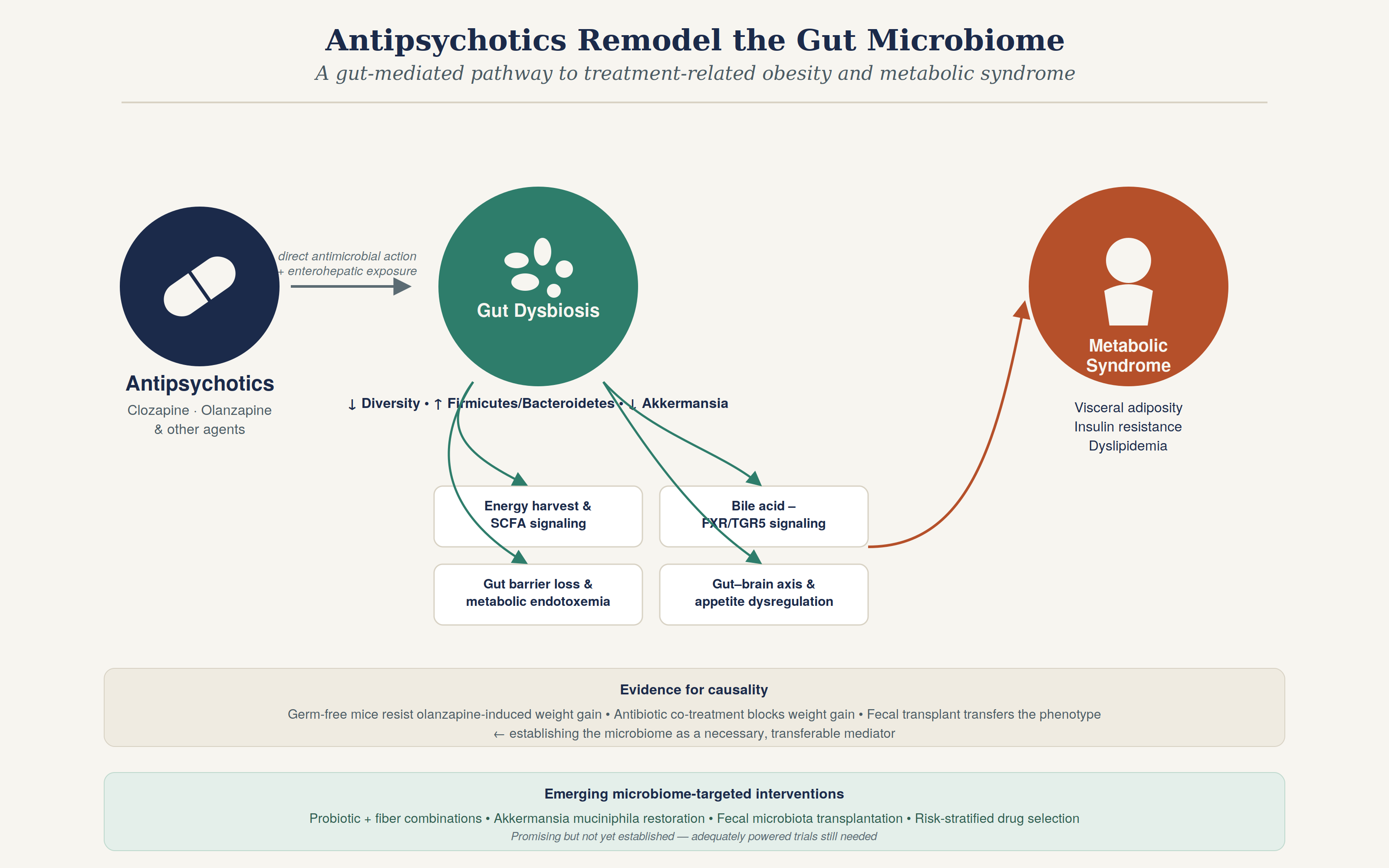
Background: Second-generation antipsychotics, particularly clozapine and olanzapine, are associated with clinically significant weight gain and metabolic syndrome, contributing to a 13-20-year reduction in life expectancy among people with schizophrenia. Conventional receptor-based explanations (histamine H1 antagonism, hypothalamic AMP-kinase activation) account for hyperphagia but incompletely explain peripheral metabolic dysfunction, visceral adiposity, and glucose dysregulation that can occur independently of weight gain. Purpose: This narrative review synthesizes clinical and translational evidence that the gut microbiome mediates antipsychotic-induced weight gain and metabolic syndrome, evaluating whether antipsychotics remodel gut microbial composition, the mechanistic routes linking such remodeling to metabolic pathology, and the evidence for microbiome-targeted prevention and treatment.Methods: A narrative synthesis of peer-reviewed literature was conducted, including preclinical germ-free, gnotobiotic, antibiotic, and fecal transplantation studies; human observational studies; randomized trials of probiotics and prebiotics; and systematic reviews and meta-analyses of metabolic outcomes in severe mental illness. Results: Convergent rodent and human evidence shows antipsychotics reduce microbial diversity, increase the Firmicutes/Bacteroidetes ratio, and deplete Akkermansia muciniphila, partly through direct antimicrobial activity. Germ-free mice are protected from olanzapine-induced weight gain and become susceptible upon colonization, while antibiotic co-administration attenuates olanzapine-induced adiposity and dyslipidemia, establishing causality. Proposed mechanisms include enhanced energy harvest and altered short-chain fatty acid signaling, impaired bile acid-FXR/TGR5 signaling, gut-barrier disruption with metabolic endotoxemia and Toll-like receptor 4-mediated inflammation, Akkermansia depletion, and bidirectional gut-brain signaling. Probiotic-fiber combinations show preliminary efficacy against antipsychotic-induced weight gain in randomized trials; fecal microbiota transplantation data in metabolic syndrome remain mixed but promising. Conclusions: The gut microbiome is a plausible, mechanistically supported mediator of antipsychotic-induced metabolic syndrome, and inter-individual microbial variation may explain differential susceptibility to treatment-related obesity. Microbiome-targeted adjunctive strategies, biomarker-guided risk stratification, and prospective phenotyping trials are priorities for future research and clinical translation.
Keywords:
gut microbiome
; antipsychotic agents
; metabolic syndrome
; weight gain
; dysbiosis
; Akkermansia muciniphila
Copyright: This open access article is published under a Creative Commons CC BY 4.0 license, which permit the free download, distribution, and reuse, provided that the author and preprint are cited in any reuse.