
Submitted:
18 September 2026
Posted:
20 September 2026
You are already at the latest version
Abstract
Canine hip osteoarthritis (OA) is a common musculoskeletal disorder requiring mul-tidimensional assessment. This randomized, double-blind, placebo-controlled trial evaluated 4-week treatment with meloxicam, two marine-based fatty acid com-pounds, combination treatment, or placebo in 203 client-owned dogs with naturally occurring hip OA. The principal outcome was peak vertical force (PVF) of the index hindlimb measured by force-plate gait analysis. Secondary outcomes included PVF responder status, orthopedic assessment score (OAS), Liverpool Osteoarthritis in Dogs (LOAD), Canine Brief Pain Inventory (CBPI), adverse events, and laboratory safety variables. Baseline-adjusted mean PVF did not differ significantly among treatment groups, although within-group PVF increased in the meloxicam group be-tween weeks 2 and 4. Using a predefined >5% of body weight PVF responder thresh-old, meloxicam-treated dogs were more likely than placebo-treated dogs to respond at week 4 (relative risk = 4.000; 95% confidence interval, 1.223 to 13.079; p = 0.022). Combination treatment was associated with improvements in LOAD and CBPI pain interference, PCSO-524 showed within-group improvement mainly in LOAD score, and EAB-277 showed within-group improvement in CBPI pain interference. OAS did not change significantly, and no consistent group-level laboratory safety concern was detected. These findings support multidimensional assessment of short-term treat-ment response in canine hip OA.
Keywords:
canine hip osteoarthritis
; peak vertical force
; force-plate gait analysis
; meloxicam
; marine-derived fatty acids
; green-lipped mussel
; responder analysis
; owner-reported outcome measures
1. Introduction
Osteoarthritis (OA) is a common chronic musculoskeletal disorder in dogs and is characterized by progressive deterioration of joint tissues, pain, impaired mobility, and reduced quality of life [1]. Prevalence estimates vary according to age, breed, case definition, and study population, but OA is recognized as an important cause of chronic pain and functional impairment in companion dogs [2,3]. Hip OA is clinically important because pain and impaired hindlimb function can reduce weight-bearing, mobility, exercise tolerance, and daily activity. Because OA is managed rather than cured, treatment goals focus on reducing pain, improving limb function, preserving mobility, and maintaining quality of life [1,4].
Assessment of treatment response in canine OA is challenging because OA affects multiple dimensions of pain and function. Veterinarian-based assessments, including orthopedic assessment scores (OAS), provide clinical evaluation of lameness, joint mobility, and pain on manipulation [5,6]. Owner-reported clinical metrology instruments, such as the Liverpool Osteoarthritis in Dogs (LOAD) questionnaire and the Canine Brief Pain Inventory (CBPI), capture owner-perceived mobility, pain severity, pain-related interference with daily activities, and quality-of-life impact [7,8,9,10]. These instruments are clinically valuable because owners observe their dogs during routine activities in the home environment. However, owner-reported outcomes may be influenced by caregiver expectations, contextual effects, and interpretation of questionnaire items [11]. Objective gait analysis can therefore provide complementary information. Ground reaction forces, particularly peak vertical force (PVF), are widely used objective measures of limb-loading function in dogs with OA and are less directly affected by caregiver perception than owner-completed questionnaires [12,13].
Non-steroidal anti-inflammatory drugs (NSAIDs) remain a cornerstone of medical management for canine OA pain. Meloxicam, an oxicam NSAID with preferential cyclooxygenase-2 inhibitory activity, is widely used for the management of pain and inflammation associated with acute and chronic musculoskeletal disease in dogs [14]. Previous clinical trials have reported improvements in lameness and other clinical signs in dogs with OA treated with meloxicam [15,16]. However, OA often requires long-term management, and NSAID therapy may be associated with gastrointestinal, renal, hepatic, or other adverse effects, particularly in susceptible dogs or during prolonged use [17]. These concerns support a multimodal approach to OA management that integrates pharmacologic analgesia, weight control, activity modification, rehabilitation, nutritional support, and appropriate monitoring [1].
Marine-based fatty acid compounds have received increasing attention as potential adjunctive or alternative interventions for canine OA. These products include lipid extracts derived from New Zealand green-lipped mussel (Perna canaliculus) and formulations that combine green-lipped mussel lipid fractions with krill oil [18,19,20,21,22]. They contain multiple lipid components, including long-chain polyunsaturated omega-3 fatty acids, and are proposed to modulate inflammatory pathways through omega-3 fatty acid-related mechanisms. This provides a biologically plausible rationale for evaluating their clinical effects in dogs with OA, particularly as part of multimodal management.
Clinical evidence for marine-based fatty acid compounds in canine OA is developing but remains incomplete. NSAIDs remain a cornerstone of medical management for canine OA pain, and omega-3-containing nutraceuticals are commonly considered adjunctive options in multimodal OA management [23,24]. Previous studies have evaluated NSAIDs, green-lipped mussel-derived products, fish oil-based interventions, and other nutraceuticals using a range of clinical, owner-reported, and objective gait outcomes [21,25,26]. However, available studies differ in treatment comparator, treatment duration, outcome measures, and study design, making direct clinical interpretation difficult.
Direct comparative evidence across meloxicam, marine-based fatty acid compounds, combination treatment, and placebo remains limited, particularly when objective limb-loading outcomes, responder-based interpretation, owner-reported clinical metrology instruments, and short-term laboratory safety variables are evaluated within the same randomized, blinded protocol. This gap is clinically relevant because dogs with naturally occurring OA are heterogeneous, and group-mean comparisons may not fully capture clinically meaningful improvement in individual dogs. Multidimensional assessment using objective kinetic data, veterinarian-assessed clinical scores, owner-reported outcomes, and safety monitoring may therefore provide a more clinically useful understanding of treatment response [27].
Therefore, the primary objective of this study was to evaluate the short-term efficacy of meloxicam, two marine-based fatty acid compounds, a combination treatment with meloxicam and a marine-based fatty acid compound against placebo in client-owned dogs with naturally occurring hip OA, using PVF of the index hindlimb as the primary objective outcome. Secondary objectives were to evaluate PVF responder status, veterinarian-assessed OAS, owner-reported LOAD and CBPI outcomes, and short-term hematological and serum biochemical safety variables. We hypothesized that active interventions would improve PVF compared with placebo. We further hypothesized that combination treatment with meloxicam and a marine-based fatty acid compound would provide additional clinical benefit compared with either treatment alone.
2. Materials and Methods
2.1. Ethical Approval and Study Setting
The study protocol was reviewed and approved by the Institutional Animal Care and Use Committee of the Faculty of Veterinary Medicine, Kasetsart University, Bang Khen Campus (approval no. ACKU61-VET-018). Client-owned dogs presented to the Kasetsart University Veterinary Teaching Hospital, Bang Khen Campus, were enrolled between January 2019 and August 2021.
Before enrollment, owners received written information describing the study objectives, procedures, potential benefits, and foreseeable risks. Written informed consent was obtained from each owner. Participation was voluntary, and owners were permitted to withdraw their dogs from the study at any time.
2.2. Study Design and Participants
This was a randomized, double-blind, placebo-controlled, parallel-group clinical trial evaluating five treatment regimens administered for 4 weeks to client-owned dogs with naturally occurring hip osteoarthritis.
Client-owned medium- to large-sized dogs of either sex were recruited from the Kasetsart University Veterinary Teaching Hospital. Eligible dogs were required to have clinical and radiographic evidence of hip osteoarthritis, as detailed below.
2.3. Eligibility Criteria
Dogs were eligible for enrollment if they were medium- to large-sized dogs of either sex, at least 18 months of age, weighed 18 to 50 kg, and had clinical and radiographic evidence of hip osteoarthritis. Clinical signs consistent with hip osteoarthritis included one or more of the following: hindlimb lameness while walking or running, difficulty rising or sitting, hindlimb muscle atrophy, or reduced hip joint range of motion. Eligible dogs were also required to have pain localized to at least one hip joint during orthopedic examination, radiographic evidence of degenerative changes in at least one hip joint, hematologic and serum biochemical results considered clinically acceptable for study participation, and the ability to run successfully across the force-plate runway.
Dogs were excluded if they had forelimb lameness, neurologic abnormalities, clinically relevant concurrent systemic disease, or clinically important concurrent orthopedic abnormalities affecting gait, including cranial cruciate ligament rupture, patellar luxation, or instability of another joint. Dogs were also excluded if they had a previous condition or surgical procedure that could substantially affect walking or running ability, including femoral head and neck excision; orthopedic surgery within the preceding 8 months; surgery for cranial cruciate ligament rupture within the preceding 6 months; or pregnancy or lactation.
Dogs previously receiving nutraceutical products or nonsteroidal anti-inflammatory drugs underwent a washout period of at least 2 weeks before enrollment. Corticosteroids and injectable sodium pentosan polysulfate were discontinued for at least 4 weeks before enrollment.
2.4. Severity Stratification and Randomization
Before treatment allocation, each dog underwent physical and orthopedic examinations using the clinical assessment system described by Moreau et al. [6]. Dogs were stratified according to their baseline clinical severity score. Scores of 1 to 3 were classified as mild-to-moderate disease, whereas scores of 4 to 6 were classified as severe disease.
Separate randomization schedules were generated for the mild-to-moderate and severe disease strata using a web-based randomization tool. Within each stratum, treatment assignments were arranged in randomly permuted blocks with a fixed block size of five. Each complete block contained one allocation to each of the five treatment groups in randomly generated order. The randomization schedules for the two severity strata were generated and maintained separately, and the original allocation schedules were retained as study records.
After eligibility confirmation and baseline severity classification had been completed, treatment allocation was assigned sequentially according to the next available code in the applicable severity-stratum schedule.
2.5. Blinding Procedures
A double-dummy procedure was used to maintain blinding because the study treatments were administered in both liquid and capsule formulations. The liquid placebo consisted of the meloxicam vehicle without an active pharmaceutical ingredient and was administered orally at a volume equivalent to the calculated meloxicam dose. The capsule placebo consisted of sunflower oil in a soft gelatin capsule that was externally indistinguishable from the active marine-derived lipid capsules and contained no marine-derived lipid extract. Owners and veterinarians responsible for clinical outcome assessments were blinded to treatment allocation. Study treatments were dispensed by a veterinarian who was not involved in outcome assessment.
2.6. Treatment Groups
Dogs were allocated to one of five treatment groups for 4 weeks. All study treatments were administered orally once daily.
In the combination group, dogs received meloxicam (Metacam®; Boehringer Ingelheim, USA) at 0.2 mg/kg on the first day, followed by 0.1 mg/kg once daily, together with PCSO-524, a stabilized lipid extract derived from New Zealand green-lipped mussel (Perna canaliculus), at a target dose of 5 mg/kg once daily.
In the meloxicam group, dogs received meloxicam at 0.2 mg/kg on the first day, followed by 0.1 mg/kg once daily, together with the matching capsule placebo administered at a quantity equivalent to the calculated PCSO-524 dose.
In the placebo group, dogs received the liquid placebo at a volume equivalent to the calculated meloxicam dose, together with the matching capsule placebo administered at a quantity equivalent to the calculated PCSO-524 dose.
In the PCSO-524 group, dogs received PCSO-524 (Antinol®) at a target dose of 5 mg/kg once daily, together with the liquid placebo administered at a volume equivalent to the calculated meloxicam dose.
In the EAB-277 group, dogs received EAB-277 (Antinol® Rapid), a marine-derived lipid extract containing green-lipped mussel and krill lipids, at a target dose of 5 mg/kg once daily, together with the liquid placebo administered at a volume equivalent to the calculated meloxicam dose. EAB-277 was supplied in soft gelatin capsules that were externally indistinguishable from the PCSO-524 and capsule-placebo formulations.
2.7. Sample-Size Determination
The required sample size was calculated using G*Power version 3.1.9.4 (Franz Faul, Universität Kiel, Germany). The calculation was based on force-plate measurements reported in a previous study [21]. Assuming an effect size of 0.25, a two-sided type I error rate of 0.05, and 80% statistical power, the minimum required sample size was estimated to be 40 dogs per treatment group, corresponding to a planned total sample size of 200 dogs.
Three additional eligible dogs were randomized before enrollment closure was finalized. Therefore, all 203 randomized dogs were retained in the study, and no dog was excluded solely to restore the originally planned sample size.
2.8. Outcome Assessments
Assessments were performed before treatment initiation at week 0 and repeated at weeks 2 and 4. The principal efficacy outcome was peak vertical force (PVF) of the index hindlimb measured by force-plate gait analysis. Additional efficacy outcomes included the veterinarian-assessed orthopedic assessment score (OAS), the owner-completed Liverpool Osteoarthritis in Dogs (LOAD) questionnaire, and the Canine Brief Pain Inventory (CBPI). The CBPI included pain severity, pain interference, and quality-of-life impairment domains.
Treatment safety and tolerability were evaluated using reported adverse events and hematological and serum biochemical variables.
2.8.1. Peak Vertical Force
Peak vertical force was measured using two force plates (Model OR6-6; Advanced Mechanical Technology, Inc., USA) embedded in the center of a 10-m runway. Force-plate data were processed using Cortex software, version 4.0 (Motion Analysis Corporation, USA).
Three timing sensors positioned at 2-m intervals were used to measure running velocity and acceleration. Dogs were required to run at a velocity of 1.8 to 2.2 m/s, with acceleration maintained between -0.5 and 0.5 m/s² [21]. The same handler guided each dog across the runway throughout the study to reduce variation associated with handling.
Each trial was video-recorded to verify complete paw contact with the force plate. A trial was considered valid when the paw made complete contact with the force plate and the prespecified velocity and acceleration criteria were met. Six valid trials were obtained for each dog at each assessment [21].
PVF was defined as the peak vertical force of the index hindlimb, normalized to body weight and expressed as percentage of body weight (%BW). For dogs with bilateral hip osteoarthritis, the painful hindlimb with the lower PVF at baseline was designated as the index hindlimb. The same index hindlimb was retained for analyses at weeks 2 and 4, irrespective of subsequent changes in PVF in either hindlimb. The mean PVF obtained from the six valid trials for the index hindlimb was used for statistical analysis [21].
2.8.2. Orthopedic Assessment Score
Orthopedic status was evaluated by a board-certified orthopedic surgeon using a clinical scoring system adapted from Moreau et al. [6]. The OAS included lameness, articular mobility, and articular pain components. Lameness was scored once per dog, whereas articular mobility and articular pain were scored separately for each hip. Hip joint pain was assessed during extension of the hip joint. The total OAS was calculated as the sum of the lameness score, left and right hip articular mobility scores, and left and right hip articular pain scores, giving a total possible score of 0 to 18. Higher scores indicated greater orthopedic impairment. The same scoring system was used at each assessment time point. The detailed scoring criteria are provided in Table 1.
2.8.3. Owner-Reported Outcome Assessments
Owners completed the LOAD questionnaire to assess mobility and functional ability associated with osteoarthritis [7,8,9]. The questionnaire consisted of two sections: the first addressed the dog’s general exercise behavior, and the second assessed mobility during routine daily activities. The scored section contained 13 items, each with five response categories. Responses were converted to ordinal scores, and the total LOAD score was used for statistical analysis. Higher LOAD scores indicated poorer mobility and functional ability.
Owners also completed the CBPI. The CBPI included pain severity, pain interference, and quality-of-life domains [10]. The pain severity domain assessed the dog’s pain intensity, whereas the pain interference domain assessed the effect of pain on daily activities. The quality-of-life domain reflected the owner’s overall assessment of the dog’s recent quality of life. The mean score for each CBPI domain was used for statistical analysis. Higher scores indicated greater pain severity, greater pain-related interference, or poorer quality of life.
2.8.4. Safety Assessment
A 3-mL blood sample was collected from the cephalic vein of each dog at each assessment. One milliliter was transferred into a tube containing ethylenediaminetetraacetic acid for a complete blood count, and the remaining 2 mL was placed in a serum collection tube for serum biochemical analysis.
Hematological analyses were performed using an automated veterinary hematology analyzer (XN-1000Vet; Sysmex Corporation, Japan). Serum biochemical analyses were performed using an automated clinical chemistry analyzer (Taurus; Instrumentation Laboratory, USA). Hematological variables included packed cell volume (PCV), White blood cell (WBC) count, and platelet count. Serum biochemical variables included blood urea nitrogen (BUN), creatinine, alanine aminotransferase (ALT), alkaline phosphatase (ALP), total protein (TP), and albumin (ALB).
Reported adverse events, treatment discontinuations, and withdrawals were recorded throughout the study.
2.9. Statistical Analysis
Statistical analyses were performed using IBM SPSS Statistics for Windows, version 31.0 (IBM Corp., Armonk, NY, USA). All statistical tests were two-sided, and statistical significance was set at p < 0.05 unless otherwise specified. Continuous variables were summarized as mean ± SD when approximately normally distributed. Ordinal or markedly skewed variables were summarized as median [interquartile range]. Categorical variables were summarized as counts and percentages. Where applicable, pairwise comparisons were adjusted within each outcome using the Bonferroni method. However, no formal study-wide adjustment was applied across all outcome measures. This decision reflected the multidimensional design of the study, in which PVF, OAS, LOAD, CBPI, and laboratory variables were intended to capture distinct aspects of treatment response rather than repeated tests of a single construct. Accordingly, findings from secondary and exploratory outcomes were interpreted cautiously, with attention to effect estimates, 95% confidence intervals, adjusted p-values where applicable, consistency across measures, direction of change, and clinical relevance rather than statistical significance alone.
2.9.1. Analysis Populations and Missing Data
The efficacy analysis included randomized dogs with baseline data and at least one post-baseline efficacy assessment. The safety analysis included all randomized dogs that received at least one dose of the assigned study treatment. Dogs were analyzed according to their randomized treatment group.
The efficacy analysis population was considered a modified intention-to-treat population with available-case analysis. All available observations were included in the analyses. Missing post-baseline measurements were not replaced by last-observation-carried-forward, next-observation-carried-backward, group-mean substitution, or other single-value imputation methods. Reasons for withdrawal or missing data were summarized by treatment group when available.
2.9.2. Baseline Characteristics
Baseline demographic and clinical characteristics were summarized by treatment group to evaluate comparability among treatment groups. Continuous baseline variables were compared among treatment groups using one-way ANOVA or Kruskal-Wallis tests, as appropriate. Categorical variables were compared using chi-square tests or Fisher’s exact tests, as appropriate. These analyses were used to describe baseline comparability and were not used as the sole basis for determining covariate adjustment in post-treatment analyses.
2.9.3. Primary Analysis: Baseline-Adjusted Linear Mixed Model for PVF
A baseline-adjusted linear mixed model was used to evaluate post-treatment PVF at weeks 2 and 4. This analysis followed an ANCOVA framework in which baseline PVF was included as a covariate rather than analyzed as a repeated outcome. Post-treatment PVF at weeks 2 and 4 was specified as the dependent variable. Treatment group, week, and the treatment group-by-week interaction were included as fixed effects, with baseline PVF included as a covariate. Dog identification was specified as the repeated subject, and within-dog correlations between repeated post-baseline measurements were modeled using a first-order autoregressive covariance structure.
Estimated marginal means were calculated for each treatment group at weeks 2 and 4. Overall fixed effects of treatment group, week, treatment group-by-week interaction, and baseline PVF were evaluated. Within-group comparisons between week 2 and week 4 were performed using model-based pairwise comparisons with Bonferroni adjustment. Because baseline PVF was included as a covariate, baseline-to-week 2 and baseline-to-week 4 changes were summarized descriptively rather than tested within this model. Observed PVF values and descriptive changes from baseline to weeks 2 and 4 were reported by treatment group. Model assumptions were assessed using residual diagnostic plots.
2.9.4. Secondary Analysis: PVF Responder Analysis
An additional responder analysis was performed for PVF. The PVF gain was calculated as the absolute change in PVF of the index hindlimb from baseline to each post-treatment assessment: PVF gain at week 2 = PVF at week 2 minus PVF at week 0, and PVF gain at week 4 = PVF at week 4 minus PVF at week 0. All PVF gain values were expressed as %BW.
The primary PVF responder threshold was defined as an absolute increase in PVF of >5 %BW from baseline [12]. This threshold was selected as a conservative PVF-based criterion informed by published recommendations for interpreting ground reaction force changes in dogs with osteoarthritis. Dogs with a PVF gain of ≤5 %BW were classified as non-responders for the primary responder analysis.
An exploratory responder analysis was also performed using a lower PVF improvement threshold of ≥3.5 %BW from baseline [12]. This analysis was conducted to evaluate whether treatment-placebo contrasts were consistent when a more sensitive responder definition was applied. Separate responder variables were created for weeks 2 and 4 for each threshold.
Relative risks for PVF response were estimated using modified Poisson regression with a log link and robust covariance estimation. The placebo group was used as the reference group. Relative risks, robust 95% confidence intervals, and p-values were reported for each active-treatment group compared with placebo. Responder counts and percentages were also summarized by treatment group.
2.9.5. Score-Based Clinical Outcomes
Score-based clinical outcomes included OAS, LOAD score, CBPI pain severity score, CBPI pain interference score, and CBPI quality-of-life impairment score. Because these outcomes were ordinal or non-normally distributed, they were summarized as median [interquartile range] and analyzed using nonparametric methods.
Within-group changes across baseline, week 2, and week 4 were evaluated using Friedman tests. When the overall Friedman test was significant, pairwise comparisons between time points were performed with Bonferroni adjustment.
Cross-sectional between-group comparisons of score-based outcomes were performed separately at baseline, week 2, and week 4 using Kruskal-Wallis tests. When the overall Kruskal-Wallis test was significant, pairwise comparisons between treatment groups were performed with Bonferroni adjustment.
2.9.6. Laboratory Safety Variables
Hematological and serum biochemical variables were summarized descriptively by treatment group and assessment time. Packed cell volume, platelet count, WBC count, blood urea nitrogen, serum creatinine, total protein, and albumin were analyzed using linear mixed models for repeated measures. Each model included treatment group, week, and the treatment group-by-week interaction as fixed effects, with dog identification specified as the repeated subject. Within-group comparisons over time and between-group comparisons at individual time points were performed with Bonferroni adjustment where applicable.
Because alanine aminotransferase and alkaline phosphatase activities were markedly skewed, these variables were summarized as median [Q1–Q3] and analyzed using nonparametric methods. Within-group changes over time were evaluated using Friedman tests, with Bonferroni-adjusted pairwise comparisons where applicable. Cross-sectional between-group comparisons at baseline, week 2, and week 4 were performed using Kruskal-Wallis tests, with Bonferroni-adjusted pairwise comparisons where applicable.
Laboratory abnormalities were interpreted together with clinical adverse events, treatment discontinuations, withdrawals, and clinical relevance.
2.9.7. Adverse Events
Adverse events were summarized in the safety population. Events were described by treatment group, time of onset, clinical category, severity, action taken, outcome, and whether the event led to treatment discontinuation or withdrawal from the study. No adverse event was classified as treatment-related unless a causal relationship to the assigned treatment was considered at least possible by the investigators.
3. Results
3.1. Study Population and Baseline Characteristics
This clinical trial was conducted in client-owned dogs with hip osteoarthritis presented to the Kasetsart University Veterinary Teaching Hospital, Bang Khen Campus, between January 2019 and August 2021. A total of 313 dogs were assessed for eligibility, of which 203 met the inclusion criteria and were randomized into five treatment groups. The randomized population comprised 79 females and 124 males, with a mean age of 60.55 ± 29.52 months and a mean body weight of 34.46 ± 7.24 kg.
Ten breeds were represented, most commonly Golden Retriever (n = 96), Labrador Retriever (n = 42), and Siberian Husky (n = 32). Other breeds included mixed-breed dogs (n = 8), Alaskan Malamute (n = 7), American Pit Bull Terrier (n = 6), Rottweiler (n = 5), German Shepherd Dog (n = 3), Thai Bangkaew Dog (n = 3), and Thai Ridgeback Dog (n = 1). Based on the five-point body condition scoring system, 84 dogs had a body condition score (BCS) of 3/5, 85 had a BCS of 4/5, and 34 had a BCS of 5/5.
Of the 110 dogs that were not enrolled, 46 did not meet the inclusion criteria, 29 were excluded because owners declined participation, and 35 had radiographically normal hip joints. One dog in the placebo group was unavailable for the week 2 assessment because the owner could not be contacted but returned for the week 4 assessment. Five dogs did not complete the week 4 assessment: two in the combination group because of bloody diarrhea (n = 1) and inability to contact the owner (n = 1), two in the meloxicam group because of inability to contact the owner (n = 1) and increased serum creatinine concentration (n = 1), and one in the placebo group because of pyometra. Participant flow through the study is shown in Figure 1.
The baseline demographic and clinical characteristics of dogs with hip osteoarthritis are summarized by treatment group in Table 2. No significant differences were detected among treatment groups for any baseline demographic or clinical characteristic.
3.2. Objective Force Plate Assessment: Peak Vertical Force
- Baseline PVF and baseline-adjusted linear mixed model analysis
A baseline-adjusted linear mixed model was used to evaluate post-treatment PVF at weeks 2 and 4. This model followed an ANCOVA framework in which baseline PVF was included as a covariate rather than analyzed as a repeated outcome. Treatment group, week, and the treatment group-by-week interaction were included as fixed effects, with baseline PVF included as a covariate. Repeated measurements within each dog were modeled using a first-order autoregressive covariance structure.
Baseline PVF was a significant covariate in the model (F = 900.672, p < 0.001). After adjustment for baseline PVF, there was no significant overall effect of treatment group (F = 1.292, p = 0.275), no significant effect of week (F = 3.225, p = 0.074), and no significant treatment group-by-week interaction (F = 2.031, p = 0.092). These findings indicate that baseline-adjusted post-treatment PVF did not differ significantly among treatment groups over the 4-week treatment period.
Baseline-adjusted estimated marginal means of PVF at weeks 2 and 4 are shown in Figure 2 and Table 3. Within-group model-based pairwise comparisons showed that PVF increased significantly from week 2 to week 4 in the meloxicam group (mean difference = 1.57 %BW; 95% CI, 0.53 to 2.62; Bonferroni-adjusted p = 0.003). No significant week 2 to week 4 differences were detected within the combination, placebo, PCSO-524, or EAB-277 groups. However, because the overall treatment group-by-week interaction was not statistically significant, this within-group finding was interpreted as supportive rather than evidence of treatment superiority.
Observed PVF values and descriptive changes from baseline to weeks 2 and 4 are provided in Supplementary Table S1. These descriptive changes were included to aid clinical interpretation, whereas inferential treatment comparisons were based on the baseline-adjusted linear mixed model and PVF responder analyses.
- Responder analysis of PVF improvement at weeks 2 and 4
To further evaluate whether changes in PVF reflected clinically meaningful improvement at the individual-dog level, responder analyses were performed at weeks 2 and 4. Responder status was defined as an absolute increase in PVF of >5 %BW from baseline. Relative risks were estimated using modified Poisson regression with a log link and robust covariance estimation, with placebo used as the reference group.
At week 2, no treatment group showed a significantly higher probability of achieving PVF responder status compared with placebo. At week 4, the meloxicam group had a significantly higher probability of achieving PVF responder status compared with placebo (Relative Risk (RR) = 4.000; 95% Confidence Interval (CIs), 1.223 to 13.079; p = 0.022). The combination group showed a borderline positive trend (RR = 3.333; 95% CI, 0.993 to 11.195; p = 0.051), whereas PCSO-524 and EAB-277 did not differ significantly from placebo (Table 4). These findings suggest that meloxicam was associated with a greater probability of clinically meaningful individual-dog PVF improvement at week 4; however, this result should be interpreted in conjunction with the non-significant overall baseline-adjusted mean PVF treatment effect.
An exploratory responder analysis using a lower threshold of ≥3.5 %BW was also performed. Because this threshold was exploratory, these findings were interpreted cautiously, and detailed results are provided in Supplementary Table S2.
3.3. Score-Based Clinical Outcomes
Within-Group Changes in Score-Based Outcomes
Orthopedic Assessment Score
Orthopedic status was evaluated by a board-certified orthopedic surgeon who was blinded to treatment allocation. No significant within-group change in orthopedic assessment score (OAS) was detected across baseline, week 2, and week 4 in any treatment group. Friedman test p-values were 0.266 for the combination group, 0.596 for the meloxicam group, 0.093 for the placebo group, 0.224 for the PCSO-524 group, and 0.703 for the EAB-277 group.
Owner Assessment: Liverpool Osteoarthritis in Dogs Questionnaire
The Liverpool Osteoarthritis in Dogs questionnaire (LOAD) was used as an owner-based assessment of mobility and functional performance. Within-group Friedman tests showed significant changes in LOAD score over time in the combination group (p = 0.016), PCSO-524 group (p = 0.005), and EAB-277 group (p = 0.038), but not in the meloxicam group (p = 0.097) or placebo group (p = 0.051). After Bonferroni correction, LOAD score was significantly reduced from baseline to week 4 in the combination group (adjusted p = 0.013). In the PCSO-524 group, LOAD score was significantly reduced from baseline at both week 2 (adjusted p = 0.018) and week 4 (adjusted p = 0.023). Although the EAB-277 group showed a significant overall Friedman test, no pairwise comparison remained significant after Bonferroni correction (Table 5).
Owner Assessment: Canine Brief Pain Inventory Score
The Canine Brief Pain Inventory (CBPI) was used to evaluate owner-assessed pain severity, pain-related interference with daily activities, and quality-of-life impairment. For the CBPI pain severity domain, significant overall within-group changes over time were detected in the PCSO-524 group (p = 0.014) and EAB-277 group (p = 0.039), but no Bonferroni-adjusted pairwise comparison remained statistically significant in any treatment group.
For the CBPI pain interference domain, significant within-group changes over time were detected in the combination group (p = 0.004), meloxicam group (p = 0.032), and EAB-277 group (p = 0.008), but not in the placebo group (p = 0.149) or PCSO-524 group (p = 0.211). After Bonferroni correction, the combination group showed a significant reduction in CBPI pain interference score from baseline to week 4 (adjusted p = 0.009) and from week 2 to week 4 (adjusted p = 0.029). The EAB-277 group also showed a significant reduction from baseline to week 4 (adjusted p = 0.024). Although the meloxicam group showed a significant overall Friedman test, none of the pairwise comparisons remained statistically significant after Bonferroni correction.
For the CBPI quality-of-life impairment domain, a significant overall within-group change over time was detected only in the combination group (p = 0.009). However, after Bonferroni correction, no pairwise comparison remained statistically significant in any treatment group. Median [interquartile range] values and Bonferroni-adjusted pairwise comparisons for all CBPI domains are presented in Table 6.
Cross-Sectional Between-Group Comparisons of Score-Based Outcomes
Between-group comparisons of score-based outcomes were performed as cross-sectional time-point analyses at baseline, week 2, and week 4 using Kruskal-Wallis tests. At baseline, no significant between-group differences were detected for any score-based outcome, supporting baseline comparability among treatment groups. At week 2, the CBPI pain severity score differed significantly among treatment groups (p = 0.002). However, after Bonferroni adjustment, no pairwise comparison between treatment groups remained statistically significant. Therefore, this finding was interpreted as an overall week-2 between-group difference without a clearly identifiable pairwise treatment contrast. No significant between-group differences were detected for any score-based outcome at week 4.
3.4. Safety Assessment
Hematological and serum biochemical variables were evaluated as safety outcomes. Packed cell volume, platelet count, serum creatinine concentration, and serum albumin concentration showed no significant treatment effect, week effect, or treatment-by-week interaction. At the group level, serum creatinine concentration did not show a significant treatment effect, week effect, or treatment-by-week interaction, although one dog in the meloxicam group was withdrawn because of increased serum creatinine concentration identified at week 2.
WBC count showed a significant treatment-by-week interaction (p = 0.028), but no significant overall treatment effect or week effect. A single between-group difference was detected at week 4, with higher WBC count in the meloxicam group than in the EAB-277 group after Bonferroni adjustment (p = 0.036). However, no significant within-group changes over time were observed. BUN showed no significant treatment effect, week effect, or treatment-by-week interaction. Although BUN increased from baseline to week 4 in the meloxicam group after Bonferroni adjustment (p = 0.034), no significant between-group differences were detected at any time point. Total protein showed a significant treatment-by-week interaction, with small transient changes in the meloxicam and PCSO-524 groups, but these changes were not accompanied by significant albumin changes or consistent between-group differences.
Because ALT and ALP activities were markedly skewed, these variables were summarized as median [Q1–Q3] and analyzed using nonparametric methods. No significant between-group differences in ALT activity were detected at baseline (p = 0.322), week 2 (p = 0.382), or week 4 (p = 0.076). Friedman tests showed a significant within-group change in ALT activity only in the combination group (p = 0.034), driven by a decrease from baseline to week 4 after Bonferroni adjustment (p = 0.033). No significant within-group increases in ALT activity were detected in any treatment group. No significant between-group differences in ALP activity were detected at baseline (p = 0.858), week 2 (p = 0.783), or week 4 (p = 0.844), and Friedman tests showed no significant within-group changes in ALP activity over time in any treatment group. Overall, no evidence of treatment-associated increases in ALT or ALP activity was detected over the 4-week study period.
Overall, no consistent group-level safety signal was detected in hematological or serum biochemical variables.
3.5. Adverse Events and Withdrawals
All randomized dogs were included in the safety assessment. Follow-up data were available for all dogs at week 2, except for one dog in the placebo group whose owner could not be contacted; this dog returned for the week 4 assessment. At week 4, outcome data were unavailable for two dogs in the combination group, two dogs in the meloxicam group, and one dog in the placebo group.
In the combination group, one dog was withdrawn because of bloody diarrhea, and one dog was lost to follow-up because the owner could not be contacted. In the meloxicam group, one dog was withdrawn because of increased serum creatinine concentration, and one dog was lost to follow-up because the owner could not be contacted. In the placebo group, one dog was withdrawn because of pyometra. No dogs in the PCSO-524 or EAB-277 groups were withdrawn or lost to follow-up.
The bloody diarrhea observed in the combination group and the increased serum creatinine concentration observed in the meloxicam group were considered clinically relevant safety events leading to withdrawal before the week 4 assessment; however, treatment causality was not definitively established. No consistent pattern of adverse events suggesting a group-level treatment-related safety signal was identified.
4. Discussion
This randomized, double-blind, placebo-controlled trial evaluated short-term objective limb-loading response, owner-reported functional outcomes, and laboratory safety findings in client-owned dogs with naturally occurring hip osteoarthritis treated with meloxicam, marine-based fatty acid compounds, combination treatment, or placebo. The principal finding was that baseline-adjusted mean PVF did not differ significantly among treatment groups over the 4-week treatment period. However, in the secondary PVF responder analysis, meloxicam showed the clearest objective individual-dog responder finding at week 4. Owner-reported outcomes showed a different pattern: combination treatment was associated with improvements in LOAD and CBPI pain interference, PCSO-524 showed within-group improvement mainly in LOAD score, and EAB-277 showed within-group improvement in CBPI pain interference. These owner-reported findings were not consistently accompanied by clear objective PVF superiority. Together, these findings indicate that objective gait analysis and owner-reported outcomes provide complementary, but not interchangeable, information when evaluating treatment response in dogs with hip osteoarthritis.
The baseline-adjusted linear mixed model was used to evaluate mean post-treatment PVF while accounting for baseline PVF. This analysis did not show a significant overall treatment effect, week effect, or treatment group-by-week interaction. Therefore, the study did not demonstrate treatment superiority based on mean PVF. Responder analysis was used to provide an additional individual-dog perspective. The primary responder analysis defined response as an absolute increase in PVF of >5 %BW from baseline. This threshold was selected as a conservative PVF-based criterion informed by published recommendations for interpreting ground reaction force changes in dogs with osteoarthritis. An exploratory responder analysis using a lower threshold of ≥3.5 %BW was also performed as a more sensitive PVF responder definition. This threshold identified more responders than the conservative >5 %BW threshold. At week 4, meloxicam and PCSO-524 showed nominally higher responder probabilities than placebo; however, the overall treatment-group effect for this exploratory threshold was not significant, and no formal study-wide multiplicity adjustment was applied. Using the conservative >5 %BW threshold, meloxicam-treated dogs were significantly more likely than placebo-treated dogs to achieve PVF responder status at week 4. Therefore, the ≥3.5 %BW findings were considered exploratory and were interpreted cautiously. Because the mean-based PVF analysis did not demonstrate a significant treatment effect or treatment group-by-week interaction, the responder findings should be interpreted as supportive evidence of short-term objective improvement at the individual-dog level rather than definitive evidence of overall treatment superiority.
The apparent difference between the mean-based PVF analysis and the responder analysis is clinically important. Mean group comparisons estimate the average treatment effect across all dogs, whereas responder analysis evaluates whether individual dogs achieve a predefined threshold of improvement. Dogs with naturally occurring hip osteoarthritis are clinically heterogeneous, with variation in disease severity, chronicity, pain sensitivity, compensatory gait patterns, body condition, activity level, and structural joint changes [28,29,30,31]. Such heterogeneity may increase variability and reduce the ability to detect an average treatment effect, even when a subset of dogs achieves meaningful objective improvement [1,32]. This may explain why the baseline-adjusted mean PVF analysis did not demonstrate treatment superiority, whereas the responder analysis identified a meloxicam-associated individual-dog responder finding at week 4. Therefore, the PVF responder finding should be interpreted as supportive evidence of short-term objective benefit in a subset of dogs, rather than definitive evidence of overall treatment superiority.
Clinical signs and ground reaction force measurements in dogs with osteoarthritis may also wax and wane over short periods [12,33]. Therefore, PVF measured at week 2 or week 4 represents objective limb-loading status at that specific visit and may not fully capture sustained treatment response. This issue supports cautious interpretation of responder status at a single post-treatment time point, even when a conservative PVF-based threshold is used. Longer follow-up with repeated measurements would be needed to determine whether PVF responder status represents a sustained clinical benefit over time.
The combination of meloxicam and PCSO-524 did not demonstrate clear additional objective benefit over meloxicam alone within the 4-week study period. Although the combination group showed a borderline PVF responder trend at week 4, the baseline-adjusted mean PVF analysis did not demonstrate treatment superiority, and the magnitude of the responder association was smaller than that observed with meloxicam alone. Several explanations are possible. First, the short-term analgesic effect of meloxicam may have limited the ability to detect further objective improvement when PCSO-524 was added. Second, the 4-week treatment period may have been too short to detect the full objective effect of a marine-based fatty acid compound. Third, the study was not primarily powered to detect active-versus-active superiority between meloxicam alone and combination treatment. Therefore, the absence of clear additional PVF benefit should not be interpreted as evidence that combination treatment has no clinical value, but rather that objective superiority over meloxicam alone was not demonstrated under the conditions of this study.
Although combination treatment did not show a clear additional objective benefit based on PVF, it showed improvement in several owner-reported functional outcomes. Both LOAD and CBPI pain interference scores are interpreted such that higher scores indicate worse mobility or greater pain-related interference with daily activities; therefore, a reduction in these scores indicates clinical improvement [9,34,35]. In the combination group, LOAD score decreased significantly from baseline to week 4, indicating owner-perceived improvement in mobility and functional ability. CBPI pain interference score also decreased significantly from baseline to week 4 and from week 2 to week 4, indicating that owners perceived less pain-related interference with daily activities. However, these owner-reported improvements were not accompanied by a statistically significant PVF responder advantage over placebo at either the conservative >5 %BW threshold or the exploratory ≥3.5 %BW threshold. This lack of concordance across outcome domains suggests that the observed owner-reported improvements should not be interpreted as evidence of objective treatment superiority. This pattern suggests that combination treatment may improve aspects of daily function perceived by owners, even though objective force-plate superiority was not demonstrated. These findings should be interpreted cautiously because owner-reported outcomes may be influenced by contextual and caregiver effects, even in blinded studies. Nevertheless, they remain clinically relevant because owners assess their dogs in the home environment, where mobility, comfort, and daily function directly affect quality of life.
PCSO-524 showed significant within-group LOAD improvement at week 2 and week 4, suggesting a possible owner-perceived mobility benefit. Although PCSO-524 did not differ significantly from placebo using the conservative >5 %BW PVF responder threshold, an exploratory analysis using the ≥3.5 %BW threshold showed a higher responder probability at week 4 (RR = 2.174; 95% CI, 1.004 to 4.707; p = 0.049). Given the exploratory nature of this analysis and the absence of study-wide multiplicity adjustment, this finding should be interpreted cautiously. EAB-277 showed within-group improvement in CBPI pain interference from baseline to week 4 but did not show a corresponding objective PVF responder advantage over placebo. Taken together, the differing patterns observed across treatment groups reinforce that statistically significant changes in individual secondary outcomes may not necessarily be corroborated by other measures of treatment response. These findings suggest that marine-based fatty acid compounds were associated with improvements in selected owner-perceived domains of mobility or pain-related function, but short-term objective limb-loading improvement was not clearly demonstrated.
The apparent divergence between objective PVF outcomes and owner-reported outcomes is a clinically relevant observation. Force-plate gait analysis measures limb loading under standardized hospital conditions and provides an objective assessment of weight-bearing function [10,12,13]. In contrast, LOAD and CBPI capture owner observations of the dog’s mobility, activity, and pain-related interference during daily life [8,10,34]. These instruments, therefore, assess overlapping but not identical dimensions of osteoarthritis impact. Some dogs may show improved willingness to move, rise, walk, or engage in daily activity at home without showing a large enough increase in standardized force-plate PVF to produce a group-level difference [10]. Conversely, objective limb-loading improvement may not always translate immediately into owner-perceived functional change [10,36]. These findings support the value of using both objective and owner-reported outcomes for multidimensional assessment of treatment response in canine hip osteoarthritis.
The veterinarian-assessed OAS did not change significantly in any treatment group. This score included lameness, articular mobility, and articular pain components, and may have been less sensitive to short-term treatment-associated changes than PVF responder status or owner-reported functional outcomes in this study. Four weeks of treatment may be insufficient to detect measurable changes in joint mobility, pain on manipulation, or examiner-assessed orthopedic impairment, particularly in dogs with chronic osteoarthritis. In addition, baseline OAS values were moderate on average, which may have limited the measurable range for improvement. The lack of OAS change, therefore, does not necessarily conflict with the PVF responder or owner-reported findings. Rather, it suggests that veterinarian-assessed clinical examination scores may capture a dimension of treatment response that is less responsive to short-term change than objective limb-loading responder status or owner-reported functional assessment.
The safety findings did not identify a consistent group-level laboratory safety concern over the 4-week treatment period. No consistent pattern was detected in hematological or serum biochemical variables, and ALT and ALP activities did not show treatment-associated increases. However, individual clinically relevant events occurred. One dog in the combination group was withdrawn because of bloody diarrhea, and one dog in the meloxicam group was withdrawn because of increased serum creatinine concentration. Treatment causality was not definitively established for these events. In addition, one dog in the combination group and one dog in the meloxicam group were lost to follow-up, and one dog in the placebo group was withdrawn because of pyometra. The bloody diarrhea observed in the combination group and the increased serum creatinine concentration observed in the meloxicam group should be interpreted cautiously because gastrointestinal and renal adverse effects are clinically relevant concerns during NSAID treatment [17]. A treatment relationship cannot be excluded for these individual events. Therefore, these findings should not be interpreted as evidence that the treatments were risk-free, but rather as indicating that no consistent group-level laboratory safety concern was detected in this short-term study.
Clinically, these findings suggest that short-term treatment response in dogs with hip osteoarthritis should be assessed across multiple dimensions [8,37]. Meloxicam showed the clearest objective individual-dog PVF responder finding and may be most relevant when the clinical goal is short-term improvement in objective limb loading. Combination treatment did not demonstrate additional objective benefit over meloxicam alone, but was associated with improvement in several owner-reported functional outcomes, suggesting potential relevance when owner-perceived mobility and pain-related daily activity are important treatment targets. Marine-based fatty acid compounds showed selected owner-reported improvements, with PCSO-524 showing within-group LOAD improvement and EAB-277 showing within-group improvement in CBPI pain interference; however, expectations regarding short-term objective gait improvement should remain cautious. Overall, treatment decisions should integrate objective gait assessment, owner-reported functional outcomes, clinical examination findings, and safety monitoring rather than relying on a single outcome measure.
This study has several strengths. It used a randomized, double-blind, placebo-controlled design in a clinically relevant population of client-owned dogs with naturally occurring hip osteoarthritis. The study evaluated multiple clinically relevant treatment approaches using both objective force-plate analysis and owner-reported outcome measures. This design allowed comparison of objective limb-loading response, owner-perceived functional change, and short-term laboratory safety within the same clinical trial. The inclusion of a responder analysis further enhanced the clinical interpretability of the PVF data by identifying individu al dogs that achieved a predefined conservative threshold of PVF improvement [12].
Several limitations should be considered. The treatment period was limited to 4 weeks, which may have been sufficient to detect short-term NSAID-associated effects but may not have fully captured the time course of response to marine-based fatty acid compounds. Longer-term studies are needed to determine whether the selected owner-reported improvements observed in this study persist, increase, or translate into objective limb-loading improvement over time. The study was powered based on force-plate measurements and was not primarily powered to detect active-versus-active superiority, particularly between meloxicam alone and combination treatment, or to detect differences in secondary responder and owner-reported outcomes. Although Bonferroni adjustment was applied for pairwise comparisons within individual outcomes, no formal multiplicity adjustment was applied across all outcome measures. Because multiple clinical and laboratory outcomes and exploratory analyses were evaluated, including the exploratory ≥3.5 %BW responder threshold, isolated significant findings may have arisen by chance and should therefore be interpreted cautiously. Owner-reported outcomes may be influenced by caregiver expectations or contextual effects, even in a blinded trial. In addition, this was a single-center study conducted in client-owned medium- to large-sized dogs with hip osteoarthritis, and the breed distribution was dominated by retriever-type breeds and Siberian Huskies; therefore, generalizability to other clinical populations should be considered. Finally, efficacy analyses used a modified intention-to-treat approach with available-case analysis, and missing post-baseline data were not imputed. These limitations should be considered when interpreting both the objective and owner-reported findings.
5. Conclusion
Overall, this study contributes clinically useful evidence for the short-term management of dogs with hip osteoarthritis. Meloxicam showed the clearest objective individual-dog PVF responder finding at week 4, whereas combination treatment was associated with improvement in several owner-reported functional outcomes, PCSO-524 showed within-group improvement mainly in LOAD score, and EAB-277 showed within-group improvement in CBPI pain interference. Combination treatment did not demonstrate objective superiority over meloxicam alone within 4 weeks, but its owner-reported functional findings may be relevant for clinical decision-making. These findings reinforce that treatment response in canine hip osteoarthritis should not be judged using a single outcome measure. Objective gait analysis, responder-based interpretation, owner-reported functional assessment, clinical examination, and safety monitoring each provide different but complementary information for clinical management.
Supplementary Materials
The following supporting information can be downloaded at the website of this paper posted on Preprints.org. Supplementary Table S1: Observed PVF values and descriptive changes from baseline. Supplementary Table S2: Exploratory responder analysis of PVF improvement at weeks 2 and 4 using an absolute ≥3.5 %BW threshold.
Author Contributions
Conceptualization, N.K., P.P., M.V. and B.D.X.L.; methodology, N.K., M.V., B.D.X.L., C.L. and J.P.; formal analysis, J.P., C.L., M.V. and N.K.; validation, J.P. and S.Y.; investigation, P.P. and S.Y.; resources, N.K., M.V. and B.D.X.L.; data curation, N.K. and M.V.; writing—original draft preparation, N.K. and M.V.; writing—review and editing, N.K., M.V., and B.D.X.L.; visualization, P.P., N.K. and M.V.; supervision, M.V. and B.D.X.L.; project administration, P.P. and S.Y.; funding acquisition, M.V. All authors have read and agreed to the published version of the manuscript.
Funding
This research was financially supported by Pharmalink International Ltd. for study-related expenses. The Faculty of Veterinary Medicine, Kasetsart University, provided in-kind institutional support, including clinical facilities, equipment, personnel support, and reduced clinical service costs. Pharmalink International Ltd. also provided the study products used in the trial.
Institutional Review Board Statement
The animal study protocol was approved by the.Institutional Animal Care and Use Committee (IACUC) of the Faculty of Veterinary Medicine, Kasetsart University (approval no. ACKU61-VET-018; approved on April 2, 2018).
Informed Consent Statement
Written informed consent was obtained from the owners. Of all client-owned dogs prior to enrollment in the study.
Data Availability Statement
The data presented in this study are available within the. article. Raw data supporting this study are available from the corresponding author upon reasonable request.
Acknowledgments
The authors would like to thank the Orthopedics and Rehabilitation. units at Kasetsart University Veterinary Teaching Hospital for their support and assistance in patient care and case management. The authors also thank all the owners and their dogs for participating in this study.
Conflicts of Interest
The study received financial and material support from Pharmlink International Ltd. The authors declare no personal financial conflicts of interest related to this study. The sponsor had no role in data collection or statistical analysis.
Abbreviations
The following abbreviations are used in this manuscript:
| ALB | albumin |
| ALP | alkaline phosphatase |
| ALT | alanine aminotransferase |
| ANCOVA | analysis of covariance |
| BCS | body condition score |
| BUN | blood urea nitrogen |
| BW | body weight |
| CBC | complete blood count |
| CBPI | Canine Brief Pain Inventory |
| CI | confidence interval |
| COX | cyclooxygenase |
| EAB-277 | marine-derived lipid extract containing green-lipped mussel and krill Lipids |
| GRF | ground reaction force |
| IACUC | Institutional Animal Care and Use Committee |
| IQR | interquartile range |
| LOAD | Liverpool Osteoarthritis in Dogs |
| NSAID | non-steroidal anti-inflammatory drug |
| OA | osteoarthritis |
| OAS | orthopedic assessment score |
| PCSO-524 | stabilized lipid extract derived from New Zealand green-lipped mussel |
| PVF | peak vertical force |
| ROM | range of motion |
| RR | relative risk |
| SD | standard deviation |
| SPSS | Statistical Package for the Social Sciences |
| WBC | white blood cell |
| %BW | percentage of body weight |
References
- Bougherara, H.; Boukhechem, S.; Dib, A.L. A multimodal approach to Canine Osteoarthritis management: A state-of-the-art. Open Vet. J. 2025, 15(11), 5461–5465. [Google Scholar] [CrossRef] [PubMed]
- Graves, J.L.; McKenzie, B.A.; Koch, Z.; Naka, A.; Spofford, N.; Morrison, J. Body weight, gonadectomy, and other risk factors for diagnosis of osteoarthritis in companion dogs. Front Vet. Sci. 2023, 10, 1275964. [Google Scholar] [CrossRef] [PubMed]
- Anderson, K.L.; O’Neill, D.G.; Brodbelt, D.C.; Church, D.B.; Meeson, R.L.; Sargan, D.; et al. Prevalence, duration and risk factors for appendicular osteoarthritis in a UK dog population under primary veterinary care. Sci. Rep. 2018, 8(1), 5641. [Google Scholar] [CrossRef] [PubMed]
- Pye, C.; Clark, N.; Bruniges, N.; Peffers, M.; Comerford, E. Current evidence for non-pharmaceutical, non-surgical treatments of canine osteoarthritis. J. Small Anim. Pract. 2024, 65(1), 3–23. [Google Scholar] [CrossRef] [PubMed]
- Aulakh, K.S.; Dongaonkar, K.R.; Barnes, K.; Gines, A.J.; Bordelon, J.T.; Hulse, D.; et al. Influence of orthopedic examination on lameness scores and interobserver and intraobserver agreement in dogs with naturally occurring elbow osteoarthritis. Vet. Surg. 2020, 49(3), 455–462. [Google Scholar] [CrossRef] [PubMed]
- Moreau, M.; Dupuis, J.; Bonneau, N.H.; Desnoyers, M. Clinical evaluation of a nutraceutical, carprofen and meloxicam for the treatment of dogs with osteoarthritis. Vet. Rec. 2003, 152(11), 323–329. [Google Scholar] [CrossRef] [PubMed]
- Radke, H.; Joeris, A.; Chen, M. Evidence-based evaluation of owner-reported outcome measures for canine orthopedic care - a COSMIN evaluation of 6 instruments. Vet. Surg. 2022, 51(2), 244–253. [Google Scholar] [CrossRef] [PubMed]
- Alves, J.C.; Santos, A.; Jorge, P.; Lavrador, C.; Carreira, L.M. Evaluation of Four Clinical Metrology Instruments for the Assessment of Osteoarthritis in Dogs. Animals 2022, 12(20). [Google Scholar] [CrossRef] [PubMed]
- Walton, M.B.; Cowderoy, E.; Lascelles, D.; Innes, J.F. Evaluation of construct and criterion validity for the ’Liverpool Osteoarthritis in Dogs’ (LOAD) clinical metrology instrument and comparison to two other instruments. PLoS ONE 2013, 8(3), e58125. [Google Scholar] [CrossRef] [PubMed]
- Brown, D.C.; Boston, R.C.; Farrar, J.T. Comparison of force plate gait analysis and owner assessment of pain using the Canine Brief Pain Inventory in dogs with osteoarthritis. J. Vet. Intern Med. 2013, 27(1), 22–30. [Google Scholar] [CrossRef] [PubMed]
- Essner, A.; Hogberg, H.; Zetterberg, L.; Hellstrom, K.; Sjostrom, R.; Gustas, P. Investigating the Probability of Response Bias in Owner-Perceived Pain Assessment in Dogs With Osteoarthritis. Top. Companion Anim. Med. 2020, 39, 100407. [Google Scholar] [CrossRef] [PubMed]
- Conzemius, M.G.; Torres, B.T.; Muir, P.; Evans, R.; Krotscheck, U.; Budsberg, S. Best practices for measuring and reporting ground reaction forces in dogs. Vet. Surg. 2022, 51(3), 385–396. [Google Scholar] [CrossRef] [PubMed]
- Moreau, M.; Lussier, B.; Ballaz, L.; Troncy, E. Kinetic measurements of gait for osteoarthritis research in dogs and cats. Can. Vet. J. 2014, 55(11), 1057–1065. [Google Scholar] [PubMed]
- Pye, C.; Bruniges, N.; Peffers, M.; Comerford, E. Advances in the pharmaceutical treatment options for canine osteoarthritis. J. Small Anim. Pract. 2022, 63(10), 721–738. [Google Scholar] [CrossRef] [PubMed]
- Walton, M.B.; Cowderoy, E.C.; Wustefeld-Janssens, B.; Lascelles, B.D.; Innes, J.F. Mavacoxib and meloxicam for canine osteoarthritis: a randomised clinical comparator trial. Vet. Rec. 2014, 175(11), 280. [Google Scholar] [CrossRef] [PubMed]
- Peterson, K.D.; Keefe, T.J. Effects of meloxicam on severity of lameness and other clinical signs of osteoarthritis in dogs. J. Am. Vet. Med. Assoc. 2004, 225(7), 1056–1060. [Google Scholar] [CrossRef] [PubMed]
- KuKanich, B.; Bidgood, T.; Knesl, O. Clinical pharmacology of nonsteroidal anti-inflammatory drugs in dogs. Vet. Anaesth. Analg. 2012, 39(1), 69–90. [Google Scholar] [CrossRef] [PubMed]
- Kampa, N.; Kaenkangploo, D.; Jitpean, S.; Srithunyarat, T.; Seesupa, S.; Hoisang, S.; et al. Evaluation of the comparative efficacy of green lipped mussel plus krill oil extracts (EAB-277), Biota orientalis extracts or NSAIDs for the treatment of dogs with osteoarthritis associated pain: a blinded, placebo-controlled study. Front Vet. Sci. 2024, 11, 1464549. [Google Scholar] [CrossRef] [PubMed]
- Kampa, N.; Kaenkangploo, D.; Jitpean, S.; Srithunyarat, T.; Seesupa, S.; Hoisang, S.; et al. Study of the effectiveness of glucosamine and chondroitin sulfate, marine based fatty acid compounds (PCSO-524 and EAB-277), and carprofen for the treatment of dogs with hip osteoarthritis: A prospective, block-randomized, double-blinded, placebo-controlled clinical trial. Front Vet. Sci. 2023, 10, 1033188. [Google Scholar] [CrossRef] [PubMed]
- Kampa, N.; Kaenkangploo, D.; Jitpean, S.; Srithunyarat, T.; Seesupa, S.; Hoisang, S.; et al. Corrigendum: Study of the effectiveness of glucosamine and chondroitin sulfate, marine based fatty acid compounds (PCSO-524 and EAB-277), and carprofen for the treatment of dogs with hip osteoarthritis: a prospective, block-randomized, double-blinded, placebo-controlled clinical trial. Front Vet. Sci. 2023, 10, 1252778. [Google Scholar] [CrossRef] [PubMed]
- Vijarnsorn, M.; Kwananocha, I.; Kashemsant, N.; Jarudecha, T.; Lekcharoensuk, C.; Beale, B.; et al. The effectiveness of marine based fatty acid compound (PCSO-524) and firocoxib in the treatment of canine osteoarthritis. BMC Vet. Res. 2019, 15(1), 349. [Google Scholar] [CrossRef] [PubMed]
- Soontornvipart, K.; Mongkhon, N.; Nganvongpanit, K.; Kongtawelert, P. Effect of PCSO-524 on OA Biomarkers and Weight-Bearing Properties in Canine Shoulder and Coxofemeral Osteoarthritis. Thai J. Vet. Med. 2015, 45(2), 157–165. [Google Scholar] [CrossRef]
- Monteiro, B.P.; Lascelles, B.D.X.; Murrell, J.; Robertson, S.; Steagall, P.V.M.; Wright, B. 2022 WSAVA guidelines for the recognition, assessment and treatment of pain. J. Small Anim. Pract. 2022, 64(4), 177–254. [Google Scholar] [CrossRef]
- Gruen, M.E.; Lascelles, B.D.X.; Colleran, E.; Gottlieb, A.; Johnson, J.; Lotsikas, P.; et al. 2022 AAHA Pain Management Guidelines for Dogs and Cats. J. Am. Anim. Hosp. Assoc. 2022, 58(2), 55–76. [Google Scholar] [CrossRef] [PubMed]
- Mata, F.; Dormer, L. The efficacy of neutraceuticals to alleviate dog osteoarthritis symptoms, a meta-analysis of case-control trials. Vet. Arh. 2023, 93(3), 351–360. [Google Scholar] [CrossRef]
- Barbeau-Gregoire, M.; Otis, C.; Cournoyer, A.; Moreau, M.; Lussier, B.; Troncy, E. A 2022 Systematic Review and Meta-Analysis of Enriched Therapeutic Diets and Nutraceuticals in Canine and Feline Osteoarthritis. Int. J. Mol. Sci. 2022, 23(18). [Google Scholar] [CrossRef] [PubMed]
- Belshaw, Z.; Asher, L.; Dean, R.S. Systematic Review of Outcome Measures Reported in Clinical Canine Osteoarthritis Research. Vet. Surg. 2016, 45(4), 480–487. [Google Scholar] [CrossRef] [PubMed]
- Roitner, M.; Klever, J.; Reese, S.; Meyer-Lindenberg, A. Prevalence of osteoarthritis in the shoulder, elbow, hip and stifle joints of dogs older than 8 years. Vet. J. 2024, 305, 106132. [Google Scholar] [CrossRef] [PubMed]
- Souza, A.N.A.; Escobar, A.S.A.; Germano, B.; Farias, C.L.F.; Gomes, L.F.F.; Matera, J.M. Kinetic and Kinematic Analysis of Dogs Suffering from Hip Osteoarthritis and Healthy Dogs Across Different Physical Activities. Vet. Comp. Orthop. Traumatol. 2019, 32(2), 104–111. [Google Scholar] [CrossRef] [PubMed]
- Knazovicky, D.; Helgeson, E.S.; Case, B.; Gruen, M.E.; Maixner, W.; Lascelles, B.D.X. Widespread somatosensory sensitivity in naturally occurring canine model of osteoarthritis. Pain 2016, 157(6), 1325–1332. [Google Scholar] [CrossRef] [PubMed]
- Moreau, M.; Pelletier, J.P.; Lussier, B.; d’Anjou, M.A.; Blond, L.; Pelletier, J.M.; et al. A posteriori comparison of natural and surgical destabilization models of canine osteoarthritis. BioMed Res. Int. 2013, 2013, 180453. [Google Scholar] [CrossRef] [PubMed]
- Sethi, V.; Anand, C.; Della Pasqua, O. Clinical Assessment of Osteoarthritis Pain: Contemporary Scenario, Challenges, and Future Perspectives. Pain Ther. 2024, 13(3), 391–408. [Google Scholar] [CrossRef] [PubMed]
- Baker-Meuten, A.; Wendland, T.; Shamir, S.K.; Hess, A.M.; Duerr, F.M. Evaluation of acupuncture for the treatment of pain associated with naturally-occurring osteoarthritis in dogs: a prospective, randomized, placebo-controlled, blinded clinical trial. BMC Vet. Res. 2020, 16(1), 357. [Google Scholar] [CrossRef] [PubMed]
- Innes, J.F.; Morton, M.A.; Lascelles, B.D.X. Minimal clinically-important differences for the ’Liverpool Osteoarthritis in Dogs’ (LOAD) and the ’Canine Orthopedic Index’ (COI) client-reported outcomes measures. PLoS ONE 2023, 18(2), e0280912. [Google Scholar] [CrossRef] [PubMed]
- Brown, D.C.; Boston, R.C.; Coyne, J.C.; Farrar, J.T. Development and psychometric testing of an instrument designed to measure chronic pain in dogs with osteoarthritis. Am. J. Vet. Res. 2007, 68(6), 631–637. [Google Scholar] [CrossRef] [PubMed]
- Conzemius, M.G.; Evans, R.B. Caregiver placebo effect for dogs with lameness from osteoarthritis. J. Am. Vet. Med. Assoc. 2012, 241(10), 1314–1319. [Google Scholar] [CrossRef] [PubMed]
- Malek, S.; Sample, S.J.; Schwartz, Z.; Nemke, B.; Jacobson, P.B.; Cozzi, E.M.; et al. Effect of analgesic therapy on clinical outcome measures in a randomized controlled trial using client-owned dogs with hip osteoarthritis. BMC Vet. Res. 2012, 8, 185. [Google Scholar] [CrossRef] [PubMed]
Figure 1.
Flow diagram of dog screening, randomization, allocation, follow-up, withdrawal, and analysis.
Figure 1.
Flow diagram of dog screening, randomization, allocation, follow-up, withdrawal, and analysis.
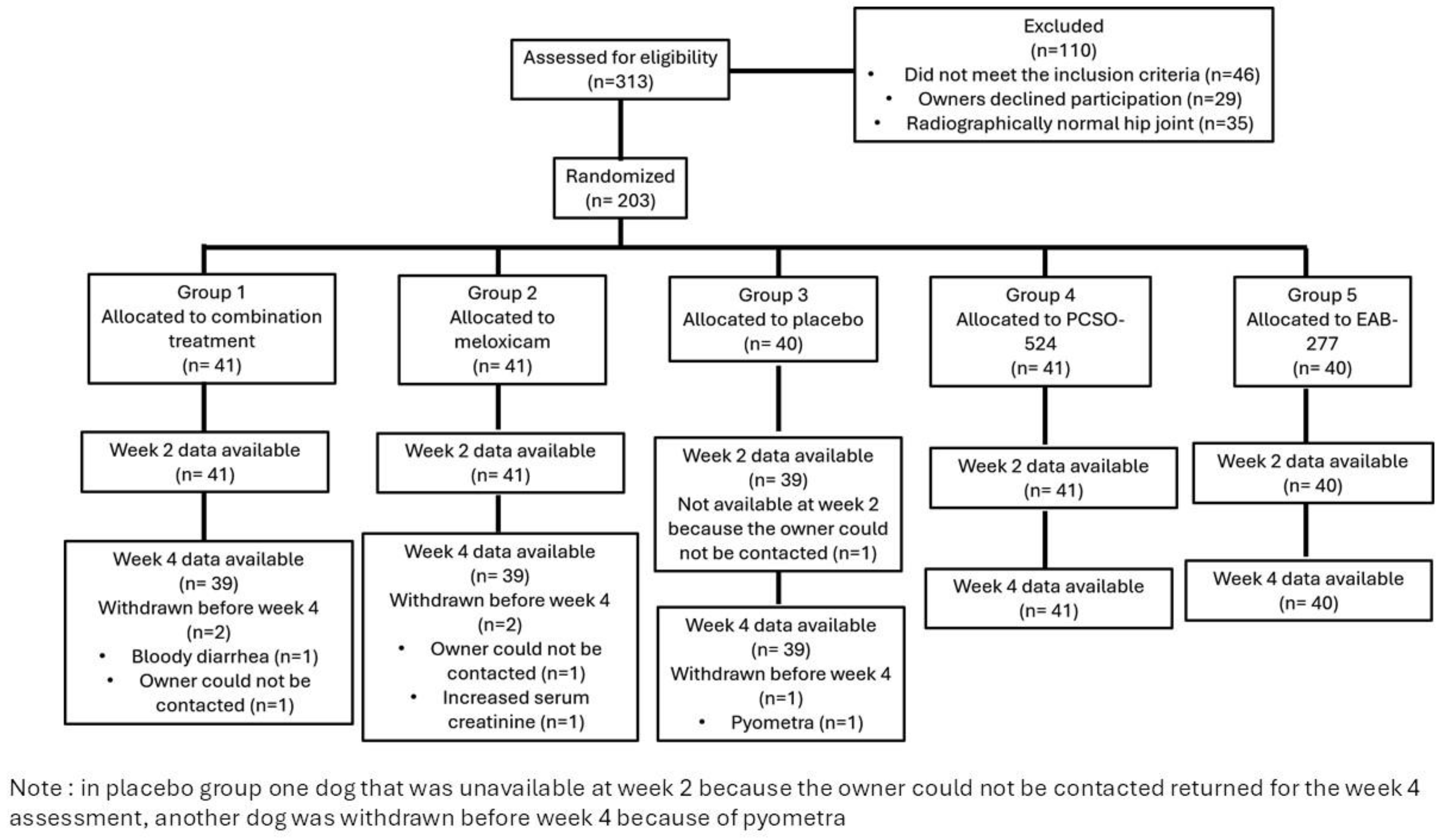
Figure 2.
Baseline-adjusted estimated marginal means of PVF at weeks 2 and 4 within each treatment group. Error bars represent 95% confidence intervals. Estimated marginal means were adjusted for baseline PVF, with the covariate evaluated at 65.54 %BW. PVF = peak vertical force of the index hindlimb; %BW = percentage of body weight.
Figure 2.
Baseline-adjusted estimated marginal means of PVF at weeks 2 and 4 within each treatment group. Error bars represent 95% confidence intervals. Estimated marginal means were adjusted for baseline PVF, with the covariate evaluated at 65.54 %BW. PVF = peak vertical force of the index hindlimb; %BW = percentage of body weight.
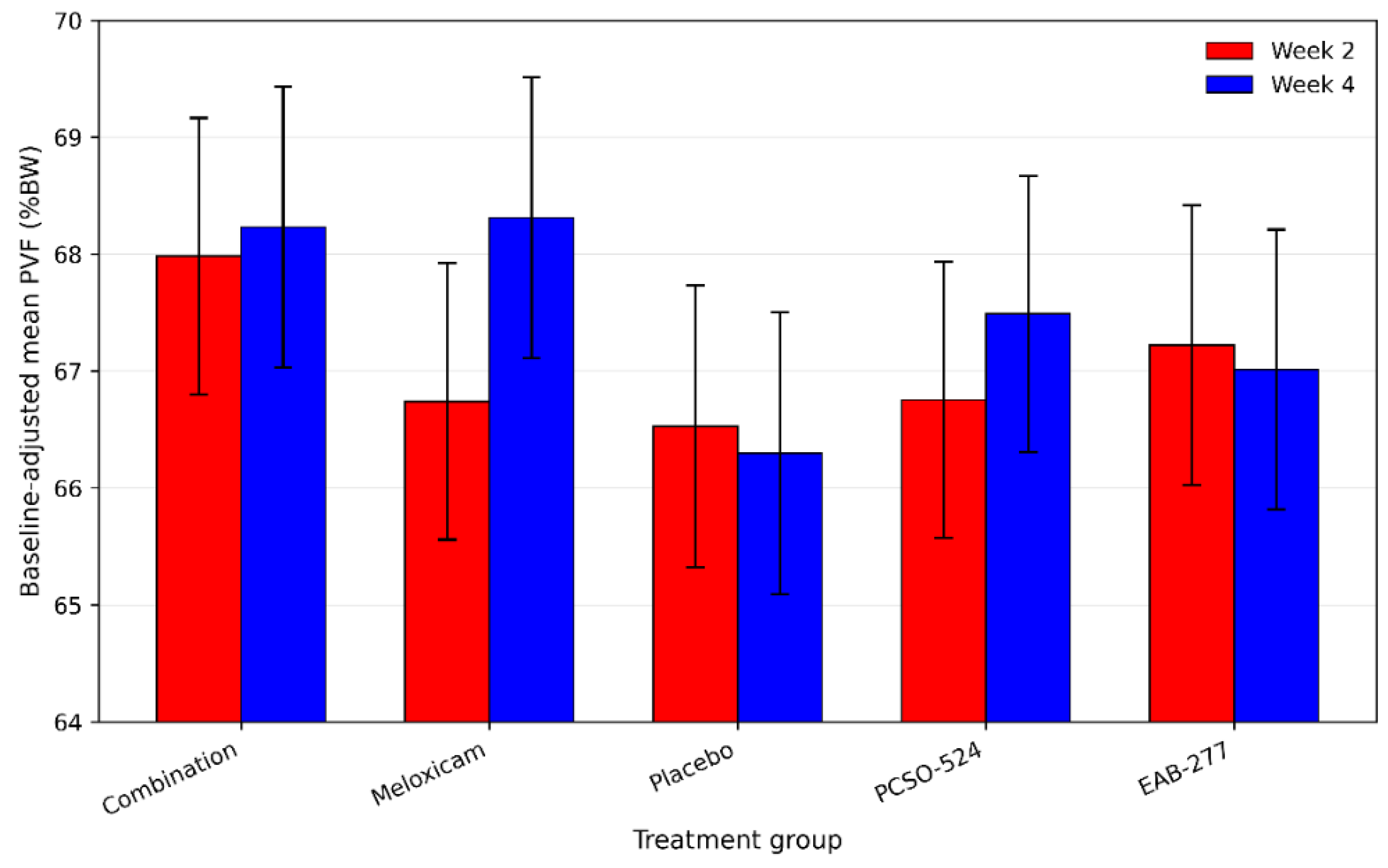

Table 1.
Orthopedic assessment score (OAS) used for clinical evaluation of dogs with hip osteoarthritis.
Table 1.
Orthopedic assessment score (OAS) used for clinical evaluation of dogs with hip osteoarthritis.
| Clinical parameter | Score | Scoring criterion |
|---|---|---|
| Lameness | Scored once per dog | ||
| Lameness | 0 | Stands, walks, and trots normally |
| 1 | Stands normally, with slight algetic gait when trotting | |
| 2 | Stands normally, with slight algetic gait when walking | |
| 3 | Stands normally, with evident algetic gait when walking | |
| 4 | Stands abnormally, with evident algetic gait when trotting | |
| Articular mobility | Scored separately for each hip | ||
| Articular mobility | 0 | No limitation of movement or crepitus |
| 1 | 10% to 20% decrease in ROM, without crepitus | |
| 2 | 10% to 20% decrease in ROM, with crepitus | |
| 3 | 20% to 50% decrease in ROM | |
| 4 | More than 50% decrease in ROM | |
| Articular pain | Scored separately for each hip | ||
| Articular pain | 0 | No sign of pain |
| 1 | Mild pain; dog turns head in recognition | |
| 2 | Moderate pain; dog pulls limb away or wants to move away | |
| 3 | Severe pain; dog vocalizes and becomes aggressive | |
OAS = orthopedic assessment score; ROM = range of motion. Lameness was scored once per dog. Articular mobility and articular pain were scored for each hip. The total OAS was calculated as the sum of the lameness score, left and right hip articular mobility scores, and left and right hip articular pain scores, giving a total possible score of 0 to 18. Higher scores indicate greater orthopedic impairment. Adapted from Moreau et al., 2003 [6].
Table 2.
Baseline demographic and clinical characteristics of dogs with hip osteoarthritis by treatment group.
Table 2.
Baseline demographic and clinical characteristics of dogs with hip osteoarthritis by treatment group.
| Characteristic | Combination (n = 41) |
Meloxicam (n = 41) |
Placebo (n = 40) |
PCSO-524 (n = 41) |
EAB-277 (n = 40) |
P value |
|---|---|---|---|---|---|---|
| Disease severity, n (%) | 0.889 | |||||
| Mild-to-moderate | 21 (51.2) | 21 (51.2) | 23 (57.5) | 21 (51.2) | 21 (52.5) | |
| Severe | 20 (48.8) | 20 (48.8) | 17 (42.5) | 20 (48.8) | 19 (47.5) | |
| General demographic variables | ||||||
| Age, months, mean ± SD | 50.0 ± 20.2 | 60.8 ± 30.7 | 64.8 ± 26.9 | 61.8 ± 32.8 | 65.6 ± 33.8 | 0.121 |
| Body weight, kg, mean ± SD | 35.9 ± 6.3 | 35.1 ± 9.7 | 35.1 ± 6.4 | 34.0 ± 7.5 | 32.3 ± 5.3 | 0.200 |
| Body condition score, n (%) | 0.088 | |||||
| 3/5 | 18 (43.9) | 17 (41.5) | 11 (27.5) | 13 (31.7) | 25 (62.5) | |
| 4/5 | 16 (39.0) | 17 (41.5) | 22 (55.0) | 18 (43.9) | 12 (30.0) | |
| 5/5 | 7 (17.1) | 7 (17.1) | 7 (17.5) | 10 (24.4) | 3 (7.5) | |
| Sex, n (%) | 0.500 | |||||
| Female | 15 (36.6) | 17 (41.5) | 20 (50.0) | 14 (34.1) | 13 (32.5) | |
| Male | 26 (63.4) | 24 (58.5) | 20 (50.0) | 27 (65.9) | 27 (67.5) | |
| Breed, n (%) | 0.628 | |||||
| Alaskan Malamute | 3 (7.3) | 1 (2.4) | 1 (2.5) | 2 (4.9) | 0 (0.0) | |
| American Pit Bull Terrier | 2 (4.9) | 1 (2.4) | 1 (2.5) | 0 (0.0) | 2 (5.0) | |
| Crossbreed | 1 (2.4) | 2 (4.9) | 2 (5.0) | 2 (4.9) | 1 (2.5) | |
| German Shepherd Dog | 1 (2.4) | 0 (0.0) | 0 (0.0) | 0 (0.0) | 2 (5.0) | |
| Golden Retriever | 19 (46.3) | 23 (56.1) | 19 (47.5) | 15 (36.6) | 20 (50.0) | |
| Labrador Retriever | 10 (24.4) | 8 (19.5) | 9 (22.5) | 11 (26.8) | 4 (10.0) | |
| Rottweiler | 1 (2.4) | 1 (2.4) | 2 (5.0) | 1 (2.4) | 0 (0.0) | |
| Siberian Husky | 4 (9.8) | 5 (12.2) | 5 (12.5) | 8 (19.5) | 10 (25.0) | |
| Thai Bangkaew Dog | 0 (0.0) | 0 (0.0) | 1 (2.5) | 2 (4.9) | 0 (0.0) | |
| Thai Ridgeback Dog | 0 (0.0) | 0 (0.0) | 0 (0.0) | 0 (0.0) | 1 (2.5) | |
| Baseline clinical outcome measures | ||||||
| PVF, %BW, mean ± SD | 65.54 ± 7.68 | 64.64 ± 9.31 | 65.84 ± 8.57 | 65.65 ± 8.54 | 66.38 ± 6.69 | 0.917 |
| Orthopedic assessment score (OAS), mean ± SD | 7.22 ± 3.57 | 6.63 ± 2.90 | 6.45 ± 3.57 | 6.85 ± 3.23 | 6.77 ± 3.04 | 0.816 |
| LOAD score, median [IQR] | 15.00 [11.75, 19.25] |
14.00 [8.00, 17.50] |
14.00 [8.00, 20.00] |
15.00 [11.00, 21.00] |
11.00 [9.00, 16.50] |
0.171 |
| CBPI pain severity score, median [IQR] | 1.25 [0.00, 2.81] |
0.88 [0.00, 2.13] |
0.25 [0.00, 2.19] |
0.50 [0.00, 2.25] |
0.25 [0.00, 1.25] |
0.443 |
| CBPI pain interference score, median [IQR] | 2.17 [0.63, 4.21] |
1.42 [0.00, 2.83] |
1.00 [0.04, 2.96] |
1.00 [0.00, 3.08] |
1.00 [0.17, 2.50] |
0.275 |
| CBPI quality-of-life impairment score, median [IQR] | 3.00 [2.00, 3.25] |
3.00 [2.00, 3.00] |
3.00 [2.00, 3.00] |
3.00 [2.00, 3.00] |
2.00 [2.00, 3.00] |
0.525 |
Values are presented as mean ± SD, n (%), or median [interquartile range], as appropriate. PVF = peak vertical force of the index hindlimb; %BW = percentage of body weight; OAS = orthopedic assessment score; LOAD = Liverpool Osteoarthritis in Dogs questionnaire; CBPI = Canine Brief Pain Inventory; IQR = interquartile range; SD = standard deviation.
Table 3.
Baseline-adjusted estimated marginal means of PVF and within-group comparisons between week 2 and week 4.
Table 3.
Baseline-adjusted estimated marginal means of PVF and within-group comparisons between week 2 and week 4.
| Treatment group | Week 2 adjusted mean (%BW) |
Week 4 adjusted mean (%BW) |
Mean difference | 95% CI | Adjusted p-value |
|---|---|---|---|---|---|
| Combination | 67.98 | 68.23 | 0.25 | -0.79 to 1.29 | 0.639 |
| Meloxicam | 66.74 | 68.31 | 1.57 | 0.53 to 2.62 | 0.003 |
| Placebo | 66.53 | 66.30 | -0.23 | -1.29 to 0.83 | 0.670 |
| PCSO-524 | 66.75 | 67.49 | 0.74 | -0.29 to 1.76 | 0.157 |
| EAB-277 | 67.22 | 67.01 | -0.21 | -1.25 to 0.83 | 0.689 |
Values are baseline-adjusted estimated marginal means from the baseline-adjusted linear mixed model. Mean differences represent week 4 minus week 2. P-values were adjusted using the Bonferroni method. PVF = peak vertical force of the index hindlimb; %BW = percentage of body weight; CI = confidence interval.
Table 4.
Responder analysis of PVF improvement at weeks 2 and 4 using an absolute >5 %BW threshold.
| Time point | Treatment group | Responders / total | Responder rate (%) | RR vs placebo | 95% CI | p-value |
|---|---|---|---|---|---|---|
| Week 2 | Placebo | 5/39 | 12.8 | Reference | ||
| Combination | 11/41 | 26.8 | 2.093 | 0.800 to 5.476 | 0.132 | |
| Meloxicam | 4/41 | 9.8 | 0.761 | 0.220 to 2.628 | 0.666 | |
| PCSO-524 | 2/41 | 4.9 | 0.380 | 0.078 to 1.848 | 0.231 | |
| EAB-277 | 6/40 | 15.0 | 1.170 | 0.389 to 3.521 | 0.780 | |
| Week 4 | Placebo | 3/39 | 7.7 | Reference | ||
| Combination | 10/39 | 25.6 | 3.333 | 0.993 to 11.195 | 0.051 | |
| Meloxicam | 12/39 | 30.8 | 4.000 | 1.223 to 13.079 | 0.022 | |
| PCSO-524 | 6/41 | 14.6 | 1.902 | 0.511 to 7.084 | 0.338 | |
| EAB-277 | 8/40 | 20.0 | 2.600 | 0.744 to 9.088 | 0.135 |
PVF responder status was defined as an absolute increase in PVF of >5 %BW from baseline at each time point; dogs with an increase of ≤5 %BW were classified as non-responders. This conservative PVF-based threshold was informed by published recommendations for interpreting ground reaction force data in dogs with osteoarthritis. Relative risks were estimated using modified Poisson regression with a log link and robust covariance estimation, with placebo as the reference group. CI = confidence interval; GRF = ground reaction force; PVF = peak vertical force of the index hindlimb; RR = relative risk; %BW = percentage of body weight.
Table 5.
Changes in LOAD score over the 4-week treatment period.
| Treatment group | Baseline | Week 2 | Week 4 | Friedman p-value |
Significant pairwise comparison |
|---|---|---|---|---|---|
| Combination | 15.00 [11.75, 19.25] | 15.00 [12.00, 19.00] | 13.00 [7.00, 19.50] | 0.016 | Baseline to week 4, p = 0.013 |
| Meloxicam | 14.00 [8.00, 17.50] | 12.00 [9.00, 17.00] | 12.00 [5.00, 18.50] | 0.097 | None |
| Placebo | 14.00 [8.00, 20.00] | 15.00 [9.00, 21.00] | 14.00 [7.00, 20.75] | 0.051 | None |
| PCSO-524 | 15.00 [11.00, 21.00] | 12.00 [7.75, 16.00] | 11.00 [8.00, 16.50] | 0.005 | Baseline to week 2, p = 0.018; Baseline to week 4, p = 0.023 |
| EAB-277 | 11.00 [9.00, 16.50] | 11.00 [8.00, 16.00] | 9.00 [8.00, 16.00] | 0.038 | None after Bonferroni correction |
Data are presented as median [interquartile range]. Higher LOAD scores indicate poorer mobility and functional ability; decreases from baseline indicate improvement. Within-group changes were analyzed using Friedman tests, with Bonferroni-adjusted pairwise comparisons. IQR = interquartile range; LOAD = Liverpool Osteoarthritis in Dogs questionnaire.
Table 6.
Changes in CBPI domain scores over the 4-week treatment period.
| CBPI domain | Treatment group | Baseline | Week 2 | Week 4 | Friedman p-value |
Significant pairwise comparison |
|---|---|---|---|---|---|---|
| Pain severity | Combination | 1.25 [0.00, 2.81] | 1.00 [0.00, 2.75] | 0.75 [0.00, 2.13] | 0.321 | None |
| Meloxicam | 0.88 [0.00, 2.13] | 1.00 [0.25, 2.38] | 1.00 [0.00, 2.38] | 0.191 | None | |
| Placebo | 0.25 [0.00, 2.19] | 1.00 [0.00, 1.75] | 0.75 [0.00, 1.75] | 0.627 | None | |
| PCSO-524 | 0.50 [0.00, 2.25] | 0.25 [0.00, 1.00] | 0.50 [0.00, 1.50] | 0.014 | None after Bonferroni correction | |
| EAB-277 | 0.25 [0.00, 1.25] | 0.00 [0.00, 1.00] | 0.25 [0.00, 1.75] | 0.039 | None after Bonferroni correction | |
| Pain interference | Combination | 2.17 [0.63, 4.21] | 1.75 [0.17, 3.29] | 0.67 [0.00, 2.33] | 0.004 | Baseline to week 4, p = 0.009; week 2 to week 4, p = 0.029 |
| Meloxicam | 1.42 [0.00, 2.83] | 1.33 [0.17, 2.92] | 1.00 [0.00, 2.08] | 0.032 | None after Bonferroni correction | |
| Placebo | 1.00 [0.04, 2.96] | 1.17 [0.00, 2.33] | 0.67 [0.00, 2.17] | 0.149 | None | |
| PCSO-524 | 1.00 [0.00, 3.08] | 0.33 [0.00, 1.29] | 0.33 [0.00, 1.33] | 0.211 | None | |
| EAB-277 | 1.00 [0.17, 2.50] | 0.50 [0.00, 1.83] | 0.17 [0.00, 1.75] | 0.008 | Baseline to week 4, p = 0.024 | |
| Quality-of-life impairment | Combination | 3.00 [2.00, 3.25] | 3.00 [2.00, 4.00] | 2.00 [1.50, 3.00] | 0.009 | None after Bonferroni correction |
| Meloxicam | 3.00 [2.00, 3.00] | 2.00 [2.00, 3.00] | 2.00 [2.00, 3.00] | 0.662 | None | |
| Placebo | 3.00 [2.00, 3.00] | 3.00 [2.00, 3.00] | 3.00 [2.00, 3.00] | 0.685 | None | |
| PCSO-524 | 3.00 [2.00, 3.00] | 3.00 [2.00, 3.00] | 3.00 [2.00, 3.00] | 0.840 | None | |
| EAB-277 | 2.00 [2.00, 3.00] | 2.00 [2.00, 3.00] | 2.00 [2.00, 3.00] | 0.984 | None |
Data are presented as median [interquartile range]. Higher CBPI scores indicate worse owner-assessed status, including greater pain severity, greater pain-related interference with daily activities, or poorer quality of life. Decreases from baseline indicate improvement. Within-group changes across baseline, week 2, and week 4 were analyzed using Friedman tests with Bonferroni-adjusted pairwise comparisons. CBPI = Canine Brief Pain Inventory; IQR = interquartile range.
Disclaimer/Publisher’s Note: The statements, opinions and data contained in all publications are solely those of the individual author(s) and contributor(s) and not of MDPI and/or the editor(s). MDPI and/or the editor(s) disclaim responsibility for any injury to people or property resulting from any ideas, methods, instructions or products referred to in the content. |
© 2026 by the authors. Licensee MDPI, Basel, Switzerland. This article is an open access article distributed under the terms and conditions of the Creative Commons Attribution (CC BY) license.
Copyright: This open access article is published under a Creative Commons CC BY 4.0 license, which permit the free download, distribution, and reuse, provided that the author and preprint are cited in any reuse.