
Submitted:
18 September 2026
Posted:
20 September 2026
You are already at the latest version
Abstract
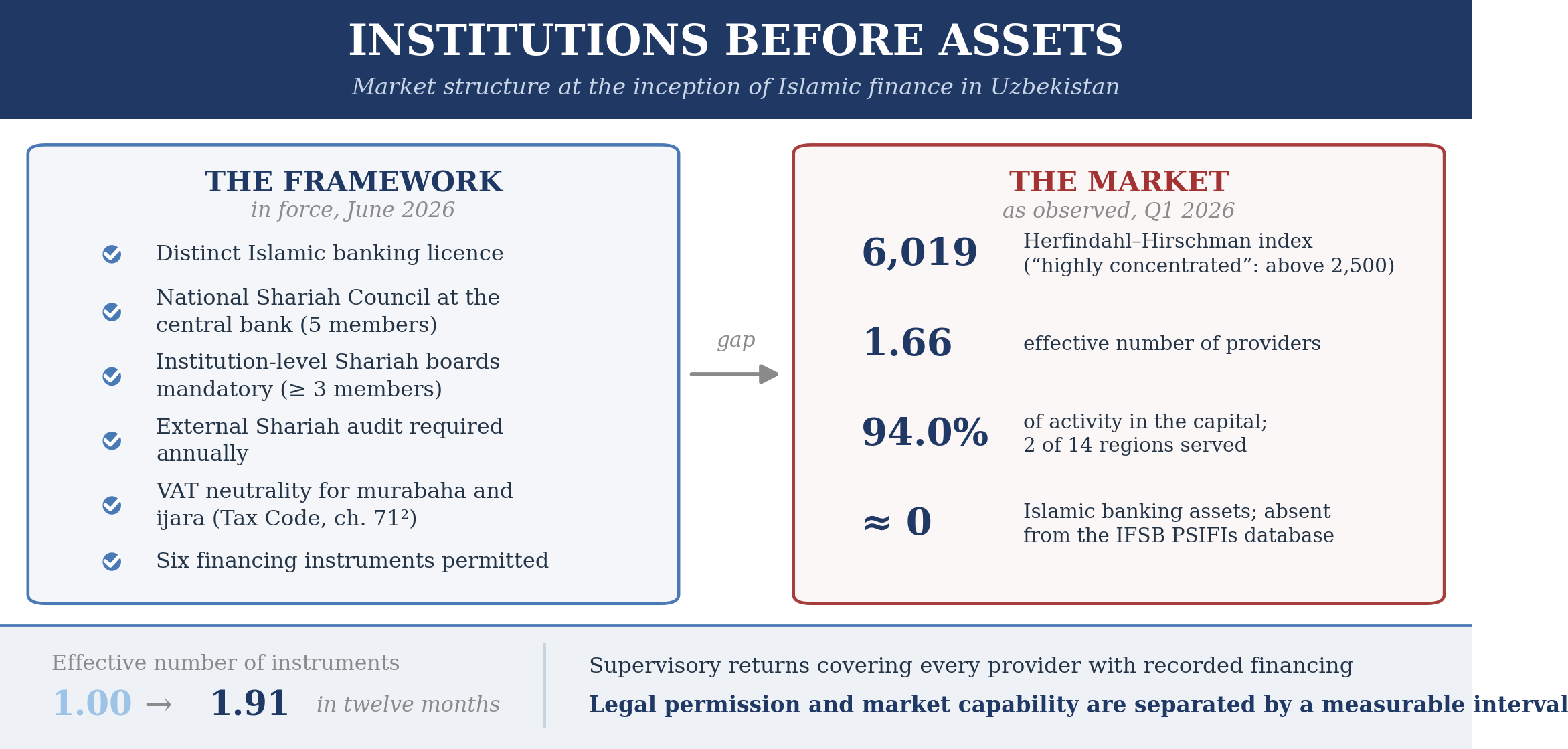
Cross-country measures of Islamic finance development are weighted toward realised market outcomes and therefore assign near-identical scores to jurisdictions that differ substantially in institutional preparation but have yet to accumulate Shariah-compliant assets. Uzbekistan is an instance of that configuration and, because the sector is new, one in which the underlying structure can be observed directly. This study examines the first eighteen months of Shariah-compliant finance in Uzbekistan using supervisory returns covering the complete population of licensed providers, together with the banking law that entered into force in June 2026. Financing grew almost eightfold year on year, yet the market is extraordinarily concentrated: the Herfindahl-Hirschman index reaches 6,019, an effective supplier count of 1.66, and 94.0 percent of activity is confined to the capital. Concentration was stable between the two observed quarters while the identity of the dominant providers changed entirely, and the Gini coefficient rose from 0.47 to 0.59. Product structure diversified sharply, the effective number of instruments rising from 1.00 to 1.91 within twelve months, with the profit-and-loss sharing instrument concentrated in the household segment. The evidence indicates that legal permission and market capability are separated by a measurable interval, and that institutional readiness advances ahead of market breadth.
Keywords:
Islamic finance
; market concentration
; institutional readiness
; microfinance
; financial regulation
; Central Asia
; Uzbekistan
Copyright: This open access article is published under a Creative Commons CC BY 4.0 license, which permit the free download, distribution, and reuse, provided that the author and preprint are cited in any reuse.