

Submitted:
18 September 2026
Posted:
18 September 2026
You are already at the latest version
Abstract
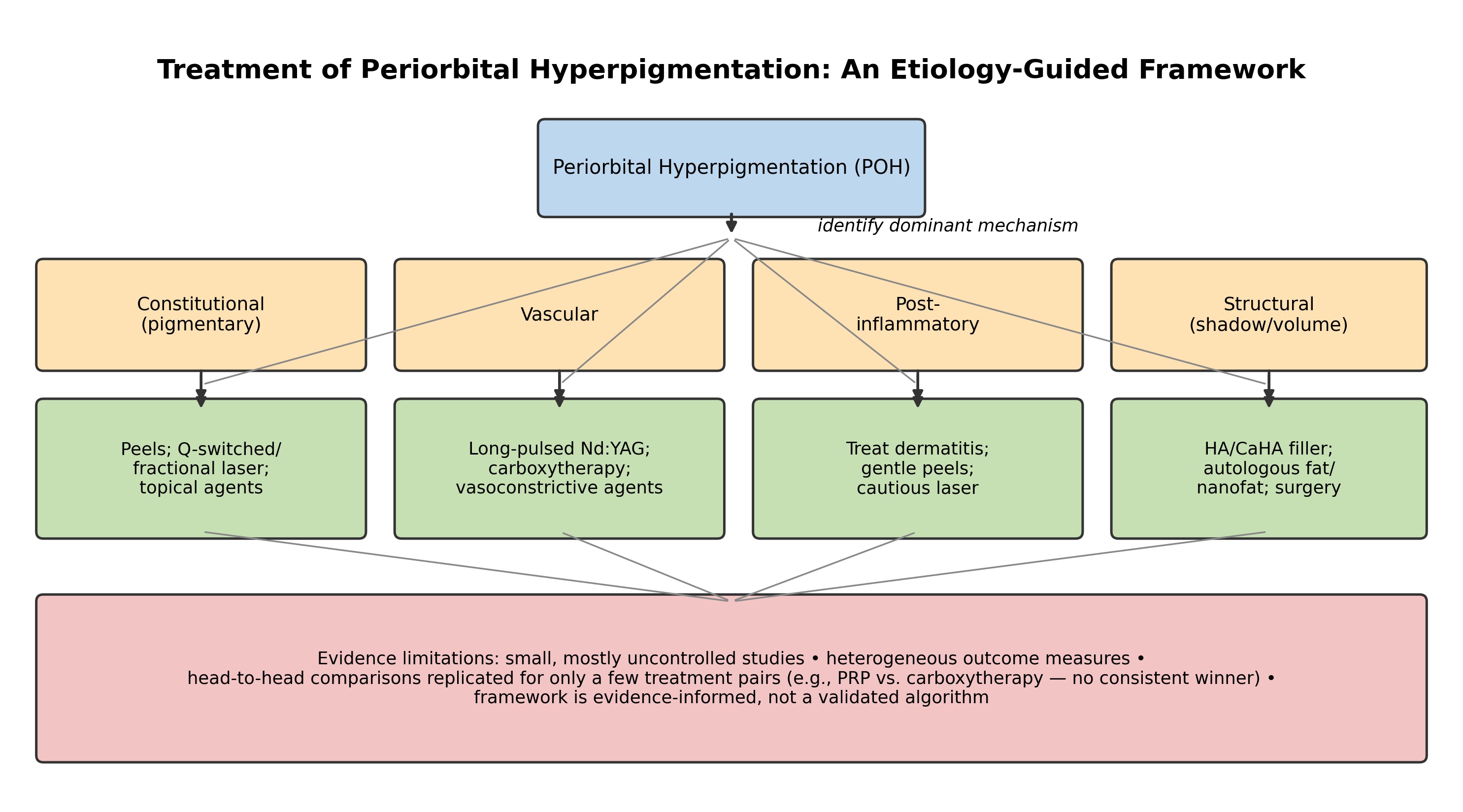
Periorbital hyperpigmentation (POH), commonly known as dark circles, is a highly prevalent, benign cosmetic concern with a heterogeneous etiology spanning constitutional (pigmentary), vascular, post-inflammatory, and structural (shadow/volume-loss) subtypes, which frequently coexist in the same patient. This narrative review draws on a literature search (PubMed, Cochrane Central and Google Scholar, conducted in September 2026) identifying 102 relevant sources spanning 1995–2026, of which 66 are directly cited, summarizing the evidence for each major treatment category, topical/cosmeceutical agents, chemical peels, laser and light-based devices, micro-needling, platelet-rich plasma (PRP), platelet-rich fibrin, carboxytherapy, dermal fillers, and autologous fat/nanofat grafting, organized around the presumed etiological subtype being treated. This review is an etiology-based framework to critically synthesize the treatment literature and distinguish replicated comparative evidence from isolated comparisons. Although improvement has been reported with many modalities, certainty remains limited by small samples, heterogeneous outcomes, inconsistent etiological classification, and short follow-up. We highlight replication of comparative trials with standardized outcome measures as the field's most pressing need.
Keywords:
periorbital hyperpigmentation
; dark circles
; infraorbital melanosis
; periorbital rejuvenation
; tear trough
; skin pigmentation
; etiology
; treatment
Copyright: This open access article is published under a Creative Commons CC BY 4.0 license, which permit the free download, distribution, and reuse, provided that the author and preprint are cited in any reuse.