
Submitted:
17 September 2026
Posted:
18 September 2026
You are already at the latest version
Abstract
This project presents a Smart Online Fitness Platform, an intelligent web-based solution designed to transform traditional fitness training by integrating artificial intelligence, computer vision, and personalized health management into a single unified platform. The system aims to provide users with a comprehensive digital fitness experience by combining personalized workout planning, nutrition guidance, real-time exercise monitoring, and interactive virtual coaching. Through a user-friendly interface, individuals can access customized fitness programs based on their personal goals, fitness levels, and progress, enabling them to maintain a structured and effective workout routine from any location. The platform incorporates a secure authentication system that allows users, trainers, and administrators to access role-specific functionalities. Certified trainers can create and assign personalized workout schedules, monitor user performance, update exercise plans, and provide professional guidance remotely. A dynamic workout calendar and task management module help users organize their daily exercise routines, set fitness goals, receive reminders, and track completed activities, promoting consistency and long-term engagement. To improve user motivation and retention, the platform integrates a comprehensive gamification framework consisting of achievement badges, experience points, reward levels, progress milestones, and interactive leader boards. Users earn rewards by completing workout sessions, maintaining exercise streaks, and achieving fitness objectives, creating an engaging and competitive environment that encourages continuous participation. In addition, detailed progress analytics enable users to monitor improvements in workout completion, calorie expenditure, body measurements, and overall fitness performance through intuitive graphical dashboards. The platform also provides personalized dietary recommendations by generating nutrition plans that complement individual fitness goals, whether focused on weight loss, muscle gain, endurance improvement, or general wellness. These recommendations are continuously updated according to user progress and workout intensity, ensuring balanced nutritional support throughout the fitness journey. A conversational AI chatbot is integrated into the platform to provide instant assistance and guidance. The chatbot answers fitness-related questions, explains exercise techniques, offers workout recommendations, assists with navigation throughout the application, and provides immediate support whenever users require help. This intelligent assistant enhances accessibility and improves the overall user experience by delivering real-time responses without requiring human intervention. One of the major innovations of the platform is the integration of an AI-powered Transformer-based Yoga Pose Detection and Correction System. The proposed Residual Biomechanical Transformer Network (RBT-Net) combines YOLOv8m-Pose for accurate human pose estimation with Transformer-based temporal reasoning and a ResidualMLP backbone to analyze body movements across sequential frames. Instead of relying solely on individual images, the Transformer encoder captures temporal dependencies between consecutive poses, enabling the system to understand movement progression, pose stability, and posture transitions more effectively. The extracted biomechanical features, including normalized skeletal coordinates, joint angles, limb distances, and confidence scores, are processed through the hybrid architecture to accurately classify yoga poses while identifying posture deviations. Beyond pose recognition, the intelligent correction framework estimates posture severity, detects joint-level errors, and generates personalized corrective feedback based on the user’s current posture and skill level. This allows the platform to function as a virtual yoga instructor capable of providing real-time guidance that helps users improve posture accuracy, reduce injury risks, and perform yoga exercises more safely and effectively. The integration of Transformer-based temporal modeling significantly enhances robustness against body movement variations and improves recognition performance during dynamic yoga sessions compared to conventional frame-based approaches. Overall, the Smart Online Fitness Platform successfully combines personalized fitness management, intelligent workout planning, nutrition guidance, gamification, conversational AI, and advanced Transformer-based yoga posture analysis into a unified digital ecosystem. By integrating modern artificial intelligence techniques with interactive web technologies, the platform delivers a comprehensive, accessible, and engaging fitness solution that bridges the gap between conventional gym environments and next-generation intelligent virtual fitness systems.
Keywords:
artificial intelligence
; computer vision
; smart fitness platform
; personalized workout planning
; real-time exercise monitoring
; virtual coaching
; nutrition guidance
; fitness management
; web-based healthcare
; remote fitness training
1. Introduction
The rapid growth of digital technologies has transformed almost every aspect of modern life, including the way people manage their health and fitness. With increasing workloads, long travel times, and busy lifestyles, many individuals find it difficult to visit physical gyms on a regular basis. Traditional gyms, although beneficial, often lack flexibility and do not provide continuous guidance or personalized recommendations tailored to each user’s needs. Additionally, many people struggle to stay motivated, track their progress, or follow proper exercise techniques without constant supervision. These limitations create a strong demand for smarter, more accessible fitness solutions that can support users anytime and from anywhere.
The Smart Online Fitness Platform is developed to address these challenges by offering a fully digital and interactive fitness environment. The goal of this platform is to bring the experience of a real gym into a virtual space using modern technologies from computer science and engineering. The system allows users to log in securely, access their personalized workout plan, track their fitness progress, get customized diet suggestions, and interact with AI-driven features — all through a user-friendly web interface. The combination of React for the frontend and Node.js with MongoDB for the backend ensures a fast, reliable, and responsive application that works smoothly across devices.
One of the key highlights of this platform is its strong focus on personalization. Users no longer follow the same generic exercises; instead, the system analyses basic health data such as BMI, fitness goals, experience level, and even current emotional state to generate a suitable workout routine. This is made possible through the AI Workout Plan Generator and the Emotion-Based Workout Recommendation module. These AI components help provide the right workout to the right person at the right time, making the fitness journey safer, more enjoyable, and more effective.
In addition to workout personalization, the platform includes a smart Diet Planner that helps users maintain a balanced lifestyle. The AI Diet module generates meal plans based on user preferences and nutritional requirements, making it easier for individuals to manage both exercise and diet from one place. To improve engagement, the system integrates gamification features such as points, badges, streak tracking, and a leaderboard. These elements are proven to significantly improve user motivation and consistency, turning fitness into a rewarding and enjoyable experience instead of a repetitive task.
Real-time user assistance is provided through an AI-powered chatbot that answers common fitness-related questions, guides users through the platform, and offers motivational support when needed. Another major feature is yoga pose detection, developed using computer vision techniques. By analyzing the user’s posture through their webcam, the system can provide instant feedback and corrections. This helps users perform exercises safely even without a physical trainer present, reducing the risk of injury and helping them build proper form.
The platform also supports interaction between users and trainers. Trainers can assign workouts, review user progress, and offer personalized suggestions through a dedicated trainer dashboard. Users can also book live training sessions directly through the booking module, making the system flexible for both guided and self-paced workouts.
Overall, the Smart Online Fitness Platform combines web development, artificial intelligence, computer vision, and gamification to create a complete digital fitness ecosystem. The objective of this project is to provide a scalable, accessible, and intelligent fitness solution that adapts to each user’s needs. By bridging the gap between traditional gyms and modern smart technologies, the platform encourages healthier lifestyles and ensures that anyone can stay fit in a convenient, motivating, and personalized way.
2. Related Studies
Several studies have explored the integration of technology in fitness and healthcare, which provide a foundation for the Smart Online Gym. Prior research on digital fitness platforms has highlighted the effectiveness of web- and app-based solutions in improving exercise adherence and motivation through interactive dashboards and user personalization [1]. Studies on gamification in fitness applications demonstrate that reward systems, leader boards, and progress tracking significantly increase user engagement and consistency in workouts [1,2]. Research on AI-based exercise recommendation systems has shown how machine learning can generate personalized workout plans by analysing user health parameters, preferences, and activity history [3,4]. Similarly, chatbot-driven fitness assistants have been found to provide real-time support, guidance, and engagement, reducing the need for constant human supervision [5]. In the area of yoga pose detection, recent work using computer vision and deep learning techniques has proven effective in posture correction and injury prevention, ensuring that users practice safely without in-person trainers [6]. Studies on diet recommendation systems further demonstrate how AI can generate customized meal plans by analysing nutritional needs, lifestyle, and health goals [3]. Together, these studies indicate that integrating multiple AI-driven features such as gamification, chatbots, pose detection, and personalized plans into a single platform can address the limitations of existing fitness solutions and provide a holistic online gym experience [4].
3. Problem Definition and Preliminaries
Modern lifestyles have increasingly moved toward desk-based work, long screen time, and reduced physical activity. This has contributed to rising health issues such as obesity, diabetes, and cardiovascular problems. Although traditional gyms and fitness centers are available, many people are unable to use them regularly due to factors like distance, time limitations, high membership costs, and the lack of continuous guidance. Even when users start gym routines, they often struggle to stay consistent because there is no system to track their progress, motivate them daily, or offer personalized recommendations based on their fitness level.
Existing online fitness platforms try to solve some of these issues, but most of them offer only partial solutions. Some provide only video tutorials, some focus only on diet suggestions, and others include basic tracking features. This separation forces users to rely on multiple apps, which can be confusing and inconvenient. Additionally, most platforms do not adapt to user behavior, do not provide real-time assistance, and lack features for personalized workout planning. The bigger challenge is that users receive very little professional feedback unless they are physically present with a trainer.
Therefore, the main problem this project aims to solve is the development of a single, integrated, AI-enabled Smart Online Fitness Platform that combines workout planning, diet guidance, progress tracking, motivation tools, and trainer–user interaction in one system. The platform must be easy to use, technically scalable, and capable of delivering personalized recommendations so that users of different fitness levels can benefit from it. The system should remove dependency on physical location and allow users to follow a guided fitness routine anytime.
Preliminaries To build this solution, several technical foundations are required. The system is developed using a modern web technology stack:
- React.js is used for the frontend to create an interactive and responsive user interface. This includes dashboards, exercise pages, booking sections, and visual progress tracking components. React ensures smooth navigation and fast rendering of user-specific data.
- Node.js with Express.js is used to build the backend server. This handles user authentication, workout assignment, diet data management, and communication between the frontend and database. Express provides a structured API system for secure and reliable data transfer.
- MongoDB is selected as the database for storing user details, trainer data, assigned workouts, diet plans, progress information, and logs. Its document-based structure makes it flexible for storing fitness-related data that may vary from user to user.
Artificial intelligence forms a core component of the platform.
- The AI Plan Generator analyzes user inputs such as age, BMI, fitness goal, and workout level to create customized workout and diet plans.
- A chatbot module is included to assist users with quick answers, basic guidance, and smooth navigation across the system.
- A computer vision–based yoga pose detection feature ensures users perform selected poses correctly, helping them maintain proper form during practice and reducing the risk of incorrect posture.
To keep users motivated, the platform also integrates gamification elements. These include points, badges, leaderboards, and progress milestones. Such mechanisms make the fitness journey more engaging and help users stay committed to their daily goals.
Together, these preliminaries form the technical and conceptual foundation of the Smart Online Gym Platform. The system brings multiple fitness tools into one place and aims to provide a complete, accessible, and adaptive digital fitness experience for all users.
4. Proposed Solution
To address the shortcomings of traditional gyms and the scattered nature of existing fitness applications, this project proposes a Smart Online Fitness Platform that brings all essential fitness services into one integrated, AI-powered web system. The main objective of the solution is to combine workout planning, diet management, motivation tools, real-time guidance, and trainer–user interaction within a single, unified platform that can be accessed from anywhere.
The proposed system is divided into multiple structured modules, each contributing to the overall functionality of the platform. At the center of the user experience is a personalized dashboard, which displays all important information in one place. Users can easily view their assigned workouts, AI-generated plans, daily tasks, BMI, diet recommendations, progress reports, and achievements. This dashboard acts as the main control panel and allows users to interact with different features of the platform without confusion.
A key part of the solution is the AI Plan Generator. This module analyzes user-provided information such as fitness goals, BMI, age, workout level, and health conditions. Using this data, the AI generates personalized workout routines and diet plans that match the user’s capabilities and goals. By automating this process, the system reduces dependency on manual planning and ensures that each user receives guidance tailored specifically to their needs.
To support users during their daily activities, the platform includes a chatbot capable of providing quick and helpful responses. The chatbot is available 24/7 and assists with basic questions about workouts, diet, navigation, and general fitness guidance. This feature ensures that users remain engaged and never feel stuck while using the platform.
For exercise accuracy and safety, the system integrates a Yoga Pose Detection module built using computer vision techniques. By analyzing the user’s body keypoints through their webcam, the system can detect whether poses are being performed correctly and provide real-time feedback. This reduces the chances of incorrect posture and helps users practice yoga more effectively even without a physical trainer.
To increase user motivation and long-term consistency, the platform implements gamification features. These include points awarded for completing workouts, badges for reaching milestones, leaderboards for comparing performance with others, and fitness challenges. Gamification is widely proven to make fitness more engaging, and incorporating it in the system helps users stay committed to their goals.
Nutrition plays a major role in fitness, so a Diet Chart Generator is included as part of the AI module. It uses user data to recommend suitable meal plans that support their workouts and overall health goals. This ensures that users receive balanced guidance covering both exercise and diet.
All modules in the platform are connected through a secure backend built using Node.js and Express. This backend handles user authentication, trainer functions, workout assignments, AI processing requests, and database operations. MongoDB is used as the database due to its flexibility in handling user-specific fitness data. The frontend is developed using React, which provides a fast, responsive, and visually appealing user interface. React’s component-based structure helps maintain clean code and supports efficient rendering of dynamic fitness content.
By integrating AI, computer vision, modern web technologies, and gamification, the Smart Online Gym Platform offers a powerful and scalable alternative to conventional fitness environments. The proposed solution ensures accessibility, personalization, and continuous engagement for users of different ages and fitness levels, making it an effective digital companion for maintaining a healthy lifestyle.
5. Project Planning
The development of the Smart Online Fitness Platform required a structured and iterative project plan to ensure that each component was built, tested, and integrated properly. The project was executed following the Agile software development life cycle, which allowed the team to break the entire system into smaller, manageable iterations called sprints. Agile was chosen because the platform includes multiple modules such as authentication, AI-based workout planning, pose detection, diet generation, gamification, and trainer–user interaction. These modules benefit from continuous refinement, user feedback, and flexible adjustments during development. The Agile model also provided the advantage of parallel development, allowing frontend, backend, and AI components to progress simultaneously while ensuring frequent reviews and improvements.
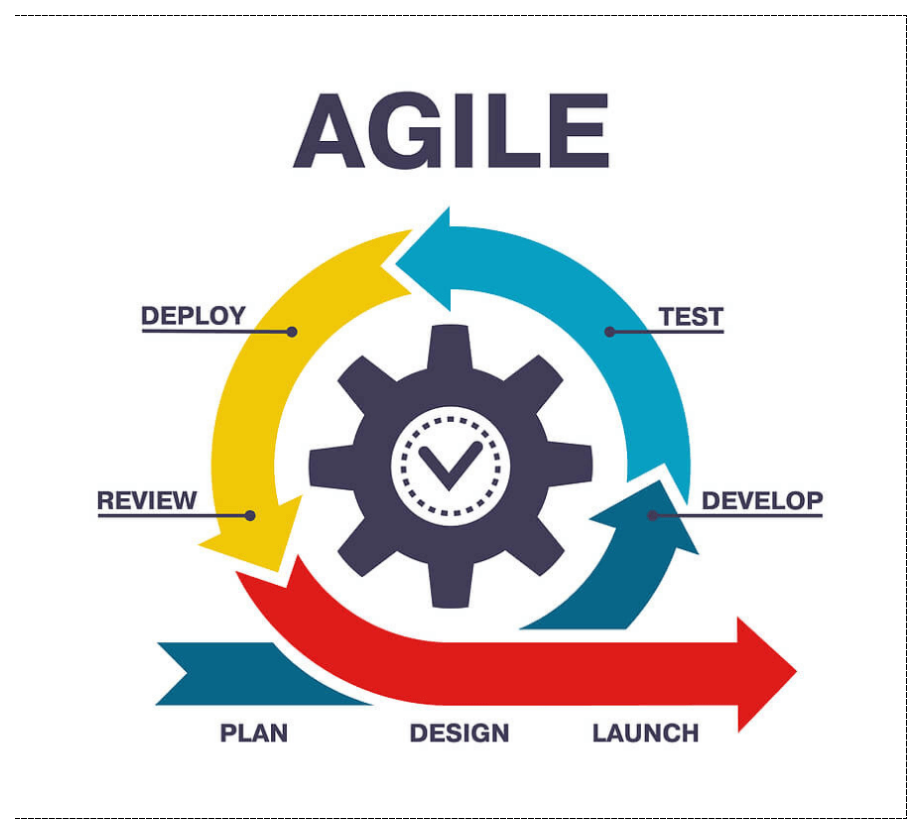
The project began with the requirement-gathering phase, where the team analyzed user needs, functional demands, and technical expectations of the platform. This phase included understanding the role of users, trainers, workout assignments, AI-based recommendations, and gamification elements. The next step involved creating the system architecture and identifying all major modules. Early planning clarified the dependencies between modules—for example, the dashboard depended on the authentication system, the trainer panel required the user database to be active, and the AI plan generator required dataset preparation before integration.
Once the architecture was planned, the project moved into development sprints. In the first sprint, the core backend functionality such as user authentication, role management, and database connectivity using MongoDB and Node.js was implemented. This sprint was essential because all other modules required a stable user system. In the second sprint, the frontend dashboard and user interface components were created using React, including pages for login, signup, workout viewing, and the user profile. After achieving a functional user interface, the next sprint focused on implementing trainer-specific modules, where trainers could assign workouts, view user progress, and upload workout content. This stage had dependencies on both the backend data models and the completed frontend layout.
In later sprints, AI-related features such as the AI Workout Plan Generator and Diet Planner were developed. These modules required careful preparation of data structures and algorithms before integration. The yoga pose detection module using computer vision was added after ensuring that the workout system and video components were functional. Once the AI and CV features were integrated, the gamification system—including points, badges, leaderboards, and streak tracking—was implemented to enhance the user experience. This module depended on the availability of workout completion tracking and user progress data. The final sprints were dedicated to improving stability, performing integration testing, optimizing performance, and completing the chatbot feature for user support.
The project timeline included major milestones such as completing the requirement analysis, finalizing the system design, creating the user authentication module, finishing the core dashboard, implementing the trainer panel, integrating AI-based modules, adding gamification, and conducting full-system testing. Each milestone represented a significant step toward the completion of the platform. The testing and deployment phase ensured that all components functioned smoothly across different devices and browsers.
Cost analysis was minimal because the project used open-source technologies such as React, Node.js, Express, TensorFlow.js, MediaPipe, and MongoDB Atlas (free-tier). The primary expenses were related to development time, internet usage, and optional cloud hosting for deployment if required. Overall, the Agile approach ensured that the project progressed efficiently, adapted to changes quickly, and delivered a full-featured Smart Online Gym Platform within the planned timeline.
6. Requirement Analysis
6.1. Requirement Matrix
| Rqmt ID | Requirement Item | Requirement Analysis Status | Design Module | Design Reference (section# under project Report) |
Test Case Number |
Technical Platform of Implementation | Prototype prepared ? | Name of Program / Component | Own code or Reusable component (with source reference)? |
| RQ-01 | User Authentication (Login/Signup) | Completed | Auth Module | Sec. 3.1.1 | TC-01 | Node.js, Express, MongoDB | Yes | authController.js | Own Code |
| RQ-02 | Video Library | Completed | Video Module | Sec. 3.2.3 | TC-02 | React, Node.js, MongoDB | Yes | videoLibrary.jsx | Own Code |
| RQ-03 | Gamified Rewards System | Completed | Rewards Module | Sec. 3.3.2 | TC-03 | React (Frontend), Node.js (Backend) | Yes | GamifiedRewards.jsx | Own Code |
| RQ-04.1 | Assign Workout (Trainer Panel) | Completed | Trainer Panel Module | Sec. 3.4.1 | TC-04 | React, Express, MongoDB | Yes | trainerPanel.jsx | Own Code |
| RQ-04.2 | Assigned Workout (User) | Completed | User Dashboard Module | Sec. 3.4.1 | TC-04 | React, Express, MongoDB | Yes | AssignedWorkoutsPage.jsx | Own Code |
| RQ-05 | Custom To-Do List | Completed | User Dashboard Module | Sec. 3.4.3 | TC-05 | React, Express, MongoDB | Yes | CustomTodoList.jsx | Own Code |
| RQ-06 | Live Session Integration | Completed | Live Session Module | Sec. 3.5.2 | TC-06 | WebRTC, Node.js | Yes | liveSession.js | Own Code |
| RQ-07 | BMI Calculator | Completed | Health Tools Module | Sec. 3.6.1 | TC-07 | React (Frontend), Node.js (Backend) | Yes | bmiCalculator.js | Own Code |
| RQ-08 | AI Workout Plan Generator | Completed | AI Module | Sec. 4.1.1 | TC-08 | Python (TensorFlow) + Node.js | Yes | aiWorkoutGen.py | Own Code |
| RQ-09 | AI Diet Chart Generator | Completed | AI Module | Sec. 4.1.2 | TC-09 | Python (Gemini API), Node.js | Yes | dietChartGen.py | Own Code |
| RQ-10 | AI Chatbot Assistance | Completed | Chatbot Module | Sec. 4.2.1 | TC-10 | Python (NLP) + Node.js | Yes | chatbotTrainer.py | Own Code |
| RQ-11 | Yoga Pose Detection | Completed | Computer Vision Module | Sec. 4.3.1 | TC-11 | Python (OpenCV, MediaPipe) | Yes | poseDetection.py | Own Code |
| RQ-12 | Testing & Debugging | Completed | Testing Module | Sec. 5.1.1 | TC-12 | Mocha, Chai, Jest | Yes | testSuite.js | Own Code |
6.2. Requirement Elaboration
The Smart Online Fitness system requires several core features to deliver a complete fitness solution. First, user authentication and security ensure safe login and data protection using JWT and password encryption. The video library allows trainers to upload and users to access categorized workout tutorials. A gamified rewards system motivates users by providing points, badges, and leaderboards for task completion. The trainer panel for workout assignment enables trainers to assign personalized workouts which are then visible on the user’s dashboard. Users can also manage daily activities through a custom to-do list, which links to the rewards system. For real-time interaction, a live session feature using WebRTC supports one-to-one or group video classes. Additionally, a simple BMI calculator helps users track health status based on weight and height. Advanced AI-driven modules such as AI workout and diet plan generators, chatbot assistance, and yoga pose detection are also part of the system, aiming to provide personalization, motivation, and safety. Together, these requirements ensure the platform is secure, engaging, and effective for both trainers and users.
7. Design
7.1. Technical Environment
The Smart Online Fitness Platform can run on any basic computer system or mobile device, as it only requires a standard web browser and an active internet connection. The frontend of the application is built using React, which provides a fast and responsive user interface that works smoothly even on low-end hardware. The backend uses Node.js and Express to handle server-side operations such as authentication, workout assignment, and data processing. MongoDB is used as the database to store user information, work out details, diet plans, and progress logs in a flexible document structure. The system also uses AI modules for workout and diet recommendations, along with computer vision components for yoga pose detection, which operate through external APIs or lightweight browser-based libraries. Since the entire platform is web-based, users do not need any special installation, high-end device, or additional software. A basic system with 4GB RAM, a modern web browser like Chrome, and stable internet is enough to access all platform features effectively.
7.2. Overall System Explanation
The Smart Online Fitness Platform is designed as a complete web-based fitness ecosystem that brings together workout planning, diet management, user motivation, trainer interaction, and AI-based assistance in one unified system. The core idea is to allow users to perform their fitness activities from anywhere while still receiving guidance, structure, and personalized recommendations similar to a physical gym. All features are tightly connected so that the system behaves like one integrated solution instead of multiple separate tools. The application works through a modern frontend built with React and a backend powered by Node.js, Express, and MongoDB, which together manage user actions, store data securely, and deliver all system functionalities smoothly.
1. User Authentication and Account Handling is the first major function. When a user or trainer signs up, the system stores their data securely in the database and generates a unique identity. During login, the backend verifies the credentials and issues a secure authentication token. This ensures that every user accesses only their own dashboard and data. Through this function, the platform guarantees privacy, session security, and controlled access to all other modules.
2. Personalized Dashboard Management is the central hub from which the user interacts with the system. The dashboard fetches data such as assigned workouts, recommended diet plans, gamification progress, BMI status, and bookings from the backend and presents them in a clean and user-friendly interface. Every update — whether a workout is completed or a diet plan is generated — instantly reflects on the dashboard, making it the main control center for daily fitness activities.
3. AI Workout Plan Generator is one of the most important features. When a user enters data such as age, BMI, fitness goal, experience level, and preferences, the backend processes this information through an AI-based logic engine. The system selects suitable exercises from the workout database, calculates difficulty levels, and generates a structured workout plan tailored to the user. This function ensures that every individual receives a routine that fits their physical condition instead of following generic workout videos.
4. Video Library Management allows users to access exercise demonstrations. Each exercise includes details such as title, difficulty level, duration, and category. These videos guide the user step-by-step so the workout can be performed correctly. Whenever the AI plan or the trainer assigns a workout, it links directly to these video tutorials for clarity.
5. Trainer-Assigned Workouts is another key system function. Trainers log into their dedicated panel, where they can view user profiles, fitness levels, and progress. Based on this data, trainers can assign personalized workout plans. Once assigned, these plans appear on the user’s dashboard instantly. This function creates a professional guidance loop within the online gym.
6. Custom To-Do List Management enables users to add their own fitness tasks beyond the assigned workouts. Users can create custom goals such as “drink 3L water,” “walk 5,000 steps,” or “stretch for 10 minutes.” These tasks help users stay disciplined and track small daily achievements.
7. BMI and Basic Health Analysis is a simple but essential function. Users can enter their height and weight, and the system automatically calculates BMI to classify their health status. This helps the AI modules and trainers understand the user’s current condition and make better recommendations.
8. AI Diet Planner is responsible for generating structured meal plans for the user. When the user provides details such as goal (weight gain, loss, maintenance), food preferences, allergies, or lifestyle patterns, the AI recommends a daily diet chart with calories and nutritional information. This ensures the fitness routine includes both exercise and nutrition.
9. Emotion-Based Workout Suggestion enhances personalization by adjusting suggestions based on how the user feels. If the user selects emotional states such as “tired,” “energetic,” “stressed,” or “sad,” the AI modifies workout intensity accordingly. This ensures users perform routines that suit their mood and energy level, making fitness more sustainable.
10. Chatbot Assistance gives users instant help. The chatbot can answer fitness questions, navigate the user through platform features, and give suggestions whenever the user is confused. This reduces dependency on trainers for basic queries and makes the system more interactive.
11. Live Session Booking System allows users to schedule live training sessions with certified trainers. Users can view available time slots, book sessions, and receive reminders. This function connects users with real human trainers when they need personalized, real-time guidance.
12. Gamified Rewards System ensures consistent motivation. Every time a user completes a workout, follows a diet plan, or finishes a to-do task, the system awards points. With enough points, users unlock badges and advance to higher levels. This encourages long-term engagement and replicates the social competitiveness found in real gyms.
13. Progress Tracking and Analytics continuously records user activity. The backend stores completed tasks, calories burned (if available), streak counts, achievements, and plan effectiveness. The dashboard then visualizes this data in the form of weekly and monthly reports, helping users understand their growth over time.
All these functions communicate through the backend, where the database stores user data, workout templates, diet recommendations, trainer assignments, and progress logs. By combining AI modules, user-friendly design, and trainer involvement, the Smart Online Fitness Platform operates as a complete digital fitness ecosystem. Each function supports the others, resulting in a connected, reliable, and intelligent fitness experience for all users.
7.3. Detailed Design
The detailed design of the Smart Online Fitness Platform focuses on how each functional requirement is implemented within the system using structured processes, data flow mechanisms, and logical interactions between modules. The primary goal of this design phase is to break down the system into understandable components and illustrate how data moves from users to the backend and between internal modules. Since the platform integrates multiple features—such as workout management, diet planning, AI recommendations, pose detection, gamification, and chatbot assistance—the design must clearly show how these modules communicate and work together. This section explains the complete system design in a step-by-step manner using DFD Level 0, DFD Level 1, UML Use Case Diagram, and the ER Diagram. Each diagram is followed by a detailed explanation to ensure clarity.
Data Flow Diagram (DFD) – Level 0
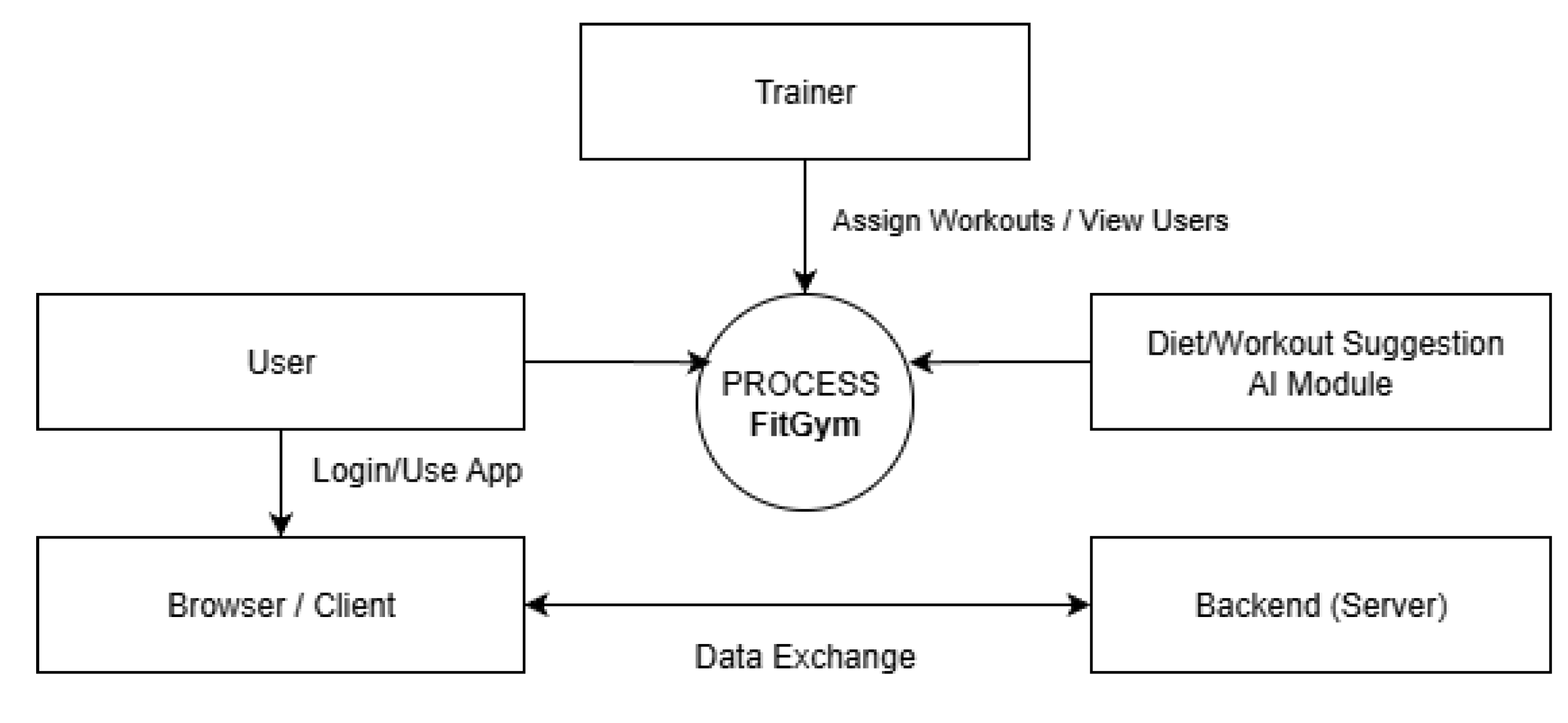
Figure 1.
DFD - Level 0.
The DFD Level 0 represents the system at its highest abstraction level and provides a bird’s-eye view of how the Smart Online Fitness Platform interacts with its main entities. At this stage, the entire system is treated as a single process, without showing internal components. The user interacts with the platform by performing actions such as logging in, viewing workouts, requesting diet plans, updating progress, or interacting with the chatbot. The system processes these actions and retrieves or stores information in its internal storage locations, including the user database, workout database, diet database, and gamification database. Any AI-based requests (like plan generation or emotion-based workout suggestions) are handled internally but represented collectively as part of the system. This top-level DFD clarifies that the user only interacts with the central platform, while the system handles all underlying logic and resources.
Data Flow Diagram (DFD) – Level 1
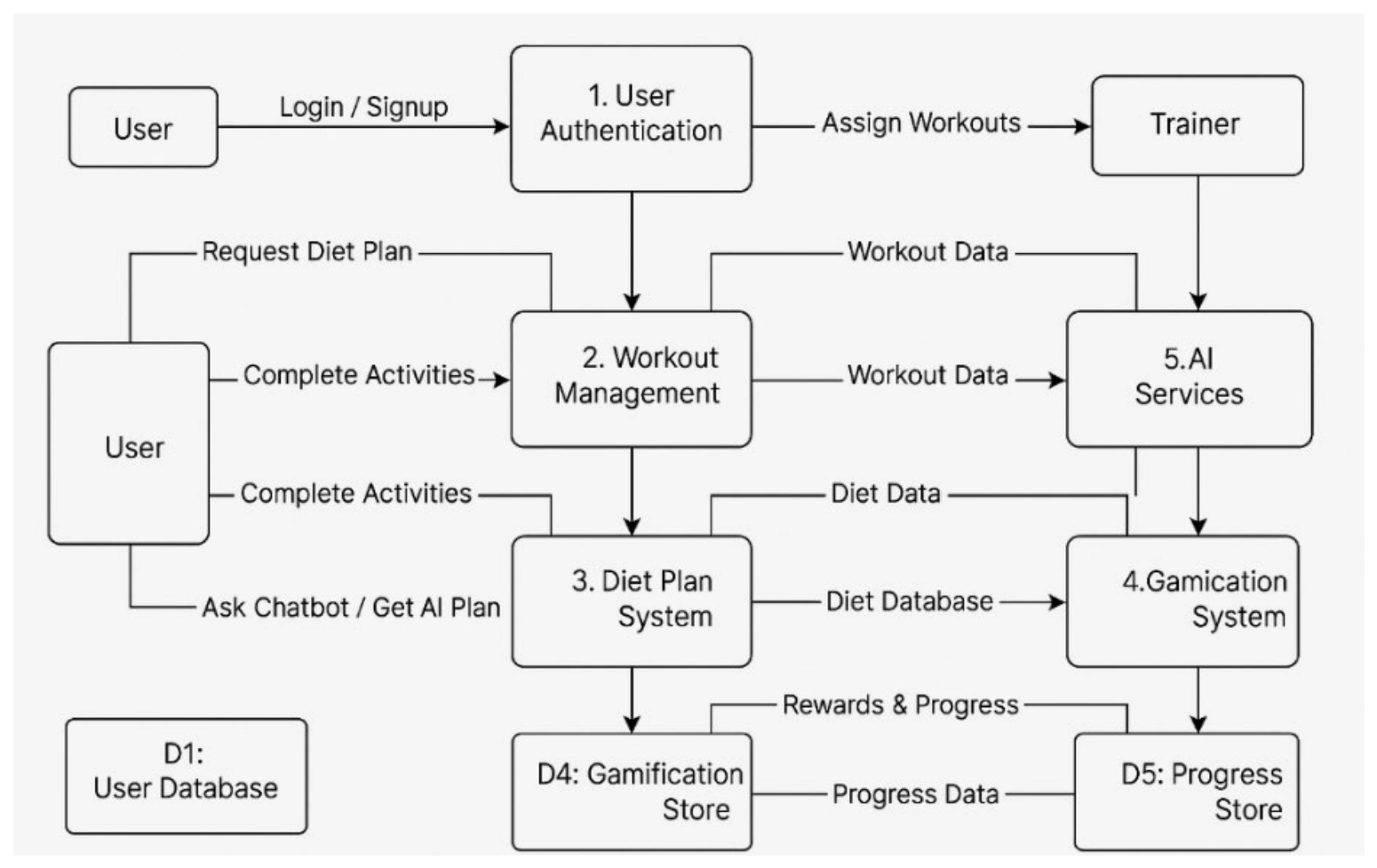
Figure 2.
DFD - Level 1.
The DFD Level 1 breaks down the internal working of the Smart Online Fitness Platform into several core processes. Each module handles a specific type of user interaction. The Authentication module manages login, signup, and secure identity verification, interacting directly with the User Database. The Workout Management module is responsible for showing assigned workouts, recording workout completion, and retrieving trainer-assigned routines from the Workout Store. The Diet Management module handles diet recommendations and stores them in the Diet Database. AI Services—including the AI Workout Plan Generator, Diet Planner, Chatbot, and Pose Detection—operate as a supporting module that provides intelligence to other components. All activity data, including completed workouts and diet adherence, feed into the Gamification System, which updates points, badges, and user progress stored in the Progress Database. This level shows how each subsystem communicates, forming a complete operational workflow.
Summary of the DFD Structure
DFD Level 0
- Shows the whole system as one process.
- External entities: User, Trainer, AI Module, Browser.
- Basic flows: login, workouts, diet, AI suggestions.
DFD Level 1
-
Breaks the system into:
- o
- Authentication
- o
- Workout Handling
- o
- Diet Plan System
- o
- Gamification Engine
- o
- AI Recommendation System
- o
- Progress Tracking
UML Use Case Diagram
The UML Use Case Diagram illustrates the relationship between actors (users and trainers) and the major functionalities they access in the system. Users perform actions such as logging in, viewing assigned workouts, checking diet plans, interacting with the chatbot, and monitoring their progress. Trainers, as secondary actors, interact with the system mainly to assign personalized workouts and track user engagement. The Smart Gym System acts as the central controller, coordinating user actions and ensuring that the appropriate modules handle each request. This diagram helps in understanding which users interact with which components of the system and ensures that the functional requirements align correctly with real-world usage patterns.
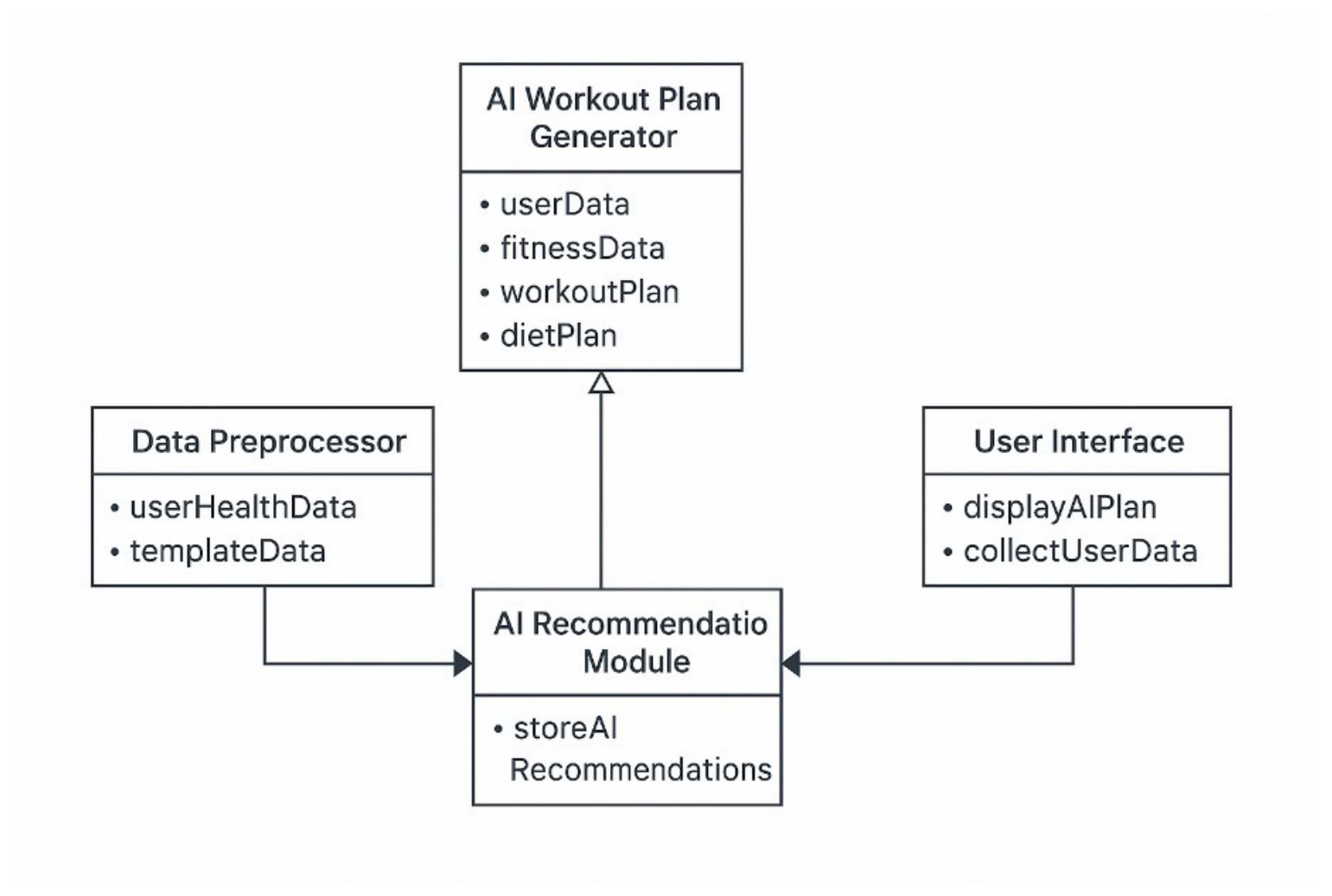
Figure 3.
UML Use Case Diagram.
8. Implementation
- Login Page:
This page allows users to securely sign in using their registered email and password. It is connected to the backend authentication module, which verifies credentials, encrypts passwords, and generates a secure JWT token for the session.
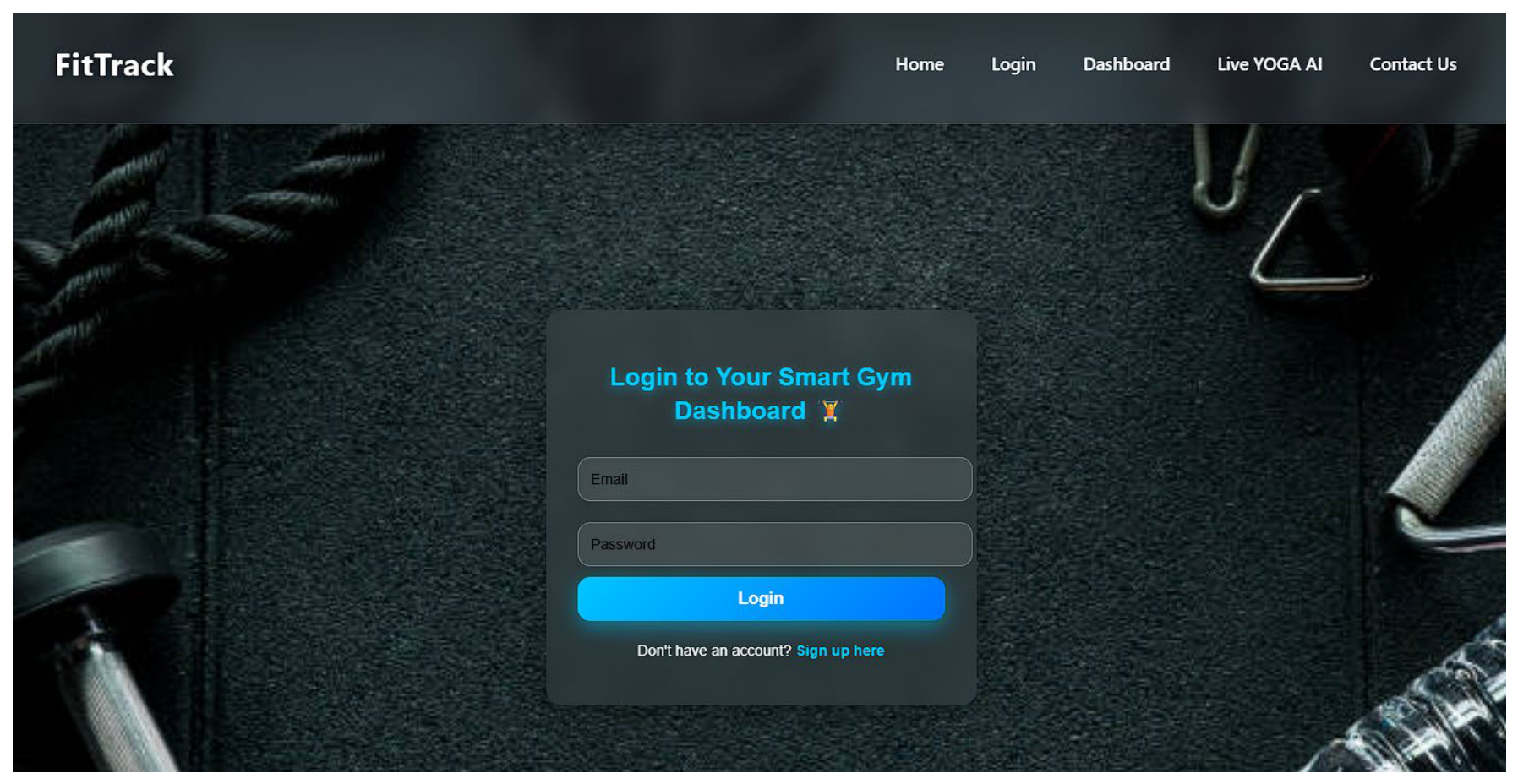
Figure 4.
Login Page.
- 2.
- Home Page:
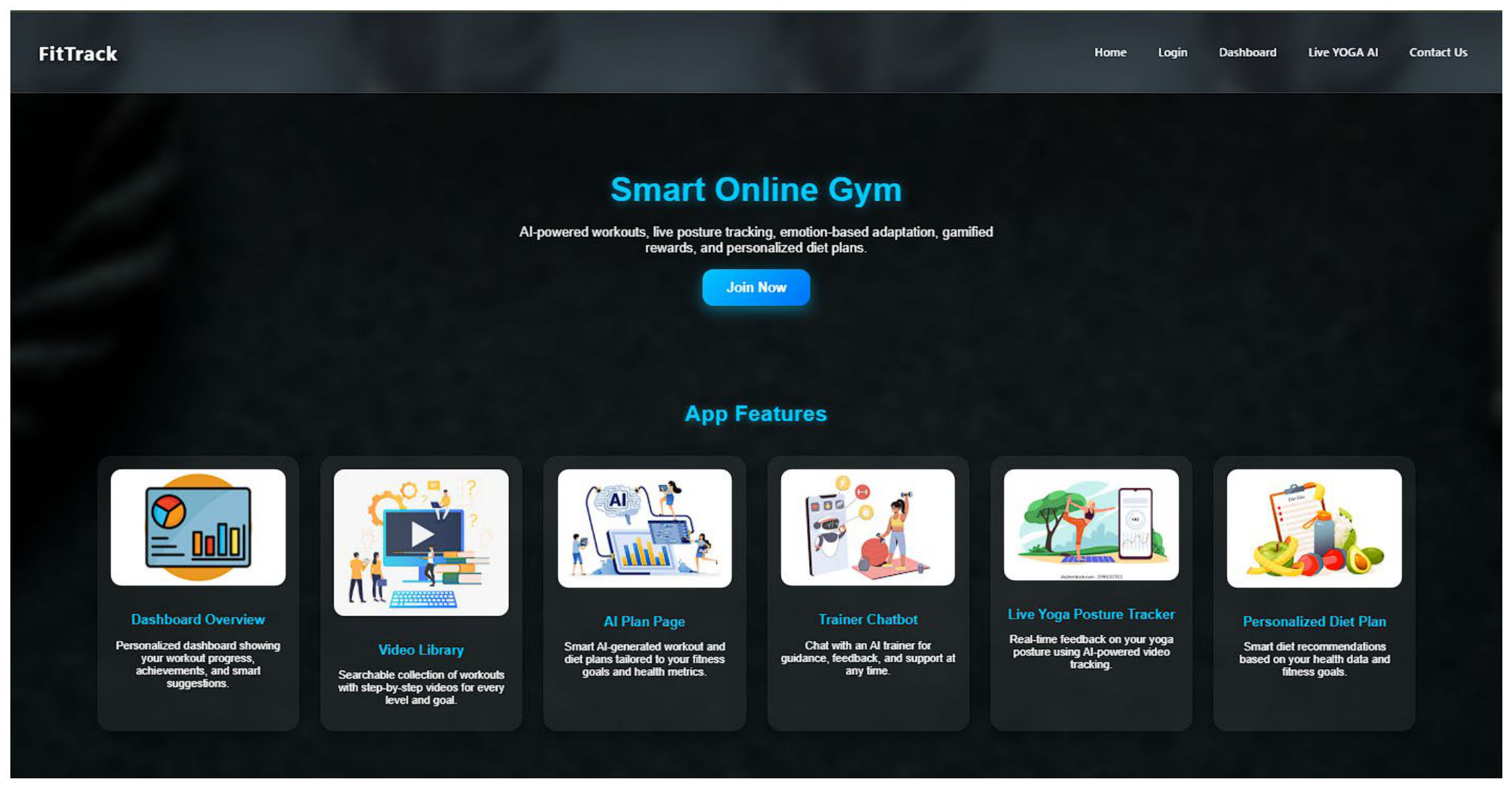
Figure 5.
Home Page.
- 3.
- User Dashboard:
The dashboard displays all the user-specific data such as assigned workouts, AI recommendations, progress tracking, points, and shortcuts to different modules. It provides a centralized and personalized view.
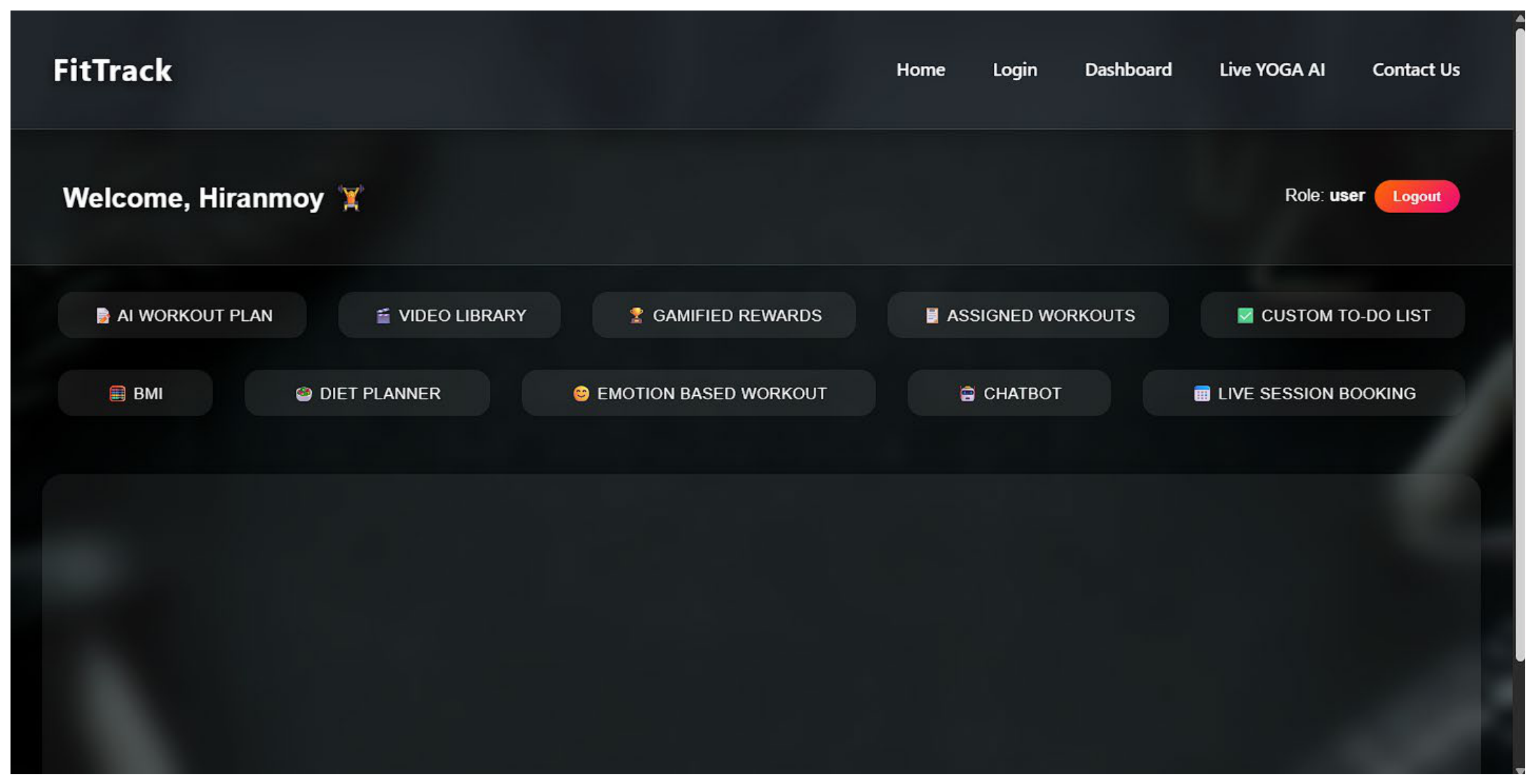
Figure 6.
User Dashboard.
- 4.
- AI Workout Plan Generator:
This screen shows personalized workout plans generated by AI. The system analyzes fitness goals, BMI, and experience level to produce a structured weekly exercise routine.
Figure 7.
AI Workout Plan Generator.
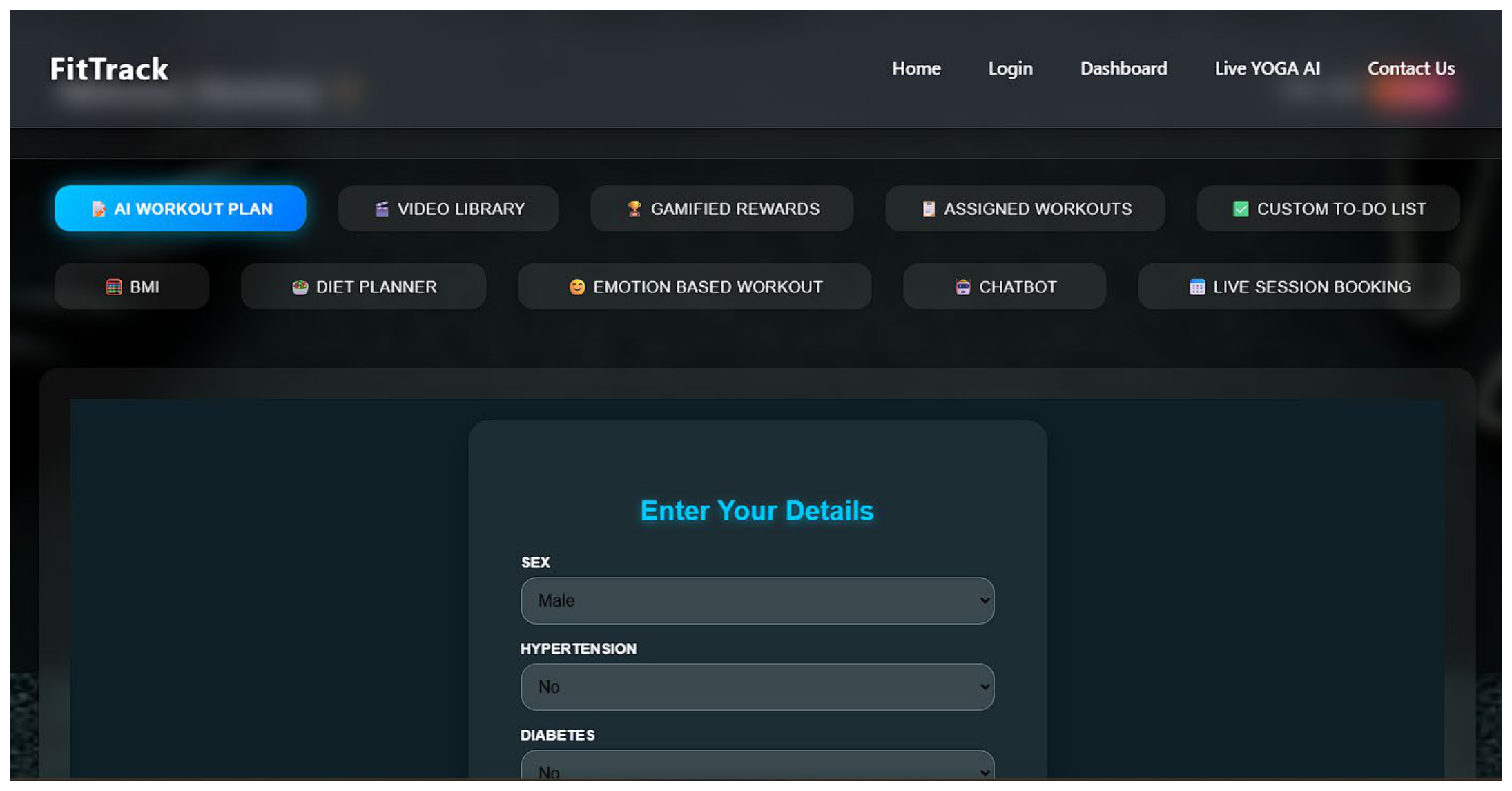
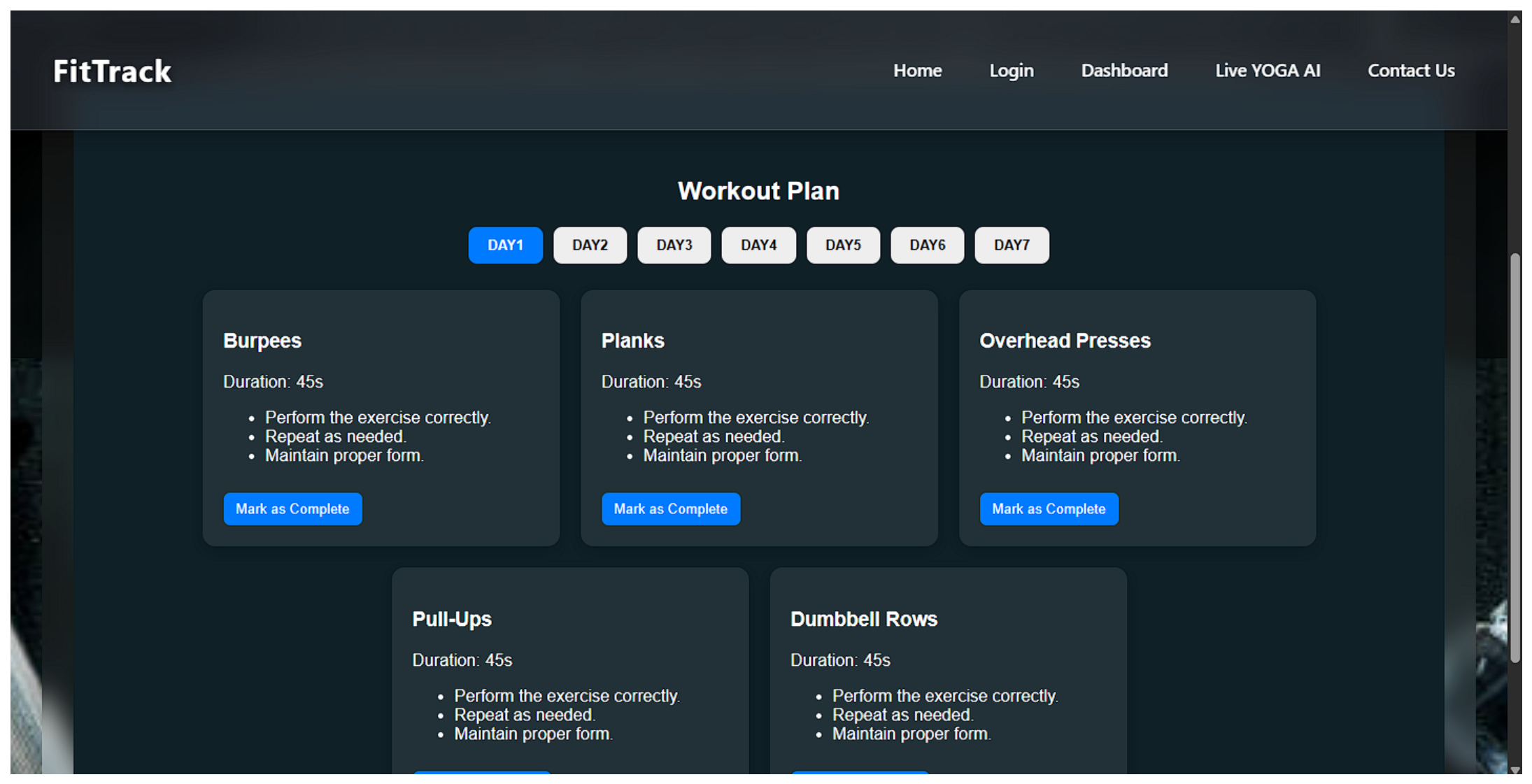
Figure 8.
AI Workout Plan.
- 5.
- Video Library:
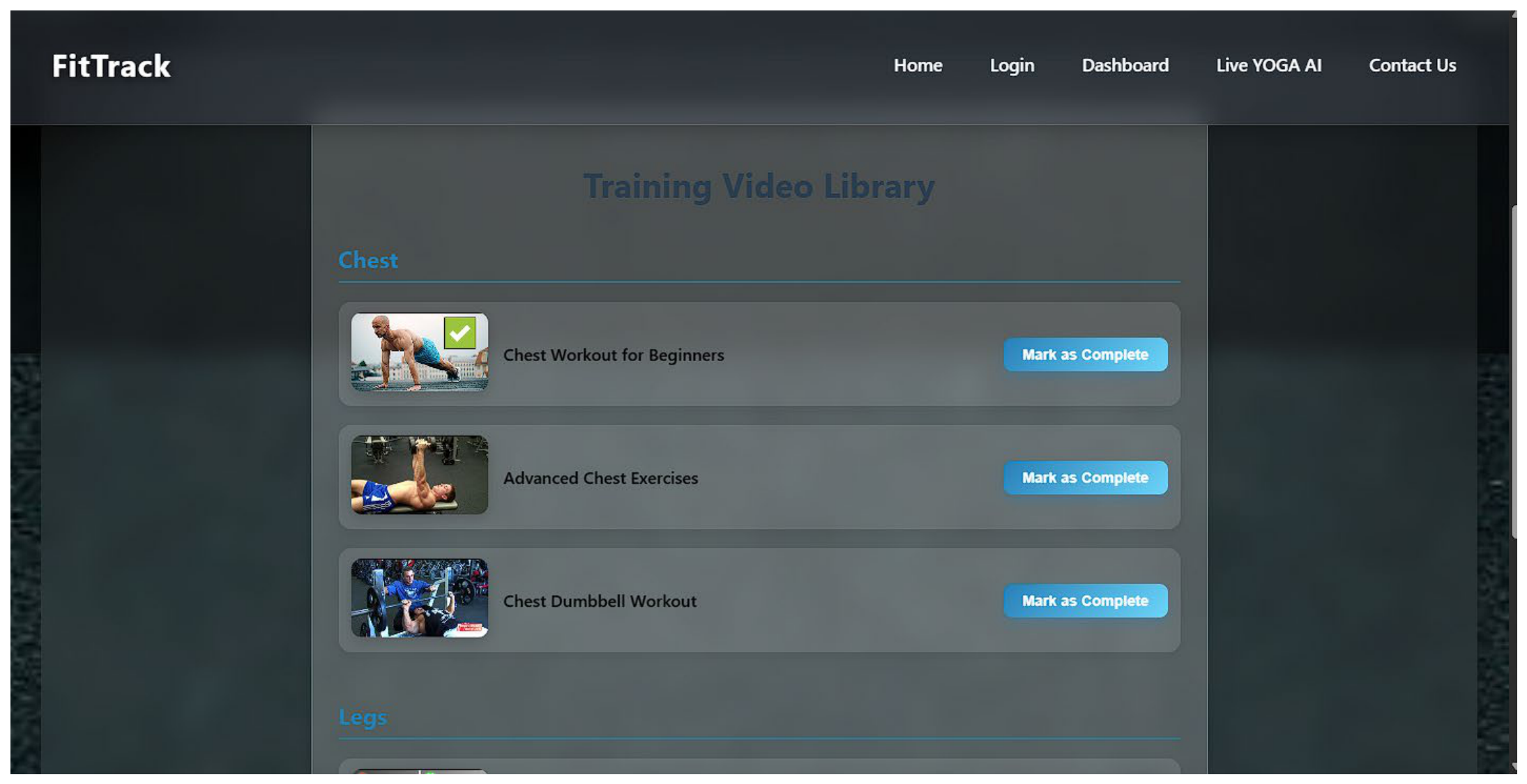
This section contains categorized workout videos. Users can open a video, view instructions, and follow along. All videos are fetched from the database and managed by the trainer/admin.
Figure 9.
Video Library.
- 6.
- Gamified Rewards:
The gamification page shows earned points, badges, streaks, and progress levels. It motivates users by rewarding each completed workout or task.
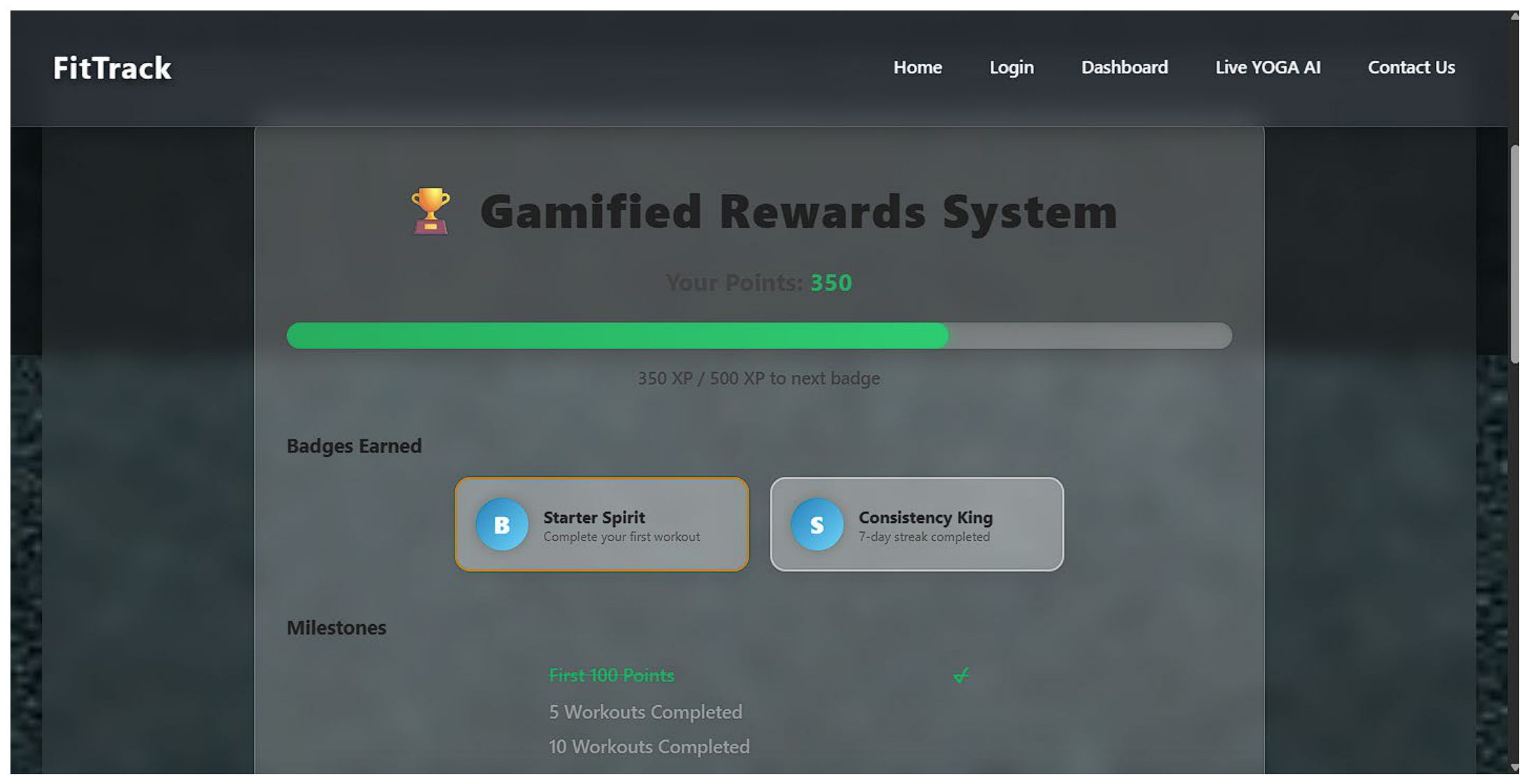
Figure 10.
Gamified Rewards.
- 7.
- Assigned Workouts:
This feature shows the workouts that the trainer has assigned to the user. Each workout includes the exercise name, duration, level, and a link to the video tutorial.
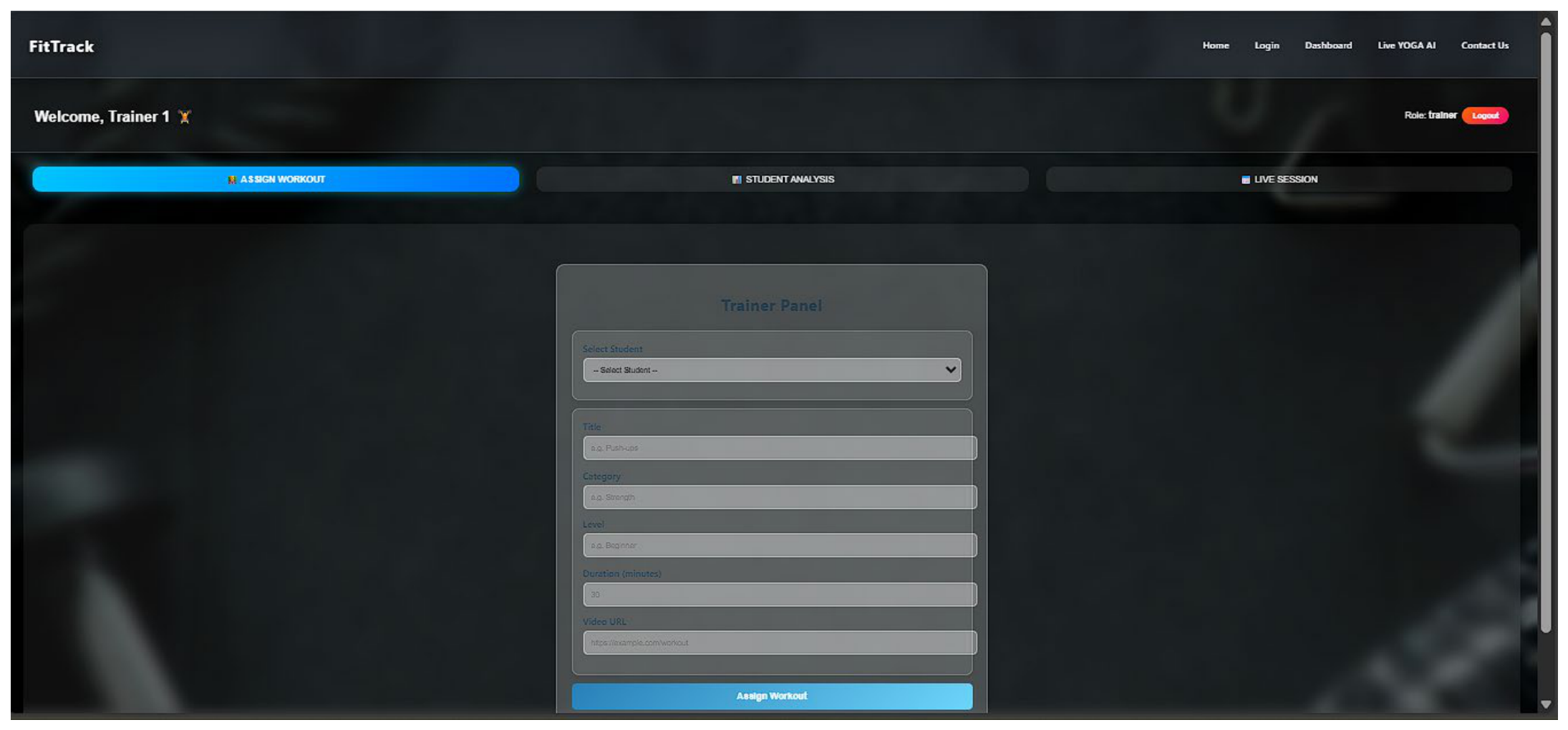
Figure 11.
Assigned Workouts (Trainer pannel).
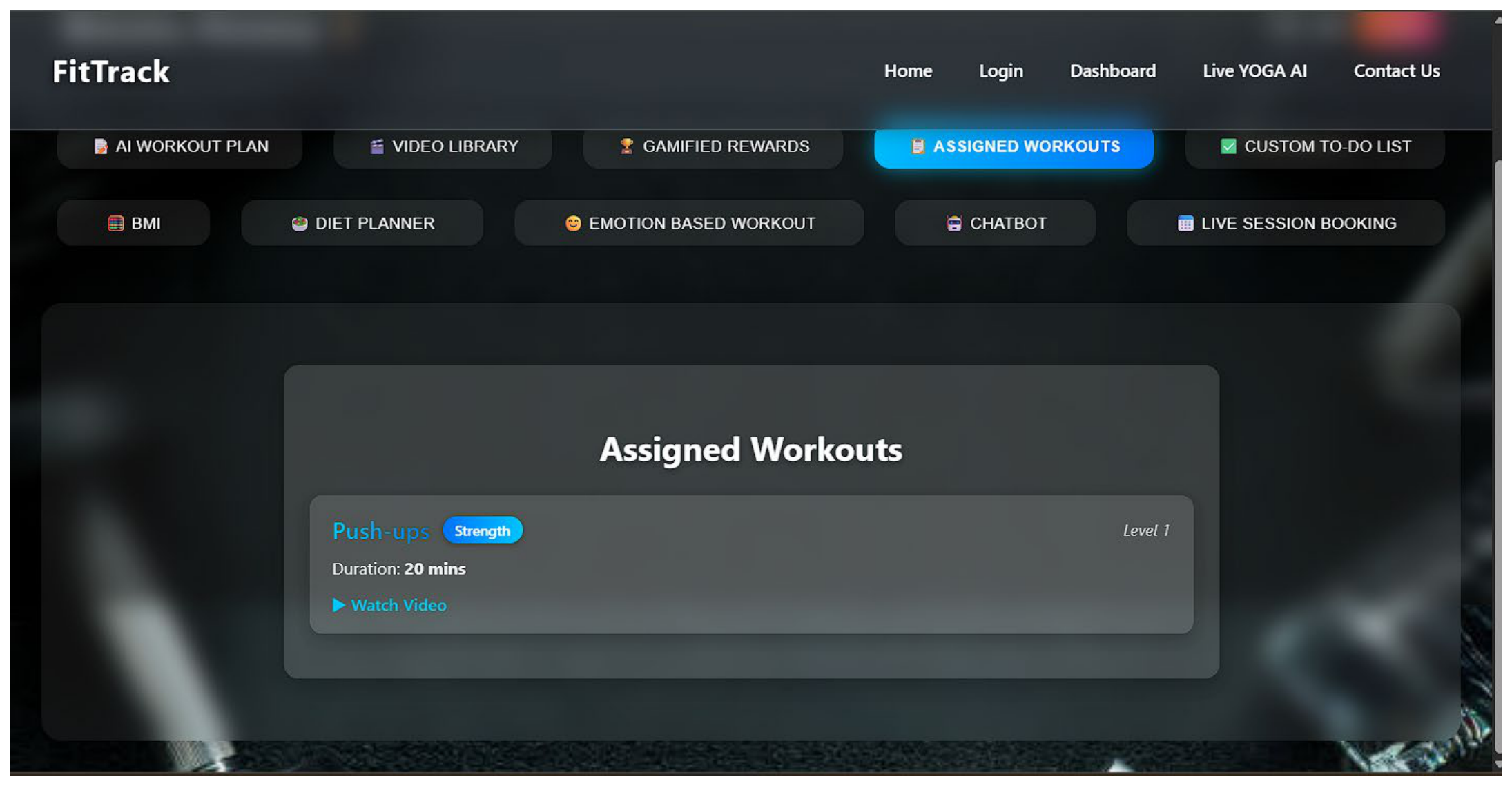
Figure 12.
Assigned Workouts (User).
- 8.
- Custom To-Do List:
Users can add their own workout tasks or daily goals. Once completed, they can mark tasks as done, which contributes to their score and consistency streak.
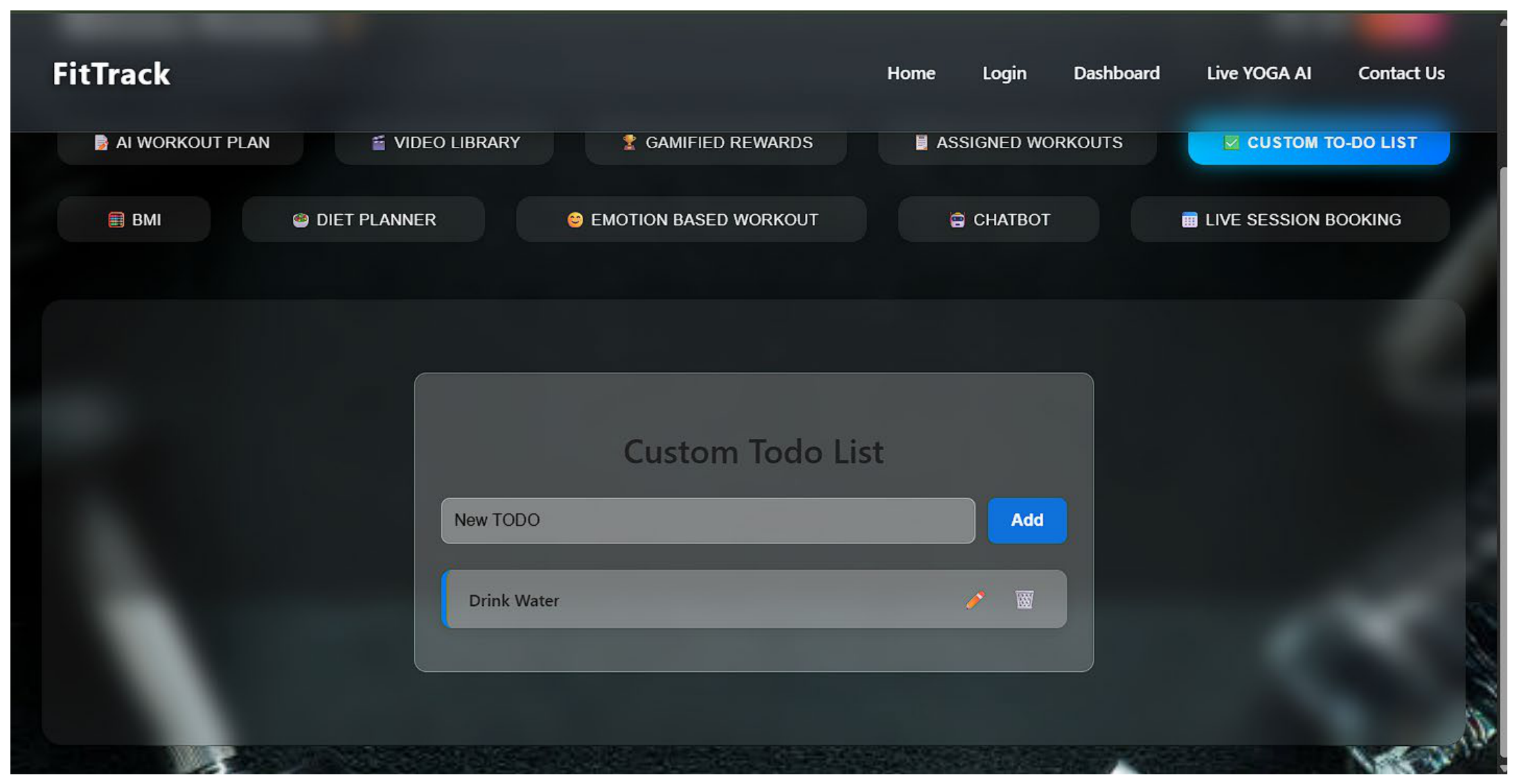
Figure 13.
Custom To-Do List.
- 9.
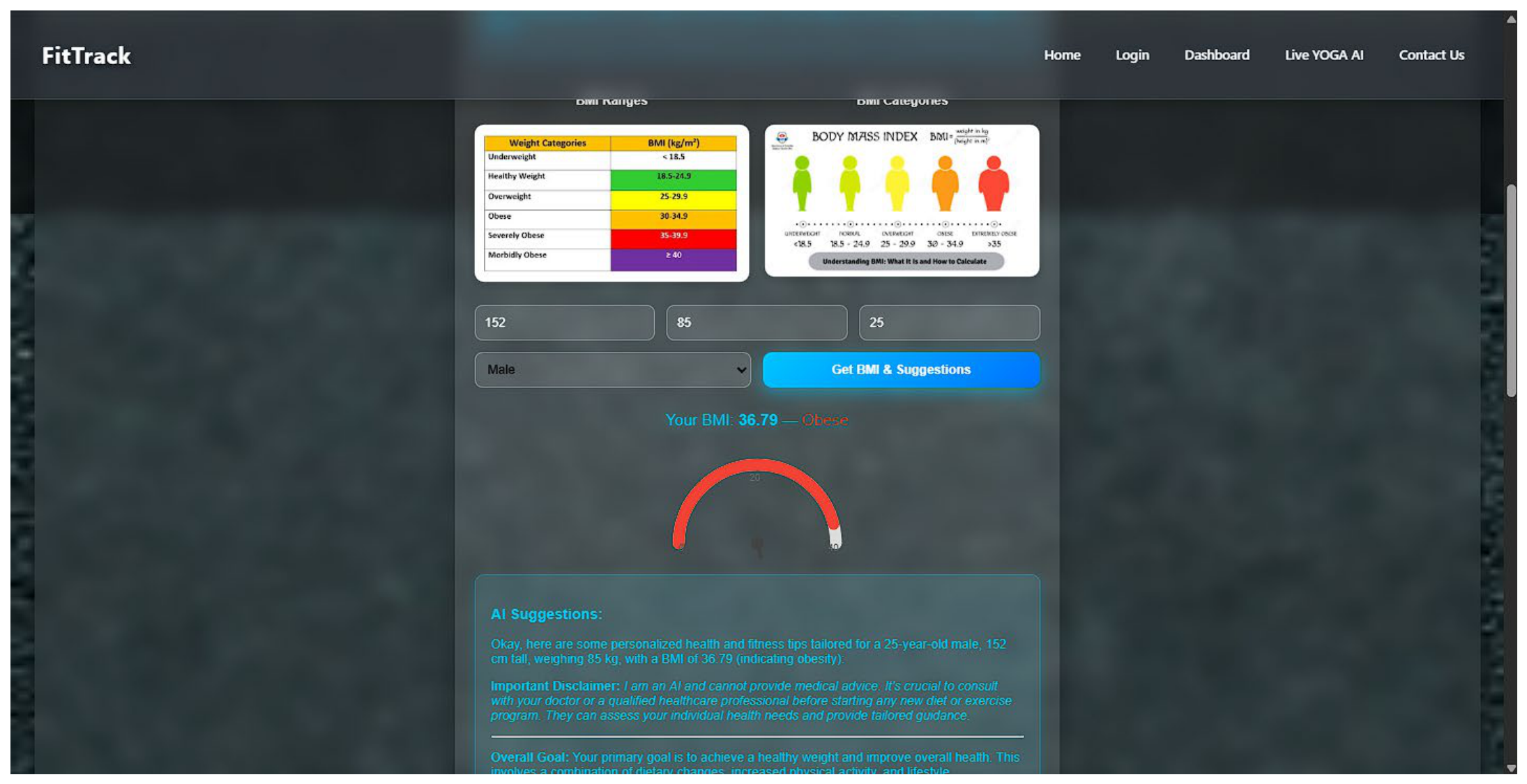
- BMI Calculator:
The BMI page calculates Body Mass Index using height and weight. It helps users quickly determine whether they fall into underweight, normal, or overweight categories and suggest workout using AI.
Figure 14.
BMI Calculator.
- 10.
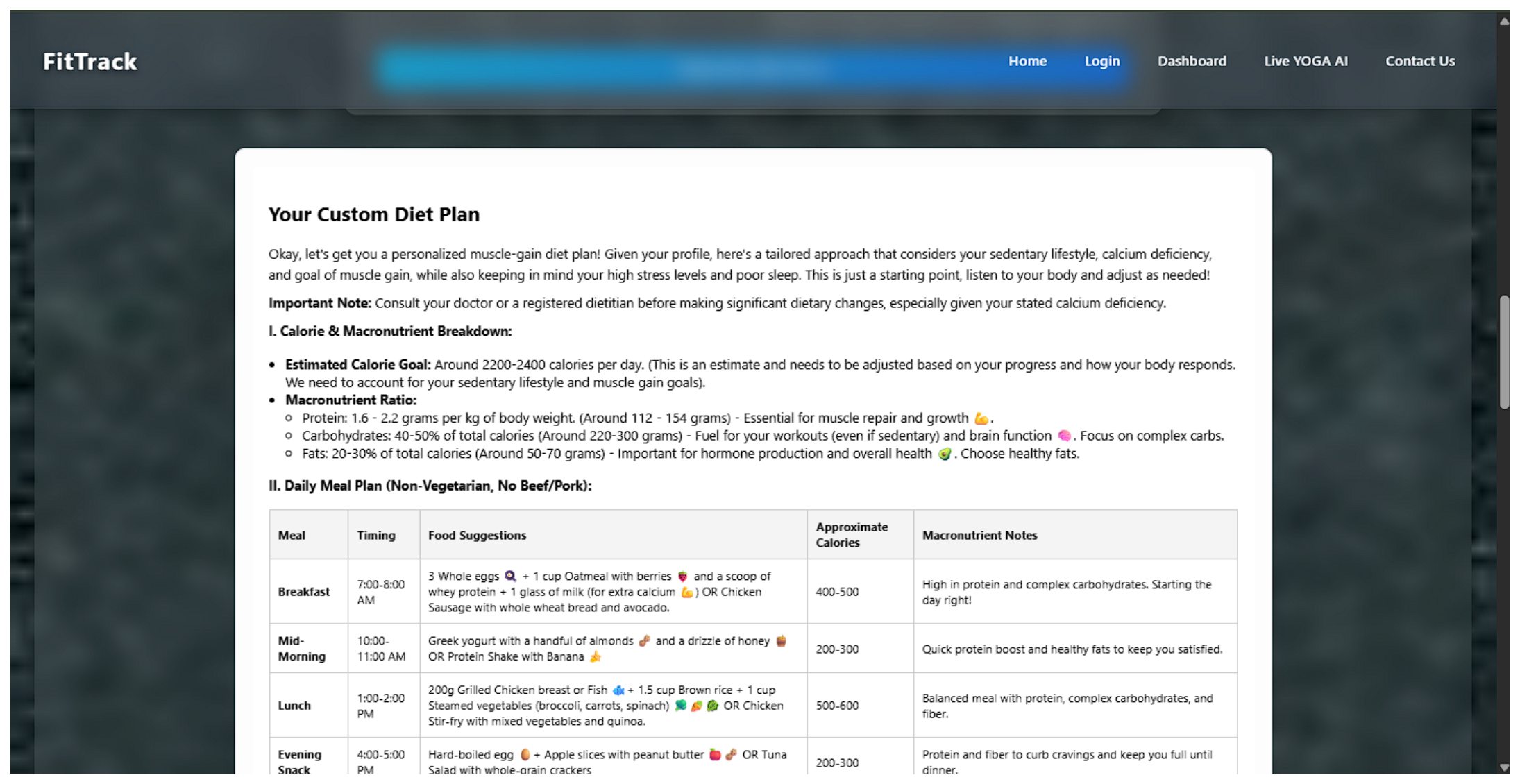
- Diet Planner:
This module provides a customized diet chart generated through AI based on user inputs such as age, body type, and fitness goals. It helps users maintain a balanced nutrition plan.
Figure 15.
Diet Planner (questions).
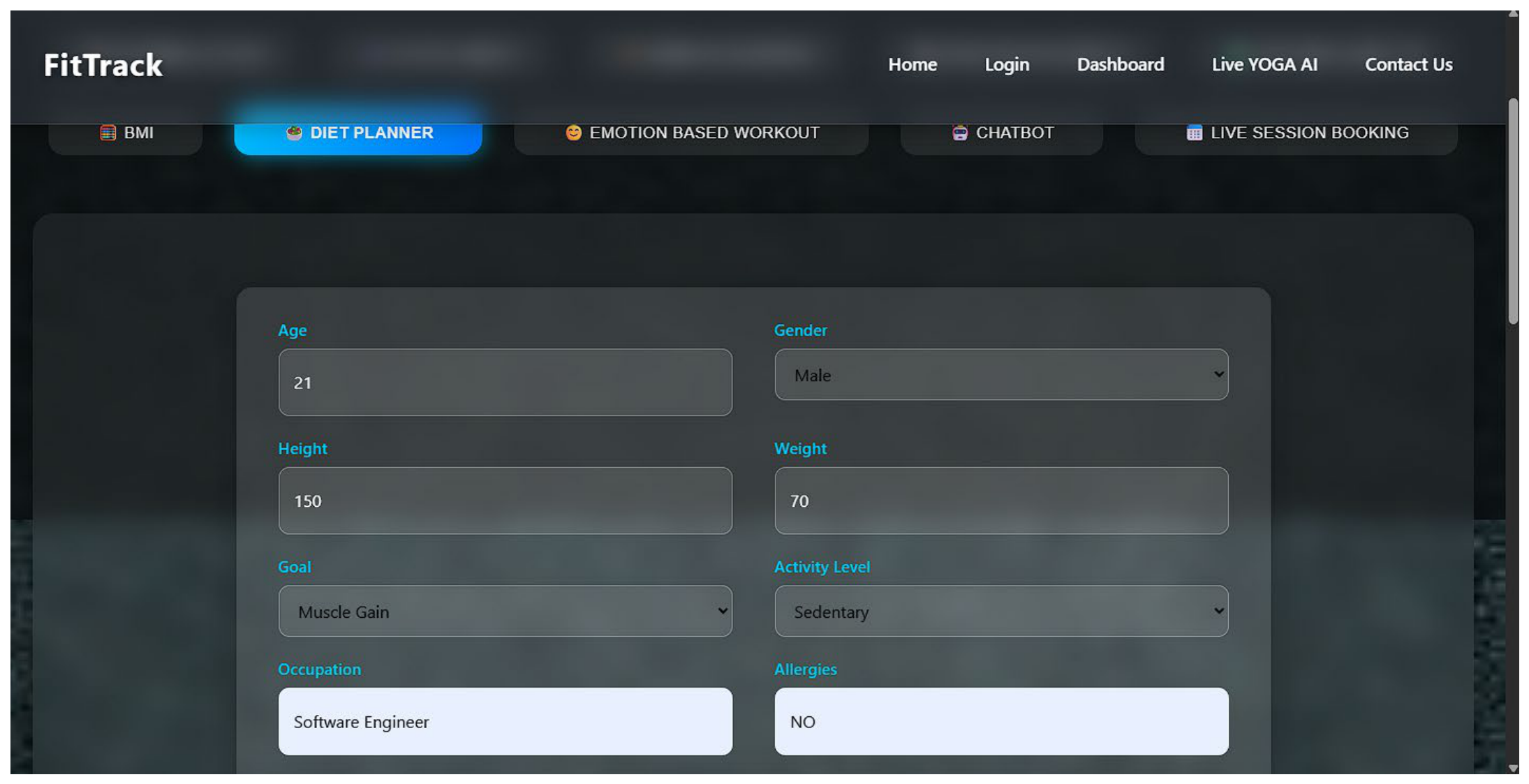
Figure 16.
Diet Planner (Diet Chart).
- 11.
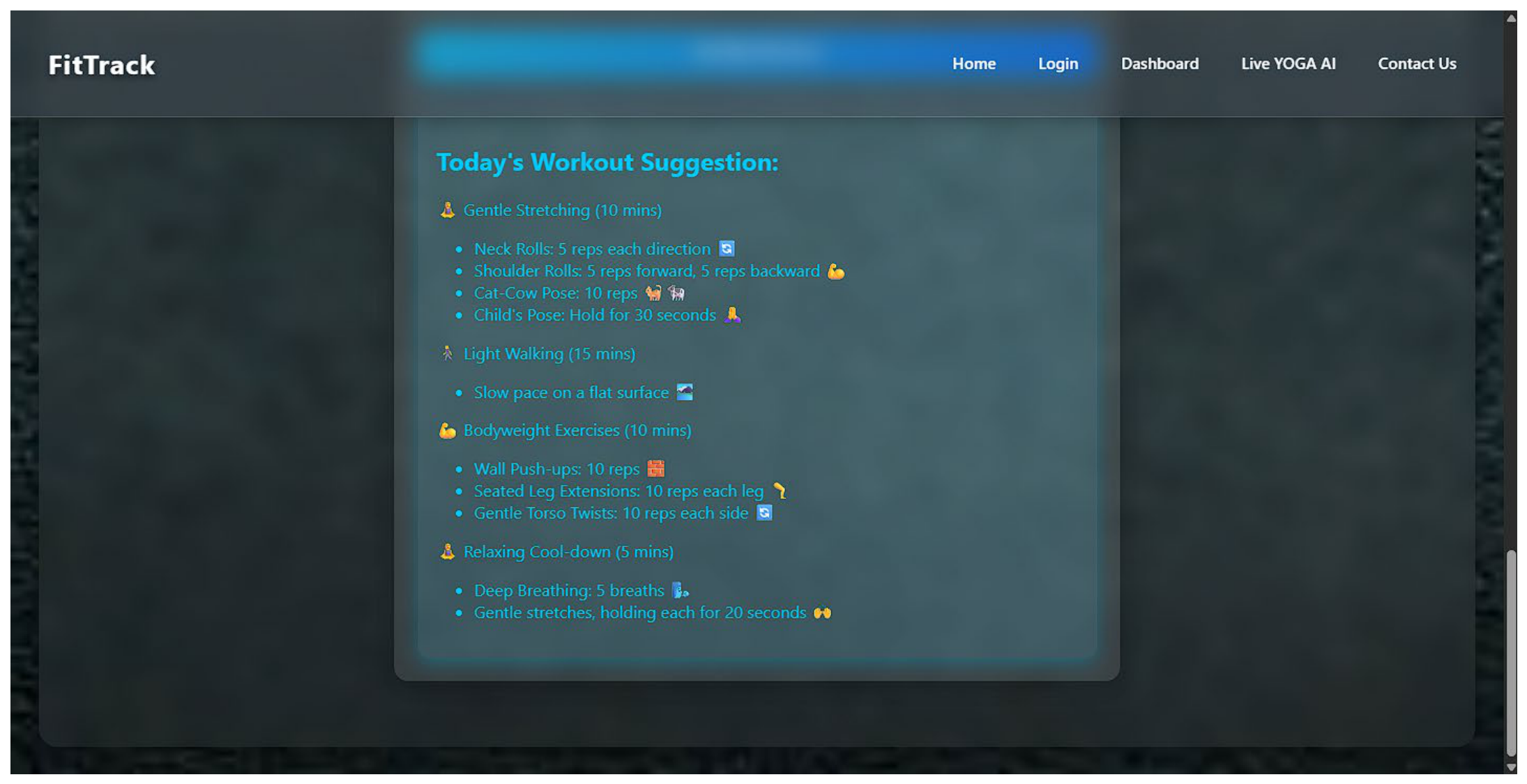
- Emotion-Based Workout:
Users can select their current mood (happy, sad, stressed, tired). Based on the emotion, the AI suggests suitable exercises that match their energy level and mental state.
Figure 17.
Emotion-Based Workout ( Q ).
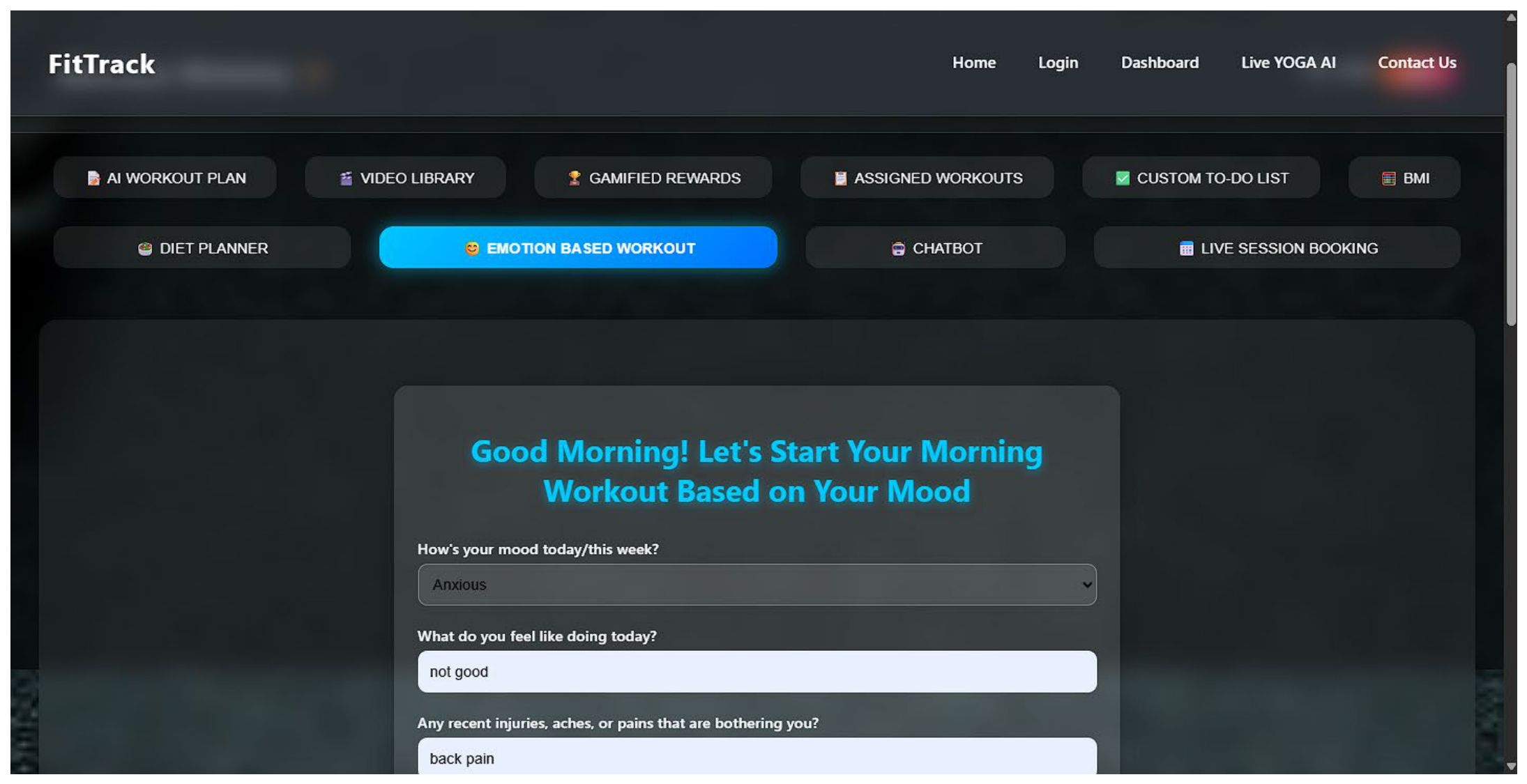
Figure 18.
Emotion-Based Workout (Suggestions).
- 12.
- AI Chatbot:
The chatbot provides real-time help by answering user questions related to workouts, diet, navigation, or general guidance. It uses natural language processing to respond intelligently.
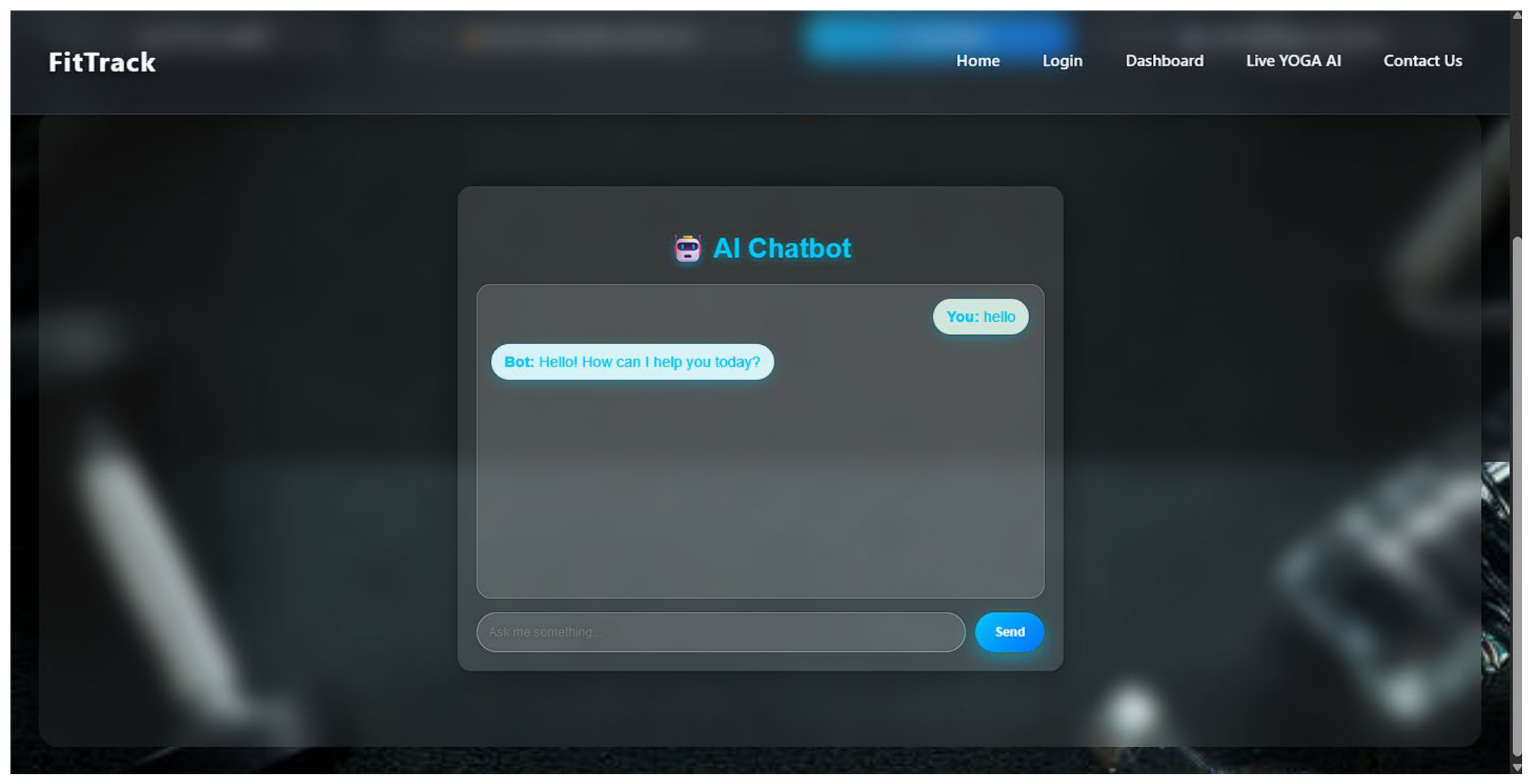
Figure 19.
AI ChatBot.
- 13.
- Live Session Booking:
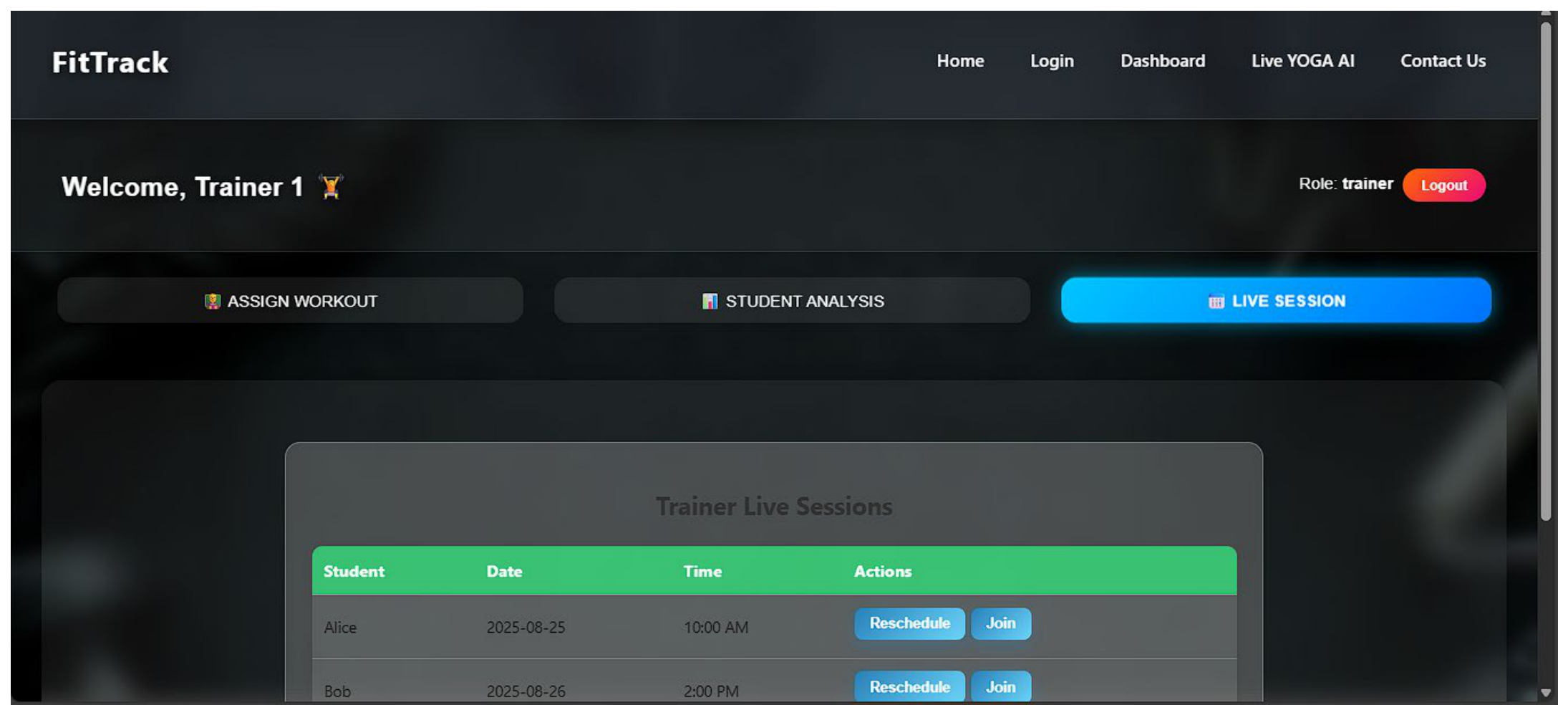
Users can book live sessions with trainers. The page displays available time slots, trainer names, and booking status. It uses WebRTC for online video communication.
Figure 20.
Live Session Booking (User).
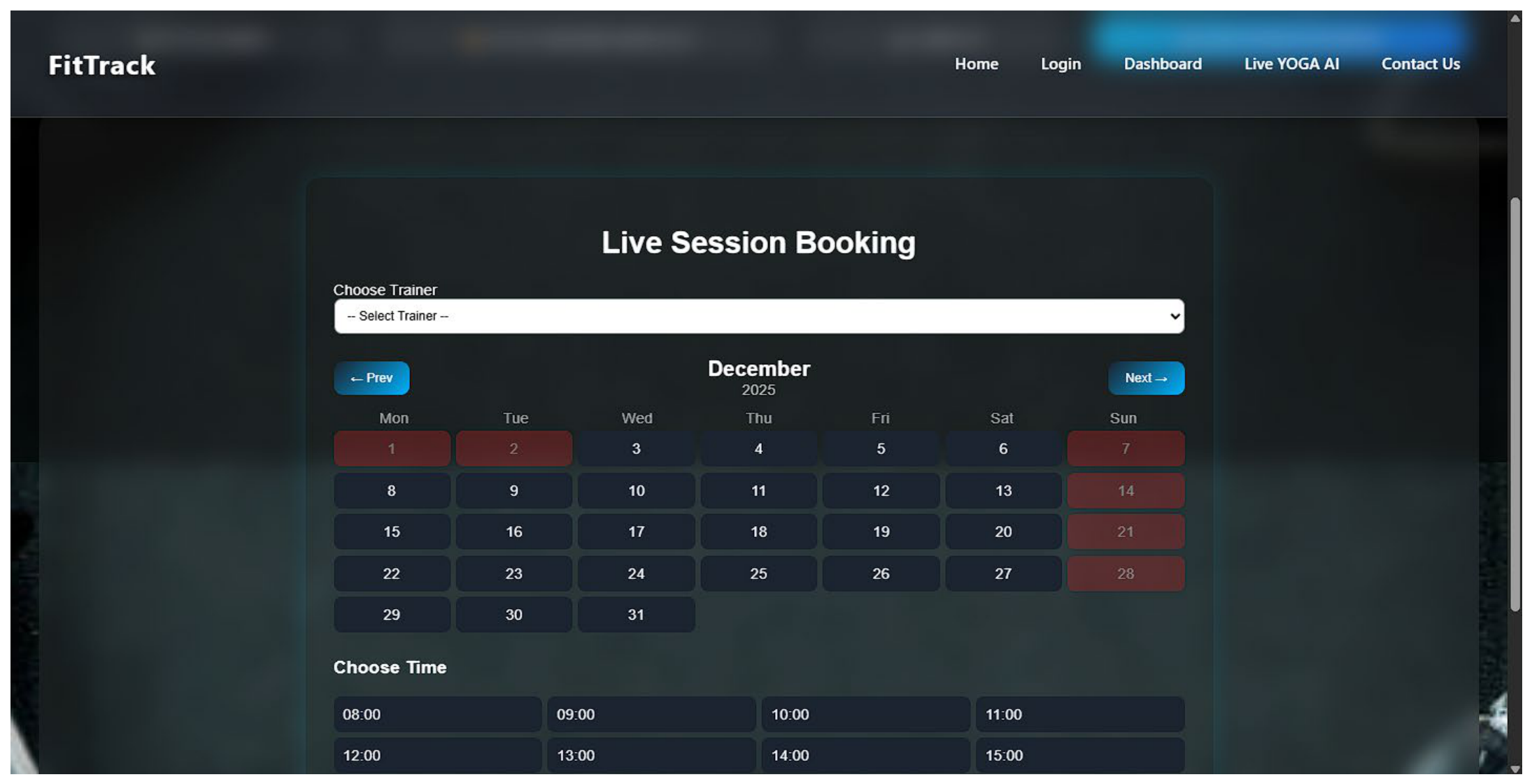
Figure 21.
Live Session Booking (Trainer).
- 14.
- Student Performance Analysis:
Here Trainer can track and monitor the students’ performance how good they are doing.
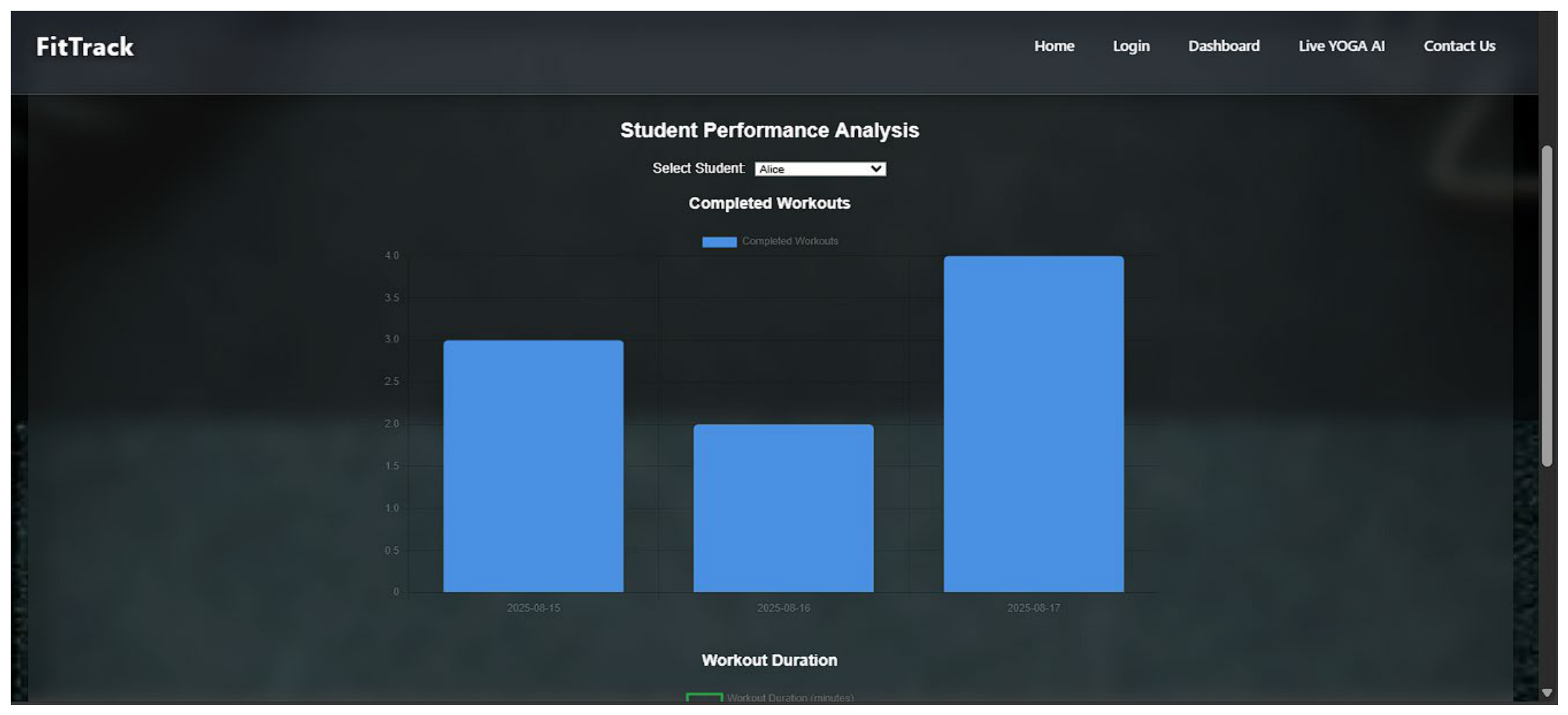
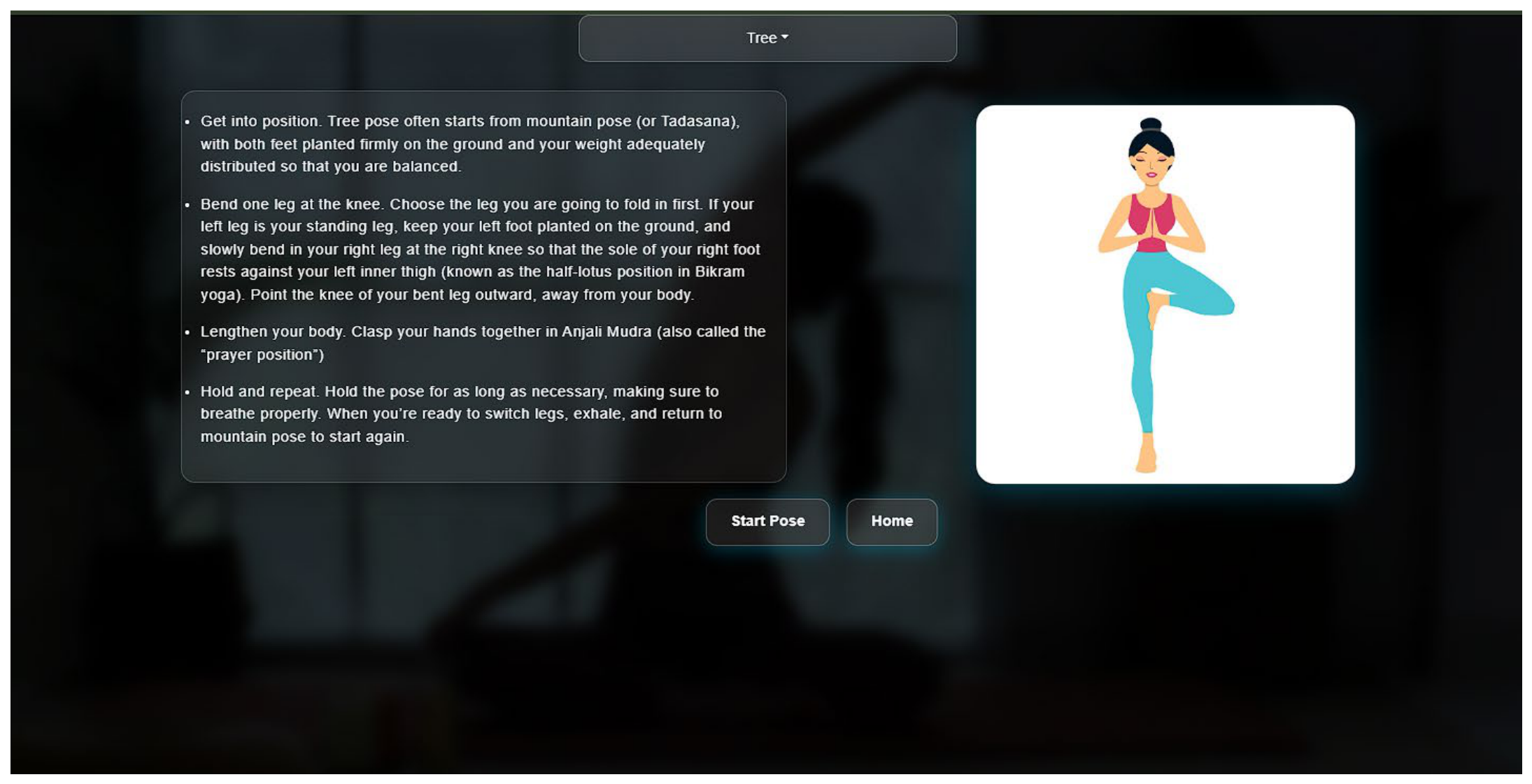
Figure 22.
Yoga Pose Detection.
- 15.
- Yoga Pose Detection:
This new AI-powered feature uses the user’s webcam and computer vision models to detect yoga poses. It gives real-time feedback on posture correctness and alignment.
9. Test Plans, Results and Analysis
- Test Plan:
The testing plan for the Smart Online Gym Platform focuses on validating the functionality, performance, and reliability of each module. The goal is to ensure that every feature works as expected across different user scenarios, devices, and network conditions. The testing process includes functional testing, integration testing, UI/UX testing, and performance checks. Each module—such as authentication, workout assignment, AI plan generation, video library, chatbot, and pose detection—is executed with predefined inputs to confirm correct output behavior. The system is tested using both manual and automated methods. Manual testing validates the user experience and checks real-time features like pose detection and chat responses. Automated testing is performed for backend APIs and workflows using tools like Jest, Mocha, and Postman. Test results are documented and compared with expected outcomes to identify errors, verify fixes, and ensure stable performance.
- 2.
- Test Case Table
| Test Case ID | Module / Feature | Test Description | Input | Expected Output | Status |
| TC-01 | Login / Signup | Verify user authentication | Valid email & password | User successfully logs in | Completed |
| TC-02 | Video Library | Check if videos load correctly | Click on a video | Video plays without error | Completed |
| TC-03 | Gamified Rewards | Validate points increment on task completion | Mark workout as complete | Points increase and reward updates | Completed |
| TC-04 | Assign Workout | Trainer assigns a workout to a user | Trainer selects workout & user | Workout appears in user dashboard | Completed |
| TC-05 | Custom To-Do List | Verify adding and checking tasks | Add a task | Task is saved and visible | Completed |
| TC-06 | Live Session | Test video call connection | Join session | Live session loads successfully | Completed |
| TC-07 | BMI Calculator | Validate BMI calculation accuracy | Height + weight | Correct BMI value displayed | Completed |
| TC-08 | AI Workout Plan | Check AI plan generation | User details | AI-generated workout plan displayed | Completed |
| TC-09 | AI Diet Chart | Generate diet based on user inputs | Age, weight, activity level | Diet plan displayed | Completed |
| TC-10 | AI Chatbot | Validate chatbot response | User question | Bot replies with relevant message | Completed |
| TC-11 | Yoga Pose Detection | Test real-time pose accuracy | Webcam input | Pose recognized with accuracy | Completed |
| TC-12 | Overall UI Test | Check navigation and responsiveness | Click, scroll | Smooth and responsive UI | Completed |
Results and Analysis:
This section presents the outcomes, observations, and performance analysis of three core AI modules implemented in the Smart Online Gym Platform: the AI Exercise Suggestion System, and the Yoga Pose Correction System. Each module was tested using controlled inputs, real user data, and multiple test cases to verify accuracy, usability, and reliability. The following subsections summarize the key results and findings.
1. AI Exercise Suggestion System — Results & Analysis
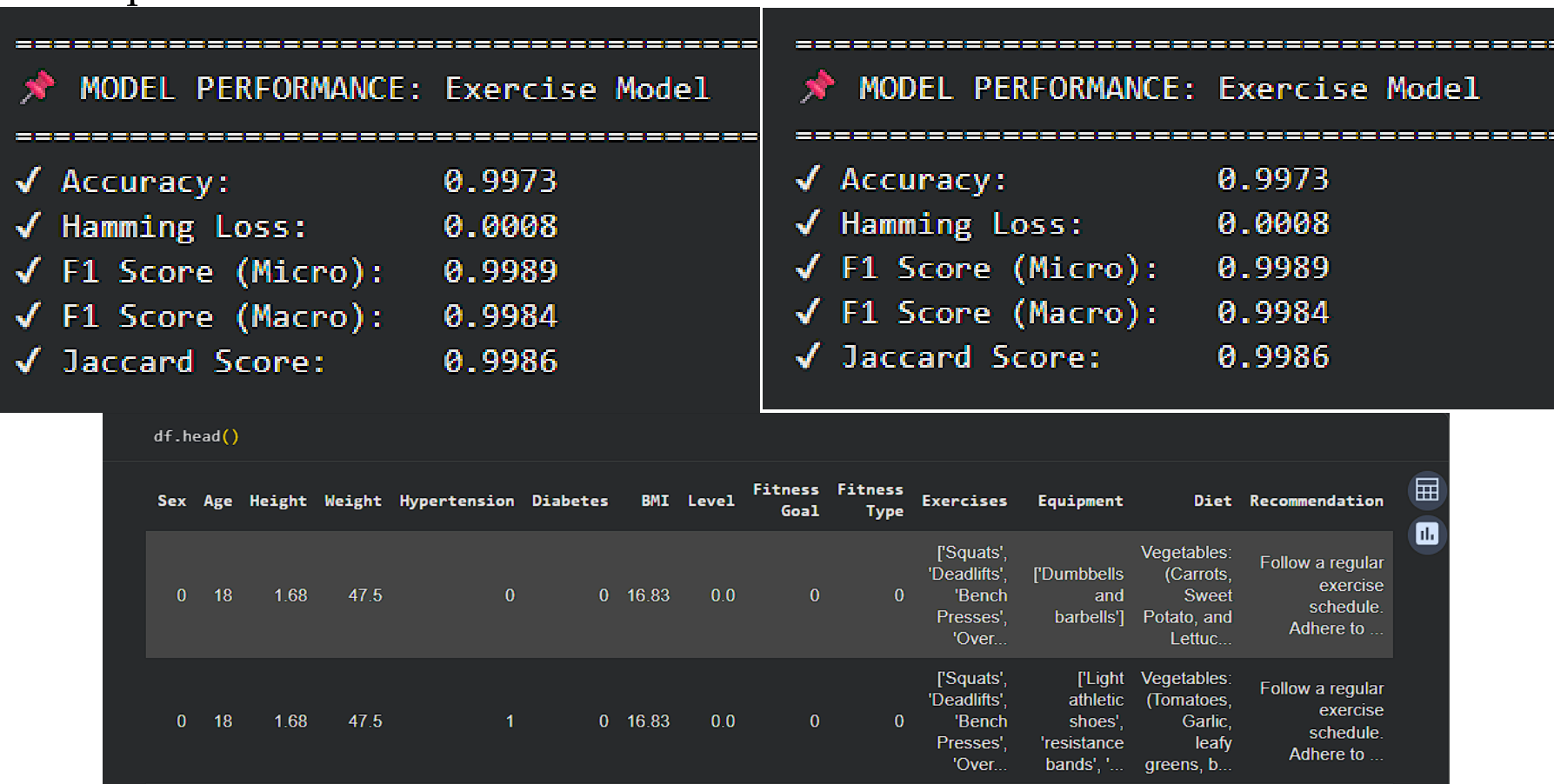
The Exercise Suggestion AI model was evaluated using a large set of unseen test data to measure how accurately it can recommend suitable exercises for different user profiles. The results show that the model performs with exceptionally high precision, achieving an accuracy of 0.9973. This means that almost every prediction made by the model is correct. In addition, the model reached a micro F1 score of 0.9989 and a macro F1 score of 0.9984, which indicates that it maintains strong performance across both common and less frequent exercise categories. The Jaccard score of 0.9986 further highlights that the predicted exercise sets closely match the actual correct sets. The very low hamming loss of 0.0008 shows that incorrect labels are extremely rare. Overall, the analysis confirms that the Exercise Suggestion AI is highly reliable and capable of delivering accurate and personalized workout recommendations suitable for deployment in a fitness application.
The Equipment Prediction AI model was also tested using unseen data to determine how well it can identify the type of equipment required for different exercises. Although this task is more complex compared to exercise selection, the model still produced strong results with an accuracy of 0.9496. The micro F1 score of 0.9710 demonstrates that the model handles frequent equipment classes very well, while the macro F1 score of 0.9410 shows that some rare equipment categories are slightly harder to classify. The Jaccard score of 0.9587 indicates that the predicted and actual equipment labels show a high level of similarity. With a hamming loss of 0.0104, the model still maintains a low error rate. The analysis shows that the Equipment Prediction AI is dependable and accurate enough to support the workout generation process by recommending only those exercises that match the equipment availability of the user. This contributes significantly to generating personalized and practical workout plans in the system.
The results demonstrate that both AI models—exercise suggestion and equipment prediction—are effective and ready for use within the Smart Online Gym platform. The high accuracy and strong generalization capability ensure that users receive recommendations that are relevant, safe, and tailored to their personal needs.
Figure 23.
AI Exercise Dataset.
1. Yoga Pose Correction AI – Results and Analysis
The Yoga Pose Correction AI model was trained using temporally organized biomechanical feature sequences extracted from yoga videos through the YOLOv8m-Pose framework. The evaluation on unseen test data achieved an overall 98% accuracy, demonstrating that the model can accurately recognize and classify different yoga poses while effectively capturing temporal movement patterns. The integration of the Transformer encoder with the ResidualMLP backbone enables the model to learn both spatial biomechanical features and temporal dependencies, resulting in stable and reliable pose recognition.
The classification report shows high precision, recall, and F1-scores across most yoga pose classes, indicating strong discrimination between different postures. The confusion matrix further confirms that the majority of predictions lie along the diagonal, with only a small number of misclassifications occurring between visually similar poses. These errors are primarily due to limited training samples for certain classes and slight similarities in body posture.
Overall, the results demonstrate that the Yoga Pose Correction AI model is highly reliable for providing real-time posture analysis and correction. With nearly perfect accuracy in major pose categories, the system can confidently guide users through yoga sessions, ensure safer practice, and support the Smart Online Gym platform’s goal of delivering virtual supervision similar to an in-person trainer. The model is fully suitable for deployment, and minor improvements can be made by expanding the dataset for under-represented poses.
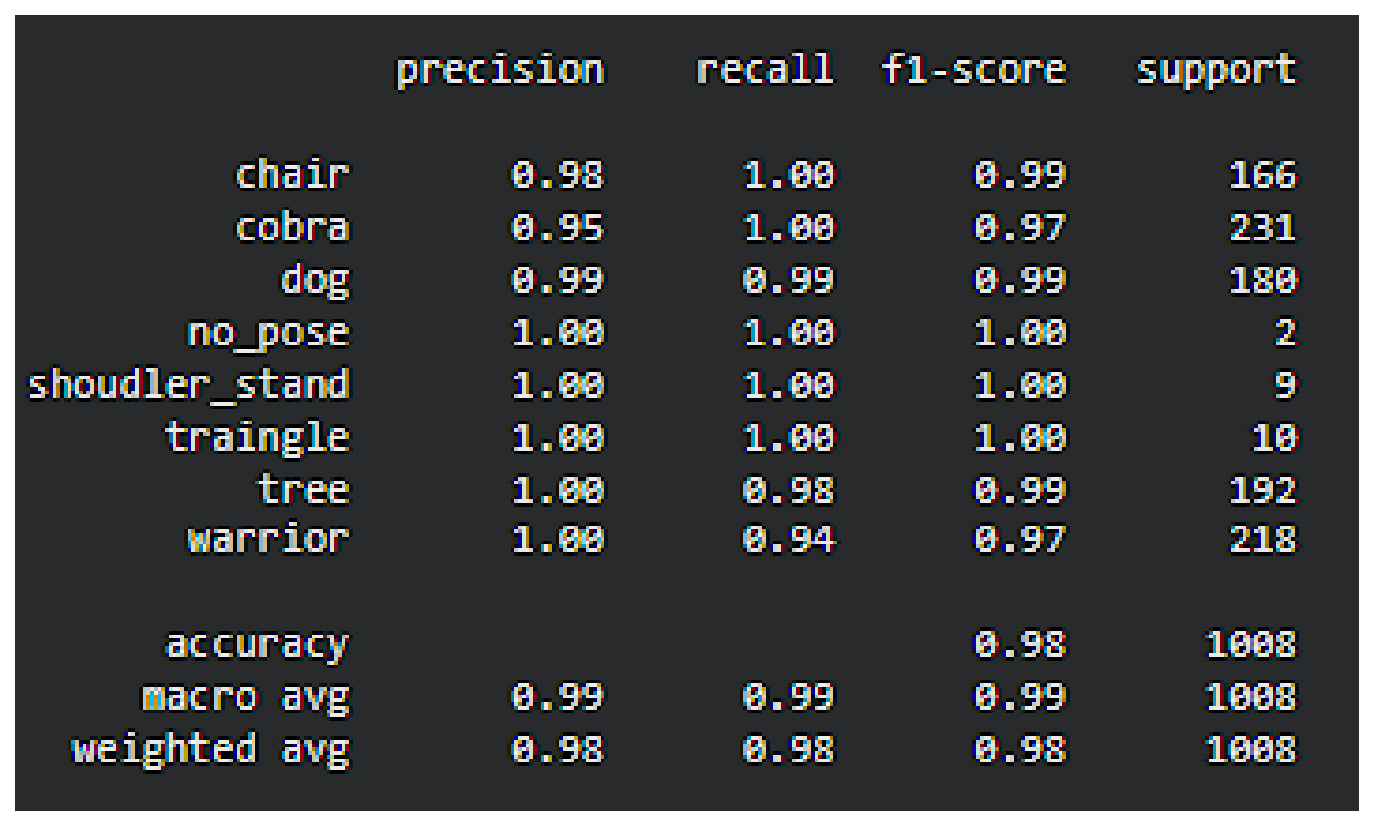
Figure 24.
Classification Report (YOGA Posture).
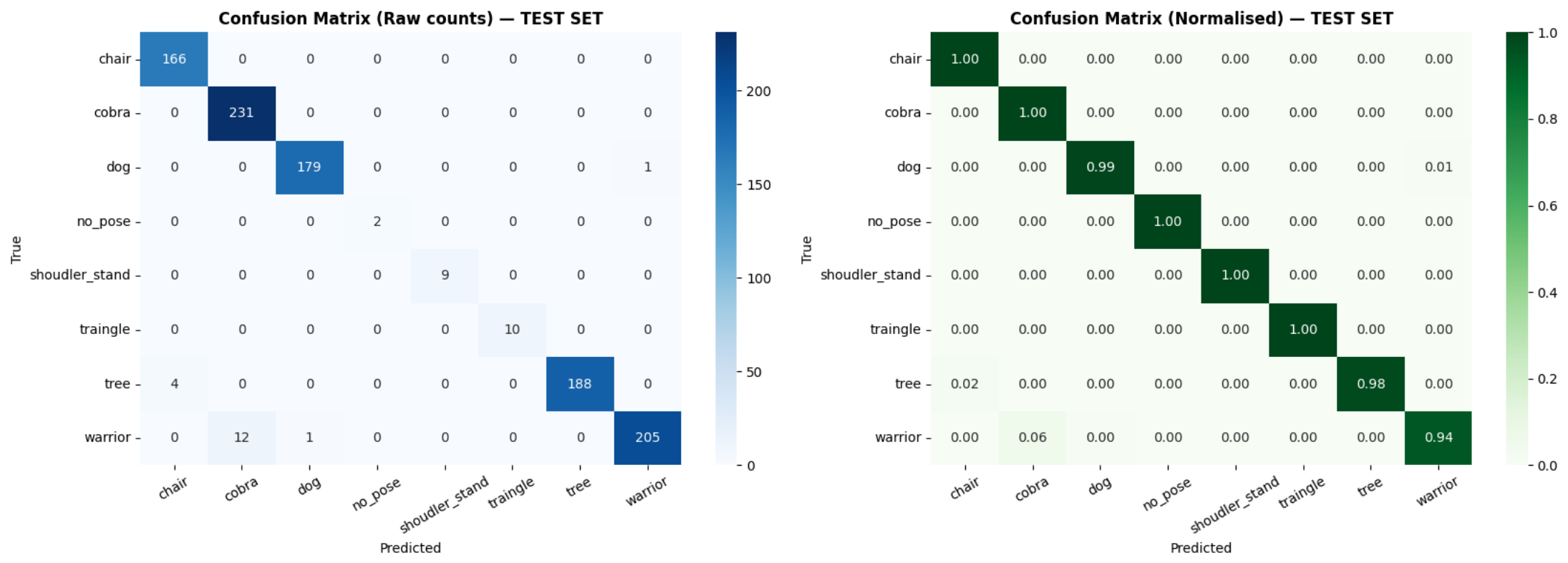
Figure 25.
Confusion Matrix (YOGA Posture).
10. Conclusion
The Smart Online Fitness Platform successfully demonstrates how modern web technologies and AI can be combined to create an accessible and personalized fitness system. By integrating modules such as user authentication, workout management, AI-generated plans, video-based guidance, diet recommendations, gamification, chatbot support, and computer-vision pose detection, the project provides a complete end-to-end solution for users seeking a digital fitness experience. The system is built using a scalable architecture with React for the frontend, Node.js and Express for backend APIs, and MongoDB for database management, ensuring reliability, speed, and secure data handling. Through this project, we addressed key problems found in traditional fitness environments—limited guidance, lack of personalization, poor motivation, and low accessibility. The platform allows users to access customized workout routines, track their progress, and interact with trainers from anywhere, making the experience flexible and user-friendly. Overall, the project shows that AI-driven digital fitness solutions can greatly improve user engagement and help individuals maintain a healthier lifestyle. The system is designed for scalability, allowing future enhancements such as advanced machine-learning models, more workout categories, improved analytics, and mobile app integration. This work lays a strong foundation for future developments in smart fitness technologies.
Acknowledgments
We would like to express our sincere gratitude to our project guide in the department of Computer Science and Engineering. We are extremely thankful for the keen interest our guide took in advising us, for the books, reference materials and support extended to us. Last but not the least we convey our gratitude to all the teachers for providing us the technical skill that will always remain as our asset and to all non-teaching staffs for the gracious hospitality they offered us.
References
- Xu, L. The Effects of mHealth-Based Gamification Interventions on Participation in Physical Activity: Systematic Review. JMIR Mhealth Uhealth 2022, vol. 10(no. 2), e27794. [Google Scholar] [CrossRef] [PubMed]
- Kim, H.; Hong, S. E. K.; Kim, C. H. S. The Influence of Gamification and Information Technology Identity on Postadoption Behaviors of Health and Fitness App Users: Empirical Study in the United States. J. Med. Internet Res. 2021, vol. 23(no. 8), e29742. [Google Scholar]
- Khan, S. M.; et al. AI-Powered Fitness App for Dynamic Workout Tracking and Personalized Exercise and Nutritional Plan Recommendations. J. Emerg. Technol. Innov. Res. (JETIR) Appears first on line 5, for personalized workout plans. 2024, vol. 11(no. 5), D442–D453. [Google Scholar]
- Sharma, A. K.; Roy, K. FitGenie: AI-Powered Personal Fitness Tracker. Int. J. Res. Publ. Rev. Appears first on line 5, for personalized workout plans. 2025, vol. 6(no. 4), 13057–13063. [Google Scholar] [CrossRef]
- Gabarron, E.; et al. Human Factors in AI-Driven Digital Solutions for Increasing Physical Activity: Scoping Review. JMIR Hum. Factors 2024, vol. 11(no. 1), e55964. [Google Scholar] [CrossRef] [PubMed]
- M. M. Augustine et al., Virtual Fitness Trainer Using AI: A Research Paper. Int. J. Res. Appl. Sci. Eng. Technol. 2024, vol. 12(no. 5), 4082–4089.
- Chandramouli Haldar, An Intelligent Framework for Real-Time Yoga Pose Detection and Posture Correction. arXiv 2026. [CrossRef]
- Haldar, Chandramouli. “Yoga Asana Image Dataset: Multi-Class Pose Recognition”. Mendeley Data 2026, V1. [Google Scholar] [CrossRef]
Disclaimer/Publisher’s Note: The statements, opinions and data contained in all publications are solely those of the individual author(s) and contributor(s) and not of MDPI and/or the editor(s). MDPI and/or the editor(s) disclaim responsibility for any injury to people or property resulting from any ideas, methods, instructions or products referred to in the content. |
© 2026 by the authors. Licensee MDPI, Basel, Switzerland. This article is an open access article distributed under the terms and conditions of the Creative Commons Attribution (CC BY) license.
Copyright: This open access article is published under a Creative Commons CC BY 4.0 license, which permit the free download, distribution, and reuse, provided that the author and preprint are cited in any reuse.