

Submitted:
15 September 2026
Posted:
17 September 2026
You are already at the latest version
Abstract
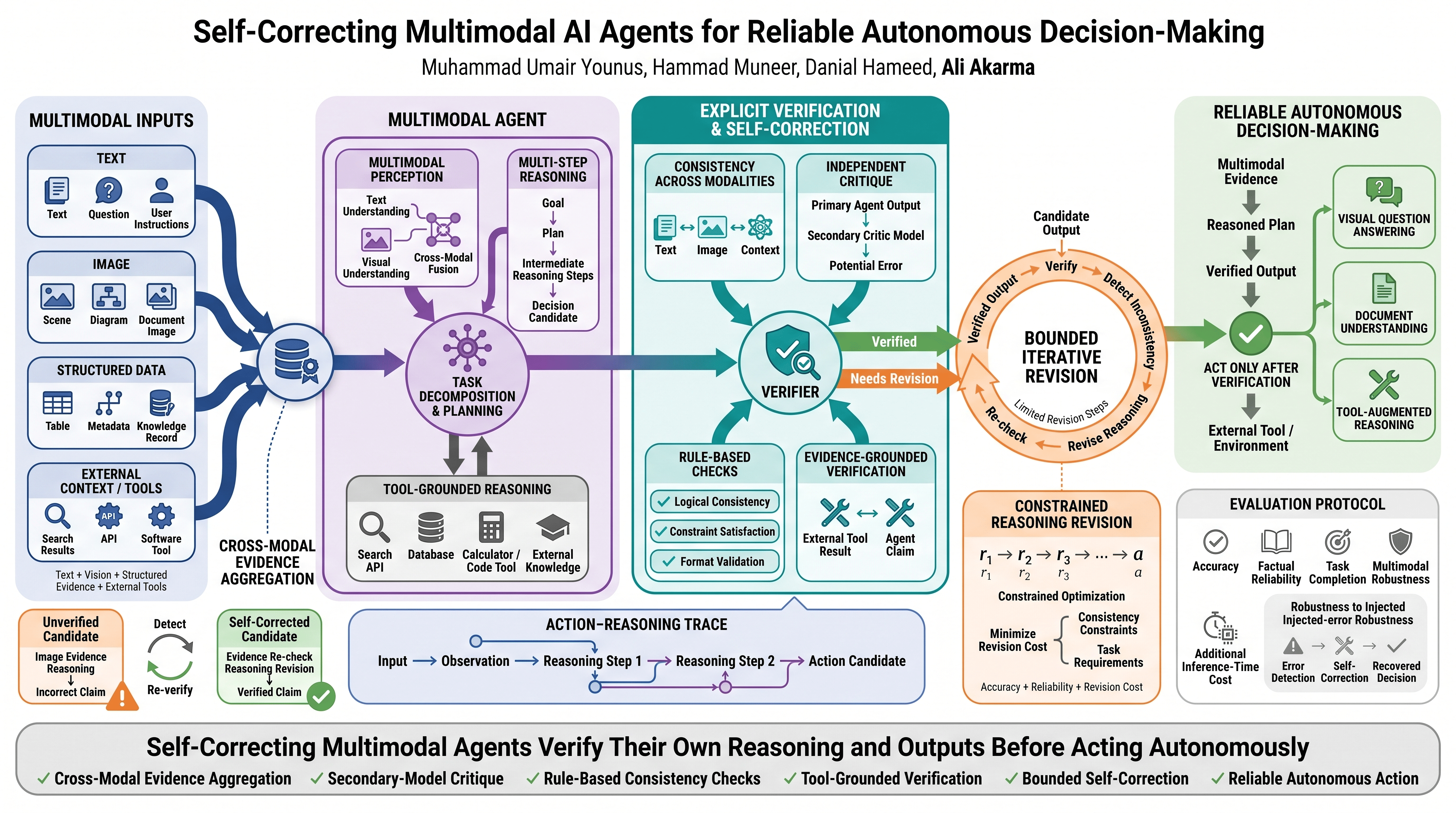
Recent advances in large language models and multimodal foundation models have enabled artificial intelligence agents to jointly process text, images, and other modalities while performing multi-step reasoning and interacting with external tools. Despite this progress, autonomous agents remain prone to compounding errors that originate in visual perception, language reasoning, tool invocation, or the interaction among these components. This paper proposes a self-correcting multimodal agent architecture that couples task decomposition and planning with an explicit verification and revision loop, allowing the agent to detect inconsistencies in intermediate reasoning steps and in final outputs before a task is considered complete. The architecture combines cross-modal evidence aggregation, secondary-model critique, rule-based consistency checks, and tool-grounded verification to identifycandidate errors, and it uses a bounded iterative revision procedure to correct them without unnecessary recomputation. We formalize the verification-and-correction process as a constrained optimization over an evolving action-reasoning trace and describe a concrete algorithmic instantiation suitable for visual question answering, document understanding, and tool-augmented reasoning tasks. We further describe an evaluation protocol spanning accuracy, factual reliability, task completion, and robustness to injected multimodal errors, together with an explicit accounting of the additional inference-time cost introduced by iterative self-correction. The framework is intended to give practitioners a concrete, reproducible template for building and evaluating multimodal agents that can detect and recover from their own mistakes prior to acting autonomously.
Keywords:
multimodal agents
; self-correction
; large language models
; verification
; agentic AI
; tool use
; reflection
; reliability
; autonomous decision-making
1. Introduction
Large language models (LLMs) have progressed from single-turn text generators into agentic systems capable of decomposing tasks, invoking external tools, and executing multi-step plans with limited human supervision [1]. The extension of these systems into the multimodal domain, in which an agent must jointly interpret images, documents, or sensor streams alongside natural language instructions, has broadened the range of tasks such agents can address, from visual question answering to document-grounded reasoning and embodied tool use [2,3]. However, this expanded capability comes with an expanded surface for failure. An agent’s final decision can be corrupted by an error at any stage of its pipeline: a visual encoder may misidentify an object, a language module may draw an unsupported inference from a correct perception, a tool call may be malformed or misinterpreted, or an early planning mistake may propagate silently through several subsequent steps.
Conventional agent architectures generate a single reasoning trace and commit to it, offering no internal mechanism to catch errors before they affect the final output. This is problematic in autonomous settings where actions have consequences beyond generating text, such as filling out a form, issuing an API call, or making a decision that a downstream system will execute without further human review. Such operational risks are especially pronounced in complex cyber-physical settings and digital twin architectures, where unverified autonomous actions can cascade across critical infrastructure or networked IoT systems [4,5]. A growing body of work has shown that language agents can be made more reliable by allowing them to reflect on their own outputs, critique their reasoning using auxiliary signals, and revise flawed steps rather than committing to a first attempt [6,7,8]. These self-correction techniques have primarily been developed and evaluated in text-only settings; multimodal environments introduce additional failure modes, such as object hallucination in vision-language models [9], that a text-only verification mechanism cannot detect on its own.
This paper addresses this gap by proposing a self-correcting multimodal agent framework in which verification and revision are treated as first-class components of the agent’s control loop rather than as an optional post-processing step. The agent decomposes an incoming task into subtasks, plans a sequence of actions that may include tool invocations, and evaluates both intermediate reasoning steps and the final answer against multiple independent sources of evidence before returning control to the user. When a verification step flags an inconsistency, the agent revises the relevant portion of its plan or reasoning rather than restarting the entire task, which bounds the additional computation required for correction.
The main contributions of this paper are as follows.
- We propose a modular self-correcting multimodal agent architecture that integrates perception, planning, tool use, and a dedicated verification-and-revision loop operating over both intermediate and final outputs.
- We formalize the verification and correction process mathematically as an iterative constrained refinement over an agent’s reasoning trace, and we present a concrete algorithm for bounded self-correction that is agnostic to the underlying foundation model.
- We describe a taxonomy of multimodal error sources, spanning perceptual, linguistic, tool-interaction, and cross-modal alignment errors, and we map each error category to a corresponding verification strategy.
- We define an evaluation protocol, covering multimodal reasoning, visual question answering, document understanding, and tool-use tasks, together with metrics for reliability, task completion, and the computational overhead of self-correction, that can be used to empirically test the framework described here.
The remainder of this paper is organized as follows. Section 2 reviews related work on language agents, self-correction, and multimodal foundation models. Section 3 presents the proposed framework at a conceptual level. Section 4 describes the system architecture. Section 5 formalizes the verification and correction process and presents the core algorithm. Section 6 describes the intended experimental setup. Section 7 discusses the evaluation protocol and the form that results should take. Section 8 presents a comparative analysis against related approaches. Section 9 discusses limitations, and Section 10 concludes with directions for future work.
2. Related Work
2.1. Language Agents and Tool Use
Interleaving reasoning traces with actions allows a language model to ground its intermediate thoughts in observations retrieved from an external environment rather than relying solely on parametric knowledge, an approach popularized by ReAct [10]. Subsequent work extended single-path reasoning into search over multiple candidate reasoning branches, allowing a model to backtrack from an unpromising line of thought, as in Tree of Thoughts [11], which itself builds on the observation that decomposing a problem into explicit intermediate steps improves performance on arithmetic, commonsense, and symbolic reasoning tasks [12]. Sampling multiple independent reasoning paths and aggregating their answers, referred to as self-consistency, has likewise been shown to improve the reliability of chain-of-thought reasoning without requiring any additional training [13]. Separately, agents have been extended with the ability to invoke external tools, such as calculators, search engines, or translation systems, either through explicit prompting, as in ReAct, or through self-supervised training on API-augmented text, as in Toolformer [14]. A comprehensive survey of the resulting design space for LLM-based autonomous agents, including their planning, memory, and tool-use components, is provided by Wang et al. [1]. Beyond general conversational and synthetic tasks, agentic AI frameworks have increasingly been deployed across specialized, high-dimensional operational domains. These include digital-twin-enabled autonomous management for civil infrastructure and climate-resilient smart cities [4,15], multi-constraint decision optimization under explicit budgetary and resource limits [16], and secure collaborative multi-agent workflows operating under federated structures [17]. In such sophisticated agentic ecosystems, agents must orchestrate heterogeneous tools while adhering to multi-faceted domain constraints, making the early detection and self-correction of flawed intermediate steps vital to system-level reliability and safety.
2.2. Self-Correction and Reflection
A parallel line of work focuses specifically on enabling language models to identify and repair errors in their own outputs. Reflexion introduces a verbal reinforcement mechanism in which an agent converts scalar or free-form feedback into a textual self-reflection that is stored in an episodic memory and consulted in subsequent attempts at the same task [6]. Self-Refine instead performs iterative refinement within a single episode, using the same model to alternately generate an output, critique it, and revise it until a stopping criterion is met, without requiring any additional training data [7]. CRITIC extends this idea by grounding the critique step in external tools, such as search engines or code interpreters, rather than relying purely on the model’s own judgment, and reports that purely internal self-verification is often unreliable when it is not anchored to an external source of truth [8]. A recent critical survey synthesizes this literature and highlights that the conditions under which self-correction reliably improves performance, as opposed to introducing new errors, remain incompletely understood, particularly when no external verifier is available [18]. This insight aligns with core principles in trustworthy AI governance and reliable autonomous systems—such as the multi-pillar verification frameworks and security auditing structures established by Jan et al. [5] and secure decentralized agent verification in FedAgent-Chain [17]—which demonstrate that autonomous agents require multi-source, verifiable oversight rather than unanchored self-evaluation to ensure operational integrity. The framework proposed in this paper builds directly on these findings by treating external, tool-grounded verification as the default rather than the exception, and by extending the notion of a critique step to explicitly cover cross-modal consistency.
2.3. Multimodal Foundation Models and Hallucination
Large multimodal models connect a pretrained visual encoder to a language model backbone and are instruction-tuned on machine-generated multimodal instruction data, as in LLaVA [2], with subsequent refinements to the visual connector and training data improving performance across a range of academic vision-language benchmarks [19]. Proprietary multimodal systems such as GPT-4 extend this capability to a broader range of visual and textual tasks [3]. Document-grounded multimodal reasoning has been studied through benchmarks such as DocVQA, which requires a model to answer questions that depend on both the textual content and the layout of a document image [20]. Despite these advances, large vision-language models are known to suffer from object hallucination, in which a generated description references objects that are not actually present in the image; the POPE benchmark was introduced specifically to measure this failure mode in a stable and controllable way [9]. This body of work motivates the present paper’s emphasis on cross-modal verification: because hallucination in multimodal systems can originate in the vision-language interface itself rather than in downstream reasoning, a verification mechanism restricted to text-only self-critique is structurally unable to catch a large class of multimodal errors.
3. Proposed Framework
The proposed framework models an autonomous task as a sequence of individually verifiable decisions rather than a single opaque generation step. The agent operates through four coupled processes: task understanding and decomposition, action planning and tool use, verification of intermediate and final outputs, and bounded revision when inconsistencies are detected.
Given a multimodal task comprising an instruction and one or more supporting images, documents, or tool-accessible resources, the agent first constructs an internal task representation that identifies the subgoals required to produce the final answer or action. Each subgoal is assigned a planned action, such as direct inference from the multimodal input, a call to an external tool (e.g., image cropper, OCR module, calculator, or retrieval system), or generation of an intermediate result for a subsequent subgoal. The output of each action is passed through verification before being accepted into the working context.
Verification is multi-source and combines four complementary strategies. First, cross-modal consistency checking compares language-level claims with evidence extracted from the visual or document modality, requiring claims about objects, quantities, or layouts to be traceable to the input. Second, secondary-model critique uses an independent model instance, or the same model in a distinct critique role, to identify unsupported inferences in the reasoning trace, following the self-critique paradigm of prior text-only work [7]. Third, rule-based checks enforce deterministic task-specific constraints, such as validating numeric outputs, tool-call schemas, or cited document regions. Fourth, tool-grounded verification independently re-executes or checks claims using an external tool, following the tool-interactive critiquing approach of [8].
When a verification strategy detects an inconsistency, the agent enters a revision phase and updates only the implicated portion of the plan or reasoning trace using the verification feedback as an additional conditioning signal. Verification is then repeated until the output passes all applicable checks or a maximum revision budget is reached. In the latter case, the agent returns its best available answer with an explicit confidence annotation indicating unresolved concerns. This bounded revise-then-reverify cycle limits the computational cost of unconstrained self-correction while enabling recovery from detectable errors.
4. System Architecture
Figure 1 shows the high-level architecture of the proposed self-correcting multimodal agent. The system is organized into five layers: a multimodal input layer, a planning and decomposition layer, an execution layer that interfaces with external tools, a verification layer that aggregates evidence from multiple sources, and a revision controller that mediates between verification outcomes and the working reasoning trace.
The multimodal input layer normalizes heterogeneous inputs, such as raw images, scanned documents, or structured tables, into a common representation consumable by the planner. The planning and decomposition layer produces an ordered list of subgoals and, for each subgoal, a candidate action drawn from a predefined action space that includes direct inference, tool invocation, and sub-answer aggregation. The execution layer carries out the selected action and interfaces with external tools such as optical character recognition, object detectors, calculators, and retrieval systems.
Figure 2 details the internal verification and revision workflow, which is the central novelty of the architecture relative to a conventional single-pass agent.
The revision controller receives, for each failed verification check, a structured explanation of the detected inconsistency, such as an object referenced in text but absent from the corresponding image region, a numeric answer that fails a domain constraint, or a tool call whose arguments do not match the expected schema. This explanation is used to condition a targeted regeneration of the affected reasoning segment, rather than discarding the entire trace, which keeps the additional cost of correction proportional to the size of the error rather than to the length of the whole task.
5. Mathematical Model and Algorithms
This section formalizes the verification-and-correction process introduced in Section 3.
5.1. Problem Formulation
Let a multimodal task instance be denoted by , where is the textual instruction and is the associated visual or document evidence. The agent produces a reasoning trace , where each step is either an inference, a tool call, or a partial answer, and a final output derived from the completed trace. We associate with each step a verification score
where is the outcome of the k-th verification source described in Section 4 (cross-modal consistency, secondary-model critique, rule-based constraints, and tool-grounded verification, so in the base configuration), is a source-specific weight satisfying , and denotes the reasoning steps preceding . A step is accepted if for a fixed acceptance threshold , and is otherwise routed to the revision controller.
5.2. Revision Objective
When a step fails verification, the agent seeks a revised step that maximizes verification score while remaining consistent with the accepted prefix of the trace. We express this as the constrained objective
where is a divergence between candidate steps in the model’s latent or textual representation space and bounds how far the revision may deviate from the original step, which discourages the revision procedure from silently changing the subgoal being addressed. In practice, Equation (2) is approximated by conditioning the generating model on the verification feedback and resampling, rather than solved exactly, following the same practical relaxation used in prior self-refinement work [7].
5.3. Bounded Iterative Correction
To prevent unbounded computation, the framework caps the number of revision attempts per step at a budget R. The overall trace-level objective combines task success with a penalty on the number of revisions consumed,
 where is the (possibly unknown at inference time) correct output, is the number of revisions used for step i, and trades off reliability against inference-time cost. Equation (3) is not optimized via gradient descent; rather, it defines the quantity that the evaluation protocol in Section 6 is designed to estimate empirically for different configurations of , R, and the source weights .
5.4. Algorithm
Algorithm 1 summarizes the bounded self-correction procedure executed for each step of the agent’s reasoning trace.
| Algorithm 1 Bounded Multimodal Self-Correction |
|
Because verification and revision operate at the granularity of individual steps rather than the entire trace, the worst-case number of additional generation calls introduced by self-correction is bounded by plus a constant number of calls for final-answer verification, giving the framework a predictable inference-time cost profile that can be tuned via R and .
6. Experimental Setup
This section describes the evaluation protocol intended to test the framework described above. Because the contribution of this paper is the architecture and its formalization, the values reported for any concrete instantiation should be obtained by implementing the framework on top of a chosen multimodal backbone and are not presented here as already-obtained findings.
6.1. Tasks and Datasets
Four task categories are proposed for evaluation, chosen to exercise distinct combinations of the error sources discussed in Section 2. Multimodal reasoning tasks that require combining information from an image and a textual instruction test the cross-modal consistency verifier directly. Visual question answering tasks, including settings constructed to probe object hallucination in the style of the POPE benchmark [9], test whether the framework reduces ungrounded claims about image content. Document understanding tasks based on layout-sensitive question answering, in the style of DocVQA [20], test the interaction between optical character recognition tool calls and rule-based constraint checking. Tool-use tasks requiring multi-step API invocation, in the style of Toolformer-style tool-augmented evaluation [14], test the tool-grounded verification source and the bounded revision procedure under sequential tool dependencies.
6.2. Baselines
The proposed self-correcting agent should be compared against a single-pass agent with an identical planner and tool interface but no verification loop, an agent restricted to text-only self-critique without cross-modal or tool-grounded verification, and a Reflexion-style agent that revises across full episodes rather than at the level of individual steps [6]. This set of baselines isolates the contribution of multimodal, tool-grounded, step-level verification relative to the closest prior approaches.
6.3. Metrics
Reliability should be measured using task accuracy, exact-match or F1 score where applicable, and a factual-consistency rate that specifically measures whether claims in the output are supported by the multimodal input. Robustness should be measured by injecting controlled perturbations, such as an artificially corrupted visual region or a deliberately mislabeled tool result, and measuring the fraction of injected errors that the verification layer detects and the fraction that the agent successfully corrects. Efficiency should be measured using the mean number of additional generation calls per task attributable to self-correction, wall-clock latency overhead relative to the single-pass baseline, and the distribution of revisions consumed per step, in Equation (3).
6.4. Implementation Details
Table 1 lists the implementation parameters that should be fixed and reported for any concrete instantiation of the framework, so that reported results are reproducible and comparable across backbones.
7. Results and Discussion
7.1. Reporting Template
This section specifies the form that results should take once the framework in Sections 3–5 is instantiated and evaluated according to the protocol in Section 6. Table 2 shows the intended reporting structure. Bracketed entries denote quantities to be filled in from actual experiments; they are left unpopulated here because no experiments were run for this paper, and the structure of the table, not any numeric value in it, is the contribution of this section.
7.2. Expected Qualitative Trends
Based on the mechanisms embedded in the architecture and consistent with findings reported for text-only self-correction [7,8] and for object hallucination in vision-language models [9], the framework is expected to reduce ungrounded claims about visual content relative to a single-pass baseline, since the cross-modal consistency verifier directly targets this failure mode. It is likewise expected that step-level revision will consume fewer additional generation calls than episode-level reflection for tasks in which errors are localized to a single subgoal, since only the affected step is regenerated. The clearest anticipated trade-off is between the acceptance threshold and inference cost: a stricter threshold should increase factual consistency at the cost of additional revision calls, consistent with the general finding that self-correction improves reliability primarily when grounded in an external verification signal rather than the model’s own unaided judgment [18].
7.3. Ablation Protocol
Table 3 specifies the ablation studies that should be run to isolate the contribution of each verification source described in Section 4. Each row removes one verification source, in Equation (1), while holding the remaining architecture fixed, so that the resulting change in factual-consistency rate can be attributed to that source.
8. Comparative Analysis
Relative to episode-level self-correction such as Reflexion, which stores a reflection in memory and only benefits from it on a subsequent attempt at a similar task [6], the proposed framework verifies and, if necessary, revises within the same episode at the granularity of individual reasoning steps, which should reduce the number of full task retries needed to reach an acceptable answer. Relative to Self-Refine, which relies exclusively on the same model’s own critique of its output [7], the proposed framework adds cross-modal and tool-grounded verification sources that do not depend solely on the generating model’s own judgment, which prior work suggests is important because unaided self-verification is often unreliable [8,18]. Relative to CRITIC, which grounds critique in external tools but was developed and evaluated primarily in text-only settings [8], the proposed framework extends tool-grounded verification with an explicit cross-modal consistency source designed to catch failures at the vision-language interface itself, such as the object hallucinations characterized by the POPE benchmark [9]. Table 4 summarizes this qualitative positioning.
9. Limitations
The framework depends on the availability of task-appropriate verification sources; in domains where no reliable external tool, rule set, or secondary evidence exists, verification degenerates toward the same unaided self-critique that prior work has found to be unreliable [18], and the expected reliability gains would not be realized. The divergence bound in Equation (2) and the acceptance threshold introduce hyperparameters that likely require task-specific tuning, and poorly chosen values could cause the agent to either accept flawed steps too readily or to consume its revision budget without resolving genuine ambiguity in the input. The bounded revision procedure also assumes that errors are predominantly localized to individual steps; tasks in which an early planning decision invalidates the entire subgoal decomposition may require full replanning rather than step-level revision, which the current formulation does not explicitly address. Finally, because this paper presents the architecture and its formalization rather than a completed empirical study, the qualitative trends discussed in Section 7 require validation on concrete multimodal backbones before any quantitative claims can be made.
10. Conclusion and Future Work
This paper presented a self-correcting multimodal agent architecture that treats verification and bounded revision as core components of the agent control loop rather than as an optional refinement step. By combining cross-modal consistency checking, secondary-model critique, rule-based constraints, and tool-grounded verification, the framework is designed to detect and correct a broader class of multimodal errors than text-only self-correction methods, while a step-level revision procedure with an explicit budget keeps the resulting inference-time overhead bounded and predictable. We formalized the verification and revision process mathematically and provided a concrete algorithm suitable for implementation on top of existing multimodal foundation models, together with an evaluation protocol spanning multimodal reasoning, visual question answering, document understanding, and tool-use tasks.
Future work includes implementing the framework on top of open multimodal backbones and empirically populating the reporting templates introduced in Section 7; extending the verification layer with learned, task-specific verifiers rather than only rule-based and tool-grounded checks; studying adaptive acceptance thresholds that adjust to estimated task difficulty rather than remaining fixed; and investigating whether reflections accumulated across episodes, in the style of Reflexion [6], can be combined with the step-level verification proposed here to improve performance on repeated or related tasks without sacrificing the bounded per-episode cost that the current framework guarantees. In addition, investigating the deployment of bounded self-correcting multimodal agents within large-scale cyber-physical digital twins [4,15] and federated agent architectures [17] constitutes an important avenue for achieving auditable, resilient, and collaborative autonomous intelligence.
References
- Wang, L.; Ma, C.; Feng, X.; Zhang, Z.; Yang, H.; Zhang, J.; Chen, Z.; Tang, J.; Chen, X.; Lin, Y.; et al. A Survey on Large Language Model Based Autonomous Agents. Frontiers of Computer Science 2024, 18, 186345. [CrossRef]
- Liu, H.; Li, C.; Wu, Q.; Lee, Y.J. Visual Instruction Tuning. In Proceedings of the Advances in Neural Information Processing Systems. Curran Associates, Inc., 2023, Vol. 36, pp. 34892–34916. [CrossRef]
- OpenAI. GPT-4 Technical Report. arXiv preprint arXiv:2303.08774 2023. [CrossRef]
- Syed, T.A.; Akarma, A.; Alatify, A.; Naqash, M.T.; Alqurashi, A. Agentic AI-enhanced digital twins for Smart City civil infrastructure: A secure, autonomous and auditable management framework. PLoS ONE 2026, 21, e0353610. [CrossRef]
- Jan, S.; Akarma, A.; Syed, T.A.; Muhammad, M.A.; Kamal, S. EAGF: A Four-Pillar Ethical AI Governance Framework for Trustworthy Cybersecurity in 5G Renewable Energy IoT Systems. Scientific Reports 2026. [CrossRef]
- Shinn, N.; Cassano, F.; Gopinath, A.; Narasimhan, K.; Yao, S. Reflexion: Language Agents with Verbal Reinforcement Learning. In Proceedings of the Advances in Neural Information Processing Systems, 2023, Vol. 36, pp. 8634–8652. [CrossRef]
- Madaan, A.; Tandon, N.; Gupta, P.; Hallinan, S.; Gao, L.; Wiegreffe, S.; Alon, U.; Dziri, N.; Prabhumoye, S.; Yang, Y.; et al. Self-Refine: Iterative Refinement with Self-Feedback. In Proceedings of the Advances in Neural Information Processing Systems, 2023, Vol. 36, pp. 46534–46594. [CrossRef]
- Gou, Z.; Shao, Z.; Gong, Y.; Shen, Y.; Yang, Y.; Duan, N.; Chen, W. CRITIC: Large Language Models Can Self-Correct with Tool-Interactive Critiquing. In Proceedings of the International Conference on Learning Representations, 2024.
- Li, Y.; Du, Y.; Zhou, K.; Wang, J.; Zhao, W.X.; Wen, J.R. Evaluating Object Hallucination in Large Vision-Language Models. In Proceedings of the Proceedings of the 2023 Conference on Empirical Methods in Natural Language Processing. Association for Computational Linguistics, 2023, pp. 292–305. [CrossRef]
- Yao, S.; Zhao, J.; Yu, D.; Du, N.; Shafran, I.; Narasimhan, K.R.; Cao, Y. ReAct: Synergizing Reasoning and Acting in Language Models. In Proceedings of the International Conference on Learning Representations, 2023.
- Yao, S.; Yu, D.; Zhao, J.; Shafran, I.; Griffiths, T.L.; Cao, Y.; Narasimhan, K. Tree of Thoughts: Deliberate Problem Solving with Large Language Models. In Proceedings of the Advances in Neural Information Processing Systems. Curran Associates, Inc., 2023, Vol. 36, pp. 11809–11822. [CrossRef]
- Wei, J.; Wang, X.; Schuurmans, D.; Bosma, M.; Ichter, B.; Xia, F.; Chi, E.H.; Le, Q.V.; Zhou, D. Chain-of-Thought Prompting Elicits Reasoning in Large Language Models. In Proceedings of the Advances in Neural Information Processing Systems, 2022, Vol. 35, pp. 24824–24837. [CrossRef]
- Wang, X.; Wei, J.; Schuurmans, D.; Le, Q.V.; Chi, E.H.; Narang, S.; Chowdhery, A.; Zhou, D. Self-Consistency Improves Chain of Thought Reasoning in Language Models. In Proceedings of the International Conference on Learning Representations, 2023.
- Schick, T.; Dwivedi-Yu, J.; Dessì, R.; Raileanu, R.; Lomeli, M.; Hambro, E.; Zettlemoyer, L.; Cancedda, N.; Scialom, T. Toolformer: Language Models Can Teach Themselves to Use Tools. In Proceedings of the Advances in Neural Information Processing Systems, 2023, Vol. 36, pp. 68539–68551. [CrossRef]
- Syed, T.A.; Akarma, A.; Naqash, M.T.; Hameed, D.; Kamal, S.; Formisano, A. Agentic AI for Climate-Resilient Cities: A PRISMA-Guided Review and Digital Twin Framework. Sustainability 2026, 18. [CrossRef]
- Syed, T.A.; Alshahrani, A.; Akarma, A.; Khan, S.; Nauman, M.; Lee, I.E.; Jan, S.; Ullah, A. FinNutriAgent (FNA): An Agentic AI for Nutrition Planning Considering Budget Constraints. Engineering, Technology & Applied Science Research 2026, 16, 36408–36417. [CrossRef]
- Syed, T.A.; Siddiqui, M.S.; Akarma, A.; Formisano, A. FedAgent-Chain: A Secure Federated and Agentic AI Framework for Multilingual Disability-Inclusive Employment in AI Cities. Smart Cities 2026, 9. [CrossRef]
- Kamoi, R.; Zhang, Y.; Zhang, N.; Han, J.; Zhang, R. When Can LLMs Actually Correct Their Own Mistakes? A Critical Survey of Self-Correction of LLMs. Transactions of the Association for Computational Linguistics 2024, 12, 1417–1440. [CrossRef]
- Liu, H.; Li, C.; Li, Y.; Lee, Y.J. Improved Baselines with Visual Instruction Tuning. In Proceedings of the Proceedings of the IEEE/CVF Conference on Computer Vision and Pattern Recognition (CVPR), 2024, pp. 26286–26296. [CrossRef]
- Mathew, M.; Karatzas, D.; Jawahar, C.V. DocVQA: A Dataset for VQA on Document Images. In Proceedings of the Proceedings of the IEEE/CVF Winter Conference on Applications of Computer Vision (WACV). IEEE, 2021, pp. 2199–2208. [CrossRef]
Figure 1.
High-level architecture of the proposed self-correcting multimodal agent. Verification failures route back through the revision controller to the planning and execution layers rather than immediately producing a final answer.
Figure 1.
High-level architecture of the proposed self-correcting multimodal agent. Verification failures route back through the revision controller to the planning and execution layers rather than immediately producing a final answer.
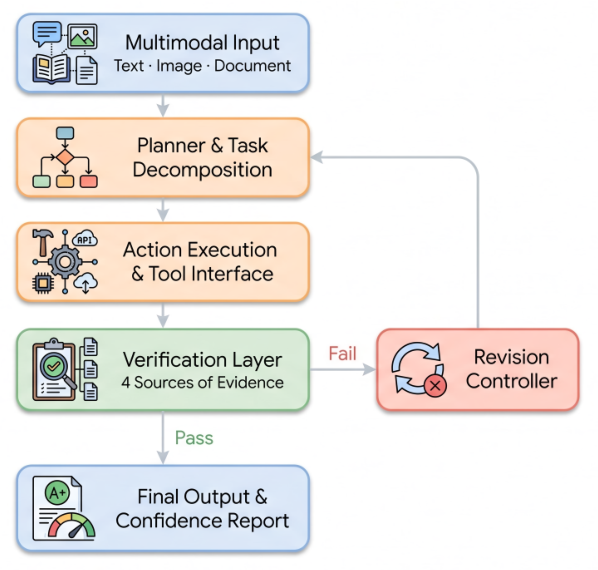
Figure 2.
Verification and revision workflow executed after each reasoning step. Evidence from four independent sources is aggregated before a step is accepted or routed to revision.
Figure 2.
Verification and revision workflow executed after each reasoning step. Evidence from four independent sources is aggregated before a step is accepted or routed to revision.
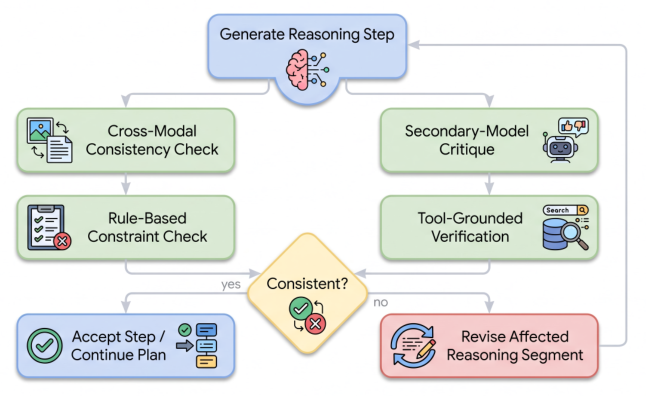
Figure 3.
Illustrative shape of expected accuracy gains from iterative revision. Curve shapes reflect qualitative expectations grounded in prior self-correction literature; illustrative numeric axis values are placeholders and must be replaced with measured results.
Figure 3.
Illustrative shape of expected accuracy gains from iterative revision. Curve shapes reflect qualitative expectations grounded in prior self-correction literature; illustrative numeric axis values are placeholders and must be replaced with measured results.
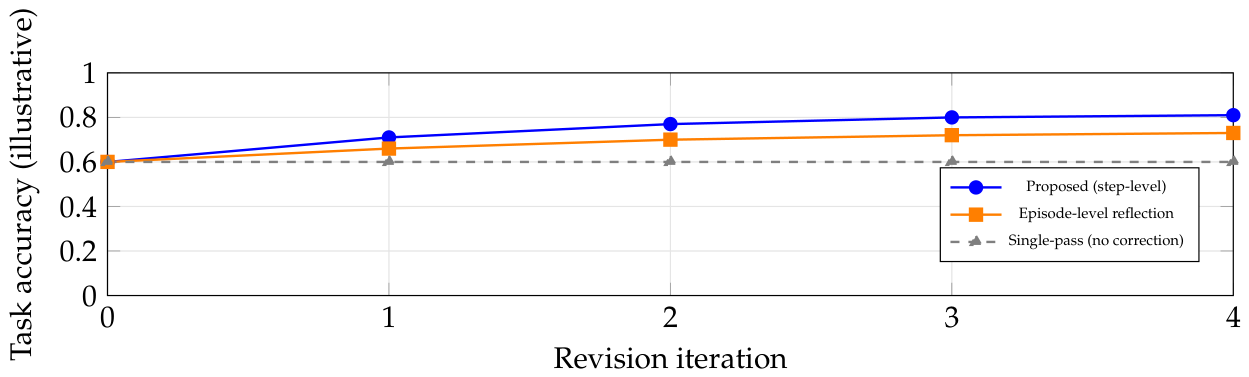
Figure 4.
Illustrative trade-off between the acceptance threshold and both factual consistency and inference overhead. As in Figure 3, values are placeholders illustrating the expected shape of the trade-off, not measured data.
Figure 4.
Illustrative trade-off between the acceptance threshold and both factual consistency and inference overhead. As in Figure 3, values are placeholders illustrating the expected shape of the trade-off, not measured data.
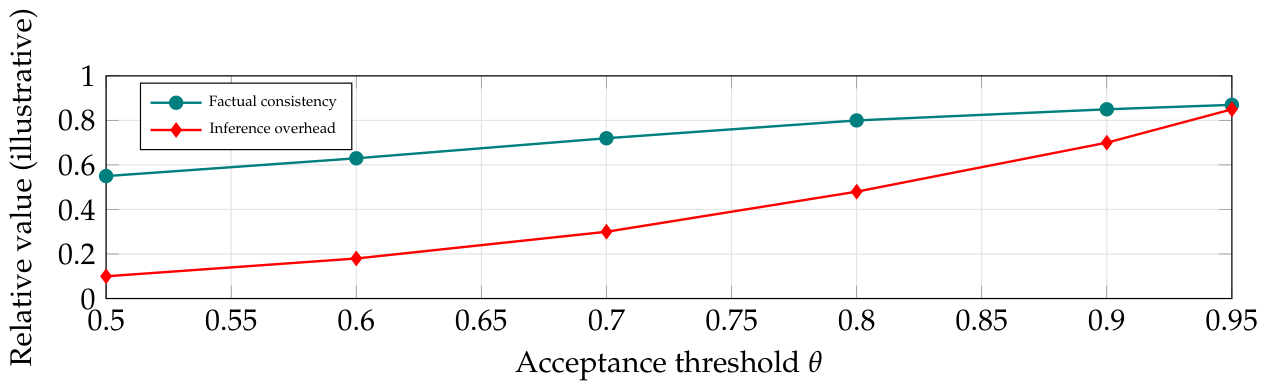

Table 1.
Implementation Parameters for the Proposed Framework.
| Parameter | Value / Range |
|---|---|
| Acceptance threshold | to be tuned in |
| Revision budget R | to be tuned in |
| Verification source weights | uniform or task-tuned |
| Divergence bound (Equation (2)) | task-dependent |
| Revision penalty (Equation (3)) | to be tuned in |
| Hardware | multi-GPU node (e.g., A100-class) |
| Decoding temperature (generation) | low, for determinism |
| Decoding temperature (critique) | moderate, for diverse critiques |
| Train/validation/test protocol | held-out test split per task |
Table 2.
Reporting Template for Task-Level Evaluation (values to be populated from experiments).
| Task | Acc. | F1 | Fact.-Cons. | Calls/Task | Latency |
|---|---|---|---|---|---|
| Multimodal reasoning | [ACC1] | [F1_1] | [FC1] | [CALLS1] | [LAT1] |
| Visual QA (POPE-style) | [ACC2] | [F1_2] | [FC2] | [CALLS2] | [LAT2] |
| Document understanding | [ACC3] | [F1_3] | [FC3] | [CALLS3] | [LAT3] |
| Tool-use reasoning | [ACC4] | [F1_4] | [FC4] | [CALLS4] | [LAT4] |
Table 3.
Ablation Reporting Template (values to be populated from experiments).
| Configuration | Fact.-Cons. | vs. full |
|---|---|---|
| Full framework (4 sources) | [FC_FULL] | — |
| w/o cross-modal check | [FC_A] | [D_A] |
| w/o secondary-model critique | [FC_B] | [D_B] |
| w/o rule-based checks | [FC_C] | [D_C] |
| w/o tool-grounded verification | [FC_D] | [D_D] |
Table 4.
Qualitative Comparison of Self-Correction Approaches.
| Approach | Granularity | External grounding | Cross-modal check | Bounded cost |
|---|---|---|---|---|
| Single-pass agent | — | No | No | Yes (fixed) |
| Reflexion [6] | Episode | Partial | No | No |
| Self-Refine [7] | Episode | No | No | No |
| CRITIC [8] | Episode | Yes (tools) | No | No |
| Proposed framework | Step | Yes (tools + rules) | Yes | Yes () |
Disclaimer/Publisher’s Note: The statements, opinions and data contained in all publications are solely those of the individual author(s) and contributor(s) and not of MDPI and/or the editor(s). MDPI and/or the editor(s) disclaim responsibility for any injury to people or property resulting from any ideas, methods, instructions or products referred to in the content. |
© 2026 by the authors. Licensee MDPI, Basel, Switzerland. This article is an open access article distributed under the terms and conditions of the Creative Commons Attribution (CC BY) license (http://creativecommons.org/licenses/by/4.0/).
Copyright: This open access article is published under a Creative Commons CC BY 4.0 license, which permit the free download, distribution, and reuse, provided that the author and preprint are cited in any reuse.