
Submitted:
15 September 2026
Posted:
16 September 2026
You are already at the latest version
Abstract
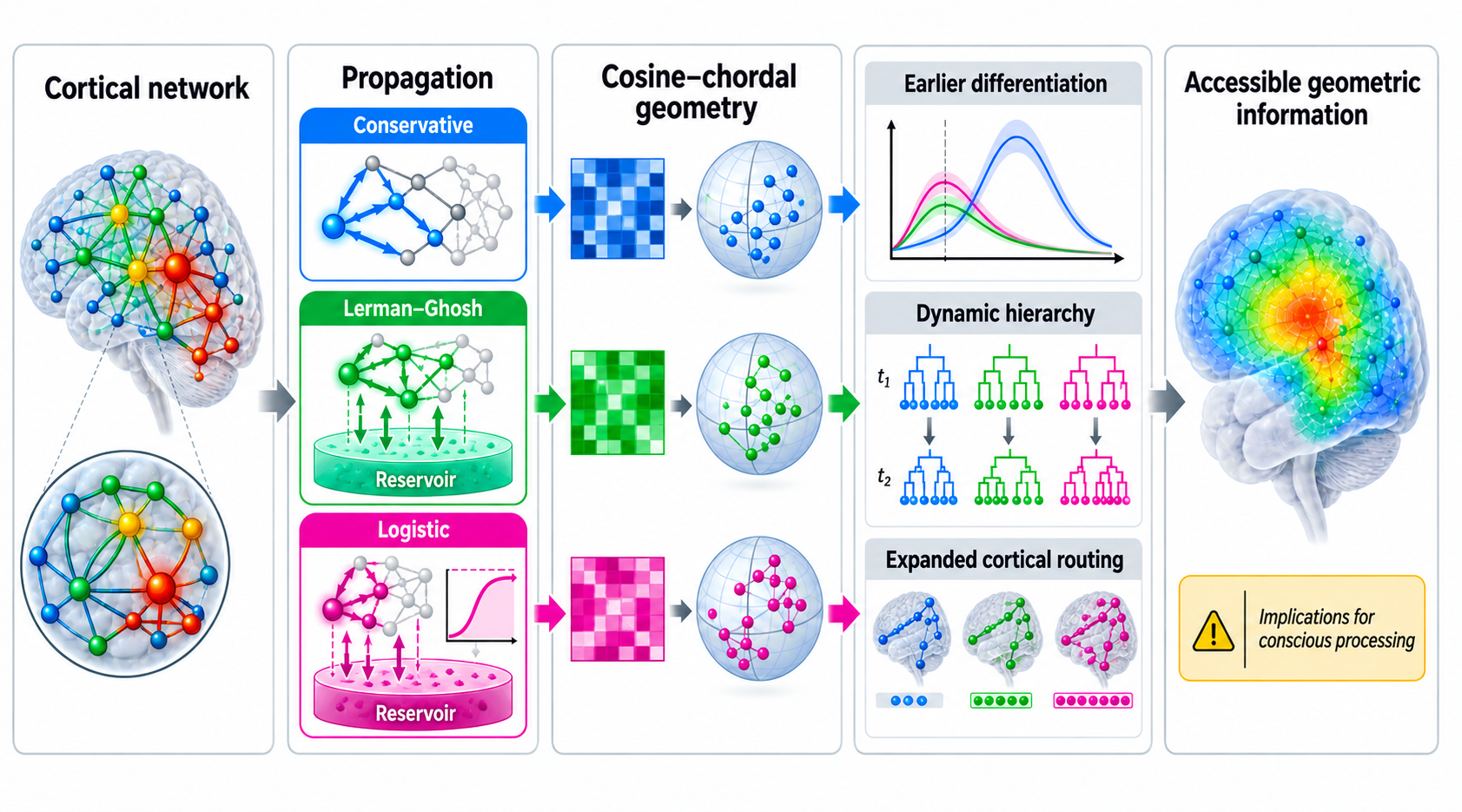
The Geometro-Diffusion Theory (GDT) proposes that neural propagation generates a relational geometry whose differentiation and intrinsic accessibility contribute to consciousness. Here, we extend GDT from conservative diffusion to open cortical systems in which the propagated quantity can be created, amplified, removed, or exchanged with a reservoir. We compare conservative diffusion with linear Lerman–Ghosh propagation and bounded nonlinear logistic propagation in cat, macaque, and human cortical networks. Because conventional Euclidean distances confound response geometry with the large amplitude changes produced by nonconservative dynamics, we introduce cosine–chordal indices that separate directional differentiation from amplification, activation, and recruitment. Nonconservative propagation does not universally maximize geometric differentiation: conservative diffusion produces larger and more persistent differentiation in the cat and macaque networks, whereas logistic propagation provides substantially greater differentiation before a finite processing deadline in the human network. Nevertheless, the nonconservative maximum consistently emerges earlier. Community analyses show that nonconservative dynamics generate locally coherent but more strongly reconfiguring cortical hierarchies. They also diversify visual-to-prefrontal communication routes, increasing the repertoire of intermediate cortical regions while tending to recruit vertices of lower anatomical degree. Finally, we show that the Lerman–Ghosh solution is a uniformly rescaled communicability kernel and that the approximate logistic response is a bounded nonlinear transformation of communicability. These results suggest that coupling to a reservoir may benefit conscious information processing not by maximizing a single differentiation index, but by accelerating geometric access and expanding the repertoire of transient cortical organizations and communication routes available to the mechanisms postulated by GDT.
Keywords:
geometro-diffusion theory
; consciousness
; nonconservative diffusion
; network communicability
; cortical networks
; geometric differentiation
Copyright: This open access article is published under a Creative Commons CC BY 4.0 license, which permit the free download, distribution, and reuse, provided that the author and preprint are cited in any reuse.