
Submitted:
15 September 2026
Posted:
16 September 2026
You are already at the latest version
Abstract
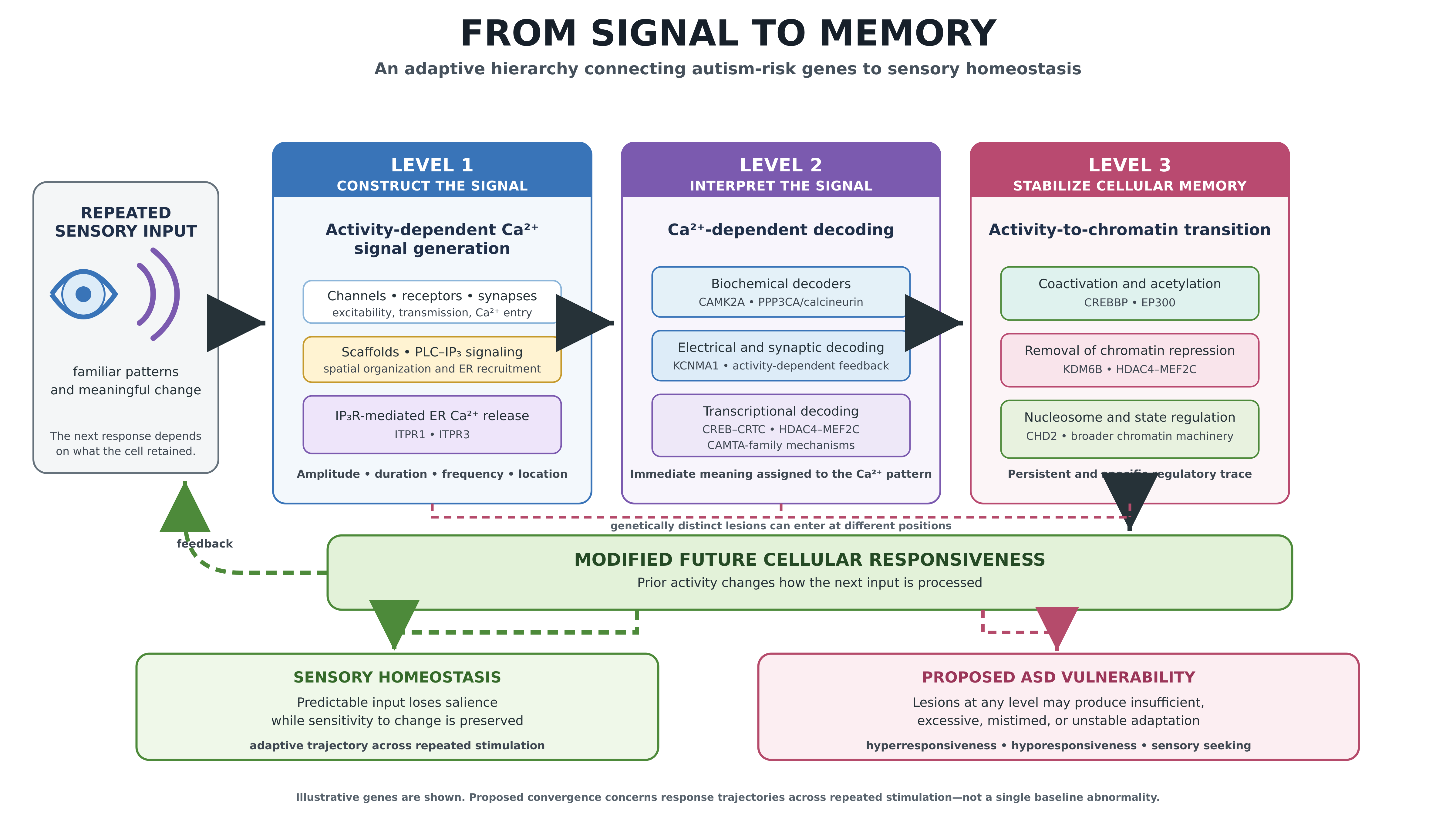
Every nervous system must preserve sensitivity to change while reducing responses to constancy. We define this adaptive objective as sensory homeostasis: familiar information recedes while unexpected or biologically important events remain salient. Its disruption is particularly relevant to autism spectrum disorder (ASD), in which sensory abnormalities occur across multiple modalities. Large-scale sequencing studies have identified hundreds of ASD-risk genes spanning neuronal excitability, synaptic function, intracellular signaling, transcription, and chromatin regulation. Here, we ask whether the established functions of independently identified ASD-associated genes reconstruct a directional pathway through which genetic vulnerability to ASD could compromise sensory homeostasis. Beginning with a prespecified Autism Sequencing Consortium–derived set of 185 ASD-associated genes, and separately classifying complementary genetic and mechanistic evidence, we organize a bounded subset of genes into three functional levels: generation and spatial organization of intracellular Ca²⁺ signals; interpretation of those signals by electrical, biochemical, synaptic, and transcriptional decoders; and stabilization of selected responses through transcriptional and chromatin-regulatory mechanisms that establish cellular memory.
Keywords:
autism spectrum disorder
; sensory processing
; sensory homeostasis
; intracellular calcium signaling
; inositol 1
; 4
; 5-trisphosphate receptor
; activity-dependent transcription
; chromatin regulation
; cellular adaptation
Copyright: This open access article is published under a Creative Commons CC BY 4.0 license, which permit the free download, distribution, and reuse, provided that the author and preprint are cited in any reuse.