
Submitted:
15 September 2026
Posted:
16 September 2026
You are already at the latest version
Abstract
The purpose of this study was to explore the relationship between knitting and STEM, and its direct impact on women's desires and abilities to enter STEM fields. While prior literature demonstrates a connection between textile crafts and mathematical logic, alongside separate motivations for participating in fiber arts and STEM, a significant gap remains regarding how these two domains correlate and mutually influence one another. Data was collected through a qualitative, phenomenological research framework. Research participants included feminine-presenting individuals actively involved in both local fiber arts communities and STEM-based academia, paired with a formal structural analysis of a specific knitting pattern. Initial results revealed a strong conceptual and community-based connection between knitting and STEM, demonstrating that this intersection actively encourages women's desires and perceived self-efficacy to pursue technical pathways. Consequently, increasing participation in fiber arts could positively shift demographics in technical disciplines. However, these findings are geographically limited to the Global West—specifically the US and UK—reflecting a homogenous socioeconomic and ethnic participant base. Further longitudinal research is required to evaluate the long-term effects of these findings on demographic shifts within both STEM and fiber arts spaces over time.
Keywords:
knitting
; women in STEM
Introduction
The general perception of a knitter is a grandmother who knits scratchy sweaters, but knitting is so much more, as are the people who participate in the activity (Stannard & Sanders, 2012, p. 14). When one thinks of a scientist, the likely image is that of a middle-aged white man. Both of these stereotypes are untrue. Knitting and other domestic tasks have been a part of the downplaying of women’s work over time (Standard & Sanders, 2012, p. 11). When examining the relationship of fiber arts and STEM, the history of knitting and femininity in Science, Technology, Engineering, and Math (STEM) are vital to the understanding of science and knitting alike (Jones, 2022, p. 9).
STEM has been a largely male-dominated field, and inversely, knitting a female dominated field. In recent years, many have begun researching how to push more women1 and girls into STEM. The general conclusion of previously conducted research is that fiber arts should have some effect upon women’s trajectory into STEM (Peters & Lucietto, 2024, p. 6) and knitting 2 provides an accessible entry point for women into STEM (Standard & Sanders, 2012, p. 16).
Literature Review
History of Knitting [ and Politics ]
Though in modern day, knitting is seen as an activity of the past, it has been used for many purposes throughout history and modern day alike. Knitting has been proven to date back as far as the 11th Century CE, however it almost certainly dates further back 3. Further, knitting has been used for much more than simple [ or even complex ] fabric creation. One key usage of knitting in a historical context is the use of it in warfare and spycraft. In both world wars, knitting was used by both sides to encode information, similarly to the process of encoding information on a computer. Knits, purls, dropped stitches, or yarn overs [ types of knitting stitches ] all had their own meaning. In “A New Arena of War” by Lia Fairbairn, she states that “Militarized language was an obvious way for the government to uplift ‘women’s work’ and encourage women to maintain their priorities around domestic feminity… The position of housewife held patriotic value due to its association with taking care of the home” (Fairbairn, 2023 p. 46). The positive association of knitting and patriotism was used to make women more inclined to knit, and feel as though their participation was valuable to the war effort as a whole.
Women and Femininity in STEM
One vital part in understanding why women are pushed out of STEM is looking at femininity in STEM.4 For the most part, femininity is rejected within STEM. Women leave STEM fields at a rapid rate in comparison to their male colleagues, with up to 12.9% leaving within the first 10 years after completion of their highest degree ( Hunt, 2016, p. 11).5 In recent years, women leaving science and engineering is often because of societal pushback, discrimination, or other demeaning actions (O’Connor et al., 2018, p. 318 ). Perhaps a bigger reason that has an impact on women leaving STEM is the wage gap. In 2014, the mean hourly wage for men in STEM fields was $41.57, whereas women in the same field made a mean of $34.78 (Michelmore & Sassler, 2016, p. 212 )6. This gap was even higher for mothers7 . It is seen as unfeminine to be a scientist, and therefore one cannot be both feminine, or rather a “girly girl”, in STEM because of likely pushback from colleagues. Paige Brown Jarreau in her blog “From the Lab Bench”. writes “Unfortunately, being ‘girly’ or feminine is stereotypically perceived as running counter to or not being attainable in conjunction with success in STEM fields “ ( Jarreau, 2018, p. 2 ). Women in STEM face pushback and feminine-presenting women face even higher pushback. Women who fall into type two or four femininity 8 ( family oriented ) are more likely to face discrimination in STEM fields because of their desire to have a family (O’Connor et.al., 2018, p. 322). This has been briefly researched, but greater research into this field and how to remedy this problem should be conducted.
Knitting’s Connection to STEM
In order to recognize how knitting can push women and girls into STEM, a prior understanding of how knitting is inherently related to STEM is vital. For example, DeepKnit at MIT demonstrates the connection between these two disciplines. In their paper, they use knit patterns and turn them into code, and then a machine in turn creates new knit patterns. In the conclusion of their research they state, “The generated patterns indicate that knitting code can in fact be represented by sequences of instructions, without sacrificing two-dimensional context and alignment. As a result, the application of known text-generation techniques to knitting code is a promising research direction” (Scheidt et al., 2020, p. 5). Therefore, it is demonstrated that knitting and STEM—specifically computer science and math—are related 9. By representing data storage processes, knitting and other textile arts can serve in a similar way that computers do when documenting ideas, information, and culture, through stitches, pattern texture, or other means of communication. Historically, this connection has been noticed and used as well: “... Punch cards 10 were originally developed as a means to program intricate weaving patterns and were employed by Jacques Marie Jacquard in his invention of the first automated weaving machine, the Jacquard loom” (Kirtz, 2025, p. 64). Similarly, Megan Chong states in Stitches and STEM, “These textiles act as a physical representation of abstract knowledge....” (Chong, 2024, p. 24). Abstract knowledge includes social and scientific ideas, along with the creation of said ideas. Overall, the use of knitting as data storage has been used throughout history to create new technologies and influence modern science and engineering. This is a key statement when understanding the historical context of both women in STEM, and knitting’s relationship to STEM.
How Knitting can Push Women into STEM
After connecting knitting and STEM, the next task is to understand how knitting can effectively be used to gently encourage women into STEM. Knitting allows a more societally acceptable transition into STEM by connecting women to math and science through a traditionally feminine domestic household task. This is a large topic of interest for many, specifically on the internet. In her TikTok video from March 19th, 2025 mass1ekur🧶 knits describes the connections that occur between knitting and computer science: specifically how one can lead to another. She explains the similarities and how knitting led the way to the development of computer science.
Much of the prior research has been focused on how this connection has affected women going into Science and Engineering, rather than Technology and Math. A magazine article from UMass Lowell helps to fill in the gaps [ on why women go into Science, rather than math ] regarding Math. She states, “ Melissa Gresalfi says that textile arts like knitting can teach rich mathematical ideas that can be difficult for students to understand…part of a larger exploratory study into the overlap between…problem solving and textile arts “ (Korbey, 2017, p.6).11 Harrison and Ogden found in their research that knitting is often seen as not worthy of academic research. They found that there is a pushback against female academics who knit and bring it up in academic spaces.
“ [ Parker (1996) ] found that when women’s needlework ‘ is carried across the borders into masculine territory’, it is considered to be ‘out of place’ (p. 215). We experienced … the validity of Parker’s (1996) observation that a female needleworker ‘can become a sociologist but does not bring her work out in staffroom, boardroom or pub’ without risk.] “ (Harrison & Ogden, 2020, p. 4)
Women are often unwilling to participate in seemingly feminine or domestic activities within academic spaces due to fear of pushback. However, women who were shown acceptance when demonstrating their artwork were more open to continuing their work with STEM due to a better relationship with their coworkers and peers. In Gender Differences in Problem Solving Strategies in Engineering & Computer Science … “ One major finding was that females tend to try different strategies when solving a difficult problem much more frequently than males.” (Agarwal et al., 2024, p. 7 ) This might be attributed to the fact that women are typically involved in hobbies that require more problem solving techniques, like knitting, crochet, and baking. These hobbies have made a positive impact on women who are already in STEM fields.
Research Gap
There is a significant lack of research discussing how knitting can push women into STEM. Much of the research that does exist is lacking in specificity of a past approach ( looking into how it worked in the past ) to how knitting has impacted women going into STEM. This led to the question What is the relationship between knitting and STEM, and how does that impact feminine presenting people going into and ability to stay in STEM within current professional and postsecondary college students and researchers in the global west? This question aims to look into the reasons why women went into STEM, and how knitting and STEM are related within a modern context of the United States and global west. The hypothesis of this research question is that knitting and STEM are connected, and knitting impacts why and how women go into STEM, with a positive correlation.
This is supported by Peters & Lucietto who discuss how further research could be done. “The connections between other forms of crafts and specific skills should be investigated, both by analyzing the content of those crafts and by studies of students and practicing stem professionals skills and hobbies” (Peters & Lucietto, 2024, p. 6). This will be where my research is focused: how does knitting impact women in STEM?
Methods
Overarching Design
I used qualitative research in conjunction with phenomenological research. My research design had three sections; the first part was to knit physical knitting patterns. This was the baseline to establish the connection between knitting and STEM, and will make it more simple to answer my research question, this section is phenomenological. Both the second and third parts of my research were qualitative. The second part is the creation and application of a survey, and the third part is the interview of this preconceived group of people. I interpreted the data from the survey, and used these results as primary data, and the transcribed interviews as secondary data.
My research method is similar to Diane Peters and Anne Luciettos. In Traditionally Feminine Hobbies and Engineering Aptitudes, they state “ To begin with, the connection between other forms of crafts and specific skills should be investigated, both by analyzing the content of those crafts and by studies of students’ and practicing STEM professionals’ skills and hobbies.” (Peters & Lucietto, 2024, p. 12). In their further research section, they describe similar research projects that could be done, where they used similar interviews to determine how women were apt to participate in STEM and math based sciences, similar to my methodology.
Ethics
The informed consent letter for both the interviews and surveys and more detailed explanation of the ethics can be found in appendices J, K, and L respectively. This study went through an Independent review board that approved the methods that were used to conduct my research. The form that was submitted to the IRB is in appendix L.
Procedures—
In order to conduct the research, there needs to be a replicable procedure. This procedure is listed below.
To determine the connection between knitting and STEM, patterns must be knit. These steps describe how to conduct this section of the research. Begin by selecting your yarn. I used a combination of DROPS yarn that held the same gauge on 4 mm needles. ( 18 stitches by 28 rows in stockinette stitch.) Then, complete your gauge swatch. Cast on eight extra stitches, and knit 4 rows of garter stitch. Then complete the following pattern :
Row 1—5—Knit all. Turn work
Row 6 - Knit 4, purl to last 4 sts, knit 4. Turn work.
Row 7—Knit all. Turn work
Repeat rows 6 and 7 until you have knit four inches of stockinette stitch from the cast on edge.
Rows 8—11—Knit all. Turn work.
Row 12—Cast of using Judy’s surprisingly stretchy bind off.
Finishing—Wash, block, and weave in the end.
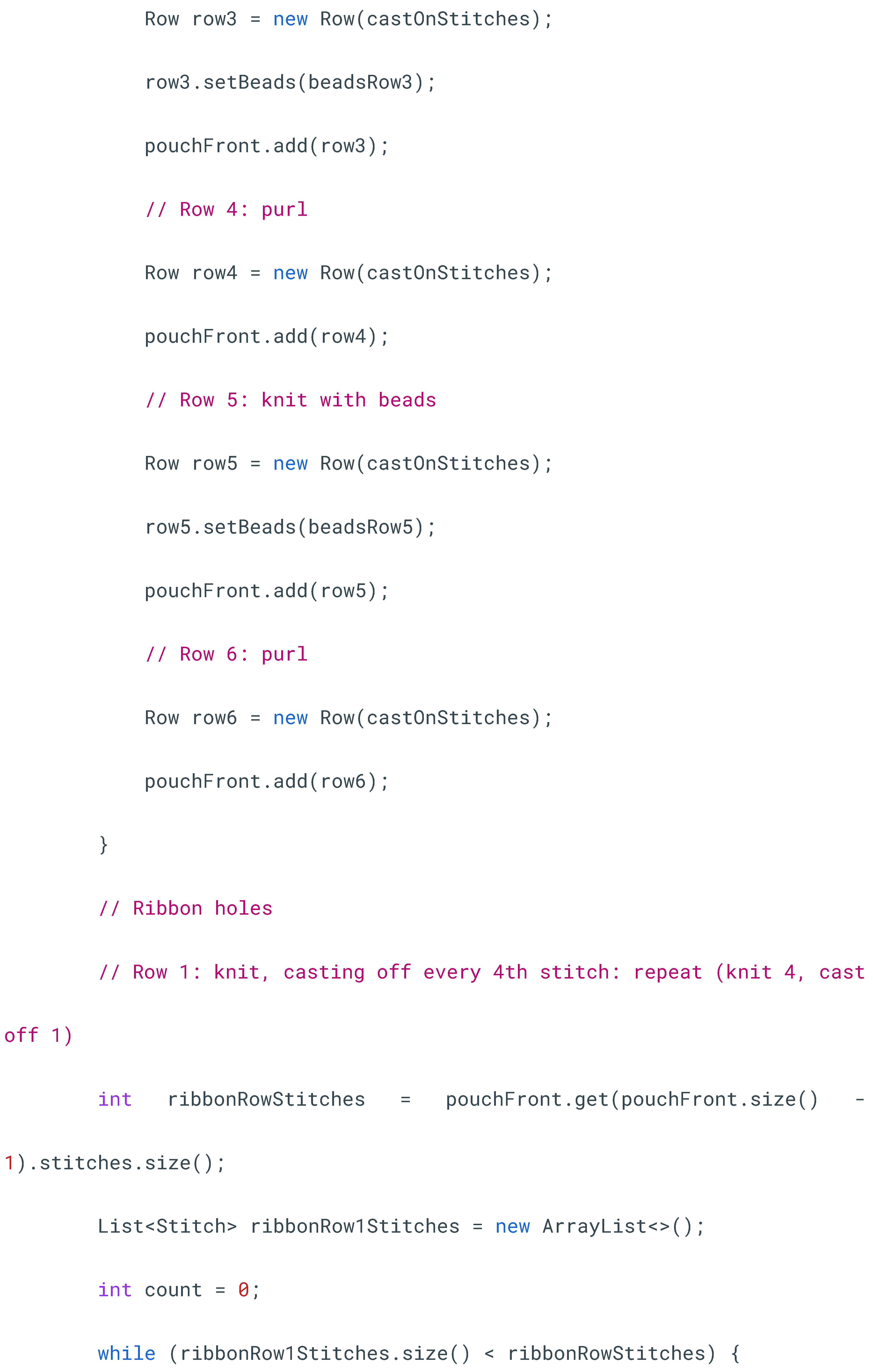
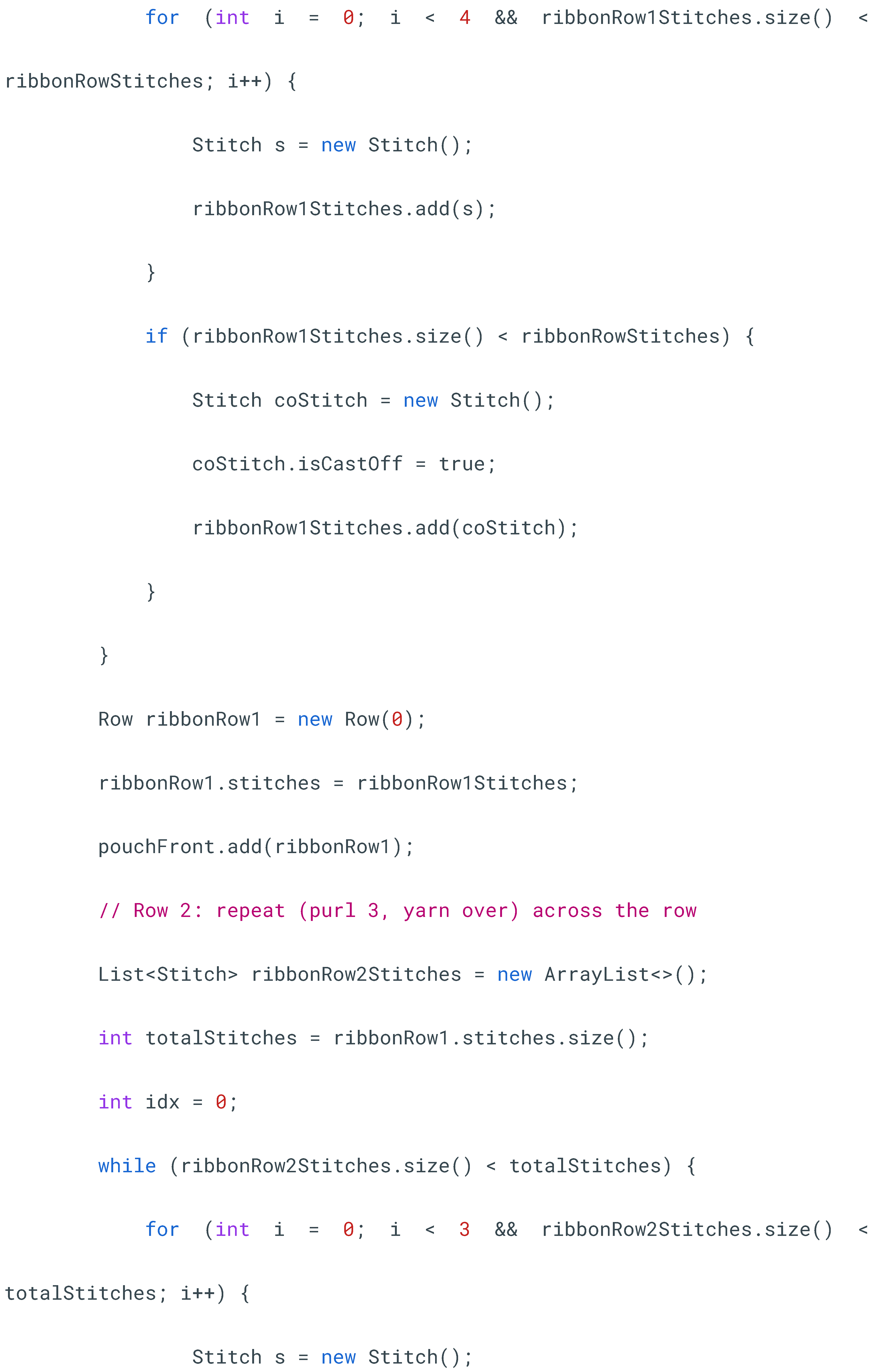
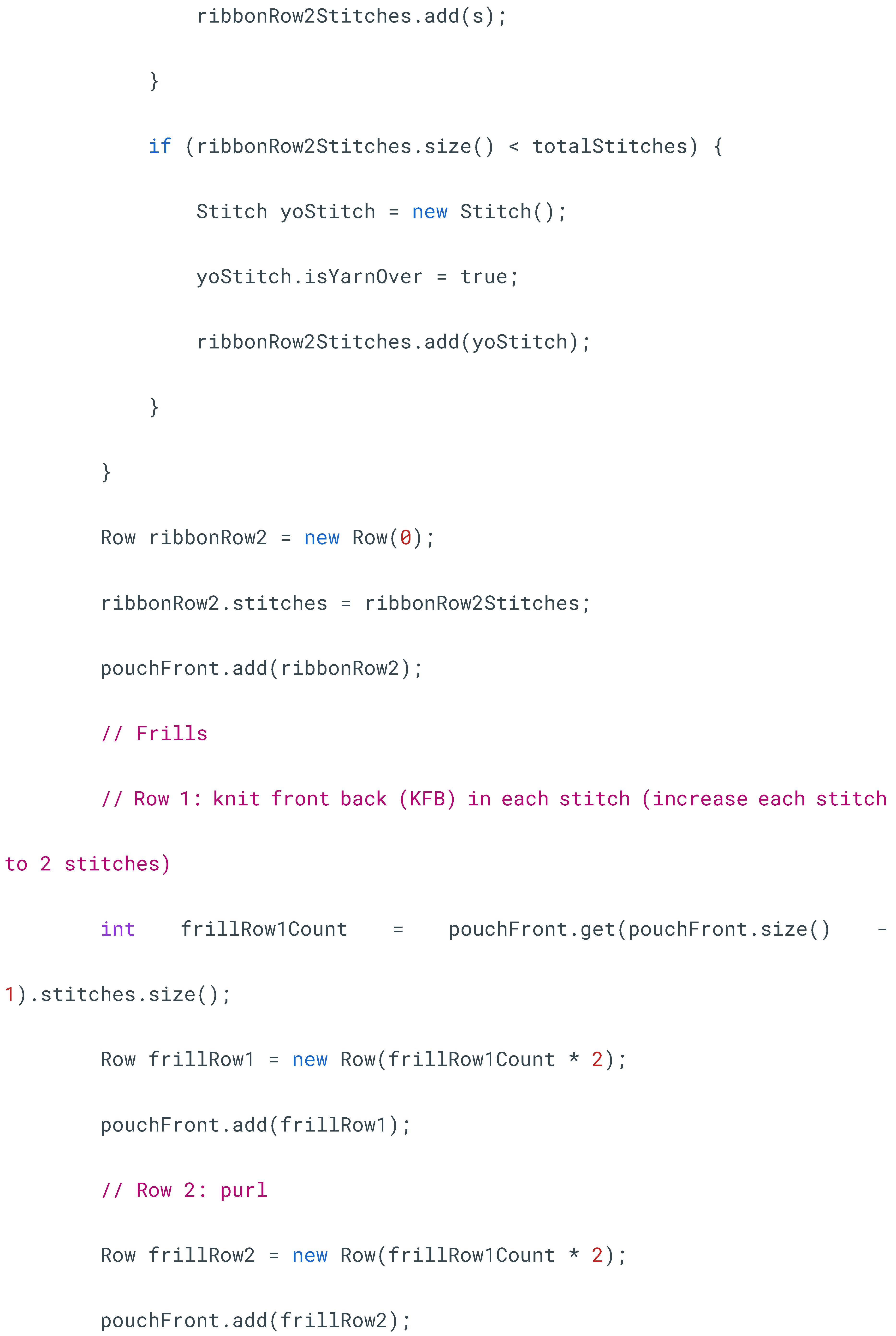
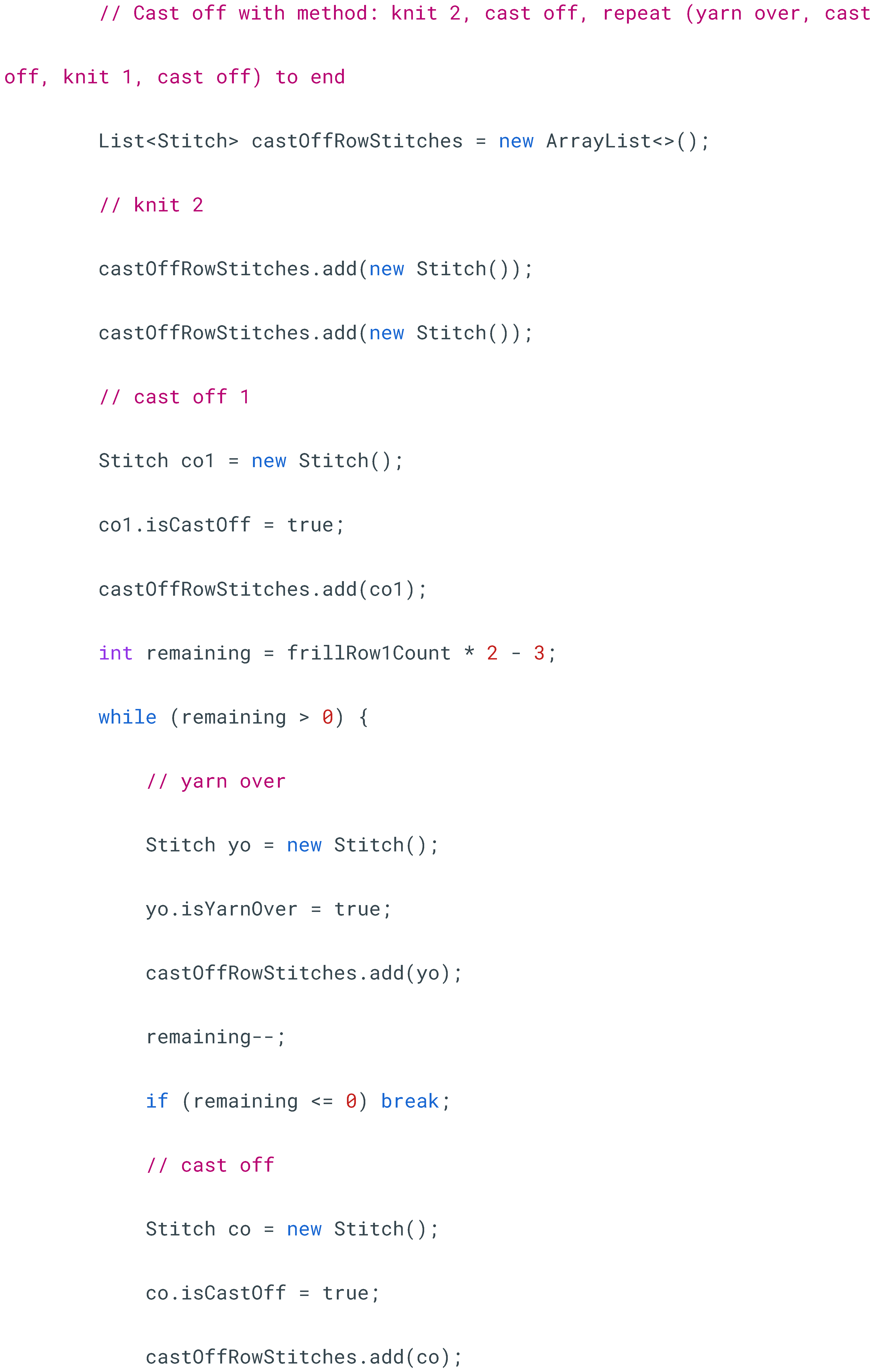
Use the pattern listed in Appendix B or, any pattern that meets gauge. I used the Polly Pocket Pouch including the beads by Material Grrrlz. I chose this pattern due to ease of creation, and past projects of this pattern being readily accessible. Use the coding method as described in Appendix C ( use online text to JAVA converter) , and the decoding method described in Appendix D. Knit all three of these patterns. Compare the final products and note differences. Using these noted differences, create knitting charts, based on the outcome. Using similar patterns and coding methods as described in the Appendix, will allow for reliable and replicable research. By comparing the final outcomes, and creating a visual, results will be easily comparable. Supporting this is the statement “ Our work introduced metrics for knittability, a necessary condition for a pattern to be useful at all, and uniqueness, describing the diversity of the output. The parameters of our model result in a tradeoff between those two quantities, which future models could try to decouple.” ( Scheidt et al., 2020, p. 9 ) This only should apply if the DeepKnit at MIT used similar decoding methods, where they coded the patterns and then decoded them. However they used machine knitting, whereas I hand knit the objects.
The next step was to reach out to participants to interview. I used potential participants’ social media handles to find email addresses to reach out to. They should meet the following criteria—Have at least 5 thousand followers on TikTok and / or Instagram and / or YouTube, have at least 25% of their posts be about knitting or other fiber arts, have a bachelor’s degree or higher in a STEM Field, and live within the criteria of the research one is conducting. They should approve of the informed consent form. There should be 5-10 potential participants reached out to, and then 5 intended final interviewees. The 25% of posts was interpreted from prior research of those who conducted studies with similar methods. Conduct the research with these interviewees using the questions listed in Appendix E.
Then conduct a survey, with questions listed in Appendix F. Get a sample size of at least 150 people who answered the survey. To get survey participants, I put my survey in the following places : Ravelry (knitting and crochet website) survey forums, local yarn stores (as posters) , local libraries (as posters), Reddit knitting and STEM related forums, online crafting related groups chats. Use similar websites or in person locations to get similar results. All must sign off on the informed consent form. Get a sample size of at least 97 individuals who answer and reach the end of the survey. To get individuals to answer the survey, have the five final interviews post the survey on their social media pages. In order to adequately gain participation for the survey, the people who I am requesting to reach out to on social media, will need to have a following that meet the requirements that I need for the survey. Conduct the survey research through local fiber arts and STEM spaces. The interview should be used as simply a backup section to provide direct quotes. Final results should disagree or match the hypothesis, simply because those are the only two options.
Find the percentage of people who said that knitting influenced them to go into a STEM field, and the consensus of how knitting influenced them to go into STEM. Then analyze the results, and analyze the final results. The final results should be in support or disagreement with the hypothesis. This is the answer to your research question.
Participants
The participants for the interviews should meet the criteria as described above. They should meet the following criteria—have at least 5 thousand followers on TikTok and / or Instagram, have at least 25% of their posts be about knitting or other fiber arts, have a bachelor’s degree or higher in a STEM Field, and live within the criteria of the research one is conducting. They should approve of the informed consent form. There is no criteria for the survey participants. Following the consent form, they should complete the rest of the survey. The participants should read and consent fully to the informed consent form. These requirements will make it so that they are knowledgeable in this topic. Further, by making sure that the participants meet the requirements, it will narrow down the population to a reasonable size.
Findings
The findings of this paper are largely represented by charts and quotes from participants.
Survey
There is quantitative and qualitative data represented in the findings of the survey. The quantitative results are represented in charts, as seen below and the qualitative results in quotes.
Quantitative
The following charts contain the most important data collected from the survey. All charts can be found in appendix H. Because there are no independent or dependent variables, the results are simply placed as tables.
Question 9.) Would you say that your participation in fiber arts influenced your desire to participate in STEM or other forms of academia? If yes, please elaborate here.
| Yes | No | Not Applicable | Total | |
| Number of Respondents | 31 | 60 | 2 | 93 |
| Percent | 33.3333 | 64.5161 | 2.1505 | 100 |
Question 10.) Would you say that your participation in fiber arts influenced your ability to participate in STEM or other forms of academia? ( Being used as a coping mechanism, similar problem solving skills, staying focused etc. ) If yes, please elaborate here.
| Yes | No | Total | |
| Number of Respondents | 47 | 17 | 64 |
| Percent | 73.4375 | 26.5625 | 100 |
Question 11.) Would you say that your participation in STEM and other forms of Academia influenced your desire to participate in fiber arts? If yes please elaborate here.
| Yes | No | Total | |
| Number of Respondents | 28 | 19 | 47 |
| Percent | 59.5744 | 40.4266 | 100 |
Question 12.) Would you say that your participation in STEM influenced your ability or to participate in fiber arts? (Being used as a coping mechanism, similar problem solving skills, staying focused etc). If yes, please elaborate here.
| Yes | No | Total | |
| Number of Respondents | 24 | 5 | 29 |
| Percent | 82.7586 | 17.2414 | 100 |
These results describe the relationship of knitting and STEM, describing how people thought about their desires in STEM / academia and fiber arts.
Qualitative
Additionally some key responses were as follows. In response to the following questions : nine, ten, eleven, and twelve. All responses can be found in appendix I. Participants stated the following ( top most impactful data point )
Question 9 -
Absolutely. My preferred fiber art is crocheting. I learned everything (crocheting, knitting, sewing, embroidery) from my grandma as a child. When learning mathematics (including algebra, geometry, mathematical analysis) in school I would visualise functions through crochet. Now when I freehand a project I think about each crochet as a geometrical progression with different parameters, so I don’t have to count each stitch. I participated in some mathematical crochet projects, the last one is “Granny life” that would be on display in Paris in Poincare museum this spring.
Question 10 -
1. ) Yes, absolutely! During my doctoral research, having an activity where planning and effort directly lead to a positive result was an important coping mechanism, since it is so common for experiments to fail or yield negative results. While there are certainly some overlaps in project planning and problem solving, I currently find fiber arts valuable because they require *different* thought processes than my career.
Question 11 -
It was something tactile and real instead of abstract and on a screen. It was art for arts sake instead of something with a correct answer that I may struggle to find. There is a value in making something pretty, which is so devalued in men-majority, technical fields.
Question 12 -
Yes. I have ADHD, and having something to do with my hands during classes and seminars has been huge for my ability to focus. I’ve tried lots of coping mechanisms, but knitting and crocheting is what has stuck. Additionally, I spend most of my days thinking really hard in a lab, and having something to do (knitting) that someone else has already designed where all I have to do is follow a pattern is really relaxing.
Though all of these results are in support of my hypothesis, I did get some that were in conflict with my hypothesis. Those can be found in the appendices. I chose not to discuss the ones that were not in support of my hypothesis, because most of the responses that fell into this category were too limited to make conclusions from them alone. The majority of the respondents decided that they were more able or had more desire to participate in STEM, after participating in fiber arts. These results discuss how their participation in fiber arts influenced their desire or ability to participate in STEM.
Interviews
My findings from the interviews largely supported the results from my survey. The transcripts of the interviews can be found by contacting the researcher directly. The overwhelming conclusion is that fiber arts impacted either their desire or ability to participate in STEM. Both participants discussed how their view of fiber arts impacted both their desire and ability, and how it was used as a coping mechanism throughout the rigors of graduate and post graduate school. Their responses support the results of the survey. The consensus of the two participants was in agreement with my hypothesis.
Knit patterns
The creation of the knit patterns had the results expected. See figures below for images and charts.
The results largely agree with prior research—specifically DeepKNIT at MIT’s results. The original chart can be found at Figure 1. Figure 1 shows a knitting chart—a chart designed to demonstrate the pattern without using language—that was created based on the original pattern. Figure 2 shows a knitting chart based on the coded pattern. The description was created based upon the input of the JAVA code. It is the same in every aspect, except for the code does not distinguish between knit and purl stitches, likely because they are the inverse of each other, and when knitting in the round, all stitches are knit to create the sam—e. When knitting in the round, to create stockinette stitch, all stitches are knit rather than knit and purling on opposite rows to create stockinette stitch. Figure 3 shows the knitting chart based upon the output of the java code. It is almost identical to Figure 2, with the only difference in how the increases at the end are read. In Figure 1 and Figure 2, the increases were kfb ( knit two stitches in the same stitch ), and in Figure 3, the increases were described as a M1 ( make one stitch, working into the bar between stitches to make another). But overall the similarity of the two demonstrates the connection between knitting and STEM—specifically through the transfer of principles of knitting and computer science ( code ). These patterns look to understand the connection, and how well concepts from one field transfer to the other. The understanding is that because the resulting charts look and act similar, there is an inherent connection between the two disciplines.
These charts aim to show the difference between each step of the process and demonstrate these differences visually rather than using a typed out version of the patterns
Data Analysis
Surveys
The surveys yielded the results that were expected. In order to reach the end of the survey and answer all questions, the participants must be feminine presenting, participate in fiber arts (of any kind ), and be involved in either STEM ( as a student, academic, or as a career ), or be a STEM teacher or educator in another way. The majority of participants answered with a positive association for question nine - “Would you say that your participation in fiber arts influenced your desire to participate in STEM or other forms of academia? If yes, please elaborate her—- and it can be concluded from the results to this question that a large number of women and feminine presenting people that participate in both STEM and fiber arts believe that the latter impacted their decision and / or ability to participate within STEM and academia ( 33.3 percent and 73.5 percent respectively). Though the former is not a significantly high percentage, it still is a statistically significant amount. If the minimum of 38.5 million women who knit nationally within the United States could be encouraged to go into STEM through fiber arts, then a minimum of 12.705 million might join the field of STEM academics and workforce.
Further, participants were asked if their desire to participate in fiber art or ability to participate was influenced by their participation in STEM, and the overwhelming majority answered positively. ( 59.5744 percent and 82.7586 percent respectively). The skills learned in STEM and those learned in fiber arts are similar, and transferable - the skills learned in one field can be used in the other field. For the results of the surveys, it was found that whether one participated in fiber arts or STEM first was inconsequential. The majority of participants believed that their participation in one, influenced their decision, desire, or ability to participate in the other activity. This means that fiber arts can push women onto STEM and vice versa.
Interviews
Due to the fact that I only interviewed two people, the results are less substantial than expected. However, despite the setbacks, the results from the survey largely support the results from the surveys. Both participants stated that knitting ( and fiber arts as a whole) allowed them to better understand the processes of STEM, and learn how they could become better scientists and academics. In general, because of the depths of these two interviews it can be assumed that the majority of people that were interviewed believe relatively similar things about how fiber arts impacted their ability and or desire to participate in stem or vice versa. The general consensus remains the same from the surveys conducted and was simply supported by the interviews. One of the most profound ideas came from Meredith Wilmot, one of the people that was interviewed, who stated that knitting allowed her to better understand the scientific method, and comprehend how she could use the skills to learn through fiber arts within her academic field of entomology (the study of bugs).
Knit patterns
As stated previously in the method section it was important to understand the connection between knitting and STEM and how ideas can be transferred from one to the other before the interview and survey method process began. The knit patterns were summarized into the charts see figures one two and three. The code that I used did not differentiate between right side (front) and wrong ( back ) side rows making the charts also not differentiate between these row types. The charts do not distinguish between knit stitches and purl stitches. however the other differences are quite small through the knitting charts. One of the main differences is how the increases were coded into the code. Most of the new understanding of my research comes from these charts. The majority of prior research did not discuss knitting’s relationship with knit charts, simply how the skills could be transferred and these charts and coded and decoded patterns represent about half of the new understanding that came from my research.
New Understanding
As stated previously about half of the new understanding came from the charts and coded and decoded patterns whereas the other half of the new understanding came from the surveys. The new understanding is in general consensus with my hypothesis that Fiber Arts are connected to stem and the skills that one learns in participation in one can be transferred to the other. The skills learned through knitting and fiber arts are transferable to skills needed to succeed in STEM fields. This has an impact on women going into STEM because they feel more confident in their ability to use the skills needed in an academic field. Further, the two fields are connected and the ideas used in one are communicable. The coding connection shows knitting is not just similar to math; rather, it is math. It is not just the soft skills gained from knitting and other Fiber Arts (like patience and ability to time things out), but rather also the hard skills (data visualization and algorithmic thinking) that impact women’s ability and desire to participate based on previous Fiber Arts knowledge and participation.
Conclusion
Overall, the results of this study state - both implicitly and explicitly - that the majority of women and feminine presenting people are able to gain skills and other encouragement to go into STEM fields. They also solidify the connection that the two disciplines share, despite their obvious differences. The results subsequently answer the question what is the relationship between fiber arts and STEM, and how does that impact women and feminine presenting people going into and their ability to participate and stay in STEM within current professional and postsecondary college students and researchers - academics - in the global west?, with a positive association. Knitting and other fiber arts are related to STEM, and they have an impact on women’s desire and ability to go into and stay in STEM. Meaning that the women and feminine presenting people can be encouraged into STEM fields, by providing a more accessible and socially acceptable route into the fields. The implications of this apply to educators, students, and academics who wish to encourage more women to go into STEM and related fields. This does not, however, mean that people should be pushed into fields which they do not wish to go into, but rather those who show aptness and potential interest in these fields should be encouraged to look into those academic spaces.
Further Research Directions
Further research projects of a similar or larger scale should be conducted. This could be to support my claim, or to research a similar question. Further research should look at whether or not the correlation I found applies mostly to those online, as almost the entirety of my participants were found from online sources like Reddit and Ravelry. Potential future researchers should also look into changing the recruitment methods from online surveys, to potential door to door or a similar style of collection for data coming from survey participants. Additionally, future studies should look into if the connection of knitting and other fiber arts affect men in a similar way that it affects women. Studies should be conducted in a similar fashion if a similar style of results is desired by the researcher(s). Another potential route for a study or research project would be to look at this topic over time. So, looking at women who knit in their childhood, adolescence, and/or young adulthood, and tracking their college and career desires and decisions. This is likely the most beneficial of the examples given, as it could see a direct correlation as it is happening, rather than having people look back, retrospectively.
Limitations
Due to the nature of this project, the lack of professional supplies and timing, there were many limitations. Some of these were due to a great deal of time constraints to conduct the research, and others were due to a lack of professional materials. Some of these materials that would have helped include: professional coding machines, knitting machines, and a Jacquard loom [ a weaving machine]. Human error in responses to the interview questions, survey responses, and / or mistakes in the hand knitting process.
Because this project was completed not at a professional level, it was difficult to complete the necessary tasks in time. Further, because of the geographically popular places that these websites are used, it is likely that the majority of my responses were from countries where those websites were used. This is a limitation because most likely these are countries in the global west- but mostly the US and the UK. Another limitation comes from the lack of time, but not the lack of responses. I had more than enough responses, but more time would have allowed me to spend more time creating complex knitting patterns, and therefore more complex and scientifically accurate design results.
Funding
There was no funding received for this project. All materials were supplied from the researchers personal supplies that were acquired for purposes other than the outcoming research.
Conflicts of Interest
There is no conflict of interest for the researcher, author, or participants, or any other individual involved in this research.
Appendicies
Appendix A - Definition
Crochet - The creation of fabric with a hook. Done by making a series of interconnected loops, connected to the loops above, below, to the left and right of, and at a diagonal. There is one live stitch. Invented in the 19th century.
Knitting - The creation of fabric with two or more needles. Done by making a series of interconnected loops, connected to the loops above, below, to the left and right of the stitch in question. The live stitch is stored on the needles. Oldest known artifact made in the 11th century CE. Likely invented much earlier, due to the advanced techniques used, such as stranded colorwork, and a heel flap and gusset turn on a sock.
Nalbinding - The creation of fabric with one needle with an eye. Done by making a series of knots with short lengths of yarn. Oldest known artifact dates to around 6500 BCE. Precursor to knitting and modern crochet.
Textile arts - Any craft involving the creation of fabric, or design upon fabric. Uses yarn, thread, fabric, string, or raw animal or plant fiber. Implements and tools include : knitting needles, crochet hooks, sewing needles, embroidery hoops, looms, and tapestry needles.
STEM - Any field in the realm of Science, Technology, Engineering, and Mathematics. Referred occasionally as STEAM, which includes the above topics and Art.
Appendix B - Pattern
Instructions
Pouch Front and Back
Cast on 26 stitches using the long tail cast on
Row 1: Knit
Row 2: Purl
Row 3: Knit, inserting beads into the 4th, 8th, 12th, 16th, and 20th stitches
Row 4: Purl
Row 5 : Knit, inserting beads into the 6th, 10th, 14th, 18th, and 22nd stitches
Row 6 : Purl repeat rows 3-6 four more times (10 total bead rows)
ribbon holes
Row 1: Knit, casting off every 4th stitch: repeat (knit 4, cast off 1) across the row
Row 2: Repeat (purl 3, yarn over) across the row
frills
Row 1: Knit front back (KFB) in each stitch
Row 2: Purl cast off with the following method: knit 2, cast off, repeat (yarn over, cast off, knit 1, cast off) to the end of the row finishing repeat all steps to create the back of the pouch using a tapestry needle and new piece of yarn, seam the two sides together using vertical & horizontal invisible seams to create the pouch crochet a chain (approximately 20 inches / 50 cm long) or insert ribbon/lace through the holes to create a bow closure
Appendix C - Pattern code
Use codeconvert.ai to transfer the text to the java programming language.
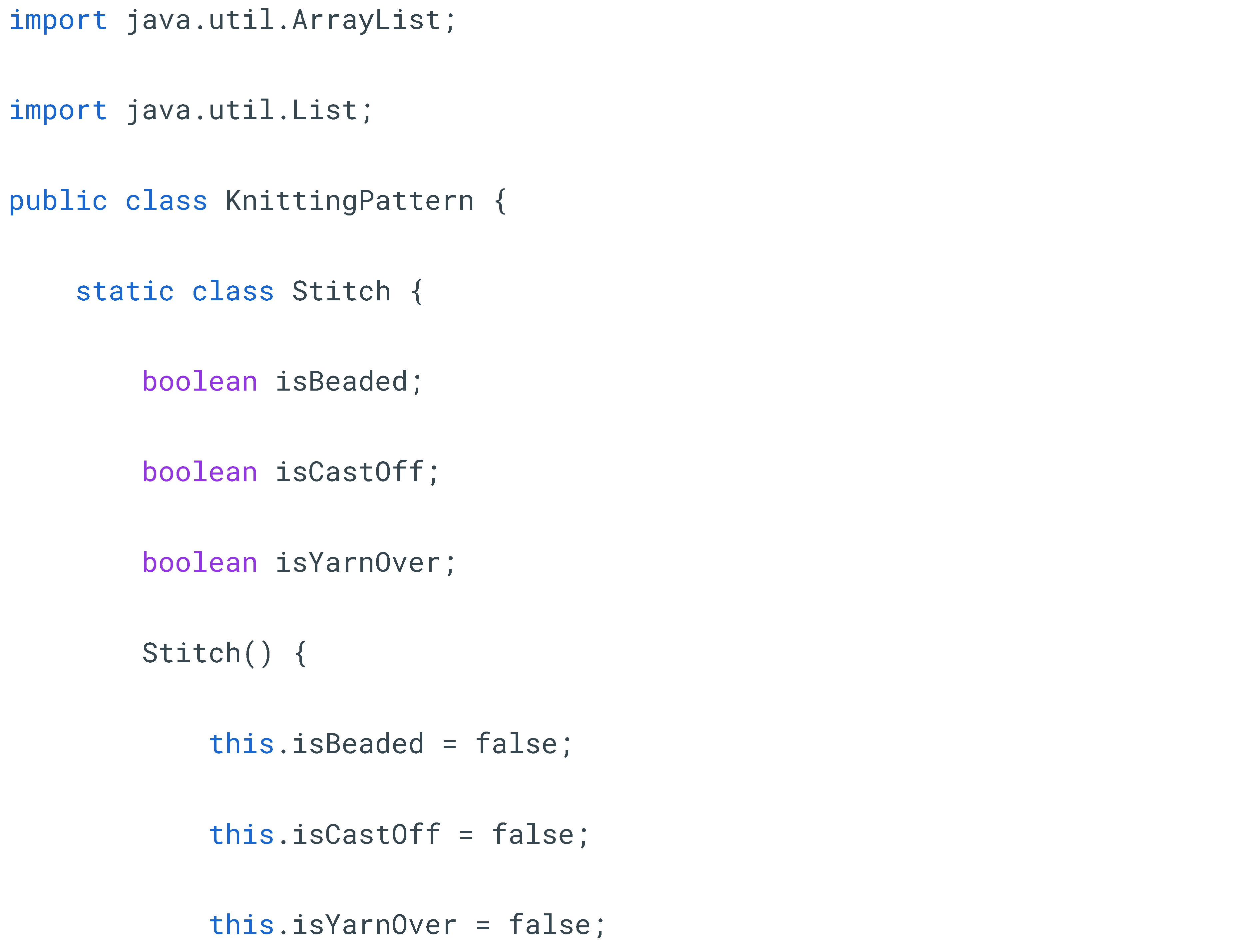
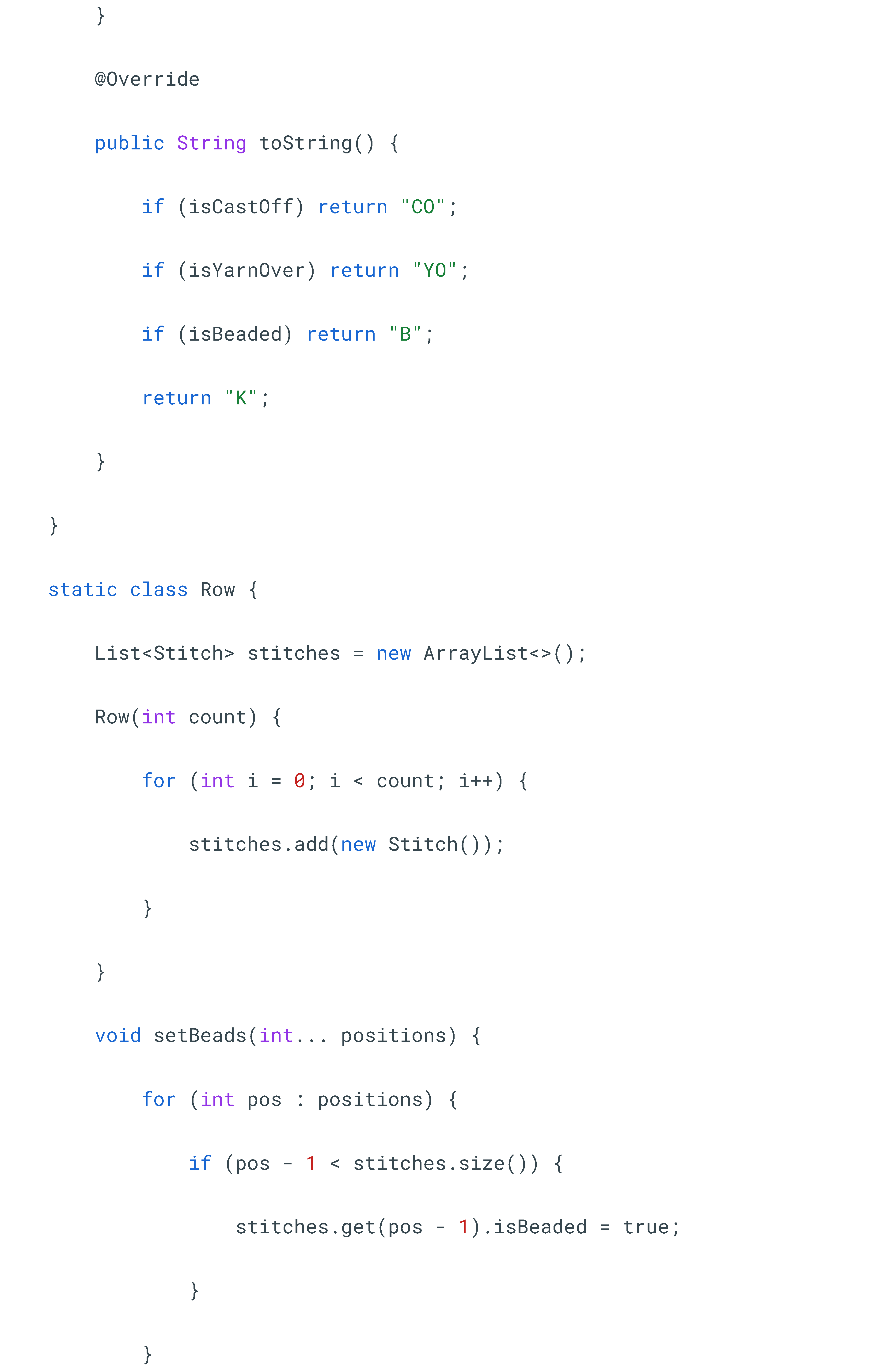
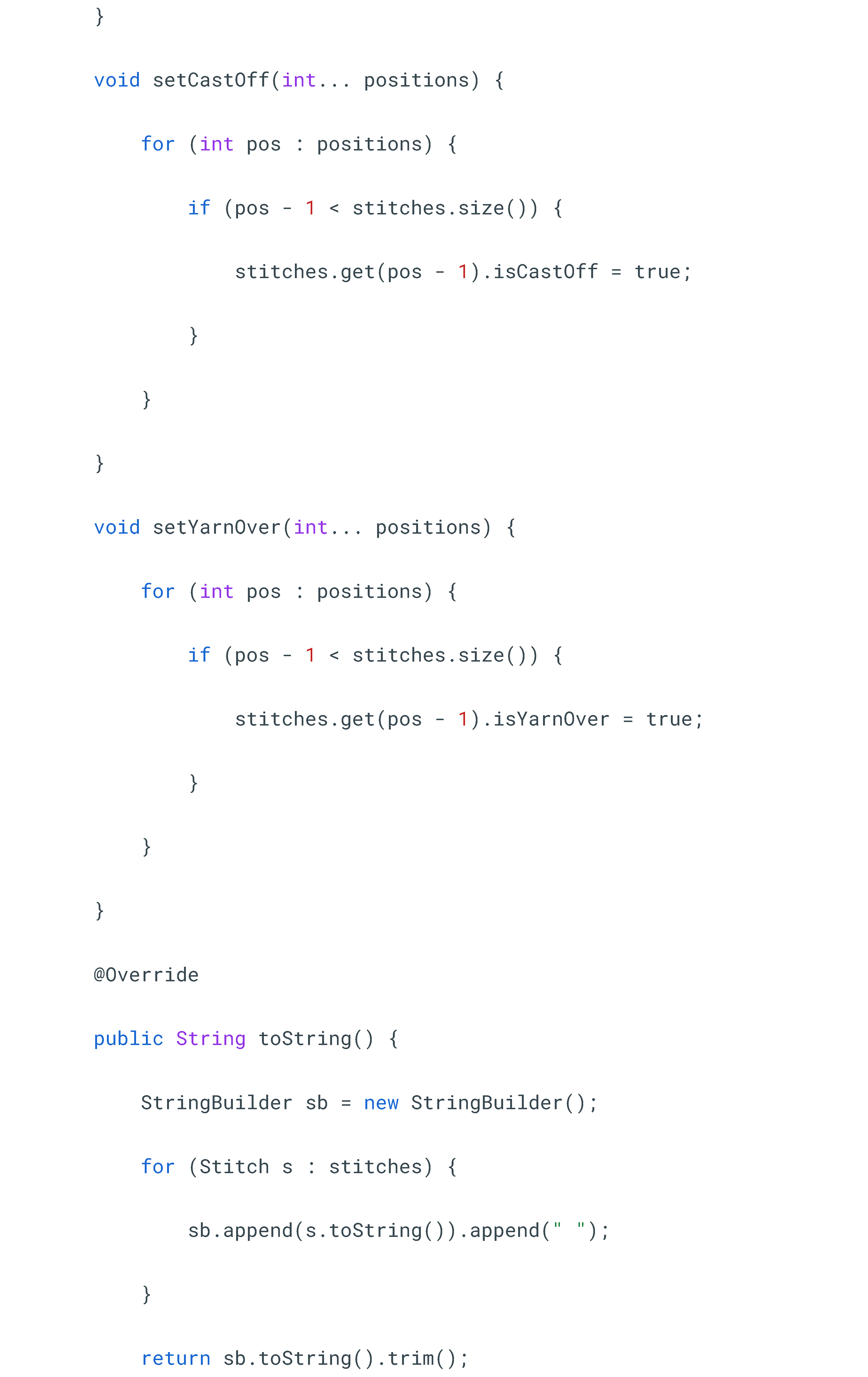
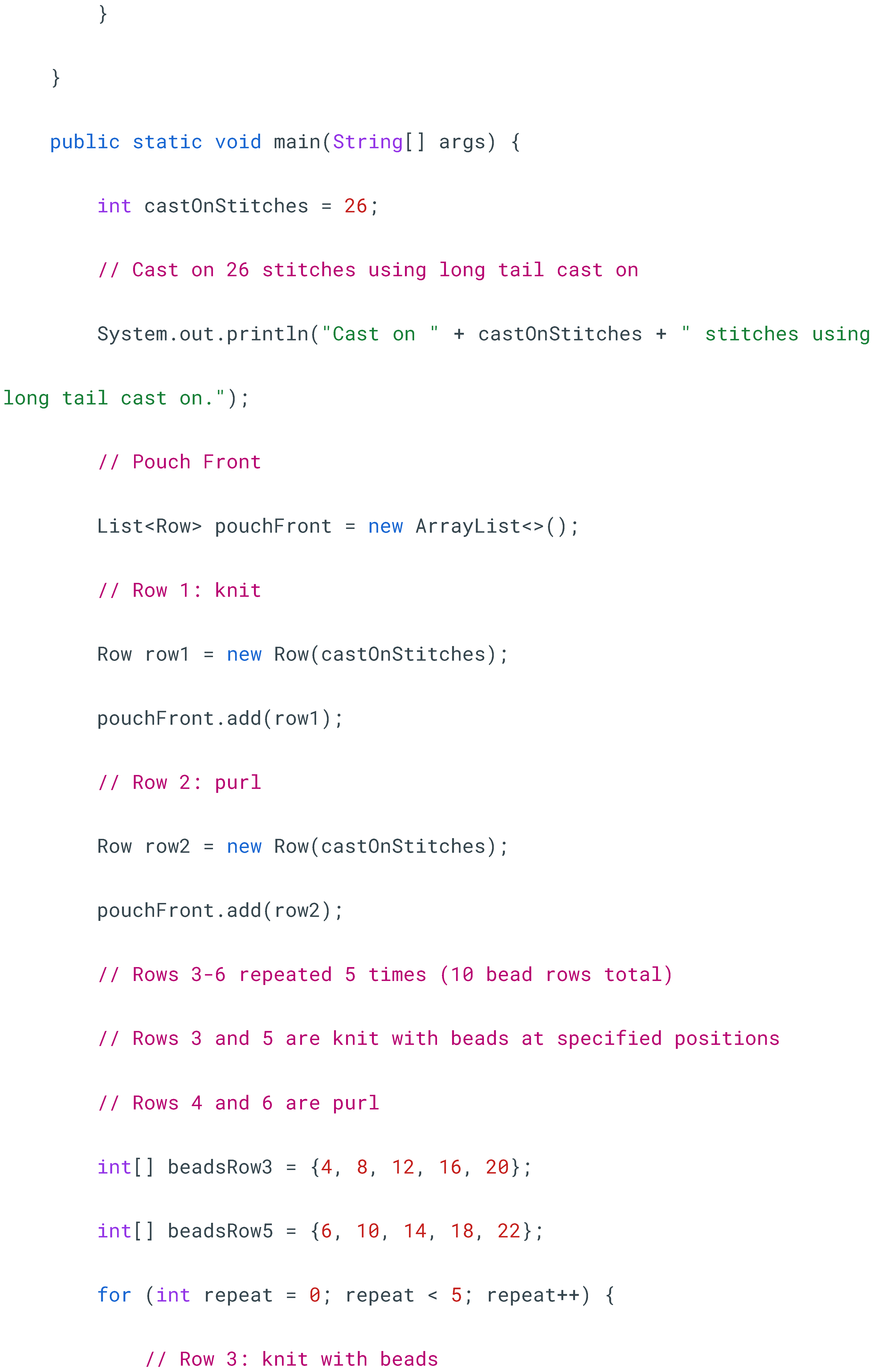
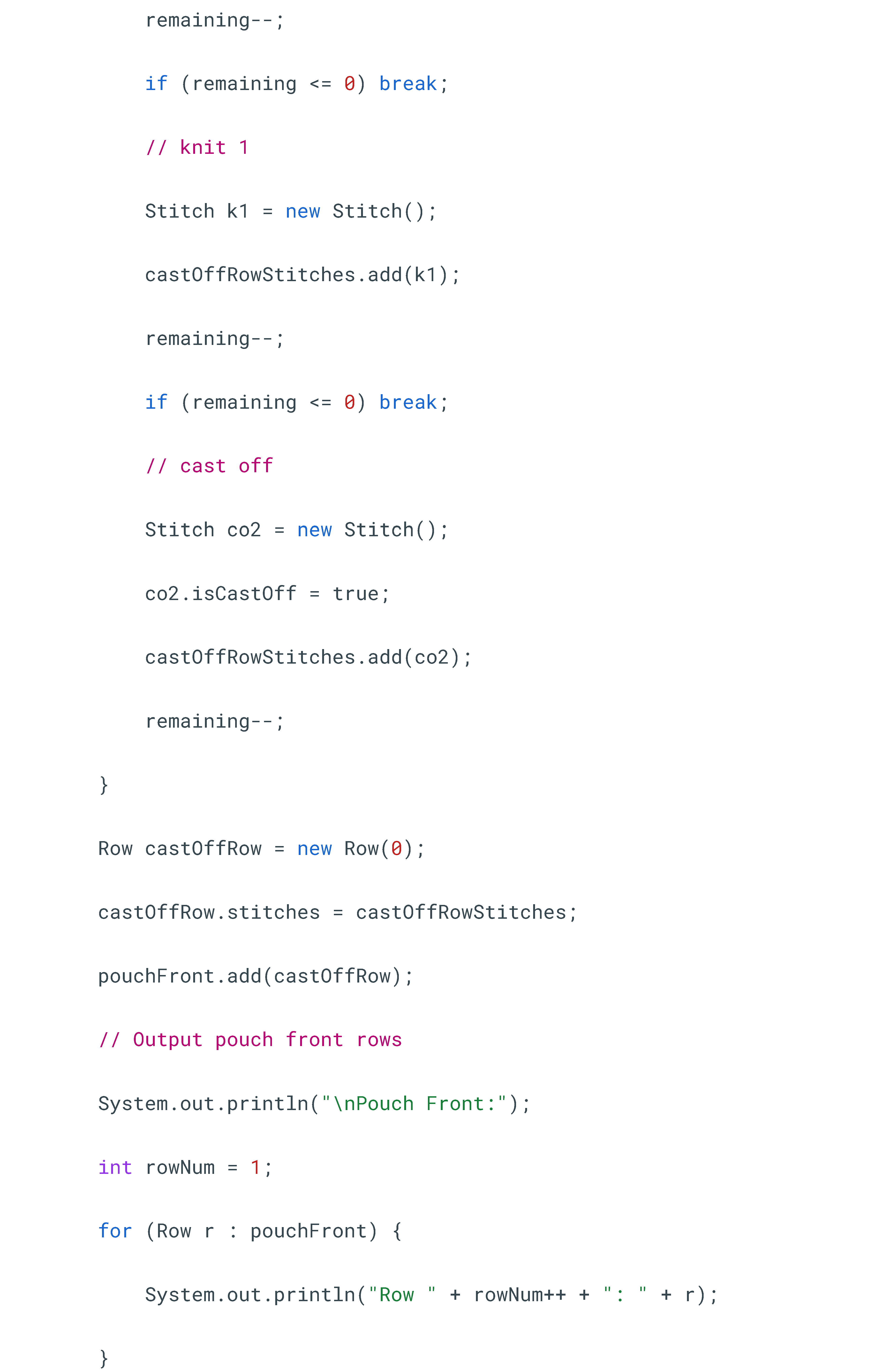
Appendix D - Output code
Cast on 26 stitches using a long tail cast on.
Pouch Front:
Row 1: K K K K K K K K K K K K K K K K K K K K K K K K K K
Row 2: K K K K K K K K K K K K K K K K K K K K K K K K K K
Row 3: K K K B K K K B K K K B K K K B K K K B K K K K K K
Row 4: K K K K K K K K K K K K K K K K K K K K K K K K K K
Row 5: K K K K K B K K K B K K K B K K K B K K K B K K K K
Row 6: K K K K K K K K K K K K K K K K K K K K K K K K K K
Row 7: K K K B K K K B K K K B K K K B K K K B K K K K K K
Row 8: K K K K K K K K K K K K K K K K K K K K K K K K K K
Row 9: K K K K K B K K K B K K K B K K K B K K K B K K K K
Row 10: K K K K K K K K K K K K K K K K K K K K K K K K K K
Row 11: K K K B K K K B K K K B K K K B K K K B K K K K K K
Row 12: K K K K K K K K K K K K K K K K K K K K K K K K K K
Row 13: K K K K K B K K K B K K K B K K K B K K K B K K K K
Row 14: K K K K K K K K K K K K K K K K K K K K K K K K K K
Row 15: K K K B K K K B K K K B K K K B K K K B K K K K K K
Row 16: K K K K K K K K K K K K K K K K K K K K K K K K K K
Row 17: K K K K K B K K K B K K K B K K K B K K K B K K K K
Row 18: K K K K K K K K K K K K K K K K K K K K K K K K K K
Row 19: K K K B K K K B K K K B K K K B K K K B K K K K K K
Row 20: K K K K K K K K K K K K K K K K K K K K K K K K K K
Row 21: K K K K K B K K K B K K K B K K K B K K K B K K K K
Row 22: K K K K K K K K K K K K K K K K K K K K K K K K K K
Row 23: K K K K CO K K K K CO K K K K CO K K K K CO K K K K CO K
Row 24: K K K YO K K K YO K K K YO K K K YO K K K YO K K K YO K K
Row 25: K K K K K K K K K K K K K K K K K K K K K K K K K K K K K K K K K K K K K K K K K K K K K K K K K K K K
Row 26: K K K K K K K K K K K K K K K K K K K K K K K K K K K K K K K K K K K K K K K K K K K K K K K K K K K K
Row 27: K K CO YO CO K CO YO CO K CO YO CO K CO YO CO K CO YO CO K CO YO CO K CO YO CO K CO YO CO K CO YO CO K CO YO CO K CO YO CO K CO YO CO K CO YO
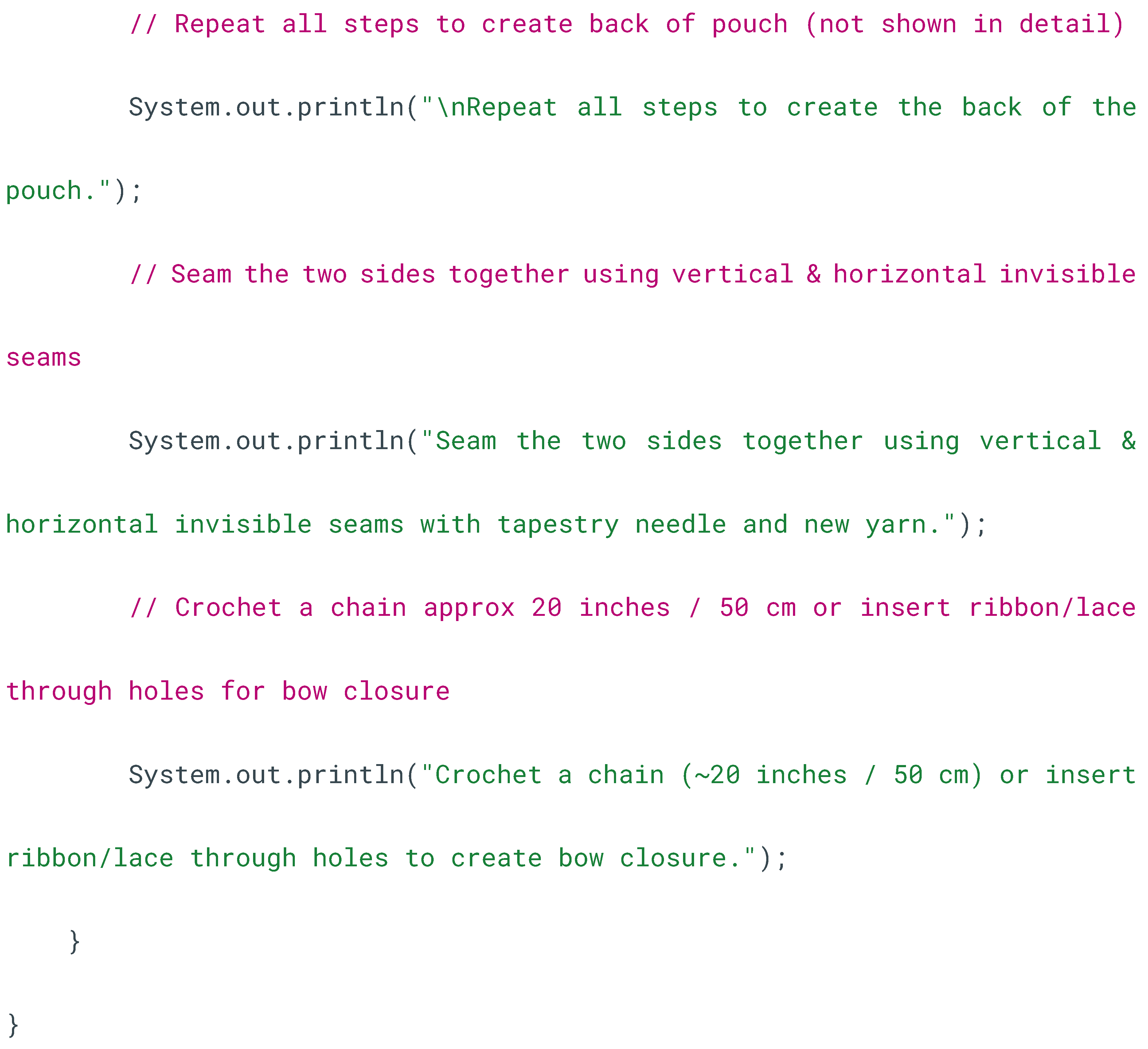
Repeat all steps to create the back of the pouch.
Seam the two sides together using vertical & horizontal invisible seams with tapestry needle and new yarn.
Crochet a chain (~20 inches / 50 cm) or insert ribbon/lace through holes to create bow closure.
Appendix E - Interview questions
Are you involved in academic research or academia?
Are you involved in any fiber arts?
When did you start participating in fiber arts?
Why did you choose to begin participating in fiber arts?
How has Fiber arts impacted your life, and if applicable, academic research.
Appendix F - Survey questions
Did you read and agree to the informed consent?
Are you over the age of legal adulthood in your country of residence? ( 18 in the US )
What is your gender? ( What do you identify as? )
Are you a typically feminine presenting person in educational or workplace environments? ( Do others perceive you as a woman? )
Are you involved in academia (student, educator, researcher etc.) OR a STEM based career field?
Did you or are you attending or planning to attend in the next twenty four months post secondary school or educational institution?
What is the highest level of education you have completed or are planning to complete?
Do you participate in knitting, crocheting, sewing or other fiber arts activities?
Did you participate in fiber arts before academia or after?
Would you say that your participation in fiber arts influenced your desire to participate in STEM or other forms of academia? If yes, please elaborate here.
Would you say that your participation in fiber arts influenced your ability to participate in STEM or other forms of academia? ( Being used as a coping mechanism, similar problem solving skills, staying focused etc. ) If yes, please elaborate here.
Would you say that your participation in STEM and other forms of Academia influenced your desire to participate in fiber arts? If yes please elaborate here.
Would you say that your participation in STEM influenced your ability or to participate in fiber arts? (Being used as a coping mechanism, similar problem solving skills, staying focused etc). If yes, please elaborate here.
How has fiber arts been a part of your life?
Where do you participate in these ( fiber arts ) communities? ( Local groups, engaging in online discourse, local stores, learning online, etc .
Are you currently involved in a STEM field as a student, researcher, in a fellowship, or other ways?
What is your profession ( or intended profession )?
Where did you find this survey?
Appendix G - Sock Image
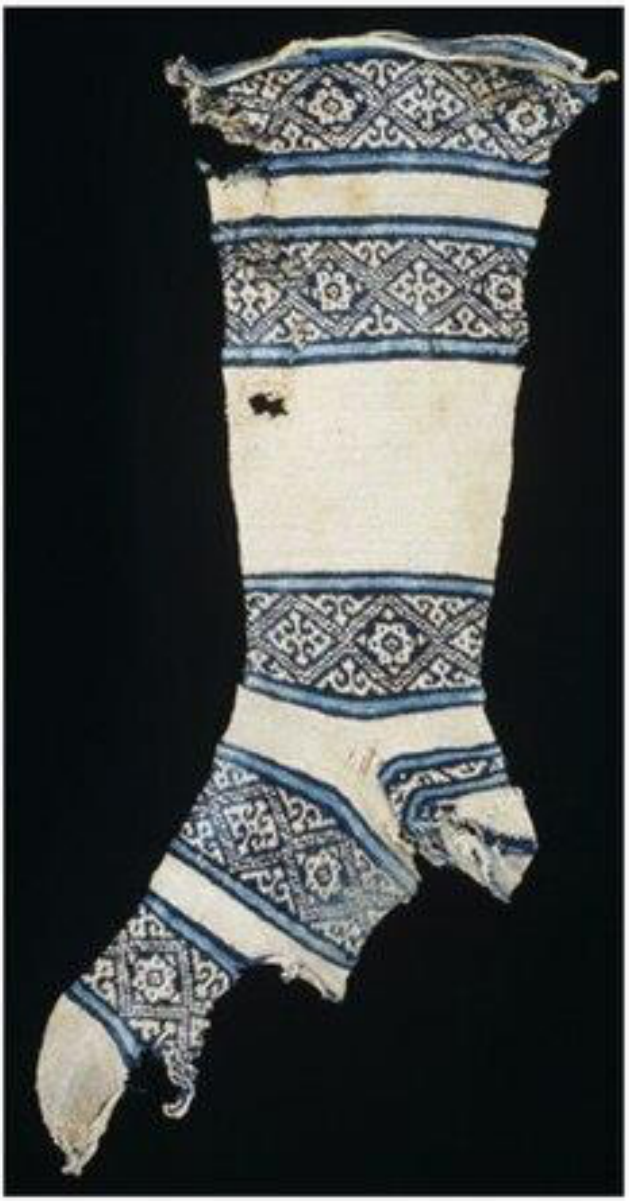
Unknown photographer ( estimated date of photography 2008 )
Appendix H - Survey Charts
*Removed from survey after question was answered
Question 2.) What is your gender ? ( What do you identify as? )
| Gender | Female | Male | Non-Binary | Prefer not to disclose | Gender Fluid | Transgender Man | Total |
| Number of respondents | 166 | 5 | 15 | 4 | 2 | 2 | 194 |
| Percent | 85.5670 | 2.57732 | 7.7319 | 2.0619 | 1.0309 | 1.0309 | 100 |
Question 3.) Are you a typically feminine presenting person in educational or workplace environments? ( Do others perceive you as a woman? )
| Yes | No* | Sometimes | Prefer not to disclose | Total | |
| Number of respondents | 175 | 10 | 8 | 1 | 194 |
| Percent | 90.2062 | 5.1546 | 4.1237 | 0.5154 | 100 |
Question 4.) Do you participate in knitting, crocheting, sewing or other fiber arts activities?
| Yes | No* | Total | |
| Number of Respondents | 182 | 0 | 182 |
| Percent | 100 | 0 | 100 |
Question 5.) Are you involved in academia (student, educator, researcher etc.) OR a STEM based career field?
| Yes | No* | Total | |
| Number of Respondents | 139 | 43 | 182 |
| Percent | 76.25 | 23.75 | 100 |
Question 6.) Did you or are you attending or planning to attend in the next twenty four months post secondary school or educational institution?
| Yes | No | Total | |
| Number of Respondents | 84 | 56 | 140 |
| Percent | 60 | 40 | 100 |
Question 7.) What is the highest level of education you have completed or are planning to complete?
| Less than High School Diploma | High School Diploma | Bachelor’s Degree | Master’s Degree | Doctorate Degree | Total | |
| Number of Respondents | 1 | 4 | 49 | 41 | 42 | 140 |
| Percent | 0.7143 | 2.8571 | 35 | 29.2857 | 30 | 100 |
Question 8.) Did you participate in fiber arts before academia or after?
| Fiber Arts and then Academia | Academia and then Fiber Arts | Total | |
| Number of Respondents | 93 | 47 | 140 |
| Percent | 66.4286 | 33.5714 | 100 |
Would you say that your participation in fiber arts influenced your desire to participate in STEM or other forms of academia? If yes, please elaborate here.
| Yes | No | Not Applicable | Total | |
| Number of Respondents | 31 | 60 | 2 | 93 |
| Percent | 33.3333 | 64.5161 | 2.1505 | 100 |
Would you say that your participation in fiber arts influenced your ability to participate in STEM or other forms of academia? ( Being used as a coping mechanism, similar problem solving skills, staying focused etc. ) If yes, please elaborate here.
| Yes | No | Total | |
| Number of Respondents | 47 | 17 | 64 |
| Percent | 73.4375 | 26.5625 | 100 |
Would you say that your participation in STEM and other forms of Academia influenced your desire to participate in fiber arts? If yes please elaborate here.
| Yes | No | Total | |
| Number of Respondents | 28 | 19 | 47 |
| Percent | 59.5744 | 40.4266 | 100 |
Would you say that your participation in STEM influenced your ability or to participate in fiber arts? (Being used as a coping mechanism, similar problem solving skills, staying focused etc). If yes, please elaborate here.
| Yes | No | Total | |
| Number of Respondents | 24 | 5 | 29 |
| Percent | 82.7586 | 17.2414 | 100 |
Where do you participate in these ( fiber arts ) communities? ( Local groups, engaging in online discourse, local stores, learning online, etc )
| Online | In person | Both online and in person | I do not participate in communities | Did not understand the question | Total | |
| Number of Respondents | 33 | 17 | 84 | 5 | 2 | 140 |
| Percent | 23.5714 | 12.1428 | 60 | 3.5714 | 1.4286 | 100 |
Are you currently involved in a STEM field as a student, researcher, in a fellowship, or other ways?
| Yes | No | Total | |
| Number of Respondents | 139 | 43 | 182 |
| Percent | 76.3736 | 23.6264 | 100 |
Where did you find this survey?
| Ravelry | Someone sent it to me | Other | Total | ||
| Number of Respondents | 153 | 7 | 7 | 1 | 168 |
| Percent | 91.0714 | 4.1666 | 4.1666 | 0.5952 | 100 |
Appendix I - Responses* to All Vital Survey Questions
* All responses are written exactly as presented by respondents.
Question - Would you say that your participation in fiber arts influenced your desire to participate in STEM or other forms of academia? If yes, please elaborate here.
Responses -
- Perhaps indirectly. The knitting club in my elementary school was run by the 6th grade math teacher
- No, I don’t think so. I liked fiber arts for a variety of reasons- I’ve always admired 1950s type women who knit and sew etc. And I love world war 1 and 2 - a lot of women used to knit for utility back then. I think if anything my profession and my interest in fiber arts are contradictory to each other, because I picked up knitting to be more feminine.
- My participation in fiber arts definitely influenced me to not only become a teacher of knit and crochet but to take on the Master courses through the national guilds.
- No
- knitting allowed me to survive a Ph.D. in math!
- yes, but going far back into my elementary school years I participated in Odyssey of the Mind where you must make costumes for a play and creatively solve problems
- No, although STEM and knitting/crochet patterns both appeal to my analytical side.
- no
- No
- Yes, but indirectly. Keeping my hands busy was a way to keep my mind calm, especially as I had (at the time) undiagnosed adhd
- Not necessarily but the skills I’ve learned from knitting has helped (patience, problem solving, creativity, perseverance)
- No, but fibre arts nourish my creativity.
- In a way, yes. I knit and crochet in high school. In college, I was a conservation biology major with a focus on plants. One of my semester final projects was on fiber plants and dyes
- I decided I was interested in materials science in high school when I heard about research in high performance fabrics for mountaineering. I went on to study chemical engineering with a minor in materials science. Now, I work on battery energy storage for renewables, so unrelated to that initial pursuit. However, I find fiber arts to be very technical and strongly related to materials science. My current hobbies are hand spinning and weaving, which both use materials science principles and I’d say are fairly technical crafts.
- Growing up I felt STEM and fiber arts were unrelated, interests.
- Nope. Completely unrelated.
- No, I don’t think so
- No I would not say that. My mom taught me how to knit when I was 12, and I fell in love with chemistry because of a high school chemistry course, and now I am pursuing a chemistry PhD and enjoy knitting in my free time. I do consider them to be separate influences, but I think my left brain is attracted to both.
- No
- I’m not sure if one influenced the other but I’ve been involved in both my entire life!
- It influenced my decision to pursue a surgical subspecialty
- No, I enjoy both types of activities and have since high school
- no
- No
- No
- No
- No
- Yes, needed clothes fixed or wouldn’t be able to go anywhere
- Not really
- I enjoy the engineering aspects of fiber arts as much as the creative aspects
- Almost certainly. Sewing in particular teaches a ton about how things go together in space. It’s the same kind of training that little boys get with legos and such (i.e., how to build and the like)
- no
- Not particularly
- No
- No
- No
- No
- no
- Yes, I love the problem solving of fiber arts when I have an idea in mind and have to create a way to execute it with fiber and crafting.
- I wouldn’t say either influenced the other, they’re kind of the same thing? The difference is just that academia is external pressure and fiber arts is for me. It reminds me that i do actually enjoy process and logic and planning and protocol, and doing a bunch of math to figure out where i am and where im going
- No
- Probably? At the very least it made me very comfortable with the scientific method, and aware of what parts of academia i would not succeed in based on the different types of math required
- I’d say my interest in fiber arts relates to my interest in language and education because all are creative pursuits that provide opportunities for—and even necessitate—lifelong learning and iterative improvement. Not sure there’s a direct causal relationship, though.
- No
- No.
- no
- no
- No
- no
- no
- No
- No
- No
- No
- No
- yes
- yes
- yes
- yes
- yes
- yes
- yes
- No, but it definetly helps manage stress from STEM/academia. Except when the fiber art projects become stressful too, haha
- No
- in a sense, yes. I knew I enjoyed working with my hands to create things and thought lab research would allow me to do that
- No
- No
- no
- No
- No
- No
- yes
- yes
- No
- At the time, I had not realized the depth at which my introduction to fiber arts at a young age influenced my love of complex mathematics and engineering, especially around the fields of topology, knot theory, and hole theory.
- I think not directly, but they use the same form of logic and thinking in my perspective as my studies (I’m in engineering)
- N/A
- No.
- No
- no
- no
- No
- No
- No
- yes
- it is a lot like experimentation and it teaches consistency and striving hard for the end goal. I also found myself doing math and applying other concepts in fiber arts, such as measurements.
Question - Would you say that your participation in fiber arts influenced your ability to participate in STEM or other forms of academia? ( Being used as a coping mechanism, similar problem solving skills, staying focused etc. ) If yes, please elaborate here.
Responses -
- Absolutely! Science is a lot of failed experiments, and I think knitting builds resilience to that type of failure (when I undo half a sweater, it’s easier to knit the second time even though I have physical 0 evidence of that growth). My field is very coding based, and as I’ve developed as a knitter I’ve seen my confidence in just throwing out a bad script and starting over has similarly grown.
- Yes. Knitting, weaving, and spinning are soothing for my brain when I need to decompress for a while, and are therapeutic when I’m stressed.
- Yes, I have a lot of hand dexterity and hand eye coordination from knitting and crochet, and I picked up suturing and surgical knot tying on my first try. It helped me make a good impression with surgeons for sure. I make my own patterns for all crafts, but especially for sewing, I believe it’s the official definition of “tailoring” (as opposed to being a seamstress where you don’t draft patterns and use draping instead.) I heavily edit knitting patterns by imagining the final object. Making patterns is an easy way for me to improve my spatial sense/visualization abilities and this will help me in my future speciality of choice, Radiology. I also crochet rugs or knit simple things like sleeves while I watch lectures so I don’t fall asleep.
- Absolutely. Kinda similar response to the previous question. I visualised new mathematical concepts as a child through crochet. Now I internalised those concepts and think of new crochet projects in terms of functions. It’s a two-way street this way
- Probably yes. I do “mindless knit and crochet” when thinking through problems and when I need to focus. The repetitive movement calms me and allows my brain to work on the issue.
- Yes, there is so much math and problem solving involved in knitting, crochet, and other crafts I’ve tried that it directly correlates to stem theories. For example, I recently used the formula for the sum of consecutive integers to help more accurately estimate a triangle scarf’s yarn usage. The structure and execution of knitting is so much like computer architecture and programming. The loops from the previous row are registers, cabling is swapping bits, and knits and purls are on and off bits. After learning about both computers and fiber arts the connection between early computers and textile machines is clear.
- most coping mechanism.
- absolutely- in high school for presentations would need to create characters in order for nerves to be calm to function- and so may costumes were made- so most certainly emotional coping there- as a sculptor, needing to squeeze studio time when my son was younger and in activities- to be able to create i started changing my work process and incorporated crochet work bc it was portable
- Yes
- Yes, absolutely! During my doctoral research, having an activity where planning and effort directly lead to a positive result was an important coping mechanism, since it is so common for experiments to fail or yield negative results. While there are certainly some overlaps in project planning and problem solving, I currently find fiber arts valuable because they require *different* thought processes than my career.
- All of the above, memorizing patterns helped, I guess. But also relaxing after class to be able to focus later on, and larger projects during holidays. Also, learning that progress is made one stitch at a time and you sometimes have to go back and undo some of your work to get it right.
- I used to knit or crochet through a lot of my lectures as a way to give my fingers something to do when the lecture was too slow for me to be taking notes the whole time. Unfortunately my current workplace doesn’t allow me to do the same during meetings, so I have taken to destroying a lot of pens instead...
- Sure, I like to think it has helped me become more patient with tedious tasks and on hard days I have gotten through hard tasks thinking of my wip as a reward for getting through. I do however notice that my knitting has gotten better after academia because I am better at admitting to myself that I need to google something and know I get it right instead of powering through and ending up with a sub-par result
- No
- 3D spacial reasoning is a strong suit of mine, and i think clothing construction helped with that, as well as reasons listed above
- Coping mechanism
- De-stressing; creativity; problem solving and having a non work related hobby.
- Definitely for stress relief. I also teach, so I often crochet props for my lessons or make prizes for student incentives
- Definitely think that my crafting pursuits (fiber arts or otherwise) in my childhood prepared me well for a degree and career in engineering. I learned to work with my hands, I learned the value of highly skilled tedious tasks, and I learned a great deal about critical thinking and problem solving.
- Fiber arts has given me a great creative outlet and has helped me make new friends in Academia (I am part of a fiber arts club consisting of people who work at two neighboring academic research organizations).
- I do think fixing mistakes in knitting is good practice for fixing mistakes in electrical engineering. It’s a good way to build up “soft” skills. 😂
- I don’t think it influenced my participation in school. It was more something I did with my mom when I had time. It’s a nice way to destress after work for sure, and I will probably continue to crochet in my free time when I start my masters program this fall.
- I have ADHD and I think knitting helps with my focus, but I wouldn’t say I couldn’t survive in my PhD without knitting. I have had “knitters block” before where I go many months without knitting and can still do my work in my chemistry PhD program.
- i think i find participation in fiber arts relaxing and calming when im stressed out about school
- I would say that I was much better at my fibre arts due to my STEM experiences. However, having experience manipulating materials was helpful when it came to certain STEM classes and projects.
- I’m an archaeologist, and my experience with garment and bag construction has often been the only reason we could identify artifacts in the lab! I recognized specific buckles/buttons/dress hooks etc that no one else was familiar with. I’ve found that the patience/attention to detail gained from fiber arts is super useful when working in the field where you have to carefully scrape back layers of dirt looking very closely for artifacts!
- It improved fine motor skills and made me a better surgeon
- Memory, logical thinking, spatial thinking. Fiber arts are great practice at these skills also needed in stem.
- no
- No
- No
- No
- No
- No
- Not really, but I liked knitting during my physics lectures
- Repeating patterns and repetitive movements clear my mind for more abstract concepts
- Similar problem solving skills and trouble shooting. My main hobby before my math and comp sci degrees was sewing. It was also absolutely a coping mechanism.
- yes - enjoy having hobbies outside of work!
- Yes definitely, my focus on fiber arts has given me many advantages, especially with patience and willingness to approach problems from many angles.
- Yes, as a coping mechanism, and as a way of expressing what I’ve learned. I studied math and became a math teacher, and utilize all of those skills in my crafting. It’s also made for great ice breakers, since I crochet a lot of sweater vests, I get to talk about them when I wear them.
- Yes, enhanced problem solving and patience. Focused and repetitive tasks helped process frustration and sometimes think deeper and find alternative solutions for academic issues
- Yes, I am a PhD student working in a wet lab and handwork crafts (knitting and sewing) help me with problem solving and require just enough focus to keep my mind from spiraling.
- Yes, I knit during meetings
- Yes, it is a coping mechanism and helps me stay focused
- Yes, it is a coping mechanism for stress and trains my focus. It gives me positive feedback when I’m able to accurately portray my ideas in fiber/crafted form. This builds self confidence as well.
- Yes, it makes it easier to cope with the infuriating parts of academia by reminding me why I like STEM in the first place. Identify a gap, figure out resources, draw up a plan to fill the gap with the resources you’ve mustered up, follow the plan (and improvise solutions to all the problems and hiccups along the way), and then the work isn’t finished when the protocol ends. Then you actually need to make it look pretty. Same/same, see?
- Yes, similar problem solving and focus requirements, but also opportunities for creativity
- Yes: staying focused, understanding patterns, following rhythm and patterns, using maths to alternate yarns and adjust problems for myself, coping mechanism
- Yes. Gotta stick with your project if you want a usable end product, and gotta be very familiar with material sciences and chemistry to not the destroy it when you wash the damn thing.
- Yes. I have ADHD, and having something to do with my hands REALLY helps me focus in meetings and, at times, in the classroom. Outside work, it also regulates my parasympathetic nervous system when I am feeling anxious. Additionally, exercising the planning, problem solving, and other skills that are essential to the knitting process enhances my sense of self-efficacy when I am feeling uncertain of myself. Also, learning to knit as a child likely contributed to the development of certain personality traits that have served me well as a student, educator, and professional—the principal one being patience.
- Yes. I sew to relieve stress, use my mind while also relaxing, etc.
- Yes. Without my fiber arts hobbies, I would not be able to unwind and participate in chemistry work to the same extent. I also like to knit a little between tasks throughout the day.
- It satisfies a similar itch for creation, problem solving, 3d/spatial logic
- No
- YES yes yes. The attention to detail and fine motor skills gained from embroidery have been invaluable in the lab. I’m capable of more delicate work than my coworkers because of my experience with fiber arts. I have also learned to knit recently which has helped me become more patient in the lab. Both of these have also been much needed coping mechanisms for me as well. I’ve been knitting more lately, which helps me reset and feel more connected to myself.
- Yes-coping mechanism via creative outlet
- Yes, I use knitting as a stress relief tool which allows me to maintain a balance between university and the rest of my life.
- yes. I find it is a great activity to use my creativity in a structured way
- Yes. I learned knitting in college as an activity that produced a physical product. This was a contrast to my major (computer science) and my other recreational activities (watching anime, computer gaming).
- Absolutely. My knowledge in the fiber arts made me a force to be reckoned with in topology discussion and application. Additionally, it serves as a strong emotional grounding activity as well as enables me to better focus on problem solving.
- Similar problem solving for sure, I also use it as a social coping mechanism to stay focused during lectures (adhd, always needing a fidget so I’d knit underneath the table).
- I think that, as much as I adore STEM, creating art has actually made me less certain in my ability to have a career in it. I feel so drawn to creation that the idea of doing something else with my life brings me a bit of dread.
- No.
- No
- I think it could have contributed to my personality, giving an indirect effect
Question - Would you say that your participation in STEM and other forms of Academia influenced your desire to participate in fiber arts? If yes please elaborate here.
Responses -
- Fiber arts serve as a creative outlet.
- In a very round about way. It was helpful to have crochet in my hands while being an exam invigilator. (Knitting would have been too loud, cross stitch required too much visual focus.) It certainly wasn’t why I started, but academia and the jobs I was doing there influenced which skills and arts I perused and/or had time for
- I also took sculpture classes in undergrad, and found my approach to art to be methodological in the way explorative science is. In both disciplines, progress was driven by observation, imagination, a goal, and then trial and error to achieve it. I was inspired first to take up embroidery to replicate forms I saw in science and nature. From there I moved to knitting, and finally crochet.
- Not particularly
- I am currently attending Western Washington University for studio art. When I came in I originally wanted to double major in physics and art and somehow combine the two. I eventually fell in love with weaving. I think because the loom is so technical i really found myself enjoying it.
- NO.
- I think that I felt the desire to pick up a fiber art because I felt it was so opposite to my computer science degree that it felt like an escape.
- It was something tactile and real instead of abstract and on a screen. It was art for arts sake instead of something with a correct answer that I may struggle to find. There is a value in making something pretty, which is so devalued in men-majority, technical fields.
- No, they are separate to me
- No
- No
- No
- No
- No
- Possibly, i started crochet because i was curious how it knotted together.
- The most brilliant fiber art I’ve witnessed has been from highly intelligent individuals !
- Yes, stem to me was a way to create and fiber arts also leans into that same creation.
- I always had the interest, but picked up knitting while in grad school. Turned out that lots of people in my grad school class also knit/crocheted/sewed etc, so we started having fiber arts nights to spend time with each other, help each other, and make the grad school stressors easier to bear.
- No
- No
- Not particularly, I think I would have been interested regardless.
- No
- Yes, though my connections came through the Humanities and a desire to connect with and embrace the arts of my female ancestors.
- I wouldn’t say academia itself, but being a part of the academic community, as many of the people I’ve met during grad school are incredibly talented fiber artists.
- I started participating in fiber arts while working towards a biology degree. I wanted to have a creative outlet and drawing/painting was not my style. I would say I started knitting as a way to think differently than the way I had to think in the classroom. As I started making things without patterns I realized just how science-y it truly is! Having an idea of how to make something, trying it out, it not working, having to go back and brainstorm, trying again, maybe messing up. I don’t know, all of it is very relatable to the experience of being in a lab.
- I think the STEM mindset of “follow these precise directions” melds well with fiber arts.
- Maybe only in the sense that I was looking for creative hobbies to complement my academic interests!
- No
- No.
- No. My Mom was a knitter
- Yes, because it was more affordable than going out, and meditative which helped with the stress.
- Yes… the anxiety it caused def made me go to fiber arts as a self soothing mechanism. But also, I feel like knitting is the same kind of fun as organic chemistry is so the kind of thinking science trained me into also helps my knitting.
- I’m a biologist and learning about the different animal fibers influenced my desire to learn spinning. I wanted to learn how the different fibers interacted to crested different threads and yarns. Their individual properties is fascinating. From silks to quviut.
- The symmetry and patterns and problem solving elements of fiber arts are really fun.
- Not necessarily an increase in the desire but it definitely gave me the confidence to teach myself how to do things and to take on big projects
- Yes, STEM taught me how to decompose hard problems and see failed attempts as evidence toward better approaches.
- In a way, but it was initially to create a time and space away from my STEM field
- Nope, I suppose I like hobbies and a career that follows instructions.
- While I started sewing as an outlet from academia stresses, it opened my eyes to the benefits of reducing fast fashion and optimising second hand fabrics that may have other wise ended up in landfills. As an environmental scientist, both are of great importance.
- No
- No
- no
- No
- No, but they come from the same place: I enjoy math and love learning -- these are the roots of my STEM career, my educational choices, and my love of fiber arts.
- No, I think I have always been a crafty person and enjoyed being creative. Finding fiber arts was just a wonderful world I finally stumbled onto when I found a craft kit in a thrift store.
- Yes, I worked in QC for pharma and had SOPs (standard operating procedures) i.e lists of instructions for standardized lab tests. Knitting patterns are just SOPs. Also gives me stress relief and something non-school related to focus on.
- Yes, it was an outlet in very stressful programs and I realised many similarities between the things I enjoyed about my courses(math, problem solving, heritage deepdives) and the crafts I was learning. We also had a fiber arts club with one of calculus professors. I felt encouraged to develop my creative ideas.
Question - Would you say that your participation in STEM influenced your ability or to participate in fiber arts? (Being used as a coping mechanism, similar problem solving skills, staying focused etc). If yes, please elaborate here.
Responses -
- Yes, I picked up crochet and knitting to ease my anxiety and actively clock out when working remotely. It‘s hard to extricate yourself when your team is involved in data production support. Fiber arts allow for me to focus and tell myself it’s time to be done for the work day so I can crochet or knit.
- Again, quite round about, but being interested in STEM and scientific methods and processes definitely influenced the way I chose to learn to knit. Not just because I knit while catching up on educational youtubers. I learnt new knit skills very systematically, trying to dive into each skill to keep the hyperfocus fed. I was looking at each new skill or variation as a step in the process, thoroughly researching methods etc before starting.
- I think the way I approach challenges in my STEM field and fiber crafts come from the same motivating force in my brain. I see an end goal and I want to achieve it with the skills and materials that I have access to.
- Fiber arts helps me decompress. Once crochet skills clicked for me, it wasn’t mentally taxing to do. And if I do happen to get frustrated I can just take a break and step away. It also feels like a better use of my time than scrolling on my phone.
- I always loved stem, I was always particularly fond on Physics and algebra. i would agree that stem has made me more confident in my problem solving skills. even if i do not know exactly how to fix a loom I know that if asked i can figure it out.
- I think my brain is suited to stem and therefore I have an easier time picturing the mechanics of knitting.
- I very quickly applied an engineering mindset to many of my crafts. I am hungry to pick up skills and techniques, learn their characteristics and ideal applications and then apply swap them out in different ways. I think a STEM degree helped break me out of needing strict instructions. I started with embroidery, learned a cross stitch, back stitch and running stitch and then it was off to the races. Any new stitch I learned, I immediately thought about how I may incorporate it into my next project. I liked to experiment with different materials to embroider into (paper, felt, canvas, etc). It wasn’t until learning crochet and knitting that I learned about producing fabric and how that relates to garment construction and material sciences. Different materials, weights and grist affect the fabric. So do different stitches. And you can play with each to get interesting new results. I like to get hacky by seeing how far I can deviate from patterns by matching odd fiber types together, different weights together, swapping out techniques for others, using different sized hooks and needles and then seeing how they impact the final product. I enjoy looking at pictures and reverse engineering how it is made. They were some of my first projects, because it overlapped so well with what I liked to do. I think that STEM makes you more comfortable with the process of trial and error. It’s not bad to frog and it is even part of the fun. It is experimentation! I also recently got a knitting machine and had a lot of fun taking it completely apart, diagramming it, and learning how it works and putting it back together again. I have been finding it to be a good thought exercise to adapt hand knit patterns to the machines. Though, so far, it’s been more fun to plan out how to do it than to actually make it on the machine.
- I would say that they influence each other. Fiber arts enhances my problem solving skills and focus which allows me to be a better academic, and the reverse is also true. My fiber arts are also a coping mechanism for stressful aspects of life and academia, and help prevent burn out.
- No
- No
- No
- No
- No
- STEM increased my ability to participate because i can spot patterns. As soon as i spot the pattern in a pattern i can predict the next stitch
- Yes in particular the mathematics and experimental process skills- also I do a lot of chemistry with my practice (dyeing mainly)
- Yes- geometry and problem solving/planning
- Yes, I crochet mainly and make my own patterns for it which can utilize math to calculate different sizes and even the drape of wearables (ie when to put increases/decreases) as well as trial and error just like in stem. Crochet has always felt like a way to “3D print” things made from fiber with my own hands.
- Yes, I feel it is a very similar skillset. I am a chemist by training. Knitting is also a field where you follow a protocol and make any necessary modifications to make something new!
- Yes, I feel like the two areas inform each other quite well--a knitting pattern is just a form of “software” with functions, loops, conditionals, etc. Learning to code helped me understand knitting patterns, and knitting patterns helped me understand code.
- Yes, I used it a lot to occupy my hands while watching lectures, to develop my visual reasoning skills, and was a good stress relief as a graduate student.
- Yes, my math skills and pattern recognition skills are really helpful for knitting!
- Yes, similar skills in dye lab settings & mathematics involved in crochet & weaving. (I study fiber arts in uni.) Many fiber art patterns are derived from computer coding, so it definitely provides some understanding of science on that level.
- Yes! Knitting, crocheting, and spinning all require focus, problem solving, and various applications of math do be done well. I also find that it helps me stay focused.
- Yes. I have ADHD, and having something to do with my hands during classes and seminars has been huge for my ability to focus. I’ve tried lots of coping mechanisms, but knitting and crocheting is what has stuck. Additionally, I spend most of my days thinking really hard in lab, and having something to do (knitting) that someone else has already designed where all I have to do is follow a pattern is really relaxing.
- I originally started knitting back in college to help me focus and listen. I would often record lectures and listen to it over and over while knitting.
- Yes. Creating something on my own, the creative nature... It’s soothing and peaceful.
- No, although I have discovered they share skills like problem solving and focus, I feel like I would have fallen into fiber arts without my STEM background
- Yes. Attention to detail, problem solving skills, research into techniques & alternative approaches.
Appendix J - Informed consent letter
Introduction and Purpose
You have been asked to participate in a research study that is part of the requirement for AP research and an independent research study for R. VanFossen. Before you agree to participate in this study, it is important that you understand your role in this study and understand the informed consent letter. If you have any questions about the study or your role in it, be sure to ask the investigator. If you have more questions at a later time, R. VanFossen will be happy to answer them for you. You may contact the investigator at:
@reagan_vanfossy on instagram
or :
knittingandstemresearch@gmail.com
Or: reaganvanfossen@gmail.com for Further questions.
Taking part in this study is entirely your choice. If you decide to take part, but later change your mind, you may stop at any time. If you decide to stop, you do not have to give a reason and there will be no negative consequences for ending your participation. Your information will remain anonymous. This research is on the connection between Knitting and related crafts and STEM. As a participant you will be asked to fill out one survey, that should take no more than 15 minutes.
Risks and benefits
The researcher estimates that the risks of participation are low. However you may experience discomfort when participating and answering questions of education level and gender. The benefits to this study do not only apply to you as a person. However, it will benefit society as a whole, specifically the knitting community and STEM.
Privacy
Your responses will be anonymized and your name will not be associated with any findings. Your information will not be published and you will not be associated with the findings. Three years after the study concludes, your information will be destroyed. You will be able to request the name or alias you would like to go by in the study. None of your personal information will be accessible to anyone other than R. VanFossen. Information will be kept confidential and in a secure location on the Schools’ campus. By filling out this form you hereby confirm the following
- I recognize that participation in this study is voluntary
- I recognize that I will not be compensated for participating in this research
- I understand and accept the benefits and risks of participating
- My consent was freely given
- I can withdraw from participation with no negative effects
- I understand that my information will remain confidential, and will be destroyed three years after the conclusion of the study
- I authorize the use of my data in the study.
Your participation is solicited, but strictly voluntary. I have read and agree to the privacy policy and terms of use.
Appendix K - Interview informed consent letter
You have been asked to participate in a research study that is part of the requirement for AP research and an independent research study for R. VanFossen. Before you agree to participate in this study, it is important that you understand your role in this study and understand the informed consent letter. If you have any questions about the study or your role in it, be sure to ask the investigator. If you have more questions at a later time, R. VanFossen will be happy to answer them for you. Further, should you decide that you would not like your information published, and / or associated with your name or likeness, please notify R. VanFossen by March 1, 2026. You may contact the investigator at:
@reagan_vanfossy on instagram
or :
knittingandstemreaserch@gmail.com
Or: reaganvanfossen@gmail.com for further questions.
Taking part in this study is entirely your choice. If you decide to take part, but later change your mind, you may stop at any time. If you decide to stop, you do not have to give a reason and there will be no negative consequences for ending your participation. This research is on the connection between Knitting and related crafts and STEM. As a participant you will be interviewed, which should take no more than 30 minutes.
Risks and benefits
The researcher estimates that the risks of participation are low. However you may experience discomfort when participating and answering questions of education level and gender. Further breach of confidentiality is a risk of harm but a data security plan is in place to minimize such a risk. Also, some questions may make you feel uncomfortable. If that happens, you can skip those questions or withdraw from the study altogether. If you decide to quit the interview your responses will not be saved. The benefits to this study do not only apply to you as a person. You will be able to reflect on the impact that Knitting and STEM has had on your life, providing a benefit. However, it will further benefit society as a whole, specifically the knitting community and STEM.
Privacy
Your responses will not be anonymous and your name will be associated with findings, unless you request otherwise your personal information will not be published and you will not be associated with the findings. However identifying information may be incorporated into the study. Three years after the study concludes, your information will be destroyed. You will be able to request the name or alias you would like to go by in the study. None of your personal identifying information will be accessible to anyone other than R. VanFossen. Information will be kept confidential and in a secure location on the schools’ campus. When an interview is conducted, audio files will be encrypted and coded, and destroyed after use. We will ask you to provide gender, name, social media handles and information requested from the survey during the interview. The identifiable information will be stored with your responses. After information that could identify you has been removed, de-identified responses may be used by or distributed to investigators for other research without obtaining additional informed consent from you. Data will be protected by R. VanFossen as much as possible. Should data be leaked or otherwise compromised, you may not take the IRB, the researcher ( R. VanFossen ) or other connected authorities into a court of law. By beginning the interview, you acknowledge that you are 18 years of age or older, have read the information and agree to take part in the research, with the knowledge that you are free to withdraw your participation without penalty. By beginning this interview, I hereby agree to the following
- I recognize that participation in this study is voluntary
- I recognize that I will not be compensated for participating in this research
- I understand and accept the benefits and risks of participating
- My consent was freely given
- I can withdraw from participation with no negative effects
- I understand that my identifying information will not remain confidential, but will be destroyed three years after the conclusion of the study
- I may not take R. VanFossen into a court of law should data be breached or otherwise compromised.
- I authorize the use of my data in the study.
Your participation is solicited, but strictly voluntary. I have read and agree to the privacy policy and terms of use.
Appendix L - Independent review board approval
Kenston High School12
Research Proposal Guidelines and Formatting
This document explains the guidelines for obtaining permission to conduct research in and/or through Kenston High School- part of the Kenston Local School System- and includes an application that must be completed and submitted to the Kenston High School Institutional Review Board for review and approval.
All requests for conducting research within and/or through Kenston High School must follow specific guidelines which were established for the following reasons:
- To protect the rights and privacy of students, parents/guardians, and staff
- To promote continuous program improvement
- To add to the body of knowledge in the chosen research field
- To protect the integrity of Kenston High School
GUIDELINES FOR OBTAINING PERMISSION
Definition: Research in/through Kenston High School is defined as any data collection from or about Kenston High School/Kenston Local Schools, students, parents, or staff OR any research outside the school system conducted by students of Kenston High School. Research includes, but is not limited to, data collection for the purposes of fulfilling the requirements of a thesis or dissertation, publication in a journal or book, and/or completion of an education class project.
Purpose: The purpose of this document is to establish a standard procedure for individuals or agencies to follow when requesting to conduct research in/through Kenston High School. Having a standard procedure for researchers to follow helps to protect staff and student time, enables system research committee members to review applications in light of existing laws and statutes about privacy and research, and promotes quality research to improve a body of knowledge.
Requirements: Kenston High School requires that researchers
- receive permission to conduct research from the Kenston High School Institutional Review Board;
- give written assurance that individuals, schools, or the district are not identifiable in the final research study or report;
- give assurance that the project has no undue effect and does not interfere with the operation of schools within the Kenston Local School system
Steps to follow when requesting permission to conduct research as an AP Capstone Research student:
1. Complete the Kenston High School Research Application (See Forms I-VII beginning on page 3 of his document) and submit it to the course instructor.
2. Read and sign the applicant agreement form - with parent signature. (See last page of this document)
3. Attach copies of any/all questionnaires, interview protocols, tests, or data collection instruments that will be used in the study.
4. Prepare participant consent forms. If data will be collected from or on individual schools, students, parents, or staff, permission to participate will be required and a copy of the participant agreement must be included with this research application. The letter should permit the parent, student, or staff member to give full or knowing consent. Consent cannot be passive. The final permission letter must:
4.1 Be in writing.
4.2 Be signed by the parent or guardian giving consent, as well as the student, if applicable, prior to the research
4.3 Be dated on the date consent is given.
4.4 Specify the reason for data collection or release.
4.5 Specify the data to be collected or the student data records to be released.
4.6 Identify the persons and institutions to which the information will be released.
4.7 Describe any feedback to be provided to the parent, student, or staff member.
4.8 Indicate that participation in the project is voluntary; will not affect student grades or staff employment/evaluation; and that consent may be withdrawn at any time without penalty.
4.9 Provide the name and contact information of the student researcher conducting the project should the participant have additional questions.
5. Submit the completed application with supporting documents (sample participant consent forms, instruments or protocols) for the course instructor to give/discuss with the Kenston High School Institutional Review Board.
RESEARCH APPLICATION
AP Capstone Research project proposal for the Institutional Review Board for approval of ethical research
- I.
- RESEARCH PROJECT IDENTIFICATION
| A. Title of Proposed Research Project | Stitches and STEM - Knitting’s Relationship to STEM, and its role in Encouraging Women’s Pathways into it |
| B. Name and e-mail address of Student Researcher | Reagan VanFossen reagan.vanfossen.2027@kenstonapps.org |
|
C. Collaborators (if applicable) Co-researcher(s) or Expert Advisor Any Consultants |
|
|
D. Purpose of Study |
To determine the relationship of knitting and STEM, and how it will in turn influence women to go into STEM fields. |
| F. Date of Submission | 11/25/25 |
- II.
- RESEARCH GOALS AND ALIGNMENT
| A. Summary Statement of Problem/Concept being addressed in the research | There is a lack of women in STEM, specifically math based sciences, and a lack of academic validity of knitting. My research aims to research the connection between knitting, STEM, and how to encourage women into STEM. |
|
B. The Research Question |
What is the relationship between knitting and STEM, and how does that impact people going into STEM within current professional and postsecondary college students and researchers in the United States? |
|
C. State the hypotheses or specific objectives for the research project |
Knitting is inherently connected to STEM, and influences women into STEM based majors, careers, and pathways. |
|
D. Explain the Research Design/Method and an explanation of its implementation |
I plan to use correlational research in connection with Phenominological research. My research has three parts. The 1st part is to establish the connection between knitting and STEM. This will be used to understand the connection, and answer the foundational piece of my research. This will be correlational. The second and third part of my research are both phenomenological and correlational. The second part is the creation and application of a survey, and the third is interviewing preconceived group people. I will interpret the data from the survey, and use the transcribed interviews as secondary. |
| E. Describe 3 key studies that are foundational in the research | Knitting and Everyday Meaning-Making, Susan Jones This source is the third part of my research. In this source they explored why and how people knit in both the modern day and how it can be used in educational fields. Jones is a professor of education at the University of Nottingham, and has received fellowships and funding for her research. In this source they found that the main reason that people knit cannot be conglomerate. The top three however were for soothing, product creation, and historical motivation. Because of the vast differences in the motivations of knitting, this source is vital when establishing the connection, and will be used in conjunction with another source that establishes why women go into STEM. DeepKnit : Learning-based generation of machine knitting code. By Fabian Scheidt This Source is key when establishing the connection between Knitting and STEM. It establishes the connection through machine generation of knit code. The program was developed through MIT, and had machines create code, using previous knit patterns. This will be foundational in the first part of my research. This source was made with research with MIT and the MIT media lab. Both have educational backgrounds in computer science and professional experience in research of textiles. They discovered and proved the connection of machine learning and knitting. Traditionally Feminine Hobbies and Engineering Aptitudes. By Diane Peters and Anne Lucietto This source is incredibly key. It explores the connection between feminine hobbies - baking, fiber art, homemaking, etc. - and how well , or not well it applies to engineering. Both authors are mechanical engineers who knit themselves. Their research was published in frontiers in education and works to establish how knitting can be used to encourage women and girls into STEM based fields. The paper established the connection of how knitting connected to people’s pathways into STEM, and how one can encourage students to pursue other pathways. |
| F. Identify the gap & explain how it is situated in the scholarly conversation. Provide sources | Through the previously provided sources, the gap that was arrived was that there is no way to connect knitting and its likelihood to impact the pathways that women take. This was stated in Traditionally Feminine Hobbies and Engineering Aptitudes. By Diane Peters and Anne Lucietto as a place for further research. Further research as a way to understand if these two variables are connected and how they are related in pushing each other to reconnection. |
- III.
- DETAILED DESCRIPTION OF PROCEDURES
|
A. Subjects needed and the selection process for choosing those subjects AND sampling procedure (could be themes, concepts, publications, a demographic of people, etc.) *If you are reaching out to another school or organization for research to host your research, documentation of connection/approval is needed |
50+ people, and 5 people respectively for surveys and interviews. The criteria for the survey is that you knit and are in STEM. The criteria to be interviewed is a combined following on social media of 5000 or more. The social media posts must be about knitting, fiber arts or STEM. |
| B. Approximate dates to begin and end data collection | January 1, 2026, and March 7, 2026 |
|
C. *Amount of time required of human participants (over the period of time - within or outside of the school day) [ex. 3x for 15 minutes each] |
[ 1 x for 5 - 15 minutes each] and [1 x 30 minutes each] |
| D. *Amount of time required of each staff or other participant(s) (Who? Role/task?) | About 20 minutes. Mr Koltas, to check over the statistics to make sure that they are accurate. |
|
E. Instructions, instruments, or apparatus to be used for data collection - physical measuring tools, data collection charts, etc. Describe here AND attach copies |
A survey and a list of questions for those being interviewed. See Appendix A for the survey and Appendix B for the questions and script of the interview. These questions will be used in the research, and will help the research understand the reasons they knit or participate in STEM, and will be the most important part. Another part of the research is coded knitting patterns. Patterns will be turned into code, and then knit. Subsequently they will be compared to the original pattern. |
| F. Technology to be used (infrastructure, networking, hardware, software, computer programs, etc) | Google forms ravelry.com Knitting patterns, and coded patterns Zoom Apple voice memos Voice memos transcription Gmail Instagram Stories |
|
H. Specific activities of self (and additional person(s) responsible for carrying out each activity, if applicable) |
Send out survey Create Knit Code Knit Pattern Knit coded pattern Email interviews Conduct interviews Analyze data Write paper |
|
I. Participant/subject information needed This may also include additional information needed on the company, topic, participant demographics, etc. |
Name - will be kept confidential. Age Gender Email address Career Applicable hobbies |
IV. m OF RESEARCH - Beneficence, Maleficence, and Informed Consent
*B., D., & F. are only needed if you have ANY contact with human subjects
| A. Identify any/all of the proposed subjects in your research |
Human subjects or participant input. Direct contact with Animal subjects (Do not select if it is observational only.) Harmful microorganisms. Hazardous or potentially hazardous materials. None of the above, which would require additional approval |
| B. *Benefits to the subjects/participants | The participants will be able to reflect on the effect both Knitting and STEM has had on them, and will benefit with a deeper understanding of themselves and their community at large. Overall, the use of the broader communication around knitting and STEM will provide indirect benefits. This research will benefit the participants indirectly through understanding how |
| C. Benefits to the school/ community | Will allow for better education and implementation of knitting and other fiber arts into STEM and academia. |
| D. Explain how you will protect participants or yourself from any harm (maleficence) - social/emotional, psychological, physical, and/or privacy | I will make sure that the participants’ information remains anonymous, and that they understand they can leave the study with no repercussions to them. They will know they will receive no compensation for their participation. I will keep my information anonymous in the study, and the participants will only know my name. The participants will know that they can leave at any point at time with no repercussion to them or their name in the paper. |
V. PARENTAL PERMISSION AND/OR INFORMED CONSENT INFORMATION
- Attach a copy of a proposed letter to parents AND/OR one for the participating students that includes parent authorization and consent. The intent of this letter should be to secure informed consent from the parents for their child’s participation in the research. If the study design includes a treatment group and a control group, be sure that the consent letter is appropriate for either group assignment, or write one version of the consent letter for potential treatment group students and one version for potential control group students. (See example on page 113 of Chapter 4 of Practical Research, by Leedy and Ormrod)
AND/OR
- 2.
- Attach a copy of ALL Informed Consent letters. The intent of these letters should be to secure informed consent from consenting adult participants who will be included in the research.
| * Informed Consent Attach/link all consent forms - Parent, student, corporation, etc., as needed |
See attached documents (included appendix) See Appendix C for the informed consent See Appendix D for the informed consent for interviews See Links listed here… |
VI. RECOGNITION OF VALUE OF CONDUCTING ETHICAL RESEARCH
| Write a statement - in your own words - that recognizes your role as the researcher in upholding the highest of ethical practices in this Research project. Consider the importance of honesty, integrity, accuracy, and all that constitutes professionalism in Research. You must illustrate that you know that professionalism in research is essential (beneficence, no maleficence, and informed consent). | I recognize the importance of ethicality, honesty, integrity, accuracy and professionalism in research. I promise to make sure that my participants know their rights. I will uphold professionalism and protect myself and my participants from harm and maleficence. I will conduct myself with a high level of professionalism and safety for my own and others benefit. I understand the importance of conducting ethical research, to prevent harm to myself and participants. I know that informed consent, and outlining the benefits prior to the beginning of my study is important and I will conduct myself with the utmost professionalism. |
PRINT and submit with signatures
Kenston High School Confidential Data Application Agreement Form
| Research Applicant | Reagan VanFossen |
| Researcher Email | |
| Research Project Title | |
| School Address | 9500 Bainbridge Road |
| City/State/Zip | Chagrin Fall, OH 44023 |
I understand that any unauthorized disclosure of confidential information is illegal as provided in the Family Educational Rights and Privacy Act of 1973 (FERPA) and in the implementing federal regulations found in 34 CFR Part 99. I understand that participation in a research study by students, parents, and school staff is strictly voluntary. In addition, I understand that any data, datasets, or outputs that I, or any authorized representative, may generate from data collection efforts throughout the duration of the research study are confidential and the data are to be protected. I will not distribute to any unauthorized person any data or reports that I have access to or may generate using confidential data. I also understand that students, schools, or the district may not be identified in the research report. Data with names or other identifiers (such as student numbers) will be disposed of when their use is complete. I understand that acceptance of this request for approval of a research project in no way obligates Kenston High School and/or Kenston Local School System to participate in the research. I also understand that approval does not constitute commitment of resources or endorsement of the study or its findings by Kenston High School, Kenston Local school system, or by the Board of Education. If the research project is approved, I agree to abide by standards of professional conduct while working in the schools. I understand that failure to do so could result in termination of the research study. I understand that the study is not eligible to commence until this report has been provided to and approved by the Kenston High School Institutional Review Board.
| Signature of Researcher | ____________________________________ | Date | ____________ |
| Signature of Expert Advisor | ____________________________________ | Date | ____________ |
| Signature of Supervising Educator | ____________________________________ | Date | ____________ |
I, the parent of ________________, have read and approved of the proposed research project. I understand that my role as a parent of an AP Research research student may be challenging as I cannot guide, edit, or in any way influence the research process. Any adult (including teachers, experts in the field, neighbors, and parents) may answer any questions - but cannot tell a student researcher what to do or change along the way. The student must initiate any questions to any expert advisor or even the teacher. I am willing to ask questions for the consideration of the researcher without exerting my opinion or feedback for future directions.
Signature of the parent or guardian ____________________________________ Date _____________
Appendix
A.)
By filling out this survey you consent to the following rules and conditions.
- • 1.)What is your gender?
- ○ Male
- ○ Female
- ○ Non-Binary
- ○ Prefer not to disclose
- ○ Other
- • 2.) Do you participate in knitting, crochet, sewing or other fiber arts activities?
- ○ Yes
- ○ No
- • 3.) Are you involved in academia ( student, educator, researcher ect) or a STEM based career field?
- ○ Yes
- ○ No
- • 4.) Did you or are you attending post secondary school or educational institution?
- ○ Yes
- ○ No
- • 5.) What is the highest level of education you have completed or are planning to complete?
- ○ High school or equivalent
- ○ Bachelors
- ○ Masters
- ○ Doctorate
- ○ Other: please specify
If yes to all the questions 2, 3, and 4
- • How has knitting or other similar activities been a part of your life?
- • Where do you participate in these communities?
- ○ Online - please specify where
- ○ In-Person
- ○ Other - please specify
- • Are you currently involved in a STEM field as a research, fellowship, or other ways?
- ○ Yes
- ○ No
- ○ Other
- • What field is your profession?
- ○ Please describe.
If you participated in fiber arts before participating in Academia
- • Would you say that your participation in knitting and other similar activities influenced your desire to participate in STEM or other forms of academia
- ○ Yes
- ○ No
- • If yes please elaborate how here.
If you participated in STEM or other academia before participating in fiber arts
- • Would you say that your participation in STEM and other forms of Academia influenced your desire to participate in fiber arts
- ○ Yes
- ○ No
- • If yes please elaborate here.
B.)
Now going on record.
For Research purposes please state your name and social media handles, this will remain anonymous if requested.
Are you involved in academic research or academia?
Are you involved in any fiber arts?
When did you start participating in fiber arts?
Why did you choose to begin participating in fiber arts?
How has Fiber arts impacted your life, and if applicable, academic success and participation?
C.) Survey informed consent
Introduction and Purpose
You have been asked to participate in a research study that is part of the requirement for AP research and an independent research study for R. VanFossen. Before you agree to participate in this study, it is important that you understand your role in this study and understand the informed consent letter. If you have any questions about the study or your role in it, be sure to ask the investigator. If you have more questions at a later time, R. VanFossen will be happy to answer them for you. You may contact the investigator at:
@reagan_vanfossy on instagram
or :
knittingandstemreaserch@gmail.com
Or: reaganvanfossen@gmail.com for Further questions.
Taking part in this study is entirely your choice. If you decide to take part, but later change your mind, you may stop at any time. If you decide to stop, you do not have to give a reason and there will be no negative consequences for ending your participation. Your information will remain anonymous. This research is on the connection between Knitting and related crafts and STEM. As a participant you will be asked to fill out one survey, that should take no more than 15 minutes.
Risks and benefits
The researcher estimates that the risks of participation are low. However you may experience discomfort when participating and answering questions of education level and gender. The benefits to this study do not only apply to you as a person. However, it will benefit society as a whole, specifically the knitting community and STEM.
Privacy
Your responses will be anonymized and your name will not be associated with any findings. Your information will not be published and you will not be associated with the findings. Three years after the study concludes, your information will be destroyed. You will be able to request the name or alias you would like to go by in the study. None of your personal information will be accessible to anyone other than R. VanFossen. Information will be kept confidential and in a secure location on the Schools’ campus. By filling out this form you hereby confirm the following
- I recognize that participation in this study is voluntary
- I recognize that I will not be compensated for participating in this research
- I understand and accept the benefits and risks of participating
- My consent was freely given
- I can withdraw from participation with no negative effects
- I understand that my information will remain confidential, and will be destroyed three years after the conclusion of the study
- I authorize the use of my data in the study.
Your participation is solicited, but strictly voluntary. I have read and agree to the privacy policy and terms of use.
D.) Interview informed consent
Introduction and Purpose
You have been asked to participate in a research study that is part of the requirement for AP research and an independent research study for R. VanFossen. Before you agree to participate in this study, it is important that you understand your role in this study and understand the informed consent letter. If you have any questions about the study or your role in it, be sure to ask the investigator. If you have more questions at a later time, R. VanFossen will be happy to answer them for you. Further, should you decide that you would not like your information published, and / or associated with your name or likeness, please notify R. VanFossen by March 1, 2026. You may contact the investigator at:
@reagan_vanfossy on instagram
or :
knittingandstemresearch@gmail.com
Or: reaganvanfossen@gmail.com for Further questions.
Taking part in this study is entirely your choice. If you decide to take part, but later change your mind, you may stop at any time. If you decide to stop, you do not have to give a reason and there will be no negative consequences for ending your participation. This research is on the connection between Knitting and related crafts and STEM. As a participant you will be interviewed, which should take no more than 30 minutes.
Risks and benefits
The researcher estimates that the risks of participation are low. However you may experience discomfort when participating and answering questions of education level and gender. Further breach of confidentiality is a risk of harm but a data security plan is in place to minimize such a risk. Also, some questions may make you feel uncomfortable. If that happens, you can skip those questions or withdraw from the study altogether. If you decide to quit the interview your responses will not be saved. The benefits to this study do not only apply to you as a person. You will be able to reflect on the impact that Knitting and STEM has had on your life, providing a benefit. However, it will further benefit society as a whole, specifically the knitting community and STEM.
Privacy
Your responses will not be anonymous and your name will be associated with findings, unless you request otherwise your personal information will not be published and you will not be associated with the findings. However identifying information may be incorporated into the study. Three years after the study concludes, your information will be destroyed. You will be able to request the name or alias you would like to go by in the study. None of your personal identifying information will be accessible to anyone other than R. VanFossen. Information will be kept confidential and in a secure location on the schools’ campus. When an interview is conducted, audio files will be encrypted and coded, and destroyed after use. We will ask you to provide gender, name, social media handles and information requested from the survey during the interview. The identifiable information will be stored with your responses. After information that could identify you has been removed, de-identified responses may be used by or distributed to investigators for other research without obtaining additional informed consent from you. Data will be protected by R. VanFossen as much as possible. Should data be leaked or otherwise compromised, you may not take the IRB, the researcher ( R. VanFossen ) or other connected authorities into a court of law. By beginning the interview, you acknowledge that you are 18 years of age or older, have read the information and agree to take part in the research, with the knowledge that you are free to withdraw your participation without penalty. By beginning this interview, I hereby agree to the following
- I recognize that participation in this study is voluntary
- I recognize that I will not be compensated for participating in this research
- I understand and accept the benefits and risks of participating
- My consent was freely given
- I can withdraw from participation with no negative effects
- I understand that my identifying information will not remain confidential, but will be destroyed three years after the conclusion of the study
- I may not take R. VanFossen into a court of law should data be breached or otherwise compromised.
- I authorize the use of my data in the study.
Your participation is solicited, but strictly voluntary. I have read and agree to the privacy policy and terms of use.
| 1 | When the word “ Women ” is used, it means anyone who identifies as one, and more broadly feminine presenting people, and though my research is focused on women, it may provide applicable research to be used in relation to all marginalized groups - People of color, economically disadvantaged peoples, first- generation immigrants, parents, and people who are a part of the LGBTQ+ community - who are pushed away from STEM Fields. |
| 2 | Throughout this paper, the term knitting will be used, as an overarching term, it really means all fiber / textile arts, not just knitting for the majority of time. |
| 3 | The artifact that has been dated the farthest back is a white and blue sock from the coptic period in Egypt. Due to the advanced techniques used in the socks Gusset and heel flap, stranded color work, and knitting in the round using Double pointed needles ( DPN’s) It can be assumed that the invention of knitting far predates this time frame. (Rutt, 1987) See image in Appendix G. |
| 4 | A large part of this understanding is how femininity is treated in STEM fields. |
| 5 | The rate is lower for men by about 5 percent (Hunt, 2016, 11). |
| 6 | Michelmore and Sassler describe the gap that women face in STEM fields, despite the strides that have been made. |
| 7 | The gap for mothers as opposed to men was a 20% gap in their salaries. Further, the gap between married men and married women was 16% (Michelmore & Sassler, 2016, 212) . |
| 8 | Type two is strong work and strong family connection and drive, and type four is weak work drive and strong family drive. (O’Connor, O’Hagan, & Gray, 2018, 323). |
| 9 | Further explaining that because the coded patterns and organized knit fabric are connected. |
| 10 | Paper tape with a series of punched holes that are read by a machine. |
| 11 | Gresalfi is a researcher at Vanderbilt that strives to help students understand complex mathematical and scientific ideas through textile arts. |
| 12 | Form adapted from Hall County School’s Research Proposal Submission Form http://www.hallco.org/boe/site/research-approval/. |
References
- Agarwal, P.; Roth, C.; Bleicher, R. Gender Differences in Problem Solving Strategies in Engineering & Computer Science. Journal of Student Research 2024, 13(3). [Google Scholar] [CrossRef]
- Chong, M. Stitches and STEM. In Issues in Science and Technology; 2024; Available online: https://issues.org/stitches-and-stem-chong.
- Fairbairn, L. A new arena of war: Knitting needles in action in Great Britain. In UBC Library Open Collections; 2023. [Google Scholar]
- Harrison, K.; Ogden, C. A. “Knit ‘n’ natter”: a Feminist methodological assessment of using creative “women’s work” in focus groups. Qualitative Research 2020, 21(5), 146879412094513. [Google Scholar] [CrossRef]
- Hunt, J. Why do Women Leave Science and Engineering? ILR Review 2015, 69(1), 199–226. [Google Scholar] [CrossRef]
- Jarreau, P. The Consequences of Being Girly in STEM. 2018. Available online: https://www.fromthelabbench.com/from-the-lab-bench-science-blog/2018/11/7/the-consequences-of-being-girly-in-stem.
- Jones, S. Knitting and Everyday Meaning-Making. Textile 2022, 1–13. [Google Scholar] [CrossRef]
- Kirtz, J. L. Textiles and Technology: Needlework as Data Storage and Feminist Process. In Feminist Digital Humanities: Intersections in Practice; Rhody, L. M., Schreibman, S., Eds.; University of Illinois Press, 2025; pp. 59–76. Available online: http://www.jstor.org/stable/10.5406/jj.24215729.8.
- Korbey, H. Girls Knit Their Way to a Math Career. www.uml.edu. 2019. Available online: https://www.uml.edu/news/news-articles/2017/bright-knitting.aspx.
- mass1ekur🧶knits. Did you know Fiber Arts were foundational to the development of computer programming? Here’s an example of how knitting and computer science are still interwoven. 2025. Available online: https://www.tiktok.com/t/ZTMYXD3f9/.
- Michelmore, K.; Sassler, S. Explaining the Gender Wage Gap in STEM: Does Field Sex Composition Matter? RSF: The Russell Sage Foundation Journal of the Social Sciences 2016, 2(4), 194. [Google Scholar] [CrossRef]
- O’Connor, P.; O’Hagan, C.; Gray, B. Femininities in STEM: Outsiders Within. Work, Employment and Society 2017, 32(2), 312–329. [Google Scholar] [CrossRef]
- Peters, D.; Lucietto, A. Traditionally feminine hobbies and engineering aptitudes. Frontiers in Education 2024, 9. [Google Scholar] [CrossRef]
- Rutt, R. A History of Hand Knitting; Batsford, 1987; pp. 7–27. Available online: https://archive.org/details/historyofhandkni0000rutt.
- Scheidt, F.; Ou, J.; Ishii, H.; Meisen, T. deepKnit: Learning-based Generation of Machine Knitting Code. Procedia Manufacturing 2020, 51, 485–492. [Google Scholar] [CrossRef]
- Stannard, C. R.; Sanders, E. A. Motivations for Participation in Knitting Among Young Women. Clothing and Textiles Research Journal 2014, 33(2), 99–114. [Google Scholar] [CrossRef]
Figure 1.
Shows original chart of pattern above.
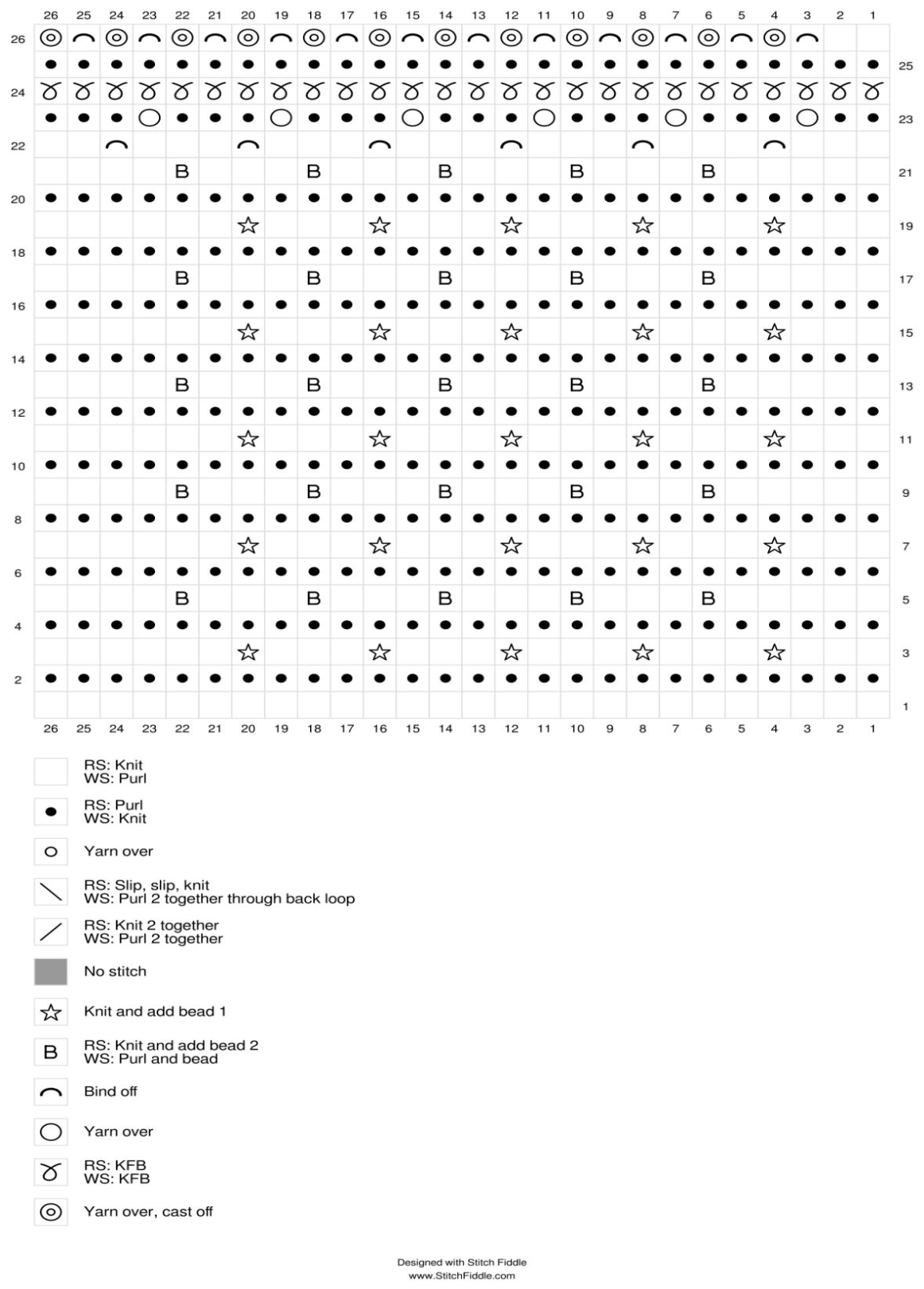
Figure 2.
Shows coded chart of pattern above.
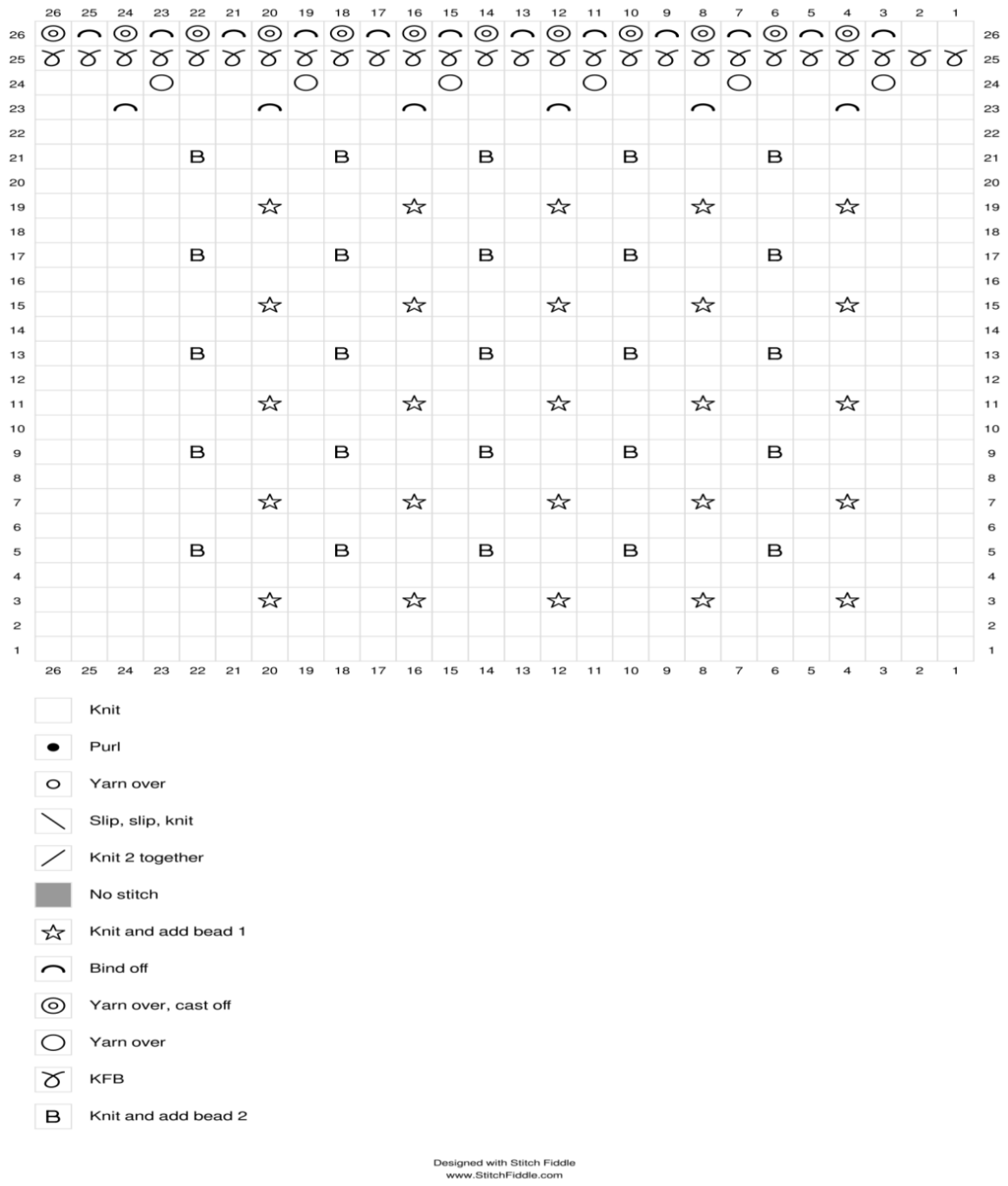
Figure 3.
Shows decoded chart of pattern above.
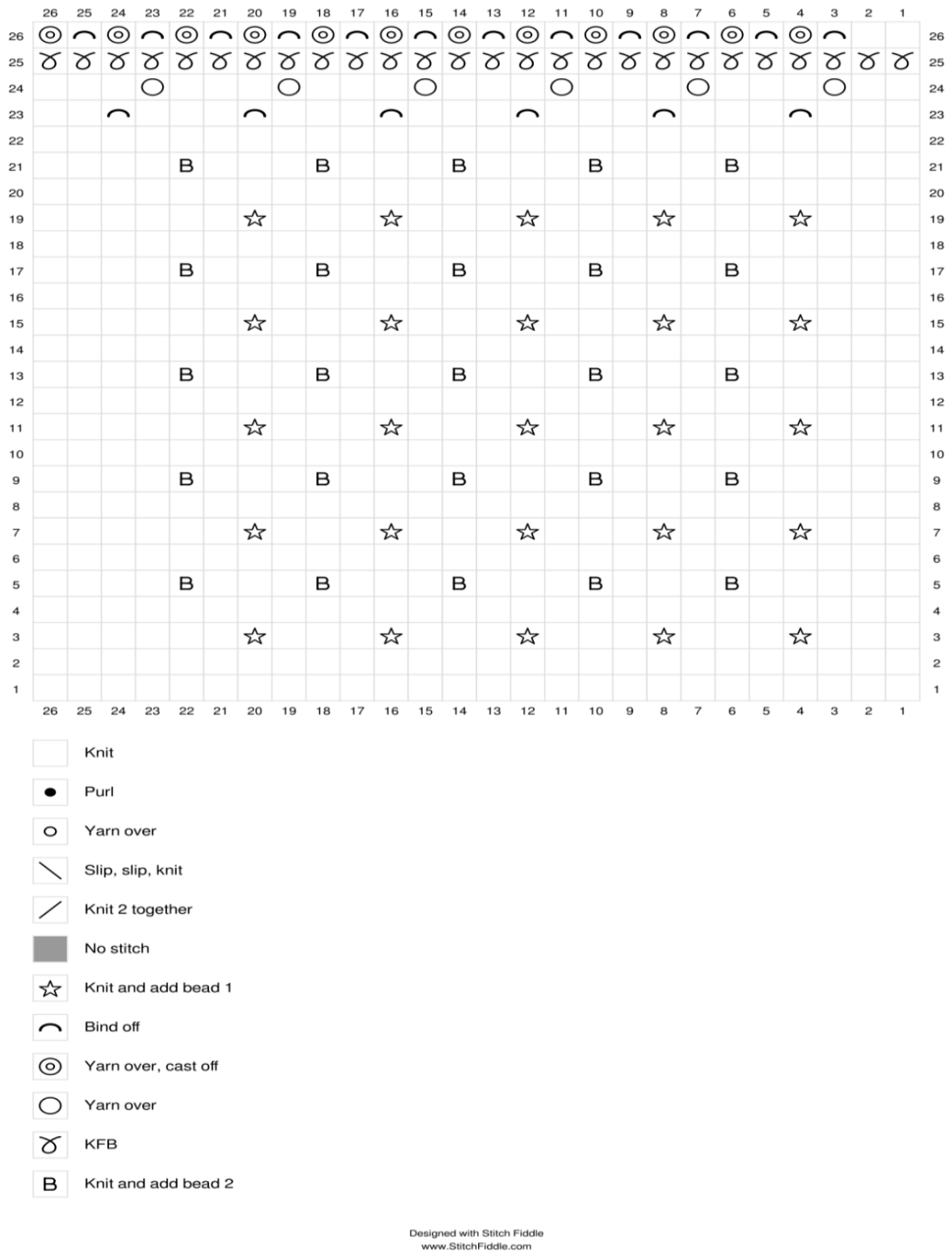
Disclaimer/Publisher’s Note: The statements, opinions and data contained in all publications are solely those of the individual author(s) and contributor(s) and not of MDPI and/or the editor(s). MDPI and/or the editor(s) disclaim responsibility for any injury to people or property resulting from any ideas, methods, instructions or products referred to in the content. |
© 2026 by the authors. Licensee MDPI, Basel, Switzerland. This article is an open access article distributed under the terms and conditions of the Creative Commons Attribution (CC BY) license (http://creativecommons.org/licenses/by/4.0/).
Copyright: This open access article is published under a Creative Commons CC BY 4.0 license, which permit the free download, distribution, and reuse, provided that the author and preprint are cited in any reuse.