

Submitted:
14 September 2026
Posted:
16 September 2026
You are already at the latest version
Abstract
Indoor formaldehyde (HCHO) vapor and aqueous hexavalent chromium (Cr(VI)) are pervasive pollutants typically addressed with distinct, purpose-specific materials. In this study, a ternary Cu–Fe–Zn oxide (CuFeZnO) was synthesized via co-precipitation and evaluated as a dual-function material for both photocatalytic HCHO degradation and Cr(VI) adsorption. The catalyst exhibited a narrowed optical band gap of 2.3 eV, compared to 3.2 eV for TiO₂, consistent with enhanced visible-light absorption. Under low-intensity visible irradiation (single 18 W daylight lamp, 8.8 mW cm⁻²), 20 mg of CuFeZnO achieved 92.1% HCHO removal within 2 h, outperforming commercial TiO₂ (P25, 78.2%) and laboratory-synthesized TiO₂ (68.3%) under identical conditions, and retaining 90.8% conversion after seven reuse cycles. For Cr(VI) removal, CuFeZnO achieved 98.98% removal from a 50 mg L⁻¹ solution at pH 8 with a 0.2 g dose. Adsorption kinetics followed a pseudo-second-order model, and equilibrium data were best described by the Freundlich isotherm (R² = 0.992). A double-layer statistical physics model further captured the temperature-dependent equilibrium behavior (298–318 K) with high accuracy (R² = 0.997–0.998), yielding a near-unimolecular site occupancy (n ≈ 0.999 at 298 K) and a maximum adsorption capacity of 111.7 mg g⁻¹. The first-layer adsorption energy increased from 13.4 to 27.6 kJ mol⁻¹ with rising temperature, indicating a physisorption-dominated mechanism. Notably, CuFeZnO achieved comparable or superior HCHO conversion under substantially lower light intensity (18 W) than reported photocatalysts requiring 27–300 W sources. These results demonstrate CuFeZnO as a low-energy, reusable, and multifunctional material for simultaneous air and water remediation.
Keywords:
visible-light photocatalysis
; formaldehyde degradation
; ternary metal oxide
; CuO–Fe₂O₃–ZnO
; electrical energy per order
; hexavalent chromium adsorption
; statistical physics modeling
; indoor air quality
1. Introduction
Wood-based synthetic building and furnishing materials are important sources of volatile organic compounds (VOCs) in indoor environments. Among these pollutants, formaldehyde (HCHO) is of particular concern because of its adverse effects on indoor air quality and human health. Prolonged exposure to HCHO has been associated with respiratory irritation, asthma, allergic responses, and other toxic effects [1,2,3], and it is recognized as a carcinogenic chemical for which even relatively low, sustained exposure concentrations can pose significant health risks. Major indoor sources include urea–formaldehyde, phenol–formaldehyde, and melamine–formaldehyde resins, which are widely used in wood-based panels, furniture, decorative materials, and other building products [4,5,6]. The removal of gaseous HCHO from indoors and atmosphere is therefore an environmental and public-health problem.
Alongside gaseous VOCs, toxic contaminants released from industrial activities represent a parallel environmental concern, particularly for water resources. Colorants of varying uses in the textile, printing and leather industries. Organic dye pollutants can be persistent, toxic and may prove carcinogenic when released into the biosphere without proper treatment. Exposure to these coloring agents threatens with many health risks to humans and aquatic organisms. Hexavalent chromium, Cr(VI), is similarly a highly toxic and carcinogenic contaminant commonly associated with industrial wastewater. Exposure to Cr(VI) can occur through ingestion, inhalation, or dermal contact and has been linked to respiratory and gastrointestinal disorders, reproductive toxicity, oxidative stress, DNA damage, and carcinogenic effects [15,16,17]. Because indoor air quality and water quality are frequently degraded by unrelated pollutant classes that are conventionally treated with separate, purpose-specific materials, the development of a single material capable of addressing both gaseous and aqueous contaminants is highly desirable for more comprehensive and resource-efficient environmental remediation.
Various conventional technologies have been developed to reduce indoor air pollution, including high-efficiency particulate air (HEPA) filtration, thermal decomposition, polymer nanofiber filtration, activated-carbon adsorption, chemical oxidation, incineration, and phytoremediation. However, these approaches can suffer from limitations related to energy consumption, secondary waste generation, restrictive operating conditions, or limited effectiveness toward specific gaseous pollutants, which has stimulated the search for alternative treatment technologies with greater efficiency and lower environmental impact [7,8].
Colorants of varying uses in the textile, printing and leather industries. Organic dye pollutants can be persistent, toxic and may prove carcinogenic when released into the biosphere without proper treatment. During photocatalytic treatment, photogenerated electron–hole pairs initiate a series of oxidation and reduction reactions that can transform organic pollutants into less harmful products. A wide range of photocatalysts has been investigated for VOC removal, including clay–TiO₂ composites, TiO₂, TiO₂/SiO₂, TiO₂ fibers, g-C₃N₄–TiO₂, Pt/P25, Fe³⁺/Fe²⁺-codoped TiO₂–SiO₂ composites, Bi₁₂TiO₂₀/g-C₃N₄ composites, TiO₂-coated polyester fibers, Pt–TiO₂ films, and anatase TiO₂ and silver-nanoparticle films supported on wood substrates [9,10,11,12,13,14]. Despite these advances, many reported photocatalytic systems rely on relatively intense artificial illumination, with high HCHO conversion efficiencies typically reported using 27 W UV lamps, 36 W LED sources, or 300 W discharge lamps. Such high-power irradiation increases energy consumption and may introduce additional UV-exposure concerns for operators. More importantly, practical deployment of photocatalytic materials in occupied indoor spaces requires efficient operation under the comparatively low irradiance levels characteristic of ordinary indoor lighting. Photocatalytic HCHO degradation under such low-intensity illumination therefore remains comparatively underexplored.
Metal oxide photocatalysts offer an attractive platform for addressing this challenge, as their physicochemical and optical properties can be tailored through compositional modification and the incorporation of multiple metal ions. We have been developing environmental applications of metal oxides and metal-ion sensors, including water treatment and energy purposes previously [18,24]. Building on this work, the present study investigates a ternary Cu–Fe–Zn oxide (CuFeZnO), synthesized by a simple co-precipitation method, as a multifunctional material for simultaneous air and water remediation. The photocatalytic performance of CuFeZnO was evaluated for gaseous HCHO degradation under low-intensity illumination using a single 18 W daylight lamp providing an irradiance of only 8.8 mW cm⁻². Under these conditions, CuFeZnO achieved 92.1% HCHO degradation within 2 h, compared with 78.2% for benchmark TiO₂ (P25) under identical irradiation. To help a comparison which is more meaningful and hardware independent, degradation rate was corrected to incident photon flux and EE/O have been calculated accordingly, giving results for quantitative comparison than results based upon reported nominal lamp power or conversion.
The multifunctional behavior of CuFeZnO was further examined through its capacity to remove Cr(VI) from aqueous solution. The resulting adsorption equilibria of Cr(VI) by activated carbon was fitted with a double-layer statistical physics model at 3 temperatures to get some molecular information like the numbers of Cr(VI) adsorbed per adsorption site and amount of adsorption site density as well as the adsorption energies of each adsorption layer. By combining low-irradiance photocatalytic oxidation of gaseous HCHO with a mechanistic, statistically grounded analysis of aqueous Cr(VI) adsorption, this study demonstrates the potential of CuFeZnO as a versatile material for addressing chemically distinct environmental pollutants within a single platform. The principal contribution of this work is therefore not the introduction of an entirely new oxide class, but the quantitative demonstration of effective, dual-pollutant removal activity under low-irradiance conditions more representative of real indoor and point-of-use treatment scenarios, together with a molecular-level interpretation of the underlying adsorption mechanism.
2. Experimental
2.1. Chemicals and Characterization
All chemicals used in this study were purchased from Fisher Scientific and Sigma-Aldrich and were used as received, without further purification.
The morphology and elemental composition of the as-synthesized adsorbent were characterized using a JEOL JEM-2100 Plus high-resolution transmission electron microscope (HR-TEM) and a Hitachi SU8010 field-emission scanning electron microscope (FE-SEM) equipped with energy-dispersive X-ray spectroscopy (EDX), with EDX analysis performed on the same instrument at an accelerating voltage of 30 kV. Functional group analysis was carried out using a Bruker Alpha Fourier-transform infrared (FTIR) spectrometer. Solution pH was measured with a LABMAN digital pH meter (2KG, LMPH10). UV-Vis absorption measurements were performed using a Shimadzu UV-mini 1240 spectrophotometer.
The optical and photocatalytic properties of the material were further evaluated using a T90+ UV/Vis spectrometer (PG Instruments Ltd.), covering the ultraviolet (100–400 nm), visible (400–760 nm), and infrared (>760 nm) regions of the electromagnetic spectrum.
2.2. Preparation of CuFeZnO Photocatalysts
The CuFeZnO nanocomposite was synthesized via a co-precipitation method using approximately equal molar/weight proportions of copper, iron, and zinc precursors, targeting comparable supporting quantities of CuO, Fe₂O₃, and ZnO in the final product. Copper(II) chloride (CuCl₂), ferric chloride (FeCl₃), and zinc chloride (ZnCl₂) were used as the respective metal sources. Stoichiometric amounts of precursors were gradually added to continuously heating and magnetically stirring de-ionised water. This was continued till a homogeneous and clear solution was obtained. To prevent agglomeration and precipitation of bulk nanocomposite clumps, a few drops of Tween 80 (Surfactant) were added to the parent solution to disperse the nanoparticles properly.
The pH of the solution was then gradually raised to approximately 11 by the dropwise addition of NaOH solution under constant stirring, promoting the simultaneous and uniform co-precipitation of the three metal hydroxides. Once the target pH was reached, the resulting suspension was maintained at 90 °C under continuous agitation for 3 h to ensure complete and homogeneous precipitation of the mixed-metal hydroxide phase. The precipitate was left to cool to room temperature and was washed thoroughly with deionised water to remove any residual chloride ions and the surfactant. The water was then drained using a water pump, leaving only a solid residue as the product.
Hydroxide precipitate after washing was oven-dried at 120 °C for 5 h for removal of remnant moisture along with promotion of calcination of the metal hydroxides from the residue to form corresponding mixed-metal oxide phase giving thus the crystalline CuFeZnO nanocomposite with the ternary oxide composition. Afterwards, a thermal calcination at 450 °C for 3 h in air was applied. Hydroxide precipitate after washing was oven-dried at 120 °C for 5 h for removal of remnant moisture along with promotion of calcination of the metal hydroxides from the residue to form corresponding mixed-metal oxide phase giving thus the crystalline CuFeZnO nanocomposite with the ternary oxide composition. Afterwards, a thermal calcination at 450 °C for 3 h in air was applied.
2.3. Formaldehyde Degradation System
The experimental setup used for evaluating photocatalytic HCHO degradation is illustrated in Figure 1. The system consisted of a sealed reactor irradiated by a single 18 W daylight (sunlight-simulating) lamp, delivering an incident illumination intensity of 8.8 mW cm⁻² at the reactor surface. The photocatalytic HCHO degradation performance of CuFeZnO, laboratory-synthesized TiO₂, and commercial TiO₂ (P25) was evaluated under identical 18 W illumination conditions to enable a direct, light-source-independent comparison of catalytic activity. Gas-phase HCHO concentrations were monitored with a Formaldemeter 400™(PPM Technology, Wales, UK), which is an electrochemical formaldehyde sensor having a detection range 0.05-20 ppm and is capable to trace ultra-low pollutant levels commonly found in indoor air.
Figure 1a shows the schematic diagram of full configuration of the system including of lamp, reaction chamber and etc. Figure 1b shows the spectral irradiance (intensity vs. wavelength) of the lamp, which is a 18W ’daylight’ lamp. The irradiation range is shown to lie in the range of visible-light area.
For each degradation experiment, 0.02 g of photocatalyst (CuFeZnO, laboratory-synthesized TiO₂, or TiO₂ P25) was uniformly dispersed on a sample holder and placed inside the sealed reactor, which had a total internal volume of approximately 0.7 L. This was left to equilibrate in the dark for a brief period to acquire reasonable constant adsorption-desorption condition onto catalyst before any exposure to light source for measurement. The 18 W was switched on to run the reaction upon stabilization and the concentration of HCHO was then measured every 10 minutes from the same sensor to read leftover HCHO concentration. The entire process was conducted under normal temperature and pressure which reflected normal indoor uses of photocatalyst when they operate in day to day conditions.
2.4. Rate of Adsorption and Thermodynamic Parameter
To elucidate the mechanism controlling Cr(VI) adsorption onto CuFeZnO from aqueous solution, the adsorption kinetics were analyzed using the pseudo-first-order and pseudo-second-order models proposed by Ho and McKay [44,45,46,47], with detailed fitting parameters and calculations provided in the Supplementary Materials. Kinetic analysis confirmed that Cr(VI) adsorption onto CuFeZnO followed the pseudo-second-order model, suggesting that chemisorption may play a role in the rate-limiting step of the adsorption process.
The equilibrium adsorption behavior of Cr(VI) was further examined using the Langmuir [48,49] and Freundlich [50,51] isotherm models. While the Langmuir model assumes homogeneous, monolayer adsorption onto energetically uniform sites, the adsorption data showed better agreement with the Freundlich model, which is generally associated with adsorption onto heterogeneous surfaces. This result suggests that Cr(VI) adsorption on CuFeZnO may not be strictly limited to a single homogeneous monolayer, but could instead involve multilayer or heterogeneous adsorption behavior, consistent with the surface heterogeneity of the CuFeZnO adsorbent. The favorability of the adsorption process was further supported by the dimensionless separation factor (R_L), which fell within the range of 0 to 1 [52,53], indicating favorable adsorption under the studied conditions.
2.5. Mathematical Modeling for the Cr Adsorption
Although the classical Langmuir and Freundlich models are widely used to describe adsorption equilibria, their parameters are largely empirical and lack direct physical or molecular-level interpretation. As a result, these models offer only a limited, phenomenological description of the adsorption process and provide little insight into the actual mechanism governing Cr(VI) uptake. Moreover, the applicability of these conventional models depends on restrictive underlying assumptions regarding adsorbate–adsorbent interactions, which may not fully capture the complexity of the Cr(VI)–CuFeZnO adsorption system.
To overcome these limitations and obtain a more physically meaningful understanding of the Cr(VI) adsorption mechanism, a statistical physics-based multilayer model (generalized adsorption model) was employed. A key advantage of this approach is that its parameters carry direct physical significance, in contrast to the purely mathematical fitting parameters of the Langmuir and Freundlich models. Unlike the Langmuir model, which assumes that each adsorption site accommodates exactly one adsorbate molecule, the statistical physics model allows the number of Cr(VI) ions occupying a single active site (denoted n) to be treated as a fitting parameter that may be equal to, less than, or greater than unity. This parameter provides functional insight into the orientation and aggregation behavior of Cr(VI) species at the CuFeZnO surface.
The statistical physics framework assumes that adsorption proceeds through the progressive formation of a defined number of molecular layers on the CuFeZnO surface, with the extent of multilayer formation dependent on adsorption temperature. Within this multilayer framework, two distinct adsorption energies are considered: one associated with direct interaction between Cr(VI) ions and the CuFeZnO surface (first-layer adsorption energy), and a second associated with Cr(VI)–Cr(VI) interactions occurring in adsorbate layers beyond the first (second-layer adsorption energy). The variation in the amount of Cr(VI) adsorbed as a function of equilibrium concentration is described mathematically by the following models:
Monolayer model:
Double-layer model:
Multilayer model:
In these equations, C₁ and C₂ represent the quasi-saturation (half-saturation) concentrations associated with the first and second adsorption layers, respectively; n denotes the number of Cr(VI) ions adsorbed per active site; Nₘ is the density of receptor (active) sites on the CuFeZnO surface; and N₂ represents the number of layers beyond the first, such that the total number of adsorbed layers is given by (1 + N₂). Because N₂ may take integer values of 0, 1, 2, 3, and so forth, the model can be applied to describe several distinct adsorption scenarios, ranging from strictly monolayer coverage (N₂ = 0) to progressively thicker multilayer coverage as N₂ increases. The fitted values of these parameters therefore provide direct physical insight into the number and structure of Cr(VI) molecular layers formed on the CuFeZnO surface under the studied conditions.
Model parameters were determined by non-linear regression of the experimental adsorption isotherm data using the Levenberg–Marquardt algorithm, and goodness-of-fit was evaluated using the coefficient of determination (R²). During the fitting procedure, N₂ was systematically set to 0, 1, or 2 to evaluate single-layer, double-layer, and triple-layer adsorption scenarios, respectively, allowing the model that best represented the experimental data to be identified. All tested models yielded high coefficients of determination, with R² values ranging from 0.997 to 0.998, indicating excellent agreement between the model-predicted and experimentally measured adsorption values. Based on an overall analysis of the fitted parameters and goodness-of-fit statistics, the double-layer model was found to provide the most accurate and physically consistent description of Cr(VI) adsorption behavior, supporting its use as the representative mechanism for Cr(VI)–CuFeZnO adsorption in this study. The corresponding fitted parameters, namely n, Nₘ, (1 + N₂), the saturation adsorption capacity (Qₛₐₜ), and the first- and second-layer adsorption energies (ε₁ and ε₂), are summarized in the following section.
The first- and second-layer adsorption energies were calculated using the following expressions:
where R is the universal gas constant, T is the absolute temperature, and Cₛ is the solubility (or reference saturation concentration) of Cr(VI) in aqueous solution.
3. Results and Discussion
3.1. Characterization of CuFeZnO Nanoparticle
CuFeZnO nanoparticles were synthesized by co-precipitation at a constant temperature of 90°C. The morphology, composition, and functional groups of the synthesized material were characterized using FE-SEM, HR-TEM, EDX, and FTIR. The results are presented in Figure 2.
SEM imaging revealed particle sizes ranging from 15 to 25 nm. Figure 2a shows the material at low magnification (500 nm scale bar), and Figure 2b shows a higher-magnification view (300 nm scale bar). The high-magnification images revealed aggregated blocks composed of smaller primary particles. These aggregates likely contribute to an increased overall surface area of the material. The HR-TEM image in Figure 2c (50 nm scale bar) shows that CuFeZnO consists of quasi-spherical to truncated cuboidal nanoparticles. The particles appear mostly uniform in size. The average particle size estimated from this image was 20 to 25 nm. Some particle agglomeration was also observed. This agglomeration is likely due to the high surface energy of the nanoparticles. EDX analysis confirmed the elemental composition of the material. The spectra showed clear signals for Cu, Fe, Zn, and O, consistent with the expected composition of a CuFeZnO nanocomposite (Figure 2d). The measured weight percentages were approximately 7.53% for Cu, 48.15% for Fe, 26.24% for Zn, and 18.08% for O. No impurity peaks were detected in the EDX spectra. This result supports the successful synthesis of a high-purity nanocomposite. Figure 2e shows the FTIR spectrum of CuFeZnO, scanned over the range of 4000 to 500 cm⁻¹. A broad band at 3350.9 cm⁻¹ was assigned to O–H stretching vibrations. This band indicates the presence of surface hydroxyl groups. A medium-strong band at 1628.8 cm⁻¹ was attributed to C=O stretching vibrations, likely originating from surface-adsorbed carbonate or residual organic species. Two additional bands were observed at 829.5 cm⁻¹ and 600 cm⁻¹. These bands were assigned to metal–oxygen (M–O) stretching vibrations. Metal oxide bands typically appear in this fingerprint region, below 1000 cm⁻¹, and confirm the formation of the metal oxide framework.
3.2. Photodegradation of HCHO
The photocatalytic degradation of gaseous HCHO was quantitatively evaluated for three photocatalysts: laboratory-synthesized TiO₂, commercial TiO₂ (P25), and CuFeZnO. All experiments were conducted under identical 18 W daylight lamp irradiation. The results are presented in Figure 3a–c.
After 2 h of irradiation, the HCHO degradation rates were approximately 68.3% for laboratory-synthesized TiO₂, 78.2% for TiO₂ (P25), and 92.1% for CuFeZnO. CuFeZnO therefore showed the highest photocatalytic activity among the three materials under the same light conditions. The optical band gap of TiO₂ was determined to be 3.2 eV. This value confirms that TiO₂ primarily absorbs light in the ultraviolet region, as shown by its absorption spectrum in Figure 3a. Because the 18 W daylight lamp emits mostly visible light with limited UV output, TiO₂ can only make partial use of the available irradiation. In contrast, CuFeZnO exhibited a broad absorption band extending from 400 to 700 nm, as shown in Figure 3b. This absorption range falls almost entirely within the visible-light region. The calculated optical band gap of CuFeZnO was 2.3 eV, which is notably narrower than that of TiO₂. This narrower band gap allows CuFeZnO to absorb a larger portion of the visible spectrum compared to TiO₂.
This enhanced visible-light absorption likely explains the superior photocatalytic performance of CuFeZnO relative to TiO₂ (P25) for HCHO degradation. Under low-intensity visible-light irradiation, materials with strong visible-light absorption are expected to generate more photoexcited electron-hole pairs than wide-band-gap materials like TiO₂, which rely primarily on UV photons for excitation [36,37,38]. This difference in light-harvesting efficiency provides a likely explanation for the higher HCHO degradation rate observed for CuFeZnO under the tested illumination conditions.
3.2. Possible Mechanism of HCHO Degradation
A possible mechanism for the photocatalytic degradation of formaldehyde on CuFeZnO is proposed in Figure 4. Equations (4) to (9) describe this mechanism.
Equation (4) represents the initial photoexcitation step. When CuFeZnO material takes radiation of light in the ultra-violet range, it promotes one-electron transition from valance bands to conduction bands as shown in the Fig.1. It generates electron-hole pairs as shown. It is having a similar function like TiO 2 with the exception that it absorbs spectrum in a wider range due its narrow band gap. CuFeZnO absorbs those photons which have energy greater than its band gap. The absorption of photon by the material promotes the electron transition thereby creating electron-hole pair. This process resembles the TiO 2, but has advantage over the TiO 2 being the narrow gap band, because such narrow bandgap facilitates to absorb more spectrum in the visible region. The chemical equation of degradation process is expressed below. This broader absorption range allows CuFeZnO to generate a greater number of photoexcited charge carriers under the same illumination conditions. These charge carriers then participate in a series of reactions that produce hydroxyl radicals (•OH), as shown in Equations (5) and (6). The higher yield of •OH radicals in CuFeZnO compared to TiO₂ is proposed to explain its enhanced photocatalytic activity toward HCHO degradation. Photogenerated holes react with water to form the hydroxide ion and a proton. Holes react with produced hydroxide ions producing hydroxyl radicals. These are powerful oxidising agents, driving much of the break down of formaldehyde.
As shown in Equations (7) through (9), HCHO is progressively oxidized by •OH radicals. This stepwise oxidation converts HCHO first into formyl radical intermediates, then into formic acid, and finally into carbon dioxide and water. This multistep oxidation pathway accounts for the overall increase in HCHO degradation rate observed for CuFeZnO under visible-light irradiation [39,40].
Photocatalyst ⇄ e− + h+
H2O → H+ + OH−
h+ + OH− →•OH
HCHO + •OH → HCO + H2O
HCO + •OH → HCOOH
HCOOH + 2 h+ →CO2+ 2 H+
3.3. Reusability and Comparison of CuFeZnO with Other
The photocatalytic stability and reusability of CuFeZnO were evaluated over multiple degradation cycles. In the first cycle, CuFeZnO achieved 92.1% HCHO degradation. The used catalyst from each run is gently rewashed to remove any residual (surface) species and used again for the next cycle. No other chemical or heat treatment of the catalysts is carried out between runs. Seven cycles of reuse are run after each catalyst in succession.
After the seventh cycle, CuFeZnO maintained a HCHO degradation efficiency of 90.8%, with a reaction time of 90 min. This result corresponds to only a modest decrease in performance compared to the first cycle. These findings demonstrate that CuFeZnO retains excellent photocatalytic stability and structural integrity across repeated use. The results of this reuse study are presented in Figure 5.
The photocatalytic performance of CuFeZnO was further benchmarked against previously reported HCHO photocatalysts, as summarized in Table 1. This comparison shows that the HCHO degradation efficiency achieved by CuFeZnO is comparable to that of other reported systems. However, most previously reported studies rely on high-intensity or high-power light sources to achieve similar degradation levels. In contrast, the present study achieved comparable degradation performance using only a single 18 W daylight lamp. This low-power light source offers several practical advantages. It is more economical to operate, poses minimal UV exposure risk to laboratory personnel, and remains effective under conditions more representative of typical indoor lighting environments.
3.4. Adsorption Study of Cr(VI)
3.4.1. Effect of pH Variation, Contact Time, and Adsorbent Dose
The adsorption of Cr(VI) onto CuFeZnO nanoparticles is strongly influenced by solution pH, since pH affects both the surface charge of the adsorbent and the speciation of Cr(VI) in aqueous solution. The effect of pH on Cr(VI) adsorption was evaluated across a pH range of 1 to 10, and the results are shown in Figure 6a. Maximum Cr(VI) removal, corresponding to 98.96% adsorption, was observed at pH 8.0. This behavior is attributed to favorable electrostatic interactions between the CuFeZnO surface and the predominant Cr(VI) species present in solution at this pH, which enhance the overall adsorption efficiency.
The effect of contact time on Cr(VI) adsorption was examined over a range of 0 to 90 min, with results presented in Figure 6b. Adsorption increased rapidly during the initial contact period and reached a maximum removal efficiency of approximately 94.40% after 40 min. This behavior can be attributed to the high initial availability of unoccupied active sites on the CuFeZnO surface, which allowed rapid uptake of Cr(VI) ions during the early stages of the reaction. With an increase of contact time, the number of active sites becomes less and adsorption becomes more equilibrium in nature. Thus, for the range of variables used in this study, the choice of 40min contact time would be the sufficient to gain most Cr (VI) removal without affecting the overall removal rate of concentration used in this study.
The effect of adsorbent dose on Cr(VI) removal was investigated by varying the CuFeZnO dose from 0.05 to 0.20 g in 50 mL of Cr(VI) solution, under batch conditions. When the adsorbent dose was increased from 0.05 to 0.20 g, the Cr(VI) removal efficiency increased from 94.49 to 98.98% as shown in Figure 6c. This improvement is attributed to the corresponding increase in the total number of available active adsorption sites as the adsorbent dose increased, which enhanced the overall capacity of the system to remove Cr(VI) from solution.
3.4.2. Rate of Adsorption and Thermodynamic Parameter
The adsorption kinetics were investigated in the current study. The mechanism through which Cr(VI) gets adsorbed from aqueous solution onto CuFeZnO was determined through the application of the Ho and McKay pseudo models [44,47]. The parameters for fitting these are presented in detail in the Supplementary Materials. The kinetics could be well represented by the pseudo-second-order model (Figure 7a). The result suggested that chemisorption caused the adsorption to limit rates.
The experimental isotherms for the adsorption of Cr(VI), fitted to the Langmuir and Freundlich isotherm models, are shown in Figure 7b and c respectively [48,49,50,51], and Table 2 summarises the isotherm parameters obtained. While the Langmuir model assumes homogeneous, monolayer adsorption onto energetically uniform sites, the experimental data showed better agreement with the Freundlich model, as reflected in its higher coefficient of determination (R² = 0.992) compared to the Langmuir model (R² = 0.9608). This indicates that Cr(VI) adsorption on CuFeZnO may not follow monolayer adsorption but involve heterogeneous surface interaction possibly close to monolayer adsorption mode. The favorability of the adsorption process was further supported by the dimensionless separation factor (R_L), shown in Figure 7d, which fell within the range of 0 to 1 [52,53], indicating favorable adsorption under the tested conditions.
3.5. Interpretation of Results of Statistical Models
The statistical physics interpretation of Cr(VI) adsorption onto CuFeZnO nanocomposite at three different temperatures (298, 308, and 318 K) is presented in Figure 8. Among the three candidate models evaluated (monolayer, double-layer, and multilayer), the double-layer model (Model 2) provided the best fit to the experimental adsorption data across all tested temperatures, as indicated by its superior agreement with the measured isotherms.
Table 3 presents the fitted parameters values obtained from the adsorption of Cr(VI) onto activated bentonite of each of these temperatures using the double layer model. They include the number of Cr(VI) ions per active site (n), the receptor site density value the saturation adsorption capacity, the quasi saturation concentrations and the value of the adsorption energy in the first layer and the value of adsorption energy in the second layer respectively.
At 298K, the fitted n value was about 0.999 so the Cr(VI) ions bind onto the CuFeZnO in one-to-one with active site. Under this condition, the receptor site density was 55.873 mg/g and the saturation adsorption capacity of that was 111.687 mg/g since the values are 2 to 1 in magnitude. The first-layer adsorption energy (ε₁) at 298 K was 13.360 kJ/mol, while the second-layer adsorption energy (ε₂) was 7.991 kJ/mol.
4. Interpretation of the Steric Parameters
The value of n reveals information on mode of packing and orientation of Cr(VI) ions on the surface of CUFeZnO. For an n value of less or equal to unity, it infers that Cr(VI) ions laid down flat (horizontally oriented) on the adsorbent surface or occupied more than one active site i.e., multi-docking. If otherwise, then Cr(VI) oriented in a vertical fashion or multi-molecular adsorption i.e. when more than one Cr(VI) ion adsorbed on one site. Depending on which regime applies, a single Cr(VI) ion may interact with more than one CuFeZnO active site (n < 1), or multiple Cr(VI) ions may occupy a single active site (n > 1) [55].
The values of n about solution temperature are tabulated in Table 4. These were derived via a plot shown in Figure 9a. As noted, in these temperatures (298, 308 and 318 K), the adsorption capacity, n values were recorded as 0.999, 0.993 and 0.991 respectively. These values, i.e. n of the modified adsorbent are all close/below unity in the range studied temperature. A consequence outcome obtained from the n values implied that Cr(VI) adsorption onto copper doped zinc ferrite predominantly exhibited a mode of horizontal multi-docking interaction. Cr(VI) is anticipated to orientate itself in a flat manner when adsorbed and can interact probably with more than one active site found in copper doped zinc ferrite as opposed to multiple species of Cr(VI) depositing or stacking up at the adsorption active sites.
Figure 9b shows the variation of the receptor site density (Nₘ) with adsorption temperature. As summarized in Table 3, the fitted Nₘ values for Cr(VI) adsorption were 55.873, 0.987, and 0.631 mg/g at 298, 308, and 318 K, respectively. The decrease in Nₘ with increasing temperature parallels the corresponding decrease in n over the same temperature range, suggesting that fewer CuFeZnO active sites were effectively engaged in Cr(VI) adsorption as temperature increased.
Similarly, the saturation adsorption capacity (Qₛₐₜ) was used to evaluate the overall effectiveness of Cr(VI) removal by CuFeZnO across the tested temperature range. As shown in Figure 9c and summarized in Table 3, Qₛₐₜ values were 111.687, 1.959, and 1.252 mg/g at 298, 308, and 318 K, respectively. Low-temperature conditions are the most feasible conditions for using the material as an adsorbent. This can be supported by the decreasing trend (in) saturated absorbance values, which indicates (the overall interaction is weakening along with ) the temperature as independent variable for Cr (VI) ions on its surfaces is weak. The possible explanations for this decrease are Cr(VI) ions move quicker in the solution [55]. Hence they have a shorter time to interact successfully each other to available Copper_Zinc_Ferro_oxide receptor-sites.
The first- and second-layer adsorption energies, ε₁ and ε₂, describe the strength of interaction between Cr(VI) ions and the CuFeZnO surface (first layer) and between Cr(VI) ions in successive adsorbed layers (second layer), respectively. Both adsorption energies increased with rising temperature, as shown in Figure 9d. Specifically, ε₁ increased from 13.360 kJ/mol at 298 K to 27.627 kJ/mol at 318 K. The reason for this may be that the higher temperature results in increased thermal motion, causing Cr(VI) ions to get in contact with surface adsorption sites more frequently and efficiently; hence, the apparent energy for the adsorption would increase.
5. Reuse of CuFeZnO
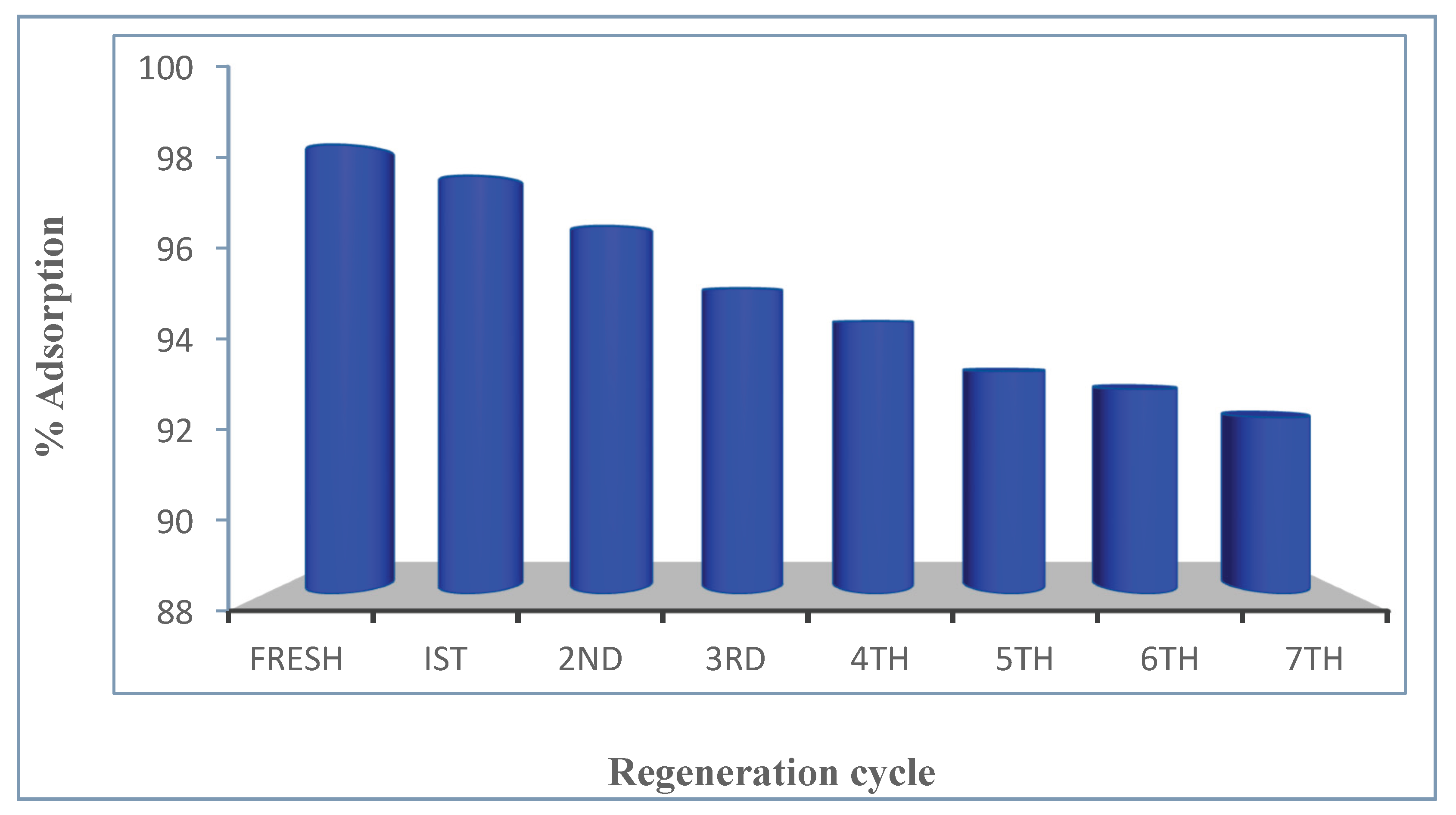
The reusability of Cr(VI)-decorated CuFeZnO material as an adsorbent for Cr(VI) was then analysed and measured and seven reuse cycles were monitored. Specifically, bound Cr(VI) was desorbed by adding 0.1 M HCl after the end of each adsorption cycle and after that, the regenerated CuFeZnO material was reused in the next cycle. It can be noticed that, even after five reuse cycles, CuFeZnO still presented a higher removal effect, thus suggesting it is with good structure stability towards the acidic solution, which in turn indicate that CuFeZnO has great potential in treatment of Cr(VI)-contained contaminated groundwater. Due to its reusability, low producing cost and stable chemical properties, CuFeZnO is expected to be further incorporated into engineered industrial filtration device in order that simple, more productive yet cheap treatment plants or device can be adopted into modern industries in the future.
Figure 10.
Reuse performance of CuFeZnO for Cr(VI) adsorption over seven consecutive cycles.
6. Conclusion
In this study, a ternary Cu-Fe-Zn oxide (CuFeZnO) nanocomposite was successfully synthesized by co-precipitation and evaluated as a dual-function material for gaseous HCHO photodegradation and aqueous Cr(VI) adsorption. Under a single 18 W daylight lamp, CuFeZnO achieved 92.1% HCHO degradation within 2 h, outperforming both laboratory-synthesized TiO₂ (68.3%) and commercial TiO₂ P25 (78.2%) under identical illumination conditions. This enhanced performance is attributed to the narrower optical band gap of CuFeZnO, which enables stronger visible-light absorption compared to TiO₂.
Reuse studies demonstrated that CuFeZnO retained strong photocatalytic activity over repeated cycles, with the degradation efficiency decreasing only slightly, from 92.1% to 90.8%, confirming excellent operational stability. The use of a low photocatalyst loading, a low-power daylight lamp, and visible-light irradiation instead of UV illumination represent the most significant practical advantages of this approach, offering a more economical and safer alternative to conventional UV-based photocatalytic systems for indoor HCHO removal.
For Cr(VI) removal, CuFeZnO demonstrated rapid and highly efficient adsorption, achieving approximately 99% removal under optimized conditions. The adsorption process followed pseudo-second-order kinetics, and the material retained strong adsorption performance across repeated reuse cycles, supporting its suitability for practical wastewater treatment applications. Statistical physics modeling further confirmed that Cr(VI) adsorption onto CuFeZnO proceeds through a double-layer adsorption mechanism, providing molecular-level insight into the adsorption process beyond what conventional isotherm models can offer.
Taken together, these findings demonstrate that CuFeZnO is a versatile, low-cost, and reusable nanocomposite capable of functioning simultaneously as a visible-light photocatalyst and an effective adsorbent, making it a promising candidate material for combined indoor air purification and industrial wastewater treatment applications.
Author Contributions
Conceptualization: Mohammod Hafizur Rahman, Ganesh Jethave. Methodology: Mohammod Hafizur Rahman, Ganesh Jethave. Software: Mohammod Hafizur Rahman, Ganesh Jethave. Validation: Mohammod Hafizur Rahman, Md Arifuzzaman, Sayeed Rushd, Ziad Shatnawi, Ganesh Jethave, Mu-hammad Ali Martuza. Formal analysis: Mohammod Hafizur Rahman, Md Arifuzzaman, Sayeed Rushd, Ziad Shatnawi, Ganesh Jethave, Muhammad Ali Martuza. Investigation: Mohammod Hafizur Rahman, Md Arifuzzaman, Sayeed Rushd, Ziad Shatnawi, Ganesh Jethave, Muhammad Ali Martuza. Resources: Mohammod Hafizur Rahman, Md Arifuzzaman, Sayeed Rushd, Ziad Shatnawi, Ganesh Jethave, Mu-hammad Ali Martuza. Data Curation: Mohammod Hafizur Rahman, Ganesh Jethave. Writing - Original Draft: Mohammod Hafizur Rahman, Ganesh Jethave. Writing - Review & Editing: Mohammod Hafizur Rahman, Md Arifuzzaman, Sayeed Rushd, Ziad Shatnawi, Ganesh Jethave, Muhammad Ali Martuza. Visualization: Mohammod Hafizur Rahman, Ganesh Jethave. Supervision: Mohammod Hafizur Rahman, Md Arifuzzaman, Sayeed Rushd. Project administration: Md Arifuzzaman, Sayeed Rushd. Funding acquisition: Md Arifuzzaman, Sayeed Rushd and Ziad Shatnawi.
Funding
This work was supported by the Deanship of Scientific Research, Vice Presidency for Graduate Studies and Scientific Research, King Faisal University, Saudi Arabia (Grant No. KFU264736).
Acknowledgments
This work was supported by the Deanship of Scientific Research, Vice Presidency for Graduate Studies and Scien-tific Research, King Faisal University, Saudi Arabia (Grant No. KFU264736). The authors also express their gratitude to Imam Mohammad Ibn Saud Islamic University, Dr. Annasaheb G. D. Bendale Mahila Mahavidyalaya, and Qassim University for their laboratory and computational supports and assis-tance.
Conflicts of Interest
The authors declare that they have no known competing financial interests or personal relationships that could have appeared to influence the work reported in this paper.
Declaration of Generative AI and AI-Assisted Technologies in the Manuscript Preparation Process
During the preparation of this work the authors used publicly accessible versions of Grammarly, ChatGPT (Open-AI), Claude, and DeepSeek for the purpose of language editing and proofreading. After using these tools, the au-thors carefully reviewed and edited the content as needed and take full responsibility for the content of the pub-lished article.
References
- Kibanova, D.; Sleiman, M.; Cervini-Silva, J.; Destaillats, H. Adsorption and photocatalytic oxidation of formaldehyde on a clay-TiO2 composite. J. Hazard. Mater. 2014, 211, 233–239. [Google Scholar]
- Yu, J.; Wang, S.; Low, J.; Xiao, W. Enhanced photocatalytic performance of direct Z-scheme g-C3N4–TiO2 photocatalysts for the decomposition of formaldehyde in air. Phys. Chem. Chem. Phys. 2013, 15, 16883. [Google Scholar] [PubMed]
- Hong, Q.I.; De-zhi, S.U.N.; Guo-qing, C.H.I. Formaldehyde degradation by UV/TiO2/O3 process using continuous flow mode. J. Environ. Sci. 2007, 19, 1136–1140. [Google Scholar]
- Feng, Y.; Ling, L.; Nie, J.; Han, K.; Chen, X.; Bian, Z.; Li, H.; Wang, Z.L. Self-Powered Electrostatic Filter with Enhanced Photocatalytic Degradation of Formaldehyde Based on Built-in Triboelectric Nanogenerators. ACS Nano 2017, 11, 12411–12418. [Google Scholar]
- Zhang, M.; An, T.; Fu, J.; Sheng, G.; Wang, X.; Hu, X.; Ding, X. Photocatalytic degradation of mixed gaseous carbonyl compounds at low level on adsorptive TiO2/SiO2 photocatalyst using a fluidized bed reactor. Chemosphere 2006, 64, 423–431. [Google Scholar] [PubMed]
- You, Y.; Zhang, S.; Wan, L.; Xu, D. Preparation of continuous TiO2 fibers by sol–gel method and its photocatalytic degradation on formaldehyde. Appl. Surf. Sci. 2012, 258, 3469–3474. [Google Scholar]
- Zhang, W.; Song, N.; Guan, L.-X.; Li, F.; Yao, M.-M. Photocatalytic degradation of formaldehyde by nanostructured TiO2 composite films. J. Exp. Nanosci. 2016, 11, 185–196. [Google Scholar]
- Sun, H.; Li, J.; Zhang, G.; Li, N. Microtetrahedronal Bi12TiO20/g-C3N4 composite with enhanced visible light photocatalytic activity toward gaseous formaldehyde degradation: Facet coupling effect and mechanism study. J. Mol. Catal. A Chem. 2016, 424, 311–322. [Google Scholar]
- Han, Z.; Chang, V.W.C.; Zhang, L.; Tse, M.S.; Tan, O.K.; Hildemann, L.M. Preparation of TiO2-Coated Polyester Fiber Filter by Spray-Coating and Its Photocatalytic Degradation of Gaseous Formaldehyde. Aerosol Air Qual. Res. 2012, 12, 1327–1335. [Google Scholar]
- Fu, P.; Zhang, P. Characterization of Pt-TiO2 film used in three formaldehyde photocatalytic degradation systems: UV254 nm, O3+UV254 nm and UV254+185 nm via X-ray photoelectron spectroscopy. Chin. J. Catal. 2014, 35, 210–218. [Google Scholar]
- Gao, L.; Gan, W.; Xiao, S.; Zhan, X.; Li, J. Enhancement of photo-catalytic degradation of formaldehyde through loading anatase TiO2 and silver nanoparticle films on wood substrates. RSC Adv. 2015, 5, 52985. [Google Scholar]
- Lin, Z.; Tong, X.; Shen, W.; Roux, J.-C.; Xi, H. Humidity impact on photo-catalytic degradation: Adsorption behavior simulations and catalytic reaction mechanisms for main gaseous pollutants in papermaking industry. J. Clean. Prod. 2020, 244, 118863. [Google Scholar]
- Jiang, X.; Xu, W.; Yu, L. Photocatalytic Decomposition of Gaseous HCHO over Ag Modified TiO2 Nanosheets at Ambient Temperature. Nanomaterials 2019, 9, 338. [Google Scholar] [CrossRef] [PubMed]
- Cui, F.; Han, W.; Si, Y.; Chen, W.; Zhang, M.; Kim, H.Y.; Ding, B. In situ synthesis of MnO2@SiO2–TiO2 nanofibrous membranes for room temperature degradation of formaldehyde. Compos. Commun. 2019, 16, 61–66. [Google Scholar]
- Fegade, U.; Marek, J.; Patil, R.; Attarde, S.; Kuwar, A. A selective fluorescent receptor for the determination of nickel(II) in semi-aqueous media. J. Lumin. 2014, 146, 234–238. [Google Scholar]
- Fegade, U.; Sharma, H.; Singh, N.; Ingle, S.; Attarde, S.; Kuwar, A. An amide based dipodal Zn2+ complex for multications recognition: Nanomolar detection. J. Lumin. 2014, 149, 190–195. [Google Scholar]
- Fegade, U.; Tayade, S.; Chaitanya, G.K.; Attarde, S.; Kuwar, A. Fluorescent and Chromogenic Receptor Bearing Amine and Hydroxyl Functionality for Iron (III) Detection in Aqueous Solution. J. Fluoresc. 2014, 24, 675–681. [Google Scholar] [PubMed]
- Fegade, U.; Sharma, H.; Attarde, S.; Singh, N.; Kuwar, A. Urea Based Dipodal Fluorescence Receptor for Sensing of Fe3+ Ion in Semi-Aqueous Medium. J. Fluoresc. 2014, 24, 27–37. [Google Scholar] [PubMed]
- Patil, S.; Patil, R.; Fegade, U.; Sahoo, S.K.; Singh, N.; Bendre, R.; Kuwar, A. A novel phthalazine based highly selective chromogenic and fluorogenic chemosensor for Co2+ in semi-aqueous medium: Application in cancer cell imaging. Photochem. Photobiol. Sci. 2015, 14, 439–443. [Google Scholar] [PubMed]
- Fegade, U.; Sahoo, S.K.; Patil, S.; Kaur, R.; Singh, N.; Bendre, R.; Kuwar, A. A novel chromogenic and fluorogenic chemosensor for detection of trace water in methanol. Sens. Actuators B 2015, 210, 324–327. [Google Scholar]
- Patil, R.; Fegade, U.; Kaur, R.; Sahoo, S.K.; Singh, N.; Kuwar, A. Highly sensitive and selective determination of Hg2+ by using 3-((2-(1H-benzo[d]imidazol-2-yl)phenylimino)methyl)benzene-1,2-diol as fluorescent chemosensor and its application in real water sample. Supramol. Chem. 2015, 27, 527–532. [Google Scholar]
- Bhosale, J.; Fegade, U.; Bondhopadhyay, B.; Kaur, S.; Singh, N.; Basuc, A.; Dabure, R.; Bendre, R.; Kuwar, A. Pyrrole-coupled salicylimine-based fluorescence “turn on” probe for highly selective recognition of Zn2+ ions in mixed aqueous media: Application in living cell imaging. J. Mol. Recognit. 2015, 28, 369–375. [Google Scholar] [PubMed]
- Fegade, U.; Sharma, H.; Bondhopadhyay, B.; Basu, A.; Attarde, S.; Singh, N.; Kuwar, A. “Turn-on” fluorescent dipodal chemosensor for nano-molar detection of Zn2+: Application in living cells imaging. Talanta 2014, 125, 418–424. [Google Scholar] [PubMed]
- Fegade, U.; Singh, A.; Chaitanya, G.K.; Singh, N.; Attarde, S.; Kuwar, A. Highly selective and sensitive receptor for Fe3+ probing. Spectrochim. Acta Part A Mol. Biomol. Spectrosc. 2014, 121, 569–574. [Google Scholar]
- Fegade, U.; Saini, A.; Sahoo, S.K.; Singh, N.; Bendre, R.; Kuwar, A. 2,2’-(Hydrazine-1,2-diylidenedimethylylidene) bis(6-isopropyl-3-methylphenol) based selective dual-channel chemosensor for Cu2+ in semiaqueous media. RSC Adv. 2014, 4, 39639–39644. [Google Scholar]
- Pawar, S.; Fegade, U.; Bhardwaj, V.K.; Singh, N.; Bendre, R.; Kuwar, A. 2-((E)-(2-aminophenylimino)methyl)-6-isopropyl-3-methylphenol based fluorescent receptor for dual Ni2+ and Cu2+ recognition: Nanomolar detection. Polyhedron 2015, 87, 79–85. [Google Scholar]
- Jethave, G.; Fegade, U.; Attarde, S.; Ingle, S.; Ghaedi, M.; Mehdi Sabzehmeidani, M. Exploration of the adsorption capability by doping Pb@ZnFe2O4 nanocomposites (NCs) for decontamination of from textile wastewater. Heliyon 2019, 5, e02412. [Google Scholar] [PubMed]
- Jethave, G.; Fegade, U. Design and synthesis of Zn0.3Fe0.45O3 nanoparticle for efficient removal of Congo red and its kinetic and isotherm investigation. Int. J. Ind. Chem. 2018, 9, 85–97. [Google Scholar]
- Kondalkar, M.; Fegade, U.; Attarde, S.; Ingle, S. Experimental investigation on phosphate adsorption, mechanism and desorption properties of Mn-Zn-Ti oxide trimetal alloy nanocomposite. J. Dispers. Sci. Technol. 2018, 11, 1635–1643. [Google Scholar]
- Kondalkar, M.; Fegade, U.; Attarde, S.; Ingle, S. Phosphate removal, mechanism, and adsorption properties of Fe-Mn-Zn oxide trimetal alloy nanocomposite abricated via co-precipitation method. Sep. Sci. Technol. 2019, 54, 2682–2694. [Google Scholar]
- Jethave, G.; Fegade, U.; Attarde, S.; Ingle, S. Decontamination study of Eriochrome Black-T from waste water by using AlTiPbO Nanoparticles (ATPO-NPs) for Sustainable Clean Environment. J. Water Environ. Nanotechnol. 2019, 4, 263–274. [Google Scholar]
- Fegade, U.; Jethave, G.; Hong, W.-G.; Khan, I.; Marwani, H.M.; Inamuddin; Wu, R.-J.; Dhake, R. Multifunctional Zn0.3Al0.4O4.5 Crystals: An Efficient Photocatalyst for Formaldehyde Degradation and EBT Adsorption. Arab. J. Chem. 2020. [Google Scholar] [CrossRef]
- Jethave, G.; Fegade, U.; Rathod, R.; Pawar, J. Pollutants removal from Waste water using Metal Oxide Nanoparticle embedded Activated Carbon: An Immobilization study. J. Dispers. Sci. Technol. 2019, 40, 563–573. [Google Scholar]
- Jethave, G.; Fegade, U.; Attarde, S.; Ingle, S. Facile synthesis of Lead Doped Zinc-Aluminum Oxide Nanoparticles (LD-ZAO-NPs) for efficient adsorption of anionic: Kinetic, isotherm and thermodynamic behaviors. J. Ind. Eng. Chem. 2017, 53, 294–306. [Google Scholar]
- Fegade, U.; Jethave, G.; Su, K.-Y.; Huang, W.-R.; Wu, R.-J. An multifunction Zn0.3Mn0.4O4 nanospheres for carbon dioxide reduction to methane via photocatalysis and reused after five cycles for phosphate adsorption. J. Environ. Chem. Eng. 2018, 6, 1918–1925. [Google Scholar]
- Li, J.; Cui, W.; Chen, P.; Dong, X.; Chu, Y.; Sheng, J.; Zhang, Y.; Wang, Z.; Dong, F. Unraveling the mechanism of binary channel reactions in photocatalytic formaldehyde decomposition for promoted mineralization. Appl. Catal. B Environ. 2020, 260, 118130. [Google Scholar]
- Wang, Y.; Jiang, C.; Le, Y.; Cheng, B.; Yu, J. Hierarchical honeycomb-like Pt/NiFe-LDH/rGO nanocomposite with excellent formaldehyde decomposition activity. Chem. Eng. J. 2019, 365, 378–388. [Google Scholar]
- Su, Y.; Li, W.; Li, G.; Ao, Z.; An, T. Density functional theory investigation of the enhanced adsorption mechanism and potential catalytic activity for formaldehyde degradation on Al-decorated C2N monolayer. Chin. J. Catal. 2019, 40, 664–672. [Google Scholar]
- Jie, Z.; Xiao, X.; Huan, Y.; Youkang, H.; Zhiyao, Z. The preparation and characterization of TiO2/r- GO/Ag nanocomposites and its photocatalytic activity in formaldehyde degradation. Environ. Technol. 2019. [Google Scholar] [CrossRef]
- Huang, Q.; Ye, J.; Si, H.; Ruan, J.; Xu, M.; Yang, B.; Tao, T.; Zhao, Y.; Chen, M. Enhanced performance of alkali-modified Bi2WO6/Bi0.15Ti0.85O2 toward photocatalytic oxidation of HCHO under visible light. Environ. Sci. Pollut. Res. [CrossRef] [PubMed]
- Han, Z.; Chang, V.W.C.; Zhang, L.; Tse, M.S.; Tan, O.K.; Hildemann, L.M. Preparation of TiO2-Coated Polyester Fiber Filter by Spray-Coating and Its Photocatalytic Degradation of Gaseous Formaldehyde. Aerosol Air Qual. Res. 2012, 12, 1327–1335. [Google Scholar]
- Sun, H.; Li, J.; Zhang, G.; Li, N. Microtetrahedronal Bi12TiO20/g-C3N4 composite with enhanced visible light photocatalytic activity toward gaseous formaldehyde degradation: Facet coupling effect and mechanism study. J. Mol. Catal. A Chem. 2016, 424, 311–322. [Google Scholar]
- Ho, Y.S.; McKay, G. Pseudo-second order model for sorption processes. Process Biochem. 1999, 34, 451–465. [Google Scholar] [CrossRef]
- Ho, Y.S.; McKay, G. Comparative sorption kinetic studies of and aromatic compounds onto fly ash, J. Environ. Sci. Heal. - Part A Toxic/Hazardous Subst. Environ. Eng. 1999, 34, 1179–1204. [Google Scholar] [CrossRef]
- Van Tran, T.; Cao, V.D.; Nguyen, V.H.; Hoang, B.N.; Vo, D.V.N.; Nguyen, T.D.; Bach, L.G. MIL-53 (Fe) derived magnetic porous carbon as a robust adsorbent for the removal of phenolic compounds under the optimized conditions. J. Environ. Chem. Eng. 2019, 8, 102902. [Google Scholar] [CrossRef]
- Van Tran, T.; Nguyen, D.T.C.; Le, H.T.N.; Bach, L.G.; Vo, D.V.N.; Hong, S.S.; Phan, T.Q.T.; Nguyen, T.D. Tunable Synthesis of Mesoporous Carbons from Fe3O(BDC)3 for Chloramphenicol Antibiotic Remediation. Nanomaterials 2019, 9, 237. [Google Scholar] [CrossRef] [PubMed]
- Langmuir. The constitution and fundamental properties of solids and liquids. Part I. Solids J. Am. Chem. Soc. 38, 2221–2295. [CrossRef]
- Langmuir. The adsorption of gases on plane surfaces of glass, mica and platinum. J. Am. Chem. Soc. 40, 1361–1403. [CrossRef]
- Freundlich, H.; Heller, W. The Adsorption of cis- and trans-Azobenzene. J. Am. Chem. Soc. 1939, 61, 2228–2230. [Google Scholar] [CrossRef]
- Dada, A.O. Langmuir, Freundlich, Temkin and Dubinin–Radushkevich Isotherms Studies of Equilibrium Sorption of Zn2+ Unto Phosphoric Acid Modified Rice Husk. IOSR J. Appl. Chem. 2012, 3, 38–45. [Google Scholar] [CrossRef]
- Banerjee, S.; Chattopadhyaya, M.C. Adsorption characteristics for the removal of a toxic, tartrazine from aqueous solutions by a low cost agricultural by-product. Arab. J. Chem. 2017, 10, S1629–S1638. [Google Scholar] [CrossRef]
- Deniz, Adsorption Properties of Low-Cost Biomaterial Derived from Prunus amygdalus L. for Removal from Water. Sci. World J. 2013, 9, 961671. [CrossRef] [PubMed]
- Abbasi, S.; Mehri-Saddat; Ekrami-Kakhki; Tahari, M. Modeling and predicting the photodecomposition of methylene blue via ZnO–SnO2 hybrids using design of experiments (DOE). J. Mater. Sci. Mater. Electr. 2017, 28. [Google Scholar] [CrossRef]
- Rahimi, B.; Jafari, N.; Abdolahnejad, A.; Farrokhzadeh, H.; Ebrahimi, A. The influence of ZnO nanoparticles amount on the optimisation of photo degradation of methyl orange using decorated MWCNTs. Prog. Ind. Eco. An. Inter. J. 2019, 13, 3. [Google Scholar] [CrossRef]
- Abou Elfetouh Barakat, M.; Kumar, R.; Seliem, M.K.; Selim, A.Q.; Mobarak, M.; Anastopoulos, I.; Giannakoudakis, D.; Barczak, M.; Bonilla-Petriciolet, A.; Mohamed, E.A. Exfoliated Clay decorated with Magnetic Iron Nanoparticles for Crystal Violet Adsorption: Modeling and Physicochemical Interpretation. Nanomaterials 2020, 10, 1454. [Google Scholar] [CrossRef] [PubMed]
Figure 1.
(a) Schematic of the experimental setup used for photocatalytic gaseous HCHO degradation; (b) spectral irradiance profile (intensity vs. wavelength) of the 18 W daylight lamp used as the light source.
Figure 1.
(a) Schematic of the experimental setup used for photocatalytic gaseous HCHO degradation; (b) spectral irradiance profile (intensity vs. wavelength) of the 18 W daylight lamp used as the light source.
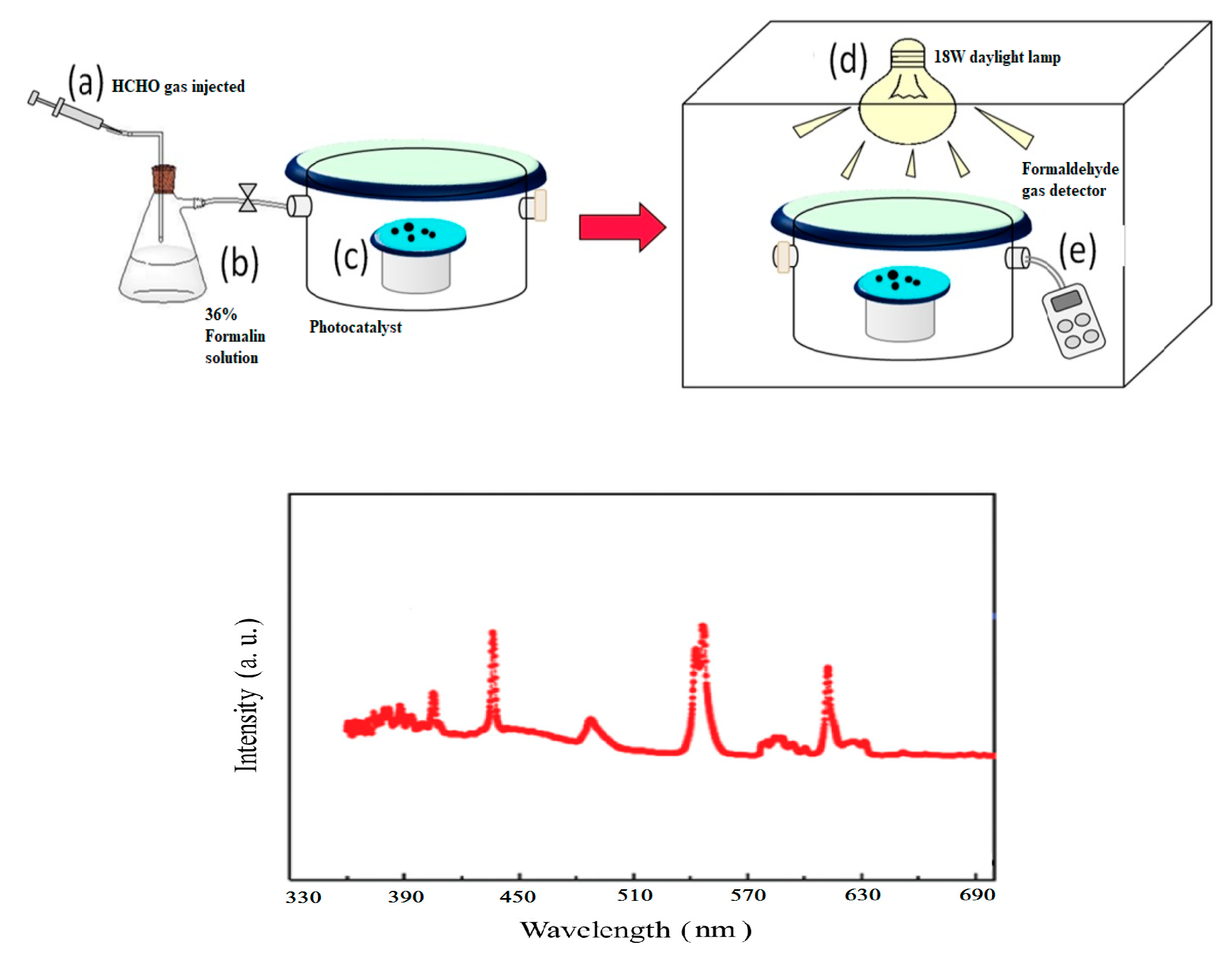
Figure 2.
(a) Low-magnification SEM image (500 nm scale bar) and (b) high-magnification SEM image (300 nm scale bar) of CuFeZnO; (c) HR-TEM image (50 nm scale bar); (d) EDX spectrum; (e) FTIR spectrum of CuFeZnO.
Figure 2.
(a) Low-magnification SEM image (500 nm scale bar) and (b) high-magnification SEM image (300 nm scale bar) of CuFeZnO; (c) HR-TEM image (50 nm scale bar); (d) EDX spectrum; (e) FTIR spectrum of CuFeZnO.
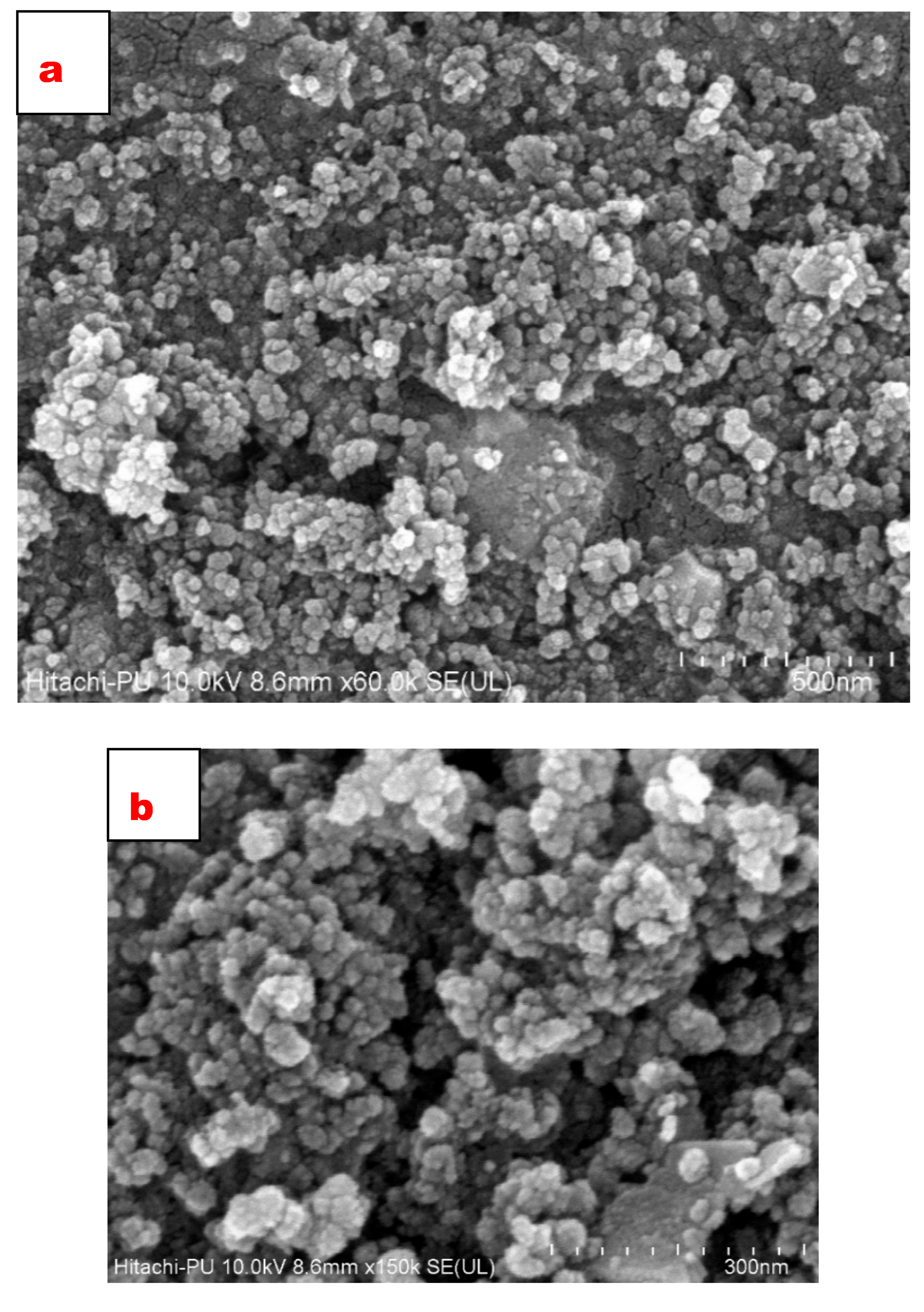
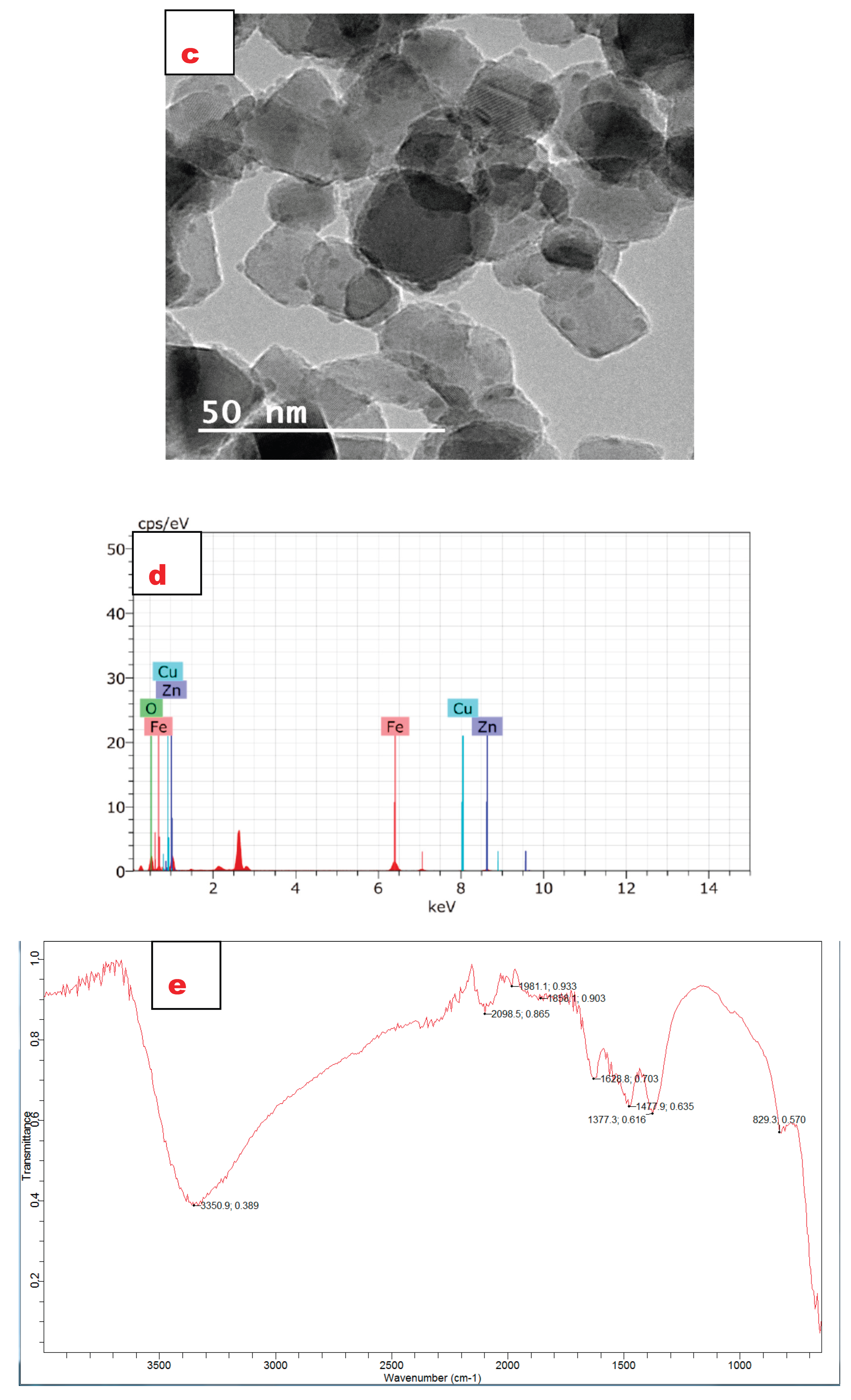
Figure 3.
HCHO degradation rate as a function of irradiation time using (a) laboratory-synthesized TiO₂, (b) TiO₂ (P25), and (c) CuFeZnO photocatalysts under 18 W daylight lamp illumination.
Figure 3.
HCHO degradation rate as a function of irradiation time using (a) laboratory-synthesized TiO₂, (b) TiO₂ (P25), and (c) CuFeZnO photocatalysts under 18 W daylight lamp illumination.
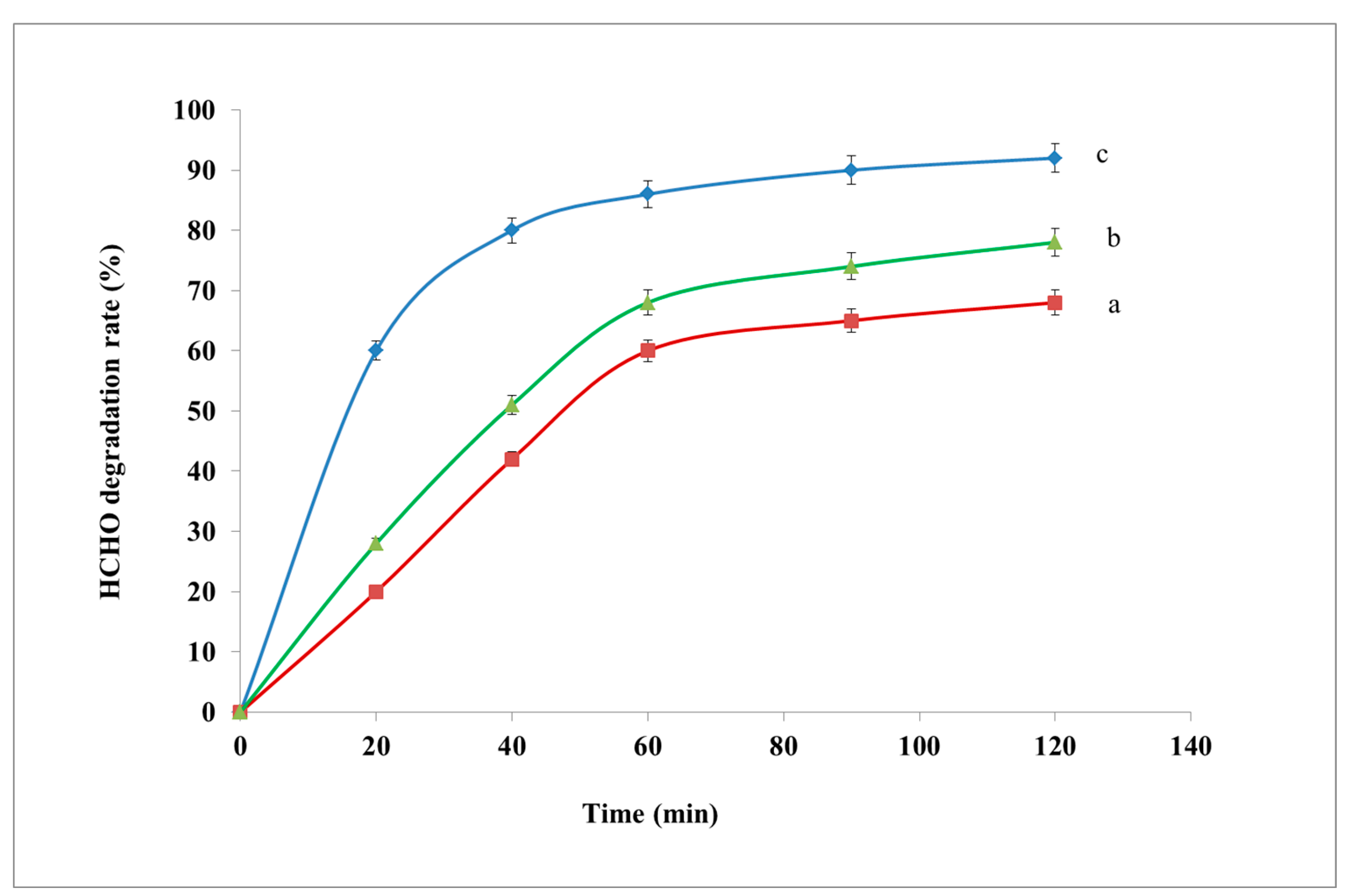
Figure 4.
Proposed mechanism for HCHO adsorption and photocatalytic degradation to CO₂ on the surface of the CuFeZnO photocatalyst under visible-light irradiation.
Figure 4.
Proposed mechanism for HCHO adsorption and photocatalytic degradation to CO₂ on the surface of the CuFeZnO photocatalyst under visible-light irradiation.
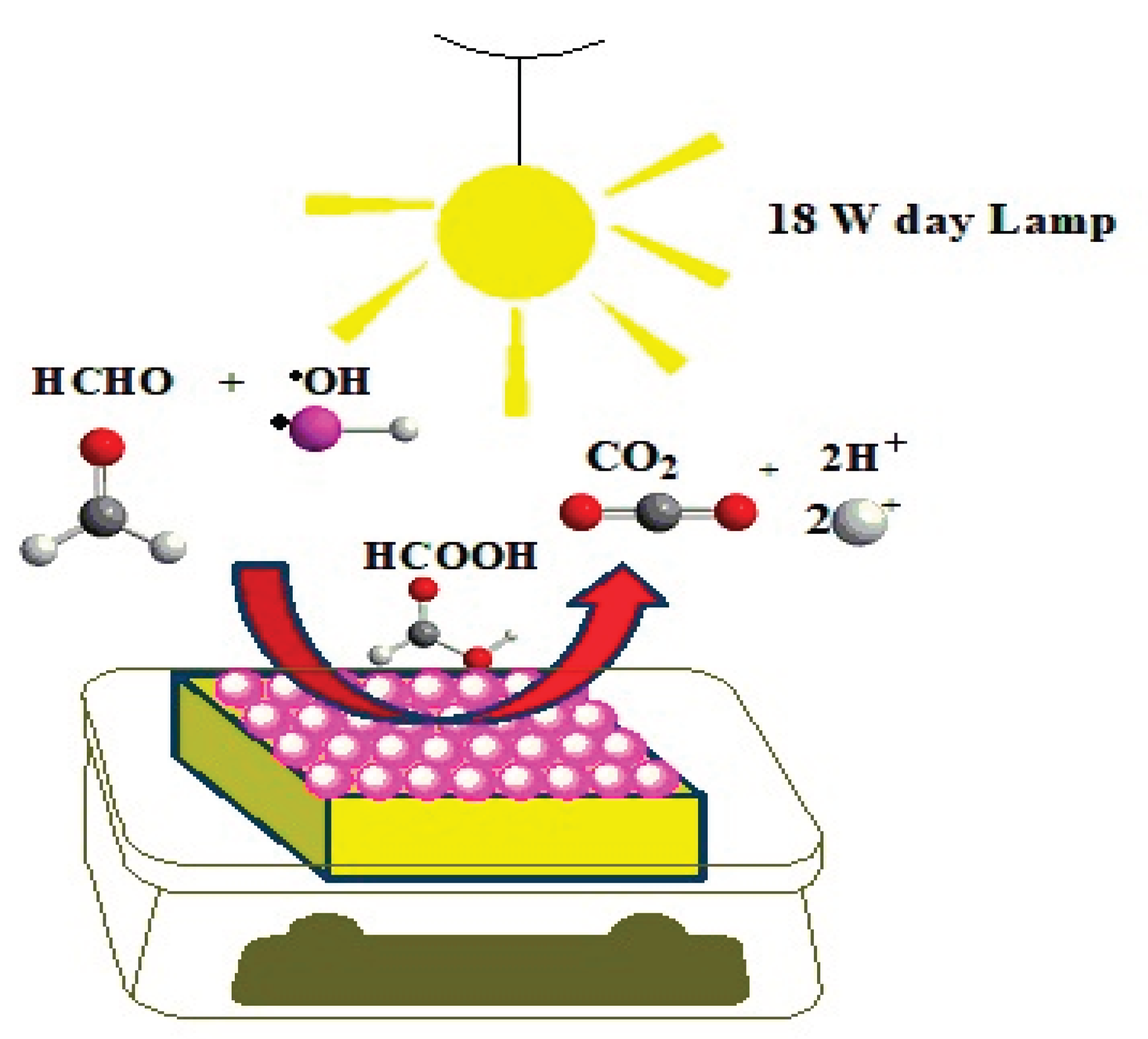
Figure 5.
Effect of catalyst reuse on the photocatalytic degradation of HCHO by CuFeZnO over seven consecutive cycles.
Figure 5.
Effect of catalyst reuse on the photocatalytic degradation of HCHO by CuFeZnO over seven consecutive cycles.
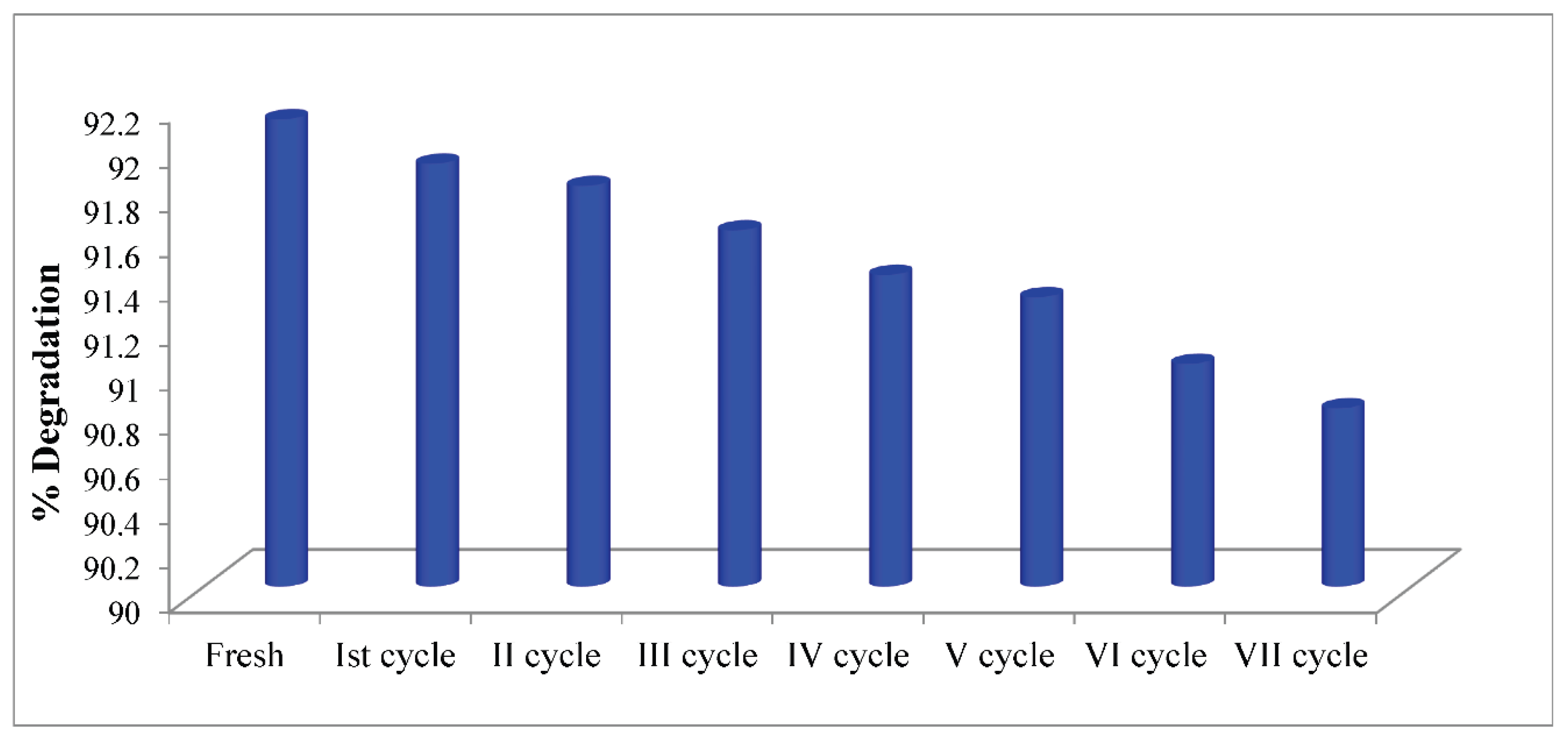
Figure 6.
(a) Effect of pH on Cr(VI) adsorption (CuFeZnO dose = 0.2 g, initial Cr(VI) concentration = 50 mg/L, contact time = 90 min); (b) effect of contact time on Cr(VI) adsorption; (c) effect of CuFeZnO dose on Cr(VI) adsorption (25 °C).
Figure 6.
(a) Effect of pH on Cr(VI) adsorption (CuFeZnO dose = 0.2 g, initial Cr(VI) concentration = 50 mg/L, contact time = 90 min); (b) effect of contact time on Cr(VI) adsorption; (c) effect of CuFeZnO dose on Cr(VI) adsorption (25 °C).
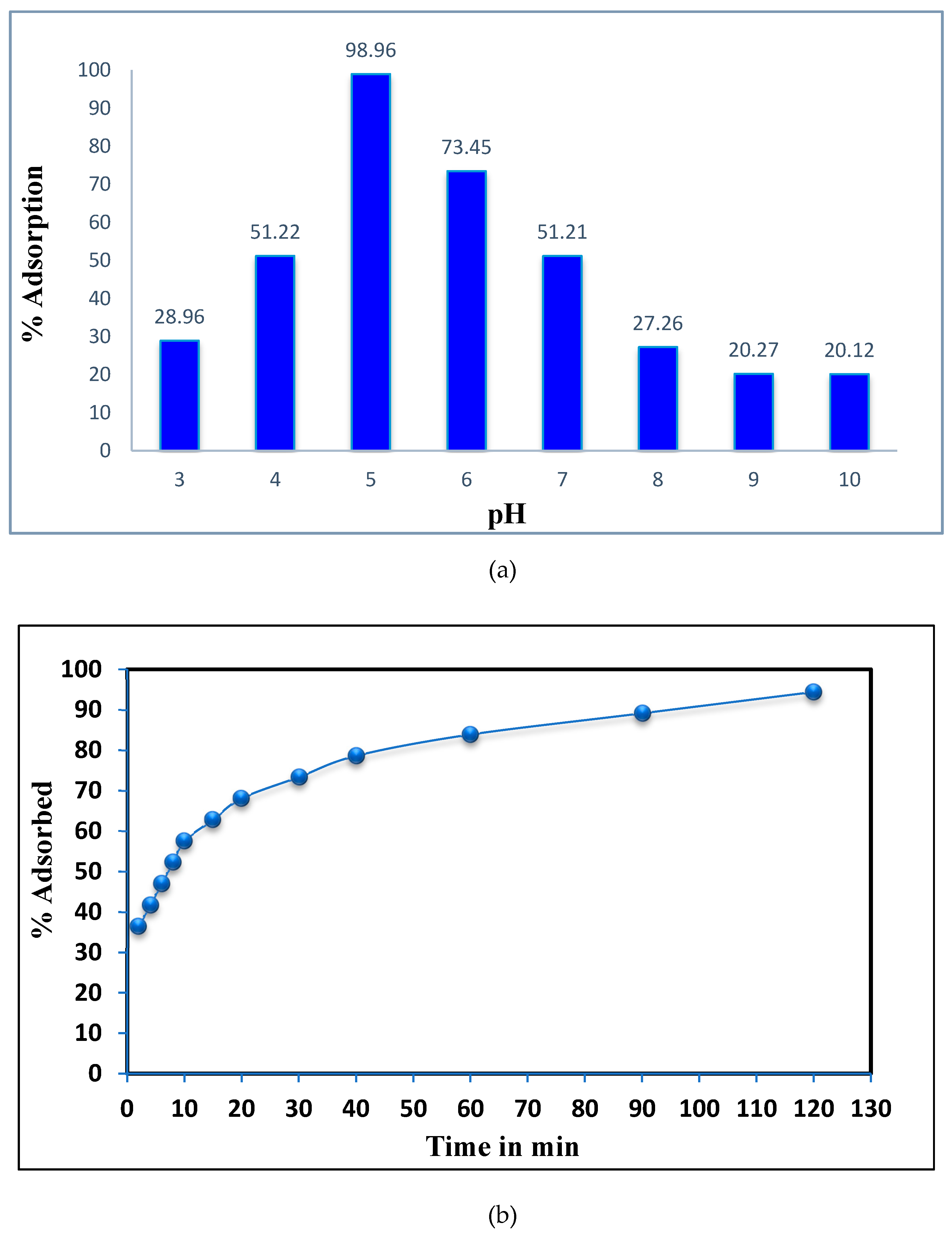
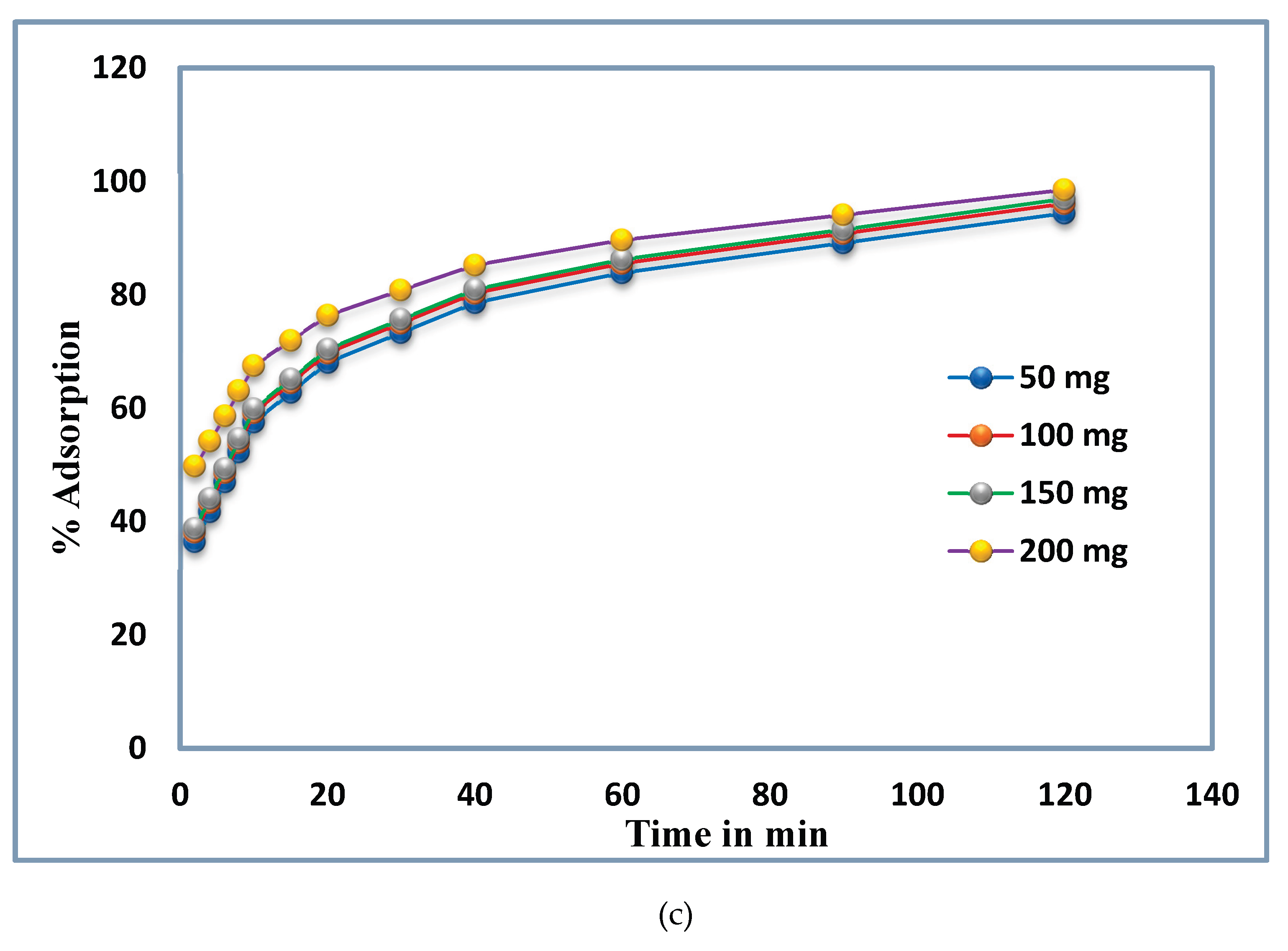
Figure 7.
(a) Pseudo-second-order kinetic model (PSOKM); (b) Langmuir isotherm; (c) Freundlich isotherm; (d) separation factor (R_L); (e) Temkin isotherm, for Cr(VI) adsorption onto CuFeZnO.
Figure 7.
(a) Pseudo-second-order kinetic model (PSOKM); (b) Langmuir isotherm; (c) Freundlich isotherm; (d) separation factor (R_L); (e) Temkin isotherm, for Cr(VI) adsorption onto CuFeZnO.
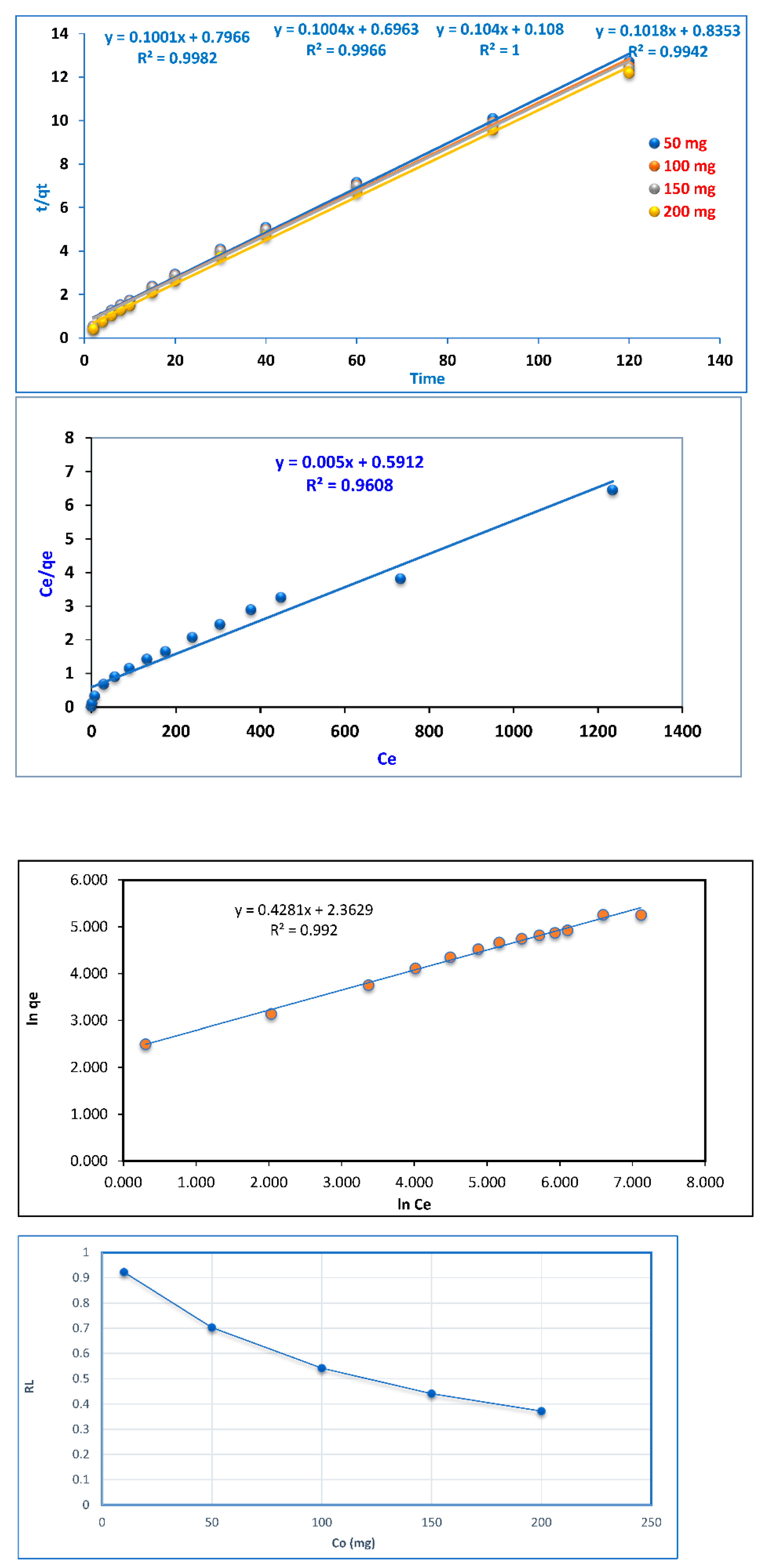
Figure 8.
Fitting of the double-layer statistical physics model to Cr(VI) adsorption onto CuFeZnO at three different temperatures (298, 308, and 318 K).
Figure 8.
Fitting of the double-layer statistical physics model to Cr(VI) adsorption onto CuFeZnO at three different temperatures (298, 308, and 318 K).
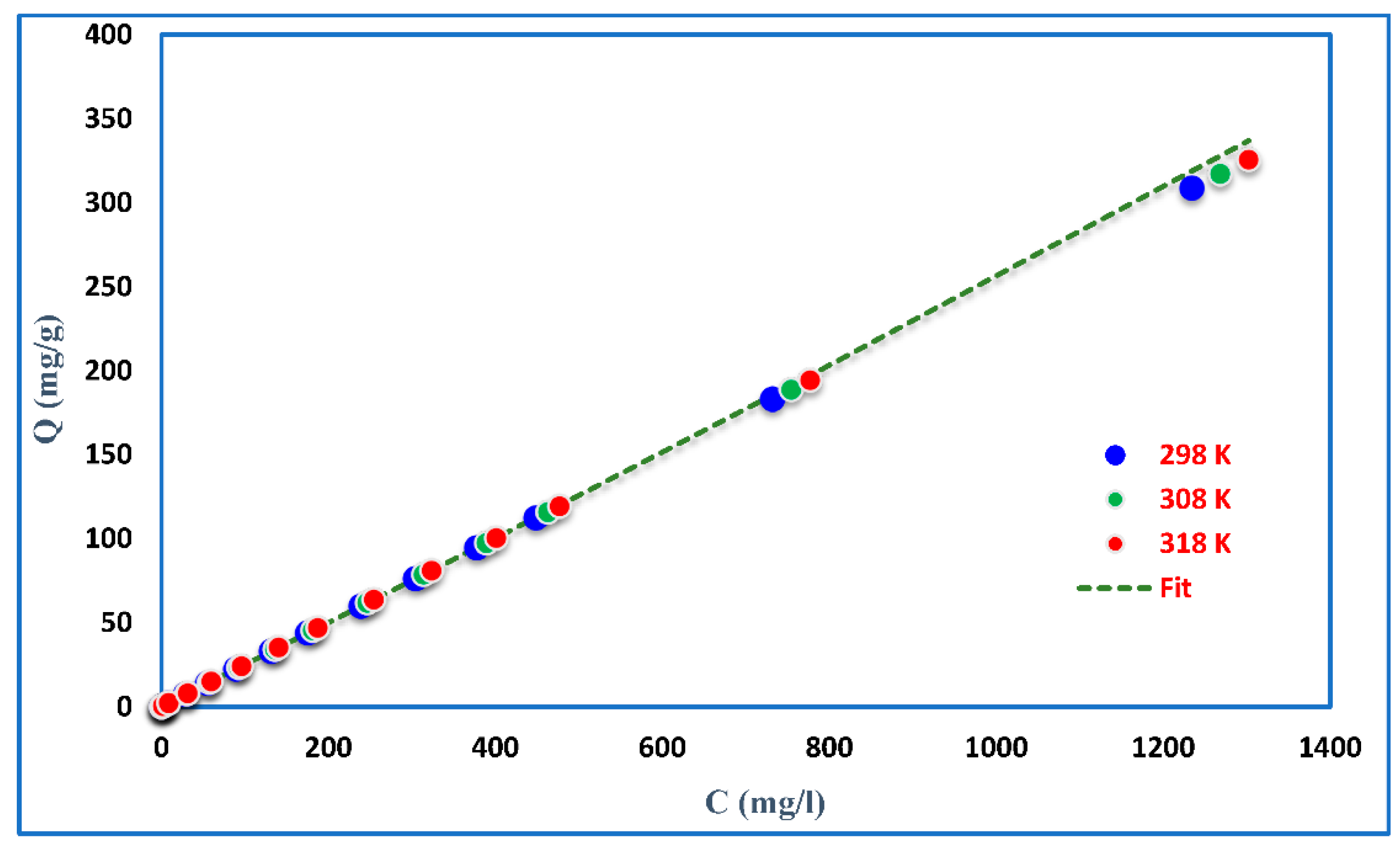
Figure 9.
Variation of statistical physics model parameters with solution temperature: (a) number of Cr(VI) ions adsorbed per site (n); (b) receptor site density (Nₘ); (c) saturation adsorption capacity (Qₛₐₜ); (d) first- and second-layer adsorption energies (ε₁ and ε₂).
Figure 9.
Variation of statistical physics model parameters with solution temperature: (a) number of Cr(VI) ions adsorbed per site (n); (b) receptor site density (Nₘ); (c) saturation adsorption capacity (Qₛₐₜ); (d) first- and second-layer adsorption energies (ε₁ and ε₂).
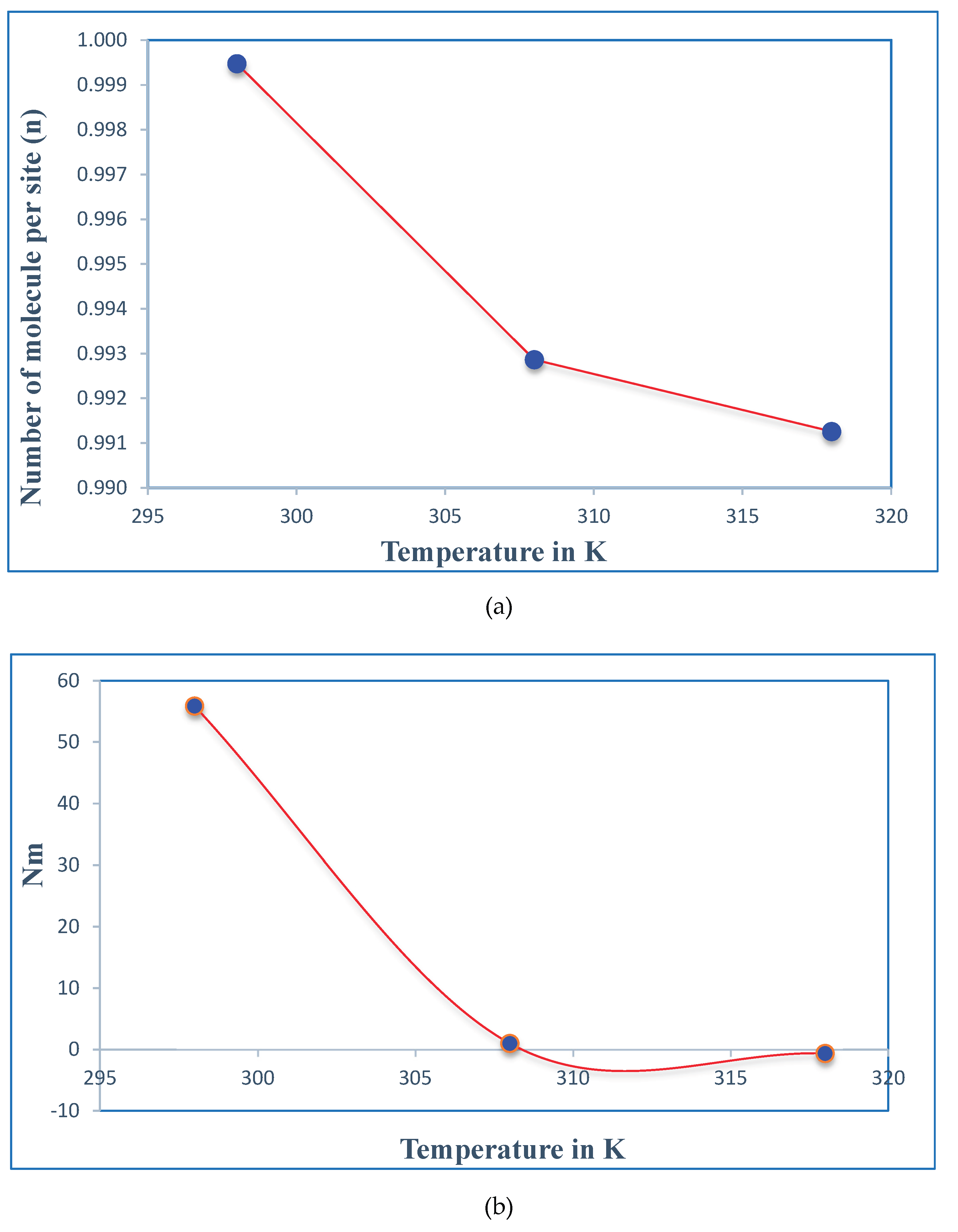
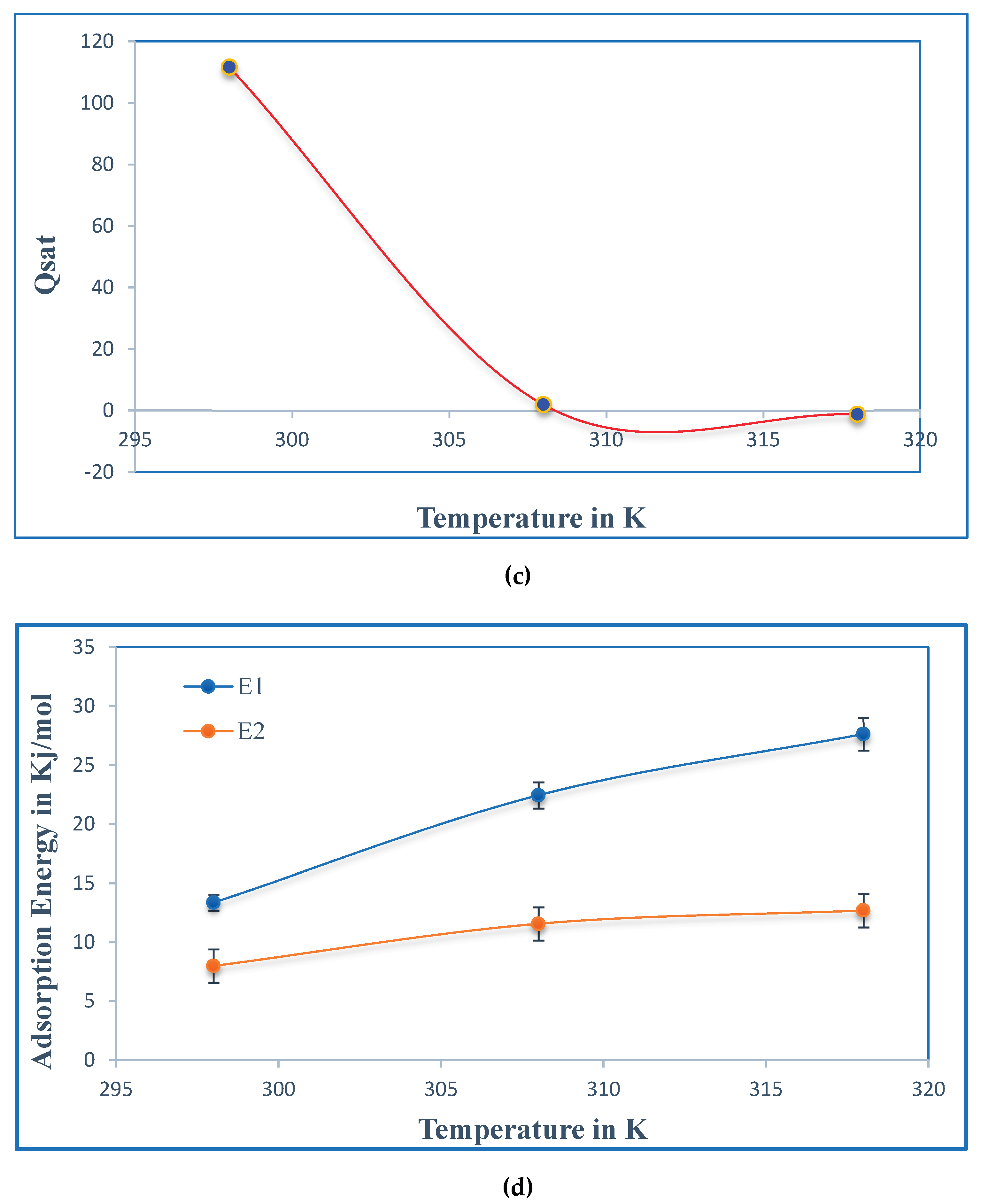

Table 1.
Comparison of CuFeZnO with other reported photocatalysts for formaldehyde degradation.
| Sr. No. | Photocatalyst | Power of the light source | Concentration of photocatalyst | % degradation | Ref. |
|---|---|---|---|---|---|
| 1 | Bi2WO6/Bi0.15Ti0.85O2 | 36 W LED light | 0.348 mg/L | 92 % | 40 |
| 2 | TiO2-Coated Polyester Fiber | 27 W UV light lamps | 200mg/L | 92.86% | 41 |
| 3 | Bi12TiO20/g-C3N4 composite | 300 W Dy lamp | 500 mg/L | --- | 42 |
| 4 | CuFeZnO | 18W daylight lamp irradiation | 20 mg/L | 92.1% | Present work |
Table 2.
Langmuir and Freundlich isotherm parameters for Cr(VI) adsorption onto CuFeZnO.
| Langmuir | Freundlich | ||
|---|---|---|---|
| KL | 1.691 | log Kf | 2.362 |
| qmax = KL/αL | 200 | 1/n | 0.4281 |
| R2 | 0.9608 | R2 | 0.992 |
Table 3.
Statistical physics model parameters for Cr(VI) adsorption onto CuFeZnO at different temperatures.
Table 3.
Statistical physics model parameters for Cr(VI) adsorption onto CuFeZnO at different temperatures.
| Temperature in (K) | n | NM (mg/g) | Qsat (mg/g) | C1 | C2 | E1 (kj/mol) | E2 (kj/mol) |
|---|---|---|---|---|---|---|---|
| 298 | 0.999 | 55.873 | 111.687 | 227.542 | 1987.344 | 13.360 | 7.991 |
| 308 | 0.993 | 0.987 | 1.959 | 7.806 | 546.209 | 22.444 | 11.566 |
| 318 | 0.991 | 0.631 | 1.252 | 1.448 | 410.281 | 27.627 | 12.698 |
Disclaimer/Publisher’s Note: The statements, opinions and data contained in all publications are solely those of the individual author(s) and contributor(s) and not of MDPI and/or the editor(s). MDPI and/or the editor(s) disclaim responsibility for any injury to people or property resulting from any ideas, methods, instructions or products referred to in the content. |
© 2026 by the authors. Licensee MDPI, Basel, Switzerland. This article is an open access article distributed under the terms and conditions of the Creative Commons Attribution (CC BY) license.
Copyright: This open access article is published under a Creative Commons CC BY 4.0 license, which permit the free download, distribution, and reuse, provided that the author and preprint are cited in any reuse.