

Submitted:
16 September 2026
Posted:
16 September 2026
You are already at the latest version
Abstract
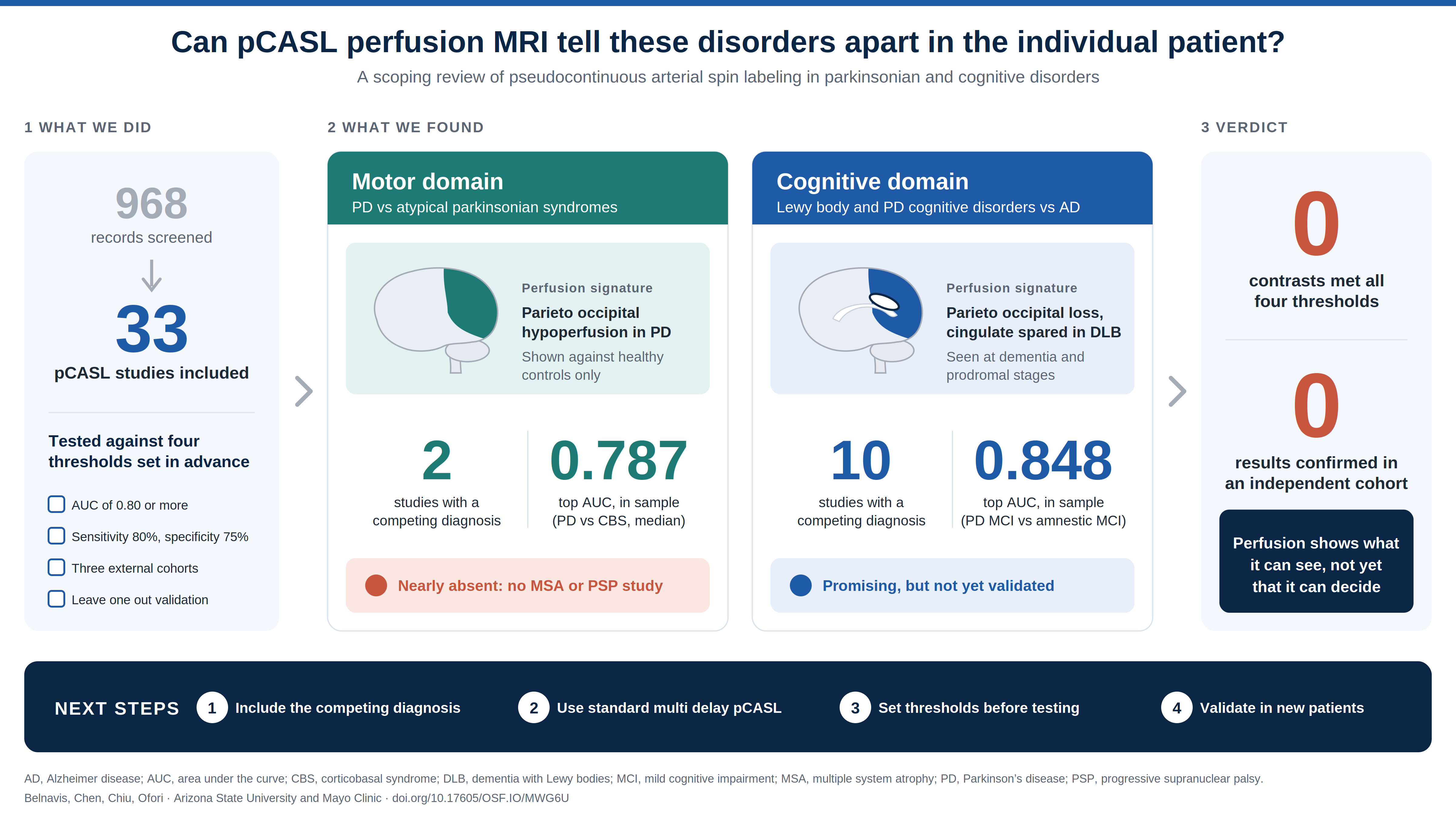
Arterial spin labelling (ASL) MRI provides a noninvasive measure of cerebral perfusion, raising the possibility of distinguishing Parkinson's disease (PD) from atypical parkinsonian syndromes (corticobasal syndrome, multiple system atrophy, progressive supranuclear palsy) and of separating the associated cognitive disorders, PD dementia and dementia with Lewy bodies (DLB), from Alzheimer's disease (AD). Whether perfusion can make either distinction in an individual patient has not been established. We conducted a scoping review reported in accordance with PRISMA-ScR, searching PubMed to 17 July 2026 (968 records, 33 studies included), and mapped the cohort-level diagnostic evidence available for each contrast. The review was restricted to pseudo-continuous ASL (pCASL), the consensus-recommended implementation for clinical use. For every study we charted acquisition parameters (post-labelling delay scheme, field strength), processing pipelines, the perfusion measures reported (absolute and normalised cerebral blood flow, arterial transit time), and any diagnostic accuracy metric, recording absence of reporting as such, and assessed risk of bias and applicability against criteria tailored to the review question. Four thresholds for single-patient use were fixed in writing before any study was counted, then applied descriptively rather than as eligibility criteria. Direct comparison against atypical parkinsonian syndromes was near-absent: one study addressed corticobasal syndrome (median AUC 0.787 across regions), none addressed multiple system atrophy or progressive supranuclear palsy, and PSP patients appeared only within a pooled parkinsonism-plus group. Evidence on the cognitive contrasts was more substantial, with DLB separating from AD at both the dementia and prodromal stages, reaching an arterial transit time AUC of 0.861. No study reported external validation in an independent cohort, and no contrast met the prespecified thresholds. Answering the question requires cohorts recruited consecutively from patients in whom the diagnosis is genuinely uncertain, multi-delay acquisition, thresholds specified in advance, and validation outside the derivation cohort, with PD against PSP and PD against corticobasal syndrome the highest priority.
Keywords:
Parkinson’s disease
; atypical parkinsonism
; arterial spin labeling
; cerebral blood flow
; differential diagnosis
; scoping review
Copyright: This open access article is published under a Creative Commons CC BY 4.0 license, which permit the free download, distribution, and reuse, provided that the author and preprint are cited in any reuse.