

Submitted:
14 September 2026
Posted:
15 September 2026
You are already at the latest version
Abstract
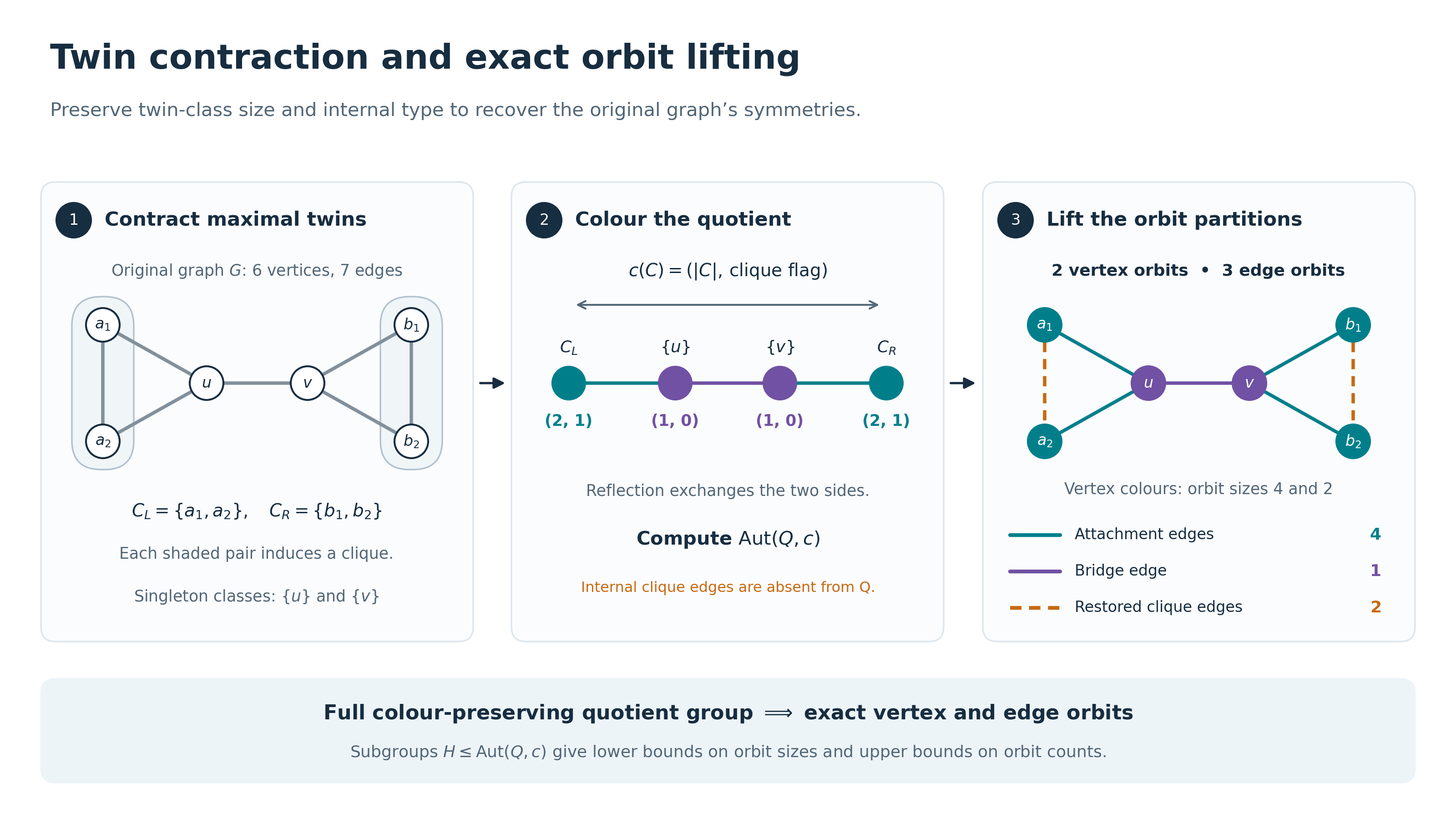
We derive explicit formulas that lift vertex and edge orbits from the twin quotient of a finite simple undirected graph to the graph itself. The edge formula is the new contribution. It is driven by quotient edge orbits rather than by the vertex orbits of their endpoints, and it carries a separate family of internal clique-edge orbits. The underlying group decomposition is known for connected graphs, and we give a short proof that needs no connectedness assumption. Colouring each quotient vertex by class size and internal adjacency type gives a split surjection onto the coloured quotient group, with kernel the product of the symmetric groups on the twin classes. Every formula applies to each subgroup of that group, so partial symmetry information yields lower bounds on orbit sizes and upper bounds on orbit counts.
Keywords:
graph automorphism
; twin reduction
; quotient graph
; vertex orbit
; edge orbit
1. Introduction
Twin classes are elementary examples of modules in the modular decomposition of graphs. See Gallai [1] and the survey of Habib and Paul [2]. Automorphism groups of graph compositions and lexicographic products were studied by Sabidussi [3,4].
The group decomposition proved below is known. Tadayyonfar and Ashrafi ([5] [Theorem 1.2]) give the corresponding semidirect product for reduced complete-empty X-joins, with connected X in their setup. Here G is obtained by substituting the clique or independent graph at each vertex C of its twin quotient. This substitution is reduced: if two quotient vertices are nonadjacent twins and both substituted graphs are edgeless, their union would be a twin class of G; the same contradiction arises for adjacent quotient twins whose substituted graphs are both complete. Their type-preserving quotient group is precisely the group preserving the colours used here. Thus, for connected G, Corollary 1 is a direct instance of their theorem. Our proof uses the invariance of maximal twin classes and applies without a connectedness assumption.
Cameron [6] studies iteration to a twin-free graph and obtains a normal series with factors that are products of symmetric groups, together with an embedding of the remaining quotient group into the automorphism group of the reduced graph. Here we retain the coloured quotient after one contraction step, which Remark 1 demonstrates is not in general twin-free. The purpose of this note is a self-contained short proof of the decomposition and an explicit account of its vertex- and edge-orbit consequences, including the bounds supplied by partial quotient symmetry information.
2. Definitions
Throughout, is a finite simple undirected graph, with . Here denotes the set of unordered two-element subsets of a set S. For , let denote the subgraph of G induced on S, and for disjoint let denote the bipartite subgraph with parts S and T whose edges are the edges of G having one endpoint in S and the other in T. For , let denote its open neighbourhood. Define
The equivalence classes of this relation, established below, are called the maximal twin classes and form a partition of V.
For a group L acting on a set X, write
An action on vertices induces an action on unordered pairs by . A partition refines a partition of the same set if every block of is contained in a block of .
Lemma 1.
The relation is an equivalence relation. For its class partition , the group
acting independently on the classes, is a subgroup of . Each induced graph is complete or empty. For distinct , the bipartite graph is complete bipartite or empty.
Proof.
For distinct , condition (1) holds if and only if the transposition is an automorphism of G. Indeed, this transposition fixes every unordered pair disjoint from , fixes itself, and preserves adjacency on all remaining pairs precisely when u and v have the same neighbours outside .
Reflexivity and symmetry are immediate. If are distinct and , then
so . Cases with repeated vertices are immediate, proving transitivity.
Every transposition within a class C, extended by the identity on , is an automorphism. Such transpositions generate . The groups for different classes have disjoint supports, so their direct product K is a subgroup of .
If , the action of on is transitive. Since adjacency is invariant under this action, is complete or empty; the assertion is also true for a singleton. For distinct classes , is transitive on the unordered pairs with one endpoint in each class. Adjacency is therefore constant on these pairs as well. □
Define the twin quotient Q by
By Lemma 1, this records exactly the adjacencies between distinct twin classes. Give each quotient vertex the colour
Thus singleton classes all have type 0. Set
where consists of the automorphisms of Q preserving c. In particular, is invariant under A.
Remark 1
(One contraction step). Contracting the maximal twin classes once does not in general leave a twin-free graph when colours are ignored. For the three-vertex path, the two leaves form one class and the centre another; the quotient is a single edge, whose endpoints are twins but have different colours, and . Quotient twins can also have equal colours: for the disjoint union of two edges, the two maximal twin classes each induce a single edge, and their quotient consists of two isolated vertices of colour . Everything below concerns this single contraction step; no twin-free assumption on Q is needed.
3. The Induced Action on Twin Classes
Lemma 2.
The action on maximal twin classes defines a surjective homomorphism
with kernel K. Equivalently, there is a short exact sequence
Moreover, for any , every choice of bijections , one for each , defines an automorphism of G satisfying .
Proof.
For , the identity implies that if and only if . Consequently, g permutes the maximal twin classes. The resulting permutation preserves their sizes, internal adjacency types, and inter-class adjacencies. Hence . The identity proves that is a homomorphism.
An element of fixes each class setwise, so belongs to K. Conversely, Lemma 1 shows that every element of K is an automorphism fixing every class setwise. Thus .
Let . Colour preservation gives , so the stated bijections exist, and their union f is a permutation of V. For distinct in one class C, adjacency of their images agrees with adjacency of , since . For and with , Lemma 1 gives
Therefore and . This also proves surjectivity. □
Corollary 1
(The extension splits). The sequence (3) splits. After choosing an ordering of each twin class, is isomorphic to , where A acts by permuting the factors of K using these orderings. This isomorphism is noncanonical.
Proof.
Fix a linear order on each class, writing . Colour preservation gives for every and every , so the assignment
defines a permutation of V. It is the union of the bijections carrying to , hence lies in and satisfies by Lemma 2. For , both and send to , so s is a homomorphism and therefore a section of . The action defining the semidirect product is . Identifying each factor with the symmetric group on through the chosen ordering, this action is
Finally, is an isomorphism : every has the unique expression , with the first factor in K. □
4. Exact Lifting of the Orbit Partitions
For and , define
For , also define
The set in (5) does not depend on the order in which the two classes of an unordered quotient edge are written.
Theorem 1
(Twin contraction and orbit lifting). Let be as above, with U, X and I as in (4), (5) and (6). For any subgroup , put . Then
and
Every displayed orbit block is nonempty. The two families on the right of (8) are disjoint: no edge orbit contains both an edge internal to a twin class and an edge between distinct twin classes. In particular, taking gives exactly the vertex and edge orbit partitions of G under its full automorphism group.
Proof.
Lemma 2 implies that and that the restriction maps onto H.
Let and . If for some , then , so lie in the same H-orbit. Conversely, if for some , choose the bijection in Lemma 2 to satisfy . Its extension f lies in and sends u to v. Thus
which proves (7).
Now consider edges and between distinct twin classes. Write their unordered class pairs as and . If for , then . Hence their quotient edges must lie in the same H-orbit. Conversely, suppose for some . Lift to using Lemma 2. The edge has one endpoint in each of . Since , some sends these endpoints to the respective endpoints of . Therefore , with . It follows that the edge orbits between distinct classes are precisely the sets in (8).
An edge internal to a class exists exactly when that class belongs to . Suppose and for . If an element sends e to , then , so lie in the same H-orbit. Conversely, choose with and lift it to . The group is transitive on , so some sends to . Thus the internal edge orbits are precisely the sets in (8).
Every automorphism of G preserves the twin relation. It therefore preserves the property that the endpoints of an edge lie in one twin class. The two kinds of edge orbits cannot mix. They exhaust E, and each block is nonempty by the definitions of and . This proves (8). Finally, , proving the last assertion. □
Corollary 2
(Exact orbit counts). The numbers of vertex and edge orbits satisfy
Proof.
Apply Theorem 1 with and count its disjoint, nonempty orbit blocks. □
Corollary 3
(Refinement and bounds from partial symmetry information). For every , the partitions in (7)–(8) refine the full vertex and edge orbit partitions of G. In particular, for or ,
For either or , the number of blocks satisfies the reverse bound
Proof.
Remark 2
(Interpretation of the bound). The bounds of Corollary 3 certify genuine equivalences. The reported orbit of a specified vertex or edge has size at most that of its true orbit. Thus orbit sizes are lower bounds, whereas the number of orbits is an upper bound. They become the equalities of Corollary 2 when the full colour-preserving quotient group is used. With , the lifted vertex partition is just the twin partition.
Remark 3
(Necessary distinctions). The edge formula uses quotientedge orbits, not merely the vertex-orbit labels of their endpoints. It also includes internal clique edges, which have no quotient-edge counterpart. The colouring in (2) is essential to the general guarantee: an uncoloured quotient automorphism can exchange classes of unequal sizes or different internal types, in which case the lifting construction need not define an automorphism of G.
Acknowledgment
The research question and computational approach originated in the author’s work on ontology construction and knowledge-graph compression, building on an automorphism-computation framework he had conceived for earlier studies. Every statement and proof in this note was verified by the author, including by exhaustive computer search against the true automorphism orbits of small graphs. OpenAI Codex assisted with formalizing the mathematical statements, drafting and checking proofs, reviewing related literature, and editing and typesetting the manuscript. The author is responsible for the final content.
Data Availability
This note is theoretical and reports no new datasets.
Conflicts of Interest
The author declares no conflicts of interest.
References
- Gallai, T. Transitiv orientierbare Graphen. Acta Math. Acad. Sci. Hung. 1967, 18, 25–66. [Google Scholar] [CrossRef]
- Habib, M.; Paul, C. A survey of the algorithmic aspects of modular decomposition. Comput. Sci. Rev. 2010, 4, 41–59. [Google Scholar] [CrossRef]
- Sabidussi, G. The composition of graphs. Duke Math. J. 1959, 26, 693–696. [Google Scholar] [CrossRef]
- Sabidussi, G. The lexicographic product of graphs. Duke Math. J. 1961, 28, 573–578. [Google Scholar] [CrossRef]
- Tadayyonfar, A.; Ashrafi, A. R. The automorphism group of the reduced complete-empty X-join of graphs. arXiv 2017, arXiv:1709.00706. [Google Scholar]
- Cameron, P. J. A new look at twin reduction. arXiv 2025, arXiv:2507.10189. [Google Scholar]
Disclaimer/Publisher’s Note: The statements, opinions and data contained in all publications are solely those of the individual author(s) and contributor(s) and not of MDPI and/or the editor(s). MDPI and/or the editor(s) disclaim responsibility for any injury to people or property resulting from any ideas, methods, instructions or products referred to in the content. |
© 2026 by the author. Licensee MDPI, Basel, Switzerland. This article is an open access article distributed under the terms and conditions of the Creative Commons Attribution (CC BY) license.
Copyright: This open access article is published under a Creative Commons CC BY 4.0 license, which permit the free download, distribution, and reuse, provided that the author and preprint are cited in any reuse.