

Submitted:
14 September 2026
Posted:
15 September 2026
You are already at the latest version
Abstract
Background/Objectives: Contemporary data on active Helicobacter pylori infection among young adults in Albania are limited. This study estimated Urea Breath Test (UBT)-detected prevalence among university students and described awareness, self-reported knowledge, gastrointestinal symptoms, and previous healthcare engagement. Methods: A cross-sectional study during 2023–2025 combined questionnaire data and interpretable UBT results from 390 consenting students aged ≥18 years in academic years I–IV in Korçë, Albania. The questionnaire underwent cultural adaptation, expert assessment, and pilot testing. Prevalence was reported with a Wilson 95% confidence interval (CI); questionnaire percentages used item-specific valid-response denominators. Results: UBT was positive in 107/390 students, giving a prevalence of 27.4% (95% CI 23.2–32.1%). Women comprised 321/390 (82.3%) participants. Overall, 209/385 (54.3%) had heard of H. pylori, 155/353 (43.9%) reported knowing associated diseases, and 152/363 (41.9%) reported knowing a transmission mode. School and health professionals were the leading reported information sources. Previous testing was reported by 21/388 (5.4%), stomach problems by 77/377 (20.4%), and gastric ulcer by 6/369 (1.6%). The highest proportions of moderate-or-greater symptoms involved bloating sensation (54/378, 14.3%), abdominal distension (54/380, 14.2%), and general abdominal complaints (49/382, 12.8%). Among six previously treated respondents with complete follow-up information, none reported post-treatment retesting. Extreme-case sensitivity estimates among 420 consenting students ranged from 25.5% to 32.6%. Conclusions: Approximately one in four tested students had evidence of current H. pylori infection, while self-reported knowledge and previous testing were limited. The findings support targeted university health education, access to clinically appropriate testing, and continuity through treatment and confirmation of eradication. Representative studies are needed before extrapolating to the broader population or adopting universal student screening.
Keywords:
Helicobacter pylori
; prevalence
; urea breath test
; university students
; awareness
; dyspepsia
; Albania
1. Introduction
Helicobacter pylori is a human gastric pathogen that can persist for decades and cause chronic gastritis, peptic ulcer disease, gastric adenocarcinoma, and gastric mucosa-associated lymphoid tissue lymphoma. Clinical outcomes depend on bacterial characteristics, host responses, and environmental exposures, so infection does not imply that every affected person will develop symptomatic disease or cancer. Its identification nevertheless has clinical importance because effective eradication can interrupt a modifiable cause of gastric disease [1,2,3].
The long-term consequences of infection extend beyond the immediate assessment of dyspepsia. Gastric cancer remains a major cause of cancer mortality worldwide, and H. pylori is an established target for prevention [4,5]. A meta-analysis of randomized trials found that eradication reduced subsequent gastric cancer occurrence, although much of the evidence came from East Asian populations [6]. These observations support interest in infection during early adulthood while also requiring careful consideration of whether evidence from older or higher-risk populations applies to university students.
The epidemiology of H. pylori varies markedly across regions, birth cohorts, and social conditions. Global syntheses consistently demonstrate substantial between-study heterogeneity [7,8]. A recent meta-analysis estimated that prevalence declined from 58.2% in 1980–1990 to 43.1% in 2011–2022, with lower estimates generally observed in younger populations, higher-income settings, and studies using non-serological tests [9]. A prevalence estimate therefore needs to be interpreted together with the recruitment setting, age structure, calendar period, and diagnostic method rather than treated as an interchangeable measure of national infection burden.
Non-invasive testing is particularly relevant to student populations. The urea breath test (UBT) detects urease activity consistent with current H. pylori infection, whereas antibody positivity can persist after successful eradication. Diagnostic reviews and European breath-test guidance support UBT as an established non-invasive method, provided that patient preparation, sample collection, analytical procedures, and interpretation are appropriate [10,11]. Recent antibiotic, bismuth, or proton-pump inhibitor exposure can suppress bacterial activity and compromise a negative result. The value of a prevalence study using UBT thus depends on both the sampling strategy and the integrity of the diagnostic pathway.
Albanian evidence remains limited. A historical serological study in selected volunteer groups reported substantial infection exposure, but those findings cannot be directly transferred to a contemporary student sample because the population and diagnostic method differ [12]. Recent European research has also examined the feasibility of H. pylori screen-and-treat programmes in younger adults. The EUROHELICAN study in Slovenia provides a useful regional implementation example, although its age range and two-stage testing strategy differ from direct UBT testing among university students [13].
Infection is commonly acquired before adulthood and can cluster within households. Contemporary work on childhood epidemiology and family-based infection management highlights the importance of early-life conditions and familial exposure [14,15]. Students’ present residence, household water access, and lifestyle describe their current circumstances without establishing when or where infection was acquired. Measuring those characteristics alongside infection status can inform the design of subsequent analytical studies, but causal interpretation requires more detailed exposure histories.
University students are also a relevant group for health education. Surveys have identified gaps in knowledge of H. pylori even among students with health-related teaching, while a quasi-experimental educational study demonstrated improvement in assessed knowledge after an intervention [16,17]. Awareness, knowledge, symptoms, and previous testing represent distinct dimensions of health engagement. Their joint description provides an overview of educational and healthcare engagement in the study population.
This study aimed to estimate the sample-specific prevalence of UBT-detected H. pylori infection among university students in Korçë, Albania. Secondary objectives were to describe awareness and self-reported knowledge, information sources, gastrointestinal symptoms, selected contextual characteristics, clinical history, and previous engagement with testing and treatment. The study was designed as a descriptive cross-sectional assessment rather than an evaluation of determinants of infection or the effectiveness of a screening intervention.
2. Materials and Methods
Study Design and Setting
A cross-sectional study was conducted during 2023–2025 among students enrolled in academic years I–IV at university faculties in Korçë, Albania. Questionnaire data were analysed alongside participants’ Urea Breath Test results. The primary objective was to estimate sample-specific UBT-detected H. pylori prevalence; secondary objectives were to characterize awareness, knowledge, information sources, gastrointestinal symptoms, and healthcare engagement. Reporting followed the STROBE recommendations for cross-sectional studies [18].
Study Population and Recruitment
The study included 390 students aged ≥18 years and enrolled in academic years I–IV, each contributing questionnaire data and an interpretable UBT result. Participation was voluntary. Item non-response did not exclude students from other descriptive analyses.
Students in the first, second, third, or fourth academic year of a participating university programme were eligible if they were aged ≥18 years and provided informed consent. Recruitment used voluntary, non-probability sampling. Students who declined participation, could not provide a usable questionnaire, or had no interpretable UBT result were excluded from the corresponding analysis. Recent medication use affecting UBT accuracy required rescheduling after the appropriate medication-free interval rather than classification as a negative result.
During 2023–2025, 450 students meeting the age and enrolment criteria were approached and invited to participate. Of these, 30 declined participation and 420 provided informed consent. Among consenting students, 18 did not provide a usable questionnaire and 12 remained without an interpretable Urea Breath Test (UBT) result. These mutually exclusive exclusions left 390 students with questionnaire data and an interpretable UBT result in the final analytic sample. The participation rate was 93.3% (420/450), and the final inclusion proportion was 86.7% (390/450). Isolated missing questionnaire items were not grounds for exclusion; item-specific denominators were used in the descriptive analyses. Participant selection is summarized in Figure 1.
Each student contributed one study observation. Questionnaire and laboratory records were linked using a study code; names and contact details were kept outside the analytic dataset. Questionnaire completion preceded communication of the study UBT result and any study-specific education to reduce feedback-related changes in awareness responses.
Study Size and Precision
The analytic sample comprised 390 participants. Precision of the prevalence estimate was summarized using a two-sided 95% confidence interval. The achieved interval quantifies binomial uncertainty around the observed proportion; it does not incorporate selection bias from voluntary recruitment. The sample was not selected to support a multivariable prediction model or a comparison of treatment effects.
Questionnaire Development, Cultural Adaptation, and Assessment
Language and Cultural Adaptation
For items adapted from English-language sources, two independent forward translations into Albanian were reconciled into a single version. An independent bilingual translator, unfamiliar with the source wording, then back-translated the reconciled items. The research team compared the versions and resolved discrepancies in meaning, everyday terminology, response options, and cultural relevance before expert review. Adaptation emphasized conceptual rather than literal equivalence [19].
Content and Face Assessment
A multidisciplinary panel of six experts assessed item relevance, comprehensiveness, clarity, and cultural appropriateness using established content-validity principles [20]. The review addressed the distinction between awareness and self-reported knowledge, the separation of previous testing from current infection status, and the wording of gastrointestinal symptom items.
Pilot Testing and Cognitive Debriefing
The questionnaire was piloted among 10 university students outside the main sample. Cognitive debriefing assessed comprehension of questions and response options, familiarity with terminology, and the clarity of recall instructions. Feedback informed revisions to ambiguous wording and response categories before administration [20].
Internal Consistency
Internal consistency of the three-item awareness and self-reported knowledge index was assessed using the Kuder–Richardson 20 coefficient (KR-20) among participants with valid binary responses to all three items [19]. The remaining questionnaire domains were analysed as individual variables.
Questionnaire Domains and Study Variables
The questionnaire covered four domains. Sociodemographic and contextual variables included sex, marital status, place of residence, access to a household toilet, running water, drinking-water source, smoking, coffee consumption, selected dietary practices, and alcohol consumption.
Awareness and self-reported knowledge items assessed whether respondents had heard of H. pylori and whether they reported knowing diseases associated with infection or a mode of transmission. Respondents could select one or more information sources, including school, a nurse or physician, television or radio, printed media, friends, family members, personal infection experience, and other sources.
Clinical and symptom variables included self-reported stomach problems, gastric ulcer history, previous antibiotics for H. pylori, prior endoscopy or gastroscopy, and non-antibiotic stomach medications. Binary symptom items and graded severity items were analyzed separately. The graded dataset distinguished absent and minimal symptoms from higher-severity responses; all categories above minimal severity were combined for the moderate-or-greater summary. Explicit uncertainty remained a separate valid response and did not enter the moderate-or-greater numerator.
The symptom recall period was the preceding seven days. Questions on previous testing, diagnosed ulcer, endoscopy, and eradication treatment referred to the period before study participation. Binary questions asked whether the specified symptom had occurred during the recall period; graded questions addressed its perceived severity during the same period. These items were used descriptively and were not treated as diagnostic criteria for functional dyspepsia.
Healthcare-engagement variables included previous H. pylori testing, reported diagnostic method, previous test result, treatment history, treatment completion, post-treatment retesting, and prior endoscopy or gastroscopy.
Primary and Secondary Outcomes
The primary outcome was a positive Urea Breath Test, coded as positive or negative. Sample prevalence was calculated as the number of participants with a positive UBT divided by the number with an interpretable UBT result. Previous self-reported testing or treatment and gastrointestinal symptoms were not used to define current UBT positivity.
Testing used the Helicobacter Test INFAI 75 mg ¹³C-urea kit (INFAI GmbH, Hagen, Germany). After fasting for more than six hours, preferably overnight, two baseline breath samples were collected. Participants then drank a test meal containing 1 g citric acid in 200 mL water, followed by 75 mg ¹³C-urea dissolved in approximately 30 mL water. Two further breath samples were collected 30 minutes after urea administration. A delta-over-baseline increase exceeding 4.0‰ was classified as positive. Breath collection was supervised by qualified personnel, with samples transferred in the kit packaging for laboratory analysis [21].
Pre-Test Preparation and Medication Restrictions
Participants were instructed to withhold proton-pump inhibitors for at least two weeks and systemic antibiotics and bismuth compounds for at least four weeks before UBT, where clinically appropriate, to minimize false-negative results [2,3]. Recent medication exposure was assessed using a standardized checklist documenting medication names and the dates of the last doses. Compliance with these restrictions was reconfirmed on the testing day. Participants who had not completed the required medication-free interval were rescheduled. Testing was performed after fasting for more than six hours, preferably overnight. Deviations from the preparation requirements were documented, and potentially compromised tests were repeated under the specified conditions rather than classified as negative [21].
Laboratory Procedures and Quality Assurance
Breath samples were analyzed by a qualified diagnostic laboratory using isotope-ratio mass spectrometry validated for ¹³C-urea breath testing. Trained personnel checked matching study codes, collection times, container integrity, lot numbers, and expiry dates. The analytical system used a reference gas and replicate measurements, with acceptance criteria of linearity ≤0.5‰ across breath CO₂ concentrations of 1%–7%, reference-gas stability ≤0.2‰ across 10 consecutive pulses, and measurement precision ≤0.3‰ at natural ¹³C abundance. At least three replicate analyses were performed per sample. Samples with identification discrepancies, inadequate collection, or failed analytical checks were not reported as negative. Unresolved samples were recollected under the required preparation conditions no earlier than the following day [21].
Secondary Outcomes and Scoring
Secondary outcomes included H. pylori-related awareness and self-reported knowledge, information sources, gastrointestinal symptoms, and previous healthcare engagement. The three-item index assigned one point for an affirmative response and zero for a negative response to having heard of H. pylori, reporting knowledge of associated diseases, and reporting knowledge of transmission. Scores ranged from 0 to 3 and were calculated only for participants with valid binary responses to all three items. Uncertain, refused, missing, or invalid responses were excluded from the composite-score analysis. Individual items were summarized separately.
Statistical Analysis
Statistical analyses were performed using IBM SPSS Statistics for Windows, version 28.0 (IBM Corp., Armonk, NY, USA). Categorical variables were summarized as frequencies and percentages with item-specific valid-response denominators. Uncertain responses were retained as a separate category in item-level analyses, whereas refused, blank, or invalid responses were excluded from the corresponding denominator. The three-item internal-consistency analysis required complete affirmative or negative responses. No missing values were imputed. For multiple-response information-source items, percentages were calculated among respondents reporting at least one named source or an explicit uncertain response, so their sum could exceed 100%. Whitespace was normalized, predefined response categories were retained, and blank entries, refusal responses, export-error codes, and contradictory multiple selections on single-response items were excluded from that item. The responses “Po” and “Po specifiko” were both coded as affirmative where appropriate. Follow-up items on testing methods and treatment completion were summarized only within the corresponding affirmative parent group.
The prevalence of H. pylori infection was calculated as the proportion of positive UBT results among participants with interpretable results and was presented with a two-sided 95% confidence interval calculated using the Wilson score method without continuity correction.
Selected questionnaire proportions were also accompanied by Wilson 95% confidence intervals to describe their precision. These intervals were calculated separately for each item using its observed numerator and valid denominator. Analyses were descriptive: no hypothesis tests, adjusted associations, or predictions of infection were estimated. No normality assessment was required for the categorical summaries reported here.
A sensitivity analysis evaluated the effect of post-consent exclusions by assigning all 30 excluded students a negative UBT result and then a positive result, yielding lower and upper prevalence bounds among the 420 consenting students. These estimates define the lower and upper bounds of the exclusion sensitivity analysis and are distinct from the observed sample prevalence and its confidence interval.
Ethical Considerations
The study was approved by the Ethics Committee of the Faculty of Medicine (protocol no. 197/5, dated 19 December 2022), before the start of data collection in 2023. Participation was voluntary, questionnaire responses were recorded under study codes, and analyses used de-identified data.
Written informed consent was obtained before questionnaire completion and breath testing. Students were informed about the study purpose, procedures, confidentiality, and their right to decline or withdraw without academic consequences. Signed consent forms and any code-to-contact linkage were stored separately from the analytic dataset, with access restricted to authorized personnel.
Participants with positive UBT results were informed confidentially and referred for clinical evaluation and appropriate eradication treatment. They were advised to undergo a test of cure at least four weeks after treatment, with the recommended medication restrictions before retesting [2,3]. Treatment response was not an outcome of the present cross-sectional analysis.
3. Results
Participant Characteristics
The analytic sample included 390 students aged ≥18 years in academic years I–IV. Of 450 approached students, 420 consented and 390 entered the analysis, corresponding to 93.3% consent and 86.7% final inclusion. Sociodemographic, household, and selected lifestyle characteristics are shown in Table 1.
Women represented 82.3% of participants, and rural residents accounted for 56.6% of those reporting residence. Household sanitation access was common, including toilet access in all 386 respondents and running water in 381/383. Tap water was the predominant drinking-water source. Smoking was reported by 10.4%, coffee consumption by 46.0%, and salty-food consumption by 84.7%. These distributions characterize the recruited sample; they do not estimate exposure-specific infection prevalence or indicate which characteristics were associated with UBT positivity.
Questionnaire Assessment
Content and face assessment involved six experts, and cognitive pilot testing involved 10 students outside the main sample. Complete binary responses to the three awareness and self-reported knowledge items were available for 215/390 participants (55.1%), with a KR-20 coefficient of 0.954. The other 175 students had at least one uncertain, refused, missing, or invalid response and contributed to eligible item-level analyses. No composite-score distribution or diagnostic threshold was estimated.
Awareness and Information Sources
Table 2 presents the full response categories for awareness and perceived knowledge, together with the leading information sources. Valid-response denominators ranged from 353 to 385 for the three knowledge-related items; information sources were summarized among 361 students reporting a named source or explicit uncertainty.
Having heard of H. pylori was reported by 54.3% of respondents (95% CI 49.3–59.2%), whereas knowledge of associated diseases and transmission was reported by 43.9% and 41.9%, respectively. Uncertainty was especially frequent for disease knowledge, with 90/353 students selecting the uncertain category. These are descriptive differences across item-specific respondent sets. School was the most frequently reported information source, followed by a nurse or physician. The estimates refer to perceived knowledge and reported information channels rather than objectively verified understanding.
Clinical History and Previous Healthcare Engagement
Family history, prior symptoms and investigations, and reported treatment experience are summarized in Table 3. Previous test methods were classified among the 21 students who reported having been tested, while treatment completion and retesting used the six respondents with valid follow-up information.
Previous testing was reported by 21/388 students (5.4%), while stomach problems were reported by 77/377 (20.4%). Among previously tested students, 17/21 reported a blood-based test alone. Previous treatment was uncommon, and none of the six respondents with complete follow-up information reported a test of cure. The 95% confidence interval for this zero-event proportion extended to 39.0%, reflecting the limited precision of the small subgroup. Reported gastric ulcer and family history are historical questionnaire responses, distinct from the current UBT result.
Binary Gastrointestinal Symptom Responses
Affirmative responses to the binary symptom items are presented in Table 4. The number of valid responses varied from 379 to 385, so each symptom was summarized using its own denominator.
Belching or regurgitation had the largest affirmative-response proportion (11.1%), closely followed by abdominal bloating and nausea (both 10.8%). Abdominal pain or discomfort had the lowest proportion (3.4%). The confidence intervals overlap for several symptoms, and no formal comparisons between correlated symptom responses were performed. These findings describe reported complaints in the full responding sample and do not determine symptom frequency among infected students specifically.
Graded Gastrointestinal Symptom Severity
Table 5 reports moderate-or-greater severity on the separate graded symptom items. Students with absent or minimal symptoms were not included in the numerator for this severity summary.
The highest proportions of moderate-or-greater severity involved abdominal bloating sensation (14.3%), abdominal distension (14.2%), and general abdominal complaints (12.8%). Regurgitation and nausea had lower proportions, at 2.1% and 3.7%, respectively. Most respondents were therefore in the absent or minimal categories for every graded item. The largest symptom proportions still represented a minority of respondents, and no overall count of students with at least one moderate symptom was derived from overlapping item totals.
UBT-Detected Prevalence and Exclusion Sensitivity Analysis
UBT was positive in 107 participants and negative in 283. Table 6 presents the observed prevalence and extreme-case sensitivity estimates for the 30 students excluded after providing consent.
The observed prevalence was 27.4% (95% CI 23.2–32.1%), equivalent to approximately one in four tested students. Assigning every post-consent exclusion a negative result yielded 25.5%, while assigning every exclusion a positive result yielded 32.6%. The two sensitivity estimates span 7.1 percentage points, defining the range associated with the alternative classifications of post-consent exclusions. It does not resolve selection outside the consenting group. No infection-specific risk-factor, symptom-association, or treatment-effect estimates were produced.
4. Discussion
The principal finding was that approximately one in four tested students had UBT evidence of current H. pylori infection. At the same time, awareness was moderate, self-reported knowledge of disease consequences and transmission was less common, and previous testing was infrequent. Symptoms were usually absent or mild, with bloating and distension accounting for the highest proportions of moderate-or-greater complaints. These findings describe several potentially important needs within the same student population, but they do not demonstrate individual-level associations between infection, knowledge, symptoms, or healthcare use.
Interpretation of Prevalence and Regional Comparisons
The observed prevalence was below the pooled global estimate of 43.1% for 2011–2022 [9]. This is not evidence that Albania has a lower national prevalence. International estimates combine populations with different age distributions, diagnostic methods, and clinical selection. The global literature consistently shows marked geographic variation, and the effect of age or socioeconomic circumstances cannot be separated from these differences by comparing unadjusted percentages alone [7,8]. The present estimate is most useful as a direct description of the students who completed testing in Korçë during the study period.
The historical Albanian volunteer study reported 70.7% seroprevalence [12]. Comparison with the current UBT estimate is limited by differences in the study populations, calendar periods, and diagnostic methods. The two studies did not follow the same population using a common protocol. A decline in Albanian population prevalence cannot therefore be quantified from this comparison.
EUROHELICAN reported 14.2% seroprevalence among Slovenian adults aged 30–34 years, with a positive confirmatory UBT in 83.7% of serology-positive participants who completed that test [13]. This provides a contemporary European comparison, but the serological prevalence and confirmatory positivity describe different denominators. Neither should be equated directly with a UBT prevalence obtained by testing every included student. The Slovenian programme also combined randomized invitations with subsequent volunteer recruitment, illustrating how participation and selection remain important even in organized prevention initiatives.
Voluntary recruitment limits the representativeness of the sample. The predominance of women also constrains comparisons with a sex-balanced student population. A relatively high consent proportion among approached students does not eliminate selection before invitation. Similarly, the sensitivity range of 25.5%–32.6% addresses the 30 post-consent exclusions only; it does not correct for the students who declined or for the absence of probability sampling.
Diagnostic Interpretation and Symptom Burden
Use of UBT provides a clinically interpretable measure of active infection when the testing conditions are satisfactory. European guidance emphasizes standardization of preparation, timing, and analysis, and diagnostic reviews show that accuracy depends on the methods and populations studied [10,11]. The reported medication restrictions and sample-quality checks are therefore central to interpreting this prevalence estimate. A negative UBT obtained after appropriate preparation is more informative than a negative result obtained during suppressive medication exposure. Conversely, a positive UBT identifies infection without determining the presence of an ulcer, the severity of gastritis, or the stage of any mucosal lesion.
The symptom findings require separate interpretation. Abdominal pain, epigastric discomfort, burning, nausea, belching, and bloating can occur across several upper gastrointestinal conditions. Current functional dyspepsia guidance recommends clinical assessment that considers symptom pattern, relevant risk factors, and indications for additional investigation [22]. The binary symptom questions and graded severity questions in this study were distinct measurements. Their percentages cannot be combined to create a single symptom prevalence or used to infer diagnostic agreement between response formats.
Eradication can improve symptoms in some infected patients with functional dyspepsia, but an updated meta-analysis found that the average benefit was modest [23]. This supports explaining to patients that treatment of confirmed infection and resolution of every gastrointestinal complaint are different outcomes. Persistent symptoms after successful eradication may require a separate clinical assessment. The present study did not evaluate symptom change after treatment and cannot estimate the proportion of complaints attributable to H. pylori.
Awareness and University-Based Education
The difference between having heard of H. pylori and reporting knowledge of its consequences or transmission identifies a practical educational priority. Familiarity with a name does not establish the ability to recognize an appropriate test, understand medication preparation, or complete follow-up. Comparable university research has shown limited knowledge, and educational interventions can improve measured understanding [16,17]. However, knowledge scores from those studies cannot be directly compared with the three self-reported items used here because the instruments and scoring approaches differ.
School and health professionals were frequently reported information sources. Faculty teaching and student-health services are therefore recommended settings for education about infection, clinical assessment, treatment adherence, and confirmation of eradication. The information-source question used a separate, multiple-response denominator and was not restricted to students who affirmed awareness. The apparent frequency of school as a source should therefore be understood as a reported channel, without interpreting it as a verified measure of exposure to an effective educational programme.
The high KR-20 coefficient reflects internal consistency among the 215 students who provided complete binary responses. It does not establish factual accuracy, criterion validity, or equivalence across demographic or academic subgroups. The coefficient does not characterize respondents who selected uncertain responses. Contemporary instrument-development guidance distinguishes content assessment, response processes, dimensionality, reliability, and validity as separate components of measurement quality [19,20]. An objective knowledge instrument with clearly scored responses is recommended for future educational assessments.
Previous Care and Continuity After Diagnosis
Previous testing was uncommon, and most previously tested respondents reported a blood-based method. This history cannot establish whether infection was active at that earlier time or whether any prior infection was eradicated. The six treated respondents with complete follow-up information all reported treatment completion but none reported a test of cure. The subgroup is too small for a stable assessment of local practice, yet the distinction between completing medication and confirming eradication is clinically consequential. European and North American guidance recommends post-treatment confirmation using an appropriate active-infection test under suitable preparation conditions [2,3].
A student-health pathway should therefore link a positive result to clinical evaluation, an appropriate prescription, support with treatment completion, and a planned test of cure. Educational materials should make the timing and purpose of follow-up clear. Improvement in symptoms alone should not be treated as proof of eradication. These are implications for service organization rather than outcomes demonstrated by the present study, because treatment success, adverse effects, and follow-up attendance after study diagnosis were not measured.
Prevention and Antimicrobial Stewardship
The relevance of identifying infection in young adults also lies in possible long-term prevention. The Taipei consensus and the 2025 IARC implementation guidance emphasize that screening decisions require local assessment of gastric cancer burden, programme capacity, suitable testing, treatment effectiveness, costs, and equitable participation [24,25]. A prevalence estimate is one necessary input, but it is not sufficient to establish the benefit or cost-effectiveness of universal university screening.
Randomized evidence strengthens the biological and clinical rationale for eradication. A trial among infected first-degree relatives of patients with gastric cancer found a lower subsequent cancer risk after treatment [26]. Long-term follow-up of the Shandong intervention trial also demonstrated a sustained reduction in gastric cancer incidence associated with H. pylori treatment [27]. In another clinical setting, eradication after endoscopic treatment of early gastric neoplasia reduced metachronous cancer occurrence [28]. These studies concern populations with different baseline risks from university students; their effect estimates should not be used to calculate cancers prevented in this sample.
Antimicrobial resistance is a further consideration when expanding diagnostic services. A global systematic review documented resistance across major antibiotic classes used for eradication [29]. European surveillance and a study of clinical-trial isolates from the United States and Europe also found substantial clarithromycin resistance [30,31]. Their estimates support the need for local susceptibility information and responsible prescribing, but they do not provide an Albanian resistance rate. Selection of therapy should follow current guidance and locally effective regimens.
Real-world European registry data demonstrate that eradication outcomes vary with regimen, duration, acid suppression, and adherence [32]. Consequently, the public-health value of detecting infection depends partly on what happens after the test. Future Albanian studies should prospectively measure these steps, including treatment uptake, tolerability, completion, documented eradication, and the reasons for incomplete follow-up.
Strengths and Limitations
Strengths include the use of UBT, assessment of educational and clinical domains in the same sample, and explicit reporting of recruitment and item-specific denominators. Cultural adaptation, expert review, and cognitive pilot testing supported questionnaire clarity. The presentation of uncertainty around prevalence and the exclusion sensitivity analysis also makes the scope of the descriptive findings more transparent.
Three limitations should guide interpretation. First, voluntary recruitment from university faculties in one city and the predominantly female sample limit generalizability. Second, self-report, item non-response, and preliminary questionnaire validation may introduce measurement bias; reliability was assessed only in complete binary responders, and test–retest and criterion validity were not established. Third, the cross-sectional descriptive design cannot establish temporal relationships or account for confounding. It also does not provide infection-stratified symptom or knowledge comparisons. Representative multicentre studies using a common testing protocol and more detailed early-life and household histories are needed to strengthen the evidence for prevention in Albania.
5. Conclusions
UBT-detected H. pylori infection was present in 27.4% of 390 university students aged ≥18 years in academic years I–IV in Korçë. Awareness exceeded self-reported knowledge of disease consequences and transmission, previous testing was uncommon, and most symptoms were absent or mild. The findings support targeted university education and clinically appropriate access to diagnosis, effective treatment, and confirmation of eradication. They provide a local descriptive estimate rather than a national prevalence measure or evidence for universal student screening. Representative multicentre studies are needed to characterize infection burden and evaluate the complete pathway from testing to documented cure.
Author Contributions
Erisa Grabocka: Conceptualization, methodology, investigation, data curation, formal analysis, project administration, and writing—original draft. Gentian Stroni: Conceptualization, methodology, supervision, and writing—review and editing.
Funding
This research received no specific grant from any funding agency in the public, commercial, or not-for-profit sectors.
Institutional Review Board Statement
The study was approved by the Ethics Committee of the Faculty of Medicine (protocol no. 197/5, dated 19 December 2022), before the start of data collection in 2023. Participation was voluntary, questionnaire responses were recorded under study codes, and analyses used de-identified data.
Informed Consent Statement
Written informed consent was obtained before questionnaire completion and breath testing. Students were informed about the study purpose, procedures, confidentiality, and their right to decline or withdraw without academic consequences. Signed consent forms and any code-to-contact linkage were stored separately from the analytic dataset, with access restricted to authorized personnel.
Data Availability Statement
The de-identified data and questionnaire supporting this study are available from the corresponding author upon reasonable request, subject to ethical and institutional restrictions.
Acknowledgments
The authors thank the participating students and the staff of the participating university faculties for their cooperation.
Conflicts of Interest
The authors declare no conflicts of interest.
References
- Malfertheiner, P.; Camargo, M.C.; El-Omar, E.; Liou, J.M.; Peek, R.; Schulz, C.; et al. Helicobacter pylori infection. Nat. Rev. Dis. Primers 2023, 9, 19. [Google Scholar] [CrossRef] [PubMed]
- Malfertheiner, P.; Megraud, F.; Rokkas, T.; Gisbert, J.P.; Liou, J.M.; Schulz, C.; et al. Management of Helicobacter pylori infection: the Maastricht VI/Florence consensus report. Gut 2022, 71, 1724–1762. [Google Scholar] [CrossRef] [PubMed]
- Chey, W.D.; Howden, C.W.; Moss, S.F.; Morgan, D.R.; Greer, K.B.; Grover, S.; et al. ACG Clinical Guideline: Treatment of Helicobacter pylori Infection. Am. J. Gastroenterol. 2024, 119, 1730–1753. [Google Scholar] [CrossRef] [PubMed]
- Smyth, E.C.; Nilsson, M.; Grabsch, H.I.; van Grieken, N.C.; Lordick, F. Gastric cancer. Lancet 2020, 396, 635–648. [Google Scholar] [CrossRef] [PubMed]
- Bray, F.; Laversanne, M.; Sung, H.; Ferlay, J.; Siegel, R.L.; Soerjomataram, I.; et al. Global cancer statistics 2022: GLOBOCAN estimates of incidence and mortality worldwide for 36 cancers in 185 countries. CA Cancer J. Clin. 2024, 74, 229–263. [Google Scholar] [CrossRef] [PubMed]
- Ford, A.C.; Yuan, Y.; Moayyedi, P. Helicobacter pylori eradication therapy to prevent gastric cancer: systematic review and meta-analysis. Gut 2020, 69, 2113–2121. [Google Scholar] [CrossRef] [PubMed]
- Hooi, J.K.Y.; Lai, W.Y.; Ng, W.K.; Suen, M.M.Y.; Underwood, F.E.; Tanyingoh, D.; et al. Global Prevalence of Helicobacter pylori Infection: Systematic Review and Meta-Analysis. Gastroenterology 2017, 153, 420–429. [Google Scholar] [CrossRef] [PubMed]
- Zamani, M.; Ebrahimtabar, F.; Zamani, V.; Miller, W.H.; Alizadeh-Navaei, R.; Shokri-Shirvani, J.; et al. Systematic review with meta-analysis: the worldwide prevalence of Helicobacter pylori infection. Aliment Pharmacol. Ther. 2018, 47, 868–876. [Google Scholar] [CrossRef] [PubMed]
- Li, Y.; Choi, H.; Leung, K.; Jiang, F.; Graham, D.Y.; Leung, W.K. Global prevalence of Helicobacter pylori infection between 1980 and 2022: a systematic review and meta-analysis. Lancet Gastroenterol. Hepatol. 2023, 8, 553–564. [Google Scholar] [CrossRef] [PubMed]
- Best, L.M.; Takwoingi, Y.; Siddique, S.; Selladurai, A.; Gandhi, A.; Low, B.; et al. Non-invasive diagnostic tests for Helicobacter pylori infection. Cochrane Database Syst. Rev. 2018, 3, CD012080. [Google Scholar] [CrossRef] [PubMed]
- Keller, J.; Hammer, H.F.; Afolabi, P.R.; Benninga, M.; Borrelli, O.; Dominguez-Munoz, E.; et al. European guideline on indications, performance and clinical impact of ¹³C-breath tests in adult and pediatric patients: An EAGEN, ESNM, and ESPGHAN consensus, supported by EPC. United Eur. Gastroenterol. J. 2021, 9, 598–625. [Google Scholar] [CrossRef] [PubMed]
- Monno, R.; Volpe, A.; Basho, M.; Fumarola, L.; Trerotoli, P.; Kondili, L.A.; et al. Helicobacter pylori seroprevalence in selected groups of Albanian volunteers. Infection 2008, 36, 345–350. [Google Scholar] [CrossRef] [PubMed]
- Tepeš, B.; Bric, T.K.; Završnik, J.; Oblak, M.; Kralj, M.; Polajžer, A.; et al. EUROHELICAN-The First Helicobacter Pylori Screen-and-Treat Population-Based Study in Young Adults in Europe. United Eur. Gastroenterol. J. 2026, 14, e70196. [Google Scholar] [CrossRef] [PubMed]
- Yuan, C.; Adeloye, D.; Luk, T.T.; Huang, L.; He, Y.; Xu, Y.; et al. The global prevalence of and factors associated with Helicobacter pylori infection in children: a systematic review and meta-analysis. Lancet Child Adolesc. Health 2022, 6, 185–194. [Google Scholar] [CrossRef] [PubMed]
- Ding, S.Z.; Du, Y.Q.; Lu, H.; Wang, W.H.; Cheng, H.; Chen, S.Y.; et al. Chinese Consensus Report on Family-Based Helicobacter pylori Infection Control and Management (2021 Edition). Gut 2022, 71, 238–253. [Google Scholar] [CrossRef] [PubMed]
- Hafiz, T.A.; D’Sa, J.L.; Zamzam, S.; Dionaldo, M.L.V.; Mubaraki, M.A.; Tumala, R.B. Helicobacter pylori Infection: Comparison of Knowledge between Health Science and Non-Health Science University Students. Int. J. Environ. Res. Public Health 2021, 18, 8173. [Google Scholar] [CrossRef] [PubMed]
- Hafiz, T.A.; D’Sa, J.L.; Zamzam, S.; Visbal Dionaldo, M.L.; Aldawood, E.; Madkhali, N.; et al. The Effectiveness of an Educational Intervention on Helicobacter pylori for University Students: A Quasi-Experimental Study. J. Multidiscip. Healthc. 2023, 16, 1979–1988. [Google Scholar] [CrossRef] [PubMed]
- von Elm, E.; Altman, D.G.; Egger, M.; Pocock, S.J.; Gøtzsche, P.C.; Vandenbroucke, J.P.; STROBE Initiative. The Strengthening the Reporting of Observational Studies in Epidemiology (STROBE) statement: guidelines for reporting observational studies. Lancet 2007, 370, 1453–1457. [Google Scholar] [CrossRef] [PubMed]
- Boateng, G.O.; Neilands, T.B.; Frongillo, E.A.; Melgar-Quiñonez, H.R.; Young, S.L. Best Practices for Developing and Validating Scales for Health, Social, and Behavioral Research: A Primer. Front Public Health 2018, 6, 149. [Google Scholar] [CrossRef] [PubMed]
- Terwee, C.B.; Prinsen, C.A.C.; Chiarotto, A.; Westerman, M.J.; Patrick, D.L.; Alonso, J.; et al. COSMIN methodology for evaluating the content validity of patient-reported outcome measures: a Delphi study. Qual. Life Res. 2018, 27, 1159–1170. [Google Scholar] [CrossRef] [PubMed]
- European Medicines Agency. Helicobacter Test INFAI 75 mg powder for oral solution: summary of product characteristics [Internet]; European Medicines Agency: Amsterdam; Available online: https://www.ema.europa.eu/en/documents/product-information/helicobacter-test-infai-epar-product-information_en.pdf (accessed on 10 Sep 2026).
- Black, C.J.; Paine, P.A.; Agrawal, A.; Aziz, I.; Aziz, I.; Eugenicos, M.P.; et al. British Society of Gastroenterology guidelines on the management of functional dyspepsia. Gut 2022, 71, 1697–1723. [Google Scholar] [CrossRef]
- Ford, A.C.; Tsipotis, E.; Yuan, Y.; Leontiadis, G.I.; Moayyedi, P. Efficacy of Helicobacter pylori eradication therapy for functional dyspepsia: updated systematic review and meta-analysis. Gut 2022, 71, 1967–1975. [Google Scholar] [CrossRef]
- Liou, J.M.; Malfertheiner, P.; Lee, Y.C.; Sheu, B.S.; Sugano, K.; Cheng, H.C.; et al. Screening and eradication of Helicobacter pylori for gastric cancer prevention: the Taipei global consensus. Gut 2020, 69, 2093–2112. [Google Scholar] [CrossRef]
- Park, J.Y. (Ed.) Population-based Helicobacter pylori screen-and-treat strategies for gastric cancer prevention: guidance on implementation [Internet]; IARC Working Group Reports; International Agency for Research on Cancer: Lyon, 2025; vol. 12, Available online: https://publications.iarc.who.int/648 (accessed on 10 Sep 2026).
- Choi, I.J.; Kim, C.G.; Lee, J.Y.; Kim, Y.I.; Kook, M.C.; Park, B.; et al. Family History of Gastric Cancer and Helicobacter pylori Treatment. N Engl. J. Med. 2020, 382, 427–436. [Google Scholar] [CrossRef] [PubMed]
- Li, W.Q.; Zhang, J.Y.; Ma, J.L.; Li, Z.X.; Zhang, L.; Zhang, Y.; et al. Effects of Helicobacter pylori treatment and vitamin and garlic supplementation on gastric cancer incidence and mortality: follow-up of a randomized intervention trial. BMJ 2019, 366, l5016. [Google Scholar] [CrossRef] [PubMed]
- Choi, I.J.; Kook, M.C.; Kim, Y.I.; Cho, S.J.; Lee, J.Y.; Kim, C.G.; et al. Helicobacter pylori Therapy for the Prevention of Metachronous Gastric Cancer. N Engl. J. Med. 2018, 378, 1085–1095. [Google Scholar] [CrossRef] [PubMed]
- Savoldi, A.; Carrara, E.; Graham, D.Y.; Conti, M.; Tacconelli, E. Prevalence of Antibiotic Resistance in Helicobacter pylori: A Systematic Review and Meta-analysis in World Health Organization Regions. Gastroenterology 2018, 155, 1372–1382.e17. [Google Scholar] [CrossRef] [PubMed]
- Megraud, F.; Bruyndonckx, R.; Coenen, S.; Wittkop, L.; Huang, T.D.; Hoebeke, M.; et al. Helicobacter pylori resistance to antibiotics in Europe in 2018 and its relationship to antibiotic consumption in the community. Gut 2021, 70, 1815–1822. [Google Scholar] [CrossRef] [PubMed]
- Mégraud, F.; Graham, D.Y.; Howden, C.W.; Trevino, E.; Weissfeld, A.; Hunt, B.; et al. Rates of Antimicrobial Resistance in Helicobacter pylori Isolates From Clinical Trial Patients Across the US and Europe. Am. J. Gastroenterol. 2023, 118, 269–275. [Google Scholar] [CrossRef] [PubMed]
- Nyssen, O.P.; Bordin, D.; Tepes, B.; Pérez-Aisa, Á.; Vaira, D.; Caldas, M.; et al. European Registry on Helicobacter pylori management (Hp-EuReg): patterns and trends in first-line empirical eradication prescription and outcomes of 5 years and 21 533 patients. Gut 2021, 70, 40–54. [Google Scholar] [CrossRef] [PubMed]
Figure 1.
Participant recruitment and selection. UBT = urea breath test.
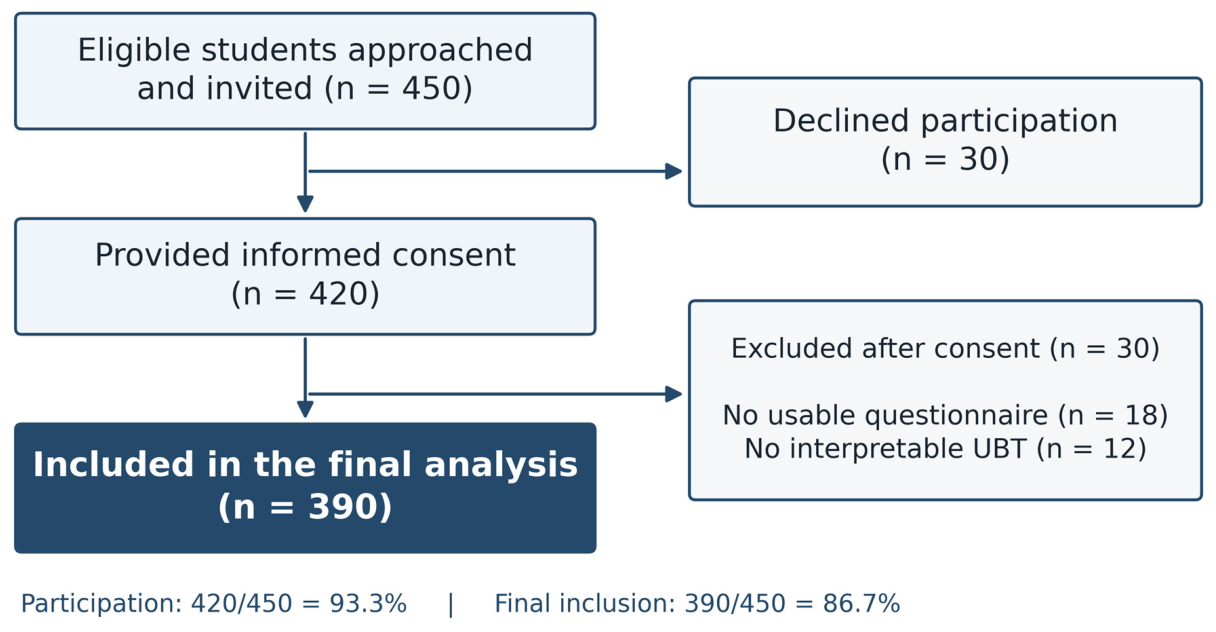

Table 1.
Participant characteristics and selected contextual factors.
| Characteristic | n | Valid N | % |
|---|---|---|---|
| Sex | |||
| Female | 321 | 390 | 82.3 |
| Male | 69 | 390 | 17.7 |
| Marital status | |||
| Single | 334 | 374 | 89.3 |
| Married | 40 | 374 | 10.7 |
| Residence | |||
| Urban | 169 | 389 | 43.4 |
| Rural | 220 | 389 | 56.6 |
| Household toilet access | |||
| Yes | 386 | 386 | 100.0 |
| Running water | |||
| Yes | 381 | 383 | 99.5 |
| No | 2 | 383 | 0.5 |
| Drinking-water source | |||
| Tap water | 300 | 383 | 78.3 |
| Purchased water | 46 | 383 | 12.0 |
| Well water | 37 | 383 | 9.7 |
| Current smoking | |||
| Yes | 40 | 386 | 10.4 |
| Coffee consumption | |||
| Yes | 178 | 387 | 46.0 |
| Salty-food consumption | |||
| Yes | 322 | 380 | 84.7 |
| Fruit/vegetables | |||
| Daily | 198 | 387 | 51.2 |
| Alcohol consumption | |||
| None | 225 | 383 | 58.7 |
Percentages use item-specific valid-response denominators. All participants were aged ≥18 years and enrolled in academic years I–IV. Only the selected responses reported in the questionnaire summaries are displayed for lifestyle items.
Table 2.
Awareness and self-reported knowledge of H. pylori and leading information sources.
| Response | n | Valid N | % | 95% CI |
|---|---|---|---|---|
| Awareness | ||||
| Had heard of H. pylori: yes | 209 | 385 | 54.3 | 49.3–59.2 |
| Had heard of H. pylori: no | 134 | 385 | 34.8 | 30.2–39.7 |
| Had heard of H. pylori: unsure | 42 | 385 | 10.9 | 8.2–14.4 |
| Disease knowledge | ||||
| Reported knowing associated diseases | 155 | 353 | 43.9 | 38.8–49.1 |
| Did not report such knowledge | 108 | 353 | 30.6 | 26.0–35.6 |
| Unsure | 90 | 353 | 25.5 | 21.2–30.3 |
| Transmission knowledge | ||||
| Reported knowing a mode of transmission | 152 | 363 | 41.9 | 36.9–47.0 |
| Did not report such knowledge | 149 | 363 | 41.0 | 36.1–46.2 |
| Unsure | 62 | 363 | 17.1 | 13.6–21.3 |
| Information source | ||||
| School | 220 | 361 | 60.9 | 55.8–65.8 |
| Nurse or physician | 132 | 361 | 36.6 | 31.8–41.7 |
| Television or radio | 37 | 361 | 10.2 | 7.5–13.8 |
| Unsure without identifying a source | 44 | 361 | 12.2 | 9.2–16.0 |
CI = confidence interval, calculated using the Wilson method. Knowledge was self-reported. The information-source denominator includes 317 students naming a source and 44 reporting uncertainty without a named source. Multiple selections were permitted, so percentages may exceed 100%. The source question was not restricted to affirmative awareness respondents.
Table 3.
Clinical history and previous testing and treatment.
| Item | n | Valid N | % | 95% CI |
|---|---|---|---|---|
| Family history | ||||
| Family member with H. pylori | 14 | 379 | 3.7 | 2.2–6.1 |
| Family member with gastric cancer | 23 | 383 | 6.0 | 4.0–8.8 |
| Prior healthcare | ||||
| Previously tested for H. pylori | 21 | 388 | 5.4 | 3.6–8.1 |
| Reported stomach problems | 77 | 377 | 20.4 | 16.7–24.8 |
| Reported gastric ulcer | 6 | 369 | 1.6 | 0.7–3.5 |
| Antibiotics previously taken for H. pylori | 7 | 358 | 2.0 | 1.0–4.0 |
| Endoscopy/gastroscopy ever performed | 15 | 368 | 4.1 | 2.5–6.6 |
| Non-antibiotic stomach medication use | 32 | 384 | 8.3 | 6.0–11.5 |
| Previous testing method among previously tested students | ||||
| Serology or blood test only | 17 | 21 | 81.0 | 60.0–92.3 |
| Urea breath test only | 1 | 21 | 4.8 | 0.8–22.7 |
| Endoscopic diagnosis only | 1 | 21 | 4.8 | 0.8–22.7 |
| Combination of methods | 2 | 21 | 9.5 | 2.7–28.9 |
| Follow-up among previously treated respondents with valid answers | ||||
| Reported completing treatment | 6 | 6 | 100.0 | 61.0–100.0 |
| Reported post-treatment retesting | 0 | 6 | 0.0 | 0.0–39.0 |
CI = Wilson 95% confidence interval. All historical outcomes were self-reported. Seven students reported prior antibiotics for H. pylori; six had valid treatment-completion and retesting information. The methods of previous testing are mutually exclusive as reported.
Table 4.
Affirmative responses to binary gastrointestinal symptom items.
| Symptom | n | Valid N | % | 95% CI |
|---|---|---|---|---|
| Abdominal pain or discomfort | 13 | 384 | 3.4 | 2.0–5.7 |
| Epigastric discomfort | 25 | 385 | 6.5 | 4.4–9.4 |
| Epigastric burning or heartburn | 20 | 383 | 5.2 | 3.4–7.9 |
| Abdominal bloating | 41 | 381 | 10.8 | 8.0–14.3 |
| Belching or regurgitation (combined item) | 42 | 379 | 11.1 | 8.3–14.6 |
| Nausea | 41 | 379 | 10.8 | 8.1–14.3 |
CI = Wilson 95% confidence interval. These binary items were analyzed separately from the graded symptom items in Table 5. The combined belching or regurgitation question cannot be separated into two binary outcomes.
Table 5.
Moderate-or-greater severity on graded gastrointestinal symptom items.
| Symptom | n | Valid N | % | 95% CI |
|---|---|---|---|---|
| General abdominal complaints | 49 | 382 | 12.8 | 9.8–16.6 |
| Epigastric complaints | 30 | 379 | 7.9 | 5.6–11.1 |
| Epigastric discomfort | 20 | 378 | 5.3 | 3.5–8.0 |
| Epigastric burning | 27 | 373 | 7.2 | 5.0–10.3 |
| Abdominal bloating sensation | 54 | 378 | 14.3 | 11.1–18.2 |
| Bloating after a small meal | 35 | 375 | 9.3 | 6.8–12.7 |
| Regurgitation | 8 | 376 | 2.1 | 1.1–4.1 |
| Abdominal distension | 54 | 380 | 14.2 | 11.1–18.1 |
| Belching | 24 | 381 | 6.3 | 4.3–9.2 |
| Nausea | 14 | 379 | 3.7 | 2.2–6.1 |
CI = Wilson 95% confidence interval. N includes explicit uncertain responses, which did not contribute to the moderate-or-greater numerator. Higher-severity categories were pooled above the minimal-symptom category. Binary presence and graded severity are distinct measurements.
Table 6.
UBT results and prevalence under post-consent exclusion scenarios.
| Result or scenario | n | N | % | 95% CI |
|---|---|---|---|---|
| Observed UBT results in the analytic sample | ||||
| Positive | 107 | 390 | 27.4 | 23.2–32.1 |
| Negative | 283 | 390 | 72.6 | 67.9–76.8 |
| Total | 390 | 390 | 100.0 | — |
| Sensitivity scenarios among all consenting students | ||||
| Lower-bound scenario: all 30 excluded students UBT-negative | 107 | 420 | 25.5 | Not applicable |
| Upper-bound scenario: all 30 excluded students UBT-positive | 137 | 420 | 32.6 | Not applicable |
UBT = urea breath test; CI = Wilson 95% confidence interval. In the sensitivity rows, n denotes the number classified as positive within each scenario, and N includes all 420 consenting students.
Disclaimer/Publisher’s Note: The statements, opinions and data contained in all publications are solely those of the individual author(s) and contributor(s) and not of MDPI and/or the editor(s). MDPI and/or the editor(s) disclaim responsibility for any injury to people or property resulting from any ideas, methods, instructions or products referred to in the content. |
© 2026 by the authors. Licensee MDPI, Basel, Switzerland. This article is an open access article distributed under the terms and conditions of the Creative Commons Attribution (CC BY) license (http://creativecommons.org/licenses/by/4.0/).
Copyright: This open access article is published under a Creative Commons CC BY 4.0 license, which permit the free download, distribution, and reuse, provided that the author and preprint are cited in any reuse.