

Submitted:
14 September 2026
Posted:
15 September 2026
You are already at the latest version
Abstract
Increasing government attention on loneliness as a global health threat places pressure on public health agencies to develop evidence-based approaches. However, numerous systematic reviews in loneliness research have failed to explain the complexity of pop-ulation loneliness, with knowledge spread out across diverse natural and social science disciplines. An interdisciplinary review was conducted to identify common ground across disciplines on key causal mechanisms that can explain how loneliness epidemics are produced. Five stages of interdisciplinary reviews were followed to limit disciplinary bias and improve the logic of integrating knowledge across disciplines. The process identified 13 authoritative experts in loneliness. Their body of work on loneliness theory was compared for common ground with three public health frameworks that explain how society and human social life directly impact population health outcomes. A total of 85 books, book chapters, textbooks, review articles, research articles and government agency reports were included in this review. Literature primarily came from sociology, psychology, neuroscience, public health (general, social epidemiology, and environ-mental health), ecology, evolutionary biology, and philosophy of science. They identi-fied eight causal mechanisms contributing to loneliness outcomes. Results are integrated in a final Adapted Social Exposome Model on Loneliness.
Keywords:
loneliness
; social exposome
; critical realism
; interdisciplinary
; population health
1. Introduction
Since 2023 the World Health Organization has classified loneliness as a global health threat, with over fifty countries and local governments creating policies to address loneliness epidemics [1,2,3]. A history of treating loneliness with therapy techniques or small group interventions has produced significant but minor effect sizes, that calls are being made to shift to systems-level and ecological interventions in public health to address loneliness epidemics [4,5,6,7]. Underlying this shifting approach is classifying social connection as a human need equivalent to water, food, and shelter [8]. Social connection captures the biological dependence of people to live in large groups, believed to be a critical part of our evolution [4,8,9,10]. Similar to public health strategies for basic needs, the safety, quantity, and quality of social connection can be assessed for detecting deprivation in communities, with loneliness signaling an overarching problem with quality in social networks [8,11]. International efforts are underway to collect evidence on how public health can address the quality of social connection in communities [12].
The evidence, however, is primarily coming from various branches of psychology and clinical sciences that inform individual-level and small group interventions [12,13,14]. The knowledge base leans toward reductionist and specialized approaches that are unique to the individuals receiving care [15]. In trying to scale this evidence to prevent loneliness in populations, a loneliness researcher has stated, “It is virtually impossible to identify the broad set of determinants of loneliness: the relationships are mostly of a reciprocal nature and mechanisms behind interrelationships are difficult to disentangle” [16] (p. 75). Recent publications trying to compile evidence about loneliness from multidisciplinary teams of experts have produced long lists of knowledge gaps because they are trying to understand the relationship of any aspect of human society to the loneliness of its residents [8,17].
In contrast, public health has relied on ecology and environmental health as systems sciences to address basic needs at national and global levels to impact population health outcomes [18,19]. Systems sciences are capable of understanding regional and global problems because they identify a limited number of factors and relationships that are most critical to explaining an outcome [20,21]. Three frameworks were identified in public health that already integrate social and environmental knowledge for system-level interventions that can address social connection as a human need: the social determinants of health framework, the social-ecological model, and the social exposome model [11].
The social determinants of health framework integrates knowledge about human society and social life with environmental knowledge about access to basic needs and adverse environmental conditions, to explain unfair differences in population health outcomes [19,22]. The social-ecological model integrates psychology and ecology knowledge to organize society into different levels that explain how larger social processes are connected to patterns in social experiences that affect developmental and health outcomes [23]. The social exposome model was developed in environmental health and social epidemiology to understand causal pathways from well-known social problems, such as socio-economic inequality, to health outcomes, by measuring total and lifetime social exposures [24].
Studies that integrated and applied these models to understand how social environments can produce loneliness across populations, found a limited number of patterns in social interactions that explain why adults feel lonely [25,26,27]. Patterns, such as being rejected and losing relationships, were not new to loneliness research but have consistently been documented across a diversity of populations [17,28]. Larger social processes that underly and influence these patterns have also been examined for several decades in public health, such as the process of marginalization [22]. It raised concerns that time and funding could be wasted on disciplines discovering concepts and theory from other disciplines, because we assume that loneliness is new to public health.
Instead, it seems that public health already has knowledge that is critical for addressing loneliness epidemics but may need to undergo a massive re-interpretation of treating our social lives as a basic need. While systematic literature reviews are rigorous approaches to determine the level of evidence on important health issues, they do not support knowledge integration that is needed to understand the complexity of interdisciplinary topics like population loneliness [29,30]. To limit author bias, systematic literature reviews rely on pre-defined search strategies using specific terms and definitions that are unique to disciplines, producing disciplinary bias that is already a problem in loneliness research [13,14,29].
What is currently needed are interdisciplinary methodologies that are designed to collect and integrate knowledge across multiple disciplines so that complex population health topics can be understood as a cohesive whole [29,31]. Interdisciplinary reviews are designed to be flexible in language, identifying conceptual common ground, or knowledge that is already agreed upon and shared across disciplines even if the same words are not being used [29]. Results are limited to evidence-based knowledge from various disciplines, but focus on the rigor of interpreting and integrating the knowledge rather than the level of evidence. Results help health researchers collaborate on testing interdisciplinary theory that includes their respective disciplines but explains how they fit into a larger understanding about a health topic [31].
To improve guidance in public health on designing interventions for population loneliness, the goal of this interdisciplinary review is to identify common ground about causal mechanisms capable of producing epidemic-levels of loneliness. Causal mechanisms are defined by ecology and critical realism as explaining the structures or processes that tend to produce an outcome [32,33], helping to identify points of intervention to change it. This review examines common ground between loneliness theory produced in sociology, psychology, and neuroscience, as well as three public health frameworks or models on human social life, including the social determinants of health framework, the social-ecological model, and the social exposome model. Given the focus on causal mechanisms, results are used to update the social exposome model with the intention of informing social environmental approaches in public health that address social connection as a basic need.
2. Materials and Methods
This interdisciplinary review followed five phases that fulfill the initial goals of knowledge integration before conducting inter- or transdisciplinary research: 1) clarify the research question and its scope, 2) develop a search strategy to identify key literature in relevant disciplines that best answer the research question, 3) deeply read literature to understand the context, or disciplinary bias, in which this knowledge was produced, 4) identify gaps in knowledge that can be filled with new disciplines and literature until the research question has been sufficiently answered, 5) compare the interpretation of knowledge for common ground and integrate it into a cohesive whole [29,31].
These five phases are similar to the five phases common in scoping reviews, except they do not pre-define criteria for selecting studies and literature [34]. Instead, general guidelines are initially given that interdisciplinary reviews should identify more than one relevant discipline that can fully answer a research question, identify the work of authoritative experts about a topic, and identify knowledge that is generally accepted within a given discipline [29]. Developing a rigorous search strategy is an iterative, or cyclical, process that may be unique to the research question. In this way, interdisciplinary reviews have post-defined criteria that require justification.
The following details how these five phases were implemented in this review.
2.1. Research Question
This interdisciplinary review wants to understand how to holistically analyze the causal mechanisms that produce loneliness epidemics to inform system-level interventions in public health.
2.2. Search Strategy
Only recently has loneliness research expanded across health-related disciplines to respond to national awareness campaigns on loneliness and to understand the impact of social distancing policies during the COVID-19 pandemic [1,35]. Prior to this, loneliness research has primarily been funded to understand the social experiences of aging populations or to address loneliness when it coincided with mental health outcomes [8,36,37]. Historically, loneliness has been a relatively small area of research with few leading experts [17,38].
For this reason, the search strategy of this review focuses on identifying the work of authoritative experts in loneliness research to understand their theories on loneliness and underlying causes.
As the United Kingdom was the first country to develop a government loneliness strategy in 2018 and the United States of America was the first country to declare a loneliness epidemic in 2023, their government reports were skimmed to identify theory on loneliness and the experts who produced them [8,37]. To have a more international perspective, the World Health Organization report on loneliness was also skimmed to identify experts [3]. In reading the body of work of loneliness experts, more experts were identified due to frequent collaboration or discussion about competing theories. Table 1 describes final criteria for identifying authoritative experts on loneliness.
A complete list of each expert’s publications was found through the online search engine Google Scholar and the science networking platform ResearchGate. These platforms were used instead of scientific reference databases, such as PubMed, because full explanations of loneliness theory are not often found in word-limited journal articles that focus on individual research studies. From Google Scholar and ResearchGate, expert publication lists included books, book chapters, professional reports, and research articles. Publication lists of each expert were scanned for addressing loneliness in their titles or summaries. They were already organized by how frequently they were cited in other literature. Final criteria for how literature was selected is described in Table 1.
On the public health side, literature was collected on the social determinants of health framework, the social-ecological model, and the social exposome model. Criteria for how this literature was selected is explained in Table 1. Textbooks, recent reviews, and government agency reports were prioritized to meet all criteria.
2.3. Extracting Knowledge
An initial selection of literature from each loneliness expert was skimmed for relevant knowledge to answer the research question. If relevant, literature was deeply read to summarize knowledge about causal mechanisms in loneliness theory and re-read to compare similarities and differences across literature [29]. Knowledge was summarized in a table, including the citation, disciplinary context, type of literature, and key contributions to results [29]. Once literature from a loneliness expert no longer provided substantial and new information about their loneliness theory, no more literature was included by that expert.
Similarly, literature on the three frameworks or models in public health was deeply read to summarize knowledge about causal mechanisms that connected human society and human social life to population health outcomes. Knowledge was summarized in a table, including the citation, the discipline for which the literature was produced, the type of literature, and a summary of its contribution to explaining causal mechanisms.
2.4. Comparing Knowledge and Filling Knowledge Gaps
When comparing knowledge between loneliness theory and public health theory on causal mechanisms that connect human social life to population health outcomes, knowledge gaps were identified. Instead of accepting these knowledge gaps, an important difference in interdisciplinary reviews is that additional disciplines and theory are identified that can fill these knowledge gaps until the research question has been answered [29]. It contributes to the rigor of explaining a health topic in full, extending beyond the bounds and bias of a specific set of disciplines. Literature from additional disciplines had to meet the same criteria as literature included on public health frameworks and models (Table 1).
Results were shared in a working paper and presentations to an interdisciplinary group of 20 PhD-level experts at the U.S. Department of Veterans Affairs. The group included a variety of medical providers, public health experts, and social scientists who are experts in gerontology, neuroscience, biology and clinical science, medical anthropology, psychology, community and behavioral health, and health services research. The group provided feedback on additional literature to consider, disciplinary context, and clarity of how results are presented. The study author also completed a fellowship for Applied Critical Realism in an academic year of 2025 – 2026. The study author has undergraduate-level training in ecology research and PhD-level training in public health research.
2.5. Final Figure and Explanation
First, common ground across loneliness research and public health frameworks were identified based on overlapping theory about causal mechanisms connecting human social life to population health outcomes. Second, knowledge was integrated into an adapted and unified social exposome model by combining points of common ground into a cohesive whole. A final summary of this knowledge is provided in the results.
Before being integrated, evidence-based knowledge adheres to disciplinary interpretations and results can be assessed for how accurately they reflect the interpretations of that discipline [29] In the results section, it will explain the contributions of each authoritative loneliness expert and each public health model or framework before integrating their knowledge.
Knowledge was integrated into a final figure to fully describe how population loneliness is theorized to occur based on literature included in the review. These results are still based on evidence-based knowledge, but knowledge integration between disciplines can change their original interpretation [29]. However, this review aimed to maintain the original interpretation of loneliness experts, documenting any time interpretations were changed and the logic for doing so. The final model is intended to be a communication tool to improve collaboration across disciplines by identifying the knowledge they share in common, to test and improve in future research studies [29].
Results can be evaluated based on explanatory power. Explanatory power describes the ability of theory to more fully explain existing evidence on a topic to the point that it is an improved explanation over existing theory [39]. For this review, explanatory power is judged on the ability of the final model to answer the original research question and the rigor of how knowledge was integrated from literature to develop results into a cohesive whole [29]. Results are intended to produce plausible explanations in a real world, minimizing changes to how knowledge is integrated from each discipline. It is not intended to be exhaustive, only focusing on points of common ground and including literature until a sufficient explanation can be produced [29].
3. Results
The body of research from thirteen authoritative experts on loneliness was included in this review (Table 2). When combined, these experts have conducted loneliness research from 1955 to present, within the United States of America, the United Kingdom, or the Netherlands. Many have worked together and with consistent collaborators. Each expert more accurately represents a clustering of several researchers who are not individually named in the results. They also represent broader global trends in health research priorities and advancements. Experts are primarily trained in the disciplines of sociology, psychology, and neuroscience, often integrating these disciplines, such as social psychology or social neuroscience.
A total of 85 books, book chapters, textbooks, review articles, research articles and government agency reports were included in this review (Supplementary Table S.1). Reading of literature occurred over several years. Literature primarily comes from the disciplines of sociology, psychology, social neuroscience, public health (general, social epidemiology, and environmental health), ecology, evolutionary biology, and philosophy of science. Table 3 summarizes information about causal mechanisms that are included in relevant public health frameworks or models, and the additional disciplines that were needed to fill in knowledge gaps before integrating knowledge together.
3.1. Knowledge Gaps
Three main knowledge gaps were found between loneliness theory and public health theory regarding causal mechanisms. One gap was the missingness from loneliness research in understanding social exposures and how they are influenced by underlying mechanisms, despite loneliness experts recognizing the critical role of social interactions in loneliness outcomes (Table 2). There seems to be a lack of awareness that it’s possible to analyze social interaction patterns and exposures that are critical to health and survival outcomes. The social-ecological model, the social exposome model, and ecology were useful for framing loneliness research to fill this gap.
A second gap is the common reference that loneliness researchers make about evolutionary theory that is completely missing from the three public health frameworks used in the review. References about evolutionary theory were added to fill this gap.
The third gap was how to make sense of the three different ways that sociology, psychology, and neuroscience define loneliness (See Section 3.5). These definitions are distinct and largely non-competing, meaning they don’t overlap. Critical realism and the three public health frameworks helped to fill this gap by recognizing separate layers of reality, helping to integrate these definitions into one to better reflect the complexity of loneliness.
3.2. Adding Critical Realism, Ecology & Evolutionary Theory
Critical realism is a philosophy of science that was incorporated into this review to help organize knowledge from various disciplines into a cohesive whole by acknowledging a complex and layered reality [33]. It is the only philosophy of science that can integrate natural and social science knowledge by organizing reality into three different layers: 1) experience (subjectivity), 2) events that can be observed (objectivity & outcomes), 3) underlying causal mechanisms that are not always visible and tend to produce events [39]. These layers can describe our external world (e.g. our environment) as well as our internal world (e.g. our bodies).
Critical realism underpins the final model. The model clarifies each layer of reality and how it’s being interpreted. Loneliness research that helps explain, for example, the subjective experience of loneliness, has its place in the model, while loneliness research that explains the biology of loneliness also has its place in the same model. These are not contradictory or competing theories, they are complementary once their role is understood within a complex world.
The final model reflects not only the social sciences, but also ecology. It is not like an ecological model; it is both an ecological and social model. In this way it overlaps a great deal with the social-ecological model in public health. However, it re-emphasizes ecology knowledge that may be unfamiliar to non-experts to better understand the direct social exposures that loneliness researchers associated with loneliness outcomes. Ecology, environmental health, social epidemiology, and social psychology all share an understanding that social interactions in people’s environments are a key causal pathway for how human health is impacted by our social lives (Appendix Table A1). They do not define interaction differently – their existing definitions conceptually overlap. What these disciplines are saying is that the interactions that people experience are objective, as they can be observed in the environment and measured in ways that are known to be critical to survival.
Ecology and evolutionary theory are heavily intertwined to explain networks of evolutionary relationships, the impact of interactions among living beings on survival outcomes, and the social behaviors of animals (Table 3). However, ecology has not included knowledge on human social life. In the reverse, public health frameworks do not include evolutionary theory, missing some key ideas about the role of evolutionary relationships in defining social connection across all species (Table 3). To fill this gap, evolutionary theory was incorporated into the model to explain current knowledge and how it can support our understanding of social connection as a basic need.
3.3. Addressing Conflicting Knowledge
Knowledge integrated into the final model largely retained its original interpretation from its respective disciplines. However, there were two instances in which conflict was identified between theory and one interpretation was selected over the other.
There is conflict in how psychologists make sense of information about social interactions compared to environmental and public health disciplines. When lonely individuals describe the interactions they have with other people, in psychology these interactions have been defined as subjective feelings about the universal experience of loneliness [49,51]. It conveys that interactions are an internal experience rather than objective events happening in the environment around us. Psychologists and social demographers have been testing these universal patterns in interactions in the very loneliness scales they have designed, including the UCLA Loneliness Scale and the De Jong Gierveld Scale [49,51] (Appendix Table A.1).
The final model selected the interpretation from environmental, public health, social psychology, and critical realism, that interactions are objective events happening in our environments (Appendix Table A.1).
The second conflict was between two different psychology interpretations about the relationship between an individual and society. Psychologists defining existential loneliness describe the mental mapping of an individual’s role in society that can reflect on their value [63]. However, this relationship is interpreted by one loneliness expert as a relationship with oneself and how an individual determines their own value or worth [63]. A second loneliness expert in cultural psychology, however, interprets this relationship as real in how society determines the value and worth of an individual within the context of cultural norms, values and beliefs [83].
Since the final model of this review integrates public health models with loneliness research, it selected for the interpretation in cultural psychology that existential loneliness reflects on an environmental relationship between an individual and the society in which they live.
3.4. Final Model and Causal Mechanisms
Based on conceptual common ground, Figure 1 was developed to integrate knowledge into a cohesive whole. Table 4 documents the reasoning for terms and causal mechanisms captured in Figure 1. To reiterate, causal mechanisms are being defined by ecology and critical realism to describe the structures or processes that explain how an outcome, specifically loneliness, tends to be produced (i.e. how does something work to produce an outcome) [32,33]. Critical realism describes how causal mechanisms apply in social systems [33].
This is not the same thing as causal effects [32]. Causal effects describe study designs and statistical approaches to determine if a caused b, or if an intervention caused an outcome. It does not describe, for example, how an intervention works.
A total of eight causal mechanisms were consistently identified in this interdisciplinary review to explain how mass loneliness can occur in populations: marginalization, intersectionality, social instability, agency to shape culture, non-conscious processes in social homeostasis, cognitive processes, aging and health, and historical evolution as a social species (Table 4). Each mechanism represents a larger underlying process that can be made up of multiple causal mechanisms that serve the same function of influencing loneliness outcomes. For example, evolution can include multiple causal mechanisms that contributed to the historical process of human evolution and our generational dependence on social connection (Table 3). Combined, these eight causal mechanisms interact as a system to produce observable changes in population-level loneliness.
Please see definitions in Table 4. Eight causal mechanisms are bolded that include intersectionality, social instability, marginalization, agency to shape culture, non-conscious processes of social homeostasis, cognitive processes, aging & health, and evolution.
3.5. Defining Loneliness
Authoritative loneliness experts consistently recognized three different definitions of loneliness that were developed from three different disciplines: social needs theory from sociology, cognitive discrepancy model from psychology, and evolutionary theory of loneliness from neuroscience.
Social Needs Theory: Loneliness is a response to the absence of an attachment figure or a response to the absence of a place in an accepting community, creating a deficit in social provisions [40,41]
Cognitive Discrepancy Model: Loneliness is a subjective feeling that occurs when there is a discrepancy between our social needs and desires and the quality of our actual relationships [8,44]
Evolutionary Theory of Loneliness: Loneliness is a biological warning system in social species that signals when salutary social relations are endangered or damaged [61]
These three definitions were all integrated into the final model as they describe a different aspect of loneliness and are non-competing. To better define the complexity of loneliness, results were developed into a unified, interdisciplinary definition of loneliness.
Interdisciplinary Definition of Loneliness: Loneliness is an emotional and protective state of distress, informed by both cognitive and non-conscious processes to make sense of the social world in which someone lives, signaling exposure to different forms of marginalization from society when failing to meet cultural expectations and motivating ways to find belonging.
4. Discussion
Loneliness research does not just explain loneliness as an outcome or experience but sheds light on how to understand social connection as a basic need. The most important word from this review is interaction. Various disciplines in this review identify interaction as the unit of measure or building block of social connection (Table 2 & 3). Despite this understanding, loneliness experts have captured interactions as subjective feelings in validated loneliness scales (Appendix Table A.1).
While it may seem like a stretch to incorporate evolutionary theory into this review, both public health and loneliness experts seem unaware of advances in evolutionary theory that describe interaction and networks as critical ways to understand evolutionary relationships across all species [94,101,102]. Interaction and networks can occur from the cellular level all the way up to interactions and networks among living beings and their larger environment [101]. While it may be practically useful to distinguish between interaction versus social interaction to describe human relationships, this distinction may fail to understand the diversity in how interaction and networks have built up across nature to exist as social connection in people today. Evolutionary theory and social connection as a basic need seem to be inseparable.
If this is the case, why are interaction patterns, like rejection, being classified as subjective in loneliness research and why is loneliness commonly defined as a purely subjective experience [8,49,51]? This review identified that early loneliness research initially struggled to understand the difference between loneliness and social isolation [40]. Loneliness researchers recognize social isolation, or a quantitative lack of relationships and contact with other people, to be objective [8]. Since social isolation and loneliness are now known to be unrelated and loneliness is an emotion, experts separate these concepts by objectivity versus subjectivity [8,15,44]. While this distinction remains important, it may be undermining the complexity of what loneliness is.
For example, health researchers also know that loneliness is critical to survival outcomes [4,8,64]. It is hard to make sense of how a purely subjective experience can result in people dying. It comes across like entire populations are feeling their own way into death. Critical realism became necessary in this review to help organize knowledge from loneliness research that could make sense of its complexity, including both subjectivity and objectivity. Critical realism is a philosophy of science that bridges natural and social sciences by acknowledging three layers of reality: subjective experiences, objective events in the environment around us, and underlying causal mechanisms that tend to produce these objective events [33,98]. So, if lonely people around the world are observing rejection in their interactions, as described by validated loneliness scales, critical realism provides guidance on how to consider their flawed perceptions, while still recognizing that interactions are objectively occurring in their environment in which rejection is possible.
Currently, validated loneliness scales are claiming that interaction patterns like rejection, along with loneliness, are a purely subjective experience [46,49,51,62]. Since loneliness researchers do not make the case that reality cannot be determined and everything is subjective, what seems to be happening is that we have not figured out an objective way to measure patterns in interactions, like rejection. If our measures of rejection are considered subjective, such as listening to people’s stories about it, loneliness researchers have ended up classifying patterns in interactions as a part of the overall subjective experience of loneliness. As scientists we must ask ourselves if the way we measure the world should dictate reality or should reality dictate how we try to measure it, even if we fall short. Critical realism was used in this review to think through reality in loneliness research regardless of how we are currently measuring it.
While these points may sound theoretical and abstract, they make a substantial difference in public health practice. Results in this review identified that fifty years of loneliness research consistently described eight main mechanisms, or underlying causes, that can interact to explain loneliness outcomes. In comparing these mechanisms with public health knowledge, four of them fall within existing public health efforts to improve population health. They include intersectionality, social instability, marginalization, and agency to shape culture, that are often described within the social determinants of health [22]. However, trying to address these concerns in public health is controversial [103].
Part of the controversy that overlaps with loneliness research is how to address social problems that are experienced subjectively and shaped by perception. How do we determine social problems that warrant public health intervention and objective improvements in results to know that an intervention was effective? Public health has largely relied on identifying demographic risk factors for populations whose overall health is worse than their peers, known as health disparities, and classifying these populations as vulnerable [104]. For a social problem, like discrimination, decades of research have also uncovered pathways that link various forms of structural discrimination and adverse social experiences to population health disparities [105]. Public health uses approaches like Health In All Policies to consider structural changes that address large-scale social problems impacting a wide range of population health outcomes [106].
However, this approach can backfire by creating an identity of vulnerability for at-risk populations based primarily on demographic data, rather than the local context producing disparities [104]. This approach can also give the impression that some populations face marginalization, but not others, failing to explain how or why it is occurring at this time, in this place.
Loneliness research improves this conversation by considering the role of marginalization in an evolutionary context and ways we can better assess social environments to understand local problems. We can know that marginalization is a real phenomenon critical to survival because it is critical to the survival of many species [59,60]. However, every human being will likely experience the forces of marginalization in their lifetime, indicated by the universal feeling of loneliness. As described by John T. Cacioppo in social neuroscience, marginalization is so important to survival that we have developed a defense mechanism against it [60].
Instead of only relying on demographic information, public health can start to examine social exposures in local places and corroborate this information with social structures, such as local laws and policies. For example, even if we can only identify social exposures like rejection through people’s stories, we can compare this information to concrete data, such as recorded communication, written laws and policies, or documented events. The importance of evaluating social environments by the kinds of interactions occurring is that loneliness research has identified multiple forms of marginalization that may require different solutions. Within this review, five patterns of interactions were linked to loneliness, including rejection, loss of relationships, lack of reciprocity in excessive labor demands, a mismatch in having nothing in common, and an inability to socially participate often due to health problems (Appendix Table A.1).
These different kinds of problems will likely require different solutions. For example, if severe enough forms of marginalization are occurring in a place to impact population health outcomes, loneliness research suggests it could be due to having nothing in common, such as having different cultures that don’t understand each other and disengaging from interaction. A public health approach to this may be developing a bridge to build common ground among different cultures in the same area.
The Adapted Social Exposome Model on Loneliness in this review is not intended to be a definitive guide. Instead, it supports collaboration across disciplines studying loneliness to critique and improve this knowledge in a coherent way. Public health can also use this model to better evaluate and design interventions for their jurisdiction. Last, results provide an interdisciplinary definition of loneliness to clarify its complexity so that experts and novices alike can better understand the breadth of knowledge we currently have about loneliness.
Limitations
Currently, there are no standardized guidelines on how to conduct an interdisciplinary review. This review relied on inter- and trans-disciplinary methodologists who outline a process for integrating knowledge across multiple disciplines before collaborating on research [29,31]. Interdisciplinary reviews share a lot in common with both scoping reviews and narrative reviews [34,107]. These are not just different methods; each of them is underpinned by a different philosophy of science. Scoping reviews are shaped by positivism with concerns about following a systematic approach that can be replicated and limits author bias [34]. Narrative reviews are shaped by social constructivism and interpretivism that do not define reality, such as evidence, instead allowing for multiple perspectives, including non-experts, to synthesize their collective knowledge about a topic [107].
Methodologists have not yet explained the philosophy they are following to conduct an interdisciplinary review, as it requires including disciplines with different philosophies to address disciplinary bias [29,31]. However, this review is underpinned by critical realism. It is the only philosophy of science that bridges a divide between natural and social sciences, while still caring about reality and causation [33]. The rigor is not in systematic replication, but in the logic of integrating knowledge into a cohesive whole that describes overlapping evidence from multiple disciplines, or common ground. This approach defines grand challenges in the sciences to explain complex topics [29].
Regardless, this review is vulnerable to author bias [29]. To limit author bias, results relied on literature from authoritative loneliness experts that have been recognized by national governments and an international public health agency to incorporate their theories on loneliness. Twenty PhD-level experts across medical, basic science, public health, and social science disciplines also provided feedback on results. Only twice did the review intentionally select one theoretical perspective over another when they conflicted in the final model. Results detail why this selection occurred so that future researchers can reconsider these decisions.
5. Conclusions
An interdisciplinary review identified eight causal mechanisms consistently discussed by authoritative loneliness experts as contributing to population-level loneliness. They were compared with three common public health frameworks and models to identify the knowledge that public health already has to address loneliness. The final Adapted Social Exposome Model for Loneliness gives insight on how to assess social environments and their underlying causes for public health interventions, including marginalization, intersectionality, social instability, and agency to shape culture. This knowledge informs a new interdisciplinary definition of loneliness as an emotional and protective state of distress, informed by both cognitive and non-conscious processes to make sense of the social world in which someone lives, signaling exposure to different forms of marginalization from society when failing to meet cultural expectations and motivating ways to find belonging.
Supplementary Materials
The following supporting information can be downloaded at Preprints.org, Table S1: Key Literature for Interdisciplinary Review by Section & Year.
Funding
This material is the result of work supported with resources and the use of facilities at the VA Eastern Colorado Healthcare System, Aurora, CO, USA.
Institutional Review Board Statement
Not applicable.
Informed Consent Statement
Not applicable.
Data Availability Statement
Data sharing is not applicable as no new data were generated.
Acknowledgments
I would like to thank the fellowship programs at the Center of Innovation for Veteran-Centered and Value Driven Care, the Geriatric Research, Education and Clinical Center, and Applied Critical Realism for their expert feedback.
Conflicts of Interest
The authors declare no conflicts of interest.
Disclaimer: The contents do not represent the views of the U.S. Department of Veterans Affairs of the United States Government.
Appendix A

Table A1.
Defining interaction.
| Defined By | Contribution |
| Social Psychology | Social Psychology has been defined as the study of human interaction. Interaction is described as observable behaviors of two or more individuals mutually responding to each other [108]. |
| Social Psychology | Robert S. Weiss describes his introduction to social psychology as focusing on interaction as the central part of its discipline [38]. |
| Environmental Health | Environmental health defines the Social Exposome Model as explaining the underlying mechanisms that translate social exposures into health outcomes. Interaction is a necessary causal pathway in which two or more actors, in a specific place, and their dynamics can directly impact health outcomes [88]. |
| Ecology | The traditional definition of ecology is the interaction among living organisms and their environment [21]. |
| Ecology | Interaction in ecology is defined as the direct impact of one individual on another in terms of survival outcomes (positive, negative, neutral) [109,110]. |
| Rejection Patterns in Interaction | Item in validated loneliness scale: “Often, I feel rejected” [51]. |
| Describes experiments to intentionally reject participants to measure loneliness responses [28]. | |
| Describes childhood loneliness scales that are centered around rejecting social experiences [69]. | |
| Describes the connection between stigmatized populations and loneliness outcomes [72]. | |
| Loss of Relationships in Interaction (Physical Absence & Distance) |
Describes loneliness in relation to attachment theory. Loneliness is thought of as resulting from a loss of relationships without an ability to re-attach. It corresponds to a physical absence that cannot be resolved. In this way it is closely associated with grief but distinctly different. Described in reference to moving of families and frequent migration of populations for new jobs [40]. |
| Item in validated loneliness scale: “I miss having people around” [51]. | |
| Item in validated loneliness scale: “How often do you feel that you are no longer close with anyone?” [49]. | |
| Describes the loss of relationships occurring in older ages due to death in social networks [51]. | |
| Expanding social networks in older ages reduces loneliness [54]. | |
| Lacking Reciprocity in Labor Demands & Caregiver Burden in Interactions | Labor within the basic need for social connection is being broadly framed as labor described across social species in E.O. Wilson’s final textbook on Sociobiology [111]. Being able to divide labor and specialize in roles has been a distinguishing characteristic of complex social species. For people, division of labor is a hallmark of both our economic systems as well as family and friend networks. |
| Describes reliable assistance and guidance as two of the six basic qualities needed in relationships [41]. | |
| Social support is opposite of loneliness [15]. | |
| Item in validated loneliness scale: “How often do you feel that there is no one you can turn to?” [49]. | |
| Item in validated loneliness scale: “There are many people that I can count on completely”, “There are plenty of people that I can lean on in case of trouble” [51]. | |
| Consistent finding of burnout in demanding professions and strong correlation to loneliness outcomes. Social support inversely related to loneliness outcomes. Teacher, nurse, and student populations [49]. | |
| Social support at jobs inversely related to burnout [112]. | |
| Exchange of both emotional and instrumental support are crucial to social embeddedness to resolve loneliness [16]. | |
| Lacking Engagement in Interactions Due to Mismatch, Such as Not Having Things in Common | Cognitive Discrepancy Model of Loneliness captures mismatch as a key word in what people not only need in their relationships, but want from them [15]. Social comparison plays an important role of comparing relationship experiences that may differ from others. |
| Mismatch often describes not meeting personal, social and cultural expectations at different stages of life [43]. But when examining relationships more closely, or the interactions that people are having, mismatch also describes different relational wants, different personalities, different life experiences, etc., that can in reciprocal ways make connection challenging [43]. | |
| Items in validated loneliness scale: “How often do you feel that you are ‘in tune’ with the people around you?”, “How often do you feel that you have a lot in common with the people around you?”, “How often do you feel that your ideas and interests are not shared by those around you?”, “How often do you feel that people are around you, but not with you?” [49] | |
| Inability to Socially Participate in Interactions |
Being socially integrated and being able to also provide nurturance or support to others are two of the six social provisions needed in relationships [40]. |
| Recovery from poor health reduces loneliness [54]. | |
| Worsening health and financial restrictions in older ages are predictors of loneliness outcomes [51]. | |
| Economic deprivation and poor health are predictors in population loneliness, requiring reliance on informal support from family members at older ages [57]. | |
| Functional limitations due to health conditions and low income that limit social participation, key predictors of loneliness at older ages [100]. |
References
- Goldman, N.; Khanna, D.; El Asmar, M.L.; Qualter, P.; El-Osta, A. Addressing loneliness and social isolation in 52 countries: a scoping review of National policies. BMC Public Health 2024, 24(1), 1207. [Google Scholar] [CrossRef] [PubMed]
- Goldman, N.; Alemdar, M.; Megges, H.; et al. National policy responses to address loneliness: A global scoping review of 194 WHO member states. Health Policy 2026, 165, 105553. [Google Scholar] [CrossRef] [PubMed]
- WHO Commission on Social Connection. From Loneliness to Social Connection: Charting a Path to Healthier Societies; World Health Organization, 2025; p. 213. Available online: https://www.who.int/publications/i/item/978240112360.
- Holt-Lunstad, J.; Robles, T.F.; Sbarra, D.A. Advancing social connection as a public health priority in the United States. Am. Psychol. 2017, 72(6), 517–530. [Google Scholar] [CrossRef] [PubMed]
- Fakoya, O.A.; McCorry, N.K.; Donnelly, M. Loneliness and social isolation interventions for older adults: a scoping review of reviews. BMC Public Health 2020, 20(1), 129. [Google Scholar] [CrossRef] [PubMed]
- Hoang, P.; King, J.A.; Moore, S.; et al. Interventions Associated With Reduced Loneliness and Social Isolation in Older Adults: A Systematic Review and Meta-analysis. JAMA Netw. Open 2022, 5(10), e2236676. [Google Scholar] [CrossRef] [PubMed]
- Masi, C.M.; Chen, H.Y.; Hawkley, L.C.; Cacioppo, J.T. A Meta-Analysis of Interventions to Reduce Loneliness. Personal. Soc. Psychol. Rev. 2011, 15(3), 219–266. [Google Scholar] [CrossRef] [PubMed]
- Office of the Surgeon General (OSG). Our Epidemic of Loneliness and Isolation: The U.S. Surgeon General’s Advisory on the Healing Effects of Social Connection and Community. US Department of Health and Human Services. 2023. Available online: http://www.ncbi.nlm.nih.gov/books/NBK595227/ (accessed on 5 May 2026).
- Holt-Lunstad, J. Social Connection as a Public Health Issue: The Evidence and a Systemic Framework for Prioritizing the “Social” in Social Determinants of Health. Annu Rev. Public Health 2022, 43(1), 193–213. [Google Scholar] [CrossRef] [PubMed]
- Cacioppo, J.T.; Cacioppo, S.; Boomsma, D.I. Evolutionary mechanisms for loneliness. Cogn. Emot. 2014, 28(1), 3–21. [Google Scholar] [CrossRef] [PubMed]
- Bauer, K.L.; Johnson-Koenke, R.; Fort, M.P. What Is Social Connection in the Context of Human Need: An Interdisciplinary Literature Review. Int. J. Environ. Res. Public Health 2025, 22(3), 363. [Google Scholar] [CrossRef] [PubMed]
- Card, K.G.; Refol, J.; Hill, T.G.; et al. Public Health Guidelines for Social Connection: An International Delphi Study. Health Policy 2025, 162, 105452. [Google Scholar] [CrossRef] [PubMed]
- Barreto, M.; Doyle, D.M.; Qualter, P. Changing the Narrative: Loneliness as a Social Justice Issue. Polit. Psychol. 2024, 45(S1), 157–181. [Google Scholar] [CrossRef]
- Holt-Lunstad, J. Why Social Relationships Are Important for Physical Health: A Systems Approach to Understanding and Modifying Risk and Protection. Annu Rev. Psychol. 2018, 69(1), 437–458. [Google Scholar] [CrossRef] [PubMed]
- Perlman, D.; Peplau, L.A. Loneliness Research: A Survey of Empirical Findings. In Preventing the Harmful Consequences of Severe and Persistent Loneliness. Prevention Publication Series; Peplau, L.A., Goldston, S.E., Eds.; National Institute of Mental Health, U.S. Department of Health & Human Services, 1984; pp. 13–46. [Google Scholar]
- de Jong Gierveld, J. A Review of Loneliness: Concept and Definitions, Determinants and Consequences. Rev. Clin. Gerontol. 1998, 8(1), 73–80. [Google Scholar] [CrossRef]
- Prohaska, T.; Burholt, V.; Burns, A.; et al. Consensus Statement: Loneliness in Older Adults, the 21st Century Social Determinant of Health? BMJ Open 2020, 10(8), e034967. [Google Scholar] [CrossRef] [PubMed]
- White, F.; Stallones, L.; Last, J.M. Global Public Health: Ecological Foundations; Oxford University Press, 2013. [Google Scholar] [CrossRef]
- Shultz, J.M. Public Health: An Introduction to the Science and Practice of Population Health, 2nd ed.; Springer Publishing Company, 2019. [Google Scholar]
- Meadows, D.H.; Wright, D. Thinking in Systems: A Primer; Chelsea Green, 2008. [Google Scholar]
- Sher, A.A.; Molles, M.C. Ecology: Concepts & Applications, Ninth edition; McGraw Hill, 2022. [Google Scholar]
- Raphael, D. Social Determinants of Health: Canadian Perspectives, 4th edition; Canadian Scholars, 2025. [Google Scholar]
- Bronfenbrenner, U. Toward an Experimental Ecology of Human Development. Am. Psychol. 1977, 32(7), 513–531. [Google Scholar] [CrossRef]
- Senier, L.; Brown, P.; Shostak, S.; Hanna, B. The Socio-Exposome: Advancing Exposure Science and Environmental Justice in a Postgenomic Era. Environ. Sociol. 2017, 3(2), 107–121. [Google Scholar] [CrossRef] [PubMed]
- Bauer, K.L.; Eskew, S.; Tung, G.; et al. Adult Loneliness Narratives Recount Exposure to Relational Loss, Rejection, Emotional Absence, and Excessive Labor: A Critical Realist Approach to Thematic Analysis. Int. J. Qual. Methods 2025, 24, 16094069251362615. [Google Scholar] [CrossRef]
- Bauer, K.L.; Eskew, S.; Tung, G.; et al. Marginalization and Intersectionality in Adults’ Relationship to Society Explain Increasing Loneliness: A Critical Realist Lens on Thematic Narrative Inquiry. Int. J. Qual. Methods 2025, 24, 16094069251346264. [Google Scholar] [CrossRef]
- Bauer, K.L.; Hernandez, V.M.; Eskew, S.; et al. A Social-Ecological Systems Understanding of Risk & Protective Factors for Loneliness in LGBTQ+ Adults: A Scoping Review. J. Homosex Published online. 2025, 1–29. [CrossRef] [PubMed]
- Cacioppo, J.T.; William, P. Loneliness: Human Nature and the Need for Social Connection; W.W. Norton & Company, 2008. [Google Scholar]
- Repko, A.F.; Szostak, R. Interdisciplinary Research: Process and Theory, Fourth edition; SAGE, 2021. [Google Scholar]
- De Cassai, A.; Dost, B.; Tulgar, S.; Boscolo, A. Methodological Standards for Conducting High-Quality Systematic Reviews. Biology 2025, 14(8), 973. [Google Scholar] [CrossRef] [PubMed]
- Bergmann, M.; Klein, J.T. Methods for Transdisciplinary Research: A Primer for Practice, English edition; Campus-Verlag, 2012. [Google Scholar]
- Grace, J.B.; Huntington-Klein, N.; Schweiger, E.W.; et al. Causal Effects Versus Causal Mechanisms: Two Traditions With Different Requirements and Contributions Towards Causal Understanding. Ecol. Lett. 2025, 28(4), e70029. [Google Scholar] [CrossRef] [PubMed]
- Bhaskar, R.; Hartwig, M. Enlightened Common Sense: The Philosophy of Critical Realism; Routledge, 2016. [Google Scholar]
- Levac, D.; Colquhoun, H.; O’Brien, K.K. Scoping Studies: Advancing the Methodology. Implement Sci. 2010, 5(1), 69. [Google Scholar] [CrossRef] [PubMed]
- O’Sullivan, R.; Burns, A.; Leavey, G.; et al. Impact of the COVID-19 Pandemic on Loneliness and Social Isolation: A Multi-Country Study. Int. J. Environ. Res. Public Health 2021, 18(19), 9982. [Google Scholar] [CrossRef] [PubMed]
- Pettigrew, S.; Roberts, M. Addressing Loneliness in Later Life. Aging Ment. Health 2008, 12(3), 302–309. [Google Scholar] [CrossRef] [PubMed]
- Department for Digital; Culture; Media and Sport. A Connected Society: A Strategy for Tackline Loneliness - Laying the Foundation for Change. In HM Government; 2018; p. 84. Available online: https://www.gov.uk/government/publications/a-connected-society-a-strategy-for-tackling-loneliness.
- Weiss, R.S. Reflections on the Present State of Loneliness Research. J. Soc. Behav. Personal. 1987, 2(2), 1–16. [Google Scholar]
- Bhaskar, R.; Danermark, B.; Price, L. Interdisciplinarity and Wellbeing: A Critical Realist General Theory of Interdisciplinarity. 1st Edition; Routledge, 2017. [Google Scholar]
- Weiss, R.S. Loneliness: The Experience of Emotional and Eocial Isolation; MIT Press, 1974. [Google Scholar]
- Weiss, R.S. Loneliness: What We Know About It and What We Might Do About It. In Preventing the Harmful Consequences of Severe and Persistent Loneliness. Prevention Publication Series; Peplau, L.A., Goldston, S.E., Eds.; National Institute of Mental Health, U.S. Department of Health & Human Services, 1984; pp. 3–12. [Google Scholar]
- Russell, D.; Cutrona, C.E.; Rose, J.; Yurko, K. Social and Emotional Loneliness: An Examination of Weiss’s Typology of Loneliness. J. Pers. Soc. Psychol. 1984, 46(6), 1313–1321. [Google Scholar] [CrossRef] [PubMed]
- Perlman, D. Loneliness: A Life-Span, Family Perspective. In Families and Social Networks; Milardo, R.M., National Council on Family Relations, Eds.; Sage Publications, 1988; pp. 190–220. [Google Scholar]
- Perlman, D.; Peplau, L.A. Toward A Social Psychology of Loneliness. In Personal Relationships in Disorder; Duck, S., Gilmour, R., Eds.; Academic Press, 1981; pp. 31–56. [Google Scholar]
- Michela, J.L.; Peplau, L.A.; Weeks, D.G. Perceived Dimensions of Attributions for Loneliness. J. Pers. Soc. Psychol. 1982, 43(5), 929–936. [Google Scholar] [CrossRef] [PubMed]
- Russell, D.; Peplau, L.A.; Cutrona, C.E. The Revised UCLA Loneliness Scale: Concurrent and Discriminant Validity Evidence. J. Pers. Soc. Psychol. 1980, 39(3), 472–480. [Google Scholar] [CrossRef] [PubMed]
- Russell, D.; Peplau, L.A.; Ferguson, M.L. Developing a Measure of Loneliness. J. Pers. Assess. 1978, 42(3), 290–294. [Google Scholar] [CrossRef] [PubMed]
- Russell, D.W. Loneliness and Social Neuroscience. World Psychiatry 2014, 13(2), 150–151. [Google Scholar] [CrossRef] [PubMed]
- Russell, D.W. UCLA Loneliness Scale (Version 3): Reliability, Validity, and Factor Structure. J. Pers. Assess. 1996, 66(1), 20–40. [Google Scholar] [CrossRef] [PubMed]
- de Jong Gierveld, J.; van Tilburg, T.; Dykstra, P.A. Loneliness and Social Isolation. In The Cambridge Handbook of Personal Relationships, 1st edition; Vangelisti, A.L., Perlman, D., Eds.; Cambridge University Press, 2006; pp. 485–500. [Google Scholar] [CrossRef]
- de Jong Gierveld, J.; van Tilburg, T. The De Jong Gierveld Short Scales for Emotional and Social Loneliness: Tested on Data from 7 Countries in the UN Generations and Gender Surveys. Eur. J. Ageing 2010, 7(2), 121–130. [Google Scholar] [CrossRef] [PubMed]
- de Jong Gierveld, J.; Fokkema, T. Strategies to Prevent Loneliness. In Addressing Loneliness: Coping, Prevention and Clinical Interventions. Researching Social Psychology; Sha’ked, A., Rokach, A., Eds.; Routledge, 2015. [Google Scholar]
- Fokkema, T.; de Jong Gierveld, J.; Dykstra, P.A. Cross-National Differences in Older Adult Loneliness. J. Psychol. 2012, 146(1-2), 201–228. [Google Scholar] [CrossRef] [PubMed]
- Dykstra, P.A.; Van Tilburg, T.G.; Gierveld, J.D.J. Changes in Older Adult Loneliness: Results From a Seven-Year Longitudinal Study. Res. Aging 2005, 27(6), 725–747. [Google Scholar] [CrossRef]
- van Tilburg, T.G. Social, Emotional, and Existential Loneliness: A Test of the Multidimensional Concept. In The Gerontologist; Meeks, S., Ed.; 2021; Volume 61, 7, pp. e335–e344. [Google Scholar] [CrossRef] [PubMed]
- Dykstra, P.A. Older Adult Loneliness: Myths and Realities. Eur. J. Ageing 2009, 6(2), 91–100. [Google Scholar] [CrossRef] [PubMed]
- van Tilburg, T.; Havens, B.; de Jong Gierveld, J. Loneliness among Older Adults in the Netherlands, Italy, and Canada: A Multifaceted Comparison. Can. J. Aging Rev. Can. Vieil. 2004, 23(2), 169–180. [Google Scholar] [CrossRef] [PubMed]
- Cacioppo, J.T. Social Neuroscience: Understanding the Pieces Fosters Understanding the Whole and Vice Versa. Am. Psychol. 2002, 57(11), 819–831. [Google Scholar] [CrossRef] [PubMed]
- Cacioppo, J.T.; Cacioppo, S.; Capitanio, J.P.; Cole, S.W. The Neuroendocrinology of Social Isolation. Annu Rev. Psychol. 2015, 66(1), 733–767. [Google Scholar] [CrossRef] [PubMed]
- Cacioppo, J.T.; Hawkley, L.C. Perceived Social Isolation and Cognition. Trends Cogn. Sci. 2009, 13(10), 447–454. [Google Scholar] [CrossRef] [PubMed]
- Spithoven, A.W.M.; Cacioppo, S.; Goossens, L.; Cacioppo, J.T. Genetic Contributions to Loneliness and Their Relevance to the Evolutionary Theory of Loneliness. Perspect. Psychol. Sci. 2019, 14(3), 376–396. [Google Scholar] [CrossRef] [PubMed]
- Hughes, M.E.; Waite, L.J.; Hawkley, L.C.; Cacioppo, J.T. A Short Scale for Measuring Loneliness in Large Surveys: Results From Two Population-Based Studies. Res. Aging 2004, 26(6), 655–672. [Google Scholar] [CrossRef] [PubMed]
- Hawkley, L.C.; Browne, M.W.; Cacioppo, J.T. How Can I Connect With Thee?: Let Me Count the Ways. Psychol. Sci. 2005, 16(10), 798–804. [Google Scholar] [CrossRef] [PubMed]
- Holt-Lunstad, J.; Smith, T.B.; Baker, M.; Harris, T.; Stephenson, D. Loneliness and Social Isolation as Risk Factors for Mortality: A Meta-Analytic Review. Perspect. Psychol. Sci. 2015, 10(2), 227–237. [Google Scholar] [CrossRef] [PubMed]
- Holt-Lunstad, J.; Smith, T.B.; Layton, J.B. Social Relationships and Mortality Risk: A Meta-analytic Review. In PLoS Med.; Brayne, C., Ed.; 2010; Volume 7, 7. [Google Scholar] [CrossRef] [PubMed]
- Qualter, P.; Brown, S.L.; Rotenberg, K.J.; et al. Trajectories of Loneliness During Childhood and Adolescence: Predictors and Health Outcomes. J. Adolesc. 2013, 36(6), 1283–1293. [Google Scholar] [CrossRef] [PubMed]
- Qualter, P.; Vanhalst, J.; Harris, R.; et al. Loneliness Across the Life Span. Perspect. Psychol. Sci. 2015, 10(2), 250–264. [Google Scholar] [CrossRef] [PubMed]
- Qualter, P.; Petersen, K.; Barreto, M.; Victor, C.; Hammond, C.; Arshad, S.A. Exploring the Frequency, Intensity, and Duration of Loneliness: A Latent Class Analysis of Data from the BBC Loneliness Experiment. Int. J. Environ. Res. Public Health 2021, 18(22), 12027. [Google Scholar] [CrossRef] [PubMed]
- Qualter, P.; Munn, P. The separateness of social and emotional loneliness in childhood. J. Child Psychol. Psychiatry 2002, 43(2), 233–244. [Google Scholar] [CrossRef] [PubMed]
- Eccles, A.M.; Qualter, P. Review: Alleviating loneliness in young people – a meta-analysis of interventions. Child Adolesc. Ment. Health 2021, 26(1), 17–33. [Google Scholar] [CrossRef] [PubMed]
- Barreto, M.; Victor, C.; Hammond, C.; Eccles, A.; Richins, M.T.; Qualter, P. Loneliness around the world: Age, gender, and cultural differences in loneliness. Personal. Individ Differ. 2021, 169, 110066. [Google Scholar] [CrossRef] [PubMed]
- Barreto, M.; Van Breen, J.; Victor, C.; et al. Exploring the Nature and Variation of the Stigma Associated with Loneliness. J. Soc. Pers. Relatsh. 2022, 39(9), 2658–2679. [Google Scholar] [CrossRef] [PubMed]
- Mund, M.; Maes, M.; Drewke, P.M.; Gutzeit, A.; Jaki, I.; Qualter, P. Would the Real Loneliness Please Stand Up? The Validity of Loneliness Scores and the Reliability of Single-Item Scores. Assessment 2023, 30(4), 1226–1248. [Google Scholar] [CrossRef] [PubMed]
- Qin, Y.; Victor, C.; Qualter, P.; Barreto, M. Understanding the psychological, relational, sociocultural, and demographic predictors of loneliness using explainable machine learning. Stigma Health. Published online. 14 November 2024. [CrossRef]
- Vytniorgu, R.; Cooper, F.; Jones, C.; Barreto, M. Loneliness and belonging in narrative environments. Emot. Space Soc. 2023, 46, 100938. [Google Scholar] [CrossRef]
- Heu, L.C. The Loneliness of the Odd One Out: How Deviations From Social Norms Can Help Explain Loneliness Across Cultures. Perspect. Psychol. Sci. 2025, 20(2), 199–218. [Google Scholar] [CrossRef] [PubMed]
- Heu, L.C.; Van Zomeren, M.; Hansen, N. Does Loneliness Thrive in Relational Freedom or Restriction? The Culture-Loneliness Framework. Rev. Gen. Psychol. 2021, 25(1), 60–72. [Google Scholar] [CrossRef]
- Heu, L.C. Social Norms and Loneliness. Curr. Opin. Behav. Sci. 2025, 63, 101508. [Google Scholar] [CrossRef]
- Heu, L.C.; Hansen, N.; Van Zomeren, M. Resolving the Cultural Loneliness Paradox of Choice: The Role of Cultural Norms About Individual Choice Regarding Relationships in Explaining Loneliness in Four European Countries. J. Soc. Pers. Relatsh. 2021, 38(7), 2053–2072. [Google Scholar] [CrossRef]
- Heu, L.C.; Van Zomeren, M.; Hansen, N. Lonely Alone or Lonely Together? A Cultural-Psychological Examination of Individualism–Collectivism and Loneliness in Five European Countries. Pers. Soc. Psychol. Bull. 2019, 45(5), 780–793. [Google Scholar] [CrossRef] [PubMed]
- Hansen, N.; Heu, L. All Human, yet Different: An Emic-Etic Approach to Cross-Cultural Replication in Social Psychology. Soc. Psychol. 2020, 51(6), 361–369. [Google Scholar] [CrossRef]
- Akhter-Khan, S.C.; Van Es, W.; Prina, M.; et al. Experiences of Loneliness in Lower- and Middle-Income Countries: A Systematic Review of Qualitative Studies. Soc. Sci. Med. 2024, 340, 116438. [Google Scholar] [CrossRef] [PubMed]
- Heu, L.C.; Hansen, N.; Van Zomeren, M.; et al. Loneliness Across Cultures with Different Levels of Social Embeddedness: A Qualitative Study. Pers. Relatsh. 2021, 28(2), 379–405. [Google Scholar] [CrossRef]
- Zaninotto, P.; Steptoe, A. English Longitudinal Study of Ageing. In Encyclopedia of Gerontology and Population Aging; Gu, D., Dupre, M.E., Eds.; Springer International Publishing, 2021; pp. 1671–1678. [Google Scholar] [CrossRef]
- Rokach, A.; Berman, D. Loneliness: An Existential and Public Health Issue. Int. J. Environ. Res. Public Health 2025, 22(10), 1544. [Google Scholar] [CrossRef] [PubMed]
- A Framework for Prevention. U.S. Centers for Disease Control and Prevention, 2025. Available online: https://www.cdc.gov/violence-prevention/about/index.html#cdc_behavioral_basics_prevention-a-framework-for-prevention.
- McEwen, C.A. Connecting the Biology of Stress, Allostatic Load and Epigenetics to Social Structures and Processes. Neurobiol. Stress. 2022, 17, 100426. [Google Scholar] [CrossRef] [PubMed]
- Gudi-Mindermann, H.; White, M.; Roczen, J.; Riedel, N.; Dreger, S.; Bolte, G. Integrating the Social Environment with an Equity Perspective into the Exposome Paradigm: A New Conceptual Framework of the Social Exposome. Environ. Res. 2023, 233, 116485. [Google Scholar] [CrossRef] [PubMed]
- Vineis, P.; Barouki, R. The Exposome as the Science of Social-to-Biological Transitions. Environ. Int. 2022, 165, 107312. [Google Scholar] [CrossRef] [PubMed]
- Matthews, G.A.; Tye, K.M. Neural Mechanisms of Social Homeostasis. Ann. N Y Acad. Sci. 2019, 1457(1), 5–25. [Google Scholar] [CrossRef] [PubMed]
- Coan, James A.; Sbarra, D.A. Social Baseline Theory: The Social Regulation of Risk and Effort. Curr. Opin. Psychol. 2015, 1, 87–91. [Google Scholar] [CrossRef] [PubMed]
- Krieger, N. Theorizing Epidemiology, The Stories Bodies Tell, and Embodied Truths: A Status Update on Contending 21st Century Epidemiological Theories of Disease Distribution. Int. J. Soc. Determ. Health Health Serv. 2024, 54(4), 331–342. [Google Scholar] [CrossRef] [PubMed]
- Sober, E. Philosophy Of Biology, Second edition; Taylor and Francis, 2018. [Google Scholar]
- Kearney, M.; Lieberman, B.S.; Strotz, L.C. Tangled Banks, Braided Rivers, and Complex Hierarchies: Beyond Microevolution and Macroevolution. In J Evol Biol.; Holman, L., Tsuboi, M., Eds.; 2024; Volume 37, 12, pp. 1402–1412. [Google Scholar] [CrossRef] [PubMed]
- Blount, Z.D.; Lenski, R.E.; Losos, J.B. Contingency and Determinism in Evolution: Replaying Life’s Tape. Science 2018, 362(6415), eaam5979. [Google Scholar] [CrossRef] [PubMed]
- Willmer, P.; Stone, G.; Johnston, I. Environmental Physiology of Animals; John Wiley & Sons, 2009. [Google Scholar]
- Hunt, G.; Hopkins, M.J.; Lidgard, S. Simple Versus Complex Models of Trait Evolution and Stasis as a Response to Environmental Change. Proc. Natl. Acad. Sci. 2015, 112(16), 4885–4890. [Google Scholar] [CrossRef] [PubMed]
- Elder-Vass, D.; Fryer, T.; Groff, R.P.; Navarrete, C.; Nellhaus, T. Does Critical Realism Need the Concept of Three Domains of Reality? A Roundtable. J. Crit. Realism 2023, 22(2), 222–239. [Google Scholar] [CrossRef]
- Cacioppo, J.T.; Cacioppo, S. Social Relationships and Health: The Toxic Effects of Perceived Social Isolation. Soc. Personal. Psychol. Compass 2014, 8(2), 58–72. [Google Scholar] [CrossRef] [PubMed]
- Luhmann, M.; Hawkley, L.C. Age Differences in Loneliness from Late Adolescence to Oldest Old Age. Dev. Psychol. 2016, 52(6), 943–959. [Google Scholar] [CrossRef] [PubMed]
- Bapteste, E.; Huneman, P. Towards a Dynamic Interaction Network of Life to unify and expand the evolutionary theory. BMC Biol. 2018, 16(1), 56. [Google Scholar] [CrossRef] [PubMed]
- Futuyma, D.J.; Agrawal, A.A. Evolutionary history and species interactions. Proc. Natl. Acad. Sci. 2009, 106(43), 18043–18044. [Google Scholar] [CrossRef] [PubMed]
- Woolf, S.H.; Chin, M.H.; Murry, V.M.; Gee, G.C. The Plight of Marginalized Populations in 2025: The Assault on Health Equity Through a Systems Lens. Am. J. Public Health 2025, 115(11), 1789–1794. [Google Scholar] [CrossRef] [PubMed]
- Garrett, C.M.; Altman, R. Vulnerabilized: Revisiting the Language of the Vulnerable Populations Framework. Am. J. Public Health 2024, 114(2), 177–179. [Google Scholar] [CrossRef] [PubMed]
- Frost, D.M.; Meyer, I.H. Minority stress theory: Application, critique, and continued relevance. Curr. Opin. Psychol. 2023, 51, 101579. [Google Scholar] [CrossRef] [PubMed]
- Green, L.; Ashton, K.; Bellis, M.A.; Clemens, T.; Douglas, M. ‘Health in All Policies’—A Key Driver for Health and Well-Being in a Post-COVID-19 Pandemic World. Int. J. Environ. Res. Public Health 2021, 18(18), 9468. [Google Scholar] [CrossRef] [PubMed]
- Sukhera, J. Narrative Reviews: Flexible, Rigorous, and Practical. J. Grad. Med. Educ. 2022, 14(4), 414–417. [Google Scholar] [CrossRef] [PubMed]
- Newcomb, T.M.; Turner, R.H.; Converse, P.E. Social Psychology.
- Nakazawa, T. Species interaction: Revisiting its terminology and concept. Ecol. Res. 2020, 35(6), 1106–1113. [Google Scholar] [CrossRef]
- Moon, K.; Brewer, T.D.; Januchowski-Hartley, S.R.; Adams, V.M.; Blackman, D.A. A guideline to improve qualitative social science publishing in ecology and conservation journals. Ecol. Soc. 2016, 21(3), art17. [Google Scholar] [CrossRef]
- Wilson, E.O. Sociobiology: The New Synthesis, 2nd printing, 25th anniversary ed.; Belknap Press of Harvard University Press, 2002. [Google Scholar]
- Russell, D.W.; Altmaier, E.; Van Velzen, D. Job-related stress, social support, and burnout among classroom teachers. J. Appl. Psychol. 1987, 72(2), 269–274. [Google Scholar] [CrossRef]
Figure 1.
Adapted Social Exposome Model on Loneliness.
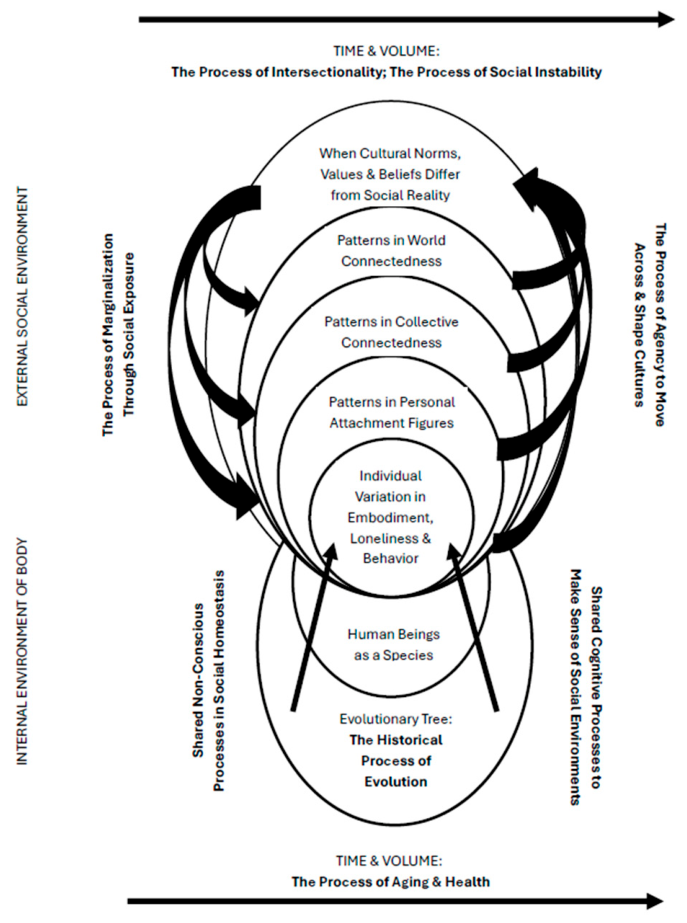
Table 1.
Inclusion criteria of literature in the review.
| Determining Authoritative Expert on Loneliness | Literature on Loneliness Theory | Literature on Public Health Frameworks and Models |
| Substantial contributions to general knowledge on loneliness, such as developing a new theory, a validated measure, or leading national research agendas | Focuses on loneliness or explaining the disciplinary context in which loneliness knowledge was produced | In-depth and full overview of the framework or model |
| Career focused on loneliness research, such as having prolific publications over a long time about loneliness | Provided holistic summaries of loneliness theory to explain historical or up-to-date knowledge | Provided historical context of its original development |
| Collaborated with other experts and independently contributed to loneliness knowledge | Provided new knowledge not yet explained in other literature | Included information about causal mechanisms or added theoretical knowledge to explain causal mechanisms |
| Published in English | Based on generally accepted knowledge in respective discipline |
Table 2.
Summaries of loneliness theory from each authoritative expert included in review.
| Name & Discipline | Contributions * | Included Publications |
| Robert S. Weiss, Sociology | 1955–2017 | |
| Social Needs Theory on Loneliness | 2 Books, 1 Article | |
| Single Parents, Grieving Loss | [38,40,41] | |
| Considers loneliness to be a real phenomenon that requires understanding the attachment system innate to human beings [38]. Describes loneliness as a “separation distress without an object”(p.10) linked to the primacy of “interaction” (p.1) in human social life [38]. Found intimate and community relationships provided different relational needs, each one creating a different kind of loneliness when absent and may work through different attachment systems [38,40]. Connects with John Bowlby’s attachment theory that places human social life in an evolutionary context. Bowlby explains how deeply embedded and instinctive attachment is across animal species, predicting its role in homeostasis similar to other physiological needs [40]. Weiss suggests six basic qualities required of overall relationships: attachment, social integration, opportunity to nurture, reassurance of worth, reliable assistance, and guidance, that was developed into the Social Provisions Scale [41,42]. | ||
| Daniel Perlman, Social Psychology | 1965–Current | |
| Cognitive Discrepancy Model | 3 Books | |
| Family Relationships | [15,43,44] | |
| Letitia Ann Peplau, Social Psychology | 1973–2022 | |
| Cognitive Discrepancy Model | 2 Books, 3 Articles | |
| Sexual Minorities | [15,44,45,46,47] | |
| Daniel W. Russell, Social Psychology | 1978–Current | |
| UCLA Loneliness Scale | 5 Articles | |
| Demanding Professions | [42,46,47,48,49] | |
| Marks a transition to a more empirical approach that emphasizes the cognitive processes mediating deficiency in relationships with feelings of loneliness [44]. Defines loneliness as 1) a mismatch between actual relationships and needs or desires for social contact, 2) a subjective experience about relationship quality unrelated to objective social isolation, and 3) a distressing experience even when it contributes to personal growth [43]. Connects with Bernard Weiner’s attributional theory to explain that individuals’ response to loneliness is impacted by their perceived causes of loneliness and how much control they have over them, suggesting interventions to change these cognitive processes [44,45]. Defines causes of loneliness as predisposing factors (individual characteristics, situational determinants, cultural values and norms) that affect the gap between an individual’s desired social relationships vs actual social relationships, along with precipitating events that change actual relationships (e.g. moving, unemployment, death, etc.) [15]. Develops a validated scale to “detect variations in loneliness that occur in everyday life” (p. 472) as loneliness is understood to be integral to developmental and family life cycles [46]. The scale reflects a unitary state of loneliness that captures the severity of deficits in any relationship, as they seem to share a common core of experiences [42,49]. | ||
| Jenny de Jong Gierveld, Social Demography |
1969–Current | |
| de Jong Gierveld Loneliness Scale | 2 Books, 4 Articles | |
| Older Adults, Family Arrangements |
[16,50,51,52,53,54] | |
| Theo G. van Tilburg, Sociology | 1991–Current | |
| Longitudinal Aging Study Amsterdam |
1 Book, 4 Articles | |
| Older Adults, Family Arrangements |
[17,50,51,54,55] | |
| Pearl A. Dykstra, Sociology | 1995–Current | |
| Longitudinal Aging Study Amsterdam |
1 Book, 3 Articles | |
| Older Adults, Family Arrangements |
[50,53,54,56] | |
| Marks a transition in comparing broader trends that can explain longitudinal and cross-national differences in population loneliness. Continues to investigate three types of loneliness that have both positive and negative facets, but are insufficient to be standalone phenomena: emotional, social, and existential [16,50,55]. When individuals are asked directly if they feel lonely, responses overlap with emotional loneliness as many only consider their personal attachments [55]. Finds feelings of social embeddedness, that includes reciprocity and support among networks, to be opposite of loneliness [16,51]. Focuses on older ages when death within social networks, worsening health, and financial restrictions are key determinants of loneliness [51]. Confirms cognitive discrepancy model but expands it to consider the mismatch between a country’s cultural value system and the reality of populations’ social arrangements [50,56,57]. | ||
| John T. Cacioppo, Social Neuroscience | 1978–2018 | |
| Evolutionary Theory of Loneliness | 1 Book, 7 Articles | |
| Chronic Loneliness | [10,28,58,59,60,61,62,63] | |
| Louise C. Hawkley, Psychology | 1998–Current | |
| U.S. National Social Life, Health, and Aging Project | 4 Articles | |
| Older Adults | [17,60,62,63] | |
| Marks a transition to integrate cognitive science with neuroscience and explain the human mind and behavior in an evolutionary context [58]. Re-interprets the brain and nervous system as an organ system across animal species required to make sense of and participate in an ever-changing social world [59]. The clustering of lonely individuals in social networks and their migration to the periphery of networks is compared with the evolutionary danger animals experience at the periphery of social groups [60]. Categorizes loneliness as a biological survival instinct and feedback mechanism within homeostasis that helps individuals identify when beneficial relationships are damaged or missing and encourages behaviors that prevent further harmful social experiences [28,61]. Incorporates into allostatic load theory to explain how chronic loneliness reflects an increasing physiological dysfunction due to accumulating stressful social situations over time [28]. Focuses on the interaction between social environments and genetic heritability of loneliness to explain differential susceptibility and reaction norms to adverse or beneficial social relationships [10,61]. Clarifies three dimensions in human mental representations of social relations that correspond with three dimensions of loneliness: 1) Personal Connectedness, or how an individual fits into the world and existential loneliness, 2) Relational Connectedness, or familiar and close relationships and emotional loneliness, 3) Collective Connectedness, or feelings of group membership and social loneliness [62,63]. Develops into a 3-Item UCLA Loneliness Scale. | ||
| Julianne Holt-Lunstad, Neuroscience & Psychology |
1998–Current | |
| Editor U.S. Advisory; SOCIAL Framework |
1 Government Report; 5 Articles |
|
| General Population | [4,8,9,14,64,65] | |
| Pamela Qualter, Psychology & Education | 1998–Current | |
| BBC Loneliness Experiment | 11 Articles | |
| Adolescence & Childhood | [13,66,67,68,69,70,71,72,73,74] | |
| Manuela Barreto, Organizational & Social Psychology |
1999–Current | |
| BBC Loneliness Experiment | 6 Articles | |
| Stigmatized Populations | [13,68,71,72,74,75] | |
| Lucia C. Heu, Cross-Cultural Psychology | 2019–Current | |
| Culture-Loneliness Framework | 8 Articles | |
| Cross-Cultural Loneliness | [76,77,78,79,80,81,82,83] | |
| Marks a transition in re-examining loneliness across diverse populations to identify similarities and continuity across the life course. Builds on a proliferation of epidemiology studies in public health, such as the English Longitudinal Study of Ageing, work by Ken J Rotenberg on childhood loneliness, and work by Ami Rokach with a diversity of populations [66,84,85]. Involves public health to address loneliness epidemics that require system-level approaches to address multiple factors [9,13,14,72]. Cites both the cognitive discrepancy model and evolutionary theory of loneliness to explain social connection as a biological human need [8,67,76]. Develops new frameworks or re-interprets existing public health frameworks, summarizing the strength of evidence that social and structural determinants drive population loneliness [9,13,77]. Emphasizes the social nature and responsibility of our sectors and institutions to support social connection across society and the human lifespan, as risk factors by the age of 5 already predict high and chronic loneliness across all school years [9,66]. Identifies vicious cycles in which cultural norms, values, and beliefs predict lonely populations who do not adhere to them, contributing to stigma that loneliness is deserved without conforming to cultural norms, values, and beliefs [72,78]. | ||
* Years listed describe the range of years in which they published literature about their research but may not imply they are actively conducting research.
Table 3.
Knowledge about causal mechanisms and pathways in how society impacts population health outcomes within three public health frameworks.
Table 3.
Knowledge about causal mechanisms and pathways in how society impacts population health outcomes within three public health frameworks.
|
Public Health Framework & Original Disciplines |
Contribution |
| Social-Ecological Model Ecology & Psychology |
Organizes society into a layered, dynamic, and interconnected social system to explain how social patterns emerge and ultimately impact developmental and population health outcomes [21,23]. Identifies the societal level as including abstract and large-scale social processes underlying patterns in social interactions, such as the shared social norms, values and beliefs of a society that influence how residents interact with each other [19,23,86]. |
| Social Determinants of Health Framework Interdisciplinary Public Health, Sociology, Biology & Neuroscience |
Identifies societal structures, such as governments, economic systems, and cultures, that can systematically produce unfair population health disparities, explained by differences in exposure to material and social needs, as well as adverse environmental conditions [19,22]. Homeostasis and allostatic load theory explain how these exposures result in worsening health outcomes over time [87]. Emphasizes the social process of marginalization and intersectionality to explain how societal systems can formalize the social exclusion and worsening population health of specific populations [19,22]. |
| Social Exposome Model Environmental Health & Social Epidemiology |
Identifies how social systems can cause population health outcomes through direct exposure to social interactions, including the actors involved, the places where they occur, and their dynamics [88,89]. Social Baseline Theory or Social Homeostasis explain how social exposures impact individual’s biological dependence on living in social groups [90,91]. Includes the theory of embodiment from social epidemiology to explain how differences in population health outcomes result from differences in lifetime social exposures that are biologically embodied, as well as agency, to explain the active role of people to choose how they interact with others and change their social environments [88,92]. |
| Added Disciplines to Fill Knowledge Gaps on Causal Mechanisms | |
| Ecology is a natural science that studies the interaction among living organisms and their environment [21]. Ecology breaks down social systems into units of interaction, across which there are a limited number of universal social patterns found to be critical to the survival and population health outcomes of any living organism [21]. Universal interaction patterns can drive evolution between species, developing a genetic dependence and survival of one species on the survival and existence of at least one other species [21]. It helps explain the interdependence of networks of species living in a region or ecosystem. Each universal social pattern represents a larger underlying ecological process, such as a reliance on the same environmental resources for survival to explain patterns in competitive interactions [21]. | |
| Evolutionary Theory is debated as not meeting criteria as a scientific law for the same reasons that social sciences are believed to not create scientific laws [39,93]. The complexity of evolutionary theory does not produce regularity or consistent outcomes [94,95]. It seems to only explain the diversity of life as it exists today from past evolutionary processes [95]. The process of becoming a species, known as speciation, is not on-going, but is a historical occurrence when a species first appears as distinctly different from other species [94]. While evolution is defined as a change in gene frequencies in populations that accumulates over time, it is a highly complex process occurring at multiple scales because of multiple mechanisms [93,94]. During speciation, the unique development of physiological needs, or dependence on specific resources in the surrounding environment for survival, can occur through the mechanism of natural selection [96]. When there is an abundant environmental resource that is beneficial to population health, for example, it is possible to grow a physiological and genetic dependence upon it that can influence the evolution of many traits that will be universal to a species as long as it exists [95,96,97]. | |
| Critical realism is a philosophy of science that was developed to better examine causality in a stratified, complex and open social system [33]. It allows for duality between the natural and social sciences by recognizing the important role of perception and its limitations to understand what is real in our social environments, while also recognizing a real world exists outside of human perception. By stratifying reality into different levels, it is possible to separate the empirical reality we observe through our senses and perception, from the actual level that describes objective events we share in common, from the real level that captures interaction among multiple causal powers responsible for producing the outcomes we observe [33,98]. It emphasizes that causal powers are not deterministic of social outcomes as they are counteracted by the agency of people to reinforce or change their social environments [39]. It is used in interdisciplinary health research to support integration of various disciplines examining different layers of reality, such as integrating the biology of our bodies, the emergent properties of our mind, and our social interactions in the bio-psycho-social model [39]. | |
Table 4.
Key terms and causal mechanisms in Adapted Social Exposome Model on Loneliness.
| Terms & Causal Mechanisms | Explanation |
| External Environment | |
| Time & Volume: Intersectionality | Time is important for understanding loneliness [43]. It includes pre-disposing factors of loneliness that capture the accumulation of traumatic social experiences over time, starting with child-parent relationships [40,43,99]. These factors include what are considered universally harmful social experiences, such as abuse and abandonment, because of their impact on population health outcomes. Lonely individuals tend to have a history of harmful social experiences, associated with learned behaviors such as socially isolating, hostility, or submissiveness, in anticipation of harmful social environments [69]. The process of intersectionality is more broadly defined in this model as capturing the accumulation of harmful social experiences over time that specifically result in loneliness outcomes. |
| Time & Volume: Social Instability |
Time also includes precipitating events that severely disrupt existing social networks and social roles to explain the onset of new loneliness [40,43]. Precipitating events capture a variety of objective social events that are not inherently positive or negative but are destabilizing to social networks, such as moving or the expected death of loved ones [40,41]. Social instability is an underlying force or process that can accompany any of the patterns seen in lonely social interactions. “Disruptions or absence of stable social relationships blasts our minds and biology like few other events” (p. 1) [62]. The overall importance of time and volume is the frequency, accumulation, and widespread impact on populations that can exceed individuals’ abilities to adapt and meet their social needs in unstable and/or harmful social environments. |
| Cultural Norms, Values & Beliefs: Marginalization | Cultural norms, values, and beliefs establish expectations for social relationships across the lifespan [14,15,44,78]. They can be literally embodied in populations through internalization and violation of these norms can produce reactions from others to pressure individuals to conform [61,77,78,88]. In this way, they can explain patterns in direct social interactions across populations of people living together based on cultural expectations of how to interact [23]. When core assumptions that a society is built around conflict with innate social needs of populations, it is predicted to result in mass loneliness [40,44]. “Marginal” (p. 17, 20, 96) [40], “alienation” (p. 33) [44], “on the social perimeter” (p. 447) [60], “odd one out” (p. 199) [76] describe the process of lonely individuals found to cluster and move further to the periphery of social networks, where individuals become vulnerable to isolation and harm. |
| Behavior & Movement: Agency to Shape Culture | Lonely individuals are already found to practice agency through coping mechanisms that often include either social withdrawal or aggressive behaviors to resolve lonely experiences [43,44,67,83]. The agency of dyads and social groups can provide for social needs to resolve loneliness by offering various forms of support, such as instrumental or emotional support [9,16,41,82]. However, underlying observable behaviors in direct interactions are the cultural norms, values, and beliefs that drive which relationships individuals are likely to turn to for specific forms of support and how much support can be expected [80]. In this way, the practice of agency constitutes a social feedback mechanism that can reinforce cultural ideas, move to new spaces and relationships with a different culture that better suits individuals, or try to change cultural ideas [33,79]. Any organizational level of a society has agency, including institutions and sectors, but the process of agency is at the deeper societal level as it is constantly molding cultural ideas to varying degrees. |
| 5 Objective Patterns in Direct Exposure to World Connectedness, Collective Connectedness, and Personal Attachment Figures | Three layers of connection represent a mental model of three separate ways that people make sense of social interactions and their identity within them [42,51,62]. They partially overlap with organizational levels describing human society in the social-ecological model [9]. Each layer represents exposure patterns in direct and reciprocal social interactions that result in feelings of loneliness [14,38,88]. World Connectedness captures the broader social experiences in communities that reflects on an individual’s purpose and belonging in society [40,55]. Collective Connectedness captures social experiences in any social group, including families, friend groups, work groups, neighborhood groups, etc. [40,42,55,63]. Personal Attachment Figures captures dyads marked by genuine, secure, deep, and long-term attachments [40,63]. One layer of social fulfillment can never replace another layer [38]. For an accounting of the five specific patterns in social interactions that have so far been identified in loneliness research, see Appendix Table A.1. |
| Individual Variation & Subjectivity in Loneliness Outcome | The individual level is where social exposures and their embodiment in social homeostasis interact to examine risk factors, but not causes [14,44,88]. This level broadly includes individual variation in biological, genetic, cognitive, psychological, and personality traits to explain differences in susceptibility to social conditions and reaction norms [14,61]. |
| Internal Environment | |
| Time & Volume: Aging & Health | Our need for others occurs across the human lifespan [40,99]. However, our bodies go through developmental changes that correspond with which relationships are most important when feeling lonely [43,67,100]. When changes in the social environment co-occur with developmental changes, it explains why the highest prevalence of loneliness is among adolescents and young adults [67]. With increasing age, specifically among the oldest old, declining health and depletion of energy can limit overall social participation along with an increasing loss of one’s social network to death [40]. The severity and onset of multiple health conditions over time can explain one’s overall health status and ability to socially participate. |
| Making Sense of Social Life: Non-Conscious & Cognitive Processes |
Social connection is an innate and universal need in human beings in which loneliness is theorized as a protective feedback mechanism in homeostasis to select against harmful interactions and seek out beneficial ones [9,28,40,61]. Loneliness activates non-conscious neural, neuroendocrine, and behavioral responses that seem to promote short-term self-preservation [59]. However, “the human brain does not simply respond to stimuli in an invariant fashion, but rather categorizes, abstracts, interprets, and evaluates incoming stimuli in light of current states and goals as well as prior knowledge and predispositions” (p. 2) [59]. Cognitive processes, such as attributing the cause of loneliness, social comparison, and perceived control over the social situation, moderate how people experience loneliness subjectively [16,43,44,51]. Evaluation of the social world is strongly shaped by learning, cognition, modeling and culture [58]. |
| History: Evolution |
Cross-species comparisons help to make sense of the importance of loneliness in human survival [10,40,99]. Comparisons find that the evolution of large and metabolically expensive brains is closely associated with social complexity, that loneliness is inherited as a consortium of genes, and the nervous system is organized to respond to different kinds of social occurrences [58,60,61]. “Social species create emergent organizations beyond the individual – structures ranging from dyads and families to institutions and cultures. Emergent structures evolved hand-in-hand with neural, hormonal, and genetic mechanisms to support them.” (p. 6) [60]. The process of evolution is made up of multiple causal mechanisms and is investigated to understand how human social life came to exist [8,93,94]. |
Disclaimer/Publisher’s Note: The statements, opinions and data contained in all publications are solely those of the individual author(s) and contributor(s) and not of MDPI and/or the editor(s). MDPI and/or the editor(s) disclaim responsibility for any injury to people or property resulting from any ideas, methods, instructions or products referred to in the content. |
© 2026 by the authors. Licensee MDPI, Basel, Switzerland. This article is an open access article distributed under the terms and conditions of the Creative Commons Attribution (CC BY) license (http://creativecommons.org/licenses/by/4.0/).
Copyright: This open access article is published under a Creative Commons CC BY 4.0 license, which permit the free download, distribution, and reuse, provided that the author and preprint are cited in any reuse.