

Submitted:
11 September 2026
Posted:
15 September 2026
You are already at the latest version
Abstract
Non-contaminated plastic waste from healthcare facilities is largely non-infectious and rich in recoverable polymers, yet it is routinely incinerated for lack of an automated sorting process suited to the clinical setting. This paper presents a sensor fusion system design and a comparative hyperspectral classification methodology for that stream. Near-infrared hyperspectral imaging, an RGB line-scan camera, and an inductive metal sensor are integrated on a collaborative robot platform, combining polymer-type identification, visual object detection, and metal discrimination in a late-fusion pipeline. Two hyperspectral classification strategies are specified and compared across labeling cost, robustness, interpretability, and stage of system maturity: reference-spectra distance matching, which needs no labeled training data, and supervised machine learning, which gains robustness as the labeled dataset grows. The two are ordered as successive development phases, the first bootstrapping the second. A throughput and spectral analysis establishes the sensor specification required for production line speeds, which the pipeline architecture accommodates without change to the classification methodology. The regulatory scope of the recoverable fraction under German waste legislation is treated as an explicit design input, determining the material classes targeted and the open-set rejection behavior required of the classifiers. Open design parameters and a validation pathway are identified.
Keywords:
hyperspectral imaging
; near-infrared spectroscopy
; plastic waste sorting
; hospital waste
; medical waste
; sensor fusion
; reference-spectra matching
; robotic sorting
; collaborative robot
; circular economy
1. Introduction
The healthcare sector is a significant generator of solid waste. According to official federal statistics, the total mass of waste group 18 01 under the European Waste Catalogue [1] generated in Germany was 425400 in 2022. This national figure aggregates waste from all producers assigned to this group, including laboratories, nursing homes, and medical practices. A recent field study across 122 German hospital locations estimates that around 22.44 of the reported group 18 01 mass originates from producers other than hospitals. Within that field study, which documented 103432 of waste across all waste groups, the fraction not subject to special infection-prevention requirements (AVV 18 01 04) forms the single largest share [2] (see Figure 1). Another study [3] showed that a substantial part of single use materials in medical environments consist of high-value polymers and packaging materials. Despite this material value, non-contaminated medical plastic waste is predominantly directed to energy recovery through incineration rather than to material recovery, because the practicable, automated sorting solutions that exist for household and industrial plastic streams have not been adapted to the healthcare context.
Material that could re-enter the polymer cycle is thus destroyed in a single pass. Under the German Closed Substance Cycle Waste Management Act (Kreislaufwirtschaftsgesetz, KrWG) [4], material recovery ranks above energy recovery in the waste hierarchy wherever it is technically possible and hygienically acceptable. For the non-infectious plastic fraction, both conditions can in principle be met, yet the enabling technology is absent. The barrier is not necessarily the recyclability of the material but the absence of a sorting process that can identify polymer type reliably while respecting the hygiene and occupational-safety constraints of the clinical environment.
Two technical gaps underlie this barrier. The first concerns identification. Existing automated approaches to medical waste classification rely on visible-range camera imagery and deep learning, and achieve high accuracy in assigning objects to visual categories such as syringe, glove, or mask [5,6,7]. Two visually identical objects may consist of different materials (polymers, metals, paper products, textiles etc.), and material composition is what determines the recyclate stream to which an object belongs. Object-category recognition alone is therefore insufficient to drive material-specific sorting. The second gap concerns the transition from classification to physical sorting. Most published work stops at classification and does not address the robotic handling and process integration required to act on the classification result in a real sorting operation.
Hyperspectral imaging in the near-infrared offers a route to closing the first gap, because it resolves the characteristic molecular absorption bands that distinguish polymer types and has been established as the primary modality for polymer identification in household, packaging, and electronic waste recycling [8,9,10]. Its application to non-contaminated hospital plastic waste, however, has not been reported. Combining hyperspectral material identification with visual object detection and robotic handling, within the regulatory constraints specific to the healthcare context, defines the problem addressed in this work.
The specific scientific contributions of this paper are as follows:
- 1.
- A gap in the published literature is identified: near-infrared hyperspectral imaging has not previously been applied to non-contaminated hospital plastic waste as a regulatorily distinct recyclable fraction, despite being the established modality for polymer identification in household, packaging, and electronic waste streams.
- 2.
- A sensor fusion system design is specified, integrating a near-infrared hyperspectral imaging camera, an RGB color line-scan camera, and an inductive metal sensor on a collaborative robot platform. Synchronized fusion of RGB and NIR-HSI data is by now an established direction in plastic sorting [11,12,13,14]. The contribution here is not the fusion architecture itself but its integration with inductive metal detection and its adaptation to the regulatorily bounded hospital waste stream, for which no methodology has been reported.
- 3.
- Two hyperspectral classification strategies are specified and compared across the dimensions most relevant to deployment on a novel waste stream: labeling cost, robustness to spectral variability, interpretability, and suitability at successive stages of system maturity. The two are ordered as successive development phases: reference-spectra distance matching first, supervised machine learning as the labeled dataset grows. The rule-based late fusion adopted here is likewise an interpretable baseline for which learned fusion is the natural successor.
- 4.
- A throughput and spectral constraint analysis is conducted, quantifying the coupling between hyperspectral line rate, spectral coverage, and conveyor speed, and establishing 0.84/ as the speed sustained at full spectral coverage. The conditions for transfer to a production-speed imaging system and a higher-rated metal sensor are established, and it is shown that the pipeline architecture accommodates this hardware substitution without modification to the classification methodology.
- 5.
- The regulatory scope of the permissible target fraction under the Kreislaufwirtschaftsgesetz and LAGA Mitteilung 18 [15] is treated as an explicit design constraint, determining both the material classes targeted by the classifiers and the open-set rejection behavior required for objects that fall outside the legally permissible fraction for material recovery.
The remainder of this paper is organized as follows. Section 2 reviews optical sensing modalities and classification approaches for plastic waste, and establishes the research gap for hospital waste specifically. Section 3 describes the existing Cobot2 handling platform into which the sensing stage is integrated. Section 4 specifies the sensor suite and the acquisition geometry. Section 5 presents the classification pipeline and the two hyperspectral strategies, and compares them. Section 6 discusses the regulatory scoping, the throughput and spectral tradeoffs, the methodological risks, and the validation pathway. Section 7 concludes.
2. Background
2.1. Optical Sensing Modalities for Plastic Identification in Recycling
Near-infrared (NIR) hyperspectral imaging (HSI) has become the primary modality for polymer-type identification in sensor-based sorting, because it resolves the characteristic molecular overtone and combination absorption bands of polymers without contact and without the upstream shredding that density-based processes require, providing greater compositional specificity than shape, color, or density cues alone [8,9]. A hard limit of this modality is that it cannot identify carbon-black-pigmented polymers, because carbon black absorbs strongly across the near-infrared and black plastics are therefore not reliably detected by NIR sensors [16]. Dark plastics therefore lie outside the addressable fraction of any NIR-HSI sorter, and their identification requires alternative modalities such as mid-wave infrared imaging [17] or fluorescence imaging [18].
The foundational capability of NIR-HSI for polyolefin characterization in recycling was established on post-consumer polyolefin waste using VIS-NIR (4001000) and NIR (10001700) imaging combined with principal component analysis (PCA), which distinguished polypropylene (PP) and polyethylene (PE) fractions and identified contaminants in a recycling feed stream [9]. Extending this approach to the shortwave infrared range (SWIR: 10002500), a hierarchical partial least squares discriminant analysis (Hi-PLS-DA) model was developed for the discrimination of low-density (LDPE) and high-density polyethylene (HDPE) within mixed plastic waste, classifying five polymer types in a single analytical step [10].
The transferability of HSI classification to operational conveyor environments has been validated in stages. Laboratory studies in the 9001700 range report high accuracy, around 89.5 for six post-consumer thermoplastics with an artificial neural network [19] and a Matthews Correlation Coefficient above 0.94 for eight polymer types under controlled indoor conditions [20], whereas a real-time system classifying 18 waste classes on a moving industrial conveyor reached an F1-score of only 71 [21]. This result illustrates the performance gap that persists between controlled laboratory characterization and live sorting environments.
The integration of RGB line-scan imaging with NIR hyperspectral data as complementary modalities on a shared conveyor platform has received growing attention. A multi-scale feature fusion architecture combining a line-scan color camera and a NIR-HSI system operating between 935.9 and 1722.5 achieved an overall classification accuracy of 95.55 for PET and PP bottle classification [11]. For contaminant detection within a polypropylene packaging stream, SWIR-HSI combined with Hi-PLS-DA recovered 98.2 of PP by weight at a purity grade of 94.4 [22]. Waste electrical and electronic equipment (WEEE) presents a compositional heterogeneity broadly comparable to that of hospital plastic waste. SWIR-HSI has been evaluated for characterizing shredded polymer fractions from this stream and demonstrated its utility for material identification and quality control across multiple polymer categories [23]. Recent work has moved the fusion of RGB and NIR-HSI data from feature-level demonstrations toward learned decision-level fusion on operational lines, including real-time alignment and fusion of the two modalities [12], multi-modal decision-fusion networks for plastic detection and sorting [13], joint identification of polymer and color from fused data [24], and the release of the first synchronized RGB-HSI dataset from an operational facility [14]. Multi-sensor approaches that add inductive metal detection to spectral imaging remain comparatively rare and have been explored mainly in broader waste-sorting and mineral-processing contexts [25,26]. A survey of the field notes that extensive labeled datasets remain a prerequisite for deploying modern machine learning in this domain [8]. No methodology combining these modalities for the polymer-focused, regulatorily bounded hospital waste stream has been reported.
2.2. Classification Approaches for Hyperspectral Plastic Data
2.2.1. Reference-Spectra Matching and Classical Chemometrics
A comprehensive review of chemometric approaches to plastic waste sorting, covering NIR, MIR, Raman, and LIBS spectroscopy paired with PCA, LDA, PLS-DA, SVM, random forest, and neural network classifiers, concludes that no single method universally dominates [27]. Classifier selection is governed by the spectral range, the degree of class overlap, and the volume of available training data.
Among reference-spectra methods, the Spectral Angle Mapper (SAM) measures the angular distance between an observed spectrum and each reference entry in spectral space. Because this metric depends only on spectral shape and not on magnitude, it is robust to illumination intensity variation and to surface geometry effects. A systematic evaluation of classification algorithms for online NIR polymer identification on a conveyor belt found that SAM, applied to the first derivatives of normalized spectra, was best suited to rapid and reliable polymer discrimination under the temporal constraints of industrial sorting [28]. A direct comparison of SAM, PLS-DA, and PCA-LDA for WEEE plastic classification showed that both SAM and PCA-LDA achieved prediction accuracies above 99, including when trained only on virgin polymer spectra and tested on recovered WEEE plastics, whereas PLS-DA failed under this limited-training-data condition [29]. This result is directly relevant to the early-phase deployment scenario considered in this work, where the volume of labeled training data for a novel waste stream is inherently constrained.
Partial least squares discriminant analysis remains the most widely applied supervised chemometric method in HSI-based plastic sorting and is typically implemented within a hierarchical classification tree [30]. In plastic sorting the classifier must also contend with materials it was never trained to recognize, a setting known as open-set classification, in which objects belonging to classes absent from the training set must be identified and rejected rather than forced into a known class. A Soft PLS-DA extension has been proposed that rejects samples falling outside all target class boundaries instead of assigning them to the nearest class, which is important for open-set sorting environments in which unrecognized materials must be routed to a residual fraction [30]. Comparative studies pairing PCA and PLS-DA with SVM and tree-based ensemble methods on NIR spectral data have shown that spectral preprocessing improves robustness across varying acquisition sessions, in particular Standard Normal Variate (SNV) normalization and Savitzky-Golay derivative filtering [31]. PCA and PLS-DA applied to NIR spectra acquired directly from unsorted and unwashed plastic waste at a recycling plant achieved complete discrimination of PE, PP, PVC, PET, and PS, demonstrating that classical chemometric classifiers tolerate realistic surface contamination levels [32].
2.2.2. Deep Learning for Hyperspectral Classification
Convolutional neural network (CNN) architectures have been applied to hyperspectral plastic classification on the expectation that learned spatial-spectral features capture classification-relevant structure that explicit preprocessing steps cannot. A CNN baseline for automatic plastic waste segregation across four polymer categories established that deep learning is applicable to this domain [33]. CNN, random forest, and SVM classifiers trained on synthetically mixed spectral data from reference libraries covering 10 polymer types achieved overall accuracies of 9597 when evaluated on airborne and satellite hyperspectral imagery, with the random forest model showing the greatest robustness to domain shift between training and test conditions [34]. For black plastic waste, which is invisible to standard NIR systems because carbon black absorbs the relevant wavelengths, CNN models achieved the highest classification accuracy of 93.5 across 12 polymer classes from fluorescence imaging data, outperforming LDA, kNN, SVM, and ensemble classifiers [18].
A recurring challenge in deep learning studies for this domain is the assembly of a sufficiently large and representative labeled dataset. Formulating NIR hyperspectral band selection as a reinforcement learning problem has been shown to reduce input dimensionality and accelerate inference without significant loss of accuracy [35]. A two-stage pipeline combining YOLO-based RGB detection with a one-dimensional CNN classifier operating over 6001700 identified 12 polymer contaminant types in a food-safety context, achieving 99 detection and 97 polymer classification accuracy [36]. This architecture localizes objects from the RGB image and identifies material from the hyperspectral data. It is directly analogous to the late-fusion pipeline proposed in the present work and demonstrates the principle in a hygiene-sensitive application environment.
2.3. Classification of Hospital Plastic Waste: State of the Art and Research Gap
The composition of hospital waste is dominated by non-infectious fractions eligible for material recovery. The field study cited above resolves this composition further: the fraction without infection-prevention requirements (AVV 18 01 04) constitutes 51.8 of the documented mass, the single largest fraction, with packaging waste (AVV 15 01) contributing a further 8.3 and municipal-type waste (AVV 20) 28.3 [2]. These fractions represent the primary target stream of the present work. Figure 2 shows representative objects from this target stream. It spans sterile packaging films and pouches, rigid bottles and containers, and single-use clinical items such as gowns, masks, gloves, tubing, syringes, and drainage devices. The collection also contains non-plastic items such as glass vials, cardboard medication cartons, and textile compresses, which the sorting pipeline must separate from the recyclable plastic fraction. Although this fraction is non-infectious at the point of collection, its objects routinely carry the surface residue and multi-material construction whose spectral consequences are examined in Section 6.3.
Reported systems include transfer learning on eight medical-waste categories at 97.2 accuracy [5], a lightweight GoogLeNet classifier for three infection-risk categories at 99.34 [6], the MedBin instance-segmentation model spanning 36 categories with a WHO-guideline disposal layer [7], and a multi-camera detection framework for circular-healthcare sorting [37].
All published approaches to medical waste classification share a common limitation. They rely exclusively on visible-range camera imagery and therefore produce object-category labels rather than polymer-type labels. A recent systematic review of robotic systems and emerging technologies for medical-waste collection, classification, and treatment finds that automated classification in this sector is dominated by computer vision and deep learning [38]. Spectral material identification has so far played almost no role there, which is the gap addressed in the present work, and HSI has been identified as a promising direction that would enable classification by polymer composition rather than by visual appearance alone [39]. A current system can determine that an object is a syringe body without determining whether the barrel is PP or PE, or identify a transparent packaging film without distinguishing PET from PE or LDPE. These distinctions govern whether an object can be directed to polymer-specific thermoplastic recycling or must instead be routed to energy recovery under the KrWG [4] waste hierarchy. To the authors’ knowledge, no published work has applied NIR-HSI-based spectral material classification to non-contaminated hospital plastic waste in a robotic sorting context. The present paper addresses this gap by developing and comparing two HSI classification strategies, reference-spectra distance matching and AI-based classification, and integrating both within a sensor fusion pipeline designed for the Cobot2 robotic sorting platform.
3. System Context: The Cobot 2 Platform
The classification methodology developed in this work is designed for integration into an existing robotic handling platform, hereafter the Cobot2 platform, developed in a preceding project at the authors’ institution and extended here with a multi-sensor bridge for material analysis. The inherited mechanical handling, conveyor, and control subsystems are reported only to the extent necessary to define the operating context for the classification pipeline.
3.1. Mechanical System and Material Flow
The platform automates the transfer of non-contaminated plastic waste from storage to a sensing station. Waste is provided in standardized small load carriers (SLCs) held in a shelf storage unit. The target stream is materially heterogeneous, with representative objects shown in Figure 2. A six-axis collaborative robot (Universal Robots UR10e) with parallel grippers and a flange-mounted vision system handles the load carriers. The robot identifies a load carrier, transfers its contents to a vibrating hopper, and returns the empty carrier to storage. The vibrating hopper meters the waste onto a conveyor belt and promotes monolayer formation through an increasing conveying speed toward the outlet, so that individual objects are presented to the sensing station separated and non-overlapping, as shown in Figure 3.
Selection of which load carrier is transferred is an upstream logistics decision made by the operator, since the material content of each carrier is known in advance, and is therefore independent of the downstream material classification task.
3.2. Control Architecture
System automation is coordinated by a programmable logic controller over Ethernet/IP and Modbus TCP, with browser-based operation and monitoring and standard safety handling (manual motion release, emergency stop, and powerless grip retention). The modular control structure allows additional sensors and actuators to be integrated without altering the base infrastructure, which is the property the present work relies upon to add the sensing stage.
3.3. Sensor Integration Point
The conveyor transports separated objects past a sensing station at which the material-analysis sensors are mounted. During data acquisition for system training and evaluation, the conveyor operates at 10.5/ (approximately 0.175/). For later deployment in an industrial environment, a conveying speed of at least 3/ is targeted. This higher speed is a design target for production rather than a demonstrated operating point, since at this speed the achievable along-track spatial resolution is bounded by the line-scan camera line rate and the available illumination intensity, both of which must be dimensioned accordingly. The sensing station is the location at which the RGB line-scan camera, the NIR hyperspectral imaging system, and the inductive metal sensor are integrated, as illustrated schematically in Figure 4.
Their specifications and acquisition geometry are described in Section 4.
4. Sensor Integration Design
4.1. Sensor Stack Overview
Three sensing modalities are integrated at the sensor station of the Cobot2 platform: a near-infrared hyperspectral imaging camera for polymer-type identification, an RGB color line-scan camera for object detection and visual feature extraction, and an inductive metal sensor for binary metal detection. The RGB and NIR-HSI cameras acquire data simultaneously as each object passes the sensor station, with spatial correspondence maintained through encoder-based line synchronization. The inductive metal sensor operates independently of the imaging channels. Its role in the classification pipeline is described in Section 5.1. Table 1 summarizes the full specification set for all three sensors and the associated illumination unit. Figure 5 relates each sensing modality to the physical signal it exploits, its discrimination task, and the output it delivers to the classification stage.
4.2. NIR Hyperspectral Imaging Camera
The EVK HELIOS EQ32 is a push-broom NIR hyperspectral imaging system based on non-contact, non-destructive infrared imaging spectroscopy. Its spectral range spans 9291702 (), with a spectral resolution of 2.5 and a spectral sampling of 3.1/pixel. At full spectral ROI (248 bands), the line scan rate is 446. The cross-track spatial resolution is 320 pixels across the 600 working width, giving a nominal cross-track pixel pitch of 1.875/pixel. Raw spectral data are transmitted as 12-bit calibrated hyperspectral cubes via GigE Vision. Classified outputs are produced by the EVK SQALAR software suite, which implements the CLASS32 algorithm supporting up to 8 material classes, as well as the EC3 color-mapped output mode.
The spectral ROI is configurable from 18 to 248 spectral pixels in two-pixel steps. Reducing the spectral ROI increases the achievable line scan rate and thereby the maximum conveyor speed for a given spatial sampling requirement. The implications of this tradeoff for system throughput are analyzed in Section 4.6.
The camera is paired with an EVK IRIL-1S-600 single-row halogen illumination unit, which projects a line-shaped beam onto the belt surface over a working width of 600 at a focal length of 260. The halogen source provides a continuous broadband spectral output covering 3502500, ensuring adequate irradiance across the full NIR detection range of the HELIOS EQ32. Figure 6 shows the spectral coverage of the two imaging sensors relative to the illumination, with the near-infrared region containing the molecular absorption bands that distinguish the target polymers.
4.3. RGB Line-Scan Camera
The RGB channel is provided by a Teledyne DALSA Linea Color 4K line-scan camera (EVK model EOS C3, part number LA-GC-04K05B-00-R), with 4096 spatial pixels at a pixel pitch of 7.04. The sensor uses a bilinear CMOS architecture. The maximum line rate is 13 without TurboDrive and 45 with TurboDrive enabled. An SP644/55 dichroic short-pass filter with a cutoff wavelength of 644 restricts the camera response to the visible range, preventing NIR radiation from the halogen illumination unit from contaminating the color signal. The optical assembly uses a VIS F-Mount objective with a focal length of 25 at f/2.7.
4.4. Inductive Metal Sensor
The EVK ABAS TL 600 is an inductive metal scanner for the real-time detection of ferrous and non-ferrous metals and stainless steel. It is mounted below the conveyor belt with its sensing face at an operating distance of 6 from the belt underside. The minimum detectable grain size is 4 diameter for copper and aluminum at this operating distance. The sensor provides binary, spatially resolved detection data over a GigE Vision interface, with a separate SPI interface available for driving EVK I/O and ejection modules directly. In the present system the GigE Vision output is used by the classification pipeline, where a positive metal detection triggers direct routing of the object to the metal sort fraction. Although the sensor can discriminate ferrous, non-ferrous, and stainless responses, only the binary detection signal is exploited here, since the scope of this system is plastics identification and any metal object is routed to a single sort fraction regardless of its class. The device is rated to IP65 and is designed for operation in industrial conveyor environments. The datasheet specifies a maximum material flow speed of 2.5/ for the minimum detectable particle size, which constitutes a hard upper bound on system throughput, as discussed in Section 4.6.
4.5. Acquisition Geometry and Spatial Resolution
Both cameras are mounted above the conveyor belt at a lens-to-belt distance of 585. At this mounting distance the thin-lens equation, with the 25 focal length, gives an image distance of 26.1 and a lateral magnification of 0.0446, so the 4096-pixel sensor at a 7.04 pitch yields a cross-track field of view of 646, which exceeds the 600 illumination working width and covers the full belt width. The resulting cross-track spatial resolution is 0.158/pixel.
The HSI cross-track spatial resolution is determined by the illumination working width and the active pixel count and is independent of the mounting height:
The along-track pixel pitch for each camera depends on the conveyor speed and the line scan rate:
At the test conveyor speed of 0.175/, the along-track pixel pitches are 13.5/line for the RGB camera (at 13, without TurboDrive) and 0.39/line for the HSI camera at full spectral ROI (446). The factor of approximately 29 between the two along-track pitches means that the RGB image must be downsampled to the HSI spatial grid before any pixel-level fusion.
The two cameras acquire data simultaneously as the object passes the sensor station. Spatial correspondence between the RGB and HSI frames is maintained by encoder-based line triggering, so that each HSI acquisition line is associated with the belt position at which it was acquired. A geometric registration step, computed from a planar calibration target placed on the belt surface, corrects for any residual optical-axis offset between the two cameras prior to fusion. This registration procedure is described in Section 5.3.2.
4.6. Conveyor Speed Constraints
The maximum achievable conveyor speed is bounded by two independent constraints: the spatial sampling requirement of the HSI camera and the maximum material flow speed rating of the ABAS TL metal sensor.
For isotropic spatial sampling the along-track pixel pitch must not exceed the cross-track pixel pitch of 1.875. The maximum conveyor speed satisfying this condition is:
The factor 1.875 in Equation (3) is the HSI cross-track pixel pitch, which is set by the working width and the active pixel count. The values in Table 2 are therefore specific to this optical configuration and would change if either the working width or the pixel count were altered. Since the HELIOS EQ32 line scan rate increases as the spectral ROI is reduced, a direct tradeoff exists between spectral coverage and maximum conveyor speed. Table 2 summarizes this tradeoff for all ROI settings listed in the HELIOS EQ32 datasheet.
At the test conveyor speed of 0.175/, the full 248-band spectral ROI is operational. The along-track pixel pitch of 0.39 is approximately 5 times finer than the cross-track pixel pitch, providing along-track oversampling relative to the isotropic condition. All spectral data in this work are acquired at this configuration. The 0.84/ ceiling at full spectral coverage follows from the isotropic-sampling criterion adopted above, namely that the along-track pitch must not exceed the cross-track pitch. This criterion is conservative for the present pipeline, because per-pixel labels are aggregated to an object-level decision by coverage fraction as described in Section 5.4, which tolerates coarser along-track sampling. Relaxing to anisotropic sampling at twice the cross-track pitch would raise the achievable speed to approximately 1.67/ at the full 248-band ROI, without discarding any spectral bands. The ceiling in Table 2 is therefore one operating point on a tradeoff between sampling, coverage, and speed rather than a fixed hardware limit. Band selection offers a further and more defensible route to higher speed than wholesale truncation of the acquired range, because it retains the diagnostic long-wavelength features that ROI reduction discards. Reinforcement-learning band selection has been applied to recyclable-waste classification [35], and chemometric variable-selection methods provide a complementary and well-established route. Variable importance in projection and interval partial least squares discriminant analysis have been shown to identify a small subset of short-wave infrared bands that retains classification efficiency close to the full-spectrum model for plastic waste streams [40]. Convex-hull selection of informative pixels and wavelengths has been used to reduce hyperspectral data volume for high-throughput plastic sorting under constrained speed and storage [41]. Manual and then automated selection of characteristic near-infrared band regions per polymer has likewise been reported to classify real waste samples at high accuracy [42]. These results indicate that a selected-band configuration can preserve the diagnostic contrast that uniform ROI truncation removes, and the specific bands and selection method for this system will be determined experimentally.
The production design target of 3/ requires a spectral ROI of 60 bands, covering 9291114. This range excludes the C–H combination absorption bands near 11501450 and the first overtone bands near 1700, which are among the most discriminative spectral features for the separation of PE, PP, and PET. Whether reliable polymer classification can be maintained over this truncated spectral range is an open empirical question that must be resolved experimentally before industrial deployment. In addition, the production speed target exceeds the ABAS TL rated maximum of 2.5/. Both constraints are discussed in Section 6.
5. Classification Methodology
5.1. Overall Pipeline Architecture
The classification pipeline is designed to process each object passing the sensor station through three parallel sensing channels whose outputs converge at a late-fusion decision node. Figure 7 gives an overview of the full pipeline.
The inductive metal sensor is configured to operate as a hardware gate at the entrance to the pipeline. A metal detection whose spatially resolved extent exceeds a calibrated object-area fraction will route the object directly to the metal sort fraction without invoking either imaging branch. This gate reduces computational load and avoids spectral misclassification of bulk-metal objects, whose NIR reflectance is not representative of their material composition. A detection below is characteristic of thin-foil composites such as blister packs and foil-lidded trays, where a small metallic signature coexists with a dominant polymer body. Such an object is not diverted but continues to the imaging branches and is resolved at the fusion node described in Section 5.7.
The RGB branch processes color line-scan images to extract object position, visual features, and optionally manufacturer identity via barcode recognition. The NIR-HSI branch will process hyperspectral cubes to identify bulk polymer type through spectral analysis. Both branches will operate on the same object simultaneously, since the RGB and NIR-HSI cameras acquire data in the same scan pass over the sensor station.
At the fusion node, the outputs of the two imaging branches will be combined with the metal gate signal to assign each object to a sort fraction. The sort fraction is defined by three object attributes: form class, material class, and color class. The RGB branch is intended as the primary source of form and color information. The NIR-HSI branch will be the primary source of material information. The fusion logic and confidence thresholds are described in Section 5.7. Objects identified by a confirmed product database match in the RGB branch are an exception to this convergence. A database match already determines form, material, and color, so the object is routed directly to its sort fraction and bypasses both the NIR-HSI branch and the fusion node. In Figure 7, dashed arrows denote the two cross-branch dependencies of the pipeline. The RGB and NIR-HSI cameras acquire each object in the same scan pass, indicated by the synchronization link between them, and the object mask computed by edge-based detection in the RGB branch is transferred to the NIR-HSI branch to restrict spectral extraction to object pixels.
5.2. RGB Processing Branch
The RGB branch will process images from the Linea Color 4K line-scan camera and will proceed through three sequential stages: object detection, barcode identification, and fallback visual classification.
5.2.1. Object Detection
Edge-based segmentation will be applied to each acquired RGB line-scan image to extract object contours and bounding boxes. Object positions will be expressed in conveyor-frame coordinates using encoder feedback from the belt drive, enabling time-of-flight tracking from the detection point to the sorting actuator. The resulting bounding boxes will also serve as spatial masks for the NIR-HSI branch, constraining spectral feature extraction to object pixels and excluding belt-background contributions.
5.2.2. Barcode and Product Database Lookup
Within each detected bounding region, a barcode and QR code scanner will be applied. A positive read will be forwarded to a product database that will associate the identified code with a known material class and sort fraction. This path requires no machine learning inference and can be extended incrementally as new product entries are added. The product database will be populated in collaboration with hospital partners to reflect the specific product catalog of the target clinical environment. Access to an existing hospital product database is subject to ongoing discussions with project partners and has not yet been confirmed.
5.2.3. Fallback Visual Classification
When barcode detection fails or yields no database match, a convolutional neural network classifier will be applied to the cropped object image to assign a form-class label such as syringe body, urine bag, or packaging tray. The network architecture, input resolution, and class set are open design parameters, to be fixed once a representative image dataset of the target hospital waste stream is available.
A confirmed database match constitutes a complete product identification. The material class is taken directly from the product record, and the object is routed to its sort fraction without invoking the confidence stage, the NIR-HSI branch, or the fusion node. Only objects that reach the fallback classifier are subject to the confidence threshold . A convolutional neural network classification whose confidence falls below is treated as non-confident, and the object proceeds to the fusion node with form information absent, where material assignment from the NIR-HSI branch alone determines a coarser sort fraction. The value of is an open design parameter to be determined empirically during commissioning trials.
5.3. NIR-HSI Preprocessing
5.3.1. Radiometric Calibration
Raw digital counts from the HELIOS EQ32 will be converted to apparent reflectance by a standard two-point correction:
where is acquired with the illumination off and the lens capped, and is acquired from a Spectralon-grade diffuse white reference tile placed on the belt surface. Both references will be re-acquired at the start of each measurement session. Depending on the thermal stability of the IRIL-1S-600 illumination unit over the course of a session, periodic re-acquisition of the white reference during operation may be necessary to correct for illumination drift. This requirement will be assessed experimentally during commissioning.
5.3.2. Spatial Registration
The RGB and NIR-HSI cameras share the same scan pass but differ in spatial resolution. The RGB cross-track resolution is 0.158/pixel and the NIR-HSI cross-track resolution is 1.875/pixel, giving a ratio of approximately 12 pixels per HSI pixel in the cross-track direction. Spatial registration will be computed from a planar calibration target placed on the belt surface, using a rigid or affine transform estimated from corresponding feature points in the two camera frames. Following registration, the RGB image will be downsampled to the HSI spatial grid. Object masks derived in the RGB branch will then be applied in the HSI coordinate frame to restrict spectral extraction to object pixels.
5.3.3. Spectral Normalization
Prior to dimensionality reduction, each reflectance spectrum is normalized by the Standard Normal Variate (SNV) transform, which subtracts the per-spectrum mean and divides by the per-spectrum standard deviation across the spectral bands. SNV removes multiplicative intensity scaling and additive baseline offsets at the level of the individual spectrum, so that the normalized spectra depend on spectral shape rather than on absolute illumination intensity or surface geometry. This normalization is the stage at which illumination invariance is established in the pipeline, and it has been shown to improve the robustness of NIR classification across varying acquisition conditions [31]. All subsequent processing operates on the SNV-normalized spectra.
5.3.4. Dimensionality Reduction
Following SNV normalization, principal component analysis (PCA) reduces the 248-band hyperspectral cube to its three most informative spectral components, yielding a spatial-spectral representation, where L is the number of acquired scan lines. PCA is applied in its standard mean-centred form, so that all three retained components describe between-sample variance rather than the common spectral baseline.
The PCA projection is computed once on a representative calibration dataset and applied as a fixed transform across all sessions, which preserves cross-session comparability of the projected spectra and is a prerequisite for Strategy A reference library construction. A per-session projection would adapt to slow illumination drift but would break cross-session comparability and invalidate any previously acquired reference library, and is therefore not adopted. The composition and size of the calibration dataset used to estimate the projection will be defined at the start of the experimental phase.
The retention of exactly three principal components is a baseline design choice that reduces preprocessing complexity and aligns with the available output configuration of the EVK SQALAR software suite. NIR spectra of common thermoplastics in the 9291702 range are highly correlated across bands, and the polymer-discriminating information is captured by a small number of principal components. PCA-based dimensionality reduction has been used as a preprocessing step in NIR polymer classification studies covering comparable spectral ranges and material classes [9,29]. Whether three components are sufficient for the specific polymer classes and illumination conditions of the present system will be validated by examining cumulative explained variance and per-class separability as a function of component count during the initial data acquisition phase.
Dimensionality reduction by PCA and truncation of the spectral region of interest are distinct operations with distinct consequences. PCA forms linear combinations of all acquired bands, so a three-component projection computed over the full 9291702 range still draws on the diagnostic absorption features above 1150, whereas reducing the acquired spectral region of interest discards those bands entirely. The compression to three components therefore preserves access to the long-wavelength contrast that the throughput analysis in Section 4.6 identifies as diagnostic, provided that contrast is captured within the retained components. If three components prove insufficient, the retained component count will be increased, at a cost in fusion-stage computation rather than in spectral acquisition. The component count carries a further consequence that closed-set separability alone does not capture. The regulatory case for the system rests on reliable rejection of materials outside the permitted fraction, and a low-dimensional score space can make in-distribution and out-of-distribution samples harder to separate, because novel materials may project close to the known clusters. The retained component count will therefore also be evaluated against open-set rejection performance, using known-versus-unknown separation metrics such as the area under the receiver operating characteristic curve rather than closed-set accuracy alone. The count required for reliable rejection may exceed the count that is sufficient for closed-set classification, and the rejection mechanism on which this evaluation depends is specified in Section 5.5.4.
The full preprocessing pipeline will be implemented as a custom processing chain external to the EVK SQALAR software, giving direct control over each preprocessing step and applying identical transforms across both classification strategies.
5.4. Strategy A: Reference-Spectra Distance Matching
5.4.1. Principle
Strategy A will classify each object pixel by computing the spectral distance between its PCA-projected spectrum and a library of reference spectra acquired from known material samples under the operating conditions of the deployed system. The pixel is assigned to the class whose reference spectrum is nearest, provided the distance is below a threshold . Pixels whose distance to the nearest reference exceeds will be labeled as undefined material and excluded from the object-level material assignment.
5.4.2. Distance Metric
Three candidate distance metrics are considered on equal footing; the choice belongs to the planned experimental work. The first two, Euclidean distance and the Spectral Angle Mapper, are evaluated against a library of reference spectra, and the third is the Mahalanobis distance to a class prototype. The pipeline is built so that the metric remains a swappable component.
The Euclidean distance between observed spectrum and reference is:
The Spectral Angle Mapper (SAM) measures the angular distance in spectral space:
A third candidate is the Mahalanobis distance from an observed spectrum to a class prototype:
Here and are the mean and covariance of class c estimated in the projected space. In Equations (5) to (7), the vectors and denote the three-component PCA-projected spectra obtained from the SNV-normalized reflectance vectors, as described in Section 5.3.
In the original reflectance domain, SAM is attractive because the angle between full spectral vectors encodes spectral shape independently of overall magnitude, which makes it invariant to illumination intensity and surface geometry. A systematic evaluation of NIR polymer classification algorithms found that SAM applied to first derivatives of normalized spectra was best suited to online conveyor classification [28]. A direct comparison of SAM, PLS-DA, and PCA-LDA for WEEE plastics reported prediction accuracies above 99 for SAM under limited-training-data conditions [29]. In the present pipeline, however, that magnitude invariance is already established upstream by the SNV normalization described in Section 5.3, which removes multiplicative scaling and additive offset at the level of each individual spectrum before projection. After SNV and mean-centred PCA to three components, and are scores in a reduced space whose origin is the calibration-set mean rather than a physically meaningful spectral zero. The angle that SAM computes is therefore measured from that mean and no longer carries its original spectral-shape interpretation. SAM is consequently retained here not for magnitude insensitivity, which SNV already provides, but as one candidate similarity whose behavior in the projected space is an empirical question rather than an assumption.
In a reduced, mean-centred score space the more conventional similarity is a distance to class prototypes. Two natural baselines are the Euclidean distance to the nearest reference and the Mahalanobis distance to a class centroid, the latter of which also accounts for the anisotropic spread of each class in the projected space. The experimental phase will therefore benchmark SAM against both a Euclidean nearest-reference baseline and a Mahalanobis-to-centroid baseline under the limited-training-data condition characteristic of early deployment. The reference library is constructed in the same projected space, and queried spectra are projected with the identical fixed transform. The requirement that the projection be frozen before library construction is set out in Section 5.3.
5.4.3. Reference Library Construction
The reference library will be built by acquiring reflectance spectra from physically distinct samples of each target material class under the operational illumination and belt conditions of the deployed system. Multiple samples per class are required to capture intra-class spectral variance arising from color, surface finish, thickness, labeling density, and age-related variation. No reference spectra have been acquired at the present design stage. Library construction will commence following sensor commissioning.
5.4.4. Object-Level Assignment
Per-pixel material labels are aggregated to the object level by computing the fractional coverage of each class across the object mask. The object will be assigned to the dominant class, subject to a minimum coverage fraction . If no class exceeds , the object-level result will be treated as non-confident and routed to the residual fraction. The value of is an open design parameter, to be set against the purity tolerance of the target recyclate streams as discussed in Section 6.3.
5.5. Strategy B: AI-Based HSI Classification
5.5.1. Principle
Strategy B will train a supervised classifier on a labeled hyperspectral dataset to map the PCA-projected spectral vector at each pixel, or a local spatial-spectral patch, to a material class label. The classifier will be applied to each acquired cube at inference time. Per-pixel material maps will be aggregated to the object level using the same coverage-fraction logic as Strategy A.
5.5.2. Candidate Architectures
At the pixel level, a support vector machine (SVM), random forest, or multilayer perceptron (MLP) operating on the three-component PCA vector represents the simplest implementation. These approaches are computationally inexpensive and interpretable but ignore spatial context. Patch-based convolutional neural networks exploit local spatial-spectral structure and have been shown to outperform pixel-wise classifiers for hyperspectral material segmentation [34]. For the present configuration, where the spectral dimension has already been reduced to three channels by PCA, architectures developed for RGB semantic segmentation are directly applicable to the PCA-reduced representation. The specific architecture will be selected during the experimental phase, once a sufficient labeled dataset is available.
5.5.3. Training Data and Labeling
A training dataset of labeled hyperspectral cubes will be acquired using the Cobot2 platform in data acquisition mode. Each acquisition records the RGB image and the hyperspectral cube of an object, which are stored for later annotation. Ground-truth material labels will be assigned per object by a human operator in a subsequent offline labeling step, with per-pixel masks derived from the RGB object segmentation so that the object-level label propagates to all object pixels. The class distribution of the training set will be designed to reflect the expected material composition of the hospital waste stream, informed by the material flow analysis carried out in collaboration with project partners from the healthcare sector.
A labeling policy for composite and semi-transparent objects has not yet been established. A syringe body, for example, presents per-pixel spectra that are mixtures of the polypropylene barrel and the elastomeric plunger seal visible through the transparent wall. Whether such pixels will be labeled with the dominant material class, assigned an explicit composite label, or excluded from training will be decided during the dataset construction phase and reported in the experimental follow-on paper. This open question is discussed further in Section 6.
5.5.4. Open-Set Behavior
A classifier trained on a fixed label set cannot recognize materials outside its training distribution. For a waste stream as heterogeneous as hospital waste, encountering novel material types in deployment is expected rather than exceptional. Silent assignment of out-of-distribution objects to the nearest training class produces incorrect sort fraction assignments with no indication of error, which is not acceptable in a quality-controlled material recovery process. A rejection mechanism must therefore be an integral component of the Strategy B pipeline from the outset.
The appropriate mechanism depends on the chosen classifier architecture. For a support vector machine, the decision function score provides a per-class confidence estimate, and objects whose maximum score falls below a tuned threshold are withheld from class assignment. For a softmax-activated neural network or a random forest, the maximum predicted class probability serves as the confidence signal, with rejection applied when this value falls below a threshold . A soft class-boundary approach, in which class regions are modeled explicitly from training data and samples lying outside all modeled regions are rejected, has been demonstrated for PLS-DA on hyperspectral plastic data and offers a directly comparable formulation for supervised classifiers in this domain [30]. More broadly, the rejection requirement is an instance of open-set recognition and out-of-distribution detection, for which a general taxonomy of methods, datasets, and evaluation criteria is available [43], complemented by a critical cross-analysis reporting a strong correlation between out-of-distribution-detection and open-set-recognition performance and showing that method rankings shift under a more disentangled, large-scale benchmark [44]. A distance-based and prototype-based open-set recognizer developed specifically for hyperspectral imagery under limited labeled data [45] is well matched to the early-phase scenario considered here and provides a design option for the rejection stage. Few-shot open-set recognition for hyperspectral imagery based on extreme-value modelling of per-class distances [46] is similarly suited to the limited-label condition of early deployment, and open-set recognition has been demonstrated specifically for spectral material classification [47]. In all cases the rejection threshold must be calibrated against the operational waste stream rather than against the training distribution alone, since the rate of out-of-distribution encounters depends on the actual material composition of the clinical waste fraction being processed. The specific rejection mechanism and the value of are open design parameters, to be determined once the classifier architecture has been fixed and a representative commissioning dataset is available.
5.6. Comparative Analysis
Table 3 compares Strategy A and Strategy B across the dimensions most relevant to early-phase deployment on a novel waste stream.
Strategy A will be deployed first, as it does not require a labeled training dataset and can be operational as soon as the sensor system is commissioned. Its outputs will provide interpretable spectral characterization of the target waste stream and will establish a performance baseline. As the labeled dataset grows, Strategy B will be trained and evaluated against this baseline. A transitional approach, in which Strategy A reference library assignments are used as soft labels to bootstrap the Strategy B training set with human review of ambiguous cases, will be considered to reduce the manual labeling burden.
5.7. Late-Fusion Decision Logic
The outputs of the RGB branch, the NIR-HSI branch, and the metal sensor are to be combined at the fusion node according to the following precedence rules. These rules apply only to objects that did not yield a confirmed product database match in the RGB branch, since a confirmed match routes the object to its sort fraction upstream of the fusion node.
If the metal sensor returns a detection whose extent exceeds the object-area fraction , the object will be routed to the metal sort fraction regardless of the imaging branch outputs. A detection below this extent is recorded as a metal-presence flag but does not override a confident polymer assignment from the imaging branches, so that thin-foil composites are retained in the appropriate polymer fraction rather than discarded as metal. The threshold is an open design parameter, calibrated during commissioning against the recyclate-purity tolerance for residual metal in the target polymer streams.
If the metal sensor returns no detection and both imaging branches return confident results, the sort fraction will be determined by a lookup in a predefined mapping table.
If one branch returns a non-confident result, the assignment is designed to fall back to the available confident result using a coarser fraction definition. A confident material assignment without a confident form result will produce a generic polymer-class fraction instead of a product-type-specific one.
If neither branch returns a confident result, the object will be routed to a residual fraction for manual review or energy recovery.
The confidence thresholds and , the minimum object coverage fraction for the HSI branch, and the metal-area fraction are the primary tunable parameters of the fusion stage. All three thresholds are open design parameters. They will be calibrated empirically against measured sort fraction purity and recovery rates during the planned commissioning trials, and their sensitivity curves will be reported in the experimental follow-on work.
6. Discussion
This work presents a system design and a comparative methodology rather than experimental results. The discussion therefore addresses the regulatory scoping that defines the target waste stream, the throughput and spectral tradeoffs imposed by the selected sensor hardware, the methodological risks that must be controlled before reliable classification can be achieved, and the validation pathway toward an industrially relevant technology readiness level.
6.1. Regulatory Scoping of the Target Waste Stream
The system is scoped to non-contaminated, non-infectious waste. Under the German Closed Substance Cycle Waste Management Act (Kreislaufwirtschaftsgesetz, KrWG) [4] and the implementing guidance of the Bund/Länder-Arbeitsgemeinschaft Abfall (LAGA Mitteilung 18) [15], medical waste is differentiated by waste code under the European Waste Catalogue (Abfallverzeichnis-Verordnung, AVV) [1]. The present work targets the packaging fractions under AVV 15 01 xx and the fraction AVV 18 01 04, which comprises waste that is not subject to special infection-prevention requirements at the point of collection.
This scoping is imposed by law. LAGA 18 states that material recovery of AVV 18 01 04 waste is in principle to be refused on hygiene grounds, with an exception possible only where the competent authority expressly confirms that occupational health and infection-control requirements are met [15]. The infectious fractions AVV 18 01 03* and the sharps fraction AVV 18 01 01 are excluded from material recovery entirely under the same guidance [15], the latter because any process requiring the opening of collection containers is impermissible even after disinfection. The system described here therefore targets the one fraction where automated material recovery is legally conceivable: clean, non-infectious plastics and packaging that would otherwise be directed to energy recovery despite their material value. A fraction that is legally non-infectious at the point of collection is not thereby spectrally clean, and the consequences of residual surface contamination for NIR identification are addressed as a methodological risk in Section 6.3.
Two consequences follow for the system design. First, the robotic and sensor-based approach offers a route to the authority approval that LAGA 18 requires, because automated handling minimizes direct human contact with the waste and can be documented as a controlled process. Second, the classification pipeline must reliably reject any object that falls outside the permitted fraction. The open-set rejection mechanisms specified for both classification strategies in Section 5 therefore serve the regulatory case as well as classification accuracy: an object that cannot be confidently assigned to a permitted material class must go to residual disposal. Figure 8 summarizes this routing logic, mapping the target stream onto material recycling, energy recovery, and residual disposal, together with the sorting fractions the system targets.
The recyclable polymer fractions are the primary targets, while non-plastic fractions such as metals, glass, and ceramics, shown as dashed boxes, are detected and separated rather than recovered as plastic. The fractions shown are provisional and reflect a working concept, pending the material characterization reported in this work.
6.2. Throughput and Spectral Tradeoffs
The analysis in Section 4.6 identifies a direct tradeoff between conveyor speed, spectral coverage, and material discrimination capability for the selected hyperspectral camera. At the full spectral region of interest of 248 bands, the HELIOS EQ32 line rate of 446 limits the conveyor speed to 0.84/ under the isotropic spatial sampling condition. The production design target of 3/ is not achievable with this camera under isotropic sampling at full spectral coverage. Anisotropic sampling recovers part of the gap as discussed in Section 4.6, but closing it entirely by reducing the spectral region of interest to approximately 60 bands would truncate the usable spectral range to 9291114.
This truncated range excludes the spectral features that are most diagnostic for the target polymers. The first overtone and combination bands of the C–H, O–H, and N–H bonds that distinguish polyethylene, polypropylene, and polyethylene terephthalate lie predominantly above 1150. A classification model restricted to the 9291114 window would rely on weaker spectral contrast and would likely show reduced separability between these polymers. The production speed target and reliable polymer discrimination are therefore in direct conflict for this specific camera. This conflict concerns the acquired spectral range, not the subsequent dimensionality reduction. The distinction between this dimensionality reduction and truncation of the acquired range, which are not equivalent, is set out in Section 5.3. An alternative to uniform truncation is evidence-based band selection, which retains the most diagnostic wavelengths instead of a contiguous block, with the supporting methods and references given in Section 4.6.
A second independent constraint arises from the inductive metal sensor. The ABAS TL is rated for a maximum material flow speed of 2.5/ at its minimum detectable grain size. The production target of 3/ exceeds this rating, so metal detection performance would degrade at the target speed regardless of the hyperspectral configuration.
The resolution adopted for this work is to operate at the test speed of 0.175/ with the full spectral region of interest during the data acquisition and methodology validation phase, where spectral completeness takes priority over throughput. For industrial deployment at the production speed target, the appropriate path is to replace the hyperspectral camera with a faster line-scan system that sustains the full spectral range at a higher line rate, and to select a metal sensor rated for the higher flow speed. The architecture of the pipeline is independent of the specific camera, so this hardware substitution does not affect the classification methodology described in Section 5.
6.3. Methodological Risks
Several methodological risks must be controlled before the pipeline can produce reliable classifications. Each of them affects the validity of the experimental results the system is meant to produce, and each is therefore addressed at the design stage.
Stability of the dimensionality reduction.
The pipeline fixes the PCA projection on a calibration dataset and applies it unchanged across sessions, for the reasons set out in Section 5.3. The projection must be frozen before any reference spectra or training data are acquired, since a later change to the projection mean or component matrix would invalidate a reference library and break the cross-session comparability on which pooled-day training depends.
Labeling of see-through and composite objects.
A substantial fraction of hospital plastic waste consists of transparent or multi-material objects. A syringe body, as described in Section 5, presents per-pixel spectra that mix the barrel and plunger materials. A blister pack similarly mixes the polymer film with the aluminum foil backing. For Strategy A, such pixels will produce ambiguous distances to single-material references and may fall below the confidence threshold. For Strategy B, the labeling policy for these pixels directly determines what the classifier learns, and an inconsistent policy would inject systematic label noise. No policy has yet been established, and it cannot be established rigorously without inspecting the spectral data from real objects.
Object-level labeling and recyclate purity.
The aggregation of per-pixel material labels to a single dominant class per object, described in Section 5, is a simplification whose acceptability depends on the downstream recyclate specification. An object assigned to a polymer class on the basis of its dominant surface fraction may still carry a minor fraction of a second material, such as an elastomeric seal on a syringe or a foil layer on a blister pack. Whether such an object is acceptable in the corresponding recyclate stream depends on the purity tolerance of that stream, which the downstream recycler sets. The dominant-class rule is therefore appropriate where the target stream tolerates minor secondary fractions, and a stricter rule that rejects mixed-material objects to a residual fraction may be required where it does not. The coverage-fraction threshold provides the mechanism for this adjustment, and its value will be calibrated against the purity requirements of the target recyclate streams during commissioning.
Illumination drift.
The two-point radiometric calibration corrects for the illumination spectrum at the moment the white reference is acquired. Halogen line illumination changes its spectral output as the lamps age and as the unit reaches thermal equilibrium. If drift over a session is significant, spectra acquired late in a session will not match references acquired at its start, degrading both strategies. How often the white reference has to be re-acquired must be measured during commissioning.
Spectral consequences of clinical residue.
The target fraction is legally non-infectious but not necessarily spectrally clean. Clinical plastics in this stream routinely carry residual moisture, saline, disinfectant, infusion residues, and thin biological films, none of which is excluded by the AVV 18 01 04 boundary. This matters because water and moisture absorption falls near 13521424, inside the diagnostic combination-band region above 1150 that carries the most discriminative contrast for the separation of PE, PP, and PET. Surface contamination has been shown to alter NIR absorption precisely in this moisture window for biodegradable plastics [48], and the same mechanism is expected here. Three mitigations are available and will be evaluated during commissioning. The first is to omit the affected bands from the classifier input, which trades a small loss of diagnostic coverage for robustness. The second is to include contaminated samples in the Strategy A reference library and the Strategy B training set, so that the residue signature is represented in the models instead of appearing as out-of-distribution. The third is to model the moisture contribution explicitly, isolating the water absorbance from the polymer signal so that it can be quantified and corrected for. Near-infrared hyperspectral imaging has been used to quantify moisture in plastic packaging waste on a conveyor by subtracting a dry reference spectrum to remove the polymer contribution, and this approach was validated at pilot scale in a sorting facility [49]. The choice among them is an empirical question that requires inspection of spectra from real clinical objects, and the approaches are not mutually exclusive.
Spatial resolution and small objects.
At the test speed and full spectral region of interest, the hyperspectral cross-track resolution is 1.875 per pixel. Small or thin objects such as ampoule fragments, tubing, and single-use connectors may be represented by only a few pixels, which limits the reliability of per-pixel aggregation to an object-level decision. The minimum object size for which classification is reliable is unknown at the design stage and must be characterized experimentally, since it bounds the fraction of the real waste stream that the system can address.
Carbon-black and dark-pigmented plastics.
Near-infrared identification fails for carbon-black-pigmented polymers, because the pigment absorbs across the NIR range and suppresses the overtone and combination bands that distinguish polymer types [16]. The limitation is inherent to the sensing modality and bounds the addressable fraction of the target stream in the same way the small-object limit does. The proportion of dark-pigmented items in the target stream has not yet been quantified. Where this share is non-negligible, identification of dark plastics is out of scope for the NIR-HSI configuration described here and would require a complementary modality such as mid-wave infrared imaging [17] or fluorescence imaging [18].
6.4. Transferability
Although the system is designed for hospital plastic waste, the methodology is not specific to that stream. Waste electrical and electronic equipment presents a comparable challenge of heterogeneous, multi-material objects requiring polymer-level discrimination, and hyperspectral imaging in the shortwave infrared has been demonstrated for that stream [23]. The combination of RGB object detection with hyperspectral material identification demonstrated in a food-safety context [36] follows the same late-fusion principle adopted here. The design is therefore expected to transfer to other heterogeneous waste streams that require simultaneous object-level and material-level classification, subject to acquisition of an application-specific reference library or training dataset.
6.5. Broader Impact
The regulatory scoping established in Section 6.1 positions the system at the fraction of hospital waste for which material recovery is legally permissible under German waste legislation. A robotic sorting process with controlled, auditable handling provides the technical basis for the authority approval that makes this recovery permissible. The classification pipeline described in this work provides the spectral identification methodology that forms a necessary part of that case. The architecture described here targets a single site. Throughput at facility scale against the national fraction is a separate question for later work.
At wider scale, diverting even a portion of the non-infectious plastic fraction from incineration to material recycling contributes to the progressive municipal waste recycling targets set by EU Directive 2018/851 [50]. The European Waste Catalogue applies across all EU member states [1], so the regulatory framing of the system transfers directly to other national contexts operating under the same legal framework. Beyond the specific waste stream, the design process described here provides a replicable structure for approaching any heterogeneous material stream where regulatory constraints define the permissible recovery fraction and no spectral characterization dataset yet exists.
6.6. Validation Pathway
The system is currently at an early technology readiness level, with a partially implemented handling and acquisition pipeline and a designed but unvalidated classification stage. The pathway toward validation in a relevant environment follows the development phases set out in the project plan. The immediate phase is sensor commissioning and the acquisition of a characterized dataset of non-contaminated hospital waste, from which the open design parameters identified throughout Section 5 will be determined: the dimensionality-reduction strategy, the distance metric and confidence thresholds for Strategy A, the architecture and labeling policy for Strategy B, and the fusion thresholds. Strategy A will be commissioned first to establish an interpretable baseline, and Strategy B will be trained and evaluated against that baseline as the labeled dataset grows. Validation will report per-class classification metrics, sort-fraction purity and recovery rates, and the sensitivity of those rates to the fusion thresholds, alongside a failure-case analysis covering the see-through and small-object regimes identified above. The specific dataset size, material classes, and acquisition protocol will be defined at the start of the experimental phase.
6.7. Toward Integration into a Hospital Setting
The system described in this work is currently under construction, with the sensing and classification stages being implemented and prepared for testing. Looking beyond this phase, the eventual goal is integration into a hospital as a stationary installation at a central waste collection point, into which the non-contaminated plastic fraction would be fed as part of the existing disposal routine. Three considerations would govern such an integration.
Material diversity and classifier coverage.
The objects available during development and testing are necessarily a bounded subset of the material diversity present in the real waste stream. An integrated installation would encounter polymer grades, product geometries, and additive formulations that were not represented when the Strategy A reference library and the Strategy B training set were first assembled. The reference library and the training set would therefore have to be treated as expandable, with field-collected samples added during an initial supervised operating period. Until such coverage is achieved, the open-set rejection mechanisms specified in Section 5 would provide the safeguard against a confident but incorrect assignment, routing an unfamiliar object to residual disposal instead.
Workflow integration and operational acceptance.
Integration as a stationary unit at a central collection point would place the system inside an established hospital waste-handling routine rather than alongside it. For the personnel who deposit waste, such a system should require no change to existing disposal behavior beyond directing the non-contaminated fraction to the dedicated input. Operational acceptance would depend on the system being reliable and unobtrusive, because a sorter that frequently halts or demands manual intervention would not be sustainable in a clinical environment. The controlled and auditable handling that the robotic approach provides would support this acceptance, since each sorting decision and its disposition can be logged for both quality assurance and regulatory review.
Hygiene and regulatory conditions in continuous operation.
Development and testing are carried out under clean and controlled conditions, whereas continuous operation in a hospital would have to maintain the non-contaminated boundary of the target fraction over extended periods. The authority approval required for material recovery of AVV 18 01 04 waste under LAGA 18, discussed in Section 6.1, would be granted for an operational process rather than for a laboratory demonstration. Routine cleaning of the conveyor and sensor station, the residue effects identified in Section 6.3, and a documented procedure for objects outside the permitted fraction would therefore have to be built into the integrated system, beyond what initial testing requires. These considerations extend the pathway of Section 6.6 from a tested classification method toward an integrated hospital installation, and they define the principal work that such an integration would require.
7. Conclusions
This paper has presented a system design and a comparative methodology for the automated sorting of non-contaminated hospital plastic waste, a stream that is largely non-infectious and rich in recoverable polymers yet is predominantly incinerated because no suitable sorting process exists. The work addresses the principal gaps identified in the literature review: the reliance of medical waste classification on visible-range object recognition rather than spectral material identification, the absence of hyperspectral approaches for this specific waste stream, the limited treatment of the transition from classification to robotic sorting, and the comparative rarity of sensor fusion that combines inductive metal detection with spectral imaging in the plastic-sorting literature.
The proposed system combines visible-range object detection, near-infrared hyperspectral material identification, and inductive metal detection in a late-fusion pipeline designed for integration with an existing collaborative-robot platform. Two hyperspectral classification strategies were specified and compared. Reference-spectra distance matching requires no labeled training dataset and is suited to early deployment and to establishing an interpretable baseline. Supervised learning requires a labeled dataset but offers greater robustness once that dataset is available. The two are complementary phases of a development pathway rather than competing alternatives, and a transitional approach using the first to bootstrap the second was outlined.
The analysis of the selected sensor hardware identified a constraint on industrial throughput. At full spectral coverage the hyperspectral camera limits the conveyor speed to well below the production target, and reaching that target by reducing the spectral region of interest would exclude the absorption bands most diagnostic of the target polymers. The appropriate resolution for industrial deployment is to adopt a faster line-scan hyperspectral camera that sustains the full spectral range at higher line rates, together with a metal sensor rated for the higher flow speed. Because the pipeline architecture is independent of the specific sensor, this substitution does not affect the classification methodology.
The regulatory scoping of the target fraction was treated as a design constraint throughout. The system targets the waste fraction for which automated material recovery is legally conceivable, and the open-set rejection behavior of its classifiers forms part of the case for the regulatory approval that such recovery requires.
Future work will commission the sensor system and acquire a characterized dataset of non-contaminated hospital waste, from which the parameters left open here follow: the dimensionality reduction, the distance metric, the confidence and fusion thresholds, and the classifier architecture with its labeling policy for composite objects. Measured sort-fraction purity and recovery will then show whether the approach holds in a relevant environment.
Author Contributions
Conceptualization, H.N. and M.K.; methodology, H.N. and M.K.; writing—original draft preparation, H.N. and M.K.; writing—review and editing, H.N., M.K., D.F. and J.F.; visualization, H.N. and M.K.; supervision, D.F. and J.F.; project administration, D.F. and J.F.; funding acquisition, D.F., J.F. and C.V. All authors have read and agreed to the published version of the manuscript.
Funding
This research was funded by the European Regional Development Fund (ERDF/EFRE) and the Free State of Saxony within the project “RoSA-ReCycle – Robotic Sorting and Automation for Recycling”, grant number 100749311.
Institutional Review Board Statement
Not applicable.
Informed Consent Statement
Not applicable.
Data Availability Statement
The data presented in this study are available from the corresponding author upon reasonable request.
Acknowledgments
The authors gratefully acknowledge the financial support provided through the project “RoSA-ReCycle – Robotic Sorting and Automation for Recycling”, funded by the European Regional Development Fund (ERDF/EFRE) and the Free State of Saxony. During the preparation of this manuscript, the authors used Claude (Anthropic) for language editing, text refinement, and manuscript preparation support. The authors reviewed and edited all generated content and take full responsibility for the content of this publication.
Conflicts of Interest
The authors declare no conflicts of interest. The funders had no role in the design of the study; in the collection, analyses, or interpretation of data; in the writing of the manuscript; or in the decision to publish the results.
Abbreviations
The following abbreviations are used in this manuscript:
| AVV | Abfallverzeichnis-Verordnung (European Waste Catalogue) |
| CMOS | Complementary metal-oxide semiconductor |
| CNN | Convolutional neural network |
| GigE | Gigabit Ethernet |
| HDPE | High-density polyethylene |
| Hi-PLS-DA | Hierarchical partial least squares discriminant analysis |
| HSI | Hyperspectral imaging |
| IP | Ingress protection |
| kNN | k-nearest neighbours |
| KrWG | Kreislaufwirtschaftsgesetz |
| LAGA | Bund/Länder-Arbeitsgemeinschaft Abfall |
| LDA | Linear discriminant analysis |
| LDPE | Low-density polyethylene |
| LIBS | Laser-induced breakdown spectroscopy |
| Mg | Megagram (1 = 1) |
| MIR | Mid-infrared |
| MLP | Multilayer perceptron |
| NIR | Near-infrared |
| PCA | Principal component analysis |
| PE | Polyethylene |
| PET | Polyethylene terephthalate |
| PLC | Programmable logic controller |
| PLS-DA | Partial least squares discriminant analysis |
| PP | Polypropylene |
| PS | Polystyrene |
| PVC | Polyvinyl chloride |
| QR | Quick response (code) |
| RGB | Red, green, blue |
| ROI | Region of interest |
| SAM | Spectral angle mapper |
| SLC | Small load carrier |
| UR | Universal Robots |
| SNV | Standard normal variate |
| SPI | Serial peripheral interface |
| SVM | Support vector machine |
| SWIR | Shortwave infrared |
| TRL | Technology readiness level |
| VIS | Visible (spectral range) |
| WEEE | Waste electrical and electronic equipment |
| WHO | World Health Organization |
| YOLO | You only look once |
References
- European Commission. Commission Decision of 3 May 2000 Establishing a List of Wastes, 2000.
- Vielsack, A.; Galler, V.; Cassier-Woidasky, A.K.; Zecha, F.; Woidasky, J. Healthcare Waste in German Hospitals: A Nationwide Benchmark Study. Waste Manag. Res. J. A Sustain. Circ. Econ. 2026, 44, 808–819. [Google Scholar] [CrossRef] [PubMed]
- Ivanović, T.; Meisel, H.J.; Som, C.; Nowack, B. Material Flow Analysis of Single-Use Plastics in Healthcare: A Case Study of a Surgical Hospital in Germany. 185, 106425. [CrossRef]
- Bundesrepublik Deutschland. Gesetz Zur Förderung Der Kreislaufwirtschaft Und Sicherung Der Umweltverträglichen Bewirtschaftung von Abfällen. 2012. [Google Scholar]
- Zhou, H.; Yu, X.; Alhaskawi, A.; Dong, Y.; Wang, Z.; Jin, Q.; Hu, X.; Liu, Z.; Kota, V.G.; Abdulla, M.H.A.H.; et al. A Deep Learning Approach for Medical Waste Classification. Sci. Rep. 2022, 12, 2159. [Google Scholar] [CrossRef] [PubMed]
- Gan, Y.S.; Liu, Y.Z.; Tseng, B.C.; Liong, G.B.; Liong, S.T. Lightweight Deep Learning Algorithm for Sorting Medical Waste Embedded System. J. Internet Technol. 2024, 25, 683–700. [Google Scholar] [CrossRef]
- Xu, X.; Wang, C.; Yi, Q.; Ye, J.; Kong, X.; Ashraf, S.Q.; Dearn, K.D.; Hajiyavand, A.M. MedBin: A Lightweight End-to-End Model-Based Method for Medical Waste Management. Waste Manag. 2025, 200, 114742. [Google Scholar] [CrossRef] [PubMed]
- Maier, G.; Gruna, R.; Längle, T.; Beyerer, J. A Survey of the State of the Art in Sensor-Based Sorting Technology and Research. IEEE Access 2024, 12, 6473–6493. [Google Scholar] [CrossRef]
- Serranti, S.; Gargiulo, A.; Bonifazi, G. Characterization of Post-Consumer Polyolefin Wastes by Hyperspectral Imaging for Quality Control in Recycling Processes. Waste Manag. 2011, 31, 2217–2227. [Google Scholar] [CrossRef] [PubMed]
- Bonifazi, G.; Capobianco, G.; Serranti, S. A Hierarchical Classification Approach for Recognition of Low-Density (LDPE) and High-Density Polyethylene (HDPE) in Mixed Plastic Waste Based on Short-Wave Infrared (SWIR) Hyperspectral Imaging. Spectrochim. Acta Part A Mol. Biomol. Spectrosc. 2018, 198, 115–122. [Google Scholar] [CrossRef] [PubMed]
- Cai, Z.; Yang, J.; Fang, H.; Ji, T.; Hu, Y.; Wang, X. Research on Waste Plastics Classification Method Based on Multi-Scale Feature Fusion. Sensors 2022, 22, 7974. [Google Scholar] [CrossRef] [PubMed]
- Alexakis, G.; Pellegrino, M.; Rodriguez-Turienzo, L.; Maniadakis, M. Enhanced Waste Sorting Technology by Integrating Hyperspectral and RGB Imaging. Recycling 2025, 10, 179. [Google Scholar] [CrossRef]
- Dewapurage, N.; Baduge, S.; Ruwanpathirana, G.; Thilakarathna, S.; Mendis, P.; Karunasekera, S. VISPec-DNet: Multi-Modal Decision Fusion of Hyperspectral and Red–Green–Blue Images for Plastic Waste Detection and Sorting. Adv. Energy Sustain. Res. 2026, 7, e70203. [Google Scholar] [CrossRef]
- Casao, S.; Peña, F.; Sabater, A.; Castillón, R.; Suárez, D.; Montijano, E.; Murillo, A.C. SpectralWaste Dataset: Multimodal Data for Waste Sorting Automation. In Proceedings of the 2024 IEEE/RSJ International Conference on Intelligent Robots and Systems (IROS), Abu Dhabi, United Arab Emirates, 2024; pp. 5852–5858. [Google Scholar] [CrossRef]
- Bund/Länder-Arbeitsgemeinschaft Abfall. Vollzugshilfe zur Entsorgung von Abfällen aus Einrichtungen des Gesundheitsdienstes. In Vollzugshilfe M 18; Länderarbeitsgemeinschaft Abfall (LAGA), 2021. [Google Scholar]
- Tamin, O.; Moung, E.G.; Dargham, J.A.; Yahya, F.; Omatu, S. A Review of Hyperspectral Imaging-Based Plastic Waste Detection State-of-the-Arts. Int. J. Electr. Comput. Eng. (IJECE) 2023, 13, 3407. [Google Scholar] [CrossRef]
- Roming, L.; Kronenwett, F.; Bäcker, P.; Josekutty, J.; Maier, G.; Längle, T. Black Plastic Identification by Hyperspectral Imaging in Mid-Wave Infrared. Waste Manag. 2026, 209, 115175. [Google Scholar] [CrossRef] [PubMed]
- Gruber, F.; Grählert, W.; Wollmann, P.; Kaskel, S. Classification of Black Plastics Waste Using Fluorescence Imaging and Machine Learning. Recycling 2019, 4, 40. [Google Scholar] [CrossRef]
- Singh, M.K.; Hait, S.; Thakur, A. Hyperspectral Imaging-Based Classification of Post-Consumer Thermoplastics for Plastics Recycling Using Artificial Neural Network. Process Saf. Environ. Prot. 2023, 179, 593–602. [Google Scholar] [CrossRef]
- Moroni, M.; Balsi, M.; Bouchelaghem, S. Plastics Detection and Sorting Using Hyperspectral Sensing and Machine Learning Algorithms. Waste Manag. 2025, 203, 114854. [Google Scholar] [CrossRef] [PubMed]
- Mazanov, G.; Iliushina, A.; Nesteruk, S.; Pimenov, A.; Stepanov, A.; Mikhaylova, N.; Somov, A. Hyperspectral Data Driven Solid Waste Classification. IEEE Access 2025, 13, 46659–46672. [Google Scholar] [CrossRef]
- Bonifazi, G.; Capobianco, G.; Cucuzza, P.; Serranti, S. Contaminant Detection in Flexible Polypropylene Packaging Waste Using Hyperspectral Imaging and Machine Learning. Waste Manag. 2025, 195, 264–274. [Google Scholar] [CrossRef] [PubMed]
- Bonifazi, G.; Fiore, L.; Gasbarrone, R.; Palmieri, R.; Serranti, S. Hyperspectral Imaging Applied to WEEE Plastic Recycling: A Methodological Approach. Sustainability 2023, 15, 11345. [Google Scholar] [CrossRef]
- Bonifazi, G.; Capobianco, G.; Cucuzza, P.; Serranti, S. Hyperspectral Imaging Coupled with Data Fusion for Plastic Packaging Waste Recycling. In Proceedings of the SPIE Future Sensing Technologies 2023; Matoba, O., Valenta, C.R., Shaw, J.A., Eds.; Yokohama, Japan, 2023; p. 26. [Google Scholar] [CrossRef]
- Friedrich, K.; Koinig, G.; Pomberger, R.; Vollprecht, D. Qualitative Analysis of Post-Consumer and Post-Industrial Waste via near-Infrared, Visual and Induction Identification with Experimental Sensor-Based Sorting Setup. MethodsX 2022, 9, 101686. [Google Scholar] [CrossRef] [PubMed]
- Peukert, D.; Xu, C.; Dowd, P. A Review of Sensor-Based Sorting in Mineral Processing: The Potential Benefits of Sensor Fusion. Minerals 2022, 12, 1364. [Google Scholar] [CrossRef]
- Neo, E.R.K.; Yeo, Z.; Low, J.S.C.; Goodship, V.; Debattista, K. A Review on Chemometric Techniques with Infrared, Raman and Laser-Induced Breakdown Spectroscopy for Sorting Plastic Waste in the Recycling Industry. Resour. Conserv. Recycl. 2022, 180, 106217. [Google Scholar] [CrossRef]
- Kulcke, A.; Gurschler, C.; Spöck, G.; Leitner, R.; Kraft, M. On-Line Classification of Synthetic Polymers Using near Infrared Spectral Imaging. J. Near Infrared Spectrosc. 2003, 11, 71–81. [Google Scholar] [CrossRef]
- Wu, X.; Li, J.; Yao, L.; Xu, Z. Auto-Sorting Commonly Recovered Plastics from Waste Household Appliances and Electronics Using near-Infrared Spectroscopy. J. Clean. Prod. 2020, 246, 118732. [Google Scholar] [CrossRef]
- Calvini, R.; Orlandi, G.; Foca, G.; Ulrici, A. Development of a Classification Algorithm for Efficient Handling of Multiple Classes in Sorting Systems Based Onhyperspectral Imaging. J. Spectr. Imaging 2018, a13. [Google Scholar] [CrossRef]
- Marchesi, C.; Rani, M.; Federici, S.; Lancini, M.; Depero, L.E. Evaluating Chemometric Strategies and Machine Learning Approaches for a Miniaturized Near-Infrared Spectrometer in Plastic Waste Classification. Acta IMEKO 2023, 12, 1–7. [Google Scholar] [CrossRef]
- Rani, M.; Marchesi, C.; Federici, S.; Rovelli, G.; Alessandri, I.; Vassalini, I.; Ducoli, S.; Borgese, L.; Zacco, A.; Bilo, F.; et al. Miniaturized Near-Infrared (MicroNIR) Spectrometer in Plastic Waste Sorting. Materials 2019, 12, 2740. [Google Scholar] [CrossRef] [PubMed]
- Bobulski, J.; Kubanek, M. Deep Learning for Plastic Waste Classification System. Appl. Comput. Intell. Soft Comput. 2021, 2021, 1–7. [Google Scholar] [CrossRef]
- Zhou, S.; Kaufmann, H.; Bohn, N.; Bochow, M.; Kuester, T.; Segl, K. Identifying Distinct Plastics in Hyperspectral Experimental Lab-, Aircraft-, and Satellite Data Using Machine/Deep Learning Methods Trained with Synthetically Mixed Spectral Data. Remote Sens. Environ. 2022, 281, 113263. [Google Scholar] [CrossRef]
- Cai, Z.; Fang, H.; Yang, J.; Fan, L.; Ji, T.; Hu, Y.; Wang, X. Application of Hyperspectral Band Selection Method Based on Deep Reinforcement Learning to Low-Value Recyclable Waste Classification. Process Saf. Environ. Prot. 2024, 192, 1138–1150. [Google Scholar] [CrossRef]
- Maram, R.; Samiappan, S.; Yoon, S.C. Detection and Classification of Plastic Contaminants on Chicken Meat Using Color and Hyperspectral Imaging. In Proceedings of the IGARSS 2024 - 2024 IEEE International Geoscience and Remote Sensing Symposium, Athens, Greece, 2024; pp. 9396–9399. [Google Scholar] [CrossRef]
- Zocco, F.; Lake, D.R.; McLoone, S.; Rahimifard, S. Synchronized Object Detection for Autonomous Sorting, Mapping, and Quantification of Materials in Circular Healthcare. 2024. [Google Scholar] [CrossRef]
- Asto Bonifacio, R.F. Applications of Robotic Systems and Emerging Technologies in the Collection, Classification, and Treatment of Medical Waste: A Systematic Review. J. Robot. Control (JRC) 2025, 6, 734–744. [Google Scholar] [CrossRef]
- Bruno, A.; Caudai, C.; Leone, G.R.; Martinelli, M.; Moroni, D.; Crotti, F. Medical Waste Sorting: A Computer Vision Approach for Assisted Primary Sorting. 2023. [Google Scholar] [CrossRef]
- Bonifazi, G.; Capobianco, G.; Cucuzza, P.; Serranti, S.; Uzzo, A. Recycling-Oriented Characterization of PET Waste Stream by SWIR Hyperspectral Imaging and Variable Selection Methods. Detritus 2022, 42–49. [Google Scholar] [CrossRef]
- Ghaffari, M.; Lukkien, M.C.J.; Omidikia, N.; Tinnevelt, G.H.; Van Eijk, M.C.P.; Podchezertsev, S.; Jansen, J.J. Systematic Reduction of Hyperspectral Images for High-Throughput Plastic Characterization. Sci. Rep. 2023, 13, 21591. [Google Scholar] [CrossRef] [PubMed]
- Werner, T.; Dawoud, M.; Aschenbrenner, D.; Taha, I. Cost-Efficient Detection of Plastics From Post-Consumer Packaging Waste Using Selected Bands in the Near-infrared Spectrum. Macromol. Mater. Eng. 2025, 310, e00143. [Google Scholar] [CrossRef]
- Yang, J.; Zhou, K.; Li, Y.; Liu, Z. Generalized Out-of-Distribution Detection: A Survey. Int. J. Comput. Vis. 2024, 132, 5635–5662. [Google Scholar] [CrossRef]
- Wang, H.; Vaze, S.; Han, K. Dissecting Out-of-Distribution Detection and Open-Set Recognition: A Critical Analysis of Methods and Benchmarks. Int. J. Comput. Vis. 2024, 133, 1326–1351. [Google Scholar] [CrossRef]
- Xi, B.; Zhang, W.; Li, J.; Song, R.; Li, Y. HyperTaFOR: Task-Adaptive Few-Shot Open-Set Recognition With Spatial-Spectral Selective Transformer for Hyperspectral Imagery. IEEE Trans. Image Process. 2025, 34, 4148–4160. [Google Scholar] [CrossRef] [PubMed]
- Pal, D.; Bose, S.; Banerjee, B.; Jeppu, Y. Extreme Value Meta-Learning for Few-Shot Open-Set Recognition of Hyperspectral Images. IEEE Trans. Geosci. Remote Sens. 2023, 61, 1–16. [Google Scholar] [CrossRef]
- Zhao, P.; Li, Z.Y. Open Set Recognition Based on Fuzzy Rule Classifier and Probabilistic Distribution Analysis with Application to Spectral Material Classification. Appl. Soft Comput. 2026, 190, 114607. [Google Scholar] [CrossRef]
- Mhaddolkar, N.; Koinig, G.; Vollprecht, D.; Astrup, T.F.; Tischberger-Aldrian, A. Effect of Surface Contamination on Near-Infrared Spectra of Biodegradable Plastics. Polymers 2024, 16, 2343. [Google Scholar] [CrossRef] [PubMed]
- Van Den Brink, P.; Bontekoe, S.; Genuino, H.C.; Van Eijk; M.C.P.; NTCP; Duitslanddreef 7; 8447 SE Heerenveen; the Netherlands.; Circular Chemical Engineering; Maastricht University; Urmonderbaan 22; 6167 RD Geleen; the Netherlands. Quantification of Moisture in Household Plastic Packaging Waste Using Near-Infrared Hyperspectral Imaging (NIR-HSI). Clean Technol. Recycl. 2025, 5, 44–63. [Google Scholar] [CrossRef]
- European Parliament; Council of the European Union. Directive (EU) 2018/851 of the European Parliament and of the Council of 30 May 2018 Amending Directive 2008/98/EC on Waste. 2018. [Google Scholar]
Figure 1.
Composition of hospital waste by waste group across 122 German hospital locations. Data from [2].
Figure 1.
Composition of hospital waste by waste group across 122 German hospital locations. Data from [2].
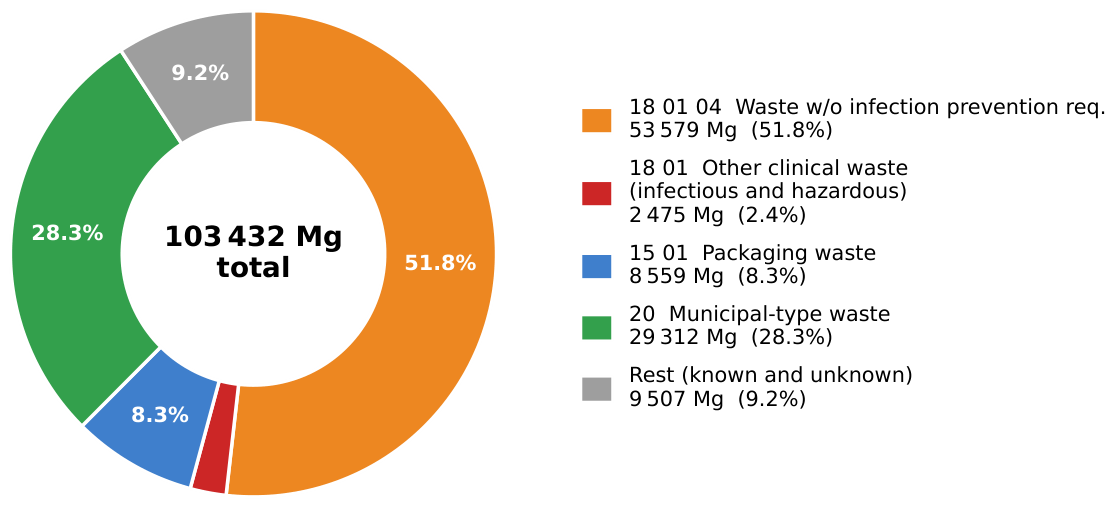
Figure 2.
Representative objects from a non-contaminated hospital waste collection.
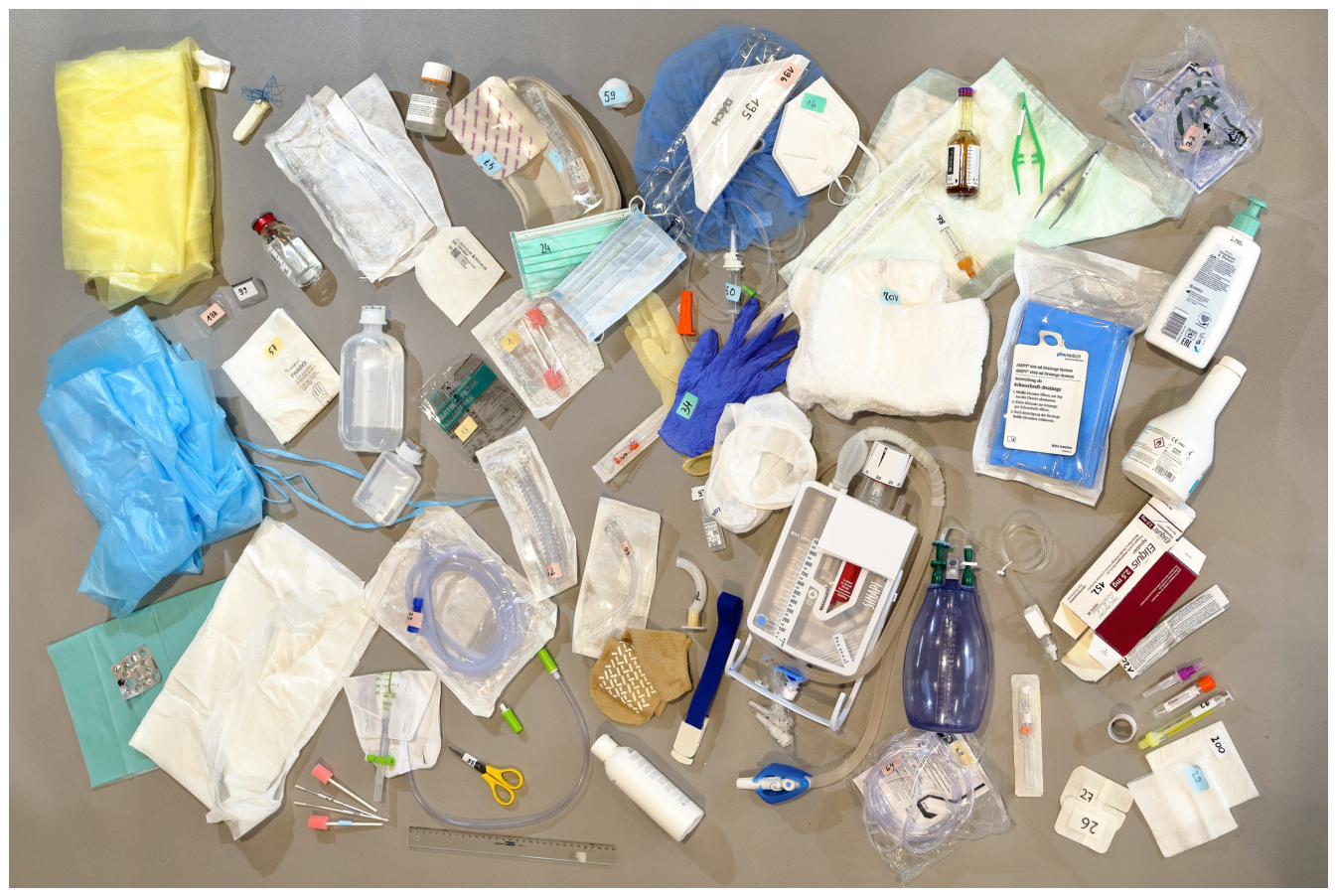
Figure 3.
The Cobot2 test platform (The sensor bridge described in Section 4 is mounted at position 5)
Figure 3.
The Cobot2 test platform (The sensor bridge described in Section 4 is mounted at position 5)
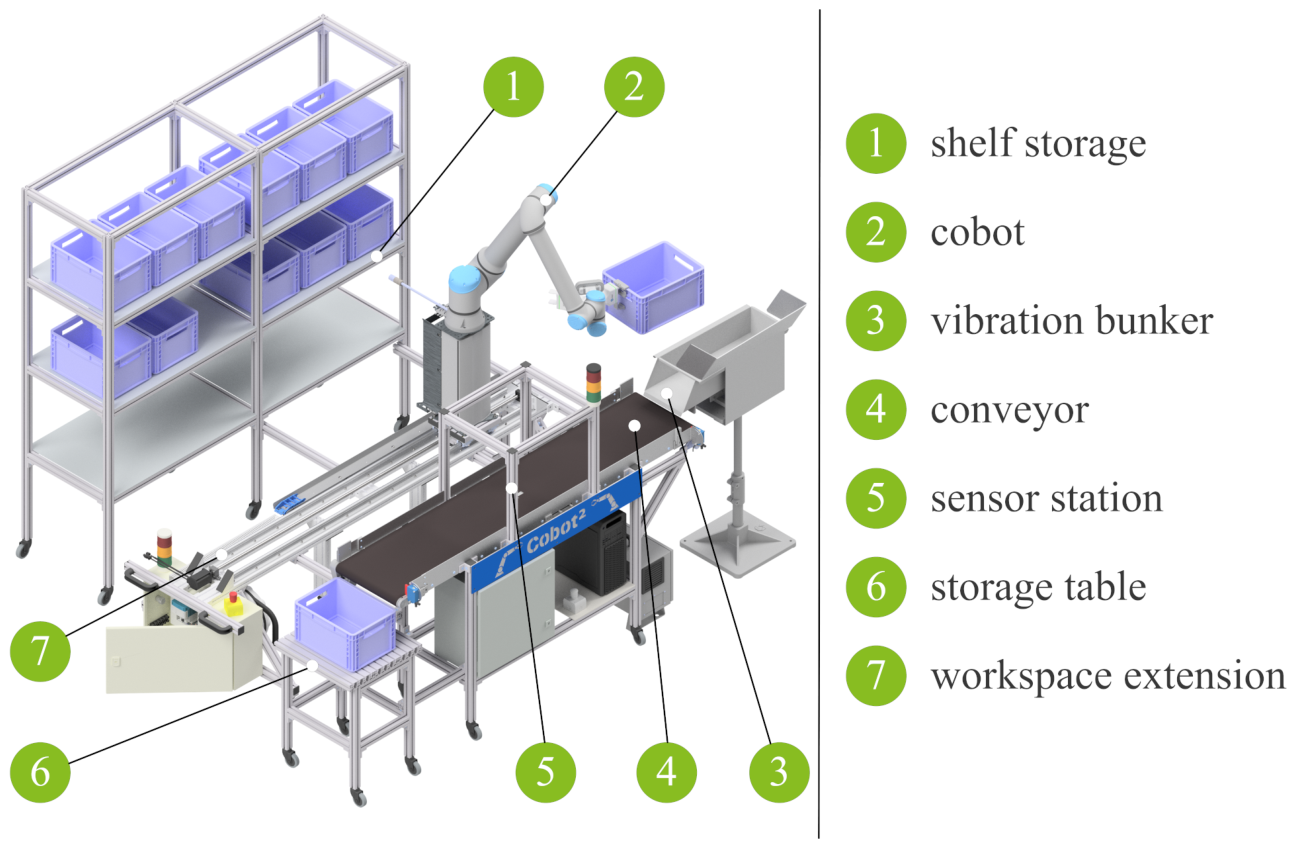
Figure 4.
Sensor station of the RoSA-ReCycle test platform. 1: NIR-HSI camera; 2: mounting frame; 3: RGB line-scan camera; 4: conveyor belt; 5: inductive metal sensor; 6: illumination unit.
Figure 4.
Sensor station of the RoSA-ReCycle test platform. 1: NIR-HSI camera; 2: mounting frame; 3: RGB line-scan camera; 4: conveyor belt; 5: inductive metal sensor; 6: illumination unit.
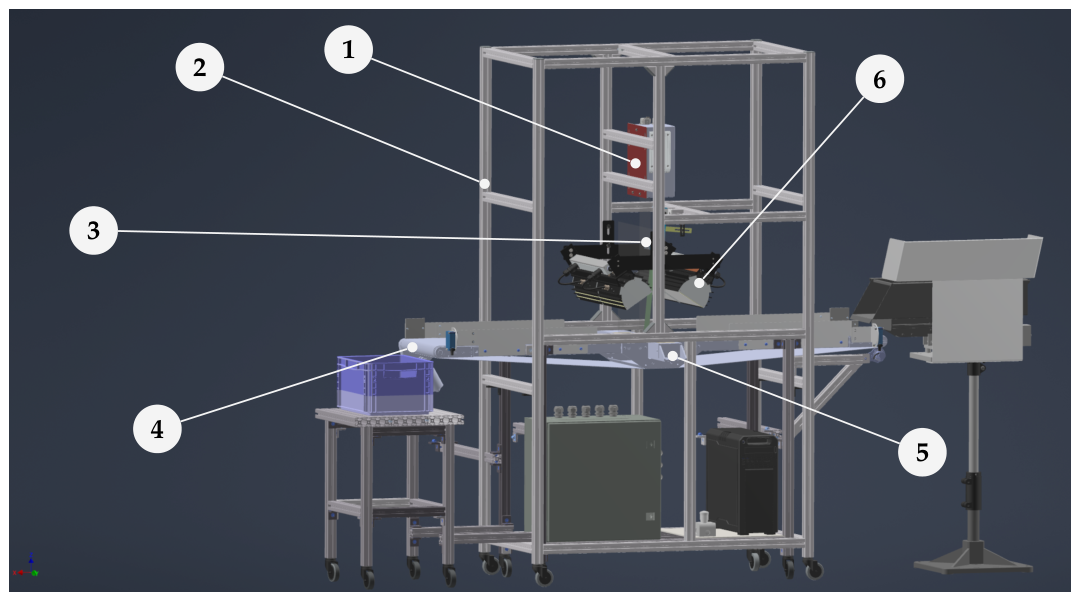
Figure 5.
Rationale for the three-sensor selection, mapping each sensing modality to the physical signal it exploits, its discrimination task, and the output it delivers.
Figure 5.
Rationale for the three-sensor selection, mapping each sensing modality to the physical signal it exploits, its discrimination task, and the output it delivers.
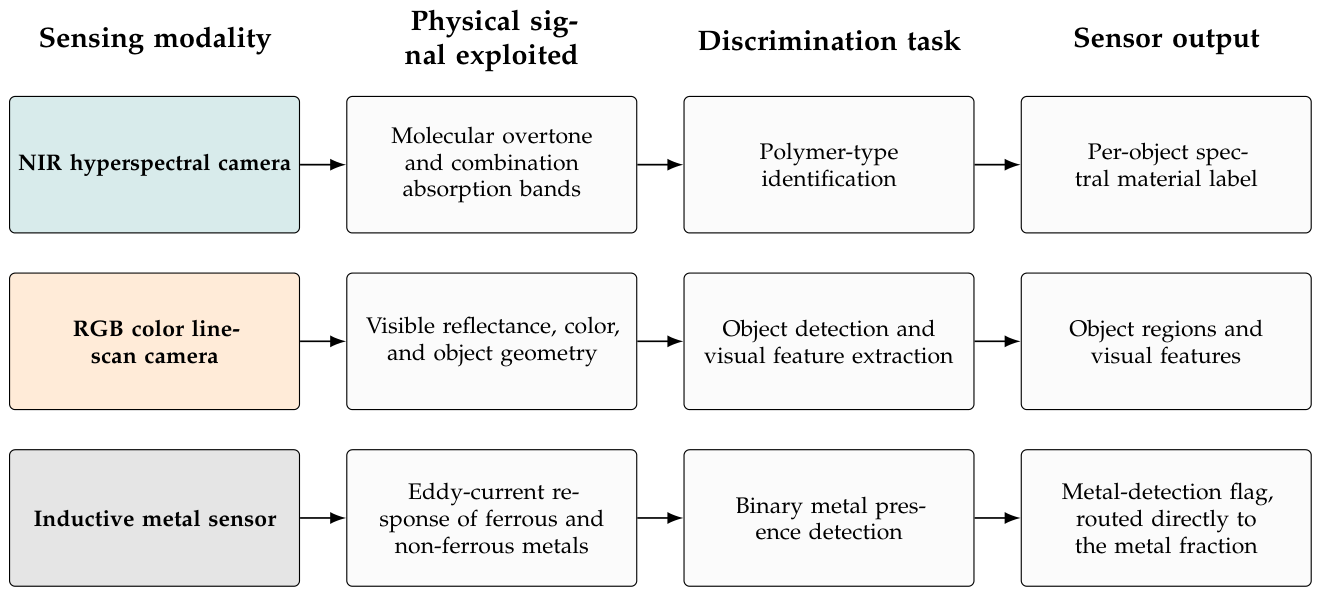
Figure 6.
Spectral coverage of the imaging sensors. The NIR-HSI range contains the molecular absorption bands that distinguish the target polymers PE, PP, and PET.
Figure 6.
Spectral coverage of the imaging sensors. The NIR-HSI range contains the molecular absorption bands that distinguish the target polymers PE, PP, and PET.
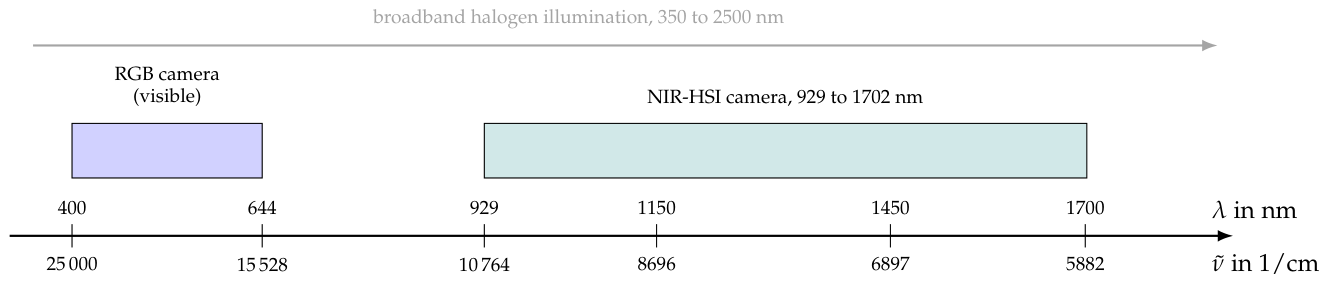
Figure 7.
Classification and sorting pipeline of the RoSA-ReCycle system.
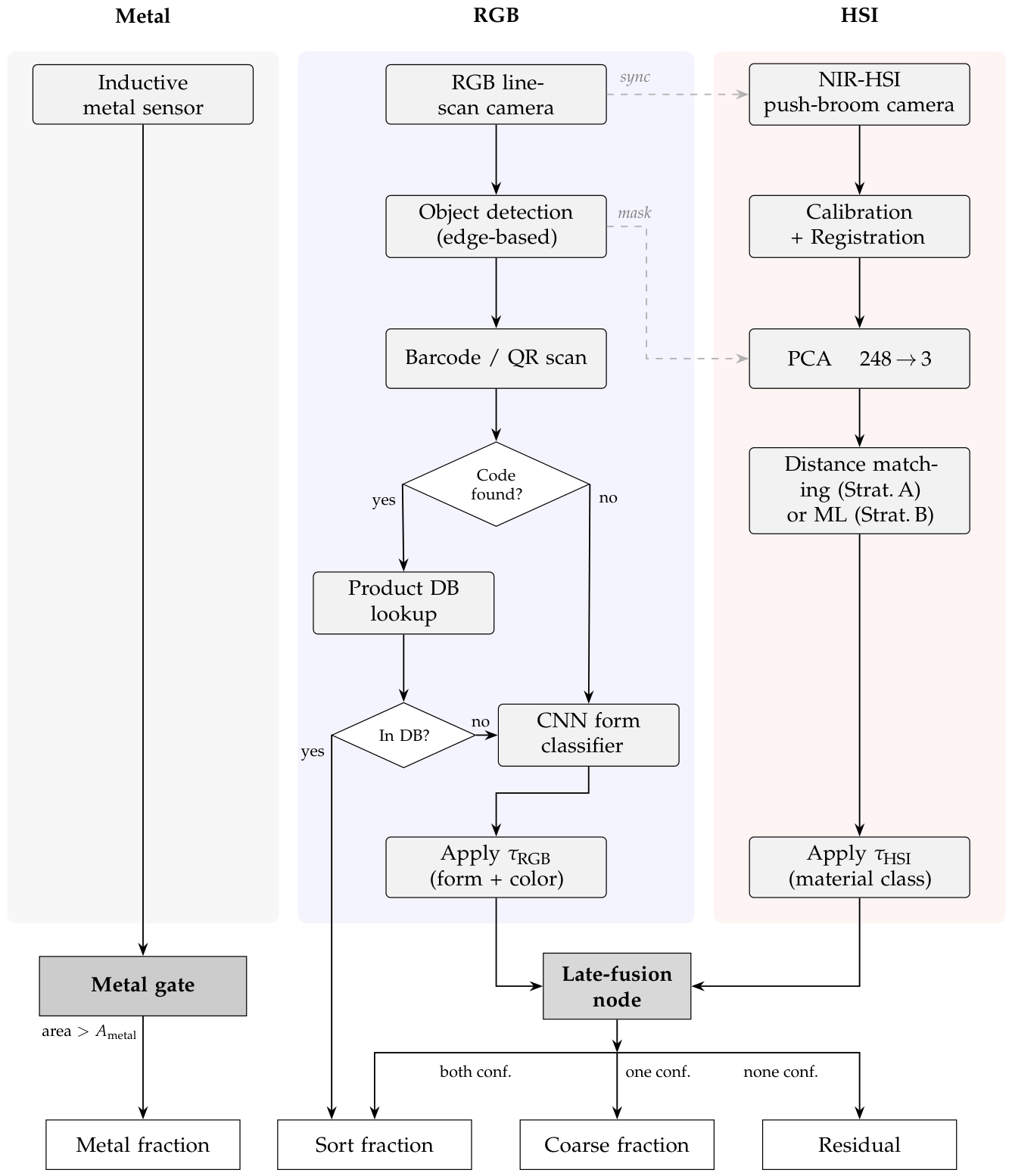
Figure 8.
Target sorting fractions and recovery routing for the hospital plastic waste stream, including the secondary processing scenarios.
Figure 8.
Target sorting fractions and recovery routing for the hospital plastic waste stream, including the secondary processing scenarios.
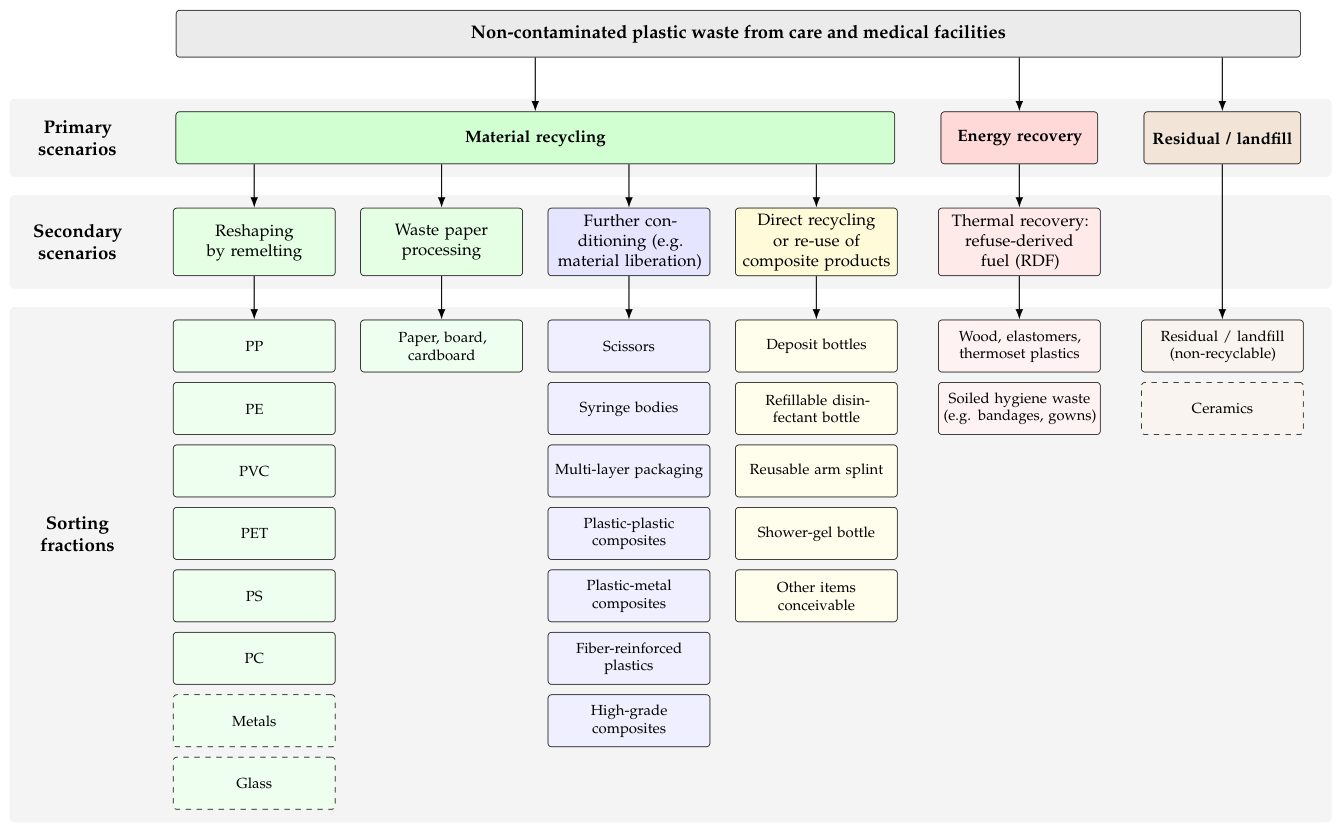

Table 1.
Sensor suite specifications for the RoSA-ReCycle sensing station.
| NIR-HSI | RGB | Metal | |
|---|---|---|---|
| Model | HELIOS EQ32 | Linea Color 4K | ABAS TL 600 |
| Spectral range | 9291702 | 400644 | — |
| Spectral bands | 248 | 3 | — |
| Spatial pixels | 320 | 4096 | — |
| Cross-track res. | 1.88 | 0.16 | — |
| Line rate | 446 | 13 | — |
| Max. speed | — | — | 2.5/ |
| Interface | GigE | GigE | GigE + SPI |
Table 2.
HELIOS EQ32 maximum conveyor speed for isotropic spatial sampling as a function of spectral ROI. The ABAS TL hard limit of 2.5/ applies regardless of ROI.
Table 2.
HELIOS EQ32 maximum conveyor speed for isotropic spatial sampling as a function of spectral ROI. The ABAS TL hard limit of 2.5/ applies regardless of ROI.
| ROI | Bands | Range (nm) | Line rate (Hz) | (m/s) |
|---|---|---|---|---|
| 248 | 248 | 929–1702 | 446 | 0.84 |
| 220 | 220 | 929–1615 | 500 | 0.94 |
| 200 | 200 | 929–1552 | 547 | 1.03 |
| 160 | 160 | 929–1427 | 674 | 1.26 |
| 120 | 120 | 929–1302 | 878 | 1.65 |
| 100 | 100 | 929–1239 | 1034 | 1.94 |
| 80 | 80 | 929–1176 | 1295 | 2.43 |
| 60 | 60 | 929–1114 | 1607 | 3.01 |
| Test speed (this work) | — | 0.175 | ||
| Production design target | — | |||
, where 1.875 is the HSI cross-track pixel pitch. Line rates from HELIOS EQ32 datasheet.
Table 3.
Comparison of the two HSI classification strategies for the target application.
| Criterion | Strategy A | Strategy B |
|---|---|---|
| Reference-spectra matching | AI-based classification | |
| Prerequisite data | Reference spectra per class | Per-pixel labeled training dataset |
| Labeling effort | Low | High |
| Time to first deployment | Short | Long |
| New class adaptation | Add reference spectra | Retrain classifier |
| Robustness to illumination variation | Established upstream by SNV (metric chosen by experiment) | High if training captures variation |
| Novel material handling | Threshold rejects to undefined | Requires explicit open-set mechanism |
| Composite object handling | Requires composite references | Can learn if represented in training |
| Interpretability | High | Low |
| Suitability at early deployment stage | High | Low |
| Suitability at mature deployment | Moderate | High |
Disclaimer/Publisher’s Note: The statements, opinions and data contained in all publications are solely those of the individual author(s) and contributor(s) and not of MDPI and/or the editor(s). MDPI and/or the editor(s) disclaim responsibility for any injury to people or property resulting from any ideas, methods, instructions or products referred to in the content. |
© 2026 by the authors. Licensee MDPI, Basel, Switzerland. This article is an open access article distributed under the terms and conditions of the Creative Commons Attribution (CC BY) license (http://creativecommons.org/licenses/by/4.0/).
Copyright: This open access article is published under a Creative Commons CC BY 4.0 license, which permit the free download, distribution, and reuse, provided that the author and preprint are cited in any reuse.