
Submitted:
12 September 2026
Posted:
14 September 2026
You are already at the latest version
Abstract
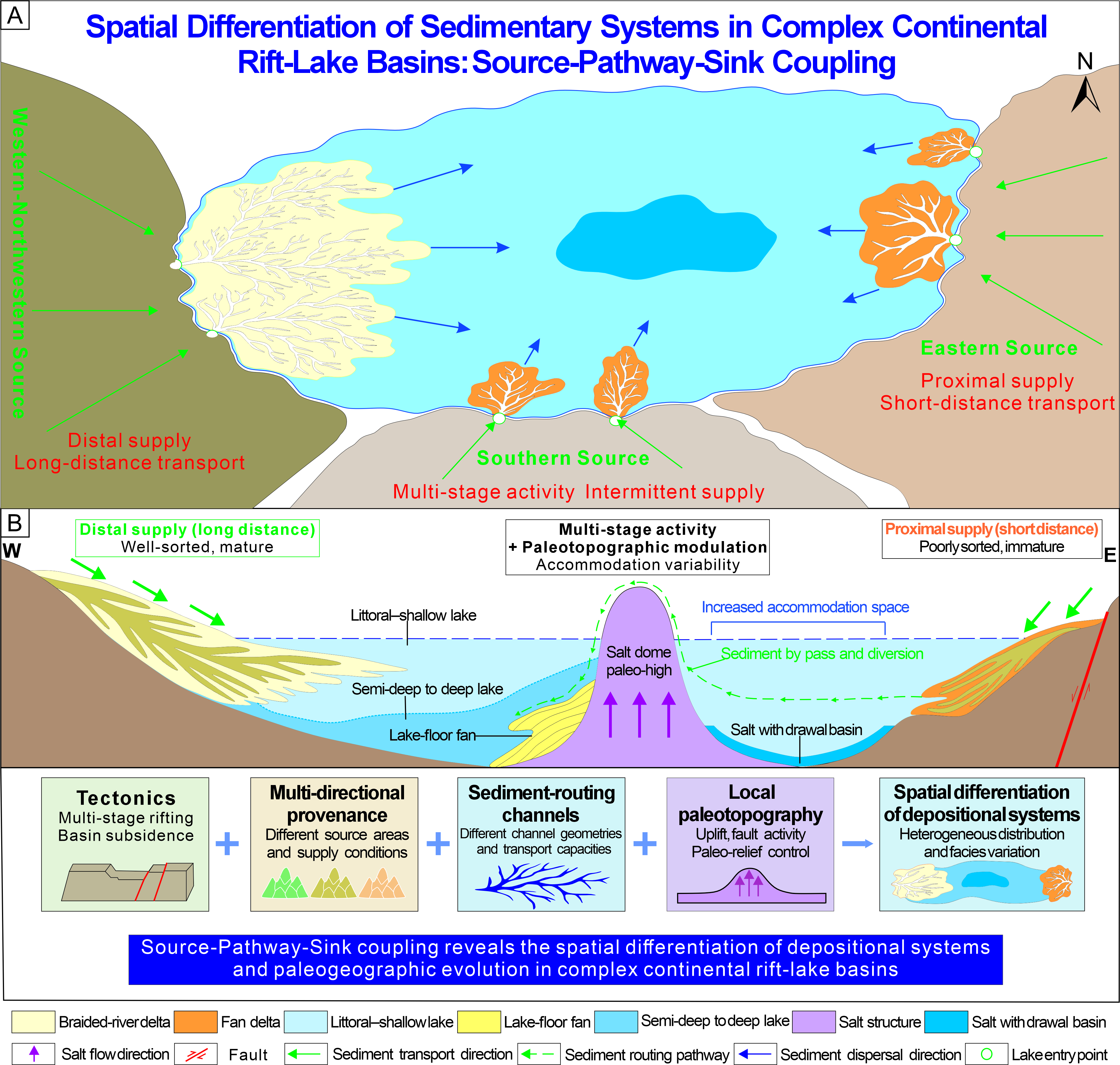
The spatial differentiation of depositional systems in complex continental rift basins is governed by the coupled effects of tectonic framework, sediment supply, and sediment-routing processes. However, the mechanisms controlling their interactions remain poorly understood. This study focuses on the third member of the Shahejie Formation (Es3) in the southern Laizhou Bay Sag, Bohai Bay Basin, eastern China. Integrated analyses of well data, well logs, and three-dimensional seismic data were combined with paleogeographic reconstruction and source-to-sink analysis to investigate depositional evolution and controlling mechanisms in a rift basin. The results indicate that: (1) The Es3 Member can be divided into four evolutionary stages, including SQ1, SQ2 (LST+TST), SQ2 (HST), and SQ3. The depositional system evolved from basin-margin filling to lacustrine transgression and subsequently to late-stage progradation. (2) Multi-directional sediment supply and sediment-routing pathways jointly regulated depositional distribution. Different basin-margin source systems resulted in contrasting depositional architectures, characterized by proximal fan deltas along steep slopes and distal braided-river deltas along gentle slopes. (3) Source-to-sink coupling controlled sediment input, transport, and spatial redistribution, whereas salt-related paleogeographic modification further influenced local accommodation space and depositional responses. Based on these findings, a multi-factor coupled depositional model involving tectonic framework, sediment supply, sediment-routing processes, and paleogeographic modification is proposed. This model provides new insights into the formation mechanisms of depositional heterogeneity in complex continental rift basins.
Keywords:
Bohai Bay Basin
; Es3 Member
; Source-to-sink coupling
; sediment-routing pathways
; continental rift basin
Copyright: This open access article is published under a Creative Commons CC BY 4.0 license, which permit the free download, distribution, and reuse, provided that the author and preprint are cited in any reuse.