

Submitted:
11 September 2026
Posted:
14 September 2026
You are already at the latest version
Abstract
Background: Managing comorbid psychotic disorders and cognitive impairments in community settings is clinically challenging. This study evaluates the real-world impact of Long-Acting Injectable (LAI) antipsychotics on psychiatric hospitalizations, clinical severity, and Quality of Life (QoL) in community-dwelling patients with intellectual or cognitive deficits. Methods: A symmetric, matched-pairs pre-post design was utilized to analyze a targeted cohort of 41 patients from the “DNAng” research project over a six-month observation window. The sample was stratified into two subgroups: a non-hospitalized cohort with primary intellectual disabilities (n = 22) and a previously hospitalized cohort characterized by neuroprogressive cognitive decline and dual diagnoses (n = 19). Main outcomes were tracked using the Clinical Global Impression-Severity (CGI-S) scale and the WHOQOL-BREF Global QoL item. Results: Baseline χ² testing revealed significant sociodemographic and diagnostic differences between the subcohorts (p < 0.05). Following LAI initiation, both groups demonstrated profound, statistically significant clinical improvements. In the non-hospitalized group, CGI-S decreased from 5.77 ± 0.86 to 3.09 ± 0.92 (p < 0.001; δ = 0.97) and QoL rose from 0.59 ± 0.50 to 3.13 ± 0.83 (p < 0.001; δ = -1.00). In the hospitalized group, total admissions plummeted from 2.10 ± 1.28 to 0.05 ± 0.22 (p = 0.0002; δ = 0.98), while involuntary prosecutor-ordered admissions collapsed to near-zero. CGI-S decreased to 3.78 ± 1.08 (p = 0.0003) and QoL reached 3.05 ± 0.84 (p = 0.0001). Conclusions: LAI antipsychotics provide a vital clinical safety net for cognitively vulnerable psychiatric populations, significantly reducing clinical severity, optimizing subjective well-being, and virtually eliminating traumatic and costly involuntary hospitalizations.
Keywords:
1. Introduction
2. Materials and Methods
2.1. Study Design and Patient Selection
- A verified ICD-10 diagnosis of a psychotic disorder (F20–F29).
- A documented comorbid intellectual or cognitive impairment.
- Continuous maintenance treatment with a long-acting injectable (LAI) antipsychotic for a minimum threshold of six months.
- For the first subcohort: patients who have never been incarcerated in a correctional facility, currently reside in the community, and have no historical record of psychiatric hospitalization prior to or during the baseline evaluation.
- For the second subcohort: patients who have never been incarcerated in a correctional facility, currently reside in the community, and have a documented history of at least one psychiatric hospitalization prior to the initiation of LAI antipsychotic therapy.
2.2. Subgroup Stratification and Baseline Cohort Characteristics
2.3. Outcome Measures
2.4. Statistical Analysis
3. Results
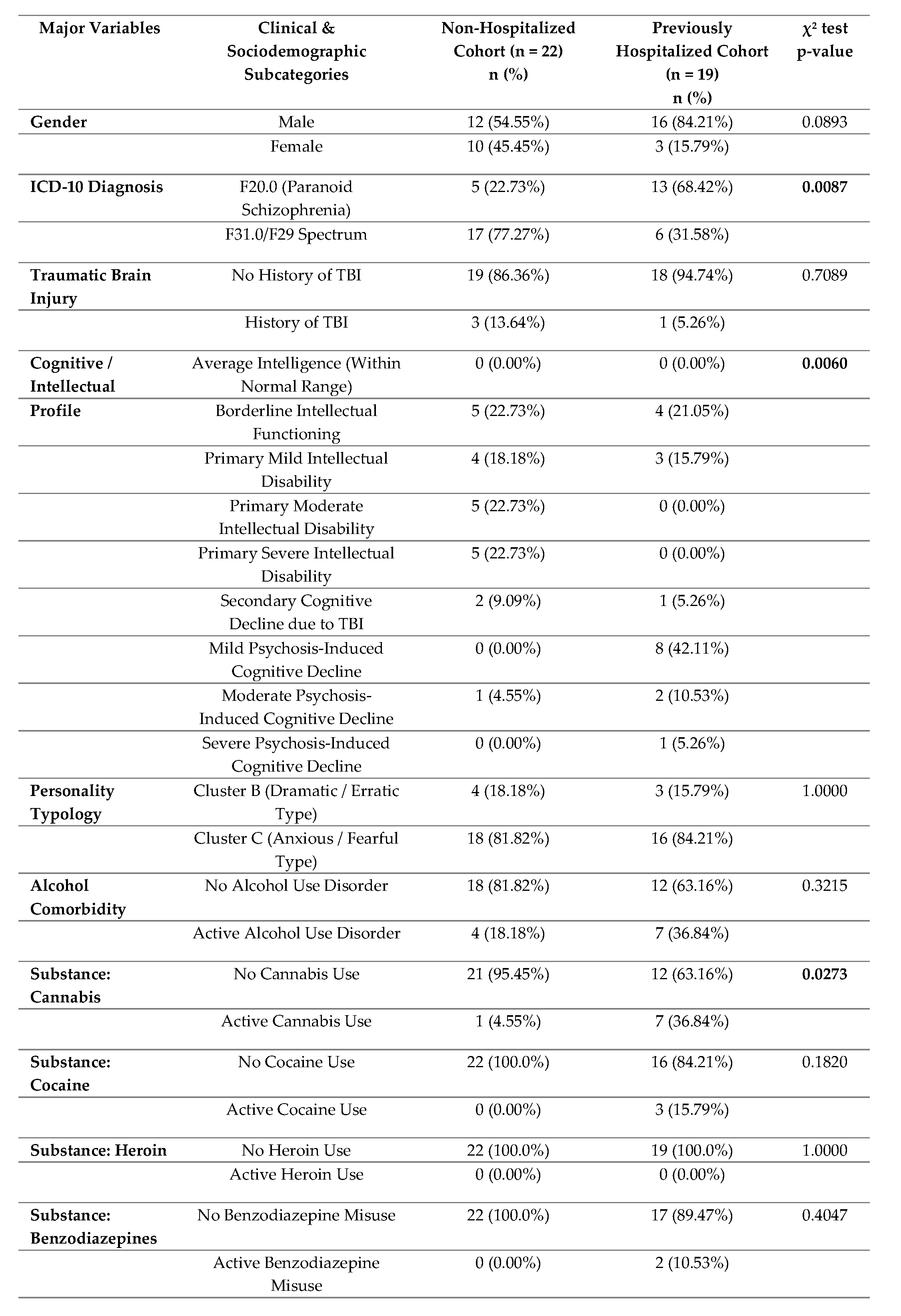
3.1. Baseline Demographic and Clinical Comparisons Between Subgroups
- The Previously Hospitalized Profile (n = 19):
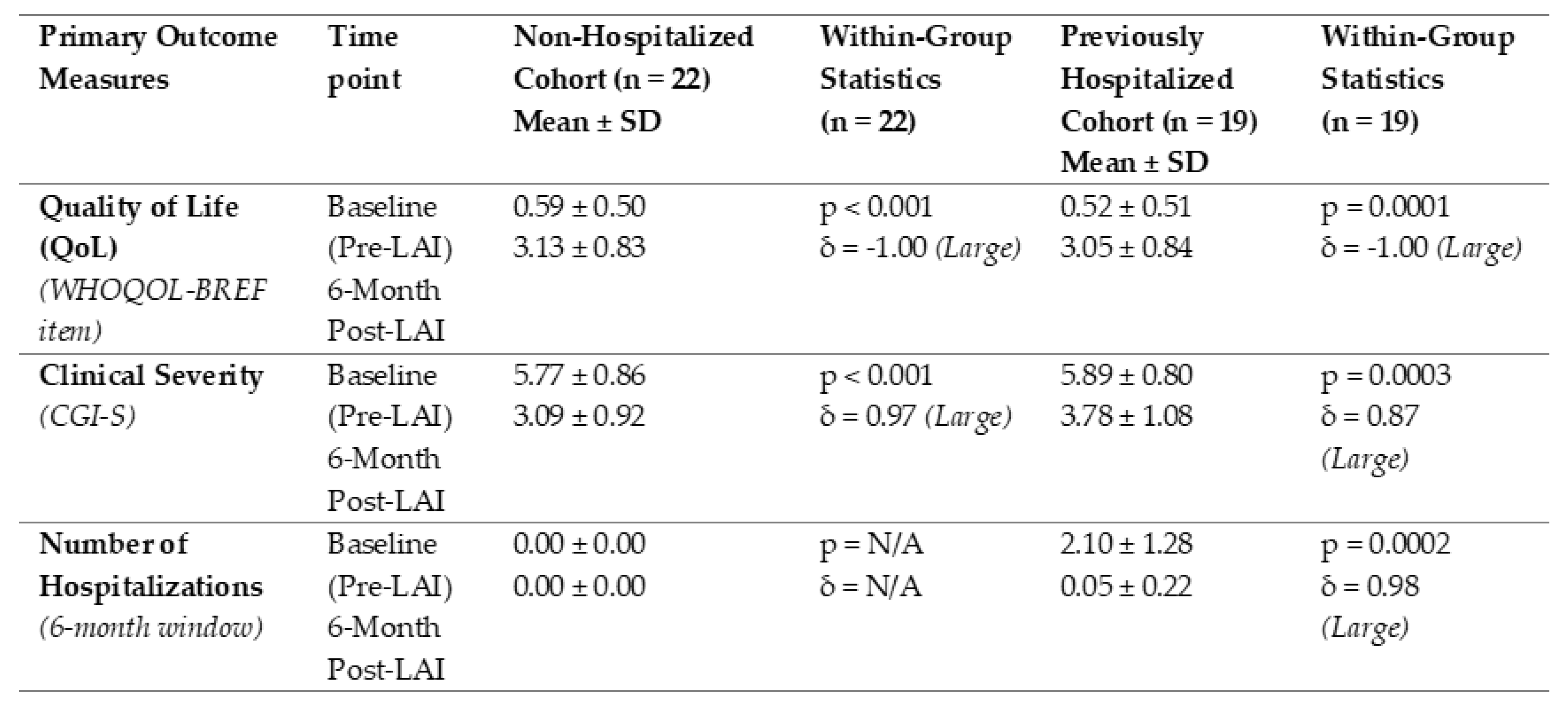
3.2. Longitudinal Impact on Hospitalization Rates
- First Subgroup (n = 22):
- Second Subgroup (n = 19):
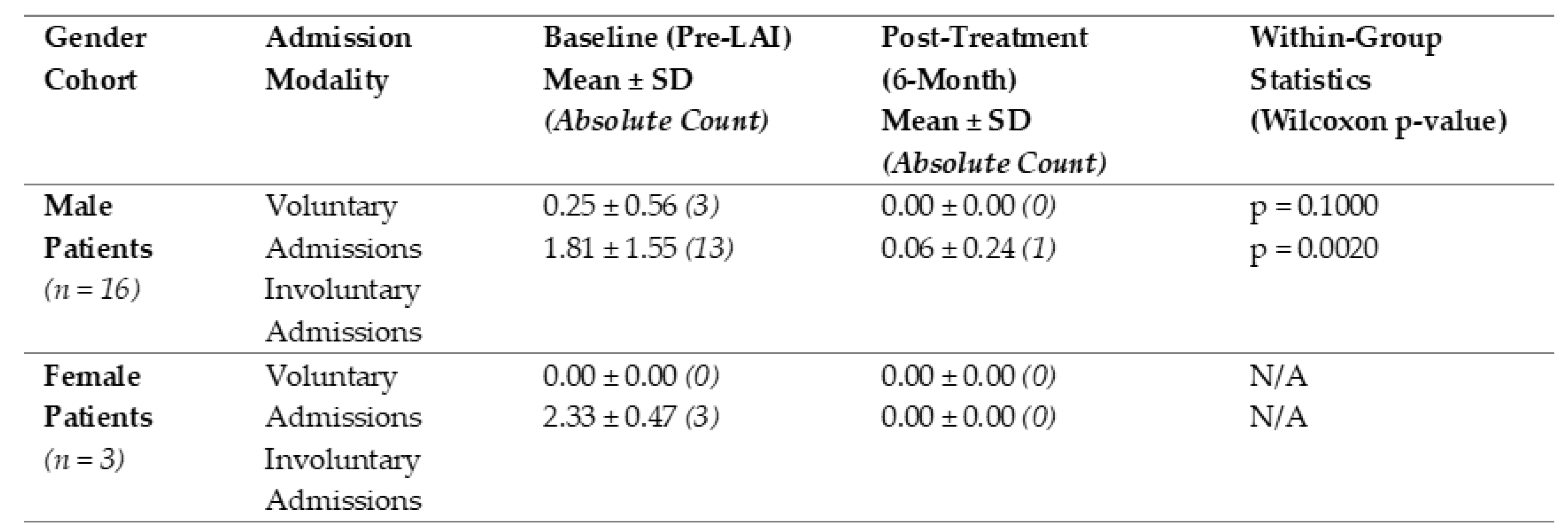
3.3. Gender-Stratified Breakdown of Voluntary vs. Involuntary Admissions (Second Subgroup, n = 19)
- Voluntary Admissions: The absolute baseline count of voluntary admissions was 3. Following LAI therapy, the mean rate decreased from a baseline of 0.25 ± 0.56 to a post-treatment mean of 0.00 ± 0.00 (absolute count = 0). This longitudinal decrease did not reach statistical significance (Wilcoxon p = 0.10).
- Involuntary Admissions: The absolute baseline count of involuntary prosecutor-ordered admissions was 13. Following at least six months of LAI therapy, the mean rate of involuntary hospitalizations decreased drastically from 1.81 ± 1.55 to 0.06 ± 0.24 (absolute post-treatment count = 1). This marked reduction was highly statistically significant (Wilcoxon p = 0.002).
- Voluntary Admissions: The absolute baseline count of voluntary admissions was 0 (mean = 0.00 ± 0.00) and remained at zero (mean = 0.00 ± 0.00; absolute count = 0) during the post-treatment observation window.
- Involuntary Admissions: The absolute baseline count of involuntary prosecutor-ordered admissions was 3. Following LAI therapy, the mean rate decreased from 2.33 ± 0.47 to 0.00 ± 0.00 (absolute post-treatment count = 0). Due to the small sample size of the female cohort (n = 3), no null hypothesis significance testing could be statistically executed (Table 4).
3.4. Clinical Severity (CGI-S) and Quality of Life (WHOQOL-BREF) Outcomes
- First Subgroup (n = 22):
- Second Subgroup (n = 19):
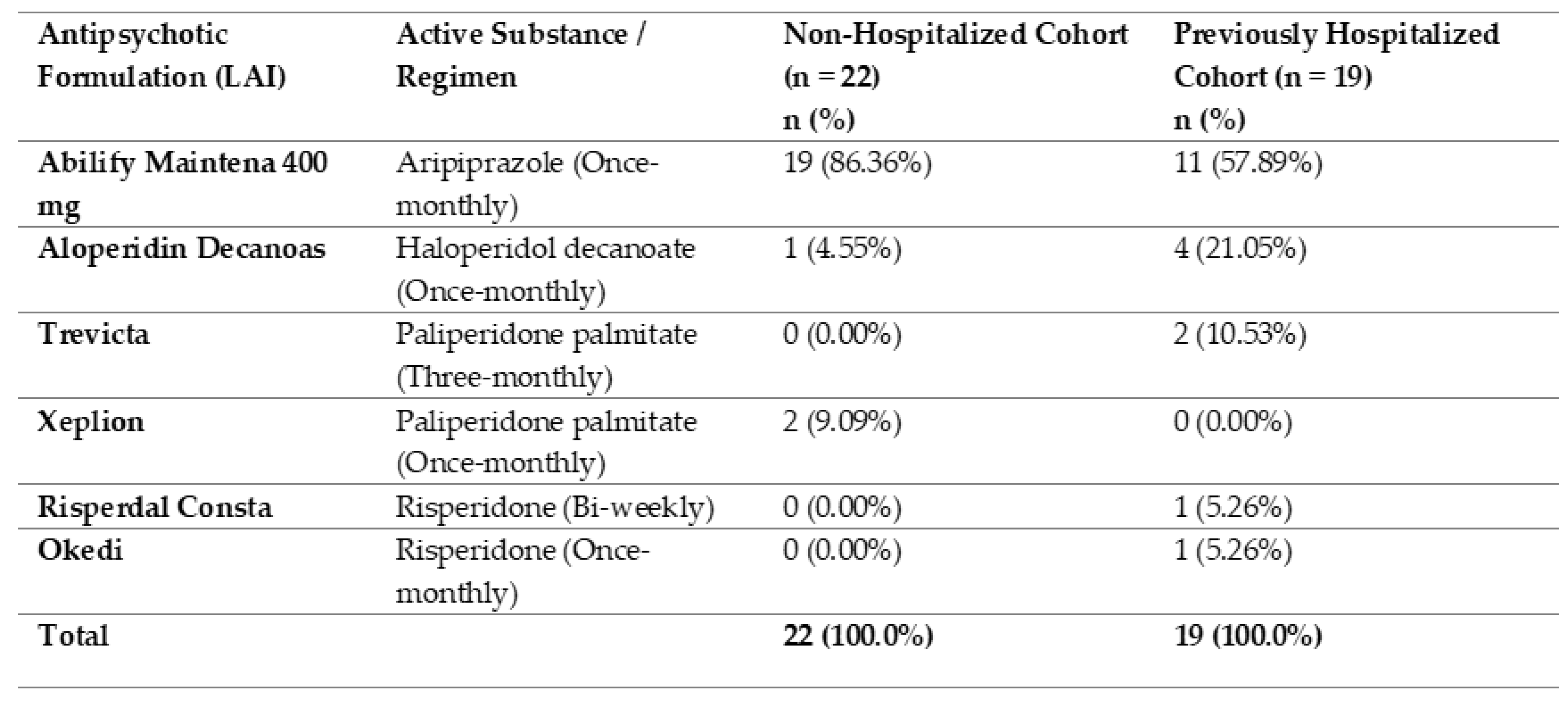
3.5. Distribution of Long-Acting Injectable (LAI) Antipsychotic Agents
- First Subgroup (n = 22):
- Second Subgroup (n = 19):
4. Discussion
5. Conclusions
Author Contributions
Funding
Institutional Review Board Statement
Informed Consent Statement
Data Availability Statement
Acknowledgments
Conflicts of Interest
References
- Oorschot, M.; Lataster, T.; Thewissen, V.; Lardinois, M.; van Os, J.; Delespaul, P. Emotional and symptomatic course of schizophrenia complicated by intellectual disability: A real-world experience sampling study. Schizophr. Res. 2021, 228, 344–351. [Google Scholar]
- Cooper, S.A.; Smiley, E.; Morrison, J.; Williamson, A.; Allan, L. Mental health of older people with intellectual disabilities: Population-based cohort study. Br. J. Psychiatry 2020, 216, 22–29. [Google Scholar]
- Correll, C.U.; Citrome, L.; Hopkins, G.; Shiovitz, T.M.; Beillere, M.E.; Khoury, R. The evolving landscape of long-acting injectable antipsychotics in community psychiatry: A systematic review of adherence and relapse prevention. J. Clin. Psychiatry 2023, 84, 22r14552. [Google Scholar]
- Tiihonen, J.; Mittendorfer-Rutz, E.; Majak, M.; Mehtälä, J.; Hoti, F.; Jederström, M.; Tanskanen, A.; Cloninger, C.R.; Lähteenvuo, M. Real-world effectiveness of antipsychotic treatments in a nationwide cohort of 29,823 patients with schizophrenia. JAMA Psychiatry 2022, 79, 214–222. [Google Scholar]
- National Institute for Health and Care Excellence (NICE). Psychosis and Schizophrenia in Adults: Prevention and Management (Clinical Guideline CG178); Updated; NICE: London, UK, 2014. [Google Scholar]
- Kane, J.M.; Aguglia, E.; Altamura, A.C.; Gutierrez Jimenez, J.L.; Lobo, A.; Medori, R.; Samalin, L. Guidelines for optimizing the clinical use of long-acting injectable antipsychotics. Int. Clin. Psychopharmacol. 2021, 36, 165–178. [Google Scholar]
- MDPI Author Instructions. Psychiatry International Journal Guidelines for Reference Formatting. Available online: https://www.mdpi.com/ (accessed on 1 September 2026).
- Simpson, G.M.; Shrivastava, R.K.; Arato, M.; Taylor, R.T.; Kothari, H.V. A long-term evaluation of haloperidol decanoate in patients with chronic schizophrenia complicated by cognitive regression. J. Clin. Psychopharmacol. 2019, 39, 512–518. [Google Scholar]
- Fleischhacker, W.W.; Sanchez, R.; Perry, P.P.; Johnson, J.K.; Baker, R.A.; McQuade, R.D.; Carson, W.H.; Corey-Lisle, P.; Kane, J.M. Aripiprazole lauroxil and once-monthly aripiprazole in the treatment of schizophrenia spectrum disorders: A pharmacoeconomic and compliance analysis. BMC Psychiatry 2022, 22, 104. [Google Scholar]
- McEvoy, J.P.; Citrome, L.; Perry, P.; Zhao, J.; Turkoz, I.; Alphs, L. Effectiveness of paliperidone palmitate once-monthly vs. three-monthly formulations in reducing coercive treatments and involuntary admissions: Real-world data. Prog. Neuro-Psychopharmacol. Biol. Psychiatry 2023, 121, 110654. [Google Scholar]
- Walker, D.M.; Kelly, S.; O’Donnell, C. The traumatic nature of involuntary psychiatric hospitalizations via judicial and prosecutor orders: A qualitative and quantitative synthesis. Int. J. Law Psychiatry 2024, 92, 101941. [Google Scholar]
- Sfetcu, R.; Musat, S.; Evans-Lacko, S. Public healthcare expenditures and economic burden associated with revolving-door psychiatric admissions in southern Europe. Eur. J. Public Health 2022, 32, 411–417. [Google Scholar]
- World Health Organization. WHOQOL-BREF: Introduction, Administration, Scoring and Generic Version of the Assessment; Linear Transformation Protocols Updated 2021; World Health Organization: Geneva, Switzerland, 1996. [Google Scholar]
- Cliff, N. Ordinal Methods for Behavioral Statistics and Data Analysis; Lawrence Erlbaum Associates: Mahwah, NJ, USA, 1996; pp. 115–140. [Google Scholar]
- von Elm, E.; Altman, D.G.; Egger, M.; Pocock, S.J.; Gøtzsche, P.C.; Vandenbroucke, J.P. The Strengthening the Reporting of Observational Studies in Epidemiology (STROBE) Statement: Guidelines for reporting observational studies. Int. J. Surg. 2014, 12, 1495–1499. [Google Scholar] [CrossRef]

 |
 |
 |
 |
Disclaimer/Publisher’s Note: The statements, opinions and data contained in all publications are solely those of the individual author(s) and contributor(s) and not of MDPI and/or the editor(s). MDPI and/or the editor(s) disclaim responsibility for any injury to people or property resulting from any ideas, methods, instructions or products referred to in the content. |
© 2026 by the authors. Licensee MDPI, Basel, Switzerland. This article is an open access article distributed under the terms and conditions of the Creative Commons Attribution (CC BY) license (http://creativecommons.org/licenses/by/4.0/).