

Submitted:
10 September 2026
Posted:
11 September 2026
You are already at the latest version
Abstract
Initial Coin Offerings (ICOs) have become an important blockchain-based fundraising mechanism; however, ICO white papers vary considerably in structure, content, and disclosure quality, limiting transparency, comparability, and informed investor decision-making. Because white papers often serve as the primary source of project information during fundraising, the absence of standardized disclosure practices represents a significant challenge. Existing literature has examined ICOs from perspectives including tokenomics, governance, disclosure quality, investor behaviour, and fundraising performance, yet little attention has been devoted to developing a harmonized disclosure framework for ICO white papers. To address this gap, this study proposes a harmonized ICO white paper framework developed through a multi-stage research process. A corpus of the ten highest-funded pure ICO white papers was analysed using content analysis, and the findings were compared with academic literature and regulatory guidance to identify both commonly disclosed and externally recommended disclosure elements. The study resulted in a harmonized framework comprising nineteen disclosure sections organized into five major components that integrate empirical industry practice with best-practice recommendations. The contribution of this paper is the development of an evidence-based harmonized ICO white paper framework that provides a standardized disclosure structure to enhance transparency, comparability, and informational completeness within blockchain fundraising ecosystems.
Keywords:
initial coin offerings
; ICO
; white papers
; blockchain
; tokenomics
; token economics
; token economy
1. Introduction
Initial Coin Offerings (ICOs) emerged as a prominent blockchain-based fundraising mechanism during the growth of the cryptocurrency ecosystem, enabling projects to raise capital directly from investors through the issuance and sale of digital tokens. In many cases, the ICO white paper serves as the primary disclosure document available to prospective investors, providing information regarding the project's objectives, technological foundations, token economics, governance arrangements, and future development plans. As a result, white papers play a central role in reducing information asymmetry between project teams and market participants and often constitute the principal source of information upon which investment decisions are based.
Despite their importance, ICO white papers have historically exhibited substantial variation in structure, content, and disclosure quality. While some projects provide extensive information concerning technical architecture, token allocation, governance mechanisms, and risk factors, others focus primarily on technological features or fundraising objectives while omitting information that may be relevant to investors and other stakeholders. This lack of standardization creates challenges for transparency, comparability, due diligence, and investor protection. Furthermore, the absence of a commonly accepted disclosure framework makes it difficult for researchers, regulators, and market participants to evaluate the completeness and quality of information provided by different projects.
The importance of this issue has been recognized within the academic literature. Prior studies have examined various aspects of ICOs, including fundraising determinants, tokenomics, governance structures, disclosure quality, investor behaviour, and project performance. Researchers have explored the relationship between white paper characteristics and fundraising success, while regulatory authorities have increasingly emphasized the need for greater transparency and accountability in token-based fundraising activities. However, although the literature provides valuable insights into individual disclosure components and regulatory concerns, relatively little attention has been devoted to developing a comprehensive and harmonized framework capable of standardizing the structure and content of ICO white papers.
The absence of such a framework represents an important gap in both research and practice. From an academic perspective, a harmonized structure would facilitate comparative studies of disclosure quality and information content across blockchain projects. From a practical perspective, a standardized framework could assist project developers in preparing more transparent disclosure documents while enabling investors and regulators to evaluate projects using a common reference structure. Consequently, there is a need for a systematic approach that identifies the disclosure elements commonly observed within successful ICO projects and integrates them with broader best-practice recommendations derived from academic and regulatory sources.
To address this gap, this study proposes a harmonized ICO white paper framework developed through a multi-stage research process. First, a corpus of the ten highest-funded pure ICO white papers was constructed using predefined inclusion criteria. Content analysis was then employed to identify recurring disclosure categories and determine the disclosure practices most commonly observed within the corpus. The findings were subsequently compared against recommendations derived from academic literature and regulatory guidance in order to identify additional disclosure elements considered important for transparency, accountability, investor protection, and informed decision-making. The resulting evidence was then synthesized into a harmonized disclosure framework.
The study achieved several outcomes. The analysis identified a set of common disclosure elements that consistently appeared across highly funded ICO white papers, including project background, proposed solution, technical architecture, product description, protocol mechanisms, and tokenomics. At the same time, the comparison with academic and regulatory sources revealed additional disclosure categories, such as governance, risk disclosures, legal considerations, use of proceeds, and team information, that were frequently recommended despite appearing less consistently within the corpus. Integrating these findings resulted in the development of a harmonized framework consisting of nineteen disclosure sections organized into five major components: Project Foundation, Technical Design, Token Economics, Governance and Accountability, and Implementation and Future Development.
The contribution of this paper is the development of an evidence-based harmonized ICO white paper framework that combines empirically observed disclosure practices with academic and regulatory best-practice recommendations. By integrating common industry practices with externally supported disclosure requirements, the framework provides a standardized structure designed to enhance transparency, comparability, and informational completeness within blockchain fundraising ecosystems. The framework may serve as a useful reference for project developers, investors, regulators, and researchers seeking to improve the quality and consistency of ICO disclosures.
The remainder of this paper is organized as follows. The next section describes the research methodology and corpus construction process. This is followed by the content analysis of the selected white papers, the comparison of empirical findings with academic and regulatory recommendations, the development of the harmonized framework, and a discussion of its implications. The paper concludes with recommendations for future research and practice.
2. Literature Review
ICOs emerged as an alternative fundraising mechanism that enables blockchain-based projects to obtain capital through the issuance and sale of digital tokens. Unlike traditional securities offerings, ICOs typically operate in environments characterized by limited regulation, varying disclosure practices, and substantial information asymmetry between project founders and potential investors. Information asymmetry arises because project teams generally possess significantly more information regarding the project's technical capabilities, business model, governance arrangements, and future prospects than prospective investors [1]. The resulting uncertainty creates challenges for investors attempting to evaluate project quality and investment risk.
Several studies have identified disclosure as a critical mechanism for mitigating information asymmetry within ICO markets. [2] found substantial variation in the voluntary disclosure practices adopted by ICO ventures and concluded that disclosure facilitates the functioning of ICOs as an alternative capital market. Similarly, [3] noted that ICOs are inherently vulnerable to information asymmetries, highlighting the importance of credible information for investor decision-making. These findings suggest that disclosure quality plays a central role in the effectiveness and credibility of blockchain-based fundraising activities.
The white paper is widely regarded as the principal disclosure document associated with an ICO. It typically provides information regarding the project's objectives, technological architecture, token economics, governance mechanisms, and future development plans. [4] observed that white papers function as indicators of project credibility because they contain technical, business, and team-related information that investors use when evaluating projects. Likewise, [5] argued that white papers help reduce information asymmetry by providing detailed project information to potential investors.
Research has further demonstrated that white papers differ considerably in both content and quality. [6] highlighted the role of voluntary disclosure in ICO markets and found that disclosure-related characteristics influence fundraising outcomes. Similarly, [7] proposed benchmarking ICO white papers against the disclosures found in Security Token Offerings (STOs) and found that higher-quality disclosures were associated with greater fundraising success. These findings indicate that the content and quality of white papers are important determinants of project credibility and investor confidence.
The literature consistently identifies disclosure quality as a significant factor affecting ICO performance and investor protection. [8] found that better disclosure quality increases the amount of capital raised, suggesting that investors reward projects that provide more comprehensive information. [9] similarly reported that disclosure quality and investor rights disclosures were positively associated with fundraising outcomes. Importantly, their findings revealed that many ICO white papers failed to disclose information concerning management teams, governance arrangements, and use of proceeds, thereby raising concerns regarding investor protection.
Regulatory discussions have echoed these concerns. [10] argued that inadequate regulation and inconsistent white paper disclosures contribute to financial, technical, and analytical risks within ICO markets. [11] similarly highlighted the challenges associated with evaluating ICO projects due to the absence of standardized disclosure requirements. Together, these studies suggest that improved disclosure practices may contribute to greater transparency, accountability, and investor protection.
Although prior studies have examined disclosure quality, fundraising success, governance, tokenomics, investor protection, and information asymmetry, relatively limited attention has been devoted to the development of a comprehensive disclosure framework capable of harmonizing ICO white papers. Existing research has generally focused on identifying determinants of ICO success, measuring disclosure quality, or examining individual disclosure characteristics rather than proposing a standardized disclosure structure.
The literature nevertheless provides indirect support for harmonization efforts. [2] documented substantial variation in disclosure practices across ICOs, while [6] emphasized the importance of voluntary disclosure in fundraising outcomes. [7] further demonstrated that higher-quality white papers are associated with greater fundraising success. Collectively, these findings suggest that disclosure quality matters, yet they do not provide guidance regarding what information should consistently be disclosed across projects.
Consequently, a gap remains in the literature regarding the development of a harmonized ICO white paper framework that integrates commonly observed disclosure practices with recommendations derived from academic research and regulatory guidance. Addressing this gap may improve transparency, facilitate comparability across projects, support investor due diligence, and contribute to the maturation of blockchain fundraising ecosystems. The present study seeks to address this gap through the development of an evidence-based harmonized ICO white paper framework derived from content analysis, literature review, and regulatory comparison.
3. Methodology
This study adopts a qualitative exploratory research design aimed at developing a harmonized Initial Coin Offering (ICO) white paper framework. The absence of a universally accepted disclosure standard for ICO white papers makes framework-development research particularly suitable for investigating disclosure practices within blockchain-based fundraising. Rather than testing an existing theory, the study seeks to identify recurring disclosure elements within practice and integrate these findings with recommendations derived from academic literature and regulatory guidance.
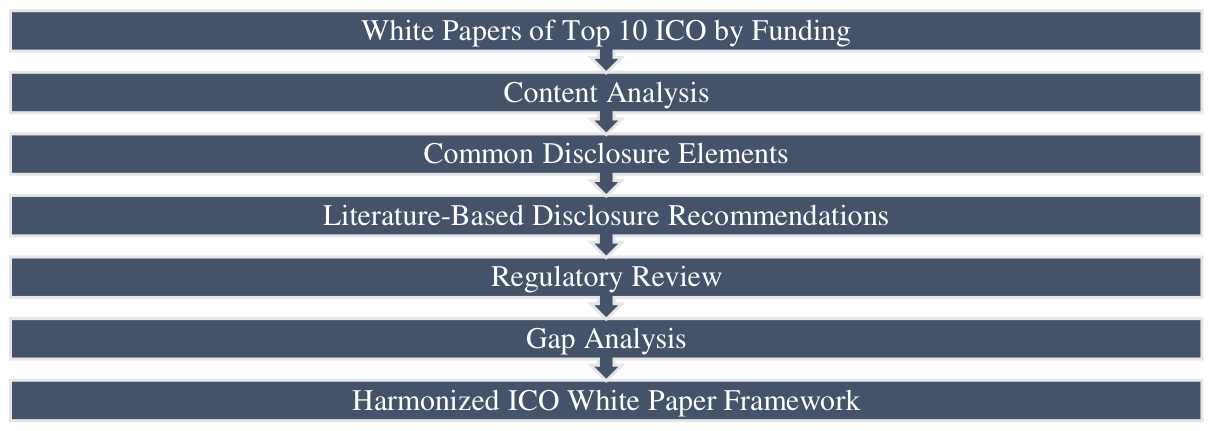
To achieve this objective, the study follows a multi-stage framework-development process, illustrated in Figure 1. The process begins with the identification of a corpus of highly funded pure ICO white papers. The selected documents are then subjected to content analysis to identify recurring disclosure elements. The disclosure categories emerging from this analysis provide an empirical representation of disclosure practices observed within the ICO ecosystem.
Subsequently, the identified disclosure elements are compared against recommendations derived from academic literature and regulatory sources. This comparison enables the identification of disclosure practices that are commonly observed in practice as well as disclosure elements that are recommended by scholars and regulators but are not consistently disclosed by ICO projects. A gap analysis is then conducted to identify areas of convergence and divergence between industry practice and external recommendations.
Finally, the findings from the empirical analysis, literature review, and regulatory review are synthesized to develop a harmonized ICO white paper framework. The resulting framework combines commonly observed disclosure practices with externally recommended disclosure elements in order to enhance transparency, comparability, and informational completeness within ICO-related disclosures. Figure 1 presents the overall methodological process employed in the study.
Figure 1.
Development process of the harmonized ICO white paper framework.
4. Data Collection
The primary data source for this study consisted of Initial Coin Offering (ICO) white papers obtained from projects identified through CryptoRank. CryptoRank was selected as the principal source because it is one of the most comprehensive cryptocurrency fundraising databases available, providing historical information regarding fundraising amounts, project classifications, fundraising types, token sales, and project characteristics. The platform aggregates data from multiple blockchain projects and maintains standardized records that facilitate the comparison of fundraising events across the cryptocurrency ecosystem. Its extensive coverage and structured classification system made it particularly suitable for identifying economically significant ICO projects and constructing a transparent and replicable research corpus.
The study employed a purposive sampling strategy aimed at selecting highly funded ICO projects that could reasonably be considered influential within the blockchain fundraising ecosystem. Rather than attempting to analyse the entire population of ICOs, the research focused on projects that raised substantial amounts of capital, as these projects were more likely to have established disclosure practices that influenced subsequent market participants.
Data collection began with the extraction of ICO fundraising records from the CryptoRank database using Python. The extracted dataset included information relating to project names, fundraising amounts, fundraising classifications, and associated project documentation. An initial list of candidate projects was compiled based on total funds raised. To ensure consistency and comparability across the sample, a series of inclusion criteria were subsequently applied.
First, the project must have conducted a public Initial Coin Offering (ICO). Projects funded through alternative fundraising mechanisms, such as Initial Exchange Offerings (IEOs), Initial DEX Offerings (IDOs), venture capital financing, private sales, seed rounds, angel investments, strategic rounds, or other non-ICO funding mechanisms, were excluded. Second, the project must have published a publicly available white paper. Third, the complete white paper had to remain accessible through reliable sources, including official project websites, archived web pages, GitHub repositories, or public ICO databases. Fourth, an English-language version of the document was required to ensure consistency during the analysis process. Fifth, the fundraising event must have been completed. Sixth, the ICO must have concluded on or before 31 December 2023. Seventh, where multiple versions of a white paper existed, the version published closest to the original fundraising event was selected. Finally, the document had to be complete, readable, and suitable for systematic examination.
Following the application of these inclusion criteria, an additional filtering stage was performed to isolate pure ICO projects. The fundraising-type classifications provided by CryptoRank were examined for each candidate project. Projects categorized as combinations of ICOs and other fundraising mechanisms, including classifications such as “ICO and Private Sale,” “ICO and Seed,” “ICO and Angel,” “ICO and Strategic,” “ICO and IEO,” and “ICO and IDO,” were excluded from the sample. This additional filtering step was undertaken to improve comparability across the corpus by ensuring that all selected projects relied exclusively on the same fundraising mechanism. Consequently, only projects whose fundraising type was recorded solely as an ICO were retained for analysis, as shown in Table 1 [12].
The associated white papers constituted the primary dataset used in this study. The resulting corpus provided the empirical foundation for the subsequent content analysis, the identification of common disclosure elements, and the development of the harmonized ICO white paper framework. To enhance transparency and replicability, the metadata file accompanying the corpus includes project information, inclusion decisions, and links to the white papers used in the analysis [13].
5. Disclosure Elements Analysis
Following the construction of the corpus of highly funded pure ICO white papers, the next stage of the study focused on identifying the disclosure elements present within the selected documents. Content analysis was employed to systematically examine the information disclosed in each white paper and identify recurring disclosure practices across the corpus. The objective of this stage was to determine whether common structural patterns existed among highly funded ICO projects and to establish an empirical basis for the development of a harmonized ICO white paper framework.
To facilitate a systematic examination of the selected white papers, a coding framework consisting of twenty-two disclosure categories was developed. The categories were derived from the academic literature and refined through iterative examination of the corpus. Each category was assigned an operational definition to ensure consistency during the coding process and reduce ambiguity in classification decisions. The disclosure categories and their corresponding operational definitions are presented in Table 2.
The disclosure categories presented in Table 2 encompass a broad range of informational elements commonly associated with blockchain projects and token-based fundraising activities. Several categories focus on the fundamental characteristics of the project, including its background, proposed solution, technical architecture, products or services, and token economics. Other categories address organizational, legal, governance, and operational considerations, such as team composition, governance structures, risk disclosures, regulatory restrictions, and the allocation of funds raised through the ICO. Collectively, these categories provide a comprehensive framework for evaluating the informational content of ICO white papers.
Each white paper was systematically reviewed and coded according to the disclosure categories shown in Table 2. A binary coding approach was employed whereby a value of one indicated the presence of a disclosure category and a value of zero indicated its absence. The coding process focused on whether a category was substantively addressed within the document rather than the length, depth, or quality of the discussion. Consequently, a disclosure category was recorded as present whenever the white paper contained sufficient content corresponding to the operational definition assigned to that category.
The coding procedure produced a disclosure matrix that recorded the occurrence of each disclosure category across all white papers included in the corpus. The matrix enabled the identification of recurring disclosure patterns and facilitated the calculation of category frequencies across the sample. By aggregating the coding results, it became possible to determine which disclosure elements appeared consistently across highly funded ICO projects and which elements were disclosed less frequently.
The resulting frequency analysis provides empirical evidence regarding disclosure practices within the ICO ecosystem. Categories appearing in a large proportion of the corpus may be considered common disclosure elements, while categories appearing less frequently may represent supplementary disclosures or areas in which disclosure practices remain inconsistent. The findings derived from this analysis form the foundation for the subsequent comparison with academic and regulatory recommendations and ultimately contribute to the development of the harmonized ICO white paper framework proposed in this study.
To improve the readability and presentation of the disclosure matrix, the disclosure categories were assigned numerical identifiers. Each rank shown in Table 3 corresponds to a specific disclosure category and operational definition presented in Table 2. The use of numerical identifiers reduces the width of the matrix while maintaining a direct link to the coding framework. Consequently, Rank 1 corresponds to Introduction / Background, Rank 2 corresponds to Proposed Solution / Project Overview, Rank 3 corresponds to Technical Architecture / System Design, and so forth through Rank 22, which corresponds to Competition / Related Work.
The disclosure matrix presented in Table 3 [13] summarizes the occurrence of each disclosure category across the ten ICO white papers included in the corpus. The results reveal substantial consistency across several disclosure categories. Ranks 1 through 3, corresponding to Introduction or Background, Proposed Solution or Project Overview, and Technical Architecture or System Design, were present in all ten white papers, resulting in a frequency of 100 percent. The universal presence of these categories suggests that they constitute the foundational components of ICO white paper disclosure and serve as the primary mechanisms through which projects communicate their purpose, functionality, and technical architecture.
Ranks 4 through 7 were present in eight of the ten white papers, corresponding to a frequency of 80 percent. These categories include Problem Statement, Product, Platform, or Services Description, Protocol, Consensus, or Cryptographic Mechanism, and Tokenomics or Token Model. The high occurrence of these disclosure elements indicates that most projects considered it important to explain the problem being addressed, describe the proposed product or service, outline the technical mechanisms supporting the project, and provide information regarding token economics. Collectively, these disclosures communicate the project's value proposition and operational design.
Ranks 8 and 9, corresponding to Business Model or Revenue Model and Risk, Security, or Compliance Disclosures, appeared in seven of the ten white papers, representing 70 percent of the corpus. Rank 10, corresponding to Roadmap, Timeline, or Development Plan, appeared in six white papers, representing 60 percent of the corpus. These findings suggest that while many projects sought to communicate long-term sustainability, potential risks, and future development plans, such disclosures were not universally adopted across the sample.
Ranks 11 and 12, corresponding to Token Allocation or Distribution and Token Sale or Crowdsale Details, appeared in five of the ten white papers, resulting in a frequency of 50 percent. Although these categories relate directly to fundraising activities and token issuance, their inconsistent presence suggests substantial variation in disclosure practices among ICO projects. Ranks 13 through 18 each appeared in four of the ten white papers, corresponding to a frequency of 40 percent. These categories include Advisors, Future Work or Expansion Plans, Legal Notices or Regulatory Restrictions, Market or Industry Context, Team Information, and Use of Proceeds or Funds Allocation. The relatively low frequency of these disclosures suggests that many projects provided limited information regarding organizational structure, regulatory considerations, market positioning, and the intended allocation of funds raised.
The least frequently disclosed categories were Community or Ecosystem and Governance, each appearing in three white papers (30 percent), Partnerships or Existing Infrastructure appearing in two white papers (20 percent), and Competition or Related Work appearing in only one white paper (10 percent). The limited occurrence of these categories indicates that governance mechanisms, ecosystem relationships, and competitive analysis were generally not emphasized within the sampled ICO white papers.
Overall, the results demonstrate that ICO white papers exhibit a combination of standardized and highly variable disclosure practices. Categories directly related to project purpose, technical functionality, and token economics appeared consistently across the corpus, whereas governance, ecosystem development, partnerships, and competition-related disclosures were often omitted or disclosed inconsistently. These findings provide empirical evidence regarding current disclosure practices among highly funded ICO projects and establish the foundation for the subsequent development of a harmonized ICO white paper framework.
6. Identification of Highly Recurrent Disclosure Elements
The frequency analysis presented in Table 3 revealed varying levels of disclosure across the twenty-two categories examined in the corpus. To identify the disclosure elements most consistently observed among highly funded ICO projects, particular attention was given to categories appearing in at least 80 percent of the sampled white papers. Given the relatively small corpus size of ten documents, an 80 percent threshold corresponds to disclosure in eight or more white papers and therefore represents a substantial majority of the corpus.
The selection of the 80 percent threshold was intended to balance inclusiveness and consistency. A more restrictive threshold of 100 percent would have limited the analysis to only those categories appearing in every document, potentially excluding disclosure elements that nevertheless appeared in the vast majority of projects. Conversely, a lower threshold such as 70 percent would permit categories omitted by three of the ten white papers to be classified as common disclosure practices. If almost one-third of the corpus does not disclose a particular element, it becomes more difficult to argue that the element represents a consistently adopted disclosure practice among highly funded ICO projects. Consequently, the 80 percent threshold was considered an appropriate criterion for identifying disclosure elements that demonstrate a strong degree of recurrence across the corpus.
Applying this criterion resulted in the identification of seven highly recurrent disclosure elements. These elements correspond to Ranks 1 through 7 in Table 3 and include Introduction or Background, Proposed Solution or Project Overview, Technical Architecture or System Design, Problem Statement, Product, Platform, or Services Description, Protocol, Consensus, or Cryptographic Mechanism, and Tokenomics or Token Model. Three of these categories appeared in all ten white papers, while the remaining four appeared in eight of the ten white papers.
The identified disclosure elements collectively describe the fundamental characteristics of an ICO project. Introduction or Background provides contextual information regarding the project and its underlying motivation. Proposed Solution or Project Overview communicates the overall concept and intended value proposition. Technical Architecture or System Design describes the technological framework supporting project implementation. Problem Statement identifies the challenge or limitation that the project seeks to address, while Product, Platform, or Services Description explains the specific functionalities offered by the project. Protocol, Consensus, or Cryptographic Mechanism outlines the technical processes enabling system operation, and Tokenomics or Token Model explains the economic role, utility, and incentive structure of the project's token.
The consistent presence of these seven categories across the substantial majority of the corpus suggests that they constitute the disclosure elements most commonly regarded as essential by ICO issuers. Collectively, they provide stakeholders with a foundational understanding of project objectives, technological architecture, operational mechanisms, and token-related economic characteristics. Consequently, these highly recurrent disclosure elements provide the empirical foundation for the subsequent development of the harmonized ICO white paper framework.
7. Comparison with Academic and Regulatory Recommendations
Table 4 compares the disclosure categories identified in the ICO white-paper corpus with the academic literature mapped to each category. The academic and regulatory comparison matrix used to conduct the external comparison analysis is publicly available as a supplementary dataset [14]. The table indicates that the categories most frequently observed in the corpus are generally consistent with the literature’s treatment of ICO white papers as voluntary disclosure documents. At the same time, Table 4 also shows that several categories receiving strong academic support were not common in the corpus. This distinction is important because corpus frequency identifies what issuers commonly disclosed, whereas the literature indicates what information academic studies have treated as relevant for assessing disclosure quality, project credibility, investor protection, governance, and ICO evaluation.
The first area of convergence concerns project and business information. Introduction/background appeared in 100% of the corpus, and Table 4 identifies full academic support for this category. The literature treats the white paper as a principal voluntary disclosure channel that typically introduces the business idea and its context [6,15,16]. This finding suggests that introductory material is not merely a narrative opening; rather, it performs an informational function by situating the offering and providing readers with the basic context for interpreting the project. Proposed solution/project overview also appeared in 100% of the corpus and is supported by literature identifying project purpose, business purpose, and product idea as core white-paper content [2,15,17]. Product, platform, or services description appeared in 80% of the corpus and is likewise academically supported because product status, products offered, and business purpose recur as empirical ICO disclosure variables [2,17,18]. These categories therefore represent a strong alignment between observed white-paper practice and academic expectations.
The problem statement category requires a more qualified interpretation. It appeared in 80% of the corpus, but Table 4 classifies academic support as partial. The literature discusses project purpose and business idea, but it less frequently frames a separate problem-statement section as a discrete recommended disclosure category [2,15]. Accordingly, the problem statement should be understood as an extension of project rationale rather than as a category with the same level of independent academic support as introduction, project overview, or product description. A harmonized framework may include this category, but it should be positioned as part of explaining why the proposed solution is necessary and how the project addresses the identified business or market need.
A second major theme is technical disclosure. Technical architecture/system design appeared in 100% of the corpus, making it one of the strongest areas of convergence with the literature. Table 4 states that researchers use technical implementation, blockchain platform, source code, and protocol-related information as disclosure and quality-signal variables [6,16,17]. Protocol, consensus, or cryptographic mechanism appeared in 80% of the corpus and is also fully supported by the academic literature because technical implementation, token utility, source code, and blockchain or protocol characteristics are repeatedly used as information variables [16,17]. The implication is that technical sections are not simply descriptive engineering appendices; they contribute to the assessment of feasibility, credibility, and project substance. In this respect, the corpus finding that technical architecture was universal is consistent with the literature’s emphasis on technical implementation and source-code-related disclosure as quality-relevant information.
The third theme concerns tokenomics and token-sale disclosures. Tokenomics/token model appeared in 80% of the corpus and is fully supported by the literature. Table 4 indicates that token pricing, supply, token utility or access rights, incentive structure, and token-sale design are recurring academic variables [2,16,17]. However, two related categories were less recurrent in the corpus despite full academic support. Token allocation/distribution appeared in 50% of the corpus, although founder retention, issuer token share, incentive pools, lockups, and token allocation are used as empirical disclosure variables [16,17,18]. Token sale/crowdsale details also appeared in only 50%, even though researchers collect presale and crowdsale splits, pricing schedules, sale timing, discounts, and crowdsale mechanics [15,16,18]. This pattern shows that the corpus disclosed general token-model information more often than the detailed distribution and sale-mechanics information emphasized in academic studies.
The comparison also reveals under-disclosure in categories connected to business planning and resource allocation. Business model/revenue model appeared in 70% of the corpus and is supported by literature identifying business purpose and economic model information as relevant to ICO white-paper disclosure and evaluation [2,17]. Roadmap/timeline/development plan appeared in 60%, although a roadmap with key milestones is expressly described as typical white-paper information in the ICO literature [2,15]. Use of proceeds/funds allocation appeared in only 40%, despite Table 4 indicating that use of proceeds and fund-release arrangements are explicit variables in the academic literature [2,15,18]. These findings suggest that several disclosures important for assessing execution feasibility, funding adequacy, and capital stewardship were less frequent than their academic relevance would warrant.
A further area of divergence concerns governance, team, and organizational disclosures. Team appeared in only 40% of the corpus, even though team size, team biographies, managerial experience, and human-capital variables are among the most consistently studied ICO disclosure characteristics [2,15,17,18]. Advisors also appeared in 40%, but Table 4 identifies advisory committee size and advisory-team quality as governance and quality-signal variables [16,17]. Governance appeared in only 30%, despite full academic support for token rights, governance rights, voting, advisory committees, founder retention, and managerial characteristics as recurring governance-related variables [2,17,18]. These results indicate that the corpus was less consistent in disclosing who controls the project, what expertise supports it, how decisions are made, and how insider incentives are structured.
Risk, legal, and compliance disclosures also show a notable gap between academic support and corpus recurrence. Risk, security, or compliance disclosures appeared in 70% of the corpus, and Table 4 identifies full academic support because academic work records investor-protection characteristics, KYC, legal-advisor disclosure, and potential fraud or risk-related information channels [2,15,18]. Legal notices/regulatory restrictions appeared in only 40%, although legal characteristics, jurisdiction, incorporation, legal-advisor disclosure, and KYC are recurring variables in empirical ICO research [15,16,17]. The literature mapping therefore supports treating risk, security, compliance, and legal restrictions as substantive disclosure categories rather than as peripheral or boilerplate content.
Several categories receive only partial academic support in Table 4. Future work/expansion plans appeared in 40%, but the literature generally folds future plans into roadmap, milestones, or development-stage variables rather than treating them as a stand-alone disclosure element [15]. Market or industry context also appeared in 40% and is partially supported because industry and peer-comparison context appear in textual similarity and industry classification studies, but are not always framed as a separate recommended category [6,15]. Community/ecosystem appeared in 30%; social-media channels and repository or community activity are studied as information channels, though less often as a formal white-paper section [15,16]. Partnerships/existing infrastructure appeared in 20% and is partially supported because external affiliations and prior venture-capital investment are studied as signals, but partnership disclosure is less consistently treated as core white-paper content [16,18]. Competition/related work appeared in only 10%, with partial support because industry-peer and market context appear in textual and content studies, but competitive analysis is not consistently isolated as a recommended disclosure category [6,15].
Overall, Table 4 demonstrates that the corpus strongly converges with academic recommendations on several high-frequency categories, particularly introduction/background, proposed solution/project overview, technical architecture/system design, product or service description, protocol or cryptographic mechanism, and tokenomics/token model. However, the comparison also demonstrates that academic recommendations extend beyond the disclosure practices commonly observed within the corpus. While highly funded ICO projects generally disclose information relating to project purpose, technical architecture, and tokenomics, the literature places additional emphasis on governance arrangements, team quality, advisors, use of proceeds, token allocation structures, token-sale mechanics, legal disclosures, and risk-related information. Notably, many of these categories—including governance, team information, advisors, use of proceeds, token allocation structures, token-sale mechanics, legal disclosures, and risk-related information—are directly related to accountability, incentive alignment, governance quality, and investor protection. The partially supported categories, including market context, community and ecosystem information, partnerships, competition, and future expansion plans, should not necessarily be excluded but may be incorporated flexibly within broader disclosure sections where they enhance understanding of the project and its environment. Consequently, the comparison with academic recommendations informs the subsequent harmonized ICO white-paper framework by distinguishing between categories that are both common and academically supported, categories that are academically important but under-disclosed, and categories that may serve a complementary role within the overall disclosure structure. These findings suggest that a harmonized ICO white-paper framework should not be based solely on empirical recurrence but should also incorporate academically supported disclosure categories that remain underrepresented in practice in order to improve transparency, comparability, and decision-usefulness.

Table 4.
Comparison of highly recurrent corpus disclosure elements with academic recommendations.
| Disclosure Category | Corpus Frequency | Corpus Count | Common in Corpus (≥80%) | Supported by Academic Literature |
| Introduction / Background | 100% | 10 | Yes | Yes |
| Proposed Solution / Project Overview | 100% | 10 | Yes | Yes |
| Technical Architecture / System Design | 100% | 10 | Yes | Yes |
| Problem Statement | 80% | 8 | Yes | Partial |
| Product, Platform, or Services Description | 80% | 8 | Yes | Yes |
| Protocol, Consensus, or Cryptographic Mechanism | 80% | 8 | Yes | Yes |
| Tokenomics / Token Model | 80% | 8 | Yes | Yes |
| Business Model / Revenue Model | 70% | 7 | No | Yes |
| Risk, Security, or Compliance Disclosures | 70% | 7 | No | Yes |
| Roadmap / Timeline / Development Plan | 60% | 6 | No | Yes |
| Token Allocation / Distribution | 50% | 5 | No | Yes |
| Token Sale / Crowdsale Details | 50% | 5 | No | Yes |
| Advisors | 40% | 4 | No | Yes |
| Future Work / Expansion Plans | 40% | 4 | No | Partial |
| Legal Notices / Regulatory Restrictions | 40% | 4 | No | Yes |
| Market or Industry Context | 40% | 4 | No | Partial |
| Team | 40% | 4 | No | Yes |
| Use of Proceeds / Funds Allocation | 40% | 4 | No | Yes |
| Community / Ecosystem | 30% | 3 | No | Partial |
| Governance | 30% | 3 | No | Yes |
| Partnerships / Existing Infrastructure | 20% | 2 | No | Partial |
| Competition / Related Work | 10% | 1 | No | Partial |
8. Comparison with Regulatory Recommendations
As shown in Table 5, the comparison between the ICO white paper corpus and the regulatory recommendations reveals a substantial, but uneven, alignment between issuer practice and the disclosure expectations articulated by supervisory and policy bodies. Unlike the preceding academic comparison, this subsection evaluates whether the disclosure categories correspond to information that regulators consider necessary for investor protection, market integrity, legal classification, and operational transparency. The table therefore suggests that many recurrent categories in the corpus are not merely conventions of white paper drafting but also correspond to matters regulators regard as material to understanding an ICO, its token, and the risks associated with participation.
The strongest area of convergence concerns project and business information. Introduction/background information and proposed solution/project overview each appear in 100% of the corpus. This high recurrence is consistent with regulatory expectations that issuers describe the business, token-offering context, offering materials, purpose of the network or application, current or proposed business, and the manner in which the token or project operates [19,20,21,22,23]. In this respect, the corpus reflects a basic regulatory logic: potential purchasers require sufficient contextual information to understand what the issuer intends to build, why it is being built, and how the proposed solution is expected to function. The product, platform, or services description category, appearing in 80% of the corpus, reinforces this pattern. Regulators emphasize disclosure of products and services offered through the network or application and the rights and benefits attached to the product or token [19,20,21]. Taken together, these categories indicate strong convergence where disclosure concerns the issuer’s core business proposition and intended product or service.
The problem statement category shows a more qualified form of convergence. Although it appears in 80% of the corpus, Table 5 classifies regulatory support as only partial. Regulatory sources generally require a description of project purpose and business rather than a separately labelled market-problem section [19,20,21]. The prevalence of problem statements may therefore reflect entrepreneurial pitching conventions more than a discrete regulatory requirement. Nevertheless, problem disclosure remains indirectly relevant because it contextualizes the business rationale, proposed use case, and need for the token. A harmonized framework should therefore retain this category, but position it as a supporting element within project purpose and business rationale rather than as an independent regulatory imperative.
A second major area of convergence concerns technical disclosures. Technical architecture/system design appears in 100% of the corpus and is fully supported by the regulatory sources. Table 5 indicates that regulatory guidance emphasizes network architecture, software, wallets and keys, code, audit status, transaction validation, and security measures [19,20,22]. This alignment is significant because ICOs are technologically mediated financing instruments, and technical design may directly affect security, scalability, user access, and token functionality. Similarly, protocol, consensus, or cryptographic mechanism disclosures appear in 80% of the corpus and are fully supported. Regulators identify validation processes, consensus mechanisms, transaction speed, fees, rewards, and technical operation as relevant disclosure topics [19,22]. The corpus therefore reflects an understanding that investors and users need not only a general project description, but also information about the infrastructure through which the token and network are expected to operate.
The regulatory comparison also demonstrates a strong relationship between tokenomics and token-sale disclosures and regulatory expectations, although recurrence varies across related categories. Tokenomics/token model appears in 80% of the white papers and is fully supported by regulatory recommendations. Regulators treat token function, economic purpose, supply rules, minting, burning, transferability, and token classification as central disclosure themes [19,20,22,23]. However, token allocation/distribution appears in only 50% of the corpus, while token sale/crowdsale details also appear in 50%, even though both are regulatory-recommended categories. Table 5 indicates that regulators focus on supply rules, treasury reserves, vesting, lock-ups, distribution, liquidity arrangements, offering documents, token features, rights, transferability, sale arrangements, and the regulatory status of the offer [19,20,22,23]. These categories therefore represent areas where corpus practice is less consistent than regulatory expectations. A harmonized framework should require structured disclosure of token allocation, distribution, sale mechanics, transferability, and restrictions, rather than relying only on broad statements about token utility.
The business model/revenue model category further illustrates a category that is strongly supported by regulators but not highly recurrent in the corpus. Although it appears in 70% of the white papers and is not classified as common under the 80% threshold, it is fully regulatory recommended. Table 5 indicates that regulatory statements include how the issuer generates, or expects to generate, revenue, profitability, or value [19,21]. This finding is important because a white paper may describe a technically sophisticated platform while leaving readers uncertain about the economic logic that sustains the project. Similarly, use of proceeds/funds allocation appears in only 40% of the corpus, yet it is fully supported by regulatory and policy sources. Regulatory recommendations refer to use of funds, milestone costs, development funding sources, and custody or control of raised funds [19,21,24]. The low recurrence of this category suggests a meaningful disclosure gap. If white papers seek capital from token purchasers, they should explain how raised funds will be allocated, safeguarded, and linked to development milestones.
A further theme concerns development planning, future work, and implementation status. Roadmap/timeline/development plan appears in 60% of the corpus and is fully recommended by regulators, which identify development stage, milestones, timeline, and implementation status as recurring disclosure topics [19,21]. Future work/expansion plans appear in only 40% of the corpus but are also fully supported, particularly where regulatory guidance addresses future development plans, network maturity, upgrades, updates, and forward-looking milestones [19]. These categories indicate that regulatory expectations are not confined to static descriptions of the project at the time of sale. Rather, issuers should communicate what has already been built, what remains to be built, and what assumptions underlie the future development path. For a harmonized framework, roadmap and future development disclosures should be treated as complementary: the former should specify milestones and timing, while the latter should disclose planned upgrades, expansion intentions, and material uncertainties.
The most pronounced regulatory emphasis appears in risk, legal, and compliance disclosures, even though these categories are not among the most recurrent in the corpus. Risk, security, or compliance disclosures appear in 70% of the white papers but are fully supported by a broad group of regulators. Table 5 shows that regulators repeatedly emphasize risk factors, cybersecurity, fraud, volatility, liquidity, legal and regulatory risk, AML/KYC issues, and compliance risks [19,20,21,22,23,25]. Legal notices/regulatory restrictions appear in only 40% of the corpus but are also fully recommended. Regulators emphasize legal classification, securities and prospectus implications, AML obligations, jurisdictional restrictions, and regulatory perimeter analysis [19,20,21,22,23,25]. The contrast between strong regulatory support and moderate or low corpus recurrence is particularly important. It suggests that issuer practice may prioritize promotional, technical, and token-design narratives while treating legal and compliance disclosure as less central. From a regulatory perspective, however, these disclosures are foundational because they enable readers to assess enforceability, transferability, jurisdictional availability, and compliance status.
The comparison also identifies several governance, team, and organizational disclosures that are strongly supported by regulators but inconsistently represented in the corpus. Team disclosure appears in 40% of the white papers, yet regulatory sources specifically highlight management, directors, significant employees, sponsors, and persons involved in the project [19,21]. Advisors also appear in 40% of the corpus but receive only partial regulatory support, because regulators primarily emphasize directors, officers, significant employees, and people involved; advisors become relevant when they perform material roles [19,21]. Governance appears in only 30% of the corpus, but it is fully recommended, with regulators emphasizing governance systems, voting or holder rights, upgrade processes, and authority to modify supply or code [19,20,23]. These findings show that organizational accountability is a significant regulatory concern, even when it is not consistently foregrounded in issuer documents. A harmonized framework should therefore distinguish between disclosure of accountable persons and governance powers, and conditional disclosure of advisors where their role is material.
Several categories receive only partial regulatory support because they overlap with regulatory concerns but are not consistently treated as discrete disclosure requirements. Community/ecosystem appears in 30% of the corpus and is partially supported because participant roles such as users, developers, validators, governance participants, and service providers are identified, even though community is not always a stand-alone topic [19]. Partnerships/existing infrastructure appears in 20% of the corpus and is partially supported where another entity, sponsor, service provider, application, or network operates the project [19,21]. Market or industry context appears in 40% of the corpus and receives partial support because regulatory guidance is more focused on issuer-specific business and risk than general market analysis, although market, valuation, and liquidity risks remain emphasized [19,21,25]. These partially supported categories should therefore be incorporated selectively, with emphasis on materiality. Competition/related work should be treated separately. It appears in only 10% of the corpus and, according to Table 5, is not regulatorily recommended as a discrete disclosure category, although business and market risks may overlap with competitive considerations [19,21].
Overall, the regulatory comparison reveals that the corpus converges most strongly with regulatory recommendations in relation to project description, technical architecture, product description, protocol operation, and tokenomics. However, it also reveals important gaps. Categories such as use of proceeds, legal restrictions, governance, team, future development, token allocation, and token-sale details are strongly supported by regulatory recommendations but are not highly recurrent in the corpus. Categories receiving partial regulatory support should be distinguished from those that are not regulatorily recommended. Problem statement, advisors, market or industry context, community/ecosystem, and partnerships/existing infrastructure receive partial regulatory support because they clarify project purpose, responsible persons, market or liquidity risks, ecosystem dependencies, or reliance on material third parties. By contrast, competition/related work does not receive consistent regulatory support in Table 5 and should not be presented as a partially recommended category; it may be included only where competitive considerations are material to business or market-risk disclosure. These findings inform the development of a harmonized ICO white paper framework by indicating that the framework should preserve categories already common in market practice while strengthening less recurrent but regulatorily important disclosures. The resulting framework should integrate narrative clarity, technology-specific transparency, token-economic detail, governance accountability, use-of-funds discipline, and legal-risk disclosure into a structured model capable of improving comparability and decision usefulness across ICO white papers.
9. Synthesis of Academic and Regulatory Recommendations
The preceding subsections compared the disclosure categories identified within the ICO white-paper corpus against academic recommendations and regulatory expectations. While these comparisons provided valuable insights individually, the development of a harmonized ICO white-paper framework requires an integrated assessment of all three sources of evidence. Consequently, Table 6 synthesizes the corpus findings, academic recommendations, and regulatory recommendations in order to identify areas of convergence, disclosure gaps, and categories that may warrant optional inclusion within a harmonized disclosure framework. The integrated assessment underlying Table 6 was developed using the refined disclosure comparison matrix compiled for this study [26].
Table 6 reveals three distinct classifications. First, several disclosure categories are both highly recurrent within the corpus and supported by external recommendation sources. Second, a number of categories receive strong support from both the academic literature and regulatory guidance despite appearing less frequently within the corpus. Third, several categories receive only partial external support and appear inconsistently across the sampled white papers. Together, these classifications provide the basis for determining which disclosure elements should be treated as core, recommended, or supplementary components of a harmonized ICO white-paper framework.
The first group consists of disclosure categories classified in Table 6 as common in the corpus and externally supported. These categories include introduction and background information, proposed solution or project overview, technical architecture and system design, problem statements, product or service descriptions, protocol or consensus mechanisms, and tokenomics. Each of these categories appeared in at least 80% of the sampled white papers and received support from at least one external recommendation source. Introduction and background information, project overviews, technical architecture, product descriptions, protocol disclosures, and tokenomics received support from both academic and regulatory sources, while problem statements received partial support from both perspectives. The convergence observed across empirical practice, academic recommendations, and regulatory expectations suggests that these categories represent the most widely accepted disclosure elements within the ICO ecosystem. Their consistent appearance across the corpus further indicates that they have become established disclosure norms among highly funded projects. Consequently, these categories should form the foundation of any harmonized ICO white-paper framework. However, Table 6 also demonstrates that empirical recurrence alone does not capture all disclosure categories considered important by external recommendation sources. Several categories that failed to reach the empirical commonness threshold nevertheless received strong support from both academic and regulatory perspectives, indicating the presence of important disclosure gaps within current white-paper practice.
The second group represents the principal disclosure gaps identified in this study. Table 6 classifies business model or revenue model disclosures, risk, security, and compliance information, roadmap and development plans, token allocation structures, token-sale details, legal notices and regulatory restrictions, team information, use of proceeds, and governance arrangements as categories that are recommended by both the academic literature and regulatory sources but remain below the empirical commonness threshold. Although these categories appeared in between 30% and 70% of the corpus, they received full support from both external recommendation sources. This pattern is particularly significant because it demonstrates that several disclosures considered important by researchers and regulators are not consistently disclosed by issuers in practice.
Many of the categories identified as disclosure gaps are directly related to transparency, accountability, investor protection, and project sustainability. Business-model disclosures help readers understand how a project intends to generate value and sustain operations over time. Risk, security, and compliance disclosures provide information regarding technological vulnerabilities, legal uncertainties, regulatory exposure, and operational risks. Roadmaps and development plans assist stakeholders in evaluating implementation feasibility and project maturity. Similarly, token allocation structures and token-sale details reveal how incentives are distributed among founders, developers, investors, and other stakeholders. Legal notices and regulatory restrictions clarify jurisdictional limitations, compliance obligations, and legal classifications. Team information and governance arrangements provide insight into managerial capability, decision-making authority, and organizational accountability. Use-of-proceeds disclosures contribute to financial transparency by explaining how raised funds will be allocated and controlled. The consistent support these categories receive from both academic and regulatory perspectives suggests that their relatively low recurrence within the corpus represents a meaningful disclosure gap rather than a lack of importance.
The third group consists of categories classified in Table 6 as uncommon in the corpus but externally supported. These categories include advisors, future work and expansion plans, market or industry context, community and ecosystem information, partnerships and existing infrastructure, and competition or related-work discussions. Although these categories did not reach the empirical commonness threshold and do not receive the same level of external support as the categories identified as disclosure gaps, they nevertheless received support from at least one external recommendation source. Their inclusion within the table therefore suggests that they may contribute useful contextual or supplementary information even though they are not consistently emphasized across all perspectives.
The distinction between disclosure gaps and supplementary disclosures is important for framework development. Categories supported by both academic and regulatory sources provide stronger justification for inclusion because they reflect consensus across multiple perspectives. In contrast, categories receiving only partial support may enhance understanding in particular contexts but do not appear to represent universally expected disclosure elements. Consequently, advisors, future development plans, market context, community information, partnerships, and competition-related discussions should be treated as supplementary components whose inclusion may depend upon project characteristics, sectoral context, or materiality considerations.
Overall, the integrated assessment presented in Table 6 demonstrates that empirical disclosure frequency alone is insufficient for determining the contents of a harmonized ICO white-paper framework. While several disclosure categories have become established practices within highly funded ICO projects, the comparison also reveals important gaps between observed disclosure behaviour and external expectations. Categories such as business models, risk disclosures, roadmaps, token allocation structures, token-sale details, legal notices, team information, use of proceeds, and governance arrangements receive strong support from both academic and regulatory sources despite appearing less frequently within the corpus. These categories therefore represent the principal disclosure gaps identified in this study and should be incorporated into a harmonized framework. Conversely, categories receiving only partial external support may be included as supplementary disclosures where appropriate. The findings of this synthesis provide the analytical foundation for the harmonized ICO white-paper framework proposed in the following section.
10. Development of the Harmonized ICO White Paper Framework
The synthesis presented in Table 6 provides the foundation for the development of the harmonized ICO white paper framework. The integrated assessment identified three categories of disclosure elements. The first category consisted of disclosure elements that were both common in the corpus and supported by external recommendation sources. The second category consisted of disclosure elements that were recommended by both academic and regulatory sources despite appearing less frequently within the corpus. The third category consisted of disclosure elements that were uncommon in the corpus but nevertheless received some degree of external support. Together, these findings provide an evidence-based basis for determining which disclosure elements should be incorporated into a harmonized disclosure structure.
The framework was developed by incorporating all disclosure categories classified in Table 6 as either common in the corpus and externally supported or recommended by both literature and regulators but infrequent in the corpus. Categories classified as uncommon in the corpus but externally supported were also considered during framework development. However, rather than treating each disclosure category as an independent section, several supplementary categories were incorporated into broader framework sections where substantial conceptual overlap existed. This approach was adopted to improve readability, reduce duplication, and enhance the practical usability of the framework while preserving the informational content identified during the analysis. Consequently, although the content analysis examined twenty-two disclosure categories, the final framework consists of nineteen disclosure sections organized into five major components.
Table 7.
Harmonized ICO white paper framework.
| Major Component | Disclosure Section |
|---|---|
| Project Foundation | Introduction / Background |
| Problem Statement | |
| Proposed Solution / Project Overview | |
| Product, Platform, or Services Description | |
| Technical Design | Technical Architecture / System Design |
| Protocol, Consensus, or Cryptographic Mechanism | |
| Risk, Security, or Compliance Disclosures | |
| Token Economics | Tokenomics / Token Model |
| Business Model / Revenue Model | |
| Token Allocation / Distribution | |
| Token Sale / Crowdsale Details | |
| Use of Proceeds / Funds Allocation | |
| Governance and Accountability | Team and Advisors |
| Governance | |
| Legal Notices / Regulatory Restrictions | |
| Implementation and Future Development | Roadmap / Timeline / Development Plan |
| Future Work / Expansion Plans | |
| Market and Competitive Environment | |
| Community, Ecosystem, and Partnerships |
The Project Foundation component establishes the context, rationale, and value proposition of the project. The categories included within this component correspond closely to the disclosure elements most frequently observed across the corpus and provide readers with a foundational understanding of the project, the problem being addressed, and the proposed solution. Because these categories demonstrated both high empirical recurrence and external support, they form the starting point of the framework.
The Technical Design component focuses on the technological foundations of the project. Technical architecture, protocol mechanisms, and risk-related disclosures collectively provide stakeholders with information regarding system functionality, operational design, technical feasibility, and security considerations. The inclusion of risk and compliance information within this component reflects the findings of Table 6, which identified such disclosures as important but underrepresented within the corpus despite strong academic and regulatory support.
The Token Economics component addresses the fundraising and economic dimensions of the project. This component incorporates tokenomics, business-model information, token allocation structures, token-sale mechanics, and use-of-proceeds disclosures. Several of these categories were identified as important disclosure gaps during the synthesis stage. Their inclusion therefore addresses deficiencies observed within existing white-paper practice while enhancing transparency regarding incentive structures, resource allocation, and long-term project sustainability.
The Governance and Accountability component focuses on the individuals, structures, and legal mechanisms responsible for project oversight. Team and advisor disclosures were consolidated into a single section because both categories provide information regarding the expertise, credibility, and accountability of those involved in the project. Similarly, governance and legal disclosures are included to improve transparency regarding decision-making authority, organizational control, regulatory obligations, and stakeholder rights.
The final component, Implementation and Future Development, addresses project evolution and external context. Roadmaps and future-development disclosures provide information regarding implementation plans, milestones, and anticipated project growth. Market context, competition, community development, ecosystem participation, and partnerships were incorporated into broader framework sections because these categories received only partial external support and were relatively uncommon within the corpus. Nevertheless, they may contribute valuable contextual information and may enhance stakeholder understanding of the project's operating environment and long-term prospects.
Overall, the proposed harmonized framework integrates empirically observed disclosure practices with externally supported recommendations derived from the academic literature and regulatory guidance. By combining commonly disclosed categories with disclosure elements identified as important but underrepresented in practice, the framework addresses the disclosure gaps identified in Table 6 while preserving the informational elements most consistently observed among highly funded ICO projects. The resulting structure provides a standardized disclosure model capable of improving transparency, comparability, accountability, and informational completeness within blockchain-based fundraising ecosystems.
11. Discussion
The findings of this study provide evidence that, despite the absence of a universally accepted disclosure standard, highly funded ICO projects exhibit a degree of convergence in the information disclosed through their white papers. The content analysis identified seven disclosure categories that appeared in at least 80% of the corpus, namely introduction and background information, proposed solution or project overview, technical architecture and system design, problem statements, product or service descriptions, protocol or consensus mechanisms, and tokenomics. The consistent recurrence of these categories suggests that they have emerged as de facto disclosure norms within the ICO ecosystem. These disclosures collectively provide stakeholders with information concerning project purpose, technological functionality, operational mechanisms, and token-related economic characteristics, thereby forming the informational foundation of most highly funded ICO projects.
However, the comparison with academic and regulatory recommendations demonstrates that disclosure frequency alone is insufficient for determining what information should be included within a comprehensive ICO white paper. Several categories that received strong support from both academic literature and regulatory guidance appeared far less frequently within the corpus. These categories included business model disclosures, risk and compliance information, roadmaps, token allocation structures, token-sale details, legal notices, team information, governance arrangements, and use-of-proceeds disclosures. The existence of these disclosure gaps suggests that issuer practices have historically emphasized explaining project concepts, technology, and token functionality while providing comparatively less information concerning accountability, governance, regulatory compliance, and the stewardship of investor funds. This finding is particularly important because many of the under-disclosed categories are directly related to transparency, investor protection, and the assessment of project sustainability.
The findings also contribute to the broader discussion regarding information asymmetry within blockchain-based fundraising markets. Prior literature has consistently highlighted the role of disclosure in reducing uncertainty between project teams and potential investors. The present study suggests that while many ICO issuers provide substantial technical and conceptual information, disclosure practices remain uneven across categories that enable stakeholders to evaluate governance quality, managerial competence, legal exposure, and resource allocation. Consequently, information asymmetries may persist even when projects provide extensive descriptions of their technology and tokenomics. The results therefore support the argument that disclosure quality should be evaluated not only in terms of quantity but also in terms of the breadth and balance of information provided across different disclosure dimensions.
A further contribution of this study concerns the distinction between core, recommended, and supplementary disclosure elements. The synthesis presented in Table 6 demonstrated that not all disclosure categories warrant identical treatment within a harmonized framework. Categories that exhibited convergence across empirical practice, academic recommendations, and regulatory guidance were classified as core disclosures because they represent information widely regarded as essential. Categories strongly supported by external recommendation sources but inconsistently disclosed in practice were identified as disclosure gaps requiring inclusion within a harmonized framework. Finally, categories receiving only partial external support were classified as supplementary disclosures that may provide useful contextual information depending on project characteristics and stakeholder needs. This distinction offers a structured approach to disclosure design that extends beyond simply replicating existing market practice.
The harmonized ICO white paper framework proposed in this study contributes to both theory and practice. From a theoretical perspective, the framework demonstrates how empirical disclosure practices can be integrated with normative recommendations derived from academic research and regulatory guidance. Rather than relying exclusively on what issuers currently disclose or solely on what regulators recommend, the framework combines both perspectives into a single evidence-based structure. This approach provides a more balanced foundation for disclosure harmonization and offers a methodological contribution that may be applicable to other emerging financial and technological domains.
From a practical perspective, the framework provides a standardized disclosure structure that may assist multiple stakeholder groups. ICO issuers may use the framework as guidance when preparing white papers, thereby improving the completeness and consistency of disclosures. Investors may benefit from enhanced comparability across projects, facilitating more informed due diligence and investment decision-making. Regulators may view the framework as a reference model for identifying disclosure categories that warrant greater attention within future policy initiatives. Researchers may likewise employ the framework as a benchmark for evaluating disclosure quality, transparency, and compliance across future ICO samples.
The study also has implications for the continuing maturation of blockchain fundraising ecosystems. As blockchain projects increasingly seek legitimacy and wider adoption, transparent disclosure practices become more important for establishing trust among investors, users, developers, and regulators. The findings suggest that greater harmonization of white-paper disclosures may contribute to improved market transparency and reduce uncertainty regarding project characteristics, governance arrangements, token economics, and regulatory positioning. Although a harmonized framework cannot eliminate all investment risks associated with blockchain ventures, it can improve the quality and consistency of information available to stakeholders.
Several limitations should be acknowledged. First, the study focused exclusively on the ten highest-funded pure ICO projects identified through CryptoRank. While these projects represent influential fundraising initiatives, disclosure practices may differ among smaller ICOs, more recent token offerings, or projects operating under different regulatory environments. Second, the analysis focused on the presence of disclosure categories rather than the quality or completeness of the information provided. Future research may therefore extend the framework by incorporating disclosure-quality measures. Third, the academic and regulatory comparisons relied on selected literature and guidance sources available at the time of analysis. As blockchain regulation continues to evolve, future studies may refine and update the framework to reflect emerging disclosure expectations.
Despite these limitations, the study provides a systematic and evidence-based contribution to the literature on blockchain fundraising disclosures. By integrating empirical observations with academic and regulatory recommendations, the proposed framework offers a practical mechanism for improving transparency, comparability, accountability, and informational completeness within ICO white papers. The framework therefore represents a step toward greater disclosure harmonization within blockchain-based fundraising ecosystems and provides a foundation for future research, policy development, and industry practice.
12. Conclusions
ICOs emerged as an important blockchain-based fundraising mechanism, yet the absence of a standardized white-paper structure has resulted in substantial variation in disclosure practices across projects. Because white papers frequently serve as the primary source of information available to potential investors, inconsistencies in disclosure may hinder transparency, comparability, due diligence, and informed decision-making. Despite the growing body of literature examining ICO performance, tokenomics, governance, and disclosure quality, limited attention has been devoted to developing a harmonized disclosure framework capable of standardizing the content and structure of ICO white papers.
To address this gap, this study developed a harmonized ICO white-paper framework through a multi-stage research process. A corpus consisting of the ten highest-funded pure ICO white papers was constructed and subjected to systematic content analysis using twenty-two disclosure categories. The resulting disclosure patterns were then compared with recommendations derived from the academic literature and regulatory guidance. Finally, the findings from the corpus analysis, academic comparison, and regulatory comparison were synthesized through a gap-analysis process to identify disclosure elements that were commonly observed in practice, externally recommended, or underrepresented despite their recognized importance.
The findings revealed that seven disclosure categories appeared in at least 80% of the corpus: introduction and background information, proposed solution or project overview, technical architecture and system design, problem statements, product or service descriptions, protocol or consensus mechanisms, and tokenomics. These categories represent the most consistently disclosed elements among highly funded ICO projects and may be regarded as the empirical core of current white-paper practice. However, the comparison with academic and regulatory recommendations demonstrated that several additional categories—including business models, risk disclosures, roadmaps, token allocation structures, token-sale details, legal notices, governance arrangements, team information, and use-of-proceeds disclosures—received strong external support despite appearing less frequently within the corpus. These findings indicate that current disclosure practices do not fully reflect the information considered important by researchers and regulators.
The synthesis of empirical findings and external recommendations resulted in the development of a harmonized ICO white-paper framework consisting of nineteen disclosure sections organized into five major components: Project Foundation, Technical Design, Token Economics, Governance and Accountability, and Implementation and Future Development. The framework incorporates both commonly observed disclosure practices and disclosure categories identified as important but underrepresented in practice. Consequently, it addresses the principal disclosure gaps identified during the analysis while preserving the informational elements most consistently observed within highly funded ICO projects.
The contribution of this paper is the development of an evidence-based harmonized ICO white-paper framework that integrates empirically observed disclosure practices with academic and regulatory recommendations. Unlike approaches based solely on existing market practice or exclusively on normative guidance, the proposed framework combines both perspectives into a single disclosure structure designed to improve transparency, comparability, accountability, and informational completeness within blockchain-based fundraising ecosystems.
The framework may serve as a practical reference for project developers preparing ICO white papers, investors conducting due diligence, regulators seeking disclosure benchmarks, and researchers examining disclosure quality and transparency within blockchain fundraising markets. By providing a standardized structure for ICO disclosures, the framework contributes to ongoing efforts to improve information quality and reduce information asymmetries within token-based fundraising environments.
Several opportunities for future research remain. Future studies may evaluate the quality and depth of disclosures within each framework category rather than focusing solely on disclosure presence. Additional research may also examine larger samples of ICO projects, compare disclosure practices across different token-offering models such as Security Token Offerings (STOs), Initial Exchange Offerings (IEOs), and Initial DEX Offerings (IDOs), or assess how evolving regulatory frameworks influence disclosure practices over time. Such research would further refine and extend the harmonized framework proposed in this study.
In conclusion, this study demonstrates that while highly funded ICO projects exhibit certain common disclosure practices, important gaps remain between observed disclosures and externally recommended information requirements. By integrating empirical evidence with academic and regulatory perspectives, the proposed harmonized framework offers a structured and practical approach for improving the consistency, transparency, and usefulness of ICO white-paper disclosures.
Data Availability Statement
The data supporting the findings of this study are publicly available through the GitHub repositories accompanying this research. These repositories include the corpus metadata, inclusion decisions, links to the ICO white papers analysed, the disclosure coding framework, the disclosure matrix, and the academic and regulatory comparison matrices used in the development of the harmonized ICO white paper framework. The ICO white papers analysed in this study were obtained from publicly available project websites, archived sources, and cryptocurrency databases, with repository links provided through the accompanying metadata.
Acknowledgments
During the preparation of this manuscript, the author used Grammarly for proofreading, grammar correction, spelling, punctuation, and language refinement. The author reviewed and edited all suggested changes and takes full responsibility for the content of this publication.
Conflicts of Interest
The author declares no conflicts of interest.
Abbreviations
The following abbreviations are used in this manuscript:
| AI | Artificial Intelligence |
| API | Application Programming Interface (only if used) |
| ASIC | Australian Securities and Investments Commission |
| DApp | Decentralized Application |
| FCA | Financial Conduct Authority |
| FINMA | Swiss Financial Market Supervisory Authority |
| ICO | Initial Coin Offering |
| KYC | Know Your Customer |
| MAS | Monetary Authority of Singapore |
| SEC | U.S. Securities and Exchange Commission |
| STO | Security Token Offering |
References
- Momtaz, P.P. Initial coin offerings, asymmetric information, and loyal CEOs. Small Bus. Econ. 2021, 57, 975–997. [Google Scholar] [CrossRef]
- Bourveau, T.; De George, E.T.; Ellahie, A.; Macciocchi, D. The role of disclosure and information intermediaries in an unregulated capital market: Evidence from initial coin offerings. J. Account. Res. 2022, 60, 129–167. [Google Scholar] [CrossRef]
- Rasivisuth, P.; Fiaschetti, M.; Medda, F. An investigation of sentiment analysis of information disclosure during initial coin offering (ICO) on the token return. Int. Rev. Financ. Anal. 2024, 95, 103437. [Google Scholar] [CrossRef]
- Campino, J.; Brochado, A.; Rosa, Á. Initial coin offerings (ICOs): Why do they succeed? Financ. Innov. 2022, 8, 1–31. [Google Scholar] [CrossRef] [PubMed]
- Ramadhan, R.A.C.L. Behind initial coin offerings (ICOs) success: A systematic literature review. Cogent Bus. Manag. 2026. [Google Scholar] [CrossRef]
- Samieifar, S.; Baur, D.G. Read me if you can! An analysis of ICO white papers. Financ. Res. Lett. 2021, 38, 101427. [Google Scholar] [CrossRef]
- Chou, S.-C.; Li, Z.-A.; Wang, T.; Yen, J.-C. How the quality of initial coin offering white papers influences fundraising: Using security token offerings white papers as a benchmark. Intell. Syst. Account. Financ. Manag. 2023, 30, 3–18. [Google Scholar] [CrossRef]
- An, J.; Duan, T.; Hou, W.; Xu, X. Initial Coin Offerings and Entrepreneurial Finance: The Role of Founder Characteristics. J. Altern. Invest. 2018. [Google Scholar] [CrossRef]
- Zhao, X.; Hou, W.; An, J.; Liu, X.; Zhang, Y. Initial coin offerings: What rights do investors have? Eur. J. Financ. 2021, 27, 305–320. [Google Scholar] [CrossRef]
- Karpenko, O.A.; Blokhina, T.K.; Chebukhanova, L.V. The Initial Coin Offering (ICO) process: Regulation and risks. J. Risk Financ. Manag. 2021, 14, 599. [Google Scholar] [CrossRef]
- European Parliamentary Research Service. Understanding initial coin offerings. Briefing 696167. 2021. Available online: https://www.europarl.europa.eu/thinktank/en/document/EPRS_BRI(2021)696167.
- Mabrouk, H. Top ICOs after Inclusion Criteria. GitHub Repository. Available online: https://github.com/hatmabrouk/ico-whitepaper-framework/blob/main/data/metadata/Top_ICOs_after_inclusion_criteria.csv (accessed on 3 September 2026).
- Mabrouk, H. ICO Disclosure Analysis. GitHub Repository. Available online: https://github.com/hatmabrouk/ico-whitepaper-framework/blob/main/data/metadata/ICO_disclosure_analysis.xlsx (accessed on 3 September 2026).
- Mabrouk, H. ICO External Comparison Analysis: Academic and Regulatory Comparison Matrix for ICO Disclosure Categories. GitHub Repository. Available online: https://github.com/hatmabrouk/ico-whitepaper-framework/blob/main/data/metadata/ICO_external_comparison_analysis.xlsx (accessed on 3 September 2026).
- Momtaz, P.P. Token sales and initial coin offerings: Introduction. J. Altern. Invest. 2019, 21, 7–12. [Google Scholar] [CrossRef]
- Howell, S.T.; Niessner, M.; Yermack, D. Initial coin offerings: Financing growth with cryptocurrency token sales. Rev. Financ. Stud. 2020, 33, 3925–3974. [Google Scholar] [CrossRef]
- Fisch, C. Initial coin offerings (ICOs) to finance new ventures. J. Bus. Ventur. 2019, 34, 1–22. [Google Scholar] [CrossRef]
- Fahlenbrach, R.; Frattaroli, M. ICO investors. Financ. Mark. Portf. Manag. 2021, 35, 1–59. [Google Scholar] [CrossRef] [PubMed]
- U.S. Securities and Exchange Commission. Framework for "Investment Contract" Analysis of Digital Assets. Available online: https://www.sec.gov/about/divisions-offices/division-corporation-finance/framework-investment-contract-analysis-digital-assets (accessed on 3 September 2026).
- Australian Securities and Investments Commission. Digital Assets: Financial Products and Services (INFO 225). Available online: https://www.asic.gov.au/regulatory-resources/digital-transformation/digital-assets-financial-products-and-services/ (accessed on 3 September 2026).
- Financial Conduct Authority. PS19/22: Guidance on Cryptoassets. Available online: https://www.fca.org.uk/publications/policy-statements/ps19-22-guidance-cryptoassets (accessed on 3 September 2026).
- Monetary Authority of Singapore. A Guide to Digital Token Offerings. Available online: https://www.mas.gov.sg/-/media/mas/sectors/guidance/guide-to-digital-token-offerings-26-may-2020.pdf (accessed on 3 September 2026).
- Swiss Financial Market Supervisory Authority. FINMA Publishes ICO Guidelines. Available online: https://www.finma.ch/en/news/2018/02/20180216-mm-ico-wegleitung/ (accessed on 3 September 2026).
- International Monetary Fund. Regulation of Crypto Assets: Fintech Note 19/03. Available online: https://www.imf.org/-/media/Files/Publications/FTN063/2019/English/FTNEA2019003.ashx (accessed on 3 September 2026).
- European Securities and Markets Authority. ESMA Highlights ICO Risks for Investors and Firms. Available online: https://www.esma.europa.eu/press-news/esma-news/esma-highlights-ico-risks-investors-and-firms (accessed on 3 September 2026).
- Mabrouk, H. Refined Comprehensive Disclosure Comparison Table: Academic, Regulatory, and Corpus Comparison Matrix for ICO Disclosure Categories. GitHub Repository. Available online: https://github.com/hatmabrouk/ico-whitepaper-framework/blob/main/data/metadata/Refined_comprehensive_disclosure_comparison_table.xlsx (accessed on 3 September 2026).
Table 1.
Final Corpus of Top 10 Highly Funded Pure ICO Projects Derived from CryptoRank Data (2026).
Table 1.
Final Corpus of Top 10 Highly Funded Pure ICO Projects Derived from CryptoRank Data (2026).
| Rank in Final Corpus | Project | Raise |
|---|---|---|
| 1 | EOS | $4.25B |
| 2 | Celsius | $908.10M |
| 3 | Flow | $746.50M |
| 4 | Avalanche | $577.70M |
| 5 | Dragon Coins | $320.00M |
| 6 | SIRIN LABS | $254.88M |
| 7 | Filecoin | $205.92M |
| 8 | Republic | $202.00M |
| 9 | MobileGo | $159.13M |
| 10 | Bankera | $153.77M |
Table 2.
Disclosure Categories and Operational Definitions Used for Content Analysis.
| Rank | Disclosure Category | Operational Definition |
|---|---|---|
| 1 | Introduction / Background | Introductory context, background, or general opening discussion. |
| 2 | Proposed Solution / Project Overview | A section presenting the project's proposed solution, network, system, or overall concept. |
| 3 | Technical Architecture / System Design | System design, architecture, components, data structures, implementation, or technical specifications. |
| 4 | Problem Statement | A section articulating a problem, challenge, limitation, or motivation addressed by the project. |
| 5 | Product, Platform, or Services Description | Description of specific products, services, modules, wallet, marketplace, device, application, or platform features. |
| 6 | Protocol, Consensus, or Cryptographic Mechanism | Consensus, proof, cryptographic, smart-contract, protocol, or mechanism-design sections. |
| 7 | Tokenomics / Token Model | Token role, utility, economics, incentives, fee model, or token-related economic mechanism. |
| 8 | Business Model / Revenue Model | Revenue, fees, financial model, profits, commercial model, or project economics beyond token mechanics. |
| 9 | Risk, Security, or Compliance Disclosures | Security, risk, assumptions, adversarial model, audit, safety, liveness, compliance, or risk-related disclosure. |
| 10 | Roadmap / Timeline / Development Plan | Roadmap, timeline, milestones, quarters, implementation plan, or planned development path. |
| 11 | Token Allocation / Distribution | Allocation or distribution of tokens across purchasers, team, reserve, ecosystem, or related holders. |
| 12 | Token Sale / Crowdsale Details | ICO, pre-ICO, crowdsale, token generation event, sale schedule, or sale terms. |
| 13 | Advisors | Named advisors or advisory board. |
| 14 | Future Work / Expansion Plans | Future work, ongoing work, open questions, expansion, or conclusion sections indicating prospective development. |
| 15 | Legal Notices / Regulatory Restrictions | Legal disclaimers, restrictions, compliance framing, jurisdictional limits, or regulatory sections. |
| 16 | Market or Industry Context | Market, industry, customer, sector, or competitive context for the project domain. |
| 17 | Team | Named team, executive team, management, founders, or biographies. |
| 18 | Use of Proceeds / Funds Allocation | Disclosure of fund allocation or proposed use of raised funds. |
| 19 | Community / Ecosystem | Community, ecosystem, developer network, users, participants, support, or decentralized application ecosystem. |
| 20 | Governance | On-chain or project governance, voting, governance structure, or decision rights. |
| 21 | Partnerships / Existing Infrastructure | Partners, supporting infrastructure, existing affiliated products, or ecosystem relationships. |
| 22 | Competition / Related Work | Comparison to other systems, related work, or prior art. |
Table 3.
Disclosure matrix across the ICO white paper corpus.
| Rank | EOS | Celsius | Flow | Avalanche | Dragon Coins | SIRIN LABS | Filecoin | Republic | MobileGo | Bankera | Count | % |
| 1 | ✓ | ✓ | ✓ | ✓ | ✓ | ✓ | ✓ | ✓ | ✓ | ✓ | 10 | 100 |
| 2 | ✓ | ✓ | ✓ | ✓ | ✓ | ✓ | ✓ | ✓ | ✓ | ✓ | 10 | 100 |
| 3 | ✓ | ✓ | ✓ | ✓ | ✓ | ✓ | ✓ | ✓ | ✓ | ✓ | 10 | 100 |
| 4 | ✓ | ✓ | ✗ | ✓ | ✓ | ✓ | ✓ | ✓ | ✗ | ✓ | 8 | 80 |
| 5 | ✓ | ✓ | ✗ | ✗ | ✓ | ✓ | ✓ | ✓ | ✓ | ✓ | 8 | 80 |
| 6 | ✓ | ✓ | ✓ | ✓ | ✓ | ✓ | ✓ | ✓ | ✗ | ✗ | 8 | 80 |
| 7 | ✓ | ✓ | ✗ | ✗ | ✓ | ✓ | ✓ | ✓ | ✓ | ✓ | 8 | 80 |
| 8 | ✗ | ✓ | ✗ | ✗ | ✓ | ✓ | ✓ | ✓ | ✓ | ✓ | 7 | 70 |
| 9 | ✗ | ✓ | ✓ | ✓ | ✓ | ✓ | ✗ | ✓ | ✗ | ✓ | 7 | 70 |
| 10 | ✗ | ✓ | ✗ | ✗ | ✓ | ✓ | ✗ | ✓ | ✓ | ✓ | 6 | 60 |
| 11 | ✗ | ✓ | ✗ | ✗ | ✓ | ✓ | ✗ | ✗ | ✓ | ✓ | 5 | 50 |
| 12 | ✗ | ✓ | ✗ | ✗ | ✓ | ✓ | ✗ | ✗ | ✓ | ✓ | 5 | 50 |
| 13 | ✗ | ✓ | ✗ | ✗ | ✓ | ✓ | ✗ | ✗ | ✗ | ✓ | 4 | 40 |
| 14 | ✓ | ✗ | ✗ | ✗ | ✓ | ✓ | ✓ | ✗ | ✗ | ✗ | 4 | 40 |
| 15 | ✗ | ✓ | ✗ | ✗ | ✓ | ✓ | ✗ | ✗ | ✗ | ✓ | 4 | 40 |
| 16 | ✗ | ✓ | ✗ | ✗ | ✓ | ✗ | ✗ | ✗ | ✓ | ✓ | 4 | 40 |
| 17 | ✗ | ✓ | ✗ | ✗ | ✓ | ✓ | ✗ | ✗ | ✗ | ✓ | 4 | 40 |
| 18 | ✗ | ✓ | ✗ | ✗ | ✓ | ✓ | ✗ | ✗ | ✓ | ✗ | 4 | 40 |
| 19 | ✗ | ✓ | ✗ | ✗ | ✓ | ✓ | ✗ | ✗ | ✗ | ✗ | 3 | 30 |
| 20 | ✓ | ✗ | ✗ | ✗ | ✓ | ✓ | ✗ | ✗ | ✗ | ✗ | 3 | 30 |
| 21 | ✗ | ✗ | ✗ | ✗ | ✗ | ✓ | ✗ | ✗ | ✗ | ✓ | 2 | 20 |
| 22 | ✗ | ✗ | ✗ | ✓ | ✗ | ✗ | ✗ | ✗ | ✗ | ✗ | 1 | 10 |
Table 5.
Comparison of corpus disclosure categories with regulatory recommendations.
| Disclosure Category | Corpus Frequency | Corpus Count | Common in Corpus (≥80%) | Regulatory Recommended |
|---|---|---|---|---|
| Introduction / Background | 100% | 10 | Yes | Yes |
| Proposed Solution / Project Overview | 100% | 10 | Yes | Yes |
| Technical Architecture / System Design | 100% | 10 | Yes | Yes |
| Problem Statement | 80% | 8 | Yes | Partial |
| Product, Platform, or Services Description | 80% | 8 | Yes | Yes |
| Protocol, Consensus, or Cryptographic Mechanism | 80% | 8 | Yes | Yes |
| Tokenomics / Token Model | 80% | 8 | Yes | Yes |
| Business Model / Revenue Model | 70% | 7 | No | Yes |
| Risk, Security, or Compliance Disclosures | 70% | 7 | No | Yes |
| Roadmap / Timeline / Development Plan | 60% | 6 | No | Yes |
| Token Allocation / Distribution | 50% | 5 | No | Yes |
| Token Sale / Crowdsale Details | 50% | 5 | No | Yes |
| Advisors | 40% | 4 | No | Partial |
| Future Work / Expansion Plans | 40% | 4 | No | Yes |
| Legal Notices / Regulatory Restrictions | 40% | 4 | No | Yes |
| Market or Industry Context | 40% | 4 | No | Partial |
| Team | 40% | 4 | No | Yes |
| Use of Proceeds / Funds Allocation | 40% | 4 | No | Yes |
| Community / Ecosystem | 30% | 3 | No | Partial |
| Governance | 30% | 3 | No | Yes |
| Partnerships / Existing Infrastructure | 20% | 2 | No | Partial |
| Competition / Related Work | 10% | 1 | No | No |
Table 6.
Integrated assessment and gap analysis of ICO white paper disclosure categories.
| Disclosure Category | Corpus Frequency | Literature Recommended | Regulatory Recommended | Gap Analysis Classification |
|---|---|---|---|---|
| Introduction / Background | 100% | Yes | Yes | Common in corpus and externally supported |
| Proposed Solution / Project Overview | 100% | Yes | Yes | Common in corpus and externally supported |
| Technical Architecture / System Design | 100% | Yes | Yes | Common in corpus and externally supported |
| Problem Statement | 80% | Partial | Partial | Common in corpus and externally supported |
| Product, Platform, or Services Description | 80% | Yes | Yes | Common in corpus and externally supported |
| Protocol, Consensus, or Cryptographic Mechanism | 80% | Yes | Yes | Common in corpus and externally supported |
| Tokenomics / Token Model | 80% | Yes | Yes | Common in corpus and externally supported |
| Business Model / Revenue Model | 70% | Yes | Yes | Recommended by both literature and regulators but infrequent in corpus |
| Risk, Security, or Compliance Disclosures | 70% | Yes | Yes | Recommended by both literature and regulators but infrequent in corpus |
| Roadmap / Timeline / Development Plan | 60% | Yes | Yes | Recommended by both literature and regulators but infrequent in corpus |
| Token Allocation / Distribution | 50% | Yes | Yes | Recommended by both literature and regulators but infrequent in corpus |
| Token Sale / Crowdsale Details | 50% | Yes | Yes | Recommended by both literature and regulators but infrequent in corpus |
| Advisors | 40% | Yes | Partial | Uncommon in corpus but externally supported |
| Future Work / Expansion Plans | 40% | Partial | Yes | Uncommon in corpus but externally supported |
| Legal Notices / Regulatory Restrictions | 40% | Yes | Yes | Recommended by both literature and regulators but infrequent in corpus |
| Market or Industry Context | 40% | Partial | Partial | Uncommon in corpus but externally supported |
| Team | 40% | Yes | Yes | Recommended by both literature and regulators but infrequent in corpus |
| Use of Proceeds / Funds Allocation | 40% | Yes | Yes | Recommended by both literature and regulators but infrequent in corpus |
| Community / Ecosystem | 30% | Partial | Partial | Uncommon in corpus but externally supported |
| Governance | 30% | Yes | Yes | Recommended by both literature and regulators but infrequent in corpus |
| Partnerships / Existing Infrastructure | 20% | Partial | Partial | Uncommon in corpus but externally supported |
| Competition / Related Work | 10% | Partial | No | Uncommon in corpus but externally supported |
Disclaimer/Publisher’s Note: The statements, opinions and data contained in all publications are solely those of the individual author(s) and contributor(s) and not of MDPI and/or the editor(s). MDPI and/or the editor(s) disclaim responsibility for any injury to people or property resulting from any ideas, methods, instructions or products referred to in the content. |
© 2026 by the authors. Licensee MDPI, Basel, Switzerland. This article is an open access article distributed under the terms and conditions of the Creative Commons Attribution (CC BY) license (http://creativecommons.org/licenses/by/4.0/).
Copyright: This open access article is published under a Creative Commons CC BY 4.0 license, which permit the free download, distribution, and reuse, provided that the author and preprint are cited in any reuse.