
Submitted:
09 September 2026
Posted:
11 September 2026
You are already at the latest version
Abstract
This paper develops a mathematical model and numerical framework for suspension filtration in a heterogeneous porous medium characterized by multi-stage particle deposition kinetics. The porous medium is represented by two interacting regions—a mobile fluid zone and an immobile fluid zone—with the model accounting for particle deposition, sediment accumulation, and mass exchange between the zones. Both deposition and inter-zone mass transfer are described by first-order kinetic relations. The governing equations are derived from mass conservation principles and numerically solved using a finite difference scheme. Numerical experiments are conducted to examine the spatial and temporal evolution of suspended particle concentration, particle concentration in the immobile zone, and sediment accumulation. The results demonstrate that the intensity of inter-zone mass exchange and the values of kinetic coefficients substantially influence the transport and deposition behavior of suspended particles. In particular, changes in mass transfer intensity alter the propagation and attenuation of concentration profiles and significantly affect the rate of sediment formation. These findings highlight the importance of incorporating multi-stage deposition kinetics and inter-zone mass exchange when modeling filtration processes in heterogeneous porous media.
Keywords:
filtration
; deposition
; finite difference method
; multistage deposition kinetics
1. Introduction
This paper investigates the mathematical modeling and analysis of suspension filtration in a heterogeneous porous medium, taking into account the deposition of suspended particles on pore walls in a medium saturated with both mobile and immobile liquid phases. Particular attention is given to the effects of sediment accumulation and inter-zone mass transfer on the filtration process.
In recent years, the disposal of various pollutants and suspended impurities through their injection, together with water, into underground reservoirs and permeable geological formations has attracted increasing attention. The practical implementation of this approach requires reliable methods for evaluating and predicting the main process characteristics, which are essential for assessing potential environmental risks and ensuring the safety of underground disposal operations. Mathematical modeling of suspension filtration in porous media is also of considerable importance in the development and optimization of secondary and tertiary oil recovery techniques, underground leaching processes, and related subsurface technologies [1,2,3,4,5].
An adequate mathematical description of suspension filtration is essential for the qualitative and quantitative assessment of transport, deposition, and retention processes in porous media. Such a description should account for the principal physical mechanisms governing the movement of suspended particles and their interaction with the porous matrix. A number of studies have therefore been devoted to the mathematical modeling of suspension filtration and particle transport in porous media [6,7,8,9].
Field observations and operational experience in oil reservoirs with heterogeneous structures indicate that, during waterflooding, fluids in regions characterized by low porosity and permeability may remain essentially immobile or move considerably more slowly than the fluid in the main flow channels, even under substantial pressure gradients. These regions are commonly referred to as stagnant or immobile zones, while the pores associated with them are often described as “dead-end” or “dead” pores. The presence of such zones can significantly affect solute and particle transport, retention, and breakthrough behavior in heterogeneous porous media. Mathematical models describing mass transport in porous media with mobile and immobile regions were developed in a number of studies [10,11,12,13,14,15,16,17,18]. In these models, the exchange of mass between the mobile and immobile zones is generally represented by a first-order kinetic equation.
2. Problem Statement and Mathematical Model
We consider the problem of the filtration of suspended particles, which deposit as sediment within the mobile fluid zone, while also accounting for mass exchange with the second zone. We examine the case where both sedimentation and mass exchange are described by a first-order kinetic equation [19,20,21,22].
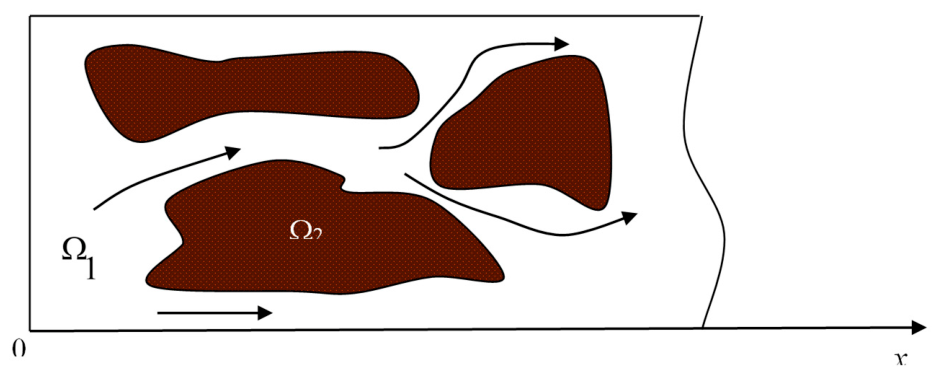
Let us consider a porous medium consisting of two zones: 1) is a zone with porosity , where the pores act as a transit for the liquid - a zone saturated with mobile liquid; 2) is a zone with porosity saturated with immobile liquid (Fig. 1).
The porous medium is considered a semi-infinite, one-dimensional domain, with the zone evenly distributed within the zone.
Figure 1.
A two-zone porous medium: transit pores () and connected, stationary liquid ().
Based on the assumptions made, the model for the problem is as follows [22,23,24]:
where is the substance concentration in the zone, m3 /m3 , v is the filtration velocity, m/s, is the substance concentration in the zone, and is the precipitate concentration in the zone, m3 /m3.
The term in (1) describes the intradiffusional mass transfer from the zone to the zone. To evaluate it, one can use the solution of the diffusion problem for geometric bodies of a certain shape (e.g., cylinders, spheres, etc.) represented as [11]. Here, we use the approach where mass transfer is defined as a first-order kinetic process [19,20]. Thus, the intradiffusional mass exchange is determined by the kinetic equation:
where - const.
The kinetics of precipitate formation is described by a first-order equation
- const .
The system has the following initial and boundary conditions:
We introduce a grid in the domain where T is the maximum value of time over which the process is studied. To do this, we divide the interval with a step of h, and we divide the segment with a step of . As a result, we obtain the following grid:
Equations (1), (2), and (3) are approximated as follows:
By transforming the difference schemes (6) and (7), we obtain the following:
3. Results and Discussion
Some results are presented in Figure 2, Figure 3, Figure 4 and Figure 5. An analysis of the graphs shows that due to the entry of substances into the medium, concentration fields c, N, ρ are formed, which move along the reservoir over time. It can be seen from the graphs that over time, all three fields shift towards the interior of the medium, and their values at fixed points simultaneously increase (Figure 2, Figure 3, Figure 4 and Figure 5).
When , it can be observed that the distribution of the concentration of suspended particles in the liquid has reached the part of the medium where , while at , it has reached (Figure 2.a).
When , the precipitate concentration reaches its maximum value only at the point , starting from the time . At larger time values, it is shown that the precipitate concentration also reaches its maximum value at points close to the point (Figure 3. b).
It can be seen that when the value of the coefficient in equation (2) is decreased , the () and () profiles spread more widely (Figure 3) and their values at fixed points are greater than when . This is explained by the fact that when , the substance exchange with the second medium is significantly reduced (Figure 3.b).
Figure 2.
Profiles of the change in values of c/c0 ( a), N (b), ρ (c) at different points in time, where c -1.
Figure 2.
Profiles of the change in values of c/c0 ( a), N (b), ρ (c) at different points in time, where c -1.
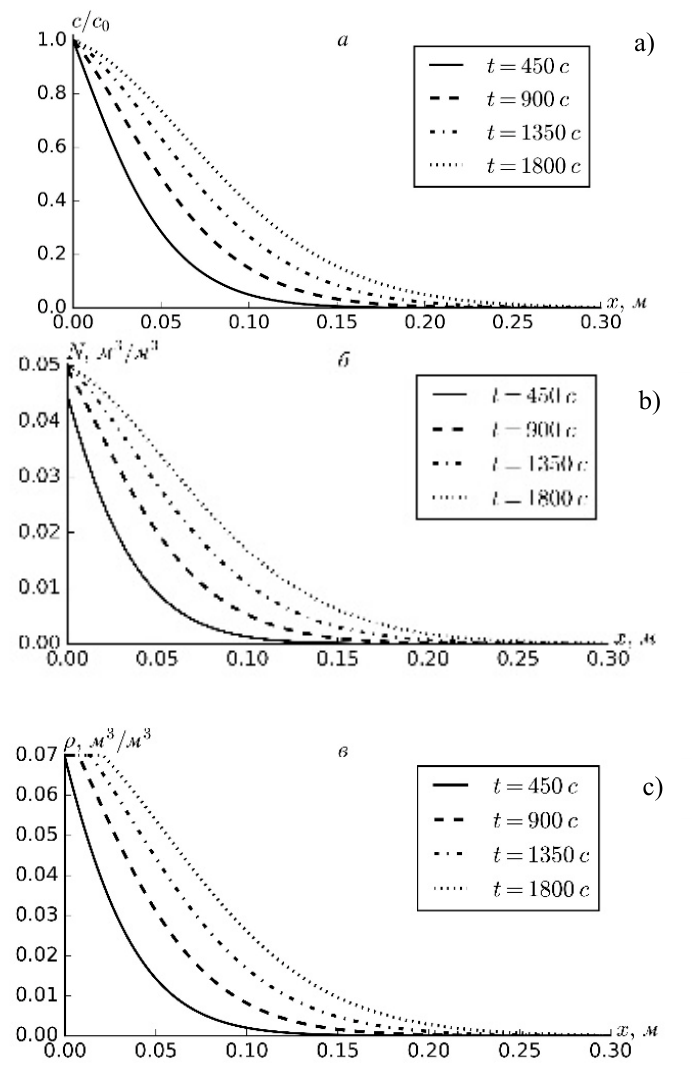
Figure 3.
Profiles of the change in values of c/c0 ( a), N (b), ρ (c) at different points in time, where c -1.
Figure 3.
Profiles of the change in values of c/c0 ( a), N (b), ρ (c) at different points in time, where c -1.
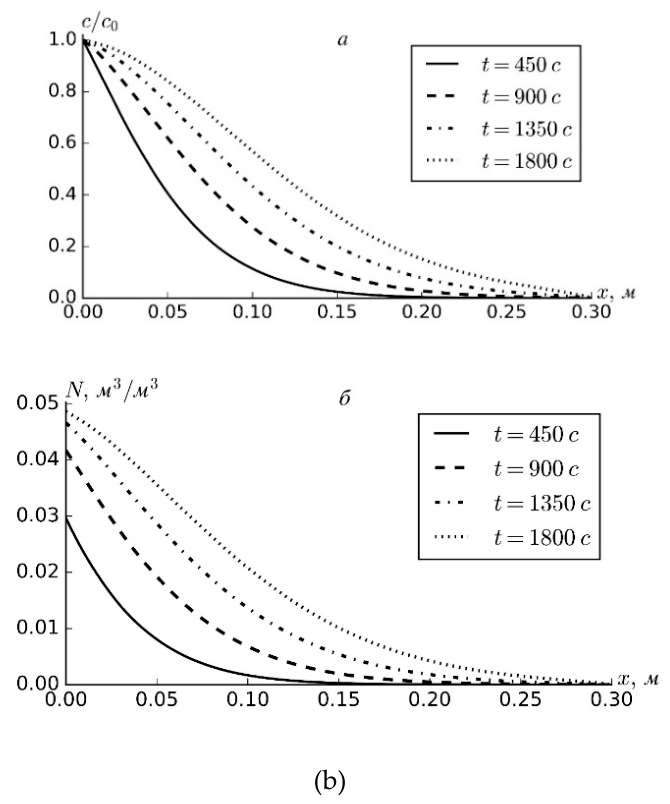
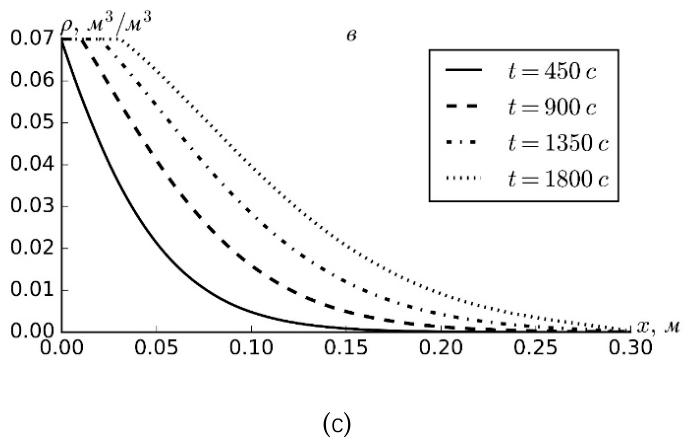
Figure 4.
Profiles of the change in values of c/c0 ( a), N (b), ρ (c) at different points in time, where c -1.
Figure 4.
Profiles of the change in values of c/c0 ( a), N (b), ρ (c) at different points in time, where c -1.
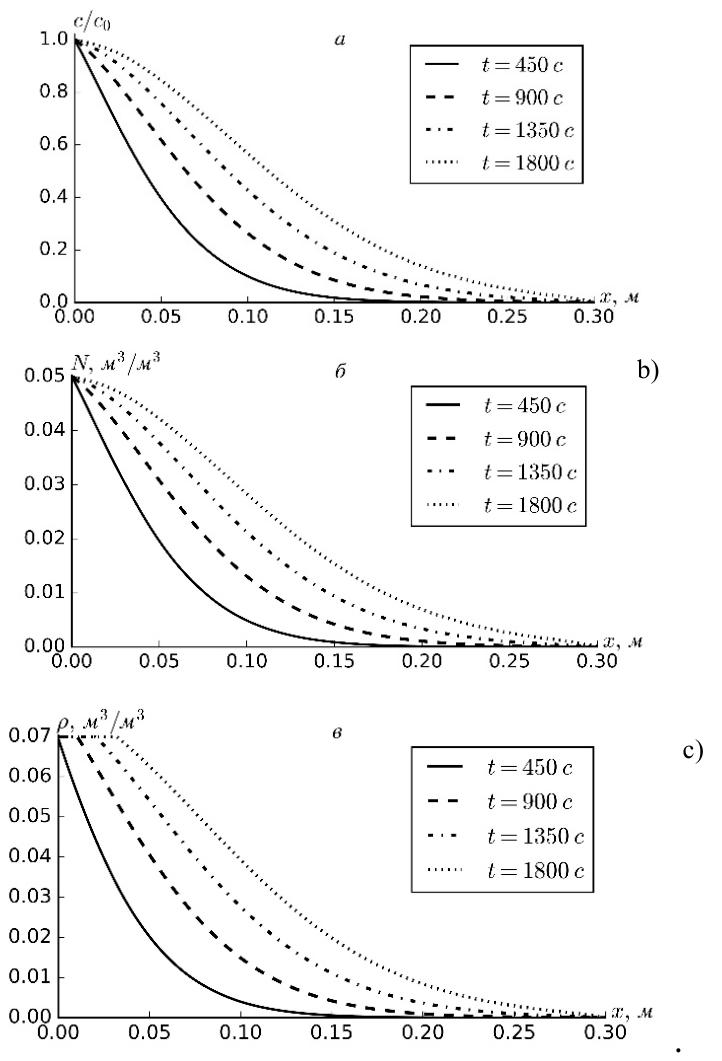
Figure 5.
Profiles of the change in values of c/c0 ( a), N (b), ρ (c) at different values of k, where c.
Figure 5.
Profiles of the change in values of c/c0 ( a), N (b), ρ (c) at different values of k, where c.
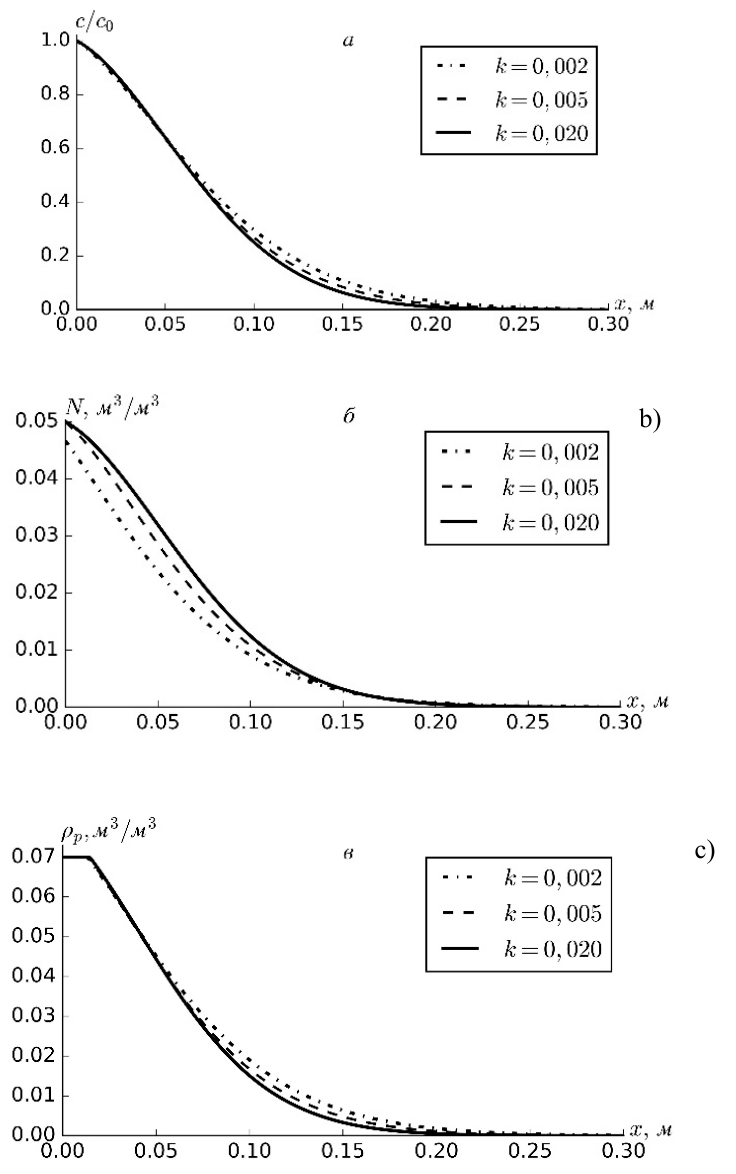
Conversely, when the value of the coefficient is increased to , it can be seen that the profiles () and () spread less (Figure 4), and their values at fixed points are smaller compared to the case where . This is explained by a significant increase in mass transfer with the second medium when (Figure 4.b).
These conclusions are more clearly illustrated in Figure 5, which is provided for comparison at different values of the coefficient .
4. Conclusions
A mathematical model for suspension filtration in a heterogeneous porous medium with a two-zone structure and multi-stage deposition kinetics has been developed and numerically investigated. The model accounts for the principal mechanisms governing the filtration process, including suspended particle transport, particle deposition and sediment accumulation, as well as mass exchange between mobile and immobile fluid zones. The resulting system of governing equations was solved using a finite difference scheme, enabling the spatial and temporal evolution of the filtration process to be analyzed.
The numerical simulations demonstrate that the concentrations of suspended particles, particles in the immobile zone, and accumulated sediment exhibit pronounced spatial and temporal variations during filtration. The intensity of mass exchange between the mobile and immobile zones was found to have a significant effect on the evolution and distribution of these quantities. In particular, reducing the mass transfer coefficient leads to broader concentration profiles and higher concentration values at specified locations, whereas increasing the rate of mass exchange produces more localized concentration distributions and lower concentrations. These results confirm the substantial role of inter-zone mass transfer in determining particle transport and deposition in heterogeneous porous media.
The proposed two-zone model with multi-stage deposition kinetics provides a more comprehensive representation of suspension filtration than conventional single-zone models, particularly for porous media containing regions with significantly different flow characteristics. The model can be applied to the analysis of a range of environmental and engineering processes, including contaminant transport in groundwater, subsurface waste disposal, filtration in heterogeneous formations, and enhanced oil recovery. Further research may extend the proposed framework to multidimensional transport, nonlinear and concentration-dependent kinetic processes, and inverse modeling approaches for the estimation and identification of model parameters.
Conflicts of Interest
The authors declare no conflicts of interest.
References
- Clark, I.; Fritz, P. Environmental Isotopes in Hydrogeology; Lewis Publishers: Boca Raton, 1997. [Google Scholar]
- Fetter, C.W. Contaminant Hydrology, 2nd ed.; Prentice-Hall: Upper Saddle River, NJ, USA, 1999. [Google Scholar]
- Kass, W. Tracing Technique in Geohydrology; A. A. Balkema Publishers: Rotterdam, Netherlands, 1998. [Google Scholar]
- Selim, H.M.; Amacher, M.C. Reactivity and Transport of Heavy Metals in Soils; Lewis Publishers: Boca Raton, FL, 1996. [Google Scholar]
- Surguchev, M.L. Methods of Monitoring and Regulating the Process of Oil Field Development; Nedra: Moscow, 1986. [Google Scholar]
- Bear, J.; Verruijt, A. Modelling Groundwater Flow and Pollution; Reidel: Dordrecht, 1987. [Google Scholar]
- Bear, J. Dynamics of Fluids in Porous Media; Elsevier: New York, 1972. [Google Scholar]
- Clark, M.M. Transport Modelling for Environmental Engineers and Scientists; John Wiley: New York, 1996. [Google Scholar]
- Nikolaevsky, V.N.; Bondarev, E.A.; Mirkin, M.I.; Stepanova, G.S.; Terzi, V.P. Movement of Hydrocarbon Mixtures in a Porous Medium; Nedra: Moscow, 1968. [Google Scholar]
- Coats, K.H.; Smith, B.D. Dead-end pore volume and dispersion in porous media Mass transfer studies in sorbing porous media. In Soc. Pet. Eng. J.;1. Analytical Solution//Soil Sci. Soc. Am. J.; Van Genuchten, M., Wierenga, P.J., Eds.; 1964; Volume No. 4, p. P 73-84 P 473-479. [Google Scholar]
- Rao, P.S.C.; Jessup, R.E.; Addiscott, T.M. Experimental and theoretical aspects of solute diffusion in spherical and nonspherical aggregates. Soil Sci. 1982, 133., 342–349. [Google Scholar] [CrossRef]
- Ravshanov, N.; Kurbonov, N.; Mukhamadiev, A. Int. J. Comput. Methods No. 13 2016, 1650042-1–1650042-10.
- Daliev, S.; Ravshanov, N. Numerical and Mathematical Modeling of Changes in Groundwater Levels in Two-layer Media; 2022; pp. 1–7. [Google Scholar] [CrossRef]
- Ravshanov, N.; Abdullaev, Z.; Aminov, S.; Khafizov, O. Numerical study of fluid filtration in three-layer interacting pressure porous formations E3S Web Conferences. 2021, 264 01018. [Google Scholar] [CrossRef]
- Ravshanov, N.; Shafiyev, T.; Daliev, S. J. Phys. Conf. Ser. 1791, 2021, 012083. [CrossRef]
- Ravshanov, N.; Aminov, S.; Kravets, O. J. Phys. Conf. Ser. 2019, 1399, 055036. [CrossRef]
- Ravshanov, N.; Daliev, S.; Abdullaev, Z.; Khafizov, O. IOP Conf. Ser. Mater. Sci. Eng. 896 2020, 012047, 1–12. [CrossRef]
- Ravshanov, N.; Shadmanov, I.; Kubyashev, K.; Khikmatullayev, S. E3S Web Conf. 2021, 264, 01038. [CrossRef]
- Rao, P.S.C.; Jessup, R.E.; Rolston, D.E.; Davidson, J.M.; Kilcrease, D.P. Experimental and mathematical description of nonadsorbed solute transfer by diffusion in spherical aggregates. Soil Sci. Soc. Am. J. 1980, 44, 684–688. 14. [Google Scholar] [CrossRef]
- De Smedt, F.; Wierenga, P.J. Mass transfer in porous media with immobile water. J. Hydrol. 1979, No. 41, 59–67. [Google Scholar] [CrossRef]
- Bond, W.J.; Wierenga, P.J. Immobile water during solute transport in unsaturated sand columns//Water Resours. Res. 1990, 26, 2475–2481. [Google Scholar] [CrossRef]
- Field, M.S.; Pinsky, P.F. A two region nonequilibrium model for solute transport in solution conduits in karstic aquifers. J. Contam. Hydrol. 2000, 44, 329–351. [Google Scholar] [CrossRef]
- Gamerdinger, A.P.; Wagenet, R.J.; van Genuchten, M.T. Application of two-site/two-region models for studying simultaneous nonequilibrium transport and degradation of pesticides. Soil Sci. Soc. Am. J. 1990, 54, 957–963. [Google Scholar] [CrossRef]
- Gaudet, J.P.; Jégat, H.; Vachaud, G.; Wierenga, P.J. Solute transfer, with exchange between mobile and stagnant water, through unsaturated sand. Soil Sci. Soc. Am. J. 1977, 41, 665–671. [Google Scholar] [CrossRef]
- Samarskii, A.A. The Theory of Difference Schemes; CRC Press: New York, NY, USA, 2001. [Google Scholar]
- Khuzhayorov, B.K.; Saydullaev, U.; Fayziev, B. J. Adv. Res. Fluid Mech. Therm. Sci. 2020, 74, 168–182. [CrossRef]
- Khuzhayorov, B.; Fayziev, B.M.; Begmatov, T.I. AIP Conf. 2022, 2637, 040014. [CrossRef]
- Fayziev, B.; Makhmudov, J.; Mustofoqulov, J.; Begmatov, T.; Safarov, R. WSEAS Trans. Fluid Mech. 2023, 18, 214–220. [CrossRef]
- Makhmudov, J.M.; Usmonov, A.I.; Kuljanov, J.B. Int. J. Appl. Math. 2023, 36, 189–203. [CrossRef]
- Burnashev, V.; Kaytarov, Z.; Tuygunov, J.; Kosimov, O. AIP Conf. Proc. 2024, 3147, 030042. [CrossRef]
- Burnashev, V.; Kaytarov, Z.; Nazarov, U.; Safarov, R. AIP Conf. Proc. 3244, 060039. [CrossRef]
- Kaytarov, Z.; Burnashev, V.; Fayziev, B.; Alwadood, Z.; Jumaev, A.; Khaydarov, O.; Namazov, G. Eng. Technol. Appl. Sci. Res. 2026, 16, 30787–30794.
- Burnashev, V.F.; Nazarov, U.A.; Usmonov, A.I.; Kaytarov, Z.D.; Kholliev, F.B. Int. J. Appl. Math. 2025, 38. [CrossRef]
- Fayziev, B.; Makhmudov, J.; Mustofoqulov, J.; Begmatov, T.; Safarov, R. WSEAS Trans. Fluid Mech. 2023, 18, 214–220. [CrossRef]
Disclaimer/Publisher’s Note: The statements, opinions and data contained in all publications are solely those of the individual author(s) and contributor(s) and not of MDPI and/or the editor(s). MDPI and/or the editor(s) disclaim responsibility for any injury to people or property resulting from any ideas, methods, instructions or products referred to in the content. |
© 2026 by the authors. Licensee MDPI, Basel, Switzerland. This article is an open access article distributed under the terms and conditions of the Creative Commons Attribution (CC BY) license (http://creativecommons.org/licenses/by/4.0/).
Copyright: This open access article is published under a Creative Commons CC BY 4.0 license, which permit the free download, distribution, and reuse, provided that the author and preprint are cited in any reuse.