

Submitted:
09 September 2026
Posted:
11 September 2026
You are already at the latest version
Abstract
Gastric cancer incidence is markedly higher among Korean-born and first-generation Korean migrants than among non-Hispanic white populations in the United States, even after relocation to a lower-incidence Westernized environment. This persistent disparity, sometimes termed the “migrant paradox,” raises the question of why elevated risk does not fully resolve despite changes in geography and lifestyle. Helicobacter pylori infection is the dominant etiologic factor in noncardia gastric carcinogenesis and remains central to most prevention strategies, but infection status alone cannot account for the wide variation in cancer risk observed among populations with comparable H. pylori prevalence. This literature review examines factors beyond H. pylori infection that may help explain why elevated gastric cancer risk persists in Korean diaspora populations after migration. Key factors considered include bacterial virulence factors (cagA and vacA genotypes), host inflammatory-response polymorphisms (including interleukin-1 beta and related cytokine pathways), behavioral exposures (high salt intake, preserved and fermented foods, smoking, and incomplete acculturation), and emerging evidence on gastric microbiome shifts beyond H. pylori alone. Across these domains, the literature suggests that no single factor fully accounts for population-level disparities; rather, gastric cancer risk in Korean migrants reflects the interaction of pre-migration exposures, host susceptibility, and post-migration environmental change. These findings have direct implications for prevention: H. pylori eradication, while effective, works best as the anchor of a risk-stratified approach that also incorporates dietary counseling, smoking cessation, and endoscopic surveillance for premalignant gastric lesions.
Keywords:
gastric cancer
; helicobacter pylori
; Korean immigrants
; Korean Americans
; cancer disparities
; migrant health
; gastric carcinogenesis
; gastric microbiome
; dietary salt
; host genetic susceptibility
; gastric cancer prevention
; endoscopic surveillance
Introduction
Gastric cancer remains a major global health burden, with incidence and mortality distributed unevenly across geographic and ethnic populations. Although overall rates are lower in many Western countries than in East Asia, Asian immigrant populations continue to experience disproportionately high gastric cancer risk compared with non-Hispanic white populations in the United States [1]. This pattern is especially notable among Korean-born and first-generation Korean migrants, whose risk appears to decrease after migration but remains elevated relative to the host population [2]. This “migrant paradox” raises a basic question: if current geography and lifestyle were the main drivers of risk, why would that elevation persist at all?
Helicobacter pylori infection is the primary etiologic factor in noncardia gastric carcinogenesis and remains the central target of most gastric cancer prevention strategies [3]. However, infection status alone cannot account for the persistent disparities seen in migrant populations: cancer risk varies widely even among groups with comparable H. pylori prevalence, and even among individuals infected with strains of similar virulence [4,5]. This review focuses on the non-H. pylori contributors that may help explain why elevated risk persists in Korean-born and first-generation migrants after relocation to a lower-incidence environment. Korean diaspora populations here refer primarily to Korean-born and first-generation migrants in the United States, while recognizing that available studies often use Korean American samples more broadly.
Several lines of evidence point toward non-H. pylori contributors that could explain this persistence. Variation in bacterial virulence factors, such as cagA and vacA genotype, might determine whether infection progresses to severe gastric disease [6,7,8]. Host inflammatory-response polymorphisms, including variants affecting interleukin-1 beta and other cytokine pathways, may further shape susceptibility to hypochlorhydria, atrophic change, and carcinogenesis [9]. Dietary and lifestyle exposures, including high salt intake, preserved or fermented foods, and smoking, may sustain gastric mucosal injury or amplify inflammation after migration, particularly in individuals with prior H. pylori-associated damage [10,11,12]. Incomplete dietary acculturation perhaps also help explain why Korean American risk remains intermediate between native Korean and non-Hispanic white populations [2,4,13]. Emerging evidence also suggests that shifts in the gastric microbiome, shaped by chronic inflammation, diet, and prior infection, may provide a mechanistic bridge linking these earlier exposures to later stages of carcinogenesis [14,15,16]. Although migrant-specific data on virulence, host genetics, and microbiome composition remain limited, together these factors offer a plausible explanation for why early-life and culturally persistent exposures may continue to shape risk well after relocation.
This perspective has implications for prevention: H. pylori eradication should be evaluated as a key factor but should also be ideally combined with risk stratification, dietary modification, and surveillance for premalignant gastric lesions in high-risk migrant populations.
“Migrant Paradox”
Gastric cancer incidence varies substantially across global populations, with the highest burden concentrated in East Asia, including South Korea. In contrast, the United States is generally considered a low-incidence region for gastric cancer. However, this geographic distinction does not fully account for the risk patterns observed among immigrant populations. Asian American populations experience notable gastric cancer disparities compared with non-Hispanic white populations, and Korean Americans have among the highest gastric cancer incidence rates of any racial or ethnic group in the United States [1]. This indicates that gastric cancer risk is shaped not only by current place of residence, but also by country of origin, early-life exposures, and culturally patterned environmental risks.
Studies comparing native Koreans, Korean American immigrants, and non-Hispanic white Americans demonstrate an intermediate-risk pattern that is central to the migrant paradox [2,13]. Korean Americans generally have lower gastric cancer incidence than native Koreans living in South Korea, suggesting that migration and exposure to a Westernized environment may reduce risk over time. At the same time, Korean Americans continue to have substantially higher risk than non-Hispanic white Americans, indicating that migration does not fully erase the elevated risk associated with Korean ancestry or early-life environment [4]. This pattern supports the idea that gastric cancer risk is partially modified by post-migration lifestyle changes but remains influenced by pre-migration exposures and persistent cultural practices.
If risk were determined solely by current geography, rates among migrants would be expected to converge more rapidly with those of the host population. Instead, this intermediate-risk pattern points to a layered model of carcinogenesis in which early-life exposures, long-standing dietary habits, host susceptibility, and infection-related gastric injury can continue to influence cancer risk after migration. This is particularly relevant for Korean migrants, who may have experienced childhood exposure to Helicobacter pylori, high-salt or preserved foods, or other environmental risks before relocation. Risk, in other words, is neither completely fixed by ancestry nor completely erased by migration but rather reflects an interaction between pre-migration exposures and post-migration environmental changes that occur after migration. This epidemiologic pattern creates the foundation for examining why H. pylori, although central to gastric carcinogenesis, is insufficient to singularly explain persistent gastric cancer risk in Korean diaspora populations.
H. pylori as Central, But Incomplete, Explanation
Helicobacter pylori remains the most important established risk factor for noncardia gastric cancer and is central to most models of gastric carcinogenesis. Chronic infection can persist for decades and initiate a sequence of gastric mucosal injury beginning with chronic active gastritis and progressing in some individuals to atrophic gastritis, intestinal metaplasia, dysplasia, and eventually adenocarcinoma [3]. Through persistent inflammation, epithelial injury, altered acid secretion, oxidative stress, and disruption of host signaling pathways, H. pylori creates a gastric environment promoting malignant transformation over time [3]. Because of this strong causal relationship, H. pylori has become a major target for gastric cancer prevention, particularly in high-incidence regions and high-risk groups.
The importance of H. pylori is further supported by studies showing that eradication as treatment can reduce gastric cancer incidence [17,18], making it one of the few modifiable causes of gastric cancer. In high-risk populations, eradication likely interrupts ongoing inflammation and reduces progression to cancer, especially when treatment occurs before advanced premalignant changes have developed. For this reason, screening and eradication strategies are increasingly discussed as preventive tools for populations with elevated gastric cancer risk.
However, infection alone does not fully explain population-level differences in gastric cancer incidence. Many individuals infected with H. pylori never develop gastric cancer, while some populations with high infection prevalence have comparatively low cancer rates [5]. Gastric cancer incidence also varies among Asian populations with overlapping or similarly high H. pylori prevalence, indicating that other modifiers must influence whether chronic infection progresses to malignancy.
For Korean migrants, this distinction is especially important. Korean migrants show persistent but altered risk after migration, indicating that H. pylori interacts with additional factors acquired before and after migration. These may include bacterial virulence factors [6,7,8], host inflammatory susceptibility [9,19,20], early-life dietary exposures including salt-preserved food intake [10,12,21,22], smoking [11], and changes in the gastric microbiome [14,15,16]. Its incomplete explanatory power is therefore not a weakness in the literature so much as a signal that gastric carcinogenesis in this population is multicausal, a claim the next four sections test in turn.
Bacterial Virulence Factors
Bacterial virulence factors potentially explain why H. pylori infection progresses to severe gastric disease in some individuals but not others. Two of the most studied virulence markers are cytotoxin-associated gene A (cagA) and vacuolating cytotoxin A (vacA). cagA-positive strains are affiliated with greater gastric inflammation and epithelial injury, while variation in vacA genotypes may influence cytotoxic activity and disease severity. These findings suggest that the carcinogenic potential of H. pylori depends not only on infection status, but also on the virulence profile of the infecting strain [6,7].
Nonetheless, the role of bacterial genotype in explaining population-level gastric cancer disparities remains debated. The “Asian enigma” literature shows that high H. pylori prevalence does not always correspond to high gastric cancer incidence, implying that bacterial infection or strain type alone cannot explain regional differences in disease burden. Host genetic background, diet, and environmental factors have been proposed as major contributors to this discrepancy [5]. Differences in cagA and vacA genotypes across Asian populations have also been documented, but bacterial strain variation is presented as only one possible explanation rather than a complete account of regional cancer differences [8].
This distinction is critical in East Asian and Korean populations, where cagA-positive strains are highly prevalent enough that cagA status alone has limited ability to distinguish who will develop gastric cancer [7,8]. In populations where cagA-positive strains are already the norm rather than the exception, testing for virulence genotype adds little discriminatory value on its own. Strain typing could therefore be more useful as a contributor to a combined risk score than as a standalone predictor of which Korean migrants will progress to gastric cancer [6,7,8].
Host Genetics and Inflammatory Response
Host genetic background may also contribute to differences in gastric cancer risk across populations. Although H. pylori is a central initiating factor in many cases of noncardia gastric cancer, the host inflammatory response helps determine whether chronic infection progresses toward atrophic gastritis, intestinal metaplasia, dysplasia, and malignancy. Significantly, individuals exposed to the same pathogen may develop different gastric outcomes depending on how strongly their immune system responds to infection. In this way, inflammatory-response polymorphisms may help explain why some H. pylori-infected individuals develop gastric cancer while many others do not [9,19].
Interleukin-1 beta (IL-1β) has received particular attention because it is both a pro-inflammatory cytokine and a potent inhibitor of gastric acid secretion. El-Omar et al. reported that interleukin-1 gene cluster polymorphisms associated with increased IL-1β production were linked to both H. pylori-induced hypochlorhydria and increased gastric cancer risk [20]. This mechanism is biologically plausible because reduced gastric acid secretion can promote corpus-predominant gastritis, gastric atrophy, and changes in the gastric environment that favor carcinogenesis. Therefore, IL-1β polymorphisms provide a likely link between host genetic susceptibility, altered gastric physiology, and progression of H. pylori-associated injury.
Additional inflammatory-response genes might also influence gastric cancer susceptibility. In a later study, El-Omar et al. found that a broader proinflammatory cytokine genetic profile involving IL-1B, IL-1RN, IL-10, and TNF-A was associated with increased risk of noncardia gastric adenocarcinoma [9]. These findings suggest that gastric cancer risk is possibly shaped by the combined effects of multiple immune-regulatory pathways rather than by a single polymorphism alone. A host profile that promotes stronger or prolonged inflammation may increase the likelihood that chronic H. pylori infection leads to hypochlorhydria, atrophic change, and malignant transformation.
Persson et al. reviewed polymorphisms in inflammatory-response genes, including IL1B, IL1RN, IL8, IL10, and TNFA, and found evidence supporting inflammatory pathways as contributors to gastric cancer risk while also highlighting the complexity of gene-environment interactions [19]. This suggests that host genetics may be most useful for understanding risk when considered alongside H. pylori status, bacterial virulence, dietary exposures, smoking, and premalignant gastric changes.
For Korean diaspora populations, host inflammatory susceptibility provides a possible explanation for why elevated risk may persist after migration, potentially shaping how early-life infection, high-salt dietary exposure, and chronic inflammation affect the gastric mucosa over time. Whether Korean diaspora populations carry IL-1β or broader proinflammatory genotypes at frequencies that differ from the host population remains understudied. Given the established role of these variants in East Asian gastric cancer cohorts, this is a plausible contributor to the persistent risk gap observed after migration. Unlike H. pylori status or dietary salt intake, inflammatory genotype is not something migrants or clinicians can modify directly. Its value may lie in future risk stratification when interpreted alongside modifiable exposures, family history, premalignant lesions, and existing screening recommendations [9,19,20,23,24].
Dietary and Behavioral Exposures
Dietary and lifestyle exposures provide an important explanation for why gastric cancer risk may persist among Korean-born and first-generation migrants despite relocation to a Westernized host environment. Although migration can alter food availability, health behaviors, and environmental exposures, dietary acculturation is often incomplete. As a result, migrants often adopt some Western dietary patterns while continuing to consume culturally familiar foods, including high-salt, fermented, pickled, preserved, or smoked foods. This is relevant to Korean diaspora populations because traditional Korean dietary patterns have historically included salt-preserved vegetables, fermented foods, soups, stews, and condiments that contribute to high sodium exposure. Thus, post-migration diet may reduce gastric cancer risk relative to native Koreans in South Korea, without fully eliminating risk relative to lower-risk host populations.
Salt intake is one of the most consistently discussed dietary risk factors for gastric cancer. Meta-analyses of prospective and observational studies have reported positive associations between high habitual salt intake and gastric cancer risk [10,21,22]. Mechanistically, high salt exposure contributes to damage of the gastric mucosal barrier, increases epithelial injury, and promotes chronic inflammation. In individuals with current or prior H. pylori infection, high salt intake may further amplify gastric injury by worsening inflammation and facilitating progression toward atrophic gastritis or intestinal metaplasia. This suggests salt functions less as a standalone risk factor and more as a modifier that amplifies infection-related carcinogenesis.
Preserved and pickled foods are suspected to also contribute to persistent risk, although this relationship should be interpreted carefully. Some Korean dietary studies and meta-analyses have associated high intake of salt-preserved foods or kimchi with increased gastric cancer risk, likely due in part to sodium content and preservation-related compounds [10,12]. However, the evidence on kimchi specifically is heterogeneous: studies vary in how kimchi consumption is measured, which preparation methods are captured, and whether sodium content is adjusted for independently.
Fermented foods are not uniformly harmful, and kimchi contains vegetables, fiber, and microbial components that may have beneficial effects in other contexts. The concern, then, is not fermentation itself, but high sodium concentration, frequency of consumption, preservation method, and the broader dietary pattern surrounding these foods. For Korean migrants, continued consumption of high-salt traditional foods represents one probable way that pre-migration dietary patterns persist after relocation.
Smoking is another important environmental and behavioral risk factor. Cigarette smoking has been associated with increased gastric cancer risk in dose-response meta-analyses, with risk varying by smoking status, intensity, duration, and time since cessation [11]. Smoking may contribute to gastric carcinogenesis through oxidative stress, impaired mucosal defense, chronic inflammation, and interaction with other carcinogenic exposures. In migrant populations, smoking behavior might change after migration depending on socioeconomic status, gender norms, stress, acculturation, and access to preventive care. Smoking should accordingly be considered alongside diet and infection status when evaluating persistent gastric cancer disparities.
Acculturation helps explain why diet and behavior remain plausible contributors to the intermediate-risk pattern described earlier: dietary habits and smoking behavior often change more slowly and unevenly than other aspects of post-migration life, allowing high-salt, preserved food, and smoking exposures to persist well after relocation [2,4,13].
Important gaps remain in understanding how diet and acculturation shape gastric cancer risk among Korean diaspora populations. Many studies identify salt, preserved foods, and smoking as risk factors, but fewer directly measure how dietary patterns change after migration or how these changes interact with H. pylori infection, premalignant gastric lesions, host inflammatory susceptibility, and length of residence in the host country. Of all the factors discussed in this review, dietary and behavioral exposures are also the most directly modifiable, making sodium reduction and smoking cessation among the few prevention strategies available to migrants independent of medical intervention.
Gastric Microbiome Shifts
Gastric microbiome shifts provide an emerging explanation for how infection, diet, inflammation, and persistent cancer risk may be connected. Historically, the stomach was considered a relatively inhospitable environment for microbial growth because of gastric acidity. However, newer sequencing-based studies have shown that the stomach contains a more complex microbial community than previously recognized. While H. pylori remains the dominant microbial risk factor for noncardia gastric cancer, non-H. pylori bacteria likely contribute too, by shaping inflammation, metabolism, and epithelial injury [14,15,16].
The gastric microbiome may evolve across the progression from chronic gastritis to atrophic gastritis, intestinal metaplasia, dysplasia, and gastric cancer. As chronic H. pylori infection promotes inflammation and gastric atrophy, reduced acid secretion can create a less acidic gastric environment that allows other microbial communities to colonize or expand. These shifts likely add to carcinogenesis through persistent inflammation, carcinogenic metabolite production, nitrosation, and oxidative stress. In this way, the microbiome acts as a bridge between earlier H. pylori-associated injury and later stages of the gastric cancer cascade [14,15,16].
For Korean migrants, this matters because many acquired H. pylori infection, high-salt diets, or chronic gastritis in childhood, before relocation. Even if migration changes later diet or environment, prior mucosal injury and altered gastric physiology can have lasting effects on the gastric microbial ecosystem. Continued consumption of high-salt or preserved foods may also influence the gastric environment after migration, potentially sustaining inflammatory or dysbiotic conditions that contribute to cancer risk [14,15,16].
The microbiome explanation is plausible, not proven. Most studies look at gastric carcinogenesis broadly, and a few look at Korean diaspora populations specifically. It remains unclear, then, whether Korean migrants have distinctive gastric microbiome patterns related to birthplace, age at migration, dietary acculturation, H. pylori status, or premalignant lesions. This research gap on microbiome changes could help explain why risk persists after migration, but current evidence is not yet strong enough to establish a migrant-specific causal pathway.
H. pylori eradication itself would reasonably alter the gastric microbial environment. By resolving the chronic inflammation that suppresses acid secretion, eradication could partially restore conditions that limit non-H. pylori dysbiosis, though whether this translates into durable microbiome normalization in patients with established premalignant lesions remains unclear [14,15,16]. Eradication resolves the trigger, without necessarily resetting the microbial environment it leaves behind.
Prevention Implications
The persistence of elevated gastric cancer risk among Korean-born and first-generation migrants has important prevention implications. Because H. pylori remains the strongest modifiable risk factor for noncardia gastric cancer, testing and eradication remain central to primary prevention. Meta-analyses have found that H. pylori eradication is associated with reduced gastric cancer incidence, particularly in East Asian populations and other high-risk groups [17,18] [Figure 1a]. Habitual high salt intake and current or former smoking similarly show dose-dependent associations with elevated risk [Figure 1b,c], reinforcing diet and behavior as compounding, modifiable contributors alongside infection. These modifiable factors are critical for Korean migrants, who may have acquired H. pylori infection during childhood in a high-prevalence environment before migration.
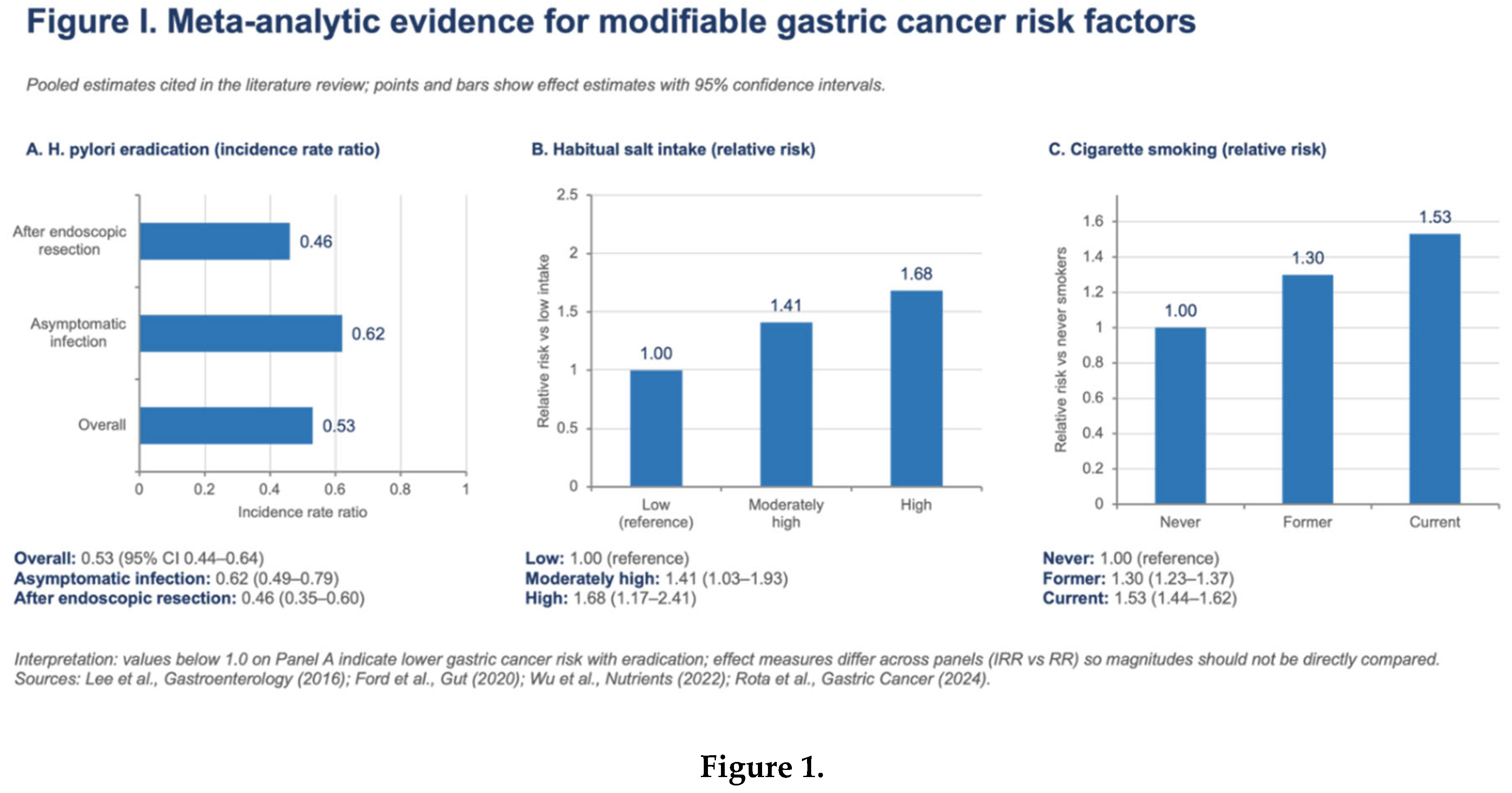
Eradication should not be viewed as eliminating all future risk. A major limitation of an eradication-only approach is that gastric cancer risk can persist in individuals who already have premalignant gastric changes, including atrophic gastritis, intestinal metaplasia, or dysplasia. The benefit of eradication appears greatest before advanced premalignant lesions have developed, while individuals with established mucosal injury may require ongoing surveillance. In a South Korean randomized trial of H. pylori-positive individuals with a first-degree family history of gastric cancer, eradication reduced gastric cancer risk, supporting its role in high-risk prevention while also highlighting the importance of identifying susceptible groups [25].
Prevention in high-risk migrant populations should accordingly include both primary and secondary components. Primary prevention involves identifying and eradicating H. pylori, while secondary prevention involves endoscopic screening and surveillance for premalignant gastric lesions. Recent American Gastroenterological Association guidance identifies first-generation immigrants from high-incidence gastric cancer regions as an increased-risk group who may benefit from gastric cancer screening and surveillance [23]. Endoscopy is vital because it allows direct visualization, biopsy, histologic staging, and detection of premalignant changes that cannot be identified through infection testing alone. In patients with gastric intestinal metaplasia, AGA guidelines also recommend testing for H. pylori followed by eradication, further supporting the integration of infection management with lesion-based risk assessment [24].
Dietary and behavioral prevention should also be incorporated because gastric cancer risk in migrant populations is likely shaped by more than infection status alone. As noted above, kimchi’s risk profile demonstrates association with sodium content and preparation rather than fermentation itself [12]. These modifiable exposures are relevant to Korean diaspora populations because migration changes some health behaviors while culturally familiar dietary practices may persist [10,11,12,21,22].
Prevention strategies should therefore be risk-stratified rather than uniform. For Korean-born and first-generation migrants, risk assessment bears considering country of origin, age at migration, duration of residence, family history, H. pylori status, prior eradication history, presence of atrophic gastritis or intestinal metaplasia, smoking status, and high-salt dietary exposure. This approach differs from an infection-only model because it recognizes that two individuals with the same H. pylori status may have different levels of residual risk depending on premalignant histology, family history, and environmental exposures.
Several prevention-related research gaps remain. Although guidelines increasingly recognize immigrants from high-incidence regions as higher-risk groups, limited evidence exists on the best screening age, screening interval, and surveillance strategy for Korean migrants living in low-incidence Western settings. More research is also needed to determine how much risk is reduced by dietary acculturation, sodium reduction, smoking cessation, and culturally tailored prevention programs after migration. Future studies must evaluate whether combining H. pylori eradication with endoscopic screening, dietary counseling, and individualized risk stratification reduces gastric cancer disparities more effectively than eradication alone.
Conclusions
Helicobacter pylori remains the dominant and most actionable risk factor, but the migrant paradox (an intermediate risk, between native Korean and non-Hispanic white populations, not fully converging with either) signals that infection is operating alongside other, longer-acting influences. Bacterial virulence genotype, host inflammatory polymorphisms, dietary and behavioral exposures, and gastric microbiome composition each add explanatory value, yet none independently accounts for the disparity. Instead, the evidence points to a layered process in which early-life infection and dietary exposure establish a foundation of risk, host genetics determines how that exposure is processed, and post-migration diet, smoking behavior, and microbial remodeling determine how much of that risk is sustained or attenuated over time [Figure 2].
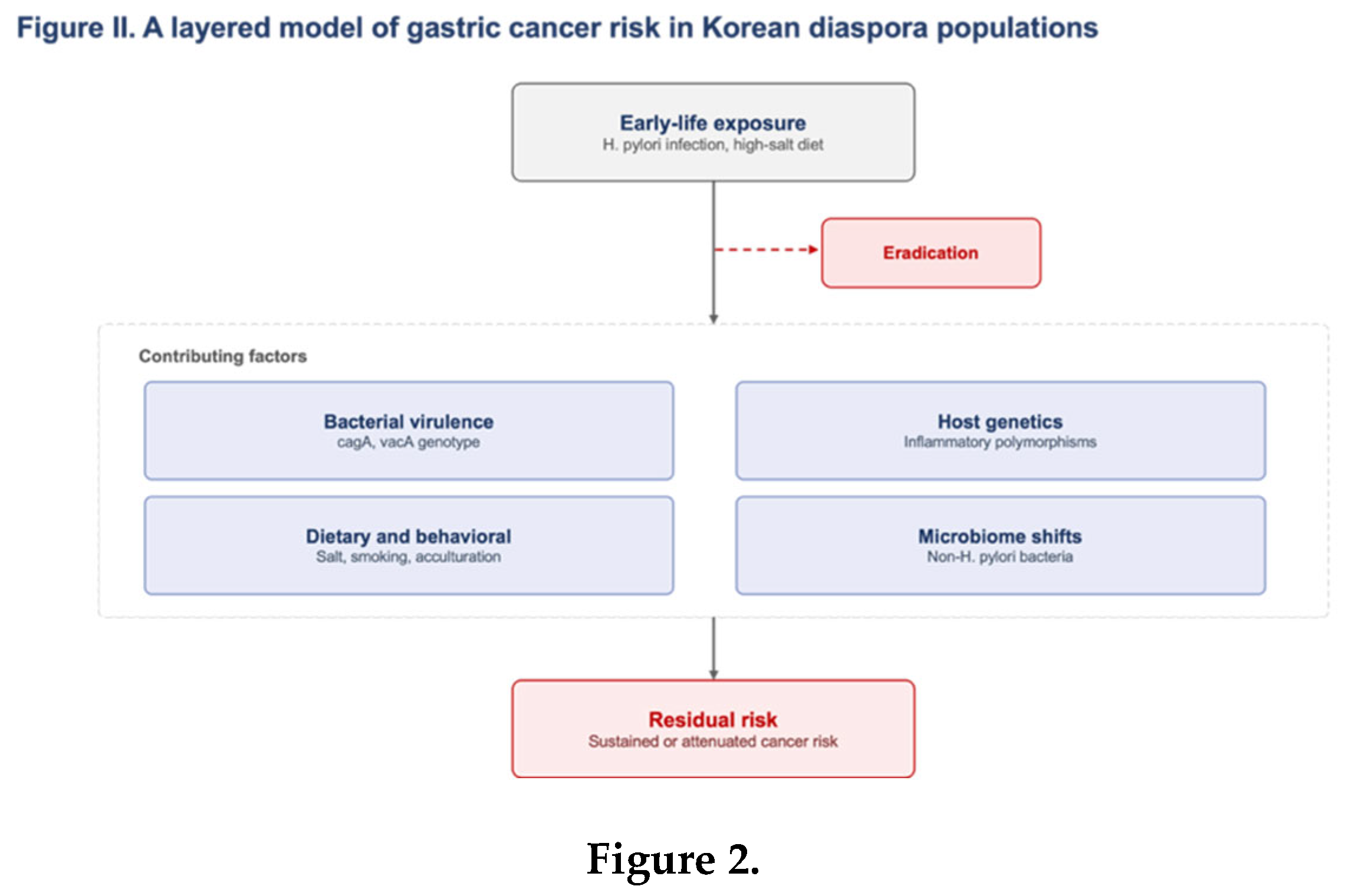
This carries direct implications for future prevention strategies. H. pylori eradication remains the single most effective intervention available and should continue to lead prevention efforts, particularly when delivered before premalignant changes develop. Eradication alone, however, leaves residual risk unaddressed in migrants who already carry atrophic gastritis, intestinal metaplasia, high-salt dietary habits, smoking history, or a family history of gastric cancer. Positioning eradication as the anchor of prevention, rather than its endpoint, better matches both the epidemiologic pattern and the mechanistic evidence reviewed here. In practice, this means pairing infection testing and treatment with dietary counseling on sodium and preserved-food intake, smoking cessation support, and endoscopic surveillance for those already showing premalignant histology.
Substantial investigative gaps remain. Most of the mechanistic evidence reviewed, including virulence genotype distribution, inflammatory polymorphism frequency, and microbiome composition, comes from studies of East Asian or general gastric cancer populations rather than from Korean diaspora cohorts specifically. Few studies directly track how dietary acculturation, length of residence, or age at migration modify these biological factors after relocation. Future research should prioritize migrant-specific cohorts that jointly measure H. pylori strain virulence, host genotype, dietary pattern change, and microbiome composition over time, since this integration is what current single-factor studies cannot provide. Until that data exists, the practical takeaway is narrower: treat H. pylori eradication as the starting point, not the finish line, and pair it with surveillance for anyone who already shows premalignant changes.
Conflicts of Interest
The authors declare no potential conflicts of interest.
References
- Taylor, V.M.; Ko, L.K.; Hwang, J.H.; Sin, M.K.; Inadomi, J.M. Gastric Cancer in Asian American Populations: a Neglected Health Disparity. Asian Pac. J. Cancer Prev. 2014, 15(24), 10565–71. [Google Scholar] [CrossRef] [PubMed]
- Lee, J.; Demissie, K.; Lu, S.E.; Rhoads, G.G. Cancer Incidence among Korean-American Immigrants in the United States and Native Koreans in South Korea. Cancer Control 2007, 14(1), 78–85. [Google Scholar] [CrossRef] [PubMed]
- Sue, S.; Shibata, W.; Maeda, S. Helicobacter pylori -Induced Signaling Pathways Contribute to Intestinal Metaplasia and Gastric Carcinogenesis. BioMed Res. Int. 2015, 2015, 1–9. [Google Scholar] [CrossRef] [PubMed]
- Kim, Y.; Park, J.; Nam, B.H.; Ki, M. Stomach cancer incidence rates among Americans, Asian Americans and Native Asians from 1988 to 2011. Epidemiol. Health 2015, 37, e2015006. [Google Scholar] [CrossRef] [PubMed]
- Singh, K. Causal role of Helicobacter pylori infection in gastric cancer: An Asian enigma. World J. Gastroenterol. 2006, 12(9), 1346. [Google Scholar] [CrossRef] [PubMed]
- Toh, J.W.T.; Wilson, R.B. Pathways of Gastric Carcinogenesis, Helicobacter pylori Virulence and Interactions with Antioxidant Systems, Vitamin C and Phytochemicals. Int. J. Mol. Sci. 2020, 21(17), 6451. [Google Scholar] [CrossRef] [PubMed]
- Jones, K.R.; Whitmire, J.M.; Merrell, D.S. A Tale of Two Toxins: Helicobacter Pylori CagA and VacA Modulate Host Pathways that Impact Disease. Front Microbiol. 2010, 1. [Google Scholar] [CrossRef] [PubMed]
- Fock, K.M.; Ang, T.L. Epidemiology of Helicobacter pylori infection and gastric cancer in Asia. J. Gastroenterol. Hepatol. 2010, 25(3), 479–86. [Google Scholar] [CrossRef] [PubMed]
- El-Omar, E.M.; Rabkin, C.S.; Gammon, M.D.; Vaughan, T.L.; Risch, H.A.; Schoenberg, J.B.; et al. Increased risk of noncardia gastric cancer associated with proinflammatory cytokine gene polymorphisms. Gastroenterology 2003, 124(5), 1193–201. [Google Scholar] [CrossRef] [PubMed]
- Wu, X.; Chen, L.; Cheng, J.; Qian, J.; Fang, Z.; Wu, J. Effect of Dietary Salt Intake on Risk of Gastric Cancer: A Systematic Review and Meta-Analysis of Case-Control Studies. Nutrients 2022, 14(20), 4260. [Google Scholar] [CrossRef] [PubMed]
- Rota, M.; Possenti, I.; Valsassina, V.; Santucci, C.; Bagnardi, V.; Corrao, G.; et al. Dose–response association between cigarette smoking and gastric cancer risk: a systematic review and meta-analysis. Gastric Cancer 2024, 27(2), 197–209. [Google Scholar] [CrossRef] [PubMed]
- Woo, H.D.; Park, S.; Oh, K.; Kim, H.J.; Shin, H.R.; Moon, H.K.; et al. Diet and Cancer Risk in the Korean Population: A Meta-analysis. Asian Pac. J. Cancer Prev. 2014, 15(19), 8509–19. [Google Scholar] [CrossRef] [PubMed]
- Lee, E.; Liu, L.; Zhang, J.; Stern, M.C.; Barzi, A.; Hwang, A.; et al. Stomach Cancer Disparity among Korean Americans by Tumor Characteristics: Comparison with Non-Hispanic Whites, Japanese Americans, South Koreans, and Japanese. Cancer Epidemiol. Biomark. Prev. 2017, 26(4), 587–96. [Google Scholar] [CrossRef] [PubMed]
- Wen, J.; Lau, H.C.H.; Peppelenbosch, M.; Yu, J. Gastric Microbiota beyond H. pylori: An Emerging Critical Character in Gastric Carcinogenesis. Biomedicines 2021, 9(11), 1680. [Google Scholar] [CrossRef] [PubMed]
- Stewart, O.A.; Wu, F.; Chen, Y. The role of gastric microbiota in gastric cancer. Gut Microbes 2020, 11(5), 1220–30. [Google Scholar] [CrossRef] [PubMed]
- Liatsos, C.; Papaefthymiou, A.; Kyriakos, N.; Galanopoulos, M.; Doulberis, M.; Giakoumis, M.; et al. Helicobacter pylori, gastric microbiota and gastric cancer relationship: Unrolling the tangle. World J. Gastrointest. Oncol. 2022, 14(5), 959–72. [Google Scholar] [CrossRef] [PubMed]
- Lee, Y.C.; Chiang, T.H.; Chou, C.K.; Tu, Y.K.; Liao, W.C.; Wu, M.S.; et al. Association Between Helicobacter pylori Eradication and Gastric Cancer Incidence: A Systematic Review and Meta-analysis. Gastroenterology 2016, 150(5), 1113–1124.e5. [Google Scholar] [CrossRef] [PubMed]
- Ford, A.C.; Yuan, Y.; Moayyedi, P. Helicobacter pylori eradication therapy to prevent gastric cancer: systematic review and meta-analysis. Gut 2020, 69(12), 2113–21. [Google Scholar] [CrossRef] [PubMed]
- Persson, C.; Canedo, P.; Machado, J.C.; El-Omar, E.M.; Forman, D. Polymorphisms in Inflammatory Response Genes and Their Association With Gastric Cancer: A HuGE Systematic Review and Meta-Analyses. Am. J. Epidemiol. 2011, 173(3), 259–70. [Google Scholar] [CrossRef] [PubMed]
- El-Omar, E.M.; Carrington, M.; Chow, W.H.; McColl, K.E.L.; Bream, J.H.; Young, H.A.; et al. Interleukin-1 polymorphisms associated with increased risk of gastric cancer. Nature 2000, 404(6776), 398–402. [Google Scholar] [CrossRef] [PubMed]
- Ge, S.; Feng, X.; Shen, L.; Wei, Z.; Zhu, Q.; Sun, J. Association between Habitual Dietary Salt Intake and Risk of Gastric Cancer: A Systematic Review of Observational Studies. Gastroenterol. Res. Pract. 2012, 2012, 1–11. [Google Scholar] [CrossRef] [PubMed]
- D’Elia, L.; Rossi, G.; Ippolito, R.; Cappuccio, F.P.; Strazzullo, P. Habitual salt intake and risk of gastric cancer: A meta-analysis of prospective studies. Clin. Nutr. 2012, 31(4), 489–98. [Google Scholar] [CrossRef] [PubMed]
- Shah, S.C.; Wang, A.Y.; Wallace, M.B.; Hwang, J.H. AGA Clinical Practice Update on Screening and Surveillance in Individuals at Increased Risk for Gastric Cancer in the United States: Expert Review. Gastroenterology 2025, 168(2), 405–416.e1. [Google Scholar] [CrossRef] [PubMed]
- Gupta, S.; Li, D.; El Serag, H.B.; Davitkov, P.; Altayar, O.; Sultan, S.; et al. AGA Clinical Practice Guidelines on Management of Gastric Intestinal Metaplasia. Gastroenterology 2020, 158(3), 693–702. [Google Scholar] [CrossRef] [PubMed]
- Choi, I.J.; Kim, C.G.; Lee, J.Y.; Kim, Y.I.; Kook, M.C.; Park, B.; et al. Family History of Gastric Cancer and Helicobacter pylori Treatment. N Engl. J. Med. 2020, 382(5), 427–36. [Google Scholar] [CrossRef] [PubMed]
Disclaimer/Publisher’s Note: The statements, opinions and data contained in all publications are solely those of the individual author(s) and contributor(s) and not of MDPI and/or the editor(s). MDPI and/or the editor(s) disclaim responsibility for any injury to people or property resulting from any ideas, methods, instructions or products referred to in the content. |
© 2026 by the authors. Licensee MDPI, Basel, Switzerland. This article is an open access article distributed under the terms and conditions of the Creative Commons Attribution (CC BY) license (http://creativecommons.org/licenses/by/4.0/).
Copyright: This open access article is published under a Creative Commons CC BY 4.0 license, which permit the free download, distribution, and reuse, provided that the author and preprint are cited in any reuse.