

Submitted:
09 September 2026
Posted:
10 September 2026
You are already at the latest version
Abstract
Plastic waste co-processing in cement kilns is expanding in settings where independent emissions and health monitoring remain limited. This study examines community-reported concerns regarding possible cement-kiln plastic co-processing and associated environmental-health conditions in Obajana, Kogi State, Nigeria. A comparative cross-sectional survey and participatory exposure mapping were conducted from September to October 2023 among 616 participants: 313 in a community adjacent to the cement plant and 303 in a comparison community approximately 15 km away. Reported symptom prevalence was higher in Obajana for upper-respiratory symptoms (41% vs. 13%), dermatological symptoms (27% vs. 7%), and ocular symptoms (33% vs. 12%). Residents also described visible smoke plumes, particulate fallout, and ash-like deposition on household surfaces and water-storage containers. The study did not independently verify the facility’s waste feed or operating conditions and lacked site-specific pollutant measurements, clinical verification, individual-level exposure data, and adjustment for potential confounding. The findings therefore do not establish causation, source at- tribution, or the agents responsible; they constitute a community-level signal warranting independent environmental monitoring and more rigorous epidemiological investigation. The paper proposes a Grassroots-Informed Risk Assessment Framework that integrates community testimony, rapid expo- sure appraisal, participatory mapping, symptom screening, vulnerability assessment, precautionary risk characterization, and policy translation in data-scarce settings.
Keywords:
plastic waste co-processing
; cement kiln emissions
; community-based environmental health
; grassroots risk assessment
; environmental justice
1. Introduction
Plastic pollution is increasingly recognized as a major global environmental health challenge, extending beyond visible waste accumulation to include risks across the plastics life cycle. Plastic combustion and other thermal treatment pathways can release particulate matter, volatile organic compounds (VOCs), polycyclic aromatic hydrocarbons (PAHs), persistent organic pollutants (POPs), and metals. Microplastic contamination, by contrast, is more appropriately associated with fragmentation, handling, transport, and fugitive dust than with the routine stack gas of a correctly operated high-temperature cement kiln [1,2]. Cement kilns have become a prominent destination for plastic waste under waste-to-energy and alternative-fuel strategies. Although their high operating temperatures and gas residence times promote thermal decomposition of polymers and organic additives, field and laboratory studies show that waste co-processing can still produce or release several pollutant classes. These include fine and submicron particulate matter generated during co-processing [3]; aromatic and oxygenated VOCs, including benzene and acrolein, measured in stack gas [4]; unintentionally produced POPs, including PCDD/Fs, that may form in cooler downstream zones such as preheaters, humidification systems, and bag filters [5,6]; and volatile or semi-volatile metals, including mercury, lead, cadmium, nickel, and arsenic [7]. Bench-scale co-processing experiments have also measured PCDD/Fs, heavy metals, and hydrogen chloride under varying waste-feed and operating conditions [8].
Accordingly, intact microplastics, phthalates, and bisphenols should not be described as routine products of kiln stack combustion. Plastic polymers and organic additives are expected to thermally decompose under standard kiln conditions; the principal concern is their transformation into smaller combustion products, including VOCs and PAHs, particularly during transient or incomplete-combustion conditions [1,4]. Microplastic exposure around a facility may instead arise from ambient dust and mechanical losses during material handling, storage, and transport, and therefore requires separate environmental measurement [1]. Stack and fugitive emissions can disperse over residential areas through prevailing winds, consistent with community observations of smoke plumes and particulate deposition. Residents may consequently inhale airborne particles and gaseous pollutants during daily activities; short-term and long-term exposure to particulate matter and combustion-related gases is associated with adverse respiratory and cardiovascular effects [9].
In addition, community-reported ash and dust accumulation on rooftops, courtyards, and open water containers constitutes a site-specific exposure indicator that requires confirmation through air, deposited-dust, and water sampling. Deposited pollution on household surfaces and water-storage media can create plausible dermal-contact and ingestion pathways [1,10]. Women and children may experience disproportionate exposure because of time–activity patterns, domestic responsibilities, developmental susceptibility, and constrained access to protective resources [2,11]. Once inhaled, submicron and ultrafine particles can penetrate deeply into the lungs and may translocate across biological membranes [12], while dioxins and PAHs can accumulate in tissues or trigger inflammatory and toxic responses [13,14], alongside heavy-metal bioaccumulation and systemic toxicity [15,16,17]. Empirical evidence also indicates that emissions vary with waste composition, chlorine content, temperature profiles, oxygen availability, residence time, air-pollution control, and transient operating conditions [4,5,7]. These factors can promote the formation or release of toxic by-products and create occupational and community-level exposure concerns.
In low- and middle-income countries (LMICs), growth in plastic-waste treatment and thermal recovery has often exceeded the capacity of regulatory, monitoring, and public-health systems, increasing risks for frontline communities [1,18]. Nigeria has adopted a National Policy on Plastic Waste Management to promote life-cycle management, resource efficiency, and cleaner production [19]. The cement sector is also subject to the National Environmental (Non-Metallic Minerals Manufacturing Industries Sector) Regulations, 2011 (S.I. No. 21), which establish pollution-prevention and monitoring requirements [20]. Nevertheless, studies of cement dust and soils surrounding Nigerian cement facilities have documented potentially hazardous metal content, underscoring the need for effective occupational and environmental monitoring [21,22]. Limited public access to facility-specific emissions and independent health-impact data can consequently constrain assessment and accountability for kiln-adjacent communities. Obajana, located in Kogi State, hosts a large cement plant operated by Dangote Cement. Residents and CAPws campaign records identified waste co-processing, visible plumes, dust, and particulate fallout as community concerns, but the present study did not independently verify the facility’s waste feed, operating conditions, or emissions. Similar patterns of local concern and mobilisation have been reported near cement plants and industrial-waste facilities elsewhere [23,24,25]. Systematic epidemiological and exposure studies remain limited in Obajana and comparable settings. This evidence gap highlights structural limitations within conventional environmental health risk assessment frameworks. The WHO Human Health Risk Assessment Toolkit describes four components of chemical risk assessment: hazard identification, hazard characterization (including dose–response assessment), exposure assessment, and risk characterization [Section 2.1 [26]. While scientifically rigorous, these frameworks depend heavily on laboratory-based measurements, emissions inventories, and biomonitoring data. In low-resource settings where such data are unavailable, communities experiencing chronic exposure are often excluded from formal risk evaluation and regulatory decision-making. Recent advances in environmental justice research, citizen science, and participatory epidemiology challenge this exclusion by recognizing community-generated evidence as a valid and necessary complement to conventional scientific data [27,28].
Community-led approaches have demonstrated effectiveness in identifying exposure pathways overlooked by regulators, documenting health symptom patterns, and generating early warning signals of environmental harm, particularly in contexts characterized by weak governance and limited institutional capacity [29,30]. This paper builds on these approaches by presenting findings from a grassroots health campaign conducted in 2023 by Community Action Against Plastic Waste (CAPws), developed in the context of civil-society engagement ahead of the third session of the Intergovernmental Negotiating Committee on plastic pollution. Using a community-led participant survey and participatory exposure mapping, the study compares aggregate symptom reporting and community-observed exposure indicators in Obajana with those in a comparison community. Beyond presenting empirical findings, the paper proposes a Grassroots-Informed Risk Assessment Framework aligned with WHO and UNEP risk assessment principles. The framework integrates hazard identification based on known toxicological profiles of plastic combustion, community-based exposure assessment, vulnerability analysis, and precautionary risk characterization. By systematically incorporating lived experience and citizen-generated data, the framework addresses key gaps in conventional risk assessment in low-resource contexts while maintaining compatibility with regulatory and public health decision-making processes.
Situating this work within the evolving global plastics governance landscape, the study contributes to ongoing debates surrounding the development of a legally binding international instrument on plastic pollution. Without explicit mechanisms to recognize and integrate community-generated evidence, global governance processes risk reproducing existing inequities in knowledge production and policy influence [31,32]. This research demonstrates how grassroots epidemiological evidence can strengthen health-centered, rights-based plastic governance by ensuring that frontline communities are visible within both national regulation and global treaty processes.
2. Background and Problem Statement
2.1. Plastic Co-processing in Cement Kilns
Cement kilns operate at temperatures exceeding and are often promoted as suitable facilities for the destruction of plastic polymers through co-processing. This practice has been framed within waste-to-energy and circular-economy narratives, particularly where waste-management infrastructure is limited [33,34]. Actual emissions depend on feedstock composition, chlorine and metal content, combustion stability, temperature profiles, residence time, and pollution-control performance, including during transient operating conditions [33,35].
Mixed plastic waste streams typically contain polyvinyl chloride (PVC), multilayer packaging, flame retardants, pigments, fillers, metals, and residual contaminants. During kiln co-processing, polymers and organic additives are expected to decompose rather than pass routinely through the stack as intact microplastics, phthalates, or bisphenols. Nevertheless, the waste feed can contribute to fine or submicron particulate matter, VOCs, PAHs, acid gases, unintentionally produced PCDD/Fs, and volatile or semi-volatile metals, particularly where feed composition, chlorine loading, combustion stability, or air-pollution controls are suboptimal [3,4,5,7,8]. Many compounds within these pollutant classes are known or suspected carcinogens, respiratory toxicants, or contributors to systemic toxicity.
Kiln-emission studies indicate that pollutant profiles vary with temperature, oxygen availability, residence time, waste composition, and downstream control conditions [5,7]. Of particular concern are fine and submicron particles, which can penetrate deeply into the respiratory system, as well as VOCs, PCDD/Fs, PAHs, and volatile metals measured in co-processing emissions [3,4,8]. Microplastics should instead be investigated as a potential fugitive-dust or material-handling exposure pathway, not presumed to be an uncombusted kiln-stack product. Despite these risks, emissions monitoring in many LMICs often focuses on a limited set of criteria pollutants and may not adequately characterize VOC speciation, unintentionally produced POPs, metal volatility, or transient operating conditions.
In Nigeria, plastic co-processing has expanded more rapidly than regulatory capacity. Emissions data from cement kilns are rarely publicly available, and independent verification is limited. Environmental impact assessments (EIAs), where conducted, are often outdated or lack health-specific endpoints. As a result, communities living near cement plants remain largely unprotected from potential long-term exposure to hazardous emissions, and regulatory authorities lack the evidence base needed to assess cumulative and chronic health risks.
2.2. Vulnerable Populations and Environmental Health Inequities
Exposure to pollution from cement kilns disproportionately affects frontline communities, which are typically characterized by low income, limited political representation, and constrained access to healthcare and legal remedies. Environmental health research consistently demonstrates that such populations bear a higher burden of exposure and disease due to structural inequalities and spatial proximity to pollution sources [36,37]. Women and children often experience heightened exposure and vulnerability in kiln-adjacent communities. Women’s daily activities such as cooking, washing, and water collection frequently take place near homes and open water containers, increasing exposure to airborne particulates and deposited contaminants. Children are particularly susceptible due to higher breathing rates, developing organ systems, and behaviors such as outdoor play that increase contact with contaminated air and surfaces [10]. Pre-existing respiratory and dermatological conditions, common in low-resource settings, further exacerbate susceptibility to pollution-related health effects. These vulnerabilities are compounded by systemic gaps in environmental health protection. In many Nigerian communities, there is no routine health surveillance for pollution-related diseases, no access to biomonitoring or environmental sampling, and limited pathways for affected residents to seek redress. Regulatory agencies often lack the resources or mandate to conduct independent investigations, leaving communities reliant on anecdotal reporting and informal advocacy to raise concerns. Such inequities reflect broader patterns of environmental injustice, where marginalized populations disproportionately experience environmental harm while benefiting least from industrial activities [38]. In the context of plastic co-processing, these inequities are further intensified by the invisibility of plastic-derived chemical exposures, which are rarely acknowledged within conventional regulatory frameworks.
2.3. Limitations of Traditional Environmental Health Risk Assessment
Chemical health risk assessment is structured around hazard identification, hazard characterization (including dose–response assessment), exposure assessment, and risk characterization [Section 2.1 [26]. While this approach provides a robust scientific foundation for regulatory decision-making, it is heavily dependent on quantitative data generated through laboratory analyses, emissions inventories, and environmental monitoring networks.
In low-resource settings, these data requirements present significant barriers. Industrial emissions are frequently self-reported, independent sampling is rare, and biomonitoring infrastructure is largely absent. Consequently, many communities experiencing chronic exposure to industrial pollution fall outside the scope of formal risk assessment processes. This reliance on data-intensive methodologies effectively excludes populations most in need of health protection.
Moreover, conventional risk assessment frameworks often overlook qualitative and contextual dimensions of risk, including lived experience, community observation, socio-economic vulnerability, and cumulative exposure. Localized exposure patterns, spatial gradients, and community-reported health indicators are rarely incorporated into standard frameworks, despite growing calls for their integration to capture real-time, cumulative risks [29,39].
As a result, frontline realities remain largely invisible within policy and regulatory decision-making. The absence of formal data is frequently misinterpreted as absence of risk, reinforcing regulatory inaction and perpetuating environmental health inequities. Addressing these limitations requires methodological approaches that complement traditional toxicology with community-generated evidence capable of informing precautionary and justice-oriented responses.
3. Methods
3.1. Community-Led Health Survey
A comparative cross-sectional, community-led survey was conducted between 7 September and 7 October 2023 in Obajana, Kogi State, Nigeria, and in a socio-demographically comparable rural community located approximately 15 km upwind of Obajana, with no industrial kiln activity in the comparison community. Eligible participants were adults aged 18 years or older who had resided continuously in the relevant community for at least one year. Residents younger than 18 years or with less than one year of continuous residency were excluded. The comparison site was selected using community knowledge of local geography and prevailing plume direction rather than atmospheric-dispersion modelling; exposure misclassification therefore remains possible.
The sample size was determined pragmatically through convenience-based fenceline saturation sampling rather than a formal statistical power calculation. In Obajana, spatial fenceline sampling involved facilitator-led recruitment of accessible eligible residents across mapped residential areas adjoining the industrial site, continuing throughout the fieldwork period to maximize coverage of the kiln-adjacent population. A total of 320 people were approached and 313 enrolled (97.8% response). In the comparison community, standard community sampling involved facilitator-led convenience recruitment of accessible eligible residents using the same age, residency, consent, and survey procedures, but without selection based on proximity to an industrial fenceline. A total of 310 people were approached and 303 enrolled (97.7% response). Of the 14 people who did not enroll, seven were from each community; 11 declined because of time constraints, and three were excluded because they had resided in the relevant community for less than one year. The total analytic sample was therefore 616 participants. Sampling and baseline characteristics are summarized in Table 1.
The survey instrument was a structured interview schedule developed collaboratively by CAPws researchers and community representatives and adapted from standard environmental-health assessment tools. It collected participant-reported symptoms rather than clinical diagnoses. Participants reported symptoms experienced during the preceding 30 days and observations of smoke, odour, ash, and dust. Individual symptom-domain variables were coded in binary form (1 = present; 0 = absent) across three primary domains: dermatological, ocular, and upper respiratory. The symptom domains were:
- Upper-respiratory symptoms, such as chronic cough, throat irritation, and breathing discomfort;
- Dermatological symptoms, including skin irritation, rashes, and itching;
- Ocular symptoms, such as eye irritation, redness, and excessive tearing;
- Exposure indicators, including frequency of visible smoke plumes, ash deposition, and odor intensity.
Surveys were administered by trained community facilitators in locally understood languages. Participants were 26–75 years old and had resided in their respective communities for at least one year. The Obajana sample comprised 258 women (82.4%) and 55 men (17.6%); the comparison sample comprised 230 women (75.9%) and 73 men (24.1%). Primary occupational groups included farmers, traders, artisans, and drivers. The questionnaire did not include medical examination, diagnostic testing, or review of clinical records.
3.2. Participatory Exposure Mapping
To complement health survey data and address the absence of formal environmental monitoring, participatory exposure mapping was employed to identify exposure pathways and spatial patterns. This method is widely recognized within participatory epidemiology and environmental justice research as a valuable tool for capturing localized exposure dynamics [27,29]. Residents participated in facilitated mapping sessions to document:
- Observed smoke plume trajectories and temporal patterns (e.g., time of day, weather conditions);
- Areas of outdoor ash and particulate accumulation, including rooftops, courtyards, and water storage containers;
- Spatial proximity of homes, schools, water sources, and communal areas to the cement kiln;
- Daily exposure durations, including time spent outdoors or in affected locations.
Mapping outputs included hand-drawn community maps annotated with exposure observations, supplemented by geo-located photographs and field notes where feasible. The materials were reviewed descriptively to identify recurring reported locations and pathways. Participatory validation sessions allowed residents to correct and contextualize the consolidated interpretation. The mapping was qualitative and did not quantify pollutant concentrations, plume dispersion, or individual exposure.
3.3. Statistical Methods and Survey Protocol
Missing responses comprised less than 1% of all survey items. Analyses used available complete responses for each variable, with incomplete entries excluded pairwise. The three primary symptom-domain variables were complete for all enrolled participants; consequently, the effective denominators for the reported outcomes remained in Obajana and in the comparison community.
The available findings were summarized as participant counts and percentages for each community. Prevalence ratios (PRs) and corresponding 95% confidence intervals (CIs) were calculated using log-Wald asymptotic confidence intervals derived from standard contingency tables in R version 4.3.2 (R Foundation for Statistical Computing, Vienna, Austria). Calculations used the event counts for dermatological symptoms (85 of 313 in Obajana and 21 of 303 in the comparison community), ocular symptoms (103 of 313 and 36 of 303), and upper-respiratory symptoms (128 of 313 and 39 of 303). Individual-level outcome records and potential confounder data were unavailable; consequently, multivariable adjustment and causal modelling were not performed. No result is described as statistically significant.
3.4. No-Lab Context Adaptation and Risk Interpretation
Recognizing the absence of chemical assays, emissions inventories, or biomonitoring data, the study used a descriptive, community-led approach to scope potential hazards and reported exposure pathways. This approach informs the initial stages of risk assessment described in the WHO toolkit [Section 2.1 and 3.3 [26]; it is not a validated WHO or UNEP rapid-assessment protocol or a substitute for quantitative risk assessment. Rather than treating the lack of laboratory data as a limitation precluding analysis, the methodology emphasized triangulation of multiple evidence streams. Risk interpretation relied on:
- Descriptive differences in participant symptom reporting between the kiln-adjacent and comparison communities;
- Spatial and observational consistency, linking reported symptoms with mapped exposure pathways and particulate deposition;
This triangulated approach is intended to identify priorities for monitoring rather than to demonstrate a source–exposure–disease relationship. The precautionary principle supports investigation and proportionate preventive action where credible concerns exist despite uncertainty [39,40]. In this study, causal inference is constrained by the absence of quantitative exposure measurements, clinical verification, individual-level data, and confounder adjustment.
3.5. Ethical Considerations and Community Validation
The study protocol was reviewed and approved by the Kogi State Ministry of Health, Health Research Ethics Committee (KSMOH HREC; approval reference: KSMoH/HREC/2023/VOL.1/097; approval date: 23 July 2023). Participation was voluntary, verbal informed consent was obtained before data collection, and no directly identifying information was recorded. Findings were subsequently discussed with participating communities through feedback sessions [41].
4. Results
4.1. Symptom Prevalence and Differential Health Burden
The results showed higher participant reporting of each assessed symptom domain in Obajana than in the comparison community approximately 15 km away (Table 2). Prevalence ratios and 95% confidence intervals were calculated from the available event counts.
Upper-respiratory symptoms were reported by 128 of 313 Obajana participants (40.9%) and 39 of 303 comparison participants (12.9%), corresponding to a prevalence ratio of 3.18 (95% CI: 2.30–4.38). Dermatological symptoms were reported by 85 participants (27.2%) and 21 participants (6.9%), respectively, corresponding to a prevalence ratio of 3.92 (95% CI: 2.50–6.15). Ocular symptoms were reported by 103 participants (32.9%) and 36 participants (11.9%), respectively, corresponding to a prevalence ratio of 2.77 (95% CI: 1.96–3.91). These symptom domains are compatible with effects reported for particulate and gaseous air pollutants, but they are non-specific and may have multiple environmental, behavioural, infectious, occupational, or socio-economic explanations [9,14,15,42,43].
4.2. Community-Identified Exposure Indicators
Residents repeatedly mapped or described visible smoke, dust or ash deposition on rooftops, outdoor surfaces, household items, and open water-storage containers. Participants also identified homes, schools, and water sources located near the industrial site and described periods when plumes were visible over residential areas. These observations indicate community concern about plausible inhalation, dermal-contact, and ingestion pathways, but the materials were not chemically analysed and cannot determine the composition, concentration, source attribution, or duration of exposure.
4.3. Risk Interpretation and Evidence Implications
Although this study did not include laboratory-based chemical measurements or biomonitoring, the combination of descriptive symptom differences and recurring community observations provides a signal for further investigation. The symptom domains are compatible with, but not specific to, pollutant classes documented in waste co-processing studies, including fine and submicron particulate matter, VOCs, PCDD/Fs, PAHs, and volatile metals [3,4,5,7,8]. The study neither demonstrates that these agents were present at Obajana nor establishes that kiln emissions caused the reported symptoms.
From a regulatory risk assessment perspective, the findings support:
- Hazard identification, based on known emissions from plastic combustion and co-processing;
- Preliminary exposure-pathway identification, using community-documented plume observations and reported deposition;
- Identification of vulnerability factors requiring assessment in future individual-level studies;
- Risk characterization under uncertainty, used to prioritize independent monitoring rather than infer causation.
The findings support proportionate precautionary steps, principally independent monitoring, transparent disclosure, improved health surveillance, and a better-designed epidemiological study. Community-generated evidence can help identify concerns and monitoring priorities, but it should complement rather than replace quantitative environmental measurement and clinical or epidemiological assessment [44,45].
5. Discussion
5.1. Community-Generated Evidence in Environmental Health Risk Assessment
This study illustrates how grassroots-generated health observations and community-reported concerns regarding possible cement-kiln plastic co-processing can identify questions for formal investigation where routine monitoring is absent. Participant reporting of upper-respiratory, dermatological, and ocular symptoms was higher in Obajana than in the comparison community, while residents described recurring smoke, dust, and ash-like deposition that they perceived as related to nearby industrial activity. These patterns warrant independent monitoring and a stronger epidemiological study, but they neither verify plastic co-processing or pollutant releases at the facility nor establish source attribution or a kiln-specific causal association.
From a risk-assessment perspective, the findings contribute to preliminary issue scoping and identification of community-perceived exposure pathways under uncertainty. Laboratory measurement, verification of facility operations, and well-designed epidemiological analysis remain necessary to characterize actual exposures and health effects. Community-led data can serve as an early-warning and agenda-setting mechanism by identifying reported locations, time periods, pathways, and population groups that should receive priority in subsequent investigation [44,45].
Women, children, older adults, people with pre-existing illness, and workers with additional occupational exposures should be considered a priori vulnerability groups in future individual-level analyses. The aggregate information available here did not permit valid subgroup prevalence estimates. Environmental epidemiology increasingly recognizes the importance of evaluating social and spatial determinants rather than relying only on population averages [46,47].
5.2. Study Strengths and Limitations
The principal strength of the study is its community-led design, which documented locally salient concerns and combined participant symptom reporting with participatory mapping of perceived exposure pathways. High response rates in both communities reduced, but did not eliminate, the possibility of non-response bias. Community validation improved the contextual interpretation of reported observations and helped identify priorities for future monitoring.
The limitations are substantial. The cross-sectional design cannot establish temporality or causation, and self-reported symptoms were not clinically verified. Individual-level outcome records, detailed covariates, and potential confounder data were unavailable for adjusted analysis. The sex distribution differed between communities, and other demographic or occupational differences may have influenced symptom reporting. The comparison community was selected through local knowledge rather than measured dispersion modelling, and exposure in either community was not quantified. No air, dust, water, biological, or facility-emissions samples were analysed. Recall bias, reporting bias, selection bias, exposure misclassification, and residual confounding are therefore possible. Participatory maps were qualitative and cannot establish pollutant source or concentration. Accordingly, the findings should be interpreted as hypothesis-generating community surveillance rather than evidence of a causal exposure–disease relationship.
5.3. Environmental Justice and Human Rights Dimensions of Community-Reported Concerns
The concerns reported by Obajana residents reflect broader environmental-justice questions raised in communities situated near industrial infrastructure. Such populations may experience limited participation in environmental decision-making, restricted access to information, and few effective avenues for redress [1,48]. In this case, limited access to facility-specific emissions data, biomonitoring, or health surveillance constrains independent assessment by residents and researchers. The findings are directly relevant to the right to health as articulated under international human rights law, which obligates states to prevent foreseeable environmental harms and protect populations from exposure to hazardous substances [49]. They also align with the procedural and substantive protections outlined in the Escazú Agreement, including access to environmental information, public participation, and justice in environmental matters, principles increasingly recognized as global best practice beyond Latin America and the Caribbean. Moreover, the results speak to UNEP’s mandate on chemicals, waste, and human rights, which emphasizes the need to investigate and prevent potentially harmful exposures that may disproportionately affect marginalized populations [1]. In the context of international plastics-treaty negotiations, the community-reported concerns in Obajana raise a broader governance question: whether policies promoting co-processing include adequate independent verification, monitoring, public disclosure, health surveillance, and community participation. These procedural safeguards are central to environmental-justice analysis [50].
5.4. Integrating Grassroots Evidence into Plastic Governance and Risk Management
The exclusion of grassroots-generated data from formal plastic governance represents a missed opportunity to strengthen risk management and accountability. Community-based evidence can identify potential early-warning signals, document reported conditions of use and disposal, and raise questions about cumulative impacts that may not be apparent through facility-level reporting alone. As demonstrated in this study, such data can guide and complement conventional toxicology and environmental monitoring, particularly where regulatory capacity is limited or enforcement is weak, but cannot substitute for independent verification and measurement. Grassroots-led, democratized governance can further connect community action with planetary-health goals by expanding public participation, strengthening local capacity, and increasing the influence of frontline knowledge in policy processes [51]. Incorporating grassroots evidence into plastic governance can enhance health-protective decision-making in several ways. First, it supports precautionary approaches by identifying potential risks before irreversible harm occurs, consistent with WHO and UNEP guidance on chemicals and waste management [44,45]. Second, it strengthens accountability by grounding policy debates in lived experience, reducing the disconnect between global treaty negotiations and local realities. Third, it enables more inclusive governance by recognizing affected communities as legitimate knowledge producers rather than passive victims. The Grassroots-Informed Risk Assessment Framework proposed in this paper operationalizes these principles by linking citizen science, rapid epidemiology, and participatory exposure assessment to established risk assessment domains. By doing so, it offers a practical pathway for regulators, researchers, and civil society to integrate community evidence into environmental health decision-making. Given the accelerating global expansion of plastic production, use, and disposal, embedding community-led governance into national regulatory systems and international agreements is urgently needed to protect human health, advance equity, and uphold environmental justice.
6. A Grassroots-Informed Risk Assessment Framework (GIRAF)
To address gaps in conventional risk assessment and integrate the lived realities of vulnerable populations, we propose the Grassroots-Informed Risk Assessment Framework (GIRAF), illustrated in Figure 1.
GIRAF is designed for low-resource, frontline contexts, particularly where industrial monitoring is absent or insufficient. It operationalizes the hazard-exposure-vulnerability-risk continuum central to WHO and UNEP environmental health frameworks [44,45], embedding community-generated evidence into formal decision-making. Community evidence forms the hub connecting the framework’s analytic, decision, action, and feedback components. The operational functions of all seven components are summarized in Table 3.
0pt 0pt 0pt 0pt
7. Conclusions
This community-led study found higher participant reporting of upper-respiratory, dermatological, and ocular symptoms in Obajana than in a comparison community and documented recurring resident concerns about smoke, dust, and ash deposition. The evidence is descriptive and hypothesis-generating: it does not identify specific pollutants, quantify exposure, or establish that kiln operations caused the reported symptoms. Its immediate value lies in directing independent monitoring and more rigorous health investigation toward community-identified locations and pathways.
The proposed Grassroots-Informed Risk Assessment Framework provides a structured way to incorporate lived experience, rapid exposure appraisal, participatory mapping, symptom screening, vulnerability considerations, and policy translation into environmental-health decision-making. Application of the framework should be paired with transparent facility data, independent air and deposited-dust sampling, assessment of water-storage pathways, clinically informed individual-level epidemiology, and explicit evaluation of alternative explanations and confounding. Such integration can strengthen public-health protection while preserving a clear distinction between community-generated early-warning evidence and causal risk assessment.
References
- United Nations Environment Programme. From Pollution to Solution: A Global Assessment of Marine Litter and Plastic Pollution. Global assessment, United Nations Environment Programme, Nairobi, 2021.
- Landrigan, P.J.; Raps, H.; Cropper, M.; Bald, C.; Brunner, M.; Canonizado, E.M.; Charles, D.; Chiles, T.C.; Donohue, M.J.; Enck, J.; et al. The Minderoo–Monaco Commission on Plastics and Human Health. Ann. Glob. Health 2023, 89, 23. [Google Scholar] [CrossRef] [PubMed]
- Yang, Z.; Wang, C.; Wang, J.; Liu, L.; Ge, X.; Zhang, Z. Investigation of Formation Mechanism of Particulate Matter in a Laboratory-Scale Simulated Cement Kiln Co-processing Municipal Sewage Sludge. J. Clean. Prod. 2019, 234, 822–831. [Google Scholar] [CrossRef]
- Yang, Y.; Li, G.; Wang, Y.; Wang, Z.; Jiang, B.; Bai, H.; Nie, L.; Chen, X.; Jing, X.; Li, G.; et al. Prioritization of VOCs Emitted from Co-processing Cement Kiln Using a Fuzzy Analytic Hierarchy Process Method. Atmosphere 2022, 13, 1952. [Google Scholar] [CrossRef]
- Yang, L.; Zheng, M.; Zhao, Y.; Yang, Y.; Li, C.; Liu, G. Unintentional Persistent Organic Pollutants in Cement Kilns Co-processing Solid Wastes. Ecotoxicol. Environ. Saf. 2019, 182, 109373. [Google Scholar] [CrossRef] [PubMed]
- Chen, C.; Wang, H.; Liu, G.; Lin, B.; Yang, L.; Jin, R.; Sun, Y.; Guo, J.; Li, Y.; Yang, N.; et al. Concentrations, Congener Patterns, and Correlations of Unintentional Persistent Organic Pollutants in Cement Kilns Co-processing Hazardous Waste. Sci. Total Environ. 2023, 854, 158793. [Google Scholar] [CrossRef] [PubMed]
- Pudasainee, D.; Kim, J.H.; Lee, S.H.; Cho, S.J.; Song, G.J.; Seo, Y.C. Hazardous Air Pollutants Emission Characteristics from Cement Kilns Co-burning Wastes. Environ. Eng. Res. 2009, 14, 212–219. [Google Scholar] [CrossRef]
- Chen, T.; Ma, Y.; Zhan, M.; Li, X.; Yan, J. Emission Characteristics of Pollutants from Co-processing Aged Refuse in a Bench-scale Simulated Cement Kiln. Aerosol Air Qual. Res. 2019, 19, 1377–1389. [Google Scholar] [CrossRef]
- World Health Organization. WHO Global Air Quality Guidelines: Particulate Matter (PM2.5 and PM10), Ozone, Nitrogen Dioxide, Sulfur Dioxide and Carbon Monoxide. Guidelines; World Health Organization: Geneva, 2021. [Google Scholar]
- Landrigan, P.J.; Fuller, R.; Acosta, N.J.R.; Adeyi, O.; Arnold, R.; Basu, N.; Baldé, A.B.; Bertollini, R.; Bose-O’Reilly, S.; Boufford, J.I.; et al. The Lancet Commission on Pollution and Health. The Lancet 2018, 391, 462–512. [Google Scholar] [CrossRef] [PubMed]
- Fuller, R.; Landrigan, P.J.; Balakrishnan, K.; Bathan, G.; Bose-O’Reilly, S.; Brauer, M.; Caravanos, J.; Chiles, T.; Cohen, A.; Corra, L.; et al. Pollution and Health: A Progress Update. Lancet Planet. Health 2022, 6, e535–e547. [Google Scholar] [CrossRef] [PubMed]
- Oberdörster, G.; Oberdörster, E.; Oberdörster, J. Nanotoxicology: An Emerging Discipline Evolving from Studies of Ultrafine Particles. Environ. Health Perspect. 2005, 113, 823–839. [Google Scholar] [CrossRef] [PubMed]
- World Health Organization. Preventing Disease through Healthy Environments WHO/CED/PHE/EPE/19.4.4Exposure to Dioxins and Dioxin-like Substances: A Major Public Health Concern. Preventing Disease through Healthy Environments WHO/CED/PHE/EPE/19.4.4; World Health Organization: Geneva, 2019. [Google Scholar]
- Kim, K.H.; Jahan, S.A.; Kabir, E.; Brown, R.J.C. A Review of Airborne Polycyclic Aromatic Hydrocarbons (PAHs) and Their Human Health Effects. Environ. Int. 2013, 60, 71–80. [Google Scholar] [CrossRef] [PubMed]
- Agency for Toxic Substances and Disease Registry. Toxicological Profile for Cadmium. Toxicological profile; U.S. Department of Health and Human Services, Public Health Service: Atlanta, GA, 2012. [Google Scholar]
- Agency for Toxic Substances and Disease Registry. Toxicological Profile for Lead; Toxicological profile, U.S. Department of Health and Human Services, Public Health Service: Atlanta, GA, 2020. [Google Scholar] [CrossRef]
- Jaishankar, M.; Tseten, T.; Anbalagan, N.; Mathew, B.B.; Beeregowda, K.N. Toxicity, Mechanism and Health Effects of Some Heavy Metals. Interdiscip. Toxicol. 2014, 7, 60–72. [Google Scholar] [CrossRef] [PubMed]
- Global Alliance for Incinerator Alternatives. Plastic Pollution and Waste Incineration. Report; Berkeley, CA, 2019, Global Alliance for Incinerator Alternatives: Berkeley, CA, 2019. [Google Scholar]
- Federal Ministry of Environment. National Policy on Plastic Waste Management; National policy, Federal Ministry of Environment, Department of Pollution Control and Environmental Health: Abuja, 2020. [Google Scholar]
- National Environmental Standards and Regulations Enforcement Agency. National Environmental (Non-Metallic Minerals Manufacturing Industries Sector) Regulations, 2011 (S.I. No. 21). National environmental regulations, Federal Government Printer, Lagos, 2011. Fed. Repub. Niger. Off. Gaz. 2011, volume 98(number 48), B637–B692. [Google Scholar]
- Ogunbileje, J.O.; Sadagoparamanujam, V.M.; Anetor, J.I.; Farombi, E.O.; Akinosun, O.M.; Okorodudu, A.O. Lead, Mercury, Cadmium, Chromium, Nickel, Copper, Zinc, Calcium, Iron, Manganese and Chromium (VI) Levels in Nigeria and United States of America Cement Dust. Chemosphere 2013, 90, 2743–2749. [Google Scholar] [CrossRef] [PubMed]
- Okoro, H.K.; Orimolade, B.O.; Adebayo, G.B.; Akande, B.A.; Ximba, B.J.; Ngila, J.C. An Assessment of Heavy Metals Contents in the Soil around a Cement Factory in Ewekoro, Nigeria Using Pollution Indices. Pol. J. Environ. Stud. 2017, 26, 221–228. [Google Scholar] [CrossRef] [PubMed]
- Bickerstaff, K.; Walker, G. Public Understandings of Air Pollution: The `Localisation’ of Environmental Risk. Glob. Environ. Change 2001, 11, 133–145. [Google Scholar] [CrossRef]
- Rootes, C. Environmental Movements, Waste and Waste Infrastructure: An Introduction. Environ. Politics 2009, 18, 817–834. [Google Scholar] [CrossRef]
- Rovira, J.; Mari, M.; Schuhmacher, M.; Nadal, M.; Domingo, J.L. Monitoring Environmental Pollutants in the Vicinity of a Cement Plant: A Temporal Study. Arch. Environ. Contam. Toxicol. 2011, 60, 372–384. [Google Scholar] [CrossRef] [PubMed]
- World Health Organization. WHO Human Health Risk Assessment Toolkit: Chemical Hazards. IPCS Harmonization Project Document 8; World Health Organization: Geneva, 2010. [Google Scholar]
- Adams, C.; Brown, P.; Morello-Frosch, R.; Brody, J.G.; Rudel, R.; Zota, A.; Dunagan, S.; Tovar, J.; Patton, S. Disentangling the Exposure Experience: The Roles of Community Context and Report-Back of Environmental Exposure Data. J. Health Soc. Behav. 2011, 52, 180–196. [Google Scholar] [CrossRef] [PubMed]
- Ottinger, G. Making Sense of Citizen Science: Stories as a Hermeneutic Resource. Energy Res. Soc. Sci. 2017, 31, 41–49. [Google Scholar] [CrossRef]
- Corburn, J. Street Science: Community Knowledge and Environmental Health Justice; MIT Press: Cambridge, MA, 2005. [Google Scholar] [CrossRef]
- Ramirez-Andreotta, M.D.; Brody, J.G.; Lothrop, N.; Loh, M.; Beamer, P.I.; Brown, P. Improving Environmental Health Literacy and Justice through Environmental Exposure Results Communication. Int. J. Environ. Res. Public Health 2016, 13, 690. [Google Scholar] [CrossRef] [PubMed]
- Dauvergne, P. Why Is the Global Governance of Plastic Failing the Oceans? Glob. Environ. Change 2018, 51, 22–31. [Google Scholar] [CrossRef]
- United Nations Environment Programme. Chemicals in Plastics: A Technical Report; Technical report; United Nations Environment Programme: Nairobi, 2023. [Google Scholar] [CrossRef]
- Karstensen, K.H. Formation, Release and Control of Dioxins in Cement Kilns. Chemosphere 2008, 70, 543–560. [Google Scholar] [CrossRef] [PubMed]
- United Nations Environment Programme. Technical Guidelines on the Environmentally Sound Co-processing of Hazardous Wastes in Cement Kilns. Technical guidelines; Geneva, 2011, Secretariat of the Basel Convention: Geneva, 2011. [Google Scholar]
- Conesa, J.A.; Gálvez, A.; Mateos, F.; Martín-Gullón, I.; Font, R. Organic and Inorganic Pollutants from Cement Kiln Stack Feeding Alternative Fuels. J. Hazard. Mater. 2008, 158, 585–592. [Google Scholar] [CrossRef] [PubMed]
- Brulle, R.J.; Pellow, D.N. Environmental Justice: Human Health and Environmental Inequalities. Annu. Rev. Public Health 2006, 27, 103–124. [Google Scholar] [CrossRef] [PubMed]
- World Health Organization. Air Pollution and Child Health: Prescribing Clean Air. Report; World Health Organization: Geneva, 2018. [Google Scholar]
- Bullard, R.D. (Ed.) The Quest for Environmental Justice: Human Rights and the Politics of Pollution; Sierra Club Books: San Francisco, CA, 2005. [Google Scholar]
- National Research Council. Science and Decisions: Advancing Risk Assessment; National Academies Press: Washington, DC, 2009. [Google Scholar] [CrossRef] [PubMed]
- Kriebel, D.; Tickner, J.; Epstein, P.; Lemons, J.; Levins, R.; Loechler, E.L.; Quinn, M.; Rudel, R.; Schettler, T.; Stoto, M. The Precautionary Principle in Environmental Science. Environ. Health Perspect. 2001, 109, 871–876. [Google Scholar] [CrossRef] [PubMed]
- Israel, B.A.; Coombe, C.M.; Cheezum, R.R.; Schulz, A.J.; McGranaghan, R.J.; Lichtenstein, R.; Reyes, A.G.; Clement, J.; Burris, A. Community-Based Participatory Research: A Capacity-Building Approach for Policy Advocacy Aimed at Eliminating Health Disparities. Am. J. Public Health 2010, 100, 2094–2102. [Google Scholar] [CrossRef] [PubMed]
- Schraufnagel, D.E.; Balmes, J.R.; Cowl, C.T.; De Matteis, S.; Jung, S.H.; Mortimer, K.; Perez-Padilla, R.; Rice, M.B.; Riojas-Rodriguez, H.; Sood, A.; et al. Air Pollution and Noncommunicable Diseases: A Review by the Forum of International Respiratory Societies’ Environmental Committee, Part 1: The Damaging Effects of Air Pollution. Chest 2019, 155, 409–416. [Google Scholar] [CrossRef] [PubMed]
- Wolkoff, P. Ocular Discomfort by Environmental and Personal Risk Factors Altering the Precorneal Tear Film. Toxicol. Lett. 2010, 199, 203–212. [Google Scholar] [CrossRef] [PubMed]
- World Health Organization. Guidelines for Drinking-Water Quality: Fourth Edition Incorporating the First Addendum. Guidelines; World Health Organization: Geneva, 2017. [Google Scholar]
- United Nations Environment Programme. An Assessment Report on Issues of Concern: Chemicals and Waste Issues Posing Risks to Human Health and the Environment. Assessment report; United Nations Environment Programme: Nairobi, 2020. [Google Scholar]
- Hajat, A.; Hsia, C.; O’Neill, M.S. Socioeconomic Disparities and Air Pollution Exposure: A Global Review. Curr. Environ. Health Rep. 2015, 2, 440–450. [Google Scholar] [CrossRef] [PubMed]
- Landrigan, P.J.; Fisher, S.; Kenny, M.E.; Gedeon, B.; Bryan, L.; Mu, J.; Bellinger, D. A Replicable Strategy for Mapping Air Pollution’s Community-Level Health Impacts and Catalyzing Prevention. Environ. Health 2022, 21, 70. [Google Scholar] [CrossRef] [PubMed]
- Bullard, R.D.; Mohai, P.; Saha, R.; Wright, B. Toxic Wastes and Race at Twenty 1987–2007: Grassroots Struggles to Dismantle Environmental Racism in the United States. Report; United Church of Christ Justice and Witness Ministries: Cleveland, OH, 2007. [Google Scholar]
- United Nations Human Rights Council. Principles on Human Rights and the Protection of Workers from Exposure to Toxic Substances. Report of the Special Rapporteur A/HRC/42/41; United Nations: Geneva, 2019. [Google Scholar]
- Mohai, P.; Pellow, D.; Roberts, J.T. Environmental Justice. Annu. Rev. Environ. Resour. 2009, 34, 405–430. [Google Scholar] [CrossRef]
- Tiamiyu, A.; Adigun, J.G. Grassroots-Led Democratized Plastic Governance as a Pathway to Advancing Planetary Health. Challenges 2026, 17, 9. [Google Scholar] [CrossRef]
Figure 1.
Spokes-of-a-wheel diagram: Community evidence at the hub (C1) with analytic (C2-C4) and decision/action (C5-C7) spokes, plus an outer feedback loop for iterative refinement.
Figure 1.
Spokes-of-a-wheel diagram: Community evidence at the hub (C1) with analytic (C2-C4) and decision/action (C5-C7) spokes, plus an outer feedback loop for iterative refinement.
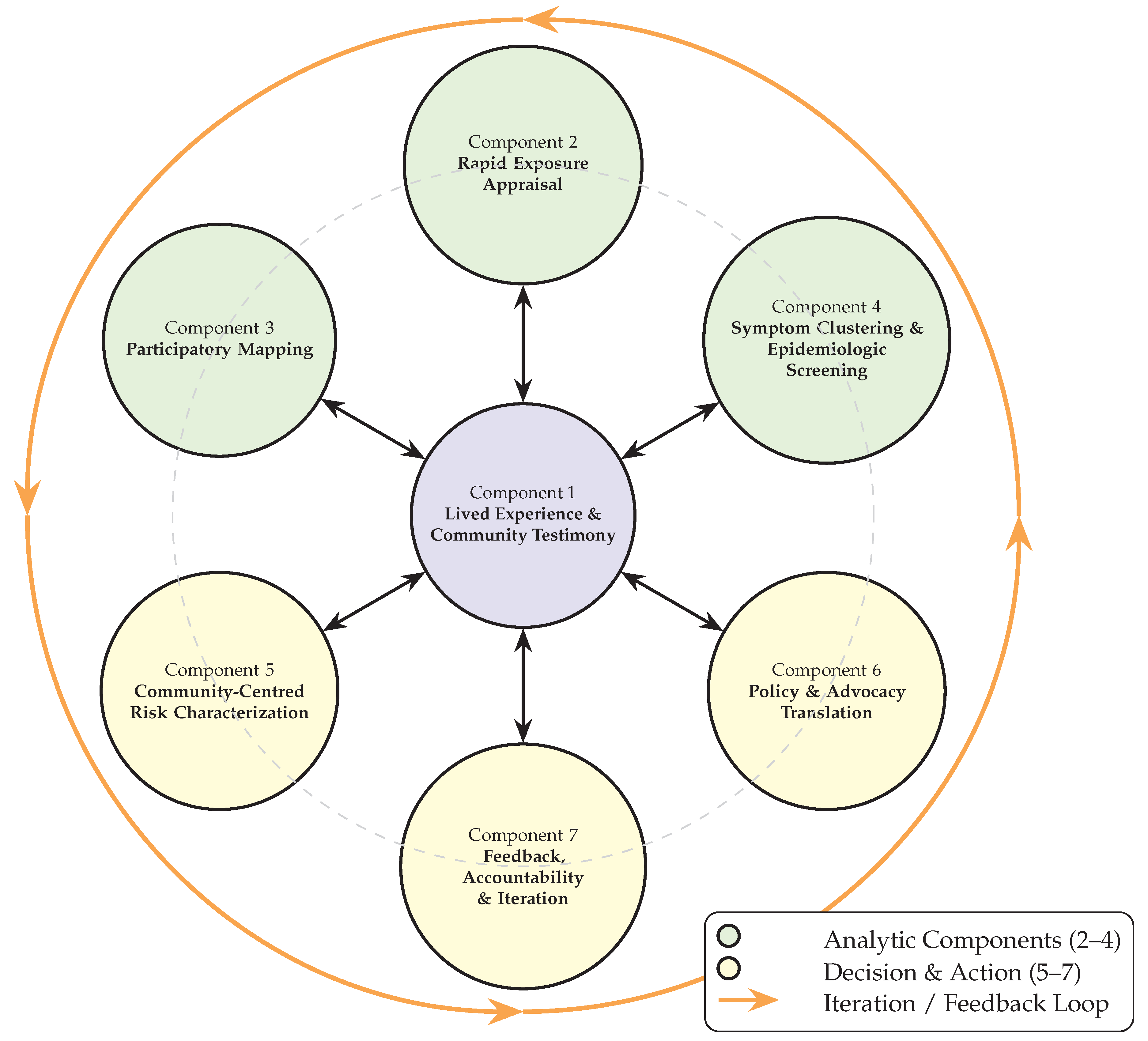
| [fill=green!12, draw=black, thick] (0,0) circle (3pt); | Analytic Components (2–4) |
| [fill=yellow!18, draw=black, thick] (0,0) circle (3pt); | Decision & Action (5–7) |
| [-Stealth[length=3mm], very thick, orange!70] (0,0) – (0.6,0); | Iteration / Feedback Loop |

Table 1.
Sampling Mechanics and Baseline Participant Characteristics Across Surveyed Communities
| Variable or characteristic | Obajana | Comparison community |
|---|---|---|
| Sampling mechanics and response rates | ||
| Recruitment method | Spatial fenceline sampling | Standard community sampling |
| Approached participants, N | 320 | 310 |
| Enrolled participants, n | 313 | 303 |
| Response rate | 97.8% (313/320) | 97.7% (303/310) |
| Recall window | Preceding 30 days | Preceding 30 days |
| Demographic characteristics | ||
| Age range | 26–75 years | 26–75 years |
| Women | 82.4% () | 75.9% () |
| Men | 17.6% () | 24.1% () |
| Residential status | Permanent resident (at least 1 year) | Permanent resident (at least 1 year) |
| Primary occupational categories | Farmers, traders, artisans, drivers | Farmers, traders, artisans, drivers |
Table 2.
Prevalence of Reported Health Outcomes During the 30-Day Recall Window
| Reported health outcome | Obajana () | Comparison community () | Prevalence ratio (95% CI) |
|---|---|---|---|
| Dermatological symptoms | 27.2% () | 6.9% () | 3.92 (2.50–6.15) |
| Ocular irritation or redness | 32.9% () | 11.9% () | 2.77 (1.96–3.91) |
| Upper-respiratory symptoms | 40.9% () | 12.9% () | 3.18 (2.30–4.38) |
The total analytic sample was 616 participants. Prevalence ratios compare Obajana with the comparison community; 95% confidence intervals were calculated from the reported event counts.
Table 3.
Operational Components of the GIRAF
Component 1: Lived Experience and Community Testimony
|
Component 2: Rapid Exposure Appraisal
|
Component 3: Participatory Mapping
|
Component 4: Symptom Clustering and Epidemiologic Screening
|
Component 5: Community-Centred Risk Characterization
|
Component 6: Policy and Advocacy Translation
|
Component 7: Feedback, Accountability, and Iteration
|
| Note. Component 1 remains the community-evidence hub. Components 2–4 provide the principal analytic functions, while Components 5–7 translate evidence into decisions, action, accountability, and iterative revision. The components are interconnected and may be implemented concurrently rather than as a strictly linear sequence. |
Disclaimer/Publisher’s Note: The statements, opinions and data contained in all publications are solely those of the individual author(s) and contributor(s) and not of MDPI and/or the editor(s). MDPI and/or the editor(s) disclaim responsibility for any injury to people or property resulting from any ideas, methods, instructions or products referred to in the content. |
© 2026 by the authors. Licensee MDPI, Basel, Switzerland. This article is an open access article distributed under the terms and conditions of the Creative Commons Attribution (CC BY) license (http://creativecommons.org/licenses/by/4.0/).
Copyright: This open access article is published under a Creative Commons CC BY 4.0 license, which permit the free download, distribution, and reuse, provided that the author and preprint are cited in any reuse.