

Submitted:
08 September 2026
Posted:
09 September 2026
You are already at the latest version
Abstract
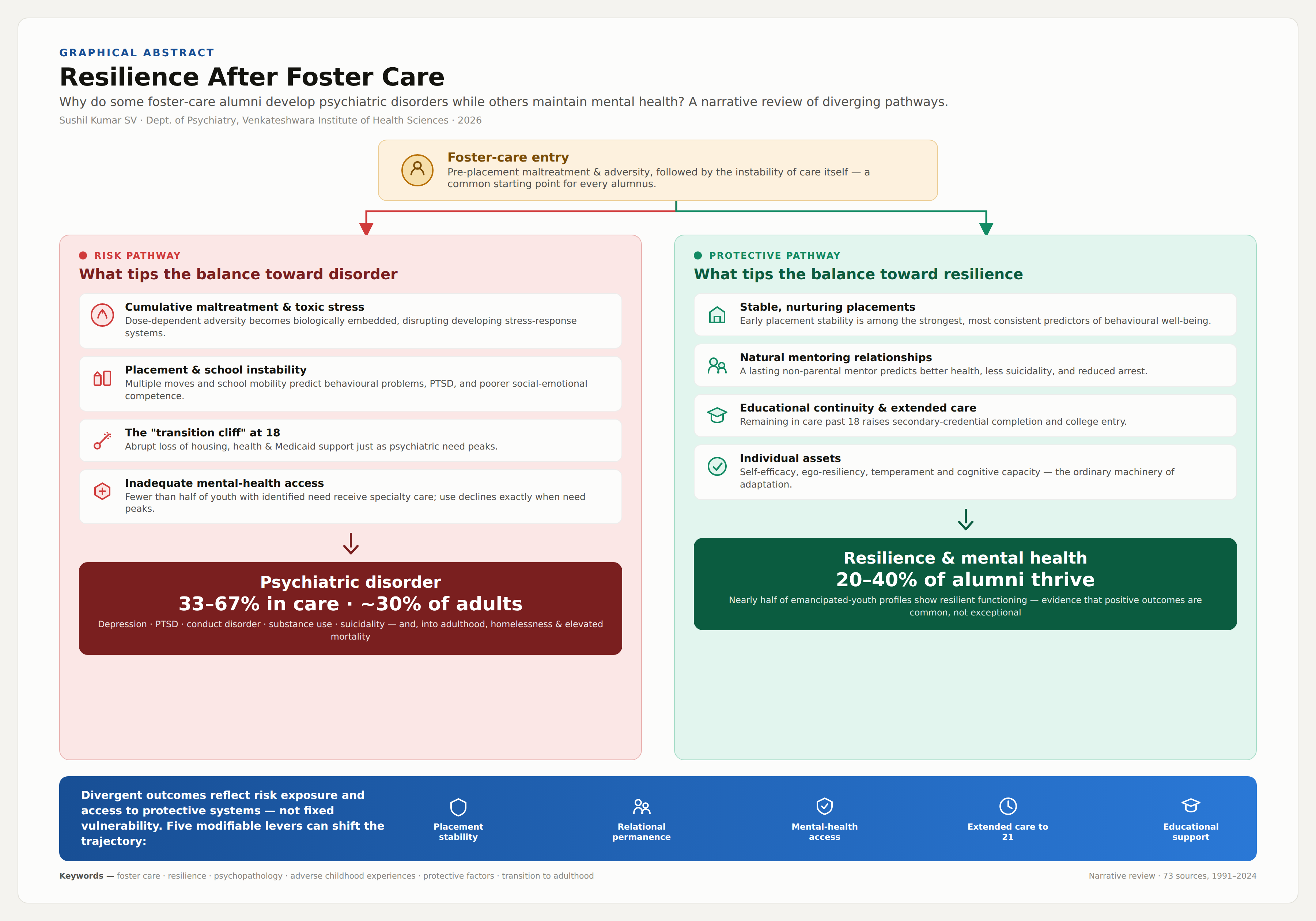
Background: Children who enter foster care experience profound pre-placement adversity and care-related instability, placing them at markedly elevated risk for psychiatric disorders across the life course. Yet a substantial minority of foster-care alumni maintain mental health and achieve resilient outcomes. This review synthesizes evidence on the divergent developmental pathways that lead to psychopathology in some alumni and resilience in others. Method: This narrative review integrates findings from epidemiological surveys, longitudinal cohort studies, meta-analyses, and resilience research. Evidence was drawn from studies of psychiatric prevalence during care, adult outcomes, biological embedding of adversity, placement characteristics, transition-age challenges, and protective processes across individual, relational, and systemic levels. Results: Psychiatric morbidity among children in care is consistently high, with prevalence estimates ranging from 33–67% and elevated risks for depression, PTSD, conduct disorder, substance use, and suicidality. These vulnerabilities persist into adulthood, predicting socioeconomic disadvantage, homelessness, criminal justice involvement, and increased mortality. Risk pathways include cumulative maltreatment, toxic stress and neurobiological embedding, placement instability, school mobility, and abrupt service discontinuity at emancipation. Despite this burden, 20–40% of maltreated or care-experienced individuals demonstrate resilient functioning. Protective processes include individual assets (self-efficacy, cognitive capacity, temperament), but relational supports are most influential. Stable, nurturing foster placements, natural mentoring relationships, educational continuity, and extended foster care consistently predict better mental health and adult functioning. Resilience is multidimensional and fluctuating; competence in one domain may coexist with hidden emotional distress. Conclusions: Divergent outcomes among foster-care alumni reflect differences in risk exposure and access to protective systems rather than inherent vulnerability. Placement stability, relational permanence, adequate mental health services, educational support, and extended care are modifiable levers that can shift trajectories toward resilience. The evidence demonstrates that positive outcomes are achievable and common when protective processes are strengthened, underscoring the need for multisystemic, developmentally informed policy and practice. Public Significance Statement: About one in three adults who grew up in foster care develops a psychiatric disorder, yet a similar number go on to thrive despite comparable early adversity. This review shows that stable placements, at least one caring mentor, and continued support after age 18 are what most reliably protect mental health — offering child-welfare systems concrete ways to improve outcomes.
Keywords:
foster care
; resilience
; psychopathology
; adverse childhood experiences
; protective factors
; transition to adulthood
Copyright: This open access article is published under a Creative Commons CC BY 4.0 license, which permit the free download, distribution, and reuse, provided that the author and preprint are cited in any reuse.