
Submitted:
08 September 2026
Posted:
09 September 2026
You are already at the latest version
Abstract
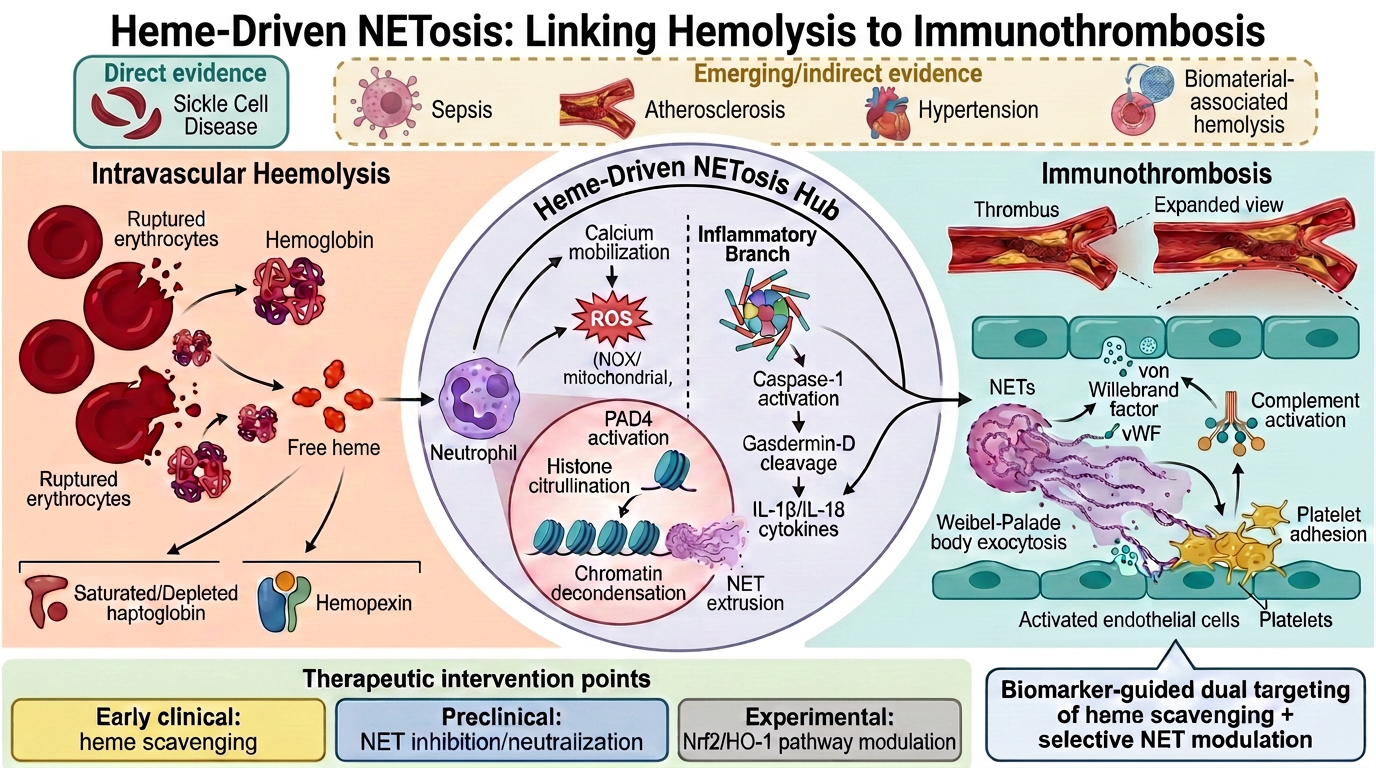
Background: Intravascular hemolysis releases cell-free hemoglobin and free heme when endogenous haptoglobin and hemopexin scavenging capacity is exceeded, converting erythrocyte injury into a systemic vascular and inflammatory process. Objective: This narrative review examines the emerging concept that heme-driven neutrophil extracellular trap (NET) formation provides a mechanistic axis linking hemolysis, sterile inflammation and immunothrombosis. Methods: Relevant experimental, translational and clinical literature was identified through targeted literature searches, with emphasis on primary mechanistic studies, disease-specific investigations and recent translational evidence. Landmark studies were retained where necessary to establish foundational mechanisms, and findings were synthesized thematically rather than quantitatively. Synthesis: Current evidence indicates that free heme can act as a damage-associated molecular pattern and promote neutrophil activation through reactive oxygen species and peptidylarginine deiminase 4-dependent pathways, while also interacting with inflammasome and PANoptosome signaling, complement, endothelial activation and platelet–neutrophil interactions. NETs provide a procoagulant scaffold that promotes platelet activation, fibrin deposition and thrombus stabilization. Evidence is strongest in sickle cell disease, whereas heme-specific evidence in sepsis and other thrombo-inflammatory disorders remains more limited or emerging. Upstream heme detoxification and downstream NET-targeted strategies have strong mechanistic rationale but remain incompletely validated clinically. Conclusion: heme-driven NETosis represents a potentially druggable convergence point within the heme–neutrophil–platelet–endothelium axis. Biomarker-guided strategies integrating heme scavenging with selective NET modulation warrant prospective clinical evaluation.
Keywords:
heme
; neutrophil extracellular traps
; hemolysis
; immunothrombosis
; sterile inflammation
; sickle cell disease
Copyright: This open access article is published under a Creative Commons CC BY 4.0 license, which permit the free download, distribution, and reuse, provided that the author and preprint are cited in any reuse.