

Submitted:
08 September 2026
Posted:
09 September 2026
You are already at the latest version
Abstract
Background/Objectives: New data on the pathogenesis of recurrent urinary tract infections (RUTIs) and the growing level of bacterial resistance to antibiotics require a revision of patient treatment strategies and a search for non-antibiotic approaches to the treatment and prevention of UTIs. The aim of this study was to investigate the clinical and microbiological efficacy of a new, non-traditional antibacterial drug, Fluorothiazinone. Methods: We conducted an open-label, randomized, multicenter cohort clinical trial, phase IV, at 12 hospitals in Moscow and St. Petersburg. 280 patients were randomized into two groups in a 1:1 ratio to receive FT at a dose of 1200 mg/day for 14 days or furadonin at a dose of 400 mg/day. for 7 days. Clinical and microbiological cure were assessed 7, 14 and 28 days after the start of therapy. Results: For the primary efficacy endpoint, clinical cure at day 28, the recovery rate was 91.7% in patients receiving FT and 92.8% in patients receiving furadonin. The proportion of patients with clinical cure on days 7 and 14 also did not differ in the two groups and amounted to 69.6% and 85.3% of patients in the FT group, respectively, and 75.6% and 90.8% of patients in the furadonin group, respectively. An assessment of microbiological eradication at all observation times in our study (days 7, 14, and 28) convincingly demonstrated that FT, whose mechanism of action is associated with the suppression of pathogen virulence, possesses intrinsic antibacterial activity comparable to that of the antibiotic furadonin leading to the eradication of pathogens causing rUTIs. The frequency of microbiological relapses after 28 days of treatment was 20.0% in the group receiving FT and 22.8% in the group receiving furadonin. No statistically significant differences were found between the groups in the proportion of patients transferred to treatment other than that prescribed by the Protocol. Both study groups were comparable in the severity of AEs. A definite relationship with the study drugs was identified for 1 (11.1%) AE after taking FT and 8 (88.9%) AE after taking furadonin. Conclusions: Clinical trials in patients with recurrent cystitis have demonstrated the intrinsic antibacterial activity of FT, equal clinical and microbiological efficacy compared to first-line drugs for the treatment of recurrent cystitis, as well as a high level of safety, indicating the potential for the use of drugs with a new mechanism of action in the context of growing antibiotic resistance.
Keywords:
recurrent cystitis
; Fluorothiazinone
; nitrofurantoin
; clinical trial
; non-antibiotic approaches
1. Introduction
Recurrent urinary tract infections (rUTIs) are a significant clinical problem, particularly among women and catheterized patients, leading to diminished quality of life and increased healthcare costs. Recurrent UTIs are defined as two or more episodes of acute bacterial cystitis within six months or at least three episodes within a year [1]. Clinical diagnosis of rUTIs is based on the acute onset of symptoms of dysuria, urinary urgency, urinary frequency, or suprapubic pain. The primary laboratory diagnostic test is the detection of more than 105 colony-forming units (CFU/ml) in urine [2,3]. The causative agents of more than 70% of rUTIs are Escherichia coli, while Klebsiella spp, Staphylococcus saprophyticus, Proteus mirabilis, Enterococcus faecalis and other bacteria are detected in a smaller percentage [3,4,5].
Treatment of urinary tract infections (UTIs) is becoming increasingly challenging due to the rapid growth of antimicrobial resistance in bacteria that cause UTIs, particularly in patients with recurrent infections. Nitrofurantoin and fosfomycin are used as a first-line therapy for recurrent cystitis [6,7,8,9].
Nitrofurantoin, a broad-spectrum antibiotic, is used to treat UTIs because it typically retains activity against drug-resistant uropathogens [9]. In recent years, two large studies of the etiologic structure and antibiotic susceptibility of cystitis pathogens have been conducted in the Russian Federation, which confirmed the high etiologic significance of E. coli (75%) as a causative agent of cystitis and low resistance (<5%) to NF [10]. Therefore, NF remains the drug of choice for empirical therapy according to Clinical Guidelines [11]. The high efficacy of NF in the treatment of rUTI makes it the optimal comparator drug in clinical trials of antimicrobial drugs in patients with cystitis.
The concept of rUTI has changed due to new data on the pathophysiology of rUTI, awareness of the side effects of repeated use of antimicrobials, and the increasing level of bacterial resistance to antimicrobials, which requires a revision of patient treatment strategies. [2,12,13,14].
A central factor in the pathogenesis of rUTI is bacterial persistence despite seemingly adequate antibiotic therapy. Unlike classic antibiotic resistance, persistence involves phenotypic adaptations that allow uropathogens to evade both the body's immune response and antimicrobial agents [15]. The presence of intracellular bacterial communities (ICBCs) in urothelial cells necessitates the use of intracellularly active antimicrobials to suppress not only bacteria present in the urine but also those within the bladder mucosa [3,4].
FT (FT) is a new antibacterial drug whose mechanism of action differs from that of antibiotics in that it inhibits virulence rather than suppresses bacterial viability. Preclinical studies of FT have demonstrated suppression of the type III secretion system (T3SS), flagellum-associated bacterial motility, biofilm formation, and decreased bacterial cytotoxicity toward immune cells [16,17]. Suppression of virulence by FT in an infected animal leads to blocking the infection process and eradication of pathogens with the same effectiveness as antibiotics. FT has significant advantages over antibiotics, including its effectiveness against antibiotic-resistant bacteria, suppression of both extracellular and intracellular pathogens, and the absence of a negative effect on normal microflora [18,19,20]. A phase III clinical trial in patients with complicated UTIs, comparing the combination of FT with cefepime versus placebo with cefepime, demonstrated a 25% clinical advantage of FT, while the rate of infection recurrence within 90 days of observation was 10 times lower [21]. Based on the results of this study, FT received state registration in 2024 for the treatment of complicated UTIs in combination with cefepime.
According to the WHO classification, FT is classified as a non-traditional antibacterial agent and is the first in its class and the only registered drug with a mechanism of action based on virulence suppression. To further evaluate the clinical and microbiological efficacy of FT as monotherapy, a clinical trial, " An open clinical trial of the safety and efficacy of the drug Fluorothiazinone , 300 mg tablets (Gamaleya Research Institute of Epidemiology and Microbiology, Health Ministry of the Russian Federation) with the participation of adult patients withchronic bacterial cystitis” was conducted in comparison with nitrofurantoin. This article presents the results of a study of the clinical and microbiological efficacy of FT, which demonstrated non-inferiority to nitrofurantoin in the treatment of recurrent bacterial cystitis.
2. Results
Subjects who met the inclusion criteria and did not have non-inclusion criteria were randomized into 2 groups in a 1:1 ratio: 140 people who received the drug FT and 140 people who received furadonin. Completed the study according to the protocol: 134 patients in the FT group and 123 patients in the furadonin group (Figure 1)
During the study, patients were distributed as follows among the study populations (Table 1).
When comparing the demographic and physiological parameters of the patient groups at the time of inclusion in the study and those who received FT or furadonin reliable differences were found only in the concentration of blood glucose and urea (Table 2), however, the parameters of both groups remained within the normal range and, therefore, their difference was not significant.
At the initial examination (screening stage), all patients complained of sharp pain, a burning sensation during urination, a feeling of fullness in the bladder, frequent urination in small amounts, a nagging pain in the lower abdomen, and changes in the appearance of urine. To assess the individual severity of clinical symptoms, they were scored using the VAS, PUF and ACSS scales (Table 3). According to the scoring, all patients included in the study had pronounced clinical symptoms of cystitis, with no significant differences between the FT and furadonin groups.
Laboratory evaluation of urine samples collected during the screening phase revealed changes characteristic of cystitis (Table 4): decreased clarity, the presence of mucus, protein, and microhematuria. Leukocyturia was observed in almost all patients. Bacteria and squamous epithelium were detected in more than half of the patients. Nitrates formed as a result of the presence of bacteria were detected in 20%. The severity of these changes was similar in patients receiving FT and furadonin.
Upon further examination, 7% of patients with cystitis were found to have concomitant chronic pathology of various organ systems (Table 5), and the prevalence of its detection also turned out to be approximately the same in the compared groups.
Thus, at the time of inclusion in the study, the two groups of patients with cystitis did not differ significantly in terms of the totality of demographic, physiological, clinical data, severity of the disease and severity of laboratory changes.
Primary efficacy end-point.
The study's primary efficacy end-point was the proportion of patients with clinical cure at 28 days after initiation of treatment. The primary endpoint was assessed in 133 patients who received FT and 125 patients who received furadonin. Due to subjective reasons that arose during the study (missing a control visit, lack of samples for laboratory tests), 18 patients dropped out of the study.
Thus, clinical cure was achieved in 91.7% of patients who received FT, and in 92.8% of patients who received furadonin (95% CI: 0.0642-0.0842) (Table 6). The differences in the proportion of patients with clinical cure between the study groups were not statistically significant (χ2 = 0.170, p = 0.918), thus, evidence was obtained of the non-inferiority of FT compared to the standard treatment regimen with furadonin.
Based on the data obtained, the hypothesis of non-inferiority of Fluorothiazinone compared to the standard regimen of Nitrofurantoin was confirmed. It was demonstrated with a 95% confidence level that Fluorothiazinone was inferior to Nitrofurantoin by no more than 15% in the proportion of patients with clinical cure on day 28 of therapy. The difference in efficacy between the drugs was statistically insignificant. These results suggest that Fluorothiazinone is non-inferior to Nitrofurantoin in the treatment of patients with urinary tract infections in this study.
Secondary end-points of the study.
Clinical cure after 7 and 14 days of treatment.
The proportion of patients with clinical cure at days 7 and 14 after initiation of treatment in the CE population was examined (Table 7).
Thus, clinical cure was achieved on day 7 in 69.6% of patients receiving FT and in 75.6% of patients receiving furadonin. There were no statistically significant differences between treatment groups in achieving clinical cure (χ2 = 1.222, p = 0.543).
Clinical cure on day 14 was achieved in 85.3% of patients receiving FT and in 90.8% of patients receiving furadonin. There were also no statistically significant differences between treatment groups in achieving clinical cure (χ2 = 2.307, p = 0.316).
Thus, the effectiveness of treating exacerbations of chronic bacterial cystitis with FT was proven with both 7-day and 14-day use.
Microbiological evaluation.
Other secondary efficacy end-points were the proportion of patients with microbiological cure on days 7 and 14 after the start of therapy and the number of microbiological relapse on day 28. The evaluation was performed in the ME population (all patients from the CE population in whom a pathogen was isolated during screening) in 97 patients receiving FT and 81 patients receiving furadonine. (Table 8, Table S1: Microbiological Cure at Visit 2: Comparison between groups, Table S2; Microbiological Cure at Visit 3: Comparison between groups).
The results of the analysis indicate that there are no statistically significant differences between treatment groups in the frequency of achieving microbiological eradication of initial pathogen in urine. The frequency of microbiological relapses after 28 days of treatment was 20.0% in the group receiving FT and 22.8% in the group receiving furadonin (Table S3: Microbiological relapse at Visit 4. Comparison between groups).
An evaluation of eradication rates for individual pathogens showed that FT exhibits antibacterial activity against the main pathogens causing chronic cystitis, with a 14-day course of therapy being most effective. Furthermore, the relapse rate associated with E. coli and K. pneumoniae on day 28 after the start of therapy did not differ between the FT group and the furadonin group (Table 9).
Thus, furadonin and FT demonstrated equal antibacterial efficacy at 7, 14, and 28 days after initiation of therapy.
The proportion of patients switched to treatment other than that specified by the Protocol, in case of treatment failure and the need to prescribe any other antibacterial drug during the follow-up period up to 14 days
According to the analysis, 2 patients (1.4%) in the FT group and 3 patients (2.1%) in the furadonin group required additional therapy prohibited by the protocol.
No statistically significant differences were found between the groups in the proportion of patients transferred to treatments other than those prescribed by the protocol (χ2 = 0.204, p = 1.000).
The proportion of patients who completed the study according to the protocol (compliance)
A secondary end-point in this study was the proportion of patients who completed the study according to the protocol (compliance).
The results of the analysis showed that 134 (95.71%) patients in the FT group and 123 (87.86%) patients in the furadonin group completed the study in accordance with the protocol. FT was statistically superior to furadonin in terms of the proportion of patients completing the study according to the protocol (χ2 = 5.732, p = 0.017).
Changes in VAS, PUF, and ACSS scores.
Also, the dynamics of symptoms according to the VAS, PUF and ACSS scales were studied as secondary endpoints (Table 10).
The mean change in the VAS score for the symptom intensity "Pain, discomfort, or burning during urination" in the FT and furadonin groups at Visit 2 was -4.582 and -4.951, respectively; at Visit 3, it was -5.485 and -5.593, respectively; and at Visit 4, it was -5.709 and -5.724, respectively. No statistically significant differences were found between treatment groups (all p > 0.05).
The average change in the pelvic pain, urgency, and frequency of urination symptom scale (PUF SCALE) score in the FT and furadonin groups at Visit 2 was -11.575 and -13.423, respectively; at Visit 3, it was -14.866 and -15.480, respectively; and at Visit 4, it was -15.784 and -16.203, respectively. Comparison of the dynamics of scale scores at Visits 3 and 4 revealed no statistically significant differences between the study groups (p>0.05), with the change at Visit 2 being significantly more pronounced in the furadonin group (p = 0.046).
The mean change in the total Typical score (ACSS), total Differential score (ACSS), and total QoL score (ACSS) at Visit 2 was -7.746, -0.149, and -3.896, respectively, in the FT group and -9.081, -0.073, and -4.309, respectively, in the furadonin group. At Visit 3, the mean change in the total Typical score (ACSS), total Differential score (ACSS), and total QoL score (ACSS) was -9.552, -0.187, and -4.925, respectively, in the FT group and -10.276, -0.089, and -4.927, respectively, in the furadonin group. At Visit 4, the mean change in the total Typical score (ACSS), total Differential score (ACSS), and total QoL score (ACSS) in points was -10.119, -0.201, and -5.164, respectively, in the FT group and -10.528, -0.089, and -5.041, respectively, in the furadonin group.
A comparison of the dynamics of the Typical, Differential, and QoL scores at Visits 2, 3, and 4 revealed no statistically significant differences between the study groups (p>0.05), with the exception of a change in the total Typical score from Visit 2 to Visit 3 (p = 0.003), which favored furadonin.
Thus, the assessment of subjective symptom scores at the end of the study did not reveal statistically significant differences between the study groups, despite some superiority of furadonin in the early stages of treatment (Visit 2, Day 7). FT was statistically superior to furadonin in terms of the proportion of patients completing the study according to the protocol (χ2 = 5.732, p = 0.017).
At study inclusion, the mean VAS scores were 5.750 and 5.757, PUF scores 19.286 and 19.147, and ACSS scores 10.529 and 10.824 in the FT and furadonin groups. By Visit 2, 7 days after the start of therapy, the change in intensity scores on the VAS scale was -4.554 and -4.864, on the PUF scale - -11.496 and -12.903, and on the ACSS scale - -7.659 and -8.900 in the FT and furadonin groups. At Visit 3, 14 days after the start of therapy, the change in the intensity score according to the VAS scale was -5.463 and -5.488, according to the PUF scale - -14.845 and -14.809, according to the ACSS scale -9.485 and -9.939 in the FT and furadonin groups. By Visit 4, 28 days after the start of therapy, on the day of assessment of the primary efficacy endpoint, the change in the intensity score according to the VAS scale was -5.712 and -5.661, according to the PUF scale - -15.850 and -15.787, according to the ACSS scale -10.100 and -10.312 in the FT and furadonin groups. There were no statistically significant differences between the treatment groups (p = 0.279). Thus, the dynamics of symptom reduction according to the VAS, PUF and ACSS scales 7, 14 and 28 days after the start of therapy did not differ in the FT and furadonin groups.
Safety.
A total of 334 AEs/SAEs were registered in 117 (42.4%) patients during the clinical trial. Of the 334 registered AEs, 294 (88%) were mild, 39 (11.7%) were moderate, and 1 (0.3%) was severe.. For 304 (91.0%) AEs, the outcome was recorded as “Resolved/Recovered”, in 1 case (0.3%) the AE resolved with consequences, in 2 cases (0.6%) there was no recovery (forearm fractures), the outcome of 27 (8.1%) AEs remained unknown. In 305 (91.3%) AEs, no action was taken regarding the study medications. In 2 cases (0.6%), the drug dose was reduced, and discontinuation was performed in 14 (4.2%) cases. The most common AEs were headache and nausea (Table 11).
The incidence of AEs associated with study drugs by system organ class is presented in Table S4: Frequency of adverse events related to the study drugs. Analysis of AEs in relation to study drugs is presented in Table S5: Comparison of the groups regarding the association of AEs with the study drugs. A definite relationship with the study drugs was identified for 1 (11.1%) AE after taking FT and 8 (88.9%) AE after taking furadonin.
A comparative analysis of AE frequency revealed no statistically significant between-group differences in the proportion of patients with any AE, AE severity, relationship to study medications, treatments for AEs, or treatments for study medications. Thus, FT demonstrated a high level of safety, comparable to first-line treatment for patients with recurrent cystitis.
3. Discussion
The aim of the clinical study was to investigate a new clinical approach to the treatment of recurrent urinary tract infections (RUTIs), based on understanding the mechanism of development of such infections associated with bacterial persistence and the possibilities of using alternative methods of antibacterial therapy. As noted in the Updates to Recurrent Uncomplicated Urinary Tract Infections in Women: AUA/CUA/SUFU Guideline, the growing global crisis of multidrug resistance has also renewed the search for non-antibiotic approaches to the treatment and prevention of urinary tract infections [2,13,14]. One such promising treatment option is the development of phage therapy, which shows promising efficacy similar to antibiotics with minimal side effects [12,22].
The main causative agent of urinary tract infections, Escherichia coli, is generally considered an extracellular bacterium; however, uropathogen E. coli (UPEC) has recently been shown to be a facultative intracellular pathogen [4]. In experimental mouse models, UPEC has been shown to rapidly replicate, forming large inclusion bodies called intracellular bacterial communities (IBCs) within urothelial cells, from which E. coli can either escape and invade other urothelial cells or remain dormant for long periods, where the pathogen is protected from the immune system and remains resistant to standard antibiotic therapy [3,4]. These studies have shown that in recurrent UTIs, the infection is not only extracellular in the urine but also intracellular in the urothelial cells, which is the cause of subsequent UTIs. Due to the inability of many antimicrobial agents to penetrate mammalian cells, infections caused by intracellular bacteria are difficult to treat, requiring the use of antibiotics that are active intracellularly.
The design of this randomized clinical trial was to compare the clinical and microbiological efficacy of a new, non-traditional FT drug in the treatment of chronic cystitis in monotherapy and to demonstrate non-inferiority to the first-line antibiotic furadonin.
FT does not have a direct antibacterial effect, but rather suppresses virulence and, due to its pharmacological properties, effectively penetrates lipid membranes and cells, while maintaining its activity. The antibacterial effect of FT on intracellular pathogens has been demonstrated in epithelial cells and macrophages infected with C. trachomatis, S. enterica, E. coli, and B. cenocepacia [23,24,25,26]. For the obligate intracellular pathogen C. trachomatis, suppression of the type 3 secretion system with FT led to blocking the development of chlamydial inclusions in McCoy cells, and in a model of chronic ascending infection in mice caused by this pathogen, treatment with FT possessed antibacterial activity in vivo and was able to control C. trachomatis (serovar D) vaginal shedding, ascending infection, and inflammation in the upper genital organs in DBA/2 mice [27].
Earlier we showed that the compound FT suppressed UPEC’s ability to form biofilms and to move using the flagellum, as well as to penetrate into cells. Prophylactic use with subsequent treatment of FT in rodent models led to an improvement in survival and significantly reduced the bacterial load in the organs of the urinary system, thereby inhibiting the development of ascending infection and preventing the development of pathological changes in prostate tissues [28].
Furadonin which is successfully used in the treatment of chronic cystitis due to its low resistance rate, was chosen as the comparator drug in this clinical trial. A clinical efficacy comparison demonstrated that FT monotherapy has a similar therapeutic effect to the antibiotic furadonin in the treatment of chronic cystitis. For the primary efficacy end-point, clinical cure at day 28, the recovery rate was 91.7% in patients receiving FT and 92.8% in patients receiving furadonin.
The proportion of patients with clinical cure on days 7 and 14 also did not differ in the two groups and amounted to 69.6% and 85.3% of patients in the FT group, respectively, and 75.6% and 90.8% of patients in the furadonin group, respectively.
There are summary data on the effectiveness of furodonin based on twenty-seven studies in 4807 patients with urinary tract infections [9]. Clinical cure rates were 79-92%, and microbiological eradication rates were 80-92%. These rates were comparable to those obtained in our study. In a more recent publication of the results of two randomized, multicenter phase III trials (EAGLE-2 and EAGLE-3) comparing the new oral chemotherapy drug gepotidacin and nitrofurantoin in the treatment of uncomplicated UTIs in women, a significant proportion of participants reported complete resolution of symptoms by the end of the study (66.5% with gepotidacin; 64.0% with nitrofurantoin), and another 22.1% (gepotidacin) and 25.9% (nitrofurantoin) reported improvement from baseline [29]. The lower clinical efficacy rates of furadonin compared with those obtained in our study, can be explained by differences in the sensitivity of uropathogens, daily dosage, and duration of furadonin use: 100 mg 2 times a day for 5 days and 100 mg 4 times a day for 7 days, respectively.
An assessment of microbiological eradication at all observation times in our study (days 7, 14, and 28) convincingly demonstrated that FT, whose mechanism of action is associated with the suppression of pathogen virulence, possesses intrinsic antibacterial activity comparable to that of the antibiotic furadonin leading to the eradication of pathogens causing chronic urinary tract infections. The frequency of microbiological relapses after 28 days of treatment was 20.0% in the group receiving FT and 22.8% in the group receiving furadonin. Thus, it was shown that the drug, the action of which is realized by suppressing virulence, does not lead to relapses after its discontinuation and allows for treatment in monotherapy mode.
At the time of writing, data on longer-term follow-up of patients (90 days) and the development of cystitis recurrences have not yet been obtained, which would allow us to evaluate the effectiveness of treating such chronic conditions with FT, a drug that suppresses intracellular pathogens.
Relief of urinary tract symptoms during the treatment of urinary tract infections is fundamental for assessing the effectiveness of therapy and patient well-being [28]. A subjective assessment of symptom scores at the end of the study revealed no statistically significant differences between the study groups, with the exception of a slight superiority of furadonin in the early stages of treatment (Visit 2, Day 7). However, in the FT group, fewer patients dropped out of the study due to a higher number of refusals to participate in the furadonin group, and this difference was statistically significant.
Thus, for the first time, evidence was obtained of the equal clinical efficacy of FT and a first-line antimicrobial agent for the treatment of recurrent cystitis, with both drugs having very high clinical and microbiological efficacy.
The safety of FT compared to furadonin was equal. Of the 334 reported AEs, 88% were mild, 11.7% were moderate, and 1 (0.3%) were severe. Both study groups were comparable in the severity of AEs. A definite relationship with the study drugs was identified for 1 (11.1%) AE after taking FT and 8 (88.9%) AE after taking furadonin. In the overwhelming majority of patients, AEs were mild and did not require medication adjustments. The most common AEs with FT were headache and nausea. No statistically significant differences were found between the groups in the proportion of patients transferred to treatment other than that prescribed by the protocol.
The study has several limitations. Firstly, when patients were enrolled, they were not stratified by risk factors for chronic cystitis, such as menopause, active sexual activity, urinary tract anomalies, and diabetes mellitus, which significantly impacts the effectiveness of antibacterial therapy [2]. This is because the primary objective of this study was to evaluate the therapeutic efficacy of a new class of antivirulence drug used as monotherapy.
In this study, 28-day follow-up after initiation of therapy revealed no advantages of this new approach to treating chronic infections associated with intracellular pathogen persistence. Perhaps, evaluating the results of long-term patient observation will help identify opportunities for more effective treatment of rUTIs and the prevention of relapses using FT. This is the aim of the current clinical trial and subsequent studies.
4. Materials and Methods
4.1. Study Design
An open-label, randomized, multicenter cohort clinical trial was conducted to investigate the safety and efficacy of the drug FT in antibacterial monotherapy mode compared with furadonin (nitrofurantoin) in patients with chronic bacterial cystitis. The study was conducted in 12 clinical centers in the Russian Federation in 2025-2026 (Table S5: List of research centers and principal investigators). The study was conducted in accordance with study authorization No. 513 dated October 30, 2024 (Ministry of Health of the Russian Federation) and amendment "No. 4310270-25-2/PP" dated January 13, 2025. The study protocol was reviewed and approved by the Ethics Committee of the Ministry of Health of the Russian Federation and the ethics committee of each research center. Written informed consent was obtained from each patient before inclusion in the study.
After enrollment, patients were divided into 2 groups:
1 – cohort of patients (140 people) who received the drug FT;
2 – comparison cohort (140 people) who received the drug furadonin.
The total study duration for each participant was no more than 96 days, including the screening period.
- Screening period (visit 0, day 0-1)– no more than 24 hours before the start of treatment;
- Visit 1 - start of FT/furadonin treatment;
- Visit 2 EOT (end-of-therapy) Visit for furadonin group - 7 days FT/furadonin treatment;
- Visit 3 EOT (end-of-therapy) Visit for FT group - 14 days FT treatment;
- Visit 4 TOC (test-of-cure) – 28 days after the start of treatment;
- Visit 5 – LFU (late-follow-up) - 90 days after the start of treatment (Figure 2).
4.2. Study Inclusion Criteria
The study enrolled women over 18 years of age with a diagnosis of bacterial cystitis and a history of chronic recurrent bladder infection, as well as characteristic symptoms of an exacerbation of chronic cystitis at the time of enrollment: pain syndrome (pain in the lower abdomen, during urination), dysuria symptoms (frequent urination, pain or burning with urination, imperative urge to urinate, feeling of incomplete bladder emptying). On the ACSS scale, the symptom score had to be 6 points or higher. Inclusion criteria also included the patient being treated on an outpatient basis and having no indications for emergency hospitalization at the time of enrollment, as well as the ability to understand the requirements for study participants and willingness to perform the procedures stipulated in the study protocol.
4.3. Study Drug Regimen
Patients were randomized into two groups in a 1:1 ratio to receive FT at a dose of 1200 mg/day or furadonin at a dose of 400 mg/day. FT was taken daily, twice a day (2 tablets in the morning and 2 tablets in the evening), for 14 days. Furadonin was taken daily as one tablet, 4 times a day, for 7 days.
4.4. Evaluation of Study Results
4.4.1. Analysis Populations
Efficacy and safety were assessed according to the study groups. The following patient populations were studied:
ITT Population – all patients randomized to treatment, regardless of whether they actually received the study drug.
MITT (Modified Intent-to-Treat) Population – all patients in the ITT population who received at least one dose of the study drug.
Clinically Evaluable (CE) Population included patients who met the MITT criteria and met the evaluability criteria (satisfied the main inclusion criteria, had no exclusion criteria, received ≥ 80% of the intended doses, and had no other factors that could interfere with the efficacy assessment).
Microbiologically Evaluable (ME) Population included patients who met the CE criteria and had a properly collected urine sample with an evaluable culture result at screening, both the EOT and Day 28 (Visit 4) visits.
4.4.2. Efficacy Assessment
Clinical Response
At Visits 2 and 3, as well as at the Early Termination Visit (ETV) in case of premature study discontinuation, based on the assessment of signs and symptoms, the investigator selected one of the following clinical outcomes:
Clinical cure – complete resolution or improvement of the signs and symptoms of cystitis that were present at baseline, and the absence of new symptoms requiring antimicrobial therapy outside the study.
Clinical failure – symptoms of cystitis present at enrollment did not completely resolve, or new symptoms developed requiring initiation of antibiotic therapy outside the study, or death occurred.
Clinically indeterminate outcome – insufficient data (lack of necessary laboratory and instrumental test results, failure to attend the visit) to determine cure or failure in the patient.
At Visit 4, based on the assessment of signs and symptoms, the investigator selected one of the following clinical outcomes:
Clinical cure – meeting the criteria for clinical cure and absence of signs of cystitis on day 28.
Relapse – patient met the criteria for clinical cure at Visits 2 or 3 but subsequently developed new signs and symptoms of cystitis by Visit 4 or at an unscheduled visit after day 14, requiring the patient to receive antibiotic therapy for cystitis.
Clinically indeterminate outcome – insufficient data (including lack of necessary laboratory and instrumental test results, failure to attend the visit) to determine cure or failure in the patient.
If the patient sought medical help for cystitis before Visit 4, unscheduled visit procedures were performed, and antibacterial therapy was prescribed only after these assessments, if necessary.
Microbiological Outcome
The microbiological outcome for each patient was determined based on the results of urine cultures at Visits 2 and 3, as well as at the ETV:
Microbiological eradication – all baseline pathogenic microorganisms decreased to < 10⁴ CFU/mL in urine culture.
Microbiological persistence – urine culture grew ≥ 10⁴ CFU/mL of any of the baseline pathogenic microorganisms identified at enrollment.
Microbiologically indeterminate outcome – no urine culture available, or the follow-up urine culture cannot be interpreted for any reason, or the follow-up urine culture is considered contaminated.
The microbiological outcome for each patient was determined based on the results of urine cultures as one of the following outcomes at Visit 4, as well as at the RR visit:
Microbiological eradication – all baseline pathogenic microorganisms decreased to < 10⁴ CFU/mL in urine culture.
Microbiological relapse – isolation of baseline pathogenic microorganisms at a titer of ≥ 10⁴ CFU/mL in urine culture.
Microbiologically indeterminate outcome – no urine culture available, or the follow-up urine culture cannot be interpreted for any reason, or the follow-up urine culture is considered contaminated.
4.4.3. Efficacy Evaluation Criteria
The primary efficacy endpoint in this clinical study was the proportion of patients with clinical cure 28 days after the start of treatment.
Secondary endpoints included:
- the proportions of patients with clinical cure on days 7 and 14;
- the proportions of patients with microbiological eradication on days 7 and 14;
- the proportions of patients with microbiological relapse on day 28;
- the proportions of patients with microbiological relapse within 90 days
- the proportion of patients switched to treatment other than that specified by the Protocol, in case of treatment failure and the need to prescribe any other antibacterial drug during the follow-up period up to 14 days;
- change in scores on the VAS, PUF and ACSS scales;
- the proportion of patients with AEs, SAEs, ARs, SARs.
4.5. Safety Assessment
The safety of the study therapy was assessed by identifying and recording all potential adverse events that occurred in patients during their participation in the study.
4.6. Sample Size Calculation
The primary objective of this study was to demonstrate the non-inferiority of FT compared to the standard regimen of furadonin.
The calculation for standard non-inferiority study conditions was performed using the Sealed envelope calculator [https://www.sealedenvelope.com/power/binary-noninferior/]. This calculator is designed for binary outcomes in parallel-group non-inferiority trials comparing an investigational drug to standard treatment.
According to the calculated data, if there is truly no difference between standard and experimental treatment (70% in both groups), then including 232 patients should show with 80% probability that the upper limit of the one-sided 95% confidence interval (or equivalently, the two-sided 90% confidence interval) will exclude a difference in favor of the standard group of more than 15%.
Considering a potential dropout rate of 20% of patients and rounding the calculated values to tens, a target of 140 patients in each group (280 patients total) was established for enrollment.
4.6.1. Randomization
Randomization of patients was carried out on the day of study drug administration. The randomization day coincided with the first day of drug administration (Visit 1). The randomization scheme was prepared before the start of the study. The study was open-label, meaning both the investigator and the patient were aware of the treatment assignment. This design was chosen as it was considered suitable for the non-inferiority objective, as the primary endpoint (clinical cure) is relatively objective and the risk of bias was deemed low.
4.6.2. Statistical Analysis
Mathematical and statistical analysis of the results was carried out using Microsoft Excel packages with the AtteStat add-in and Statistica 10.0, or similar programs.
Enrollment in the study, protocol deviations, premature discontinuation of study drug, and withdrawal from the study were presented by group. Summary data on demographic characteristics (age, race, ethnicity, gender), medical and surgical history, baseline assessment of clinical signs and symptoms, microbiological assessment, and study drug administration were also presented.
Statistical processing of safety, tolerability, and efficacy results was carried out in several stages: determination of the analysis population; determination of data type; determination of the distribution type of quantitative data; data presentation (descriptive statistics); determination of the method for data analysis and comparison.
Descriptive statistics for quantitative data were presented according to the results of the distribution type analysis. In accordance with the Recommendations for data that do not follow a normal distribution, the median (Me) was used as a measure of central tendency for quantitative variables, and the upper (UQ) and lower quartiles (LQ) were used as measures of dispersion. For normally distributed data, the arithmetic mean (Mean) was used as a measure of central tendency, and the standard deviation (SD) was used as a measure of dispersion. The minimum (Min) and maximum (Max) values of the indicator were given.
Ordinal, categorical, and qualitative data were presented as absolute frequencies (number of observations), relative frequencies (proportions, %), and 95% confidence intervals (CI) of the proportion.
For the analysis and comparison of quantitative variables, parametric (in case of normal distribution) and non-parametric (in case of rejection of the hypothesis of normal distribution) statistical methods were used.
To compare data not following a normal distribution, non-parametric tests were calculated. To identify significant changes in dependent samples at different study stages at two time points, the paired Wilcoxon test was used; at three or more time points, Friedman's rank analysis of variance (Friedman test) was used. For intergroup comparison (Group 1 ↔ Group 2), the Mann-Whitney U test was used.
For normally distributed data, Student's t-test for independent samples was calculated for intergroup comparison, and Student's t-test for dependent samples was used to assess differences at two observation points for each group. To assess within-group differences between three or more observation points, Repeated Measures ANOVA was used.
To compare qualitative indicators (proportions) and assess the significance of detected differences in their frequency, Fisher's exact test or Pearson's chi-square test (χ² test) was used, depending on the sample size.
All statistical tests were two-sided, and a p-value of < 0.05 was considered statistically significant.
Concomitant diseases and adverse events were coded using the MedDRA classification. Concomitant therapy was coded using the ATC system.
In addition to frequency indicators, the values of all quantitative safety indicators (physical examination data, vital signs, and laboratory results) will be presented by visit and by group in tabular form.
5. Conclusions
The results of a comparative randomized clinical trial of the efficacy of FT and furadonin in patients with recurrent cystitis demonstrated FT's antibacterial activity, equal clinical and microbiological efficacy compared to first-line drug for the treatment of re-current cystitis, and a high level of safety. The obtained results demonstrate the potential of a new approach to the treatment of chronic infections in the context of increasing antibiotic resistance, an approach associated with the use of antibacterial drugs with a new mechanism of action, to which the risk of developing resistance is reduced.
Supplementary Materials
The following supporting information can be downloaded at the website of this paper posted on Preprints.org, Table S1: Microbiological Cure at Visit 2: Comparison between groups; Table S2: Microbiological Cure at Visit 3: Comparison between groups; Table S3: Microbiological relapse at Visit 4. Comparison between groups; Table S4: Frequency of adverse events related to the study drugs; Table S5: Comparison of the groups regarding the association of AEs with the study drugs; Table S6: List of research centers and principal investigators.
Author Contributions
Conceptualization, N.A.Z., D.Y.P., N.E.B., N.L.L., S.K.Z., A.L.G.; software, T.S.P., E.A.S., V.B.B., A.V.Z., S.K.Z., M.A.K., E.U.L., A.B.S.; validation, T.S.P., E.A.S., M.A.K.; formal analysis, N.A.Z., N.E.B., N.L.L., V.B.B., E.U.L., A.B.S.; investigation, N.A.Z., D.Y.P., N.E.B., N.L.L., T.S.P., E.A.S., V.B.B., A.V.Z., S.K.Z., M.A.K., E.U.L., A.B.S.; resources, D.Y.P., T.S.P., E.A.S., S.K.Z., M.A.K.; data curation, N.A.Z., D.Y.P., N.E.B., N.L.L., T.S.P., E.A.S., V.B.B., A.V.Z., S.K.Z., M.A.K., E.U.L., A.B.S.; writing—original draft preparation, N.A.Z., N.E.B., V.B.B.; writing—review and editing, N.A.Z., D.Y.P., N.E.B., N.L.L., T.S.P., E.A.S., V.B.B., A.V.Z., S.K.Z., M.A.K., E.U.L., A.B.S., A.L.G.; visualization, N.A.Z., N.E.B., V.B.B., E.U.L., A.B.S.; supervision, N.A.Z., N.E.B., N.L.L.; project administration, N.A.Z., A.L.G.; funding acquisition, N.A.Z., A.L.G. All authors have read and agreed to the published version of the manuscript.
Funding
This research and APC was funded by National Research Center for Epidemiology and Microbiology named after the honorary academician N. F. Gamaleya (Ministry of Health of the Russian Federation).
Institutional Review Board Statement
Institutional Review Board Statement: The study was conducted in accordance with the Declaration of Helsinki, and approved by the Ethics Committee of the Russian Ministry of Health (protocol number 371, date of approval 29.10.2024).
Informed Consent Statement
Informed consent was obtained from all subjects involved in the study.
Data Availability Statement
The provision of data is limited due to the privacy policies of funding and regulatory organizations. The possibility of providing data can be considered upon request to the corresponding author. Proposals will be reviewed and approved by the sponsor, security department, researcher, and staff on the basis of scientific merit and absence of competing interests. Once the proposal has been approved, data can be transferred through a secure online platform after the signing of a data access agreement and a confidentiality agreement.
Acknowledgments
The authors would like to thank the administration of the National Research Center for Epidemiology and Microbiology named after the honorary academician N. F. Gamaleya (Ministry of Health of the Russian Federation), CRO Accellena LLC and Department of Clinical Research, Moscow Center for Innovative Technologies in Healthcare (Autonomous Non-Profit Organization) for their support. The authors have reviewed and edited the output and take full responsibility for the content of this publication.
Conflicts of Interest
The authors declare no conflicts of interest. The funders had no role in the design of the study; in the collection, analyses, or interpretation of data; in the writing of the manuscript; or in the decision to publish the results.
References
- Ahmed, K.; Zaman, I.; Khan, M.S.; Dasgupta, P. Recurrent urinary tract infections in women. Int. Urogynecol J. 2015, 26, 795–804. [Google Scholar] [CrossRef] [PubMed]
- Ackerman, A.L.; Bradley, M.; D’Anci, K. E.; Hickling, D.; Kim, S.K.; Kirkby, E. Updates to Recurrent Uncomplicated Urinary Tract Infections in Women: AUA/CUA/SUFU Guideline (2025). J. Urol. 2026, 215, 3–12. [Google Scholar] [CrossRef] [PubMed]
- Sgarabotto, D.; Andretta, E.; Sgarabotto, C. Recurrent Urinary Tract Infections (UTIs): A Review and Proposal for Clinicians. Antibiotics 2025, 14, 22. [Google Scholar] [CrossRef] [PubMed]
- Zhou, Y.; Zhou, Z.; Zheng, L.; Gong, Z.; Li, Y.; Jin, Y.; Huang, Y.; Chi, M. Urinary Tract Infections Caused by Uropathogenic Escherichia coli: Mechanisms of Infection and Treatment Options. Int.J. Mol. Sci. 2023, 24, 10537. [Google Scholar] [CrossRef] [PubMed]
- Alaryan, R.M.; Alajmi, A.A.; Alkhudhair, O.O.; Alabdulwahab, A.A.; Alsharif, E.M.; Alfaifi, A.A.; Alanazi, W.H.; Alamri, A.A.; Alharthi, A.H.; Mirza, A.A. Overview of the causes and types of recurrent cystitis. Int. J. Community Med. Public Health 2022, 9, 3867–3872. [Google Scholar]
- Dos Santos, C.; Dos Santos, L.S.; Franco, O.L. Fosfomycin and nitrofurantoin: classic antibiotics and perspectives. J. Antibiot. 2021, 74, 547–558. [Google Scholar] [CrossRef] [PubMed]
- Gardiner, B. J.; Stewardson, A.; Abbott, I.; Peleg, A. Nitrofurantoin and fosfomycin for resistant urinary tract infections: old drugs for emerging problems. Aust. Prescr. 2019, 42, 14–19. [Google Scholar] [CrossRef] [PubMed]
- Kahlmeter, G. Prevalence and antimicrobial susceptibility of pathogens in uncomplicated cystitis in Europe. The ECO.SENS study. Int. J. Antimicrob. Agents 2003, 22, 49–52. [Google Scholar] [CrossRef] [PubMed]
- Mahdizade Ari, M.; Dashtbin, S.; Ghasemi, F.; Shahroodian, S.; Kiani, P.; Bafandeh, E.; Darbandi, T.; Ghanavati, R.; Darbandi, A. Nitrofurantoin: properties and potential in treatment of urinary tract infection: a narrative review. Front Cell Infect. Microbiol. 2023, 13, 1148603. [Google Scholar] [CrossRef] [PubMed]
- Kozlov, R.S.; Palagin, I.S.; Ivanchik, N.V.; Trushin, I.V.; Dekhnich, A.V.; Edelstein, M.V.; Perepanova, T.S. «DARMIS-2023» Study Group. National monitoring of antibiotic resistance of community-acquired urinary tract infections in Russia: results of the multicenter epidemiological study «DARMIS-2023». Klin. Mikrobiol. I Antimikrobn. Himioter. 2024, 26, 328–337. [Google Scholar] [CrossRef]
- Recurrent uncomplicated urinary tract infections in women: AUA/CUA/SUFU GUIDELINE (2019, CONFIRMED 2022, AMENDED 2025; American Urological Association, 2025.
- Kim, P.; Sanchez, A.M.; Penke, T.J.R.; Tuson, H.H.; Kime, J.C.; McKee, R.W.; Slone, W.L.; Conley, N.R.; McMillan, L.J.; Prybol, C.J.; Garofolo, P.M. Safety, pharmacokinetics, and pharmacodynamics of LBP-EC01, a CRISPR-Cas3-enhanced bacteriophage cocktail, in uncomplicated urinary tract infections due to Escherichia coli (ELIMINATE): the randomised, open-label, first part of a two-part phase 2 trial. Lancet Infecious Dis. 2024, 24, 1319–1332. [Google Scholar] [CrossRef] [PubMed]
- Kranz, J.; Lackner, J.; Künzel, U.; Wagenlehner, F.; Schmidt, S. Original Article Phytotherapy in Adults with Recurrent Uncomplicated Cystitis. Dtsch. Arztebl. Int. 2022, 119, 353–360. [Google Scholar] [CrossRef] [PubMed]
- Ambite, I.; Pilatz, A.; Buch-Heberling, M.; Ahmadi, S.; Godaly, G.; Wagenlehner, F.; Svanborg, C. Targeted innate immune inhibition therapy compared with antibiotics for recurrent acute cystitis: a randomized, open-label phase 2 trial. Nat. Microbiol. 2026, 11, 638–647. [Google Scholar] [CrossRef] [PubMed]
- Choi, C.; Kim, D.S.; Choi, J.B.; Choi, T.; Lee, J.W. Mechanisms and clinical implications of bacterial persistence in recurrent urinary tract infections. Investig. Clin. Urol. 2026, 67, 123–130. [Google Scholar] [CrossRef] [PubMed]
- Zigangirova, N.A.; Bondareva, N.E.; Sheremet, A.B.; Ordzhonikidze, M.K.; Yarovoy, S.K.; Kareva, E.N.; Ginzburg, A.L. Principles of action, efficacy and safety of Fluorothiazinone – a new domestic antibacterial drug. Exp. Clin. Pharmacol. 2025, 88, 33–42. [Google Scholar]
- Slonov, A.; et al. The Small Molecule Inhibitor of the Type III Secretion System Fluorothiazinone Affects Flagellum Surface Presentation and Restricts Motility in Gram-Negative Bacteria. Antibiotics 2025, 14, 820. [Google Scholar] [CrossRef] [PubMed]
- Sheremet, A.B.; et al. Small Molecule Inhibitor of Type Three Secretion System Belonging to a Class 2, 4-disubstituted-4H-[1, 3, 4]-thiadiazine-5-ones Improves Survival and Decreases Bacterial Loads in an Airway Pseudomonas aeruginosa Infection in Mice. BioMed Res. Int. 2018, 2018, 5810767. [Google Scholar] [CrossRef] [PubMed]
- Bondareva, N.E.; et al. Preventative treatment with Fluorothiazinon suppressed Acinetobacter baumannii-associated septicemia in mice. J. Antibiot. 2022, 75, 155–163. [Google Scholar] [CrossRef] [PubMed]
- Tsarenko, S. V.; et al. A novel antivirulent compound fluorothiazinone inhibits Klebsiella pneumoniae biofilm in vitro and suppresses model pneumonia. J. Antibiot. 2023, 76, 397–405. [Google Scholar] [CrossRef] [PubMed]
- Zigangirova, N.A.; Lubenec, N.L.; Beloborodov, V.B.; Bondareva, N.E.; Zakharov, K.A.; Nelyubina, S.A.; Sheremet, A.B.; Luyksaar, S.I.; Zolotov, S.A.; Soloveva, A.V.; Levchenko, E.U.; Luyksaar, S.V.; Koroleva, E.A.; Fedina, E.D.; Simakova, Y.V.; Pushkar, D.Yu.; Gintzburg, A.L. A New «Non-Traditional» Antibacterial Drug Fluorothiazinone – Clinical Research in Patients with Complicated Urinary Tract Infections. Antibiotics 2024, 13, 476. [Google Scholar] [CrossRef] [PubMed]
- Leitner, L.; Ujmajuridze, A.; Chanishvili, N.; et al. Intravesical bacteriophages for treating urinary tract infections in patients undergoing transurethral resection of the prostate: a randomised, placebo-controlled, double-blind clinical trial. Lancet Infect. Dis. 2021, 21, 427–436. [Google Scholar] [CrossRef] [PubMed]
- Zigangirova, N.A.; et al. A small-molecule compound belonging to a class of 2, 4-disubstituted 1, 3, 4-thiadiazine-5-ones inhibits intracellular growth and persistence of Chlamydia trachomatis. J. Med. Microbiol. 2016, 65, 91–98. [Google Scholar] [PubMed]
- Nesterenko, L.N.; et al. A small-molecule compound belonging to a class of 2, 4-disubstituted 1, 3, 4-thiadiazine-5-ones suppresses Salmonella infection in vivo. J. Antibiot. 2016, 69, 422–427. [Google Scholar]
- Zigangirova, N.A.; et al. Fluorothiazinon, a small-molecular inhibitor of T3SS, suppresses salmonella oral infection in mice. J. Antibiot. 2021, 74, 244–254. [Google Scholar] [CrossRef] [PubMed]
- Soloveva, A.V.; Nelyubina, S.A.; Morgunova, E.Yu.; Komyakova, M.E.; Fedina, E.D.; Parfenova, A.S.; Koroleva, E.A.; Kapotina, L.N.; Danilina, G.A.; Zigangirova, N.A. Long-term lung infection suppression in a mouse model caused via the clinical isolate of Burkholderia cenocepacia using the nontraditional antibacterial agent Fluorothiazinone. J. Antibiot. 2026, 79, 391–401. [Google Scholar] [CrossRef] [PubMed]
- Koroleva, E.A.; et al. Small molecule inhibitor of type three secretion suppresses acute and chronic Chlamydia trachomatis infection in a novel urogenital Chlamydia model. BioMed Res. Int. 2015, 2015, 484853. [Google Scholar] [CrossRef] [PubMed]
- Koroleva, E.A.; et al. Fluorothiazinon inhibits the virulence factors of uropathogenic Escherichia coli involved in the development of urinary tract infection. J. Antibiot. 2023, 76, 279–290. [Google Scholar] [CrossRef] [PubMed]
- Wagenlehner, F.; Perry, C.R.; Hooton, T.M.; Scangarella-Oman, N.E.; Millns, H.; Powell, M.; Jarvis, E.; Dennison, J.; Sheets, A.; Butler, D.; Breton, J.; Janmohamed, S. Oral gepotidacin versus nitrofurantoin in patients with uncomplicated urinary tract infection (EAGLE-2 and EAGLE-3): two randomised, controlled, double-blind, double-dummy, phase 3, non-inferiority trials. Lancet 2024, 403(10428), 741–755. [Google Scholar] [CrossRef] [PubMed]
Figure 1.
Patient flow and population distribution diagram.
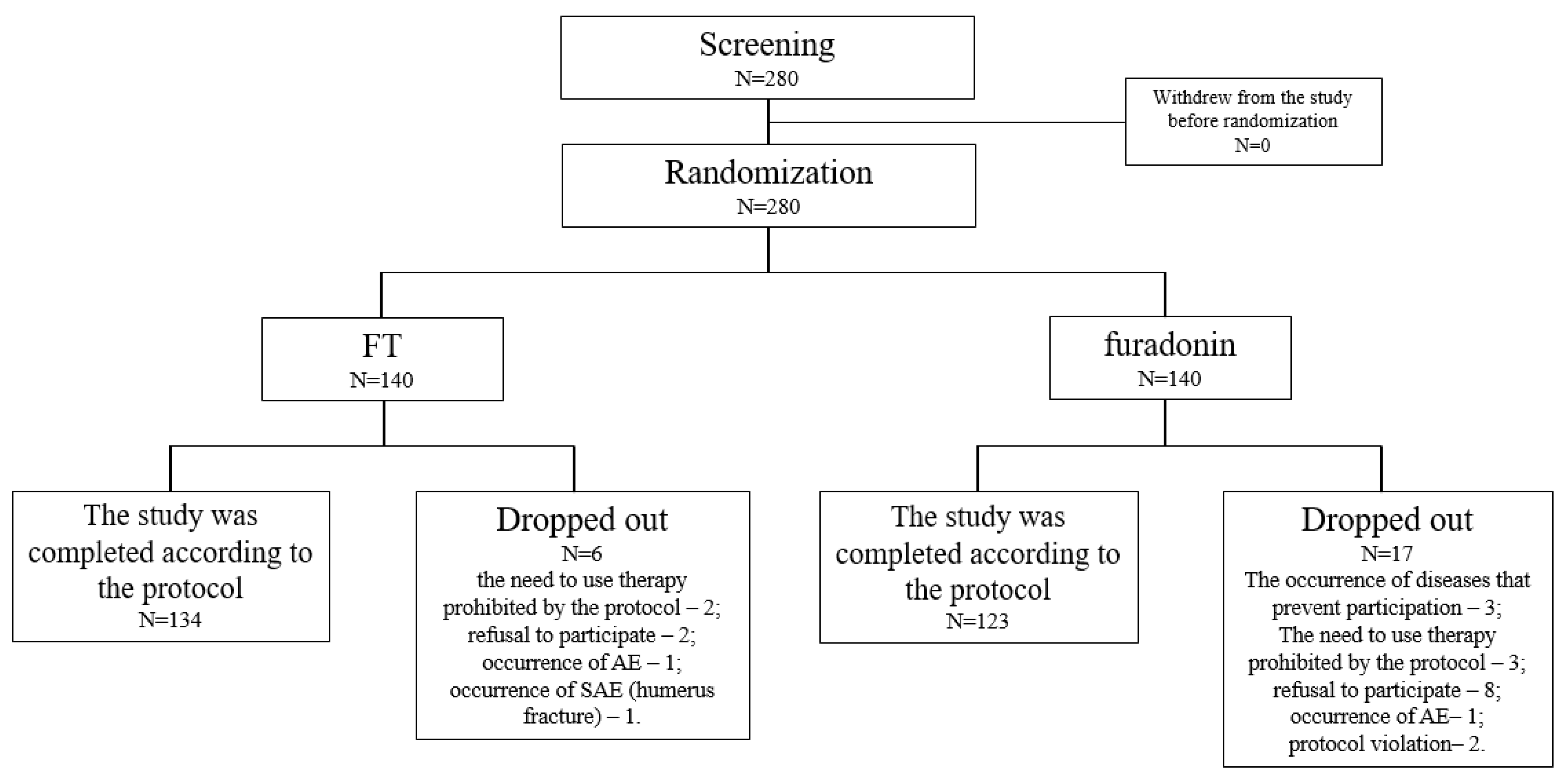
Figure 2.
Study design. EOT (end-of-therapy) visit, TOC (test-of-cure) visit, LFU (late-follow-up) visit.
Figure 2.
Study design. EOT (end-of-therapy) visit, TOC (test-of-cure) visit, LFU (late-follow-up) visit.
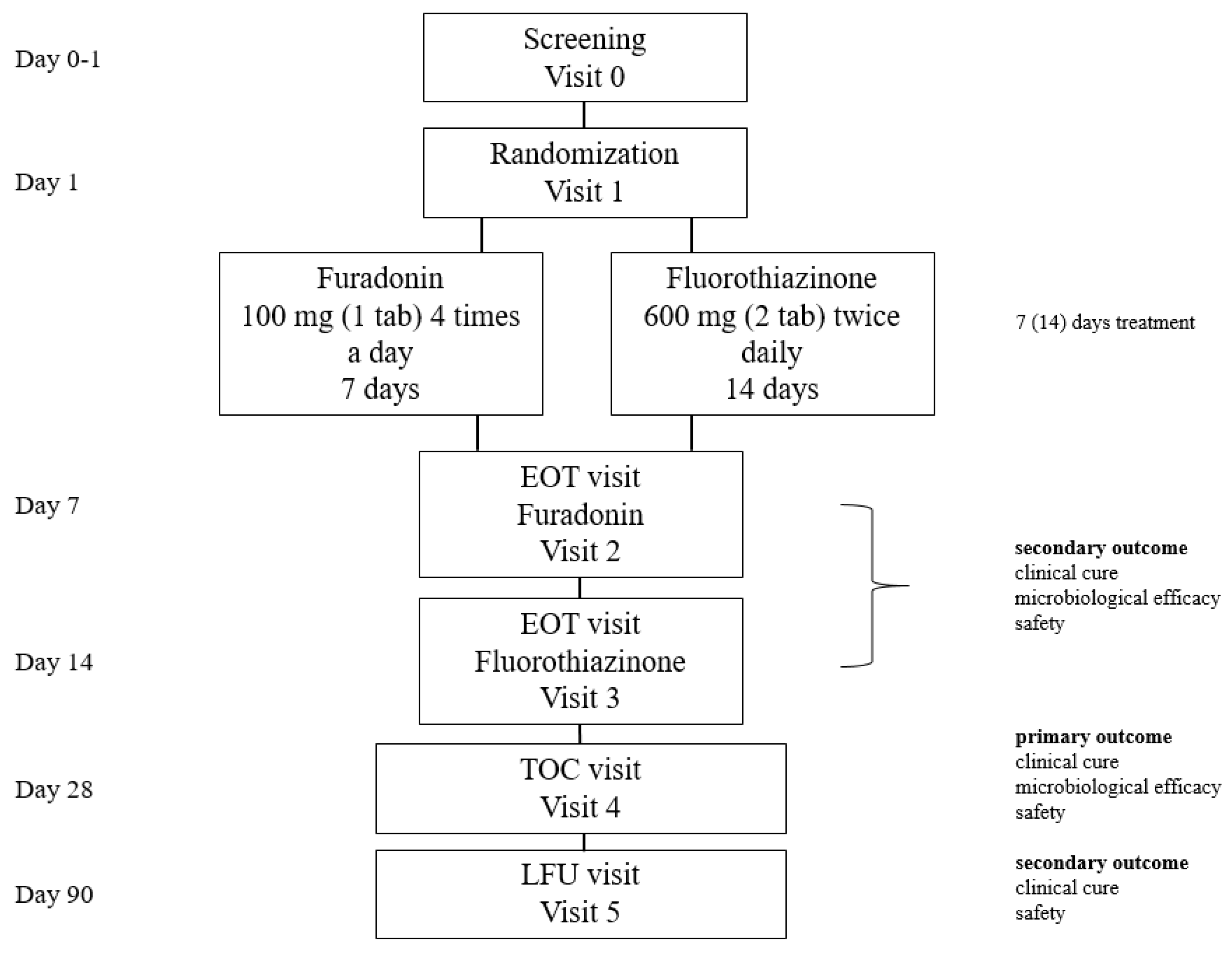

Table 1.
Distribution of patients by study population.
| ITT | MITT | CE | ME | PP | Safety population |
| 280 | 276 | 269 | 179 | 257 | 276 |
Table 2.
Demographic, physiological and laboratory parameters of patients at the time of inclusion in the study.
Table 2.
Demographic, physiological and laboratory parameters of patients at the time of inclusion in the study.
| Indicator | FT(n=140) | furadonin(n=136) | Р |
| Age, years | 47 ± 1.4 | 45 ± 1.2 | 0.133 |
| Weight, kg | 70 ± 0.9 | 71 ± 1.1 | 0.806 |
| BMI, kg/m2 | 166.9 ± 0.45 | 166.2 ± 0.45 | 0.283 |
| Temperature, °C | 36.5 ± 0.15 | 36.5 ± 0.16 | 0.771 |
| SBP, mmHg | 119 ± 9.1 | 118 ± 8.2 | 0.542 |
| DBP, mmHg | 74 ± 6.7 | 73 ± 6.6 | 0.676 |
| HR, bpm | 72 ± 5.4 | 72 ± 5.5 | 0.184 |
| RR, bpm | 16 ± 1.1 | 16 ± 1.1 | 0.949 |
| Blood counts | |||
| Hemoglobin, g/L | 132 ± 13.2 | 131 ± 11.3 | 0.630 |
| Red blood cells, 10*12/L | 4.4 ± 0.39 | 4.5 ± 0.40 | 0.524 |
| Hematocrit, % | 40 ± 0.36 | 40 ± 3.43 | 0.416 |
| Platelets, 10*9/L | 261.34 ± 59.604 | 271.29 ± 62.877 | 0.179 |
| Leukocytes, 10*9/L | 6.8 ± 1.88 | 6.8 ± 1.54 | 0.975 |
| Glucose, mmol/L | 5.0 ± 0.72 | 4.8 ± 0.79 | 0.043 |
| Creatinine, µmol/L | 70 ± 12.5 | 71 ± 10.8 | 0.93 |
| Total bilirubin, µmol/L | 9.9 ± 0.47 | 9.9 ± 0.39 | 0.88 |
| Total protein, g/L | 73.0 ± 0.36 | 72.3 ± 0.39 | 0.21 |
| AST, U/L | 20 ± 0.7 | 20 ± 0.6 | 0.70 |
| ALT, U/L | 20 ± 0.7 | 18 ± 0.8 | 0.65 |
| Urea, mmol/L | 5.0 ± 0.1 | 4.7 ± 0.1 | 0.06 |
| Alkaline phosphatase, U/L | 70 ± 2.0 | 66 ± 1.7 | 0.22 |
| Lactate dehydrogenase, U/L | 205 ± 5.1 | 209 ± 5.7 | 0.66 |
Table 3.
Total score of cystitis symptoms in patients at the time of screening.
| Evaluation method | FT(n=140) | furadonin(n=136) | Р |
| "Pain, discomfort, or burning when urinating" on the VAS scale, points | 5.750 ± 0.1470 | 5.757 ± 0.1463 | 0.972 |
| Pelvic pain, urgency, and frequency urinary symptom scale (PUF SCALE) score, points | 19.286 ± 0.6348 | 19.140 ± 0.6151 | 0.869 |
| Acute Cystitis Symptom Scale (ACSS) score, Total (Typical) score | 10.529 ± 0.2187 | 10.824 ± 0.2434 | 0.368 |
Table 4.
Absolute values of urine pH and specific gravity and relative deviations (%) from normal urine values in patients with cystitis at the time of inclusion in the study.
Table 4.
Absolute values of urine pH and specific gravity and relative deviations (%) from normal urine values in patients with cystitis at the time of inclusion in the study.
| Indicator | FT (n=140) | furadonin(n=136) | Р |
| Absolute indicators | |||
| рН | 5.7 ± 0.78 | 5.8 ± 0.79 | 0.47 |
| Specific gravity, g/L | 1017 ± 7.7 | 1018 ± 7.4 | 0.32 |
| Relative indicators (number (%) of patients with deviation from N) | |||
| FT (n=140) | furadonin (n=136) | Normal values | |
| Color | 2.1% | 1.5% | Light yellow |
| Transparency | 25.7% | 29.4% | Clear |
| Mucus | 71.4% | 76.5% | No |
| Protein >0.15 g/L | 26.4% | 22.8% | <0.15 g/L |
| Nitrites | 20.7% | 22.1% | No |
| Ketones | 2.1% | 2.9% | No |
| Urobilinogen | 44.3% | 47.1% | <17 μmol/L |
| Bilirubin | 3.6% | 0.7% | No |
| Glucose | 0.7% | 5.1% | No |
| Leukocyte esterase | 52.9% | 47.1% | No |
| Erythrocytes | 60.0% | 57.4% | No |
| Leukocytes >6 in the field of view | 91.4% | 94.1% | <6 in the field of view |
| Hyaline casts | 7.1% | 4.4% | No |
| Granular casts | 10.7% | 5.9% | No |
| Epithelial casts | 36.4% | 22.8% | No |
| Squamous epithelium | 60.7% | 57.4% | < 15 in the field of view |
| Transitional epithelium | 9.3% | 6.6% | No |
| Bacteria | 53.6% | 66.2% | No |
Table 5.
Comorbidities in patients with cystitis identified at inclusion in the study.
| Area of associated pathology | FT(n=140) | furadonin(n=136) |
| Skin and visible mucous membranes | 2 (1.4) | 1 (0.7) |
| Musculoskeletal system | 2 (1.4) | 1 (0.7) |
| Cardiovascular system | 1 (0.7) | 2 (1.4) |
| Respiratory system | 1 (0.7) | 2 (1.4) |
| ENT organs | 1 (0.7) | 0 |
| Digestive system | 2 (1.4) | 1 (0.7) |
| Central nervous system | 1 (0.7) | 1 (0.7) |
| Total | 10 (7%) | 9 (7%) |
Table 6.
Clinical efficacy between groups of CE population receiving FT or furadonin on day 28 after the start of therapy.
Table 6.
Clinical efficacy between groups of CE population receiving FT or furadonin on day 28 after the start of therapy.
| Group | Clinical effect | Frequency | Percent | Acceptable percent | Accumulated percent |
| FT | Clinically uncertain outcome | 8 | 6.0 | 6.0 | 6.0 |
| Clinical cure | 122 | 91.7 | 91.7 | 97.7 | |
| Clinical failure | 3 | 2.3 | 2.3 | 100.0 | |
| Total | 133 | 100.0 | 100.0 | ||
| furadonin | Clinically uncertain outcome |
7 | 5.6 | 5.6 | 5.6 |
| Clinical cure | 116 | 92.8 | 92.8 | 98.4 | |
| Clinical failure | 2 | 1.6 | 1.6 | 100.0 | |
| Total | 125 | 100.0 | 100.0 | ||
| Chi-square criteria | |||||
| Meaning | df | Asymptotic significance (2-sided) |
Precise significance (2-sided) |
Precise significance (1-sided) |
|
| Pearson's chi-square | .170а | 2 | .918 | ||
| Likelihood ratios | .171 | 2 | .918 | ||
| Number of admissible observations | 258 | ||||
| а. For the number of cells 2 (33.3%) the assumed value is less than 5. The minimum expected number is 2.90. | |||||
Table 7.
Clinical efficacy of treatment with FT and furadonin 7 and 14 days after the start of therapy.
Table 7.
Clinical efficacy of treatment with FT and furadonin 7 and 14 days after the start of therapy.
| Clinical efficacy 7 days after initiation of treatment | |||||
| Group | Clinical effect | Frequency | Percent | Acceptable percent | Accumulated percent |
| FT | Clinically uncertain outcome |
5 | 3.6 | 3.6 | 3.6 |
| Clinical cure | 37 | 26.8 | 26.8 | 30.4 | |
| Clinical failure | 96 | 69.6 | 69.6 | 100.0 | |
| Total | 138 | 100.0 | 100.0 | ||
| furadonin | Clinically uncertain outcome |
4 | 3.1 | 3.1 | 3.1 |
| Clinical cure | 28 | 21.4 | 21.4 | 24.4 | |
| Clinical failure | 99 | 75.6 | 75.6 | 100.0 | |
| Total | 131 | 100.0 | 100.0 | ||
| Chi-square criteria | |||||
| Meaning | df | Asymptotic significance (2-sided) |
Precise significance (2-sided) |
Precise significance (1-sided) |
|
| Pearson's chi-square | 1.222a | 2 | .543 | ||
| Likelihood ratios | 1.225 | 2 | .542 | ||
| Number of admissible observations | 269 | ||||
| а. For the number of cells 2 (33.3%) the assumed value is less than 5. The minimum expected number is 4.38. | |||||
| Clinical efficacy 14 days after initiation of treatment | |||||
| Group | Clinical effect | Frequency | Percent | Acceptable percent | Accumulated percent |
| FT | Clinically uncertain outcome | 6 | 4.4 | 4.4 | 4.4 |
| Clinical cure | 14 | 10.3 | 10.3 | 14.7 | |
| Clinical failure | 116 | 85.3 | 85.3 | 100.0 | |
| Total | 136 | 100.0 | 100.0 | ||
| furadonin | Clinically uncertain outcome | 5 | 3.8 | 3.8 | 3.8 |
| Clinical cure | 7 | 5.4 | 5.4 | 9.2 | |
| Clinical failure | 118 | 90.8 | 90.8 | 100.0 | |
| Total | 130 | 100.0 | 100.0 | ||
| Chi-square criteria | |||||
| Meaning | df | Asymptotic significance (2-sided) |
Precise significance (2-sided) |
Precise significance (1-sided) |
|
| Pearson's chi-square | 2.307а | 2 | .316 | ||
| Likelihood ratios | 2.351 | 2 | .309 | ||
| Number of admissible observations | 266 | ||||
| а. For the number of cells 0 (0.0%) the assumed value is less than 5. The minimum expected number is 5.38. | |||||
Table 8.
Microbiological eradication of all pathogens from urine on days 7 and 14, the number of microbiological relapses on day 28 after the start of treatment.
Table 8.
Microbiological eradication of all pathogens from urine on days 7 and 14, the number of microbiological relapses on day 28 after the start of treatment.
| Effect, observation period | FT n (%) | furadonin n (%) | χ2 | P |
| Eradication, Day 7 | 66 (66.7) | 59 (71.1) | 0.410 | 0.522 |
| Eradication, Day 14 | 79 (80.6) | 63 (75.9) | 0.589 | 0.443 |
| Microbiological relapse, Day 28 | 19 (20.0) | 18 (22.8) | 0.200 | 0.655 |
Table 9.
Microbiological eradication of pathogens from urine on days 7 and 14, the number of microbiological relapses on day 28 after the start of treatment.
Table 9.
Microbiological eradication of pathogens from urine on days 7 and 14, the number of microbiological relapses on day 28 after the start of treatment.
| Bacteria | FT n (%) | Furadonin n (%) |
| Visit 0 (screening) | ||
| E. coli | 59 | 50 |
| K. pneumoniae | 14 | 14 |
| E. faecalis | 20 | 21 |
| Visit 2 (7th day) | ||
| E. coli | 24 (59.3) | 34 (68.0) |
| K. pneumoniae | 9 (64.3) | 13 (92.9) |
| E. faecalis | 14 (70.0) | 17 (81.0) |
| Visit 3 (14th day) | ||
| E. coli | 42 (71.2) | 34 (68.0) |
| K. pneumoniae | 11 (78.6) | 14 (100.0) |
| E. faecalis | 16 (80.0) | 20 (95.2) |
| Visit 4 (28th day) | ||
| E. coli | 10 (16.9) | 8 (16) |
| K. pneumoniae | 1 (7.1) | 1 (7.1) |
| E. faecalis | 7 (35.0) | 5 (23.8) |
Table 10.
Assessment of the intensity of the symptom "Pain, discomfort, or burning during urination" according to the VAS, PUF, and ACSS scales.
Table 10.
Assessment of the intensity of the symptom "Pain, discomfort, or burning during urination" according to the VAS, PUF, and ACSS scales.
| Screening | Visit 1 | Visit 2 | Visit 3 | Visit 4 | ||||||
|
FT N= 140 |
furadonin N= 136 |
FT N= 140 |
furadonin N= 136 |
FT N= 138 |
furadonin N= 131 |
FT N= 136 |
furadonin N= 130 |
FT N= 133 |
furadonin N= 125 |
|
| Assessment of the intensity of the symptom "Pain, discomfort or burning during urination" on the VAS scale | ||||||||||
| Average value | 5.750 | 5.757 | 5.750 | 5.757 | 1.196 | .893 | .287 | .269 | .038 | .096 |
| Standard error | .1470 | .1463 | .1470 | .1463 | .1088 | .1148 | .0684 | .0723 | .0197 | .0501 |
| Standard deviation | 1.7388 | 1.7062 | 1.7388 | 1.7062 | 1.2779 | 1.3141 | .7973 | .8239 | .2272 | .5597 |
| Pelvic Pain, Urgency, and Frequency (PUF) Symptom Scale (PUF SCALE) | ||||||||||
| Average value | 19.286 | 19.147 | 19.286 | 19.140 | 7.790 | 6.244 | 4.441 | 4.338 | 3.436 | 3.360 |
| Standard error | .6348 | .6145 | .6348 | .6151 | .4287 | .3691 | .2843 | .2567 | .1892 | .1861 |
| Standard deviation | 7.5114 | 7.1663 | 7.5114 | 7.1732 | 5.0363 | 4.2246 | 3.3150 | 2.9269 | 2.1824 | 2.0806 |
| Acute Cystitis Symptom Scale (ACSS) score | ||||||||||
| Average value | 10.529 | 10.824 | 10.529 | 10.824 | 2.870 | 1.924 | 1.044 | .885 | .414 | 0.512 |
| Standard error | .2187 | .2434 | .2187 | .2434 | .2295 | .2188 | .1610 | .1600 | .0841 | .1253 |
| Standard deviation | 2.5879 | 2.8386 | 2.5879 | 2.8386 | 2.6958 | 2.5042 | 1.8772 | 1.8242 | .9702 | 1.4006 |
Table 11.
Adverse events by groups.
| AEs/SAEs | Absolute value, number of AEs/SAEs | Relative importance, number of AEs/SAEs | ||||
| Total | FT | furadonin | Total | FT | furadonin | |
| Headache [10019211] | 58 | 37 | 21 | 17.4 | 21.3 | 13.1 |
| Nausea [10028813] | 45 | 10 | 35 | 13.5 | 5.7 | 21.9 |
| Dizziness [10013573] | 28 | 12 | 16 | 8.4 | 6.9 | 10.0 |
| Diarrhea [10012735] | 22 | 13 | 9 | 6.6 | 7.5 | 5.6 |
| Asthenia [10003549] | 21 | 14 | 7 | 6.3 | 8.0 | 4.4 |
| Decreased appetite [10061428] | 20 | 11 | 9 | 6.0 | 6.3 | 5.6 |
| Hyperhidrosis [10020642] | 12 | 7 | 5 | 3.6 | 4.0 | 3.1 |
| Abdominal pain [10000081] | 11 | 3 | 8 | 3.3 | 1.7 | 5.0 |
| Increased bilirubin levels in the blood [10005364] | 9 | 9 | 0 | 2.7 | 5.2 | 0.0 |
| Leukocyturia [10050791] | 7 | 4 | 3 | 2.1 | 2.3 | 1.9 |
| Vomiting[10047700] | 6 | 3 | 3 | 1.8 | 1.7 | 1.9 |
| Decreased hemoglobin levels [10018884] | 6 | 6 | 0 | 1.8 | 3.4 | 0.0 |
| Hypersthenuria [10020770] | 4 | 2 | 2 | 1.2 | 1.1 | 1.3 |
| Increased lactate dehydrogenase levels in the blood [10005630] | 4 | 4 | 0 | 1.2 | 2.3 | 0.0 |
| Hematuria [10018867] | 4 | 2 | 2 | 1.2 | 1.1 | 1.3 |
| Chest pain [10008479] | 4 | 2 | 2 | 1.2 | 1.1 | 1.3 |
| Other | 77 | 35 | 42 | 21.7 | 20.4 | 23.6 |
| Overall summary | 334 | 174 | 160 | 100 | 100 | 100 |
Disclaimer/Publisher’s Note: The statements, opinions and data contained in all publications are solely those of the individual author(s) and contributor(s) and not of MDPI and/or the editor(s). MDPI and/or the editor(s) disclaim responsibility for any injury to people or property resulting from any ideas, methods, instructions or products referred to in the content. |
© 2026 by the authors. Licensee MDPI, Basel, Switzerland. This article is an open access article distributed under the terms and conditions of the Creative Commons Attribution (CC BY) license (http://creativecommons.org/licenses/by/4.0/).
Copyright: This open access article is published under a Creative Commons CC BY 4.0 license, which permit the free download, distribution, and reuse, provided that the author and preprint are cited in any reuse.