

Submitted:
08 September 2026
Posted:
09 September 2026
You are already at the latest version
Abstract
Corporate Social Responsibility (CSR) has become increasingly relevant in emerging banking systems, yet its financial implications remain debated. This study investigates the impact of CSR on the financial performance of Moroccan banks over the 2014–2023 period. Using a panel dataset of eleven banking groups, we employ static econometric models (fixed effects, random effects, and pooling) and a dynamic Arellano-Bond GMM model to examine whether CSR certification, measured through institutional recognition by CGEM, MASI.ESG, UNGC, or Vigeo Eiris, affects profitability (ROA, ROE, and ROS), solvency (RSC and RCR), and market valuation (MBV). The findings do not reveal a statis-tically robust relationship between CSR certification and financial performance. Only the risk coverage ratio (RCR) exhibits a partially significant association in some static models. These results suggest that CSR practices remain relatively immature in emerging econo-mies and that certification may operate primarily as a legitimacy mechanism rather than a direct driver of financial value creation. The study contributes to the CSR–financial per-formance debate by providing evidence from the Moroccan banking sector and highlights the need for strategically embedded, measurable, and integrated CSR practices to generate financial benefits.
Keywords:
Corporate Social Responsibility (CSR)
; ESG
; financial performance
; banking sector
; Morocco
; emerging markets
; CSR certification
; Sustainable Development Goals (SDGs)
1. Introduction
Corporate Social Responsibility (CSR) has gradually emerged as a lever for legitimacy and sustainable performance in contemporary organizations (Freeman, 1984; Carroll, 1999). Driven by evolving societal expectations and increasingly stringent regulatory demands, CSR promotes the integration of environmental, social, and governance (ESG) considerations into business models. In this regard, several theoretical contributions have emphasized the strategic potential of CSR to generate shared value (Porter & Kramer, 2011), enhance corporate reputation (Fombrun & Shanley, 1990), and mitigate exposure to non-financial risks (Clark et al., 2015).
As a key financial intermediary, the banking sector plays a critical role in directing capital flows toward responsible activities. CSR is therefore viewed not only as an ethical commitment but also as a governance tool that may influence banks’ financial performance (Cornett et al., 2016). However, in emerging economies such as Morocco, the effective integration of CSR into banking practices remains limited and is often driven more by compliance logics than by strategic optimization (Soana, 2011; Gangi et al., 2021).
Despite the proliferation of institutional discourse on sustainable finance, empirical research on the relationship between CSR and performance in the Moroccan banking context remains scarce. This research gap hinders a deeper understanding of the value-creation mechanisms associated with CSR certification, particularly within a highly regulated and prudentially constrained sector.
This article aims to address this gap by providing an empirical assessment of the effect of CSR on the financial performance of banks operating in Morocco, including both domestically owned institutions and subsidiaries of international banking groups. To this end, we employ both static models (pooled OLS, fixed effects, random effects) to test for significant differences across groups, and a dynamic panel model using the Generalized Method of Moments (GMM) in differences (Arellano & Bond, 1991) to control for endogeneity and inertia effects. The estimations are conducted using several representative indicators of financial performance, including profitability (ROA, ROE, ROS), solvency (RSC, RCR), and market valuation (MBV). This study pursues a dual objective: (i) to contribute to the theoretical debate on the economic relevance of CSR practices in emerging banking systems, and (ii) to inform policymakers about the conditions for achieving financially sound and socially responsible governance.
This study contributes to the literature in three ways. First, it provides one of the first longitudinal investigations of CSR certification and financial performance in the Moroccan banking sector. Second, it combines static and dynamic panel estimations to account for both contemporaneous and delayed CSR effects. Third, it contributes to the emerging debate on double materiality by questioning the capacity of conventional IFRS-based financial indicators to capture sustainability-related value creation.
2. Theoretical Framework
Corporate Social Responsibility (CSR) has progressively evolved from a peripheral philanthropic activity to a strategic component of corporate governance and sustainable value creation. In recent decades, growing societal expectations, regulatory pressures, and investor demand for Environmental, Social, and Governance (ESG) transparency have reinforced the integration of CSR practices into business strategies, particularly within the financial sector. As financial institutions play a central role in allocating capital and supporting economic development, understanding whether CSR contributes to financial performance has become a major research concern.
The relationship between CSR and financial performance has generated extensive academic debate. While some studies report a positive relationship between social responsibility and corporate profitability (Orlitzky, Schmidt & Rynes, 2003; Margolis & Walsh, 2003; Friede, Busch & Bassen, 2015), others identify neutral, indirect, or context-dependent effects (Soana, 2011; Surroca, Tribó & Waddock, 2009). These divergent findings suggest that the CSR–financial performance nexus cannot be explained by a single theoretical perspective and requires a multidimensional framework.
A first explanation is provided by stakeholder theory (Freeman, 1984), which argues that organizations create value by balancing the interests of multiple stakeholders rather than focusing exclusively on shareholders. According to this perspective, socially responsible practices strengthen relationships with employees, customers, regulators, investors, and local communities. Improved stakeholder trust may reduce transaction costs, enhance corporate reputation, and ultimately contribute to superior financial performance. Within the banking industry, where confidence and reputation are strategic assets, stakeholder-oriented management is expected to positively influence profitability and organizational sustainability.
This perspective is complemented by the shared value approach developed by Porter and Kramer (2011). Unlike the traditional shareholder-centered view defended by Friedman (1970), the shared value framework suggests that social and environmental challenges can become sources of innovation, competitiveness, and long-term value creation. CSR therefore constitutes not merely a cost but a potential strategic investment capable of generating both economic and societal benefits. Under this approach, the positive impact of CSR on profitability depends on the organization’s ability to create more value than the costs associated with its social and environmental commitments.
The Resource-Based View (RBV) offers an additional explanation for the potential economic benefits of CSR. According to Barney (1991), firms achieve sustainable competitive advantage through valuable, rare, inimitable, and non-substitutable resources. CSR initiatives may contribute to the development of intangible assets such as reputation, stakeholder trust, organizational culture, human capital, and relational networks. These resources can improve organizational resilience and generate long-term performance advantages. In the banking sector, where services are largely intangible, such resources may constitute a critical source of differentiation and value creation.
However, not all CSR initiatives are necessarily motivated by strategic value creation. Institutional theory (DiMaggio & Powell, 1983) argues that organizations often adopt CSR practices in response to coercive, normative, and mimetic pressures originating from regulators, professional associations, investors, and society. In this context, CSR certification may function primarily as a legitimacy mechanism aimed at maintaining social acceptance and conformity with institutional expectations. Consequently, organizations may obtain reputational or legitimacy benefits without necessarily achieving immediate improvements in financial performance.
The signaling perspective provides another relevant framework for understanding the relationship between CSR and financial performance. According to signaling theory (Spence, 1973), firms use observable signals to communicate unobservable qualities to external stakeholders. CSR certifications, ESG ratings, sustainability reports, and responsible governance practices may therefore serve as credible signals of managerial quality, risk management capability, and long-term strategic orientation. Such signals can reduce information asymmetry and positively influence investor perceptions, potentially enhancing market valuation and access to financial resources.
Empirical evidence remains mixed despite the strong theoretical foundations supporting a positive CSR–performance relationship. A large-scale meta-analysis conducted by Friede, Busch and Bassen (2015), based on more than 2,000 empirical studies, concludes that the majority of investigations report a positive association between ESG performance and financial performance. Nevertheless, the magnitude and significance of this relationship vary considerably across countries, sectors, institutional environments, and measurement approaches. Several studies suggest that CSR effects may be indirect, mediated through intangible assets, governance quality, or organizational reputation rather than directly reflected in traditional accounting indicators (Surroca et al., 2009).
These debates are particularly relevant in emerging economies, where institutional frameworks, capital market maturity, and stakeholder expectations differ substantially from those observed in developed countries. In Morocco, CSR has experienced significant growth over the last decade through the promotion of the CGEM CSR Label, the development of the MASI ESG index, and the adoption of sustainability-oriented regulatory initiatives by public authorities and financial market institutions. Despite these advances, empirical evidence regarding the financial consequences of CSR remains limited, especially within the banking sector.
Based on these complementary theoretical perspectives, this study assumes that CSR certification may affect financial performance through three main mechanisms. First, CSR may enhance profitability by improving stakeholder relationships and strengthening competitive advantage (stakeholder theory and shared value framework). Second, CSR may contribute to stronger solvency and more effective risk management through improved governance practices and organizational resilience (institutional theory and RBV). Third, CSR certification may positively influence market valuation by signaling responsible management and reducing information asymmetries (signaling theory). These mechanisms constitute the theoretical foundation of the research hypotheses examined in this study.
3. Materials and Methods
This research adopts a post-positivist epistemological stance and follows a hypothetico-deductive approach to empirically examine the effects of Corporate Social Responsibility (CSR) on financial performance in the Moroccan banking sector. The choice of a quantitative strategy based on panel data econometrics is motivated by its ability to control for unobserved heterogeneity, incorporate the temporal dimension, and test robust causal relationships (Hsiao, 2003; Roodman, 2009).
The study draws on a balanced panel of 110 observations covering 11 banking groups operating in Morocco—whether publicly listed or not—including both domestically owned institutions (e.g., BCP, CIH Bank, CAM) and subsidiaries of international banking conglomerates (e.g., BMCI, CDM, SGMB). The period under review spans from 2014 to 2023. Financial data were extracted from annual financial statements (balance sheets, income statements, and annexes), annual reports, and publications of the Moroccan Capital Market Authority (AMMC), while CSR-related data were sourced from sustainability reports, CGEM’s CSR label, Vigeo Eiris rankings, the MASI.ESG index, and the UN Global Compact registry.
The main explanatory variable is CSR certification, constructed as a binary variable taking the value of 1 if the bank has received at least one formal institutional or financial recognition for CSR (CGEM label, inclusion in MASI.ESG, Vigeo rating, or UNGC adherence), and 0 otherwise. This methodological choice reflects the intent to capture formal, institutionalized CSR commitments in line with institutional theories of organizational legitimacy (DiMaggio & Powell, 1983; Suchman, 1995).
Financial performance (FP) is assessed using three dimensions: (i) profitability, measured by ROA (Return on Assets), ROE (Return on Equity), and ROS (Return on Sales), aggregated into a composite standardized index; (ii) solvency, assessed via the Consolidated Solvency Ratio (RSC) and the Risk Coverage Ratio (RCR); and (iii) market valuation, captured through the Market-to-Book Value (MBV) ratio. For unlisted banks, a constant artificial value of 100 was assigned to the MBV variable to eliminate structural bias and ensure panel balance. This methodological choice was adopted solely to preserve panel balance and facilitate comparative analysis. Consequently, results relating to market valuation should be interpreted with caution and considered exploratory rather than conclusive.
Several control variables were included to enhance robustness: bank size (natural logarithm of total assets), age (years since regulatory authorization by Bank Al-Maghrib), and listing status (dummy variable).

Table 1.
Definition and Measurement of Variables.
| Variable | Type | Measurement |
| CSR | Independent | Dummy variable (1 = certified/labeled bank; 0 = otherwise) |
| Composite FP | Dependent | Mean of ROA, ROE and ROS |
| RSC | Dependent | Consolidated Solvency Ratio |
| RCR | Dependent | Risk Coverage Ratio |
| MBV | Dependent | Market-to-Book Value |
| Size | Control | Log of Total Assets |
| Age | Control | Years since authorization |
| Listing | Control | 1 = Listed bank |
Source: Author’s own elaboration.
Grounded in stakeholder theory (Freeman, 1984), this study posits that CSR—captured through formal CSR labels (CGEM, MASI.ESG, UNGC, Vigeo Eiris)—acts as a strategic lever for improving banks’ overall financial performance. The research model is built around the following general hypothesis (H):
- H: CSR certification positively influences the financial performance of banks operating in Morocco. This hypothesis is further refined into three testable sub-hypotheses:
H1: CSR certification enhances banks’ profitability by strengthening operational efficiency and economic performance (measured through the composite profitability variable combining ROA, ROE, and ROS).
H2: CSR certification contributes to greater solvency and improved risk management, through more prudent capitalization and provisioning policies (evaluated using RSC and RCR).
H3: CSR certification improves market valuation by enhancing institutional reputation and meeting the expectations of socially responsible investors (assessed via the MBV ratio).
To test these hypotheses, both static and dynamic panel data models were estimated.
Static Panel Model:
FPit = α + β1CSRit + β2SIZEit + β3AGEit + β4LISTINGit + εit
Dynamic Panel Model (Arellano-Bond GMM)
where FPit represents the financial performance indicator of bank i at time t (Composite Profitability, RSC, RCR, or MBV); CSRit denotes the CSR certification variable; SIZEit, AGEit, and LISTINGit represent the control variables corresponding respectively to bank size, age, and stock market listing status; α is the intercept term; μi captures unobserved bank-specific effects; and εit is the idiosyncratic error term. In the dynamic specification, FPit−1denotes the lagged dependent variable, introduced to capture persistence and adjustment effects in financial performance over time.
FPit = γFPit−1 + β1CSRit + β2SIZEit + β3AGEit + β4LISTINGit + μi + εit
To test these hypotheses, two econometric modeling strategies were used. Static panel models—pooled OLS, fixed effects (FEM), and random effects (REM)—were employed to analyze the influence of CSR certification on performance while accounting for bank-specific heterogeneity. Specification tests (F-test and Hausman test) led to the preference for fixed effects models, indicating that unobserved bank characteristics are correlated with explanatory variables, thereby rejecting the random effects assumption (Baltagi, 2008).
Recognizing the potential dynamic nature of financial performance, a dynamic panel model using the Generalized Method of Moments (GMM) in first differences was implemented following the Arellano and Bond (1991) methodology. The model was estimated using the xtabond2 command in Stata 12, in two steps, with HAC-robust standard errors and internal instruments.
The conceptual model developed in this study posits that CSR certification is an explanatory variable capable of influencing three key dimensions of banks’ financial performance: profitability, solvency/risk management, and market valuation. Figure 1 below presents this framework, highlighting the main independent variable (CSR certification), the three clusters of dependent variables (performance indicators), and the structural control variables (size, age, listing status).
4. Results
The research model adopted in this study is premised on the assumption that Corporate Social Responsibility (CSR) serves as a strategic lever capable of positively influencing the financial performance of banks operating in Morocco. This hypothesis is rooted in stakeholder theory (Freeman, 1984), which posits that firms integrating internal and external stakeholder expectations into their governance practices enhance both institutional legitimacy and organizational resilience.
4.1. Descriptive Statistics and Data Validation
Prior to conducting econometric estimations, a descriptive analysis was undertaken to characterize the sample and assess the statistical reliability of the dataset. The study covers 11 banking groups operating in Morocco from 2014 to 2023, yielding a balanced panel of 110 annual observations. Financial performance was measured using three profitability indicators (ROA, ROE, ROS), two solvency/risk management indicators (RSC, RCR), and one market-based indicator (MBV). The main explanatory variable is CSR certification, constructed as a binary variable reflecting the possession of formal CSR recognition (CGEM label, MASI.ESG index inclusion, UNGC commitment, or Vigeo Eiris rating).
Data reliability was ensured through a dual verification process. Quantitatively, financial aggregates such as total assets, operating income, and net banking product were cross-checked with figures published by Bank Al-Maghrib, showing over 99% concordance for the 11 banking groups. Qualitatively, time series plots were visually inspected to identify anomalies, which were corrected through verification against original financial reports. Internal consistency checks among interdependent financial aggregates further reinforced data integrity.
Descriptive statistics reveal differentiated dynamics across indicators. ROA averaged 1.06% (SD: 0.41%), indicating stable but moderate operational profitability. ROE displayed a higher average of 11.14% but with substantial dispersion (SD: 9.65%; min: –41.95%), reflecting structural heterogeneity across banks. ROS was comparatively stable, with a mean of 17.15% and a standard deviation of 4.27%.
Regarding prudential indicators, the Consolidated Solvency Ratio (RSC) exhibited high and stable values (mean: 14.44%; SD: 3.23%), whereas the Risk Coverage Ratio (RCR) was more volatile, particularly during 2020 due to the exogenous COVID-19 shock. As for market valuation, the Market-to-Book Value (MBV) ratio averaged 87.02% (SD: 11.4%), with observed extremes ranging from 34.08% to 119.37%.
Given the high correlation between the three profitability metrics (correlation coefficient > 0.85), a composite variable was constructed using their arithmetic mean. The final empirical model thus retained six financial performance indicators, grouped into three dimensions: profitability (composite variable), solvency (RSC, RCR), and market valuation (MBV). Control variables included bank size (log of total assets), age (years since licensing by Bank Al-Maghrib), and listing status.
4.2. Static Panel Estimation Results
The static panel estimations provide a nuanced assessment of the relationship between CSR certification and the different dimensions of financial performance in the Moroccan banking sector.
Regarding profitability, measured through the composite indicator combining ROA, ROE, and ROS, the results consistently indicate the absence of a statistically significant CSR effect across all specifications. In the pooled OLS model, the CSR coefficient is positive (β = 0.58; p = 0.797), suggesting a favorable but economically negligible association. However, both the fixed-effects model (β = –1.72; p = 0.489) and the random-effects model (β = –1.28; p = 0.590) yield negative and non-significant coefficients. These findings indicate that CSR-certified banks do not exhibit significantly higher profitability than non-certified institutions. The absence of significance further suggests that intra-bank variations in CSR engagement are insufficient to generate measurable differences in profitability over the study period.
The analysis of solvency, measured through the Consolidated Solvency Ratio (RSC), leads to similar conclusions. Although all estimated coefficients are positive, none are statistically significant. The pooled OLS model reports a coefficient of 0.205 (p = 0.780), while the fixed-effects and random-effects models produce coefficients of 1.153 (p = 0.207) and 0.253 (p = 0.735), respectively. These results suggest that CSR certification is not associated with stronger capitalization or improved solvency positions among Moroccan banks.
A different pattern emerges when examining the Risk Coverage Ratio (RCR). In this case, CSR certification exhibits a positive and statistically significant relationship in both the pooled OLS model (β = 14.84; p = 0.005) and the random-effects model (β = 14.84; p = 0.004). These findings suggest that CSR-certified banks tend to maintain higher levels of risk coverage and provisioning, which may reflect a more prudent approach to risk management and governance. However, the coefficient becomes statistically insignificant in the fixed-effects specification (β = 8.43; p = 0.227), indicating that the observed effect may be driven primarily by structural differences between banks rather than by changes occurring within banks over time. Consequently, the evidence supporting a CSR effect on risk management remains only partially robust.
Finally, the results for market valuation, proxied by the Market-to-Book Value (MBV) ratio, reveal positive but statistically insignificant coefficients across all models. The estimated CSR coefficients range from 3.49 in the fixed-effects model (p = 0.148) to 5.28 in the pooled OLS model (p = 0.060). Although the positive signs suggest that CSR-certified banks may benefit from slightly higher market valuations, the absence of statistical significance prevents any firm conclusion regarding investors’ recognition of CSR efforts in the Moroccan banking market.
The results reported in Table 2 summarize the estimates obtained from pooled OLS, fixed-effects, and random-effects models. The objective is to evaluate whether CSR certification contributes to improved financial performance among Moroccan banking institutions. Particular attention is given to profitability, solvency, risk coverage, and market valuation indicators. The coefficients associated with the CSR variable provide insight into the magnitude and direction of the relationship, while the p-values indicate the statistical robustness of the estimated effects.
Overall, the static estimations provide limited support for the hypothesis that CSR certification enhances financial performance. Among the six performance indicators examined, only the Risk Coverage Ratio exhibits a partially significant association with CSR certification. These findings suggest that CSR engagement in Moroccan banks may contribute more to prudential risk management practices than to profitability, solvency, or market valuation outcomes.
4.3. Dynamic Panel Estimation Results (GMM)
To account for the potential delayed effects of CSR practices on financial performance, dynamic panel estimations were conducted using the Arellano-Bond (1991) Generalized Method of Moments (GMM) estimator. A five-year lag of the CSR variable [CSR (L5)] was introduced to capture the long-term impact of CSR certification on profitability, solvency, risk management, and market valuation.
The results indicate that CSR certification does not exert a statistically significant influence on any of the financial performance dimensions considered. For the profitability model, measured through the composite indicator combining ROA, ROE, and ROS, the estimated coefficient is positive (β = 0.890) but highly insignificant (p = 0.944). This finding suggests that CSR certification does not generate measurable profitability gains, even after a substantial adjustment period.
Similarly, the solvency model reveals a negative but statistically insignificant coefficient for the Consolidated Solvency Ratio (RSC) (β = –1.208; p = 0.754), indicating that CSR-certified banks do not maintain significantly stronger capital adequacy positions than their counterparts. Regarding risk management, the Risk Coverage Ratio (RCR) exhibits a positive coefficient (β = 25.037), suggesting a potential tendency toward more prudent provisioning policies. Nevertheless, the result remains statistically insignificant (p = 0.574).
Finally, the analysis of market valuation shows a negative coefficient for the Market-to-Book Value ratio (MBV) (β = –11.458; p = 0.244). Although this result may indicate that investors do not immediately reward CSR certification, the lack of statistical significance prevents any robust conclusion.
Table 3.
Dynamic GMM Estimation Results: Long-Term Effects of CSR on Financial Performance.
| Performance Dimension |
Dependent Variable | CSR (L5) Coefficient | p-value | Interpretation |
| Profitability | Composite (ROA, ROE, ROS) | 0.890 | 0.944 | Positive but not significant |
| Solvency | RSC | -1.208 | 0.754 | Negative but not significant |
| Risk Management | RCR | 25.037 | 0.574 | Positive but not significant |
| Market Valuation | MBV | -11.458 | 0.244 | Negative but not significant |
Source: Author’s calculations based on dynamic panel estimations using the Arellano-Bond GMM estimator (Stata 12) and data collected from Moroccan banking groups over the period 2014–2023.
Overall, the dynamic estimations corroborate the results obtained from the static panel models. The findings provide no empirical evidence that CSR certification contributes to improved profitability, solvency, risk management, or market valuation in the Moroccan banking sector, even when a five-year lag structure is introduced. Consequently, the hypothesis of a delayed positive CSR effect is not supported by the data.
4.4. Robustness and Diagnostic Tests
The validity of the dynamic panel estimations was assessed through a series of diagnostic tests commonly recommended for Generalized Method of Moments (GMM) estimations. Following Arellano and Bond (1991), the robustness of the estimated models was evaluated using the AR(1) and AR(2) autocorrelation tests, as well as the Sargan over-identification test. These procedures make it possible to verify the consistency of the estimators and the validity of the instrumental variables used in the estimation process. Table 4 reports the results of the diagnostic tests for the four estimated dynamic models.
The Arellano-Bond tests examine whether the residuals exhibit first-order [AR(1)] or second-order [AR(2)] serial correlation. While first-order autocorrelation is generally expected in differenced equations, the absence of second-order autocorrelation is a necessary condition for the consistency of GMM estimators. The Sargan test, in turn, evaluates the overall validity of the instruments by testing whether they are uncorrelated with the error term.
The results indicate that the profitability model, based on the composite indicator combining ROA, ROE, and ROS, satisfies the autocorrelation requirements, as neither the AR(1) nor the AR(2) tests are statistically significant. However, the Sargan test is significant (p = 0.021), suggesting potential concerns regarding the validity of the instrument set and possible over-identification issues.
A similar pattern is observed for the solvency model (RSC). Both autocorrelation tests remain non-significant, indicating no evidence of residual serial correlation. Nevertheless, the significant Sargan statistic (p = 0.002) raises concerns about instrument exogeneity and suggests that the model should be interpreted with caution.
The risk management model (RCR) presents a different configuration. The Sargan test confirms the validity of the instruments (p = 0.797), while the AR(1) test remains non-significant. However, the AR(2) test is significant at the 5% level (p = 0.045), indicating the presence of second-order serial correlation and suggesting that the dynamic specification may not fully capture the persistence of risk coverage behavior.
Among all estimated specifications, the market valuation model (MBV) provides the most satisfactory diagnostic results. The AR(1), AR(2), and Sargan tests are all non-significant, indicating the absence of residual autocorrelation and supporting the validity of the instrumental variables used in the estimation.
Overall, the diagnostic tests provide mixed but generally acceptable evidence regarding the robustness of the dynamic estimations. While some concerns arise regarding instrument validity in the profitability and solvency models, and residual autocorrelation in the RCR specification, the diagnostic results do not alter the central conclusion of this study. Consistent with the static panel estimations, the dynamic models fail to provide statistically significant evidence that CSR certification generates long-term improvements in profitability, solvency, risk management, or market valuation among Moroccan banks.
5. Discussion
The objective of this study was to examine whether Corporate Social Responsibility (CSR) certification contributes to improving the financial performance of Moroccan banks. Drawing upon stakeholder theory (Freeman, 1984) and the shared value framework (Porter & Kramer, 2011), the research assumed that socially responsible banks would benefit from superior profitability, stronger solvency positions, improved risk management, and enhanced market valuation. However, the empirical evidence obtained from both static and dynamic panel models does not provide robust support for these assumptions.
Overall, the findings indicate that CSR certification has no statistically significant impact on profitability, solvency, or market valuation. Across the different econometric specifications, the coefficients associated with CSR remain predominantly positive but statistically insignificant. These results suggest that, within the Moroccan banking sector, CSR certification alone does not constitute a sufficient condition for generating measurable financial gains. Consequently, the first hypothesis (H1), which predicted a positive effect of CSR on profitability, is rejected. Similarly, the third hypothesis (H3), relating CSR certification to market valuation, is not supported by the empirical evidence.
The only dimension showing partial support concerns risk management. The positive relationship observed between CSR certification and the Risk Coverage Ratio (RCR) in some static models suggests that CSR-certified banks may adopt more prudent provisioning policies and stronger risk management practices. Nevertheless, this relationship disappears in the dynamic estimations and therefore cannot be considered robust. As a result, the second hypothesis (H2) receives only partial support and must be interpreted with caution.
These findings are broadly consistent with previous studies conducted in emerging economies. Tjia and Stiawati (2012), investigating Indonesian banks, reported no significant relationship between CSR disclosure and market valuation. Similarly, Moses et al. (2014) found no measurable impact of CSR practices on the financial performance of Nigerian firms, while Masoud and Halaseh (2017) observed either weak or insignificant relationships between CSR engagement and traditional financial indicators in Jordan. Taken together, these studies suggest that in developing and emerging markets, CSR often functions primarily as a mechanism of legitimacy and institutional compliance rather than as an immediate source of competitive advantage.
The results also support the argument developed by Surroca, Tribó and Waddock (2009), who emphasize that the relationship between CSR and financial performance is often indirect. According to their resource-based perspective, CSR contributes to the accumulation of intangible resources such as reputation, stakeholder trust, organizational learning, and human capital. These resources may ultimately enhance firm performance, but their effects are difficult to capture through conventional accounting indicators. Consequently, the absence of statistical significance should not necessarily be interpreted as evidence that CSR creates no value, but rather that its value creation mechanisms may operate through channels that are not directly observable in financial statements.
A microeconomic interpretation of the results suggests that CSR-certified banks tend to adopt more responsible governance practices without necessarily generating immediate profitability gains. The positive coefficients obtained for risk-related indicators are consistent with the prudential logic embedded in banking regulation and IFRS 9 requirements. In this respect, CSR may contribute to strengthening organizational resilience and risk awareness rather than directly improving short-term financial returns.
At the macroeconomic level, the findings indicate that market incentives alone may not be sufficient to reward socially responsible behavior. The Moroccan banking sector operates within a highly regulated environment characterized by prudential supervision, limited competition, and relatively homogeneous business models. Under such conditions, the economic benefits of CSR initiatives may remain weak or difficult to distinguish from the effects of regulatory compliance. This observation echoes the broader sustainability literature, which argues that public policies and institutional incentives remain essential for promoting sustainable business practices.
Institutional theory provides an additional explanation for the observed results. From this perspective, CSR certification may function primarily as a legitimacy-seeking mechanism rather than a strategic performance driver. Moroccan banks may adopt CSR labels, sustainability reports, and ESG commitments in response to expectations from regulators, investors, and society. Such practices reinforce organizational legitimacy but do not necessarily translate into superior financial performance. The predominance of conformity-based motivations may therefore explain the limited economic effects observed in this study.
Another important explanation concerns the accounting framework used to assess performance. The financial indicators employed in this research are derived from IFRS-based financial statements, which remain primarily focused on financial materiality. Although IFRS standards provide a reliable representation of economic performance, they do not adequately capture the social, environmental, and human dimensions of value creation. As a result, many benefits generated by CSR initiatives remain invisible within traditional accounting metrics. This limitation is particularly relevant in the banking sector, where trust, reputation, governance quality, and stakeholder relationships constitute major intangible assets.
Recent developments in sustainability reporting have highlighted the importance of the double materiality principle, notably through the Corporate Sustainability Reporting Directive (CSRD). Unlike traditional accounting approaches, double materiality recognizes both the financial impacts of sustainability issues and the organization’s impacts on society and the environment. Alternative accounting frameworks such as the CARE model proposed by Richard and Rambaud offer promising avenues for capturing forms of value creation that remain excluded from conventional financial reporting. Consequently, part of the apparent absence of a CSR-performance relationship may reflect measurement limitations rather than the actual ineffectiveness of CSR initiatives.
Overall, the findings suggest that CSR in the Moroccan banking sector should be viewed as an ongoing institutional transformation rather than a fully mature strategic performance lever. CSR certification alone does not appear sufficient to generate measurable improvements in profitability, solvency, or market valuation. Its contribution may instead lie in the gradual development of organizational resilience, stakeholder trust, and sustainable governance capabilities whose economic benefits emerge over longer time horizons and through mechanisms that extend beyond traditional financial indicators.
The divergence between our findings and those reported in developed economies may be attributed to differences in ESG market maturity. In mature financial markets, investors increasingly incorporate sustainability criteria into valuation models, thereby rewarding socially responsible firms. In contrast, the Moroccan financial market remains predominantly driven by conventional financial criteria, which may limit the economic rewards associated with CSR certification.
Overall, the findings provide stronger support for institutional theory than for stakeholder theory or the shared value perspective. CSR certification appears to function primarily as a legitimacy-enhancing mechanism rather than as a direct driver of financial performance. This result suggests that the Moroccan banking sector remains at an intermediate stage of CSR maturity, where conformity-based motivations dominate strategic value creation objectives.
6. Conclusions
This study examined the relationship between Corporate Social Responsibility (CSR) and the financial performance of Moroccan banking institutions over the period 2014–2023. Using a balanced panel of eleven banking groups and combining static panel estimators (Pooled OLS, Fixed Effects, and Random Effects) with dynamic Generalized Method of Moments (GMM) models, the research assessed the impact of CSR certification on profitability, solvency, risk management, and market valuation.
Overall, the empirical findings do not provide robust evidence supporting the existence of a systematic positive relationship between CSR certification and financial performance. The results lead to the rejection of Hypothesis H1, which predicted a positive effect of CSR on profitability, and Hypothesis H3, which assumed a positive influence on market valuation. Hypothesis H2 receives only partial support, as a positive association is observed for the Risk Coverage Ratio (RCR) in some static specifications, but this relationship disappears in the dynamic estimations. Consequently, CSR certification does not appear to generate measurable improvements in profitability, solvency, or market valuation within the Moroccan banking sector during the period under investigation.
These findings contribute to the ongoing debate surrounding the CSR–financial performance nexus by suggesting that the economic effects of CSR remain highly context-dependent. While stakeholder theory and the shared value framework predict a positive contribution of CSR to organizational performance, the results are more consistent with institutional theory, which views CSR adoption as a response to legitimacy, regulatory, and societal pressures. In the Moroccan banking context, CSR certification may therefore function primarily as a mechanism of institutional conformity and reputational legitimacy rather than as an immediate source of financial value creation.
The findings also support the argument advanced by the Resource-Based View and signaling theory that the benefits of CSR may be indirect, long-term, and largely intangible. CSR initiatives may strengthen stakeholder trust, reputation, organizational resilience, and governance quality without necessarily producing immediate improvements in conventional accounting or market indicators. Consequently, the absence of statistical significance should not be interpreted as evidence that CSR creates no value, but rather as an indication that such value may remain insufficiently captured by traditional financial measures.
From a managerial perspective, the results suggest that CSR should not be approached merely as a certification process or a compliance-oriented exercise. Banking institutions should integrate CSR principles into strategic decision-making, risk management systems, stakeholder engagement policies, and organizational culture. Sustainable value creation is likely to emerge when CSR becomes embedded within core business activities rather than remaining confined to symbolic or reputational initiatives.
The study also carries important implications for regulators and standard-setting bodies. The growing adoption of ESG frameworks, non-financial reporting requirements, and sustainability certifications should be accompanied by more rigorous evaluation mechanisms capable of distinguishing substantive CSR practices from symbolic compliance. Institutions such as the AMMC, Bank Al-Maghrib, and the CGEM may further strengthen the effectiveness of CSR policies by promoting sector-specific indicators, sustainability maturity frameworks, and enhanced transparency requirements.
A major implication of this research concerns the limitations of conventional accounting frameworks. Most financial indicators employed in this study are derived from IFRS-based reporting systems that remain largely centered on financial materiality. As a result, several dimensions of social, environmental, and human value creation remain invisible within traditional financial statements. This observation reinforces current debates surrounding double materiality and integrated sustainability reporting. Emerging frameworks such as the Corporate Sustainability Reporting Directive (CSRD) and the CARE (Comprehensive Accounting in Respect of Ecology) model offer promising avenues for better capturing the multidimensional value generated by CSR initiatives.
This study contributes to the literature in three main ways. First, it provides one of the few longitudinal analyses of CSR and financial performance within the Moroccan banking sector. Second, it combines static and dynamic panel approaches, thereby improving the robustness of empirical inference and addressing potential endogeneity concerns. Third, it highlights the conceptual and measurement limitations of traditional financial indicators when evaluating sustainability-related value creation, thereby contributing to emerging discussions on double materiality, integrated reporting, and sustainable accounting.
This study is subject to several limitations. First, the sample is restricted to the Moroccan banking sector, which may limit the generalizability of the findings to other industries and institutional contexts. Second, CSR is measured through a binary certification variable that may not fully capture the intensity or quality of sustainability practices. Third, conventional accounting and market-based indicators may fail to reflect the intangible benefits associated with CSR initiatives.
Future research could extend this work by incorporating continuous ESG scores, qualitative dimensions of CSR engagement, and cross-sectoral or international comparisons. Further investigations may also explore indirect transmission mechanisms through which CSR influences performance, including reputation, stakeholder trust, innovation capacity, and organizational resilience. Such approaches would provide a deeper understanding of how CSR contributes to long-term sustainable value creation in emerging economies.
Ultimately, the findings suggest that CSR certification alone does not guarantee superior financial performance in emerging banking markets. Rather than representing an immediate financial lever, CSR appears to constitute a long-term governance and sustainability mechanism whose benefits may materialize through indirect channels that conventional accounting systems are not yet fully equipped to capture.
Author Contributions
Conceptualization, Ismail Merchich; methodology, Ismail Merchich; software, Ismail Merchich; validation, Ismail Merchich; formal analysis, Ismail Merchich; investigation, Ismail Merchich; resources, Ismail Merchich; data curation, Ismail Merchich; writing—original draft preparation, Ismail Merchich; writing—review and editing, Ismail Merchich; visualization, Ismail Merchich; supervision, Kaoutar El Abidi Amine; project administration, Ismail Merchich. The author has read and agreed to the published version of the manuscript.
Funding
This research received no external funding.
Institutional Review Board Statement
Not applicable.
Informed Consent Statement
Not applicable.
Data Availability Statement
he data used in this study were obtained from publicly available sources, including banks’ annual reports, financial statements, and publicly accessible institutional and market databases. The data supporting the findings of this study are available from the corresponding sources cited in the manuscript.
Acknowledgments
During the preparation of this manuscript, the authors used ChatGPT (OpenAI) for language editing and assistance with the organization of the manuscript. The authors reviewed and edited the output and take full responsibility for the content of the publication.
Conflicts of Interest
The authors declare no conflicts of interest.
Abbreviations
The following abbreviations are used in this manuscript:
| CSR | Corporate Social Responsibility |
| ESG | Environmental, Social and Governance |
| ROA | Return on Assets |
| ROE | Return on Equity |
| ROS | Return on Sales |
| RCR | Risk Coverage Ratio |
| MBV | Market-to-Book Value |
| GMM | Generalized Method of Moments |
| CGEM | Confédération Générale des Entreprises du Maroc |
| UNGC | United Nations Global Compact |
References
- Arellano, M.; Bond, S. Some tests of specification for panel data: Monte Carlo evidence and an application to employment equations. J. Econom. 1991, 58(2), 277–297. [Google Scholar] [CrossRef]
- Baltagi, B. H. Econometric analysis of panel data, 4th ed.; John Wiley & Sons, 2008. [Google Scholar]
- Barney, J. B. Firm resources and sustained competitive advantage. J. Manag. 1991, 17(1), 99–120. [Google Scholar] [CrossRef]
- Carroll, A. B. Corporate social responsibility: Evolution of a definitional construct. Bus. Soc. 1999, 38(3), 268–295. [Google Scholar] [CrossRef]
- CESE. Responsabilité sociétale des organisations: Mécanismes de transition vers un développement durable. In Conseil Économique, Social et Environnemental; 2016. [Google Scholar]
- Clark, G. L.; Feiner, A.; Viehs, M. From the stockholder to the stakeholder: How sustainability can drive financial outperformance. In Smith School of Enterprise and the Environment; University of Oxford, 2015. [Google Scholar]
- Cornett, M. M.; Erhemjamts, O.; Tehranian, H. Greed or good deeds: An examination of the relation between corporate social responsibility and the financial performance of U.S. commercial banks around the financial crisis. J. Bank. Financ. 2016, 70, 137–159. [Google Scholar] [CrossRef]
- DiMaggio, P. J.; Powell, W. W. The iron cage revisited: Institutional isomorphism and collective rationality in organizational fields. Am. Sociol. Rev. 1983, 48(2), 147–160. [Google Scholar] [CrossRef]
- Eccles, R. G.; Ioannou, I.; Serafeim, G. The impact of corporate sustainability on organizational processes and performance. Manag. Sci. 2014, 60(11), 2835–2857. [Google Scholar] [CrossRef]
- Edmans, A. Does the stock market fully value intangibles? Employee satisfaction and equity prices. J. Financ. Econ. 2011, 101(3), 621–640. [Google Scholar] [CrossRef]
- European Commission. Directive (EU) 2022/2464 of the European Parliament and of the Council of 14 December 2022 as regards corporate sustainability reporting (Corporate Sustainability Reporting Directive – CSRD). In Official Journal of the European Union; 2022. [Google Scholar]
- Fombrun, C. J.; Shanley, M. What’s in a name? Reputation building and corporate strategy. Acad. Manag. J. 1990, 33(2), 233–258. [Google Scholar] [CrossRef]
- Freeman, R. E. Strategic management: A stakeholder approach; Pitman Publishing, 1984. [Google Scholar]
- Friede, G.; Busch, T.; Bassen, A. ESG and financial performance: Aggregated evidence from more than 2,000 empirical studies. J. Sustain. Financ. Invest. 2015, 5(4), 210–233. [Google Scholar] [CrossRef]
- Gangi, F.; Mustilli, M.; Varrone, N.; Daniele, L. M. Corporate social responsibility and banks’ financial performance. Int. Bus. Res. 2018, 11(10), 220–242. Available online: https://www.ccsenet.org/journal/index.php/ibr/article/view/0/36911. [CrossRef]
- Hsiao, C. Analysis of panel data, 2nd ed.; Cambridge University Press, 2003. [Google Scholar] [CrossRef]
- IFRS Foundation. IFRS S1 General Requirements for Disclosure of Sustainability-related Financial Information and IFRS S2 Climate-related Disclosures; IFRS Foundation, 2023. [Google Scholar]
- Margolis, J. D.; Walsh, J. P. Misery loves companies: Rethinking social initiatives by business. Adm. Sci. Q. 2003, 48(2), 268–305. [Google Scholar] [CrossRef]
- Masoud, N.; Halaseh, A. Corporate social responsibility and company performance: An empirical analysis of Jordanian companies. J. Soc. Sci. 2017, 6(3), 74–84. [Google Scholar]
- Merchich, I.; El Abidi, K. L’investissement socialement responsable: Un levier pour la durabilité des entreprises dans les marchés émergents: Cas du Maroc. Actes de la 26e Université de Printemps de l’Audit Social et Sociétal. Institut International de l’Audit Social. 2025. [Google Scholar]
- Moses, O.; Ebere, O.; Samuel, A. Corporate social responsibility and financial performance in Nigeria. Int. J. Bus. Manag. Rev. 2014, 2(4), 1–17. [Google Scholar]
- Orlitzky, M.; Schmidt, F. L.; Rynes, S. L. Corporate social and financial performance: A meta-analysis. Organ. Stud. 2003, 24(3), 403–441. [Google Scholar] [CrossRef]
- Porter, M. E.; Kramer, M. R. Creating shared value. Harv. Bus. Rev. 2011, 89(1–2), 62–77. [Google Scholar]
- Rambaud, A.; Richard, J. Révolution comptable: Pour une entreprise écologique et sociale; Éditions de l’Atelier, 2020. [Google Scholar]
- Roodman, D. How to do xtabond2: An introduction to difference and system GMM in Stata. Stata J. 2009, 9(1), 86–136. [Google Scholar] [CrossRef]
- Soana, M. G. The relationship between corporate social performance and corporate financial performance in the banking sector. J. Bus. Ethics 2011, 104(1), 133–148. [Google Scholar] [CrossRef]
- Spence, M. Job market signaling. Q. J. Econ. 1973, 87(3), 355–374. [Google Scholar] [CrossRef]
- Suchman, M. C. Managing legitimacy: Strategic and institutional approaches. Acad. Manag. Rev. 1995, 20(3), 571–610. [Google Scholar] [CrossRef]
- Surroca, J.; Tribó, J. A.; Waddock, S. Corporate responsibility and financial performance: The role of intangible resources. Strateg. Manag. J. 2009, 31(5), 463–490. [Google Scholar] [CrossRef]
- Tjia, O.; Stiawati, D. Corporate social responsibility disclosure and corporate financial performance in Indonesian banking industry. Int. J. Bus. Soc. Sci. 2012, 3(14), 152–160. [Google Scholar]
Figure 1.
Conceptual Model – CSR Effects on Financial Performance Dimensions. Source: Author’s own elaboration.
Figure 1.
Conceptual Model – CSR Effects on Financial Performance Dimensions. Source: Author’s own elaboration.
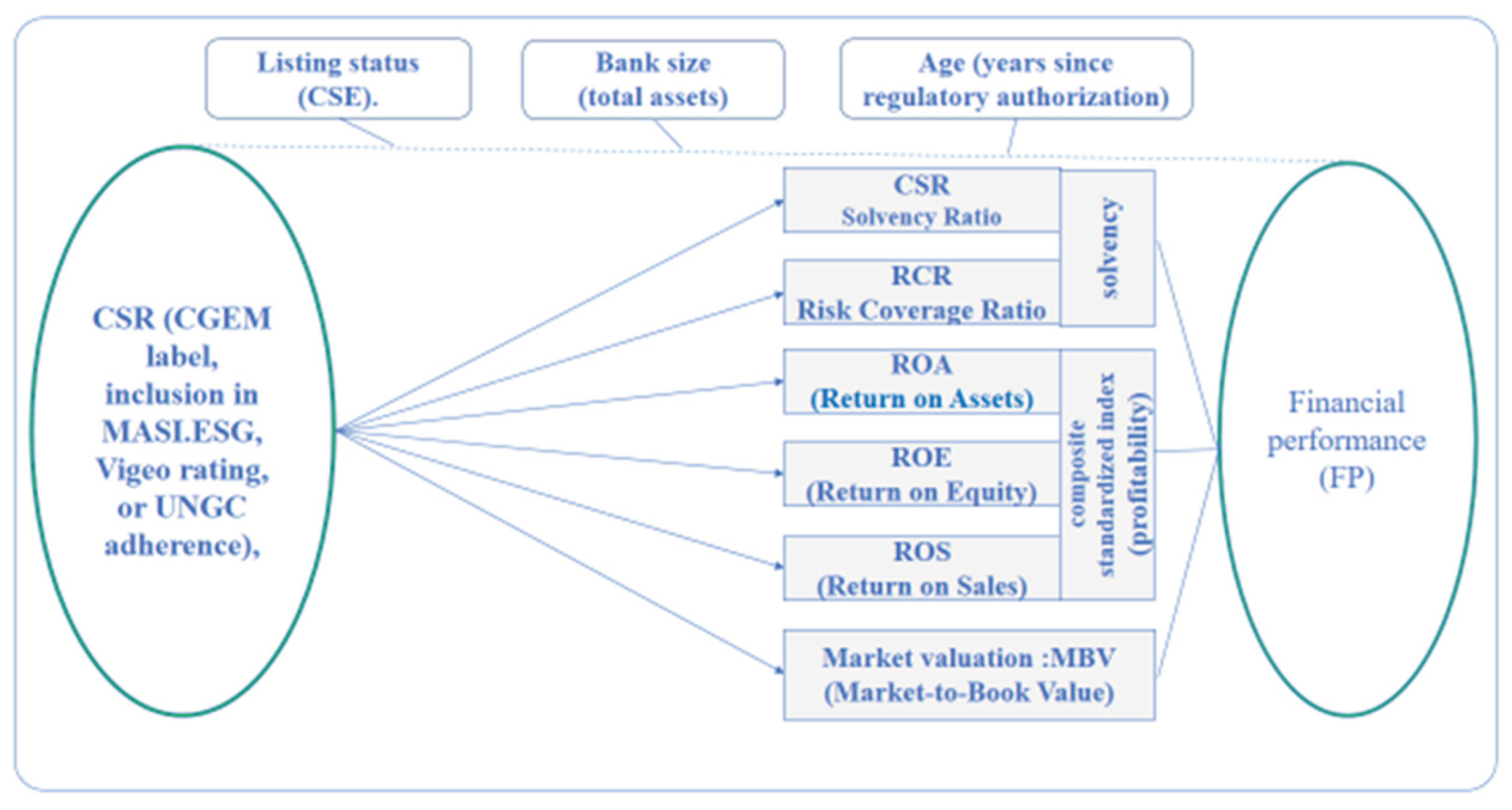
Table 2.
Static Panel Regression Results for CSR and Financial Performance.
| Dependent Variable | Model | CSR Coefficient | p-value | Interpretation |
| Composite (ROA, ROE, ROS) | Pooled OLS | 0.58 | 0.797 | Not significant |
| Composite (ROA, ROE, ROS) | Fixed Effects | -1.72 | 0.489 | Not significant |
| Composite (ROA, ROE, ROS) | Random Effects | -1.28 | 0.590 | Not significant |
| RSC | Pooled OLS | 0.205 | 0.780 | Not significant |
| RSC | Fixed Effects | 1.153 | 0.207 | Not significant |
| RSC | Random Effects | 0.253 | 0.735 | Not significant |
| RCR | Pooled OLS | 14.84 | 0.005 | Significant positive effect |
| RCR | Fixed Effects | 8.43 | 0.227 | Not significant |
| RCR | Random Effects | 14.84 | 0.004 | Significant positive effect |
| MBV | Pooled OLS | 5.28 | 0.060 | Marginally significant |
| MBV | Fixed Effects | 3.49 | 0.148 | Not significant |
| MBV | Random Effects | 4.47 | 0.096 | Not significant |
Source : Compiled and calculated by the authors from data collected from banks’ annual reports, Bank Al-Maghrib supervisory reports, AMMC publications, the CGEM CSR Label database, the MASI.ESG Index, the UN Global Compact, and Vigeo Eiris ESG assessments for the period 2014–2023.
Table 4.
Robustness and Diagnostic Tests of Dynamic GMM Models.
| Dynamic GMM Model | AR(1) | AR(2) | Sargan Test |
| Composite Profitability (ROA, ROE, ROS) | 0.402 | 0.110 | 0.021 |
| Solvency Ratio (RSC) | 0.862 | 0.331 | 0.002 |
| Risk Coverage Ratio (RCR) | 0.287 | 0.045 | 0.797 |
| Market-to-Book Value (MBV) | 0.624 | 0.433 | 0.186 |
Source: Author’s calculations based on dynamic panel estimations using the Arellano-Bond (1991) Generalized Method of Moments estimator (xtabond2, Stata 12) and data collected from Moroccan banking groups over the period 2014–2023. Notes: AR (1) and AR (2) correspond to the Arellano-Bond tests for first- and second-order serial correlation in the differenced residuals. The null hypothesis assumes the absence of autocorrelation. The Sargan test evaluates the overall validity of the instruments under the null hypothesis that the instruments are exogenous. A significance level of 5% is adopted.
Disclaimer/Publisher’s Note: The statements, opinions and data contained in all publications are solely those of the individual author(s) and contributor(s) and not of MDPI and/or the editor(s). MDPI and/or the editor(s) disclaim responsibility for any injury to people or property resulting from any ideas, methods, instructions or products referred to in the content. |
© 2026 by the authors. Licensee MDPI, Basel, Switzerland. This article is an open access article distributed under the terms and conditions of the Creative Commons Attribution (CC BY) license (http://creativecommons.org/licenses/by/4.0/).
Copyright: This open access article is published under a Creative Commons CC BY 4.0 license, which permit the free download, distribution, and reuse, provided that the author and preprint are cited in any reuse.