

Submitted:
08 September 2026
Posted:
09 September 2026
You are already at the latest version
Preprints on COVID-19 and SARS-CoV-2
Abstract
Clostridioides difficile infection (CDI) has evolved from a sporadic, antibiotic-associated illness into a leading European healthcare-associated infection (HAI). Romania is an instructive case: hypervirulent ribotype 027 (RT027) has dominated locally since 2011–2012, and national surveillance traces four phases — emergence, consolidation, pandemic-era distortion, and recent resurgence. This review synthesises 102 Romanian and pan-European sources (ECDC, ECDIS-Net, COMBACTE-CDI, ESCMID/IDSA-SHEA guidance) to characterise CDI’s epidemiology, molecular typing, and clinical outcomes in Romania relative to Europe. Romanian RT027 prevalence (68–82.6% of typed isolates) far exceeds the 2008 pan-European baseline (5%); national confirmed cases rose from 5,845 in 2015 to a pre-pandemic peak of 12,068 in 2019, fell during the pandemic despite persistently elevated calculated incidence, and resurged to 11,651 in 2022; hospital incidence more than tripled between 2020 and 2023 at one tertiary centre; a 2026 multicentre analysis found CDI caused over half of reported HAIs, amid high antibiotic consumption despite low official HAI rates; and treatment access remains constrained, with limited fidaxomicin reimbursement data and just 31 active faecal microbiota transplantation centres continent-wide. Romania exemplifies a surveillance-bias-masked endemic pattern in which true CDI burden is likely underestimated; priorities include mandatory notification, systematic ribotyping, disciplined antimicrobial stewardship, and equitable access to guideline-recommended therapy.
Keywords:
Clostridioides difficile
; Romania
; Europe
; epidemiology
; ribotype 027
; antimicrobial resistance
; antimicrobial stewardship
; fidaxomicin
; mortality
; healthcare-associated infection
; surveillance
; COVID-19
1. Introduction
Clostridioides difficile (formerly Clostridium difficile) is a spore-forming, toxin-producing anaerobe and the leading identifiable cause of healthcare-associated diarrhoea worldwide [1]. Its epidemiology changed markedly after 2000 with the emergence and global spread of the hypervirulent BI/NAP1/027 clone, characterised by increased toxin production, binary toxin (CDT) carriage, and high-level fluoroquinolone resistance — a combination that converted CDI from a mild, self-limiting complication of antibiotic therapy into a cause of epidemic outbreaks, severe colitis, and excess mortality [2]. The first pan-European hospital-based survey, conducted by the ECDIS Study Group in 2008 across 34 countries, found a mean incidence of 4.1 cases per 10,000 patient-days but striking heterogeneity between countries and hospitals, with ribotype 027 accounting for only 5% of isolates at that time against a background dominated by ribotypes 014/020, 001 and 078 [3]. A parallel finding — confirmed repeatedly in subsequent surveys — is systematic underdiagnosis: the EUCLID study estimated that roughly 40,000 hospitalised CDI patients went undiagnosed annually across participating European hospitals because of suboptimal testing algorithms [4].
Romania entered this European picture relatively late but abruptly. The first ribotyping study from Bucharest, covering March 2011 to March 2012, found that RT027 accounted for 68% of toxigenic isolates at the national reference infectious-diseases hospital — more than tenfold the contemporaneous European average — and described a genetically distinct local cluster rather than a direct import from a single neighbouring outbreak [5]. Within three years, Romanian investigators were describing CDI as “emerging,” explicitly linking the phenomenon to excessive antibiotic consumption [6]. A dedicated national CDI surveillance system, aligned with the European surveillance protocol and coordinated by the National Centre for Surveillance and Control of Communicable Diseases (CNSCBT) within the National Institute of Public Health (INSP), began operating in August 2014, channelling case reports from hospitals through county public-health directorates to a centralised database [7]. Since then, a small but growing body of single-centre and, more recently, multicentre Romanian studies, together with this national reporting system, has documented rising incidence, a persistently RT027-dominated molecular landscape, and — most recently — quantitative evidence that Romania’s officially reported HAI burden is distorted by inconsistent case ascertainment. Because CDI is not a mandatory notifiable disease in Romania even though it is nationally reported, and because national ribotyping capacity remains concentrated in a handful of urban centres, the country’s true epidemiological trajectory has been difficult to place within the broader European narrative of “emergence to endemicity” that has already been described for countries such as the Czech Republic, Poland, and Serbia. Read as a whole, the nine years of available national reporting trace a trajectory of emergence before 2014, consolidation from 2015 to 2019, pandemic-era distortion in 2020–2021, and renewed resurgence from 2022 onward — a chronology developed in detail in Section 4.1.
This review had two aims: first, to synthesise what is known about the epidemiological, molecular, therapeutic, resistance-related, and outcome-related particularities of CDI in Romania; and second, to situate these findings explicitly within the European surveillance and treatment landscape, so as to identify where Romania’s experience is representative of Central/Eastern Europe generally and where it diverges.
2. Materials and Methods
This is a narrative review; it was not registered and does not follow a formal systematic-review protocol, but literature identification followed a structured, reproducible process (Figure 1). PubMed/MEDLINE was searched for the period 1 January 2000 to 31 July 2026 using combinations of the MeSH and free-text terms “Clostridioides difficile” OR “Clostridium difficile” AND (“Romania” OR “Europe” OR “epidemiology” OR “ribotype” OR “PCR ribotyping” OR “antimicrobial resistance” OR “treatment” OR “mortality” OR “recurrence” OR “healthcare-associated infection”), run separately for each thematic domain (general epidemiology and surveillance; molecular typing and toxin genes; antimicrobial resistance and treatment; mortality, recurrence and economic burden). Reference lists and PubMed’s related-article suggestions for key retrieved papers were used to identify additional sources (citation tracking). Records were screened by title and abstract for relevance to CDI epidemiology, molecular typing, resistance, treatment, or clinical/economic outcomes in Romania and/or Europe; single-patient case reports, non-European data without comparative European content, and clearly duplicated or superseded datasets were excluded at this stage. Current European (ESCMID) and North American (IDSA/SHEA) treatment guidance documents, plus European Centre for Disease Prevention and Control (ECDC)/ECDIS-Net surveillance-network publications and the corresponding Romanian national surveillance reports (INSP/CNSCBT), were added irrespective of the original search strategy because of their reference status. In total, 102 sources were retained for narrative synthesis: 33 reporting Romania-specific primary data or national surveillance/policy documents, and 69 reporting European, multinational, or guideline-level evidence used for comparison. For numerical claims central to the review’s conclusions (ribotype proportions, incidence figures, mortality rates), the corresponding PubMed record was independently re-checked against its original abstract before inclusion, and figures were not interpolated or estimated beyond what the source explicitly reported. Because included studies used heterogeneous denominators (cases per 10,000 patient-days, per 10,000 discharges, or per 1,000 admissions) and heterogeneous case definitions for healthcare-associated versus community-acquired CDI, no meta-analytic pooling was attempted; findings are presented narratively and, where comparable, in summary tables. Title/abstract screening and full-text assessment were performed by the author team without a formal dual-independent-reviewer protocol or a documented disagreement-adjudication process of the kind used in systematic reviews; this is disclosed here as a methodological limitation rather than implied rigour the review does not have (Section 10). The manuscript’s structure and reporting nonetheless follow the domains recommended for narrative reviews by the SANRA (Scale for the Assessment of Narrative Review Articles) framework — explicit justification of the review’s importance, a stated aim, a described literature-search approach, evidence-based reasoning, and appropriate, referenced use of the evidence presented — although no formal SANRA scoring was conducted, and this review was not registered in a protocol database, consistent with its narrative (not systematic) design.
3. The European Epidemiological Landscape: A Framework for Interpreting Romanian Data
Robust cross-country comparison of CDI in Europe has been built almost entirely on a small number of coordinated surveillance efforts, and Romania’s position within each is informative. The ECDIS-Net network, established after the 2008 Bauer survey [3], found in 2011 that only 14 of 31 surveyed European countries had any functioning national CDI surveillance system, with markedly inconsistent case definitions for healthcare- versus community-associated disease [8]; a follow-up assessment in 2017 found this had improved to 20 countries with a national system, of which 21 participated in coordinated ECDC surveillance, but methodological heterogeneity persisted [9]. A 2013 ECDIS-Net pilot study, in which the Cantacuzino National Institute (Bucharest) was Romania’s participating centre, applied standardised case definitions across 37 hospitals in 14 countries and again identified RT027 as the single most common ribotype overall (30% of “enhanced-surveillance” isolates) [10].
Genomic analysis has clarified why ribotype distribution differs so much between countries. Sequencing of 624 isolates from 19 European countries showed two contrasting spread patterns: ribotypes such as 027 formed distinct, country-specific genetic clusters (including separate Romanian, Hungarian, Italian, German, and Polish clades), consistent with predominantly nosocomial, within-country transmission, whereas ribotypes such as 078, 015, 002, 014, and 020 were genetically homogeneous across the whole continent, consistent with a shared external source such as the food chain [11]. Fluoroquinolone resistance was significantly associated with the country-clustered pattern (p = 0.009) [11], directly linking antimicrobial use to the persistence of locally endemic hypervirulent clones — a mechanistic link of particular relevance to Romania, discussed further in Section 6.
Contemporary incidence and testing data come chiefly from two multinational research consortia. The Innovative Medicines Initiative’s COMBACTE-CDI programme, which included Romanian sites, found a 90-day cumulative incidence of a first CDI episode of 1.9% among 1,007 patients ≥50 years receiving broad-spectrum antibiotics across 34 European hospitals, with carbapenem exposure the strongest independent risk factor (HR 5.3) [12]. Its companion point-prevalence study across 12 countries (July–November 2018) found hospital test-positivity of 4.4% versus 1.3% in the community, with toxinotype III (encompassing ribotypes 027/181/176) reaching 56% prevalence in Eastern European sites specifically — the same region that also had the lowest testing rate (58%) — implying roughly 111,000 undiagnosed community CDI cases annually across Europe, three times the hospital-setting shortfall [13]. A mathematical model built on the same dataset concluded that variation in testing intensity, not variation in true prevalence, is the principal determinant of the reported cross-country differences in CDI incidence [14], a conclusion echoed by a companion COMBACTE-CDI survey of 105 hospitals in 12 countries, which found that countries with the highest reported incidence often used non-ESCMID-compliant testing algorithms [15].
National surveillance trends confirm both a general European rise and marked heterogeneity: hospitalised CDI incidence in Sicily rose 40-fold between 2009 and 2019 [16]; Belgium’s incidence rose from 2.24 to 2.77 per 10,000 patient-days between 2013 and 2024, with the apparent disappearance of RT027 [17]; Sweden, despite one of Europe’s lowest antibiotic consumption rates, remains among the higher-incidence countries, though a 22% decline was recorded between 2012 and 2016 [18]; Spain’s hospital CDI prevalence rose from 14.1 to 35.9 per 10,000 admissions between 2012 and 2019 [19]; and Switzerland reported 3.8 episodes per 10,000 patient-days in 2022, slightly above the ECDC mean [20] (Figure 2). A Global Burden of Disease analysis of CDI-attributable mortality (1990–2019) found rising rates across Europe (+2.1%/year in men, +2.8%/year in women) but, counter-intuitively, the lowest standardised mortality rates in Eastern Europe — a pattern more plausibly reflecting diagnostic and reporting capacity than true disease burden [21], echoed by a broader 13-country narrative review that identified methodological heterogeneity, not epidemiological reality, as the principal barrier to international comparison [22].
ECDC’s own coordinated surveillance provides the most directly comparable European denominators against which to read the Romanian data presented in Section 4. In the first two years of coordinated reporting (2016–2017), incidence density across participating hospitals was 3.48 cases per 10,000 patient-days, with higher values in tertiary hospitals and roughly 1 in 26 patients with healthcare-associated CDI dying [23]. Coverage was disrupted by the COVID-19 public-health emergency in 2020, but the 2018–2020 report nonetheless documented healthcare-associated CDI incidence density falling slightly, from 2.79 to 2.58 cases per 10,000 patient-days, while community-associated incidence rose, from 0.69 to 1.35 cases per 1,000 admitted patients — a divergence between hospital- and community-onset trends that recurs, at greater magnitude, in the Romanian data below [24]. Across the EU/EEA as a whole, C. difficile accounts for close to half of all gastrointestinal healthcare-associated infections, and the most recent point-prevalence survey (2022–2023) found it among the single most frequent healthcare-associated infections in several national surveys [25].
4. The Romanian Epidemiological Landscape
Table 1 summarises the published Romanian CDI literature. Three consistent features emerge. First, incidence estimates vary enormously by hospital type and denominator, reflecting the case-mix of specialised infectious-disease hospitals versus general hospitals rather than genuine regional variation. Second, a healthcare-associated pattern predominates: the only genuinely national multicentre study — now over a decade old, and not repeated at national scale since — was conducted across nine Romanian hospitals between November 2013 and February 2014, and classified 70.5% of 393 identified CDI cases as healthcare-associated, 10.2% as community-acquired, and 19.3% as indeterminate, with a mean prevalence of 5.2 cases per 10,000 patient-days (peaking at 24.9 and 20.0 per 10,000 in gastroenterology- and infectious-disease-specialised hospitals, respectively) and 8.8% all-cause in-hospital mortality [26]. The most recent update to this picture is regional rather than national: a 2026 county-level multicentre study across 10 hospitals in Constanța county (3,929 confirmed healthcare-associated infections, March 2020–December 2024) found CDI to be the single leading healthcare-associated infection, accounting for roughly half of all cases, with a higher post-pandemic than pandemic-era prevalence — a finding consistent in direction with the resurgence phase described in Section 4.1 and with the surveillance-bias pattern documented in Section 4.2, though it cannot substitute for a repeated national-scale survey [27]. Third, the trend is unambiguously upward in every longitudinal Romanian dataset published to date. At a Timișoara infectious-diseases hospital, incidence reached 20.6 and 15.7 cases per 1,000 discharges in 2013–2014 following what the authors describe as an outbreak-triggered shift to an endemic pattern [28]; molecular surveillance using real-time PCR at a Bucharest university hospital found binary toxin genes in 81% of toxin-positive samples, with striking concentration in general surgery wards (29.85% of that ward’s positive samples) [29]; and, most strikingly, a four-year surveillance study (2020–2023) at a Bucharest tertiary infectious-diseases hospital recorded an incidence rise from 65.1 to 211.7 cases per 10,000 discharges — a 3.3-fold increase in four years (Figure 3) — while explicitly describing the year-on-year trend as “very variable,” underscoring the fragility of single-centre trend data as a proxy for national epidemiology [30]. That same Bucharest cohort (618 cases in total) illustrates in detail how a case profile can shift even while incidence rises: 73.6% of cases were healthcare-associated and 23.5% community-acquired, but the community-acquired share rose significantly across the study period, from 8.5% in 2021 to 27.6% in 2023; 63.6% of patients were over 60 years old (median 68 years); 66.2% had a hospital stay in the previous 12 months, 38.2% had used gastric antisecretory agents, and 28.9% were immunocompromised; diagnosis relied on chromatographic immunoassay alone in 76.2% of cases, PCR alone in 11.5%, and both methods in 12.3%; and, among 390 first-episode cases with recorded antibiotic-exposure data, half (50.4%) had received a third-generation cephalosporin in the three months before CDI onset, 28.3% a β-lactam/β-lactamase-inhibitor combination, and 20.6% a carbapenem [30].
Risk-factor profiles reported from Romanian cohorts are broadly consistent with the wider European literature: recent hospitalisation, antibiotic exposure (particularly third-generation cephalosporins, β-lactam/inhibitor combinations, and carbapenems), advanced age, chronic kidney disease, heart failure, and immunosuppression recur across studies [30,32,33,40]. In hospitalised octogenarians at two academic centres, prior antibiotic use (OR 12.6) and hospitalisation within the preceding two months (OR 10.2) were the strongest independent predictors [32]. Recurrence rates are notably high and heterogeneous across Romanian cohorts — 18–20% in most series [28,39,41] but as high as 53.8% in a 195-patient cohort from Oradea with multiple documented CDI episodes [33], where cardiovascular comorbidity (OR 3.02), digestive comorbidity (OR 3.58), dementia (OR 3.26), and immunosuppression (OR 3.88) were independent predictors. An earlier Cluj-Napoca cohort of 306 patients found a comparable first-recurrence rate of 20% (60/306 patients, 95 recurrence episodes), with age over 70 years (RR 1.5) and proton-pump-inhibitor use (RR 1.3) as the only significant independent predictors, and no benefit of extending metronidazole or vancomycin therapy beyond ten days [39].
4.1. National Surveillance Trends: Four Epidemic Phases (2014–2022)
Romania’s own national reporting system provides the only genuinely country-level view of the epidemic, and it describes a trajectory in four phases (Figure 4). In the emergence phase, before national surveillance began, the foundational 2013–2014 nine-hospital survey already found a highly moxifloxacin-resistant RT027 circulating with a mean prevalence of 5.2 cases per 10,000 patient-days [26], prompting the launch of the national CNSCBT/INSP surveillance system in August 2014 [7]. A consolidation phase followed: reported confirmed cases rose from 5,845 in 2015 — around one-third of all healthcare-associated infections notified in Romania that year — to 10,080 in 2017 (55% of patients having received antibiotics in the three months before admission) and a pre-pandemic peak of 12,068 in 2019 [7]. During the COVID-19 pandemic, reported case counts fell, to 9,660 in 2021, an apparent decline driven largely by reduced hospital admissions rather than genuine risk reduction: calculated incidence in fact remained essentially flat and elevated, at 48, 43 and 42 cases per 10,000 discharged patients in 2020, 2021 and 2022 respectively [7,30]. A resurgence phase has followed: 11,651 confirmed cases were reported in 2022, a 20.6% rise on 2021, and the 2023 national point-prevalence survey identified CDI as the single most frequent healthcare-associated infection in Romanian hospitals [7,25] (Figure 5). A publicly available national CNSCBT/INSP case count beyond 2022 could not be identified despite a repeat literature and institutional-website search in August 2026; the closest available indication of the 2023–2024 trajectory is indirect, from the regional multicentre and surveillance-bias studies discussed above and in Section 4.2, both of which describe a continued, and in one case rising, CDI share of healthcare-associated infections through 2024 [27,38].
Antibiotic consumption data place this trajectory in context. Romania is consistently classified among the highest-consuming EU/EEA countries for total antibacterial use: 27.6 defined daily doses (DDD) per 1,000 inhabitants per day across all sectors, against a European mean of 19.4 [30]. Hospital-sector consumption, by contrast, is slightly below the European figure (1.39 vs. 1.61 DDD per 1,000 inhabitants per day), indicating that Romania’s excess antibiotic exposure is generated predominantly in the community rather than in hospitals [30] — a distinction with direct relevance to where stewardship interventions would have the greatest effect (Section 6.2). At EU/EEA level, the proportion of consumption drawn from the WHO AWaRe “Access” category — a marker of prescribing quality, with a 2030 target of over 65% — was 61.5% in 2023 and 60.3% in 2024, in both years below target [42,43]; no equivalent Romania-specific AWaRe breakdown was identified in the literature search, a further gap noted in Section 9.
These national figures should be read against the same surveillance-bias framework developed in Section 4.2: because case ascertainment depends on local testing intensity and reporting discipline, reported national totals should be interpreted as a lower, not an upper, bound on the true burden, and year-to-year changes may partly reflect evolving testing practice rather than purely biological change [38].
4.2. Surveillance Bias: A Distinctively Romanian Problem
The single most consequential recent finding for interpreting all Romanian CDI data is not epidemiological but methodological. A 2026 multicentre analysis across 32 hospitals in five south-eastern Romanian counties, examining 2,878 HAI cases reported in 2024, found that CDI accounted for 56.3% of all reported HAIs nationally — far above the proportion typically reported in European point-prevalence surveys — but with the proportion ranging from approximately 1% to 93% between individual hospitals. Using a Spiegelhalter funnel-plot approach, the authors concluded that most participating hospitals fell outside statistical control limits, and interpreted the pattern not as evidence of a genuinely CDI-dominated HAI profile, but as evidence of systematic under-ascertainment of other HAI types relative to CDI, which is comparatively easy to diagnose by immunochromatography or PCR [38]. This is consistent with an independent ecological analysis integrating ECDC point-prevalence and ESAC-Net antimicrobial-consumption data across 26 EU/EEA countries, which placed Romania (with Bulgaria) in an isolated cluster combining some of the highest broad-spectrum hospital antibiotic consumption in Europe with some of the lowest officially reported HAI prevalence on the continent — a combination not replicated in any other EU/EEA country, and one the authors explicitly attribute to systematic underreporting: modelled “true” Romanian HAI prevalence was estimated at ~7.3%, more than double the ~3.1% officially reported [44]. A broader review of HAI detection methods across Romania and Europe reaches the same conclusion: Romania’s officially reported HAI burden is lower than in Western Europe not because the true burden is lower, but because the detection and reporting infrastructure is weaker [45]. This surveillance-bias framework substantially reframes the RT027-dominance and rising-incidence findings described above and in Section 5: they should be read as a floor, not a ceiling, on the true burden of CDI in Romania.
4.3. The COVID-19 Pandemic
Romanian and European data on the pandemic’s effect on CDI are heterogeneous, reflecting a genuine tension between increased broad-spectrum antibiotic use in COVID-19 patients and simultaneously intensified infection-control measures and, in some settings, reduced diarrhoea testing [46]. At Bucharest’s national infectious-diseases institute, healthcare-associated CDI incidence was statistically unchanged between the pre-pandemic and pandemic periods (6.1 vs. 5.6 per 1,000 adult discharges, p = 0.6), but the risk profile shifted: patients were older, less often immunosuppressed but more often on proton-pump inhibitors (94.1% vs. 32.3%), and had longer stays [34]. At Târgu Mureș, pandemic-era CDI patients had significantly higher comorbidity burden, more antibiotic and corticosteroid exposure, and worse outcomes (more organ failure, more ICU admission, longer stays) than pre-pandemic controls [47], and a related ICU-focused study at the same centre found fluoroquinolone treatment, diabetes, and invasive mechanical ventilation each significantly associated with SARS-CoV-2–CDI co-infection [48]. At Sibiu, overall CDI incidence fell during the pandemic but case severity and mortality rose; 54.7% of co-infected patients had been antibiotic-exposed before COVID-19 admission [49]. At Iași, third-generation cephalosporins (55%) and carbapenems (24%) were the dominant antibiotics among co-infected patients, with carbapenem use significantly associated with severe COVID-19 in this group [50]. This pattern — stable-to-rising incidence with worsening severity — mirrors findings from Greece, where an interrupted time-series analysis found CDI incidence rising markedly faster during the pandemic (r = +0.47) than before it (r = +0.16) [51], and contrasts with the United Kingdom, where one tertiary centre reported a pandemic-era decline in combined community and hospital CDI rates [52] — underscoring that the pandemic’s net effect on CDI epidemiology was setting-specific rather than uniform.
5. Molecular Epidemiology: Ribotype Distribution
If one finding defines the Romanian CDI literature, it is the near-universal dominance of ribotype 027. Every Romanian ribotyping study published to date — from the founding 2011–2012 Bucharest series (68% of toxigenic isolates) [5] through the 2013–2014 nine-hospital national survey (82.6% of all typed isolates, present in every participating hospital) [26] to smaller regional series from Timișoara [31,53] and case reports of RT027-associated toxic megacolon from Constanța [54] — identifies RT027 as the dominant or sole circulating epidemic clone (Figure 6). This places Romania among the most RT027-dominated countries in Europe, alongside Serbia (78.9% in the 2013 ECDIS-Net pilot) [55] and above Poland (48–62% in serial hospital-based surveys) [56], and starkly above the 2008 pan-European baseline of 5% [3].

Table 2.
Ribotype distribution: Romania and selected Central/Eastern European countries.
| Country / region | Period | N isolates | Dominant ribotype(s) | % of typed isolates | Ref. |
| Pan-European baseline (34 countries) | 2008 | 389 | 014/020, 001, 078, 027 | 16 / 9 / 8 / 5 | [3] |
| Romania (Bucharest) | 2011–2012 | 64 | RT027 | 68.0 | [5] |
| Romania (9-hospital national) | 2013–2014 | 393 patients | RT027 | 82.6 | [26] |
| Serbia (Belgrade pilot) | 2013 | 39 | RT027 | 78.9 | [55] |
| Poland (national hospital survey) | 2011–2013 | 159 | RT027 / RT176 | 62.0 (RT027) | [56] |
| Poland (Silesia) | NR | 108 | RT027 | 82.4 | [57] |
| Czech Republic (national) | 2013–2015 | 2,201 | RT176 / RT001 | 26.7 / 20.7 | [58] |
| Slovakia | 2018–2019 | NR | RT176 & RT001 (combined dominant) | majority of typed isolates | [59] |
| Bulgaria | NR | NR | RT017 & RT014/020 (combined) | 44.0 | [60] |
| Croatia | NR | NR | RT001 / RT014/020 | 27.8 / 24.1 | [61] |
| Greece, northern (post-COVID) | 2023 | 60 | RT181 (027-related) | 73.6–76.6 | [62] |
NR = not reported. RT027 and RT176 both carry the tcdC deletion and binary toxin genes and are frequently grouped as toxinotype III.
This regional picture is more nuanced than “RT027 everywhere,” however, and the nuance matters for Romania because it identifies where local surveillance is likely to be blind. In the Czech Republic, ribotype 176 — a distinct but closely related “027-like” lineage carrying the same tcdC deletion and binary toxin genes — has displaced RT027 as the dominant clone, accounting for 26.7% of 2,201 isolates typed nationally in 2013–2015, ahead of RT001 (20.7%) [58,63]; RT176 similarly dominates in eastern Bohemia (60.9%) [64] and, together with RT001, in Slovakia (2018–2019 series, with 27.6% in-hospital mortality) [59]. In Silesia, Poland, RT027 remains dominant (82.4%) but with universal fluoroquinolone, imipenem, and erythromycin resistance and universal carriage of all four major toxin genes (tcdA, tcdB, cdtA, cdtB) [57]. Bulgaria and Croatia show a different pattern again, dominated by ribotypes 014/020 and 017 rather than 027 [60,61]. A methodologically important caveat, directly relevant to any Romanian centre considering rapid molecular ribotype-presumption assays, is that the Xpert C. difficile Epi test — which infers RT027 status from three molecular targets — misclassified 29 genuine RT176 isolates as RT027 in a Czech validation study, because the two lineages share overlapping target sequences; capillary-electrophoresis ribotyping was required to resolve this [65]. No published Romanian study has systematically excluded RT176 or newer emerging lineages (such as the RT181 clone that reached 73.6–76.6% prevalence in a 2023–2024 northern Greek series, a genetic relative of 027 [62]) using reference-standard ribotyping; the apparent Romanian RT027 dominance could therefore, in principle, partly reflect assay limitations rather than pure biological reality, although the consistency of the finding across three independent Romanian centres over more than a decade makes a purely artefactual explanation unlikely.
Toxin-gene carriage data reinforce the hypervirulence picture: 69% of isolates in the original Bucharest series carried binary toxin genes [5], and a 2020 prospective study at Iași found presumptive RT027/NAP1/BI markers (toxin B gene, binary toxin, and the characteristic tcdC deletion) in 86% of 50 characterised isolates, with this genotype significantly associated with higher recurrence (35.6% vs. controls, p = 0.025) [35]. The molecular locus governing this variability, the pathogenicity locus (PaLoc) encoding TcdA/TcdB, is classified by the Rupnik toxinotyping scheme (27 recognised variant toxinotypes as of its original description) [66], a framework subsequently extended by comprehensive European reviews of ribotype emergence and toxin-gene diversity [67]. European diagnostic guidance from ESCMID recommends a two-step testing algorithm — a sensitive screening test (glutamate dehydrogenase EIA or nucleic-acid amplification) followed, if positive, by a specific confirmatory test (toxin EIA or toxigenic culture) — precisely because no single commercial assay has adequate positive predictive value at the case-mix and prevalence typical of general hospital practice [68]. Romanian practice, as documented in the available literature, relies predominantly on toxin A/B immunochromatography as the primary test, with PCR confirmation and ribotyping performed only on small, non-consecutive, often study-driven subsets [26,29] — a pattern that likely under-samples molecular diversity relative to the Czech or Polish national reference-laboratory systems, where thousands of isolates are ribotyped annually.
6. Antimicrobial Resistance
Antimicrobial resistance in C. difficile is inseparable from its molecular epidemiology in Europe, because the same fluoroquinolone-resistance-conferring mutations that helped RT027 (and RT176) achieve epidemic spread also constrain first-line treatment choices. High-level fluoroquinolone resistance, together with a tcdC deletion driving toxin overproduction, defines the classical BI/NAP1/027 phenotype [2]. A landmark Northern Ireland outbreak-control study demonstrated the causal chain directly: hospital-wide restriction of fluoroquinolone prescribing was followed, after an approximately four-month lag, by a significant reduction in CDI incidence (p = 0.003) [69] — a finding of direct relevance to Romania given the country’s comparatively high fluoroquinolone and broad-spectrum antibiotic consumption (Section 6.1).
Table 3.
Antimicrobial resistance patterns reported in Central/Eastern European C. difficile isolates.
Table 3.
Antimicrobial resistance patterns reported in Central/Eastern European C. difficile isolates.
| Region / ribotype | N | Fluoroquinolone resistance | Macrolide / clindamycin resistance | Rifampicin resistance | Reduced vancomycin susceptibility | Ref. |
| Poland (Silesia), RT027 | 108 | Universal (100%) | Erythromycin 100% | NR | NR | [57] |
| Poland/Czech/Slovakia, RT176 | 22 | Universal (gyrA T82I) | Erythromycin 21/22; clindamycin 15/22 (ermB) | 14/22 (rpoB); novel mrmA methyltransferase | NR | [70] |
| Serbia (Belgrade), RT027 | 28/39 typed | Moxifloxacin MIC ≥4 μg/mL | NR | NR | NR | [55] |
| Multicentre US cohort, all ribotypes | 594 | NR | NR | NR | 29% MIC >2 μg/mL; RT027 independent predictor (OR 13.4) | [71] |
| Multi-country Europe (COMBACTE-CDI) | regional pooled | Elevated in Eastern Europe, linked to RT027/RT181 | NR | NR | NR | [72] |
NR = not reported. No Romanian phenotypic susceptibility dataset was identified in the literature search (Section 6.1).
Beyond fluoroquinolones, two further resistance trends are of growing concern across Europe. First, genomic characterisation of RT176 isolates from Poland, the Czech Republic, and Slovakia found universal fluoroquinolone resistance (gyrA T82I), erythromycin resistance in 21/22 isolates, clindamycin resistance in 15/22 (ermB), rifampicin resistance in 14/22 (rpoB mutations), and identified a previously undescribed macrolide-resistance mechanism (the mrmA methyltransferase) [70] — a multidrug-resistant profile directly relevant to the RT176/RT001-dominated epidemiology of Romania’s immediate regional neighbours. Second, “MIC creep” against vancomycin — the first-line oral agent for CDI in most guidelines — is now documented at a scale that appears clinically consequential: a US multicentre cohort found 29% of isolates had reduced vancomycin susceptibility (MIC > 2 μg/mL), independently associated with RT027 carriage (OR 13.4) [71], and reduced susceptibility was in turn associated with significantly lower rates of sustained clinical response at 30 days (76% vs. 86%, OR 0.52) [73]. A companion European multi-country susceptibility study confirmed that resistance is not uniformly distributed across the continent: elevated resistance was concentrated in Eastern Europe and linked predominantly to RT027 and the related emerging RT181 [72].
6.1. Antibiotic Consumption as the Underlying Driver
No Romania-specific phenotypic antibiogram data (metronidazole, vancomycin, or fluoroquinolone MICs measured directly on Romanian isolates) were identified in the literature search — a notable gap, since all Romanian molecular data to date rely on presumptive genetic markers rather than culture-based susceptibility testing [35]. What is documented, however, is the consumption side of the equation. The ecological analysis of ESAC-Net and ECDC point-prevalence data described in Section 4.2 places Romania among the highest broad-spectrum antibiotic consumers in the EU/EEA [44]. A single-centre analysis of a Romanian emergency hospital (2021–2025) found that “Watch”-category antibiotics (WHO AWaRe classification) had overtaken “Access”-category agents from 2023 onward — falling below the WHO-recommended 60% Access-category threshold — with the highest consumption in medical wards, and with CDI the single most common HAI recorded (33.3% of cases); a numerical co-variation between fluoroquinolone consumption and CDI incidence was noted, consistent with the causal mechanism established in Northern Ireland [69] and elsewhere [74]. A metagenomic analysis of a healthy Romanian population cohort further found antimicrobial-resistance gene carriage correlated with national consumption patterns of β-lactams and fluoroquinolones specifically, consistent with a population-level resistance reservoir shaped by antibiotic-prescribing pressure [75].
6.2. National Stewardship and Infection-Control Framework
Romania has progressively built a regulatory and surveillance architecture for antimicrobial stewardship and HAI control, although implementation remains uneven. Beyond the CDI-specific surveillance stream described in Section 4.1, national antibiotic consumption, antimicrobial resistance and HAI data are consolidated annually by INSP through the same CNSCBT reporting structure [7]. A World Health Organization assessment of the Romanian health system’s response to antimicrobial resistance, published in 2020, identified gaps in stewardship implementation and surveillance integration that substantially overlap with those documented in this review [76], and subsequent ministerial regulation (Ordinul nr. 63/2024) has further specified hospital obligations for infection prevention and antibiotic stewardship [77]. National antibiotic-use guidelines exist but, as the fragmented, single-centre nature of the Romanian CDI evidence base in Table 1 itself illustrates, are implemented inconsistently at hospital level; outpatient antibiotics are dispensed by prescription only, a restriction enforced by legislation [77]. Given that Section 4.1 identifies community rather than hospital consumption as the principal source of Romania’s excess antibiotic exposure, strengthening outpatient stewardship and prescribing audit — rather than hospital-focused interventions alone — is likely to be the more consequential lever for reducing CDI incidence nationally.
7. Treatment: Guideline Evolution and Access in Romania
International treatment guidance for CDI has changed substantially over the past decade, and the direction of change is consistent between the two major reference bodies. The current ESCMID guidance (2021, superseding 2009 and 2014 versions) removed metronidazole as a first-line option (reserving it for resource-limited settings only) and recommends fidaxomicin over vancomycin as preferred first-line therapy for an initial CDI episode, based on consistently lower recurrence rates, alongside structured recommendations for bezlotoxumab as an adjunct in high-recurrence-risk patients and for faecal microbiota transplantation (FMT) in multiply recurrent disease [78]. The IDSA/SHEA 2021 focused update reached parallel conclusions: fidaxomicin preferred over vancomycin for both an initial episode and a first recurrence, with bezlotoxumab recommended as an adjunct in high-risk patients receiving standard antibiotic therapy [79]. Meta-analyses of randomised trials confirm the underlying evidence: fidaxomicin significantly reduces recurrence relative to vancomycin without consistent differences in initial cure or mortality [80], including specifically in patients receiving concomitant systemic antibiotics [81], although a large 2026 Spanish multicentre cohort found that extended-pulsed fidaxomicin dosing offered no additional benefit over conventional dosing in routine practice (12.8% vs. 12.7% recurrence) [82].
Table 4.
Evolution of major CDI treatment guideline recommendations.
| Guideline (year) | First-line, initial episode | First recurrence | Adjunct / novel therapies | FMT recommendation | Ref. |
| ESCMID 2021 | Fidaxomicin (preferred) over vancomycin | Fidaxomicin | Bezlotoxumab in high recurrence-risk patients | Recommended for multiple recurrence | [78] |
| IDSA/SHEA 2021 focused update | Fidaxomicin (preferred) over vancomycin | Fidaxomicin | Bezlotoxumab in high-risk patients on standard antibiotics | Recommended (≥2 recurrences) | [79] |
| Romanian national FMT guideline (2021) | N/A (FMT-specific document) | N/A | N/A | First national standardisation of donor screening and technique | [83] |
| BSG/HIS 2nd edition (2024) | N/A (FMT-specific document) | N/A | Capsule-based FMT administration | Updated donor-screening standards, post-pandemic | [84] |
N/A = not applicable (document addresses FMT specifically, not first-line antibiotic therapy). FMT = faecal microbiota transplantation.
For multiply recurrent CDI, the therapeutic landscape has expanded beyond conventional FMT: SER-109, an orally administered purified Firmicutes spore product, significantly reduced recurrence versus placebo in patients with ≥3 prior episodes in a pivotal phase 3 trial [85], and updated British Society of Gastroenterology/Healthcare Infection Society FMT guidelines detail donor-screening standards (tightened after post-pandemic pathogen-transmission concerns), timing, and capsule-based administration [84]. National guidelines exist in several European countries, including Denmark [86] and the Czech Republic [87], generally converging on fidaxomicin or oral vancomycin as first-line hospital therapy. Romania has its own national FMT guideline [83], developed by working groups in Iași, Cluj-Napoca, and Bucharest in collaboration with international experts (Imperial College London, University of Birmingham) specifically to standardise indications, donor screening, and technique — the authors explicitly note the prior absence of any national standardisation, underscoring how recent this infrastructure is.
Access, however, remains the binding constraint across much of Central and Eastern Europe, and no Romania-specific published data quantify it directly — itself a notable literature gap. A pan-European FMT survey identified only 31 active FMT centres across the entire continent in 2019 [88]. In Germany, an expert survey explicitly flagged limited FMT access as a national deficiency requiring improvement [89], and in Austria, fidaxomicin access was constrained by reimbursement policy until December 2025, when it was added to the national positive drug list as first-line therapy — a subsequent cost-effectiveness analysis found the newly reimbursed pathway dominant (lower cost, higher QALYs) over the prior restricted-access pathway [90]. Whether an analogous reimbursement-driven access gap for fidaxomicin or bezlotoxumab exists in Romania has not, to our knowledge, been formally studied, but the general pattern documented in Austria and Germany, combined with Romania’s documented under-resourcing of CDI surveillance infrastructure (Section 4.2), makes it a plausible and testable hypothesis for future research.
8. Mortality, Recurrence, and Economic Burden
European reference data establish CDI as a meaningfully lethal condition even outside epidemic settings: a large UK National Health Service cohort (2002–2008) found cumulative all-cause mortality of 13.4% at 7 days, 20.8% at 14 days, 32.5% at 30 days, and 58.7% at 1 year, rising sharply with age (from 3.4% under 40 years to 41% over 90 years) [91]. A German claims-based study using matched controls estimated the excess (attributable) mortality more precisely, at 2.17, 1.35, and 0.94 deaths per 100 patient-months at 6, 12, and 24 months respectively — excess risk concentrated early and attenuating over time; the same cohort’s unadjusted all-cause mortality reached 32%, 39% and 48% at 6, 12 and 24 months [92]. A large meta-analysis of prediction models (112,640 pooled patients) identified immunosuppression (OR 1.83), leukocytosis, elevated Charlson comorbidity score, and elevated urea and creatinine as the most consistent mortality risk factors, with mortality models substantially outperforming recurrence models in discriminative accuracy (AUC up to 0.969 vs. typically <0.7) [93]. For recurrence specifically, the companion German real-world cohort (RECUR Germany, 11,884 patients, 2015–2019) found that around 19% of patients experienced at least one recurrence, with a median time to recurrence of 20 days and each subsequent recurrence increasing the risk of a severe complication by 31% [94] — a national-scale benchmark against which the Romanian single-centre estimates below (12.9–53.8%) sit at the higher end.
Romanian mortality data are more limited but broadly consistent with this European picture once case-mix is accounted for. The largest published Romanian cohort (534 patients over 30 months, Iași) recorded 50 deaths (~9.4%), with fever and age over 65 years independently associated with prolonged hospitalisation [36]; the four-year Bucharest cohort described in Section 4.1 recorded 53 deaths among 618 cases (8.6% crude case-fatality, 2.9% CDI-attributed), predominantly among healthcare-associated cases and patients over 65 years [30]; an emergency surgical cohort from north-eastern Romania recorded 14% mortality among 140 CDI cases identified from over 12,000 admissions [37]; and a Slovak regional series — included here as the closest available regional comparator with a comparably RT176/001-dominated molecular epidemiology — recorded 27.6% in-hospital mortality [59], illustrating how mortality estimates diverge by hospital case-mix rather than by true regional differences in severity.
Recurrence in the same Bucharest cohort was recorded in 12.9% of evaluated cases (80/618), with a median age of 73 years among recurrent cases and a documented history of hospitalisation in 72 of 80 patients; the authors explicitly note this rate was markedly higher than the 5% reported in a comparable western Romanian cohort covering 2020–2021, a difference attributed to heterogeneity in case definition, follow-up completeness and study period rather than to genuine biological variation [30]. Median length of stay in the same cohort was 13 days for healthcare-associated cases against 8 days for community-acquired cases, rising to 20 days among patients requiring intensive care [30].
Recurrence, more than the index episode, drives both clinical burden and cost in the European literature. A pooled analysis of recurrence predictors identified antibiotic use (OR 2.26), proton-pump inhibitor use (OR 2.03), and inflammatory bowel disease (OR 1.69) as the most consistent independent risk factors [93], while a Japanese cohort study proposed cumulative “days of antibiotic spectrum coverage” in the 30 days pre-diagnosis as a stronger discriminator (128 vs. 80 days in recurrent vs. non-recurrent cases, p < 0.01) than any single antibiotic class [95]. In Romania, a Sibiu cohort found duration of antibiotic therapy (AUC 0.712 alone; 0.775 in a combined model) to be the strongest recurrence predictor, with class-specific associations losing significance after adjustment for overall healthcare exposure [96] — mechanistically consistent with the Japanese cumulative-exposure finding [95]. The economic consequence of recurrence is best quantified by the COMBACTE-CDI cost study across 12 European countries: mean hospital stay rose from 22 days (no recurrence) to 55 days (with recurrence), and mean total cost from €15,242 to €52,024 [97] — a pattern replicated at national level in Germany [98], Sweden (18-fold higher post-CDI hospitalisation rate) [99], Denmark (€12,867 per index episode, exceeding €91,000 with complications) [100], and France (an estimated €189 million annual national cost of hospitalised CDI, with roughly half of all episodes now managed in ambulatory rather than inpatient settings) [101]. No comparable Romanian cost-of-illness study was identified, representing a further gap in the national evidence base; pharmacoeconomic analyses from Germany and Austria nonetheless indicate that fidaxomicin, despite higher acquisition cost, is cost-effective or dominant once downstream recurrence-related costs are included [90] — an argument directly relevant to reimbursement policy in resource-constrained Central and Eastern European health systems, including Romania’s.
Two Romania-specific downstream consequences of CDI deserve brief mention. First, post-infectious irritable bowel syndrome was documented in a Romanian/Italian cohort following confirmed CDI [41], consistent with a growing recognition that CDI morbidity extends beyond the acute episode. Second, inflammatory biomarkers and haemogram-derived ratios have been proposed and validated in a joint Italian–Romanian cohort as accessible, low-cost tools for early mortality-risk stratification in hospitalised CDI patients [102] — a pragmatic response to the resource constraints documented throughout this review.
9. Surveillance Gaps and Priorities for Romania
Three structural gaps recur throughout this synthesis and, in our assessment, should be prioritised. First, CDI remains a non-mandatorily-notifiable disease in Romania, and the country lacks standardised denominators (patient-days or admissions) in national HAI reporting — a limitation explicitly identified in the most recent multicentre surveillance-bias analysis [38] and consistent with the broader European finding that testing intensity, not true prevalence, drives most of the reported cross-country variation [14,15]. Second, molecular surveillance is fragmented: every published Romanian ribotyping dataset originates from a small number of urban academic centres (Bucharest, Timișoara, Constanța), typically on samples of fewer than 100 isolates, with no continuous national ribotyping programme comparable to those in the Czech Republic or Poland, and no published Romanian study since 2021 has generated new ribotyping data [53]; a repeat literature search conducted in August 2026, specifically for this revision, confirmed that this remains the case — a gap of particular concern given the documented emergence of new hypervirulent lineages elsewhere in Europe in the interim [62]. Third, phenotypic antimicrobial-susceptibility data for Romanian C. difficile isolates are entirely absent from the literature identified in this review, precluding any direct assessment of whether the vancomycin MIC-creep and multidrug-resistance trends documented in neighbouring countries [70,71,73] are also occurring domestically. Fourth, no Romanian cost-of-illness analysis specific to CDI has been published (Section 8), and no Romania-specific AWaRe antibiotic-category breakdown was identified (Section 4.1); both represent readily addressable extensions of existing national reporting infrastructure rather than requiring new data systems. Addressing these four gaps — mandatory notification with standardised denominators, a sustained national ribotyping programme linked to the ECDIS-Net/ECDC framework, routine phenotypic susceptibility testing, and national economic and prescribing-quality metrics — would allow Romania’s genuine epidemiological trajectory to be distinguished from the artefacts of its current surveillance architecture.
10. Limitations of This Review
This review has several limitations, most of which follow directly from the state of the underlying evidence base rather than from the review method itself. First, it is a narrative rather than a systematic review: although the search strategy (Section 2) was described and applied consistently, studies were not selected against pre-specified eligibility criteria, no formal risk-of-bias appraisal was undertaken, and selection bias in favour of accessible, English-language publications cannot be excluded — a small number of Romanian-language national reports were included (Section 4.1) precisely to mitigate this, but their content could not be independently re-verified to the same standard as peer-reviewed sources. Second, the Romanian primary evidence base is itself limited: most studies are retrospective and single-centre, several regions are not represented at all, and the resulting national picture is weighted toward tertiary infectious-disease hospitals, whose case-mix and testing intensity differ systematically from general hospitals (Section 4). Third, as Section 4.2 discusses at length, national and single-centre surveillance figures are affected by documented under-testing and under-reporting, so reported case counts and incidence figures throughout this review should be read as a lower bound on true burden, and changes over time may partly reflect evolving testing practice rather than genuine changes in incidence. Fourth, indicators are not directly comparable across sources: prevalence per 10,000 patient-days, incidence per 10,000 discharges, incidence per 1,000 admissions, and point-prevalence estimates rest on different denominators, and, consistent with the approach stated in Section 2, we have deliberately avoided pooling them numerically. Fifth, the Romanian molecular-typing data are dated: no published Romanian ribotyping dataset postdates 2021 (Section 9), so current assumptions about ribotype distribution rest on a small, ageing evidence base at a time when the wider European molecular landscape has continued to shift. Finally, several Romanian national reports cited here are not indexed in international bibliographic databases and were retrieved directly from institutional websites, which limits independent verification by non-Romanian-speaking readers and means their bibliographic detail is less complete than for peer-reviewed sources; where feasible, this was mitigated by cross-checking figures against a peer-reviewed source citing the same underlying surveillance data (Section 4.1).
11. Conclusions
Romania’s CDI epidemiology cannot be read simply as a smaller-scale version of the Western European experience. It is instead best characterised as a distinct regional pattern within Central/Eastern Europe, traceable across four national phases — emergence before 2014, consolidation to a 2019 pre-pandemic peak, pandemic-era distortion, and a resurgence since 2022 (Section 4.1) — underpinned throughout by an early and still-dominant hypervirulent ribotype 027 clone, a documented and quantified surveillance bias that likely masks the true burden of both CDI and competing HAIs, a community-driven pattern of excess antibiotic consumption, and treatment and diagnostic infrastructure that remains concentrated in a handful of academic centres. None of these features is unique to Romania in isolation — RT027/176 dominance, testing-driven reporting variation, and FMT/fidaxomicin access constraints all recur elsewhere in Central and Eastern Europe — but their combination, together with the near-complete absence of national phenotypic resistance data and cost-of-illness studies, marks Romania as a country where the transition “from emergence to endemicity” has occurred largely outside the visibility of routine national surveillance. Sustained national surveillance with reliable denominators, renewed molecular monitoring, disciplined antimicrobial stewardship targeted particularly at community prescribing, effective infection control, and equitable therapeutic access should be considered public-health priorities, both for Romania itself and as a template for comparable Central/Eastern European health systems.
Author Contributions
Conceptualization N.C. and I-M.D; Methodology O-E.I, M-E.V, N-M.M; Formal analysis.B.S, E.D.; Writing – Original Draft N.C, R-C.C, E.M; Writing – Review & Editing R.C, R-C.C; Supervision: I-M.D, C-S.C and F-L.F).
Funding
Not applicable.
Institutional Review Board Statement
Not applicable (narrative literature review; no original human or animal data).
Informed Consent Statement
Not applicable.
Data Availability Statement
No new data were generated. All data discussed are available in the cited publications.
Declaration of Generative AI and AI-Assisted Technologies in the Writing Process: During the preparation of this manuscript, the authors used Claude (Anthropic) to assist with structuring the literature search. All AI-assisted output was reviewed, fact-checked against primary sources, and edited by the authors, who take full responsibility for the accuracy, originality, and content of this publication.
Conflicts of Interest
No conflict of interest.
References
- Chilton, C.H.; Viprey, V.; Normington, C.; Moura, I.B.; Buckley, A.M.; Freeman, J.; Davies, K.; Wilcox, M.H. Clostridioides difficile pathogenesis and control. Nat. Rev. Microbiol. 2025, 24(3), 215–232. [Google Scholar] [CrossRef] [PubMed]
- O’Connor, J.R.; Johnson, S.; Gerding, D.N. Clostridium difficile infection caused by the epidemic BI/NAP1/027 strain. Gastroenterology 2009, 136(6), 1913–1924. [Google Scholar] [CrossRef] [PubMed]
- Bauer, M.P.; Notermans, D.W.; van Benthem, B.H.B.; Brazier, J.S.; Wilcox, M.H.; Rupnik, M.; Monnet, D.L.; van Dissel, J.T.; Kuijper, E.J.; ECDIS Study Group. Clostridium difficile infection in Europe: a hospital-based survey. Lancet 2011, 377(9759), 63–73. [Google Scholar] [CrossRef] [PubMed]
- Davies, K.A.; Longshaw, C.M.; Davis, G.L.; Bouza, E.; Barbut, F.; Barna, Z.; Delmée, M.; Fitzpatrick, F.; Ivanova, K.; Kuijper, E.; Macovei, I.S.; Mentula, S.; Mastrantonio, P.; von Müller, L.; Oleastro, M.; Petinaki, E.; Pituch, H.; Norén, T.; Nováková, E.; Nyč, O.; Rupnik, M.; Schmid, D.; Wilcox, M.H. Underdiagnosis of Clostridium difficile across Europe: the European, multicentre, prospective, biannual, point-prevalence study of Clostridium difficile infection in hospitalised patients with diarrhoea (EUCLID). Lancet Infect. Dis. 2014, 14(12), 1208–1219. [Google Scholar] [CrossRef] [PubMed]
- Rafila, A.; Indra, A.; Popescu, G.A.; Wewalka, G.; Allerberger, F.; Benea, S.; Badicut, I.; Aschbacher, R.; Huhulescu, S. Occurrence of Clostridium difficile infections due to PCR ribotype 027 in Bucharest, Romania. J. Infect. Dev. Ctries. 2014, 8(6), 694–698. [Google Scholar] [CrossRef] [PubMed]
- Popescu, G.A.; Florea, D.; Rafila, A. Clostridium difficile is emerging in Romania: a story of 027 ribotype and excessive antibiotic consumption. J. Gastrointestin Liver Dis. 2014, 23(3), 342–343. [Google Scholar] [PubMed]
- Institutul Național de Sănătate Publică (INSP); Centrul Național de Supraveghere și Control al Bolilor Transmisibile (CNSCBT). Analiza evoluției infecției cu Clostridium difficile/Clostridioides difficile în spitalele din România, anii 2015-2022; Metodologia de supraveghere a infecțiilor cu Clostridium difficile; Consumul de antibiotice, rezistența microbiană și infecțiile asociate asistenței medicale (CARMIAAM-ROM); INSP: București, 2016-2023; Available online: https://cnscbt.ro/index.php/analiza-date-supraveghere/infectii-nosocomiale-1.
- Kola, A.; Wiuff, C.; Akerlund, T.; van Benthem, B.H.; Coignard, B.; Lyytikäinen, O.; Weitzel-Kage, D.; Suetens, C.; Wilcox, M.H.; Kuijper, E.J.; Gastmeier, P. Survey of Clostridium difficile infection surveillance systems in Europe, 2011. Euro Surveill. 2016, 21(29), 30291. [Google Scholar] [CrossRef] [PubMed]
- Krutova, M.; Kinross, P.; Barbut, F.; Hajdu, A.; Wilcox, M.H.; Kuijper, E.J. ECDIS-Net working group. How to: Surveillance of Clostridium difficile infections. Clin. Microbiol. Infect. 2018, 24(5), 469–475. [Google Scholar] [CrossRef] [PubMed]
- van Dorp, S.M.; Kinross, P.; Gastmeier, P.; Behnke, M.; Kola, A.; Delmée, M.; Pavelkovich, A.; Mentula, S.; Barbut, F.; Hajdu, A.; Ingebretsen, A.; Pituch, H.; Macovei, I.S.; Jovanović, M.; Wiuff, C.; Schmid, D.; Olsen, K.E.P.; Wilcox, M.H.; Suetens, C.; Kuijper, E.J. Standardised surveillance of Clostridium difficile infection in European acute care hospitals: a pilot study, 2013. Euro Surveill. 2016, 21(29), 30293. [Google Scholar] [CrossRef] [PubMed]
- Eyre, D.W.; Davies, K.A.; Davis, G.; Fawley, W.N.; Dingle, K.E.; De Maio, N.; Karas, A.; Crook, D.W.; Peto, T.E.A.; Walker, A.S.; Wilcox, M.H. Two distinct patterns of Clostridium difficile diversity across Europe indicating contrasting routes of spread. Clin. Infect. Dis. 2018, 67(7), 1035–1044. [Google Scholar] [CrossRef] [PubMed]
- van Werkhoven, C.H.; Ducher, A.; Berkell, M.; et al. Incidence and predictive biomarkers of Clostridioides difficile infection in hospitalized patients receiving broad-spectrum antibiotics. Nat. Commun. 2021, 12(1), 2240. [Google Scholar] [CrossRef] [PubMed]
- Viprey, V.F.; Davis, G.L.; Benson, A.D.; et al. A point-prevalence study on community and inpatient Clostridioides difficile infections: results from COMBACTE-CDI, July to November 2018. Euro Surveill. 2022, 27(26), 2100704. [Google Scholar] [CrossRef] [PubMed]
- Agnew, E.; Davies, K.A.; Viprey, V.F.; Evans, S.; Davis, G.L.; Hope, R.; Wilcox, M.H.; Wingen-Heimann, S.M.; Robotham, J.V. Impact of testing on Clostridioides difficile infection rates in hospitals across Europe: a mathematical model. Clin. Microbiol. Infect. 2023, 29(6), 796.e1–796.e6. [Google Scholar] [CrossRef] [PubMed]
- Viprey, V.F.; Granata, G.; Vendrik, K.E.W.; et al. European survey on the current surveillance practices, management guidelines, treatment pathways and heterogeneity of testing of Clostridioides difficile, 2018-2019. J. Hosp. Infect. 2022, 131, 213–220. [Google Scholar] [CrossRef] [PubMed]
- Medaglia, A.A.; Buffa, S.; Gioè, C.; Bonura, S.; Rubino, R.; Iaria, C.; Colomba, C.; Cascio, A. An emergent infectious disease: Clostridioides difficile infection hospitalizations, 10-year trend in Sicily. Infection 2021, 49(6), 1221–1229. [Google Scholar] [CrossRef] [PubMed]
- Callies, M.; Mertens, K.; Ngyuvula Mantu, E.; et al. Clostridioides difficile infection surveillance in Belgium: trends and insights from 2013 to 2024. J. Hosp. Infect. 2026, 171, 154–163. [Google Scholar] [CrossRef] [PubMed]
- Rizzardi, K.; Norén, T.; Aspevall, O.; Mäkitalo, B.; Toepfer, M.; Johansson, Å.; Åkerlund, T. National surveillance for Clostridioides difficile infection, Sweden, 2009-2016. Emerg. Infect. Dis. 2018, 24(9), 1617–1625. [Google Scholar] [CrossRef] [PubMed]
- Asensio, Á.; Vallejo-Plaza, A.; Parra, L.M.; Ortí-Lucas, R.; Salcedo, I.; Ramos, A.; Cantero, M. Epidemiology of Clostridioides difficile infection in hospitalized patients in Spain: an eight-year review (2012-2019). Enferm. Infecc. Microbiol. Clin. 2022, 40(3), 125–130. [Google Scholar] [CrossRef] [PubMed]
- Durovic, A.; Scherrer, A.U.; Widmer, D.; Widmer, A.F. Evaluation of a surveillance system for Clostridioides difficile infections for Swiss hospitals. Swiss Med. Wkly. 2024, 154, 3571. [Google Scholar] [CrossRef] [PubMed]
- Ilic, I.; Zivanovic Macuzic, I.; Ilic, M. Mortality attributable to Clostridioides difficile infection: the rising burden of disease in European countries, 1990-2019. Medicina 2024, 60(8), 1222. [Google Scholar] [CrossRef] [PubMed]
- Angulo, F.J.; Furtado, M.; Gonzalez, E.; Zhang, P.; Kelly, P.H.; Moïsi, J.C. Incidence of public health surveillance-reported Clostridioides difficile infections in thirteen countries worldwide: a narrative review. Anaerobe 2024, 88, 102878. [Google Scholar] [CrossRef] [PubMed]
- European Centre for Disease Prevention and Control. Clostridioides (Clostridium) difficile infections — annual epidemiological report for 2016-2017; ECDC: Stockholm, 2022; Available online: https://www.ecdc.europa.eu/en/publications-data/clostridioides-clostridium-difficile-infections-annual-epidemiological-report-2017.
- European Centre for Disease Prevention and Control. Clostridioides difficile infections — annual epidemiological report for 2018-2020; ECDC: Stockholm, 2024; Available online: https://www.ecdc.europa.eu/en/publications-data/clostridioides-difficile-infections-annual-epidemiological-report-2020.
- European Centre for Disease Prevention and Control. Point prevalence survey of healthcare-associated infections and antimicrobial use in European acute care hospitals; ECDC: Stockholm, 2024; Available online: https://www.ecdc.europa.eu/en/publications-data/point-prevalence-survey-healthcare-associated-infections-and-antimicrobial-use-4.
- Popescu, G.A.; Serban, R.; Pistol, A.; Niculcea, A.; Preda, A.; Lemeni, D.; Macovei, I.S.; Tălăpan, D.; Rafila, A.; Florea, D. The recent emergence of Clostridium difficile infection in Romanian hospitals is associated with a high prevalence of polymerase chain reaction ribotype 027. Balk. Med. J. 2017, 35(2), 191–195. [Google Scholar] [CrossRef] [PubMed]
- Voinea, C.; Mocanu, E.; Dantes, E.; Jurja, S.; Neculai, A.M.; Craciun, A.; Serbanescu, L.; Dascalu, A.M.; Mehedinti, M.C.; Rugina, S. Etiologic patterns and evolution of healthcare-associated infections in the pandemic and post-pandemic periods: a county-level multicenter study from southeastern Romania. Antibiotics 2026, 15(2), 214. [Google Scholar] [CrossRef] [PubMed]
- Laza, R.; Jurac, R.; Crişan, A.; Lăzureanu, V.; Licker, M.; Popovici, E.D.; Bădițoiu, L.M. Clostridium difficile in western Romania: unfavourable outcome predictors in a hospital for infectious diseases. BMC Infect. Dis. 2015, 15, 141. [Google Scholar] [CrossRef] [PubMed]
- Bãicuş, A.; Cîrstoiu, M.; Lambru, K.; Plata, F.; Cîrstoiu, C.F. The impact of the molecular diagnosis in the surveillance of the Clostridium difficile infection. Roum. Arch. Microbiol. Immunol. 2016, 75(1-2), 12–17. [Google Scholar] [PubMed]
- Vasile, C.C.; Gheorghe, L.A.; Chivu, C.D.; Anghel, M.A.M.; Mîinea, Ș.E.; Pițigoi, D.; Crăciun, M.D. Clostridioides difficile infections and antibiotherapy: results of four years of observation in a Romanian tertiary hospital. Microorganisms 2024, 12(12), 2490. [Google Scholar] [CrossRef] [PubMed]
- Marinescu, A.R.; Lăzureanu, V.; Laza, R.; Musta, V.; Nicolescu, N.; Cuț, T.G.; Dehelean, C.; Oancea, C.; Licker, M. Association between ribotype and clinical form of enterocolitis within Western Romania: a 2-year study. Exp. Ther. Med. 2021, 23(1), 22. [Google Scholar] [CrossRef] [PubMed]
- Trifan, A.; Girleanu, I.; Stanciu, C.; Miftode, E.; Cojocariu, C.; Singeap, A.M.; Sfarti, C.; Chiriac, S.; Cuciureanu, T.; Stoica, O. Clostridium difficile infection in hospitalized octogenarian patients. Geriatr. Gerontol. Int. 2018, 18(2), 315–320. [Google Scholar] [CrossRef] [PubMed]
- Negrut, N.; Bungau, S.; Behl, T.; et al. Risk factors associated with recurrent Clostridioides difficile infection. Healthcare 2020, 8(3), 352. [Google Scholar] [CrossRef] [PubMed]
- Manea, E.; Jipa, R.; Milea, A.; Roman, A.; Neagu, G.; Hristea, A. Healthcare-associated Clostridioides difficile infection during the COVID-19 pandemic in a tertiary care hospital in Romania. Rom. J. Intern Med. 2021, 59(4), 409–415. [Google Scholar] [CrossRef] [PubMed]
- Stămăteanu, L.O.; Pleşca, C.E.; Miftode, I.L.; Bădescu, A.C.; Manciuc, D.C.; Hurmuzache, M.E.; Roșu, M.F.; Miftode, R.Ș.; Obreja, M.; Miftode, E.G. The epidemiology of toxigenic Clostridioides difficile strains in the antibiotic era: regional infectious diseases hospital in Eastern Europe. Antibiotics 2024, 13(5), 461. [Google Scholar] [CrossRef] [PubMed]
- Stămăteanu, L.O.; Miftode, I.L.; Pleşca, C.E.; Hurmuzache, M.E.; Manciuc, D.C.; Leca, D.; Miftode, E.G. Healthcare-associated Clostridioides difficile infection: a hospital-based retrospective study in North Eastern Romania. Microorganisms 2025, 13(6), 1377. [Google Scholar] [CrossRef] [PubMed]
- Ciuntu, B.M.; Balan, G.G.; Buna-Arvinte, M.; et al. Clostridioides difficile infections in an emergency surgical unit from North-East Romania. Medicina 2023, 59(5), 830. [Google Scholar] [CrossRef] [PubMed]
- Condratovici, A.P.; Debita, M.; Stoian, V.I.; Condratovici, C.P.; Tupu, A.E.; Tudor, S.S. Beyond the reported numbers: Clostridioides difficile dominance and surveillance bias in healthcare-associated infections in post-pandemic Southeast Romania. Antibiotics 2026, 15(7), 662. [Google Scholar] [CrossRef] [PubMed]
- Lupşe, M.; Flonta, M.; Cioara, A.; Filipescu, I.; Todor, N. Predictors of first recurrence in Clostridium difficile-associated disease. A study of 306 patients hospitalized in a Romanian tertiary referral center. J. Gastrointestin Liver Dis. 2013, 22(4), 397–403. [Google Scholar] [PubMed]
- Marincu, I.; Bratosin, F.; Vidican, I.; Cerbu, B.; Turaiche, M.; Tirnea, L.; Timircan, M. Predictive factors for the first recurrence of Clostridioides difficile infection in the elderly from Western Romania. Medicina 2020, 56(9), 439. [Google Scholar] [CrossRef] [PubMed]
- Iacob, T.; Scarlata, G.G.M.; Abenavoli, L.; Leucuţa, D.C.; Lupşe, M.S.; Dumitraşcu, D.L. Irritable bowel syndrome after Clostridioides difficile infection. Med. Pharm. Rep. 2025, 98(3), 320–324. [Google Scholar] [CrossRef] [PubMed]
- European Centre for Disease Prevention and Control. Antimicrobial consumption in the EU/EEA (ESAC-Net) — annual epidemiological report for 2023; ECDC: Stockholm, 2024; Available online: https://www.ecdc.europa.eu/en/publications-data/surveillance-antimicrobial-consumption-europe-2023.
- European Centre for Disease Prevention and Control. Antimicrobial consumption in the EU/EEA (ESAC-Net) — annual epidemiological report for 2024; ECDC: Stockholm, 2025; Available online: https://www.ecdc.europa.eu/en/publications-data/surveillance-antimicrobial-consumption-europe-2024.
- Tatomirescu, A.; Tatomirescu, L.F.; Turcu, S.; Ciuc, D. High antimicrobial consumption, low reported infection rates: an ecological analysis of HAI surveillance discordance across EU/EEA countries. Antibiotics 2026, 15(7), 700. [Google Scholar] [CrossRef] [PubMed]
- Szabó, S.; Feier, B.; Capatina, D.; Tertis, M.; Cristea, C.; Popa, A. An overview of healthcare associated infections and their detection methods caused by pathogen bacteria in Romania and Europe. J. Clin. Med. 2022, 11(11), 3204. [Google Scholar] [CrossRef] [PubMed]
- Spigaglia, P. Clostridioides difficile infection (CDI) during the COVID-19 pandemic. Anaerobe 2022, 74, 102518. [Google Scholar] [CrossRef] [PubMed]
- Boeriu, A.; Roman, A.; Dobru, D.; Stoian, M.; Voidăzan, S.; Fofiu, C. The impact of Clostridioides difficile infection in hospitalized patients: what changed during the pandemic? Diagnostics 2022, 12(12), 3196. [Google Scholar] [CrossRef] [PubMed]
- Stoian, M.; Andone, A.; Boeriu, A.; Bândilă, S.R.; Dobru, D.; Laszlo, S.Ș.; Corău, D.; Arbănași, E.M.; Russu, E.; Stoian, A. COVID-19 and Clostridioides difficile coinfection analysis in the intensive care unit. Antibiotics 2024, 13(4), 367. [Google Scholar] [CrossRef] [PubMed]
- Birlutiu, V.; Dobritoiu, E.S.; Lupu, C.D.; Herteliu, C.; Birlutiu, R.M.; Dragomirescu, D.; Vorovenci, A. Our experience with 80 cases of SARS-CoV-2-Clostridioides difficile co-infection: an observational study. Medicine 2022, 101(27), e29823. [Google Scholar] [CrossRef] [PubMed]
- Stămăteanu, L.O.; Miftode, I.L.; Pleşca, C.E.; Dorneanu, O.S.; Roșu, M.F.; Miftode, I.D.; Obreja, M.; Miftode, E.G. Symptoms, treatment, and outcomes of COVID-19 patients coinfected with Clostridioides difficile: single-center study from NE Romania during the COVID-19 pandemic. Antibiotics 2023, 12(7), 1091. [Google Scholar] [CrossRef] [PubMed]
- Karampatakis, T.; Tsergouli, K.; Kandilioti, E.; Nikopoulou, A.; Katsifa, H.; Kachrimanidou, M. Implication of COVID-19 pandemic on the incidence of Clostridioides difficile infection in a Greek tertiary hospital. J. Med. Microbiol. 2023, 72(5). [Google Scholar] [CrossRef] [PubMed]
- Voona, S.; Abdic, H.; Montgomery, R.; Clarkson, A.; Twitchell, H.; Hills, T.; Briggs, S.; Crooks, C.; Monaghan, T.M. Impact of COVID-19 pandemic on prevalence of Clostridioides difficile infection in a UK tertiary centre. Anaerobe 2021, 73, 102479. [Google Scholar] [CrossRef] [PubMed]
- Marinescu, A.R.; Laza, R.; Musta, V.F.; Cut, T.G.; Dumache, R.; Tudor, A.; Porosnicu, M.; Lazureanu, V.E.; Licker, M. Clostridium difficile and COVID-19: general data, ribotype, clinical form, treatment-our experience from the largest infectious diseases hospital in Western Romania. Medicina 2021, 57(10), 1099. [Google Scholar] [CrossRef] [PubMed]
- Dumitru, I.M.; Dumitru, E.; Rugina, S.; Tuta, L.A. Toxic megacolon: a three case presentation. J. Crit. Care Med. (Targu Mures) 2017, 3(1), 39–44. [Google Scholar] [CrossRef] [PubMed]
- Jovanović, M.; van Dorp, S.M.; Drakulović, M.; Papić, D.; Pavić, S.; Jovanović, S.; Lešić, A.; Korać, M.; Milošević, I.; Kuijper, E.J. A pilot study in Serbia by European Clostridium difficile Infection Surveillance Network (ECDIS-Net). Acta Microbiol. Immunol. Hung. 2019, 67(1), 42–48. [Google Scholar] [CrossRef] [PubMed]
- Pituch, H.; Obuch-Woszczatyński, P.; Lachowicz, D.; Wultańska, D.; Karpiński, P.; Młynarczyk, G.; van Dorp, S.M.; Kuijper, E.J. Hospital-based Clostridium difficile infection surveillance reveals high proportions of PCR ribotypes 027 and 176 in different areas of Poland, 2011 to 2013. Euro Surveill. 2015, 20(38), 30025. [Google Scholar] [CrossRef] [PubMed]
- Aptekorz, M.; Szczegielniak, A.; Wiechuła, B.; Harmanus, C.; Kuijper, E.; Martirosian, G. Occurrence of Clostridium difficile ribotype 027 in hospitals of Silesia, Poland. Anaerobe 2017, 45, 106–113. [Google Scholar] [CrossRef] [PubMed]
- Krutova, M.; Nyc, O.; Matejkova, J.; Allerberger, F.; Wilcox, M.H.; Kuijper, E.J. Molecular characterisation of Czech Clostridium difficile isolates collected in 2013-2015. Int. J. Med. Microbiol. 2016, 306(7), 479–485. [Google Scholar] [CrossRef] [PubMed]
- Plankaova, A.; Brajerova, M.; Capek, V.; Balikova Novotna, G.; et al. Clostridioides difficile infection predominantly driven by fluoroquinolone-resistant ribotypes 176 and 001 in Slovakia in 2018-2019. Int. J. Antimicrob. Agents 2023, 62(4), 106824. [Google Scholar] [CrossRef] [PubMed]
- Dobreva, E.G.; Ivanov, I.N.; Vathcheva-Dobrevska, R.S.; Ivanova, K.I.; Asseva, G.D.; Petrov, P.K.; Kantardjiev, T.V. Advances in molecular surveillance of Clostridium difficile in Bulgaria. J. Med. Microbiol. 2013, 62 Pt 9, 1428–1434. [Google Scholar] [CrossRef] [PubMed]
- Novak, A.; Spigaglia, P.; Barbanti, F.; Goic-Barisic, I.; Tonkic, M. First clinical and microbiological characterization of Clostridium difficile infection in a Croatian University Hospital. Anaerobe 2014, 30, 18–23. [Google Scholar] [CrossRef] [PubMed]
- Charisi, E.; Tsioka, K.; Karampatakis, T.; Kachrimanidou, M. Epidemiology of Clostridioides difficile PCR ribotype 181 after the COVID-19 pandemic in Northern Greece. Acta Microbiol. Immunol. Hung. 2024, 71(4), 315–323. [Google Scholar] [CrossRef] [PubMed]
- Krutova, M.; Matejkova, J.; Kuijper, E.J.; Drevinek, P.; Nyc, O. Clostridium difficile PCR ribotypes 001 and 176 - the common denominator of C. difficile infection epidemiology in the Czech Republic, 2014. Euro Surveill. 2016, 21(29), 30296. [Google Scholar] [CrossRef] [PubMed]
- Beran, V.; et al. Clostridium difficile PCR ribotype 176 in the eastern Bohemia region. Folia Microbiol. (Praha) 2017, 62(5), 445–451. [Google Scholar] [PubMed]
- Krutova, M.; Matejkova, J.; Nyc, O. C. difficile ribotype 027 or 176? Folia Microbiol. (Praha) 2014, 59(6), 523–526. [Google Scholar] [CrossRef] [PubMed]
- Rupnik, M. Clostridium difficile toxinotyping. Methods Mol. Biol. 2010, 646, 67–76. [Google Scholar] [CrossRef] [PubMed]
- Couturier, J.; Davies, K.; Barbut, F. Ribotypes and new virulent strains across Europe. Adv. Exp. Med. Biol. 2024, 1435, 151–168. [Google Scholar] [CrossRef] [PubMed]
- Crobach, M.J.T.; Planche, T.; Eckert, C.; Barbut, F.; Terveer, E.M.; Dekkers, O.M.; Wilcox, M.H.; Kuijper, E.J. European Society of Clinical Microbiology and Infectious Diseases: update of the diagnostic guidance document for Clostridium difficile infection. Clin. Microbiol. Infect. 2016, 22 (Suppl 4), S63–S81. [Google Scholar] [CrossRef] [PubMed]
- Aldeyab, M.A.; Devine, M.J.; Flanagan, P.; et al. Multihospital outbreak of Clostridium difficile ribotype 027 infection: epidemiology and analysis of control measures. Infect. Control Hosp. Epidemiol. 2011, 32(3), 210–219. [Google Scholar] [CrossRef] [PubMed]
- Krutova, M.; Kovarovic, V.; Brajerova, M.; et al. Genomic islands and molecular mechanisms relating to drug-resistance in C. difficile PCR ribotype 176. Emerg. Microbes Infect. 2025, 14(1), 2482698. [Google Scholar] [CrossRef] [PubMed]
- Eubank, T.A.; Dureja, C.; Gonzales-Luna, A.J.; Hurdle, J.G.; Garey, K.W. Reduced vancomycin susceptibility in C. difficile is associated with specific ribotypes. Open Forum Infect. Dis. 2024, 11(11), ofae588. [Google Scholar] [CrossRef] [PubMed]
- Freeman, J.; Viprey, V.; Ewin, D.; Spittal, W.; Clark, E.; Vernon, J.; Fawley, W.; Davis, G.; Tkalec, V.; Wilcox, M.; Rupnik, M.; Davies, K. Antimicrobial susceptibility in Clostridioides difficile varies according to European region and isolate source. JAC Antimicrob. Resist. 2024, 6(4), dlae112. [Google Scholar] [CrossRef] [PubMed]
- Eubank, T.A.; Dureja, C.; Garey, K.W.; Hurdle, J.G.; Gonzales-Luna, A.J. Reduced vancomycin susceptibility in C. difficile is associated with lower rates of initial cure and sustained clinical response. Clin. Infect. Dis. 2024, 79(1), 15–21. [Google Scholar] [CrossRef] [PubMed]
- Matei, A.; Chirica, A.; Ifrim, M.; et al. Antibiotic consumption and healthcare-associated infection surveillance in a multi-unit emergency hospital in Romania. Medicina 2026, 62(6), 1171. [Google Scholar] [CrossRef] [PubMed]
- Mirăuță, A.; Riza, A.L.; Streata, I.; et al. Resistome and microbiome-immune interactions in an Eastern European population with high antibiotic use. Microbiol. Spectr. 2026, e0052826. [Google Scholar] [CrossRef] [PubMed]
- World Health Organization Regional Office for Europe. Strengthening Romania’s health system to address antimicrobial resistance; WHO Regional Office for Europe: Copenhagen, 2020; Available online: https://www.who.int/europe/publications/i/item/WHO-EURO-2020-5545-45310-64851.
- Ministerul Sănătății din România. Ordinul nr. 63 din 10 ianuarie 2024 privind aprobarea normelor tehnice de supraveghere, prevenire, control și limitare a infecțiilor asociate asistenței medicale. In Monitorul Oficial al României; 2024. [Google Scholar]
- van Prehn, J.; Reigadas, E.; Vogelzang, E.H.; et al. European Society of Clinical Microbiology and Infectious Diseases: 2021 update on the treatment guidance document for Clostridioides difficile infection in adults. Clin. Microbiol. Infect. 2021, 27 (Suppl 2), S1–S21. [Google Scholar] [CrossRef] [PubMed]
- Johnson, S.; Lavergne, V.; Skinner, A.M.; et al. Clinical practice guideline by the Infectious Diseases Society of America (IDSA) and Society for Healthcare Epidemiology of America (SHEA): 2021 focused update guidelines on management of Clostridioides difficile infection in adults. Clin. Infect. Dis. 2021, 73(5), e1029–e1044. [Google Scholar] [CrossRef] [PubMed]
- Tashiro, S.; Mihara, T.; Sasaki, M.; et al. Oral fidaxomicin versus vancomycin for the treatment of Clostridioides difficile infection: systematic review and meta-analysis of randomized controlled trials. J. Infect. Chemother. 2022, 28(11), 1536–1545. [Google Scholar] [CrossRef] [PubMed]
- Rao, K.; Zhao, Q.; Bell, J.; et al. An open-label, randomized trial comparing fidaxomicin with oral vancomycin for Clostridioides difficile infection in hospitalized patients receiving concomitant antibiotics. Clin. Infect. Dis. 2024, 78(2), 277–282. [Google Scholar] [CrossRef] [PubMed]
- Rubio-Martín, E.; Escudero-Sánchez, R.; López-Contreras, J.; et al. Extended-pulsed fidaxomicin versus conventional dosing in patients at high risk of recurrence of Clostridioides difficile infection: a multicentre cohort study. Clin. Microbiol. Infect. 2026. [Google Scholar] [CrossRef] [PubMed]
- Gilca-Blanariu, G.E.; Stefanescu, G.; Girleanu, I.; et al. Romanian national guideline on translating fecal microbiota transplantation applications related to Clostridioides difficile infections into the local clinical practice. J. Gastrointestin Liver Dis. 2021, 30(1), 147–163. [Google Scholar] [CrossRef] [PubMed]
- Mullish, B.H.; Merrick, B.; Quraishi, M.N.; et al. The use of faecal microbiota transplant as treatment for recurrent or refractory Clostridioides difficile infection and other potential indications: second edition of joint BSG and HIS guidelines. J. Hosp. Infect. 2024, 148, 189–219. [Google Scholar] [CrossRef] [PubMed]
- Feuerstadt, P.; Louie, T.J.; Lashner, B.; et al. SER-109, an oral microbiome therapy for recurrent Clostridioides difficile infection. N Engl. J. Med. 2022, 386(3), 220–229. [Google Scholar] [CrossRef] [PubMed]
- Baunwall, S.M.D.; Dahlerup, J.F.; Engberg, J.H.; et al. Danish national guideline for the treatment of Clostridioides difficile infection and use of faecal microbiota transplantation. Scand. J. Gastroenterol. 2021, 56(9), 1056–1077. [Google Scholar] [CrossRef] [PubMed]
- Beneš, J.; Stebel, R.; Musil, V.; et al. Updated Czech guidelines for the treatment of patients with colitis due to Clostridioides difficile. Klin. Mikrobiol. Infekc. Lek. 2022, 28(3), 77–94. [Google Scholar] [PubMed]
- Baunwall, S.M.D.; Terveer, E.M.; Dahlerup, J.F.; et al. The use of faecal microbiota transplantation (FMT) in Europe: a Europe-wide survey. Lancet Reg. Health Eur. 2021, 9, 100181. [Google Scholar] [CrossRef] [PubMed]
- Vehreschild, M.J.G.T.; Schreiber, S.; von Müller, L.; et al. Need for improvement in care of patients with Clostridioides difficile infection: expert opinion in international comparison. Z. Gastroenterol. 2024, 62(7), 1032–1041. [Google Scholar] [CrossRef] [PubMed]
- Walter, E.; Voit, M.; Eichhober, G.; et al. The ongoing challenge of Clostridioides difficile infection in Austria: economic evaluation of two recommended treatment pathways. J. Med. Econ. 2026, 29(1), 2186–2200. [Google Scholar] [CrossRef] [PubMed]
- McGowan, A.P.; Lalayiannis, L.C.; Sarma, J.B.; et al. Thirty-day mortality of Clostridium difficile infection in a UK National Health Service Foundation Trust between 2002 and 2008. J. Hosp. Infect. 2010, 77(1), 11–15. [Google Scholar] [CrossRef] [PubMed]
- Antunes, A.; Tricotel, A.; Wilk, A.; et al. Estimating excess mortality and economic burden of Clostridioides difficile infections and recurrences during 2015-2019: the RECUR Germany study. BMC Infect. Dis. 2024, 24(1), 548. [Google Scholar] [CrossRef] [PubMed]
- Wei, Q.; Cai, Y.; Lu, G.; et al. Prediction models for recurrence and mortality in patients with Clostridioides difficile infection: a systematic review and meta-analysis. J. Hosp. Infect. 2026, 173, 93–110. [Google Scholar] [CrossRef] [PubMed]
- Tricotel, A.; Antunes, A.; Wilk, A.; Dombrowski, S.; Rinta-Kokko, H.; Andersson, F.L.; Ghosh, S. Epidemiological and clinical burden of Clostridioides difficile infections and recurrences between 2015-2019: the RECUR Germany study. BMC Infect. Dis. 2024, 24(1), 357. [Google Scholar] [CrossRef] [PubMed]
- Mori, N.; Shibata, Y.; Hirai, J.; Asai, N.; Mikamo, H. Days of antibiotic spectrum coverage as predictors of recurrent Clostridioides difficile infection: a retrospective cohort study. J. Infect. Chemother. 2025, 31(4), 102650. [Google Scholar] [CrossRef] [PubMed]
- Todor, A.; Boicean, A.; Teodoru, M.; Anderco, P.; Stoia, O. Predictors of recurrent Clostridioides difficile infection. Diagnostics 2026, 16(7), 969. [Google Scholar] [CrossRef] [PubMed]
- Wingen-Heimann, S.M.; Davies, K.; Viprey, V.F.; et al. Clostridioides difficile infection: a pan-European multi-centre cost and resource utilization study. Clin. Microbiol. Infect. 2023, 29(5), 651.e1–651.e8. [Google Scholar] [CrossRef] [PubMed]
- Wingen-Heimann, S.M.; Ullah, S.; Cruz Aguilar, R.; et al. Health economic burden of refractory and recurrent Clostridioides difficile infection in the inpatient setting of the German healthcare system: the IBIS study. J. Hosp. Infect. 2025, 160, 19–25. [Google Scholar] [CrossRef] [PubMed]
- Boven, A.; Simin, J.; Andersson, F.L.; et al. Clostridioides difficile infection, recurrence and the associated healthcare consumption in Sweden between 2006 and 2019. BMC Infect. Dis. 2024, 24(1), 468. [Google Scholar] [CrossRef] [PubMed]
- Braae, U.C.; Møller, F.T.; Ibsen, R.; et al. The economic burden of Clostridioides difficile infection in Denmark: a retrospective cohort study. Front Public Health 2020, 8, 562957. [Google Scholar] [CrossRef] [PubMed]
- Nuttens, C.; Barbut, F.; Fiévez, S.; et al. Epidemiology of community-treated and hospitalized Clostridioides difficile infection and estimation of attributable hospitalization costs in France, 2015-2019. Anaerobe 2026, 98, 103044. [Google Scholar] [CrossRef] [PubMed]
- Scarlata, G.G.M.; Quirino, A.; Costache, C.; Toc, D.A.; Marascio, N.; Pantanella, M.; Leucuta, D.C.; Ismaiel, A.; Dumitrascu, D.L.; Abenavoli, L. Clostridioides difficile infection: use of inflammatory biomarkers and hemogram-derived ratios to predict mortality risk in hospitalized patients. Antibiotics 2024, 13(8), 769. [Google Scholar] [CrossRef] [PubMed]
Figure 1.
Literature identification and thematic allocation of the 102 sources retained for narrative synthesis.
Figure 1.
Literature identification and thematic allocation of the 102 sources retained for narrative synthesis.
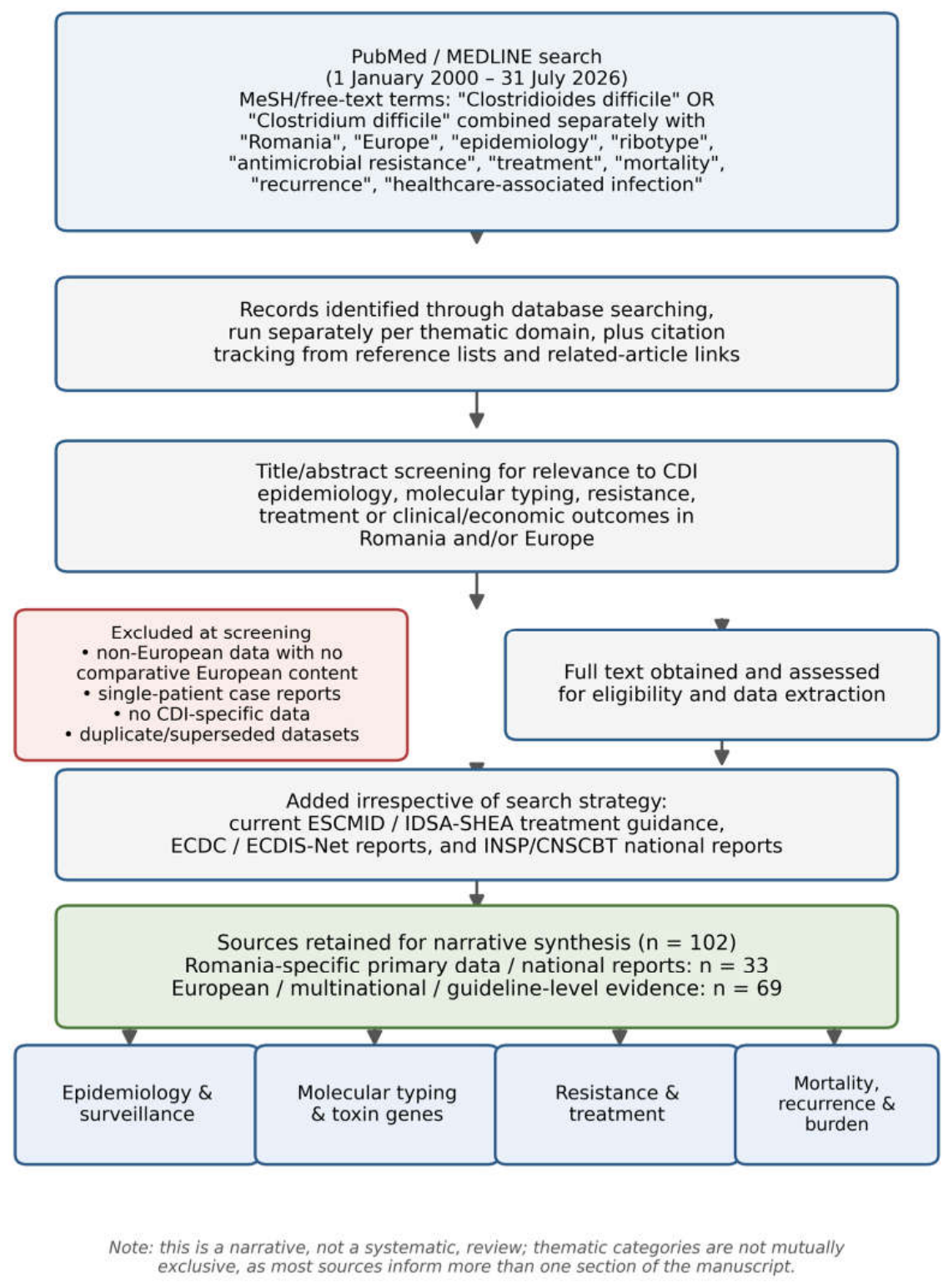
Figure 2.
Change in reported hospital CDI incidence over the surveillance period shown, by country, illustrating the marked heterogeneity in European trends discussed in Section 3 [16,17,18,19]. Indicators use different denominators and are not directly comparable in absolute terms; each bar reflects a country’s own trend over its own reported period. Sicily’s true value (+3,900%) is truncated at the axis break for legibility.
Figure 2.
Change in reported hospital CDI incidence over the surveillance period shown, by country, illustrating the marked heterogeneity in European trends discussed in Section 3 [16,17,18,19]. Indicators use different denominators and are not directly comparable in absolute terms; each bar reflects a country’s own trend over its own reported period. Sicily’s true value (+3,900%) is truncated at the axis break for legibility.
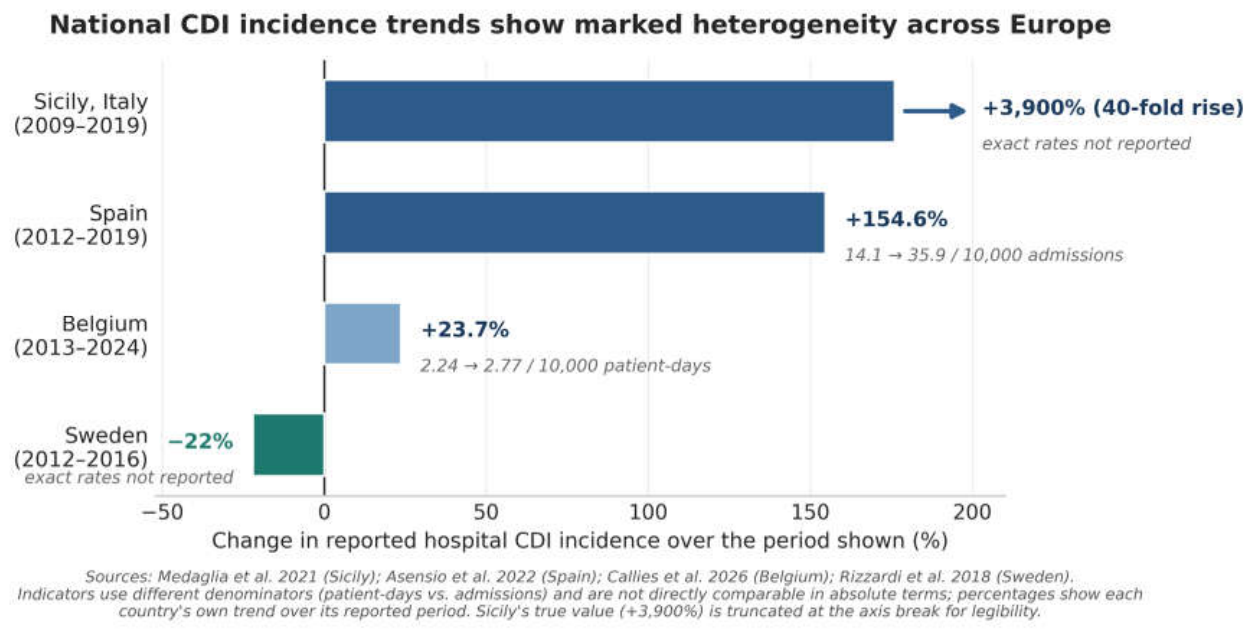
Figure 3.
CDI incidence in a Bucharest tertiary-care infectious-diseases hospital, 2020 vs. 2023. Only the two years with published data are shown; the source describes the intervening annual trend as highly variable [30].
Figure 3.
CDI incidence in a Bucharest tertiary-care infectious-diseases hospital, 2020 vs. 2023. Only the two years with published data are shown; the source describes the intervening annual trend as highly variable [30].
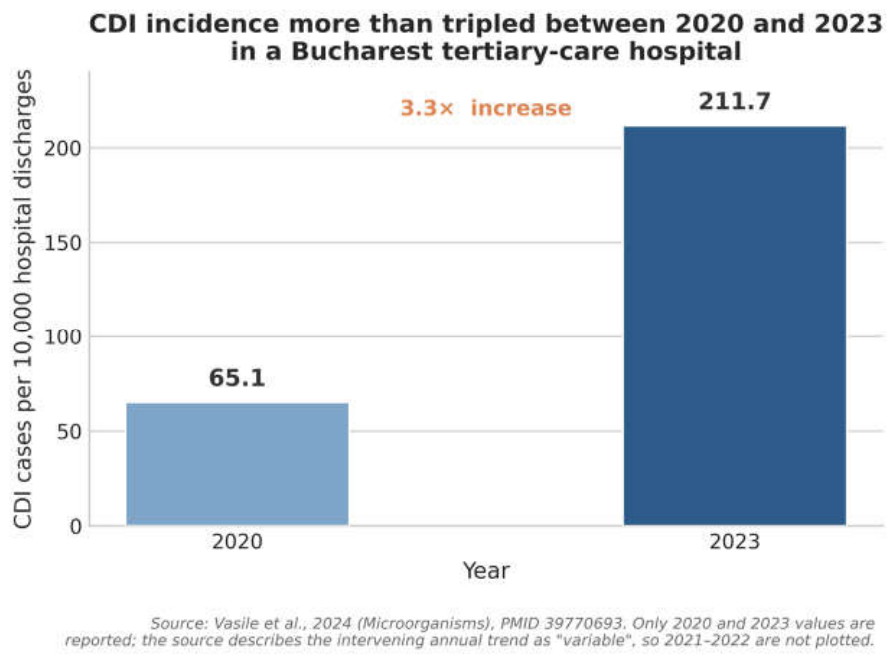
Figure 4.
Four phases of the Romanian CDI epidemic, 2011–2022, derived from national CNSCBT/INSP surveillance reports and Vasile et al. 2024 [5,7,26,30].
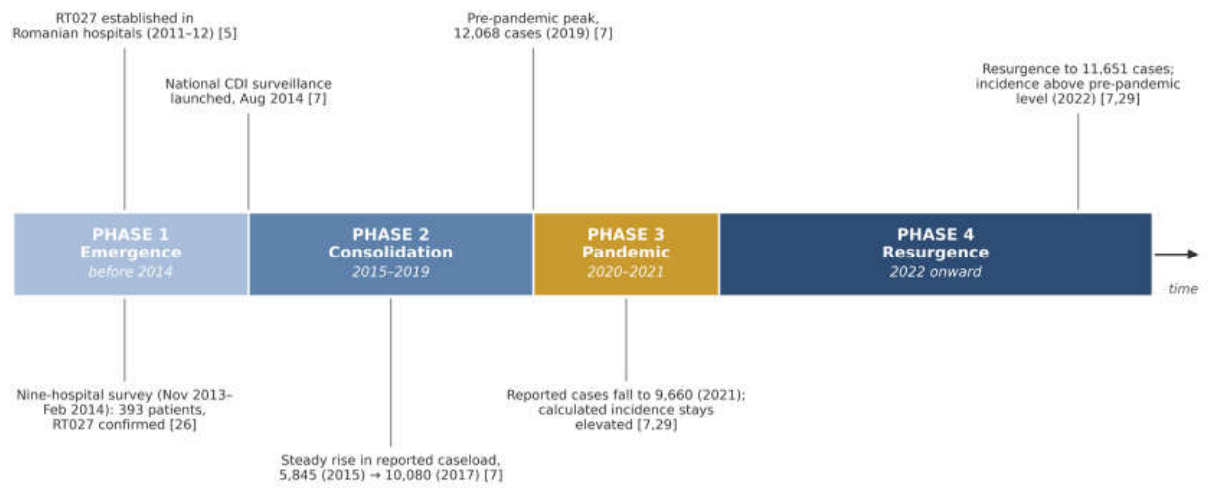
Figure 5.
National CDI surveillance trend, Romania, 2014–2022: confirmed cases reported through the CNSCBT/INSP system and calculated incidence per 10,000 discharges. Years labelled “n.d.” are those for which a national figure was not retrievable from the sources consulted [7,30].
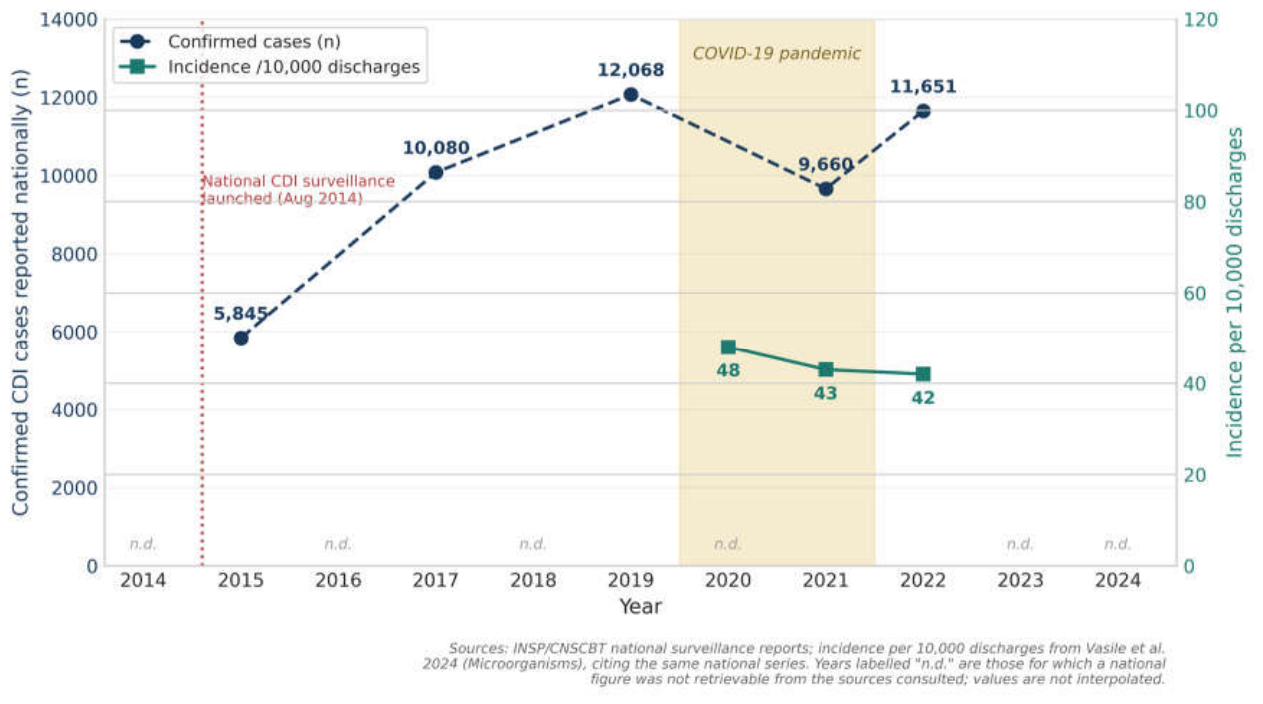
Figure 6.
Ribotype 027 prevalence among typed C. difficile isolates: Romania compared with other Central/Eastern European countries and the 2008 pan-European baseline [3,5,26,55,56].
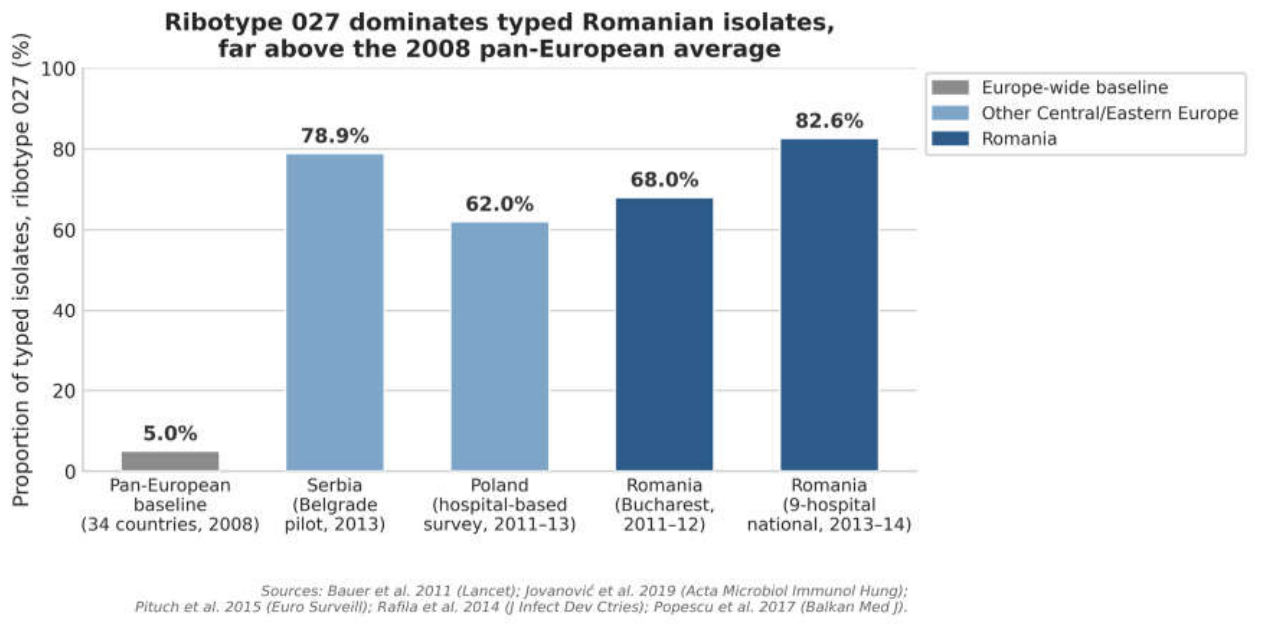
Table 1.
Summary of published Romanian CDI epidemiological studies.
| Study | Location | Period | N | Incidence | HA-CDI (%) | RT027 (%) | Mortality (%) | Recurrence (%) | Ref. |
| Rafila et al. | Bucharest | 2011–2012 | 64 isolates | NR | NR | 68.0 | 6.4 | 18.3 | [5] |
| Popescu et al. | 9 hosp., national | 2013–2014 | 393 pts | 5.2/10,000 pt-days (0–24.9) | 70.5 | 82.6 | 8.8 | NR | [26] |
| Laza et al. | Timișoara | 2013–2014 | NR | 20.6 & 15.7/1,000 disch. | NR | NR | NR | ~20 | [28] |
| Băicuș et al. | Bucharest | 2014–2015 | 165 samples | 0.47% of tested | NR | NR (81% CDT+) | NR | NR | [29] |
| Marinescu et al. | Timișoara | 2016–2017 | 210 pts | NR | NR | Presumptive, subset | NR | NR | [31] |
| Trifan et al. | 2 centres | 2014–2016 | 286 (octog.) | 27.6% of cohort | NR | NR | 0 (subgroup) | NR | [32] |
| Negrut et al. | Oradea | 2018–2019 | 195 pts | NR | NR | NR | NR | 53.8 | [33] |
| Manea et al. | Bucharest | 2020–2021 | HA-CDI cohort | 5.6/1,000 disch. | 100 | NR | NR | NR | [34] |
| Vasile et al. | Bucharest | 2020–2023 | NR | 65.1 → 211.7/10,000 disch. | Majority | NR | NR | NR | [30] |
| Stămăteanu et al. | Iași | Jan–Jun 2020 | 50 pts | NR | NR | 86 (presumptive) | NR | 35.6 (RT027+) | [35] |
| Stămăteanu et al. | Iași | 30 months | 534 pts | NR | NR | NR | 9.4 | NR | [36] |
| Ciuntu et al. | Iași | 3 years | 140/12,432 adm. | 1.12% of adm. | NR | NR | 14.0 | NR | [37] |
| Condratovici et al. | 32 hosp., SE Romania | 2024 | 2,878 HAI cases | CDI = 56.3% of HAI (1–93% range) | NR | NR | NR | NR | [38] |
| Voinea et al. | 10 hosp., Constanța county | 2020–2024 | 3,929 HAI cases (CDI ~50%) | NR | NR | NR | NR | NR | [27] |
| Lupșe et al. | Cluj-Napoca | 2011–2012 | 306 pts | NR | NR | NR | 3.0 | 20.0 | [39] |
| Vasile et al. (cohort detail) | Bucharest | 2020–2023 | 618 cases | 65.1–211.7/10,000 disch. | 73.6 | NR | 8.6 (crude) | 12.9 | [30] |
NR = not reported. HA-CDI = healthcare-associated CDI (% of cohort classified as HA where reported). CDT = binary toxin genes. pts = patients; hosp. = hospitals; disch. = discharges; adm. = admissions; octog. = octogenarians.
Disclaimer/Publisher’s Note: The statements, opinions and data contained in all publications are solely those of the individual author(s) and contributor(s) and not of MDPI and/or the editor(s). MDPI and/or the editor(s) disclaim responsibility for any injury to people or property resulting from any ideas, methods, instructions or products referred to in the content. |
© 2026 by the authors. Licensee MDPI, Basel, Switzerland. This article is an open access article distributed under the terms and conditions of the Creative Commons Attribution (CC BY) license (http://creativecommons.org/licenses/by/4.0/).
Copyright: This open access article is published under a Creative Commons CC BY 4.0 license, which permit the free download, distribution, and reuse, provided that the author and preprint are cited in any reuse.