
Submitted:
08 September 2026
Posted:
08 September 2026
You are already at the latest version
Abstract
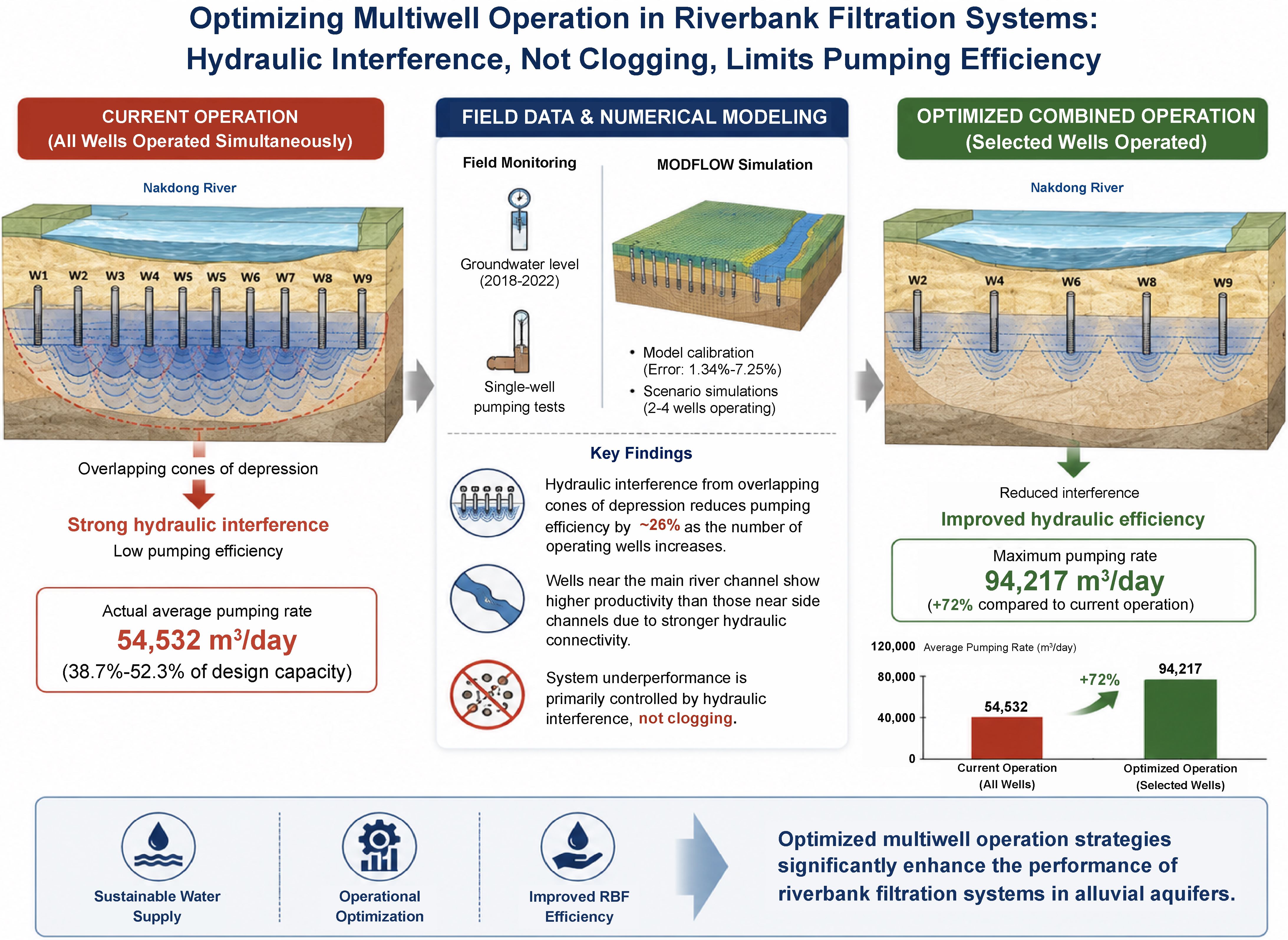
Riverbank filtration (RBF) is a sustainable technology for securing drinking water resources; however, many existing systems operate below their design capacities due to lack of optimization for site-specific hydrogeological conditions. Improving the performance of existing facilities is therefore an important challenge for sustainable groundwater management. This study proposes an operational management framework for improving the performance of a multi-well RBF system using long-term field monitoring data and groundwater modeling. A collector-well system located along the Nakdong River, South Korea, was selected as a case study. A MODFLOW groundwater model was calibrated using observed groundwater levels and single-well pumping tests and applied to evaluate hydraulic interference among wells and alternative pumping scenarios under multi-well operating conditions. The calibrated model reproduced observed pumping rates with errors ranging from 1.34% to 7.25%. Simulation results showed that simultaneous operation of multiple wells reduced abstraction efficiency because of hydraulic interference, whereas appropriate grouping of productive wells mitigated the loss of pumping performance. The recommended operation strategies increased simulated groundwater abstraction by approximately 72% compared with the current operating condition, without structural modifications. Integrating long-term operational monitoring with groundwater modeling provides a practical decision-support approach for improving the operational performance of existing multi-well RBF systems.
Keywords:
riverbank filtration
; operation strategy
; groundwater modeling
; MODFLOW
; well interference
; sustainable groundwater management
1. Introduction
Riverbank filtration (RBF) is a managed aquifer recharge technique in which surface water is induced to infiltrate through riverbed and aquifer materials toward pumping wells installed adjacent to a river. During subsurface passage, filtration, sorption, biodegradation, and mixing processes improve raw-water quality while providing a relatively stable source of water for municipal supply [1,2,3,4]. The effectiveness of RBF depends strongly on the hydraulic connection between the river and adjacent aquifer, aquifer properties, river-stage fluctuations, pumping conditions, and travel pathways between the river and production wells [5,6,7]. Consequently, understanding groundwater–surface water interactions and the hydraulic response of RBF well fields is essential for maintaining reliable long-term abstraction.
The hydraulic performance of RBF systems has been investigated using field observations, pumping tests, and numerical groundwater-flow models. Numerical modeling is particularly valuable for estimating induced river infiltration, groundwater flow paths, drawdown, and pumping capacity under different hydrogeological and operational conditions [8,9,10]. Radial and horizontal collector wells are widely used at large RBF facilities because their laterals can distribute abstraction over a relatively large aquifer volume while limiting excessive drawdown near the central caisson [8]. However, collector-well performance is sensitive to pumping rate, aquifer heterogeneity, river–aquifer connectivity, and hydraulic interactions among neighboring wells. When multiple wells are operated simultaneously, overlapping drawdown reduces individual well productivity and causes the effective abstraction capacity of the well field to differ substantially from its installed design capacity.
Long-term operation introduces additional challenges. Riverbed and aquifer clogging can reduce hydraulic conductivity and induced infiltration, thereby progressively affecting RBF performance [11,12]. Field-scale studies have also demonstrated that RBF performance varies over time in response to changes in river conditions, groundwater levels, pumping intensity, and individual well characteristics [13,14]. These observations indicate that design capacity alone may not adequately represent the actual production potential of a mature RBF facility. Consequently, operational records collected after commissioning provide important information for diagnosing changes in individual well performance and for evaluating whether the existing pumping strategy remains hydraulically efficient.
Several studies conducted along the Nakdong River in South Korea provide an important basis for understanding the hydraulic and operational characteristics of RBF systems under local hydrogeological conditions. Lee et al. [8] numerically analyzed a radial collector well near the Nakdong River and demonstrated that groundwater abstraction could induce a substantial proportion of river water into the collector well, highlighting the importance of collector-well configuration and river–aquifer connectivity. Time-series analysis at a lower Nakdong River RBF facility further demonstrated that groundwater levels respond to both river-stage fluctuations and pumping rates [15]. At Ddanseom Island (referred to as Ttansum Island in Lee et al. [16]), which corresponds to the study area investigated herein, Lee et al. [16] evaluated the productivity of radial collector wells using groundwater-flow modeling under several design-stage well configurations and estimated pumping capacities for the planned RBF system. Additional studies along the Nakdong River have investigated the feasibility, hydrogeological characteristics, and water-quality performance of RBF and horizontal collector-well systems [17,18,19]. Together, these studies established the hydrogeological feasibility and potential production capacity of RBF systems in the region.
Despite these advances, an important gap remains between design-stage evaluation and long-term operational management of multi-well RBF systems. Most previous studies have focused on hydrogeological characterization, induced infiltration, water-quality improvement, clogging processes, or potential abstraction capacity under prescribed pumping conditions [8,9,10,11,12,13,14,15,16,17,18,19]. Relatively few studies have examined how long-term operational records can be integrated with groundwater-flow modeling to evaluate alternative combinations of existing collector wells after years of actual facility operation. This issue is particularly important where individual wells exhibit unequal productivity and where hydraulic interference varies with the number and spatial combination of simultaneously operating wells. Groundwater-management studies outside the RBF domain have demonstrated that numerical models and pumping-allocation strategies can support more efficient wellfield operation [20,21,22]; however, practical application of such approaches to existing multi-well RBF facilities remains limited.
The increasing availability of long-term operational data provides an opportunity to move from design-oriented assessment toward data-informed operational management of existing RBF facilities. Accordingly, this study investigates the long-term performance of the Gimhae RBF system using daily operational records from 2018 to 2022 combined with a MODFLOW groundwater-flow model [23]. The objectives are to (1) characterize long-term groundwater abstraction and individual well contributions, (2) evaluate the effects of alternative multi-well operating combinations on groundwater production and hydraulic interaction, and (3) develop a practical operating strategy for improving the utilization of the existing well field. Unlike previous design-stage studies at the site, the present study focuses on the actual post-construction performance of the RBF facility and uses observed long-term operational behavior to define and evaluate alternative pumping scenarios. Beyond the presented case study, the proposed approach provides a transferable framework for improving the operational management of existing multi-well RBF systems and supporting more efficient use of existing water-supply infrastructure.
2. Materials and Methods
2.1. Study Area and Operational History
The study site is located at the Ddanseom riverbank filtration (RBF) facility along the lower Nakdong River in Gimhae, South Korea (Figure 1). The Nakdong River is the longest in South Korea and one of the country’s most important drinking water sources. To enhance water supply reliability and reduce dependence on direct river-water abstraction, a large-scale riverbank filtration system was constructed on the alluvial deposits adjacent to the river. The hydrogeological setting consists of highly permeable alluvial sediments hydraulically connected to the Nakdong River, providing favorable conditions for induced riverbank infiltration and groundwater abstraction.
The RBF facility was originally designed to produce 180,000 m3 day−1 using nine radial collector wells (W1–W9). During subsequent construction and commissioning, three additional collector wells (W10–W12) were installed to improve production flexibility and operational reliability. Although these additional wells were incorporated into the facility, the present study focused on the original W1–W9 well field, for which consistent long-term operational records and model-calibration data were available throughout the study period. Accordingly, W10–W12 were not included in the operational scenario analysis. The facility has been operated as one of the major municipal water supply systems in the region since 2018, with groundwater production being controlled through various combinations of collector wells according to operational requirements. However, long-term operational records indicate that groundwater production during routine operation was substantially lower than the design abstraction capacity. Under normal operating conditions, the combined production of the original W1–09 well field ranged from approximately 46,000 to 63,000 m3 day−1, corresponding to only 39–52% of the expected production capacity.
To investigate the factors behind this discrepancy, we analyzed long-term operational records collected between 2018 and 2022, along with groundwater monitoring data and numerical groundwater modeling. The operational dataset includes daily pumping records, groundwater abstraction volumes, and well operation histories, providing a unique opportunity to evaluate hydraulic interference among collector wells under actual operating conditions. The availability of long-term operational records together with comprehensive hydrogeological information makes this site particularly suitable for evaluating operation strategies and developing a practical framework for improving the performance of existing multi-well riverbank filtration systems.
2.2. Operational Data and Processing
The long-term operational dataset summarized in Table 1 was analyzed to characterize the operational behavior of the collector-well system and to establish representative pumping scenarios for numerical simulation. The dataset includes daily groundwater abstraction, operating well combinations, groundwater levels, and river stage observations collected during routine operation of the RBF facility.
Historical operating records were analyzed to identify the pumping frequency of individual collector wells, total groundwater abstraction, and typical operating well combinations. Because the collector wells operated under different pumping combinations based on operational requirements, the dataset provides valuable information for evaluating hydraulic interference among wells and assessing changes in groundwater production under actual operating conditions.
The historical operational records were subsequently used to support the development of representative multi-well pumping scenarios and the evaluation of alternative operating strategies, as described in Section 2.5.
2.3. Groundwater Flow Model
A three-dimensional groundwater-flow model was developed using Visual MODFLOW (Waterloo Hydrogeologic Inc., Canada), which is based on the MODFLOW code developed by the U.S. Geological Survey [23]. The model was constructed to simulate groundwater flow within the Gimhae riverbank filtration (RBF) system and to evaluate the hydraulic response of the collector-well system under alternative multi-well pumping scenarios. Although groundwater-flow models are commonly used for aquifer characterization and wellfield design, the model developed in this study was intended to evaluate operational strategies to improve groundwater abstraction efficiency in an existing multi-well RBF system.
The conceptual groundwater-flow model is illustrated in Figure 2. The model represents the alluvial aquifer hydraulically connected to the Nakdong River, where groundwater abstraction from collector wells induces riverbank infiltration toward the well field. The principal hydrogeological components incorporated into the model include the river, alluvial aquifer, impermeable bedrock, and collector wells. The numerical model domain corresponds to the area shown in Figure 1, and Figure 2 presents the conceptual representation of groundwater flow and riverbank infiltration. The Nakdong River was represented using the River (RIV) Package, whereas groundwater abstraction by the collector wells was simulated using the Well (WEL) Package.
The groundwater-flow model was developed using hydrogeological information obtained from site investigations and long-term monitoring data. Initial hydrogeological parameters, including hydraulic conductivity, recharge, aquifer properties, and riverbed characteristics, were assigned based on field investigations and design reports and were subsequently refined through model calibration.
2.4. Model Calibration
The groundwater-flow model was calibrated to ensure its applicability for evaluating alternative collector-well operating strategies. To improve the model’s applicability to operational scenario analysis, calibration incorporated both groundwater level observations and measured groundwater abstraction from single-well pumping tests. This approach improved the model’s ability to reproduce not only regional groundwater-flow conditions but also the pumping performance of individual collector wells.
Model calibration was performed through iterative adjustment of the principal hydraulic parameters — including hydraulic conductivity, recharge, and riverbed conductance — within physically reasonable ranges derived from site investigation data and previous hydrogeological studies. Groundwater level observations obtained from the long-term monitoring program were used to reproduce the regional hydraulic conditions of the study area, while the measured abstraction rates from the single-well pumping tests were used to evaluate the model’s ability to reproduce the pumping performance of individual collector wells.
The calibrated model was evaluated by comparing the simulated groundwater abstraction with the measured pumping rates obtained from the single-well pumping tests. Table 2 summarizes the comparison of measured and simulated abstraction rates for the six operating collector wells. The calibrated model was subsequently used to evaluate the effects of alternative multi-well operating scenarios on groundwater abstraction and hydraulic interference.
2.5. Operation Scenario Simulation and Performance Evaluation
To evaluate the operational performance of the Gimhae riverbank filtration (RBF) system, a series of multi-well pumping scenarios was developed using the calibrated groundwater-flow model. The scenarios were designed to quantify the effects of different collector-well operating combinations on groundwater abstraction and hydraulic interference, identifying practical operating strategies to improve groundwater production under existing field conditions.
As described in Section 2.1, the operational scenario analysis was restricted to the original W1–W9 well field. Among these wells, W5, W7, and W8 exhibited negligible groundwater abstraction during long-term operation and were suspected to be affected by clogging; therefore, these wells were excluded from the scenario analysis. Consequently, operational scenarios were developed using the six productive collector wells that remained in routine operation (W1, W2, W3, W4, W6, and W9).
Representative pumping scenarios were established by considering all possible combinations of one-, two-, three-, and four-well operations among the six productive collector wells. We evaluated 56 operational scenarios: 6 single-well, 15 two-well, 20 three-well, and 15 four-well combinations. Table S1 provides the complete set of multi-well operational scenarios and their simulated groundwater abstraction rates. The scenarios were designed to systematically evaluate the effects of different well combinations on groundwater abstraction and hydraulic interference among the collector wells. The procedure used to establish the operational scenarios is illustrated in Figure 3.
For each operational scenario, we performed steady-state groundwater-flow simulations using the calibrated model described in Section 2.3 and Section 2.4. The simulation results were evaluated using the total groundwater abstraction, groundwater abstraction efficiency of individual collector wells, and the degree of hydraulic interference among simultaneously operating wells. These performance indicators were then used to identify operating combinations that maximize groundwater production while minimizing mutual hydraulic interference.
3. Results
3.1. Long-Term Operational Characteristics
The long-term operational records collected between 2018 and 2022 were analyzed to characterize the operating conditions of the Gimhae riverbank filtration (RBF) system. Figure 4 summarizes the annual groundwater abstraction of individual collector wells together with their contribution to the total groundwater production during the study period. The operational records provide valuable insight into the actual performance of the collector-well system under routine field conditions and form the basis for developing representative operational scenarios.
As shown in Figure 4(a), considerable differences in groundwater abstraction were observed among the collector wells throughout the operating period. Although the RBF facility was originally designed to produce 180,000 m3 day−1, the total groundwater abstraction ranged from approximately 46,000 to 63,000 m3 day−1, corresponding to only 39–52% of the design capacity. Annual groundwater production remained relatively stable over the five years, indicating that the reduced production was not a temporary operational issue but a persistent characteristic of the existing collector-well system.
Distinct differences were also observed in the operating performance of individual collector wells. Wells W3 and W9 consistently produced the largest groundwater abstraction throughout the monitoring period, whereas W5, W7, and W8 exhibited negligible production after the initial operation period (Figure 4(a)). These three collector wells contributed less than approximately 1% of the total groundwater production after 2020 (Figure 4(b)), indicating that they no longer functioned as effective production wells. Given their persistently low productivity and the suspected effects of clogging based on their long-term operational behavior, W5, W7, and W8 were excluded from the operational scenario analysis.
The contribution ratio in Figure 4(b) further shows that groundwater production gradually concentrated in a limited number of collector wells, particularly W3 and W9, while the contribution of the remaining productive wells remained relatively consistent throughout the monitoring period. These long-term operational characteristics indicate that the reduced system performance cannot be explained solely by the installed abstraction capacity but is strongly influenced by the operational status and productivity of individual collector wells. Consequently, alternative operating combinations of the six productive collector wells (W1, W2, W3, W4, W6, and W9) were evaluated in the subsequent scenario analysis to identify practical operating strategies that improve groundwater abstraction while minimizing hydraulic interference.
3.2. Multi-Well Operational Scenarios
The performance of the multi-well operational scenarios was evaluated using the six productive collector wells (W1, W2, W3, W4, W6, and W9). The simulation results showed that groundwater abstraction was influenced by both the number of simultaneously operating wells and the specific combination of wells. To examine these effects, pumping performance was first compared by the number of operating wells, followed by an assessment of variation in total abstraction among representative well combinations.
Figure 5 compares the minimum, average, and maximum pumping rates per well under the two-, three-, and four-well operational scenarios. The average pumping rate per well decreased progressively from 16,593 m3 day−1 per well for two-well operation to 14,984 m3 day−1 per well for three-well operation and 13,090 m3 day−1 per well for four-well operation. A similar trend was observed for the maximum pumping rate, which decreased from 20,872 m3 day−1 per well for two-well operation to 17,130 and 14,353 m3 day−1 per well for three- and four-well operations, respectively. The minimum pumping rates were 12,025, 13,756, and 11,090 m3 day−1 per well for the two-, three-, and four-well scenarios, respectively. These results indicate that the abstraction capacity of an individual collector well decreased as more wells were operated simultaneously, consistent with increasing hydraulic interaction among the operating wells.
The importance of the specific operating combination becomes more evident when the total groundwater abstraction is compared among representative scenarios (Figure 6). For two-well operation, the total abstraction ranged from 24,050 m3 day−1 in the worst-performing scenario (S2-15) to 41,743 m3 day−1 in the best-performing scenario (S2-3), while the median scenario (S2-1) produced 32,826 m3 day−1. Similar differences were observed for three-well operation, with total abstraction increasing from 41,267 m3 day−1 (S3-13) to 51,389 m3 day−1 (S3-8). For four-well operation, the corresponding values ranged from 44,359 m3 day−1 (S4-13) to 57,411 m3 day−1 (S4-8), with the median scenario (S4-11) producing 51,804 m3 day−1. These differences demonstrate that even when the same number of wells is operated, total groundwater production can vary substantially depending on the selected well combination.
Although increasing the number of operating wells generally increased total groundwater abstraction, the increase was not proportional to the number of wells in operation. For example, the best-performing two-well scenario produced 41,743 m3 day−1, whereas the worst-performing four-well scenario produced only 44,359 m3 day−1, despite operating twice as many wells. This relatively small increase in total abstraction shows that simply increasing the number of simultaneously operating wells does not proportionally improve system-level production. Instead, the spatial arrangement and hydraulic interaction of the selected wells play an important role in determining the overall performance of the collector-well system.
Overall, the multi-well scenario analysis shows that operational performance depends not only on the number of active collector wells but also on selecting an appropriate well combination. Therefore, an effective operating strategy should seek to maintain high total groundwater abstraction while avoiding combinations that result in excessive mutual hydraulic interference. Based on these findings, the following section evaluates the performance of the recommended operating strategies.
3.3. Recommended Operating Strategy
Based on the multi-well scenario results, alternative combined operation strategies were developed to improve groundwater production while reducing the effects of hydraulic interference among simultaneously operating collector wells. Rather than operating all six productive wells simultaneously, the proposed strategies divide the productive collector wells into separate operational groups. Two combined operation strategies were evaluated: Combined operation 1, consisting of sequential operation of two-well and four-well groups, and Combined operation 2, consisting of two three-well groups. The evaluated combined operating strategies and corresponding total groundwater abstraction rates are summarized in Table S2. Their performance was compared with the current operating strategy, in which the six productive wells are operated simultaneously.
As shown in Figure 7, the current simultaneous operation produced a total groundwater abstraction of 54,532 m3 day−1. In comparison, Combined operation 1 achieved 94,217 m3 day−1, representing an increase of approximately 72% relative to the current operation. Combined operation 2 showed a similarly high abstraction rate of 93,902 m3 day−1. The difference between the two combined strategies was small, whereas both substantially outperformed the current simultaneous operation. These results demonstrate that rearranging the operation of the existing productive wells can substantially improve groundwater abstraction without increasing the number of collector wells.
The improved performance of the combined operation strategies can be explained by the hydraulic interaction identified in the multi-well scenario analysis. As demonstrated in Section 3.2, increasing the number of simultaneously operating wells reduced the average pumping rate per well, and substantial differences in total abstraction were observed among different well combinations. Dividing the productive wells into appropriate operating groups therefore allows individual wells to operate under less restrictive hydraulic conditions and reduces the loss of pumping performance associated with simultaneous operation. In particular, the comparable performance of the two combined strategies indicates that the operational benefit is primarily associated with selecting and grouping collector wells rather than simply maximizing the number of wells operated simultaneously.
These results indicate that improving the operational performance of an existing RBF system does not necessarily require constructing additional collector wells or immediately expanding abstraction infrastructure. For the Gimhae RBF system, reorganizing the operation of the existing productive wells substantially increased simulated groundwater abstraction compared with the current operating strategy. The proposed combined operation strategy therefore provides a practical approach for improving the utilization of existing well-field capacity, while its broader applicability and implications for sustainable RBF management are discussed in Section 4.
4. Discussion
4.1. Operational Implications for Existing RBF Systems
The results of this study demonstrate that the operational performance of a multi-well RBF system cannot be determined solely by the installed abstraction capacity or the number of collector wells in operation. Although operating additional wells simultaneously increased total groundwater abstraction, the average pumping rate per well decreased as the number of operating wells increased. Moreover, total abstraction differed substantially among well combinations even when the same number of wells was operated. These results indicate that hydraulic interaction among collector wells is an important factor controlling the effective production capacity of an existing RBF well field.
Previous studies conducted along the Nakdong River have investigated the hydraulic and hydrogeological characteristics of RBF systems, including river–aquifer connectivity, river-stage responses, and pumping behavior [8,15,16,17,18]. In particular, Lee et al. [16] evaluated the potential pumping capacity of radial collector wells at Ddanseom Island under design-stage conditions, providing an important basis for the development of the present RBF facility. The present study extends these previous investigations from design-stage assessment to post-construction operational management by evaluating the long-term performance of the well field using operational records collected during 2018–2022. The results demonstrate that the effective production capacity after several years of operation is strongly influenced by the productivity of individual wells and by the combinations in which these wells are operated.
Hydraulic interference between pumping wells is a well-established characteristic of multi-well groundwater systems, in which overlapping drawdown induced by neighboring wells can reduce the pumping performance of individual wells. This effect is particularly relevant to RBF systems because collector wells are commonly installed within hydraulically connected alluvial aquifers and rely on induced infiltration from adjacent surface-water bodies [5,6,8,9,10]. Consequently, the effective abstraction capacity of a multi-well RBF system varies substantially depending on the spatial arrangement and hydraulic interaction of simultaneously operating wells.
The scenario analysis further indicates that increasing the number of simultaneously operating wells does not necessarily provide a proportional increase in groundwater production. The best-performing two-well scenario produced 41,743 m3 day−1, whereas the worst-performing four-well scenario produced only 44,359 m3 day−1. Thus, operating twice as many wells yielded only a marginal increase in abstraction when an unfavorable combination was selected. Conversely, selecting combinations with more favorable hydraulic interactions allowed the existing collector wells to maintain higher individual pumping performance. This finding emphasizes that the spatial and hydraulic relationships among wells must be considered alongside individual well capacity when determining pumping schedules for multi-well RBF systems.
This operational perspective is consistent with previous wellfield-management studies showing that groundwater production can be improved through appropriate allocation and scheduling of pumping rather than by simply maximizing simultaneous abstraction [22]. However, such approaches have been less frequently examined for existing RBF facilities using long-term operational records. In the Gimhae RBF system, analysis of the 2018–2022 records first identified substantial differences in the contribution and productivity of individual collector wells, after which the calibrated groundwater-flow model was used to evaluate alternative operating combinations. The resulting combined operation strategies increased simulated abstraction from 54,532 m3 day−1 under the current simultaneous operation to approximately 94,000 m3 day−1, demonstrating the potential benefit of operational reorganization without immediate expansion of the existing well field.
These findings have important implications for existing RBF facilities experiencing declining or insufficient production. When actual abstraction remains below design expectations, increasing pumping intensity or adding new production wells may not necessarily represent the first or most efficient management response. Evaluating the performance of existing wells and their hydraulic interactions can reveal opportunities to improve production through changes in well grouping and operating schedules. Accordingly, operational management should be considered an integral component of maintaining the long-term performance of multi-well RBF systems, particularly where infrastructure expansion is constrained or where more efficient use of existing abstraction facilities is desirable.
4.2. Practical Framework for Operation Management
The results of this study provide a practical basis for developing an operational management framework for existing multi-well RBF systems. Rather than treating the installed pumping capacity as a fixed measure of system performance, the proposed approach accounts for the actual productivity of individual wells and their hydraulic interactions under different operating conditions. Previous groundwater-management studies have demonstrated that numerical groundwater models can support pumping allocation and wellfield management by evaluating alternative operational strategies [20,21,22]. Building on this concept, the framework proposed in this study integrates long-term operational records with groundwater-flow modeling and scenario-based evaluation, allowing operational decisions to be based on observed well performance and simulated responses of the well field.
The proposed framework can be organized into four sequential stages. First, long-term operational records are used to diagnose the performance of individual collector wells. Pumping history, operating frequency, groundwater levels, and river stages can be examined to identify wells with persistent productivity declines or abnormal operating behavior. In the present study, this initial screening identified W5, W7, and W8 as poorly performing wells and allowed subsequent analyses to focus on the six productive wells. This step is particularly important for existing RBF facilities because the current production capacity of individual wells may differ substantially from their original design capacity after prolonged operation.
Second, a calibrated groundwater-flow model is used to characterize the hydraulic response of the productive well field. Once the model adequately represents observed groundwater levels and abstraction behavior, alternative combinations of operating wells can be systematically evaluated without disrupting actual water-supply operations. This provides a practical means of examining hydraulic interactions that would otherwise require numerous field pumping tests with different combinations of collector wells. The numerical model therefore serves not only as a representation of groundwater flow but also as an operational assessment tool for existing well fields.
Third, alternative multi-well operational scenarios are evaluated using performance indicators such as total groundwater abstraction, pumping performance per well, and hydraulic interaction among simultaneously operating wells. The scenario results can then be used to distinguish favorable and unfavorable well combinations. As demonstrated in this study, the number of operating wells alone was insufficient to determine operational performance; combinations involving the same number of wells produced substantially different abstraction rates. Scenario-based assessment therefore enables operators to identify well groups that use the available production capacity more effectively while limiting losses associated with mutual hydraulic interference.
Finally, operators can incorporate the selected well combinations into practical operating schedules and periodically reassess them as field conditions change. RBF well performance is not necessarily stationary because long-term operation may alter individual well productivity through clogging, changes in river–aquifer connectivity, or variations in groundwater conditions. The proposed framework should therefore be treated as an adaptive management process rather than a one-time optimization procedure. Updating the operational dataset and periodically reevaluating well combinations would allow operating strategies to be adjusted as the hydraulic performance of the well field evolves.
This framework differs from approaches focused primarily on well-field design or expansion because it emphasizes better use of existing infrastructure. For RBF facilities where actual production has declined below design expectations, combining operational monitoring with scenario-based groundwater modeling can provide an intermediate management option before considering additional wells, rehabilitation, or major infrastructure expansion. The framework is therefore particularly applicable to mature RBF systems with sufficient operational records, where water-supply performance can be improved through better allocation of existing abstraction capacity. Although the specific operating combinations identified for the Gimhae RBF system are site-dependent, the overall procedure—performance diagnosis, model-based scenario evaluation, selection of favorable well combinations, and periodic reassessment—provides a transferable approach for supporting the operational management of existing multi-well RBF systems.
4.3. Limitations and Future Work
Several limitations should be considered when interpreting the results of this study. First, the groundwater-flow model necessarily simplifies the spatial heterogeneity of the alluvial aquifer and the complex hydraulic connection between the river and aquifer. Although the model was calibrated using observed groundwater levels and pumping data, it may not fully represent local variations in hydraulic properties around individual collector wells. Consequently, the simulated differences among operating scenarios should be interpreted as indicators of relative operational performance rather than as exact predictions of future abstraction rates.
Second, the persistently low abstraction observed at W5, W7, and W8 was considered to be associated with clogging based on their long-term operational behavior; however, the physical and biogeochemical processes responsible for the deterioration of well performance were not directly investigated. The present study therefore focused on the operational management of the remaining productive wells rather than diagnosing or rehabilitating the poorly performing wells. Future studies should integrate operational analysis with direct investigations of screen and aquifer clogging to determine whether rehabilitation of deteriorated wells could further improve system performance.
Third, the present analysis focused primarily on groundwater abstraction and hydraulic interaction among collector wells. Water-quality responses associated with changes in pumping patterns, including variations in travel time, river-water contribution, and filtration performance, were not explicitly considered. Because RBF operation must ultimately balance water quantity and water quality, future operational assessments should incorporate both hydraulic performance and water-quality criteria when selecting appropriate well combinations.
Finally, the recommended operating combinations identified in this study are specific to the hydrogeological conditions, well configuration, and operational characteristics of the Gimhae RBF system. Direct application of the same combinations to other RBF facilities is therefore not appropriate without site-specific evaluation. Nevertheless, the overall approach of using long-term operational data to diagnose well performance, calibrating a groundwater-flow model, evaluating alternative operating scenarios, and periodically updating the resulting strategy can be transferred to other multi-well RBF systems. Future research should evaluate this framework at additional RBF sites and extend it toward an adaptive decision-support approach in which operating strategies are periodically updated in response to changes in well productivity, river stage, groundwater conditions, and water-supply requirements.
5. Conclusions
This study evaluated the operational performance of an existing multi-well riverbank filtration (RBF) system and developed a practical operating strategy based on long-term operational records and groundwater-flow modeling. The Gimhae RBF facility exhibited a persistent discrepancy between its design abstraction capacity and actual groundwater production during 2018–2022. Analysis of the long-term records revealed substantial differences in the productivity and contribution of individual collector wells, and six productive wells (W1, W2, W3, W4, W6, and W9) were subsequently selected for multi-well operational scenario analysis.
The numerical simulations demonstrated that groundwater production was strongly influenced by both the number and combination of simultaneously operating collector wells. The average pumping rate per well decreased from 16,593 m3 day−1 per well under two-well operation to 14,984 and 13,090 m3 day−1 per well under three- and four-well operations, respectively, indicating increasing hydraulic interaction as additional wells were operated simultaneously. Moreover, total abstraction differed substantially among combinations with the same number of operating wells. The best-performing two-well scenario produced 41,743 m3 day−1, whereas the worst-performing four-well scenario produced only 44,359 m3 day−1, demonstrating that increasing the number of operating wells alone does not necessarily result in a proportional increase in groundwater production.
Based on these findings, combined operation strategies were developed by grouping the existing productive wells rather than operating all six productive wells simultaneously. The current simultaneous operation produced 54,532 m3 day−1, whereas the proposed combined operation strategies produced approximately 94,000 m3 day−1. The highest simulated abstraction of 94,217 m3 day−1 represented an improvement of approximately 72% compared with the current operation. These results show that substantial improvements in well-field performance can be achieved by appropriately selecting and grouping existing collector wells without expanding abstraction infrastructure.
Overall, the findings indicate that the effective production capacity of an existing RBF system should not be evaluated solely based on installed well capacity or the number of wells in operation. Instead, operational decision-making should incorporate individual well productivity and hydraulic interaction among simultaneously operating wells. Integrating long-term operational monitoring, well-performance diagnosis, groundwater-flow modeling, and scenario-based evaluation provides a practical decision-support framework for improving the operational management of existing multi-well RBF systems.
Supplementary Materials
The following supporting information can be downloaded at the website of this paper posted on Preprints.org: Table S1: Simulated groundwater abstraction for multi-well operational scenarios and comparison with available measured pumping rates; Table S2: Evaluation of combined operating strategies and identification of optimal well combinations.
Author Contributions
Conceptualization, J.O.; methodology, S.J.; software, J.O. and S.J.; validation, D.K. and S.J.; formal analysis, D.K. and S.J.; investigation, J.O. and S.J.; resources; data curation, D.K.; writing—original draft preparation, J.O.; writing—review and editing, J.O. and S.J.; visualization, J.O. and S.J.; supervision, D.K.; project administration, D.K.; funding acquisition, D.K. All authors have read and agreed to the published version of the manuscript.
Funding
This work was supported by a grant from research year of Inje University in 2018, grant number 20190006).
Institutional Review Board Statement
Not applicable.
Informed Consent Statement
Not applicable.
Data Availability Statement
The operational and monitoring data used in this study are not publicly available due to confidentiality restrictions. The data are managed by Gimhae City and were provided to the authors exclusively for the purposes of this study; therefore, the authors are not authorized to distribute the original data to third parties.
Acknowledgments
We would like to thank Editage for English language editing.
Conflicts of Interest
The authors declare no conflicts of interest. The funder had no role in the design of the study; in the collection, analyses, or interpretation of data; in the writing of the manuscript; or in the decision to publish the results.
Abbreviations
The following abbreviations are used in this manuscript:
| RBF | Riverbank filtration |
| MODFLOW | Modular Finite-Difference Groundwater Flow Model |
| RIV | River Package |
| WEL | Well Package |
References
- Bouwer, H. Artificial recharge of groundwater: Hydrogeology and engineering. Hydrogeol. J. 2002, 10, 121–142. [Google Scholar] [CrossRef]
- Ray, C.; Melin, G.; Linsky, R.B. (Eds.) Riverbank Filtration; Springer: Dordrecht, The Netherlands, 2003. [Google Scholar] [CrossRef]
- Hiscock, K.M.; Grischek, T. Attenuation of groundwater pollution by bank filtration. J. Hydrol. 2002, 266, 139–144. [Google Scholar] [CrossRef]
- Kondor, A.C.; Vancsik, A.V.; Bauer, L.; Szabó, L.; Szalai, Z.; Jakab, G.; Maász, G.; Pedrosa, M.; Sampaio, M.J.; Lado Ribeiro, A.R.L. Efficiency of the bank filtration for removing organic priority substances and contaminants of emerging concern: A critical review. Environ. Pollut. 2024, 340, 122795. [Google Scholar] [CrossRef] [PubMed]
- Kalbus, E.; Reinstorf, F.; Schirmer, M. Measuring methods for groundwater—surface water interactions: A review. Hydrol. Earth Syst. Sci. 2006, 10, 873–887. [Google Scholar] [CrossRef]
- Boano, F.; Harvey, J.W.; Marion, A.; Packman, A.I.; Revelli, R.; Ridolfi, L.; Wörman, A. Hyporheic flow and transport processes: Mechanisms, models, and biogeochemical implications. Rev. Geophys. 2014, 52, 603–679. [Google Scholar] [CrossRef]
- Gollnitz, W.D.; Whitteberry, B.L.; Vogt, J.A. Riverbank filtration: Induced infiltration and groundwater quality. J. AWWA 2004, 96, 98–110. [Google Scholar] [CrossRef]
- Lee, E.; Hyun, Y.; Lee, K.K.; Shin, J. Hydraulic analysis of a radial collector well for riverbank filtration near Nakdong River, South Korea. Hydrogeol. J. 2012, 20, 575–589. [Google Scholar] [CrossRef]
- Shebl, A.; Abdel Wahaab, R.; Elazizy, I.; Hagras, M. Hydraulic performance of riverbank filtration: Case study West Sohag, Egypt. Water Supply 2022, 22, 294–308. [Google Scholar] [CrossRef]
- Nguyen, T.K.H.; Nuottimäki, K.; Jarva, J.; Dang, T.T.; Luoma, S.; Nguyen, K.H.; Pham, T.L.; Hoang, T.N.A. Use of a groundwater model to evaluate groundwater–surface water interaction at a riverbank filtration site: A case study in Binh Dinh, Vietnam. Sustain. Water Resour. Manag. 2025, 11, 14. [Google Scholar] [CrossRef]
- Grischek, T.; Bartak, R. Riverbed clogging and sustainability of riverbank filtration. Water 2016, 8, 604. [Google Scholar] [CrossRef]
- Hu, B.; Liu, L.; Chen, R.; Li, Y.; Li, P.; Chen, H.; Liu, G.; Teng, Y. The impact of clogging issues at a riverbank filtration site in the Lalin River, NE, China: A laboratory column study. Sustainability 2022, 14, 9330. [Google Scholar] [CrossRef]
- Weiss, W.J.; Bouwer, E.J.; Aboytes, R.; LeChevallier, M.W.; O’Melia, C.R.; Le, B.T.; Schwab, K.J. Riverbank filtration for control of microorganisms: Results from field monitoring. Water Res. 2005, 39, 1990–2001. [Google Scholar] [CrossRef] [PubMed]
- Noh, J.H.; So, S.H.; Park, J.W.; Kim, S.Y.; Song, K.G.; Choi, J.; Kim, G.B.; Son, H.; Kim, H.; Maeng, S.K. An assessment of the effectiveness of riverbank filtration in a sewage plant effluent-impacted river using a full-scale horizontal well. Water 2022, 14, 1873. [Google Scholar] [CrossRef]
- Cheong, J.Y.; Hamm, S.Y.; Kim, H.S.; Lee, S.H.; Park, H.J. Estimating groundwater level change associated with river stage and pumping using time series analyses at a riverbank filtration site in Korea. J. Environ. Sci. Int. (in Korean). 2017, 26, 1135–1146. [Google Scholar] [CrossRef]
- Lee, C.M.; Hamm, S.Y.; Choo, Y.W.; Kim, H.S.; Cheong, J.Y. Determining optimum pumping rates of groundwater in Ttansum Island related to riverbank filtration. J. Environ. Sci. Int. (in Korean). 2018, 27, 831–844. [Google Scholar] [CrossRef]
- Maeng, S.K.; Lee, K.H. Riverbank filtration for the water supply on the Nakdong River, South Korea. Water 2019, 11, 129. [Google Scholar] [CrossRef]
- Moniruzzaman, M.; Lee, J.H.; Jung, K.M.; Kwon, J.S.; Kim, K.H.; Yun, S.T. Lithologic control of the hydrochemistry of a point-bar alluvial aquifer at the low reach of the Nakdong River, South Korea: Implications for the evaluation of riverbank filtration potential. Water 2018, 10, 1763. [Google Scholar] [CrossRef]
- Rossetto, R.; Barbagli, A.; De Filippis, G.; Marchina, C.; Vienken, T.; Mazzanti, G. Importance of the induced recharge term in riverbank filtration: Hydrodynamics, hydrochemical, and numerical modelling investigations. Hydrology 2020, 7, 96. [Google Scholar] [CrossRef]
- Culver, T.B.; Shoemaker, C.A. Dynamic optimal control for groundwater remediation with flexible management periods. Water Resour. Res. 1992, 28, 629–641. [Google Scholar] [CrossRef]
- Alqahtani, A.; Sale, T. Optimizing aquifer storage and recovery wellfield operations to minimize energy consumption. J. Water Resour. Plan. Manag. 2020, 146. [Google Scholar] [CrossRef]
- Wang, H.; Wanakule, N.; Asefa, T. Examining effectiveness of optimal groundwater management at multiple timescales in Tampa Bay Region. J. Water Resour. Plan. Manag. 2021, 147. [Google Scholar] [CrossRef]
- Harbaugh, A.W. MODFLOW-2005. The U.S. Geological Survey modular ground-water model—The ground-water flow process. In U. S. Geological Survey Techniques and Methods 6-A16; United States Geological Survey: Reston, VA, USA, 2005. [Google Scholar]
Figure 1.
Study site and numerical model domain of the Gimhae riverbank filtration system. The collector-well layout, well field area, and groundwater-flow model domain used in this study are superimposed on a satellite image of the study area.
Figure 1.
Study site and numerical model domain of the Gimhae riverbank filtration system. The collector-well layout, well field area, and groundwater-flow model domain used in this study are superimposed on a satellite image of the study area.
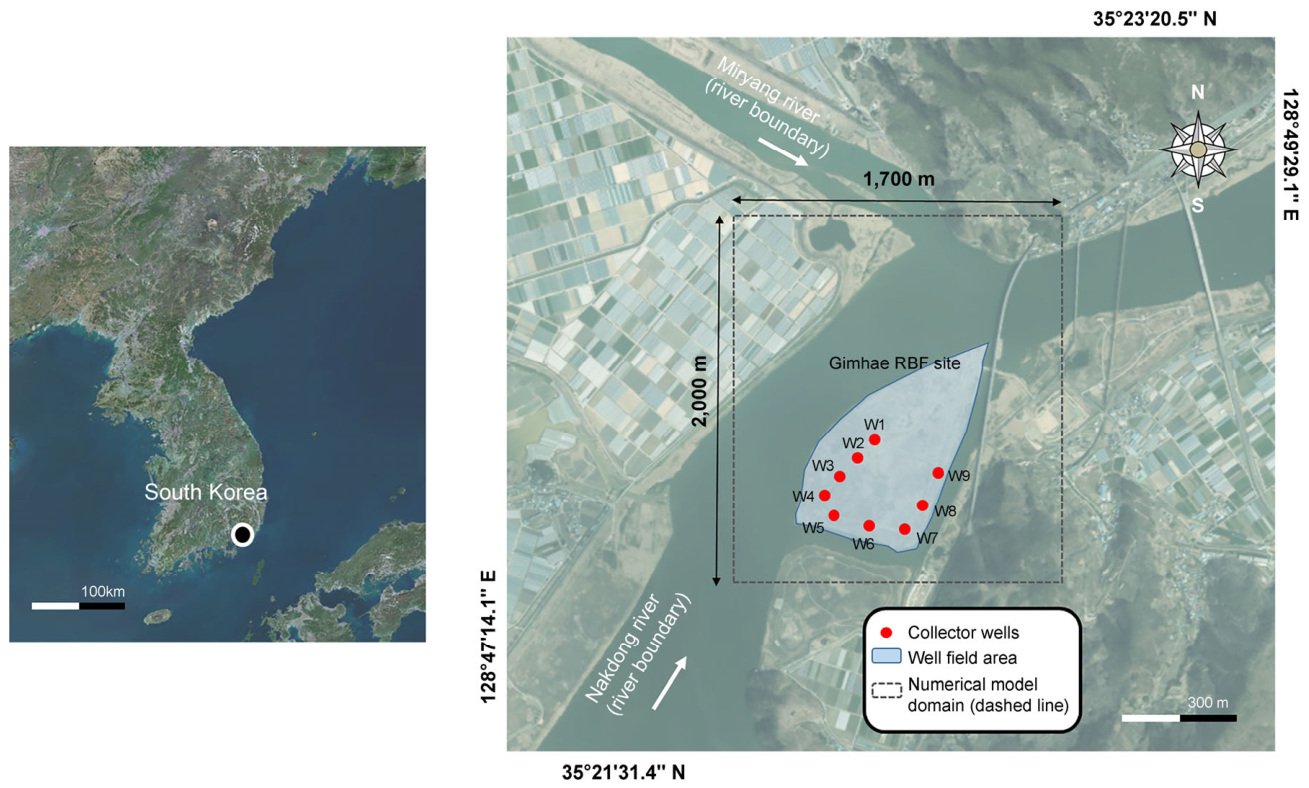
Figure 2.
Conceptual groundwater-flow model of the Gimhae riverbank filtration system illustrating riverbank infiltration, groundwater flow within the alluvial aquifer, and groundwater abstraction by collector wells represented in the numerical groundwater-flow model.
Figure 2.
Conceptual groundwater-flow model of the Gimhae riverbank filtration system illustrating riverbank infiltration, groundwater flow within the alluvial aquifer, and groundwater abstraction by collector wells represented in the numerical groundwater-flow model.
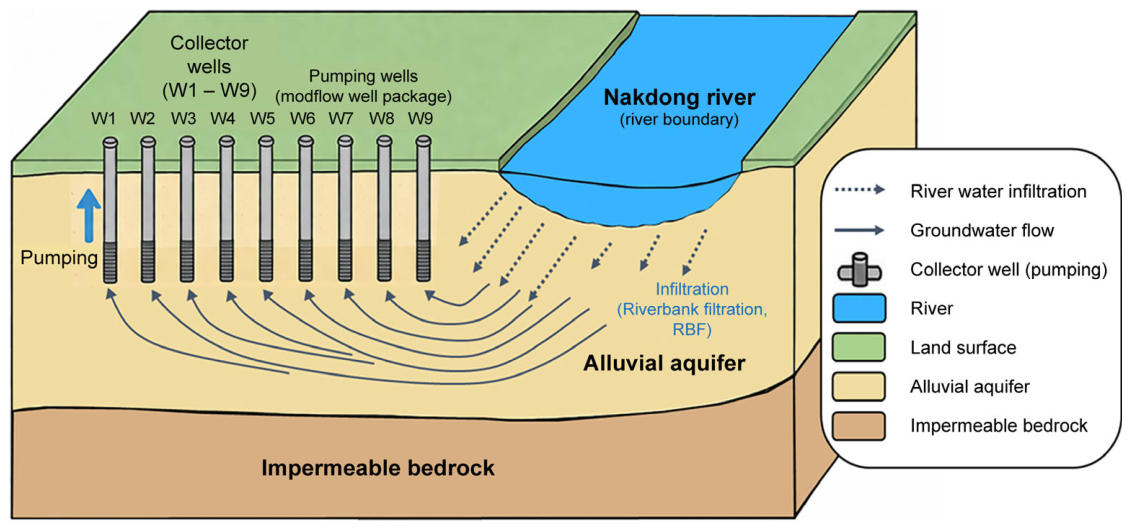
Figure 3.
Framework for developing and evaluating multi-well operational scenarios for the Gimhae RBF system.
Figure 3.
Framework for developing and evaluating multi-well operational scenarios for the Gimhae RBF system.
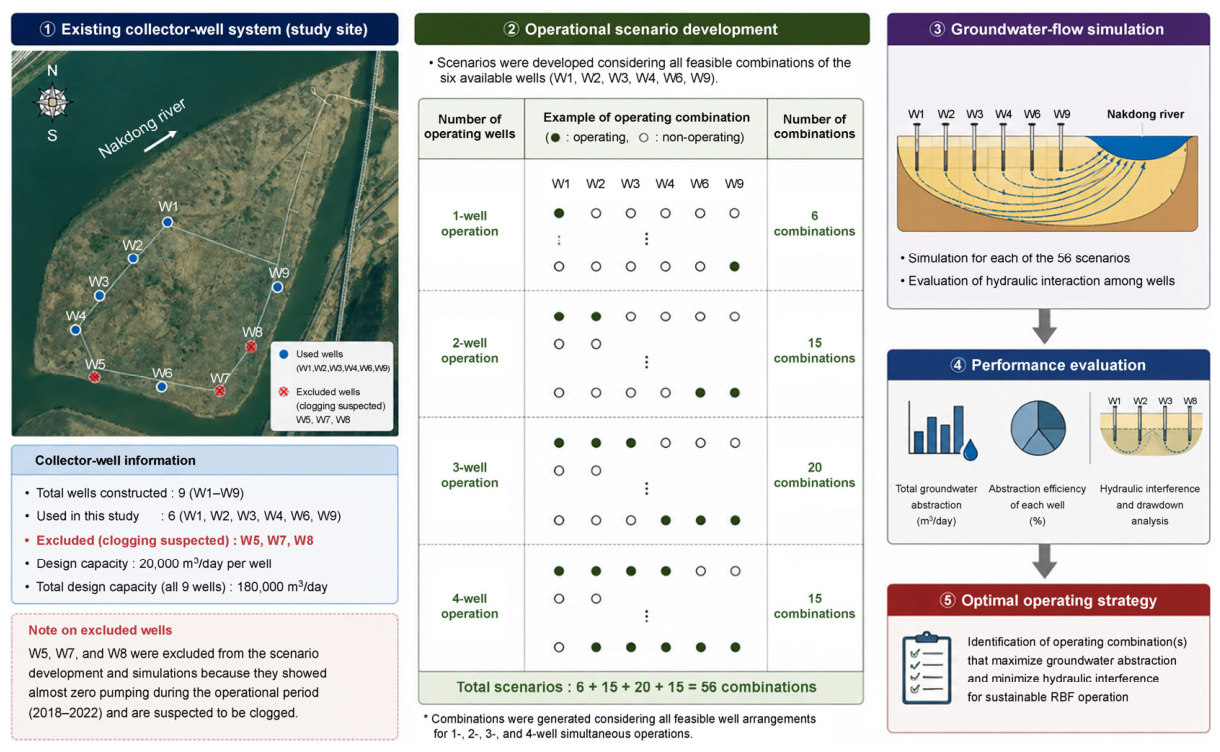
Figure 4.
Long-term operational characteristics of the Gimhae riverbank filtration system during 2018–2022: (a) annual groundwater abstraction of individual collector wells and (b) annual contribution ratio of each collector well to the total groundwater production.
Figure 4.
Long-term operational characteristics of the Gimhae riverbank filtration system during 2018–2022: (a) annual groundwater abstraction of individual collector wells and (b) annual contribution ratio of each collector well to the total groundwater production.
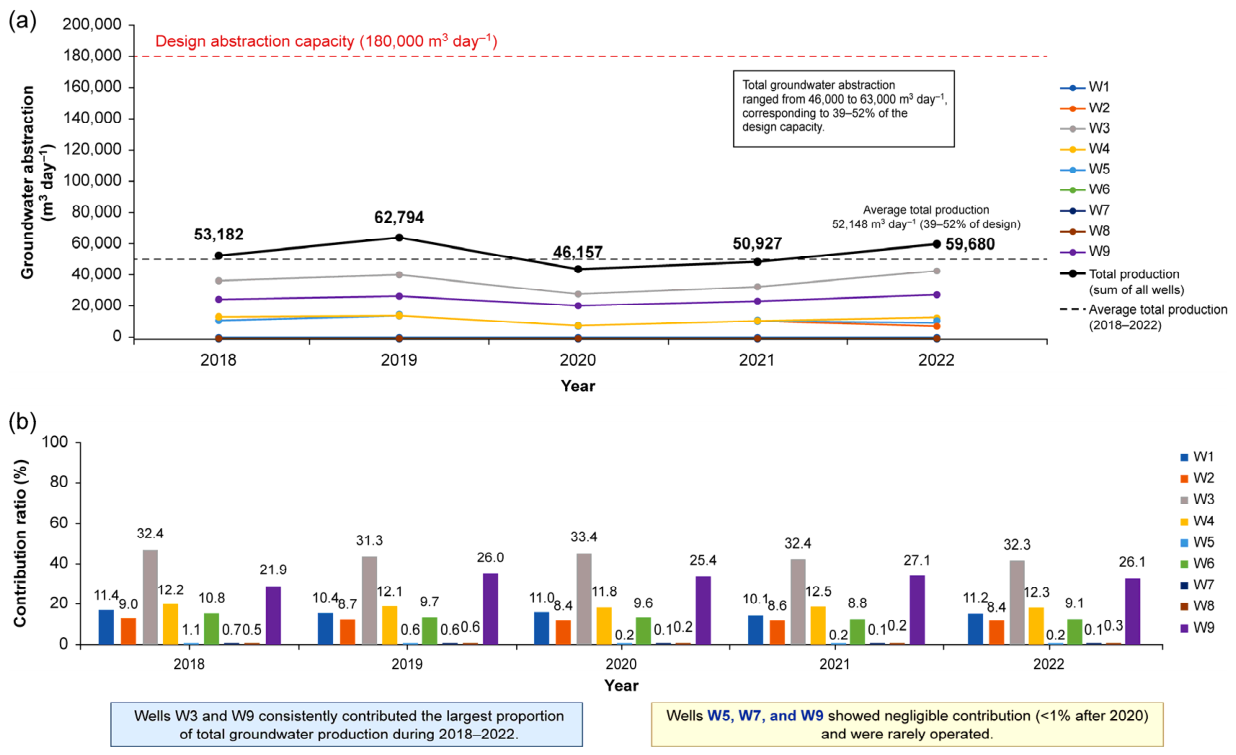
Figure 5.
Minimum, average, and maximum pumping rates per well under two-, three-, and four-well operational scenarios.
Figure 5.
Minimum, average, and maximum pumping rates per well under two-, three-, and four-well operational scenarios.
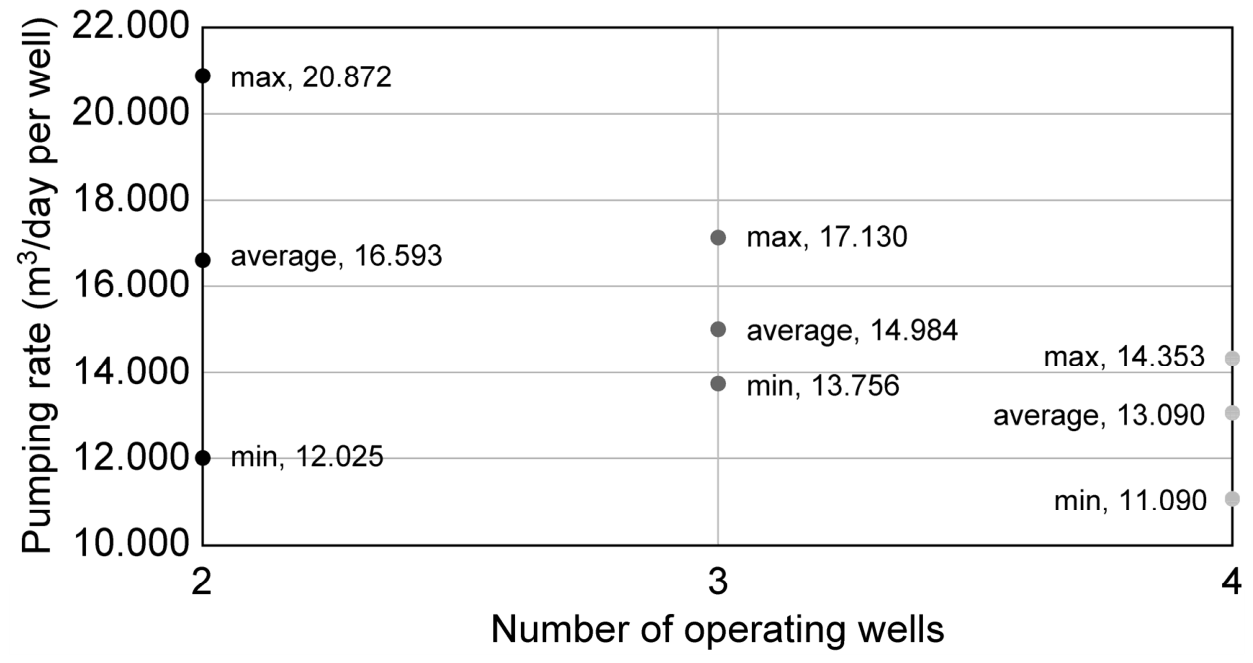
Figure 6.
Comparison of total groundwater abstraction among representative multi-well operational scenarios classified as worst-, median-, and best-performing combinations.
Figure 6.
Comparison of total groundwater abstraction among representative multi-well operational scenarios classified as worst-, median-, and best-performing combinations.
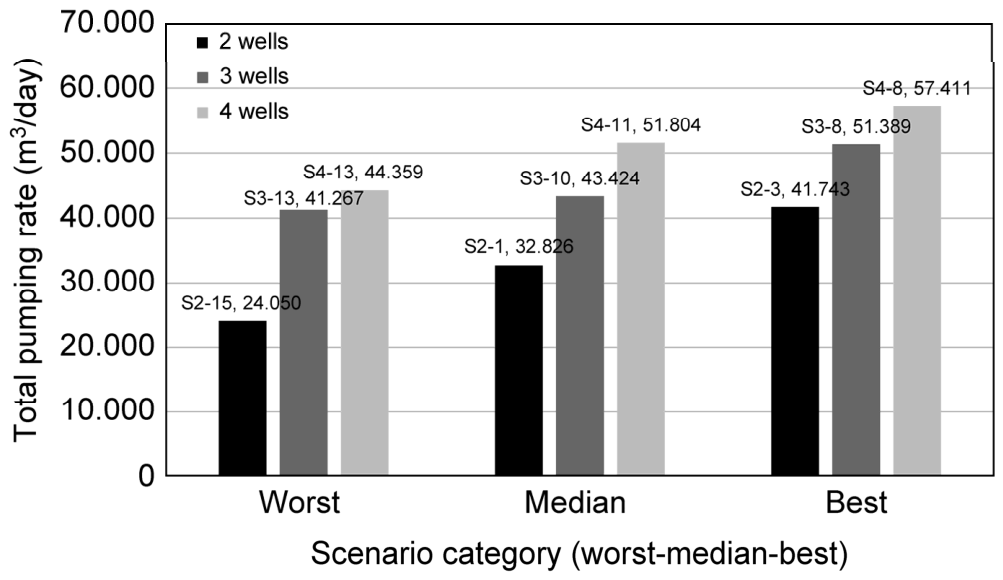
Figure 7.
Comparison of total groundwater abstraction between the current simultaneous operation and the proposed combined operation strategies.
Figure 7.
Comparison of total groundwater abstraction between the current simultaneous operation and the proposed combined operation strategies.
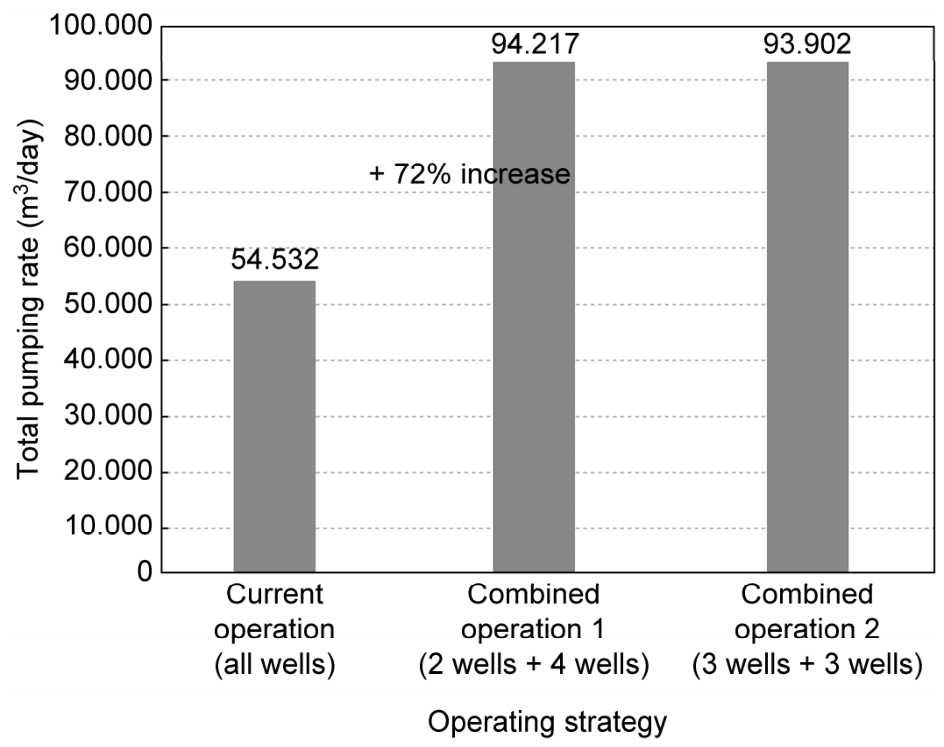

Table 1.
Summary of datasets used in this study.
| Category | Data | Temporal resolution | Purpose in this study |
| Operation | Pumping volume | Daily | Operational history analysis |
| Operation | Operating wells | Daily | Scenario development |
| Monitoring | Groundwater level | Daily | Model calibration |
| Monitoring | River stage | Daily | Boundary condition |
| Design | Well specifications | Static | Model construction |
Table 2.
Comparison of measured and simulated groundwater abstraction for individual collector wells used in model calibration.
Table 2.
Comparison of measured and simulated groundwater abstraction for individual collector wells used in model calibration.
| Well | Measured pumping rate (m3 day−1) | Simulated pumping rate (m3 day−1) | Error* (%) |
| W1 | 21,072 | 22,600 | 7.25 |
| W2 | 22,272 | 21,267 | 4.51 |
| W3 | 23,400 | 21,757 | 7.02 |
| W4 | 21,984 | 22,839 | 3.89 |
| W6 | 13,560 | 13,742 | 1.34 |
| W9 | 10,968 | 10,728 | 2.19 |
*Note: Error (%) = |Simulated - Measured| / Measured × 100.
Disclaimer/Publisher’s Note: The statements, opinions and data contained in all publications are solely those of the individual author(s) and contributor(s) and not of MDPI and/or the editor(s). MDPI and/or the editor(s) disclaim responsibility for any injury to people or property resulting from any ideas, methods, instructions or products referred to in the content. |
© 2026 by the authors. Licensee MDPI, Basel, Switzerland. This article is an open access article distributed under the terms and conditions of the Creative Commons Attribution (CC BY) license (http://creativecommons.org/licenses/by/4.0/).
Copyright: This open access article is published under a Creative Commons CC BY 4.0 license, which permit the free download, distribution, and reuse, provided that the author and preprint are cited in any reuse.