

Submitted:
07 September 2026
Posted:
07 September 2026
You are already at the latest version
Abstract
Recent years, a series of pegmatite-type rare-metal deposits and occurrences—including Chakabeishan, Shaliuquan, Jinshuikou, Adatan, and Gaduo—have been reported in Qinghai, sparking a wave of rare-metal exploration activity. The Southern Kunlun Convergence Zone is a key tectonic unit of the Eastern Kunlun Orogenic Belt; however, systematic geochronological and geochemical constraints on the granitic-pegmatitic rare-metal mineralization system within this region have long been lacking. This study focuses on the newly discovered beryllium ore body at Wulugou in the Southern Kunlun Mountains. Samples from the ρ10 and ρ38 beryllium-bearing pegmatite veins were selected for petrological analysis, LA-ICP-MS zircon-monazite U-Pb geochronology, and whole-rock major and trace element analyses. Zircon Lu-Hf and monazite Sm-Nd isotope analyses were also conducted on the ρ10 and ρ38 beryllium-bearing pegmatite veins. This study precisely determined the diagenetic and mineralization ages of the pegmatites, systematically clarified the genesis and evolutionary relationships among the ore-bearing pegmatite, the surrounding granite, and the barren pegmatite, and elucidated the characteristics of the magma source region and the mechanisms of beryllium mineralization. LA-ICP-MS dating results for monazite and zircon in the pegmatites indicate that the ore-bearing pegmatite formed during the Early Devonian (404.9–408.3 Ma). Whole-rock geochemical analysis indicates that the albitized granites, barren pegmatite, and beryllium-bearing pegmatites in the study area constitute a continuous, homologous, highly differentiated evolutionary sequence, all of which are highly differentiated granites. As the degree of crystallization increases, the rock undergoes continuous enrichment in SiO₂, Na₂O, MnO, P₂O₅, and Be, while K₂O, Ca, and Sr are progressively depleted. The effects of the four rare-earth groups, along with the Zr/Hf and K/Rb ratios, collectively indicate that saturation and dissolution of volatile fluids in the late stage are the key controlling factors in the precipitation of beryllium ore. Primary magmatic zircon εHf (t) = −2.69 to +1.95 (mean + 0.76); two-stage Hf model age: 1.28 to 1.57 Ga; Isolated εNd (t) = -6.71 to -5.44, Nd two-stage model age 1.57 to 1.68 Ga, The source-area discrimination diagrams all fall within the muddy clastic-melt zone, indicating that the parent magma originated from low-degree partial melting of the Middle Proterozoic Wanbaogou Group metamorphic basement, accompanied by contamination by mantle-derived magma. This study discovered Early Devonian Caledonian-period pegmatite-type beryllium deposits in the Southern Kunlun Mountains, providing a theoretical basis and practical reference for the exploration of granite-pegmatite-type beryllium deposits in the Southern Kunlun Mountains.
Keywords:
Wulugou beryllium mine
; pegmatite
; monazite and zircon U-Pb dating
; source-area tracing
; Southern Kunlun
1. Introduction
As a critical strategic rare metal, beryllium is widely used in high-tech fields such as national defense and the military industry, aerospace, the nuclear industry, high-end electronics, and oil and gas development. It is an important mineral resource that underpins the nation’s high-end industries and national defense security [1,2,3]. Pegmatite-type deposits are the most important type of hard-rock beryllium resource. They account for nearly one-tenth of the world’s beryllium reserves [4,5,6]. The main ore-bearing minerals of beryllium include beryl, phenacite, and bertrandite/hydroxyl silicon beryllium stone, among others. These minerals are often concentrated in highly differentiated granites and associated greisen and pegmatites; therefore, granitic pegmatite.
Beryllium rare-metal deposits have long been a hotspot of research in the field of ore deposit science [7,8,9,10]. Pegmatite-type rare-metal mineralization is active in China, with the Early Paleozoic and Mesozoic eras being the primary periods of mineralization; this represents the main resource type for rare metals such as lithium, beryllium, niobium, and tantalum in the country. In recent years, significant breakthroughs have been made in domestic rare-metal prospecting. Several large- to super-large pegmatite-type rare-metal deposits have been discovered in regions such as the Western Kunlun Mountains, western Sichuan, northern Qaidam, and the southern margin of the Qinghai-Tibet Plateau. These discoveries have effectively increased China’s rare-metal resource reserves, ensured national resource security, and significantly advanced research on rare-metal metallogenesis and mineral exploration [11,12,13,14,15].
The South Kunlun Junction Zone is located on the southern margin of the East Kunlun Orogenic Belt and is the key tectonic unit of the superposition and compounding of the tectonic system of the Proto-Tethys Ocean and the Paleo-Tethys Ocean [16,17]. Previous studies have confirmed that, alongside the evolution of the Proto-Tethys and Paleo-Tethys Oceans, the Southern Kunlun region underwent multiple phases of tectonic activity—including ancient oceanic basin subduction, land-land collision, post-collisional extension, and slab break-off—which gave birth to large-scale Early Paleozoic and Late Paleozoic-Early Mesozoic magmatic activities and provided superior magmatic-structural conditions for rare metal mineralization [18,19,20,21,22].
Through a series of geological surveys conducted in recent years, researchers have discovered numerous beryllium-bearing pegmatite veins in the Wulugou and Kunlun River areas of the Southern Kunlun Junction zone, highlighting the region’s excellent potential for beryllium mineral exploration [23]. Based on a preliminary study of beryl-bearing pegmatite veins and their surrounding granitic rocks in the northern part of the region [22,24,25,26], it is confirmed that pegmatite has important indicative significance for regional magmatic evolution, tectonic environment, and rare metal mineralization. However, existing research still has significant short comings: First, there is a lack of precise constraints on the age of diagenesis and mineralization of beryllium-bearing pegmatite in the Wulugou area of South Kunlun; second, the genetic type and tectonic environment of pegmatite are unclear; and third, the mineralization mechanism of beryllium deposits lacks systematic geochemical evidence, which severely hampers the refinement of regional beryllium mineralization theories and the planning of exploration efforts.
In light of the above issues, this paper employs systematic petrographic analysis, zircon and monazite U–Pb geochronology, whole-rock major- and trace-element geochemistry, and Hf–Nd isotopic analyses; the beryllium-bearing pegmatite exposed in the Wulugou area of South Kunlun is taken as the research object. The study aims to investigate the formation age, petrogenesis, and tectonic environment of these granitic pegmatites, thereby providing a basis for the exploration of rare-metal deposits in the study area and the Southern Kunlun Junction Zone.
2. Materials and Methods
2.1. Geological Characteristics
2.1.1. Regional Geological Background
The study area lies in the central part of the South Kunlun Junction Zone (SKB), south of the East Kunlun Orogenic Belt (EKO) and north of the Qiangtang‒Songpan blocks. The South Kunlun Junction Zone marks the soft-subduction collision between the Qaidam block and the Bayan Kara Block island arc system. The study area is bounded to the north by the Central East Kunlun Fault and to the south by the southern marginal fault of the Buqingshan Mountains, and it trends approximately E–W in Figure 1a. Stratigraphic units exposed in the region include the Naij Tal Group of the Cambrian–Ordovician System, the Shasongwula Formation of the Cambrian System, the Lower–Middle Triassic, and the Wanbaogou Group of the Meso-Neoproterozoic, among others. Among these, the Naij Tal Group is a shallowly metamorphosed rock sequence characterized by low-grade green schist facies. Island-arc-related magmatic rocks are widely distributed, consisting primarily of Caledonian, Indosinian, Silurian, and Jurassic granites. Both the Silurian and Jurassic granites belong to the peraluminous high-K calc-alkaline series. Adakitic granites have also been identified in the Laodaogou area. In addition, several granite-related W–Sn deposits occur in the region, such as the Erdaogou tungsten deposit (Point) in Figure 1b [22,25,26].
2.1.2. Geological Characteristics of the Mining Area
The strata exposed at the Wulugou pegmatite-type beryllium deposit are relatively simple, consisting primarily of Cambrian–Ordovician Naij Tal ophiolite mélange, with the main body comprising a clastic rock assemblage (∈ONd). The lithology is dominated by feldspar-quartz sandstone intercalated with silty slate and sandstone. Fault structures are well developed, primarily trending northwest-southwest and nearly east-west. The northwest-southwest-trending fault is the main fault in the area; it is large in scale and formed early. The intrusive rocks are primarily composed of Late Silurian diorite granites and Late Triassic monzogranites and granodiorites, which are widely distributed. In the inner and outer contact zones of the rock mass, as well as within the Naij Tal strata, there are numerous grayish-white granitic pegmatite veins. These veins vary in size and mostly extend in lens-shaped or vein-like patterns; mineral zoning at the surface is not pronounced. A total of 111 pegmatite veins were delineated within the study area. Of these, 16 beryllium ore bodies were delineated within 24 pegmatite veins, with average BeO grades ranging from 0.042% to 0.082%. For this study, two pegmatite veins—ρ10 andρ38—were selected to carry out corresponding research work in Figure 2.
The ρ10 pegmatite vein comprises two relatively simple, large-scale pegmatite veins within the study area. The surface-controlled length is 1,152 m, with a strike of 140°–320°, a northeast dip, and a dip angle of 51°to 54°. The lithology is albite-muscovite granite pegmatite (Figure 3), characterized by a pegmatitic structure and a massive texture. The mineral composition consists of plagioclase (35%–40%), quartz (25%–30%), potassium feldspar (5%–15%), sodium feldspar (10%–15%), muscovite (5%–10%), beryl (2%) (Figure 4a), silicoberyllite (1%), and small amounts of opaque metallic minerals (Figure 4b). Three beryllium ore bodies were delineated within the vein system, with BeO grades ranging from 0.046% to 0.108%.
The ρ38 pegmatite consists of three narrow veins, ranging from 0.97 to 3.71 m in width and 80 to 284 m in length. They strike between 50° and 230°, dip to the north, and have a dip angle between 53° and 54°. The lithology is albite-muscovite granite pegmatite (Figure 4c), characterized by a pegmatitic structure and a massive structure. It is composed of 43% potassium feldspar, 15% sodium feldspar, 40% quartz, 1% muscovite, a small amount of opaque minerals, and trace amounts of beryl (Figure 4d). Three beryllium ore bodies have been delineated, with BeO grades ranging from 0.049% to 0.125%.
2.2. Sample Collection
The samples used in this study for zircon and monazite dating, as well as major and trace element testing, were primarily collected from the ρ10 and ρ38 pegmatite veins at Wulugou. One sample was collected from each vein (WLG1, WLG2); zircon and monazite were selected from these samples, respectively, for testing. A total of five samples were collected for major and trace element analysis, including three from ρ10 (WLG1-1, WLG1-2, WLG1-3) and two from ρ38 (WLG2-1, WLG2-2). At the same time, five samples of barren pegmatites were collected nearby, and 10 samples of albitized granites from the roof and floor of the ore-bearing pegmatites were collected in the QZ003 hole for ρ10 in Figure 1c. Based on the U-Pb zircon dating results from the two samples, Hf isotope analyses were conducted on 8 points from sample WLG1 and 10 points from sample WLG2; simultaneously, based on the monazite dating results from the two samples, in-situ Nd isotope testing was conducted on 5 points from each sample.
2.3. Analytical Methods
In this study, all major and trace element analyses, as well as U-Pb, Lu-Hf, and Nd isotope analyses of zircon and monazite were conducted at the Wuhan Shangpu Laboratory.
2.3.1. U-Pb Dating of Zircon and Monazite
For detailed instrument parameters and analytical procedures related to U-Pb isotope dating of zircon and monazite, see [27]. The instrument used in the experiment was the GeolasPro laser ablation system, consisting of a COMPexPro 102 ArF 193 nm excimer laser and a MicroLas optical system; the ICP-MS model was an Agilent 7900. During the laser ablation process, helium was used as the carrier gas and argon as the compensation gas to adjust sensitivity. The two gases were mixed via a T-joint before entering the ICP. The laser ablation system was equipped with a signal smoothing device [28], which ensures a smooth analytical signal even at laser pulse frequencies as low as 1 Hz, making it particularly suitable for micro-area testing of samples with high U content [29]. The laser spot size and repetition rate were adjusted according to the sample type. Zircon analyses were performed using spot diameters of 32 or 24 μm at a repetition rate of 5 Hz, whereas monazite analyses were conducted using a 16 μm spot diameter at 2 Hz. For zircon U-Pb isotope dating and trace element content treatment, zircon standard 91500 and glass standard material NIST 610 were used as external standards; for monazite U-Pb isotope dating and trace element content treatment, standard material 44069 and the glass reference material NIST 610 were used as external standards to perform separate isotope and trace element fractionation correction [30]. Each time-resolution analysis data set includes 20–30 seconds of blank signal and 50 seconds of sample signal. Offline processing of the analytical data (including selection of sample and blank signals, correction for instrument sensitivity drift, and calculation of element concentrations, U-Pb isotope ratios, and ages) was performed using the ICPMSDataCal software [31]. The U-Pb age Harmonic graph and age-weighted average calculations for zircon and monazite samples were performed using Isoplot/Ex_ver3 [32].
2.3.2. Whole-Rock Geochemical Analysis
For whole-rock major and trace element analysis, fresh samples were selected, weathered surfaces were trimmed off, the samples were ground to 5 mm to remove impurities, and finally ground to a 200-mesh powder. Major elements were analyzed using a wavelength-dispersive X-ray fluorescence spectrometer (ZSXPrimus II). The GBW07105 (standard values) was used as the reference standard to ensure testing accuracy, with an analytical precision of 1% to 5%. FeO was determined by chemical titration with a detection limit of 0.5%. Trace element concentrations were determined following acid digestion and analyzed using a PerkinElmer Perjub-Ekmer-Sciex Elan 6000 inductively coupled plasma mass spectrometer (ICP-MS). USGS rock standard samples W-2, G-2, BCR-2, BHVO-2, and AGV-2, as well as domestic standards GSR-1, GSR-2, GSR-3, and GSD-9, surveying instrument calibration curves to correct the elemental concentrations of the tested samples. The analytical precision was generally better than 5%. For the specific procedure, refer to [33].
2.3.3. In-Situ Lu-Hf Isotope Analysis
A micro-area in situ zircon Hf isotope ratio test was performed using laser ablation multi- collector cup coupled plasma mass spectrometry (LA-MC-ICP-MS). The laser ablation system was a Geolas HD (Coherent, Germany), and the MC-ICP-MS was a Neptune Plus (Thermo Fisher Scientific, Germany). Zircon ablation was performed at a repetition rate of 8 Hz, an energy density of 10 J/cm², and laser spot diameters of 32/44 μm. Since the 176Lu/177Hf ratio in zircon is extremely low (generally less than 0.002), the isotopic interference of 176Lu with 176Hf is negligible. The average 173Yb/172Yb ratio at each test point was used to calculate the Yb fractionation coefficient, after which the isobaric interference of 176Yb with 176Hf was subtracted; the 173Yb/172Yb isotope ratio was 1.35274. The off-line processing of analysis data (including selection of sample and blank signals, and isotope mass fractionation correction) was performed using the ICPMSDataCal software.
3. Results
3.1. U-Pb Dating of Zircon and Monazite
(1)Zircon U-Pb Dating
Zircon U-Pb dating was performed on two samples of granitic pegmatite. The sample from the ρ10 ore-bearing pegmatite vein is designated WLG1; the sample from the ρ38 ore-bearing pegmatite vein is designated WLG2 in TableA2. The zircons are pale yellow to colorless and transparent. In the CL images, the zircons are automorphic, with most exhibiting a long prismatic shape (Figure 5), measuring approximately 70–190 μm in length and 50–130 μm in width. Overall, the annular zones in both samples are poorly developed; only in sample WLG1 were a few zircons with distinct oscillation bands observed, and the zircons exhibit relatively pronounced dissolution.
A total of 50 analytical spots were analyzed from the two samples. The measurement points were selected from clear annular zones along the margins of zircon or from microzones with weaker cathodoluminescence intensity. Among these, 8 measurement points yielded 206Pb/238U ages between 270 and 320 Ma; 13 measurement points yielded ages between 330 and 380 Ma; 16 measurement points yielded ages in the 400–410 Ma range; 5 measurement points yielded ages in the 410–440 Ma range; and 8 measurement points yielded scattered data in the 469.4–930.2 Ma range. From the 18 sampling sites with a good degree of harmony, two harmonic ages were obtained: 408.2 ± 3.3 Ma (n = 8, MSWD = 0.41) and 405.0 ± 1.3 Ma (n = 10, MSWD = 1.02) (Figure 6).
410–440 Ma old zircon: Zircon CL images show well-developed magmatic rhythm annular zones (WLG1-14, Site 15), with 206Pb/238U ages ranging from 411.1 to 426.7 Ma, and Th/U ratios of0.01–0.02, possiblyrepresenting Early Paleozoic magmatic zircons from the host rock that were captured when the pegmatite magma intruded upward through the Movie Mountain Granite Body; these are capture crystals and do not represent the diagenetic age of the pegmatite itself;
Two sets of young zircons from 270–320 Ma and 330–380 Ma: The zircons are generally irregularly granular; except for sample WLG1-17, none of the other zircons show well-developed shock oscillation ring zones. Overall blackening, and dissolution metasomatic features can be seen on the edge of zircons.;206Pb/238U ages range from 277.5 to 378.0 Ma, with Th/U ratios of 0.01–0.02 (except for WLG1-01, 12, 16, where Th/U = 0.35, 0.95, and 0.30, respectively), U and Pb concentrations fluctuate discretely, indicating two phases of Late Paleozoic regional tectonic fluid superimposed alteration following the formation of Devonian pegmatites. These ages represent hydrothermal disturbance and have no metallogenic significance [34];
400–410 Ma Harmonious Zircon Group: Zircons mostly occur as irregular grains, with a few automorphic elongated prisms (WLG1-12, 16), some of which exhibit oscillation ring zones (sites WLG1-01 and 12), overall, the zircons lack dissolution-metasomatic edge (WLG1-02, 06; WLG2-11, 15, where dissolution features are observed at the margins), 206Pb/238U ages range from 403.0 to 411.5 Ma, and Th/U ratios range from 0.01 to 0.02 (except for WLG1-01, 12, and 16, where Th/U = 0.35, 0.95, and 0.30, respectively), the ages of the 25 measurement points in sample WLG1are generally near the harmony line; the harmonized age of the 8 lower intersection points with higher harmony is 408.2 ± 3.3 Ma (MSWD = 0.41); For the WLG2sample, the 10 measurement points with higher harmony had a weighted age of 405.0±1.3 Ma (MSWD=1.02), representing the crystallization age of the primary magma of the pegmatite.
(2)U-Pb Dating of Isolated Stones
U-Pb dating of monazite was performed on two samples of granitic pegmatites. The monazite is light gray, and it is a semi-automorphic, it-shaped crystal, mostly irregularly granular, with a length of 40–200μm. Back-scatter images (Figure 7) reveal that the internal structure of the monazite is relatively uniform, with localized traces of alteration by other minerals. A total of 50 monazite U–Pb isotope data points were obtained in TableA3.
The data table clearly shows two distinct characteristics: one is monazite (36 samples), which is uranium-rich (6,073×10−6–43,836×10−6) and Th-rich (12,219×10−6–59,765×10−6), with relatively high Pb content (923×10−6–3218×10−6). ²⁰⁶Pb/²³⁸U surface ages range from 398.0 to 407.1 Ma, and the two samples together have 1>36 data points with a high degree of harmony (Figure 8), yielding two concordia ages of 404.9±1.4 Ma (n=19, MSWD=1.3) and 402.3±1.3 Ma (n=17, MSWD=2.8) (Figure 8);
Another type of monazite (13 points) is rich in Th (20,652×10−6~46,518×10−6) and relatively poor in U (130×10−6~327×10−6)and Pb (362×10−6~860×10−6), except for the WLG2-03 site (U content: 3139×10−6);206Pb/238U surface ages range from 412.4~429.7Ma (236.9 Ma at station WLG2-03), with the overall age is older except for individual points..
3.2. In-Situ Lu-Hf Isotope Analysis
The results of the Hf isotope analysis see TableA4 show that the176Yb/177Hf ratio ranges from 0.028810 to 0.128998, with an average of 0.075298, the176Hf/177Hf ratio ranged from 0.282450 to 0.282721, with an average of 0.282544, showing relatively uniform values; Calculated using the corresponding ages, the εHf(t) values range from -2.69 to +1.95 (there are two values with large deviations., -11.22 and +6.80, which were not included in the statistics), with an average of +0.76. The Hf model age for Stage 1 (tDM1) ranges from 950.37 Ma to 1136.98 Ma, with an average of 1019.88 Ma; in Stage II (tDM2), the Hf model ages range from 1276.73 Ma to 1574.44 Ma, with an average of 1355.32 Ma.
3.3. Nd Isotope Analysis
The Nd isotopic composition in TableA5; the initial Nd isotope ratio (143Nd/144Nd)i of the Wulugou pegmatites ranges from 0.512000 to 0.512166. Calculations show that the pegmatites as a whole exhibit relatively low negative values, with εNd(t) values ranging from −6.71 to −5.44. The tDM2 model ages range from 1.57 to 1.68 Ga, with an average of 1.61 Ga, corresponding to the Paleo-Mesoproterozoic.
3.4. Whole-Rock Geochemical Characteristics
The results of the major element analysis of rare-metal-mineralized granitic pegmatite samples are shown in TableA1. The SiO2 content of the granitic pegmatite ranges from 72.14% to 79.06%, and the Al2O3 content ranges from 12.09% to 15.37%; CaO content ranges from 0.38% to 1.84%, MgO content ranges from 0.05% to 0.09%, full alkali (K2O + Na2O) content ranges from 5.99% to 8.62%, Fe2O3 + FeO ranges from 0.30% to 0.77%, and the differentiation index (DI) ranges from 91.84 to 96.76 (average 94.76), overall exhibiting characteristics of high silicon, strong aluminum, rich alkali, low calcium, low magnesium, and low iron; on the whole-rock TAS diagram, all samples fall within the granite region (Figure 9a). On the K2O-SiO2 diagram, albitized granites are primarily located within the high-K calc-alkaline series, while non-ore-bearing pegmatites are scattered across both the high-K calc-alkaline and calcium-alkaline series; in contrast, pegmatites closely associated with mineralization all fall within the low-K tholeiitic series (Figure 9b). The rock’s aluminum saturation index (A/CNK) ranges from 1.12 to 1.31; on the A/NK-A/CNK diagram, all samples fall within the over-aluminous zone (Figure 9c), indicating distinct over-aluminous characteristics, with a relatively high content of corundum (1.66%–2.87%, averaging 2.9%) among the CIPW standard minerals.
In terms of rare earth element composition inTableA1, the total rare earth element content (ΣREE) in granitic pegmatites ranges from 0.72×10⁻⁶ to 2.93×10⁻⁶, with an average of 1.62 × 10⁻⁶. The total rare earth element content is extremely low, and the light-to-heavy rare earth element ratio (LREE/HREE) ranges from 4.09 to 14.52, with an average of 7.21. (La/Yb)N ranges from 9.70 to 37.51, with an average of 18.02, and δEu ranges from 0.21 to 2.30, with an average value of 1.03; in the standardized distribution pattern diagram of rare earth elements in chondrite (Figure 10a), the curve shapes of barren pegmatites and sodium feldspar granites are similar, with a pronounced Eunegative anomaly, and the fractionation of light and heavy rare earth elements is not pronounced; beryl-bearing granitic pegmatites, in contrast, exhibit relatively obvious characteristics of light and heavy rare earth elements, showing a phenomenon where positive and negative Eu anomalies coexist. According to the four-group quantification formula provided by [35], the barren pegmatite and albitized granite generally have t₁, t₃, and t₄ values greater than 1(except for a few samples), exhibiting a distinct four-grouping effect (TE1,3 ranging from 0.89 to 1.39), while beryl-bearing granitic pegmatites show a wider range of variation.
The results of trace element analysis TableA1 and the spider diagram of trace elements normalized to the primitive mantle (Figure10b) show that the characteristics of trace element distribution patterns of ore-free granitic pegmatites and sodium feldspar granites are consistent, both being enriched in large-ion lithophile elements Rb and U, as well as high-field-strength elements Nb, Ta, P, and Hf, and relatively depleted in Ba, Eu, and Ti, suggesting a high degree of magmatic differentiation. In contrast, beryl-bearing granitic pegmatites are relatively more enriched in the high-field-strength elements Ta and P, and more depleted in the large-ion lithophile elements Ba, Th, and rare earth elements, further indicating their highest degree of magmatic differentiation and evolution.
4. Discussion
4.1. Age of Pegmatite Formation
The Wulugou area exhibits extensive magmatic activity and is a complex granite base. It is composed of granitic magmatic rocks of different times and types (1:50,000 Yaodongshan Sheet). The Wulugou granite basement formed between 201 and 423 Ma, with three peak ages of 201.9 Ma, 410.7 Ma, and 423 Ma (1:50,000 Yaodongshan Sheet). The granitic basement is mainly composed of medium- to fine-grained granodiorite, medium- to fine-grained monzogranite, and muscovite granite, among which the muscovite granite is closely associated with the ore-bearing pegmatites. Zircon U-Pb Ages
The U-Pb ages of zircon in the granitic pegmatite veins show a wide distribution ranging from 270 to 440 Ma and can be divided into three groups: 270–320 Ma, 330–380 Ma, and 400–410 Ma. These three age groups show a certain correspondence with the three peak ages of the Movie Mountain granitic basement. Studies indicate that the evolution time of contemporaneous magmatic activity is less than 10 Ma [36]. The Th/U ratio in zircon is a classic trace element indicator for distinguishing between magmatic and hydrothermal zircons [37]; generally, Th/U in magmatically crystallized zircon is >0.1, while that in hydrothermally altered zircon is typically below 0.05 [38]. In the two samples (WLG1 and WLG2) analyzed here, the Th/U ratios of zircon from the 400–410 Ma interval ranged from 0.35 to 0.95 at some measurement points, consistent with the characteristics of primary magmatic zircon; whereas the Th concentrations of zircon from the 270–380 Ma interval were extremely low, with all Th/U ratios 0.02, At the same time, the in-situ rare earth element distribution curves show that the characteristics of most of the zircons analyzed in this study are close to those of hydrothermal zircon curves (Figure 11a), suggesting they belong to hydrothermal zircons. This indicates that this group records Late Paleozoic hydrothermal alteration events and does not represent the diagenetic age of the Wulugou pegmatites.
The CL images of zircon show sharp boundaries and a small number of well-developed magmatic rhythm ring bands. The La-(Sm/La)ₙ and (Sm/La)ₙ-Ce/Ce* discrimination diagrams all fall into the magmatic zircon zoning (Figure 11b), The Th/U ratios show considerable variation: those in Ore-bearing pegmatites range from 0.03 to 0.23, with an average of 0.16, while those in barren pegmatites range from 0.56 to 3.74, with an average of 1.71, while the Th/U ratios of albitized granites range from 0.82 to 5.53, with an average of 2.08. These represent Early Paleozoic magmatic zircon captured by the surrounding rock when the pegmatite magma invaded upward through the Movie Mountain granite body. It belongs to the xenocryst and does not represent the diagenetic age of the pegmatite itself. It can be seen from the correlated covariance graphs of rare earth elements that the zircon samples tested in this study contain a large number of hydrothermal zircons (Figure 11b), whose ages do not represent the genesis age of the pegmatite. However, zircon dating of the Wulugou granitic pegmatites reveals that the age difference between three groups of zircons exceeds 10 Ma; therefore, the zircon from Stage 3 of the Wulugou granitic pegmatites is not the product of the same magmatism. The two zircon age groups (270–320 Ma and 330–380 Ma) may represent interference caused by later hydrothermal alteration. Additionally, the sporadically distributed 440 Ma zircons may represent zircons captured by the granite pegmatites from the wall rock of the Movie Mountain granite batholith during the intrusion process. The youngest group of zircons, dating to 400–410 Ma, exhibits a high degree of harmony.
High-U zircons are not only affected by the “high-U effect,” which increases their apparent U-Pb ages, but may also be subject to the loss of radiogenic Pb, resulting in lower apparent ages [39]. This makes dating high-U zircons extremely difficult. The zircon U content of the two samples in this study is generally high, ranging from 395 to 14,915 × 10-6(with one sample at 102,080 × 10-6), with an average of 6,815 × 10⁻⁶. Among these, the U concentrations at the harmonic age points of the two zircon samples ranged from 395 to 8,311 × 10⁻⁶, with an average of 3,663 × 10⁻⁶, while the U concentrations at the other age points ranged from 404 to 14,915 × 10-6, with an average of 5,572 × 10-6—significantly higher than those at the harmonized age points. Notably, samples WLG1-18, 22, WLG2-5, and 17 exhibited a phenomenon of lower ages due to markedly high U concentrations; however, overall, with the exception of a few samples that were slightly older, the two sets of samples generally exhibited a trend of decreasing ages. And the206Pb/238U ages of the 18 points with a high degree of harmony did not show significant changes in response to variations in U content, remaining overall near the 400 Ma harmonic age line (Figure 12). Therefore, the “high-U effect” of zircon in the pegmatites of this region has exerted a certain influence. Combined with the characteristics of the zircon genesis discrimination diagram, the208Pb/238U weighted average age may mainly represent the age of hydrothermal zircon formed during the late stage of pegmatite differentiation.
In summary, this paper adopts the harmonic ages of 405.0–408.2 Ma, derived from 18 measurement points on two zircon samples, as the pegmatite formation age.
- U-Pb ages of monazite
Zircon U-Pb dating of highly differentiated granites often yields inaccurate ages due to the “high-U effect” and Pb loss, among other factors [39,40]. Although monazite is enriched in Th and U, it is more resistant to radiation damage than zircon [41,42,43]; therefore, monazite is the most reliable U-Th-Pb geochronometer in magmatic-hydrothermal deposit systems [44,45]. Monazite can be of various genesis types, including magmatic, metamorphic, hydrothermal, and carbonate; determining the genesis type of monazite is a prerequisite for investigating the age of a deposit. The Th mass fraction in hydrothermal monazite is generally less than 1% [36,46,47,48,49,50], while magmatic monazite is generally Th-rich [46,47,48,49,51] and exhibits a pronounced negative Eu anomaly with a relatively high Th/U ratio greater than 1%. The monazite in the Wulugou pegmatites studied in this paper exhibits strong Eu negative anomalies (δEu = 0.02–0.13) and a relatively high Th/U ratio, averaging 37.97 (0.37–186.74, excluding sample points with ratios below this value), and their Th mass fractions range from12,219 × 10⁻⁶ to 59,765 × 10⁻⁶, with anaverage of 34,142× 10⁻⁶—an average greater than 1%—indicating the characteristics of magma genesis..
The U-Pb ages of monazite in the granitic pegmatite veins show a generally concentrated distribution ranging from 398 to 429.7 Ma and can be divided into two groups: 398.0–407.1 Ma and 412.4–429.7Ma.
Primary monazite (36 points), Uvalue 6073×10⁻⁶–43836×10⁻⁶, Thvalues ranging from 12,219 × 10⁻⁶ to 59,765 × 10⁻⁶; the high U-Th signature indicates simultaneous precipitation during the magmatic crystallization stage; ²⁰⁶Pb/²³⁸U ages are concentrated between 398.0 and 407.1 Ma; the weighted average ages for the two groups are 404.9 ± 1.4 Ma (MSWD = 1.3) and 402.3 ± 1.3 Ma (MSWD = 2.8); the Th/U ratio ranges from 0.37 to 5.30, with an average of 1.28; δEu ranges from 0.02 to 0.07, with an average of 0.04; Backscatter images are homogeneous internally, with no fluid corrosion edge, record that magmatic crystallization occurred contemporaneously with beryl and bertrandite mineralization.
Captured/altered monazite (13 points), Uvalue130×10⁻⁶–327×10⁻⁶, Thvalue 20,652×10⁻⁶–46,518×10⁻⁶, U-poor, Th-rich; age 412.4–429.7 Ma; Th/U ratios range from13.16to186.74, with an average of132.31; δEu ranges from 0.02 to 0.12, with an average of 0.11; Local metasomatic dissolution structure. These are products of metamorphic country rock captured by ascending magma or of late-stage fluid transformation products and are not included in the mineralization age statistics.
In the standardized rare earth element distribution diagrams for zircon and monazite chondrite, the red lines represent primary crystalline minerals with good U-Pb concordance; the two exhibit complementary crystallochemical characteristics [52]. Zircon with good concordance shows a strong deficit in light rare earth elements (LREs) and enrichment in heavy rare earth elements (HREs), with a significant Ce positive anomaly and an Eu negative valley; Th/U ratios are generally >0.1. It represents the crystallization products of Early Devonian (405.0–408.2 Ma) pegmatitic primary magma (Figure 13). Monazite with good concordance is enriched in light rare earth elements and shows no obvious Ce-Eu anomalies; its high U-Th characteristics indicate simultaneous magmatic precipitation, with a weighted age of 402.3–404.9 Ma, which is highly coupled with the zircon age. The rare earth distribution morphology of zircon and monazite, with poor concordance is disordered, recording Late Paleozoic hydrothermal reworking or surrounding rock capture events; they have no significance for determining the age of mineralization.
In summary: The two age sets—405.0–408.2 Ma for zircon and 402.3–404.9 Ma for monazite—are in perfect agreement within the margin of error, and it is uniformly defined that Wulugou beryllium-bearing pegmatite was formed in the Early Devonian (402–408 Ma).
4.2. Rock Genesis and Tectonic Setting
The genesis of granitic pegmatites is of great significance for studying pegmatite mineralization theories and the mechanisms of rare-metal enrichment. The currently accepted genetic theory of granite pegmatites mainly includes anatexis and magmatic differentiation. [53,54]. The deep-melting theory posits that pegmatites are the products of partial melting of metamorphic strata in a small proportion of the amphibolite to granulite facies. Pegmatites formed by deep melting are mostly found in metamorphic strata in sac-like, lens-shaped, and vein-like forms; their occurrence is parallel to the foliation of the surrounding rock and mixed rock, and they exhibit a gradual contact with light-colored bodies; furthermore, the pegmatites and wall-rock metamorphic rocks have similar compositional characteristics and isotopic compositions [55]. The magmatic differentiation theory posits that pegmatites form through intense crystallization and differentiation of granitic magma. Pegmatites formed by differentiation exhibit certain differences in isotopic composition compared to the surrounding rocks, and their trace element profiles show strong differentiation characteristics relative to the parent magma [56]. Although some pegmatites in the study area are also found within the Naij Tal clastic rocks, the main body is associated with intrusions such as granodiorite, monzogranite, sodium feldspar granite, and other intrusive bodies. Furthermore, no parallel pale-colored bodies have been observed in the pegmatites within the clastic rocks; therefore, anatexis is excluded as the cause.
In the study area, the SiO₂ content of pegmatites ranges from 72.14% to 79.06%, and the Al₂O₃ content ranges from 12.09% to 15.37%, with extremely low MgO, Ca, and Fe contents; total alkali (K₂O + Na₂O) content ranges from 5.99% to 8.62%; and a mean differentiation index (DI) of 94.76 in TableA1. The extremely high DI value indicates that the magma underwent extreme crystallization differentiation[7]. The A/CNK values range from 1.12 to 1.31, and CIPW corundum content ranged from 1.66% to 2.87%, with all samples falling within the over-aluminous region of the A/NK-A/CNK diagram; it belongs to peraluminous granite. The main body of the K₂O-SiO₂ diagram belongs to high-K calc-alkaline series [57], while the ore-bearing pegmatite belongs to the low-K tholeiitic series.
The covariation trend of whole rock principal quantity proves that barren pegmatites and albitization granites exhibit very similar geochemical characteristics, and from albitization granite → barren pegmatites → beryllium-bearing pegmatites, the principal elements show a regular gradual change, constitute a complete chain of homologous magma differentiation, As the SiO2content continues to increase, feldspar and quartz crystallize early; feldspar separation removes Ca, K, and Na, Al is relatively enriched, and the A/CNK ratio progressively increases, reflecting an increasingly peraluminous character., whereas the refractory siliceous components remained in the residual melt. K₂O decreases and Na₂O becomes relatively enriched, leading to the preferential crystallization of potassium feldspar; the late-stage melt is rich in Na, resulting in large-scale sodium feldspathization; the differentiation index (DI) increased simultaneously; compared to barren pegmatites and roof and floor albitization granite, the ore-bearing pegmatites (WLG1 and WLG2) show markedly higher MnO, P₂O₅, and Na₂O, and a substantial decrease in K₂O/Na₂O (Figure 14). The magma evolved into a volatile-rich, low-viscosity residual melt, undergoing large-scale albitization, with simultaneous precipitation of beryl and bertrandite, representing symbolic main element responses during the melt-fluid transformation stage, resulting in the formation of beryl-bearing pegmatite veins [58]. Therefore, the beryllium-bearing pegmatites at Wulugou and the surrounding barren pegmatites are not the result of independent magmatic intrusions, but rather terminal derivatives formed following extreme crystallization differentiation and fluid exsolution of the regional albitization granite parental magma; both are products of different evolutionary stages of the same magma chamber.
Typically, pegmatites have undergone a high degree of crystallization and differentiation and belong to the highly differentiated granite group [59]. Granite pegmatites exhibit distinct negative anomalies in Ba, Sr, Eu, and Ti (Figure 10); Ba, Sr, and Eu are typically enriched in plagioclase, while Ba and Ti are associated with potassium feldspar and ilmenite, respectively. Therefore, the negative anomalies in Ba, Sr, Eu, and Ti observed in the samples may indicate that the magma underwent varying degrees of fractional crystallization of plagioclase, potassium feldspar, and ilmenite during the crystallization process. Ba-Sr and Sr-Rb diagrams (Figure 15) indicate that the indicator samples underwent significant separation crystallization of plagioclase and potassium feldspar [60], while the Th-LREE diagram shows that monazite differentiation directly influenced the LREE in the rock mass [22]. Furthermore, pegmatites (especially ore-bearing pegmatites) exhibit stronger differentiation compared to albitization granites, further indicating that they are products of crystallization and differentiation at different stages of the same magma.
The Zr/Hf ratios of pegmatites and albitized granites (8.45–20. 41) are both relatively low and concentrated; in particular, ore-bearing pegmatites exhibit even lower ratios (8.45–10.66), which are significantly lower than those of chondrites and crust-derived granites (33–40)[61]; Nb/Ta values range from 1.53 to 9.74, with ore-bearing pegmatites exhibiting Nb/Ta values ranging from 1.53 to 5.05, which are significantly lower than those of chondrite and the continental crust (17.5 and approximately 11, respectively). Nb-Ta and Zr-Hf exhibit very similar geochemical behavior; the extreme reduction in Nb/Ta values may be primarily due to the early crystallization of Nb-rich minerals or fluid differentiation and the incorporation of mineralizing fluids [62,63,64,65], whereas Zr-Hf differentiation is controlled by the separate crystallization of zircon [66]. In contrast, the ΣREE values of pegmatites range from only 0.72×10⁻⁶ to 2.93×10⁻⁶, which is far lower than that of ordinary granites. In the mineral-free samples, TE1,3 ranges from 0.89 to 1.39, the four-group effect of rare earth is significant [35], which results from the interaction between the melt and fluids following high fractional crystallization [20,66,67]. Beryllium-bearing pegmatites have a mean (La/Yb)ₙ of 18.02, exhibit stronger fractionation of light and heavy rare earth elements, and show coexisting positive and negative Eu anomalies, indicating that Eu underwent selective activation and redistribution during fluid migration and beryl precipitation(Figure 10). The raw mantle-normalized models for all samples uniformly show enrichment in Rb, U, Ta, Hf, and P, with strong depletion in Ba, Sr, and Ti(Figure 10); in vein-bearing samples, Ta and P are further enriched, while Ba-Th losses intensify. The K/Rb and Zr/Hf ratios decrease linearly with increasing crystallization differentiation(Figure 10), while the Zr+Nb+Ce+Y and FeOᵀ/MgO ratios are illustrated in (Figure 16) are all located in highly differentiated metallogenic granite regions, demonstrating long-term magmatic differentiation and fluid saturation, which provide conditions for large-scale rare metal offloading [58]. Furthermore, mineralized granitic pegmatites exhibit significantly higher Rb and Cs contents and lower Zr and Y contents compared to non-mineralized granitic pegmatites; they also have a significantly lower total rare earth content and a more pronounced fractionation between light and heavy rare earth elements, These characteristics indicate that mineralized granitic pegmatites have undergone a higher degree of magmatic evolution compared to non-mineralized granitic pegmatites, or that mineralized granitic pegmatites have experienced a higher degree of fluid-melt interaction.
This study uses a whole-rock Zr saturation thermometer [68] to estimate the magma crystallization temperature as499–704 °C, with an average of629 °C(Figure 17), which falls within the low-temperature crystallization window for pegmatites, which is significantly lower than the average temperature of 833 °C for Type A granite formation [69], and also lower than the zircon saturation temperature of normal Type I granite (averaging 791 °C) [70,71]. Both albitized granites and granitic pegmatites exhibit low Zr contents (1.39–53.0×10⁻⁶), significantly lower than that of Type A granites (>250 × 10-6), while in the study area, the magmatic crystallization temperature shows a gradual decrease from albitized granites, through barren pegmatites, to ore-bearing pegmatites; TE1,3 and Rb/Sr ratios continue to increase as temperature decreases, and the K/Rb-Zr/Hf variation diagram reveals characteristics of continuous crystallization differentiation, indicating that these are not typical Type A or Type I granites, but rather exhibit the characteristics of highly differentiated granites.
Discrimination diagram for identifying highly differentiated granites (Figure 16), except for a few samples, the ore-bearing pegmatites in the study area almost entirely fall within the high-differentiation granite region, whereas in the R1-R2 and SiO2-Al2O3and SiO2-TFeO/(TFeO+MgO) diagrams (Figure 18), all fall within or near post-orogenic extension zones. In conjunction with regional tectonic evolution, during the Early Devonian (Lower Devonian), the Southern Kunlun Mountains were situated in a post-subduction extensional collapse environment of the proto-Tethys Ocean. Crustal thinning and earth heat flow rises induced low-level melting of the ancient basement, leading to the formation of super-aluminous, highly differentiated granitic magma [26].
In summary, the pegmatites in the region may have been constrained by the combined effects of highly differentiated evolutionary melts and volatiles-rich fluids [72] and formed in an Early Devonian extensional setting. This time frame corresponds to the late stage of subduction of the northern branch of the ancient Tethys Ocean and the initial extensional tectonic setting of the South Kunlun Orogenic Belt [25,26]. Crustal thinning and heating triggered low-degree melting of the ancient Mesoproterozoic basement, and highly differentiated magma intruded along the Northwest-West Main Fault, forming a group of highly differentiated granitic pegmatite dike swarm closely associated with the low-degree melting of the ancient basement.
4.3. Characteristics of Pegmatite Source Areas
After charging off two hydrothermal anomaly sites from the Lu-Hf isotope data of zircons in the study area’s pegmatites (εHf (t) = -11.22 and +6.80), the εHf (t) values of primary magmatic zircons ranged from -2.69 to +1.95, with a mean of +0.76, representing a weak positive value close to zero overall; Stage II tDM2 = 1.28–1.57 Ga, concentrated in the Mesoproterozoic interval in TableA4. The εHf(t) values are both positive and negative, suggesting that the source region may result from the mixing of crustal and mantle magmas [73]. On the εHf(t)-t(Ma) diagram (Figure 19), all samples lie along the chondrite evolution line and on either side of it; with the exception of a few samples, they all fall between the upper and lower crust evolution lines, indicating that the source rock may have originated from the remelting of Mesoproterozoic crustal material with some mantle material mixed in; In contrast, the εHf(t) values of surrounding Silurian–Devonian granites range from −10.62 to 2.73 [25], The εHf(t) values of the pegmatites are similar to those of the surrounding rock mass, and tDM2 is fully coupled with the regional model age of the Mesoproterozoic metamorphic basement in Wanbaogou, ruling out the shallowly metamorphosed rocks of the Naij Tal Group as the primary source rock for melting [23]. The first stage, tDM1 = 950–1137 Ma, may therefore represent a Neoproterozoic basement reactivation and reworking event following Mesoproterozoic crustal formation [74].
The Nd isotope εNd(t) of monazite in pegmatite ranges from -6.71 to -5.44; the Nd second-stage age tDM2= 1.57–1.68 Ga, which is slightly older than the zircon Hf second-stage age in TableA5. The absence of significant Hf–Nd isotopic decoupling indicates that the melting process was not significantly affected by large-scale underplating and contamination of mantle-derived magmas. On the CaO/Na2O–Al2O3/TiO2and Rb/Ba–Rb/Sr source discrimination diagrams, all samples fall within the argillite source region(Figure 20), and the magma in this source region primarily originates from the melting of argillaceous rock. Anatexis of crustal materials mainly occurs in two forms: dehydration melting and hydration melting[75,76,77,78,79]. Compared to melts formed by dehydration melting, melts produced by hydration melting are characterized by higher concentrations of Ca, Sr, Ba, Zr, Hf, Th, and LREE, as well as higher Zr/Hf ratios, and lower concentrations of Ta, Nb, Rb, and U, along with lower εHf(t) values [78]. Samples of pegmatites and albitized granites from the study area all exhibit low calcium (average CaO of 0.69%; average of 0.97% for ore-bearing pegmatites), low LREE content (average 19.39×10⁻⁶, average 1.34×10⁻⁶ for ore-bearing pegmatites), and low Zr/Hf ratios (average 14.19, average 9.78 for ore-bearing pegmatites), and exhibit geochemical characteristics of enrichment in Rb and Ta and depletion in Ba, Th, and Sr. Therefore, it is inferred that their magmatic system formed through the dehydration and melting of lower-crustal metamorphic mudstones, corresponding to the metamorphic mudstone and clastic rock complexes of the Wanbaogou Group. This confirms that the magma originated from low-degree partial melting of the ancient metamorphic basement at Wanbaogou. Furthermore, combined with Hf-Nd isotopic characteristics, this indicates that the process was accompanied by the incorporation of mantle material.
4.4. Geological and Prospecting Significance
In recent years, a large number of pegmatite-type rare-metal deposits (sites), such as the Chakabeishan deposit, have been successively discovered along the northern margin of the Qaidam Basin, Qinghai Province. Studies indicate that these deposits formed primarily during the Triassic period, and ore-bearing pegmatites from the same period have also been discovered in areas such as Bayankala Gaduo and Zaduo in the Eastern Kunlun Mountains. Consequently, previous studies generally believed that the granitic pegmatite-type rare-metal mineralization around the Qaidam Basin was primarily concentrated during the Indosinian period [6,12,80,81,82]. However, the Early Devonian beryllium-bearing granitic pegmatites newly identified in the Wulugou area of the South Kunlun Mountains represent the first reported occurrence of Caledonian pegmatite-type rare-metal mineralization in this region. Together with the successive discoveries of pegmatite-type Li–Be deposits in the Adatan, Jinshuikou, and other mining districts of the South Kunlun Mountains by the Fifth Geological Exploration Institute of Qinghai Province, these findings provide new evidence for Caledonian rare-metal mineralization in the South Kunlun region (Qinghai Provincial Fifth Geological Survey Institute), the newly discovered pegmatite-type lithium-beryllium ore deposits within a nearly 50-kilometer-long stretch extending from the Kunlun River Yidaogou –Wulugou area, the discovery of a large number of new pegmatites and corresponding mineralization facts within an extension of nearly 50 kilometers has expanded the exploration scope for rare-metal deposits in the region. This area is poised to become another key rare-metal exploration zone in Qinghai Province, filling a gap in the record of rare-metal mineralization in Qinghai Province during the evolution of the Proto-Tethys Ocean, improving the understanding of the Caledonian metallogenic sequence in Qinghai Province, and expanding the potential areas for rare-metal exploration.
5. Conclusions
1. Chronological studies of ore-bearing pegmatites at Wulugou were conducted using various methods. The results show that the U-Pb ages for zircon and monazite are 405.0–408.2 Ma and 402.3–404.9 Ma, respectively. Based on a comprehensive analysis of the measurement errors of age and the possible duration of pegmatite crystallization, it is inferred that the rare-metal pegmatites in the Wulugou area of the Southern Kunlun Mountains formed between 402.3 and 408.2 Ma. It is concluded that the pegmatites in the study area date to the Early Devonian.
2. Ore-bearing pegmatites are characterized by high silica and aluminum content, low calcium content, and relative enrichment in alkalis; they belong to the low-K tholeiitic series. Albitized granites belong to the high-K calc-alkaline series, while barren pegmatites belong to the calc-alkaline to high-K calc-alkaline series. The samples show relative enrichment in trace elements such as Rb, U, Ta, P, and Hf, and relative depletion in elements such as Ba, Eu, and Ti. The total content of rare earth elements is low, with no distinct fractionation between light and heavy rare earth elements. A pronounced negative Eu anomaly is observed, along with a relatively distinct four-grouping effect, collectively reflecting a highly differentiated magmatic evolution sequence.
3. The zircon from the ore-bearing pegmatites at Wulugou has εHf(t) values ranging from -2.69 to +1.95, with a two-stage Hf model ages ranging from 1276.73 Ma to 1574.44 Ma, averaging 1355.32 Ma; The εNd(t) values for monazite range from -6.71 to -5.44, with a two-stage Nd model age of 1570–1680 Ma, indicating that the pegmatites in this area may result from the remelting of ancient crust with the incorporation of mantle-derived material. The source region is the Meso- to Neoproterozoic strata of the Wanbaogou Group, which is associated with Devonian extensional tectonics during the late stage of the original Tethys Ocean’s evolution in the study area.
4. The Wulugou beryllium deposit is a relatively large-scale rare-metal pegmatites mineralization group discovered in the Southern Kunlun Mountains. The ore-forming characteristics, formation age, and source-area characteristics revealed in this study will provide important reference significance for the exploration of granitic pegmatite-type beryllium deposits in the Southern Kunlun region.
Author Contributions
T-S W is responsible for writing the original manuscript. Y-Z L and X-L Z are responsible for copyright, revising the manuscript, drawing figures and data arrangement. Y-D L and Y-B L is responsible for basic data and maps. F-C Y, X-S Y and J L is responsible for sampling. Y-H L, Y-H H, Y Z and B-B X is responsible for field work and lab work. All authors have read and agreed to the published version of the manuscript.
Funding
This research was funded by the Qinghai Province “Kunlun Talents • High-End Innovation and Entrepreneurship Talent”—Project for Cultivating Top-Tier Talent (Qing Talent No. [9]) and the Qinghai Province 2024”Kunlun Talents” Action Plan—Support Program for Middle-Aged and Young Scientific and Technological Talents (2024QHSKXRCTJ32).
Data Availability Statement
The original contributions presented in the study are included in the article/Supplementary Material; further inquiries can be directed to the corresponding author.
Acknowledgments
We are grateful to Mr. Zhen-Hui Cao at the Wuhan Microbeam Analysis Technology Co., Ltd. for his help with the EPMA work and Prof. Chang-Zhi Wu from the State Key Laboratory for Miner. Depos. Research, Department of Earth Sciences at Nanjing University for their help with LA–ICP–MS CGMs dating and the trace element analysis. We also want to thank Jian-Ping Zheng for his assistance during field work. We thank the Editor-in-Chief and two reviewers for their thoughtful reviews. His constructive, stimulating, and valuable comments and suggestions helped improve the manuscript significantly. We thank LetPub (www. letpub.com) for its linguistic assistance during the preparation of this manuscript.
Conflicts of Interest
The authors declare no conflicts of interest.
Appendix A

Table A1.
Data on Major Elements(%)and Trace Elements(10-6)in the Wulugou Region.
| Sample ID | EDG1-1 | EDG2-1 | EDG3-1 | EDG4-1 | EDG5-1 | WLG1-1 | WLG1-2 | WLG1-3 | WLG2-1 | WLG2-2 | WLG4-1 | WLG4-2 | WLG4-3 | WLG4-4 | WLG4-5 | WLG5-1 | WLG5-2 | WLG5-3 | WLG5-4 | WLG5-5 |
|---|---|---|---|---|---|---|---|---|---|---|---|---|---|---|---|---|---|---|---|---|
| SiO2 | 76.20 | 75.52 | 75.54 | 77.60 | 76.05 | 72.52 | 78.66 | 72.14 | 79.06 | 77.10 | 75.05 | 75.80 | 74.60 | 75.79 | 75.27 | 74.27 | 74.76 | 74.62 | 74.54 | 79.78 |
| TiO2 | 0.009 | 0.036 | 0.046 | 0.017 | 0.026 | 0.008 | 0.010 | 0.004 | 0.011 | 0.005 | 0.042 | 0.034 | 0.048 | 0.017 | 0.040 | 0.028 | 0.027 | 0.030 | 0.031 | 0.025 |
| Al2O3 | 14.84 | 14.52 | 14.26 | 13.76 | 14.57 | 13.90 | 12.09 | 15.37 | 12.60 | 13.92 | 14.19 | 14.17 | 14.40 | 13.71 | 14.12 | 14.53 | 14.46 | 14.24 | 13.96 | 11.47 |
| Fe2O3T | 0.27 | 0.31 | 0.39 | 0.34 | 0.51 | 0.85 | 0.51 | 0.33 | 0.46 | 0.32 | 0.45 | 0.43 | 0.52 | 0.33 | 0.48 | 0.59 | 0.56 | 0.56 | 0.52 | 0.41 |
| MnO | 0.017 | 0.018 | 0.008 | 0.009 | 0.014 | 0.431 | 0.080 | 0.159 | 0.026 | 0.019 | 0.013 | 0.038 | 0.044 | 0.044 | 0.015 | 0.060 | 0.087 | 0.082 | 0.069 | 0.047 |
| MgO | 0.09 | 0.10 | 0.10 | 0.13 | 0.19 | 0.09 | 0.06 | 0.05 | 0.09 | 0.06 | 0.09 | 0.08 | 0.08 | 0.05 | 0.11 | 0.10 | 0.10 | 0.10 | 0.10 | 0.10 |
| CaO | 0.49 | 0.46 | 0.49 | 0.77 | 0.58 | 1.84 | 0.93 | 1.29 | 0.38 | 0.45 | 0.41 | 0.82 | 0.59 | 0.81 | 0.49 | 0.59 | 0.55 | 0.62 | 0.69 | 0.63 |
| Na2O | 5.56 | 4.98 | 4.42 | 4.96 | 5.05 | 6.00 | 4.54 | 7.83 | 5.31 | 6.78 | 4.79 | 4.30 | 4.54 | 4.59 | 4.54 | 4.62 | 4.71 | 4.60 | 4.70 | 3.71 |
| K2O | 1.60 | 3.65 | 4.08 | 1.53 | 2.14 | 1.26 | 1.45 | 0.79 | 1.22 | 0.85 | 4.35 | 4.12 | 4.47 | 3.81 | 4.34 | 4.05 | 3.99 | 4.02 | 3.74 | 3.18 |
| P2O5 | 0.18 | 0.07 | 0.06 | 0.13 | 0.19 | 1.54 | 0.62 | 1.01 | 0.24 | 0.33 | 0.02 | 0.03 | 0.03 | 0.02 | 0.07 | 0.07 | 0.07 | 0.07 | 0.06 | 0.04 |
| LOI | 0.82 | 0.51 | 0.61 | 0.93 | 0.93 | 1.12 | 1.05 | 0.77 | 0.72 | 0.61 | 0.55 | 0.46 | 0.70 | 0.54 | 0.63 | 0.87 | 0.79 | 0.95 | 1.08 | 1.07 |
| SUM | 100.08 | 100.19 | 100.00 | 100.18 | 100.25 | 99.55 | 100.00 | 99.74 | 100.12 | 100.45 | 99.95 | 100.29 | 100.02 | 99.70 | 100.12 | 99.78 | 100.09 | 99.89 | 99.48 | 100.45 |
| FeO | 0.04 | 0.06 | 0.08 | 0.06 | 0.08 | 0.04 | 0.10 | 0.04 | 0.08 | 0.08 | 0.20 | 0.20 | 0.22 | 0.22 | 0.26 | 0.20 | 0.16 | 0.18 | 0.16 | 0.18 |
| FeOT/MgO | 2.49 | 2.68 | 3.21 | 2.19 | 2.28 | 7.98 | 6.87 | 5.39 | 4.37 | 4.63 | 4.78 | 4.95 | 5.64 | 6.45 | 4.20 | 5.03 | 5.06 | 5.04 | 4.42 | 3.83 |
| K2O+Na2O | 7.16 | 8.64 | 8.50 | 6.49 | 7.19 | 7.26 | 5.99 | 8.62 | 6.53 | 7.64 | 9.14 | 8.42 | 9.01 | 8.40 | 8.89 | 8.67 | 8.69 | 8.62 | 8.44 | 6.89 |
| K2O/Na2O | 0.29 | 0.73 | 0.92 | 0.31 | 0.42 | 0.21 | 0.32 | 0.10 | 0.23 | 0.13 | 0.91 | 0.96 | 0.99 | 0.83 | 0.96 | 0.88 | 0.85 | 0.87 | 0.79 | 0.86 |
| 分异指数(DI) | 94.21 | 95.65 | 95.25 | 93.07 | 93.42 | 91.84 | 94.16 | 95.21 | 95.85 | 96.76 | 96.34 | 94.04 | 95.17 | 94.75 | 95.69 | 94.61 | 94.91 | 94.72 | 94.69 | 95.32 |
| A/CNK | 1.31 | 1.13 | 1.15 | 1.26 | 1.30 | 1.24 | 1.31 | 1.12 | 1.24 | 1.15 | 1.07 | 1.09 | 1.08 | 1.05 | 1.09 | 1.13 | 1.12 | 1.11 | 1.08 | 1.08 |
| A/NK | 1.36 | 1.19 | 1.22 | 1.40 | 1.37 | 1.24 | 1.34 | 1.12 | 1.25 | 1.15 | 1.13 | 1.23 | 1.17 | 1.17 | 1.16 | 1.21 | 1.20 | 1.20 | 1.19 | 1.20 |
| TE1,3 | 1.13 | 1.23 | 1.14 | 1.04 | 1.23 | 0.95 | 1.00 | 0.89 | 1.39 | 1.25 | 1.02 | 1.02 | 1.05 | 1.03 | 1.04 | 1.09 | 1.10 | 1.08 | 1.10 | 1.10 |
| Li | 8.67 | 20.4 | 33.2 | 7.39 | 10.0 | 48.9 | 32.2 | 27.8 | 32.2 | 19.9 | 22.8 | 21.6 | 24.8 | 13.7 | 27.7 | 19.5 | 16.9 | 14.8 | 13.7 | 13.8 |
| Be | 3.87 | 3.98 | 3.11 | 4.43 | 2.87 | 705 | 224 | 230 | 295 | 250 | 3.30 | 2.99 | 3.23 | 3.29 | 3.96 | 3.83 | 4.21 | 4.06 | 6.13 | 3.23 |
| Sc | 0.71 | 1.50 | 1.82 | 0.60 | 2.06 | 0.15 | 0.15 | 0.029 | 0.066 | 0.028 | 3.74 | 3.89 | 4.31 | 2.00 | 3.50 | 1.57 | 1.66 | 1.37 | 1.69 | 1.02 |
| V | 1.50 | 2.21 | 8.47 | 1.97 | 2.16 | 1.15 | 1.01 | 1.19 | 1.38 | 1.21 | 1.94 | 1.88 | 3.21 | 1.88 | 2.94 | 3.73 | 3.77 | 4.20 | 5.38 | 4.80 |
| Cr | 0.67 | 0.72 | 0.82 | 0.81 | 0.65 | 0.66 | 0.62 | 0.65 | 0.85 | 0.76 | 0.84 | 2.92 | 1.03 | 0.91 | 0.80 | 1.40 | 0.62 | 0.78 | 0.69 | 0.80 |
| Co | 0.16 | 0.18 | 0.24 | 0.31 | 0.45 | 0.31 | 0.11 | 0.19 | 0.11 | 0.094 | 0.55 | 0.12 | 2.45 | 0.19 | 0.86 | 0.27 | 0.21 | 0.19 | 0.55 | 0.17 |
| Ni | 0.69 | 0.37 | 0.20 | 0.33 | 13.1 | 0.51 | 0.16 | 0.29 | 0.22 | 0.17 | 0.25 | 0.27 | 0.31 | 0.38 | 0.35 | 0.30 | 0.26 | 0.40 | 0.33 | 0.22 |
| Cu | 3.20 | 6.07 | 21.3 | 1.73 | 1.54 | 20.8 | 3.11 | 4.50 | 2.10 | 2.00 | 46.0 | 6.98 | 19.9 | 19.6 | 39.2 | 54.1 | 86.7 | 87.5 | 140 | 52.2 |
| Zn | 9.02 | 9.46 | 6.57 | 4.21 | 8.99 | 96.9 | 20.6 | 29.1 | 20.4 | 13.9 | 8.50 | 11.5 | 14.8 | 12.8 | 10.2 | 85.0 | 45.0 | 60.2 | 16.9 | 27.1 |
| Ga | 16.1 | 24.9 | 23.5 | 13.6 | 15.7 | 24.1 | 25.1 | 20.7 | 22.7 | 21.0 | 23.6 | 27.6 | 25.6 | 23.3 | 24.3 | 29.3 | 29.4 | 29.5 | 27.3 | 22.3 |
| Rb | 81.6 | 163 | 151 | 66.0 | 74.9 | 310 | 383 | 186 | 274 | 185 | 206 | 221 | 241 | 193 | 223 | 173 | 153 | 158 | 138 | 123 |
| Sr | 43.3 | 16.3 | 20.1 | 90.3 | 92.2 | 169 | 40.0 | 63.9 | 12.3 | 16.9 | 56.2 | 49.1 | 63.4 | 45.2 | 57.8 | 50.2 | 66.4 | 56.2 | 73.1 | 42.4 |
| Y | 2.08 | 7.21 | 7.67 | 2.52 | 9.76 | 0.26 | 0.12 | 1.05 | 0.85 | 0.42 | 14.1 | 13.5 | 14.8 | 16.7 | 16.0 | 18.3 | 19.4 | 21.6 | 20.6 | 12.8 |
| Zr | 4.53 | 20.8 | 19.0 | 6.29 | 25.9 | 3.63 | 1.99 | 4.21 | 1.39 | 2.64 | 42.0 | 47.0 | 44.5 | 28.6 | 47.4 | 50.8 | 53.0 | 50.5 | 50.2 | 40.4 |
| Nb | 6.86 | 8.40 | 7.50 | 8.97 | 8.62 | 23.4 | 31.1 | 11.3 | 24.0 | 15.9 | 10.6 | 14.6 | 13.8 | 7.62 | 11.1 | 12.6 | 14.1 | 13.5 | 12.3 | 10.8 |
| Sn | 1.26 | 0.66 | 1.31 | 2.74 | 4.20 | 3.60 | 4.99 | 2.10 | 7.84 | 4.81 | 3.18 | 4.38 | 3.73 | 2.29 | 3.54 | 2.54 | 2.49 | 2.65 | 2.39 | 1.99 |
| Cs | 3.80 | 4.78 | 4.01 | 1.62 | 1.85 | 38.9 | 31.3 | 17.5 | 20.8 | 12.5 | 5.59 | 4.52 | 9.04 | 7.73 | 8.72 | 3.35 | 3.16 | 3.43 | 3.98 | 2.60 |
| Ba | 48.5 | 18.7 | 30.3 | 76.5 | 123 | 87.9 | 11.5 | 28.9 | 8.47 | 8.72 | 159 | 98.0 | 143 | 87.0 | 167 | 83.6 | 92.1 | 94.4 | 135 | 85.4 |
| La | 0.52 | 1.21 | 1.83 | 1.86 | 2.69 | 0.25 | 0.20 | 0.57 | 0.45 | 0.29 | 5.73 | 6.14 | 5.43 | 4.70 | 6.70 | 8.76 | 8.41 | 9.92 | 8.38 | 6.76 |
| Ce | 0.87 | 3.37 | 4.21 | 2.95 | 6.44 | 0.27 | 0.23 | 0.79 | 1.06 | 0.56 | 12.2 | 13.0 | 11.6 | 9.80 | 14.1 | 18.5 | 17.4 | 21.0 | 17.9 | 14.4 |
| Pr | 0.13 | 0.42 | 0.66 | 0.35 | 0.54 | 0.021 | 0.020 | 0.089 | 0.14 | 0.069 | 1.67 | 1.77 | 1.59 | 1.35 | 1.92 | 2.35 | 2.18 | 2.65 | 2.32 | 1.82 |
| Nd | 0.47 | 1.58 | 2.48 | 1.15 | 1.60 | 0.065 | 0.048 | 0.37 | 0.46 | 0.22 | 6.65 | 7.47 | 6.54 | 5.34 | 7.55 | 8.24 | 7.73 | 9.40 | 8.27 | 6.36 |
| Sm | 0.22 | 0.91 | 1.35 | 0.31 | 0.48 | 0.019 | 0.013 | 0.095 | 0.24 | 0.099 | 2.52 | 2.89 | 2.42 | 2.15 | 2.93 | 2.67 | 2.56 | 2.91 | 2.81 | 1.99 |
| Eu | 0.036 | 0.058 | 0.12 | 0.10 | 0.12 | 0.015 | 0.0069 | 0.027 | 0.011 | 0.0071 | 0.30 | 0.29 | 0.29 | 0.24 | 0.33 | 0.17 | 0.17 | 0.24 | 0.22 | 0.14 |
| Gd | 0.26 | 0.99 | 1.41 | 0.30 | 0.56 | 0.020 | 0.010 | 0.14 | 0.25 | 0.11 | 2.86 | 3.13 | 2.68 | 2.55 | 3.27 | 2.96 | 2.86 | 3.43 | 3.24 | 2.12 |
| Tb | 0.063 | 0.22 | 0.28 | 0.059 | 0.16 | 0.0032 | 0.0016 | 0.023 | 0.055 | 0.022 | 0.48 | 0.50 | 0.49 | 0.49 | 0.56 | 0.55 | 0.57 | 0.65 | 0.63 | 0.40 |
| Dy | 0.39 | 1.35 | 1.55 | 0.40 | 1.26 | 0.020 | 0.011 | 0.12 | 0.20 | 0.093 | 2.60 | 2.64 | 2.81 | 2.83 | 3.02 | 3.33 | 3.44 | 3.76 | 3.78 | 2.29 |
| Ho | 0.064 | 0.23 | 0.25 | 0.078 | 0.29 | 0.0035 | 0.0021 | 0.024 | 0.019 | 0.011 | 0.50 | 0.46 | 0.52 | 0.58 | 0.54 | 0.62 | 0.65 | 0.72 | 0.70 | 0.41 |
| Er | 0.17 | 0.61 | 0.65 | 0.24 | 0.97 | 0.015 | 0.0056 | 0.059 | 0.032 | 0.019 | 1.30 | 1.17 | 1.42 | 1.57 | 1.41 | 1.64 | 1.81 | 1.95 | 1.91 | 1.14 |
| Tm | 0.027 | 0.099 | 0.092 | 0.039 | 0.18 | 0.0015 | 0.0007 | 0.0063 | 0.0022 | 0.0019 | 0.17 | 0.15 | 0.19 | 0.21 | 0.19 | 0.23 | 0.26 | 0.26 | 0.27 | 0.16 |
| Yb | 0.21 | 0.68 | 0.60 | 0.26 | 1.39 | 0.012 | 0.0038 | 0.042 | 0.022 | 0.015 | 1.03 | 0.88 | 1.26 | 1.26 | 1.09 | 1.46 | 1.63 | 1.73 | 1.70 | 1.04 |
| Lu | 0.029 | 0.088 | 0.077 | 0.040 | 0.20 | 0.0017 | 0.0007 | 0.0067 | 0.0016 | 0.0015 | 0.13 | 0.11 | 0.16 | 0.16 | 0.15 | 0.20 | 0.21 | 0.22 | 0.21 | 0.14 |
| Hf | 0.36 | 2.14 | 1.73 | 0.31 | 1.09 | 0.36 | 0.23 | 0.44 | 0.14 | 0.25 | 2.60 | 2.96 | 2.90 | 1.86 | 2.86 | 3.28 | 3.32 | 3.23 | 3.27 | 2.57 |
| Ta | 3.09 | 1.44 | 0.98 | 2.24 | 1.84 | 11.0 | 8.31 | 7.34 | 4.76 | 3.23 | 1.23 | 1.50 | 1.51 | 0.87 | 1.60 | 1.66 | 1.77 | 1.91 | 1.73 | 1.46 |
| Tl | 0.28 | 0.78 | 0.70 | 0.21 | 0.27 | 1.38 | 1.64 | 0.82 | 1.14 | 0.81 | 0.99 | 1.00 | 1.23 | 0.96 | 1.05 | 0.77 | 0.65 | 0.67 | 0.57 | 0.51 |
| Pb | 14.4 | 21.8 | 28.9 | 16.4 | 16.2 | 36.3 | 5.03 | 9.93 | 1.63 | 2.14 | 31.0 | 32.3 | 38.4 | 35.3 | 30.1 | 53.1 | 23.3 | 43.4 | 21.5 | 15.9 |
| Th | 0.21 | 3.01 | 3.14 | 0.45 | 1.11 | 0.41 | 0.32 | 0.50 | 0.12 | 0.11 | 10.8 | 11.6 | 11.6 | 8.23 | 11.5 | 6.33 | 6.15 | 7.04 | 6.88 | 4.92 |
| U | 0.37 | 1.42 | 0.84 | 0.35 | 1.28 | 13.8 | 1.69 | 4.17 | 0.54 | 0.48 | 4.63 | 2.10 | 4.59 | 3.22 | 4.55 | 4.71 | 7.48 | 7.69 | 7.25 | 3.87 |
| ΣREE | 3.46 | 11.81 | 15.55 | 8.14 | 16.89 | 0.72 | 0.56 | 2.36 | 2.93 | 1.51 | 38.16 | 40.58 | 37.43 | 33.23 | 43.75 | 51.68 | 49.86 | 58.83 | 52.29 | 39.18 |
| LREE | 2.24 | 7.54 | 10.65 | 6.73 | 11.87 | 0.64 | 0.52 | 1.94 | 2.36 | 1.24 | 29.11 | 31.54 | 27.89 | 23.59 | 33.54 | 40.69 | 38.42 | 46.10 | 39.85 | 31.48 |
| HREE | 1.22 | 4.27 | 4.91 | 1.41 | 5.02 | 0.08 | 0.04 | 0.42 | 0.58 | 0.27 | 9.05 | 9.05 | 9.54 | 9.65 | 10.22 | 10.99 | 11.44 | 12.72 | 12.44 | 7.70 |
| LREE/HREE | 1.84 | 1.77 | 2.17 | 4.77 | 2.37 | 8.25 | 14.52 | 4.64 | 4.09 | 4.57 | 3.22 | 3.49 | 2.92 | 2.45 | 3.28 | 3.70 | 3.36 | 3.62 | 3.20 | 4.09 |
| (La/Yb)N | 1.76 | 1.28 | 2.17 | 5.09 | 1.39 | 14.38 | 37.51 | 9.70 | 14.39 | 14.12 | 4.00 | 5.00 | 3.09 | 2.67 | 4.41 | 4.30 | 3.70 | 4.12 | 3.54 | 4.66 |
| δEu | 0.46 | 0.19 | 0.26 | 1.05 | 0.71 | 2.30 | 1.85 | 0.70 | 0.13 | 0.21 | 0.34 | 0.30 | 0.34 | 0.31 | 0.33 | 0.19 | 0.19 | 0.23 | 0.22 | 0.21 |
| δCe | 0.81 | 1.15 | 0.94 | 0.89 | 1.31 | 0.91 | 0.90 | 0.86 | 1.05 | 0.96 | 0.97 | 0.96 | 0.97 | 0.95 | 0.96 | 1.00 | 1.00 | 1.00 | 0.99 | 1.01 |
| Nb/Ta | 2.22 | 5.83 | 7.62 | 4.01 | 4.70 | 2.12 | 3.75 | 1.53 | 5.05 | 4.94 | 8.63 | 9.74 | 9.15 | 8.76 | 6.93 | 7.62 | 7.97 | 7.04 | 7.10 | 7.40 |
| Th/U | 0.56 | 2.12 | 3.74 | 1.26 | 0.86 | 0.03 | 0.19 | 0.12 | 0.23 | 0.23 | 2.33 | 5.53 | 2.52 | 2.56 | 2.54 | 1.34 | 0.82 | 0.91 | 0.95 | 1.27 |
| Rb/Sr | 1.88 | 10.02 | 7.53 | 0.73 | 0.81 | 1.83 | 9.58 | 2.91 | 22.29 | 10.91 | 3.66 | 4.50 | 3.80 | 4.26 | 3.86 | 3.45 | 2.30 | 2.80 | 1.88 | 2.90 |
| Th/Yb | 0.98 | 4.44 | 5.21 | 1.70 | 0.80 | 32.58 | 84.95 | 11.91 | 5.52 | 7.61 | 10.53 | 13.20 | 9.18 | 6.53 | 10.60 | 4.33 | 3.78 | 4.07 | 4.05 | 4.73 |
| K/Rb | 162.75 | 185.46 | 224.14 | 192.04 | 237.72 | 33.70 | 31.42 | 35.32 | 36.98 | 38.33 | 175.54 | 154.85 | 154.23 | 164.13 | 161.82 | 194.03 | 216.83 | 211.77 | 225.55 | 214.41 |
| Zr+Nb+Ce+Y | 14.34 | 39.81 | 38.43 | 20.73 | 50.76 | 27.54 | 33.49 | 17.32 | 27.32 | 19.56 | 78.99 | 88.12 | 84.77 | 62.74 | 88.67 | 100.26 | 103.83 | 106.52 | 100.95 | 78.37 |
Table A2.
LA-ICP-MS Zircon U-Pb Dating Data for Granite Pegmatites in the Wulugou Area.
| Analytical spot | Element concentration(10-6) | Th/U | Isotopic ratio | Age(Ma) | ||||||||||||||||
| Pb | Th | U | 207Pb/206Pb | 1σ | 207Pb/235U | 1σ | 206Pb/238U | 1σ | 208Pb/232Th | 1σ | 207Pb/206Pb | 1σ | 207Pb/235U | 1σ | 206Pb/238U | 1σ | 208Pb/232Th | 1σ | ||
| WLG1(Zr)-01 | 39.89 | 175 | 496 | 0.35 | 0.0582 | 0.0021 | 0.5236 | 0.0183 | 0.0652 | 0.0007 | 0.0202 | 0.0006 | 538.9 | 78.5 | 427.6 | 12.2 | 407.3 | 4.1 | 404.8 | 11.8 |
| WLG1(Zr)-02 | 444.5 | 67.7 | 5656 | 0.01 | 0.0760 | 0.0020 | 0.7313 | 0.0283 | 0.0684 | 0.0014 | 0.3078 | 0.0134 | 1094.4 | 53.7 | 557.3 | 16.6 | 426.7 | 8.5 | 5423.2 | 207.2 |
| WLG1(Zr)-05 | 621.3 | 65.5 | 8311 | 0.01 | 0.0575 | 0.0014 | 0.5200 | 0.0141 | 0.0652 | 0.0010 | 0.0889 | 0.0055 | 522.3 | 53.7 | 425.1 | 9.4 | 407.1 | 5.9 | 1721.6 | 101.9 |
| WLG1(Zr)-06 | 563.7 | 180 | 7256 | 0.02 | 0.0694 | 0.0015 | 0.6462 | 0.0152 | 0.0671 | 0.0008 | 0.0995 | 0.0022 | 922.2 | 38.4 | 506.1 | 9.4 | 418.4 | 4.7 | 1917.0 | 40.6 |
| WLG1(Zr)-12 | 36.3 | 375 | 395 | 0.95 | 0.0563 | 0.0019 | 0.5142 | 0.0184 | 0.0656 | 0.0008 | 0.0197 | 0.0005 | 464.9 | 75.9 | 421.3 | 12.3 | 409.7 | 4.6 | 393.9 | 9.4 |
| WLG1(Zr)-16 | 194.5 | 765 | 2523 | 0.30 | 0.0558 | 0.0014 | 0.5051 | 0.0122 | 0.0650 | 0.0005 | 0.0192 | 0.0004 | 442.6 | 55.6 | 415.2 | 8.2 | 406.3 | 3.1 | 385.2 | 8.4 |
| WLG1(Zr)-20 | 261.58 | 10.5 | 3673 | 0.00 | 0.0550 | 0.0012 | 0.5045 | 0.0119 | 0.0659 | 0.0007 | 0.0242 | 0.0027 | 413.0 | 50.0 | 414.8 | 8.1 | 411.1 | 4.4 | 482.7 | 52.6 |
| WLG1(Zr)-25 | 276.17 | 22.3 | 3858 | 0.01 | 0.0540 | 0.0013 | 0.4963 | 0.0148 | 0.0659 | 0.0012 | 0.0435 | 0.0025 | 368.6 | 55.6 | 409.2 | 10.1 | 411.5 | 7.1 | 860.8 | 48.3 |
| WLG1(Zr)-03 | 254.73 | 40.2 | 4216 | 0.01 | 0.0567 | 0.0016 | 0.4397 | 0.0178 | 0.0561 | 0.0017 | 0.0275 | 0.0088 | 479.7 | 63.0 | 370.0 | 12.6 | 351.8 | 10.6 | 548.6 | 172.9 |
| WLG1(Zr)-04 | 442.9 | 127 | 8569 | 0.01 | 0.0546 | 0.0015 | 0.3514 | 0.0128 | 0.0464 | 0.0011 | 0.0011 | 0.0044 | 394.5 | 63.0 | 305.8 | 9.6 | 292.4 | 6.6 | 22.5 | 88.8 |
| WLG1(Zr)-07 | 158.92 | 120 | 968 | 0.12 | 0.0787 | 0.0020 | 1.5622 | 0.0647 | 0.1400 | 0.0036 | 0.0363 | 0.0019 | 1164.8 | 45.4 | 955.3 | 25.6 | 844.4 | 20.5 | 721.1 | 36.8 |
| WLG1(Zr)-08 | 194.13 | 5.44 | 1120 | 0.00 | 0.0729 | 0.0016 | 1.5377 | 0.0350 | 0.1521 | 0.0015 | 0.0446 | 0.0032 | 1009.3 | 44.5 | 945.6 | 14.0 | 913.0 | 8.6 | 881.3 | 62.3 |
| WLG1(Zr)-09 | 64.6 | 565 | 404 | 1.40 | 0.0678 | 0.0022 | 0.9921 | 0.0316 | 0.1070 | 0.0020 | 0.0311 | 0.0009 | 864.8 | 66.4 | 699.8 | 16.1 | 655.1 | 11.8 | 618.9 | 16.7 |
| WLG1(Zr)-10 | 400.9 | 49.5 | 7016 | 0.01 | 0.0549 | 0.0015 | 0.3826 | 0.0109 | 0.0506 | 0.0010 | 0.0075 | 0.0083 | 409.3 | 65.7 | 328.9 | 8.0 | 318.0 | 5.9 | 150.3 | 165.7 |
| WLG1(Zr)-11 | 176.44 | 11.6 | 2450 | 0.00 | 0.0562 | 0.0014 | 0.5039 | 0.0127 | 0.0644 | 0.0005 | 0.0250 | 0.0019 | 461.2 | 25.0 | 414.3 | 8.6 | 402.4 | 3.0 | 499.5 | 38.0 |
| WLG1(Zr)-13 | 487.7 | 131 | 9836 | 0.01 | 0.0537 | 0.0018 | 0.3325 | 0.0102 | 0.0471 | 0.0016 | 0.0116 | 0.0171 | 366.7 | 74.1 | 291.5 | 7.8 | 296.6 | 9.6 | 233.5 | 342.5 |
| WLG1(Zr)-14 | 108.3 | 454 | 1024 | 0.44 | 0.0651 | 0.0016 | 0.7807 | 0.0201 | 0.0862 | 0.0010 | 0.0238 | 0.0005 | 788.9 | 51.8 | 585.9 | 11.5 | 532.7 | 5.6 | 475.7 | 10.6 |
| WLG1(Zr)-15 | 112.2 | 167 | 617 | 0.27 | 0.0693 | 0.0017 | 1.4997 | 0.0425 | 0.1552 | 0.0025 | 0.0466 | 0.0012 | 909.3 | 54.6 | 930.3 | 17.3 | 930.2 | 13.8 | 921.5 | 24.1 |
| WLG1(Zr)-17 | 278.7 | 458 | 3973 | 0.12 | 0.0573 | 0.0016 | 0.4799 | 0.0130 | 0.0601 | 0.0005 | 0.0210 | 0.0011 | 501.9 | 59.3 | 398.0 | 8.9 | 376.3 | 3.3 | 419.6 | 22.6 |
| WLG1(Zr)-18 | 674.4 | 160 | 14915 | 0.01 | 0.0549 | 0.0015 | 0.3541 | 0.0176 | 0.0458 | 0.0018 | 0.0073 | 0.0083 | 409.3 | 65.7 | 307.8 | 13.2 | 288.7 | 10.8 | 147.0 | 166.8 |
| WLG1(Zr)-19 | 748.5 | 38.5 | 6802 | 0.01 | 0.0400 | 0.0026 | 0.6497 | 0.0985 | 0.0915 | 0.0077 | 0.0884 | 0.1754 | - | - | 508.3 | 60.6 | 564.7 | 45.2 | 1711.8 | 3257.6 |
| WLG1(Zr)-21 | 399.2 | 118 | 5176 | 0.02 | 0.0424 | 0.0058 | 0.3381 | 0.0481 | 0.0542 | 0.0011 | 0.0469 | 0.1259 | - | - | 295.8 | 36.5 | 340.0 | 6.9 | 926.4 | 2430.4 |
| WLG1(Zr)-22 | 545.0 | 63.6 | 10419 | 0.01 | 0.0512 | 0.0015 | 0.3161 | 0.0084 | 0.0446 | 0.0005 | 0.0084 | 0.0163 | 250.1 | 69.4 | 278.9 | 6.5 | 281.1 | 3.1 | 169.2 | 326.4 |
| WLG1(Zr)-23 | 492.8 | 75.3 | 7406 | 0.01 | 0.0544 | 0.0013 | 0.4327 | 0.0102 | 0.0573 | 0.0007 | 0.0121 | 0.0065 | 387.1 | 47.2 | 365.1 | 7.2 | 359.4 | 4.2 | 242.5 | 130.0 |
| WLG1(Zr)-24 | 352.05 | 24.8 | 5354 | 0.00 | 0.0531 | 0.0013 | 0.4460 | 0.0122 | 0.0604 | 0.0009 | 0.0257 | 0.0019 | 344.5 | 55.6 | 374.5 | 8.6 | 377.8 | 5.8 | 513.9 | 37.0 |
| WLG2(Zr)-02 | 85.78 | 3.66 | 1176 | 0.00 | 0.0554 | 0.0014 | 0.4986 | 0.0123 | 0.0648 | 0.0006 | 0.0241 | 0.0024 | 427.8 | 57.4 | 410.7 | 8.3 | 404.6 | 3.4 | 481.4 | 46.6 |
| WLG2(Zr)-04 | 143.73 | 3.30 | 1998 | 0.00 | 0.0545 | 0.0013 | 0.4902 | 0.0119 | 0.0646 | 0.0006 | 0.0201 | 0.0021 | 390.8 | 55.6 | 405.1 | 8.1 | 403.5 | 3.5 | 402.6 | 41.7 |
| WLG2(Zr)-07 | 362.41 | 26.6 | 5073 | 0.01 | 0.0561 | 0.0014 | 0.5078 | 0.0129 | 0.0651 | 0.0008 | 0.0273 | 0.0018 | 453.8 | 55.6 | 417.0 | 8.7 | 406.3 | 4.7 | 544.8 | 34.8 |
| WLG2(Zr)-11 | 200.85 | 7.63 | 2817 | 0.00 | 0.0550 | 0.0013 | 0.4929 | 0.0118 | 0.0645 | 0.0006 | 0.0550 | 0.0080 | 409.3 | 47.2 | 406.9 | 8.0 | 403.0 | 3.7 | 1081.9 | 153.2 |
| WLG2(Zr)-12 | 220.33 | 47.6 | 3048 | 0.02 | 0.0557 | 0.0014 | 0.4994 | 0.0122 | 0.0648 | 0.0008 | 0.0317 | 0.0013 | 442.6 | 57.4 | 411.3 | 8.3 | 404.9 | 4.7 | 630.2 | 26.1 |
| WLG2(Zr)-13 | 228.74 | 6.88 | 3173 | 0.00 | 0.0529 | 0.0014 | 0.4785 | 0.0130 | 0.0652 | 0.0008 | 0.0281 | 0.0022 | 324.1 | 59.3 | 397.1 | 8.9 | 407.4 | 4.7 | 561.0 | 43.7 |
| WLG2(Zr)-15 | 181.42 | 6.48 | 2520 | 0.00 | 0.0521 | 0.0015 | 0.4715 | 0.0135 | 0.0653 | 0.0007 | 0.0333 | 0.0029 | 300.1 | 60.2 | 392.2 | 9.3 | 407.5 | 4.4 | 662.2 | 55.8 |
| WLG2(Zr)-16 | 417.12 | 13.6 | 5780 | 0.00 | 0.0524 | 0.0013 | 0.4728 | 0.0121 | 0.0650 | 0.0006 | 0.0244 | 0.0015 | 305.6 | 52.8 | 393.1 | 8.3 | 406.0 | 3.6 | 487.7 | 28.8 |
| WLG2(Zr)-21 | 329.93 | 23.9 | 4763 | 0.01 | 0.0534 | 0.0012 | 0.4818 | 0.0120 | 0.0650 | 0.0008 | 0.0258 | 0.0015 | 346.4 | 51.8 | 399.3 | 8.2 | 405.7 | 4.7 | 514.8 | 29.2 |
| WLG2(Zr)-23 | 238.08 | 8.81 | 3426 | 0.00 | 0.0529 | 0.0013 | 0.4752 | 0.0118 | 0.0649 | 0.0008 | 0.0476 | 0.0035 | 324.1 | 21.3 | 394.8 | 8.1 | 405.5 | 4.7 | 940.7 | 67.5 |
| WLG2(Zr)-01 | 352.7 | 36.7 | 5131 | 0.01 | 0.0561 | 0.0014 | 0.4743 | 0.0150 | 0.0604 | 0.0010 | 0.0185 | 0.0128 | 453.8 | 55.6 | 394.1 | 10.3 | 378.0 | 6.0 | 370.6 | 253.8 |
| WLG2(Zr)-05 | 642.7 | 134 | 12161 | 0.01 | 0.0526 | 0.0012 | 0.3546 | 0.0085 | 0.0484 | 0.0006 | 0.0114 | 0.0017 | 322.3 | 51.8 | 308.2 | 6.4 | 304.6 | 3.6 | 228.5 | 34.3 |
| WLG2(Zr)-06 | 292.29 | 34.8 | 4410 | 0.01 | 0.0546 | 0.0014 | 0.4581 | 0.0118 | 0.0602 | 0.0007 | 0.0298 | 0.0021 | 394.5 | 55.6 | 383.0 | 8.2 | 377.1 | 4.1 | 594.3 | 40.9 |
| WLG2(Zr)-08 | 281.13 | 27.8 | 4718 | 0.01 | 0.0560 | 0.0014 | 0.4142 | 0.0101 | 0.0532 | 0.0005 | 0.0415 | 0.0024 | 453.8 | 57.4 | 351.9 | 7.3 | 333.8 | 3.1 | 821.9 | 47.1 |
| WLG2(Zr)-09 | 223.67 | 34.3 | 2471 | 0.01 | 0.0576 | 0.0014 | 0.6233 | 0.0165 | 0.0777 | 0.0009 | 0.0777 | 0.0138 | 522.3 | 53.7 | 491.9 | 10.4 | 482.2 | 5.1 | 1513.1 | 259.3 |
| WLG2(Zr)-14 | 306.99 | 68.5 | 4971 | 0.01 | 0.0536 | 0.0015 | 0.4149 | 0.0130 | 0.0558 | 0.0009 | 0.0324 | 0.0025 | 353.8 | 64.8 | 352.4 | 9.3 | 350.2 | 5.4 | 645.5 | 48.7 |
| WLG2(Zr)-17 | 613.5 | 106 | 11669 | 0.01 | 0.0515 | 0.0013 | 0.3560 | 0.0116 | 0.0496 | 0.0010 | 0.0006 | 0.0032 | 264.9 | 54.6 | 309.2 | 8.7 | 312.0 | 6.3 | 11.7 | 63.7 |
| WLG2(Zr)-18 | 193.4 | 39.5 | 2170 | 0.02 | 0.0538 | 0.0017 | 0.5648 | 0.0185 | 0.0755 | 0.0008 | 0.0022 | 0.0060 | 361.2 | 65.7 | 454.6 | 12.0 | 469.4 | 4.8 | 43.8 | 120.3 |
| WLG2(Zr)-19 | 224.65 | 64.3 | 3661 | 0.02 | 0.0527 | 0.0014 | 0.4066 | 0.0112 | 0.0557 | 0.0008 | 0.0031 | 0.0016 | 322.3 | 59.3 | 346.4 | 8.1 | 349.7 | 4.8 | 63.0 | 32.8 |
| WLG2(Zr)-20 | 411.0 | 144 | 6683 | 0.02 | 0.0532 | 0.0013 | 0.4072 | 0.0109 | 0.0550 | 0.0006 | 0.0039 | 0.0020 | 338.9 | 55.6 | 346.8 | 7.9 | 345.0 | 3.8 | 78.1 | 40.3 |
| WLG2(Zr)-22 | 369.7 | 29.2 | 6318 | 0.00 | 0.0530 | 0.0013 | 0.3982 | 0.0121 | 0.0539 | 0.0007 | 0.0267 | 0.0107 | 327.8 | 25.0 | 340.4 | 8.8 | 338.3 | 4.5 | 533.0 | 210.8 |
| WLG2(Zr)-24 | 574.3 | 109 | 8483 | 0.01 | 0.0533 | 0.0015 | 0.4374 | 0.0135 | 0.0588 | 0.0007 | 0.0096 | 0.0079 | 342.7 | 93.5 | 368.4 | 9.6 | 368.3 | 4.2 | 193.3 | 158.0 |
| WLG2(Zr)-25 | 4960.7 | 537 | 102080 | 0.01 | 0.0523 | 0.0013 | 0.3191 | 0.0097 | 0.0440 | 0.0009 | 0.0010 | 0.0035 | 298.2 | 53.7 | 281.2 | 7.5 | 277.5 | 5.5 | 20.0 | 71.2 |
| WLG2(Zr)-03 | 484.2 | 483 | 5897 | 0.08 | 0.0882 | 0.0022 | 0.7969 | 0.0209 | 0.0648 | 0.0006 | 0.0857 | 0.0028 | 1387.0 | 49.2 | 595.1 | 11.8 | 405.0 | 3.4 | 1661.5 | 52.7 |
| WLG2(Zr)-10 | 332.3 | 63.3 | 3718 | 0.02 | 0.1156 | 0.0028 | 1.0928 | 0.0304 | 0.0678 | 0.0009 | 0.7227 | 0.0399 | 1900.0 | 38.1 | 749.9 | 14.7 | 422.8 | 5.7 | 10992.7 | 467.8 |
Table A3.
LA-ICP-MS Monazite U-Pb Dating Data for Granite Pegmatites in the Wulugou Area.
| Analytical spot | Element concentration(10-6) | Th/U | Isotopic ratio | Age(Ma) | ||||||||||||||||
| Pb | Th | U | 207Pb/206Pb | 1σ | 207Pb/235U | 1σ | 206Pb/238U | 1σ | 208Pb/232Th | 1σ | 207Pb/206Pb | 1σ | 207Pb/235U | 1σ | 206Pb/238U | 1σ | 208Pb/232Th | 1σ | ||
| WLG1(Mz)-01 | 2747 | 51905 | 29308 | 1.77 | 0.0556 | 0.0009 | 0.4988 | 0.0080 | 0.0649 | 0.0004 | 0.0199 | 0.0001 | 438.9 | 2.8 | 410.9 | 5.4 | 405.6 | 2.4 | 397.8 | 2.5 |
| WLG1(Mz)-03 | 2327 | 35905 | 27135 | 1.32 | 0.0547 | 0.0008 | 0.4916 | 0.0074 | 0.0651 | 0.0004 | 0.0199 | 0.0001 | 398.2 | 33.3 | 406.0 | 5.0 | 406.8 | 2.5 | 397.5 | 2.0 |
| WLG1(Mz)-04 | 923 | 32160 | 6073 | 5.30 | 0.0560 | 0.0009 | 0.4961 | 0.0080 | 0.0643 | 0.0004 | 0.0195 | 0.0001 | 450.0 | 37.0 | 409.1 | 5.4 | 401.7 | 2.5 | 391.2 | 1.8 |
| WLG1(Mz)-05 | 3080 | 53416 | 34357 | 1.55 | 0.0554 | 0.0008 | 0.4968 | 0.0071 | 0.0650 | 0.0004 | 0.0200 | 0.0001 | 427.8 | 31.5 | 409.6 | 4.9 | 405.7 | 2.2 | 400.5 | 2.4 |
| WLG1(Mz)-06 | 2647 | 26341 | 35025 | 0.75 | 0.0561 | 0.0008 | 0.5015 | 0.0070 | 0.0648 | 0.0004 | 0.0201 | 0.0001 | 457.5 | 26.9 | 412.7 | 4.7 | 404.8 | 2.3 | 401.4 | 2.4 |
| WLG1(Mz)-08 | 3251 | 50209 | 38034 | 1.32 | 0.0560 | 0.0008 | 0.5024 | 0.0077 | 0.0651 | 0.0004 | 0.0204 | 0.0001 | 450.0 | 33.3 | 413.3 | 5.2 | 406.4 | 2.3 | 407.3 | 2.3 |
| WLG1(Mz)-10 | 2834 | 29855 | 36930 | 0.81 | 0.0558 | 0.0009 | 0.5004 | 0.0083 | 0.0650 | 0.0004 | 0.0207 | 0.0001 | 455.6 | 35.2 | 412.0 | 5.6 | 406.1 | 2.4 | 414.6 | 2.6 |
| WLG1(Mz)-12 | 1962 | 24548 | 24720 | 0.99 | 0.0554 | 0.0010 | 0.4969 | 0.0094 | 0.0650 | 0.0004 | 0.0202 | 0.0001 | 427.8 | 45.4 | 409.6 | 6.4 | 406.3 | 2.6 | 403.8 | 2.5 |
| WLG1(Mz)-13 | 2371 | 35260 | 28416 | 1.24 | 0.0555 | 0.0011 | 0.4946 | 0.0097 | 0.0647 | 0.0004 | 0.0204 | 0.0001 | 431.5 | 42.6 | 408.1 | 6.6 | 404.1 | 2.5 | 408.0 | 2.4 |
| WLG1(Mz)-15 | 2577 | 44152 | 28797 | 1.53 | 0.0543 | 0.0009 | 0.4905 | 0.0081 | 0.0655 | 0.0004 | 0.0205 | 0.0001 | 383.4 | 37.0 | 405.2 | 5.6 | 409.1 | 2.6 | 410.2 | 2.6 |
| WLG1(Mz)-16 | 2530 | 33286 | 31218 | 1.07 | 0.0543 | 0.0008 | 0.4871 | 0.0075 | 0.0650 | 0.0004 | 0.0205 | 0.0001 | 383.4 | 33.3 | 402.9 | 5.1 | 406.2 | 2.3 | 409.5 | 2.2 |
| WLG1(Mz)-17 | 2169 | 39264 | 23945 | 1.64 | 0.0548 | 0.0008 | 0.4931 | 0.0076 | 0.0653 | 0.0004 | 0.0199 | 0.0001 | 466.7 | 33.3 | 407.0 | 5.1 | 407.6 | 2.2 | 397.3 | 2.1 |
| WLG1(Mz)-18 | 2024 | 31370 | 23811 | 1.32 | 0.0543 | 0.0008 | 0.4838 | 0.0074 | 0.0647 | 0.0004 | 0.0202 | 0.0001 | 383.4 | 33.3 | 400.7 | 5.1 | 403.9 | 2.4 | 403.8 | 2.2 |
| WLG1(Mz)-19 | 3125 | 23435 | 43483 | 0.54 | 0.0541 | 0.0008 | 0.4822 | 0.0073 | 0.0646 | 0.0004 | 0.0205 | 0.0001 | 376.0 | 33.3 | 399.6 | 5.0 | 403.8 | 2.3 | 409.8 | 2.6 |
| WLG1(Mz)-21 | 2552 | 36618 | 30807 | 1.19 | 0.0536 | 0.0009 | 0.4769 | 0.0083 | 0.0645 | 0.0004 | 0.0200 | 0.0001 | 353.8 | 34.3 | 395.9 | 5.7 | 403.1 | 2.3 | 400.3 | 2.5 |
| WLG1(Mz)-22 | 1925 | 31797 | 22460 | 1.42 | 0.0533 | 0.0008 | 0.4717 | 0.0077 | 0.0642 | 0.0004 | 0.0199 | 0.0001 | 342.7 | 35.2 | 392.3 | 5.3 | 401.0 | 2.7 | 398.0 | 2.6 |
| WLG1(Mz)-23 | 2777 | 59765 | 27881 | 2.14 | 0.0523 | 0.0007 | 0.4701 | 0.0068 | 0.0652 | 0.0004 | 0.0201 | 0.0001 | 298.2 | 31.5 | 391.3 | 4.7 | 407.1 | 2.4 | 403.0 | 2.3 |
| WLG1(Mz)-24 | 2959 | 36898 | 37490 | 0.98 | 0.0531 | 0.0007 | 0.4713 | 0.0062 | 0.0644 | 0.0003 | 0.0201 | 0.0001 | 331.5 | 29.6 | 392.1 | 4.3 | 402.0 | 1.9 | 402.8 | 1.9 |
| WLG1(Mz)-25 | 3218 | 27381 | 43836 | 0.62 | 0.0535 | 0.0007 | 0.4802 | 0.0059 | 0.0650 | 0.0003 | 0.0205 | 0.0001 | 350.1 | 32.4 | 398.2 | 4.0 | 405.9 | 1.9 | 409.3 | 2.1 |
| WLG1(Mz)-02 | 566 | 30798 | 272 | 113.40 | 0.0619 | 0.0031 | 0.5712 | 0.0262 | 0.0680 | 0.0010 | 0.0203 | 0.0001 | 672.2 | 105.5 | 458.8 | 17.0 | 424.3 | 6.1 | 406.3 | 2.9 |
| WLG1(Mz)-07 | 735 | 39399 | 254 | 155.05 | 0.0652 | 0.0037 | 0.6106 | 0.0294 | 0.0689 | 0.0009 | 0.0211 | 0.0001 | 788.9 | 118.5 | 483.9 | 18.5 | 429.7 | 5.7 | 422.8 | 2.2 |
| WLG1(Mz)-09 | 860 | 46518 | 315 | 147.45 | 0.0626 | 0.0032 | 0.5915 | 0.0278 | 0.0689 | 0.0009 | 0.0212 | 0.0001 | 694.5 | 104.6 | 471.8 | 17.7 | 429.2 | 5.3 | 424.5 | 2.6 |
| WLG1(Mz)-11 | 509 | 27803 | 212 | 131.11 | 0.0669 | 0.0041 | 0.6243 | 0.0385 | 0.0681 | 0.0011 | 0.0211 | 0.0001 | 835.2 | 132.4 | 492.5 | 24.1 | 424.7 | 6.6 | 421.5 | 2.5 |
| WLG1(Mz)-14 | 602 | 32458 | 327 | 99.19 | 0.0555 | 0.0030 | 0.5225 | 0.0266 | 0.0688 | 0.0008 | 0.0212 | 0.0001 | 431.5 | 118.5 | 426.8 | 17.8 | 429.2 | 5.1 | 424.7 | 2.6 |
| WLG1(Mz)-20 | 753 | 41828 | 325 | 128.89 | 0.0558 | 0.0026 | 0.5201 | 0.0237 | 0.0682 | 0.0009 | 0.0205 | 0.0001 | 455.6 | 100.9 | 425.2 | 15.8 | 425.3 | 5.4 | 410.5 | 2.6 |
| WLG2(Mz)-01 | 1726 | 18180 | 22701 | 0.80 | 0.0532 | 0.0007 | 0.4773 | 0.0065 | 0.0650 | 0.0004 | 0.0201 | 0.0001 | 344.5 | 29.6 | 396.2 | 4.5 | 405.8 | 2.4 | 401.5 | 2.5 |
| WLG2(Mz)-02 | 2707 | 34158 | 33946 | 1.01 | 0.0532 | 0.0007 | 0.4789 | 0.0067 | 0.0652 | 0.0004 | 0.0204 | 0.0001 | 344.5 | 31.5 | 397.3 | 4.6 | 407.0 | 2.2 | 407.4 | 2.5 |
| WLG2(Mz)-04 | 2638 | 34436 | 33425 | 1.03 | 0.0542 | 0.0007 | 0.4819 | 0.0060 | 0.0643 | 0.0003 | 0.0195 | 0.0001 | 388.9 | 29.6 | 399.4 | 4.1 | 401.9 | 2.0 | 391.3 | 1.8 |
| WLG2(Mz)-05 | 2136 | 28713 | 26461 | 1.09 | 0.0540 | 0.0007 | 0.4829 | 0.0058 | 0.0648 | 0.0004 | 0.0201 | 0.0001 | 372.3 | 27.8 | 400.0 | 4.0 | 404.7 | 2.4 | 401.4 | 2.3 |
| WLG2(Mz)-10 | 2623 | 27254 | 34692 | 0.79 | 0.0551 | 0.0007 | 0.4888 | 0.0069 | 0.0642 | 0.0004 | 0.0197 | 0.0001 | 416.7 | 34.3 | 404.1 | 4.7 | 401.2 | 2.2 | 395.1 | 2.8 |
| WLG2(Mz)-11 | 2975 | 42139 | 36061 | 1.17 | 0.0545 | 0.0007 | 0.4839 | 0.0064 | 0.0643 | 0.0003 | 0.0200 | 0.0001 | 390.8 | 29.6 | 400.8 | 4.4 | 401.8 | 1.9 | 400.6 | 2.7 |
| WLG2(Mz)-14 | 3112 | 33924 | 40554 | 0.84 | 0.0538 | 0.0008 | 0.4753 | 0.0074 | 0.0640 | 0.0003 | 0.0203 | 0.0001 | 361.2 | 35.2 | 394.9 | 5.1 | 400.0 | 2.0 | 405.6 | 2.1 |
| WLG2(Mz)-15 | 2575 | 36388 | 31560 | 1.15 | 0.0528 | 0.0010 | 0.4674 | 0.0083 | 0.0641 | 0.0004 | 0.0196 | 0.0001 | 320.4 | 40.7 | 389.4 | 5.7 | 400.6 | 2.2 | 391.9 | 2.1 |
| WLG2(Mz)-16 | 2242 | 50317 | 22212 | 2.27 | 0.0542 | 0.0009 | 0.4808 | 0.0081 | 0.0643 | 0.0003 | 0.0199 | 0.0001 | 388.9 | 38.9 | 398.6 | 5.5 | 401.6 | 2.1 | 397.4 | 1.8 |
| WLG2(Mz)-17 | 3150 | 35725 | 41283 | 0.87 | 0.0547 | 0.0008 | 0.4812 | 0.0072 | 0.0637 | 0.0003 | 0.0195 | 0.0001 | 466.7 | 33.3 | 398.9 | 4.9 | 398.0 | 2.0 | 389.6 | 1.7 |
| WLG2(Mz)-18 | 2690 | 27557 | 35083 | 0.79 | 0.0549 | 0.0008 | 0.4939 | 0.0071 | 0.0652 | 0.0004 | 0.0202 | 0.0001 | 409.3 | 31.5 | 407.6 | 4.8 | 406.9 | 2.3 | 404.2 | 2.2 |
| WLG2(Mz)-19 | 2660 | 26093 | 35143 | 0.74 | 0.0549 | 0.0008 | 0.4915 | 0.0070 | 0.0648 | 0.0004 | 0.0202 | 0.0001 | 409.3 | 25.0 | 406.0 | 4.8 | 405.0 | 2.2 | 404.8 | 2.2 |
| WLG2(Mz)-20 | 2283 | 12219 | 33216 | 0.37 | 0.0563 | 0.0008 | 0.4996 | 0.0071 | 0.0643 | 0.0003 | 0.0200 | 0.0001 | 464.9 | 31.5 | 411.4 | 4.8 | 401.8 | 2.1 | 400.7 | 2.6 |
| WLG2(Mz)-21 | 2323 | 32634 | 28407 | 1.15 | 0.0558 | 0.0008 | 0.4953 | 0.0075 | 0.0643 | 0.0004 | 0.0198 | 0.0001 | 455.6 | 33.3 | 408.5 | 5.1 | 401.7 | 2.2 | 396.5 | 2.3 |
| WLG2(Mz)-22 | 2688 | 41746 | 31738 | 1.32 | 0.0566 | 0.0009 | 0.5037 | 0.0081 | 0.0645 | 0.0004 | 0.0197 | 0.0001 | 476.0 | 39.8 | 414.2 | 5.5 | 402.8 | 2.4 | 394.8 | 2.2 |
| WLG2(Mz)-24 | 2406 | 30247 | 30437 | 0.99 | 0.0570 | 0.0008 | 0.5038 | 0.0069 | 0.0641 | 0.0003 | 0.0198 | 0.0001 | 500.0 | 29.6 | 414.3 | 4.7 | 400.5 | 2.0 | 395.5 | 1.9 |
| WLG2(Mz)-25 | 1853 | 40252 | 18775 | 2.14 | 0.0563 | 0.0008 | 0.4987 | 0.0070 | 0.0643 | 0.0003 | 0.0198 | 0.0001 | 461.2 | 31.5 | 410.8 | 4.7 | 401.7 | 2.1 | 396.5 | 2.0 |
| WLG2(Mz)-06 | 595 | 32885 | 245 | 134.08 | 0.0670 | 0.0036 | 0.6154 | 0.0311 | 0.0674 | 0.0009 | 0.0207 | 0.0001 | 836.7 | 113.0 | 487.0 | 19.6 | 420.5 | 5.2 | 413.8 | 2.3 |
| WLG2(Mz)-07 | 362 | 20652 | 135 | 152.97 | 0.0743 | 0.0052 | 0.6749 | 0.0430 | 0.0672 | 0.0012 | 0.0201 | 0.0001 | 1050.0 | 140.7 | 523.7 | 26.1 | 419.2 | 7.4 | 402.0 | 2.6 |
| WLG2(Mz)-08 | 551 | 30639 | 215 | 142.43 | 0.0599 | 0.0039 | 0.5405 | 0.0322 | 0.0672 | 0.0011 | 0.0205 | 0.0001 | 611.1 | 145.4 | 438.8 | 21.2 | 419.3 | 6.4 | 410.5 | 2.7 |
| WLG2(Mz)-09 | 440 | 24421 | 157 | 155.92 | 0.0679 | 0.0053 | 0.6106 | 0.0436 | 0.0672 | 0.0012 | 0.0206 | 0.0002 | 864.8 | 161.1 | 484.0 | 27.5 | 419.5 | 7.2 | 411.6 | 3.1 |
| WLG2(Mz)-12 | 548 | 30471 | 210 | 145.08 | 0.0697 | 0.0046 | 0.6250 | 0.0361 | 0.0672 | 0.0012 | 0.0204 | 0.0001 | 920.4 | 137.0 | 493.0 | 22.5 | 419.0 | 7.0 | 409.0 | 2.4 |
| WLG2(Mz)-13 | 493 | 27581 | 188 | 146.93 | 0.0713 | 0.0044 | 0.6416 | 0.0368 | 0.0669 | 0.0013 | 0.0204 | 0.0001 | 964.8 | 127.8 | 503.3 | 22.7 | 417.3 | 7.8 | 408.1 | 2.4 |
| WLG2(Mz)-23 | 434 | 24231 | 130 | 186.74 | 0.0830 | 0.0060 | 0.7353 | 0.0486 | 0.0661 | 0.0015 | 0.0205 | 0.0001 | 1269.4 | 142.6 | 559.6 | 28.4 | 412.4 | 9.1 | 410.2 | 2.4 |
| WLG2(Mz)-03 | 522 | 40993 | 3139 | 13.06 | 0.0527 | 0.0016 | 0.2725 | 0.0083 | 0.0374 | 0.0003 | 0.0118 | 0.0001 | 316.7 | 63.9 | 244.7 | 6.6 | 236.9 | 1.7 | 237.6 | 1.3 |
Table A4.
Results of Hf Isotope Analysis of Zircon from the Ore-Bearing Pegmatite at Wulugou.
| Name | Age | 176Yb/177Hf | 176Lu/177Hf | 176Hf/177Hf | I Hf | εHf(0) | εHf(t) | 2σ | tDM1 /(Ma) |
tDM2 /(Ma) |
fLu/Hf | |||
| Ma | Ratio | Ratio | Ratio | 1σ | ||||||||||
| WLG1-01 | 407 | 0.039090 | 0.000970 | 0.282450 | 0.000021 | 0.282443 | -11.4 | -2.7 | 0.7 | 1133 | 1563 | -0.97 | ||
| WLG1-02 | 427 | 0.128999 | 0.003297 | 0.282577 | 0.000015 | 0.282551 | -6.9 | 1.6 | 0.5 | 1017 | 1309 | -0.90 | ||
| WLG1-05 | 407 | 0.200307 | 0.005928 | 0.282583 | 0.000033 | 0.282538 | -6.7 | 0.7 | 1.2 | 1088 | 1350 | -0.82 | ||
| WLG1-06 | 418 | 0.350798 | 0.008328 | 0.282663 | 0.000023 | 0.282598 | -3.8 | 3.1 | 0.8 | 1035 | 1209 | -0.75 | ||
| WLG1-12 | 410 | 0.053512 | 0.001227 | 0.282210 | 0.000026 | 0.282200 | -19.9 | -11.2 | 0.9 | 1479 | 2098 | -0.96 | ||
| WLG1-16 | 406 | 0.057190 | 0.001307 | 0.282721 | 0.000017 | 0.282711 | -1.8 | 6.8 | 0.6 | 758 | 963 | -0.96 | ||
| WLG1-20 | 411 | 0.112285 | 0.002696 | 0.282545 | 0.000017 | 0.282524 | -8.0 | 0.3 | 0.6 | 1047 | 1379 | -0.92 | ||
| WLG1-25 | 412 | 0.087804 | 0.002409 | 0.282530 | 0.000025 | 0.282511 | -8.6 | -0.2 | 0.9 | 1061 | 1408 | -0.93 | ||
| WLG2-02 | 405 | 0.052950 | 0.001670 | 0.282574 | 0.000016 | 0.282562 | -7.0 | 1.5 | 0.6 | 976 | 1299 | -0.95 | ||
| WLG2-04 | 404 | 0.059283 | 0.001675 | 0.282581 | 0.000015 | 0.282569 | -6.7 | 1.7 | 0.5 | 966 | 1284 | -0.95 | ||
| WLG2-07 | 406 | 0.156733 | 0.004462 | 0.282593 | 0.000016 | 0.282559 | -6.3 | 1.4 | 0.6 | 1028 | 1305 | -0.87 | ||
| WLG2-11 | 403 | 0.072330 | 0.001835 | 0.282590 | 0.000015 | 0.282576 | -6.4 | 1.9 | 0.5 | 959 | 1269 | -0.94 | ||
| WLG2-12 | 405 | 0.061947 | 0.001752 | 0.282575 | 0.000015 | 0.282562 | -7.0 | 1.5 | 0.5 | 978 | 1300 | -0.95 | ||
| WLG2-13 | 407 | 0.120877 | 0.003759 | 0.282530 | 0.000024 | 0.282502 | -8.5 | -0.6 | 0.8 | 1101 | 1431 | -0.89 | ||
| WLG2-15 | 408 | 0.076239 | 0.002124 | 0.282547 | 0.000014 | 0.282530 | -8.0 | 0.4 | 0.5 | 1029 | 1367 | -0.94 | ||
| WLG2-16 | 406 | 0.028810 | 0.000698 | 0.282578 | 0.000015 | 0.282572 | -6.9 | 1.9 | 0.5 | 947 | 1275 | -0.98 | ||
| WLG2-21 | 406 | 0.114241 | 0.003277 | 0.282563 | 0.000018 | 0.282538 | -7.4 | 0.7 | 0.6 | 1037 | 1351 | -0.90 | ||
| WLG2-23 | 405 | 0.063921 | 0.001696 | 0.282588 | 0.000014 | 0.282575 | -6.5 | 1.9 | 0.5 | 958 | 1270 | -0.95 | ||
Table A5.
Results of Nd Isotope Analysis of Monazite from the Ore-Bearing Pegmatite at Wulugou.
| Number of samples | lithology | Sm | Nd | 147Sm/144Nd | 143Nd/144Nd | 2σ | T2DM(Ga) | (143Nd/144Nd)i | (143Nd/144Nd)CHUR | age | eNd(t) |
| WLG1-01 | granitic pegmatites | 105704 | 63649 | 0.143574 | 0.512392 | 0.000014 | 1.58 | 0.511855902 | 0.512139010 | 405.58 | -5.53 |
| WLG1-02 | 100693 | 96692 | 0.086528 | 0.512395 | 0.000011 | 1.61 | 0.511841811 | 0.512139526 | 424.31 | -5.81 | |
| WLG1-03 | 114765 | 67822 | 0.140862 | 0.512374 | 0.000015 | 1.59 | 0.511850573 | 0.512139913 | 406.81 | -5.65 | |
| WLG1-05 | 113463 | 64707 | 0.153505 | 0.512432 | 0.000015 | 1.59 | 0.511853407 | 0.512139010 | 405.67 | -5.58 | |
| WLG1-06 | 81235 | 58906 | 0.122687 | 0.512330 | 0.000014 | 1.59 | 0.511850023 | 0.512140042 | 404.80 | -5.66 | |
| WLG2-01 | 154596 | 88812 | 0.155294 | 0.512446 | 0.000015 | 1.57 | 0.511865570 | 0.512144684 | 405.79 | -5.54 | |
| WLG2-02 | 111312 | 68540 | 0.141955 | 0.512414 | 0.000016 | 1.57 | 0.511866092 | 0.512144684 | 407.01 | -5.45 | |
| WLG2-03 | 112018 | 67976 | 0.118003 | 0.511993 | 0.000013 | 1.62 | 0.511835818 | 0.512144426 | 401.24 | -5.44 | |
| WLG2-04 | 111252 | 66725 | 0.152502 | 0.512419 | 0.000012 | 1.68 | 0.511801742 | 0.512145329 | 401.86 | -6.03 | |
| WLG2-05 | 114205 | 69433 | 0.141450 | 0.512381 | 0.000015 | 1.68 | 0.511801742 | 0.512145329 | 404.72 | -6.71 |
References
- Linnen, R.L.; Samson, I.M.; Williams-Jones, A.E.; Chakhmouradian, A.R. Geochemistry of the Rare-Earth Element, Nb, Ta, Hf, and Zr Deposits. In Treatise on Geochemistry: Second Edition; 2013; pp. 543–568. [Google Scholar] [CrossRef]
- Nassar, N.T. Shifts and Trends in the Global Anthropogenic Stocks and Flows of Tantalum. Resour. Conserv. Recycl. 2017, 125, 233–250. [Google Scholar] [CrossRef]
- Kaeter, D.; Barros, R.; Menuge, J.F.; Chew, D.M. The Magmatic–Hydrothermal Transition in Rare-Element Pegmatites from Southeast Ireland: LA-ICP-MS Chemical Mapping of Muscovite and Columbite–Tantalite. Geochim. Cosmochim. Acta 2018, 240, 98–130. [Google Scholar] [CrossRef]
- Shaw, R.A.; Goodenough, K.M.; Roberts, N.M.W.; Horstwood, M.S.A.; Chenery, S.R.; Gunn, A.G. Petrogenesis of Rare-Metal Pegmatites in High-Grade Metamorphic Terranes: A Case Study from the Lewisian Gneiss Complex of North-West Scotland. Precambrian Res. 2016, 281, 338–362. [Google Scholar] [CrossRef]
- Schulz, K.J.; DeYoung, J.H.; Seal, R.R.; Bradley, D.C. Critical Mineral Resources of the United States: Economic and Environmental Geology and Prospects for Future Supply. Geolog. Surv. 2017. [Google Scholar]
- Liu, J.-H.; Wang, Q.; Xu, C.-B.; Zhou, J.-S.; Wang, B.-Z.; Li, W.-F.; Li, S.-P.; Huang, T.-Y.; Yan, Q.-H.; Song, T.-Z. Geochronology of the Chakabeishan Li–(Be) Rare-Element Pegmatite, Zongwulong Orogenic Belt, Northwest China: Constraints from Columbite–Tantalite U–Pb and Muscovite–Lepidolite 40Ar/39Ar Dating. Ore Geol. Rev. 2022, 146, 104930. [Google Scholar] [CrossRef]
- Fuyuan, W.; Zhichao, L.; Xiaochi, L.; Weiqiang, J. Himalayan Leucogranite: Petrogenesis and Implications to Orogenesis and Plateau Uplift. Acta Petrol. Sin. 2015, 31, 1–36. [Google Scholar]
- Wang, R.C.; Wu, F.Y.; Xie, L.; Liu, X.C.; Wang, J.M.; Yang, L.; Lai, W.; Liu, C. A Preliminary Study of Rare-Metal Mineralization in the Himalayan Leucogranite Belts, South Tibet. Sci. China Earth Sci. 2017, 60, 1655–1663. [Google Scholar] [CrossRef]
- Chakhmouradian, A.R.; Smith, M.P.; Kynicky, J. From “Strategic” Tungsten to “Green” Neodymium: A Century of Critical Metals at a Glance. Ore Geol. Rev. 2015, 64, 455–458. [Google Scholar] [CrossRef]
- Yin, D.; Yang, D.W.; Zhang, B.; Gao, X.Z. Study on Occurrence State of Beryllium and Rubidium in Pegmatite from Jiuluzhu Mining Area, Jiulong, Sichuan Province. Acta Geol. Sichuan 2022, 42, 585–595. [Google Scholar] [CrossRef]
- Fu, X.F.; Yuan, L.P.; Wang, D.H.; Hou, L.W.; Pan, M.; Hao, X.F.; Liang, B.; Tang, Y. Mineralization Characteristics and Prospecting Model of Newly Discovered X03 Rare Metal Vein in Jiajika Orefield, Sichuan. Miner. Depos. 2015, 34, 1172–1186. [Google Scholar]
- Wang, B.Z.; Han, J.; Xie, X.L.; Chen, J.; Wang, T.; Xue, W.W.; Bai, Z.H.; Li, S.P. Discovery of the Indosinian (Beryl-Bearing) Spodumene Pegmatitic Dike Swarm in the Chakaibeishan Area in the Northeastern Margin of the Tibetan Plateau: Implications for Li-Be Mineralization. Geotecton. Metallog. 2020, 44, 69–79. [Google Scholar] [CrossRef]
- Kezhang, Q.; Junxing, Z.; Changtong, H.; Ruizhe, S. Discovery of the Qongjiagang Giant Lithium Pegmatite Deposit in Himalaya, Tibet, China. Acta Petrol. Sin. 2021, 37, 3277–3286. [Google Scholar]
- Wang, H.; Li, P.; Ma, H.D.; Zhu, B.Y.; Qiu, L.; Zhang, X.Y.; Dong, R.; Zhou, K.L.; Wang, M.; Wang, Q. Discovery of the Bailongshan Superlarge Lithium-Rubidium Deposit in Karakorum, Hetian, Xinjiang, and Its Prospecting Implication. Geotecton. Metallog. 2017, 41, 1053–1062. [Google Scholar] [CrossRef]
- Wang, H.; Ma, H.; Zhang, S.; Du, X.; Huang, L.; Cai, M.; Chen, G.; Zhu, B.; Wang, Q.; Wang, K. Discovery of the Huanglongling Giant Lithium Pegmatite Deposit in Altyn Tagh, Xinjiang, China. Acta Petrol. Sin. 2023, 39, 3307–3318. [Google Scholar] [CrossRef]
- Jiang, C.F.; Zhu, S.N. Introduction to Tectonic Migration Theory. Bull. Chin. Acad. Geol. Sci. 1992, 13, 1–14. [Google Scholar]
- Pei, X.Z.; Li, R.B.; Li, Z.C.; Liu, C.J.; Chen, Y.X.; Pei, L.; Liu, Z.Q.; Chen, G.C.; Li, X.B.; Wang, M. Composition Feature and Formation Process of Buqingshan Composite Accretionary Mélange Belt in Southern Margin of East Kunlun Orogen. Earth Sci. 2018, 43, 4498–4520. [Google Scholar] [CrossRef]
- Wang, G.; Sun, F.Y.; Li, B.L.; Li, S.J.; Zhao, J.W.; Yang, Q.A.; Ao, C. Zircon U-Pb Geochronology and Geochemistry of the Early Devonian Syenogranite in the Xiarihamu Ore District from East Kunlun, with Implications for the Geodynamic Setting. Geotecton. Metallog. 2013, 37, 685–697. [Google Scholar] [CrossRef]
- Xu, Z.; Yang, J.; Li, W.; Li, H.; Cai, Z.; Yan, Z.; Ma, C. Paleo-Tethys System and Accretionary Orogen in the Tibet Plateau. Acta Petrol. Sin. 2013, 29, 1847–1860. [Google Scholar]
- Wu, F.; Liu, X.; Ji, W.; Wang, J.; Yang, L. Highly Fractionated Granites: Recognition and Research. Sci. China Earth Sci. 2017, 60, 1201–1219. [Google Scholar] [CrossRef]
- Liang, Z.; Bile, L.; Lei, L.; PanXi, W.; Liang, L. Geochronology, Geochemistry and Geological Significance of the Early Devonian Bimodal Intrusive Rocks in Wulonggou Area, East Kunlun Orogen. Acta Petrol. Sin. 2021, 37, 2007–2028. [Google Scholar] [CrossRef]
- Wang, B.; Zhang, J.; Li, W.; Wang, T.; Jin, T.; Fu, C. Discovery of Two Stages of the Early Paleozoic Adakitic Intrusive Rocks in the Kunlun River Area, East Kunlun: Implications for Collisional Orogenic Processes. Acta Petrol. Sin. 2023, 39, 763–784. [Google Scholar]
- Wang, T.; Wang, B.; Chen, J.; Zhang, J.; He, J.; Jing, T.; Li, W. Genesis and Prospecting Significance of Caledonian Peraluminous Granite in Kunlunhe Area, East Kunlun. Acta Petrol. Sin. 2024, 40, 571–590. [Google Scholar] [CrossRef]
- Shi, B. The Genesis of the Caledonian Peraluminous Granites in Heihai Region, the Eastern Kunlun. In China University of Geosciences; Wuhan, 2014; pp. 1–89. [Google Scholar]
- Chen, J. Geochronology and Geochemistry of Silurian Pegmatites and Related Granodiorites from the Wudaogou Area, Southern East Kunlun Orogen, Northern Qinghai–Tibetan Plateau. Arab. J. Geosci. 2022, 15, 881. [Google Scholar] [CrossRef]
- Lu, Y.; Wang, T.; Yu, F.; Han, J.; Lin, Y.; Zhang, X.; Li, J.; Yuan, B.; Xu, B. Discovery of Early Cretaceous Highly Fractionated Granite in the Mangkuangxigou Area of South Kunlun Suture Zone and Its Geological Significance. Geotecton. Metallog. 2023, 47, 233–247. [Google Scholar] [CrossRef]
- Zong, K.; Klemd, R.; Yuan, Y.; He, Z.; Guo, J.; Shi, X.; Liu, Y.; Hu, Z.; Zhang, Z. The Assembly of Rodinia: The Correlation of Early Neoproterozoic (ca. 900 Ma) High-Grade Metamorphism and Continental Arc Formation in the Southern Beishan Orogen, Southern Central Asian Orogenic Belt (CAOB). Precambrian Res. 2017, 290, 32–48. [Google Scholar] [CrossRef]
- Hu, Z.; Zhang, W.; Liu, Y.; Gao, S.; Li, M.; Zong, K.; Chen, H.; Hu, S. “Wave” Signal-Smoothing and Mercury-Removing Device for Laser Ablation Quadrupole and Multiple Collector ICPMS Analysis: Application to Lead Isotope Analysis. Anal. Chem. 2015, 87, 1152–1157. [Google Scholar] [CrossRef] [PubMed]
- Zong, K.; Chen, J.; Hu, Z.; Liu, Y.; Li, M.; Fan, H.; Meng, Y. In-Situ U-Pb Dating of Uraninite by Fs-LA-ICP-MS. Sci. China Earth Sci. 2015, 58, 1731–1740. [Google Scholar] [CrossRef]
- Hu, Z.; He, T.; Zhang, W.; Chen, H.; Li, M.; Liu, Y. US20200312648A1; Analysis Method for Determining Halogens in Geological Samples by Icp-Ms. 2020.
- Liu, Y.; Gao, S.; Hu, Z.; Gao, C.; Zong, K.; Wang, D. Continental and Oceanic Crust Recycling-Induced Melt–Peridotite Interactions in the Trans-North China Orogen: U–Pb Dating, Hf Isotopes and Trace Elements in Zircons from Mantle Xenoliths. J. Petrol. 2010, 51, 537–571. [Google Scholar] [CrossRef]
- Ludwig, K.R. A Geochronological Toolkit for Microsoft Excel. Berkeley Geochronol. Cent. Spec. Publ. 2003, 3, 1–70. [Google Scholar]
- Li, X.H.; Liu, Y.; Tu, X.L.; Hu, G.Q.; Zeng, W. Precise Determination of Chemical Compositions in Silicate Rocks Using ICP-AES and ICP-MS: A Comparative Study of Sample Digestion Techniques of Alkali Fusion and Acid Dissolution. Geochim. 2002, 31, 289–294. [Google Scholar] [CrossRef]
- Zhou, Q.; Qin, K.; Liu, Y.; He, C.; Zhao, J.; Li, J.; Zhu, L.; Zhao, Y.; Zhang, X. Cassiterite of the Kuqu Spodumene-Bearing Pegmatites in the Eastern Himalaya, Tibet, and Its Implication. Acta Petrol. Sin. 2024, 40, 433–449. [Google Scholar] [CrossRef]
- Irber, W. The Lanthanide Tetrad Effect and Its Correlation with K/Rb, Eu/Eu∗, Sr/Eu, Y/Ho, and Zr/Hf of Evolving Peraluminous Granite Suites. Geochim. Cosmochim. Acta 1999, 63, 489–508. [Google Scholar] [CrossRef]
- Glazner, A.F.; Bartley, J.M.; Coleman, D.S.; Gray, W.; Taylor, R.Z. Are Plutons Assembled over Millions of Years by Amalgamation from Small Magma Chambers? GSA Today 2004, 14, 4–11. [Google Scholar] [CrossRef]
- Hoskin, P.W.; Ireland, T.R. Rare Earth Element Chemistry of Zircon and Its Use as a Provenance Indicator. Geol. Soc. Am. 2000, 28, 627–630. [Google Scholar] [CrossRef]
- Wu, Y.; Zheng, Y. Genesis of Zircon and Its Constraints on Interpretation of U-Pb Age. Chin. Sci. Bull. 2004, 49, 1554–1569. [Google Scholar] [CrossRef]
- Li, Q. L “High-U Effect” during SIMS Zircon U-Pb Dating. Bull. Mineral. Petrol. Geochem. 2016, 35, 405–412. [Google Scholar]
- Wu, L.G.; Li, X.H. Isotopic and Elemental Microanalyses of Monazite and Its Geological Application. Bull. Mineral. Petrol. Geochem. 2020, 39, 1077–1094. [Google Scholar]
- Meldrum, A.; Boatner, L.A.; Ewing, R.C. Displacive Radiation Effects in the Monazite-and Zircon-Structure Orthophosphates. Phys. Rev. B 1997, 56, 13805. [Google Scholar] [CrossRef]
- Meldrum, A.; Boatner, L.A.; Weber, W.J.; Ewing, R.C. Radiation Damage in Zircon and Monazite. Geochim. Cosmochim. Ac. 1998, 62, 2509–2520. [Google Scholar] [CrossRef]
- Seydoux-Guillaume, A.-M.; Wirth, R.; Nasdala, L.; Gottschalk, M.; Montel, J.-M.; Heinrich, W. An XRD, TEM and Raman Study of Experimentally Annealed Natural Monazite. Phys. Chem. Miner. 2002, 29, 240–253. [Google Scholar] [CrossRef]
- Schandl, E.S.; Gorton, M.P. A Textural and Geochemical Guide to the Identification of Hydrothermal Monazite: Criteria for Selection of Samples for Dating Epigenetic Hydrothermal Ore Deposits. Econ. Geol. 2004, 99, 1027–1035. [Google Scholar] [CrossRef]
- Budzyn, B.; Harlov, D.E.; Williams, M.L.; Jercinovic, M.J. Experimental Determination of Stability Relations between Monazite, Fluorapatite, Allanite, and REE-Epidote as a Function of Pressure, Temperature, and Fluid Composition. Am. Mineral. 2011, 96, 1547–1567. [Google Scholar] [CrossRef]
- Zhu, X.K.; O’Nions, R.K. Monazite Chemical Composition: Some Implications for Monazite Geochronology. Contrib. Mineral. Petrol. 1999, 137, 351–363. [Google Scholar] [CrossRef]
- Zhu, X.K.; O’nions, R.K. Zonation of Monazite in Metamorphic Rocks and Its Implications for High Temperature Thermochronology: A Case Study from the Lewisian Terrain. Earth Planet. Sci. Lett. 1999, 171, 209–220. [Google Scholar] [CrossRef]
- Rasmussen, B.; Muhling, J.R. Monazite Begets Monazite: Evidence for Dissolution of Detrital Monazite and Reprecipitation of Syntectonic Monazite during Low-Grade Regional Metamorphism. Contrib. Mineral. Petrol. 2007, 154, 675–689. [Google Scholar] [CrossRef]
- Zi, J.-W.; Rasmussen, B.; Muhling, J.R.; Fletcher, I.R.; Thorne, A.M.; Johnson, S.P.; Cutten, H.N.; Dunkley, D.J.; Korhonen, F.J. In Situ U–Pb Geochronology of Xenotime and Monazite from the Abra Polymetallic Deposit in the Capricorn Orogen, Australia: Dating Hydrothermal Mineralization and Fluid Flow in a Long-Lived Crustal Structure. Precambrian Res. 2015, 260, 91–112. [Google Scholar] [CrossRef]
- Zhang, H.; Lv, Z.-H.; Tang, Y. Metallogeny and Prospecting Model as Well as Prospecting Direction of Pegmatite-Type Rare Metal Ore Deposits in Altay Orogenic Belt, Xinjiang. Miner. Depos. 2019, 38, 792–814. [Google Scholar]
- Grauch, R.I.; Aleinikoff, J.N.; Kwak, L.M.; Kamo, S.L.; Fanning, C.; Mazdab, F.K. Origin of an Unusual Monazite-Xenotime Gneiss, Hudson Highlands, New York: SHRIMP U-Pb Geochronology and Trace Element Geochemistry. Am. J. Sci. 2012, 312, 723–765. [Google Scholar] [CrossRef]
- Hoskin, P.W.; Schaltegger, U. The Composition of Zircon and Igneous and Metamorphic Petrogenesis. Zircon 2003, 53, 27–62. [Google Scholar] [CrossRef]
- Acosta-Vigil, A.; London, D.; Morgan, G.B., Vi. Contrasting Interactions of Sodium and Potassium with H2O in Haplogranitic Liquids and Glasses at 200 MPa from Hydration–Diffusion Experiments. Contrib. Mineral. Petrol. 2005, 149, 276–287. [Google Scholar] [CrossRef]
- Fuchsloch, W.C.; Nex, P.A.; Kinnaird, J.A. Classification, Mineralogical and Geochemical Variations in Pegmatites of the Cape Cross-Uis Pegmatite Belt, Namibia. Lithos 2018, 296, 79–95. [Google Scholar] [CrossRef]
- Simmons, W.; Falster, A.; Webber, K.; Roda-Robles, E.; Boudreaux, A.P.; Grassi, L.R.; Freeman, G. Bulk Composition of Mt. Mica Pegmatite, Maine, USA: Implications for the Origin of an LCT Type Pegmatite by Anatexis. Can. Mineral. 2016, 54, 1053–1070. [Google Scholar] [CrossRef]
- Černý, P.; Ercit, T.S. The Classification of Granitic Pegmatites Revisited. Can. Mineral. 2005, 43, 2005–2026. [Google Scholar] [CrossRef]
- Jiang, H.; Guo, N.; Zhang, K.; Luo, H. Coupled Study of Alteration System and Spectral-Geochemical Characteristics of Granite-Pegmatitic Type Rare Metal Deposits, Associated with Daqianggou Mining Area in Western Sichuan Province. Acta Petrol. Sin. 2024, 40, 197–214. [Google Scholar] [CrossRef]
- Zhang, H.; Li, G. Metallogenic Mechanism of the Koktokay Pegmatite-Type Rare-Metal Deposit, Northwest China. Acta Petrol. Sin. 2024, 40, 2769–2785. [Google Scholar] [CrossRef]
- Yang, Z.J. Zircon U-Pb Ages and Petrogeochemical Characteristics of Paleoproterozoic Granitic Pegmatites in Xiuyan Area, Eastern Liaoning Province, and Their Geological Significance. Geol. Rev. 2021, 67, 523–541. [Google Scholar] [CrossRef]
- Xu, H.; Li, X.F.; Dou, S.; Jiang, Y.G.; Liu, W.J.; Zheng, X.J.; Zhang, J.X.; Qi, W.F. Petrogenesis and Tectonic Setting of the Lüyintang Granite Pegmatites in Changning County, Westren Yunnan: Constraints from Geochemistry, Zircon U-Pb Age and Hf Isotopes. Geotecton. Metallog. 2023, 47, 839–855. [Google Scholar] [CrossRef]
- Green, T.H. Significance of Nb/Ta as an Indicator of Geochemical Processes in the Crust-Mantle System. Chem. Geol. 1995, 120, 347–359. [Google Scholar] [CrossRef]
- Ercit, T.S.; Hawthorne, F.C.; Cerny, P. The Crystal Structure of Alumotantite; Its Relation to the Structures of Simpsonite and the (Al, Ga)(Ta, Nb) O4 Compounds. Can. Mineral. 1992, 30, 653–662. [Google Scholar]
- Dostal, J.; Chatterjee, A.K. Contrasting Behaviour of Nb/Ta and Zr/Hf Ratios in a Peraluminous Granitic Pluton (Nova Scotia, Canada). Chem. Geol. 2000, 163, 207–218. [Google Scholar] [CrossRef]
- Zhang, H.; Liu, C.Q. Tetrad Effect of REE in Apatites from Pegmatite No. 3, Altay, Xinjiang and Its Implications. Geochim. 2001, 30, 323–334. [Google Scholar] [CrossRef]
- He, L.; Gao, J.G.; Wang, D.H.; Liang, T.; Feng, Y.G.; Huang, F.; Tan, X.J.; Cen, J.B. Discussion on Genetic Relationship between Granite and Pegmatite in Dahongliutan Rare Metal Ore Field, Xinjiang. Miner. Depos. 2023, 42, 693–712. [Google Scholar]
- Yu, Z.Q.; Liu, H.C.; Chen, X.; Li, W.Q.; Wang, K.; Ren, W.W. Decoupling of Twin Elements and Tetrad Effects of Rare Earth Elements in Highly Fractionated Granites. Geochim. 2023, 52, 344–359. [Google Scholar] [CrossRef]
- Zhenhua, Z.; Xiaolin, X.; Xiaodong, H.; Yixian, W.; Qiang, W.; Zhiwei, B.; Jahn, B. Controls on the REE Tetrad Effect in Evidence from the Qianlishan and Baerzhe Granites: Granites, China. Geochem. J. 2002, 36, 527–543. [Google Scholar] [CrossRef]
- Watson, E.B.; Harrison, T.M. Zircon Saturation Revisited: Temperature and Composition Effects in a Variety of Crustal Magma Types. Earth Planet. Sci. Lett. 1983, 64, 295–304. [Google Scholar]
- Chang-shi, L.; Xiao-ming, C.; Pei-rong, C.; Ru-cheng, W.; Huan, H. Subdivision, Discrimination Criteria and Genesis for A Type Rock Suites. Geol. J. China Univ. 2003, 9, 573–591. [Google Scholar] [CrossRef]
- Whalen, J.B.; Currie, K.L.; Chappell, B.W. A-Type Granites: Geochemical Characteristics, Discrimination and Petrogenesis. Contrib. Mineral. Petrol. 1987, 95, 407–419. [Google Scholar] [CrossRef]
- King, P.L.; White, A.J.R.; Chappell, B.W.; Allen, C.M. Characterization and Origin of Aluminous A-Type Granites from the Lachlan Fold Belt, Southeastern Australia. J. Petrol. 1997, 38, 371–391. [Google Scholar] [CrossRef]
- Nie, X.L.; Wang, S.L.; Liu, S.; Xu, L. Geological and Geochemical Characteristics of the Xikeng Lithium Deposit and the 40Ar/39Ar Chronology of Lepidolite of the Deposit in Jiangxi Province, China. Acta Mineral. Sin. 2022, 42, 285–294. [Google Scholar] [CrossRef]
- Zhigang, C.; Yongsheng, L.I.; Xiaofei, Y.U.; Ying, W.; Shimin, Z.; Fanying, G. Characterization of the Xiaokelehe Granite Porphyry in the Northern Great Xing’an Range. Earth Sci. Front. 2021, 28, 267. [Google Scholar] [CrossRef]
- Wang, B.; Pan, T.; Li, W.; Xu, G.; Liu, J.; Zhang, X.; Wang, C.; Jin, T. Petrogenesis of Layered Devonian Granites in the Jinshuikou Area of East Kunlun and Its Prospecting Significance. Acta Petrol. Sin. 2024, 40, 827–863. [Google Scholar] [CrossRef]
- Skjerlie, K.P.; Douce, A.P. Anatexis of Interlayered Amphibolite and Pelite at 10 Kbar: Effect of Diffusion of Major Components on Phase Relations and Melt Fraction. Contrib. Mineral. Petrol. 1995, 122, 62–78. [Google Scholar] [CrossRef]
- Douce, A.E.P.; McCarthy, T.C. Melting of Crustal Rocks during Continental Collision and Subduction. In When continents collide: geodynamics and geochemistry of ultrahigh-pressure rocks; Springer, 1998; pp. 27–55. [Google Scholar] [CrossRef]
- Prince, C.; Harris, N.; Vance, D. Fluid-Enhanced Melting during Prograde Metamorphism. J. Geol. Soc. 2001, 158, 233–241. [Google Scholar] [CrossRef]
- Gao, L.; Gao, J.; Zhao, L.; Hou, K.; Tang, S. The Miocene Leucogranite in the Nariyongcuo Gneiss Dome, Southern Tibet: Products from Melting Metapelite and Fractional Crystallization. Acta Petrol. Sin. 2017, 33, 2395–2411. [Google Scholar]
- Zeng, L.; Gao, L. Cenozoic Crustal Anatexis and the Leucogranites in the Himalayan Collisional Orogenic Belt. Acta Petrol. Sin. 2017, 33, 1420–1444. [Google Scholar]
- Li, W.; Liu, J.; Li, S.; Jia, C.; Wang, C.; Zhou, J.; Wang, C.; Xu, C.; Tan, S.; Hu, J. Discovery and Mineralization Significance of Early Jurassic (Beryl-and Lepidolite-) Spodumene-Bearing Pegmatites in the Gaduo-Zaduo Area of the Yushu Region, Northeastern Tibet. Geotecton. Metallog. 2022, 46, 924–950. [Google Scholar] [CrossRef]
- Liu, J.-H.; Wang, Q.; Li, W.-F.; Wang, B.-Z.; Wyman, D.A.; Ding, L.; Wang, H.; Xu, C.-B.; Li, S.-P.; Wang, C.-T. Origins and Evolution of Two Types of Late Triassic Granitic Magmas in the Caolong-Xiangkariwa Area of Central-Eastern Songpan-Ganze Terrane, Northern Tibet: Implications for Pegmatite Lithium Mineralization. GSA Bull. 2024, 136, 2543–2557. [Google Scholar] [CrossRef]
- Liu, J.-H.; Wang, Q.; Wang, B.-Z.; Li, W.-F.; Xu, C.-B.; Li, S.-P.; Wang, Z.-L.; Hao, L.-L.; Song, T.-Z.; Wang, C.-T. Petrogenesis of the Chakabeishan Pegmatites, North Qaidam Terrane: Implications for Indosinian Lithium Mineralization in the Northern Tibetan Plateau. Lithos 2023, 440, 107025. [Google Scholar] [CrossRef]
Figure 1.
(a) Tectonic map of the study area; (b) Simplified regional geological map of the study area; (c) Cross-section of borehole QZ003 in the study area.
Figure 1.
(a) Tectonic map of the study area; (b) Simplified regional geological map of the study area; (c) Cross-section of borehole QZ003 in the study area.
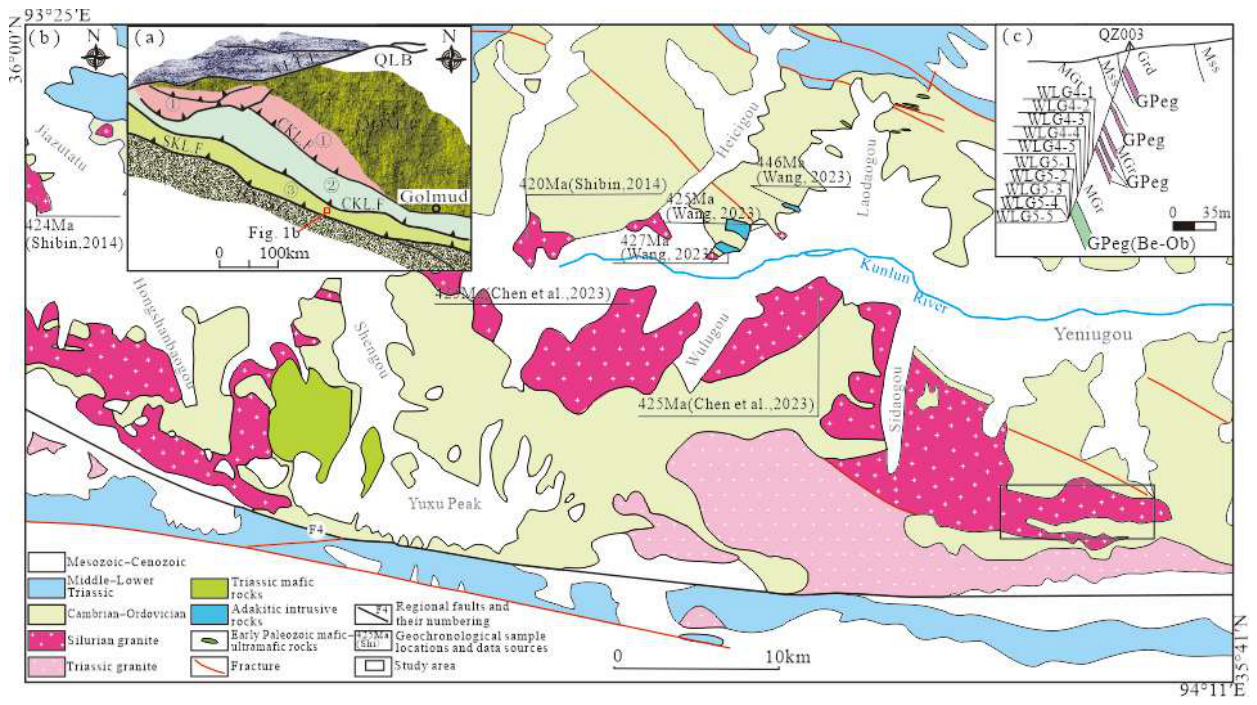
Figure 2.
Simplified Geological Map of the Wulugou Area.
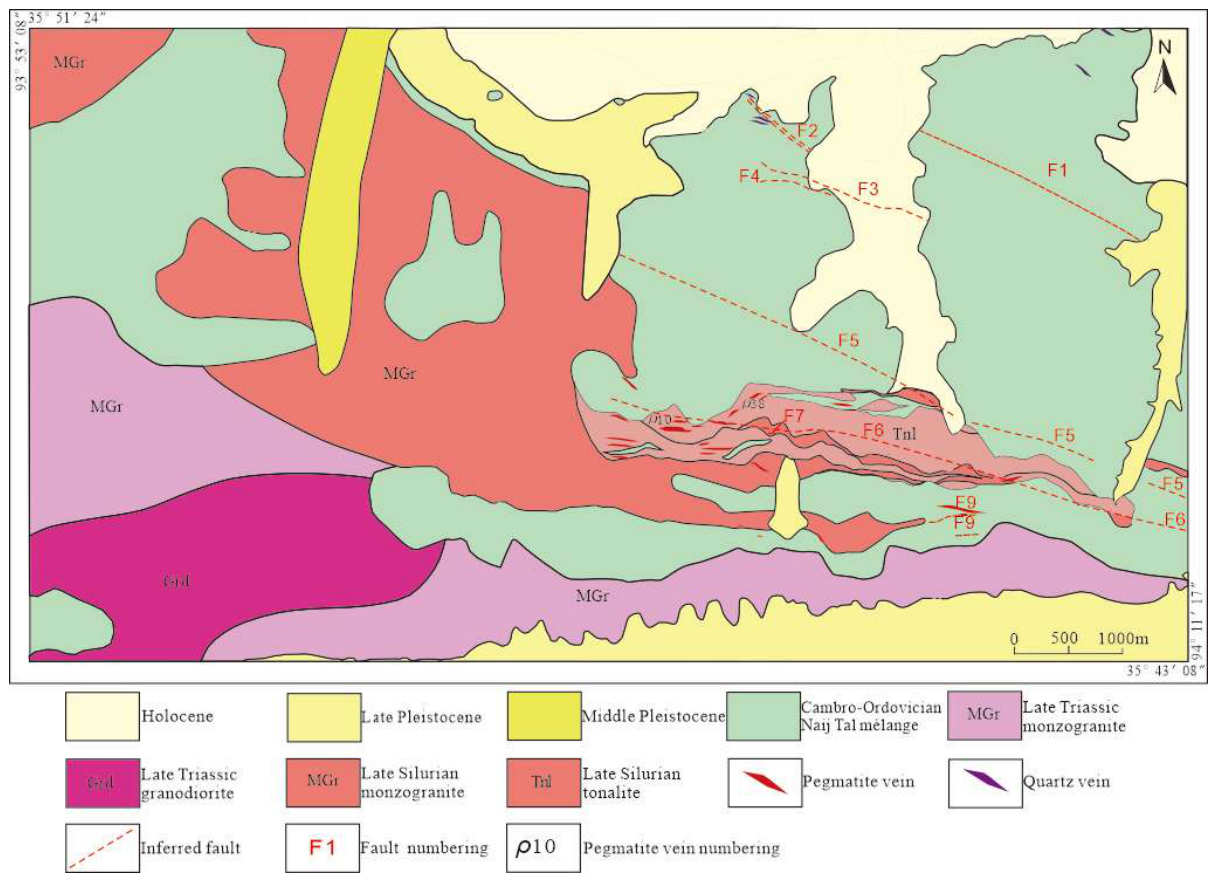
Figure 3.
Field Occurrence Characteristics of Pegmatites.
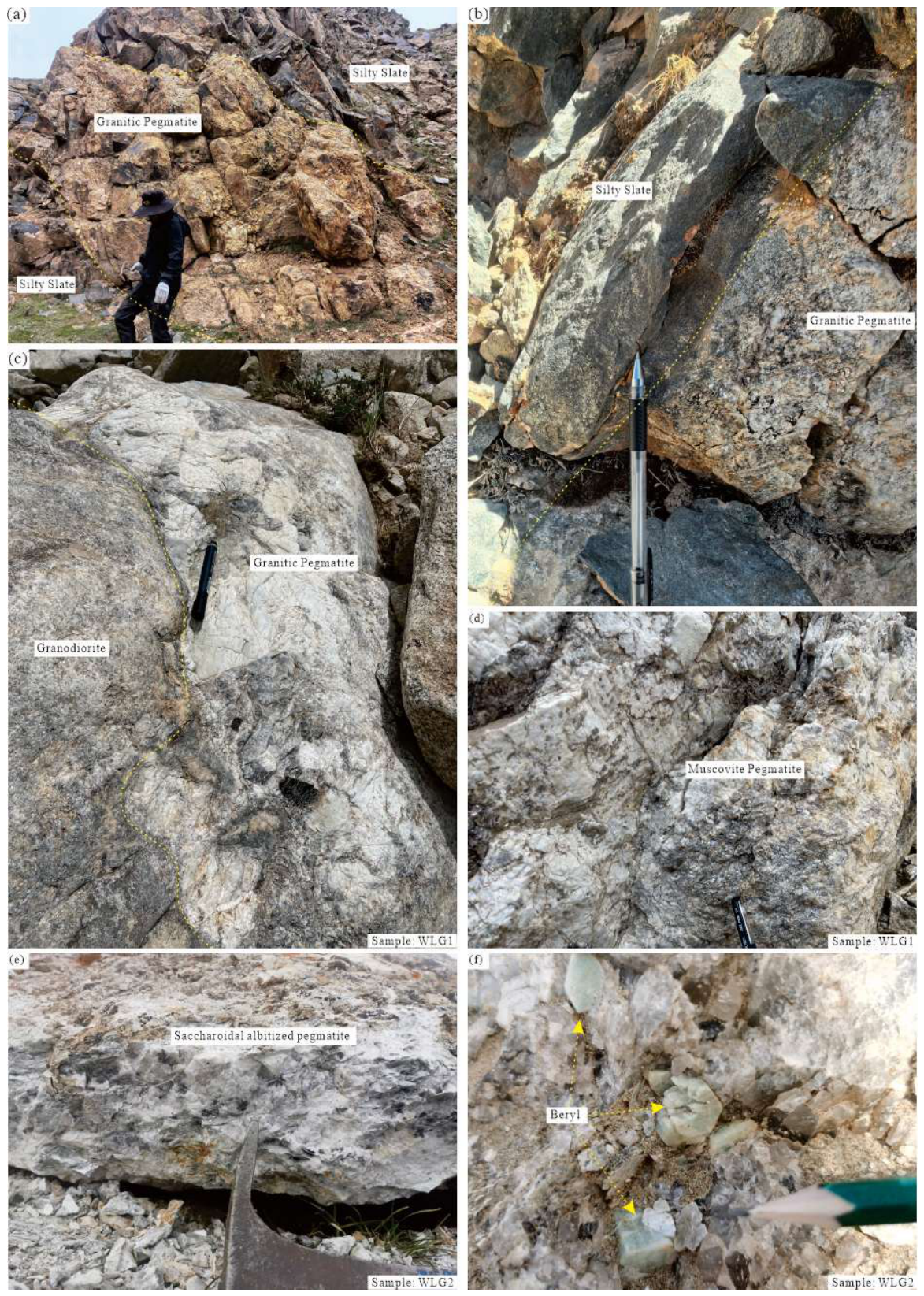
Figure 4.
Microscopic photographs of ore-bearing pegmatite.
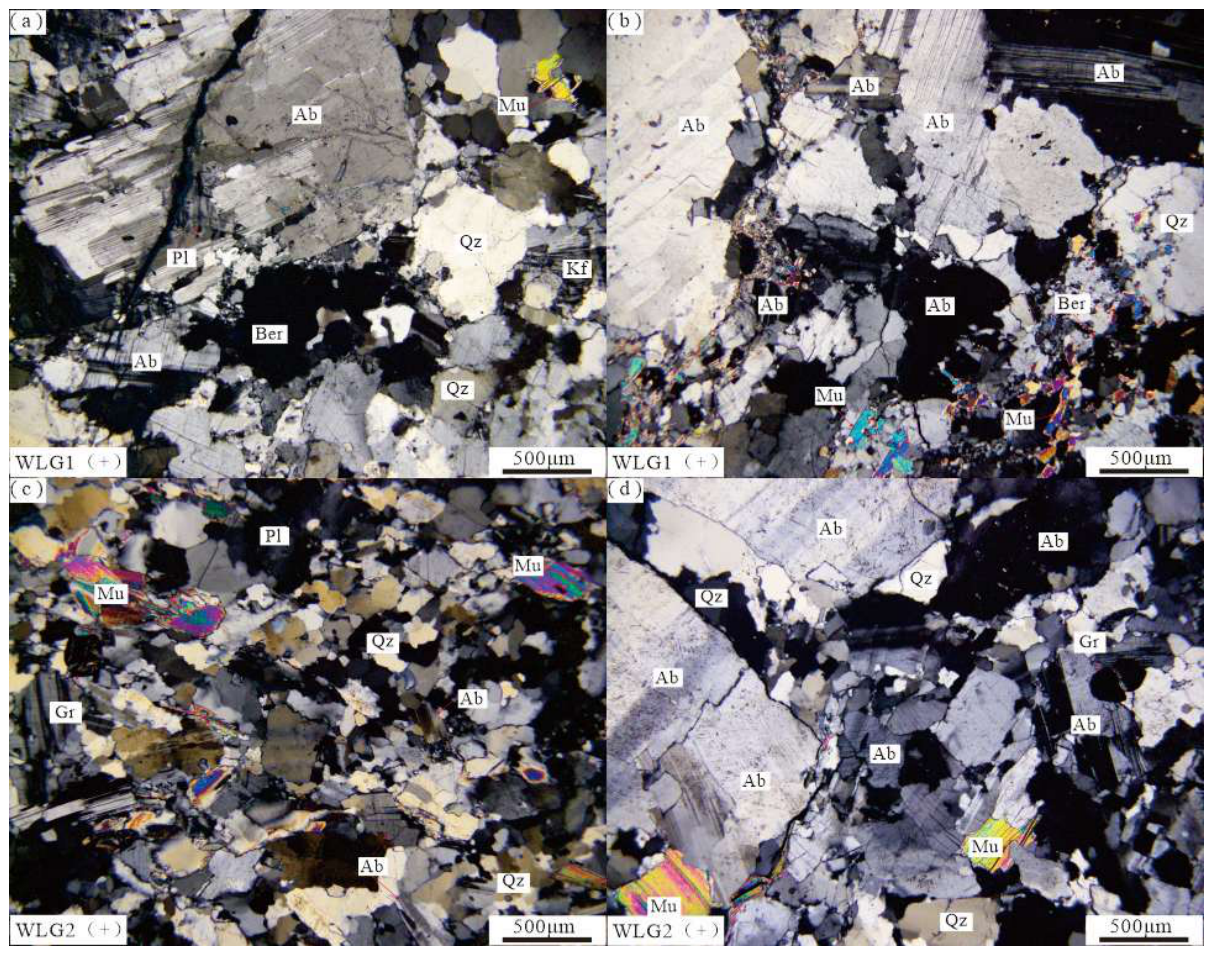
Figure 5.
Covariation diagrams illustrating fractional crystallization of the rocks.
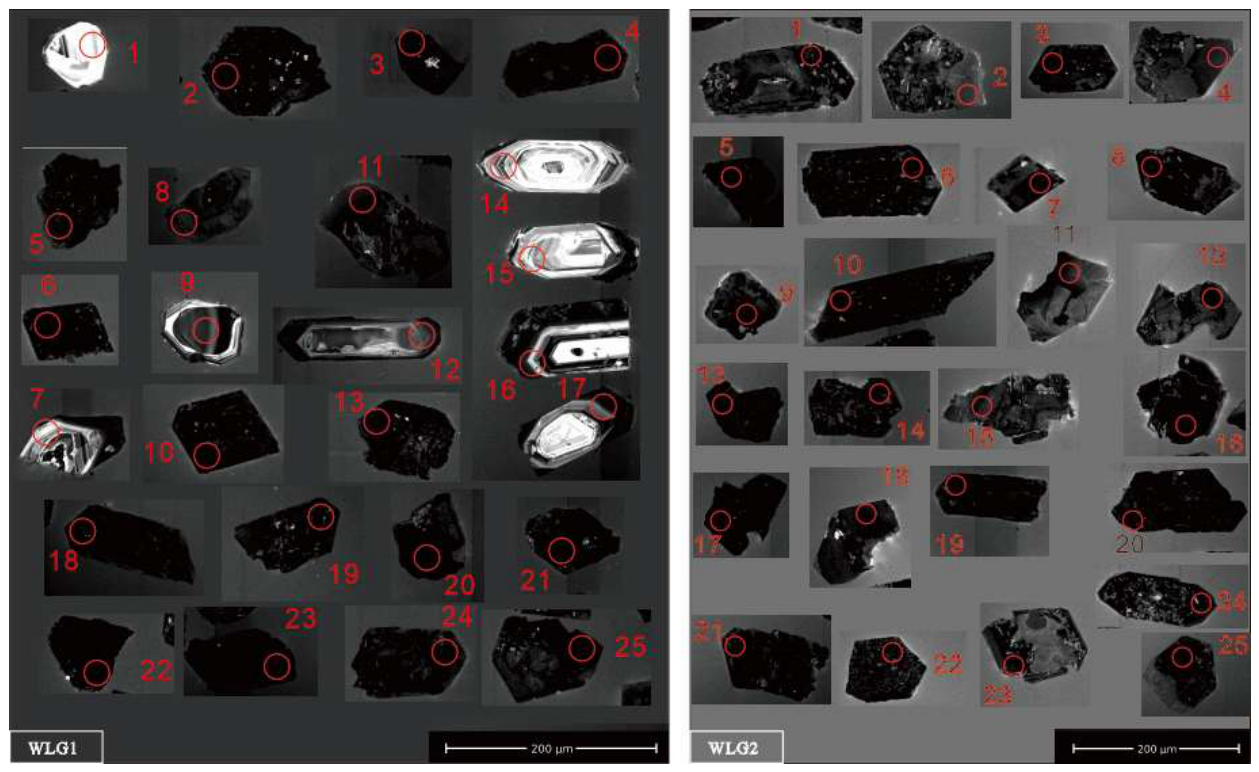
Figure 6.
Zircon Harmonized Age.
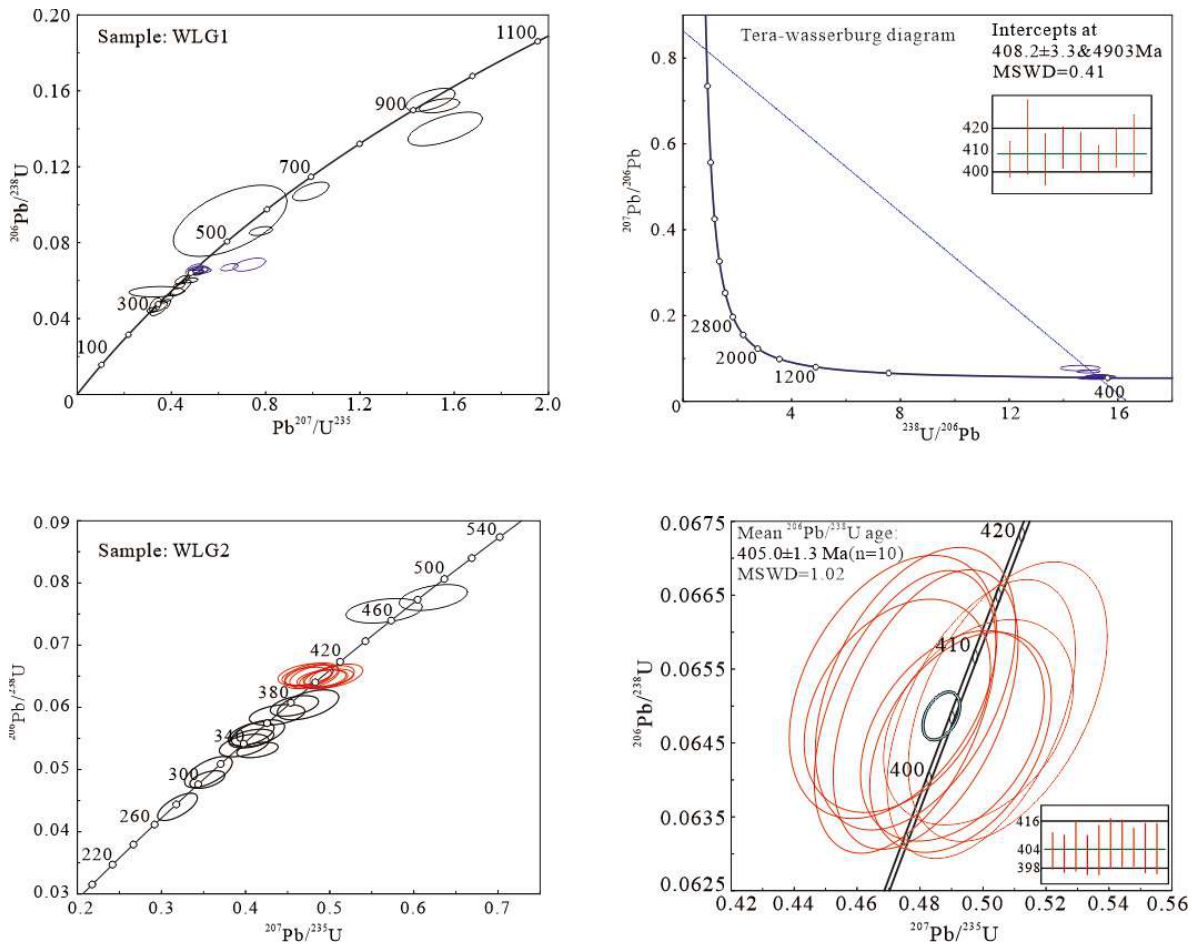
Figure 7.
Photographs of Backscattering from Solitary Stones.
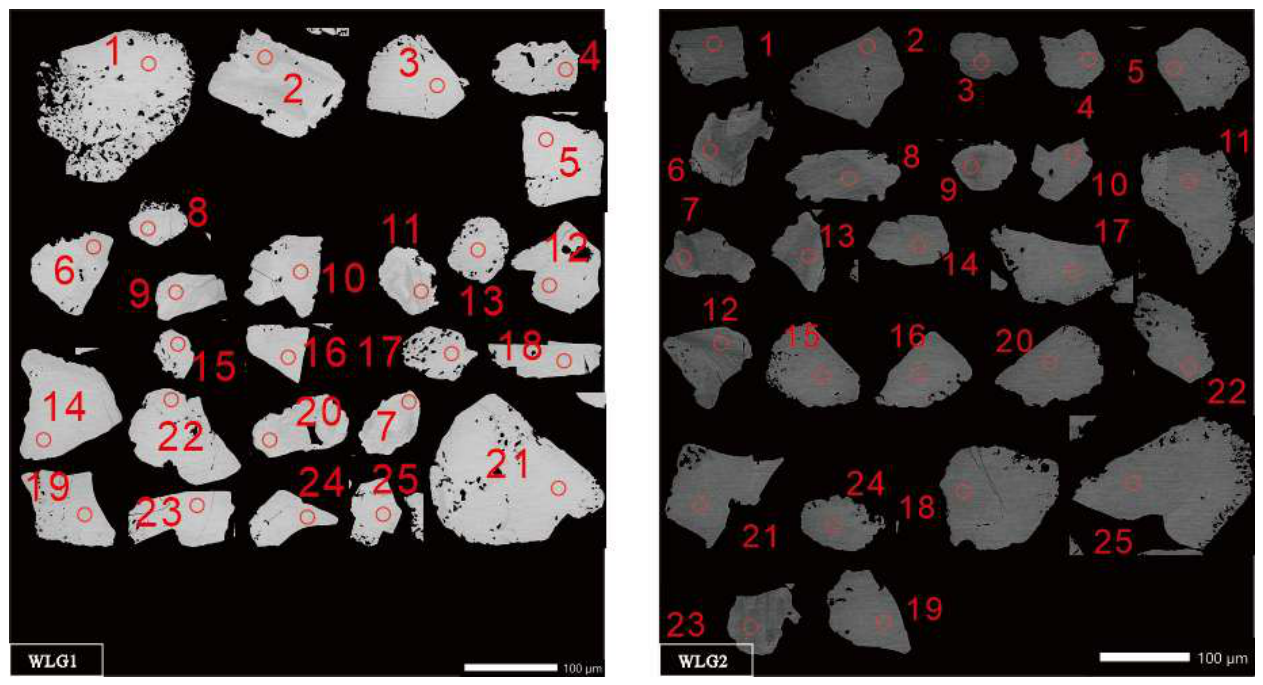
Figure 8.
The Age of the Solitary Stone and Harmony.
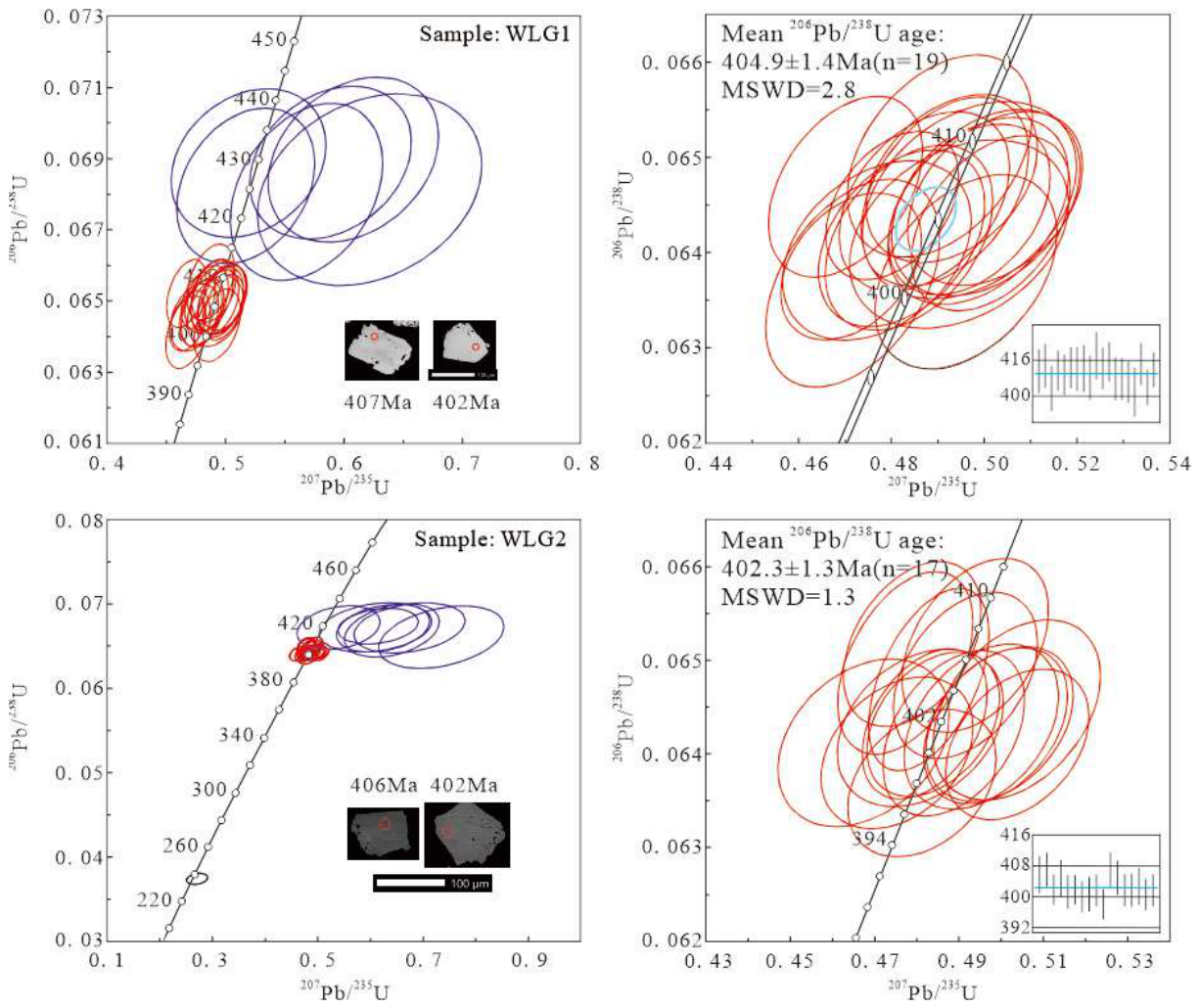
Figure 9.
(a) Whole-rock TAS diagram; (b) SiO₂–K₂O+Na₂O silicate-alkali diagram; (c) A/CNK–A/NK diagram.
Figure 9.
(a) Whole-rock TAS diagram; (b) SiO₂–K₂O+Na₂O silicate-alkali diagram; (c) A/CNK–A/NK diagram.
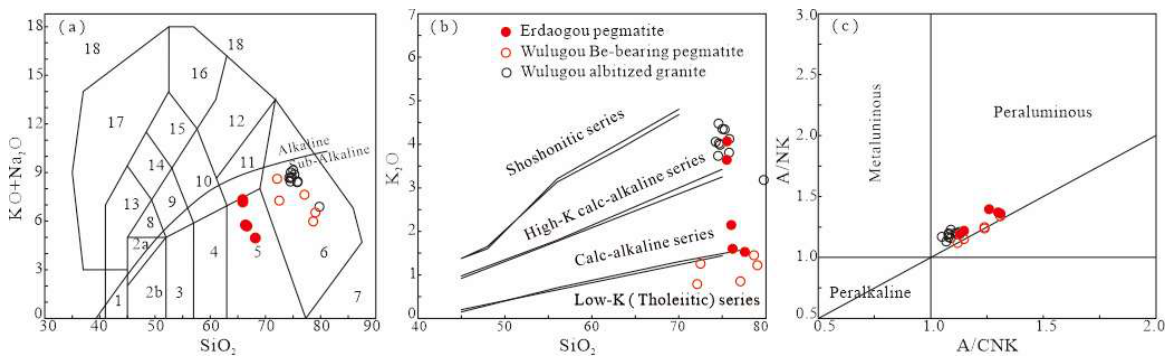
Figure 10.
(a) Standardized rare earth element distribution diagram for chondrite; (b) Primitive mantle-normalized trace element spider diagram.
Figure 10.
(a) Standardized rare earth element distribution diagram for chondrite; (b) Primitive mantle-normalized trace element spider diagram.
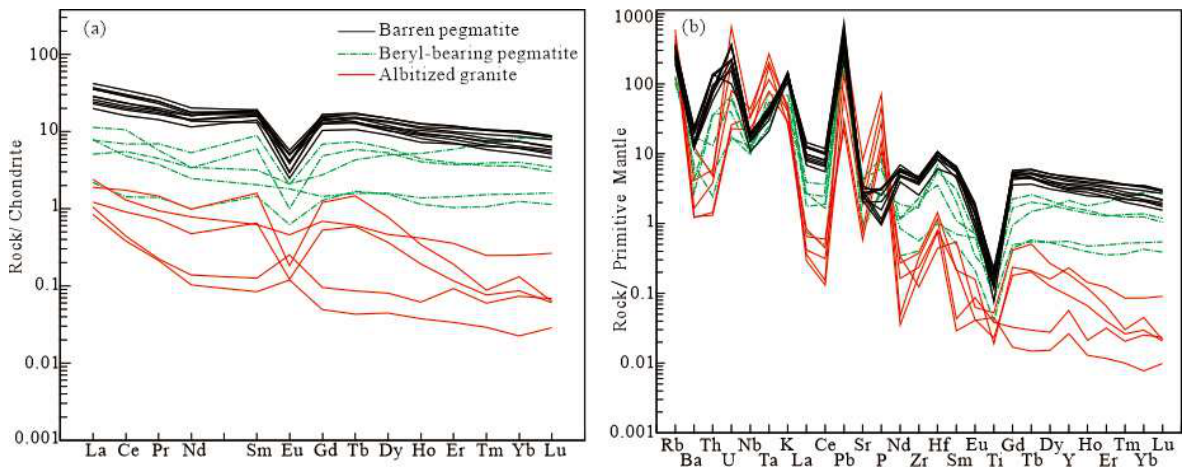
Figure 11.
Zircon Genesis Classification Chart (red indicates concordant age points; black indicates others).
Figure 11.
Zircon Genesis Classification Chart (red indicates concordant age points; black indicates others).
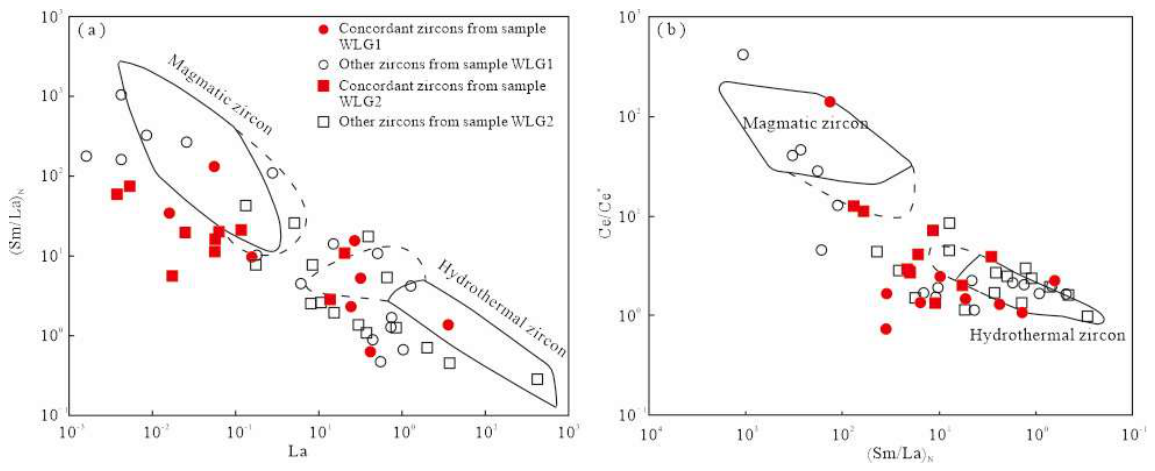
Figure 12.
Illustration of the U-age diagram for zircon in pegmatites (red represents concordant age points; black represents others).
Figure 12.
Illustration of the U-age diagram for zircon in pegmatites (red represents concordant age points; black represents others).
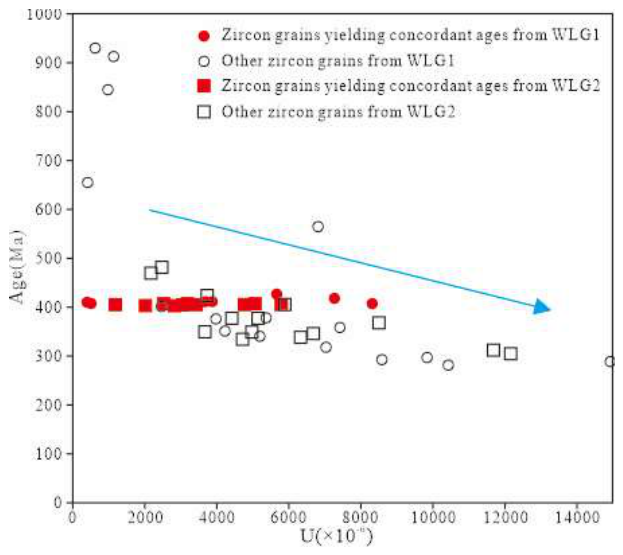
Figure 13.
(a)In situ rare earth element distribution curve for zircon; (b)In situ rare earth element distribution curve for monazite (red represents harmonic age points, black represents others).
Figure 13.
(a)In situ rare earth element distribution curve for zircon; (b)In situ rare earth element distribution curve for monazite (red represents harmonic age points, black represents others).
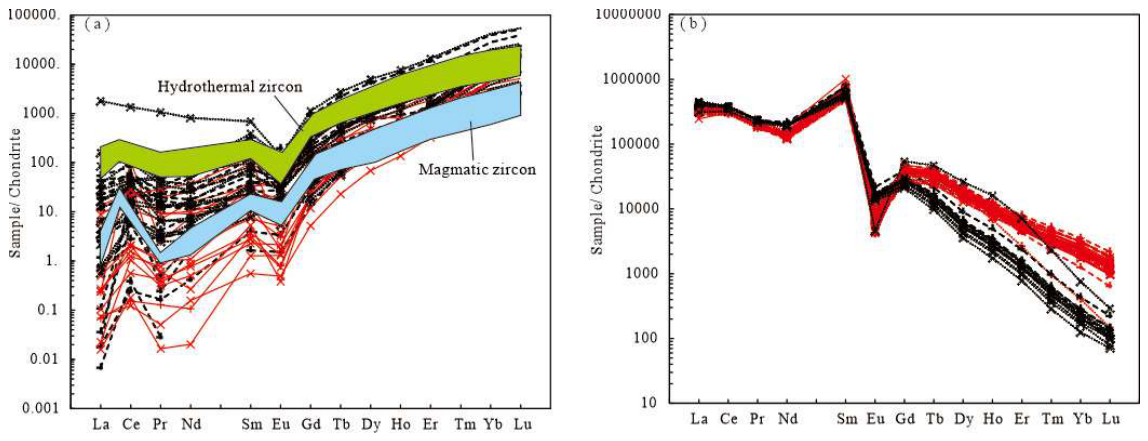
Figure 14.
Co-variation Diagrams of Major and Trace Elements in Rocks.
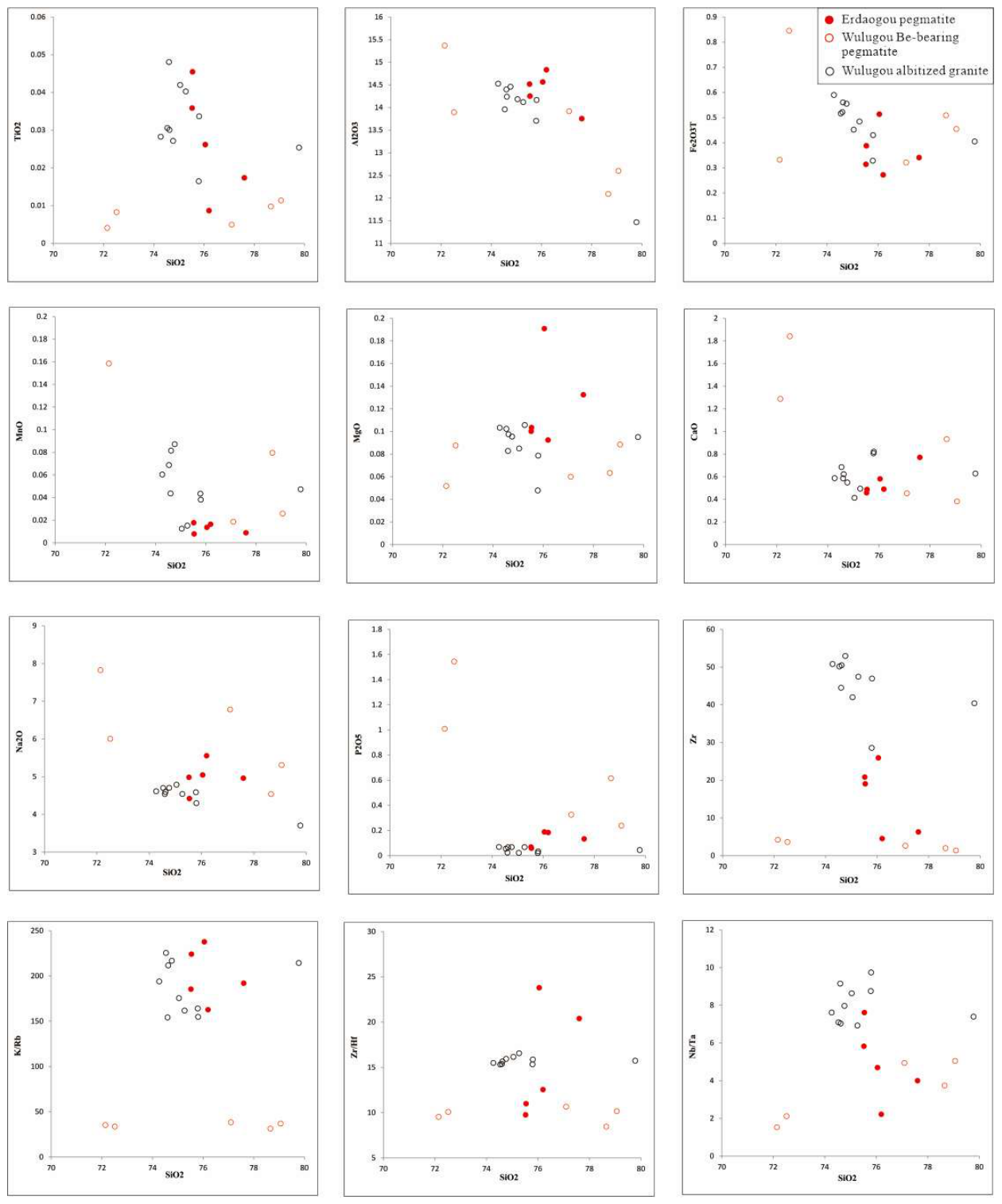
Figure 15.
Covariation Diagram of Crystallization and Differentiation in Rocks.
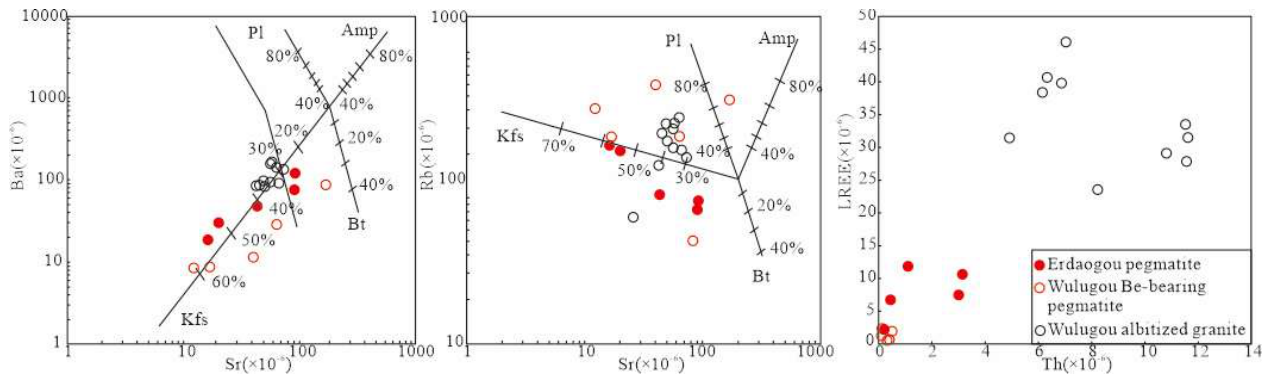
Figure 16.
High-Resolution Granite Classification Chart.
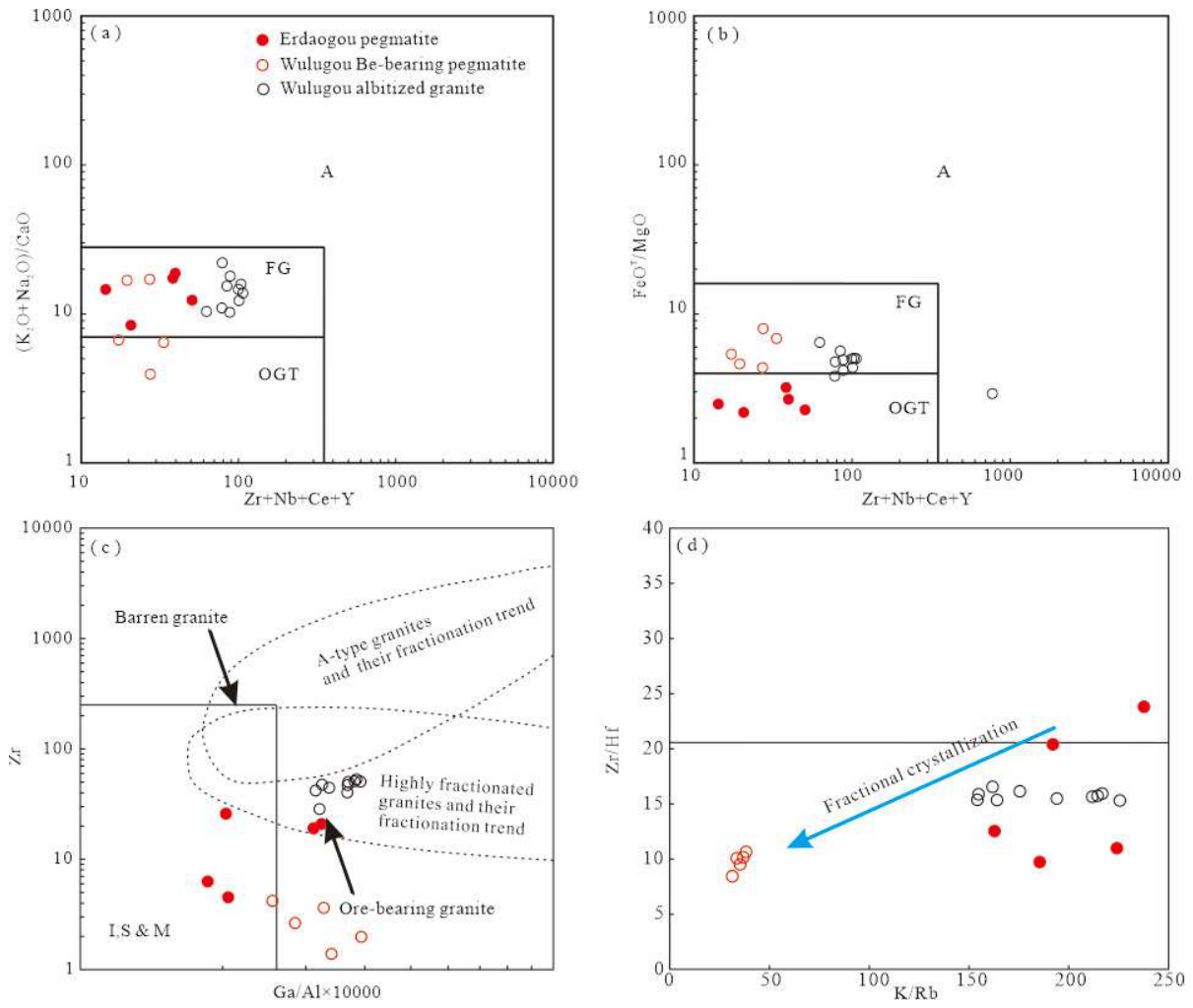
Figure 17.
Co-variation Diagram of Zirconia Crystallization Temperatures.
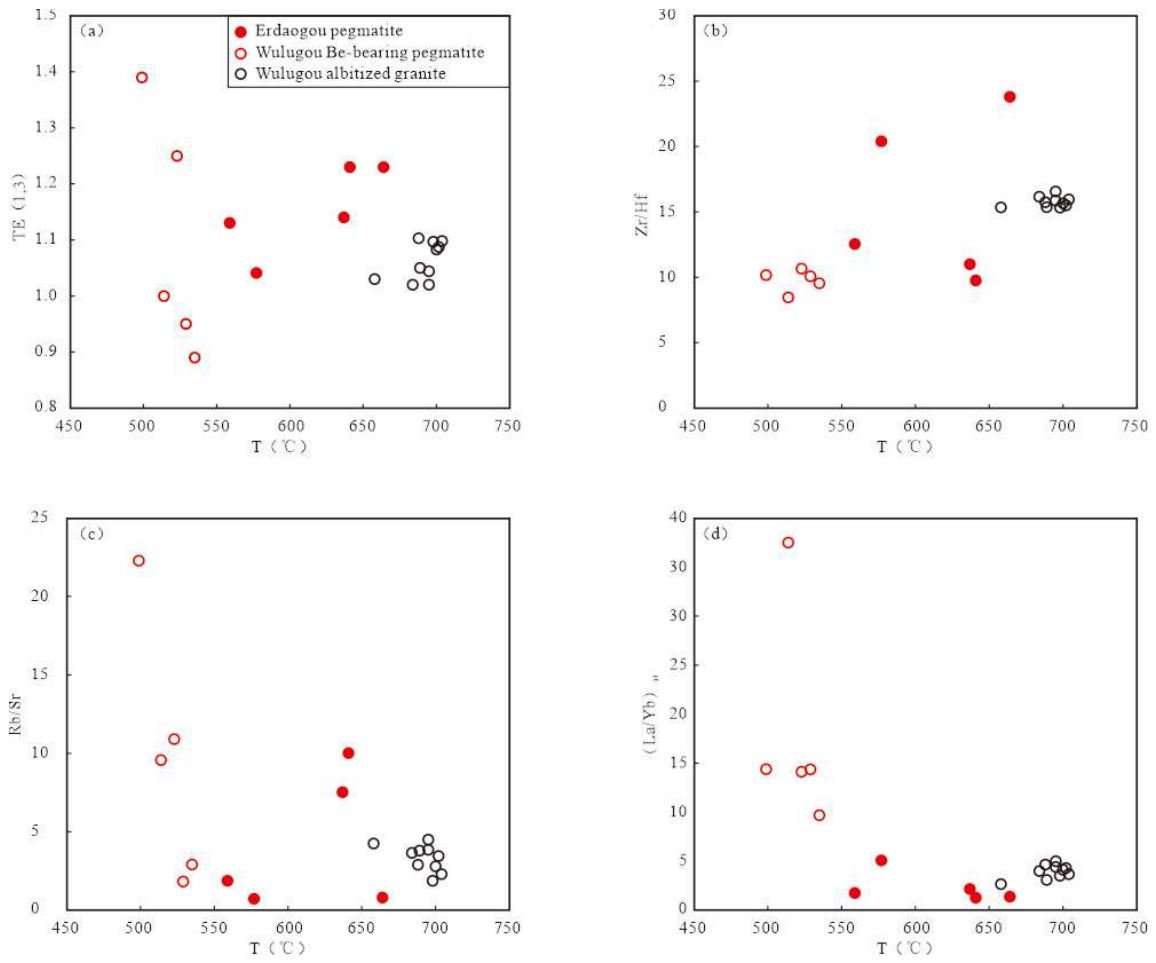
Figure 18.
Constructing an Environmental Discrimination Map.
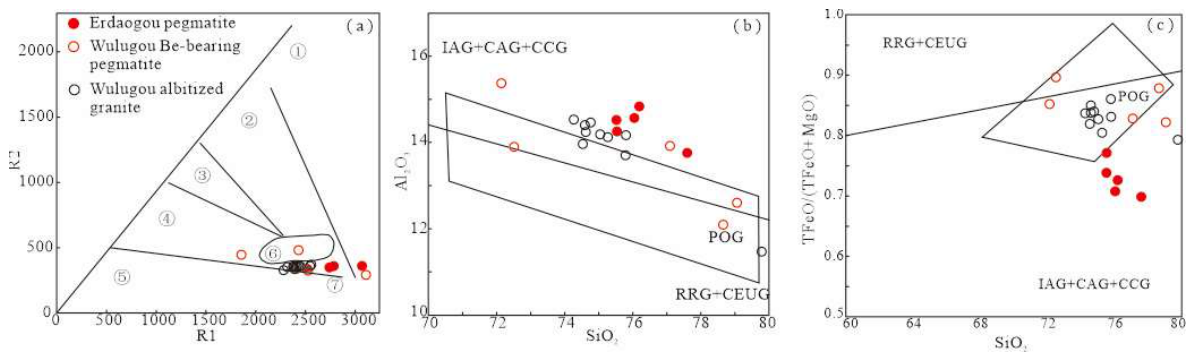
Figure 19.
Rock εHf(t)-Age Diagrams.
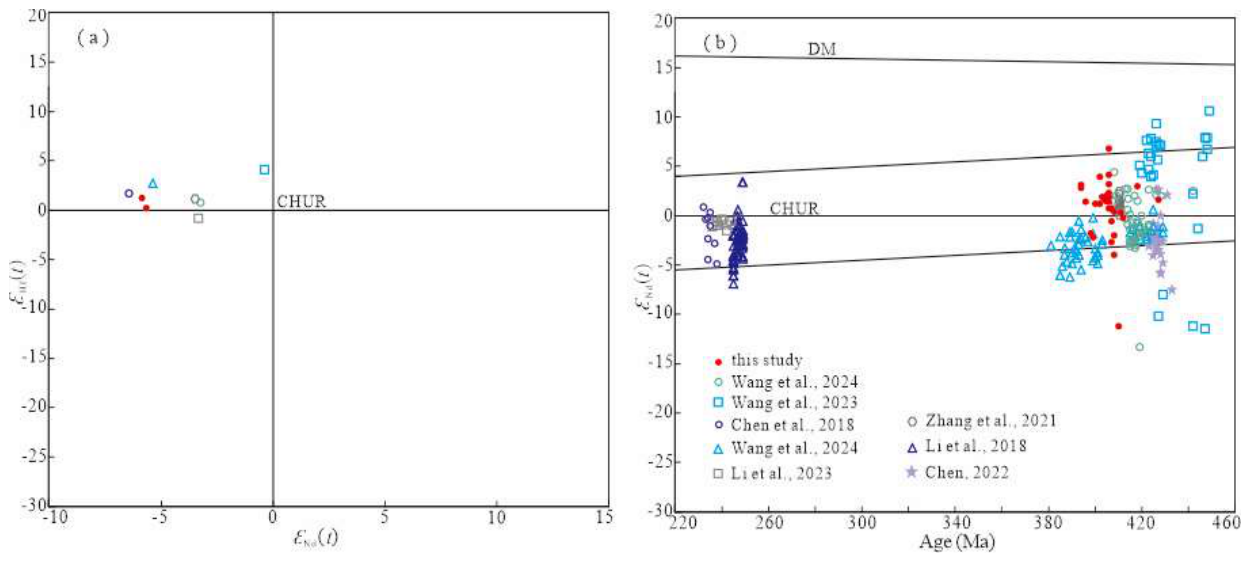
Figure 20.
Rock Source Area Identification Map.
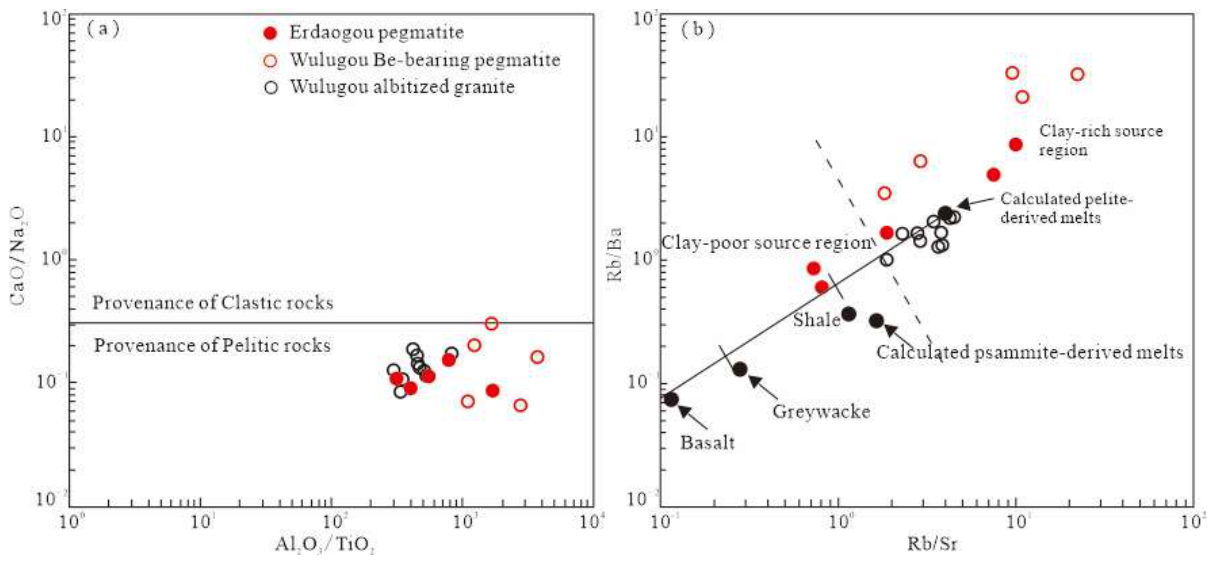
Disclaimer/Publisher’s Note: The statements, opinions and data contained in all publications are solely those of the individual author(s) and contributor(s) and not of MDPI and/or the editor(s). MDPI and/or the editor(s) disclaim responsibility for any injury to people or property resulting from any ideas, methods, instructions or products referred to in the content. |
© 2026 by the authors. Licensee MDPI, Basel, Switzerland. This article is an open access article distributed under the terms and conditions of the Creative Commons Attribution (CC BY) license (http://creativecommons.org/licenses/by/4.0/).
Copyright: This open access article is published under a Creative Commons CC BY 4.0 license, which permit the free download, distribution, and reuse, provided that the author and preprint are cited in any reuse.