

Submitted:
07 September 2026
Posted:
07 September 2026
You are already at the latest version
Preprints on COVID-19 and SARS-CoV-2
Abstract
Objective: Little is published on health indices for incarcerated populations. Such information can enhance health services delivery with a view to optimize programming goals and reduce recidivism. Methods: Following IRB approval, the volunteer incarcerated persons' health assessment for rehabilitation and training effectiveness (VIPHARTE) will proceed on two tracks—Array I (retrospective) will comprise de-identified data from previously entered health records on all incarcerated adults in California state prisons (n > 90,000). Redacted weights taken on January 1st (baseline) will be anonymously tracked for each record with weight remeasured on 31st December for cohorts in 2017, 2021, and 2024. Age, gender, and self-identified ethnicity will be matched on each entry to document weight change (if any) before, during, and after COVID-19. Array II (prospective) will estimate current inmate wellness from biomarker tests offered to incarcerated volunteer participants (n=1000). These samples would be collected at previously booked primary care clinic visits, with specimens frozen for off-site batch analysis. VIPHARTE will focus on hematologic, metabolic, endocrine, and epigenomic stress parameters, some of which (20%) are already being collected at California correctional institutions. The remaining items (n = 24) will be completed by research partners from specialty laboratories at no additional cost. Results: Weight change patterns among the incarcerated are well documented but largely ignored, and require further study. Array I will be among the first datasets to clarify this phenomenon. VIPHARTE will also enable cross-comparisons with reference to COVID-19, where prison populations are known to have been particularly impacted. In Array II, new information on anemia, nutrition, infection, systemic inflammation, hepatic/renal function, endocrine status, and oxidative stressors as potential epigenomic modifiers will be aggregated from the volunteer cohort. Conclusion: Health assessments, either historical or real-time, taken directly from the incarcerated are scarce. When available, they bring value in shaping correctional health policy, budget prioritization, public workforce allocations, and overall awareness of needs within a vulnerable population. California operates 31 correctional institutions, including the world's largest women's prison. Treatment and care decisions for these incarcerated individuals develop inside a high-throughput managed care organization functioning as a system-within-a-system. Large tranches of its clinical data will provide raw resources to power Array I of VIPHARTE. Its prospective component (Array II) will gather original data on novel cell signaling elements contributed by representative volunteers, producing a detailed and overdue update concerning wellness strengths and weaknesses in this understudied group.

Keywords:
COVID
; correctional health
; inmate wellness
; inflammation
Introduction
In 2021, there were approximately 1.8M individuals incarcerated in the United States—a population larger than the active-duty U.S. military (Thakrar et al., 2021; Janssen, 2023). California maintains the country’s most extensive system of state prisons where some 90,000 individuals are in custody at 31 secure facilities. Many of the incarcerated enter prison with complicated medical problems as pre-existing conditions, while others develop new symptoms or diagnoses while in custody. The task of providing care for this group is the remit of California Correctional Health Care Services (CCHCS), a major clinical and administrative enclave with its own hierarchy and budget authority inside the California Department of Corrections and Rehabilitation (CDCR). Daily CCHCS workflow and function rely on its electronic health information system, although data generated on this platform remain a surprisingly latent and untapped research asset.
In 2026, an inmate-led science group at Soledad, California’s Correctional Training Facility began to discuss CCHCS as the central term in the incarcerated wellness equation. These irregular gatherings soon formed an ad hoc journal club, the Core Tissue Function Laboratory (CTF Soledad). Working only with anecdotal inputs, intermittent library access, and no internet, CTF lab group members considered the disappointments and successes over which CCHCS presides. But perhaps more importantly, it was recognized that no meaningful progress would be possible without credible data.
Motivated by a CDCR-sponsored inspirational poster displayed in a common area (“Do Not Wait for Change, Be the Change”), the volunteer incarcerated persons’ health assessment for rehabilitation and training effectiveness (VIPHARTE) evolved. This report describes VIPHARTE as a sui generis research initiative—a cost neutral proposal conceived by the incarcerated for repurposing existing (and acquiring new) prison health data with a framework for its analysis.
Methods
After obtaining IRB approval and registering feedback received during formal evaluation, Array I of VIPHARTE would review CCHCS entries as a public information non-document data query as authorized under California Government Code Sec. 7920.530. All data required for Array I will be retrievable from CCHCS’ HCS Dashboard via their interactive abstracting portal for information on California incarcerated individuals. The application tracks trended performance assessments on >250 measures organized into 12 domains including scheduling & care access, population health management, continuity of clinicians & services, pharmacy records/medication logs, and other categories (personal communication, CCHCS).
For incarcerated individuals age ≥18 on 1 January of the years 2017, 2021, and 2024 who remained in continuous custody through 31 December of the same year, this will create three annual cohorts comprising Array I. Demographic tags will be retained on deidentified records with the three annual datasets subgrouped by age and self-reported ethnicity, as follows: 1) Age 18–30, 31–45, 46–59, and ≥60 years; and 2) a) African-American/Black, b) Latinx/Hispanic, c) Caucasian/White, d) Native American/First Nations, and e) other. Application of these filters would yield Array I inputs partitioned as shown in Table 1 and will report equivalent subgroup detail on both male and female health records.
For Array II, research collaborators will consult on the provisional test panel to validate (or modify) components summarized in Table 2. After consensus on testing to be performed, specialty partner(s) will advise on exact requirements for each sample to be collected and define storage particulars necessary to maintain specimen integrity for off-site batch analysis. Using the same data filtering approach as for Array I, the prospective results will also be subclassified by inmate age/gender/race. Ideation of test flow sequence and chronology is depicted in Figure 1.
Results
Array I of VIPHARTE is expected to summarize the California incarcerated population weight fluctuations during 2017, 2021, and 2024. The structure will arrange data stratified to discover any relation with COVID for any subgroup and to identify potential health needs, trends, or features in this population. If no significant weight change during any year under review were observed, and if all ages/genders/ethnicities evince similar weight patterns irrespective of year audited, this will be an important finding not previously observed.
Results from Array II will populate Table 2, where considerable insights should emerge for any panel component by age, gender, or ethnic category. Such metrics will help characterize selected inflammatory mediators in this volunteer group. Growth factor, cytokine, and other less common cell sensing indicators have never been fully factored for those in prisons, where unique health challenges require consideration (Mei et al., 2024). Should subgroup analysis in Array II identify differential risk(s) revealed after data partition by age, gender, or race, then targeted counseling or follow-up may be appropriate.
Discussion
Governments operating correctional institutions have a special duty of care to provide medical support to those in custody. Weights recorded on inmates entering incarceration represent a crude but useful index for inferring general health status. The relation between patient weight and caloric intake defines a clinical practice feature accepted by school nurses, hospitalists, flight surgeons and prison health advocates over many years. Here it is easy to see how VIPHARTE results are unlikely to be discounted, as unwell or poorly fed inmates generally underperform on programming tasks, and those with fewer training or rehabilitation attainments tend to re-offend and reenter prison (Stickle & Schuster, 2013).
Interestingly, nutrition in California prisons today is not the same as that from past generations (Strange, 2025). It must be noted that food in prison has been criticized as a ‘hidden punishment’, reinscribing low-value nutrition choices precisely when an offending group is to be ‘corrected’ (Woods-Brown et al., 2023). Thus findings from VIPHARTE should help reify the linkages across diet, health, and by extension, programming (Lockwood et al., 2012) by placing wellness markers in sharper focus. In any case, the popular notion of prisons being a nourishment wasteland where people are sent to face starvation is incorrect, at least in California. This research will help dispel the myth and indeed may show tendencies to weight gain during incarceration for select subgroups. The recent availability of GLP-1 agonists, as prescribed by prison physicians as an assist to reduce inmate weight (Jones, 2025) highlights a sophisticated response to obesity, type 2 diabetes, or both by correctional health leadership. VIPHARTE would put overweight in the incarcerated population under closer magnification, validating the investment in treating maladaptive metabolic disorders here.
Because of the original nature of most testing (80%) in Array II, prior work cannot predict the range of possible lessons to be learned. For example, markers for inflammation including reactive oxygen species (ROS) levels and epigenomic modulators are completely unstudied in any incarcerated group. The VIPHARTE cohort is positioned to help develop an early understanding of ‘prison physiology’ at the most basic level. Of course, deferring extensive commentary on the work is prudent until its full experimental payload is returned, but it should still be possible to consider plausible previews of some coming attractions. For example, any modern comprehension of wellness must include the role played by epigenomic programming, now understood as the chief conductor of environmental cues to influence gene expression (Christensen et al., 2009; Desaulniers et al., 2021). Accepting that DNA methylation, histone properties, and RNA transcription all are responsive to environmental inputs, VIPHARTE Array II will provide a partial audit of epigenomic features as a glimpse of cell function or disorder existing with—and perhaps induced by—previously unrealized local exposures (Giorgio et al., 2020).
Another element of Array II may draw special attention from colleagues in food science, clinical dietetics, or agriculture. Acrylamide (AA) is a low molecular weight endocrine disruptor, carcinogen, neurotoxin, and controversial ‘obesogen’ found in many foods prepared by frying, baking, roasting, or grilling mainly by carbohydrate glycation (Maillard reaction). Breads, cereals, chips, baked goods, and coffee (Krishnakumar & Visvanathan, 2014; Singh et al., 2016; Maan et al., 2022; Buyukdere & Akyol, 2023) are among familiar products known to have high AA content, and unsurprisingly, all are staple items ingested daily in prisons. A government advisory group identified AA intake as a public health concern in 2015, with special emphasis on cancer risk (Abt et al., 2022). To quantify this hazard the German food safety authority initially suggested a limit of 0.8 mg/kg for dietary AA, above which European grocers and suppliers could not purchase or import (De Maria, 2013). The safe dietary threshold was subsequently lowered to 0.75 mg/kg and both California and the E.U. now enforce regulations requiring AA disclosures on food product labels (Cantrell & McDougal, 2021). With environmental exposure to AA near-ubiquitous and probably unavoidable without strenuous effort (Atkinson et al., 2023), if this substance were somehow present in levels among incarcerated individuals at concentrations above standards regulated outside prison, this would easily escape notice using current surveillance. Here Array II is expected to clarify the issue, since VIPHARTE will present an indirect measure of consumed AA via the hemoglobin AA adduct assay, hemoglobin glycidamide (GA) adduct assay, and N7-guanine (as glycidamide DNA adduct) assay. A major metabolite of AA is GA, itself a potent mutagen (Buyukdere & Akyol, 2023). Given the diverse tissue accumulation of AA in kidney, thymus, heart, brain and liver after ingestion (Pundir et al., 2019), Array II results should construct an early awareness of AA’s systemic effects among the incarcerated. And because AA crosses the placenta (Yu et al., 2019) registering its prevalence as a reproductive toxin can influence dietary guidance for female inmates especially susceptible to this hazard (Maher & Nowak, 2022). One path such change could take, depending on the final report from VIPHARTE, might involve an expert panel convened at state level to revise dietary AA allowances for all California prisons, whereby consumables exceeding a recognized AA limit would be replaced by safer alternatives.
For Array II, where will these tests be sourced and interpreted, and how much will it cost an already overstretched prison budget to get these datapoints? Any VIPHARTE appraisal must mention the essential role of equipment and personnel willing to run these complex tests — most of which are too new to be accessed through major commercial laboratories. Fortunately, California is home to world-leading research units with accredited specialists co-located at nearby academic teaching centers. Experts with interests aligning with VIPHARTE will be invited to join this public health service project pro bono as co-investigators and co-authors, assisting in interpreting results, revising manuscripts, biostatistical support, etc. In this way, VIPHARTE would be revenue neutral with no adverse budget implications for host facilities.
VIPHARTE will have some limitations which should be noted prior to study launch. For example, information on COVID vaccine uptake will not be included in Array I, so the complete picture of inmate weight dynamics may not be fully revealed. Because vaccine skepticism in general, and for COVID in particular, could be high in this institutionalized population, the issue may touch on a sensitive subject for the incarcerated. This preventive health aspect of correctional medicine therefore was felt better explored in a separate study. While overall health status can be approximated by patient weight patterns, weight alone is an imprecise proxy for global wellness. VIPHARTE will review weights taken at year-start and again 12 months later, so the tool will miss changes which occurred at intermediate points. A follow-up study could incorporate health record reviews at finer scale, and discussions on a possible VIPHARTE 2.0 are underway to address this issue. Since Array I is designed to review batched records entered during three annual sets, it is possible some records might contribute to more than one year category. This would happen for anyone serving long prison terms commencing before 2017 (or even 2021) who therefore would be counted in multiple columns. As length of incarceration is not considered in VIPHARTE, it could suffer from oversampling error if this feature were common.
Perhaps a more nuanced critique could challenge VIPHARTE’s assumption concerning the stasis and uniformity widely believed to typify prison life as a monolithic, standardized and unvaried living environment. Yet even within California, nontrivial variances exist across state facilities on water purity, food quality, air pollution, or access to and consumption of prepackaged foodstuffs acquired from prison canteens or approved vendors. Since none of these terms are expected to be identical at any two nodes in this facility network, VIPHARTE calculations derived from multicenter inputs will need to be generalized cautiously. Finally, VIPHARTE is an inmate-led research concept submitted as an original sampling strategy to audit anonymous health markers in a large, incarcerated population. With no known comparable work published to endorse this unique methodology, the operational efficacy of VIPHARTE could follow the same arc as other ‘orphan initiatives’ with viability guarded during the pendancy of its approval.
Conclusion
Anyone facing incarceration in the United States eventually navigates a locked labyrinth promising free access to basic health services, but finding instead a system ill-equipped to meet even rudimentary wellness targets. The best evidence marking the underperformance of prison health networks is difficult to ignore: the sheer mass of America’s justice-impacted population has now grown so large that its negative health burden is helping downgrade the entire country’s average lifespan. In fact for each year spent in an American prison, the life expectancy for the average inmate is cut short by two years (Patterson, 2013). Unfortunately, there has been no apparent program to explain these lost life-years in clinical or molecular terms until now. VIPHARTE approaches this critical issue as a first-in-class sentinel probe, venturing into an institutional space where experts rarely enter. Its two arrays will enlarge the knowledge enclosure around energy balance, ROS and cellular stress signaling in the incarcerated—far beyond existing boundaries and on channels not yet fully actuated. The approved proposal thus can shape aftercoming work to map an untraveled dimension here more completely.
Author Contributions
ESS developed the protocol, designed the data rubric, and formatted the manuscript as Principal Investigator; FY reviewed the literature and coordinated research logistics; SHW revised the data framework, consulted on policy, and revised the manuscript. All authors read and approved the final work.
Funding
This proposal has not received external funding.
Ethics Approval and Consent to Publish
Not applicable.
Conflicts of Interest
None declared.
References
- Abt, E.; Incorvati, V.; Robin, L. Acrylamide: Perspectives from international, national, and regional exposure assessments. Curr. Opin. Food Sci. 2022, 47, 100891. [Google Scholar] [CrossRef]
- Atkinson, R.; Berru, S.; Delgado, L.; et al. Food Addit Contam A 2187646; Identifying the origin of acrylamide in Peruvian panela production to inform strategies for its reduction. 2023.
- Buyukdere, Y.; Akyol, A. From a toxin to an obesogen: A review of potential obesogenic roles of acrylamide with a mechanistic approach. Nutr. Rev. 2023, 82(1), 128–42. [Google Scholar] [CrossRef]
- Cantrell, M.S.; McDougal, D.M. Biomedical rationale for acrylamide regulation and methods of detection. Compr. Rev. Food Sci. Food Saf. 2021, 20, 2176–205. [Google Scholar] [CrossRef]
- De Maria, G. Panela: The natural nutritional sweetener. Agro TECH Ind. Hi Tech 2013, 24(6), 44–8. [Google Scholar]
- Janssen, S ed. Nations with largest armed forces, 2022. In World Almanac & Book of Facts; Skyhorse Publishing Inc.: New York, 2023; p. 121. [Google Scholar]
- Jones, T.L. Ozempic weight loss program inspires life changing habits. San. Quentin News (California) [Newspaper] 2025, 7. [Google Scholar]
- Krishnakumar, T.; Visvanathan, R. Acrylamide in food products: A review. J. Food Process Technol. 2014, 50, 344. [Google Scholar]
- Lockwood, S.; Nally, J.; Ho, T.; Knutson, K. The effect of correctional education on post-release employment and recidivism: A 5-year follow-up study. Crime. Delinq. 2012, 58(3), 380–96. [Google Scholar]
- Maan, A.A.; Anjum, M.A.; Khan, M.K.I.; et al. Acrylamide formation and different mitigation strategies during food processing—A review. Food Rev. Int. 2022, 38, 70–87. [Google Scholar] [CrossRef]
- Maher, A.; Nowak, A. Chemical contamination in bread from food processing and its environmental origin. Molecules 2022, 27, 5406. [Google Scholar] [CrossRef]
- Mei, X.; Kowalski, M.A.; Reddy, L. The deleterious health consequences of COVID in United States prisons. Am. J. Crim. Justice 2024, 49(3), 435–61. [Google Scholar] [CrossRef]
- Patterson, E.J. The dose-response of time served in prison on mortality: New York State, 1989–2003. Am. J. Public Health 2013, 103(3), 523–8. [Google Scholar] [CrossRef]
- Pundir, C.S.; Yadav, N.; Chhillar, A.K. Occurrence, synthesis, toxicity and detection methods for acrylamide determination in processed foods with special reference to biosensors: A review. Trends Food Sci. Technol. 2019, 85, 211–25. [Google Scholar] [CrossRef]
- Singh, L.; Varshney, J.G.; Agarwal, T. Polycyclic aromatic hydrocarbons’ formation and occurrence in processed food. Food Chem. 2016, 199, 768–81. [Google Scholar] [CrossRef]
- Stickle, B.; Schuster, S.S. Are schools in prison worth it? The effects and economic returns of prison education. Am. J. Crim. Justice 2013, 48, 1263–94. [Google Scholar]
- Strange, J. Food for rehabilitation: Other states provide examples for California to follow. San. Quentin News (California) [Newspaper] 2025, 6. [Google Scholar]
- Thakrar, A.P.; Alexander, G.C.; Saloner, B. Trends in buprenorphine use in US jails and prisons from 2016 to 2021. JAMA Netw. Open 2021, 4(12), e2138807. [Google Scholar] [CrossRef]
- Woods-Brown, C.; Hunt, K.; Sweeting, H. Food and the prison environment: A meta-ethnography of global first hand experiences of food, meals, and eating in custody. Health Justice 2023, 11(1), 1–19. [Google Scholar] [CrossRef]
- Xu, Y.; Cui, B.; Ran, R.; et al. Risk assessment, formation, and mitigation of dietary acrylamide: Current status and future prospects. Food Chem. Toxicol. 2014, 69, 1–12. [Google Scholar] [CrossRef]
- Yu, D.; Xie, X.; Qiao, B.; et al. Gestational exposure to acrylamide inhibits mouse placental development in vivo. J. Hazard Mater. 2019, 367, 160–70. [Google Scholar] [CrossRef]
Figure 1.
Relation of VIPHARTE retrospective (Array I) and prospective (Array II) annual data frames in relation to COVID-19 pandemic (yellow).
Figure 1.
Relation of VIPHARTE retrospective (Array I) and prospective (Array II) annual data frames in relation to COVID-19 pandemic (yellow).
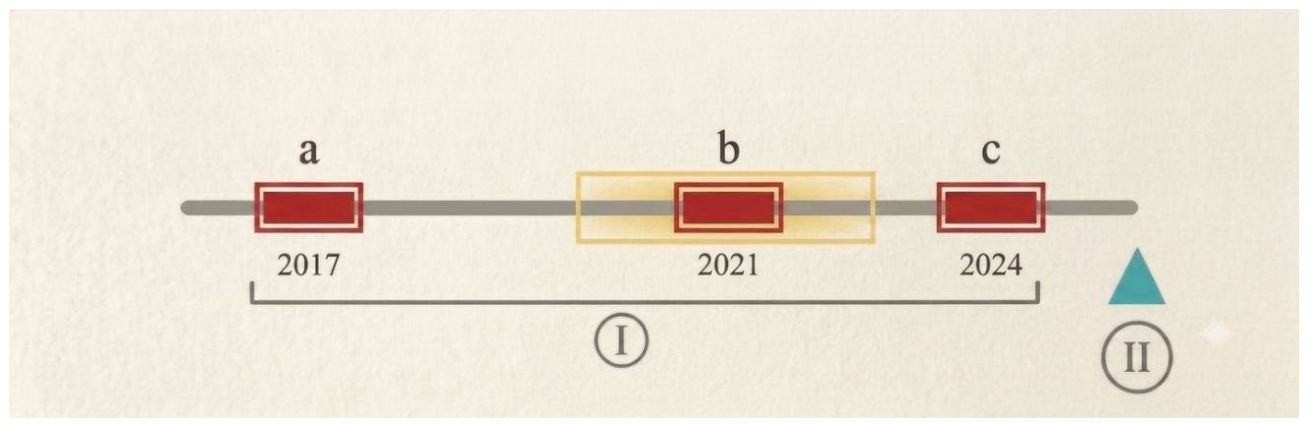

Table 1.
Incarcerated adults (>90,000) +/- weight variation by sample year, age, and race measured in 31 California Department of Corrections & Rehabilitation institutions.
Table 1.
Incarcerated adults (>90,000) +/- weight variation by sample year, age, and race measured in 31 California Department of Corrections & Rehabilitation institutions.
| t | I | II | III | IV | |||||||||||||||||||
| a | b | c | d | e | a | b | c | d | e | a | b | c | d | e | a | b | c | d | e | ||||
| 2017 | |||||||||||||||||||||||
| 2021 | |||||||||||||||||||||||
| 2024 | |||||||||||||||||||||||
Notes: Age groups: I = 18–30; II = 31–45; III = 46–59; IV = ≥60 years. Self-reported ethnicity: a = African-American/Black; b = Latinx/Hispanic; c = Caucasian; d = Native American/First Nations; e = Other. Male and female data reported separately. Variation calculated from incarcerated person’s official weight at prison clinic measured on 1 January and 31 December of each sample year (t). Source: CCHCS; Elk Grove, California.
Table 2.
Proposed laboratory sampling detail for VIPHARTE Array I obtained from incarcerated volunteers (n = 1000).
Table 2.
Proposed laboratory sampling detail for VIPHARTE Array I obtained from incarcerated volunteers (n = 1000).
| test (n = 30) | group | specimen requirements |
| CBC BMP ESR CRP TSH PRL hGH PAI-1 insulin |
hematologic/ metabolic |
1 2 |
| AMH FSH LH E2 Ttot SHBG |
endocrine |
1 |
| BDNF CXCL4 (PF4) GDF11 HbAA HbGA IL-4 IL-6 MDA N7-guanine NF-κB OGG1 SABG TGFβ1 TIMP2 VEGF |
ROS/epigenetic investigational |
3 |
Notes: Samples to be obtained securely on-site by CCHCS staff phlebotomists for batch/freezing and later processing either at routine contracted laboratory facility or off-site at specialty location, as necessary. VIPHARTE = volunteer incarcerated persons’ health assessment for rehabilitation and training effectiveness; ROS = reactive oxygen species; CBC = complete blood count (with platelet concentration); BMP = basic metabolic panel; ESR = erythrocyte sedimentation rate; CRP = C-reactive protein; TSH = thyroid stimulating hormone; PRL = prolactin; hGH = human growth hormone; PAI-1 = plasminogen activator inhibitor-1; AMH = anti-Müllerian hormone; FSH = follicle stimulating hormone; LH = luteinizing hormone; E2 = estradiol; Ttot = total testosterone; SHBG = steroid/sex hormone binding globulin; BDNF = brain-derived neurotrophic factor; CXCL4/PF4 = platelet factor 4; GDF11 = growth differentiation factor 11; HbAA = acrylamide hemoglobin adduct; HbGA = glycidamide hemoglobin adduct; IL-4 = interleukin-4; IL-6 = interleukin-4; MDA = malondialdehyde; N7-guanine = glycidamide DNA adduct; NF-κB = nuclear factor κB; OGG1 = 8-oxoguanine DNA glycosylase 1; SABG = senescence-associated β-galactosidase; TGFβ1 = transforming growth factor β1; TIMP2 = tissue metalloproteinase inhibitor 2; VEGF = vascular endothelial growth factor. 1 Collected by routine peripheral venipuncture (PV). 2 By PV as a.m. fasting plasma sample. 3 By PV with sample handling to be determined by specialty lab partner(s).
Disclaimer/Publisher’s Note: The statements, opinions and data contained in all publications are solely those of the individual author(s) and contributor(s) and not of MDPI and/or the editor(s). MDPI and/or the editor(s) disclaim responsibility for any injury to people or property resulting from any ideas, methods, instructions or products referred to in the content. |
© 2026 by the author. Licensee MDPI, Basel, Switzerland. This article is an open access article distributed under the terms and conditions of the Creative Commons Attribution (CC BY) license.
Copyright: This open access article is published under a Creative Commons CC BY 4.0 license, which permit the free download, distribution, and reuse, provided that the author and preprint are cited in any reuse.