

Submitted:
06 September 2026
Posted:
07 September 2026
You are already at the latest version
Abstract
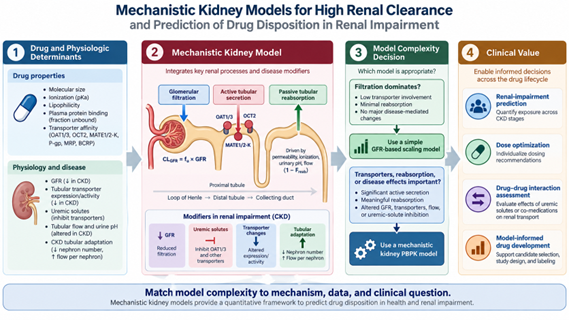
Background. Renal drug elimination is incompletely captured by estimated glomerular filtration rate (eGFR) alone. It reflects filtration, transporter-mediated secretion, passive/active reabsorption, renal blood flow, and sometimes metabolism, so proportional GFR scaling may be inadequate for high-clearance drugs, transporter substrates, and advanced chronic kidney disease (CKD).Objective. This review evaluates the basis, structure, verification, applications, and limitations of mechanistic kidney models for renal drug disposition, emphasizing tubular secretion, reabsorption, CKD adaptation, transporter biomarkers, uremic inhibition, and extracorporeal clearance.Evidence synthesis. Renal clearance cannot always be represented by a single GFR-dependent factor. Adaptive tubular flow and water handling affect passive reabsorption in advanced CKD: absolute fold error for reabsorption-prone compounds was 1.05–1.73 with an adaptive model versus 2.61–7.35 with a non-adaptive, proportionally scaled model at CKD stages 4–5 [1]. Transporter-mediated secretion can decline independently of GFR; uremic solutes inhibiting renal organic anion transporters shifted a tenofovir PBPK model from failing to passing a pre-defined 2-fold acceptance criterion [2]. Endogenous biomarkers offer emerging, independent strategies for estimating renal transporter function: pyridoxic acid has been developed as a population-informed biomarker of OAT1/3 activity for predicting transporter-mediated drug-drug interactions [3], and a separate biomarker-informed model combining estimated secretory clearance and renal blood flow with GFR produced only modest improvements in mean absolute prediction error relative to a regression-based comparator [4] a more cautious result than the pyridoxic acid work alone might suggest, and the two lines of evidence are kept distinct in this review. Simple GFR-based methods can match or exceed PBPK models in some direct comparisons (95.0% vs. 93.1% of observations within a 2-fold error band, 33 drugs), so complexity should track elimination mechanism [5].Conclusions. Mechanistic kidney models distinguish filtration, secretion, and reabsorption and incorporate disease-related physiological change, with greatest value for high renal extraction, substantial transporter secretion, nonlinear handling, or marked CKD uncertainty. Progress requires better transporter, biomarker, and extracorporeal-clearance data and standardized verification criteria; mechanistic modelling should complement, not replace, GFR-based approaches.
Keywords:
mechanistic kidney model
; physiologically based pharmacokinetic modelling
; renal clearance
; renal impairment
; chronic kidney disease
; tubular secretion
; renal transporters
; PBPK
; model verification
1. Introduction
The kidney is a major organ of drug and metabolite elimination and a central determinant of systemic exposure, duration of pharmacological action, and dose requirements. Renal drug elimination is conventionally summarized as renal clearance (CLR), but this apparently simple parameter is the net result of several distinct physiological processes. Drug reaching the kidney may undergo glomerular filtration, active tubular secretion, passive tubular reabsorption, active reabsorption, and, for selected compounds, renal metabolism. The relative contribution of each process depends on drug-specific properties and on kidney physiology.
Clinical practice for renal dose adjustment has relied heavily on estimated GFR (eGFR) or related measures of kidney function. This approach is simple, clinically familiar, and supported by decades of experience. However, eGFR principally characterizes filtration; it does not directly quantify tubular secretion, tubular reabsorption, or renal blood flow. Mechanistic modelling work has sharpened this distinction and has provided quantitative methods for integrating filtration, secretion, reabsorption, and renal hemodynamic within physiologically based pharmacokinetic (PBPK) frameworks, building on kidney model architectures that separate transporter-mediated secretion from filtration [6] and that have subsequently been extended to renal impairment populations for other renally cleared drugs [7] and to biomarker-informed individual secretory function [4].
This distinction is particularly important for drugs with high renal clearance. If:
where fu is the unbound fraction of drug in plasma, filtration alone cannot explain the observed renal clearance under the usual assumptions, and net active secretion must be considered although interpretation should also account for reabsorption and the inherent limitations of partitioning filtration and secretory components from clinical data alone.
CLR > fu × GFR
Renal impairment further complicates this picture. CKD is not simply a state of reduced GFR; it is accompanied by structural and functional changes affecting tubular function, fluid handling, transporter activity, protein binding, renal blood flow, circulating uremic solutes, and nonrenal drug disposition. Mechanistic PBPK models offer a framework for representing these changes individually rather than assuming that every component of renal clearance falls in direct proportion to GFR [1].
The purpose of this review is to critically examine mechanistic kidney models from the perspective of two closely related problems: (1) understanding and predicting high renal clearance, and (2) predicting drug disposition in renal impairment. Rather than treating mechanistic models as universally superior to empirical approaches, this review asks when their added complexity is scientifically and clinically justified, and, where possible, reports the actual quantitative verification performance of the models discussed rather than only their direction of effect.
2. Evidence-Synthesis Approach and Methodological Rigour
This is a narrative, critical review rather than a systematic review. Its purpose is not to calculate pooled predictive-performance statistics across studies, but to integrate heterogeneous mechanistic, pharmacometrics, and regulatory evidence spanning renal physiology, transporter biology, PBPK model structures, quantitative model-verification analyses, and agency guidance into a decision-oriented framework for choosing between GFR-based and mechanistic kidney models. Quantitative pooling was considered inappropriate because the eligible studies differ substantially in model architecture (the transporters, compartments, and reabsorption terms represented), the drugs and populations studied, and the verification metrics reported (for example, absolute fold error, geometric mean fold error, or the proportion of predictions within a pre-defined fold-error band). The review was informed by the Scale for the Assessment of Narrative Review Articles (SANRA), particularly its domains relating to justification of the review's importance, statement of aims, description of the literature search, appropriate referencing, scientific reasoning, and presentation of relevant evidence [8].
To reduce selective interpretation, the synthesis explicitly separates quantitatively verified findings the fold-error and percentage-within-band statistics reported by the cited studies from mechanistically plausible but less directly verified inference, identifies areas of physiological and parameter uncertainty (including renal transporter abundance and activity in CKD, the potency of uremic-solute-mediated transporter inhibition, and tubular adaptation across CKD stages), and avoids presenting either mechanistic PBPK modelling or simple GFR-based scaling as universally superior. This is consistent with the review's own comparative finding that a simple GFR-based method can match or numerically exceed PBPK model performance for some renally eliminated drugs (Section 7; [5]), so that mechanistic complexity is treated as a question to be justified by disposition mechanism and clinical decision rather than assumed by default.
Literature published between 1 January 2020 and 4 September 2026 was identified through PubMed/MEDLINE, Scopus, Web of Science Core Collection, Google Scholar, publisher and journal websites, and regulatory sources (the U.S. Food and Drug Administration, the European Medicines Agency, and the International Council for Harmonisation); reference lists of key mechanistic-modelling and verification papers were also screened for additional eligible sources not captured by database searching. Search terms were combined using Boolean logic and adapted to each source: “mechanistic kidney model,” “renal clearance,” “renal impairment,” “chronic kidney disease,” “PBPK,” “physiologically based pharmacokinetic,” “tubular secretion,” “renal transporter,” “OAT1,” “OAT3,” “OCT2,” “MATE,” “reabsorption,” “uremic solute,” “augmented renal clearance,” “dialysis,” “micro physiological system,” and “biomarker.” Searches were intentionally broad at the first stage and then narrowed by relevance to mechanistic model structure, quantitative verification, transporter involvement, or renal-impairment application.
Studies and guidance documents were eligible for inclusion if they met at least one of the following criteria: reported or verified a mechanistic, physiologically based model of renal drug clearance incorporating filtration, secretion, and/or reabsorption; reported quantitative verification performance (for example, AFE, GMFE, or the proportion of observations within a pre-defined fold-error band) for a renal or systemic pharmacokinetic prediction; examined transporter-mediated tubular secretion (OAT1/3, OCT2, MATE1/2-K, P-gp, MRP2/4, BCRP) or its alteration by CKD or uremic solutes; addressed passive or active tubular reabsorption, including urine pH-, flow-, or permeability-dependence; addressed renal drug disposition in CKD, augmented renal clearance, or extracorporeal (dialysis or continuous renal replacement therapy) clearance; evaluated an endogenous biomarker (for example, pyridoxic acid, creatinine, or N1-methylnicotinamide) of renal transporter or filtration function; or provided regulatory or industry guidance on PBPK modelling or pharmacokinetic study design in renal impairment. Priority was given to peer-reviewed mechanistic modelling studies, critical reviews, translational studies, and contemporary regulatory guidance, selected for mechanistic scope, physiological assumptions, model verification, treatment of renal impairment, incorporation of renal transporters, and clinical or regulatory applicability.
Sources were excluded when they were unrelated to mechanistic renal drug disposition, lacked sufficient methodological detail to judge model structure or verification performance, duplicated data already reported in a more complete source, made claims unsupported by verifiable evidence, or could not be traced to a publisher, DOI, regulatory record, or authoritative institutional source. Conference abstracts, non-technical items, and unverifiable online sources were not used to support substantive quantitative claims, and preprints were not used as primary evidence where a peer-reviewed alternative was available. Screening and selection were undertaken by the review team, with disagreements resolved through discussion. Every citation was independently checked against its publisher record or DOI immediately before submission.
3. Renal Clearance Is a Composite Physiological Process
3.1. Glomerular Filtration
The simplest mechanistic component of renal clearance is glomerular filtration:
CLGF = fu × GFR
Only the unbound fraction of drug is assumed to be freely available for filtration, so a highly protein-bound drug can have low filtration clearance even when its total renal clearance is high. For example, for a patient with a reference glomerular filtration rate of 120 mL/min/1.73m2 and fu = 0.10, CLGF ≈ 12 mL/min/1.73m2 the same normalized units used throughout Table 2. If measured renal clearance substantially exceeds this filtration estimate, filtration alone cannot explain the observation. This relationship is therefore diagnostically useful but should not be mistaken for a complete description of total renal clearance.
3.2. Tubular Secretion
Active tubular secretion occurs predominantly in the proximal tubule and is mediated by basolateral uptake and apical efflux transport systems. Transporters of established or emerging relevance include organic anion transporter 1 (OAT1), organic anion transporter 3 (OAT3), organic cation transporter 2 (OCT2), multidrug and toxin extrusion protein 1 (MATE1), MATE2-K, P-glycoprotein, multidrug resistance-associated proteins, and breast cancer resistance protein.
Transporter-mediated secretion can be represented using intrinsic transporter clearance or capacity-limited kinetics. A simplified Michaelis–Menten representation is:
where Vmax is maximal transport capacity and Km is the concentration at half-maximal transport. At low concentrations (Cu ≪ Km) the process is approximately linear; at higher concentrations, transporter saturation introduces nonlinear renal clearance. This has practical consequences for drugs with high renal clearance, because an apparently constant CLR may actually reflect a concentration-dependent combination of filtration and active secretion.
vsec = (Vmax × Cu) / (Km + Cu)
4. Identifying High Renal Clearance Mechanistically
A useful diagnostic step is comparing observed renal clearance with filtration clearance, CLR versus fu × GFR (Table 1).
This is the authors' own diagnostic heuristic, offered as an organizing framework rather than a finding drawn from a single cited source.
The third scenario is especially relevant to mechanistic modelling. The International Council for Harmonisation (ICH) M12 guideline on drug interaction studies recognizes that renal uptake and efflux transporters can contribute materially to renal secretion and recommends that in-vitro transporter assessment be considered when active secretion represents a substantial proportion of systemic clearance; the guideline specifically identifies OAT1, OAT3, OCT2, MATE1, and MATE2-K among the relevant renal transporters [9]. High renal clearance should therefore not be interpreted simply as "high GFR-dependent clearance." The mechanistic question is what fraction of renal elimination is attributable to filtration, secretion, and reabsorption, and which physiological determinants govern each component.
Table 2 grounds this diagnostic comparison in real drugs spanning the range of renal handling mechanisms discussed throughout this review, using a representative glomerular filtration rate of 120 mL/min/1.73m2 to compute fu × GFR as an illustrative anchor; patient-specific values should always be used for individual predictions.
Filtration alone substantially underpredicts renal clearance for every actively secreted compound in Table 2, by a factor of roughly 1.3- to 7-fold depending on transporter capacity, while cidofovir's response to co-administered probenecid shows directly how pharmacological inhibition of OAT1-mediated secretion collapses renal clearance back toward the filtration-only estimate a clean illustration of the diagnostic logic in Table 1 operating within a single drug.

Table 2.
Representative drugs illustrating distinct renal handling mechanisms.
| Drug | fe | CLR (mL/min)ᵃ | fu | fu×GFR (mL/min)ᵇ | CLR : fu×GFR | Dominant mechanism |
|---|---|---|---|---|---|---|
| PAH (aminohippurate) | ≈100% (reference compound) | ≈595–675 (ERPF) | ≈0.83 | ≈100 | ≈6–7 | Filtration + very high-capacity secretion; extraction ratio ≈0.90; classic ERPF marker [10] |
| Metformin | ≈90%+ | ≈510 | ≈1.0 | ≈120 | ≈4.3 | Active secretion (OCT2 uptake, MATE1/2-K efflux); unbound, not metabolized [11] |
| Tenofovir | ≈70–80% (IV) | ≈244 (CrCl >80) | ≈0.95–0.99 | ≈115–119 | ≈2.0–2.1 | Filtration + active secretion (OAT1/3 uptake, MRP2/4 efflux) [12] |
| Adefovir | ≈98% (urinary recovery, IV) | ≈239 (70 kg) | ≈0.96 | ≈115 | ≈2.1 | Active secretion (OAT1), with filtration contributing the remainder [13] |
| Cidofovir (± probenecid) | ≈80–100% (no probenecid) | ≈150 (no probenecid); ≈99 (+probenecid) | ≈0.97–1.0 | ≈116–120 | ≈1.3 → ≈0.8 with probenecid | Filtration + OAT1 secretion; probenecid blocks secretion, unmasking near-filtration-only clearance [14] |
| Methamphetamine | ≈30–54% (pH-dependent) | ≈175 (highly variable) | not well characterized | — | variable | Passive, pH-dependent reabsorption; CLR rises in acidic urine, falls in alkaline urine [15] |
| Vancomycin | ≈70–90% | ≈84–108 (tracks CrCl) | ≈0.45–0.70 | ≈54–84 | ≈1.2–1.4 | Predominantly filtration with a minor secretion component; CLR tracks CrCl closely, but rises substantially in augmented renal clearance [16], [17] |
| Penicillin G | ≈58–85% | not precisely quantified; very rapid (t½ ≈42 min IV) | ≈0.40 | ≈48 | >1 (secretion-dominant) | Filtration + dominant active secretion, probenecid-sensitive [18] |
ᵃ Representative healthy-adult values; substantial inter-study variability exists. ᵇ Computed using a representative GFR of 120 mL/min/1.73m2 as an illustrative anchor for the Table 1 heuristic, not a patient-specific prediction.
5. Mechanistic kidney models: general architecture
A mechanistic kidney model represents the anatomical and physiological environment through which a drug pass. A contemporary framework may include renal arterial and peritubular blood compartments, glomerular filtration, proximal tubular segments, the loop of Henle, the distal tubule, the collecting duct, tubular epithelial cells, basolateral uptake transport, apical efflux transport, passive tubular diffusion, tubular fluid flow, and urinary excretion. This architecture allows simulated drug concentrations at distinct anatomical locations, rather than treating the kidney as a single clearance compartment. Figure 1 summarizes this architecture conceptually.
Drug is delivered to the kidney via the renal blood compartment, filtered at the glomerulus, subject to bidirectional active transport across proximal tubular epithelium (basolateral uptake via OAT1/OAT3/OCT2; apical efflux via MATE1, MATE2-K, P-glycoprotein, MRP2/4, and BCRP), and then subject to passive reabsorption along the loop of Henle, distal tubule, and collecting duct before the remainder is excreted in urine. CKD-associated tubular adaptation (Section 8) and uremic-solute-mediated transporter inhibition (Section 10) are superimposed on this same architecture rather than requiring a separate model structure. Original schematic prepared for this review; not a reproduction of any specific published figure.
A 2025 review of PBPK modelling of renal drug disposition emphasizes that mechanistic kidney models can combine physiological parameters tubular flow, pH, and transporter expression, with drug-specific properties including protein binding, lipophilicity, ionization, and transporter substrate status, and highlights the growing number of applications spanning healthy adults, paediatric populations, and CKD [19].
Several modelling platforms implement versions of this architecture, which is worth naming explicitly for readers seeking practical entry points. The Simcyp Simulator's Mechanistic Kidney Model ("Mech KiM") separates the contributions of glomerular filtration, active and passive tubular secretion, active and passive tubular reabsorption, and renal metabolism to overall renal clearance, incorporating transporter abundance data and, in more recent implementations, electrochemical-gradient-driven transport and urinary drug precipitation; a dedicated paediatric extension of this architecture has been developed and applied to renal clearance prediction across childhood, including for metformin, tenofovir, zidovudine, cimetidine, and ciprofloxacin [6]. The same general kidney-model architecture has been applied to renal impairment populations for other renally cleared drugs: a 2025 PBPK model of cefotaxime, for example, incorporates basolateral and apical renal transporters and extrapolates predicted exposure across CKD stages, though with reduced accuracy reported at CKD stage 4 an honest limitation that itself illustrates why disease-stage-specific verification (Section 21) matters [7]. The Open Systems Pharmacology Suite (PK-Sim/MoBi) represents renal excretion within its kidney organ compartment as glomerular filtration (a passive process) together with substance-specific active tubular secretion. GastroPlus includes glomerular filtration and reabsorption within its standard physiologically based organ compartments but, unlike its dedicated gastrointestinal absorption (ACAT) model, does not currently publish a separately branded, multi-segment nephron sub-model comparable to Mech KiM. Naming these platforms is not an endorsement of any single implementation; it is intended to make the architecture in Figure 1 traceable to tools a practicing pharmacometrician can access.
6. Passive Tubular Reabsorption
Reabsorption is frequently underappreciated in simplified renal models. After filtration and secretion, drug can move from tubular fluid back into the systemic circulation. Passive reabsorption depends on membrane permeability, lipophilicity, molecular size, ionization, urinary pH, tubular fluid flow, water reabsorption, and the resulting concentration gradient.
For ionizable drugs, urinary pH can substantially change the fraction of drug present in membrane-permeable, non-ionized form. Mechanistic PBPK modelling of methamphetamine and amphetamine has demonstrated that urine-pH-dependent reabsorption materially alters renal excretion and systemic exposure, and that this behaviour can be captured quantitatively within a mechanistic kidney model [15]; this urine-pH dependence has since been treated as an explicit external verification target for physiologically based kidney models more broadly, not only for the compound in which it was first demonstrated. Urine-flow-dependence of reabsorption is physiologically plausible through its effect on tubular fluid transit time and is represented structurally in the kidney-model architecture in Figure 1, but this review did not identify a 2020–2026 study that independently verifies flow-dependence with the same rigor as the pH-dependence work above; this is flagged here as a genuine evidence gap rather than assumed to be equally well established. A drug with apparently low renal clearance therefore does not necessarily undergo poor filtration; its low net clearance may instead reflect substantial reabsorption.
The clinical relevance of reabsorption extends beyond adults. A 2025 paediatric PBPK analysis evaluated whether simple GFR-based scaling adequately predicts renal clearance for drugs undergoing passive tubular reabsorption in children and found that GFR-based scaling alone can misrepresent clearance for such compounds, supporting explicit mechanistic representation of reabsorption rather than filtration-only scaling across age groups [20]. Taken together, these findings indicate that reabsorption is not a minor correction term for a subset of unusual drugs; it is a mechanistically distinct process that can dominate the observed renal clearance phenotype, in both adults and children, a point developed quantitatively into the master equation presented in Section 14.
7. Why Renal Impairment Cannot Always Be Represented by Proportional GFR Scaling
A common empirical strategy scales clearance in renal impairment (CLRI) from clearance in healthy individuals (CLH) by the ratio of GFR values:
CLRI = CLH × (GFRRI / GFRH)
This approach is attractive for its simplicity, but it implicitly assumes that the clearance mechanism of interest changes in direct proportion to GFR. That assumption is biologically questionable when clearance includes active secretion, passive reabsorption, active reabsorption, renal-blood-flow dependence, transporter inhibition, or nonlinear transporter kinetics.
Importantly, the conclusion should not be that GFR-based approaches are inherently inadequate. A comparative analysis of 33 drugs and 101 observations found that both a simple GFR-based method and a PBPK approach performed well overall: 96 of 101 observations (95.0%) fell within a 0.5- to 2-fold prediction-error band using the simple GFR method, compared with 94 of 101 (93.1%) using the PBPK model that is, the simple method was numerically not inferior to the mechanistic one in this particular dataset [5]. The comparison was in fact less favourable to PBPK on the more stringent 30% error band in some sub-studies: in one AUC-ratio analysis, the GFR method captured 94.7% of observations within 30% error against 63.2% for the PBPK model [5]. The more defensible conclusion is therefore not that mechanistic models are more accurate by default, but that mechanistic complexity should be introduced when the drug's disposition mechanism creates a plausible source of non-GFR-dependent behaviour a claim this particular comparative dataset does not, on its own, resolve either way, and a nuance revisited quantitatively alongside a second industry dataset in Section 19.
8. Tubular Adaptation in Chronic Kidney Disease
One of the strongest arguments for mechanistic kidney modelling is that CKD alters tubular physiology, not only glomerular filtration. As functional nephron number decreases, surviving nephrons undergo adaptive changes that can modify tubular fluid flow and water reabsorption per remaining nephron, a pattern consistent with the intact nephron hypothesis, which frames CKD drug handling in terms of compensatory hyperfunction of surviving nephrons rather than uniform loss of function; a 2021 analysis applied this framework directly to metformin dosing in CKD and argued that nephron-level adaptation, not eGFR alone, should inform dose selection for actively handled drugs [21].
Huang and Isoherranen developed an adaptive mechanistic kidney model incorporating these effects and evaluated it using permeable and non-permeable compounds across CKD stages, using absolute fold error (AFE, pre-defined acceptance criterion AFE < 2) as the verification metric [1]. The contrast was substantial: the adaptive model achieved AFE = 1.05–1.73 for permeable, reabsorption-prone compounds across CKD stages including stage 4–5, whereas a proportional (non-adaptive) GFR-scaled model produced AFE = 2.61–7.35 for the same compounds at stages 4–5, with 83% of permeable drugs exceeding an AFE of 3 under the non-adaptive model [1]. Non-permeable compounds and actively secreted reference compounds (para-amino Hippurate, memantine) performed acceptably under either model structure (AFE 1.0–1.8), confirming that the adaptive representation specifically rescues prediction for the subset of drugs where passive reabsorption is pharmacokinetically important, rather than improving prediction uniformly across all renally cleared drugs [1].
This finding has an important conceptual implication: CLR is not a function of GFR alone for all drugs. For a permeable compound, decreased water reabsorption and increased tubular flow per remaining functional nephron can alter the residence time available for passive reabsorption. Reduced GFR can therefore simultaneously reduce filtration while changing the fraction of drug subsequently reabsorbed, and the direction and magnitude of the net change in CLR depend on the balance between these opposing processes. Independently, application of a mechanistic PBPK kidney model to renal impairment populations for other renally cleared drugs for example, the cefotaxime model introduced in Section 5, which represents basolateral and apical renal transporters across CKD stages 1–4 [7] illustrates how the same class of model can separate transporter-mediated secretion from filtration in CKD even outside the permeability-driven reabsorption scenario that motivated the adaptive model above, although the reduced accuracy reported at the most advanced CKD stage underscores that tubular-adaptation modelling and transporter modelling in CKD are complementary extensions of the same underlying architecture, not equally mature ones.
9. Renal Impairment and Transporter-Mediated Secretion
Active secretion introduces a further layer of complexity. For a drug substantially secreted through OAT1/3 or OCT2/MATE pathways, renal impairment may affect clearance through mechanisms not captured by GFR, including decreased transporter abundance, decreased transporter activity, altered intracellular metabolism, changes in renal blood flow, altered plasma protein binding, accumulation of endogenous transporter inhibitors, and loss of functional nephron mass. A mechanistic PBPK model can represent these mechanisms separately rather than folding them into a single filtration-based scalar, which matters because the assumption that tubular secretion declines proportionally with GFR is not necessarily valid secretory clearance can fall faster, slower, or through a qualitatively different mechanism than filtration clearance as CKD progresses.
This concern is reinforced by direct evidence on OCT2/MATE-mediated interaction prediction. A 2022 analysis of renal OCT2 and MATE1/2-K transporter drug-drug interaction predictions found substantial inter-study variability between predicted and observed interaction magnitude and identified transporter abundance data and in-vitro-to-in-vivo extrapolation as the principal sources of uncertainty [22], and a 2025 International Transporter Consortium perspective explicitly extended OCT2/MATE-mediated interaction prediction using the extended clearance concept together with endogenous biomarkers and in-vitro inhibition data to patients with chronic kidney disease specifically, rather than healthy volunteers alone [23]. Both analyses support the view that transporter-mediated secretion in CKD is not yet reliably predictable from GFR-based extrapolation alone.
10. Uremic Solutes as Mechanistic Modifiers
One of the most important recent advances in renal PBPK modelling is the recognition that CKD-associated endogenous compounds can directly modify transporter function. Chang and colleagues incorporated inhibition of OAT1/3 by uremic solutes into a mechanistic kidney model of tenofovir, using a pre-defined acceptance criterion of absolute average fold error (AAFE) within 2-fold of observed values [2]. Quantitatively, the model excluding uremic-solute-mediated inhibition failed this criterion (AAFE > 2), while incorporating inhibition of OAT1/3 by uremic solutes brought the model within the pre-defined 2-fold acceptance criterion, improving prediction of both renal and systemic tenofovir disposition in patients with severe kidney disease [2]. The published report does not provide the underlying decimal AAFE values beyond this pass/fail framing in its openly accessible text, so the magnitude of improvement is best read as clinically meaningful crossing a pre-specified acceptance threshold rather than precisely quantified here.
This observation reframes the conceptual representation of renal impairment. Rather than a single relationship in which GFR decline directly drives CLR decline, a more comprehensive system emerges in which GFR falls, transporter activity falls, uremic-solute-mediated inhibition rises, tubular adaptation changes, protein binding may change, and renal blood flow may change, with the final observed clearance the integrated result of all of these processes acting together, sometimes in opposing directions.
11. Biomarker-Informed Mechanistic Kidney Modelling
A major emerging development is the use of endogenous biomarkers to characterize renal transporter function in vivo. Pyridoxic acid has been investigated as an endogenous biomarker of OAT1/3 activity; a 2025 study developed a mechanistic PBPK model incorporating OAT1/3-mediated secretion of pyridoxic acid, characterized its population variability, and used the biomarker-informed model to predict drug–drug interactions mediated by renal OAT1/3 [3].
A separate line of work, using a distinct biomarker-informed approach not based on pyridoxic acid, combined biomarker-derived estimates of renal secretory clearance and kidney blood flow with GFR within a mechanistic PBPK model, and used the approach to predict renal clearance of drugs undergoing both filtration and secretion in a manner not achievable from GFR alone [4]. Quantitatively, in a cohort of 27 outpatients (mean iohexol-measured GFR 76±31 mL/min/1.73m2), this biomarker-informed mechanistic model reduced mean absolute prediction error for tenofovir clearance to 37.1 mL/min (95% CI 24–52.9) compared with 41.8 mL/min (95% CI 25–61.6) for a regression-based comparator, and for oseltamivir carboxylate clearance to 42.9 mL/min (95% CI 29.7–56.4) compared with 48.1 mL/min (95% CI 31.2–67.3) [4]. The improvement is real but modest in absolute terms, and unlike the fold-error metrics used in Section 8, Section 10 and Section 19, and Section 21 is reported here as mean error rather than fold-error, a difference in verification metric that should be kept in mind when comparing across studies in this review. Because this quantitative comparison and the pyridoxic acid work above come from independent studies using different biomarker strategies, this review treats them as two separate lines of evidence rather than a single finding: pyridoxic acid's demonstrated value is specifically for OAT1/3 drug-interaction prediction, while the modest-but-real gain over a regression comparator is specific to the secretory-clearance-and-blood-flow biomarker approach. Both nonetheless represent a potentially important transition from reliance on population-average GFR toward individual GFR combined with individual secretory function and renal blood flow, although substantial further clinical validation remains necessary before either can be applied routinely.
12. Renal Transporter Biomarkers and Regulatory Science
Clinical development of renal transporter biomarkers is particularly relevant because transporter-mediated drug–drug interactions (DDIs) can be difficult to characterize using conventional clinical probe-drug studies alone. The 2024 ICH M12 guidance formally recognizes endogenous biomarkers as an emerging approach for evaluating transporter-mediated interactions, including biomarkers relevant to renal OAT1/3 and to OCT2/MATE pathways [9]. A 2024 industry perspective similarly described endogenous biomarkers as a promising strategy for streamlining assessment of renal-transporter-mediated DDIs during early drug development [24], and a 2025 evaluation of an adefovir PBPK model demonstrated how biomarker-informed OAT1 DDI assessment can be extended to explicitly incorporate the effect of CKD on transporter activity [13]. A 2026 review further frames the integration of renal transporter biomarkers into drug development as a pathway toward precision-medicine applications in renal dosing [25].
The endogenous-biomarker strategy extends well beyond pyridoxic acid. Creatinine and N1-methylnicotinamide have both been modelled mechanistically as MATE1/2-K- and OCT2-mediated biomarkers of renal transporter-drug interactions, with a PBPK modelling approach used to predict how co-administered inhibitors shift their renal handling [26], and a 2023 clinical study directly quantified changes in N1-methylnicotinamide renal clearance ratio following cimetidine, revamping, verapamil, and probenecid administration, providing clinical validation of N1-methylnicotinamide as a MATE-mediated interaction biomarker distinct from and complementary to pyridoxic acid and creatinine [27]. The combination of multiple endogenous biomarkers, in-vitro transporter data, a mechanistic kidney model, and clinical PK data can therefore provide a more integrated description of renal drug disposition than any single data source alone.
13. Micro Physiological Systems as an Experimental Input
Mechanistic kidney modelling need not depend exclusively on conventional in-vitro transporter systems. Kidney micro physiological systems (MPS) provide an additional experimental source of information on renal secretion. Caetano-Pinto and colleagues demonstrated that a kidney-MPS system could reproduce active secretion of metformin and cidofovir, and that MPS-derived transport parameters could be incorporated into pharmacokinetic models to estimate renal secretory clearance [28]. The resulting workflow kidney MPS to transport parameters, to in-vitro–in-vivo extrapolation (IVIVE), to a mechanistic kidney model, to predicted CLR, to whole-body PBPK illustrates a route by which human-relevant experimental systems could reduce reliance on animal models for characterizing renal secretion.
More recent micro physiological platforms have extended this approach. A proximal-tubule-on-chip model has been used to characterize OCT2-mediated cation transport dynamics under controlled fluid-flow conditions, directly linking flow rate to transporter expression and cationic drug transport [29], and induced pluripotent stem cell (hiPSC)-derived kidney organoids incorporated into a tubule-on-chip platform have been used to functionally assess renal transporter activity in a human-relevant, non-animal system [30]. MPS-derived parameters nonetheless still require rigorous human translation and validation before routine use.
14. A Reconciled Mechanistic Equation for Renal Clearance
Two simplified representations of renal clearance are commonly encountered in the literature, and reconciling them clarifies which physiological process each best describes and how they nest together.
The most defensible general decomposition expresses renal clearance as filtration plus secretion, with reabsorption acting multiplicatively on the combined filtered-and-secreted load rather than as an independently subtracted parallel pathway:
where CLGF = fu × GFR, CLsec is the secretory clearance contributed by transporter-mediated flux, and Freab is the fraction of the filtered-plus-secreted drug load subsequently reabsorbed (0 ≤ Freab ≤ 1). This multiplicative form is preferred over an additive/subtractive approximation of the form CLR ≈ CLGF + CLsec − CLreab, which appears in some simplified treatments, because reabsorption physiologically acts downstream on material already present in tubular fluid: an independently subtracted CLreab term admits no natural upper bound and can, for a sufficiently large parameterization, predict a physiologically impossible negative net clearance. The subtractive form remains usable as a first-order linear approximation when Freab is small, but becomes progressively less defensible as Freab approaches 1.
CLR = (CLGF + CLsec) × (1 − Freab)
For drugs where transporter-mediated secretion is capacity-limited relative to renal blood flow delivery that is, where secretion approaches an extraction-ratio-limited process, as for para-amino Hippurate in Table 2 the secretory term itself can be represented using a kidney analogue of the well-stirred organ-clearance model:
where QR is renal blood flow and CLint,sec is the intrinsic secretory clearance attributable to transporter activity. Substituting this expression for CLsec into the master equation above gives a single nested representation:
CLsec = (QR × fu × CLint,sec) / (QR + fu × CLint,sec)
CLR = [fu×GFR + (QR×fu×CLint,sec)/(QR+fu×CLint,sec)] × (1 − Freab)
This clarifies the division of labour between the two equations: the well-stirred form governs only the secretory component, and specifically becomes important when CLint,sec is large relative to QR, that is, for highly extracted drugs such as para-amino Hippurate (Table 2), whose renal extraction ratio of ≈0.90 places its clearance close to renal plasma flow. Filtration clearance itself is not conventionally treated as flow-limited across the normal physiological range, because glomerular filtration is governed by hydrostatic and oncotic pressure gradients rather than by carrier-mediated intrinsic clearance; it is therefore represented as fu × GFR throughout rather than nested inside the well-stirred term. As secretory extraction becomes very high, CLsec approaches QR, placing an upper physiological bound on how far transporter-mediated secretion alone can push total renal clearance, a bound that is not visible in the additive/subtractive decomposition alone.
A disease-state representation follows directly by allowing each term to change with CKD:
where CLsec,CKD reflects disease-dependent changes in transporter abundance, uremic-solute-mediated inhibition (Section 10), and renal blood flow, and Freab,CKD reflects tubular adaptation (Section 8). These equations remain conceptual rather than a universal mathematical implementation: different mechanistic kidney models use different anatomical resolutions and parameterizations, and the appropriate structural complexity depends on the drug and the question being asked.
CLR,CKD = [fu,CKD×GFRCKD + CLsec,CKD] × (1 − Freab,CKD)
15. Augmented Renal Clearance: The Mirror-Image Problem
Most of this review addresses reduced renal function. However, "high renal clearance" also has a clinically important counterpart in patients whose renal function is supra-normal, augmented renal clearance (ARC). ARC is most frequently described in critically ill patients (for example, those with sepsis, trauma, burns, or receiving aggressive fluid resuscitation), in whom increased cardiac output, systemic vasodilation, and elevated renal blood flow raise glomerular filtration and tubular secretory capacity above population-normal values. A recent synthesis of the pathophysiology, clinical implications, and research needs around ARC highlights that renally cleared drugs, antibiotics in particular, including several of the actively secreted beta-lactams and glycopeptides in Table 2, can be substantially underdosed in ARC if dosing is anchored to population-typical renal function rather than to the patient's actual, elevated clearance [31]. A 2022 review synthesizing 51 studies of drug dosing in critically ill adults with ARC reached the same conclusion across a broader drug set, reporting frequent underexposure for meropenem, imipenem, vancomycin, ceftriaxone, and enoxaparin under standard dosing regimens [32].
Quantitative, agent-specific modelling reinforces this concern. A 2025 population pharmacokinetic and Monte Carlo simulation analysis of meropenem across a creatinine clearance range of 140–200 mL/min found that standard dosing regimens frequently failed to achieve an adequate probability of target attainment against common pathogens in patients with ARC, and proposed optimized, higher-intensity regimens for this population [33]. A systematic review of 21 studies of vancomycin specifically in ARC reported a 1.3- to 3.5-fold increase in vancomycin clearance relative to normal renal function, with 34–100% of patients across the pooled studies failing to reach therapeutic trough concentrations on standard dosing [17] directly reinforcing Table 2's characterization of vancomycin as predominantly filtration-cleared but nonetheless sensitive to renal hemodynamic status.
Mechanistically, ARC is the inverse of the CKD problem addressed throughout this review: instead of CLGF, CLsec, and Freab each moving toward reduced net clearance (and doing so non-proportionally), renal blood flow and glomerular filtration rise, and, for actively secreted drugs, secretory clearance can rise as well, again not necessarily in the same proportion as filtration. A mechanistic kidney model built on the nested equation in Section 14 which already represents QR, GFR, and transporter-mediated secretion as separable terms is naturally positioned to describe ARC using the same structural framework used for CKD, simply by allowing the relevant parameters to move in the opposite direction. This symmetry is a further argument for building renal clearance prediction around explicit physiological components rather than a single empirical scalar tied to eGFR, since a single-scalar approach calibrated for reduced-function populations does not automatically extrapolate to supra-normal renal function.
16. Why Mechanistic Models Are Particularly Valuable for Highly Secreted Drugs
Consider two contrasting cases from Table 2. For a predominantly filtered drug such as vancomycin, CLR ≈ fu × GFR, and a GFR-based approach may provide a reasonable approximation of renal impairment effects outside the ARC setting discussed in Section 15, where even a filtration-dominant drug's clearance can shift substantially. For an extensively secreted drug such as metformin or para-amino Hippurate, CLR ≫ fu × GFR, and renal clearance depends substantially on transporter-mediated secretion. If CKD reduces GFR and, independently, reduces intrinsic secretory clearance, then scaling total clearance according to GFR alone may misrepresent the patient's exposure potentially in either direction, depending on whether secretion falls faster or more slowly than filtration. This is precisely the situation in which a mechanistic model can supply information that an empirical GFR-scaled clearance model cannot.
17. Renal Impairment Is a Systemic Disease
A major limitation of purely kidney-centric models is that CKD influences drug disposition outside the kidney as well. Potential systemic changes include altered plasma albumin and α1-acid glycoprotein concentrations, altered haematocrit, altered gastrointestinal physiology, altered hepatic enzyme activity, altered drug transporter expression at nonrenal sites, accumulation of endogenous inhibitors, changes in volume of distribution, and changes in nonrenal clearance alongside renal clearance. A 2024 critical review of CKD-focused PBPK models highlighted the breadth of physiological changes incorporated across existing models, spanning GFR, plasma proteins, gastrointestinal physiology, hepatic enzymes, and other disease-related parameters, and noted substantial heterogeneity in which of these processes individual models actually implement [34].
A 2025 population PBPK model developed specifically for end-stage renal disease patients quantified several of these nonrenal changes directly, reporting an approximately 75% reduction in hepatic OATP1B1/1B3-mediated uptake and an approximately 2-fold increase in intestinal BCRP-mediated efflux alongside altered P-glycoprotein and CYP3A4 activity, and used these changes to simulate altered systemic exposure to OATP1B/BCRP/P-gp/CYP3A4 substrate drugs such as statins in an end-stage renal disease population [35]. This concretely illustrates how the systemic consequences of CKD discussed qualitatively above can be incorporated quantitatively into a whole-body PBPK framework. A kidney model should therefore ideally be embedded within a whole-body PBPK framework whenever systemic CKD effects are plausible contributors to the observed pharmacokinetic phenotype.
18. Extracorporeal Clearance: Dialysis and Continuous Renal Replacement Therapy
Advanced CKD frequently progresses to kidney replacement therapy intermittent haemodialysis, peritoneal dialysis, or, in critically ill patients, continuous renal replacement therapy (CRRT) and extracorporeal clearance is among the most clinically consequential renal pharmacokinetic problems to which this review's mechanistic framework can be extended. Dialytic clearance adds a further clearance pathway operating in parallel with native renal clearance (typically minimal by this stage) and hepatic clearance, governed by dialyzer or filter surface area and membrane characteristics, blood and dialysate or ultrafiltrate flow rates, sieving or saturation coefficient, and the same drug-specific determinants protein binding, molecular size, volume of distribution that govern native tubular handling.
Mechanistic PBPK modelling has been applied to this problem, though less extensively than to native CKD. Individualized PBPK modelling has been used to evaluate how haemodialysis affects nonrenal, hepatic clearance pathways, illustrating that extracorporeal clearance can have systemic consequences beyond the drug directly removed by the dialyzer [36], and a PBPK-pharmacodynamic model spanning CKD stages through to haemodialysis has been developed for meropenem, an actively secreted beta-lactam antibiotic, to support dose individualization across this transition [37]. These examples demonstrate that the filtration/secretion/reabsorption architecture developed in Section 3, Section 4, Section 5, Section 6, Section 7, Section 8, Section 9, Section 10, Section 11, Section 12, Section 13 and Section 14 can, in principle, be extended with an explicit extracorporeal clearance term operating alongside native CLR.
This gap is beginning to narrow, though it is not yet closed. A 2025 ex vivo model directly measured transmembrane clearance of several antimicrobials including cefepime, meropenem, levofloxacin, and micafungin during continuous renal replacement therapy, generating mechanistic, circuit-specific clearance data of the kind needed to parameterize an explicit extracorporeal clearance term [38], and a 2022 population pharmacokinetic meta-analysis of meropenem specifically in CRRT patients produced dosing recommendations based on pooled clinical data, although this remains a population-PK rather than a fully mechanistic PBPK treatment [39]. Beyond these advances, a broader search for mechanistic, as opposed to empirical population-PK, PBPK modelling of CRRT clearance did not identify a substantial 2020–2026 literature comparable in depth to the native-kidney CKD literature reviewed elsewhere in this article. This is best read as a genuine gap rather than an oversight: CRRT settings vary considerably across institutions and modalities (continuous veno-venous hemofiltration, haemodialysis, or hemodiafiltration), which complicates the kind of generalizable mechanistic parameterization argued for elsewhere in this review, and represents a clear priority for future mechanistic kidney model development, particularly given how often CRRT is required in the same critically ill populations discussed in Section 15 in connection with augmented renal clearance.
19. Evidence for PBPK Modelling in Renal Impairment
Industry-wide evaluation provides useful evidence on the practical performance of PBPK modelling in this setting. A pharmaceutical-industry-perspective analysis spanning 29 compounds and 106 organ-impairment study arms reported that, for the renal impairment subset specifically (25 compounds, 50 study arms: 8 mild, 14 moderate, 25 severe, 3 end-stage renal disease), predicted AUC ratios (impaired-to-healthy) fell within 2-fold of observed ratios in 47 of 50 arms (94%), and within the more stringent Guest criterion in 88% of arms [40]. For comparison, the same analysis reported that hepatic impairment predictions from the same industry dataset achieved a lower proportion within 2-fold (43 of 56 arms, 77%), suggesting renal impairment PBPK predictions were, in this dataset, comparatively better calibrated than hepatic impairment predictions [40].
This evidence should not, however, be interpreted as proof that complex PBPK models are always superior to simpler methods: a separate comparative study using a similar 2-fold window reported 95.0% of observations within range for a simple GFR-based method versus 93.1% for a PBPK model in a different, partially overlapping dataset (Section 7) [5]. Read together, both approaches cleared a 2-fold bar in the large majority of cases in their respective evaluation datasets, and neither analysis provides head-to-head evidence that mechanistic complexity systematically outperforms GFR-based scaling once evaluated on a comparable set of drugs the two literatures have simply not yet been directly reconciled. The critical implication is that model selection should be mechanism-driven, not complexity-driven, and that claims of PBPK superiority should be evaluated against the specific comparator and dataset used, not treated as a general property of mechanistic models.
20. Current Limitations of Mechanistic Kidney Models
Limited human transporter abundance data. Transporter expression varies across individuals and may vary with disease state; quantitative translation from in-vitro transporter activity to human kidney clearance remains challenging.
Uncertainty in transporter ontogeny and disease effects in children. Paediatric mechanistic kidney models increasingly incorporate transporter ontogeny: a dedicated paediatric kidney model built on the Mech KiM architecture has been developed and applied to renal clearance prediction across childhood [6], a 2024 analysis used maximum-likelihood estimation to derive renal transporter ontogeny profiles specifically for paediatric PBPK modelling [41], and a large multi-author synthesis has proposed a unified physiological scaling approach to renal clearance spanning premature neonates through adulthood [42]. Nonetheless, additional data are required, particularly in neonates and young infants, and particularly for how ontogeny and CKD-related changes might interact.
Limited individual-level measurements. GFR is relatively accessible clinically, whereas direct measurement of individual renal secretory capacity and renal blood flow remains uncommon outside research settings. Biomarker-informed approaches directly address this limitation but, as Section 11 shows, have so far demonstrated only modest quantitative improvement and require broader clinical validation before routine use [4].
Model identifiability. Multiple combinations of filtration, secretion, and reabsorption parameters can sometimes reproduce the same plasma PK profile, so a good model fit does not by itself prove that the individual physiological mechanisms have been correctly identified.
Disease heterogeneity. CKD is biologically heterogeneous in ways that eGFR alone does not capture. Two patients with similar eGFR values may have different degrees of tubular dysfunction, transporter activity, protein binding, or uremic burden, such that eGFRA = eGFRB does not necessarily imply CLR,A = CLR,B for transporter-dependent drugs. Pharmacogenetic variability in renal transporter expression and activity for example, OCT2 and MATE1/2-K polymorphisms affecting metformin secretion, and the broader inter-individual variability in OCT2/MATE-mediated transport discussed in Section 9 can further compound this heterogeneity, so that similar renal function does not guarantee similar net clearance for a transporter-dependent drug [22].
Extracorporeal clearance. As Section 18 describes, mechanistic modelling of CRRT clearance specifically remains a substantial gap relative to native-kidney CKD modelling, notwithstanding recent ex vivo and population-PK progress.
21. Model Verification and Qualification
A mechanistic kidney model should undergo structured verification before clinical use. A recommended sequence includes:
- Structural verification; confirming that model equations correctly represent filtration, blood flow, tubular flow, secretion, reabsorption, and urinary excretion.
- Parameter verification; assessing transporter parameters, permeability, protein binding, GFR, renal blood flow, tubular dimensions, and fluid flow against independent physiological data.
- Healthy-population qualification; predicting renal clearance for compounds spanning different ionization properties, permeability, protein binding, transporter dependence, and reabsorption characteristics.
- Disease qualification; testing performance across mild, moderate, and severe CKD, and kidney replacement therapy where applicable.
- Independent prediction; ideally using data not used to parameterize the model, which provides the strongest evidence of predictive validity.
- Sensitivity and uncertainty analysis; identifying which parameters dominate predicted exposure and renal clearance so that model conclusions can be appropriately qualified.
In practice, "verified" is not a binary label; qualification exercises in this space typically specify a quantitative acceptance criterion in advance most commonly an absolute fold error (AFE) or absolute average fold error (AAFE) below 2, or a target proportion of predictions (commonly ≥80–90%) falling within a 2-fold window of observed values, and, for more stringent applications, within 1.25-fold or 1.5-fold [1][2][40]. As Section 19 illustrates, a 2-fold window is a comparatively permissive bar: both a simple GFR-based method and a mechanistic PBPK model cleared it in more than 90% of cases in independent datasets, so clearing a 2-fold criterion does not by itself demonstrate that mechanistic complexity was necessary. Reviewers and regulators should look for performance against the tighter bands (30–50% error, or AFE closer to 1) where mechanistic models are specifically expected to add value over GFR scaling, as the adaptive-versus-proportional contrast in Section 8 illustrates.
22. Regulatory Considerations
The regulatory environment is increasingly receptive to model-informed approaches to renal drug disposition. The FDA's 2024 guidance on pharmacokinetic studies in patients with impaired renal function provides recommendations for assessing the effect of renal impairment on drug PK and dosing, and notes that the need for dedicated renal impairment studies depends partly on the extent of renal elimination and on the clinical context [43]. In parallel, ICH M12 provides a harmonized framework for evaluating enzyme- and transporter-mediated DDIs and explicitly recognizes modelling and endogenous biomarkers as components of modern DDI assessment [9].
The European Medicines Agency's guideline on the pharmacokinetics of medicinal products in patients with decreased renal function sets out comparable expectations for renal impairment study design [44], and a recent EMA-specific survey of PBPK use in regulatory submissions indicates that PBPK evidence is now a routine, if still selectively weighted, component of European marketing-authorization applications rather than a novelty confined to FDA submissions [45]. Regulatory frameworks on both sides of the Atlantic therefore now provide structured entry points for mechanistic kidney models, even though neither agency treats a mechanistic model as a categorical replacement for a dedicated clinical renal impairment study. Together, these developments support a future in which mechanistic kidney models are integrated with renal impairment studies, transporter DDI assessment, endogenous biomarkers, clinical pharmacology, dose optimization, and model-informed drug development more broadly. Regulatory acceptance nonetheless remains dependent on model-specific credibility, verification, transparency, sensitivity analysis, and the intended application a mechanistic model developed for one drug or context is not automatically qualified for another.
23. Proposed Decision Framework for Model Selection
A practical framework can be built from the evidence reviewed above (Table 3, Figure 2). This framework is the authors' own proposed synthesis, offered as a practical heuristic rather than a validated algorithm derived from a single cited source.
Original diagram prepared for this review, summarizing the six-stage heuristic in Table 3 for practical use.
24. Future Directions
Six developments appear particularly important for the next generation of mechanistic kidney models.
- Biomarker-informed renal physiology may permit estimation of transporter function in individual patients rather than reliance on GFR alone, as illustrated by recent work with pyridoxic acid [3] and with creatinine and N1-methylnicotinamide [26][27], though Section 11 shows the demonstrated improvement over regression-based comparators has so far been modest for some approaches and needs broader replication.
- Integration of uremic toxins should extend future CKD models beyond loss of kidney function to include accumulation of endogenous substances capable of inhibiting renal transporters, building on the tenofovir/OAT1/3 precedent [2].
- Extracorporeal clearance modelling should extend mechanistic frameworks to CRRT specifically, building on emerging ex vivo transmembrane-clearance data [38] to close the gap identified in Section 18, as CRRT use in critically ill, often augmented-renal-clearance patients continues to grow.
- Multiscale modelling may eventually integrate molecular transporter kinetics with cellular, nephron, whole-kidney, and whole-body scales, enabling mechanistic translation across levels of biological organization.
- Precision renal dosing should combine GFR, renal blood flow, transporter activity, protein binding, uremic burden, and drug-specific properties to estimate patient-specific renal clearance, extending, in principle, to both reduced-function populations and to augmented renal clearance in critically ill patients [31][32], rather than being framed solely around CKD.
25. Critical Perspective
The principal strength of mechanistic kidney modelling is not mathematical complexity; it is causal interpretation. A conventional clearance model may report only that CLR = 50 mL/min. A mechanistic model attempts to explain that value using the reconciled equation in Section 14, and then asks which of its components changes when renal function deteriorates or, conversely, becomes supra-normal. This distinction is especially important for highly secreted drugs, because transporter function can change independently of GFR; the tenofovir/OAT1/3 work demonstrates how uremic-solute-mediated inhibition can be incorporated to move a model from failing to passing a pre-defined acceptance criterion that GFR reduction alone could not satisfy [2].
The opposite error should also be avoided: assuming that every renally cleared drug requires a highly detailed kidney model. The datasets discussed in Section 7 and Section 19, considered together, show that a simple GFR-based method and a mechanistic PBPK model can both clear a 2-fold accuracy bar in the large majority of cases, and that neither has been shown to be systematically superior once matched on dataset and comparator [5][40]. Model complexity should therefore be justified by the drug's mechanistic characteristics and by the prediction question at hand, not applied indiscriminately. Accordingly, the most defensible strategy remains a hierarchical modelling paradigm that moves from an empirical GFR-based model, to a mechanistic kidney model, to an individualized biomarker-informed PBPK model, with the appropriate tier selected according to the uncertainty and clinical consequences associated with the prediction at hand, and verified at each tier against a pre-specified quantitative criterion rather than a qualitative impression of improvement.
26. Conclusions
Mechanistic kidney models provide an increasingly important framework for understanding renal drug disposition beyond GFR alone. Renal clearance represents the integrated outcome of glomerular filtration, tubular secretion, passive and active reabsorption, renal blood flow, tubular fluid dynamics, transporter activity, and drug-specific physicochemical properties, formalized in Section 14 as CLR = (CLGF + CLsec) × (1 − Freab). For drugs with high renal clearance renal clearance substantially exceeding fu × GFR, transporter-mediated secretion, substantial tubular reabsorption, nonlinear renal disposition, or marked sensitivity to advanced CKD (or, conversely, to augmented renal clearance) mechanistic kidney models can provide biologically interpretable predictions that are difficult to obtain from simple GFR scaling alone, though, as the quantitative comparisons in Section 7 and Section 19 show, this advantage is not universal and should be demonstrated against a pre-specified criterion for the specific drug and population in question, not assumed.
The emerging evidence also indicates that CKD should not be modelled merely as reduced filtration. Tubular adaptation, transporter dysfunction, uremic-solute-mediated inhibition, altered protein binding, extracorporeal clearance, and other systemic changes can all contribute to the observed pharmacokinetic phenotype, sometimes in opposing directions. The future of renal PBPK is therefore likely to depend on integrating mechanistic kidney physiology, transporter biology, endogenous biomarkers, micro physiological systems, extracorporeal clearance, clinical PK, and disease-specific physiology, with model complexity kept proportional to mechanistic uncertainty and to the intended application, and verified against explicit, pre-specified quantitative criteria rather than qualitative impressions of improvement. Renal impairment is not simply reduced GFR; it is altered renal physiology, and mechanistic kidney modelling offers a quantitative framework for translating that altered physiology into drug-specific predictions of clearance and exposure.
Author Contributions
MCI conceived the review. MCI, OAO, PUA, EUA, and KA performed the literature analysis. MCI and OAO drafted the manuscript. All authors critically reviewed and approved the final manuscript.
Funding
No funding was received for preparation of this manuscript.
Institutional Review Board Statement
Not applicable. This article is a review of previously published literature and does not involve new human or animal research.
Informed Consent Statement
Not applicable.
Data Availability Statement
No new datasets were generated for this review. All information discussed is derived from publicly available literature and regulatory documents cited in the manuscript; the quantitative figures reported in Section 7, Section 8, Section 10, Section 11, Section 15, Section 17, and Section 19 are transcribed from the cited sources' own reported results.
Conflicts of Interest
The authors declare no competing interests.
References
- Huang, W.; Isoherranen, N. Novel mechanistic PBPK model to predict renal clearance in varying stages of CKD by incorporating tubular adaptation and dynamic passive reabsorption. CPT Pharmacomet. Syst. Pharmacol. 2020, 9(10), 571–583. [Google Scholar] [CrossRef] [PubMed]
- Chang, S.Y.; Huang, W.; Chapron, A.; Lopez Quinones, A.J.; Wang, J.; Isoherranen, N.; et al. Incorporating uremic solute-mediated inhibition of OAT1/3 improves PBPK prediction of tenofovir renal and systemic disposition in patients with severe kidney disease. Pharm. Res. 2023, 40(11), 2597–2606. [Google Scholar] [CrossRef] [PubMed]
- Thakur, A.; Mathialagan, S.; Kimoto, E.; Varma, M.V.S. Pyridoxic acid as endogenous biomarker of renal organic anion transporter activity: population variability and mechanistic modelling to predict drug-drug interactions. CPT Pharmacomet. Syst. Pharmacol. 2025, 14(5), 904–917. [Google Scholar] [CrossRef] [PubMed]
- Granda, M.L.; Huang, W.; Yeung, C.K.; Isoherranen, N.; Kestenbaum, B. Predicting complex kidney drug handling using a physiologically-based pharmacokinetic model informed by biomarker-estimated secretory clearance and blood flow. Clin. Transl. Sci. 2024, 17(1), e13678. [Google Scholar] [CrossRef] [PubMed]
- Mahmood, I. A GFR-based method to predict the effect of renal impairment on the exposure or clearance of renally excreted drugs: a comparative study between a simple GFR method and a physiologically based pharmacokinetic model. Drugs R D. 2020, 20(4), 377–387. [Google Scholar] [CrossRef] [PubMed]
- Salem, F.; Small, B.G.; Johnson, T.N. Development and application of a paediatric mechanistic kidney model. CPT Pharmacomet. Syst. Pharmacol. 2022, 11(7), 854–866. [Google Scholar] [CrossRef] [PubMed]
- Zbib, F.; Deschamps, A.; Velly, L.; Blin, O.; Guilhaumou, R.; Gattacceca, F. Physiologically based pharmacokinetic model of cefotaxime in patients with impaired renal function. Clin. Pharmacokinet. 2025, 64(2), 257–273. [Google Scholar] [CrossRef] [PubMed]
- Baethge, C.; Goldbeck-Wood, S.; Mertens, S. SANRA a scale for the quality assessment of narrative review articles. Res. Integr. Peer Rev. 2019, 4, 5. [Google Scholar] [CrossRef] [PubMed]
- International Council for Harmonisation. ICH M12 guideline: drug interaction studies, Step 4 version, 21 May 2024. https://database.ich.org/sites/default/files/ICH_M12_Step4_Guideline_2024_0521_0.pdf. Adopted as final guidance for industry by the U.S. Food and Drug Administration, August 2024. Available online: https://www.fda.gov/regulatory-information/search-fda-guidance-documents/m12-drug-interaction-studies.
- Aminohippurate sodium injection [prescribing information, Clinical Pharmacology section]. Whitehouse Station, NJ: Merck Sharp & Dohme Corp; NDA 005619, revised January 2011. Available online: https://www.accessdata.fda.gov/drugsatfda_docs/label/2011/005619s021lbl.pdf.
- Yang, Y.; Zhang, Z.; Li, P.; Kong, W.; Liu, X.; Liu, L. A whole-body physiologically based pharmacokinetic model characterizing interplay of OCTs and MATEs in intestine, liver and kidney to predict drug-drug interactions of metformin with perpetrators. Pharmaceutics 2021, 13(5), 698. [Google Scholar] [CrossRef] [PubMed]
- Tenofovir disoproxil fumarate (Viread) [prescribing information, Clinical Pharmacology section]. Foster City, CA: Gilead Sciences, Inc; NDA 021356, revised April 2019. Available online: https://www.accessdata.fda.gov/drugsatfda_docs/label/2019/021356s058,022577s014lbl.pdf.
- Tan, S.P.F.; Wu, H.; Rostami-Hodjegan, A.; Scotcher, D.; Galetin, A. Evaluation of adefovir PBPK model to assess biomarker-informed OAT1 drug-drug interaction and effect of chronic kidney disease. CPT Pharmacomet. Syst. Pharmacol. 2025, 14(5), 964–974. [Google Scholar] [CrossRef] [PubMed]
- Cidofovir injection (Vistide) [prescribing information, Clinical Pharmacology section]. Foster City, CA: Gilead Sciences, Inc; NDA 020638, revised September 2013. Available online: https://dailymed.nlm.nih.gov/dailymed/drugInfo.cfm?setid=90639fc6-0295-4115-98f0-054b783850ce.
- Huang, W.; Czuba, L.C.; Isoherranen, N. Mechanistic PBPK modeling of urine pH effect on renal and systemic disposition of methamphetamine and amphetamine. J. Pharmacol. Exp. Ther. 2020, 373(3), 488–501. [Google Scholar] [CrossRef] [PubMed]
- Patel, S.; Preuss, C.V.; Bernice, F. Vancomycin. [Updated 2024 Oct 29]. In: StatPearls [Internet]. Treasure Island, FL: StatPearls Publishing; 2024. Available online: https://www.ncbi.nlm.nih.gov/books/NBK459263/.
- Tesfamariam, N.S.; Aboelezz, A.; Mahmoud, S.H. The impact of augmented renal clearance on vancomycin pharmacokinetics and pharmacodynamics in critically ill patients. J. Clin. Med. 2024, 13(8), 2317. [Google Scholar] [CrossRef] [PubMed]
- Yip, D.W.; Gerriets, V. [Updated 2024 Feb 20]. In: StatPearls [Internet]. Treasure Island, FL: StatPearls Publishing; 2024. Available online: https://www.ncbi.nlm.nih.gov/books/NBK554560/.
- Huang, W.; Bowman, C.M.; Yin, M.; Han, L.W.; Wen, Y.; Ahn, S.K.; Chen, Y. A review of physiologically based pharmacokinetic modeling of renal drug disposition. Drug Metab. Dispos. 2025, 53(3), 100042. [Google Scholar] [CrossRef] [PubMed]
- Li, S.; Ye, X.; Wang, Q.; Cheng, Z.; Liu, F.; Xie, F. Is the GFR-based scaling approach adequate for predicting pediatric renal clearance of drugs with passive tubular reabsorption? Insights from PBPK modeling. CPT Pharmacomet. Syst. Pharmacol. 2025, 14(1), 152–163. [Google Scholar] [CrossRef] [PubMed]
- Pradhan, S.; Duffull, S.B.; Wilson, L.C.; Kuan, I.H.S.; Walker, R.J.; Putt, T.L.; Schollum, J.B.W.; Wright, D.F.B. Does the intact nephron hypothesis provide a reasonable model for metformin dosing in chronic kidney disease? Br. J. Clin. Pharmacol. 2021, 87(12), 4868–4876. [Google Scholar] [CrossRef] [PubMed]
- Krishnan, S.; Ramsden, D.; Ferguson, D.; Stahl, S.H.; Wang, J.; McGinnity, D.F.; Hariparsad, N. Challenges and opportunities for improved drug-drug interaction predictions for renal OCT2 and MATE1/2-K transporters. Clin. Pharmacol. Ther. 2022, 112(3), 562–572. [Google Scholar] [CrossRef] [PubMed]
- Asano, S.; Galetin, A.; Tomita, Y.; Giacomini, K.M.; Chu, X.; Yang, X.; Nakamura, T.; Kusuhara, H.; Sugiyama, Y. Predicting OCT2/MATEs-mediated drug interactions in healthy volunteers and patients with chronic kidney disease: insights from extended clearance concept, endogenous biomarkers, and in vitro inhibition studies (perspectives from the International Transporter Consortium). Clin. Pharmacol. Ther. 2025, 118(5), 994–1014. [Google Scholar] [CrossRef] [PubMed]
- Choi, H.J.; Madari, S.; Huang, F. Utilising endogenous biomarkers in drug development to streamline the assessment of drug-drug interactions mediated by renal transporters: a pharmaceutical industry perspective. Clin. Pharmacokinet. 2024, 63(6), 735–749. [Google Scholar] [CrossRef] [PubMed]
- Yee, S.W.; Prasad, B.; Kusuhara, H.; Kimoto, E. Integrating renal transporter biomarkers into drug development: discovery, clinical assessment, and precision medicine. Drug Metab. Pharmacokinet. 2026, 67, 101515. [Google Scholar] [CrossRef] [PubMed]
- Turk, D.; Muller, F.; Fromm, M.F.; Selzer, D.; Dallmann, R.; Lehr, T. Renal transporter-mediated drug-biomarker interactions of the endogenous substrate’s creatinine and N1-methylnicotinamide: a PBPK modelling approach. Clin. Pharmacol. Ther. 2022, 112(3), 687–698. [Google Scholar] [CrossRef] [PubMed]
- Muller, F.; Hohl, K.; Keller, S.; Schmidt-Gerets, S.; Deutsch, B.; Schuler-Metz, A.; Fromm, M.F.; Stopfer, P.; Gessner, A. N1-methylnicotinamide as biomarker for MATE-mediated renal drug-drug interactions: impact of cimetidine, rifampin, verapamil, and probenecid. Clin. Pharmacol. Ther. 2023, 113(5), 1070–1079. [Google Scholar] [CrossRef] [PubMed]
- Caetano-Pinto, P.; Nordell, P.; Nieskens, T.; Haughan, K.; Fenner, K.S.; Stahl, S.H. Amplifying the impact of kidney micro physiological systems: predicting renal clearance using mechanistic modelling based on reconstructed drug secretion. ALTEX 2023, 40(3), 408–424. [Google Scholar] [CrossRef] [PubMed]
- Petit, I.; Faucher, Q.; Bernard, J.S.; Giunchi, P.; Humeau, A.; Sauvage, F.L.; et al. Proximal tubule-on-chip as a model for predicting cation transport and drug transporter dynamics. Sci. Rep. 2025, 15, 2580. [Google Scholar] [CrossRef] [PubMed]
- Ma, C.; Banan Sadeghian, R.; Negoro, R.; Fujimoto, K.; Araoka, T.; Ishiguro, N.; Takasato, M.; Yokokawa, R. Efficient proximal tubule-on-chip model from hiPSC-derived kidney organoids for functional analysis of renal transporters. iScience 2024, 27(9), 110760. [Google Scholar] [CrossRef] [PubMed]
- Xu, B.; Chen, M.; Chu, Y. Augmented renal clearance: from pathophysiological mechanisms to clinical implications and research perspectives. Ren. Fail. 2026, 48(1), 2696634. [Google Scholar] [CrossRef] [PubMed]
- Hefny, F.; Sambhi, S.; Morris, C.; Kung, J.Y.; Stuart, A.; Mahmoud, S.H. Drug dosing in critically ill adult patients with augmented renal clearance. Eur. J. Drug Metab. Pharmacokinet. 2022, 47(5), 607–620. [Google Scholar] [CrossRef] [PubMed]
- Luo, J.; Liu, J.; Lin, H.; Yang, Y.; Chen, C.; Chen, J.; Zhong, H.; Zhang, S. Optimization of meropenem dosing regimens in critically ill patients with augmented renal clearance. Front Med. 2025, 12, 1550053. [Google Scholar] [CrossRef] [PubMed]
- Zamir, A.; Alqahtani, F.; Rasool, M.F. Chronic kidney disease and physiologically based pharmacokinetic modeling: a critical review of existing models. Expert Opin. Drug Metab. Toxicol. 2024, 20(1-2), 95–105. [Google Scholar] [CrossRef] [PubMed]
- Wu, Y.; Kong, W.; Li, J.; Xiang, X.; Liang, H.; Liu, D. Development of PBPK population model for end-stage renal disease patients to inform OATP1B-, BCRP-, P-gp-, and CYP3A4-mediated drug disposition with individual influencing factors. Pharmaceutics 2025, 17(8), 1078. [Google Scholar] [CrossRef] [PubMed]
- Franchetti, Y.; Nolin, T.D. Application of individualized PBPK modeling of rate data to evaluate the effect of hemodialysis on nonrenal clearance pathways. J. Clin. Pharmacol. 2021, 61(6), 769–781. [Google Scholar] [CrossRef] [PubMed]
- Deng, G.; Yang, F.; Sun, N.; Liang, D.; Cen, A.; Zhang, C.; Ni, S. Physiologically based pharmacokinetic-pharmacodynamic evaluation of meropenem in CKD and hemodialysis individuals. Front Pharmacol. 2023, 14, 1126714. [Google Scholar] [CrossRef] [PubMed]
- McGrath, C.; Koenig, C.; Roenfanz, H.F.; Shen, Y.; Nicolau, D.P.; Kuti, J.L. An ex vivo model to determine transmembrane clearance of antimicrobials during continuous renal replacement therapy. J. Antimicrob. Chemother. 2025, 80(8), 2109–2116. [Google Scholar] [CrossRef] [PubMed]
- Peng, Y.; Cheng, Z.; Xie, F. Population pharmacokinetic meta-analysis and dosing recommendation for meropenem in critically ill patients receiving continuous renal replacement therapy. Antimicrob. Agents Chemother. 2022, 66(9), e00822-22. [Google Scholar] [CrossRef] [PubMed]
- Heimbach, T.; Chen, Y.; Chen, J.; Dixit, V.; Parrott, N.; Peters, S.A.; et al. Physiologically based pharmacokinetic modeling in renal and hepatic impairment populations: a pharmaceutical industry perspective. Clin. Pharmacol. Ther. 2021, 110(2), 297–310. [Google Scholar] [CrossRef] [PubMed]
- Hunt, J.P.; Dubinsky, S.; McKnite, A.M.; Cheung, K.W.K.; van Groen, B.D.; Giacomini, K.M.; de Wildt, S.N.; Edginton, A.N.; Watt, K.M. Maximum likelihood estimation of renal transporter ontogeny profiles for pediatric PBPK modeling. CPT Pharmacomet. Syst. Pharmacol. 2024, 13(4), 576–588. [Google Scholar] [CrossRef] [PubMed]
- Holford, N.; O'Hanlon, C.J.; Allegaert, K.; Anderson, B.; Falcao, A.; Simon, N.; et al. A physiological approach to renal clearance: from premature neonates to adults. Br. J. Clin. Pharmacol. 2024, 90(4), 1066–1080. [Google Scholar] [CrossRef] [PubMed]
- U.S. Food and Drug Administration. Pharmacokinetics in patients with impaired renal function study design, data analysis, and impact on dosing: guidance for industry. March 2024. Available online: https://www.fda.gov/media/78573/download.
- European Medicines Agency; Committee for Medicinal Products for Human Use. Guideline on the evaluation of the pharmacokinetics of medicinal products in patients with decreased renal function. EMA/CHMP/725881/2015, effective 1 July 2016. Available online: https://www.ema.europa.eu/en/evaluation-pharmacokinetics-medicinal-products-patients-decreased-renal-function-scientific-guideline.
- Paul, P.; Colin, P.J.; Musuamba Tshinanu, F.; Versantvoort, C.; Manolis, E.; Blake, K. Current use of physiologically based pharmacokinetic modeling in new medicinal product approvals at EMA. Clin. Pharmacol. Ther. 2025, 117(3), 808–817. [Google Scholar] [CrossRef] [PubMed]
Figure 1.
Conceptual architecture of a mechanistic kidney model.
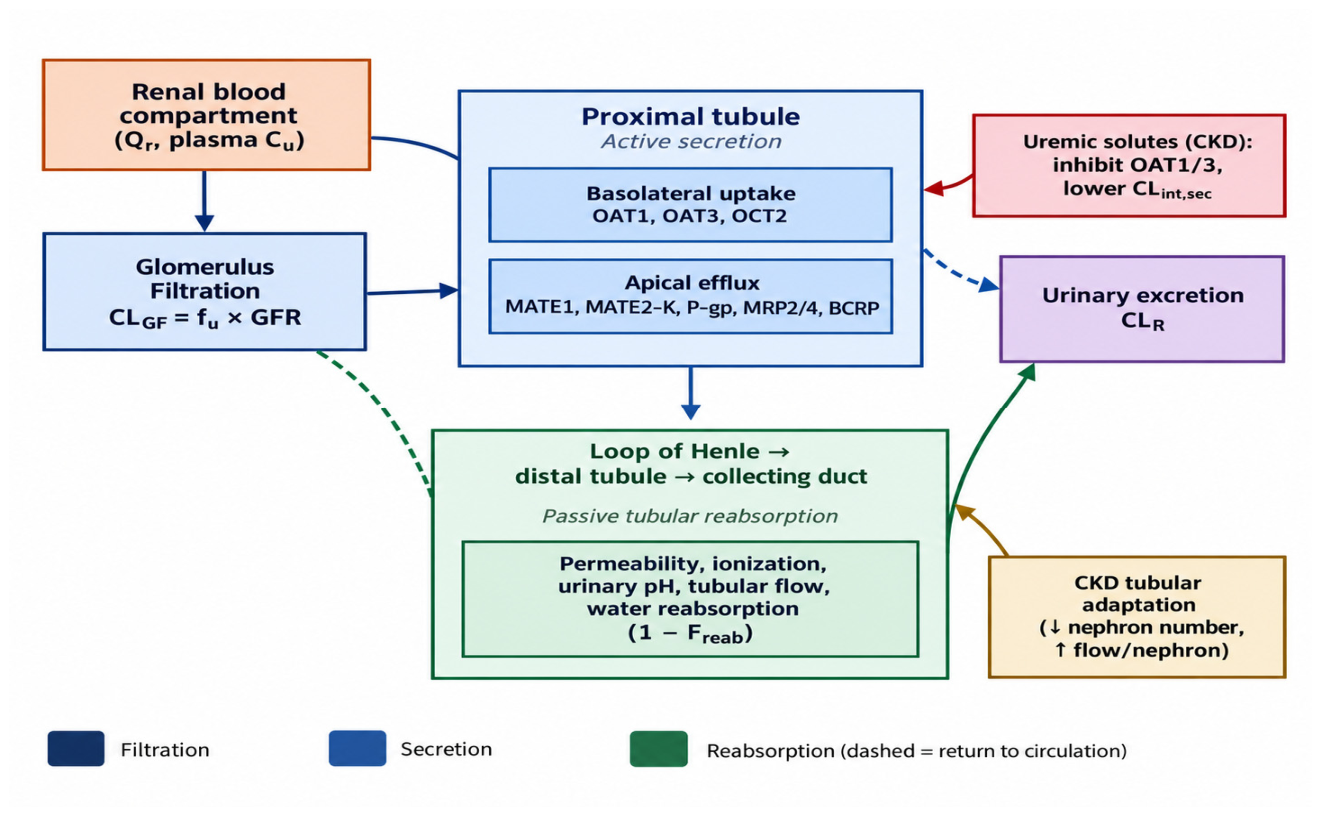
Figure 2.
Flow diagram rendering of the Table 3 decision framework.
Figure 2.
Flow diagram rendering of the Table 3 decision framework.
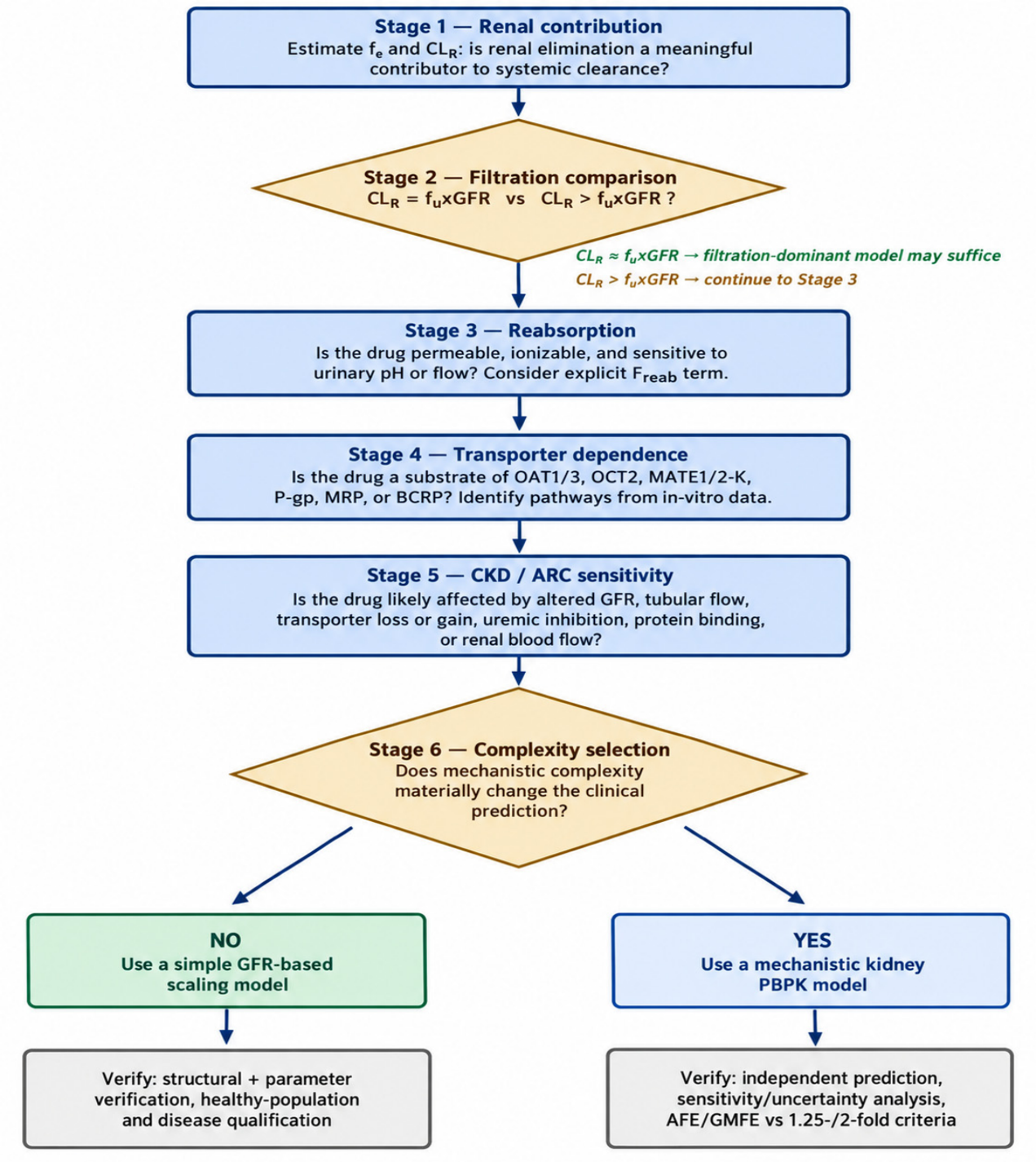
Table 1.
Mechanistic interpretation of the relationship between observed and filtration-predicted renal clearance.
Table 1.
Mechanistic interpretation of the relationship between observed and filtration-predicted renal clearance.
| Relationship | Mechanistic interpretation |
|---|---|
| CLR < fu × GFR | Net reabsorption is likely |
| CLR ≈ fu × GFR | Filtration may dominate |
| CLR > fu × GFR | Net active secretion is likely important |
Table 3.
A staged decision framework for selecting renal clearance model complexity (proposed framework).
Table 3.
A staged decision framework for selecting renal clearance model complexity (proposed framework).
| Stage | Question | Action |
|---|---|---|
| 1. Renal contribution | What fraction of clearance is renal (fe), and what is CLR? | Establish whether renal elimination is a meaningful contributor to systemic clearance |
| 2. Filtration comparison | Does CLR ≈ fu × GFR, or does CLR ≫ fu × GFR? | If approximately equal, a filtration-dominant model may suffice; if much greater, investigate active secretion |
| 3. Reabsorption | Is the drug permeable, ionizable, and sensitive to urinary pH or flow? | Consider explicit Freab term if physicochemical properties suggest reabsorption is plausible |
| 4. Transporter dependence | Is the drug a substrate of OAT1/3, OCT2, MATE1/2-K, P-gp, MRP, or BCRP? | Identify relevant transporter pathways from in-vitro data |
| 5. CKD / ARC sensitivity | Is the drug likely affected by altered GFR, tubular flow, transporter loss or gain, uremic inhibition, protein-binding changes, or renal blood flow? | Assess which disease-related mechanisms are plausible for this drug, in either direction |
| 6. Complexity selection | Does mechanistic complexity materially change the clinical prediction, against a pre-specified quantitative criterion? | Use a simple GFR-based model when adequate; use a mechanistic kidney PBPK model when it is not |
Disclaimer/Publisher’s Note: The statements, opinions and data contained in all publications are solely those of the individual author(s) and contributor(s) and not of MDPI and/or the editor(s). MDPI and/or the editor(s) disclaim responsibility for any injury to people or property resulting from any ideas, methods, instructions or products referred to in the content. |
© 2026 by the authors. Licensee MDPI, Basel, Switzerland. This article is an open access article distributed under the terms and conditions of the Creative Commons Attribution (CC BY) license (http://creativecommons.org/licenses/by/4.0/).
Copyright: This open access article is published under a Creative Commons CC BY 4.0 license, which permit the free download, distribution, and reuse, provided that the author and preprint are cited in any reuse.