
Submitted:
05 September 2026
Posted:
07 September 2026
You are already at the latest version
Abstract
Background: Clostridioides difficile infection (CDI) is an important healthcare-associated infection associated with substantial morbidity and mortality. This study aimed to characterize the clinical and epidemiological profile of hospitalized CDI patients and identify independent predictors of 90-day all-cause mortality. Methods: We conducted a retrospective observational study of adult patients with CDI admitted to a regional infectious diseases’ hospital in Galați, Romania, during 2024. CDI was defined according to ECDC criteria and diagnosed using a two-step laboratory algorithm. Clinical, epidemiological, and laboratory data were collected. Predictors of 90-day mortality were assessed using multivariable logistic regression. Results: Among 170 patients (median age, 70 years), 74.3% had an age-adjusted Charlson Comorbidity Index >5, and 49.4% had previous antibiotic exposure. Three patients died during hospitalization, while an additional 52 deaths occurred among 167 patients discharged alive. An ATLAS score >4 (adjusted OR, 3.96; 95% CI, 1.78–8.81; p = 0.001) and indwelling urinary catheter use (adjusted OR, 2.89; 95% CI, 1.13–7.35; p = 0.026) were independently associated with 90-day mortality. Conclusions: Ninety-day all-cause mortality was substantial. An ATLAS score >4 and indwelling urinary catheter use were independently associated with mortality, supporting early risk stratification and closer follow-up of high-risk patients.
Keywords:
Clostridioides difficile infection
; healthcare-associated infection
; epidemiological surveillance
; 90-day mortality
; Romania
1. Introduction
Healthcare-associated infections (HAIs) remain a major challenge for healthcare systems worldwide, contributing substantially to patient morbidity, mortality, and healthcare utilization. Despite considerable advances in infection prevention and control, the increasing complexity of medical care, population aging, the widespread use of antibiotics, and the growing burden of antimicrobial resistance have sustained HAIs as a major global public health concern. The World Health Organization (WHO) recognizes the prevention of healthcare-associated infections as a strategic priority for improving patient safety and reducing the global burden of nosocomial infections [1].
Within this context, Clostridioides difficile infection (CDI) is an important healthcare-associated infection associated with substantial morbidity, prolonged hospitalization, recurrence, and mortality. Although CDI has traditionally been considered predominantly hospital- and antibiotic-associated, epidemiological changes over recent decades have highlighted the contribution of community-associated infections and the need for continuous epidemiological surveillance [2,3,4]. Previous antibiotic exposure remains one of the major recognized risk factors for CDI, while advanced age and a high burden of comorbidities contribute to severe disease and adverse outcomes [3,4,5,6].
Recent advances have been accompanied by important conceptual changes in the classification and surveillance of CDI. The taxonomic reclassification of Clostridium difficile as Clostridioides difficile, the adoption of standardized epidemiological definitions for healthcare-associated and community-associated infection, and the refinement of the concept of recurrent CDI have contributed to a more consistent framework for epidemiological surveillance and clinical research [5,6,7,8]. Current expert recommendations further emphasize that, in the absence of molecular strain typing, clinically recurrent episodes should be classified as recurrent CDI (rCDI), whereas differentiation between relapse and reinfection should be reserved for molecular epidemiological investigations [7,8].
In Romania, CDI remains a major challenge for healthcare institutions, particularly in the context of high antibiotic consumption, an aging population, and the increasing prevalence of patients with multiple comorbidities. National surveillance data and recent Romanian studies indicate that CDI continues to be among the most frequently reported healthcare-associated infections, with an increasing incidence following the COVID-19 pandemic and a persistently high prevalence of prior antibiotic exposure among affected patients [9,10].
Although in-hospital mortality remains an important outcome in patients with CDI, it may underestimate the overall mortality burden, as it does not capture deaths occurring after discharge. Post-discharge mortality may be influenced by recurrent infection, persistent frailty, treatment-related complications, and decompensation of underlying comorbidities. Consequently, 90-day all-cause mortality provides a more comprehensive assessment of short-term prognosis and may better capture the clinical burden of CDI beyond the index hospitalization [6,11,12].
Accordingly, this study aimed to characterize the clinical and epidemiological profile of patients with CDI admitted to an infectious diseases’ hospital serving southeastern Romania and to identify independent predictors of 90-day all-cause mortality.
2. Materials and Methods
2.1. Study Design and Setting
We conducted a retrospective observational study at the “Sf. Cuv. Parascheva” Clinical Hospital of Infectious Diseases, Galați, Romania, a 160-bed specializing in infectious diseases’ regional hospital without an intensive care unit (ICU). The study included all eligible patients admitted to Infectious Diseases Clinical Department I between 1 January and 31 December 2024.
The study was approved by the hospital's Ethics Committee (Approval No. 50/23.07.2026).
2.2. Study Population
Patients were eligible if they were adults (≥18 years) admitted to the hospital during the study period, had a primary or secondary discharge diagnosis coded as ICD-10 A04.7 (Enterocolitis due to Clostridioides difficile), and fulfilled the predefined clinical and microbiological diagnostic criteria for CDI. Patients were included irrespective of sex, body weight, demographic characteristics, comorbidities, co-infections, concomitant medications, or previous vaccination status. These characteristics were recorded as clinical or epidemiological variables when available and were considered in the subsequent analyses.
Patients were excluded if they were younger than 18 years, did not fulfil the clinical and microbiological criteria for CDI, or lacked documented written informed consent authorizing the use of their personal data for research and medical education purposes, in accordance with institutional policies and local procedures (Figure 1).
2.3. Definitions
In the present study, the case definition for CDI was established in accordance with the current recommendations of the European Centre for Disease Prevention and Control (ECDC) and the U.S. Centers for Disease Control and Prevention (CDC) [Table 1].
Although the ECDC case definition accepts several laboratory methods for confirming Clostridioides difficile infection, in the present study all cases were laboratory-confirmed using a two-step diagnostic algorithm consisting of glutamate dehydrogenase (GDH) antigen detection followed by testing for toxins A/B in diarrheal stool specimens. Thus, all patients included in the final study cohort had CDI confirmed using this diagnostic algorithm.
CDI cases were classified according to the ECDC surveillance definitions as healthcare-associated (HA-CDI), community-associated (CA-CDI), or of unknown association (UA-CDI), based on the timing and location of symptom onset in relation to healthcare exposure. HA-CDI was defined as CDI with symptom onset on or after day 3 of hospitalization, or within four weeks after discharge from a healthcare facility, including cases presenting in the community or on days 1–2 of a subsequent hospitalization. CA-CDI was defined as CDI with symptom onset outside a healthcare facility and no discharge from a healthcare facility during the preceding 12 weeks, or onset on days 1–2 of hospitalization in a patient without residence in a healthcare facility during the preceding 12 weeks. Cases with symptom onset outside a healthcare facility 4–12 weeks after discharge, or onset on days 1–2 of hospitalization in patients with healthcare exposure 4–12 weeks earlier, were classified as having an unknown association, according to the ECDC criteria [5].
For the purposes of the present study, HA-CDI cases were further categorized according to the presumed healthcare setting of acquisition as external HA-CDI, when the relevant healthcare exposure occurred in another healthcare facility, and internal HA-CDI, when CDI was presumed to have been acquired during hospitalization at the study hospital. This study-specific subcategorization was based on the patient's documented hospitalization, transfer, and discharge history and was used to characterize the epidemiological setting of acquisition.
2.4. Data Collection
Data were retrospectively extracted from patients' medical records and the hospital electronic information system. Demographic, clinical, epidemiological, laboratory, and treatment-related data were collected for each episode of CDI.
Data on concomitant infections were collected from the medical records and included documented viral, bacterial, or fungal infections other than CDI identified during hospitalization. Patients could have more than one concomitant infection.
Indwelling urinary catheter (UC) use was recorded as a binary variable (yes/no) and defined as UC use throughout hospitalization for CDI.
The ATLAS score and the Age-adjusted Charlson Comorbidity Index (ACCI) were calculated for each patient using their respective validated methods [13,14]. The ATLAS score incorporates age, systemic antibiotic treatment, leukocyte count, serum albumin concentration, and serum creatinine concentration and was calculated using parameters recorded at CDI diagnosis to assess disease severity and prognosis [13]. The ACCI incorporates age and a weighted set of comorbid conditions and was used to quantify the baseline comorbidity burden and its prognostic impact on mortality [14,16,17,18].
All data were anonymized prior to analysis in accordance with institutional confidentiality requirements and applicable personal data protection regulations.
2.5. Study Outcome
The primary outcome was 90-day all-cause mortality, defined as death from any cause occurring during the index hospitalization or within 90 days after hospital admission for CDI. In-hospital deaths were therefore included in the 90-day mortality outcome. Vital status at day 90 was determined through review of hospital records and, when necessary, telephone follow-up.
Patients discharged alive were followed until day 90 after hospital admission to ascertain vital status. When vital status could not be established from available hospital records, telephone contact was attempted up to three times with the patient or, when necessary, a relative, solely to ascertain whether the patient was alive or deceased. Of the 191 eligible patients, three died during hospitalization, while 21 withdrew their informed consent and were excluded from the 90-day mortality analysis. Consequently, the final cohort for the 90-day mortality analysis consisted of 170 patients (Figure 1).
2.6. Statistical Analysis
Statistical analyses were performed using XLSTAT (version 4.5.2022; Addinsoft, Paris, France).
Categorical variables were summarized as frequencies and percentages, whereas continuous variables were expressed as mean ± standard deviation (SD) or median with interquartile range (IQR), as appropriate according to data distribution. Comparisons between categorical variables were performed using the chi-square test or Fisher's exact test, as appropriate.
Continuous variables were compared using Student's t-test or one-way analysis of variance (ANOVA), as appropriate. Correlations between continuous variables were assessed using Spearman's rank correlation coefficient.
Predictors of 90-day all-cause mortality were assessed using binary logistic regression. Variables showing an association with mortality in univariable analysis (p < 0.05), together with clinically relevant variables, were considered for inclusion in the multivariable model. To avoid redundancy, components of composite scores were not entered simultaneously with the corresponding composite score. Thus, albumin was not entered simultaneously with the ATLAS score, and individual comorbidities contributing to the Charlson score were not entered simultaneously with the Charlson score. Given the number of mortality events, the number of predictors included in the final multivariable model was limited to minimize the risk of overfitting. Results are presented as odds ratios (ORs) with 95% confidence intervals (95% CIs). Multivariable logistic regression was used to identify independent predictors of 90-day all-cause mortality. Adjusted odds ratios (ORs) with 95% confidence intervals (CIs) were reported. Model discrimination was assessed using the area under the receiver operating characteristic curve (AUC), with the 95% CI estimated using the DeLong method. All statistical tests were two-sided, and a p value < 0.05 was considered statistically significant.
3. Results
A total of 170 patients were included in the analysis.
3.1. Demographic Characteristics
Patient age ranged from 18 to 96 years, with a median age of 70 years (IQR, 60–78.5) and a mean age of 67.5 ± 15.18 years. The most represented age group was 67–77 years. Overall, 59.4% of patients were older than 65 years, while 28.6% were over 80 years of age.
The study population comprised 83 men (49.0%) and 87 women (51.0%).
Overall, 72.9% of patients (n = 124) were from urban areas, whereas 27.1% (n = 46) were from rural areas.
No significant difference in age was observed between male and female patients (p = 0.800). Similarly, no significant association was found between sex and place of residence.
The length of hospital stay ranged from 1 to 30 days, with a median of 7 days and a mean of 7.36 ± 3.42 days. Overall, 54.6% of patients were hospitalized for 1–5 days, 38.6% for 6–10 days, whereas 11 patients (6.5%) required hospitalization for more than 10 days.
3.2. Epidemiological Characteristics
Most patients were hospitalized with a first episode of ICI, whereas 26 patients (15.3%) presented with disease relapse.
Based on the epidemiological investigation, 66 cases (38.8%) were classified as community-associated CDI, 61 (35.9%) as external healthcare-associated CDI, and 18 (10.6%) as internal healthcare-associated CDI. In 41 cases (24.1%), the epidemiological association could not be reliably established, and these cases were classified as CDI of unknown association (UA-CDI).
The ACCI ranged from 0 to 13, with a median score of 5 and a mean score of 5.22 ± 2.90. Overall, 74.3% of patients had an ACCI score >5.
Comorbidities were stratified according to their prevalence. The most common comorbidities (prevalence >20%) were chronic cardiac disease (29.4%), diabetes mellitus (25.4%), solid malignancies (22.9%), and cerebrovascular disease (20.5%). Comorbidities with a prevalence of 10–20% included chronic liver disease (19.4%), chronic kidney disease (18.0%), and chronic pulmonary disease (10.5%). Connective tissue diseases (9.4%) and dementia (5.9%) showed intermediate prevalence (5–10%), whereas all remaining comorbidities were identified in fewer than 5% of patients (Figure 2).
3.3. Clinical Characteristics
The interval between symptom onset and hospital admission ranged from 1 to 30 days, with a median of 4 days and a mean of 6.4 days. Overall, 63.0% of patients were admitted within the first 7 days after symptom onset.
Disease severity was assessed according to stool frequency. The number of bowel movements ranged from 3 to 15 per day, with a median of 5 stools/day and a mean of 5.79 stools/day. Fever (>38°C) was documented in 16.0% of patients.
The most common risk factors potentially associated with gut microbiota disruption included age >65 years (59.4%), concomitant infections (55.8%), recent exposure to broad-spectrum antibiotics (49.4%), malignancy (27.1%), and indwelling UC use (16.4%).
Previous exposure to antibiotics before the CDI episode was reported in 84 patients (49.4%). The antibiotic classes previously received included cephalosporins (42.8%), penicillins (19.0%), fluoroquinolones (17.9%), systemic vancomycin (11.9%), and other classes (27.3%).
3.4. Concomitant Infections and MDR Colonization
Concomitant infections were identified in 95 patients (55.9%). Candidiasis was the most frequent (n = 83). Concomitant viral infections included COVID-19 (n = 3), influenza A (n = 1), influenza B (n = 1), HIV infection (n = 3), hepatitis C virus infection (n = 2), and hepatitis B virus infection (n = 6). Tuberculosis was present in two patients, including one with atypical tuberculosis. A total of 18 additional bacterial isolates were identified, including Escherichia coli (n = 5), Klebsiella pneumoniae (n = 5), Proteus spp. (n = 1), Salmonella spp. (n = 1), Acinetobacter baumannii (n = 1), Pseudomonas aeruginosa (n = 1), Streptococcus gallolyticus (n = 1), Streptococcus pyogenes (n = 1), Staphylococcus aureus (n = 1), and Enterococcus spp. (n = 1). Concomitant antibiotic therapy for infections other than CDI was administered to 41 patients (24.1%). Some patients had received more than one antibiotic class, resulting in percentages exceeding 100%.
Rectal screening for multidrug-resistant (MDR) organisms was performed in 22 patients transferred from other hospital departments or healthcare facilities. Positive screening results were obtained in 10 patients (45.5%), identifying MDR Escherichia coli (n = 4), MDR Klebsiella pneumoniae (n = 3), vancomycin-resistant Enterococcus (VRE; n = 1), and methicillin-resistant Staphylococcus aureus (MRSA; n = 1).
3.5. Disease Severity
Disease severity was assessed using the ATLAS score, which ranged from 0 to 9, with a median score of 3 and a mean score of 3.36 ± 1.73. According to the ATLAS classification, 20% of patients had mild disease (0–3 points), 52% had moderate disease (4–5 points), 26% had severe disease (6–7 points), and 2% had critical disease (8–10 points).
3.6. Clinical Management and In-Hospital Outcomes
Oral vancomycin was the standard antimicrobial therapy for CDI. Combination therapy with metronidazole was administered in 2.6% of patients.
Major complications during hospitalization included sepsis in seven patients (4.1%) and toxic megacolon in four patients (2.3%).
Three patients died during hospitalization, corresponding to an in-hospital mortality rate of 1.8%.
3.7. Ninety-Day Mortality and Its Predictors
Overall, the 90-day all-cause mortality rate was 32.4% (55/170). Among the 167 patients discharged alive, 52 (31.1%) died within 90 days after CDI diagnosis.
In univariate analysis, hospital-acquired CDI, indwelling urinary catheter use, underlying malignancy, dementia, and advanced chronic kidney disease were significantly associated with 90-day mortality (Table 2).
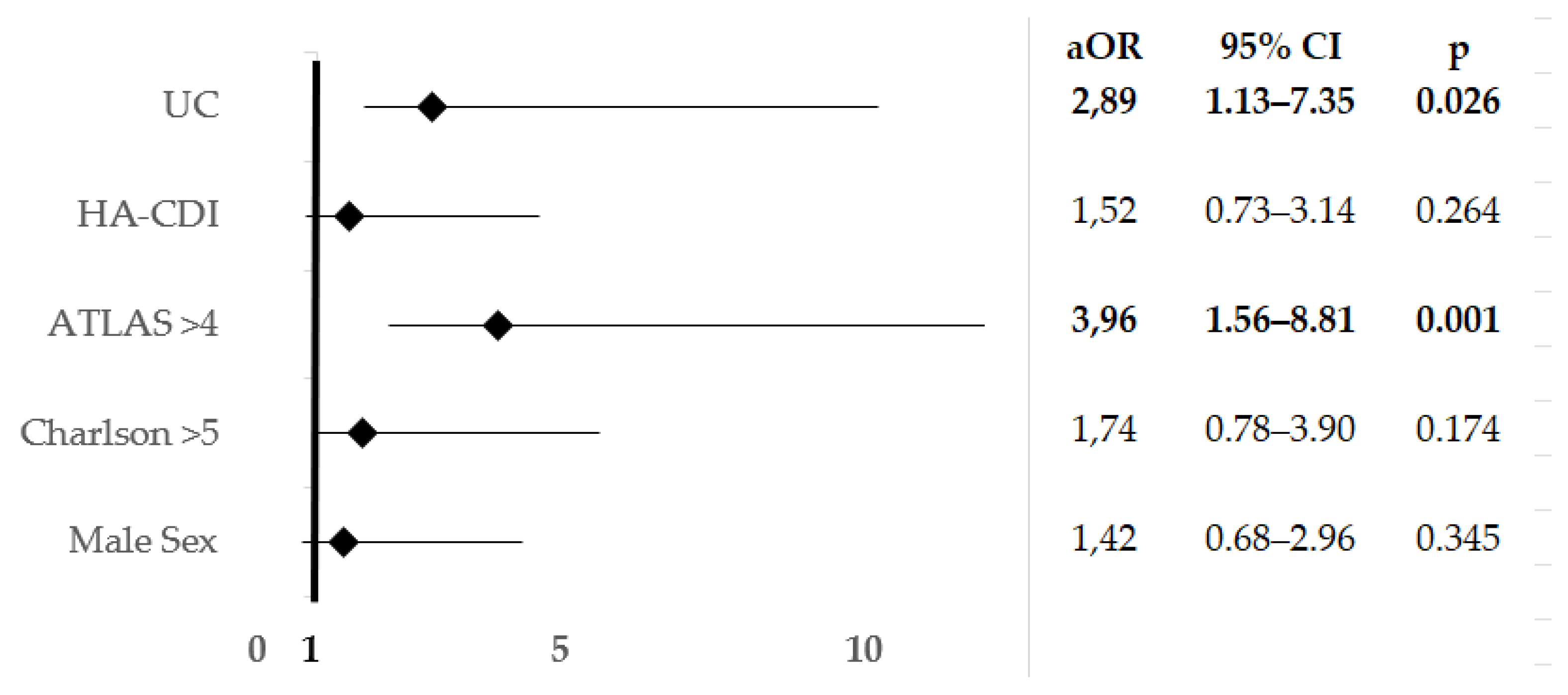
Multivariable logistic regression analysis identified an ATLAS score >4 and indwelling urinary catheter (UC) use as independent predictors of 90-day all-cause mortality (Figure 3).
Patients with an ATLAS score >4 had a more than threefold higher odds of death compared with those with lower scores (adjusted OR [aOR], 3.52; 95% CI, 1.56–7.95; p = 0.002). Indwelling UC use was also associated with an approximately threefold higher odds of 90-day mortality (aOR, 2.88; 95% CI, 1.12–7.37; p = 0.028). Charlson Comorbidity Index >5, healthcare-associated CDI, and male sex were not independently associated with 90-day mortality after adjustment.
The final multivariable model showed good discriminatory ability for 90-day mortality, with an area under the receiver operating characteristic curve (AUC) of 0.746 (95% CI, 0.664–0.828; DeLong method, p < 0.001).
4. Discussion
4.1. Principal Findings
In this retrospective observational study, we evaluated the clinical and epidemiological characteristics of hospitalized patients with CDI and investigated factors associated with 90-day all-cause mortality. Three principal findings emerged.
First, 90-day all-cause mortality was substantial, with 32.4% of patients dying within 90 days of hospital admission. Second, an ATLAS score >4 was independently associated with mortality, highlighting the prognostic importance of acute disease severity at presentation. Third, indwelling urinary catheter (UC) use was independently associated with mortality, suggesting that a readily identifiable marker of functional and clinical vulnerability may provide additional prognostic information.
The demographic and epidemiological characteristics of our cohort were consistent with the profile commonly described among hospitalized patients with CDI. The cohort was predominantly composed of older adults (median age, 70 years; 59.4% aged >65 years) and was characterized by a high burden of comorbidity, with 74.3% having an age-adjusted Charlson Comorbidity Index (ACCI) >5. Nearly half of the patients (49.4%) had a history of prior antibiotic exposure, most frequently involving cephalosporins and penicillins. These findings are consistent with the established epidemiology of CDI, in which advanced age, multimorbidity, and antimicrobial exposure represent important determinants of susceptibility and adverse outcomes.
The final multivariable model identified ATLAS >4 and indwelling UC use as independent predictors of 90-day all-cause mortality, whereas ACCI >5, healthcare-associated CDI, and sex were not independently associated with the outcome. The prognostic relevance of ATLAS is biologically plausible because the score integrates several parameters reflecting both acute disease severity and host vulnerability. In contrast, the lack of an independent association between ACCI >5 and mortality suggest that the prognostic information provided by global comorbidity burden may overlap with measures of acute illness and functional vulnerability. The final model demonstrated good discriminatory ability for 90-day mortality, with an AUC of 0.746 (95% CI, 0.664–0.828; DeLong test, p < 0.001).
4.2. Comparison with Previous Studies
The demographic characteristics of our cohort are broadly consistent with contemporary European epidemiological data. The predominance of older patients and the high burden of multimorbidity observed in our study are in line with findings from Germany, Spain, and Sweden, where CDI has been consistently associated with advanced age, frailty, and complex underlying disease [19,20,21]. The relatively high proportion of patients with previous antibiotic exposure, particularly to cephalosporins and penicillins, is also consistent with the established role of antimicrobial exposure in disrupting the intestinal microbiota and increasing susceptibility to CDI [22,23,24].
The 90-day all-cause mortality rate in our cohort was 32.4%, which appears higher than the approximately 15–25% reported in several previously published CDI cohorts [19]. However, comparisons between studies should be interpreted cautiously because mortality estimates are influenced by differences in patient characteristics, CDI severity, healthcare setting, case mix, and duration of follow-up. The relatively high mortality observed in our cohort may partly reflect the advanced age and substantial comorbidity burden of the study population. Differences in healthcare delivery and continuity of care after hospitalization may also contribute, although these factors could not be directly evaluated in our study.
The independent association between an ATLAS score >4 and 90-day mortality is consistent with previous studies evaluating prognostic models in CDI [26,27,28,29]. The ATLAS score combines age, systemic antibiotic treatment, leucocytosis, serum albumin, and serum creatinine, thereby incorporating parameters reflecting both acute clinical severity and host vulnerability. Previous investigations have demonstrated that ATLAS can discriminate patients at different levels of risk for severe outcomes, although its performance has varied according to the population, outcome definition, and clinical setting. In our cohort, an ATLAS score >4 was associated with approximately fourfold higher odds of 90-day all-cause mortality (aOR 3.96, 95% CI 1.78–8.81; p = 0.001). This finding suggests that the physiological impact of the acute CDI episode may provide important prognostic information extending beyond the immediate hospitalization.
Indwelling UC use also emerged as an independent predictor of 90-day mortality. This association is unlikely to indicate a direct causal effect of catheterization and may instead reflect underlying frailty, functional dependence, impaired mobility, greater severity of illness, or increased exposure to healthcare interventions. Patients requiring an indwelling UC may have reduced physiological reserve and a greater susceptibility to subsequent complications, potentially contributing to poorer outcomes. Similar associations between invasive device use and adverse outcomes have been reported in other hospitalized populations, supporting the interpretation of catheterization as a marker of overall clinical vulnerability [30,31,32,33,34]. Nevertheless, the observational design of our study precludes establishing a causal relationship between UC use and mortality.
Interestingly, ACCI >5 was not independently associated with 90-day mortality in the final multivariable model despite reflecting the substantial comorbidity burden of our cohort. This finding may indicate that the prognostic contribution of chronic comorbidities is partly captured by measures of acute disease severity and functional vulnerability. Importantly, however, this should not be interpreted as evidence that comorbidities are clinically irrelevant. Rather, their individual prognostic effects may overlap with other variables included in the model.
Albumin and dementia were associated with mortality in preliminary analyses but were not retained as individual predictors in the final model because albumin is a component of the ATLAS score and dementia contributes to the Charlson Comorbidity Index. Including these variables alongside their respective composite scores could result in redundancy and double counting of prognostic information. Therefore, the final model retained ATLAS and Charlson scores as composite measures.
4.3. Clinical Implications
Our findings emphasize the importance of assessing outcomes beyond hospital discharge in patients with CDI. Although only three patients died during hospitalization, an additional 52 deaths occurred during the subsequent 90-day follow-up, indicating that hospital mortality alone would substantially underestimate the mortality burden observed in this cohort. The high proportion of deaths occurring after discharge highlights the vulnerability of patients recovering from CDI and the potential contribution of recurrent infection, persistent disruption of the intestinal microbiota, functional decline, and decompensation of underlying chronic conditions to longer-term outcomes [21,35,36,37].
The identification of an ATLAS score >4 and indwelling UC use as independent predictors of 90-day mortality has potential implications for clinical risk stratification. Patients presenting with a high ATLAS score may benefit from closer monitoring during the acute episode and careful reassessment before discharge. Similarly, the presence of an indwelling UC may help identify patients with greater functional or clinical vulnerability who could require enhanced surveillance and coordinated follow-up after discharge. In this context, catheter necessity should be regularly reassessed, with removal whenever clinically appropriate, although our observational findings do not establish that catheter removal itself would reduce mortality.
The substantial proportion of deaths occurring after discharge also supports a broader approach to CDI management that extends beyond treatment of the acute infection. Structured follow-up of high-risk patients, early recognition of recurrence, optimization of comorbid conditions, appropriate antimicrobial use, and measures aimed at reducing avoidable healthcare-associated complications may be relevant components of post-discharge care [38,39,40,41,42,43,44,45]. These strategies may be particularly important in settings where elderly and multimorbid patients are discharged with persistent functional limitations or a high need for healthcare support.
4.4. Strengths of the Study
The present study has several strengths. First, CDI cases were diagnosed using a standardized two-step laboratory algorithm within a single institution, thereby minimizing diagnostic heterogeneity. Second, the study included systematic 90-day follow-up after hospital admission, allowing assessment of mortality beyond the index hospitalization and capturing clinically relevant outcomes that may be missed when only in-hospital mortality is considered. Third, the availability of detailed clinical and epidemiological data allowed simultaneous assessment of acute disease severity, comorbidity burden, healthcare-associated factors, and markers of functional vulnerability. Finally, the multivariable analysis incorporated clinically relevant predictors while avoiding redundancy between individual variables and composite scores, such as albumin and ATLAS or dementia and ACCI.
4.5. Limitations
This study has several limitations that should be considered when interpreting the findings. First, the retrospective, single-center design limits the ability to establish causal relationships and may restrict the generalizability of the findings. In addition, 24 of the 191 initially eligible patients (12.6%) were lost to 90-day follow-up and were therefore excluded from the final analysis. Because baseline characteristics of these patients were not available for comparison with those who completed follow-up, the possibility of selection or attrition bias cannot be excluded. Consequently, the observed 90-day mortality rate and the estimated associations may not fully represent the entire eligible cohort. Although the final multivariable model included five predictors and 55 outcome events, the relatively limited sample size may have reduced the precision of some estimates and the ability to detect weaker associations. External validation in larger cohorts is therefore warranted.
Second, the primary outcome was 90-day all-cause mortality rather than CDI-attributable mortality. Consequently, the study cannot determine the extent to which individual deaths were directly related to CDI or to the progression of underlying diseases and comorbid conditions.
Third, molecular strain typing was not performed. Therefore, among patients with recurrent CDI, relapse could not be reliably distinguished from reinfection. This limitation may have restricted our ability to assess the relationship between recurrence and longer-term mortality.
Fourth, the study was conducted at a single regional infectious diseases hospital in Romania. Differences in patient case mix, CDI management, antimicrobial stewardship practices, discharge planning, and access to post-discharge care may limit the generalizability of our findings to other hospitals and healthcare settings.
Finally, although the final multivariable model demonstrated good discriminatory ability (AUC 0.746, 95% CI 0.664–0.828), its calibration and clinical utility were not formally evaluated. Therefore, the combination of ATLAS score and indwelling urinary catheter use should be considered a potentially useful prognostic approach rather than a validated clinical prediction tool until externally validated in larger, independent cohorts.
4.6. Future Research
Prospective multicentre studies involving larger and more diverse patient populations are needed to externally validate the prognostic value of an ATLAS score >4 and indwelling urinary catheter use for 90-day mortality in patients with CDI. Future studies should also evaluate model calibration and clinical utility to determine whether these variables can be integrated into a reliable clinical risk-stratification approach.
Further research should distinguish between all-cause and CDI-attributable mortality and systematically assess causes of death during follow-up. Molecular strain typing would also be valuable for differentiating relapse from reinfection among patients with recurrent CDI and for clarifying their respective contributions to longer-term outcomes.
Finally, interventional studies should evaluate potentially modifiable factors identified through observational research. Studies assessing structured post-discharge follow-up, early recognition and management of recurrent CDI, and systematic reassessment of the need for indwelling urinary catheters could determine whether these strategies improve longer-term outcomes. Such studies would help establish whether the associations observed in the present study represent clinically modifiable risk factors rather than markers of underlying patient vulnerability.
5. Conclusions
In this Romanian cohort of hospitalized patients with Clostridioides difficile infection, 90-day all-cause mortality was substantial. An ATLAS score >4 and indwelling urinary catheter use were independently associated with 90-day mortality, whereas a high comorbidity burden, as assessed by the ACCI, and healthcare-associated CDI were not independently associated with the outcome after adjustment. These findings suggest that acute disease severity and markers of clinical and functional vulnerability may provide important prognostic information beyond baseline comorbidity burden. Early risk stratification using readily available clinical variables and closer follow-up of patients at increased risk may help identify individuals who require enhanced clinical surveillance. Further prospective multicenter studies are needed to externally validate these findings and determine whether targeted interventions addressing modifiable factors, including unnecessary urinary catheter use and post-discharge care, can improve outcomes.
Author Contributions
Conceptualization, P.N. and M.A.; methodology, M.A., P.N., and G-V.P.; software, and A-V.I., and A.P-C.; validation, G-V.P., and M-N.M.; formal analysis, M.A., P.N., and A.P-C., and M-N.M.; investigation, M.A., A-V-I., P.N., and G-V.P.; resources, G-V.P. and M-N.M.; data curation, A-V.I., and A.P-C.; writing—original draft preparation, P.N., M.A., A-V.I., G-V.P, M-N.M; and A.P-C.; writing—review and editing, M.A., and P.N.; visualization, M.A., P.N., A-V.I., G-V.P, M-N.M., and A.P-C.; supervision, M.A.; project administration, P.N., and G-V.P. All authors have read and agreed to the published version of the manuscript.
Funding
This research received no external funding.
Institutional Review Board Statement
The study was conducted in accordance with the Declaration of Helsinki and approved by the Ethics Committee of Infectious Diseases Clinic Hospital “Sf. Cuv. Parascheva” Galati No 50/23.07.2026 for studies involving humans.
Informed Consent Statement
Informed consent was obtained from all subjects involved in the study.
Data Availability Statement
The data supporting the findings of this study are presented within the article. Individual participant data are not publicly available due to privacy and ethical restrictions. Additional information may be obtained from the corresponding author upon reasonable request.
Acknowledgments
The authors acknowledge the financial support provided by “Dunărea de Jos” University of Galați for the Article Processing Charge (APC) of this publication. The authors have reviewed and edited the output and take full responsibility for the content of this publication.
Conflicts of Interest
The authors declare no conflicts of interest.
Abbreviations
The following abbreviations are used in this manuscript:
| ACCI | Age-adjusted Charlson Comorbidity Index |
| CDI | Clostridioides difficile infection |
| CA-CDI | community-associated Clostridioides difficile infection |
| CHF | Chronic Heart Faillure |
| CKD | Chronic Kidney Disease |
| CLD | Chronic Liver Disease |
| CPD | Chronic Pulmonary Disease |
| CTD | Connective tissue disease |
| CVA/TIA | History of a cerebrovascular |
| DM | Diabetes Mellitus |
| ECDC | European Centre for Disease Prevention and Control |
| HA-CDI | Healthcare-associated Clostridioides difficile infection |
| HAIs | Health care-associated infections |
| MDR | Multidrug-resistant |
| MI | Myocardial Infarction |
| OR | odds ratios |
| PVD | Peripheral vascular disease |
| rCDI | Clostridioides difficile infection |
| U-CAT | Urinary catheter |
| VIF | variance inflation factor |
| WHO | World Health Organization |
References
- World Health Organization. Global report on infection prevention and control; WHO: Geneva, 2024. [Google Scholar]
- European Centre for Disease Prevention and Control. Clostridioides difficile infections – Annual Epidemiological Report 2018–2020; ECDC: Stockholm, 2024. [Google Scholar]
- Guh, A.Y.; McDonald, L.C. Changes in the Epidemiology of Clostridioides difficile Infection. Infect. Dis. Clin. North Am. 2025, 39(4), 567–580. [Google Scholar] [CrossRef] [PubMed]
- Smits, W.K.; Garey, K.W.; Riley, T.V.; Han, Y.W.; Young, V.B.; Heritage, J.; Lillis, C.J.; Lyras, D.; Rupnik, M.; Johnson, S. Clostridioides difficile should be considered a bacterial priority pathogen. Lancet Microbe 2025, 6(11), 101184. [Google Scholar] [CrossRef] [PubMed]
- European Centre for Disease Prevention and Control. European Surveillance of Clostridioides (Clostridium) difficile infections. Surveillance protocol version 2.4; ECDC: Stockholm, 2019; Available online: https://www.ecdc.europa.eu/sites/default/files/documents/clostridium-difficile-infections-EU-surveillance-protocol-vers2.4.pdf.
- Johnson, S.; Lavergne, V.; Skinner, A.M.; et al. Clinical Practice Guideline by the Infectious Diseases Society of America (IDSA) and Society for Healthcare Epidemiology of America (SHEA): 2021 Focused Update Guidelines on Management of Clostridioides difficile Infection in Adults. Clin. Infect. Dis. 2021, 73, e1029–e1044. [Google Scholar] [CrossRef] [PubMed]
- Fischer, M.; Vaughn, B.P.; Peery, A.F.; Kelly, C.R. AGA Clinical Practice Update on Management of Clostridioides difficile Infection in Adults: Expert Review. Clin. Gastroenterol. Hepatol. 2026. [Google Scholar] [CrossRef] [PubMed]
- Allegretti, J.R.; Pardi, D.S. When Does Clostridioides difficile "Recur"? Reconciling Epidemiologic and Bedside Definitions of Recurrent CDI. J. Infect. Dis. 2026. [Google Scholar] [CrossRef] [PubMed]
- Vasile, C.-C.; Gheorghe, L.-A.; Chivu, C.-D.; Anghel, M.A.M.; Mîinea, Ș.E.; Pițigoi, D.; Crăciun, M.-D. Clostridioides difficile Infections and Antibiotherapy: Results of Four Years of Observation in a Romanian Tertiary Hospital. Microorganisms 2024, 12(12), 2490. [Google Scholar] [CrossRef] [PubMed]
- European Centre for Disease Prevention and Control. Point prevalence survey of healthcareassociated infections and antimicrobial use in European acute care hospitals; ECDC: Stockholm, 2024; Available online: https://www.ecdc.europa.eu/sites/default/files/documents/healthcare-associated-point-prevalence-survey-acute-care-hospitals-2022-2023.pdf.
- Czepiel, J.; Krutova, M.; Mizrahi, A.; et al. Mortality Following Clostridioides difficile Infection in Europe: A Retrospective Multicenter Case-Control Study. Antibiotics 2021, 10(3), 299. [Google Scholar] [CrossRef] [PubMed]
- van Prehn, J.; Reigadas, E.; Vogelzang, E.H.; et al. Guideline Committee of the European Study Group on Clostridioides difficile. European Society of Clinical Microbiology and Infectious Diseases: 2021 update on the treatment guidance document for Clostridioides difficile infection in adults. Clin. Microbiol. Infect. 2021, 27 Suppl 2, S1–S21. [Google Scholar] [CrossRef] [PubMed]
- Miller, M.A.; Louie, T.; Mullane, K.; Weiss, K.; Lentnek, A.; Golan, Y.; Kean, Y.; Sears, P. Derivation and validation of a simple clinical bedside score (ATLAS) for Clostridium difficile infection which predicts response to therapy. BMC Infect. Dis. 2013, 13, 148. [Google Scholar] [CrossRef] [PubMed] [PubMed Central]
- Charlson, M.E.; Pompei, P.; Ales, K.L.; MacKenzie, C.R. A new method of classifying prognostic comorbidity in longitudinal studies: development and validation. J. Chronic Dis. 1987, 40(5), 373–383. [Google Scholar] [CrossRef] [PubMed]
- Charlson Comorbidity Index (CCI). MDCalc. Available online: https://www.mdcalc.com/calc/3917/charlson-comorbidity-index-cci (accessed on 26 April 2025).
- Madden, G.R.; Petri WAJr Costa, D.V.S.; Warren, C.A.; Ma, J.Z.; Sifri, C.D. Validation of Clinical Risk Models for Clostridioides difficile-Attributable Outcomes. Antimicrob. Agents Chemother. Epub 2022 Jun 21. 2022, 66(7), e0067622. [Google Scholar] [CrossRef] [PubMed] [PubMed Central]
- Turner, N.A.; Shelton, B.; Smith, B.A.; Crane, L.; Padgette, P.; Roach, L.; Wood, B.; Alame, D.; Anderson, D.J. Epidemiologic validation of the National Healthcare Safety Network's updated Clostridioides difficile test method definition. Infect. Control Hosp. Epidemiol. 2025, 46(8), 845–848. [Google Scholar] [CrossRef] [PubMed]
- Furtado, L. Risk Stratification and Mortality in Clostridioides difficile Infection: Clinical Determinants and Prognostic Assessment. Acta Microbiol. Hell. 2026, 71(1), 7. [Google Scholar] [CrossRef]
- Rohde, A.M.; Kern, W.V.; Behnke, M.; et al. All-cause mortality and risk factors for death in patients with Clostridioides difficile infections: a prospective multi-centre cohort study in six German university hospitals, 2016-2020. J. Hosp. Infect. 2026, 171, 79–87. [Google Scholar] [CrossRef] [PubMed]
- Fernandez-Cotarelo, M.J.; Henriquez-Camacho, C.; Hernandez-Barrera, V.; Gil-de-Miguel, A. Characteristics, temporal trends and outcomes of Clostridioides difficile infection among hospitalized patients in Spain , 2016-2022. BMC Infect. Dis. Published online. 2026. [Google Scholar] [CrossRef] [PubMed]
- Boven, A.; Simin, J.; Andersson, F.L.; et al. Clostridioides difficile infection, recurrence and the associated healthcare consumption in Sweden between 2006 and 2019: a population-based cohort study. BMC Infect. Dis. 2024, 24(1), 468. [Google Scholar] [CrossRef] [PubMed]
- Ding, W.; Cheng, Y.; Liu, X.; et al. Harnessing the human gut microbiota: an emerging frontier in combatting multidrug-resistant bacteria. Front Immunol. 2025, 16, 1563450. [Google Scholar] [CrossRef] [PubMed]
- Dongre, D.S.; Saha, U.B.; Saroj, S.D. Exploring the role of gut microbiota in antibiotic resistance and prevention. Ann. Med. 2025, 57(1), 2478317. [Google Scholar] [CrossRef] [PubMed]
- Müller, K.; Gillard, J.; Typas, A.; Knopp, M.; Goemans, C.V. Antibiotic-induced gut microbiome dysbiosis: risks and strategies for mitigation. EMBO J. 2026, 45(11), 3642–3654. [Google Scholar] [CrossRef] [PubMed]
- Garcia-Carretero, R.; Vazquez-Gomez, O.; Rodriguez-Maya, B.; Gil-Prieto, R.; Gil-de-Miguel, A. Risk Factors for Recurrence and In-Hospital Mortality in Patients with Clostridioides difficile: A Nationwide Study. J. Clin. Med. 2025, 14(14), 4907. [Google Scholar] [CrossRef] [PubMed]
- Wei, Q.; Cai, Y.; Lu, G.; et al. Prediction models for recurrence and mortality in patients with Clostridioides difficile infection: a systematic review and meta-analysis. J. Hosp. Infect. 2026, 173, 93–110. [Google Scholar] [CrossRef] [PubMed]
- Carvalho, F.A.C.; Silva, R.O.S.; Santos, B.M.R.T.; Diniz, A.N.; Vilela, E.G. Clinical outcome and severity of Clostridioides (Clostridium) difficile infection at a tertiary referral hospital in Brazil. Arq. Gastroenterol. 2023, 60(3), 330–338. [Google Scholar] [CrossRef] [PubMed]
- Tijerina-Rodríguez, L.; Garza-González, E.; Martínez-Meléndez, A.; et al. Clinical characteristics associated with the severity of Clostridium [Clostridioides] difficile infection in a tertiary teaching hospital from Mexico. BioMed J. 2022, 45(1), 200–205. [Google Scholar] [CrossRef] [PubMed]
- Bishop, E.J.; Tiruvoipati, R. Management of Clostridioides difficile infection in adults and challenges in clinical practice: review and comparison of current IDSA/SHEA, ESCMID and ASID guidelines. J. Antimicrob. Chemother. 2022, 78(1), 21–30. [Google Scholar] [CrossRef] [PubMed]
- Rosenbæk, J.B.; Erikstrup, L.T.; Hvas, C.L.; Damsgaard, E.M.S. Frailty level at discharge predicts mortality in older patients with Clostridioides difficile more accurately than age or disease severity. Eur. Geriatr. Med. 2023, 14(3), 583–593. [Google Scholar] [CrossRef] [PubMed]
- Šuljagić, V.; Milenković, B.; PerićA; et al. Healthcare associated Clostridioides difficile infection in adult surgical and medical patients hospitalized in tertiary hospital in Belgrade, Serbia: a seven years prospective cohort study. Libyan J. Med. 2020, 15(1), 1708639. [Google Scholar] [CrossRef] [PubMed]
- Alizai, Q.; Chatzipanagiotou, O.P.; Charalampous, C.M.; et al. Predictors, timing, and outcomes of Clostridium difficile infection following liver and pancreatic resection. HPB 2026, 28(7), 908–917. [Google Scholar] [CrossRef] [PubMed]
- Deckey, D.G.; Boddu, S.P.; Verhey, J.T.; et al. Clostridium difficile Infection Prior to Total Hip Arthroplasty Independently Increases the Risk of Periprosthetic Joint Infection. J. Arthroplast. 2024, 39((9) Suppl 2, S444–S448.e1. [Google Scholar] [CrossRef] [PubMed]
- Douglas, S.J.; Remily, E.A.; Sax, O.C.; et al. THAs Performed Within 6 Months of Clostridioides difficile Infection Are Associated with Increased Risk of 90-Day Complications. Clin. Orthop. Relat. Res. 2021, 479(12), 2704–2711. [Google Scholar] [CrossRef] [PubMed]
- Herrera, G.; Arboleda, J.C.; Pérez-Jaramillo, J.E.; Patarroyo, M.A.; Ramírez, J.D.; Muñoz, M. Microbial Interdomain Interactions Delineate the Disruptive Intestinal Homeostasis in Clostridioides difficile Infection. Microbiol. Spectr. 2022, 10(5), e0050222. [Google Scholar] [CrossRef] [PubMed]
- Silva, S.Y.; Wilson, B.M.; Donskey, C.J. Effect of the ribotype 027 strain on Clostridioides difficile infection outcomes and recurrence in the Veterans Affairs healthcare system: a propensity scores matching study. BMC Infect. Dis. Published online. 2026. [Google Scholar] [CrossRef] [PubMed]
- Robertson, C.; Pan, J.; Kavanagh, K.; et al. Cost burden of Clostridioides difficile infection to the health service: A retrospective cohort study in Scotland. J. Hosp. Infect. 2020, 106(3), 554–561. [Google Scholar] [CrossRef] [PubMed]
- Kinzler, A.; Durst, M.; Dixon, H.; Yassin, M. A Clostridioides difficile active surveillance program to identify positive high-risk patients on admit. Am. J. Infect. Control. 2026, 54(8), 902–906. [Google Scholar] [CrossRef] [PubMed]
- Williams, M.D.; Bridges, A.; Coppin, J.D.; et al. Copper (Cu) for Reducing Environmental Healthcare Associated Infections (CuRE HAI): A 10-year pragmatic copper surface implementation study. Am. J. Infect. Control. 2026, 54(8), 866–872. [Google Scholar] [CrossRef] [PubMed]
- Collins, D.A.; Riley, T.V. Ridinilazole: a novel, narrow-spectrum antimicrobial agent targeting Clostridium (Clostridioides) difficile. Lett. Appl. Microbiol. 2022, 75(3), 526–536. [Google Scholar] [CrossRef] [PubMed]
- Okhuysen, P.C.; Ramesh, M.S.; Louie, T.; et al. A Randomized, Double-Blind, Phase 3 Safety and Efficacy Study of Ridinilazole Versus Vancomycin for Treatment of Clostridioides difficile Infection: Clinical Outcomes With Microbiome and Metabolome Correlates of Response. Clin. Infect. Dis. 2024, 78(6), 1462–1472. [Google Scholar] [CrossRef] [PubMed]
- Prosty, C.; Carignan, A.; Chan, A.K.; et al. Secondary Prophylaxis of Recurrent Clostridioides difficile Infections During Systemic Antibiotics with Vancomycin (SPORES-V): study protocol for a randomized controlled trial. Trials 2026. [Google Scholar] [CrossRef] [PubMed]
- Awan, A.R.; Ijaz, M.; Ayyazuddin, M.; et al. Association between Proton Pump Inhibitor and Clostridioides Difficile risk in ICU patients: A systematic review and meta-analysis of clinical outcomes. Dig. Dis. 2026. [Google Scholar] [CrossRef] [PubMed]
- Baek, J.E.; Choi, I.H.; Cho, Y.W.; et al. Clinical characteristics and outcomes of Clostridioides difficile infection in the intensive care unit: a KASID multi-centre study. J. Hosp. Infect. 2023, 139, 106–112. [Google Scholar] [CrossRef] [PubMed]
- Nashtar, M.A.; Garipoglu, G.; Traut, I.; Canbay, A.; Katsounas, A. From ward to intensive care unit: clinical drivers of adverse outcomes in Clostridioides difficile infection - A retrospective cohort study. J. Hosp. Infect. 2026, 170, 209–217. [Google Scholar] [CrossRef] [PubMed]
Figure 1.
Flow Diagram of the study.
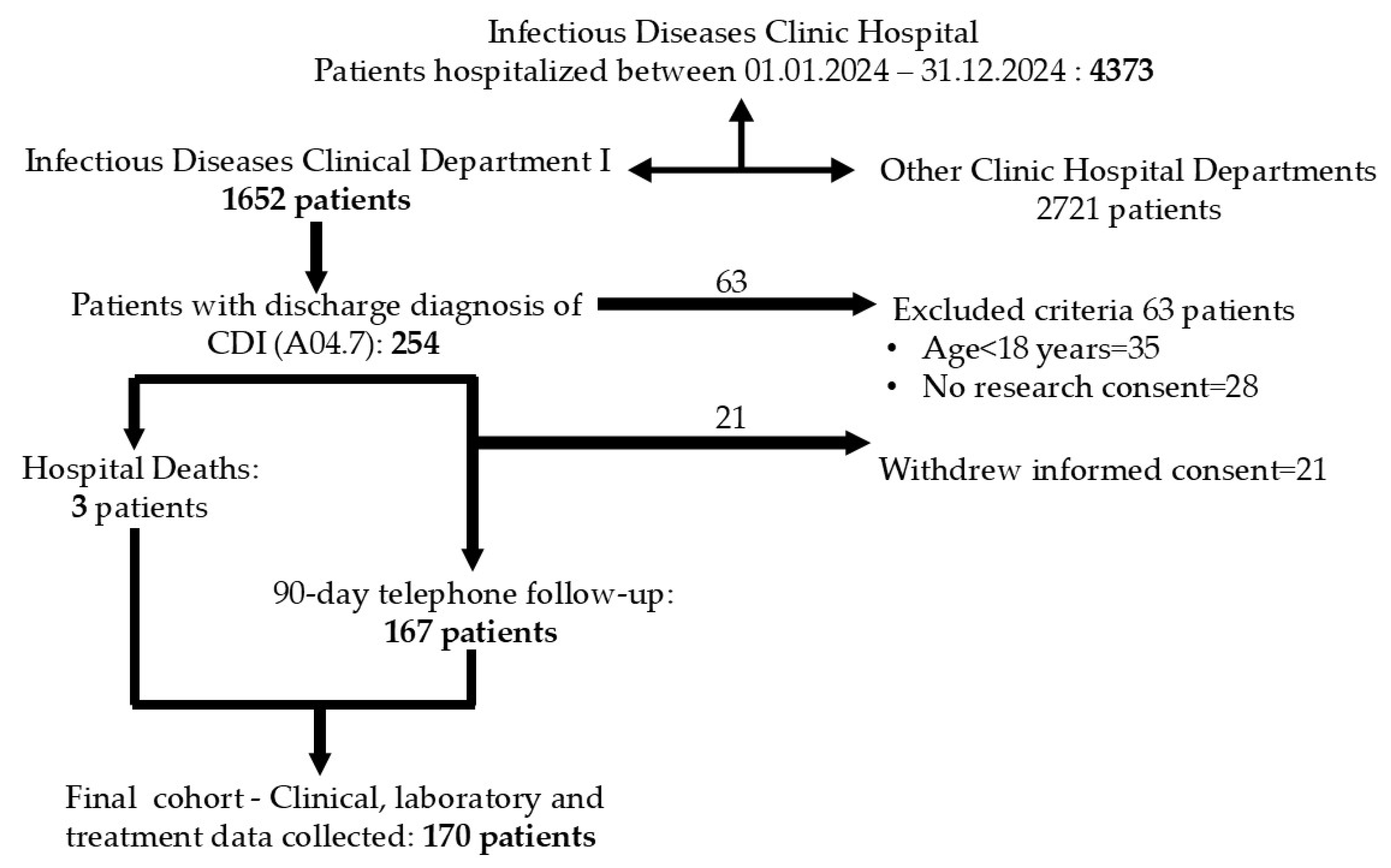
Figure 2.
Prevalence of comorbidities included in the ACCI. Legend: CHF- Chronic Heart Failure; MI: Myocardial Infarction; PVD: Peripheral vascular disease; CVA/TIA: History of a cerebrovascular accident with minor or no residua and transient ischemic attacks; CPD: Chronic Pulmonary Disease; CTD: Connective tissue disease; CLD: Chronic Liver Disease; DM: Diabetes Mellitus; CKD: Chronic Kidney Disease; AIDS: Acquired Immunosuppression Diseases Syndrome.
Figure 2.
Prevalence of comorbidities included in the ACCI. Legend: CHF- Chronic Heart Failure; MI: Myocardial Infarction; PVD: Peripheral vascular disease; CVA/TIA: History of a cerebrovascular accident with minor or no residua and transient ischemic attacks; CPD: Chronic Pulmonary Disease; CTD: Connective tissue disease; CLD: Chronic Liver Disease; DM: Diabetes Mellitus; CKD: Chronic Kidney Disease; AIDS: Acquired Immunosuppression Diseases Syndrome.
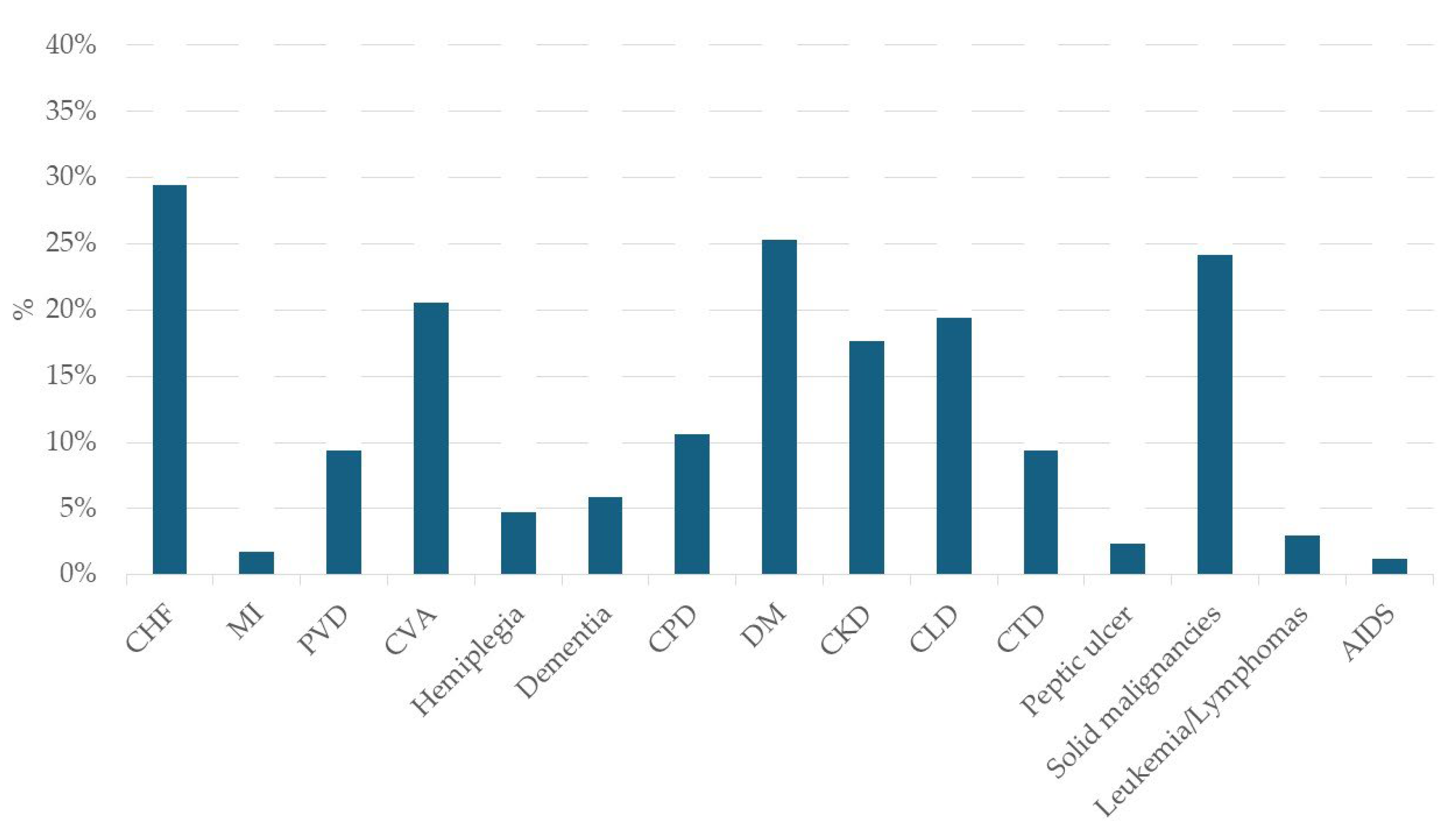
Figure 3.
Multivariable logistic regression analysis identifying independent predictors of 90-day all-cause mortality in patients with Clostridioides difficile infection. Legend: CI: confidence interval; aOR: Adjusted Odds ratio; HA-CDI: healthcare associated Clostridioides difficile infection; UC: Indwelling Urinary Catheter use. Forest plot showing adjusted odds ratios (aORs) with 95% confidence intervals derived from the multivariable logistic regression model. The vertical dashed line represents an odds ratio of 1. Variables with confidence intervals not crossing 1 were considered independent predictors of 90-day all-cause mortality.
Figure 3.
Multivariable logistic regression analysis identifying independent predictors of 90-day all-cause mortality in patients with Clostridioides difficile infection. Legend: CI: confidence interval; aOR: Adjusted Odds ratio; HA-CDI: healthcare associated Clostridioides difficile infection; UC: Indwelling Urinary Catheter use. Forest plot showing adjusted odds ratios (aORs) with 95% confidence intervals derived from the multivariable logistic regression model. The vertical dashed line represents an odds ratio of 1. Variables with confidence intervals not crossing 1 were considered independent predictors of 90-day all-cause mortality.

| Clinical criteria | At least one of the following criteria | |
|---|---|---|
|
AND |
1. Detection of Clostridioides difficile in stool using a two-step algorithm based on RICTs) for GDH Ag, followed by testing for toxins A/B; 2.Endoscopic or intraoperative evidence of pseudomembranous colitis; 3.Histopathological confirmation of pseudomembranous colitis based on biopsy specimens, surgical, or post-mortem examination. |
Legend:Ag: antigen; GDH: glutamate dehydrogenase; RICT: rapid immunochromatographic test.
Table 2.
Univariable analysis of factors associated with 90-day mortality in patients with CDI.
| Survivors | 90d_Deaths | OR | 95% CI | P* | ||
|---|---|---|---|---|---|---|
| Sex | Male | 50 | 32 | 0.55 | 0,28; 1.05 | 0,102 |
| Female | 65 | 23 | ||||
| Living | Urban | 83 | 41 | 1.12 | 0.54;2.34 | 0.895 |
| Rural | 32 | 14 | ||||
| CHF | Yes | 29 | 21 | 1.83 | 0.92; 3.62 | 0.122 |
| No | 86 | 34 | ||||
| CVD | Yes | 21 | 14 | 1.52 | 0.71;5.48 | 0.375 |
| No | 94 | 41 | ||||
| Diabetes | Yes | 25 | 20 | 2. 53 | 1.17;4.13 | 0.069 |
| No | 90 | 39 | ||||
| CKD | Yes | 16 | 16 | 2.53 | 1.17;5.48 | 0.034 |
| No | 99 | 37 | ||||
| Dementia | Yes | 3 | 7 | 5.44 | 1,53; 19.31 | 0.027 |
| No | 112 | 48 | ||||
| Malignancy | Yes | 29 | 22 | 1.97 | 1,00; 3.89 | 0.075 |
| No | 86 | 33 | ||||
| Albumin | >3 | 81 | 26 | 2.65 | 1.38;5.11 | 0.006 |
| ≤3 | 34 | 29 | ||||
| HA-CDI | Yes | 47 | 33 | 2.17 | 1.13;4.15 | 0.029 |
| No | 68 | 22 | ||||
| UC | Yes | 11 | 16 | 3.87 | 1.71; 8.76 | 0.003 |
| No | 104 | 39 | ||||
| Charlson score | >5 | 57 | 42 | 3.28 | 1.62; 6.64 | 0.001 |
| ≤5 | 58 | 13 | ||||
| ATLAS score | >4 | 17 | 26 | 5.16 | 2.55; 10.47 | <0.001 |
| ≤4 | 98 | 29 |
Legend: *P values were calculated using Fisher's exact test; CI: confidence interval; OR: Odds ratio; CHF: chronic heart failure; CKD: chronic kidney disease; CVD: cerebral vascular disease; HA-CDI: healthcare associated Clostridioides difficile infection; UC: indwelling urinary catheter.
Disclaimer/Publisher’s Note: The statements, opinions and data contained in all publications are solely those of the individual author(s) and contributor(s) and not of MDPI and/or the editor(s). MDPI and/or the editor(s) disclaim responsibility for any injury to people or property resulting from any ideas, methods, instructions or products referred to in the content. |
© 2026 by the authors. Licensee MDPI, Basel, Switzerland. This article is an open access article distributed under the terms and conditions of the Creative Commons Attribution (CC BY) license (http://creativecommons.org/licenses/by/4.0/).
Copyright: This open access article is published under a Creative Commons CC BY 4.0 license, which permit the free download, distribution, and reuse, provided that the author and preprint are cited in any reuse.