
Submitted:
02 September 2026
Posted:
03 September 2026
You are already at the latest version
Abstract
Sedimentary-basin brines are increasingly evaluated as unconventional lithium (Li) resources, but legacy water-chemistry datasets commonly lack Li measurements. This study develops a geological and geochemical workflow for screening Li prospectivity in the Northern Gondwana Region (NGR). Major-ion, potassium (K), boron (B), bromine (Br) and stable-isotope data from Triassic, Jurassic and Paleogene carbonate aquifers were integrated with basin history and compared with published Li-bearing brines. Na-Cl facies, Cl-Br systematics and isotope compositions indicate residual evaporative components and varying degrees of water-rock interaction, whereas the Paleogene aquifer shows greater meteoric dilution. Triassic and Jurassic samples occupy the region of B-K space populated by published Smackover brines with higher Li concentrations. Comparable associations among Li, K, B and Br occur in Devonian Alberta brines, although Qianjiang data demonstrate that these relationships are basin dependent. The convergence of potential Li sources, evaporative evolution, burial-related water-rock interaction, organic-matter maturation and possible hydrothermal circulation identifies the Triassic and Jurassic aquifers as higher priorities for direct Li analysis. The workflow is an exploration-screening method; it neither predicts Li concentration nor establishes a mineral resource.
Keywords:
lithium
; critical minerals
; sedimentary-basin brines
; geochemical exploration
; boron
; potassium
; bromine
; Northern Gondwana Region
1. Introduction
Lithium (Li) is a crucial element that has emerged over the past decade as an essential component in sustainable energy solutions. Traditionally, Li has been sourced from conventional mining operations, primarily from spodumene-bearing pegmatites [1] and surface brines, particularly in South America (Andean salars: [2]). Recognizing the limitations of conventional and salar-based Li extraction, there is a growing interest in exploring alternative brine resources, such as sedimentary basin brines and geothermal fluids which can contain significant Li concentrations [3].
Li can be introduced to and concentrated in pore waters and sedimentary basin brines by a variety of mechanisms (Figure 1). These mechanisms include deposition of volcanic aerosols and ash into surface waters (marine or lake) subjected to evaporation, water-rock interaction, kerogen maturation and Li-rich hydrothermal fluids derived from deep crystalline lithologies [4,5,6,7,8,9,10]. Once Li is introduced into surface or subsurface brines, it tends to stay dissolved in aqueous solution due to its small size, ionic stability and high mobility.
The aim of this paper is threefold: 1) to review processes of introduction and enrichment of Li into sedimentary brines, 2) to develop a conceptual, yet comprehensive, workflow of geological, hydrogeological and geochemical factors that influence Li concentrations in brines, and 3) to investigate genetic relationships between Li and routinely reported water-chemistry data in published Li-bearing brines, thereby providing an analogue-based screening tool for basins where direct Li measurements are absent. We apply this conceptual workflow to the Northern Gondwanan Region (NGR; North Africa, Arabia, and part of Iran) to evaluate Li prospectivity using sedimentary formation-brine data [10,11,12,13,14,15,16,17,18]. Relationships reviewed here and discerned from our evaluations may also be applicable to other basins with similar geological and hydrogeological settings. The workflow is intended to prioritize direct analysis and does not predict Li concentration or establish a resource.
2. Sources of Li in Sedimentary Brines
The initial step to enrich sedimentary basins brines with Li requires the release of Li into the water phase through processes of volcanism, weathering of igneous rocks, and leaching from clay-rich sediments (Figure 1; [19,20,21]). Li can be introduced directly into the surface waters by volcanic aerosols and ash from felsic (i.e., rhyolitic) eruptions [4]. The effectiveness of this mechanism depends on the concentration of Li in the volcanic rock, distance between volcanic source and sink, explosiveness of the volcanic eruption, atmospheric transport patterns, and ash-particle size [22]. Over geological timescales, weathering of volcanic ash and other volcanic rock forms clay minerals such as kaolinite, smectite, and montmorillonite [10]. This process releases Li ions from the primary volcanic minerals, trapping them loosely into clay mineral structures, from which they can be easily leached out into the water phase [4,23].
Li is also present in other felsic rocks such as granites and granitic pegmatites within minerals such as spodumene, lepidolite, petalite and tourmaline [24]. Surface weathering can release Li ions from these minerals and from other felsic-derived clastic sediments into surface and groundwater [25]. Additionally, organic matter such as kerogen, which is typically deposed in reducing environments, can also be a significant source of Li in sedimentary basins (Figure 1; [4,6,9,19,26]). This relationship is indicated by positive correlations between total organic carbon (TOC) and Li in hydrocarbon source rocks in several US petroleum basins [27,28,29].
3. Key Mechanisms for Li Enrichment in Sedimentary Brines
3.1. Evaporative Enrichment
The formation of Li-rich subsurface brines has long been associated with evaporation of surface waters in hydrologically closed basins, particularly under arid climatic conditions (see Figure 1; [7,26,30,31,32,33,34,35]). For example, extreme evaporation in closed basins can enhance Li concentration in seawater by approximately 110 fold (e.g., from 0.18 ppm to 20 ppm; [31]). Therefore, this mechanism alone is not a prerequisite for economic accumulation of Li.
3.2. Water-Rock Interaction
Water-rock interaction is an effective mechanism for Li enrichment in brines through, desorption, ion exchange, hydrothermal alteration, and mineral replacement [36,37,38,39,40,41,42,43,44,45,46,47]. The effectiveness of Li enrichment is tightly linked to water-rock reaction rates, which are pressure and temperature dependent. A principal driver of subsurface pressure and temperature variations is basin subsidence and tectonics, and their impact on the rocks and fluids within them translates into an impact on Li enrichment. For instance, the transformation of low-temperature, Li-rich clay minerals (such as smectite and montmorillonite) into the higher-temperature mineral illite can release significant quantities of water-soluble Li and B to ambient pore water/brine [4,5,26]. Additionally, fractures of Li-rich crystalline or sedimentary rocks can increase the pores surface area, enhancing the capacity of hot formation water to leach Li [48].
3.3. Migration of High-Temperature, Deep-Sourced Fluids
Fault and fracture corridors represent major conduits for vertical fluid flow in the subsurface under suitable stress and pore-pressure conditions [49,50]. Several of these deformational events are interpreted to have occurred through reactivation of pre-existing, basement-involved faults [51,52]. Basement-involved faulting and fracturing can increase basement-rock permeability [53], providing conduits for the migration of Li-rich hydrothermal fluids to shallower sedimentary aquifers [8,54,55,56]. Due to the conductive nature of fluids, the existence of large-scale pathways in the form of faults and fracture corridors can results in not only the enrichment of Li concentration, but also the introduction of Li into an otherwise Li-poor brines [48].
3.4. Organic Matter Maturation
Increasing temperature associated with burial organic-rich lithologies can drive the release of Li and B during maturation and hydrocarbon expulsion [4,19]. Maturation-driven release of Li is controlled by TOC, kerogen type, maceral fabric, and mineral-matrix interactions [9]. Hydrous pyrolysis on organic-rich mudrocks has shown that organic-matter structure and mineral association can significantly influence petroleum-generation kinetics and reaction timing, thereby affecting the release of Li [57].
4. Materials and Methods
4.1. Study Design and Data Basis
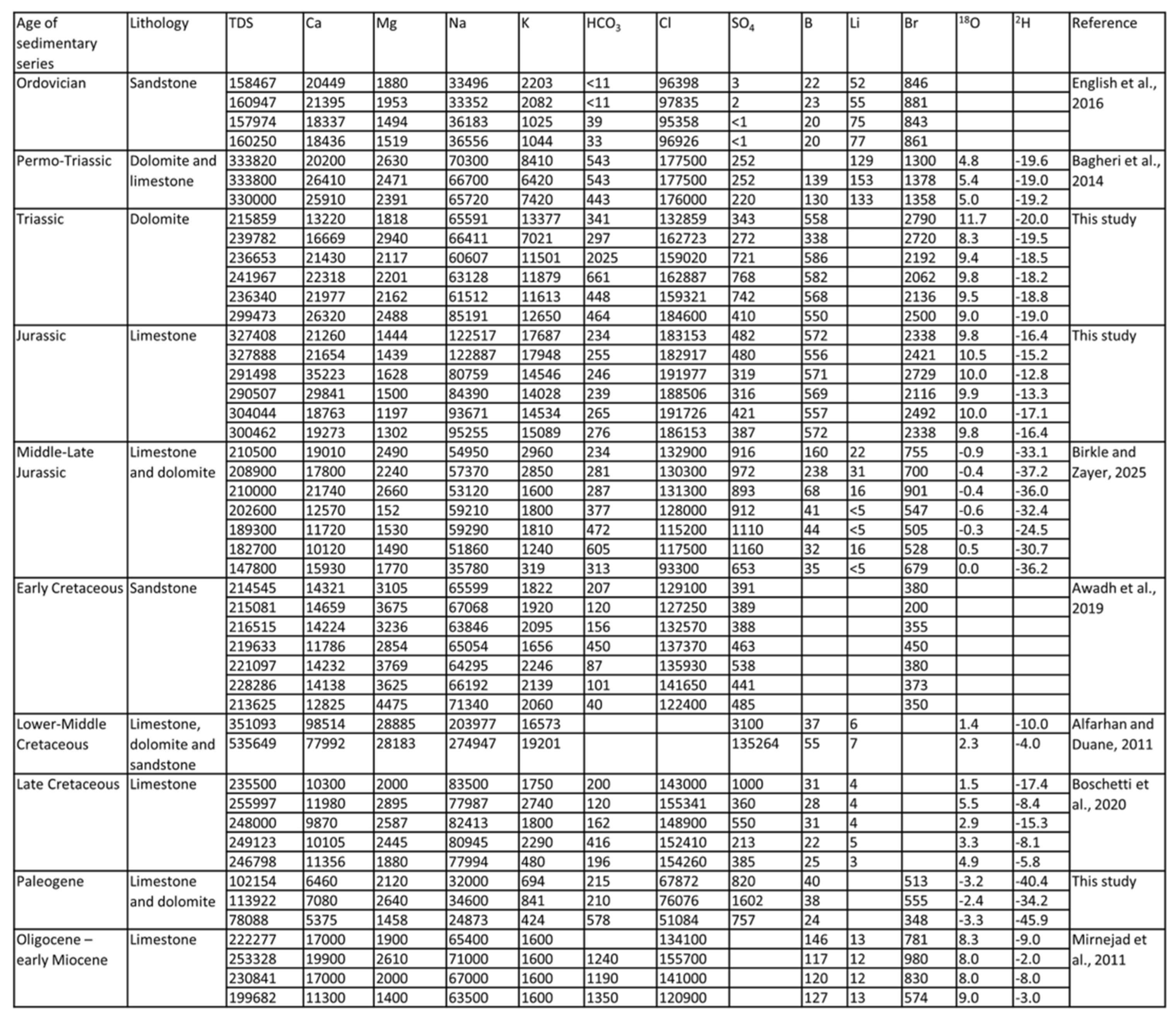
This study applies a retrospective, indicator-based comparison to archived water-chemistry data from three NGR carbonate-hosted aquifers and to published regional and global analogues. The aquifers are identified by stratigraphic age as Triassic (n = 6), Jurassic (n = 6) and Paleogene (n = 3). The evaluated dataset comprises total dissolved solids, major ions, K, B, Br, δ18O and δ2H where available (Table A1). Li concentrations are not included in the evaluated aquifer dataset. No Li concentration is estimated or imputed.
4.2. Hydrochemical and Isotope Evaluation
Major-ion compositions were evaluated using a Piper diagram to identify hydrochemical facies. Chloride and bromide concentrations were compared with the seawater-evaporation trend of Carpenter [31] and with published sedimentary-basin brines to distinguish residual evaporative components from halite dissolution and subsequent water–rock interaction. Stable-isotope compositions were compared with the Global Meteoric Water Line and a seawater-evaporation trajectory to assess evaporative evolution, meteoric mixing and possible fluid-rock exchange. Concentrations reported in the source datasets were expressed in mg/l; values were used as reported and missing variables were not imputed.
4.3. Analogue-Based Prospectivity Screening
Geological evidence for possible Li sources and enrichment mechanisms was integrated with the hydrochemical observations. K, B and Br were treated as process and brine-evolution indicators rather than as universal proxies for Li. The B–K compositions of the studied aquifers were compared with published Smackover Formation brines and other sedimentary-basin datasets for which Li has been reported. The comparison is qualitative and is intended to rank aquifers for direct Li analysis. It is not a regression model, does not predict Li concentration and does not demonstrate an economic resource. Interpretations were required to be consistent with basin age, lithology, evaporative history, burial and water–rock interaction, organic-matter maturation and possible fault-controlled hydrothermal circulation.
5. Geological and Hydrogeochemical Results for NGR Sedimentary Brines
NGR has undergone a long history of tectonics, magmatic activity, sedimentary deposition and erosion from Precambrian basement formation to Cenozoic collision and mountain building (Figure 2; [58]). During the Late Neoproterozoic, the supercontinent Gondwana formed from the amalgamation of stable cratons and more juvenile crustal terranes following the suturing of west (Africa-South America) and east (India-Antarctica-Australia) Gondwana landmasses (Figure 2; [58,59]). Different rock types characterize the collisional zones spanning metamorphic, metasedimentary and metavolcanic units, as well as syn-orogenic, post-orogenic and anorogenic igneous intrusions.
The amalgamated terranes were affected by extensional collapse and transcurrent tectonics during the Late Neoproterozoic [61]. During much of the Paleozoic and Mesozoic eras, large sedimentary basins developed within relatively passive hosting thick successions of clastic, carbonate and evaporitic lithologies [62,63]. The passive margin settings were at times punctuated by extensional to compressional tectonic events that reactivated deep basement structures. Furthermore, several magmatic events affected these basins. The passive margins that characterized much of NGR history have created suitable conditions for the formation of numerous extensive shallow and deep aquifer systems [11,13,16,64] characterized by high total dissolved solids (TDS), including elevated Li concentrations. The conditions leading to these high salinities were often driven by global tectonic activity and the associated climate shifts. The widespread presence of evaporite strata, particularly those rich in halite and anhydrite, serves as a geological indicator of past arid conditions and high evaporation rates within closed basins throughout the NGR [62,65,66,67]. These evaporites form precisely when salts dissolved in the closed basin waters become so concentrated during evaporation that they precipitate out of solution to form thick evaporite layers.
5.1. Geological Context and Candidate Sources of Li
The first step to evaluate the potential for Li enrichment in the NGR brines is to identify original sources of Li. The tectonic and magmatic evolution of the region has resulted in the emplacement of a wide range of lithologies, the weathering and alteration of which have the potential to release significant volumes of Li to both surface water and subsurface brines. Among these are the Neoproterozoic granites and granitic pegmatites of the Arabian-Nubian Shield (ANS) (Figure 3), which are enriched in lithophile elements including Nb, Ta, Sn, Rb, and Li [68,69,70]. For example, Li measurements in the Asir region of the southwest ANS range between 4,727 and 7,865 ppm, indicating a major source of Li, primarily hosted by the Li-bearing mineral lepidolite [71]. Other areas of the Shield contain clusters and belts of felsic plutonic rocks that are reported to have Li concentrations up to 121 ppm [72]. Specifically, the plumasitic-type rocks, which are predominantly leucocratic alkali-feldspar granites, are characterized by high concentrations of Li, and are thought to have formed from the differentiation of plutons of the alkali-feldspar granite association [72]. Furthermore, in the Ghadara area of the central ANS, monzogranites hosting gold mineralization have also been found to contain Li concentrations up to 81 ppm [73]. The ANS is also considered a primary sediment source for the nearby clastic cover, including some Li-rich Early Triassic shaly units [74].
The Phanerozoic features several volcanic episodes that produced a diverse range of igneous lithologies, including potentially Li-rich rocks (Figure 3). Continental extension along the African part of northern Gondwana during the Middle Ordovician was associated with magmatism that produced plutonic rocks and deposited volcanic bentonite strata [75]. Furthermore, the break-up of Gondwana was associated with several phases of magmatism, including possible mantle-plume activity and localized intraplate rift-related magmatic events [76]. Late Permian andesite and rhyodacite lavas and pyroclastic deposits (Figure 3) have been observed in Oman [77]. Later during the Jurassic, a more widespread phase of magmatism affected several parts of the NGR (Figure 3). These included rhyolitic volcanism and microsyenite intrusions in north Libya [78] and subduction-related volcanism in the Zagros region of Iran (extending to the Paleogene) [79]. Where contemporaneous with brine-generating basins, volcanic ash, aerosols, and volcaniclastic material constitute plausible Li sources that can be evaluated within the proposed workflow.
The basins straddling the NGR have accumulated large thicknesses of sedimentary units, which due to subsidence and burial, led to the generation and accumulation of the region’s massive hydrocarbon resources and may also have released significant volumes of Li to associated oil-field brines. Hydrous-pyrolysis and kinetic modeling of Type II-S source rocks from the Arabian Basin demonstrate that maturation products can evolve differentially during generation and migration, reinforcing the need to couple brine-enrichment models with source-rock kinetics and burial-history reconstruction [80].
5.2. Evidence for Evaporative Brine Evolution
Brines with residual evaporitic components are reported from the NGR, including parts of southwest Asia and north Africa, consistent with a history of several prolonged periods of aridity and basin restriction [81,82,83]. Following the identification of potential hard-rock sources of Li, we assess the type of brine and degree of evaporation from three geological formations of ages spanning Triassic to Paleogene through a re-analysis of historical data (Table S1, supplement). The aquifers are mainly composed of carbonate (limestone and dolomite) rocks. The salinity of brine samples varied across the three aquifers, with a Triassic aquifer exhibiting a range of 231 to 299 g/L, a Jurassic aquifer brine ranging from 321 to 351 g/L, and a Paleogene aquifer brine ranging from 85 to 124 g/L TDS. Chloride concentrations also varied, with the Triassic aquifer brine exhibiting a range of 133 to 185 g/L, the Jurassic aquifer brine ranging from 183 to 192 g/L, and the Paleogene aquifer brine ranging from 51 to 76 g/L (Table S1, supplement).
Based on theoretical considerations of water-rock interaction, and given the lithologies of the aquifers (i.e., limestone and dolomite), the samples were expected to plot on the Ca-Mg-SO4 or Ca-Mg-HCO3 field of the Piper diagram [84]. However, hydrochemical analysis revealed a consistent Na-Cl water type across all brine aquifers, regardless of depth and location (Figure 4), suggesting a common salinity source unrelated to acquisition of solutes from host lithologies through water-rock interaction. For comparison purposes, data from other brines from the NGR [11,12,13,14,15,16,18] were plotted on the same Piper diagram, revealing the same Na-Cl water type (Figure 4).
Major sources of Na-Cl-type brine salinity include evaporation of seawater and dissolution of halite, which can be distinguished using chloride/bromide (Cl/Br) ratios (Figure 5; [13,31,64,85,86,87,88]). The Jurassic aquifer brine plots mainly along the Seawater Evaporation Trend (SET), suggesting an evaporated seawater origin, while samples from the Triassic and Paleogene brines plot to the right and below the SET, indicating mixing or dilution involving evaporated seawater end-members. Samples from the Paleogene aquifer brine exhibit a larger downward displacement from the SET, likely due to flushing and mixing with fresh paleometeoric water during the Late Pleistocene and Early Holocene [64].
Other published data from several NGR aquifers suggest a similar evaporated seawater mechanism of salinization in brines (Figure 5; Ordovician in Algeria [14]; Permo-Triassic in Iran [13]; Middle-Upper Jurassic in Arabia [18]; Oligocene-Lower Miocene in Iran [11]. An exception is noted from the Lower Cretaceous in Iraq, where the sample was plotted in the halite dissolution by evaporated seawater brines zone potentially due to moving upward through a halite layer along faults cutting Jurassic to Cretaceous units [15].
The SET in Figure 5 shows the related saturation stage for specific minerals, including the calcite, gypsum, halite, epsomite, sylvite, carnallite, and bischofite stages [89]. The plotted data from different brine samples are consistent with genesis from progressive evaporation of seawater beyond the point of gypsum precipitation and before epsomite precipitation. This demonstrates that seawater evaporation operated extensively, both spatially over much of the NGR and temporally at several extended geological intervals, as an important mechanism for concentrating dissolved constituents, potentially including Li. Bromide is particularly useful in this context as an indicator of residual brine evolution and halite precipitation or dissolution; it should not be treated as a universal positive predictor of Li.
5.3. Evidence of Hydrothermal Water-Rock Interaction
The history of episodic subsidence and basement-involved faulting of the NGR created environments conducive for enhanced water-rock interaction [91,92,93] potentially enriching hot brines residing in deep, overpressured strata with Li and other valuable commodities [4,5]. For example, studies of diagenesis and fluid flow have shown that hydrothermal fluids actively migrated up-faults from deeper sources during Late Cretaceous to Cenozoic tectonic activities [93,94,95,96].
To evaluate the effect of hydrothermal fluids on Li enrichment, we utilize oxygen (δ18O) and hydrogen (δ2H) isotopes as environmental tracers that can distinguish pristine meteoric water from water affected by evaporation and/or water-rock interaction [97,98,99]. For instance, δ18O and δ2H have been utilized to provide valuable insights into the origin of water [100,101], understanding migration pathways and mixing trends [48], evaluating temperature and circulation depths [102], and paleoclimates [103].
Figure 6 illustrates the isotopic composition of samples from the three brine aquifers in comparison with the Global Meteoric Water Line (GMWL) and the seawater evaporation curve [104]. The Triassic and Jurassic samples are enriched in both δ18O and δ2H, which suggests the evaporation of seawater as a dominant process to explain the current water composition consistent with the evaporative component of the proposed brine-enrichment model. Furthermore, the isotopic compositions deviate from the expected seawater evaporation curve (i.e., δ18O enrichment without affecting δ2H ratios). Such deviation can occur due to oxygen isotope exchange with bedrock minerals through high-temperature mineral water-rock interaction [48,105], indicating the potential for hydrothermal fluids to have intruded the Triassic and Jurassic aquifers.
Based on published data from the Smackover Formation (Gulf Coast, USA; [107]), a well-known example of a sedimentary brine system enriched in Li, we use the δ18O:δ2H plot to evaluate whether the studied brines experienced processes comparable to those associated with Li enrichment in Smackover (Figure 6). Samples from the Triassic and Jurassic brine aquifers follow a trend consistent with more progressive water-rock interaction. This similarity identifies water-rock interaction as a plausible component of their Li-prospectivity model, but isotopic displacement is not a Li concentration scale and cannot demonstrate that their Li concentrations equal or exceed those of Smackover. Similar enriched δ18O and δ2H values were observed for other NGR samples, including the Permo-Triassic successions in Iran [13], Late Cretaceous in Iraq [16], and Oligocene-Early Miocene in Iran [11].
In contrast, samples from the Paleogene brine aquifer are probably composed of two water types: evaporated seawater and Pleistocene meteoric water [64] (Figure 6). This indicates that any earlier evaporative and water-rock-interaction signature in the Paleogene aquifer is likely modified by mixing between these two end-members. Similar observations were made for the Middle-Late Jurassic in Arabia [18], the Ordovician in Algeria [14], and the Lower-Middle Cretaceous in Kuwait [108]. Samples from those aquifers plot close to the evaporated seawater curve, indicating a dominant evaporative origin, but show a slight deviation towards more enriched δ18O values, which is typically an indication of water-rock interaction. This deviation is not as pronounced as in the Triassic and Jurassic brine aquifers and the Smackover Formation, suggesting that water-rock interaction in these aquifers was less intense.
6. Discussion: Geochemical Indicators for Li-Prospectivity Screening
In the absence of direct Li measurements, which is common in historical water-chemistry reports, we propose that concentrations and ratios of routinely reported elements such as boron (B), potassium (K), bromide (Br), and chloride (Cl) be used as strategic indicators of processes that may favour Li enrichment in sedimentary brines. High concentrations of Li and B in Andean salar brines have been attributed to weathering of nearby Li- and B-rich felsic volcanic rocks, such as ignimbrites [32]. K remains in residual bittern until late stages of seawater evaporation [31], but can also be modified by feldspar alteration, clay-mineral reactions, and late evaporite precipitation. Br is excluded relative to Cl during halite precipitation and therefore records residual brine evolution, whereas halite dissolution produces comparatively Br-poor Na-Cl brines. Consequently, B and K concentrations, interpreted together with Br, Cl/Br, TDS, isotopes, lithology, burial history, and evidence for magmatic or hydrothermal activity, can indicate conditions analogous to those found in some Li-bearing basins. These variables are process indicators rather than unique or universally conservative proxies for Li.
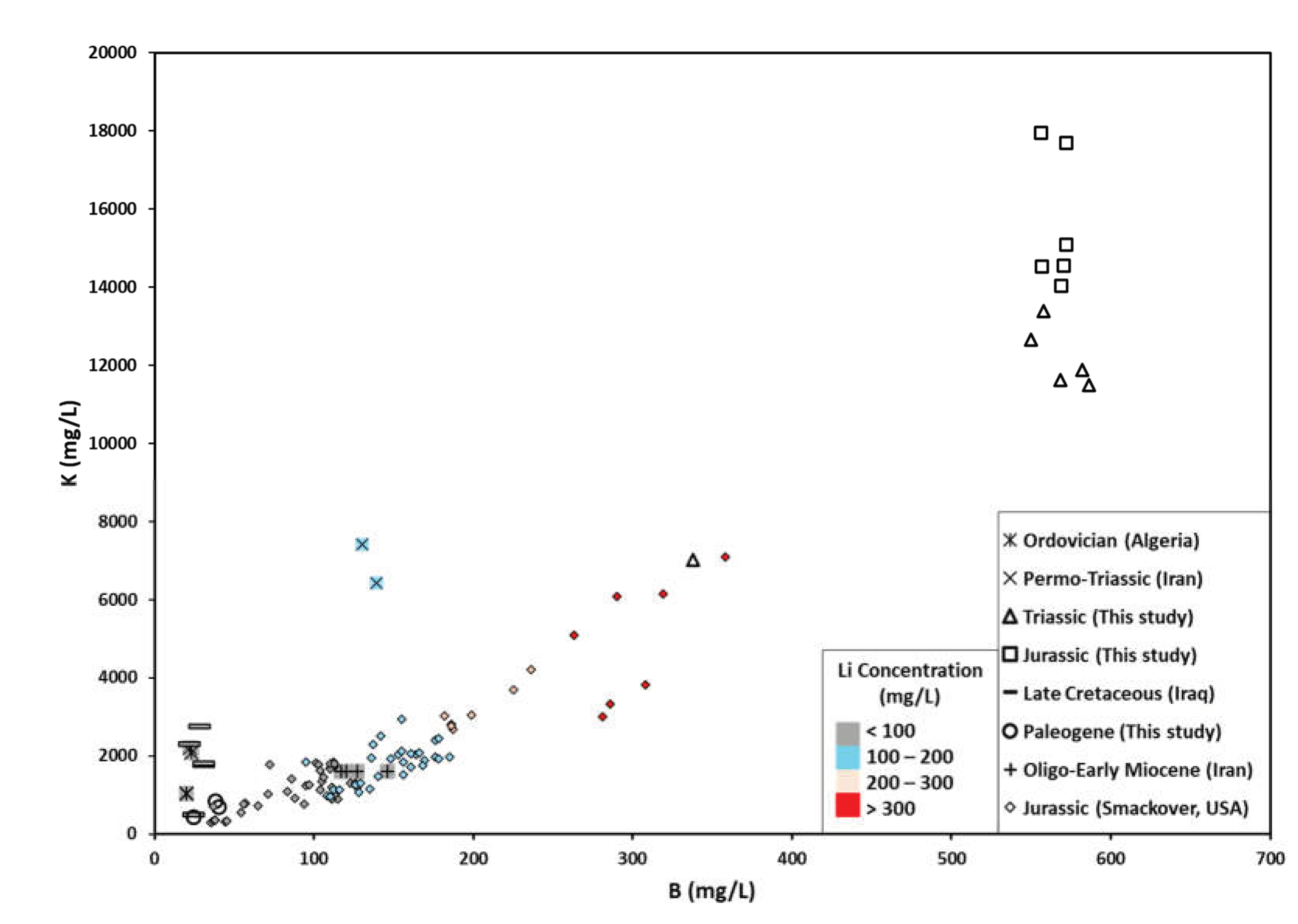
This relationship can be examined by plotting K and B concentrations of Jurassic Smackover Formation brines along the Gulf Coast of the United States [107]. The Smackover sedimentary brines, with Li concentrations exceeding 400 mg/L, have a substantial residual evaporitic-brine component [30,35,107]. As shown in Figure 7, a plot of B versus K for these brines reveals a positive association between the two elements, with published Li concentrations represented by symbol colour. Lithium in Smackover brines has also been reported to correlate with K, possibly reflecting interaction with feldspathic minerals or clays [107]. Comparable co-occurrence is reported from Devonian Leduc and Swan Hills brines in the Alberta Basin, where Li-rich waters contain elevated K, B, and Br and are interpreted to involve alteration of Li- and K-bearing silicates [43,46]. A recent Alberta exploration workflow likewise selected K, together with Na, Mg, Ca, and TDS, among routinely available variables used to prioritize brines lacking Li analyses [109]. However, behaviour is not universal: Qianjiang Formation brines show only a weak Li-salinity relationship and a negative relationship between Li and Cl/Br [110]. These comparisons support integrated, basin-specific use of K, B, Br, and Cl/Br rather than any single-element proxy.
When this approach is applied to the analyzed samples from this study, the Triassic and Jurassic aquifers occupy the region of the B-K plot populated by published brines with higher Li concentrations (Figure 7). Together with their residual-evaporative character, stable-isotope evidence for water-rock interaction, basin burial history, and the regional occurrence of potentially contemporaneous magmatic and hydrothermal activity, this similarity indicates a possibility of substantive Li enrichment analogous to Smackover and Alberta basin brines. It does not predict a Li concentration or demonstrate a resource. In contrast, samples from the Paleogene aquifer occupy a lower-priority region of the B-K plot, consistent with dilution by meteoric water that partially recharged those aquifers during the more humid Pleistocene and Holocene in the region [64]. This analogue-based approach provides a practical means of prioritizing sedimentary brines for direct Li analysis.
However, this indicator-based approach should be framed as a screening workflow rather than a substitute for direct Li measurements. Integrated organic and inorganic geochemical datasets improve process-based interpretations of sedimentary systems, particularly where elemental indicators are used to infer depositional and diagenetic controls [111]. The approach should therefore combine B and K with Cl/Br, TDS, stable isotopes, geological age, host lithology, burial history, potential volcanic or magmatic sources, and structural evidence for fluid migration. Direct Li analysis is required to test the resulting ranking.
7. Conclusions
This study employed a multifaceted approach to evaluate the Li prospectivity of sedimentary basin brines along the NGR and other Gondwana-derived terranes, moving beyond conventional hard-rock and Andean salar brine sources. The resulting workflow is intended to prioritize Li exploration efforts in the region.
A comprehensive analysis of the unique geological setting of the NGR reveals a long and complex geological history, characterized by the development of extensive sedimentary basins containing highly saline formation waters. Importantly, the presence of significant potential primary sources of Li is well established. These include Neoproterozoic granites and pegmatites, as well as felsic igneous rocks generated during Paleozoic and Mesozoic magmatism in the region. Their presence establishes source plausibility, although source-to-aquifer connection must be evaluated for individual basins.
The geological history of the study area is also marked by extensive periods of arid climate, which created suitable conditions for intense evaporation in hydrologically isolated basins. Li supplied to these basins by volcanic ashfall, aerosols, and/or low-temperature weathering of volcanic and crystalline rocks could have become progressively concentrated in residual evaporitic brines. The widespread occurrence of evaporite strata and evidence for trapped paleoseawater within extensive brine aquifers support long-standing conditions capable of concentrating mobile solutes, potentially including Li.
This study also identifies potential mechanisms for Li transport from source rocks to sedimentary basin brines. Basin subsidence and associated tectonic activity likely played important roles in transferring Li from Li-bearing clastic sediments and organic matter to brines through temperature- and fluid-flow-enhanced water-rock interaction, clay reactions, and kerogen maturation.
Finally, published fluid-inclusion and diagenetic studies across the NGR support episodes of up-fault migration of hot fluids in parts of the sedimentary basins. These studies demonstrate plausible pathways by which deep fluids could interact with crystalline or sedimentary sources and migrate into shallower reservoir lithologies; they do not by themselves establish Li enrichment.
In conclusion, the convergence of potential primary Li sources, evaporative brine evolution, water-rock interaction, organic-matter maturation, possible transport pathways, and favourable conditions for brine preservation indicates that sedimentary basin brines along the NGR and other Gondwana-derived terranes represent a plausible frontier for Li exploration (Figure 1). The Triassic and Jurassic aquifers show a combination of K-B chemistry, residual-brine indicators, and isotopic evidence for water-rock interaction comparable to processes documented in published Li-bearing basins, whereas the Paleogene aquifer records greater meteoric dilution. This integrated geological and geochemical workflow identifies the former aquifers as higher priorities for direct Li analysis, but does not predict concentration, continuity, recoverability, or economic significance.
Supplementary Materials
The following supporting information can be downloaded at the website of this paper posted on Preprints.org.
Author Contributions
Conceptualization, Waleed Saeed; methodology, Waleed Saeed and Serguey Arkadakskiy; investigation, Waleed Saeed, Serguey Arkadakskiy and Saleh Alqahtani; writing-original draft preparation, Waleed Saeed; writing-review and editing, Serguey Arkadakskiy and Saleh Alqahtani; supervision, Saleh Alqahtani. All authors have read and agreed to the published version of the manuscript.
Funding
This research received no external funding.
Institutional Review Board Statement
Not applicable.
Informed Consent Statement
Not applicable.
Data Availability Statement
The geochemical data evaluated in this study are reported in Table A1. Exact aquifer names and sampling coordinates are not disclosed because they are commercially sensitive. The aquifer ages, generalized lithologies and regional geological context are provided to support interpretation and reproducibility of the screening workflow.
Acknowledgments
During preparation of this manuscript, the authors used OpenAI ChatGPT to assist with language editing, manuscript restructuring and formatting. The authors reviewed and edited the output and take full responsibility for the content.
Conflicts of Interest
The authors declare no conflicts of interest.
Appendix A
Table A1. Major- and trace-element concentrations (mg/L) in sedimentary-basin brines in the NGR.
References
- Fortier, S. M.; Hammarstrom, J. H.; Ryker, S. J.; Day, W. C.; Seal, R. R. USGS critical minerals review. Min. Eng. 2019, 71(5), 35–47. [Google Scholar]
- Bustos-Gallardo, B.; Bridge, G.; Prieto, M. Harvesting Lithium: water, brine and the industrial dynamics of production in the Salar de Atacama. Geoforum 2021, 119, 177–189. [Google Scholar] [CrossRef]
- Stringfellow, W. T.; Dobson, P. F. Technology for the recovery of lithium from geothermal brines. Energies 2021, 14(20), 6805. [Google Scholar] [CrossRef]
- Williams, L. B.; S’rodon, J.; Huff, W.D.; Clauer, N.; Hervig, R.; L. Light element distributions (N, B, Li) in Baltic Basin bentonites record organic sources. Geochim. Et. Cosmochim. Acta 2013, 120, 582–599. [Google Scholar] [CrossRef]
- Clauer, N.; Lewan, M. D.; Dolan, M. P.; Chaudhuri, S.; Curtis, J. B. Mineralogical, chemical and K–Ar isotopic changes in Kreyenhagen Shale whole rocks and<2 μm clay fractions during natural burial and hydrous-pyrolysis experimental maturation. Geochim. Et. Cosmochim. Acta 2014, 130, 93–112. [Google Scholar] [CrossRef]
- Williams, L. B.; Elliott, W. C.; Hervig, R. L. Tracing hydrocarbons in gas shale using lithium and boron isotopes: Denver Basin USA, Wattenberg Gas Field. Chem. Geol. 2015, 417, 404–413. [Google Scholar] [CrossRef]
- Munk, L. A.; Hynek, S. A.; Bradley, D. C.; Boutt, D.; Labay, K.; Jochens, H. Lithium brines: A global perspective; 2016. [Google Scholar]
- Huff, D. E. The Igneous Petrology, Thermal History, and Genesis of Sedimentary Rock -Hosted Au Deposits in the Northern Battle Mountain Mining District, Nevada. Doctoral dissertation, Colorado School of Mines, 2021. [Google Scholar]
- Lee, K. J. Potential of petroleum source rock brines as a new source of lithium: Insights from basin-scale modeling and local sensitivity analysis. Energy Rep. 2022, 8, 56–68. [Google Scholar] [CrossRef]
- Dugamin, E. J.; Cathelineau, M.; Boiron, M. C.; Richard, A.; Despinois, F. Lithium enrichment processes in sedimentary formation waters. Chem. Geol. 2023, 635, 121626. [Google Scholar] [CrossRef]
- Mirnejad, H.; Sisakht, V.; Mohammadzadeh, H.; Amini, A. H.; Rostron, B. J.; Haghparast, G. Major, minor element chemistry and oxygen and hydrogen isotopic compositions of Marun oil--field brines, SW Iran: Source history and economic potential. Geol. J. 2011, 46(1), 1–9. [Google Scholar] [CrossRef]
- Birkle, P.; Jenden, P. D.; Al-Dubaisi, J. M. Origin of formation water from the Unayzah and Khuff petroleum reservoirs, Saudi Arabia. Procedia Earth Planet. Sci. 2013, 7, 77–80. [Google Scholar] [CrossRef]
- Bagheri, R.; Nadri, A.; Raeisi, E.; Shariati, A.; Mirbagheri, M.; Bahadori, F. Chemical evolution of a gas-capped deep aquifer, southwest of Iran. Environ. Earth Sci. 2014, 71(7), 3171–3180. [Google Scholar] [CrossRef]
- English, K. L.; English, J. M.; Redfern, J.; Hollis, C.; Corcoran, D. V.; Oxtoby, N.; Cherif, R. Y. Remobilization of deep basin brine during exhumation of the Illizi Basin, Algeria. Mar. Pet. Geol. 2016, 78, 679–689. [Google Scholar] [CrossRef]
- Awadh, S. M.; Al-Auweidy, M. R.; Al-Yaseri, A. A. Hydrochemistry as a tool for interpreting brine origin and chemical equilibrium in oilfields: Zubair reservoir southern Iraq case study. Appl. Water Sci. 2019, 9(3), 65. [Google Scholar] [CrossRef]
- Boschetti, T.; Awadh, S. M.; Al-Mimar, H. S.; Iacumin, P.; Toscani, L.; Selmo, E.; Yaseen, Z. M. Chemical and isotope composition of the oilfield brines from Mishrif Formation (southern Iraq): Diagenesis and geothermometry. Mar. Pet. Geol. 2020, 122, 104637. [Google Scholar] [CrossRef]
- Ullattumpoyil, N. Produced water geochemistry from an upstream oil operation. J. Geosci. Environ. Prot. 2023, 11(6), 155–168. [Google Scholar]
- Birkle, P.; Zayer, A. J. Provenance of Oilfield Brines and Vertical Connectivity of Middle to Upper Jurassic Sequence in Eastern Saudi Arabia. Appl. Geochem. 2025, 106673. [Google Scholar] [CrossRef]
- Lee, K. J.; You, J.; Gao, Y.; Terlier, T. Release, transport, and accumulation of lithium in shale brines. Fuel 2024, 356, 129629. [Google Scholar] [CrossRef]
- Butler, K. L.; Munk, L.; Boutt, D. F.; Morris, N.; Kennedy, J.; Saha, P.; Ibarra, D. E. The origin and enrichment of sedimentary basin lithium brines: a case study from the Upper Devonian Leduc Formation, Alberta Basin, Canada. Econ. Geol. 2025, 120(3), 649–662. [Google Scholar] [CrossRef]
- Saeed, W. Sources and Mechanism of Lithium Enrichment in Oilfield Brines. SPE Middle East Oil and Gas Show and Conference (p. D011S032R005)., 2025; SPE. [Google Scholar]
- Ruggieri, F.; Saavedra, J.; Fernandez-Turiel, J. L.; Gimeno, D.; Garcia-Valles, M. Environmental geochemistry of ancient volcanic ashes. J. Hazard. Mater. 2010, 183(1-3), 353–365. [Google Scholar] [CrossRef] [PubMed]
- Luo, M.; Yu, M.; Torres, M. E.; Solomon, E. A.; Gieskes, J.; You, C. F.; Chen, D. Volcanic ash alteration triggers active sedimentary lithium cycling: Insights from lithium isotopic compositions of pore fluids and sediments in the Hikurangi subduction zone. Earth Planet. Sci. Lett. 2024, 642, 118854. [Google Scholar] [CrossRef]
- Gourcerol, B.; Gloaguen, E.; Melleton, J.; Tuduri, J.; Galiegue, X. Re-assessing the European lithium resource potential–A review of hard-rock resources and metallogeny. Ore Geol. Rev. 2019, 109, 494–519. [Google Scholar] [CrossRef]
- Benson, T. R.; Coble, M. A.; Rytuba, J. J.; Mahood, G. A. Lithium enrichment in intracontinental rhyolite magmas leads to Li deposits in caldera basins. Nat. Commun. 2017, 8(1), 270. [Google Scholar] [CrossRef] [PubMed]
- Phan, T. T.; Capo, R. C.; Stewart, B. W.; Macpherson, G. L.; Rowan, E. L.; Hammack, R. W. Factors controlling Li concentration and isotopic composition in formation waters and host rocks of Marcellus Shale, Appalachian Basin. Chem. Geol. 2016, 420, 162–179. [Google Scholar] [CrossRef]
- McCarthy, K.; Rojas, K.; Niemann, M.; Palmowski, D.; Peters, K.; Stankiewicz, A. Basic petroleum geochemistry for source rock evaluation. Oilfield Rev. 2011, 23(2), 32–43. [Google Scholar]
- De Silva, P. N. K.; Simons, S. J. R.; Stevens, P.; Philip, L. M. A comparison of North American shale plays with emerging non-marine shale plays in Australia. Mar. Pet. Geol. 2015, 67, 16–29. [Google Scholar] [CrossRef]
- Jang, E.; Jang, Y.; Chung, E. Lithium recovery from shale gas produced water using solvent extraction. Appl. Geochem. 2017, 78, 343–350. [Google Scholar] [CrossRef]
- Collins, A. G.; Vine, J. D. Lithium abundances in oilfield waters. Lithium Resour. Requir. By Year 2000 1976, 1005, 116–123. [Google Scholar]
- Carpenter, A. B. Origin and chemical evolution of brines in sedimentary basins. SPE Annual Technical Conference and Exhibition? 1978; SPE; pp. SPE–7504. [Google Scholar]
- Risacher, F.; Fritz, B. Origin of salts and brine evolution of Bolivian and Chilean salars. Aquat. Geochem. 2009, 15(1), 123–157. [Google Scholar] [CrossRef]
- Bradley, D.; Munk, L.; Jochens, H.; Hynek, S.; Labay, K. A. A preliminary deposit model for lithium brines (No. 2013-1006); US Geological Survey, 2013. [Google Scholar]
- Stephenson, L. Tectonic related lithium deposits another major region found north east Tanzania—A new area with close association to the dominant areas: The fourth of four. Nat. Resour. 2023, 14(9), 161–191. [Google Scholar]
- Darvari, R.; Nicot, J. P.; Scanlon, B. R.; Kyle, J. R.; Elliott, B. A.; Uhlman, K. Controls on lithium content of oilfield waters in Texas and neighboring states (USA). J. Geochem. Explor. 2024, 257, 107363. [Google Scholar] [CrossRef]
- Billings, G. K.; Hitchon, B.; Shaw, D. R. Geochemistry and origin of formation waters in the western Canada sedimentary basin, 2. Alkali metals. Chem. Geol. 1969, 4(1-2), 211–223. [Google Scholar] [CrossRef]
- Spencer, R. J. Origin of CaCl brines in Devonian formations, western Canada sedimentary basin. Appl. Geochem. 1987, 2(4), 373–384. [Google Scholar] [CrossRef]
- Machel, H. G.; Cavell, P. A.; Patey, K. S. Isotopic evidence for carbonate cementation and recrystallization, and for tectonic expulsion of fluids into the Western Canada Sedimentary Basin. Geol. Soc. Am. Bull. 1996, 108(9), 1108–1119. [Google Scholar] [CrossRef]
- Machel, H. G.; Cavell, P. A. Low-flux, tectonically-induced squeegee fluid flow (“hot flash”) into the Rocky Mountain Foreland Basin. Bull. Can. Pet. Geol. 1999, 47(4), 510–533. [Google Scholar]
- Buschkuehle, B. E.; Machel, H. G. Diagenesis and paleofluid flow in the Devonian Southesk-Cairn carbonate complex in Alberta, Canada. Mar. Pet. Geol. 2002, 19(3), 219–227. [Google Scholar] [CrossRef]
- Michael, K.; Bachu, S. Origin, chemistry and flow of formation waters in the Mississippian–Jurassic sedimentary succession in the west-central part of the Alberta Basin, Canada. Mar. Pet. Geol. 2002, 19(3), 289–306. [Google Scholar] [CrossRef]
- Michael, K.; Machel, H. G.; Bachu, S. New insights into the origin and migration of brines in deep Devonian aquifers, Alberta, Canada. J. Geochem. Explor. 2003, 80(2-3), 193–219. [Google Scholar] [CrossRef]
- Eccles, D. R.; Berhane, H. Geological Introduction to Lithium Rich Water with Emphasis on the Fox Creek Area of west-Central Alberta (NTS 83F and 83K). Alberta Geological Survey Open File Report 2011-10. 2011, 22. [Google Scholar]
- Gupta, I.; Wilson, A. M.; Rostron, B. J. Cl/Br compositions as indicators of the origin of brines: Hydrogeologic simulations of the Alberta Basin, Canada. Bulletin 2012, 124(1-2), 200–212. [Google Scholar] [CrossRef]
- Huff, G. F. Origin and Li-enrichment of selected oilfield brines in the Alberta Basin; Alberta Geological Survey, AER/AGS Open File Report: Canada, 2019; Volume 1, p. 28. [Google Scholar]
- Huff, G. F.; Grasby, S. Evolution of Li-enriched oilfield brines in Devonian carbonates of the south-central Alberta Basin, Canada. Bull. Can. Pet. Geol. 2016, 64(3), 438–448. [Google Scholar] [CrossRef]
- Stacey, J.; Hollis, C.; Corlett, H.; Koeshidayatullah, A. Burial dolomitization driven by modified seawater and basal aquifer--sourced brines: Insights from the Middle and Upper Devonian of the Western Canadian Sedimentary Basin. Basin Res. 2021, 33(1), 648–680. [Google Scholar] [CrossRef]
- Nelson, S. T.; Mayo, A. L.; Gilfillan, S.; Dutson, S. J.; Harris, R. A.; Shipton, Z. K.; Tingey, D. G. Enhanced fracture permeability and accompanying fluid flow in the footwall of a normal fault: The Hurricane fault at Pah Tempe hot springs, Washington County, Utah. Geol. Soc. Am. Bull. 2009, 121(1-2), 236–246. [Google Scholar]
- Barton, C. A.; Zoback, M. D.; Moos, D. Fluid flow along potentially active faults in crystalline rock. Int. J. Rock Mech. Min. Sci. Geomech. Abstr. 1996, Vol. 5(No. 33), 206A. [Google Scholar]
- Zoback, M. D. Reservoir geomechanics; Cambridge university press, 2010. [Google Scholar]
- McClay, K. R. (Ed.) Thrust Tectonics and Hydrocarbon Systems: AAPG Memoir 82 (No. 82); AAPG, 2004. [Google Scholar]
- Phillips, E. R.; Waters, C. N.; Ellison, R. A. The Jurassic–Cretaceous depositional and tectonic evolution of the southernwestern margin of the Neotethys Ocean, Northern Oman and United Arab Emirates. In lithosphere dynamics and sedimentary basins: The Arabian plate and analogues; Springer Berlin Heidelberg: Berlin, Heidelberg, 2012; pp. 61–100. [Google Scholar]
- Evans, J. P.; Forster, C. B.; Goddard, J. V. Permeability of fault-related rocks, and implications for hydraulic structure of fault zones. J. Struct. Geol. 1997, 19(11), 1393–1404. [Google Scholar] [CrossRef]
- Huff, D. E.; Holley, E.; Guenthner, W. R. Constraining the Timing of Hydrothermal Fluid Flow at the Marigold Deposit, Nevada Using U-Th Thermochronology; Geological Society of America Abstracts, 2016; Vol. 48, p. 278909. [Google Scholar]
- Li, Q.; Fan, Q.; Wang, J.; Qin, Z.; Zhang, X.; Wei, H.; Shan, F. Hydrochemistry, distribution and formation of lithium-rich brines in salt lakes on the Qinghai-Tibetan Plateau. Minerals 2019, 9(9), 528. [Google Scholar] [CrossRef]
- Coffey, D. M.; Munk, L. A.; Ibarra, D. E.; Butler, K. L.; Boutt, D. F.; Jenckes, J. Lithium storage and release from lacustrine sediments: Implications for lithium enrichment and sustainability in continental brines. Geochem. Geophys. Geosystems 2021, 22(12), e2021GC009916. [Google Scholar] [CrossRef]
- Atwah, I.; Sweet, S. Petroleum generation kinetics of unconventional Mississippian mudrocks in central Oklahoma, United States. Front. Earth Sci. 2023, 11, 1146251. [Google Scholar] [CrossRef]
- Stern, R. J.; Johnson, P. Continental lithosphere of the Arabian Plate: a geologic, petrologic, and geophysical synthesis. Earth-Sci. Rev. 2010, 101(1-2), 29–67. [Google Scholar] [CrossRef]
- Torsvik, T. H.; Cocks, L. R. M. Gondwana from top to base in space and time. Gondwana Res. 2013, 24(3-4), 999–1030. [Google Scholar] [CrossRef]
- Scotese, C. R.; Wright, N. PALEOMAP paleodigital elevation models (PaleoDEMS) for the Phanerozoic. In Paleomap Proj; 2018; pp. 1–26. [Google Scholar]
- Stern, R. J. The Najd fault system, Saudi Arabia and Egypt: A late Precambrian rift--related transform system? Tectonics 1985, 4(5), 497–511. [Google Scholar] [CrossRef]
- Nairn, A. E. M.; Alsharhan, A. S. Sedimentary basins and petroleum geology of the Middle East; Elsevier, 1997. [Google Scholar]
- Wilson, A. O. Chapter 1 Introduction to the Jurassic Arabian Intrashelf Basin; Geological Society, London, Memoirs, 2020; Volume 53, 1, pp. 1–19. [Google Scholar]
- Saeed, W.; Shouakar-Stash, O.; Unger, A.; Wood, W. W.; Parker, B. Origin of solutes in a regional multi-layered sedimentary aquifer system (a case study from the Rub’al Khali basin, Saudi Arabia). Appl. Geochem. 2021a, 126, 104871. [Google Scholar] [CrossRef]
- Beydoun, Z. R. The petroleum resources of the Middle East: a review. J. Pet. Geol. 1986, 9(1), 5–27. [Google Scholar] [CrossRef]
- Christian, L. Cretaceous subsurface geology of the Middle East region. GeoArabia 1997, 2(3), 239–256. [Google Scholar] [CrossRef]
- Martin, A. Z. Late Permian to Holocene paleofacies evolution of the Arabian Plate and its hydrocarbon occurrences. GeoArabia 2001, 6(3), 445–504. [Google Scholar] [CrossRef]
- Drysdall, A. R.; Douch, C. J. NbThZr mineralization in microgranite—microsyenite at Jabal Tawlah, Midyan region, Kingdom of Saudi Arabia. J. Afr. Earth Sci. (1983) 1986, 4, 275–288. [Google Scholar] [CrossRef]
- Küster, D. Granitoid-hosted Ta mineralization in the Arabian–Nubian Shield: ore deposit types, tectono-metallogenetic setting and petrogenetic framework. Ore Geol. Rev. 2009, 35(1), 68–86. [Google Scholar] [CrossRef]
- Kashghari, W.; Collins, A. S.; Nehlig, P. Critical review of the stratigraphy framework of the Arabian Shield: current understanding and knowledge gaps. Critical Review of the Stratigraphy Framework of the Arabian Shield: Current Understanding and Knowledge Gaps; Saudi Geological Survey Special Publication Report, 2025; p. SGS-SP-2025-1. [Google Scholar]
- Azer, M. K.; Gahlan, H. A.; Bartoli, O. Formation of Li-bearing pegmatites in the Arabian Shield: A case study from the Mount Ablah, Asir Terran, Saudi Arabia. Environ. Earth Sci. 2025, 84(11), 305. [Google Scholar] [CrossRef]
- Ramsay, C. R. Specialized felsic plutonic rocks of the Arabian Shield and their precursors. J. Afr. Earth Sci. (1983) 1986, 4, 153–168. [Google Scholar] [CrossRef]
- Harbi, H. M.; Ali, K. A.; Eldougdoug, A. A.; Al-Jahdli, N. S. Geochemistry and U-Pb zircon dating constraints of some plutonic rocks along Bir Tawilah shear zone, central Saudi Arabia: Implication for magma peterogenesis and age of gold mineralization. Geochemistry 2016, 76(2), 309–324. [Google Scholar] [CrossRef]
- Ortiz, M. A.; Vahrenkamp, V. Lithium Potential in Saudi Arabia–An Initial Assessment. SPE Middle East Oil and Gas Show and Conference (p. D011S032R001)., 2025; SPE. [Google Scholar]
- Ramos, E.; Navidad, M.; Marzo, M.; Bolatti, N.; Albanesi, G. L.; Beresi, M. S.; Peralta, S. H. Middle Ordovician K-bentonite beds in the Murzuq Basin (Central Libya). Ordovician From Andes 2003, 17, 203–207. [Google Scholar]
- Sharland, P. R.; Casey, D. M.; Davies, R. B.; Simmons, M. D.; Sutcliffe, O. E. Arabian plate sequence stratigraphy–revisions to SP2. GeoArabia 2004, 9(1), 199–214. [Google Scholar] [CrossRef]
- Rabu, D.; Le Metour, J.; Bechennec, F.; Beurrier, M.; Villey, M. Sedimentary aspects of the Eo-Alpine cycle on the northeast edge. 1990. [Google Scholar] [CrossRef]
- Wilson, M.; Guiraud, R.; Moreau, C.; Bellion, Y. C. Late Permian to Recent magmatic activity on the African-Arabian margin of Tethys; Geological Society, London, Special Publications, 1998; Volume 132, 1, pp. 231–263. [Google Scholar]
- GholamiZadeh, P.; Hu, X.; Garzanti, E.; Adabi, M. H. Constraining the timing of Arabia-Eurasia collision in the Zagros orogen by sandstone provenance (Neyriz, Iran). Bulletin 2022, 134(7-8), 1793–1810. [Google Scholar] [CrossRef]
- Sandu, C.; Arouri, K.; Srinivasan, P.; Endara Arguello, E.M.; Ghazwani, A.H.; Atwah, I. Generation of carbazoles in Type II-S source rocks: Experimental analysis for kinetic parameters estimation. Org. Geochem. 2025, 208, 105057. [Google Scholar] [CrossRef]
- Hallam, A. Continental humid and arid zones during the Jurassic and Cretaceous. Palaeogeogr. Palaeoclimatol. Palaeoecol. 1984, 47(3-4), 195–223. [Google Scholar] [CrossRef]
- Böhme, M.; Spassov, N.; Majidifard, M. R.; Gärtner, A.; Kirscher, U.; Marks, M.; Winklhofer, M. Neogene hyperaridity in Arabia drove the directions of mammalian dispersal between Africa and Eurasia. Commun. Earth Environ. 2021, 2(1), 85. [Google Scholar] [CrossRef]
- Mansour, A.; Wang, J.; Ruebsam, W.; Tahoun, S. S.; Abdelhalim, L. A.; Ahmed, M. S.; Fu, X. Late Albian-Cenomanian paleoenvironmental and paleoclimatic reconstructions in northeastern Gondwana: Palynological perceptions. Cretac. Res. 2024, 160, 105878. [Google Scholar] [CrossRef]
- Piper, A. M. A graphic procedure in the geochemical interpretation of water--analyses. Eos Trans. Am. Geophys. Union 1944, 25(6), 914–928. [Google Scholar] [CrossRef]
- Kharaka, Y. K.; Hanor, J. S. Deep fluids in the continents: I. Sedimentary basins. Treatise Geochem. 2003, 5, 605. [Google Scholar]
- Frape, S. K.; Shouakar-Stash, O.; Stotler, R.; Pačes, T. Geochemical and isotopic characteristics of the waters from crystalline and sedimentary structures of the Bohemian Massif. Water-Rock Interact.-Proc. 12th Int. Symp. Water-Rock Interact. 2007, WRI-12, 727–733. [Google Scholar]
- Shouakar-Stash, O.; Alexeev, S. V.; Frape, S. K.; Alexeeva, L. P.; Drimmie, R. J. Geochemistry and stable isotopic signatures, including chlorine and bromine isotopes, of the deep groundwaters of the Siberian Platform, Russia. Appl. Geochem. 2007, 22(3), 589–605. [Google Scholar] [CrossRef]
- Saeed, W.; Shouakar-Stash, O.; Unger, A.; Wood, W. W.; Parker, B. Chemical evolution of an inland sabkha: a case study from Sabkha Matti, Saudi Arabia. Hydrogeol. J. 2021b, 29(5), 1939–1951. [Google Scholar] [CrossRef]
- Matray, J. M. Hydrochimie et géochimie isotopique des eaux de réservoir pétrolier du Trias et du Dogger dans le bassin de Paris. In Th~ se; Univ. Paris XI, 1988. [Google Scholar]
- Rittenhouse, G. Bromine in oil-field waters and its use in determining possibilities of origin of these waters. AAPG Bull. 1967, 51(12), 2430–2440. [Google Scholar] [CrossRef]
- Sirat, M.; Al-Aasm, I. S.; Morad, S.; Aldahan, A.; Al-Jallad, O.; Ceriani, A.; Al-Suwaidi, A. Saddle dolomite and calcite cements as records of fluid Flow during basin evolution: Paleogene carbonates, United Araba Emirates. Mar. Pet. Geol. 2015, 74, 1–21. [Google Scholar] [CrossRef]
- Mansurbeg, H.; Morad, D.; Othman, R.; Morad, S.; Ceriani, A.; Al-Aasm, I.; Koyi, H. Hydrothermal dolomitization of the Bekhme formation (Upper Cretaceous), Zagros Basin, Kurdistan Region of Iraq: Record of oil migration and degradation. Sediment. Geol. 2016, 341, 147–162. [Google Scholar] [CrossRef]
- Al-Hajeri, M. M.; Parnell, J.; Bowden, S.; Costanzo, A.; Feely, M. Deep hydrothermal activity in hydrocarbon reservoirs, South Kuwait. Arab. J. Geosci. 2017, 10(2), 41. [Google Scholar] [CrossRef]
- Al Abdalla, A.; Barrier, E.; Matar, A.; Muller, C. Late Cretaceous to Cenozoic tectonic evolution of the NW Arabian platform in NW Syria. 2010. [Google Scholar] [CrossRef]
- Breesch, L.; Swennen, R.; Dewever, B.; Roure, F.; Vincent, B. Diagenesis and fluid system evolution in the northern Oman Mountains, United Arab Emirates: implications for petroleum exploration. GeoArabia 2011, 16(2), 111–148. [Google Scholar] [CrossRef]
- Hollis, C. Diagenetic controls on reservoir properties of carbonate successions within the Albian–Turonian of the Arabian Plate. Pet. Geosci. 2011, 17, 223–241. [Google Scholar] [CrossRef]
- Harris, C.; Stock, W. D.; Lanham, J. Stable isotope constraints on the origin of CO2 gas exhalations at Bongwan, Natal. South Afr. J. Geol. 1997, 100(3), 261–266. [Google Scholar]
- Clark, I. D.; Fritz, P. Environmental isotopes in hydrogeology; CRC press, 2013. [Google Scholar]
- Demlie, M.; Titus, R. Hydrogeological and hydrogeochemical characteristics of the Natal Group sandstone, South Africa. South Afr. J. Geol. 2015, 118(1), 33–44. [Google Scholar] [CrossRef]
- Wilkinson, M.; Gilfillan, S. M.; Haszeldine, R. S.; Ballentine, C. J. Plumbing the depths: Testing natural tracers of subsurface CO2 origin and migration, Utah; 2009. [Google Scholar]
- Delalande, M.; Bergonzini, L.; Gherardi, F.; Guidi, M.; Andre, L.; Abdallah, I.; Williamson, D. Fluid geochemistry of natural manifestations from the Southern Poroto–Rungwe hydrothermal system (Tanzania): Preliminary conceptual model. J. Volcanol. Geotherm. Res. 2011, 199(1-2), 127–141. [Google Scholar] [CrossRef]
- Ziegler, K. Clay minerals of the Permian Rotliegend Group in the North Sea and adjacent areas. Clay Miner. 2006, 41(1), 355–393. [Google Scholar] [CrossRef]
- Hays, P. D.; Grossman, E. L. Oxygen isotopes in meteoric calcite cements as indicators of continental paleoclimate. Geology 1991, 19(5), 441–444. [Google Scholar] [CrossRef]
- Holser, W.T. Trace elements and isotopes in evaporites. In Reviews in Mineralogy, In: Marine Minerals; Burns, R.G., Ed.; Mineralogical Society of America: Washington, DC, 1979; vol. 6, pp. 295–346. [Google Scholar]
- Cerón, J. C.; Pulido-Bosch, A.; de Galdeano, C. S. Isotopic identification of CO2 from a deep origin in thermomineral waters of southeastern Spain. Chem. Geol. 1998, 149(3-4), 251–258. [Google Scholar] [CrossRef]
- D’amore, F.; Panichi, C. Geochemistry in geothermal exploration. Int. J. Energy Res. 1985, 9(3), 277–298. [Google Scholar] [CrossRef]
- Moldovanyi, E. P.; Walter, L. M. Regional trends in water chemistry, Smackover Formation, Southwest Arkansas: geochemical and physical controls. AAPG Bull. 1992, 76(6), 864–894. [Google Scholar] [CrossRef]
- Alfarhan, A. A.; Duane, M. J. Geochemistry and modification of oilfield brines in surface pits in Northern Kuwait. Arab. J. Geosci. 2012, 5(5), 1055–1068. [Google Scholar] [CrossRef]
- Peng, X.; Chen, Z.; Jiang, C.; Yuan, W.; Yao, J. A data-driven approach for exploring unconventional lithium resources in Devonian sedimentary brines, Alberta, Canada. Nat. Resour. Res. 2025, 34, 1885–1900. [Google Scholar] [CrossRef]
- Yu, X.; Wang, C.; Huang, H.; Wang, J.; Yan, K. Lithium and brine geochemistry in the Qianjiang Formation of the Jianghan Basin, central China. Sci. Rep. 2023, 13, 4445. [Google Scholar] [CrossRef] [PubMed]
- Atwah, I.; Adeboye, O.O.; Zhang, J.; Wilcoxson, R.; Marcantonio, F. Linking biomarkers with elemental geochemistry to reveal controls on organic richness in Devonian-Mississippian mudrocks of Oklahoma. Palaeogeogr. Palaeoclimatol. Palaeoecol. 2023, 611, 111355. [Google Scholar] [CrossRef]
Figure 1.
Lithium (Li) introduction and enrichment processes in sedimentary basin brines.
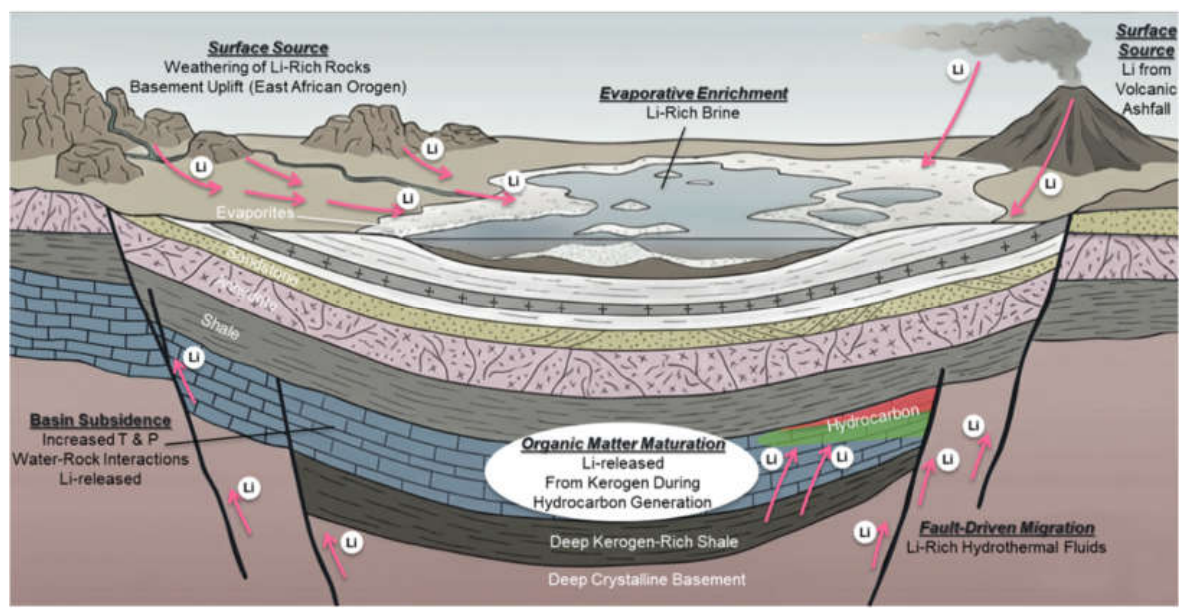
Figure 2.
A panel showing the position and state of the NGR through time. The time periods shown correspond to the age of aquifers discussed in the text. a) Late Neoproterozoic basement cratons and terranes amalgamation [58]. b-f) Several time through the Phanerozoic extracted using GPlates software from the PaleoMap project [60].
Figure 2.
A panel showing the position and state of the NGR through time. The time periods shown correspond to the age of aquifers discussed in the text. a) Late Neoproterozoic basement cratons and terranes amalgamation [58]. b-f) Several time through the Phanerozoic extracted using GPlates software from the PaleoMap project [60].
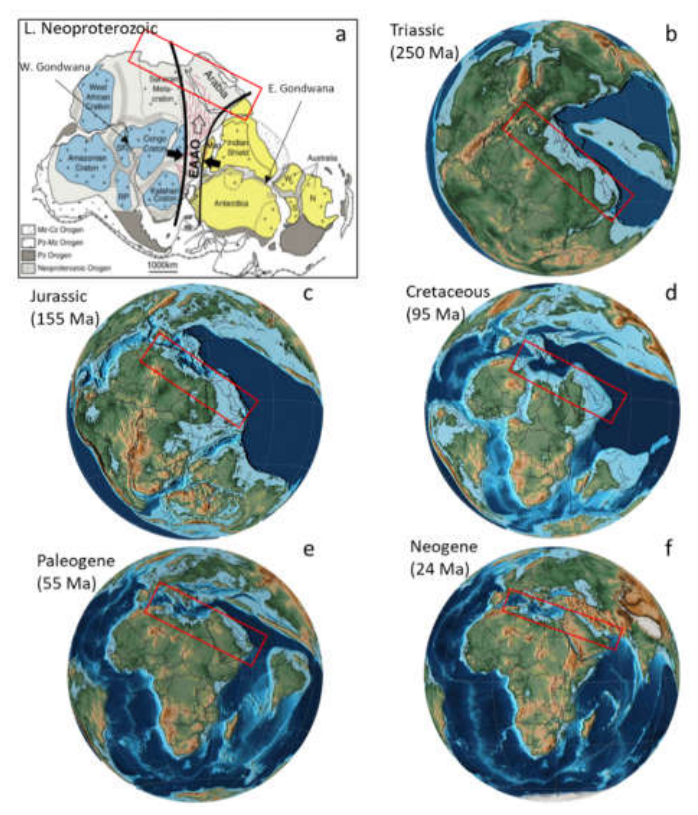
Figure 3.
A generalized spatio-temporal chart showing major tectonic and magmatic events. Main numbered events are mentioned in the text: 1) shield formation, including felsic intrusions with high Li potential; 2) volcanic rocks, including Li-rich bentonites in Libya; 3) andesite and rhyodacite lavas and pyroclastic deposits in Oman; 4) felsic magmatism, including rhyolitic volcanism and microsyenite intrusions in northern Libya; and 5) subduction-related volcanism reported in the Zagros Mountains. Abbreviations: LNSS: Late Neoproterozoic strike-slip faulting; H-VO: Hercynian-Variscan Orogeny (waning effect to the east); NATt: North Arabia transtensional tectonics; S: subduction; O: ophiolite obduction; PI: Palmyride inversion; RSR: Red Sea rifting; GoA-DS: Gulf of Aqaba-Dead Sea transtension/pull-apart basin; APH: Arabian Plate harrats (volcanic fields); ZO: Zagros Orogeny.
Figure 3.
A generalized spatio-temporal chart showing major tectonic and magmatic events. Main numbered events are mentioned in the text: 1) shield formation, including felsic intrusions with high Li potential; 2) volcanic rocks, including Li-rich bentonites in Libya; 3) andesite and rhyodacite lavas and pyroclastic deposits in Oman; 4) felsic magmatism, including rhyolitic volcanism and microsyenite intrusions in northern Libya; and 5) subduction-related volcanism reported in the Zagros Mountains. Abbreviations: LNSS: Late Neoproterozoic strike-slip faulting; H-VO: Hercynian-Variscan Orogeny (waning effect to the east); NATt: North Arabia transtensional tectonics; S: subduction; O: ophiolite obduction; PI: Palmyride inversion; RSR: Red Sea rifting; GoA-DS: Gulf of Aqaba-Dead Sea transtension/pull-apart basin; APH: Arabian Plate harrats (volcanic fields); ZO: Zagros Orogeny.
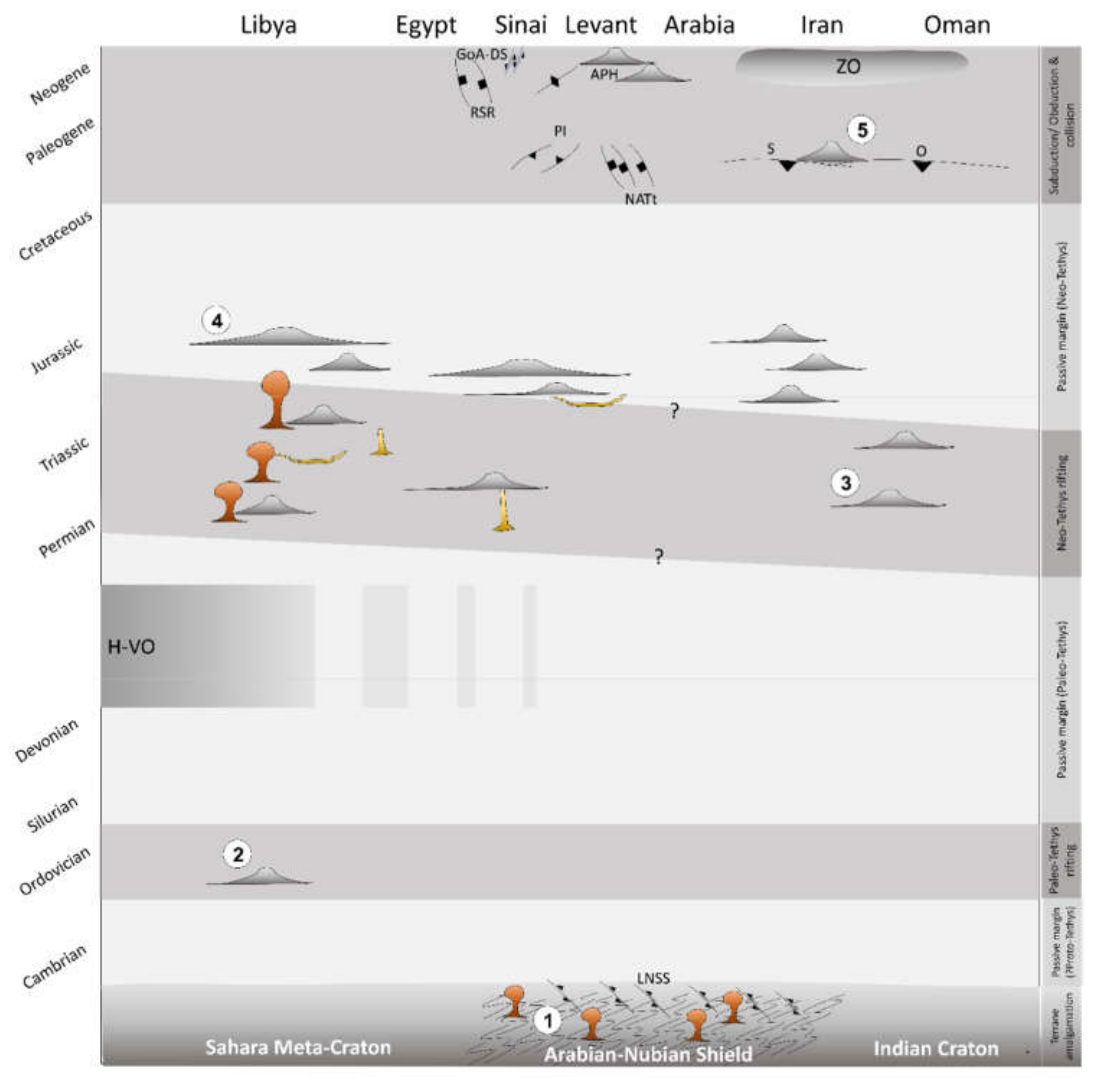
Figure 4.
Piper diagram comparing the major ion chemistry of brine samples from the brine aquifers (this study) to regional analogues, including Ordovician rocks in Algeria [14]; Permo-Triassic rocks in Iran [13]; Middle-Late Jurassic in Arabia [18]; Early Cretaceous in Iraq [15]; Late Cretaceous in Iraq [16]; and Oligocene-Early Miocene in Iran [11]. The diagram highlights the similarities in hydrochemical facies between these formations, with implications for the origin and evolution of the brines.
Figure 4.
Piper diagram comparing the major ion chemistry of brine samples from the brine aquifers (this study) to regional analogues, including Ordovician rocks in Algeria [14]; Permo-Triassic rocks in Iran [13]; Middle-Late Jurassic in Arabia [18]; Early Cretaceous in Iraq [15]; Late Cretaceous in Iraq [16]; and Oligocene-Early Miocene in Iran [11]. The diagram highlights the similarities in hydrochemical facies between these formations, with implications for the origin and evolution of the brines.
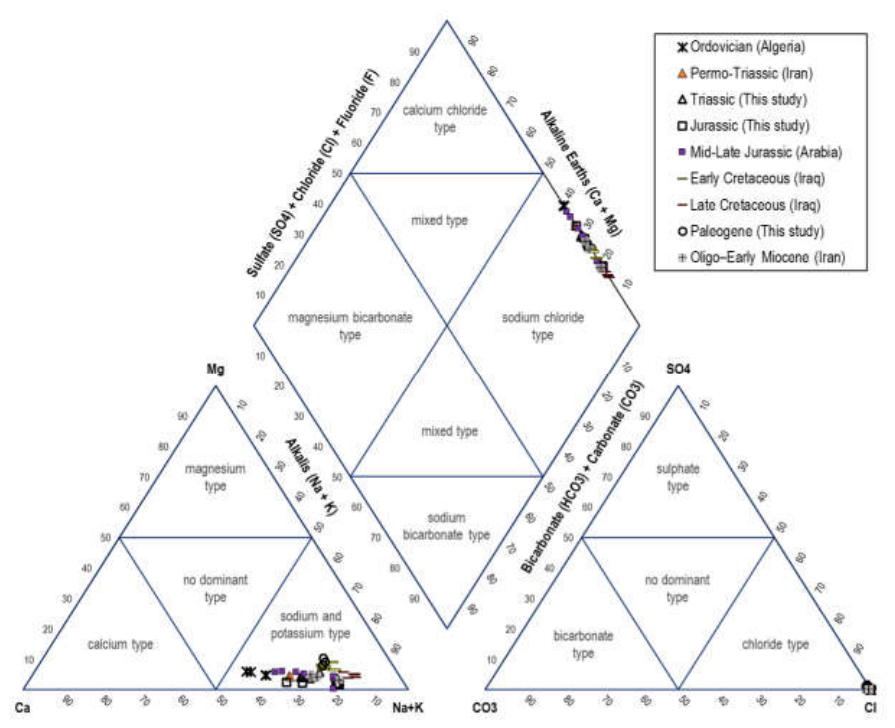
Figure 5.
Logarithmic plot of chloride (Cl) versus bromide (Br) concentrations during seawater evaporation from Carpenter [31], illustrating the initial precipitation point of evaporite mineral phases (after [89]. The plot also shows possible mixing scenarios [90] with various halite dissolution products and end-member waters. Data from this study are compared to regional brines, including the Ordovician brine in Algeria [14], the Permo-Triassic brine in Iran [13], the Middle-Late Jurassic brine in Arabia [18], the Early Cretaceous brine in Iraq [15], and the Oligocene-Early Miocene brine in Iran [11].
Figure 5.
Logarithmic plot of chloride (Cl) versus bromide (Br) concentrations during seawater evaporation from Carpenter [31], illustrating the initial precipitation point of evaporite mineral phases (after [89]. The plot also shows possible mixing scenarios [90] with various halite dissolution products and end-member waters. Data from this study are compared to regional brines, including the Ordovician brine in Algeria [14], the Permo-Triassic brine in Iran [13], the Middle-Late Jurassic brine in Arabia [18], the Early Cretaceous brine in Iraq [15], and the Oligocene-Early Miocene brine in Iran [11].
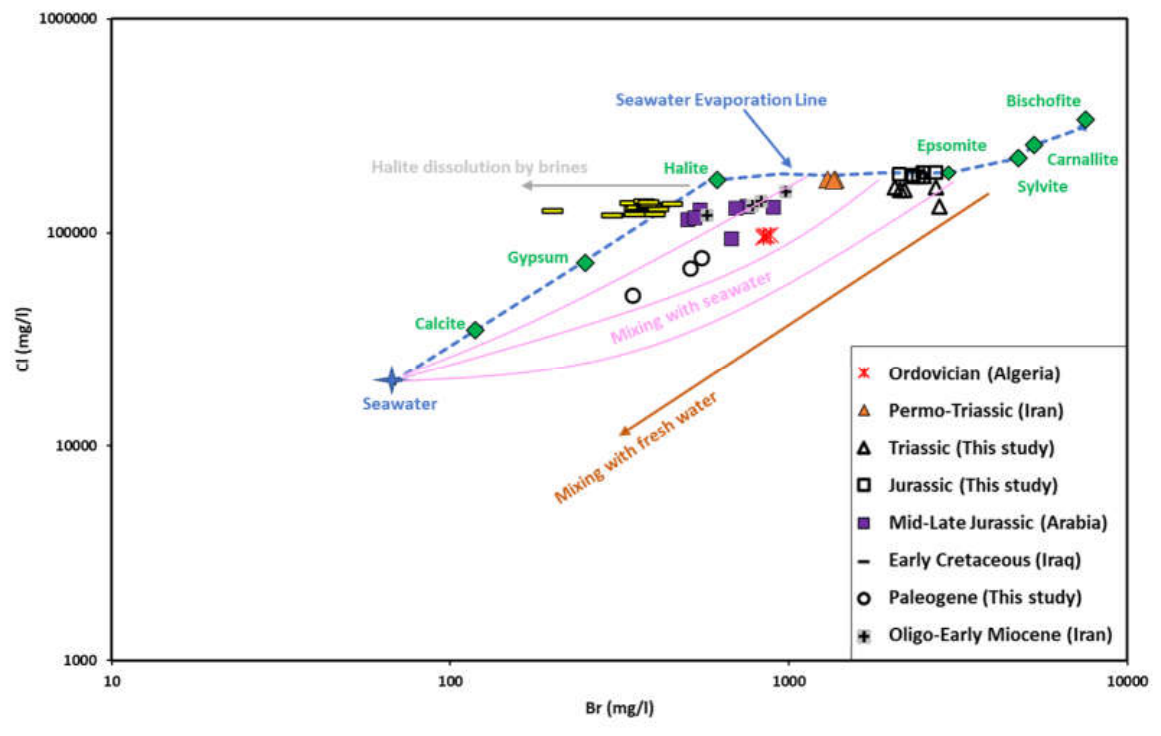
Figure 6.
δ²H-δ¹⁸O isotopic composition of brine samples from the studied aquifers, compared to the Global Meteoric Water Line (GMWL) and the seawater evaporation curve [104]. The diagram illustrates the natural processes that affect water δ18O and δ2H values, including mixing between various end-members, seawater evaporation, hydrothermal activities, and water-rock interactions, as outlined by [106]. For reference, the isotopic composition of a regional analogue, the Smackover Formation [107], a well-known example of a Li-enriched brine system, is also plotted. In addition, published data of brine samples from the NGR are shown, including samples from Permo-Triassic successions in Iran [13], the Middle-Late Jurassic in Saudi Arabia [18], the Lower-Middle Cretaceous in Kuwait [108], the Late Cretaceous in Iraq [16], and the Oligocene-Early Miocene aquifer in Iran [11].
Figure 6.
δ²H-δ¹⁸O isotopic composition of brine samples from the studied aquifers, compared to the Global Meteoric Water Line (GMWL) and the seawater evaporation curve [104]. The diagram illustrates the natural processes that affect water δ18O and δ2H values, including mixing between various end-members, seawater evaporation, hydrothermal activities, and water-rock interactions, as outlined by [106]. For reference, the isotopic composition of a regional analogue, the Smackover Formation [107], a well-known example of a Li-enriched brine system, is also plotted. In addition, published data of brine samples from the NGR are shown, including samples from Permo-Triassic successions in Iran [13], the Middle-Late Jurassic in Saudi Arabia [18], the Lower-Middle Cretaceous in Kuwait [108], the Late Cretaceous in Iraq [16], and the Oligocene-Early Miocene aquifer in Iran [11].
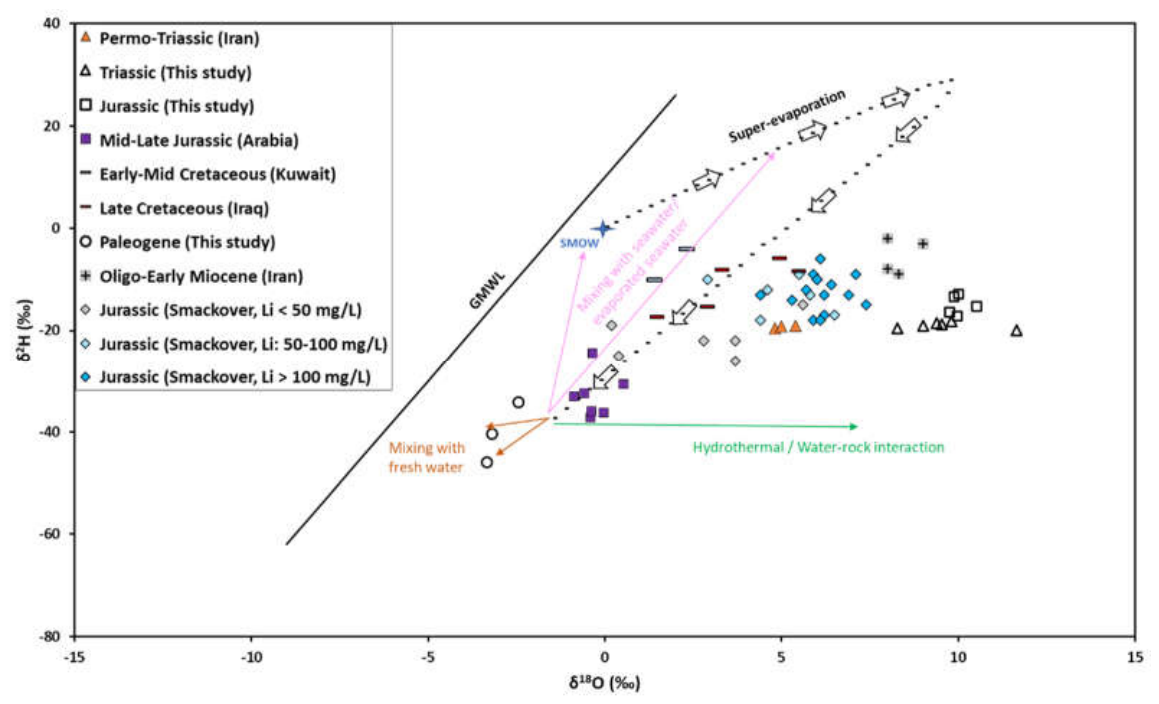
Figure 7.
Boron (B) versus potassium (K) plot for published Smackover Formation brines [107] and samples from the Triassic, Jurassic, and Paleogene aquifers in this study. Additional published brine data from the NGR include Ordovician successions in Algeria [14], Permo-Triassic successions in Iran [13], the Late Cretaceous in Iraq [16], and the Oligocene-Early Miocene in Iran [11]. Published Li concentrations are represented by symbol colours where available, with warmer colours indicating higher concentrations. The studied aquifers are plotted using B and K only and are not assigned Li values. The diagram provides an analogue-based screening comparison rather than a quantitative prediction of Li concentration.
Figure 7.
Boron (B) versus potassium (K) plot for published Smackover Formation brines [107] and samples from the Triassic, Jurassic, and Paleogene aquifers in this study. Additional published brine data from the NGR include Ordovician successions in Algeria [14], Permo-Triassic successions in Iran [13], the Late Cretaceous in Iraq [16], and the Oligocene-Early Miocene in Iran [11]. Published Li concentrations are represented by symbol colours where available, with warmer colours indicating higher concentrations. The studied aquifers are plotted using B and K only and are not assigned Li values. The diagram provides an analogue-based screening comparison rather than a quantitative prediction of Li concentration.
Disclaimer/Publisher’s Note: The statements, opinions and data contained in all publications are solely those of the individual author(s) and contributor(s) and not of MDPI and/or the editor(s). MDPI and/or the editor(s) disclaim responsibility for any injury to people or property resulting from any ideas, methods, instructions or products referred to in the content. |
© 2026 by the authors. Licensee MDPI, Basel, Switzerland. This article is an open access article distributed under the terms and conditions of the Creative Commons Attribution (CC BY) license.
Copyright: This open access article is published under a Creative Commons CC BY 4.0 license, which permit the free download, distribution, and reuse, provided that the author and preprint are cited in any reuse.