
Submitted:
01 September 2026
Posted:
03 September 2026
You are already at the latest version
Abstract
Background/Objectives: Gross hematuria frequently requires continuous bladder irrigation (CBI), a measure that provides no pharmacological hemostatic effect. Intravesical tranexamic acid (TXA) and epinephrine have emerged as adjunctive agents to improve local bleeding control. This systematic review evaluates their efficacy and safety compared with conventional CBI. Methods: A systematic search was conducted in PubMed, Scopus, and Web of Science from inception to March 2025. Randomized controlled trials (RCTs) and non-randomized studies evaluating TXA and/or epinephrine versus CBI in urological gross hematuria were included. Risk of bias was assessed with the Cochrane Risk of Bias 2 (RoB 2) tool and the Newcastle–Ottawa Scale (NOS). The protocol was prospectively registered in PROSPERO (CRD420251117904) and the review is reported according to the Preferred Reporting Items for Systematic Reviews and Meta-Analyses (PRISMA) 2020 statement. Results: Seven studies (654 patients) were included: five RCTs and two non-randomized studies. Clinical contexts encompassed bleeding after transurethral resection of the prostate (TURP), spontaneous emergency department (ED) hematuria, and radiation cystitis. Intravesical TXA reduced CBI volume, ED length of stay, Foley catheter duration, and revisit rates. Intravenous TXA showed superior early hemoglobin preservation compared with the irrigation route in TURP patients. Intravesical epinephrine achieved hemostatic success in 86.7% of patients versus 46.7% with electrocautery fulguration (p < 0.001). No thromboembolic events were reported in any study. Conclusions: Intravesical TXA and epinephrine are efficacious and safe adjuncts for the management of gross hematuria, reducing resource utilization and improving clinical outcomes. Standardized dosing protocols and larger RCTs are needed.
Keywords:
gross hematuria
; tranexamic acid
; epinephrine
; intravesical therapy
; continuous bladder irrigation
; hemostatic agents
; systematic review
1. Introduction
Gross hematuria is a clinical sign with high diagnostic value, associated with a broad spectrum of urological conditions ranging from benign prostatic hyperplasia and urolithiasis to urothelial carcinoma and radiation-induced cystitis. Its visible nature mandates prompt evaluation, particularly in patients over 35 years of age or with risk factors such as tobacco use or occupational carcinogen exposure, given its strong association with urinary tract malignancies [1,2].
When the underlying etiology cannot be immediately corrected, symptomatic hemostatic control becomes a clinical priority. Continuous bladder irrigation (CBI) via a three-way Foley catheter constitutes the first-line measure, acting mechanically through dilution and clot prevention. However, CBI has no direct pharmacological hemostatic effect and is frequently insufficient in severe or oncological hematuria, resulting in prolonged catheterization, emergency department (ED) overcrowding, and high revisit rates [3].
Two adjunctive intravesical agents have attracted growing clinical interest. Tranexamic acid (TXA) is a synthetic lysine analogue that competitively inhibits plasminogen binding to lysine residues, preventing its conversion to plasmin and thereby stabilizing fibrin clots locally. Its topical application limits systemic absorption, theoretically reducing thromboembolic risk [4]. Epinephrine is a potent alpha- and beta-adrenergic receptor agonist. Alpha-1 adrenoceptors predominate in the bladder base and mediate smooth muscle contraction, so that intravesical application induces direct vasoconstriction of submucosal vessels and reduces hemorrhage at the level of the bladder mucosa, independently of the coagulation cascade [5].
A systematic review of TXA in hematuria was published while the present work was in preparation [6]. Its scope is defined by the drug rather than by the clinical scenario: of its seven studies (970 participants), four addressed bleeding after percutaneous nephrolithotomy or transrectal prostate biopsy and one addressed cyst hemorrhage in autosomal dominant polycystic kidney disease, so that only three overlap with the present review. It did not consider epinephrine, did not include the randomized evidence on TXA added to the irrigation fluid during transurethral resection of the prostate (TURP), and appraised methodological quality with the MASTER and National Heart, Lung, and Blood Institute instruments rather than with the Cochrane Risk of Bias 2 (RoB 2) tool and the Newcastle–Ottawa Scale (NOS). No review has yet appraised together the two agents used to control bleeding at the level of the bladder itself. The aim of this review is therefore to evaluate the efficacy and safety of TXA and/or epinephrine administered via intravesical, intravenous, or combined routes in the management of gross hematuria of urological origin requiring bladder irrigation, as compared with conventional CBI without hemostatic agents.
2. Materials and Methods
2.1. Protocol and Registration
The review protocol was prospectively registered in the International Prospective Register of Systematic Reviews (PROSPERO; registration number CRD420251117904), and the record is publicly available at https://www.crd.york.ac.uk/PROSPERO/view/CRD420251117904. The review is reported in accordance with the Preferred Reporting Items for Systematic Reviews and Meta-Analyses (PRISMA) 2020 statement [7]. No generative artificial intelligence tools were used to generate text, data, or graphics, or to assist in study design, data collection, analysis, or interpretation.
2.2. Research Question (PICO Framework)
The review question was structured as follows:
- Population: adult patients with gross hematuria of lower urinary tract origin (post-procedural, oncological, or spontaneous) managed with bladder irrigation;
- Intervention: TXA or epinephrine via any route (intravesical, intravenous, irrigation fluid additive, or combined);
- Comparator: conventional CBI without hemostatic agents, or placebo;
- Outcomes: hemoglobin drop, CBI volume, transfusion rate, ED length of stay, Foley catheter duration, hospital revisits, length of hospitalization, and adverse events including thromboembolic events.
2.3. Search Strategy
A systematic search was conducted in PubMed, Scopus, and Web of Science from inception through March 2025, with no language restriction, using the following Boolean string:
(“hematuria” OR “gross hematuria” OR “visible hematuria” OR “urinary bleeding” OR “bladder bleeding” OR “clot retention”) AND (“tranexamic” OR “tranexamic acid” OR TXA OR “hemostatic” OR “antifibrinolytic” OR “epinephrine” OR “adrenaline”) AND (“continuous bladder irrigation” OR “CBI” OR “irrigation” OR “bladder irrigation” OR “intravesical irrigation”)
Reference lists of the included articles and of previous reviews were screened manually for additional eligible studies.
2.4. Eligibility Criteria
Studies were included if they (1) enrolled adults with gross hematuria of lower urinary tract origin managed in a setting where bladder irrigation formed part of routine care; (2) evaluated TXA or epinephrine via any route versus CBI, no hemostatic agent, or placebo; (3) reported at least one pre-specified efficacy or safety outcome; and (4) were published as full-text peer-reviewed articles. Case reports, conference abstracts, and studies of non-urological bleeding were excluded. Consistent with this scope, hematuria arising from upper urinary tract procedures such as percutaneous nephrolithotomy, from transrectal prostate biopsy, and from renal parenchymal disease was not eligible, since bleeding in those settings is neither accessible to nor routinely managed by bladder irrigation.
2.5. Study Selection and Data Extraction
Two investigators independently screened titles and abstracts, followed by full-text review of potentially eligible studies. Disagreements were resolved by consensus with a third investigator. Data extraction used a standardized form capturing study design, participant characteristics, intervention and comparator details, outcomes, and adverse events.
2.6. Risk of Bias Assessment
2.7. Data Synthesis
Substantial clinical and methodological heterogeneity across interventions, routes, doses, populations, and outcome definitions precluded meta-analysis. Results were therefore synthesized narratively and stratified by clinical scenario and route of administration. Continuous outcomes are reported as means with standard deviations or as medians with interquartile ranges, as provided by the primary studies.
3. Results
3.1. Study Selection
The electronic search retrieved 157 records from the three databases; no additional records were identified from registers. After removal of 49 duplicates, 108 records were screened by title and abstract, of which 86 were excluded as clearly irrelevant. All 22 reports sought for retrieval were obtained and assessed in full text. Fifteen reports were excluded, with reasons: absence of a control group (n = 6), case series without a comparator (n = 5), and narrative reviews (n = 4). Seven studies, corresponding to seven reports, met the eligibility criteria and were included in the qualitative synthesis. The study selection process is summarized in Figure 1.
3.2. Study Characteristics
Seven studies totaling 654 patients were included: five randomized controlled trials (RCTs) and two non-randomized studies. Three clinical scenarios were represented: spontaneous or ED-presenting gross hematuria (Moharamzadeh et al. [4] and Choi et al. [10]); post-TURP hematuria (Tawfick et al. [11], Gupta et al. [12], Kundargi et al. [13], and Salehi et al. [14]); and intractable lower urinary tract hematuria predominantly secondary to radiation cystitis (Chow et al. [5]). Most studies evaluated TXA; only one study explored intravesical epinephrine as the primary intervention. Table 1 summarizes study characteristics, interventions, and key outcomes.
3.3. Risk of Bias in the Included Studies
The methodological appraisal of the seven included studies is presented in Table 2. Among the five randomized trials assessed with RoB 2, the two double-blind trials [4,14] were judged to be at low risk of bias, whereas the three remaining trials [11,12,13] raised some concerns. The dominant driver was the comparator itself: only two trials [4,11] used a true placebo, while Gupta et al. [12], Kundargi et al. [13] and Salehi et al. [14] compared TXA with untreated controls, so that participants and operating personnel could not be blinded to allocation. Allocation concealment was explicitly described in three trials (closed envelopes in Tawfick et al. [11], sealed envelopes opened after induction of anesthesia in Salehi et al. [14], and computer-generated tables in Kundargi et al. [13]) and left unreported in the remainder. Mitigating this, the primary bleeding outcomes were objective throughout (hemoglobin concentration, photometrically measured blood loss, irrigation volume), which limits the likely impact of unblinded outcome assessment; the principal exception is the subjectively graded endoscopic vision reported by Tawfick et al. [11] and Kundargi et al. [13]. Attrition was negligible except in Moharamzadeh et al. [4], where 65 patients were randomized but only 50 entered the per-protocol analysis. The two non-randomized studies [10,5] were rated as high quality on the Newcastle-Ottawa Scale (8 of 9 stars each), with points lost in the comparability domain: Choi et al. [10] compared consecutive cohorts separated by a twelve-month interval without multivariable adjustment, and the groups of Chow et al. [5] differed significantly in the distribution of hematuria etiologies (p = 0.002). No study was judged to be at high risk of bias or of low methodological quality, and none was excluded from the synthesis on the basis of its rating.
3.4. Tranexamic Acid in Spontaneous or ED-Presenting Gross Hematuria
Moharamzadeh et al. [4] conducted the index double-blind RCT of intravesical TXA for gross hematuria in 50 ED patients. Instillation of 500 mg of TXA in 100 mL of normal saline via a Foley catheter with a 15 min clamp significantly reduced the total CBI saline volume (9.52 ± 4.13 L vs. 12.00 ± 4.22 L; p = 0.04) and improved microscopic hematuria at 24 h (p = 0.026). No significant difference was observed in hemoglobin drop or packed cell transfusion rates (p > 0.05), likely reflecting the self-limiting nature of hematuria in this outpatient-presenting population. Adverse events were not reported. Of note, 65 patients were randomized but only 50 were analyzed under a per-protocol strategy, the remainder having been discharged from the emergency department before follow-up.
Choi et al. [10] extended these findings in a before-and-after study of 159 ED patients. Intravesical TXA 1000 mg with a 15 min dwell prior to CBI initiation reduced the median ED length of stay from 411 to 274 min (p < 0.001) and shortened the median Foley catheter duration from 308 to 145 min (p < 0.001). Hospital revisits fell from 12.3% to 2.3% (p = 0.030), and a trend toward reduced admissions was observed (45.2% to 29.1%; p = 0.052). Interrupted time series analysis showed no significant change in monthly slope, but confirmed a significant immediate effect at intervention onset for both ED length of stay (−302.7 min; p < 0.001) and Foley catheter duration (−306.9 min; p < 0.001). TXA-related adverse events were not reported.
3.5. Tranexamic Acid in Post-TURP Hematuria
Tawfick et al. [11] randomized 50 TURP patients (aged 50–85 years, prostate 50–80 g) to 0.1% TXA 1000 mg added to each litre of glycine irrigation fluid intraoperatively plus 500 mg instilled intravesically at the end of surgery with a 15 min clamp, versus a distilled-water placebo delivered by the same schedule. Total blood loss was significantly lower in the TXA group (483.4 ± 113.5 mL vs. 644.2 ± 101.2 mL; p < 0.001), with reductions maintained at each of the three measurement timepoints. Serum hemoglobin at 4 h postoperatively was 13.24 ± 0.77 g/dL in the TXA group versus 12.60 ± 0.82 g/dL in controls (p = 0.006), corresponding to a smaller total hemoglobin drop (1.10 ± 0.24 vs. 1.37 ± 0.31 g/dL). Surgery duration was significantly shorter with TXA (91.4 vs. 99.2 min; p = 0.001) and endoscopic view quality was improved (good vision 56% vs. 20%; p = 0.032). No thromboembolic events occurred in either group.
Gupta et al. [12] evaluated a combined intravenous and topical approach in 70 patients undergoing bipolar TURP, administering TXA 500 mg intravenously after induction of anesthesia plus 500 mg per 3 L irrigation bottle (maximum 2 g), against an untreated control group. Intraoperative blood loss was significantly reduced (174.6 ± 125.4 mL vs. 232.5 ± 116.8 mL; p = 0.04) and the transfusion requirement fell from 14.2% to 2.8%. On subgroup analysis, the benefit was most pronounced in prostates larger than 60 g (p = 0.019). Hemoglobin drop at 24 h (1.31 vs. 1.40 g/dL; p = 0.722), irrigation volume (14.9 vs. 15.5 L; p = 0.703) and operative time (56.7 vs. 54.4 min; p = 0.550) did not differ significantly between groups, and no complications were observed in either arm.
Kundargi et al. [13] compared three approaches in 105 bipolar-TURP patients with glands of 40–100 g: intravenous TXA 1 g given 20 min preoperatively, TXA 500 mg per 3 L irrigation fluid (maximum 2 g), and an untreated control arm; despite being labelled a placebo group, controls received no agent. At 4 h postoperatively, the hemoglobin drop was greatest in controls (ΔHb 0.785 g/dL), intermediate with irrigation TXA (0.511 g/dL), and least with intravenous TXA (0.274 g/dL); only the intravenous versus control difference reached statistical significance (p = 0.016), the irrigation route being indistinguishable from control at this timepoint (p = 0.292). By postoperative day 1, both active arms outperformed controls (control 1.108 g/dL, irrigation 0.828 g/dL, intravenous 0.811 g/dL; p = 0.026 and p = 0.016, respectively, versus control), although neither route was superior to the other (p = 0.985). Resection time, irrigation volume, endoscopic vision and postoperative stay were comparable across arms, and no deep vein thrombosis or thromboembolic event was encountered.
Salehi et al. [14] addressed the interaction between TXA and irrigation fluid temperature in 100 TURP patients randomized to four arms, all using 1.5% glycine irrigation with 500 mg of TXA per 3 L bottle in the three active groups. Cold TXA irrigation (2 °C) produced the lowest intraoperative blood loss (mean 69.2 mL) compared with room-temperature TXA at 21.5 °C (110.2 mL), warm TXA at 37 °C (150.3 mL), and untreated control (126.2 mL), with significant pairwise differences for cold versus every other arm (p ≤ 0.004). Notably, neither room-temperature nor warm TXA differed significantly from control, so the benefit was attributable to the combination of TXA with cold fluid rather than to TXA alone. Cold irrigation carried the reciprocal penalty: grade 4 shivering involving all muscle groups occurred in 52% of that arm and in none of the warm-TXA arm, where 92% of patients remained entirely free of shivering, revealing a clinically relevant hemostasis-versus-thermoregulation trade-off. Hemoglobin declined significantly over time in all groups, with no statistically significant between-group differences at any postoperative timepoint (p > 0.05).
3.6. Intravesical Epinephrine for Intractable Hematuria
Chow et al. [5] retrospectively evaluated 60 patients with intractable lower urinary tract hematuria (radiation cystitis 65%, bladder urothelial carcinoma 15%, interstitial cystitis 11.7%) treated with intravesical epinephrine 1:10,000 (150 mL instilled via cystoscopy under general anesthesia, three-minute dwell repeated three times) followed by 24 h ward irrigation with 1:100,000 diluted epinephrine, compared with 60 patients treated with cystoscopic electrocautery fulguration. All patients had failed prior conservative measures, and 58.3% of the epinephrine group had already failed cystoscopic fulguration, versus none of the controls. Hemostatic success at one month, defined as resolution of hematuria without additional invasive procedures, was achieved in 86.7% of the epinephrine group versus 46.7% of controls (p < 0.001). Additional invasive procedures were significantly fewer in the epinephrine arm (p < 0.001). Immediate complete hemostasis was observed intraoperatively in every epinephrine case, and median hospitalization was markedly shorter (8.5 [IQR 3.0–32.5] vs. 23.0 [IQR 8.0–55.8] days; p = 0.049). Median follow-up was 13.0 months in the epinephrine group and 8.0 months in controls. Serial cardiopulmonary monitoring throughout the procedure and the ward phase demonstrated no significant changes in mean blood pressure, heart rate, or respiratory rate from baseline, supporting hemodynamic safety at the doses employed.
3.7. Safety Profile
Across all seven included studies, no thromboembolic events—venous thromboembolism, pulmonary embolism, or arterial events—were attributable to TXA, regardless of route (intravesical bolus, irrigation fluid additive, or intravenous) or dose (500 mg to 2 g). This finding is consistent with the mechanistic rationale for topical administration, in that negligible systemic absorption limits coagulation cascade effects to the local urinary compartment. Adverse events were mild and transient. Postoperative shivering was the most clinically relevant, occurring predominantly with cold TXA irrigation in TURP patients [14], an effect attributable to fluid temperature rather than to TXA itself. Intravesical epinephrine was well tolerated in all 60 patients in the series by Chow et al., with no anxiety, tremor, headache, perspiration, or cardiovascular instability recorded at the 1:10,000 instillation concentration; serial measurement of systolic and diastolic blood pressure, heart rate, and respiratory rate at baseline, at 3, 6 and 9 min, and on the ward showed no significant deviation from baseline [5]. These data collectively support an acceptable safety profile for both agents in the urological context.
4. Discussion
This systematic review integrates evidence from seven studies across three distinct urological hematuria scenarios and consistently demonstrates clinically meaningful benefits of intravesical TXA and epinephrine over conventional CBI alone, without any signal of serious harm.
The mechanistic basis for intravesical TXA is well established. The urothelium and prostatic tissue harbor high concentrations of urokinase-type plasminogen activator, which continuously degrades fibrin clots at bleeding sites [11,12]. By competitively blocking lysine-binding sites on plasminogen, TXA prevents its conversion to plasmin and stabilizes local clots. Topical delivery concentrates the drug at the bleeding source while limiting systemic absorption, an important advantage given reported associations between systemic TXA and thromboembolic risk in high-dose surgical settings.
An important route-dependent pharmacokinetic distinction emerges from the TURP studies. Kundargi et al. [13] demonstrated that intravenous TXA achieved superior early hemoglobin preservation at 4 h, at which point the irrigation route was statistically indistinguishable from no treatment at all, although both routes were equivalent to each other and superior to control by postoperative day 1. This likely reflects the anatomy of the prostatic venous plexus: bleeding from disrupted venous sinuses may be more effectively reached by systemically delivered TXA than by irrigation-route administration, which depends on diffusion into the peri-prostatic tissue. In contrast, for bladder mucosal and urothelial hematuria, as in the ED-presenting populations studied by Moharamzadeh et al. [4] and Choi et al. [10], the intravesical route appears sufficient, directly bathing the bleeding surface. This route-stratified reading converges with the independent synthesis of Naseralallah et al. [6], which likewise concluded that intravenous TXA yields superior outcomes after surgery whereas the irrigation route performs comparatively better in non-surgical presentations, despite that review sharing only three studies with the present one.
The study by Tawfick et al. [11] is notable for combining irrigation-route TXA intraoperatively with a postoperative intravesical instillation, yielding significant reductions in total blood loss across all three measurement timepoints and improved endoscopic visualization. The additional finding of shorter operative time in the TXA arm is clinically relevant, as longer resection time is itself an independent predictor of post-TURP hemorrhage.
The cold-versus-warm TXA irrigation finding of Salehi et al. [14] introduces an important practical consideration. Cold irrigation (2 °C) provided the greatest hemostatic benefit but was associated with the highest shivering rates, a complication that substantially increases oxygen demand and carries metabolic consequences in elderly TURP patients. Room-temperature TXA irrigation showed intermediate hemostatic efficacy without a significant excess of shivering compared with control, and may represent the most practical balance for routine clinical use pending further investigation.
The intravesical epinephrine data reported by Chow et al. [5] deserve particular attention from an uro-oncological perspective. Radiation cystitis represents one of the most therapeutically challenging hematuria etiologies, with impaired mucosal healing, diffuse telangiectasia, and frequent refractory bleeding. The 86.7% hemostatic success rate for epinephrine, compared with 46.7% for cystoscopic electrocautery, which has historically been considered the procedural standard, is striking, especially given the non-invasive profile relative to formalin, alum instillation, or arterial embolization. The vasoconstrictor mechanism via alpha-1 adrenergic receptors in bladder smooth muscle provides rapid hemostasis independent of coagulation status, which is particularly advantageous in patients receiving antiplatelet or anticoagulant therapy. This is, to our knowledge, the first systematic appraisal to place this agent alongside TXA within a single evidence framework.
From a clinical translation perspective, intravesical TXA is inexpensive, widely available, and administrable through an existing Foley catheter without additional procedural expertise. The 15 min dwell protocol described consistently across the ED studies is easily implementable in routine emergency urology practice. Intravesical epinephrine requires cystoscopic delivery under general anesthesia and specialist supervision, positioning it as a second-line intervention for refractory cases after conservative measures fail.
4.1. Limitations
Several methodological limitations warrant acknowledgement. Heterogeneity is substantial across the included studies: TXA doses range from 500 mg to 2 g, delivery routes and timing vary, patient populations span three distinct clinical scenarios, and outcome definitions, particularly for resolution of hematuria, are inconsistent. This heterogeneity precluded meta-analysis and limits the strength of any pooled inference. Five of the seven studies were randomized, but only two employed a true placebo comparator [4,11]; the other three compared TXA with untreated controls, leaving participants and personnel effectively unblinded. The before-and-after design of Choi et al. [10] is susceptible to secular trend bias, and the retrospective cohort of Chow et al. [5] carries uncontrolled confounding, both from a significant imbalance in hematuria etiology between groups (p = 0.002) and from the fact that most of the epinephrine group had already failed fulguration, the very comparator against which the agent was judged. Sample sizes were modest throughout, ranging from 50 to 159 patients. Outcome definitions were heterogeneous even within the TURP subgroup, where blood loss was variously derived from photometric hemoglobin assay of the irrigation fluid, from serial serum hemoglobin, or from hematocrit, precluding direct numerical comparison across trials. Only three databases were searched and grey literature was not systematically retrieved, so publication bias cannot be excluded; the number of studies was insufficient to assess it formally. The deliberate restriction to bleeding accessible to bladder irrigation also means that trials of systemic TXA after percutaneous nephrolithotomy or prostate biopsy fall outside this review; readers seeking that broader picture are referred to Naseralallah et al. [6]. Finally, the search was closed in March 2025 and no study published thereafter is represented. The certainty of the body of evidence was not formally rated. Prospective registration of the protocol in PROSPERO, duplicate screening and extraction, and the use of validated risk-of-bias instruments represent methodological strengths of this review.
5. Conclusions
Intravesical tranexamic acid and epinephrine represent efficacious and safe adjunctive therapeutic strategies for the management of gross hematuria across urological etiologies. TXA reduces CBI volume, ED length of stay, Foley catheter duration, and hospital revisit rates in spontaneous hematuria; intravenous TXA confers superior early intraoperative hemoglobin preservation in post-TURP bleeding; and intravesical epinephrine achieves high hemostatic success in refractory radiation-induced hematuria. A clinically relevant trade-off exists between cold TXA irrigation, which offers superior hemostasis, and warm TXA irrigation, which reduces postoperative shivering, in the TURP context. No thromboembolic events were recorded in any included study. Prospective, adequately powered RCTs are needed to standardize dosing regimens, refine route selection according to hematuria etiology, and establish head-to-head comparisons between TXA and epinephrine.
Author Contributions
Conceptualization, R.C.-V. and E.G.M.-L.; methodology, R.C.-V.; validation, J.J.A.-P., J.A.G.-L. and E.G.M.-L.; formal analysis, R.C.-V. and O.D.G.-A.; investigation, R.C.-V., J.J.A.-P., O.D.G.-A., J.A.V.-C., M.G.-L., A.S.I.-L., E.F.-F., J.A.G.-L. and E.G.M.-L.; data curation, J.J.A.-P., O.D.G.-A., J.A.V.-C., M.G.-L., A.S.I.-L. and E.F.-F.; writing—original draft preparation, R.C.-V.; writing—review and editing, J.J.A.-P., O.D.G.-A., J.A.V.-C., M.G.-L., A.S.I.-L., E.F.-F., J.A.G.-L. and E.G.M.-L.; visualization, R.C.-V.; supervision, E.G.M.-L.; project administration, R.C.-V. All authors have read and agreed to the published version of the manuscript.
Funding
This research received no external funding.
Institutional Review Board Statement
Ethical review and approval were waived for this study because it is a systematic review of previously published, peer-reviewed literature and involved no direct experimentation on, or collection of identifiable data from, human subjects or animals.
Informed Consent Statement
Not applicable. No patient data, photographs, or individually identifiable clinical information were collected or used in this review; all data derive from published sources.
Data Availability Statement
No new data were created in this study. All data analyzed were extracted from the published articles cited in the reference list. The extraction forms and risk-of-bias assessments generated during the review are available from the corresponding author upon reasonable request. The review protocol is publicly available in PROSPERO (CRD420251117904) at https://www.crd.york.ac.uk/PROSPERO/view/CRD420251117904.
Acknowledgments
The authors thank the medical library staff of the participating institutions for their assistance with full-text retrieval. During the preparation of this manuscript, the authors did not use any generative artificial intelligence tool to generate text, data, or graphics, or to assist in study design, data collection, analysis, or interpretation.
Conflicts of Interest
The authors declare no conflicts of interest.
Conference Presentation
An abstract reporting this work has been accepted for presentation at the 46th Congress of the Société Internationale d’Urologie (SIU 2026), Florence, Italy, 11–14 November 2026. The present manuscript is a substantially expanded version of that abstract.
Abbreviations
The following abbreviations are used in this manuscript:
| BPH | Benign prostatic hyperplasia |
| CBI | Continuous bladder irrigation |
| DVT | Deep vein thrombosis |
| ED | Emergency department |
| Hb | Hemoglobin |
| IQR | Interquartile range |
| IV | Intravenous |
| LOS | Length of stay |
| NOS | Newcastle–Ottawa Scale |
| NS | Normal saline |
| PRISMA | Preferred Reporting Items for Systematic Reviews and Meta-Analyses |
| RCT | Randomized controlled trial |
| RoB 2 | Cochrane Risk of Bias 2 tool |
| TEV | Thromboembolic event |
| TURP | Transurethral resection of the prostate |
| TXA | Tranexamic acid |
| UC | Urothelial carcinoma |
References
- Ingelfinger, J.R. Hematuria in Adults. N. Engl. J. Med. 2021, 385, 153–163. [Google Scholar] [CrossRef]
- Barocas, D.A.; Boorjian, S.A.; Alvarez, R.D.; Downs, T.M.; Gross, C.P.; Hamilton, B.D.; Kobashi, K.C.; Lipman, R.R.; Lotan, Y.; Ng, C.K.; et al. Microhematuria: AUA/SUFU Guideline. J. Urol. 2020, 204, 778–786. [Google Scholar] [CrossRef] [PubMed]
- Hicks, D.; Li, C.Y. Management of Macroscopic Haematuria in the Emergency Department. Emerg. Med. J. 2007, 24, 385–390. [Google Scholar] [CrossRef]
- Moharamzadeh, P.; Ojaghihaghighi, S.; Amjadi, M.; Rahmani, F.; Farjamnia, A. Effect of Tranexamic Acid on Gross Hematuria: A Pilot Randomized Clinical Trial Study. Am. J. Emerg. Med. 2017, 35, 1922–1925. [Google Scholar] [CrossRef] [PubMed]
- Chow, Y.-C.; Hsu, W.-H.; Chen, M.; Lin, W.-C.; Chiu, A.W. Safety and Efficacy of Intravesical Epinephrine Instillation in Patients with Intractable Lower Urinary Tract Hematuria—A Novel Approach. Urology 2023, 175, 216–222. [Google Scholar] [CrossRef] [PubMed]
- Naseralallah, L.; Nasrallah, D.; Alsheikh, R.; Assami, D.; Boudaka, R. Tranexamic Acid for the Management of Hematuria: A Systematic Review. Urology 2026, 210, 136–142. [Google Scholar] [CrossRef] [PubMed]
- Page, M.J.; McKenzie, J.E.; Bossuyt, P.M.; Boutron, I.; Hoffmann, T.C.; Mulrow, C.D.; Shamseer, L.; Tetzlaff, J.M.; Akl, E.A.; Brennan, S.E.; et al. The PRISMA 2020 Statement: An Updated Guideline for Reporting Systematic Reviews. BMJ 2021, 372, n71. [Google Scholar] [CrossRef] [PubMed]
- Sterne, J.A.C.; Savović, J.; Page, M.J.; Elbers, R.G.; Blencowe, N.S.; Boutron, I.; Cates, C.J.; Cheng, H.-Y.; Corbett, M.S.; Eldridge, S.M.; et al. RoB 2: A Revised Tool for Assessing Risk of Bias in Randomised Trials. BMJ 2019, 366, l4898. [Google Scholar] [CrossRef] [PubMed]
- Wells, G.A.; Shea, B.; O’Connell, D.; Peterson, J.; Welch, V.; Losos, M.; Tugwell, P. The Newcastle–Ottawa Scale (NOS) for Assessing the Quality of Nonrandomised Studies in Meta-Analyses. Available online: https://www.ohri.ca/programs/clinical_epidemiology/oxford.asp (accessed on añadir fecha de consulta).
- Choi, H.; Kim, D.W.; Jung, E.; Kye, Y.C.; Lee, J.; Jo, S.; Kang, M.; Kim, D.; Kim, B. Impact of Intravesical Administration of Tranexamic Acid on Gross Hematuria in the Emergency Department: A Before-and-After Study. Am. J. Emerg. Med. 2023, 68, 68–72. [Google Scholar] [CrossRef] [PubMed]
- Tawfick, A.; Mousa, W.; El-Zhary, A.F.; Saafan, A.M. Can Tranexamic Acid in Irrigation Fluid Reduce Blood Loss during Monopolar Transurethral Resection of the Prostate? A Randomised Controlled Trial. Arab J. Urol. 2022, 20, 94–99. [Google Scholar] [CrossRef] [PubMed]
- Gupta, A.; Priyadarshi, S.; Vyas, N.; Sharma, G. Efficacy of Tranexamic Acid in Decreasing Primary Hemorrhage in Transurethral Resection of the Prostate: A Novel Combination of Intravenous and Topical Approach. Urol. Ann. 2021, 13, 238–242. [Google Scholar] [CrossRef] [PubMed]
- Kundargi, V.S.; Patil, S.; Patil, S.B.; Vaidya, M.K.; Patil, B.S.; Sharif, A.N.; Shukla, V. Role of Tranexamic Acid via Intravenous and Irrigation Fluid Route in Controlling TURP-Associated Bleeding. Afr. J. Urol. 2024, 30, 68. [Google Scholar] [CrossRef]
- Salehi, M.; Imani, B.; Zandi, S.; Haghiabi, H.; Souri, S. Effect of Tranexamic Acid Dissolved in Warm, Cold, and Room-Temperature Irrigation Fluid on Complications during and after TURP Surgery: A Double-Blind, Randomized Clinical Trial. Afr. J. Urol. 2025, 31, 4. [Google Scholar] [CrossRef]
Figure 1.
PRISMA 2020 flow diagram of study identification, screening, and inclusion.
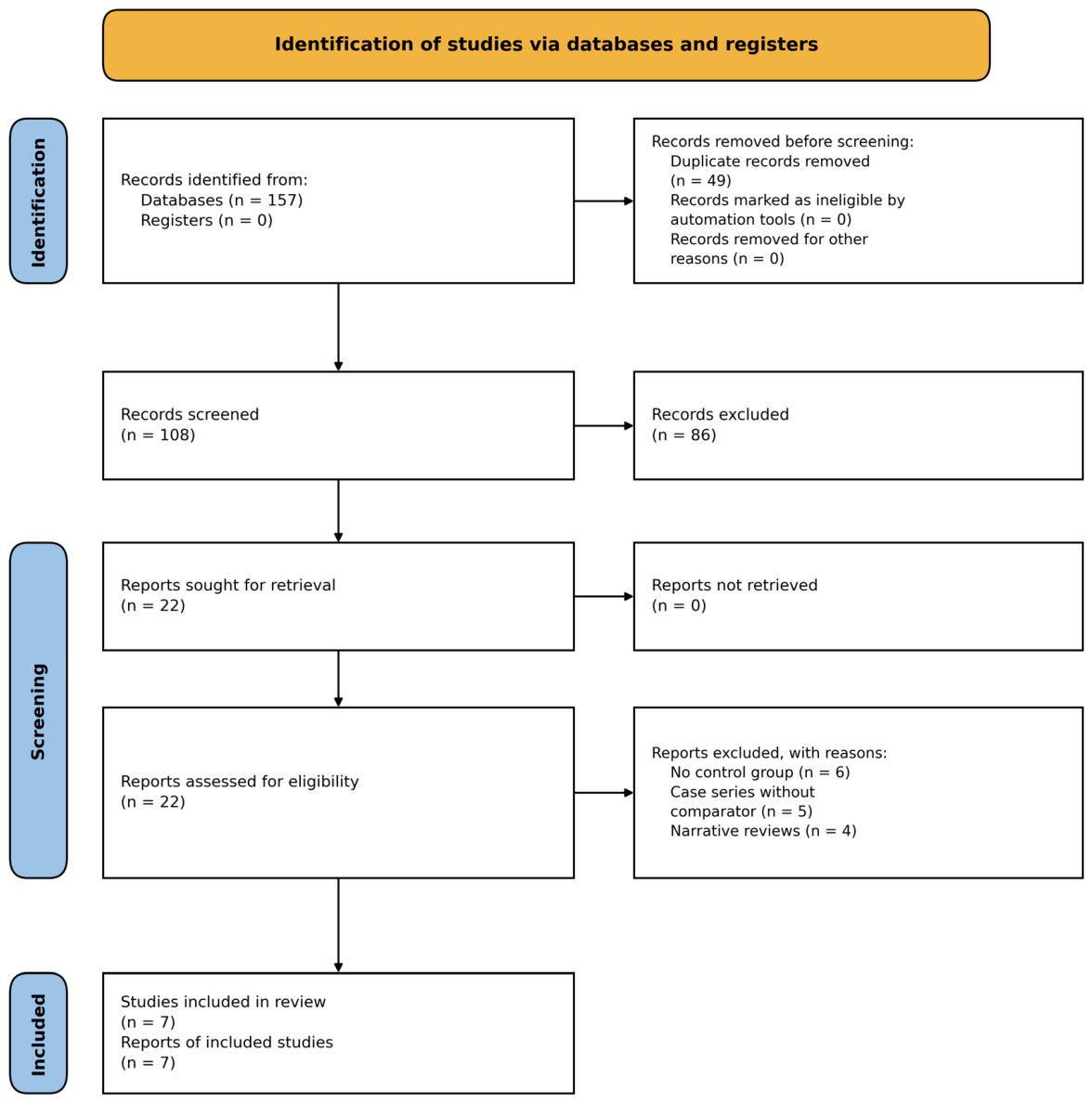

Table 1.
Characteristics and main outcomes of the included studies.
| Study (Year); Journal | Design | N | Population | Intervention | Comparator | Key outcomes |
| Moharamzadeh et al. (2017); Am. J. Emerg. Med. | Double-blind RCT | 50 (25/25) | ED patients, painless gross hematuria, age > 40 years | Intravesical TXA 500 mg in 100 mL NS + CBI (15 min dwell) | Distilled water + CBI | ↓ CBI volume (9.52 vs. 12.00 L; p = 0.04); ↓ urine blood at 24 h (p = 0.026); no difference in Hb drop or transfusion |
| Choi et al. (2023); Am. J. Emerg. Med. | Before-and-after, retrospective | 159 (73/86) | ED patients, gross hematuria grade ≥ 6 requiring CBI | Intravesical TXA 1000 mg in 100 mL NS (15 min dwell), then CBI | CBI alone (historical cohort, 2021) | ↓ ED LOS (274 vs. 411 min; p < 0.001); ↓ Foley duration (145 vs. 308 min; p < 0.001); ↓ revisits (2.3% vs. 12.3%; p = 0.030); trend ↓ admissions (29.1% vs. 45.2%; p = 0.052) |
| Tawfick et al. (2022); Arab J. Urol. | RCT, placebo-controlled (blinding not reported) | 50 (25/25) | Monopolar TURP for BPH, age 50–85 years, prostate 50–80 g | TXA 1000 mg per litre of glycine irrigation fluid + 500 mg intravesical at end of surgery (15 min clamp) | Placebo (distilled water) | ↓ total blood loss (483 vs. 644 mL; p < 0.001); ↓ total Hb drop (1.10 vs. 1.37 g/dL); Hb at 4 h 13.24 vs. 12.60 g/dL (p = 0.006); ↓ surgery duration (91.4 vs. 99.2 min; p = 0.001); ↑ good endoscopic view (56% vs. 20%; p = 0.032); no TEV |
| Gupta et al. (2021); Urol. Ann. | RCT, open-label | 70 (35/35) | Bipolar TURP for BPH, age 40–80 years | IV TXA 500 mg + 500 mg per 3 L irrigation bottle (max. 2 g) | No TXA (untreated control) | ↓ intraoperative blood loss (174.6 vs. 232.5 mL; p = 0.04); ↓ transfusion rate (2.8% vs. 14.2%); greatest benefit in prostates > 60 g (p = 0.019); no difference in Hb at 24 h (p = 0.722), irrigation volume (p = 0.703) or operative time (p = 0.550) |
| Kundargi et al. (2024); Afr. J. Urol. | Three-arm RCT, open-label | 105 (35/35/35) | Bipolar TURP for BPH, prostate 40–100 g | IV TXA 1 g (20 min preoperatively) OR TXA 500 mg per 3 L irrigation fluid (max. 2 g) | No TXA (labelled placebo; no agent given) | ΔHb at 4 h: control 0.785, irrigation 0.511, IV 0.274 g/dL (IV vs. control p = 0.016; irrigation vs. control p = 0.292); ΔHb POD1: 1.108 / 0.828 / 0.811 g/dL (both vs. control p = 0.026 and p = 0.016; IV vs. irrigation p = 0.985); no DVT or TEV |
| Salehi et al. (2025); Afr. J. Urol. | Double-blind four-arm RCT | 100 (25/25/25/25) | TURP for BPH, age 50–85 years, prostate ≤ 70 g | TXA 500 mg per 3 L of 1.5% glycine irrigation fluid, cold (2 °C), room-temperature (21.5 °C) or warm (37 °C) | Routine irrigation without TXA | Cold TXA: lowest intraoperative bleeding (69.2 vs. 110.2 room, 150.3 warm, 126.2 control mL; p ≤ 0.004 for cold vs. each); room-temperature and warm TXA not different from control; grade 4 shivering 52% (cold) vs. 0% (warm), 92% shivering-free with warm TXA; no between-group Hb difference at any timepoint |
| Chow et al. (2023); Urology | Retrospective cohort | 120 (60/60) | Intractable lower urinary tract hematuria refractory to prior treatment (radiation cystitis 65%; bladder UC 15%; interstitial cystitis 11.7%); 58.3% of the epinephrine group had already failed fulguration | Intravesical epinephrine 1:10,000 (150 mL via cystoscopy) + ward irrigation 1:100,000 for 24 h | Cystoscopic electrocautery fulguration | Hemostatic success at 1 month 86.7% vs. 46.7% (p < 0.001); ↓ additional procedures (p < 0.001); ↓ median hospitalization (8.5 vs. 23.0 days; p = 0.049); no significant change in blood pressure, heart rate or respiratory rate |
BPH: benign prostatic hyperplasia; CBI: continuous bladder irrigation; DVT: deep vein thrombosis; ED: emergency department; Hb: hemoglobin; IV: intravenous; LOS: length of stay; NS: normal saline; POD1: postoperative day 1; RCT: randomized controlled trial; TEV: thromboembolic event; TURP: transurethral resection of the prostate; TXA: tranexamic acid; UC: urothelial carcinoma; ΔHb: hemoglobin drop.
Table 2.
Methodological quality and risk-of-bias assessment of the included studies.
| Study (Year) | Study design | Tool | Overall judgement | Key comment |
| Moharamzadeh et al. (2017) | Double-blind RCT | RoB 2 | Low risk of bias | Adequate randomization and double blinding; objective outcomes; distilled-water placebo. Small sample; 65 randomized but 50 analyzed per protocol. |
| Choi et al. (2023) | Retrospective observational (before-and-after) | NOS | High quality (8/9) | Consecutive cohorts with a clear protocol and objective outcomes. No randomization; historical control separated by twelve months; no multivariable adjustment. |
| Tawfick et al. (2022) | RCT, placebo-controlled | RoB 2 | Some concerns | Allocation concealed by closed envelopes and a distilled-water placebo used, but blinding of participants and personnel not reported; endoscopic vision subjectively graded; single-center, small sample. |
| Gupta et al. (2021) | Open-label RCT | RoB 2 | Some concerns | Computer-generated randomization, but untreated control rather than placebo, and neither allocation concealment nor blinding reported. Objective primary outcomes; small sample. |
| Kundargi et al. (2024) | Three-arm RCT, open-label | RoB 2 | Some concerns | Computer-generated randomization tables; untreated control rather than placebo, without blinding; single-center. Moderate sample; objective primary outcomes minimize bias, though endoscopic vision was subjectively graded. |
| Salehi et al. (2025) | Double-blind RCT | RoB 2 | Low risk of bias | Block randomization with allocation concealed in sealed envelopes opened after induction; participants and principal investigator blinded; photometric blood loss measurement. Untreated control rather than placebo; single-center; no follow-up for thromboembolism. |
| Chow et al. (2023) | Comparative retrospective observational | NOS | High quality (8/9) | Well-described epinephrine protocol; median follow-up 13.0 vs. 8.0 months. Non-randomized comparison group, significant imbalance in hematuria etiology (p = 0.002), no multivariable adjustment, and most of the epinephrine group had already failed the comparator procedure. |
NOS: Newcastle-Ottawa Scale; RCT: randomized controlled trial; RoB 2: Cochrane Risk of Bias 2 tool. RoB 2 judgements refer to the trial’s primary bleeding outcome. NOS scores are expressed as stars out of a maximum of 9.
Disclaimer/Publisher’s Note: The statements, opinions and data contained in all publications are solely those of the individual author(s) and contributor(s) and not of MDPI and/or the editor(s). MDPI and/or the editor(s) disclaim responsibility for any injury to people or property resulting from any ideas, methods, instructions or products referred to in the content. |
© 2026 by the authors. Licensee MDPI, Basel, Switzerland. This article is an open access article distributed under the terms and conditions of the Creative Commons Attribution (CC BY) license (http://creativecommons.org/licenses/by/4.0/).
Copyright: This open access article is published under a Creative Commons CC BY 4.0 license, which permit the free download, distribution, and reuse, provided that the author and preprint are cited in any reuse.