
Submitted:
02 September 2026
Posted:
03 September 2026
You are already at the latest version
Abstract
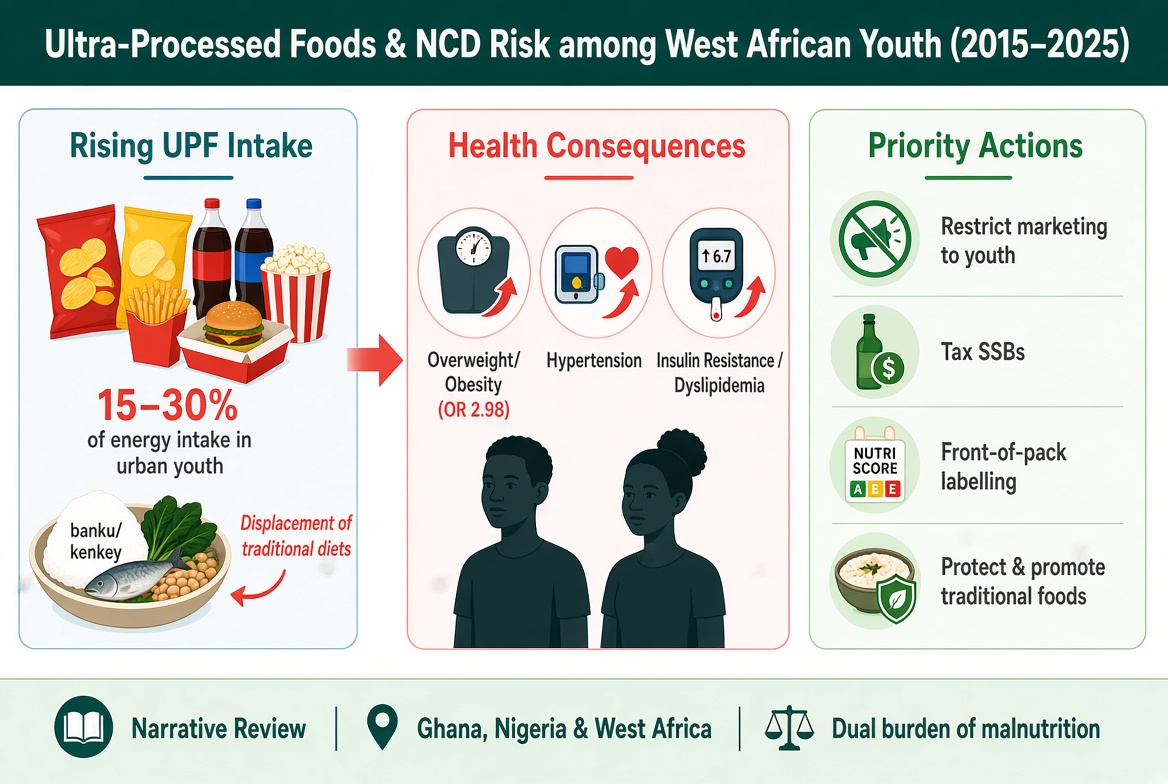
Background/Objectives: Ultra-processed foods (UPFs) are industrial formulations linked to rising non-communicable diseases (NCDs) globally. In West Africa, rapid urbanization and retail modernization have accelerated UPF availability among youth, yet the NCD implications remain under-synthesized. This narrative review examines the relationship between UPF consumption and NCD risk among West African adolescents and young adults aged 10–24 years from 2015 to 2025. Methods: We systematically searched PubMed, Scopus, and Web of Science for English-language studies published between 1 January 2015 and 31 December 2025 examining UPF intake and metabolic outcomes in West African youth. A thematic synthesis was organized by dietary patterns, adiposity, cardiometabolic markers, and policy responses. Supplementary hand-searching of reference lists and grey literature was conducted. Results: Evidence indicates that UPFs contribute an estimated 15-30% of energy intake among urban West African youth, displacing traditional diets based on fermented cereals, legumes, leafy vegetables, and fish. Higher UPF consumption is associated with increased overweight and obesity risk (Africa subgroup OR = 2.98; 95% CI: 1.88–4.73), elevated blood pressure, insulin resistance, and dyslipidemia. Sugar-sweetened beverages (SSBs) and fast foods are primary drivers. Regulatory frameworks remain fragmented, with marketing restrictions and school food policies emerging in Ghana and Nigeria. Conclusions: Addressing the growing NCD burden among West African youth requires context-specific longitudinal research, strengthened food-environment governance, and preservation of traditional food systems. Priority actions include restricting UPF marketing to youth, taxing SSBs, implementing front-of-pack labeling, and integrating traditional food systems into public-health strategies.
Keywords:
ultra-processed foods
; non-communicable diseases
; adolescents
; West Africa
; nutrition transition
; obesity
; food policy
1. Introduction
The global food system has undergone profound transformation over the past two decades. Industrial food processing, aggressive transnational marketing, and supermarket expansion have driven a rapid rise in the availability and consumption of ultra-processed foods (UPFs). According to the NOVA classification, UPFs are industrial formulations of ingredients, mostly of exclusive industrial use, that result from a series of industrial processes [1]. Typical examples include sugar-sweetened beverages (SSBs), packaged snacks, reconstituted meat products, instant noodles, and ready-to-eat meals. These products are characteristically energy-dense, high in free sugars, unhealthy fats, and sodium, and low in dietary fiber and micronutrients [2].
Children, adolescents, and young adults are disproportionately exposed. In high-income countries, UPFs supply more than 50% of total energy intake among youth [3]. In low- and middle-income countries (LMICs), absolute intakes remain lower but are rising steeply, particularly in urban settings [4]. This nutrition transition coincides with the dual burden of malnutrition: persistent stunting and micronutrient deficiencies alongside rapidly increasing overweight, obesity, and early-onset metabolic disease [5].
West Africa illustrates these dynamics with particular clarity. Countries such as Ghana, Nigeria, and Senegal are experiencing accelerated penetration of UPFs driven by urbanization, income growth, and intensive marketing directed at children and adolescents [6,7]. School environments in Greater Accra and Lagos, for example, are saturated with advertisements and sales of SSBs and packaged snacks [8]. Traditional diets based on fermented cereals, legumes, leafy vegetables, and fish are being displaced, raising concerns about diet quality and long-term metabolic programming [6].
Despite growing global evidence linking UPF consumption to adverse health outcomes, the specific intersection of rising UPF consumption, residual traditional dietary patterns, and non-communicable disease (NCD) risk among West African youth remains poorly characterized. This narrative review addresses the following question: What is the relationship between ultra-processed food consumption and non-communicable disease risk among West African youth between 2015 and 2025? The review objectives are to (i) synthesize regional evidence on UPF consumption patterns and nutritional quality; (ii) examine the metabolic and cardiometabolic implications of UPF exposure among West African adolescents and young adults; and (iii) identify knowledge gaps and policy implications for NCD prevention during the nutrition transition.
2. Materials and Methods
2.1. Search Strategy
The reviewer systematically searched PubMed (MEDLINE via NCBI), Scopus (Elsevier), and Web of Science Core Collection (Clarivate) for English-language articles published between 1 January 2015 and 31 December 2025. The search strategy combined four concept blocks: (i) ultra-processed foods and the NOVA classification; (ii) youth and adolescent populations (aged 10-24 years); (iii) West African countries; and (iv) non-communicable diseases, metabolic health, diet quality, and food policy. Complete search strings for each database are provided in Supplementary Materials (Table S1-S3). We supplemented database searches by hand-searching reference lists of included systematic reviews and key bibliographies.
2.2. Eligibility Criteria
We included primary observational studies (cross-sectional, cohort, case-control), systematic reviews, meta-analyses, and authoritative reports that examined: (i) the nutritional quality or consumption patterns of UPFs as defined by the NOVA classification; (ii) youth or young adult populations (age 10–24 years) in West Africa; and (iii) NCD or metabolic health outcomes (adiposity, insulin resistance, lipid profiles, blood pressure, type 2 diabetes, metabolic syndrome) or diet-quality indicators. We excluded editorials, opinion pieces, letters, conference abstracts without full peer-reviewed data, and studies conducted exclusively outside West Africa. No restrictions were placed on study setting within the sub-region.
2.3. Study Selection and Data Extraction
Search results from each database were compiled and duplicates removed using reference management software and manual verification. Titles and abstracts were screened by the first author against eligibility criteria. Full-text articles were retrieved for all potentially eligible records and assessed independently by both authors. Disagreements were resolved through discussion and consensus. A standardized extraction form was developed to capture: first author, year of publication, country, study design, population characteristics, UPF exposure definition and assessment method, key findings, and stated limitations.
2.4. Synthesis
We employed a narrative synthesis organized by five analytic themes: (i) consumption patterns and dietary displacement in West Africa; (ii) adiposity and cardiometabolic risk; (iii) sugar-sweetened beverages and fast foods as primary drivers; (iv) interaction with traditional diets and socioeconomic gradients; and (v) policy and regulatory landscape.
3. Results
3.1. Consumption Patterns and Dietary Displacement in West Africa
West Africa is at a critical juncture in the nutrition transition. While undernutrition remains prevalent, overweight and obesity among school-aged children and adolescents are rising faster than in many other sub-regions [7]. UPF sales have increased markedly; urban food environments are now dominated by SSBs, packaged snacks, and fast foods [6,8]. In Ghana, dietary pattern analyses identify an “energy-dense” pattern characterized by processed meats, fried foods, SSBs, and snacks, which is associated with higher odds of overweight and obesity among school-age children [9]. Among adolescents in Northern Ghana, a distinct “sweet tooth pattern” (high loadings for SSBs, sweets, and sugar-sweetened snacks) coexists with a “traditional pattern” (cereals, legumes, fish, and vegetables); pocket money and higher household wealth predict greater adherence to the sweet tooth pattern [10].
In Nigeria, cross-sectional studies report that over one-third of in-school adolescents consume UPFs four or more times per week, with pocket money and increased screen time identified as key predictors of high consumption [11]. Marketing of unhealthy products is intense around schools, and traditional food environments are being reshaped by informal vendors selling packaged snacks and soft drinks [8]. The dual burden of malnutrition is especially pronounced: households may simultaneously experience child stunting and adolescent overweight, reflecting the coexistence of energy-dense, nutrient-poor UPFs with limited access to diverse, micronutrient-rich foods [5].
3.2. Adiposity and Cardiometabolic Risk
Systematic reviews and meta-analyses consistently link higher UPF intake to increased adiposity among children and adolescents globally [12,13]. A 2026 meta-analysis of 23 studies involving 155,000 adolescents found that higher UPF consumption was associated with 63% greater odds of overweight or obesity (OR = 1.63; 95% CI: 1.36-1.95) [3]. Notably, the Africa subgroup analysis demonstrated a strong association (OR = 2.98; 95% CI: 1.88-4.73), although this was derived from limited regional data [3]. Beyond adiposity, UPF consumption is positively associated with body fat accumulation and waist circumference in pediatric populations [13].
In West Africa specifically, the rise in UPF intake parallels increasing prevalence of hypertension and type 2 diabetes among urban adolescents [6]. Early markers of metabolic dysfunction including elevated fasting glucose, insulin resistance, and adverse lipid profiles are increasingly documented among overweight youth in the region [6,9]. These trends align with the global evidence that each 10% increase in UPF consumption is associated with a 12% rise in cardiovascular disease risk [14].
3.3. Sugar-Sweetened Beverages and Fast Foods as Primary Drivers
SSBs and fast foods constitute the most commonly consumed UPF categories among West African youth. In big cities such as Accra and Lagos, children consume as much as seven times more candies, ice cream, and SSBs than fruits and vegetables [6]. Per-capita expenditure on SSBs remains substantial, and supermarket shelf space is heavily skewed toward less-healthy products [7]. Nigerian adolescents report high exposure to fast-food marketing via social media platforms, which normalizes frequent consumption of energy-dense, nutrient-poor meals [11].
The displacement effect is particularly consequential during adolescence because this life stage establishes long-term dietary preferences and metabolic trajectories. Commercial snack foods and beverages marketed to youth frequently exceed recommended thresholds for free sugars and sodium while providing limited micronutrient density [15]. The net effect is a phenotype of rapid weight gain and early insulin dysregulation that predisposes to later cardiometabolic disease [5].
3.4. Interaction with Traditional Diets and Socioeconomic Gradients
A critical unresolved question is how local traditional diets modify the metabolic impact of ultra-processed ingredients. Traditional West African diets are typically high in fiber, resistant starch, and polyphenols from legumes, whole grains, and fermented foods—components known to support beneficial microbiota and metabolic health [6]. Whether these protective elements can partially offset the adverse effects of concurrent UPF consumption remains largely untested across the genetic and socioeconomic diversity of the region.
Socioeconomic position influences both the quantity and quality of UPFs accessible to households. In contrast to high-income countries, higher household wealth in urban Ghana and Nigeria is associated with greater consumption of energy-dense, Westernized dietary patterns [9,10]. Urban-rural gradients are marked: urban children typically show higher UPF intakes and higher overweight prevalence, yet rural areas are not immune as retail networks expand [6].
3.5. Policy and Regulatory Landscape
Policy responses to UPF proliferation in West Africa include front-of-pack labeling, marketing restrictions to children, taxation of SSBs, and school food standards. Ghana has implemented school feeding programs and emerging food-environment research provides a platform for policy experimentation [16]. Nigeria has introduced marketing restrictions and scoping studies for front-of-pack labeling [17]. However, enforcement gaps, policy fragmentation, industry influence, and inequities in exposure to UPFs limit effectiveness [17].
A central challenge is to curb the least nutritious UPFs without reducing overall calorie availability for vulnerable households or undermining livelihoods in the informal sector. Solutions that simultaneously strengthen traditional food systems, improve the nutritional quality of affordable processed foods, and protect youth from aggressive marketing are urgently needed [4,17].
Figure 1.
Conceptual framework linking ultra-processed food consumption to non-communicable disease risk among West African youth. Figure Legend: UPFs displace nutrient-dense traditional foods, leading to poor diet quality (high free sugars, sodium, unhealthy fats; low fiber and micronutrients). Multiple pathways including rapid glycemic responses, altered gut microbiota, endocrine-disrupting additives, and early-life metabolic programming contribute to excess adiposity, insulin resistance, hypertension, and cardiometabolic disease risk. Protective factors from traditional West African diets (fiber, resistant starch, polyphenols) may partially offset these adverse effects.
Figure 1.
Conceptual framework linking ultra-processed food consumption to non-communicable disease risk among West African youth. Figure Legend: UPFs displace nutrient-dense traditional foods, leading to poor diet quality (high free sugars, sodium, unhealthy fats; low fiber and micronutrients). Multiple pathways including rapid glycemic responses, altered gut microbiota, endocrine-disrupting additives, and early-life metabolic programming contribute to excess adiposity, insulin resistance, hypertension, and cardiometabolic disease risk. Protective factors from traditional West African diets (fiber, resistant starch, polyphenols) may partially offset these adverse effects.
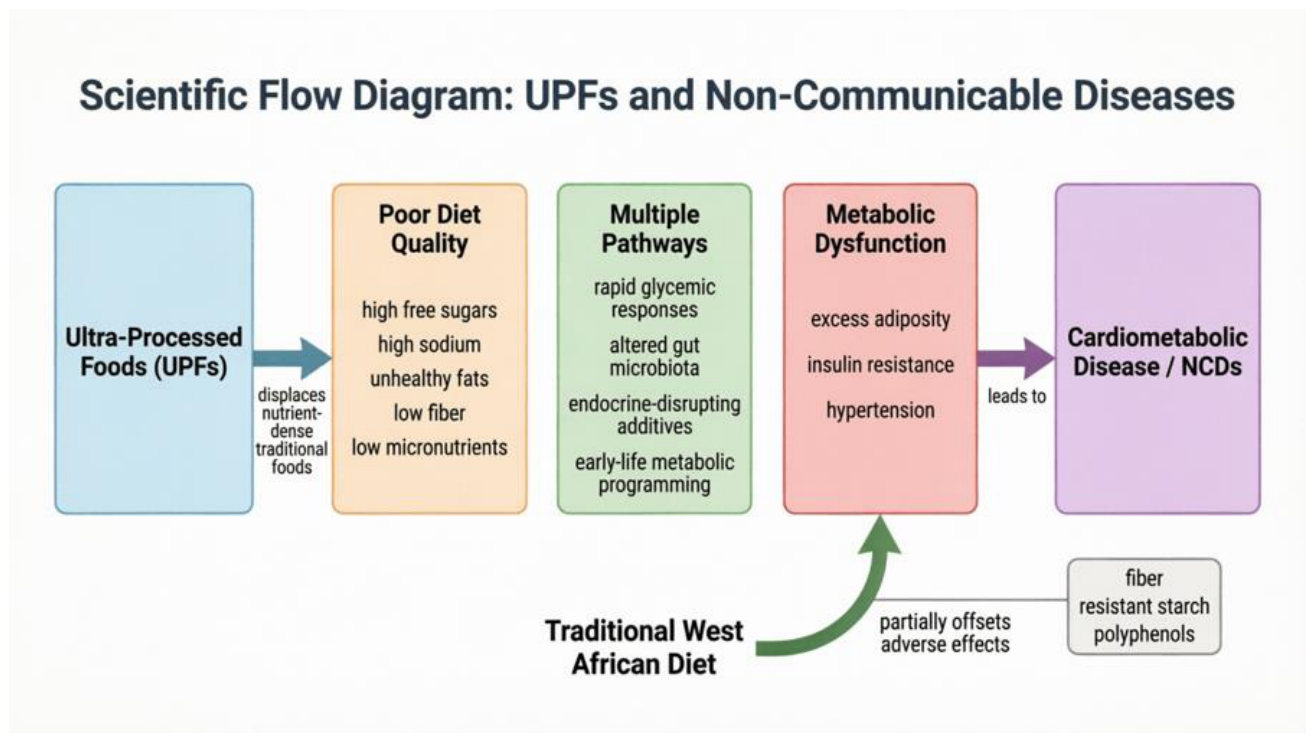

Table 1.
Selected evidence on ultra-processed food consumption and non-communicable disease outcomes among West African youth (2015–2025.
Table 1.
Selected evidence on ultra-processed food consumption and non-communicable disease outcomes among West African youth (2015–2025.
| Study (Reference) | Design | Setting/Population | Key Findings |
| Ogum Alangea et al., 2018 [9] | Cross-sectional | School-age children, urban Ghana | Energy-dense dietary pattern (processed meats, SSBs, snacks) associated with higher overweight/obesity odds; higher SES linked to pattern adherence |
| Abrahams et al., 2019 [10] | Cross-sectional | Schooling adolescents, Northern Ghana | Sweet tooth pattern (SSBs, sweets, snacks) vs. traditional pattern; pocket money and wealth predicted sweet tooth pattern |
| Bankole et al., 2024 [11] | Cross-sectional | Nigerian adolescents | High fast-food marketing exposure via Instagram normalizes frequent UPF consumption |
| Aweke et al., 2026 [3] | Systematic review and meta-analysis | Global, including Africa subgroup | Africa subgroup: OR 2.98 (95% CI: 1.88–4.73) for overweight/obesity among adolescents |
| Bosu, 2015 [6] | Narrative review | West Africa | Rising adolescent obesity, hypertension, and diabetes linked to dietary westernization |
| Laar et al., 2020 [16] | Policy assessment | Ghana national experts | Marketing restrictions and school food standards partially implemented; enforcement gaps remain |
4. Discussion
This narrative review synthesizes evidence that UPF consumption is a significant and growing risk factor for NCDs among West African youth. The poor nutritional quality of UPFs high in free sugars, sodium, and unhealthy fats, yet low in fiber and micronutrients contributes to the dual burden of malnutrition and elevates long-term cardiometabolic risk [2,5]. Multiple mechanisms likely underlie these associations, including rapid glycemic responses, altered gut microbiota, endocrine-disrupting additives, and displacement of protective traditional foods [14].
The West African context presents unique challenges. The region’s nutrition transition is occurring faster than regulatory capacity can adapt. While high-income countries have documented UPF contributions exceeding 50% of energy intake among youth, West African youth currently derive an estimated 15–30% of energy from UPFs, but the trajectory is steep [3,6]. Early-life exposure to commercial snack foods and formulas high in free sugars may program taste preferences and metabolic set-points, elevating later risk of obesity, insulin resistance, and hypertension [15].
This review has several strengths. It addresses a timely, policy-relevant gap by focusing specifically on West African youth during a defined ten-year window. The explicit search strategy, eligibility criteria, and quality assessment enhance methodological transparency. However, limitations must be acknowledged. As a narrative review, we did not perform a quantitative meta-analysis. The search was limited to English-language publications, potentially excluding relevant studies from Francophone West Africa. Heterogeneity in UPF classification and dietary assessment methods across primary studies limits direct comparability. Finally, the evidence base from West Africa remains relatively sparse, and longitudinal data linking youth UPF exposure to adult NCD outcomes in the region are largely absent
4.1. Implications for Policy and Practice
The evidence reviewed carries several implications for policy and practice in West Africa:
First, regulatory strengthening is essential. Governments should accelerate implementation of WHO-recommended policies including front-of-pack warning labels, restrictions on marketing of UPFs to children, and fiscal measures such as SSB taxation. Ghana and Nigeria have made initial progress, but enforcement mechanisms require substantial reinforcement [16,17].
Second, traditional food systems must be preserved and modernized. Rather than allowing traditional diets to be entirely displaced, public health strategies should promote the nutritional benefits of indigenous foods while addressing barriers to their availability and affordability.
Third, context-specific research is urgently needed. Longitudinal studies tracking UPF exposure from adolescence into adulthood would provide critical evidence to inform policy. Research examining how traditional dietary components might mitigate the metabolic effects of UPFs could reveal targeted intervention opportunities
5. Conclusions
Ultra-processed foods are reshaping diets among West African youth and contributing to an emerging NCD crisis. Their poor nutritional quality drives excess adiposity, early insulin resistance, and cardiometabolic risk, while displacing nutrient-dense traditional foods. Priority actions include: (i) context-specific longitudinal research on UPF exposure and metabolic programming; (ii) coherent, equity-informed regulatory frameworks that restrict marketing to youth, tax SSBs, and implement front-of-pack labeling; and (iii) integration of traditional food systems into public-health strategies. For Ghana, Nigeria, and neighboring countries, protecting and modernizing traditional food environments while regulating UPF formulation and marketing offers a pragmatic path toward healthier youth nutrition trajectories.
Supplementary Materials
The following supporting information can be downloaded at the website of this paper posted on Preprints.org. search strategy tables; eligibility criteria; quality assessment details.
Funding
This research received no external funding.
Institutional Review Board Statement
Not applicable. This is a narrative review of previously published literature and does not involve human participants, human data, or human tissue.
Informed Consent Statement
Not applicable.
Data Availability Statement
No new data were created or analyzed in this study. Data sharing is not applicable to this article.
Acknowledgments
During the preparation of this manuscript, the authors used ChatGPT for language refinement and formatting guidance only. The authors have reviewed and edited the output and take full responsibility for the content of this publication.
Conflicts of Interest
The authors declare no conflicts of interest.
References
- Monteiro, C.A.; Cannon, G.; Levy, R.B.; Moubarac, J.C.; Louzada, M.L.; Rauber, F.; et al. Ultra-processed foods: What they are and how to identify them. Public Health Nutr. 2019, 22, 936–941. [Google Scholar] [CrossRef]
- Elizabeth, L.; Machado, P.; Zinöcker, M.; Baker, P.; Lawrence, M. Ultra-processed foods and health outcomes: A narrative review. Nutrients 2020, 12, 1955. [Google Scholar] [CrossRef]
- Aweke, M.N.; Abuhay, H.W.; Limenih, M.A.; Alhur, A.A.; Baykemagn, N.D.; Alemu, G.G.; et al. Ultra-processed food consumption and the risk of overweight and obesity in adolescents: A systematic review and meta-analysis. PLoS ONE 2026, 21, e0344873. [Google Scholar] [CrossRef]
- Baker, P.; Machado, P.; Santos, T.; Sievert, K.; Backholer, K.; Hadjikakou, M.; et al. Ultra-processed foods and the nutrition transition: Global, regional and national trends, food systems transformations and political economy drivers. Obes. Rev. 2020, 21, e13126. [Google Scholar] [CrossRef]
- Popkin, B.M.; Corvalan, C.; Grummer-Strawn, L.M. Dynamics of the double burden of malnutrition and the changing nutrition reality. Lancet 2020, 395, 65–74. [Google Scholar] [CrossRef]
- Bosu, W.K. An overview of the nutrition transition in West Africa: Implications for non-communicable diseases. Proc. Nutr. Soc. 2015, 74, 466–477. [Google Scholar] [CrossRef]
- NCD Risk Factor Collaboration (NCD-RisC). Worldwide trends in underweight and obesity from 1990 to 2022: A pooled analysis of 3663 population-representative studies with 222 million children, adolescents, and adults. Lancet 2024, 403, 1027–1050. [Google Scholar] [CrossRef]
- Green, M.A.; Pradeilles, R.; Laar, A.; Osei-Kwasi, H.; Bricas, N.; Coleman, N.; et al. Investigating foods and beverages sold and advertised in deprived urban neighbourhoods in Ghana and Kenya: A cross-sectional study. BMJ Open 2020, 10, e035680. [Google Scholar] [CrossRef]
- Ogum Alangea, D.; Aryeetey, R.N.; Gray, H.L.; Laar, A.K.; Adanu, R.M.K. Dietary patterns and associated risk factors among school age children in urban Ghana. BMC Nutr. 2018, 4, 22. [Google Scholar] [CrossRef]
- Abrahams, Z.; de Villiers, A.; Steyn, N.P.; Fourie, J.M.; Draper, C.E.; Hill, J.; et al. Dietary patterns and associated factors of schooling Ghanaian adolescents. BMC Public Health 2019, 19, 1125. [Google Scholar] [CrossRef]
- Bankole, E.; Harris, N.; Rutherford, S.; Wiseman, N. Nigerian adolescents’ exposure to fast food marketing via Instagram. BMC Public Health 2024, 24, 2405. [Google Scholar] [CrossRef]
- Costa, C.S.; Del-Ponte, B.; Assunção, M.C.F.; Santos, I.S. Consumption of ultra-processed foods and body fat during childhood and adolescence: A systematic review. Public Health Nutr. 2018, 21, 148–159. [Google Scholar] [CrossRef]
- De Amicis, R.; Mambrini, S.P.; Pellizzari, M.; Foppiani, A.; Bertoli, S.; Battezzati, A.; et al. Ultra-processed foods and obesity and adiposity parameters among children and adolescents: A systematic review. Eur. J. Nutr. 2022, 61, 3645–3658. [Google Scholar] [CrossRef]
- Babalola, O.O. The impact of ultra-processed foods on cardiovascular diseases and cancer: Epidemiological and mechanistic insights. Asp. Mol. Med. 2025, 3, 100103. [Google Scholar] [CrossRef]
- Pries, A.M.; Filteau, S.; Ferguson, E.L. Snack food and beverage consumption and young child nutrition in low- and middle-income countries: A systematic review. Matern. Child Nutr. 2019, 15 (Suppl. 4), e12729. [Google Scholar] [CrossRef]
- Laar, A.; Barnes, A.; Aryeetey, R.; Tandoh, A.; Bash, K.; Mensah, K.; et al. Implementation of healthy food environment policies to prevent nutrition-related non-communicable diseases in Ghana: National experts’ assessment of government action. Food Policy 2020, 93, 101907. [Google Scholar] [CrossRef]
- Popkin, B.M.; Ng, S.W. The nutrition transition to a stage of high obesity and noncommunicable disease prevalence dominated by ultra-processed foods is not inevitable. Obes. Rev. 2022, 23, e13366. [Google Scholar] [CrossRef]
Disclaimer/Publisher’s Note: The statements, opinions and data contained in all publications are solely those of the individual author(s) and contributor(s) and not of MDPI and/or the editor(s). MDPI and/or the editor(s) disclaim responsibility for any injury to people or property resulting from any ideas, methods, instructions or products referred to in the content. |
© 2026 by the authors. Licensee MDPI, Basel, Switzerland. This article is an open access article distributed under the terms and conditions of the Creative Commons Attribution (CC BY) license.
Copyright: This open access article is published under a Creative Commons CC BY 4.0 license, which permit the free download, distribution, and reuse, provided that the author and preprint are cited in any reuse.