

Submitted:
02 September 2026
Posted:
03 September 2026
You are already at the latest version
Abstract
Armed conflict threatens financial resilience by weakening the infrastructure, liquidity, information, and repayment conditions on which financial intermediation depends. This study examines whether state-based and non-state conflict affect financial access and use differently across 33 Sub-Saharan African countries. We merge Global Findex 2025 data for 32,951 adults with Uppsala Conflict Data Program fatalities and GSMA mobile money regulatory indicators. Multilevel mixed-effects logit models show that a one-standard-deviation increase in state-based conflict intensity is associated with 3.2 and 1.3 percentage point reductions in formal financial-institution and any-account ownership. State-based conflict is also associated with lower borrowing, domestic remittances, utility payments, and transfer receipt. Non-state conflict produces smaller reductions in formal account ownership, borrowing, remittances, and utility payments. Predicted margins show nonlinear vulnerability, especially for remittances as state-based conflict intensifies. Saving, pensions, and wages are comparatively resilient. The findings connect household financial resilience to banking stability and credit risk by showing how conflict simultaneously weakens transaction continuity and the conditions supporting credit supply. Policy should prioritize payment continuity, agent liquidity, credit-risk management, and resilient financial infrastructure in conflict-exposed emerging markets.
Keywords:
armed conflict
; banking stability
; credit risk
; financial inclusion
; financial resilience
; mobile money
; emerging markets
; Sub-Saharan Africa
1. Introduction
Armed conflict affects financial systems through destruction, displacement, uncertainty, interrupted markets, and weaker institutions (Collier, 1999; Blattman & Miguel, 2010). Banks and other providers depend on branches, communications networks, staff mobility, cash logistics, identification systems, borrower information, and enforceable repayment arrangements. Conflict raises operating and monitoring costs, weakens borrower cash flows, and increases credit risk. Households simultaneously face income losses, mobility restrictions, and greater need for emergency liquidity and transfers. Financial disruption under conflict therefore reflects linked pressures on banking stability, credit supply, payment continuity, and household financial behaviour.
These pressures are important in Sub-Saharan Africa, where conflict exposure coexists with gaps in formal financial access and uneven financial infrastructure. Mobile money and agent networks have reduced distance and transaction costs and widened access to transfers, savings, and credit (Aron, 2018; Jack & Suri, 2014; Suri & Jack, 2016; Kodom et al., 2020; Kodom et al., 2022; Grzybowski et al., 2023). Yet digital finance also depends on connectivity, agents, liquidity, electricity, identification, and regulatory capacity. Conflict therefore tests whether financial systems preserve their core functions when both providers and users face stress.
Existing evidence leaves an important gap. Conflict studies document losses in output, capital, infrastructure, and institutional capacity (Bellows & Miguel, 2009; Blattman & Miguel, 2010), while financial-inclusion studies focus mainly on income, education, gender, technology, and institutions (Allen et al., 2014; Aron, 2018; Asongu et al., 2024). Direct evidence links insecurity to weaker branches, ATMs, credit, and composite financial inclusion (Garang, 2024; Abu et al., 2026), but three issues remain. First, aggregate inclusion measures conceal differences between account ownership and actual use. Second, state-based and non-state violence differ in their implications for public infrastructure, mobility, and provider risk. Third, average estimates conceal whether disruption becomes stronger as conflict intensity rises.
This study addresses these gaps through a financial-resilience framework. Financial resilience refers to the continuity of access to and use of financial services as conflict intensity rises. We combine individual-level Global Findex 2025 data with UCDP conflict fatalities and GSMA mobile money regulatory indicators for 32,951 adults in 33 Sub-Saharan African countries. The analysis separates formal financial-institution accounts from any account and examines borrowing, saving, pensions, domestic remittances, wages, utility payments, and transfers. It also distinguishes state-based from non-state conflict, tests variation across conflict intensity, and examines heterogeneity by country income classification.
The results show selective disruption. State-based conflict is associated with lower formal and broader account ownership and with lower borrowing, domestic remittances, utility payments, and transfer receipt. Non-state conflict has smaller negative associations with formal account ownership, borrowing, remittances, and utility payments. Saving, pensions, and wages show greater average continuity. Remittances become especially vulnerable as state-based conflict intensity rises. These patterns indicate that conflict affects financial functions according to their dependence on networks, liquidity, counterparties, and institutional infrastructure.
The paper contributes to the Special Issue's focus on banking stability, credit risk, and financial resilience in emerging markets in three ways. First, it links household financial resilience to financial-sector stress by separating access from transaction-dependent use. Second, it shows that conflict type and intensity matter for the continuity of credit and payment functions. Third, it places these responses within national regulatory and agent-service conditions. The analysis does not estimate bank solvency or portfolio quality directly. Instead, it identifies the household-side outcomes through which conflict-related operational risk, credit rationing, liquidity constraints, and payment disruption become visible. This provides evidence relevant to regulators and financial institutions designing resilience strategies for conflict-exposed emerging markets.
This paper is structured as follows. Section 2 reviews the literature, develops the conceptual framework, and states the hypotheses. Section 3 describes the data sources, variable measurement, and empirical estimation model. Section 4 presents the results on financial access, financial use, and heterogeneity by conflict intensity and income classification. Section 5 discusses the findings. Section 6 concludes. Section 7 sets out the policy implications and recommendations.
2. Literature, Conceptual Framework and Hypotheses
2.1. Conflict and Economic Disruption
Conflict affects economic activity through destruction, displacement, uncertainty, and higher transaction costs (Collier, 1999; Blattman & Miguel, 2010). These mechanisms matter for finance because intermediation depends on infrastructure, information, mobility, contract enforcement, and repeated interaction. Conflict also creates spillovers through trade, migration, and confidence (Ogbe et al., 2024). For financial institutions, the resulting stress appears through higher operating costs, weaker collateral and borrower cash flows, impaired monitoring, and greater default risk.
Financial institutions therefore face connected operational, liquidity, and credit-risk channels. Violence raises the cost of maintaining branches and agents, moving cash, verifying customers, and monitoring borrowers. Providers may tighten screening, reduce lending, close access points, or concentrate operations in safer areas. Evidence from South Sudan links civil war to weaker branch and ATM access and constrained credit (Garang, 2024), while African panel evidence associates insecurity with lower financial inclusion (Abu et al., 2026). Global syndicated-loan evidence similarly shows foreign banks reducing lending to conflict-affected countries (De Haas et al., 2025). These findings motivate the expectation that conflict weakens financial access and use, with state-based conflict producing broader disruption because state participation places administrative systems and public infrastructure under greater stress.
2.2. Financial Inclusion, Digital Finance and Resilience
Financial inclusion extends beyond account ownership to the effective use of financial services. This distinction is important for understanding resilience because an account may remain registered even when households are unable to borrow, save, transfer funds, receive remittances, or make payments. In Sub-Saharan Africa, constraints on infrastructure and population density have historically limited formal financial access (Allen et al., 2014). Digital finance, particularly mobile money, has reduced some of these constraints by lowering distance and transaction costs and expanding access to payments, transfers, savings, and credit (Aron, 2018; Kodom et al., 2020; Kodom et al., 2022; Grzybowski et al., 2023). The expansion of digital finance therefore shifts the resilience question from whether households possess accounts to whether financial services continue to function when households and financial systems experience shocks.
Evidence on mobile money supports this functional perspective. Mobile money strengthens households' capacity to respond to shocks by facilitating transfers and widening risk-sharing networks (Jack & Suri, 2014). Its longer-term expansion has also been associated with lower extreme poverty and greater household resilience (Suri & Jack, 2016), while mobile savings products influence saving and investment decisions (Batista & Vicente, 2020b). These benefits, however, depend on an operational financial ecosystem. Digital transactions require connectivity, electricity, functioning agents, adequate liquidity, cash logistics, and accessible payment infrastructure. Digitalisation therefore reduces dependence on physical bank branches without eliminating infrastructure dependence. Under conflict, disruption to these supporting systems may weaken the same financial channels households rely on to manage shocks.
This dependence places institutions and financial-sector stability at the centre of financial resilience. Evidence across Sub-Saharan Africa links financial inclusion to institutional quality, infrastructure, and macroeconomic conditions (Anifowose & Chummun, 2025; Golpet et al., 2026). Meniago (2025) similarly shows that institutional conditions shape the economic gains associated with digital financial inclusion in SADC countries. At the financial-system level, Jungo et al. (2022) find that financial stability conditions the relationship between financial regulation, inclusion, and banking-sector competitiveness. This literature suggests that expanding financial access and maintaining financial access under stress are related but distinct outcomes. Regulation and institutional capacity influence whether providers, payment systems, and delivery networks continue functioning when economic or security conditions deteriorate.
The relevant institutional environment extends from formal regulation to the infrastructure through which users access financial services. Consumer protection, safeguarding arrangements, identification requirements, and agent-service conditions influence financial access and service continuity (Balasubramanian et al., 2023; Gyamerah & Tetteh, 2024). Evidence from fragile and conflict-affected settings further shows that payment resilience depends on the functioning of the entire transaction chain, including connectivity, intermediaries, payment solutions, liquidity, and user access (Malaika et al., 2025). Weakness at any point in this chain may interrupt transactions even where account ownership remains unchanged. This provides a basis for examining regulatory and agent-service conditions alongside conflict exposure rather than treating financial inclusion primarily as an individual-level outcome.
Resilience also differs across users and according to how financial services are used. Chamboko (2022) identifies gender and age differences in digital financial service use in Zimbabwe, while Kodom et al. (2024) show how digital financial inclusion relates to women's economic empowerment in rural Northern Ghana. Evidence from Ghana further indicates that greater financial service use does not necessarily produce equivalent improvements in financial health, since outcomes depend partly on the nature and purpose of financial use (Osarfo et al., 2025). Policy design also shapes incentives to use digital services. Ghana's E-levy illustrates how transaction-related policy choices influence public responses to digital finance (Asante et al., 2024), while evidence from the eCedi pilot shows how adoption of new digital payment instruments operates within an already established mobile money ecosystem (Osafoh & Kodom, 2026). These findings reinforce the need to distinguish availability from effective use and to account for institutional and user-level conditions when assessing resilience.
Financial resilience captures this broader concern. It refers to the capacity to absorb, adapt to, and recover from financial shocks while preserving core financial functions (Liu et al., 2025; Kamble et al., 2026). Much of this literature examines household-specific, economic, or pandemic-related shocks. Armed conflict presents a different resilience problem because it simultaneously affects households and the institutions serving them. Income loss and displacement may increase households' demand for liquidity, credit, and transfers at the same time that insecurity disrupts agents, payment networks, cash logistics, borrower monitoring, and financial infrastructure. Financial resilience under conflict therefore depends on whether specific financial functions continue operating under a joint demand-and-supply shock. This study builds on this distinction by examining whether access and different forms of financial use respond differently as state-based and non-state conflict intensify, while accounting for the regulatory and agent-service environment in which these responses occur.
2.3. Conceptual Framework and Testable Expectations
The conceptual framework defines resilience as continuity of specific financial functions. Conflict raises the cost of mobility, communication, liquidity management, verification, screening, monitoring, and settlement. Account ownership is largely a stock outcome and can persist without active use. Borrowing, remittances, utility payments, and transfers are flows requiring functioning providers, counterparties, payment rails, or agents at the point of use. Transaction-dependent services should therefore be more sensitive to conflict than registered account status or established institutional receipts (Dhawan et al., 2024; Malaika et al., 2025).
Saving is theoretically ambiguous. Conflict reduces income and raises emergency spending, encouraging dissaving, but insecurity can also strengthen precautionary saving among households with resources. Wages and pensions may show greater continuity where established employer or government payment arrangements remain operational. The framework therefore expects unequal effects across financial uses rather than a common decline.
Conflict type provides a second distinction. UCDP state-based conflict involves armed force in which at least one party is a state, while non-state conflict involves organised armed groups where neither party is a state. State involvement is expected to create broader financial disruption because administrative systems, transport corridors, public infrastructure, and state-linked financial arrangements face simultaneous pressure. This expectation is consistent with evidence of wider lender retrenchment when conflict affects sovereign and institutional risk (De Haas et al., 2025).
Conflict intensity provides the third dimension. In this study, intensity is based on UCDP resulting deaths for each conflict type. Fatalities are transformed as ln(1 + deaths) and standardized across the merged estimation sample. Higher values therefore represent more severe conflict, and one unit equals a one-standard-deviation increase in the log-transformed fatality measure. Predicted probabilities at the 25th, 50th, and 75th percentiles represent relatively low, median, and high intensity. This allows the analysis to test whether financial disruption changes as violence becomes more severe rather than imposing a constant interpretation across the conflict distribution.
Domestic remittances provide a useful test because conflict can increase the need for support while simultaneously disrupting sender-recipient networks, mobility, liquidity, and connectivity. Evidence from conflict settings shows both stronger support motives and constraints on transfer delivery (Ibrahim, 2025; van Asselt et al., 2025; Lindley, 2024). The net association is therefore empirical: resilience depends on whether financial networks continue to transmit support when insecurity rises.
2.4. Conceptual Model
Figure 1 organizes these mechanisms. Armed conflict enters by type and intensity and operates through mobility restrictions, liquidity and cash-logistics disruption, communications failures, provider risk controls and credit rationing, and household income loss. These channels affect financial stocks, represented by account ownership, and financial flows, represented by borrowing, saving, remittances, wages, pensions, utility payments, and transfers. National regulatory conditions and income classification capture differences in institutional capacity and structural resilience.
The framework generates six expectations. H1 predicts lower formal and any-account ownership as state-based and non-state conflict intensity rises. H2 predicts stronger negative associations for transaction-dependent uses, especially borrowing, remittances, utility payments, and transfers, than for saving and selected institutional receipts. H3 predicts broader and stronger disruption under state-based conflict. H4 predicts larger reductions at higher conflict intensity for conflict-sensitive functions. H5 predicts positive associations between stronger agent-service conditions, consumer protection, flexible minimum KYC requirements, and selected financial outcomes. H6 predicts heterogeneous conflict associations across country income classifications without imposing a uniform direction. These hypotheses map to Table 3 to 7 and Figure 2.
3. Method
3.1. Data Sources
The study merges three sources. Individual financial outcomes and socioeconomic characteristics come from the 2025 Global Findex database. The analytical sample contains 32,951 adults from 33 Sub-Saharan African countries with complete information for the main access models. Usage models contain between 31,912 and 32,951 observations because some questions apply to smaller subsamples.
Conflict exposure comes from the Uppsala Conflict Data Program Georeferenced Event Dataset (UCDP GED), which records conflict events and resulting deaths and distinguishes state-based from non-state conflict (Sundberg & Melander, 2013; Pettersson et al., 2021). The study measures country-level conflict intensity using resulting deaths for each conflict type. Raw fatalities are transformed as ln(1 + deaths) to retain zero-conflict observations and reduce skewness, then standardized over the merged estimation sample. One unit therefore represents a one-standard-deviation increase in log-transformed conflict fatalities.
National institutional conditions come from the GSMA Mobile Money Regulatory Index. The analysis includes consumer protection, safeguarding of funds, agent services, and minimum know-your-customer requirements. Each indicator ranges from 0 to 100. Higher scores represent stronger consumer protection, stronger safeguarding, better agent-service conditions, or more flexible minimum KYC rules.
3.2. Measurement of Variables
The two access outcomes are binary indicators for ownership of an account at a formal financial institution and ownership of any account. Usage outcomes are binary indicators for borrowing, saving, pension receipt, domestic remittances, wage receipt, utility payments, and transfer receipt. Conflict exposure is measured at country level. State-based conflict involves armed force between parties where at least one party is a state, while non-state conflict involves organised armed groups where neither party is a state (Sundberg & Melander, 2013; Pettersson et al., 2021). Conflict intensity is the standardized value of ln(1 + resulting deaths) for the relevant conflict type. The transformation retains countries with zero recorded deaths, reduces the influence of extreme fatality counts, and makes coefficients comparable across conflict types. The 25th, 50th, and 75th percentiles of each standardized index represent relatively low, median, and high conflict intensity within the estimation sample.
Accordingly, a one-unit increase in the conflict measure represents a one-standard-deviation increase in log-transformed fatalities. State-based and non-state conflict enter separate baseline specifications. Individual controls include sex, age, age squared, employment, household income quintile, rural residence, secondary education, tertiary education, and internet access. The fifth income quintile is the reference group, while primary education or less is the education reference category. Regulatory controls capture consumer protection, safeguarding of funds, agent services, and minimum KYC requirements. The merged sample covers 33 countries, while outcome-specific observation counts vary only where Findex questions apply to smaller subsamples.

Table 1.
Variable Description and Data Sources.
| Variable name | Description | Source |
| Female | Respondent is female | FINDEX 2025 |
| Age | Respondent's age | FINDEX 2025 |
| Age_sq | Square of respondent's age | FINDEX 2025 |
| Emp_in | Respondent is employed | FINDEX 2025 |
| Q_1 | 1st within-economy household income quintile (Lowest) | FINDEX 2025 |
| Q_2 | 2nd within-economy household income quintile (Lowest) | FINDEX 2025 |
| Q_3 | 3rd within-economy household income quintile (Lowest) | FINDEX 2025 |
| Q_4 | 4th within-economy household income quintile (Lowest) | FINDEX 2025 |
| Rural | Respondent lives in rural area | FINDEX 2025 |
| Secondary | Respondent has attained Secondary education | FINDEX 2025 |
| Tertiary | Respondent has attained Tertiary education or more | FINDEX 2025 |
| Internet_access | Internet access | FINDEX 2025 |
| z_ln_state_based_conflict | Standard deviation of ln_state_based_conflict | Uppsala Conflict Data Program, Georeferenced Event Dataset |
| z_ln_non_state_based_conflict | Standard deviation of ln_non_state_based_conflict | Uppsala Conflict Data Program, Georeferenced Event Dataset |
| State-based conflict intensity | P_25, P_50 and P_75 represent the 25th, median and 75th percentile of the standardized log-transformed state-based conflict fatality index, respectively. Represents a relatively low, median and high level of state-based conflict intensity within the estimation sample, respectively. | Uppsala Conflict Data Program, Georeferenced Event Dataset |
| Non-state-based conflict intensity | P_25, P_50 and P_75 represent the 25th, median and 75th percentile of the standardized log-transformed state-based conflict fatality index, respectively. Represents a relatively low, median and high level of non state-based conflict intensity within the estimation sample, respectively. | Uppsala Conflict Data Program, Georeferenced Event Dataset |
| Consumer protection | Consumer protection (0-100; higher values depict better consumer protection) | GSMA Mobile Money Regulatory Index |
| Safeguarding of funds | Safeguarding of funds (0-100; higher values depict better safeguarding of funds) | GSMA Mobile Money Regulatory Index |
| Agent services | Agent Services (0-100; higher values depict better agent services) | GSMA Mobile Money Regulatory Index |
| Minimum KYC requirements | Minimum KYC requirements (0-100; higher values depict more flexible KYC) | GSMA Mobile Money Regulatory Index |
3.3. Empirical Estimation Model
The binary nature of the outcomes and the hierarchical structure of the data motivate a multilevel mixed-effects logit model. Individuals are grouped within countries, while countries belong to World Bank income classifications. Mixed-effects logit models combine fixed covariate effects with random intercepts that represent unobserved group-level heterogeneity. The baseline latent-index specification is:
where denotes financial outcome j for individual i in country c and income group m. is a vector of individual characteristics, contains country-level mobile money regulatory indicators, is an income-group random intercept, and is a country random intercept nested within income group. The random intercepts are assumed to have zero means and constant variances, and to be independent of the observed regressors. Conditional on the covariates and random effects, follows a Bernoulli distribution with success probability given by the logistic cumulative distribution function. Logit coefficients express changes in log odds and therefore do not translate directly into percentage-point changes in outcome probabilities. To support substantive interpretation and comparisons across outcomes, the paper reports average marginal effects. For a continuous regressor , the average marginal effect is:
The derivative is evaluated for each respondent using observed covariate values and the fitted model, then averaged over the outcome-specific estimation sample. For binary covariates, the reported effect represents the average discrete change in predicted probability when the indicator changes from zero to one. Standard errors for marginal effects follow the delta method. We also conduct extensive heterogeneity analysis. The first heterogeneity analysis assesses whether predicted financial behavior differs across the observed conflict distribution. After fitting Equation (2), the 25th, 50th, and 75th percentiles of the relevant standardized conflict index are calculated within the estimation sample. Adjusted predicted probabilities are then computed at each percentile while averaging over the observed values of the remaining covariates:
Pairwise contrasts compare the adjusted predictions at the median and 25th percentile, and at the 75th percentile and median. The second heterogeneity analysis evaluates whether the association between conflict and financial service use differs across low-income, lower-middle-income, and upper-middle-income economies. Equation (2) is re-estimated separately within each income group for borrowing, saving, domestic remittances, and receipt of transfers. Since income classification is constant within each subsample, these models retain a country random intercept but omit the income-group random intercept. Both standardized conflict measures enter the same subgroup specification:
Average marginal effects for state-based and non-state conflict are recovered within each income group and presented with 95 percent confidence intervals.
4. Results
4.1. Descriptive Characteristics of the Sample
Table 2 describes a financially diverse and conflict-exposed sample. Any-account ownership is 62.2%, compared with 36.1% for formal financial-institution accounts, confirming the importance of non-bank channels. Borrowing (72.1%) and saving (63.2%) are common, domestic remittances involve 45.3% of respondents, while utility payments (19.8%), wages (15.9%), transfers (5.1%), and pensions (2.6%) are less prevalent. Conflict exposure is highly dispersed. Mean state-based fatalities are 902.5, compared with 46.3 for non-state fatalities, with maxima of 24,107 and 510, respectively. The sample is also structurally constrained: 66.7% live in rural areas and 41.6% have internet access. These patterns justify separating access from use and examining conflict type and intensity.
4.2. Conflict and Access to Financial Services
Table 3 shows stronger access disruption under state-based conflict. A one-standard-deviation increase in state-based intensity is associated with a 3.2 percentage point reduction in formal financial-institution account ownership (p<0.01) and a 1.3 point reduction in any-account ownership (p<0.05). Non-state conflict is associated with a 2.3 point reduction in formal account ownership (p<0.01), while its 0.8 point association with any-account ownership is insignificant. Relative to the sample mean, the state-based formal-account effect equals about 8.9%. The weaker response for any-account ownership is consistent with greater continuity through alternative channels, although the model does not identify substitution into mobile money directly.
Pre-existing inclusion inequalities remain important. Women and rural residents have lower account ownership, while employment, education, and internet access are positively associated with access. Internet access is associated with 14.4 points higher formal-account ownership and 19.2 points higher any-account ownership. Agent-service quality is also positively associated with both access measures. These results indicate that resilience reflects both conflict exposure and the resources and delivery infrastructure available to remain financially connected.
4.3. Conflict and Use of Financial Services
Table 4 and Table 5 show a sharper conflict gradient for financial use. Under state-based conflict, a one-standard-deviation increase in intensity is associated with lower borrowing by 2.0 percentage points (p<0.01), domestic remittances by 3.8 points (p<0.01), utility payments by 2.2 points (p<0.05), and transfer receipt by 1.9 points (p<0.05). Saving, pensions, and wages are statistically unchanged. Under non-state conflict, borrowing falls by 0.6 points (p<0.05), remittances by 2.9 points (p<0.01), and utility payments by 1.6 points (p<0.05), while transfer receipt is insignificant. State-based conflict therefore has a broader and generally larger association with financial use.
Domestic remittances are the most consistently conflict-sensitive function, followed by borrowing and utility payments. These activities require functioning counterparties, payment rails, liquidity, connectivity, or provider interaction at the time of use. Saving, pensions, and wages show greater average continuity. This pattern supports the paper's distinction between registered financial access and the ability to execute financial functions under stress.
Socioeconomic gradients remain substantial. Internet access is positively associated with every use outcome, especially remittances, saving, and utility payments. Employment predicts borrowing, saving, remittances, wages, and utilities. Lower income is strongly associated with reduced saving, remittances, wages, and utility payments. Conflict-related disruption therefore operates alongside digital, spatial, and resource inequalities.
4.4. Heterogeneity by Conflict Intensity
Table 6 and Table 7 show that average effects conceal changes across the conflict distribution. For state-based conflict, predicted borrowing falls from 0.700 at the 25th percentile to 0.667 at the median, a 3.3 point decline. Domestic remittance participation falls from 0.479 to 0.456 over the same interval and then to 0.403 at the 75th percentile. The second remittance decline, 5.3 points, is more than twice the first, showing greater vulnerability at high state-based conflict intensity. Saving and transfer receipt show no significant reported contrasts.
Non-state conflict produces a narrower intensity pattern. Borrowing declines by 1.0 point between the 25th percentile and the median, while remittances fall by 4.9 points. Saving and transfer receipt remain statistically unchanged. State-based conflict produces the larger borrowing deterioration and a broader set of average negative associations, but remittances are sensitive to both forms of violence, consistent with disruption to networks, agent liquidity, mobility, and connectivity.
4.5. Heterogeneity by Income Classification
Figure 2 shows that conflict associations differ across country income classifications and financial functions. Low-income economies display pronounced negative state-based effects for borrowing and saving, while remittance and transfer responses do not follow a uniform income gradient. Lower-middle-income economies show substantial state-based remittance vulnerability, and some non-state estimates differ in sign across income groups. Several confidence intervals are wide, so these estimates should be interpreted as heterogeneity patterns rather than precise rankings.
The implication is that national income does not mechanically protect every financial function. Resilience depends on the specific infrastructure, provider networks, household resources, and institutional arrangements supporting each service. This supports function-specific rather than income-group-wide policy responses.
5. Discussion
The results support a functional view of financial resilience under conflict. Conflict does not shrink every financial activity by a similar margin. Instead, conflict weakens functions built on live exchange, liquidity, information, and provider interaction more than financial stocks staying registered without active use. This finding extends financial-resilience research beyond household buffers toward the operational continuity of financial systems under a shared shock (Liu et al., 2025; Kamble et al., 2026). The pattern also lines up with payment-resilience research showing how failures in connectivity, intermediaries, liquidity, or user access interrupt end-to-end service in fragile settings (Malaika et al., 2025).
The access results show why state-based and non-state conflict leave different financial footprints. State-based conflict involves government forces, so fighting concentrates near administrative centers, transport corridors, courts, land registries, and national identification systems, the same infrastructure formal banks depend on for verification and settlement (Xiao et al., 2025). Counter-insurgency operations also widen curfews, checkpoints, and movement restrictions across a broader area than most communal or resource-based disputes, raising the operating cost of every branch and agent along affected corridors. Non-state conflict typically stays confined to specific communities or grievances and rarely disables national payment settlement or identification systems directly (Wang et al., 2024). This gap in reach helps explain why non-state conflict lowers formal-institution ownership by 2.3 points yet leaves any-account ownership statistically unaffected, while state-based conflict weakens both measures. Households facing localized violence retain some capacity to stay connected through mobile money and agent channels running independently of the administrative systems formal branches rely on, even though the data do not identify direct substitution between channels.
The use results connect more directly to banking stability and credit risk. Borrowing falls under both conflict types, with the state-based association more than three times the non-state estimate. Conflict lowers borrower income, collateral values, and information quality, weakens monitoring, and raises provider operating costs, conditions building credit risk and pushing lenders toward tighter screening or rationing. Lower observed borrowing therefore does not necessarily signal weaker demand; the pattern fits a contraction in supply as lenders protect asset quality and liquidity. Cross-border evidence showing lender retrenchment from conflict-affected economies supports this reading (De Haas et al., 2025). The household results offer a retail-level counterpart to this broader risk response, though the associations do not measure bank portfolio quality directly.
Domestic remittances give the clearest evidence of transaction vulnerability. Remittances carry the largest negative average coefficient under both conflict types and deteriorate further once state-based conflict intensity rises above the median. Sending and receiving money depends on an active link between sender and recipient at the moment of transfer, mediated by agents, network coverage, and cash or e-money liquidity. As violence intensifies, agents progressively withdraw from insecure routes and network operators scale back maintenance, so every added increment of conflict removes another link in the transfer chain rather than reducing every link by a fixed amount. This compounding process, more than a simple loss of income among senders, offers a plausible explanation for the sharper 5.3-point decline between the median and 75th percentile compared with the 3.3-point decline between the 25th percentile and median. Evidence from conflict settings elsewhere documents the same tension between stronger support motives and constrained delivery channels (Ibrahim, 2025; van Asselt et al., 2025; Lindley, 2024), while research on digital finance and risk sharing shows the benefit depends on the network staying functional (Jack & Suri, 2014; Suri & Jack, 2016).
Utility payments show a smaller decline of similar shape under both conflict types, reinforcing the importance of payment-system continuity for recurring, provider-dependent transactions. Saving, pensions, and wages hold up better on average, though the null estimates likely mask offsetting movements rather than an absence of financial stress. Conflict lowers income and raises emergency spending, pushing some households toward dissaving, while insecurity strengthens precautionary saving among households still holding resources to protect. Wage and pension arrangements tied to established employers or government payroll systems continue operating as long as the underlying payment channel remains intact, independent of the saving decisions households make at the same time.
Income heterogeneity confirms resilience does not follow development level in a mechanical way. Low-income economies show sharper state-based declines in borrowing and saving, a pattern consistent with thinner formal credit and deposit markets to begin with: a conflict shock of a given size removes a larger share of an already narrow financial buffer than in economies with deeper credit markets and stronger institutions (Golpet et al., 2026). Remittance and transfer responses, by contrast, do not track income classification as closely. Remittance and mobile money infrastructure often reflects targeted investment in specific corridors and dominant network operators rather than aggregate national income, so a lower-middle-income economy with a mature mobile money corridor sometimes shows remittance vulnerability similar to, or greater than, a low-income economy without one (Grzybowski et al., 2023). Evidence from post-conflict Burundi points to a similar conclusion: institutional capacity and delivery infrastructure, more than income category alone, shape which financial functions continue operating after conflict (Atta-Aidoo et al., 2023). Income classification therefore works as an incomplete proxy for financial-system resilience, since infrastructure redundancy, digital connectivity, provider depth, and household resources matter differently across services (Osabutey & Jackson, 2024; Nefla et al, 2026).
The regulatory coefficients offer supporting, non-causal evidence for this institutional reading. Better agent-service conditions associate positively with both access measures and several uses, while consumer protection and KYC flexibility associate positively with selected outcomes. These results do not show regulation moderating conflict effects directly. The pattern instead suggests the institutional environment associates with households' capacity to stay financially connected once conflict exposure is held constant, consistent with agent networks, consumer protection, and identification rules forming part of the operational plumbing behind continuity rather than acting as separate levers.
This interpretation lines up with evidence showing institutions condition the effects of digital financial inclusion (Meniago, 2025) and with evidence showing financial inclusion, institutional quality, and growth move together over the long run in Sub-Saharan Africa (Golpet et al., 2026). The pattern also accords with Jungo et al. (2022), who show financial stability shapes the relationship between regulation, inclusion, and banking competitiveness. In conflict settings, these institutional relationships turn operational: rules governing agents, customer identification, consumer protection, and safeguarding either support continuity or compound disruption in liquidity, connectivity, and provider risk management. Demographic differences in digital financial service use (Chamboko, 2022) suggest service continuity likely differs across population groups rather than moving uniformly with national averages.
Taken together, the findings contribute to emerging-market finance research in four ways. Conflict affects financial functionality more strongly than account status; state-based conflict generally produces broader disruption; remittance vulnerability rises with conflict intensity; and income classification changes the pattern without producing a uniform gradient. This framing connects household financial inclusion to banking stability, since operational disruption, credit risk, liquidity constraints, and payment failures shape whether financial institutions keep serving households under stress. The findings also complement evidence showing digital finance strengthens resilience while remaining dependent on infrastructure vulnerable to conflict (Ozili, 2026; Nandnaba, 2026). From a banking-stability perspective, the distinction between account status and active use matters, since conflict weakens intermediation before conventional solvency indicators fully register the shock. Payment interruptions reduce transaction volumes and fee income, liquidity shortages constrain agent and branch operations, and deteriorating household and firm cash flows raise repayment risk. Banks facing these pressures tend to tighten underwriting standards, shorten maturities, raise collateral requirements, or shift portfolios toward safer assets and locations, responses protecting individual institutions while narrowing credit availability and deepening financial exclusion in affected communities. The observed decline in borrowing fits this transmission channel, although the household data do not separate the relative contributions of lender supply and borrower demand.
The analysis remains associational. Conflict is measured at country level even though violence concentrates in specific areas, and cross-sectional data cannot rule out unobserved heterogeneity or reverse selection. Fatalities measure severity rather than displacement, curfews, infrastructure damage, network outages, or proximity to events. GSMA indicators capture formal regulatory frameworks rather than implementation quality, and several income-group marginal effects carry wide confidence intervals. Future research combining geocoded conflict exposure with panel data, bank or agent-network information, and quasi-experimental conflict-onset designs would strengthen causal claims. Linking household outcomes to bank-level non-performing loans, liquidity, capital, and credit allocation would test the banking-stability mechanisms inferred here directly.
6. Conclusions and Policy Implications
This study examined whether financial resilience under armed conflict differs by financial service, conflict type, conflict intensity, and country income classification across 33 Sub-Saharan African countries. It addressed three gaps in the literature by distinguishing account ownership from actual financial use, separating state-based from non-state conflict, and examining whether disruption changes as conflict intensity rises. The framework therefore treated resilience as continuity of specific financial functions rather than the persistence of account ownership alone.
The findings provide qualified support for all six hypotheses. State-based conflict reduces both formal and any-account ownership, while non-state conflict reduces formal account ownership only. Transaction-dependent services are more vulnerable than financial stocks and institutional receipts. Borrowing, remittances, and utility payments decline under both conflict types, whereas saving, pensions, and wages remain comparatively stable. State-based conflict generally produces broader and stronger effects than non-state conflict. Conflict intensity also matters, especially for remittances, where participation declines more sharply at higher levels of state-based conflict. Regulatory and institutional conditions matter as well. Better agent-service conditions, consumer protection, and more flexible KYC requirements are positively associated with selected financial outcomes. The income-group results further show that resilience does not follow a uniform development gradient.
These findings point to a central conclusion: financial resilience under conflict is selective. Conflict weakens financial functions that depend most heavily on live transactions, liquidity, connectivity, counterparties, and provider interaction, while account ownership and some institutional receipts remain more stable. This distinction also connects household financial outcomes with banking stability and credit risk because operational disruption, liquidity shortages, payment failures, and tighter lending conditions can weaken financial intermediation before conventional solvency indicators fully reflect the shock.
The findings raise several policy implications for African economies. Central banks, financial-sector regulators, and mobile money providers operating in conflict-exposed markets should measure resilience through functioning services rather than account registration alone. Monitoring frameworks built around successful remittance completion, cash-in and cash-out availability at agent points, payment failure rates, network uptime, credit access, and geographic service continuity would surface functional exclusion long before such exclusion appears in account-ownership statistics. National financial inclusion surveys and central bank supervisory returns offer a practical channel for adding these indicators, since Findex-style modules already collect several of them at the individual level.
Payment and remittance continuity deserve priority given the size and consistency of the remittance effect. Regulators and mobile network operators should maintain interoperable payment channels across providers so a household is able to complete a transfer even when a preferred agent or network becomes unavailable. Providers serving insecure areas should pre-position cash and e-money liquidity at regional hubs before violence escalates, rather than relying on resupply routes likely to become unsafe, and should define alternative cash-management routes and agent contingency procedures ahead of time rather than during an active crisis. Humanitarian and government transfer programmes operating in conflict-affected areas should verify actual transaction and cash-out functionality at the point of disbursement rather than inferring access from registered beneficiary accounts, since registration figures overstate what households retrieve during active violence.
Credit policy needs to separate lower borrower demand from conflict-induced supply restriction, since the two require different responses. The stronger decline in borrowing under state-based conflict fits higher screening, monitoring, collateral, and repayment risk on the lender side. Development finance institutions and central banks should support temporary loan restructuring for borrowers in conflict-affected areas, extend targeted credit guarantees covering a share of default risk on new lending in these areas, and expand alternative borrower information, such as mobile money transaction histories, where conventional collateral and credit records become unreliable. Banking supervisors should also track whether conflict-related portfolio risk leads lenders to withdraw credit from viable households and firms rather than only from higher-risk ones, using indicators such as loan approval rates and branch or agent presence in conflict-affected districts relative to unaffected districts within the same country.
Income heterogeneity argues against uniform country-group responses. Regional and international financial-sector programmes designed by income band, for example concessional credit lines targeted at low-income countries as a group, should instead identify the specific financial function at risk in each context, along with the infrastructure supporting the function. In economies where saving and borrowing show the largest state-based declines, priority should go to protecting deposit-taking and lending channels. In economies where remittance corridors show large declines regardless of income classification, priority should go to protecting mobile network coverage and agent liquidity along the routes carrying the largest transfer volumes.
The positive association between agent-service quality, consumer protection, flexible KYC requirements, and financial outcomes points toward a feasible resilience agenda for regulators. Mobile money regulators should adopt proportionate, risk-based KYC tiers allowing continued account access and low-value transactions when standard identification documents become temporarily unavailable during displacement, while keeping stronger verification requirements for higher-value transactions. Regulators should also require licensed providers to file contingency plans covering agent liquidity, communications backup, and consumer-protection procedures for operations in conflict-affected regions, reviewed as part of routine supervisory examinations rather than only after a crisis emerges. Building these requirements into existing licensing and supervisory frameworks avoids creating new institutions and uses inspection processes already in place.
Financial resilience under conflict is best judged by whether households continue to move money, receive support, access credit and liquidity, store value, and meet obligations as insecurity rises. For emerging-market banking systems, protecting these functions supports household welfare while narrowing the operational and credit channels through which conflict weakens financial intermediation and stability.
Author Contributions
M.K.: Conceptualization, methodology, literature review, original draft preparation, review and editing, and proofreading. D.O.: Conceptualization, Methodology, formal analysis, original draft preparation, review and editing, and proofreading. E.O.: literature review, review and editing, and proofreading. All authors have read and agreed to the published version of the manuscript.
Funding
This research received no external funding.
Institutional Review Board Statement
Not applicable.
Informed Consent Statement
Not applicable.
Data Availability Statement
The data used in this study are publicly available from three sources. 1. Individual-level financial inclusion data were obtained from the World Bank Global Findex Database 2025, available from the World Bank Global Findex Database (https://www.worldbank.org/en/publication/globalfindex/download-data). 2. Conflict data were obtained from the Uppsala Conflict Data Program (UCDP), available through the UCDP Download Center (https://ucdp.uu.se/downloads/?utm_source). 3. Mobile money regulatory indicators were obtained from the GSMA Mobile Money Regulatory Index, available through the GSMA Mobile Money Regulatory Index (https://www.gsma.com/mobile-money-metrics/#regulatory-index). The analytical dataset was constructed by merging information from these sources as described in the Methods section.
Acknowledgments
The authors acknowledge the World Bank, the Uppsala Conflict Data Program (UCDP), and GSMA for making the data used in this study publicly available.
Conflicts of Interest
The authors declare no conflicts of interest.
References
- Abu, N., Sakanko, M. A., & Haron, N. F. (2026). Insecurity and financial inclusion nexus in Africa: Evidence from System-GMM approach. African Journal of Economic and Management Studies, 1-17. [CrossRef]
- Allen, F., Carletti, E., Cull, R., Qian, J. Q. J., Senbet, L., & Valenzuela, P. (2014). The African financial development and financial inclusion gaps. Journal of African Economies, 23(5), 614-642. [CrossRef]
- Anifowose, O. L., & Chummun, B. Z. (2025). A panel data analysis of determinants of financial inclusion in Sub-Saharan Africa (SSA) countries from 1999 to 2024. Journal of Risk and Financial Management, 18(5), 275. [CrossRef]
- Aron, J. (2018). Mobile money and the economy: A review of the evidence. The World Bank Research Observer, 33(2), 135-188. [CrossRef]
- Asante, K. T., Kumi, E., & Kodom, M. (2024). Post-COVID economic crisis, citizen-state relations, and the Electronic Transactions Levy (E-levy) controversy in Ghana. World Development Perspectives, 35, 100621. [CrossRef]
- Asongu, S. A., Agyemang-Mintah, P., Nnanna, J., & Ngoungou, Y. E. (2024). Mobile money innovations, income inequality and gender inclusion in sub-Saharan Africa. Financial Innovation, 10, 11. [CrossRef]
- Atta-Aidoo, J., Bizoza, S., Saleh, A. O., & Matthew, E. C. (2023). Financial inclusion choices in post-conflict and fragile states of Africa: The case of Burundi. Cogent Social Sciences, 9(1), 2216996. [CrossRef]
- Balasubramanian, K., Drake, D. F., & Urrea, G. (2023). The impact of poverty on base of the pyramid operations: Evidence from mobile money in Africa. Journal of Operations Management, 69(4), 616-642. [CrossRef]
- Batista, C., & Vicente, P. C. (2020b). Improving access to savings through mobile money: Experimental evidence from African smallholder farmers. World Development, 129, 104905. [CrossRef]
- Bellows, J., & Miguel, E. (2009). War and local collective action in Sierra Leone. Journal of Public Economics, 93(11-12), 1144-1157. [CrossRef]
- Blattman, C., & Miguel, E. (2010). Civil war. Journal of Economic Literature, 48(1), 3-57. [CrossRef]
- Chamboko, R. (2022). On the role of gender and age in the use of digital financial services in Zimbabwe. International Journal of Financial Studies, 10(3), 82. [CrossRef]
- Collier, P. (1999). On the economic consequences of civil war. Oxford Economic Papers, 51(1), 168-183. [CrossRef]
- De Haas, R., Mamonov, M., Popov, A., & Shala, I. (2025). Violent conflict and cross-border lending. ECB Working Paper Series No. 3073. European Central Bank.
- Dhawan, S. M., Wilson, K., & Zademach, H.-M. (2024). From financial inclusion to financial health of refugees: Urging for a shift in perspective. Third World Quarterly, 45(5), 926-945. [CrossRef]
- Garang, J. A. (2024). Effects of the civil war on financial inclusion in South Sudan: Theory and evidence. African Journal of Economic and Sustainable Development, 9(3), 255-271. [CrossRef]
- Golpet, M. K., Makoni, P. L., & Marozva, G. (2026). A cointegrating linkage of financial inclusion, institutional quality and economic growth in Sub-Saharan African countries. International Journal of Financial Studies, 14(3), 71. [CrossRef]
- Grzybowski, L., Lindlacher, V., & Mothobi, O. (2023). Mobile money and financial inclusion in Sub-Saharan Africa. Information Economics and Policy, 65, 101064. [CrossRef]
- GSMA. (2025). Mobile Money Regulatory Index. GSMA.
- Gyamerah, K.K. & Tetteh, F.K. (2024). Examining the impact of mobile money on financial inclusion in Sub-Saharan Africa: the role of institutions and governance. SAM Advanced Management Journal, 89(4), 315-339. [CrossRef]
- Ibrahim, M. A. (2025). Remittance flow determinants and the role of government policy in conflict-affected Palestinian territories. Journal of Government and Economics, 18, 100143. [CrossRef]
- Jack, W., & Suri, T. (2014). Risk sharing and transactions costs: Evidence from Kenya's mobile money revolution. American Economic Review, 104(1), 183-223. [CrossRef]
- Jungo, J., Madaleno, M., & Botelho, A. (2022). Financial regulation, financial inclusion and competitiveness in the banking sector in SADC and SAARC countries: The moderating role of financial stability. International Journal of Financial Studies, 10(1), 22. [CrossRef]
- Kamble, P. A., Mehta, A., & Rani, N. (2026). Building financial resilience: A systematic literature review and future research agenda. Journal of Economic Surveys, 40(2), 954-981. [CrossRef]
- Kodom, M., Ackah, C., Steel, W. F., & Bokpin, G. A. (2020). Drivers of mobile financial inclusion in Ghana. Enterprise Development and Microfinance, 31(4), 226–253. [CrossRef]
- Kodom, M., Osarfo, D., & Quartey, P. (2024). Digital financial inclusion and women’s economic empowerment in Northern Ghana: The experience of rural women in the shea value chain. In I. Koomson & R. A. Villano (Eds.), Financial Inclusion and Sustainable Rural Development (pp. 179–200). Palgrave Macmillan. [CrossRef]
- Kodom, M., Steel, W. F., Ackah, C., & Bokpin, G. A. (2022). Mobile money: A gateway to achieving financial inclusion in Ghana. Enterprise Development and Microfinance, 33(2), 105–123. [CrossRef]
- Lindley, A. (2024). Remitting through crisis: Looking beyond resilience in UK migrant and diaspora communities. Migration Studies, 12(3), mnae026. [CrossRef]
- Liu, Z., Chen, J.-K., & Xiao, J. J. (2025). Financial resilience: A scoping review, conceptual synthesis and theoretical framework. International Journal of Bank Marketing, 43(7), 1541-1576. [CrossRef]
- Malaika, M., Söderberg, G., & Zhabska, K. (2025). Payment resilience in fragile and conflict-affected states: Lessons for central bank digital currency (CBDC). IMF Fintech Note No. 2025/009. International Monetary Fund. [CrossRef]
- Meniago, C. (2025). Digital financial inclusion and economic growth: The moderating role of institutions in SADC countries. International Journal of Financial Studies, 13(1), 4. [CrossRef]
- Nandnaba, A. M. (2026). From capabilities to peace: Can mobile money reduce conflicts in developing countries? Economics & Politics, 38(2), 598-618. [CrossRef]
- Nefla, D., Hassan, R., Jellouli, S., and Thabet, S.B. (2026). Financial Inclusion as a Sustainable Development Imperative in Africa: Trends, Gaps, and Future Directions. Sustainable Development 34(3), 3053–3079. [CrossRef]
- Ogbe, M. A., Abdullahi, M. S., & Ding, Y. (2024). Measuring how armed conflict impacts economic growth in sub-Saharan Africa through spatial analysis. Frontiers in Political Science, 6, 1433584. [CrossRef]
- Osabutey, E. L. C., & Jackson, T. (2024). Mobile money and financial inclusion in Africa: Emerging themes, challenges and policy implications. Technological Forecasting and Social Change, 202, 123339. [CrossRef]
- Osafoh, E., & Kodom, M. (2026). Adoption of central bank digital currency in the era of mobile money in Ghana. Enterprise Development and Microfinance, 36(2), 139–158. https://www.papjournals.com/index.php/edm/article/view/44.
- Osarfo, D., Kodom, M., Quartey, P., & Darkwah, H. A. (2025). The effect of financial services utilization on financial health: Insights from the Ghanaian experience. Social Sciences & Humanities Open, 12, 102171. [CrossRef]
- Ozili, P. K. (2026). War and digital financial inclusion: Role of digital financial services in war and armed conflict. Conflict Resolution Quarterly, 1–8. [CrossRef]
- Pettersson, T., Davies, S., Deniz, A., Engstr¨om, G., Hawach, N., H¨ ogbladh, S., et al., (2021). Organized violence 1989–2020, with a special emphasis on Syria. Journal of Peace Research, 58(4), 809-825. [CrossRef]
- Sundberg, R., & Melander, E. (2013). Introducing the UCDP Georeferenced Event Dataset. Journal of Peace Research, 50(4), 523-532. [CrossRef]
- Suri, T., & Jack, W. (2016). The long-run poverty and gender impacts of mobile money. Science, 354(6317), 1288-1292. [CrossRef]
- van Asselt, J., Naing, P. T., Sabai, M., Minten, B., & Kham Synt, N. L. (2025). Remittances in fragile and conflict-affected settings: Insights from Myanmar. European Journal of Development Research, 37(6), 1013-1043. [CrossRef]
- Wang, M. G., Wong, M. C. S., Zhuang, H., & Cate, R. (2024). The impact of armed conflict on inward foreign direct investment (FDI): An analysis of conflict over government, conflict over territory, and FDI. Global Economic Review, 53(1), 25-51. [CrossRef]
- World Bank. (2025). Global Findex Database 2025. World Bank.
- Xiao, H., Tang, B., & Dai, L. (2025). The effects of African civil conflicts on FDI: The moderating role of bilateral political relations. China Economic Review, 89, 102326. [CrossRef]
Figure 1.
Conceptual model of financial resilience under conflict.
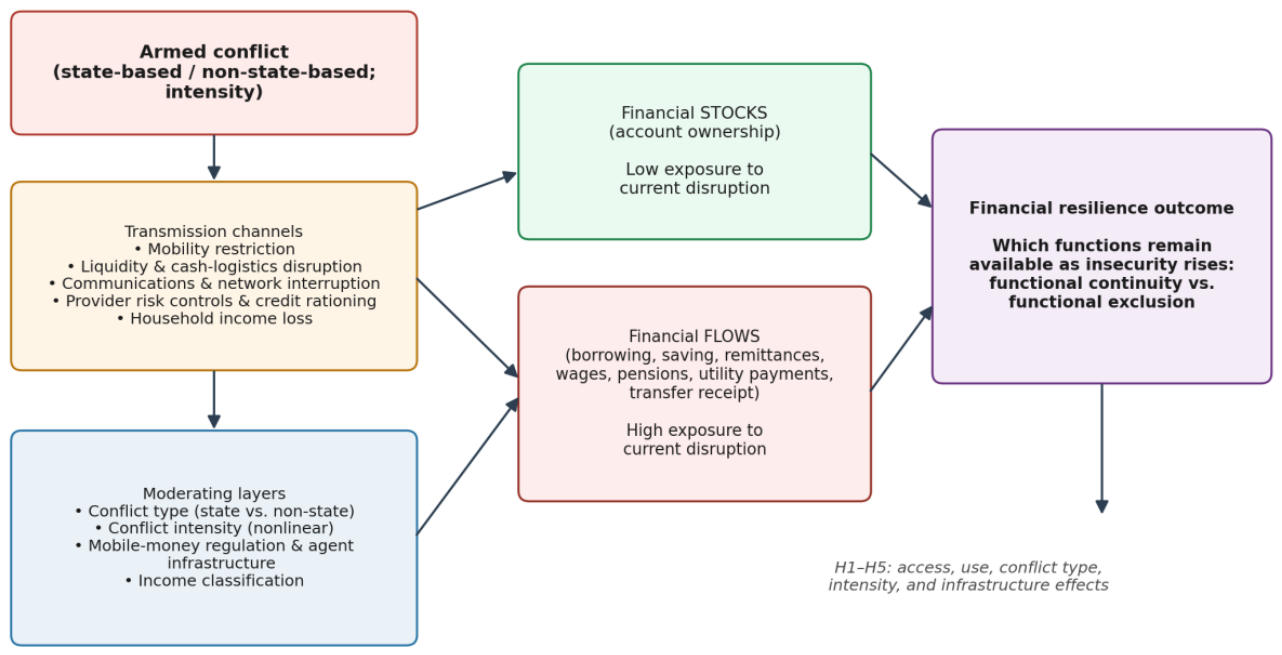
Figure 2.
Heterogeneity by Income Classification.
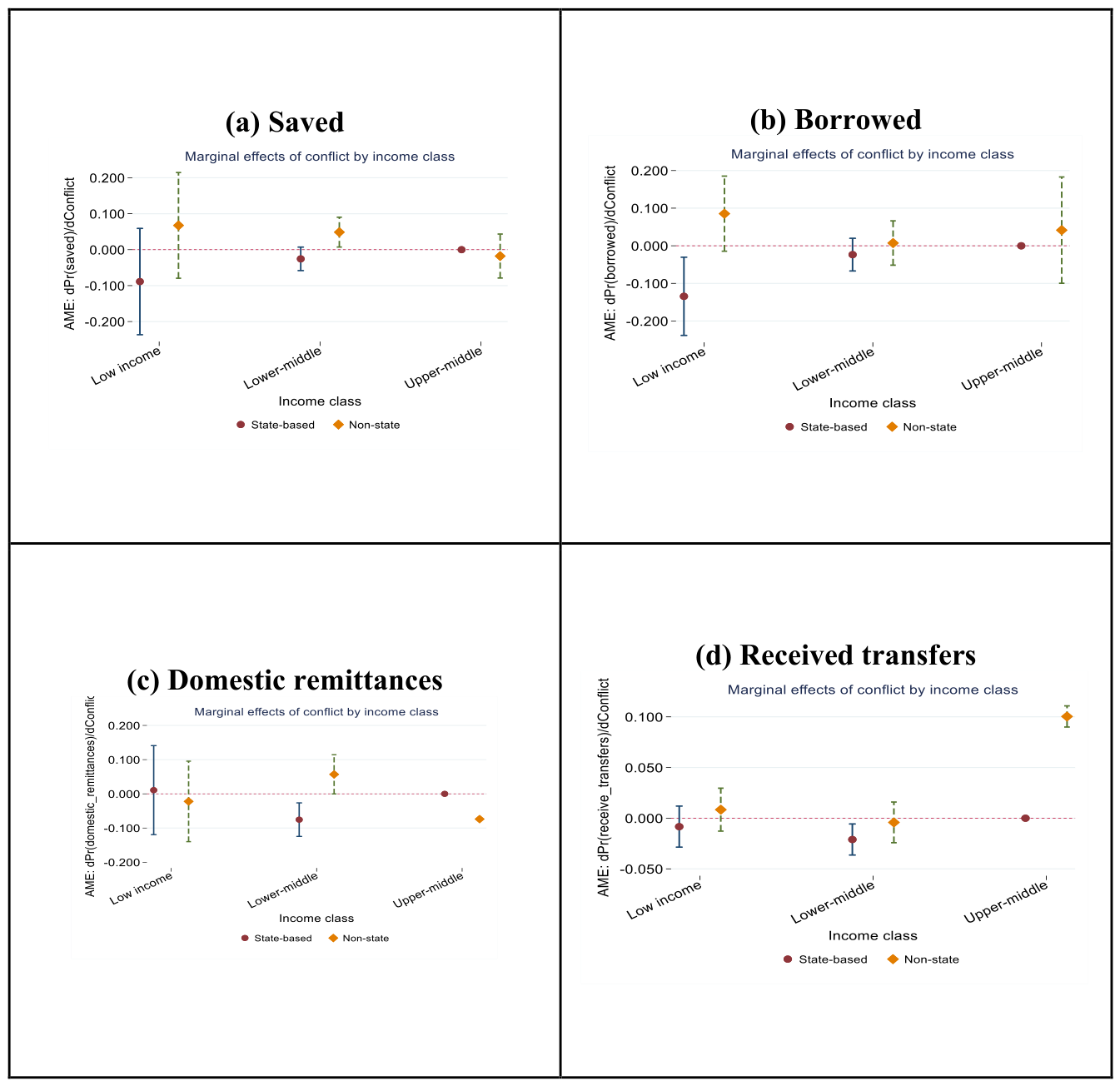
Table 2.
Descriptive Characteristics.
| Variables | Count | Mean | sd | Min | Max |
| Has an account | 32951 | 0.622 | 0.485 | 0 | 1 |
| Has an account at a financial institution | 32951 | 0.361 | 0.48 | 0 | 1 |
| Borrowed | 32951 | 0.721 | 0.449 | 0 | 1 |
| Saved | 32951 | 0.632 | 0.482 | 0 | 1 |
| Receive pensions | 31955 | 0.026 | 0.16 | 0 | 1 |
| Domestic remittances | 31912 | 0.453 | 0.498 | 0 | 1 |
| Receive wages | 31955 | 0.159 | 0.366 | 0 | 1 |
| Pay utilities | 31955 | 0.198 | 0.399 | 0 | 1 |
| Receive transfers | 31955 | 0.051 | 0.221 | 0 | 1 |
| State-based conflict (resulting deaths) | 32951 | 902.456 | 4128.12 | 0 | 24107 |
| Non state-based conflict (resulting deaths) | 32951 | 46.329 | 108.284 | 0 | 510 |
| Std. ln_state_based_conflict | 32951 | 0.023 | 1.043 | -0.85 | 2.743 |
| Std. ln_non_state_based_conflict | 32951 | 0.083 | 0.995 | -0.769 | 2.186 |
| Respondent is female | 32951 | 0.513 | 0.5 | 0 | 1 |
| Age | 32951 | 34.096 | 14.763 | 15 | 100 |
| Age_sq | 32951 | 1380.489 | 1265.704 | 225 | 10000 |
| Emp_in | 32951 | 0.658 | 0.475 | 0 | 1 |
| Q_1== 1.0000 | 32951 | 0.158 | 0.364 | 0 | 1 |
| Q_2== 2.0000 | 32951 | 0.166 | 0.372 | 0 | 1 |
| Q_3== 3.0000 | 32951 | 0.185 | 0.388 | 0 | 1 |
| Q_4== 4.0000 | 32951 | 0.211 | 0.408 | 0 | 1 |
| Q_5== 5.0000 | 32951 | 0.281 | 0.449 | 0 | 1 |
| Rural | 32951 | 0.667 | 0.471 | 0 | 1 |
| Primary education or less | 32951 | 0.421 | 0.494 | 0 | 1 |
| Secondary | 32951 | 0.518 | 0.5 | 0 | 1 |
| Tertiary | 32951 | 0.061 | 0.239 | 0 | 1 |
| Internet access | 32951 | 0.416 | 0.493 | 0 | 1 |
| Consumer protection | 32951 | 86.362 | 10.426 | 66.67 | 100 |
| Safeguarding of funds | 32951 | 78.781 | 40.887 | 0 | 100 |
| Agent services | 32951 | 86.658 | 18.211 | 0 | 100 |
| Minimum KYC requirements | 32951 | 76.335 | 23.866 | 0 | 100 |
Table 3.
Access to Financial Services and State-Based Conflict in Sub-Saharan Africa.
| Variables | State-based conflict | Non-State based conflict | ||
| 1 | 2 | 3 | 4 | |
| Account with a formal financial Institution | Any Account | Account with a formal financial Institution | Any Account | |
| z_ln_state_based_conflict | -0.032*** | -0.013** | -0.023*** | -0.008 |
| -0.009 | -0.006 | -0.004 | -0.008 | |
| Female | -0.032*** | -0.034*** | -0.032*** | -0.033*** |
| -0.006 | -0.006 | -0.006 | -0.006 | |
| Age | 0.014*** | 0.013*** | 0.014*** | 0.013*** |
| -0.002 | -0.002 | -0.002 | -0.002 | |
| Age_sq | -0.000*** | -0.000*** | -0.000*** | -0.000*** |
| 0.000 | 0.000 | 0.000 | 0.000 | |
| Emp_in | 0.109*** | 0.123*** | 0.109*** | 0.123*** |
| -0.015 | -0.004 | -0.014 | -0.004 | |
| Income Quintiles (Ref=Q_5) | ||||
| Q_1 | -0.101*** | -0.123*** | -0.101*** | -0.123*** |
| -0.013 | -0.005 | -0.013 | -0.005 | |
| Q_2 | -0.085*** | -0.075*** | -0.085*** | -0.075*** |
| -0.01 | -0.012 | -0.009 | -0.012 | |
| Q_3 | -0.080*** | -0.055*** | -0.080*** | -0.055*** |
| -0.005 | -0.01 | -0.005 | -0.010 | |
| Q_4 | -0.055*** | -0.028*** | -0.055*** | -0.028*** |
| -0.002 | -0.009 | -0.002 | -0.009 | |
| Rural | -0.027** | -0.042*** | -0.027** | -0.042*** |
| -0.011 | -0.012 | -0.011 | -0.012 | |
| Secondary | 0.118*** | 0.140*** | 0.118*** | 0.139*** |
| -0.006 | -0.003 | -0.005 | -0.003 | |
| Tertiary | 0.327*** | 0.318*** | 0.327*** | 0.317*** |
| -0.023 | -0.010 | -0.021 | -0.010 | |
| Internet access | 0.144*** | 0.192*** | 0.144*** | 0.192*** |
| -0.001 | -0.010 | -0.002 | -0.011 | |
| Consumer protection | 0.000 | 0.002** | 0.000 | 0.002** |
| -0.004 | -0.001 | -0.003 | -0.001 | |
| Safeguarding of funds | 0.000 | 0.000 | 0.000 | 0.000 |
| 0.000 | 0.000 | 0.000 | 0.000 | |
| Agent services | 0.003** | 0.003*** | 0.003** | 0.003*** |
| -0.001 | -0.001 | -0.001 | -0.001 | |
| Minimum KYC requirements | 0.000 | 0.001** | 0.000 | 0.001** |
| -0.001 | 0.000 | -0.001 | 0.000 | |
| Observations | 32,951 | 32,951 | 32,951 | 32,951 |
Robust standard errors in parentheses. *** p < .01, ** p < .05, * p < .10.
Table 4.
Usage of Financial Services and State-based Conflict in Sub-Saharan Africa.
|
Variables |
(1) | (2) | (3) | (4) | (5) | (6) | (7) |
| Borrowed | Saved | Received pensions | Sent/received domestic remittances | Receive wages | Paid utilities | Received transfers | |
| z_ln_state_based_conflict | -0.020*** | -0.001 | -0.004 | -0.038*** | -0.005 | -0.022** | -0.019** |
| (0.003) | (0.009) | (0.004) | (0.013) | (0.011) | (0.010) | (0.009) | |
| Female | -0.003 | 0.024*** | -0.005*** | -0.003 | -0.049*** | -0.010* | -0.000 |
| (0.006) | (0.002) | (0.001) | (0.005) | (0.003) | (0.006) | (0.004) | |
| Age | 0.009*** | 0.005*** | 0.001* | 0.006*** | 0.009*** | 0.009*** | -0.000 |
| (0.000) | (0.001) | (0.000) | (0.002) | (0.001) | (0.002) | (0.000) | |
| Age_sq | -0.000*** | -0.000*** | 0.000*** | -0.000*** | -0.000*** | -0.000*** | 0.000* |
| (0.000) | (0.000) | (0.000) | (0.000) | (0.000) | (0.000) | (0.000) | |
| Emp_in | 0.106*** | 0.165*** | 0.000 | 0.097*** | 0.142*** | 0.063*** | 0.006 |
| (0.005) | (0.002) | (0.002) | (0.007) | (0.021) | (0.004) | (0.007) | |
| Income Quintiles (Ref=Q_5) | |||||||
| Q_1 | -0.004 | -0.144*** | -0.015** | -0.140*** | -0.102*** | -0.075*** | -0.001 |
| (0.019) | (0.014) | (0.006) | (0.003) | (0.016) | (0.011) | (0.003) | |
| Q_2 | 0.018 | -0.088*** | -0.007*** | -0.090*** | -0.079*** | -0.066*** | 0.003 |
| (0.015) | (0.010) | (0.003) | (0.006) | (0.007) | (0.011) | (0.002) | |
| Q_3 | 0.020 | -0.056*** | -0.005*** | -0.058*** | -0.070*** | -0.037*** | 0.002 |
| (0.018) | (0.012) | (0.001) | (0.006) | (0.005) | (0.012) | (0.003) | |
| Q_4 | 0.016 | -0.037*** | -0.004*** | -0.029*** | -0.048*** | -0.022*** | -0.003 |
| (0.014) | (0.011) | (0.001) | (0.004) | (0.005) | (0.003) | (0.004) | |
| Rural | 0.038*** | 0.001 | -0.000 | -0.008 | -0.013*** | -0.050*** | -0.001 |
| (0.006) | (0.009) | (0.001) | (0.013) | (0.003) | (0.010) | (0.004) | |
| Secondary | 0.011 | 0.074*** | 0.011*** | 0.114*** | 0.079*** | 0.080*** | 0.008** |
| (0.007) | (0.006) | (0.002) | (0.010) | (0.006) | (0.003) | (0.004) | |
| Tertiary | 0.038 | 0.158*** | 0.018*** | 0.211*** | 0.171*** | 0.152*** | 0.020 |
| (0.034) | (0.014) | (0.007) | (0.011) | (0.003) | (0.018) | (0.013) | |
| Internet_access | 0.064*** | 0.172*** | 0.007** | 0.189*** | 0.086*** | 0.131*** | 0.018*** |
| (0.021) | (0.002) | (0.003) | (0.008) | (0.005) | (0.008) | (0.004) | |
| Consumer protection | 0.001* | 0.001** | -0.001 | 0.000 | -0.000 | -0.001 | -0.000 |
| (0.001) | (0.001) | (0.000) | (0.002) | (0.000) | (0.001) | (0.001) | |
| Safeguarding of funds | -0.000** | -0.000 | -0.000*** | -0.001*** | -0.000 | -0.000*** | -0.000*** |
| (0.000) | (0.000) | (0.000) | (0.000) | (0.000) | (0.000) | (0.000) | |
| Agent services | 0.001** | 0.001 | 0.000*** | 0.001 | 0.001*** | 0.002*** | 0.001*** |
| (0.000) | (0.001) | (0.000) | (0.001) | (0.000) | (0.000) | (0.000) | |
| Minimum KYC requirements | 0.001 | -0.000 | 0.000*** | 0.001** | 0.001* | 0.000 | 0.001*** |
| (0.001) | (0.001) | (0.000) | (0.000) | (0.000) | (0.000) | (0.000) | |
| Observations | 32,951 | 32,951 | 31,955 | 31,912 | 31,955 | 31,955 | 31,955 |
Robust standard errors in parentheses. *** p < .01, ** p < .05, * p < .10.
Table 5.
Usage of Financial Services and Non-state-based Conflict in Sub-Saharan Africa.
|
VARIABLES |
(1) | (2) | (3) | (4) | (5) | (6) | (7) |
| Borrowed | Saved | Received pensions | Sent/received domestic remittances | Receive wages | Paid utilities | Received transfers | |
| z_ln_non_state_based_conflict | -0.006** | -0.010 | -0.002 | -0.029*** | -0.001 | -0.016** | -0.003 |
| (0.003) | (0.007) | (0.003) | (0.007) | (0.005) | (0.007) | (0.008) | |
| Female | -0.003 | 0.024*** | -0.005*** | -0.003 | -0.049*** | -0.010* | -0.000 |
| (0.006) | (0.002) | (0.001) | (0.005) | (0.003) | (0.006) | (0.004) | |
| Age | 0.009*** | 0.005*** | 0.001* | 0.006*** | 0.009*** | 0.009*** | -0.000 |
| (0.000) | (0.001) | (0.000) | (0.002) | (0.002) | (0.002) | (0.000) | |
| Age_sq | -0.000*** | -0.000*** | 0.000*** | -0.000*** | -0.000*** | -0.000*** | 0.000** |
| (0.000) | (0.000) | (0.000) | (0.000) | (0.000) | (0.000) | (0.000) | |
| Emp_in | 0.106*** | 0.165*** | 0.000 | 0.097*** | 0.143*** | 0.063*** | 0.006 |
| (0.005) | (0.001) | (0.002) | (0.007) | (0.023) | (0.004) | (0.007) | |
| Income Quintiles (Ref=Q_5) | |||||||
| Q_1 | -0.004 | -0.144*** | -0.015** | -0.141*** | -0.103*** | -0.075*** | -0.001 |
| (0.019) | (0.014) | (0.007) | (0.003) | (0.018) | (0.011) | (0.003) | |
| Q_2 | 0.018 | -0.088*** | -0.007*** | -0.091*** | -0.079*** | -0.066*** | 0.003 |
| (0.015) | (0.010) | (0.003) | (0.006) | (0.008) | (0.011) | (0.002) | |
| Q_3 | 0.020 | -0.056*** | -0.005*** | -0.058*** | -0.071*** | -0.037*** | 0.002 |
| (0.018) | (0.012) | (0.001) | (0.006) | (0.006) | (0.012) | (0.003) | |
| Q_4 | 0.015 | -0.037*** | -0.004*** | -0.029*** | -0.048*** | -0.022*** | -0.003 |
| (0.014) | (0.011) | (0.001) | (0.005) | (0.005) | (0.003) | (0.004) | |
| Rural | 0.038*** | 0.001 | -0.000 | -0.008 | -0.013*** | -0.051*** | -0.001 |
| (0.006) | (0.009) | (0.001) | (0.013) | (0.003) | (0.010) | (0.004) | |
| Secondary | 0.011 | 0.074*** | 0.011*** | 0.114*** | 0.079*** | 0.080*** | 0.008** |
| (0.007) | (0.006) | (0.002) | (0.010) | (0.006) | (0.003) | (0.004) | |
| Tertiary | 0.037 | 0.158*** | 0.018*** | 0.212*** | 0.172*** | 0.152*** | 0.020 |
| (0.034) | (0.014) | (0.007) | (0.010) | (0.005) | (0.018) | (0.013) | |
| Internet_access | 0.064*** | 0.172*** | 0.007** | 0.190*** | 0.087*** | 0.131*** | 0.018*** |
| (0.020) | (0.002) | (0.003) | (0.008) | (0.006) | (0.009) | (0.003) | |
| Consumer protection | 0.001** | 0.001 | -0.001 | 0.001 | -0.000 | -0.000 | -0.000 |
| (0.001) | (0.001) | (0.000) | (0.002) | (0.000) | (0.001) | (0.001) | |
| Safeguarding of funds | -0.000 | -0.000 | -0.000*** | -0.001** | -0.000 | -0.000*** | -0.000*** |
| (0.000) | (0.000) | (0.000) | (0.000) | (0.000) | (0.000) | (0.000) | |
| Agent services | 0.000 | 0.001 | 0.000** | 0.001* | 0.001*** | 0.002*** | 0.001*** |
| (0.000) | (0.001) | (0.000) | (0.001) | (0.000) | (0.000) | (0.000) | |
| Minimum KYC requirements | 0.001 | -0.000 | 0.000*** | 0.001*** | 0.001* | 0.000 | 0.000** |
| (0.001) | (0.000) | (0.000) | (0.000) | (0.000) | (0.000) | (0.000) | |
| Observations | 32,951 | 32,951 | 31,955 | 31,912 | 31,955 | 31,955 | 31,955 |
Robust standard errors in parentheses. *** p < .01, ** p < .05, * p < .10.
Table 6.
Pairwise Comparison of Predicted Margins for State-Based Conflict.
| Variables | Borrowed | Saved | Domestic Remittances | Receive Transfers |
| P_25 | 0.700*** | 0.635*** | 0.479*** | 0.061*** |
| -0.07 | -0.023 | -0.036 | -0.013 | |
| P_50 | 0.667*** | 0.634*** | 0.456*** | 0.052*** |
| -0.068 | -0.016 | -0.028 | -0.007 | |
| P_75 | 0.403*** | 0.036*** | ||
| -0.011 | -0.004 | |||
| DELTA | ||||
| Contrast (P_50 vs P_25) | -0.033*** | -0.001 | -0.023*** | -0.009 |
| Std. Err. | 0.005 | 0.014 | 0.007 | 0.006 |
| Contrast (P_75 vs P_50) | -0.053*** | -0.016 | ||
| Std. Err. | 0.018 | 0.082 | ||
| Observations | 32,951 | 32,951 | 31,912 | 31,955 |
Notes: n.r. means not reported in the available results. *** p < .01, ** p < .05.
Table 7.
Pairwise comparison of predicted margins for non-state-based conflict.
| Variables | Borrowed | Saved | Domestic Remittances | Receive Transfers |
| P_25 | 0.695*** | 0.642*** | 0.473*** | 0.051*** |
| -0.065 | -0.025 | -0.022 | -0.012 | |
| P_50 | 0.685*** | 0.626*** | 0.424*** | 0.047*** |
| -0.06 | -0.013 | -0.03 | -0.009 | |
| DELTA | ||||
| Contrast (P_50 vs P_25) | -0.010** | -0.016 | -0.049*** | -0.004 |
| Std. Err. | 0.005 | 0.011 | 0.011 | 0.014 |
| Observations | 32,951 | 32,951 | 31,912 | 31,955 |
Notes: n.r. means not reported in the available results. *** p < .01, ** p < .05.
Disclaimer/Publisher’s Note: The statements, opinions and data contained in all publications are solely those of the individual author(s) and contributor(s) and not of MDPI and/or the editor(s). MDPI and/or the editor(s) disclaim responsibility for any injury to people or property resulting from any ideas, methods, instructions or products referred to in the content. |
© 2026 by the authors. Licensee MDPI, Basel, Switzerland. This article is an open access article distributed under the terms and conditions of the Creative Commons Attribution (CC BY) license (http://creativecommons.org/licenses/by/4.0/).
Copyright: This open access article is published under a Creative Commons CC BY 4.0 license, which permit the free download, distribution, and reuse, provided that the author and preprint are cited in any reuse.