

Submitted:
01 September 2026
Posted:
02 September 2026
You are already at the latest version
Abstract
Large language models (LLMs) have achieved remarkable performance, prompting the development of LLM-based agents to tackle complex, open-world tasks. Despite these advances, autonomous agents still face critical bottlenecks in environmental perception, multi-step reasoning, and long-term opera-tional consistency. Graphs provide a systematic solution to these challenges by explicitly modeling entities, relationships, and dependencies, thereby establishing a rigorous foundation for reasoning and interaction. While recent literature explores this integration, existing surveys primarily focus on operational workflows and architectures, lacking a systematic analysis of how graphs fundamentally elevate agent intelligence. To bridge this gap, this survey presents a comprehensive review of Graph-Augmented LLM-based Agents (GLAs). We systematically decompose agent architecture to distill five core capabilities required for advanced intelligence: perception, reasoning, memorization, generaliza-tion, and interaction. We explicitly address why graphs are uniquely suited to bolster these capabilities and how they are practically integrated, proposing a novel taxonomy that organizes existing studies along these five dimensions. Furthermore, we review representative real-world applications of GLAs across diverse domains and outline key challenges and promising directions for future research. A curated repository containing the literature reviewed in this survey, along with the latest advancements in this field, is maintained and regularly updated at https://github.com/sqs17/GLA.
Keywords:
graphs
; LLM
; LLM-based agents
; survey
1. Introduction
The remarkable performance of Large Language Models (LLMs) across a wide range of specialized domains, including software engineering [1], healthcare [2], and the social sciences [3], highlights their potential as a cornerstone for Artificial General Intelligence (AGI). However, traditional LLMs often lack autonomous evolution and environmental interaction, limiting their intelligence in complex, open-world applications. To address these constraints, the paradigm of LLM-based agents has emerged. Within this framework, individual agents are equipped with modular components such as planning, memory, tool use, and reflection to facilitate autonomous decision-making and grounded execution. Meanwhile, multiple agents coordinate via specialized roles and communication protocols to collaboratively tackle complex tasks. While this paradigm has shown significant promise, achieving AGI remains a formidable challenge, particularly regarding environmental perception, reasoning hallucinations, and the maintenance of long-term operational consistency.
Graphs offer a systematic perspective for addressing these challenges by serving as a universal structural representation. By explicitly modeling entities, relationships, and environmental dependencies, graphs provide a rigorous foundation for reasoning, memory, and interactive behaviors. Consequently, a growing body of research has focused on Graph-Augmented LLM-based Agents (GLAs) to enhance model cognition and decision-making capabilities. For instance, Besta et al. [4] formulate LLM reasoning as a graph to enable structured, task-aware inference. HippoRAG [5] organizes memory as a relational graph, reducing fragmentation and inconsistency caused by isolated retrieval. Zhou et al. [6] optimize the structure of multi-agent collaboration by sampling and pruning interaction topologies, leading to more effective coordination.
While the integration of graphs with LLMs has shown significant promise, a systematic study examining GLAs from a holistic perspective remains absent. Table 1 provides an overview of existing survey papers on the integration of graphs and LLMs. Early surveys primarily examined the potential of applying LLMs to graph tasks, focusing on perspectives such as model design [7,8,9,10,11], graph scenarios [12,13,14], and data transformation [15]. Subsequent studies shifted attention to the bidirectional interaction between graphs and LLMs [16], including graph-augmented LLMs and LLM-assisted graph learning. Within graph-augmented LLM research, Ma et al. [17] examined how knowledge graphs (KGs) serve as structured functional modules that augment LLMs in complex reasoning tasks, whereas Peng et al. [18] studied the application of Graph Retrieval-Augmented Generation (GraphRAG) in LLMs. Narrowing the focus to agentic systems, Table 2 provides a detailed overview of existing surveys specifically addressing GLAs. Liu et al. [19] focus on how graphs overcome specific operational limitations within the workflows of LLM-based agents. Meanwhile, Bei et al. [20] explore how graphs enhance AI agents more broadly, encompassing both LLM-based and reinforcement learning-based agents. Nevertheless, their analyses remain largely confined to operational workflows and architectures, lacking a systematic examination of how graphs fundamentally elevate the intelligence of LLM-based agents.
To address this gap, this paper presents a comprehensive review of prior research with the goal of establishing a clear taxonomy and systematically examining how graphs can enhance the intelligence of LLM-based agents in the pursuit of AGI. Specifically, we seek to answer three fundamental questions: (i) What are the core capabilities of LLM-based agents? (ii) Why do we need graphs in LLM-based agents? and (iii) How can we enhance LLM-based agents with graphs? To this end, we systematically dissect LLM-based agents across three granularities—the foundation LLM, single-agent architectures, and multi-agent collaboration—to distill five core capabilities: perception, reasoning, memorization, generalization, and interaction. We then justify the importance of graphs for enhancing LLM-based agents from three complementary perspectives: structural cognition, computational reliability, and system coordination. Subsequently, starting from these foundational capabilities, we provide a detailed investigation of the internal mechanisms through which graphs enhance the intelligence of LLM-based agents. Building on this foundation, we survey representative real-world applications enabled by GLAs. Finally, we summarize the key challenges facing current approaches and outline promising directions for future research.
Contribution. The main contributions of this survey are summarized as follows.
- We systematically identify the key capabilities required by LLM-based agents and analyze why graphs are essential for enhancing these capabilities.
- We propose a novel taxonomy that organizes existing studies according to how graphs enhance five core capabilities of LLM-based agents: perception, reasoning, memorization, generalization, and interaction.
- We review representative real-world applications of GLAs to demonstrate the practical significance of graphs across diverse domains, and outline open challenges as well as promising directions for future research.
The remainder of this survey is organized as follows. Section 2 introduces the architecture of LLM-based agents and systematically defines the core capabilities required for advancing their intelligence. Section 3 reviews foundational graph concepts and explains from multiple perspectives why graphs play a critical role in enhancing the capabilities of LLM-based agents. Section 4 provides a detailed analysis of how graphs support the five key capabilities of LLM-based agents including perception, reasoning, memorization, generalization, and interaction. Section 5 presents representative real-world applications of GLAs. Subsequently, Section 6 discusses the major challenges in current research and outlines promising directions for future work. Finally, Section 7 concludes the paper with a comprehensive summary.
2. What Are the Core Capabilities of LLM-Based Agents?
In this section, we present a system-level decomposition of LLM-based agents and distill the core capabilities that underpin their intelligent behavior, which serve as the analytical basis for subsequent investigations of GLAs.
2.1. Structure of LLM-Based Agents
Enhancing the general intelligence of LLM-based agents for complex tasks necessitates systemic analysis rather than mere reliance on specific architectural designs or isolated functional modules. We systematically decompose LLM-based agents into three hierarchical levels: the Foundation LLM, Single-Agent Architecture, and Multi-Agent Collaboration. As illustrated in Figure 1, these three levels form a progressive and interdependent hierarchy. The Foundation LLM provides the core capabilities of reasoning, memory, and generalization, serving as the central decision-making brain for a single agent. Building upon this, the single-agent architecture integrates the LLM with modular components—such as planning, memory management, and tool use—to function as the foundational unit of multi-agent collaboration. Collectively, these levels empower LLM-based agents to exhibit general intelligence in complex environments. Below, we detail the role and critical function of each level.
Foundation LLM. The foundation LLM serves as the epistemic core of the LLM-based agent, functioning as the cognitive substrate that mirrors human brain faculties. It encapsulates vast knowledge and facilitates essential operations such as comprehension, logical reasoning, and generalization. When confronted with novel and complex tasks, the LLM exploits knowledge acquired during large-scale pre-training together with its contextual modeling capacity to interpret task objectives and constraints. It then synthesizes this information to produce high-level decisions that guide subsequent autonomous actions.
Single-Agent Architecture. The single-agent architecture augments the intelligence of the underlying LLM by equipping it with modular components designed for environmental interaction. A widely recognized framework for single agents consists of three critical components: Perception, Brain, and Action [33]. The perception module, mirroring human sensory systems, processes multimodal information from the external environment. The LLM, acting as the brain, subsequently performs computation, reasoning, and decision-making based on this input. Specialized modules—such as task planning, memory management, and tool use—provide the infrastructure for environment interaction, allowing the agent to iteratively update its internal states and achieve self-evolution during the interaction process.
Multi-Agent Collaboration. Multi-agent collaboration extends individual capabilities by simulating human-like social structures to resolve complexities beyond the scope of a solitary agent. In this paradigm, agents are assigned distinct roles and objectives, facilitating the resolution of intricate goals through asynchronous communication, shared memory, and the exchange of intermediate reasoning traces. Compared to single-agent systems, multi-agent collaboration significantly mitigates inherent LLM limitations—such as hallucinations, shallow reasoning depth, and constrained perspectives. This collaborative synergy ensures heightened robustness and adaptability when navigating large-scale, systemic tasks that require diverse expertise.
2.2. Core Capabilities of the LLM-Based Agents
While the aforementioned three-tier hierarchy provides a structural taxonomy for LLM-based agents, these layers are functionally intertwined rather than operating in isolation. Consider reasoning as an illustrative example: solving a complex problem requires the parametric reasoning capability of the foundation LLM, augmented by modular components such as planning and tool use at the single-agent level, and further enhanced by collaborative deliberation across multiple agents. To more precisely capture the evolution of intelligence within LLM-based agents, we distill five cardinal capabilities: perception, reasoning, memorization, generalization, and interaction. These capabilities constitute a cohesive ecosystem in which each capability supports and reinforces the others. Perception captures multimodal inputs from dynamic environments, and these inputs are synthesized with historical experiences retrieved from memory to drive the reasoning engine. The intermediate outcomes of reasoning, in turn, update memory to facilitate iterative refinement. Generalization ensures the transferability of these logic patterns to unseen domains. Ultimately, through continuous interaction with the environment, LLM-based agents establish a self-evolving feedback loop, fostering goal-oriented general intelligence in complex, open-ended scenarios. In the following, we provide a detailed discussion of each capability.
Perception. Perception in LLM-based agents refers to the ability to acquire, recognize, interpret, and represent key information from a dynamic environment—forming the foundation for reasoning and decision-making. Traditional LLMs primarily rely on textual input. Through pretraining on vast text corpora, they learn linguistic structures and semantic representations, enabling them to abstract aspects of the real world through language. However, this sequence-based representation inevitably loses information. It overlooks fine-grained sensory signals and struggles to capture explicit spatiotemporal dynamics and relational structures. Therefore, extending the perceptual space of LLM-based agents to include multisensory signals, as well as representations of temporal and relational structures, is essential for a deeper understanding of the world and for supporting downstream reasoning and decision-making processes.
Reasoning. Reasoning constitutes the core capability that enables intelligence in LLM-based agents. At the foundation LLM level, reasoning is enhanced through the explicit and structured representation of intermediate reasoning steps such as structured prompts or decompositional thinking. At the agent level, reasoning becomes more robust through modular integration. Retrieval and memory management modules allow agents to dynamically incorporate external knowledge and prior experiences, strengthening factual grounding and long-term coherence. The planning module decomposes complex tasks into distributed reasoning processes, while the tool-use module enables precise computation, environmental feedback, and formal verification—enhancing both accuracy and executability. Moreover, multi-agent collaboration deepens and stabilizes reasoning by allowing agents with different roles to cross-validate and iteratively refine their inferences.
Memorization. Memory allows LLM-based agents to retain, retrieve, and utilize information from prior learning and interactions, thereby supporting self-improvement during ongoing processes. It operates across multiple scales, including long-term memory, short-term memory, and agentic memory. Long-term memory encompasses persistent knowledge applicable across contexts, ranging from parametric memory acquired during pretraining to external memory storing previous interactions. Short-term memory, by contrast, handles context-dependent information within limited time spans, realized through mechanisms like context windows or temporary caches. Agentic memory emphasizes the structured management and dynamic scheduling of past experiences—including selection, compression, updating, and forgetting—as well as the sharing of memory across agents. These mechanisms collectively enable strategy optimization and goal consistency during extended task execution.
Generalization. Generalization denotes the capability of LLM-based agents to maintain stability and achieve effective transferability when encountering novel tasks or domains, representing a core hallmark of general intelligence. While conventional models often lack robustness due to their domain-specific nature, foundation LLMs utilize vast parameter spaces to internalize broad knowledge, enabling zero-shot or few-shot reasoning. By integrating modular components and strengthening inter-agent interactions, LLM-based agents further bolster their resilience and adaptability within complex, open-world environments.
Interaction. Interaction within LLM-based agents represents the systematic capacity for agents to synchronize states, coordinate behaviors, and align goals through mutual information exchange and environmental feedback. Emerging from the interplay of perception, reasoning, memorization, and generalization, this capability transcends static generation by operating as a closed-loop process where environmental changes and feedback iteratively inform reasoning and planning. Furthermore, structured multi-agent collaboration—characterized by role specialization, the sharing of intermediate results, and iterative cross-validation—enhances the stability, adaptability, and long-term coherence essential for complex task execution.
3. Why We Need Graphs in LLM-Based Agents
Before detailing how graphs enhance the intelligence of LLM-based agents, this section introduces foundational graph-related concepts. We then systematically justify why graphs are fundamentally necessary for LLM-based agents from three critical perspectives: structural cognition, computational reliability, and system coordination.
3.1. Basic Knowledge
We first formalize the graph-related definitions and notation employed throughout this paper.
Definition 1
(Graph). A graph is denoted as , where is a finite set of vertices and is a set of edges representing pairwise relationships between vertices. A graph is called undirected if implies ; otherwise, it is a directed graph . If each edge is associated with a weight , the graph is referred to as a weighted graph.
Definition 2
(Path). A path P in a graph G is an ordered sequence of vertices such that for all .
Definition 3
(Cycle). A cycle is a path such that and all other vertices are distinct.
Definition 4
(Tree). A tree is an undirected graph that is connected and acyclic. A forest is a disjoint union of trees.
Definition 5
(Subgraph). Given a graph , a graph is called a subgraph of G if and , and every edge in connects two vertices in .
3.2. Perspective of Structural Cognition
Cognitive science demonstrates that human cognition fundamentally depends on associative and semantic networks to abstract and structure knowledge within complex environments [34]. Conversely, foundation LLMs predominantly encode information via one-dimensional token sequences. Although this sequence-centric paradigm is highly efficient at compressing information, it inherently lacks the built-in relational awareness necessary to explicitly model multidimensional entity interactions and structural environmental dependencies.
To achieve human-like comprehension in open-world settings, LLM-based agents must overcome this structural blindness. Graphs provide a universal mathematical abstraction that directly addresses this gap by injecting explicit relational priors into the system. For instance, scene graphs empower agents to holistically perceive physical spatial layouts [35], while code dependency graphs elucidate the intricate topologies of software repositories [36]. Furthermore, by integrating diverse graph representations and algorithmic operators as adaptable cognitive modules, LLM-based agents can systematically enhance their structural comprehension across a wide spectrum of complex scenarios [37].
3.3. Perspective of Computational Reliability
To execute complex long-horizon tasks, LLM-based agents must overcome the inherent error accumulation and reasoning hallucinations caused by the probabilistic nature of LLMs [38]. In bridging unconstrained probabilistic generation and deterministic, verifiable logic, graphs are key to ensuring computational reliability in the following aspects: (1) Factual grounding. An important function of graphs is to serve as structured external knowledge bases for retrieving factual paths [39]. By bounding the solution space, graphs mitigate parametric hallucinations and provide deterministic factual constraints. This is critical for improving agent accuracy in knowledge-intensive tasks. (2) Structural verification. To maintain logical consistency across multi-step inference, agents must avoid reasoning drift. By encoding intermediate reasoning states as thought nodes and permissible transitions as directed edges, graphs allow the system to recast reasoning traces as verification graphs, enabling the agent to pinpoint erroneous reasoning segments before final execution [40]. (3) Deterministic execution. Graphs also play a critical role in explicitly defining operational prerequisites by constraining agents to traverse explicit tool-dependency graphs [41]. This rigorous topological foundation ensures that generated action sequences are computationally reliable, logically coherent, and safely executable, which forms the basis for reliable agent-environment interaction. In summary, bridging probabilistic generation with deterministic logic is a fundamental requirement for LLM-based agents, and graphs are essential for establishing this computational reliability.
3.4. Perspective of System Coordination
In LLM-based agents, a structured interaction topology is an indispensable component of effective system coordination. For example, in complex task-solving scenarios, a communication graph dictates a clear flow of information among specialized agents, which is necessary to route messages efficiently and orchestrate collaboration. Without an explicit graph structure, agents would communicate in a fully connected, unstructured manner, inevitably leading to exponential communication bottlenecks, redundant message passing, and context-window overflow [42]. Furthermore, in distributed collaborative environments, a well-defined graph topology is of great importance to maintain stable control flow and prevent cascading failures. Without a graph to restrict interaction channels and isolate compromised or erroneous nodes, malicious information or reasoning errors can freely propagate across the system, easily leading to chaotic decision-making [43]. As these examples demonstrate, whether mitigating communication bottlenecks or preventing cascading failures, graphs provide the fundamental constraints necessary for efficient and secure multi-agent collaboration.
4. How to Enhance LLM-Based Agents with Graphs
In this section, we provide an in-depth analysis of the core mechanisms through which graphs enhance LLM-based agents. Figure 2 presents our comprehensive taxonomy of GLAs, illustrating these enhancements through the lens of the five core capabilities essential for advanced intelligence.
4.1. Perception Capability
Graphs, by modeling intricate relationships among entities, offer a powerful mechanism for enhancing the perception capabilities of LLM-based agents in complex real-world environments. We focus on two key aspects of enhancing the perception capabilities of LLM-based agents through graph techniques: Graph Perception and Multimodal Perception. Graph perception enables LLM-based agents to comprehend structured information by recognizing entities, relations, and topological patterns within graph data, thereby supporting relational reasoning and knowledge integration. Multimodal perception, in turn, enables LLM-based agents to align and fuse information across different modalities, such as text, images, and audio, facilitating comprehensive understanding and cross-modal generation. As illustrated in Figure 3, these two aspects of perception capabilities jointly enhance the structural and semantic awareness of LLM-based agents, paving the way for more comprehensive and contextually grounded intelligence.
4.1.1. Graph Perception
With the remarkable success of LLMs in text generation and comprehension, researchers have explored how LLM-based agents can perceive and reason over graph data [44,45]. A direct strategy is to reformulate graphs into LLM-compatible representations. Existing work serializes graph structures as textual or symbolic inputs, including edge lists [46], graph-syntax trees [47], node sequences [48] and symbolic representations [49]. With the development of MLLMs, graphs have also been transformed into visual representations processed by vision-language models, as illustrated by GITA [50], GraphVis [51], and VisionGraph [52]. In addition, graph-as-code methods exploit the code understanding and executable validation capabilities of LLMs to support graph reasoning [53]. These representation-based methods improve graph perception by aligning graph data with modalities already familiar to LLMs, but empirical evidence still indicates that LLMs remain limited in native structural understanding [54].
To address this limitation, another line of work enhances structural awareness through graph-centric instruction tuning. InstructGraph [55] encodes graphs into a universal code-like format and fine-tunes LLMs with graph instruction tuning and preference alignment, while GUNDAM [56] and GraphWiz [57] further explore task-specific graph tuning strategies. Since full LLM fine-tuning can be computationally expensive, many studies instead align GNN-based structural encoders with LLMs. In this paradigm, GNNs capture structural and semantic information from graphs, and lightweight projection modules map the resulting graph-aware representations into the LLM semantic space, reducing training cost and input length while improving structural comprehension. Representative methods include GraphPrompter [58], GraphTranslator [59], GraphLLM [60], and DGTL [61].
4.1.2. Multimodal Perception
Previous research has thoroughly demonstrated the crucial role of graphs in enhancing multimodal perception [62]. Broadly speaking, existing studies can be categorized into two main directions. First, some studies extract graphs from other modalities—such as images and videos—to enhance the model’s capability to perceive and reason about information within those modalities. Second, other works exploit the representational power of graphs as a bridging mechanism to align and integrate heterogeneous modalities, thereby uncovering the latent structural relationships among them.
Representative studies in the first category employ scene graphs to extract entities and relationships from multimodal data such as images or videos. By structuring semantic information in this way, these methods improve modality-specific perception in LLM-based agents. Prominent examples include LLaVA-SG [35], CCoT [63], VoT [64], and SG-Nav [65]. Further extending this direction, several studies have proposed transforming the multimodal inputs of MLLMs into graphs to enhance their multimodal perception. For example, BDoG [66] constructs a scene graph from textual and visual sources, which serves as a shared representation for reasoning. It then orchestrates multiple LLM-based agents to iteratively refine this graph through structured debates, improving the capabilities of LLM-based agents to integrate and understand information across modalities.
In parallel, multimodal graphs have been widely adopted to enhance the multimodal perception capability of LLM-based agents, as they effectively capture and represent structural relationships across different modalities [67]. Recent studies such as MMGraphRAG [68] leverage the rich cross-modal semantic relationships embedded in multimodal graphs, utilizing them as external knowledge bases to extend the perceptual boundaries of LLMs and substantially enhance their multimodal perception capability. Meanwhile, other works including Graph4MM [69] and MR-MKG [70] focus on intrinsic structured relationships among heterogeneous modalities within multimodal graphs. By emphasizing modality fusion and alignment, these approaches further improve the capability of LLM-based agents to perceive and reason across multiple modalities.
4.2. Reasoning Capability
Reasoning serves as the cornerstone for addressing complex problems, requiring the systematic management of intricate dependencies, the integration of heterogeneous evidence, and the preservation of consistency throughout multi-step inference. Graphs offer a natural abstraction for these requirements: nodes represent concepts or intermediate reasoning states, while edges encode logical or evidential relations. Building upon this structural correspondence, research on GLAs has flourished, examining how graphs can bolster both the reliability and the structural coherence of the reasoning process. Figure 4 provides a detailed overview of graph-enhanced reasoning, highlighting the progression from structured internal inference within foundation LLMs to complex, agentic reasoning frameworks driven by retrieval, planning, and multi-agent collaboration.
4.2.1. LLM Reasoning
Focusing on the intrinsic computational and inferential capabilities of LLMs, we will explore two core methodologies: Structured Prompt Engineering and Thoughts as Graphs. We investigate how structured frameworks optimize logical generation and how graphs enable models to perform complex, non-linear reasoning.
Structured Prompt Engineering. Prompt engineering has been shown to substantially improve LLM reasoning, and incorporating graph data into prompts further guides the reasoning trajectory and curbs hallucinations. One line of work injects explicit graph structures into prompts. CCoT [63] and HetGCoT [71] incorporate scene graphs or task-relevant heterogeneous subgraphs into reasoning prompts, while RwG [72] constructs explicit graphs from unstructured input contexts to support multi-step reasoning. A complementary line embeds structural information directly into vector representations. Yang et al. [73] encode reasoning as subgraph-based aggregation, whereas Yao et al. [74] integrate graph representations with multimodal features to support high-order inference. Beyond directly steering the reasoning trajectory, structured prompt engineering exploits graphs for several complementary objectives: optimizing the prompts themselves [75], formally verifying complex reasoning chains [40], improving inference efficiency [76], and generating structured reasoning trajectories for supervision [77].
Thoughts as Graphs. A common paradigm in LLM reasoning is to represent the model’s reasoning process as a graph. Intermediate steps are encoded as thought nodes, and directed edges describe their logical relationships. Reasoning is then performed by searching over this graph, providing a controlled mechanism for multi-step inference that extends beyond linear CoT [78] prompting. Early work instantiated this idea in the more constrained form of tree-structured reasoning. ToT [79] formulates the reasoning process as an explicit tree search: the model generates alternative intermediate thoughts as branching nodes and uses its own scoring ability as a heuristic to navigate the search space, enabling exploration of multiple reasoning paths and selection of high-value solutions. Moreover, LATS [80] generalizes this line of work by combining a tree-structured search procedure with environment interaction and reflective memory. Guided by Monte Carlo Tree Search principles, the agent explores alternative reasoning paths, receives outcome feedback from the environment, and iteratively refines subsequent reasoning paths through a self-reflection module.
As research has progressed beyond tree-based formulations, models such as GoT [4] leverage graph-based reasoning to capture richer dependencies among intermediate thoughts. By enabling aggregation and refinement operations over thought nodes, GoT synthesizes complementary partial solutions across reasoning branches. EGoT [81] extends this paradigm by propagating evaluator-generated rationales across nodes to mitigate error accumulation in multi-hop inference, while employing a cosine-annealed dynamic temperature schedule to balance exploratory diversity and convergent accuracy throughout the reasoning process. Complementing these approaches, Alotaibi et al. [82] propose a Graph of Logic that integrates the structural flexibility of graphs with the rigor of symbolic logic, allowing LLMs to perform inference and verification over graphs governed by explicit logical rules. Toward a more unified and flexible framework, AGoT [83] further unifies chain, tree, and graph reasoning by decomposing sub-steps recursively into a nested graphical hierarchy, providing a comprehensive abstraction for heterogeneous reasoning workflows.
4.2.2. Agentic Reasoning
Moving beyond the internal inference of standalone LLMs, agentic reasoning explores how reasoning evolves within autonomous intelligent agents. While existing literature has systematically categorized its core mechanisms into foundational capabilities, self-evolving adaptation, and collective coordination [84], this survey specifically examines agentic reasoning from a graph perspective. We emphasize how graphs augment reasoning by optimizing three critical dimensions: retrieval, planning, and collaboration.
Retrieval-Augmented Reasoning. Retrieval-augmented generation (RAG) [85] has become a powerful paradigm for enhancing the reasoning capabilities of LLM-based agents by incorporating external knowledge into the inference loop. By retrieving task-relevant evidence, RAG mitigates the inherent incompleteness of parametric memory and improves factual grounding, motivating a broad range of methods that couple LLMs with external knowledge repositories. Graphs, as a compact and relational representation of structured information, have increasingly been adopted as retrieval substrates. While traditional vector-based retrieval over isolated text segments often leads to fragmented evidence and obscured relational cues, graph-based retrieval exposes explicit entity and relation structures.
GraphRAG augments classical RAG by embedding graph data management throughout the retrieval–generation pipeline, allowing LLM-based agents to exploit explicit relational structures for more coherent and reliable reasoning. In this paradigm, external knowledge is first organized as a graph structure, where both local and global dependencies among knowledge units are explicitly preserved. During retrieval, graph algorithms are employed to extract query-conditioned evidence at different granularities, ranging from individual nodes to complex subgraphs [86,87]. The retrieved structures are then converted into structured prompts that inject relational context into LLMs [70], enabling structured reasoning and reducing reliance on loosely connected textual evidence. Microsoft’s GraphRAG [88] is a representative instantiation of the GraphRAG paradigm, in which unstructured corpora are converted into KGs and organized through hierarchical community summaries. Query-aware pruning is performed via a Map–Reduce process, followed by LLM-based aggregation to support global sensemaking.
Subsequent research has further extended the GraphRAG paradigm from the perspectives of graph construction, retrieval algorithms, and system efficiency. From the perspective of graph construction, beyond conventional KGs, existing studies have explored how different graph structures offer advantages in different reasoning scenarios. Hierarchical graphs organize textual units at multiple granularities, thereby supporting coarse-to-fine evidence selection and reducing retrieval noise [89]. In contrast, temporal and causal graphs encode specialized relational dependencies required by time-sensitive and narrative reasoning tasks [90]. From the perspective of retrieval algorithms, GraphRAG systems are no longer limited to retrieving semantically similar chunks through vector search; instead, they acquire relational evidence from neighboring nodes, paths, and subgraphs. Representative methods include subgraph- and path-oriented retrieval frameworks such as GRAG [91] and LEGO-GraphRAG [92], as well as GNN-based retrievers such as GFM-RAG [93] and G-Reasoner [94]. Beyond direct algorithmic retrieval, LLMs can also exploit their parametric knowledge to conduct heuristic searches over graphs. For example, RoG [95] first generates high-level reasoning paths using LLMs and then executes constrained retrieval over KGs. In addition to improving retrieval accuracy, recent studies have investigated lightweight indexing [96], selective retrieval[97,98], graph pruning [99,100], and small plug-in models [101,102,103] to reduce the runtime latency and computational cost of GraphRAG systems. Nevertheless, GraphRAG remains sensitive to graph quality, retrieval overhead, and task complexity [104]. Recent studies therefore explore hybrid retrieval, which combines vector-based and graph-based evidence [105], and agentic retrieval, where LLM-based agents actively traverse graphs to reduce retrieval cost and hallucinations [106,107,108].
Plans as Graphs. Effective agentic reasoning relies on robust planning to operationalize complex objectives. However, traditional linear planning often struggles to manage the intricate, non-sequential dependencies inherent in real-world problems. To address this limitation, representing the task specification itself as a graph has emerged as a powerful paradigm. In this approach, complex user objectives are decomposed into sub-tasks and organized into a task graph, where edges encode their temporal or logical dependencies. LLM-based agents are then used to search, update, and execute plans over this graph, leveraging its structural constraints to support more disciplined multi-step reasoning and execution. For example, Wu et al. [109] introduce a graph-driven planning framework in which the LLM-based agent decomposes the user’s instruction into subtasks, and these subtasks are subsequently mapped onto a task graph. A GNN then searches this graph to identify a feasible execution path, effectively strengthening the planning capability of the LLM-based agents. Plan-over-Graph [110] formulates the user’s objective as an abstract task graph by decomposing it into executable subtasks and leverages a two-stage trained LLM to compute an efficient parallel execution plan on this graph. Building on this paradigm, DAG-Plan [111] employs a directed acyclic task graph to encode temporal relations among sub-tasks and to orchestrate dual-arm robotic execution, yielding efficient coordination and parallelism. In addition, benchmarks such as AsyncHow [112] and WorfBench [113] provide standardized datasets and evaluation protocols for evaluating graph tasks and workflow planning.
Collective Reasoning. Multi-agent collaboration enhances the reasoning capabilities of LLM-based agents by enabling complex tasks to be addressed through specialized division of labor and interactive deliberation [114]. Graphs serve as the foundational carrier for agent interactions, providing a structured framework for task decomposition, role specialization, and iterative cross-validation. Several recent frameworks exemplify these mechanisms in practice: GraphAgent-Reasoner [115] distributes decomposed sub-tasks across collaborating agents to reduce the burden on individual models and mitigate hallucinations; GraphTeam [116] assembles role-specialized teams for graph analysis to improve reasoning efficiency and accuracy; and CoLL [117] introduces a cross-validation mechanism in which specialized agents gather evidence that is subsequently evaluated for consistency. Such graph-structured collective reasoning has been applied to medical diagnosis [118], financial decision-making [119], scientific discovery [120], and software development [121], supporting reliable inference in complex domains.
4.3. Memorization Capability
On the path toward AGI, organized memory is crucial for LLM-based agents, mirroring the associative networks of human cognition. Graphs serve as a natural substrate for such organization, offering an explicit means to encode, retrieve, and consolidate interconnected memories and concepts. A schematic representation of this graph-enhanced memorization is depicted in Figure 5, detailing how graphs facilitate the organization and retrieval of knowledge across long-term, short-term, and agentic memory scales.
4.3.1. Long-Term Memory
In the context of LLMs, long-term memory refers to the model’s enduring capacity to encode, retain, and retrieve knowledge accumulated during training or through external interactions. It can be broadly divided into external and parametric forms. External memory involves persistent knowledge stores—such as document databases or KGs—that LLM can repeatedly access and update. Parametric memory, on the other hand, resides within the model’s parameters, representing the factual, conceptual, and semantic knowledge internalized during large-scale pretraining. By integrating both external repositories and in-parameter knowledge, long-term memory enables LLMs to maintain broad factual grounding, to generalize from learned patterns, and to build on prior experience rather than treating each prompt in isolation.
External Memory. As discussed above, GraphRAG techniques play an important role in improving the reasoning performance of LLM-based agents. In these approaches, graph databases serve as structured external memory, providing persistent relational knowledge that enables LLMs to realize explicit long-term memory. HippoRAG [5] exemplifies how GraphRAG can be used to extend the long-term memory capacity of LLMs. Inspired by the hippocampal indexing theory of human long-term memory, it treats a KG as an artificial hippocampal index and employs personalized PageRank to emulate associative recall, enabling the model to retrieve relevant information in a structured and efficient manner. Although GraphRAG techniques alleviate the limitations of LLMs in capturing relational dependencies within long-term memory, empirical results reveal that their performance on fundamental factual recall tasks often lags behind that of standard RAG. To further leverage graphs for long-term memory, HippoRAG 2 [122] enhances the original framework through deeper paragraph-level integration and more effective online LLM coordination. These improvements yield consistent gains over standard RAG, notably on factual, sense-making, and associative memory tasks. Moreover, additional studies leverage graph-structured repositories as external memory and manage their stored knowledge to reinforce explicit long-term memory in LLMs. Representative examples include [123], MemQ [124], and Cognee [125].
Parametric Memory. Beyond explicit external memory, graphs also serve as a vital tool for decoding the implicit long-term memory hidden within an LLM’s parameters. Recent research has begun to investigate the internal mechanisms of knowledge storage within models [126], with model editing emerging as a pivotal technique. It enables targeted and controllable modifications to internal representations or parameters associated with specific facts or rules, without requiring full retraining [127], as demonstrated by methods like ROME [128] and PMET [129]. By injecting, correcting, or removing knowledge while preserving behavior on unrelated inputs, model editing offers an efficient means of storing and updating LLMs’ long-term memory. GLAME [130] introduces the novel application of graphs in model editing. It constructs a multi-hop subgraph centered around an edit target entity from a KG, and applies a relational GNN to propagate information across the subgraph. The result is an entity vector representation that incorporates relationship-aware embeddings, guiding specific parameter updates in LLMs.
4.3.2. Short-Term Memory
Although long-term memory enables LLMs to accumulate and retain persistent knowledge, interactive settings also require short-term memory to temporarily store and manipulate recent information. This transient workspace, typically implemented through a context window or similar buffering mechanism, supports local coherence and multi-step reasoning. However, simply expanding the context window does not reliably improve short-term memory: models may still lose focus on salient information or overlook earlier evidence required for reasoning [131]. Graphs address this limitation by organizing dispersed information and long-range dependencies into structured memory representations. MEMWALKER [132] and GraphReader [133] organize long contexts as hierarchical trees or graphs that agents can explore to retrieve task-relevant evidence. GoA [134] treats long-context modeling as graph-based compression, preserving key information through an input-dependent multi-agent collaboration graph, whereas EM-LLM [135] constructs graph-structured episodic memory from streaming inputs to support retrieval based on both similarity and temporal contiguity.
Graph-based short-term memory is also useful for stabilizing multi-step reasoning. In sequential or multi-hop tasks, LLMs may lose intermediate evidence, causing reasoning drift or failures to recall previously retrieved information. Graph-structured memory preserves intermediate states and their dependencies across reasoning steps, thereby supporting more consistent evidence reuse. MDCoR [136] integrates graph-based retrieval with step-wise reasoning to refine the evidence used in subsequent queries, while TME [137] maintains a hierarchical task-memory tree that records step-level inputs, outputs, and dependencies, enabling rollback and selective reuse without exposing irrelevant execution traces.
4.3.3. Agentic Memory
Memory serves as a cornerstone of LLM-based agents, as it enables continual self-evolution through the accumulation, organization, and adaptation of past experiences. Consequently, recent studies have devoted growing attention to the design and optimization of memory mechanisms in intelligent agents [138]. Building on the preceding discussion of long-term and short-term memory, we further distinguish between memory management within a single agent and shared memory across multiple agents, highlighting how graph-based approaches enhance memory structure and retrieval, thereby reinforcing agent adaptation and continual self-evolution.
Memory Management. Graph-structured memory preserves semantic and temporal dependencies within a single agent, facilitating efficient recall and continual refinement of knowledge. A representative example is AriGraph [139], which integrates semantic and episodic memory into a unified memory graph that expands as the agent encounters new environments. By continuously updating and retrieving information from this graph, the system strengthens long-term memory and supports more reliable decision-making for single-agent settings, particularly in complex tasks. Building on AriGraph’s memory organization strategy, subsequent work further generalizes and extends this design. For example, ZEP [140] develops a temporally aware KG engine that not only maintains episodic and semantic subgraphs, similar to AriGraph, but also introduces a community subgraph to jointly model structured business data and unstructured conversational content. Along this trajectory, Menschikov et al. [141] adopt a personalized language-model perspective and introduce a flexible KG-based external memory framework built upon the AriGraph paradigm. Their approach allows agents to customize both memory construction and retrieval modules, enabling large-scale personalization and context-aware reasoning. Furthermore, A-Mem [142] adopts a graph-based approach to organize and manage agentic memory. It encodes memories as structured notes and groups them into local subgraphs based on semantic similarity. As the agent interacts with its environment, these subgraphs are continuously updated, supporting more adaptive and context-aware memory management across diverse tasks.
Shared Memory. Multi-agent systems introduce additional challenges and opportunities for memory management, as agents must not only maintain their own knowledge but also share and integrate information from others. Graphs provide a natural framework for modeling inter-agent relationships and facilitating shared memory processes. A common strategy is to organize multi-agent memory through hierarchical KG representations, enabling agents to encode and retrieve collaborative experience at multiple levels of abstraction. G-Memory [143] adopts this design by decomposing memory into insight, query, and interaction graphs, thereby preserving both transferable abstractions and temporal traces of past coordination. DAMCS [144] further supports decentralized collaboration by integrating hierarchical adaptive KGs with task-relevant information exchange, allowing agents to update local memories while improving coordination efficiency. In multi-user and multi-agent settings, Rezazadeh et al. [145] model interactions among users, agents, and shared resources through a dynamic bipartite access graph, combining private and shared memory tiers to control information flow and promote secure knowledge reuse.
4.4. Generalization Capability
Graph data is ubiquitous, spanning molecular interactions, transportation systems, social networks, and KGs. As a unified abstraction for diverse domains and tasks, graphs provide an important foundation for enhancing the generalization capability of LLM-based agents. Figure 6 outlines the overall framework of graph-enhanced generalization, encompassing two key aspects: Graph Tasks Generalization and General Tasks Generalization.
4.4.1. Graph Tasks Generalization
Conventional graph learning approaches are largely built upon the pre-training and fine-tuning paradigm. While effective within specific domains, this paradigm poses challenges for cross-graph generalization, demanding repeated training and careful adaptation. These constraints limit efficiency and robustness, and may even result in negative transfer, motivating the search for more universal and transferable graph learning frameworks. Although prior studies have explored the possibility of universal graph learning frameworks [146], the remarkable zero-shot and few-shot generalization capabilities demonstrated by LLMs have recently inspired a surge of research on leveraging LLMs for graph generalization tasks [147].
Building on GraphWiz [57] and InstructGLM [148], which have established that graph instruction tuning markedly improves the cross-task and cross-domain generalization of LLMs, MuseGraph [149] extends this paradigm toward a unified framework for generic graph mining. Specifically, MuseGraph constructs a compact graph description to unify heterogeneous input graphs. On top of this description, it performs graph instruction tuning, where dynamically assigned task-specific instruction packages guide the model’s adaptation to different graph tasks, ultimately yielding robust cross-task and cross-domain generalization. Another line of work combines the linguistic generalization strengths of LLMs with the structural reasoning capabilities of GNNs to build general-purpose graph foundation models (GFMs). Typically, GNNs generate graph embeddings that capture topological information, which are mapped into the LLM’s semantic space. The model is then refined through graph instruction tuning or graph preference alignment to achieve robust generalization across varied graph tasks. Notable examples include UniGraph [150], TEA-GLM [37], and HiGPT [151]. Another paradigm treats GNNs as retrievers that extract structured information from large-scale graph data to assist LLMs in graph tasks, thereby enhancing their cross-graph generalization capability. For instance, GFM-RAG [93] employs a two-stage fine-tuned GNN retriever to capture the relationships between complex queries and knowledge. The retrieved structural information is then provided to the LLM, enabling more effective reasoning and generalization across graph tasks. Extending this approach, G-reasoner [94] introduces QuadGraph, a unified hierarchical graph that organizes multi-level knowledge and injects fine-grained structure into LLMs, leading to stronger generalization across graph tasks.
In addition, several other methods enhance the generalization capability of LLM-based agents for graph tasks. For example, LLaGA [48] employs a neighborhood detail template and a hop-field overview template to capture both local and global structural information of target nodes, while a trained projector enables the LLM to interpret graph-aware tokens. PromptGFM [152] conceptualizes the LLM itself as a GNN, simulating the message-passing process in the textual embedding space and introducing a language-based, scalable graph vocabulary that supports cross-graph and cross-task transfer. Wang et al. [153] summarize generalization principles for LLMs on graph tasks and propose the LLM-BP framework, which introduces task-adaptive embeddings and a generalizable, adaptive graph information aggregation mechanism to improve LLM adaptability across different graph tasks. Meanwhile, GL-Agent [154] deploys an LLM-based multi-agent system that autonomously configures task-specific graph learning strategies, moving toward a unified and flexible approach to general intelligence.
4.4.2. General Tasks Generalization
Prior studies have demonstrated that graph data offer substantial benefits for enhancing model generalization across diverse tasks [155]. Motivated by the ability of graphs to encode heterogeneous information in a unified relational form, recent research employs synthetic graph corpora to improve the general task generalization of LLM-based agents [156]. These approaches follow a unified pipeline: extensive cross-domain synthetic graph data are generated, often with the aid of LLMs’ strong generative abilities, and subsequently used in a two-stage post-training regimen of supervised fine-tuning and reinforcement learning. This enables LLMs to acquire domain-agnostic reasoning behaviors that transfer across tasks and data distributions.
Within this paradigm, existing methods mainly differ in data construction, reward design, and adaptation strategy. G1 [157] fine-tunes LLMs on Erdos, a large-scale heterogeneous graph-task dataset, and uses a rule-based outcome reward model to accommodate different output structures. GraphPRM [156] instead emphasizes process-level supervision by constructing GraphSilo with step-wise reasoning labels and training a process reward model for graph reasoning. Zhang et al. [158] further combine solution-based and process-based rewards to improve adaptation across diverse reasoning tasks. For NP-hard graph problems, Graph-R1 [159] strengthens reasoning depth and efficiency through Long CoT-based supervised fine-tuning and reinforcement learning with rewards over repetition, solution quality, and output format. Beyond such post-training schemes, GraphMind [160] explores continual learning over diverse reasoning tasks, while GraphRouter [161] uses graph-based model routing and selection to handle varying task scenarios. These studies indicate that graph-derived supervision can serve not only graph-specific reasoning, but also broader task transfer by shaping reusable reasoning procedures and adaptive decision policies.
4.5. Interaction Capability
Recent progress in LLM-based agents marks a shift from passive information reception to an active, exploration-driven paradigm. Instead of awaiting externally provided information, these agents engage in iterative interactions with their surroundings and progressively improve through accumulated experience. Graphs offer a natural way to capture the relational and contextual signals that shape such interactions. By grounding agent behaviors in graphs, LLM-based agents gain improved perception of complex environments and stronger interaction capabilities across tasks. Figure 7 visually demonstrates this graph-driven interaction mechanism. Below, we investigate the role of graphs in advancing the interaction capabilities of LLM-based agents, focusing on both environment interaction and multi-agent interaction.
4.5.1. Environment Interaction
The interaction between LLM-based agents and their environments fundamentally operates through a closed-loop cycle encompassing perception, decision-making, action, and feedback [33]. While the efficacy of this interaction relies heavily on the agents’ intrinsic capabilities—such as perception, reasoning, memorization, and generalization—it is equally constrained by external factors, specifically the structural representation of the environment and the organization of available tools. Therefore, we further explore how graphs enhance the environmental interaction of LLM-based agents along two critical dimensions: Environments as Graphs and Tools as Graphs.
Environments as Graphs. Scene graphs serve as a representative approach to modeling environments as graphs, having demonstrated significant efficacy in lifting multimodal inputs into structured perceptual representations. By providing a natural abstraction of the external environment, such graphs enable agents to maintain persistent memories of explored spaces, reason over long-range dependencies, and execute complex interactive behaviors, forming the foundation for navigation [162], object search [163], and household rearrangement tasks [164].
Meanwhile, digital agents—such as Graphical User Interface (GUI) agents and web-browsing agents—place particularly high demands on environment modeling. These systems must operate within complex, often proprietary interfaces, where effective performance hinges on the ability to perceive intricate structural cues, interpret dynamic interaction patterns, and maintain reliable navigation even in previously unseen environments. A natural solution emerging in recent research is to represent such digital environments as transition graphs, with nodes encoding GUI screens or web pages and edges encoding permissible interface transitions. Such graphs provide agents with an explicit map of the interaction landscape, enabling more systematic exploration, more stable decision-making, and improved generalization across heterogeneous applications and tasks. Work in this area includes PG-Agent [165], Xplore-Agent [166], and Go-Browse [167].
Tools as Graphs. Tools equip agents with the necessary executable actions to manipulate external states and acquire deterministic, grounded feedback [168]. However, as the repository of available tools scales, this action space becomes highly intricate, characterized by complex prerequisites, nested parameters, and strict execution dependencies. Representing this action space as a tool graph provides agents with a clear structural map, thereby facilitating safer and more efficient environment interactions.
Existing studies leverage tool graphs in both training and inference. In training-oriented settings, graph-structured tool dependencies are used to construct tool-calling datasets for fine-tuning LLMs, thereby improving their ability to perform multi-step tool invocation, as illustrated by ToolFlow [169]. During inference, explicit tool-dependency graphs recast tool selection as a retrieval and planning problem over permissible tool chains. SciToolAgent [170] and ControlLLM [171] organize tools and parameters into dependency graphs to support coherent tool-chain construction, while GTool [41] complements incomplete dependency structures. This graph-based formulation is further extended by ToolChain* [172] and ToolNet [173], which treat tool selection as dynamic navigation over tool spaces to reduce inefficient exploration.
4.5.2. Multi-Agent Interaction
Multi-agent collaboration has emerged as a powerful paradigm for tackling complex problems that exceed the capabilities of individual agents [174]. In these systems, a collection of autonomous agents operates much like a human team: each agent is assigned a specific role or sub-task, and overall success depends on how effectively they exchange information, align local decisions, and coordinate actions toward a shared objective. This interaction is naturally described by a communication graph, where nodes denote agents and edges encode possible channels for information flow or dependency relations, closely mirroring structures studied in social networks and network science. Building on this view, the key question is how to shape the topology of this communication graph so that agents can jointly solve complex tasks more effectively while avoiding unnecessary or redundant communication.
Adaptive Orchestration. Earlier research systematically characterized the advantages of different multi-agent collaboration topologies [175]—chain structures for sequential workflows [176], star structures for centralized oversight [177], tree structures for hierarchical control [178], and distributed graphs for flexible decentralized cooperation [179]. While effective, these designs typically rely on task-specific manual engineering and thus scale poorly to diverse or evolving environments. To address these limitations, recent work frames multi-agent collaboration within a graph paradigm, enabling principled analysis of how agent roles, thinking patterns, scale, and network topology jointly shape collaborative performance [180]. This perspective seeks to realize task-adaptive, automatically evolving coordination structures rather than fixed architectures.
Subsequent studies have further optimized graph-based adaptive multi-agent orchestration from task, structure, and method perspectives. From the task perspective, the collaboration topology must be aligned with the task structure and dynamically adjusted as the task evolves. Representative methods, including ReSo [181], GoA [134], and IoA [182], decompose complex objectives into sub-tasks and dynamically assign agents with corresponding expertise to each component, thereby supporting task-oriented adaptive orchestration. Beyond task decomposition, methods such as FlowReasoner [183] directly map user queries to task-specific coordination topologies in an end-to-end manner. From the structural perspective, different graph topologies have been widely explored. Irregular graph topologies with arbitrary connectivity flexibly adjust collaboration structures according to task scenarios [42,184]; multilayer network topologies that resemble feed-forward neural architectures enable cross-level, multi-granular collaboration and information aggregation for tasks of varying complexity [6,185,186]; and tree-structured hierarchical topologies, as canonical rooted acyclic graphs, provide explicit execution control flows while reducing unnecessary communication overhead [182]. From the method perspective, existing approaches can be broadly divided into forward-generative and post-pruning paradigms. In the forward-generative paradigm, systems map user queries and candidate agents into vector embeddings and select the next participating agent or communication edge by matching their compatibility scores [186,187,188]. By contrast, the post-pruning paradigm first constructs a dense or fully connected graph and then removes redundant agents and communication links through graph learning or reinforcement learning, ultimately producing a compact multi-agent collaboration architecture [42,184,189].
Collaborative Security. As multi-agent systems scale in both the number of participating agents and the depth of their interaction cycles, the attack surface grows accordingly. Weakly authenticated communication links, unverified message exchanges, or the presence of compromised agents can introduce cascading failures across the communication graph. These risks have prompted a growing body of work that examines multi-agent security through the lens of graph-structured interactions [190]. Several studies approach the problem from an attacker’s perspective to inform the design of safer multi-agent systems. NetSafe [191] evaluates how canonical topologies—chain, tree, star, and complete graphs—behave under different malicious-information attacks, providing a topology-level view of system robustness. He et al. [192] introduce AiTM, an attack that plants an intermediate proxy in the communication graph and uses a reflective adversarial agent to craft context-aware malicious commands that propagate through the system and compromise collaboration. In addition to analyzing how attacks exploit communication structures, several studies design graph-centric defensive interventions to safeguard multi-agent collaboration. ARGUS [193] utilizes the topology of the communication graph to dispatch and dynamically reposition corrective agents, which issue CoT-guided goal-aware rectifications to suppress covert misinformation. Meanwhile, G-Safeguard [43] performs real-time anomaly detection via a GNN and adaptively prunes compromised nodes and edges, thereby containing adversarial signal propagation at the graph level.
5. Applications
Having established the necessity and mechanisms of graph integration within LLM-based agents, we now transition to their practical deployment across diverse real-world domains. This section surveys representative applications, providing critical insights for the future design and optimization of robust, structure-aware systems.
5.1. Biomedicine
GLAs have shown particular promise in biomedicine, where molecular structures, biomedical KGs, and clinical records naturally contain rich relational information. In drug discovery, molecular graphs provide a structured substrate for LLMs to understand chemical topology and support molecular prediction or generation. Existing studies therefore incorporate molecular structures into LLM-based agents through multimodal fusion [194], graph encoders [195], or topology-aware language modeling [196], supporting molecular understanding, prediction, and generation. Medical question answering and clinical decision support constitute another major line of application, where factual reliability and interpretability are critical. Biomedical KGs provide reliable and traceable evidence for model reasoning, and many methods integrate them into retrieval [197] and model training [198] pipelines to substantially improve the reliability and generalization of medical question answering.
5.2. E-Commerce
Recommendation is central to e-commerce platforms, yet conventional LLMs are not inherently designed to model the structured user–item interactions underlying recommender systems. GLAs address this limitation by incorporating relational structure into recommendation, allowing LLMs to capture higher-order dependencies among users, items, sessions, and multimodal signals. Representative studies introduce GraphRAG [199], structured prompting [200], and graph-based interaction modeling [201] to improve recommendation accuracy, generalization, and interpretability. In parallel, agent-based approaches simulate user–item interactions to support cold-start recommendation and explainability [202]. Beyond static recommendation, GLAs have also been explored in session-based search [49] and conversational recommendation [203], where graph representations help capture evolving user preferences and interaction contexts.
5.3. Software Engineering
Software engineering tasks rely on structural relationships across multiple abstraction layers of a codebase. Graphs provide a natural representation for this information, capturing syntactic, semantic, dependency, and execution structures through abstract syntax trees, control-flow graphs, data-flow graphs, repository graphs, service graphs, and related representations. GLAs leverage graphs to support code understanding and transformation, as reflected in graph-aware prompting [204], graph-aligned tuning [205], and repository-level retrieval methods [1]. Across these studies, graph integration improves LLM performance on a broad range of software tasks, including code generation and completion [206,207], code localization [36], vulnerability detection [208], and code repair [209]. Beyond code-level reasoning, GLAs also support software operations by modeling service dependencies and execution paths for anomaly detection [210] and root cause analysis [211].
5.4. Embodied AI
Embodied AI requires agents to perceive, reason, and act in dynamic and partially observable physical environments. GLAs enhance this interaction loop by encoding environmental structure as graphs, enabling LLM-based agents to reason over spatial, semantic, and relational information. In vision–language navigation, dynamically maintained topological maps and external spatial memory provide structured environmental context, allowing agents to maintain a global view of explored spaces, plan navigation actions, and revise routes based on interaction feedback [212,213]. Beyond navigation, graph-based environment representations also support task planning by transforming abstract instructions into long-horizon action sequences under spatial and semantic constraints. Scene graphs can guide agents to retrieve task-relevant subgraphs and reduce planning complexity, while safety-oriented graph representations support risk-aware replanning in uncertain environments [214,215].
6. Challenges and Future Directions
Multimodal LLM-based Agents. Language, as a compressed representation of the physical world, inherently entails significant informational loss [216]. To improve grounding in reality, LLM-based agents require stronger multimodal perception capabilities, yet current research still relies heavily on pre-aligned MLLM backbones and lacks sufficient design of agent-centric modules [217]. This limitation motivates the use of scene and multimodal graphs, which explicitly model latent structural dependencies across modalities and provide a structured framework for aligning heterogeneous signals in multimodal LLM-based agents [66,70].
Reliable Agentic Reasoning. Hallucination remains a central challenge for LLM-based agents, especially when they perform complex multi-hop reasoning beyond standard text generation. Graphs have been widely integrated into agentic frameworks to support reliable reasoning by organizing factual evidence and multi-step reasoning processes, as illustrated by GraphRAG [88] and GoT [4]. However, existing work remains concentrated on RAG and internal reasoning state modeling, leaving planning, verification, tool invocation, and collaboration comparatively underexplored. Reliable agentic reasoning from a graph-centric perspective therefore remains an important future direction.
Memory Architectures in LLM-based Agents. Memory is central to the autonomous evolution of LLM-based agents, and existing studies have examined parametric, external, contextual, and shared memory [5,130,133,145]. Graph-based memory representations are particularly valuable because they store not only isolated facts but also multi-hop dependencies among entities, events, tools, and interaction trajectories. Hierarchical graphs support granularity-aware retrieval and scalable long-term memory [143], whereas temporal graphs preserve information order and causal dependencies for long-horizon interaction and reasoning [140]. Despite these benefits, graph-based memory still faces challenges in factual accuracy and computational efficiency, and open questions remain regarding memory representation, storage, retrieval, updating, and selective forgetting.
Graph Foundation Models for LLM-based Agents. GFMs explicitly capture relational dependencies in graph data, making them suitable for structure-intensive scenarios such as drug discovery [195], financial risk analysis [218], and recommendation systems [219]. Existing GFMs have explored prompt-based adaptation [220,221], and recent work further leverages LLM generalization to develop LLM-based GFMs [149]. However, these models still show limitations on complex graph tasks, motivating future research on GFMs for LLM-based agents. Such models should incorporate tool modules, fundamental graph operators, and multi-agent collaboration to address more intricate graph reasoning tasks.
Scalable and Adaptive Multi-Agent Collaboration. As agents and tools scale, communication overhead and topology design become critical bottlenecks. Fully connected interaction often wastes computation and degrades reasoning quality due to redundancy and conflicts [222], while preliminary studies suggest that sparse, task-oriented collaboration can improve both efficiency and robustness [186,189]. Future research may leverage graph algorithms, such as path selection and community search, to jointly optimize topologies and routing strategies under cost-performance constraints.
Communication Security in Multi-Agent Systems. The intrinsic connectivity of multi-agent systems makes them vulnerable to communication attacks and cascading failures, with risks involving topologies, memory mechanisms, and message routing [191,192]. Integrating graph algorithms into multi-agent security is therefore a promising direction [190]. Future studies may model malicious injections and adversarial behaviors as anomalous nodes or edges in communication graphs, enabling anomaly detection, verification, and pruning to improve interaction security and reliability.
7. Conclusion
In this survey, we provide a systematic review of augmenting the intelligence of LLM-based agents with graphs. We organize the literature along a coherent what-why-how perspective, covering core agent capabilities, the necessity of graph integration, and practical enhancement mechanisms. We further summarize representative real-world applications of GLAs and discuss major open challenges and future directions. We hope this survey provides a useful reference for researchers and facilitates the development of more advanced, structure-aware LLM-based agents toward AGI.
References
- Ouyang, S.; Yu, W.; Ma, K.; Xiao, Z.; Zhang, Z.; Jia, M.; Han, J.; Zhang, H.; Yu, D. RepoGraph: Enhancing AI Software Engineering with Repository-level Code Graph. In Proceedings of the The Thirteenth International Conference on Learning Representations, 2025. [Google Scholar]
- Singhal, K.; Azizi, S.; Tu, T.; Mahdavi, S.S.; Wei, J.; Chung, H.W.; Scales, N.; Tanwani, A.; Cole-Lewis, H.; Pfohl, S.; et al. Large language models encode clinical knowledge. Nature 2023, 620, 172–180. [Google Scholar] [CrossRef]
- Wang, H.; Wang, Z.; Zhang, Y.; Wang, B.; Wu, B. Synergizing Multimodal Temporal Knowledge Graphs and Large Language Models for Social Relation Recognition. In Proceedings of the Proceedings of the 2025 Conference on EMNLP, 2025; pp. 4501–4520. [Google Scholar]
- Besta, M.; Blach, N.; Kubicek, A.; Gerstenberger, R.; Podstawski, M.; Gianinazzi, L.; Gajda, J.; Lehmann, T.; Niewiadomski, H.; Nyczyk, P.; et al. Graph of thoughts: Solving elaborate problems with large language models. Proc. Proc. AAAI Conf. Artif. Intell. 2024, Vol. 38, 17682–17690. [Google Scholar] [CrossRef]
- Gutiérrez, B.J.; Shu, Y.; Gu, Y.; Yasunaga, M.; Su, Y. HippoRAG: neurobiologically inspired long-term memory for large language models. In Proceedings of the Proceedings of the 38th International Conference on Neural Information Processing Systems, 2024; pp. 59532–59569. [Google Scholar]
- Zhou, H.; Wan, X.; Sun, R.; Palangi, H.; Iqbal, S.; Vulić, I.; Korhonen, A.; Arik, S.O. Multi-Agent Design: Optimizing Agents with Better Prompts and Topologies. In Proceedings of the The Fourteenth International Conference on Learning Representations, 2026. [Google Scholar]
- Li, Y.; Li, Z.; Wang, P.; Li, J.; Sun, X.; Cheng, H.; Yu, J.X. A survey of graph meets large language model: progress and future directions. In Proceedings of the Proceedings of IJCAI, 2024; pp. 8123–8131. [Google Scholar]
- Ren, X.; Tang, J.; Yin, D.; Chawla, N.; Huang, C. A survey of large language models for graphs. In Proceedings of the Proceedings of the 30th ACM SIGKDD Conference on Knowledge Discovery and Data Mining, 2024; pp. 6616–6626. [Google Scholar]
- Mao, Q.; Liu, Z.; Liu, C.; Li, Z.; Sun, J. Advancing graph representation learning with large language models: A comprehensive survey of techniques. arXiv 2024, arXiv:2402.05952. [Google Scholar]
- Li, J.; Sun, X.; Li, Y.; Li, Z.; Cheng, H.; Yu, J.X. Graph intelligence with large language models and prompt learning. In Proceedings of the Proceedings of the 30th ACM SIGKDD Conference on Knowledge Discovery and Data Mining, 2024; pp. 6545–6554. [Google Scholar]
- Huang, C.; Ren, X.; Tang, J.; Yin, D.; Chawla, N. Large language models for graphs: Progresses and directions. Proc. Companion Proc. ACM Web Conf. 2024, 2024, 1284–1287. [Google Scholar] [CrossRef]
- Jin, B.; Liu, G.; Han, C.; Jiang, M.; Ji, H.; Han, J. Large language models on graphs: A comprehensive survey. IEEE Transactions on Knowledge and Data Engineering, 2024. [Google Scholar]
- Li, M.; Zhang, P.; Xing, W.; Zheng, Y.; Zaporojets, K.; Chen, J.; Zhang, R.; Zhang, Y.; Gong, S.; Hu, J.; et al. A survey of large language models for data challenges in graphs. Expert Syst. With Appl. 2025, 129643. [Google Scholar]
- Shang, W.; Huang, X. A survey of large language models on generative graph analytics: Query, learning, and applications. IEEE Transactions on Knowledge and Data Engineering, 2025. [Google Scholar]
- Yu, S.; Wang, Y.; Li, R.; Liu, G.; Shen, Y.; Ji, S.; Li, B.; Han, F.; Zhang, X.; Xia, F. Graph2text or graph2token: A perspective of large language models for graph learning. ACM Trans. Inf. Syst. 2026, 44, 1–49. [Google Scholar] [CrossRef]
- Wang, S.; Huang, J.; Chen, Z.; Song, Y.; Tang, W.; Mao, H.; Fan, W.; Liu, H.; Liu, X.; Yin, D.; et al. Graph machine learning in the era of large language models (llms). ACM Trans. Intell. Syst. Technol. 2025, 16, 1–40. [Google Scholar] [CrossRef]
- Ma, C.; Chen, Y.; Wu, T.; Khan, A.; Wang, H. Large language models meet knowledge graphs for question answering: Synthesis and opportunities. In Proceedings of the Proceedings of the 2025 Conference on Empirical Methods in Natural Language Processing, 2025; pp. 24589–24608. [Google Scholar]
- Peng, B.; Zhu, Y.; Liu, Y.; Bo, X.; Shi, H.; Hong, C.; Zhang, Y.; Tang, S. Graph retrieval-augmented generation: A survey. ACM Trans. Inf. Syst. 2025, 44, 1–52. [Google Scholar] [CrossRef]
- Liu, Y.; Zhang, G.; Wang, K.; Li, S.; Pan, S. Graph-augmented large language model agents: Current progress and future prospects. arXiv 2025, arXiv:2507.21407. [Google Scholar]
- Bei, Y.; Zhang, W.; Wang, S.; Chen, W.; Zhou, S.; Chen, H.; Li, Y.; Bu, J.; Pan, S.; Yu, Y.; et al. Graphs Meet AI Agents: Taxonomy, Progress, and Future Opportunities. arXiv 2025, arXiv:2506.18019. [Google Scholar]
- Xue, R.; Deng, H.; He, F.; Wang, M.; Zhang, Z. Trustworthy GNNs with LLMs: A Systematic Review and Taxonomy. arXiv 2025, arXiv:2502.08353. [Google Scholar]
- Sun, G.; Wang, Y.; Niyato, D.; Wang, J.; Wang, X.; Poor, H.V.; Letaief, K.B. Large language model (llm)-enabled graphs in dynamic networking. IEEE Network, 2024. [Google Scholar]
- Liu, B.; Fang, Y.; Xu, N.; Hou, S.; Li, X.; Li, Q. Large Language Models for Knowledge Graph Embedding: A Survey. Mathematics 2025, 13. [Google Scholar] [CrossRef]
- Bian, H. LLM-empowered knowledge graph construction: A survey. arXiv 2025, arXiv:2510.20345. [Google Scholar]
- Zhu, Y.; Wang, X.; Chen, J.; Qiao, S.; Ou, Y.; Yao, Y.; Deng, S.; Chen, H.; Zhang, N. LLMs for knowledge graph construction and reasoning: recent capabilities and future opportunities. World Wide Web 2024, 27. [Google Scholar] [CrossRef]
- Pan, S.; Zheng, Y.; Liu, Y. Integrating graphs with large language models: Methods and prospects. IEEE Intell. Syst. 2024, 39, 64–68. [Google Scholar] [CrossRef]
- Pan, S.; Luo, L.; Wang, Y.; Chen, C.; Wang, J.; Wu, X. Unifying large language models and knowledge graphs: A roadmap. IEEE Trans. Knowl. Data Eng. 2024, 36, 3580–3599. [Google Scholar] [CrossRef]
- Ibrahim, N.; Aboulela, S.; Ibrahim, A.; Kashef, R. A survey on augmenting knowledge graphs (KGs) with large language models (LLMs): models, evaluation metrics, benchmarks, and challenges. Discov. Artif. Intell. 2024, 4, 76. [Google Scholar] [CrossRef]
- Khorashadizadeh, H.; Amara, F.Z.; Ezzabady, M.; Ieng, F.; Tiwari, S.; Mihindukulasooriya, N.; Groppe, J.; Sahri, S.; Benamara, F.; Groppe, S. Research trends for the interplay between large language models and knowledge graphs. arXiv 2024, arXiv:2406.08223. [Google Scholar]
- Zhang, Q.; Chen, S.; Bei, Y.; Yuan, Z.; Zhou, H.; Hong, Z.; Chen, H.; Xiao, Y.; Zhou, C.; Dong, J.; et al. A survey of graph retrieval-augmented generation for customized large language models. arXiv 2025, arXiv:2501.13958. [Google Scholar]
- Han, H.; Wang, Y.; Shomer, H.; Guo, K.; Ding, J.; Lei, Y.; Halappanavar, M.; Rossi, R.A.; Mukherjee, S.; Tang, X.; et al. Retrieval-augmented generation with graphs (graphrag). arXiv 2024, arXiv:2501.00309. [Google Scholar]
- Zhu, Z.; Huang, T.; Wang, K.; Ye, J.; Chen, X.; Luo, S. Graph-based approaches and functionalities in retrieval-augmented generation: A comprehensive survey. ACM Computing Surveys, 2025. [Google Scholar]
- Xi, Z.; Chen, W.; Guo, X.; He, W.; Ding, Y.; Hong, B.; Zhang, M.; Wang, J.; Jin, S.; Zhou, E.; et al. The rise and potential of large language model based agents: A survey. Sci. China Inf. Sci. 2025, 68, 121101. [Google Scholar] [CrossRef]
- Rmus, M.; Ritz, H.; Hunter, L.E.; Bornstein, A.M.; Shenhav, A. Humans can navigate complex graph structures acquired during latent learning. Cognition 2022, 225, 105103. [Google Scholar] [CrossRef]
- Wang, J.; Ju, J.; Luan, J.; Deng, Z. LLaVA-SG: Leveraging scene graphs as visual semantic expression in vision-language models. In Proceedings of the ICASSP 2025-2025 IEEE International Conference on Acoustics, Speech and Signal Processing (ICASSP); IEEE, 2025; pp. 1–5. [Google Scholar]
- Chen, Z.; Tang, R.; Deng, G.; Wu, F.; Wu, J.; Jiang, Z.; Prasanna, V.; Cohan, A.; Wang, X. Locagent: Graph-guided llm agents for code localization. Proceedings of the Proceedings of the 63rd Annual Meeting of the Association for Computational Linguistics 2025, Volume 1, 8697–8727. [Google Scholar] [CrossRef]
- Wang, D.; Zuo, Y.; Li, F.; Wu, J. LLMs as zero-shot graph learners: alignment of GNN representations with LLM token embeddings. In Proceedings of the Proceedings of the 38th International Conference on Neural Information Processing Systems, 2024; pp. 5950–5973. [Google Scholar]
- Alansari, A.; Luqman, H. Large language models hallucination: A comprehensive survey. arXiv 2025, arXiv:2510.06265. [Google Scholar]
- He, X.; Tian, Y.; Sun, Y.; Chawla, N.V.; Laurent, T.; LeCun, Y.; Bresson, X.; Hooi, B. G-retriever: retrieval-augmented generation for textual graph understanding and question answering. In Proceedings of the Proceedings of the 38th International Conference on Neural Information Processing Systems, 2024; pp. 132876–132907. [Google Scholar]
- Fang, J.; Zhang, B.; Wang, C.; Wan, J.; Xu, Z. Graph of verification: Structured verification of llm reasoning with directed acyclic graphs. Proc. Proc. AAAI Conf. Artif. Intell. 2026, Vol. 40, 30665–30672. [Google Scholar] [CrossRef]
- Chen, W.; Yao, D.; Li, W.; Meng, X.; Gong, C.; Bi, J. GTool: Graph Enhanced Tool Planning with Large Language Model. In Proceedings of the The Fourteenth International Conference on Learning Representations, 2026. [Google Scholar]
- Zhuge, M.; Wang, W.; Kirsch, L.; Faccio, F.; Khizbullin, D.; Schmidhuber, J. GPTSwarm: language agents as optimizable graphs. In Proceedings of the Proceedings of the 41st International Conference on Machine Learning, 2024; pp. 62743–62767. [Google Scholar]
- Wang, S.; Zhang, G.; Yu, M.; Wan, G.; Meng, F.; Guo, C.; Wang, K.; Wang, Y. G-Safeguard: A Topology-Guided Security Lens and Treatment on LLM-based Multi-agent Systems. In Proceedings of the Proceedings of the 63rd Annual Meeting of the Association for Computational Linguistics, 2025; Volume 1. [Google Scholar]
- Wang, H.; Feng, S.; He, T.; Tan, Z.; Han, X.; Tsvetkov, Y. Can language models solve graph problems in natural language? In Proceedings of the Proceedings of the 37th International Conference on Neural Information Processing Systems, 2023; pp. 30840–30861. [Google Scholar]
- Zhang, Z.; Wang, X.; Zhang, Z.; Li, H.; Qin, Y.; Zhu, W. LLM4DyG: can large language models solve spatial-temporal problems on dynamic graphs? In Proceedings of the Proceedings of the 30th ACM SIGKDD Conference on Knowledge Discovery and Data Mining, 2024; pp. 4350–4361. [Google Scholar]
- Fatemi, B.; Halcrow, J.; Perozzi, B. Talk like a Graph: Encoding Graphs for Large Language Models. In Proceedings of the The Twelfth International Conference on Learning Representations, 2024. [Google Scholar]
- Zhao, J.; Zhuo, L.; Shen, Y.; Qu, M.; Liu, K.; Bronstein, M.; Zhu, Z.; Tang, J. Graphtext: Graph reasoning in text space. arXiv 2023, arXiv:2310.01089. [Google Scholar]
- Chen, R.; Zhao, T.; Jaiswal, A.; Shah, N.; Wang, Z. LLaGA: large language and graph assistant. In Proceedings of the Proceedings of the 41st International Conference on Machine Learning, 2024; pp. 7809–7823. [Google Scholar]
- Wu, S.; Tu, Q.; Liu, H.; Xu, J.; Liu, Z.; Zhang, G.; Wang, R.; Chen, X.; Yan, R. Unify graph learning with text: Unleashing llm potentials for session search. Proc. Proc. ACM Web Conf. 2024, 2024, 1509–1518. [Google Scholar] [CrossRef]
- Wei, Y.; Fu, S.; Jiang, W.; Zhang, Z.; Zeng, Z.; Wu, Q.; Kwok, J.T.; Zhang, Y. GITA: graph to visual and textual integration for vision-language graph reasoning. In Proceedings of the Proceedings of NeurIPS, 2024; pp. 44–72. [Google Scholar]
- Deng, Y.; Ye, C.; Huang, Z.; Ma, M.D.; Kou, Y.; Wang, W. GraphVis: boosting LLMs with visual knowledge graph integration. In Proceedings of the Proceedings of NeurIPS, 2024; pp. 67511–67534. [Google Scholar]
- Li, Y.; Hu, B.; Shi, H.; Wang, W.; Wang, L.; Zhang, M. VisionGraph: leveraging large multimodal models for graph theory problems in visual context. In Proceedings of the Proceedings of the 41st International Conference on Machine Learning, 2024; pp. 27903–27919. [Google Scholar]
- Wu, X.; Tsioutsiouliklis, K. Thinking with knowledge graphs: Enhancing LLM reasoning through structured data. arXiv 2024, arXiv:2412.10654. [Google Scholar]
- Ai, Q.; Zhou, J.; Jiang, H.; Liu, L.; Shi, S. When Graph Data Meets Multimodal: A New Paradigm for Graph Understanding and Reasoning. arXiv 2023, arXiv:2312.10372. [Google Scholar]
- Wang, J.; Wu, J.; Hou, Y.; Liu, Y.; Gao, M.; McAuley, J. InstructGraph: Boosting Large Language Models via Graph-centric Instruction Tuning and Preference Alignment. Proc. Find. Assoc. Comput. Linguist. ACL 2024, 2024, 13492–13510. [Google Scholar] [CrossRef]
- Ouyang, S.; Hu, Y.; Chen, G.; Liu, Y. Gundam: Aligning large language models with graph understanding. arXiv 2024, arXiv:2409.20053. [Google Scholar]
- Chen, N.; Li, Y.; Tang, J.; Li, J. Graphwiz: An instruction-following language model for graph computational problems. In Proceedings of the Proceedings of the 30th ACM SIGKDD Conference on Knowledge Discovery and Data Mining, 2024; pp. 353–364. [Google Scholar]
- Liu, Z.; He, X.; Tian, Y.; Chawla, N.V. Can we soft prompt llms for graph learning tasks? Proc. Companion Proc. ACM Web Conf. 2024, 2024, 481–484. [Google Scholar] [CrossRef]
- Zhang, M.; Sun, M.; Wang, P.; Fan, S.; Mo, Y.; Xu, X.; Liu, H.; Yang, C.; Shi, C. Graphtranslator: Aligning graph model to large language model for open-ended tasks. Proc. Proc. ACM Web Conf. 2024, 2024, 1003–1014. [Google Scholar] [CrossRef]
- Chai, Z.; Zhang, T.; Wu, L.; Han, K.; Hu, X.; Huang, X.; Yang, Y. Graphllm: Boosting graph reasoning ability of large language model. IEEE Transactions on Big Data, 2025. [Google Scholar]
- Qin, Y.; Wang, X.; Zhang, Z.; Zhu, W. Disentangled representation learning with large language models for text-attributed graphs. arXiv 2023, arXiv:2310.18152. [Google Scholar]
- Jin, B.; Pang, Z.; Guo, B.; Wang, Y.X.; You, J.; Han, J. INSTRUCTG2I: synthesizing images from multimodal attributed graphs. In Proceedings of the Proceedings of the 38th International Conference on Neural Information Processing Systems, 2024; pp. 117614–117635. [Google Scholar]
- Mitra, C.; Huang, B.; Darrell, T.; Herzig, R. Compositional Chain-of-Thought Prompting for Large Multimodal Models. In Proceedings of the 2024 IEEE/CVF Conference on Computer Vision and Pattern Recognition (CVPR); IEEE, 2024; pp. 14420–14431. [Google Scholar]
- Fei, H.; Wu, S.; Ji, W.; Zhang, H.; Zhang, M.; Lee, M.L.; Hsu, W. Video-of-thought: step-by-step video reasoning from perception to cognition. In Proceedings of the Proceedings of the 41st International Conference on Machine Learning, 2024; pp. 13109–13125. [Google Scholar]
- Yin, H.; Xu, X.; Wu, Z.; Zhou, J.; Lu, J. SG-Nav: online 3D scene graph prompting for LLM-based zero-shot object navigation. In Proceedings of the Proceedings of the 38th International Conference on Neural Information Processing Systems, 2024; pp. 5285–5307. [Google Scholar]
- Zheng, C.; Liang, D.; Zhang, W.; Wei, X.Y.; Chua, T.S.; Li, Q. A picture is worth a graph: A blueprint debate paradigm for multimodal reasoning. In Proceedings of the Proceedings of the 32nd ACM International Conference on Multimedia, 2024; pp. 419–428. [Google Scholar]
- Liu, J.; Meng, S.; Gao, Y.; Mao, S.; Cai, P.; Yan, G.; Chen, Y.; Bian, Z.; Wang, D.; Shi, B. Aligning Vision to Language: Annotation-Free Multimodal Knowledge Graph Construction for Enhanced LLMs Reasoning. In Proceedings of the Proceedings of the IEEE/CVF International Conference on Computer Vision, 2025; pp. 981–992. [Google Scholar]
- Wan, X.; Yu, H. MMGraphRAG: Bridging Vision and Language with Interpretable Multimodal Knowledge Graphs. arXiv 2025, arXiv:2507.20804. [Google Scholar]
- Ning, X.; Fu, D.; Wei, T.; Xu, W.; He, J. Graph4MM: Weaving Multimodal Learning with Structural Information. In Proceedings of the Forty-second International Conference on Machine Learning, 2025. [Google Scholar]
- Lee, J.; Wang, Y.; Li, J.; Zhang, M. Multimodal Reasoning with Multimodal Knowledge Graph. Proceedings of the Proceedings of the 62nd Annual Meeting of the Association for Computational Linguistics 2024, Volume 1, 10767–10782. [Google Scholar] [CrossRef]
- Jia, R.; Wu, M.; Ding, Y.; Lu, J.; Zhang, Y. HetGCoT: Heterogeneous Graph-Enhanced Chain-of-Thought LLM Reasoning for Academic Question Answering. Proc. Find. Assoc. Comput. Linguist. EMNLP 2025, 2025, 15950–15963. [Google Scholar] [CrossRef]
- Han, H.; Xie, Y.; Liu, H.; Tang, X.; Nag, S.; Headden, W.; Li, Y.; Luo, C.; Ji, S.; He, Q.; et al. Reasoning with graphs: Structuring implicit knowledge to enhance llms reasoning. Proc. Find. Assoc. Comput. Linguist. ACL 2025, 2025, 25698–25714. [Google Scholar] [CrossRef]
- Yang, J.C.; Li, Z.; Xie, S.; Yu, W.; Li, S.; Du, B. Soft-Prompting with Graph-of-Thought for Multi-modal Representation Learning. In Proceedings of the Proceedings of the 2024 Joint International Conference on Computational Linguistics, Language Resources and Evaluation (LREC-COLING 2024), 2024; pp. 15024–15036. [Google Scholar]
- Yao, Y.; Li, Z.; Zhao, H. GoT: Effective Graph-of-Thought Reasoning in Language Models. In Proceedings of the Findings of the Association for Computational Linguistics: NAACL 2024, 2024. [Google Scholar]
- Wang, X.; Li, C.; Wang, Z.; Bai, F.; Luo, H.; Zhang, J.; Jojic, N.; Xing, E.; Hu, Z. PromptAgent: Strategic Planning with Language Models Enables Expert-level Prompt Optimization. In Proceedings of the The Twelfth International Conference on Learning Representations, 2024. [Google Scholar]
- Ning, X.; Lin, Z.; Zhou, Z.; Wang, Z.; Yang, H.; Wang, Y. Skeleton-of-Thought: Prompting LLMs for Efficient Parallel Generation. In Proceedings of the The Twelfth International Conference on Learning Representations, 2024. [Google Scholar]
- Huang, Z.; Guo, L.; Li, W.; Sheng, J.; Shen, C.; Chen, H.; Jin, B.; Lu, C.; Wang, X. GraphThought: Graph Combinatorial Optimization with Thought Generation. arXiv 2025, arXiv:2502.11607. [Google Scholar]
- Wei, J.; Wang, X.; Schuurmans, D.; Bosma, M.; Xia, F.; Chi, E.; Le, Q.V.; Zhou, D.; et al. Chain-of-thought prompting elicits reasoning in large language models. Adv. Neural Inf. Process. Syst. 2022, 35, 24824–24837. [Google Scholar] [CrossRef]
- Yao, S.; Yu, D.; Zhao, J.; Shafran, I.; Griffiths, T.L.; Cao, Y.; Narasimhan, K. Tree of thoughts: deliberate problem solving with large language models. In Proceedings of the Proceedings of the 37th International Conference on NeurIPS, 2023; pp. 11809–11822. [Google Scholar]
- Zhou, A.; Yan, K.; Shlapentokh-Rothman, M.; Wang, H.; Wang, Y.X. Language agent tree search unifies reasoning, acting, and planning in language models. In Proceedings of the Proceedings of the 41st International Conference on Machine Learning, 2024; pp. 62138–62160. [Google Scholar]
- Shin, S.; Kim, Y. Enhancing graph of thought: Enhancing prompts with LLM rationales and dynamic temperature control. In Proceedings of the The Thirteenth International Conference on Learning Representations, 2025. [Google Scholar]
- Alotaibi, F.; Kulkarni, A.; Zhou, D. Graph of logic: Enhancing llm reasoning with graphs and symbolic logic. In Proceedings of the 2024 IEEE International Conference on Big Data (BigData); IEEE, 2024; pp. 5926–5935. [Google Scholar]
- Pandey, T.; Ghukasyan, A.; Goktas, O.; Radha, S.K. Adaptive graph of thoughts: Test-time adaptive reasoning unifying chain, tree, and graph structures. arXiv 2025, arXiv:2502.05078. [Google Scholar]
- Wei, T.; Li, T.W.; Liu, Z.; Ning, X.; Yang, Z.; Zou, J.; Zeng, Z.; Qiu, R.; Lin, X.; Fu, D.; et al. Agentic reasoning for large language models. arXiv 2026, arXiv:2601.12538. [Google Scholar]
- Lewis, P.; Perez, E.; Piktus, A.; Petroni, F.; Karpukhin, V.; Goyal, N.; Küttler, H.; Lewis, M.; Yih, W.t.; Rocktäschel, T.; et al. Retrieval-augmented generation for knowledge-intensive NLP tasks. In Proceedings of the Proceedings of NeurIPS, 2020; pp. 9459–9474. [Google Scholar]
- Zhang, Q.; Dong, J.; Chen, H.; Zha, D.; Yu, Z.; Huang, X. Knowgpt: Knowledge graph based prompting for large language models. Adv. Neural Inf. Process. Syst. 2024, 37, 6052–6080. [Google Scholar] [CrossRef]
- Tan, X.; Wang, X.; Liu, Q.; Xu, X.; Yuan, X.; Zhang, W. Paths-over-graph: Knowledge graph empowered large language model reasoning. Proc. Proc. ACM Web Conf. 2025, 2025, 3505–3522. [Google Scholar] [CrossRef]
- Edge, D.; Trinh, H.; Cheng, N.; Bradley, J.; Chao, A.; Mody, A.; Truitt, S.; Metropolitansky, D.; Ness, R.O.; Larson, J. From local to global: A graph rag approach to query-focused summarization. arXiv 2024, arXiv:2404.16130. [Google Scholar]
- Liang, L.; Bo, Z.; Gui, Z.; Zhu, Z.; Zhong, L.; Zhao, P.; Sun, M.; Zhang, Z.; Zhou, J.; Chen, W.; et al. Kag: Boosting llms in professional domains via knowledge augmented generation. Proc. Companion Proc. ACM Web Conf. 2025, 2025, 334–343. [Google Scholar] [CrossRef]
- Li, D.; Niu, Y.; Ai, Y.; Zou, X.; Qi, B.; Liu, J. T-grag: A dynamic graphrag framework for resolving temporal conflicts and redundancy in knowledge retrieval. In Proceedings of the Proceedings of the 33rd ACM International Conference on Multimedia, 2025; pp. 11880–11889. [Google Scholar]
- Hu, Y.; Lei, Z.; Zhang, Z.; Pan, B.; Ling, C.; Zhao, L. GRAG: Graph Retrieval-Augmented Generation. In Proceedings of the Findings of the Association for Computational Linguistics: NAACL 2025, 2025. [Google Scholar]
- Cao, Y.; Gao, Z.; Li, Z.; Xie, X.; Zhou, S.K.; Xu, J. LEGO-GraphRAG: Modularizing Graph-Based Retrieval-Augmented Generation for Design Space Exploration. Proc. VLDB Endow. 2025, 18, 3269–3283. [Google Scholar] [CrossRef]
- Luo, L.; Zhao, Z.; Haffari, G.; Phung, D.; Gong, C.; Pan, S. GFM-RAG: Graph Foundation Model for Retrieval Augmented Generation. In Proceedings of the Proceedings of NeurIPS, 2025. [Google Scholar]
- Luo, L.; Zhao, Z.; Liu, J.; Qiu, Z.; Dong, J.; Panev, S.; Gong, C.; Vu, T.T.; Haffari, G.; Phung, D.; et al. G-reasoner: Foundation Models for Unified Reasoning over Graph-structured Knowledge. In Proceedings of the ICLR, 2026. [Google Scholar]
- LUO, L.; Li, Y.F.; Haffari, G.; Pan, S. Reasoning on Graphs: Faithful and Interpretable Large Language Model Reasoning. In Proceedings of the The Twelfth International Conference on Learning Representations, 2024. [Google Scholar]
- Huang, Y.; Zhang, S.; Xiao, X. Ket-rag: A cost-efficient multi-granular indexing framework for graph-rag. In Proceedings of the Proceedings of the 31st ACM SIGKDD Conference on Knowledge Discovery and Data Mining V. 2, 2025; pp. 1003–1012. [Google Scholar]
- Wang, S.; Fang, Y.; Zhou, Y.; Liu, X.; Ma, Y. Archrag: Attributed community-based hierarchical retrieval-augmented generation. Proc. Proc. AAAI Conf. Artif. Intell. 2026, Vol. 40, 15868–15876. [Google Scholar] [CrossRef]
- Zhuang, L.; Chen, S.; Xiao, Y.; Zhou, H.; Zhang, Y.; Chen, H.; Zhang, Q.; Huang, X. LinearRAG: Linear Graph Retrieval Augmented Generation on Large-scale Corpora. In Proceedings of the ICLR, 2026. [Google Scholar]
- Liang, X.; Gu, Z. Fast think-on-graph: Wider, deeper and faster reasoning of large language model on knowledge graph. Proc. Proc. AAAI Conf. Artif. Intell. 2025, Vol. 39, 24558–24566. [Google Scholar] [CrossRef]
- Guo, K.; Shomer, H.; Zeng, S.; Han, H.; Wang, Y.; Tang, J. Empowering graphrag with knowledge filtering and integration. In Proceedings of the Proceedings of the 2025 Conference on Empirical Methods in Natural Language Processing, 2025; pp. 25450–25464. [Google Scholar]
- Liu, H.; Wang, S.; Zhu, Y.; Dong, Y.; Li, J. Knowledge Graph-Enhanced Large Language Models via Path Selection. Proc. Find. Assoc. Comput. Linguist. ACL 2024, 2024, 6311–6321. [Google Scholar] [CrossRef]
- Liu, G.; Zhang, Y.; Li, Y.; Yao, Q. Dual Reasoning: A GNN-LLM Collaborative Framework for Knowledge Graph Question Answering. In Proceedings of the Conference on Parsimony and Learning. PMLR, 2025; pp. 351–372. [Google Scholar]
- Luo, L.; Zhao, Z.; Haffari, G.; Li, Y.F.; Gong, C.; Pan, S. Graph-constrained Reasoning: Faithful Reasoning on Knowledge Graphs with Large Language Models. In Proceedings of the Forty-second International Conference on Machine Learning, 2025. [Google Scholar]
- Xiang, Z.; Wu, C.; Zhang, Q.; Chen, S.; Hong, Z.; Huang, X.; Su, J. When to use Graphs in RAG: A Comprehensive Analysis for Graph Retrieval-Augmented Generation. In Proceedings of the The Fourteenth International Conference on Learning Representations, 2026. [Google Scholar]
- Li, Z.; Chen, X.; Yu, H.; Lin, H.; Lu, Y.; Tang, Q.; Huang, F.; Han, X.; Sun, L.; Li, Y. StructRAG: Boosting Knowledge Intensive Reasoning of LLMs via Inference-time Hybrid Information Structurization. In Proceedings of the ICLR, 2025. [Google Scholar]
- Sun, J.; Xu, C.; Tang, L.; Wang, S.; Lin, C.; Gong, Y.; Ni, L.; Shum, H.Y.; Guo, J. Think-on-Graph: Deep and Responsible Reasoning of Large Language Model on Knowledge Graph. In Proceedings of the ICLR, 2024. [Google Scholar]
- Wang, Y.; Lipka, N.; Rossi, R.A.; Siu, A.; Zhang, R.; Derr, T. Knowledge graph prompting for multi-document question answering. Proc. Proc. AAAI Conf. Artif. Intell. 2024, Vol. 38, 19206–19214. [Google Scholar] [CrossRef]
- Chen, L.; Tong, P.; Jin, Z.; Sun, Y.; Ye, J.; Xiong, H. Plan-on-graph: self-correcting adaptive planning of large language model on knowledge graphs. In Proceedings of the Proceedings of the 38th International Conference on Neural Information Processing Systems, 2024; pp. 37665–37691. [Google Scholar]
- Wu, X.; Shen, Y.; Shan, C.; Song, K.; Wang, S.; Zhang, B.; Feng, J.; Cheng, H.; Chen, W.; Xiong, Y.; et al. Can graph learning improve planning in LLM-based agents? Adv. Neural Inf. Process. Syst. 2024, 37, 5338–5383. [Google Scholar] [CrossRef]
- Zhang, S.; Ma, X.; Cao, Z.; Zhang, Z.; Zhao, H. Plan-over-graph: Towards parallelable llm agent schedule. arXiv 2025, arXiv:2502.14563. [Google Scholar]
- Gao, Z.; Mu, Y.; Qu, J.; Hu, M.; Peng, S.; Hou, C.; Guo, L.; Luo, P.; Zhang, S.; Lu, Y. Dag-plan: Generating directed acyclic dependency graphs for dual-arm cooperative planning. arXiv 2024, arXiv:2406.09953. [Google Scholar]
- Lin, F.; Malfa, E.L.; Hofmann, V.; Yang, E.M.; Cohn, A.G.; Pierrehumbert, J.B. Graph-enhanced large language models in asynchronous plan reasoning. In Proceedings of the Proceedings of the 41st International Conference on Machine Learning, 2024; pp. 30108–30134. [Google Scholar]
- Qiao, S.; Fang, R.; Qiu, Z.; Wang, X.; Zhang, N.; Jiang, Y.; Xie, P.; Huang, F.; Chen, H. Benchmarking Agentic Workflow Generation. In Proceedings of the ICLR, 2025. [Google Scholar]
- Zhuge, M.; Liu, H.; Faccio, F.; Ashley, D.R.; Csordás, R.; Gopalakrishnan, A.; Hamdi, A.; Hammoud, H.A.A.K.; Herrmann, V.; Irie, K.; et al. Mindstorms in natural language-based societies of mind. Comput. Vis. Media 2025, 11, 29–81. [Google Scholar] [CrossRef]
- Hu, Y.; Lei, R.; Huang, X.; Wei, Z.; Liu, Y. Scalable and accurate graph reasoning with llm-based multi-agents. arXiv 2024, arXiv:2410.05130. [Google Scholar]
- Li, X.; Chu, Q.; Chen, Y.; Liu, Y.; Liu, Y.; Yu, Z.; Chen, W.; Qian, C.; Shi, C.; Yang, C. Graphteam: Facilitating large language model-based graph analysis via multi-agent collaboration. arXiv 2024, arXiv:2410.18032. [Google Scholar]
- Xu, Y.; Chen, J.; Peng, Z.; Chen, Z.; Lin, Q.; Ma, L.; Shi, B.; Dong, B. Court of LLMs: Evidence-Augmented Generation via Multi-LLM Collaboration for Text-Attributed Graph Anomaly Detection. In Proceedings of the Proceedings of ACM MM, 2025; pp. 2437–2446. [Google Scholar]
- Zuo, K.; Jiang, Y.; Mo, F.; Lio, P. Kg4diagnosis: A hierarchical multi-agent llm framework with knowledge graph enhancement for medical diagnosis. In Proceedings of the AAAI Bridge Program on AI for Medicine and Healthcare. PMLR, 2025; pp. 195–204. [Google Scholar]
- Yu, Y.; Yao, Z.; Li, H.; Deng, Z.; Jiang, Y.; Cao, Y.; Chen, Z.; Suchow, J.W.; Cui, Z.; Liu, R.; et al. FINCON: a synthesized LLM multi-agent system with conceptual verbal reinforcement for enhanced financial decision making. In Proceedings of the Proceedings of NeurIPS, 2024; pp. 137010–137045. [Google Scholar]
- Su, H.; Chen, R.; Tang, S.; Yin, Z.; Zheng, X.; Li, J.; Qi, B.; Wu, Q.; Li, H.; Ouyang, W.; et al. Many heads are better than one: Improved scientific idea generation by a llm-based multi-agent system. Proceedings of the Proceedings of the 63rd Annual Meeting of the Association for Computational Linguistics 2025, Volume 1, 28201–28240. [Google Scholar] [CrossRef]
- Hu, Y.; Cai, Y.; Du, Y.; Zhu, X.; Liu, X.; Yu, Z.; Hou, Y.; Tang, S.; Chen, S. Self-Evolving Multi-Agent Collaboration Networks for Software Development. In Proceedings of the The Thirteenth International Conference on Learning Representations, 2025. [Google Scholar]
- Gutiérrez, B.J.; Shu, Y.; Qi, W.; Zhou, S.; Su, Y. From RAG to Memory: Non-Parametric Continual Learning for Large Language Models. In Proceedings of the Proceedings of the 42nd International Conference on Machine Learning, 2025; pp. 21497–21515. [Google Scholar]
- Chhikara, P.; Khant, D.; Aryan, S.; Singh, T.; Yadav, D. Mem0: Building production-ready ai agents with scalable long-term memory. arXiv 2025, arXiv:2504.19413. [Google Scholar]
- Xu, M.; Liang, G.; Chen, K.; Wang, W.; Zhou, X.; Yang, M.; Zhao, T.; Zhang, M. Memory-augmented Query Reconstruction for LLM-based Knowledge Graph Reasoning. In Proceedings of the Findings of the Association for Computational Linguistics: ACL 2025, 2025. [Google Scholar]
- Markovic, V.; Obradovic, L.; Hajdu, L.; Pavlovic, J. Optimizing the Interface Between Knowledge Graphs and LLMs for Complex Reasoning. arXiv 2025, arXiv:2505.24478. [Google Scholar]
- Yao, Y.; Zhang, N.; Xi, Z.; Wang, M.; Xu, Z.; Deng, S.; Chen, H. Knowledge circuits in pretrained transformers. In Proceedings of the Proceedings of the 38th International Conference on Neural Information Processing Systems, 2024; pp. 118571–118602. [Google Scholar]
- Wang, S.; Zhu, Y.; Liu, H.; Zheng, Z.; Chen, C.; Li, J. Knowledge editing for large language models: A survey. ACM Comput. Surv. 2024, 57, 1–37. [Google Scholar] [CrossRef]
- Meng, K.; Bau, D.; Andonian, A.; Belinkov, Y. Locating and editing factual associations in GPT. In Proceedings of the Proceedings of the 36th International Conference on Neural Information Processing Systems, 2022; pp. 17359–17372. [Google Scholar]
- Li, X.; Li, S.; Song, S.; Yang, J.; Ma, J.; Yu, J. Pmet: Precise model editing in a transformer. Proc. Proc. AAAI Conf. Artif. Intell. 2024, Vol. 38, 18564–18572. [Google Scholar] [CrossRef]
- Zhang, M.; Ye, X.; Liu, Q.; Ren, P.; Wu, S.; Chen, Z. Knowledge Graph Enhanced Large Language Model Editing. In Proceedings of the Proceedings of the 2024 Conference on Empirical Methods in Natural Language Processing, 2024; pp. 22647–22662. [Google Scholar]
- Liu, N.F.; Lin, K.; Hewitt, J.; Paranjape, A.; Bevilacqua, M.; Petroni, F.; Liang, P. Lost in the middle: How language models use long contexts. Trans. Assoc. Comput. Linguist. 2024, 12, 157–173. [Google Scholar] [CrossRef]
- Chen, H.; Pasunuru, R.; Weston, J.; Celikyilmaz, A. Walking down the memory maze: Beyond context limit through interactive reading. arXiv 2023, arXiv:2310.05029. [Google Scholar]
- Li, S.; He, Y.; Guo, H.; Bu, X.; Bai, G.; Liu, J.; Liu, J.; Qu, X.; Li, Y.; Ouyang, W.; et al. GraphReader: Building Graph-based Agent to Enhance Long-Context Abilities of Large Language Models. Proc. Find. Assoc. Comput. Linguist. EMNLP 2024, 2024, 12758–12786. [Google Scholar] [CrossRef]
- Joo, T.; Ishida, S.; Sosnovik, I.; Lim, B.; Rezaei-Shoshtari, S.; Gaier, A.; Giaquinto, R. Graph of Agents: Principled Long Context Modeling by Emergent Multi-Agent Collaboration. arXiv 2025, arXiv:2509.21848. [Google Scholar]
- Fountas, Z.; Benfeghoul, M.; Oomerjee, A.; Christopoulou, F.; Lampouras, G.; Ammar, H.B.; Wang, J. Human-inspired episodic memory for infinite context LLMs. In Proceedings of the ICLR, 2025. [Google Scholar]
- Li, S.; Du, Y.; Li, M. Graph-Augmented Retrieval with Memory-Driven Reasoning and Constraint-Aware Filtering for MultiHop QA. In Proceedings of the Proceedings of the 48th International ACM SIGIR Conference on Research and Development in Information Retrieval, 2025; pp. 2700–2705. [Google Scholar]
- Ye, Y. Task memory engine (tme): Enhancing state awareness for multi-step llm agent tasks. arXiv 2025, arXiv:2504.08525. [Google Scholar]
- Zhang, Z.; Dai, Q.; Bo, X.; Ma, C.; Li, R.; Chen, X.; Zhu, J.; Dong, Z.; Wen, J.R. A survey on the memory mechanism of large language model-based agents. ACM Trans. Inf. Syst. 2025, 43, 1–47. [Google Scholar] [CrossRef]
- Anokhin, P.; Semenov, N.; Sorokin, A.; Evseev, D.; Kravchenko, A.; Burtsev, M.; Burnaev, E. AriGraph: learning knowledge graph world models with episodic memory for LLM agents. In Proceedings of the Proceedings of IJCAI, 2025; pp. 12–20. [Google Scholar]
- Rasmussen, P.; Paliychuk, P.; Beauvais, T.; Ryan, J.; Chalef, D. Zep: a temporal knowledge graph architecture for agent memory. arXiv 2025, arXiv:2501.13956. [Google Scholar]
- Menschikov, M.; Evseev, D.; Dochkina, V.; Kostoev, R.; Perepechkin, I.; Anokhin, P.; Burnaev, E.; Semenov, N. PersonalAI: A Systematic Comparison of Knowledge Graph Storage and Retrieval Approaches for Personalized LLM agents. arXiv 2025, arXiv:2506.17001. [Google Scholar]
- Xu, W.; Liang, Z.; Mei, K.; Gao, H.; Tan, J.; Zhang, Y. A-Mem: Agentic Memory for LLM Agents. In Proceedings of the The Thirty-ninth Annual Conference on Neural Information Processing Systems, 2025. [Google Scholar]
- Zhang, G.; Fu, M.; Wang, K.; Wan, G.; Yu, M.; YAN, S. G-Memory: Tracing Hierarchical Memory for Multi-Agent Systems. In Proceedings of the Proceedings of NeurIPS, 2025. [Google Scholar]
- Yang, H.; Chen, J.; Siew, M.; Lorido-Botran, T.; Joe-Wong, C. Llm-powered decentralized generative agents with adaptive hierarchical knowledge graph for cooperative planning. arXiv 2025, arXiv:2502.05453. [Google Scholar]
- Rezazadeh, A.; Li, Z.; Lou, A.; Zhao, Y.; Wei, W.; Bao, Y. Collaborative Memory: Multi-User Memory Sharing in LLM Agents with Dynamic Access Control. arXiv 2025, arXiv:2505.18279. [Google Scholar]
- Wang, Q.; Sun, X.; Cheng, H. Does Graph Prompt Work? A Data Operation Perspective with Theoretical Analysis. In Proceedings of the Forty-second International Conference on Machine Learning, 2025. [Google Scholar]
- Shirai, S.; Srinivas, K.; Dolby, J.; Katz, M.; Samulowitz, H.; Sohrabi, S. Less is More: Learning Graph Tasks with Just LLMs. arXiv 2025, arXiv:2508.10115. [Google Scholar]
- Ye, R.; Zhang, C.; Wang, R.; Xu, S.; Zhang, Y. Language is all a graph needs. Proc. Find. Assoc. Comput. Linguist. EACL 2024, 2024, 1955–1973. [Google Scholar] [CrossRef]
- Tan, Y.; Lv, H.; Zhan, P.; Wang, S.; Yang, C. Graph-oriented Instruction Tuning of Large Language Models for Generic Graph Mining. IEEE Transactions on Pattern Analysis and Machine Intelligence, 2025. [Google Scholar]
- He, Y.; Sui, Y.; He, X.; Hooi, B. Unigraph: Learning a unified cross-domain foundation model for text-attributed graphs. Proceedings of the Proceedings of the 31st ACM SIGKDD Conference on Knowledge Discovery and Data Mining 2025, V. 1, 448–459. [Google Scholar] [CrossRef]
- Tang, J.; Yang, Y.; Wei, W.; Shi, L.; Xia, L.; Yin, D.; Huang, C. Higpt: Heterogeneous graph language model. In Proceedings of the Proceedings of the 30th ACM SIGKDD conference on knowledge discovery and data mining, 2024; pp. 2842–2853. [Google Scholar]
- Zhu, X.; Xue, H.; Zhao, Z.; Xu, W.; Huang, J.; Guo, M.; Wang, Q.; Zhou, K.; Razzak, I.; Zhang, Y. Llm as gnn: Graph vocabulary learning for text-attributed graph foundation models. arXiv 2025, arXiv:2503.03313. [Google Scholar]
- Wang, H.P.; Liu, S.; Wei, R.; Li, P. Generalization Principles for Inference over Text-Attributed Graphs with Large Language Models. In Proceedings of the Forty-second International Conference on Machine Learning, 2025. [Google Scholar]
- Wei, L.; Zhao, H.; Zheng, X.; He, Z.; Yao, Q. A Versatile Graph Learning Approach through LLM-based Agent. arXiv 2023, arXiv:2309.04565. [Google Scholar]
- Mahdavi, S.; Swersky, K.; Kipf, T.; Hashemi, M.; Thrampoulidis, C.; Liao, R. Towards Better Out-of-Distribution Generalization of Neural Algorithmic Reasoning Tasks. Transactions on Machine Learning Research, 2023. [Google Scholar]
- Peng, M.; Chen, N.; Suo, Z.; Li, J. Rewarding graph reasoning process makes llms more generalized reasoners. In Proceedings of the Proceedings of the 31st ACM SIGKDD Conference on Knowledge Discovery and Data Mining V. 2, 2025; pp. 2257–2268. [Google Scholar]
- Guo, X.; Li, A.; Wang, Y.; Jegelka, S.; Wang, Y. G1: Teaching llms to reason on graphs with reinforcement learning. arXiv 2025, arXiv:2505.18499. [Google Scholar]
- Zhang, Y.; Wang, H.; Feng, S.; Tan, Z.; Liu, X.; Tsvetkov, Y. Generalizable LLM Learning of Graph Synthetic Data with Post-training Alignment. arXiv 2025, arXiv:2506.00845. [Google Scholar]
- Wang, Y.; Liu, B.; Tang, J.; Chen, N.; Li, Y.; Zhang, Q.; Li, J. Graph-r1: Unleashing llm reasoning with np-hard graph problems. arXiv 2025, arXiv:2508.20373. [Google Scholar]
- Zhang, Q.; Chen, N.; Li, Z.; Peng, M.; Tang, J.; Li, J. Improving LLMs‘ Generalized Reasoning Abilities by Graph Problems. In Proceedings of the Second Conference on Language Modeling, 2025. [Google Scholar]
- Feng, T.; Shen, Y.; You, J. GraphRouter: A Graph-based Router for LLM Selections. In Proceedings of the ICLR, 2025. [Google Scholar]
- Liu, R.; Wang, X.; Wang, W.; Yang, Y. Bird’s-eye-view scene graph for vision-language navigation. In Proceedings of the Proceedings of the IEEE/CVF International Conference on Computer Vision, 2023; pp. 10968–10980. [Google Scholar]
- Yin, H.; Xu, X.; Zhao, L.; Wang, Z.; Zhou, J.; Lu, J. Unigoal: Towards universal zero-shot goal-oriented navigation. In Proceedings of the Proceedings of the Computer Vision and Pattern Recognition Conference, 2025; pp. 19057–19066. [Google Scholar]
- Li, W.; Yu, Z.; She, Q.; Yu, Z.; Lan, Y.; Zhu, C.; Hu, R.; Xu, K. LLM-enhanced Scene Graph Learning for Household Rearrangement. In Proceedings of the SIGGRAPH Asia 2024 Conference Papers, 2024; pp. 1–11. [Google Scholar]
- Chen, W.; Wang, Z.; Yang, L.; Zhou, S.; Tang, X.; Bu, J.; Li, Y.; Jiang, W. PG-Agent: An Agent Powered by Page Graph. In Proceedings of the Proceedings of ACM MM, 2025; pp. 6878–6887. [Google Scholar]
- Sun, Y.; Zhao, S.; Yu, T.; Wen, H.; Va, S.; Xu, M.; Li, Y.; Zhang, C. Gui-xplore: Empowering generalizable gui agents with one exploration. In Proceedings of the Proceedings of the Computer Vision and Pattern Recognition Conference, 2025; pp. 19477–19486. [Google Scholar]
- Gandhi, A.; Neubig, G. Go-Browse: Training Web Agents with Structured Exploration. In Proceedings of the The Fourteenth International Conference on Learning Representations, 2026. [Google Scholar]
- Wang, R.; Liang, S.; Chen, Q.; Zhang, J.; Qin, K. Graphtool-instruction: Revolutionizing graph reasoning in llms through decomposed subtask instruction. Proceedings of the Proceedings of the 31st ACM SIGKDD Conference on Knowledge Discovery and Data Mining V. 1(2025), 1492–1503. [CrossRef]
- Wang, Z.; Zeng, X.; Liu, W.; Li, L.; Wang, Y.; Shang, L.; Jiang, X.; Liu, Q.; Wong, K.F. Toolflow: Boosting llm tool-calling through natural and coherent dialogue synthesis. In Proceedings of the Proceedings of the 2025 Conference of NAACL, 2025; pp. 4246–4263. [Google Scholar]
- Ding, K.; Yu, J.; Huang, J.; Yang, Y.; Zhang, Q.; Chen, H. SciToolAgent: a knowledge-graph-driven scientific agent for multitool integration. Nat. Comput. Sci. 2025, 1–11. [Google Scholar] [CrossRef]
- Liu, Z.; Lai, Z.; Gao, Z.; Cui, E.; Li, Z.; Zhu, X.; Lu, L.; Chen, Q.; Qiao, Y.; Dai, J.; et al. Controlllm: Augment language models with tools by searching on graphs. In Proceedings of the European Conference on Computer Vision, 2024; Springer; pp. 89–105. [Google Scholar]
- Zhuang, Y.; Chen, X.; Yu, T.; Mitra, S.; Bursztyn, V.; Rossi, R.A.; Sarkhel, S.; Zhang, C. ToolChain*: Efficient Action Space Navigation in Large Language Models with A* Search. In Proceedings of the The Twelfth International Conference on Learning Representations, 2024. [Google Scholar]
- Liu, X.; Peng, Z.; Yi, X.; Xie, X.; Xiang, L.; Liu, Y.; Xu, D. Toolnet: Connecting large language models with massive tools via tool graph. arXiv 2024, arXiv:2403.00839. [Google Scholar]
- Tran, K.T.; Dao, D.; Nguyen, M.D.; Pham, Q.V.; O’Sullivan, B.; Nguyen, H.D. Multi-agent collaboration mechanisms: A survey of llms. arXiv 2025, arXiv:2501.06322. [Google Scholar]
- Yang, J.; Zhang, M.; Jin, Y.; Chen, H.; Wen, Q.; Lin, L.; He, Y.; Xu, W.; Evans, J.; Wang, J. Topological Structure Learning Should Be A Research Priority for LLM-Based Multi-Agent Systems. arXiv 2025, arXiv:2505.22467. [Google Scholar]
- Zhang, Y.; Sun, R.; Chen, Y.; Pfister, T.; Zhang, R.; Arik, S. Chain of agents: Large language models collaborating on long-context tasks. Adv. Neural Inf. Process. Syst. 2024, 37, 132208–132237. [Google Scholar] [CrossRef]
- Huot, F.; Amplayo, R.K.; Palomaki, J.; Jakobovits, A.S.; Clark, E.; Lapata, M. Agents’ Room: Narrative Generation through Multi-step Collaboration. In Proceedings of the The Thirteenth International Conference on Learning Representations, 2025. [Google Scholar]
- Xia, H.; Peng, H.; Qi, Y.; Xu, B.; Li, J.; Lei, H.; Wang, X. Storywriter: A multi-agent framework for long story generation. In Proceedings of the Proceedings of the 34th ACM International Conference on Information and Knowledge Management, 2025; pp. 6559–6563. [Google Scholar]
- Zhang, Y.; Yang, J.; Yuan, Y.; Yao, A.C. Cumulative Reasoning with Large Language Models. Trans. Mach. Learn. Res. 2025. [Google Scholar] [CrossRef]
- Qian, C.; Xie, Z.; Wang, Y.; Liu, W.; Zhu, K.; Xia, H.; Dang, Y.; Du, Z.; Chen, W.; Yang, C.; et al. Scaling Large Language Model-based Multi-Agent Collaboration. In Proceedings of the The Thirteenth International Conference on Learning Representations, 2025. [Google Scholar]
- Zhou, H.; Geng, H.; Xue, X.; Kang, L.; Qin, Y.; Wang, Z.; Yin, Z.; Bai, L. ReSo: A Reward-driven Self-organizing LLM-based Multi-Agent System for Reasoning Tasks. In Proceedings of the Proceedings of the 2025 Conference on Empirical Methods in Natural Language Processing, 2025. [Google Scholar]
- Chen, W.; You, Z.; Li, R.; Qian, C.; Zhao, C.; Yang, C.; Xie, R.; Liu, Z.; Sun, M.; et al. Internet of Agents: Weaving a Web of Heterogeneous Agents for Collaborative Intelligence. In Proceedings of the The Thirteenth International Conference on Learning Representations, 2025. [Google Scholar]
- Gao, H.; Liu, Y.; He, Y.; Dou, L.; Du, C.; Deng, Z.; Hooi, B.; Lin, M.; Pang, T. Flowreasoner: Reinforcing query-level meta-agents. arXiv 2025, arXiv:2504.15257. [Google Scholar]
- Zhang, G.; Yue, Y.; Li, Z.; Yun, S.; Wan, G.; Wang, K.; Cheng, D.; Yu, J.X.; Chen, T. Cut the Crap: An Economical Communication Pipeline for LLM-based Multi-Agent Systems. In Proceedings of the The Thirteenth International Conference on Learning Representations, 2025. [Google Scholar]
- Liu, Z.; Zhang, Y.; Li, P.; Liu, Y.; Yang, D. A dynamic llm-powered agent network for task-oriented agent collaboration. In Proceedings of the First Conference on Language Modeling, 2024. [Google Scholar]
- Zhang, G.; Niu, L.; Fang, J.; Wang, K.; BAI, L.; Wang, X. Multi-agent Architecture Search via Agentic Supernet. In Proceedings of the Forty-second International Conference on Machine Learning, 2025. [Google Scholar]
- Wang, S.; Tan, Z.; Chen, Z.; Zhou, S.; Chen, T.; Li, J. AnyMAC: Cascading Flexible Multi-Agent Collaboration via Next-Agent Prediction. In Proceedings of the Proceedings of the 2025 Conference on Empirical Methods in Natural Language Processing, 2025. [Google Scholar]
- Li, S.; Liu, Y.; Wen, Q.; Zhang, C.; Pan, S. Assemble your crew: Automatic multi-agent communication topology design via autoregressive graph generation. Proc. Proc. AAAI Conf. Artif. Intell. 2026, Vol. 40, 23142–23150. [Google Scholar] [CrossRef]
- Zhang, G.; Yue, Y.; Sun, X.; Wan, G.; Yu, M.; Fang, J.; Wang, K.; Chen, T.; Cheng, D. G-Designer: Architecting Multi-agent Communication Topologies via Graph Neural Networks. In Proceedings of the Forty-second International Conference on Machine Learning, 2025. [Google Scholar]
- Chen, A.; Wu, Y.; Zhang, J.; Xiao, J.; Yang, S.; Huang, J.t.; Wang, K.; Wang, W.; Wang, S. A Survey on the Safety and Security Threats of Computer-Using Agents: JARVIS or Ultron? arXiv 2025, arXiv:2505.10924. [Google Scholar]
- Yu, M.; Wang, S.; Zhang, G.; Mao, J.; Yin, C.; Liu, Q.; Wang, K.; Wen, Q.; Wang, Y. NetSafe: Exploring the Topological Safety of Multi-agent System. In Proceedings of the Findings of the Association for Computational Linguistics: ACL 2025, 2025. [Google Scholar]
- He, P.; Lin, Y.; Dong, S.; Xu, H.; Xing, Y.; Liu, H. Red-Teaming LLM Multi-Agent Systems via Communication Attacks. In Proceedings of the Findings of the Association for Computational Linguistics: ACL 2025, 2025. [Google Scholar]
- Li, Z.; Mi, Y.; Zhou, Z.; Jiang, H.; Zhang, G.; Wang, K.; Fang, J. Goal-Aware Identification and Rectification of Misinformation in Multi-Agent Systems. In Proceedings of the The Fourteenth International Conference on Learning Representations, 2026. [Google Scholar]
- Liu, P.; Ren, Y.; Tao, J.; Ren, Z. Git-mol: A multi-modal large language model for molecular science with graph, image, and text. Comput. Biol. Med. 2024, 171, 108073. [Google Scholar] [CrossRef]
- Cao, H.; Liu, Z.; Lu, X.; Yao, Y.; Li, Y. Instructmol: Multi-modal integration for building a versatile and reliable molecular assistant in drug discovery. In Proceedings of the Proceedings of the 31st International Conference on Computational Linguistics, 2025; pp. 354–379. [Google Scholar]
- Hu, C.; Li, H.; Yuan, Y.; Song, Z.; Zhao, C.; Wang, H. Omni-Mol: Multitask Molecular Model for Any-to-any Modalities. In Proceedings of the The Thirty-ninth Annual Conference on Neural Information Processing Systems, 2025. [Google Scholar]
- Soman, K.; Rose, P.W.; Morris, J.H.; Akbas, R.E.; Smith, B.; Peetoom, B.; Villouta-Reyes, C.; Cerono, G.; Shi, Y.; Rizk-Jackson, A.; et al. Biomedical knowledge graph-optimized prompt generation for large language models. Bioinformatics 2024, 40, btae560. [Google Scholar] [CrossRef]
- Zhang, J.; Zhang, D.C.; Liang, S.; Li, Z.; Ying, R.; Shao, J. Retrieval-Augmented Language Model for Knowledge-aware Protein Encoding. In Proceedings of the Forty-second International Conference on Machine Learning, 2025. [Google Scholar]
- Wang, S.; Fan, W.; Feng, Y.; Shanru, L.; Ma, X.; Wang, S.; Yin, D. Knowledge graph retrieval-augmented generation for llm-based recommendation. In Proceedings of the Proceedings of ACL, 2025; pp. 27152–27168. [Google Scholar]
- Yi, Z.; Ounis, I. A Multi-modal Large Language Model with Graph-of-Thought for Effective Recommendation. In Proceedings of the Proceedings of NAACL, 2025; pp. 1591–1606. [Google Scholar]
- Ma, Q.; Ren, X.; Huang, C. XRec: Large Language Models for Explainable Recommendation. Proc. Find. Assoc. Comput. Linguist. EMNLP 2024, 2024, 391–402. [Google Scholar] [CrossRef]
- Zhang, J.; Hou, Y.; Xie, R.; Sun, W.; McAuley, J.; Zhao, W.X.; Lin, L.; Wen, J.R. Agentcf: Collaborative learning with autonomous language agents for recommender systems. Proc. Proc. ACM Web Conf. 2024, 2024, 3679–3689. [Google Scholar] [CrossRef]
- Qiu, Z.; Luo, L.; Zhao, Z.; Pan, S.; Liew, A.W.C. Graph Retrieval-Augmented LLM for Conversational Recommendation Systems. In Proceedings of the Pacific-Asia Conference on Knowledge Discovery and Data Mining, 2025; Springer; pp. 344–355. [Google Scholar]
- Chen, Z.; Chu, Z.; Gui, Y.; Guo, F.; Wan, Y.; Shi, C. Bridging Code Graphs and Large Language Models for Better Code Understanding. arXiv 2025, arXiv:2512.07666. [Google Scholar]
- Zhang, Z.; Yu, H.; Lee, S.; Di, P.; Li, J.; Wang, R. Galla: Graph aligned large language models for improved source code understanding. In Proceedings of the Proceedings of ACL, 2025; pp. 13784–13802. [Google Scholar]
- Wang, X.; Wang, B.; Zhi, C.; Han, J.; Zhao, X.; Yin, J.; Deng, S. GRACE: Graph-Guided Repository-Aware Code Completion through Hierarchical Code Fusion. arXiv 2025, arXiv:2509.05980. [Google Scholar]
- Cheng, W.; Wu, Y.; Hu, W. Dataflow-Guided Retrieval Augmentation for Repository-Level Code Completion. In Proceedings of the Proceedings of ACL, 2024; pp. 7957–7977. [Google Scholar]
- Lekssays, A.; Mouhcine, H.; Tran, K.; Yu, T.; Khalil, I. LLMxCPG: context-aware vulnerability detection through code property graph-guided large language models. In Proceedings of the Proceedings of the 34th USENIX Conference on Security Symposium, 2025; pp. 489–507. [Google Scholar]
- Yang, B.; Ren, J.; Jin, S.; Liu, Y.; Liu, F.; Le, B.; Tian, H. Enhancing repository-level software repair via repository-aware knowledge graphs. arXiv 2025, arXiv:2503.21710. [Google Scholar]
- Peng, A.; Chathoth, A.K.; Lee, S. Log Anomaly Detection with Large Language Models via Knowledge-Enriched Fusion. arXiv 2025, arXiv:2512.11997. [Google Scholar]
- Cui, S.; Krishna, R.; Jha, S.; Iyer, R.K. Agentic Structured Graph Traversal for Root Cause Analysis of Code-related Incidents in Cloud Applications. arXiv 2025, arXiv:2512.22113. [Google Scholar]
- Chen, J.; Lin, B.; Xu, R.; Chai, Z.; Liang, X.; Wong, K.Y. Mapgpt: Map-guided prompting with adaptive path planning for vision-and-language navigation. In Proceedings of the Proceedings of ACL, 2024; pp. 9796–9810. [Google Scholar]
- Zhou, G.; Hong, Y.; Wang, Z.; Wang, X.E.; Wu, Q. Navgpt-2: Unleashing navigational reasoning capability for large vision-language models. In Proceedings of the European Conference on Computer Vision, 2024; Springer; pp. 260–278. [Google Scholar]
- Rana, K.; Haviland, J.; Garg, S.; Abou-Chakra, J.; Reid, I.; Suenderhauf, N. SayPlan: Grounding Large Language Models using 3D Scene Graphs for Scalable Robot Task Planning. In Proceedings of the Conference on Robot Learning. PMLR, 2023; pp. 23–72. [Google Scholar]
- Huang, W.; Pan, T.; Ye, Y. Graphormer-guided task planning: Beyond static rules with llm safety perception. arXiv 2025, arXiv:2503.06866. [Google Scholar]
- Conklin, H.; Hosking, T.; Yi-Chern, T.; Cohen, J.D.; Leslie, S.J.; Griffiths, T.L.; Bartolo, M.; Goldfarb-Tarrant, S. Learning is Forgetting; LLM Training As Lossy Compression. In Proceedings of the ICLR, 2026. [Google Scholar]
- Yin, S.; Fu, C.; Zhao, S.; Li, K.; Sun, X.; Xu, T.; Chen, E. A survey on multimodal large language models. Natl. Sci. Rev. 2024, 11. [Google Scholar] [CrossRef]
- Qiao, H.; Niu, C.; Chen, L.; Pang, G. Anomalygfm: Graph foundation model for zero/few-shot anomaly detection. Proceedings of the Proceedings of the 31st ACM SIGKDD Conference on Knowledge Discovery and Data Mining 2025, V. 2, 2326–2337. [Google Scholar] [CrossRef]
- Guo, X.; Zhang, T.; Wang, Y.; Wang, C.; Wang, F.; Wang, X.; Zhang, X.; Liu, X.; Cui, Z. Multi-Modal Hypergraph Enhanced LLM Learning for Recommendation. arXiv 2025, arXiv:2504.10541. [Google Scholar]
- Sun, X.; Cheng, H.; Li, J.; Liu, B.; Guan, J. All in one: Multi-task prompting for graph neural networks. In Proceedings of the Proceedings of the 29th ACM SIGKDD Conference on Knowledge Discovery and Data Mining, 2023; pp. 2120–2131. [Google Scholar]
- Zhao, H.; Chen, A.; Sun, X.; Cheng, H.; Li, J. All in one and one for all: A simple yet effective method towards cross-domain graph pretraining. In Proceedings of the Proceedings of the 30th ACM SIGKDD Conference on Knowledge Discovery and Data Mining, 2024; pp. 4443–4454. [Google Scholar]
- Li, Y.; Du, Y.; Zhang, J.; Hou, L.; Grabowski, P.; Li, Y.; Ie, E. Improving Multi-Agent Debate with Sparse Communication Topology. Proc. Find. Assoc. Comput. Linguist. EMNLP 2024, 2024, 7281–7294. [Google Scholar] [CrossRef]
Figure 1.
Hierarchical decomposition of LLM-based agents across three levels: the foundation LLM, the single-agent architecture, and multi-agent collaboration.
Figure 1.
Hierarchical decomposition of LLM-based agents across three levels: the foundation LLM, the single-agent architecture, and multi-agent collaboration.
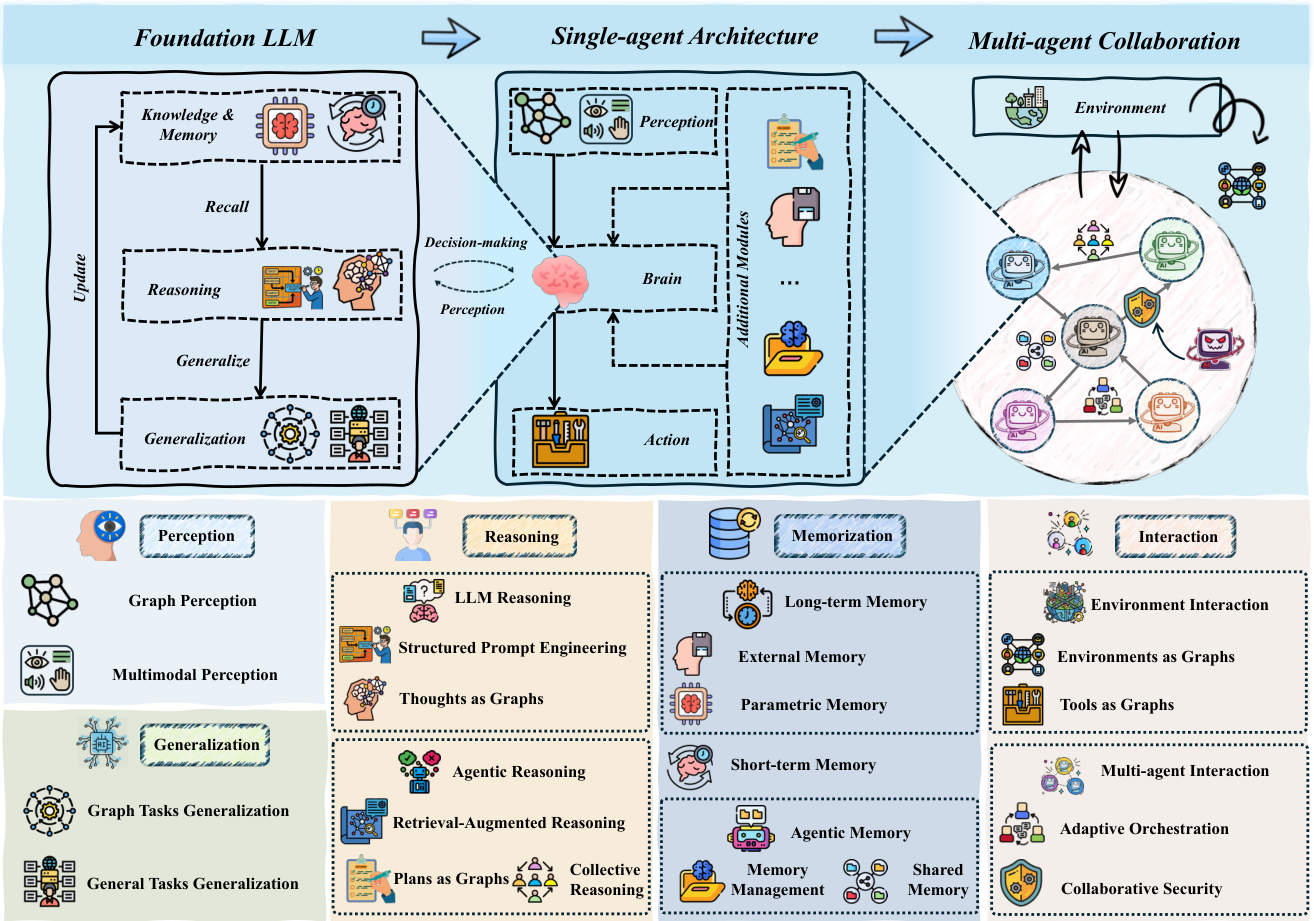
Figure 2.
A capability-oriented taxonomy of GLAs. Representative studies are organized according to the five core capabilities enhanced by graphs: perception, reasoning, memorization, generalization, and interaction.
Figure 2.
A capability-oriented taxonomy of GLAs. Representative studies are organized according to the five core capabilities enhanced by graphs: perception, reasoning, memorization, generalization, and interaction.
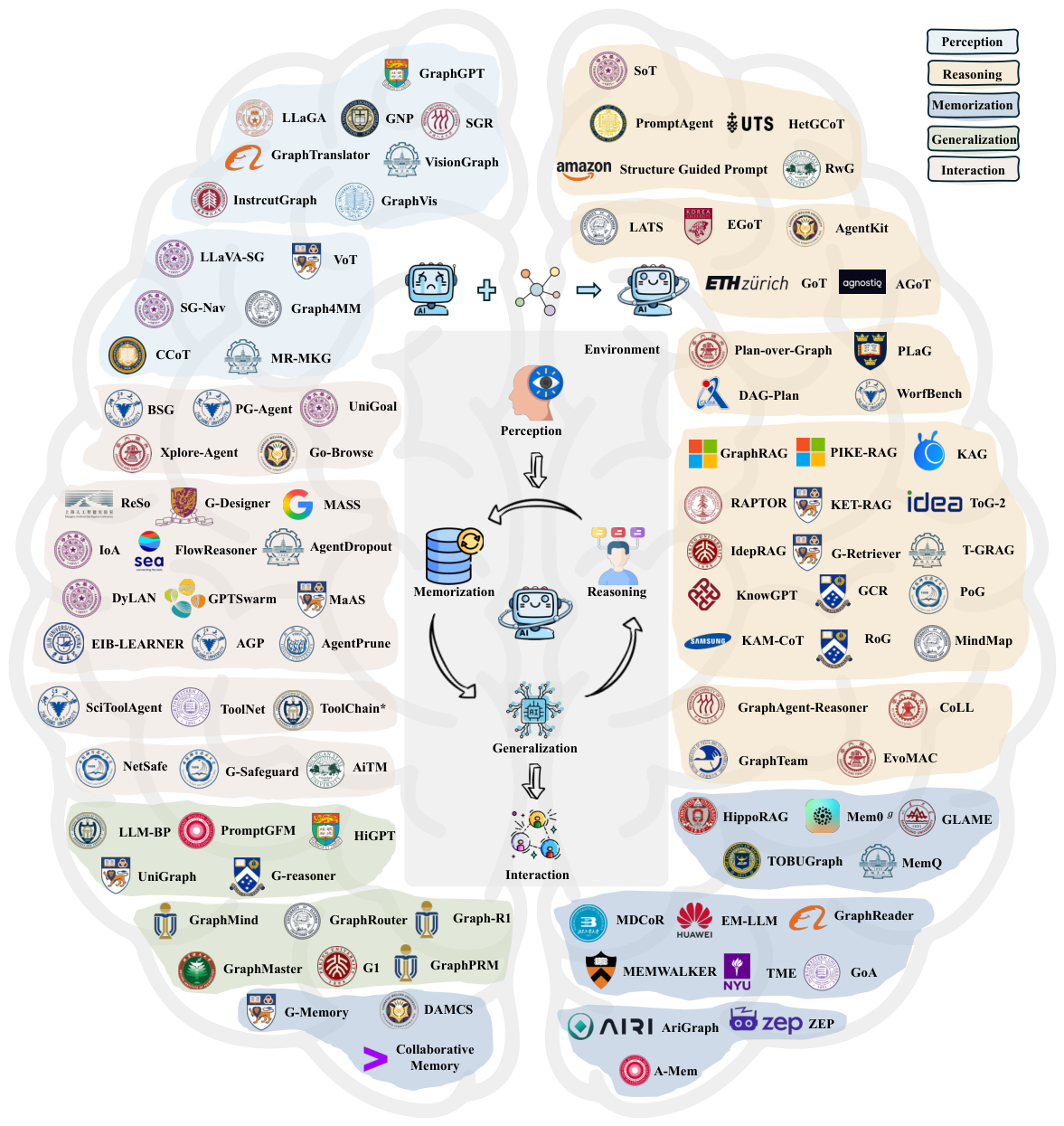
Figure 3.
A framework of graph-enhanced perception in LLM-based agents.
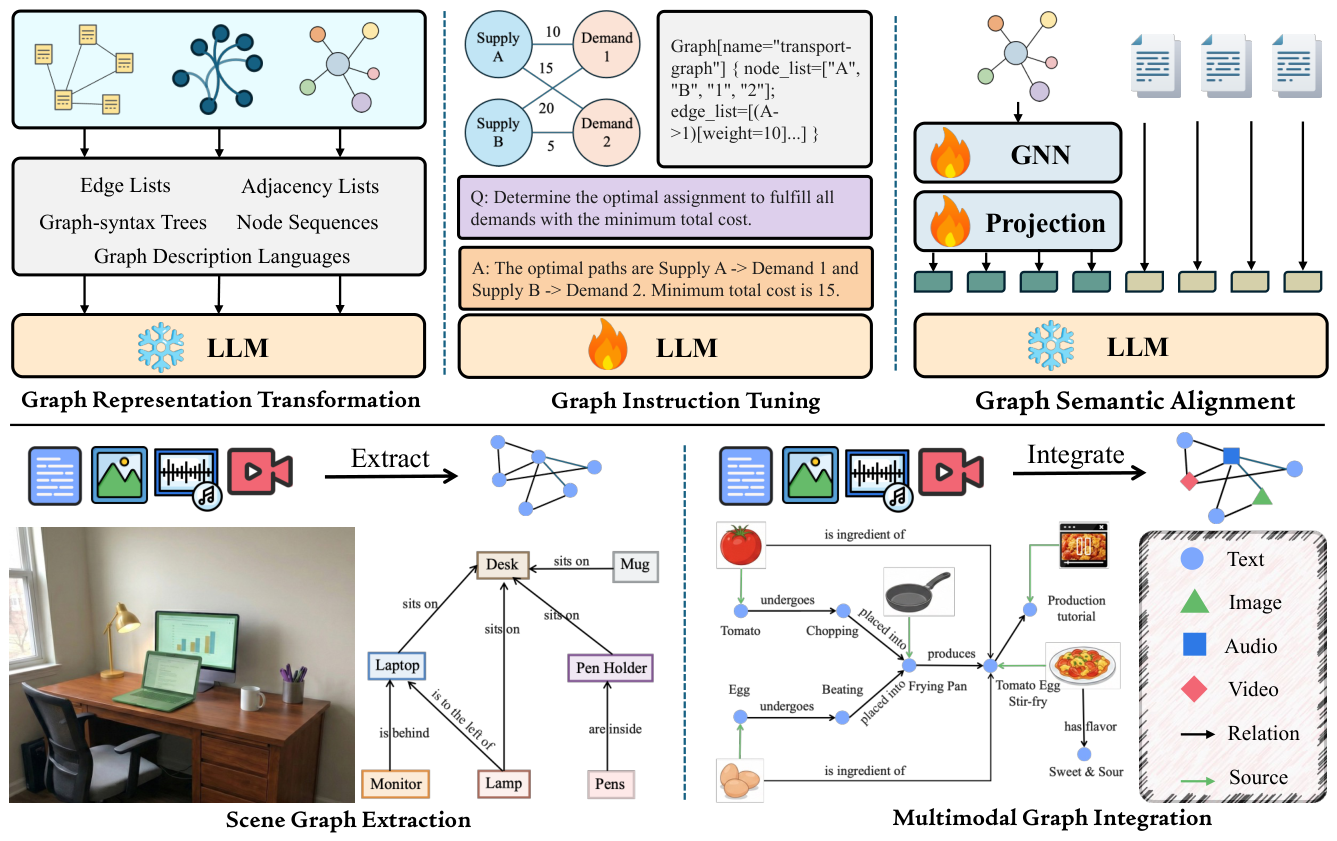
Figure 4.
An overview of graph-enhanced reasoning in LLM-based agents.
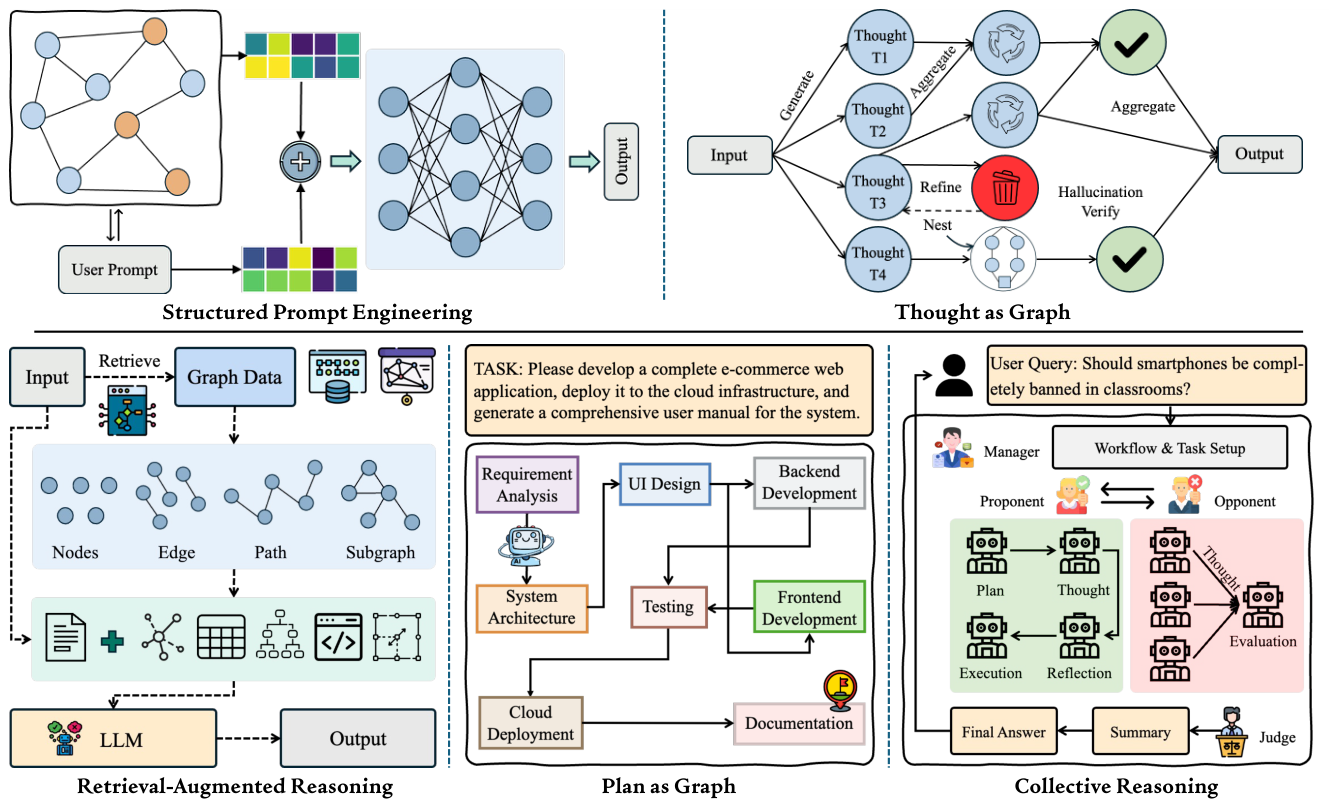
Figure 5.
Graph-based memory mechanisms in LLM-based agents.
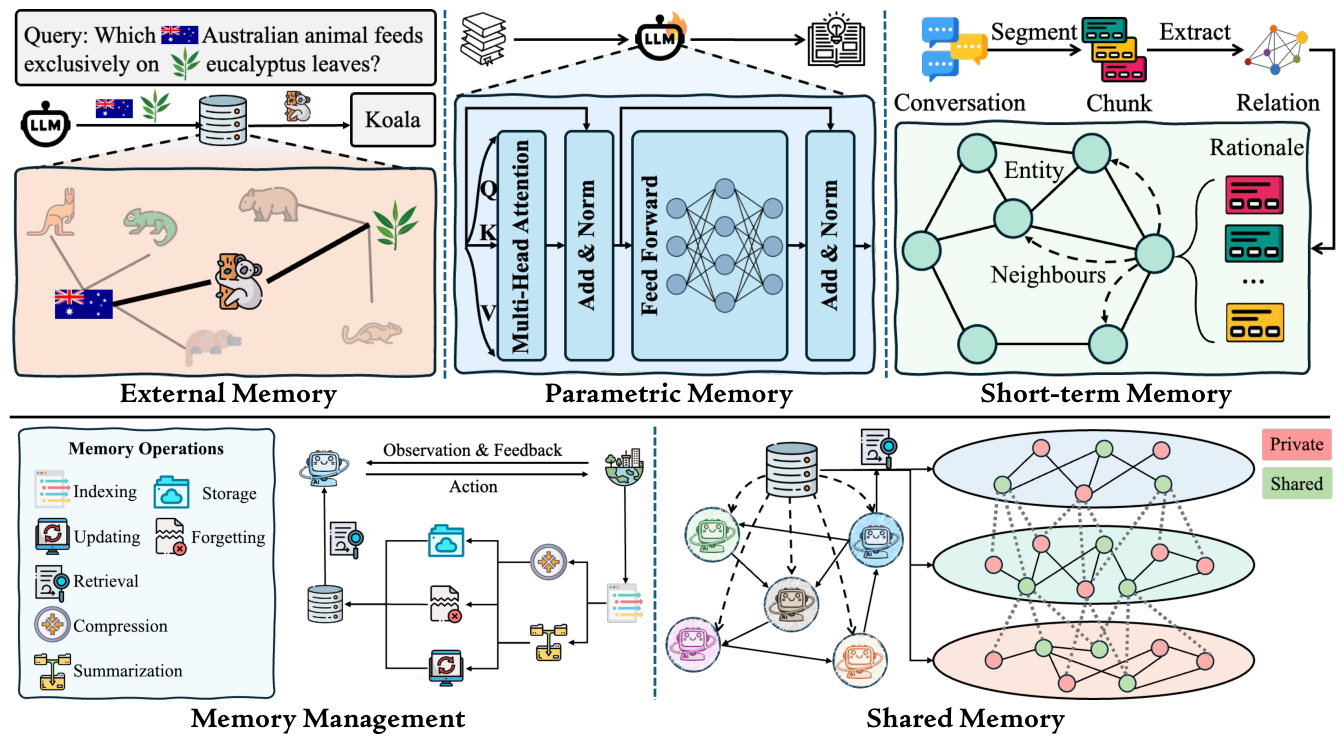
Figure 6.
Illustration of graph-enhanced generalization in LLM-based agents
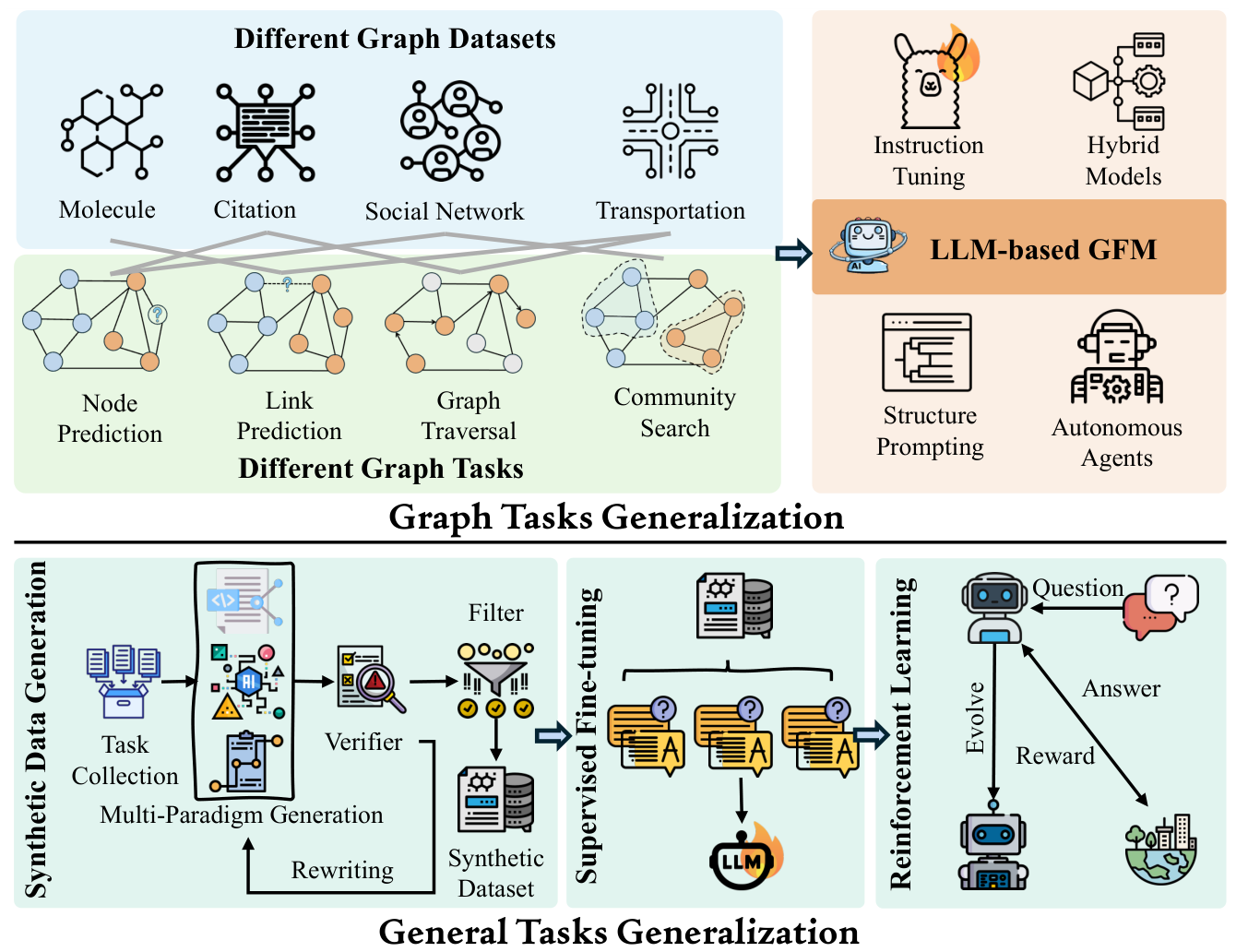
Figure 7.
Graph-based interaction mechanisms in LLM-based agents.
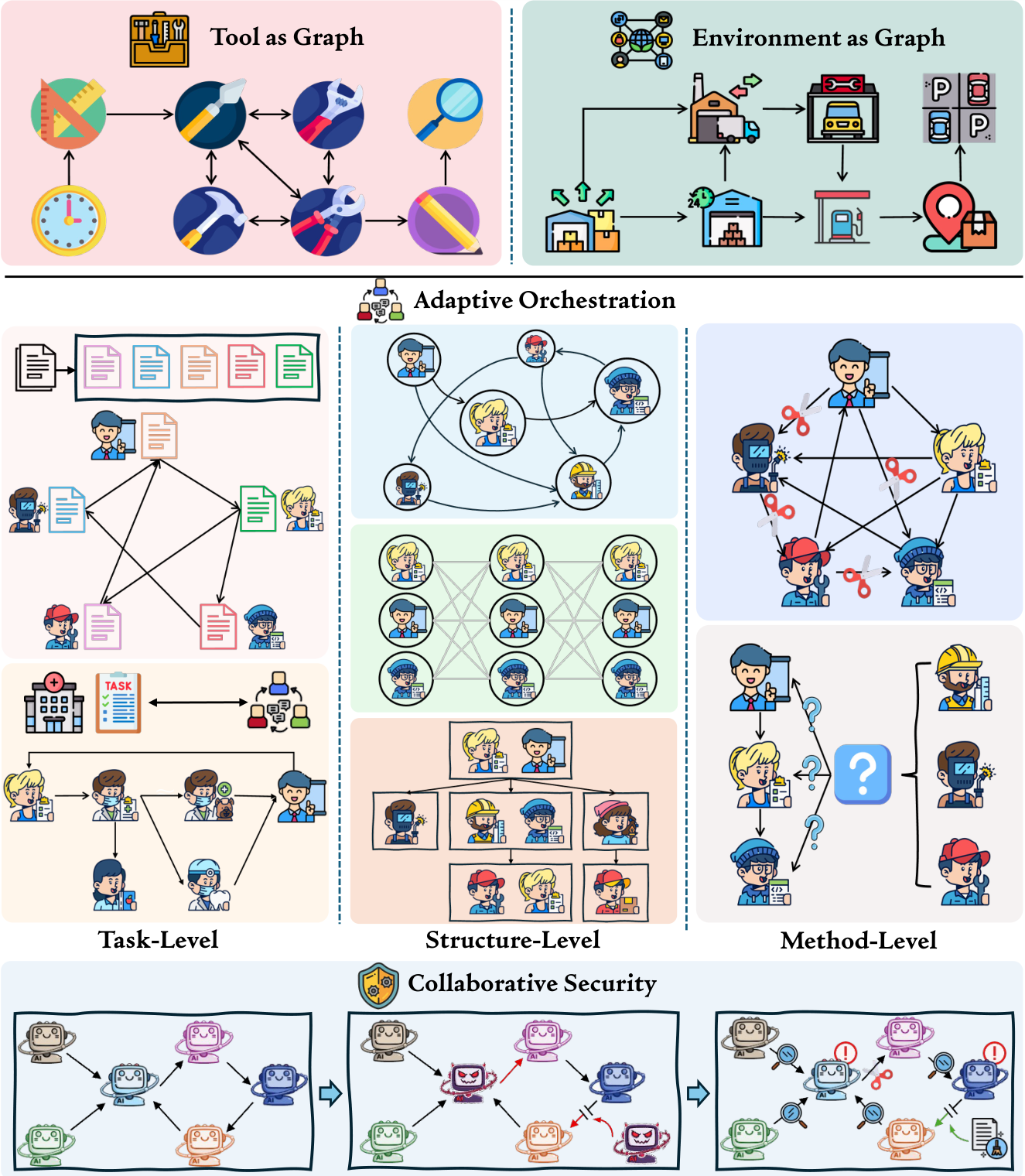

Table 1.
A Comprehensive Comparison of Existing Surveys on the Integration of LLMs and Graphs.
| Topics | Related Survey | Key Contribution |
|---|---|---|
| LLMs for Graphs | [7,8,9,10,11] | These surveys examine, from a model-design perspective, how different integration frameworks combining LLMs with graph learning methods can be used to address graph learning tasks. |
| [12,13,14] | These surveys adopt a graph-centric perspective to examine how LLMs address tasks and challenges across graph application scenarios, graph analysis tasks, and graph learning challenges. | |
| [15] | This survey reviews LLMs for graph learning from a data transformation perspective, outlining the associated challenges, techniques, and future directions. | |
| [21] | This survey investigates the role of LLMs in fostering trustworthy graph neural networks (GNNs), providing a systematic overview of key research directions including reliability, robustness, privacy, and reasoning. | |
| [22] | This article reviews LLM-enabled graphs in dynamic networking and discusses their roles in prediction, encoding, and alignment. | |
| [23,24,25] | These surveys examine applications of LLMs to KG-related tasks, spanning KG construction, embedding, and reasoning. | |
| LLMs–Graphs Synergy | [16,26] | These surveys explore the bidirectional synergy between LLMs and graphs, including LLMs for graph learning and graph-augmented LLMs. |
| [27,28,29] | These surveys investigate collaborative frameworks between LLMs and KGs, covering KG-enhanced LLMs, LLM-augmented KGs, and unified systems. | |
| Graphs for LLMs | [17] | This survey investigates the role of KGs in enhancing LLMs for complex tasks, providing a comparative analysis of their advantages, limitations, and requirements. |
| [18,30,31,32] | These surveys review GraphRAG techniques, detailing how graph data and relational retrieval empower LLMs. | |
| Graphs for LLM-based Agents | [19,20] | These surveys investigate how graphs empower LLM-based agents from the perspectives of agent architecture and workflow. |
Disclaimer/Publisher’s Note: The statements, opinions and data contained in all publications are solely those of the individual author(s) and contributor(s) and not of MDPI and/or the editor(s). MDPI and/or the editor(s) disclaim responsibility for any injury to people or property resulting from any ideas, methods, instructions or products referred to in the content. |
© 2026 by the authors. Licensee MDPI, Basel, Switzerland. This article is an open access article distributed under the terms and conditions of the Creative Commons Attribution (CC BY) license.
Copyright: This open access article is published under a Creative Commons CC BY 4.0 license, which permit the free download, distribution, and reuse, provided that the author and preprint are cited in any reuse.