

Submitted:
31 August 2026
Posted:
01 September 2026
You are already at the latest version
Abstract
Purpose of Review Exercise is routinely recommended for osteoporosis, yet reviews often merge bone mineral density, falls, function, and fractures as if they were interchangeable. This review updates the evidence through August 2026 and translates it into an outcome-specific, phenotype-stratified prescription for older adults at fragility-fracture risk. Recent Findings Exercise reduces fall rates in community-dwelling older adults by about one quarter, whereas average gains in areal bone mineral density are modest, site-specific, and heterogeneous. High-intensity resistance and impact training can improve lumbar-spine and femoral-neck outcomes in selected, closely supervised postmenopausal women. However, fracture meta-analyses remain limited by sparse events, fractures recorded as secondary outcomes, and low or very low certainty; a 2026 synthesis of heterogeneous fall-prevention interventions did not show a clear reduction in fractures. Newer evidence also supports functional benefit after osteoporotic vertebral fracture, while reinforcing the need for individualized progression, explicit adverse-event reporting, and continued training. Summary Prescription should target two partly independent pathways: progressive resistance and impact loading for skeletal adaptation, and challenging balance, functional, and strength training for falls prevention. Dose, impact exposure, spinal loading, and supervision should be modified by vertebral-fracture status, frailty, fall risk, pain, and training experience. Practical dose ranges should be identified as trial protocols, consensus exemplars, or pragmatic starting points rather than fracture-validated targets. Exercise complements—but does not replace—osteoporosis medication when pharmacotherapy is indicated.
Keywords:
exercise
; osteoporosis
; fragility fractures
; falls
; resistance training
; exercise prescription
1. Introduction
Fragility fracture is the clinically decisive outcome of osteoporosis, but it is produced by more than low bone mass. Skeletal strength, the probability and direction of a fall, neuromuscular capacity, vision, cognition, medication exposure, environmental hazards, and the ability to arrest or recover from disequilibrium all contribute. Contemporary guidelines therefore position exercise within comprehensive fracture prevention rather than as a stand-alone treatment [1,2]. Frailty further amplifies risk by coupling low reserve to higher fall exposure and poorer recovery after injury [3].
The exercise literature is nevertheless easy to overread. A statistically significant change in lumbar-spine areal bone mineral density (BMD) is not equivalent to fewer hip fractures; improved chair-rise performance is not equivalent to fewer falls; and fewer falls do not guarantee fewer fractures. These outcomes sit at different points in the causal chain, carry different certainty, and require different intervention components. A clinically useful synthesis must therefore preserve outcome directness while still converting trial protocols into a practical prescription.
Recent reviews in Current Osteoporosis Reports have addressed exercise for postmenopausal bone health and the intersection of frailty and fragility fracture [3,4]. The present review takes a deliberately different axis: it asks what outcome each exercise component can reasonably be expected to change, how confident that inference is, and how the dose should be modified for common clinical phenotypes. The aim is not to identify a single “best” program, but to provide a defensible prescription that does not confuse surrogate improvement with fracture efficacy.
2. Review Approach and Evidence Calibration
This is a targeted narrative review, not a systematic review. The review question concerned adults generally aged 60 years or older with osteopenia, osteoporosis, elevated fall risk, or fragility fracture; postmenopausal cohorts were retained when they constituted the direct skeletal evidence base. Eligible interventions were structured exercise or exercise therapy, compared with usual care, no exercise, or another program. Outcomes were kept in a prespecified hierarchy: fracture; falls and fallers; BMD or bone structure; physical function, pain, and quality of life; and safety, adherence, and implementation.
Searches were last updated on 28 August 2026 in PubMed/MEDLINE, with focused checking of the Cochrane Database of Systematic Reviews and backward/forward citation tracking. The reproducible core PubMed logic was: (“Osteoporosis”[Mesh] OR osteoporosis[tiab] OR osteopenia[tiab] OR “fragility fracture”[tiab] OR “fragility fractures”[tiab] OR “vertebral fracture”[tiab] OR “vertebral fractures”[tiab]) AND (“Exercise”[Mesh] OR “Exercise Therapy”[Mesh] OR exercise[tiab] OR training[tiab] OR “resistance training”[tiab] OR “strength training”[tiab] OR “impact training”[tiab] OR weight-bearing[tiab] OR “balance training”[tiab] OR multicomponent[tiab]) AND (fracture*[tiab] OR fall*[tiab] OR “fall rate”[tiab] OR faller*[tiab] OR “fall incidence”[tiab] OR “bone mineral density”[tiab] OR BMD[tiab] OR function*[tiab] OR pain[tiab] OR “quality of life”[tiab] OR safety[tiab] OR “adverse event”[tiab] OR “adverse events”[tiab] OR adherence[tiab]). Separate focused searches paired vertebral fracture with rehabilitation, balance, pain, function, and adverse events. Historical labels such as “senile osteoporosis” were not treated as independent concepts because they add no unique retrieval concept beyond osteoporosis and aging.
Priority was given to systematic reviews, pairwise or network meta-analyses, major guidelines, and randomized trials published in 2021–2026. Earlier trials were retained only when they established a widely cited protocol or reported safety and prescription details not replaced by newer evidence. A source was used for a dose claim only when the population, exercise exposure, comparator, and relevant outcome were identifiable. Studies centered on children, young athletes, or non-exercise interventions were not used to define an older-adult exercise dose; mixed-intervention reviews were explicitly labeled as such.
For each source, the synthesis recorded age and sex distribution, fracture and frailty status, setting, osteoporosis medication, training experience, exercise content and dose, supervision, comparator, outcome definition and follow-up, adherence, adverse events, and the source review’s risk-of-bias or certainty judgment. Exercise descriptions were appraised against the Consensus on Exercise Reporting Template (CERT) [5], and reporting of this narrative review was informed by SANRA [6]. No new pooling was performed. All 2026 citations, publication details, and DOI strings were cross-checked against PubMed and the publisher’s version-of-record page.
Conclusions were calibrated along three dimensions: directness to fracture, certainty reported by the source review, and transferability to the target phenotype. Transferability was downgraded when the evidence population differed in age, sex, fracture status, frailty, care setting, medication exposure, or training experience, or when the tested program required supervision or equipment unlikely to be reproduced. Trial protocols, consensus exemplars, and pragmatic starting ranges are therefore labeled separately; none is presented as a universally optimal or fracture-validated dose.
No protocol was registered, title/abstract screening was not duplicated, and no de novo risk-of-bias or GRADE assessment was performed. Because selection was purposive, no PRISMA flow count or claim of exhaustive retrieval is made. These limitations leave selection bias possible and mean that certainty labels in this review reproduce the contributing source assessments rather than a new formal grading exercise.
Generative AI tools were used to assist language editing and structural drafting. The author independently selected and verified all sources, critically revised all scientific content, and accepts full responsibility for the manuscript.
3. The Outcome Hierarchy: Two Pathways to One Fracture
Exercise can influence fracture risk through a skeletal pathway and a falls pathway (Figure 1). The skeletal pathway uses progressive muscle loading and impact to stimulate site-specific adaptation and preserve the force-generating capacity needed for daily life. The falls pathway uses balance, task-specific functional practice, strength, power, gait, and reactive control to reduce fall exposure or alter the circumstances of a fall. The components overlap—resistance training supports both—but their proximal outcomes and effective doses are not identical.
BMD, bone mineral density; QoL, quality of life. The two pathways interact, but evidence at an intermediate node should not be reported as direct fracture efficacy.
This distinction changes both interpretation and prescription. BMD, bone geometry, strength, postural control, and fall rate are mechanistically informative intermediate outcomes. Fracture is the patient-important endpoint, but trials powered for fracture require large samples, long follow-up, stable exposure, and reliable event adjudication. When those data are absent, language should remain precise: exercise may improve a fracture-risk factor; it has not necessarily been shown to prevent fracture.
4. Direct Fracture Evidence: Promising Signal, Low Direct Certainty
A 2022 systematic review and meta-analysis reported lower incidence rates for low-trauma fractures (incidence-rate ratio 0.67, 95% CI 0.51–0.87) and major osteoporotic fractures (0.69, 95% CI 0.52–0.92) among exercise participants [7]. A companion analysis suggested that longer studies and progressive intensity may be important [8]. These estimates are clinically encouraging, but they are not equivalent to evidence from fracture-powered trials: fractures were commonly secondary or adverse-event outcomes, event counts were sparse, interventions varied, and reporting/adjudication were inconsistent.
A 2026 systematic review of 17 fall-prevention studies (more than 25,000 participants) included exercise, multifactorial programs, medication optimization, and vitamin D rather than exercise alone. Five studies (18,519 participants; 1,343 events) showed no clear effect on any fracture (risk ratio 0.91, 95% CI 0.72–1.14; I2 = 65%); only two randomized trials reported extractable hip-fracture data (12,489 participants; 132 events), precluding pooling. Certainty for both fracture outcomes was very low [9]. This estimate cannot be attributed specifically to exercise. The apparent tension between reviews instead shows how direct fracture estimates depend on population, intervention mix, event ascertainment, and statistical power.
The defensible clinical statement is therefore conditional: multicomponent exercise is recommended because it reduces falls and improves skeletal and functional risk factors, with a plausible fracture benefit, but no specific exercise program can yet be presented as definitively fracture-preventive across older adults. Table 1 summarizes the resulting evidence map.
5. The Skeletal Pathway: What Kind of Loading Changes Bone?
5.1. Average Effects are Modest and Site-Specific
The most comprehensive recent pairwise synthesis included 80 intervention studies and 5,581 postmenopausal women. Exercise produced small positive standardized effects at the lumbar spine (0.29), femoral neck (0.27), and total hip (0.41), with substantial heterogeneity and evidence of small-study effects at the lumbar spine [13]. A randomized-trial-only synthesis in women aged 60 years or older reached the same broad conclusion [23]. These results support efficacy at the level of a surrogate, not a uniform response. Baseline bone status, menopausal age, medication, exercise history, impact tolerance, compliance, and actual loading exposure all influence the observed mean.
A 2026 network meta-analysis of 74 studies and 5,331 participants ranked combined mind–body and resistance approaches highly across several BMD sites [14]. The analysis was restricted to postmenopausal women or healthy women aged at least 60 years and excluded participants receiving hormone replacement or bone-affecting medication and those with major comorbidity. Its rankings therefore have limited transferability to treated, frail, multimorbid, or male patients. More generally, network rankings depend on indirect comparisons and broad modality categories; they do not identify a universally superior exercise, load, velocity, or progression.
5.2. Progressive Resistance Training is the Skeletal Foundation
Resistance training supplies high muscle-derived strain, strengthens the lower limb and trunk, and supports the capacity needed for impact and balance tasks. A 2025 meta-analysis of 17 randomized trials (690 participants) reported positive BMD effects and exploratory subgroup signals for loads of at least 70% one-repetition maximum, three sessions weekly, and interventions lasting at least 48 weeks [15]. Between-trial subgroup findings should not be interpreted as validated thresholds: all participants were healthy postmenopausal women (approximately 50–72 years), some subgroups contained few studies, and heterogeneity at the lumbar spine and femoral neck was very high. Earlier evidence likewise suggests that higher intensities can be useful when achieved safely and progressively, but does not establish one compulsory intensity [16]. Movement velocity alone has not emerged as a settled determinant of BMD response [24].
The LIFTMOR trial supplies a concrete efficacy protocol, not a universal target dose: selected postmenopausal women with low bone mass completed two supervised 30-minute sessions weekly for 8 months, using five sets of five repetitions at greater than 85% one-repetition maximum plus impact loading. Lumbar-spine BMD increased by 2.9% versus a 1.2% decrease in controls; femoral-neck BMD changed by 0.3% versus −1.9% [19]. A secondary vertebral analysis found no new or progressive vertebral fractures in the high-intensity group [20]. These findings demonstrate feasibility and efficacy in a screened, closely supervised cohort. They do not establish unsupervised high-intensity lifting as safe for every adult with osteoporosis, prevalent painful fracture, severe frailty, or poor technique.
MEDEX-OP used a related twice-weekly, high-intensity approach and improved lumbar-spine BMD, while not clearly demonstrating an additional BMD effect beyond antiresorptive medication [25]. In a more pragmatic community model, Osteo-cise combined progressive resistance, impact, and challenging balance three days weekly. At 12 months, lumbar-spine and femoral-neck BMD improved by approximately 1.0–1.1%, with concurrent gains in strength and function; adherence fell from 59% during the supervised year to 45% during the transition period, and fall incidence did not differ [26]. Efficacy and implementation therefore cannot be separated.
5.3. Impact Loading is an Option, not a Default
Impact creates rapid, multidirectional loading that resistance exercise may not reproduce. A 2023 systematic review found that moderate- to high-impact training can improve aspects of bone structure across the lifespan, although evidence in older and clinically fragile adults was thinner than in younger groups [27]. A jumping meta-analysis in postmenopausal women reported an approximately 1.5% net benefit at the femoral neck, with protocols commonly using repeated jumps several days per week; benefits were not consistent at all sites or in the oldest participants [28].
Impact should therefore be prescribed by capacity. For an independent adult without vertebral or multiple low-trauma fractures, good balance, and no acute lower-limb pain, heel drops, stamps, step-down landings, hops, or jumps are consensus-derived options that may be introduced from low amplitude and progressed by height, direction, speed, surface, and number of contacts. In severe osteoporosis with vertebral fracture, recent fracture, substantial pain, or high fall risk, the initial “impact” may appropriately be brisk walking or controlled heel raises while strength and balance are rebuilt. These are risk-management examples rather than fracture-tested dose rules; the restriction is not evidence that all impact is intrinsically unsafe.
6. The Falls Pathway: The Most Secure Clinical Effect
The falls evidence is larger and more direct than the fracture evidence. An abridged Cochrane review of 116 randomized trials involving 25,160 community-dwelling older adults found a 23% reduction in fall rate (rate ratio 0.77). Balance and functional exercise, multicomponent programs, and Tai Chi all reduced falls; programs delivering at least 3 hours per week of balance and functional exercise had larger effects in subgroup analysis [10]. A 2024 component network meta-analysis across 219 trials reinforced the value of supervised, longer-duration balance, resistance, and Tai Chi components, while rating fracture evidence much less certain [11].
An effective balance dose is not defined by standing near a chair while remaining stable. The exercise must progressively narrow the base of support, reduce upper-limb support, move the center of mass, alter sensory input, change direction and speed, and practice stepping or recovery responses. Functional tasks should reflect the person’s fall mechanism: turns and dual tasking for gait-related instability, sit-to-stand and stair practice for low reserve, obstacle negotiation for environmental trips, and reactive stepping when trained supervision is available. Resistance training assists by raising the force and power reserve, but resistance alone is not a complete falls program.
A 2026 meta-analysis found that multicomponent interventions reduced both fall rate and the proportion of fallers; higher adherence was associated with larger effects [29]. The association cannot prove that adherence itself caused the difference, but it underscores exposure: a theoretically excellent program does not work when rarely performed. In residential care, a 2025 Cochrane review found benefit while structured exercise was active (rate ratio 0.68) but no persisting effect after cessation, and no clear fracture reduction [30]. Maintenance is therefore part of the treatment, not an optional aftercare phase.
Disease-specific evidence is less secure. A 2026 review included 14 randomized trials (2,797 participants) in older adults with osteoporosis or osteopenia and reported favorable pooled effects on fear of falling and number of falls, but 13 trials had high risk of bias and heterogeneity for falls was 96% [31]. A second 2026 network meta-analysis included 22 trials (1,538 participants), yet only seven trials (586 participants) reported falls; the network was sparse, had no closed loop, and could not establish the superiority of a specific regimen [12]. Balance training improves test performance [32], but a balance score is not a fracture outcome. The stronger general community evidence should therefore anchor practice, with mode and supervision modified for bone fragility.
7. Vertebral Fracture: Preserve Function Without Ignoring Spinal Load
Osteoporotic vertebral fracture (OVF) changes the initial prescription through pain, kyphosis, extensor weakness, fear, and the consequences of another fall. A 2026 review included 21 articles: 19 exercise studies entered the meta-analysis and two health-education studies were synthesized narratively. Exercise improved functional capacity, balance, trunk strength, pain, and quality of life, but effects on thoracic posture and fear of falling were not clear. Minor adverse events occurred in approximately 6.3% and major events in 1.65%, without a statistically significant excess versus controls [17]. Samples were mostly women (mean age about 73 years), fracture chronicity varied, and recurrent fracture was not established.
Patient-reported benefit is not confined to OVF cohorts. A separate 2026 meta-analysis of 23 trials (2,120 participants; mean age 67.1 years; 95.1% women) reported improvements in mental health and quality of life with moderate-certainty evidence and in pain with low-certainty evidence [33]. These outcomes matter clinically, but the female predominance, heterogeneous modalities, and short mean intervention duration limit transferability, and none should be recast as evidence of fracture reduction.
After vertebral augmentation, exercise has also been associated with better pain and function, but protocols and study quality vary [18]. The practical response should not be indefinite avoidance. Begin with symptom-limited walking or cycling as tolerated, lower-limb strengthening, supported balance, and low-load spinal-extensor endurance. Teach a hip hinge and neutral, controlled trunk strategies for lifting and transfers. Progress range, load, and complexity according to pain behavior, movement quality, and fracture healing.
Consensus guidance recommends avoiding repeated, sustained, or end-range loaded spinal flexion and poorly controlled combined flexion/rotation in those at high vertebral-fracture risk, while explicitly avoiding a blanket prohibition of all spinal flexion [34,35]. The distinction matters: ordinary life requires spinal movement, and fear-driven rigidity can worsen activity restriction. The therapeutic target is controlled loading and task competence, not a “no bending” identity.
8. A Clinically Usable Prescription
Table 2 translates evidence into an implementation framework, not a fracture-validated algorithm. Every numeric entry is labeled as one of three categories: a tested trial protocol, a consensus exemplar, or a pragmatic starting example. A trial protocol describes what worked in its eligible, supervised sample; it does not define the dose for an unselected patient. Each prescription should document the exercise, load or effort, sets, repetitions or duration, weekly frequency, supervision, progression trigger, symptoms, adherence, and adverse events—items commonly omitted despite CERT guidance [5,21].
9. Phenotype-Stratified Modification
BMD alone cannot determine the starting dose. The same T-score may occur in a confident lifter without falls and in a frail adult with recurrent falls, painful vertebral fractures, and polypharmacy. Table 3 prioritizes the dominant modifiable pathway and the degree of supervision for common phenotypes. Clinical review should also address adequate calcium/protein intake, vitamin D when indicated, vision, footwear, home hazards, hypotension, and fall-risk-increasing medication [1,2].
10. Exercise and Osteoporosis Medication
Exercise and pharmacotherapy address different parts of fracture risk. Medication should be initiated or continued according to fracture risk, prior fracture, BMD, age, comorbidity, and patient preference; exercise should not be presented as an alternative when pharmacotherapy is indicated [1,2]. Conversely, medication does not train balance, gait adaptability, lower-limb power, or confidence in daily tasks.
Evidence for an additive BMD effect remains uncertain. A 2023 review of five randomized trials (530 participants) rated the available evidence very low and found no fracture data [37]. A broader 2024 synthesis likewise found no consistent additional lumbar-spine or hip BMD benefit over medication or supplementation alone, although physical performance and quality of life could improve [38]. The treatment rationale is complementary mechanisms and patient-centered outcomes, not an expectation that combining treatments must produce an extra DXA gain.
11. Safety, Screening, and Supervision
Serious exercise-related adverse events appear uncommon in osteoporosis trials, but adverse-event definitions and reporting are often incomplete. A safety review found that musculoskeletal soreness and minor symptoms were more frequent than serious harm, while rare vertebral events were associated with flexion-based tasks or poorly controlled loading in vulnerable participants [22]. High-intensity trials provide reassurance only for people who met their eligibility criteria and received the trial’s supervision [19,20].
A separate blanket medical-clearance visit is not required for every clinically stable adult, but targeted review is important when risk signals are present [1,2,34]: new severe or focal spinal/hip pain, suspected recent fracture, progressive height loss, neurologic deficit, recurrent unexplained falls or syncope, uncontrolled cardiopulmonary/metabolic disease, severe cognitive impairment, and inability to follow safety instructions warrant assessment or modification. Pain during loading should be interpreted by location, severity, onset, persistence, and associated signs—not by a universal zero-pain rule.
Supervision is a dose in its own right. It enables technique correction, safe proximity to fatigue, external load progression, and exposure to balance challenge that would be inappropriate alone. The need is greatest during initiation, after fracture, with high fall risk, and when approaching high intensity. Supervision can then taper through teach-back, written/video instructions, logs, periodic re-testing, and a clear route to re-consultation.
12. Adherence, Reporting, and Long-Term Delivery
The biological dose is the dose completed. A 2026 review of 39 high-intensity resistance and impact studies (3,349 peri- or postmenopausal women; mean age 57.6 years) found moderate-to-good reporting but persistent gaps in individualization, motivational strategies, home components, and progression detail [21]. The younger, selected population also limits direct transfer to frail older adults. These omissions make successful protocols difficult to reproduce and help explain why a label such as “resistance exercise” carries little clinical information. CERT provides a minimum language for replication: who delivered the program, where, what equipment and exercises were used, how intensity and volume were set, how progression was triggered, what adaptations were allowed, and how adherence and fidelity were measured [5].
Adherence is strengthened when the prescription is feasible, meaningful, and visibly progressive. Offer a small number of high-yield exercises, connect them to valued tasks, provide feedback from strength or balance re-tests, and design a fallback dose for low-energy days. Home exercise expands reach, but complex high-intensity or reactive-balance work may still require intermittent supervised sessions. The community Osteo-cise trial shows that benefits can be translated outside a laboratory, while its declining adherence also exposes the problem [26].
Exercise should be framed as continuing therapy. Only three studies met criteria for a 2025 detraining review, but the limited evidence suggested that BMD gains attenuate after training stops [39]. Falls benefits in care facilities similarly disappeared after structured exercise ceased [30]. The appropriate discharge endpoint is therefore not “program completed”; it is a sustainable plan with maintained exposure, progression, and a response to interruptions caused by illness, pain, travel, or caregiving.
13. Evidence Gaps and Research Priorities
The next generation of trials should be designed around the clinical claim they intend to support. Fracture prevention requires pragmatic, sufficiently powered trials or harmonized individual-participant data with prospective fracture adjudication. At minimum, studies should report vertebral, hip, major osteoporotic, and all low-trauma fractures separately; recurrent falls; fear of falling; patient-reported function; pain; quality of life; medication and nutrition; attendance; actual completed loading; and adverse events per exposure time. Surrogate outcomes should be identified as such.
Underrepresented groups require deliberate inclusion: men, the oldest old, people with frailty or cognitive impairment, residents of care facilities, those with recent painful or multiple fractures, and people receiving anabolic or sequential osteoporosis therapy. Evidence in older men remains far smaller than in postmenopausal women [40]. Trials should pre-specify phenotype-by-treatment interactions and test stepped supervision, remote support, implementation cost, and maintenance after the intensive phase. Network rankings and subgroup analyses are useful for hypothesis generation; direct comparisons of fully specified prescriptions are needed for dosing.
14. Conclusions
Exercise should be prescribed for fragility-fracture prevention, but the clinical claim must match the endpoint. The strongest evidence supports a reduction in falls through sufficiently challenging balance and functional exercise. Progressive resistance and, in appropriate phenotypes, impact loading produce modest site-specific BMD benefits and improve strength and function. Direct fracture reduction is plausible and supported by some pooled signals, yet remains low-certainty because fractures are sparse and rarely primary outcomes.
A high-quality prescription therefore combines the skeletal and falls pathways, states whether each dose is trial-derived, consensus-based, or pragmatic, and modifies impact, spinal loading, progression, and supervision for vertebral fracture, frailty, fall risk, pain, and training experience. It complements indicated osteoporosis medication and continues beyond the supervised phase. Precision in both language and prescription is the essential step from an attractive mechanism to useful fracture-risk care.
Funding
This research received no external funding.
Author Contributions
Simone Orsucci Berzieri conceived the review, developed the methodology, selected and critically appraised the literature, prepared the visualization, drafted and revised the manuscript, and approved the final version.
Institutional Review Board Statement
Not applicable. This narrative review did not involve new research with human participants or animals.
Informed Consent Statement
Not applicable.
Data Availability Statement
No new data were created or analyzed in this study; data sharing is not applicable.
Conflicts of Interest
The author declares no conflict of interest.
References
- LeBoff, M.S.; Greenspan, S.L.; Insogna, K.L.; et al. The clinician’s guide to prevention and treatment of osteoporosis. Osteoporos. Int. 2022, 33, 2049–2102. [Google Scholar] [CrossRef]
- Morin, S.N.; Feldman, S.; Funnell, L.; et al. Clinical practice guideline for management of osteoporosis and fracture prevention in Canada: 2023 update. CMAJ 2023, 195, E1333–E1348. [Google Scholar] [CrossRef]
- Dent, E.; Daly, R.M.; Hoogendijk, E.O.; Scott, D. Exercise to prevent and manage frailty and fragility fractures. Curr. Osteoporos. Rep. 2023, 21, 205–215. [Google Scholar] [CrossRef]
- Integrates frailty and skeletal risk and supports a multicomponent approach rather than walking alone.
- Kumar, S.; Smith, C.; Clifton-Bligh, R.J.; Beck, B.R.; Girgis, C.M. Exercise for postmenopausal bone health—can we raise the bar? Curr. Osteoporos. Rep. 2025, 23, 20. [Google Scholar] [CrossRef]
- A recent journal-specific synthesis of bone-targeted exercise that defines the overlap this review deliberately avoids by emphasizing outcome directness and phenotype-specific prescription.
- Slade, S.C.; Dionne, C.E.; Underwood, M.; Buchbinder, R. Consensus on Exercise Reporting Template (CERT): explanation and elaboration statement. Br. J. Sports Med. 2016, 50, 1428–1437. [Google Scholar] [CrossRef]
- Baethge, C.; Goldbeck-Wood, S.; Mertens, S. SANRA—a scale for the quality assessment of narrative review articles. Res. Integr. Peer Rev. 2019, 4, 5. [Google Scholar] [CrossRef]
- Hoffmann, I.; Shojaa, M.; Kohl, M.; et al. Exercise reduces the number of overall and major osteoporotic fractures in adults. Does supervision make a difference? Systematic review and meta-analysis. J. Bone Min. Res. 2022, 37, 2132–2148. [Google Scholar] [CrossRef]
- The most favorable recent pooled fracture signal, interpreted here alongside its sparse-event and secondary-outcome limitations.
- Hoffmann, I.; Kohl, M.; von Stengel, S.; et al. Exercise and the prevention of major osteoporotic fractures in adults: a systematic review and meta-analysis with special emphasis on intensity progression and study duration. Osteoporos. Int. 2023, 34, 15–28. [Google Scholar] [CrossRef]
- Alalwani, Y.J.; Aldossari, M.A.; Alzahrani, L.A.; et al. Fall prevention interventions and fracture risk in community-dwelling older adults: a systematic review and meta-analysis. Clin. Pract. 2026, 16(3), 52. [Google Scholar] [CrossRef]
- A fracture-focused 2026 synthesis of heterogeneous fall-prevention interventions showing no clear reduction and very-low-certainty evidence; its pooled estimate is not exercise-specific.
- Sherrington, C.; Fairhall, N.J.; Wallbank, G.K.; et al. Exercise for preventing falls in older people living in the community: an abridged Cochrane systematic review. Br. J. Sports Med. 2020, 54, 885–891. [Google Scholar] [CrossRef]
- High-certainty evidence that balance and functional exercise reduces falls and that sufficient weekly exposure matters.
- Pillay, J.; Gaudet, L.A.; Saba, S.; et al. Falls prevention interventions for community-dwelling older adults: systematic review and meta-analysis of benefits, harms, and patient values and preferences. Syst. Rev. 2024, 13, 289. [Google Scholar] [CrossRef]
- A large synthesis distinguishing effective falls components from very-uncertain fracture outcomes.
- Liu, X.; Chang, M.; Yuan, H.; et al. Effects of exercise regimens on balance ability in older patients with osteoporosis: a systematic review and Bayesian network meta-analysis of randomized controlled trials. Front Physiol. 2026, 17, 1793389. [Google Scholar] [CrossRef]
- An osteoporosis-specific synthesis that improves population directness but illustrates the fragility of rankings from sparse networks and heterogeneous balance and fall outcomes.
- Mohebbi, R.; Shojaa, M.; Kohl, M.; et al. Exercise training and bone mineral density in postmenopausal women: an updated systematic review and meta-analysis of intervention studies with emphasis on potential moderators. Osteoporos. Int. 2023, 34, 1145–1178. [Google Scholar] [CrossRef]
- Large updated synthesis showing small positive, site-specific BMD effects together with substantial heterogeneity.
- Zhou, Z.; Wei, X.; Zhang, X.; et al. Effects of different types of exercise over 24 weeks on bone mineral density in postmenopausal women: a systematic review with pairwise and network meta-analysis of randomized controlled trials. J. Sport Health Sci. 2026, 15, 101127. [Google Scholar] [CrossRef]
- Very recent network comparison across exercise categories; useful for hypothesis generation but not a universal dosing hierarchy, particularly outside untreated postmenopausal cohorts.
- Zhao, F.; Su, W.; Sun, Y.; Wang, J.; Lu, B.; Yun, H. Optimal resistance training parameters for improving bone mineral density in postmenopausal women: a systematic review and meta-analysis. J. Orthop. Surg. Res. 2025, 20, 523. [Google Scholar] [CrossRef]
- Provides recent parameter-specific subgroup signals while illustrating why heterogeneous between-trial subgroups should not be called proven optima.
- Kistler-Fischbacher, M.; Weeks, B.K.; Beck, B.R. The effect of exercise intensity on bone in postmenopausal women (part 2): a meta-analysis. Bone 2021, 143, 115697. [Google Scholar] [CrossRef]
- Fernández-González, M.; Mora-Traverso, M.; Molina-Garcia, P.; et al. Effectiveness and safety of physical exercise and health education for the management of osteoporotic vertebral fractures: a systematic review and meta-analysis. In Osteoporos Int.; Online ahead of print; 2026. [Google Scholar] [CrossRef]
- The newest OVF-specific synthesis, supporting functional benefit while documenting domain-specific uncertainty and limited fracture outcomes.
- Than, C.A.; Adra, M.; Curtis, T.J.; et al. The effect of exercise post vertebral augmentation in osteoporotic patients: a systematic review and meta-analysis. J. Orthop. Res. 2023, 41, 2703–2712. [Google Scholar] [CrossRef]
- Watson, S.L.; Weeks, B.K.; Weis, L.J.; Harding, A.T.; Horan, S.A.; Beck, B.R. High-intensity resistance and impact training improves bone mineral density and physical function in postmenopausal women with osteopenia and osteoporosis: the LIFTMOR randomized controlled trial. J. Bone Min. Res. 2018, 33, 211–220. [Google Scholar] [CrossRef]
- Watson, S.L.; Weeks, B.K.; Weis, L.J.; Harding, A.T.; Horan, S.A.; Beck, B.R. High-intensity exercise did not cause vertebral fractures and improves thoracic kyphosis in postmenopausal women with low to very low bone mass: the LIFTMOR trial. Osteoporos. Int. 2019, 30, 957–964. [Google Scholar] [CrossRef]
- Tortoli, E.; Riccio, G.; Mattii, E.; et al. High-intensity resistance and impact exercise in menopausal women: a systematic review of intervention reporting quality and training content. Osteoporos Int. Online ahead of print. 2026. [CrossRef]
- Demonstrates improved exercise reporting but persistent gaps in individualization, behavior support, home delivery, and progression.
- Kunutsor, S.K.; Leyland, S.; Skelton, D.A.; et al. Adverse events and safety issues associated with physical activity and exercise for adults with osteoporosis and osteopenia: a systematic review of observational studies and an updated review of interventional studies. J. Frailty Sarcopenia Falls 2018, 3, 155–178. [Google Scholar] [CrossRef]
- Hejazi, K.; Askari, R.; Hofmeister, M. Effects of physical exercise on bone mineral density in older postmenopausal women: a systematic review and meta-analysis of randomized controlled trials. Arch. Osteoporos. 2022, 17, 102. [Google Scholar] [CrossRef]
- Quattlaender, R.A.; Rothmore, P.; Hutchinson, M.R.; Lathlean, T.J.H. Effects of different movement velocities during resistance training on bone mineral density in older adults: a systematic review and meta-analysis. Arch. Gerontol. Geriatr. 2025, 136, 105906. [Google Scholar] [CrossRef]
- Kistler-Fischbacher, M.; Yong, J.S.; Weeks, B.K.; Beck, B.R. A comparison of bone-targeted exercise with and without antiresorptive bone medication to reduce indices of fracture risk in postmenopausal women with low bone mass: the MEDEX-OP randomized controlled trial. J. Bone Min. Res. 2021, 36, 1680–1693. [Google Scholar] [CrossRef]
- Daly, R.M.; Gianoudis, J.; Kersh, M.E.; et al. Effects of a 12-month supervised, community-based, multimodal exercise program followed by a 6-month research-to-practice transition on bone mineral density, trabecular microarchitecture, and physical function in older adults: a randomized controlled trial. J. Bone Min. Res. 2020, 35, 419–429. [Google Scholar] [CrossRef]
- Ng, C.A.; Gandham, A.; Mesinovic, J.; et al. Effects of moderate- to high-impact exercise training on bone structure across the lifespan: a systematic review and meta-analysis of randomized controlled trials. J. Bone Min. Res. 2023, 38, 1612–1634. [Google Scholar] [CrossRef]
- Florence, G.E.; Oosthuyse, T.; Bosch, A.N. Skeletal site-specific effects of jump training on bone mineral density in adults: a systematic review and meta-analysis. J. Sports Sci. 2023, 41, 2063–2076. [Google Scholar] [CrossRef]
- Hua, Y.; Yang, Y.; Chen, Y.; Long, H.; Li, E. Adherence and effectiveness of multicomponent exercise fall prevention programmes across delivery formats in community-dwelling older adults: a systematic review and multilevel meta-analysis. Arch. Gerontol. Geriatr. 2026, 149, 106304. [Google Scholar] [CrossRef]
- Dyer, S.M.; Kwok, W.S.; Suen, J.; et al. Interventions for preventing falls in older people in care facilities. Cochrane Database Syst. Rev. 2025, 8, CD016064. [Google Scholar] [CrossRef]
- Shows benefit while exercise is active in care facilities, attenuation after cessation, and uncertain fracture effects.
- Johari, S.; MacDermid, J.; Graham, L.J.; Ziebart, C.T.; Shafiee, E. A systematic review and meta-analysis to examine the effectiveness of exercise training in people with osteoporosis or osteopenia compared with other rehabilitation interventions on fear of falling and the number of falls. J. Geriatr. Phys. Ther. 2026, 49(1), E1–E12. [Google Scholar] [CrossRef]
- Wei, F.; Hu, Z.; He, R.; Wang, Y. Effects of balance training on balance and fall efficacy in patients with osteoporosis: a systematic review and meta-analysis with trial sequential analysis. J. Rehabil. Med. 2023, 55, jrm00390. [Google Scholar] [CrossRef]
- Fitzgerald, C.; Burley, C.; Wright, K.; et al. Exercise improves quality of life, mental health and pain in people living with osteoporosis: a systematic review and meta-analysis. Osteoporos Int. Online ahead of print. 2026. [CrossRef]
- A patient-centered synthesis showing benefits beyond BMD while making clear the female predominance, short exposure, and outcome-specific certainty.
- Brooke-Wavell, K.; Skelton, D.A.; Barker, K.L.; et al. Strong, steady and straight: UK consensus statement on physical activity and exercise for osteoporosis. Br. J. Sports Med. 2022, 56, 837–846. [Google Scholar] [CrossRef]
- Provides the clearest phenotype-aware consensus doses for resistance, impact, balance, and spinal loading.
- Bae, S.; Lee, S.; Park, H.; et al. Position statement: exercise guidelines for osteoporosis management and fall prevention in osteoporosis patients. J. Bone Metab. 2023, 30, 149–165. [Google Scholar] [CrossRef]
- Bull, F.C.; Al-Ansari, S.S.; Biddle, S.; et al. World Health Organization 2020 guidelines on physical activity and sedentary behaviour. Br. J. Sports Med. 2020, 54, 1451–1462. [Google Scholar] [CrossRef]
- Schumm, A.K.; Craige, E.A.; Arora, N.K.; et al. Does adding exercise or physical activity to pharmacological osteoporosis therapy in patients with increased fracture risk improve bone mineral density and lower fracture risk? A systematic review and meta-analysis. Osteoporos. Int. 2023, 34, 1867–1880. [Google Scholar] [CrossRef]
- Hsu, H.H.; Chiu, C.Y.; Chen, W.C.; Yang, Y.R.; Wang, R.Y. Effects of exercise on bone density and physical performance in postmenopausal women: a systematic review and meta-analysis. PM R 2024, 16, 1358–1383. [Google Scholar] [CrossRef]
- Gombarčíková, T.; Svobodová, L.; Svobodová, A.; Gimunová, M. The effect of physical activity intervention and detraining on postmenopausal osteopenia and osteoporosis: a systematic review. Front Sports Act. Living 2025, 7, 1655404. [Google Scholar] [CrossRef]
- Hu, K.; Cassimatis, M.; Girgis, C.M. Exercise and musculoskeletal health in men with low bone mineral density: a systematic review. Arch. Rehabil. Res. Clin. Transl. 2024, 6, 100313. [Google Scholar] [CrossRef]
Figure 1.
Outcome-specific model for exercise and fragility-fracture risk.
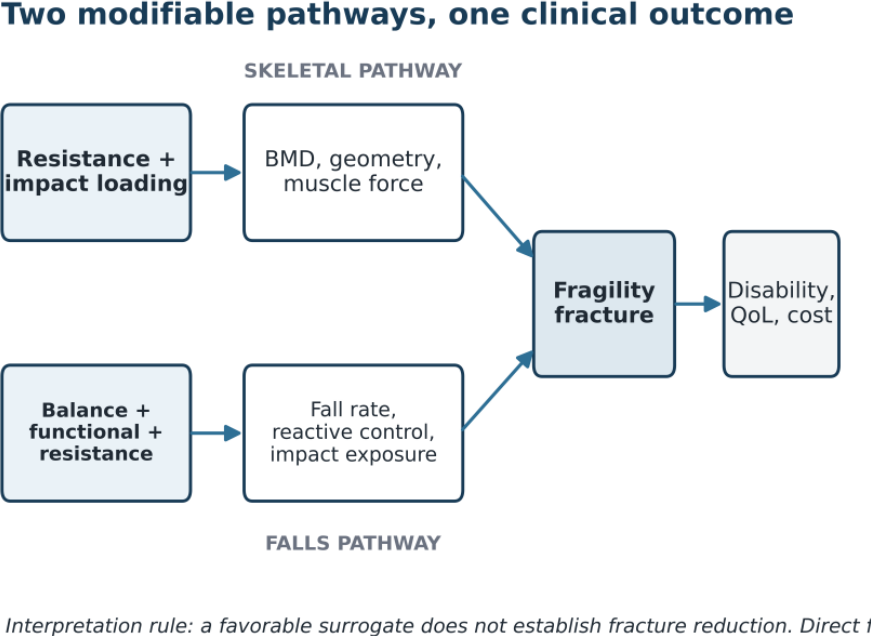

Table 1.
Outcome-specific interpretation of the current evidence.
| Outcome | Best current estimate | Directness / certainty | Principal limitation / transferability | Prescription implication |
| Any or major osteoporotic fracture | Exercise-specific pooled signals favor benefit (IRR about 0.67–0.69), whereas a mixed-intervention review found no clear effect (RR 0.91, 95% CI 0.72–1.14) [7,8,9]. | Direct outcome; low to very low certainty. | Estimates are not exchangeable: events were sparse or secondary, and the 2026 review was not exercise-specific. | Do not promise fracture reduction from one protocol. Combine skeletal and falls components. |
| Falls | Community exercise reduces fall rate by about 23%; balance/functional and multicomponent programs are effective [10,11,12]. | Direct intermediate clinical outcome; strongest certainty in general community samples. | Osteoporosis-specific networks are smaller, short, and often high risk; transfer is weaker in care settings and severe frailty. | Prioritize progressively challenging balance; treat weekly exposure as an evidence anchor, not a universal threshold. |
| Areal BMD | Small, site-specific improvements; pooled standardized effects are positive but heterogeneous [13,14,15,16]. | Surrogate outcome; moderate confidence that targeted training can modify BMD. | Evidence is predominantly in postmenopausal women; treated, frail, very old, and male populations are underrepresented. | Use progressive resistance; add impact only when phenotype permits. |
| Function after vertebral fracture | Exercise/education improve several functional outcomes, trunk strength, pain, or QoL, with variable effects by domain [17,18]. | Patient-relevant but indirect to recurrent fracture; low to moderate certainty. | Mostly female samples, variable fracture chronicity, mixed designs, short follow-up, and no recurrent-fracture efficacy. | Start symptom-guided, spine-aware strength and balance; progress rather than immobilize. |
| Safety and adherence | Serious events are uncommon in studied, selected cohorts; minor symptoms and incomplete event reporting are more common [19,20,21,22]. | Direct safety data, but limited generalizability. | Recently fractured, highly frail, cognitively impaired, and unsupervised high-risk adults are poorly represented. | Match supervision and starting dose to risk; report exposure and adverse events. |
BMD, bone mineral density; CI, confidence interval; IRR, incidence-rate ratio; QoL, quality of life; RR, risk ratio. Certainty labels reflect the limitations of the contributing reviews, not a new GRADE assessment.
Table 2.
Outcome-specific exercise prescription for an older adult at fragility-fracture risk.
| Goal | Core exercise content | Dose anchor and evidentiary status | Progression rule | Key modifications / stop rules |
| Skeletal loading + strength | Squat or sit-to-stand; hip hinge/deadlift pattern; leg press; row; press as tolerated; calf raise; back-extensor endurance. | Pragmatic start, not outcome-tested: often 2 days/week, 1–2 sets of 8–12 at tolerable effort. Progress toward higher effort only as capacity permits. Trial anchor: selected, closely supervised postmenopausal women used 5 × 5 at >85% 1RM twice weekly [19,20]. | When technique and symptoms are stable and the planned repetitions are completed with reserve, add the smallest practical load, a repetition, or a set. No osteoporosis-specific increment threshold is validated. | Recent painful fracture, unstable symptoms, or severe frailty: begin below these examples. Stop and assess new severe focal spinal/hip pain, neurologic symptoms, chest pain, presyncope, or loss of safe technique. |
| Bone-targeted impact | Heel drops, stamps, brisk stair ascent, step-down landings; progress to multidirectional hops or jumps when appropriate. | Consensus exemplar (grade C), not fracture-tested: in lower-risk adults, build toward about 50 moderate impacts on most days, divided by rest [34]. Higher-risk phenotypes begin with low-impact weight bearing. | Increase one variable at a time—contacts, height, speed, direction, or surface—only after controlled landings and symptom tolerance. | Defer higher impact with acute fracture, uncontrolled pain, marked instability, or inability to land safely. Vertebral/multiple fractures: keep initial weight bearing at walking or marching intensity [34]. |
| Falls prevention | Narrow-base stance; reduced hand support; weight shifts; turns; tandem/stepping; obstacles; sit-to-stand; stair and reactive/dual-task practice as appropriate. | Evidence anchor, not an individual minimum: schedule challenge on ≥3 days/week when feasible. Community-program subgroup analyses associated ≥3 h/week with larger effects; osteoporosis-specific validation is lacking [10,11,29]. | Reduce support, narrow base, move center of mass, add direction/speed or cognitive task, then add reactive challenges under supervision. | A task must remain challenging but recoverable. Use support, harness, or close guarding for high fall risk; remove hazards and avoid unsupervised reactive drills. |
| Spinal function after OVF | Hip-hinge practice; thoracic extension/posture; low-load back-extensor endurance; lower-limb strength; supported balance; breathing and task practice. | Consensus/rehabilitation example, not an optimal dose: 2–3 days/week with brief low-load extensor repetitions or holds; volume and range follow symptoms, healing, and quality [17,34]. | First improve tolerance and control, then resistance, range, and real-life task complexity; progression is response-contingent rather than calendar-based. | Avoid repeated/sustained end-range loaded flexion and uncontrolled flexion-rotation. New severe spinal pain or height loss warrants fracture assessment. |
| Aerobic capacity + participation | Brisk walking, cycling, aquatic or other tolerable mode; use bouts that support recovery and adherence. | Accumulate toward general older-adult activity guidance; distribute across the week [36]. Aerobic exercise complements rather than replaces resistance, impact, or balance. | Increase duration before intensity in deconditioned adults; use talk test and symptoms. | Walking alone is not a complete osteogenic or falls prescription. Choose lower-impact modes during painful recovery without abandoning strength/balance. |
1RM, one-repetition maximum; OVF, osteoporotic vertebral fracture. Numeric anchors describe the cited trial or consensus source; none is a proven individual threshold for fracture prevention. The approximately 50-impact recommendation is expert consensus (grade C) [34].
Table 3.
Phenotype-stratified starting points and supervision.
| Clinical phenotype | First priority | Starting modification | Supervision / reassessment |
| Independent osteopenia/osteoporosis; no vertebral fracture; low fall risk | Progressive resistance plus site-appropriate impact; maintain challenging balance. | Train movement patterns, then progress toward high effort. Introduce low-amplitude impact and build contacts/direction. | Initial instruction; periodic technique and load review. High-intensity lifting only after competence is demonstrated. |
| Prevalent vertebral or multiple low-trauma fractures | Spinal-extensor endurance, hip hinge, lower-limb strength, balance, symptom-guided function. | Low-to-moderate load; avoid repeated loaded end-range flexion/rotation; impact no higher than brisk walking initially [34]. | Supervised start by an osteoporosis-informed clinician/exercise professional; review pain, height loss, and neurologic signs. |
| Frailty, recurrent falls, or marked balance impairment | Falls pathway: strength reserve, transfers, gait, progressively challenging balance. | Supported tasks, lower volume, short frequent sessions; defer unsupported impact and reactive challenges. | Close supervision/guarding; reassess falls, orthostatic symptoms, cognition, and assistive-device use. |
| Recent or unhealed painful fracture | Restore safe mobility and prevent deconditioning while protecting healing tissue. | Region-specific precautions; symptom-limited aerobic activity, unaffected-limb strength, breathing, gentle functional practice. | Coordinate with treating team. Escalate for worsening focal pain, new deformity, neurologic deficit, or inability to mobilize. |
| Residential care or cognitive impairment | Simple, repeated functional strength and balance embedded in routine. | One-step cues, familiar tasks, sit-to-stand, walking and supported weight shifts; short sessions with high repetition. | Staff-supported delivery; monitor behavior, fatigue, falls, and medication changes. Continue exposure—effects attenuate after cessation [30]. |
These categories are risk-management starting points, not a validated stratification algorithm or proof of different fracture efficacy. When phenotypes overlap, use the more conservative starting example and greater supervision, then progress from observed capacity.
Disclaimer/Publisher’s Note: The statements, opinions and data contained in all publications are solely those of the individual author(s) and contributor(s) and not of MDPI and/or the editor(s). MDPI and/or the editor(s) disclaim responsibility for any injury to people or property resulting from any ideas, methods, instructions or products referred to in the content. |
© 2026 by the author. Licensee MDPI, Basel, Switzerland. This article is an open access article distributed under the terms and conditions of the Creative Commons Attribution (CC BY) license.
Copyright: This open access article is published under a Creative Commons CC BY 4.0 license, which permit the free download, distribution, and reuse, provided that the author and preprint are cited in any reuse.