
Submitted:
29 August 2026
Posted:
31 August 2026
You are already at the latest version
Abstract
To investigate how the anatexis of accretionary complexes contributes to crustal differen-tiation in orogenic belts, we present an integrated analysis of whole-rock geochemistry, zircon U-Pb geochronology, and zircon Lu-Hf isotopes for Late Carboniferous granitoids from the Dunhuang orogenic belt. Zircon U-Pb dating indicates that the granitoids were emplaced between 323 and 312 Ma. Their zircon εHf(t) values (−39.3 to 10.7) are largely negative, suggesting derivation primarily from ancient crustal materials. Geochemical correlations and field relationships between the granitoids and their wall rocks suggest that the magmatic sources were dominated by meta-sedimentary rocks with minor me-ta-mafic rocks. The systematic whole-rock Rb-Sr-Ba variations are attributed to wa-ter-fluxed melting of muscovite in a metasedimentary source. Given the continued activity of the Dunhuang subduction zone during the Late Carboniferous, we infer that elevated temperature combined with fluid-rich conditions in the deeper accretionary wedge trig-gered anatexis of the accreted materials. The segregation and upward migration of granit-ic magmas leave a residue within the deeper accretionary wedge that resembles the lower continental crust in composition. This process enhances vertical differentiation within the orogenic belt crust and likely plays an important role in transforming loose accreted ma-terials into more mature continental crust.
Keywords:
anatexis
; accretionary complex
; crustal differentiation
; Central Asian Orogenic Belt
1. Introduction
The existence of felsic upper continental crust makes the Earth unique in the Solar system [1,2]. How this special compositional layer forms and evolves during Earth's history remains a fundamental scientific issue in geoscience [3,4,5]. Granitoids are the most important components of Earth's upper continental crust. They can originate either by partial melting of pre-existing crustal rocks (crustal reworking, e.g. [6,7,8]), or by fractionation of mantle-derived mafic magmas (crustal growth, e.g. [9]). A fundamental issue herein is the characterization of the magma source [10,11]. In the modern Earth system, granitoids are chiefly generated in the orogenic belts [12,13], making them the principal locus for studying the formation of the upper continental crust. During the orogenic process, the transition of tectonic environment will lead to partial melting of different source materials and then form granitoids with different compositions [14,15,16,17]. Therefore, tracing and identifying the source nature of diverse compositional granitoids formed during orogenic process is a significant way for understanding the continental crust formation and evolution.
The Central Asian Orogenic Belt (CAOB) has developed voluminous granitoids of diverse types during its prolonged evolution [18,19,20,21]. It is an ideal natural laboratory for investigating crustal formation and evolutionary mechanisms in accretionary orogenic processes. Regarding the continental crust evolution of the CAOB, scholars represented by Şengör et al. [18] proposed that approximately 50% of the crustal volume in the CAOB consists of juvenile crust derived from mantle-derived magmas. But Kröner et al. [22] contended that this proportion of juvenile crust may have been overestimated, emphasizing instead the role of reworking pre-existing crustal materials like accretionary complexes. This reflects a fundamental competition between mantle input and crustal recycling, with granitic magmatism from both sources shaping the complex crustal architecture of the CAOB.
The Dunhuang orogenic belt is located in the southern margin of the CAOB, occupying a key position connecting the Central Asian domain and the Tethyan domain [23,24]. Traditionally, this region was regarded as a microcontinent with Precambrian crystalline basement [25,26,27,28]. Subsequent studies have identified abundant Paleozoic magmatic and metamorphic rocks within the Precambrian basement of Dunhuang, and recognized that Precambrian rocks constitute only a limited proportion [29,30]. Additionally, the discovery of eclogites metamorphosed at 411 Ma in the southern Dunhuang region provides evidence for Devonian oceanic crust subduction [31]. Moreover, the Paleozoic magmatic rocks widespread in the Dunhuang region generally exhibit arc-related geochemical characteristics [32,33,34,35], recording the Paleozoic subduction-accretion and crustal evolution. The arc-related magmatism in the central-northern Dunhuang block during the Cambrian to Early Devonian significantly contributed to the growth of juvenile crust [36]. While, the Late Devonian to Carboniferous magmatism in the southern Dunhuang block was dominated by reworking of ancient crustal materials [35]. Among them, the Late Carboniferous granitoids limited crops out in the Hongliuxia areas in the southern portion of the Dunhuang orogenic belt. At present, their source nature and petrogenetic mechanisms are not clear.
In this study, detailed structural geology, petrology, geochronology and zircon Hf isotope studies were carried out on the Late Carboniferous granitoids in Hongliuxia accretionary complex (HAC), the southern Dunhuang orogenic belt. We aimed to trace the magmatic source composition and to reveal the petrogenesis of these granitoids. And then provide new evidence for better understanding of the Paleozoic tectonic evolution of the Dunhuang orogenic belt and of the continental crustal evolution in the southern margin of the CAOB.
2. Geological Background
The Dunhuang orogenic belt is located between the southern CAOB and the northeastern Tibetan Plateau. It is bounded by the Tarim Craton to the west, the Beishan orogenic belt to the north, the Alxa Block to the east and the Altyn Tagh Fault to the south (Figure 1a, b). The far-field effect of Indo-Eurasian plate collision produces a large number of Cenozoic faults in the Dunhuang orogenic belt [43], cutting the exposed rocks into nearly ENE-WSW zonal distributed scattered massifs. Primary lithologies exposed in the Dunhuang orogenic belt are medium/high-grade supracrustal metamorphic rocks, subordinate tonalite-trondhjemite-granodiorite gneisses, minor serpentinites, called "Dunhuang complex" [37]. Based on the existence of Neoarchean-Paleoproterozoic felsic gneiss, the Dunhuang complex has long been regarded as a stable continental block with Precambrian crystalline basement, known as the "Dunhuang block" [25,44]. Besides, the Dunhuang block were considered to have witnessed the assembly and breakup processes of the Columbia and Rodinia supercontinents [26,44,45].
Recent studies have revealed the widespread occurrence of Paleozoic metabasites in various locations within the Dunhuang Complex. These rocks occur predominantly as lenticular blocks exhibiting variable metamorphic grades, including amphibolites, granulites, and eclogites [29,31,46]. They generally record clockwise P-T-t metamorphic paths, with metamorphic ages ranging from the Early Silurian to the Late Devonian (440~365 Ma) [47,48,49]. These metabasites were interpreted as products formed at various depths within a subduction channel and then mixed and juxtaposed during tectonic exhumation [24]. Meanwhile, numerous intermediate to felsic magmatic rocks occur widely in the Dunhuang complex. They were emplaced in multiple episodes at 510 Ma, 450~430 Ma, 390~360 Ma, 330 Ma, and 280~245 Ma, and exhibit an overall trend of becoming younger from north to south. Geochemically, these magmatic rocks show a progressive evolutionary trend from low-K tholeiite to high-K calc-alkaline series. The Cambrian to Early Devonian magmatic rocks are mainly I-type granites, which are interpreted to have formed in a magmatic arc setting [30,32,34,39,41,50]. The Late Devonian to Early Permian magmatic rocks exhibit geochemical characteristics similar to adakites and are considered to have formed in a crustal-thickening setting during the collisional orogenic stage [33,34,51]. And, the latest Permian to Early Mesozoic magmatic rocks are mainly interpreted as products of a post-orogenic extensional setting [52]. The above mentioned magmatic-metamorphic rocks are suggested to have recorded the Paleozoic orogeny in the Dunhuang region. Regionally, the Dunhuang orogenic belt shares similar metamorphic-magmatic events with the northerly neighboring Beishan-Middle Tianshan orogen [53,54,55,56,57]. This correlation suggests that the Dunhuang orogenic belt is likely the southern part of the CAOB [23,24,30].
The Hongliuxia Massif is located in the southern Dunhuang orogenic belt (Figure 1c), which is an exhumed deep-level accretionary complex formed during the Early Silurian to Late Carboniferous [58,59]. The main rocks exposed in this area are the metasedimentary rocks, metabasites, marbles and granitoids. The metasedimentary rocks are intensely deformed and experienced the greenschist-facies metamorphism [59]. Their protoliths are mainly trench turbidite deposited after the middle Devonian [60]. They enclose the lenticular metabasites and marbles exhibiting the "block-inmatrix" fabric [23]. The metabasites including the eclogite, mafic granulite, amphibolite, were mostly metamorphosed in 440~365 Ma [31,48,49,59,61]. They record metamorphic peak *P-T* conditions ranging from 830 °C and 24 kbar for eclogite to 735~744 °C and 17 kbar for mafic granulites, or 652 °C and 10 kbar for amphibolite [31,59,61]. Some literatures revealed that the metabasites were mostly metamorphosed from the oceanic plate components, e.g. the mid-oceanic ridge basalt, island arc basalt, and oceanic plateau basalt [31,48,49,58,61,62]. While the protoliths of the marbles were formed in different tectonic environments including the seamount (or ocean island) and accretionary wedge slope basin [63]. Besides, the granitoids formed in 430~400 Ma, 360~340 Ma and 325~313 Ma were intruded in the Hongliuxia accretionary complex [34,62].
3. Samples and Methods
3.1. Field Relationship and Samples Description
The samples for this study were primarily collected from the Hongliuxia Valley. The studied granitoids intrude the deformed Hongliuxia accretionary complex, which is composed of the metagreywacke, biotite plagioclase gneiss and marble. Folds and faults are developed in the metasedimentary rocks (Figure 2a), indicating north-south compressional deformation. Additionally, pronounced mineral lineations and tight folds can be observed in the marbles (Figure 2b, c).
The granitoids show different occurrences in the field. The gneissic granites develop foliations defined by the elongated quartz grains (Figure 2d, e). Their country rocks are metagreywackes rich in femic minerals (Figure 2f, g). The garnet-bearing granites are slightly foliated (Figure 2h) and are mainly composed of plagioclase, quartz, biotite and garnet (Figure 2i). Plagioclases are subhedral-anhedral, some of which have the embayment shaped edge, seeming like products of resorption. Quartzs display as aggregates or anhedral fine inclusions in the plagioclases. Their host rocks are biotite plagioclase gneisses with obvious foliations (Figure 2j, k). The light-colored granitic dykes intrude the biotite plagioclase gneisses and garnet-bearing granites (Figure 2l, m). Their variable width and length are controlled by foliations of the surrounding rocks, which may be syntectonic intrusive dykes. They are mainly composed of potassium feldspar, plagioclase and quartz (Figure 2n). Potassium feldspars are subhedral with clayized surface. Plagioclase are anhedral with sericitization. Quartzs distribute among feldspar particles as anhedral grains or in the interior feldspar as droplet inclusions. The alteration widely occurred in both feldspars may imply the enrichment of fluids during their crystallization.
3.2. Methods
Three granitoids and one metagreywacke samples were selected for zircon U-Pb dating and trace element analyses by LA-ICP-MS. Zircon in situ Hf isotopic compositions analyses were also made for the three dated granitoids samples. Whole rock major and trace element analyses were made for ten granitoids. All analyses were undertaken in the Wuhan Sample Solution Analytical Technology Co. Ltd., Wuhan, China. Detailed description of the analytical procedures and analyzed data are provided in the Supplementary Material.
4. Results
4.1. Zircon U-Pb Geochronology
Zircon U–Pb dating results of the granitoids and metagreywacke, zircon trace elements of granites were listed in Table S1 and S2, respectively.
Zircons from the mylonitic granite (S18-232) are mostly subhedral to euhedral. All zircon grains show obvious oscillatory structure in the CL images (Figure 3a) and have high Th/U ratios (>0.1, Figure 3b), suggesting their igneous origin [64,65]. On the chondrite-normalized REE diagram (Figure 3c), these zircons are characterized by steep heavy REE patterns with prominently positive Ce and insignificant Eu anomalies. A total of 40 spots from sample S18-232 were used for U-Pb analyses. Twenty-nine concordant ages were obtained from the analytical spots, and yield a range of 206Pb/238U ages from 331 Ma to 302 Ma which have a weighted mean age of 312 ± 3Ma (Figure 4a). This age is interpreted as the emplacement age of the mylonitic granite.
Zircons from the garnet-bearing granite (S18-227) are mostly euhedral and prismatic. All zircon grains show obvious oscillatory structure in the CL images (Figure 3a) and have high Th/U ratios (>0.1, Figure 3d), suggesting their igneous origin. On the chondrite-normalized REE diagram (Figure 3e), these zircons are characterized by steep heavy REE patterns with prominently positive Ce and insignificant Eu anomalies (except for spots #07 and #20). A total of 20 spots from sample S18-227 were used for U-Pb analyses. Nineteen concordant ages were obtained from the analytical spots, with 206Pb/238U ages ranging from 332 Ma to 313 Ma. They yield a weighted mean age of 323 ± 3 Ma (Figure 4c). This age is interpreted as the emplacement age of the garnet-bearing granite.
Zircons from the light-colored granite (S18-235) are mostly subhedral to euhedral. All zircon grains show the core-rim structure with obvious oscillatory rim in the CL images (Figure 3a). The cores and rims both have high Th/U ratios (>0.1, Figure 3f), suggesting the igneous origin. On the chondrite-normalized REE diagram (Figure 3g), these zircons are characterized by steep heavy REE patterns with prominently positive Ce and insignificant Eu anomalies (except for spots #08 and #17). A total of 20 spots from sample S18-227 were used for U-Pb analyses. Fifteen concordant ages were obtained from sixteen analytical spots on the rims. They have 206Pb/238U ages ranging from 338 Ma to 313 Ma with a weighted mean age of 321 ± 3 Ma (Figure 4e). This age is interpreted as the emplacement age of the light-colored granite. Three concordant 206Pb/207Pb ages were obtained from four analytical spots on the cores, scattering in 2457 Ma, 1887 Ma and 1785Ma (Figure 4e), probably the inherited zircons.
Zircons from the metagreywacke (S18-246) are mostly subhedral to euhedral. Most zircon grains show patchy zoning structure without obvious oscillatory structure in the CL images (Figure 3a) and have low Th/U ratios (<0.1, Figure 3h). On the chondrite-normalized REE diagram (Figure 3i), these zircons are characterized by steep heavy REE patterns with prominently positive Ce and insignificant Eu anomalies (except for spots #08). A total of 54 spots from sample S18-227 were used for U-Pb analyses. Forty-four concordant ages were obtained from the analytical spots, with U-Pb ages ranging from 301 Ma to 2259 Ma (Figure 4g). The younger group yield a weighted mean 206Pb/238U age of 319 ± 2 Ma (Figure 4h).
4.2. Zircon Lu-Hf Isotopic Compositions
Zircon Lu-Hf isotopic results of the granitoids were listed in Table 1.
Twenty one in-situ Hf analyses were made on the above dated zircons from the mylonitic granite (S18-232). They have 176Hf/177Hf ratios ranging from 0.281840 to 0.282682, yielding εHf(t) values of -26.9 to -5.4 and TDM1(Hf) model ages of 2191~1146 Ma, respectively (except spot 12 for εHf(t)=3.4 and 812 Ma) (Figure 4f; Table 1).
Fifteen in-situ Hf analyses were made on the above dated zircons from the garnet-bearing granite (S18-227). They have 176Hf/177Hf ratios ranging from 0.281472 to 0.282874, yielding εHf(t) values and TDM1(Hf) model ages of -39.3 to -2.6 and 2562~1072 Ma, respectively (except spot 6 for εHf(t)=10.7 and 537 Ma) (Figure 4f; Table 1).
Fourteen in-situ Hf analyses were made on the above dated igneous zircons from the light-colored granite (S18-235). They have 176Hf/177Hf ratios ranging from 0.281850 to 0.282601, yielding εHf(t) values and TDM1(Hf) model ages of -24.6 to -1.9 and 1949~1047 Ma, respectively (except spot 5 for εHf(t)=0.7 and 920 Ma) (Figure 4f; Table 1).
4.3. Whole-Rock Major and Trace Element Compositions
Whole rock major and trace element analyses results of the granitoids were listed in Table S3.
In terms of major elements, the studied granitoids are variable in the contents of SiO2: 70.3-70.4% for mylonitic granites, 62.0-62.6% for garnet-bearing granites, and 73.7-77.0% for light-colored granites, respectively. They exhibit relatively high Na2O (3.77~4.86%) and K2O (3.0~4.4%) contents, with K2O/Na2O ratios ranging from 0.86 to 1.71. The contents of Al2O3 are variable from 12.95% to 17.54%. In the TAS diagram (Figure 5a), all samples plot within the quartz monzoite and granite fields. In the SiO₂-K₂O diagram (Figure 5b), all samples fall into the medium-K to high-K calc-alkaline series. The Aluminum saturation index (A/CNK) ranges from 1.0 to 1.07, indicating a weakly peraluminous affinity (Figure 5c). Therefore, these granitoids are the medium-K to high-K calc-alkaline, peraluminous rock series.
In the chondrite-normalized rare earth element (REE) diagram, the mylonitic granites and garnet-bearing granites show the LREE-enriched patterns. They exhibit weakly positive Eu anomalies with the δEu values of 1.21-1.31 and 1.16-1.35, respectively (Figure 6a, b). Their contents of ΣREE (68.1-71.6 ppm and 188.7-261.4 ppm, respectively) are relative high. While, the light-colored granites have low contents of ΣREE (10.9-13.5 ppm), with remarkable positive Eu anomalies (δEu = 16.18-24.24) in the chondrite-normalized REE diagram (Figure 6c).
In the primitive mantle-normalized spider diagram, the mylonitic granites and garnet-bearing granites have similar patterns with enrichment in large-ion lithophile elements (e.g., Ba, Pb, and Zr) and variable depletion in high-field-strength elements such as Nb, and Ta (Figure 6d, e). However, the light-colored granites also show negative Th anomalies and positive Eu anomalies (Figure 6f). The all samples have very low Ni (0.62-2.75 ppm) and Cr (1.05-8.47 ppm) abundances, corresponding to the low contents of dark-colored minerals. The concentrations of Sr are 840~1019 ppm for the mylonitic granites, 546~552 ppm for the garnet-bearing granites, and 217~441 ppm for the light-colored granites, respectively. The Y contents are low (6.27~6.71 ppm for mylonitic granites, 5.72~8.15 ppm for the garnet-bearing granites, and 0.55~0.94 ppm for the light-colored granites, respectively). The Rb/Sr ratios (0.05~0.28), Zr/Hf ratios (36.63 ~51.26), Rb/Ba ratios (0.025 ~0.109), Sr/Y ratios (67.08~799.16), and La/Yb ratios (23.3~132.7) exhibit a wide range of variation.
5. Discussion
5.1. Source Rocks of the Granitoids
The granitoids can originate either by partial melting of pre-existing crustal rocks or by fractionation of mantle-derived mafic magmas [70,71,72,73]. Discriminating the nature of source rocks (e.g., crustal vs. mantle-derived, juvenile vs. ancient crustal sources, metasedimentary vs. meta-igneous protoliths) is a key issue in granitoids petrogenetic studies. The composition of granitic magma generally has strong inheritable to the source rock. For example, igneous zircon exhibits high crystallization temperatures, stable chemical properties, and extremely low Lu/Hf ratios, essentially inheriting the Hf isotopic composition of its source rocks. The εHf (t) values of such zircons can effectively indicate the relative contributions of juvenile versus ancient crustal materials [74]. In this study, the igneous zircons from the samples almost show negative εHf(t) values (Figure 4), indicating the relative older crustal materials in their magma source.
Experimental petrology indicates that the relationships among major element concentrations in whole rocks can serve as indicators of source rock characteristics [75,76]. The Al2O3/(MgO+FeOT) vs. CaO/(MgO+FeOT)and Al2O3/(MgO+FeOT+TiO2) vs. Al2O3+MgO+FeOT+TiO2 diagrams (Figure 7), reveal that mylonite garanites are more likely derived from melts generated by the partial melting of greywacke or felsic rocks, whereas garnet-bearing granites probably have received contributions from melts originating from metabasic rocks. Besides, the abundances and ratios of incompatible elements of granitoids generally can give some clues to their source rock properties. In the Rb/Ba vs. Rb/Sr plot, the samples mostly overlap the metasedimentary rocks of the HAC and are close to the experimental greywacke-derived melt (Figure 8a). The Nb/Ta vs. Zr/Hf plot also reveals the similar relationship (Figure 8b). These geochemical connections indicate that the metasedimentary rocks of the HAC are possible the dominant source rocks of the studied granitoids. Furthermore, the Zircon U-Pb geochronology and Zircon Hf compositions also support this speculation. Some zircon xenocrysts of Precambrian age were detected in the studied samples (such as, S18-235), which share similar ages to the metasedimentary rocks of the HAC [60,77].
In the samples studied in this work, some distinctions of these granitic rocks should be considered. For example, the higher contents of MgO, TFe2O3, TiO2, Cr, and Ni in the garnet-bearing granites probably indicate relative more mafic components in their source rocks. These “mafic features” may be derived from the widely distributed meta-mafic rocks in the HAC, such as the eclogite, mafic granulite and amphibolite whose protoliths are mostly the island arc basalts [31,48,49,62]. Besides, the light-colored granites deviate from the field of metasedimentary rocks of the HAC in the elemental diagrams (Figure 8c, d), probably due to their lower contents of REEs. This suggests that either the source rocks were not inherently enriched in REEs (e.g., metapelites), or that REE-rich minerals such as monazite and apatite were retained in the residue during partial melting. Additionally, the light-colored granites’ positive Eu anomalies seemingly require a plagioclase-rich source rock or a plagioclase accumulation process during the formation.
Collectively, combined with the field relationships, we suggest that the source rocks of the late Carboniferous granitiods in this work are deferent. The magmas of garnet-bearing granites and mylonite garanites were primarily derived from metagreywackes and metabasic rocks. While, the magmas of light-colored granites were originated from the partial melting of pelitic metamorphic rocks (metapelites).
5.2. Petrogenesis and Tectonic Implication
In the Rb vs. Y+Nb diagram (Figure 9a), all samples plot within the volcanic arc granites field [78], suggesting that they are likely products of arc magmatism. Their Nb/U and Ce/Pb ratios further indicate contributions from the partial melting of subducted sediments and arc volcaniclastic materials to the magma genesis (Figure 9b) [79]. These geochemical correlations suggest that the formation of the late Carboniferous granitiods would be related to the partial melting of the Hongliuxia accretionary complex itself.
During the orogenic process, the generation of peraluminous granitic rocks is mostly associated with partial melting of fertile crustal components, such as the metapelite and metagreywacke. The negative correlation between Ba and Rb/Sr ratios of the samples (Figure 10a), reflects the characteristic dehydration partial melting of muscovite in metapelites. Furthermore, the observed Rb-Sr-Ba systematic variations are consistent with derivation from water-fluxed melting of muscovite-bearing metasedimentary rocks, following the reaction: Quartz + Plagioclase + Muscovite + H2O → Melt (Figure 10). This melting mechanism is analogous to that proposed for the Himalayan leucogranites [80,81]. Consequently, the presence of a water-rich source region may have been a critical factor in the genesis of these Late Carboniferous granitoids in this work.
Previous studies have suggested that the HAC was still in the formation process during the Late Carboniferous period [49,58,82]. In this tectonic context, vast liquids including water could be introduced into the accretionary materials (such as the oceanic crustal basalt, deep sea sediments and so on) (Figure 11a). As the subduction proceeding and the accretionary wedge thickening, an elevated temperature regime was also achieved in the lower part of HAC. This high geothermal environment is recorded by the late Paleozoic metamorphism at conditions of 700~800 ℃ in the HAC [49,61,82,83]. This kind of regime with elevated temperature and much water facilitates the partial melting of the deeper accretionary complex. As the granitic magmas segregate, extract, and migrate upward, they gradually cool and crystallize to form batholiths or dikes that intrude into the overlying rock layers (Figure 11b). This process leaves a residue with the composition similar to that of the lower continental crust (Figure 11c), and this deduction is supported by computational results of petrogeochemical data from both the granitoids and their surrounding metasedimentary rocks (Figure 11d).
The giant accretionary complexes generally characterize the architecture of the fossilled accretionary orogens [18,84] and of the active circum-Pacific accretionary system [85]. In these regions, the partial melting or anatexis of the accretionary wedge materials has been claimed to be an important process influencing the crustal formation and evolution [7,86,87,88]. In this study, the late Carboniferous (323~312 Ma) anatexis of accretionary complex occurred in the Dunhuang orogen (southernmost CAOB) also verifies this speculation. Further, we propose that metamorphism and partial melting within the lower portions of accretionary complexes during slab subduction may drive their vertical material and structural differentiation. This mechanism promotes the transformation of loosely consolidated deposits within accretionary complexes into relative more mature continental crust, suggesting that it may represent a significant yet underappreciated process in continental crust formation.
6. Conclusions
(1) The Late Carboniferous granitoids in the southern Dunhuang orogenic belt comprise mylonitic granites, garnet-bearing granites, and light-colored granites,which formed at ca. 312 Ma, 323 Ma, and 321 Ma, respectively.
(2) Integrated field relationships, geochemical data, and zircon εHf(t) values (-39.3 to10.7) collectively reveal that the garnet-bearing and mylonitic granites were derived from metagreywackes and metabasic rocks, whereas light-colored granites were probably originated from metapelitic sources.
(3) The Late Carboniferous granitic magmatism in the southern Dunhuang orogenic belt is interpreted as resulting from anatexis of accreted materials within the deeper levels of the accretionary wedge. The processes of partial melting, melt extraction and upward migration of granitic magmas facilitate vertical differentiation of both material composition and structural architecture within the orogenic crust, thereby promoting the transformation of unconsolidated accreted materials into more mature continental crust.
Supplementary Materials
The supporting information can be downloaded at the website of this paper posted on Preprints.org. Table S1: Zircon LA-ICP-MS U-Pb dating data of granite from Hongliuxia accretionary complex, southern Dunhuang orogenic belt; Table S2: Zircons trace elements of granites from Hongliuxia accretionary complex, southern Dunhuang orogenic belt; Method procedures S1: Detailed description of the analytical procedures.
Author Contributions
Conceptualization, Mengyan Shi; methodology, Mengyan Shi; formal analysis, Nannan Cheng; investigation, Mengyan Shi, Nannan Cheng and Quanlin Hou; resources, Quanlin Hou; data curation, Kangkang Fu and Huan Li; writing—original draft preparation, Mengyan Shi; writing—review and editing, Nannan Cheng; visualization, Pingping Yang; supervision, Quanlin Hou; project administration, Mengyan Shi; funding acquisition, Mengyan Shi and Nannan Cheng. All authors have read and agreed to the published version of the manuscript.
Funding
This research was funded by the Natural Science Foundation of Henan Province, grant numbers 232300420437, 232300420439.
Data Availability Statement
The data supporting the findings of this study are available within the paper. Raw data that support the findings are available from the Supplementary Materials.
Acknowledgments
This research was funded by the Natural Science Foundation of Henan Province, grant numbers 232300420437, 232300420439.
Conflicts of Interest
The authors declare no conflicts of interest.
References
- Campbell, I.H.; Taylor, S.R. No water, no granites - No oceans, no continents. Geophys. Res. Lett. 1983, 10, 1061–1064. [Google Scholar] [CrossRef]
- Rudnick, R.L.; Fountain, D.M. Nature and composition of the continental crust: A lower crustal perspective. Rev. Geophys. 1995, 33(3), 267–309. [Google Scholar] [CrossRef]
- Rudnick, R.L. Making continental crust. Nature 1995, 378(6557), 571–578. [Google Scholar] [CrossRef]
- Keller, C.B.; Schoene, B.; Barboni, M.; Samperton, K.M.; Husson, J.M. Volcanic--plutonic parity and the differentiation of the continental crust. Nature 2015, 523(7560), 301–307. [Google Scholar] [CrossRef] [PubMed]
- Dhuime, B.; Hawkesworth, C.J.; Delavault, H.; Cawood, P. A. Rates of generation and destruction of the continental crust: Implications for continental growth. Philos. Trans. Ser. A Math. Phys. Eng. Sci. 2018, 376, 20170403. [Google Scholar] [CrossRef] [PubMed]
- Castro, A.; Gerya, T.; García-Casco, A.; Fernández, C.; Díaz-Alvarado, J.; Moreno-Ventas, I.; Löw, I. Melting relations of MORB-sediment mélanges in underplated mantle wedge plumes; Implications for the origin of Cordilleran-type batholiths. J. Petrol. 2010, 51, 1267–1295. [Google Scholar] [CrossRef]
- Jiang, Y.D.; Schulmann, K.; Sun, M.; Štípská, P.; Guy, A.; Janoušek, V.; Lexa, O.; Yuan, C. Anatexis of accretionary wedge, Pacific-type magmatism, and formation of vertically stratified continental crust in the Altai Orogenic Belt. Tectonics 2016, 35(12), 3095–3118. [Google Scholar] [CrossRef]
- Hopkinson, T.N.; Harris, N.B.W.; Warren, C.J.; Spencer, C.J.; Roberts, N.M.W.; Horstwood, M.S.A.; Parrish, R.R.; EIMF. The identification and significance of pure sediment-derived granites. Earth Planet. Sci. Lett. 2017, 467, 57–63. [Google Scholar] [CrossRef]
- Gazel, E.; Hayes, J.L.; Hoernle, K.; Kelemen, P.; Everson, E.; Holbrook, W.S.; Yogodzinski, G.M. Continental crust generated in oceanic arcs. Nat. Geosci. 2015, 8, 321–327. [Google Scholar] [CrossRef]
- Clemens, J.D.; Stevens, G. What controls chemical variation in granitic magmas? Lithos 2012, 134-135, 317–329. [Google Scholar] [CrossRef]
- Zheng, Y.F.; Chen, R.X.; Gao, P. Anatectic Metamorphism and Granite Petrogenesis in Continental Collision Zones. Earth Sci. 2024, 49(1), 1–28, (in Chinese with English abstract). [Google Scholar]
- Zhu, D.C.; Wang, Q.; Zhao, Z.D.; Niu, Y.L.; Hou, Z.Q.; Pan, G.T.; Mo, X.X. Magmatic origin of continental arcs and continental crust formation. Earth Sci. Front. 2018, 25(6), 67–77, (in Chinese with English abstract). [Google Scholar]
- Sun, W.D.; Xie, G.Z.; Zhang, L.P.; Liu, H.; Li, C.Y.; Sun, S.J. The onset of plate subduction and the evolution of continental crust. Acta Geol. Sin. 2021, 95(1), 32–41. [Google Scholar]
- Collins, W.J.; Huang, H.Q.; Bowden, P.; Kemp, A.I.S. Repeated S-I-A-type granite trilogy in the Lachlan Orogen and geochemical contrasts with A-type granites in Nigeria: implications for petrogenesis and tectonic discrimination. In Post-Archean Granitic Rocks: Petrogenetic Processes and Tectonic Environments; Janousek, V., Bonin, B., Collins, W.J., Farina, F., Owden, P., Eds.; Geological Society, London, Special Publications, 2020; no. 491; pp. 53–76. [Google Scholar]
- Gao, P.; Wang, Y.; Yin, C.Q.; Zhang, J.; Qian, J.H. The change of crustal anatectic conditions for granitic magmatisms from Eocene and Miocene in the Himalayan orogen: Geochemical evidences of granites. Bull. Mineral. Petrol. Geochem. 2023, 42(5), 998–1015. [Google Scholar]
- Oriolo, S.; González, P.D.; Renda, E.M.; Basei, M.A.S.; Otamendi, J.; Cordenons, P.; Marcos, P.; Yoya, M.B.; Justiniano, C.A.B.; Suárez, R. Linking accretionary orogens with continental crustal growth and stabilization: Lessons from Patagonia. Gondwana Res. 2023, 121, 368–382. [Google Scholar] [CrossRef]
- Jessop, K.; Daczko, N.R.; Piazolo, S. Occurrence and petrogenesis of diverse S-type granites in an extensional tectonic setting: a case study from the Wongwibinda Complex, eastern Australia. Aust. J. Earth Sci. 2025, 72(2), 213–232. [Google Scholar] [CrossRef]
- Şengör, A.M.C.; Natal'in, B.A.; Burtman, V.S. Evolution of the Altaid tectonic collage and Palaeozoic crustal growth in Eurasia. Nature 1993, 364(6435), 299–307. [Google Scholar] [CrossRef]
- Jahn, B.M.; Wu, F.Y.; Chen, B. Granitoids of the Central Asian Orogenic Belt and continental growth in the Phanerozoic. Earth Environ. Sci. Trans. R. Soc. Edinb. 2000, 91, 181–193. [Google Scholar] [CrossRef]
- Xiao, W.J.; Windley, B.F.; Huang, B.C.; Han, C.M.; Yuan, C.; Chen, H.L.; Sun, M.; Sun, S.; Li, J.L. End-Permian to mid-Triassic termination of the accretionary processes of the southern Altaids: Implications for the geodynamic evolution, Phanerozoic continental growth, and metallogeny of Central Asia. Int. J. Earth Sci. 2009, 98(6), 1189–1217. [Google Scholar] [CrossRef]
- Li, S.; Wang, T.; Xiao, W.J.; Hou, Q.L. Tectono-magmatic evolution from accretion to collision in the southern margin of the Central Asian Orogenic Belt. Acta Petrol. Sin. 2023, 39(5), 1261–1275, (in Chinese with English abstract). [Google Scholar] [CrossRef]
- Kröner, A.; Kovach, V.; Belousova, E.; et al. Reassessment of continental growth during the accretionary history of the Central Asian Orogenic Belt. Gondwana Res. 2014, 25(1), 103–125. [Google Scholar] [CrossRef]
- Shi, M.Y.; Hou, Q.L.; Wu, C.M.; Wang, H.Y.C.; Chen, H.X. An analysis of the characteristics of the rock-structure association of the Dunhuang orogenic belt and their implications for tectonic setting. Geol. Bull. China 2017, 36(2-3), 238–250, (in Chinese with English abstract). [Google Scholar]
- Wang, H.; Xiao, W.J.; Windley, B.F.; Zhang, Q.W.L.; Tan, Z.H.; Wu, C.M.; Shi, M.Y. Diverse P-T-t paths reveal high-grade metamorphosed forearc complexes in NW China. J. Geophys. Res. Solid Earth 2022, 127, e2022JB024309. [Google Scholar] [CrossRef]
- Lu, S.N.; Li, H.K.; Zhang, C.L.; Niu, G.H. Geological and geochronological evidence for the Precambrian evolution of the Tarim Craton and surrounding continental fragments. Precambrian Res. 2008, 160(1-2), 94–107. [Google Scholar] [CrossRef]
- Zhang, J.X.; Yu, S.Y.; Gong, J.H.; Li, H.K.; Hou, K.J. The latest Neoarchean-Paleoproterozoic evolution of the Dunhuang block, eastern Tarim craton, northwestern China: evidence from zircon U-Pb dating and Hf isotopic analyses. Precambrian Res. 2013, 226, 21–42. [Google Scholar] [CrossRef]
- Long, X.P.; Yuan, C.; Sun, M.; et al. Detrital zircon ages and Hf isotopes of the Dunhuang Complex: Implications for the Precambrian evolution of the Tarim Craton. Precambrian Res. 2014, 250, 85–99. [Google Scholar]
- Zhao, Y.; Diwu, C. R.; Ao, W. H.; Wang, H. L.; Zhu, T.; Sun, Y. Ca. 3.06 Ga granodioritic gneiss in Dunhuang Block. Chin. Sci. Bull. 2015, 60(1), 75–87, (in Chinese with English abstract). [Google Scholar] [CrossRef]
- Meng, F.C.; Zhang, J.X.; Yang, J.S. The Dunhuang complex: A Paleozoic orogenic belt? Acta Petrol. Sin. 2011, 27(12), 3583–3594. [Google Scholar]
- Zhao, Y.; Sun, Y.; Diwu, C.R.; Guo, A.L.; Ao, W.H.; Zhu, T. The Dunhuang block is a Paleozoic orogenic belt and part of the Central Asian Orogenic Belt (CAOB), NW China. Gondwana Res. 2016, 30, 207–223. [Google Scholar] [CrossRef]
- Wang, H.; Wang, J.; Wang, G.D.; Lu, J.S.; Chen, H.X.; Peng, T.; Wu, C.M.; Yan, Q.R.; Hou, Q.L. Metamorphic evolution and geochronology of the Dunhuang orogenic belt in the Hongliuxia area, northwestern China. J. Asian Earth Sci. 2017, 135, 51–69. [Google Scholar] [CrossRef]
- Wang, N.; Wu, C.L.; Ma, C.Q.; Lei, M.; Guo, W.F.; Zhang, X.; Chen, H.J. Geochemistry, zircon U-Pb geochronology and Hf isotopic characteristics for granites in Sanweishan area, Dunhuang Block. Acta Geol. Sin. 2016, 90(10), 2681–2705, (in Chinese with English abstract). [Google Scholar]
- Bao, W.H.; Long, X.P.; Yuan, C.; Sun, M.; Zhao, G.C.; Wang, Y.J.; Guan, Y.L.; Zhang, Y.Y. Paleozoic adakitic rocks in the northern Altyn Tagh, northwest China: Evidence for progressive crustal thickening beneath the Dunhuang Block. Lithos 2017, 272-273, 1–15. [Google Scholar] [CrossRef]
- Zhao, Y.; Sun, Y.; Diwu, C.R.; Zhu, T.; Ao, W.H.; Zhang, H.; Yan, J.H. Paleozoic intrusive rocks from the Dunhuang tectonic belt, NW China: Constraints on the tectonic evolution of the southernmost Central Asian Orogenic Belt. J. Asian Earth Sci. 2017, 138, 562–587. [Google Scholar] [CrossRef]
- Gan, B.P.; Tang, J.X.; Diwu, C.R. Magmatism and tectonic evolution at an active continental margin: A case study of the Dunhuang Block. Acta Petrol. Sin. 2024, 40(3), 702–718, (in Chinese with English abstract). [Google Scholar] [CrossRef]
- Gan, B.P.; Tang, J.X.; Safonova, I.; Qin, L.M.; Diwu, C.R. Devonian continental arc magmatism in the southern Central Asian Orogenic Belt: Evidence from the Dunhuang block, NW China. Geosci. Front. 2023, 14, 101643. [Google Scholar] [CrossRef]
- Bureau of Geology and Mineral Resources of Gansu Province. Regional Geology of Gansu Province; Geological Publishing House, 1989. (in Chinese) [Google Scholar]
- Shi, M.Y.; Hou, Q.L.; Wu, C.M.; Yan, Q.R.; Wang, H.Y.C.; Cheng, N.N.; Zhang, Q.W.L.; Li, Z.M.G. Paleozoic Sanweishan arc in the northern Dunhuang region, NW China: The Dunhuang block is a Phanerozoic orogen, not a Precambrian block. J. Asian Earth Sci. 2020, 194, 103954. [Google Scholar] [CrossRef]
- Gan, B.P.; Li, Z.X.; Song, Z.C.; Li, J.Y. Middle Cambrian granites in the Dunhuang Block, NW China mark the early subduction of the southernmost Paleo-Asian Ocean. Lithos 2020, 372, 105654. [Google Scholar] [CrossRef]
- Gan, B.P.; Diwu, C.R.; Wu, L.; Wang, T.Y. Geochronology, geochemistry, and Sr-Nd-Pb-Hf isotopes of the late Paleozoic Dongshuigou composite pluton in the Dunhuang Block, southernmost Central Asian Orogen: Petrogenesis and implications for crustal growth. Lithos 2021a, 384-385, 105970. [Google Scholar] [CrossRef]
- Gan, B.P.; Diwu, C.R.; Lai, S.C.; Wang, T.Y.; Wu, L. Petrogenesis of early Paleozoic granitoids in the Dunhuang block, NW China: Insights into magma evolution and crustal thickening. Lithos 2021b, 402-403, 106233. [Google Scholar] [CrossRef]
- Gan, B.P.; Tang, J.X.; Diwu, C.R.; Zhu, L.H.; Sun, Q.F.; Liu, Y.Y. Petrogenesis and geological significance of the Late Silurian quartz monzodiorite in the Dunhuang block. Acta Geol. Sin. 2025, 99(9), 2983–2999. [Google Scholar]
- Cunningham, D.; Zhang, J.; Li, Y.F. Late Cenozoic transpressional mountain building directly north of the Altyn Tagh fault in the Sanweishan and Nanjieshan, North Tibetan foreland, China. Tectonophysics 2016, 687, 111–128. [Google Scholar] [CrossRef]
- Zong, K.Q.; Zhang, Z.M.; He, Z.Y.; Hu, Z.C.; Santosh, M.; Liu, Y.S.; Wang, W. Early Palaeozoic high-pressure granulites from the Dunhuang block, northeastern Tarim Craton: Constraints on continental collision in the southern Central Asian Orogenic Belt. J. Metamorph. Geol. 2012, 30(8), 753–768. [Google Scholar] [CrossRef]
- Yu, S.Y.; Zhang, J.X.; Zhao, X.L.; Gong, J.H.; Li, Y.S. Geochronology, geochemistry and petrogenesis of the late Palaeoproterozoic A-type granites from the Dunhuang block, SE Tarim Craton, China: implications for the break-up of the Columbia supercontinent. Geol. Mag. 2014, 151(4), 629–648. [Google Scholar] [CrossRef]
- Zhang, Q.W.L.; Wang, H.; Liu, J.H.; Shi, M.Y.; Chen, Y.C.; Li, Z.M.; Wu, C.M. Diverse subduction and exhumation of tectono-metamorphic slices in the Kalatashitage area, western Paleozoic Dunhuang Orogenic Belt, northwestern China. Lithos 2020, 360-361, 105434. [Google Scholar] [CrossRef]
- He, Z.Y.; Zhang, Z.M.; Zong, K.Q.; Xiang, H.; Klemd, R. Metamorphic P-T-t evolution of mafic HP granulites in the northeastern segment of the Tarim Craton (Dunhuang block): Evidence for early Paleozoic continental subduction. Lithos 2014, 196, 1–13. [Google Scholar] [CrossRef]
- Soldner, J.; Yuan, C.; Schulmann, K. Early Paleozoic Cascadia-type active-margin evolution of the Dunhuang block (NW China): Geochemical and geochronological constraints. Geol. Soc. Am. Bull. 2022, 134(10), 2503–2530. [Google Scholar] [CrossRef]
- Soldner, J.; Schulmann, K.; Stípská, P.; Jiang, Y.D.; Anczkiewicz, R.; Yuan, C. Shi. Earth-Sci. Rev. 2025, 261, 104984. [Google Scholar]
- Zhu, T.; Wang, H. L.; Zhao, Y.; Xu, X. Y.; Li, Z. P.; Li, S. Palaeozoic diorites from the south-western Dunhuang terrane, NW China: Constraints on tectonic evolution of southernmost CAOB. Geol. J. 2020, 55(1), 893–911. [Google Scholar] [CrossRef]
- Zhu, T.; Sun, Y.; Zhao, Y.; Diwu, C.R. Discovery ofadakitic rocks in south margin of Dunhuang Block and its geological significance. Acta Petrol. Sin. 2014, 30(2), 491–502, (in Chinese with English abstract). [Google Scholar]
- Feng, L.; Lin, S.; Davis, D. W.; Staal, C. R. V.; Song, C.; Li, L.; …; Ren, S. Dunhuang Tectonic Belt in northwestern China as a part of the Central Asian Orogenic Belt: Structural and U-Pb geochronological evidence. Tectonophysics 2018, 747-748(13), 281–297. [Google Scholar] [CrossRef]
- Liu, X.; Chen, B.; Jahn, B.M.; Wu, G.; Liu, Y. Early Paleozoic (ca. 465 Ma) eclogites from Beishan (NW China) and their bearing on the tectonic evolution of the southern Central Asian Orogenic Belt. J. Asian Earth Sci. 2011, 42(4), 715–731. [Google Scholar] [CrossRef]
- Li, S.; Wang, T.; Wilde, S.A.; Tong, Y.; Hong, D.W.; Guo, Q.Q. Geochronology, petrogenesis and tectonic implications of Triassic granitoids from Beishan, NW China. Lithos 2012, 134-135, 123–145. [Google Scholar] [CrossRef]
- Guo, Q.Q.; Xiao, W.J.; Hou, Q.L.; Windley, B.F.; Han, C.M.; Tian, Z.H.; Song, D.F. Construction of Late Devonian Dundunshan arc in the Beishan orogen and its implication for tectonics of southern Central Asian Orogenic Belt. Lithos 2014, 184, 361–378. [Google Scholar] [CrossRef]
- Guo, Q.Q.; Chung, S.L.; Xiao, W.J.; Hou, Q.L.; Li, S. Petrogenesis and tectonic implications of Late Devonian arc volcanic rocks in southern Beishan orogen, NW China: Geochemical and Nd-Sr-Hf isotopic constraints. Lithos 2017, 278-281, 84–96. [Google Scholar] [CrossRef]
- Guo, Q.Q.; Chung, S.L.; Lee, H.Y.; Xiao, W.J.; Hou, Q.L. Termination of the Paleo-Asian Ocean in the Beishan orogen, NW China: Constraints from detrital zircon U-Pb age and Hf isotope analysis of turbidites. Geol. Soc. Am. Bull. 2023, 135(7-8), 1734–1746. [Google Scholar] [CrossRef]
- Shi, M.Y.; Hou, Q.L.; Wu, C.M.; Yan, Q.R.; Cheng, N.N.; Zhang, Q.W.L.; Wang, H.Y.C. Origins of the meta-mafic rocks in the southern Dunhuang Block (NW China): Implication for tectonic framework of the southernmost Central Asian Orogenic Belt. Geol. J. 2021, 56, 3959–3973. [Google Scholar] [CrossRef]
- Wang, H.; Chen, H.X.; Zhang, Q.W.L.; Shi, M.Y.; Yan, Q.R.; Hou, Q.L.; Zhang, Q.; Kusky, T.; Wu, C.M. Tectonic mélange records the Silurian-Devonian subduction-metamorphic process of the southern Dunhuang terrane, southernmost Central Asian Orogenic Belt. Geology 2017, 45(5), 427–430. [Google Scholar] [CrossRef]
- Shi, M.Y.; Hou, Q.L.; Wu, C.M.; Wang, H.Y.C.; Cheng, N.N.; Zhang, Q.W.L.; Pham, V.T. Sedimentology, geochemistry, geochronology, and tectonic implication of the matrix in Hongliuxia mélange, southern Dunhuang Orogenic Belt. Acta Petrol. Sin. 2018, 34(7), 2099–2118, (in Chinese with English abstract). [Google Scholar]
- Wang, H.; Zhang, Q.W.L.; Chen, H.X.; Liu, J.H.; Zhang, H.C.; Pham, V.T.; Wu, C. M. Paleozoic subduction of the southern Dunhuang Orogenic Belt, northwest China: Metamorphism and geochronology of the Shuixiakou area. Geodin. Acta 2018, 30(1), 63–83. [Google Scholar] [CrossRef]
- Wang, Z.M.; Han, C.M.; Xiao, W.J.; Wan, B.; Sakyi, P.A.; Ao, S.J.; Song, D.F. Petrology and geochronology of Paleoproterozoic garnet-bearing amphibolites from the Dunhuang Block, Eastern Tarim Craton. Precambrian Res. 2014, 255, 163–180. [Google Scholar] [CrossRef]
- Shi, M.Y.; Hou, Q.L.; Cheng, N.N.; Kang, Y.X. Origin and tectonic significance of the graphite-bearing marble in the southern Dunhuang tectonic belt. Chin. J. Geol. 2024, 59(4), 925–939, (in Chinese with English abstract). [Google Scholar]
- Corfu, F.; Hanchar, J.M.; Hoskin, P.W.O.; Kinny, P. Atlas of zircon textures. Rev. Mineral. Geochem. 2003, 53(1), 469–500. [Google Scholar] [CrossRef]
- Hoskin, P.W.O.; Schaltegger, U. The composition of zircon and igneous and metamorphic petrogenesis. Rev. Mineral. Geochem. 2003, 53(1), 27–62. [Google Scholar] [CrossRef]
- Le Bas, M.J.; Le Maitre, R.W.; Streckeisen, A.; Zanettin, B. A chemical classification of volcanic rocks based on the total Alkali-Silica diagram. J. Petrol. 1986, 27(3), 745–750. [Google Scholar] [CrossRef]
- Peccerillo, A.; Taylor, A.R. Geochemistry of Eocene calc-alkaline volcanic rocks from the Kastamonu area, Northern Turkey. Contrib. To Mineral. Petrol. 1976, 58(1), 63–81. [Google Scholar] [CrossRef]
- Maniar, P.D.; Piccoli, P.M. Tectonic discrimination of granitoids. Geol. Soc. Am. Bull. 1989, 101, 635–643. [Google Scholar] [CrossRef]
- Sun, S.S.; McDonough, W.F. Chemical and isotopic systematics of oceanic basalts: Implications for mantle composition and processes. In Magmatism in the Ocean Basins; Saunders, A. D., Norry, M.J., Eds.; Geological Society, London, Special Publications, 1989; Volume 42, 1, pp. 313–345. [Google Scholar]
- Chappell, B.W.; White, A.J.R. Two contrasting granite types. Pac. Geol. 1974, 8, 173–174. [Google Scholar]
- Jagoutz, O.; Schmidt, M.W. The formation and bulk composition of modern juvenile continental crust: The Kohistan arc. Chem. Geol. 2012, 298-299, 79–96. [Google Scholar] [CrossRef]
- Jagoutz, O.; Klein, B. On the Importance of Crystallization-Differentiation for the Generation of SiO2-rich Melts and the Compositional Build-Up of Arc (and Continental) Crust. Am. J. Sci. 2018, 318(1), 29–63. [Google Scholar] [CrossRef]
- Moyen, J.F.; Janousek, V.; Laurent, O.; Bachmann, O.; Jacob, J.B.; Farina, F.; Fiannacca, P.; Villaros, A. Crustal melting vs. fractionation of basaltic magmas: Part 1, granites and paradigms. Lithos 2021, 402, 106291. [Google Scholar] [CrossRef]
- Wu, F.Y.; Li, X.H.; Yang, J.H.; Zheng, Y.F. Discussions on the petrogenesis of granites. Acta Petrol. Sin. 2007, 23(6), 1217–1238, (in Chinese with English abstract). [Google Scholar]
- Douce, A.E.P. What do experiments tell us about the relative contributions of crust and mantle to the origin of granitic magmas? In Magmatism in the Ocean Basins. Geological Society, London, Special Publication; Saunders, A. D., Norry, M. J., Eds.; 1999; Volume 168, pp. 55–75. [Google Scholar]
- Gerdes, A.; Montero, P.; Bea, F.; Fershater, G. Peraluminous granites frequently with mantle-like isotope compositions: the continental-type Murzinka and Dzhabyk batholiths of the eastern Urals. Int. J. Earth Sci. 2002, 91, 3–19. [Google Scholar] [CrossRef]
- Wang, Z.M.; Han, C.M.; Su, B.X.; Sakyi, P.A.; Malaviarachchi, S.P.K.; Ao, S.J.; Wang, L.J. The metasedimentary rocks from the eastern margin of the Tarim Craton: Petrology, geochemistry, zircon U-Pb dating, Hf isotopes and tectonic implications. Lithos 2013, 179, 120–136. [Google Scholar] [CrossRef]
- Pearce, J.A.; Harris, N.B.W.; Tindle, A.G. Trace element discrimination diagrams for the tectonic interpretation of granitic rocks. J. Petrol. 1984, 25(4), 956–983. [Google Scholar] [CrossRef]
- Klein, E.M.; Karsten, J.L. Ocean-ridge basalts with convergent-margin geochemical affinities from the Chile Ridge. Nature 1995, 374, 52–57. [Google Scholar] [CrossRef]
- Inger, R.; Harris, N. Geochemical constraints on leucogranite magmatism in the Langtang Valley, Nepal Himalaya. J. Petrol. 1993, 34(2), 345–368. [Google Scholar] [CrossRef]
- Zeng, L.S.; Gao, L.E. Cenozoic crustal anatexis and the leucogranites in the Himalayan collisional orogenic belt. Acta Petrol. Sin. 2017, 33(5), 1420–1444, (in Chinese with English abstract). [Google Scholar]
- Zhang, Q.W.L.; Chen, Y.C.; Shi, M.Y.; Li, Z.M.G.; Liu, J.H.; Wu, C.M. Permian-triassic magmatic and thermal events in the Dunhuang orogenic belt: Implications for subduction records of the Paleo-Asian Ocean. Int. Geol. Rev. 2022, 64(16), 2306–2329. [Google Scholar] [CrossRef]
- Wang, H.; Chen, H.X.; Lu, J.S.; Wang, G.D.; Peng, T.; Zhang, H.C.; Yan, Q.R.; Hou, Q.L.; Zhang, Q.W.L.; Wu, C.M. Metamorphic evolution and SIMS U-Pb geochronology of the Qingshigou area, Dunhuang block, NW China: Tectonic implications of the southernmost Central Asian orogenic belt. Lithosphere 2016, 8(5), 463–479. [Google Scholar] [CrossRef]
- Windley, B.F.; Alexeiev, D.; Xiao, W.J.; Kröner, A.; Badarch, G. Tectonic models for accretion of the Central Asian Orogenic Belt. J. Geol. Soc. 2007, 164(1), 31–47. [Google Scholar] [CrossRef]
- Taira, A. Tectonic evolution of the Japanese island arc system. Annu. Rev. Earth Planet. Sci. 2001, 29(1), 109–134. [Google Scholar] [CrossRef]
- Shinjoe, H. Origin of the granodiorite in the forearc region of southwest Japan: Melting of the Shimanto accretionary prism. Chem. Geol. 1997, 134(4), 237–255. [Google Scholar] [CrossRef]
- Yakymchuk, C.; Siddoway, C.S.; Fanning, C.M.; Mcfadden, R.; Brown, M. 2013. Anatectic reworking and differentiation of continental crust along the active margin of Gondwana: A zircon Hf-O perspective from West Antarctica. Antarctica and Supercontinent Evolution. Geological Society of London. [Google Scholar]
- Nielsen, S.G.; Marschall, H.R. Geochemical evidence for mélange melting in global arcs. Sci. Adv. 2017, 3, e1602402. [Google Scholar] [CrossRef] [PubMed]
- Taylor, S.R.; McLennan, S.M. The continental crust: Its composition and evolution; Blackwell Scientific Publications: Oxford, UK, 1985. [Google Scholar]
- Rudnick, R.L.; Gao, S. Composition of the continental crust. Treatise Geochem. 2003, 3, 1–64. [Google Scholar] [CrossRef]
Figure 1.
Locality maps of regional geology and the study locale. (a) General overview of the (CAOB) and adjacent units (after [18,20]); (b) Simplified geological map of the Dunhuang orogen (after [37]); (c) Simplified geological map of Hongliuxia massif in the southern Dunhuang orogen (after [37]). Age data are from [32,34,35,36,38,39,40,41,42].
Figure 1.
Locality maps of regional geology and the study locale. (a) General overview of the (CAOB) and adjacent units (after [18,20]); (b) Simplified geological map of the Dunhuang orogen (after [37]); (c) Simplified geological map of Hongliuxia massif in the southern Dunhuang orogen (after [37]). Age data are from [32,34,35,36,38,39,40,41,42].
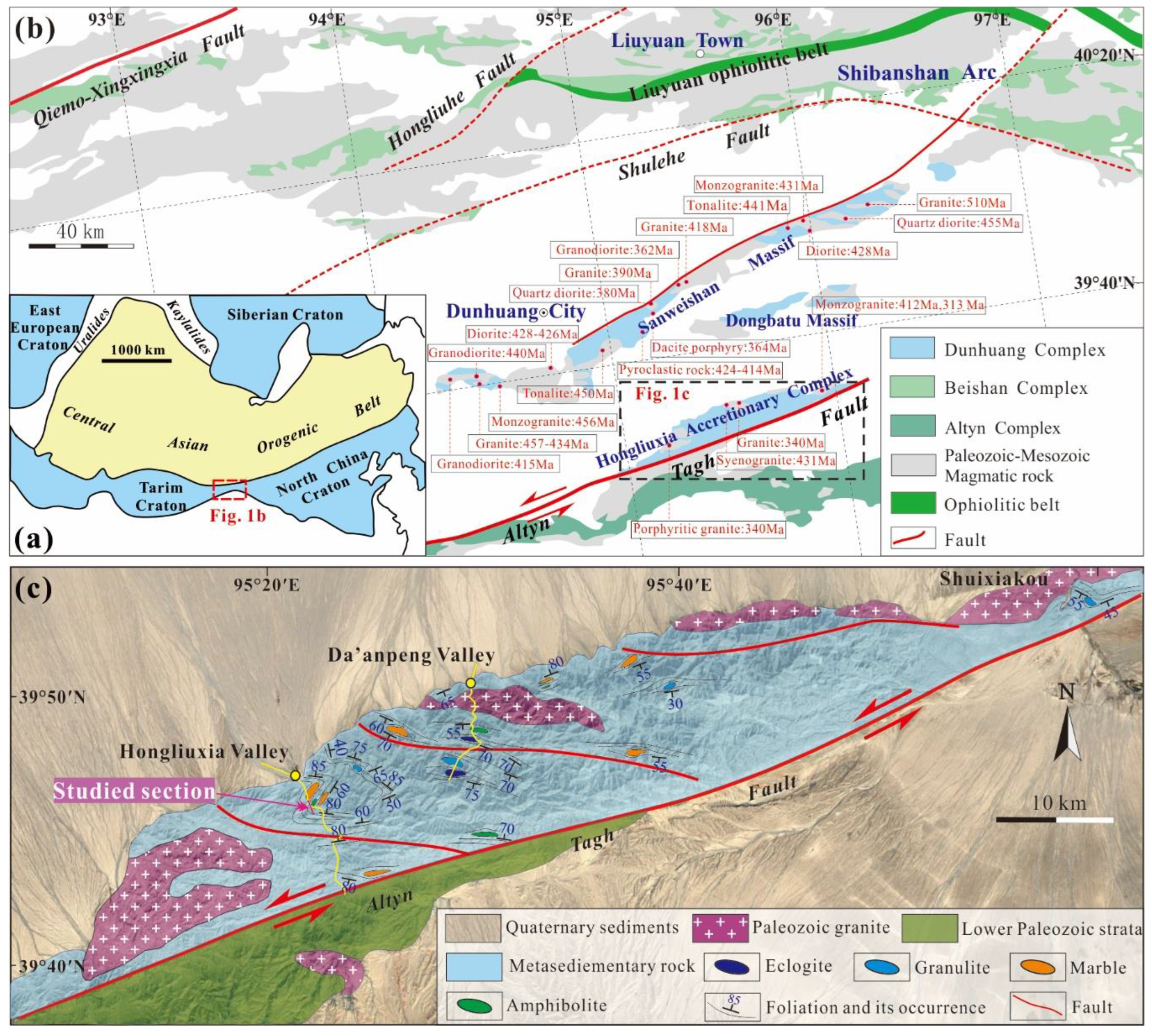
Figure 2.
Field relationships and petrography of the granitic rocks. (a) Sketch of the studied section; (b-c) Deformed marble; (d-e) Mylonitic granite; (f-g) Metagreywacke as the country rock; (h-i) Garnet-bearing granite; (j-k) Biotite plagioclase gneiss as the country rock; (l-n) Light-colored granite.
Figure 2.
Field relationships and petrography of the granitic rocks. (a) Sketch of the studied section; (b-c) Deformed marble; (d-e) Mylonitic granite; (f-g) Metagreywacke as the country rock; (h-i) Garnet-bearing granite; (j-k) Biotite plagioclase gneiss as the country rock; (l-n) Light-colored granite.
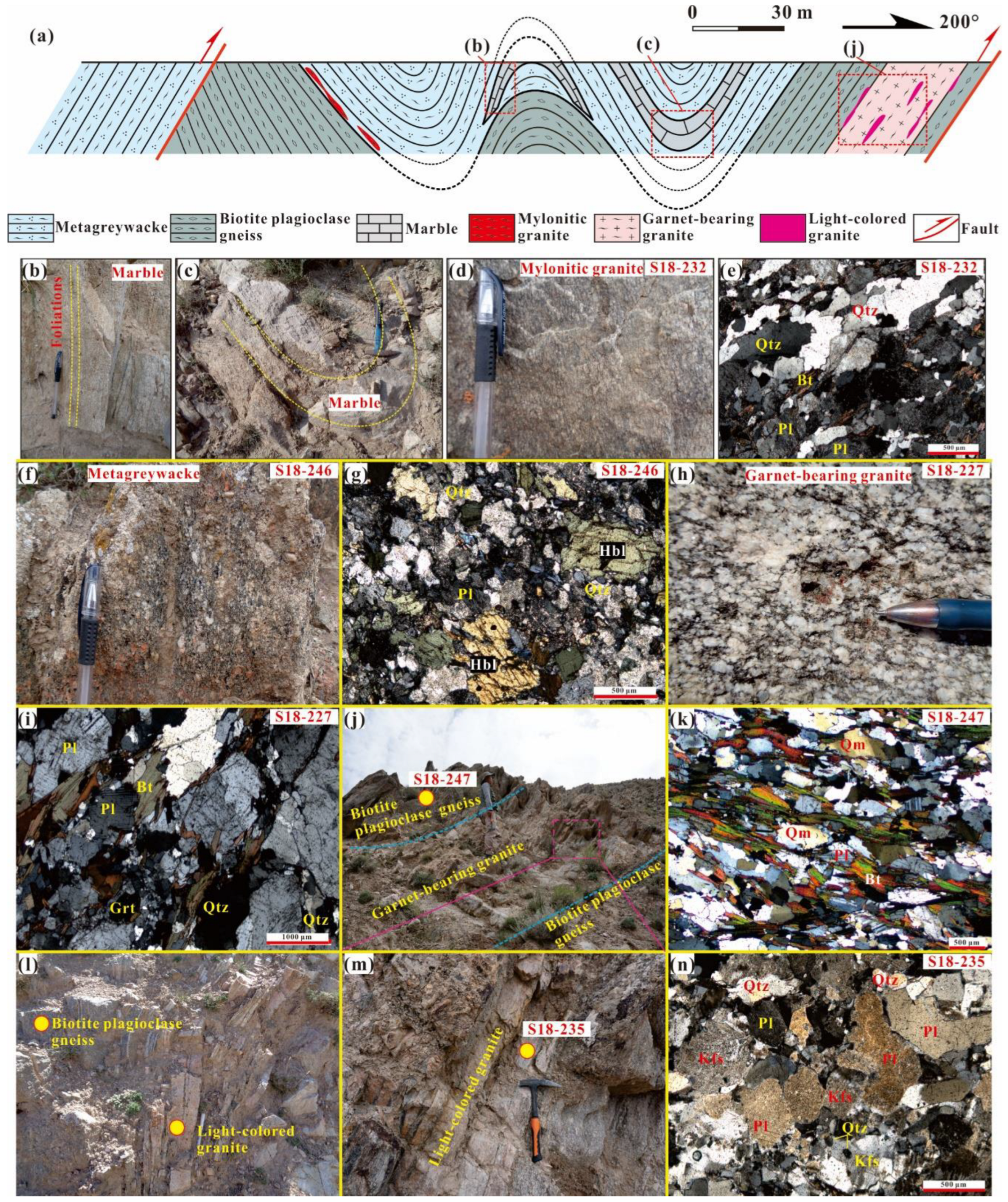
Figure 3.
(a) Representative cathode luminescence (CL) pictures of zircons from the granitoids and metagreywacke; (b, d, f, h) Zircon Th/U ratios of zircons from the granitoids and metagreywacke; (c, e, g, i) Trace element compositions of zircons from the granitoids.
Figure 3.
(a) Representative cathode luminescence (CL) pictures of zircons from the granitoids and metagreywacke; (b, d, f, h) Zircon Th/U ratios of zircons from the granitoids and metagreywacke; (c, e, g, i) Trace element compositions of zircons from the granitoids.
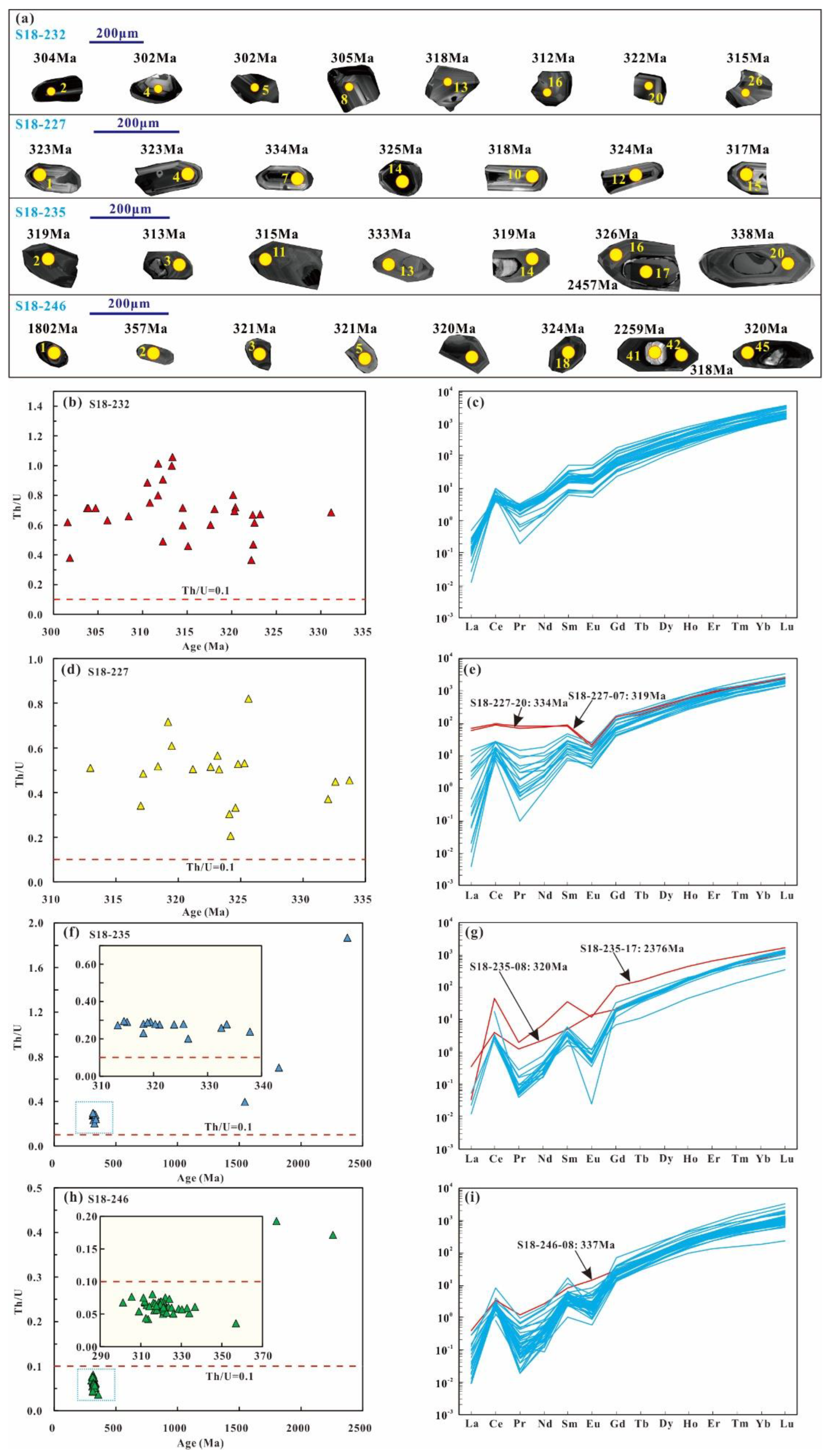
Figure 4.
(a, b, c) Zircon U-Pb concordia diagrams of the granitoids; (d, e) Zircon U-Pb concordia diagrams of the metasedimentary rock; (f) Zircon εHf(t) vs. U-Pb age diagrams of the granitoids.
Figure 4.
(a, b, c) Zircon U-Pb concordia diagrams of the granitoids; (d, e) Zircon U-Pb concordia diagrams of the metasedimentary rock; (f) Zircon εHf(t) vs. U-Pb age diagrams of the granitoids.
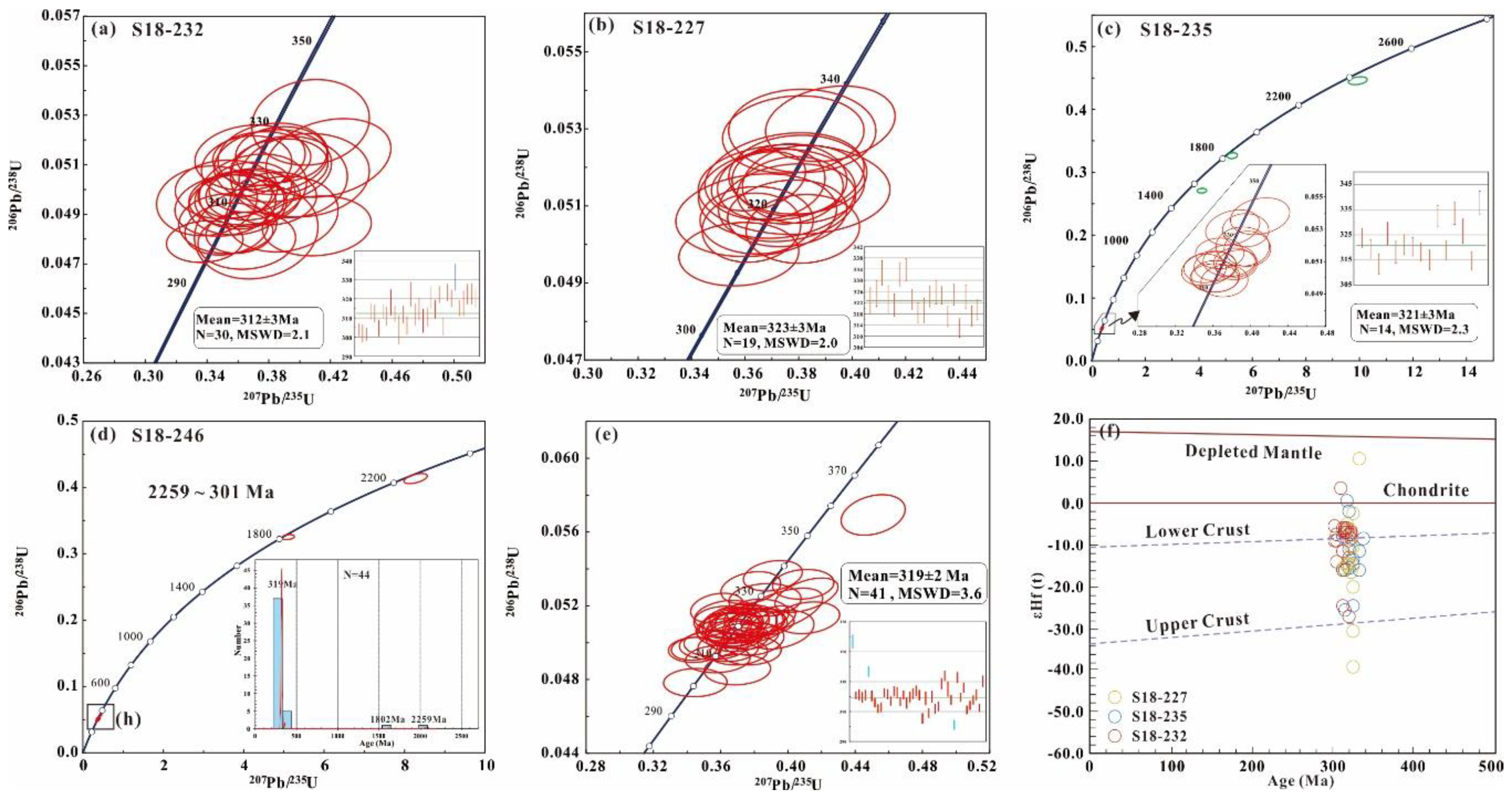
Figure 5.
(a) TAS diagram (after [66]); (b) SiO2 vs. K2O diagram (after [67]); (c) A/NK vs. A/CNK diagram (after [68]). Hollow marks represent Late Carboniferous granitoids in the HAC from [34].
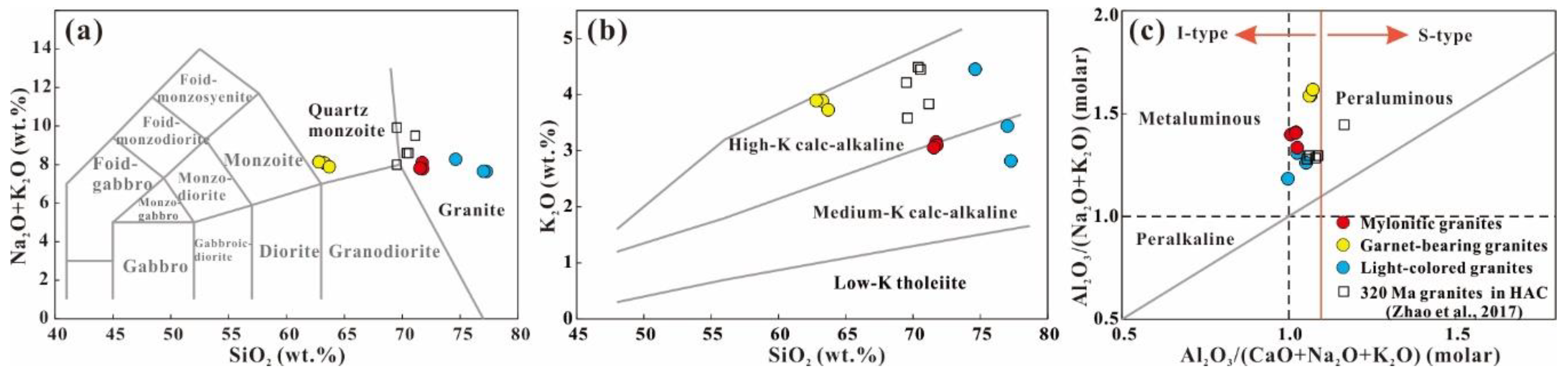
Figure 6.
(a-c) Chondrite normalized REE patterns of the granitic rocks; (d-f) Primitive normalized trace element patterns of the granitic rocks. Chondrite and primitive mantle values from [69].
Figure 6.
(a-c) Chondrite normalized REE patterns of the granitic rocks; (d-f) Primitive normalized trace element patterns of the granitic rocks. Chondrite and primitive mantle values from [69].
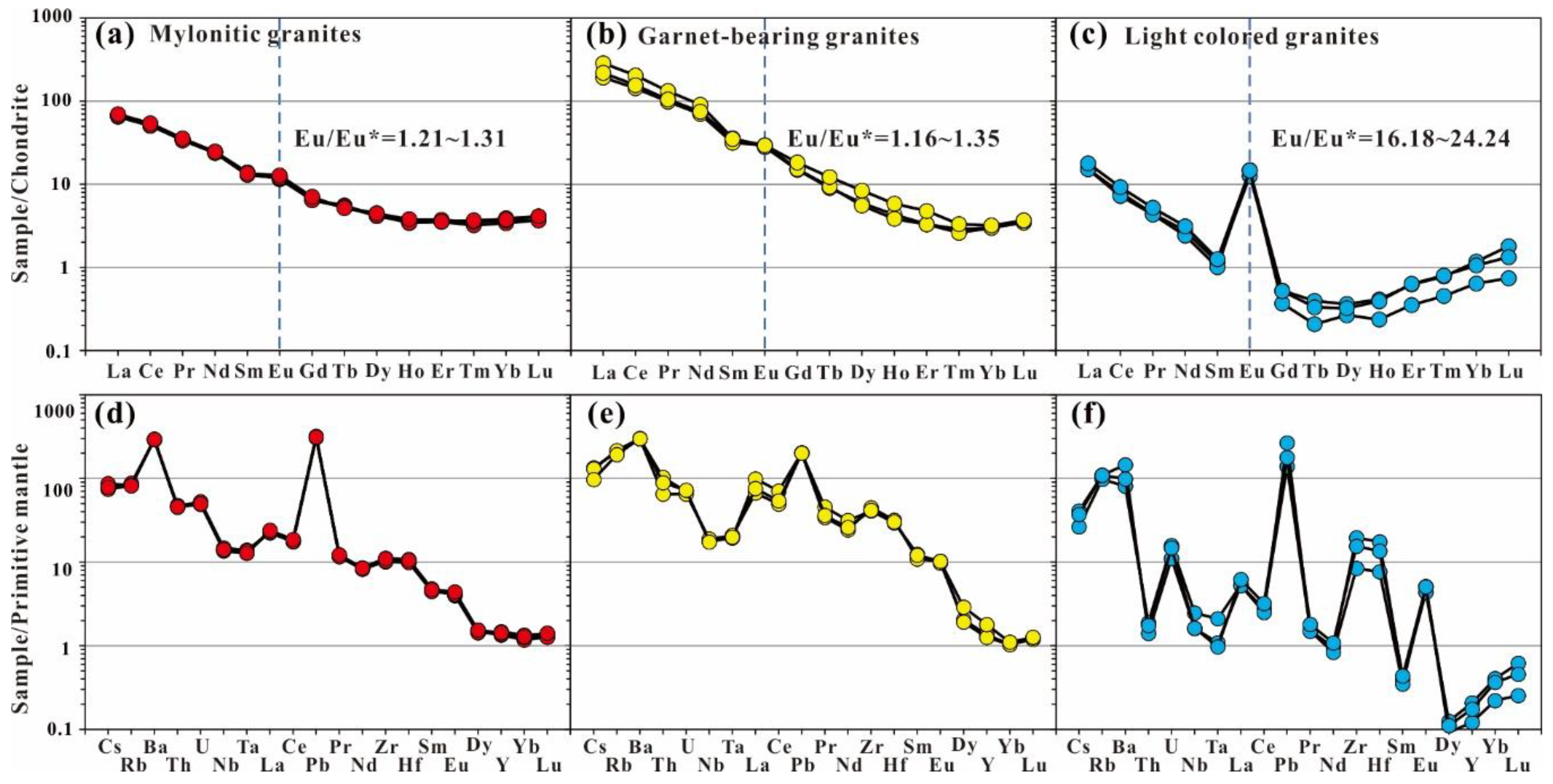
Figure 7.
(a) Molar Al2O3/(MgO + FeOT) vs. CaO/(MgO+ FeOT) diagram (after [76]); (b) Al2O3/(MgO+FeOT+TiO2) vs. Al2O3+MgO+FeOT+TiO2 diagram (after [75]). Hollow marks represent Late Carboniferous granitoids in the HAC from [34].
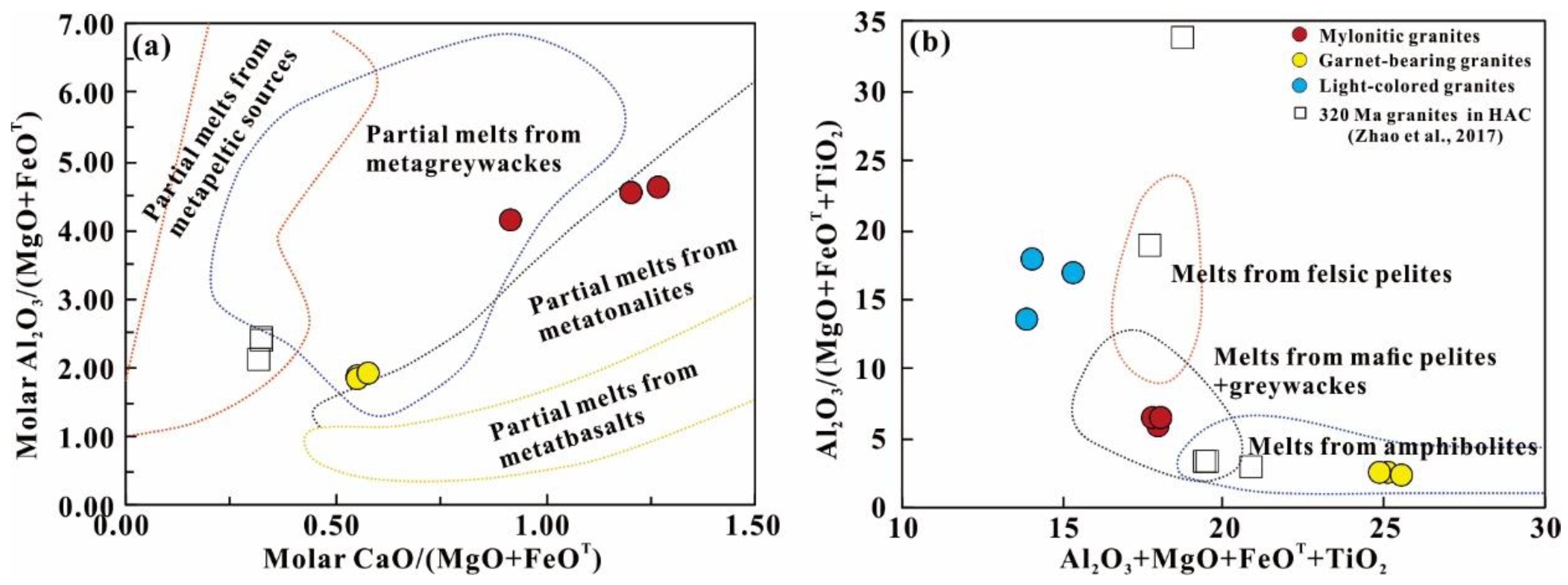
Figure 8.
Whole-rock trace element variations of the granitoids. Hollow marks represent metasedimentary in the HAC from [60] and [77].
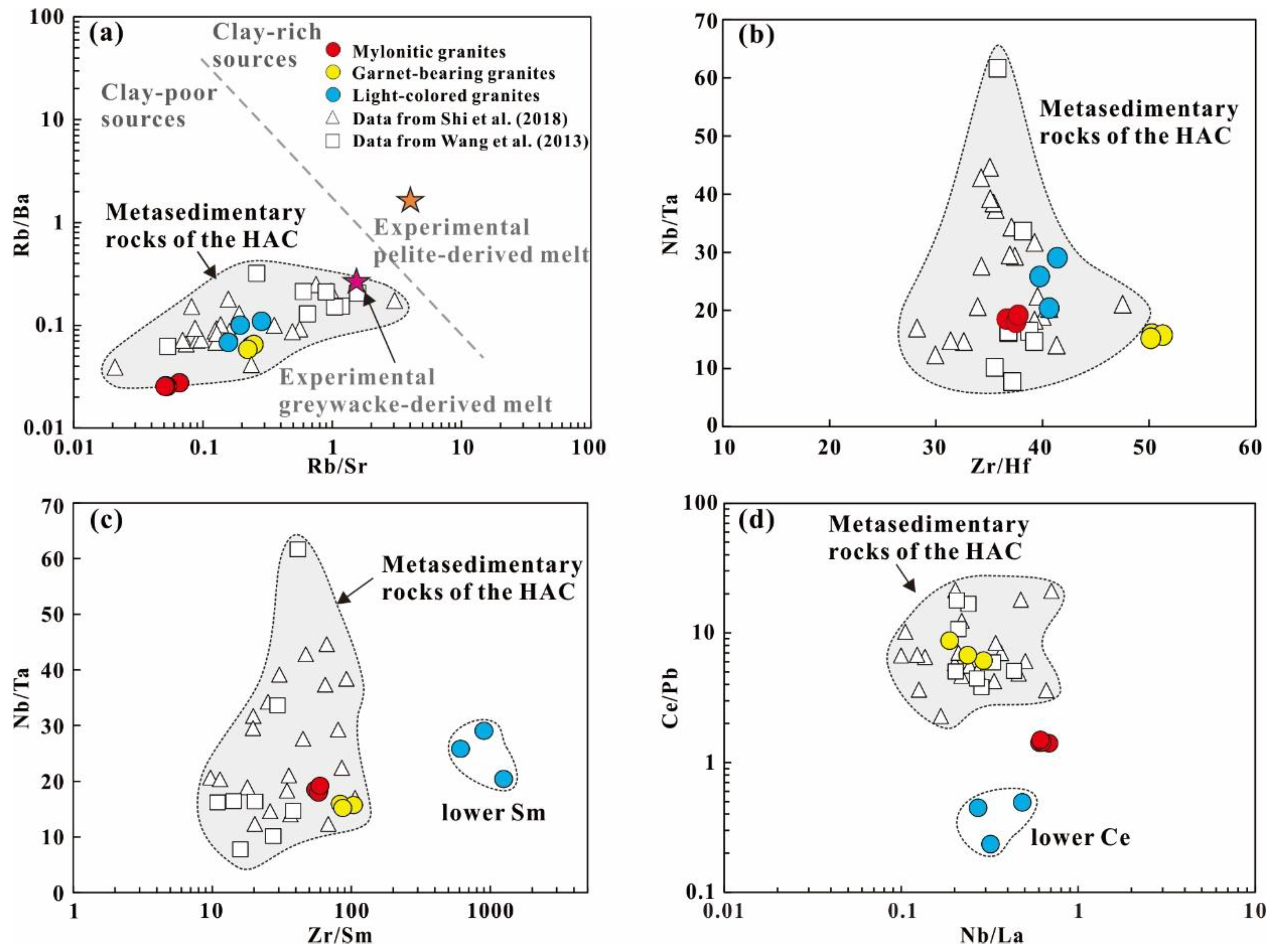
Figure 9.
Whole-rock trace element variations of the granitoids ((a) after [78]; (b) after [79]). Hollow marks represent metasedimentary in the HAC from [34].
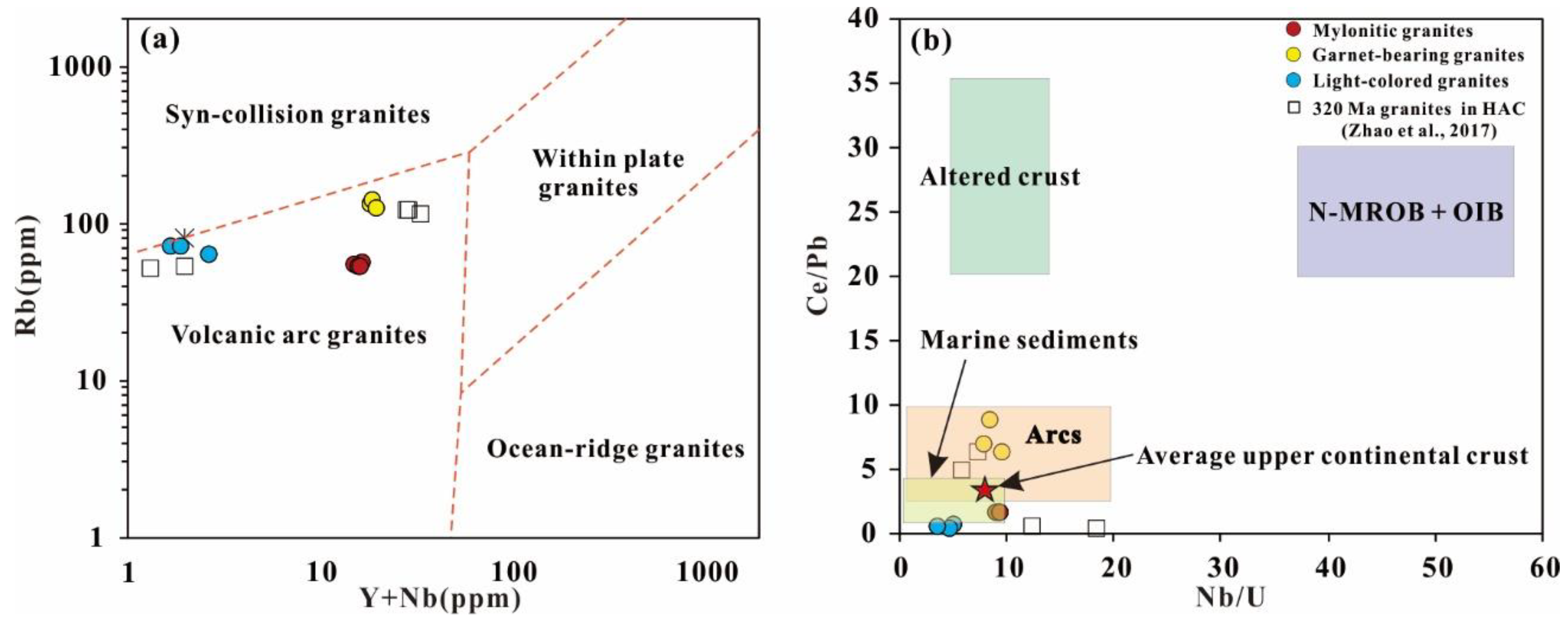
Figure 10.
Rb/Sr vs. Ba and Rb/Sr vs. Sr diagrams of the studied granitic rocks in the HAC. Hollow marks represent metasedimentary in the HAC from [60,77].
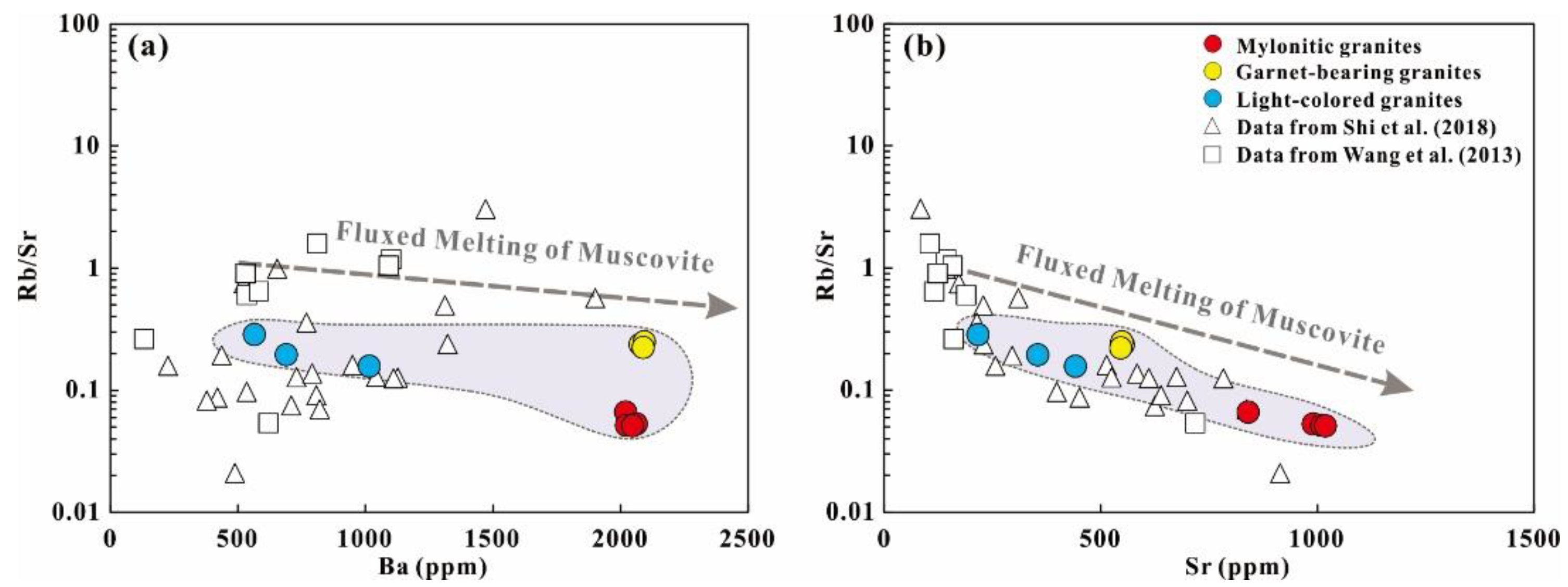
Figure 11.
A conceptual model of the process of crustal differentiation by anatexis of accretionary complexes. REEs of average metasedimentary rocks are calculated from data of [60,77]; REEs of average granitic rocks are calculated from data of this study and [34]; REEs of residue is the difference between the above two values, representing the residual composition after granitic melt extraction from metasedimentary rocks, which is then compared with published data for the lower continental crust [89,90]. The illustrations not to scale.
Figure 11.
A conceptual model of the process of crustal differentiation by anatexis of accretionary complexes. REEs of average metasedimentary rocks are calculated from data of [60,77]; REEs of average granitic rocks are calculated from data of this study and [34]; REEs of residue is the difference between the above two values, representing the residual composition after granitic melt extraction from metasedimentary rocks, which is then compared with published data for the lower continental crust [89,90]. The illustrations not to scale.
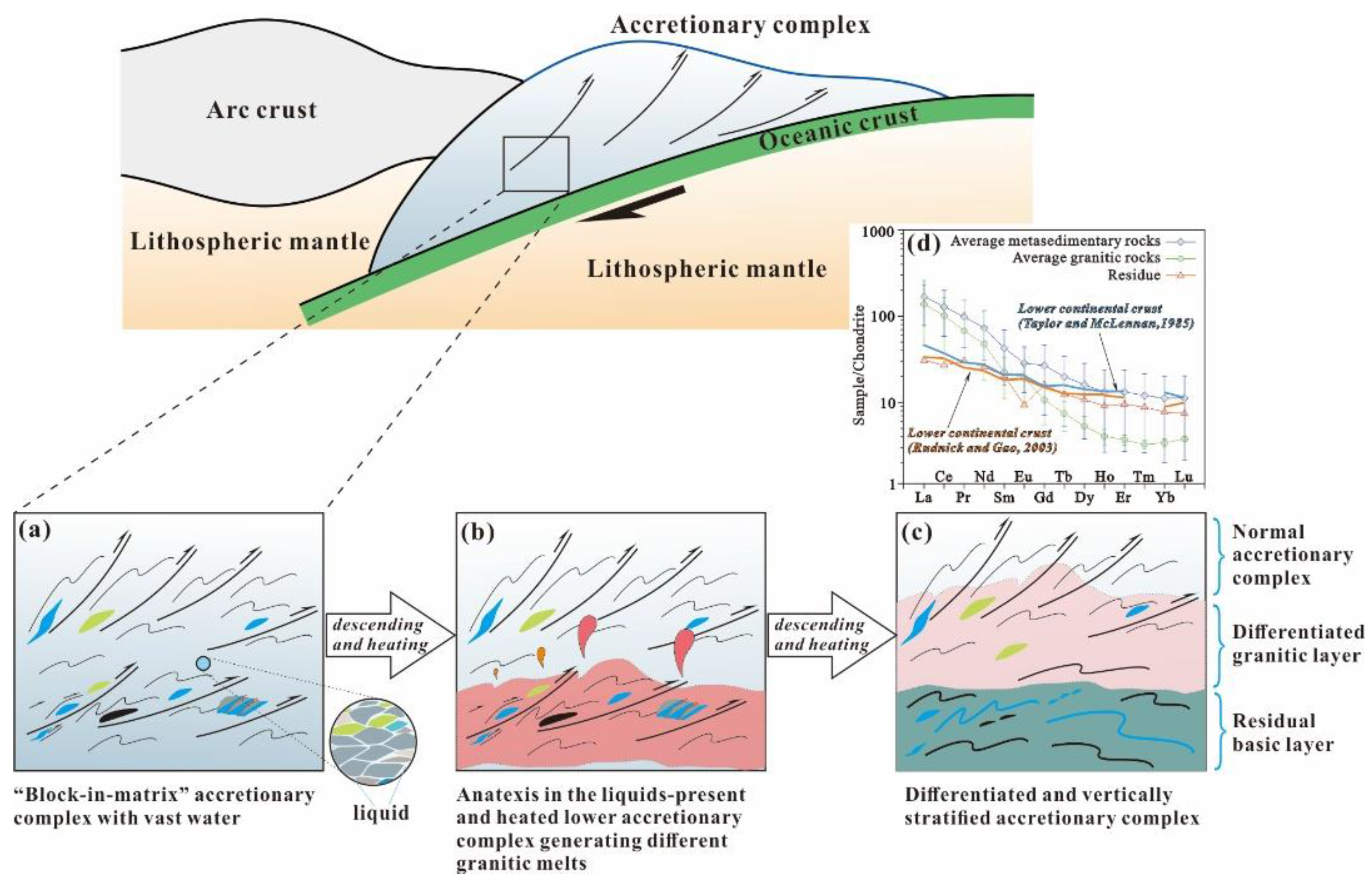

Table 1.
Zircon in situ Hf isotopic compositions of granitoids from HAC, southern Dunhuang orogenic belt.
Table 1.
Zircon in situ Hf isotopic compositions of granitoids from HAC, southern Dunhuang orogenic belt.
| Spot | Age (Ma) | 176Hf/177Hf | 1σ | 176Lu/177Hf | 1σ | 176Yb/177Hf | 1σ | εHf(0) | 1σ | εHf(t) | 1σ | TDM1 | TDM2 | fLu/Hf |
|---|---|---|---|---|---|---|---|---|---|---|---|---|---|---|
| S18-227 | ||||||||||||||
| 1 | 323 | 0.282276 | 0.000054 | 0.001142 | 0.000006 | 0.035917 | 0.000285 | -17.5 | 2.0 | -10.7 | 2.0 | 1382 | 1795 | -0.97 |
| 2 | 325 | 0.282283 | 0.000054 | 0.001370 | 0.000009 | 0.042858 | 0.000236 | -17.3 | 2.0 | -10.4 | 2.0 | 1380 | 1782 | -0.96 |
| 4 | 323 | 0.282386 | 0.000057 | 0.000987 | 0.000003 | 0.034048 | 0.000093 | -13.6 | 2.1 | -6.8 | 2.1 | 1223 | 1578 | -0.97 |
| 5 | 321 | 0.282174 | 0.000059 | 0.001684 | 0.000018 | 0.055901 | 0.000577 | -21.1 | 2.2 | -14.5 | 2.2 | 1547 | 2000 | -0.95 |
| 6 | 332 | 0.282874 | 0.000078 | 0.001080 | 0.000056 | 0.050828 | 0.001073 | 3.6 | 2.8 | 10.7 | 2.8 | 537 | 617 | -0.97 |
| 9 | 323 | 0.282110 | 0.000071 | 0.001785 | 0.000008 | 0.059564 | 0.000347 | -23.4 | 2.6 | -16.7 | 2.6 | 1643 | 2125 | -0.95 |
| 10 | 318 | 0.282159 | 0.000076 | 0.001502 | 0.000034 | 0.048996 | 0.001212 | -21.7 | 2.7 | -15.0 | 2.7 | 1561 | 2029 | -0.95 |
| 12 | 324 | 0.282153 | 0.000092 | 0.001431 | 0.000033 | 0.045670 | 0.000995 | -21.9 | 3.3 | -15.1 | 3.3 | 1566 | 2037 | -0.96 |
| 13 | 326 | 0.282506 | 0.000106 | 0.001622 | 0.000129 | 0.080886 | 0.003560 | -9.4 | 3.8 | -2.6 | 3.8 | 1072 | 1350 | -0.95 |
| 14 | 325 | 0.281721 | 0.000410 | 0.002920 | 0.000974 | 0.115094 | 0.061691 | -37.2 | 14.5 | -30.7 | 14.7 | 2260 | 2886 | -0.91 |
| 15 | 317 | 0.282447 | 0.000110 | 0.001691 | 0.000017 | 0.070364 | 0.001032 | -11.5 | 3.9 | -4.9 | 3.9 | 1158 | 1469 | -0.95 |
| 16 | 325 | 0.281472 | 0.000151 | 0.002100 | 0.000022 | 0.101279 | 0.003715 | -46.0 | 5.4 | -39.3 | 5.4 | 2562 | 3353 | -0.94 |
| 17 | 313 | 0.282147 | 0.000116 | 0.001174 | 0.000011 | 0.041125 | 0.000501 | -22.1 | 4.1 | -15.5 | 4.1 | 1564 | 2050 | -0.96 |
| 18 | 324 | 0.282012 | 0.000122 | 0.000537 | 0.000078 | 0.035324 | 0.002825 | -26.9 | 4.3 | -19.9 | 4.4 | 1723 | 2299 | -0.98 |
| 19 | 317 | 0.282164 | 0.000126 | 0.001126 | 0.000032 | 0.039021 | 0.001327 | -21.5 | 4.5 | -14.8 | 4.5 | 1539 | 2015 | -0.97 |
| S18-235 | ||||||||||||||
| 1 | 324 | 0.282195 | 0.000142 | 0.000750 | 0.000010 | 0.026483 | 0.000395 | -20.4 | 5.1 | -13.5 | 5.1 | 1480 | 1948 | -0.98 |
| 2 | 319 | 0.282142 | 0.000205 | 0.000897 | 0.000048 | 0.034479 | 0.005746 | -22.3 | 7.3 | -15.5 | 7.3 | 1560 | 2055 | -0.97 |
| 3 | 313 | 0.282354 | 0.000153 | 0.000581 | 0.000002 | 0.022089 | 0.000265 | -14.8 | 5.4 | -8.0 | 5.4 | 1255 | 1641 | -0.98 |
| 4 | 326 | 0.282157 | 0.000158 | 0.000650 | 0.000003 | 0.025211 | 0.000191 | -21.7 | 5.6 | -14.7 | 5.6 | 1528 | 2018 | -0.98 |
| 5 | 318 | 0.282601 | 0.000170 | 0.000913 | 0.000038 | 0.036820 | 0.002073 | -6.1 | 6.0 | 0.7 | 6.1 | 92 | 1159 | -0.97 |
| 7 | 321 | 0.282264 | 0.000169 | 0.000724 | 0.000003 | 0.029014 | 0.000284 | -18.0 | 6.0 | -11.1 | 6.0 | 1384 | 1814 | -0.98 |
| 8 | 320 | 0.282317 | 0.000174 | 0.000777 | 0.000003 | 0.030107 | 0.000346 | -16.1 | 6.2 | -9.2 | 6.2 | 1313 | 1713 | -0.98 |
| 11 | 315 | 0.281850 | 0.000184 | 0.000632 | 0.000002 | 0.024565 | 0.000260 | -32.6 | 6.5 | -25.8 | 6.5 | 1949 | 2617 | -0.98 |
| 13 | 333 | 0.282245 | 0.000201 | 0.000903 | 0.000012 | 0.033007 | 0.000626 | -18.6 | 7.1 | -11.5 | 7.1 | 1416 | 1848 | -0.97 |
| 14 | 319 | 0.282534 | 0.000201 | 0.002134 | 0.000166 | 0.075816 | 0.006842 | -8.4 | 7.1 | -1.9 | 7.2 | 1047 | 1304 | -0.94 |
| 15 | 334 | 0.282109 | 0.000194 | 0.000972 | 0.000028 | 0.039445 | 0.001816 | -23.4 | 6.9 | -16.3 | 6.9 | 1608 | 2112 | -0.97 |
| 16 | 326 | 0.281877 | 0.000185 | 0.000574 | 0.000019 | 0.021031 | 0.000856 | -31.6 | 6.6 | -24.6 | 6.6 | 1909 | 2560 | -0.98 |
| 18 | 315 | 0.282122 | 0.000173 | 0.000749 | 0.000002 | 0.022193 | 0.000104 | -23.0 | 6.2 | -16.2 | 6.2 | 1581 | 2093 | -0.98 |
| 20 | 338 | 0.282328 | 0.000165 | 0.001268 | 0.000024 | 0.045040 | 0.000949 | -15.7 | 5.9 | -8.6 | 5.9 | 1314 | 1690 | -0.96 |
| S18-232 | ||||||||||||||
| 4 | 302 | 0.282435 | 0.000153 | 0.000729 | 0.000005 | 0.022006 | 0.000245 | -11.9 | 5.4 | -5.4 | 5.4 | 1146 | 1488 | -0.98 |
| 5 | 302 | 0.282337 | 0.000137 | 0.001323 | 0.000018 | 0.043588 | 0.000820 | -15.4 | 4.9 | -9.0 | 4.9 | 1303 | 1686 | -0.96 |
| 6 | 313 | 0.281905 | 0.000136 | 0.003152 | 0.000027 | 0.144768 | 0.000318 | -30.7 | 4.8 | -24.5 | 4.9 | 2006 | 2539 | -0.91 |
| 8 | 305 | 0.282196 | 0.000126 | 0.002186 | 0.000018 | 0.071617 | 0.000672 | -20.4 | 4.5 | -14.1 | 4.5 | 1536 | 1968 | -0.93 |
| 11 | 313 | 0.282427 | 0.000127 | 0.002821 | 0.000025 | 0.146868 | 0.000821 | -12.2 | 4.5 | -5.9 | 4.5 | 1225 | 1524 | -0.92 |
| 12 | 311 | 0.282682 | 0.000122 | 0.001245 | 0.000005 | 0.061610 | 0.000748 | -3.2 | 4.3 | 3.4 | 4.3 | 812 | 1005 | -0.96 |
| 13 | 318 | 0.282375 | 0.000111 | 0.001085 | 0.000016 | 0.036761 | 0.000688 | -14.0 | 4.0 | -7.3 | 4.0 | 1241 | 1602 | -0.97 |
| 17 | 304 | 0.282375 | 0.000106 | 0.000998 | 0.000009 | 0.033316 | 0.000437 | -14.0 | 3.8 | -7.6 | 3.8 | 1239 | 1608 | -0.97 |
| 18 | 312 | 0.282144 | 0.000101 | 0.002621 | 0.000020 | 0.091085 | 0.001324 | -22.2 | 3.6 | -15.9 | 3.6 | 1631 | 2072 | -0.92 |
| 19 | 306 | 0.282335 | 0.000096 | 0.001575 | 0.000003 | 0.049522 | 0.000279 | -15.5 | 3.4 | -9.1 | 3.4 | 1315 | 1692 | -0.95 |
| 20 | 322 | 0.282336 | 0.000090 | 0.001152 | 0.000008 | 0.039099 | 0.000131 | -15.4 | 3.2 | -8.6 | 3.2 | 1298 | 1678 | -0.97 |
| 21 | 312 | 0.282259 | 0.000075 | 0.001973 | 0.000008 | 0.064661 | 0.000465 | -18.2 | 2.7 | -11.7 | 2.7 | 1438 | 1842 | -0.94 |
| 22 | 315 | 0.282394 | 0.000070 | 0.001046 | 0.000017 | 0.035120 | 0.000745 | -13.4 | 2.5 | -6.7 | 2.5 | 1214 | 1568 | -0.97 |
| 25 | 320 | 0.282372 | 0.000064 | 0.001162 | 0.000003 | 0.038477 | 0.000244 | -14.1 | 2.3 | -7.4 | 2.3 | 1248 | 1609 | -0.96 |
| 26 | 315 | 0.282381 | 0.000059 | 0.001098 | 0.000021 | 0.034923 | 0.000804 | -13.8 | 2.2 | -7.1 | 2.2 | 1233 | 1592 | -0.97 |
| 27 | 322 | 0.282382 | 0.000054 | 0.001357 | 0.000004 | 0.041385 | 0.000246 | -13.8 | 2.0 | -7.0 | 2.0 | 1241 | 1592 | -0.96 |
| 30 | 323 | 0.282370 | 0.000063 | 0.002142 | 0.000022 | 0.089564 | 0.001327 | -14.2 | 2.3 | -7.6 | 2.3 | 1285 | 1624 | -0.94 |
| 31 | 320 | 0.282222 | 0.000044 | 0.002312 | 0.000010 | 0.076369 | 0.000704 | -19.5 | 1.6 | -12.9 | 1.7 | 1505 | 1915 | -0.93 |
| 35 | 318 | 0.282416 | 0.000039 | 0.000996 | 0.000005 | 0.032774 | 0.000079 | -12.6 | 1.5 | -5.8 | 1.5 | 1182 | 1523 | -0.97 |
| 37 | 323 | 0.282385 | 0.000035 | 0.001086 | 0.000014 | 0.036662 | 0.000647 | -13.7 | 1.3 | -6.8 | 1.3 | 1228 | 1582 | -0.97 |
| 40 | 320 | 0.281840 | 0.000034 | 0.004634 | 0.000032 | 0.187279 | 0.001484 | -33.0 | 1.3 | -26.9 | 1.3 | 2191 | 2677 | -0.86 |
Disclaimer/Publisher’s Note: The statements, opinions and data contained in all publications are solely those of the individual author(s) and contributor(s) and not of MDPI and/or the editor(s). MDPI and/or the editor(s) disclaim responsibility for any injury to people or property resulting from any ideas, methods, instructions or products referred to in the content. |
© 2026 by the authors. Licensee MDPI, Basel, Switzerland. This article is an open access article distributed under the terms and conditions of the Creative Commons Attribution (CC BY) license (http://creativecommons.org/licenses/by/4.0/).
Copyright: This open access article is published under a Creative Commons CC BY 4.0 license, which permit the free download, distribution, and reuse, provided that the author and preprint are cited in any reuse.