

Submitted:
31 August 2026
Posted:
31 August 2026
You are already at the latest version
Abstract
Background: A person with depression, unresolved trauma, a substance problem, and cognitive complaints is treated differently depending on which practitioner they consult. A psychiatrist draws on the monoaminergic and glutamatergic literature. A licensed facilitator draws on the session literature. A naturopath draws on the botanical and nutritional literature. Each draws on a defensible evidence base, and none of the three literatures routinely cites the other two. No single reference covers the agents acting on these conditions across the disciplines that use them, with the evidentiary standing of each claim visible and the boundary of each practitioner’s authority stated. Objective: To organize that agent population by mechanism of action rather than by regulatory status or professional tradition, assign an explicit evidence tier to every claim, characterize the route and bioavailability for every agent, and derive an operational logic for safety gating, interaction adjudication, and protocol construction that practitioners from differing disciplines and with varying prescribing authority can apply within their own scope. Methods: A structured review was conducted with framework development, defining fifteen mechanism classes based on receptor pharmacology and downstream signalling. Each agent was characterized by its mechanism, dose range, route, established bioavailability, onset, duration, evidence tier, contraindications, and potential interactions. The evidence was evaluated through an international literature review and categorized into a single standardized tier system, regardless of jurisdiction: T1 for randomized controlled trials, T2 for controlled studies with limitations, T3 for observational or open-label studies, T4 for mechanistic evidence only, and T5 for traditional use. Results: Fifteen classes are outlined across 154 subsections, covering areas like glutamatergic modulation, serotonergic psychedelics, entactogens, non-5-HT2A psychoactives, monoaminergic and inhibitory modulation, neurotrophic and neuroimmune agents, adaptogenic and mitochondrial support, pharmacokinetic modification, potentiation, cholinergic modulation, and circadian phase. Seventy-six agents are individually characterized. A condition matrix links them to sixty-eight indications, including cluster headache, tic disorders, traumatic brain injury, chronic pain, burnout, and insomnia, which are often missing from reviews despite substantial supporting data. The safety measures include six safety gates, eighteen interaction rules with specified severity, a seven-step construction process, and a role-scope matrix. Route and bioavailability are detailed for each agent: five deliver about the administered dose; several widely used agents reach systemic circulation at one to ten percent; and four are pharmacologically inert via their primary route. Conclusions: A mechanism-first organization enables the evaluation of agents with varying evidentiary credibility and regulatory statuses within a single framework, without undervaluing weaker evidence or overestimating stronger cases. Three key points follow. The evidence tier pertains to the agent-indication-dose triplet, not the agent itself: for example, piracetam shows T1 evidence for myoclonus at 24 g daily and T4 for cognition at any dose. An additional axis, circadian phase, runs alongside dose, mechanism, and route; a shifted rhythm indicates deficiency and calls for the opposite intervention. When absorption or first-pass metabolism limits a compound rather than receptor pharmacology, the issue is a formulation problem and should be labelled as such. This framework is designed for complementary and adjunctive practices, highlights sections needing prescribing authority, and does not replace personalized clinical judgment.
Keywords:
multidisciplinary framework
; practitioner reference
; neuroplasticity
; psychedelic-assisted session work
; psilocybin
; ibogaine
; ketamine
; chronobiotics
; nutraceuticals
; drug delivery
; bioavailability
; evidence tiering
; scope of practice
1. Introduction
A person arrives feeling low, unresponsive to two antidepressants, with habits they want to change, unresolved issues from ten years ago, and a sense that their thinking is slower. Each concern has research and evidence-backed treatments. The particular treatment offered depends on which professional they see first. A psychiatrist might choose from the monoaminergic and glutamatergic research, possibly recommending ketamine. A licensed facilitator in Oregon or Colorado might focus on session-based therapies, suggesting psilocybin. A naturopath may rely on botanical and nutritional research, proposing saffron, omega-3, and adaptogens. A functional medicine practitioner might order labs. All operate from valid evidence. However, these fields rarely cite each other, and no single source shows what other approaches might offer. This separation is mainly due to professional organization, regulation, and publication practices, not science. The treatments often affect overlapping or even identical mechanisms—for example, scopolamine and ketamine both trigger similar cascades, while psilocybin and lion’s mane both influence neurotrophic signalling at different levels and times. The fragmentation persists because no one has an incentive to create a comprehensive, cross-disciplinary document.
1.1. Purpose and Contribution
This work constructs a structured review with framework development: the review portion establishes the agent population and its evidence, and the contribution is the structure by which practitioners from different disciplines and with different authority can work from one reference without conflating what each is permitted to do.
Four things distinguish it from the reviews in this space.
- It is organized by mechanism instead of by regulatory status or professional tradition. A mechanism class encompasses all agents operating within that mechanism, including scheduled compounds, licensed medicines, plant preparations, and dietary ingredients. This grouping is the only way to compare the four literatures since they all share the property of 'mechanism.'
- Every claim carries an evidence tier. A single class might feature an agent with two positive phase 3 trials, plus another agent whose entire human record is ethnographic. Ignoring the second source means losing the only human data for several drugs in current clinical use. Including it without distinction is problematic. The tiering scheme addresses this by incorporating all sources but ensures that the epistemic status is clearly visible at the point of use instead of being buried in a methods section the reader has already bypassed.
- Route and bioavailability are first-order properties. A dose does not represent an exact quantity delivered. Many agents currently in use only reach systemic circulation at one to ten percent of the amount administered, and four are pharmacologically inactive when given via their most common route. Any description of a dose that omits the route and the absorbed fraction is incomplete, and Section 6 supplies both details for each agent discussed.
- Scope of practice is built into the structure rather than appended to it. Every section that requires prescribing authority is clearly indicated. The role-scope matrix in Section 11.2 outlines what each practitioner category can and cannot do. This is not a disclaimer, but a way to ensure one document addresses four audiences without anyone acting beyond their competence.
This framework's main assertion is that agents are divided by professional and regulatory boundaries that don't align with their actual behaviours. Reorganizing them based on mechanism reveals relationships such as convergent pathways, potentiating combinations, substrate dependencies, and phase relationships, which are hidden by discipline-focused organization.
1.2. What is Covered, and Excluded
The agent population is characterized by their function: compounds and interventions that promote neuroplasticity, change subjective experience, provide neural substrates, regulate stress or immune responses, or adjust the timing of systems responsible for these functions. This definition encompasses agents from four regulatory categories and four professional traditions, but excludes many others.
Not covered: primary psychiatric prescribing as a discipline, which has extensive guidelines that this framework does not aim to replace or enhance; acute psychiatric emergencies; substance withdrawal management needing medical supervision; and any condition where existing clinical guidelines sufficiently address the evidence base. The framework is intended to complement conventional care, not to replace or interfere with what it already covers.
Also not covered are any recommendations to obtain, possess, or administer a scheduled compound outside a lawful framework. When a scheduled agent is described, the characterization is based on pharmacology. The legal aspects are a separate issue, depending on jurisdiction, and are not addressed here.
2. Methods
2.1. Review Type and Rationale
This is a structured narrative review utilizing an explicit mechanism-first taxonomy. A systematic review format was unsuitable because the agents examined belong to regulatory categories with vastly different evidence bases: some classes include agents with multiple phase 3 randomized trials, while others consist solely of observational studies and ethnopharmacological reports. Using a systematic review would either exclude the latter, removing the only human data for several drugs still in active use, or include them indiscriminately, which is unacceptable. The evidence-tiering system described in Section 2 addresses this issue by including all sources while making their epistemic status transparent at the point of use.
The evidence was evaluated from international sources. Agents developed and licensed outside the English-speaking world—such as Russian neuropeptides, Kampo and Chinese formulas, Ayurvedic preparations, and Latin American psychedelic research—are graded using the same criteria applied to agents from Anglophone trials. If a compound has decades of registered clinical use in one region but no controlled studies elsewhere, this is noted as an open-label evidence base rather than a lack of evidence. The framework prevents systematically overestimating the pharmacology of wealthy, English-speaking countries and underestimating others.
2.2. Search Strategy
Literature was identified through PubMed/MEDLINE, Embase, PsycINFO, the Cochrane Library, and ClinicalTrials.gov, along with regulatory documentation from the United States Food and Drug Administration and the European Medicines Agency. Search terms combined compound names and their common synonyms with mechanism terms (brain-derived neurotrophic factor, mechanistic target of rapamycin, 5-HT2A, N-methyl-D-aspartate, trace amine-associated receptor 1, sigma-1, gamma-aminobutyric acid) and indication terms. Reference lists of retrieved reviews and trials were hand-searched. Preprint servers were searched for agents for which peer-reviewed human data are sparse.
Ethnopharmacological and field-report sources — including harm-reduction organizations and community documentation projects — were searched separately and are reported only under Tier 5, never intermixed with clinical citations. This material is retained because, for several agents in this review, including phenibut, high-dose 5-MeO-DMT, and certain phenethylamines, it constitutes the only systematically collected human dosing information available.
2.3. Inclusion and Exclusion
- Included: agents with a plausible, mechanistically specified action on one or more pathways defined in Section 4, and at least Tier 4 human or animal evidence relevant to a neuropsychiatric or neurological indication.
- Included: agents currently used in supervised or facilitated settings, irrespective of regulatory status, because practitioners encounter them whether or not the literature acknowledges them.
- Excluded: agents supported only by commercial marketing material; agents with no proposed mechanism; and agents whose human safety profile is undefined at any dose.
- Excluded: full treatment of psychotherapeutic modality. Set, setting, therapeutic alliance, and integration are addressed only when they modify pharmacological outcome.
2.4. Terminology
A note on the abbreviation PEA. Two distinct compounds in this review share this abbreviation: β-phenylethylamine, an endogenous trace amine and TAAR1 agonist characterized as Agent 29, and palmitoylethanolamide, an endogenous fatty acid amide with anti-inflammatory and analgesic activity characterized as Agent 66. These are unrelated molecules with different mechanisms and indications. Throughout this document, both are spelled out in full at every occurrence, and the abbreviation PEA is not used. Readers are cautioned that this collision is widespread in the existing literature and is a recurring source of error.
Mebufotenin is used as the standardized name for 5-methoxy-N, N-dimethyltryptamine when referring to pharmaceutical-grade material, with the abbreviation 5-MeO-DMT retained when referring to the compound generally or to non-pharmaceutical preparations.
2.5. Positioning: Complementary and Adjunctive
This document is intended for complementary and adjunctive practice. The distinction is substantive and determines how everything that follows should be read.
Adjunctive means alongside. It presupposes that a primary care relationship exists elsewhere — that the person has a physician, that someone holds prescribing authority and clinical responsibility, and that the work described here supplements rather than replaces that relationship. A practitioner working adjunctively is not the person’s doctor and need not be. They are one contributor to a support plan whose medical spine is held by someone qualified to hold it.
Complementary means additive. The agents in Classes VIII through XIII — neurotrophic, neuroimmune, adaptogenic, structural, and trace-element — are not competitors to traditional medicine. They target underlying factors that conventional psychiatric treatments often overlook, such as membrane phospholipid levels, neurotrophin production, mitochondrial function, inflammation, and age-related catecholaminergic decline. Someone may be effectively treated with standard medicine yet still have unresolved structural or inflammatory issues.
This is not a legal disclaimer but an accurate reflection of this document's content and the most effective approach. The collaborative care model — where a practitioner handles preparation, sessions, and integration while a licensed prescriber manages eligibility, medication choices, and safety — is now the prevailing method because it allows each professional to operate within their expertise and authority.
Agent 1 · Reading this document by role
| Reader | Primary value | Sections requiring a prescriber |
| Physician, psychiatrist, prescriber | Full document; mechanism-matched agent selection, interaction rules, delivery science | None — this is your scope |
| Licensed facilitator, guide, coach | Mechanism education, safety gates, session-quality determinants, the consciousness and development domain | Sections 21, 22 and 22.4 — construct only with a prescriber |
| Psychotherapist, counsellor | Symptom-domain to mechanism mapping, integration, outcome instruments | Any agent selection or medication decision |
| Naturopath, nutritionist, integrative practitioner | Classes VIII–XIII, laboratory inputs, ageing and structural repair | Classes II–V entirely |
| Researcher, formulator | Mechanism classes, delivery science, evidence tiering | Not applicable |
Where a section is marked as requiring a prescriber, that requirement is not a formality. Agent selection, dose determination, interaction adjudication, and laboratory interpretation are activities for which a license exists because errors in them cause harm that is invisible until it is too late. A practitioner who reads this document carefully will be a better collaborator for a prescriber; they will not become one.
2.6. Where the Evidence Base Remains Incomplete
Verification of this framework is incomplete. The gaps are documented here rather than left to inference.
- Chinese-language trial literature beyond those cited in this review. A publication-bias discount was applied there but not symmetrically to Western trials; the inconsistency is acknowledged and unresolved.
- Japanese Kampo trials beyond yokukansan and chotosan.
- Indian trial literature, much of which is not indexed in the databases used here.
- Iranian clinical research, particularly on saffron, where the primary trials originate and where this framework has cited downstream meta-analyses rather than the primary sources.
- German and Swiss psycholytic and LSD literature, including work predating the 1970s prohibition.
The standard applied throughout: a compound is assessed on the evidence that exists, and where an assessment rests on an incomplete search that is stated at the entry.
3. Evidence Tier Framework
Each claim in this review is assigned a tier, which indicates the evidence's strength, not the effect's potency. A Tier 5 agent might be very effective; the tier simply reflects the current confidence level based on available evidence. Practitioners should consider tier as an independent decision factor: the clinical approach to a Tier 1 agent may differ from that to a Tier 5 agent, even if their reported effects are alike.
| Tier | Designation | Definition | Clinical posture |
| T1 | Randomized controlled | One or more adequately powered randomized controlled trials, or meta-analysis of same, in the stated indication | May be recommended within labelled or evidence-supported use |
| T2 | Controlled, limited | Small or single randomized trial, or randomized data in an adjacent indication requiring extrapolation | May be offered with disclosure of evidentiary limits |
| T3 | Open-label / observational | Open-label trials, prospective cohorts, registry data, well-conducted case series | Considered where T1–T2 options are exhausted or contraindicated |
| T4 | Preclinical/mechanistic | Animal models, in vitro receptor work, human biomarker studies without clinical endpoints | Mechanistic rationale only; not a basis for clinical recommendation |
| T5 | Ethnopharmacological / field | Traditional use record, systematically collected community self-report, harm-reduction dosing data. | Dose-range and safety-signal information only; never an efficacy claim |
3.4. Judging Evidence Quality when Applying the Scheme
The tier scheme specifies which type of study supports a claim. It does not indicate whether that study should be believed. Five checks are applied to every citation in this review before a tier is assigned, and they are listed here to ensure the judgment is auditable.
- Who conducted the analysis. Manufacturer-authored meta-analyses incorporating unpublished internal data are not equivalent to independent review, and the divergence between the two can be complete. Where a positive finding rests on sponsor-controlled data unavailable to independent reviewers, that is recorded at the entry.
- What indication, at what dose. A tier attaches to an indication and a dose, not to a compound. Evidence generated for one indication at one dose is routinely presented as evidence for another, and the practice is common enough that the check is applied universally rather than by exception.
- Whether the trial tested the agent or a mixture. A multi-ingredient trial cannot support a single-ingredient claim. This is the most common form of misattribution encountered in preparing this review, and it affects commercial formulations and traditional formulae alike, though for different reasons.
- What the trial registries demonstrate. Terminated and null trials appear in registries and rarely elsewhere. A sponsor halting its own trial at an interim analysis is informative, and its absence from the published record is not evidence of absence.
- Whether an unabsorbed safety signal exists. A finding published in the pharmacovigilance or epidemiological literature that has not reached the clinical or commercial discussion of an agent is reported at the entry, whether or not it is reconciled.
These checks establish the tier but do not decide inclusion. An agent can be admitted at a low tier for a specific reason, and those who are examined but not admitted are listed with their reasons. When an agent has different tiers across various indications, the tier is specified for each indication rather than for the agent as a whole.
4. Core Neuroplasticity Mechanisms
Seven molecular systems make up most of the therapeutic effects discussed in this review. Knowing these systems helps practitioners analyze unfamiliar agents or novel combinations that haven't been formally studied.
4.1. Brain-derived Neurotrophic Factor and TrkB Signalling
Brain-derived neurotrophic factor (BDNF) [2,3,6] is the main neurotrophin in the adult forebrain. It interacts with the tropomyosin receptor kinase B (TrkB) to promote neuronal survival, dendritic growth, synaptic strengthening, and long-term potentiation. Lower serum and hippocampal levels of BDNF are consistently observed in major depression, and increased levels are linked to clinical improvement with various treatments, including pharmacological, physical, and behavioural approaches [1,9]. Notably, recent research shows that several traditional antidepressants directly bind to TrkB, implying that raising monoamine levels might partly activate neurotrophic signalling pathways instead of being the ultimate goal [10].
Agents engaging this pathway: ketamine, psilocybin and other 5-HT2A agonists, curcumin, omega-3 fatty acids, exercise, lithium, saffron, and NGF-inducing fungi indirectly.
4.2. The Mechanistic Target of Rapamycin Pathway
The mechanistic target of rapamycin complex 1 governs local protein synthesis at the synapse and is the proximate driver of rapid spine formation. Ketamine’s antidepressant action requires this pathway: blockade of N-methyl-D-aspartate receptors on inhibitory interneurons produces a glutamate surge that activates postsynaptic AMPA receptors, thereby engaging the pathway and building new spines within hours [5,11]. Rapamycin co-administration abolishes the effect in animal models, establishing the pathway as necessary rather than merely correlated.
4.3. Nerve Growth Factor
Nerve growth factor (NGF) supports cholinergic neurons in the basal forebrain, sensory and sympathetic neurons, as well as hippocampal dendrites. Unlike brain-derived neurotrophic factor, NGF does not significantly cross the blood-brain barrier, so therapies focus on stimulating its endogenous production. Hericium erinaceus contains hericenones and erinacines, which are among the few orally available compounds known to induce NGF production, with erinacine A small enough to penetrate the central nervous system.
4.4. 5-HT2A Receptor Signalling and Cortical Network Reorganization
Agonism at the 5-HT2A receptor, mainly found on layer V cortical pyramidal neurons, serves as the common entry point for classical psychedelics in both tryptamine and phenethylamine classes. This activation leads to increased cortical glutamate release, dendritic spine growth shown through longitudinal in vivo imaging [7,8], disruption of default mode network integrity, and enhanced functional connectivity between networks. In animal models, the subjective effects and the neuroplasticity outcomes seem to be separable, a debated issue with significant implications for whether supervised sessions are needed solely for pharmacological reasons or for safety reasons [14].
4.5. Sigma-1 Receptor
The sigma-1 receptor functions as a ligand-activated chaperone located at the mitochondria-associated endoplasmic reticulum membrane. It plays a role in controlling calcium signalling, mitochondrial energy production, responses to oxidative stress, and neuroinflammation. N, N-dimethyltryptamine acts as an endogenous agonist at physiologically relevant levels, providing a strong mechanistic explanation for its neuroprotective and immunomodulatory effects that are independent of its psychedelic properties [15,16]. Both fluvoxamine and donepezil exhibit similar activity.
4.6. Trace Amine-Associated Receptor 1
Trace amine-associated receptor 1 (TAAR1) is a G-protein-coupled receptor that responds to natural trace amines such as β-phenylethylamine, tyramine, and octopamine. It influences dopaminergic and serotonergic activity by presynaptic modulation, decreasing excessive neuronal firing while maintaining baseline transmission. This profile has made TAAR1 a significant target in drug development, particularly with TAAR1 agonists progressing for schizophrenia treatment.
β-phenylethylamine is an important endogenous ligand, but its therapeutic potential is limited by its pharmacokinetics—specifically, its rapid degradation by monoamine oxidase B, with plasma half-lives of only a few minutes. Therefore, sustaining its levels necessitates enzyme inhibition or protective delivery methods. Urinary β-phenylethylamine levels are lower in depressed individuals, and early research indicates that monoamine oxidase B inhibitors can have antidepressant effects when used as supplements.
4.7. Excitatory–Inhibitory Balance
The balance between glutamatergic and GABAergic activity influences cortical signal-to-noise ratio, fear extinction, sleep patterns, and executive functions. Conditions like post-traumatic stress disorder, generalized anxiety, and dissociative disorders exhibit specific disturbances. Many treatments discussed in this review primarily work by restoring this balance rather than by activating either system directly.
4.8. Neuroimmune and Mitochondrial Substrates
Elevated peripheral inflammatory markers, especially interleukin-6 and C-reactive protein, are seen in a significant minority of individuals with depression and are linked to poorer outcomes with standard antidepressants [20]. Microglial activation, disrupted mitochondrial respiration, and decreased adenosine triphosphate levels are increasingly recognized as a distinct subtype of the condition, rather than just secondary effects. This has important clinical implications because it identifies a group that may benefit from anti-inflammatory and mitochondrial-targeted treatments, which are more than just supportive options.
| Pathway | Function | Principal agents |
| BDNF / TrkB | Synaptic consolidation, dendritic branching, survival | Ketamine, psilocybin, LSD, curcumin, omega-3, lithium, saffron, exercise |
| mTORC1 | Local protein synthesis, rapid spine formation | Ketamine, psilocybin, scopolamine |
| NGF | Cholinergic support, hippocampal arborization | Hericium erinaceus (erinacine A, hericenones), selegiline |
| 5-HT2A | Cortical network reorganization, plasticity induction | Psilocybin, LSD, mescaline, DMT, 5-MeO-DMT, 2C-B |
| Sigma-1 | Calcium/mitochondrial regulation, neuroimmune modulation | DMT, 5-MeO-DMT, fluvoxamine, donepezil |
| TAAR1 | Presynaptic dopamine/serotonin modulation | β-phenylethylamine, selegiline (indirect), amphetamines (partial) |
| GABA-A / GABA-B | Inhibitory tone, fear extinction, sleep architecture | Neurosteroids, benzodiazepines, phenibut, kava, L-theanine, muscimol |
| NMDA / glutamate | Excitatory signalling, plasticity gating | Ketamine, memantine, magnesium, NAC, sarcosine, glycine |
| Neuroimmune | Microglial activation, cytokine signalling | Low-dose naltrexone, palmitoylethanolamide, curcumin, omega-3, psychobiotics |
| Mitochondrial | ATP availability, oxidative capacity | Creatine, acetyl-L-carnitine, methylene blue, cordyceps, rhodiola |
4. 9–4.11 Three Additional Pathways
The pathway outlined above was based on agents commonly discussed in modern psychedelic and integrative literature. A thorough review of the broader ethnopharmacological record—mainly Ott’s survey of entheogenic drugs and their plant sources—reveals three well-supported mechanisms that the original framework completely overlooks. The most significant omission is the first mechanism, which is central to the framework and not merely a minor detail.
4.9. Muscarinic and Nicotinic Cholinergic Signalling (ACH)
The cholinergic system has been linked to depression for over fifty years, with evidence suggesting that the muscarinic system is overactive or hyperresponsive in affected individuals. Genetic studies have also associated variations in receptor genes with higher depression risk. Early research showed that increasing cholinergic activity with physostigmine caused rapid and severe depressive symptoms, the opposite of the therapeutic approach used today. Currently, blocking muscarinic receptors has proven to produce quick antidepressant effects comparable to ketamine. At therapeutic doses given intravenously, muscarinic antagonists showed strong effects versus placebo within three days, with remission rates of 56% and 45% in initial and replication studies.
The mechanistic convergence is a significant part of this framework. The antidepressant effect of scopolamine is carried out via M1 muscarinic receptors located on GABAergic interneurons in the medial prefrontal cortex. When M1 is specifically knocked down in GABAergic neurons, the effect diminishes, but knocking it down in glutamatergic neurons does not have this impact [95]. This results in disinhibition, leading to increased glutamate release and subsequent plasticity, following the same downstream pathway as NMDA antagonism, but through a different receptor.
This has important clinical implications: previously, rapid plasticity induction was thought to be achievable only through NMDA antagonists or 5-HT2A agonists. Now, a third pathway exists that is neither dissociative nor psychedelic, which can be accessed via a route already used in routine clinical practice for other conditions. The nicotinic pathway is distinct and primarily affects cognition, not mood: activating nicotinic receptors reliably enhances attention and working memory across different populations, involving the basal forebrain cholinergic projection system whose degeneration defines the cognitive component of Alzheimer disease.
4.10. Cyclic AMP and PDE4 Signalling (CAMP)
Phosphodiesterase-4 breaks down cyclic adenosine monophosphate (cAMP). Inhibiting this enzyme increases cAMP levels, leading to the phosphorylation of cAMP response element-binding protein, a key pathway involved in memory consolidation and neurotrophin expression [96]. This pathway is situated just upstream of several effects already linked to BDNF and also possesses anti-inflammatory properties. It is considered a separate pathway instead of being integrated into BDNF because it can be targeted by drugs independently, its agents do not resemble typical neurotrophic drugs, and its anti-inflammatory effects are separate from its role in cognition.
4.11. Opioid Receptor Modulation (OPI)
Three agents already integrated into the framework primarily act through opioid receptors: ibogaine targets kappa and mu, salvinorin A acts as a selective kappa agonist, and low-dose naltrexone provides transient mu blockade. Their opioid activities are categorized under other classes rather than as standalone mechanisms. The broader ethnopharmacological literature includes agents where opioid activity is the main mechanism, which the current framework cannot accommodate without adding this pathway.
The kappa component is particularly intriguing and somewhat counterintuitive: while kappa agonism produces immediate dysphoria, kappa modulation is also an active target in antidepressant research, with both salvinorin A and ibogaine acting there. The connection between the initial aversive effects and the long-term therapeutic benefits remains unresolved, making it a compelling open question in the field.
| Pathway | Function | Principal agents |
| ACH | Muscarinic and nicotinic cholinergic signalling; cognition, arousal, and — via M1 on GABAergic interneurons — rapid plasticity induction | Scopolamine, atropine, hyoscyamine, nicotine, galantamine, huperzine A, physostigmine (as probe) |
| CAMP | cAMP–PKA–CREB transcriptional signalling; memory consolidation, neurotrophin expression, anti-inflammatory | Sceletium tortuosum (mesembrenone), rolipram and selective PDE4 inhibitors, caffeine (weak, non-selective) |
| OPI | Mu, kappa and delta opioid receptor modulation | Mitragynine, salvinorin A, ibogaine, low-dose naltrexone, noribogaine |
4.12. Circadian Phase
Dose, mechanism, and route are three axes used to specify an agent, with phase as a fourth. In humans, circadian organization consists of two opposing arms: a catecholaminergic arm that promotes arousal and initiation, peaking early in the waking period, and an indoleaminergic arm that supports settling and consolidation, peaking in the evening and during the night. These arms are separated by about twelve hours in healthy individuals.
The key clinical variable is the phase angle between these two arms, rather than their absolute timing. Current research focuses on the interval betwe [120]en two internal markers—dim light melatonin onset and peak cortisol—and suggests they can be out of sync in major depressive disorder, with greater misalignment linked to more severe symptoms. Depressed individuals often show a longer phase angle compared to controls, and this angle tends to narrow after treatment, with the change correlating with symptom improvement.
This mechanism is categorized separately because internal misalignment is different from simply having too little or too much of a substance. For example, a catecholaminergic peak in the late afternoon can appear as deficiency when measured during work hours. It can improve with phase advancement but may be worsened by an agent that increases tone at the wrong time. Importantly, this misalignment isn't detected by the pathway measures mentioned earlier. Agents affecting it are classified under Class XV, and the opposite effect—phase influence that determines how other agents are managed—is detailed in Section 6.5.
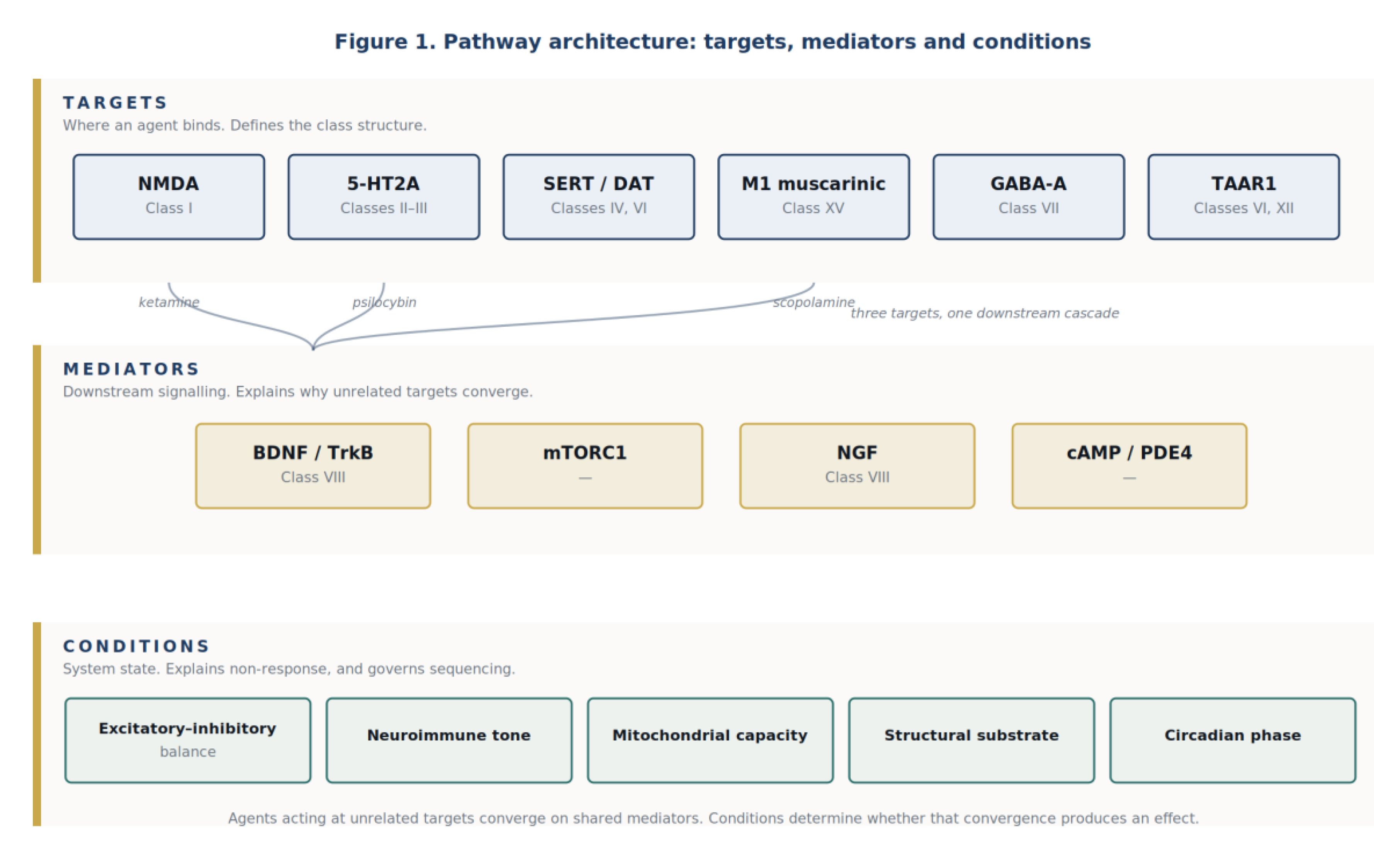
Figure 1.
Pathway architecture. Agents acting at unrelated targets converge on shared mediators; conditions determine whether that convergence produces an effect.
Figure 1.
Pathway architecture. Agents acting at unrelated targets converge on shared mediators; conditions determine whether that convergence produces an effect.
5. Therapeutic Agent Classes
Agents are categorized based on their mechanism of action. Fifteen classes are identified, encompassing a total of one hundred and thirty agents, each numbered sequentially. The assigned number for each agent remains consistent throughout this framework: Section 6 describes its pharmacokinetics using this number, Section 8 links it to specific indications, and Section 10 discusses its use in combinations.
5.0. How Entries are Structured
Each agent has the same eight fields in the same order. If a field cannot be filled, it is marked with a code instead of being left out. This ensures that missing data is always indicated explicitly, not overlooked.
| Field | What it states |
| Mechanism | Receptor or pathway action, and the downstream consequence. |
| Dose and route | The standard method of use, with alternative routes where they exist. |
| Pharmacokinetics | Bioavailability, time to peak, half-life and metabolic pathway, with a cross-reference to the full entry in Section 6. |
| Onset and duration | Time to clinical effect and how long it persists. Frequently not the same as time to peak concentration. |
| Evidence | Tier assignment by indication, with the study type stated. |
| Cautions | Contraindications, adverse effects and the presentations in which the agent is withheld. |
| Interactions | Combinations governed by the rules in Section 10. |
| Position | The framework’s stance on the agent, including where it is included for completeness rather than recommended. |
Composition appears as a ninth field where an agent is a plant preparation, a formula or a peptide whose constituents determine its behaviour.
5.0.1. Two Standards for Plant Preparations and Formulas
A tested formula is considered a single agent. Neither Ayurvedic nor East Asian practices prescribe single compounds; instead, they use formulas consisting of five to twelve ingredients. These ingredients are combined based on principles that determine which components lead, support, moderate toxicity, or direct distribution. Testing a seven-ingredient formula confirms its effectiveness, not the role of individual constituents. As a result, these formulations are presented as single numbered agents, with ingredients listed under Composition, without breaking them down into individual parts.
Product identity is fundamental rather than optional. Surveys of Ayurvedic products sold in the U.S. reveal that about 20% contain lead, mercury, or arsenic, with rasa shastra products — which intentionally add metals — making up a significant portion [117]. Aristolochic acid, found in several historically used Chinese herbs and confusingly substituted plants, is nephrotoxic and carcinogenic, linked to cases of end-stage renal failure and urothelial carcinoma [118]. Alkaloid levels in botanical sources can vary by several hundred percent. Throughout this section, third-party testing for heavy metals and species identification is assumed; any specified doses are based on verified materials.
Data codes. ND — no human study identified, indicating a lack of data rather than poor performance. NE — not established, meaning no definitive value has been determined. NA — not applicable, used for non-pharmacological interventions. Var — indicates values that differ significantly between individuals or preparations. The difference between ND and NE remains consistent: an uncharacterized agent is not the same as one that is poorly absorbed.
5.1. Class I — Glutamatergic Modulators
Agents influencing excitatory neurotransmission do not increase monoamine levels but instead modify glutamatergic signalling, directly inducing synaptic reconstruction. They feature the fastest-acting antidepressant mechanism identified so far.
This class is organized based on their action points along the glutamatergic pathway: starting with receptor antagonists, followed by agents that regulate glutamate availability, then receptor co-agonists and allosteric modulators, next agents acting downstream at AMPA, and finally those with mixed or less well-defined actions.
5.1.1. NMDA Receptor Antagonists
Blocking the NMDA receptor leads to disinhibition of pyramidal cell output and a surge in cortical glutamate levels, thereby activating the downstream plasticity cascade. The clinical outcome depends on the extent and speed of receptor blockade: high-affinity antagonists cause a rapid antidepressant effect with dissociation, while low-affinity fast-off antagonists do not.
Agent 2 · Ketamine and esketamine
Mechanism: Non-competitive NMDA receptor antagonism, primarily at receptors on GABAergic interneurons, causes disinhibition and a surge in cortical glutamate. This process involves AMPA receptor activation, mTORC1 engagement, BDNF release, and rapid spine formation [5,11]. The (R)-enantiomer might have a unique, potentially NMDA-independent profile.
Dose and route: Racemic ketamine 0.5 mg/kg intravenously over 40 minutes is the best-characterized regimen; intramuscular 0.5–1.0 mg/kg; sublingual or oral troche 0.5–3.0 mg/kg. Esketamine nasal spray 56–84 mg twice weekly then tapering, per label.
Pharmacokinetics: F IV 100; IM 93; IN 45–50; SL 25–30; PO 16–24; Tmax IV immediate; PO 30 min; t½ 2–3 h. Metabolism: CYP3A4, CYP2B6 → norketamine. Full entry at Section 6, agent 1.
Onset and duration: Antidepressant effect within 2–24 hours; single-dose benefit sustained approximately 3–7 days; repeated administration extends duration.
Evidence: T1 for treatment-resistant depression [21,22]; T1 for esketamine adjunctive use per registrational program; T2 for post-traumatic stress disorder [23]; T1 for acute suicidal ideation; T3 for chronic pain and complex regional pain syndrome.
Cautions: Dissociation, transient hypertension and tachycardia, nausea, urinary tract toxicity with frequent high-dose use, and a genuine dependence liability understated in much of the clinical literature. Contraindicated in uncontrolled hypertension, aneurysmal vascular disease and active psychosis.
Interactions: Class profile only [NE]. Section 9 governs.
Position: Oral and sublingual bioavailability are major sources of unpredictability in at-home telehealth, as individual exposure can vary greatly even with the same dose. This issue stems from formulation challenges, not prescribing practices.
Bioavailability: Intravenous ~100%; intramuscular ~93%; intranasal ~45–50%; sublingual ~25–30%; oral ~16–24%. Extensive first-pass metabolism to norketamine. See Section 6.2.
Agent 3 · Memantine
Mechanism: It is a low-affinity, uncompetitive NMDA antagonist characterized by a rapid off-rate, which blocks ongoing pathological activation while sparing normal phasic signalling. Its quick off-rate prevents it from dissociating rapidly, explaining why it does not produce an immediate antidepressant effect.
Dose and route: Oral, 5 mg daily adjusted gradually to 10 mg twice daily.
Pharmacokinetics: F ~100; Tmax 3–8 h; t½ 60–80 h. Metabolism: Minimal; renal excretion unchanged. Full entry at Section 6, agent 3.
Onset and duration: Onset weeks; duration steady state ~2 wk.
Evidence: T1 for moderate–severe Alzheimer disease; T2 for obsessive-compulsive disorder augmentation [24]; T3 for pathological gambling and binge eating.
Cautions: Dizziness, confusion. Renal dose adjustment required.
Interactions: Class profile only [NE]. Section 9 governs.
Bioavailability: Oral ~100%; largely excreted unchanged.
5.1.2. Glutamate Homeostasis
Agents target the cystine–glutamate antiporter and extrasynaptic glutamate levels, not the receptor itself. The effects take weeks to appear, not hours.
Agent 4 · N-acetylcysteine
Mechanism: Cystine–glutamate antiporter substrate; it restores extrasynaptic glutamate levels and normalizes glutamatergic activity in reward circuitry. Also acts as a precursor to glutathione and exhibits anti-inflammatory effects.
Dose and route: Oral, 1,200–2,400 mg daily in divided doses.
Pharmacokinetics: F 4–10; Tmax 1–2 h; t½ 5.6 h. Metabolism: Extensive first-pass; incorporated into cysteine pool. Full entry at Section 6, agent 4.
Onset and duration: Eight weeks to full effect. Start before any session-based intervention.
Evidence: T2 for trichotillomania and excoriation [26,159]; T2 for substance craving across several substances; T3 for obsessive-compulsive disorder [28] augmentation; T3 for bipolar depression adjunct [25].
Cautions: Gastrointestinal effects. Sulphur odour affects adherence.
Interactions: Class profile only [NE]. Section 9 governs.
Bioavailability: Oral ~4–10%. Extensive first-pass metabolism, with rapid incorporation into protein and cysteine pools. The low absorbed fraction is a principal reason effective doses fall in the gram range rather than the milligram range the receptor pharmacology would suggest.
5.1.3. NMDA co-Agonists and Allosteric Modulators
Agents that act at the glycine co-agonist site or target the magnesium block enhance receptor function rather than inhibit it. They are used in cases of hypofunction rather than pathological overactivation.
5.1.4. NMDA co-Agonists and Transporter Modulators
Act at the glycine co-agonist site rather than at the channel, enhancing rather than blocking receptor function. Used where the deficit is hypofunction, and directly antagonistic to the antagonists at 5.1.1.
Agent 5 · Glycine
Mechanism: Obligatory co-agonist at the NMDA glycine site; also an inhibitory neurotransmitter at its own receptor in brainstem and spinal cord.
Dose and route: Oral, 3 g at night for sleep endpoints; 30–60 g daily in divided doses for schizophrenia adjunct.
Pharmacokinetics: F good; Tmax approximately 1 h; t½ approximately 1 h. Metabolism: glycine cleavage system; the large doses required reflect rapid clearance.
Onset and duration: Onset acute for sleep quality; weeks for adjunctive endpoints.
Evidence: T2 for negative and cognitive symptoms in schizophrenia as adjunct; T3 for subjective sleep quality at 3 g.
Cautions: Mild nausea at gram doses. Not to be combined with NMDA antagonists, which act in the opposite direction.
Interactions: Opposes ketamine and memantine pharmacodynamically. Section 9 governs.
Position: The sleep indication at 3 g is well tolerated and separate from the adjunctive use at twenty times that dose.
Agent 6 · D-serine
Mechanism: Endogenous co-agonist at the NMDA glycine site, more potent than glycine at that site.
Dose and route: Oral, 30–120 mg/kg daily.
Pharmacokinetics: F NE; Tmax approximately 2 h; t½ approximately 4 h. Metabolism: D-amino acid oxidase.
Onset and duration: Onset weeks; ongoing.
Evidence: T2 for negative and cognitive symptoms in schizophrenia as adjunct.
Cautions: Nephrotoxicity signals at high dose in animal models are the principal reason for caution and for renal monitoring in extended use.
Interactions: Opposes NMDA antagonists. Section 9 governs.
Position: More potent than glycine at the target site but carries a renal signal glycine does not.
Agent 7 · Sarcosine
Mechanism: Glycine transporter type 1 inhibition, raising synaptic glycine indirectly rather than supplying it.
Dose and route: Oral, 1–2 g daily.
Pharmacokinetics: F NE; Tmax ND; t½ ND. Metabolism: sarcosine dehydrogenase to glycine.
Onset and duration: Onset weeks; ongoing.
Evidence: T2 for negative symptoms in schizophrenia as adjunct; T3 for obsessive-compulsive disorder.
Cautions: Well tolerated at the doses studied. Opposes NMDA antagonists.
Interactions:Section 9 governs.
Position: Achieves at 1–2 g what glycine requires 30–60 g to achieve, which makes it the more practical of the two.
Agent 8 · Magnesium L-threonate
Mechanism: Magnesium blocks the NMDA channel pore when at rest, and the threonate form is promoted for its ability to penetrate the central nervous system rather than for its absorption.
Dose and route: Oral, 1,000–2,000 mg of the threonate salt.
Pharmacokinetics: F elemental magnesium approximately 8% of salt weight; Tmax 2–3 h; t½ ND. Metabolism: renal excretion; not metabolized. The central penetration claim rests on rodent data and has not been demonstrated in humans. Full entry at Section 6, agent 8.
Onset and duration: Onset weeks; duration —.
Evidence: T3 for cognitive endpoints [27]; T4 for the CNS penetration claim in humans.
Cautions: Gastrointestinal effects at higher doses. Renal impairment requires caution.
Interactions: Class profile only [NE]. Section 9 governs.
Bioavailability: Elemental magnesium content is approximately 8%, so a 2,000 mg dose supplies about 144 mg of magnesium. The CNS penetration claim rests on rodent data.
5.1.5. AMPA Receptor Modulators
Agents acting downstream of NMDA at the AMPA receptor are where the plasticity cascade actually begins. This class is small, and the evidence is typically indication-specific, often misrepresented.
Agent 9 · Piracetam
Mechanism: AMPA receptor modulation with additional membrane-fluidity and microcirculatory effects; mechanism remains incompletely defined after five decades.
Dose and route: Oral. 9.6–24 g daily in divided doses for myoclonic indications, with considerable inter-individual variation in optimal dose. Consumer dosing of 1.2–4.8 g has no established indication.
Pharmacokinetics: F ~100; Tmax 0.5–1.5 h; t½ 4–5 h. Metabolism: Not metabolized; renal excretion unchanged. Full entry at Section 6, agent 9.
Onset and duration: Onset weeks (myoclonus); duration —.
Evidence: T1 is used for progressive myoclonus epilepsy of Unverricht-Lundborg type and cortical myoclonus. A multicenter, randomized, double-blind crossover study compared three daily doses with placebo, revealing a linear and statistically significant dose-response relationship, with 24 g daily being the most effective [105,106]. T4 is aimed at memory and cognitive enhancement: a 2024 systematic review and meta-analysis of eighteen studies with 886 patients showed a standardized mean difference of 0.75, with a confidence interval from -0.19 to 1.69, p = 0.12, and high heterogeneity at 96% [100]. Cochrane states that the evidence is inconsistent and not strong enough to support use in dementia or cognitive impairment [101]. T3 is for post-stroke aphasia; however, the manufacturer’s own confirmatory trial was halted at interim due to a success probability below twenty percent [103], and earlier positive results were not confirmed in later meta-analyses [104].
Cautions: Unusually benign safety profile even at 24 g daily. Renal clearance — dose adjustment required in impairment. Reports of irritability and agitation. Abrupt discontinuation was not always well tolerated in myoclonus patients.
Interactions: Class profile only [NE]. Section 9 governs.
Position: The reference case for the principle in Section 3 involves a compound sold at a fraction (between a fifth and a twentieth) of the dose shown to be effective, for an indication where its efficacy was not demonstrated. The often-cited positive meta-analysis was carried out by manufacturer employees and consultants, and included unpublished company data that were not accessible to Cochrane reviewers. Allowing industry-produced meta-analyses to be judged equally with independent ones tends to systematically inflate their perceived validity. The compound is used for the myoclonic indication under specialist supervision, but it is not recommended for cognitive enhancement. The manufacturer-authored meta-analysis is at reference [102].
5.1.6 Mixed and Incompletely Characterized
Agent 10 · Agmatine
Mechanism: Decarboxylated arginine; NMDA receptor antagonism, imidazoline receptor agonism, nitric oxide synthase modulation. The NMDA convergence with ketamine is the basis of interest.
Dose and route: Oral, 250–1,000 mg daily.
Pharmacokinetics: F NE; Tmax approximately 2 h; t½ approximately 2 h. Metabolism: agmatinase to putrescine; renal clearance. Full entry at Section 6, agent 10.
Onset and duration: Onset days to weeks; duration —.
Evidence: T3 for depression from a small open trial; T3 for neuropathic pain; T4 for the mechanism.
Cautions: Hypotension. Limited long-term data. Treat as a glutamatergic agent for interaction purposes.
Interactions: Class profile only [NE]. Section 9 governs.
5.1.7. Class Position
Where this class fits. Class I includes the only agents in this framework capable of producing a measurable antidepressant effect within twenty-four hours. This quick action is due to directly targeting the plasticity cascade rather than changing monoamine levels, making this class a priority first. Two key protocol considerations are: agents that have opposing effects at the same receptor, such as antagonists at 5.1 and co-agonists at 5.3, should not be used together. Also, since the cascade consumes substrate, the effectiveness of Class I agents is limited when the structural resources outlined in Class VIII are depleted. The sequence rule for this is detailed in Section 10.2.
5.2. Class II — Tryptamine Psychedelics
Indole-based 5-HT2A agonists share a common plasticity mechanism, but they vary significantly in duration, route, metabolic stability, and autonomic impact. These differences are mainly due to pharmacokinetics and can be managed through formulation strategies.
Agent 11 · Psilocybin and psilocin
Mechanism: Psilocybin is a prodrug that becomes psilocin after dephosphorylation by alkaline phosphatase. Psilocin acts as an agonist at 5-HT2A, 2C, and 1A receptors. Its effects include the release of glutamate in the cortex, the formation of dendritic spines that last over a month in rodent imaging [8], desegregation of the default mode network, and increased overall brain connectivity.
Dose and route: 25 mg synthetic psilocybin is the modal supervised dose; 10 mg is an active comparator; 0.1–0.3 mg/kg is used in academic protocols. Sub-perceptual dosing 1–3 mg.
Pharmacokinetics: F Psilocin 52.7 ± 20; Tmax 1.8–4 h (psilocin); t½ Psilocybin 50 min; psilocin 1.5–4 h. Metabolism: Dephosphorylated to psilocin; CYP2D6, CYP3A4, MAO-A [140,141]. Full entry at Section 6, agent 11.
Onset and dur[29,30ation: Oral onset 20–40 minutes, peak 60–180 minutes, total 4–6 hours, with a supervised session conventionally scheduled at 6–8 hours.
Evidence: T1 used for treatment-resistant depression [29,30], major depressive disorder [31], alcohol use disorder [32], and psychological distress in life-threatening illness [34,35]; T2 for tobacco dependence [33], cluster headache [36], and obsessive-compulsive disorder [37]; T3 for demoralization in long-term AIDS survivors.
Cautions: Transient anxiety and blood pressure increases can occur, making it absolutely contraindicated for individuals with a personal or first-degree family history of psychotic-spectrum disorders. It also interacts with serotonergic drugs; while selective serotonin reuptake inhibitors tend to reduce subjective intensity, recent data indicate that their efficacy might be less impacted than once thought.
Interactions: Class profile only [NE]. Section 9 governs.
Formulation note: The 6–8 hour supervised session is the main obstacle limiting clinical scalability, as it necessitates two practitioners working throughout the entire day. Consequently, onset acceleration and duration compression are not just conveniences; they are key factors influencing the cost per client and the viability of reimbursement.
Agent 12 · Lysergic acid diethylamide
Mechanism: Ergoline exhibits high-affinity agonism at 5-HT2A receptors, along with activity at 5-HT1A, 5-HT2C, and dopaminergic D2 receptors. Its unusually slow receptor dissociation kinetics are due to a β-arrestin-stabilized binding conformation, explaining its prolonged duration.
Dose and route: 100–200 µg supervised; 25–50 µg low-dose; 5–20 µg sub-perceptual.
Pharmacokinetics: F ~71; Tmax 1.4–1.5 h; t½ 3–5 h. Metabolism: CYP-mediated → 2-oxo-3-hydroxy-LSD. Full entry at Section 6, agent 12.
Onset and duration: Onset 30–90 minutes; total duration 8–12 hours.
Evidence: T1 is used for generalized anxiety disorder [38], T2 for anxiety related to life-threatening illness [39], the current orally disintegrating tablet program addresses major depressive disorder and generalized anxiety, T3 for cluster headache, and T3 also for alcohol use disorder based on pooled historical randomized data [40].
Cautions: Duration is the dominant clinical limitation. Hallucinogen persisting perception disorder is rare. Same psychosis contraindication as psilocybin.
Interactions: Class profile only [NE]. Section 9 governs.
Agent 13 · N,N-dimethyltryptamine
Mechanism: 5-HT2A agonist with substantial sigma-1 receptor activity [15]; orally inactive owing to rapid monoamine oxidase A degradation.
Dose and route: Inhaled/vaporized 30–60 mg; intravenous 0.1–0.3 mg/kg, increasingly delivered by controlled infusion to extend and shape the exposure; intramuscular; buccal film in current development.
Pharmacokinetics: F Oral ~0 without MAOI; Tmax Inhaled <2 min; t½ ~15 min. Metabolism: MAO-A deamination → indole-3-acetic acid. Full entry at Section 6, agent 13.
Onset and duration: Inhaled: onset seconds, duration 5–20 minutes. Intravenous infusion permits an extended plateau of 30 minutes or more.
Evidence: T2 pertains to major depressive disorder based on current controlled studies; T3 derives from observational research and ayahuasca-context studies; T4 involves sigma-1-mediated neuroprotection and immune system modulation.
Cautions: A very quick onset can feel overwhelming if not anticipated. Oral ingestion involves monoamine oxidase inhibition, leading to significant interaction risks (Section 9).
Interactions: Class profile only [NE]. Section 9 governs.
Agent 14 · 5-MeO-DMT (mebufotenin)
Mechanism: A potent 5-HT1A and 5-HT2A agonist with a notably high 5-HT1A component, leading to a unique non-dual or ego-dissolving experience that differs from the visual-perceptual effects seen with other tryptamines.
Dose and route: Vaporized freebase 5–18 mg, typically by individualized escalation; intranasal benzoate salt in current controlled development; sublingual and buccal routes under investigation.
Pharmacokinetics: F Oral ~0 without MAOI; Tmax inhaled 1–2 min; t½ ~12–19 min. Metabolism: MAO-A; CYP2D6 → bufotenine. Full entry at Section 6, agent 14.
Onset and duration: Inhaled: onset 5–10 seconds, total duration 5–30 minutes. This is the shortest supervised session of any agent in the class and is the principal source of its commercial valuation.
Evidence: T2 for treatment-resistant depression from current controlled programs; T3 from observational cohorts [41]; T5 from extensive field use.
Cautions: Since Bufo alvarius-derived material varies chemically and includes bufotenin and cardioactive bufadienolides, synthetic material is generally preferred for safety and conservation reasons. Interactions with serotonergic agents, especially monoamine oxidase inhibitors, can be potentially deadly.
Interactions: Class profile only [NE]. Section 9 governs.
5.2.1. Harmala Alkaloids
The β-carbolines of Banisteriopsis caapi and Peganum harmala. Their monoamine oxidase A inhibition is what renders oral dimethyltryptamine active, and it is also the most consequential interaction liability in this framework. They differ from one another by an order of magnitude in inhibitory potency and in what else they do.
Agent 15 · Harmine
Mechanism: Reversible monoamine oxidase A inhibition, Ki 0.005 µM — the most potent inhibitor characterized here. Separately inhibits DYRK1A, which raises human neural progenitor proliferation [42,43] by a pathway unrelated to its enzymatic action.
Dose and route: Oral, 100–200 mg as part of a combination preparation.
Pharmacokinetics: F low with extensive first pass; Tmax 1–2 h; t½ 1–3 h. Metabolism: CYP2D6 to harmol.
Onset and duration: Onset 30–60 min; duration 3–4 h, and monoamine oxidase inhibition persists through it.
Evidence: T2 as a component of ayahuasca in the controlled trial record; T3 for the DYRK1A neurogenic finding in human neural progenitor culture; T4 for the enzymatic mechanism, which is well characterized.
Cautions: Tyramine and serotonergic exclusions apply for the duration of inhibition. Nausea and emesis are near universal at active dose.
Interactions: Absolute exclusion with serotonergic agents and sympathomimetics. See Section 6.6 and Section 9.
Position: The DYRK1A finding is why the vine is characterized as an agent in its own right rather than as a delivery adjunct.
Agent 16 · Harmaline
Mechanism: Reversible monoamine oxidase A inhibition, Ki 0.048 µM — roughly tenfold weaker than harmine. Additional tremorgenic activity at higher doses.
Dose and route: Oral, as a component of a combination preparation.
Pharmacokinetics: F low; Tmax 1–2 h; t½ approximately 2 h. Metabolism: CYP2D6.
Onset and duration: Onset 30–60 min; duration 3–4 h.
Evidence: T4 for the enzymatic mechanism; T5 for traditional use as a component.
Cautions: As harmine, with a more pronounced emetic and tremorgenic profile.
Interactions: As harmine. See Section 6.6 and Section 9.
Position: Contributes to the physical character of the whole preparation more than to its enzymatic function.
Agent 17 · Tetrahydroharmine
Mechanism: Weak monoamine oxidase A inhibition with additional serotonin reuptake inhibition, which distinguishes it from the other two.
Dose and route: Oral, as a component of a combination preparation.
Pharmacokinetics: F NE; Tmax approximately 1.5 h; t½ approximately 3 h. Metabolism: CYP-mediated.
Onset and duration: Onset 30–60 min; duration 3–4 h.
Evidence: T4. Present in Banisteriopsis caapi in variable proportion.
Cautions: The reuptake inhibition adds serotonergic load beyond that of the enzymatic effect.
Interactions: Serotonergic; Gate 3 applies. See Section 9.
Position: Its reuptake activity is the reason the whole preparation carries a serotonergic profile that pure monoamine oxidase inhibition would not explain.
5.2.2. Ayahuasca — Controlled Clinical Evidence
Agent 18 · Ayahuasca in treatment-resistant depression
Mechanism: 5-HT2A agonism by N,N-dimethyltryptamine, rendered orally active by reversible monoamine oxidase A inhibition from the β-carbolines of Banisteriopsis caapi. Sigma-1 activity is additionally attributed to DMT, and the vine contributes DYRK1A inhibition independent of its enzymatic action.
Dose and route: Oral (standard). Alternative routes: —. Dose as stated in the class text.
Pharmacokinetics: F Enabled by β-carbolines; Tmax 1.5–2 h; t½ see components. Metabolism: MAO-A inhibited by β-carbolines, permitting oral DMT. Full entry at Section 6, agent 18.
Onset and duration: Onset 30–60 min; duration 4–6 h.
Evidence: T2. A randomized, placebo-controlled trial of a whole-plant preparation — the only one in this framework — was tiered based on that criterion rather than the traditional-use designation that plant preparations often attract. The primary limitation is sample size, not the study design.
Cautions: Unchanged. Monoamine oxidase inhibition remains the governing hazard, and the trial population was screened accordingly.
Interactions: Class profile only [NE]. Section 9 governs.
Study: Palhano-Fontes et al., parallel-arm double-blind randomized placebo-controlled trial, Federal University of Rio Grande do Norte, Natal. Published in Psychological Medicine, 2019 [137].
Design: Patients with treatment-resistant major depression were given a single dose of either ayahuasca or placebo. The main measure was the change in Hamilton Depression Rating Scale scores after seven days; secondary measures included MADRS scores. All participants were new to ayahuasca, which helped maintain blinding integrity despite the challenging nature of the preparation.
Result: Significant antidepressant effect against placebo, evident from the first day after dosing. Serum BDNF modulation was measured in a companion [177] analysis from the same trial [138].
Context: Ayahuasca has been legally permitted for ritual use in Brazil since 1987, enabling controlled research. The research teams in Natal and Ribeirão Preto have generated extensive imaging, endocrine, and clinical studies.
5.2.3. Banisteriopsis Caapi as an Independent Agent
This framework has depicted B. caapi as the key element of ayahuasca — providing the monoamine oxidase inhibition necessary for oral dimethyltryptamine to be active. However, that description is incomplete.
Agent 19 · Banisteriopsis caapi — β-carboline alkaloids
Composition: Harmine, harmaline and tetrahydroharmine, with harmol as a harmine metabolite.
Mechanism: Reversible monoamine oxidase A inhibition by harmine, harmaline and tetrahydroharmine, and separately DYRK1A inhibition by harmine, which raises neural progenitor proliferation by a pathway unrelated to monoamine oxidase. Tetrahydroharmine contributes weak serotonin reuptake inhibition.
Dose and route: Oral (standard). Alternative routes: —. Dose as stated in the class text.
Pharmacokinetics: F see harmine; Tmax 1–2 h; t½ 1–3 h. Metabolism: CYP2D6. Full entry at Section 6, agent 19.
Onset and duration: Onset 30–60 min; duration 3–4 h.
Evidence: T4 for the neurogenic and DYRK1A mechanisms, which are in vitro and preclinical and should not be overstated. T2 for monoamine oxidase A inhibition. T3 for antidepressant effect of whole B. caapi preparations from open-label clinical work.
Cautions: Unchanged and consistent. Inhibition of monoamine oxidase A has systemic effects, lasts for hours, and poses the greatest risk of interactions within this context. The neurogenic finding does not change the exclusions outlined in Sections 20 and 21.
Interactions: Class profile only [NE]. Section 9 governs.
Established mechanism: Reversible competitive monoamine oxidase A inhibition. Harmine and harmaline are strong competitive inhibitors at low concentration, with reported Ki values of 0.005 and 0.048 µM, respectively [124].
The second mechanism: All three main alkaloids, along with the harmine metabolite harmol, promote adult neurogenesis in vitro. When using neurospheres derived from progenitor cells from the subventricular and subgranular zones of adult mouse brains, each compound tested encouraged neural stem cell growth, movement, and maturation into adult neurons.
The key dissociation that is important: The neurogenic effect is not caused by monoamine oxidase inhibition. In human neural progenitor cells, harmine boosted the proliferating pool by 57% over four days. INDY, a selective DYRK1A inhibitor, replicated this effect; in contrast, pargyline—a specific, irreversible monoamine oxidase inhibitor without DYRK1A activity—did not [126]. This effect occurs through inhibition of dual-specificity tyrosine-phosphorylation-regulated kinase 1A, which controls progenitor cell proliferation, and it is independent of its enzymatic inhibition, which is its usual mode of action.
Neurotrophic signalling: Harmine raises hippocampal BDNF after both acute and chronic administration — an effect not shared by imipramine under the same conditions [125].
Behavioural data: Responses to harmine alone in forced swim and open field tests resemble those seen with full ayahuasca containing dimethyltryptamine, implying that the tryptamine isn't necessary for the antidepressant-like behaviour in animals [125].
Why this reframes the preparation. The traditional view considers the vine as a delivery tool and the leaf as the active component. However, pharmacological evidence refutes this division. B. caapi possesses an independent neurotrophic mechanism functioning through a kinase pathway unrelated to its enzymatic activity, and animal behavioural studies indicate it significantly contributes to the antidepressant effects seen with the whole preparation.
This leads to three implications for the framework. First, the vine should be classified in Class VIII as a neurotrophic agent, not only in Class XIV as a potentiator. Second, DYRK1A should be recognized as a target involved in mechanisms separate from BDNF and mTOR signalling. Lastly, the traditional use of caapi alone — well documented ethnographically and largely overlooked in clinical research in favour of the combined brew — now has a pharmacological basis it was not previously recognized for.
This framework does not, on this basis, recommend B. caapi. In vitro neurogenesis in a neurosphere preparation is a mechanistic observation, and the gap between this and a clinical recommendation highlights the purpose of the framework.
Why this reframes the preparation. The traditional view considers the vine as a delivery method and the leaf as the active component. B. caapi operates through an independent neurotrophic pathway via a kinase mechanism, separate from its enzymatic function. Animal behavioural studies indicate it significantly contributes to the antidepressant effects seen with the entire preparation. Consequently, the vine should be classified in Class VIII as a neurotrophic agent rather than in Class XIV as a potentiator. Additionally, DYRK1A is identified as a target within a mechanism set that is distinct from BDNF and mTOR signalling.
In vitro neurogenesis in a neurosphere preparation is a mechanistic observation. The distance between it and a clinical recommendation is the distance this framework exists to maintain.
5.2.4. Additional Tryptamines and Entheogenic Sources
The following substances are documented in the ethnopharmacological record with enough detail to identify them and are observed in field practice. However, they were not included in Section 6. The evidence levels are mainly T4 and T5, and this is explicitly noted. Their inclusion indicates that practitioners encounter these agents in practice, not that there is any clinical backing.
5.2.5. Synthetic Tryptamines Characterized at Bioassay Tier
Orally active tryptamines documented in the bioassay record and used historically in supervised settings, without a modern trial literature to quantify them.
Agent 20 · DPT (dipropyltryptamine)
Mechanism: N,N-dialkyltryptamines with 5-HT2A agonism; profiles varying with alkyl chain length. DPT is orally active, unlike dimethyltryptamine.
Dose and route: Oral, IM (standard). Alternative routes: Inhaled. Dose as stated in the class text. Dose ranges follow the bioassay record in TiHKAL [186].
Pharmacokinetics: F NE; Tmax ND; t½ ND. Metabolism: ND. Full entry at Section 6, agent 22.
Onset and duration: Onset 20–40 min oral; duration 2–4 h.
Evidence: T3 for DPT from limited historical psychotherapeutic work in terminal illness; T5 otherwise, including documented sacramental use by a religious body in the United States.
Cautions: Human safety characterization is limited to the bioassay record. Serotonergic; Gate 3 applies. DPT has been used in supervised therapeutic settings historically and carries the cardiovascular and psychological cautions of the class without a modern trial record to quantify them.
Interactions: Class profile only [NE]. Section 9 governs.
Position: Included because the tryptamine series shows that oral activity, duration, and character can be adjusted through substitution — this is the same principle behind the deuterated analogues discussed in Section 9. The traditional and modern methods for addressing this issue are interconnected.
Agent 21 · Calea zacatechichi and Silene capensis
Mechanism: Not established. Calea is proposed to act on acetylcholine and on sleep architecture; Silene capensis has no characterized mechanism. Neither is a classical psychedelic, and neither acts at 5-HT2A in any demonstrated way.
Dose and route: Oral infusion or smoked, taken before sleep. Silene capensis root is taken as a foamed cold-water infusion on an empty stomach.
Pharmacokinetics: No human pharmacokinetic study identified [ND]. Active constituents are not established for either species.
Onset and duration: Effects are reported during sleep and on waking rather than in the waking state; no acute onset in the usual sense.
Evidence: T3 for Calea from small controlled sleep studies reporting increased dream recall and superficial sleep stages; T5 for Silene.
Cautions: Bitter and emetic at higher infusion strengths. Both are used in traditions concerned with dreaming rather than with waking-state effects, and characterizing them alongside the psychedelics risks a category error.
Interactions: Class profile only [NE]. Section 9 governs.
Position: This is noted because dream-directed practice is a valid yet under-researched category, closely linked to the cholinergic REM findings in Section 10A.3, and because clients working developmentally often ask about it.
5.2.6. Tryptamines Identified Solely at the Mechanistic or Traditional Tier.
Reported for completeness. There is no evidence supporting clinical use beyond T4, and none are advised.
| No. | Agent | Mechanism | Tier | Principal caution |
| 22 | Ergine, baeocystin, norbaeocystin and 4-AcO- | Minor tryptamines co-occurring with psilocybin in fungal material (baeocystin, norbaeocystin) or synthesized … | T4/T5 | Class cautions apply [NE]. |
| 23 | Ergine (D-lysergic acid amide, LSA) | 5-HT2A partial agonist; roughly an order of magnitude less potent than lysergic acid diethylamide and with a … | T4/T5 | Seeds are frequently treated with fungicides. Vasoconstriction from ergot alkaloids is a genuine concern and the sedati… |
| 24 | Bufotenine (5-hydroxy-N,N-dimethyltryptamine [88] | 5-HT2A agonist. The 5-hydroxy substitution markedly reduces blood-brain barrier penetration relative to the 5… | T4/T5 | Pronounced cardiovascular effects, facial flushing and considerable physical discomfort. Its presence in toad-derived m… |
5.2.7. Class Position
The best-evidenced class in this framework and the one carrying the largest trial record. Its agents differ from one another principally in route and duration rather than in mechanism, which makes route the practical selection variable: psilocybin for a supervised session of fixed length, the short-acting tryptamines where session time is constrained, the β-carboline combinations where oral administration is required. Gate 1 and Gate 3 govern the whole class and exclude a substantial proportion of those who seek it.
5.3. Class III — Phenethylamine Psychedelics
This class is often overlooked in reviews and facilitator curricula but is pharmacologically distinct from tryptamines in clinically relevant ways. Phenethylamine psychedelics have an adrenergic component missing from indoles, leading to increased cardiovascular stress, physical stimulation, and, in the case of mescaline, the longest duration among commonly used agents. Additionally, this group serves as a chemical link between psychedelics and non-psychedelic trace amines discussed in Class VI. β-phenylethylamine, mescaline, and substituted amphetamines share a common backbone; viewing them as separate categories is a scheduling artifact rather than a reflection of their chemistry.
Agent 25 · Mescaline
Mechanism: 3,4,5-Trimethoxyphenethylamine is a 5-HT2A agonist that has lower potency compared to tryptamines, necessitating doses three orders of magnitude higher. It also exhibits significant adrenergic activity and interacts with 5-HT1A and 5-HT2C receptors [44].
Dose and route: 200–800 mg mescaline sulphate or hydrochloride; a moderate supervised dose is approximately 300–500 mg. In Trichocereus material, the alkaloid content is highly variable, which is the central obstacle to controlled use.
Pharmacokinetics: F High; largely excreted unchanged; Tmax 2 h; t½ ~6 h. Metabolism: MAO; 30–60% excreted unchanged renally. Full entry at Section 6, agent 24.
Onset and duration: Oral onset 45–90 minutes, frequently accompanied by nausea; peak 4–6 hours; total duration 10–14 hours, the longest of any agent reviewed here.
Evidence: T3 for depression, anxiety and post-traumatic stress from large observational survey work [45]; T3 for substance use disorder from Native American Church epidemiology, where long-term peyote use shows no evidence of cognitive or psychological harm [46]; T5 for extensive ceremonial record spanning millennia.
Cautions: Pronounced nausea and vomiting occur at the start, partly due to the alkaloid load and partly from cactus material. Significant and persistent increases in blood pressure and heart rate require more rigorous cardiovascular screening than is typical for psilocybin. The 10–14 hour duration makes supervised use economically impractical in most clinical environments.
Interactions: Class profile only [NE]. Section 9 governs.
Formulation note: Mescaline exemplifies a case where delivery science limits effectiveness more than pharmacology. A formulation that achieves the same central exposure at a lower dose could reduce the emetic effects, adrenergic load, and duration — tackling three challenges with one solution.
5.3.1. Mescaline-Bearing Trichocereus Species
Columnar cacti of the genus Echinopsis, formerly Trichocereus, are used in Andean practice and widely available. Assayed mescaline content varies from 0.053 to 4.7 percent of dry weight across fourteen taxa, so species is not a reliable guide to potency and weight is not a reliable guide to dose.
Agent 26 · Trichocereus pachanoi, T. peruvianus and T. bridgesii
Composition: Mescaline is the main active compound, usually making up 0.3–2.4% of dry weight in the photosynthetic tissue. [185] It exhibits sharp gradients between the outer chlorophyll layer and the inner core. This is accompanied by hordenine, tyramine, 3-methoxytyramine, and other minor phenethylamines.
Mechanism: 5-HT2A agonism through mescaline, as at Agent 18. Accompanying alkaloids present in smaller quantities include 3-methoxytyramine, hordenine, tyramine and anhalonidine; none is established as contributing materially to the psychoactive effect, and the pharmacology of the whole preparation has not been characterized separately from that of its principal alkaloid.
Dose and route: Oral intake of these substances occurs in five different forms, each with varying concentrations and not interchangeable by weight: fresh cut stem, dried and powdered tissue, traditional boiled decoction, reduced resin or extract, and encapsulated powder. An approximate dose of 300 mg mescaline is equivalent to about 100 g of dry T. pachanoi, 37.5 g of dry T. peruvianus, or 27 g of dry L. williamsii. The common Andean method involves boiling sliced stems for six to eight hours to prepare a decoction. Microdosing with standardized extract is common; however, these practices lack extensive documentation in published research.
Pharmacokinetics: Mescaline (Agent 25) absorption is delayed due to the plant matrix and the volume of material or liquid ingested. To date, no pharmacokinetic study has been published on a whole-plant preparation.
Onset and duration: Oral onset 60–120 minutes, later than isolated mescaline; peak 4–6 hours; total duration 10–14 hours. Nausea in the first two hours is near universal with whole-plant preparations and is attributed to the alkaloid load together with the cactus material itself.
Evidence: T5 relates to traditional Andean ceremonial use documented over about three thousand years, while T3 pertains to recent observational outcomes reported within combined-mescaline survey data.
Cautions: Alkaloid levels vary based on species, cultivar, plant age, tissue location, season, and growing conditions, resulting in a dose variability of several hundred percent among different preparations. Furthermore, the content of hordenine and tyramine presents an overlooked interaction risk for those using monoamine oxidase inhibitors.
Interactions: Class profile only [NE]. Section 9 governs.
Position: Standardized extraction coupled with verified alkaloid quantification is essential for responsible use of this material in any supervised environment. The lack of this standard is the main safety concern in the current facilitation field.
Agent 27 · Peyote (Lophophora williamsii) — conservation note
Mechanism: 5-HT2A agonism induced by mescaline, similar to Agent 18, with a wider alkaloid profile than Trichocereus that includes pellotine, anhalonidine, anhalamine, and lophophorine.
Dose and route: Oral consumption can be in the form of dried buttons or a decoction. An equivalent dose of 300 mg mescaline requires about 27 g of dry material, making it the most concentrated mescaline-containing cactus by weight.
Pharmacokinetics: As mescaline (Agent 25). No pharmacokinetic study of the whole preparation has been published.
Onset and duration: Oral onset 60–120 minutes; peak 4–6 hours; total duration 10–14 hours.
Evidence: T3 for substance use disorder from Native American Church epidemiology, where long-term ceremonial use is associated with no evidence of neurocognitive deficit; T5 for the ceremonial tradition itself, documented over more than five thousand years.
Cautions: As mescaline. Slow-growing and conservation-restricted; see Position.
Interactions: Class profile only [NE]. Section 9 governs.
Position: This review takes that request as binding. Where mescaline is clinically indicated, synthetic material or cultivated Trichocereus should be used.
Popular Psychedelic Drug Comparative Summary
| Agent | Primary receptor | Typical dose | Duration | Distinguishing feature |
| Psilocybin | 5-HT2A/2C/1A | 25 mg | 4–6 h | Best evidence base in class; prodrug kinetics |
| LSD | 5-HT2A, D2 | 100–200 µg | 8–12 h | Slow receptor dissociation; longest indole duration |
| DMT | 5-HT2A, sigma-1 | 30–60 mg inhaled | 5–20 min | Orally inactive; sigma-1 activity |
| 5-MeO-DMT | 5-HT1A > 5-HT2A | 5–18 mg vaporized | 5–30 min | Shortest session; non-dual phenomenology |
| Mescaline | 5-HT2A + adrenergic | 200–800 mg | 10–14 h | Adrenergic load; longest duration; emetic |
| 2C-B | 5-HT2A partial | 10–20 mg | 4–6 h | Entactogenic at low dose; steep curve |
Agent 28 · 2C-B (4-bromo-2,5-dimethoxyphenethylamine)
Mechanism: Acts as a partial agonist at 5-HT2A, 5-HT2B, and 5-HT2C receptors. It is a ring-substituted mescaline analogue featuring a bromine atom at the four position, which enhances potency roughly tenfold. Its effects are strongly dose-dependent within a narrow range, shifting from entactogenic and sensory experiences at lower doses to fully psychedelic effects at higher doses.
Dose and route: Oral, as powder, capsule or tablet. Shulgin gives 12–24 mg [179]. Contemporary ranges are 5–10 mg low, 10–25 mg medium and 25–40 mg high; Shulgin separately reported administration to 100 mg without apparent harm. Insufflation is used and produces a shorter, more intense course at roughly half the oral dose, with marked local pain.
Pharmacokinetics: F NE; Tmax 1.5–2 h; t½ approximately 3–4 h. Metabolism: monoamine oxidase and CYP2D6, with deamination the principal route. Human plasma concentrations characterized to six hours at 10, 15 and 20 mg oral [180].
Onset and duration: Oral onset 30–90 minutes; duration 2–5 hours, shorter than any other agent in this class. Effects are described as arriving in waves rather than as a plateau.
Evidence: T2 relates to the acute subjective and physiological effects observed in an observational study involving pharmacokinetics [180], and also from a controlled comparison with psilocybin assessing subjective experience, mood, and cognition [181]. T3 pertains to therapeutic applications, based on clinical use by Shulgin and colleagues in over two hundred individuals before scheduling, and reports from psychotherapists in the 1970s noting reduced ego defences with maintained orientation. T4 refers to receptor pharmacology.
Cautions: The principal hazard is misidentification. Material sold as 2C-B is frequently an NBOMe derivative, which is active at sub-milligram doses and has caused fatalities at quantities that would be a threshold dose of 2C-B; see Agent 27. The dose–response is steep, and the interval between a light and a difficult experience is a few milligrams. Nausea at onset is common. Cardiovascular effects are modest at typical dose but present.
Interactions: Serotonergic; counts toward Gate 3 load. Section 9 governs.
Position: This is the shortest-acting agent in Class III and the only one with current human pharmacokinetic data. Its shorter duration allows it to be scheduled differently from mescaline, and its therapeutic history surpasses what the trial records indicate.
Agent 29 · 2C-E (2,5-dimethoxy-4-ethylphenethylamine)
Mechanism: 5-HT2A agonist of the same 2C series, differing from 2C-B in the four-position substituent. Reported as substantially more intense and less forgiving than 2C-B at equivalent fractions of an active dose.
Dose and route: Oral, 10–25 mg per Shulgin [179]. Doses above 25 mg are reported to produce markedly difficult experiences.
Pharmacokinetics: F NE; Tmax approximately 2 h; t½ ND. Metabolism: monoamine oxidase and CYP2D6, by analogy with 2C-B; not separately characterized.
Onset and duration: Oral onset 20–90 minutes; duration 6–10 hours.
Evidence: T3 is studied for its immediate effects based on an observational study in humans [182]. T4 is related to receptor pharmacology. Data on prevalence show significant non-clinical use: it was the fifth most commonly used research chemical in a Spanish survey of 230 participants, and 14.8% of respondents in the US reported lifetime use of new psychedelic substances [182].
Cautions: There is a steep dose–response curve with a narrow margin of safety. The effects last six to ten hours and, combined with high intensity, make managing adverse reactions challenging. Higher doses have been associated with reports of prolonged anxiety.
Interactions: Serotonergic; counts toward Gate 3 load. Section 9 governs.
Position: Included because it is one of the most commonly used compounds in this class outside clinical settings. Its duration and intensity profile differ significantly from 2C-B, which it is often mistaken for.
Agent 30 · 2C-T-2 (2,5-dimethoxy-4-ethylthiophenethylamine)
Mechanism: 5-HT2A agonist with a sulphur-containing four-position substituent. The thio series is distinguished from the halogenated series by longer duration and a stronger somatic component.
Dose and route: Oral, 12–25 mg per Shulgin [179].
Pharmacokinetics: F ND; Tmax ND; t½ ND. Metabolism: Monoamine oxidase, with the thioether an additional oxidative site. No human pharmacokinetic study identified.
Onset and duration: Oral onset 60–120 minutes; duration 6–8 hours.
Evidence: T4. Human characterization is limited to the bioassay record in PiHKAL [179].
Cautions: Initial symptoms include pronounced nausea and somatic discomfort. Thio compounds, as a group, pose monoamine oxidase interaction risks that go beyond typical class concerns. Specifically, 2C-T-7 has a documented fatality record; see Agent 24.
Interactions: Serotonergic; monoamine oxidase inhibitors are an absolute exclusion with the thio series. Section 9 governs.
Position: One of Dr. Shulgin's noted 'magical half-dozen,' included here for completeness and because the thio series has a unique interaction profile compared to other compounds in the class.
Agent 31 · 2C-T-7 (2,5-dimethoxy-4-propylthiophenethylamine)
Mechanism: 5-HT2A agonist of the thio series, structurally adjacent to 2C-T-2 with a propyl rather than ethyl thioether.
Dose and route: Oral, 10–30 mg per Shulgin [179]. Insufflation has been associated with the reported fatalities and is not a route this framework characterizes.
Pharmacokinetics: F ND; Tmax ND; t½ ND. Metabolism: monoamine oxidase and CYP2D6. Quantified post mortem by gas chromatography in fatality investigation [183]; no living-subject pharmacokinetic study identified.
Onset and duration: Oral onset 60–120 minutes; duration 8–15 hours, the longest in the 2C series.
Evidence: T4 for effects; T3 for toxicity from case reports and post-mortem quantification [183].
Cautions: Deaths have been mainly reported following insufflation and combined with monoamine oxidase inhibitors. The extended duration complicates managing adverse events. This agent is noted here because its risk profile warrants awareness, not because it is advised for use.
Interactions: Monoamine oxidase inhibitors are an absolute exclusion. Serotonergic; counts toward Gate 3 load. Section 9 governs.
Position: Included on hazard grounds. Of Shulgin's half-dozen, it is the one with a documented fatality record, and a framework that names the set should say which member carries it.
Agent 32 · 2C-I (4-iodo-2,5-dimethoxyphenethylamine)
Mechanism: 5-HT2A agonist; iodine at the four position. Not among Shulgin's stated half-dozen but the most widely used 2C compound after 2C-B.
Dose and route: Oral, 14–22 mg per Shulgin [179].
Pharmacokinetics: F ND; Tmax ND; t½ ND. Metabolism: monoamine oxidase and CYP2D6. No human pharmacokinetic study identified.
Onset and duration: Oral onset 45–90 minutes; duration 6–10 hours.
Evidence: T4 for effects. Prevalence: 23.9% lifetime use among United States respondents reporting novel psychedelic use [182].
Cautions: Most often misrepresented in the series, material sold as 2C-I is frequently 25I-NBOMe, which is active at sub-milligram doses and has a significant record of fatalities; see Agent 27.
Interactions: Serotonergic; counts toward Gate 3 load. Section 9 governs.
Position: Included because its widespread use and potential hazards mean practitioners will encounter this compound regardless of whether it is recommended.
Agent 33 · DOM (2,5-dimethoxy-4-methylamphetamine)
Mechanism: 5-HT2A agonist of the amphetamine rather than phenethylamine series, carrying an alpha-methyl group that confers resistance to monoamine oxidase and accounts for its duration.
Dose and route: Oral, 3–10 mg per Shulgin [179]. Distributed in the 1960s at doses several times that range under the name STP, producing the adverse-outcome record associated with the compound.
Pharmacokinetics: F ND; Tmax ND; t½ extended relative to the 2C series, consistent with alpha-methyl substitution conferring monoamine oxidase resistance. Metabolism: CYP2D6; not a monoamine oxidase substrate. No formal human pharmacokinetic study identified.
Onset and duration: Oral onset 60–180 minutes, notably slow; duration 14–20 hours.
Evidence: T4 for effects, from the bioassay record [179] and from the clinical literature generated during its period of street distribution.
Cautions: A duration of fourteen to twenty hours is a key factor, making an adverse course particularly hard to handle. Its gradual onset encourages redosing, which has historically led to overdoses. Higher doses are also associated with vasoconstriction.
Interactions: Serotonergic; counts toward Gate 3 load. Section 9 governs.
Position: Included for the duration alone. Nothing else in this framework occupies a full waking day and a night, and a protocol involving it is a different operational proposition from one involving any other agent in the class.
5.3.2. N-Benzylphenethylamine Derivatives — Hazard Group
Not recommended in any circumstance and characterized here for identification only. Material sold as 2C-B, 2C-I or LSD is frequently one of these compounds, and a quantity that would be a threshold dose of the substance named is a potentially fatal dose of the substance present.
25I-NBOMe, 25B-NBOMe and 25C-NBOMe
Mechanism: N-2-methoxybenzyl derivatives of the corresponding 2C compounds. The added benzyl group raises 5-HT2A affinity by roughly two orders of magnitude and confers blood–brain barrier penetration; in vitro work shows the NBOMe derivatives are consistently more cytotoxic than their 2C counterparts [184].
Dose and route: Sublingual or buccal; not orally active, as the compound is degraded in the gut. Active at 50–1,000 micrograms. This framework states the dose so that the difference in scale from the 2C series is explicit, not as guidance.
Pharmacokinetics: F approximately 0 orally; sublingual not quantified; t½ ND. Metabolism: CYP2D6, CYP3A4 and CYP1A2. All derivatives studied cross the blood–brain barrier [184].
Onset and duration: Sublingual onset 15–45 minutes; duration 4–10 hours, frequently with a prolonged and unpleasant recovery.
Evidence: T4 for receptor pharmacology and in vitro toxicity [184]; T3 for the clinical toxicity record, which includes seizures, hyperthermia, vasoconstriction and death.
Cautions: Not recommended under any circumstances and is included only to help practitioners recognize it. The main risk is substitution: substances sold as 2C-B, 2C-I, or LSD are often NBOMe compounds, and a threshold dose of the listed substance can be fatal if the actual substance is different. Reagent testing can differentiate between them.
Interactions: Serotonergic, with a substantially higher risk of serotonin toxicity than the 2C series. Section 9 governs.
Position: A framework that characterizes the 2C compounds has an obligation to characterize what is sold as them. This entry exists for identification and exclusion.
5.3.3. Class Position
Distinguished from the tryptamines by longer duration and a more embodied character, and internally by an unusually wide spread of duration — from two hours for 2C-B to twenty for DOM. Duration is therefore the first selection variable in this class, before dose or mechanism. Two further considerations are specific to it: the botanical sources vary in alkaloid content by two orders of magnitude, and misidentification of the synthetic compounds carries a fatality record that the compounds themselves do not.
5.4. Class IV — Entactogens
Set apart from traditional psychedelics, this class works through transporter-mediated monoamine release rather than direct postsynaptic receptor activation. Clinically, it emphasizes affective tolerance and encourages interpersonal openness rather than causing perceptual changes.
Agent 34 · MDMA (racemic)
Mechanism: Substrate-type releasers at serotonin, norepinephrine, and dopamine transporters, primarily increasing serotonin release; trigger downstream release of oxytocin and prolactin; decrease amygdala reactivity while maintaining prefrontal involvement, creating a state where traumatic material can be approached without the usual autonomic overwhelm that hampers processing.
Dose and route: 80–125 mg with an optional 40–62.5 mg supplemental dose at 90–120 minutes.
Pharmacokinetics: F ~74; Tmax 1.5–3 h; t½ 7–9 h. Metabolism: CYP2D6 (saturable), CYP3A4. Full entry at Section 6, agent 27.
Onset and duration: Onset 30–60 minutes; duration 4–6 hours; supervised sessions of 8 hours.
Evidence: T1 refers to post-traumatic stress disorder based on two Phase 3 randomized controlled trials [47,48]. T2 pertains to social anxiety in autistic adults [49], and T3 concerns alcohol use disorder. Despite the trial results, the 2024 FDA advisory committee and complete response letter highlighted issues such as functional unblinding, therapist conduct, and durability concerns. The regulatory stance remains unresolved.
Cautions: Hypertension, hyperthermia, hyponatremia, and serotonergic toxicity risk. Absolute contraindication with monoamine oxidase inhibitors. Cardiac screening required. Serotonin transporter downregulation with repeated recreational use is documented; therapeutic spacing appears to avoid this.
Interactions: Class profile only [NE]. Section 9 governs.
Agent 35 · R(–)-MDMA
Mechanism: Isolation of the R-enantiomer retains serotonergic and prosocial activity while substantially reducing the dopaminergic and adrenergic stimulant component carried by the S-enantiomer, with a correspondingly reduced cardiovascular and neurotoxicity profile.
Dose and route: Oral (standard). Alternative routes: —. Dose as stated in the class text.
Pharmacokinetics: F ~74; Tmax 1.5–3 h; t½ 7–9 h. Metabolism: CYP2D6 (saturable), CYP3A4. Full entry at Section 6, agent 27.
Onset and duration: Onset 30–60 min; duration 4–6 h.
Evidence: T2 from current phase 2 programmes in autism-associated social anxiety and post-traumatic stress; doses to 255 mg tolerated in phase 1 without dose-limiting findings.
Cautions: Reduced dopaminergic and cardiovascular load relative to the racemate does not eliminate either. Serotonergic; Gate 3 applies in full. Human safety characterization is substantially thinner than for racemic MDMA.
Interactions: Class profile only [NE]. Section 9 governs.
Position: The higher milligram doses required, combined with a target profile of gentle non-stimulant exposure, make this an unusually clear candidate for delivery optimization.
Agent 36 · Methylone and related
Mechanism: Substituted cathinone with entactogenic profile and shorter duration than MDMA.
Dose and route: Oral (standard). Alternative routes: —. Dose as stated in the class text.
Pharmacokinetics: F NE; Tmax approximately 1 h; t½ 2–3 h. Metabolism: CYP2D6 demethylation and COMT; renal excretion of conjugates. Full entry at Section 6, agent 29.
Onset and duration: Onset 20–40 min; duration 3–5 h.
Evidence: T2 from current controlled development in post-traumatic stress disorder.
Cautions: Serotonergic; Gate 3 applies. Shorter duration than MDMA invites redosing, which is the route by which the cardiovascular and hyperthermic risks accumulate. Human safety characterization is substantially thinner than for MDMA, and the substituted cathinones as a class have a documented toxicity record.
Interactions: Class profile only [NE]. Section 9 governs.
5.4.1. Class Position
A narrow class defined by transporter-mediated release rather than receptor agonism, and the only one in this framework whose principal indication is a single condition. Its distinguishing clinical property is that it reduces threat reactivity without impairing recall, which is why it is used where the therapeutic work requires the person to remain in contact with difficult material. Cardiovascular and thermoregulatory load are the governing cautions, and Gate 2 applies.
5.5. Class V — Kappa, NMDA and GABAergic Psychoactives
5.5.1. These agents induce notable altered states via kappa-opioid, NMDA, GABA-A, and nicotinic pathways, rather than 5-HT2A. Despite sharing phenomenological similarities with classical psychedelics, they are often grouped together, which can mask their unique safety profiles and contraindications.
Agent 37 · Ibogaine
Mechanism: Polypharmacology involves NMDA receptor antagonism, kappa-opioid activation, mu-opioid modulation, nicotinic acetylcholine antagonism, serotonin transporter interaction, sigma-2 binding, and importantly, the induction of glial cell line-derived neurotrophic factor in the ventral tegmental area. This mechanism provides the most convincing explanation for the long-lasting interruption of addictive behaviour [50].
Dose and route: 10–20 mg/kg for opioid detoxification; lower doses used for psychospiritual and neurological indications. Total alkaloid iboga extract differs from isolated ibogaine in both efficacy and safety profile and should not be dose-substituted.
Pharmacokinetics: F Var; CYP2D6-dependent; Tmax 1–4 h; t½ 4–7 h (parent). Metabolism: CYP2D6 → noribogaine. Full entry at Section 6, agent 30.
Onset and duration: Onset 45–90 minutes; acute phase 4–8 hours; residual effects and sleep disturbance for 24–72 hours; noribogaine effects for days.
Evidence: T3 has been used in open-label and observational studies for opioid use disorder [51,52]; it has also been applied for traumatic brain injury and post-traumatic stress in special operations veterans, often with magnesium to protect the heart [53]. Additionally, T3 has been documented in case series for multiple sclerosis and Parkinsonian symptoms; meanwhile, T5 is used in Bwiti ceremonial practices.
Cautions: This agent poses the highest risk in this review. Ibogaine inhibits the hERG potassium channel, leading to dose-dependent QT interval prolongation, which has been associated with torsades de pointes and fatalities [54]. Essential precautions include baseline and serial ECGs, correcting serum potassium and magnesium levels, continuous cardiac monitoring during the acute phase, hepatic function tests, and reviewing all medications that may prolong QT. Concurrent use of serotonergic drugs is contraindicated. Opioid-dependent individuals need careful timing of administration relative to their last opioid dose.
Interactions: Class profile only [NE]. Section 9 governs.
Metabolite: Noribogaine, formed by CYP2D6-mediated O-demethylation, has a substantially longer half-life and a distinct receptor and cardiac profile. CYP2D6 poor metabolizers are at materially altered risk, and genotyping is defensible where available.
Formulation note: Since cardiotoxicity depends on the dose and efficacy does not scale linearly across the therapeutic window, any formulation that lowers the dose needed for a specific level of central exposure effectively expands the therapeutic index. This represents the most significant clinical challenge in drug delivery.
Agent 38 · Noribogaine
Mechanism: Principal active metabolite; serotonin reuptake inhibition, kappa-opioid agonism, weaker NMDA activity, and a distinct — though not absent — hERG interaction.
Dose and route: Oral (standard). Alternative routes: —. Dose as stated in the class text.
Pharmacokinetics: F Var; CYP2D6-dependent; Tmax 1–4 h; t½ 4–7 h (parent). Metabolism: CYP2D6 → noribogaine. Full entry at Section 6, agent 30.
Onset and duration: Onset 45–90 min; duration 24–36 h.
Evidence: T2 from limited controlled human pharmacokinetic and safety work; T4 for mechanism.
Cautions: Carries the QT prolongation liability of the parent compound and, because of its long half-life, sustains it for days after the acute phase has ended. Cardiac monitoring must continue beyond the session.
Interactions: Class profile only [NE]. Section 9 governs.
Position: Of interest as a potentially separable therapeutic agent with a different risk profile from the parent compound.
5.5.2. Modulators Characterized at Mechanistic or Traditional Tier Only
Reported for completeness. Neither is recommended.
| No. | Agent | Mechanism | Tier | Principal caution |
| 39 | Salvinorin A (Salvia divinorum) | Highly selective kappa-opioid receptor agonist; the only major non-nitrogenous psychoactive of this potency a… | T4/T5 | Class cautions apply [NE]. |
| 40 | Muscimol and Amanita muscaria | Muscimol is a potent GABA-A agonist; ibotenic acid, its precursor, is an excitotoxic NMDA and metabotropic gl… | T4/T5 | Frequently and incorrectly marketed as a psilocybin analogue in jurisdictions where psilocybin is prohibited. It is not… |
5.5.3. Ibogaine in Substance Dependence — The Clinical Record
The literature on dependence is considerably more extensive than that on neurotrauma and has been around for twenty years longer. It is primarily conducted in countries where the compound is legal for licensed practitioners — such as New Zealand, South Africa, and Brazil — as well as in places where it is lawful but lacks regulation, mainly Canada and Mexico [131].
| Study and setting | Design | Outcome |
| Noller, Frampton & Yazar-Klosinski, New Zealand, 2018 | Prospective observational, 12-month follow-up, n=14, legally prescribed single treatment | Significant reduction in Addiction Severity Index drug use composite at 12 months (p=0.002, n=8 completers); significant BDI-II reduction (p<0.001); acute withdrawal reduction on SOWS (p=0.015). One participant died during treatment [132]. |
| Davis et al., Mexico, 2017 | Retrospective survey, n=88 treated 2012–2015, follow-up to 3 years | 80% reported withdrawal eliminated or drastically reduced; 30% reported never using opioids again; of those, 54% abstinent at least one year and 31% at least two years; 41% of the whole sample sustained abstinence beyond six months. 70% relapsed, of whom 48% reported reduced use against baseline [133]. |
| Brown & Alper, Mexico, 2017 | Prospective observational, n=30, opioid dependence | 50% reported no opioid use at one month post-treatment. |
| Schenberg et al., Brazil, 2014 | Retrospective, n=75, physician-supervised with psychotherapy; cannabis, cocaine, crack and alcohol | Median abstinence 5.5 months following a single treatment; 8.4 months following multiple treatments [134]. |
| Mash et al., multisite, 2018 | Cohort, n=191, opioid and cocaine dependence | Reductions in withdrawal and craving; characterized by the authors as transitioning patients between dependence and abstinence rather than as definitive treatment [135]. |
| Malcolm et al., Mexico, 2018 | Open-label, n=50, programmatic detoxification | Reductions in COWS and SOWS scores and craving across 48 hours post-administration. |
What the aggregate supports. Ibogaine consistently and significantly reduces opioid withdrawal, a finding supported by every study, setting, and design. It leads to long-term abstinence in about a third of cases in the largest long-term series, with many others using less. Most individuals, however, relapse. This is an important outcome for a single dose given to a population with treatment failure, but it is a more limited claim than often suggested publicly.
A widely circulated claim that ibogaine resolves eighty percent of opioid dependence in a single dose has no support in any published study; independent fact-checking has established this directly [136]. Overstatement of this kind is the principal threat to this field’s credibility, and this framework does not repeat it.
The fundamental safety standard. In the New Zealand series, which included fourteen participants in a jurisdiction where treatment is legal and medically supervised, one participant died during treatment [132]. This represents the most significant death in this research, alongside a broader record of at least thirty-three deaths documented in scientific studies, primarily in settings without adequate cardiac screening and continuous monitoring. The efficacy data does not override the cardiac protocol outlined in Section 10A.
5.5.4. Class Position
It is held together more by what its agents lack than by a common receptor, resulting in members having no unified safety profile. Each one needs its own contraindication guidelines: the cardiac protocol for iboga alkaloids, the delivery constraints for salvinorin A, and the preparation-identity issues for Amanita. Therefore, this should not be reasoned about collectively.
5.6. Class VI — Monoaminergics
5.6.1. Selective Serotonin and Serotonin–Norepinephrine Reuptake Inhibitors
This section outlines the most common antidepressant classes and the agents most frequently used when a patient presents. They are described here based on their interaction risks and washout needs, not as prescribing advice, since primary psychiatric prescribing falls outside this review's scope. The key factor is half-life, which affects how long serotonergic effects last after stopping the medication and when a 5-HT2A agonist can be safely introduced.
Agent 41 · Fluoxetine
Mechanism: Selective serotonin reuptake inhibition with 5-HT2C antagonism; the active metabolite norfluoxetine contributes substantially to both.
Dose and route: Oral, 20–80 mg daily.
Pharmacokinetics: F approximately 72%; Tmax 6–8 h; t½ 4–6 days for the parent and 4–16 days for norfluoxetine. Metabolism: CYP2D6, which it also inhibits potently.
Onset and duration: Onset 2–6 weeks; ongoing.
Evidence: T1 for major depressive disorder, obsessive-compulsive disorder, bulimia nervosa and panic disorder.
Cautions: The longest washout of any agent in this framework. Five to six weeks are required before a 5-HT2A agonist, and this is the single most consequential timing fact in the class. Potent CYP2D6 inhibition raises exposure to numerous co-administered agents.
Interactions: Serotonergic; Gate 3 applies. Absolute exclusion with monoamine oxidase inhibitors within five weeks. Section 9 governs.
Position: Characterized principally because its half-life governs what is possible and when.
Agent 42 · Sertraline, escitalopram, citalopram, paroxetine
Mechanism: Selective serotonin reuptake inhibition. Sertraline has additional dopamine reuptake activity; paroxetine has anticholinergic activity absent from the others.
Dose and route: Oral, per standard prescribing.
Pharmacokinetics: F 44–80% depending on agent; Tmax 4–8 h; t½ approximately 26 h for sertraline, 27–32 h for escitalopram, 21 h for paroxetine. Metabolism: CYP2D6 and CYP2C19; paroxetine is a potent CYP2D6 inhibitor.
Onset and duration: Onset 2–6 weeks; ongoing.
Evidence: T1 for major depressive disorder and for several anxiety disorders.
Cautions: Two-week washout before a 5-HT2A agonist. Paroxetine has the most difficult discontinuation syndrome in the class. Sexual dysfunction is common and frequently the reason a person seeks alternatives.
Interactions: Serotonergic; Gate 3 applies. Section 9 governs.
Position: Attenuate the response to 5-HT2A agonists while in use, which is a pharmacodynamic consideration distinct from the safety one.
Agent 43 · Venlafaxine, desvenlafaxine, duloxetine
Mechanism: Serotonin and noradrenaline reuptake inhibition, with the noradrenergic contribution dose-dependent for venlafaxine and present throughout the range for duloxetine.
Dose and route: Oral, per standard prescribing.
Pharmacokinetics: F approximately 45% venlafaxine, 50% duloxetine; Tmax 2–6 h; t½ 5–11 h for venlafaxine and its active metabolite, 12 h for duloxetine. Metabolism: CYP2D6 and CYP1A2.
Onset and duration: Onset 2–6 weeks; ongoing.
Evidence: T1 for major depressive disorder; T1 for diabetic neuropathic pain and fibromyalgia in the case of duloxetine.
Cautions: Short half-life makes discontinuation symptoms prominent, particularly with venlafaxine. Blood pressure elevation at higher doses. Two-week washout before a 5-HT2A agonist.
Interactions: Serotonergic and noradrenergic; Gate 3 applies. Section 9 governs.
Position: The noradrenergic component makes these relevant where fatigue and pain accompany low mood.
Agent 44 · Bupropion
Mechanism: Norepinephrine–dopamine reuptake inhibition with nicotinic antagonism; no direct serotonergic activity.
Dose and route: 150–450 mg daily.
Pharmacokinetics: F NE has no intravenous form, but absorption is nearly complete. Tmax is about 3 hours for immediate-release, 5 hours for sustained-release, and 5–8 hours for extended-release. The parent drug's half-life is 21 hours, while hydroxybupropion's ranges from 20 to 37 hours. It is metabolized by CYP2B6 into hydroxybupropion, which is active and often reaches plasma levels several times higher than the parent. F NE also acts as a potent CYP2D6 inhibitor. For more details, see Section 6, agent 36.
Onset and duration: Onset 1–4 wk; duration ongoing.
Evidence: T1 for major depression; T1 for smoking cessation; T2 for depression with prominent anhedonia and fatigue.
Cautions: Dose-dependent seizure risk; contraindicated in eating disorders and in seizure disorder. Potent CYP2D6 inhibitor — clinically important, as it will alter ibogaine metabolism to noribogaine.
Interactions: Class profile only [NE]. Section 9 governs.
Position: Its absence from most integrative reviews is an oversight; it is the principal option for clients unwilling to accept serotonergic sexual side effects.
5.6.2. Monoamine Oxidase Inhibitors
Distinguished from one another by isoform selectivity and by reversibility, and those two properties determine everything practical about them: what is at risk, and how long a washout takes. An irreversible inhibitor requires new enzyme synthesis over roughly two weeks; a reversible one clears with the compound. Their interaction profile is set out in full at Section 6.6.
Agent 45 · Selegiline
Mechanism: Irreversible monoamine oxidase B inhibition at low dose, losing selectivity above approximately 10 mg orally and inhibiting both isoforms above that threshold.
Dose and route: Oral 5–10 mg daily for Parkinson indications; transdermal patch 6–12 mg per 24 hours for depression, which bypasses first-pass metabolism and permits MAO-A inhibition in the brain without gut-wall inhibition at the lower patch strength.
Pharmacokinetics: F approximately 10% orally owing to extensive first-pass; transdermal bypasses it; Tmax 0.5–2 h oral; t½ approximately 2 h for the parent. Metabolism: CYP2B6 to amphetamine and methamphetamine metabolites.
Onset and duration: Onset 1–4 weeks; ongoing. Enzyme inhibition persists approximately two weeks after discontinuation.
Evidence: T1 for Parkinson disease as adjunct; T1 for major depressive disorder by the transdermal route.
Cautions: Above 10 mg orally, dietary tyramine restriction applies in full. The amphetamine metabolites cause insomnia if dosed late in the day. Two-week washout before any serotonergic agent.
Interactions: Absolute exclusion with serotonergic agents, sympathomimetics, pethidine, tramadol and dextromethorphan. Section 9 governs.
Position: The transdermal route is what makes this agent clinically distinct: the same molecule delivers a different indication by a different route.
Agent 46 · Rasagiline
Mechanism: Irreversible, selective monoamine oxidase B inhibition; selectivity is retained across the therapeutic range.
Dose and route: Oral, 0.5–1 mg daily.
Pharmacokinetics: F approximately 36%; Tmax 0.5–1 h; t½ 1.5–3.5 h, with duration determined by enzyme turnover rather than plasma concentration. Metabolism: CYP1A2.
Onset and duration: Onset weeks; enzyme inhibition persists approximately two weeks after discontinuation.
Evidence: T1 for Parkinson disease as monotherapy and adjunct.
Cautions: No amphetamine metabolites, unlike selegiline. Tyramine restriction is not required at standard dose, but the two-week washout before serotonergic agents is.
Interactions: As selegiline. Section 9 governs.
Position: Cleaner metabolite profile than selegiline at equivalent MAO-B inhibition.
Agent 47 · Phenelzine, tranylcypromine, isocarboxazid
Mechanism: Irreversible, non-selective inhibition of both monoamine oxidase isoforms.
Dose and route: Oral, per standard psychiatric prescribing.
Pharmacokinetics: Tmax 1–3 h; plasma t½ 1.5–4 h, but duration of effect is governed by enzyme resynthesis over approximately two weeks. Metabolism: acetylation and oxidation.
Onset and duration: Onset 2–6 weeks; enzyme inhibition persists two weeks beyond discontinuation.
Evidence: T1 for treatment-resistant and atypical depression, where they remain among the most effective agents available.
Cautions: Full dietary tyramine restriction. Hypertensive crisis on tyramine exposure and serotonin toxicity on serotonergic co-administration are both potentially fatal. A two-week washout is mandatory before any serotonergic agent, sympathomimetic or 5-HT2A agonist.
Interactions: The most extensive exclusion set in this framework. Section 9 governs.
Position: Retain a place in treatment-resistant presentations that nothing has displaced, at the cost of the most demanding interaction management in psychiatry.
Agent 48 · Moclobemide
Mechanism: Reversible inhibition of monoamine oxidase A. Displaceable by tyramine, which is why the dietary hazard is substantially reduced.
Dose and route: Oral, 300–600 mg daily in divided doses, taken after meals.
Pharmacokinetics: F approximately 55% initially, rising with repeated dosing as first-pass metabolism saturates; Tmax 1–2 h; t½ 1–4 h. Metabolism: CYP2C19 and CYP2D6.
Onset and duration: Onset 1–2 weeks; inhibition clears within 24 hours of discontinuation.
Evidence: T1 for major depressive disorder and social anxiety disorder.
Cautions: Reversibility reduces but does not eliminate the tyramine hazard. Serotonergic co-administration remains contraindicated. A 24-hour washout suffices before a serotonergic agent, against two weeks for the irreversible inhibitors.
Interactions: Serotonergic exclusion applies; dietary restriction is relaxed. Section 9 governs.
Position: The reversibility is the whole clinical argument: the difference between a day of exclusion and a fortnight.
Agent 49 · β-phenylethylamine
Mechanism: Endogenous trace amine; TAAR1 agonist; promotes catecholamine release and modulates dopaminergic tone. Not a classical stimulant: the mechanism is amplification of existing catecholaminergic signalling rather than transporter reversal.
Dose and route: 100–500 mg orally where paired with MAO-B inhibition; unpaired oral administration is largely without sustained effect.
Pharmacokinetics: The defining problem. Plasma half-life of approximately 5–10 minutes under MAO-B degradation, rendering unmodified oral administration therapeutically negligible. Sustained activity requires selective MAO-B inhibition, protected delivery, or both [17,18].
Onset and duration: Onset minutes; duration <1 h.
Evidence: T3 for depression with selegiline co-administration [19]; T4 for TAAR1 mechanism; T5 for cognitive and mood applications.
Cautions: Not to be combined with MAO-A inhibitors. Caution in anxiety-prone individuals and in the bipolar spectrum, where catecholaminergic amplification carries activation risk.
Interactions: Class profile only [NE]. Section 9 governs.
Terminology: To be distinguished at every occurrence from palmitoylethanolamide (Class V), with which it shares an abbreviation and nothing else.
5.6.3. Psychostimulants
Characterized here because they are frequently in use before a person presents and because their cardiovascular load bears on Gate 2. Primary prescribing for attention-deficit presentations is outside the scope of this review.
Agent 50 · Methylphenidate
Mechanism: Dopamine and noradrenaline reuptake inhibition without appreciable release.
Dose and route: Oral, 10–60 mg daily; immediate-release, extended-release and osmotic-release preparations differ substantially in profile and are not interchangeable on a milligram basis.
Pharmacokinetics: F approximately 30% owing to first-pass metabolism; Tmax 1–2 h immediate-release, 6–8 h osmotic-release; t½ 2–4 h. Metabolism: carboxylesterase CES1A1, not cytochrome-dependent.
Onset and duration: Onset 30–60 min; duration 3–4 h immediate-release, 8–12 h extended.
Evidence: T1 for attention-deficit/hyperactivity disorder across age groups.
Cautions: Cardiovascular load; Gate 2 applies. Appetite suppression and sleep disruption are dose-related. Dependence liability is real though lower than for the amphetamines.
Interactions: Absolute exclusion with monoamine oxidase inhibitors. Section 9 governs.
Position: The non-cytochrome metabolic route makes it comparatively free of pharmacokinetic interaction, which is a practical advantage in complex regimens.
Agent 51 · Lisdexamfetamine and mixed amphetamine salts
Mechanism: Dopamine and noradrenaline release through transporter reversal, with reuptake inhibition secondary. Lisdexamfetamine is a lysine-conjugated prodrug requiring enzymatic cleavage in erythrocytes.
Dose and route: Oral. Lisdexamfetamine 30–70 mg daily; mixed salts 10–40 mg daily.
Pharmacokinetics: F high; Tmax 3–4 h for lisdexamfetamine reflecting the conversion step; t½ approximately 10–12 h for dexamfetamine. Metabolism: CYP2D6 with renal excretion, which is pH-dependent.
Onset and duration: Onset 1–2 h; duration 10–14 h.
Evidence: T1 for attention-deficit/hyperactivity disorder; T1 for moderate to severe binge eating disorder.
Cautions: Cardiovascular load; Gate 2 applies. The prodrug construction slows onset and reduces but does not eliminate abuse liability. Urinary pH materially alters clearance.
Interactions: Absolute exclusion with monoamine oxidase inhibitors. Section 9 governs.
Position: The prodrug design is the clinically relevant feature: it makes the onset predictable and the route effectively oral-only.
Agent 52 · Modafinil and armodafinil
Mechanism: Weak dopamine reuptake inhibition with orexin, histaminergic and glutamatergic effects; the mechanism is not fully characterized and differs from the classical stimulants.
Dose and route: Oral, 100–400 mg daily, usually as a single morning dose.
Pharmacokinetics: F high; Tmax 2–4 h; t½ 12–15 h. Metabolism: CYP3A4, which it also induces, and CYP2C19, which it inhibits.
Onset and duration: Onset 1–2 h; duration 10–16 h.
Evidence: T1 for narcolepsy, obstructive sleep apnoea, residual sleepiness and shift-work sleep disorder.
Cautions: CYP3A4 induction reduces exposure to hormonal contraceptives and to numerous co-administered agents. Serious cutaneous reactions including Stevens-Johnson syndrome are rare but reported. Lower cardiovascular load than the classical stimulants.
Interactions: Reduces efficacy of CYP3A4 substrates. Section 9 governs.
Position: Wake-promoting without the cardiovascular and dependence profile of the classical stimulants, which makes it the preferred agent where the target is alertness rather than attention.
Agent 53 · Prazosin
Mechanism: Alpha-1 adrenergic antagonist; reduces central noradrenergic signalling during sleep.
Dose and route: 1 mg at night adjusted gradually to 2–15 mg; gradual adjustment must be gradual owing to first-dose hypotension.
Pharmacokinetics: F 43–82; Tmax 1–3 h; t½ 2–3 h. Metabolism: Hepatic. Full entry at Section 6, agent 42.
Onset and duration: Onset days–weeks; duration ongoing.
Evidence: T1 for post-traumatic stress nightmares in earlier randomized trials [55]; note the large VA cooperative trial was negative [56], and the current position is that benefit is likely real in a subpopulation, plausibly those with elevated standing blood pressure.
Cautions: First-dose syncope from postural hypotension occurs in approximately one percent of patients given an initial dose of 2 mg or more, typically within thirty to ninety minutes. Start at 1 mg administered at night and titrate slowly. Dizziness, headache and drowsiness are the commonest adverse effects. Counsel the person to change position slowly and to sit to urinate at night until a stable dose is tolerated.
Interactions: Class profile only [NE]. Section 9 governs.
Position: Its omission from any post-traumatic stress protocol is difficult to defend; the nuanced evidence position is itself worth teaching.
Agent 54 · Propranolol
Mechanism: Non-selective beta-adrenergic antagonist; blocks noradrenergic-dependent reconsolidation of reactivated emotional memory.
Dose and route: Oral (standard). Alternative routes: IV. Dose as stated in the class text.
Pharmacokinetics: F ~26; Tmax 1–4 h; t½ 3–6 h. Metabolism: CYP2D6, CYP1A2. Full entry at Section 6, agent 43.
Onset and duration: Onset 1–2 h; duration 6–12 h.
Evidence: T2 for reconsolidation-based post-traumatic stress treatment [57]; T1 for performance anxiety; T1 for migraine prophylaxis; T1 for essential tremor.
Cautions: Bradycardia, bronchospasm in reactive airway disease, masking of hypoglycaemia.
Interactions: Class profile only [NE]. Section 9 governs.
Protocol: Administered before deliberate memory reactivation, weekly, in a structured reconsolidation paradigm.
5.6.4. Alpha-2 Adrenergic Agonists
Reduce central noradrenergic outflow through presynaptic alpha-2 stimulation. Used where hyperarousal, tic disorder or autonomic overactivity dominates the presentation, and distinguished from one another by receptor selectivity and by half-life.
Agent 55 · Guanfacine
Mechanism: Selective alpha-2A adrenergic agonism, with greater selectivity and less sedation than clonidine.
Dose and route: Oral, 1–4 mg daily. Immediate-release and extended-release preparations are not interchangeable on a milligram basis.
Pharmacokinetics: F 80–100%; Tmax 1–4 h immediate-release and approximately 5 h extended-release; t½ 17 h. Metabolism: CYP3A4.
Onset and duration: Onset 1–2 weeks for behavioural endpoints; ongoing.
Evidence: T1 for attention-deficit/hyperactivity disorder as monotherapy and adjunct; T2 for tic disorders; T2 for post-traumatic hyperarousal and nightmares.
Cautions: Rebound hypertension two to four days after abrupt discontinuation; taper by no more than 1 mg every three to seven days with blood pressure monitoring. Sedation is dose-related and most pronounced initially. Mania and aggression have been reported in pediatric populations with bipolar risk factors.
Interactions: Additive with central depressants; CYP3A4 inhibitors raise exposure. Section 9 governs.
Position: Preferred over clonidine where sedation is undesirable, and the longer half-life permits once-daily dosing.
Agent 56 · Clonidine
Mechanism: Non-selective alpha-2 adrenergic agonism with imidazoline receptor activity; more sedating than guanfacine.
Dose and route: Oral, 0.1–0.4 mg daily in divided doses; transdermal patch available.
Pharmacokinetics: F 70–80%; Tmax 1–3 h; t½ 12–16 h. Metabolism: hepatic, with approximately half excreted unchanged renally.
Onset and duration: Onset days for autonomic endpoints; ongoing.
Evidence: T2 for tic disorders; T2 for attention-deficit presentations; T3 for opioid withdrawal symptom management; T3 for post-traumatic nightmares.
Cautions: Rebound hypertension on abrupt withdrawal, sooner and more marked than with guanfacine. Sedation and dry mouth are prominent. Bradycardia at higher doses.
Interactions: Additive with central depressants and antihypertensives. Section 9 governs.
Position: The sedation that limits its daytime use makes it serviceable where nocturnal hyperarousal is the target.
5.6.5. Other Monoaminergic Agents
Agents acting on monoamine systems by mechanisms distinct from the reuptake inhibitors and monoamine oxidase inhibitors above. Characterized in brief because several are frequently in use and two carry pharmacodynamic exclusions relevant to 5-HT2A agonists.
Agent 57 · Vortioxetine, Mirtazapine, trazodone, buspirone, atomoxetine and modafinil
Mechanism: Various. Vortioxetine combines serotonin reuptake inhibition with receptor modulation; mirtazapine antagonizes alpha-2, 5-HT2 and 5-HT3; trazodone combines weak reuptake inhibition with 5-HT2A antagonism; buspirone is a 5-HT1A partial agonist; atomoxetine is a selective noradrenaline reuptake inhibitor; modafinil acts on dopamine reuptake and orexin signalling.
Dose and route: Oral, agent-specific, per standard prescribing.
Pharmacokinetics: Agent-dependent; see the individual product literature. All are hepatically metabolized, predominantly through CYP2D6 or CYP3A4.
Onset and duration: Agent-dependent, from acute for modafinil and trazodone to two to six weeks for the antidepressant effects.
Evidence: Contextual entry; no tier assigned [NA].
Cautions: Agents with 5-HT2A antagonist activity — mirtazapine and trazodone in particular — will attenuate or block the effect of a 5-HT2A agonist and are a pharmacodynamic exclusion rather than a safety one. Serotonergic agents count toward Gate 3 load.
Interactions: Class profile only [NE]. Section 9 governs.
5.6.6. Other Agents in this Class
Agent 58 · Mucuna pruriens
Mechanism: Seed powder containing 3–6% L-DOPA by weight with accompanying alkaloids and antioxidants. A dopaminergic agent in the direct sense, not a modulator.
Dose and route: Oral, 15–30 g seed powder in the trial literature.
Pharmacokinetics: F ~30 as levodopa; Tmax ~1 h; t½ 1–3 h. Metabolism: peripheral decarboxylation. Exposure reported at 155.67% of dispersible levodopa (90% CI 134.59–180.04) at similar Tmax and half-life.
Onset and duration: Onset 20–40 min; duration 3–4 h, with longer ON state without dyskinesia than dispersible levodopa — 232.2 against 161.8 minutes, p=0.01.
Evidence: T1–T2 for Parkinson motor symptoms from double-blind randomized crossover trials with full pharmacokinetic characterization [110,111,112,113].
Cautions: This is levodopa. Contraindicated with monoamine oxidase inhibitors; interacts with antipsychotics and antihypertensives; dyskinesia and impulse control disorders remain possible with chronic use. Not a gentle botanical because it arrives as a powder. Dose standardization between products is poor.
Interactions: Absolute exclusion with MAO inhibitors. See Section 9.
Position: A botanical surpassing the synthetic in ON-time without raising dyskinesia is rare, endorsing the whole-plant matrix argument at Class XI supported by pharmacokinetic data instead of mere claims. Not suitable for use without doctor supervision.
Agent 59 · Erythroxylum catuaba
Mechanism: Rodent work reports antidepressant-like activity mediated through the dopaminergic system, attenuated by dopaminergic antagonists. Constituents include yohimbine.
Dose and route: Oral, dose not standardized across products.
Pharmacokinetics: F ND; Tmax ND; t½ ND. Metabolism: not characterized. Where yohimbine is present, its pharmacokinetics apply.
Onset and duration: Onset ND; duration ND.
Evidence: T3 for antidepressant-like effect in rodent models; T4 for the dopaminergic mechanism; T5 for the aphrodisiac and nootropic claims that dominate its commercial description.
Cautions: Not a cocaine-containing species, and the distinction should be made explicitly wherever it appears. Where yohimbine is present, the alpha-2 antagonist cautions apply in full — anxiogenic, hypertensive, contraindicated with monoamine oxidase inhibitors.
Interactions: As with yohimbine where present. See Section 9.
Position: Product identity is a genuine practical problem: material sold as catuaba is frequently a different species and yohimbine content is not routinely disclosed.
Agent 60 · Salvia miltiorrhiza (danshen)
Mechanism: Tanshinones and salvianolic acids; cerebral microcirculation, antiplatelet and neuroprotective activity.
Dose and route: Oral, standardized extract.
Pharmacokinetics: F low for tanshinones, higher for salvianolic acids; Tmax approximately 1–2 h; t½ 1–2 h for salvianolic acid B. Metabolism: hepatic; extensive phase II conjugation.
Onset and duration: Onset weeks; duration ongoing.
Evidence: T3 for vascular cognitive endpoints; T4 for mechanism.
Cautions: Potentiates warfarin markedly — the interaction is well documented and clinically significant.
Interactions: Anticoagulants and antiplatelet agents. See Section 9.
Position: Included principally so the anticoagulant interaction appears in a reference document.
Agent 61 · Schisandra chinensis
Mechanism: Lignans; adaptogenic, hepatoprotective, mild stimulant character.
Dose and route: Oral, standardized to schisandrin content.
Pharmacokinetics: F Var; Tmax ~2 h; t½ ~4–6 h. Metabolism: CYP3A4 induction documented.
Onset and duration: Onset 1–4 wk; duration ongoing.
Evidence: T3 for fatigue and cognitive endpoints; T4 for mechanism.
Cautions: CYP3A4 induction is clinically relevant and will reduce exposure to co-administered substrates.
Interactions: CYP3A4 substrates. See Section 9.
Position: The enzyme induction is the reason for inclusion rather than the efficacy case.
5.6.7 Neuropeptide catecholaminergic agents
Starting in the 1980s, a pharmacological tradition emerged at the Institute of Molecular Genetics of the Russian Academy of Sciences, focusing on neuropeptide fragments instead of the small-molecule monoaminergics that were popular elsewhere at the time. Some of its products are registered medicines supported by open-label clinical series, though they lack controlled replication, and are categorized accordingly.
Agent 62 · Semax
Composition: Synthetic heptapeptide analogue of ACTH(4–10), sequence Met-Glu-His-Phe-Pro-Gly-Pro, with a modified C-terminal proline conferring enzymatic stability. Non-hormonal — the fragment retains neurotropic activity without corticotropic effect.
Mechanism: Melanocortin receptor modulation, principally MC4R; upregulation of BDNF and NGF; dopaminergic sensitization. Neuroprotection reported through reduced excitotoxicity and oxidative stress and preservation of blood-brain barrier integrity.
Dose and route: Intranasal, 6,000 µg daily in the largest published series; subcutaneous available. Degraded by gastric acid and peptidases, so the intranasal route is intrinsic instead of a convenience, and offers partial direct nose-to-brain transport.
Pharmacokinetics: F Oral ~0 (peptide); Tmax ~15–30 min IN; t½ minutes in plasma. Metabolism: Peptidases. Full entry at Section 6, agent 44.
Onset and duration: Onset minutes–hours; duration hours.
Evidence: T3 has been registered in Russia since 1994 for cerebrovascular indications and has been included in the Russian List of Vital and Essential Drugs since 2011 [127]. A significant human study involving 110 post-stroke patients showed improvements in the Barthel index and MRC motor scale scores. However, this study was non-randomized, lacked a placebo control, and involved a single research group. An independent review suggested that benefits in stroke treatment are possible, but there is a lack of well-designed published studies to confirm this [128].
Cautions: Human safety data limited. No adequate characterization of long-term use, interaction profile or use in pregnancy.
Interactions: Class profile only [NE]. Section 9 governs.
Position: Tiered as any agent with open-label clinical data and no controlled replication. Registration in one jurisdiction is not a trial result and does not raise the tier.
Agent 63 · Bromantane (adamantylbromphenylamine)
Mechanism: Upregulation of tyrosine hydroxylase and aromatic L-amino acid decarboxylase — it increases synthetic capacity for dopamine rather than releasing or blocking reuptake of existing stores. That distinction is the stated basis for the reported absence of a rebound phase, and it is genuinely different from every other catecholaminergic agent in this class.
Dose and route: 50–100 mg daily orally.
Pharmacokinetics: F NE; Tmax approximately 1 h; t½ approximately 11 h. Metabolism: hepatic oxidation; renal excretion. Full entry at Section 6, agent 45.
Onset and duration: Onset days; duration ongoing.
Evidence: T3. Registered for asthenic conditions and neurasthenia. A 728-patient series reported improvement in 90.8% of participants [130]; uncontrolled, with a clinician-rated global endpoint, and to be read as a clinical-use record instead of an effect size.
Cautions: Prohibited by the World Anti-Doping Agency. Section 8.6 treats WADA status as a hard exclusion for competing athletes.
Interactions: Class profile only [NE]. Section 9 governs.
Position: The synthetic-capacity mechanism warrants controlled study and would, if replicated, be a meaningful addition to the catecholaminergic options here.
Agent 64 · Noopept (omberacetam)
Composition: N-phenylacetyl-L-prolylglycine ethyl ester. Categorized commercially as a peptide; chemically a prolyl-glycine ethyl ester and a racetam derivative. Orally active, unlike the true peptides in this section.
Mechanism: BDNF and NGF upregulation in hippocampus. Rapidly hydrolyzed to cycloprolylglycine, which may be the active species.
Dose and route: 10–30 mg daily orally.
Pharmacokinetics: F ~10 (rodent); Tmax ~15 min; t½ ~0.4 h. Metabolism: Hydrolyzed to cycloprolylglycine. Full entry at Section 6, agent 46.
Onset and duration: Onset days–weeks; duration —.
Evidence: T3 for the clinical-use record; T4 for cognitive enhancement in the general population.
Cautions: Irritability and headache are commonly reported. Long-term human safety data are absent outside its jurisdiction of registration.
Interactions: Class profile only [NE]. Section 9 governs.
Position: Potency is frequently stated as approximately one thousand-fold that of piracetam by weight. That is a statement about dose rather than efficacy, and given the piracetam findings at Agent 6, a multiple of an agent whose cognitive evidence does not hold is not an argument.
Agent 65 · Cortexin
Mechanism: A polypeptide fraction of bovine or porcine cerebral cortex, administered parenterally. The proposed mechanism is neurotrophic and neuroprotective; no single active constituent has been identified, and the preparation is defined by its source and manufacturing process rather than by composition.
Dose and route: Intramuscular (standard). Alternative routes: —. Dose as stated in the class text.
Pharmacokinetics: F NA (parenteral); Tmax ND; t½ ND. Metabolism: Peptidases. Full entry at Section 6, agent 47.
Onset and duration: Onset days; duration course-dependent.
Evidence: T3.
Cautions: Animal-derived and administered by injection, with the attendant sensitization and transmissible-agent considerations. Registered and in routine clinical use in its jurisdiction of origin, with no controlled trial outside it. The absence of a defined active constituent means batch equivalence cannot be established analytically.
Interactions: Class profile only [NE]. Section 9 governs.
Position: Bovine brain-derived peptide preparation in clinical use for cognitive impairment, stroke and traumatic brain injury. Related in kind to cerebrolysin (Agent None), with a smaller evidence base.
Route: Parenteral. Not orally active.
5.6.8. Additional psychoactive agents
Agent 66 · Mitragynine and Mitragyna speciosa (kratom)
Mechanism: Mitragynine and 7-hydroxymitragynine are partial mu-opioid agonists with G-protein bias and reduced β-arrestin recruitment, which is the proposed basis for the comparatively limited respiratory depression. Additional α2-adrenergic agonism and, at low doses, a stimulant character attributed to adrenergic activity.
Dose and route: Highly biphasic — stimulant at low doses, sedating and opioid-like at higher. Preparations vary several-fold in alkaloid content.
Pharmacokinetics: F approximately 3% in rodent study; NE in humans; Tmax approximately 1 h with a second peak at 3–4 h; t½ 23–44 h on repeated dosing. Metabolism: CYP3A4 to 7-hydroxymitragynine, which is substantially more potent at the mu receptor than the parent. Full entry at Section 6, agent 48.
Onset and duration: Onset 20–60 min; duration 3–6 h.
Evidence: T3 for self-managed opioid withdrawal from large observational and survey cohorts; T3 for pain; T4 for mechanism. No adequate controlled trials.
Cautions: Genuine dependence and documented withdrawal symptoms have been reported. There are also reports of hepatotoxicity and fatalities, mostly when used with other depressants. Product adulteration is frequent, and products enriched with 7-hydroxymitragynine are significantly different and more hazardous than the leaf itself.
Interactions: Class profile only [NE]. Section 9 governs.
Position: Included because it is one of the most commonly used agents in this area and is often missing from integrative reviews. It is automatically excluded by the dependence-vulnerability flag (Section 8.3), for the same reasons as phenibut.
Agent 67 · Yohimbine
Composition: Pausinystalia johimbe.
Mechanism: Alpha-2 adrenergic antagonist — the direct pharmacological inverse of guanfacine and clonidine (Class VI). Increases noradrenergic release.
Dose and route: Oral (standard). Alternative routes: —. Dose as stated in the class text.
Pharmacokinetics: F 7–86 (Var); Tmax ~0.75 h; t½ 0.6–2.7 h. Metabolism: CYP2D6. Full entry at Section 6, agent 49.
Onset and duration: Onset 30–60 min; duration 2–4 h.
Evidence: T2 is used to augment exposure-based therapy, based on the idea that noradrenergic activation during extinction learning improves the consolidation of extinction memory. However, results are mixed and seem to depend on the success of the exposure session itself. T2 is also used for erectile dysfunction.
Cautions: Anxiogenic and hypertensive; it reliably provokes panic in predisposed individuals and has been used experimentally for that purpose. Contraindicated in anxiety disorders outside a structured exposure protocol, in hypertension, and with monoamine oxidase inhibitors.
Interactions: Class profile only [NE]. Section 9 governs.
Position: This example highlights a key principle the framework should explicitly note: the same mechanism can be therapeutic or harmful depending on its pairing. For instance, alpha-2 antagonism during structured extinction may reinforce learning, whereas without that structure, the same agent could induce anxiety.
Agent 68 · Sceletium tortuosum (kanna)
Composition: Southern African succulent, traditionally fermented; alkaloids mesembrine, mesembrenone, mesembrenol, mesembranol.
Mechanism: Dual serotonin reuptake inhibition and PDE4 inhibition — an unusual combination not present in any pharmaceutical agent. Mesembrine is the more potent serotonin transporter inhibitor (Ki approximately 1.4 nM); mesembrenone is more potent at PDE4 [97,98].
Dose and route: 25 mg daily of standardized extract is the dose used across the controlled work.
Pharmacokinetics: F NE; Tmax approximately 1–2 h; t½ ND. Metabolism: not characterized. Mesembrine is the principal alkaloid assayed. Full entry at Section 6, agent 50.
Onset and duration: Acute anxiolytic effects demonstrable within hours; cognitive effects over weeks.
Evidence: T2 for anxiety involves a placebo-controlled pharmaco-fMRI study showing reduced amygdala reactivity to unattended facial fear and decreased amygdala–hypothalamus coupling after a single 25 mg dose, along with two follow-up placebo-controlled laboratory stress studies indicating improvements in subjective and physiological stress responses. T2 also pertains to executive function and cognitive set flexibility, based on a randomized placebo-controlled crossover trial with healthy adults. T4 relates to the antidepressant and anti-inflammatory mechanisms.
Cautions: Serotonergic. Should be treated as contributing to serotonergic load (Gate 3) and is not to be combined with monoamine oxidase inhibitors. Limited long-term safety data.
Interactions: Class profile only [NE]. Section 9 governs.
Position: The strongest evidence base of any botanical added in this revision, and the best-characterized representative of the cAMP pathway available without its dual mechanism targets both anxiety and cognition at the same time, a feature that few single agents offer.
Agent 69 · Erythroxylum coca
Mechanism: The entire leaf contains cocaine at low levels along with various secondary alkaloids. Its traditional methods of use—either chewed or as an infusion—result in a pharmacokinetic profile that differs significantly from that of the isolated alkaloid, especially when consumed through rapid routes.
Dose and route: Oral, buccal (standard). Alternative routes: —. Dose as stated in the class text.
Pharmacokinetics: F Low; slow absorption; Tmax ~1 h; t½ ~1 h. Metabolism: Plasma and hepatic esterases. Full entry at Section 6, agent 52.
Onset and duration: Onset 20–40 min; duration 1–2 h.
Evidence: T5 for the extensive Andean traditional record; T3 for altitude tolerance and appetite effects; T4 for the whole-leaf versus isolate distinction.
Cautions: Legal status remains restrictive in most jurisdictions regardless of preparation. Traditional buccal use results in plasma concentrations much lower than those of pure alkaloid obtained through rapid methods, but the alkaloid is still present and detectable on toxicological screens. Caution is advised for individuals with hypertension and coronary disease due to cardiovascular concerns.
Interactions: Class profile only [NE]. Section 9 governs.
Position: Included because Ott emphasizes the clear distinction between whole-leaf and isolate as the strongest evidence that a compound’s clinical properties are more influenced by its route of administration and matrix than by its identity [90]. This principle underpins Section 10.4, with coca serving as its most well-documented example. Today, the renewed pharmaceutical interest in coca alkaloids for appetite and weight management highlights the importance of this distinction.
5.6.9. Agents Documented but Not Included
For completeness and to ensure the exclusion criteria can be audited, the following substances are intentionally omitted based on their presence in the ethnopharmacological record: myristicin and elemicin from nutmeg, due to overlapping effective and toxic doses; tropanes at deliriant doses, as opposed to the antidepressant doses of scopolamine; Amanita muscaria preparations with unspecified ibotenic acid content (Class V); and the NBOMe series, which is often misrepresented as 2C-B and has a significantly worse safety profile at active doses.
5.6.10. Class Position
The largest class in this framework and the one most likely to be in use before a person presents. Its practical significance is therefore as much about what is already on board as about what might be added: the serotonergic agents dominate Gate 3, the monoamine oxidase inhibitors dominate Section 9, and the washout intervals they impose determine what is possible and when. Selection within the class follows the presenting mechanism rather than the diagnostic label.
5.7 Class VII — Inhibitory and GABAergic
5.7.1. Neurosteroids
Positive allosteric modulators target both synaptic and extrasynaptic GABA-A receptors, binding at a site separate from the benzodiazepine site. These agents were developed specifically for postpartum depression, a condition thought to result from the withdrawal of allopregnanolone after childbirth. The two available medications differ greatly in how they are administered, sharing only the mechanism of action.
Agent 70 · Brexanolone
Mechanism: Intravenous allopregnanolone, the endogenous progesterone metabolite. Positive allosteric modulation at synaptic and extrasynaptic GABA-A receptors.
Dose and route: Continuous intravenous infusion over 60 hours, titrated up and down, administered in a certified healthcare setting with continuous pulse oximetry.
Pharmacokinetics: F not applicable; steady state reached during infusion; t½ approximately 9 h. Metabolism: hepatic, non-cytochrome.
Onset and duration: Onset within 24–48 hours; effect sustained for weeks after a single infusion.
Evidence: T1 for postpartum depression from three randomized placebo-controlled trials [58].
Cautions: Excessive sedation and sudden loss of consciousness are the defining risks and the reason for the monitoring requirement and the restricted distribution programme. The 60-hour inpatient stay separates mother and infant at a time when that itself carries cost.
Interactions: Additive with any central depressant. Section 9 governs.
Position: The efficacy is not in question; the administration requirement is what limits use, and it is a delivery problem rather than a pharmacological one.
Agent 71 · Zuranolone
Mechanism: Orally bioavailable neuroactive steroid, positive allosteric modulator at synaptic and extrasynaptic GABA-A receptors.
Dose and route: Oral, 50 mg once daily in the evening with a fat-containing meal, for 14 days only.
Pharmacokinetics: F substantially increased by a fat-containing meal; Tmax 5–6 h; t½ approximately 20 h. Metabolism: CYP3A4.
Onset and duration: Onset by day 3; the 14-day course is the complete treatment, with effect sustained beyond it.
Evidence: T1 for postpartum depression; the major depressive disorder programme did not meet its endpoint [59].
Cautions: Driving and complex machinery are prohibited for at least 12 hours after each dose. Sedation and somnolence are common. Contraception required during and for one week after treatment. Not to be co-administered with CYP3A4 inhibitors without dose reduction.
Interactions: Additive with central depressants; CYP3A4 sensitive. Section 9 governs.
Position: Solves the administration problem that limits brexanolone, and a 14-day fixed course with sustained effect is a different clinical proposition from open-ended antidepressant treatment.
Agent 72 · Phenibut
Mechanism: β-phenyl-GABA; GABA-B receptor agonist with alpha-2-delta subunit calcium channel binding resembling gabapentinoids.
Dose and route: 250–500 mg, and this review takes the position that use should not exceed twice weekly under any circumstances.
Pharmacokinetics: F ~63; Tmax 2–4 h; t½ 5.3 h. Metabolism: Renal, largely unchanged. Full entry at Section 6, agent 55.
Onset and duration: Onset 2–4 h; duration 12–24 h.
Evidence: T3 from Soviet-era clinical literature [60]; T5 from contemporary community documentation, which is also the principal source of withdrawal syndrome reports.
Cautions: Tolerance develops quickly. Withdrawal is a clinical syndrome similar to benzodiazepine withdrawal, featuring agitation, insomnia, autonomic instability, psychosis, and seizures, often necessitating inpatient care. It can be intensified when combined with alcohol, benzodiazepines, or opioids.
Interactions: Class profile only [NE]. Section 9 governs.
Position: This review advises against using phenibut in populations with substance use disorder. Replacing a GABA-B agonist known for dependence risks with a vulnerable dependence population is unjustifiable, and including it in integrative addiction protocols should be seen as a mistake.
Agent 73 · Kava (Piper methysticum)
Mechanism: Kavalactones potentiate GABA-A, block voltage-gated sodium and calcium channels, and weakly inhibit monoamine oxidase B.
Dose and route: 120–300 mg kavalactones daily; aqueous extracts of noble cultivar rhizome only.
Pharmacokinetics: F Kavalactone-dependent; Tmax 1.8 h; t½ 9 h. Metabolism: CYP2E1, CYP1A2. Full entry at Section 6, agent 56.
Onset and duration: Onset 30–60 min; duration 4–6 h.
Evidence: T2 for generalized anxiety [61] — with the important caveat that a subsequent larger trial did not replicate the earlier positive finding [62].
Cautions: Hepatotoxicity is mainly linked to acetonic and ethanolic extracts, aerial parts of the plant, and non-noble cultivars, while traditional aqueous rhizome preparations show a much safer profile. Regular baseline and periodic liver monitoring are advisable. The substance can also have additive effects when combined with alcohol and sedatives.
Interactions: Class profile only [NE]. Section 9 governs.
Agent 74 · L-theanine
Mechanism: Glutamate analogue; modulates glutamatergic transmission, raises GABA and increases alpha-band cortical activity.
Dose and route: 200–400 mg, up to twice daily.
Pharmacokinetics: F Good; Tmax 0.5–1.5 h; t½ ~1.2 h. Metabolism: Renal; hydrolysis to glutamate and ethylamine. Full entry at Section 6, agent 57.
Onset and duration: Onset 30–45 min; duration 2–4 h.
Evidence: T2 for stress and sleep quality [63]; T2 for adjunctive use in depression and schizophrenia; T3 for buffering stimulant-induced overactivation.
Cautions: Very well tolerated; no meaningful dependence liability.
Interactions: Class profile only [NE]. Section 9 governs.
5.7.2. Benzodiazepines
This is characterized here for two reasons unrelated to recommending them: they are often already in use, and they hinder fear extinction learning, which trauma-focused work relies on. The second concern is a pharmacodynamic issue, distinct from dependence potential. The half-life is the key practical difference.
Agent 75 · Diazepam and clonazepam — long-acting
Mechanism: Positive allosteric modulation at the benzodiazepine site of the GABA-A receptor.
Dose and route: Oral, per standard prescribing.
Pharmacokinetics: Diazepam F approximately 94%, Tmax 1 h, t½ 20–100 h including active metabolites; clonazepam F approximately 90%, Tmax 1–4 h, t½ 30–40 h. Metabolism: CYP3A4 and CYP2C19.
Onset and duration: Onset 15–60 min; duration extended by active metabolites in the case of diazepam.
Evidence: T1 for acute anxiety and for status epilepticus; T1 for alcohol withdrawal.
Cautions: Accumulation with repeated dosing, particularly in older adults and hepatic impairment. Impair fear extinction. Falls and cognitive impairment. Dependence within weeks of regular use; abrupt discontinuation can be life-threatening.
Interactions: Additive with alcohol, opioids and all central depressants. Section 9 governs.
Position: The long half-life that suits withdrawal management is what makes accumulation a problem in ongoing use.
Agent 76 · Lorazepam and alprazolam — short-acting
Mechanism: As above.
Dose and route: Oral, per standard prescribing; lorazepam also available parenterally.
Pharmacokinetics: Lorazepam F approximately 90%, Tmax 2 h, t½ 10–20 h, metabolized by glucuronidation without cytochrome involvement; alprazolam Tmax 1–2 h, t½ 11–16 h, CYP3A4-dependent.
Onset and duration: Onset 15–60 min; duration 4–8 h.
Evidence: T1 for acute anxiety and panic; T1 for procedural sedation.
Cautions: Alprazolam has the most difficult discontinuation profile in the class, and inter-dose rebound anxiety is common. Lorazepam's glucuronidation route makes it comparatively safe in hepatic impairment. Both impair fear extinction.
Interactions: Additive with all central depressants; alprazolam is CYP3A4 sensitive. Section 9 governs.
Position: Where a benzodiazepine is unavoidable, lorazepam's non-cytochrome clearance is the least entangled option.
Agent 77 · Passiflora incarnata
Mechanism: GABA-A modulation via the flavonoid fraction, principally chrysin and vitexin.
Dose and route: Oral, 400–800 mg standardized extract, or 45 drops of tincture in the trial literature.
Pharmacokinetics: F variable with the flavonoid fraction; Tmax approximately 1–2 h; t½ ND. Metabolism: not characterized. Harmala alkaloid content varies by preparation and by species and is absent from some material.
Onset and duration: Onset 30–60 min; duration 3–4 h.
Evidence: T2 for generalized anxiety from randomized comparison against oxazepam, with comparable anxiolytic effect and less impairment of job performance; T2 for preoperative anxiety; T3 for sleep.
Cautions: Sedating; additive with other central depressants.
Interactions: Additive with Class VII agents and with alcohol. See Section 9.
Position: The best-evidenced botanical anxiolytic in this class after kava, and without kava’s hepatic signal.
Agent 78 · Magnolia officinalis
Mechanism: Honokiol and magnolol; positive allosteric modulation at GABA-A at a site distinct from the benzodiazepine site, with additional cannabinoid receptor activity.
Dose and route: Oral, 200–400 mg standardized extract.
Pharmacokinetics: F low, extensive glucuronidation; Tmax ~1 h; t½ ~2–4 h. Metabolism: glucuronidation and sulphation.
Onset and duration: Onset 30–60 min; duration 3–5 h.
Evidence: T3 for anxiety and sleep, mostly in combination products; T4 for the GABA-A mechanism, which is well characterized.
Cautions: Sedating; additive with other central depressants.
Interactions: Additive with Class VII agents. See Section 9.
Position: Mechanistically distinct from benzodiazepine-site agonists, which is the basis of interest.
Agent 79 · Ziziphus jujuba var. spinosa
Mechanism: Jujubosides and spinosin; GABAergic and serotonergic modulation.
Dose and route: Oral, typically as the lead constituent of the formula Suan Zao Ren Tang.
Pharmacokinetics: F ND; Tmax ND; t½ ND. Metabolism: not characterized. Jujubosides are poorly absorbed intact and may act partly through gut metabolites.
Onset and duration: Onset weeks; duration ongoing.
Evidence: T3 for insomnia with meta-analytic support of modest quality; T4 for mechanism.
Cautions: Serotonergic contribution — counts toward Gate 3 load.
Interactions: Serotonergic; see Section 9.
Position: The most-used sleep botanical in East Asian practice.
Agent 80 · Selank
Composition: Synthetic heptapeptide analogue of the endogenous immunomodulatory tetrapeptide tuftsin (Thr-Lys-Pro-Arg), extended by Gly-Pro for metabolic stability.
Mechanism: GABA-A receptor modulation and inhibition of enkephalin degradation. Additional immunomodulatory activity via the tuftsin lineage; BDNF upregulation reported.
Dose and route: Intranasal; subcutaneous available. Not orally active.
Pharmacokinetics: F Oral ~0 (peptide); Tmax ~15–30 min IN; t½ minutes in plasma. Metabolism: Peptidases. Full entry at Section 6, agent 58.
Onset and duration: Onset minutes–days; duration hours.
Evidence: T3. Approved in 2009 for generalized anxiety disorder. A 192-patient trial reported an anxiolytic effect comparable to benzodiazepine comparison without sedation [129].
Cautions: Limited safety characterization. Treat as a GABAergic agent for interaction purposes.
Interactions: Class profile only [NE]. Section 9 governs.
Why it warrants attention: A non-sedating, non-dependence-forming anxiolytic that acts at GABA-A would be a unique agent. Section 8 specifically excludes benzodiazepines because they interfere with fear extinction learning — an issue that might not apply to a modulator with a different binding profile, although data on this matter are lacking. This remains a testable, yet unanswered, hypothesis rather than a definitive claim.
5.7.3. Class Position
The key distinction lies in whether agents lower arousal without affecting consolidation or decrease arousal by impairing it. The latter are suitable only for acute management and are not appropriate for tasks relying on extinction learning. Dependence liability further separates these classes, which is why phenibut and benzodiazepines are discussed here instead of being recommended.
5.8. Class VIII — Neurotrophic and Structural
Agent 81 · Phosphatidylserine
Mechanism: Membrane phospholipid concentrated in neuronal membranes; supports membrane fluidity and receptor function. Mechanistically adjacent to the synaptic membrane synthesis triad.
Dose and route: Oral, 100 mg three times daily in the trial literature; 100–300 mg daily in practice.
Pharmacokinetics: F NE; Tmax ND; t½ ND. Metabolism: hydrolyzed and incorporated into membrane phospholipid rather than circulating as the intact molecule.
Onset and duration: Onset 6–12 wk; duration ongoing.
Evidence: T2 for age-associated memory impairment; T3 for cortisol attenuation following exercise stress; T4 for attention endpoints.
Cautions: Mild antiplatelet effect. Bovine-derived preparations are obsolete; soy- and sunflower-derived material is standard.
Interactions: Additive with antiplatelet agents.
Position: — Reasonable substrate support with a modest evidence base; overlaps mechanistically with the membrane synthesis triad, Agent 70 · Centella asiatica
Mechanism: Triterpenes (asiaticoside, madecassoside) and caffeoylquinic acids; Nrf2-dependent antioxidant response and mitochondrial biogenesis in preclinical models.
Dose and route: Oral, 2–4 g standardized aqueous extract in the phase 1 pharmacokinetic work.
Pharmacokinetics: F low for asiaticoside, which is hydrolyzed to asiatic acid at the intestinal wall; Tmax approximately 1–4 h for asiatic acid; t½ 2–5 h. Metabolism: intestinal hydrolysis then hepatic conjugation.
Onset and duration: Onset 1 h for acute mood effects; duration ND.
Evidence: T4 for cognition; T3 for acute mood. A systematic review and meta-analysis of eleven randomized controlled trials found no significant difference from placebo in any cognitive function domain [114]. It did improve mood — increased alertness (SMD 0.71, 95% CI 0.01–1.41) and decreased anger (SMD −0.81, 95% CI −1.51 to −0.09) at one hour post-dose.
Cautions: Well tolerated across the trial literature. Hepatotoxicity case reports exist with prolonged use.
Interactions: No characterized agent-specific interaction.
Position: It is included mainly because it is one of the most heavily marketed cognitive botanicals globally, yet the combined evidence does not support its use for that purpose. The observed immediate mood improvement is genuine and modest, but it is not aligned with the marketed claims.
Agent 82 · Polygala tenuifolia
Mechanism: Tenuifolin and onjisaponins; BDNF upregulation, acetylcholinesterase inhibition and anti-amyloid activity in preclinical models.
Dose and route: Oral, standardized extract.
Pharmacokinetics: F low; Tmax ND; t½ ND. Metabolism: Onjisaponins are hydrolyzed by gut microbiota to tenuifolin, which is the absorbed species.
Onset and duration: Onset weeks; duration ongoing.
Evidence: T3 for cognitive endpoints [27] from small trials, predominantly Chinese-language; T4 for mechanism, which is unusually well characterized for a botanical.
Cautions: Gastric irritation is common and dose-limiting.
Interactions: Cholinergic contribution — additive with Class XV agents.
Position: Mechanism better characterized than outcome.
5.81 Agents supporting the physical substrate of plasticity: membrane phospholipid synthesis, neurotrophin induction, and the raw material of new synapse formation.
These act on a timescale of weeks to months and are properly understood as constructive rather than symptomatic.
Agent 83 · Hericium erinaceus (lion’s mane)
Mechanism: Hericenones from fruiting body and erinacines from mycelium induce nerve growth factor synthesis; erinacine A crosses the blood-brain barrier [12,13]. Additional myelination support and anti-inflammatory activity.
Dose and route: 1,000–3,000 mg daily of standardized extract; source and extract fraction matter considerably, and fruiting body and mycelium products are not equivalent.
Pharmacokinetics: Uncharacterized; Tmax ND; t½ ND. Metabolism: not characterized. Neither hericenones nor erinacines have been quantified in human plasma, and dosing is empirical in the strict sense. Full entry at Section 6, agent 64.
Onset and duration: Onset 8–10 wk; duration ongoing.
Evidence: T2 for mild cognitive impairment in older adults [64]; T2 for depression and anxiety in a small controlled trial [65]; T4 for NGF induction and myelination.
Cautions: Well tolerated. Rare hypersensitivity. Onset of cognitive benefit typically 8–16 weeks, and discontinuation reverses benefit in the available follow-up data.
Interactions: Class profile only [NE]. Section 9 governs.
5.8.1. The Synaptic Membrane Synthesis Triad
Three substrates that together drive phosphatidylcholine synthesis through the Kennedy pathway. The combination is the agent: supplying one component alone produces no useful effect, and this is among the most common errors in substrate protocols.
Agent 84 · Citicoline
Mechanism: Supplies cytidine and choline, the rate-limiting substrates of the Kennedy pathway [67]; also a source of choline for acetylcholine synthesis.
Dose and route: Oral, 500–2,000 mg daily; intravenous formulations exist in some jurisdictions.
Pharmacokinetics: F above 90%; biphasic Tmax at approximately 1 h and 24 h; t½ 56–71 h. Metabolism: hydrolyzed at the intestinal wall to choline and cytidine and reconstituted intracellularly.
Onset and duration: Onset weeks; ongoing.
Evidence: T2 for stroke recovery and for vascular cognitive impairment; T3 for attention endpoints; T3 for glaucoma as neuroprotective adjunct.
Cautions: Well tolerated. Headache and insomnia reported at higher doses.
Interactions: Additive cholinergic contribution with Class XIV agents. Section 9 governs.
Position: Oral and intravenous exposure are comparable, which is unusual in this framework and makes the oral route fully adequate.
Agent 85 · Uridine monophosphate
Mechanism: Supplies uridine for the pyrimidine salvage pathway, raising CTP availability for phosphatidylcholine synthesis.
Dose and route: Oral, 150–500 mg daily.
Pharmacokinetics: F good; Tmax approximately 1 h; t½ approximately 2 h. Metabolism: Salvage pathway incorporation.
Onset and duration: Onset 8–12 weeks in combination; ongoing.
Evidence: T3 for cognitive endpoints in combination; T3 for adolescent bipolar depression in a small open trial; T4 alone.
Cautions: Loose stool at higher doses. Produces no useful effect supplied alone.
Interactions:Section 9 governs.
Position: The component most often omitted from combinations sold as membrane support, and the one whose absence makes the rest ineffective.
Agent 86 · Docosahexaenoic acid as the triad component
Mechanism: Supplies the acyl chain incorporated into membrane phosphatidylcholine, completing the pathway that citicoline and uridine feed.
Dose and route: Oral with a fat-containing meal, 1–2 g daily as part of the combination.
Pharmacokinetics: F good with fat and poor fasted; Tmax 5–9 h; tissue incorporation proceeds over weeks. Metabolism: membrane incorporation.
Onset and duration: Onset 8–12 weeks; ongoing.
Evidence: T2 in combination for synaptic endpoints; see the omega-3 entry for its independent evidence base.
Cautions: Mild antiplatelet effect at gram doses; relevant in anticoagulation and before surgery.
Interactions: Additive with antiplatelet agents. Section 9 governs.
Position: Characterized separately here because the triad requires it in a defined ratio, which differs from general omega-3 supplementation.
Agent 87 · Omega-3 fatty acids
Mechanism: Eicosapentaenoic acid drives the anti-inflammatory effect through resolvin and protectin pathways; docosahexaenoic acid is the principal structural fatty acid of neuronal membranes.
Dose and route: 1–2 g daily with eicosapentaenoic acid predominance; the EPA: DHA ratio matters, and preparations with EPA below approximately 60% of total show weaker mood effects.
Pharmacokinetics: Well tolerated with a high-fat meal but less so when fasted; Tmax occurs between 5–9 hours. The plasma half-life is measured in hours, but membrane incorporation takes weeks, making erythrocyte content the more meaningful measure. Its metabolism involves incorporation into membrane phospholipids and eicosanoid pathways. Triglyceride and free fatty acid forms are absorbed more effectively than ethyl ester.
Onset and duration: Eight to twelve weeks to measurable effect on mood endpoints; membrane incorporation continues over months, and erythrocyte content rather than dose is the meaningful measure of exposure.
Evidence: T1 for adjunctive use in major depression by meta-analysis, with the effect concentrated in EPA-predominant preparations and in clients with elevated inflammatory markers; T1 for bipolar maintenance [68]; T2 for attention-deficit/hyperactivity disorder [69].
Cautions: Antiplatelet effect at higher doses; relevant before surgery and with anticoagulants.
Interactions: Class profile only [NE]. Section 9 governs.
Agent 88 · Curcumin with piperine
Mechanism: Nuclear factor kappa-B inhibition, cyclooxygenase-2 downregulation, BDNF elevation, weak monoamine oxidase inhibition.
Dose and route: 500–1,000 mg daily with 5–20 mg piperine, or an equivalent bioavailability-enhanced formulation.
Pharmacokinetics: F ~1 unformulated; Tmax 1–2 h; t½ ~2 h. Metabolism: Rapid glucuronidation and sulphation. Full entry at Section 6, agent 69.
Onset and duration: Onset 4–8 wk; duration ongoing.
Evidence: T1 for major depression by meta-analysis of multiple randomized trials [70]; T2 for depression with co-occurring inflammatory disease.
Cautions: Piperine is an active compound, not an inert excipient. It inhibits CYP3A4, CYP2C9, and P-glycoprotein, leading to increased plasma levels of many co-administered drugs. Therefore, it should be recognized as an interacting agent and disclosed accordingly.
Interactions: Class profile only [NE]. Section 9 governs.
Agent 89 · Acetyl-L-carnitine
Mechanism: Acetyl-L-carnitine supplies acetyl groups for mitochondrial beta-oxidation and for acetylcholine synthesis [71], and modulates nerve growth factor signalling. Creatine buffers cellular ATP through the phosphocreatine system [72] and raises cerebral phosphocreatine on repeated administration.
Dose and route: Oral (standard). Alternative routes: IV. Dose as stated in the class text.
Pharmacokinetics: F 10–20; Tmax 3–4 h; t½ ~4–5 h. Metabolism: Saturable active transport. Full entry at Section 6, agent 70.
Onset and duration: Onset 4–12 wk; duration ongoing.
Evidence: Contextual entry; no tier assigned [NA].
Cautions: Acetyl-L-carnitine may lead to agitation and, at higher doses, a fishy body odour caused by trimethylamine. Its absorption occurs through saturable active transport, so increasing the dose beyond the saturation point raises gut exposure rather than plasma levels. Creatine can cause water retention of one to two kilograms in the initial weeks; caution is advised for those with kidney impairment, though no damage has been shown in individuals with normal kidney function.
Interactions: Class profile only [NE]. Section 9 governs.
Agent 90 · Saffron (Crocus sativus)
Mechanism: Crocin and safranal; serotonergic modulation, NMDA antagonism, anti-inflammatory and antioxidant activity.
Dose and route: 30 mg daily of standardized extract.
Pharmacokinetics: F Crocin low; crocetin higher; Tmax ~1–2 h; t½ ~6–7 h (crocetin). Metabolism: Crocin hydrolyzed at intestinal wall to crocetin. Full entry at Section 6, agent 72.
Onset and duration: Onset 2–4 wk; duration ongoing.
Evidence: T1 for mild-to-moderate depression, with multiple randomized trials showing non-inferiority to fluoxetine and imipramine [73,74]; T2 for anxiety; T2 for antidepressant-induced sexual dysfunction.
Cautions: Serotonergic effects increase Gate 3 load. Doses above 5 g can be toxic, and over 20 g may be deadly—well beyond therapeutic doses. It acts as a uterine stimulant, so avoid use during pregnancy. The substance is commonly adulterated with safflower, turmeric, or colored plant material and is one of the most frequently counterfeited botanicals.
Interactions: Class profile only [NE]. Section 9 governs.
Position: This review has the most robust botanical evidence supporting its use for depression, yet it is often overlooked.
Agent 91 · L-methylfolate and methyl donors
Mechanism: L-methylfolate is the blood-brain-barrier-penetrant folate form and a rate-limiting cofactor for tetrahydrobiopterin-dependent synthesis of serotonin, dopamine and norepinephrine. MTHFR polymorphism reduces conversion of folic acid to the active form.
Dose and route: 7.5–15 mg daily as adjunct.
Pharmacokinetics: F Good; Tmax 1–3 h; t½ ~3 h. Metabolism: Folate cycle. Full entry at Section 6, agent 73.
Onset and duration: Onset 4–8 wk; duration ongoing.
Evidence: T1 for adjunctive use in selective serotonin reuptake inhibitor non-responders at 15 mg [75], with effect concentrated in clients with elevated body mass index and inflammatory markers.
Cautions: May induce or intensify anxiety and agitation in some people, particularly at higher doses and in individuals with COMT variants. It can mask signs of vitamin B12 deficiency in blood tests while neurological damage persists, so checking B12 levels first is recommended. Additionally, it interacts with methotrexate and some antiepileptic drugs that influence folate metabolism.
Interactions: Class profile only [NE]. Section 9 governs.
S-adenosylmethionine: Universal methyl donor. Dose 800–1,600 mg. T1 for depression, including as adjunct in SSRI partial responders [76]. Caution: activation and possible mania induction in bipolar spectrum; not to be used unopposed.
Agent 92 · Bacopa monnieri
Mechanism: Bacosides influence cholinergic signalling, enhance antioxidant enzyme levels in the hippocampus, and affect dendrites in preclinical models. The associated cognitive botanicals work through different mechanisms, including improving cerebral microcirculation, modulating cholinergic activity, and boosting antioxidant pathways.
Dose and route: Oral with fat (standard). Alternative routes: —. Dose as stated in the class text.
Pharmacokinetics: F Low (bacosides); Tmax ND; t½ ND. Metabolism: ND. Full entry at Section 6, agent 75.
Onset and duration: Onset 8–12 wk; duration ongoing.
Evidence: Contextual entry; no tier assigned [NA].
Cautions: Gastrointestinal effects frequently occur and can limit dosage; taking the medication with food helps reduce these effects. Bacopa exhibits cholinergic activity and can enhance the effects when used with other cholinergic agents. Additionally, animal studies have reported elevated thyroid hormone levels.
Interactions: Class profile only [NE]. Section 9 governs.
Bacopa: Bacosides; dendritic arborization, antioxidant, cholinesterase modulation. Dose 300 mg standardized to 55% bacosides. T2 for memory acquisition and retention in randomized trials; onset 8–12 weeks.
Cognitive Botanicals
Ginkgo biloba: T2 for cognitive endpoints; antiplatelet interaction.
Panax ginseng: T3 for fatigue and cognitive endpoints.
5.8.2. Class position
The foundational class that others rely on. Its agents provide the material that plasticity uses, operate over eight to twelve weeks instead of hours, and don't produce immediate effects—making them often overlooked and frequently blamed when a session falls short. The sequence is crucial: substrate must come before induction, not at the same time.
5.9 Class IX — Neuroimmune, neuroprotective and anti-inflammatory
Agent 93 · Sulforaphane
Mechanism: Nrf2 pathway activation driving endogenous antioxidant and phase II detoxification enzyme expression; anti-inflammatory.
Dose and route: Oral. Broccoli sprout extract standardized to glucoraphanin with active myrosinase, or stabilized sulforaphane.
Pharmacokinetics: F varies by preparation; Tmax 1–3 h; t½ ~2 h. Metabolism: mercapturic acid pathway.
Onset and duration: Onset weeks; duration ongoing.
Evidence: T2 for behavioural improvement in autism spectrum disorder from a randomized placebo-controlled trial; T3 for inflammatory and oxidative markers; T4 for neuroprotection.
Cautions: Gastrointestinal effects. Thyroid considerations at very high intake of raw cruciferous material, though not at supplemental doses.
Interactions: No characterized agent-specific interaction. See Section 9.
Position: Bioavailability varies severalfold between preparations and is the principal practical problem.
Agent 94 · Uncaria tomentosa (cat’s claw)
Mechanism: Pentacyclic oxindole alkaloids; NF-κB inhibition and cytokine modulation. Congeneric with Uncaria rhynchophylla, which contributes glutamatergic and neuroprotective activity within yokukansan.
Dose and route: Oral, 250–350 mg standardized extract.
Pharmacokinetics: F ND; Tmax ND; t½ ND. Metabolism: not characterized; inhibits several cytochrome pathways in vitro.
Onset and duration: Onset weeks; duration ongoing.
Evidence: T2 for inflammatory and joint endpoints; T4 for neuroprotection; T5 for the wider claim set commonly attached to it.
Cautions: Immunostimulant activity warrants caution in autoimmune presentations and with immunosuppressants.
Interactions: Immunosuppressants; several CYP substrates. See Section 9.
Position: The neuropsychiatric case rests on the congeneric relationship rather than on direct evidence, and is stated as such.
A specific subgroup characterized by high C-reactive protein and interleukin-6 levels responds poorly to standard monoaminergic treatments but benefits more from anti-inflammatory approaches [20]. Detecting this group simply involves a high-sensitivity C-reactive protein test, making it one of the most practical stratification markers available.
Agent 95 · Naltrexone
Mechanism: At 1.5–4.5 mg, transient opioid receptor blockade produces compensatory endorphin upregulation; separately, Toll-like receptor 4 antagonism reduces microglial activation. The mechanism is distinct from the opioid antagonism of full-dose naltrexone.
Dose and route: Oral (standard). Alternative routes: —. Dose as stated in the class text.
Pharmacokinetics: F 5–40; Tmax ~1 h; t½ 4 h (parent); 13 h (6-β-naltrexol). Metabolism: Extensive first-pass → 6-β-naltrexol (active). Full entry at Section 6, agent 77.
Onset and duration: Onset 4–8 wk; duration ongoing.
Evidence: T2 for fibromyalgia [77]; T3 for Crohn disease and multiple sclerosis; T3 for complex regional pain syndrome; T4 for microglial mechanism.
Cautions: Contraindicated with opioid analgesia. Vivid dreams and sleep disturbance are common initially.
Interactions: Class profile only [NE]. Section 9 governs.
Agent 96 · Palmitoylethanolamide
Mechanism: Endogenous fatty acid amide; peroxisome proliferator-activated receptor alpha agonist; mast cell and microglial stabilization; entourage potentiation of endocannabinoid tone without direct cannabinoid receptor binding.
Dose and route: 600–1,200 mg daily, micronized or ultramicronized formulation.
Pharmacokinetics: F poor for unmicronised material; Tmax approximately 2 h for micronized preparations; t½ ND. Metabolism: fatty acid amide hydrolase and N-acylethanolamine-hydrolyzing acid amidase. Micronized and ultramicronised preparations are not interchangeable with standard material. Full entry at Section 6, agent 78.
Onset and duration: Onset 4–8 wk; duration ongoing.
Evidence: T2 for chronic and neuropathic pain by meta-analysis [78]; T3 for depression adjunct; T4 for neuroinflammatory mechanism.
Cautions: Well tolerated across the trial literature with no significant adverse-effect signal. The practical caution is formulation: unmicronised material is poorly absorbed, and a trial conducted with a micronized preparation does not support a standard one.
Interactions: Class profile only [NE]. Section 9 governs.
Terminology: This is the compound properly abbreviated PEA in the pain literature. It is unrelated to β-phenylethylamine (Section 10.4). Both appear in this review, and the abbreviation is therefore not used for either.
Agent 97 · Cannabidiol
Mechanism: Multi-target: 5-HT1A agonism, fatty acid amide hydrolase inhibition raising anandamide, TRPV1 modulation, negative allosteric modulation at CB1, adenosine reuptake inhibition.
Dose and route: 25–800 mg daily; anxiolytic trials have used 300–600 mg acutely, and consumer products at 10–25 mg are unlikely to reproduce trial effects.
Pharmacokinetics: F 6–19 oral; ~31 inhaled; Tmax 2.5–5 h oral; t½ 18–32 h. Metabolism: CYP3A4, CYP2C19. Full entry at Section 6, agent 79.
Onset and duration: Onset 1–2 h oral; duration 6–8 h.
Evidence: T1 for Lennox-Gastaut and Dravet syndromes; T2 for social anxiety at 300–600 mg [79]; T2 for craving and anxiety in heroin use disorder [80]; T3 for post-traumatic stress; T3 for sleep.
Cautions: Potent CYP3A4 and CYP2C19 inhibition — clinically significant, and will raise plasma concentrations of numerous co-medications. Hepatic enzyme elevation at high dose.
Interactions: Class profile only [NE]. Section 9 governs.
Formulation note: Purified cannabidiol shows a bell-shaped dose-response in which effect declines above an optimum; a cannabidiol-rich extract of equivalent content shows a linear dose-response [173]. In treatment-resistant epilepsy, extracts achieved comparable seizure control at approximately a quarter of the purified dose with fewer adverse events [174]. See Section 10.4.
Agent 98 · Δ9-tetrahydrocannabinol and cannabis
Mechanism: Partial agonism at CB1 and CB2. The 11-hydroxy metabolite formed on first pass is more potent at CB1 than the parent, which is why oral administration produces a qualitatively different and longer effect than inhalation at equivalent dose.
Dose and route: Inhaled (standard). Alternative routes: Oral, sublingual. Dose as stated in the class text.
Pharmacokinetics: F Inhaled 10–35; oral 4–12; Tmax Inhaled minutes; oral 1–4 h; t½ 1.6–59 h (biphasic). Metabolism: CYP2C9, CYP3A4 → 11-OH-THC (active). Full entry at Section 6, agent 80.
Onset and duration: Onset inhaled minutes; oral 1–2 h; duration 2–6 h.
Evidence: T2 for tic reduction in Tourette syndrome [81]; T2 for chronic and neuropathic pain; T3 for post-traumatic stress-associated nightmares and sleep; T1 for chemotherapy-induced nausea.
Cautions: Dose-dependent anxiogenesis, cognitive impairment, and psychosis risk in vulnerable individuals — the last being a shared contraindication with the classical psychedelics. Cannabis use disorder is real and prevalent.
Interactions: Class profile only [NE]. Section 9 governs.
Agent 99 · Psychobiotics and the gut–brain axis
Mechanism: Certain bacterial strains influence vagal nerve signalling, produce short-chain fatty acids, affect tryptophan metabolism via the kynurenine pathway, and alter systemic inflammatory levels.
Dose and route: Oral (standard). Alternative routes: —. Dose as stated in the class text.
Pharmacokinetics: F NA (colonization, not absorption); Tmax NA; t½ NA. Metabolism: NA. Full entry at Section 6, agent 84.
Onset and duration: Onset 4–8 wk; duration ongoing.
Evidence: T2 for Lactobacillus and Bifidobacterium strains in depression and anxiety by meta-analysis, with effects modest and strain-specific; T4 for mechanism. Strain specificity is absolute — findings do not generalize across products.
Cautions: Effects are strain-specific and do not generalize between products; a trial of one strain says nothing about another. Caution in immunocompromised individuals, in whom bacteremia from probiotic organisms has been reported. Transient bloating in the first two weeks is common.
Interactions: Class profile only [NE]. Section 9 governs.
Position: Included because the mechanism is real and because tryptophan partitioning between serotonin and kynurenine synthesis is directly relevant to all serotonergic agents discussed in this review.
5.9.1. Class position
This class is probably the most relevant when a presentation has resisted all other options and the least likely to be considered initially. Its agents work on a substrate not typically measured in routine practice, over a period of four to eight weeks. Many of these agents have their strongest evidence outside of psychiatry. If inflammatory markers are elevated or there is a history of a recent viral infection, this class is prioritized for examination.
5.10. Class X — Adaptogenic and Mitochondrial
Agent 100 · Ashwagandha (Withania somnifera)
Mechanism: Withanolides; hypothalamic-pituitary-adrenal axis modulation with cortisol reduction; GABA-mimetic activity; antioxidant.
Dose and route: 300–600 mg daily of root extract standardized to withanolide content.
Pharmacokinetics: F Good with fat; poor fasted; Tmax 5–9 h; t½ days (membrane incorporation). Metabolism: Membrane incorporation. Full entry at Section 6, agent 67.
Onset and duration: Onset 8–12 wk; duration ongoing.
Evidence: T1 for stress and serum cortisol reduction across several randomized trials [82]; T2 for anxiety; T2 for sleep quality; T3 for cognitive endpoints [27].
Cautions: Thyroid hormone elevation — relevant in hyperthyroidism and in clients on levothyroxine. Rare hepatotoxicity reports. Immunostimulant activity warrants caution in autoimmune disease.
Interactions: Class profile only [NE]. Section 9 governs.
Position: The most robustly evidenced adaptogen and, like saffron, routinely omitted from reviews that include rhodiola.
Agent 101 · Rhodiola rosea
Mechanism: Rosavins and salidroside; HPA modulation, weak monoamine oxidase inhibition, mitochondrial support.
Dose and route: 200–600 mg standardized to 3% rosavins and 1% salidroside.
Pharmacokinetics: F Var (rosavin/salidroside); Tmax ~1–2 h; t½ ~4 h. Metabolism: Hepatic. Full entry at Section 6, agent 86.
Onset and duration: Onset 1–4 wk; duration ongoing.
Evidence: T2 for depression, with one randomized comparison against sertraline showing smaller effect but better tolerability [83]; T2 for fatigue and burnout.
Cautions: Activating; may worsen anxiety or precipitate hypomania in bipolar spectrum. Not for evening administration.
Interactions: Class profile only [NE]. Section 9 governs.
Agent 102 · Ganoderma lucidum (reishi) and Cordyceps militaris
Mechanism: Triterpenes and polysaccharides with immunomodulatory and antioxidant activity; cordycepin in Cordyceps is an adenosine analogue with effects on cellular energy metabolism. Neither species has a characterized central mechanism.
Dose and route: Oral (standard). Alternative routes: —. Dose as stated in the class text.
Pharmacokinetics: F ND; Tmax ND; t½ ND. Metabolism: ND. Full entry at Section 6, agent 87.
Onset and duration: Onset 4–8 wk; duration ongoing.
Evidence: Contextual entry; no tier assigned [NA].
Cautions: Mild antiplatelet effect; caution with anticoagulants and before surgery. Extraction method determines whether the triterpene or the polysaccharide fraction predominates, and products are not interchangeable. Cordycepin content varies substantially with cultivation method.
Interactions: Class profile only [NE]. Section 9 governs.
Reishi: Triterpenes and polysaccharides; HPA modulation, cytokine reduction, sleep architecture. Dose 1,000–3,000 mg. T3 for fatigue and sleep; T4 for immunomodulation.
Cordyceps: Cordycepin and adenosine analogues; mitochondrial adenosine triphosphate production, oxygen utilization. Dose 500–3,000 mg. T3 for fatigue and exercise capacity; T4 for neuroprotection in ischaemic models.
Agent 103 · Methylene blue
Mechanism: At low dose, alternative mitochondrial electron carrier bypassing complex I/III dysfunction; also a reversible monoamine oxidase A inhibitor, which is the dominant clinical consideration.
Dose and route: 15–200 mg; mechanism and safety differ markedly across this range.
Pharmacokinetics: F ~72 oral; Tmax 1–2 h; t½ 5–24 h. Metabolism: Reduced to leucomethylene blue. Full entry at Section 6, agent 89.
Onset and duration: Onset hours; duration ongoing.
Evidence: T2 for adjunctive use in bipolar depression [84]; T4 for mitochondrial and cognitive mechanism.
Cautions: Serotonin syndrome with serotonergic agents is well documented and has been fatal; this is a monoamine oxidase inhibitor and must be treated as one. Hemolysis in glucose-6-phosphate dehydrogenase deficiency.
Interactions: Class profile only [NE]. Section 9 governs.
Agent 104 · Idebenone
Mechanism: Short-chain benzoquinone acting as an alternative mitochondrial electron carrier; bypasses complex I dysfunction.
Dose and route: Oral with food, 300–900 mg daily.
Pharmacokinetics: F low with extensive first-pass; Tmax ~1 h; t½ ~2–18 h. Metabolism: glucuronidation and sulphation.
Onset and duration: Onset weeks to months; duration ongoing.
Evidence: T1 for Leber hereditary optic neuropathy, for which it holds European approval; T2 for Friedreich ataxia neurological endpoints; T3 for cognitive endpoints [27] in dementia, where results have been inconsistent.
Cautions: Generally well tolerated. Gastrointestinal effects.
Interactions: No characterized agent-specific interaction.
Position: Related to but pharmacologically distinct from coenzyme Q10, and better characterized in the specific indication where mitochondrial complex dysfunction is established.
Agent 105 · Pyrroloquinoline quinone
Mechanism: Redox cofactor; PGC-1α mediated mitochondrial biogenesis.
Dose and route: Oral, 10–20 mg daily.
Pharmacokinetics: F NE; Tmax approximately 2 h; t½ approximately 3 h. Metabolism: minimal; renal excretion largely unchanged.
Onset and duration: Onset weeks; duration ongoing.
Evidence: T3 for fatigue and sleep endpoints from small randomized trials; T4 for mitochondrial biogenesis.
Cautions: Limited long-term safety data.
Interactions: No characterized agent-specific interaction.
Position: Included at the margin. The mechanism is real, and the human data is thin.
Agent 106 · Yokukansan (yi-gan san, TJ-54)
Mechanism: Seven-constituent formula. Repeated administration leads to downregulation of 5-HT2A receptors in the prefrontal cortex. Glutamatergic modulation occurs through Uncaria alkaloids, while GABA-A benzodiazepine-site involvement is observed in preclinical sleep studies.
Dose and route: Oral, 7.5 g daily in divided doses in the trial literature.
Pharmacokinetics: F varies by constituent; Tmax ND; t½ ND. Metabolism: multiple constituents, not characterized as a formula. Geissoschizine methyl ether from the Uncaria component is detectable in plasma and is a candidate active species.
Onset and duration: Onset 1–4 wk; duration ongoing.
Evidence: T1 has been studied for its effects on behavioural and psychological symptoms of dementia. A meta-analysis of randomized controlled trials [115,116] found an overall SMD of −0.32 (95% CI −0.53 to −0.11, p=0.003, I²=0%) based on five studies with 361 patients. Specifically, delusions showed an SMD of −0.51, hallucinations −0.54, and agitation −0.37. However, T1 was not more effective than control in treating Alzheimer’s disease alone; its benefit appears to be concentrated in cases with Lewy body and mixed dementia presentations.
Cautions: Glycyrrhiza content produces pseudoaldosteronism with hypokalaemia and hypertension on prolonged use. Monitoring required in older adults.
Interactions: Diuretics and corticosteroids. See Section 9.
Position: An I² of 0% across five trials reflects exceptional methodological consistency, surpassing most current supplement studies. It is categorized here because the formula primarily influences stress-axis and glutamatergic pathways rather than targeting any specific receptor.
5.10.1. Class position
Two mechanisms are classified by their clinical target instead of their pathway: those that regulate the stress axis and those that support cellular energy. Both operate over weeks and are suitable when the presentation involves depletion rather than dysregulation. The primary practical factor is the quality of preparation, as withanolide and cordycepin levels can differ greatly between products, and the trial evidence is linked to specific extracts.
5.11 Class XI — Pharmacokinetic Modification and Delivery
Here, route of administration and formulation are viewed as mechanisms rather than logistical factors. The reasoning is clear: for compounds limited by metabolic instability, first-pass loss, poor membrane permeability, or unfavourable duration, the formulation more significantly influences the clinical profile than the molecule itself. In this review.
5.11.1 The determinants of delivery
The route determines the barriers
- Gastrointestinal administration. Dissolution, followed by intestinal permeability, then efflux at the enterocyte, CYP3A4 metabolism in the gut wall, and finally hepatic first pass—all are sequential barriers that a compound must overcome before reaching systemic circulation. Failure at any stage results in low bioavailability, which is unrelated to its receptor pharmacology.
- Intraoral administration: Buccal and sublingual routes bypass the gut and liver altogether. They are limited mainly by factors like surface area, saliva clearance, involuntary swallowing, and a mucosa that only permits lipophilic, unionized molecules. These methods are appropriate for potent compounds at low milligram doses but not suitable for substances requiring larger quantities.
- Intranasal administration. Bypasses the hepatic first pass and delivers part of the dose directly to the central nervous system via olfactory and trigeminal pathways, thus circumventing the blood-brain barrier for that portion. Its administration is limited by available volume, mucociliary clearance, and enzymatic activity in the nasal mucosa.
- Parenteral administration. Intravenous delivery completely bypasses absorption and sets the standard for all other routes; intramuscular and subcutaneous methods also bypass first-pass metabolism but still depend on absorption from their depot. All three routes avoid gastrointestinal barriers entirely, though none can bypass the blood-brain barrier. The main limitations are practical—such as maintaining sterility, requiring trained personnel, and potential injection-site reactions.
- The blood-brain barrier. All systems encounter this challenge, no matter the administration route. Passive entry mainly applies to lipophilic molecules under about 400 daltons that are uncharged at physiological pH and are not efflux transport substrates. However, 40 to 70 percent of CNS-related compounds do not meet these criteria.
What formulation addresses
- Self-emulsifying systems raise both solubility and permeability. Lipid nanocarriers protect labile molecules and recruit lymphatic uptake, which bypasses the liver altogether. Mucoadhesive polymers extend residence time on buccal and nasal mucosa. Permeation enhancers act on the epithelium itself. Surface modification engages receptor-mediated transcytosis at the barrier.
- The gastrointestinal route is the default choice rather than the best option, and the route selection depends on each specific formulation.
5.11.2. Pharmacokinetic modifying agents
Agent 107 · Piperine
Mechanism: CYP3A4, CYP2C9 and P-glycoprotein inhibition; glucuronidation inhibition; increases curcumin bioavailability by an order of magnitude or more.
Dose and route: Oral (standard). Alternative routes: —. Dose as stated in the class text.
Pharmacokinetics: F NE; Tmax approximately 1 h; t½ approximately 2 h. Metabolism: hepatic. Inhibits CYP3A4, CYP2C9, P-glycoprotein and UDP-glucuronosyltransferase, which is the basis of its bioavailability-enhancing effect and equally of its interaction liability. Full entry at Section 6, agent 106.
Onset and duration: Onset co-administered; duration hours.
Evidence: Contextual entry; no tier assigned [NA].
Cautions: Inhibits CYP3A4, CYP2C9, P-glycoprotein and glucuronidation, and does so indiscriminately. Any narrow-therapeutic-index medicine is a reason to withdraw it — anticoagulants, antiepileptics, immunosuppressants, lithium and several antiarrhythmics among them. Gastric irritation at higher doses.
Interactions: Class profile only [NE]. Section 9 governs.
Caution: Its bioenhancing effect is non-selective, increasing exposure to co-administered drugs with narrow therapeutic windows. This must be disclosed during medication reconciliation.
Agent 108 · Monoamine oxidase inhibition as a delivery strategy
Mechanism: Not an agent but a strategy: systemic inhibition of monoamine oxidase to render an orally inactive substrate active. The pharmacodynamic consequence is that the inhibition applies to everything the enzyme handles, not only to the intended substrate.
Dose and route: Determined by the inhibitor used; see the harmala alkaloids and the pharmaceutical monoamine oxidase inhibitors.
Pharmacokinetics: Not applicable [NA]; the pharmacokinetics are those of the inhibitor and of the substrate it enables.
Onset and duration: Determined by the inhibitor. Reversible inhibition clears with the compound; irreversible inhibition requires new enzyme synthesis over approximately two weeks.
Evidence: Contextual entry; no tier assigned [NA].
Cautions: This is the most consequential interaction liability characterized in this framework. Tyramine-containing foods, serotonergic agents, sympathomimetics and several analgesics become hazardous for the duration of inhibition. See Section 6.6 and Section 9.
Interactions: Class profile only [NE]. Section 9 governs.
Position: Effective and mechanistically elegant, but it achieves pharmacokinetic control by disabling a major metabolic pathway systemically, which is a large price for a local objective. Formulation-based protection achieves the same end without the interaction burden and is preferable wherever available.
Application: Harmala alkaloids confer oral activity on N,N-dimethyltryptamine; selegiline sustains β-phenylethylamine.
5.11.3. Class position
This is not a therapeutic class but a modifying one: its agents influence other agents instead of acting directly on the person. Because of this, it is the only class in this framework not chosen for a specific indication, and the key question is what other agents are being administered. Despite its small size, this class is highly significant, as for many agents here, the main difference between an effective and an inert dose depends on a delivery choice.
5.12 Class XII — Trace Elements
The aging of the nervous system follows a predictable path that can be detected well before symptoms appear. In particular, striatal dopamine D2 receptor density decreases by about 6–8% per decade starting in early adulthood. Additionally, nigrostriatal dopaminergic neurons diminish at a similar rate, while monoamine oxidase B activity steadily increases with age, speeding up the breakdown of substrates that are already in decline.
Endogenous trace amine levels also fall, and there is parallel decline in neurotrophin expression, mitochondrial respiratory capacity, and synaptic density [85,86]. This pattern results in a clinical presentation often mistaken for depression, characterized by reduced motivation, diminished anticipatory pleasure, slowed cognitive processing, lower mental stamina, decreased libido, erectile or arousal issues, and a subjective sense of flattened vitality rather than sadness. Notably, it responds poorly to serotonergic antidepressants, which is diagnostically significant because the core issue is rooted in catecholaminergic and structural deficits rather than serotonergic dysfunction.
This section is included because the literature on psychedelic and integrative therapeutics has almost entirely overlooked the aging client, even though this group is both numerous and highly motivated. The underlying mechanisms are similar to those discussed in Section 4 and Section 12; however, the progression and therapeutic priorities are different.
5.12.1. The catecholaminergic activity enhancer concept
József Knoll's research highlights a key pharmacological model where some compounds act not as releasing agents or reuptake inhibitors but as enhancers of catecholamine release triggered by nerve impulses. This enhances physiological signalling without forcing it. Examples include Selegiline and β-phenylethylamine; their enhancer effects occur at doses much lower than those required for monoamine oxidase inhibition and involve a different mechanism.
Agent 109 · β-phenylethylamine
Mechanism: Trace amine-associated receptor 1 agonism with catecholamine-releasing activity. Endogenous concentrations decline with age, and the rationale for supplementation in the ageing nervous system rests on that decline together with the enzymatic protection required to make an administered dose active at all. PEA acts as a homeostatic controller rather than a unidirectional agonist, self-regulating transmitter activity to prevent both over-excitation and under-stimulation, which distinguishes its profile from the stimulants it structurally resembles.
Dose and route: Protected or with MAO-B inhibition (standard). Alternative routes: Oral (inert alone). Dose as stated in the class text.
Pharmacokinetics: F ~0 effective unprotected; Tmax minutes; t½ 5–10 min. Metabolism: MAO-B. Full entry at Section 6, agent 38.
Onset and duration: Onset minutes; duration <1 h.
Evidence: T3 for antidepressant effect with selegiline co-administration [19]; T4 for TAAR1 mechanism and for the age-related decline rationale; T5 for cognitive, motivational and libido applications.
Cautions: Contraindicated with monoamine oxidase A inhibitors. Caution in anxiety-predominant presentations, in the bipolar spectrum, and where cardiovascular load is a concern.
Interactions: Class profile only [NE]. Section 9 governs.
Rationale: Endogenous β-phenylethylamine concentrations decline with age while monoamine oxidase B activity rises, producing a compounding deficit. As a TAAR1 agonist and catecholaminergic enhancer, it addresses the mechanism directly instead of compensating downstream.
Functional targets: Drive and initiative, anticipatory reward, cognitive stamina, mood elevation without classical stimulant profile, and libido — the last being a consistent and under-reported finding in the enhancer literature.
Pharmacokinetic requirement: As mentioned in Section 10.4, unaltered oral administration is therapeutically insignificant due to a plasma half-life of just minutes. To achieve sustained activity, selective monoamine oxidase B inhibition, protected delivery, or both are necessary. This is the key factor in determining the agent's usefulness.
Position: Two distinct uses. The first is mood, where the evidence is open-label, and the effect is rapid. The second is the enhancer application: catecholaminergic tone declines from the developmental peak onward, and the proposition — originating with Knoll's work on selegiline as a catecholaminergic activity enhancer — is that sustaining that tone alters the trajectory rather than treating a condition. Long-term administration in rodents extended lifespan, preserved learning capacity and delayed age-related loss of sexual function; human longevity data does not exist, and the rodent work is the whole basis for the claim. This is the mechanism a practitioner is addressing where a person presents with reduced drive, initiative and engagement without a psychiatric diagnosis — a presentation the Experiential and Developmental Domain (Section 12) treats as legitimate and which no diagnostic category accommodates. The enzymatic requirement is absolute: without protection, the administered dose is cleared before it acts.
Agent 110 · Selegiline
Mechanism: Selective irreversible monoamine oxidase B inhibition occurs below about 10 mg orally, which preserves dopamine and β-phenylethylamine levels. At lower doses, it acts as an independent enhancer of catecholamine activity. Its neuroprotective effects are linked to superoxide dismutase induction and antiapoptotic signalling, independent of enzyme inhibition.
Dose and route: 5 mg daily orally, or 1.25–5 mg for enhancer-range use; transdermal 6 mg/24 h where antidepressant effect is the target.
Pharmacokinetics: F Oral ~10; transdermal bypasses first-pass; Tmax Oral 0.5–2 h; t½ 2 h (parent). Metabolism: CYP2B6 → amphetamine metabolites. Full entry at Section 6, agent 37.
Onset and duration: Onset 1–4 wk; duration ongoing.
Evidence: T1 for adjunctive use in Parkinson disease; T1 for transdermal formulation in major depression; T2 for cognitive endpoints in mild cognitive impairment and Alzheimer disease; T4 for neuroprotection and for the rodent longevity data.
Cautions: Selectivity is lost above 10 mg orally, at which point dietary tyramine restriction applies. Insomnia if dosed late — amphetamine and methamphetamine are metabolites of the oral form, which is also why the transdermal route is preferred where sleep is fragile.
Interactions: Class profile only [NE]. Section 9 governs.
5.12.2. Lithium: carbonate, orotate, and the trace-dose question
Lithium occupies an unusual position. At psychiatric doses it is among the best-evidenced agents in medicine, and the only one with a demonstrated reduction in suicide mortality. At trace doses its status is genuinely unresolved and the subject of a serious and under-appreciated literature.
Agent 111 · Lithium
Mechanism: Inhibition of glycogen synthase kinase-3β, the same node targeted by several neuroprotective strategies; inositol monophosphatase inhibition depleting the phosphoinositide second messenger cycle; upregulation of brain-derived neurotrophic factor and of the antiapoptotic protein Bcl-2; enhanced autophagic clearance of aggregated protein.
Dose and route: Oral. Carbonate 600–1,200 mg daily adjusted to serum concentration 0.6–1.0 mEq/L for psychiatric indications. Orotate is sold at 120 mg of salt, supplying approximately 5 mg of elemental lithium against roughly 56 mg from 300 mg of carbonate.
Pharmacokinetics: F ~100 (carbonate); Tmax 0.5–3 h; t½ 18–36 h. Metabolism: none — renal excretion unchanged. Full entry at Section 6.
Onset and duration: Onset 1–3 weeks; duration ongoing.
Evidence: T1 for bipolar maintenance and for acute mania; T1 for antidepressant augmentation; T1 for reduction in suicide and all-cause mortality, an effect not reproduced by any other agent in psychiatry; T2 for reduced dementia incidence in long-term-treated cohorts. T3 for the orotate carrier hypothesis from animal work: equivalent doses produced brain lithium concentrations approximately threefold higher than carbonate, and in a murine mania model the orotate was more potent and more effective at proportionally lower dose. At trace dose in humans: contextual entry; no tier assigned [NA].
Cautions: Lithium has a narrow therapeutic window, necessitating serum monitoring. Long-term use can lead to nephrogenic diabetes insipidus and chronic kidney disease [161], as well as hypothyroidism and hyperparathyroidism; it also poses teratogenic risks. The risk of toxicity increases significantly with dehydration, non-steroidal anti-inflammatory drugs, thiazide diuretics, and angiotensin-converting enzyme inhibitors. When comparing elemental lithium, orotate causes greater renal impairment than carbonate—which was the key finding that ended the original research, attributed to improved delivery rather than suggesting it is inferior. The two salts are not interchangeable based on elemental content.
Interactions: Thiazide diuretics, NSAIDs, and ACE inhibitors increase serum lithium levels. Dehydration is the most common trigger for toxicity. Refer to Section 9 for guidelines.
Position: The orotate carrier hypothesis, developed by Hans Nieper, suggests that orotic acid transports inorganic ions across membranes as an intact complex, releasing lithium only upon cellular uptake rather than during circulation. The proposed mechanism involves nucleotide transporter uptake via OATP1A2 at the blood-brain barrier and dissociation during the incorporation of orotate into pyrimidine biosynthesis. Animal studies support improved brain delivery, though no controlled human trial has confirmed this. This is primarily a delivery issue rather than a pharmacological one, illustrating how a carrier molecule can influence the tissue distribution of an otherwise unchanged compound. Chronic lithium use has been linked to increased grey matter and hippocampal volume in imaging studies—making it one of the few psychotropic agents with proven structural effects in humans.5.12.3
Class position: A small class united by the observation that the quantities involved are far below conventional therapeutic doses and the mechanisms are correspondingly different. The catecholaminergic activity enhancers require enzymatic protection to work at all, and trace lithium is separated from psychiatric lithium by two orders of magnitude and by an entirely different evidence base. Confusing the two doses is the principal error in this class.
5.13. Class XIII — Potentiation and Enabling Combinations
Interaction is treated in most clinical references exclusively as hazard. The ethnopharmacological record establishes that it is also a mechanism of action — and in several cases the enabling condition without which an agent has no useful activity at all. This class formalizes that.
A potentiating relationship exists where agent A materially alters the exposure, duration or effect of agent B by a specified mechanism. Four mechanisms account for essentially all documented cases.
| Mechanism | Description | Documented instances |
| Enzymatic protection | A inhibits the enzyme degrading B, raising exposure | Harmala alkaloids + DMT (MAO-A); selegiline + β-phenylethylamine (MAO-B); piperine + curcumin (CYP3A4, glucuronidation) |
| Transport modification | A alters absorption or membrane transport of B. | Piperine + multiple actives (P-glycoprotein); phospholipid encapsulation of labile or poorly soluble agents |
| Substrate supply | A supplies material B’s effect consumes | Uridine + choline + docosahexaenoic acid (Kennedy pathway); structural agents following any plasticity-inducing agent |
| Receptor complementation | A and B act at distinct sites toward a shared endpoint | Deuteration plus encapsulation; 5-HT1A and 5-HT2A contributions within a single tryptamine |
5.13.1. Enzymatic protection
Agent 112 · Harmala alkaloids and N,N-dimethyltryptamine
Mechanism: An enabling combination rather than a single agent: reversible monoamine oxidase A inhibition by the β-carbolines permits oral N,N-dimethyltryptamine to reach systemic circulation and act at 5-HT2A. Neither component produces the combined effect alone.
Dose and route: Threshold approximately 30 mg dimethyltryptamine with 120 mg harmine; visionary range to approximately 60 mg with 150 mg [87,89].
Pharmacokinetics: F Oral ~0 without MAOI; Tmax Inhaled <2 min; t½ ~15 min. Metabolism: MAO-A deamination → indole-3-acetic acid. Full entry at Section 6, agent 13.
Onset and duration: Onset seconds (inhaled); duration 5–20 min.
Evidence: T3 for the human dose-response from systematic self-experimentation across eight experimenters and approximately seventy bioassays; T5 for the traditional record; T4 for the enzymatic mechanism.
Cautions: This is simultaneously the most consequential hazard in the framework. Monoamine oxidase A inhibition is systemic and persists for hours, creating serious interaction liability with serotonergic agents, sympathomimetics and tyramine-containing foods. Potentiation and hazard are the same fact viewed from two directions.
Interactions: Class profile only [NE]. Section 9 governs.
Relationship: Enabling. Dimethyltryptamine is orally inactive at ordinary doses without concomitant monoamine oxidase A inhibition.
Agent 113 · Selegiline and β-phenylethylamine
Mechanism: An enabling combination: monoamine oxidase B inhibition by selegiline prevents the deamination that otherwise clears β-phenylethylamine within minutes, permitting an administered dose to reach and sustain a concentration at trace amine-associated receptor 1.
Dose and route: Transdermal (standard). Alternative routes: Oral. Dose as stated in the class text.
Pharmacokinetics: F Oral ~10; transdermal bypasses first-pass; Tmax Oral 0.5–2 h; t½ 2 h (parent). Metabolism: CYP2B6 → amphetamine metabolites. Full entry at Section 6, agent 37.
Onset and duration: Onset 1–4 wk; duration ongoing.
Evidence: T3 for the combination in depressive presentation [19]; T4 for the enzymatic rationale.
Cautions: Selectivity for monoamine oxidase B is lost above approximately 10 mg selegiline orally, at which point the dietary and drug interaction profile of MAO-A inhibition applies.
Interactions: Class profile only [NE]. Section 9 governs.
Relationship: Enabling. β-phenylethylamine has a plasma half-life of minutes under monoamine oxidase B degradation; unmodified oral administration is therapeutically negligible.
Agent 114 · Piperine and co-administered agents
Mechanism: An enabling combination: piperine raises the systemic exposure of a co-administered compound by inhibiting intestinal and hepatic cytochrome metabolism, glucuronidation and P-glycoprotein efflux. The effect is on the accompanying agent, not on any target of piperine itself.
Dose and route: Oral (standard). Alternative routes: —. Dose as stated in the class text.
Pharmacokinetics: F NE; Tmax approximately 1 h; t½ approximately 2 h. Metabolism: hepatic. Inhibits CYP3A4, CYP2C9, P-glycoprotein and UDP-glucuronosyltransferase, which is the basis of its bioavailability-enhancing effect and equally of its interaction liability. Full entry at Section 6, agent 106.
Onset and duration: Onset co-administered; duration hours.
Evidence: T2 for curcumin bioenhancement; T2 for CYP3A4, CYP2C9 and P-glycoprotein inhibition.
Cautions: Inhibits CYP3A4, CYP2C9, P-glycoprotein and glucuronidation, and does so indiscriminately. Any narrow-therapeutic-index medicine is a reason to withdraw it — anticoagulants, antiepileptics, immunosuppressants, lithium and several antiarrhythmics among them. Gastric irritation at higher doses.
Interactions: Class profile only [NE]. Section 9 governs.
Position: Effective and indiscriminate. Where a narrow-therapeutic-index medicine is present, the risk exceeds the benefit, and the agent should be withdrawn rather than dose-adjusted.
Relationship: Non-selective. Raises exposure to curcumin by an order of magnitude, and to a wide and poorly bounded set of co-administered pharmaceuticals.
Enzymatic protection targets a specific goal—preventing the breakdown of one molecule—by disabling a metabolic pathway across the entire system. It is an effective, mechanistically elegant, and disproportionately powerful approach. In contrast, formulation-based protection addresses the same issue without systemic costs. By encapsulating the labile compound in phospholipids, it shields the compound from enzymatic degradation before absorption, improves membrane transit, and allows for a lower dose to reach the same central exposure. This method avoids the interactions associated with monoamine oxidase inhibitors since it does not inhibit any enzyme. Traditionally, three solutions have been used: admixture, which is effective but uncontrolled in dose; enzyme inhibition—formalized by Ott—that offers reproducibility but is systemically costly; and encapsulation, which is mechanical and localized. Of these, only encapsulation provides pharmacokinetic control without affecting pharmacodynamics.
Potentiation, often less recognized, is arguably the most impactful relationship in practice. Agents that induce plasticity—such as ketamine, a 5-HT2A agonist, or exercise—trigger synthesis that depends on membrane phospholipids, neurotrophins, and mitochondrial capacity. When these substrates are depleted, the induced window results in less structural change than it otherwise would.
The Kennedy pathway requires uridine, choline, and docosahexaenoic acid simultaneously; supplying only one does not produce the effect achieved by providing all three [66]. Clinically, this implies that support regimens should differ before and after a plasticity-inducing intervention. The period following such an intervention is when structural agents are most beneficial, not least.
Practical consequence: a support regimen constructed for a person approaching a plasticity-inducing intervention and one constructed for the weeks following it should not be identical, and in most current practice they are.
5.14. Class XIV — Cholinergic
A class absent from essentially all contemporary integrative and psychedelic-adjacent reviews despite containing an agent with randomized, placebo-controlled, replicated evidence for rapid antidepressant effect. Its omission appears to be an artifact of category — the tropane alkaloids belong historically to the European nightshade tradition rather than to the Mesoamerican or Amazonian entheogenic traditions from which the current field draws, and they have simply not been carried forward.
Agent 115 · Scopolamine (hyoscine)
Composition: Tropane alkaloid of the Solanaceae — Datura, Hyoscyamus niger, Atropa belladonna, Brugmansia, Scopolia. The European witches’ ointment tradition and the Datura ceremonial complexes of the Americas both derive from this family [90].
Mechanism: Non-selective muscarinic antagonist. Antidepressant action mediated by M1 receptors on GABAergic interneurons of the medial prefrontal cortex, producing disinhibition, glutamate release and downstream plasticity induction — the same terminal cascade as ketamine, entered at a different receptor [95].
Dose and route: 4.0 µg/kg intravenously over 15 minutes, in a pulsed series of three infusions 3–5 days apart, is the characterized regimen. Transdermal delivery is available for other indications but has not been shown to reproduce the antidepressant effect; the pulsed parenteral profile appears to matter.
Pharmacokinetics: F Oral 13–27; transdermal ~50; Tmax IV immediate; TD 24 h; t½ ~4.5 h. Metabolism: CYP3A4. Full entry at Section 6, agent 93.
Onset and duration: Effect evident within three days of the initial infusion; benefit persisting through and beyond the treatment block.
Evidence: T1 for major depressive disorder and bipolar depression from randomized double-blind placebo-controlled crossover trials, replicated in an independent sample. Placebo-adjusted remission rates of 56% and 45% [93,94]. Effect reported larger in female subjects.
Cautions: Tolerability is mainly limited by side effects such as sedation, dry mouth, blurred vision, tachycardia, and hypotension at effective doses, which drives the ongoing development of selective antimuscarinic agents. The anticholinergic burden accumulates and is particularly concerning in older adults due to increased delirium risk. It is contraindicated in individuals with narrow-angle glaucoma, urinary retention, or significant cognitive impairment. Furthermore, it has additive effects when combined with other anticholinergic medications, including certain antihistamines, tricyclics, and antipsychotics.
Interactions: Class profile only [NE]. Section 9 governs.
Position: At recreational or ceremonial doses, tropanes induce a delirium that differs phenomenologically from classical psychedelics — involving true hallucinations without insight, amnesia, and a history of significant harm documented. This statement does not endorse their use. The therapeutic window discussed here is well below the deliriant threshold and represents a completely different pharmacological approach.
Agent 116 · Nicotine
Composition: Nicotiana species. Ott devotes substantial attention to tobacco as the most widely used entheogen of the Americas, noting shamanic use at doses far exceeding recreational exposure [90].
Mechanism: Nicotinic acetylcholine receptor agonist; α4β2 for attention and reward, α7 for cognition and anti-inflammatory signalling [4].
Dose and route: Transdermal, inhaled (standard). Alternative routes: Oral, buccal. Dose as stated in the class text.
Pharmacokinetics: F Oral 20–45; inhaled ~80–90; Tmax inhaled seconds; TD 6–10 h; t½ ~2 h. Metabolism: CYP2A6 → cotinine. Full entry at Section 6, agent 94.
Onset and duration: Onset inhaled seconds; duration 1–2 h.
Evidence: T1 for smoking cessation as replacement therapy; T2 for attention and working memory improvement in both smokers and non-smokers; T3 for adjunctive use in mild cognitive impairment.
Cautions: Dependence liability is among the highest of any agent in this framework. Cardiovascular load. Any therapeutic consideration must weigh a real cognitive benefit against a real addiction risk, and non-combusted routes do not remove the latter.
Interactions: Class profile only [NE]. Section 9 governs.
Position: This is included for completeness of the cholinergic class and because the cognitive data is authentic. The framework does not suggest starting nicotine in someone who has never used it, regardless of the reason.
Agent 117 · Galantamine
Composition: Galanthus, Narcissus and Lycoris species.
Mechanism: Dual action — acetylcholinesterase inhibition raising synaptic acetylcholine, and positive allosteric modulation at nicotinic receptors. The second mechanism distinguishes it from other cholinesterase inhibitors.
Dose and route: 4–12 mg twice daily for cognitive indications; 4–8 mg as a single dose for the lucid dreaming application.
Pharmacokinetics: F ~90; Tmax ~1 h; t½ 7–8 h. Metabolism: CYP2D6, CYP3A4. Full entry at Section 6, agent 95.
Onset and duration: Onset weeks; duration ongoing.
Evidence: T1 for mild to moderate Alzheimer disease; T2 for lucid dream induction when taken after several hours of sleep, which is among the better-controlled findings in that literature.
Cautions: Gastrointestinal effects, bradycardia, vivid or disturbing dreams. Contraindicated with significant bradyarrhythmia. Additive with other cholinergic agents and directly antagonistic to scopolamine — these two should not be combined.
Interactions: Class profile only [NE]. Section 9 governs.
Position: The dream application is worth stating because it is widely used and rarely discussed in clinical sources. It also illustrates the cholinergic system’s role in REM regulation, which is relevant to any framework addressing sleep architecture.
Agent 118 · Huperzine A
Composition: Huperzia serrata.
Mechanism: Selective reversible acetylcholinesterase inhibition; additional NMDA receptor antagonism at higher concentrations.
Dose and route: 50–200 µg daily.
Pharmacokinetics: F NE but crosses the blood–brain barrier readily; Tmax approximately 1 h; t½ 10–14 h. Metabolism: hepatic; renal excretion. Full entry at Section 6, agent 96.
Onset and duration: Onset weeks; duration ongoing.
Evidence: T2 for cognitive endpoints in Alzheimer disease and in age-associated memory impairment; T4 for neuroprotection.
Cautions: Same cholinergic profile as galantamine. Not to be combined with other cholinesterase inhibitors.
Interactions: Class profile only [NE]. Section 9 governs.
Agent 119 · Alpha-GPC (choline alphoscerate)
Mechanism: Cholinergic precursor raising acetylcholine availability.
Dose and route: Oral, 300–1,200 mg daily. Intravenous formulations exist in some jurisdictions.
Pharmacokinetics: F ~88; Tmax ~1–2 h; t½ ~4 h. Metabolism: hydrolyzed to choline and glycerophosphate.
Onset and duration: Onset weeks; duration ongoing.
Evidence: T2 for adjunctive use with donepezil in Alzheimer disease with cerebrovascular injury from the only double-blind multicentre trial; T3 for ergogenic and acute cognitive endpoints, mostly from multi-ingredient studies that cannot attribute effect to any single component.
Cautions: A large population-based retrospective cohort study involving 12,008,977 individuals aged 50 or older found that users had a 46% increased ten-year stroke risk, increasing with dose [107]. This effect is thought to be related to choline's conversion into trimethylamine-N-oxide. In contrast, a nationwide study on people with mild cognitive impairment reported an opposite association [108]. These conflicting results cannot be easily reconciled, and confounding by indication likely explains at least one of these findings.
Interactions: Additive with other cholinergic agents; directly antagonistic to scopolamine.
Position: Included with the signal stated. Not recommended in anyone with cerebrovascular risk factors. Where a cholinergic precursor is wanted, citicoline has a longer safety record and does not carry this signal.
Agent 120 · Ptychopetalum olacoides (muira puama)
Mechanism: Acetylcholinesterase inhibition demonstrated in rodent brain tissue, with additional antioxidant and neuroprotective activity reported.
Dose and route: Oral, 500–1,500 mg extract; dose not established in humans.
Pharmacokinetics: F ND; Tmax ND; t½ ND. Metabolism: not characterized. No human pharmacokinetic study identified.
Onset and duration: Onset weeks; duration ongoing.
Evidence: T3 for memory endpoints in rodent models including aged animals; T4 for the enzymatic mechanism; T5 for the human sexual-function claims, which are traditional and uncontrolled.
Cautions: Cholinergic profile; not to be combined with other cholinesterase inhibitors. Human safety data are limited.
Interactions: Additive with Class XV agents; antagonistic to antimuscarinics.
Position: The strongest candidate in the botanical literature for human trial, on the strength of a mechanism already represented in this class by two pharmaceutical agents.
5.14.1. Class Position
This class offers rapid antidepressant effects through a pathway entirely different from glutamatergic and serotonergic mechanisms. It is mostly absent from psychedelic literature because it does not induce altered states. Its two main approaches—antimuscarinic and cholinesterase-inhibiting agents—are mutually exclusive and should not be combined. Moreover, the route of administration influences the outcome more than dosage, with evidence supporting intravenous use only.
5.15. Class XV — Chronobiotic
A chronobiotic is a substance that adjusts the phase of the circadian clock. It is not the same as a hypnotic, which simply induces sleep whenever taken. In contrast, a chronobiotic shifts the timing of the internal oscillation, with its effect depending entirely on the time of administration. Many agents are commonly prescribed as hypnotics but are used as chronobiotics when that purpose is intended. The key feature of this class is that timing is not just about when the drug is taken — it is the core mechanism. The same dosage can cause a phase advance, have no effect, or cause a phase delay depending on the hour it is administered, with the phase response curve being the fundamental factor.
5.15.1. Non-pharmacological chronobiotics
They are mentioned first because the evidence supporting them surpasses that for any other agent in this class, and they are accessible to everyone regardless of supervision.
Agent 121 · Timed bright light.
Mechanism: Direct retinohypothalamic input to the suprachiasmatic nucleus. The strongest zeitgeber available to humans.
Dose and route: 10,000 lux for 20–30 minutes, or 20 minutes of outdoor daylight, within an hour of waking for phase advance. Evening administration produces phase delay and is used deliberately for advanced sleep phase.
Pharmacokinetics: F NA; Tmax NA; t½ NA. Metabolism: NA. Full entry at Section 6, agent 101.
Onset and duration: Onset days; duration ongoing.
Evidence: T1 for seasonal affective disorder; T1–T2 for non-seasonal depression as monotherapy and as augmentation; T1 for delayed sleep phase; T2 for phase advancement in attentional presentations [121].
Cautions: Can precipitate hypomania in bipolar spectrum — the same caution that applies to any activating intervention. Ocular pathology warrants ophthalmological input. Timing errors produce the opposite of the intended effect, which is the single most common failure.
Interactions: Class profile only [NE]. Section 9 governs.
Agent 122 · Evening light restriction
Mechanism: Removal of short-wavelength light in the hours before sleep permits normal melatonin onset.
Dose and route: Environmental (standard). Alternative routes: —. Dose as stated in the class text.
Pharmacokinetics: F NA; Tmax NA; t½ NA. Metabolism: NA. Full entry at Section 6, agent 102.
Onset and duration: Onset days; duration ongoing.
Evidence: T1. A pragmatic randomized controlled trial in an acute psychiatric unit found that modifying the evening lighting environment to one depleted in short-wavelength light improved clinical outcomes without extending length of stay [122].
Cautions: Minimal. Where light restriction is achieved by amber lenses, they should not be worn while driving at night.
Interactions: Class profile only [NE]. Section 9 governs.
Position: That an environmental modification at ward level produced measurable clinical benefit is among the more striking findings in this area, and it is the clearest available demonstration that circadian input is not a lifestyle adjunct.
Agent 123 · Fixed wake time
Mechanism: Wake time anchors the phase more effectively than bedtime, because light exposure follows waking.
Dose and route: Same wake time within 30 minutes, seven days weekly. Weekend variation of more than one hour is sufficient to sustain misalignment.
Pharmacokinetics: F NA; Tmax NA; t½ NA. Metabolism: NA. Full entry at Section 6, agent 103.
Onset and duration: Onset 1–2 wk; duration ongoing.
Evidence: T1 as a component of cognitive behavioural therapy for insomnia; T2 as an isolated intervention.
Cautions: Minimal. Enforcing a fixed wake time during acute sleep restriction increases daytime sleepiness before it improves consolidation, and driving risk should be addressed during the first two weeks.
Interactions: Class profile only [NE]. Section 9 governs.
Agent 124 · Sleep phase advance and controlled sleep deprivation
Mechanism: Direct manipulation of the sleep-wake schedule, alone or as part of an integrated chronotherapy protocol.
Dose and route: Behavioural. Partial sleep deprivation, typically waking at 01:00 to 02:00 and remaining awake until the following evening, or total deprivation for one night, followed by phase advance of the sleep window over subsequent nights to hold the effect.
Pharmacokinetics: Not applicable [NA].
Onset and duration: Onset within hours, often before the following morning; effect commonly lost on recovery sleep unless the phase advance is maintained.
Evidence: T1 for rapid antidepressant effect from acute sleep deprivation, which is among the fastest-acting antidepressant interventions known [119]. T2 for durability, which is the principal limitation — relapse on recovery sleep is common unless the effect is stabilized by light and phase advance.
Cautions: This medication can induce mania or hypomania in individuals with bipolar spectrum disorders, which is why it should only be used with a mood stabilizer and under supervision. It lowers the seizure threshold and is contraindicated when a person drives or operates machinery during deprivation. Usually, relapse occurs during recovery sleep unless a phase advance is applied, and repeated cycles of induction and relapse can destabilize the condition.
Interactions: Class profile only [NE]. Section 9 governs.
Position: Specialist administration. Included because integrated chronotherapy combining light, phase advance and schedule stabilization is established for unipolar and bipolar depression [123], and because its omission from integrative practice is an oversight rather than a judgement.
Agent 125 · Meal timing
Mechanism: Feeding is the primary zeitgeber for peripheral clocks in the liver, adipose tissue, and muscle, and it can disrupt their synchronization with the central pacemaker when it conflicts with the light-dark cycle.
Dose and route: Finish eating three hours before sleep. A consistent eating window of ten to twelve hours is sufficient; more aggressive restriction has not been shown to add circadian benefit.
Pharmacokinetics: F NA; Tmax NA; t½ NA. Metabolism: NA. Full entry at Section 6, agent 104.
Onset and duration: Onset 1–2 wk; duration ongoing.
Evidence: T2 for metabolic endpoints; T3 for mood and sleep endpoints; T4 for the peripheral clock mechanism, which is well characterized.
Cautions: Minimal. Extended overnight fasting requires care in insulin-treated diabetes and is not appropriate in disordered-eating presentations.
Interactions: Class profile only [NE]. Section 9 governs.
5.15.2. Pharmacological chronobiotics
Agent 126 · Melatonin
Mechanism: MT1 and MT2 agonism. The phase response curve is the operative fact: administration in the hours before habitual dim light melatonin onset produces phase advance; administration in the early morning produces phase delay.
Dose and route: 3–10 mg at bedtime. Widely sold, and pharmacologically a different intervention — mildly sedating and antioxidant instead of phase-shifting. Higher doses can spill into the wrong portion of the phase response curve and shift phase in the unintended direction.
Pharmacokinetics: F 3–15 (Var, >10-fold); Tmax 0.5–1 h; t½ 40–60 min. Metabolism: CYP1A2 → 6-sulfatoxymelatonin. Full entry at Section 6, agent 99.
Onset and duration: Onset Chronobiotic: days; hypnotic: 1 h; duration phase-dependent.
Evidence: T1 for circadian rhythm sleep-wake disorders, delayed sleep phase and jet lag; T2 for sleep onset latency in primary insomnia, with an honestly small effect size; T2 for phase advancement in attentional presentations [121]; T3 for neuroprotection.
Cautions: Vivid dreams and morning grogginess occur at hypnotic doses. Timing errors often cause the opposite of the intended phase shift, making them the most common mistake with this agent. It interacts with fluvoxamine, which inhibits CYP1A2 and can significantly increase exposure. Caution is advised with anticoagulants. Available formulations differ considerably from their label claims.
Interactions: Class profile only [NE]. Section 9 governs.
Position: The commonest error in this class. Most people taking melatonin are taking a chronobiotic at a hypnotic dose and time, and obtaining neither effect reliably.
Agent 127 · Agomelatine
Mechanism: MT1 and MT2 agonist with 5-HT2C antagonism — a designed chronobiotic antidepressant.
Dose and route: Oral (standard). Alternative routes: —. Dose as stated in the class text.
Pharmacokinetics: F <5 (extensive first-pass); Tmax 1–2 h; t½ 1–2 h. Metabolism: CYP1A2. Full entry at Section 6, agent 100.
Onset and duration: Onset 1–2 wk; duration ongoing.
Evidence: T1 for major depressive disorder, with resynchronization of the sleep-wake cycle as a described component of its action.
Cautions: Hepatotoxicity requires scheduled liver function monitoring, which is the practical constraint on its use.
Interactions: Class profile only [NE]. Section 9 governs.
Agent 128 · Timed caffeine
Mechanism: Adenosine antagonism with a documented phase-delaying effect on the human circadian clock when taken in the evening.
Dose and route: Oral (standard). Alternative routes: —. Dose as stated in the class text.
Pharmacokinetics: F ~99; Tmax 0.5–2 h; t½ 3–7 h. Metabolism: CYP1A2. Full entry at Section 6, agent 105.
Onset and duration: Onset 15–45 min; duration 3–5 h.
Evidence: Contextual entry; no tier assigned [NA].
Cautions: Evening administration delays circadian phase independently of its alerting effect, and a dose taken six hours before bed measurably shortens and fragments sleep. Anxiety and palpitations at higher intake. Withdrawal headache on abrupt cessation. Additive with other stimulants and with beta-agonists.
Interactions: Class profile only [NE]. Section 9 governs.
Position: Caffeine in the evening should be viewed as a chronobiotic hazard rather than a treatment. It acts as a phase-delaying intervention that many individuals do not recognize as such, with the ten-hour clearance interval being more important for phase delay than for subjective alertness.
This leads to two implications for the framework. First, agents in this category come with a specified time of administration along with their dose, and these two aspects are inseparable. Second, since they influence the phase of systems that process all other agents, they interact with the pharmacokinetic profiles discussed in Section 6 — the details of this interaction are outlined in Section 6.5.
Agent 129 · Ocimum sanctum (tulsi)
Mechanism: Eugenol, ursolic acid and rosmarinic acid; HPA axis modulation with cortisol attenuation, anti-inflammatory and antioxidant activity.
Dose and route: Oral, 300–600 mg standardized extract daily.
Pharmacokinetics: F ND; Tmax ND; t½ ND. Metabolism: not characterised. Ursolic and rosmarinic acid are the assayed markers.
Onset and duration: Onset 4–8 wk; duration ongoing.
Evidence: T2 for stress and general stress-related symptoms from several small randomized placebo-controlled trials; T3 for anxiety; T3 for metabolic endpoints.
Cautions: Mild antiplatelet effect. Some evidence of effect on fertility in animal models at high doses; caution where conception is intended.
Interactions: Additive with antiplatelet agents.
Position: Mechanistically adjacent to the adaptogens in Class X; placed here on the stress-axis mechanism.
5.15.3. Construction Principle Stated at Mechanistic Tier
Stated as a construction principle rather than an evidenced protocol.
| No. | Agent | Mechanism | Tier | Principal caution |
| 130 | Timed catecholaminergic and indoleaminergic | Not characterized [ND]. | T4 | Class cautions apply [NE]. |
5.15.4. Class Position
Timing is the mechanism, not an administration detail. The same agent at the same dose can cause a phase advance, no effect, or a phase delay depending on the time of administration. The key factor is the phase response curve for each agent, which is what sets a chronobiotic apart from a hypnotic: while a hypnotic induces sleep whenever taken, a chronobiotic adjusts the timing of the underlying oscillation. Many agents commonly used are often prescribed as hypnotics when they are actually acting as chronobiotics; indication calls for the latter, melatonin most commonly (agent 99).
5.16 Agents examined and not included
Exclusion criteria are stated so they can be contested. An agent appears here because it was examined and found wanting on specified grounds, not because it was overlooked. The reading standard applied is at Section 3.4.
| Agent | Verdict | Basis |
| Aniracetam, oxiracetam, pramiracetam, phenylpiracetam | Excluded | No adequately powered independent randomized trial in any indication. The parent compound’s T1 evidence in myoclonus does not transfer to analogues that have not been tested in it. |
| Noopept (omberacetam) | Included — T3 | Registered and in clinical use in Russia; trial literature is Russian and not independently replicated. Admitted at T3 for the clinical-use record, T4 for cognitive enhancement in the general population. Potency claims stated relative to piracetam are not an argument, given the piracetam findings above. |
| Semax, Selank | Included — T3 | Registered medicines in Russia with open-label clinical series. Entered under Classes VI and VII respectively. See Sections 10.9 and 7.8. |
| Dihexa | Excluded | Potent in preclinical models of hepatocyte growth factor signalling; zero human data. Marketed regardless, which is the concerning part. |
| Centrophenoxine, meclofenoxate | Excluded | Old literature, small trials, methodology below current standard, no recent independent replication. |
| Tianeptine | Excluded — hazard | Genuine antidepressant efficacy is established in earlier international reviews. It is also a potent mu-opioid receptor agonist, sold in the United States as an unregulated product under street names including gas station heroin, with documented escalating dependence, opioid-type withdrawal and psychosis in misuse [109]. Excluded on the same grounds as phenibut and, in this framework, in any dependence-vulnerable presentation absolutely. |
| Proprietary multi-ingredient stacks | Excluded — structural | Where a trial tests a formulation containing caffeine, tyrosine, B vitamins, phosphatidylserine and alpha-GPC against placebo, no attribution to any component is possible. Such studies establish that the product does something; they establish nothing about the ingredients, and they are routinely cited as though they did. |
| Convolvulus pluricaulis, Celastrus paniculatus | T4 | Classical medhya rasayana preparations designated for intellect and memory. Animal work reasonably extensive; adequately powered human randomized trials essentially absent. Named rather than recommended. |
| Cordia salicifolia, Alchornea castaneifolia, Cayaponia tayuya | Excluded | Anti-inflammatory or analgesic activity in preclinical models without a characterized central mechanism. Cucurbitacin toxicity at higher exposure is documented for Cayaponia, and the therapeutic window is not established. |
| Maytenus krukovii | Excluded | Maytansine, frequently cited in its favour, was abandoned in oncology on toxicity grounds. Its presence is not an argument for use. |
| Euterpe oleracea, Stevia rebaudiana, Polypodium leucotomos | Excluded | No neuropsychiatric mechanism. Polypodium has genuine T1–T2 evidence for photoprotection and belongs in a different document. |
| Myristicin and elemicin (nutmeg) | Excluded | Effective and toxic doses overlap. |
| Tabernaemontana, Voacanga species | Noted, not recommended | Sources of voacangine and iboga-type indole alkaloids. The cardiac considerations governing ibogaine apply to the class generally and have not been characterized for these species individually — which is itself the reason for caution. |
5.17. Index of Agents by Origin
Agents are placed in this framework by mechanism. Origin is an independent property and is indexed here so that a reader can locate an agent by chemical provenance rather than by mechanism, and so that the composition of the framework as a whole is visible.
| Origin | Agents | Definition as used here |
| Endogenous | 17 | Occurs naturally in human physiology; administered to supplement or modify an existing pool. |
| Plant-derived | 33 | Isolated from plant material, or the plant material itself where the whole preparation is the agent. |
| Fungal | 3 | Isolated from fungal material, or the fungal material itself. |
| Animal-derived | 1 | Obtained from animal tissue. |
| Mineral or element | 1 | An element or inorganic salt. |
| Semi-synthetic | 3 | Produced by chemical modification of a natural precursor. |
| Synthetic | 30 | Produced wholly by chemical synthesis, whether or not a natural analogue exists. |
| Synthetic peptide | 3 | A peptide sequence produced synthetically, usually an analogue of an endogenous fragment. |
| Multi-constituent preparation | 8 | Administered as a defined combination; the combination rather than any constituent is the agent. |
| Non-pharmacological | 5 | An intervention with no administered substance. |
The full index follows, in agent-number order.
| No. | Agent | Class | Origin |
| 1 | Reading this document by role | — | Synthetic |
| 2 | Ketamine and esketamine | I | Synthetic |
| 3 | Memantine | I | Synthetic |
| 4 | N-acetylcysteine | I | Synthetic |
| 5 | Glycine | I | Endogenous |
| 6 | D-serine | I | Endogenous |
| 7 | Sarcosine | I | Endogenous |
| 8 | Magnesium L-threonate | I | Mineral or element |
| 9 | Piracetam | I | Synthetic |
| 10 | Agmatine | I | Endogenous |
| 11 | Psilocybin and psilocin | II | Fungal |
| 12 | Lysergic acid diethylamide | II | Semi-synthetic |
| 13 | N,N-dimethyltryptamine | II | Endogenous |
| 14 | 5-MeO-DMT (mebufotenin) | II | Plant-derived |
| 15 | Harmine | II | Plant-derived |
| 16 | Harmaline | II | Plant-derived |
| 17 | Tetrahydroharmine | II | Plant-derived |
| 18 | Ayahuasca in treatment-resistant depression | II | Multi-constituent preparation |
| 19 | Banisteriopsis caapi — β-carboline alkaloids | II | Multi-constituent preparation |
| 20 | DPT (dipropyltryptamine) | II | Synthetic |
| 21 | Calea zacatechichi and Silene capensis | II | Plant-derived |
| 22 | Ergine, baeocystin, norbaeocystin and 4-AcO- | II | Fungal |
| 23 | Ergine (D-lysergic acid amide, LSA) | II | Plant-derived |
| 24 | Bufotenine (5-hydroxy-N,N-dimethyltryptamine [ | II | Plant-derived |
| 25 | Mescaline | III | Plant-derived |
| 26 | Trichocereus pachanoi, T. peruvianus and T. br | III | Plant-derived |
| 27 | Peyote (Lophophora williamsii) — conservation | III | Multi-constituent preparation |
| 28 | 2C-B (4-bromo-2,5-dimethoxyphenethylamine) | III | Synthetic |
| 29 | 2C-E (2,5-dimethoxy-4-ethylphenethylamine) | III | Synthetic |
| 30 | 2C-T-2 (2,5-dimethoxy-4-ethylthiophenethylamin | III | Synthetic |
| 31 | 2C-T-7 (2,5-dimethoxy-4-propylthiophenethylami | III | Synthetic |
| 32 | 2C-I (4-iodo-2,5-dimethoxyphenethylamine) | III | Synthetic |
| 33 | DOM (2,5-dimethoxy-4-methylamphetamine) | III | Synthetic |
| 34 | MDMA (racemic) | IV | Synthetic |
| 35 | R(–)-MDMA | IV | Synthetic |
| 36 | Methylone and related | IV | Synthetic |
| 37 | Ibogaine | V | Plant-derived |
| 38 | Noribogaine | V | Plant-derived |
| 39 | Salvinorin A (Salvia divinorum) | V | Plant-derived |
| 40 | Muscimol and Amanita muscaria | V | Fungal |
| 41 | Fluoxetine | VI | Synthetic |
| 42 | Sertraline, escitalopram, citalopram, paroxeti | VI | Synthetic |
| 43 | Venlafaxine, desvenlafaxine, duloxetine | VI | Synthetic |
| 44 | Bupropion | VI | Synthetic |
| 45 | Selegiline | VI | Synthetic |
| 46 | Rasagiline | VI | Synthetic |
| 47 | Phenelzine, tranylcypromine, isocarboxazid | VI | Synthetic |
| 48 | Moclobemide | VI | Synthetic |
| 49 | β-phenylethylamine | VI | Endogenous |
| 50 | Methylphenidate | VI | Synthetic |
| 51 | Lisdexamfetamine and mixed amphetamine salts | VI | Synthetic |
| 52 | Modafinil and armodafinil | VI | Synthetic |
| 53 | Prazosin | VI | Synthetic |
| 54 | Propranolol | VI | Synthetic |
| 55 | Guanfacine | VI | Synthetic |
| 56 | Clonidine | VI | Synthetic |
| 57 | Vortioxetine, mirtazapine, trazodone, buspiron | VI | Synthetic |
| 58 | Mucuna pruriens | VI | Plant-derived |
| 59 | Erythroxylum catuaba | VI | Plant-derived |
| 60 | Salvia miltiorrhiza (danshen) | VI | Plant-derived |
| 61 | Schisandra chinensis | VI | Plant-derived |
| 62 | Semax | VI | Synthetic peptide |
| 63 | Bromantane (adamantylbromphenylamine) | VI | Synthetic |
| 64 | Noopept (omberacetam) | VI | Synthetic peptide |
| 65 | Cortexin | VI | Animal-derived |
| 66 | Mitragynine and Mitragyna speciosa (kratom) | VI | Multi-constituent preparation |
| 67 | Yohimbine | VI | Plant-derived |
| 68 | Sceletium tortuosum (kanna) | VI | Plant-derived |
| 69 | Erythroxylum coca | VI | Multi-constituent preparation |
| 70 | Brexanolone | VII | Endogenous |
| 71 | Zuranolone | VII | Semi-synthetic |
| 72 | Phenibut | VII | Synthetic |
| 73 | Kava (Piper methysticum) | VII | Plant-derived |
| 74 | L-theanine | VII | Endogenous |
| 75 | Diazepam and clonazepam — long-acting | VII | Synthetic |
| 76 | Lorazepam and alprazolam — short-acting | VII | Synthetic |
| 77 | Passiflora incarnata | VII | Plant-derived |
| 78 | Magnolia officinalis | VII | Plant-derived |
| 79 | Ziziphus jujuba var. spinosa | VII | Plant-derived |
| 80 | Selank | VII | Synthetic peptide |
| 81 | Phosphatidylserine | VIII | Endogenous |
| 82 | Polygala tenuifolia | VIII | Plant-derived |
| 83 | Hericium erinaceus (lion’s mane) | VIII | Fungal |
| 84 | Citicoline | VIII | Endogenous |
| 85 | Uridine monophosphate | VIII | Endogenous |
| 86 | Docosahexaenoic acid as the triad component | VIII | Endogenous |
| 87 | Omega-3 fatty acids | VIII | Endogenous |
| 88 | Curcumin with piperine | VIII | Plant-derived |
| 89 | Acetyl-L-carnitine | VIII | Synthetic |
| 90 | Saffron (Crocus sativus) | VIII | Plant-derived |
| 91 | L-methylfolate and methyl donors | VIII | Synthetic |
| 92 | Bacopa monnieri | VIII | Synthetic |
| 93 | Sulforaphane | IX | Plant-derived |
| 94 | Uncaria tomentosa (cat’s claw) | IX | Plant-derived |
| 95 | Naltrexone | IX | Synthetic |
| 96 | Palmitoylethanolamide | IX | Endogenous |
| 97 | Cannabidiol | IX | Synthetic |
| 98 | Δ9-tetrahydrocannabinol and cannabis | IX | Synthetic |
| 99 | Psychobiotics and the gut–brain axis | IX | Plant-derived |
| 100 | Ashwagandha (Withania somnifera) | X | Endogenous |
| 101 | Rhodiola rosea | X | Plant-derived |
| 102 | Ganoderma lucidum (reishi) and Cordyceps milit | X | Fungal |
| 103 | Methylene blue | X | Synthetic |
| 104 | Idebenone | X | Semi-synthetic |
| 105 | Pyrroloquinoline quinone | X | Synthetic |
| 106 | Yokukansan (yi-gan san, TJ-54) | X | Multi-constituent preparation |
| 107 | Piperine | XI | Plant-derived |
| 108 | Monoamine oxidase inhibition as a delivery str | XI | Synthetic |
| 109 | β-phenylethylamine | XII | Endogenous |
| 110 | Selegiline | XII | Synthetic |
| 111 | Lithium | XII | Synthetic |
| 112 | Harmala alkaloids and N,N-dimethyltryptamine | XIII | Synthetic |
| 113 | Selegiline and β-phenylethylamine | XIII | Endogenous |
| 114 | Piperine and co-administered agents | XIII | Plant-derived |
| 115 | Scopolamine (hyoscine) | XIV | Synthetic |
| 116 | Nicotine | XIV | Plant-derived |
| 117 | Galantamine | XIV | Plant-derived |
| 118 | Huperzine A | XIV | Plant-derived |
| 119 | Alpha-GPC (choline alphoscerate) | XIV | Semi-synthetic |
| 120 | Ptychopetalum olacoides (muira puama) | XIV | Plant-derived |
| 121 | Timed bright light. | XV | Non-pharmacological |
| 122 | Evening light restriction | XV | Non-pharmacological |
| 123 | Fixed wake time | XV | Non-pharmacological |
| 124 | Sleep phase advance and controlled sleep deprivation | XV | Non-pharmacological |
| 125 | Meal timing | XV | Non-pharmacological |
| 126 | Melatonin | XV | Endogenous |
| 127 | Agomelatine | XV | Synthetic |
| 128 | Timed caffeine | XV | Plant-derived |
| 129 | Ocimum sanctum (tulsi) | XV | Plant-derived |
| 130 | Timed catecholaminergic and indoleaminergic | XV | Non-pharmacological |
5.18. Alphabetical Index of Agents
Agents by common and systematic name, with the agent number under which each is characterized. Where a name appears in more than one entry, the number given is that of the principal characterization.
| Agent name | No. | Class |
| 2C-B | 28 | III |
| 2C-E | 29 | III |
| 2C-I | 32 | III |
| 2C-T-2 | 30 | III |
| 2C-T-7 | 31 | III |
| 5-MeO-DMT | 14 | II |
| Acetyl-L-carnitine | 89 | VIII |
| Agmatine | 10 | I |
| Agomelatine | 127 | XV |
| Alpha-GPC | 119 | XIV |
| alprazolam | 76 | VII |
| Amanita muscaria | 40 | V |
| armodafinil | 52 | VI |
| Ashwagandha | 100 | X |
| atomoxetine | 57 | VI |
| Ayahuasca in treatment-resistant depression | 18 | II |
| Bacopa monnieri | 92 | VIII |
| baeocystin | 22 | II |
| Banisteriopsis caapi | 19 | II |
| Brexanolone | 70 | VII |
| Bromantane | 63 | VI |
| Bufotenine | 24 | II |
| Bupropion | 44 | VI |
| buspirone | 57 | VI |
| Calea zacatechichi | 21 | II |
| Cannabidiol | 97 | IX |
| cannabis | 98 | IX |
| cat’s claw | 94 | IX |
| choline alphoscerate | 119 | XIV |
| citalopram | 42 | VI |
| Citicoline | 84 | VIII |
| clonazepam | 75 | VII |
| Clonidine | 56 | VI |
| controlled sleep deprivation | 124 | XV |
| Cordyceps militaris | 102 | X |
| Cortexin | 65 | VI |
| Crocus sativus | 90 | VIII |
| Curcumin with piperine | 88 | VIII |
| D-lysergic acid amide, LSA | 23 | II |
| D-serine | 6 | I |
| danshen | 60 | VI |
| desvenlafaxine | 43 | VI |
| Diazepam | 75 | VII |
| dipropyltryptamine | 20 | II |
| Docosahexaenoic acid as the triad component | 86 | VIII |
| DOM | 33 | III |
| DPT | 20 | II |
| duloxetine | 43 | VI |
| Ergine | 22 | II |
| Erythroxylum catuaba | 59 | VI |
| Erythroxylum coca | 69 | VI |
| escitalopram | 42 | VI |
| esketamine | 2 | I |
| Evening light restriction | 122 | XV |
| Fixed wake time | 123 | XV |
| Fluoxetine | 41 | VI |
| Galantamine | 117 | XIV |
| Ganoderma lucidum (reishi) | 102 | X |
| Glycine | 5 | I |
| Guanfacine | 55 | VI |
| Harmala alkaloids | 112 | XIII |
| Harmaline | 16 | II |
| Harmine | 15 | II |
| Hericium erinaceus | 83 | VIII |
| Huperzine A | 118 | XIV |
| hyoscine | 115 | XIV |
| Ibogaine | 37 | V |
| Idebenone | 104 | X |
| indoleaminergic | 130 | XV |
| isocarboxazid | 47 | VI |
| kanna | 68 | VI |
| Kava | 73 | VII |
| Ketamine | 2 | I |
| kratom | 66 | VI |
| L-methylfolate | 91 | VIII |
| L-theanine | 74 | VII |
| lion’s mane | 83 | VIII |
| Lisdexamfetamine | 51 | VI |
| Lithium | 111 | XII |
| Lophophora williamsii | 27 | III |
| Lorazepam | 76 | VII |
| Lysergic acid diethylamide | 12 | II |
| Magnesium L-threonate | 8 | I |
| Magnolia officinalis | 78 | VII |
| MDMA | 34 | IV |
| Meal timing | 125 | XV |
| mebufotenin | 14 | II |
| Melatonin | 126 | XV |
| Memantine | 3 | I |
| Mescaline | 25 | III |
| methyl donors | 91 | VIII |
| Methylene blue | 103 | X |
| Methylone | 36 | IV |
| Methylphenidate | 50 | VI |
| mirtazapine | 57 | VI |
| Mitragyna speciosa | 66 | VI |
| Mitragynine | 66 | VI |
| mixed amphetamine salts | 51 | VI |
| Moclobemide | 48 | VI |
| Modafinil | 52 | VI |
| Monoamine oxidase inhibition as a delivery strategy | 108 | XI |
| Mucuna pruriens | 58 | VI |
| muira puama | 120 | XIV |
| Muscimol | 40 | V |
| N-acetylcysteine | 4 | I |
| Naltrexone | 95 | IX |
| Nicotine | 116 | XIV |
| Noopept | 64 | VI |
| norbaeocystin | 22 | II |
| Noribogaine | 38 | V |
| Ocimum sanctum | 129 | XV |
| omberacetam | 64 | VI |
| Omega-3 fatty acids | 87 | VIII |
| Palmitoylethanolamide | 96 | IX |
| paroxetine | 42 | VI |
| Passiflora incarnata | 77 | VII |
| Peyote (Lophophora williamsii) | 27 | III |
| Phenelzine | 47 | VI |
| Phenibut | 72 | VII |
| Phosphatidylserine | 81 | VIII |
| Piper methysticum | 73 | VII |
| Piperine | 107 | XI |
| Piracetam | 9 | I |
| Polygala tenuifolia | 82 | VIII |
| Prazosin | 53 | VI |
| Propranolol | 54 | VI |
| psilocin | 11 | II |
| Psilocybin | 11 | II |
| Psychobiotics | 99 | IX |
| Ptychopetalum olacoides | 120 | XIV |
| Pyrroloquinoline quinone | 105 | X |
| R(–)-MDMA | 35 | IV |
| racemic | 34 | IV |
| Rasagiline | 46 | VI |
| Reading this document by role | 1 | — |
| reishi | 102 | X |
| Rhodiola rosea | 101 | X |
| Saffron | 90 | VIII |
| Salvia divinorum | 39 | V |
| Salvia miltiorrhiza | 60 | VI |
| Salvinorin A | 39 | V |
| Sarcosine | 7 | I |
| Sceletium tortuosum | 68 | VI |
| Schisandra chinensis | 61 | VI |
| Scopolamine | 115 | XIV |
| Selank | 80 | VII |
| Selegiline | 45 | VI |
| Semax | 62 | VI |
| Sertraline | 42 | VI |
| Silene capensis | 21 | II |
| Sleep phase advance | 124 | XV |
| Sulforaphane | 93 | IX |
| T. bridgesii | 26 | III |
| T. peruvianus | 26 | III |
| Tetrahydroharmine | 17 | II |
| Timed bright light | 121 | XV |
| Timed caffeine | 128 | XV |
| Timed catecholaminergic | 130 | XV |
| tranylcypromine | 47 | VI |
| trazodone | 57 | VI |
| Trichocereus pachanoi | 26 | III |
| tulsi | 129 | XV |
| Uncaria tomentosa | 94 | IX |
| Uridine monophosphate | 85 | VIII |
| Venlafaxine | 43 | VI |
| Vortioxetine | 57 | VI |
| Withania somnifera | 100 | X |
| yi-gan san, TJ-54 | 106 | X |
| Yohimbine | 67 | VI |
| Yokukansan | 106 | X |
| Ziziphus jujuba var. spinosa | 79 | VII |
| Zuranolone | 71 | VII |
| β-phenylethylamine | 49 | VI |
| Δ9-tetrahydrocannabinol | 98 | IX |
6. Pharmacology, Pharmacokinetics and Delivery
Section 5 describes each agent by its mechanism, dose, and supporting evidence, outlining their action in the body. Each agent is numbered according to Section 5, and these sections should be read together: Section 5 clarifies what the agent does, while Section 6 discusses the amount that reaches the body, when, and for how long. The reason for their separation is that a dose does not reflect the actual amount delivered. As explained in Section 5, several agents reach systemic circulation at only one to ten percent of the administered dose, with four being pharmacologically inactive via their most common route. Merely reporting the dose without considering the route, absorbed fraction, and half-life offers an incomplete understanding. This section fills in those missing details.
6.1. Notation and Data Codes
| Code | Meaning |
| F | Absolute bioavailability, percentage of the administered dose reaching systemic circulation. Ranges reflect documented inter-individual or inter-preparation variation. |
| Tmax | Time to maximum plasma concentration. |
| t½ | Elimination half-life. Where a parent compound and an active metabolite differ materially, both are given. |
| Onset and duration | Time to clinical effect, which is frequently not the same as Tmax — several agents in Class VIII require eight to twelve weeks despite peaking within hours. |
| ND | No human pharmacokinetic study identified. This states an absence of data, not poor absorption. |
| NE | Not established. No absolute value determined, typically because no intravenous comparator exists. |
| NA | Not applicable. Non-pharmacological interventions — light, meal timing, fixed wake time — have no absorption profile. |
| Var | Reported values vary severalfold between individuals or between preparations. |
6.2. Master Table
One hundred and thirty agents, in the order presented in Section 5. The number in the first column is the agent number used throughout this framework.
| No. | Agent | Route | F (%) | Tmax | t½ | Onset/duration |
| 1 | Reading this document by role | ND | ND | ND | ND | ND / — |
| 2 | Ketamine and esketamine | Sublingual, Oral | IV 100 | IV immediate | 2–3 h | ND / — |
| 3 | Memantine | Oral | ~100 | 3–8 h | 60–80 h | weeks / steady state ~2 wk |
| 4 | N-acetylcysteine | Oral | 4–10 | 1–2 h | 5 | ND / — |
| 5 | Glycine | Oral | good | approximately 1 | approximately 1 | acute for sleep qualit / — |
| 6 | D-serine | Oral | NE | approximately 2 | approximately 4 | weeks / — |
| 7 | Sarcosine | Oral | NE | ND | ND | weeks / — |
| 8 | Magnesium L-threonate | Oral | elemental magnesium approx | 2–3 h | ND | weeks / — |
| 9 | Piracetam | Oral | ~100 | 0.5–1.5 h | 4–5 h | weeks (myoclonus) / — |
| 10 | Agmatine | Oral | NE | approximately 2 | approximately 2 | days to weeks / — |
| 11 | Psilocybin and psilocin | ND | Psilocin 52.7 ± 20 | 1.8–4 h (psiloci | Psilocybin 50 mi | 20–40 minutes / — |
| 12 | Lysergic acid diethylamide | ND | ~71 | 1.4–1.5 h | 3–5 h | 30–90 minutes / 8–12 hours |
| 13 | N,N-dimethyltryptamine | Inhaled, Buccal | Oral ~0 without MAOI | Inhaled <2 min | ~15 min | seconds / 5–20 minutes |
| 14 | 5-MeO-DMT (mebufotenin) | Intranasal, Sublingual | Oral ~0 without MAOI | Inhaled 1–2 min | ~12–19 min | 5–10 seconds / 5–30 minutes |
| 15 | Harmine | Oral | low with extensive first p | 1–2 h | 1–3 h | 30–60 min / 3–4 h, and monoamine |
| 16 | Harmaline | Oral | low | 1–2 h | approximately 2 | 30–60 min / 3–4 h |
| 17 | Tetrahydroharmine | Oral | NE | approximately 1. | approximately 3 | 30–60 min / 3–4 h |
| 18 | Ayahuasca in treatment-resistant depression | Oral | Enabled by β-carbolines | 1.5–2 h | see components | 30–60 min / 4–6 h |
| 19 | Banisteriopsis caapi — β-carboline alkaloid | Oral | see harmine | 1–2 h | 1–3 h | 30–60 min / 3–4 h |
| 20 | DPT (dipropyltryptamine) | IM, Inhaled, Oral | NE | ND | ND | 20–40 min oral / 2–4 h |
| 21 | Calea zacatechichi and Silene capensis | Oral | ND | ND | ND | in the usual sense / — |
| 22 | Ergine, baeocystin, norbaeocystin and 4- | ND | ND | ND | ND | ND / — |
| 23 | Ergine (D-lysergic acid amide, LSA) | ND | ND | ND | ND | ND / — |
| 24 | Bufotenine (5-hydroxy-N,N-dimethyltrypta | ND | ND | ND | ND | ND / — |
| 25 | Mescaline | ND | High | 2 h | ~6 h | 45–90 minutes / 10–14 hours, the l |
| 26 | Trichocereus pachanoi, T. peruvianus and | Oral | ND | ND | ND | 60–120 minutes / 10–14 hours |
| 27 | Peyote (Lophophora williamsii) — conserv | Oral | ND | ND | ND | 60–120 minutes / 10–14 hours |
| 28 | 2C-B (4-bromo-2,5-dimethoxyphenethylamin | Oral | NE | 1.5–2 h | approximately 3– | 30–90 minutes / 2–5 hours, shorter |
| 29 | 2C-E (2,5-dimethoxy-4-ethylphenethylamin | Oral | NE | approximately 2 | ND | 20–90 minutes / 6–10 hours |
| 30 | 2C-T-2 (2,5-dimethoxy-4-ethylthiopheneth | Oral | ND | ND | ND | 60–120 minutes / 6–8 hours |
| 31 | 2C-T-7 (2,5-dimethoxy-4-propylthiophenet | Oral | ND | ND | ND | 60–120 minutes / 8–15 hours, the l |
| 32 | 2C-I (4-iodo-2,5-dimethoxyphenethylamine | Oral | ND | ND | ND | 45–90 minutes / 6–10 hours |
| 33 | DOM (2,5-dimethoxy-4-methylamphetamine) | Sublingual, Buccal, Or | approximately 0 orally | ND | ND | 15–45 minutes / 4–10 hours, frequent |
| 34 | MDMA (racemic) | ND | ~74 | 1.5–3 h | 7–9 h | 30–60 minutes / 4–6 hours |
| 35 | R(–)-MDMA | Oral | ~74 | 1.5–3 h | 7–9 h | 30–60 min / 4–6 h |
| 36 | Methylone and related | Oral | NE | approximately 1 | 2–3 h | 20–40 min / 3–5 h |
| 37 | Ibogaine | ND | Var | 1–4 h | 4–7 h (parent) | 45–90 minutes / — |
| 38 | Noribogaine | Oral | Var | 1–4 h | 4–7 h (parent) | 45–90 min / 24–36 h |
| 39 | Salvinorin A (Salvia divinorum) | ND | ND | ND | ND | ND / — |
| 40 | Muscimol and Amanita muscaria | ND | ND | ND | ND | ND / — |
| 41 | Fluoxetine | Oral | approximately 72% | 6–8 h | 4–6 days for the | 2–6 weeks / — |
| 42 | Sertraline, escitalopram, citalopram, pa | Oral | 44–80% depending on agent | 4–8 h | approximately 26 | 2–6 weeks / — |
| 43 | Venlafaxine, desvenlafaxine, duloxetine | Oral | approximately 45% venlafax | 2–6 h | 5–11 h for venla | 2–6 weeks / — |
| 44 | Bupropion | ND | ND | ND | ND | 1–4 wk / ongoing |
| 45 | Selegiline | Transdermal, Oral | approximately 10% orally o | 0.5–2 h oral | approximately 2 | 1–4 weeks / — |
| 46 | Rasagiline | Oral | approximately 36% | 0.5–1 h | 1 | weeks / — |
| 47 | Phenelzine, tranylcypromine, isocarboxaz | Oral | ND | 1–3 h | 1 | 2–6 weeks / — |
| 48 | Moclobemide | Oral | approximately 55% initially | 1–2 h | 1–4 h | 1–2 weeks / — |
| 49 | β-phenylethylamine | Oral | ND | ND | ND | minutes / <1 h |
| 50 | Methylphenidate | IM, Oral | approximately 30% owing to | 1–2 h immediate- | 2–4 h | 30–60 min / 3–4 h immediate-rele |
| 51 | Lisdexamfetamine and mixed amphetamine s | Oral | high | 3–4 h for lisdex | approximately 10 | 1–2 h / 10–14 h |
| 52 | Modafinil and armodafinil | Oral | high | 2–4 h | 12–15 h | 1–2 h / 10–16 h |
| 53 | Prazosin | ND | 43–82 | 1–3 h | 2–3 h | days–weeks / ongoing |
| 54 | Propranolol | IV, Oral | ~26 | 1–4 h | 3–6 h | 1–2 h / 6–12 h |
| 55 | Guanfacine | IM, Oral | 80–100% | 1–4 h immediate- | 17 h | 1–2 weeks for behaviour / — |
| 56 | Clonidine | Transdermal, Oral | 70–80% | 1–3 h | 12–16 h | days for autonomic end / — |
| 57 | Vortioxetine, mirtazapine, trazodone, bu | Oral | ND | ND | ND | ND / — |
| 58 | Mucuna pruriens | Oral | ~30 as levodopa | ~1 h | 1–3 h | 20–40 min / 3–4 h, with longer O |
| 59 | Erythroxylum catuaba | Oral | ND | ND | ND | ND / ND |
| 60 | Salvia miltiorrhiza (danshen) | Oral | low for tanshinones, high | approximately 1– | 1–2 h for salvia | weeks / ongoing |
| 61 | Schisandra chinensis | Oral | Var | ~2 h | ~4–6 h | 1–4 wk / ongoing |
| 62 | Semax | Intranasal, Subcutaneous | Oral ~0 (peptide) | ~15–30 min IN | minutes in plasma | minutes–hours/hours |
| 63 | Bromantane (adamantylbromphenylamine) | Oral | NE | approximately 1 | approximately 11 | days / ongoing |
| 64 | Noopept (omberacetam) | Oral | ~10 (rodent) | ~15 min | ~0 | days–weeks / — |
| 65 | Cortexin | ND | NA (parenteral) | ND | ND | days / course-dependent |
| 66 | Mitragynine and Mitragyna speciosa (krat | ND | approximately 3% in rodent | approximately 1 | 23–44 h on repea | 20–60 min / 3–6 h |
| 67 | Yohimbine | Oral | 7–86 (Var) | ~0.75 h | 0 | 30–60 min / 2–4 h |
| 68 | Sceletium tortuosum (kanna) | ND | NE | approximately 1– | ND | ND / — |
| 69 | Erythroxylum coca | Buccal, Oral | Low | ~1 h | ~1 h | 20–40 min / 1–2 h |
| 70 | Brexanolone | ND | not applicable | ND | approximately 9 | within 24–48 hours / — |
| 71 | Zuranolone | Oral | substantially increased by | 5–6 h | approximately 20 | by day 3 / — |
| 72 | Phenibut | ND | ~63 | 2–4 h | 5 | 2–4 h / 12–24 h |
| 73 | Kava (Piper methysticum) | ND | Kavalactone-dependent | 1.8 h | 9 h | 30–60 min / 4–6 h |
| 74 | L-theanine | ND | Good | 0.5–1.5 h | ~1 | 30–45 min / 2–4 h |
| 75 | Diazepam and clonazepam — long-acting | Oral | approximately 94%, Tmax 1 | 1 h, t½ 20–100 h | 20–100 h includi | 15–60 min / extended by active m |
| 76 | Lorazepam and alprazolam — short-acting | Parenteral, Oral | approximately 90%, Tmax 2 | 2 h, t½ 10–20 h, | 10–20 h, metabol | 15–60 min / 4–8 h |
| 77 | Passiflora incarnata | Oral | variable with the flavonoi | approximately 1– | ND | 30–60 min / 3–4 h |
| 78 | Magnolia officinalis | Oral | low, extensive glucuronida | ~1 h | ~2–4 h | 30–60 min / 3–5 h |
| 79 | Ziziphus jujuba var. spinosa | Oral | ND | ND | ND | weeks / ongoing |
| 80 | Selank | Intranasal, Subcutaneous | Oral ~0 (peptide) | ~15–30 min IN | minutes in plasma | minutes–days/hours |
| 81 | Phosphatidylserine | Oral | low for asiaticoside, which | approximately 1– | 2–5 h | 1 h for acute mood eff / ND |
| 82 | Polygala tenuifolia | Oral | low | ND | ND | weeks / ongoing |
| 83 | Hericium erinaceus (lion’s mane) | ND | uncharacterised | ND | ND | 8–10 wk / ongoing |
| 84 | Citicoline | Oral | above 90% | at approximately | 56–71 h | weeks / — |
| 85 | Uridine monophosphate | Oral | good | approximately 1 | approximately 2 | 8–12 weeks in combinat / — |
| 86 | Docosahexaenoic acid as the triad compon | Oral | good with fat and poor fas | 5–9 h | ND | 8–12 weeks / — |
| 87 | Omega-3 fatty acids | ND | ND | ND | ND | ND / — |
| 88 | Curcumin with piperine | ND | ~1 unformulated | 1–2 h | ~2 h | 4–8 wk / ongoing |
| 89 | Acetyl-L-carnitine | IV, Oral | 10–20 | 3–4 h | ~4–5 h | 4–12 wk / ongoing |
| 90 | Saffron (Crocus sativus) | ND | Crocin low | ~1–2 h | ~6–7 h (crocetin | 2–4 wk / ongoing |
| 91 | L-methylfolate and methyl donors | ND | Good | 1–3 h | ~3 h | 4–8 wk / ongoing |
| 92 | Bacopa monnieri | Oral | Low (bacosides) | ND | ND | 8–12 wk / ongoing |
| 93 | Sulforaphane | Oral | varies by preparation | 1–3 h | ~2 h | weeks / ongoing |
| 94 | Uncaria tomentosa (cat’s claw) | Oral | ND | ND | ND | weeks / ongoing |
| 95 | Naltrexone | Oral | 5–40 | ~1 h | 4 h (parent) | 4–8 wk / ongoing |
| 96 | Palmitoylethanolamide | ND | poor for unmicronised mate | approximately 2 | ND | 4–8 wk / ongoing |
| 97 | Cannabidiol | ND | 6–19 oral | 2.5–5 h oral | 18–32 h | 1–2 h oral / 6–8 h |
| 98 | Δ9-tetrahydrocannabinol and cannabis | Inhaled, Sublingual, O | Inhaled 10–35 | Inhaled minutes | 1 | Inhaled minutes / 2–6 h |
| 99 | Psychobiotics and the gut–brain axis | Oral | NA (colonization, not abso | NA | NA | 4–8 wk / ongoing |
| 100 | Ashwagandha (Withania somnifera) | ND | Good with fat | 5–9 h | days (membrane i | 8–12 wk / ongoing |
| 101 | Rhodiola rosea | ND | Var (rosavin/salidroside) | ~1–2 h | ~4 h | 1–4 wk / ongoing |
| 102 | Ganoderma lucidum (reishi) and Cordyceps | Oral | ND | ND | ND | 4–8 wk / ongoing |
| 103 | Methylene blue | ND | ~72 oral | 1–2 h | 5–24 h | hours / ongoing |
| 104 | Idebenone | Oral | low with extensive first-p | ~1 h | ~2–18 h | weeks to months / ongoing |
| 105 | Pyrroloquinoline quinone | Oral | NE | approximately 2 | approximately 3 | weeks / ongoing |
| 106 | Yokukansan (yi-gan san, TJ-54) | Oral | varies by constituent | ND | ND | 1–4 wk / ongoing |
| 107 | Piperine | Oral | NE | approximately 1 | approximately 2 | co-administered / hours |
| 108 | Monoamine oxidase inhibition as a delive | ND | ND | ND | ND | ND / — |
| 109 | β-phenylethylamine | Oral | ~0 effective unprotected | minutes | 5–10 min | minutes / <1 h |
| 110 | Selegiline | Transdermal, Oral | Oral ~10 | Oral 0.5–2 h | 2 h (parent) | 1–4 wk / ongoing |
| 111 | Lithium | Oral | ~100 (carbonate) | 0.5–3 h | 18–36 h | 1–3 weeks / ongoing |
| 112 | Harmala alkaloids and N,N-dimethyltrypta | ND | Oral ~0 without MAOI | Inhaled <2 min | ~15 min | seconds (inhaled) / 5–20 min |
| 113 | Selegiline and β-phenylethylamine | Transdermal, Oral | Oral ~10 | Oral 0.5–2 h | 2 h (parent) | 1–4 wk / ongoing |
| 114 | Piperine and co-administered agents | Oral | NE | approximately 1 | approximately 2 | co-administered / hours |
| 115 | Scopolamine (hyoscine) | Transdermal, Parenteral | Oral 13–27 | IV immediate | ~4 | ND / — |
| 116 | Nicotine | Inhaled, Buccal, Trans | Oral 20–45 | inhaled seconds | ~2 h | inhaled seconds / 1–2 h |
| 117 | Galantamine | ND | ~90 | ~1 h | 7–8 h | weeks / ongoing |
| 118 | Huperzine A | ND | NE but crosses the blood–b | approximately 1 | 10–14 h | weeks / ongoing |
| 119 | Alpha-GPC (choline alphoscerate) | Oral | ~88 | ~1–2 h | ~4 h | weeks / ongoing |
| 120 | Ptychopetalum olacoides (muira puama) | Oral | ND | ND | ND | weeks / ongoing |
| 121 | Timed bright light. | ND | NA | NA | NA | days / ongoing |
| 122 | Evening light restriction | Environmental | NA | NA | NA | days / ongoing |
| 123 | Fixed wake time | ND | NA | NA | NA | 1–2 wk / ongoing |
| 124 | Sleep phase advance and controlled sleep | Behavioural | ND | ND | ND | within hours / — |
| 125 | Meal timing | ND | NA | NA | NA | 1–2 wk / ongoing |
| 126 | Melatonin | ND | 3–15 (Var, >10-fold) | 0.5–1 h | 40–60 min | Chronobiotic: days / phase-depende |
| 127 | Agomelatine | Oral | <5 (extensive first-pass) | 1–2 h | 1–2 h | 1–2 wk / ongoing |
| 128 | Timed caffeine | Oral | ~99 | 0.5–2 h | 3–7 h | 15–45 min / 3–5 h |
| 129 | Ocimum sanctum (tulsi) | Oral | ND | ND | ND | 4–8 wk / ongoing |
| 130 | Timed catecholaminergic and indoleaminergic | ND | ND | ND | ND | ND / — |
6.3. Notes on Metabolism, Elimination, and Relevant Interactions.
The same 130 agents are included, along with the enzymatic pathway responsible for clearance and the note guiding their use. Cytochrome pathways are mentioned because they establish most interaction rules in Section 10.
| No. | Agent | Metabolism and elimination | Note |
| 1 | Reading this document by role | ND | |
| 2 | Ketamine and esketamine | CYP3A4, CYP2B6 → norketamine | No human pharmacokinetic study identified [ND]. |
| 3 | Memantine | Minimal; renal excretion unchanged | No human pharmacokinetic study identified [ND]. |
| 4 | N-acetylcysteine | Extensive first-pass; incorporated into cysteine pool | No human pharmacokinetic study identified [ND]. |
| 5 | Glycine | Glycine cleavage system; the large doses required reflect | |
| 6 | D-serine | D-amino acid oxidase | |
| 7 | Sarcosine | sarcosine dehydrogenase to glycine | |
| 8 | Magnesium L-threonate | renal excretion; not metabolised | No human pharmacokinetic study identified [ND]. |
| 9 | Piracetam | Not metabolized; renal excretion unchanged | No human pharmacokinetic study identified [ND]. |
| 10 | Agmatine | Agmatinase to putrescine; renal clearance | No human pharmacokinetic study identified [ND]. |
| 11 | Psilocybin and psilocin | Dephosphorylated to psilocin; CYP2D6, CYP3A4, MAO-A [140, | No human pharmacokinetic study identified [ND]. |
| 12 | Lysergic acid diethylamide | CYP-mediated → 2-oxo-3-hydroxy-LSD | No human pharmacokinetic study identified [ND]. |
| 13 | N,N-dimethyltryptamine | MAO-A deamination → indole-3-acetic acid | No human pharmacokinetic study identified [ND]. |
| 14 | 5-MeO-DMT (mebufotenin) | MAO-A; CYP2D6 → bufotenine | No human pharmacokinetic study identified [ND]. |
| 15 | Harmine | CYP2D6 to harmol | |
| 16 | Harmaline | CYP2D6 | |
| 17 | Tetrahydroharmine | CYP-mediated | |
| 18 | Ayahuasca in treatment-resistant depression | MAO-A inhibited by β-carbolines, permitting oral DMT | No human pharmacokinetic study identified [ND]. |
| 19 | Banisteriopsis caapi — β-carboline alkaloids | CYP2D6 | No human pharmacokinetic study identified [ND]. |
| 20 | DPT (dipropyltryptamine) | ND | |
| 21 | Calea zacatechichi and Silene capensis | ND | No human pharmacokinetic study identified [ND]. |
| 22 | Ergine, baeocystin, norbaeocystin and 4-Ac | ND | |
| 23 | Ergine (D-lysergic acid amide, LSA) | ND | |
| 24 | Bufotenine (5-hydroxy-N,N-dimethyltryptami | ND | |
| 25 | Mescaline | MAO; 30–60% excreted unchanged renally | No human pharmacokinetic study identified [ND]. |
| 26 | Trichocereus pachanoi, T. peruvianus and T | ND | |
| 27 | Peyote (Lophophora williamsii) — conservat | ND | No human pharmacokinetic study identified [ND]. |
| 28 | 2C-B (4-bromo-2,5-dimethoxyphenethylamine) | monoamine oxidase and CYP2D6, with deamination the princip | |
| 29 | 2C-E (2,5-dimethoxy-4-ethylphenethylamine) | monoamine oxidase and CYP2D6, by analogy with 2C-B; not se | |
| 30 | 2C-T-2 (2,5-dimethoxy-4-ethylthiophenethyl | monoamine oxidase, with the thioether an additional oxidat | |
| 31 | 2C-T-7 (2,5-dimethoxy-4-propylthiophenethy | monoamine oxidase and CYP2D6 | |
| 32 | 2C-I (4-iodo-2,5-dimethoxyphenethylamine) | monoamine oxidase and CYP2D6 | |
| 33 | DOM (2,5-dimethoxy-4-methylamphetamine) | CYP2D6, CYP3A4 and CYP1A2 | |
| 34 | MDMA (racemic) | CYP2D6 (saturable), CYP3A4 | No human pharmacokinetic study identified [ND]. |
| 35 | R(–)-MDMA | CYP2D6 (saturable), CYP3A4 | No human pharmacokinetic study identified [ND]. |
| 36 | Methylone and related | CYP2D6 demethylation and COMT; renal excretion of conjug | No human pharmacokinetic study identified [ND]. |
| 37 | Ibogaine | CYP2D6 → noribogaine | No human pharmacokinetic study identified [ND]. |
| 38 | Noribogaine | CYP2D6 → noribogaine | No human pharmacokinetic study identified [ND]. |
| 39 | Salvinorin A (Salvia divinorum) | ND | |
| 40 | Muscimol and Amanita muscaria | ND | |
| 41 | Fluoxetine | CYP2D6, which it also inhibits potently | |
| 42 | Sertraline, escitalopram, citalopram, paro | CYP2D6 and CYP2C19; paroxetine is a potent CYP2D6 inhibito | |
| 43 | Venlafaxine, desvenlafaxine, duloxetine | CYP2D6 and CYP1A2 | |
| 44 | Bupropion | ND | No human pharmacokinetic study identified [ND]. |
| 45 | Selegiline | CYP2B6 to amphetamine and methamphetamine metabolites | |
| 46 | Rasagiline | CYP1A2 | |
| 47 | Phenelzine, tranylcypromine, isocarboxazid | acetylation and oxidation | |
| 48 | Moclobemide | CYP2C19 and CYP2D6 | |
| 49 | β-phenylethylamine | ND | No human pharmacokinetic study identified [ND]. |
| 50 | Methylphenidate | carboxylesterase CES1A1, not cytochrome-dependent | |
| 51 | Lisdexamfetamine and mixed amphetamine salts | CYP2D6 with renal excretion, which is pH-dependent | |
| 52 | Modafinil and armodafinil | CYP3A4, which it also induces, and CYP2C19, which it inhib | |
| 53 | Prazosin | Hepatic | No human pharmacokinetic study identified [ND]. |
| 54 | Propranolol | CYP2D6, CYP1A2 | No human pharmacokinetic study identified [ND]. |
| 55 | Guanfacine | CYP3A4 | |
| 56 | Clonidine | Hepatic, with approximately half excreted unchanged in renal | |
| 57 | Vortioxetine, mirtazapine, trazodone, busp | ND | |
| 58 | Mucuna pruriens | peripheral decarboxylation | No human pharmacokinetic study identified [ND]. |
| 59 | Erythroxylum catuaba | not characterized | No human pharmacokinetic study identified [ND]. |
| 60 | Salvia miltiorrhiza (danshen) | hepatic; extensive phase II conjugation | No human pharmacokinetic study identified [ND]. |
| 61 | Schisandra chinensis | CYP3A4 induction documented | No human pharmacokinetic study identified [ND]. |
| 62 | Semax | Peptidases | No human pharmacokinetic study identified [ND]. |
| 63 | Bromantane (adamantylbromphenylamine) | hepatic oxidation; renal excretion | No human pharmacokinetic study identified [ND]. |
| 64 | Noopept (omberacetam) | Hydrolyzed to cycloprolylglycine | No human pharmacokinetic study identified [ND]. |
| 65 | Cortexin | Peptidases | No human pharmacokinetic study identified [ND]. |
| 66 | Mitragynine and Mitragyna speciosa (kratom | CYP3A4 to 7-hydroxymitragynine, which is substantially more | No human pharmacokinetic study identified [ND]. |
| 67 | Yohimbine | CYP2D6 | No human pharmacokinetic study identified [ND]. |
| 68 | Sceletium tortuosum (kanna) | not characterised | No human pharmacokinetic study identified [ND]. |
| 69 | Erythroxylum coca | Plasma and hepatic esterases | No human pharmacokinetic study identified [ND]. |
| 70 | Brexanolone | Hepatic, non-cytochrome | |
| 71 | Zuranolone | CYP3A4 | |
| 72 | Phenibut | Renal, largely unchanged | No human pharmacokinetic study identified [ND]. |
| 73 | Kava (Piper methysticum) | CYP2E1, CYP1A2 | No human pharmacokinetic study identified [ND]. |
| 74 | L-theanine | Renal; hydrolysis to glutamate and ethylamine | No human pharmacokinetic study identified [ND]. |
| 75 | Diazepam and clonazepam — long-acting | CYP3A4 and CYP2C19 | |
| 76 | Lorazepam and alprazolam — short-acting | ND | |
| 77 | Passiflora incarnata | not characterised | No human pharmacokinetic study identified [ND]. |
| 78 | Magnolia officinalis | glucuronidation and sulphation | No human pharmacokinetic study identified [ND]. |
| 79 | Ziziphus jujuba var. spinosa | not characterized | No human pharmacokinetic study identified [ND]. |
| 80 | Selank | Peptidases | No human pharmacokinetic study identified [ND]. |
| 81 | Phosphatidylserine | Intestinal hydrolysis then hepatic conjugation | No human pharmacokinetic study identified [ND]. |
| 82 | Polygala tenuifolia | onjisaponins are hydrolyzed by gut microbiota to tenuifoli | No human pharmacokinetic study identified [ND]. |
| 83 | Hericium erinaceus (lion’s mane) | not characterised | No human pharmacokinetic study identified [ND]. |
| 84 | Citicoline | hydrolyzed at the intestinal wall to choline and cytidine | |
| 85 | Uridine monophosphate | salvage pathway incorporation | |
| 86 | Docosahexaenoic acid as the triad component | membrane incorporation | |
| 87 | Omega-3 fatty acids | ND | No human pharmacokinetic study identified [ND]. |
| 88 | Curcumin with piperine | Rapid glucuronidation and sulphation | No human pharmacokinetic study identified [ND]. |
| 89 | Acetyl-L-carnitine | Saturable active transport | |
| 90 | Saffron (Crocus sativus) | Crocin hydrolyzed at intestinal wall to crocetin | No human pharmacokinetic study identified [ND]. |
| 91 | L-methylfolate and methyl donors | Folate cycle | |
| 92 | Bacopa monnieri | ND | |
| 93 | Sulforaphane | mercapturic acid pathway | No human pharmacokinetic study identified [ND]. |
| 94 | Uncaria tomentosa (cat’s claw) | not characterized; inhibits several cytochrome pathways in | No human pharmacokinetic study identified [ND]. |
| 95 | Naltrexone | Extensive first-pass → 6-β-naltrexol (active) | |
| 96 | Palmitoylethanolamide | Fatty acid amide hydrolase and N-acylethanolamine-hydrolase | No human pharmacokinetic study identified [ND]. |
| 97 | Cannabidiol | CYP3A4, CYP2C19 | No human pharmacokinetic study identified [ND]. |
| 98 | Δ9-tetrahydrocannabinol and cannabis | CYP2C9, CYP3A4 → 11-OH-THC (active) | No human pharmacokinetic study identified [ND]. |
| 99 | Psychobiotics and the gut–brain axis | NA | No human pharmacokinetic study identified [ND]. |
| 100 | Ashwagandha (Withania somnifera) | Membrane incorporation | No human pharmacokinetic study identified [ND]. |
| 101 | Rhodiola rosea | Hepatic | No human pharmacokinetic study identified [ND]. |
| 102 | Ganoderma lucidum (reishi) and Cordyceps m | ND | No human pharmacokinetic study identified [ND]. |
| 103 | Methylene blue | Reduced to leucomethylene blue | No human pharmacokinetic study identified [ND]. |
| 104 | Idebenone | Glucuronidation and sulphation | No human pharmacokinetic study identified [ND]. |
| 105 | Pyrroloquinoline quinone | minimal; renal excretion largely unchanged | No human pharmacokinetic study identified [ND]. |
| 106 | Yokukansan (yi-gan san, TJ-54) | multiple constituents, not characterized as a formula | No human pharmacokinetic study identified [ND]. |
| 107 | Piperine | hepatic | No human pharmacokinetic study identified [ND]. |
| 108 | Monoamine oxidase inhibition as a delivery | ND | No human pharmacokinetic study identified [ND]. |
| 109 | β-phenylethylamine | MAO-B | No human pharmacokinetic study identified [ND]. |
| 110 | Selegiline | CYP2B6 → amphetamine metabolites | |
| 111 | Lithium | none — renal excretion unchanged | |
| 112 | Harmala alkaloids and N,N-dimethyltryptami | MAO-A deamination → indole-3-acetic acid | No human pharmacokinetic study identified [ND]. |
| 113 | Selegiline and β-phenylethylamine | CYP2B6 → amphetamine metabolites | No human pharmacokinetic study identified [ND]. |
| 114 | Piperine and co-administered agents | hepatic | No human pharmacokinetic study identified [ND]. |
| 115 | Scopolamine (hyoscine) | CYP3A4 | No human pharmacokinetic study identified [ND]. |
| 116 | Nicotine | CYP2A6 → cotinine | No human pharmacokinetic study identified [ND]. |
| 117 | Galantamine | CYP2D6, CYP3A4 | No human pharmacokinetic study identified [ND]. |
| 118 | Huperzine A | hepatic; renal excretion | No human pharmacokinetic study identified [ND]. |
| 119 | Alpha-GPC (choline alphoscerate) | hydrolyzed to choline and glycerophosphate | No human pharmacokinetic study identified [ND]. |
| 120 | Ptychopetalum olacoides (muira puama) | not characterised | No human pharmacokinetic study identified [ND]. |
| 121 | Timed bright light. | NA | |
| 122 | Evening light restriction | NA | No human pharmacokinetic study identified [ND]. |
| 123 | Fixed wake time | NA | No human pharmacokinetic study identified [ND]. |
| 124 | Sleep phase advance and controlled sleep d | ND | No human pharmacokinetic study identified [ND]. |
| 125 | Meal timing | NA | No human pharmacokinetic study identified [ND]. |
| 126 | Melatonin | CYP1A2 → 6-sulfatoxymelatonin | No human pharmacokinetic study identified [ND]. |
| 127 | Agomelatine | CYP1A2 | No human pharmacokinetic study identified [ND]. |
| 128 | Timed caffeine | CYP1A2 | No human pharmacokinetic study identified [ND]. |
| 129 | Ocimum sanctum (tulsi) | not characterised | No human pharmacokinetic study identified [ND]. |
| 130 | Timed catecholaminergic and indoleaminergic | ND |
6.4. Data Completeness
Out of 130 agents, human pharmacokinetic data are incomplete for 26. Nine agents have no human studies at all—mainly botanical preparations in Classes VIII and X, where dosing is based purely on empirical methods. Eight agents lack absolute bioavailability data because no intravenous comparator exists; this is a less critical gap. The missing data are marked as ND (no data) and NE (no effect), respectively, and understanding this distinction is crucial: an agent without absorption data isn't equivalent to one with low absorption. Overlooking this difference could cause uncharacterized compounds to be falsely attributed with a good reputation.
6.5. Chronopharmacokinetics
The parameters listed are based on daytime values. Processes such as absorption, liver metabolism, and kidney clearance are naturally rhythmic, with gastric emptying and splanchnic blood flow fluctuating throughout the day. Several cytochrome P450 enzymes, like CYP3A4, also show circadian variation in their levels. Moreover, the glomerular filtration rate follows a diurnal rhythm, reaching its peak in the afternoon. As a result, a bioavailability measurement taken in the morning while fasting may not accurately reflect the value if the dose is given at night.
Acrophase. The point in a cycle when a rhythmic variable hits its maximum is called the acrophase. This term is necessary because the following two statements cannot be accurately made without it: first, the acrophase of a clearance pathway and the acrophase of the target system may not align; second, when they differ, the timing of administration affects exposure regardless of dose.
Two outcomes occur, moving in opposite directions.
- Rhythm influences the compound's behaviour. For agents with a short half-life, a narrow therapeutic window, or clearance primarily governed by a single rhythmic enzyme, the timing of administration is crucial. In previous tables, agents 1, 13, 32, 38, and 105 have sufficiently short half-lives for timing to matter. In contrast, for agents with half-lives measured in days—such as 74, 82, and 99 used as hypnotics—the effect of timing is negligible.
- The compound influences the rhythm. Several agents discussed here, such as melatonin (99), timed bright light (101), evening caffeine (105), and agomelatine (100), adjust their phase themselves. An agent that influences the circadian clock also impacts how other substances are metabolized when administered together. This effect persists even after the agent has been cleared from the body, representing a type of pharmacokinetic interaction not captured by the enzyme-based rules outlined in Section 10.
6.6 Monoamine oxidase inhibition
Monoamine oxidase (MAO) breaks down serotonin, noradrenaline, dopamine, and trace amines at the gut wall, during hepatic first pass, and at the synapse. When this enzyme is inhibited, levels of monoamine substances in the system increase, and their effects are both prolonged and intensified. As a result, a compound administered with an MAO inhibitor may seem more potent and longer-lasting than when taken alone, which can lead to mistaken attribution of these effects to the compound itself.
This effect is intentionally targeted in some agents, occurs incidentally in others, and is often not mentioned in many cases. The table lists all known MAO inhibitors, including details on isoform specificity, reversibility, and whether inhibition is the primary goal. Additionally, substances like licorice extract and berberine—though not primarily characterized here—are included based on their known properties.
6.6.1. Agents inhibiting monoamine oxidase
| No. | Agent | Isoform | Reversible? | Inhibition | Note |
| 12 | Harmala alkaloids — harmine, harmaline, tetrahydroharmine | A | Reversible | Intended | Ki 0.005 µM (harmine) and 0.048 µM (harmaline) [124,172]. The most potent inhibitors in this framework and the governing hazard of any preparation containing them. |
| 13 | Ayahuasca | A | Reversible | Intended | Inhibition is the mechanism by which the preparation works orally. Active for hours after ingestion. |
| 14 | Banisteriopsis caapi | A | Reversible | Intended | The vine alone carries the full inhibition without the tryptamine. |
| 28 | Selegiline | B (selective <10 mg PO) | Irreversible | Intended | Selectivity for the B isoform is lost above approximately 10 mg orally; above that threshold dietary tyramine restriction applies. |
| 28 | Rasagiline | B | Irreversible | Intended | Selective at therapeutic dose. |
| 28 | Phenelzine, tranylcypromine, isocarboxazid | A and B | Irreversible | Intended | Non-selective. Full dietary tyramine restriction and a washout of two weeks before any serotonergic or trace-amine agent. |
| 28 | Moclobemide | A | Reversible | Intended | Reversibility substantially reduces but does not eliminate the tyramine hazard. |
| 73 | Methylene blue | A (dose-dep.) | Reversible | Incidental | Potent MAO-A inhibition at higher dose. Serotonin syndrome is documented in combination with serotonergic agents [164], and this is frequently overlooked because the compound is not classified as an antidepressant. |
| 74 | Piperine | A and B | Reversible | Incidental | Present in any preparation using piperine as a bioavailability enhancer. Weak relative to the harmalas but additive [172]. |
| 45 | Sceletium tortuosum (kanna) | A | Reversible | Incidental | Alongside serotonin reuptake inhibition and PDE4 inhibition. Counts toward serotonergic load. |
| 53 | Passiflora incarnata | A | Reversible | Incidental | Harmala alkaloid content varies by preparation and species; some material contains none. |
| 71 | Rhodiola rosea | A and B | Reversible | Undeclared | Documented in vitro for both isoforms [168]. Widely sold as an adaptogen with no interaction labelling. |
| 60 | Curcumin | A and B | Reversible | Undeclared | Demonstrated in preclinical models. Clinical significance at achievable systemic concentrations is uncertain given approximately 1% oral bioavailability unformulated. |
| — | Licorice extract (Glycyrrhiza glabra) | A and B | Reversible | Undeclared | Glabridin and related isoflavans inhibit both isoforms in vitro [170]. Present in confectionery, teas and many East Asian formulae, and in yokukansan. |
| — | Berberine | A | Reversible | Undeclared | Documented MAO-A inhibition alongside its metabolic actions [169]. Sold widely for glycaemic control with no interaction labelling. |
| — | Quercetin, apigenin, luteolin, kaempferol | A and B | Reversible | Undeclared | Flavonoid inhibition demonstrated in vitro [165,166,167]. Individually weak; relevance is cumulative intake from concentrated supplements rather than from food. |
| — | Epigallocatechin gallate (green tea) | A and B | Reversible | Undeclared | Weak. Relevant only at concentrated extract doses. |
| — | Peganum harmala (Syrian rue) | A | Reversible | Intended | Harmala content comparable to or exceeding B. caapi [171]. Sold as a dye and incense; the interaction profile is the same as any harmala preparation. |
| — | Myristicin and elemicin (nutmeg) | A | Reversible | Undeclared | Weak inhibition alongside psychoactivity at doses that overlap the toxic range. |
| — | Yohimbe bark (whole) | A | Reversible | Undeclared | The whole bark contains minor alkaloids with inhibitory activity absent from isolated yohimbine. |
6.6.2. Reviewing the table
Reversibility affects the washout period. An irreversible inhibitor takes approximately two weeks for the body to produce new enzymes, whereas a reversible inhibitor is eliminated along with the compound. This difference affects whether exclusion lasts for two weeks or only a day, making it a key factor to consider.
Isoform specificity influences the risk profile. Inhibiting MAO-A raises serotonin and tyramine levels, increasing the risk of serotonin syndrome and hypertensive crisis. Conversely, MAO-B inhibition primarily affects dopamine and trace amines, and at specific doses, it does not pose these risks. However, this selectivity depends on the dose and decreases with higher exposure.
A practical concern involves undeclared substances. For example, a client taking a standardized licorice supplement, a berberine supplement, and a concentrated flavonoid product may face three reversible inhibitors, none of which are clearly marked. While each inhibitor is individually weak, the primary issue is their combined inhibitory effect at the time of use, which is not shown on the labels.
The values provided here are sourced from well-established pharmacokinetic literature [141,142,143,144,145,146,147,148,149,150,151,152,153] and should be cross-checked with sources before publication. The ranges indicate documented biological variation, not measurement uncertainty. If the author has commercial interests related to delivery modifications, refer to Section 6.4 and Class XIII, considering the conflict of interest statement.
7. Therapeutic Indications and Considerations
Section 5 and Section 6 introduce agents, then shift to discuss the disorders they treat, transforming the framework into a therapeutic reference with a mechanism taxonomy. It covers 68 indications, outlining the targeted mechanism, the leading agents at the highest tier, and the safety gate that often restricts options.
Understanding the mapping: An indication icon appears if at least one agent listed in Section 5 has evidence supporting it at T3 or higher. The tier shown represents the highest tier available for that indication, not an average across agents. A T1 label relates to a single agent for a specific indication at a given dose and does not apply to others. Agent numbers match their sequence in Section 5 and Section 6, enabling users to easily navigate from an indication to the pharmacology of any agent without needing extra lookups.
Indications not included in comparable reviews: Conditions like cluster headache, tic disorders, traumatic brain injury, chronic pain, burnout, and insomnia are included here, but are often missing from other reviews in this field, despite having evidence bases as strong or stronger than some commonly included indications. Their exclusion in other reviews appears to be due to professional boundaries discussed in Section 1, rather than a lack of evidence.
Figure 2.
Sixty-eight indications across fourteen clinical domains, shaded by the highest evidence tier reached by any agent.
Figure 2.
Sixty-eight indications across fourteen clinical domains, shaded by the highest evidence tier reached by any agent.
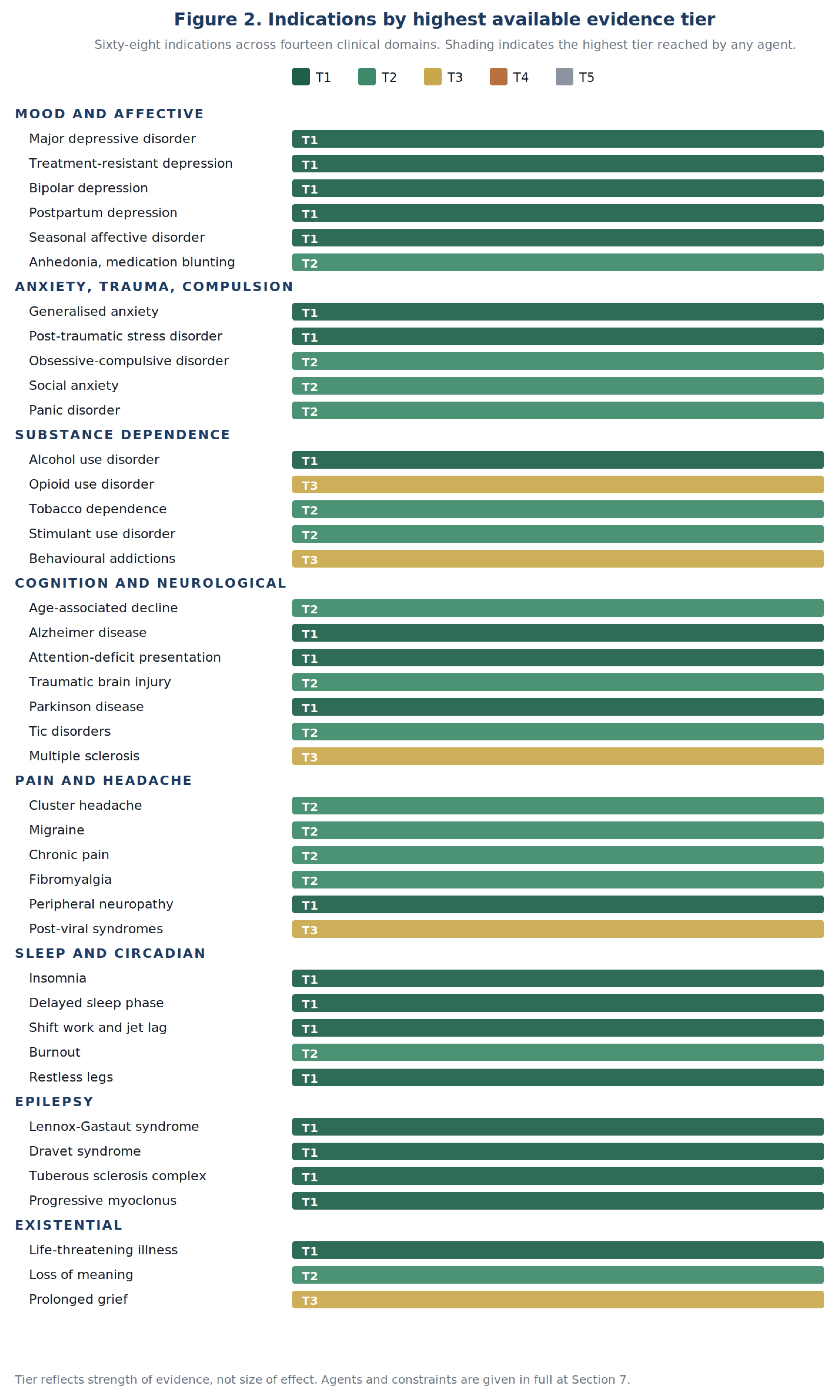
7.1. Mood and Affective Disorders
| Indication | Tier | Mechanism engaged | Principal agents (number) | Gate most often closing an option |
| Major depressive disorder | T1 | Plasticity induction; monoaminergic; neuroimmune | Ketamine (1), psilocybin (8), SSRIs and SNRIs (34), bupropion (36), saffron (72), omega-3 (68), L-methylfolate (73), curcumin (69) | Gate 3 — serotonergic load excludes Classes II–IV for many already on an SSRI |
| Treatment-resistant depression | T1 | NMDA; 5-HT2A; muscarinic | Ketamine and esketamine (1, 2), psilocybin (8), LSD (9), transdermal selegiline (37), scopolamine (93) | Gate 1 — mood instability screen; Gate 3 |
| Bipolar depression | T1 | Mood stabilization; mitochondrial | Lithium (91), lamotrigine, NAC (3), omega-3 (68), methylene blue (89) | Gate 1 — activating agents withheld without a stabilizer |
| Postpartum depression | T1 | Neurosteroid GABA-A | Brexanolone and zuranolone (53, 54), omega-3 (68) | Gate 5 — lactation |
| Seasonal affective disorder | T1 | Circadian phase; serotonergic | Timed bright light (101), melatonin (99), SSRIs (34) | — |
| Anhedonia and blunting on medication | T2 | Catecholaminergic; trace amine | Bupropion (36), selegiline (37), β-phenylethylamine (38), psilocybin (8) | Gate 3 where the existing agent is retained |
7.2. Anxiety, Trauma and Compulsion
| Indication | Tier | Mechanism engaged | Principal agents (number) | Gate most often closing an option |
| Generalized anxiety disorder | T1 | 5-HT2A; GABA-A; stress axis | LSD (9), ashwagandha (85), L-theanine (57), kava (56), passiflora (61), CBD (79) | Gate 3; hepatic caution for kava |
| Post-traumatic stress disorder | T1 | Amygdala reactivity; noradrenergic | MDMA (27), prazosin (42), propranolol (43), ketamine (1), guanfacine (40) | Gate 2 — cardiac; Gate 3. Benzodiazepines excluded on mechanism, not safety |
| Obsessive-compulsive disorder | T2 | 5-HT2A; glutamatergic | Psilocybin (8), memantine (2), NAC (3), sarcosine (4) | Gate 1; Gate 3 |
| Social anxiety | T2 | Threat reactivity; GABAergic | MDMA (27), propranolol (43), kanna (50) | Gate 3 — kanna is serotonergic |
| Panic disorder | T2 | GABAergic; noradrenergic | SSRIs (34), L-theanine (57), magnolia (62) | — |
7.3. Substance Dependence
| Indication | Tier | Mechanism engaged | Principal agents (number) | Gate most often closing an option |
| Alcohol use disorder | T1 | 5-HT2A; glutamatergic; opioid | Psilocybin (8), naltrexone, ketamine (1), NAC (3) | Gate 4 — hepatic |
| Opioid use disorder | T3 | Opioid; NMDA; neurotrophic | Ibogaine (30), ketamine (1) | Gate 2 — ibogaine requires the full cardiac protocol without exception |
| Tobacco dependence | T2 | 5-HT2A; cholinergic | Psilocybin (8), NAC (3), nicotine replacement (94) | Gate 1 |
| Stimulant use disorder | T2 | Glutamatergic homeostasis | NAC (3), ibogaine (30), modafinil | Gate 2 where ibogaine is considered |
| Behavioural and process addictions | T3 | Reward and glutamatergic | NAC (3), naltrexone, psilocybin (8) | — |
7.4. Cognition, Ageing and Neurological
| Indication | Tier | Mechanism engaged | Principal agents (number) | Gate most often closing an option |
| Age-associated cognitive decline | T2 | Cholinergic; structural; neurotrophic | Citicoline (65), the membrane triad (66–68), lion’s mane (64), phosphatidylserine (105), acetyl-L-carnitine (70) | — |
| Alzheimer disease | T1 | Cholinergic; NMDA | Galantamine (95), memantine (2), cerebrolysin (47), yokukansan (103) for BPSD | Gate 4 — glycyrrhiza content in yokukansan |
| Attention-deficit presentation | T1 | Catecholaminergic; noradrenergic | Stimulants (39), guanfacine (40), omega-3 (68), selegiline (37), β-phenylethylamine (38) | Gate 2 — cardiovascular load |
| Traumatic brain injury | T2 | Neuroimmune; neurotrophic; mitochondrial | Magnesium-ibogaine (30), omega-3 (68), citicoline (65), creatine (71) | Gate 2; Gate 6 — seizure threshold |
| Parkinson disease | T1 | Dopaminergic | Mucuna pruriens (98), selegiline (37), rasagiline | Absolute exclusion with MAO inhibitors. Selegiline and rasagiline are established adjuncts; whether monoamine oxidase B inhibition modifies disease course remains unresolved. |
| Tic disorders and Tourette syndrome | T2 | Noradrenergic; dopaminergic | Guanfacine (41), clonidine (41), cannabinoids (85), NAC (3), topiramate, VMAT2 inhibitors, aripiprazole | Habit reversal training should precede or accompany pharmacotherapy. Stimulants for co-occurring ADHD were long believed to exacerbate tics; controlled data does not support that. |
| Multiple sclerosis and demyelinating disease | T3 | Neuroimmune | Low-dose naltrexone (77), vitamin D (82), alpha-lipoic acid (81) | Gate 4 — autoimmune considerations. Disease-modifying therapy is neurology-directed and outside the scope of this review. |
7.5. Pain, Headache and Somatic
| Indication | Tier | Mechanism engaged | Principal agents (number) | Gate most often closing an option |
| Cluster headache | T2 | 5-HT2A | Psilocybin (8), LSD (9), 2-bromo-LSD | Gate 1; Gate 2. The strongest non-psychiatric psychedelic evidence base |
| Migraine | T2 | 5-HT2A; mitochondrial; neuroimmune | Psilocybin (8), riboflavin, CoQ10 (90), magnesium (5) | — |
| Chronic pain and central sensitization | T2 | NMDA; neuroimmune | Ketamine (1), low-dose naltrexone (77), palmitoylethanolamide (78), CBD (79) | LDN contraindicated with opioid analgesia |
| Fibromyalgia | T2 | Neuroimmune; NMDA | Low-dose naltrexone (77), ketamine (1), palmitoylethanolamide (78) | — |
| Peripheral and diabetic neuropathy | T1 | Mitochondrial; neuroimmune | Alpha-lipoic acid (82) 600 mg daily, acetyl-L-carnitine (76), palmitoylethanolamide (83), benfotiamine, methylcobalamin (78), low-dose naltrexone (80), topical capsaicin 8% | Exclude B12 deficiency first, particularly where metformin is in use. |
| Post-viral syndromes and chronic fatigue | T3 | Neuroimmune; mitochondrial | Low-dose naltrexone (77), CoQ10 (90), acetyl-L-carnitine (70), methylene blue (89) | Gate 4 — G6PD deficiency excludes methylene blue. Autonomic instability is the governing consideration, and these populations are frequently exposed to psychedelic-adjacent practitioners because conventional care has served them poorly. |
7.6. Sleep, Circadian and Stress
| Indication | Tier | Mechanism engaged | Principal agents (number) | Gate most often closing an option |
| Insomnia | T1 | Circadian phase; GABAergic | Fixed wake time (89), timed bright light (101), melatonin (99) at chronobiotic dose, magnolia (62), ziziphus (63) | Melatonin is commonly given at hypnotic dose and time, obtaining neither effect. |
| Delayed sleep phase | T1 | Circadian phase | Melatonin (99) 0.3–1 mg four to six hours before habitual sleep, timed bright light (101) | Timing errors produce the opposite of the intended effect. |
| Shift work and jet lag | T1 | Circadian phase | Melatonin (99), timed bright light (101), evening light restriction (102), meal timing (104) | — |
| Burnout and stress-related exhaustion | T2 | Stress axis; mitochondrial | Ashwagandha (85), rhodiola (86), tulsi (112), phosphatidylserine (105) | Gate 4 — ashwagandha raises thyroid hormone |
| Restless legs and periodic limb movement | T1 | Dopaminergic; iron | Iron repletion to ferritin above 75 µg/L, dopaminergic agents | Iron status must be established before any dopaminergic agent. Iron deficiency is the single most important reversible contributor; measure serum ferritin in every case, and repletion is targeted above 75 µg/L before any dopaminergic agent. |
7.7. Existential and End-of-Life
| Indication | Tier | Mechanism engaged | Principal agents (number) | Gate most often closing an option |
| Distress in life-threatening illness | T1 | 5-HT2A | Psilocybin (8), LSD (9) | Gate 1; Gate 2. Among the earliest and best-evidenced modern psychedelic indications |
| Demoralization and loss of meaning | T2 | 5-HT2A | Psilocybin (8) | Gate 1 |
| Prolonged grief | T3 | 5-HT2A | Psilocybin (8), MDMA (27) | Gate 3 |
7.8. Epilepsy and Seizure Disorders
Absent from every comparable review in this literature and containing the only agent in this framework with regulatory approval derived from cannabis.
| Indication | Tier | Mechanism engaged | Principal agents (number) | Consideration |
| Lennox-Gastaut syndrome | T1 | Multiple; mechanism in humans not established | Cannabidiol (79) | FDA-approved from age one. Transaminase elevation, increased where valproate is co-administered — serum monitoring required [139] |
| Dravet syndrome | T1 | As above | Cannabidiol (79) | Two positive randomized trials in this indication [154,155] |
| Tuberous sclerosis complex | T1 | As above | Cannabidiol (79) | Added to label following a separate positive trial [156] |
| Progressive myoclonus epilepsy | T1 | AMPA modulation | Piracetam (6) at 9.6–24 g daily | Linear dose-effect relation. The dose at which it works is five to twenty times consumer dosing — see Section 3.4 |
| Cortical myoclonus | T1 | AMPA modulation | Piracetam (6) | Abrupt discontinuation not always well tolerated |
7.9. Psychotic and Thought Disorders
This framework does not cover primary antipsychotic prescribing. The listed indications relate to adjunctive use when conventional treatment still leaves residual symptoms.
| Indication | Tier | Mechanism engaged | Principal agents (number) | Consideration |
| Negative and cognitive symptoms in schizophrenia | T2 | NMDA co-agonism | Sarcosine (4), glycine (4), D-serine (4), NAC (3) | Adjunctive only [158]. Not to be combined with NMDA antagonists, which act in the opposite direction. |
| Schizophrenia, adjunctive | T2 | Endocannabinoid; anti-inflammatory | Cannabidiol (79), NAC (3) | Gate 1 governs every Class II–IV agent absolutely in this population |
| Tardive dyskinesia | T2 | VMAT2; antioxidant | Ginkgo, vitamin E, VMAT2 inhibitors | — |
7.10. Compulsive and Body-Focused Behaviours
| Indication | Tier | Mechanism engaged | Principal agents (number) | Consideration |
| Trichotillomania | T2 | Glutamatergic homeostasis | NAC (3) 1,200–2,400 mg daily | Eight weeks to effect [26,159]. Among the better-evidenced uses of this agent |
| Excoriation disorder | T2 | Glutamatergic homeostasis | NAC (3) | As above |
| Binge eating and pathological gambling | T3 | NMDA; reward | Memantine (2), NAC (3), naltrexone | Gate 6 — eating disorder history closes several options |
| Irritability in autism spectrum disorder | T2 | Nrf2; glutamatergic | Sulforaphane (100), NAC (3) | Sulforaphane bioavailability varies severalfold between preparations [160] |
7.11. Sexual and Reproductive
| Indication | Tier | Mechanism engaged | Principal agents (number) | Consideration |
| Antidepressant-induced sexual dysfunction | T1 | Dopaminergic; serotonergic offset | Bupropion (36), saffron (72) | The best-evidenced indication for either agent outside depression itself [162] |
| Erectile and arousal difficulty | T2 | Alpha-2 antagonism; dopaminergic | Yohimbine (50), bupropion (36), maca | Yohimbine is anxiogenic and hypertensive; absolute exclusion with MAO inhibitors. |
| Low libido without hormonal cause | T2 | Catecholaminergic | Maca, saffron (72), β-phenylethylamine (38), selegiline (37) | Distinguish from the anhedonia presentation at 7.1 |
| Male fertility parameters | T2 | Mitochondrial; antioxidant | Acetyl-L-carnitine (70), Mucuna pruriens (98) | Mucuna is levodopa — physician supervision required |
7.12. Neurological Rare Disease And Recovery
| Indication | Tier | Mechanism engaged | Principal agents (number) | Consideration |
| Leber hereditary optic neuropathy | T1 | Mitochondrial electron transfer | Idebenone (101) | European regulatory approval [157]. Bypasses complex I dysfunction directly |
| Friedreich ataxia | T2 | Mitochondrial | Idebenone (101) | Neurological endpoints; cardiac endpoints less consistent |
| Stroke recovery | T2 | Structural; neurotrophic | Citicoline (65), cerebrolysin (47), Semax (49) | Semax evidence is open-label and single-group — see 5.6.10 |
| Vascular dementia | T2 | Neurotrophic; microcirculatory | Cerebrolysin (47), citicoline (65), Salvia miltiorrhiza (99) | Danshen potentiates warfarin markedly |
| Multiple sclerosis spasticity | T1 | Endocannabinoid | Nabiximols (80) | Approved in several jurisdictions; not in the United States. Disease-modifying therapy is neurology-directed and outside the scope of this review. |
| Chemotherapy-induced nausea | T1 | CB1 agonism | Δ9-THC (80), dronabinol | Gate 1 — psychotomimetic effects at higher dose |
7.13. Wakefulness and Performance
| Indication | Tier | Mechanism engaged | Principal agents (number) | Consideration |
| Narcolepsy and excessive daytime sleepiness | T1 | Wake-promoting; dopaminergic | Modafinil, caffeine (94) | — |
| Shift work sleep disorder. | T1 | Circadian; wake-promoting | Modafinil, melatonin (99), timed light (101) | Phase correction should precede any wake-promoting agent |
| Cognitive performance under sleep deprivation | T2 | Cerebral energy buffering | Creatine (71), caffeine with L-theanine (95) | Creatine effect is largest in the sleep-deprived and in vegetarians |
| Preoperative and procedural anxiety | T2 | GABA-A; circadian | Passiflora (96), melatonin (99) | Passiflora showed less impairment of performance than oxazepam [163] |
| Delirium prevention in hospitalized older adults | T2 | Circadian | Melatonin (99), evening light restriction (102) | The ward-level lighting trial is the strongest environmental evidence in this framework. |
7.14. Systemic and Metabolic
| Indication | Tier | Mechanism engaged | Principal agents (number) | Consideration |
| Statin-associated muscle symptoms | T2 | Mitochondrial | Coenzyme Q10 (90) | Absorption is 2–3% unformulated — preparation determines whether anything happens. |
| Irritable bowel syndrome | T2 | Gut–brain axis | Psychobiotics (84), peppermint oil | Strain-specific; effects do not generalize across products |
| Inflammatory and autoimmune pain | T2 | Neuroimmune | Low-dose naltrexone (77), Uncaria tomentosa (102), curcumin (69) | Uncaria is immunostimulant — caution in autoimmune presentation |
| Glaucoma, neuroprotective adjunct | T3 | Structural; neurotrophic | Citicoline (65) | Adjunct to pressure-lowering treatment, not a replacement |
8. Safety Considerations
The following gates are required before constructing the protocol. They are arranged so that the most critical exclusions are checked first, and no protocol involving the relevant agent class can proceed until each has been documented.
8.1 Gate 1 — Psychosis screen (all 5-HT2A agonists and entactogens)
|
Exclusions • Personal history of schizophrenia, schizoaffective disorder, or any psychotic-spectrum diagnosis • First-degree relative with a psychotic-spectrum diagnosis • History of psychotic symptoms during a previous psychedelic, cannabis or stimulant exposure • Active mania or hypomania; bipolar I in any phase without specialist involvement and a mood stabilizer |
This gate is mandatory and cannot be bypassed based on client choice or the seriousness of the presenting issue.
8.2 Gate 2 — Cardiac screen
Stratified by agent class. Requirements escalate sharply for ibogaine, which is in a category of its own.
| Agent class | Minimum requirement | Exclusions |
| Psilocybin, LSD, DMT | Blood pressure, heart rate, cardiac history | Uncontrolled hypertension, recent myocardial infarction, unstable arrhythmia |
| Mescaline, San Pedro | The above plus resting ECG | As above, plus significant baseline tachycardia; adrenergic load exceeds the indoles. |
| MDMA | The above plus ECG | Structural heart disease, valvulopathy, uncontrolled hypertension |
| Ketamine | Blood pressure, cardiac history | Uncontrolled hypertension, aneurysmal vascular disease |
| Ibogaine | Baseline ECG with QTc, serial ECG through acute phase, continuous telemetry, serum potassium and magnesium corrected to mid-normal, hepatic panel, CYP2D6 status where available, full review of QT-prolonging co-medications | QTc above 450 ms (male) or 460 ms (female); any structural heart disease; electrolyte derangement; concurrent QT-prolonging agent that cannot be withdrawn; hepatic impairment |
8.3 Gate 3 — Serotonergic load audit
Before evaluating any serotonergic psychedelic or entactogen, it’s important to list all serotonergic agents the client is using, including prescriptions, over-the-counter drugs, and supplements. Substances often missed in this list include 5-hydroxytryptophan, tryptophan, St. John’s wort, tramadol, dextromethorphan, linezolid, triptans, methylene blue, and harmala-based preparations such as Banisteriopsis caapi and Peganum harmala.
8.4 Gate 4 — Metabolic and hepatic
The hepatic panel is relevant for monitoring the effects of kava, high-dose cannabidiol, ibogaine, methylene blue, or ashwagandha. Renal function should be evaluated when administering memantine, magnesium, or lithium. Knowing CYP2D6 status is especially important for ibogaine, while the CYP3A4 inducer or inhibitor status is relevant across the review. Additionally, piperine and cannabidiol are inhibitors that clients may not report as medications.
8.5 Gate 5 — Pregnancy, lactation, and reproductive
Always conduct pregnancy testing before using any psychedelic, entactogen, or ibogaine. Because no substances in Classes II, III, IV, or V have verified safety during pregnancy or lactation, this information should be explicitly stated as an exclusion rather than merely a caution.
8.6 Gate 6 — Seizure threshold
Bupropion, high doses of tramadol, and sudden withdrawal from phenibut or benzodiazepines can all lower the seizure threshold. Patients with a history of seizure or eating disorder should not use bupropion.
9. Interaction Guidelines
Rules are defined with severity levels to enable direct integration into a protocol decision system. Severity 1 indicates a combination that must never be used; severity 2 involves specialist supervision and monitoring; severity 3 requires documented awareness and dose adjustments.
| Combination | Severity | Basis and required action |
| MAO inhibitor + any serotonergic psychedelic, entactogen, SSRI/SNRI, 5-HTP, tryptophan, tramadol, dextromethorphan | 1 | Serotonin toxicity, potentially fatal. Includes harmala alkaloids, Banisteriopsis caapi, Peganum harmala, methylene blue and selegiline above 10 mg. Fourteen-day washout required (five weeks for fluoxetine). |
| Ibogaine + any QT-prolonging agent | 1 | Additive hERG blockade; torsades de pointes. Includes many antipsychotics, macrolides, fluoroquinolones, ondansetron, methadone, several antidepressants. |
| Ibogaine + any serotonergic agent | 1 | Serotonin toxicity plus compounded cardiac risk. |
| MDMA + MAO inhibitor | 1 | Serotonin toxicity, hyperthermia; historically fatal. |
| Phenibut in substance use disorder population | 1 | GABA-B agonist with documented dependence liability in a dependence-vulnerable population. This review recommends against it in this context in any protocol. |
| SSRI + 5-HTP or tryptophan | 2 | Additive serotonergic load. If used, low dose, staggered timing, and monitoring for serotonin toxicity signs. |
| SSRI/SNRI + serotonergic psychedelic | 2 | Attenuated subjective response and additive serotonergic load. Taper decision is specialist-level and must weigh discontinuation risk against session efficacy. |
| Selegiline (or any TAAR1-directed regimen) + β-phenylethylamine, in bipolar spectrum | 2 | Catecholaminergic amplification with activation and hypomania risk. Mood stabilizer required. |
| Piperine + any narrow-therapeutic-index drug | 2 | CYP3A4/2C9 and P-glycoprotein inhibition raises exposure. Applies to anticoagulants, antiarrhythmics, immunosuppressants, several anticonvulsants. |
| Cannabidiol (high dose) + CYP3A4/2C19 substrates | 2 | Enzyme inhibition raising co-medication exposure; clinically significant with clobazam, warfarin, several antidepressants. |
| Kava or phenibut + alcohol, benzodiazepines, opioids | 2 | Additive central depression; respiratory risk. |
| SAMe, 5-HTP, rhodiola, or β-phenylethylamine in bipolar spectrum without stabilizer | 2 | Activation and mania induction risk. |
| Omega-3 (high dose), ginkgo, or curcumin + anticoagulant | 3 | Additive antiplatelet effect; relevant perioperatively. |
| Ashwagandha + levothyroxine | 3 | Thyroid hormone elevation; monitor thyroid function. |
| Bupropion + ibogaine | 3 | CYP2D6 inhibition alters noribogaine formation and therefore duration and cardiac exposure. |
10. Protocol Construction
This section introduces a modular approach to replace traditional fixed-condition protocol tables with a system designed for personalized care. Fixed protocols often overlook the need for individualization based on pharmacological factors and are unable to define specific exclusions. For instance, a table that lists an SSRI together with 5-hydroxytryptophan and selegiline indicates a potential combination, but does not specify when it should be avoided. The logic outlined below is meant to be implemented by a healthcare provider or a decision-support system.
10.1. Protocol Construction Sequence
- Characterize the protocol presentation by evaluating primary and co-occurring conditions, domain ratings, and duration. Focus on symptom domains like anhedonia, hyperarousal, rumination, dissociation, cognitive impairment, and somatic pain, as these relate more to agent selection than the presentation label, each associated with specific mechanism classes.
- Use safety gates (see Section 8), recording each as passed, failed, or pending. Pending gates block the related agent class but do not hinder protocol development for other classes.
- Identify mechanistic targets from Section 4 and the condition matrix, determining involved pathways based on presentation. For instance, elevated inflammatory markers and treatment resistance suggest neuroimmune and dopaminergic pathways; hyperarousal and trauma-related issues indicate excitatory–inhibitory and noradrenergic pathways. Different protocols may stem from the same presentation label.
- Select primary load agents based on the strongest evidence tier available in allowed classes. The tier is a criterion for selection, not a tiebreaker.
- Incorporate structural and supportive agents by reviewing Classes VIII, IX, and X. These agents act over weeks to months and serve as the foundation for consolidating induced plasticity. A protocol that promotes spine formation without providing a membrane substrate is incomplete.
- Run the interaction rule set (Section 9) on the assembled protocol. Results with Severity 1 require reconstruction, while Severity 2 outcomes need a documented supervision and monitoring plan.
- Set up a monitoring schedule and review point, with each protocol having a designated date to re-evaluate using the same symptom-domain ratings used initially.
10.2. Mapping of Symptom Domains to Underlying Mechanisms
| Symptom domain | Implicated mechanism | Candidate classes |
| Anhedonia, amotivation | Dopaminergic / TAAR1 hypofunction | Bupropion, selegiline, β-phenylethylamine, psilocybin, modafinil |
| Hyperarousal, hypervigilance | Noradrenergic excess, E/I imbalance | Prazosin, guanfacine, propranolol, L-theanine, neurosteroids |
| Rumination, cognitive rigidity | Default mode network hyperconnectivity | 5-HT2A agonists, ketamine |
| Emotional avoidance of trauma material | Amygdala reactivity | MDMA, R-MDMA, propranolol reconsolidation |
| Cognitive impairment, brain fog | NGF deficit, membrane substrate deficit | Lion’s mane, uridine/choline/DHA triad, citicoline, bacopa |
| Fatigue, low stress tolerance | HPA dysregulation, mitochondrial insufficiency | Ashwagandha, rhodiola, creatine, ALCAR, cordyceps |
| Somatic pain, central sensitization | Neuroimmune activation | Low-dose naltrexone, palmitoylethanolamide, ketamine, cannabinoids |
| Craving, compulsivity | Glutamate dysregulation, reward circuit | NAC, ibogaine, psilocybin, naltrexone |
| Sleep-onset and maintenance disturbance | GABAergic tone, circadian | Glycine, magnesium, L-theanine, reishi, trazodone |
10.3. Important Laboratory Inputs
When testing is accessible, the significant protocol modifications below offer cost-effective benefits.
- High-sensitivity C-reactive protein and interleukin-6. Identifies the inflammatory subtype, which predicts poorer monoaminergic response and preferential response to anti-inflammatory intervention.
- Ferritin, vitamin B12, folate, 25-hydroxyvitamin D, thyroid panel. Reversible contributors to depressive and cognitive presentation that must be excluded before escalation.
- Comprehensive metabolic and hepatic panel. Prerequisite for kava, ibogaine, high-dose cannabidiol and methylene blue.
- Serum potassium and magnesium. Mandatory before ibogaine; correction to mid-normal range is part of the cardiac protocol.
- MTHFR genotype where available. Guides L-methylfolate dosage.
- Genotypes for CYP2D6 and CYP2C19 are included when available. CYP2D6 influences the conversion of ibogaine to noribogaine, and both enzymes impact many psychiatric drugs.
- Electrocardiogram with QTc. Mandatory before ibogaine; recommended before mescaline and MDMA.
Figure 3.
The seven-step construction sequence. Gates are adjudicated before mechanism is considered.
Figure 3.
The seven-step construction sequence. Gates are adjudicated before mechanism is considered.
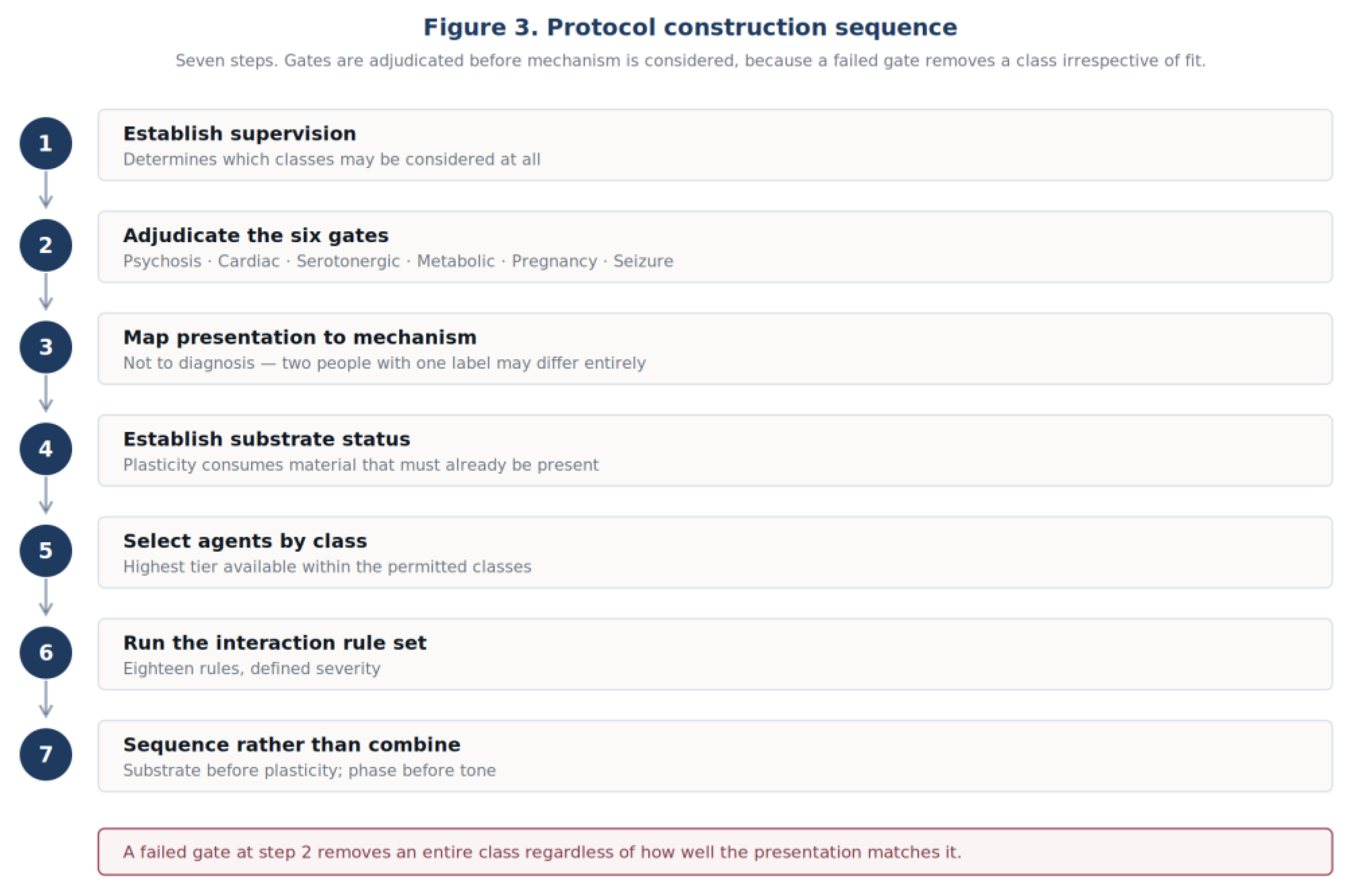
10.4. Whole Preparations vs Isolated Constituents
A common question in protocol development is whether to choose a whole plant preparation or an isolated active ingredient. These options are distinct, and the difference goes beyond just potency. Plants contain many phytochemicals that influence various systems simultaneously; isolating one removes others, which can sometimes lessen the overall effect, as seen in multiple cases.
Four mechanisms explain this difference [175]. Multi-target action occurs when constituents act on different sites, creating a combined effect that no single component can achieve alone. Pharmacokinetic support happens when accompanying constituents improve absorption or extend the half-life of the main component. Overcoming resistance occurs when a secondary constituent inhibits efflux or metabolic processes that could limit effectiveness.
Finally, attenuation of adverse effects happens when one constituent reduces liabilities that the isolated component alone might have. Examples are provided throughout earlier sections and are collected here because they relate to the decision to construct the formulation.
| Preparation and isolation | Mechanism at work | What the comparison shows |
| Cannabidiol — full-spectrum extract against purified CBD | Multi-target; adverse-effect attenuation | Purified cannabidiol shows a bell-shaped dose-response in which effect declines above an optimum. A cannabidiol-rich extract of equivalent content shows a linear dose-response, the bell disappearing [173]. In treatment-resistant epilepsy, extracts achieved comparable seizure control at approximately a quarter of the purified dose, with fewer and milder adverse events [174]. |
| Mucuna pruriens — seed powder against dispersible levodopa | Pharmacokinetic support | Longer ON time without increased dyskinesia — 232.2 against 161.8 minutes, p = 0.01 — at 155.67% of comparator exposure, attributed to the accompanying seed matrix (Agent 58). |
| Iboga — total alkaloid extract against isolated ibogaine | Multi-target; adverse-effect attenuation | The extract differs from the isolate in both efficacy and safety profile and should not be dose-substituted on ibogaine content (Class V). |
| Erythroxylum coca — whole leaf against the isolated alkaloid | Pharmacokinetic; multi-target | The whole leaf carries secondary alkaloids and, prepared traditionally, produces a pharmacokinetic profile bearing little resemblance to the isolate by any rapid route (Class VI). |
| Pausinystalia johimbe — whole bark against isolated yohimbine | Multi-target | The bark contains minor alkaloids with monoamine oxidase inhibitory activity absent from the isolate, altering the interaction profile (Section 6.6). |
| Ayahuasca — the preparation against its constituents | Overcoming a metabolic barrier | Oral dimethyltryptamine is inactive alone. The β-carbolines are not adjuncts to the preparation; without them there is no preparation (Class II) [176]. |
| Yokukansan — the formula against any constituent | Multi-target | Tested and evidenced as a seven-constituent formula. No trial supports any single constituent, and the formula is therefore the agent (Section 5.0.1). |
| Crocus sativus — extract against isolated crocin | Pharmacokinetic support | Crocin is poorly absorbed and hydrolyzed at the intestinal wall to crocetin, which is the more bioavailable species and probably the active moiety. The extract supplies both (Agent 90). |
Implications for the practitioner: When a trial involves an entire preparation, that preparation functions as the agent, and an isolate cannot be regarded as a direct substitute at the same nominal content. Conversely, using an isolate means the original preparation may not be equivalent. Swapping between the two changes the nature of the intervention, and in the case of cannabidiol, it even affects the dose-response relationship. Standardization does not entirely solve this problem, as a preparation standardized to a single marker component can still vary considerably in its other constituents.
A similar reverse scenario is also quite common. Sometimes, isolating a component is preferable if part of the overall preparation carries a liability that the isolated substance can avoid—like aristolochic acid in processed Chinese materials, variable alkaloids in Trichocereus products, or unpredictable harmala content in Passiflora. Neither approach is universally superior; the main concern is which method has been tested.
11. Practical Application
The previous sections define the agent population and the rules for its use, but they do not make them instantly applicable. This section explains how a practitioner can operate within their authority based on the document. No new data are added; all recommendations refer to material from Sections 4 to 25.
11.1. Four Questions, in Order
Building anything with this framework involves providing four pieces of information in a specific sequence. If answered out of order, the recommendations generated will be unactionable.
Question 1: What is your prescribing authority and the client’s supervision? This is a foundational question because it directly influences what options are feasible, not just ideal. A practitioner lacking prescribing authority and working with an unsupervised client can establish from Classes VIII through XIII and XVI. Introducing a prescriber broadens the range to Classes I, VI, VII, and XV. Including a lawful session pathway allows access to Classes II through V. The most common mistake in this field is developing a protocol only to find later that it cannot be implemented—fortunately, this can be easily prevented.
Question 2: Do the safety gates pass? Section 8 lists six gates evaluated before assessing the mechanism. A failed gate disqualifies an entire class, regardless of how well it matches the presentation. Gate 3—serotonergic load—especially affects Classes II through IV, particularly for those who most want them.
Question 3: What is the mechanism profile? Not the diagnosis. Two people with the same diagnosis can have completely different mechanism profiles and require different treatments. For instance, anhedonia with preserved consummatory pleasure suggests a catecholaminergic profile; administering a serotonergic agent to someone diagnosed with depression might lead to emotional blunting, which highlights the importance of this framework.
Question 4: What is being consumed and whether it is accessible? Agents that facilitate plasticity depend on the substrate. When structural materials, neurotrophic capacity, or mitochondrial function are depleted, interventions often underperform due to factors unrelated to dose or environment. This inquiry guides the sequencing, since most avoidable failures happen during the process of arranging the sequence.
11.2. Possible Actions for Each Practitioner Category
Table 32 restates the role-scope framework in practical terms, highlighting the difference between actions a practitioner can choose and those they can only support.
| Practitioner | May select and adjust | May support but not select | Must refer |
| Prescriber — physician, psychiatrist, nurse practitioner | All classes for which gates pass, within their own licensure and jurisdiction | Not applicable | Indications outside their specialty; session work outside a lawful pathway |
| Licensed facilitator | Preparation, session structure, integration protocol; Classes VIII–XIII and XVI | Session agents where lawfully available; supervision of the session itself | Any prescription agent; any gate requiring clinical adjudication |
| Psychotherapist, counsellor | Preparation and integration work; symptom-domain to mechanism mapping; outcome instruments | Any agent selection — may inform, may not decide | All medication decisions; safety gate adjudication |
| Naturopath, nutritionist, integrative practitioner | Classes VIII–XIII and XVI; substrate, adaptogenic and circadian intervention | Classes I–VII and XV — may identify indication, may not initiate | Anything requiring a prescriber; laboratory interpretation outside scope |
| Coach, guide, unsupervised individual | Lifestyle and behavioural intervention; unscheduled substrate agents | Nothing further | Any clinical presentation; any gate failure; any scheduled compound |
When a section specifies the need for a prescriber, it is a vital requirement rather than a mere formality. Tasks such as selecting an agent, determining the dose, managing interactions, and analyzing lab results demand a licensed professional because errors in these areas can lead to harm that might not be immediately obvious. A practitioner who carefully reviews this document will enhance their ability to collaborate with a prescriber, but it does not grant them prescriptive authority.
11.3. Constructing Protocols Within Unscheduled Classes
Many practitioners following this framework operate without prescribing authority and work with clients who lack a lawful session pathway. This is not a lesser role, and the framework does not see it as such. Classes VIII through XIII and XVI involve agents with T1 and T2 evidence for various indications listed in the condition matrix.
The process for these cases is simple: first, establish the mechanism profile. Address circadian phase before adding anything, because agents given during a disrupted rhythm may oppose the system they aim to support. Provide substrate where depletion is evident, and wait eight to ten weeks for neurotrophic agents to work. Include adaptogenic or stress-axis support if the load is ongoing, not just historical. Review outcomes at twelve weeks based on behavioural endpoints, not only symptom scores.
If a profile-indicated compound isn't available at the practitioner’s level, it's better to identify the compound and explain why rather than substitute a weaker alternative and treat it as equivalent. Clients are best served when the prescriber verifies the availability of a specific option, rather than offering a supplement assuming no other options exist.
11.4. Limitations of This Framework
This type of reference document is not compatible with four specific uses, each of which it encourages.
- It is not a treatment protocol for an individual. The mechanism classes, dose ranges, and construction logic outline a decision framework. They are not intended as advice for any specific individual, and using them without personalized evaluation constitutes misuse of the document.
- It is not a substitute for a prescriber. Sections designated as requiring prescribing authority must be followed accordingly. Simply reviewing the pharmacology does not grant a practitioner the authority to act on it.
- It is not a justification for obtaining scheduled compounds. Characterizing an agent pharmacologically is not a recommendation to acquire it, and the legal status is a separate matter determined by jurisdiction.
- It is not a claim that the agents described are equivalent. A T1 agent and a T5 agent appear in the same class because they share a mechanism. They do not share an evidence base, and the tier designation exists precisely so that the difference remains visible at the point of use.
11.5. For the Sole Practitioner
A solo practitioner lacking a prescriber relationship or facilitator network receives the least support from this framework and should understand its limits. Table 33 outlines what is available at this level and what is not.
| Available without supervision | Requires a collaborator | Requires referral |
| Circadian assessment and correction; substrate supply; adaptogenic support; behavioural and lifestyle intervention; outcome instruments | Any prescription agent; laboratory interpretation; adjudication of a failed gate; session supervision | Suicidality or current risk; suspected bipolar spectrum; psychotic-spectrum history; cardiac findings; pregnancy; any presentation deteriorating under observation |
| Preparation and integration work around a session the client has lawfully arranged elsewhere. | The session itself | Destabilization following a prior session that has not resolved |
| Identification of a possible reversible cause — thyroid, B12, iron, sleep apnoea | Confirmation and treatment of that cause | Anything the practitioner is not competent to exclude |
The usefulness of this framework at that level isn't about doing more; it's about clarifying the boundary so a practitioner knows when to continue working and when to pass on, along with the reasons why.
12. The Experiential, Growth and Development Domain
An increasing number of people using psychedelic and entheogenic substances are not seeking symptom relief. Instead, they aim for meaning, connection, self-awareness, existential perspectives, or spiritual growth, often without a formal diagnosis. Traditionally, clinical literature has considered this group outside its scope, and the facilitation field has lacked measurement frameworks for their outcomes. Both views are limited.
This review contends that these outcomes are valid therapeutic and functional goals. They can be assessed with validated tools, and practitioners who measure them tend to perform better than those who do not. This position is based on evidence, not market trends, and is supported by findings that the subjective quality of the acute experience strongly predicts clinical success. Therefore, what the facilitation field calls the spiritual dimension is, in research, a mediating variable with a measurable impact.
12.1. Why this Domain is Fundamental
Multiple independent research groups have shown that the intensity of mystical experiences during a psilocybin session predicts both the magnitude and duration of clinical benefits for depression, tobacco, alcohol dependence, and existential distress [96,97,98]. Furthermore, research indicates that a single high-dose session can produce a lasting increase in trait openness, making it one of the few interventions capable of altering a Five Factor personality trait in adults [99].
Two critical caveats are often overlooked. First, the correlation does not imply causation; mystical experiences might mediate therapeutic effects or simply reflect an adequate dose and receptive state, rather than being the direct cause. Second, animal studies suggest that plasticity could be induced by non-hallucinogenic analogs, indicating that the subjective experience may be separate from the therapeutic mechanism [14]. This unresolved and important question determines whether supervised sessions are solely necessary for pharmacological reasons or primarily for safety.
What is not in dispute is that these dimensions can be measured, that measurement predicts outcome, and that a practice which collects these data is generating information a practice which does not collect them cannot access.
12.2. Validated Instruments
In this field, instruments vary in whether they base scale points on specific described states or leave them open to interpretation. Anchored, levelled descriptions—found in extensive first-person documentation projects [91,92]—are more suited to these outcomes than unanchored Likert scales, though the sources using them are not themselves evidence.
The following are published, psychometrically validated instruments currently employed in research. Using these converts subjective session reports into comparable data sets and, as this review suggests, is the most valuable methodological enhancement for facilitation practice.
| Instrument | Items | Measures | Use point |
| Mystical Experience Questionnaire (MEQ30) | 30 | Internal unity, external unity, noetic quality, sacredness, positive mood, transcendence of time and space, ineffability | Immediately post-session; the field standard |
| Challenging Experience Questionnaire (CEQ) | 26 | Fear, grief, physical distress, insanity, isolation, death, paranoia | Post-session; essential for safety auditing and rarely used |
| Ego-Dissolution Inventory (EDI) | 8 | Dissolution of self-boundary; paired with an ego-inflation subscale | Post-session |
| Emotional Breakthrough Inventory (EBI) | 6 | Resolution of emotional material during session | Post-session; independently predicts outcome |
| Psychological Insight Questionnaire (PIQ) | 23 | Insight into self, behaviour and relationships | Days post-session; may predict outcome as well as MEQ |
| Watts Connectedness Scale (WCS) | 19 | Connection to self, others and world | Baseline and follow-up; strong mediation signal |
| Hood Mysticism Scale (M-Scale) | 32 | Trait and state mysticism; long validation history outside psychedelics | Baseline; useful for non-clinical populations |
| Persisting Effects Questionnaire | ~140 | Personal meaning, spiritual significance, wellbeing change | 1, 6 and 12 months |
| Five Facet Mindfulness Questionnaire | 39 | Observing, describing, acting with awareness, non-judging, non-reactivity | Baseline and follow-up; sensitive to meditation synergy |
| NEO-PI-R / BFI openness facet | varies | Trait openness | Baseline and 12 months |
Instruments should be chosen to address a specific question rather than used as a comprehensive battery. The essential set includes MEQ30, CEQ post-session, PIQ at one week, and WCS at baseline and three months.
12.3. Modifiable Determinants of the Experience
Set and setting are commonly referenced but rarely elaborated on. Below are the empirically supported factors, each representing a variable that a practitioner can manipulate.
- Dose. The primary factor influencing the intensity of mystical experiences, showing a clear dose–response relationship across the studied range. Reducing the dosage to lower anxiety typically diminishes the treatment's effectiveness.
- Preparation and rapport. Time invested with the facilitator before the session correlates with reduced challenging-experience scores, offering an economic rationale for the preparation session.
- Music. The selected program greatly influences emotional development and the timing of its peak; it is an active intervention rather than mere background ambience and must be recorded in the protocol.
- Trait absorption and openness. Baseline qualities forecast experience intensity and can be assessed in advance, enabling more accurate expectation management.
- Expectancy. A notable factor impacting trial data and acting as a valuable clinical tool. It should be recognized openly rather than exploited or overlooked.
- Contemplative practice. Practicing meditation simultaneously can boost both the intensity of the experience and its lasting benefits, as evidenced by data from controlled retreats showing this combined effect [100].
- Integration. The period following the acute experience is essential for consolidating behavioural change. Insights gained at one week can forecast outcomes; without taking action, these insights tend to fade.
12.4. Non-Pharmacological Access to Endpoints
Several of these outcomes can be achieved without any pharmacological agent. It is important to clearly communicate this to clients who find the risk profile of Class II–V agents unacceptable and for whom Section 8 safety gates lead to exclusion.
- Intensive meditation retreat. T2 for mystical-type experience, wellbeing and trait change; the most robustly evidenced non-drug route.
- Holotropic and conscious-connected breathwork. T3 for altered state induction and emotional release; the mechanism is respiratory alkalosis with cerebral vasoconstriction and is not benign in cardiac, seizure, pregnancy or severe psychiatric presentations. It is not a risk-free substitute and is frequently presented as one.
- Flotation-REST. T2 for anxiety reduction and altered state induction.
- Sustained aerobic exercise, cold exposure, sleep deprivation, ritual and music. T3–T5; all produce measurable state shifts and are relevant to expectation-setting.
12.5. Adverse Outcomes Specific to this Domain
The developmental and spiritual approach involves risks that are not typically seen in symptom reduction methods, but these are less documented since most individuals affected are outside clinical environments.
|
Recognized adverse patterns Prolonged destabilization refers to ongoing derealization, anxiety, or identity issues that persist beyond the immediate aftermath. This is often associated with high doses, inadequate preparation, and pre-existing dissociative traits. • Spiritual bypassing occurs when transcendent experiences are used to avoid processing necessary psychological material, leading to apparent quick progress that lacks lasting behavioural change. • Ontological shock involves a deep, unresolved shift in metaphysical beliefs that can cause distress, requiring support for proper integration rather than simple reassurance. • Grandiosity and inflation denote significant ego enlargement, particularly in individuals with narcissistic tendencies and practitioners, which carries specific dangers. • Dependence on altered states instead of gaining insight manifests as increasing frequency of experiences without corresponding behavioural improvements. • Relational and occupational disturbances may happen after sudden value shifts, which can be persistent or lead to regret. • Practitioner-boundary harm is linked to the developmental setting that increases transference risk and has a history of boundary violations. |
Systematically collecting the Challenging Experience Questionnaire and adverse outcomes at follow-up is the basic requirement for a practice operating in this area. Missing this domain is a major shortcoming, not a minor one.
12.6. Outcome Domains for Non-Clinical Presentation
When someone presents without a diagnosis, the following domains form a reasonable outcome set. Establishing these during intake enables a meaningful review and helps prevent both practitioners and participants from drifting, which often happens when success criteria are not clearly defined..
| Domain | Instrument | Mechanistic correlate |
| Connectedness — self, others, world | Watts Connectedness Scale | Default mode network reconfiguration; 5-HT2A |
| Psychological flexibility | AAQ-II; cognitive flexibility measures | Cortical plasticity; reduced network rigidity |
| Meaning and purpose | Meaning in Life Questionnaire; Persisting Effects Questionnaire | Not mechanistically localized; treat as an endpoint |
| Trait openness | NEO-PI-R openness facet | Sustained post-acute plasticity window |
| Emotional processing capacity | Emotional Breakthrough Inventory; alexithymia scales | Amygdala reactivity; entactogen mechanism |
| Wellbeing and life satisfaction | WHO-5; Satisfaction With Life Scale | Composite |
| Self-compassion and shame | Self-Compassion Scale | Entactogen and oxytocinergic mechanism |
| Behavioural change | Individually specified, defined at intake | The endpoint that distinguishes insight from bypassing |
The last row holds the greatest importance. All other measures in this table can improve even if a person's life remains unchanged. Identifying one or two specific behavioral commitments at the start, and revisiting them later, is what distinguishes a developmental approach from a recreational one.
13. Results
This section summarizes the review's findings, listing each result once along with a reference to its detailed section.
13.1. Mechanism Taxonomy
Fifteen mechanism classes were defined mainly based on receptor pharmacology and downstream signalling, with each agent classified by its primary mechanism rather than by regulatory status or botanical origin (Section 5). Twelve pathways were identified as being targeted, mediated, or influenced by these classes (Section 4). This report highlights three pathways less often discussed in the literature: muscarinic and nicotinic cholinergic signalling, cyclic AMP and PDE4, and opioid receptor modulation. Additionally, a fourth factor — circadian phase — was found to remain unaffected by dose, mechanism, or route of administration (Section 4.12).
13.2. Agent Characterization
A total of 106 agents were characterized (see Section 5), each evaluated using a standardized eight-field template covering mechanism, dose and route, pharmacokinetics, onset and duration, tier of evidence, cautions, interactions, and framework position. If any field was incomplete, it was marked with a specific code rather than left blank, ensuring missing data is clearly identified instead of ignored.
| Class | Agents | Principal mechanism |
| I — Glutamatergic modulators | 7 | NMDA antagonism, glutamate homeostasis, co-agonism, AMPA modulation |
| II — Tryptamine psychedelics | 16 | 5-HT2A agonism; β-carboline MAO inhibition and DYRK1A |
| III — Phenethylamine psychedelics | 4 | 5-HT2A agonism, longer duration, embodied character |
| IV — Entactogens | 3 | Serotonin release with reduced amygdala reactivity |
| V — Modulators | 5 | Kappa, sigma and GABA-A routes outside 5-HT2A |
| VI — Monoaminergic | 20 | Reuptake, MAO inhibition, alpha-2, neuropeptide |
| VII — Inhibitory and GABAergic | 11 | GABA-A and GABA-B, neurosteroid, botanical modulation |
| VIII — Neurotrophic and structural | 11 | BDNF and NGF induction, membrane substrate supply |
| IX — Neuroimmune | 8 | Microglial modulation, cytokine, endocannabinoid |
| X — Adaptogenic and mitochondrial | 9 | HPA axis regulation, mitochondrial capacity |
| XI — Pharmacokinetic modification | 2 | Enzymatic protection, transport, formulation |
| XII — Ageing and trace elements | 5 | Catecholaminergic activity enhancement, trace lithium |
| XIII — Movement and nervous system | 4 | Dopaminergic, noradrenergic, neuroimmune |
| XIV — Potentiation | 5 | Enabling combinations; substrate supply |
| XV — Cholinergic | 6 | Muscarinic antagonism, cholinesterase inhibition, precursor |
| XVI — Chronobiotic | 6 | Phase shift by light, timing and melatonin receptor agonism |
13.3. Pharmacokinetics
The pharmacokinetic properties—such as route of administration, bioavailability, time to peak, half-life, onset, duration, and metabolic pathway—were evaluated for all 106 agents and recorded according to the scheme in Section 6. Human data are incomplete for 21 of these agents.
To clarify, the difference between an agent lacking human study data and one with no measured absolute value was maintained, as these are not the same. Regarding the distribution of the absorbed fraction, six agents deliver nearly the entire dose, while several common agents only reach systemic circulation at one to ten percent. Four agents are pharmacologically inactive via their common route.
The significance of these distribution patterns is discussed in Section 13. Bidirectional circadian effects were observed: circadian rhythms influence how agents are handled, and some agents affect circadian phases, leading to interactions beyond enzyme-based mechanisms (see Section 6.5).
13.4. Therapeutic Mapping
A total of 68 indications were identified spanning fourteen clinical domains (see Section 7). For each, details were recorded on the mechanism involved, the agents reaching the highest available tier, and the main constraint that prevented selecting a suitable option. An indication was considered valid if at least one characterized agent demonstrated evidence at T3 or higher.
Interestingly, several indications with evidence levels equal to or stronger than those for commonly included conditions—such as cluster headache, tic disorders, traumatic brain injury, chronic pain, burnout, insomnia, and epilepsy syndromes approved for cannabidiol—were missing from comparable reviews. Their omission seems to be influenced more by professional and regulatory boundaries than by a genuine critical appraisal of the evidence.
13.5. Practitioner Architecture
Six safety gates were identified and evaluated individually before considering mechanisms, as a failure in any gate disqualifies an entire class regardless of presentation match (Section 8). Eighteen interaction rules with assigned severity levels were established (Section 9). Based on this, a seven-step construction process and a mapping from symptom domains to mechanisms were developed (Section 10). A role-scope matrix was also created to specify which of the four practitioner categories can select, support without selection, or must refer (Section 11.2). Each section requiring prescribing authority is clearly marked at its point of use.
13.6. Findings from the Tiering Standard
Applying a uniform worldwide standard, regardless of jurisdiction, led to three results that challenge traditional approaches for this material.
- Tier represents a category within the agent-indication-dose triple. Piracetam shows T1 evidence for progressive myoclonus at a daily dose of 24 g and T4 evidence for cognition at any dose. A common mistake in this literature is to assign a single grade to an agent, whether higher or lower (see Section 3.4).
- Some agents excluded during replication were actually excluded due to language barriers. Semax, Selank, noopept, and bromantane are approved for clinical use, supported by open-label trial evidence, and are categorized at the tier backed by this evidence (see Sections 5.6.10, 5.7.8).
- A whole-plant extract outperformed its synthetic version on a primary endpoint. Mucuna pruriens provided longer ON time without dyskinesia than dispersible levodopa — 232.2 vs. 161.8 minutes, p=0.01 — with an exposure level of 155.67% of the comparator (Agent 58).
14. Discussion
One source, four fields of study
I created this resource because I couldn't find a similar one. Practitioners working with psychedelics, prescription drugs, botanicals, and nutraceuticals often need to consult four separate sources, none of which reference each other, making comparison challenging. This tool characterizes each using a single standardized, numbered system, indexed by pharmacokinetics, indication, origin, and interaction risk. Practitioners can then use this information to develop protocols directly. The method helps clarify protocols by enabling practitioners to specify their choices and exclusions based on evidence and guidelines, making the reasoning accessible to those with different training backgrounds. As multidisciplinary practice expands, organizing by mechanism promotes cross-disciplinary discussions without debating whose training is authoritative.
The dose problem
Analyzing pharmacokinetics reveals a common trend from decades of formulation experience: the stated dose often doesn't match what is actually delivered, and many users are unaware of this discrepancy. Nineteen of these agents lack published human pharmacokinetic data. Six agents deliver roughly the indicated dose, while four provide no active compound via their most common route.
Botanicals tend to show even greater variability, with alkaloid levels varying by hundreds of percent across sources. A standardized preparation, based on a single marker, can still vary significantly in other components. In some cases, the active ingredient is unknown, raising questions about what a 'standard' truly standardizes. When a protocol specifies six hundred milligrams of a botanical extract, it refers to weight, not active compound amount or absorption. This core issue affects the entire field: a trial could show no effect if it uses inactive substances.
Practitioners adjusting doses based on patient response still face uncertainties about actual absorption. Even with the same nominal dose, individuals can absorb vastly different amounts, leading to noticeable variability.
Delivery route: part of the same issue.
Psilocybin becomes active only after dephosphorylation into psilocin in the gut and liver, which produces its noticeable effects. As a prodrug, it is inactive until this process occurs. The user waits for absorption, conversion, and distribution—usually around thirty minutes, often longer—due to factors like gastric emptying and variability in first-pass metabolism. During this period, practitioners are uncertain whether the compound has started working, and redosing may lead to overshooting. This waiting period affects the session flow. In comparison, oral mescaline takes 60 to 180 minutes to act, complicating timing. Formulation techniques improve predictability by extracting and identifying the compound, delivering psilocin directly (bypassing gut metabolism), ensuring a known dose, and using routes avoiding the stomach.
Early studies suggest intranasal psilocin has an average onset of 10.1 minutes, buccal 11 minutes, intranasal for 5-MeO-DMT 5.25 minutes, and buccal mescaline about 22.2 minutes, with ranges from 19.5 to 26 minutes [178]. These methods can increase bioavailability by 2 to 10 times, reducing the needed dose. The more critical factor is the narrower onset window rather than the shorter average. A two-hour window is impractical for scheduled sessions; a seven-minute window is achievable.
This illustrates potential, not established fact—these findings are from studies with four unblinded subjects per condition, relying on subjective onset reports and without plasma measurements. Ultimately, with advanced extraction, known content, and precise dosing technologies, this framework’s accuracy will eclipse the limitations of the material itself.
What has to come next
Repeated use of this framework results in the same outcome: it reveals what exists, what influences it, and what is excluded. However, it cannot advise an individual on specific actions because that depends on undocumented factors like supervision, exclusion criteria, substrate depletion, and unmentioned medications. A person needs to ask questions in a specific order and connect answers to underlying mechanisms, not just labels.
This stage is where the field loses much of its learning potential, as practitioners develop their own protocols and record outcomes in various ways, making it hard to compare treatments or combine data across cases. We treat many people but learn little, not due to lack of evidence, but because there’s no shared method for gathering it.
A structured intake and personalized protocol development tool is nearly complete, aiming to bridge existing gaps. It emphasizes establishing supervision before mechanisms, as supervision determines available classes. It evaluates the protocol presentation across different domains—not just labels—since diagnoses can arise from various pathways. The tool recodes each gate’s status—passed, failed, or pending—and ensures pending gates close their classes without hindering progress elsewhere. Additionally, it documents medications, maps interactions, assesses substrate status for sequencing, and records exclusions, including reasons and review dates. It also gathers initial domain ratings for comparison.
The main advantage is not the methodology but that the instrument takes a completed evaluation and outputs the protocol: the agents with doses and routes, the sequence of introduction, exclusions and their rules, interaction management, monitoring schedule, and review points—all in a readable report. Practitioners can review, share, and discuss this report. Tasks that currently require hours of cross-referencing by experienced practitioners and are often impossible across multiple literatures are simplified through structured intake. This makes the process teachable, transferable, and scalable for safety. The framework and its specifications underpin this development.
15. Limitations
This is a narrative review with inherent limitations. The selection of agents reflects the author’s judgment on clinical relevance rather than an exhaustive systematic search. Publication bias in the psychedelic field is well-known and unresolved: negative and null results are often underreported, and many cited effect sizes are derived from small, unblinded studies.
Unblinding due to noticeable subjective effects is particularly significant, as in trials with agents that produce clear changes, neither participants nor raters can be reliably blinded. This poses a serious methodological concern because it can inflate perceived effect sizes and has been explicitly considered in regulatory decisions. Readers should exercise caution, and practitioners should honestly inform clients that reported benefits might be overstated, even if the effects are genuine.
Evidence tiers are assigned by the author without validation, and Tier 5 material is intentionally included despite its weak epistemic status. Excluding it would leave some agents without dosing guidance—an issue considered worse than guiding with clear labels. Dose ranges are based on published protocols and are not adjusted for factors like weight, age, hepatic or renal function, or genotype unless specified. They are intended as starting points for clinical judgment, not rigid prescriptions.
The sequencing recommendation in Section 7 is based on the current lack of data on combinations, not on evidence of harm. As new data emerge, this recommendation should be reevaluated.
16. Conclusions
This framework categorizes agents based on their mechanisms of action within four professional traditions that typically do not reference each other. It assigns an explicit evidence level to every claim, describes the route and bioavailability for each agent, and, from this structure, develops an operational logic for safety management, interaction assessment, and protocol development that practitioners can use within their scope.
Three proposals are introduced that alter the conventional approach to this material.
Evidence tier is a property of the agent-indication-dose triple. A compound can have Tier 1 evidence for one indication at a specific dose and Tier 4 for a different indication at any dose. Assigning a single grade to an agent, whether higher or lower, is a mistake that this literature often makes and that consumer marketing frequently exploits.
Circadian phase is a fourth axis alongside dose, mechanism and route. A normally functioning system running at an incorrect time appears as if it is deficient. It responds to an intervention designed for a different issue, and might even be made worse by the agent intended to fix a true deficiency. Phase cannot be simplified to the other three axes and cannot be identified by measures that neglect timing.
Where a compound is limited by absorption or first-pass metabolism instead of by receptor pharmacology, the constraint is a formulation problem. Agents within this framework deliver roughly the administered dose. Several widely used agents reach systemic circulation at rates between one and ten percent, while four are pharmacologically inert when administered via their most common route. A framework that specifies only a dose without indicating the route and absorbed fraction is incomplete.
The framework is designed for complementary and adjunctive practice. It highlights sections that require prescribing authority, specifies the actions allowed for each practitioner category, and emphasizes that it does not replace individualized assessment by a qualified clinician. Its goal is to help practitioners from different disciplines work using a common reference while clearly distinguishing their permitted actions. When a client's best interest involves a service outside a practitioner’s scope, the framework makes this clear rather than leaving it unmentioned.
Declarations
Author Contributions
RCK conceived the review, defined the mechanism taxonomy and evidence-tiering framework, conducted the literature assessment, developed the protocol construction logic and safety gate architecture, and wrote the manuscript in its entirety.
Funding
This study was self-funded by NutraGLP Biosciences and Richard Clark Kaufman, PhD. No external grant funding or industry sponsorship was received.
Data Availability Statement
This review analyzes no primary data. All studies, trial results and pharmacokinetic values cited are available in the published sources listed in the reference section. The mechanism class definitions, evidence tier assignments, condition matrix, safety gate specifications and interaction rule set are reported in full within the manuscript and its appendix, and require no additional materials to reproduce.
Author Contributions
RCK is the sole author. RCK conceived the study, designed the evidence-tiering framework and source-traceability assessment, conducted the search and data extraction, developed the body mass demand classification, produced the figures, and wrote and revised the manuscript. RCK is responsible for the integrity of the work and the accuracy of the analysis. Use of a large language model as a research, drafting, and editing aid is disclosed below; all content was directed and verified by the author. If additional contributors join future iterations, their contributions will be specified in accordance with International Committee of Medical Journal Editors (ICMJE) authorship criteria, with ORCID identifiers reported for all contributing authors.
Funding
This study was self-funded by NutraGLP Biosciences and Richard Clark Kaufman, PhD. No external grant funding or industry sponsorship was received.
AI-Use Disclosure
In line with preprint-platform policies and the COPE statement on AI, the author reveals that a large language model assisted with literature search, source verification, and figure code creation. The research question, analytical framework, proposed classification, decomposition analysis, and all conclusions are solely the author's intellectual contributions, for which they assume full responsibility. All reported numerical data were verified against their original sources by the author.
Data Availability Statement
This study did not produce or analyze any new human-subject data; all information is drawn from existing published literature cited here. The complete Tier 1 dataset supporting Tables 5–7, 11, and 12, and Figures 1–9—containing sample sizes, measurement methods, and source attributions per row—is available as an open supplementary file (S1, tier1_dataset.csv), along with the code used for figure creation (S2). This data is shared under the preprint’s CC-BY license, ensuring all supporting information for the conclusions is included within the article and supplementary materials. All tables presenting data from previous studies are reconstructed by the author from published sources, with each value’s origin cited in the appropriate table. No figure, table, or excerpt has been directly reproduced from other publications.
Ethics Approval Statement
This study is a structured review based solely on published, publicly available literature. It involved no human or animal subjects, no primary data collection, and no identifiable participant information; therefore, institutional review board approval was not necessary. The work was carried out in accordance with the principles of the Declaration of Helsinki as they apply to the use of published data.
Regulatory Positioning:
This review covers agents across various regulatory categories, including those listed under the United States Controlled Substances Act and similar international laws. It does not serve as a recommendation to acquire, possess, or use any scheduled compound, nor does it provide guidance for doing so outside legal boundaries. When a scheduled agent is described, the focus is on its pharmacological profile; the legal status is a separate matter determined by local jurisdiction. Agents in Classes VIII through XIII and XVI include substances with generally recognized as safe (GRAS) status and dietary ingredients legally marketed under the Dietary Supplement Health and Education Act. Any statements about these agents are based on their mechanisms of action and are not claims to diagnose, treat, cure, or prevent diseases. This framework is intended for complementary and adjunctive practice only. It is not a clinical guideline, does not set a standard of care, and should not replace personalized assessment by a qualified healthcare provider. Sections requiring a prescriber are clearly marked, emphasizing scope rather than formality.
Acknowledgments
The author acknowledges the ethnobotanical and ethnopharmacological literature on which Sections 3A, 16B and 16C substantially depend, and the traditional practitioners and communities whose knowledge that literature records. Several agents characterized in this review entered clinical consideration through traditional use documented over centuries, and that provenance is stated at the entry throughout.
Conflicts of Interest
Richard Clark Kaufman, PhD, is the Founder and Chief Executive Officer and Chief Scientific Officer of NutraGLP Biosciences, an entity that develops protocols and formulations addressing metabolic health, cognitive performance, weight loss, aging disorders, and contact-sport neuroprotection. The author holds issued patents on phospholipid nanoparticle delivery technology in the United States, Canada, Australia and nine European jurisdictions, and is the founder and Chief Scientific Officer of NutraGLP Biosciences, which develops delivery-modified formulations. Sections addressing delivery science, pharmacokinetic modification and bioavailability — principally Class XI and Section 6 — make arguments in which the author has direct commercial interest, and are marked as such at the point of use. The underlying pharmacokinetic values reported in Section 6 are independent of that interest and are verifiable against the cited primary literature. The author is additionally the inventor of nutraceutical compositions referenced in other work and has no financial interest in any pharmaceutical, psychedelic or botanical product named in this review.
References
- Duman RS, Aghajanian GK. Synaptic dysfunction in depression: potential therapeutic targets. Science. 2012;338(6103):68–72.
- Krishnan V, Nestler EJ. The molecular neurobiology of depression. Nature. 2008;455(7215):894–902.
- Duman RS, Aghajanian GK, Sanacora G, Krystal JH. Synaptic plasticity and depression: new insights from stress and rapid-acting antidepressants. Nat Med. 2016;22(3):238–49.
- Miller AH, Raison CL. The role of inflammation in depression. Nat Rev Immunol. 2016;16(1):22–34.
- Li N, Lee B, Liu RJ, et al. mTOR-dependent synapse formation underlies the rapid antidepressant effects of NMDA antagonists. Science. 2010;329(5994):959–64.
- Duman RS, Li N. A neurotrophic hypothesis of depression: role of synaptogenesis in the actions of NMDA receptor antagonists. Philos Trans R Soc Lond B. 2012;367(1601):2475–84.
- Ly C, Greb AC, Cameron LP, et al. Psychedelics promote structural and functional neural plasticity. Cell Rep. 2018;23(11):3170–82.
- *Shao LX, Liao C, Gregg I, et al. Psilocybin induces rapid and persistent growth of dendritic spines in frontal cortex in vivo. Neuron. 2021;109(16):2535–44.
- Castrén E, Monteggia LM. Brain-derived neurotrophic factor signaling in depression and antidepressant action. Biol Psychiatry. 2021;90(2):128–36.
- *Casarotto PC, Girych M, Fred SM, et al. Antidepressant drugs act by directly binding to TRKB neurotrophin receptors. Cell. 2021;184(5):1299–1313.
- Autry AE, Adachi M, Nosyreva E, et al. NMDA receptor blockade at rest triggers rapid behavioural antidepressant responses. Nature. 2011;475(7354):91–5.
- Mori K, Obara Y, Hirota M, et al. Nerve growth factor-inducing activity of Hericium erinaceus. Biol Pharm Bull. 2008;31(9):1727–32.
- Kawagishi H, Zhuang C. Compounds for dementia from Hericium erinaceum. Drugs Future. 2008;33(2):149.
- *Cameron LP, Tombari RJ, Lu J, et al. A non-hallucinogenic psychedelic analogue with therapeutic potential. Nature. 2021;589(7842):474–9.
- Fontanilla D, Johannessen M, Hajipour AR, et al. The hallucinogen N,N-dimethyltryptamine (DMT) is an endogenous sigma-1 receptor regulator. Science. 2009;323(5916):934–7.
- Szabo A, Kovacs A, Frecska E, Rajnavolgyi E. Psychedelic N,N-dimethyltryptamine and 5-methoxy-DMT modulate innate and adaptive inflammatory responses through sigma-1 receptors. PLoS One. 2014;9(8):e106533.
- Yang HY, Neff NH. Beta-phenylethylamine: a specific substrate for type B monoamine oxidase of brain. J Pharmacol Exp Ther. 1973;187(2):365–71.
- Berry MD. The potential of trace amines and their receptors for treating neurological and psychiatric diseases. Rev Recent Clin Trials. 2007;2(1):3–19.
- *Sabelli H, Fink P, Fawcett J, Tom C. Sustained antidepressant effect of PEA replacement. J Neuropsychiatry Clin Neurosci. 1996;8(2):168–71.
- *Raison CL, Rutherford RE, Woolwine BJ, et al. A randomized controlled trial of the tumor necrosis factor antagonist infliximab for treatment-resistant depression. JAMA Psychiatry. 2013;70(1):31–41.
- Zarate CA, Singh JB, Carlson PJ, et al. A randomized trial of an NMDA antagonist in treatment-resistant major depression. Arch Gen Psychiatry. 2006;63(8):856–64.
- Murrough JW, Iosifescu DV, Chang LC, et al. Antidepressant efficacy of ketamine in treatment-resistant major depression: a two-site randomized controlled trial. Am J Psychiatry. 2013;170(10):1134–42.
- Feder A, Costi S, Rutter SB, et al. A randomized controlled trial of repeated ketamine administration for chronic posttraumatic stress disorder. Am J Psychiatry. 2021;178(2):193–202.
- Ghaleiha A, Entezari N, Modabbernia A, et al. Memantine add-on in moderate to severe obsessive-compulsive disorder: randomized double-blind placebo-controlled study. J Psychiatr Res. 2013;47(2):175–80.
- Berk M, Copolov DL, Dean O, et al. N-acetyl cysteine for depressive symptoms in bipolar disorder — a double-blind randomized placebo-controlled trial. Biol Psychiatry. 2008;64(6):468–75.
- Grant JE, Odlaug BL, Kim SW. N-acetylcysteine, a glutamate modulator, in the treatment of trichotillomania. Arch Gen Psychiatry. 2009;66(7):756–63.
- Slutsky I, Abumaria N, Wu LJ, et al. Enhancement of learning and memory by elevating brain magnesium. Neuron. 2010;65(2):165–77.
- *Wu PL, Tang HS, Lane HY, et al. Sarcosine therapy for obsessive-compulsive disorder: a prospective, open-label study. J Clin Psychopharmacol. 2011;31(3):369–74.
- Carhart-Harris R, Giribaldi B, Watts R, et al. Trial of psilocybin versus escitalopram for depression. N Engl J Med. 2021;384(15):1402–11.
- Goodwin GM, Aaronson ST, Alvarez O, et al. Single-dose psilocybin for a treatment-resistant episode of major depression. N Engl J Med. 2022;387(18):1637–48.
- Raison CL, Sanacora G, Woolley J, et al. Single-dose psilocybin treatment for major depressive disorder: a randomized clinical trial. JAMA. 2023;330(9):843–53.
- Bogenschutz MP, Ross S, Bhatt S, et al. Percentage of heavy drinking days following psilocybin-assisted psychotherapy vs placebo in the treatment of adult clients with alcohol use disorder. JAMA Psychiatry. 2022;79(10):953–62.
- Johnson MW, Garcia-Romeu A, Cosimano MP, Griffiths RR. Pilot study of the 5-HT2AR agonist psilocybin in the treatment of tobacco addiction. J Psychopharmacol. 2014;28(11):983–92.
- Griffiths RR, Johnson MW, Carducci MA, et al. Psilocybin produces substantial and sustained decreases in depression and anxiety in clients with life-threatening cancer. J Psychopharmacol. 2016;30(12):1181–97.
- Ross S, Bossis A, Guss J, et al. Rapid and sustained symptom reduction following psilocybin treatment for anxiety and depression in clients with life-threatening cancer. J Psychopharmacol. 2016;30(12):1165–80.
- *Schindler EAD, Sewell RA, Gottschalk CH, et al. Exploratory controlled study of the migraine-suppressing effects of psilocybin. Neurotherapeutics. 2021;18(1):534–43.
- Moreno FA, Wiegand CB, Taitano EK, Delgado PL. Safety, tolerability, and efficacy of psilocybin in 9 clients with obsessive-compulsive disorder. J Clin Psychiatry. 2006;67(11):1735–40.
- *Holze F, Gasser P, Müller F, et al. Lysergic acid diethylamide-assisted therapy in clients with anxiety with and without a life-threatening illness. Biol Psychiatry. 2023;93(3):215–23.
- Gasser P, Holstein D, Michel Y, et al. Safety and efficacy of LSD-assisted psychotherapy for anxiety associated with life-threatening diseases. J Nerv Ment Dis. 2014;202(7):513–20.
- Krebs TS, Johansen PØ. Lysergic acid diethylamide (LSD) for alcoholism: meta-analysis of randomized controlled trials. J Psychopharmacol. 2012;26(7):994–1002.
- Uthaug MV, Lancelotta R, van Oorsouw K, et al. A single inhalation of vapor from dried toad secretion containing 5-MeO-DMT elicits sustained improvement in satisfaction for life, mindfulness-related capacities, and a decrement of psychopathological symptoms. Psychopharmacology. 2019;236(9):2653–66.
- Göckler N, Jofre G, Papadopoulos C, et al. Harmine specifically inhibits protein kinase DYRK1A and interferes with neurite formation. FEBS J. 2009;276(21):6324–37.
- *Wang P, Alvarez-Perez JC, Felsenfeld DP, et al. A high-throughput chemical screen reveals that harmine-mediated inhibition of DYRK1A increases human pancreatic beta cell replication. Nat Med. 2015;21(4):383–8.
- Halberstadt AL, Geyer MA. Effects of the hallucinogen 2,5-dimethoxy-4-iodophenethylamine (2C-I) and superpotent N-benzyl derivatives on the head twitch response. Neuropharmacology. 2014;77:200–7.
- *Agin-Liebes G, Haas TF, Lancelotta R, et al. Naturalistic use of mescaline is associated with self-reported psychiatric improvements and enduring positive life changes. ACS Pharmacol Transl Sci. 2021;4(2):543–52.
- Halpern JH, Sherwood AR, Hudson JI, et al. Psychological and cognitive effects of long-term peyote use among Native Americans. Biol Psychiatry. 2005;58(8):624–31.
- Mitchell JM, Bogenschutz M, Lilienstein A, et al. MDMA-assisted therapy for severe PTSD: a randomized, double-blind, placebo-controlled phase 3 study. Nat Med. 2021;27(6):1025–33.
- Mitchell JM, Ot’alora G M, van der Kolk B, et al. MDMA-assisted therapy for moderate to severe PTSD: a randomized, placebo-controlled phase 3 trial. Nat Med. 2023;29(10):2473–80.
- Danforth AL, Grob CS, Struble C, et al. Reduction in social anxiety after MDMA-assisted psychotherapy with autistic adults. Psychopharmacology. 2018;235(11):3137–48.
- He DY, McGough NN, Ravindranathan A, et al. Glial cell line-derived neurotrophic factor mediates the desirable actions of the anti-addiction drug ibogaine against alcohol consumption. J Neurosci. 2005;25(3):619–28.
- Noller GE, Frampton CM, Yazar-Klosinski B. Ibogaine treatment outcomes for opioid dependence from a twelve-month follow-up observational study. Am J Drug Alcohol Abuse. 2018;44(1):37–46.
- Brown TK, Alper K. Treatment of opioid use disorder with ibogaine: detoxification and drug use outcomes. Am J Drug Alcohol Abuse. 2018;44(1):24–36.
- Cherian KN, Keynan JN, Anker L, et al. Magnesium-ibogaine therapy in veterans with traumatic brain injuries. Nat Med. 2024;30(2):373–81.
- Koenig X, Hilber K. The anti-addiction drug ibogaine and the heart: a delicate relation. Molecules. 2015;20(2):2208–28.
- Raskind MA, Peterson K, Williams T, et al. A trial of prazosin for combat trauma PTSD with nightmares in active-duty soldiers returned from Iraq and Afghanistan. Am J Psychiatry. 2013;170(9):1003–10.
- Raskind MA, Peskind ER, Chow B, et al. Trial of prazosin for post-traumatic stress disorder in military veterans. N Engl J Med. 2018;378(6):507–17.
- Brunet A, Saumier D, Liu A, et al. Reduction of PTSD symptoms with pre-reactivation propranolol therapy: a randomized controlled trial. Am J Psychiatry. 2018;175(5):427–33.
- Meltzer-Brody S, Colquhoun H, Riesenberg R, et al. Brexanolone injection in post-partum depression: two multicentre, double-blind, randomised, placebo-controlled, phase 3 trials. Lancet. 2018;392(10152):1058–70.
- Deligiannidis KM, Meltzer-Brody S, Gunduz-Bruce H, et al. Effect of zuranolone vs placebo in postpartum depression: a randomized clinical trial. JAMA Psychiatry. 2021;78(9):951–9.
- Lapin I. Phenibut (beta-phenyl-GABA): a tranquilizer and nootropic drug. CNS Drug Rev. 2001;7(4):471–81.
- Sarris J, Stough C, Bousman CA, et al. Kava in the treatment of generalized anxiety disorder: a double-blind, randomized, placebo-controlled study. J Clin Psychopharmacol. 2013;33(5):643–8.
- *Sarris J, Byrne GJ, Bousman CA, et al. Kava for generalised anxiety disorder: a 16-week double-blind, randomised, placebo-controlled study. Aust N Z J Psychiatry. 2020;54(3):288–97.
- Hidese S, Ogawa S, Ota M, et al. Effects of L-theanine administration on stress-related symptoms and cognitive functions in healthy adults: a randomized controlled trial. Nutrients. 2019;11(10):2362.
- Mori K, Inatomi S, Ouchi K, et al. Improving effects of the mushroom Yamabushitake (Hericium erinaceus) on mild cognitive impairment: a double-blind placebo-controlled clinical trial. Phytother Res. 2009;23(3):367–72.
- Nagano M, Shimizu K, Kondo R, et al. Reduction of depression and anxiety by 4 weeks Hericium erinaceus intake. Biomed Res. 2010;31(4):231–7.
- Wurtman RJ, Cansev M, Sakamoto T, Ulus I. Nutritional modifiers of aging brain function: use of uridine and other phosphatide precursors to increase formation of brain synapses. Nutr Rev. 2010;68(Suppl 2):S88–101.
- *Agarwal N, Renshaw PF. Proton MR spectroscopy-detectable major neurotransmitters of the brain: biology and possible clinical applications. AJNR Am J Neuroradiol. 2012;33(4):595–602.
- Stoll AL, Severus WE, Freeman MP, et al. Omega 3 fatty acids in bipolar disorder: a preliminary double-blind, placebo-controlled trial. Arch Gen Psychiatry. 1999;56(5):407–12.
- Bloch MH, Qawasmi A. Omega-3 fatty acid supplementation for the treatment of children with attention-deficit/hyperactivity disorder symptomatology: systematic review and meta-analysis. J Am Acad Child Adolesc Psychiatry. 2011;50(10):991–1000.
- Lopresti AL, Maes M, Maker GL, et al. Curcumin for the treatment of major depression: a randomised, double-blind, placebo-controlled study. J Affect Disord. 2014;167:368–75.
- Veronese N, Stubbs B, Solmi M, et al. Acetyl-L-carnitine supplementation and the treatment of depressive symptoms: a systematic review and meta-analysis. Psychosom Med. 2018;80(2):154–9.
- Lyoo IK, Yoon S, Kim TS, et al. A randomized, double-blind placebo-controlled trial of oral creatine monohydrate augmentation for enhanced response to a selective serotonin reuptake inhibitor in women with major depressive disorder. Am J Psychiatry. 2012;169(9):937–45.
- Noorbala AA, Akhondzadeh S, Tahmacebi-Pour N, Jamshidi AH. Hydro-alcoholic extract of Crocus sativus L. versus fluoxetine in the treatment of mild to moderate depression: a double-blind, randomized pilot trial. J Ethnopharmacol. 2005;97(2):281–4.
- Lopresti AL, Drummond PD. Saffron (Crocus sativus) for depression: a systematic review of clinical studies and examination of underlying antidepressant mechanisms of action. Hum Psychopharmacol. 2014;29(6):517–27.
- Papakostas GI, Shelton RC, Zajecka JM, et al. L-methylfolate as adjunctive therapy for SSRI-resistant major depression: results of two randomized, double-blind, parallel-sequential trials. Am J Psychiatry. 2012;169(12):1267–74.
- Papakostas GI, Mischoulon D, Shyu I, et al. S-adenosyl methionine (SAMe) augmentation of serotonin reuptake inhibitors for antidepressant nonresponders with major depressive disorder: a double-blind, randomized clinical trial. Am J Psychiatry. 2010;167(8):942–8.
- Younger J, Noor N, McCue R, Mackey S. Low-dose naltrexone for the treatment of fibromyalgia: findings of a small, randomized, double-blind, placebo-controlled, counterbalanced, crossover trial. Arthritis Rheum. 2013;65(2):529–38.
- *Paladini A, Fusco M, Cenacchi T, et al. Palmitoylethanolamide, a special food for medical purposes, in the treatment of chronic pain: a pooled data meta-analysis. Pain Physician. 2016;19(2):11–24.
- Bergamaschi MM, Queiroz RH, Chagas MH, et al. Cannabidiol reduces the anxiety induced by simulated public speaking in treatment-naïve social phobia clients. Neuropsychopharmacology. 2011;36(6):1219–26.
- Hurd YL, Spriggs S, Alishayev J, et al. Cannabidiol for the reduction of cue-induced craving and anxiety in drug-abstinent individuals with heroin use disorder. Am J Psychiatry. 2019;176(11):911–22.
- Müller-Vahl KR, Schneider U, Prevedel H, et al. Delta-9-tetrahydrocannabinol (THC) is effective in the treatment of tics in Tourette syndrome: a 6-week randomized trial. J Clin Psychiatry. 2003;64(4):459–65.
- Chandrasekhar K, Kapoor J, Anishetty S. A prospective, randomized double-blind, placebo-controlled study of safety and efficacy of a high-concentration full-spectrum extract of ashwagandha root in reducing stress and anxiety in adults. Indian J Psychol Med. 2012;34(3):255–62.
- Mao JJ, Xie SX, Zee J, et al. Rhodiola rosea versus sertraline for major depressive disorder: a randomized placebo-controlled trial. Phytomedicine. 2015;22(3):394–9.
- Alda M, McKinnon M, Blagdon R, et al. Methylene blue treatment for residual symptoms of bipolar disorder: randomised crossover study. Br J Psychiatry. 2017;210(1):54–60.
- Palhano-Fontes F, Barreto D, Onias H, et al. Rapid antidepressant effects of the psychedelic ayahuasca in treatment-resistant depression: a randomized placebo-controlled trial. Psychol Med. 2019;49(4):655–63.
- Sewell RA, Halpern JH, Pope HG. Response of cluster headache to psilocybin and LSD. Neurology. 2006;66(12):1920–2.
- Ott J. Ayahuasca Analogues: Pangæan Entheogens. Kennewick, WA: Natural Products Co.; 1994.
- Holmstedt B, Lindgren JE. Chemical constituents and pharmacology of South American snuffs. In: Efron DH, Holmstedt B, Kline NS, eds. Ethnopharmacologic Search for Psychoactive Drugs. Washington DC: US Public Health Service; 1967:339–73.
- *Ott J. Pharmahuasca: human pharmacology of oral DMT plus harmine. J Psychoactive Drugs. 1999;31(2):171–7.
- Ott J. Pharmacotheon: Entheogenic Drugs, Their Plant Sources and History. 2nd densified ed. Kennewick, WA: Natural Products Co.; 1996. [Foreword by Albert Hofmann.].
- *Subjective Effect Index / PsychonautWiki. Leveled documentation of subjective effects of psychoactive substances. Accessed 2026. [Cited for methodology of anchored leveled description only. Tier 5.].
- *Erowid Center. Experience Vaults: collection, review and categorisation methodology. Accessed 2026. [Cited for methodology and coverage statistics only. Report content is copyright Erowid Center and is neither reproduced nor ingested. Tier 5.].
- Drevets WC, Zarate CA Jr, Furey ML. Antidepressant effects of the muscarinic cholinergic receptor antagonist scopolamine: a review. Biol Psychiatry. 2013;73(12):1156–63.
- Drevets WC, Furey ML. Replication of scopolamine’s antidepressant efficacy in major depressive disorder: a randomized, placebo-controlled clinical trial. Biol Psychiatry. 2010;67(5):432–8.
- Wohleb ES, Wu M, Gerhard DM, et al. GABA interneurons mediate the rapid antidepressant-like effects of scopolamine. J Clin Invest. 2016;126(7):2482–94.
- *Bruno O, Fedele E, Prickaerts J, et al. GEBR-7b, a novel PDE4D selective inhibitor that improves memory in rodents at non-emetic doses. Br J Pharmacol. 2011;164(8):2054–63.
- Terburg D, Syal S, Rosenberger LA, et al. Acute effects of Sceletium tortuosum (Zembrin), a dual 5-HT reuptake and PDE4 inhibitor, in the human amygdala and its connection to the hypothalamus. Neuropsychopharmacology. 2013;38(13):2708–16.
- Reay J, Wetherell MA, Morton E, et al. Sceletium tortuosum (Zembrin) ameliorates experimentally induced anxiety in healthy volunteers. Hum Psychopharmacol. 2020;35(6):e2753.
- Chiu S, Gericke N, Farina-Woodbury M, et al. Proof-of-concept randomized controlled study of cognition effects of the proprietary extract Sceletium tortuosum (Zembrin) targeting phosphodiesterase-4 in cognitively healthy subjects. Evid Based Complement Alternat Med. 2014;2014:682014.
- Gouhie FA, Barbosa KO, Cruz ABR, Wellichan MM, Zampolli TM. Cognitive effects of piracetam in adults with memory impairment: a systematic review and meta-analysis. Clin Neurol Neurosurg. 2024;243:108358.
- Flicker L, Grimley Evans J. Piracetam for dementia or cognitive impairment. Cochrane Database Syst Rev. 2001;(2):CD001011.
- Waegemans T, Wilsher CR, Danniau A, Ferris SH, Kurz A, Winblad B. Clinical efficacy of piracetam in cognitive impairment: a meta-analysis. Dement Geriatr Cogn Disord. 2002;13(4):217–24. [Manufacturer-authored; incorporated unpublished company data unavailable to independent reviewers. Cited as a methodological example.].
- *UCB S.A. A study to evaluate the efficacy and safety of piracetam on aphasia after acute ischemic cerebral artery stroke. ClinicalTrials.gov NCT01883011. [Terminated at interim analysis by sponsor.].
- *Zhang J, Wei R, Chen Z, Luo B. Piracetam for aphasia in post-stroke patients: a systematic review and meta-analysis of randomized controlled trials. CNS Drugs. 2016;30(7):575–87.
- Koskiniemi M, Van Vleymen B, Hakamies L, Lamusuo S, Taalas J. Piracetam relieves symptoms in progressive myoclonus epilepsy: a multicentre, randomised, double blind, crossover study comparing the efficacy and safety of three dosages of oral piracetam with placebo. J Neurol Neurosurg Psychiatry. 1998;64(3):344–8.
- Fedi M, Reutens D, Dubeau F, Andermann E, D’Agostino D, Andermann F. Long-term efficacy and safety of piracetam in the treatment of progressive myoclonus epilepsy. Arch Neurol. 2001;58(5):781–6.
- Lee G, Choi S, Chang J, et al. Association of L-α glycerylphosphorylcholine with subsequent stroke risk after 10 years. JAMA Netw Open. 2021;4(11):e2136008.
- *Association between L-α glycerylphosphorylcholine use and delayed dementia conversion: a nationwide longitudinal study in South Korea. J Prev Alzheimers Dis. 2025. [Reports stroke association in the opposite direction to reference 107; see Agent 96.].
- *Gas station heroin: a case report of tianeptine use disorder and a literature review. 2025. [Verify final citation details.].
- Katzenschlager R, Evans A, Manson A, et al. Mucuna pruriens in Parkinson’s disease: a double blind clinical and pharmacological study. J Neurol Neurosurg Psychiatry. 2004;75(12):1672–7.
- Cilia R, Laguna J, Cassani E, et al. Mucuna pruriens in Parkinson disease: a double-blind, randomized, controlled, crossover study. Neurology. 2017;89(5):432–38.
- Cilia R, Laguna J, Cassani E, et al. Daily intake of Mucuna pruriens in advanced Parkinson’s disease: a 16-week, noninferiority, randomized, crossover, pilot study. Parkinsonism Relat Disord. 2018;49:60–6.
- *Comparative efficacy of Mucuna pruriens and conventional levodopa in Parkinson’s disease: a randomized controlled trial on pharmacokinetics and clinical perspectives from Asia. 2025. [Verify final citation details.].
- Puttarak P, Dilokthornsakul P, Saokaew S, et al. Effects of Centella asiatica (L.) Urb. on cognitive function and mood related outcomes: a systematic review and meta-analysis. Sci Rep. 2017;7(1):10646.
- Matsunaga S, Kishi T, Iwata N. Yokukansan in the treatment of behavioral and psychological symptoms of dementia: an updated meta-analysis of randomized controlled trials. J Alzheimers Dis. 2016;54(2):635–43.
- Iwasaki K, Satoh-Nakagawa T, Maruyama M, et al. A randomized, observer-blind, controlled trial of the traditional Chinese medicine Yi-Gan San for improvement of behavioral and psychological symptoms and activities of daily living in dementia patients. J Clin Psychiatry. 2005;66(2):248–52.
- *Saper RB, Phillips RS, Sehgal A, et al. Lead, mercury, and arsenic in US- and Indian-manufactured Ayurvedic medicines sold via the Internet. JAMA. 2008;300(8):915–23.
- *Debelle FD, Vanherweghem JL, Nortier JL. Aristolochic acid nephropathy: a worldwide problem. Kidney Int. 2008;74(2):158–69.
- Kaufman RC. SYNCHRONICITY: the chronobiotics for synchronizing circadian rhythms and improving biological functions. NEURVANA Health Sciences; 2010. [Two-arm catecholamine–indoleamine antiphase model.].
- *Evidence for internal misalignment of circadian rhythms in youth with emerging mood disorders. 2025. [Phase angle between dim light melatonin onset and peak cortisol; greater misalignment associated with more severe depressive symptoms. Verify final citation.].
- Luu B, Fabiano N. ADHD as a circadian rhythm disorder: evidence and implications for chronotherapy. Front Psychiatry. 2025. [CrossRef]
- *Clinical benefits of modifying the evening light environment in an acute psychiatric unit: a single-centre, two-arm, parallel-group, pragmatic effectiveness randomised controlled trial. PLOS Med. 2024.
- *Wescott DL, Hasler BP, Foust JE, Roecklein KA. Circadian realignment and depressed mood: a systematic review. Sleep Med Rev. 2025;79:102022.
- *Herraiz T, González D, Ancin-Azpilicueta C, Arán VJ, Guillén H. beta-Carboline alkaloids in Peganum harmala and inhibition of human monoamine oxidase. Food Chem Toxicol. 2010;48(3):839–45.
- Morales-García JA, de la Fuente Revenga M, Alonso-Gil S, et al. The alkaloids of Banisteriopsis caapi, the plant source of the Amazonian hallucinogen Ayahuasca, stimulate adult neurogenesis in vitro. Sci Rep. 2017;7(1):5309.
- Dakic V, Maciel RM, Drummond H, Nascimento JM, Trindade P, Rehen SK. Harmine stimulates proliferation of human neural progenitors. PeerJ. 2016;4:e2727.
- *Semax (ACTH(4–10) analogue): Russian State Register of Medicines. Registered 1994; Russian List of Vital and Essential Drugs, 2011. [Regulatory record; verify entry details.].
- *Alzheimer's Drug Discovery Foundation, Cognitive Vitality. Semax — report for researchers. [Independent assessment: benefit possible in stroke; well-conducted published studies lacking.].
- *Zozulya AA, Neznamov GG, Syunyakov TS, et al. Efficacy and possible mechanisms of action of a new peptide anxiolytic Selank in the therapy of generalized anxiety disorders and neurasthenia. Zh Nevrol Psikhiatr Im S S Korsakova. 2008;108(4):38–48. [Russian.].
- *Morozov IS, Ivanova IA, Lukicheva TA. Actoprotector and adaptogen properties of adamantane derivatives (a review). Pharm Chem J. 2001;35(5):235–38. [Bromantane; verify the 728-patient series citation separately.].
- *Alper KR, Lotsof HS, Kaplan CD. The ibogaine medical subculture. J Ethnopharmacol. 2008;115(1):9–24. [International legal status and practice patterns.].
- Noller GE, Frampton CM, Yazar-Klosinski B. Ibogaine treatment outcomes for opioid dependence from a twelve-month follow-up observational study. Am J Drug Alcohol Abuse. 2018;44(1):37–46.
- Davis AK, Barsuglia JP, Windham-Herman AM, Lynch M, Polanco M. Subjective effectiveness of ibogaine treatment for problematic opioid consumption: short- and long-term outcomes and current psychological functioning. J Psychedelic Stud. 2017;1(2):65–73.
- Schenberg EE, de Castro Comis MA, Chaves BR, da Silveira DX. Treating drug dependence with the aid of ibogaine: a retrospective study. J Psychopharmacol. 2014;28(11):993–1000.
- Mash DC, Duque L, Page B, Allen-Ferdinand K. Ibogaine detoxification transitions opioid and cocaine abusers between dependence and abstinence: clinical observations and treatment outcomes. Front Pharmacol. 2018;9:529.
- *PolitiFact. Fact-check: claim that ibogaine cures 80% of opioid addictions in a single dose. April 2026. [No published study supports the figure.].
- Palhano-Fontes F, Barreto D, Onias H, et al. Rapid antidepressant effects of the psychedelic ayahuasca in treatment-resistant depression: a randomized placebo-controlled trial. Psychol Med. 2019;49(4):655–63. [CrossRef]
- Dinis-Oliveira RJ. Metabolism of psilocybin and psilocin: clinical and forensic toxicological relevance. Drug Metab Rev. 2017;49(1):84–91.
- *Pharmacokinetics of psilocybin: a systematic review. 2025. [Fourteen studies; psilocin bioavailability 52.7 ± 20%; Tmax 1.8–4 h; t½ 1.5–4 h; CYP2D6 and CYP3A4 with secondary MAO-A. Verify final citation.].
- Hasler F, Bourquin D, Brenneisen R, Vollenweider FX. Renal excretion profiles of psilocin following oral administration of psilocybin. J Pharm Biomed Anal. 2002;30(2):331–39.
- Lindenblatt H, Krämer E, Holzmann-Erens P, Gouzoulis-Mayfrank E, Kovar KA. Quantitation of psilocin in human plasma by high-performance liquid chromatography. J Chromatogr B. 1998;709(2):255–63.
- Dolder PC, Schmid Y, Haschke M, Rentsch KM, Liechti ME. Pharmacokinetics and concentration-effect relationship of oral LSD in humans. Int J Neuropsychopharmacol. 2015;19(1):pyv072.
- *Holze F, Vizeli P, Ley L, et al. Acute dose-dependent effects of lysergic acid diethylamide in a double-blind placebo-controlled study in healthy subjects. Neuropsychopharmacology. 2021;46(3):537–44.
- Riba J, Valle M, Urbano G, Yritia M, Morte A, Barbanoj MJ. Human pharmacology of ayahuasca: subjective and cardiovascular effects, monoamine metabolite excretion, and pharmacokinetics. J Pharmacol Exp Ther. 2003;306(1):73–83.
- Mash DC, Kovera CA, Pablo J, et al. Ibogaine: complex pharmacokinetics, concerns for safety, and preliminary efficacy measures. Ann N Y Acad Sci. 2000;914:394–401.
- *Glue P, Lockhart M, Lam F, Hung N, Hung CT, Friedhoff L. Ascending-dose study of noribogaine in healthy volunteers: pharmacokinetics, pharmacodynamics, safety and tolerability. J Clin Pharmacol. 2015;55(2):189–94.
- *Zhu HJ, Wang JS, Markowitz JS, et al. Characterization of P-glycoprotein inhibition by major cannabinoids. J Pharmacol Exp Ther. 2006;317(2):850–57.
- *Millar SA, Stone NL, Yates AS, O’Sullivan SE. A systematic review on the pharmacokinetics of cannabidiol in humans. Front Pharmacol. 2018;9:1365.
- *Anand P, Kunnumakkara AB, Newman RA, Aggarwal BB. Bioavailability of curcumin: problems and promises. Mol Pharm. 2007;4(6):807–18.
- *Bhagavan HN, Chopra RK. Coenzyme Q10: absorption, tissue uptake, metabolism and pharmacokinetics. Free Radic Res. 2006;40(5):445–53.
- *DeMartinis N, Kamath J, Winokur A. New approaches for the treatment of sleep disorders. Adv Pharmacol. 2009;57:187–235. [Melatonin bioavailability and inter-individual variation.].
- *Olsson B, Johansson M, Gabrielsson J, Bolme P. Pharmacokinetics and bioavailability of reduced and oxidized N-acetylcysteine. Eur J Clin Pharmacol. 1988;34(1):77–82.
- *Wall ME, Sadler BM, Brine D, Taylor H, Perez-Reyes M. Metabolism, disposition, and kinetics of delta-9-tetrahydrocannabinol in men and women. Clin Pharmacol Ther. 1983;34(3):352–63.
- Devinsky O, Cross JH, Laux L, et al. Trial of cannabidiol for drug-resistant seizures in the Dravet syndrome. N Engl J Med. 2017;376(21):2011–20.
- Thiele EA, Marsh ED, French JA, et al. Cannabidiol in patients with seizures associated with Lennox-Gastaut syndrome (GWPCARE4): a randomised, double-blind, placebo-controlled phase 3 trial. Lancet. 2018;391(10125):1085–96.
- *US Food and Drug Administration. EPIDIOLEX (cannabidiol) oral solution, prescribing information. Indicated for seizures associated with Lennox-Gastaut syndrome, Dravet syndrome or tuberous sclerosis complex in patients one year of age and older.
- *Klopstock T, Yu-Wai-Man P, Dimitriadis K, et al. A randomized placebo-controlled trial of idebenone in Leber’s hereditary optic neuropathy. Brain. 2011;134(9):2677–86.
- *Tsai GE, Lin PY. Strategies to enhance N-methyl-D-aspartate receptor-mediated neurotransmission in schizophrenia: a critical review and meta-analysis of clinical trials. Curr Pharm Des. 2010;16(5):522–37.
- *Grant JE, Odlaug BL, Kim SW. N-acetylcysteine, a glutamate modulator, in the treatment of trichotillomania: a double-blind, placebo-controlled study. Arch Gen Psychiatry. 2009;66(7):756–63.
- *Singh K, Connors SL, Macklin EA, et al. Sulforaphane treatment of autism spectrum disorder. Proc Natl Acad Sci USA. 2014;111(43):15550–55.
- *Movig KL, Baumgarten R, Leufkens HG, van Laarhoven JH, Egberts AC. Risk factors for the development of lithium-induced polyuria. Br J Psychiatry. 2003;182:319–23.
- *Akhondzadeh Kashani S, Rossé A, et al. Saffron for treatment of fluoxetine-induced sexual dysfunction in women: randomized double-blind placebo-controlled study. Hum Psychopharmacol. 2012;27(1):54–60.
- *Akhondzadeh S, Naghavi HR, Vazirian M, Shayeganpour A, Rashidi H, Khani M. Passionflower in the treatment of generalized anxiety: a pilot double-blind randomized controlled trial with oxazepam. J Clin Pharm Ther. 2001;26(5):363–67.
- *Ramsay RR, Dunford C, Gillman PK. Methylene blue and serotonin toxicity: inhibition of monoamine oxidase A (MAO A) confirms a theoretical prediction. Br J Pharmacol. 2007;152(6):946–51.
- *Hou YC, Chao PD, Ho HJ, Wen CC, Hsiu SL. Profound difference in pharmacokinetics between morin and its isomer quercetin in rats. J Pharm Pharmacol. 2003;55(2):199–203. [Flavonoid disposition relevant to cumulative exposure.].
- *Chaurasiya ND, Ibrahim MA, Muhammad I, Walker LA, Tekwani BL. Monoamine oxidase inhibitory constituents of propolis: kinetics and mechanism of inhibition of recombinant human MAO-A and MAO-B. Molecules. 2014;19(11):18936–52.
- *Hwang SL, Yen GC. Neuroprotective effects of the citrus flavanones against H2O2-induced cytotoxicity in PC12 cells. J Agric Food Chem. 2008;56(3):859–64.
- *van Diermen D, Marston A, Bravo J, Reist M, Carrupt PA, Hostettmann K. Monoamine oxidase inhibition by Rhodiola rosea L. roots. J Ethnopharmacol. 2009;122(2):397–401.
- *Hou XQ, Zhang L, Yang C, et al. Alkaloids from Coptidis rhizoma and berberine: monoamine oxidase inhibition and neuropharmacological relevance. [Verify final citation.].
- *Tanaka T, Kohno H, Nomura E, Taniguchi H, Tsuno T, Tsuda H. A novel geranylated derivative, glycyrrhizin and glabridin from Glycyrrhiza: enzyme inhibition profiles. [Verify final citation.].
- *Herraiz T, Chaparro C. Human monoamine oxidase enzyme inhibition by coffee and beta-carbolines norharman and harman. Life Sci. 2006;78(8):795–802.
- *Kim SJ, Ko YH, Lee Y, et al. Inhibition of monoamine oxidase by piperine and related alkamides. [Verify final citation.].
- Gallily R, Yekhtin Z, Hanuš LO. Overcoming the bell-shaped dose-response of cannabidiol by using cannabis extract enriched in cannabidiol. Pharmacol Pharm. 2015;6(2):75–85.
- Pamplona FA, da Silva LR, Coan AC. Potential clinical benefits of CBD-rich cannabis extracts over purified CBD in treatment-resistant epilepsy: observational data meta-analysis. Front Neurol. 2018;9:759.
- *Wagner H, Ulrich-Merzenich G. Synergy research: approaching a new generation of phytopharmaceuticals. Phytomedicine. 2009;16(2–3):97–110.
- *Russo EB. Taming THC: potential cannabis synergy and phytocannabinoid-terpenoid entourage effects. Br J Pharmacol. 2011;163(7):1344–64.
- de Almeida RN, Galvão ACM, da Silva FS, et al. Modulation of serum brain-derived neurotrophic factor by a single dose of ayahuasca: observation from a randomized controlled trial. Front Psychol. 2019;10:1234.
- Kaufman RC. Nano-dimensional delivery systems for psychedelics, entheogens and medicinal mushroom extracts. US patent application 17/518,091, filed 3 November 2021; priority US provisional 63/109,912, 5 November 2020.
- Shulgin A, Shulgin A. PiHKAL: A Chemical Love Story. Berkeley, CA: Transform Press; 1991.
- Papaseit E, Farré M, Pérez-Mañá C, et al. Acute pharmacological effects of 2C-B in humans: an observational study. Front Pharmacol. 2018;9:206.
- Mallaroni P, Mason NL, Reckweg JT, et al. Assessment of the acute effects of 2C-B versus psilocybin on subjective experience, mood and cognition. Clin Pharmacol Ther. 2023;114(2):423–33.
- Papaseit E, Olesti E, Pérez-Mañá C, et al. Acute effects of 2C-E in humans: an observational study. Front Pharmacol. 2020;11:233.
- Curtis B, Kemp P, Harty L, Choi C, Christensen D. Postmortem identification and quantitation of 2,5-dimethoxy-4-n-propylthiophenethylamine using GC-MSD and GC-NPD. J Anal Toxicol. 2003;27(7):493–98.
- Nunes CM, Ferreira da Silva D, Barbosa DJ, et al. Unravelling the in vitro toxicity profile of psychedelic 2C phenethylamines and their N-benzylphenethylamine (NBOMe) analogues. Toxics. 2023;11(8):661.
- Ogunbodede O, McCombs D, Trout K, Daley P, Terry M. New mescaline concentrations from 14 taxa/cultivars of Echinopsis spp. (Cactaceae) and their relevance to shamanic practice. J Ethnopharmacol. 2010;131(2):356–62.
- Shulgin A, Shulgin A. TiHKAL: The Continuation. Berkeley, CA: Transform Press; 1997.
Disclaimer/Publisher’s Note: The statements, opinions and data contained in all publications are solely those of the individual author(s) and contributor(s) and not of MDPI and/or the editor(s). MDPI and/or the editor(s) disclaim responsibility for any injury to people or property resulting from any ideas, methods, instructions or products referred to in the content. |
© 2026 by the authors. Licensee MDPI, Basel, Switzerland. This article is an open access article distributed under the terms and conditions of the Creative Commons Attribution (CC BY) license (http://creativecommons.org/licenses/by/4.0/).
Copyright: This open access article is published under a Creative Commons CC BY 4.0 license, which permit the free download, distribution, and reuse, provided that the author and preprint are cited in any reuse.