

Submitted:
26 August 2026
Posted:
28 August 2026
You are already at the latest version
Abstract
Background: Employee well-being is increasingly understood as the result of the inter-action between individual vulnerabilities and organizational resources. However, limited evidence has examined how employees’ emotion regulation difficulties, workplace bullying, and leaders’ emotional intelligence (EI) jointly contribute to psychological well-being within a multilevel organizational context. Drawing on the Job Demands–Resources (JD-R) theory, this study conceptualizes emotion regulation difficulties as indicators of deficits in personal emotional resources, workplace bullying as a psycho-social job demand, and leaders’ EI as a team-level organizational resource. Methods: A multilevel design was adopted involving 287 employees nested within 41 work teams of an Italian communication company. Employees completed measures of emotion regulation difficulties, workplace bullying, and psychological well-being (level 1), whereas team leaders (level 2) completed the Mayer–Salovey–Caruso Emotional Intelligence Test (MSCEIT). Random-intercept multilevel models were estimated to examine direct and cross-level relationships. Results: Greater emotion regulation difficulties and higher exposure to workplace bullying were associated with poorer psychological well-being. Although leaders’ EI showed limited direct effects on well-being, specific emotional abilities—particularly understanding emotions —buffered the negative association between workplace bullying and psychological well-being. These findings suggest that emotionally intelligent leaders can provide a supportive interpersonal context that mitigates the impact of employees’ emotional vulnerabilities. Conclusions: The findings support a multilevel JD-R perspective in which employee well-being emerges from the interaction between deficits in personal emotional re-sources, psychosocial job demands, and organizational resources. By providing partial evidence for the buffering role of specific leader EI abilities, this study extends current knowledge on emotionally intelligent leadership and highlights its value for promoting psychologically healthy and sustainable workplaces.
Keywords:
emotional intelligence
; emotion regulation difficulties
; workplace bullying
; psychological well-being
; Job Demands–Resources theory
; multilevel analysis
; leadership
1. Introduction
1.1. A Multilevel Job Demands–Resources Perspective on Employee Well-Being
Employee well-being has increasingly been recognized as the result of the dynamic interaction between individual characteristics and organizational working conditions. Among the theoretical frameworks developed to explain employees' psychological functioning, the JD-R theory has emerged as one of the most comprehensive and widely adopted models [1,2,3].
According to the JD-R framework, every work environment is characterized by a combination of job demands and job resources that jointly influence employees' health, motivation, and performance. Job demands refer to those physical, psychological, social, or organizational aspects of work that require sustained effort and are therefore associated with psychological and physiological costs. In contrast, job resources are organizational or interpersonal factors that facilitate goal achievement, reduce the negative impact of job demands, and promote employees' growth and well-being. More recently, the JD-R model has expanded its perspective by acknowledging that employees also differ in the personal resources they bring to the workplace. These individual resources influence how employees perceive workplace demands and their ability to cope effectively with stressful situations [4].
Within this framework, employee well-being is not determined exclusively by either individual dispositions or organizational conditions but emerges from the interaction between employees' personal resources and the characteristics of their work environment. Consequently, understanding employee well-being requires simultaneously considering individual vulnerabilities, psychosocial job demands, and organizational resources operating at different hierarchical levels [5].
Building on this perspective, the present study conceptualizes emotion regulation difficulties as deficits in employees' personal emotional resources, workplace bullying as a psychosocial job demand, and leaders' emotional intelligence (EI) as a team-level organizational resource. We argue that emotionally intelligent leaders constitute an important contextual resource capable of buffering the detrimental effects of employees' personal vulnerabilities and workplace stressors on psychological well-being.
1.2. Emotion Regulation Difficulties as Deficits in Personal Emotional Resources
The ability to regulate emotions is widely recognized as one of the most important personal resources supporting psychological adaptation in demanding work environments. Emotion regulation refers to the processes through which individuals monitor, evaluate, and modify their emotional experiences and behavioural responses according to situational demands [6]. Within organizational settings, these abilities are particularly important because employees are continuously exposed to emotionally demanding situations arising from interpersonal interactions, workload pressures, organizational change, and performance expectations. Therefore, effective emotion regulation enables employees to cope with stressful events, maintain constructive interpersonal relationships, and preserve psychological functioning under pressure [7,8].
However, not all individuals possess the same capacity to regulate emotional experiences successfully. Rather than focusing on adaptive regulation strategies, the present study adopts the perspective of emotion regulation difficulties, defined as persistent problems in recognizing, understanding, accepting, and managing emotional experiences. These difficulties do not represent specific regulation strategies but rather deficits in employees' personal emotional resources that reduce their ability to respond adaptively to emotionally demanding work situations.
The Difficulties in Emotion Regulation Scale (DERS) operationalizes this construct through several dimensions, including non-acceptance of emotional responses, impulse control difficulties, limited access to adaptive regulation strategies, lack of emotional awareness, and emotional confusion [7,9]. Collectively, these dimensions reflect an individual's reduced capacity to mobilize emotional resources when facing workplace challenges.
From the JD-R perspective, deficits in personal emotional resources increase employees' vulnerability to occupational strain because they impair the capacity to cope effectively with job demands. Previous studies have consistently shown that greater emotion regulation difficulties are associated with higher psychological distress, emotional exhaustion, burnout, anxiety, and poorer psychological functioning. Employees who experience greater emotional dysregulation are therefore less capable of adapting to stressful interpersonal interactions, workload pressures, and emotionally demanding situations, making them more vulnerable to reductions in psychological well-being [10].
Empirical evidence strongly supports this perspective. Buruck et al. (2016), in a study involving elder-care professionals, demonstrated that the development of emotion regulation skills was associated with significant improvements in employee well-being [10]. In particular, individuals who enhanced their capacity to accept, tolerate, and modify negative emotions reported higher levels of psychological well-being over time. More recent research has examined emotional dysregulation as a specific risk factor for occupational distress. Veltri et al. (2026) found that key dimensions of emotional dysregulation—such as affective instability, negative emotionality, and emotional impulsivity—were strongly associated with perceived stress, anxiety, and depressive symptoms among employees experiencing work-related stress [11]. Notably, affective instability was also related to unfavorable working conditions, including high job demands and limited decision-making autonomy. Overall, these findings suggest that employees with greater difficulties managing their emotions are more likely to perceive their work environment as stressful and to experience lower levels of psychological well-being.
The relationships between emotion dysregulation and occupational well-being were confirmed in studies adopting different design approaches. To illustrate, an event-based diary study on employees’ everyday work experiences by Scheibe and Moghimi (2021) showed that emotional dysregulation and maladaptive strategies, particularly emotional suppression, were associated with lower job satisfaction and increased fatigue [12]. Longitudinal evidence from a recent study on mental health professionals by Brillon and colleagues (2025) confirmed that perceived stress increases emotional dysregulation over time, while emotional dysregulation subsequently contributed to higher levels of compassion fatigue [13].
Following this brief review, we propose the following hypothesis:
H1. Employees' emotion regulation difficulties are positively associated with poorer psychological well-being.
1.3. Workplace Bullying as a Psychosocial Job Demand
Besides employees' personal characteristics, the Job Demands–Resources (JD-R) model identifies adverse work conditions as key antecedents of occupational strain. Among psychosocial job demands, workplace bullying has been recognized as one of the most detrimental stressors for employees' psychological health [3]. Workplace bullying refers to repeated exposure to persistent negative behaviours, such as social exclusion, humiliation, intimidation, excessive criticism, and work-related harassment, occurring within asymmetric interpersonal relationships. Unlike isolated interpersonal conflicts, bullying develops over time through repeated negative interactions that progressively undermine employees' psychological resources and professional identity [14].
From a JD-R perspective, workplace bullying constitutes a chronic psychosocial job demand because coping with hostile interpersonal environments requires continuous emotional, cognitive, and behavioural effort, progressively depleting employees' psychological resources and impairing their well-being [15,16]. Consistent with this perspective, extensive empirical evidence has shown that workplace bullying is associated with indices of psychological distress and anxiety, along with work-related indicators of burnout, absenteeism, reduced job satisfaction and organizational commitment [17,18]. Recent systematic reviews and meta-analyses further confirm that employees exposed to workplace bullying consistently report lower levels of psychological well-being across occupational and cultural contexts, identifying workplace bullying as a significant risk factor for subsequent mental health deterioration [19,20]. Moreover, bullying negatively affects broader indicators of occupational well-being, including work engagement, motivation, psychological safety, and organizational attachment [21].
Overall, the literature consistently indicates that employees' perceptions of workplace bullying, at both the personal and work-related levels, are negatively associated with psychological well-being.
Accordingly, we hypothesize:
H2. Employees' perceived workplace bullying, whether personal or work-related, is positively associated with poorer psychological well-being.
1.4. Leaders' Emotional Intelligence as a Team-Level Job Resource
The JD-R model assumes that job resources not only promote employee motivation and well-being but also attenuate the detrimental effects of job demands. Among these organizational resources, the role played by leaders represents one of the most influential factors shaping employees' daily work experiences [4].
The present study focuses specifically on leaders' Emotional Intelligence (EI), conceptualized according to the ability model proposed by Mayer and Salovey as the capacity to perceive, use, understand, and manage emotions effectively [22]. These emotional abilities enable leaders to interpret emotional signals accurately, regulate interpersonal interactions constructively, facilitate conflict resolution, and promote psychologically safe working environments [23].
Emotionally intelligent leaders are therefore more likely to establish relationships characterized by trust, empathy, emotional support, and open communication. Such relational climates encourage employees to express concerns, seek support during stressful situations, and cope more effectively with interpersonal challenges [24]. Previous empirical evidence has consistently associated leaders' EI with higher employee engagement, greater job satisfaction, lower burnout, enhanced psychological safety, and healthier organizational climates [25,26]. The relationship between leaders’ EI and employees’ well-being can be understood through social and emotional influence processes. Emotionally intelligent leaders are more capable of accurately recognizing employees’ emotional states, responding empathetically to their needs, and regulating their own emotional reactions during challenging situations, reflecting the core dimensions of Mayer and Salovey's ability model of emotional intelligence [22]. As a result, they foster interpersonal trust, psychological safety, and positive working relationships, all of which constitute important antecedents of employee well-being. Through their daily interactions, emotionally intelligent leaders provide socio-emotional support that helps employees cope more effectively with workplace demands and stressors [27,28,29]. Hence, being aware of their emotions, leaders perform better in their role, foster productivity and performance in their followers [30]. Empirical evidence consistently supports the positive association between the different features of leaders’ EI and employee well-being.
A recent multilevel study by A’yuninnisa, Carminati, and Wilderom (2024) found that employees who perceived their leaders as emotionally intelligent reported higher levels of job flourishing and work performance [31]. The study further demonstrated that leaders’ EI positively influenced followers’ own EI, which subsequently enhanced their well-being. Moreover, this relationship was strengthened in teams characterized by a positive emotional climate, suggesting that emotionally intelligent leaders contribute to the creation of social environments that promote employee flourishing [32,33]. These findings suggest that emotionally intelligent leadership contributes to the development of supportive and motivating work environments in which employees experience greater psychological comfort and well-being [34].
Within the JD-R framework, leaders' EI can therefore be conceptualized as a team-level job resource because it represents a contextual organizational characteristic capable of supporting employees' adaptation to demanding work environments.
Accordingly, we propose:
H3. Leaders' EI, reflected in the abilities to perceive, use, understand, and manage emotions [22] is positively associated with employees' psychological well-being.
1.5. Leaders' EI as a Cross-Level Buffer
One of the core assumptions of the JD-R theory is the buffering hypothesis, according to which job resources reduce the detrimental effects of job demands on employee health and well-being. Extending this proposition, we argue that leaders' EI may also buffer the negative consequences of employees' deficits in personal emotional resources, in addition to mitigating the impact of adverse psychosocial work conditions.
Importantly, leaders' EI is not expected to directly modify employees' emotion regulation difficulties or eliminate their exposure to workplace bullying. Rather, emotionally intelligent leaders create supportive relational contexts that influence how employees experience and cope with these individual and environmental stressors. By recognizing emotional cues, responding empathically, managing interpersonal conflicts effectively, and promoting respectful interactions, emotionally intelligent leaders can reduce the psychological burden associated with emotional dysregulation and workplace bullying [35,36].
This reasoning also explains why a moderation, rather than a mediation, hypothesis is proposed. Leaders' EI is a contextual characteristic operating at the team level, whereas emotion regulation difficulties and workplace bullying are individual-level experiences. Therefore, leaders' EI is expected to modify the strength of the relationships between these individual-level risk factors and employees' psychological well-being, rather than directly influencing employees' personal emotional resources.
This has proved to be a virtuous circle as long leaders’ emotion regulation abilities could help and sustain followers also in coping with work-related negative emotions [37], preventing and/or revealing some creeping forms of organizational misbehaviors [38]. Recently, Hayat and Afshari [39] found that a supportive environment could buffer the relationship between workplace bullying and employee’s well-being. Previous research has shown that EI could be a predictor of leaders’ pertinent responses to employees’ negative emotions, and that these responses are mediated by the relationships between EI and leadership effectiveness [40]. Emotionally intelligent leaders serve as role models, helping employees develop more adaptive strategies of emotion regulation and further high-EI leaders are less likely to engage in or tolerate bullying behavior [5]. By tailoring their responses to situational cues and interpersonal dynamics, emotionally intelligent leaders can de-escalate tensions, mediate conflicts, and support victims of bullying more effectively [41]. Leaders’ EI contributes to creating a psychologically safe environment where employees feel valued and respected, thus reducing the likelihood of bullying behaviors taking root [42]. Furthermore, leaders with high EI can model and promote emotion regulation strategies among employees. Evidence from Kiffin-Petersen et al. [43] shows that emotionally intelligent leaders reduce emotional exhaustion and enhance followers' ability to cope with workplace stress, thereby indirectly lowering the risk of experiencing or perceiving bullying and enhancing perceived well-being. A longitudinal study by Nielsen and Einarsen [14] further supports this, showing that perceived leadership fairness and emotional support are negatively correlated with self-reported exposure to bullying behaviors. Emotionally intelligent leadership thus acts as both a buffer against the emergence of bullying and a resource that enhances employees’ own emotional regulation capabilities, which are known to mediate the relationship between stressors and perceived victimization [43]. This adaptability, grounded in balancing task- and relationship-oriented behaviors, directly affects employees’ coping and performance. EI supports such flexibility, enabling leaders to manage negative events, prevent conflicts, and buffer employees from workplace bullying [42,24]. In sum, extant literature refers that employees’ well-being at work is strictly related to their own emotional abilities and those of their leaders. As for the leaders, EI was proved to be a key factor in facilitating employees’ management of the most stressful and negative situations [21]. However, while the role of employees’ EI in mitigating the effects of exposure to unpleasant situations has been in the focus of past studies in workplace contexts, the role of leaders’ EI – particularly its different dimensions – in such processes is still underrated [39].
In view of the above and from this multilevel JD-R perspective, leaders' EI represents a higher-level organizational resource capable of buffering the effects of both personal vulnerabilities and psychosocial job demands on employee well-being.
Therefore, the following hypotheses are formulated:
H4. Leaders' abilities to perceive, use, understand, and manage emotions moderate the relationship between employees' emotion regulation difficulties and psychological well-being, by attenuating its negative association.
H5. Leaders' abilities to perceive, use, understand, and manage emotions moderate the relationship between employees' experienced workplace bullying and psychological well-being, by attenuating its negative association.
1.6. Overview
As outlined in the sections above, despite growing evidence linking emotion regulation, workplace bullying, and leaders’ EI to employee well-being, these factors have largely been investigated in isolation or at a single level of analysis. As a result, there is limited understanding of how individual vulnerabilities and organizational resources interact to shape employees' psychological well-being in real workplace settings. Examining these relationships simultaneously within a multilevel Job Demands–Resources framework is therefore important because it provides a more comprehensive explanation of the mechanisms underlying employee well-being. Such an approach can clarify whether leaders' EI functions as a protective organizational resource that buffers the adverse effects of employees' emotion regulation difficulties and workplace bullying, thereby offering stronger theoretical insights and informing more effective workplace interventions and leadership development strategies.
Although the theoretical framework presented above conceptualizes emotion regulation difficulties, workplace bullying, and leaders’ EI as broad, higher-order constructs, this study adopted a multidimensional measurement approach for each of them to provide a comprehensive operationalization while capturing their inherent complexity. Our hypotheses were developed at the construct level to remain consistent with the underlying theoretical framework rather than with the psychometric structure of the measures. At the same time, examining the constituent dimensions enables the identification of the specific facets that primarily drive the hypothesized relationships, thereby providing a more nuanced understanding of the mechanisms through which these higher-order constructs influence employee well-being. Consequently, the dimension-level analyses should be interpreted as exploratory refinements of the construct-level hypotheses rather than as tests of separate a priori predictions.
The conceptual model expected to be assessed from the study is depicted in Figure 1.
2. Materials and Methods
2.1. Design and Participants
Data were collected from leaders and employees working in the same Italian communication company, recruited on a voluntary basis. The study adopted a cross-sectional multilevel research design, involving employees measures at the level 1 of the design, and their corresponding team leaders at level 2. Sample in level 1 was composed by 287 employees (67% women, Mage=35.83; SD=8.05), while sample in level 2 included the corresponding 41 team leaders (56% women, Mage=34.73; SD=4.78) from the same organization. Each team included a minimum of 3 to a maximum of 17 employees (Memployees=7, SD=3.18). The data were included in a multilevel model with employees’ self-reported well-being measures as a dependent variable, employees’ emotion regulation difficulties and experienced workplace bullying as level 1 predictors, and leaders’ EI ability as a level 2 moderator.
2.2. Procedure
Employees were requested to fill in a questionnaire encompassing some self-report measures assessing their perception of well-being through questions about their general health, their emotion regulation difficulties, and their experience of workplace bullying (see Measures section). Considering the set of variables in level 2, the study assessed leaders’ EI abilities (see Measure section). Both participants involved in level 1 and 2 were invited to take part in a research project concerning risk factors for stress prevention in the workplace and only those who agreed to join the study signed an informed consent form and were then provided with a link to fill in a form through the Google module platform. When starting the assessment, participants of both levels 1 and 2 were assigned an alphanumeric code ensuring anonymity and enabling the matching between each employees’ team and the corresponding leader. All participants completed the assessment protocol online in individual sessions and were debriefed on the general aims of the study in a subsequent face-to-face individual session. The study was approved by the Ethical Committee of the University of Bari (no. ET-20-05).
2.3. Measures
Level 1 measures. Employees were requested to fill in self-report scales assessing their general state of health, emotion regulation difficulties, and experienced workplace bullying.
Psychological Well-being. Psychological well-being was assessed through the General Health Questionnaire (GHQ-12), a widely used screening instrument measuring psychological distress and general mental health [44,45]. It is composed of twelve 4-point items, ranging from 1 (=not at all) to 4 (= much more than usual) summed up into a one total factor (Cronbach’s α =.68). Higher scores indicate poorer psychological well-being.
Emotion regulation difficulties. Persistent difficulties in emotional self-regulation were assessed through the Difficulty in Emotion Regulation Scale (DERS) [7]. The scale was composed of thirty-six 5-point items, ranging from 1 (=never) to 5 (=always). It operationalizes deficits in employees' personal emotional resources through six dimensions: i) Non Acceptance of Emotional Responses (Non Acceptance, 6 items; Cronbach’s α =.86); ii) Difficulties Engaging in Goal-Directed Behavior (Goals, 5 items; Cronbach’s α =.85); iii) Impulse Control Difficulties (Impulse, 6 items; Cronbach’s α =.81); iv) Lack of Emotional Awareness (Awareness, 6 items; Cronbach’s α =.76); v) Limited Access to Emotion Regulation Strategies (Strategies, 8 items; Cronbach’s α =.89); vi) Lack of Emotional Clarity (Clarity, 5 items; Cronbach’s α =.76).
Workplace bullying. The Negative Act Questionnaire-Revised (NAQ-R) [46,47,48] was adopted to assess this variable considered as a psycho-social job demand. It is composed by seventeen 5-point items ranging from 1 (=never) to 5 (=every day), expressed in behavioural terms so that no specific reference to the word bullying was made. The items were summed up into two scales respectively corresponding to Personal Mobbing (5 items; Cronbach’s α =.67), and Work-related Mobbing (12 items; Cronbach’s α =.76).
Level 2 measures
EI abilities. Leaders’ EI abilities were considered as a team-level organizational resource and were assessed with the Italian version of the MSCEIT v2.0 [49,50,51]. The MSCEIT has 141 multiple-choice-format items that measure four EI branches: i) B1 Perceiving; ii) B2 Using; iii) B3 Understanding; iv) B4 Managing. The four-branch scores were expressed as standard scores, and computed through consensus scoring from the automatic scoring system of the Italian validated version (see 52 for a description of this approach), based on the responses of an Italian normative sample (1,176 individuals, 51.7% women, aged between 17 and 83, balanced for geographical provenance and level of education) [49,23].
3. Results
3.1. Descriptive Analyses
Table 1 reports descriptive analyses for both the level 1 and level 2 variables of the design. As an inspection of the Table shows, employees reported moderate to low scores on all variables in the analyses (GHQ, DERS, and NAQ-R), and no significant differences were observed for participants’ sex (ts < |1.60|, n.s.) and age (rs < |.12|, n.s.). Moreover, leaders reported EI scores (MSCEIT branches) in line with the normative sample average scores, with no significant differences for sex (ts < |1.42|, n.s.) and age (rs < |.20|, n.s.).
3.2. Multilevel Analyses
We first computed the association of the index of psychological well-being (GHQ) with scores of the indices of emotion regulation difficulties (DERS) and workplace bullying (NAQ-R): The GHQ index resulted as being significantly associated with all DERS indices (r ranging from .20 to .35, p < .05), and moderately associated with NAQ-RPersonal mobbing (r =.14, p < .05). Table 1 displays the Pearson’s zero order correlations among all variables of the study.
Given the hierarchical structure of the data, with employees (level 1) nested within their corresponding leaders (level 2), multilevel linear modelling was adopted to account for the non-independence of observations within teams. Mixed models were run with the package lme4 [53] for R multilevel analysis [54,55]. First, an unconditional random-intercept model was fitted to partition the variance of GHQ scores into within- and between-leader components and to calculate the intraclass correlation coefficient (ICC) [55,56]. Subsequently, separate random-intercept models were estimated for employees’ emotion-regulation difficulties (DERS) and workplace bullying (NAQ-R) as level-1 predictors, together with leaders’ EI dimensions (MSCEIT branches) as level-2 predictors, while allowing the intercept to vary across leaders. Fixed effects were evaluated through regression coefficients, standard errors, t statistics, and p values using Satterthwaite’s approximation for degrees of freedom. Random-effects variance components were inspected, and nested models were compared using likelihood-ratio tests together with AIC and BIC indices [57].
The unconditional random-intercept model indicated modest clustering of employees’ psychological distress within leaders, with a between-leader variance of 1.17 and a within-leader residual variance of 17.26, corresponding to an intraclass correlation coefficient ICC = .063. Thus, approximately 6.3% of the total variance in GHQ scores was attributable to differences between leaders. A random-intercept model including the six employee-level emotion-regulation dimensions (DERS indices) and the four leader-level MSCEIT dimensions provided a significantly better fit than the unconditional model, χ²(10) = 50.71, p < .001. Consistent with this improvement, AIC decreased from 1653.5 to 1622.8, although BIC increased slightly from 1664.5 to 1670.3, reflecting its stronger penalty for model complexity. Among the employee-level predictors, DERSnonacceptance (b = .13, SE = .06, p = .044) and DERSstrategies (b = .17, SE = .07, p = .014) were significantly associated with higher GHQ scores, indicating greater psychological distress. The index of DERSimpulse-control also showed a significant but negative conditional coefficient (b = −.22, SE = .09, t = −2.49, p = .013). Given the positive zero-order association between DERSimpulse control and GHQ (see Table 1), this coefficient should be interpreted cautiously as an adjusted association in the presence of the other correlated DERS dimensions, rather than as evidence that greater impulse-control difficulties are generally associated with better psychological health. The effect of DERSgoals approached, but did not reach, conventional statistical significance (p = .056), whereas DERSawareness and DERSClarity were not significantly associated with GHQ. None of the four leader-level EI dimensions showed a significant direct association with employees’ GHQ scores. Finally, after inclusion of the level-1 and level-2 predictors, the residual between-leader variance was estimated at approximately zero, resulting in a singular random-intercept fit. This suggests that no appreciable unexplained level-2 variance remained in the adjusted main-effects model, despite the modest clustering observed in the unconditional model. Table 2 and Figure 2a and Figure 2b, 2c provide a visual display of the results.
To test whether leaders’ EI moderated the associations between employees’ emotion-regulation difficulties and psychological distress, cross-level interactions were examined, corresponding to the six DERS dimensions crossed with the four leaders’ MSCEIT scores. For each EI dimension, the six interaction terms were entered simultaneously and the resulting model was compared with the main-effects model. As Table 3 shows, none of the four interaction blocks significantly improved model fit: B1, χ²(6) = 6.92, p = .328; B2, χ²(6) = 4.16, p = .655; B3, χ²(6) = 7.54, p = .274; and B4, χ²(6) = 6.08, p = .414. Consistently, AIC and BIC values were higher for all interaction models than for the more parsimonious main-effects model, providing no overall evidence that leaders’ EI moderated the relationships between employees’ emotion-regulation difficulties (DERS scores) and GHQ scores. Inspection of the individual interaction coefficients nevertheless revealed a nominally significant interaction between employees’ lack of emotional clarity (DERSclarity) and leaders’ MSCEIT-B3 scores, b = −.0159, SE = .0065, t = −2.44, p = .015. The negative coefficient suggests that the positive association between lack of emotional clarity and psychological distress tended to weaken as leaders’ ability of understanding emotions scores increased. However, this effect did not remain statistically significant after Holm correction for the six R3-related interaction tests (padjusted = .091). Accordingly, the interaction effect should be regarded as an exploratory finding needing further empirical scrutiny.
A random-intercept model was subsequently estimated to examine the direct associations of employees’ exposure to personal and work-related bullying (NAQ-R) and leaders’ MSCEIT dimensions with GHQ scores as the dependent variable. Compared with the unconditional model, inclusion of the two NAQ-R dimensions and the four leader EI dimensions did not significantly improve model fit, χ2 (6) = 7.12, p=.310. Consistently, both AIC (1658.3 vs. 1653.5) and BIC (1691.3 vs. 1664.5) were higher for the predictor model than for the unconditional model. At the individual level, NAQ-Rpersonal showed a positive but non-significant association with GHQ scores (b = .21, SE = .11, p = .052), whereas NAQ-Rwork was not significantly associated with GHQ (b = −.13, SE = .13, p = .327). None of the four leader MSCEIT dimensions showed a significant direct association with employees’ GHQ scores (all p ≥ .144). The residual between-leader variance was .83, compared with a within-leader residual variance of 17.06, corresponding to an ICC of approximately .046. Moreover, removal of the random intercept did not significantly worsen model fit (LRT = 1.19, p = .275), indicating limited residual between-leader heterogeneity after inclusion of the predictors (see Table 4).
Cross-level interaction models were estimated to examine whether leaders’ MSCEIT scores moderated the associations between employees’ exposure to personal and work-related bullying (NAQ-R) and psychological well-being (GHQ). For each MSCEIT dimension, the two corresponding NAQ-R * MSCEIT interaction terms were entered simultaneously and the resulting model was compared with the main-effects model. The addition of the interaction terms involving MSCEIT-B1 did not significantly improve model fit, χ²(2) = 1.69, p = .429, nor did the interaction terms involving MSCEIT-B2, χ²(2) = 2.32, p = .314, or MSCEIT-B4, χ²(2) = 0.38, p = .828. In contrast, the model including the interactions with MSCEIT-B3 provided a significant improvement in fit relative to the main-effects model, χ²(2) = 8.03, p = .018. Consistently, the AIC decreased from 1658.3 to 1654.3, although the BIC increased slightly from 1691.3 to 1694.6 (see Table 5).
Inspection of the individual interaction coefficients indicated that this effect was primarily attributable to NAQ-Rwork-related dimension (b = −.028, SE = .010, t = −2.74, p = .006), and the coefficient remained significant after Holm correction (padjusted = .013). The negative coefficient indicates that the association between work-related bullying and psychological distress became weaker as leaders’ MSCEIT-B3 scores increased, a pattern consistent with the hypothesized buffering effect of leaders’ EI (see Figure 3 for a visual display). In contrast, the interaction between personal bullying and MSCEIT-B3 was positive but not statistically significant (b = .013, SE = .008, t = 1.71, p = .088). In sum, these findings indicate that leaders’ ability of understanding emotions significantly moderated at least one of the associations between workplace bullying and employees’ well-being, whereas no evidence of cross-level moderation emerged for the other MSCEIT branches, providing partial support for the hypothesized buffering role of leaders’ EI.
4. Discussion
The present study examined the joint contribution of employees' emotion regulation difficulties, workplace bullying, and leaders' EI to psychological well-being from a multilevel Job Demands–Resources (JD-R) perspective. Specifically, emotion regulation difficulties were conceptualized as indicators of deficits in employees' personal emotional resources, workplace bullying as a psychosocial job demand, and leaders' EI as a team-level organizational resource. By integrating these constructs within a single theoretical framework, the study extends previous research that has largely examined these factors separately and provides a multilevel explanation of employee psychological well-being. Most of the effects observed here were modest, and several of the hypothesized relationships were either not supported or only marginally significant. These findings should therefore be interpreted as exploratory rather than confirmatory.
Overall, the findings support the assumption that employee well-being is shaped by the interaction between individual vulnerabilities and organizational resources. Consistent with the JD-R framework, employees' psychological well-being cannot be explained solely by individual emotional characteristics or workplace conditions in isolation. Rather, well-being emerges from the dynamic interplay between employees' personal emotional resources, psychosocial work demands, and contextual organizational resources provided by leadership.
As for the relationship between emotion regulation difficulties and well-being, the first hypothesis was largely supported. Employees reporting greater emotion regulation difficulties also reported poorer psychological well-being. More specifically, difficulties related to emotional non-acceptance and limited access to adaptive emotion regulation strategies were associated with higher levels of psychological distress. These findings are consistent with previous evidence showing that difficulties in emotion regulation reduce individuals' capacity to cope effectively with emotionally demanding situations, increasing vulnerability to occupational strain, emotional exhaustion, and poorer psychological functioning [58,59]. A different pattern emerged for Difficulties in impulse control, which showed a negative regression coefficient in the multilevel model. This result seems to contradict the findings emerging from the bivariate correlation analysis where impulse control deficits were found associated with a poor level of psychological well-being. However, and importantly, given the coefficient was estimated within a multivariable model including interrelated dimensions of emotion dysregulation, it reflects the unique association of the Impulse dimension after the variance shared with the other predictors has been taken into account. Therefore, the negative coefficient should not be taken to mean that impulse-control difficulties are intrinsically beneficial for mental health. Accordingly, this finding should be interpreted with caution, and further research is needed to clarify the unique and shared contributions of different dimensions of emotion dysregulation to psychological well-being.
Overall, from the perspective adopted in the present study, the present findings further suggest that emotion regulation difficulties can be interpreted as indicators of deficits in employees' personal emotional resources. Within the JD-R framework, such deficits reduce employees' ability to mobilize adaptive coping mechanisms when facing emotionally demanding work situations, thereby increasing the likelihood that everyday work experiences will translate into psychological distress. This interpretation contributes to extending the application of the JD-R model by emphasizing the importance of emotional self-regulatory capacities as personal resources supporting employee well-being.
Interestingly, only specific dimensions of emotion regulation difficulties emerged as significant predictors of well-being. This finding suggests that emotional dysregulation should not be considered a unitary construct but rather a multidimensional phenomenon, with different components exerting different effects on employees' psychological adjustment. Future research should therefore continue exploring which dimensions of emotional dysregulation are most relevant for occupational health.
The second hypothesis, investigating the direct role of workplace bullying as a psychosocial job demand on employees’ psychological well-being, was not confirmed. This finding contrasts with a substantial body of literature identifying workplace bullying as one of the most detrimental psychosocial stressors in organizational settings. Previous studies have documented a direct negative effect of workplace bullying on employees’ well-being [61], as well as adverse consequences for job satisfaction and psychological health [62]. In the present study, however, neither personal nor work-related bullying showed a statistically significant direct association with psychological well-being in the multilevel model, although the association with personal bullying approached conventional levels of significance. Thus, our findings do not replicate the direct effect consistently reported in previous research and should be interpreted cautiously.
The most original contribution of the present study concerns the role of leaders' EI as a team-level organizational resource. Although leaders' EI showed no direct effects on employees' psychological well-being, specific emotional abilities—particularly the capacity to understand emotions (i.e., the third branch of the EI model)—moderated the relationship between employees' workplace bullying experiences and psychological well-being. A similar pattern emerged for the relationship between employees' emotion regulation difficulties (the Clarity dimension of DERS) and psychological well-being, where a tendentially significant moderation role was played by the leader’s capacity to understand emotions requiring further studies to be evaluated more effectively. This selective pattern may reflect the importance of understanding emotional dynamics when interpreting the interpersonal cues associated with bullying. Leaders who understand how emotions arise, develop, and interact within a team may be better able to make sense of relational tensions and recognize what lies behind them, rather than focusing only on visible behavior. This may be especially important in the context of workplace bullying, where hostile behaviors can easily blend into everyday task-related interactions. In these situations, subtle emotional cues -such as a shift in tone or a change in someone’s level of engagement- may be difficult to distinguish from ordinary workplace friction. Leaders who are sensitive to these changes may therefore be more likely to notice when routine tensions are developing into more problematic relational dynamics.
This consideration also explains why a moderation rather than a mediation model was theoretically appropriate. Leaders' EI does not eliminate employees' deficits in personal emotional resources; instead, it modifies the strength of their association with psychological well-being by providing an emotionally supportive work environment.
More broadly, these findings reinforce the view that emotionally intelligent leadership should be understood as a contextual organizational resource operating at the team level. Leaders who are able to understand employees’ emotions effectively are more likely to foster psychologically safe environments, facilitate constructive interpersonal relationships, regulate conflicts, and provide emotional support during stressful work situations. These relational processes may strengthen employees' capacity to cope with psychosocial demands, thereby reducing the adverse consequences of emotional dysregulation.
Overall, the study highlighted the role of leaders' EI in shaping workplace dynamics and employees’ well-being [30], suggesting the value of emotionally supportive leadership in fostering a positive work environment. Our findings are in line with previous studies, such as Sharma [40] suggesting that leader’s EI is a dynamic ability enabling excellence in leadership behavior to build positive organizational outcomes (e.g., trust, emotional well-being, etc.). Moreover, our findings are consistent with a theoretical model in which the leader’s EI is a key factor in moderating the negative effects of workplace bullying on the organizational variables [64]. Leaders who exhibit high EI capacities were not only better equipped to navigate the complex emotional landscapes of their contexts but could also be a vehicle in fostering positive outcomes among employees, such as enhanced work engagement [65] and a wellbeing-oriented culture [66].
In addition to supporting previous findings on emotion regulation, workplace bullying, and EI, the present study offers three tentative theoretical contributions. These should, however, be considered in light of the limitations discussed below.
First, it integrates these constructs within a common Job Demands–Resources framework, providing a more comprehensive explanation of employee psychological well-being than approaches examining these variables separately.
Second, it extends the JD-R literature by conceptualizing emotion regulation difficulties as indicators of deficits in personal emotional resources and leaders' emotional intelligence as a team-level organizational resource operating through cross-level buffering mechanisms.
Third, by adopting a multilevel design, the study demonstrates that employee well-being emerges from the interaction between individual-level vulnerabilities and contextual organizational resources. This perspective contributes to a more nuanced understanding of leadership, suggesting that emotionally intelligent leaders influence employee well-being less through direct effects than through their capacity to shape emotionally supportive and psychologically safe work environments.
5. Practical Implications
The present findings provide several practical implications for organizations seeking to promote employee psychological well-being through evidence-based interventions.
First, the significant association between employees' emotion regulation difficulties and psychological well-being suggests that interventions aimed at improving workplace health should not exclusively focus on reducing occupational stressors but should also strengthen employees' emotional self-regulatory capacities [31]. Organizations may benefit from implementing training programmes that foster emotional awareness, emotional acceptance, and adaptive emotion regulation skills, particularly in occupations characterized by high emotional demands. Such interventions may increase employees' capacity to cope with stressful work situations, thereby reducing their vulnerability to psychological distress.
The most relevant practical implication emerging from the present study concerns leadership development [67]. Although leaders' EI showed no direct effects on employee well-being, specific emotional abilities—particularly the ability to understand emotions—buffered the detrimental effects of employees' emotional troubles at the workplace. This finding suggests that specific leader emotional abilities may contribute to employee well-being by strengthening employees' capacity to cope with emotionally demanding situations rather than by directly improving well-being itself.
Consequently, leadership development programmes should move beyond traditional managerial competencies and place greater emphasis on emotional competencies, particularly those related to accurately recognizing employees' emotional states, responding empathically to emotional cues, and managing emotionally challenging interpersonal situations. Developing these competencies may enable leaders to create emotionally supportive work environments capable of reducing the psychological impact of employees' emotional vulnerabilities.
More broadly, the findings support an organizational approach to employee well-being that simultaneously addresses individual and contextual factors [68,69]. Consistent with the Job Demands–Resources perspective, interventions targeting employee well-being are likely to be more effective when they combine initiatives aimed at strengthening employees' personal emotional resources with organizational strategies that reduce psychosocial job demands and enhance supportive leadership practices. Such an integrated approach may contribute to healthier, more resilient, and psychologically sustainable workplaces.
6. Limitations and Future Research Direction
Despite the theoretical and practical contributions of the present study, several limitations should be acknowledged when interpreting the findings.
First, the study was conducted within a single Italian communication company. Although this organizational setting provided an appropriate context for testing the proposed multilevel model, the use of a single-company sample inevitably limits the generalizability of the findings across different sectors, organizational cultures, and national contexts. Future research should replicate the proposed framework in organizations operating in different industries and institutional settings to assess the robustness and external validity of the observed relationships.
Second, the cross-sectional nature of the research design prevents drawing causal conclusions regarding the relationships among emotion regulation difficulties, workplace bullying, leaders' EI, and psychological well-being. Future longitudinal and diary studies would provide a more robust understanding of how employees' personal vulnerabilities, psychosocial job demands, and organizational resources dynamically interact over time.
Third, the study does not address the potential interaction between individual resources (emotion regulation difficulties) and job demands (workplace bullying), which is of interest to from a JD-R perspective. Indeed, including the interaction between individual-level predictors would have substantially increased the complexity of our model and diverted attention from the present study's central research question. Future research may extend the present model by examining whether emotion regulation difficulties also moderate employees' responses to workplace bullying within a multilevel JD-R framework.
A further limitation concerns the measurement strategy adopted in the study. Employees' variables were assessed through self-report questionnaires, whereas leaders' EI was measured using a performance-based ability test. Although this approach reduced the likelihood of common-source bias across hierarchical levels, future studies would benefit from integrating multiple sources of information, including peer and supervisor ratings, behavioural observations, and organizational indicators of employee well-being. Furthermore, future studies should test the proposed model using larger samples of teams and organizations to provide greater statistical power to investigate the cross-level interactions between employees’ and leaders’ variables.
Moreover, the internal consistency of the GHQ-12 in the present sample was below the conventional threshold (Cronbach’s α = .68) and this relatively low reliability suggests that the measurement of dependent variable of the model may contain a non-negligible amount of measurement error, potentially reducing the precision of the estimated associations and the statistical power to detect cross-level effects. Accordingly, findings involving GHQ scores should be interpreted with caution, and future studies should seek to replicate the present results using measures of psychological well-being with stronger reliability and, where possible, multiple indicators of employees’ mental health.
Future research could also extend the perspective proposed by the study incorporating additional personal and organizational resources that have been identified as relevant for employee well-being, such as resilience, psychological capital, psychological safety, organizational climate, supervisor support, and team resilience. Examining how these individual and contextual resources jointly operate within multilevel organizational systems would contribute to a more comprehensive understanding of employee psychological well-being.
Finally, present results showed that the moderating role of specific EI abilities deserves further investigation. Future research should explore whether different EI branches differentially protect employees from distinct psychosocial job demands and whether these relationships vary across organizational contexts and leadership styles.
7. Conclusions
Employee well-being has become a strategic priority for organizations seeking to promote healthy, sustainable, and psychologically safe work environments. While previous research has extensively documented the individual contributions of emotion regulation, workplace bullying, and emotionally intelligent leadership, these factors have rarely been examined within a common multilevel framework.
Drawing on the Job Demands–Resources (JD-R) theory, the present study contributes to this literature by integrating employees' emotion regulation difficulties, workplace bullying, and leaders' EI within a single conceptual model. Specifically, emotion regulation difficulties were conceptualized as indicators of deficits in employees' personal emotional resources, workplace bullying as a psychosocial job demand, and leaders' EI as a team-level organizational resource capable of buffering the detrimental effects of individual vulnerabilities on psychological well-being.
The findings support this multilevel perspective. Employees experiencing greater emotion regulation difficulties and higher exposure to workplace bullying reported poorer psychological well-being, whereas leaders' EI—particularly the abilities to understand emotions—attenuated the negative impact of employees' emotional vulnerabilities. These findings suggest that emotionally intelligent leadership contributes to employee well-being not primarily through direct effects, but by creating supportive interpersonal environments that strengthen employees' capacity to cope with emotionally demanding work situations.
Beyond extending current knowledge on EI, the present study also contributes to the growing application of the JD-R framework by demonstrating how individual vulnerabilities and organizational resources jointly shape employee psychological well-being. This integrative perspective highlights that promoting well-being requires organizations to move beyond interventions exclusively targeting either employees or organizational conditions, adopting instead multilevel strategies that simultaneously strengthen employees' personal emotional resources, reduce psychosocial job demands, and foster emotionally intelligent leadership.
Overall, the present findings reinforce the importance of considering the leader’s emotional abilities as a key organizational resource for protecting employee psychological well-being. By integrating individual and contextual factors within a multilevel framework, this study offers both a theoretical contribution to the literature on occupational well-being and practical guidance for organizations seeking to develop healthier, more resilient, and sustainable workplaces.
Author Contributions
For research articles with several authors, a short paragraph specifying their individual contributions must be provided. The following statements should be used “Conceptualization, all authors; methodology, A.C.; software, A.C, validation, all authors; formal analysis, A.C.; investigation, A.C., T.L, A.M., A.S.; resources, all authors; data curation, A.C., T.L., A.M, ; writing—original draft preparation, all authors; writing—review and editing, all authors; visualization, A.C., T.L., A.M, M.L.G., supervision, A.C., A.M.; project administration, A.C.; funding acquisition, none. All authors have read and agreed to the published version of the manuscript.”.
Funding
This research received no external funding.
Institutional Review Board Statement
The study was conducted in accordance with the Declaration of Helsinki, and approved by the Institutional Review Board (or Ethics Committee) of University of Bari (protocol code no. ET-20-05 and April 30, 2020).
Informed Consent Statement
Informed consent was obtained from all subjects involved in the study.
Data Availability Statement
The data presented in this study are available on request from the corresponding author. The data are not publicly available due to privacy reasons.
Conflicts of Interest
The authors declare no conflicts of interest.
References
- Bakker, A. B.; Demerouti, E.; Sanz-Vergel, A. Job demands–resources theory: Ten years later. Annu. Rev. Organ. Psychol. Organ. Behav. 2023, 10, pp. 25–53. [Google Scholar] [CrossRef]
- Bennett, K.; Sawatzky, J.A.V. Building emotional intelligence: A strategy for emerging nurse leaders to reduce workplace bullying. Nurs. Adm. Q. 2013, 37(2), 144–151. [Google Scholar] [PubMed]
- Hutchinson, M.; Hurley, J. Exploring leadership capability and emotional intelligence as moderators of workplace bullying. J. Nurs. Manag 2013, 21(3), 553–562. [Google Scholar] [CrossRef] [PubMed]
- Bakker, A. B.; Demerouti, E. Job demands–resources theory: Taking stock and looking forward. J. Occup. Health Psychol. 2017, 22(3), 273–285. [Google Scholar] [CrossRef] [PubMed]
- Gross, J. J.; Thompson, R. A. Emotion regulation: Conceptual foundations. In Handbook of emotion regulation; Gross, J. J., Ed.; Guilford Press: New York, 2007; pp. 3–24. [Google Scholar]
- Madrid, H.P.; Barros, E.; Vasquez, C.A. The emotion regulation roots of job satisfaction. Front. Psychol. 2020, 11, 609933. [Google Scholar] [CrossRef] [PubMed]
- Gratz, K.L.; Roemer, L. Multidimensional assessment of emotion regulation and dysregulation: Development, factor structure, and initial validation of the difficulties in emotion regulation scale. J. Psychopathol. Behav. Assess. 2004, 26, 41–54. [Google Scholar] [CrossRef]
- Elfenbein, H. Emotion in organizations: Theory and research. Annu. Rev. Psychol. 2023, 74(1), 489–517. [Google Scholar] [CrossRef] [PubMed]
- Yin, H.; Huang, S.; Lv, L. A multilevel analysis of job characteristics, emotion regulation, and teacher well-being: A job demands-resources model . Front. Psychol. 2018, 9, 2395. [Google Scholar] [CrossRef] [PubMed]
- Buruck, G.; Dörfel, D.; Kugler, J.; Brom, S. S. Enhancing well-being at work: The role of emotion regulation skills as personal resources. J. Occup. Health Psychol. 2016, 21(4), 480–493. [Google Scholar] [CrossRef] [PubMed]
- Veltri, A.; Beatino, M.F.; Corsi, M.; Chiumiento, M.; Caldi, F.; Guglielmi, G.; Foddis, R.; Perugi, G.; Buselli, R. Emotional Dysregulation and Stress-Related Psychopathology in Workers Exposed to Occupational Stress. Behav. Sci. 2026, 16, 105. [Google Scholar] [CrossRef] [PubMed]
- Scheibe, S.; Moghimi, D. Age and Context Effects in Daily Emotion Regulation and Well-Being at Work. Work Aging Retire. 2021, 7(1), 31–45. [Google Scholar] [CrossRef]
- Brillon, P.; Dewar, M.; Lapointe, V.; Paradis, A.; Philippe, F.L. Emotion regulation and compassion fatigue in mental health professionals in a context of stress: A longitudinal study. PLoS Ment. Health 2025, 2(2), e0000187. [Google Scholar] [CrossRef] [PubMed]
- Nielsen, M.B.; Einarsen, S.V. What we know, what we do not know, and what we should and could have known about workplace bullying: An overview of the literature and agenda for future research. Aggres. Violent Behav. 2018, 42, 71–83. [Google Scholar] [CrossRef]
- Einarsen, S.; Skogstad, A.; Rørvik, E.; Lande, Å.B.; Nielsen, M.B. Climate for conflict management, exposure to workplace bullying and work engagement: a moderated mediation analysis. Int. J. Hum. Resourc. Manag. 2018, 29(3), 549–570. [Google Scholar] [CrossRef]
- Zapf, D.; Vartia, M. Prevention and treatment of workplace bullying: An overview. Bullying Harass. Work. 2020, 457–495. [Google Scholar] [CrossRef]
- Trépanier, S.G.; Fernet, C.; Austin, S. Workplace bullying and psychological health at work: The mediating role of satisfaction of needs for autonomy, competence and relatedness. Work Stress 2013, 27(2), 123–140. [Google Scholar] [CrossRef]
- Sprigg, C. A.; Niven, K.; Dawson, J.; Farley, S.; Armitage, C. J. Witnessing workplace bullying and employee well-being: A two-wave field study. J. Occup. Health Psychol. 2019, 24(2), 286. [Google Scholar] [CrossRef] [PubMed]
- Farley, S.; Mokhtar, D.; Ng, K.; Niven, K. What influences the relationship between workplace bullying and employee well-being? A systematic review of moderators. Work Stress 2023, 37(3), 345–372. [Google Scholar] [CrossRef]
- Verkuil, B.; Atasayi, S.; Molendijk, M. L. Workplace Bullying and Mental Health: A Meta-Analysis on Cross-Sectional and Longitudinal Data. PLoS ONE 2015, 10(8), e0135225. [Google Scholar] [CrossRef] [PubMed]
- Hodgins, M.; MacCurtain, S.; Mannix-McNamara, P. Power and inaction: why organizations fail to address workplace bullying. Int. J. Workplace Health Manag. 2020, 13(3), 265–290. [Google Scholar] [CrossRef]
- Mayer, J. D.; Salovey, P.; Caruso, D. R. Emotional intelligence: Theory, findings, and implications. Psychol. Inq. 2004, 15(3), 197–215. [Google Scholar] [CrossRef] [PubMed]
- Côté, S. Emotional intelligence in organizations. Annu. Rev. Organ. Psychol. Organ. Behav. 2014, 1(1), 459–488. [Google Scholar] [CrossRef]
- George, J. M. Emotions and leadership: The role of emotional intelligence. Hum.Rel. 2000, 53(8), 1027–1055. [Google Scholar] [CrossRef]
- Coronado-Maldonado, I.; Benítez-Márquez, M. D. Emotional intelligence, leadership, and work teams: A hybrid literature review. Heliyon 2023, 9(10). [Google Scholar] [CrossRef] [PubMed]
- Chakkaravarthy, M.; Bhaumik, A. Impact of emotional intelligence and leadership styles on employees' job performance: a review paper. J. Multidiscip. Res. SMET (JMR-SMET) 2025, 1(1), 40–57. [Google Scholar] [CrossRef]
- Edelman, P.; van Knippenberg, D. Emotional intelligence, management of subordinate’s emotions, and leadership effectiveness. Leadersh. Organ. Dev. J. 2018, 39(5), 592–607. [Google Scholar] [CrossRef]
- Liu, X. Y.; Liu, J. Effects of team leader emotional intelligence and team emotional climate on team member job satisfaction: A cross-level. Nankai Bus. Rev. Int. 2013, 4(3), 180–198. [Google Scholar] [CrossRef]
- Hur, Y.; Van Den Berg, P.T.; Wilderom, C.P. Transformational leadership as a mediator between emotional intelligence and team outcomes. Leadersh. Q. 2011, 22(4), 591–603. [Google Scholar] [CrossRef]
- Gerhardt, K.; Bauwens, R.; van Woerkom, M. Emotional Intelligence and Leader Outcomes: A Comprehensive Review and Roadmap for Future Inquiry. Hum. Resour. Dev. Rev. 2026, 25(1), 29–79. [Google Scholar] [CrossRef]
- A’yuninnisa, R. N.; Carminati, L.; Wilderom, C. P. M. Promoting employee flourishing and performance: The roles of perceived leader emotional intelligence, positive team emotional climate, and employee emotional intelligence. Front. Organ. Psychol. 2024, 2, 1283067. [Google Scholar] [CrossRef]
- Callea, A.; De Rosa, D.; Ferri, G.; Lipari, F.; Costanzi, M. Are more intelligent people happier? Emotional intelligence as mediator between need for relatedness, happiness and flourishing. Sustainability 2019, 11(4), 1022. [Google Scholar] [CrossRef]
- Hone, L. C.; Jarden, A.; Duncan, S.; Schofield, G. M. Flourishing in New Zealand workers: Associations with lifestyle behaviors, physical health, psychosocial, and work-related indicators. J. Occup. Environ. Med. 2015, 57(9), 973–983. [Google Scholar] [PubMed]
- Rodrigues, R.; Teixeira, N.; Costa, B. The impact of perceived leadership effectiveness and emotional intelligence on employee satisfaction in the workplace. Merits 2014, 4(4), 490–501. [Google Scholar]
- Scheibe, S.; Zacher, H. A lifespan perspective on emotion regulation, stress, and well-being in the workplace. In The role of emotion and emotion regulation in job stress and well being; Emerald Group Publishing Limited, 2013; pp. 163–193. [Google Scholar]
- Haver, A.; Akerjordet, K.; Furunes, T. Emotion regulation and its implications for leadership: An integrative review and future research agenda. J. Leadersh. Organ. Stud. 2013, 20(3), 287–303. [Google Scholar]
- Trépanier, S.G.; Fernet, C.; Austin, S. A longitudinal investigation of workplace bullying, basic need satisfaction, and employee functioning. J. Occup. Health Psychol. 2015, 20(1), 105. [Google Scholar] [CrossRef] [PubMed]
- Johan, A.P.; Yusuf, A. Counterproductive work behavior, job stress, trait emotional intelligence and person organization fit among employees of leasing industry in Indonesia. Intang. Cap. 2022, 18(2), 233–246. [Google Scholar] [CrossRef]
- Hayat, A.; Afshari, L. Supportive organizational climate: a moderated mediation model of workplace bullying and employee well-being. Pers. Rev. 2021, 50(7/8), 1685–1704. [Google Scholar] [CrossRef]
- Sharma, R. The Role of Emotional Intelligence in Effective Leadership. J. Adv. Manag. Stud. 2024, 1(1), 1–6. [Google Scholar] [CrossRef]
- Xanthopoulou, D.; Bakker, A. B.; Demerouti, E.; Schaufeli, W. B. The Role of Personal Resources in the Job Demands–Resources Model . Int. J. Stress Manag. 2007, 14(2), 121–141. [Google Scholar] [CrossRef]
- Woodrow, C.; Guest, D.E. Leadership and approaches to the management of workplace bullying. Eur. J. Work Organ. Psychol. 2017, 26(2), 221–233. [Google Scholar] [CrossRef]
- Kiffin-Petersen, S.A.; Jordan, C.L.; Soutar, G.N. The big five, emotional exhaustion and citizenship behaviors in service settings: The mediating role of emotional labor. Pers. Ind. Differ. 2011, 50(1), 43–48. [Google Scholar] [CrossRef]
- Goldberg, D. P. The Detection of Psychiatric Illness by Questionnaire . In Maudsley Monograph No. 21.; Oxford University Press: London, 1972. [Google Scholar]
- Lanciano, T.; Curci, A. Does the emotions communication ability affect the psychological well-being? A study with the Mayer–Salovey–Caruso Emotional Intelligence Test (MSCEIT) v2.0. Health Comm. 2015, 30(11), 1112–1121. [Google Scholar] [CrossRef] [PubMed]
- Einarsen, S.; Hoel, H.; Notelaers, G. Measuring exposure to bullying and harassment at work: Validity, factor structure and psychometric properties of the Negative Acts Questionnaire-Revised. Work Stress 2009, 23(1). [Google Scholar] [CrossRef]
- Giorgi, G. The negative acts questionnaire revised (NAQ-R) in Italy. Prev. Oggi 2008, 4(4), 71–84. [Google Scholar]
- Giorgi, G.; Arenas, A.; Leon-Perez, J.M. An operative measure of workplace bullying: the negative acts questionnaire across Italian companies. Ind. Health 2011, 49(6), 686–695. [Google Scholar] [CrossRef] [PubMed]
- Curci, A.; D'Amico, A. Taratura italiana del Mayer-Salovey-Caruso Emotional Intelligence Test (MSCEIT). In O.S; Firenze, Italy, 2011. [Google Scholar]
- Curci, A.; Lanciano, T.; Soleti, E.; Zammuner, V.L.; Salovey, P. Construct validity of the Italian version of the Mayer-Salovey-Caruso Emotional Intelligence Test (MSCEIT) v2.0. J. Personal. Assess 2013, 95, 486–494. [Google Scholar]
- D’Amico, A.; Curci, A. Traduzione ed adattamento italiano del Mayer-Salovey-Caruso Emotional Intelligence Test (MSCEIT), O.S.; Firenze, Italy, 2011. [Google Scholar]
- Bates, M. D.; Castellano, K. E.; Rabe-Hesketh, S.; Skrondal, A. Handling correlations between covariates and random slopes in multilevel models. J. Educ. Behav. Stat. 2014, 39(6), 524–549. [Google Scholar] [CrossRef]
- RCore Team. R: A language and environment for statistical computing; R Foundation for Statistical Computing: Vienna, Austria, 2020; Available online: https://www.r-project.org/.
- Fox, J.; Weisberg, S. An R companion to applied regression; Sage publications, 2018. [Google Scholar]
- Hox, J.; Moerbeek, M.; Van de Schoot, R. Multilevel analysis: Techniques and applications; Routledge, 2017. [Google Scholar]
- Snijders, T. A.; Bosker, R. Multilevel analysis: An introduction to basic and advanced multilevel modeling; Sage, 2012. [Google Scholar]
- Gilbert, K.; Hall, K.; Codd, R. T. Radically Open Dialectical Behavior Therapy: Social Signaling, Transdiagnostic Utility and Current Evidence. Psychol. Res. Behav. Manag 2020, 8(13), 19–28. [Google Scholar] [CrossRef]
- Lawrence, S.A.; Troth, A.C.; Jordan, P.J.; Collins, A.L. A review of emotion regulation and development of a framework for emotion regulation in the workplace. Role Individ. Differ. Occup. Stress Well Being 2011, 9, 197–263. [Google Scholar] [CrossRef]
- Troth, A.C.; Lawrence, S.A.; Jordan, P.J.; Ashkanasy, N.M. Interpersonal emotion regulation in the workplace: A conceptual and operational review and future research agenda. Int. J. Man. Rev. 2018, 20(2), 523–543. [Google Scholar] [CrossRef]
- Khan, K.; Nazir, T.; Shafi, K. The effects of perceived narcissistic supervision and workplace bullying on employee silence: the mediating role of psychological contracts violation. Bus. Econ. Rev. 2021, 13(2), 87–110. [Google Scholar] [CrossRef]
- Cañas, E.; Estévez, E.; Martínez-Monteagudo, M. C.; Delgado, B. Emotional adjustment in victims and perpetrators of cyberbullying and traditional bullying. Soc. Psychol. Educ. 2020, 23(4), 917–942. [Google Scholar] [CrossRef]
- Rueda, P.; Pérez-Romero, N.; Cerezo, M. V.; Fernández-Berrocal, P. The role of emotional intelligence in adolescent bullying: A systematic review. Psicol. Educ. Psicol. Educ. 2022, 28(1), 53–59. [Google Scholar] [CrossRef]
- Wan, J.; Zhou, W.; Qin, M.; Zhou, H.; Li, P. The impact of emotional leadership on Chinese subordinates’ work engagement: Role of intrinsic motivation and traditionality. BMC psychol. 2022, 10(1), 323. [Google Scholar] [CrossRef] [PubMed]
- Mayer, J.D.; Salovey, P. What is Emotional Intelligence? In Emotional Development and Emotional Intelligence: Educational Implications; Salove, P., Sluyter, D.J., Eds.; Basic Books: New York, 1997; pp. 3–31. [Google Scholar]
- Majeed, N.; Jamshed, S. Nursing turnover intentions: The role of leader emotional intelligence and team culture. J. Nurs. Manag. 2021, 29(2), 229–239. [Google Scholar] [CrossRef] [PubMed]
- Reilly, P. J. Developing emotionally intelligent work teams improves performance and organizational wellbeing: a literature review. New Rev. Acad. Librariansh. 2023, 29(2), 203–217. [Google Scholar] [CrossRef]
- Saha, S.; Das, R.; Lim, W. M.; Kumar, S.; Malik, A.; Chillakuri, B. Emotional intelligence and leadership: insights for leading by feeling in the future of work. Int. J. Manpow. 2023, 44(4), 671–701. [Google Scholar] [CrossRef]
- Chaudhary, P.; Rohtagi, M.; Singh, R. K.; Arora, S. Impact of leader's e-competencies on employees' wellbeing in global virtual teams during COVID-19: the moderating role of emotional intelligence. Empl. Relat. Int. J. 2022, 44(5), 1048–1063. [Google Scholar] [CrossRef]
- Momeni, N. The relation between managers' emotional intelligence and the organizational climate they create. Public Person. Manag. 2009, 38(2), 35–48. [Google Scholar] [CrossRef]
Figure 1.
Conceptual model to be assessed.
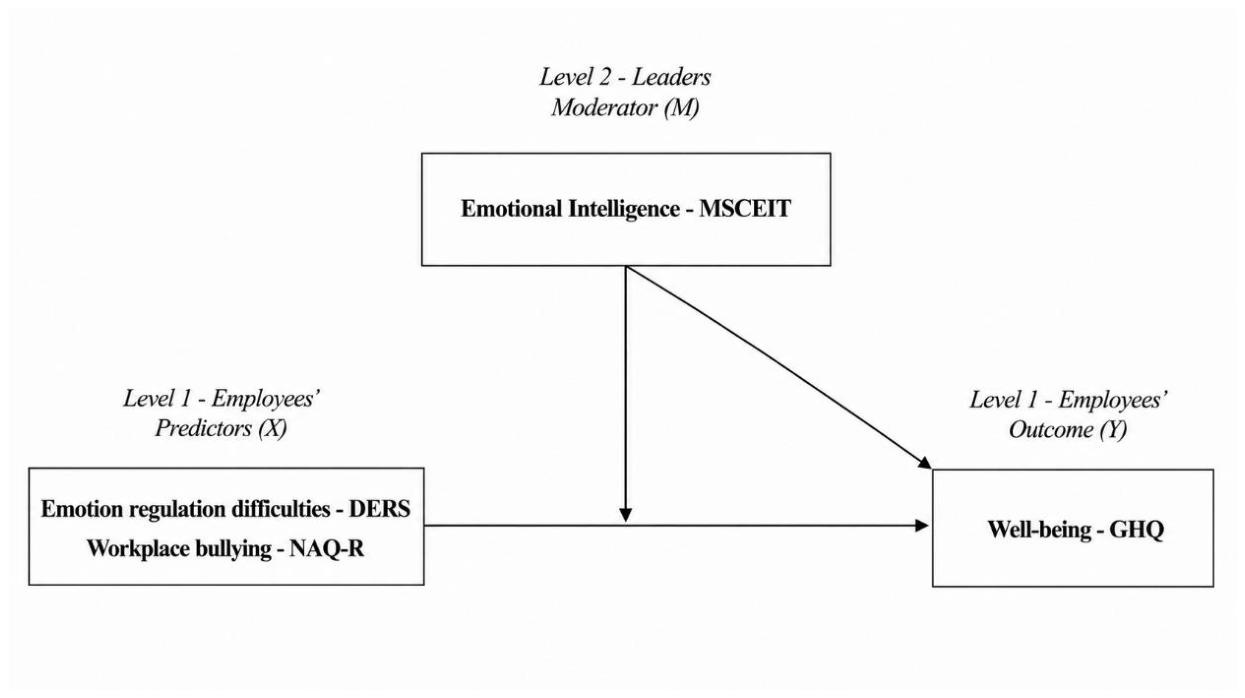
Figure 2.
Visual plot for the main effects of random intercept models for GHQ of DERSnon acceptance (2a), of DERSimpulse control (2b), and of DERSstrategies (2c). Note: Figure 2b shows a negative conditional association, and the effect should not be interpreted as a simple bivariate relationship.
Figure 2.
Visual plot for the main effects of random intercept models for GHQ of DERSnon acceptance (2a), of DERSimpulse control (2b), and of DERSstrategies (2c). Note: Figure 2b shows a negative conditional association, and the effect should not be interpreted as a simple bivariate relationship.
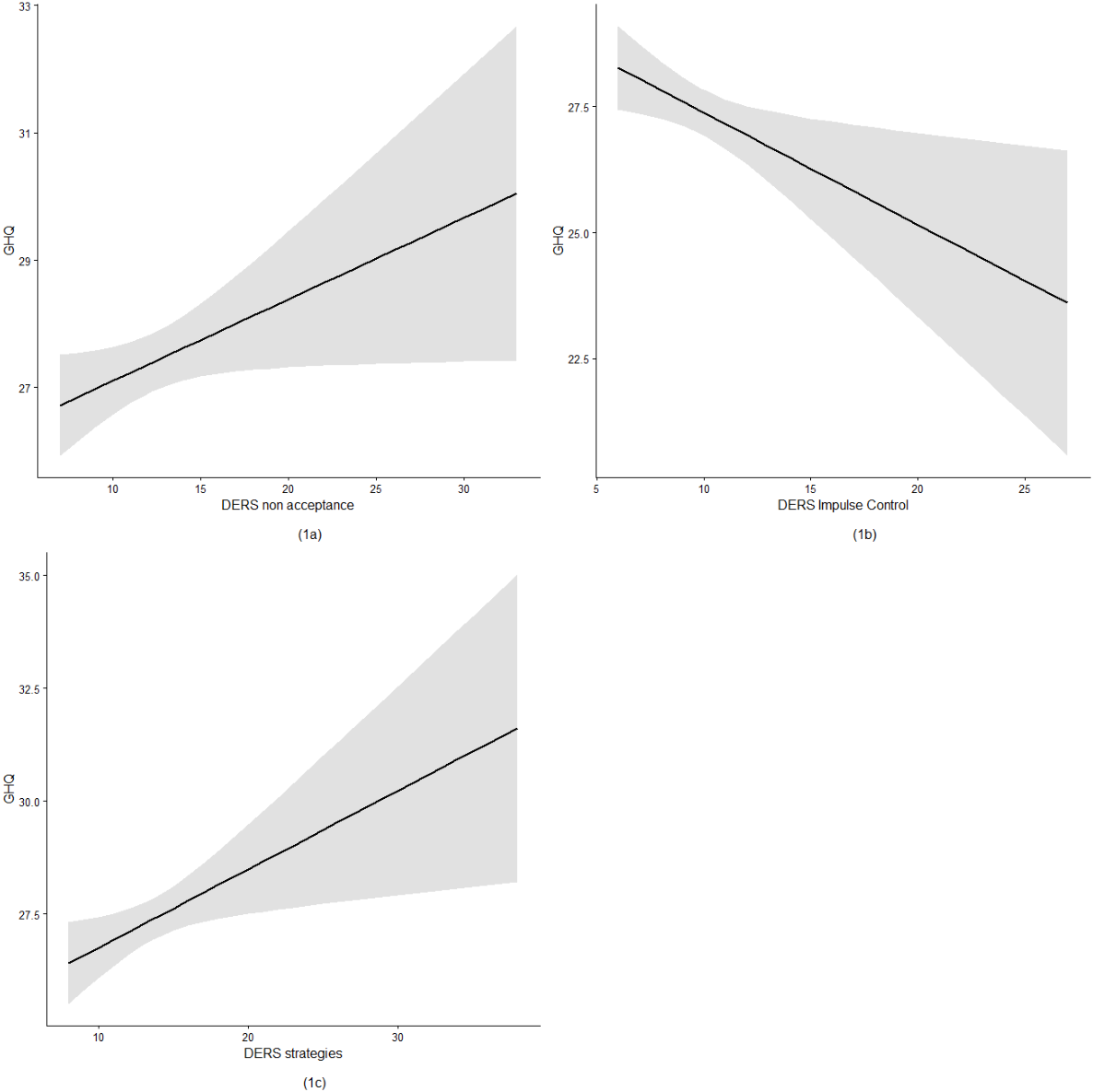
Figure 3.
Visual plot of the effect of MSCEIT-B3 as a Moderator of the association between Work-Related Bullying (NAQ-Rwork) and Psychological Distress (GHQ).
Figure 3.
Visual plot of the effect of MSCEIT-B3 as a Moderator of the association between Work-Related Bullying (NAQ-Rwork) and Psychological Distress (GHQ).
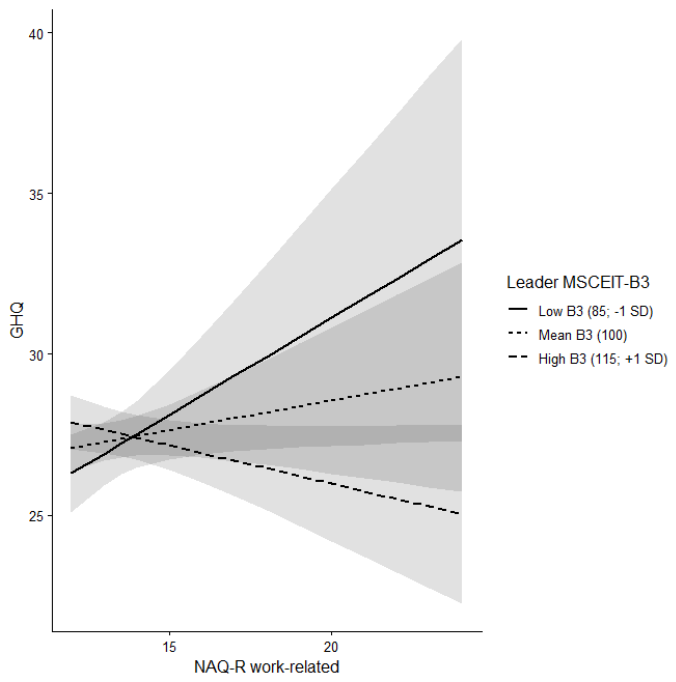
Figure 4.
Empirical model of the effects of DERS subscales and MSCEIT branch scores upon GHQ. Note: Dashed arrows correspond to non-significant effects.
Figure 4.
Empirical model of the effects of DERS subscales and MSCEIT branch scores upon GHQ. Note: Dashed arrows correspond to non-significant effects.
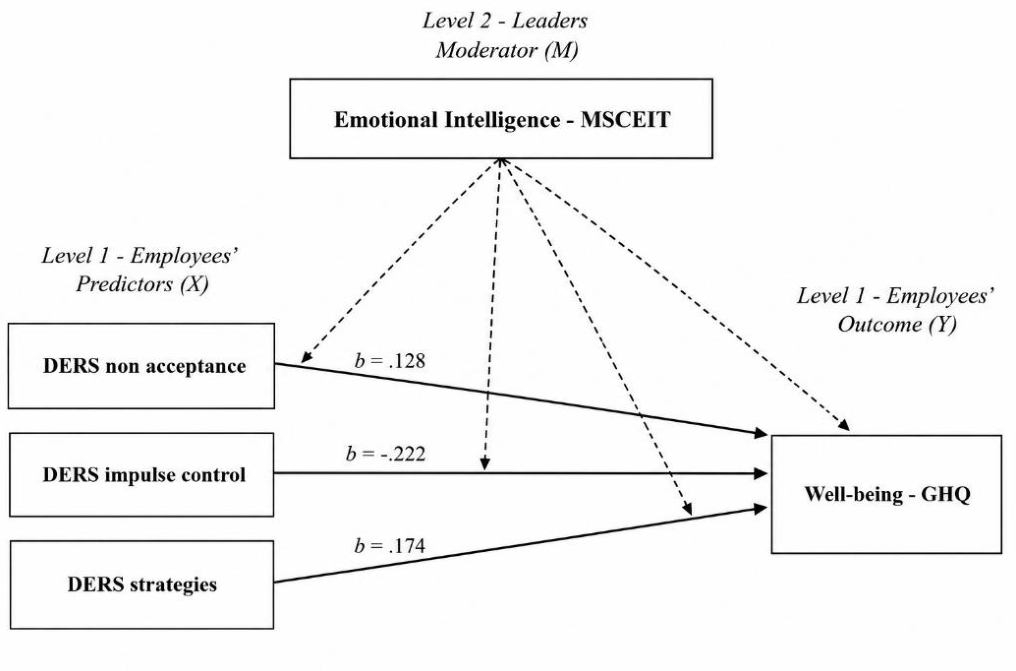
Figure 5.
Empirical model of the effects of NAQ-R subscales and MSCEIT branch scores upon GHQ. Note: Dashed arrows correspond to non-significant effects.
Figure 5.
Empirical model of the effects of NAQ-R subscales and MSCEIT branch scores upon GHQ. Note: Dashed arrows correspond to non-significant effects.
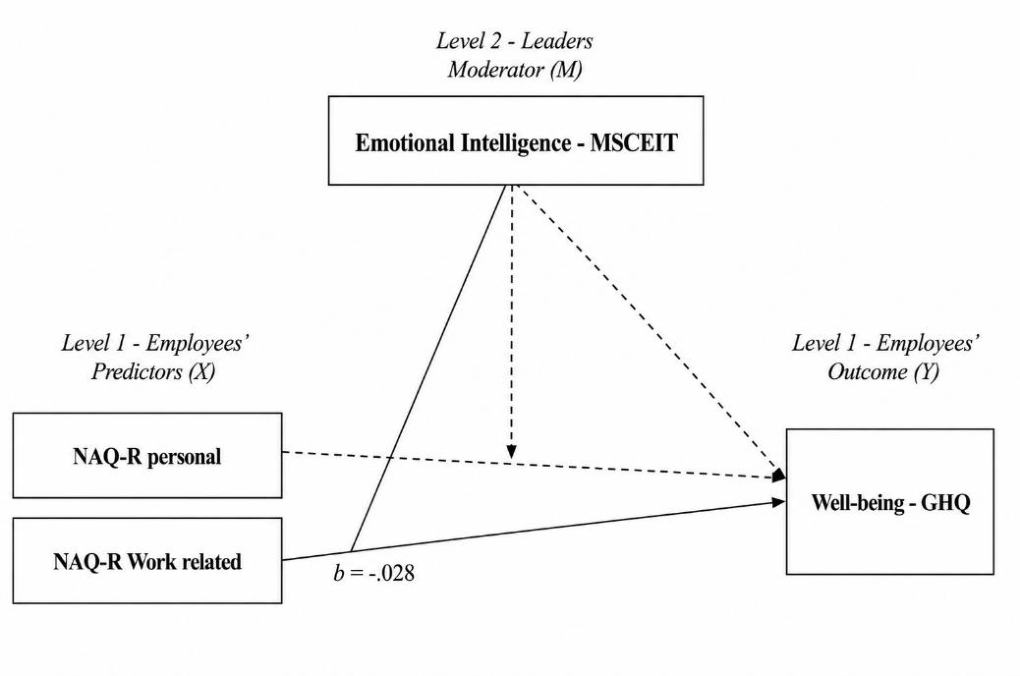

Table 1.
Descriptive analyses and Pearson’s zero-order correlations for the variables of the study.
|
Level 1 variables n = 287 |
Level 2 variables n = 41 |
||||||||||||
| GHQ | DERSnon-acceptance | DERSgoals | DERSimpulse control | DERSawareness | DERSstrategies | DERSclarity | NAQ-Rpersonal | NAQ-Rwork | MSCEIT B1 | MSCEIT B2 | MSCEIT B3 | MSCEIT B4 | |
| GHQ | .68 | ||||||||||||
| DERSnon-acceptance | .32*** | .86 | |||||||||||
| DERSgoals | .28*** | .48*** | .85 | ||||||||||
| DERSimpulse-control | .20*** | .57*** | .69*** | .81 | |||||||||
| DERSawareness | .02 | .09 | .09 | .14 | .76 | ||||||||
| DERSstrategies | .35*** | .71*** | .65*** | .71*** | .17** | .89 | |||||||
| DERSclarity | .25*** | .50*** | .39*** | .48*** | .44*** | .57*** | .76 | ||||||
| NAQ-Rpersonal | .14* | .19** | .16* | .15* | .02 | .17* | .03 | .67 | |||||
| NAQ-Rwork | .04 | .17** | .16* | .18** | .09 | .17** | .10 | .47*** | .76 | ||||
| MSCEIT B1 | .10 | .06 | .02 | .06 | .01 | .02 | .07 | .05 | .00 | .90 | |||
| MSCEIT B2 | .04 | .01 | -.07 | .03 | .08 | -.05 | .02 | .02 | .00 | .44*** | .77 | ||
| MSCEIT B3 | .06 | -.07 | -.07 | -.01 | .08 | -.03 | -.03 | .13* | .14* | .10 | .20*** | .75 | |
| MSCEIT B4 | .02 | -.05 | -.04 | -.02 | -.01 | -.08 | .01 | -.03 | -.05 | .42*** | .58*** | .04 | .72 |
|
M (SD) |
27.39 (4.29) |
12.22 (5.32) |
9.87 (4.08) |
9.94 (4.21) |
15.87 (5.48) |
13.65 (5.95) |
8.99 (3.43) |
6.95 (2.61) |
13.55 (2.23) |
104.76 (17.23) |
103.29 (14.19) |
103.83 (13.27) |
103.05 (15.26) |
| Min-max | 15-41 | 7-33 | 5-24 | 6-27 | 7.-33 | 8-38 | 5-21 | 5-19 | 12.24 | 69-135 | 75-135 | 79-135 | 74-135 |
Note: GHQ=General Health Questionnaire; DERS=Difficulties in Emotion Regulation Scale; NAQ-R=Negative Acts Questionnaire-Revised; MSCEIT=Mayer-Salovey-Caruso Emotional Intelligence Test; B1=Branch 1 Perceiving Emotions; B2=Branch 2 Using Emotions; B3=Branch 3 Understanding Emotions; B4=Branch 4 Managing Emotions. Reliability coefficients are italicized in the diagonal. For GHQ and DERS Cronbach’s alphas are computed from the sample scores; for MSCEIT, split-half coefficients are reported from the manual of the Italian standardization (Curci and D’Amico, 2011). * p < .05, ** p < .05 *** p < .001.
Table 2.
Random intercept model on GHQ scores, testing the effects of DERS (Level-1) and MSCEIT (Level-2) scores.
Table 2.
Random intercept model on GHQ scores, testing the effects of DERS (Level-1) and MSCEIT (Level-2) scores.
| Model component | Estimate / statistic | SE | t-test / p |
| Fixed effects: Full random-intercept model | |||
| Intercept | 18.829 | 2.617 | t = 7.194, p < .001 |
| DERSnon-acceptance | 0.128 | 0.063 | t = 2.025, p = .044 |
| DERSgoals | 0.164 | 0.085 | t = 1.917, p = .056 |
| DERSimpulse-control | −0.222 | 0.089 | t = −2.492, p = .013 |
| DERSawareness | −0.076 | 0.048 | t = −1.579, p = .116 |
| DERSstrategies | 0.174 | 0.070 | t = 2.468, p = .014 |
| DERSclarity | 0.142 | 0.091 | t = 1.548, p = .123 |
| MSCEIT-B1 | 0.019 | 0.016 | t = 1.197, p = .232 |
| MSCEIT-B2 | 0.010 | 0.021 | t = 0.478, p = .633 |
| MSCEIT-B3 | 0.027 | 0.017 | t = 1.588, p = .113 |
| MSCEIT-B4 | −0.006 | 0.020 | t = −0.316, p = .752 |
| Random effects: Null model | |||
| Between-leader variance | 1.168 | SD = 1.081 | |
| Within-leader residual variance | 17.260 | SD = 4.154 | |
| ICC | .063 | ||
| Random effects: Full model | |||
| Between-leader variance | ≈ 0 | ≈ 0 | |
| Residual variance | 15.27 | SD = 3.907 | |
| Residual ICC | ≈ 0 | ||
| Model fit | Null model | Full model | Comparison |
| Log-likelihood | −823.73 | −798.38 | |
| −2 log-likelihood | 1647.5 | 1596.8 | |
| AIC | 1653.5 | 1622.8 | ΔAIC = −30.7 |
| BIC | 1664.5 | 1670.3 | ΔBIC = +5.8 |
| Likelihood-ratio test | χ²(10) = 50.712, p < .001 |
Note: VD=GHQ; ICC=Intra Class Correlation; MSCEIT=Mayer-Salovey-Caruso Emotional Intelligence Test; B1=Branch 1 Perceiving Emotions; B2=Branch 2 Using Emotions; B3=Branch 3 Understanding Emotions; B4=Branch 4 Managing Emotions; AIC=Akaike’s Information Criterion; BIC=Bayesian Information Criterion.
Table 3.
Summary of cross-level interaction models of the six DERS dimensions with the four leaders’ MSCEIT scores.
Table 3.
Summary of cross-level interaction models of the six DERS dimensions with the four leaders’ MSCEIT scores.
| Model |
LRT χ²(6) |
p | AIC |
ΔAIC vs. Main Effects |
BIC |
ΔBIC vs. Main Effects |
Level-2 Intercept Variance |
| Main-effects model | — | — | 1622.8 | — | 1670.3 | — | ≈ 0 |
| DERS * MSCEIT-B1 | 6.92 | .328 | 1627.8 | +5.0 | 1697.4 | +27.1 | ≈ 0 |
| DERS * MSCEIT-B2 | 4.16 | .655 | 1630.6 | +7.8 | 1700.1 | +29.8 | .071 |
| DERS * MSCEIT-B3 | 7.54 | .274 | 1627.2 | +4.4 | 1696.8 | +26.5 | .117 |
| DERS * MSCEIT-B4 | 6.08 | .414 | 1628.7 | +5.9 | 1698.2 | +27.9 | .287 |
Note: VD=GHQ; LRT=Likelihood Ratio Test; AIC=Akaike’s Information Criterion; BIC=Bayesian Information Criterion; MSCEIT=Mayer-Salovey-Caruso Emotional Intelligence Test; B1=Branch 1 Perceiving Emotions; B2=Branch 2 Using Emotions; B3=Branch 3 Understanding Emotions; B4=Branch.
Table 4.
Random intercept model on GHQ scores, testing the effects of NAQ-R (Level-1) and MSCEIT (Level-2) scores.
Table 4.
Random intercept model on GHQ scores, testing the effects of NAQ-R (Level-1) and MSCEIT (Level-2) scores.
| Model component | Estimate / statistic | SE | t-test / p |
| Fixed effects: Full random-intercept model | |||
| Intercept | 24.385 | 3.405 | t = 7.160, p < .001 |
| NAQ-Rpersonal | 0.212 | 0.109 | t = 1.949, p = .052 |
| NAQ-Rwork | -0.125 | 0.127 | t = -0.981, p = .327 |
| MSCEIT-B1 | 0.029 | 0.019 | t = 1.506, p = .144 |
| MSCEIT-B2 | -0.002 | 0.026 | t = -0.071, p = .944 |
| MSCEIT-B3 | 0.015 | 0.021 | t = 0.693, p = .495 |
| MSCEIT-B4 | -0.012 | 0.024 | t = -0.513, p = .611 |
| Random effects: Null model | |||
| Between-leader variance | 1.168 | SD = 1.081 | |
| Within-leader residual variance | 17.260 | SD = 4.154 | |
| ICC | .063 | ||
| Random effects: Full model | |||
| Between-leader variance | 0.829 | SD = 0.911 | |
| Residual variance | 17.058 | SD = 4.130 | |
| Residual ICC | .046 |
||
| Model fit | Null model | Full model | Comparison |
| Log-likelihood | -823.73 | -820.17 | |
| −2 log-likelihood | 1647.5 | 1640.3 | |
| AIC | 1653.5 | 1658.3 | ΔAIC = +4.8 |
| BIC | 1664.5 | 1691.3 | ΔBIC = +26.8 |
| Likelihood-ratio test | χ²(6) = 7.12, p = .310 |
Note: VD=GHQ; ICC=Intra Class Correlation; MSCEIT=Mayer-Salovey-Caruso Emotional Intelligence Test; B1=Branch 1 Perceiving Emotions; B2=Branch 2 Using Emotions; B3=Branch 3 Understanding Emotions; B4=Branch 4 Managing Emotions; AIC=Akaike’s Information Criterion; BIC=Bayesian Information Criterion.
Table 5.
Summary of cross-level interaction models of the two NAQ-R dimensions with the four leaders’ MSCEIT scores.
Table 5.
Summary of cross-level interaction models of the two NAQ-R dimensions with the four leaders’ MSCEIT scores.
| Model |
LRT χ²(df) |
p | AIC |
ΔAIC vs. Main Effects |
BIC |
ΔBIC vs. Main Effects |
Level-2 Intercept variance |
| Main-effects model | 7.12 (6) | .310 | 1658.3 | — | 1691.3 | — | .829 |
| NAQ-R * MSCEIT-B1 | 1.69 (2) | .429 | 1660.7 | +2.4 | 1700.9 | +9.6 | .580 |
| NAQ-R * MSCEIT-B2 | 2.32 (2) | .314 | 1660.0 | +1.7 | 1700.3 | +9.0 | .742 |
| NAQ-R * MSCEIT-B3 | 8.03 (2) | .018 | 1654.3 | −4.0 | 1694.6 | +3.3 | .669 |
| NAQ-R * MSCEIT-B4 | 0.38 (2) | .828 | 1662.0 | +3.7 | 1702.2 | +10.9 | .763 |
Note: VD=GHQ; LRT=Likelihood Ratio Test; AIC=Akaike’s Information Criterion; BIC=Bayesian Information Criterion; MSCEIT=Mayer-Salovey-Caruso Emotional Intelligence Test; B1=Branch 1 Perceiving Emotions; B2=Branch 2 Using Emotions; B3=Branch 3 Understanding Emotions; B4=Branch 4 Managing Emotions.
Disclaimer/Publisher’s Note: The statements, opinions and data contained in all publications are solely those of the individual author(s) and contributor(s) and not of MDPI and/or the editor(s). MDPI and/or the editor(s) disclaim responsibility for any injury to people or property resulting from any ideas, methods, instructions or products referred to in the content. |
© 2026 by the authors. Licensee MDPI, Basel, Switzerland. This article is an open access article distributed under the terms and conditions of the Creative Commons Attribution (CC BY) license (http://creativecommons.org/licenses/by/4.0/).
Copyright: This open access article is published under a Creative Commons CC BY 4.0 license, which permit the free download, distribution, and reuse, provided that the author and preprint are cited in any reuse.