

Submitted:
25 August 2026
Posted:
27 August 2026
You are already at the latest version
Abstract
Background: The American Heart Association's cardiovascular–kidney–metabolic (CKM) syndrome framework has not previously been applied to cardiac surgery–associated acute kidney injury (CSA-AKI) risk after coronary artery bypass grafting (CABG). We used this framework to test, for the first time in this setting, whether cumulative CKM burden predicts severe CSA-AKI independently of established cardiorenal dysfunction, specifically baseline kidney function and left ventricular ejection fraction (LVEF). Methods: In this retrospective secondary analysis of the KARMA cohort, a prospectively maintained CABG registry at University Malaya Medical Centre, adults undergoing isolated CABG between January 2021 and December 2025 were classified into three CKM-CABG stages: Stage A (one or fewer metabolic risk factors, no CKD or heart failure [HF]), Stage B (two or more metabolic risk factors, no CKD or HF), and Stage C (CKD and/or HF, irrespective of metabolic burden). The primary outcome, severe CSA-AKI (KDIGO Stage 2–3), was modelled by multivariable logistic regression, with a secondary model adjusting for baseline estimated glomerular filtration rate (eGFR) and LVEF. Results: Among 517 patients, severe CSA-AKI occurred in 46 (8.9%). Stage C was associated with higher odds of severe CSA-AKI in the primary adjusted model (adjusted odds ratio [OR] 5.49, 95% confidence interval [CI] 1.72–17.50; p=0.004), but this attenuated substantially after adjustment for baseline eGFR and LVEF (adjusted OR 3.23, 95% CI 0.88–11.80; p=0.077), suggesting substantial overlap between Stage C classification and baseline cardiorenal function. Stage B did not differ significantly from Stage A (adjusted OR 2.42, 95% CI 0.73–8.01; p=0.148), though power was limited. Adding CKM-CABG stage to the clinical model modestly improved discrimination (apparent ΔAUC 0.032, 95% CI 0.005–0.065; p=0.034; bootstrap-corrected AUCs 0.776 vs 0.803) with satisfactory calibration. Conclusions: Severe CSA-AKI was more frequent among patients with established CKD and/or HF, and this association was substantially attenuated after adjustment for baseline eGFR and LVEF, indicating that its prognostic signal overlaps substantially with routinely measured cardiorenal function. Metabolic burden in the absence of established organ dysfunction was not independently associated with severe AKI. CKM-CABG staging provided only modest incremental discrimination beyond routinely measured eGFR and LVEF, and this finding requires external validation. Its potential utility may therefore be as a pragmatic framework for communicating cardiorenal–metabolic vulnerability. In elective CABG, baseline eGFR and LVEF appear to capture most of the CKM-related risk of severe AKI; metabolic burden alone should not prompt escalation of AKI risk categorization.
Keywords:
cardiovascular–kidney–metabolic syndrome
; CKM syndrome
; coronary artery bypass grafting
; cardiac surgery–associated acute kidney injury
; CSA-AKI
; cardiorenal function
; perioperative risk stratification
; chronic kidney disease
1. Introduction
CSA-AKI occurs in roughly 20–40% of patients undergoing CABG and remains a major contributor to postoperative morbidity [1,2,3,19]. Even small rises in serum creatinine correlate with longer ICU stays, CKD progression, and higher short- and long-term mortality [4,5,6]. Severe AKI requiring kidney replacement therapy carries particularly poor outcomes despite advances in perioperative care.
Established risk factors for CSA-AKI, including pre-existing CKD, reduced LVEF, diabetes, and anemia [7,8], alongside prolonged cardiopulmonary bypass (CPB), are incorporated into several validated prediction scores [15,16,23,24]. Most CABG candidates carry more than one of these factors concurrently. Whether their co-occurrence amplifies renal susceptibility through a shared pathophysiological mechanism, or simply through additive individual effects, remains unclear, with direct implications for how perioperative renal risk is conceptualized and stratified.
The American Heart Association's cardiovascular–kidney–metabolic (CKM) syndrome framework offers one way to examine this gap [12,13]. It proposes that obesity, diabetes, CKD, and cardiovascular disease represent progressively severe manifestations of a common continuum, driven by chronic inflammation, endothelial dysfunction, and neurohormonal dysregulation [13,14]. Under this model, AKI risk in CABG patients may rise not simply because individual risk factors are present, but because cumulative CKM burden depletes physiological reserve across the cardiorenal axis, reducing tolerance to the ischemia-reperfusion injury and hemodynamic stress of cardiac surgery [17,18].
CKD and reduced LVEF are already established CSA-AKI predictors incorporated into existing validated risk scores. The question this study addresses is whether organizing these variables within a CKM staging framework, and adding a metabolic dimension, provides information beyond what direct measurement of eGFR and LVEF already captures. This study tests whether the CKM framework adds incremental value; it does not propose a new clinical prediction tool, and any utility depends on the staging structure contributing beyond its own component variables. In elective CABG, eGFR and LVEF are routinely measured before surgery, so any proposed framework needs to demonstrate value over and above them. To our knowledge, this is among the first studies to apply the AHA CKM staging framework specifically to CSA-AKI risk stratification in CABG, providing an empirical test of whether CKM-defined metabolic burden adds information beyond established cardiorenal function.
We conducted a secondary analysis of the KARMA cohort, a prospectively maintained CABG registry at University Malaya Medical Centre [25], framed around a clear population, intervention, comparison, and outcome (PICO). In adults undergoing isolated CABG (population), we tested whether preoperative CKM-CABG stage, a three-category classification combining metabolic risk factors with CKD and HF status (intervention), was associated with severe CSA-AKI, KDIGO Stage 2–3 (outcome), independently of direct measurement of baseline eGFR and LVEF (comparison). Three specific questions followed: (i) how CKM-related comorbidity distributes across an isolated CABG cohort; (ii) whether CKM burden is associated with severe CSA-AKI; and (iii) whether any such association persists after accounting for baseline eGFR and LVEF, testing whether the CKM framework contributes risk information beyond the two cardiorenal functional parameters already available at the time of surgical planning.
2. Methods
2.1. Study Design, Setting, and Population
Retrospective secondary analysis of the KARMA cohort, a prospectively maintained database of consecutive CABG patients at University Malaya Medical Centre (UMMC), a tertiary academic center in Malaysia [25]. Adults aged ≥18 years who underwent isolated CABG between January 2021 and December 2025 were eligible. Patients undergoing combined CABG plus valve surgery were excluded to maintain procedural homogeneity. All 517 remaining patients had complete staging and outcome data. The manuscript was prepared in accordance with the STROBE checklist (Supplementary File S1: STROBE Checklist).
2.2. Data Sources and Variables
Data were obtained from the institutional CABG database maintained by the nephrology and cardiothoracic surgery units at UMMC. Variables included demographics (age, sex, ethnicity), comorbidities (diabetes, hypertension, HF, COPD, prior cardiac surgery, CKD), renal parameters (CKD stage, baseline creatinine, baseline eGFR), cardiac and operative parameters (LVEF, CPB time, cross-clamp time, emergency surgery status), and anthropometric and laboratory measures (BMI, baseline hemoglobin). Postoperative variables included AKI onset, KDIGO stage, peak creatinine, nadir urine output, CRRT use, vasopressor use, ventilation duration, SOFA score, ICU and hospital length of stay, in-hospital mortality, and renal recovery at discharge.
2.3. Definitions
Asian obesity was defined as BMI ≥25 kg/m², consistent with WHO recommendations for Asian populations [11]. Diabetes mellitus was defined by prior physician diagnosis, current antidiabetic medication use, or fasting plasma glucose ≥7.0 mmol/L. Hypertension was defined by prior diagnosis or current antihypertensive medication use. Pre-existing CKD was identified from clinical records and staged per KDIGO GFR categories [9,10]. AKI was defined and staged by KDIGO 2012 criteria using both serum creatinine and urine output; urine-output data were complete for all patients, and both criteria were applied throughout [3]. Severe CSA-AKI was defined as KDIGO Stage 2 or 3 during the index admission. In-hospital mortality was defined as death from any cause before discharge. Renal non-recovery was defined as failure of serum creatinine to return to within 0.3 mg/dL of the baseline value by hospital discharge.
Baseline serum creatinine was defined as the most recent preoperative value obtained within 30 days before surgery, and eGFR was calculated using the CKD-EPI 2021 equation. Pre-existing CKD was defined by a documented clinical diagnosis in the medical record; where available, CKD stage was recorded according to KDIGO GFR categories. Preoperative HF was defined by a documented diagnosis of congestive heart failure (CHF) recorded in the institutional CABG database, reflecting prior clinical diagnosis rather than a numeric LVEF threshold or echocardiographic impression. LVEF was obtained separately from the most recent preoperative transthoracic echocardiogram, performed within 30 days before surgery.
2.4. CKM-CABG Classification
A three-stage CKM-CABG phenotype was developed using preoperative clinical variables available in routine practice. Metabolic risk factors were defined as diabetes mellitus, hypertension, and Asian obesity. Patients were categorized as:
- Stage A: ≤1 metabolic risk factor, without CKD or HF.
- Stage B: ≥2 metabolic risk factors, without CKD or HF.
- Stage C: CKD and/or HF, irrespective of metabolic burden.
This classification was adapted from the AHA CKM construct [12] but is not equivalent to the official AHA staging system. Stage A served as the reference. The Stage A/B distinction was designed to test whether metabolic burden in the absence of organ dysfunction independently influences severe AKI risk. Stage C tests the contribution of established cardiorenal disease. All 517 patients had complete staging data.
2.5. Outcomes
The primary outcome was severe CSA-AKI (KDIGO Stage 2–3). This threshold was selected over KDIGO Stage 3 alone to ensure adequate events (n=46) for stable multivariable modelling; a sensitivity analysis using Stage 3 alone is reported in Appendix A. Any CSA-AKI (KDIGO Stage 1–3) was a secondary outcome. CRRT use, in-hospital mortality, renal non-recovery, ICU and hospital length of stay, SOFA score, and ventilation duration were analyzed descriptively given limited event numbers.
2.6. Bias
Several design features addressed anticipated sources of bias. Selection bias was limited by including all consecutive patients undergoing isolated CABG at UMMC over five years, rather than a convenience or referred subset. Exclusion of combined CABG plus valve surgery was applied uniformly to preserve procedural homogeneity, and all 517 eligible patients had complete staging and outcome data for these variables, reducing, but not eliminating, the possibility of bias related to missing data.
Information bias was addressed through standardized, guideline-based definitions applied uniformly across the cohort: AKI was staged using KDIGO 2012 serum creatinine and urine output criteria [3], CKD using KDIGO GFR categories [9,10], and obesity using WHO Asian BMI thresholds [11], rather than site-specific or subjective criteria.
Confounding was addressed with two pre-specified multivariable models. CKD and HF were excluded as separate covariates in the primary model to avoid overadjustment, since they define Stage C by construction; the secondary model then added baseline eGFR and LVEF specifically to test whether the CKM-CABG association reflected these two functional parameters rather than the categorical staging itself. Because CKM-CABG stage was assigned from preoperative variables recorded before the AKI outcome occurred, reverse causation was not a concern.
Classification bias from the a priori Stage A/B threshold (two or more metabolic risk factors) was assessed with a sensitivity analysis using an alternative threshold of three or more factors (§3.8), and the robustness of the severe AKI outcome definition (KDIGO Stage 2–3) was tested against a more stringent KDIGO Stage 3-only definition (Appendix A).
2.7. Statistical Analysis
Baseline characteristics were compared across CKM-CABG stages using one-way ANOVA or Kruskal–Wallis tests for continuous variables and chi-square or Fisher's exact tests for categorical variables.
The association between CKM-CABG stage and severe CSA-AKI was evaluated with two pre-specified multivariable logistic regression models. The primary model adjusted for age, sex, CPB duration, emergency surgery, and baseline hemoglobin. CKD and HF were excluded from this model to avoid overadjustment, as they define Stage C. The secondary model additionally included baseline eGFR and LVEF to determine whether the Stage C association persisted after accounting for the underlying cardiorenal functional impairment those variables capture. Covariates in both models were selected a priori for established clinical relevance to CSA-AKI risk, not through data-driven or stepwise selection.
With 46 severe AKI events, modelling was kept parsimonious. The primary model included approximately seven parameters (events-per-variable ratio ~6.6); the secondary model approximately nine (~5.1). Results were interpreted with attention to effect size, confidence intervals, and consistency across models rather than p-values alone. Discrimination was assessed by AUC; calibration by Hosmer–Lemeshow test (10 groups). Incremental AUC was tested using a bootstrap comparison (B=2000 iterations); bootstrap optimism correction (B=500) was used to estimate corrected AUCs. Net reclassification improvement (NRI) and integrated discrimination improvement (IDI) were calculated for the clinical versus clinical+CKM model comparison as an exploratory, non-prespecified secondary analysis; no risk threshold was prespecified for category-based NRI, so only the continuous (category-free) form is reported. The Thakar (Cleveland Clinic) score was calculated from available KARMA variables as an external reference comparator, with the caveat that it was developed for dialysis prediction rather than KDIGO Stage 2–3 AKI. All analyses were conducted using IBM SPSS Statistics version 26 (IBM Corp., Armonk, NY, USA). Multivariable logistic regression models were fitted by maximum-likelihood estimation using the Binary Logistic Regression procedure (Newton–Raphson algorithm). Bootstrap resampling (2000 replicates for the incremental AUC comparison; 500 replicates for optimism correction) was performed using the SPSS Bootstrapping module, with the NRI/IDI calculations implemented via custom SPSS syntax. P<0.05 was the threshold for primary analyses.
3. Results
3.1. Study Participant Flow
Figure 1.
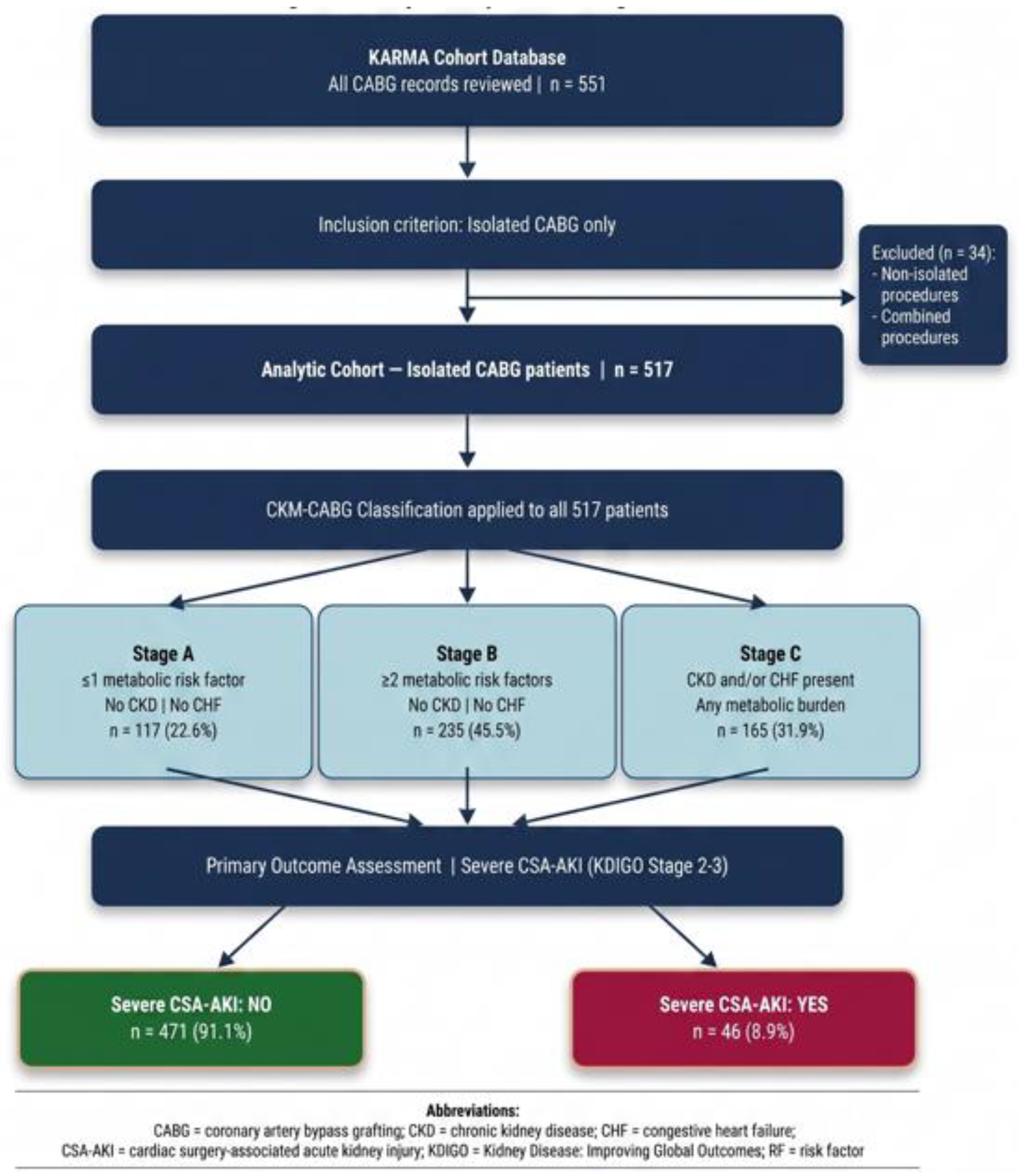
Study participant flow diagram. Of 551 CABG records screened, 34 were excluded (non-isolated CABG), yielding 517 patients classified into three CKM-CABG stages. CABG = coronary artery bypass grafting; CKM = cardiovascular–kidney–metabolic; CSA-AKI = cardiac surgery–associated acute kidney injury; KDIGO = Kidney Disease: Improving Global Outcomes.
Figure 1.
Study participant flow diagram. Of 551 CABG records screened, 34 were excluded (non-isolated CABG), yielding 517 patients classified into three CKM-CABG stages. CABG = coronary artery bypass grafting; CKM = cardiovascular–kidney–metabolic; CSA-AKI = cardiac surgery–associated acute kidney injury; KDIGO = Kidney Disease: Improving Global Outcomes.
3.2. Population and CKM-CABG Stage Distribution
3.3. Baseline Characteristics by CKM-CABG Stage
Age, sex, CPB time, cross-clamp time, emergency surgery rate, and hemoglobin were similar across stages (Table 2). Stage B patients had substantially higher metabolic burden than Stage A, with over 80% diabetic, nearly 90% hypertensive, and two-thirds meeting Asian obesity criteria, while maintaining normal eGFR and LVEF. Stage C patients had markedly impaired cardiorenal function: mean eGFR 72.0 ± 19.3 mL/min/1.73m² compared with ~86 mL/min/1.73m² in Stages A and B, and mean LVEF 48.5 ± 13.7% compared with ~59–60% in the other two groups. These baseline differences in kidney and cardiac function are the context against which the outcome data should be read.
3.4. Postoperative AKI Outcomes by CKM-CABG Stage
Any CSA-AKI occurred in 165 patients (31.9%), rising from 19.7% in Stage A to 25.1% in Stage B and 50.3% in Stage C (p<0.001). Severe CSA-AKI occurred in 46 patients (8.9%) and showed a similar gradient: 4.3% in Stage A, 6.4% in Stage B, and 15.8% in Stage C (p<0.001). CRRT use was low overall but highest in Stage C (9.7%). In-hospital mortality and renal non-recovery were numerically higher in Stage C but did not reach statistical significance, reflecting limited event counts (Table 3, Figure 3 and Figure 4).
3.5. Multivariable Analysis: Primary Model
In the primary model, Stage C was associated with higher odds of severe CSA-AKI compared with Stage A (adjusted OR 5.49, 95% CI 1.72–17.50; p=0.004). Stage B showed no significant difference from Stage A (adjusted OR 2.42, 95% CI 0.73–8.01; p=0.148). Older age, longer CPB time, and lower hemoglobin were also independently associated with severe AKI (Table 4, Figure 5).
3.6. Secondary Model: Effect of Adjusting for eGFR and LVEF
When baseline eGFR and LVEF were added to the model, the Stage C association was substantially attenuated (adjusted OR 3.23, 95% CI 0.88–11.80; p=0.077), with the confidence interval including the null. Of the two additional covariates, baseline eGFR was independently associated with severe AKI (OR 0.97 per mL/min/1.73m²; p=0.023), whereas LVEF was not (OR 0.99 per percentage point; p=0.503). This suggests that baseline eGFR overlaps substantially with the excess AKI risk reflected by Stage C classification (Table 5).
3.7. Discrimination and Calibration
The clinical model achieved an apparent AUC of 0.798; bootstrap optimism correction (B=500) yielded a corrected AUC of 0.776 (optimism 0.022). Adding CKM-CABG stage raised the apparent AUC to 0.830 (ΔAUC 0.032, 95% CI 0.005–0.065; p=0.034), with a corrected AUC of 0.803 (optimism 0.027; Figure 6). The Thakar (Cleveland Clinic) score, calculated from available KARMA variables, achieved an AUC of 0.714; this comparison is cross-outcome as the Thakar score was developed to predict dialysis need rather than KDIGO Stage 2–3 AKI. As an exploratory, non-prespecified secondary analysis, reclassification metrics showed a category-free NRI of 0.54 (95% CI 0.20–0.91; p=0.004) and an IDI of 0.034 (95% CI 0.007–0.090; p=0.100) when CKM-CABG stage was added to the clinical model. Both models had satisfactory calibration (Hosmer–Lemeshow p=0.643 and p=0.592, respectively).
3.8. Sensitivity Analysis
To evaluate robustness of the prespecified Stage B threshold (two or more metabolic risk factors), the primary model was repeated with a threshold of three or more metabolic factors. Under this alternative, Stage B comprised 84 patients and Stage A 268 patients. The Stage B OR was 2.41 (95% CI 0.86–6.76; p=0.096) and Stage C OR was 3.71 (95% CI 1.72–8.02; p=0.001). The Stage B point estimate was nearly identical to the prespecified analysis (OR 2.42 vs 2.41), supporting directional consistency across threshold definitions. The Stage C association remained statistically significant at both cut-offs.
4. Discussion
4.1. Key Findings
This study asked whether CKM burden predicts severe CSA-AKI in CABG patients, and whether any association is independent of the cardiorenal functional impairment that defines higher CKM stages. Two findings stand out, and both point in the same direction.
Stage C carried more than five-fold higher odds of severe AKI in the primary model (adjusted OR 5.49, 95% CI 1.72–17.50; p=0.004), but this effect attenuated substantially once baseline eGFR and LVEF entered the model (adjusted OR 3.23, 95% CI 0.88–11.80; p=0.077), with the confidence interval including the null. Of the two added covariates, baseline eGFR was independently associated with severe AKI (OR 0.97 per mL/min/1.73m²; p=0.023); LVEF was not (OR 0.99 per percentage point; p=0.503). Stage C patients had a mean eGFR approximately 14 mL/min/1.73m² lower and a mean LVEF approximately 11 percentage points lower than Stages A and B, so part of the attenuation is structural: Stage C is defined by CKD and/or HF, and eGFR and LVEF are the continuous measures of those same conditions, which means adjusting for them partly decomposes a binary classifier back into its own components.
Stage B patients were metabolically loaded by any measure: more than 80% had diabetes, nearly 90% had hypertension, and two-thirds met Asian obesity criteria. Yet their adjusted odds of severe AKI relative to Stage A were 2.42 (95% CI 0.73–8.01; p=0.148), a clinically plausible point estimate with a confidence interval crossing unity. With only 46 outcome events, the study lacks power to reliably detect an effect of this magnitude, so the non-significant result should not be read as evidence that metabolic burden without organ dysfunction is unimportant. A sensitivity analysis using a threshold of three or more metabolic factors produced an almost identical estimate (OR 2.41, 95% CI 0.86–6.76; p=0.096).
Adding CKM-CABG stage to the clinical model raised discrimination modestly, from a bootstrap-corrected AUC of 0.776 to 0.803 (ΔAUC 0.027). In this exploratory, non-prespecified analysis, the category-free NRI was 0.54 (95% CI 0.20–0.91; p=0.004) and the IDI was 0.034 (95% CI 0.007–0.090; p=0.100). In this cohort, baseline cardiorenal function was more strongly associated with severe AKI risk than cumulative metabolic burden. The modest incremental value of CKM-CABG staging is clinically informative: routinely measured eGFR and LVEF appear to capture much of the risk information contained in the staging construct, so metabolic burden alone should not be used to escalate a patient's AKI risk category.
4.2. Comparison with Other Studies
Several validated models for CSA-AKI and dialysis risk after cardiac surgery already exist, including the Cleveland Clinic (Thakar) score, the Mehta score, the Leicester score, and the Simplified Renal Index, each built from overlapping variables such as CKD, diabetes, ventricular dysfunction, anemia, and emergency surgery [15,16,23,24]. Applying the Thakar score to this cohort using available KARMA variables yielded an AUC of 0.714, lower than the clinical model alone (0.798); the comparison is cross-outcome, since the Thakar score was developed to predict post-cardiac surgery dialysis need rather than KDIGO Stage 2–3 AKI. A head-to-head evaluation against a score developed and validated for KDIGO-defined AKI, such as the Birnie et al. model, would offer a cleaner benchmark and was not possible here because that score requires variables not uniformly recorded in KARMA. These AUCs are consistent with the broader validation of four preoperative risk scores (Mehta, Cleveland Clinic, Simplified Renal Index, and Leicester) in the full KARMA cohort, which similarly found moderate discrimination (AUC 0.71–0.76) for severe AKI and CRRT, alongside high negative predictive value but poor positive predictive value [25].
The high metabolic burden observed in Stage B, over 80% diabetic, nearly 90% hypertensive, two-thirds meeting Asian obesity criteria, is consistent with the disproportionate burden of diabetes and premature cardiovascular risk reported in South and Southeast Asian populations [21,22]. What this cohort does not reproduce is the AHA CKM framework's premise that cumulative metabolic burden itself drives progressively worse cardiorenal outcomes [12,13]: among participants without CKD or HF by the study classification, added metabolic risk factors contributed little independent signal, and a graded independent association between metabolic burden and cardiorenal outcomes was not evident in these data. This is consistent with mechanistic accounts in which metabolic disease damages the kidney and heart mainly through its organ-level consequences, reduced glomerular filtration reserve, impaired renal autoregulation, endothelial dysfunction, rather than through a separately measurable systemic burden [17,18].
4.3. Strengths and Limitations
This analysis draws on five years of consecutive, prospectively recorded data from a single high-volume tertiary CABG registry, with complete staging and outcome data in all 517 patients, reducing, but not eliminating, the possibility of bias from missing data. AKI, CKD, and obesity were defined using standardized KDIGO and WHO criteria rather than site-specific thresholds, and the CKM-CABG classification, Stage A/B threshold, and analysis plan were pre-specified before the primary and secondary models were run. Discrimination and calibration were assessed with bootstrap optimism correction rather than apparent statistics alone, and two sensitivity analyses, an alternative Stage A/B threshold and a KDIGO Stage 3-only outcome, tested the robustness of the main findings.
Set against these strengths are several limitations. This is a single-center retrospective analysis, so residual confounding cannot be excluded, and findings may not generalize to centers with different patient populations or perioperative practices. With 46 severe AKI events, both multivariable models operated near the lower acceptable bound for events-per-variable ratio, and the nine-parameter secondary model is more susceptible to overfitting than the primary model; bootstrap optimism correction (B=500) yielded corrected AUCs of 0.776 and 0.803 for the clinical and clinical-plus-CKM models respectively, with optimism estimates of only 0.022 and 0.027, suggesting limited overfitting, but external validation in an independent cohort remains necessary before clinical deployment. The Thakar score, the only external comparator available, predicts dialysis need rather than KDIGO Stage 2–3 AKI, which limits direct comparison, and a head-to-head evaluation against a KDIGO-specific model such as Birnie et al. was not possible with the variables recorded in KARMA. The Stage A/B threshold was set a priori rather than derived in a separate cohort; the sensitivity analysis using three or more metabolic factors produced consistent estimates (Stage B OR 2.41, Stage C OR 3.71), supporting directional robustness, but this does not substitute for external validation of the staging system itself. CRRT use and in-hospital mortality had too few events for multivariable analysis and are reported descriptively only. Stage C is also internally heterogeneous, combining patients with CKD alone, HF alone, or both; this analysis did not decompose Stage C by subgroup, which limits interpretation given that eGFR, not LVEF, was independently significant in the secondary model.
4.4. Impact on Clinical Practice
Patients with CKD and/or HF had the highest rates of severe AKI, CRRT use, and prolonged ICU and hospital stays. Pending external validation, this group is a reasonable target for enhanced perioperative renal surveillance, early nephrology involvement, and KDIGO-based supportive care, consistent with trial evidence that implementing KDIGO guideline-based bundles in high-risk cardiac surgery patients reduces AKI incidence [20]. That Stage B carried no significant AKI signal suggests metabolic burden alone, without end-organ dysfunction, does not warrant the same intensity of perioperative protective measures, though this is not grounds to deprioritize longer-term metabolic risk management in these patients.
The data does not establish CKM-CABG staging as a clinically useful prediction tool beyond direct eGFR and LVEF assessment: Stage C's predictive signal is substantially captured by those two variables. The clinical model showed higher apparent discrimination than the Thakar score in this cohort (AUC 0.798 vs 0.714), although the comparison is cross-outcome. If externally validated, its potential value may be as a structured summary of preoperative cardiorenal–metabolic vulnerability and as a shared communication framework; it should not replace direct assessment of eGFR and LVEF. Whether that communication value changes clinical decisions or outcomes has not been tested, and clinicians assessing perioperative renal risk should rely on eGFR and LVEF directly rather than on CKM-CABG stage alone.
4.5. Impact on Future Studies
Four priorities follow from these findings. External validation in multicenter cohorts is needed before CKM-CABG staging, or the attenuation of its Stage C signal by eGFR and LVEF, can be generalized beyond this single Malaysian center. Head-to-head comparison with CSA-AKI risk scores developed and validated for KDIGO-defined outcomes, such as the Birnie et al. model, would give a cleaner benchmark than the dialysis-focused Thakar score used here. A dedicated subgroup analysis decomposing Stage C into CKD-only, HF-only, and combined phenotypes would clarify whether the AKI signal traces to one condition, the other, or their combination. Prospective evaluation of whether CKM-CABG stage-guided perioperative protocols, for example targeted renal surveillance or earlier nephrology involvement in Stage C, reduce AKI incidence or severity would test whether the framework's communication value translates into better outcomes. Larger multicenter studies would also help determine whether ethnic differences in CKM-related AKI susceptibility exist, which this single-center cohort was not designed to detect.
5. Conclusions
In this five-year Malaysian CABG cohort, severe CSA-AKI was concentrated in patients with pre-existing CKD and/or HF. The association between Stage C and severe CSA-AKI was substantially attenuated after adjustment for baseline eGFR and LVEF, suggesting that the stage's prognostic signal overlaps substantially with routinely measured cardiorenal function; high metabolic burden without organ dysfunction did not independently elevate risk. A graded independent association between metabolic burden and severe CSA-AKI was not demonstrated in this cohort. Taken together, these data support a simple, clinically relevant takeaway: for elective CABG, baseline eGFR and LVEF already capture most of the CKM-related risk of severe AKI, and metabolic burden alone does not warrant escalation of AKI risk categorization.
CKM-CABG staging provided only modest incremental discrimination beyond a model incorporating routinely measured eGFR and LVEF, both of which are routinely available before elective CABG, and its clinical usefulness requires external validation and comparison with established CSA-AKI risk instruments before broader use.
Supplementary Materials
Supplementary File S1 (STROBE Checklist) accompanies this manuscript and identifies the manuscript location of each STROBE item; a sensitivity analysis restricting the severe AKI outcome to KDIGO Stage 3 alone is presented in Appendix A of this manuscript.
Author Contributions
Conceptualization, S.S.B. and W.A.H.W.M.A.; methodology, S.S.B.; formal analysis, S.S.B.; data curation, S.S.B., K.V.P., Y.W.L., S.Y.Y., E.L. and S.F.C.; validation, K.V.P., Y.W.L., S.Y.Y. and E.L.; writing—original draft preparation, S.S.B.; writing—review and editing, S.S.B., K.V.P., Y.W.L., S.Y.Y., E.L., S.F.C., C.K.T. and W.A.H.W.M.A.; supervision, C.K.T. and W.A.H.W.M.A.; project administration, W.A.H.W.M.A. Author contributions follow the CRediT taxonomy. All authors have read and agreed to the published version of the manuscript.
Funding
This study is a secondary analysis of the KARMA cohort, which was supported by the Department of Medicine Research Support Fund (DOM-RSF), Faculty of Medicine, Universiti Malaya (Cycle 7/1, 2026), awarded to Dr Bay Shing Shen as Principal Investigator. The funder had no role in study design, data collection, analysis, interpretation, manuscript preparation, or the decision to submit.
Institutional Review Board Statement
The study was conducted in accordance with the Declaration of Helsinki and approved by the Medical Research Ethics Committee (MREC) of University Malaya Medical Centre (MREC ID No. 202617-16114, approval date: 12 March 2026).
Informed Consent Statement
Patient consent was waived by the Medical Research Ethics Committee (MREC) of University Malaya Medical Centre based on the retrospective study design and the use of anonymized patient data.
Data Availability Statement
The datasets generated and analyzed during this study contain potentially identifying clinical information and cannot be deposited in a public repository due to patient confidentiality restrictions imposed by the UMMC Medical Research Ethics Committee (MREC, ID No. 202617-16114). De-identified data underlying the results reported in this manuscript are available to qualified researchers on reasonable request to the corresponding author, Dr Bay Shing Shen (shingshen@um.edu.my), who will liaise with the UMMC MREC to assess each request against institutional data governance and confidentiality requirements.
Acknowledgments
Not applicable.
Conflicts of Interest
The authors declare no competing interests.
Declaration of Generative AI and AI-assisted Technologies in the Writing Process
During preparation of this manuscript, the authors used Claude (Anthropic) solely to improve language, grammar, and readability. The authors reviewed and edited all generated text as appropriate and take full responsibility for the content of the manuscript.
Abbreviations
The following abbreviations are used in this manuscript:
| Abbreviation | Definition |
| AKI | Acute kidney injury |
| AUC | Area under the receiver operating characteristic curve |
| BMI | Body mass index |
| CABG | Coronary artery bypass grafting |
| CI | Confidence interval |
| CKD | Chronic kidney disease |
| CKM | Cardiovascular–kidney–metabolic (syndrome) |
| CKM-CABG | Cardiovascular–kidney–metabolic CABG phenotype |
| CPB | Cardiopulmonary bypass |
| CRRT | Continuous renal replacement therapy |
| CSA-AKI | Cardiac surgery–associated acute kidney injury |
| eGFR | Estimated glomerular filtration rate |
| EPV | Events per variable |
| HF | Heart failure |
| ICU LOS | Intensive care unit length of stay |
| IDI | Integrated discrimination improvement |
| IQR | Interquartile range |
| KDIGO | Kidney Disease: Improving Global Outcomes |
| LVEF | Left ventricular ejection fraction |
| MREC | Medical Research Ethics Committee |
| NRI | Net reclassification improvement |
| OR | Odds ratio |
| SOFA | Sequential Organ Failure Assessment |
| UMMC | University Malaya Medical Centre |
Appendix A
Appendix A.1. Sensitivity Analysis for the Severe AKI Outcome Definition
The primary analysis defined severe CSA-AKI as KDIGO Stage 2 or 3 (n=46 events, 8.9%) to ensure sufficient events for stable multivariable modelling. This sensitivity analysis restricts the outcome to KDIGO Stage 3 AKI only (n=28 events, 5.4%) to assess whether the CKM-CABG stage associations observed in the primary analysis are consistent when a more stringent outcome definition is applied. The events-per-variable ratio for the primary sensitivity model is 4.0 (28 events / 7 parameters), which is below the recommended threshold of 10. Results should therefore be interpreted as exploratory only.

Table A1.
Stage 3 AKI Incidence by CKM-CABG Stage
| CKM-CABG Stage | Total N | Stage 3 AKI, n (%) | p value |
|---|---|---|---|
| Stage B | 235 | 8 (3.4%) | |
| Stage C | 165 | 15 (9.1%) | |
| Total | 517 | 28 (5.4%) | 0.016 |
Model A: Primary Multivariable Model (CKM-CABG Stage + Age + Sex + CPB Time + Emergency Surgery + Hemoglobin)
Table A2.
Primary Multivariable Model for KDIGO Stage 3 AKI
| Variable | Adjusted OR | 95% CI | p value |
|---|---|---|---|
| Stage B vs A | 1.13 | 0.31–4.16 | 0.853 |
| Stage C vs A | 2.49 | 0.74–8.41 | 0.141 |
| Age, per year | 1.05 | 1.00–1.11 | 0.055 |
| Male sex | 0.44 | 0.17–1.13 | 0.089 |
| CPB time, per min | 1.01 | 1.01–1.02 | 0.001 |
| Emergency surgery | 2.83 | 0.74–10.82 | 0.128 |
| Hemoglobin, per g/dL | 0.67 | 0.54–0.83 | <0.001 |
Outcome: KDIGO Stage 3 AKI. N=517, events=28. EPV=4.0 (exploratory only). Stage A is the reference category. OR, odds ratio; CI, confidence interval; CPB, cardiopulmonary bypass.
Model B: Secondary Multivariable Model (Additionally Adjusting for Baseline eGFR and LVEF)
Table A3.
Secondary Multivariable Model for KDIGO Stage 3 AKI (additionally adjusted for baseline eGFR and LVEF).
Table A3.
Secondary Multivariable Model for KDIGO Stage 3 AKI (additionally adjusted for baseline eGFR and LVEF).
| Variable | Adjusted OR | 95% CI | p value |
|---|---|---|---|
| Stage B vs A | 1.13 | 0.30–4.20 | 0.856 |
| Stage C vs A | 1.31 | 0.31–5.50 | 0.714 |
| Age, per year | 1.04 | 0.99–1.10 | 0.109 |
| Male sex | 0.42 | 0.16–1.08 | 0.072 |
| CPB time, per min | 1.01 | 1.01–1.02 | 0.001 |
| Emergency surgery | 2.63 | 0.67–10.23 | 0.164 |
| Hemoglobin, per g/dL | 0.70 | 0.56–0.88 | 0.002 |
| Baseline eGFR, per mL/min/1.73m² | 0.98 | 0.95–1.01 | 0.106 |
| LVEF, per % | 0.98 | 0.94–1.01 | 0.211 |
Outcome: KDIGO Stage 3 AKI. N=517, events=28. EPV=3.1 (exploratory only). Stage A is the reference category. AKI, acute kidney injury; CKM-CABG, cardiovascular–kidney–metabolic CABG phenotype; CPB, cardiopulmonary bypass; eGFR, estimated glomerular filtration rate; KDIGO, Kidney Disease: Improving Global Outcomes; LVEF, left ventricular ejection fraction; OR, odds ratio; EPV, events per variable.
Note: The CKM-CABG Stage C association is no longer statistically significant under the Stage 3–only outcome (Model A: adjusted OR 2.49, 95% CI 0.74–8.41, p=0.141), consistent with reduced statistical power from the smaller event count (n=28 vs n=46 in the primary analysis). This attenuation is more pronounced in Model B (adjusted OR 1.31, 95% CI 0.31–5.50, p=0.714), directionally consistent with the primary analysis' finding that baseline eGFR and LVEF capture much of the Stage C signal, though the wide confidence interval reflects the small event count. CPB time and hemoglobin remain the most consistent predictors across both outcome definitions and both models. These findings are directionally consistent with the primary analysis but should be interpreted with caution given the low events-per-variable ratio.
References
- Mao, H.; Katz, N.; Ariyanon, W.; et al. Cardiac surgery-associated acute kidney injury. Cardiorenal Med. 2013, 3(3), 178–199. [Google Scholar] [CrossRef]
- Englberger, L.; Suri, R.M.; Li, Z.; et al. Clinical accuracy of RIFLE and AKIN criteria for AKI in patients undergoing cardiac surgery. Crit. Care 2011, 15(1), R16. [Google Scholar] [CrossRef]
- Kidney Disease: Improving Global Outcomes (KDIGO) Acute Kidney Injury Work Group. KDIGO Clinical Practice Guideline for Acute Kidney Injury. Kidney Int. Suppl. 2012, 2(1), 1–138.
- Lassnigg, A.; Schmidlin, D.; Mouhieddine, M.; et al. Minimal changes of serum creatinine predict prognosis after cardiothoracic surgery. J. Am. Soc. Nephrol. 2004, 15(6), 1597–1605. [Google Scholar] [CrossRef]
- Hobson, C.E.; Yavas, S.; Segal, M.S.; et al. Acute kidney injury is associated with increased long-term mortality after cardiothoracic surgery. Circulation 2009, 119(18), 2444–2453. [Google Scholar] [CrossRef]
- Brown, J.R.; Cochran, R.P.; Dacey, L.J.; et al. Perioperative increases in serum creatinine predict 90-day mortality after CABG. Circulation 2006, 114((1) Suppl, I409–I413. [Google Scholar] [CrossRef]
- Haase, M.; Bellomo, R.; Story, D.; et al. Effect of mean arterial pressure, haemoglobin and blood transfusion during CPB on postoperative AKI. Nephrol. Dial. Transplant. 2012, 27(1), 153–160. [Google Scholar] [CrossRef]
- Karkouti, K. Transfusion and risk of acute kidney injury in cardiac surgery. Br. J. Anaesth. 2012, 109 (Suppl 1), i29–i38. [Google Scholar] [CrossRef]
- Levey, A.S.; de Jong, P.E.; Coresh, J.; et al. The definition, classification, and prognosis of chronic kidney disease. Kidney Int. 2011, 80(1), 17–29. [Google Scholar] [CrossRef]
- KDIGO CKD Work Group. KDIGO 2024 Clinical Practice Guideline for the Evaluation and Management of Chronic Kidney Disease. Kidney Int. 2024, 105 (Suppl 4), S117–S314. [Google Scholar] [CrossRef] [PubMed]
- WHO Expert Consultation. Appropriate body-mass index for Asian populations. Lancet 2004, 363(9403), 157–163. [Google Scholar] [CrossRef]
- Ndumele, C.E.; Rangaswami, J.; Chow, S.L.; et al. Cardiovascular-Kidney-Metabolic Health: A Presidential Advisory From the American Heart Association. Circulation 2023, 148(20), 1606–1635. [Google Scholar] [CrossRef]
- Ndumele, C.E.; Neeland, I.J.; Tuttle, K.R.; et al. A synopsis of the evidence for the science and clinical management of cardiovascular-kidney-metabolic syndrome. Circulation 2023, 148(20), 1636–1664. [Google Scholar] [CrossRef]
- Rangaswami, J.; Bhalla, V.; de Boer, I.H.; et al. Cardiorenal protection in the CKM syndrome era. Circulation 2024, 149(4), 321–336. [Google Scholar]
- Mehta, R.H.; Grab, J.D.; O'Brien, S.M.; et al. Bedside tool for predicting the risk of postoperative dialysis after cardiac surgery. Circulation 2006, 114(21), 2208–2216. [Google Scholar] [CrossRef]
- Thakar, C.V.; Arrigain, S.; Worley, S.; et al. A clinical score to predict acute renal failure after cardiac surgery. J. Am. Soc. Nephrol. 2005, 16(1), 162–168. [Google Scholar] [CrossRef]
- Ronco, C.; McCullough, P.; Anker, S.D.; et al. Cardiorenal syndromes: report from the Acute Dialysis Quality Initiative. J. Am. Coll. Cardiol. 2008, 52(19), 1527–1539. [Google Scholar]
- Ostermann, M.; Liu, K.; Kashani, K. Cardiac surgery-associated acute kidney injury: current concepts and future directions. Nat. Rev. Nephrol. 2021, 17(9), 607–623. [Google Scholar]
- Kellum, J.A.; Romagnani, P.; Ashuntantang, G.; et al. Acute kidney injury. Nat. Rev. Dis. Primers 2021, 7(1), 52. [Google Scholar]
- Zarbock, A.; Küllmar, M.; Ostermann, M.; et al. Prevention of CSA-AKI by implementing KDIGO guidelines in high-risk patients: the PrevAKI RCT. Intensive Care Med. 2021, 47(11), 1232–1241. [Google Scholar]
- Ramachandran, A.; Snehalatha, C.; Ma, R.C.W. Diabetes in South-East Asia: an update. Diabetes Res. Clin. Pract. 2014, 103(2), 231–237. [Google Scholar] [CrossRef]
- Joshi, P.; Islam, S.; Pais, P.; et al. Risk factors for early myocardial infarction in South Asians. JAMA 2007, 297(3), 286–294. [Google Scholar] [CrossRef]
- Birnie, K.; Verheyden, V.; Pagano, D.; et al. Predictive models for KDIGO-defined AKI in UK cardiac surgery. Crit. Care 2014, 18(6), 606. [Google Scholar] [CrossRef]
- Wijeysundera, D.N.; Karkouti, K.; Dupuis, J.Y.; et al. Derivation and validation of a simplified predictive index for RRT after cardiac surgery. JAMA 2007, 297(16), 1801–1809. [Google Scholar] [CrossRef]
- Lau, C.H.; Bay, S.S.; Lee, Y.W.; et al. Cardiac Surgery–Associated Acute Kidney Injury in Malaysia: Incidence, Outcomes, and Validation of Four Preoperative Risk Scores in a Coronary Artery Bypass Grafting Cohort (KARMA Study). Research Square [Preprint]. 2026. [Google Scholar] [CrossRef]
Figure 2.
Distribution of CKM-CABG stages in isolated CABG patients.
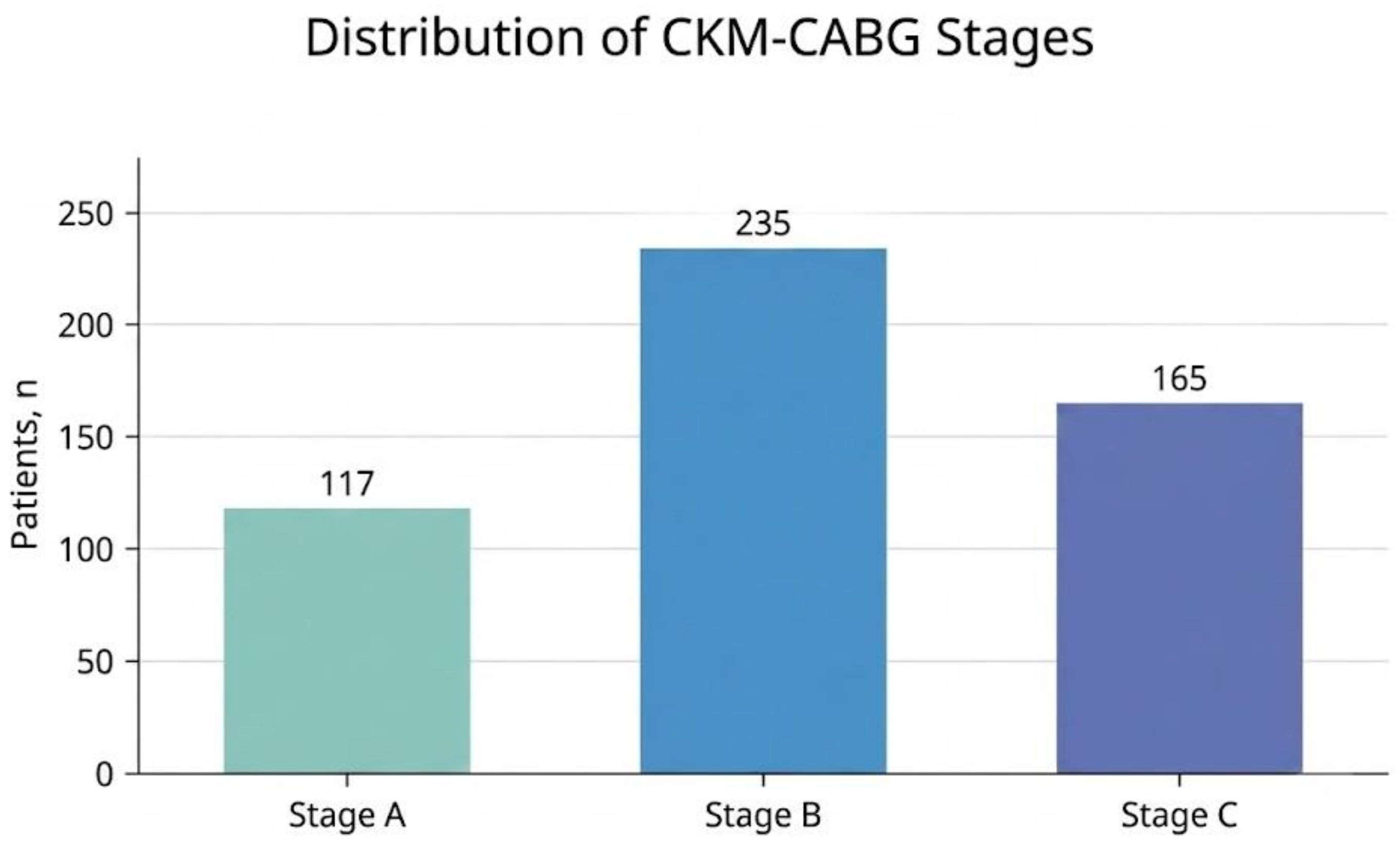
Figure 3.
Incidence of any and severe CSA-AKI by CKM-CABG stage.
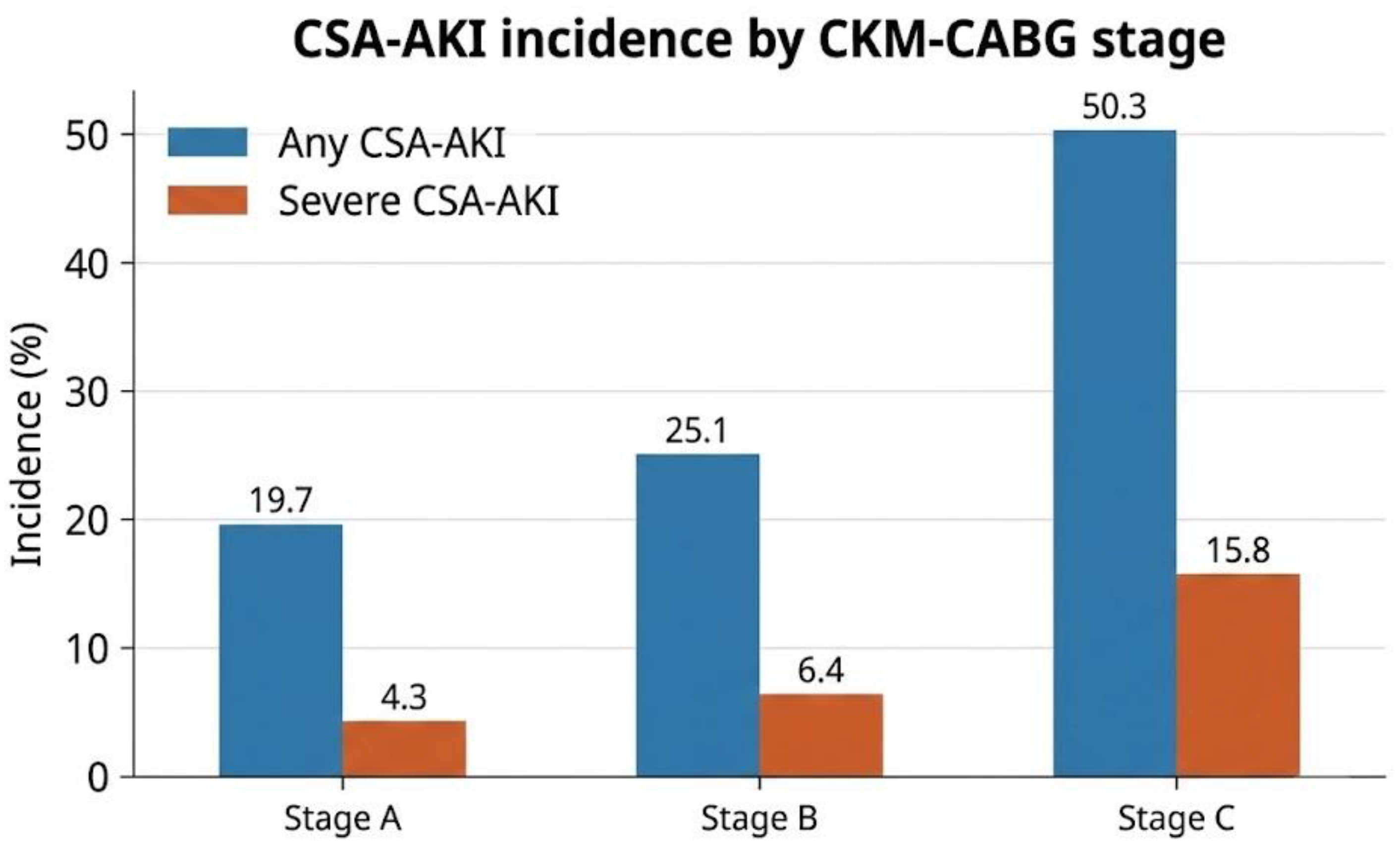
Figure 4.
Median ICU and hospital length of stay by CKM-CABG stage.
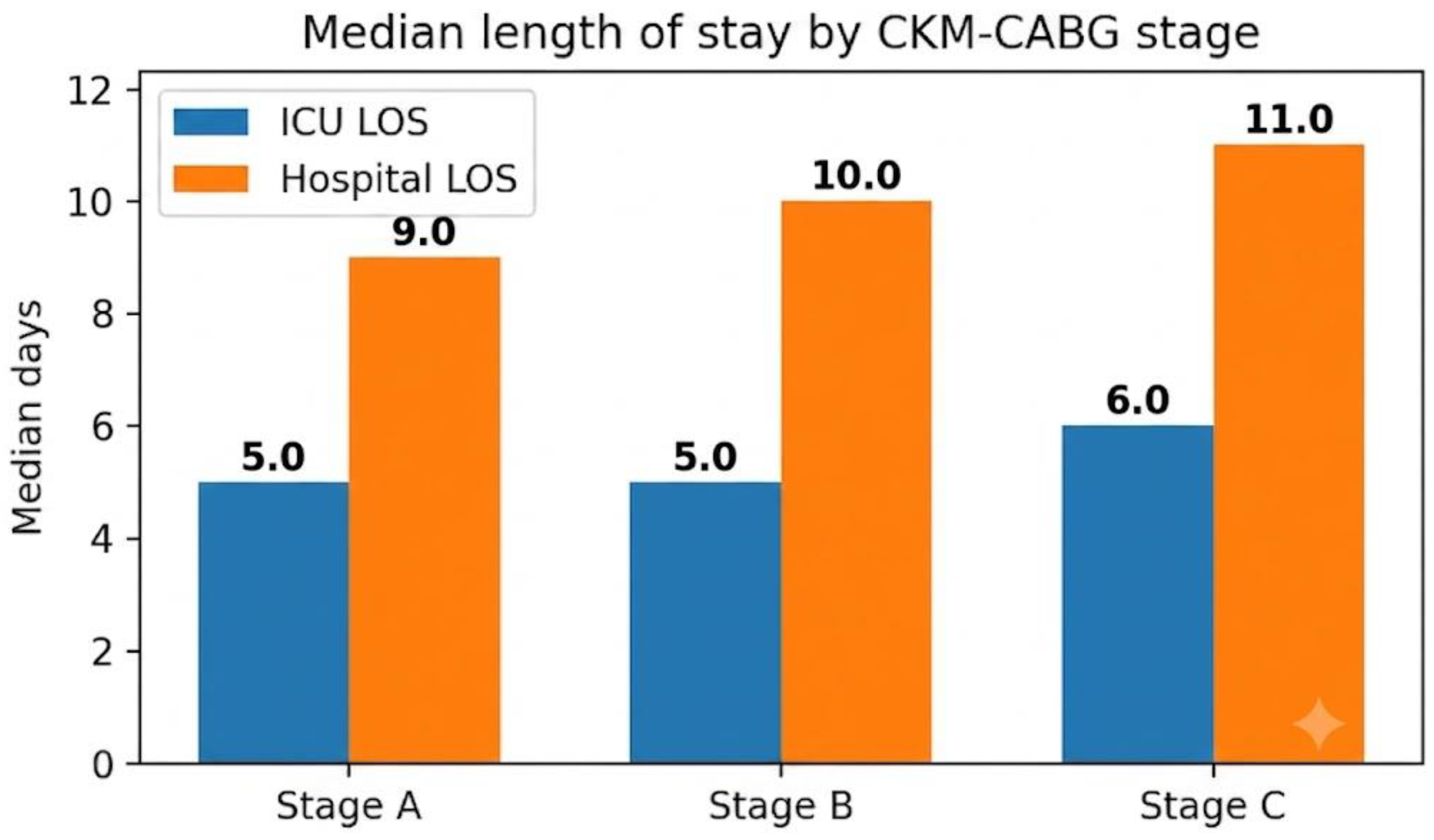
Figure 5.
Forest plot of the primary multivariable model for severe CSA-AKI.
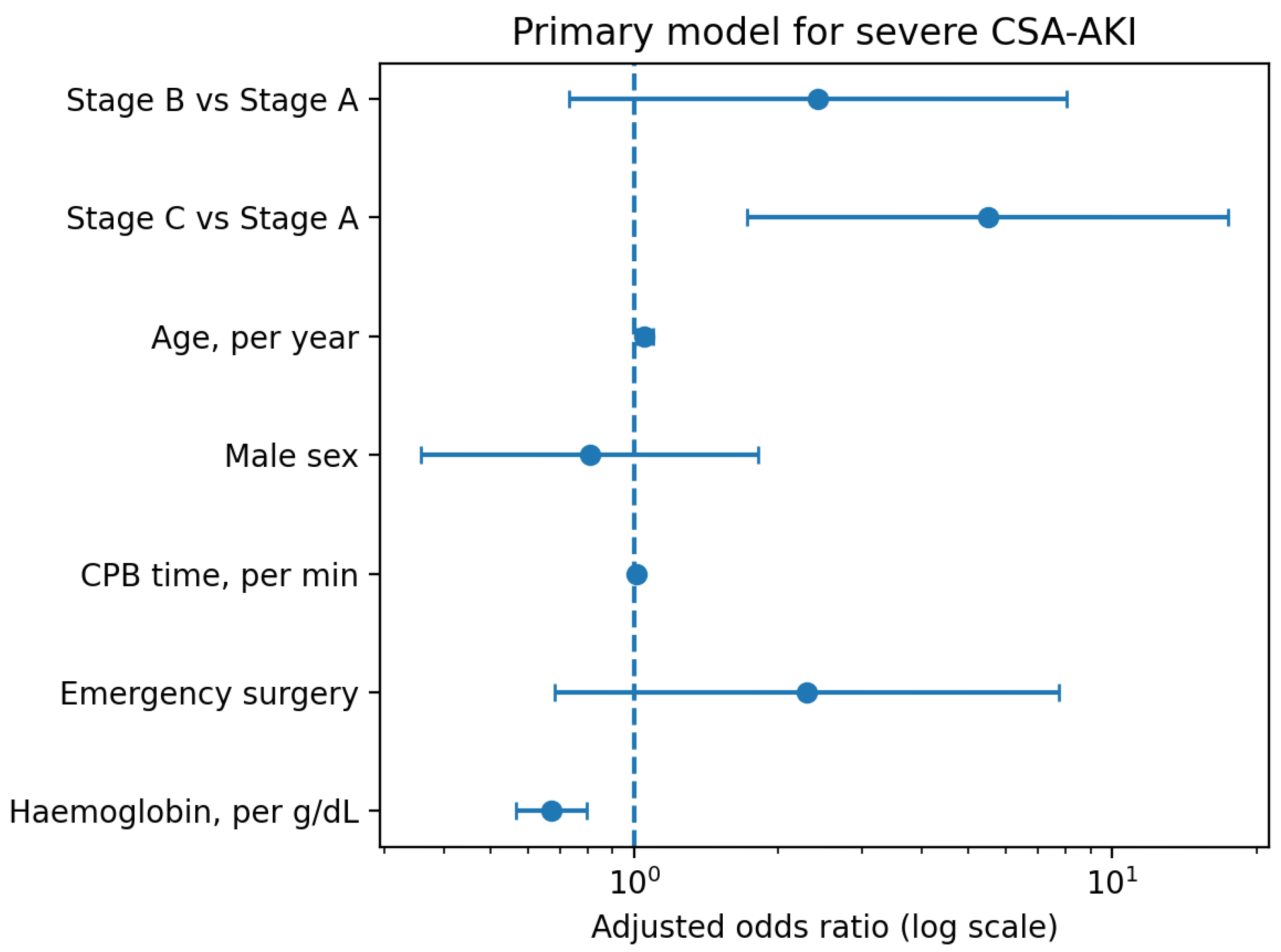
Figure 6.
ROC curves comparing the CKM-CABG stage alone, clinical model alone, and clinical model plus CKM-CABG stage for prediction of severe CSA-AKI. AUC, area under the receiver operating characteristic curve. Apparent AUCs: CKM-CABG alone 0.648, clinical model 0.798, clinical +CKM 0.830. Bootstrap-corrected AUCs (B=500): clinical model 0.776, clinical+CKM 0.803.
Figure 6.
ROC curves comparing the CKM-CABG stage alone, clinical model alone, and clinical model plus CKM-CABG stage for prediction of severe CSA-AKI. AUC, area under the receiver operating characteristic curve. Apparent AUCs: CKM-CABG alone 0.648, clinical model 0.798, clinical +CKM 0.830. Bootstrap-corrected AUCs (B=500): clinical model 0.776, clinical+CKM 0.803.
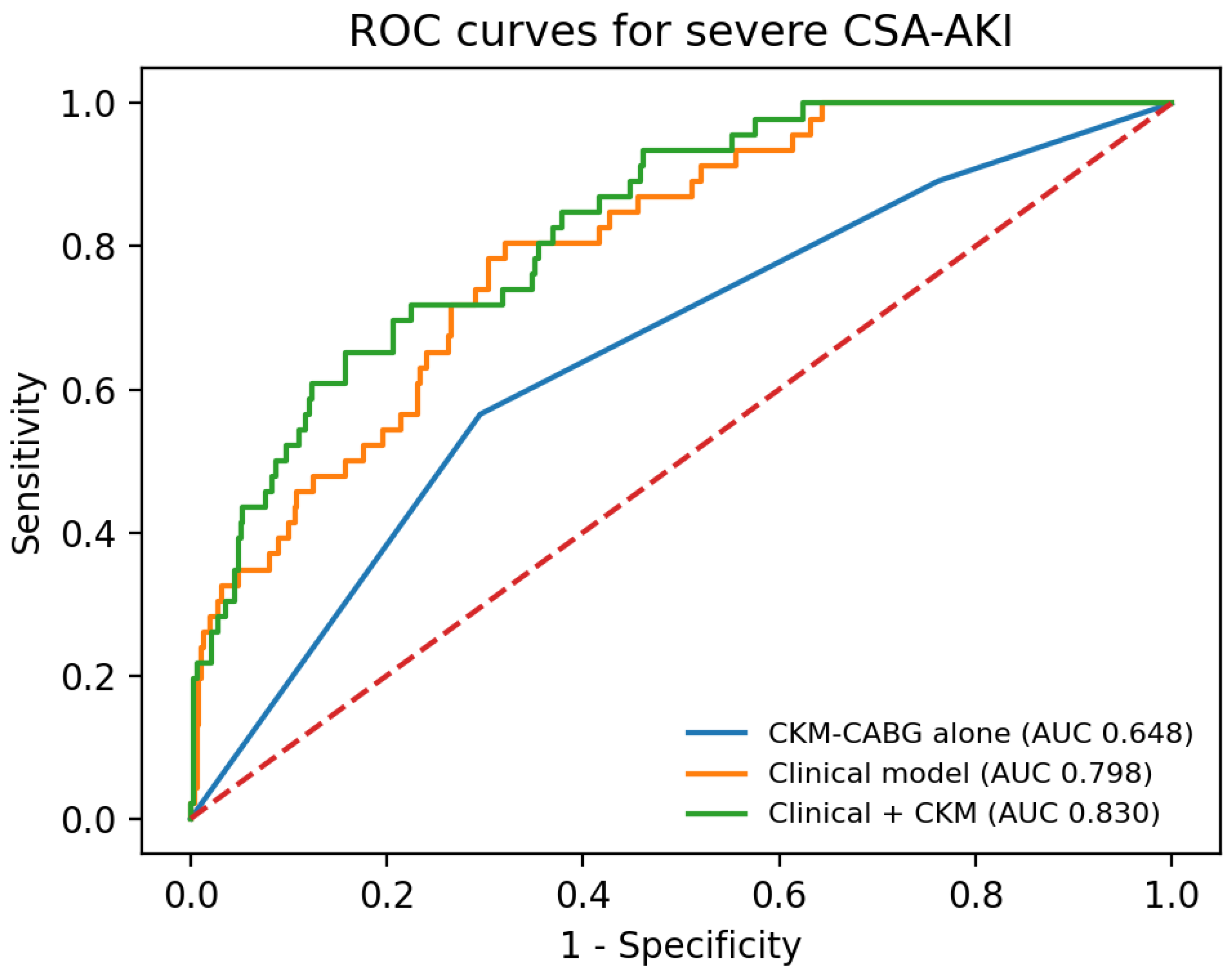
Table 1.
Distribution of CKM-CABG Stages
| CKM-CABG Stage | Definition | n | % |
|---|---|---|---|
| Stage A | ≤1 metabolic factor; no CKD; no HF | 117 | 22.6 |
| Stage B | ≥2 metabolic factors; no CKD; no HF | 235 | 45.5 |
| Stage C | CKD and/or HF, irrespective of metabolic count | 165 | 31.9 |
Abbreviations: CKM-CABG, cardiovascular–kidney–metabolic CABG; CKD, chronic kidney disease; HF, heart failure.
Table 2.
Baseline Characteristics by CKM-CABG Stage
| Variable | Stage A | Stage B | Stage C | p value |
|---|---|---|---|---|
| Age, years | 62.0 ± 9.7 | 62.4 ± 8.6 | 62.2 ± 9.9 | 0.957 |
| Male sex, n (%) | 100 (85.5) | 195 (83.0) | 135 (81.8) | 0.718 |
| BMI, kg/m² | 23.5 ± 4.7 | 26.5 ± 4.3 | 25.4 ± 6.1 | <0.001 |
| Asian obesity, n (%) | 31 (26.5) | 152 (64.7) | 88 (53.3) | <0.001 |
| Diabetes mellitus, n (%) | 27 (23.1) | 191 (81.3) | 119 (72.1) | <0.001 |
| Hypertension, n (%) | 35 (29.9) | 211 (89.8) | 126 (76.4) | <0.001 |
| Pre-existing CKD, n (%) | 0 (0.0) | 0 (0.0) | 70 (42.4) | <0.001 |
| HF, n (%) | 0 (0.0) | 0 (0.0) | 117 (70.9) | <0.001 |
| Baseline eGFR, mL/min/1.73m² | 86.1 ± 6.7 | 85.7 ± 7.5 | 72.0 ± 19.3 | <0.001 |
| LVEF, % | 59.9 ± 8.8 | 59.1 ± 9.9 | 48.5 ± 13.7 | <0.001 |
| Hemoglobin, g/dL | 12.3 ± 2.1 | 12.3 ± 2.1 | 11.9 ± 2.4 | 0.085 |
| CPB time, min | 144.9 ± 53.8 | 141.9 ± 46.3 | 146.1 ± 45.9 | 0.661 |
| Aortic cross-clamp time, min | 91.8 ± 35.3 | 94.6 ± 36.4 | 96.6 ± 34.2 | 0.534 |
| Emergency surgery, n (%) | 7 (6.0) | 9 (3.8) | 6 (3.6) | 0.572 |
Data means SD or n (%). Abbreviations: BMI, body mass index; CKD, chronic kidney disease; HF, heart failure; eGFR, estimated glomerular filtration rate; LVEF, left ventricular ejection fraction; CPB, cardiopulmonary bypass.
Table 3.
Postoperative Outcomes by CKM-CABG Stage
| Outcome | Stage A | Stage B | Stage C | p value |
|---|---|---|---|---|
| Any CSA-AKI, n (%) | 23 (19.7) | 59 (25.1) | 83 (50.3) | <0.001 |
| Severe CSA-AKI, n (%) | 5 (4.3) | 15 (6.4) | 26 (15.8) | <0.001 |
| CRRT, n (%) | 3 (2.6) | 5 (2.1) | 16 (9.7) | <0.001 |
| In-hospital mortality, n (%) | 4 (3.4) | 7 (3.0) | 9 (5.5) | 0.432 |
| Renal non-recovery, n (%) | 2 (1.7) | 5 (2.1) | 9 (5.5) | 0.103 |
| ICU LOS, days (median, IQR) | 5 (3–7) | 5 (4–7) | 6 (4–8) | <0.001 |
| Hospital LOS, days (median, IQR) | 9 (8–12) | 10 (8–12) | 11 (9–15) | 0.006 |
| SOFA score (median, IQR) | 0 (0–0) | 0 (0–1) | 0 (0–1) | 0.027 |
Data are n (%) or median (IQR). Abbreviations: CSA-AKI, cardiac surgery–associated acute kidney injury; CRRT, continuous renal replacement therapy; ICU LOS, intensive care unit length of stay; SOFA, Sequential Organ Failure Assessment; IQR, interquartile range. Ventilation duration (median 1 day in all groups, p=0.442) is not shown as it was uninformative across stages.
Table 4.
Primary Multivariable Model for Severe CSA-AKI (KDIGO Stage 2–3)
| Variable | Adjusted OR (95% CI) | p value |
|---|---|---|
| Stage B vs Stage A | 2.42 (0.73–8.01) | 0.148 |
| Stage C vs Stage A | 5.49 (1.72–17.50) | 0.004 |
| Age, per year | 1.05 (1.01–1.09) | 0.016 |
| Male sex | 0.81 (0.36–1.82) | 0.605 |
| CPB time, per min | 1.01 (1.01–1.02) | <0.001 |
| Emergency surgery | 2.30 (0.68–7.75) | 0.179 |
| Hemoglobin, per g/dL | 0.67 (0.56–0.80) | <0.001 |
Stage A is the reference category. OR, odds ratio; CI, confidence interval; CPB, cardiopulmonary bypass.
Table 5.
Secondary Multivariable Model for Severe CSA-AKI (additionally adjusted for baseline eGFR and LVEF)
Table 5.
Secondary Multivariable Model for Severe CSA-AKI (additionally adjusted for baseline eGFR and LVEF)
| Variable | Adjusted OR | 95% CI | p value |
|---|---|---|---|
| Stage B vs A | 2.49 | 0.74–8.36 | 0.141 |
| Stage C vs A | 3.23 | 0.88–11.80 | 0.077 |
| Age, per year | 1.04 | 1.00–1.08 | 0.075 |
| Male sex | 0.82 | 0.36–1.87 | 0.633 |
| CPB time, per min | 1.01 | 1.01–1.02 | <0.001 |
| Emergency surgery | 2.23 | 0.65–7.71 | 0.205 |
| Hemoglobin, per g/dL | 0.70 | 0.59–0.84 | <0.001 |
| Baseline eGFR, per mL/min/1.73m² | 0.97 | 0.95–1.00 | 0.023 |
| LVEF, per % | 0.99 | 0.96–1.02 | 0.503 |
Stage A is the reference category. OR, odds ratio; CI, confidence interval; CPB, cardiopulmonary bypass; eGFR, estimated glomerular filtration rate; LVEF, left ventricular ejection fraction.
Disclaimer/Publisher’s Note: The statements, opinions and data contained in all publications are solely those of the individual author(s) and contributor(s) and not of MDPI and/or the editor(s). MDPI and/or the editor(s) disclaim responsibility for any injury to people or property resulting from any ideas, methods, instructions or products referred to in the content. |
© 2026 by the authors. Licensee MDPI, Basel, Switzerland. This article is an open access article distributed under the terms and conditions of the Creative Commons Attribution (CC BY) license (http://creativecommons.org/licenses/by/4.0/).
Copyright: This open access article is published under a Creative Commons CC BY 4.0 license, which permit the free download, distribution, and reuse, provided that the author and preprint are cited in any reuse.