

Submitted:
26 August 2026
Posted:
26 August 2026
You are already at the latest version
Abstract
Machine learning has become a central framework for analyzing high-dimensional biological data generated by genomics, transcriptomics, proteomics, single-cell sequencing, and multi-omics technologies. However, predictive modeling is frequently limited by severe class imbalance, where biologically important populations including rare disease subtypes, uncommon molecular states, and low-frequency cell populations are underrepresented. Synthetic oversampling addresses this challenge by increasing minority-class representation, with the Synthetic Minority Oversampling Technique (SMOTE) being the most widely used approach. However, conventional SMOTE assumes that geometric proximity reflects biological similarity, an assumption often violated in high-dimensional, nonlinear, and heterogeneous biological data. This review examines clustering-guided synthetic generation methods that integrate unsupervised learning before oversampling to preserve underlying biological structure. We evaluate partition-based, density-aware, fuzzy, cluster-filtering, and representation-based approaches, emphasizing their mathematical foundations, computational assumptions, and applications in molecular classification, rare population analysis, single-cell modeling, and multi-omics integration. Key challenges including cluster instability, preservation of rare biological populations, synthetic data validation, and distinguishing statistical rarity from biological significance are discussed. Finally, we outline emerging directions involving biological foundation models, graph-based learning, multi-omics representation spaces, and biologically constrained generative frameworks. These advances represent a shift from conventional data balancing toward structure-aware synthetic modeling that preserves meaningful biological organization while improving predictive performance.
Keywords:
biomedical machine learning
; class imbalance
; synthetic data generation
; clustering-guided oversampling
; SMOTE
; rare disease prediction
1. Introduction
The rapid expansion of high-throughput biological technologies has transformed computational biology into a data-intensive discipline requiring sophisticated mathematical and computational approaches for extracting meaningful patterns from complex biological systems. Modern experimental platforms, including next-generation sequencing, single-cell profiling, proteomics, metabolomics, and large-scale molecular assays, generate biological datasets characterized by high dimensionality, nonlinear relationships, and substantial biological heterogeneity. Computational biology increasingly relies on algorithmic and statistical approaches capable of modeling these complex structures and transforming large-scale measurements into biologically interpretable representations [1,2,3].
Despite these technological advances, the development of reliable machine learning models remains challenging because biological datasets often contain relatively few representative samples. This limitation is particularly evident in computational biology when studying rare biological states, including uncommon genetic variants, rare disease-associated molecular profiles, low-frequency cellular populations, and specialized biological phenotypes because minority classes frequently correspond to biologically meaningful events rather than random statistical exceptions [4]. A rare cellular state may represent an important developmental transition, a resistant tumor population, or a disease-associated molecular mechanism. Therefore, computational methods addressing imbalance must preserve biological diversity rather than simply increase numerical representation[5].
Several approaches[4,5,6] have been developed to address imbalance, including cost-sensitive learning, ensemble methods, algorithm modification, and data-level resampling strategies. Among these, synthetic oversampling has attracted considerable attention because it increases minority representation while maintaining information contained within the original dataset.
The Synthetic Minority Oversampling Technique (SMOTE) represents one of the most influential synthetic generation approaches. This method generates new minority observations by interpolating existing minority samples and their nearest neighbors. Although SMOTE has demonstrated effectiveness across many machine learning applications, its assumptions become problematic for complex biological datasets. This method implicitly assumes that feature similarity ≈ biological similarity. However, biological systems rarely follow this simple geometric relationship [7].
Molecular datasets frequently contain nonlinear biological manifolds, multiple latent populations, hierarchical organization, continuous biological transitions, and high-dimensional feature spaces. For example, two samples belonging to the same disease category may represent different molecular mechanisms, while two cellular populations may occupy nearby mathematical regions but correspond to distinct biological states. Therefore, direct interpolation may generate observations that are statistically plausible but biologically unrealistic. In computational biology, where synthetic data may influence downstream biological interpretation, preserving structural relationships is as important as improving classification performance [8].
Complex, imbalanced biological datasets have motivated the development of structure-aware synthetic generation methods. Instead of assuming that all minority observations represent a single distribution, these approaches first identify latent structures within the dataset and subsequently generate synthetic observations within more meaningful regions of feature space. Clustering-guided synthetic generation represents one important strategy within this framework. By integrating unsupervised structure discovery with oversampling, clustering-based methods attempt to preserve minority subpopulations, reduce generation from noisy regions, and improve representation of heterogeneous biological systems. Different clustering strategies provide different computational assumptions. Partition-based methods model compact groups, density-based methods identify irregular biological populations, fuzzy clustering approaches represent overlapping states, and representation-aware methods attempt to identify structure within learned biological embeddings. These approaches are particularly relevant for modern computational biology applications, including molecular subtype classification, single-cell population modeling, multi-omics integration, rare biological state prediction, and biological representation learning [9].
Although synthetic oversampling methods have been extensively investigated in machine learning, their application to biological systems remains insufficiently synthesized from a computational perspective. Existing reviews have primarily organized the literature around class-imbalance strategies, modified SMOTE methodologies, and predictive performance, with comparatively less emphasis on the relationship between synthetic generation, biological structure, and the mathematical representation of heterogeneous populations [4,10,11]. This review addresses this gap by examining clustering-guided synthetic generation as a framework for structure-aware modeling in computational biology. The objective is to evaluate how structure-aware augmentation can move computational biology beyond simple class balancing toward the generation of biologically meaningful computational representations.
The remainder of this review is organized to progressively develop the concept of structure-aware synthetic generation in computational biology, as summarized in Figure 1. Section 2 establishes the mathematical foundations of class imbalance and synthetic generation, including the limitations of feature-space interpolation and the role of biological data geometry and clustering in structure-aware modeling. Section 3 examines major categories of clustering-guided oversampling methods and their computational assumptions and biological applications. Section 4 critically evaluates these approaches with respect to statistical validity, computational utility, biological relevance, and limitations arising from high-dimensionality, cluster instability, and the distinction between biological rarity and statistical noise. Section 5 discusses future directions, including biologically constrained generation, multi-omics integration, representation learning, biological foundation models, single-cell applications, graph-based approaches, and standardized validation frameworks. The review concludes by synthesizing these developments and highlighting the transition from conventional numerical class balancing toward biologically informed synthetic modeling.
2. Mathematical Foundations of Class Imbalance and Structure-Aware Synthetic Generation
2.1. Computational Formulation of Class Imbalance in Biological Datasets
In supervised computational biology, biological observations are represented as feature vectors derived from experimental measurements, molecular profiles, or integrated biological representations. Let a dataset be defined as:
where represents the feature vector of the biological sample containing measured characteristics, and denotes the corresponding class label. Depending on the application, the feature vector may represent gene expression values, sequence-derived features, protein abundance measurements, cellular phenotypes, imaging-derived descriptors, or integrated multi-omics representations.
In an ideal classification problem, observations from different classes are sufficiently represented to allow the machine learning algorithm to estimate reliable decision boundaries. However, biological datasets frequently violate this assumption because the distribution of observations among classes is highly uneven. Let and represent the number of majority- and minority-class observations, respectively. The imbalance ratio can be defined as:
where increasing values indicate progressively greater imbalance. In computational biology, high imbalance ratios are common because biological systems are often characterized by rare but functionally important states. Examples include rare genetic variants, low-frequency cellular populations, uncommon disease-associated molecular signatures, and minority transcriptomic states. These observations may contain critical biological information despite their limited representation.
From a statistical learning perspective, imbalance affects the empirical distribution used during model optimization. A classifier trained using empirical risk minimization seeks to minimize the average loss across the training observations:
where denotes the empirical risk (the average loss over the training observations); denotes the loss function, which quantifies the discrepancy between the predicted and true labels; and denotes the prediction function (classifier), such as a neural network, support vector machine, or random forest. Because each observation contributes equally to the empirical risk, the total contribution of a class depends on the number of observations it contains. Therefore, in an imbalanced dataset, the majority class contributes a larger proportion of the overall loss than the minority class. For example, if the majority class represents 95% of the training observations and the minority class represents only 5%, the majority class accounts for approximately 95% of the individual loss terms in the empirical-risk objective. Consequently, the model may favor the majority class, while minority samples have less influence on the learned decision boundary. This imbalance is particularly important in computational biology, where minority observations may represent rare but biologically meaningful populations.
2.2. Limitations of Feature-Space Interpolation for Biological Data
The Synthetic Minority Oversampling Technique (SMOTE) and related interpolation-based approaches address imbalance by generating new minority observations between existing samples [7]. Given two minority samples and , a synthetic observation is generated as:
where .
This formulation assumes that the line segment connecting two neighboring samples represents a biologically meaningful trajectory within the data space. While this assumption may be reasonable for relatively simple datasets, it becomes problematic for complex biological measurements. Biological datasets frequently exhibit nonlinear distributions, hierarchical organization, multimodal populations, latent biological states, and high-dimensional feature spaces [12]. For example, two samples may appear close according to a mathematical distance metric while representing different biological mechanisms, whereas biologically related samples may be separated due to technical variation, batch effects, or high-dimensional sparsity. Therefore, the fundamental limitation of conventional SMOTE is not simply the generation of synthetic data, but the absence of an explicit model of biological structure.
2.3. Biological Data Geometry and the Need for Structure-Aware Generation
Modern computational biology increasingly recognizes that high-dimensional biological datasets often contain structured patterns that can be described using a smaller number of underlying dimensions. Rather than being distributed uniformly throughout the full feature space, biological observations may lie near lower-dimensional structures or manifolds embedded within the high-dimensional measurement space [13,14].
Let the observed biological data exist in:
where may represent thousands or millions of molecular features. However, the intrinsic biological structure may exist on a lower-dimensional manifold:
where:
This concept explains why direct interpolation in raw feature space may generate unrealistic samples. If synthetic observations are generated away from the underlying biological manifold, they may preserve numerical similarity but lose biological meaning.
Clustering-guided synthetic generation attempts to address this limitation by identifying local structures before generating artificial observations. Instead of assuming a single continuous minority distribution, clustering methods model the minority population as a collection of biologically or statistically coherent subgroups:
where denotes the entire minority-class dataset and each represents a cluster containing observations with shared characteristics. Thus, synthetic generation is constrained within these regions or clusters:
Where the two minority samples used to generate a synthetic observation, both belong to the same cluster. This restriction introduces a form of structural regularization by reducing interpolation across potentially unrelated biological populations.
2.4. Clustering as a Computational Strategy for Synthetic Generation
Clustering methods an intermediate computational representation between raw biological measurements and synthetic sample generation. Rather than generating synthetic observations directly from individual minority-class samples, clustering first identifies latent structure within the data, enabling synthetic samples to be generated within biologically or statistically coherent regions. The overall structure-aware workflow is summarized in Figure 2.
This framework consists mainly of three computational stages. First, biological observations are transformed into an appropriate feature representation through preprocessing, dimensionality reduction, or learned latent embeddings. Second, a clustering algorithm partitions the feature space into groups that capture local biological or statistical structure. Finally, synthetic samples are generated according to cluster-specific characteristics, such as density, purity, or proximity to decision boundaries, thereby constraining interpolation within structurally consistent regions.
Then present your equation:
where:
represents the biological feature space,
represents the clustering process,
represents cluster-guided synthetic generation.
This framework motivates clustering-guided oversampling as a structure-aware augmentation strategy in which latent organization is identified before synthetic sample generation, improving both the computational consistency and potential biological validity of the augmented dataset.
Therefore, future synthetic generation methods must incorporate biological constraints rather than relying exclusively on statistical structure. The conceptual progression from conventional feature-space interpolation to structure-aware synthetic generation is summarized in Figure 3, which illustrates how clustering introduces an intermediate structural representation before synthetic sample generation.
3. Categories of Clustering-Guided Oversampling Methods for Computational Biology
3.1. Partition-Based Clustering Approaches: K-Means SMOTE and Related Methods
Partition-based clustering approaches represent one of the earliest strategies for integrating unsupervised structure discovery with synthetic oversampling. These methods assume that minority observations can be divided into relatively compact subgroups, within which synthetic generation can be performed more reliably. K-Means SMOTE represents a prominent example of this strategy by combining centroid-based partitioning with SMOTE interpolation [15].
The method combines the partitioning capability of k-means clustering with the interpolation mechanism of SMOTE.
Given a dataset:
The objective minimizes the sum of squared distances between observations and their assigned cluster centroids:
where:
represents cluster ,
represents the cluster centroid.
After clustering, minority-rich clusters are identified, and synthetic samples are generated primarily within those regions.
The computational advantage of this strategy is that synthetic generation is no longer performed across the entire minority population. Instead, these clusters represent computationally defined regions of similarity that may correspond to biological subpopulations depending on the quality of the feature representation. For computational biology, this concept is particularly relevant because biological classes frequently contain hidden substructures. Examples include:
- cancer samples containing multiple molecular subtypes,
- immune-cell populations containing functional states,
- genetic disorders containing different molecular mechanisms,
- drug-response groups containing different regulatory pathways.
By generating synthetic samples within clusters, K-Means SMOTE attempts to preserve minority-class diversity rather than expanding only the dominant minority pattern. The method also allocates greater synthetic-generation effort to regions with sparse minority representation while filtering clusters with insufficient minority presence, thereby reducing the likelihood of generating unnecessary synthetic observations in poorly represented or noisy regions.
Computational characteristics and advantages
- Reduction of within-class imbalance
A common assumption in imbalance learning is that only the majority/minority ratio matters. However, minority classes themselves may contain internal imbalance.
For example:
where one biological subgroup may dominate while another rare but important subgroup remains poorly represented. K-Means SMOTE can allocate synthetic generation according to cluster characteristics, improving representation of underrepresented regions.
- 2.
- Improved control of synthetic generation
Traditional SMOTE generates samples based on nearest-neighbor relationships.
Cluster-guided approaches introduce an additional constraint:
meaning that synthetic samples are generated within a defined structural region.
This reduces the probability of interpolating between statistically distant or potentially unrelated subpopulations.
Limitations in biological datasets
Despite these advantages, partition-based clustering introduces several assumptions that may not always match biological reality.
- Assumption of spherical clusters
K-means assumes approximately compact and spherical clusters. However, biological structures are often nonlinear, continuous, overlapping, and trajectory-based. For example, cellular differentiation processes may represent continuous transitions rather than discrete clusters.
- 2.
- Requirement for predefined cluster number
K-means requires selection of :
However, the true number of biological states is often unknown. Incorrect selection of K may split biologically related populations, merge distinct biological states, and distort synthetic generation.
- 3.
- Sensitivity to feature representation
The quality of clustering depends strongly on the feature space. For high-dimensional omics datasets:
where is the number of measured features and is the number of biological samples. Direct clustering of raw molecular measurements may therefore produce unstable structures. A common solution is to combine clustering with:
- principal component analysis,
- autoencoder representations,
- biological embeddings,
- network-based features.
3.2. Density-Based Clustering Approaches: Modeling Irregular Biological Structures
Partition-based clustering assumes that biological populations form compact groups. However, many biological datasets contain irregular distributions where populations differ in density, shape, and connectivity. Density-based approaches provide an alternative by defining clusters according to local density connectivity rather than proximity to predefined cluster centers. These methods identify groups as regions where observations are sufficiently concentrated while allowing sparse regions to remain unassigned as noise [17].
Unlike centroid-based methods, density-based algorithms define clusters according to the local neighborhood structure of observations. For example, the -neighborhood can be defined as:
Where represents the distance between two observations and defines the neighborhood radius. A point is considered a core observation when its neighborhood contains at least MinPts observations:
These density conditions allow algorithms such as DBSCAN to distinguish core points, boundary points, and noise observations without requiring predefined cluster centers or cluster numbers. Algorithms such as DBSCAN and related density-based methods identify dense regions, sparse boundaries, and outlier observations. This property is particularly attractive for computational biology because biological datasets frequently contain rare subpopulations embedded within heterogeneous distributions.
Unlike k-means, density-based clustering can identify clusters with irregular geometry. For example, a rare cellular state may occupy a small but dense region within a large transcriptomic landscape. Density-based methods may preserve such structures without forcing them into spherical clusters, and this can be used in different applications include:
- rare cell population discovery,
- single-cell transcriptomic analysis,
- heterogeneous disease cohorts,
- molecular phenotype identification.
One important extension of density-based approaches is the integration of noise filtering before oversampling. Methods such as cluster-based noise reduction SMOTE [18] attempt to first identify unreliable observations, then remove or down-weight noisy regions, and finally generate synthetic samples from more reliable structures. This is particularly important in biological datasets because observed variation may result from experimental noise, batch effects, measurement uncertainty, and biological variability. However, a major challenge remains:
A rare biological population may appear statistically isolated but represent an important discovery. Therefore, density-based synthetic generation requires biological validation rather than purely statistical filtering.
Limitations in biological datasets
- Parameter sensitivity
DBSCAN depends on neighborhood radius () and minimum number of points (). These parameters strongly influence cluster detection. Incorrect parameter selection may fragment continuous biological populations or classify meaningful rare states as noise.
- 2.
- Variable-density populations
Biological datasets often contain abundant cell populations, rare cell populations, and transitional states. A further limitation is that many biological datasets contain populations with different intrinsic densities. A density threshold suitable for abundant populations may fail to detect rare but biologically important states.
Therefore, density-based clustering approaches are particularly suitable for biological datasets characterized by irregular geometry, rare subpopulations, and heterogeneous distributions. However, their effectiveness depends on appropriate density estimation and feature representations, which remain challenging in high-dimensional biological datasets.
3.3. Fuzzy Clustering Approaches: Representing Biological Continua
Traditional clustering approaches produce hard assignments in which each observation is associated with a single cluster:
However, biological systems frequently do not exhibit completely discrete states. Examples include tumor progression, immune activation, developmental trajectories, and cellular differentiation. Fuzzy clustering [19] provides an alternative by assigning membership values:
where represents the degree to which observation belongs to cluster .
Unlike hard clustering, where is restricted to binary values, fuzzy clustering allows observations to partially belong to multiple clusters, enabling representation of overlapping or transitional states. The membership values typically satisfy:
where represents the center (centroid) of cluster k, and (q>1) is the fuzzification parameter controlling the degree of cluster overlap. The weighting term determines the contribution of observation (i) to cluster (k), with higher membership values resulting in greater influence on the cluster objective and centroid estimation
This framework better reflects biological reality because a sample may simultaneously exhibit characteristics of multiple states. A common implementation of fuzzy clustering is fuzzy c-means [20], which optimizes cluster centers and membership values by minimizing a weighted within-cluster objective function.
In synthetic generation, membership values can guide augmentation intensity. Samples with strong cluster membership, high biological confidence, and stable representation can be assigned higher sampling probabilities during synthetic generation, whereas observations with uncertain memberships may be down-weighted to reduce interpolation across ambiguous regions. This approach is particularly promising for biological systems where classification boundaries represent artificial simplifications of continuous biological processes. However, fuzzy clustering introduces additional computational assumptions. The selection of the number of clusters and the fuzzification parameter can influence the resulting membership structure. Furthermore, membership values represent computational similarity rather than direct biological probabilities and therefore require biological interpretation and validation. In high-dimensional biological datasets, the quality of fuzzy clustering also depends strongly on the underlying feature representation
Therefore, fuzzy clustering approaches are particularly appropriate for biological systems characterized by gradual transitions, overlapping states, and uncertain class boundaries. However, their effectiveness depends on appropriate parameter selection and careful interpretation of membership values within a biological context.
3.4. Cluster Filtering Approaches: Improving Synthetic Reliability
Not all minority observations contribute equally to synthetic generation. Although minority samples are generally underrepresented, they may differ substantially in reliability, local structure, and biological relevance [15]. Cluster filtering approaches attempt to identify regions where synthetic generation is more likely to preserve the underlying data distribution. Some samples may represent measurement noise, classification uncertainty, and boundary cases. Cluster filtering methods attempt to identify reliable minority regions before augmentation. The filtering process can be formulated by assigning each observation a reliability score:
where represents the reliability of observation based on its cluster membership , local neighborhood structure, or class composition within the cluster. Samples satisfying:
are considered suitable candidates for synthetic generation, where represents a predefined reliability threshold.
A typical workflow involves: 1) clustering the dataset, 2) identifying stable minority regions, 3) filtering noisy or low-confidence samples, and 4) applying synthetic generation. For example, KNSMOTE [21] combines k-means clustering with a filtering strategy that identifies safer samples before SMOTE interpolation. The method aims to remove boundary, overlapping, or noisy samples that may negatively influence synthetic generation. The objective is to retain samples considered more reliable for interpolation. This concept has particular relevance in computational biology because biological datasets often contain uncertain annotations. This uncertainty may arise from incomplete disease characterization, evolving cellular states, measurement variability, or limitations in experimental labeling. Examples include ambiguous disease phenotypes, transitional cellular states, and borderline molecular signatures.
Cluster filtering improves synthetic generation by restricting augmentation to regions with higher structural consistency. This can reduce the propagation of noisy observations and improve the reliability of generated samples, particularly when minority populations contain heterogeneous or poorly separated regions. However, the main limitation of cluster filtering approaches is the possibility of eliminating informative minority observations. In biological applications, rare samples may correspond to novel cell states, uncommon disease mechanisms, or emerging molecular patterns. Excessive filtering may therefore reduce biological diversity and bias downstream models toward dominant patterns.
Future filtering approaches should incorporate biological knowledge rather than relying exclusively on statistical criteria. Therefore, cluster filtering approaches are most suitable for biological datasets in which measurement uncertainty, annotation variability, or noisy observations may compromise synthetic generation. By restricting augmentation to more reliable regions, these methods can improve the structural consistency of generated samples. However, their effectiveness depends on carefully balancing noise removal with preservation of rare biological states, as excessive filtering may eliminate informative observations that represent genuine biological diversity.
3.5. Representation-Aware Clustering for High-Dimensional Biological Data
A major challenge in computational biology is that biological datasets often contain high-dimensional, sparse, and heterogeneous measurements, with the number of observed features exceeding the number of biological samples. This high-dimensional setting is common in omics applications, including transcriptomics, proteomics, epigenomics, and single-cell sequencing. In such datasets, similarity calculations performed directly in the raw feature space may be affected by irrelevant variation, technical noise, and the curse of dimensionality, making it more difficult to identify meaningful biological relationships [8].
Direct clustering in the raw feature space may therefore provide unreliable representations of biological similarity. Representation-aware approaches address this limitation by transforming the original feature space into a lower-dimensional latent space:
where represents the original biological feature vector, represents the learned latent representation, and . The clustering process is subsequently performed within the latent space rather than the original measurement space:
This approach assumes that biologically meaningful variation can be represented more effectively in the learned latent space than in the original high-dimensional feature space.
Representation learning methods can identify compressed, lower-dimensional spaces that capture biologically meaningful patterns while reducing irrelevant variation and technical noise. Examples include autoencoders, variational representations, contrastive learning embeddings, and foundation-model-derived biological representations, which can provide informative latent spaces for downstream tasks such as clustering, classification, and synthetic data generation.
Autoencoder-based approaches learn compressed nonlinear representations through reconstruction objectives, whereas contrastive learning methods optimize latent spaces by encouraging biologically similar observations to become closer and dissimilar observations to separate. Foundation-model-derived representations further extend this concept by learning generalizable biological embeddings from large-scale datasets [22].
Synthetic generation within these latent spaces may provide a better approximation of biological manifolds than direct interpolation in raw feature space. In representation-aware synthetic generation, clustering and oversampling are performed after transformation into the learned latent space. Synthetic samples can therefore be generated according to latent similarity rather than raw feature similarity:
where represent neighboring observations in the latent space and controls interpolation. The generated latent representation may then be mapped back to the original feature space or directly used for downstream predictive modeling.
Representation-aware clustering is particularly relevant for biological systems where observed measurements reflect complex interactions among multiple molecular processes. Learned latent spaces may capture hidden biological factors associated with cellular identity, disease progression, regulatory programs, or multi-omics relationships that are difficult to detect using conventional distance metrics.
Despite their advantages, representation-aware approaches introduce additional challenges. The biological interpretation of latent dimensions is often difficult because learned embeddings may not correspond directly to measurable biological processes. Furthermore, representation quality depends strongly on model architecture, training objectives, dataset size, and the presence of technical biases. A poorly learned latent space may preserve computational similarity while failing to capture biologically meaningful variation
Therefore, representation-aware clustering approaches provide a flexible framework for high-dimensional biological datasets by combining dimensionality reduction, latent structure discovery, and synthetic generation within learned feature spaces. These methods are particularly suitable for complex biological systems involving nonlinear relationships, multi-omics integration, and heterogeneous populations. However, their effectiveness depends on the biological validity and interpretability of the learned representations, requiring careful evaluation before synthetic augmentation is applied.
3.6. Comparative Summary of Clustering-Guided Oversampling Approaches
The major categories of clustering-guided oversampling methods differ in their computational assumptions, biological applications, advantages, and limitations. These characteristics are summarized in Table 1.
Clustering-guided oversampling represents a transition from purely numerical class balancing toward structure-aware synthetic modeling. Rather than treating minority observations as a homogeneous population, these approaches incorporate assumptions regarding biological organization, including discrete subtypes, density-defined populations, transitional states, sample reliability, and latent molecular representations. Partition-based methods provide simplicity and interpretability, density-based approaches capture irregular biological structures, fuzzy methods represent continuous biological variation, cluster-filtering approaches improve synthetic reliability, and latent-space approaches enable modeling of complex high-dimensional biological systems.
However, no clustering strategy is universally optimal. The appropriate method depends on the geometry of the biological dataset, the quality of the feature representation, the degree of heterogeneity, and the biological question being investigated. Future computational biology frameworks will likely integrate clustering with generative models, biological networks, and foundation-model-derived representations to generate synthetic data that preserve statistical structure, biological constraints, and mechanistic relevance.
3.7. Choosing an Appropriate Clustering-Guided Oversampling Strategy
While clustering-guided oversampling techniques have proliferated, no single algorithm performs optimally across all biological contexts. Selecting an effective framework requires balancing key data properties, including structural topology, sample heterogeneity, feature dimensionality, and label or signal noise. Figure 4 provides a structured decision matrix to guide method selection based on these core biological characteristics.
4. Critical Evaluation of Clustering-Guided Synthetic Generation in Computational Biology
4.1. Beyond Predictive Performance: Evaluating Biological Usefulness
The primary objective of clustering-guided synthetic generation is to improve representation of underrepresented biological populations. However, unlike conventional machine learning applications, computational biology requires evaluation criteria that extend beyond predictive performance. A synthetic sample that improves classification accuracy may not necessarily represent a biologically meaningful observation. This distinction is particularly important in molecular biology because biological measurements reflect complex systems involving regulatory interactions, cellular states, and evolutionary constraints. Therefore, evaluation of clustering-guided synthetic generation should integrate three complementary dimensions that assess not only predictive performance but also the fidelity and biological relevance of the generated observations, as summarized in Figure 5:
Statistical validity
Statistical evaluation examines whether generated samples preserve the key characteristics of the original biological dataset, including feature distributions, covariance relationships, local density structure, cluster organization, and overall dimensionality patterns. Importantly, a synthetic dataset should not simply increase the number of minority observations; it should preserve the joint statistical structure of the original data, including meaningful relationships among correlated biological variables rather than reproducing individual feature distributions alone.
For example, in transcriptomic data, preservation of individual gene distributions alone may be insufficient. Synthetic observations should also maintain relationships among co-expressed genes and pathway-level patterns.
Computational utility
The second evaluation dimension concerns whether synthetic augmentation improves machine learning performance. Common evaluation metrics include sensitivity, specificity, F1-score, balanced accuracy, and area under the precision–recall curve. Because class imbalance can make conventional accuracy measures misleading, evaluation should prioritize metrics that provide a more informative assessment of minority-class performance under skewed class distributions. The effectiveness of synthetic augmentation should therefore be assessed by comparing models trained with and without synthetic data using consistent evaluation criteria.
To avoid information leakage, synthetic samples should be generated only from the training data after the dataset has been divided into training and evaluation partitions. Generating synthetic observations before data splitting can allow information from the evaluation set to influence the training process and may lead to overly optimistic performance estimates. Ultimately, a model trained with synthetic augmentation should demonstrate improved performance on independent, real biological observations rather than only on an artificially expanded dataset. This distinction is important because synthetic data may contain distributional differences from real observations and may not necessarily improve generalization to unseen biological samples.
Biological plausibility
The most challenging evaluation dimension is determining whether synthetic observations preserve meaningful biological characteristics of the original data. In computational biology, biological validation may include assessing pathway enrichment and activity, preservation of regulatory relationships, consistency with known biological mechanisms, and similarity to independent biological cohorts. These evaluations help determine whether synthetic observations reproduce biologically meaningful patterns rather than merely matching the statistical properties of the original dataset.
Depending on the biological domain, additional validation may assess the preservation of cell-type composition, gene co-expression networks, regulatory modules, or known molecular interactions. For example, a synthetic gene expression profile should ideally preserve coordinated expression patterns and pathway activity rather than simply reproduce the distribution of individual gene expression values. Similarly, preservation of gene co-expression or regulatory modules can provide evidence that synthetic observations retain higher-order biological relationships present in the original data.
Consequently, synthetic biological data should be regarded as useful only when statistical fidelity, computational utility, and biological plausibility are jointly satisfied. Improvements in predictive performance alone are insufficient to establish the biological validity of generated observations.
4.2. Biological Contexts Where Clustering-Guided Synthetic Generation Is Advantageous
Clustering-guided synthetic generation is particularly advantageous when minority-class observations are biologically heterogeneous rather than originating from a single homogeneous population. Such datasets frequently arise in computational biology because molecular and cellular phenotypes often exhibit latent substructure, high dimensionality, and continuous biological variation. Consequently, clustering-guided methods are especially beneficial in the following scenarios [25].
4.2.1. Heterogeneous Molecular Populations
Many biological labels represent broad clinical or phenotypic categories that can contain multiple underlying molecular states. This heterogeneity is evident across computational biology applications, including cancer classifications, immune phenotypes, neurological disorders, and drug response groups. For example, tumors assigned to the same diagnostic category may exhibit distinct molecular subtypes, genetic alterations, transcriptional programs, and treatment responses. Molecular profiling studies have demonstrated that tumors within the same diagnostic category can be organized into biologically distinct subtypes with different molecular characteristics and clinical outcomes [26].
Consequently, a disease label may correspond to multiple underlying molecular mechanisms rather than a single homogeneous biological state. Treating all observations within such a category as one minority population may cause conventional synthetic generation methods to interpolate across biologically distinct subpopulations. Clustering-guided approaches provide a potential solution by identifying latent subpopulations before synthetic generation, allowing new observations to be generated within more coherent regions of the biological feature space. For example, molecular cancer datasets frequently contain transcriptionally distinct subtypes despite sharing the same diagnostic annotation. Generating synthetic observations within subtype-specific clusters may therefore better preserve molecular heterogeneity than applying interpolation globally across the entire minority population.
4.2.2. Small Sample Size and High-Dimensional Biology
A major characteristic of computational biology datasets is the high dimensionality of biological measurements, where the number of observed features may greatly exceed the number of biological samples. This setting is common in applications such as RNA sequencing, proteomics, metabolomics, and epigenomics. The large number of features relative to observations creates challenges for statistical estimation and machine learning and can make similarity-based analyses more sensitive to noise, sparsity, and irrelevant variation. In high-dimensional spaces, conventional distance measures may become less informative, reducing the reliability of direct clustering and other proximity-based methods [27].
Clustering-guided approaches may provide advantages by identifying latent organization within limited sample populations. However, effective clustering in high-dimensional biological data often requires an appropriate representation of the underlying measurements. Rather than clustering directly on raw molecular features, modern computational pipelines may first transform the data into a lower-dimensional representation that captures relevant biological variation: Therefore, modern pipelines increasingly combine:
This representation-aware strategy may reduce the influence of noisy or irrelevant features and provide a more suitable space for identifying biologically meaningful subpopulations. Dimensionality reduction and representation-learning approaches have therefore become important components of high-dimensional biological data analysis, particularly when clustering is used to identify cellular or molecular structure [27].
4.2.3. Single-Cell Biological Populations
Single-cell technologies provide a particularly important application area for structure-aware synthetic generation because they capture substantial cellular heterogeneity at high resolution. Single-cell datasets often contain rare cell populations, transitional cellular states, developmental trajectories, and tumor-associated subpopulations. Unsupervised clustering is therefore a central component of single-cell analysis and is routinely used to identify transcriptionally similar cellular populations before downstream tasks such as cell-type annotation and characterization of cellular heterogeneity [28]. This makes clustering-guided synthetic generation a natural extension of existing single-cell analytical workflows, particularly for augmenting rare or underrepresented cellular populations.
However, synthetic single-cell generation must preserve more than overall expression similarity. Generated cells should maintain biologically meaningful characteristics such as gene-expression relationships, cellular identity, lineage relationships, and, where appropriate, developmental trajectories. A synthetic cell should therefore represent a plausible biological state rather than an arbitrary point within transcriptomic feature space. This requirement is particularly important for transitional and developmental populations, where cellular states may form continuous trajectories rather than clearly separated clusters [28]. Preserving transcriptional programs, regulatory relationships, and cellular identity is therefore essential for ensuring that augmented single-cell datasets remain biologically interpretable. More broadly, recent evaluations of single-cell foundation models emphasize that strong performance on downstream computational tasks does not necessarily establish biological validity, highlighting the need for evaluation frameworks that consider biological relevance and interpretability alongside predictive performance [29].
4.3. Situations Where Clustering-Guided Approaches May Fail
Although clustering introduces structural information into synthetic generation, it is not universally beneficial. Its effectiveness depends on whether the underlying biological organization is compatible with the assumptions of the clustering method. Three important limitations are the absence of discrete biological clusters, instability in high-dimensional feature spaces, and the difficulty of distinguishing biologically meaningful rarity from statistical noise.
4.3.1. Absence of Discrete Biological Clusters
A fundamental assumption of clustering-guided synthetic generation is that the underlying biological population can be partitioned into meaningful subgroups. However, many biological processes are inherently continuous rather than discretely organized. Examples include cellular differentiation, aging, immune activation, and disease progression. In such systems, forcing observations into discrete clusters may oversimplify the underlying biological organization. Continuous developmental systems, for example, are often better represented using trajectory-based or manifold-learning approaches than by assuming clearly separated populations [30].
A continuous biological trajectory may be represented mathematically as:
rather than:
In these cases, clustering-guided oversampling may generate observations that appear valid within individual clusters but fail to represent the continuous transitions between biological states. Consequently, the suitability of clustering-guided synthetic generation should first be assessed by determining whether the biological system is characterized by discrete populations, continuous trajectories, or a combination of both.
4.3.2. High-Dimensional Instability
High-dimensional biological datasets create several computational challenges for clustering. As dimensionality increases, conventional distance measures may become less informative, irrelevant or noisy features may influence similarity calculations, and clustering results may become sensitive to preprocessing and parameter choices. In biological datasets, clustering outcomes can therefore depend strongly on normalization methods, feature selection, dimensionality reduction, clustering algorithms, and parameter settings.
This sensitivity introduces uncertainty into subsequent synthetic generation. Because clustering is an unsupervised step, changes in preprocessing or clustering parameters can alter cluster assignments and consequently change the regions from which synthetic observations are generated. Cluster stability is therefore an important consideration when evaluating clustering-guided oversampling methods [9]. Stability-based approaches have been proposed in biomedical clustering specifically because identifying reliable clusters in high-dimensional biological data can be challenging [9].
An unstable cluster may therefore produce synthetic observations that reflect computational artifacts rather than reproducible biological structure. This can reduce both the predictive reliability and biological interpretability of the resulting synthetic dataset.
4.3.3. Rare Biology Versus Statistical Noise
Another major challenge in computational biology is distinguishing biologically meaningful rare observations from technical artifacts. A sparse observation may represent technical noise or an experimental artifact, but it may also correspond to a rare mutation, an uncommon cellular population, or a previously unrecognized biological state. Therefore, statistical rarity alone should not be treated as sufficient evidence that an observation is noise.
This distinction is particularly important for clustering-guided methods that incorporate noise detection or filtering. Density-based clustering and filtering procedures may classify isolated observations as noise, potentially removing rare biological populations before synthetic generation. In single-cell analysis, rare cell populations can be overlooked during conventional clustering because their small size and weak molecular signals make them difficult to distinguish from dominant populations. Recent methods have therefore been developed specifically to improve the identification of rare cell populations that may otherwise be missed by standard clustering approaches [31]. Similarly, recent work highlights that rare biological populations can be both sparse and biologically important, requiring methods that are sensitive to weak signals while remaining robust to technical noise [32].
Therefore, future clustering-guided synthetic generation methods should distinguish technical variability from biologically informative rarity by combining statistical evidence with biological knowledge. Removing statistical outliers without biological validation may eliminate observations that represent precisely the rare biological phenomena of interest. The goal should therefore not be to eliminate rarity, but to identify and preserve biologically meaningful rarity while reducing the influence of technical artifacts.
Collectively, these limitations demonstrate that clustering-guided synthetic generation is a context-dependent strategy rather than a universally applicable solution. Its effectiveness depends on whether the assumptions underlying the clustering method are consistent with the biological organization of the dataset. When biological systems exhibit continuous trajectories, unstable high-dimensional structure, or genuinely rare populations, inappropriate clustering or filtering may distort rather than preserve biological information. Clustering-guided oversampling should therefore be applied only after considering the underlying biological structure, the stability of the identified clusters, and the possibility that apparently rare observations represent meaningful biology rather than statistical noise.
4.3.4. Reproducibility and Robustness of Clustering-Guided Synthetic Generation
A critical hurdle in clustering-guided synthetic generation is ensuring that biological findings remain reproducible across varied computational settings. Methodological outcomes often hinge on subtle choices in preprocessing, dimensionality reduction, clustering algorithms, hyperparameter tuning, and random initialization. Minor perturbations in any of these components can alter cluster boundaries, shifting where synthetic observations are placed and how their features are shaped. Performance gains should therefore be viewed with caution unless paired with rigorous proofs of cluster stability. To distinguish true biological signals from computational artifacts, benchmark evaluations must test oversampling techniques across diverse parameter spaces, random seeds, and independent validation datasets. Ultimately, synthetic generation strategies that produce divergent outcomes from minor analytical shifts offer limited utility for reproducible science.
5. Future Directions and Research Opportunities in Structure-Aware Synthetic Generation
5.1. From Statistical Augmentation Toward Biologically Constrained Synthetic Generation
Clustering-guided oversampling represents an important step beyond conventional interpolation-based methods because it incorporates structural information before synthetic generation. However, these approaches remain largely data-driven, relying on statistical relationships within feature space rather than explicitly modeling the biological mechanisms that govern molecular and cellular systems. This limitation motivates a broader shift from structure-aware interpolation toward biologically constrained synthetic generation, in which prior biological knowledge is incorporated directly into the generation process. Recent work has demonstrated the potential of integrating biological networks and regulatory information into synthetic transcriptomic data generation, supporting the feasibility of this direction [33].
In computational biology, the goal of synthetic generation should therefore extend beyond producing samples that resemble the statistical distribution of observed data. Generated observations should also preserve biologically meaningful relationships among molecular entities, cellular states, and regulatory systems. Future frameworks could incorporate constraints derived from gene regulatory networks, protein–protein interaction networks, metabolic pathways, disease ontologies, and cellular lineage relationships. For example, generating a synthetic transcriptomic profile should not only reproduce individual gene-expression distributions but also preserve coordinated pathway activity and regulatory dependencies. Similarly, synthetic single-cell profiles should reflect biologically plausible developmental trajectories and cell-state transitions rather than arbitrary interpolations within transcriptomic space.
This represents a conceptual transition from feature interpolation toward biological mechanism preservation. Such approaches may substantially reduce the generation of synthetic observations that are computationally plausible but biologically unrealistic. More importantly, they represent a shift from preserving statistical similarity toward preserving the biological mechanisms that underlie molecular organization, cellular behavior, and disease processes. This transition may therefore define an important direction for the next generation of synthetic data augmentation methods in computational biology [33].
5.2. Integration with Multi-Omics Computational Frameworks
Modern computational biology increasingly relies on multi-omics datasets that integrate complementary molecular measurements from the same biological system. Although these data provide a more comprehensive representation of biological processes, they also introduce substantial computational challenges because each biological sample is characterized by multiple heterogeneous but biologically interconnected data modalities, including genomics, transcriptomics, epigenomics, proteomics, and metabolomics.
A multi-omics representation can be described as:
where each component represents a distinct molecular modality measured from the same biological sample. Future synthetic generation methods should preserve both the characteristics of individual modalities and the biological relationships that exist among them. The primary challenge is preserving the coordinated relationships among molecular layers rather than generating each modality independently. For example, a genomic mutation may influence transcriptional regulation, transcriptional changes may alter protein abundance, protein changes may affect metabolic pathways. Independent generation of each data layer may disrupt these relationships.
Future clustering-guided approaches should therefore incorporate multimodal representation learning, shared latent spaces, cross-omics clustering, and biological network constraints. Learning a shared latent representation across multiple omics modalities may enable clustering algorithms to identify biologically coherent populations that are not apparent within any single molecular layer [34].
A possible framework is:
where multiple molecular modalities are integrated into a common representation before clustering and synthetic generation. Such a framework enables synthetic observations to preserve both modality-specific information and cross-modal biological relationships. Moreover, it may enable synthetic observations to preserve coordinated molecular variation across multiple biological layers rather than treating each omics modality independently. Consequently, future clustering-guided methods are likely to evolve from single-modality augmentation toward integrated multi-omics synthetic modeling capable of representing complex biological systems more faithfully.
5.3. Representation Learning and Biological Foundation Models
A major limitation of traditional clustering-guided oversampling is its reliance on manually engineered or task-specific feature representations, which may not adequately capture the complex structure of biological data. Biological foundation models offer a promising alternative by learning generalizable representations from large-scale, often unlabeled, datasets across genomics, transcriptomics, proteomics, and single-cell biology. These learned embeddings can capture higher-order relationships among biological entities and provide a more informative basis for clustering and subsequent synthetic generation. For example, large-scale single-cell foundation models have demonstrated the ability to learn contextual relationships among genes across diverse cell types and cellular states, suggesting their potential for generating biologically meaningful representations for downstream analysis [35].
Instead of clustering raw biological measurements, future pipelines may follow:
Clustering and synthetic generation are subsequently performed within the learned embedding space, where biologically related observations are expected to exhibit greater structural coherence than in the original feature space. This framework may be particularly valuable for single-cell transcriptomics, protein sequence analysis, genomic variation modeling, computational pathology, and multimodal biomedical datasets.
Foundation-model-derived embeddings may provide a biologically meaningful representation in which molecular similarity reflects functional or regulatory relationships rather than purely geometric proximity. Consequently, clustering-guided synthetic generation may operate within representations that better preserve underlying biological organization where related biological states are closer, irrelevant technical variation is reduced, and latent molecular relationships are preserved. However, several challenges remain:
- Interpretability
Large biological models often produce complex latent representations whose biological meaning is difficult to determine. Latent dimensions often lack direct correspondence with measurable biological processes, making mechanistic interpretation difficult [36].
- 2.
- Data dependence
The quality of learned representations depends on training data diversity, dataset quality, and representation bias. Biases in the pretraining data may influence downstream clustering and synthetic generation, particularly when underrepresented biological populations are poorly represented during model training [35].
- 3.
- Validation
Improved embedding quality does not automatically guarantee biologically valid synthetic generation. Generated observations should therefore be evaluated using statistical, computational, and biological validation frameworks, as discussed in Section 4. Therefore, biological foundation models should be regarded as enabling technologies rather than complete solutions. Their greatest potential lies in providing biologically meaningful representations that enhance clustering-guided synthetic generation while remaining subject to rigorous statistical, computational, and biological validation [35].
5.4. Synthetic Generation for Single-Cell Computational Biology
Single-cell technologies represent a particularly promising application area for clustering-guided synthetic generation because cellular populations are inherently heterogeneous and organized according to complex transcriptional, developmental, and functional structures. The coexistence of rare cell populations, continuous differentiation processes, and high-dimensional molecular profiles makes single-cell data well suited to structure-aware synthetic generation [29]. Single-cell datasets frequently contain rare immune populations, tumor-associated states, developmental intermediates, and treatment-resistant subpopulations that may be underrepresented by conventional data-generation strategies. Moreover, because clustering is already a fundamental component of single-cell analysis, integrating synthetic generation into clustering workflows represents a natural extension of existing computational pipelines.
A future framework could therefore follow a pipeline in which single-cell transcriptomic data are first transformed into biologically informative representations, followed by clustering, cluster-guided synthetic generation, and downstream biological validation. Such an approach would aim to preserve both cellular heterogeneity and the organization of cells within biologically meaningful states and trajectories. However, biological validity requires more than reproducing transcriptional similarity. Generated cells should remain consistent with cell identity, lineage relationships, transcriptional regulatory programs, developmental trajectories, and, where relevant, cell–cell communication networks. These constraints can help ensure that synthetic observations reflect the underlying organization of cellular systems rather than merely occupying plausible locations within a high-dimensional expression space.
For example, a synthetic cell may closely resemble the average expression profile of a particular cell type while simultaneously exhibiting an implausible combination of lineage markers or regulatory programs. Similarly, independently generating cells from different points along a differentiation process may reproduce local expression distributions without preserving the continuous relationships between cellular states. Such observations may appear statistically plausible but have limited biological value. Consequently, future approaches should seek to preserve both static cellular identity and dynamic biological organization, including relationships among cell states, developmental trajectories, and regulatory programs.
This represents a transition from:
toward:
expression-level similarity → cluster-level similarity
biologically informed representation → structure-aware generation → biological validation
Recent advances in single-cell foundation models provide a potential mechanism for achieving this transition. These models are trained on large-scale single-cell datasets and can generate cell- and gene-level embeddings that capture patterns across diverse cellular states and biological contexts [29]. Such representations could provide a richer basis for clustering and synthetic generation than manually engineered features, particularly when rare or transitional cell states are difficult to distinguish using conventional representations. However, the biological utility of foundation-model embeddings should not be assumed; recent evaluations indicate that their representations do not consistently outperform simpler approaches across downstream single-cell tasks.
Therefore, the integration of foundation models into clustering-guided synthetic generation will require rigorous evaluation of whether generated cells preserve meaningful biological properties rather than merely improving distributional similarity. Validation should consider cell-type identity, lineage consistency, regulatory programs, developmental trajectories, and, where applicable, functional or experimental plausibility. Ultimately, future single-cell synthetic generation frameworks are likely to combine learned biological representations, clustering, controlled generation, and multi-level biological validation within a unified computational workflow.
5.5. Graph-Based Biological Synthetic Generation
Biological systems are inherently relational, with genes, proteins, cells, and other biological entities interacting through complex and structured networks rather than existing as independent observations. Processes such as gene regulation, protein–protein interactions, cellular communication, and metabolic activity are governed by relationships that may not be adequately captured by conventional feature-based representations. Graph-based learning provides a natural framework for representing these non-Euclidean structures by explicitly modeling biological entities as nodes and their interactions as edges [37]. Such representations can capture a wide range of biological relationships, including gene–gene interactions, protein–protein interaction networks, cell–cell communication networks, gene regulatory networks, and pathway-level relationships, thereby providing a more structurally informed representation of biological systems.
Traditional oversampling methods represent biological samples as independent feature vectors:
This representation assumes that biological observations can be adequately described by their measured attributes alone, while ignoring relationships among biological components that influence system behavior. However, biological systems are better represented as graphs:
where:
represents biological entities,
represents relationships between entities.
Graph-based machine learning therefore provides an opportunity to incorporate biological relationships directly into synthetic data generation rather than treating observations as independent points in feature space. Future frameworks could integrate graph neural networks to learn relational representations, graph-based clustering to identify biologically coherent subpopulations, network embeddings to capture higher-order relationships, and graph generative models to produce synthetic observations that preserve underlying network structure. These components could ultimately be combined within biologically constrained generation frameworks, allowing synthetic data to reflect both the statistical characteristics of observed datasets and the biological relationships that govern molecular and cellular systems [37].
A graph-aware synthetic generator could therefore consider not only whether two samples are numerically similar but also whether their biological interaction patterns are consistent. For example, synthetic molecular profiles should preserve regulatory relationships, pathway connectivity, and interaction topology rather than only reproducing marginal feature distributions. This may reduce the generation of samples that occupy valid statistical regions but violate biological network structure. Consequently, graph-based synthetic generation represents a transition from sample-level augmentation toward system-level biological modeling. Future approaches combining graph learning, foundation-model representations, and biological constraints may provide more realistic synthetic datasets capable of preserving the organization of complex biological systems.
5.6. Explainable Synthetic Generation
A growing priority in synthetic data generation is the development of explainable frameworks capable of transparently justifying generated observations. Standard oversampling techniques rarely specify why a given sample was created, which biological populations contributed to it, or what underlying structures were retained. Future methods should instead provide traceable metrics including cluster origin, neighborhood selection, latent-space relationships, and key biological attributes for each synthetic instance. Such metadata enhances interpretability, simplifies biological validation, and strengthens confidence in downstream analyses. Because synthetic observations in computational biology can drive clinical insights and hypothesis generation, explainability is rapidly becoming as essential as predictive performance. Ultimately, future generative systems must not only yield biologically plausible samples, but also provide understandable, auditable logs of their underlying mechanics.
5.7. Toward Standardized Validation Frameworks for Biologically Meaningful Synthetic Data
A major unresolved challenge in synthetic biomedical research is the lack of universally accepted evaluation standards. Although many studies assess synthetic generation through downstream machine learning performance, improved predictive accuracy alone does not demonstrate that generated observations preserve biological meaning. A model may achieve higher classification performance while producing synthetic samples that fail to represent valid biological states. Therefore, future evaluation frameworks should incorporate multiple complementary levels of validation, including statistical fidelity, computational utility, structural preservation, and biological relevance. Many studies evaluate synthetic generation primarily through downstream classifier performance. However, improved prediction does not necessarily demonstrate biological validity [39,40,41].
A comprehensive evaluation framework should include three complementary levels: statistical validation, machine learning validation, and biological validation:
1. Statistical validation
Statistical validation assesses whether synthetic observations preserve the key statistical properties and multivariate structure of the original biological dataset. Important criteria include similarity in feature distributions, preservation of covariance and correlation structures, and consistency in the overall organization of observations within the underlying feature space. Together, these measures determine whether synthetic data reproduce both marginal distributions and higher-order relationships present in the original dataset.
2. Machine learning validation
Machine learning validation evaluates whether synthetic augmentation provides practical predictive utility beyond the synthetic-expanded training dataset. The primary objective should be improved performance on previously unseen biological observations rather than improved performance only when synthetic samples are included in both training and evaluation. Evaluation should therefore incorporate independent test cohorts, external datasets from different studies or populations, and, where feasible, prospective validation. These approaches provide a more rigorous assessment of generalization and can help identify overfitting, data leakage, or memorization of the original training observations that may otherwise lead to overly optimistic performance estimates.
3. Biological validation
Biological validation assesses whether generated observations preserve meaningful biological properties and relationships that may not be captured by statistical similarity alone. Depending on the biological domain, evaluation should consider the preservation of pathway activity, molecular and cellular interactions, known regulatory relationships, cell-type or molecular identities, and established biological mechanisms. This level of validation is particularly important for computational biology because a synthetic observation may be statistically plausible while simultaneously violating known biological constraints. Therefore, future generative frameworks must incorporate human-in-the-loop validation, engaging domain experts throughout model development and assessment. Expert oversight helps identify biologically implausible samples, verify alignment with known biological mechanisms, and distinguish genuine biological states from statistical artifacts. This expert review is critical for studies on rare diseases, molecular subtypes, and single-cell populations, where biologically significant instances are sparse and often poorly captured by automated metrics. Integrating expert-guided interpretation with computational validation will ultimately be essential for ensuring the trustworthiness and clinical utility of synthetic biological data.
Consequently, biological validation should complement statistical and machine learning assessments to determine whether synthetic data are not only mathematically realistic and computationally useful but also biologically credible. The future of synthetic augmentation in computational biology is not simply generating more data; it is generating biologically structured data that can be validated, interpreted, and trusted.
Collectively, these emerging research directions point toward a unified framework for biologically informed synthetic generation, integrating representation learning, clustering, graph-based learning, multi-omics integration, and biologically grounded constraints within a single computational workflow. Such frameworks should couple structure-aware learning with comprehensive statistical, predictive, and biological validation to generate synthetic observations that not only resemble the original data but also preserve meaningful biological organization and improve generalization to previously unseen observations.
6. Conclusion
The rapid expansion of high-dimensional biological datasets has transformed computational biology by enabling machine learning approaches for molecular classification, disease modeling, biomarker discovery, and biological system analysis. However, the effectiveness of these approaches is frequently limited by severe class imbalance, particularly when biologically important populations are represented by only a small number of observations.
Unlike many conventional machine learning problems, imbalance in computational biology often reflects genuine biological rarity rather than insufficient sampling alone. Rare disease-associated variants, uncommon cellular states, molecular subtypes, and specialized biological populations may contain essential information despite their limited representation. Therefore, addressing imbalance requires computational strategies that increase minority representation while preserving the organization and diversity of biological systems.
Synthetic oversampling has emerged as an important strategy for mitigating imbalance, with SMOTE providing a foundational framework for synthetic sample generation. However, conventional interpolation-based approaches rely on the assumption that feature-space proximity reflects meaningful similarity. This assumption is frequently violated in biological datasets characterized by nonlinear structures, heterogeneous populations, high-dimensional representations, and complex molecular relationships.
Clustering-guided synthetic generation provides a structure-aware alternative by introducing unsupervised learning before augmentation. By identifying latent populations within biological datasets, clustering-based approaches attempt to generate synthetic observations within more biologically coherent regions. Partition-based methods, density-aware approaches, fuzzy clustering strategies, cluster-filtering frameworks, and latent-space approaches represent different computational solutions for modeling biological heterogeneity.
The central computational advantage of these approaches is the introduction of an intermediate structural representation between raw biological observations and synthetic generation:
Where represents the biological feature space, represents the clustering process, and represents cluster-guided synthetic generation. This transformation allows synthetic generation to incorporate population-level organization rather than relying exclusively on individual sample similarity. However, clustering-guided synthetic generation should not be considered a universal solution. Its effectiveness depends on several biological and computational assumptions, including the existence of meaningful latent structures, appropriate similarity measures, reliable feature representations, and accurate distinction between biological rarity and statistical noise. In particular, high-dimensional omics datasets present significant challenges because biologically meaningful structures may not be directly observable within raw feature spaces.
Future advances will likely move beyond conventional oversampling toward integrated frameworks combining biological constraints, multi-omics representations, graph-based learning, foundation-model-derived embeddings, biologically informed generative approaches and expert-guided validation workflows. These frameworks may enable synthetic observations to preserve molecular relationships, cellular organization, and biological mechanisms rather than simply reproducing statistical patterns.
An important future objective is therefore to redefine synthetic data generation from a numerical balancing problem into a biologically constrained computational modeling problem. The success of synthetic augmentation should not be evaluated solely by improved classifier performance, but also by whether generated observations preserve biological organization, support reproducible discovery, and provide interpretable representations of complex biological systems. Rigorous validation frameworks integrating statistical, computational, structural, and biological criteria will be essential for establishing trust in future synthetic datasets.
Ultimately, clustering-guided synthetic generation represents an important transition toward a new generation of computational biology methods in which artificial observations are not merely additional data points, but structured computational representations capable of capturing the diversity, organization, and complexity of biological systems.
Author Contributions
Conceptualization, R.S. and O.D.; methodology, R.S. and O.D.; investigation, R.S. and O.D.; writing—original draft preparation, R.S. and O.D.; writing—review and editing, R.S. and O.D.; supervision, R.S. and O.D. All authors have read and agreed to the published version of the manuscript.
Funding
This research received no external funding.
Institutional Review Board Statement
Not applicable.
Informed Consent Statement
Not applicable.
Data Availability Statement
No new data were created or analyzed in this study. Data sharing is not applicable to this article.
Acknowledgments
None.
Conflicts of Interest
The authors declare no conflicts of interest.
References
- Berger, B.; Peng, J.; Singh, M. Computational solutions for omics data. Nat. Rev. Genet. 2013, 14, 333–346. [Google Scholar] [CrossRef] [PubMed]
- Eraslan, G.; Avsec, Ž.; Gagneur, J.; Theis, F. J. Deep learning: new computational modelling techniques for genomics. Nat. Rev. Genet. 2019, 20, 389–403. [Google Scholar] [CrossRef] [PubMed]
- Libbrecht, M. W.; Noble, W. S. Machine learning applications in genetics and genomics. Nat. Rev. Genet. 2015, 16, 321–332. [Google Scholar] [CrossRef] [PubMed]
- Yu, H.; Sun, C.; Yang, W.; Xu, S.; Dan, Y. A Review of Class Imbalance Learning Methods in Bioinformatics. Curr. Bioinforma. 2015, 10, 360–369. [Google Scholar] [CrossRef]
- Haixiang, G.; et al. Learning from class-imbalanced data: Review of methods and applications. Expert Syst. Appl. 2017, 73, 220–239. [Google Scholar] [CrossRef]
- Salmi, M.; Atif, D.; Oliva, D.; Abraham, A.; Ventura, S. Handling imbalanced medical datasets: review of a decade of research. Artif. Intell. Rev. 2024, 57, 273. [Google Scholar] [CrossRef]
- Chawla, N. V.; Bowyer, K. W.; Hall, L. O.; Kegelmeyer, W. P. SMOTE: Synthetic Minority Over-sampling Technique. J. Artif. Intell. Res. 2002, 16, 321–357. [Google Scholar] [CrossRef]
- Blagus, R.; Lusa, L. SMOTE for high-dimensional class-imbalanced data. BMC Bioinform. 2013, 14, 106. [Google Scholar] [CrossRef] [PubMed]
- Liu, T.; Yu, H.; Blair, R. H. Stability estimation for unsupervised clustering: A review. WIREs Comput. Stat. 2022, 14, e1575. [Google Scholar] [CrossRef] [PubMed]
- Hairani, H.; Widiyaningtyas, T.; Dwi Prasetya, D. Addressing Class Imbalance of Health Data: A Systematic Literature Review on Modified Synthetic Minority Oversampling Technique (SMOTE) Strategies. JOIV Int. J. Inform. Vis. 2024, 8, 1310. [Google Scholar] [CrossRef]
- Jiang, J.; et al. A review of machine learning methods for imbalanced data challenges in chemistry. Chem. Sci. 2025, 16, 7637–7658. [Google Scholar] [CrossRef] [PubMed]
- Wu, Y.; Zhang, K. Tools for the analysis of high-dimensional single-cell RNA sequencing data. Nat. Rev. Nephrol. 2020, 16, 408–421. [Google Scholar] [CrossRef] [PubMed]
- Stein-O’Brien, G. L.; et al. Enter the Matrix: Factorization Uncovers Knowledge from Omics. Trends Genet. 2018, 34, 790–805. [Google Scholar] [CrossRef] [PubMed]
- Moon, K. R.; et al. Manifold learning-based methods for analyzing single-cell RNA-sequencing data. Curr. Opin. Syst. Biol. 2018, 7, 36–46. [Google Scholar] [CrossRef]
- Douzas, G.; Bacao, F.; Last, F. Oversampling for Imbalanced Learning Based on K-Means and SMOTE. Inf. Sci. 2018, 465, 1–20. [Google Scholar] [CrossRef]
- Zhang, S.; Li, X.; Lin, J.; Lin, Q.; Wong, K.-C. Review of single-cell RNA-seq data clustering for cell-type identification and characterization. RNA 2023, 29, 517–530. [Google Scholar] [CrossRef] [PubMed]
- Ester, M.; Kriegel, H.-P.; Sander, J.; Xu, X. A density-based algorithm for discovering clusters in large spatial databases with noise. In Proceedings of the Second International Conference on Knowledge Discovery and Data Mining, 1996; AAAI Press; pp. 226–231. [Google Scholar]
- Arafa, A.; El-Fishawy, N.; Badawy, M.; Radad, M. RN-SMOTE: Reduced Noise SMOTE based on DBSCAN for enhancing imbalanced data classification. J. King Saud. Univ.-Comput. Inf. Sci. 2022, 34, 5059–5074. [Google Scholar] [CrossRef]
- Bezdek, J. C. Pattern Recognition with Fuzzy Objective Function Algorithms; Springer US: Boston, MA, 1981. [Google Scholar] [CrossRef]
- Bezdek, J. C.; Ehrlich, R.; Full, W. FCM: The fuzzy c-means clustering algorithm. Comput. Geosci. 1984, 10, 191–203. [Google Scholar] [CrossRef]
- Xu, Z.; et al. A cluster-based oversampling algorithm combining SMOTE and k-means for imbalanced medical data. Inf. Sci. 2021, 572, 574–589. [Google Scholar] [CrossRef]
- Joas, M. J.; Jurenaite, N.; Praščević, D.; Scherf, N.; Ewald, J. AUTOENCODIX: a generalized and versatile framework to train and evaluate autoencoders for biological representation learning and beyond. Nat. Comput. Sci. 2025, 6, 96–108. [Google Scholar] [CrossRef] [PubMed]
- Xu, Z.; et al. CFS-SMOTE: A cluster sample filtering-based synthetic minority oversampling technique for imbalanced clinical data. Knowl.-Based Syst. 2026, 339, 115525. [Google Scholar] [CrossRef]
- Reynolds, D. Gaussian Mixture Models. In Encyclopedia of Biometrics; Li, S. Z., Jain, A. K., Eds.; Springer US: Boston, MA, 2015; pp. 827–832. [Google Scholar] [CrossRef]
- Jiang, J.; et al. A review of machine learning methods for imbalanced data challenges in chemistry. Chem. Sci. 2025, 16, 7637–7658. [Google Scholar] [CrossRef] [PubMed]
- Zhao, L.; Lee, V. H. F.; Ng, M. K.; Yan, H.; Bijlsma, M. F. Molecular subtyping of cancer: current status and moving toward clinical applications. Brief. Bioinform. 2019, 20, 572–584. [Google Scholar] [CrossRef] [PubMed]
- Rahnenführer, J.; et al. Statistical analysis of high-dimensional biomedical data: a gentle introduction to analytical goals, common approaches and challenges. BMC Med. 2023, 21, 182. [Google Scholar] [CrossRef] [PubMed]
- Zhang, S.; et al. Biological sequence clustering: A survey. Comput. Sci. Rev. 2026, 62, 101026. [Google Scholar] [CrossRef]
- Baek, S.; Song, K.; Lee, I. Single-cell foundation models: bringing artificial intelligence into cell biology. Exp. Mol. Med. 2025, 57, 2169–2181. [Google Scholar] [CrossRef] [PubMed]
- Tritschler, S.; et al. Concepts and limitations for learning developmental trajectories from single cell genomics. Development 2019, 146, dev170506. [Google Scholar] [CrossRef] [PubMed]
- Xu, Y.; et al. scCAD: Cluster decomposition-based anomaly detection for rare cell identification in single-cell expression data. Nat. Commun. 2024, 15, 7561. [Google Scholar] [CrossRef] [PubMed]
- Fa, B.; et al. Cell neighborhood topology directs rare cell population identification. Nat. Commun. 2026, 17, 4618. [Google Scholar] [CrossRef] [PubMed]
- Kim, N.; De Carluccio, G.; Zhang, K.; Collins, J. J. Generative AI for synthetic biology: Designing biological parts, circuits, and genomes. Cell Syst. 2026, 17, 101533. [Google Scholar] [CrossRef] [PubMed]
- Baião, A. R.; et al. A technical review of multi-omics data integration methods: from classical statistical to deep generative approaches. Brief. Bioinform. 2025, 26, bbaf355. [Google Scholar] [CrossRef] [PubMed]
- Guo, F.; et al. Foundation models in bioinformatics. Natl. Sci. Rev. 2025, 12, nwaf028. [Google Scholar] [CrossRef] [PubMed]
- Denvis, O. Opening the Black Box of the Cell; A Review of Mechanistic Interpretability for Biological Foundation Models. 2026. [Google Scholar] [CrossRef]
- Deng, L.; Dong, Z.; Yang, Z.; Gong, B.; Zhang, L. Graph Learning in Bioinformatics: A Survey of Graph Neural Network Architectures, Biological Graph Construction and Bioinformatics Applications. Biomolecules 2026, 16, 333. [Google Scholar] [CrossRef] [PubMed]
- El Emam, K.; Mosquera, L.; Fang, X.; El-Hussuna, A. Utility Metrics for Evaluating Synthetic Health Data Generation Methods: Validation Study. JMIR Med. Inform. 2022, 10, e35734. [Google Scholar] [CrossRef] [PubMed]
- Van Breugel, B.; Liu, T.; Oglic, D.; Van Der Schaar, M. Synthetic data in biomedicine via generative artificial intelligence. Nat. Rev. Bioeng. 2024, 2, 991–1004. [Google Scholar] [CrossRef]
- Chen, D.; et al. Towards Biologically Plausible and Private Gene Expression Data Generation. 2024. [Google Scholar] [CrossRef]
- Fragkouli, S.-C.; et al. An ELIXIR scoping review on domain-specific evaluation metrics for synthetic data in life sciences. NAR Genom. Bioinforma 2026, 8, lqag012. [Google Scholar] [CrossRef] [PubMed]
Figure 1.
Conceptual organization and logical progression of the review. The review progresses from the mathematical foundations of class imbalance and feature-space interpolation (Section 2), through clustering-guided oversampling approaches (Section 3) and their critical evaluation (Section 4), toward future biologically informed synthetic generation frameworks (Section 5), concluding in the transition from numerical class balancing to structure-aware biological modeling (Section 6).
Figure 1.
Conceptual organization and logical progression of the review. The review progresses from the mathematical foundations of class imbalance and feature-space interpolation (Section 2), through clustering-guided oversampling approaches (Section 3) and their critical evaluation (Section 4), toward future biologically informed synthetic generation frameworks (Section 5), concluding in the transition from numerical class balancing to structure-aware biological modeling (Section 6).
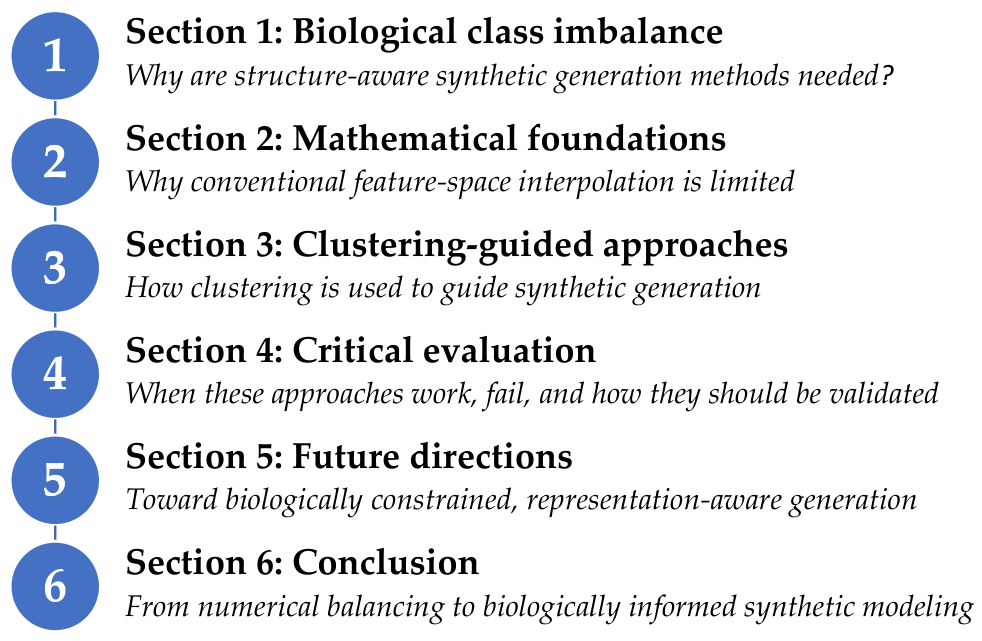
Figure 2.
Structure-aware computational framework for clustering-guided synthetic generation in computational biology. Instead of generating synthetic samples directly from individual minority-class observations, biological data are first represented in an appropriate feature space and partitioned into structurally coherent groups. Synthetic observations are then generated within cluster-defined regions, reducing unrealistic interpolation across distinct biological populations and producing an augmented dataset for downstream machine learning.
Figure 2.
Structure-aware computational framework for clustering-guided synthetic generation in computational biology. Instead of generating synthetic samples directly from individual minority-class observations, biological data are first represented in an appropriate feature space and partitioned into structurally coherent groups. Synthetic observations are then generated within cluster-defined regions, reducing unrealistic interpolation across distinct biological populations and producing an augmented dataset for downstream machine learning.
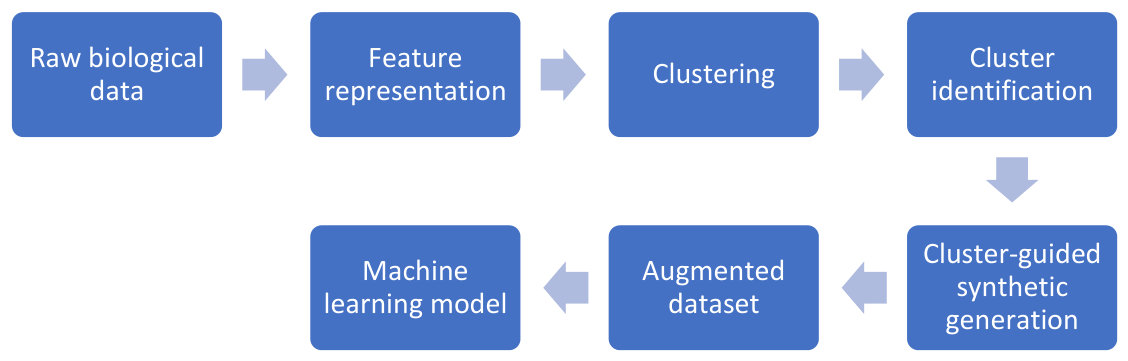
Figure 3.
Evolution from conventional feature-space interpolation toward structure-aware synthetic generation. Conventional SMOTE generates synthetic observations directly from nearest-neighbor interpolation in feature space, whereas clustering-guided approaches first identify latent biological structure before generating synthetic samples within coherent subpopulations, thereby reducing biologically unrealistic interpolation.
Figure 3.
Evolution from conventional feature-space interpolation toward structure-aware synthetic generation. Conventional SMOTE generates synthetic observations directly from nearest-neighbor interpolation in feature space, whereas clustering-guided approaches first identify latent biological structure before generating synthetic samples within coherent subpopulations, thereby reducing biologically unrealistic interpolation.
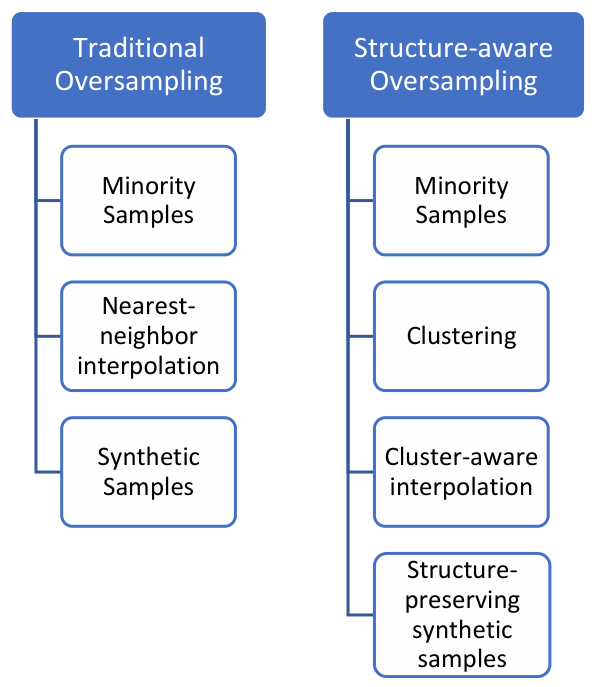
Figure 4.
A structured decision matrix to guide method selection. Partition-based approaches suit datasets with compact, discrete biological groups, whereas density-based methods excel at capturing irregular populations and rare biological states. When cell states transition along continuous trajectories, such as developmental pathways, fuzzy clustering provides a more realistic representation of overlapping populations. For high-dimensional omics data, representation-aware clustering improves structure discovery by mapping relationships within latent spaces. Finally, integrating cluster-filtering strategies helps mitigate the impact of noisy observations, unreliable annotations, and experimental artifacts during synthetic data generation.
Figure 4.
A structured decision matrix to guide method selection. Partition-based approaches suit datasets with compact, discrete biological groups, whereas density-based methods excel at capturing irregular populations and rare biological states. When cell states transition along continuous trajectories, such as developmental pathways, fuzzy clustering provides a more realistic representation of overlapping populations. For high-dimensional omics data, representation-aware clustering improves structure discovery by mapping relationships within latent spaces. Finally, integrating cluster-filtering strategies helps mitigate the impact of noisy observations, unreliable annotations, and experimental artifacts during synthetic data generation.
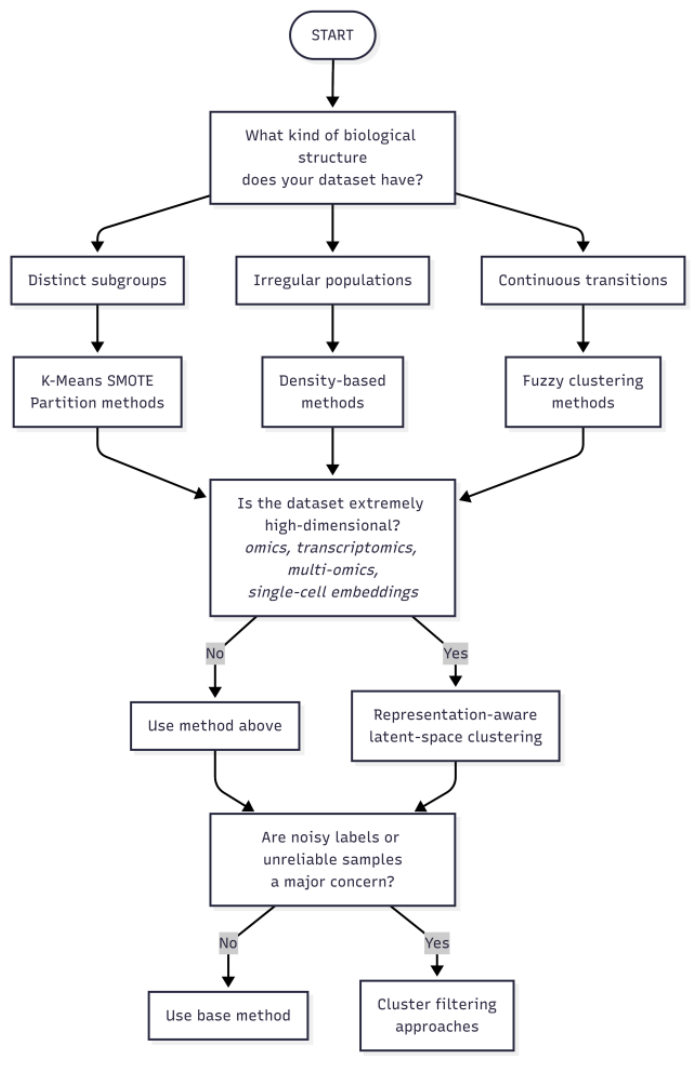
Figure 5.
Multidimensional evaluation framework for clustering-guided synthetic generation in computational biology. Evaluation should extend beyond predictive performance to include statistical validation, computational utility, and biological plausibility providing a comprehensive assessment of synthetic data quality.
Figure 5.
Multidimensional evaluation framework for clustering-guided synthetic generation in computational biology. Evaluation should extend beyond predictive performance to include statistical validation, computational utility, and biological plausibility providing a comprehensive assessment of synthetic data quality.
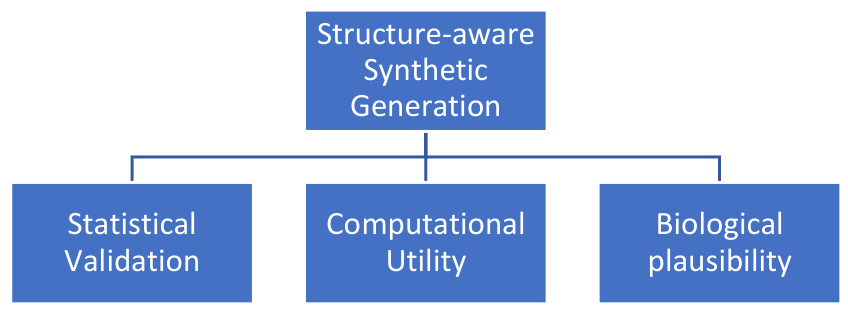

Table 1.
Comparative summary of clustering-guided oversampling approaches for computational biology.
Table 1.
Comparative summary of clustering-guided oversampling approaches for computational biology.
| Approach | Computational strategy | Suitable biological applications | Strengths | Limitations |
| Partition-based methods (e.g., K-Means SMOTE [15]) | Partitions minority samples into centroid-based clusters before interpolation. | Molecular subtypes, structured patient cohorts, bulk omics datasets. | Simple, computationally efficient, reduces interpolation across distant groups. | Assumes spherical, well-separated clusters, sensitive to the number of clusters (k). |
| Density-based methods (e.g., DBSCAN-SMOTE [18]) | Identifies dense regions while excluding sparse areas and outliers. | Rare cell populations, single-cell RNA-seq, heterogeneous biological data. | Preserves irregular cluster shapes and improves robustness to noise. | Sensitive to density parameters, performance declines in datasets with varying densities. |
| Cluster-filtering methods (e.g., CFS-SMOTE [23]) | Removes noisy or overlapping samples before or after synthetic generation. | Clinical datasets, noisy genomic and proteomic data. | Reduces synthetic noise and class overlap, improving decision boundaries. | May eliminate biologically meaningful rare observations if filtering is too aggressive. |
| Fuzzy clustering methods [19] | Assigns probabilistic membership of samples to multiple clusters. | Continuous cell differentiation, developmental trajectories, disease progression. | Models gradual biological transitions and uncertain class boundaries. | Higher computational complexity and sensitivity to membership parameters. |
| Latent-space clustering (e.g., Gaussian Mixture Models [24]) |
Learns low-dimensional representations before clustering and oversampling. | Multi-omics integration, deep learning, single-cell foundation models. | Captures nonlinear biological structure and complex molecular relationships. | Requires large datasets, substantial computational resources, and careful model training. |
Disclaimer/Publisher’s Note: The statements, opinions and data contained in all publications are solely those of the individual author(s) and contributor(s) and not of MDPI and/or the editor(s). MDPI and/or the editor(s) disclaim responsibility for any injury to people or property resulting from any ideas, methods, instructions or products referred to in the content. |
© 2026 by the authors. Licensee MDPI, Basel, Switzerland. This article is an open access article distributed under the terms and conditions of the Creative Commons Attribution (CC BY) license.
Copyright: This open access article is published under a Creative Commons CC BY 4.0 license, which permit the free download, distribution, and reuse, provided that the author and preprint are cited in any reuse.